Brown-headed nuthatches – examples of conscientious and industrious parenthood!

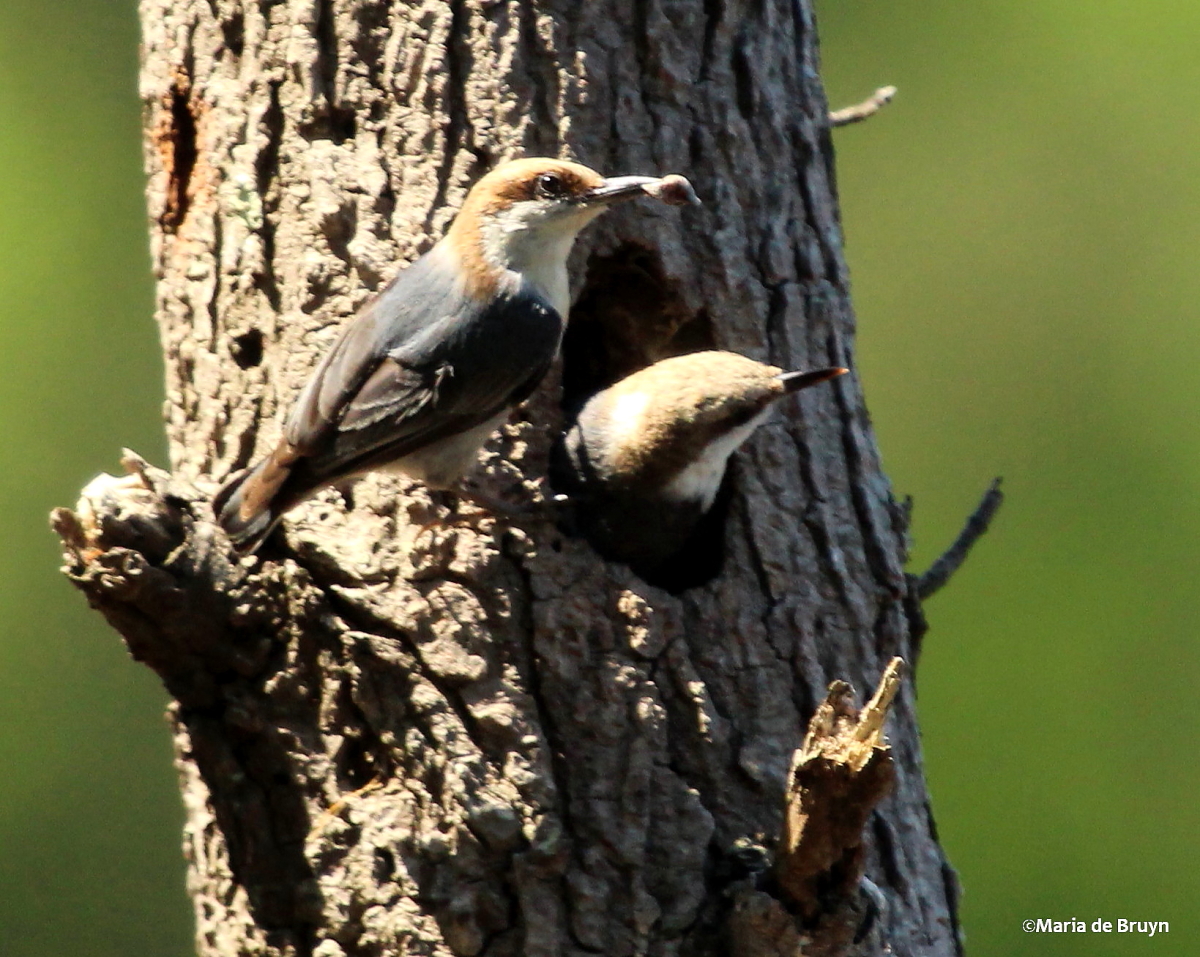
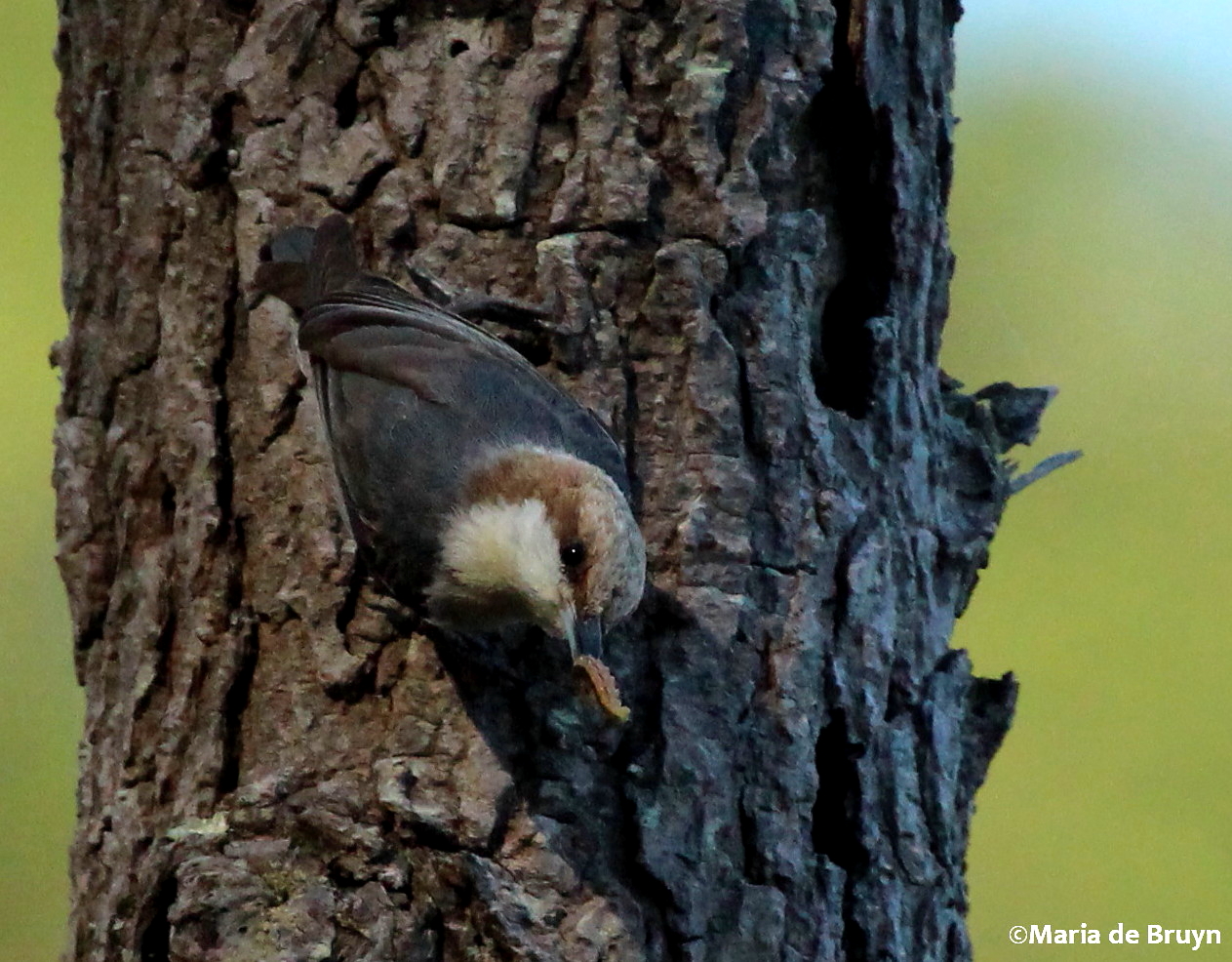
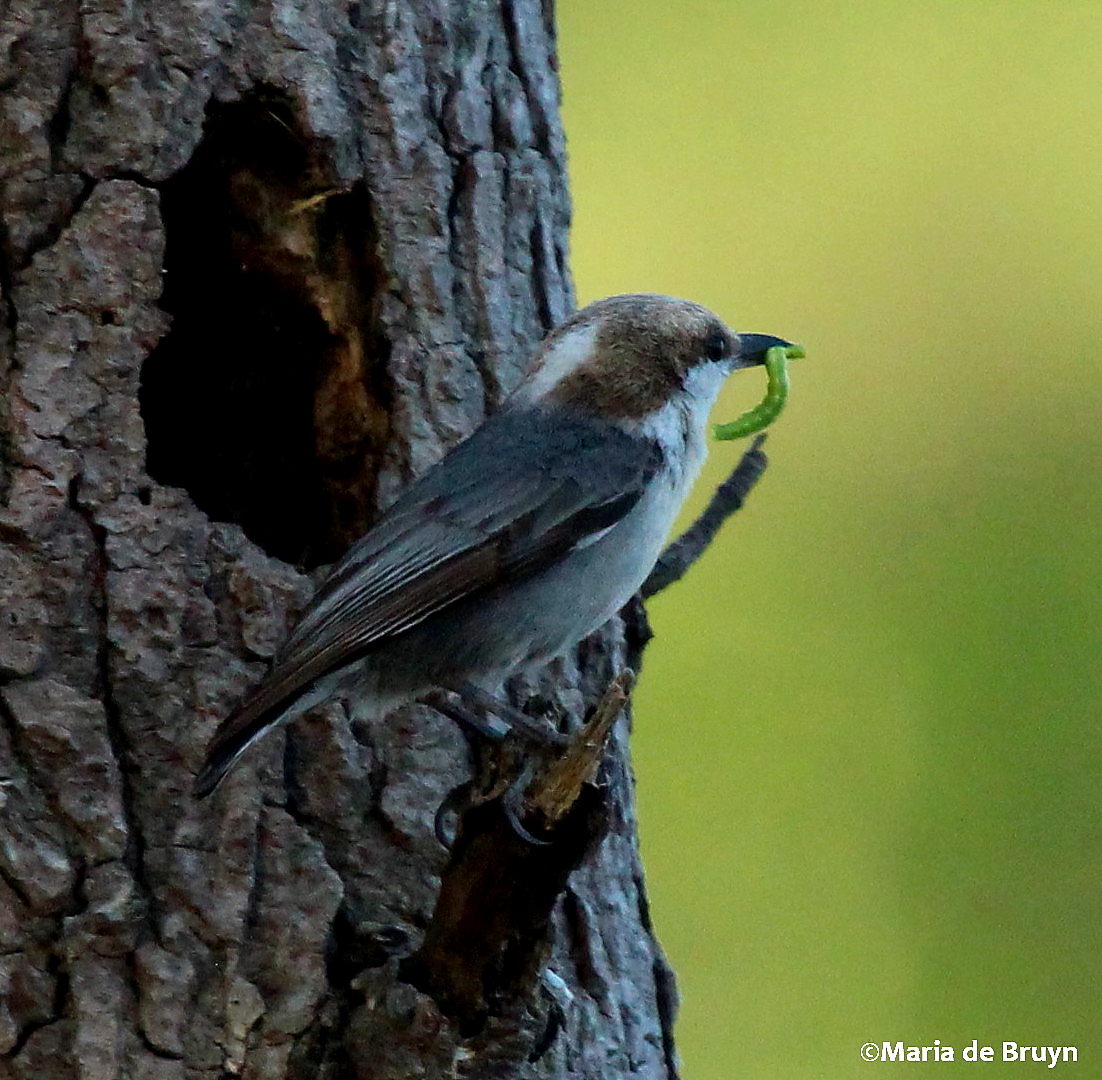
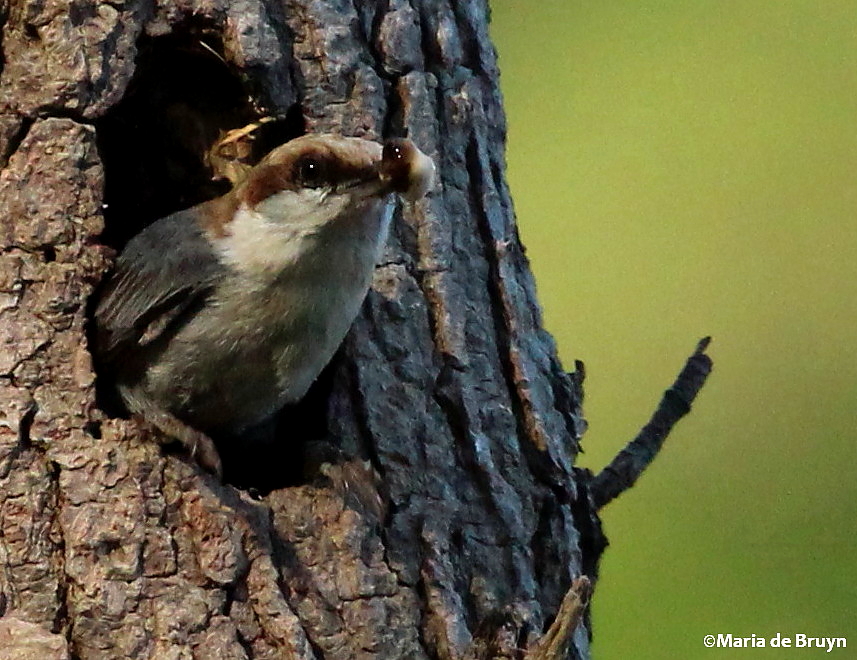
IMG_3634©Maria de BruynLast weekend, when walking the woods along Jordan Lake in order to write a blog for the NC Audubon Society, I happened upon a thin dead tree standing in the water at the shore’s edge. Just then as I was looking it up and down, a brown-headed nuthatch (Sitta pusilla) flew up and made its way down the trunk to a hole where it obviously had a nest. That was a treat and I watched the mom and dad fly to and fro with provisions for the brood.

Yesterday, I decided to return and see if the industrious pair was still working on meals for their brood. They were indeed and I watched for quite a long time, wondering how they could see anything down in the nest where it has to be pretty dark.
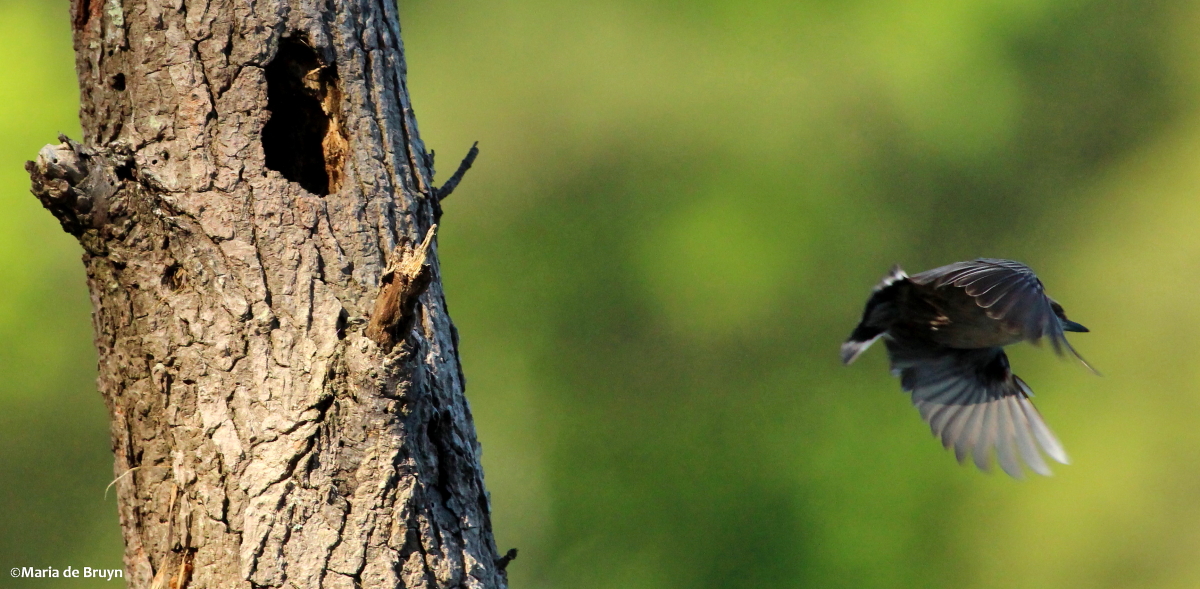
brown-headed nuthatch IMG_3690©Maria de BruynresThese lovely little birds are native to the Southeastern US and there is a small population in the Bahamas; they don’t live in any other countries so they really are kind of special. In addition, since 1966, the population has declined by 45% because they are losing nesting habitats (dead and pine trees) to deforestation and urbanization.
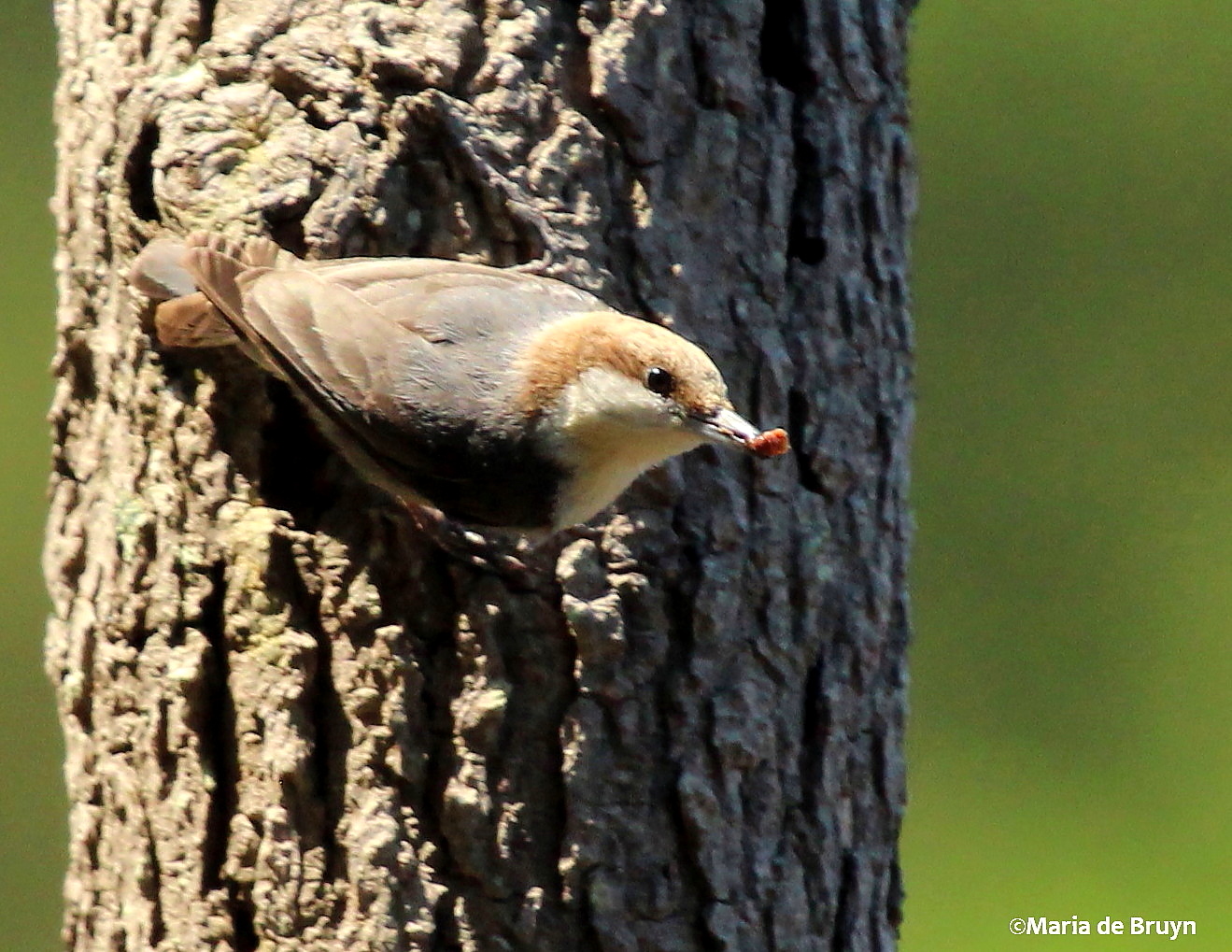
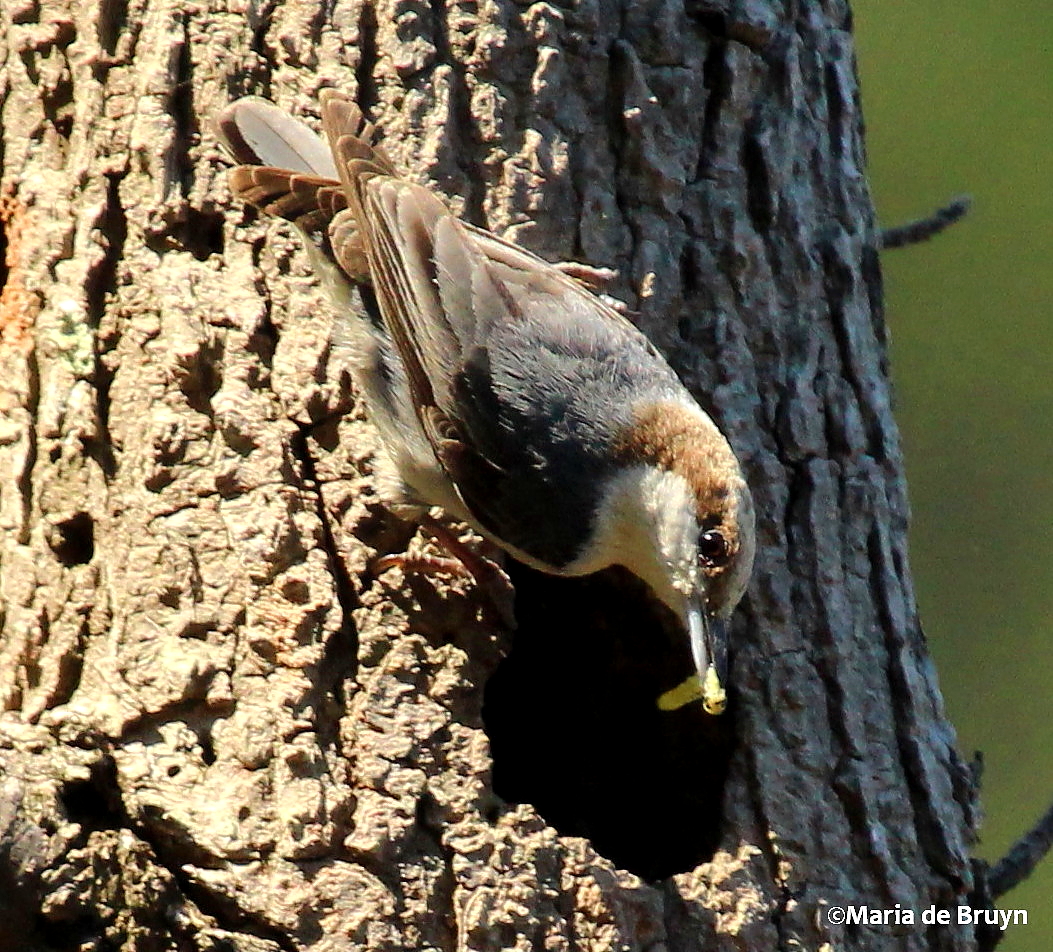
IMG_4116©Maria de Bruyn IMG_4031©Maria de Bruyn brown-headed nuthatch IMG_4136©Maria de Bruyn res

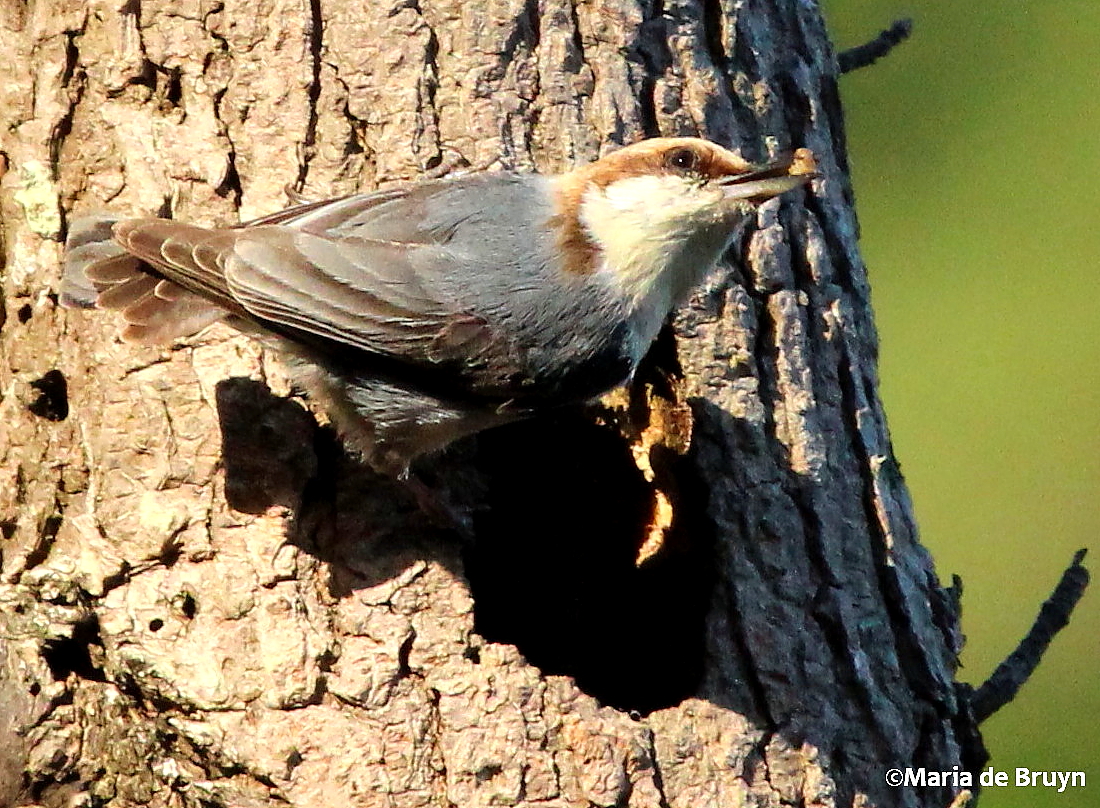
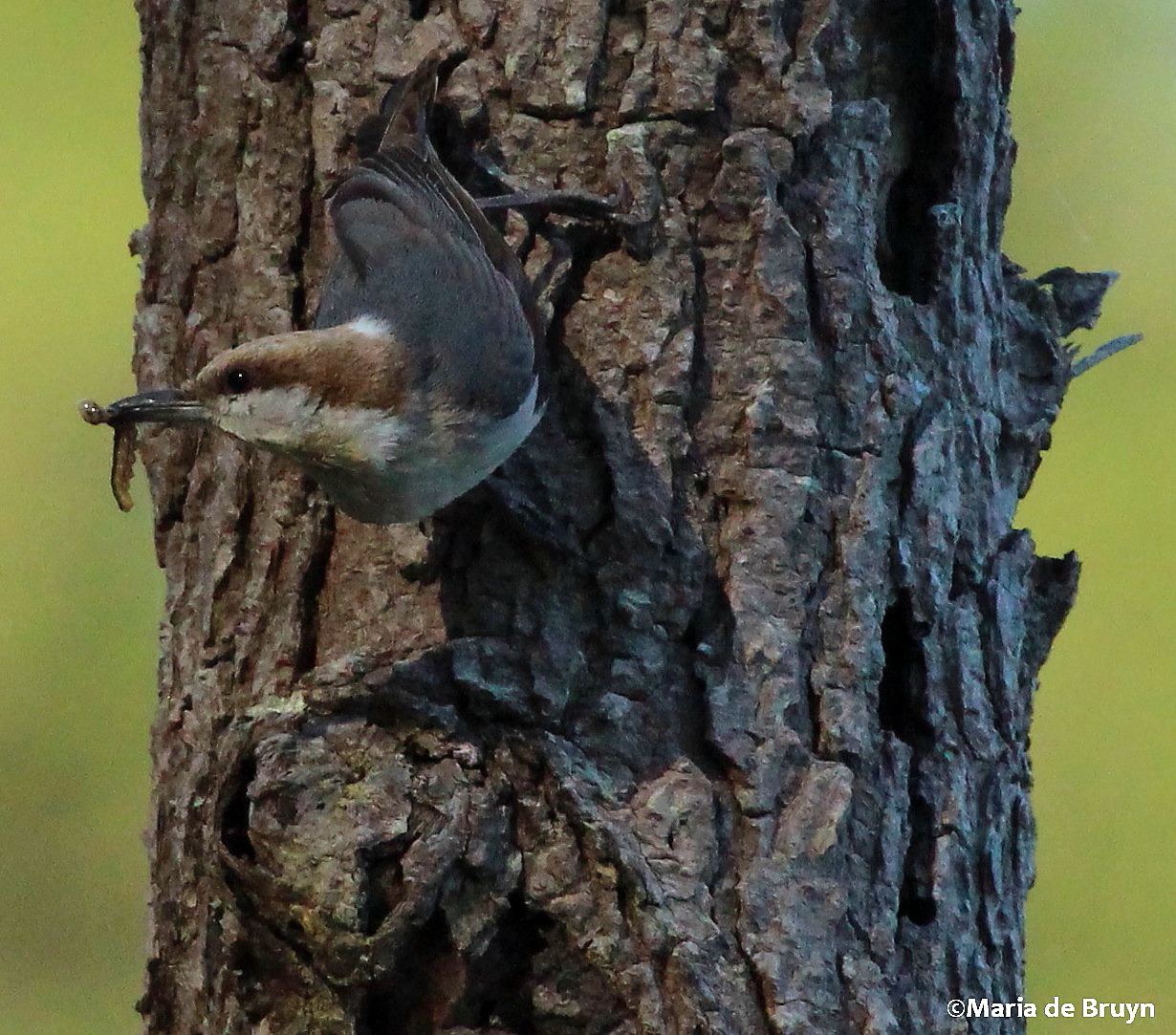
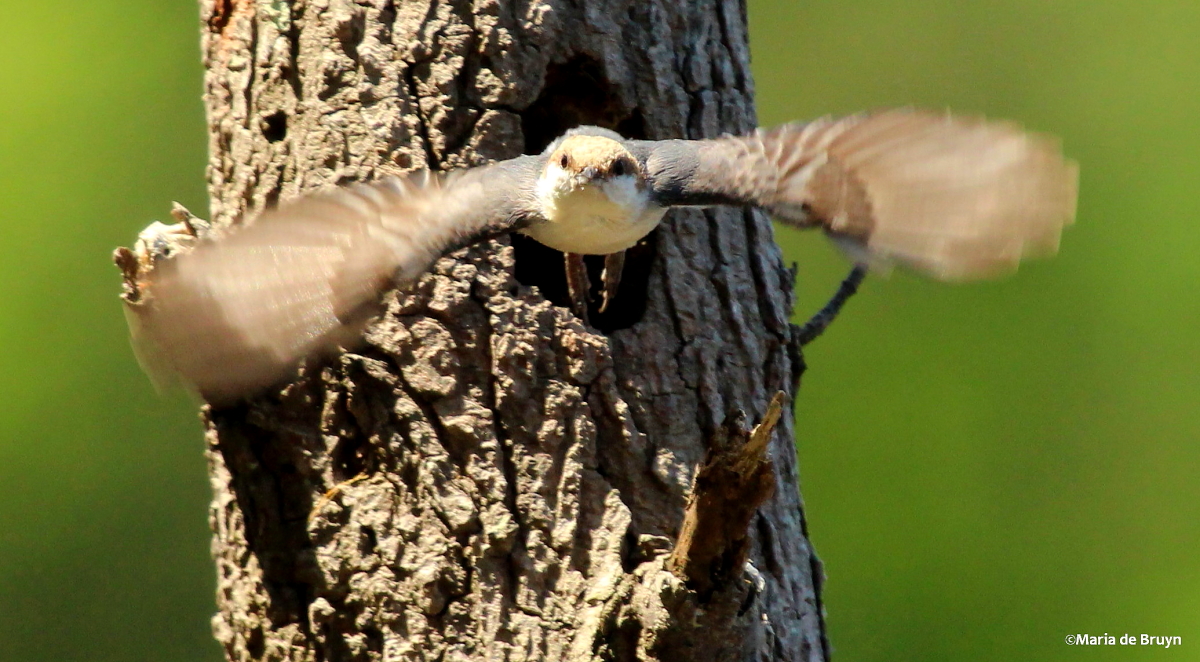
The parents were most often alternating their meal runs, but occasionally they would arrive simultaneously or very close in time. They would usually alight on the trunk above the nest hole and then work their way down – they can descend head-first, which is a handy trait.
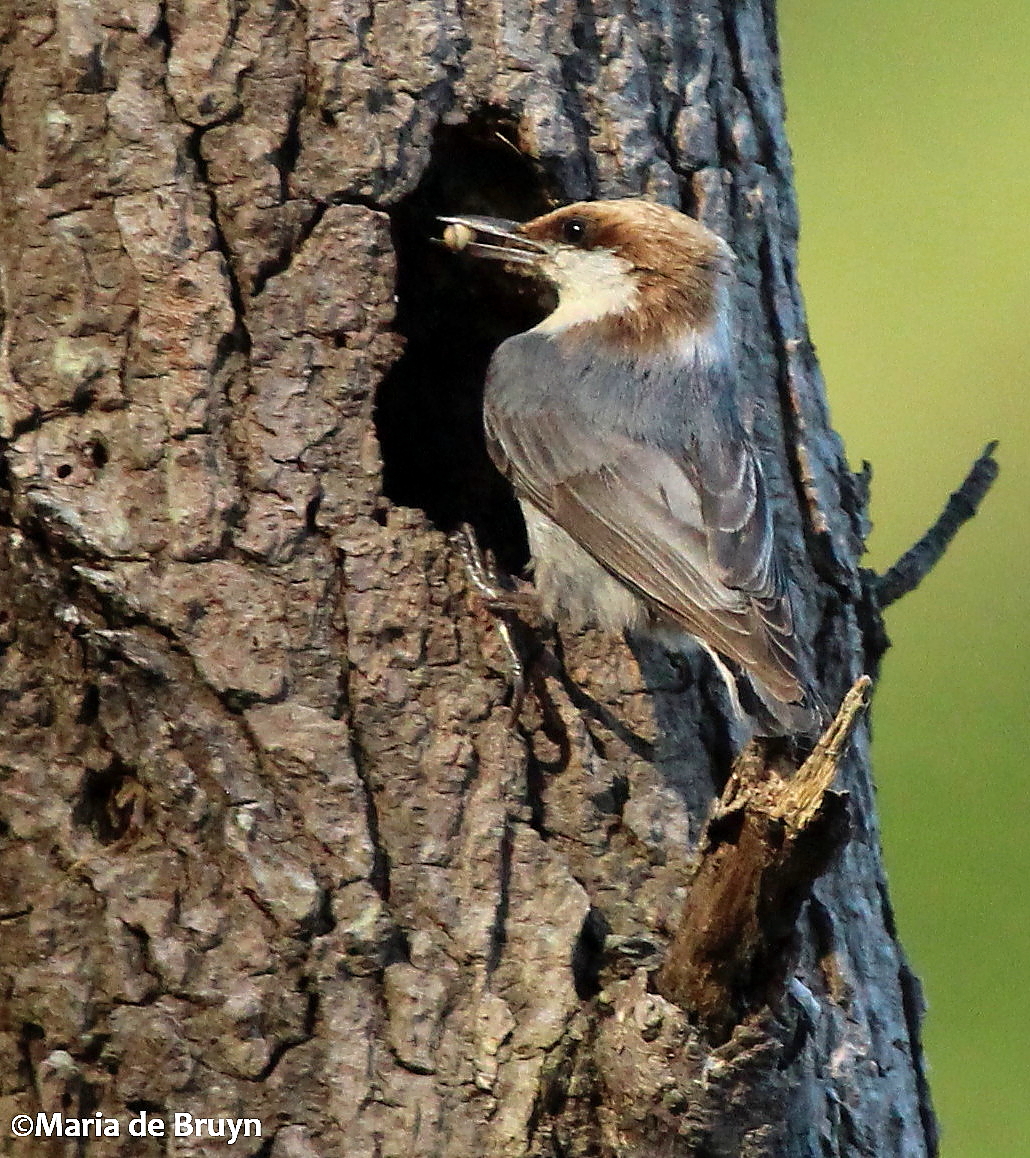
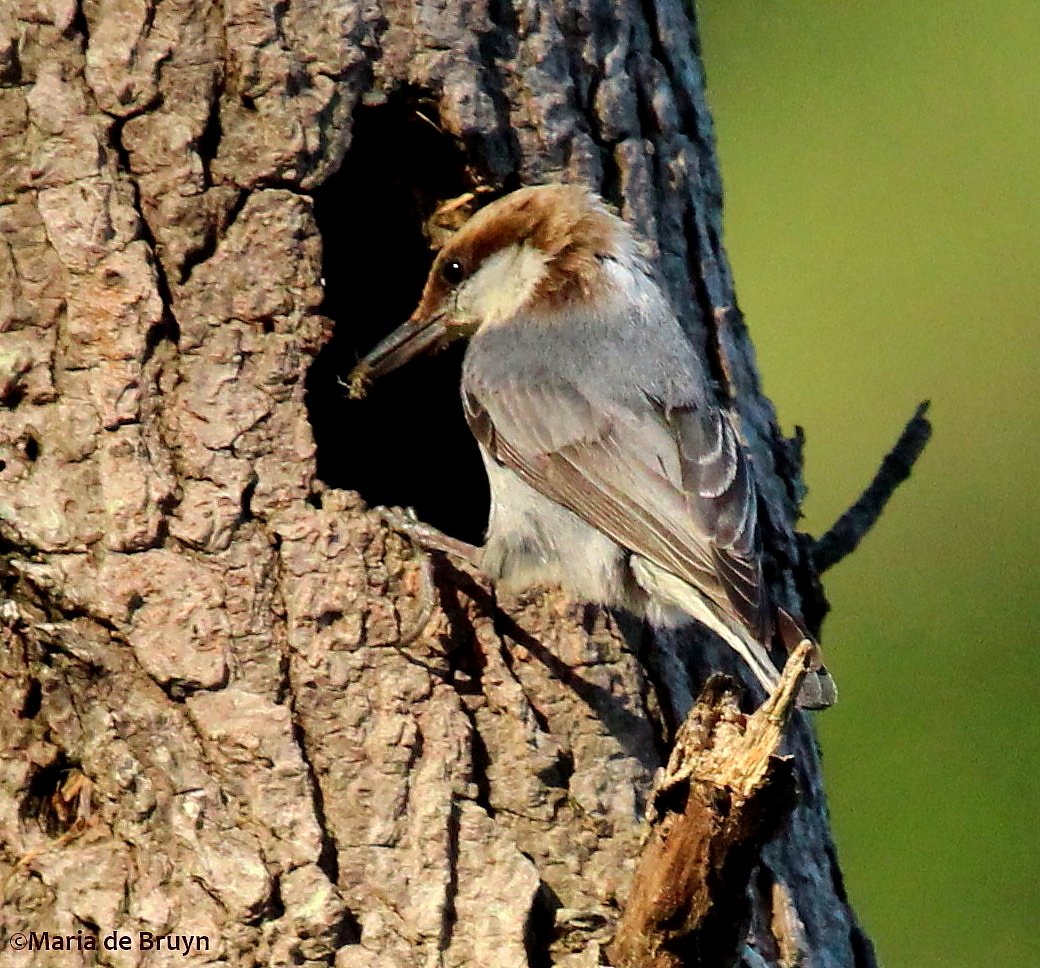
IMG_3726©Maria de Bruyn IMG_3684©Maria de Bruyn IMG_3669©Maria de Bruyn

Occasionally, though, they would alight right by the hole or work their way upwards from a little further down the tree trunk. They seemed very concentrated on their task but I learned that they were definitely keeping an eye on me because when I took up a position a bit closer to the tree for some better shots, they just hopped about in other trees waiting for me to step back again. Which I did, of course.
IMG_3639©Maria de Bruyn IMG_3627©Maria de Bruyn

Though I didn’t witness it, these small birds are tool-users, sometimes using a piece of bark to pry up tree bark in search of insects; they may even carry the tool with them. They certainly were bringing their babies varied meals, including moth caterpillars and insects of various kinds.
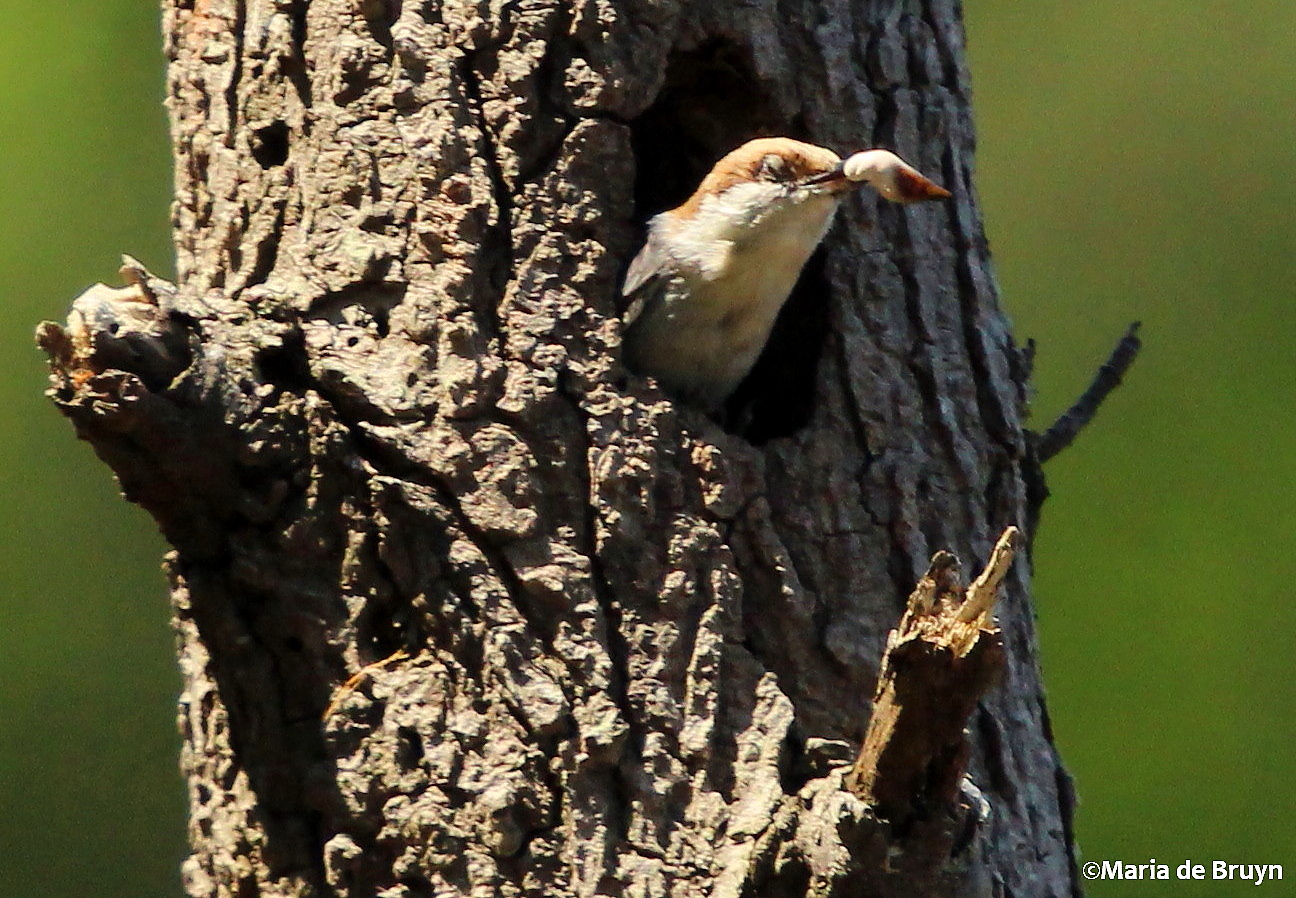
IMG_4164©Maria de BruynThese parents were fastidious, too, removing fecal sacs from the nest with some regularity. I had hoped to see these birds in action when using a nuthatch box I put up in my yard, but a pair of Carolina chickadees (Poecile carolinensis) are currently raising a brood there.


brown-headed nuthatch IMG_4197©Maria de Bruyn resIMG_3658©Maria de Bruyn

The nestlings fledge after about 18 days so I may be too late to see anything when I return sometime this coming week, but it sure would be cool to see them leave the nest!
brown-headed nuthatch IMG_4149©Maria de Bruyn res

So, you may ask – what happened to the blog on springtime creatures I announced last time? Well, the various birds species are working so hard and demonstrating their parenting skills so nicely right now, I decided to focus on that for a little while! Next time – those squatter Chickadees in my yard!
More spring flowers – at home and in the wild

Up until 2 a.m. crocus IMG_3724©Maria de Bruyn resworking on an advocacy paper and then awakened by a tornado alert on my cell phone at 5 a.m. a few days ago, seeing bright flashes of lightening through the blinds and hearing rumbling thunder as the rain poured down. After what seemed like a somewhat lengthy and lingering winter, we’ve had a rather wet spring with temperatures yo-yo-ing. The flowers seemed a bit confused, too, but they have been blooming albeit not always when expected!Pear blossom IMG_3985©Maria de Bruyn res
 

My yard is quite enjoyable in the spring, with a variety of cultivated and wild-growing flowers. The cheerful violet crocuses (Crocus) were the first to greet me in delightful profusion, while the early blooming pear tree (Pyrus) only had a few blossoms this year, apparently confused by warm spring days alternating with freezing mornings.

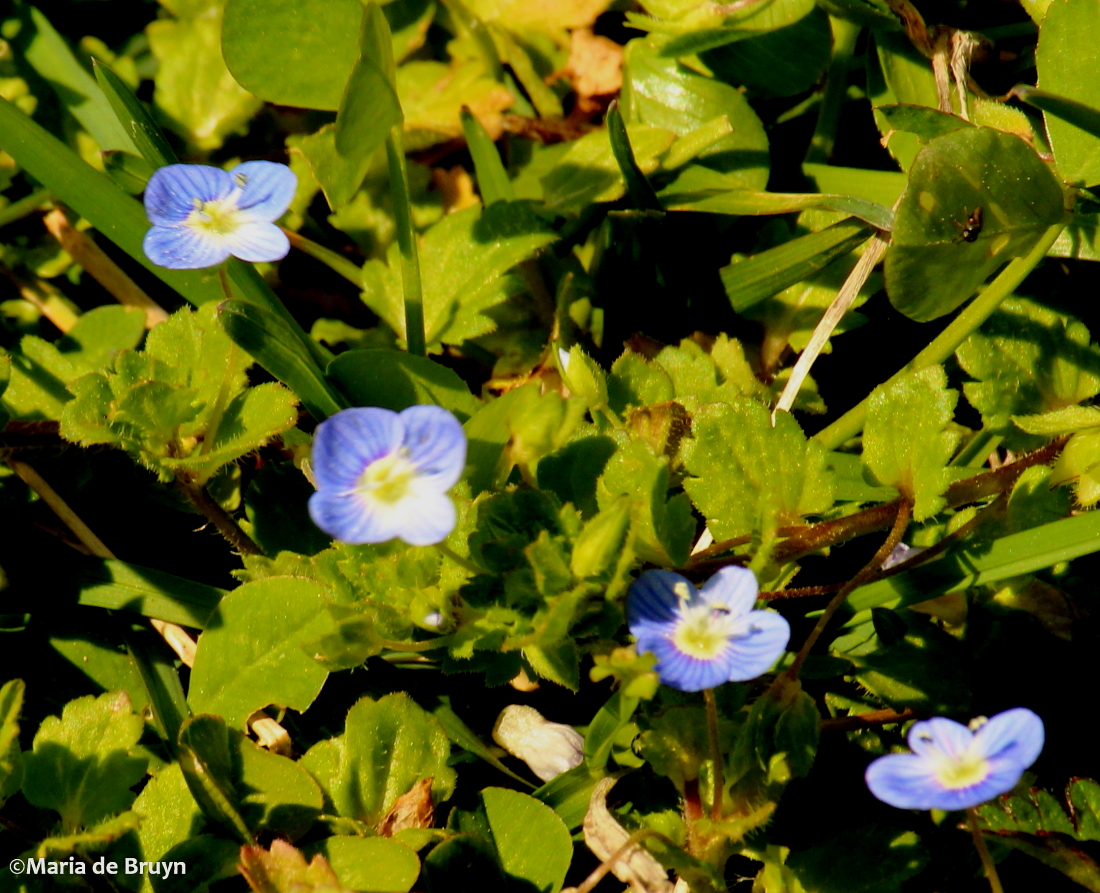
A rapidly spreading invader, the purple deadnettle (Lamium purpureum) has moved into my flowerbeds, obviously feeling that it should be nestled in among the African daisies and tulips. It’s fine with me; I leave them be with their lovely little blossoms. The cute little Persian speedwell (Veronica persica) is sticking to the “lawn” – I wouldn’t mind if the grass were gradually all replaced with this wildflower, clover and moss.

Purple deadnettle IMG_4522©Maria de Bruyn res Persian speedwell IMG_6519©Maria de Bruynres

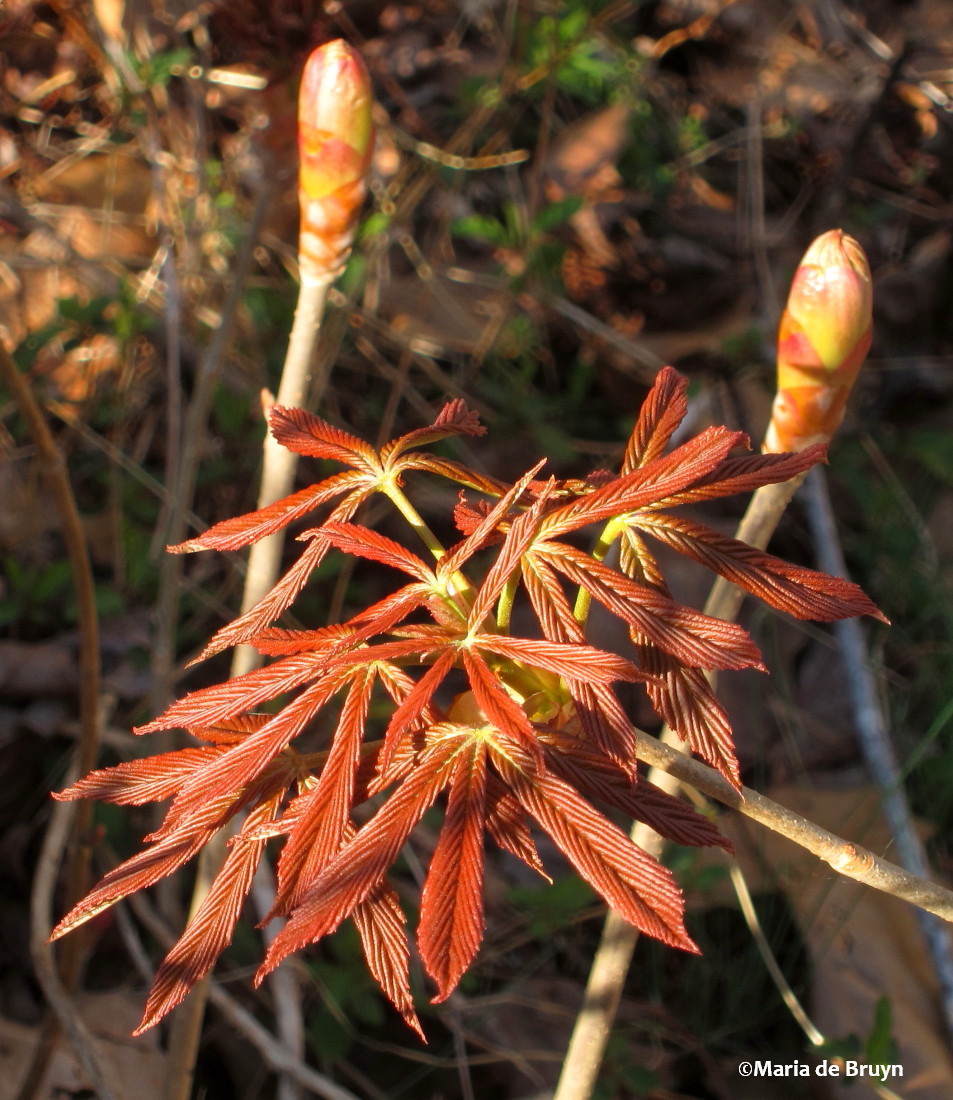
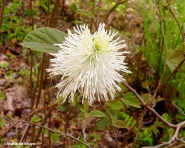
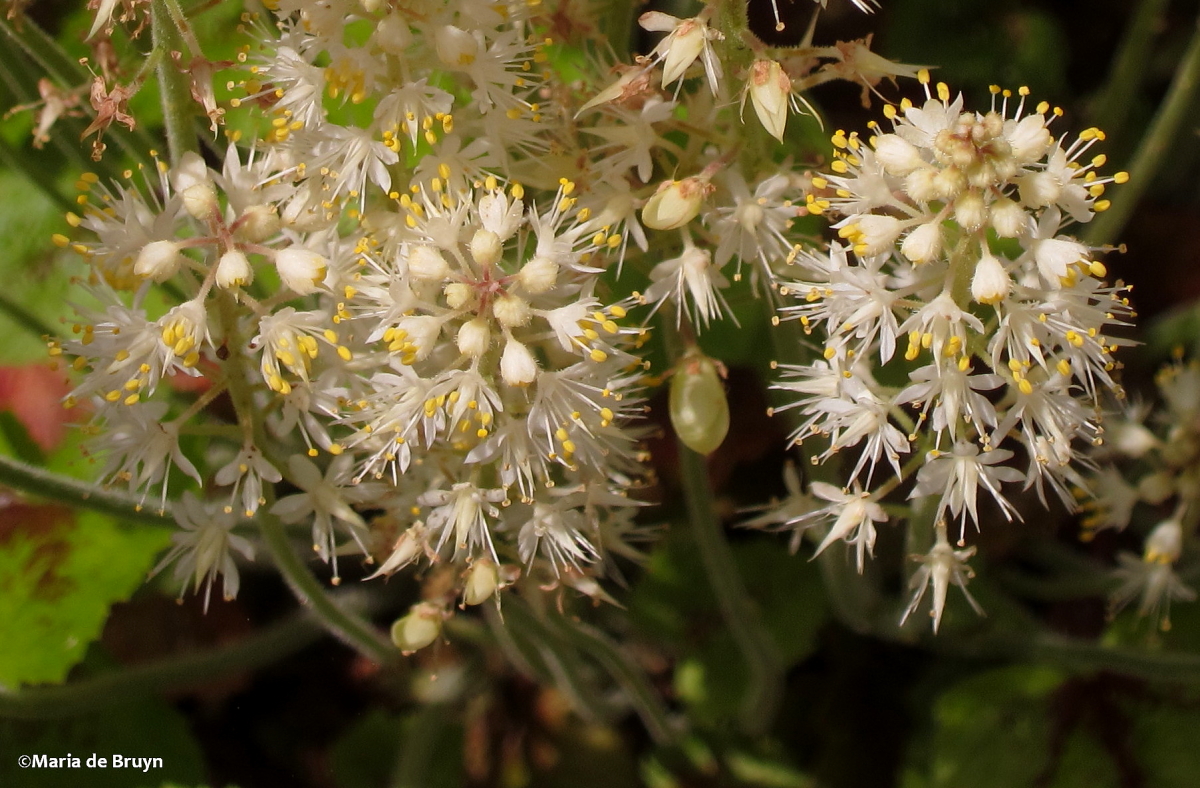
Painted buckeye IMG_3887©Maria de Bruyn resThe painted buckeyes (Aesculus sylvatica) have now bloomed but were also very pretty when they first began growing, like this specimen near Bolin Creek. Sweet Betsy (Calycanthus floridus) had reached a good size at the Botanical Garden, where the mountain witch alder (Fothergilla major) was also showing off its flowers. The foamflower (Tiarelia cordifolia var. collina) was half-way through its cycle and being visited by lots of bees.

sweet betsy IMG_4263©Maria de BruynresMountain witch alder IMG_4552©Maria de Bruyn

Foamflower IMG_4532©Maria de Bruynres

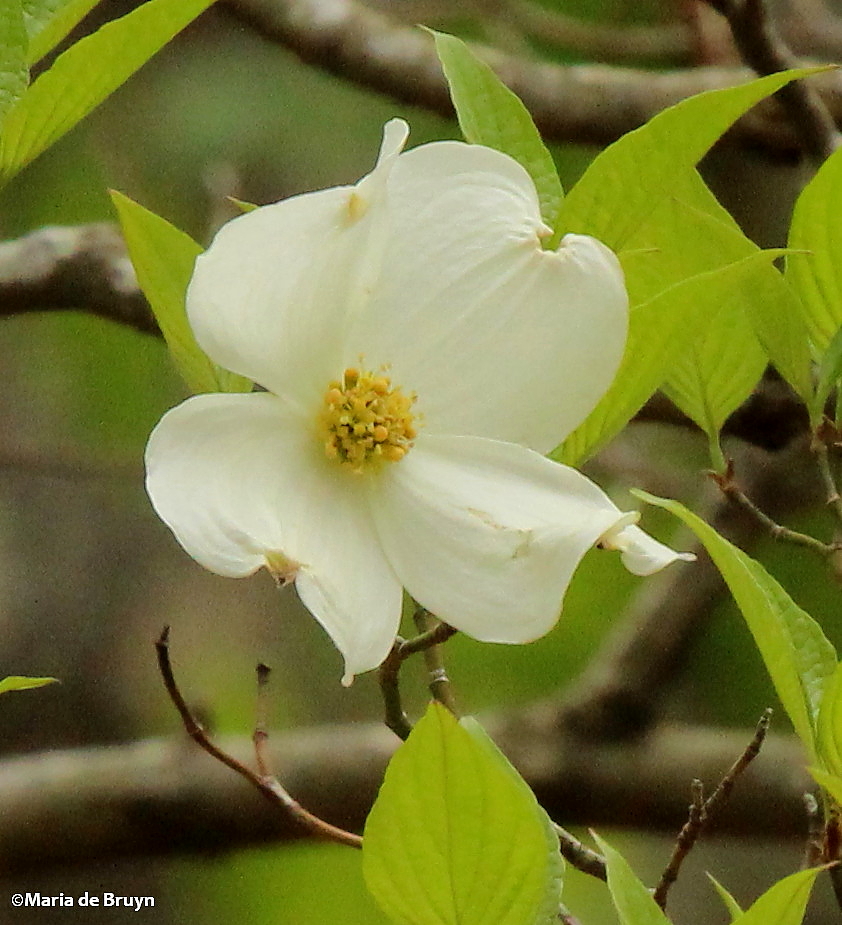
At Mason Farm Biological Reserve, the dogwood (Cornus) was lovely; the tree in my yard didn’t flower this year but the leaves still look healthy. On the ground, the Jack-in-the-pulpit (Arisaema triphyllum) was really abundant in places, some plants with green “tubes” and others with purple-striped ones.

dogwood IMG_9380©Maria de BruynresJack in the pulpit IMG_0833©Maria de Bruyn res

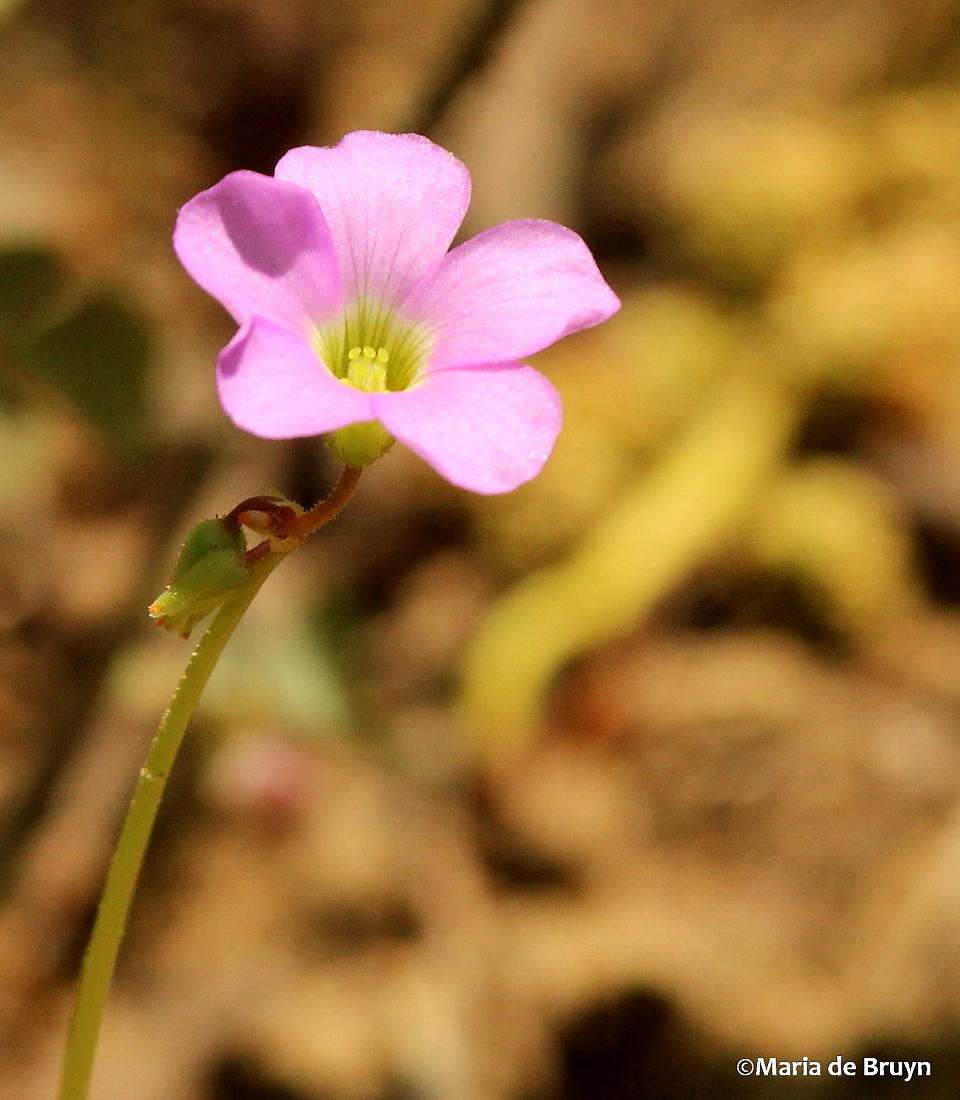
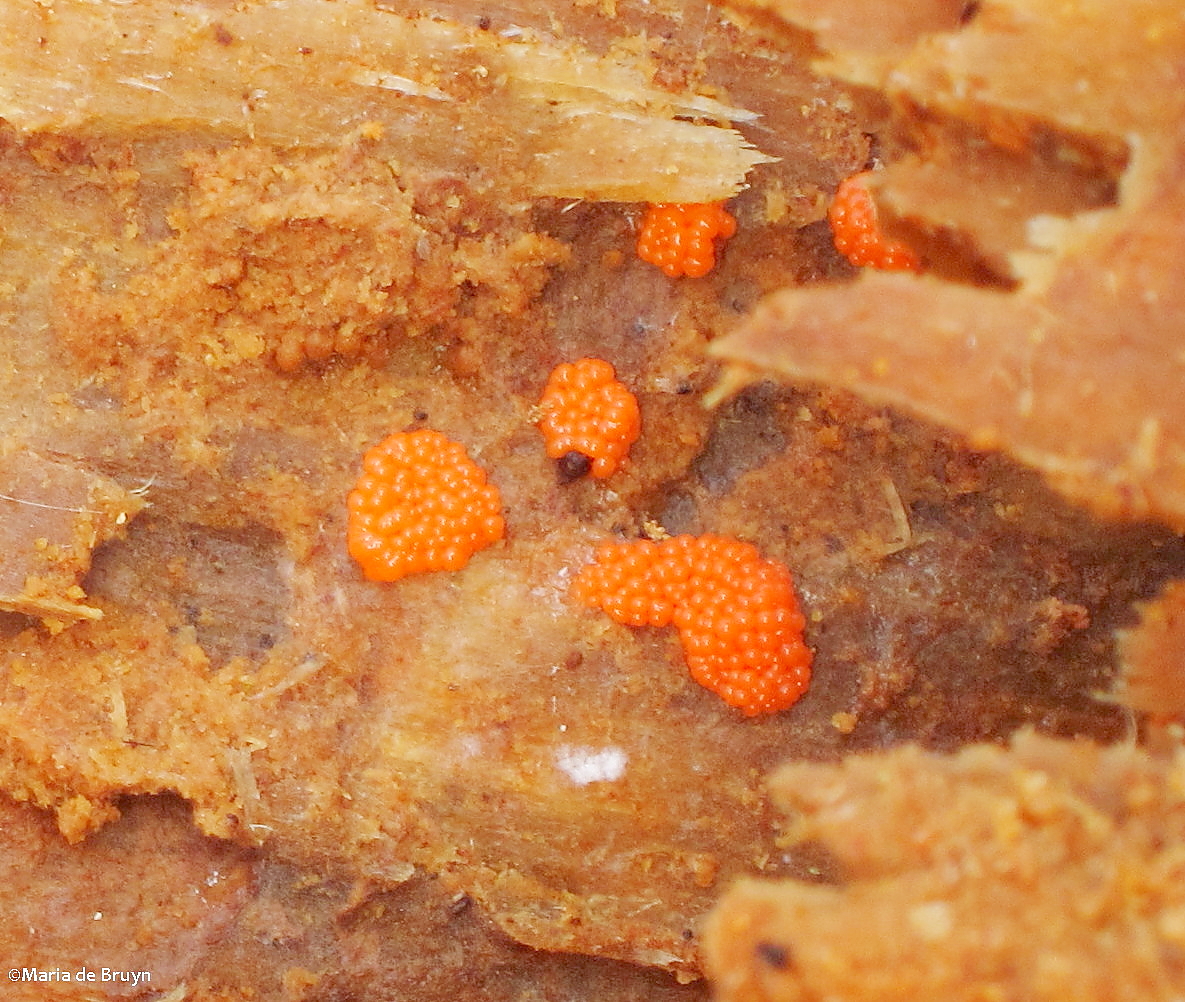
Two plants were a bit mysterious. When I first saw the violet word sorrel (Oxalis violacea), I stared at it for a time as it seemed to be growing out of a clump of clover leaves. However, the flower didn’t look like clover; I finally decided it must be an unusual kind. The man in charge of Mason Farm, a botanist, set me straight fortunately. The other mystery concerned some clumps of red globules. An entomologist who was present told me they were insect eggs; bug experts on BugGuide, however, concurred that this had to be a slime mold. Interesting that insect eggs and slime mold can look so similar!

Violet wood-sorrel IMG_0827©Maria de BruynresSlime mold IMG_4092©Maria de Bruyn

Next blog – some spring wildlife and then back to birds!


Spring has sprung – at last!

While we did have some nice days during the past winter months, we also had some very cold and icy periods in North Carolina. The way the temperatures were yo-yo-ing up and down (70s F and then 20s, 60s then 30s, etc.), the cold and nasty days seemed even worse than usual. I was going to post photos of birds in the snow but “life got in the way” and my time was preoccupied with other tasks. So I’ll jump right into spring with some floral beauties that are blooming.

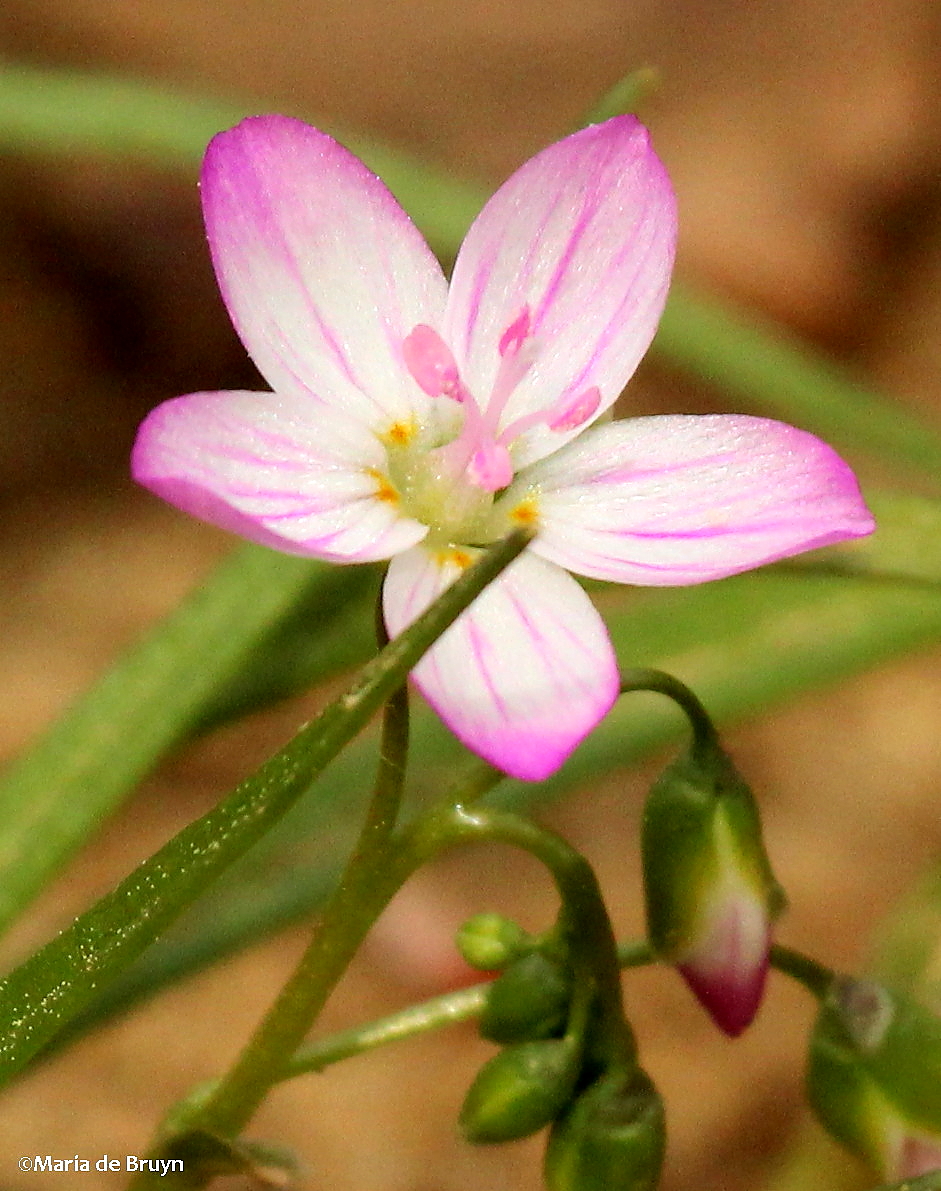
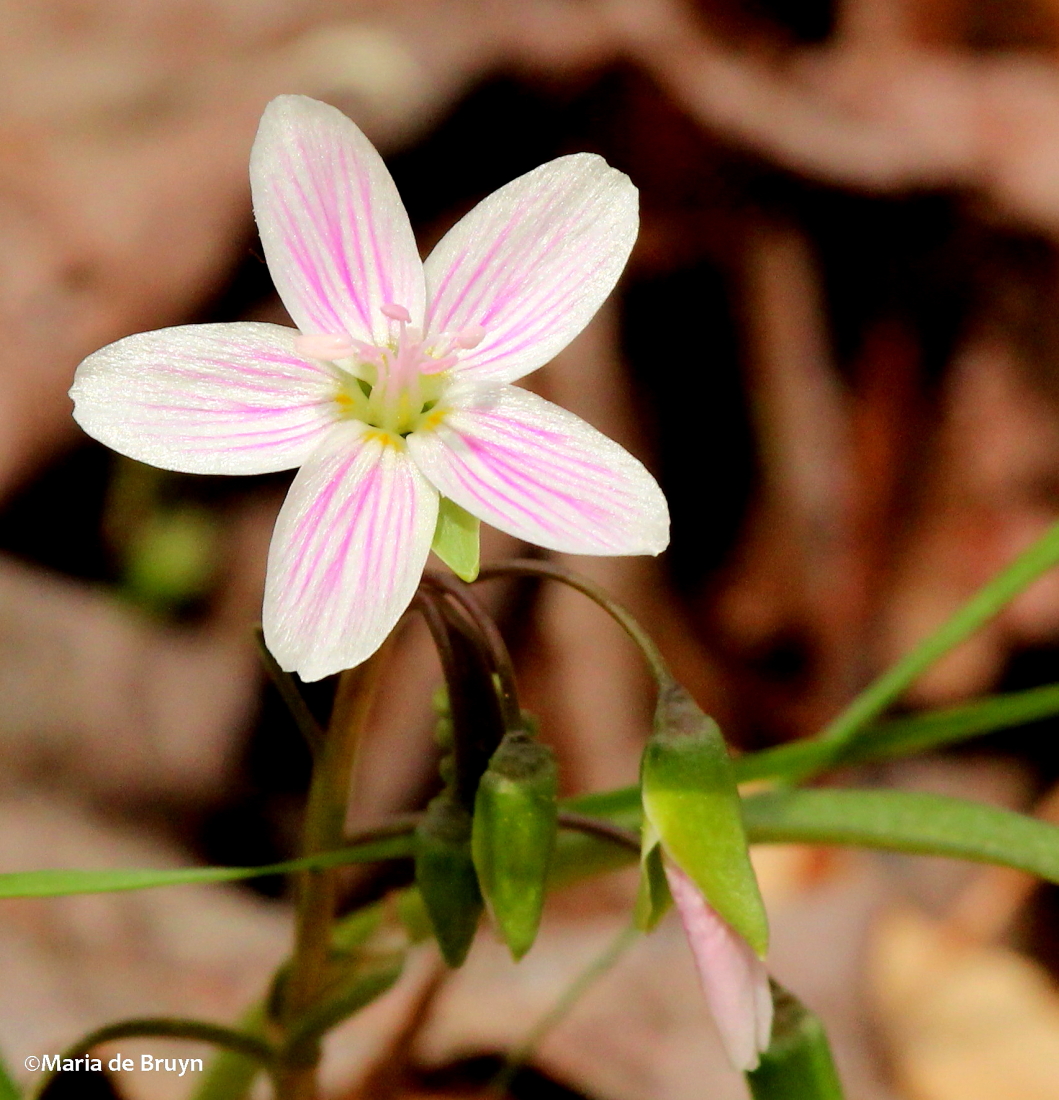
Eastern spring beauty IMG_7866©Maria de BruynThis past Sunday, I went on a wildflower walk organized by the Friends of Bolin Creek and led by Dave Otto, who helped point out and identify the blossoms we were seeing. The Eastern spring beauties (Claytonia virginica) were exactly that – some almost completely white, others with lots of pink and a few with pink stripes on white backgrounds (below left). Some butterflies but especially different types of bees and flies collect nectar and pollen from these flowers and I have been told that the stripes help guide the insects to the pollen. I haven’t found confirmation of that theory, but it’s a nice idea.


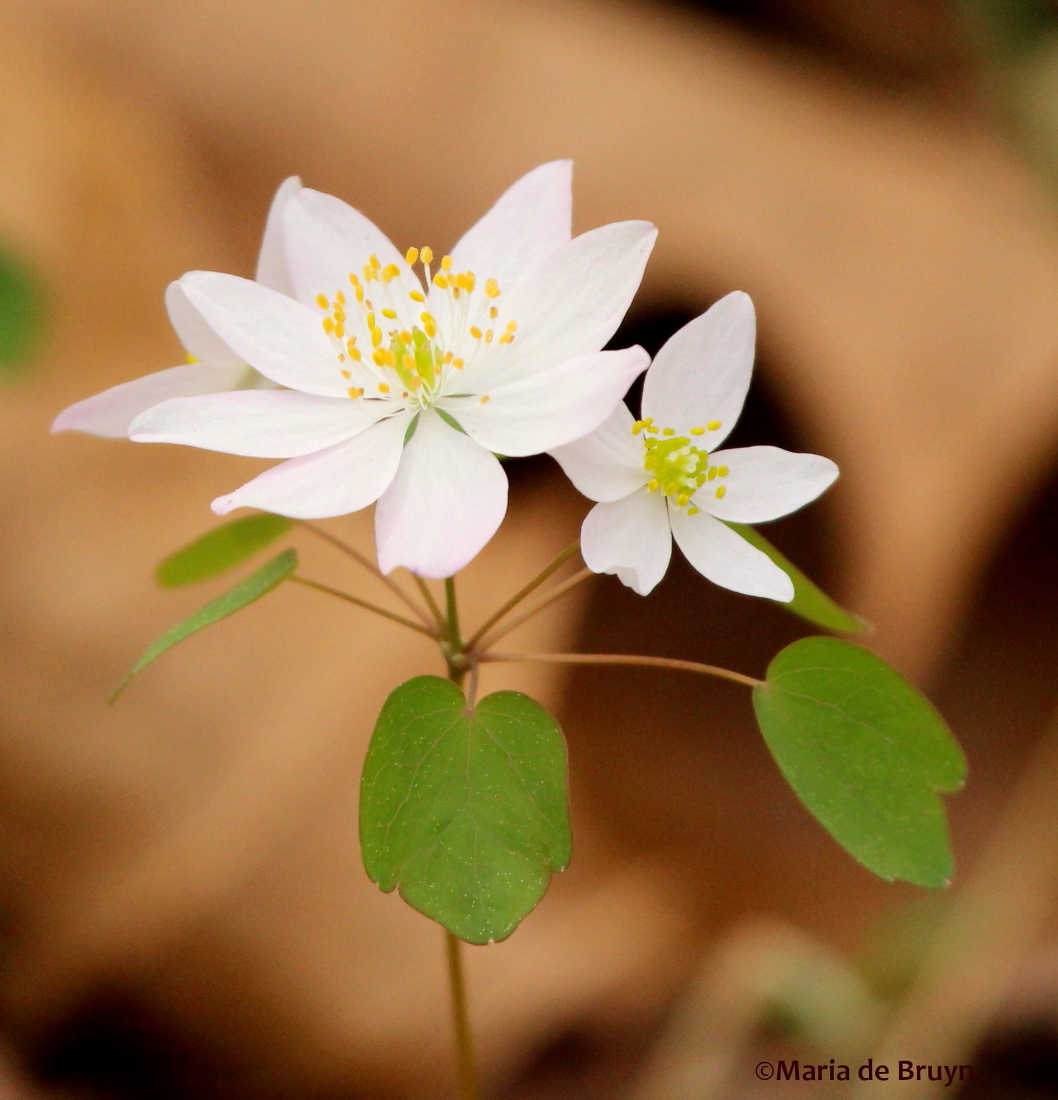
Eastern spring beauty IMG_7876©Maria de Bruyn resRue-anemone IMG_7903©Maria de Bruyn resRue-anemone

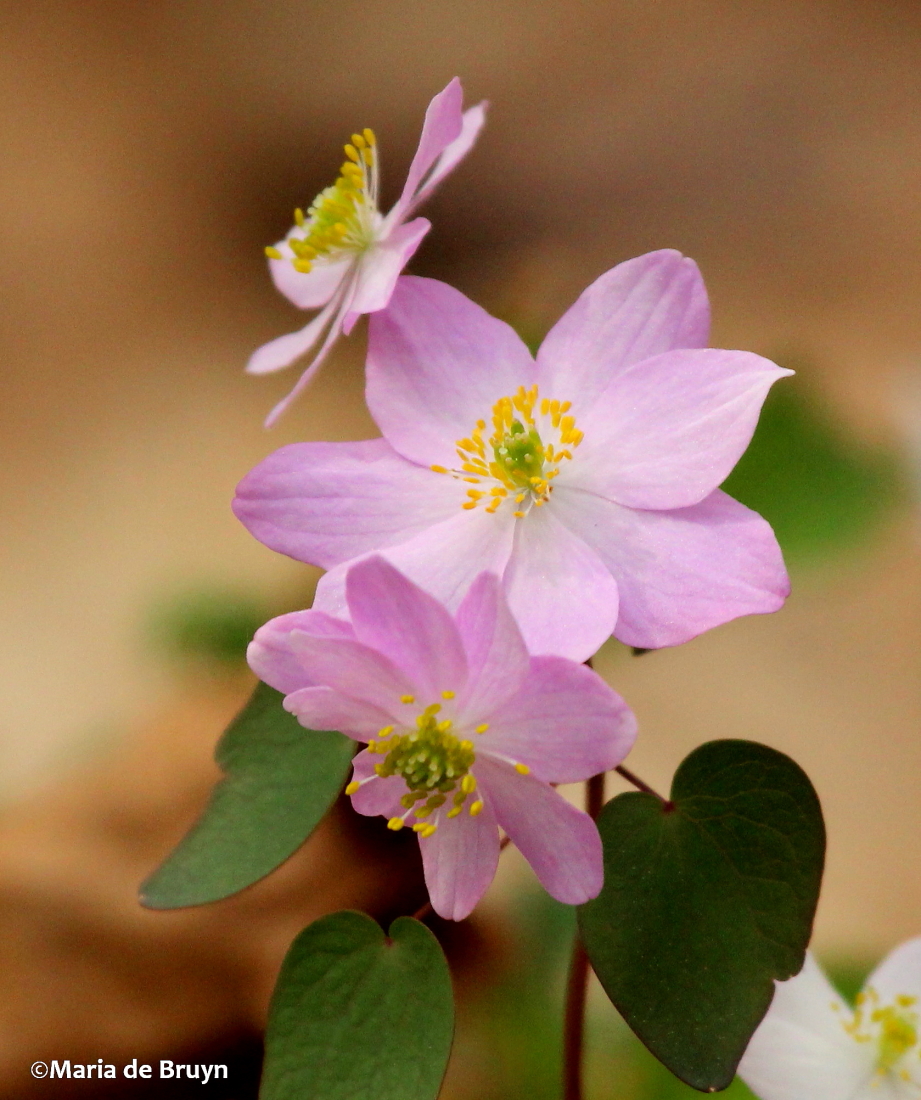
Another small bloom that can be white or with shades of pink is the rue-anemone (Thalictrum thalictroides). Its leaves are more rounded, in contrast to the elongated leaves of the spring beauties.

Rue-anemone IMG_7899©Maria de Bruyn res

We saw a few that looked almost lavender in color, stunning little blossoms that sway to and fro as the breeze moves their stems, undoubtedly contributing to their nickname of windflower.

Star chickweed IMG_7858©Maria de Bruyn

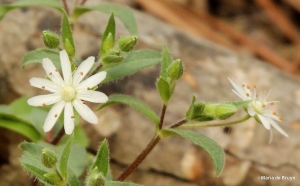
A third white springtime flower is the star chickweed (Stellaria pubera), a cheerful springtime bloomer. While they appear to have 10 petals, the flower actually only has five that are almost split in two.


Crane-fly orchid IMG_4312©Maria de Bruyn res

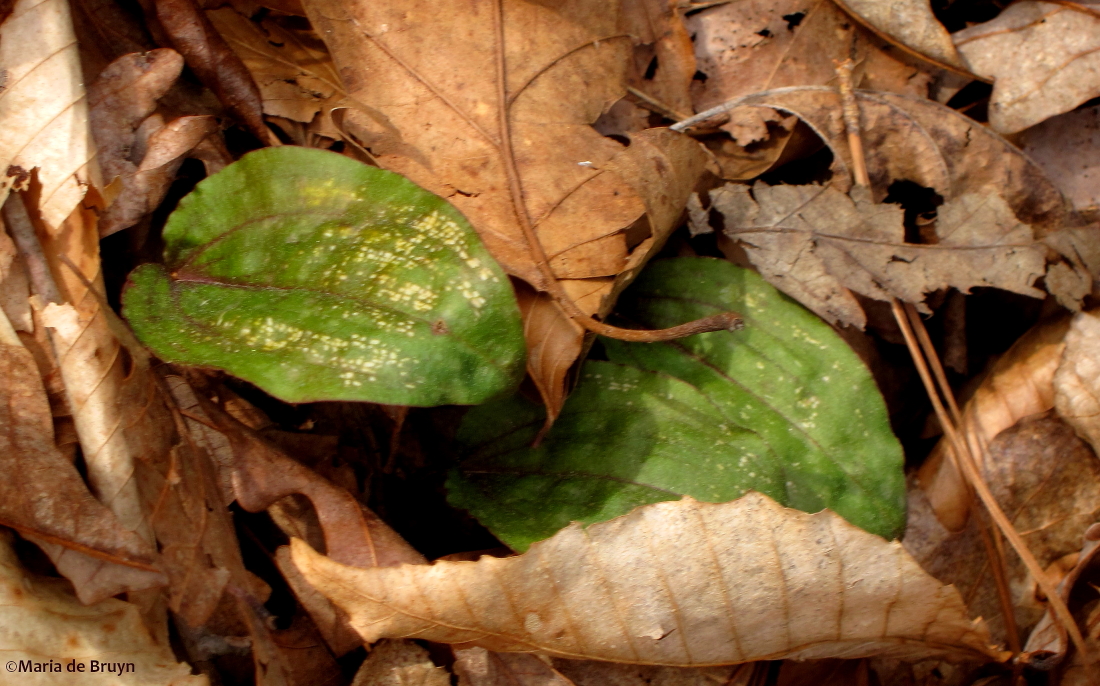
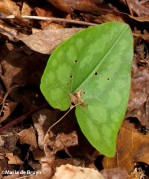
The crane-fly orchid (Tipularia discolor) only has one or two leaves (with dark purple undersides) that emerge in the fall and begin to die off in the springtime. By the end of summer, when the leaves are gone, the flower emerges.

Large-flower heartleaf IMG_4308© Maria de Bruyn

Large flower heart-leaf IMG_4306©Maria de Bruyn res2

The large-flower heartleaf (Hexastylis shuttleworthii), also known as wild ginger, does produce a flower in the spring that resembles a small brown jug.


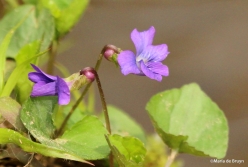
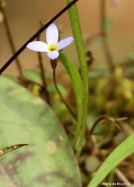
Even thViolet IMG_7868©Maria de Bruynresough they are fairly common, the violets (Viola sororia) are among Azure bluet IMG_7864©Maria de Bruynmy favorites. Their deep blue or purple blooms look wonderful against the deep green leaves. The azure bluets (Houstonia caerulia), on the other hand, have a very subtle bluish tinge.
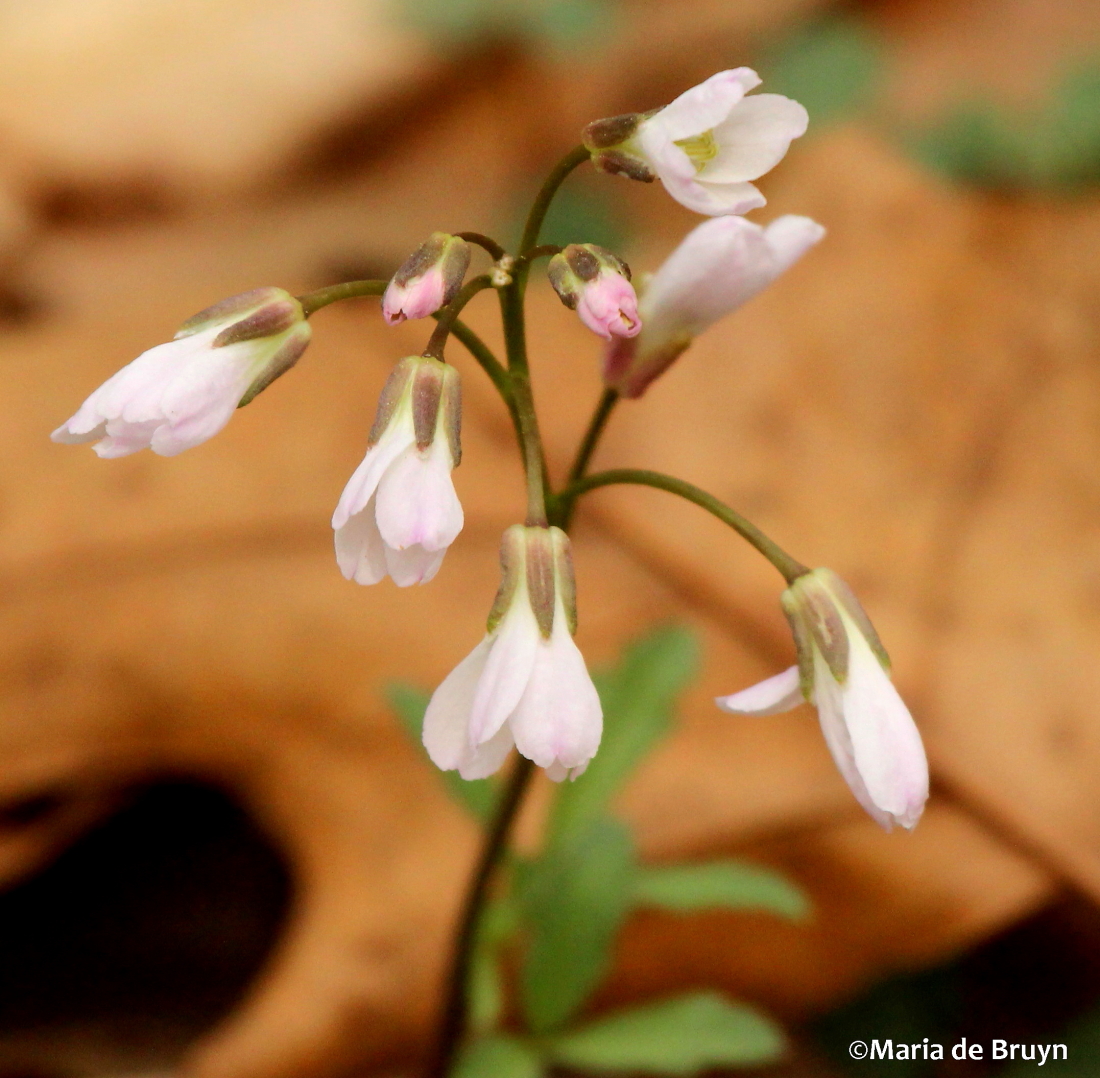
 

Slender toothwort IMG_7881©Maria de Bruyn resThe slender toothwort is known by two scientific names (Cardamine angustata and Dentaria heterophylla) and depends on an appropriate habitat for survival. It can disappear as a result of land development or changes in land use.


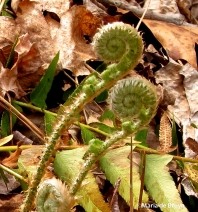
Another favorite of mine in spring are the fiddleheads of the ChristmasChristmas fern IMG_4322©Maria de Bruyn ferns (Polystichum acrostichoides). These curled fern fronds are collected to be cooked and served as vegetables, although the fiddleheads of this particular fern are not recommended as being particularly edible. It is a useful fern, though, as the full-grown leaves lie flat on the ground and contribute to controlling erosion and conserving soil by keeping fallen leaves in place as they decompose.
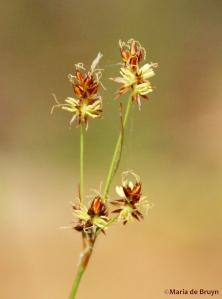


The heath woHeath woodrush IMG_7871©Maria de Bruyn resodrush (Lazula multiflora) is not such a spectacularly beautiful flower from my perspective but perhaps it is because of the muted colors. The turkey tail mushrooms (Trametes versicolor) also often appear with browns, rust and blackish colors but I find that they always create a beautiful image as they grow on stumps with bands of different colors.
Turkey tail IMG_7909©Maria de Bruyn res

All the spring bloomers brought smiles as we walked. Next blog, I’ll describe some of the other spring harbingers and then feature some of the wildlife emerging into the sunlight these days. (And hopefully have more luck with layout; this remains challenging!)


Moths to rival butterflies!

Friendly probole moth IMG_9681©Maria de BruynresThe past week has been incredibly busy with work and the next couple weeks will be so as well. But I hope to stick somewhat to my weekly schedule of (hopefully) entertaining and perhaps educating you a bit on the wonderful wildlife around us!

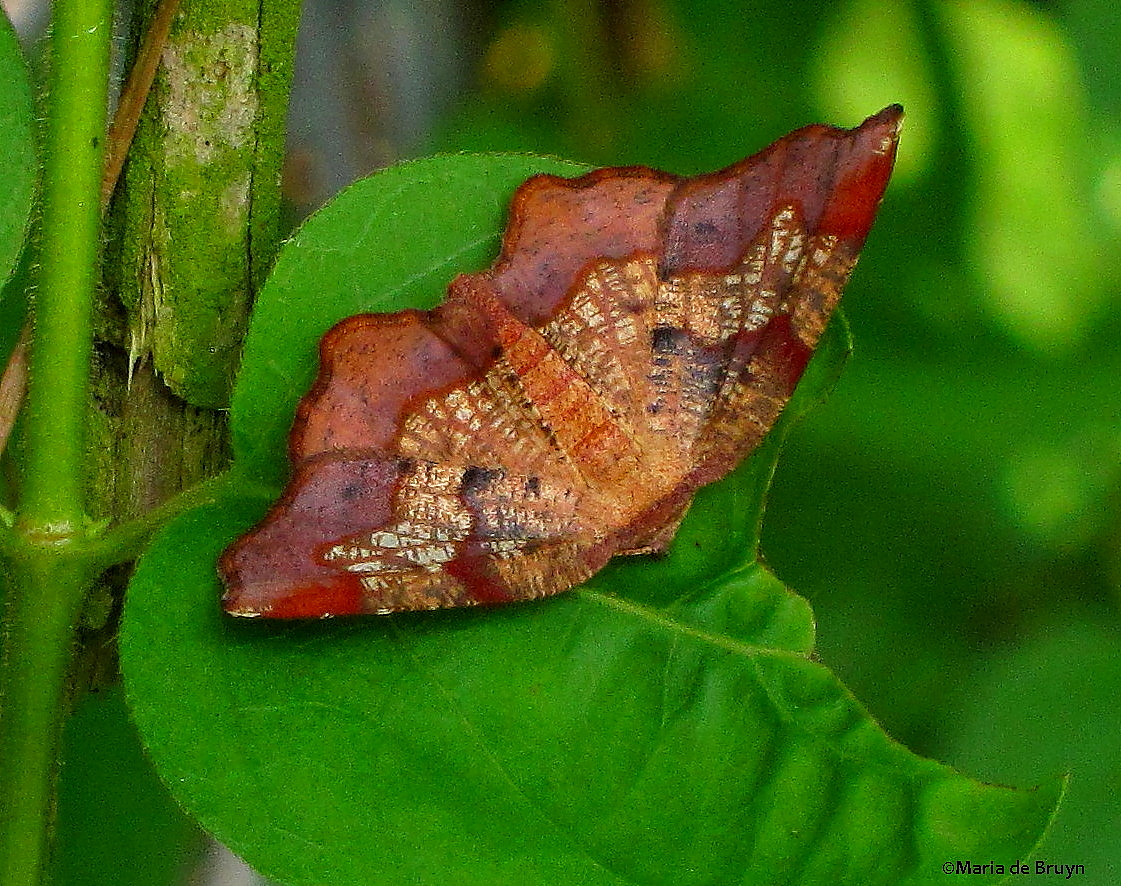
Today, I was pleasantly surprised to find that a fellow Project Noah member, Jacob Gorneau, had mentioned me in his article about National Moth Week (http://nationalmothweek.org/2014/02/23/project-noah-hosts-the-second-annual-national-moth-week/), What he quoted me as saying – “I really did think of butterflies as being the beauties and moths as the plain cousins. It’s great to have learned so much about the beauty of moths!” – was  a result of having participated in that annual week. Just like birders do bird counts, “moth-ers” do moth counts. And it was through my joining in on that activity that I learned to appreciate just how gorgeous moths can be – like that Friendly Probole Moth (Probole amicaria) at the top of this blog! Here are a few more beauties I’ve seen over time.

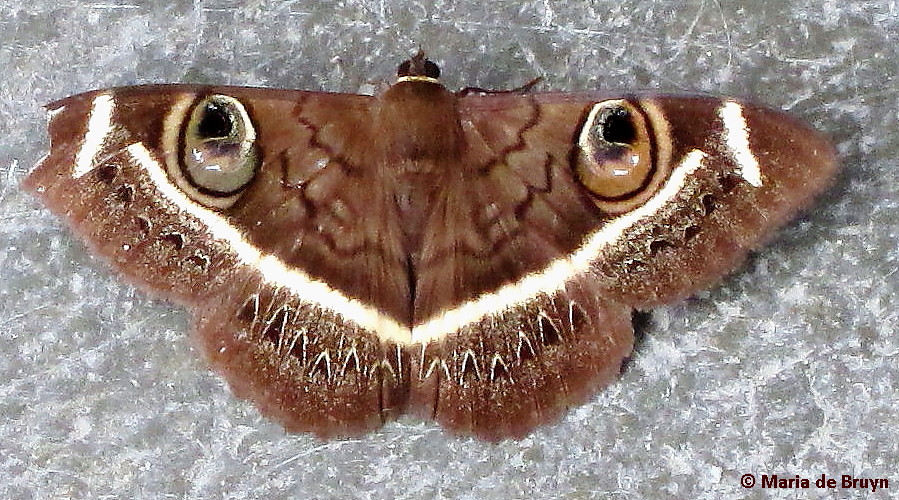
Polka-dot wasp moth IMG_0107VThis polka dot wasp moth (Syntomeida epimoth, Cream-striped owl IMG_6548© Maria de Bruynlais) was visiting a plant in Mexico. And this is a cream-striped owl moth (Cyligramma latona), which was a welcome surprise in Namibia.

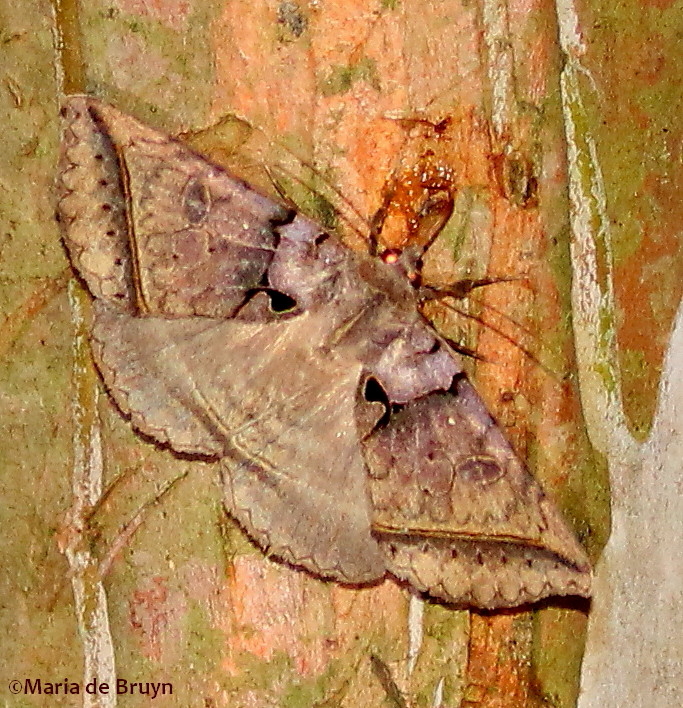
Zale moth IMG_4866©Maria de BruynMy backyard also reveals some interesting specimens. Moth Week induced me to go outside at night with a flashlight and I found these beauties on my crepe myrtle trees. Left is a Zale moth and below a black bit moth (Celiptera frustulum).

Black bit moth IMG_4867©Maria de Bruyn2

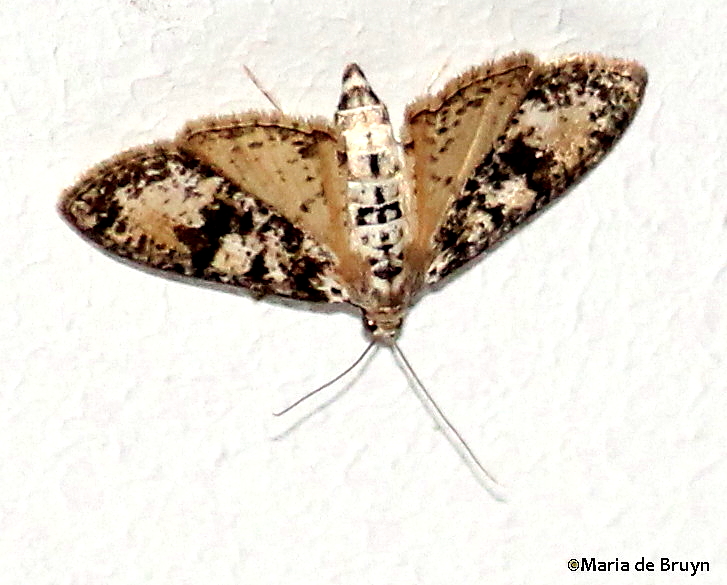
Splendid palpita moth IMG_4696©Maria de BruynThis splendid palpita moth (Palpita magniferalis) was on the ceiling of the roof overhanging my front porch. Gorgeous pattern, don’t you think?

Next week, I’ll share a few more of these beauties!

Birds braving winter

American goldfinch IMG_1955©Maria de Bruyn

It’s not unheard to have snow in central North Carolina, but it also isn’t what you’d call a commonplace occurrence. It is a BIG deal when it snows here; if a couple inches of snow or some icing on the roads is expected, schools and businesses close. This is a cause of hilarity among people who originated from points north, but when they realize that many drivers here are not accustomed to winter-weather driving and that the Department of Transportation and towns are not equipped so well to deal with the conditions, they also will often stay inside and not go out on the road.

Carolina wren IMG_0424©Maria de BruynAmerican robin IMG_0326©Maria de Bruyn

When we had two days of snow and ice storms last week, it wasn’t only people who were unhappy. The birds also didn’t seem enamored with the climate change, like the American goldfinch up above (Spinus tristis). They had had a taste of snow at the end of January, but it wasn’t such a strong storm then.  The Carolina chickadee (Poecile carolinensis) was scurrying about looking for food under the snow and the American robin (Turdus migratorius) was enjoying some berries.  The February storm was a bit different though

Mourning dove IMG_2478©Maria de Bruyn

On the first day, when it didn’t snow heavily all at once (it was more a matter of lightly falling snow much of the day), I had a multitude of birds at my feeders – including some that I don’t usually see there. This mourning dove (Zenaida macroura), for example, didn’t scrounge around on the ground in the snow but landed on a feeder to see if there were seeds there.

Other birds flew back and forth between the trees and feeders, like the yellow-rumped warblers (Setophaga coronata), who weren’t always happy to have others sharing the feeders), and the tufted titmice (Baeolophus bicolor).

Yellow-rumped warbler IMG_2618©Maria de BruynTufted titmouse IMG_2355©Maria de Bruyn

When out walking in a furious flurry of fat snowflakes, I ran into a neighbor who does research on bird survival. I mentioned that on the first day of the storm, I had a multitude of birds at my feeders (probably a 100 or so) but now, with this heavier snowfall, not a bird was to be seen. He noted that, given bird’s short lifespans in some cases and the fact that many would be younger, they were likely hunkering down as this was their first encounter with these weather conditions.

Brown thrasher IMG_2127©Maria de Bruyn

Northern cardinal IMG_2375©Maria de Bruyn

Another neighbor down the road and I kept our feeders filled so that our avian friends could rev up their energy stores, like the brown thrasher (Toxostoma rufum) and the Northern cardinals (Cardinalis cardinalis). The birds did their part by fluffing up their feathers to help keep body warmth as much as possible.  And they posed for some nice photos – albeit not with enthusiastic expressions, like this warbler and Northern mockingbird (Mimus polyglottos).

Yellow-rumped warbler IMG_2684©Maria de BruynNorthern mockingbird IMG_3455©Maria de Bruyn

Today, they should all be happy though – we’re expecting temperatures well in the upper 60s F! That should make for happy white-throated sparrows (Zonotrichia albicollis), Eastern towhees (Pipilo erythrophthalmus) and all the other birds visiting my yard!

white-throated sparrow IMG_2564©Maria de BruynEastern towhee IMG_0670©Maria de Bruyn