Flying rays of sunshine, spirits on the wing – part 2

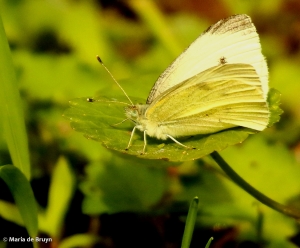
Cabbage white butterfly DK7A2287© Maria de Bruyn resWhen a butterfly like the cabbage white (Pieris rapae) alights on a flower or leaf, we sometimes have a little time to see them more clearly and appreciate their beauty; capturing a photo for leisurely viewing gives us the chance to focus on details. And those details are important if we want to determine their correct scientific names since entomologists have differentiated many species and sub-species, sometimes on the basis of factors such as the shape of their spots.

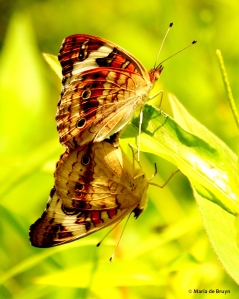
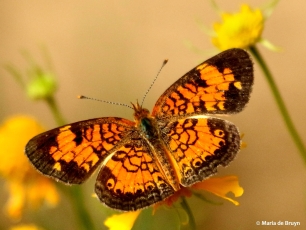
One butterfly pair that can be puzzling are the silvery checkerspot (Chlosyne nycteis, top), with a small white center to one of its spots in the lower row, and the pearl crescent (Phyciodes tharos), which was abundant this year.
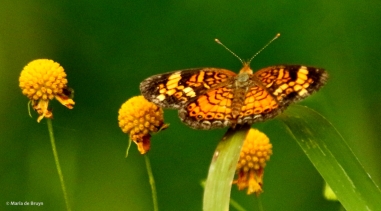
silvery checkerspot DK7A1405© Maria de Bruyn res

pearl crescent DK7A1469© Maria de Bruyn res pearl crescent DK7A4689© Maria de Bruyn res

The Eastern comma (Polygonia comma) and question mark (Polygonia interrogationis) look really similar, too. Perhaps the difference in their distinguishing underside marking is really apparent to proofreaders.
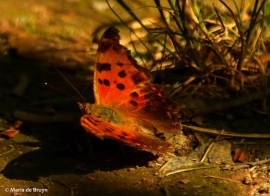
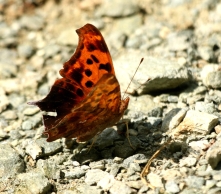
Eastern comma DK7A5636© Maria de Bruyn resQuestion mark DK7A3181© Maria de Bruyn res

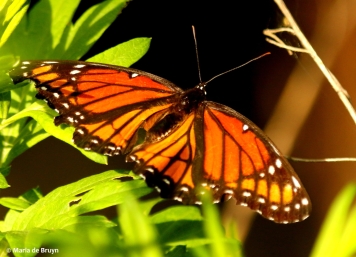
The easiest way to distinguish the endangered monarch (Danaus plexippus) and the viceroy (Limenitis archippus) is that the viceroy has a black stripe running horizontally across its lower wings.
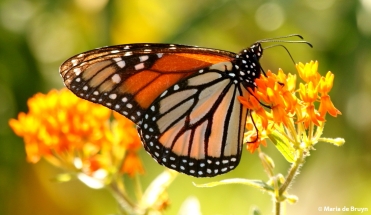
monarch DK7A7941© Maria de Bruyn res

viceroy DK7A5128© Maria de Bruyn res

Eastern tiger swallowtail DK7A2096© Maria de Bruyn res

The swallowtails are always a favorite, including the Eastern tiger swallowtail (Papilio glaucus) with differently colored males (yellow) and females (yellow and also blue).

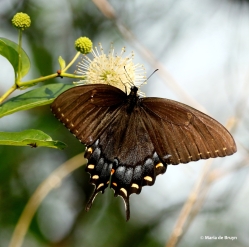
 

Eastern tiger swallowtail DK7A7768© Maria de Bruyn res Eastern tiger swallowtail DK7A0256© Maria de Bruyn res

Zebra swallowtail DK7A0046© Maria de Bruyn res

The zebra swallowtail (Protographium marcellus) really catches your eye as it flutters about, while the pipevine swallowtail (Battus philenor) is a little more subdued.
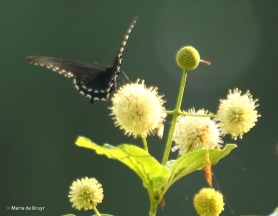
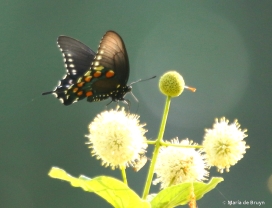
 

Pipevine swallowtail DK7A9681© Maria de Bruyn res Pipevine swallowtail DK7A9691© Maria de Bruyn

The red spotted purples (Limenitis arthemis) come in different variations; this one enjoyed the hummingbird nectar this summer.
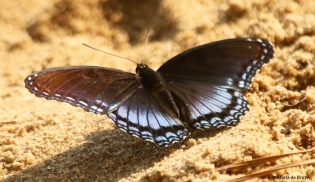
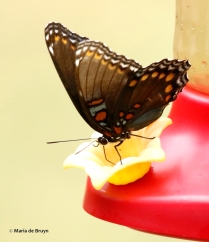
Red-spotted purple DK7A0518© Maria de Bruyn res Red-spotted purple DK7A0998© Maria de Bruyn res

Another new butterfly for me this year was the great spangled fritillary (Speyeria cybele), which I enjoyed seeing as they enjoyed common milkweed (Asclepias syriaca) at the Horton Grove Nature Reserve.
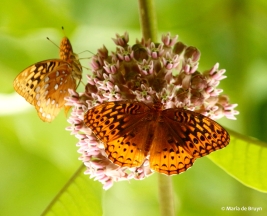
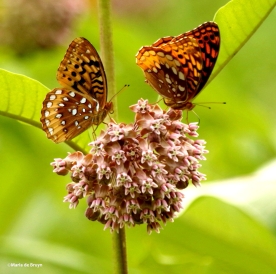
great spangled fritillary DK7A5377© Maria de Bruyn res Great spangled fritillary DK7A5052© Maria de Bruyn res

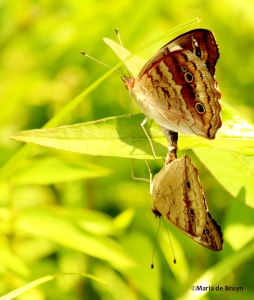
Hackberry emperor DK7A6150© Maria de Bruyn resThe hackberry emperor (Asterocampa celtis) turned up at Jordan Lake, while the common buckeye (Junonia coenia) – whose beauty is anything but common! – was in my yard and various nature reserves. I also observed a pair getting ready to propagate the next generation.
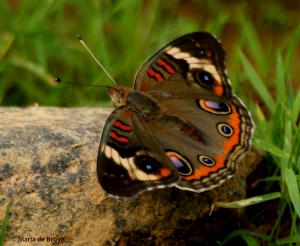
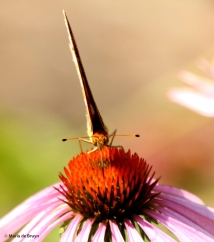


common buckeye DK7A1181© Maria de Bruyn common buckeye DK7A8729© Maria de Bruyn res common buckeye IMG_9470© Maria de Bruyn res common buckeye IMG_9538© Maria de Bruyn res

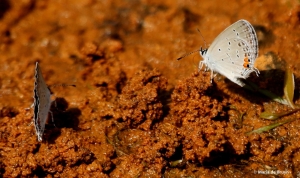
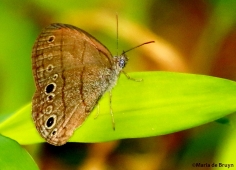
Some of the tinier butterflies are delicate beauties, like the Summer azure (Celastrina neglecta), the gray hairstreak – which can look brown (Strymon melinus), the Eastern tailed-blue (Cupido comyntas) and the Carolina satyr (Hermeuptychia sosybius).
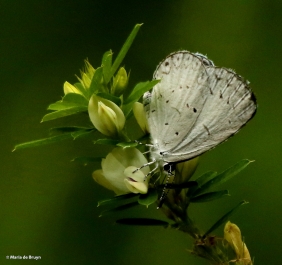
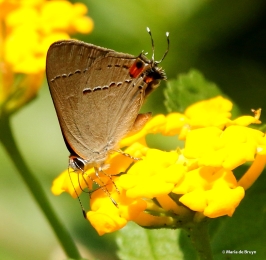
Summer azure DK7A5424© Maria de BruynGray hairstreak DK7A4495© Maria de Bruyn

Eastern tailed-blue DK7A1141© Maria de Bruyn resCarolina Satyr DK7A5279 © Maria de Bruyn res2

To end, here are two more beauties that I had the privilege to see this year. I hope  seeing these butterflies and those in my previous blog brightened your day, especially if you have been dealing with sorrow as I have while this year approaches its end.
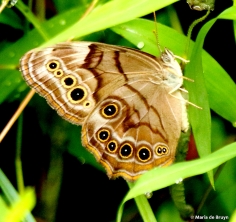
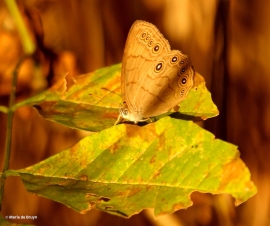
Southern pearly eye DK7A9953© Maria de Bruyn resNorthern pearly-eye DK7A7752©Maria de Bruyn res

Southern pearly eye (Lethe portlandia) and Northern pearly-eye (Enodia anthedon)


Flying rays of sunshine, spirits on the wing – part 1

Fiery and dun skippers IMG_7262© Maria de Bruyn resIt is now early December and late autumn in the Northern hemisphere, so why a blog about butterflies? When I was writing this on the last day of November, I had still seen a few of these beauties a couple days previously, and in the Southern hemisphere it is late spring, so it seems fine as a topic for a nature blog. Also, three weeks ago, my mother passed away, while in two weeks the anniversary of my father’s death comes again — I like to think of butterflies as nature’s emissaries for spirits on the wing. They allow me to think of my parents in somewhat lighter terms than the sadness that predominated during their dying processes. Because there are so many butterflies to highlight, this will be a two-part blog.

This past spring, summer and fall gifted me with a large variety of butterflies – a boon compared to last year when there seemed to be a dearth of them. I had some new butterflies to my garden, like the tawny emperor (Asterocampa clyton clyton), which I also saw at the Mason Farm Biological Reserve when one landed on my arm.

Tawny emperor DK7A2536© Maria de Bruyn resTawny emperor IMG_4926© Maria de Bruyn (2)

juniper hairstreak DK7A1677© Maria de BruynThe juniper hairstreak (Callophrys gryneus) was another new visitor that at first made me think it was covered in pollen.

A second-time visitor to my yard was the American snout (Libytheana carinenta), which looks quite distinctive with the long protrusion from its face.

American snout butterfly IMG_0257© Maria de Bruyn res

It was a good year for the little skipper butterflies, of which there are many. Quite a few look similar to one another and pose difficulties in identification; fortunately, BugGuide helps me figure out which ones I have been seeing.


Common checkered skipper DK7A8473©Maria de BruynCommon checkered skipper DK7A8483©Maria de Bruyn

Common checkered skipper (Pyrgus communis)

silver-spotted skipper IMG_0885© Maria de Bruyn Fiery skipper DK7A3463© Maria de Bruyn

Silver-spotted skipper (Epargyreus clarus) & Fiery skipper (Hylephila phyleus)

Zabulon skipper female DK7A8091© Maria de Bruyn Zabulon skipper DK7A2945© Maria de Bruyn res

Zabulon skipper (Poanes zabulon), female on the left and male on the right

sachem skipper DK7A6355© Maria de BruynSachem skipper male DK7A7657©Maria de Bruyn res Sachem skipper DK7A1271© Maria de Bruyn bg

The Sachem skipper (Atalopedes campestris) also illustrates how males (top) and females can differ.

A few skippers were new for me this year, like the little glassywing skipper (Pompeius verna) and the somewhat drabber dun skipper (Euphyes vestris) and Ocola skipper (Panoquina ocola).

Little glassywing skipper DK7A2843© Maria de Bruyn  Dun skipper DK7A3364© Maria de BruynOcola skipper IMG_4247©Maria de Bruyn

Even though dark in color, the Horace’s duskywing (Erynnis horatius) and the Juvenal’s duskywing (Erynnis juvenalis) have beautiful dorsal patterns.

Horace's duskywing DK7A3695© Maria de Bruyn

Juvenal's duskywing DK7A9907© Maria de Bruyn res

It’s always fascinating to see how different the butterflies’ color patterns can be on the upper and undersides of their wings, as shown here by the American lady (Vanessa virginiensis).

American Lady DK7A2242© Maria de Bruyn res American Lady DK7A2292© Maria de Bruyn res

The red admiral (Vanessa atalanta) is a gorgeous butterfly; a somewhat tattered individual rode along on me and my camera for a while at Mason Farm.

Red Admiral DK7A6667©Maria de Bruyn (2) res

red admiral IMG_4769© Maria de Bruyn red admiral IMG_4767© Maria de Bruyn res

A group that can sometimes be challenging to identify are the sulphurs. Distinguishing the sleepy orange (Abaeis nicippe, top) and the orange sulphur (Colias eurytheme) is no easy task. Both are quite lovely and a delight in flight when they reveal their brightly colored dorsal pattern.
Sleepy orange DK7A8367© Maria de Bruyn Sleepy orange DK7A8263© Maria de Bruyn

Orange sulphur DK7A0410© Maria de Bruyn resOrange sulphur DK7A0476© Maria de Bruyn res

Cloudless sulphur DK7A2774© Maria de Bruyn res

The larger yellow butterflies like the cloudless sulphur (Phoebis sennae) are great to see, especially when they frequent the brightly colored blooms such as the red cardinal flower (Lobelia cardinalis).
cloudless sulphur DK7A8466©Maria de Bruyn resCloudless sulphur DK7A0063© Maria de Bruyn res

Clouded sulphur DK7A0269© Maria de Bruyn

The clouded sulphur (Colias philodice) may be a bit harder to see when it feeds on clover in the grass.

Stay tuned for more butterflies to admire in part 2 of this blog!


Rain drops, dewdrops and frost – Mother Nature’s adornments

rain drops IMG_8843© Maria de Bruyn resDewdrops in the early morning, raindrops during the day, and frost covering everything outdoors can be seen merely as various manifestations of heavenly water on earth, but another way of looking at them can be as nature’s jewels. When light and sunshine illuminate the drops and crystals, they lend an air of elegance and beauty to whatever they have covered.

When it rains, leaves and blooms may look uniformly slick with moisture but we often see them covered in rain drops. Have you ever wondered why the rain drops are of different sizes?

dewdrops IMG_7571© Maria de Bruyn res day lily with rain drops IMG_5259© Maria de Bruyn res

The US Geological Survey’s Water Science School reports that water vapor wraps around particles in the air (salt, smoke, dust) which are of different sizes; then when the drops begin falling to earth, they bump into other drops and merge. The drops that merge with more “neighbors” become larger. Rain drops suspended from branches and leaves are quite lovely.

rain drops DK7A8019© Maria de Bruyn res rain drops DK7A8052© Maria de Bruyn 2 res

rain drops DK7A8020© Maria de Bruyn resruby-throated hummingbird DK7A8190© Maria de Bruyn resThey often roll right off birds’ feathers but occasionally adhere, as was the case for this ruby-throated hummingbird (Archilochus colubris) at a feeder sheltered by a roof overhang.

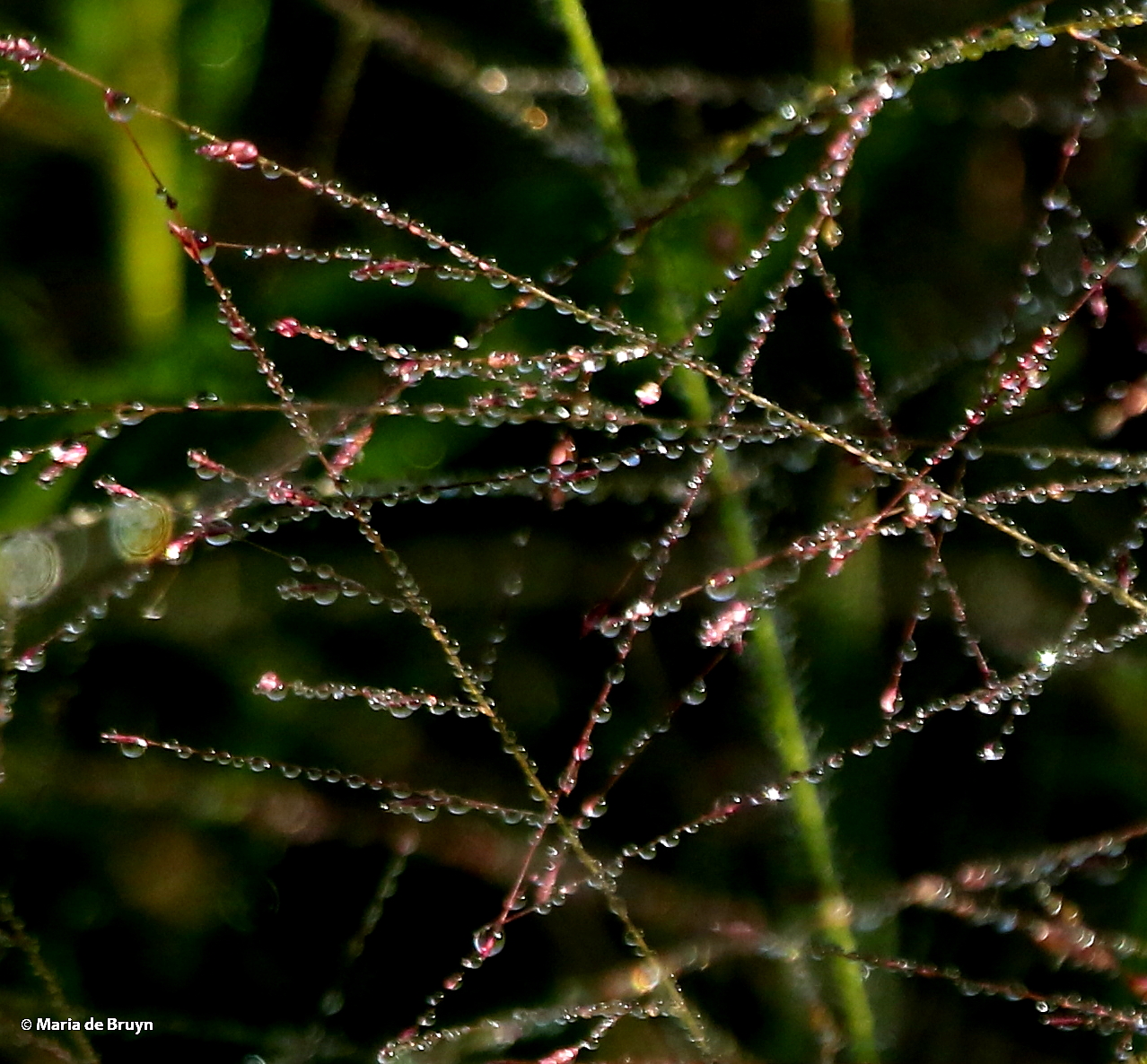
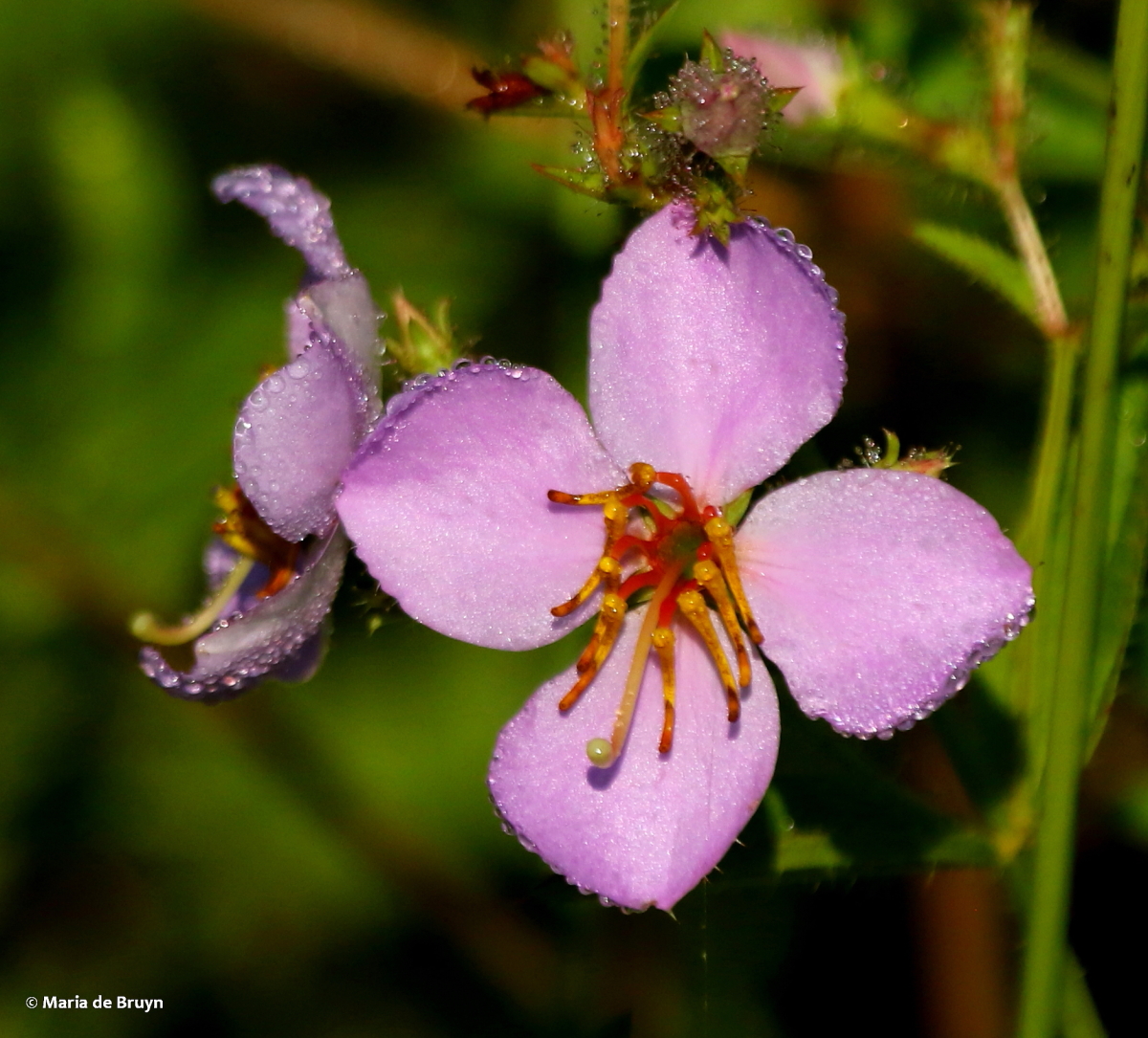
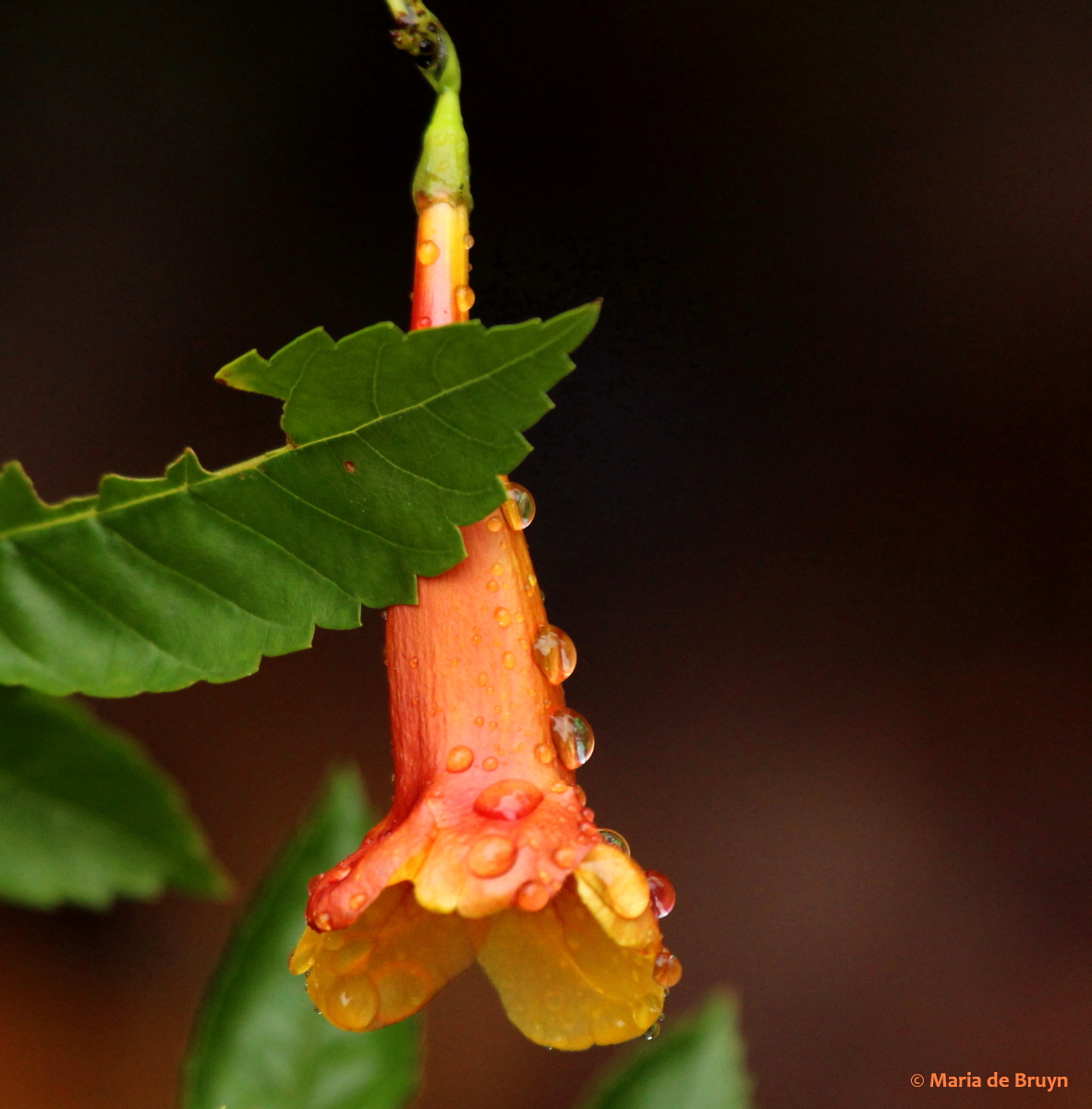
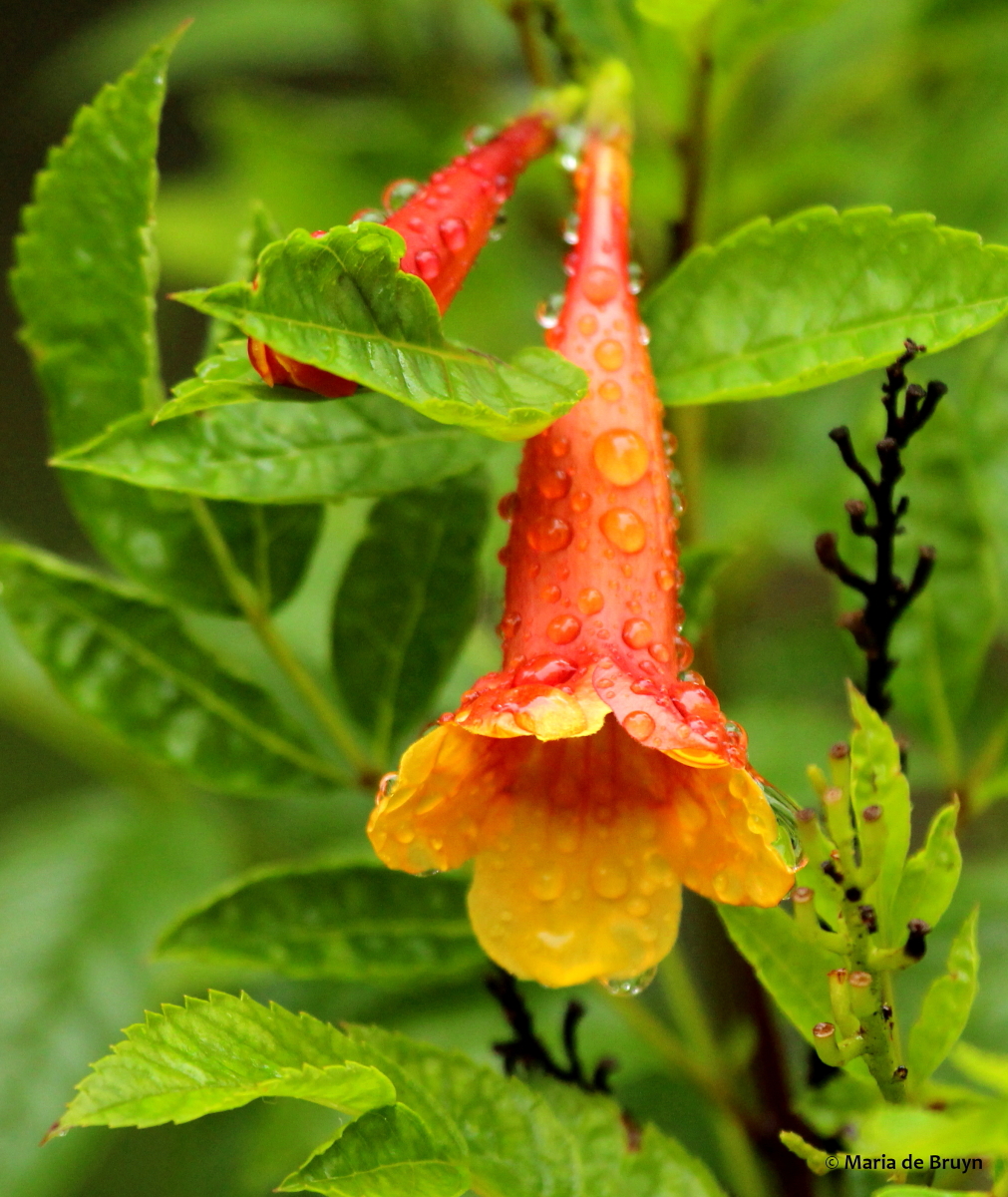
Dew – water droplets on surfaces of objects and vegetation – forms when an exposed surface cools down by radiating its heat and the moisture in the atmosphere then condenses faster than it evaporates. It looks beautiful on flowers and other plants, such as these grasses, the Virginia meadow beauty (Rhexia virginica) and the Orange mahogany esperanza (Tecoma stans “Orange Mahogany”).

dewdrops DK7A2989© Maria de Bruyngrass dewdrops DK7A3012© Maria de Bruyn res

Virginia meadow beauty DK7A3083© Maria de Bruyn res

Orange mahagony esperanza IMG_6425© Maria de Bruyn res Orange mahagony esperanza IMG_6414© Maria de Bruyn res

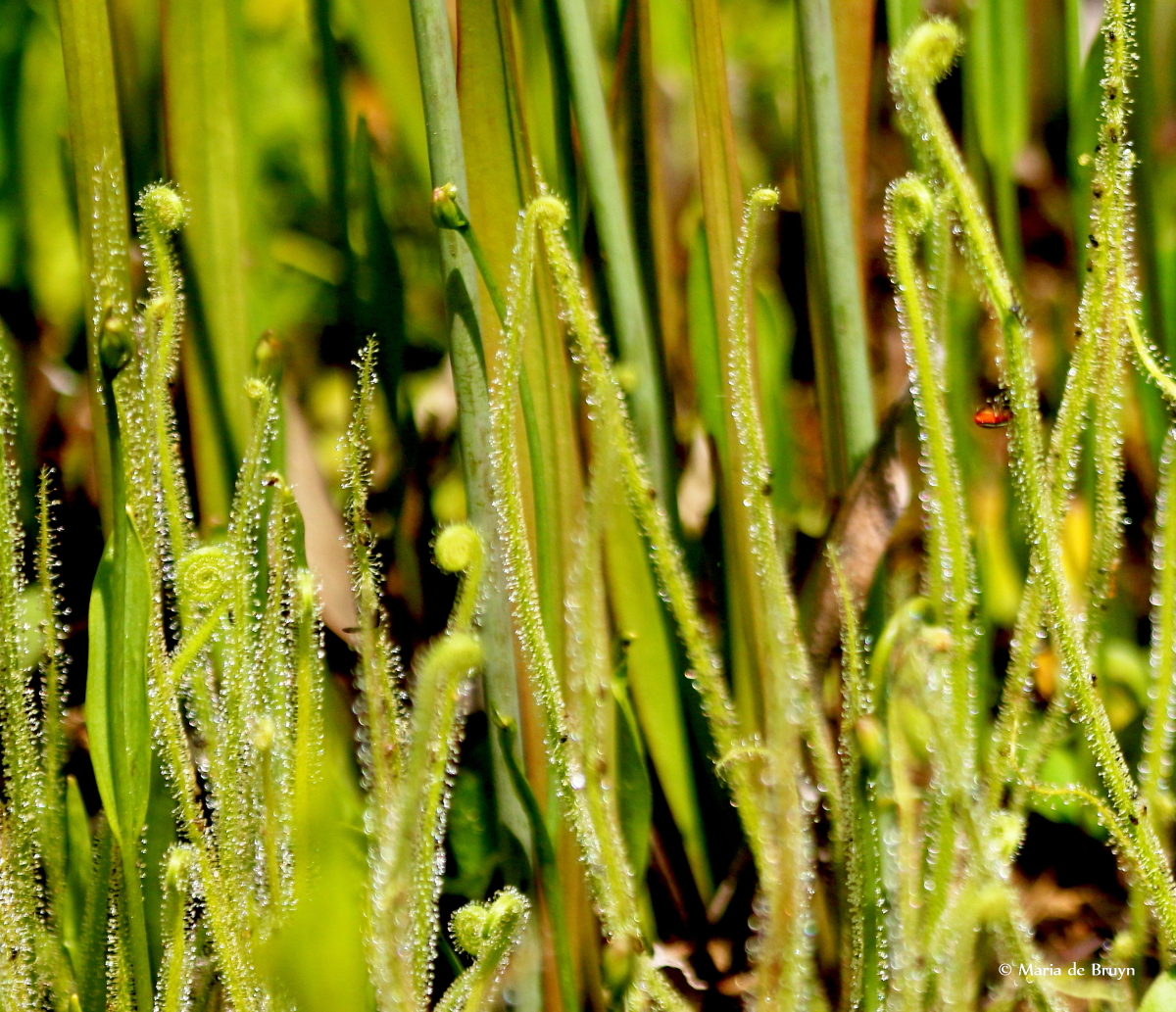
Some plants actually mimic dewdrops, like Tracey’s sundew.

Tracy's sundew DK7A5228© Maria de Bruyn res Tracy's sundew IMG_4952© Maria de Bruyn

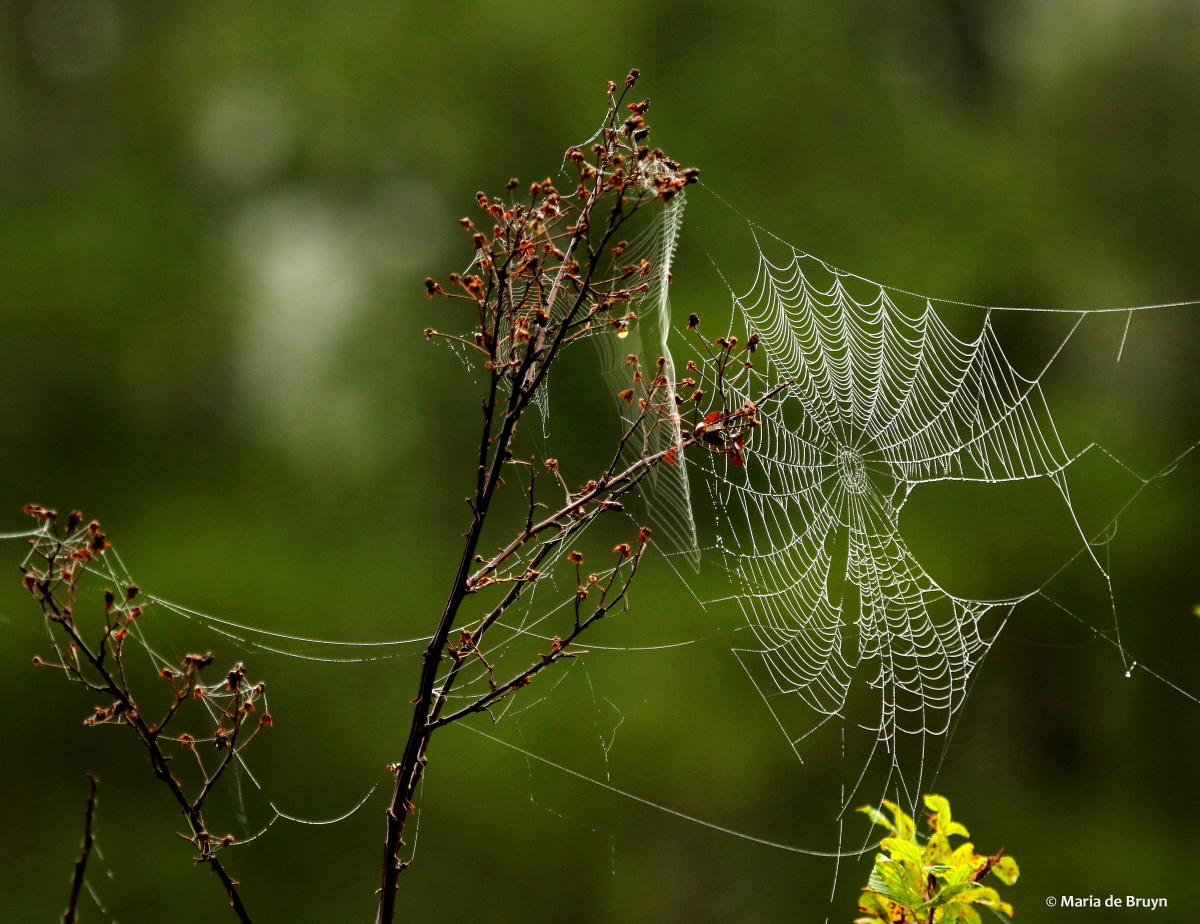
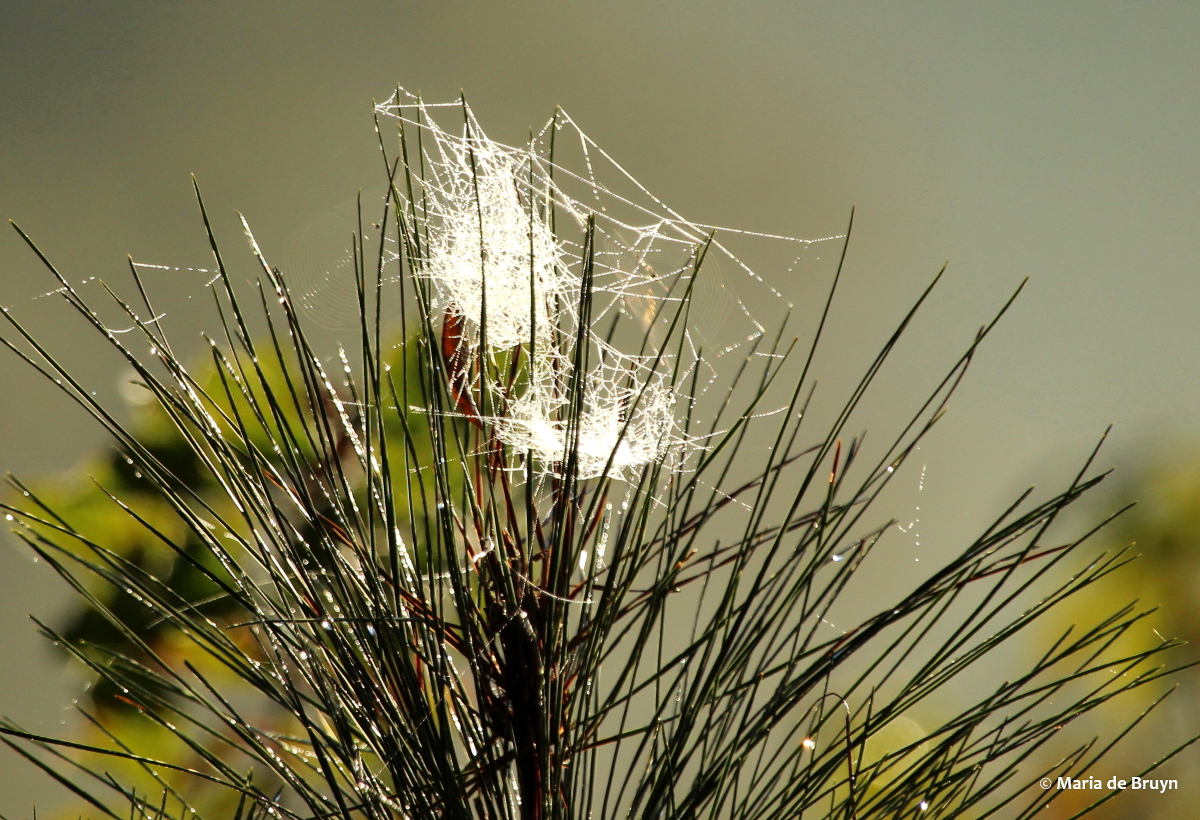
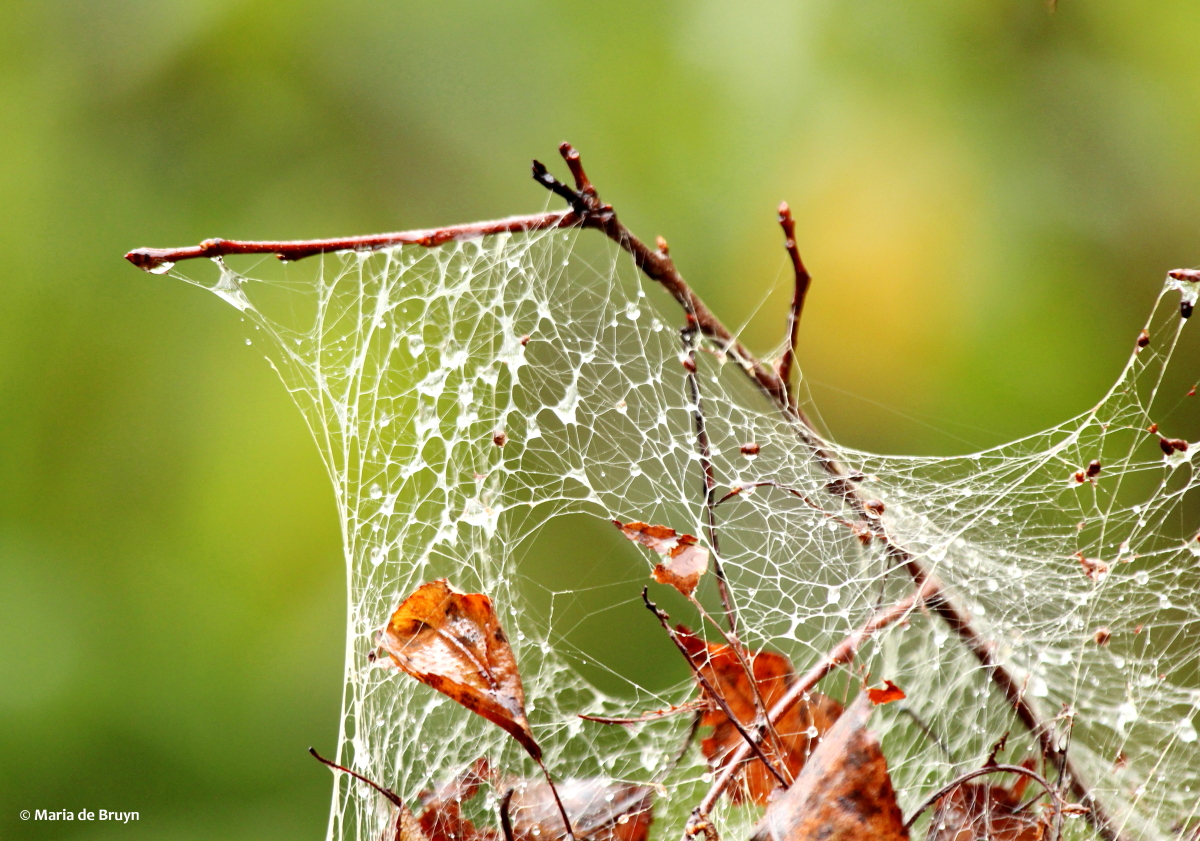
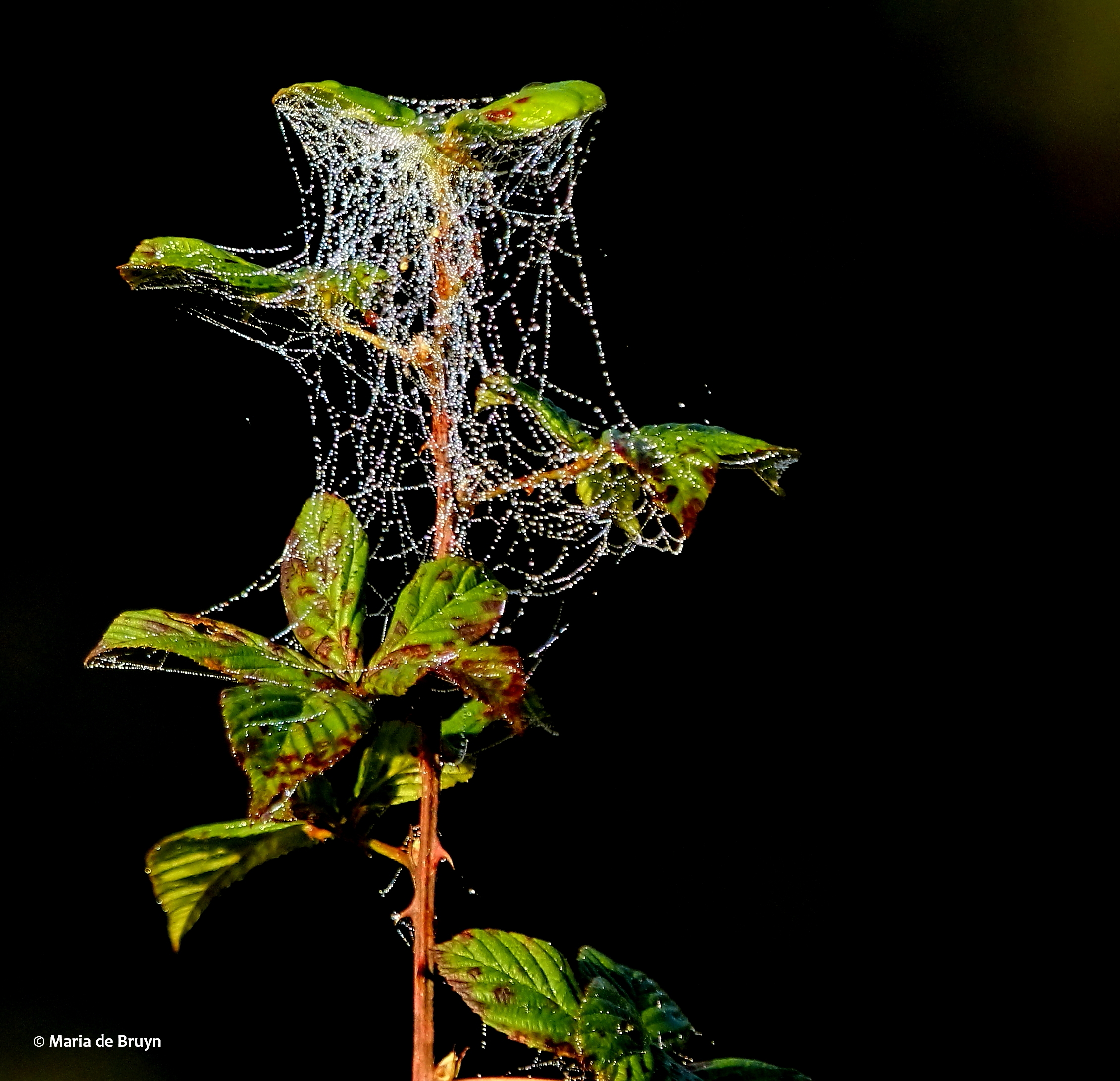
On spider webs, water and ice droplets outline the architecture created by the arachnids, showing off the symmetry and beauty of the lines.

spider web DK7A6479© Maria de Bruyn res spider web with dewdrops IMG_2683©Maria de Bruyn res

spider web with dewdrops IMG_6438© Maria de Bruyn res spider web with dewdrops IMG_6396© Maria de Bruyn res

sheetweb dwarf spider IMG_0959©Maria de Bruynsigned


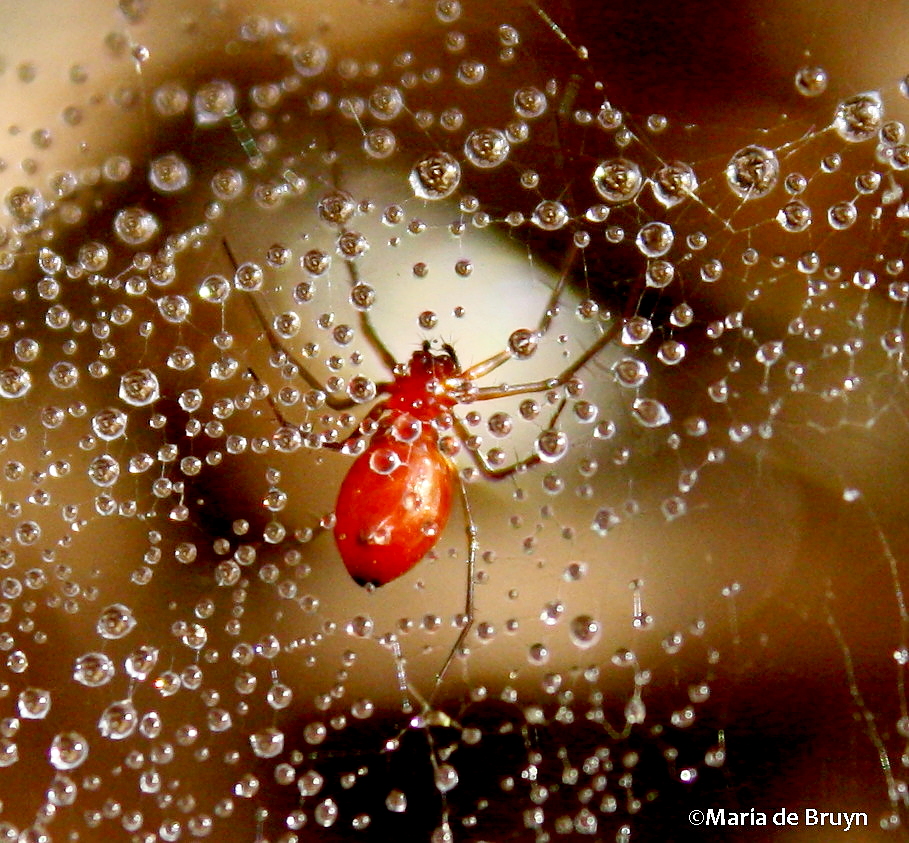
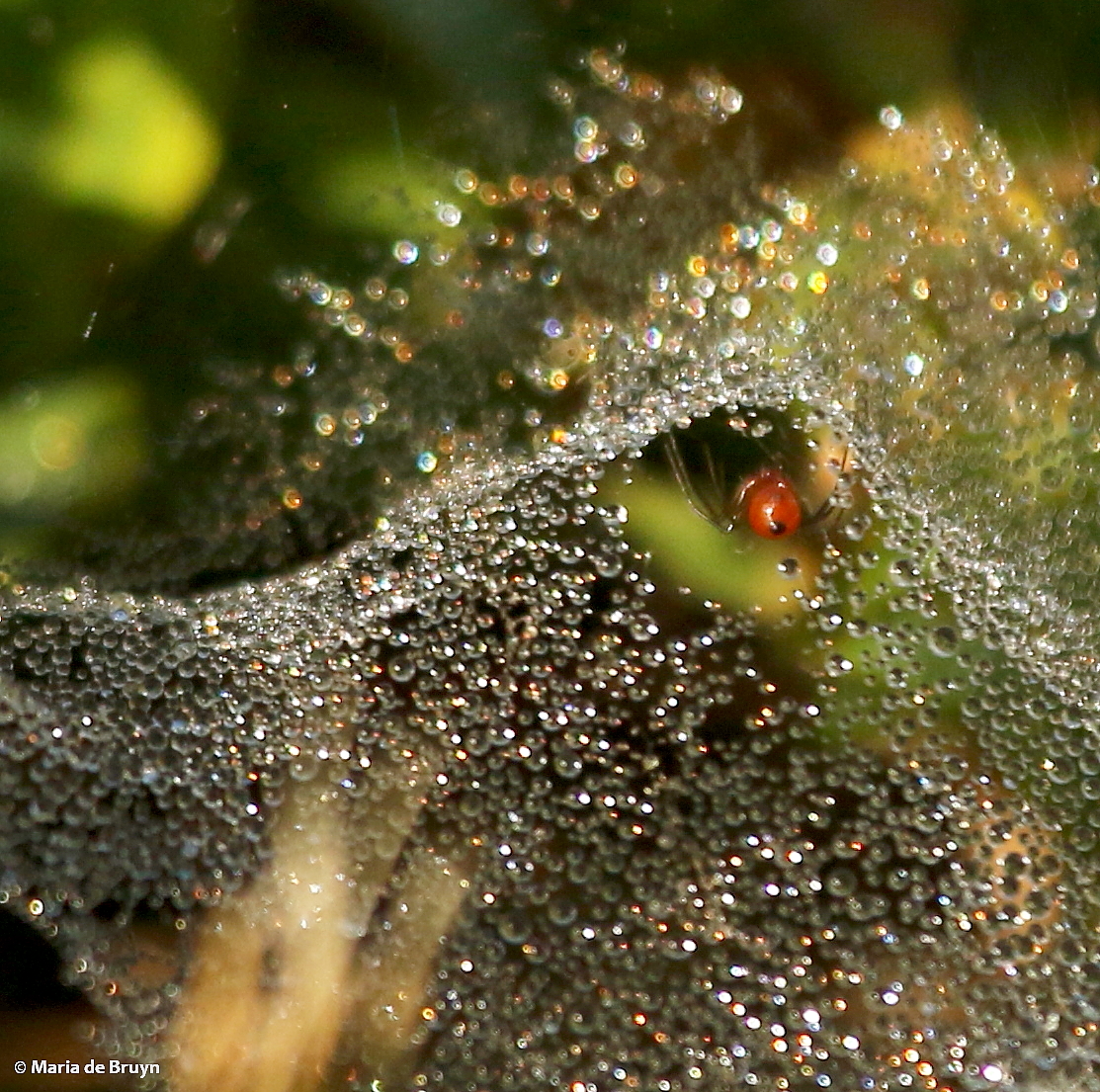
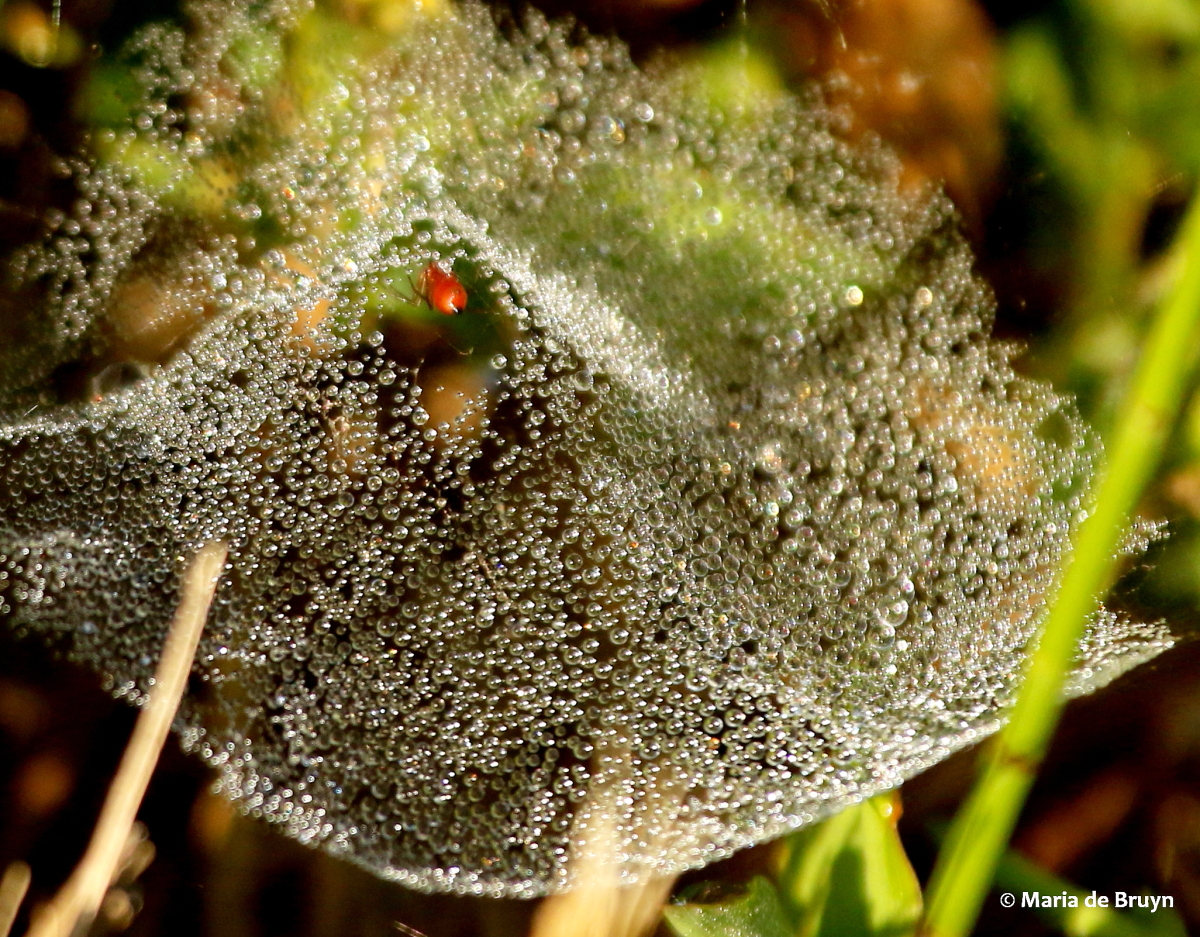
The webs of sheetweb dwarf spiders (Florinda coccinea), often not so visible in the grass, become quite noticeable when covered in dewdrops and then you can often spot the little red spider hanging underneath waiting for its prey.

sheetweb spider DK7A4086© Maria de Bruyn sheetweb dwarf spider DK7A4076© Maria de Bruyn res

spider web splendor IMG_2727©Maria de Bruyn res


In this case, the plant looked like a natural jewelry stand for strings of glass or diamond beads.

It was interesting for me to learn that the Indian Institute of Management Ahmedabad (IIMA) and the International Organisation for Dew Utilization (OPUR) created a dew harvesting system for a semi-arid area in India. Their condensers can collect more than 200 liters of dew each night from October through May and could provide an additional water source for people in arid coastal regions.

Leaves and flowers, like this coral honeysuckle (Lonicera sempervirens) can seem bedecked with glistening jewels when the ice crystals of frozen dewdrops adhere to their surfaces and edges.

Coral honeysuckle DK7A6792© Maria de Bruyn resCoral honeysuckle DK7A6805© Maria de Bruyn res

frosty morning leaves IMG_7351©Maria de Bruyn Nat GeoFrost may appear to be translucent or crystal clear; when a mass of crystals are together, they look white in color because they scatter light in all directions. The ice crystals of wind frost (also known as advection frost) arise when a very cold wind blows over tree branches, leaves and flowers; they can form gorgeous borders on these surfaces.

Early morning can be a great time for nature walks – beautiful sunrises, brisk (or cooler) temperatures and awakening wildlife make for interesting viewing. And raindrops, dew and frost can add extra scenes of beauty for us to appreciate!

Plenty of persimmon pleasure!

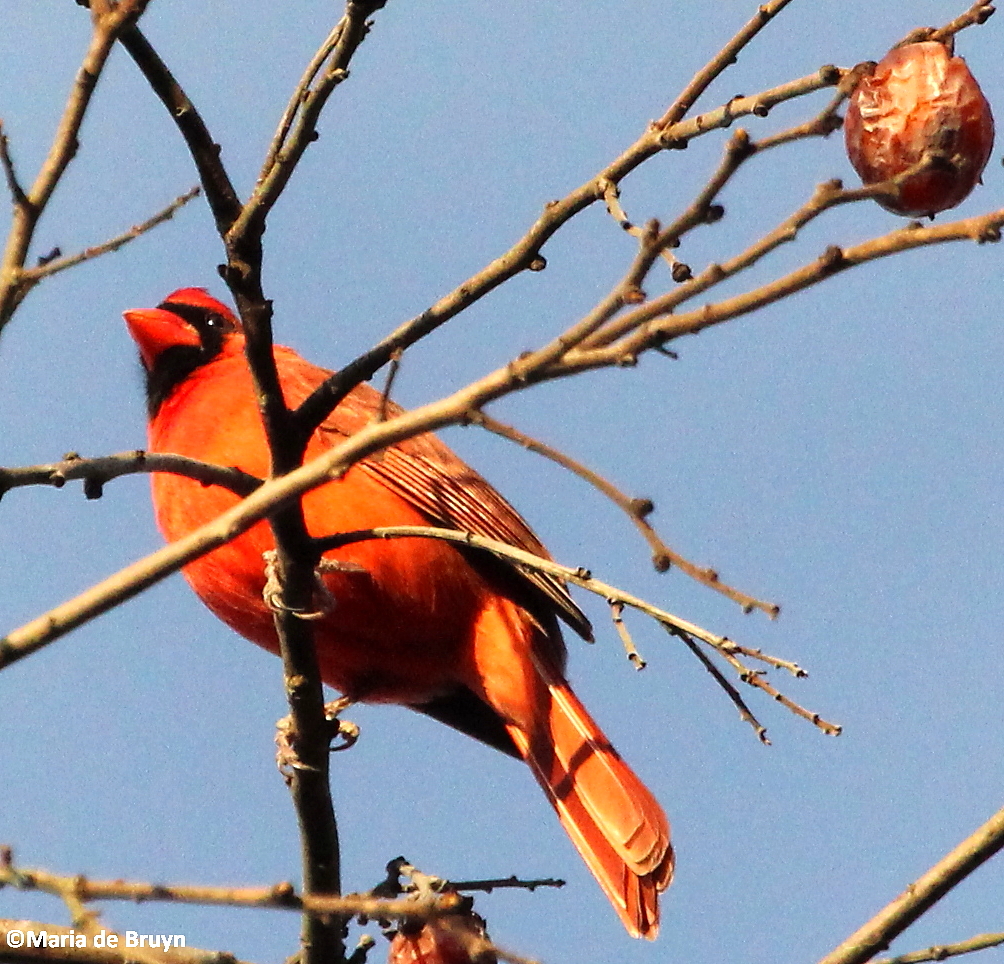
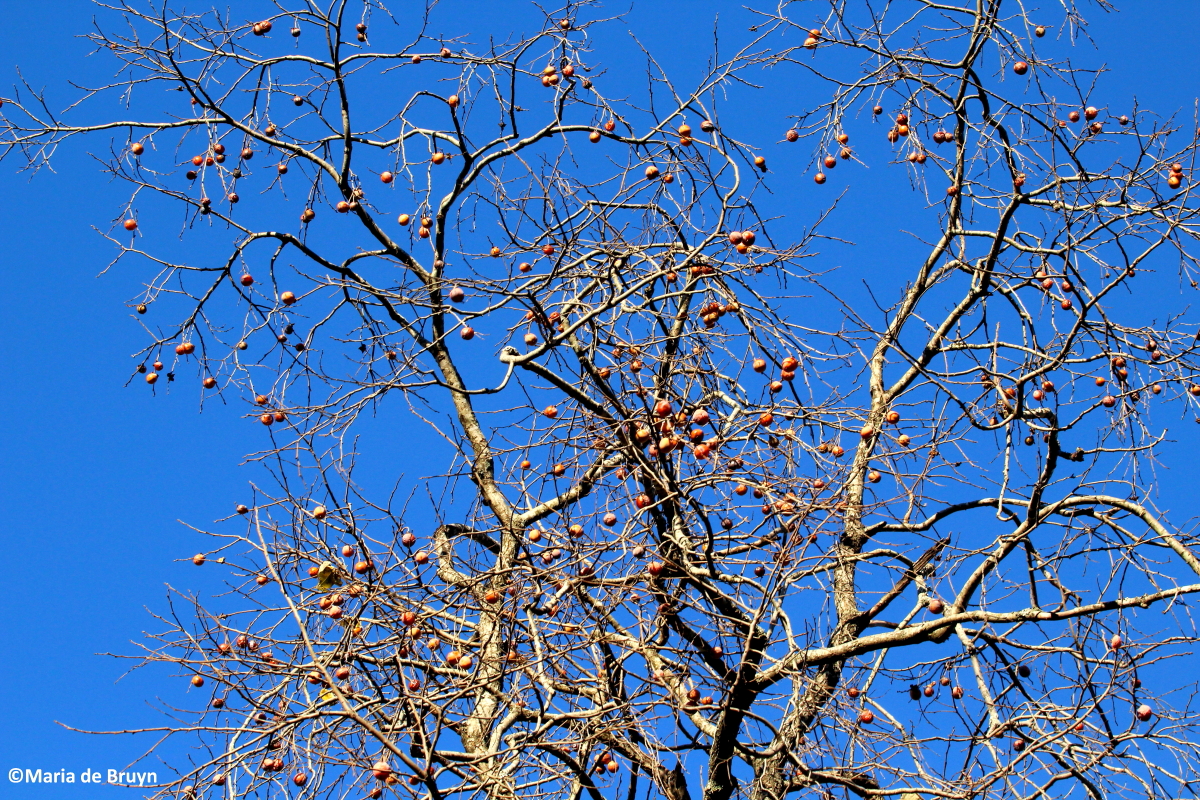
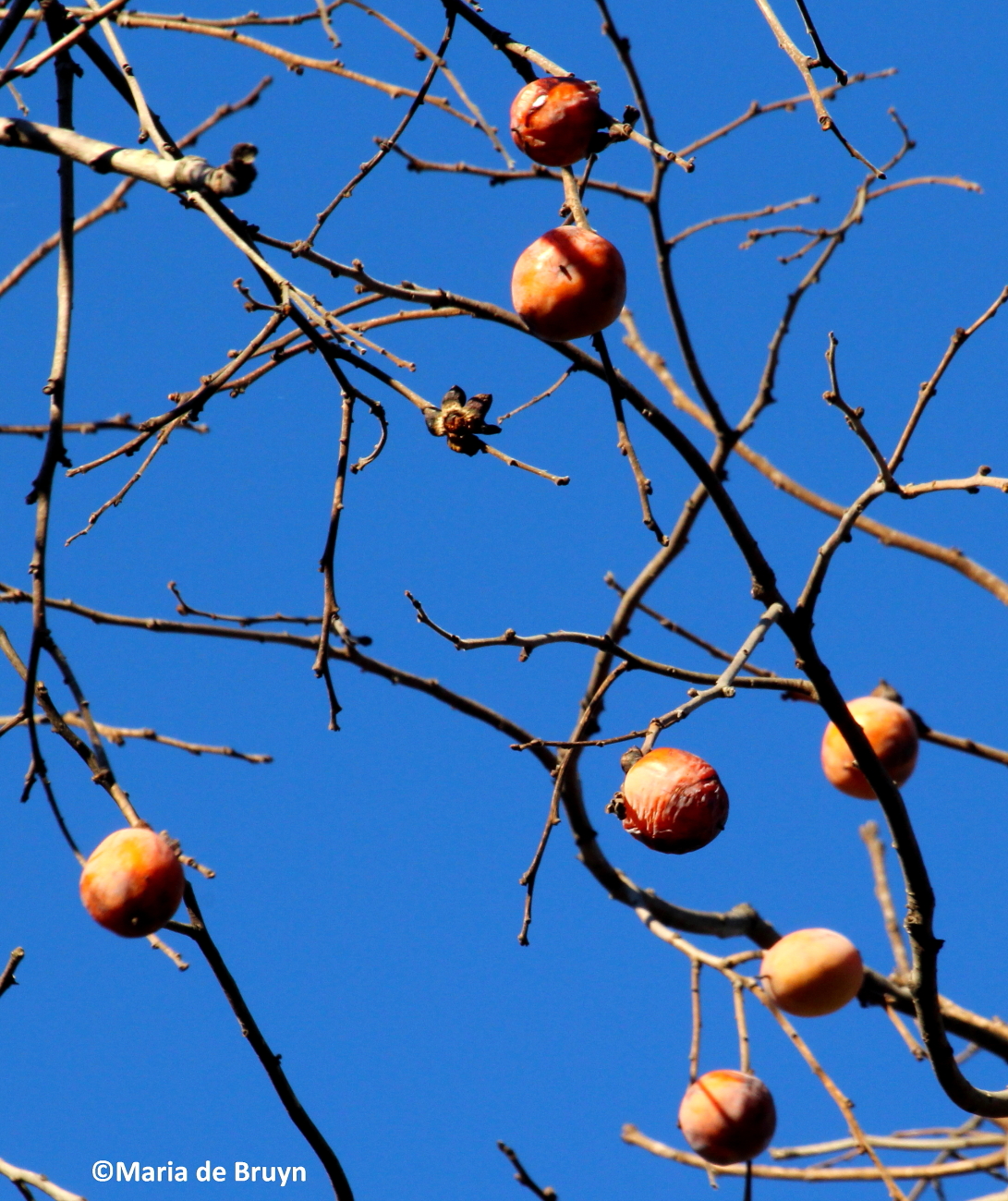
Northern cardinal  IMG_7335© Maria de BruynMy side- and backyards are both blessed with a persimmon tree (Diospyros virginiana) but the one out back only produces small hard fruit for some reason. The large persimmon at the side of my house, however, is the exact opposite. Each year it is laden with fruit; much of it begins falling while the persimmons are still unripe or only half-ripe but plenty remains on the tree through the first frost. You need to have both male and female plants for the fruit to grow, but I don’t know where the male trees are – likely in a neighbor’s yard.

Persimmon tree IMG_6996© Maria de Bruyn resPersimmon tree IMG_6993© Maria de Bruyn res

I’d been warned that an unripe or only partly ripe persimmon would not be tasty and, when I tried one, that advice turned out to be very true. I later tried a really ripe persimmon as so many North Carolinians find it a wonderful fruit, especially in pudding, but I can’t say that it is much to my liking. You won’t find me using persimmons to make tea, wine, beer or bread.

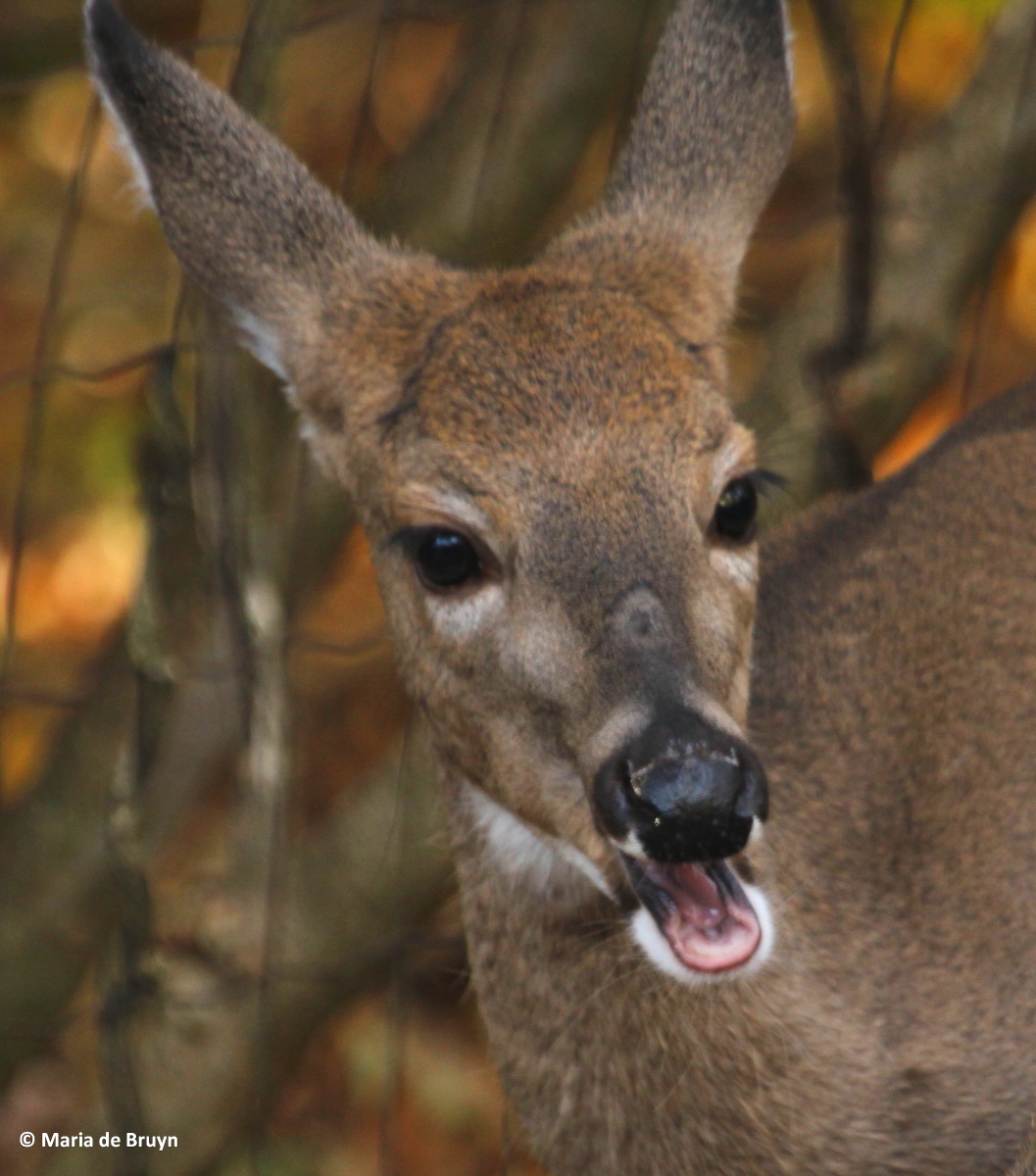
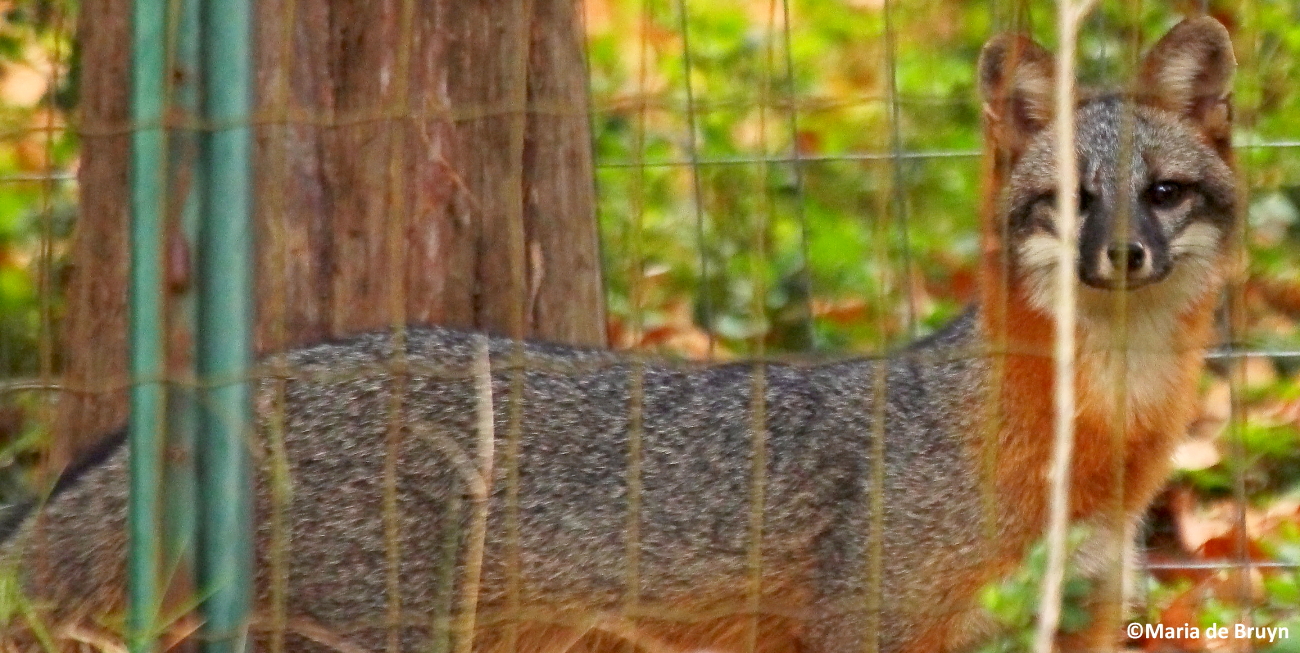
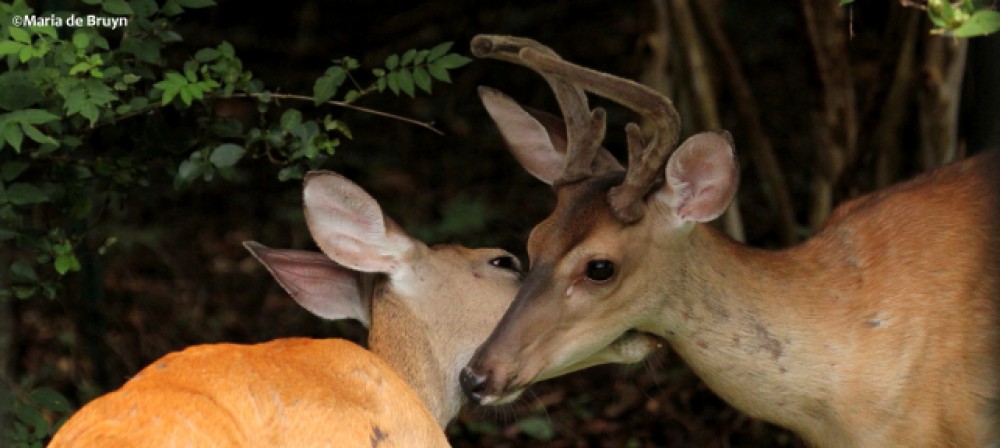
white-tailed deer IMG_9971© Maria de Bruyn resIt is, however, VERY popular with the wildlife that is around my house. The first fallen persimmons are gobbled up by the white-tailed deer (Odocoileus virginianus), who don’t seem to mind a bit of astringent fruit. Our neighborhood has opossums, raccoons, coyotes and gray foxes (Urocyon cinereoargenteus) , but I haven’t seen their persimmon seed-filled scat – I think the deer get the fruit before they have a chance. (Too bad the stem was in front of the fox’s face; I don’t use Photoshop, but you can still see its beauty.)

Gray fox IMG_1124 MdB res

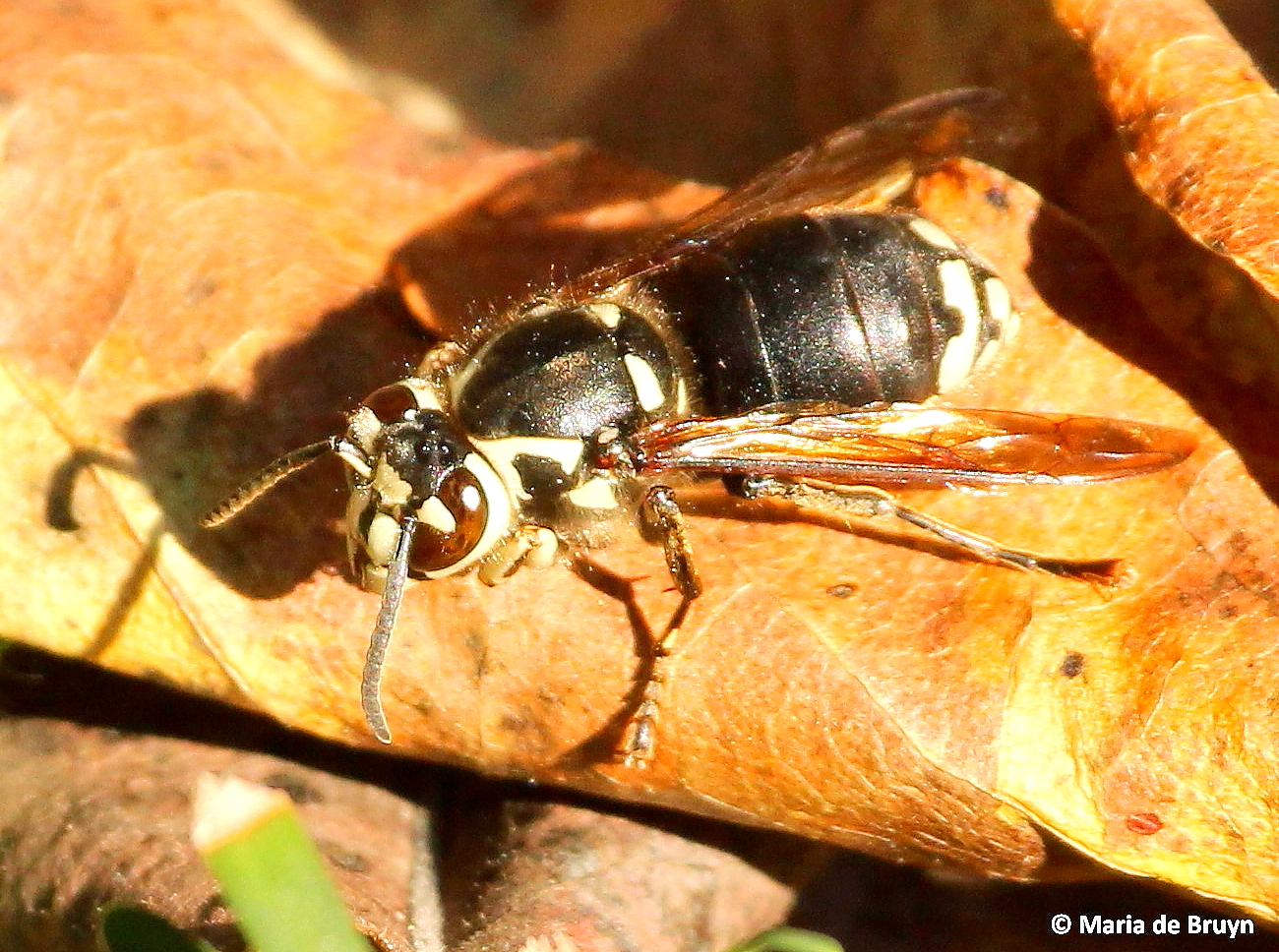
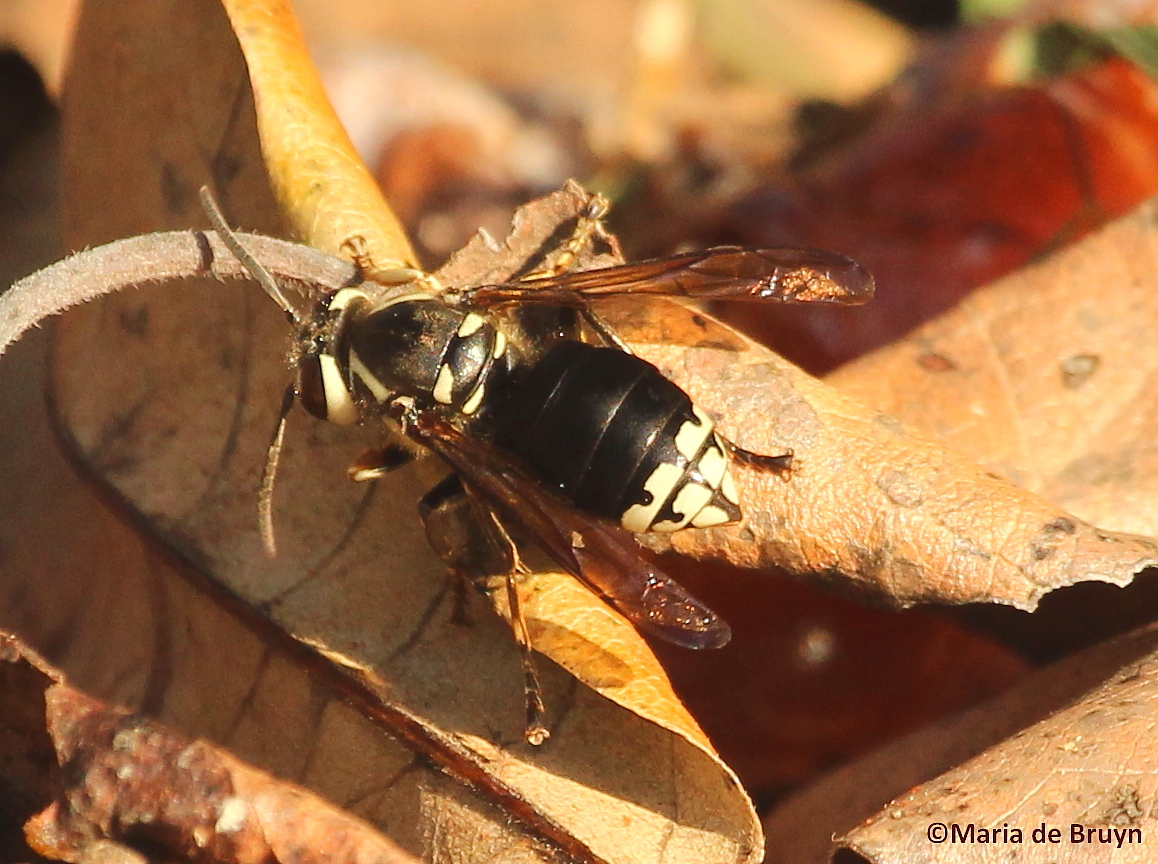
When the large orange berries begin falling on the ground in an ever riper state, the first diners include the bald-faced hornets (Dolichovespula maculata), whose beautiful large nest must be in a neighbor’s tree.

bald-faced hornet IMG_3348©Maria de Bruynbald-faced hornet IMG_3486©Maria de Bruyn

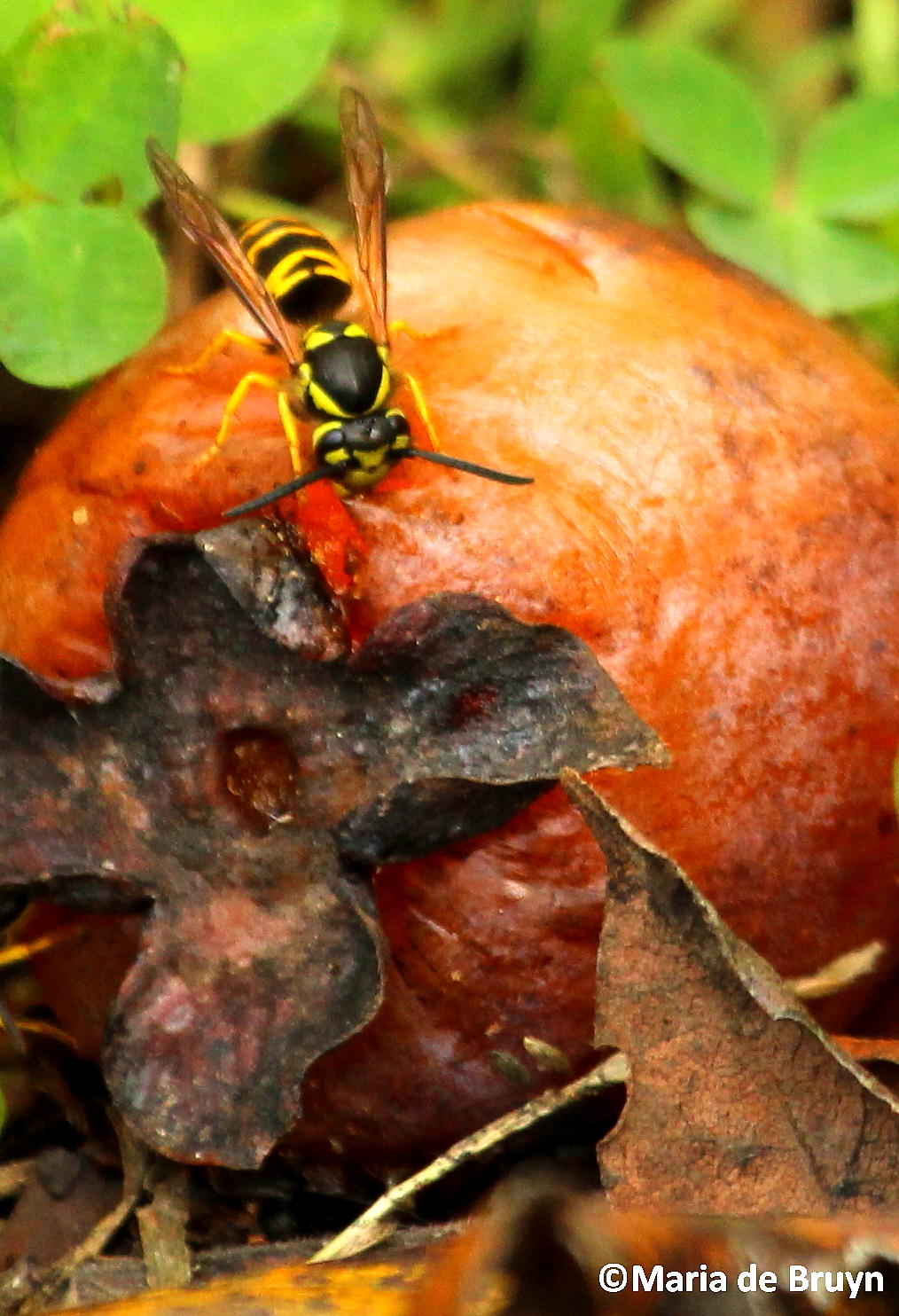
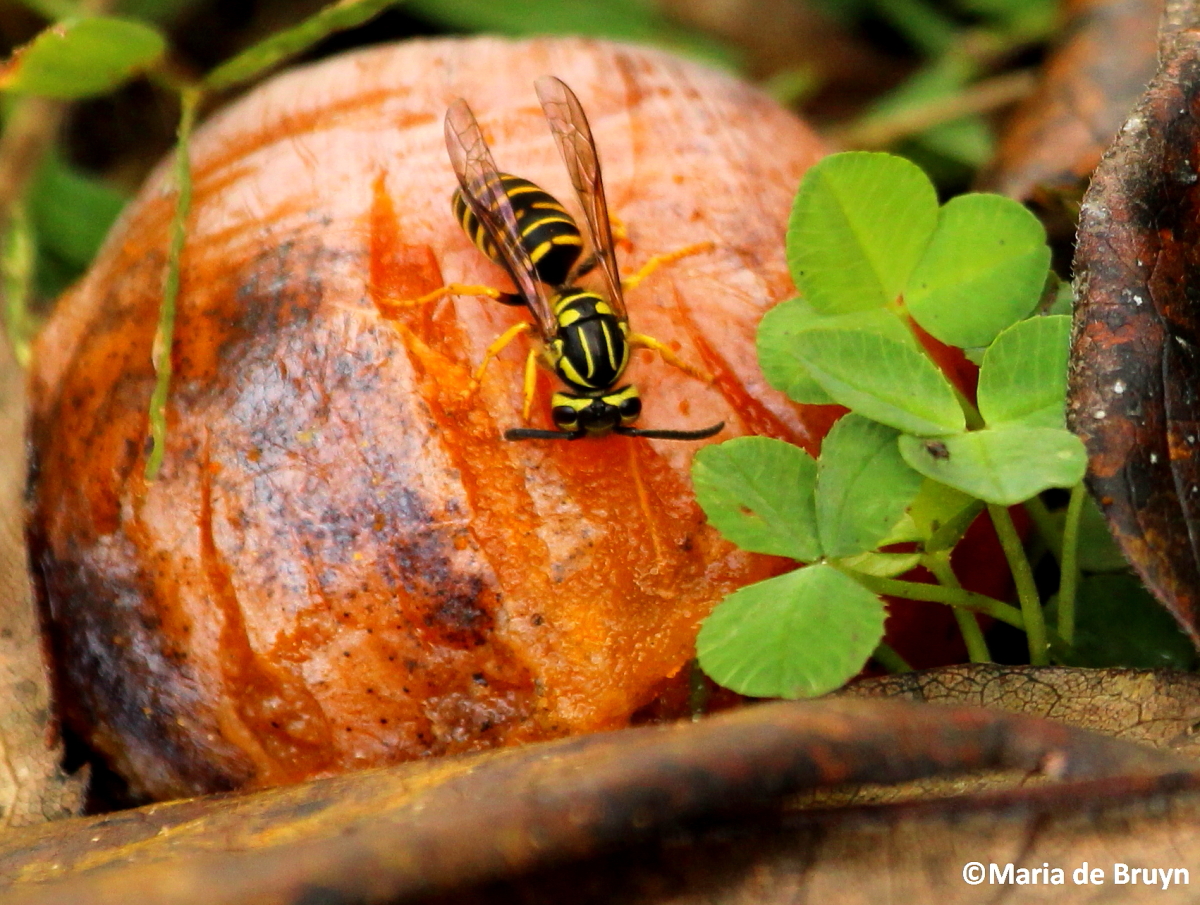
Eastern yellowjacket IMG_2502©Maria de BruynEastern yellowjacket wasps (Vespula maculifrons), which can deliver a very nasty sting, show no interest in a human hovering over the persimmons to get a shot – they are totally engrossed in getting a piece of juicy fruit.

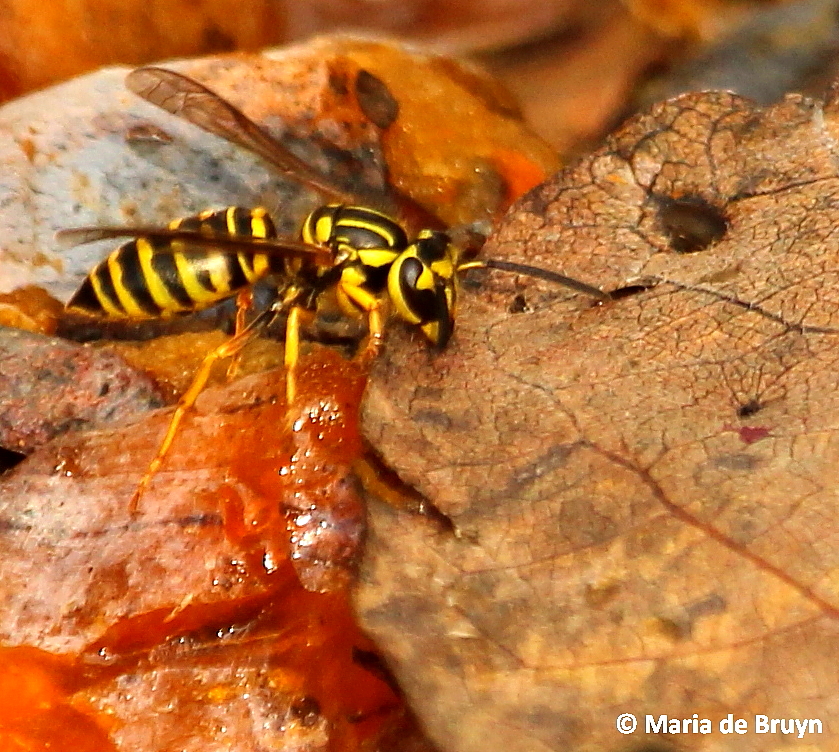
Southern yellowjackets (Vespula squamosa), also painful stingers, act likewise – their focus is entirely on the orange pulp.


Southern yellowjacket IMG_2473©Maria de BruynSouthern yellowjacket IMG_2507©Maria de Bruyn res

Paper wasp polistes metricus IMG_4359©Maria de BruynThe paper wasps (Polistes metricus) dig deep into the persimmon to extract some sweetness.

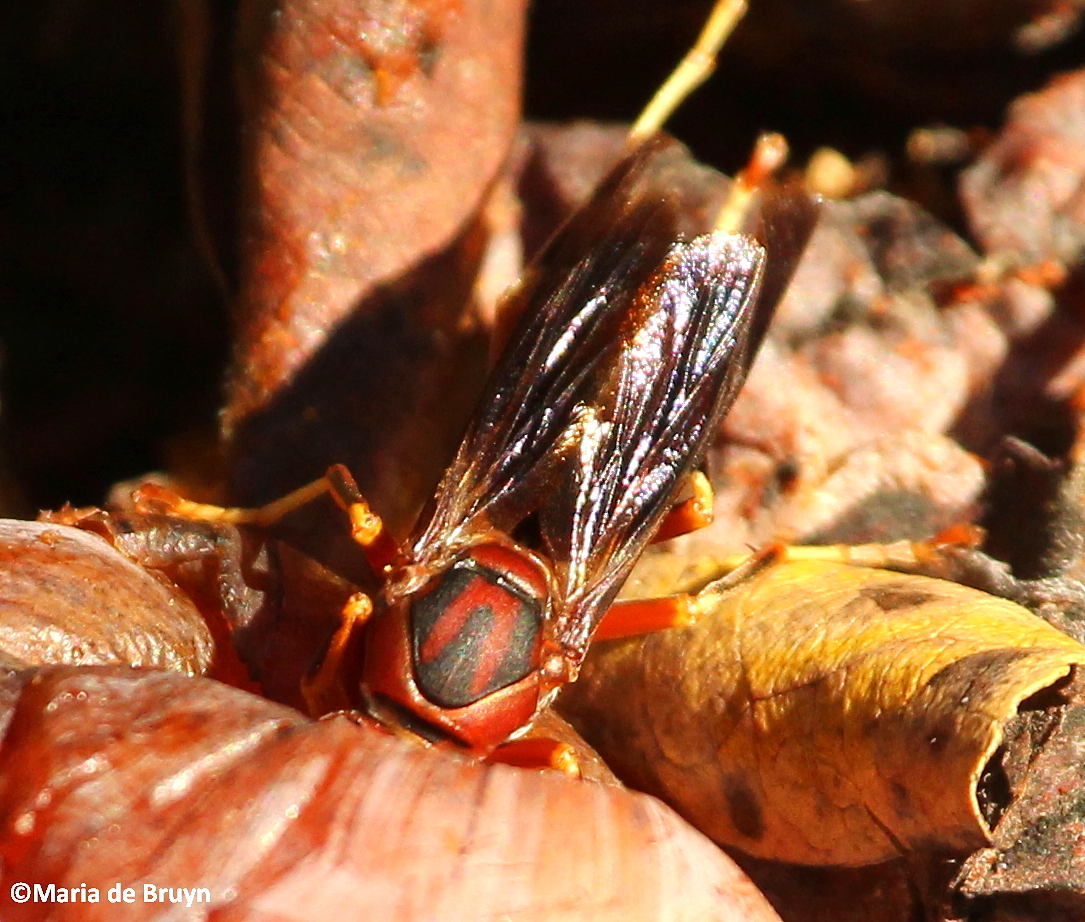
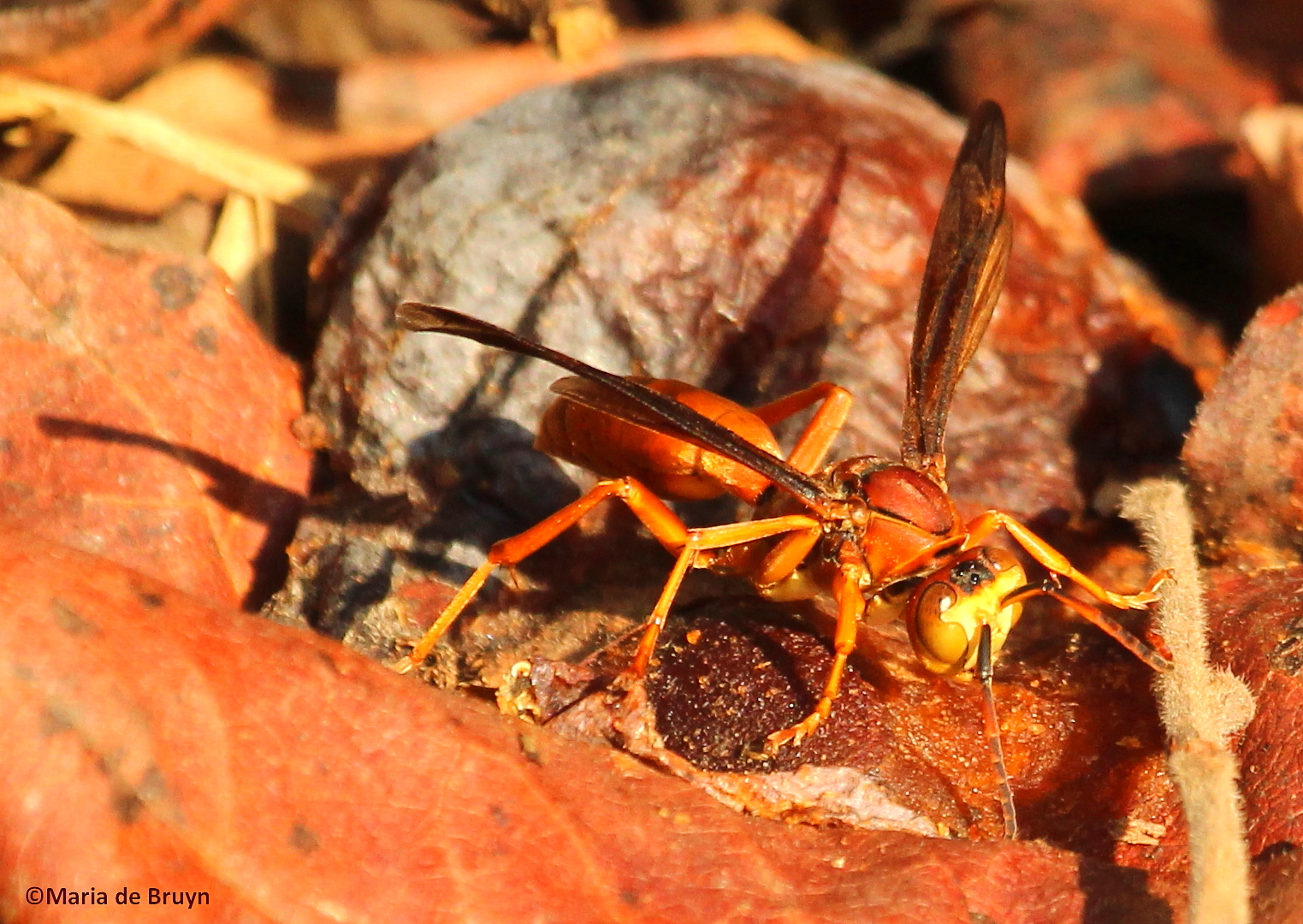
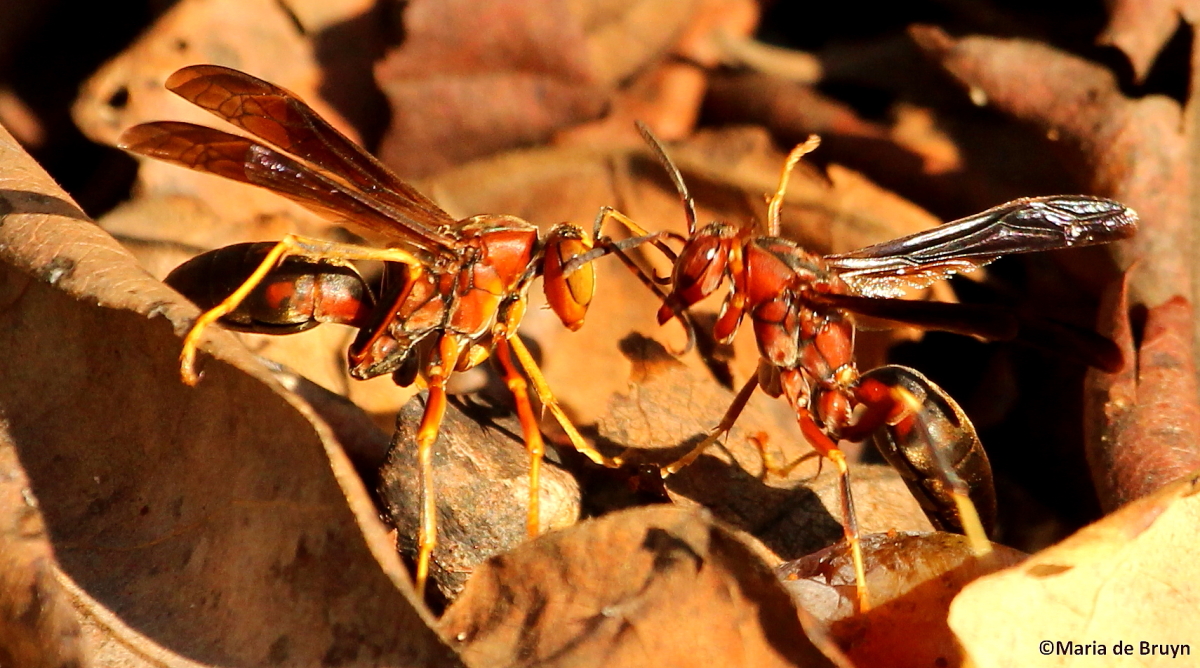
The red wasps (either Polistes carolina or rubiginosus; entomologists can only tell by examining the insect) also enjoy flitting from one fallen fruit to another in search of the sweetest bits. Sometimes they and the paper wasps challenge one another for territory.

Red wasp P carolina IMG_3495©Maria de Bruyn

Paper wasp polistes metricus IMG_3513©Maria de Bruyn res

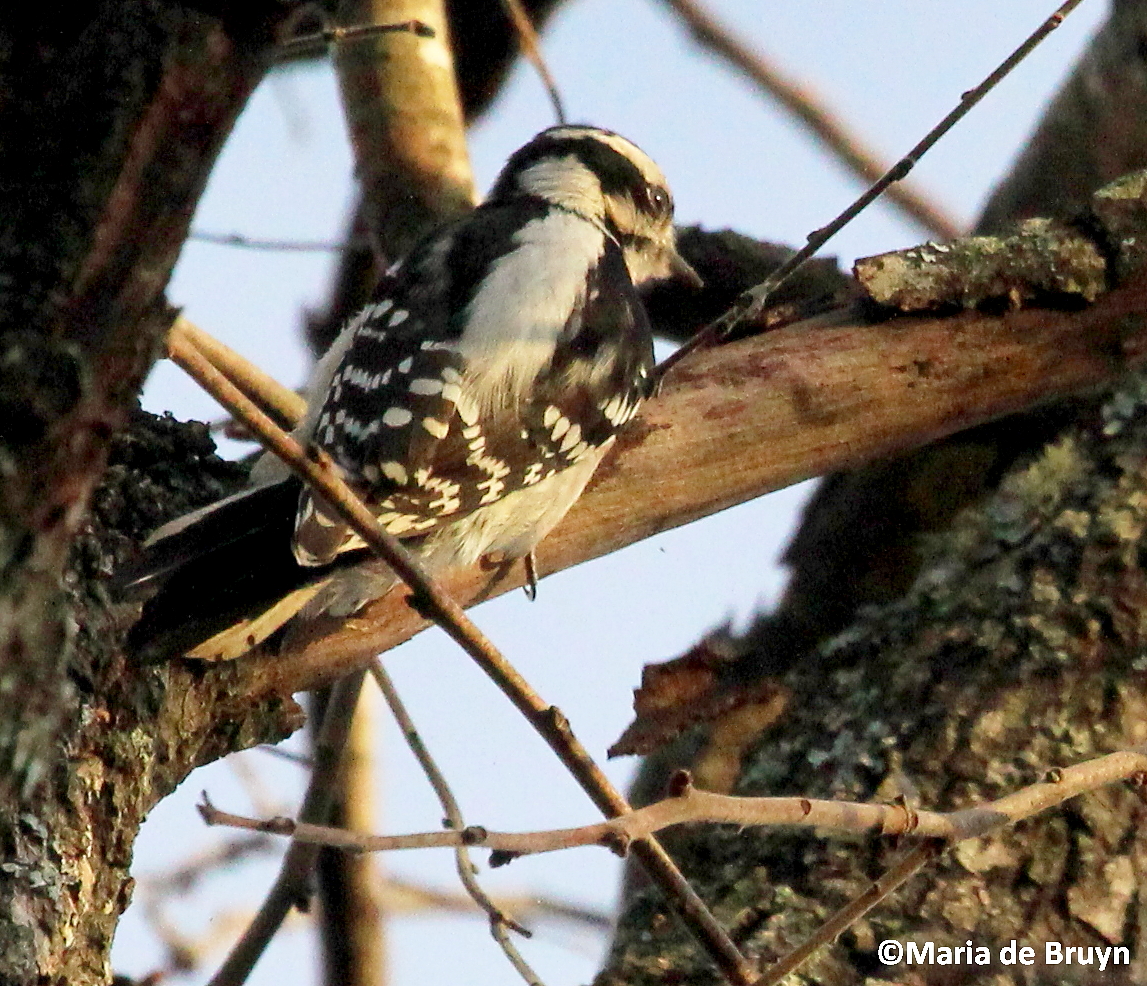
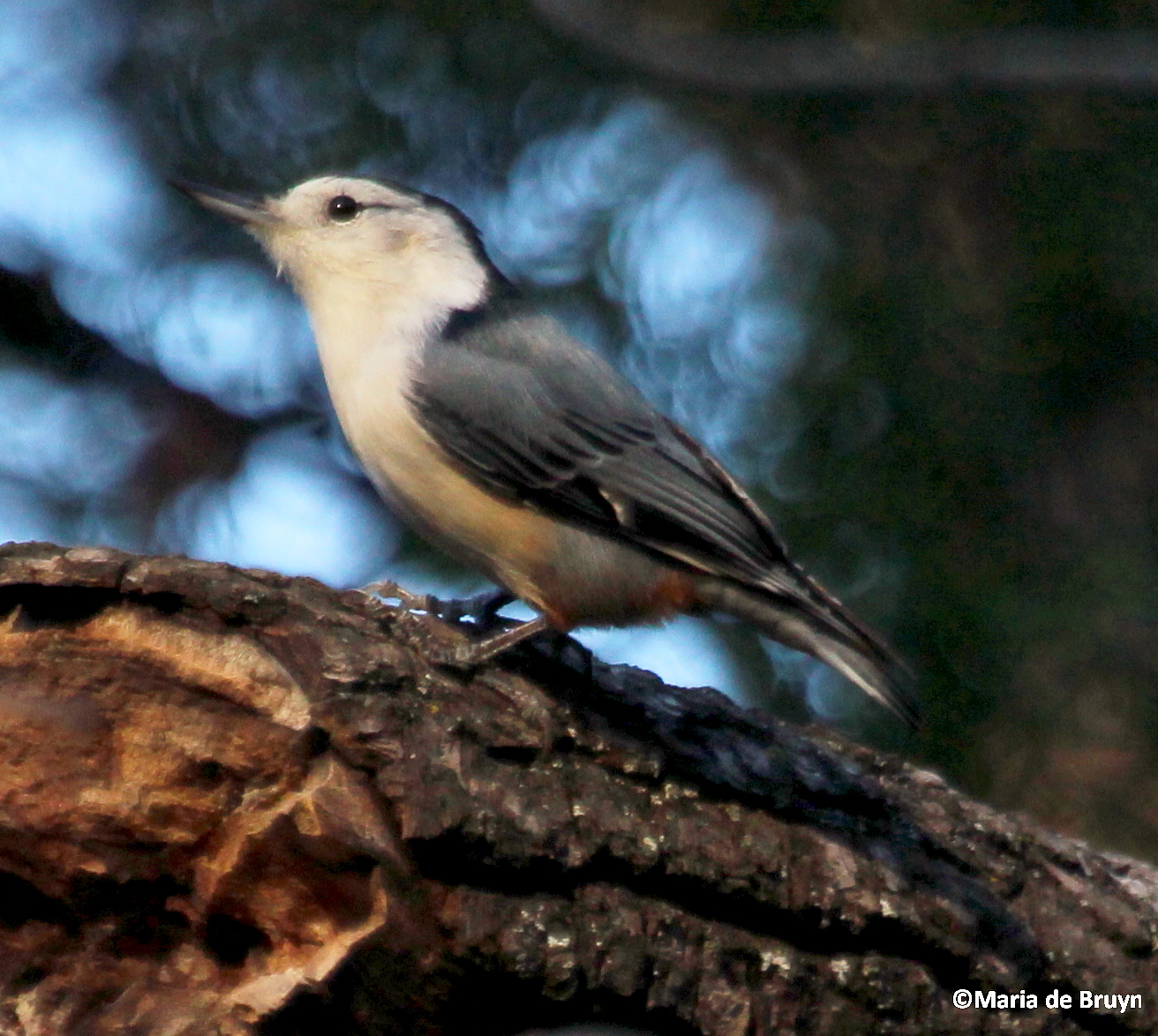
Downy woodpecker IMG_7248© Maria de BruynThe next group of persimmon pickers are the birds. Some birds only visit the tree to rest or look for insects, like the downy woodpecker (Picoides pubescens) and the white-breasted nuthatch (Sitta carolinensis).

White-breasted nuthatch IMG_5997© Maria de Bruyn


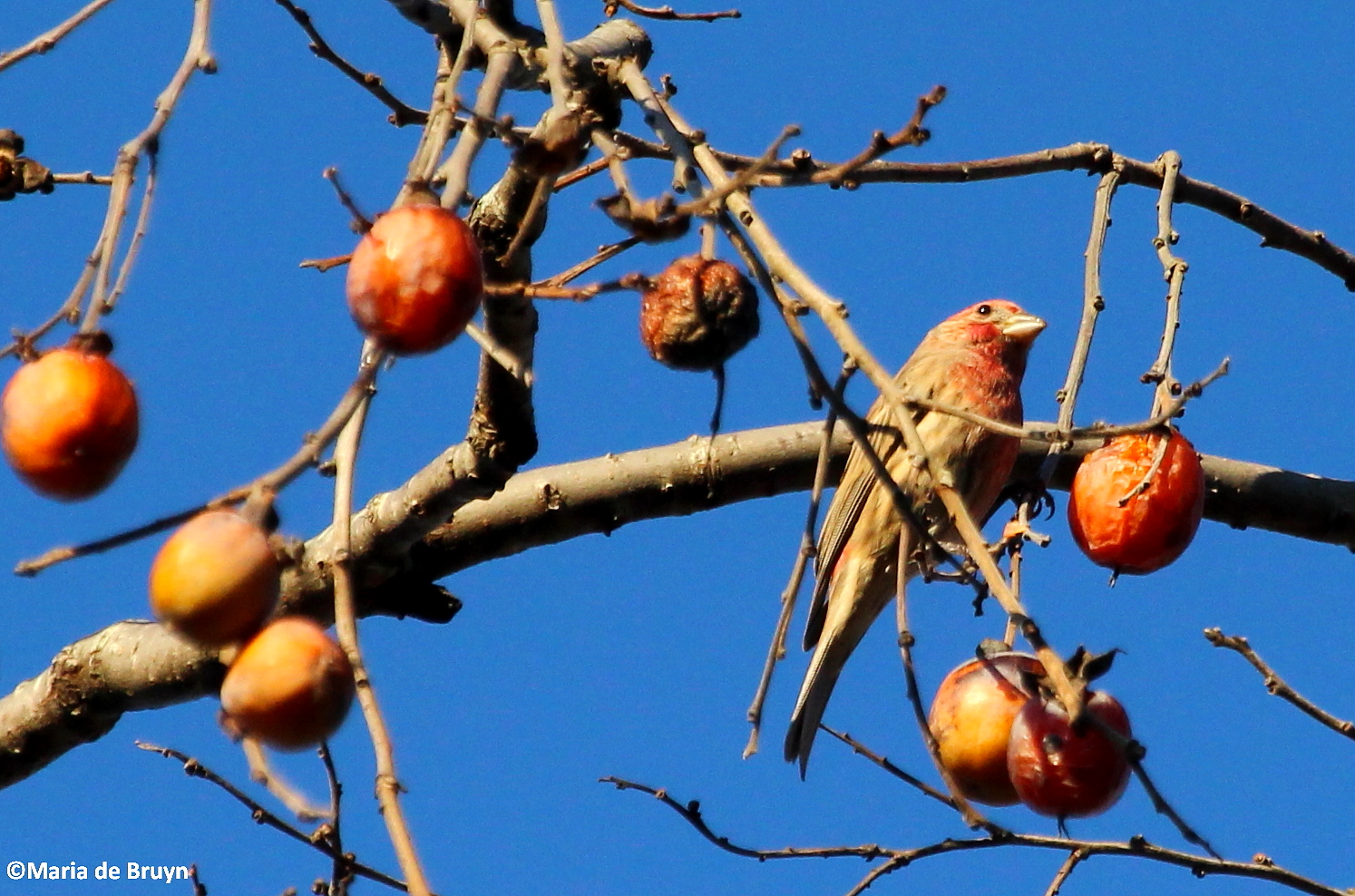
A few birds just rest in the tree and others rest and occasionally peck at a berry, like the house finches (Haemorhous mexicanus).


House finch IMG_5956© Maria de Bruyn

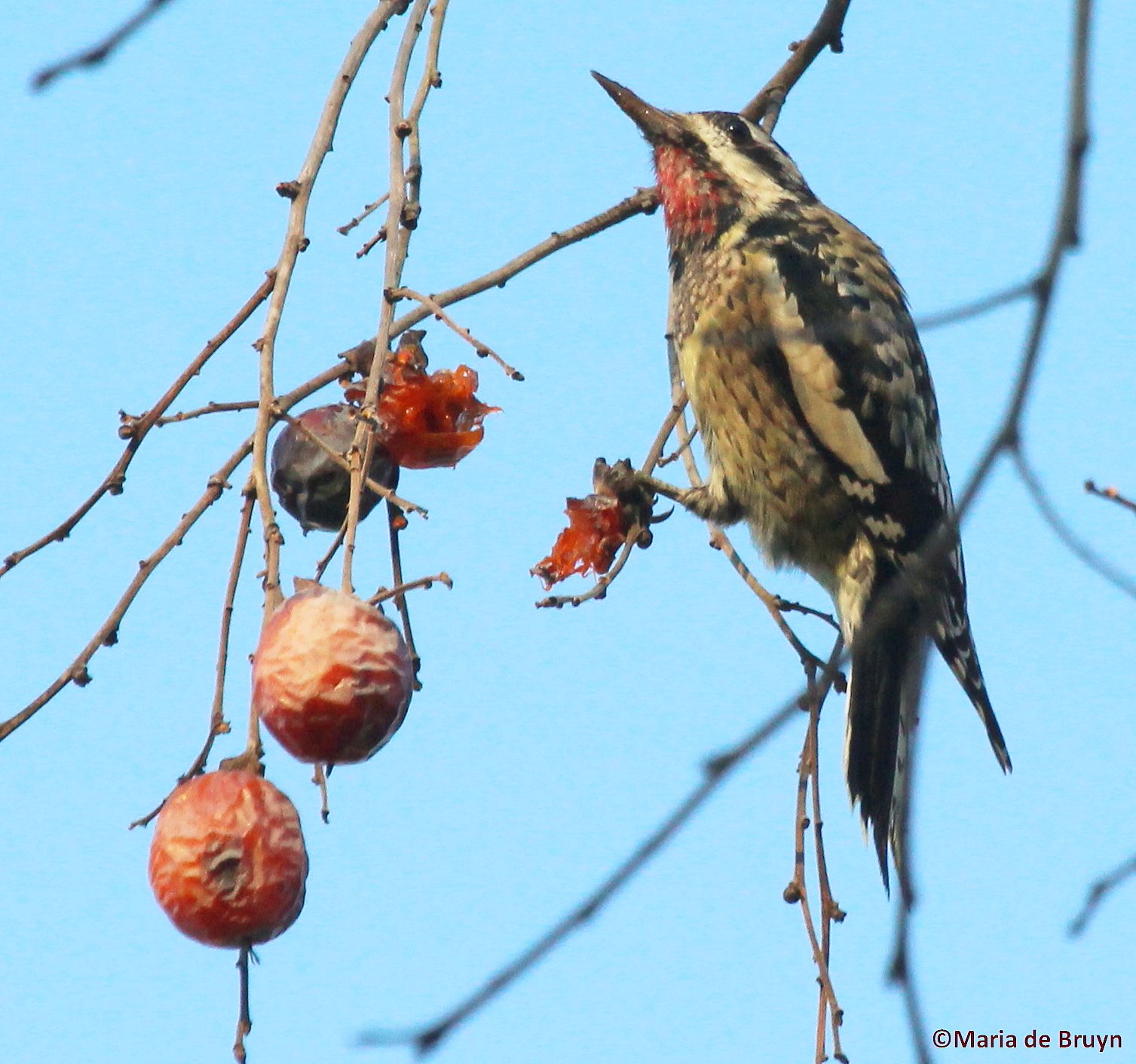
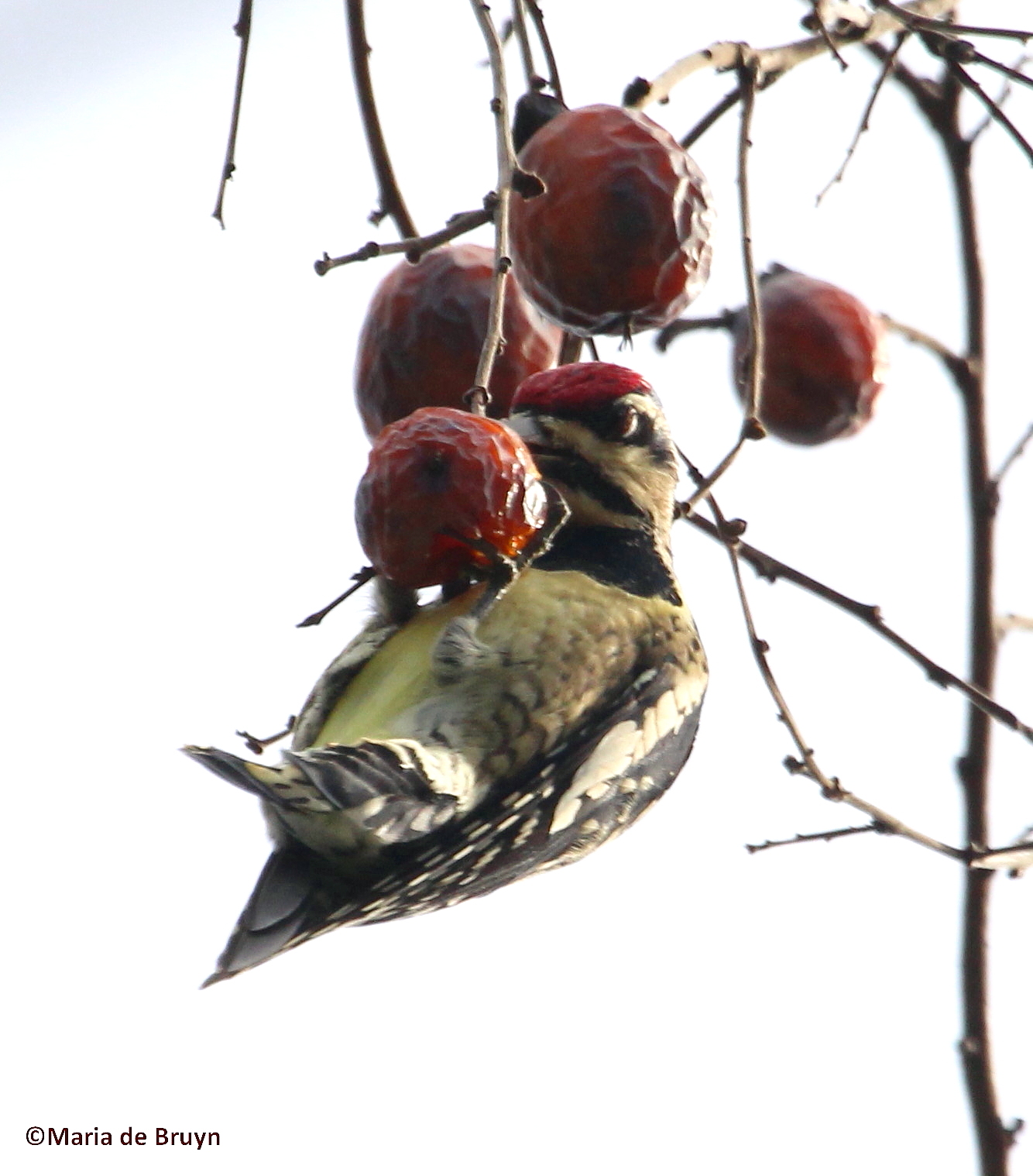
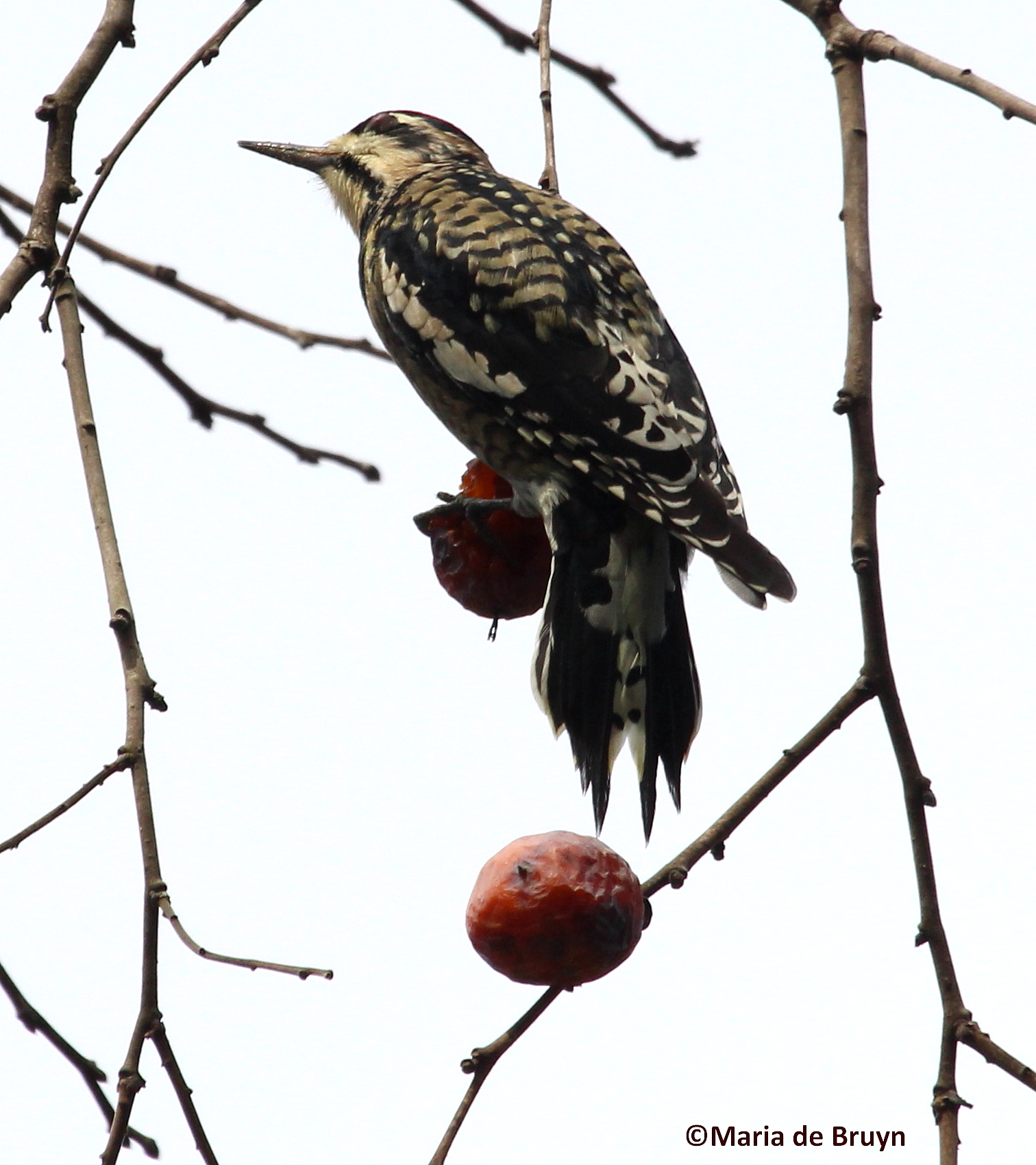
Yellow-bellied sapsucker IMG_8379© Maria de Bruyn The yellow-bellied sapsucker (Sphyrapicus varius) though is a woodpecker that is highly attracted by the fruit. A few of these attractive birds – both adults and juveniles – have been visiting the tree every day for weeks now to enjoy a sweet treat.


Yellow-bellied sapsucker IMG_8263© Maria de BruynYellow-bellied sapsucker IMG_8233© Maria de Bruyn

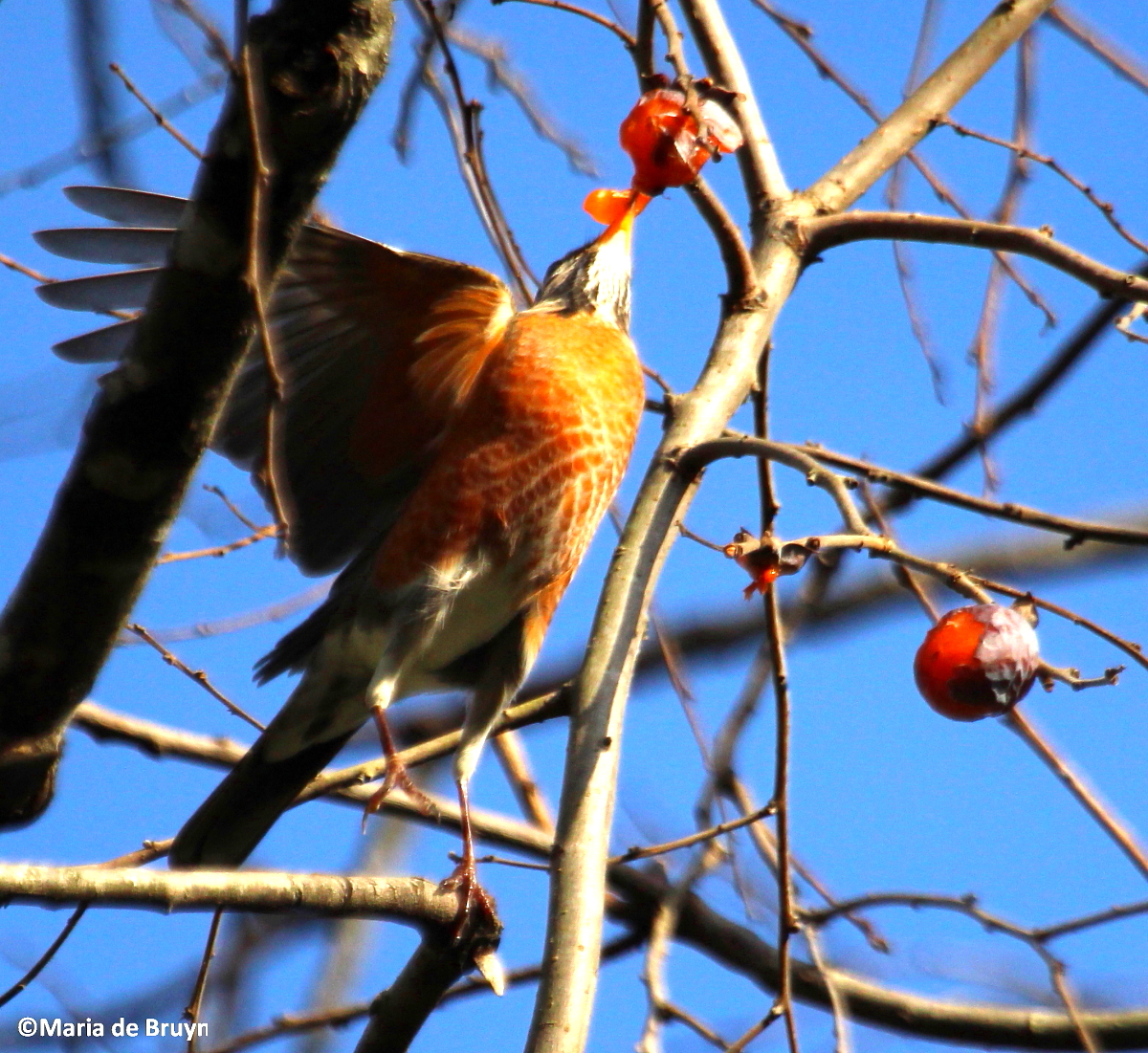
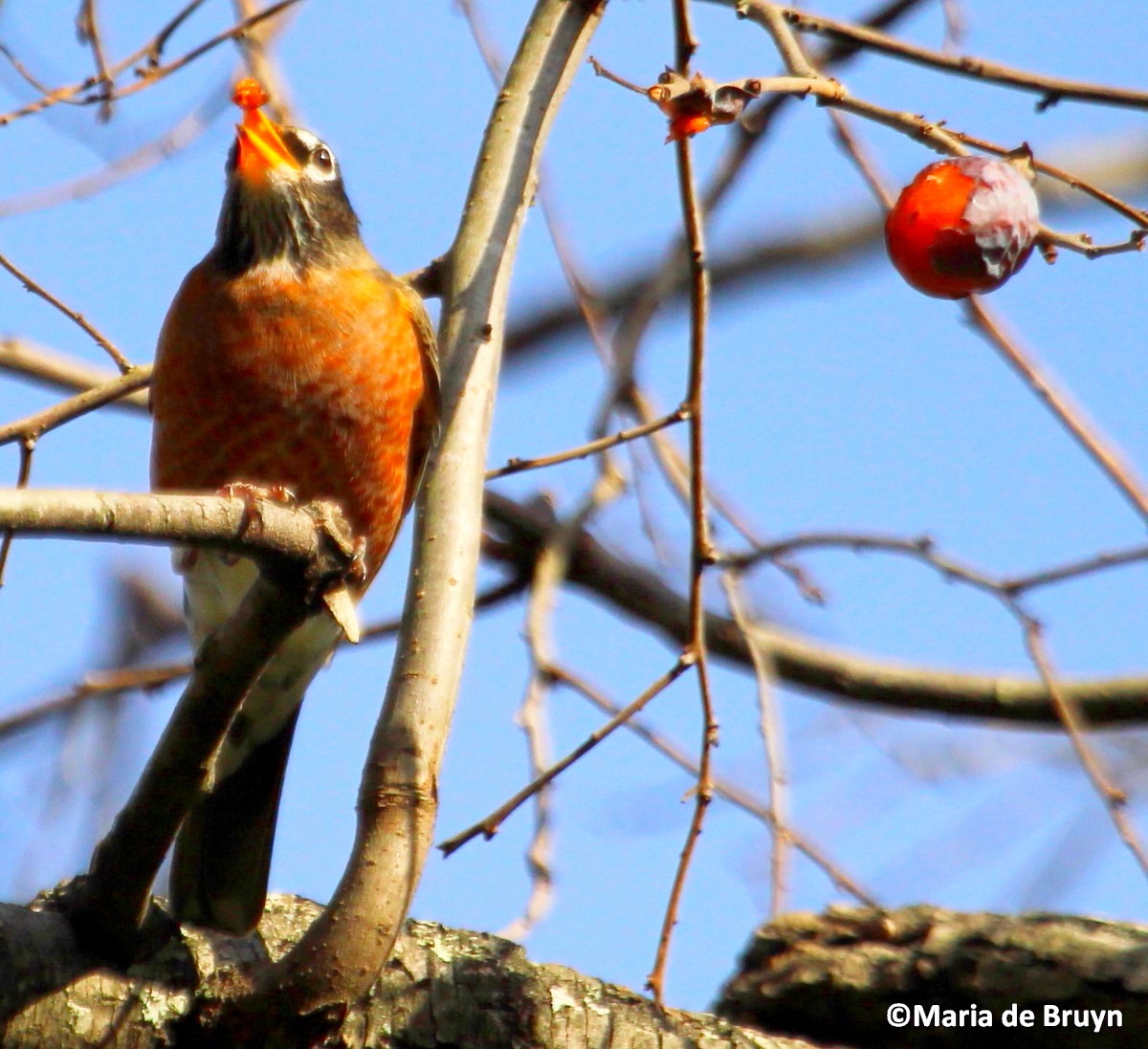
The American robin (Turdus migratorius) will not turn up its beak at a piece of persimmon either. Perhaps next year I should take a leaf from their books and collect a few fruits to try a pudding??

American robin IMG_9826©Maria de Bruyn resAmerican robin IMG_9813©Maria de Bruyn res


Mother Nature is a gamer, too!

mouth IMG_0207© Maria de BruynresThough it’s not everyone’s idea of a great past-time, there are plenty of people who play games online as a way of relaxing and temporarily escaping the daily grind. One type of popular game focuses on finding hidden objects, where players need to quickly find various items in different settings. But we can play a similar game with Mother Nature when we go outdoors and then get some good exercise while we’re at it.

Hidden objects can be seen in Mother Nature’s (or Gaia’s, if you prefer that name) creations of all kinds. Some are fairly obvious, while others require using a bit of imagination, but once you get going, it can be a lot of fun.

face IMG_0291©Maria de BruynresFinding faces in tree trunks, fungi and rocks is one variant of the game.

Facelike mushroom©Maria de Bruynres

Another focus can be discovering figures in plants and rock formations. The saguaro cactus (Carnegiea gigantean) lends itself particularly well to this in my opinion. This cactus species can grow to heights of more than 20 meters (~70 ft) and live as long as 150 years. Woodpecker nest holes in trees and cacti definitely help create “face” looks.

Hello IMG_1872©Maria de Bruyn rescactus people©Maria de Bruyn res

caterpillar-like cactus©Maria de BruynPlants can also mimic animals.

Clouds can often elicit imaginative responses and I’ve seen some really interesting formations over the years, but I lost those photos when my laptop and external hard drive both crashed within a short time. But —  fortunately  — the game can always continue since Mother Nature continues to create surprises for us to discover.

What do you see in this pcactus 4©Maria de Bruynreshoto of the crested saguaro (and some of the others)?