Big Blue – my avian nemesis!

Over the past few years, I’ve become an avid birder, at least from the standpoint of photographing the different species I see and trying to get interesting shots of their behavior. And while I’ve grown to love the beauty in each type of bird, there is one particular individual that I would rather not see in my yard.
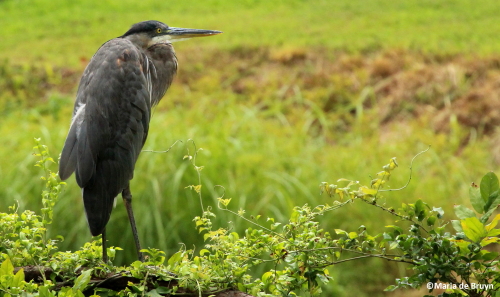
Great blue heron IMG_7612©Maria de Bruynres

What has caused this aversion, you might ask? It’s related to my pond and fondness for the fish that have populated it. At one time, I had a lovely group of goldfish, butterfly koi, shubunkins, comets and one medium-sized koi, whom I named Big Guy (or Girl, depending on my perception that day). The first predator to get some of them was a turtle, who I admired near the pond one day, not realizing that it would go into the pond and then not be able to get out.

painted turtle IMG_8914

Turtle unfortunately accounted for the disappearance of a few smaller fish, until I finally figured out that I needed to put in a larger log for it to climb out on. (This turtle would NOT let me catch it.)

But then my real nemesis appeared – Big Blue (a name given by my neighbor, Kevin), a great blue heron (Ardea Herodias). I had seen Big Blue at a large neighborhood pond and admired the grace of this large bird.
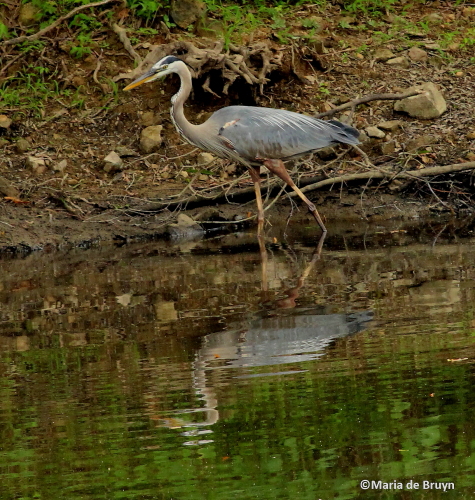
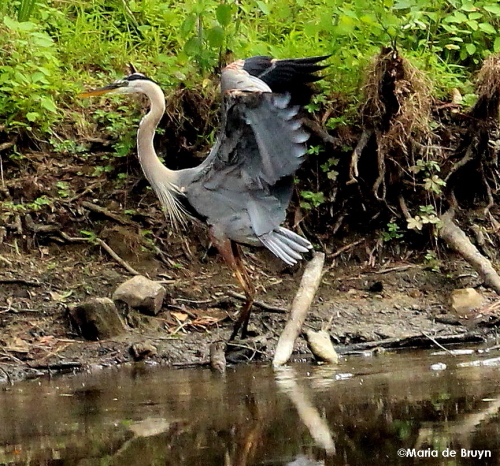
Great blue heron IMG_7482© Maria de BruynresGreat blue heron IMG_7465© Maria de Bruynres

Big Blue at the neighborhood pond

However, the first time Big Blue visited my yard – to my knowledge – I caught sight of him (or her) standing in my small pond with one of my biggest goldfish hanging from his beak. I ran out into the yard, uselessly yelling for him to drop the fish. He stared at me and didn’t move until I was about three feet away – impressing me with his large size. (He was only about 6 inches shorter than me!) Then he lifted off with his prize meal.

Great blue herons, the largest North American heron species, have a varied diet that includes small fish, as well as shrimp, crabs, rodents, other small mammals, frogs, salamanders, lizards, snakes, crayfish, dragonflies, grasshoppers, aquatic insects and even small birds. Their main hunting technique is to wade slowly in shallow water, sometimes diving headfirst into the water to quickly spear their prey with their sharp long bills.
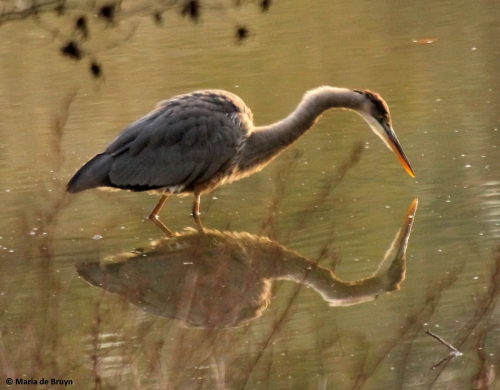
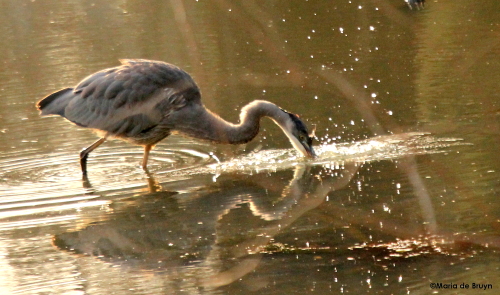
Great blue heron IMG_9216© Maria de BruynGreat blue heron IMG_9158©Maria de Bruynres

Covering my pond with netting was not an option. I had used netting to protect some plants and then had to rescue a small bird and an anole that had gotten tangled up. The owner of the store where I bought my fish (sadly closed now after many decades of running their family business) recommended I buy a life-like statue of a heron to position by the pond. He had done this at his own pond and said it kept the herons away as they are solitary hunters and don’t want others in their territory. He said Big Blue would see the statue and fly on. So I installed the statue, changing its position from time to time.

This seemed to work for many months but the past weeks I was very busy and didn’t change the stationary bird’s place. Then I noticed that my family of three bullfrogs were gone and Big Guy had gone missing (all the fish would come to the surface when I gave them pellet meals and Big Guy was gone. A gorgeous red, black and white goldfish with wavy fins was also gone. Inexplicably, the statue was also facing a different direction!

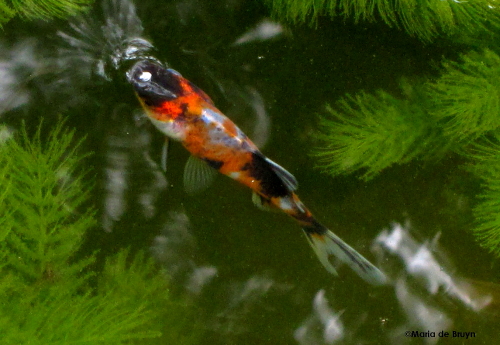
Fishy IMG_8951© Maria de Bruynres

Goldfish IMG_8917© Maria de Bruynres

Apparently, Big Blue must have had a tussle with the imposter and discovered he was not real, leaving him free to take up fishing in my pond again. I realized this about 2 weeks ago, when I saw Big Blue at the pond’s edge. I ran out to chase him off and he flew up to a neighbor’s tree. Now the pond is partly covered with some metal fencing laid over one end; it has tiny holes so no animals can get caught in it. The fish can hide under that and the smaller birds can still perch on sticks to get a drink. As it’s getting colder, the fish are also going into hibernation so – hopefully – they will make it through the winter!
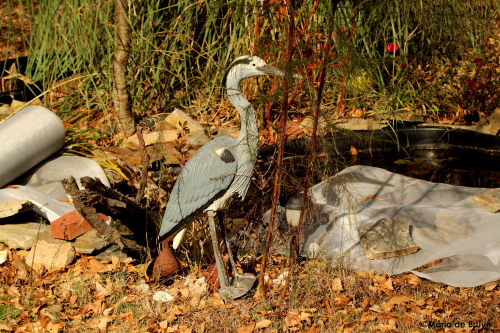
Heron statue IMG_2917©Maria de Bruynres

I have never seen Big Blue with a mate at the large neighborhood pond and sincerely hope that he will remain a bachelor. I admire his beauty but don’t want a family of herons using my pond as a restaurant!
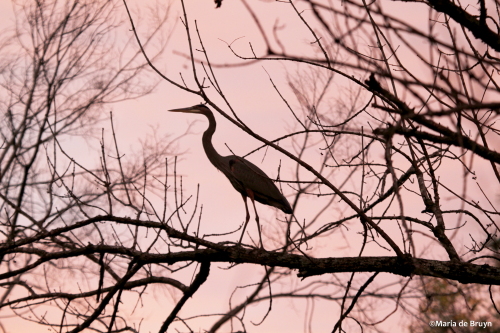
IMG_0108©Maria de Bruynres

Next blog: Caterpillars with fuzzy hair-dos

Animals that carry ticks

Thanks for visiting my blog! So, this edition is about a part of my beautiful world that is actually not so appealing to me, but it does represent some of my learning about nature over the past few years. The photos aren’t beautiful, but they do show something interesting (at least to me). Be forewarned! (And next week, back to some nice bird photos.)

Many proponents of getting rid of deer in our town argue that this will help eradicate the ticks that carry Lyme disease, Rocky Mountain spotted fever and other tick-borne diseases. It is true that ticks get on the deer, but what many people don’t know is that other animals transport these nasty little bloodsuckers as well.

According to the NC State University Department of Entomology, ticks go through four stages in their development – egg, larva, nymph, adult. The developing ticks need blood meals, with most species taking it from a different type of host at each stage. As seen in the photo of the poor white-tailed deer (Odocoileus virginianus) below, the ticks start out tiny but swell up tremendously when they have had a meal.

deer with several ticks IMG_6000 ©Maria de Bruynres

The larvae of the dog tick (Dermacentor variabilis), which can carry Rocky Mountain spotted fever, take blood from white-footed field mice and pine or meadow voles (Microtus pennsylvanicus), like the one pictured here. The nymphs go for somewhat bigger mammals such as opossums or raccoons, while the adults prefer meals from humans and dogs. Black-legged tick (Ixodes scapularis) larvae and nymphs feed on small mammals and lizards, while the nymphs and adults also seek out larger mammals, including dogs and deer. Eastern cottontail rabbits (Sylvilagus floridanus) are another tick host.

meadow vole IMG_4712©Maria de BruynRabbit with tick  IMG_8196©Maria de Bruynres

In the past couple years, the first wildlife that I have seen carrying ticks in the spring are birds – common grackles (Quiscalus quiscula) seem to be a favorite host, although I’ve seen them on other birds as well. The ticks can sense body heat and will even drop down from a tree onto another living species. This undoubtedly accounts for the first tick that gave me a bite requiring antibiotics to prevent Rocky Mountain spotted fever. It was during a visit to an exotic wildlife sanctuary that has been surrounded by an electric fence for more than 30 years so that no deer have been there for decades.

Common grackle 4 ©Maria de BruynCommon grackle 1 ©Maria de Bruyn

Ticks also wait in the grass to latch onto animals – and people – walking by. Fortunately, I’ve never found ticks on my indoor-outdoor cat, but I have found them on me after being in the yard and out on nature walks. Different techniques for loosening their grip have worked well – a new skill that I had never anticipated learning. There are few animal species that I really dislike, but I must admit that ticks are definitely one of them. But I also know now that eradicating deer is not the solution to getting rid of the ticks.

Next blog: Big Blue – my avian nemesis!

Acrobatic squirrels

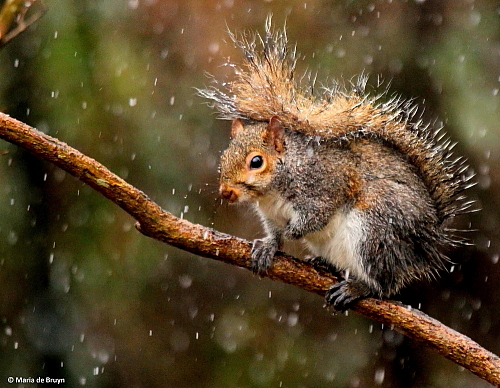
The Eastern gray squirrel (Sciurus carolinensis) is a well-known – and sometimes quite annoying! – visitor to our yards in North Carolina. One way in which they earn themselves a reputation as a pest is when they get into attics, where they could end up chewing on wires. This happened to me, so I had to have a pest control agent come to trap them humanely (rather than poison them). Unfortunately, I found out later that when they are released outside their home territory, it’s tough going for them as other squirrels see them as invaders. I hope they made it.

Squirrel IMG_0820©Maria de Bruynres2 Eastern gray squirrel IMG_2144©Maria de Bruynres2

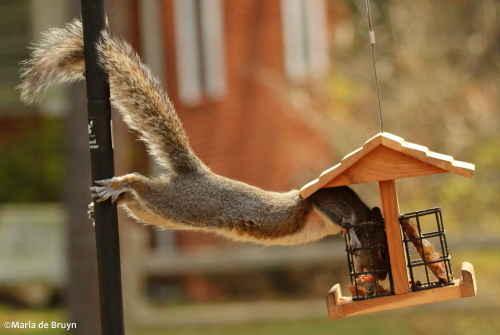
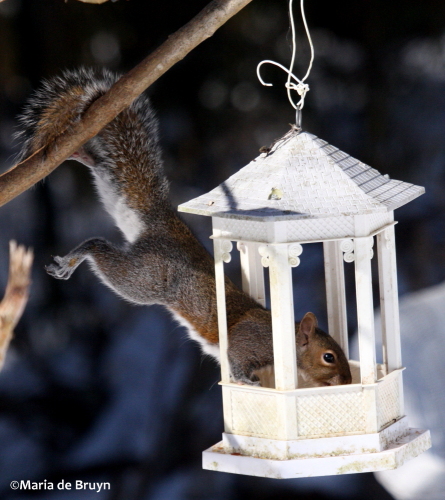
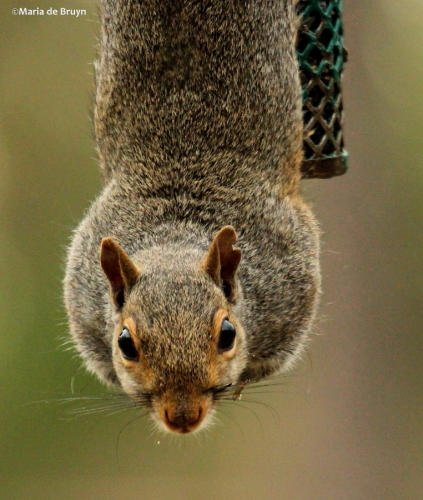
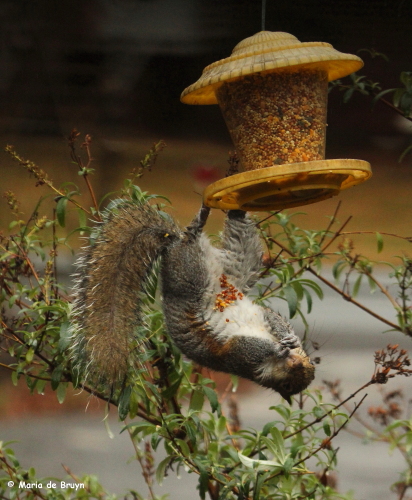
The second way in which they can be a nuisance is when they go to extreme lengths to get at the food in bird feeders. My yard squirrels and I have had an ongoing game of wits over the years, with them doing all they can to get to the feeders and me taking new measures to prevent them from doing so.

Squirrel IMG_8869©Maria de Bruynres2squirrel IMG_1232©Maria de Bruynres2

The gray squirrels mainly eat plants and seeds, including acorns and pine cones, but they also like a variety of other foods, including fruit, seeds and suet. Fortunately, I haven’t had the same experience as my neighbors, who had squirrels chew through the screen on their back porch to get to a bag of seed left there. These agile little mammals have posed a challenge to me, however, in situating my feeders in places that they can’t get to them.

Squirrel IMG_8418©Maria de Bruynres2squirrel IMG_0120© Maria de Bruynres

If the feeder is within a few feet of something they can use as a launching pad (a bush, pole, etc.), they will manage to jump the distance in their ever-present quest for food. Various attempts to prevent this, by moving feeder poles and using combinations of squirrel and raccoon baffles have – sometimes! – proved useful.

squirrel 115©Maria de Bruynres2

However, if the baffles are too low or near a tree, they jump over the baffle to land on top so they can enjoy a meal at their leisure (or until I see them and chase them away).

squirrel IMG_2084©Maria de Bruynres2squirrel IMG_2473©Maria de Bruynres2squirrel IMG_3618 ©Maria de Bruynres2

I must admit, though, that they are a source of entertainment, too; watching their antics and persistence in thinking about how to overcome the barriers can be very amusing. And it’s not like I don’t give them a treat now and then!

Next blog: how ticks get around

Birds using salt blocks

In the past, I have put out salt blocks for the deer to use in winter, but then I learned that other animals will use them as well. I have seen squirrels and rabbits licking at the blocks and chipmunks in their vicinity, but I was most surprised when I first saw purple finches (Haemorhous purpureus) pecking away at them.

squirrel at salt block IMG_5209 ©Maria de Bruynsigned resrabbit at salt block IMG_6254©Maria de Bruynsigned

At first, I thought this was abnormal or unusual but a specialist with the Audubon Society/North Carolina wildlife department told me that finches and other bird species will do this regularly to obtain salt when it is lacking from their diet. They also use the salt to help clean out their gizzards (an organ behind the stomach that helps break down seeds and food so that the bird can digest it more easily).

male and female purple finch at salt block IMG_7614©Maria de Bruynsignedresmale and female purple finch at salt block IMG_2733© Maria de Bruynsigned res

Apparently, mourning doves, sparrows, grosbeaks, pine siskins, goldfinches, house finches (Haemorhous mexicanus) and purple finches (like those in the photos) will all peck at salt blocks. So far, I have only seen the purple and house finches doing it.

Sometimes, they have had mini-gatherings there, making the salt block a place for socializing!

purple finches at salt block IMG_7605©Maria de Bruynsignedrespurple finches gathering at salt block IMG_4244©Maria de Bruynsignedres

Balancing on the block can also involve some acrobatics.

house finch IMG_9840©Maria de Bruynreshouse finch IMG_9841©Maria de Bruynres

It’s nice to have something to offer them besides suet, bird seed and bird baths.

Next week’s blog: acrobatic squirrels

Deer antlers – a sometimes impressive sight!

After living in apartments for many decades, it was a thrill for me when I was able to live in a house surrounded by a yard on all sides. It was even cooler when I discovered my neighborhood was home to a variety of birds and animals, undoubtedly helped by the fact that there are woods, a creek and a pond nearby. One of my greatest delights has been the white-tailed deer (Odocoileus virginianus), that visit – even though some neighbors loathe them and chase them from their yards. I’ve found that a home-made deer repellant, as well as a store-bought one, work well to keep these visitors from eating the plants I want to keep. The veggies are in a narrow, fenced garden that they cannot enter so no problems there either.

deer antler IMG_5122©Maria de Bruynsignedres

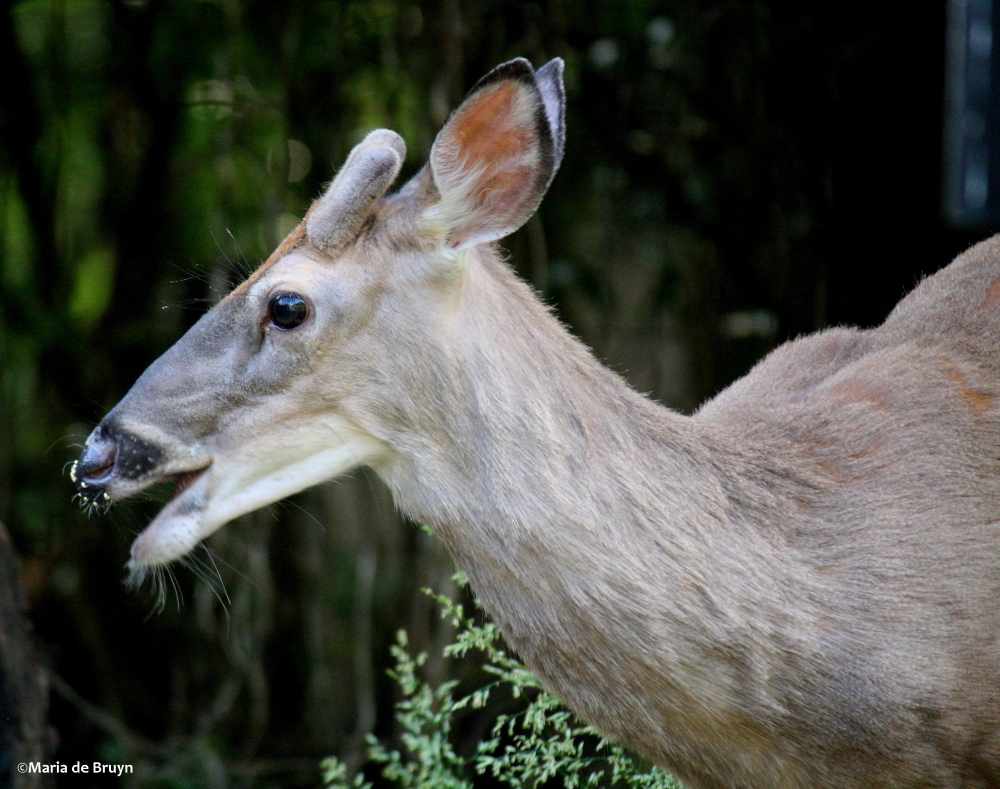
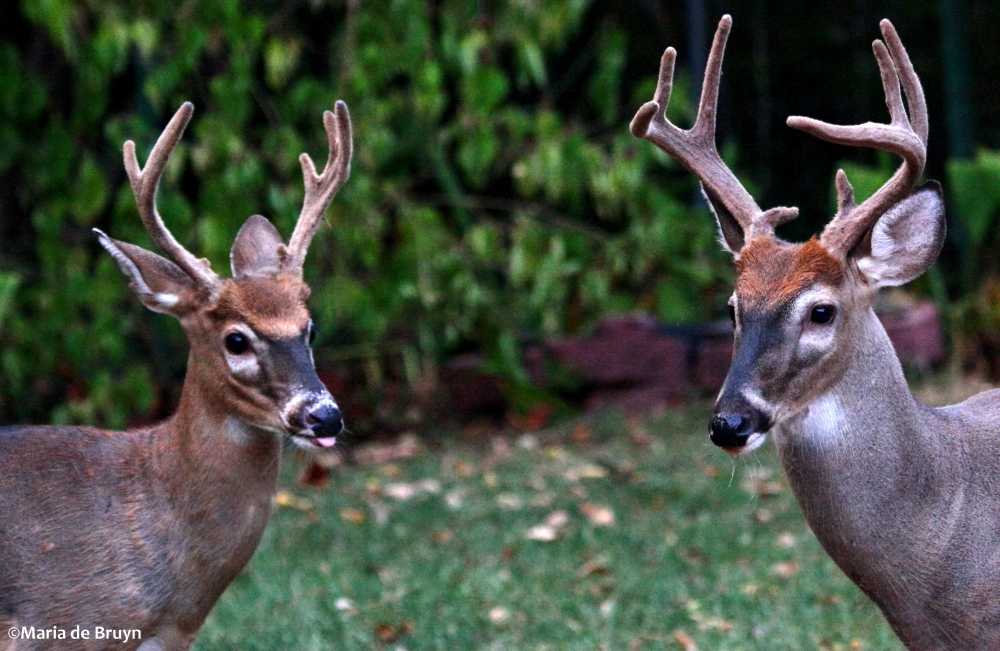
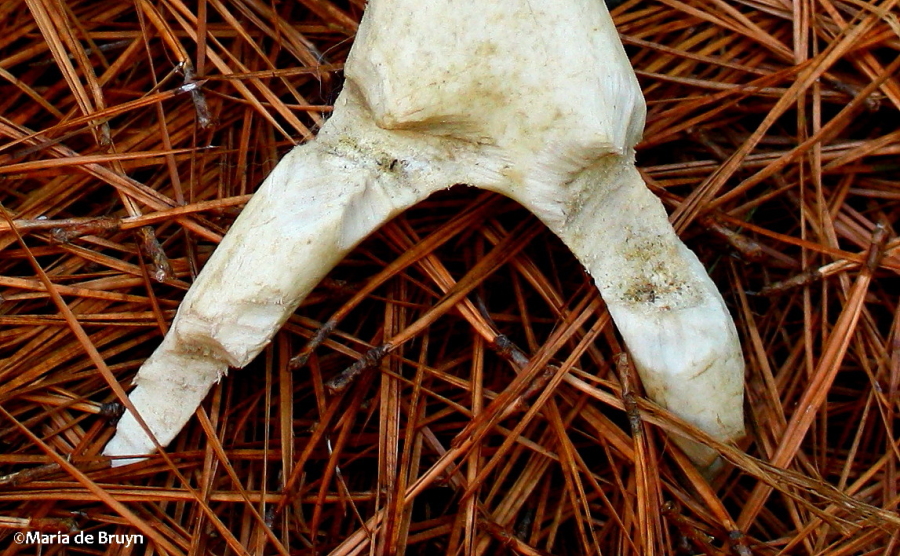
While does and fawns are the main passersby, a variety of male deer visit, too. Some have been the offspring of local does, while others have come in during mating season.The buck above was kind enough to drop one antler in my yard and I found the other in the woods. Learning about their antlers has been interesting and showing the antlers to kids that I have mentored and visitors is fun, too.  So what process leads to these impressive growths?

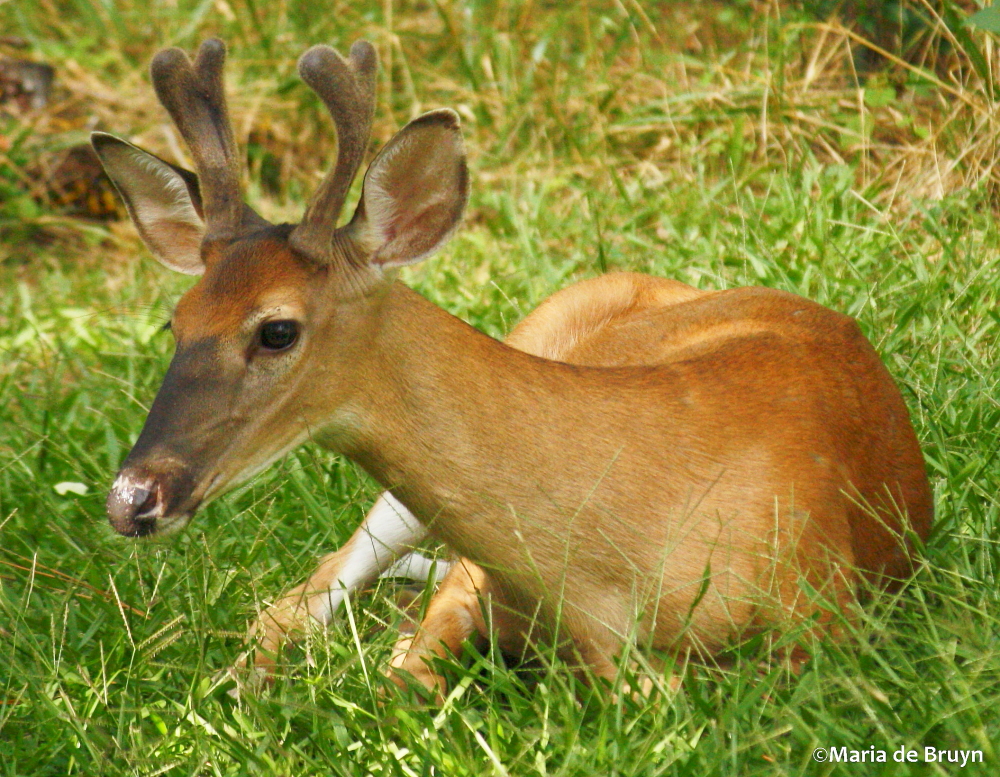
Male fawns that are 6-9 months old during their first winter (fawns are born in the spring) are called “button bucks” because they have nobs on their heads that are covered with skin. In their second year, their antlers become longer but are still rather short.

button buck IMG_4770©Maria de Bruynsigned2nd year buck IMG_5975©Maria de Bruynsignedres

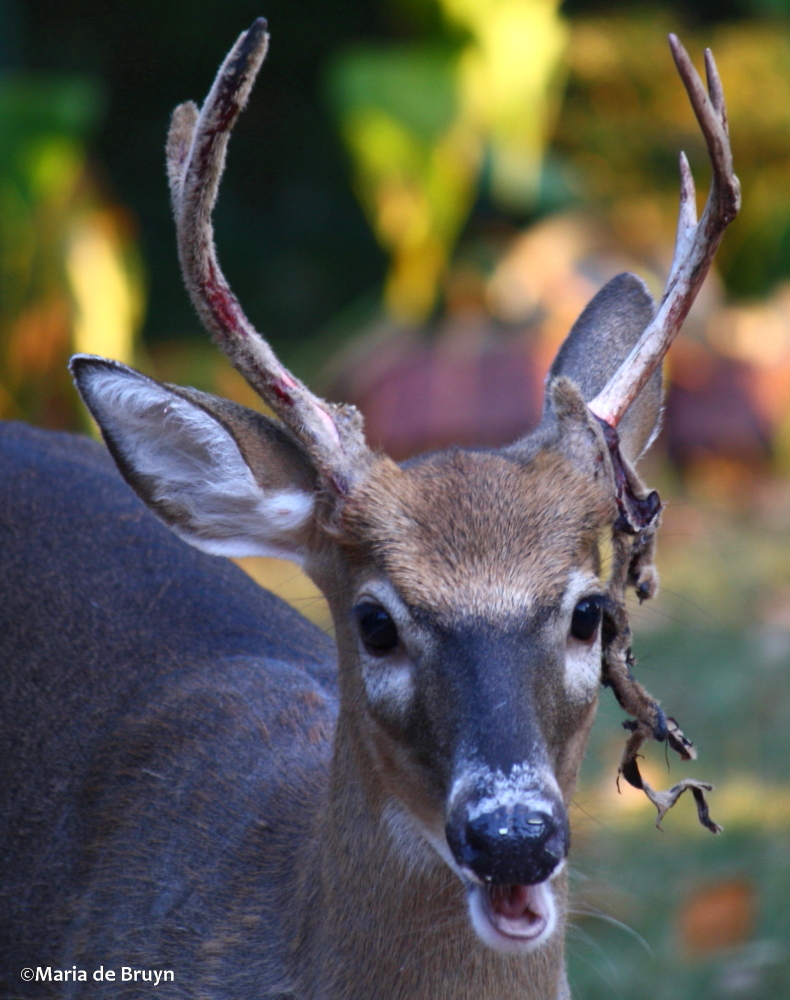
The males grow new antlers every year; they are the fastest growing bone in mammals. They start growing in late spring and are at first covered with a fuzzy skin, called velvet, which provides nutrients and oxygen to the growing bone. The velvet has blood vessels and when the deer rub it off, for example, against tree branches, you can see traces of blood. When the velvet has been shed, the antler becomes dead bone and it doesn’t hurt when the antler is shed.

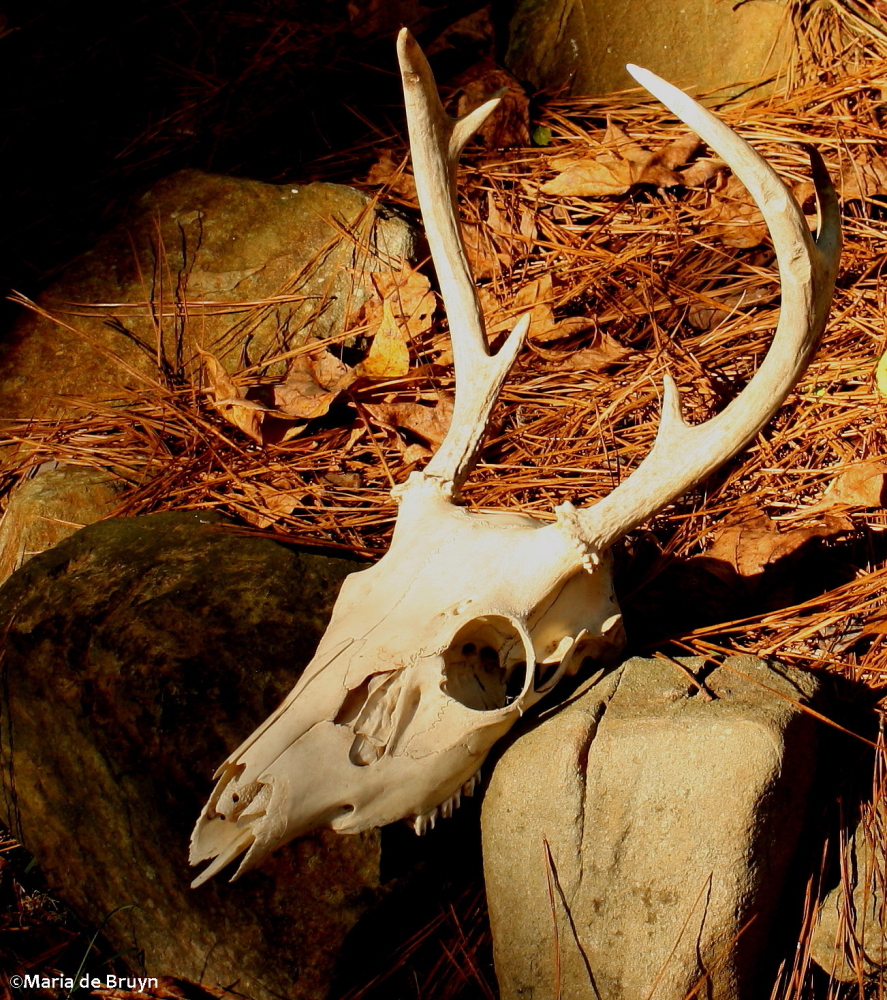
antler velvet shedding IMG_6077©Maria de Bruynsignedresdeer skull IMG_1388©Maria de Bruynsignedres

The way that the antlers grow is influenced by the deer’s nutrition, age and genetic background. Some have simple spikes, which may become branched antlers as the deer grows older. Some “racks” (the pair of antlers) will have many branches.

deer antlers IMG_5414©Maria de Bruynsignedres

The bucks lose their antlers at the end of winter and you can find them on the ground if the squirrels don’t get to them first! I had left some antlers outdoors as garden decorations until one day I found a couple had been gnawed by the squirrels. The squirrels eat them to help wear down their front teeth (which are always growing) and to obtain minerals such as calcium.

gnawed antler IMG_1402©Maria de Bruynsignedres

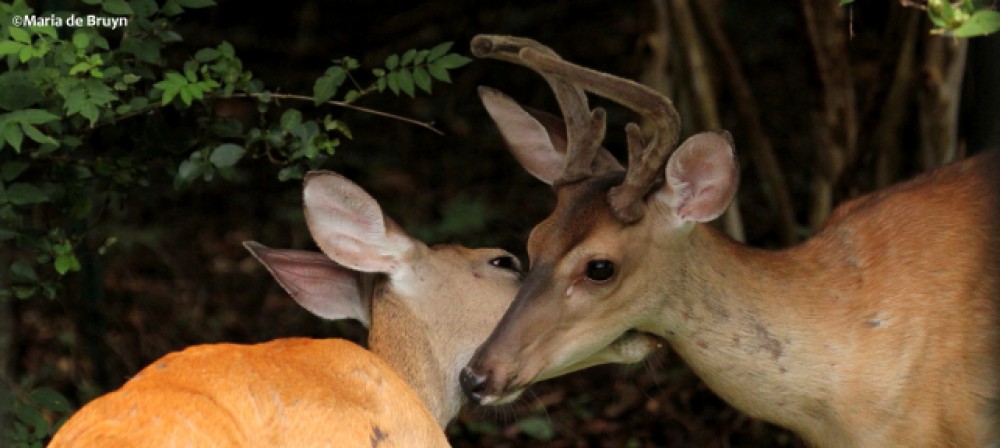
As long as the does are around, the bucks will come, which makes me happy. They may not be as comfortable staying in the yard as this member of Schatje’s family, but their brief visits will remain a source of pleasure and learning!

Schatje's son Topa IMG_7560©Maria de Bruyn signedres

Thanks to Kevin Hinkle for letting me photograph the skull.

Next blog: birds at salt blocks