Backyard citizen science – take 2

As I mentioned a few weeks ago, as part of an eMammal citizen science project, a motion trap camera was placed in my yard for three weeks. I am used to a variety of wildlife passing through and living here, including: white-tailed deer (Odocoileus virginianus), Eastern chipmunks, Eastern cottontail rabbits (Sylvilagus floridanus), opossums, raccoons, Eastern gray squirrels (Sciurus carolinensis), field and house mice and the occasional vole. My hope was that the camera would capture the gray fox that has been wandering our neighborhood lately or maybe even a coyote visiting at night.

The project started with the placement of a camera at knee level on a crepe myrtle tree facing a path through which animals enter and leave my back yard. The objective was to record all the mammal species that visit (or at least those passing in front of the camera) for three weeks.

Jonahay eMammal camera IMG_2971© Maria de Bruyn resAs neighborhood cats come to the yard, I was sure to get some photos of them, if nothing else. My senior deaf cat, who is now suffering from some dementia, only goes out when I accompany him (the other two family cats must stay inside). He checked out the camera right away and I wondered if he was going to pee on it to mark it as a new part of his territory. Instead, he went off to mark another part of the yard.

It was with great anticipation that I looked at the photos on the card after it was taken down, only to discover that the camera may have been aimed too high.

Eastern gray squirrel EK000016© Maria de Bruyn It seems that a squirrel may have been captured one evening, and in another case, it seems an opossum was entering the yard. However, the main captures (and there were not that many) were glimpses of deer.

A rabbit had decided to have a lie-down in front of the camera one day, perhaps 1½ feet away. It was not photographed and the project coordinator told me that the camera has a large blind spot right in front of it extending out roughly 3 feet.

Eastern cottontail DK7A2749© Maria de Bruyn res

unknown EK000547© NCSU


Staring at the night shots made me think in a few instances that some creature had been photographed but I wasn’t really sure if that was it or just my imagination running amok.


white-tailed deer EK000425© Maria de Bruyn res


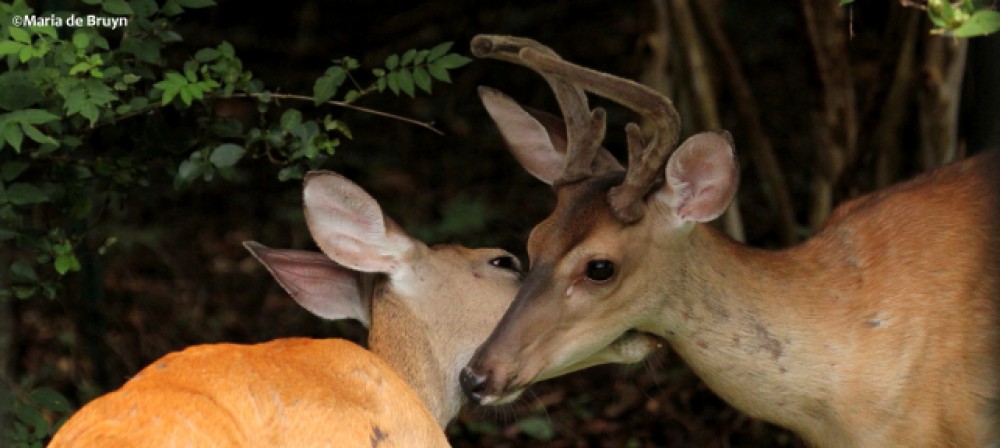
A few times a deer stopped and the camera got a portrait shot, occasionally with a gesture that in humans might equate to thumbing their noses at something.


white-tailed deer DK7A1403© Maria de Bruyn reswhite-tailed deer EK000212© Maria de Bruyn res

white-tailed deer EK000514© Maria de Bruyn res


A few shots were close-ups.

Other times, we see an ear or the deer’s behind as she moves out of range.


white-tailed deer EK000548© Maria de Bruyn res white-tailed deer EK000073© Maria de Bruyn res

One day, I caught a doe giving the camera a good look; this led to a few blank photos as her face or tongue covered the lens area.

white-tailed deer DK7A3136© Maria de Bruyn res white-tailed deer DK7A3120© Maria de Bruyn resdoe EK000010© NCSUwhite-tailed deer EK000472© Maria de Bruyn res

Despite the paucity of cool camera captures, I enjoyed participating in the project and will consider taking their 30-minute course so I can have a camera placed here for a longer period. And if it is aimed lower, who knows what we may see then!

Yearning and burning for biological diversity

Burn 18 March 2015 DK7A1575© Maria de Bruyn resOn 18 March, a controlled burn again took place on 18 March at the Mason Farm Biological Reserve as part of the management strategy to promote the biological diversity of native plants at this nature refuge. During a controlled understory burn, the undergrowth of a defined area is set afire in a simulation of the wildfires that have historically been a part of meadow and forest ecology.

Burn 18 March 2015 IMG_1047© Maria de Bruyn resThe area to be burned is prepared by clearing a broad border of flammable materials such as leaves and twigs. If there are trees or plants that should remain but that could catch fire, for example because there are vines going up their trunks, the area around them can be raked clear or sprayed with water, creating a firebreak.


Burn 18 March 2015 IMG_1107© Maria de Bruyn resA controlled burn requires permission from safety authorities and is monitored by a team of people, some of whom will ignite the fire and others who will patrol the perimeters and help ensure that the fire is quenched before leaving for the day. Duties are assigned during pre-burn briefings and team members have copies of maps showing which sections of the designated burn area are their responsibility. They carry out a radio check before the burn begins to ensure they can be in communication when needed.

Burn 18 March 2015 IMG_1076© Maria de Bruyn resBurn 18 March 2015 IMG_1078© Maria de Bruyn res

Burn 18 March 2015 IMG_1157© Maria de Bruyn resdrip torch IMG_1156© Maria de Bruyn resAt Mason Farm, the fires were ignited in lines through the use of a drip torch, which allows the person wielding it to direct a stream of flaming fuel to the area to be burned.


Burn 18 March 2015 DK7A1407© Maria de Bruyn res Burn 18 March 2015 DK7A1393© Maria de Bruyn res

Perimeter and interior monitors use implements such as shovels, rakes, “fire flappers” (long-handled instruments with flexible ends to swat down flames and embers) and portable water sprayers to contain the burn within its boundaries.

Burn 18 March 2015 IMG_1117© Maria de Bruyn resBurn 18 March 2015 DK7A1460© Maria de Bruyn res

The burn at Mason Farm was ignited first in a small patch so that the team could observe the speed with which the fire spread and burned the ground vegetation.

Burn 18 March 2015 DK7A1421© Maria de Bruyn res Burn 18 March 2015 IMG_1080© Maria de Bruyn res

Burn 18 March 2015 IMG_1090© Maria de Bruyn resBurn 18 March 2015 IMG_1119© Maria de Bruyn resThey also paid careful attention to the wind direction, which could transport embers and bits of burned debris away from the burn site.

Burn 18 March 2015 DK7A1427© Maria de Bruyn res Burn 18 March 2015 DK7A1446© Maria de Bruyn res

Controlled burns are important in eradicating invasive plants (e.g., Microstegium vimineum, commonly known as Japanese stiltgrass) and enabling native plants to thrive. Some plants are fire-resistant and suffer little damage during a burn. A variety of grasses, flowers and trees need fire for their seeds to germinate, while other plants may need less dense areas as prime growth habitat. Some of the minerals contained in slowly decaying plant matter become soluble and more available in ash, contributing to quicker rejuvenation of the soil.

Burn 18 March 2015 IMG_1120© Maria de Bruyn resBurn 18 March 2015 DK7A1520© Maria de Bruyn res

Some areas of the work area burned quickly and turned into smoldering ash that occasionally flared up with a rise or turn of the wind. During this burn, some patches did not catch fire; others at first appeared immune to the fire only to burst into flame after some time.

Burn 18 March 2015 IMG_1154© Maria de Bruyn resThe flames could be quite beautiful and even mesmerizing as they flickered and flashed.

Burn 18 March 2015 DK7A1627© Maria de Bruyn res Burn 18 March 2015 DK7A1577© Maria de Bruyn res

At times the wind turned and brought smoke in our direction, obscuring the view but then the wind shifted again and we could see the crackling, shifting fire on logs and stumps.

Burn 18 March 2015 DK7A1496© Maria de Bruyn res Burn 18 March 2015 DK7A1498© Maria de Bruyn res

Burn 18 March 2015 DK7A1573© Maria de Bruyn resA concern for wildlife lovers is the possible demise of animals during a burn. Birds may lose nests but if the burn takes place outside the breeding season, the majority of birds can fly to safety. Many mammals can flee to other areas, while some reptiles and amphibians can burrow into the ground and survive. Occasionally, some animals may perish such as slow-moving turtles and arthropods (e.g., spiders) and insects. That is certainly a sad and regrettable outcome but team members sometimes can help rescue fleeing wildlife. During this burn, the marbled salamander larvae (Ambystoma opacum) continued to swim about placidly in a vernal pool in the woods across from the fire.

Marbled salamander DK7A1338© Maria de Bruyn resOverall, promoting a healthy environment for native plants not only helps restore the natural environment but is also important for wildlife species that depend on the fire-dependent plants for sustenance and habitat. Watching a burn can be an interesting and educational experience. People who want to participate in controlled burns can volunteer for this with the managers of preserved natural areas.