Big-beaked birds – lovely or laughable?

I don’t know how many of us would find a human being with an extremely large nose (e.g., even bigger than the face) and multi-colored head, facial and body hair to be beautiful or even attractive. Perhaps it would depend on the nose shape and which color combinations would be in play? But it is certainly a fact that many of us find big-beaked, multi-hued birds to be alluring and enticing, if not just plain gorgeous, magnificent and delightful to say the least.
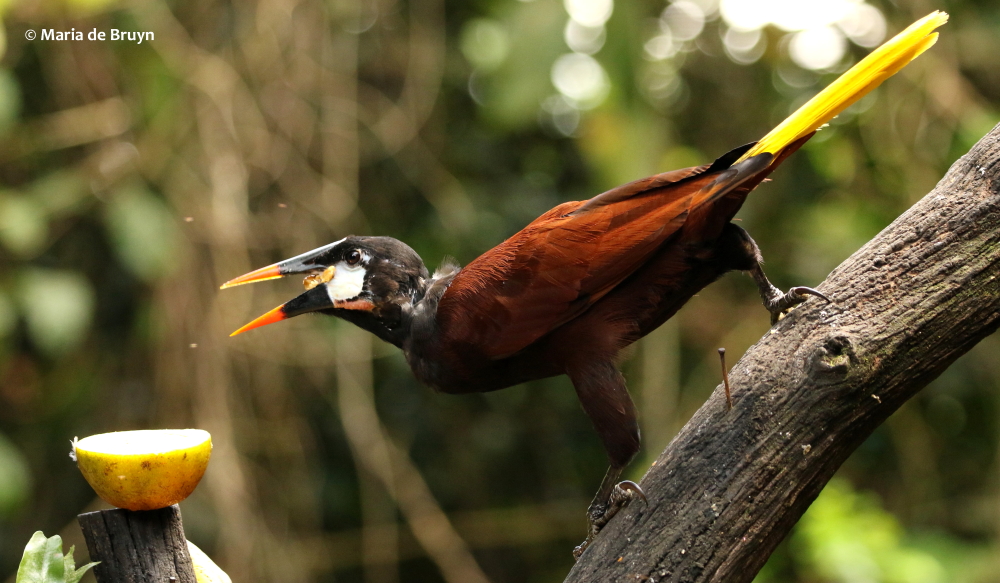
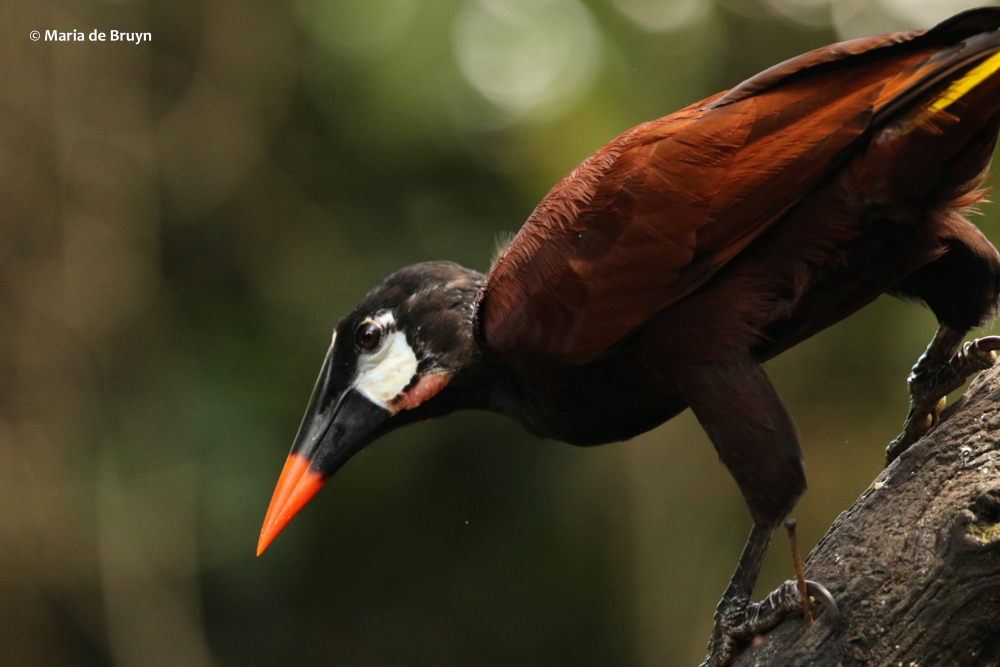
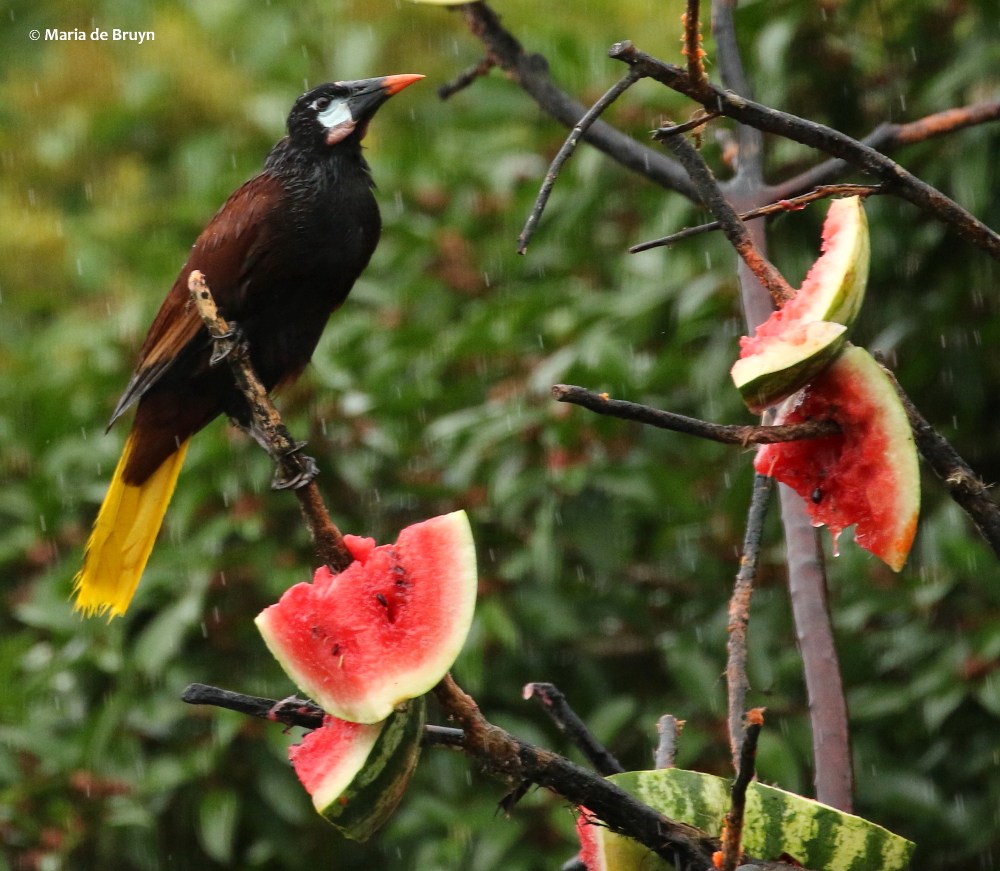
Well, Costa Rica does not lack for a variety of big-beaked birds and I found them all appealing, each in their own way. Some were not completely colorful but had splashes of color, like the brown-hued Montezuma oropendola (Psarocolius montezuma) with its white bare patch on the cheek with a pink wattle underneath and mostly yellow tail feathers.
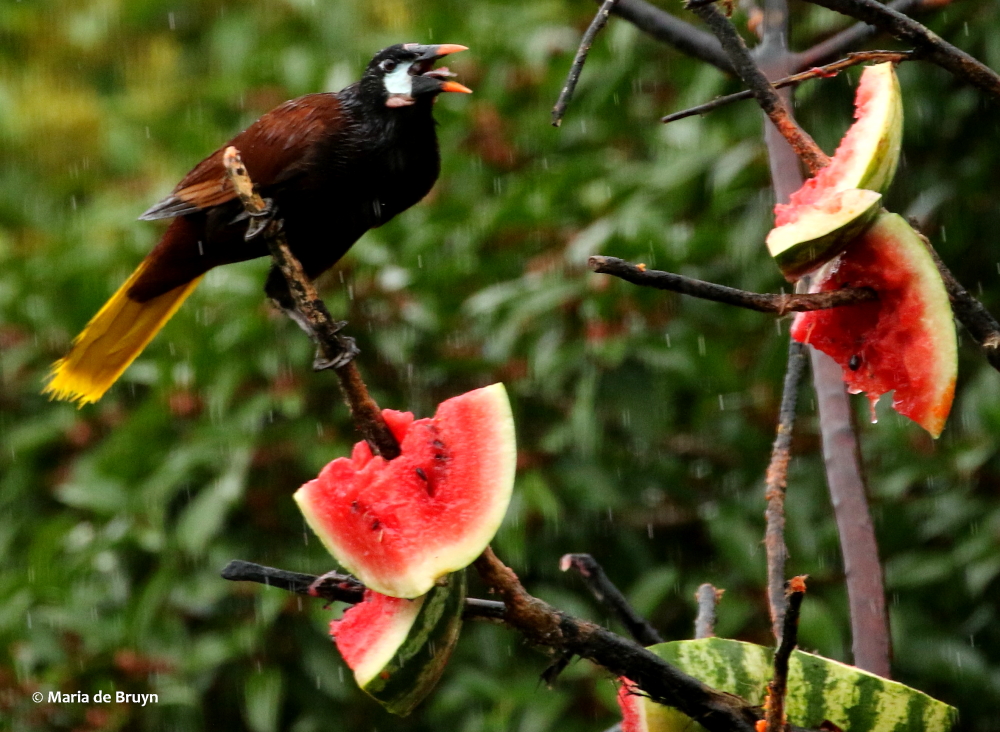
An unusual fact about this bird is that the males are generally twice as heavy as the females. They are called “colonial” nesters, meaning that the females build their pendulous nests (24-71 in/60–180 cm long) near one another in “colonies”. Unfortunately, their nest success is not great with only about one-third of colony nests resulting in a fledgling!
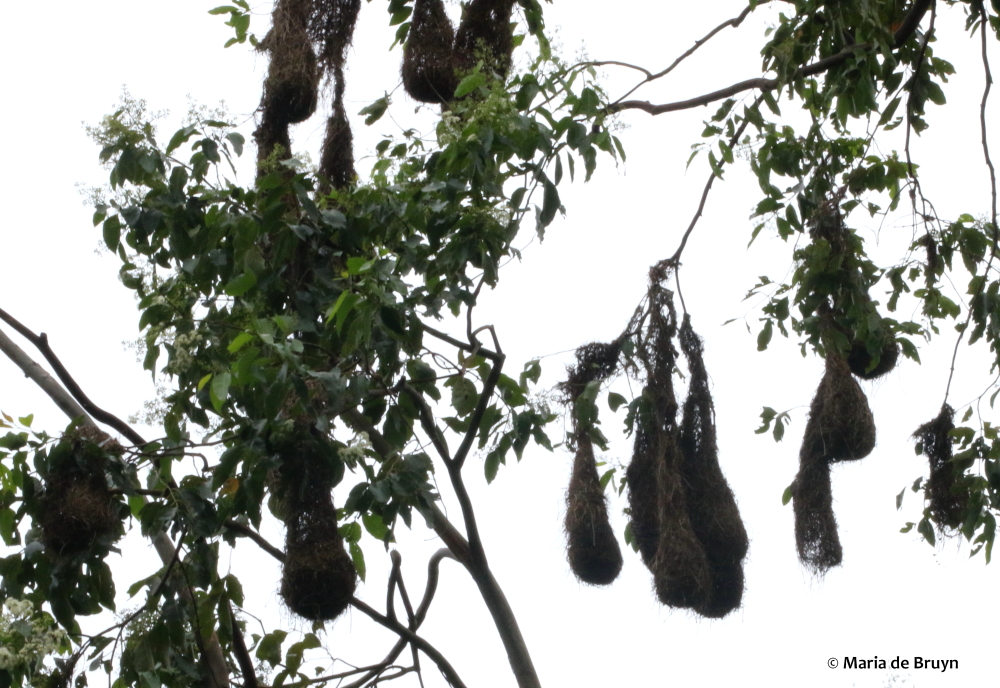
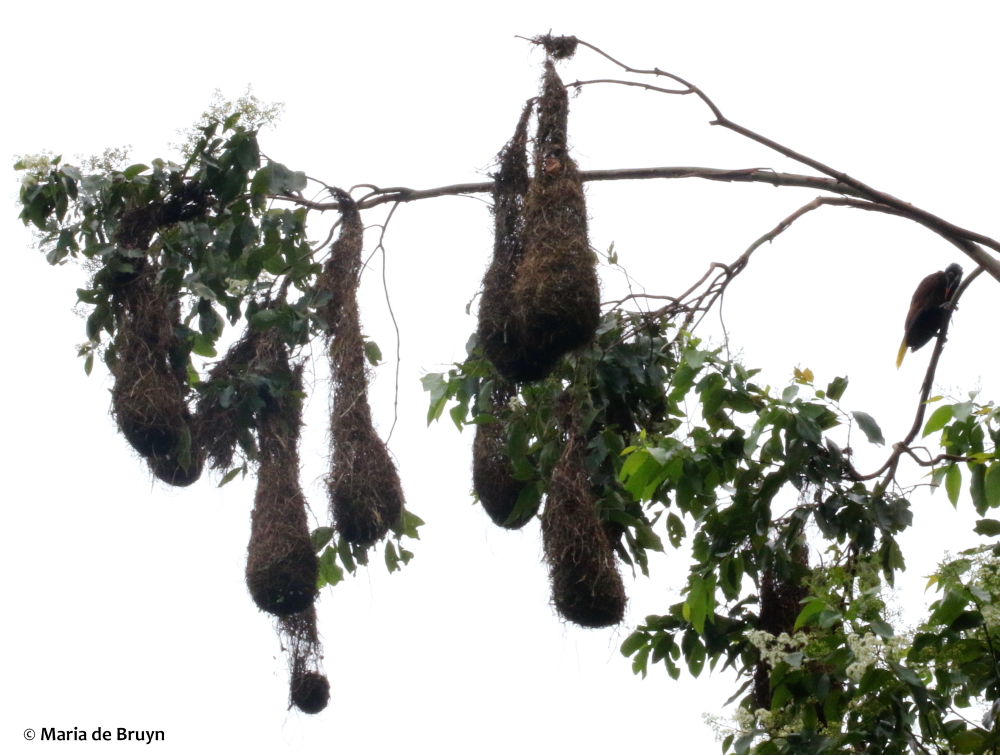
 

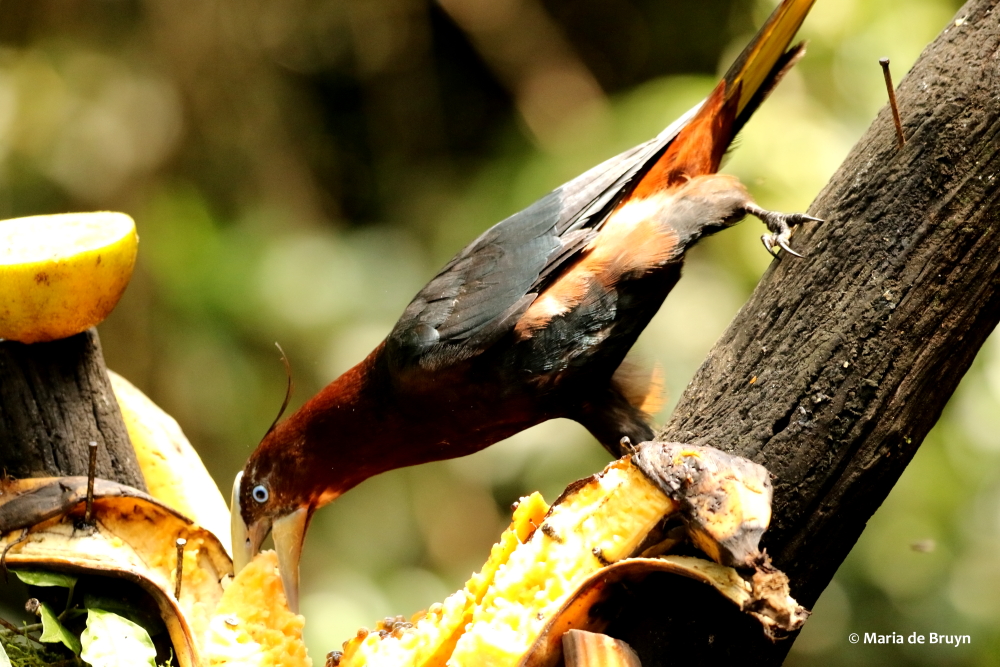
These oropendolas tend to forage in small groups in the tree canopies, searching for insects and fruit. Their love of fruit also brings them to feeding platforms, like this one set up to not only entice birds but also the tourists who want to see them. They seemed to especially enjoy papayas and watermelon.
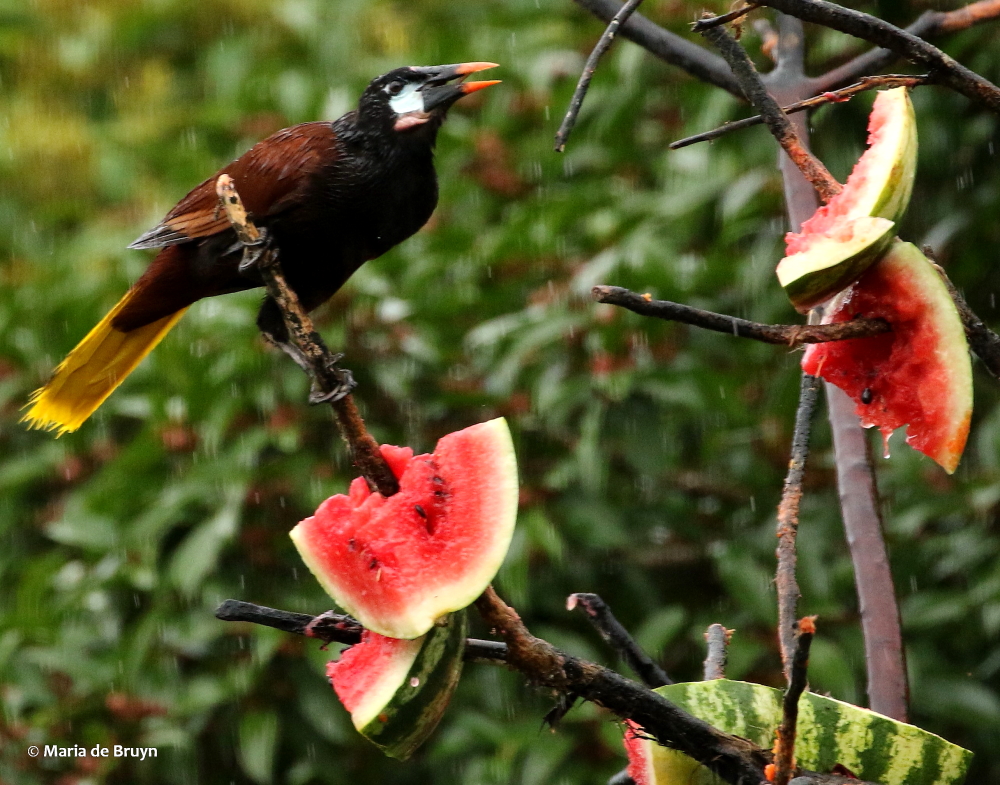
The call that the males especially emit from their bi-colored black and red-tipped beaks is said to resemble water being poured from a bottle, bubbling and gurgling.
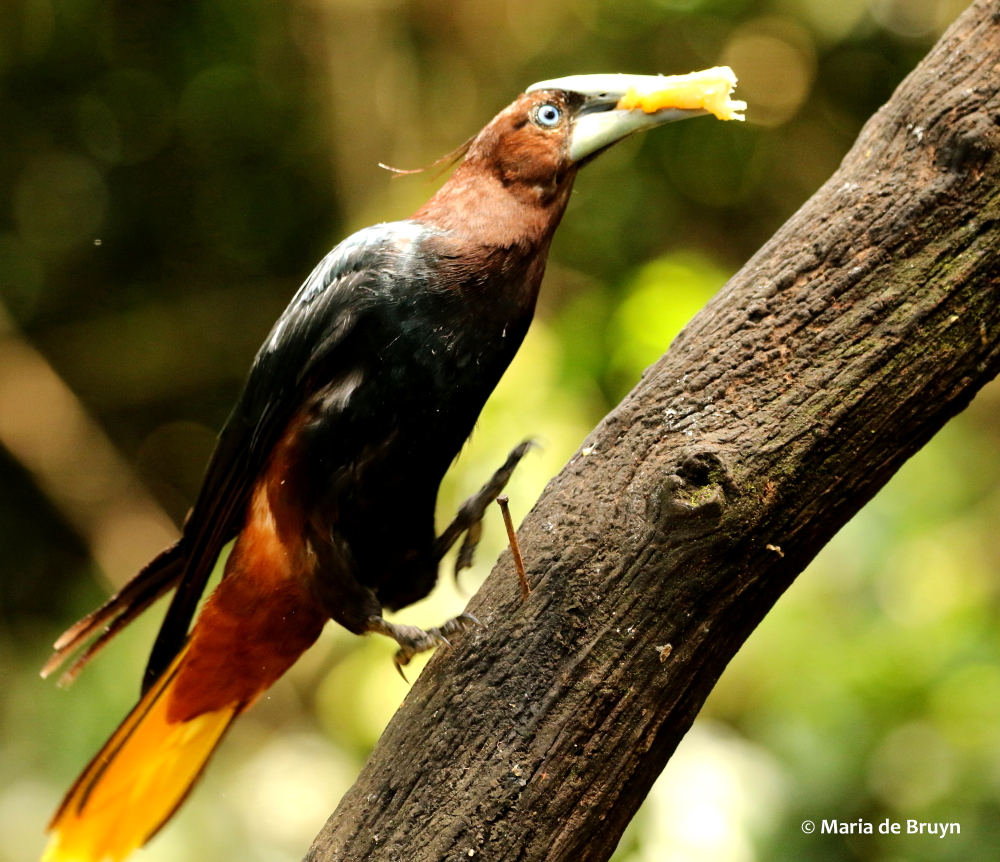
The chestnut-headed oropendola (Psarocolius wagleri) resembles the Montezuma species but is a bit less colorful with a pale bill. They are a bit smaller than the Montezumas and fly more quickly. Like their cousins, their broods in hanging nests are also threatened by giant cowbirds (nest parasites) and botflies.
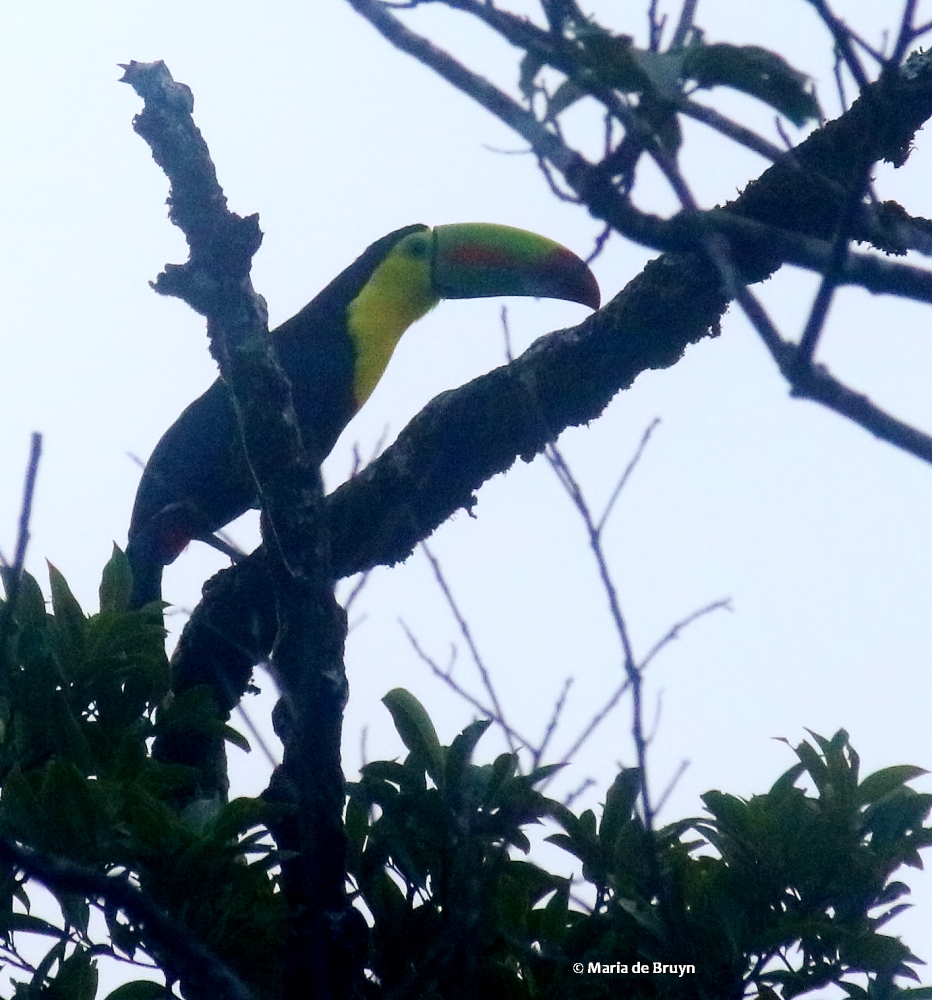
 

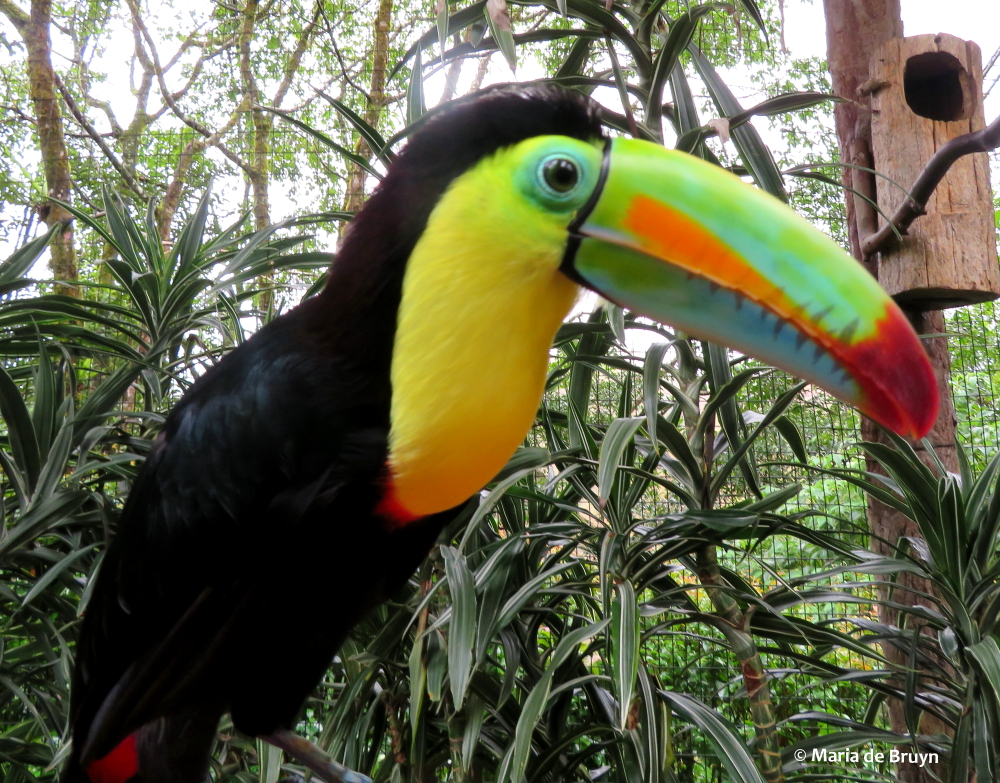
We were lucky to see two toucans and a toucanet during our trip to Costa Rica this past year. We had a glimpse of a keel-billed toucan (Ramphastos sulfuratus) high up in trees on a cloudy day. Their large bill measures 4.7-5.9 in (12–15 cm), which is about one-third the size of their entire length! Their zygodactyl feet (two toes facing forwards and two facing backwards) help them balance on branches.
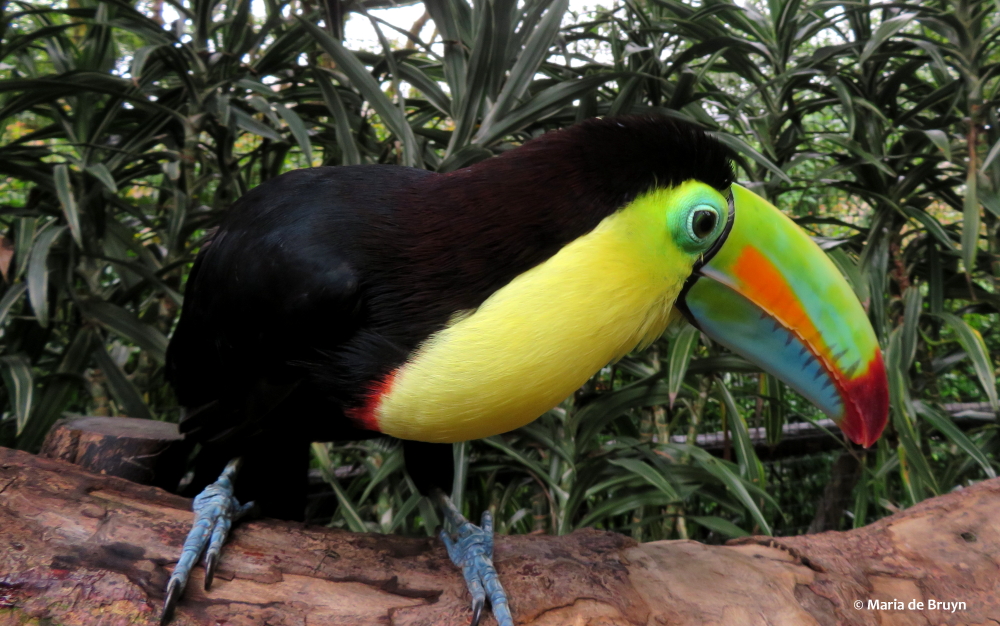
 

We got an up-close and personal view of a couple when we visited a hotel with an adjacent bird park and animal displays. A couple of these birds were in a large aviary, accompanied by two attendants who let people pose for photos with them. I just took photos of the birds and did not have a self-portrait done.
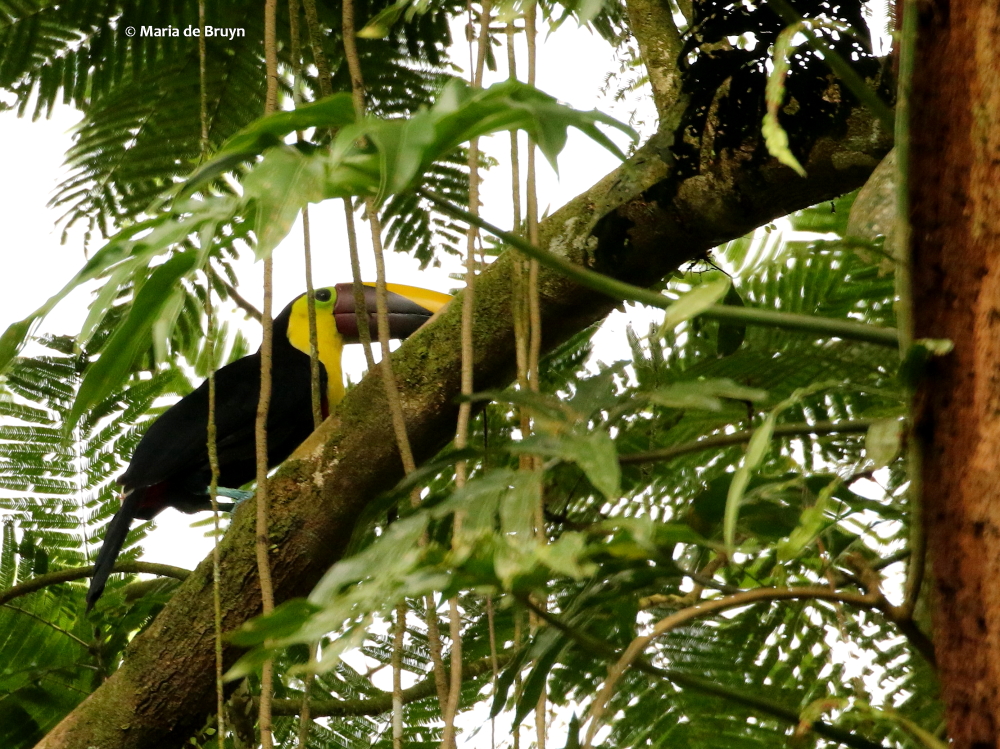
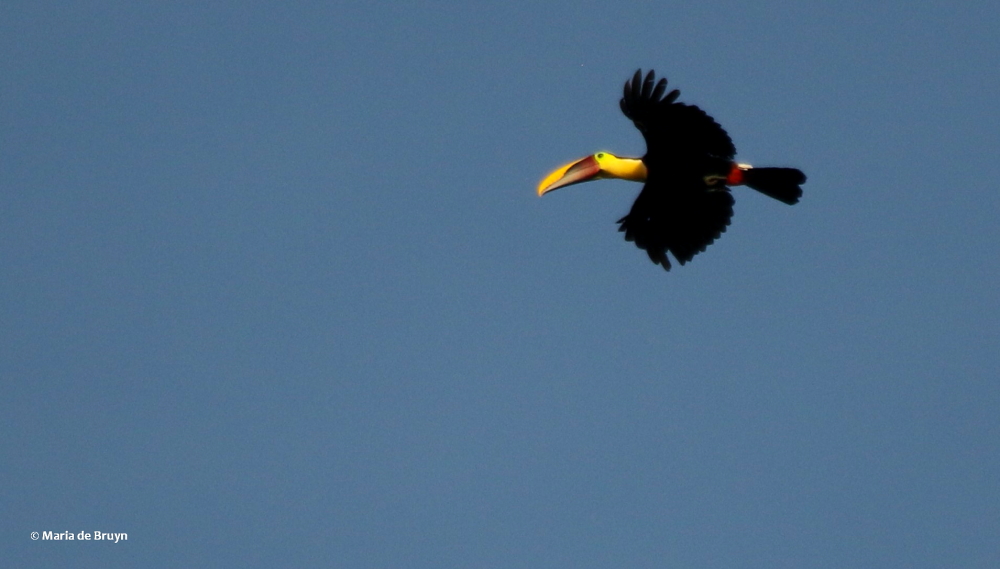
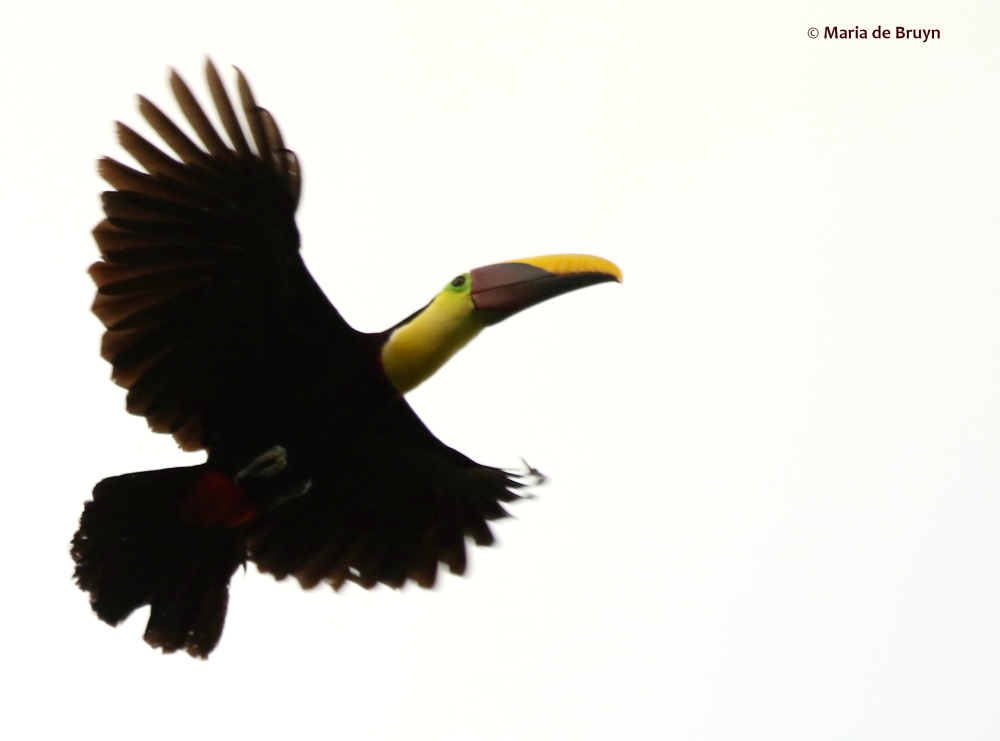
The second toucan that we got to see was the yellow-throated toucan (Ramphastos ambiguus), one of whom seemed to be posing for us during an early morning walk. They have an even larger bill than the keel-billed toucan, which ranges in length from 5.1-7.9 in (12.9-20 cm).
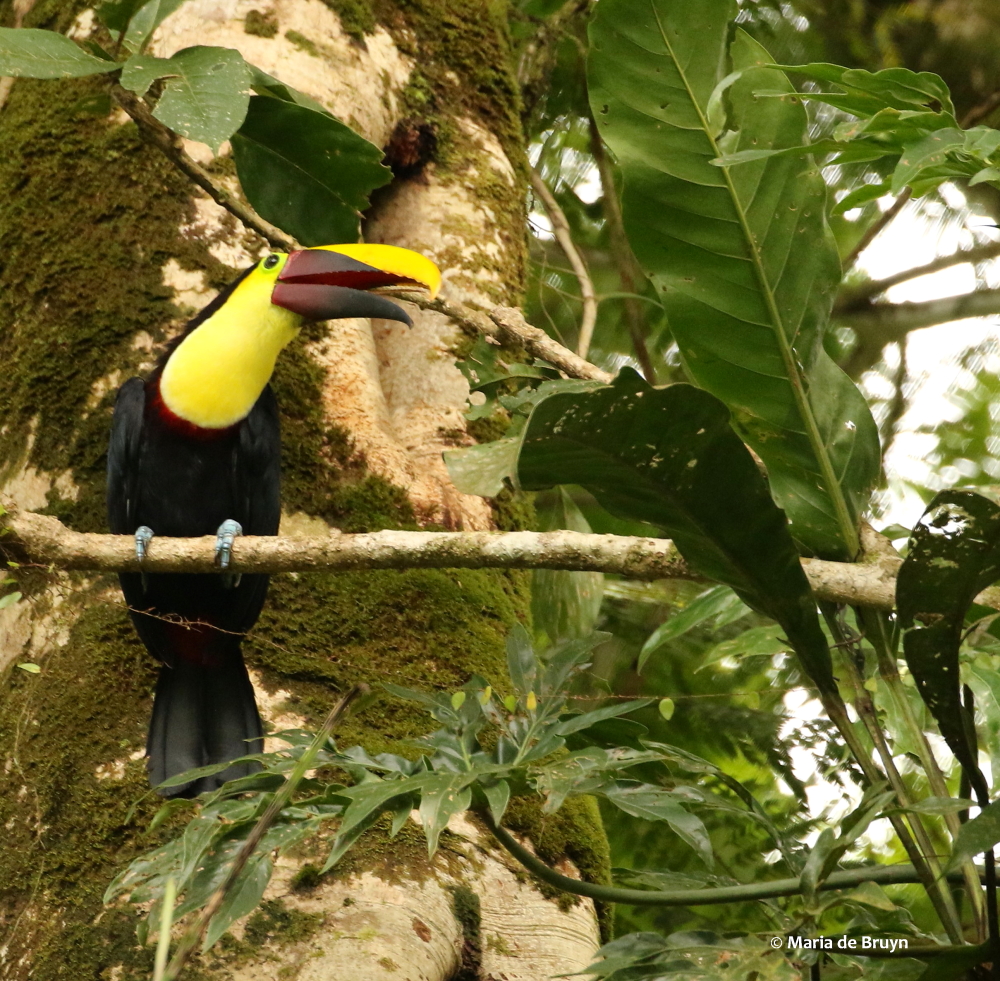
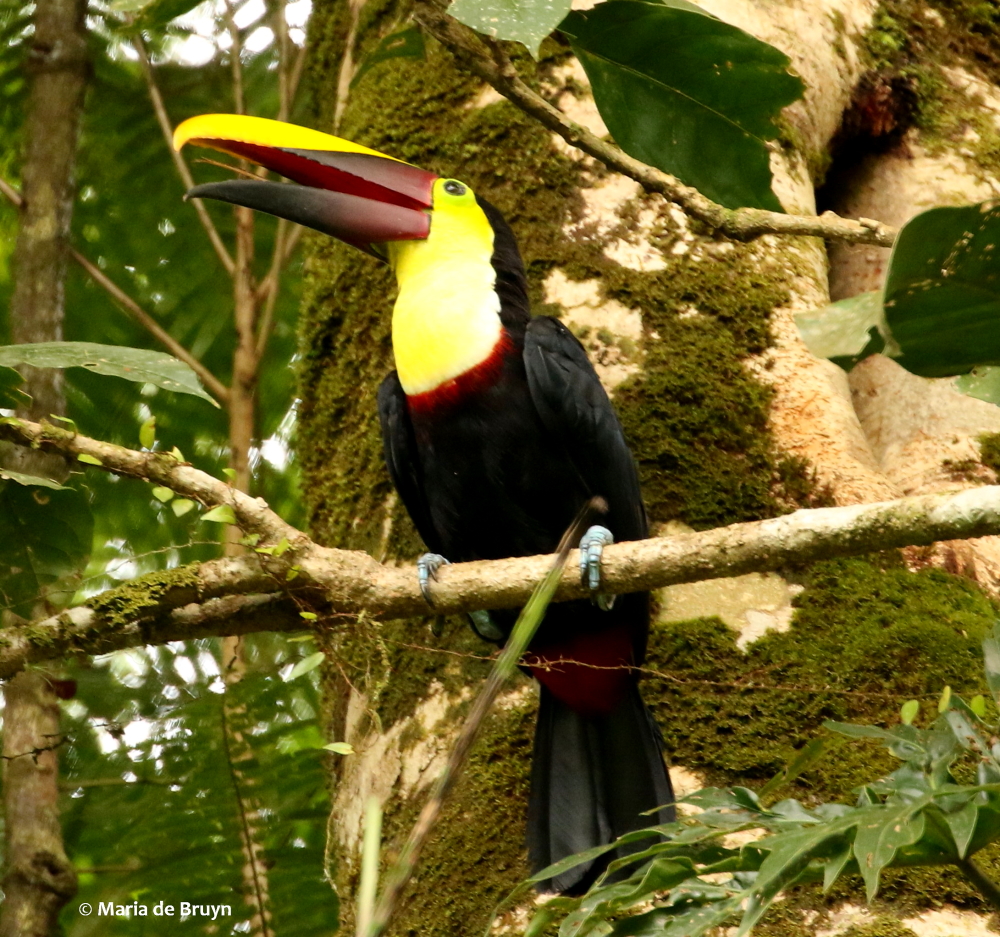


In 2018, I was able to photograph a couple that were flying by over a river.


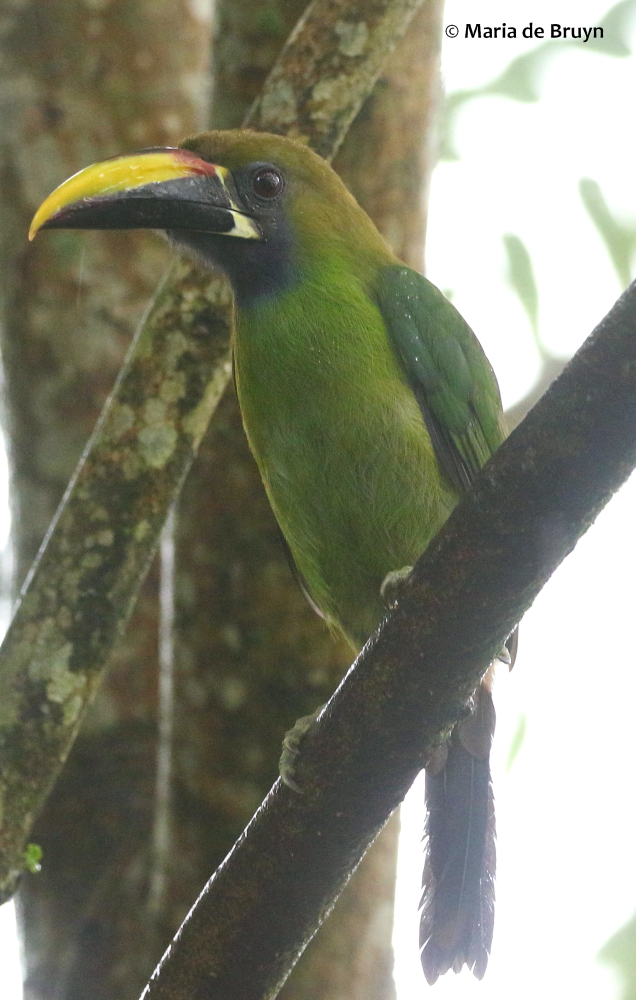
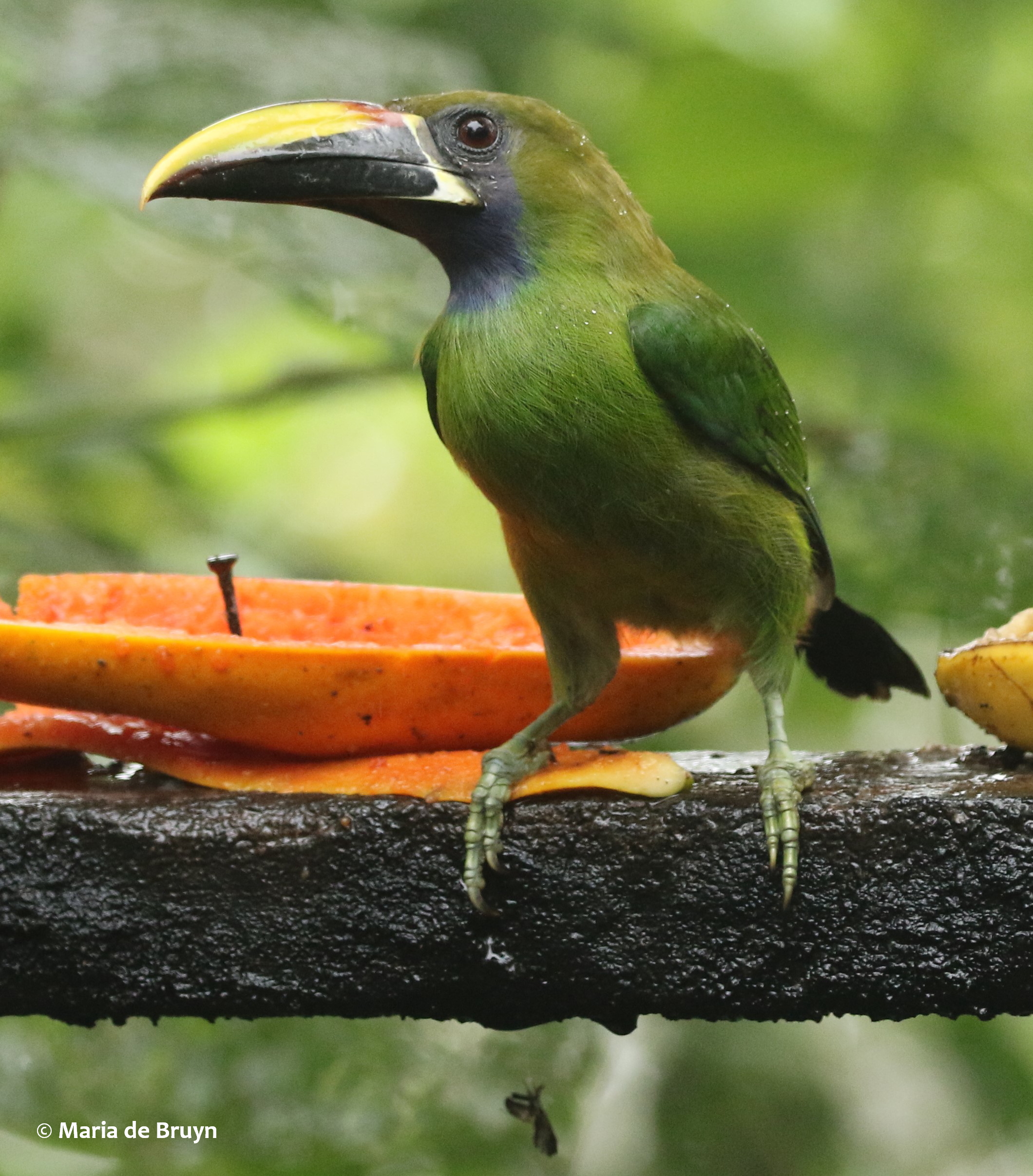
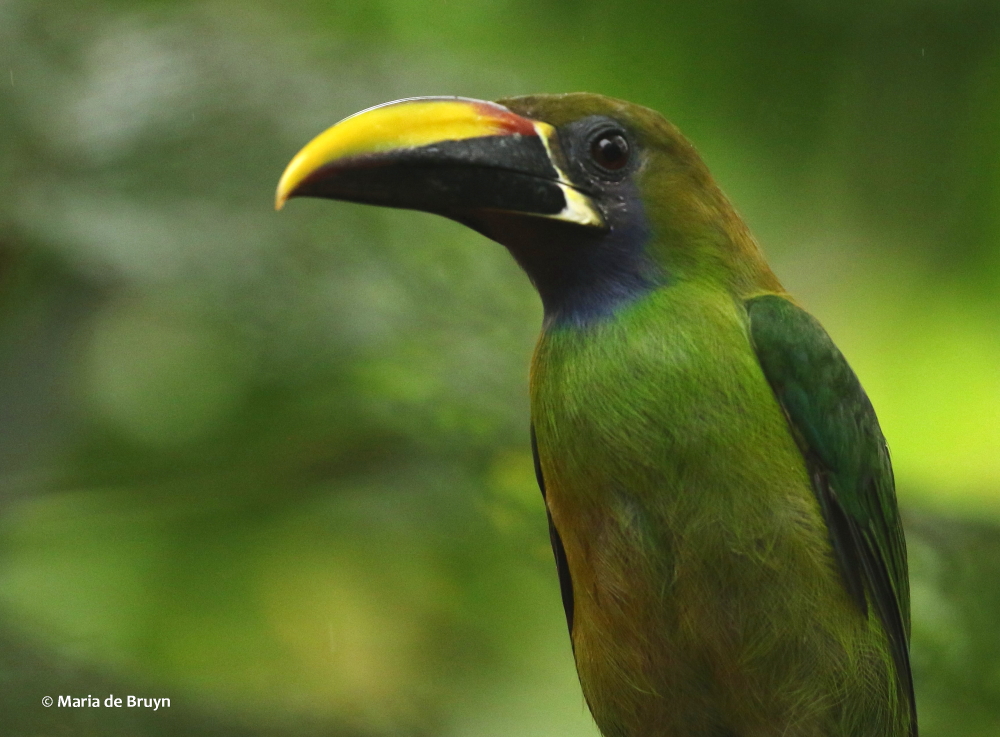
The Northern emerald toucanet (Aulacorhynchus prasinus) is a smaller toucan that also sports a large beak in comparison to its head size. We saw one of these birds every morning at one hotel where we stayed as it was hanging out in trees next to our room cabins. It was often overcast, however, and it wasn’t easy to get a good photo; the same situation arose several days later when we saw one on another rainy day.


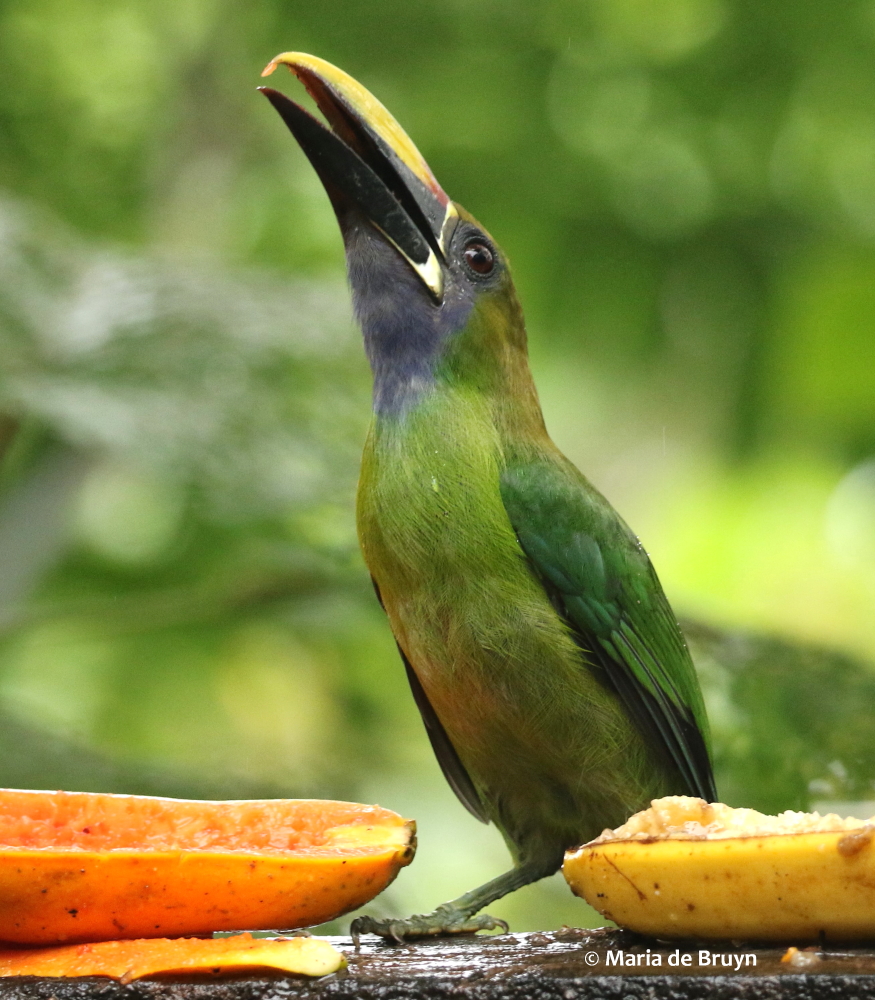
Luckily, that bird came down to a feeding station set up to attract birds for tourists. You can see its beautiful green body set off with a multi-colored bill that has a distinctive white band at the base.
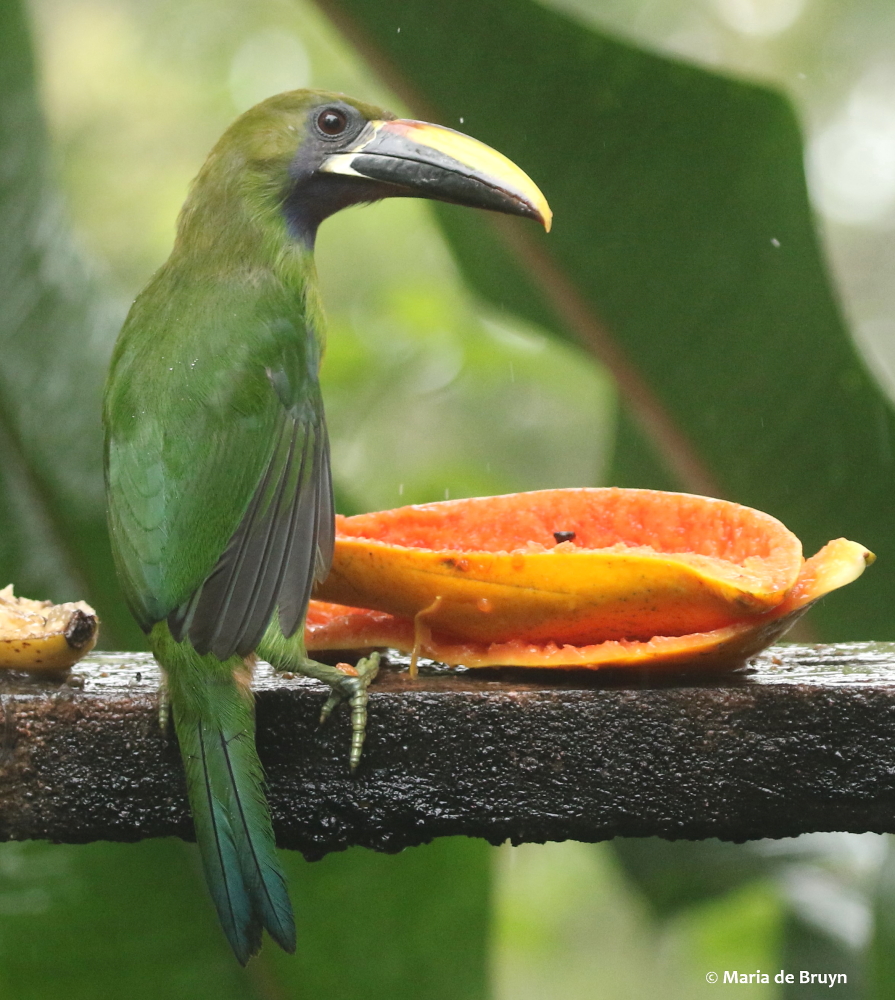
 

Like other toucans, the toucanet will eat insects and lizards but it, too, has a real fondness for fruit meals, especially berries.

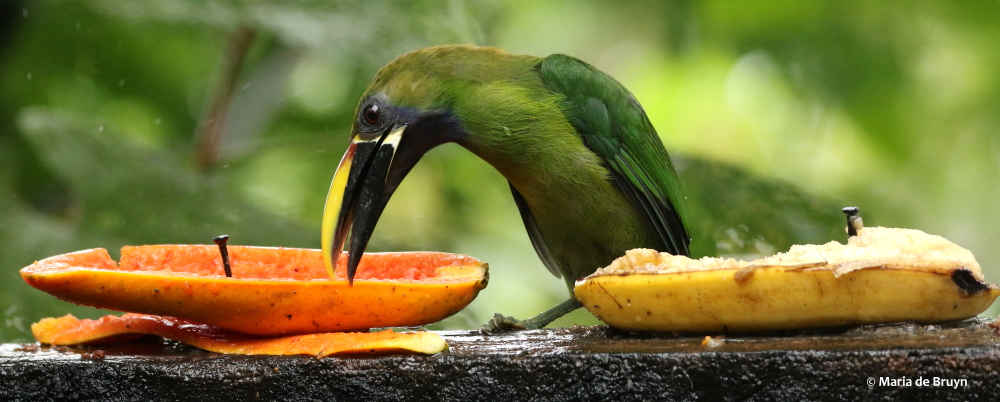
 

In contrast to the oropendolas, this bird’s calls resemble frog croaking and barking!
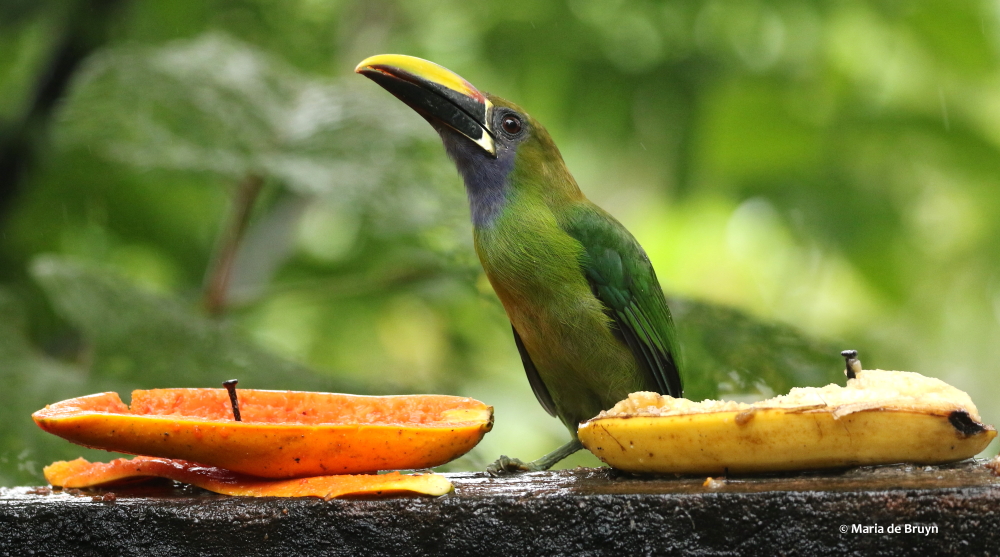
Unfortunately, it appears that these birds are popular as pets and they are taken from the wild to live in cages. They are popular because they can be affectionate and interact with their “owners” and they can learn tricks.
 

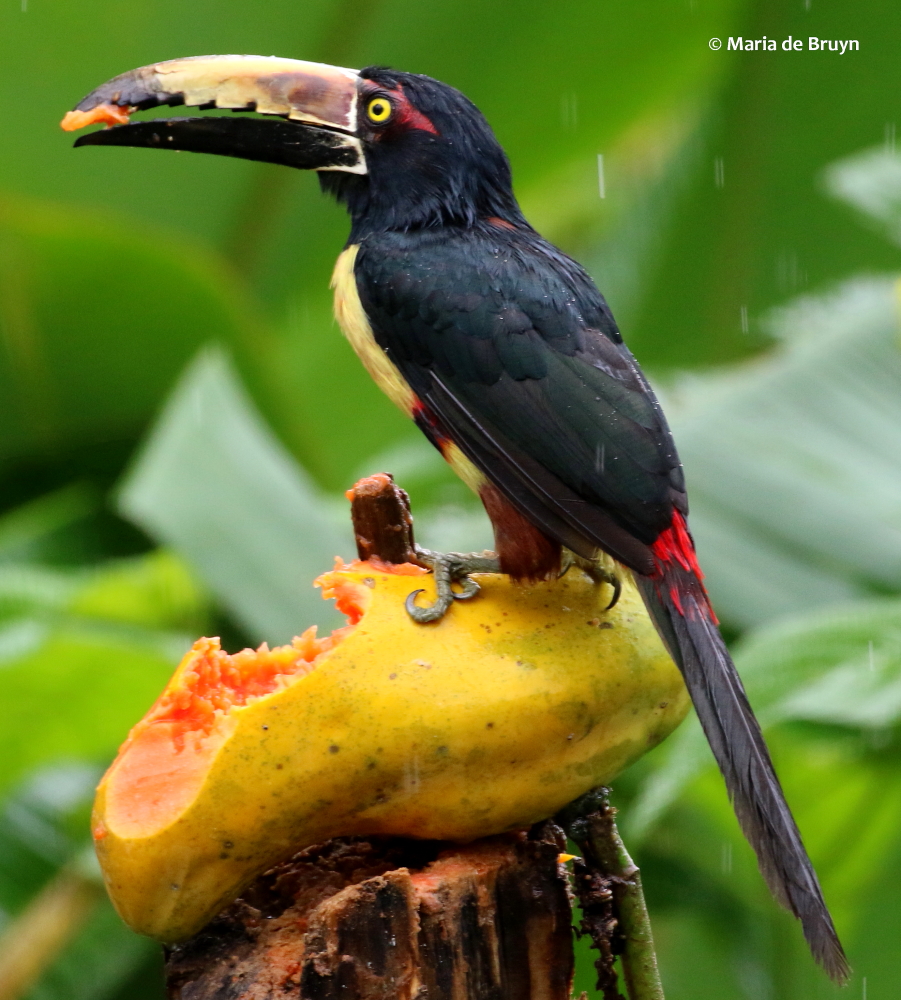
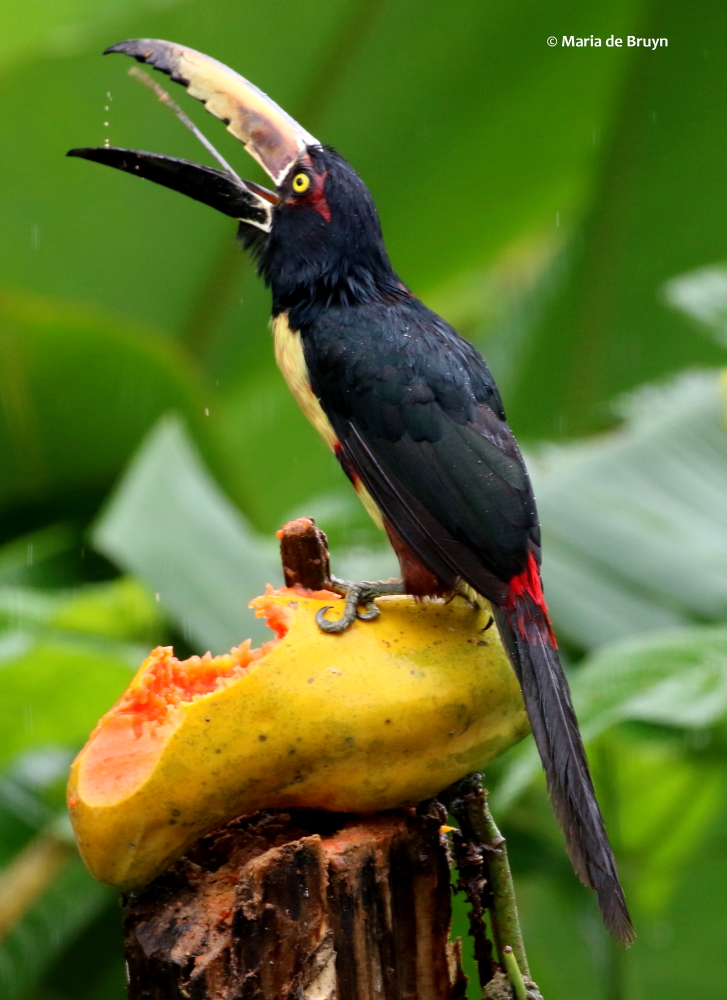
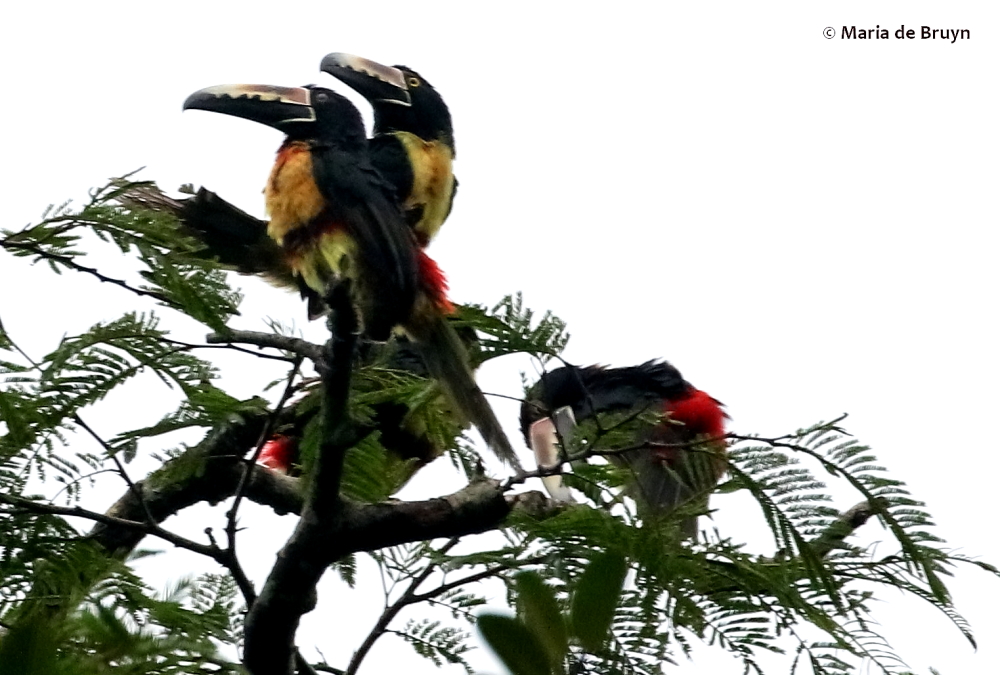
Going back to the bigger birds, Costa Rica has two aracaris, which are also members of the toucan group. They differ from other toucans in their sociability, often roosting in groups of several birds.
We did not see the fiery-billed aracari (Pteroglossus frantzii) during our August 2019 trip, but I had seen one flying by during a trip to Costa Rica in 2018.
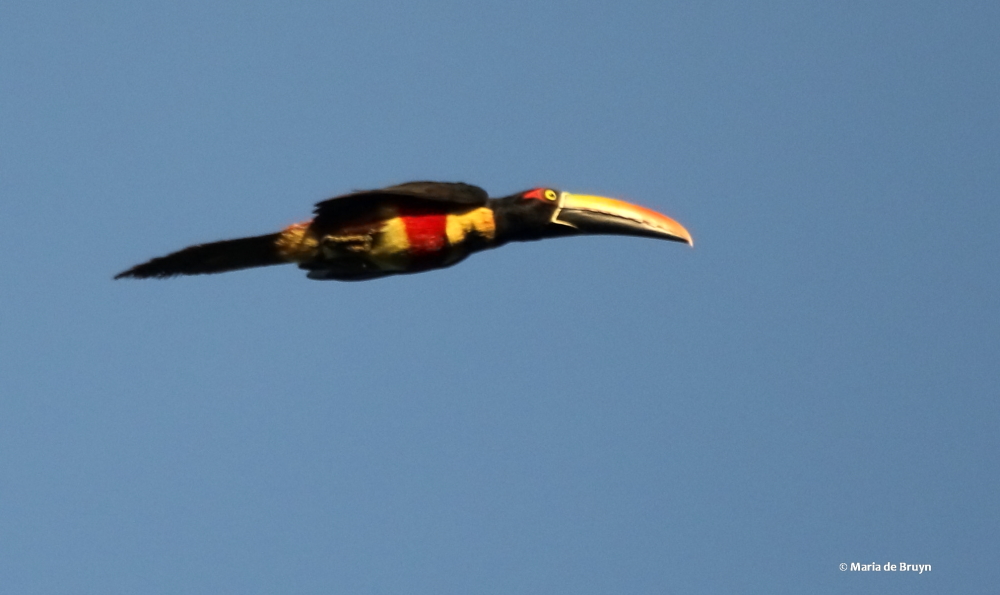
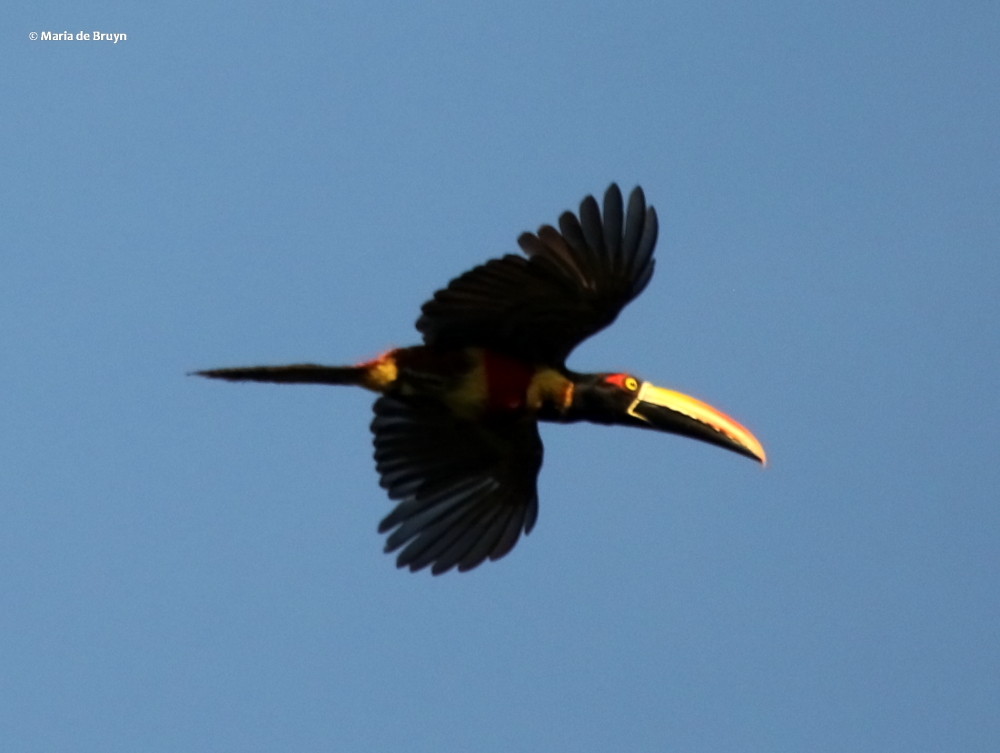
It looks similar to the collared aracari but is distinguished by a bright red breast band and its bill is somewhat more colorful. It, too, is mainly frugivorous.
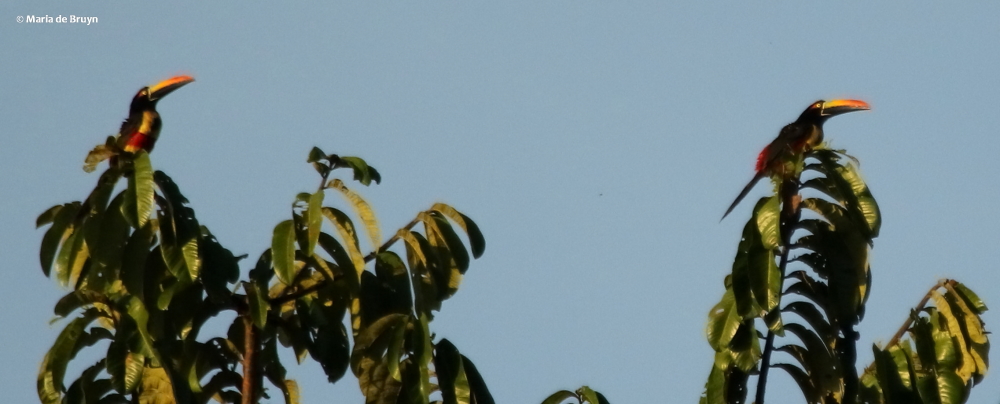
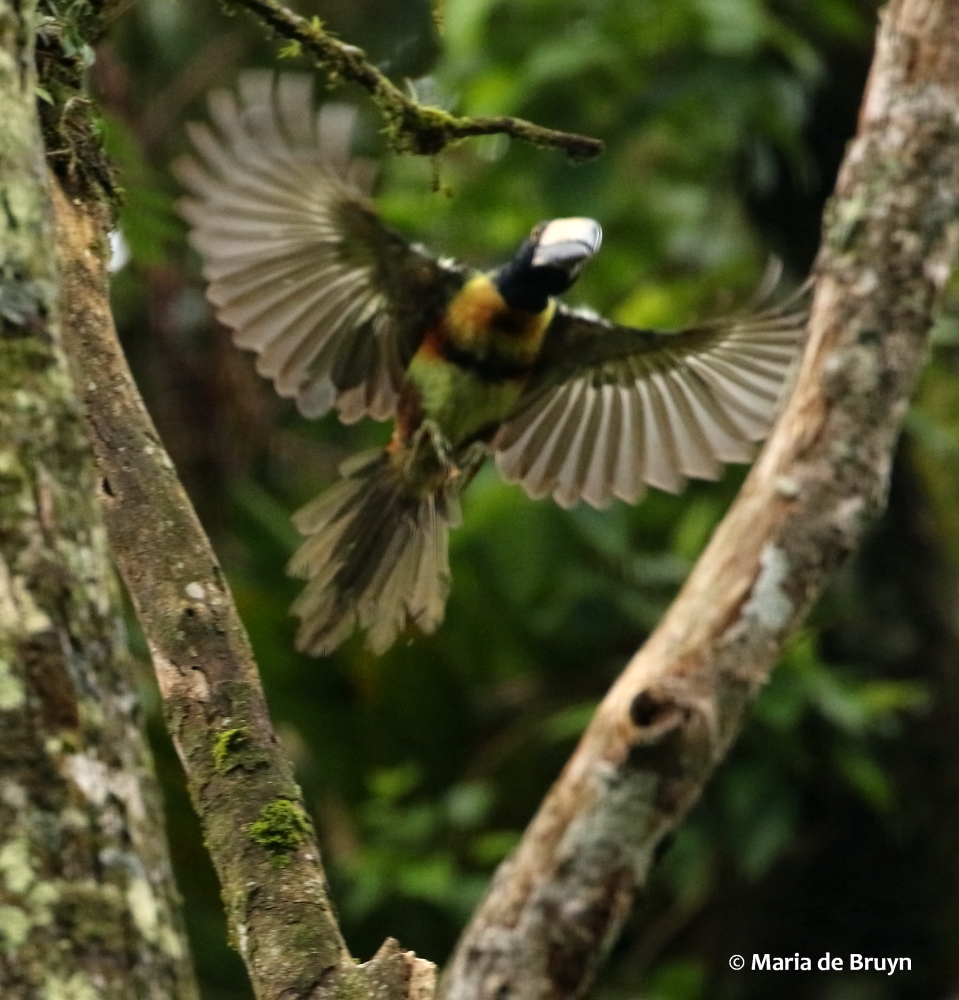
 

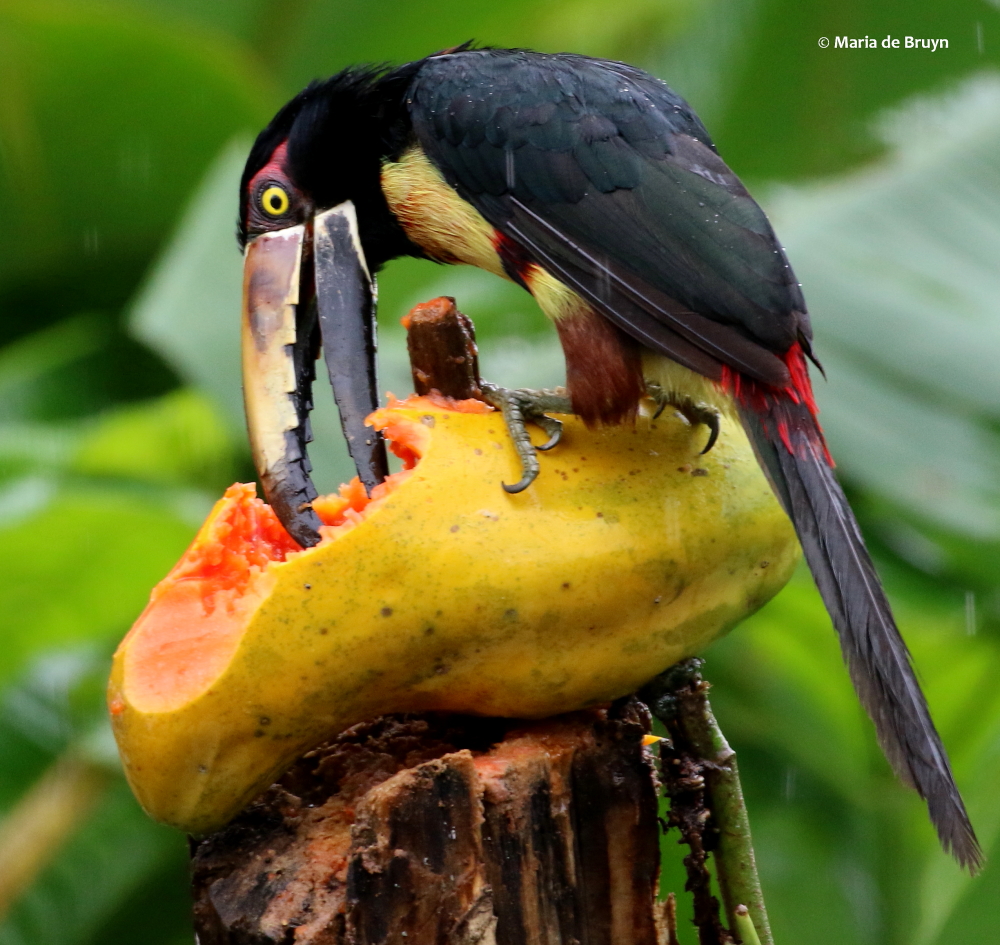
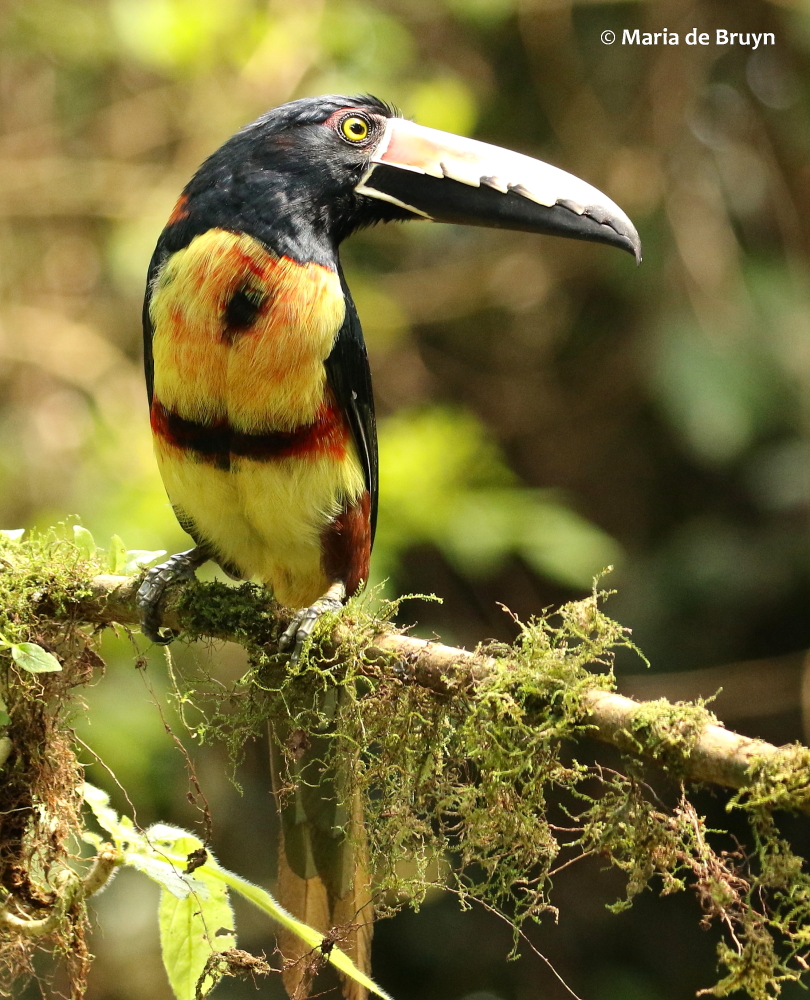
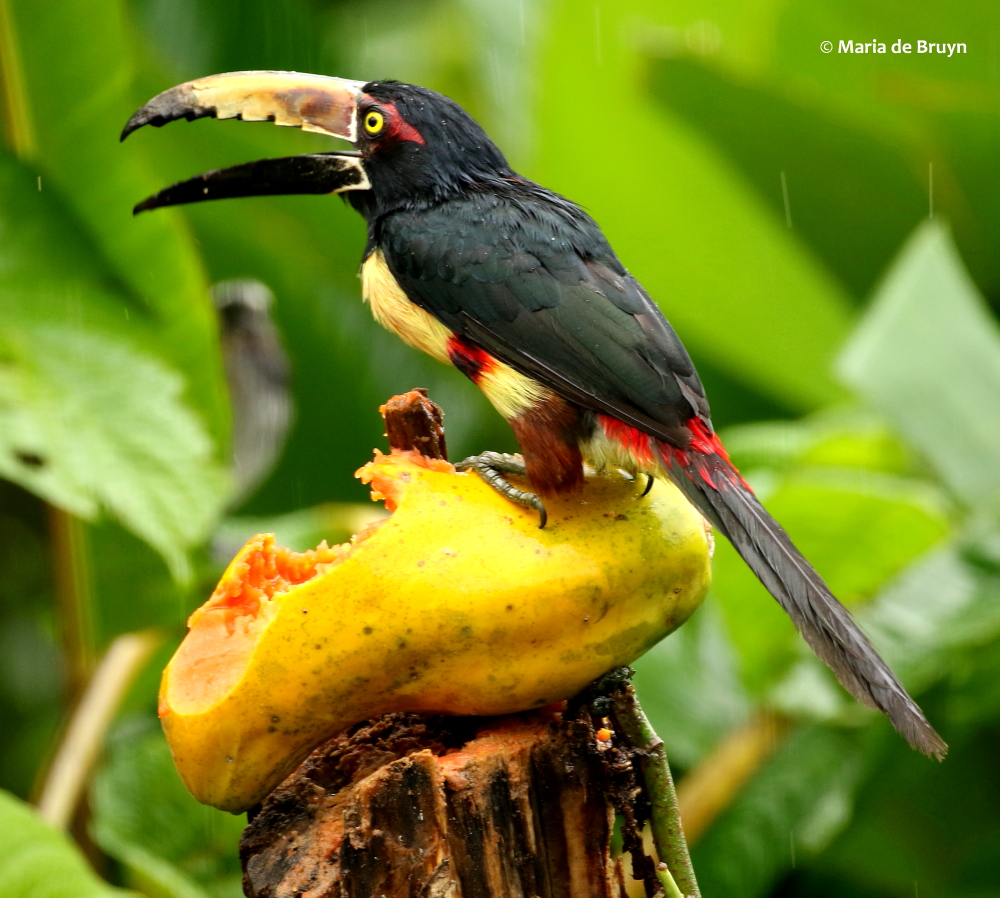
The collared aracari (Pteroglossus torquatus) was a frequently seen bird during our August trip through Costa Rica.


We visited several spots where people were earning tourist dollars by setting up feeding stations with plenty of fruit to attract a variety of birds. The aracaris were enthusiastic and voracious feeder visitors.
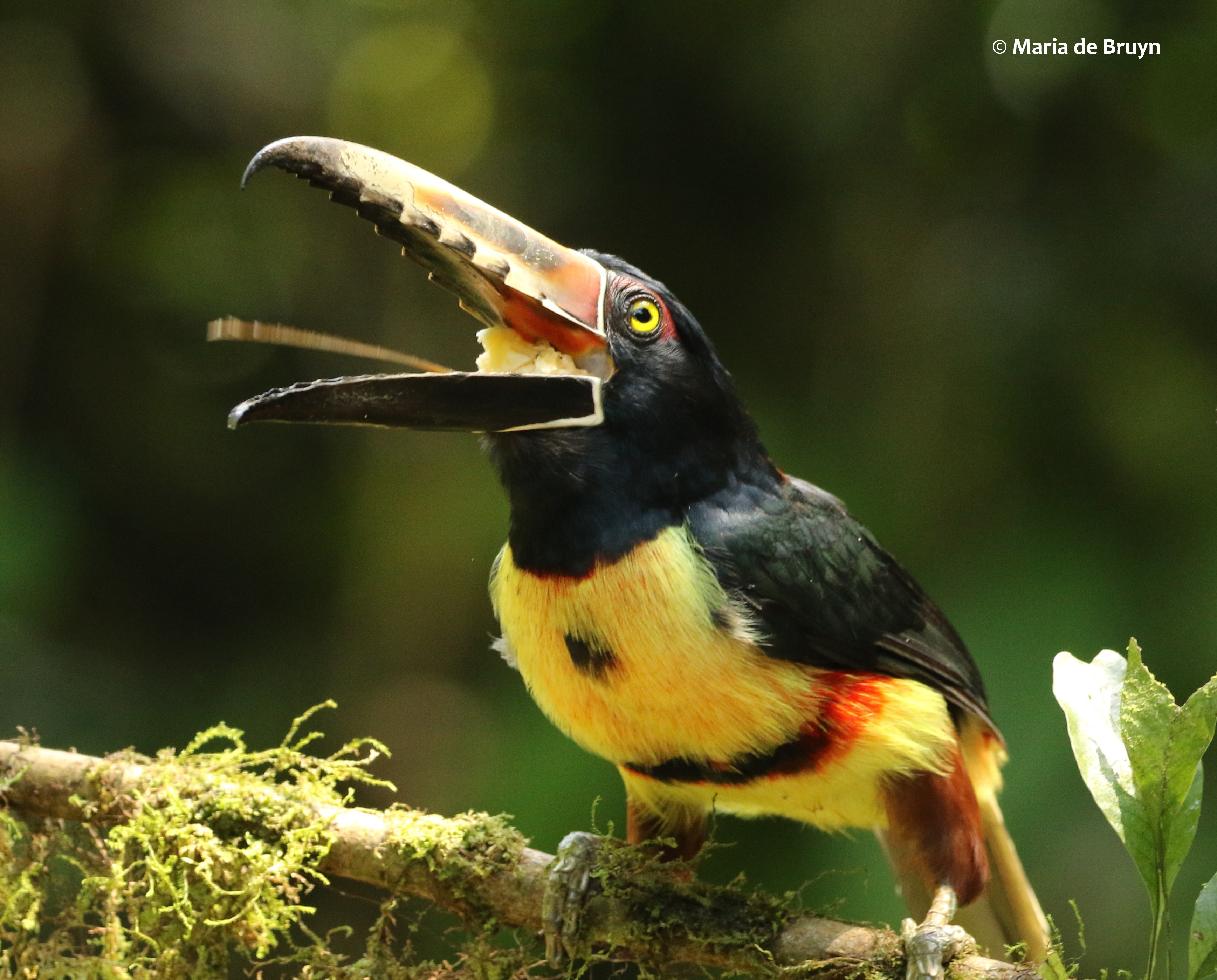
 

When the young aracaris are born, they are blind, naked and have short bills. Their feet also have specialized heel pads to help protect their feet from the rough nest floor. Not only the parents but also other birds help feed them for six weeks, at which point they fledge. The adults will still feed them for a time after they leave the nest as well.
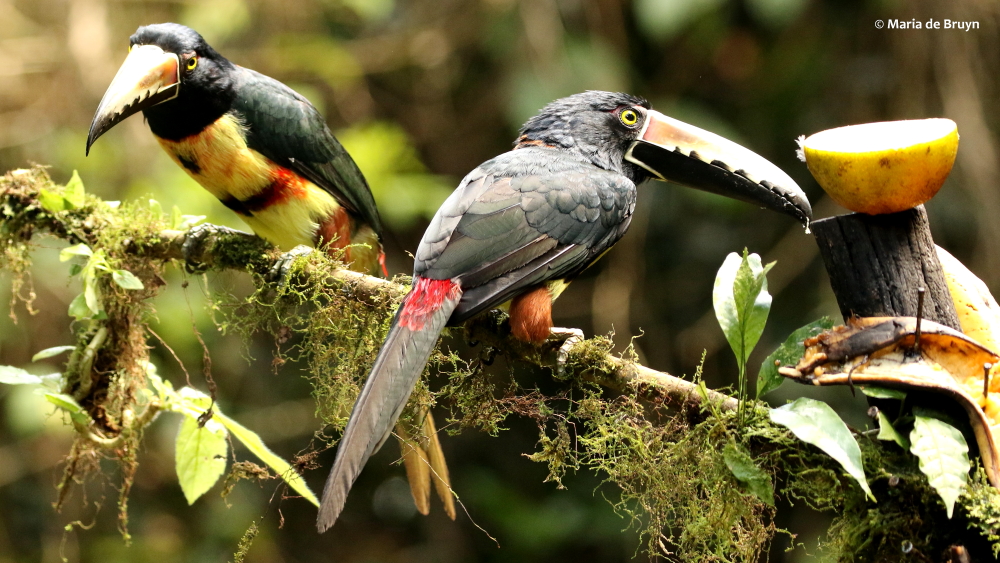
These aracaris are interesting in that their large colorful bills also have a sawtooth pattern on the cutting edges. It can take up to a year for the young birds to develop the notches and color pattern on their beaks.
Now all these photos might give the impression that all the big-beaked birds are large in size, but this is definitely not the case. There are also medium- and small-sized colorful birds that tote around bills large in size when compared to their heads. Among the middle-sized range are two beautiful motmots.

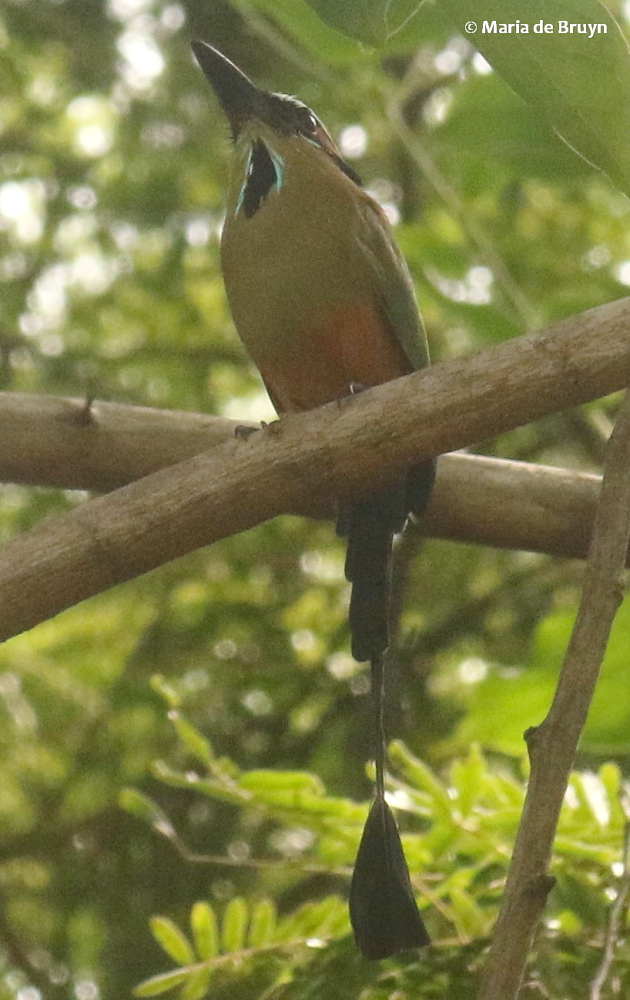
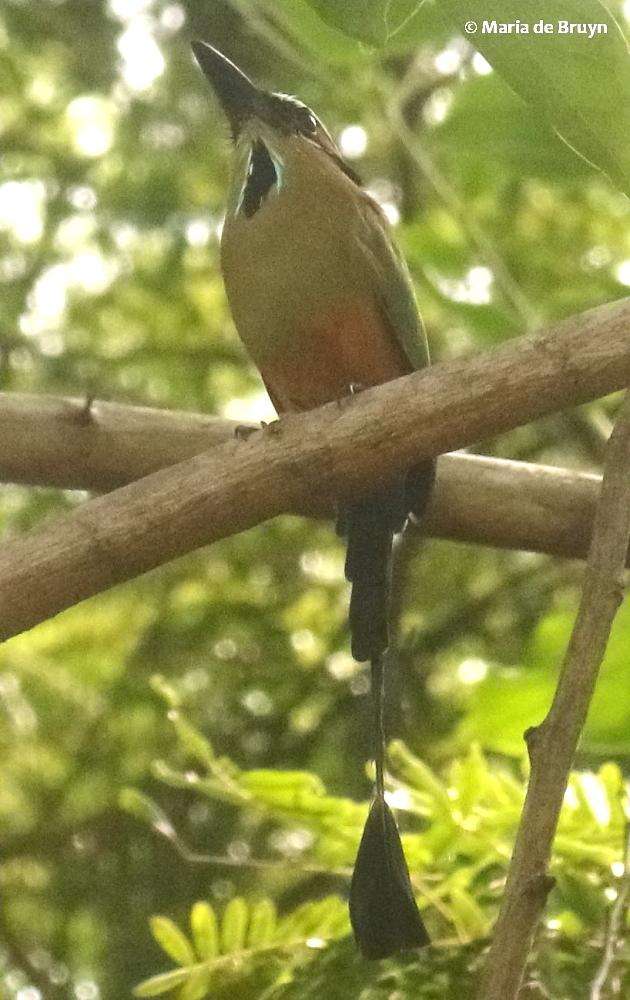
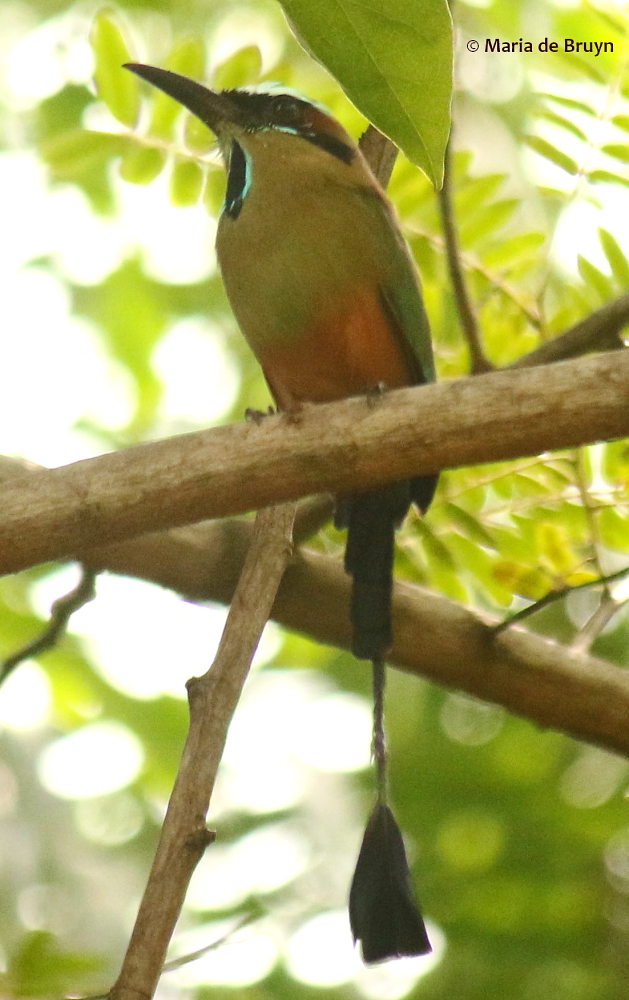
We saw our first turquoise-browed motmot (Eumomota superciliosa) early one morning when it was still dark. A flashlight showed the bird sitting quietly in a tree as we made our way to breakfast. Oddly (to me at least), it didn’t seem very bothered by the bright light and just watched us as we drew near.
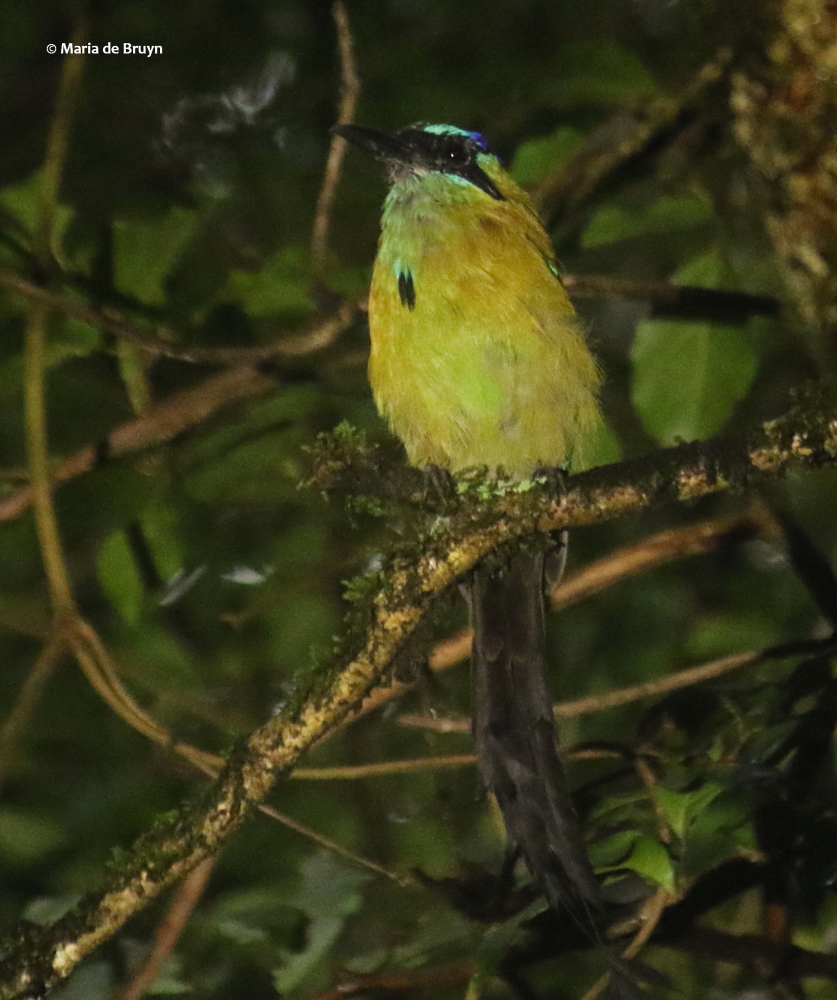
We later saw one sitting in a shady area alongside a road. They often perch on fences and wires as well, scanning the area for their diet of insects and lizards. They use their racketed tails for communication purposes, as part of a mating display or as a “pursuit-deterrent signal” to warn predators that they have been seen and will not be able to capture the aware birds. In Costa Rica, these birds have the nickname pájaro bobo (foolish bird) because they will allow humans to get quite near.
         

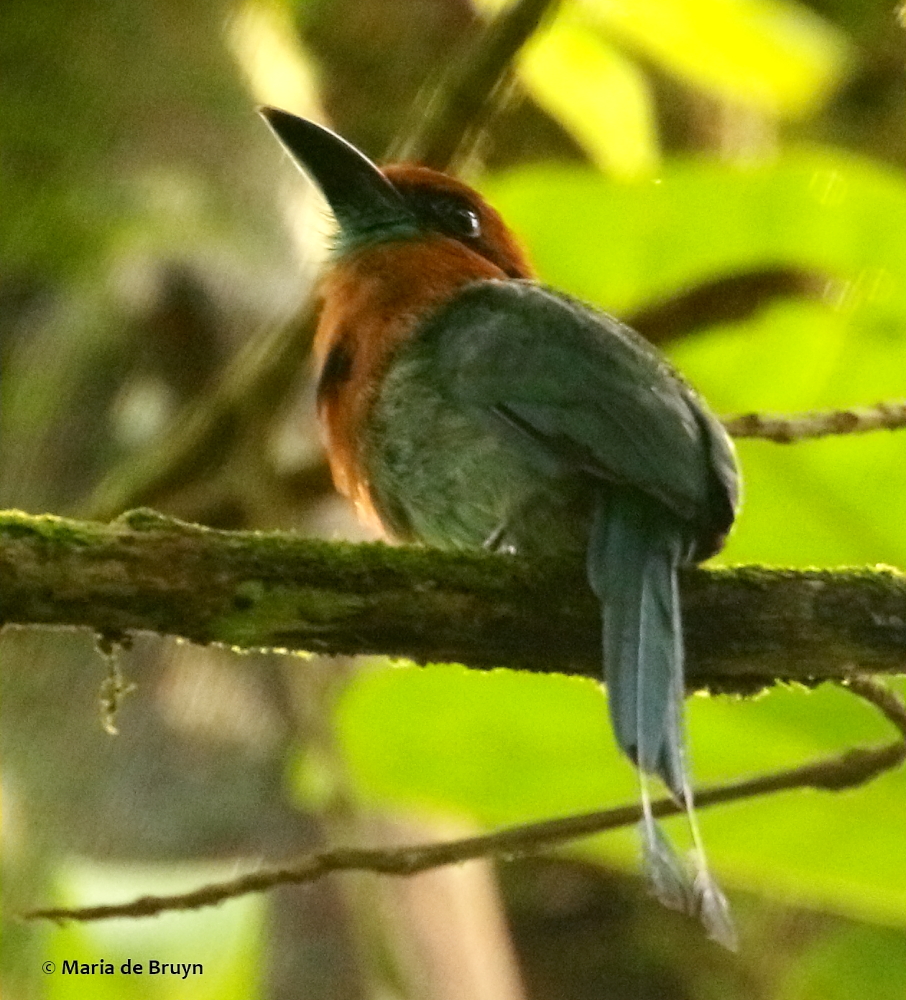
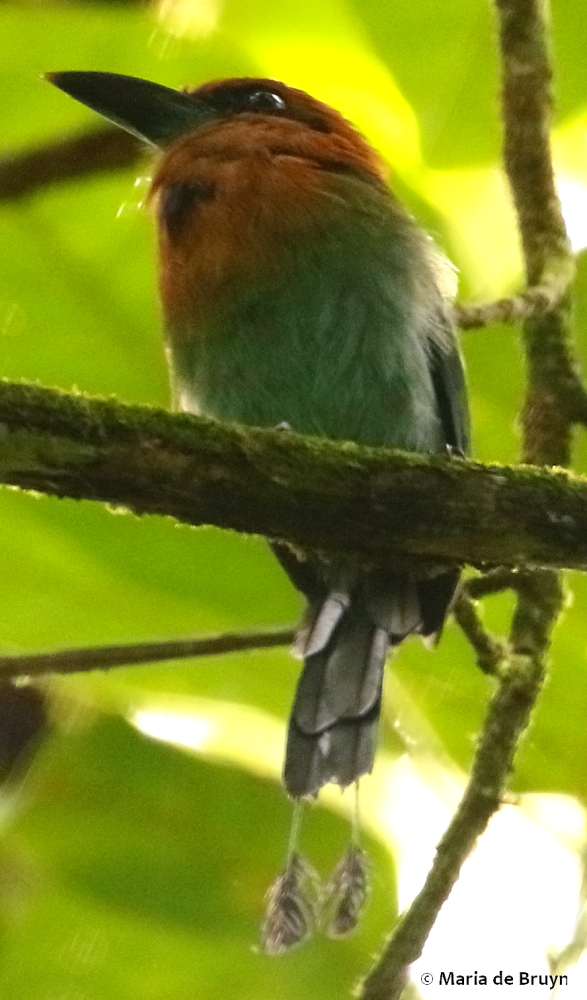
The broad-billed motmot (Electron platyrhynchum) is also an insectivore and has not been seen consuming fruit. These motmots are less studied than the turquoise-browed species; for example, it is not known how they use the tail rackets for communication.
 

The smallest bird in this account of the big-beaked avians is the rufous-tailed jacamar (Galbula ruficauda), which I first thought might be a large hummingbird. (Some hummers also have enormously large bills and will feature in a later blog.) They measure only 10 inches long (25 cm) with a 2-inch (5 cm) bill.
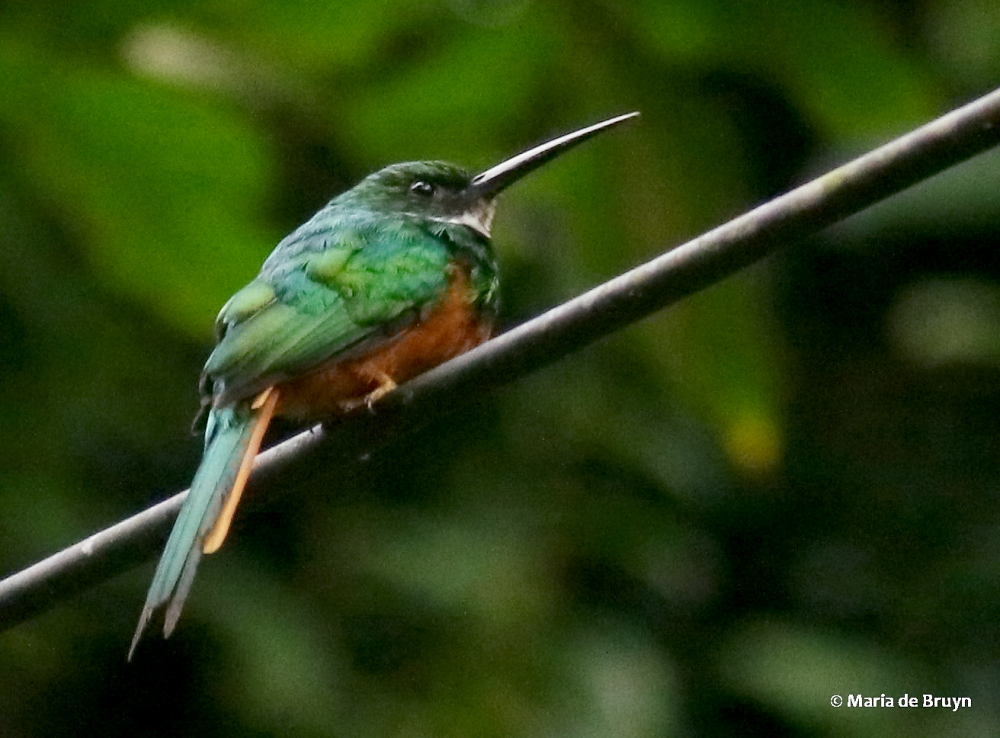
They are insectivores who will remove an insect’s wings before they swallow it. A surprising finding for me was that they nest in bare earth burrows. They do not keep the burrows clean and the nestlings do not lie down but remain standing so that they protect their feathers from accumulated debris!

On that surprising note, I wish my blog readers a wonderful start to the next decade and hope you all will have a great 2020 with good health, a comfortable living situation and as many hours enjoying our beautiful natural world as possible!

Kinglet capers – defending territory!

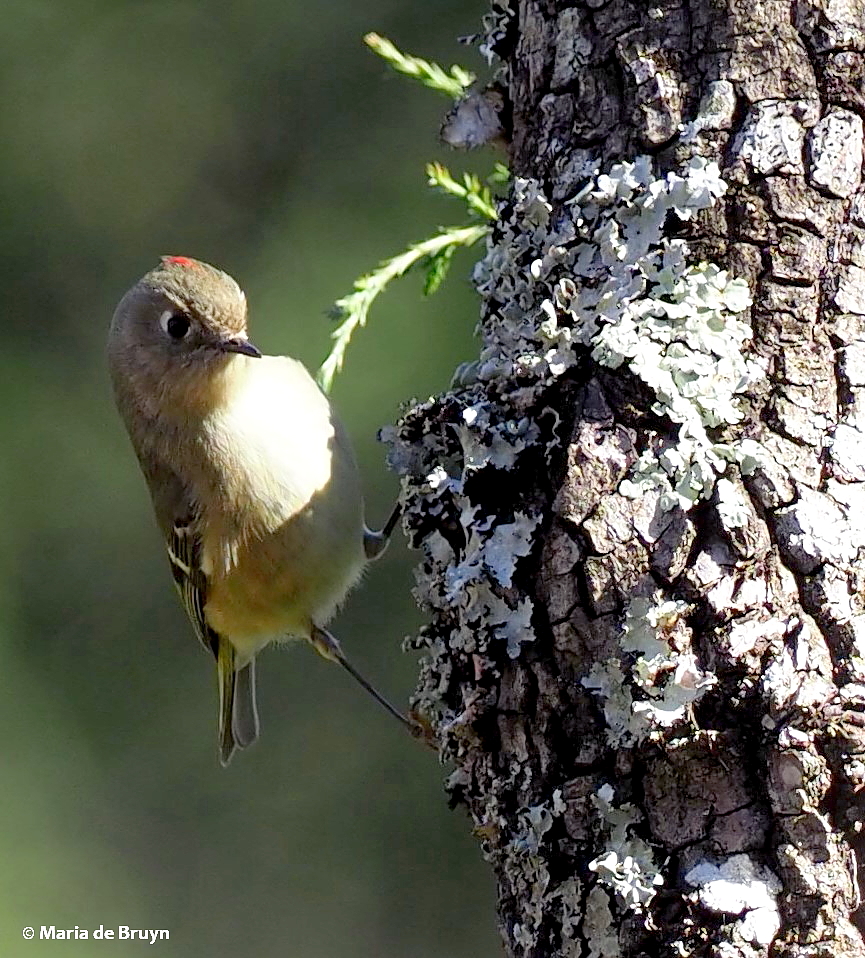
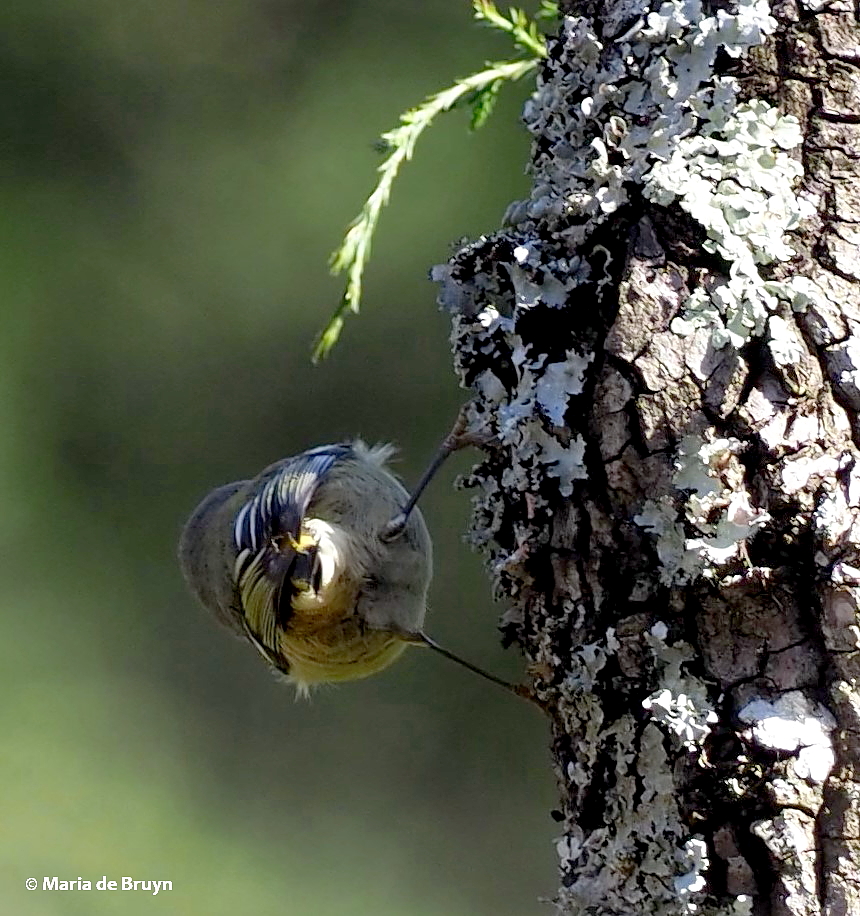
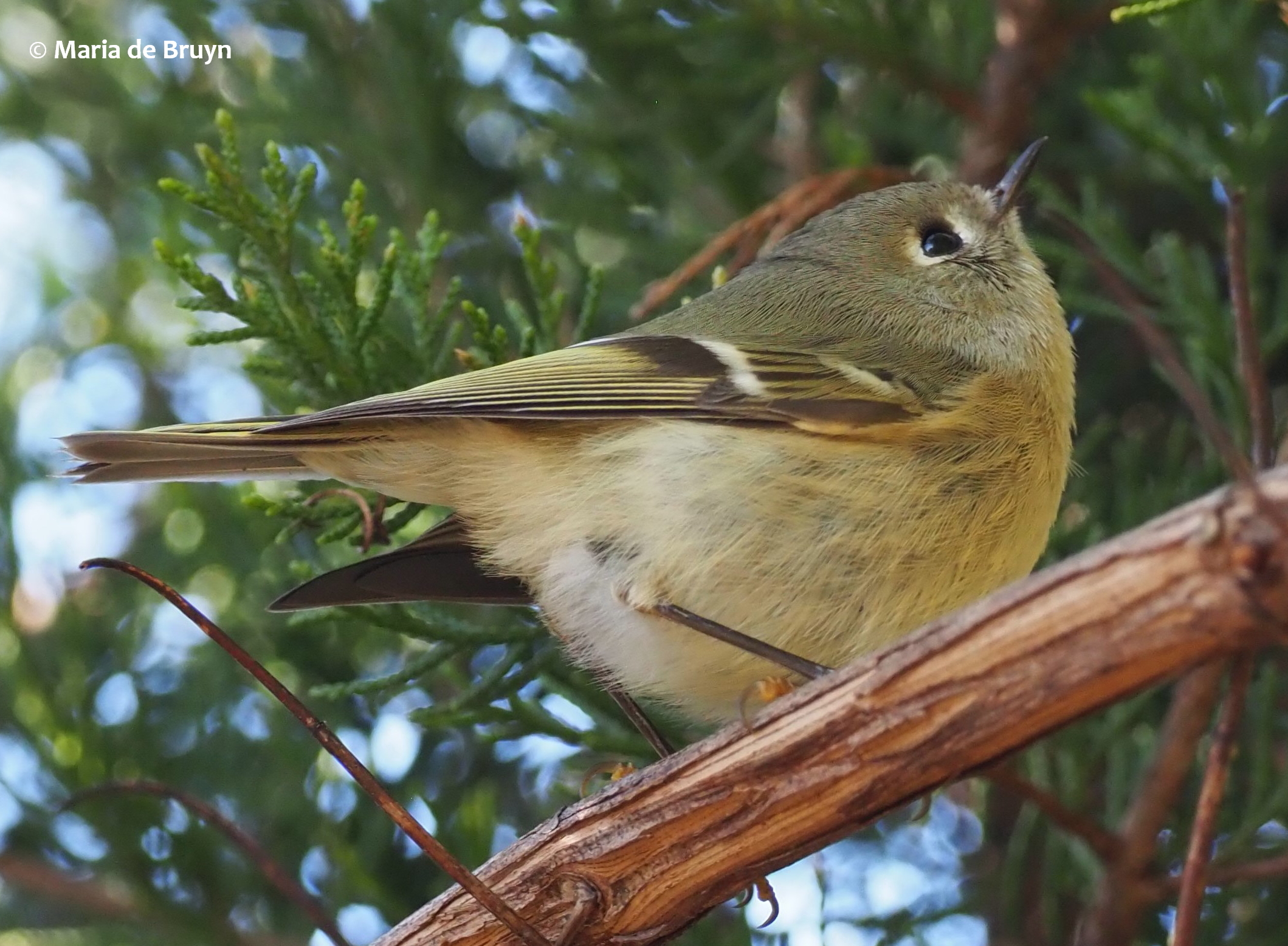
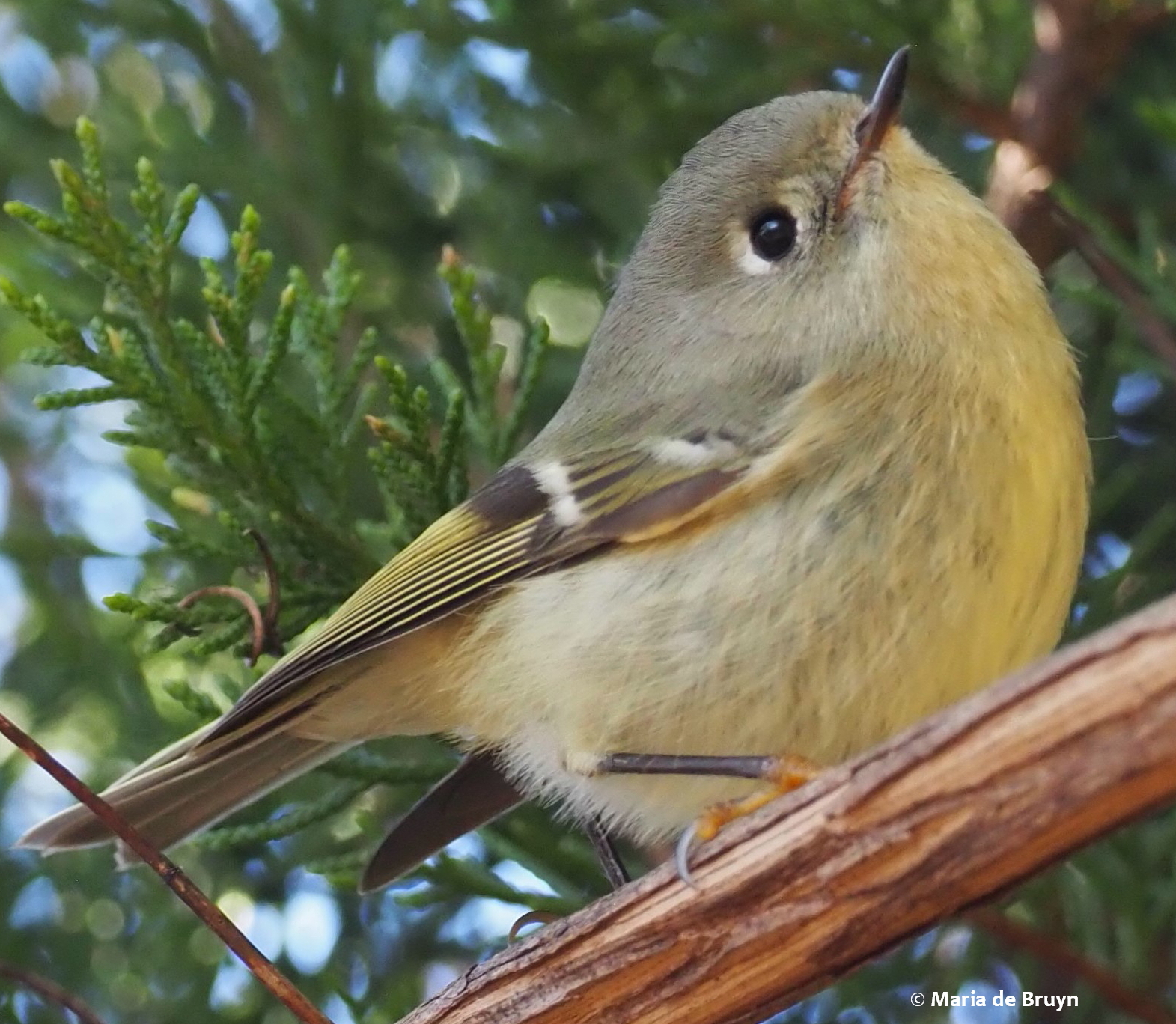
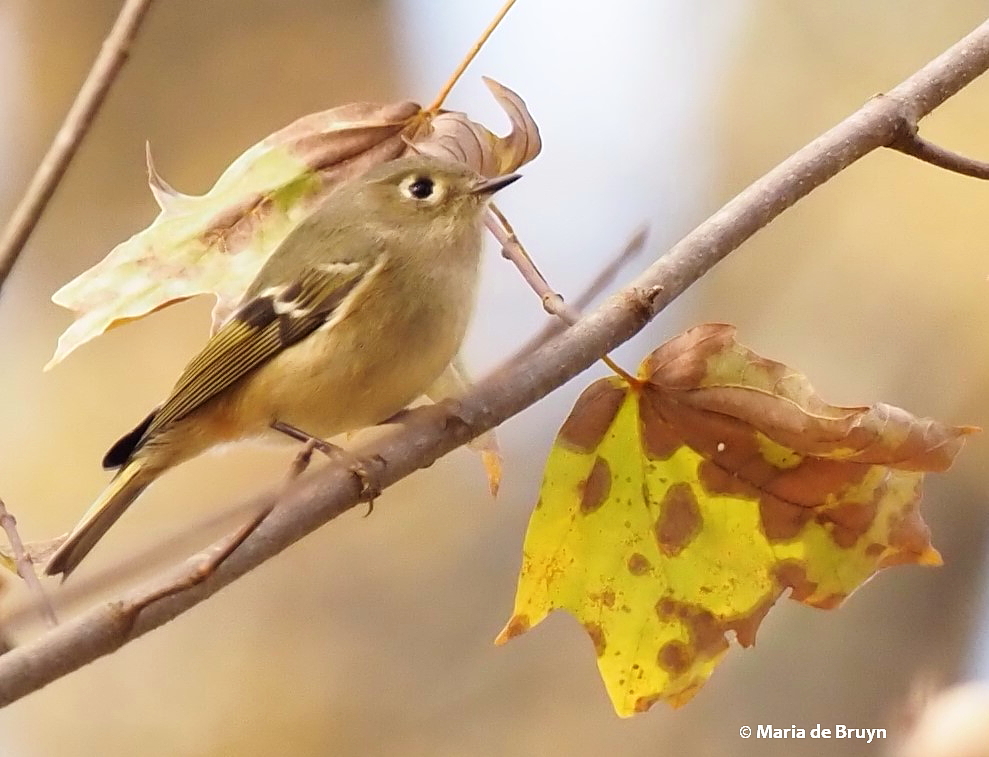
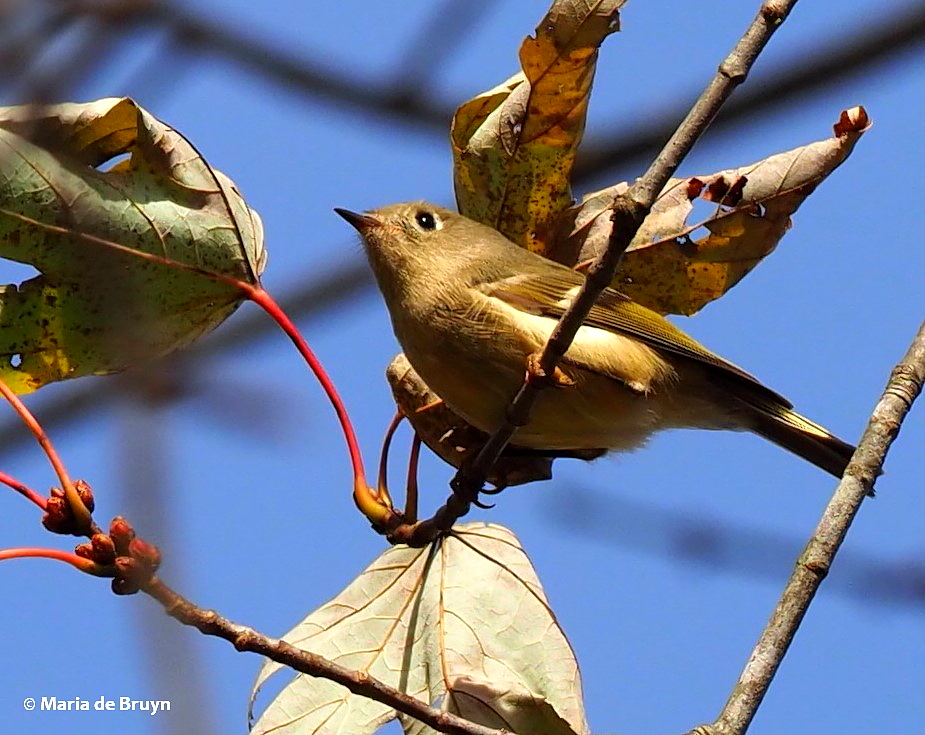
A birder recently remarked on a Facebook feed that ruby-crowned kinglets (Regulus calendula) seem to have a diet consisting solely of caffeine and Ritalin, which might account for the almost constant motion in which these lovely little birds seem to spend much of their time. They really get revved up, however, not when they are feeding but when they are defending what they consider to be their territory.

Unlike many other bird species, these kinglets don’t tend to hang out in groups of their peers. On the contrary, they often chase away others of their kind and this can turn into an actual campaign against an intruder that can last for quite lengthy periods.


This was brought home to me when I saw a vigorous little male who was confused by his own reflection in an installation at a local garden, aptly entitled “Self-reference”. The NC Botanical Garden organizes a yearly outdoor sculpture competition and this year included Jonathan Davis’ entry comprising a series of shiny glass balls arranged in a tall column supported by encircling metal struts and rope-like cables.

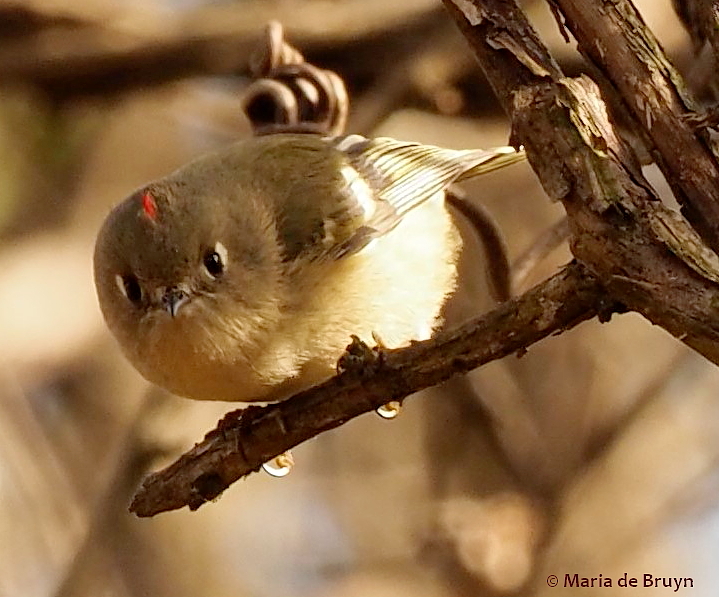
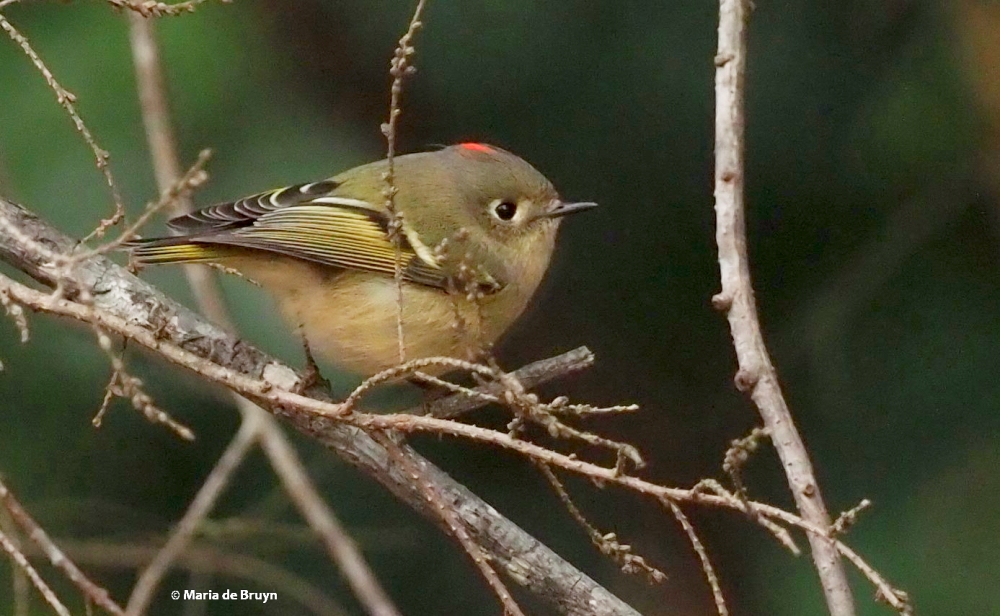
The orbs provided the kinglet with mirrors in which he could see himself, although he was obviously convinced that another male was trying to take over his winter domain. The raised red crest was like waving a flag in front of a bull. (These kinglets usually have the red crest hidden; they only raise it when excited or perturbed.)

My friend Lucretia had seen him attacking the “intruding bird” when she was at the Garden and she alerted another photographer, Mary, and me to his presence. Mary headed over to the site right away and got a lovely photo of Edward looking at himself. (I named him Edward as the meaning of that Anglo-Saxon name is “guardian of prosperity.”)


I only got to the Garden later the next morning, but Edward was still spending his time trying to drive away the interloper.


The sight of another male kinglet with HIS crown raised undoubtedly only incensed him further.

The day that I was there, he took frequent breaks to restore his energy levels by flying to nearby trees and shrubs to gather food.

He also took some time now and again to sit quietly on the sculpture’s metal rings – when his back was turned to the balls, he didn’t see the invader and could catch his breath, so to speak.


It was interesting to see how he tried to peck at the opposing bird, over and over again despite the fact that he was bumping his beak on the sculpture.


After observing him for a couple hours, I decided to leave Edward alone. However, there was a Garden party that evening and I returned to see the sculpture lit up with reflections of nearby Christmas lights – Edward was still busy in the late afternoon challenging his rival!


When I returned a couple days later, the sculpture had been removed, to the relief of some birders who were worried that Edward was going to wear himself out and perhaps be compromised when temperatures were due to drop considerably. As I had seen him feeding frequently, I was not too worried about that, but I am glad that calmer times have now returned for him so that he can spend his coming weeks in a more peaceful atmosphere. Hope to see you in your normal foraging mode soon, Edward!

Kinglet capers – finding food and enjoying short rests

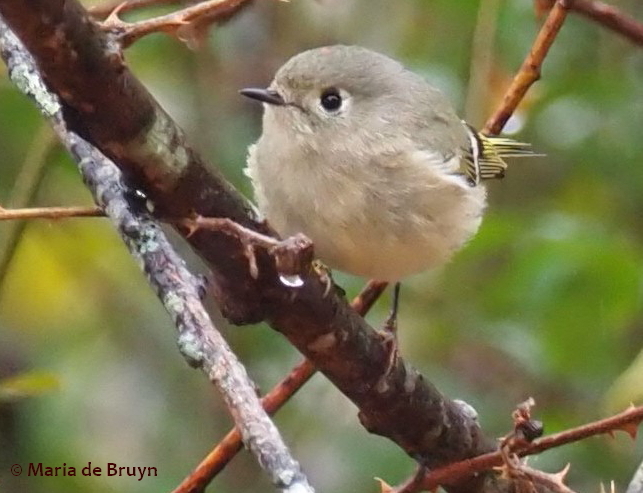
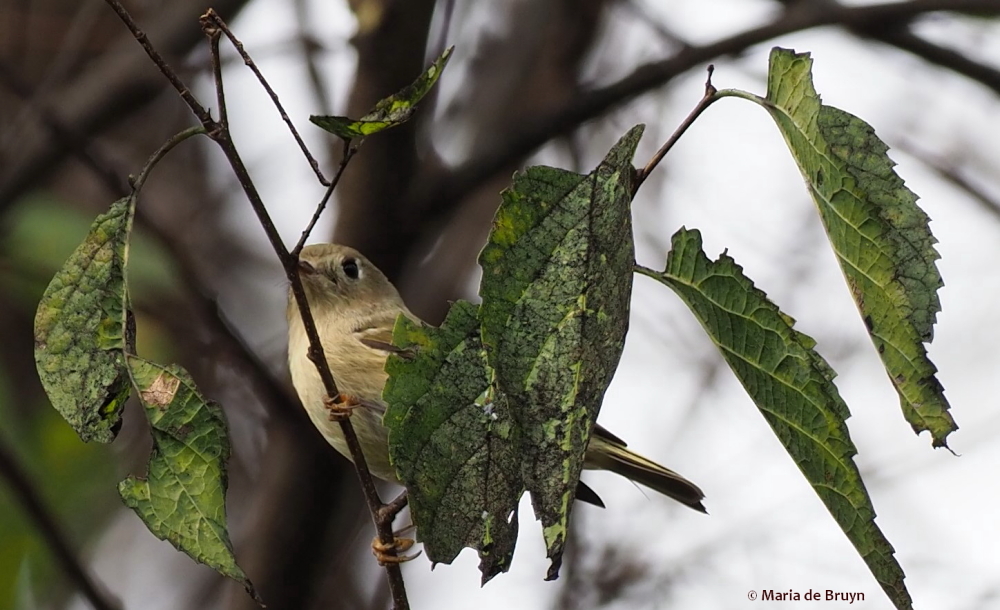
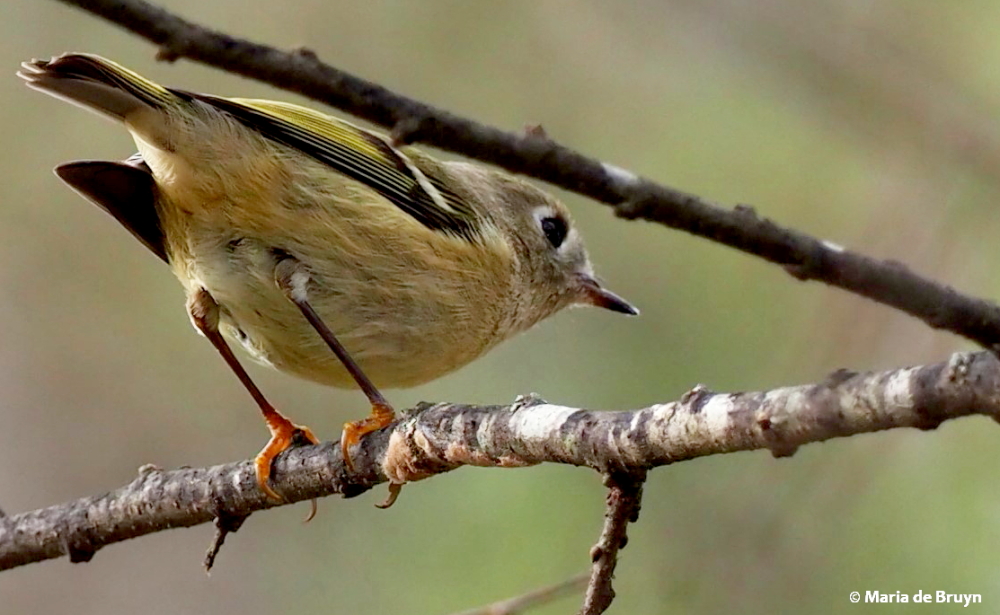
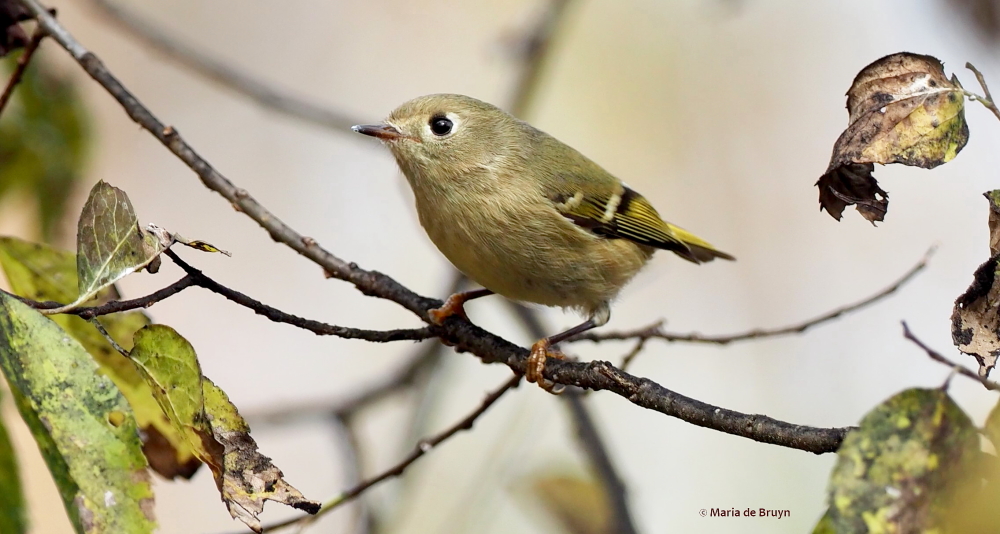
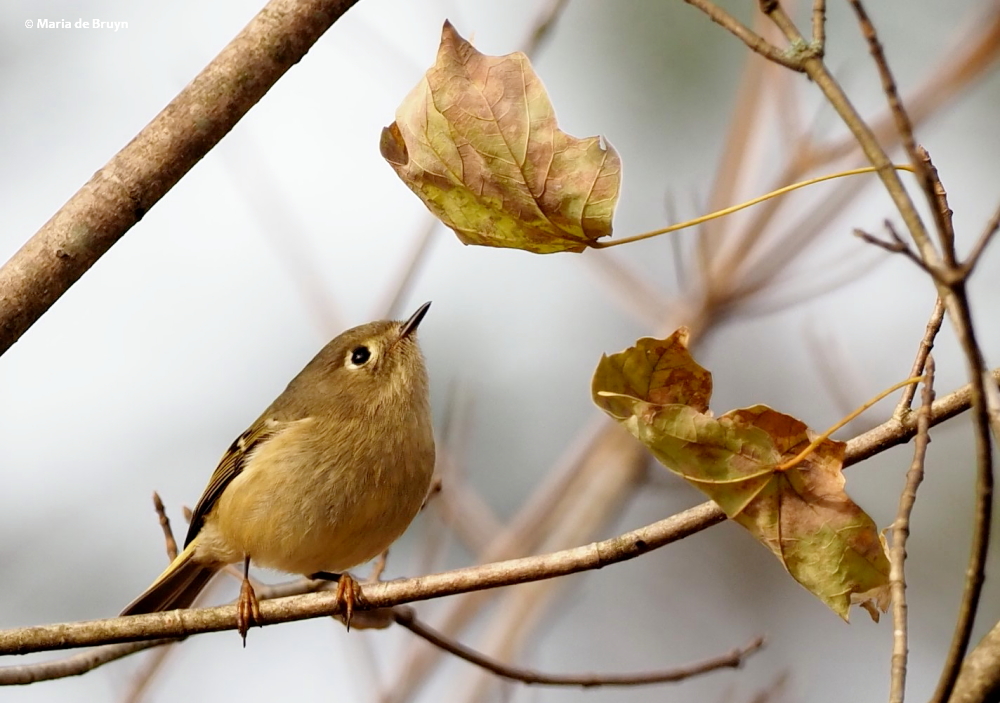
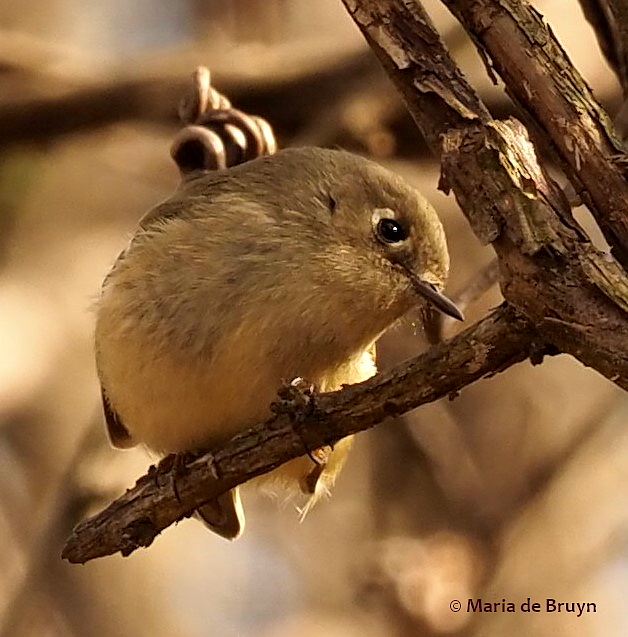
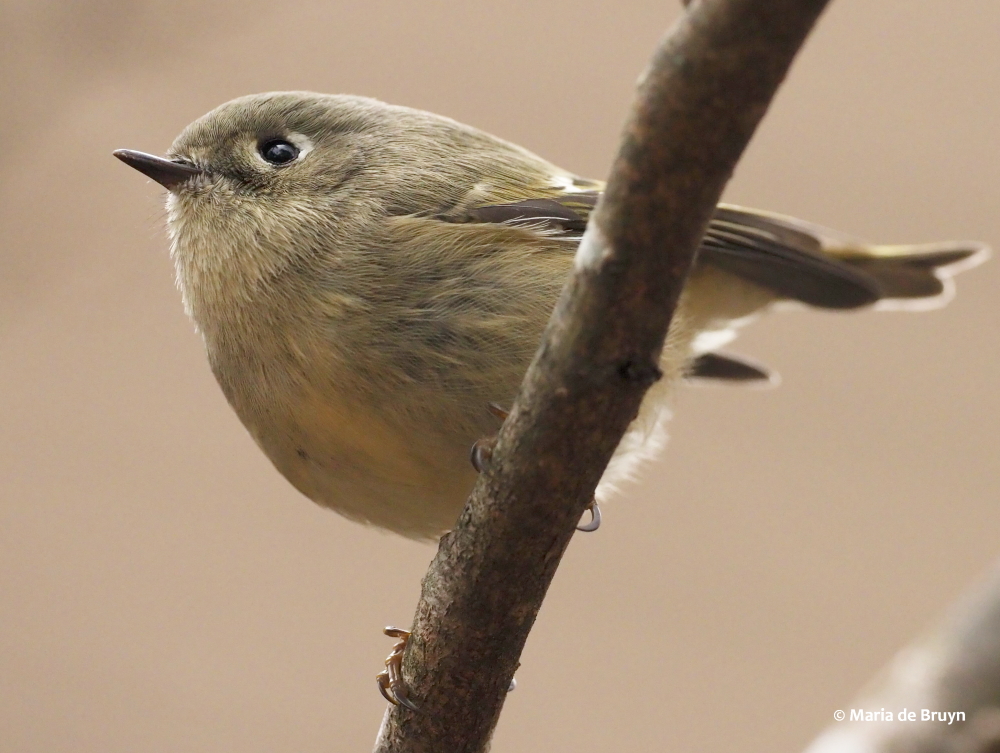
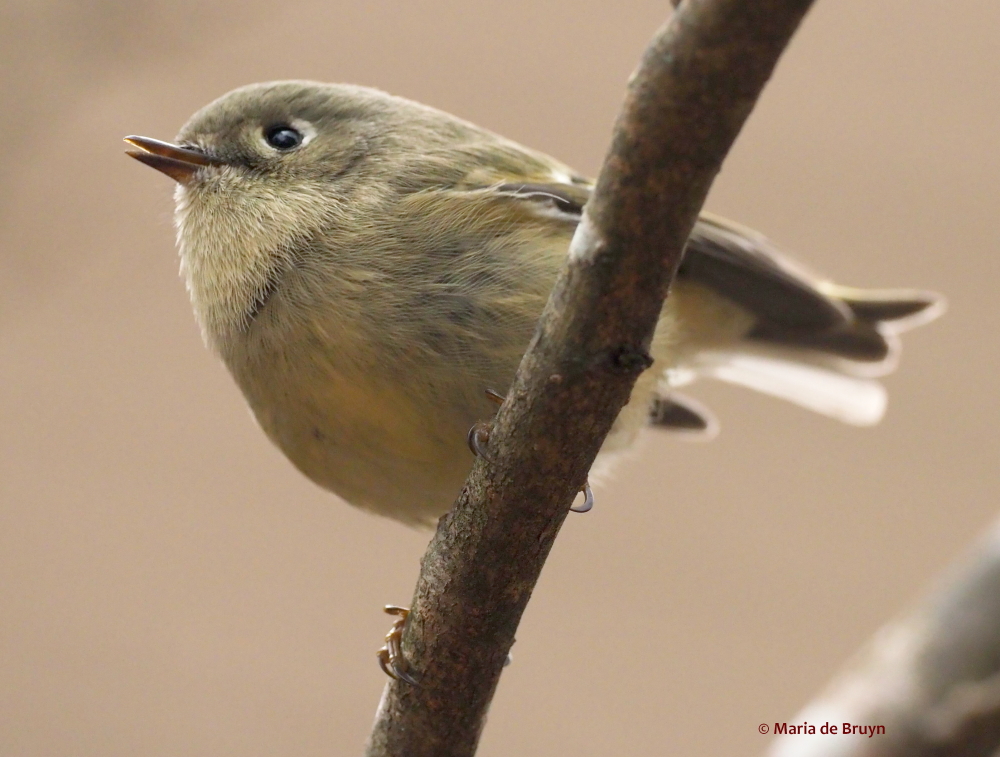
It seems that at least once a year, ruby-crowned kinglets (Regulus calendula) feature in my blogs; they are one of my favorite bird species and I always enjoy seeing them again and again.

These small birds are bundles of feathered energy, almost constantly in motion as they seek insects, which form the bulk of their diet.


They are only slightly larger than ruby-throated hummingbirds: 9-11 cm (3.5-4.3 in) long versus a length of 7-9 cm (2.8-3.5 in) for the hummer.

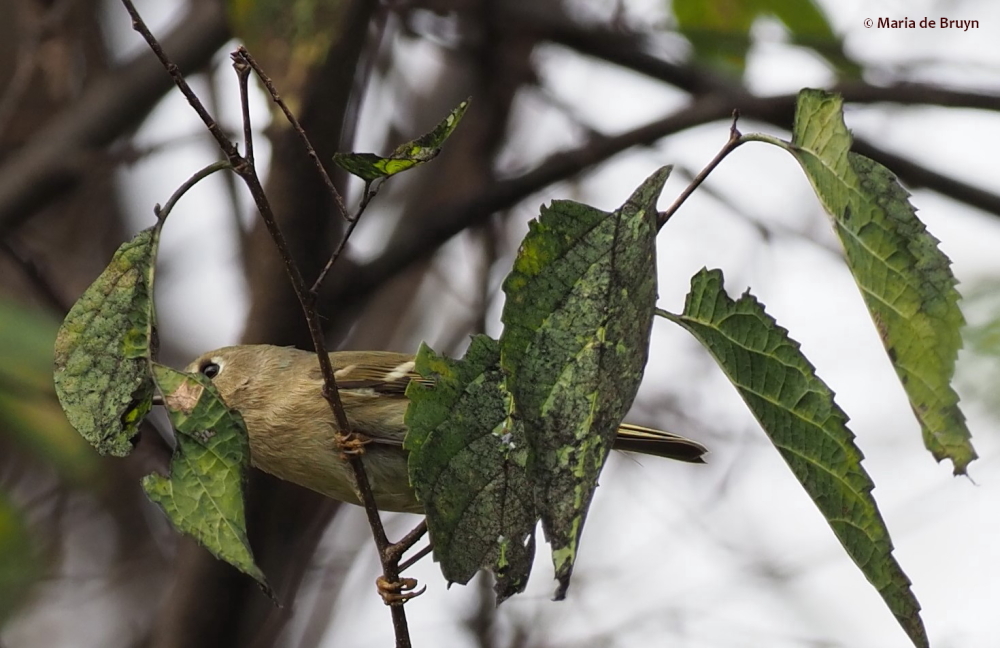
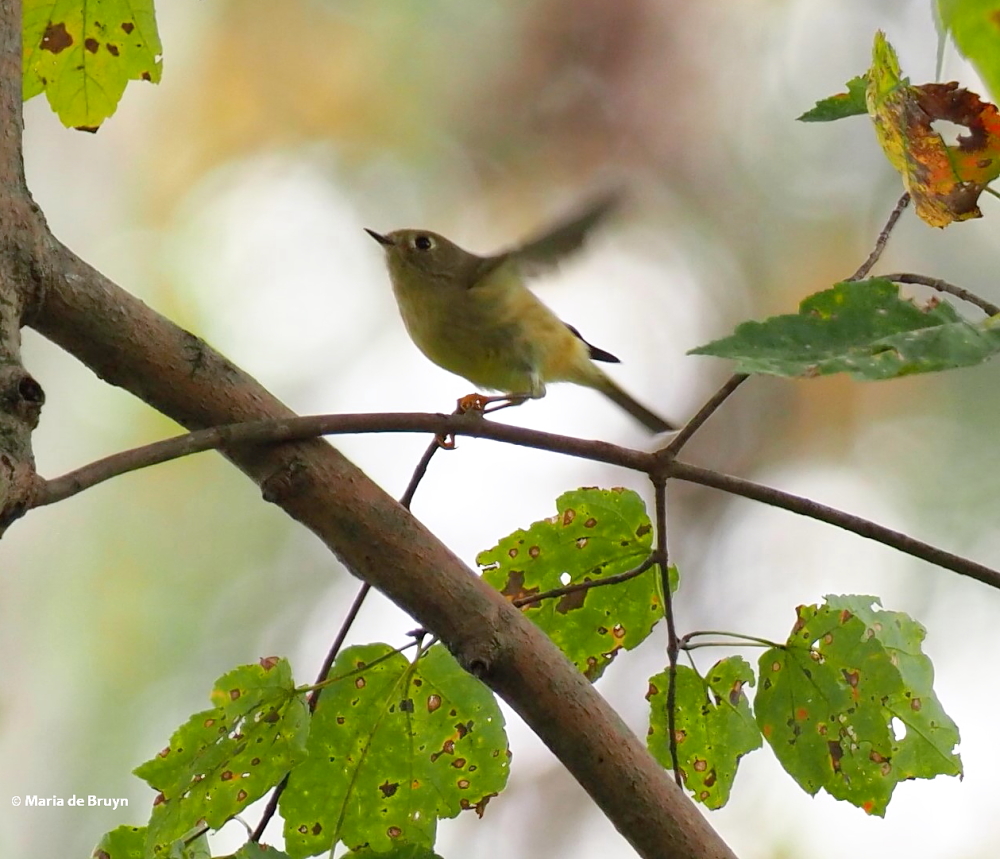
When they scour the vegetation for food, they may be flicking their wings continuously.

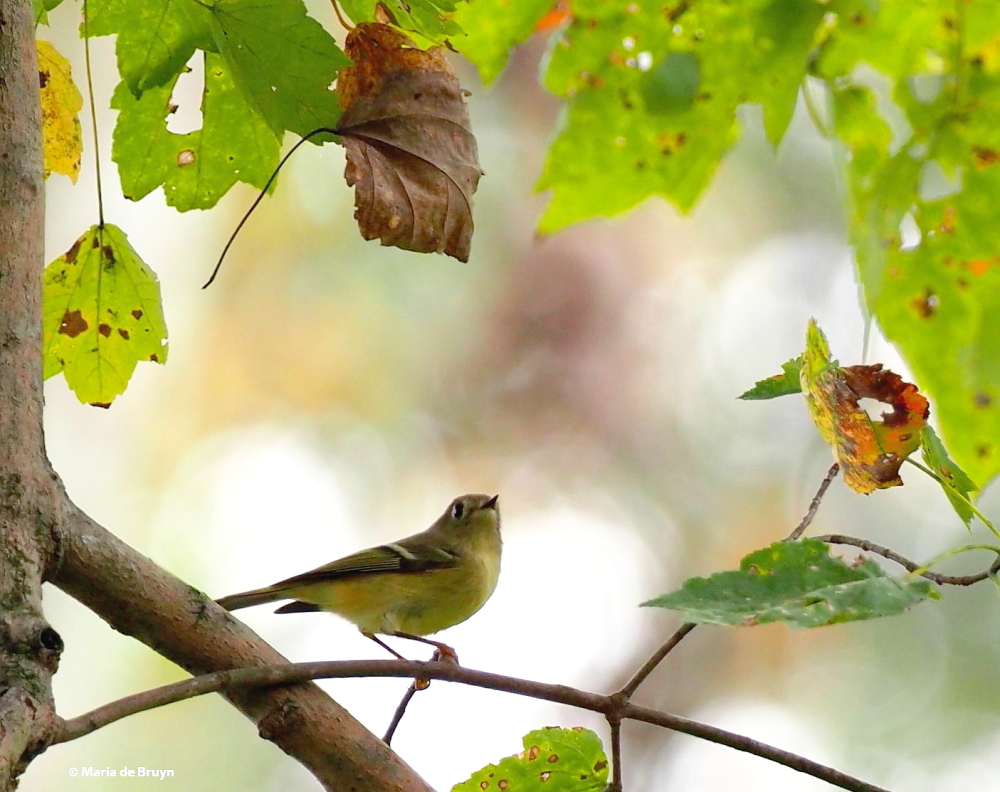
Fortunately, they do take little breaks now and again, so we can admire their beauty.

These breaks often last less than minute, however, and often are even briefer so you have to be ready and waiting to capture a photo.

I’ve been lucky this fall to find a few spots where I know some kinglets are hanging out, so I get to see them quite regularly.

My yard-visiting kinglet has returned for the winter season as well; I usually see him mostly at the suet feeder, where he will hover like a hummer as he takes quick bites of peanut-flavored vegetable lard laced with grits, oatmeal and nuts. He is a bit more gray in color than many other kinglets.

I’m wondering if this year’s bird is the same one who has been here the last 5 years. Unlike my previous visitor, I’ve seen him take a seed from a feeder as well. This has not happened before, even though it is known that they eat berries and seeds in winter.

This year’s bird also seems a bit shyer than my kinglet(s) from previous years. When I lift up my camera, he tends to take off. My resident the last years was not shy at all, a couple times actually perching on the suet feeder as I carried it to the pole. Still, my yard visitor’s anxiety has been nowhere nearly as obvious as that of another kinglet whose story I will relate in the next blog!


‘Rassing – a surprise visitor – what a delight!

(Warning – this is a bit of a long blog!) Several years ago, what was likely a rufous hummingbird took up residence in my yard during the winter months. That was really unexpected — while it’s not uncommon for migrating or some resident hummingbirds (especially ruby-throats, Archilochus colubris, above) to spend wintertime in North Carolina, particularly along the coast, it’s not so common in the central part of the state. That experience taught me that it’s a good idea to keep up a nectar feeder in the winter as you never know when a stray migrant might show up. In 2015 and 2016, I traveled with fellow birders to visit people who had a buff-breasted (Amazilia yucatanensis) and calliope hummingbird (Selasphorus calliope) wintering at their homes. In actuality, however, I didn’t really expect a rare passerby in my yard.


It was consequently with great surprise that I saw a hummer hovering at the nectar feeder last week. “Oh, wow!” I thought; “a ruby-throated hummer is passing through as a very late migrant.” I grabbed my camera to take a few shots and immediately felt perplexed.


The bird looked like he had a purple rather than ruby or red gorget (throat feathers). The white patch behind his eye also showed prominently because of his very dark head.

To me, it also looked as if this hummer had blue patches on his tail feathers. (Most say his flanks are green and a hummingbird expert said he has iridescent black tail feathers; the way the light reflects off them made me see blue, however.)

I got a few photos and cautiously asked birding experts on a facebook group if he could possibly be a black-chinned hummingbird (Archilochus alexandri), also sometimes known as the Alexander hummingbird. It seemed unlikely as their normal range is the Western part of the Northern hemisphere, reaching north into Canada (Alberta and British Columbia), east to Oklahoma, and as far south as Mexico, where most spend the winter.

A couple people thought I might be correct, but most thought it was a ruby-throated hummingbird. My spring-summer ruby-throated residents had left at least a month ago but I thought perhaps a late migrant might have arrived. The next day, I saw the bird again and became convinced that it was a black-chinned hummer; his purple gorget was very obvious to me. I posted new photos and now the experts agreed that I was correct. That was very cool – I got a lifer without even leaving my own yard!


A couple days later, North Carolina’s hummingbird researcher, Susan Campbell, came to my home to band the unusual visitor. I invited a friend who had been to bird bandings in my yard before to come for the happy event.

Susan arrived early and first set up a cage trap for ‘Rassing (short for the Dutch word verrassing, which means surprise; I wanted him to have a name during his stay 😊). She left the door open with a long string attached and hung the nectar feeder on the outside. It wasn’t long at all before the bird arrived for a drink. When he left, Susan moved the nectar feeder inside the cage.

‘Rassing returned for another drink and flew right into the cage, which Susan shut promptly. She had already laid out her banding materials so she could remove him from the trap promptly.

He went into a small bag (the kind often used to hold birds for banding) which Lucretia held while Susan began filling out the paperwork.

Then the actual banding procedure began. Susan first checked his legs to ensure that he hadn’t been banded already – the hummers rarely show their legs so that was necessary.

Then she got ready to put a thin red metal band on his tiny leg with a silver band showing his numeric code for identification in case he is caught again some time (Band number 7100 (M)-41902).

She checked the length of his bill – 19.19 mm. She also advised that bird feeders with long slits are not preferred even if the birds like them. It turns out that the thin slots can rub against the bill and wear it down, damaging the bill and making it vulnerable to infection. (I afterwards enlarged the slots into ovals and circles and went back to a couple other feeders I had with larger holes.)

She blew on his stomach feathers to check his fat; he was not a hefty bird but certainly a healthy adult male. His weight turned out to be 3.09 g. She also recorded his body length.

She stopped for a moment so I could take a few photos trying to get a good shot of the purple gorget. It looked like ‘Rassing was trembling but this was the vibrations from his rapid breathing. (When resting at 91⁰ F, they take about 245 breaths per minute; at 55⁰ F, this rises to 420 breaths per minute!!) Susan thought he was acting fairly calm.

She measured his short tail (23.5 mm), as well as his wings (40.42 mm). The female black-chinned hummer would have more rounded wing feather tips than this male.


Susan took a few photos of ‘Rassing and he got a few long drinks from a feeder held by Lucretia. Then Susan gave me the honor of releasing him – and to my delight, he chose to sit in my hand for what seemed to be at least 90 seconds. I could feel him breathing and it was a real thrill to see him so close. With a little flutter of his wings he took off – and then stayed away from the feeder for quite some time.


I added a feeder in the backyard and ‘Rassing began preferentially feeding there – perhaps the front yard had acquired some unpleasant memories. However, at the end of the day, I would remove the backyard feeder so that visitors who wanted to see him had a better chance of seeing him dine at the front-yard feeders.


A fair number of birders were interested in being able to add him to their life, state and county bird lists, so I offered to schedule visits through a birding listserv for a few people at a time. ‘Rassing appeared more reticent to stay at the feeder when there were more than 2 or 3 people watching, which is understandable. Who wants an audience for each meal and snack you eat??

When it rained, the feathers atop his head clumped together, giving him a new “hair-do.”


It appears that this species of hummingbird has not been studied much. I found his behavior interesting and spent a good amount of time observing him (chores had to wait). When I watched him leave the feeder and go to a nearby tree, he would sometimes watch me (turnabout fair play, of course).


He seemed very comfortable with lots of other bird species at nearby feeders. Perhaps it gave him a safer feeling.

‘Rassing tended not to sit on feeders, as ruby-throated hummers often do. Instead, he mainly hovered and vigorously pumped his short tail quite a lot. I learned that this tiny bundle of energy was breathing at a flight rate of about 1260 beats per minute!
 

Occasionally, you could see the band on his leg but mostly he kept his legs tucked into his body.

In the evenings, he came around nearly the same time each day to have a longer drink and then he sometimes perched while feeding.


A Cornell University website says that black-chinned hummers rarely stay at a feeder longer than a day during migration, even when food is scarce. In my yard, he had access to lots of bugs (I have a small pond) and three types of sage/salvia were still blooming. Indeed, he sometimes came to the feeder with pollen covering the top of his bill.

Yesterday morning, ‘Rassing apparently had decided it was time to move on. After the warmest Halloween on record in our area, the temperature plunged during the night to the 30s. The next morning was the same and he may have decided it was time to go to warmer climes.


I did feel lucky that he graced my yard with his presence for a week; it gave me something to celebrate during a personally challenging time. The oldest known black-chinned hummer was more than 11 years old; if ‘Rassing likes going east during migration, perhaps he’ll stop by again next year – wouldn’t that be a tremendous surprise! 😊
 

Costa Rica – varied landscapes and fabulous flora. Part 2 – heliconias and special plants

During the rainy winter season, Costa Rica’s foliage is abundant, lush, varied and beautiful. For plant lovers, it is awesome; for birders, it’s very cool and also very challenging.        In many places, the tall trees, like the Cecropias, towered over mid-canopy trees, shrubs and ground cover, creating dense foliage where we were challenged to spot birds on twigs and behind leaves.


When you are in the rain and cloud forests and wearing glasses, it can also be frustrating – in some areas where we were birding, my spectacles (a nice old-fashioned word!) fogged up every half-second.


Our guide used a laser pointer (the green spot on the right) to indicate when he had found a bird among the leaves — “Look a foot or two to the left, right, above or below” — and we attempted to locate the winged visual target. Sometimes I found the bird and other times, I just couldn’t focus with glasses that required constant wiping and getting good photos was really out of the question.

Fortunately, photographing plants was somewhat easier than creating avian portrait. Heliconias (of which there are about 200 species) can be seen throughout Costa Rica. They are very attractive with their elaborate “inflorescences” – flower heads that include stems/stalks, bracts (modified leaves or scales from which a flower emerges) and the blooms themselves. The large colorful hanging or erect structures on them might seem to be the flowers but those are the bracts.

Some heliconias are called false birds of paradise as they closely resemble the Asian birds of paradise flowers (Strelitzia reginae).


Others are called by avian and animal names as well.

Lobster claw (Heliconia caribaea)


Expanded lobster claw (Heliconia latispatha)


Parrot’s beak (Heliconia and Heliconia psittacorum)

One yellow flower is called the rattlesnake plant (Calathea crotalifera); it was featured in a “Garden of wisdom” at the Santa Elena Cloud Forest Reserve.

The name comes from the bract’s resemblance to a rattlesnake’s tail. Our guide told us that venomous yellow pit vipers will wait in the plant to ambush hummingbirds that come to feed on the flowers. Eyelash pit vipers will return to familiar ambush sites during spring bird migration!

Some of the foliage was enormous in size. The elephant ear (Xanthosoma) is a plant with huge leaves that can be seen along roadsides and in nature reserves. Other large leaf plants, likely philodendron species, serve as insect food.


Mushrooms similar to those we see in North Carolina were in almost all the habitats we visited. Here are just a few of them.


At one point, we birded near a small coffee (Coffea) plantation.

In one of the reserves, we came across cacao trees (Theobroma cacao). A member of our group touched the sticky insides of one fallen fruit and found it quite smelly.

Various species of palms were common and we were able to see some in bloom.


Elsewhere, we saw how small trees are pruned to form living fences along fields.


One of the most interesting plants we saw was the Columnea consanguinea. The green leaves are distinguished by translucent red heart-shaped patches on their undersides. These are visible from above the leaves as yellow-green areas.


The purpose of these markings is to attract the plant’s main pollinator, the green-crowned brilliant hummingbird (Heliodoxa jacula).


When they see the yellow-green/red hearts, they know the plant’s inconspicuous flowers will be lying nearby against the plant’s stem.


This plant with aerial roots had been cut off somehow; it was now in the process of covering itself with a gel-like substance, intended to discourage animals from chewing on it before the roots reached the ground.

Here are a few more lovely flowering plants that I couldn’t identify but certainly enjoyed seeing.


To conclude this focus on Costa Rican plants, I’d like to show a photo kindly shared by Nan DeWire – it reflected our attitude as we toured the marvelous natural areas.

The next Costa Rica blog will feature some of the mammals which we were lucky to encounter as we moved from place to place. However, a quick side trip to North Carolina will take place first to document a lucky event for a birder.