More otter fun — for the mammals and me!

Part 3: Communication and play

The otter family that I observed this past January captivated me and I photographed them often. Here are a few more scenes from their life that I hope you enjoy seeing.

The otter that caught the very big bass kept that fish to itself even when the other two stayed close. The pair never tried to grab the prey. Finally, I concluded that the lucky hunter must be the parent and the other two the offspring.

After some time, the non-dining pair left the prize behind and the successful hunter took some pauses in consuming the large meal.

After the young mammals disappeared into the water, I assumed that they might have swum back to the beaver lodge, where they had been residing the past days. Otters shelter either in burrows that beavers have made or in natural hollows created under tree roots.

The beaver lodge in this pond appeared ideal for their purposes; they played on it, rested on it and appeared to be going into a burrow underneath as well.

River otters communicate in two ways — through olfactory and auditory signals. Their scent marking is done in two ways.

Their hind feet have plantar pad scent glands which are used to mark various areas.  Biologists believe that the otters transmit messages about identity, reproductive and social status by leaving glandular scents as well as anal secretion deposits on scent mounds that can be used for years.

River otters have a reputation for being playful and this group lived up to that. They dove after one another and wrestled on the ice. Sometimes all three were engaged and sometimes it was a pair exercise.

One day, after I had visited several times, their curiosity seemed to get the better of them.

Previously they had only observed me from a distance while going about their daily life. This time, they spent some time at a stump and then after a time, all turned and stared at me.

Finally, two of them began swimming under the ice in my direction, occasionally breaking through to see how close they had come to me.

One decided to chill out by a nearby stump in the water, perhaps waiting to see if I would get in the pond with them. When I just stayed still and watched, they finally regrouped and began fishing again closer to a weedy section of the pond.

The last couple times I visited the pond, I didn’t see the trio. Perhaps they had fished enough in this area and decided to go to another spot for a while so as not to deplete the available stores of fish — even though our temperatures have suddenly increased, there is no guarantee that we won’t have icy days ahead in later February or early March, so their natural pantries may be running a bit low.

I’ll miss seeing them — and hope they do return The river otters are one of the few animal species I get to see who can look like they’re smiling! 😊 😊


Continued otter fun – for the mammals and me!

Part 2: surviving and dining in winter

One otter or two above? My otter friends produced an unusual portrait for me one day while they were running around an icy pond. 😊 It looked as if they had brought an extremely long family member with them!

Continued observation showed, of course, that the resident otters (Lontra canadensis) were all of normal stature. During much of the time that I was able to watch them, the temperatures were very low for North Carolina. In our central area of the state, temperatures in January 2025 were the 18th coldest ever recorded, averaging 36.6°F (2.6°C°F). Some days had significantly low temperatures, such as 17°F (-8.3°C) on 23 January.

That weather meant that the local ponds were partly or mostly frozen and had very icy waters indeed. In this and my next blog, I’ll share with you what I observed and learned about how river otters function in such cold conditions.

Their unique metabolism has several features that collectively enable them to survive in extreme cold.

  • Their very thick, water-repellent fur covers a dense undercoat that traps air. This fur is 10 times denser than that of the bobcat or red fox, with 585 hairs per square mm.
  • The trapped air acts as a buffer against the cold.
  • A thin blubber layer underneath their skin provides a second thermal barrier. (It also gives them extra energy when there is limited food availability.)
  • Shivering increases their internal body temperature.
  • Their high basal metabolism increases when they are actively swimming and diving, which also generates heat and helps them maintain a steady body temperature.
  • Their high metabolic rate enables them to pass food through their digestive system in about 60 minutes.

I was sometimes amazed at how quickly they caught one fish after another and now understand how they could process so much food in a short time. Their 36 teeth, including 4 long canines, obviously help them process the food they capture.

The otters also have corporal features that make their food hunting efficient:

  • Their ears and eyes are high on their heads, enabling them to swim more easily at the water’s surface.
  • They can swim both forwards and backwards, as well as tread water while surveying their surroundings.
  • They are near-sighted, which may improve their underwater vision.
  • Their whiskers are very sensitive, enabling them to more easily capture prey on dark nights or in murky waters.
  • Their ears close under water.
  • Their feet have five webbed toes as well as non-retractable claws.
  • Their traction on slippery surfaces is increased through heel pads on their hind feet.

The otter family that I observed on several occasions was very adept at catching fish. The NC Wildlife Organization notes that they sometimes collaborate in hunting by herding fish.

The pond otters whom I was watching had certain spots that they kept open in the ice, often diving down and coming up with another fish each time. In this video (click here) you can see one enjoying a meal.

Since I know very little about freshwater fish, I posted a couple photos on a fish identification page to find out just what the otters were eating. Group members debated a bit but then came up with these IDs.

Otters with bluegill sunfish (Lepomis macrochirus)

Otter with a large largemouth bass (Micropterus nigricans)

Biologists say that otters prefer to go after slow-moving fish, including catfish, carp, bass, suckers, and sunfish. Some of the fishing enthusiasts shared about what they had seen otters eat. (Then two men made negative comments and insulted the group moderator, so I removed the photos and left the group so as not to foment more dissension among that group’s adherents.) Here are some of their comments:

  • Otters are such cool animals! Have seen a couple groups while fishing/hunting this year in NC!
  • They’ll eat most any fish. Where I live they have cleaned out nearly all the fish in the ponds near the river. My old pond was teeming with fish when I owned it and now it holds a fraction of the fish it once did.
  • Ours eat a lot of eels. Ophelia/Smith Point, Virginia.
  • Here in New Hampshire I saw them eating what appeared to be fallfish last year.
  • I used to see otters pull rainbow trout out of the river when I lived in Idaho.
  • I hate otter and kill em every chance I get within season…I have had them drag 40 pound catfish out of my ponds and eat them…

It always saddens me when people develop a hatred for an animal (with the possible exceptions of ticks, mosquitoes and chiggers). In any case, I love the otters and will share with you how I saw them play in the next blog.


Frigid days and thirsty birds

Before my next Yellowstone blog (later today; I’m on a roll after a long posting absence), I wanted to share a tip with those of you concerned about birds when you’re confronted with frigid temperatures.

Here in the Southeastern USA, our late autumn/winter season has so far been a temperature roller coaster. We have gone from afternoon temperatures in the 50s and 60s F° (about 10-15 C°) to morning lows of 10 to 25 F° (-12 to -3 C°).

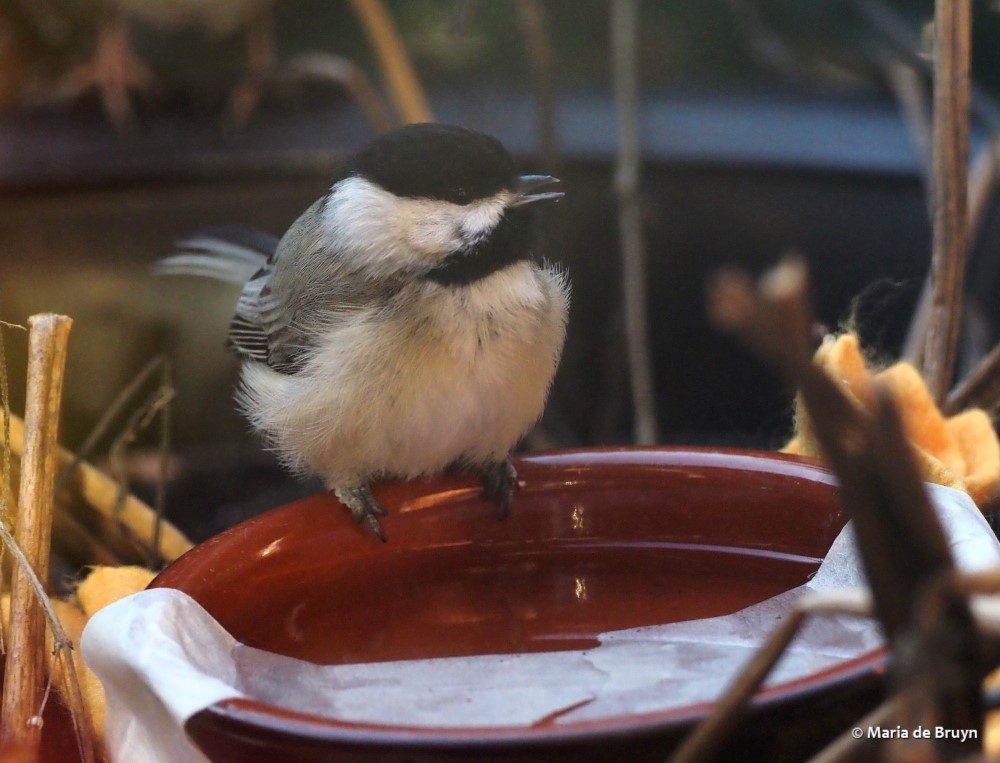
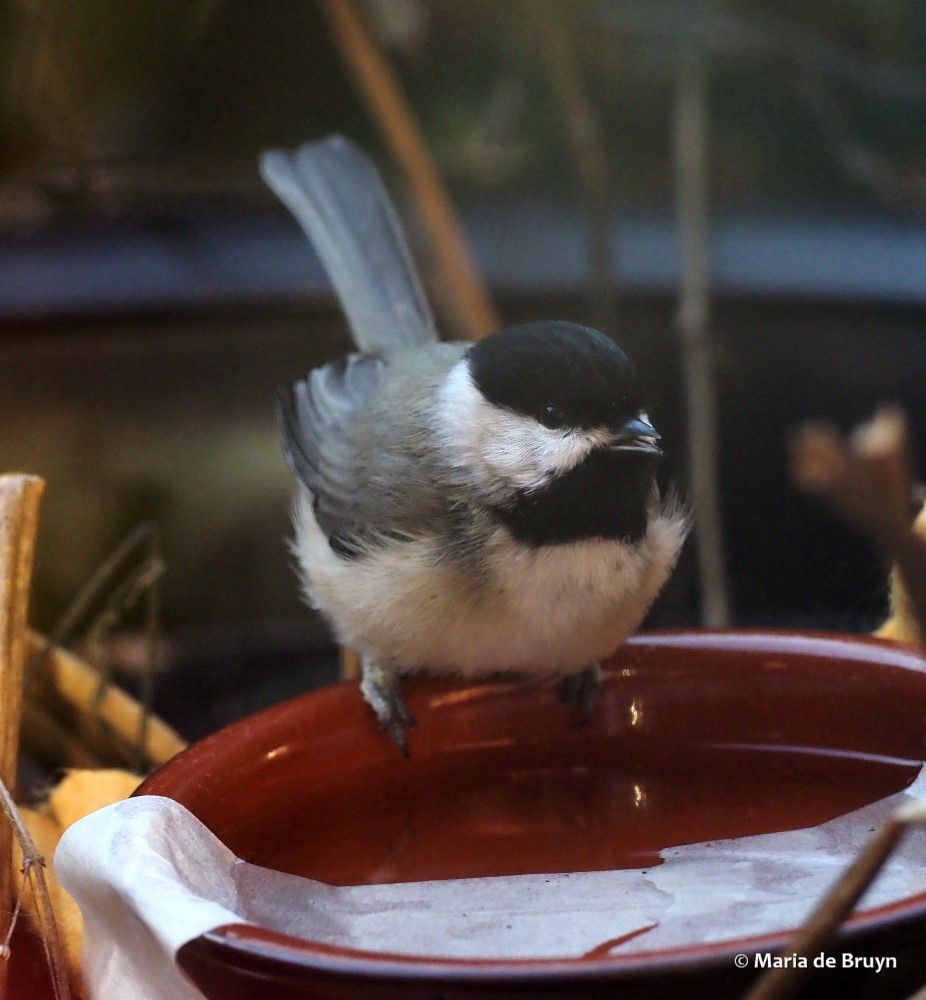
Carolina chickadee

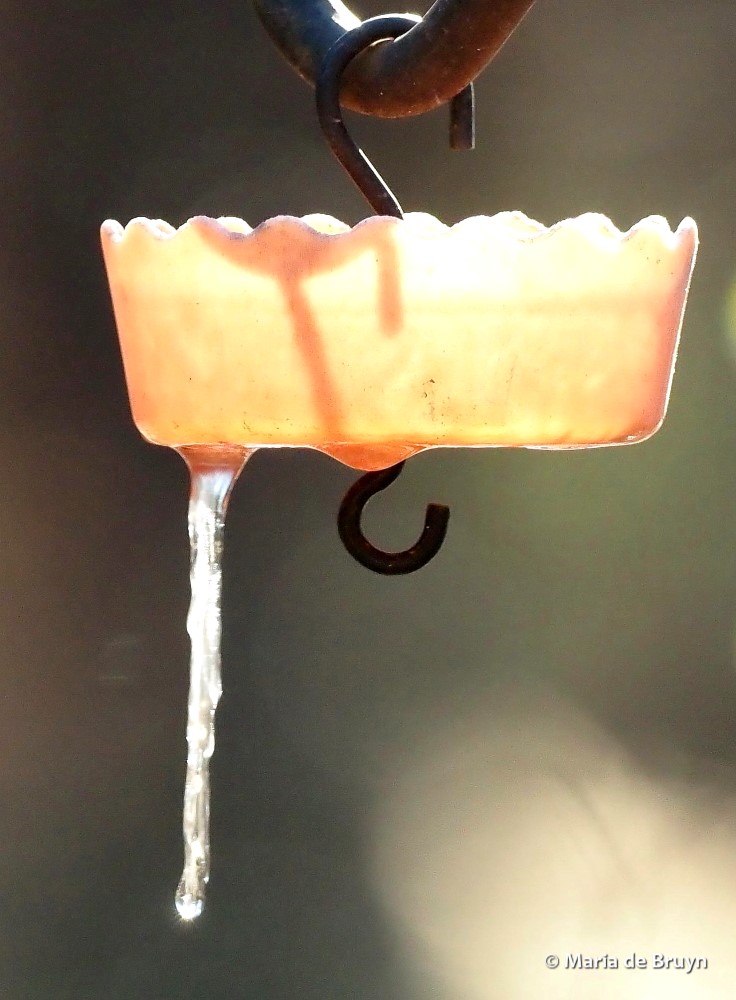
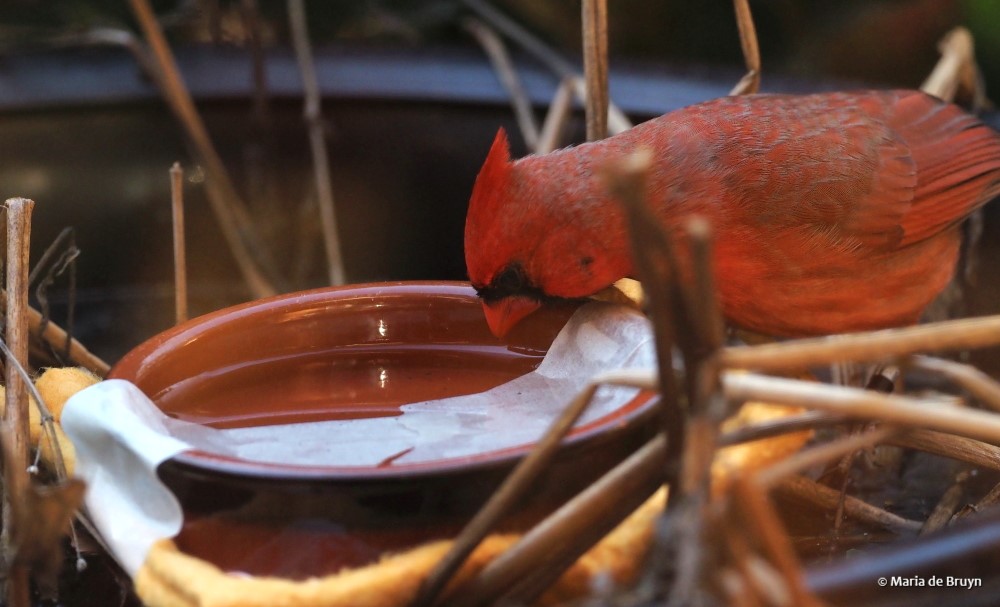
My porch features some shallow plastic plant saucers that I keep filled with water and a solar fountain. The smaller birds especially like to get drinks there because it is more sheltered than the bird baths out in the yard. However, that water has been frozen and birds began chipping at it fruitlessly to get a drink.

Northern cardinal

As a hiker, I often use hand, toe and body warmers when I walk in the cold. So it occurred to me that I might use them to provide the birds with some liquid refreshment in the cold. Wikipedia explains what they are: “Air-activated hand warmers contain cellulose, iron, activated carbon, vermiculite (which holds water) and salt and produce heat from the exothermic oxidation of iron when exposed to air.” The small packets are shaken to activate them and then they give off warmth for about 8-10 hours.


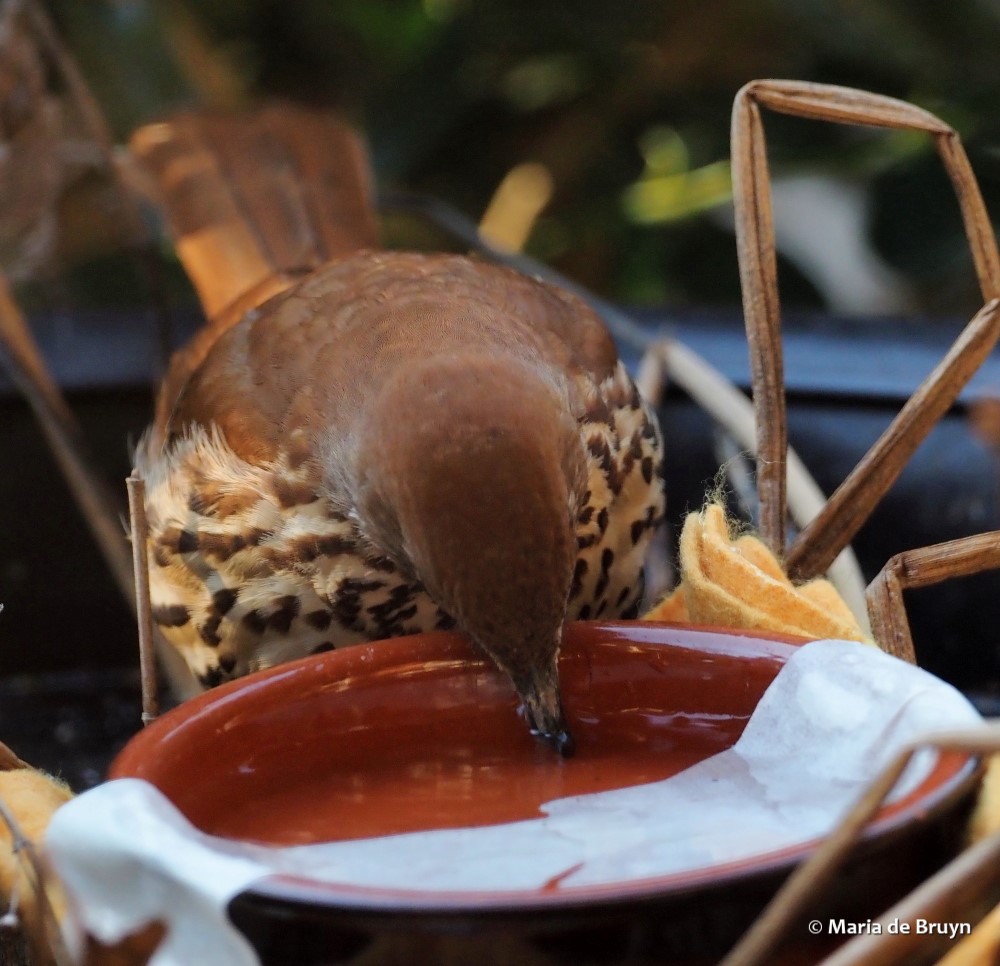
Brown thrasher 

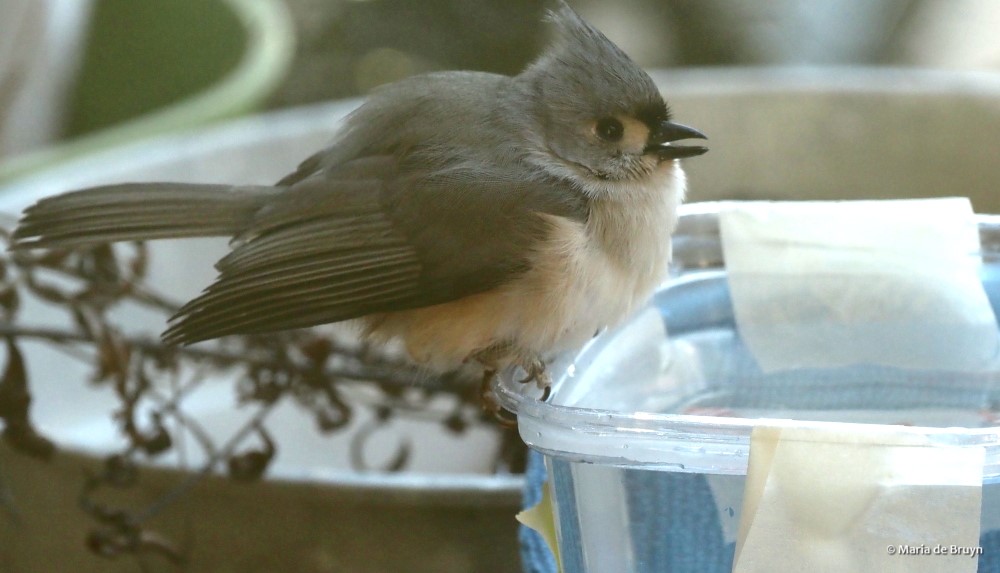
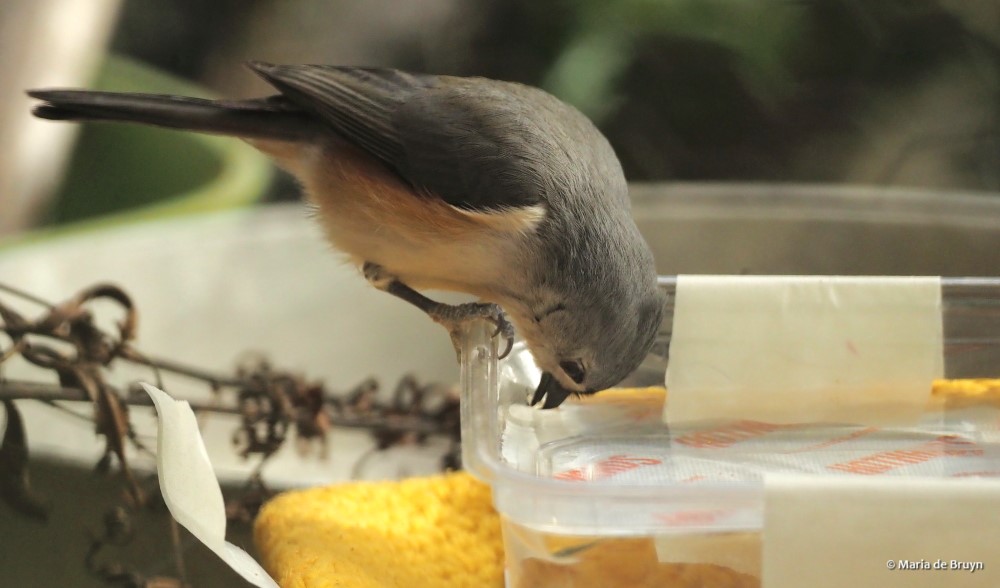
I taped some of the hand and body warmers to the bottom of plastic containers and ceramic dishes and it has worked really well. Even in freezing weather, the warmers keep the water in the containers liquid all day for birds like the tufted titmice below.


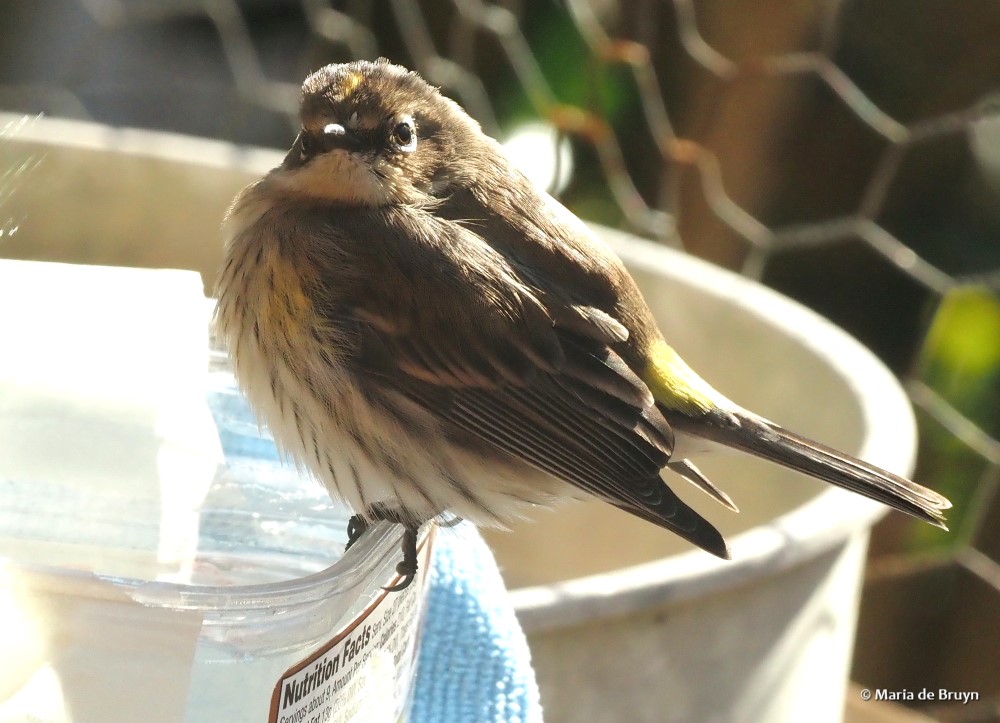
As you can see from the accompanying photos, a variety of birds have been using them and it’s been rewarding for both them and me! As I write this in front of my porch window, a yellow-rumped warbler stopped by for a drink.

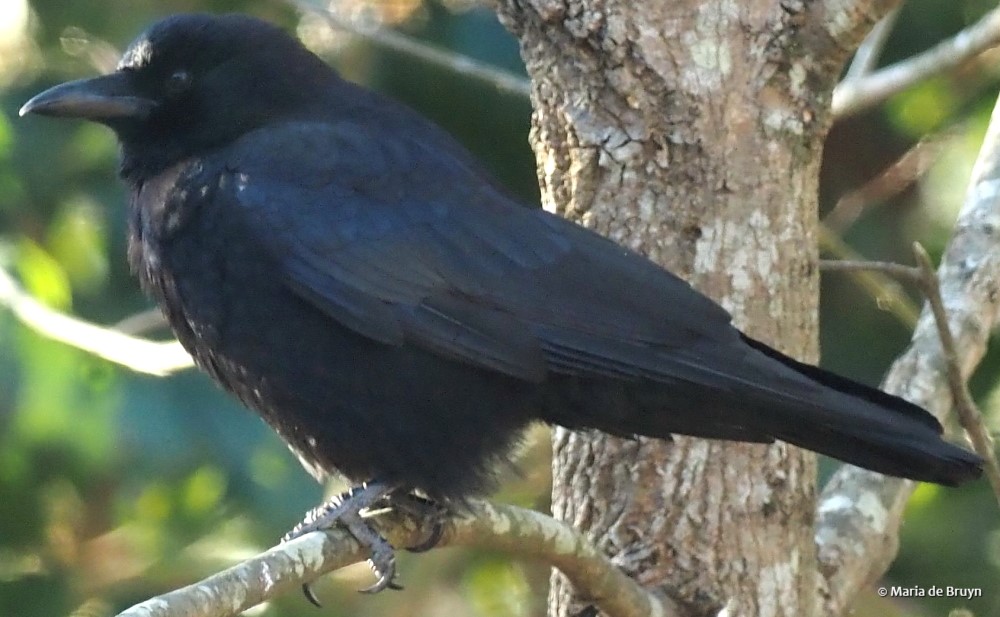
The larger birds like the crows have not come onto the porch but I hope they have strong enough beaks to break through ice in the ponds and puddles.

The coming week, our temperature roller coaster will return. We’re now expecting to have temperatures in the next two weeks reaching about 65 F° (18 C)!!

As you’ll see in the next blog, when my friend and I visited Yellowstone in the spring, we also encountered temperature roller coasters. Some days we started off bundled up for winter and ended with our jackets off in the afternoon. I am immensely grateful that I’ve been able to cope with these climatic circumstances and will maintain my wood pile in case we lose electricity later this winter and I need to use the fireplace.


Weather, water, wildlife, and well-being

As I continue to go through my photos from Yellowstone National Park (a lengthy process!), I will post on a few other topics that you will hopefully enjoy. 😊

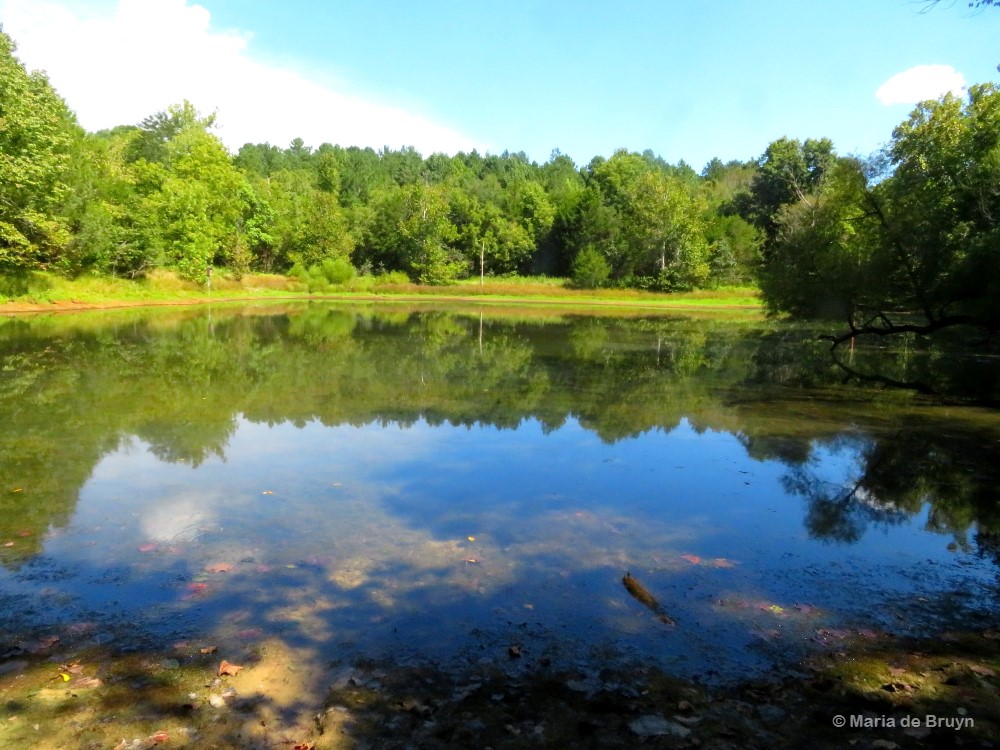
I just wrote a column for a local newspaper about climate and water. All life on our earth needs water to exist — plants, animals, and humans. Water contributes to respiration, processing nutrition, photosynthesis, regulating temperature and providing a living environment for many organisms. Scientific studies are documenting the benefits for our well-being of spending time in natural areas and beautiful places for this include nature reserves and parks with ponds, wetlands, lakeshores, creeks, and rivers.

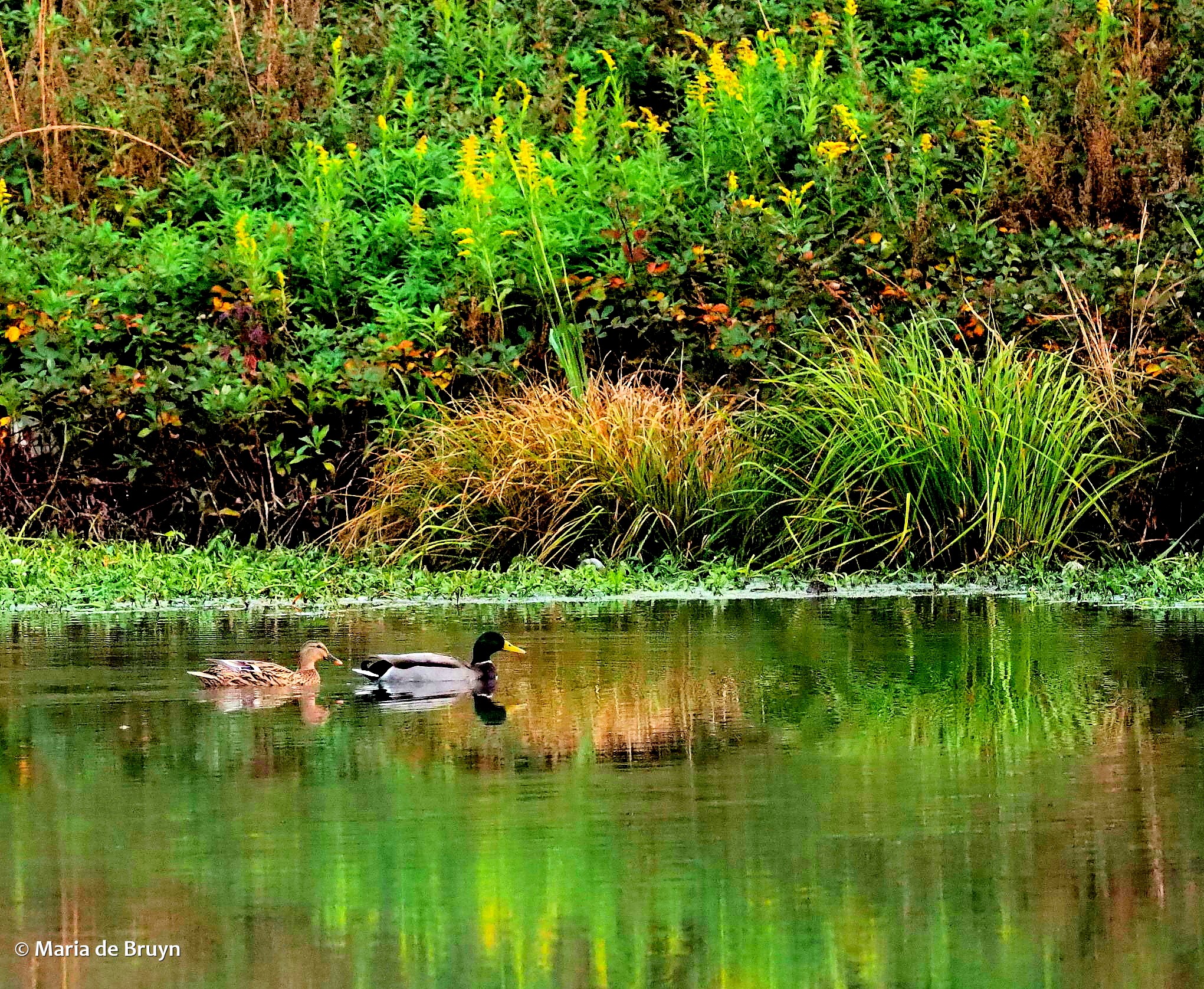
The diversity of wildlife around ponds can be delightful, especially in the summertime. You may be lucky to see mammals coming to the shoreline or pond’s edge to get a drink or have the good luck to catch sight of beavers, muskrats, minks, or otters.

Or perhaps there will be a yellow-crowned night heron (Nyctanassa violacea) standing atop a beaver lodge, surveying its surroundings, and taking time to preen.

Reptiles and amphibians clamber onto rocks, snags, branches, and boardwalks to sun. Turtles lay their eggs close to ponds and rivers. At this the time of year, you may come across the remains of leathery eggshells left by hatched turtles (or dug up by predators).

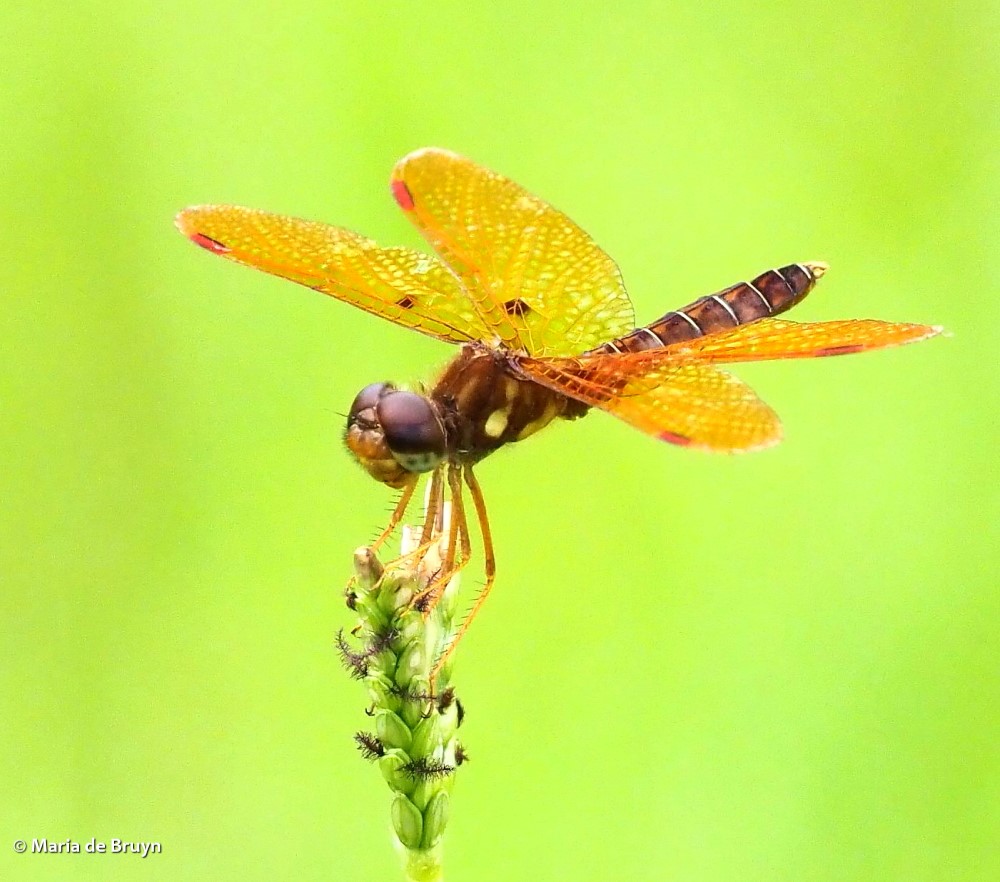
Damsel- and dragonflies, like these amber-winged dragonflies (Perithemis tenera), are interesting to watch; they don’t even need natural water sources but will come to tubs of water containing plants like pickerelweed. Butterflies, such as these cabbage whites (Pieris rapae), “puddle” in mud, carrion and dung alongside creek and pond banks to obtain amino acids and salts in the fluids they suck up.


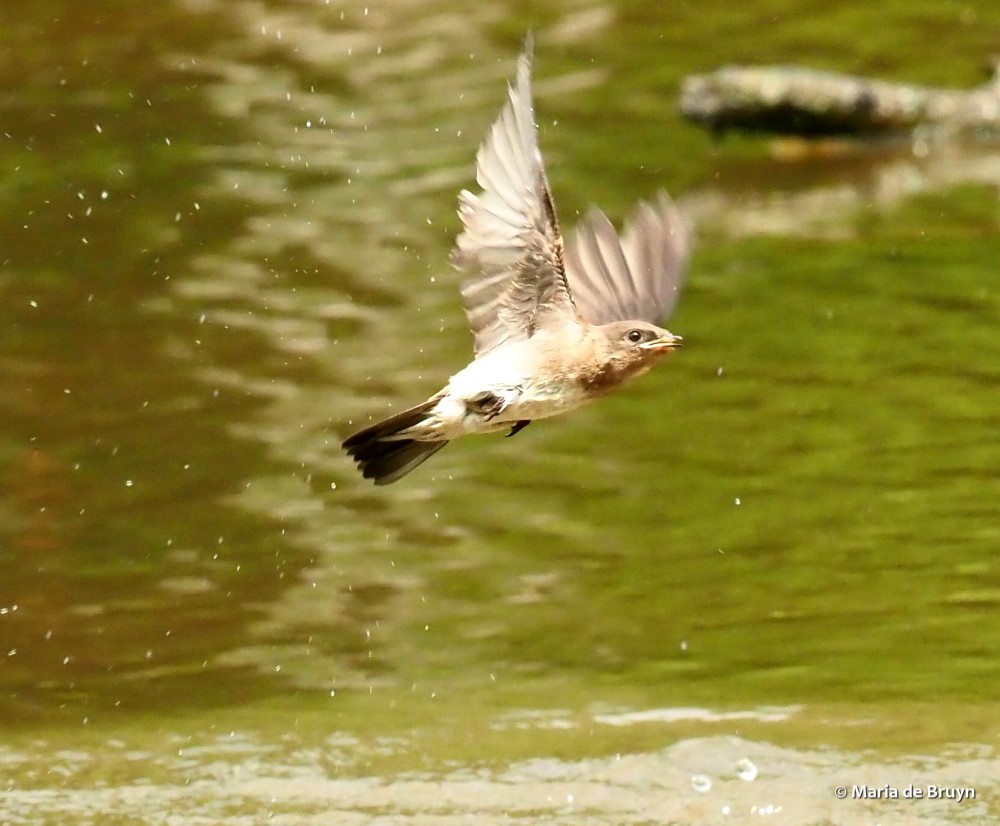
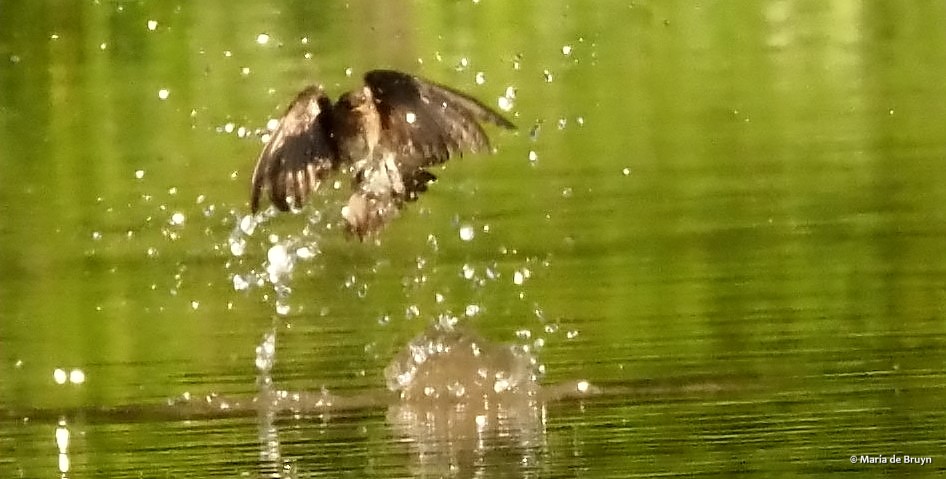
The bugs do risk ending up as bird food. Northern rough-winged swallows (Stelgidopteryx serripennis) and purple martins (Progne subis) skim above and over the water, snapping up insects as they swoop and soar.


The tiny insects on vegetation near water can be remarkably interesting, so taking along a magnifier can increase what you see. Most leaf- and planthoppers are quite small but the glassy-winged sharpshooters (Homalodisca vitripennis) are about fingernail-sized. They consume the fluids in water-carrying tubes in plants, called xylem, and then need to expel excess water from their bodies by shooting out fluid droplets into the air.


The vegetation near water can also be fascinating. Indian pipes, also known as ghost plants (Monotropa uniflora), are saprophytes (not fungi) with no chlorophyll. These white, leafless plants obtain their nutrients by tapping into other plants’ resources through mycorrhizal fungi. They usually grow in clusters but can still be difficult to see. My friend Ace spotted one and introduced me to the species, for which I was quite grateful!

Many birds nest near water. Eastern bluebirds (Sialia sialis) and brown-headed nuthatches (Sitta pusilla) will raise young in boxes we put out for them, but they and other birds also like to use holes in snags near or in water. Those nests are much more difficult for predators to reach.

Birds also like to nest near water because they’re primarily insectivores in the spring and summer and there are plenty of bugs in such areas. The only hummingbird nests that I’ve been able to find were all near water; up to 60-80% of their diet comprises spiders and other bugs.

This year, I had the good fortune to see a female ruby-throated hummingbird building her nest and raising her young (previous blog). The first time I visited this wetland after the babies fledged, mama hummer came and hovered about 2 feet in front of me, as if she were greeting me. I’ve seen her on subsequent days as well.

The larger water birds, such as geese and ducks, like to bathe in ponds and rivers.

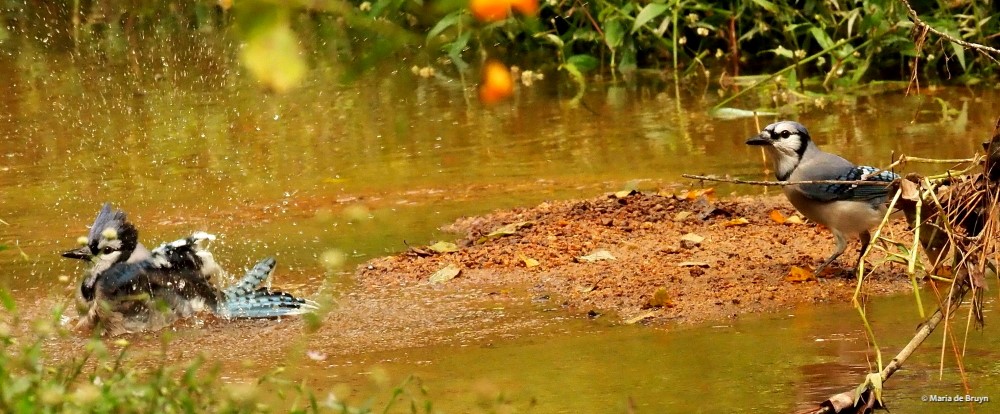
Other birds enjoy taking a bath in streams and creeks. American goldfinches (Spinus tristis) and house finches (Haemorhous mexicanus) enjoy company with other species. Blue jays (Cyanocitta cristata) like some solitude or sharing space with a fellow jay.


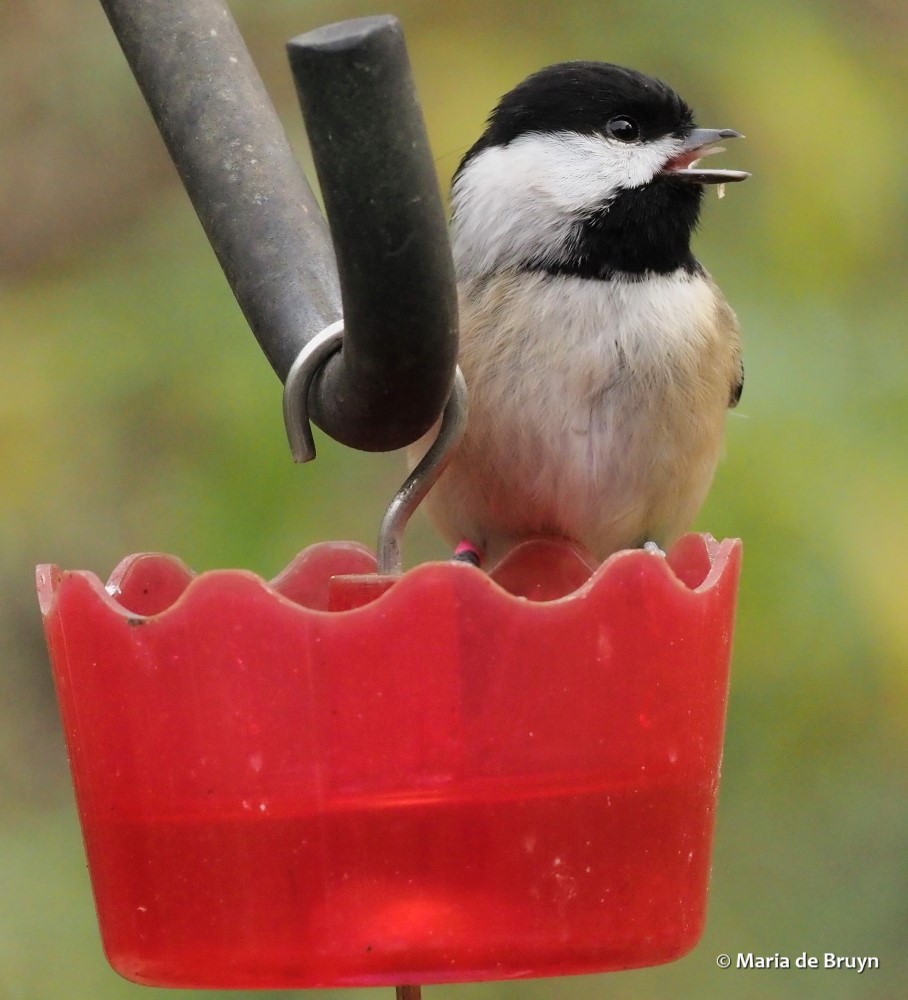
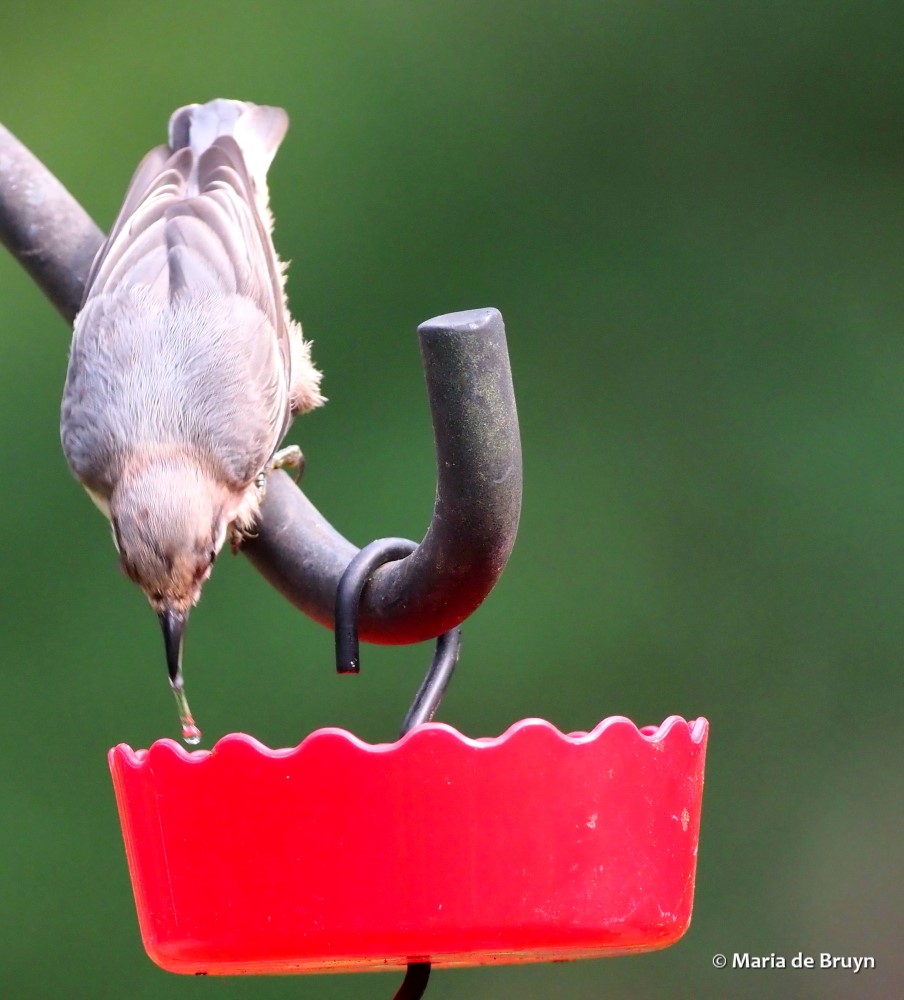
Birds living further away from natural water resources also need to drink and bathe and that is where we can help them out. Small birds like Carolina chickadees and brown-headed nuthatches like to drink from the ant guards on which hummingbird feeders are hung.


Bird baths can become very popular. Eastern bluebirds and European starlings (Sturnus vulgaris) very much enjoy two of mine in the front yard.


House finches, American robins, cedar waxwings, Carolina chickadees and gray catbirds (Dumetella carolinensis) tend to like my backyard baths. And then they appreciate branches and nest boxes as platforms to shake out those water-laden feathers. Birding friend Ylva commented that the vigorous fluttering of this catbird would be worthy of an audition for the musical Cats!

Even if you don’t have a yard, you can put out shallow dishes or plant pot saucers in your outdoor space (steps or patio) as a place for birds to drink and cool off. If you have a balcony, it might take a while for birds to find your water source, but if you stay inside, you may see them come to sip and splash.

If you are luckily mobile, I encourage you to take some outings near waterways. The wildlife and plant diversity can be wonderful and entertaining. And in the meantime, we can all take action to conserve and preserve water: