Chilly mornings and nights – birds coping with and resisting the cold!

Many birders focus their attention on nest boxes in the spring and summer, hoping to see avian parents bringing food to nestlings – and if they’re lucky, getting to see the young fledge. Those blessed with yards or a voice in deciding what goes in public spaces may create more such places by putting up nest boxes on poles and trees. (Poles with baffles are a better choice as it makes it harder for snakes and raccoons to enter and eat the eggs and nestlings.)

What many people don’t always realize is that nest boxes can be enjoyable birding spots in the fall and winter, too. As more and more people choose not to leave snags in their neighborhoods and/or have trees removed from properties, birds are losing places to construct their natural nest cavities. Nest boxes help make up a little bit for that habitat destruction.


In the winter, birds check out nest boxes to get a head start on choosing possible nesting sites come spring and summer. In my own yard, especially the Eastern bluebirds (Sialia sialis) and brown-headed nuthatches (Sitta pusilla) will visit one nest box after another to decide which one they might choose as a brooding site in the spring. The nuthatches may be accompanied by a youngster from the past summer who will help raise their new siblings.


Various species of birds also use nest boxes as warm overnight abodes when the temperatures fall to near freezing and below. Besides the Eastern bluebirds and brown-headed nuthatches, I’ve seen white-breasted nuthatches, Carolina wrens (Thryothorus ludovicianus) and downy woodpeckers (Picoides pubescens) checking out a nest box inside and out.


Carolina wren                                                 Downy woodpecker

Some species even use a nest box as a communal overnight refuge, with 12 or more birds squeezing together to conserve their body heat. I haven’t seen so many birds enter a box but perhaps I’m not looking at the right time.

The competition for nest boxes as warm overnight roosting spots can also be intense. A male downy woodpecker in my yard has adopted one particular box as his overnight abode, but the bluebirds would rather have the refuge for themselves. He gets there in the late afternoon and sometimes must pass angry birds to squeeze through the hole.

The bluebirds will then scold from atop the box and while hovering in front of the entrance, but he hunkers down and refuses to leave.

It’s interesting to see that the nest boxes also serve other creatures. Various birds perch on nest boxes while checking out the yard to see what’s going on, like this beautiful Northern flicker (Colaptes auratus).

One day, when looking out my window, I was certain I had seen a lizard peeking out of a box hole. Shortly thereafter, when I was outside, I caught a glimpse of a head and went over to open the box. And it turned out that a Carolina anole (Anolis carolinensis) is sometimes using that box as a place to rest! The birds don’t enter when s/he is there as far as I can tell.

When it’s cold and damp, you can also see birds using other measures to stay warm and resist the cold. Most birds eat quite a lot to put on body fat that is used up at night through shivering (which helps keep them warm). This means you may have crowds at bird feeders with species sharing space as they increase their body mass.

You may also occasionally get an “invasion” of one species, like the pine siskins (Spinus pinus).

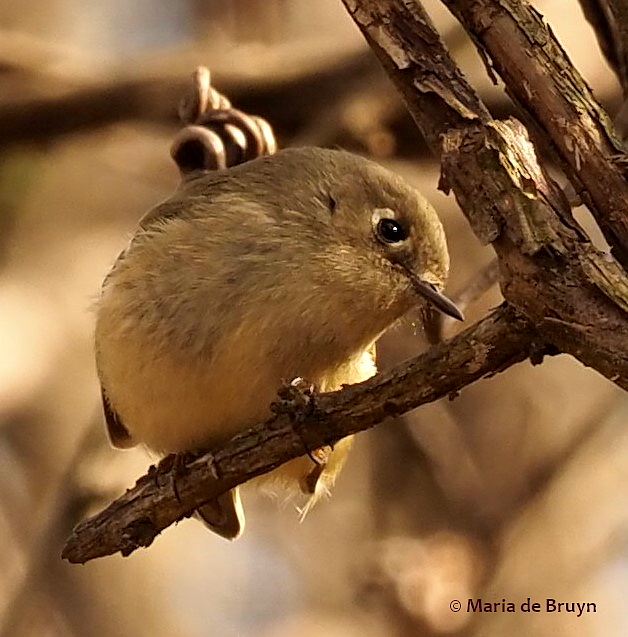
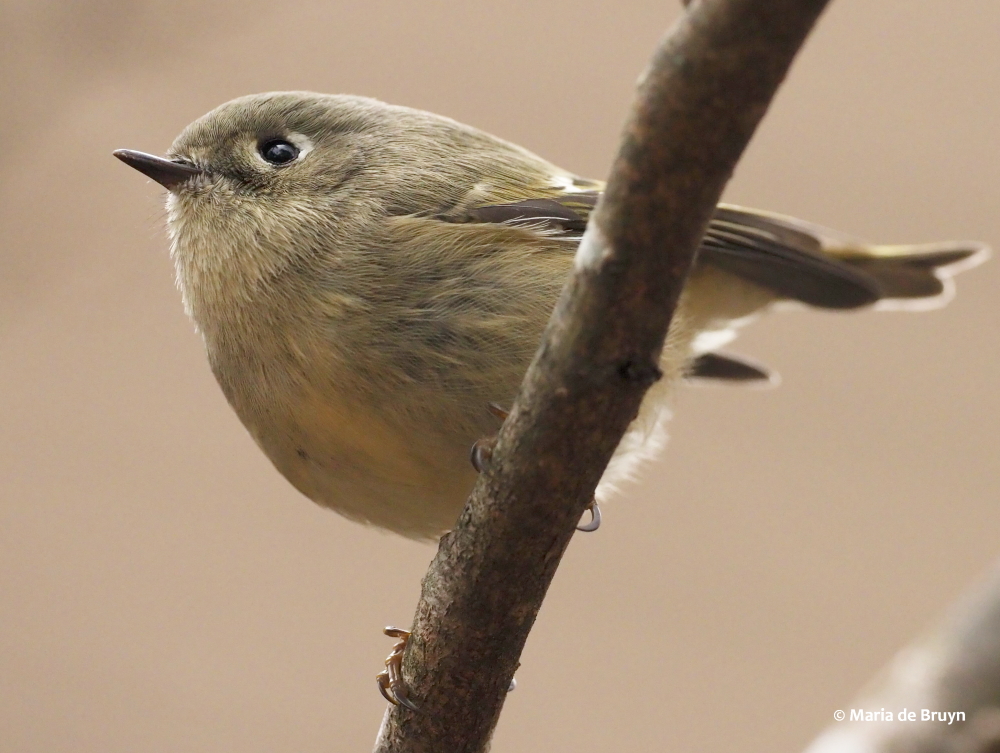
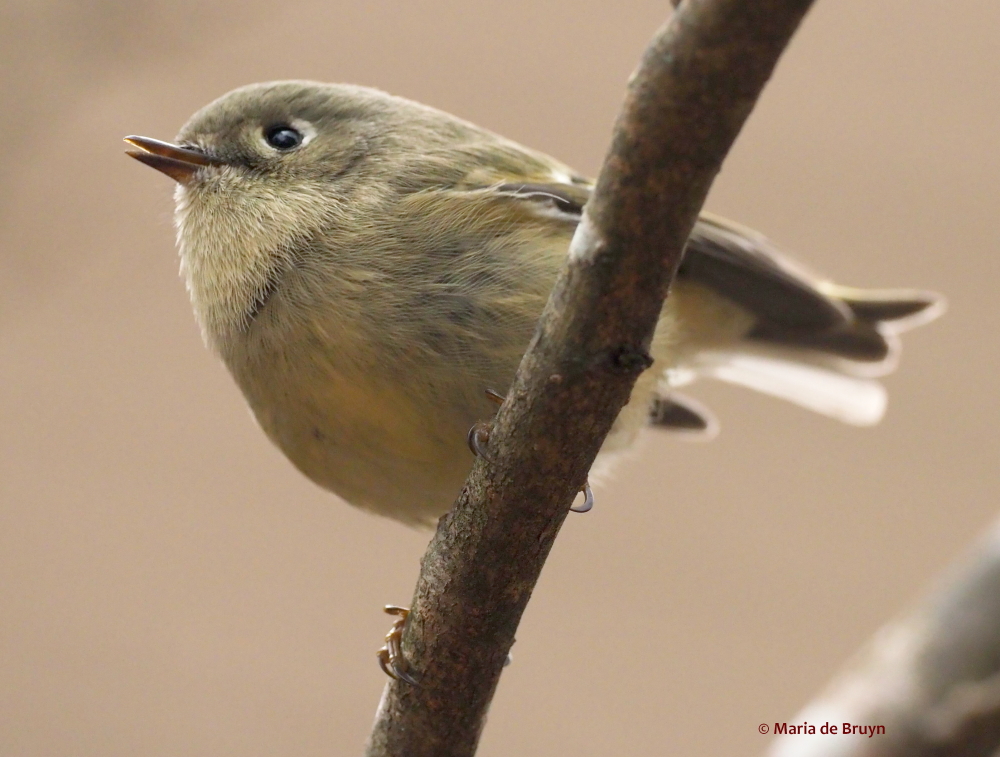
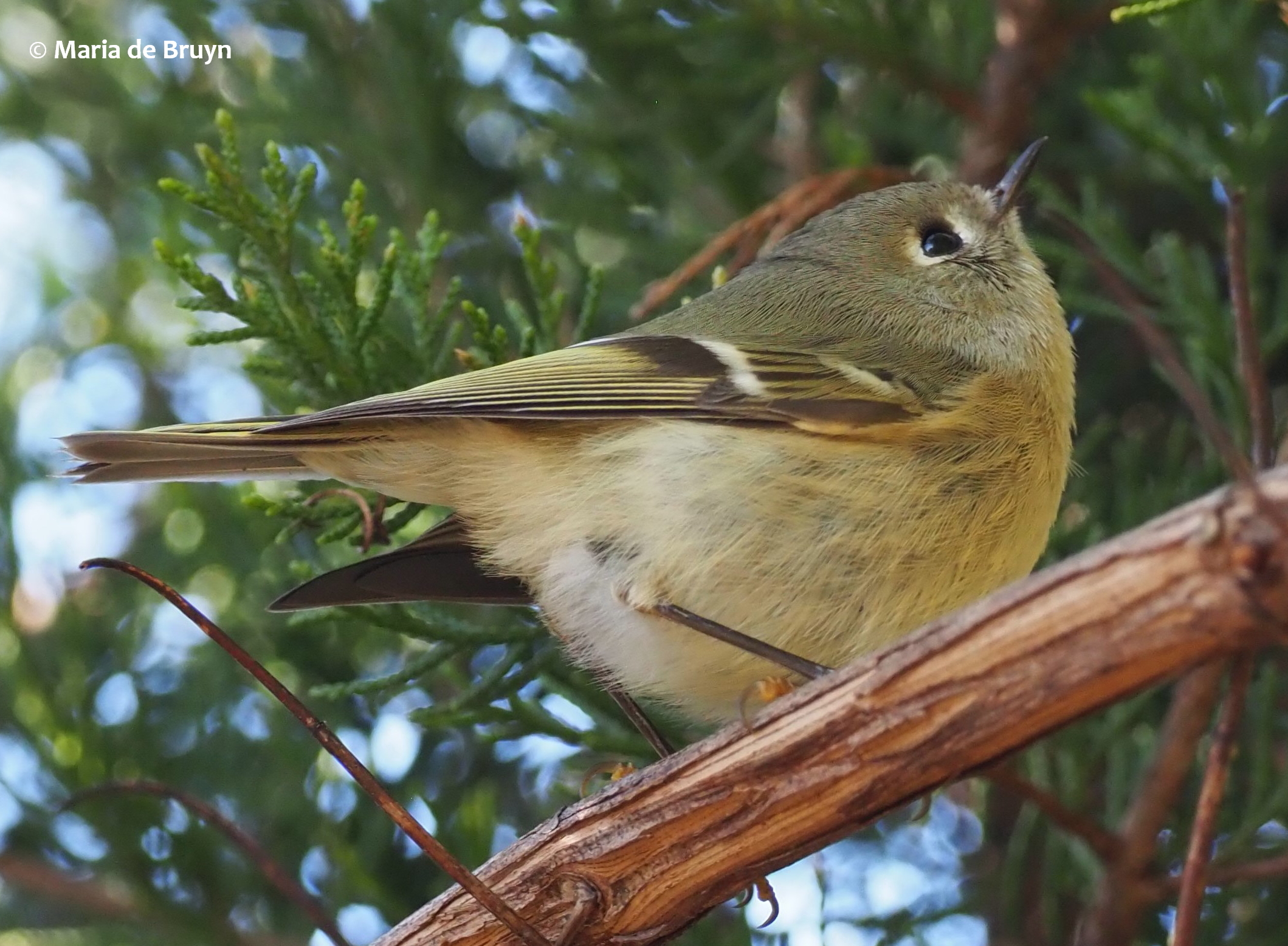
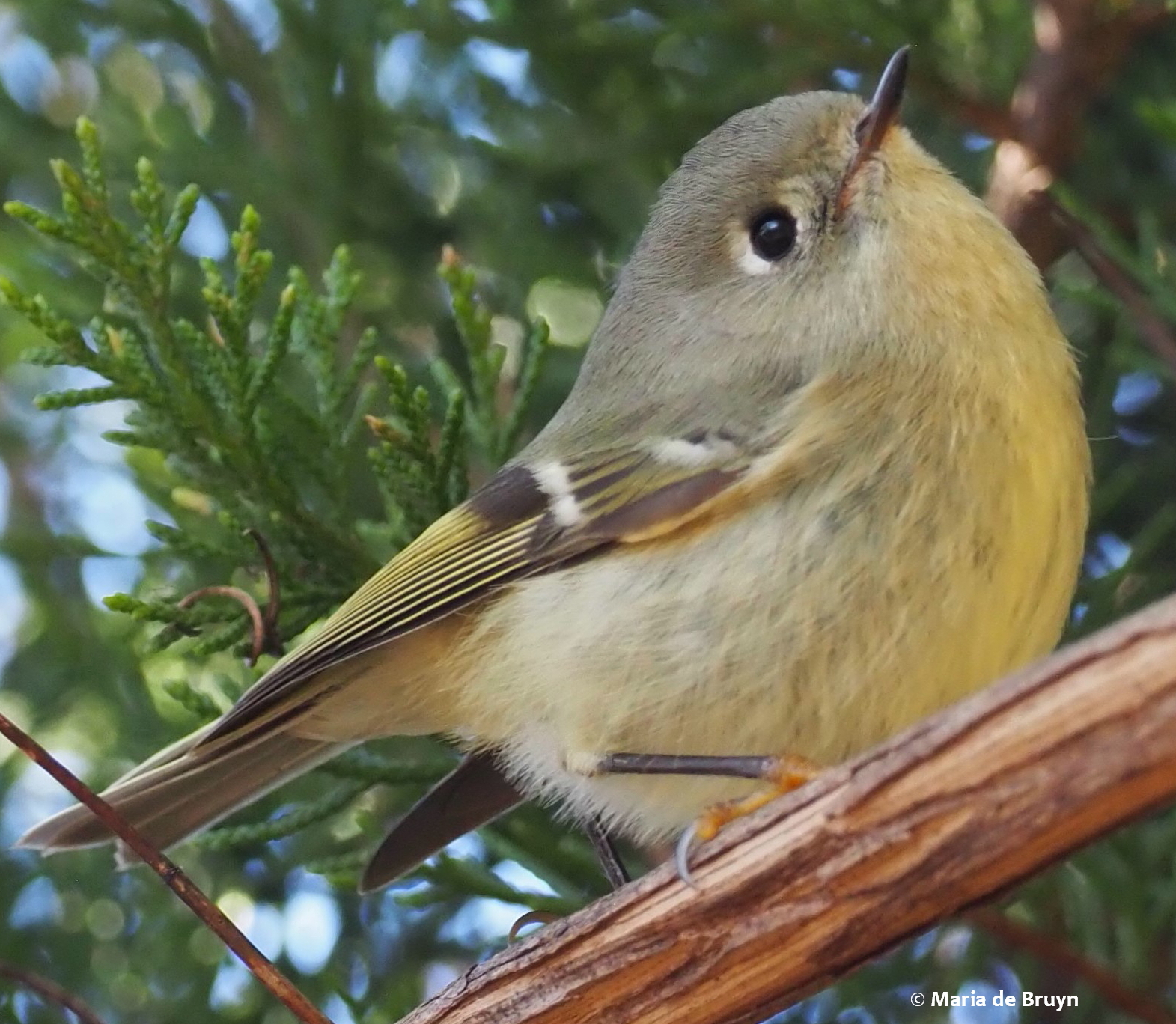
Puffing up their feathers is another strategy that our avian friends use – they trap pockets of warmer air around their bodies.

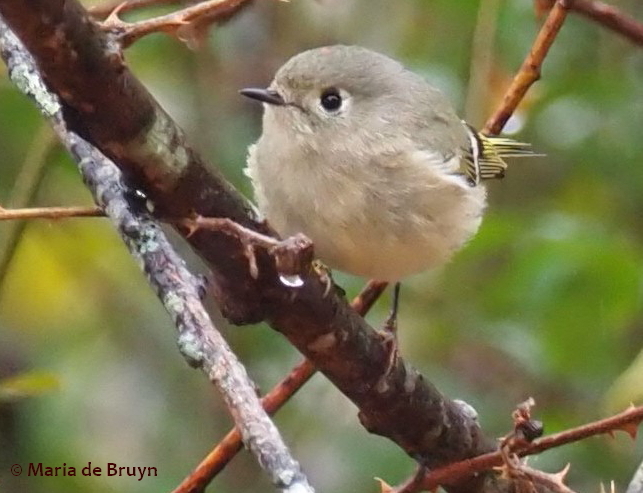
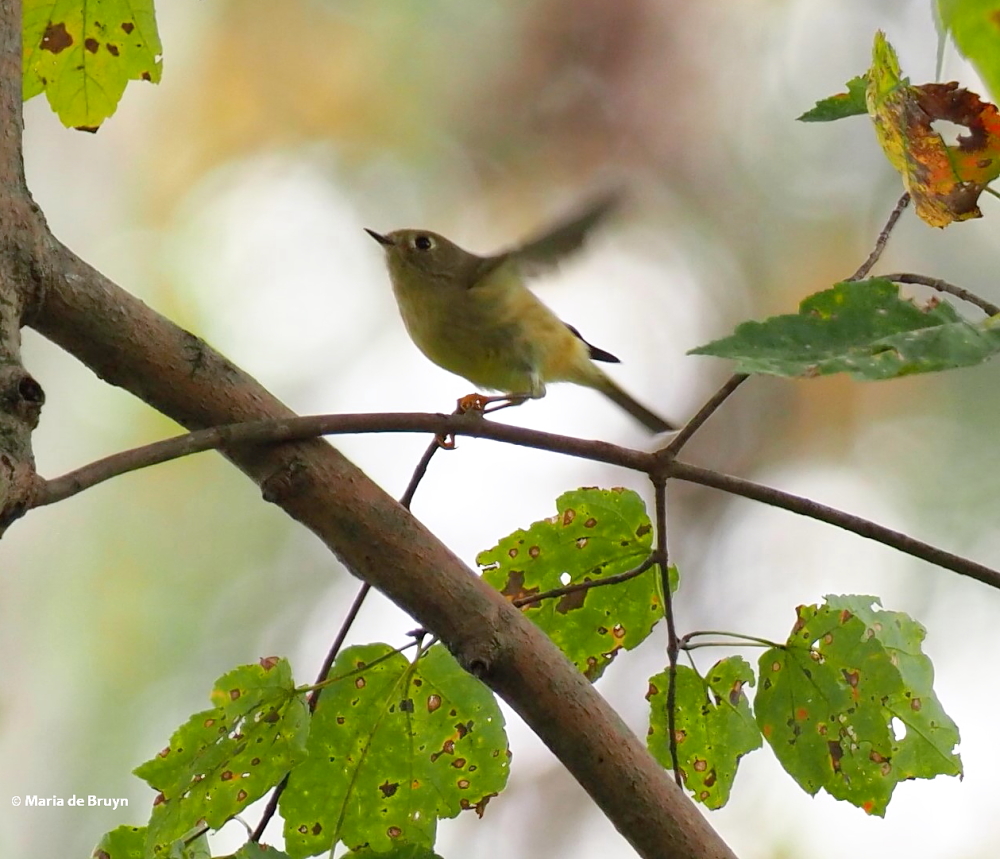
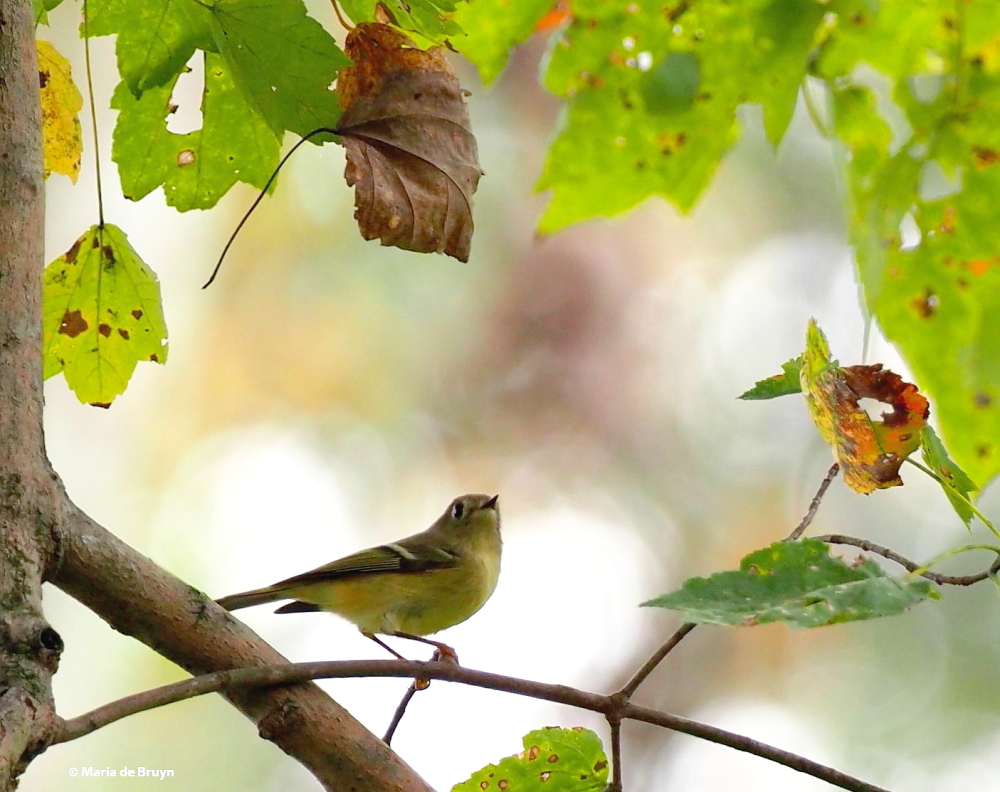
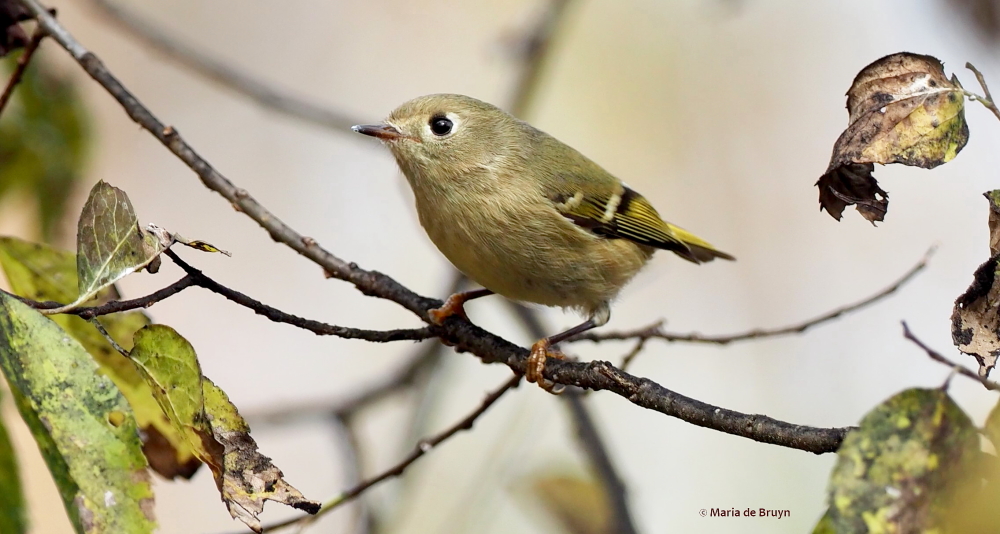
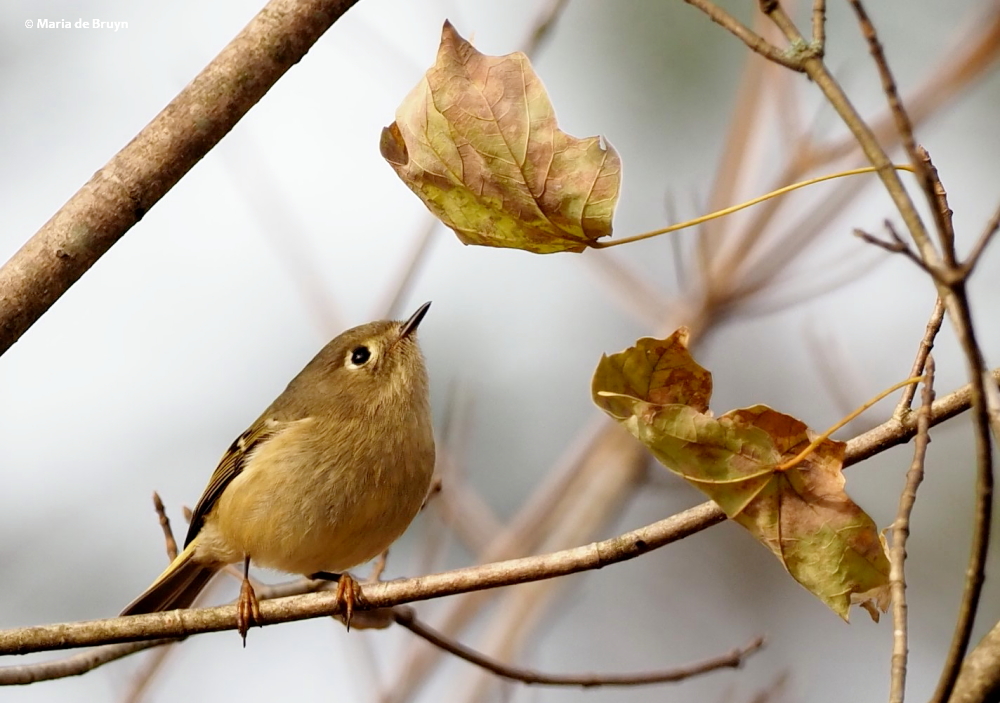
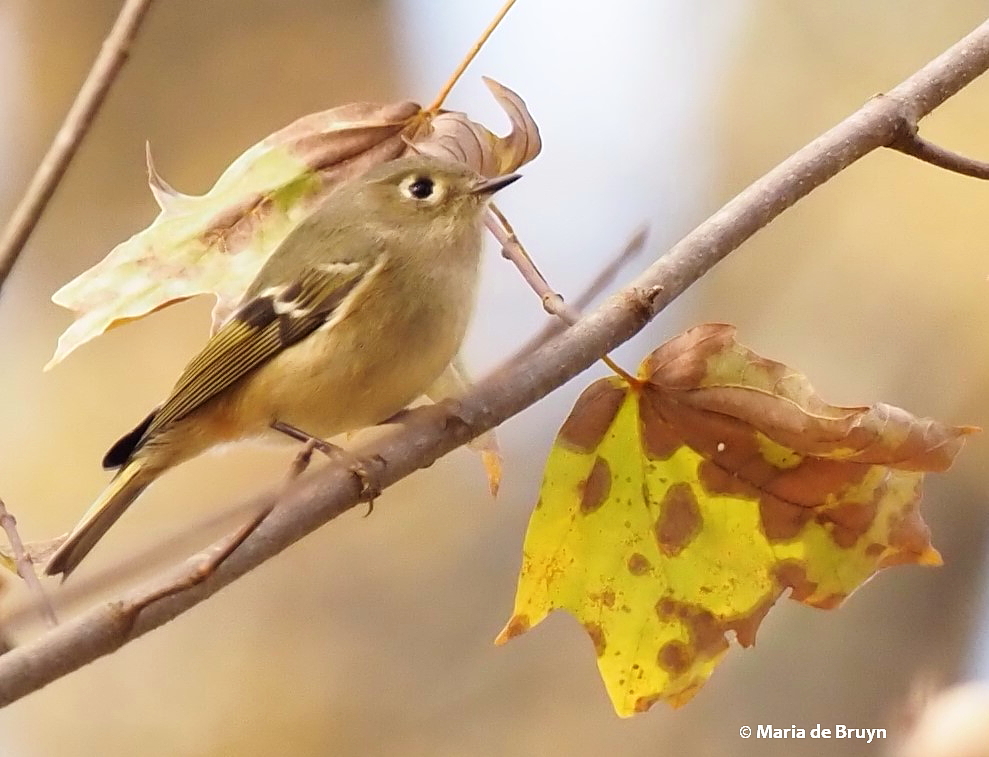
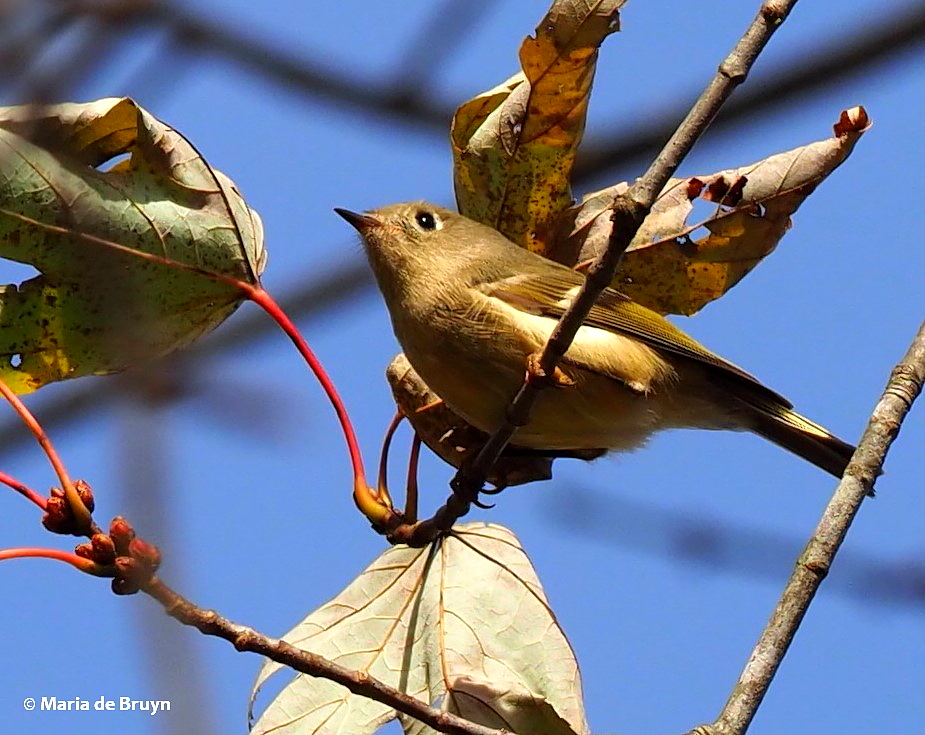
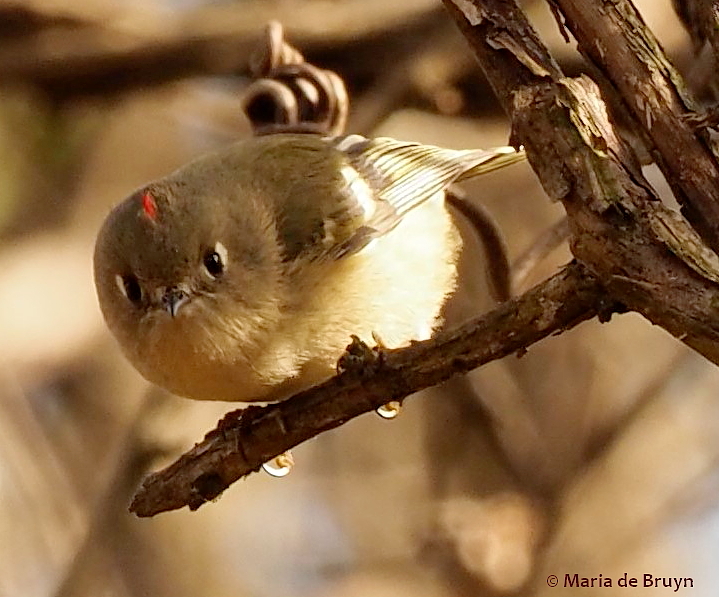
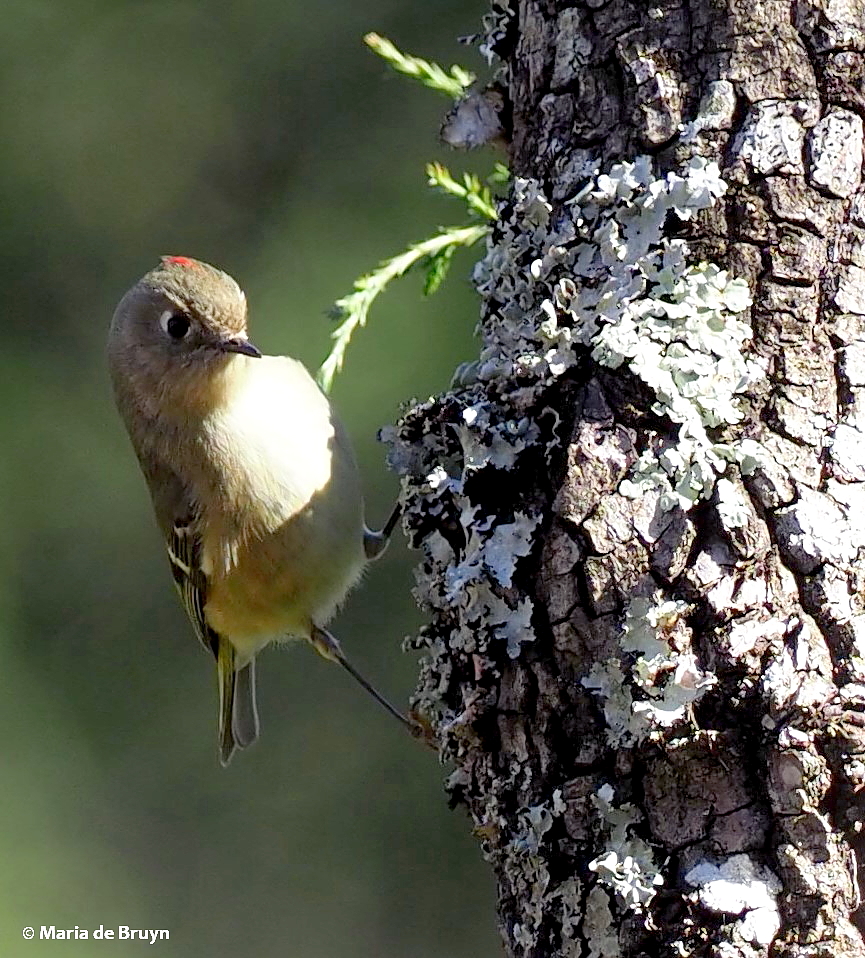
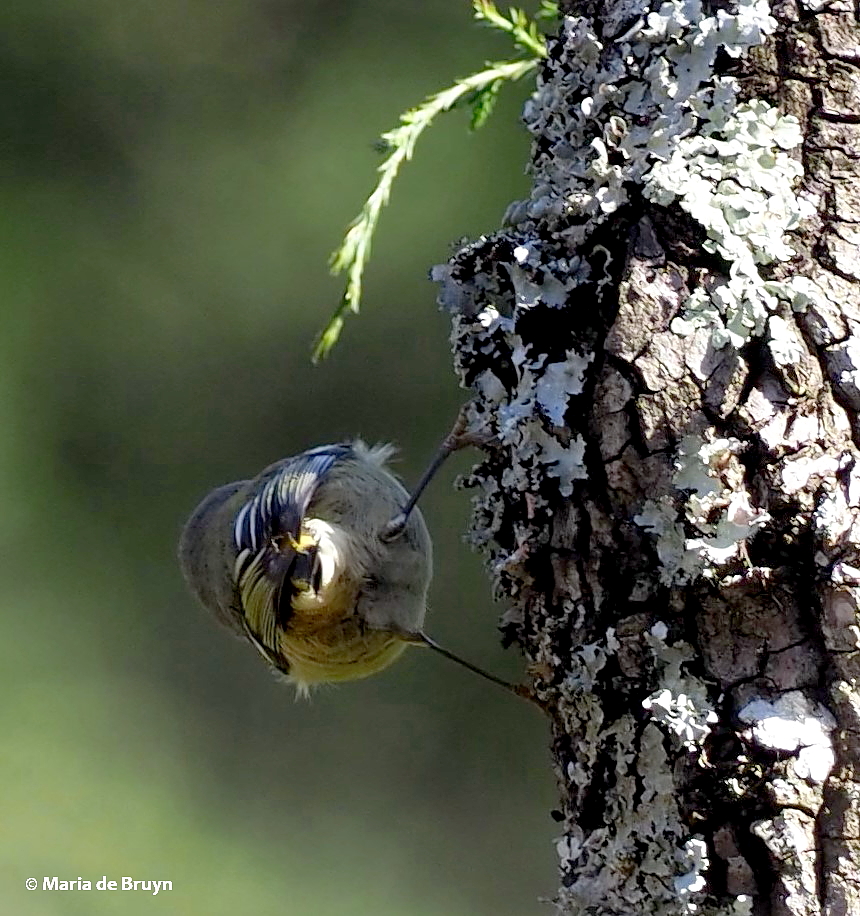
Ruby-crowned kinglet (Regulus calendula)

                                              Brown thrasher (Toxostoma rufum)


Chipping sparrow (Spizella passerina)         Dark-eyed junco (Junco hyemalis)

The birds keep their feathers in good condition by engaging in vigorous preening. Some water birds oil their feathers to waterproof them, while others grow special feathers that disintegrate, producing a special waterproofing powder. And birds like mallard ducks (Anas platyrhynchos) have a special blood circulatory system in their legs whereby they lose only about 5% of their body heat through their bare feet.

Creating wood piles and leaving dried leaves and stalks from summer and fall grasses and shrubs can provide birds with some shelter from winter winds and cold, so my yard is now home to five wood piles. Several species of birds also seek out protected roosting areas when the deciduous trees and shrubs lose their leaves and the branches no longer provide hiding spots from predators. My native holly bushes serve that purpose for the lovely white-throated sparrows (Zonotrichia albicollis), as well as Eastern towhees (Pipilo erythrophthalmus) and Northern cardinals (Cardinalis cardinalis). I’m glad it keeps them returning to the yard!

As 2021 gets underway, I wish you readers all the best – hope this new year is healthy, happy and as worry-free as possible for you! And thanks for reading my blog. 😊

Serendipity in a stressful year

2020 has turned out to be quite a stress-filled series of months on multiple fronts, so unexpected pleasures and delights are very welcome. For birders in North Carolina (NC), that scenario has luckily been playing itself out this fall and winter. Several unexpected and unusual birds have been spotted in our state, including a Kirtland’s warbler, vermilion flycatcher, MacGillivray’s warbler, and sandhill cranes.

Many bird lovers have traveled to catch sight of these surprising visitors. While I’ve mostly avoided groups the past nine months as part of my COVID-avoiding measures, last week I did join the human migration to an NC home about 20 miles away to see a bird that is normally only found in the northwestern United States – a varied thrush (Ixoreus naevius).

The opportunity to see this lovely bird was offered to the local community by homeowners Tony Hewitt and Marla Wolf. They generously allowed people to come to their suburban yard (by appointment) to watch over the backyard fence to catch sight of the thrush.

When I visited on a “slow” day, it was easy to socially distance oneself from other birders and photographers. Only a couple other people were there for a while (and I was alone some of the time) waiting for the thrush to make an appearance. Everyone wore masks, some having double masked as well.

The varied thrushes normally migrate back and forth in the area stretching from Alaska, through Canada, down to northern California, as shown by this map from the Cornell Lab of Ornithology. The website remarks that a few of these birds occasionally wander outside their normal range to the Midwest and Northeast. Seeing one in the southeastern USA is highly unusual.

Map credit: https://www.allaboutbirds.org/guide/Varied_Thrush/maps-range#

This robin-sized bird is a real stunner – his orange, grey, yellow and white feathers grow in a wonderful pattern. The colors seem to vary a bit, depending on the quality of the light falling on them and the background against which you see him. But he is handsome from any angle – front, side or back!

Something I found particularly interesting was a pattern of wavy lines in his tail feathers when the light hit them in a certain way. This was not something that I saw mentioned in descriptions of its physical characteristics. The observation made me want to photograph the thrush again to see if this would show up again.


It is interesting to note that one varied thrush crossed the Atlantic and turned up in Great Britain in 1982. It was a unique bird since it represented a rare variant of the species in which the orange feather coloration has become all white. Only five such representatives of this mutation have been recorded since 1921.

In its home range, the varied thrush prefers to stay in dense, coniferous forests near water. The NC visitor is taking advantage of a backyard nook that Marla designed with multiple shrubs and some open space.

The home is not far from a lake, but the thrush is taking advantage of a bird bath for drinks, which Marla kindly had moved so that it was better visible for visiting birders looking over the fence.

Varied thrushes usually feed on insects, foraging on the ground and often under dense cover.

The thrush’s insectivorous diet can be wide-ranging and include ants, beetles, caterpillars, crickets, earthworms, millipedes, snails and spiders.


They also eat berries, either in trees or on the ground, during the autumn and winter months. 

Our NC celebrity bird is obviously enjoying seeds furnished daily by Tony and Marla.

A notice placed by Tony near fence announced that the thrush seemed to come out in the open every 30 minutes or so. It turned out that this was indeed the case the first hour that I was there; then the bird came after a couple 15-minute intervals.

He certainly seemed to be a creature of habit because I noticed that after eating, he would go back into the dense undergrowth for several minutes and then re-emerge to take a couple drinks at the bird bath. Eating obviously was making him thirsty and noticing this habit meant it was possible to get “camera-ready” for another appearance.

When it is breeding time, male varied thrushes begin to establish territories and confront other males with threat displays. These begin with the bird cocking his tail and turning it towards his rival, while he lowers his wings. If the rival bird does not go away, the thrush will lower his head, raise and fan his tail and then spread his wings out to the side.

Obviously, our NC bird had no rivals around but there were many other birds foraging in the ground underneath the feeders. They included Northern cardinals, white-throated sparrows, pine siskins and downy woodpeckers among others. And it seemed that “our” thrush was sometimes warning them off.

Or perhaps he was just flashing his wings to scare up insects hiding in the fallen leaves.

There are still large numbers of varied thrushes, with an estimate of some 20 million in the current global breeding population. However, the North American Breeding Bird Survey recorded a cumulative decline of the species of 73% between 1966 and 2015. Logging, wildfires and forest fragmentation are ongoing threats to their breeding habitat.

This is only the fifth time that a varied thrush has been seen in North Carolina. The first sighting was in 2005; three other birds were seen in 2010. No one has any idea what got this year’s bird so far off-course during its migration and no one knows how long it will stay around.

Tony and Marla have kept a visitors’ book (with hand sanitizer available for signers) and many people have been recording their visit. When I visited, more than 110 people had already come by, including some birders from Virginia and Tennessee. More people have since stopped by the Hewitt-Wolf residence to admire this vagrant bird. We are grateful to them for giving us this opportunity!

It’s apparent that the serendipitous sojourn of this gorgeous bird has been a welcome gift to many people – both those who saw it in person and those who’ve admired photos distributed through facebook groups. We hope the bird will survive the winter here and be able to return to its home grounds out West so that its journey has a happy ending!


Kinglet capers – defending territory!

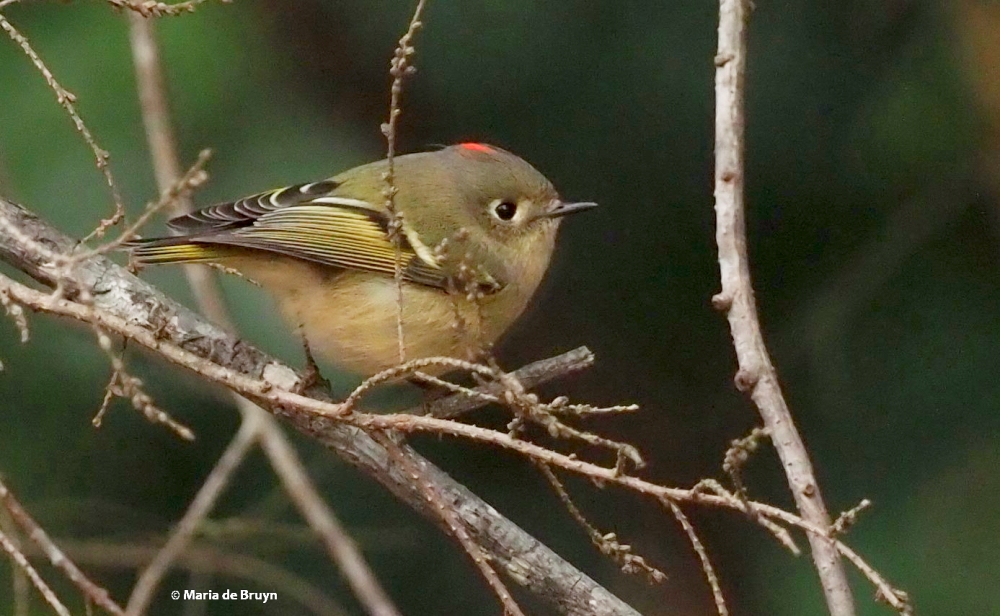
A birder recently remarked on a Facebook feed that ruby-crowned kinglets (Regulus calendula) seem to have a diet consisting solely of caffeine and Ritalin, which might account for the almost constant motion in which these lovely little birds seem to spend much of their time. They really get revved up, however, not when they are feeding but when they are defending what they consider to be their territory.

Unlike many other bird species, these kinglets don’t tend to hang out in groups of their peers. On the contrary, they often chase away others of their kind and this can turn into an actual campaign against an intruder that can last for quite lengthy periods.


This was brought home to me when I saw a vigorous little male who was confused by his own reflection in an installation at a local garden, aptly entitled “Self-reference”. The NC Botanical Garden organizes a yearly outdoor sculpture competition and this year included Jonathan Davis’ entry comprising a series of shiny glass balls arranged in a tall column supported by encircling metal struts and rope-like cables.

The orbs provided the kinglet with mirrors in which he could see himself, although he was obviously convinced that another male was trying to take over his winter domain. The raised red crest was like waving a flag in front of a bull. (These kinglets usually have the red crest hidden; they only raise it when excited or perturbed.)

My friend Lucretia had seen him attacking the “intruding bird” when she was at the Garden and she alerted another photographer, Mary, and me to his presence. Mary headed over to the site right away and got a lovely photo of Edward looking at himself. (I named him Edward as the meaning of that Anglo-Saxon name is “guardian of prosperity.”)


I only got to the Garden later the next morning, but Edward was still spending his time trying to drive away the interloper.


The sight of another male kinglet with HIS crown raised undoubtedly only incensed him further.

The day that I was there, he took frequent breaks to restore his energy levels by flying to nearby trees and shrubs to gather food.

He also took some time now and again to sit quietly on the sculpture’s metal rings – when his back was turned to the balls, he didn’t see the invader and could catch his breath, so to speak.


It was interesting to see how he tried to peck at the opposing bird, over and over again despite the fact that he was bumping his beak on the sculpture.


After observing him for a couple hours, I decided to leave Edward alone. However, there was a Garden party that evening and I returned to see the sculpture lit up with reflections of nearby Christmas lights – Edward was still busy in the late afternoon challenging his rival!


When I returned a couple days later, the sculpture had been removed, to the relief of some birders who were worried that Edward was going to wear himself out and perhaps be compromised when temperatures were due to drop considerably. As I had seen him feeding frequently, I was not too worried about that, but I am glad that calmer times have now returned for him so that he can spend his coming weeks in a more peaceful atmosphere. Hope to see you in your normal foraging mode soon, Edward!

Kinglet capers – finding food and enjoying short rests

It seems that at least once a year, ruby-crowned kinglets (Regulus calendula) feature in my blogs; they are one of my favorite bird species and I always enjoy seeing them again and again.

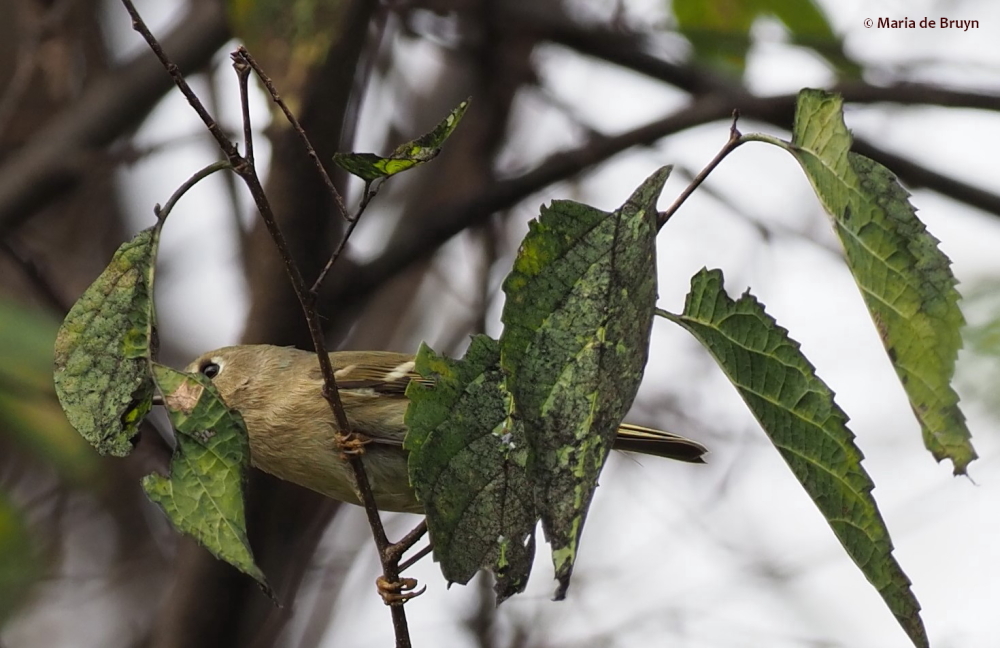
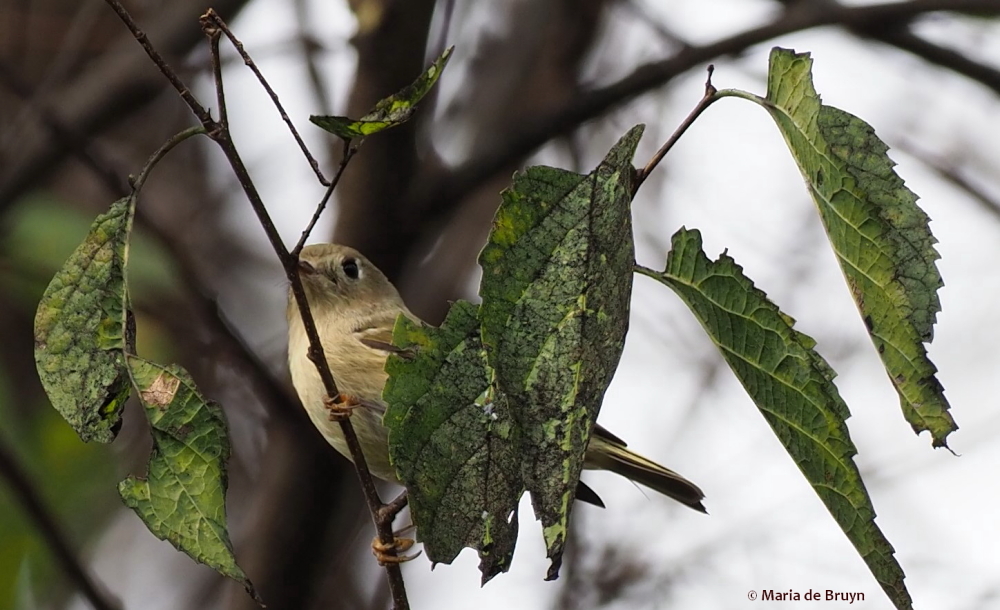
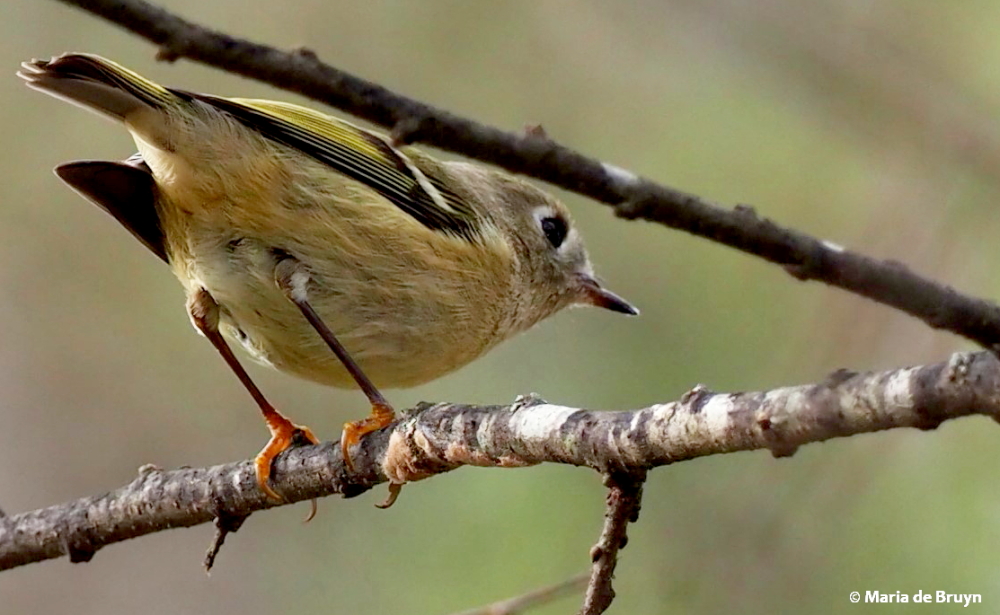
These small birds are bundles of feathered energy, almost constantly in motion as they seek insects, which form the bulk of their diet.


They are only slightly larger than ruby-throated hummingbirds: 9-11 cm (3.5-4.3 in) long versus a length of 7-9 cm (2.8-3.5 in) for the hummer.

When they scour the vegetation for food, they may be flicking their wings continuously.

Fortunately, they do take little breaks now and again, so we can admire their beauty.

These breaks often last less than minute, however, and often are even briefer so you have to be ready and waiting to capture a photo.

I’ve been lucky this fall to find a few spots where I know some kinglets are hanging out, so I get to see them quite regularly.

My yard-visiting kinglet has returned for the winter season as well; I usually see him mostly at the suet feeder, where he will hover like a hummer as he takes quick bites of peanut-flavored vegetable lard laced with grits, oatmeal and nuts. He is a bit more gray in color than many other kinglets.

I’m wondering if this year’s bird is the same one who has been here the last 5 years. Unlike my previous visitor, I’ve seen him take a seed from a feeder as well. This has not happened before, even though it is known that they eat berries and seeds in winter.

This year’s bird also seems a bit shyer than my kinglet(s) from previous years. When I lift up my camera, he tends to take off. My resident the last years was not shy at all, a couple times actually perching on the suet feeder as I carried it to the pole. Still, my yard visitor’s anxiety has been nowhere nearly as obvious as that of another kinglet whose story I will relate in the next blog!


‘Rassing – a surprise visitor – what a delight!

(Warning – this is a bit of a long blog!) Several years ago, what was likely a rufous hummingbird took up residence in my yard during the winter months. That was really unexpected — while it’s not uncommon for migrating or some resident hummingbirds (especially ruby-throats, Archilochus colubris, above) to spend wintertime in North Carolina, particularly along the coast, it’s not so common in the central part of the state. That experience taught me that it’s a good idea to keep up a nectar feeder in the winter as you never know when a stray migrant might show up. In 2015 and 2016, I traveled with fellow birders to visit people who had a buff-breasted (Amazilia yucatanensis) and calliope hummingbird (Selasphorus calliope) wintering at their homes. In actuality, however, I didn’t really expect a rare passerby in my yard.


It was consequently with great surprise that I saw a hummer hovering at the nectar feeder last week. “Oh, wow!” I thought; “a ruby-throated hummer is passing through as a very late migrant.” I grabbed my camera to take a few shots and immediately felt perplexed.


The bird looked like he had a purple rather than ruby or red gorget (throat feathers). The white patch behind his eye also showed prominently because of his very dark head.

To me, it also looked as if this hummer had blue patches on his tail feathers. (Most say his flanks are green and a hummingbird expert said he has iridescent black tail feathers; the way the light reflects off them made me see blue, however.)

I got a few photos and cautiously asked birding experts on a facebook group if he could possibly be a black-chinned hummingbird (Archilochus alexandri), also sometimes known as the Alexander hummingbird. It seemed unlikely as their normal range is the Western part of the Northern hemisphere, reaching north into Canada (Alberta and British Columbia), east to Oklahoma, and as far south as Mexico, where most spend the winter.

A couple people thought I might be correct, but most thought it was a ruby-throated hummingbird. My spring-summer ruby-throated residents had left at least a month ago but I thought perhaps a late migrant might have arrived. The next day, I saw the bird again and became convinced that it was a black-chinned hummer; his purple gorget was very obvious to me. I posted new photos and now the experts agreed that I was correct. That was very cool – I got a lifer without even leaving my own yard!


A couple days later, North Carolina’s hummingbird researcher, Susan Campbell, came to my home to band the unusual visitor. I invited a friend who had been to bird bandings in my yard before to come for the happy event.

Susan arrived early and first set up a cage trap for ‘Rassing (short for the Dutch word verrassing, which means surprise; I wanted him to have a name during his stay 😊). She left the door open with a long string attached and hung the nectar feeder on the outside. It wasn’t long at all before the bird arrived for a drink. When he left, Susan moved the nectar feeder inside the cage.

‘Rassing returned for another drink and flew right into the cage, which Susan shut promptly. She had already laid out her banding materials so she could remove him from the trap promptly.

He went into a small bag (the kind often used to hold birds for banding) which Lucretia held while Susan began filling out the paperwork.

Then the actual banding procedure began. Susan first checked his legs to ensure that he hadn’t been banded already – the hummers rarely show their legs so that was necessary.

Then she got ready to put a thin red metal band on his tiny leg with a silver band showing his numeric code for identification in case he is caught again some time (Band number 7100 (M)-41902).

She checked the length of his bill – 19.19 mm. She also advised that bird feeders with long slits are not preferred even if the birds like them. It turns out that the thin slots can rub against the bill and wear it down, damaging the bill and making it vulnerable to infection. (I afterwards enlarged the slots into ovals and circles and went back to a couple other feeders I had with larger holes.)

She blew on his stomach feathers to check his fat; he was not a hefty bird but certainly a healthy adult male. His weight turned out to be 3.09 g. She also recorded his body length.

She stopped for a moment so I could take a few photos trying to get a good shot of the purple gorget. It looked like ‘Rassing was trembling but this was the vibrations from his rapid breathing. (When resting at 91⁰ F, they take about 245 breaths per minute; at 55⁰ F, this rises to 420 breaths per minute!!) Susan thought he was acting fairly calm.

She measured his short tail (23.5 mm), as well as his wings (40.42 mm). The female black-chinned hummer would have more rounded wing feather tips than this male.


Susan took a few photos of ‘Rassing and he got a few long drinks from a feeder held by Lucretia. Then Susan gave me the honor of releasing him – and to my delight, he chose to sit in my hand for what seemed to be at least 90 seconds. I could feel him breathing and it was a real thrill to see him so close. With a little flutter of his wings he took off – and then stayed away from the feeder for quite some time.


I added a feeder in the backyard and ‘Rassing began preferentially feeding there – perhaps the front yard had acquired some unpleasant memories. However, at the end of the day, I would remove the backyard feeder so that visitors who wanted to see him had a better chance of seeing him dine at the front-yard feeders.


A fair number of birders were interested in being able to add him to their life, state and county bird lists, so I offered to schedule visits through a birding listserv for a few people at a time. ‘Rassing appeared more reticent to stay at the feeder when there were more than 2 or 3 people watching, which is understandable. Who wants an audience for each meal and snack you eat??

When it rained, the feathers atop his head clumped together, giving him a new “hair-do.”


It appears that this species of hummingbird has not been studied much. I found his behavior interesting and spent a good amount of time observing him (chores had to wait). When I watched him leave the feeder and go to a nearby tree, he would sometimes watch me (turnabout fair play, of course).


He seemed very comfortable with lots of other bird species at nearby feeders. Perhaps it gave him a safer feeling.

‘Rassing tended not to sit on feeders, as ruby-throated hummers often do. Instead, he mainly hovered and vigorously pumped his short tail quite a lot. I learned that this tiny bundle of energy was breathing at a flight rate of about 1260 beats per minute!


Occasionally, you could see the band on his leg but mostly he kept his legs tucked into his body.

In the evenings, he came around nearly the same time each day to have a longer drink and then he sometimes perched while feeding.


A Cornell University website says that black-chinned hummers rarely stay at a feeder longer than a day during migration, even when food is scarce. In my yard, he had access to lots of bugs (I have a small pond) and three types of sage/salvia were still blooming. Indeed, he sometimes came to the feeder with pollen covering the top of his bill.

Yesterday morning, ‘Rassing apparently had decided it was time to move on. After the warmest Halloween on record in our area, the temperature plunged during the night to the 30s. The next morning was the same and he may have decided it was time to go to warmer climes.


I did feel lucky that he graced my yard with his presence for a week; it gave me something to celebrate during a personally challenging time. The oldest known black-chinned hummer was more than 11 years old; if ‘Rassing likes going east during migration, perhaps he’ll stop by again next year – wouldn’t that be a tremendous surprise! 😊