Learning to love an over-protective bird

When house wrens (Troglodytes aedon) first began visiting my yard some years ago, I was not aware that they are extremely protective parents. I didn’t see them as often as birds of other species since they don’t come to my feeders and were not using nest boxes.


The past couple years, however, they have become more comfortable in my yard and began building their nests in boxes after all. This became problematic for me and especially the other species who use the boxes — Eastern bluebirds, Carolina chickadees and brown-headed nuthatches. The reason?

House wrens do their utmost to drive other birds out of their territory so that there is no competition for food needed by their nestlings and fledglings. This protectiveness makes them go so far as to peck other birds’ eggs, which they have done with chickadees and bluebirds in my yard.

Very unfortunately (and upsetting to me), they even killed two nestling nuthatches one year. The other two nuthatch babies managed to fledge. This behavior led a birder, Althea Sherman, to launch a crusade against house wrens in scientific journals in the early 1900s. Now, there are instructions online on how the wrens can be discouraged, for example, on a website devoted to bluebirds.

This year, Eastern bluebirds (Sialia sialis) were tending four eggs in one box and a house wren tried to invade. The parents were very protective and successfully drove the wren away (photo below). Another pair of bluebirds had nested early and managed to guide their young to fledging. They then abandoned my backyard for nesting and the house wrens had no rivals for nest boxes in that area for the rest of breeding season.

House wrens are one of the bird species banded in my yard each year for the Smithsonian Institution’s Neighborhood Nestwatch program. This year the bird bander noticed their nest with babies in a backyard nest box, so she upped the chances of catching one by counting on their extremely protective nature.

A net was put up not far from the box and the bird bander played the call of another house wren. This resulted in both mama and papa wren getting inadvertently caught up in the net while trying to drive away the intruder. They were both banded and then immediately let go so they could resume feeding their babies.

The four woodpiles in my backyard were like a larder for them because they host a plethora of insects.


And the house wrens are obviously not that choosy about which insects they eat. Mama and Papa brought a large variety to their ever-hungry nestlings.


The parents were also very good at keeping the nest clean.

The three nestlings appeared to be producing numerous fecal sacs so that mom and dad were constantly checking the nest for them and flying them away.


At one point, it was interesting that when the male wren brought a large insect to the nest, he handed it over to the female, who was waiting a bit after having just given the babies food.


Eventually, the large meal was delivered to the nestlings.


As the days went by, the nestlings became louder and more insistent on being fed and the parents scarcely paused in their efforts to keep the meals coming and the nest clean. It must have been a relief for the parents when the babies finally left the nest box because they could now take a breather now and then.


Right after fledging, the parents were still busy. The fledglings had not yet flown far so I could see the first post-fledging feeding session for one young wren.

I had learned that house wrens sometimes incorporate spider egg sacs into the nests they build because the hatched spiders eat nest parasites and thereby help protect the developing nestlings! The parents also fed mother spiders and egg sacs to their young. Just after fledging I caught a circle-of-life moment when a parental wren fed a mother spider with her attached egg sac to a fledgling – the death of the poor insect furthered the life of the new bird.

I could see and hear the parent house wrens continuing to feed the fledglings that afternoon. But after a while they appear to have moved to another yard, where they likely weren’t dealing with humans closely watching.


The Eastern bluebirds have a new nest in my front yard now with four eggs, so my nest watching can continue for a while. And the juvenile birds of other species coming to the feeders are entertaining, too.

Our largest North American woodpecker — a real delight!

During nesting season, we have a good chance of seeing many birds whom we might not notice otherwise because they’re out in the open, collecting nesting material and scrounging for as much food as possible because they have hungry mouths to feed. I was very grateful to my friend Carol when she told me about a pileated woodpecker (Dryocopus pileatus) nest where the babies might be fledging soon. Pileated woodpeckers are also nesting somewhere near my home, but I rarely see them.

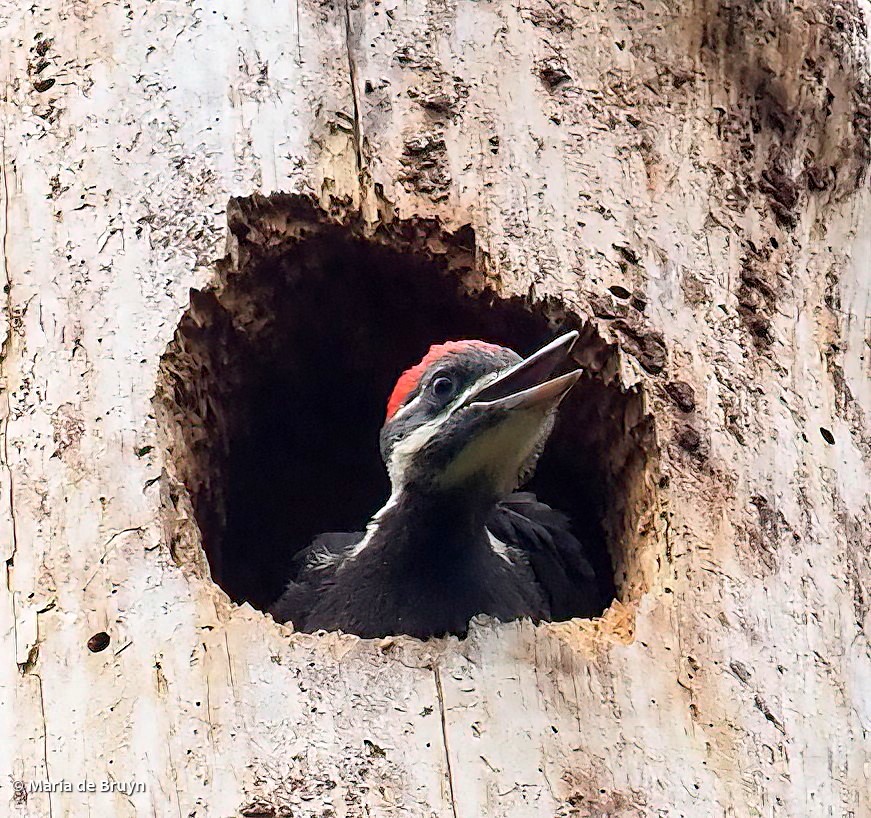
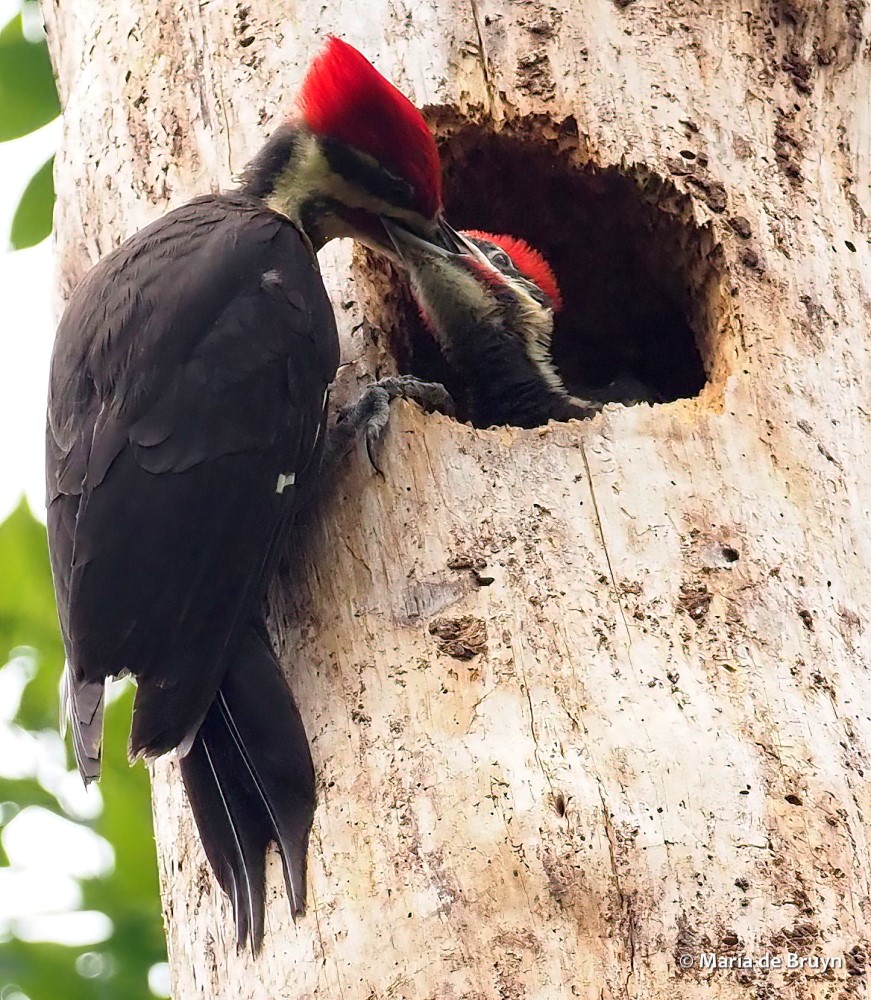
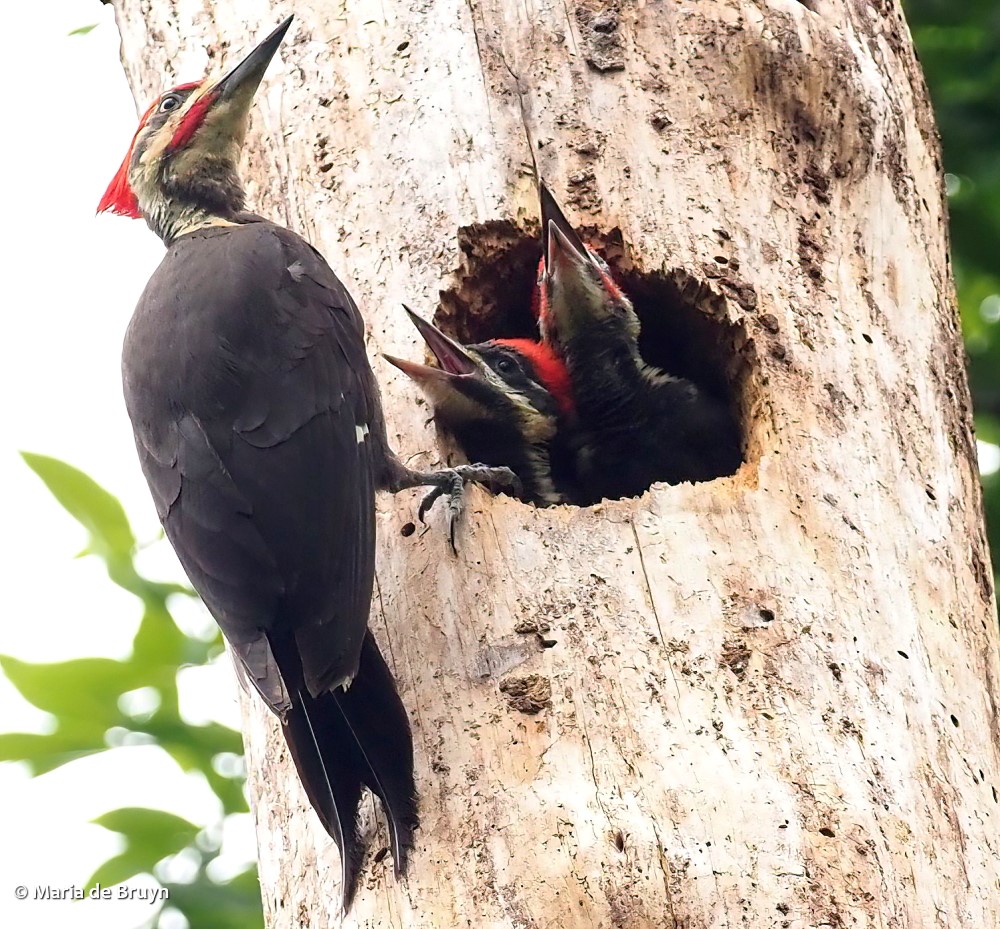
When we arrived at the nesting site, one baby was poking its head out of the oblong nest hole about two-thirds the way up a very tall snag.


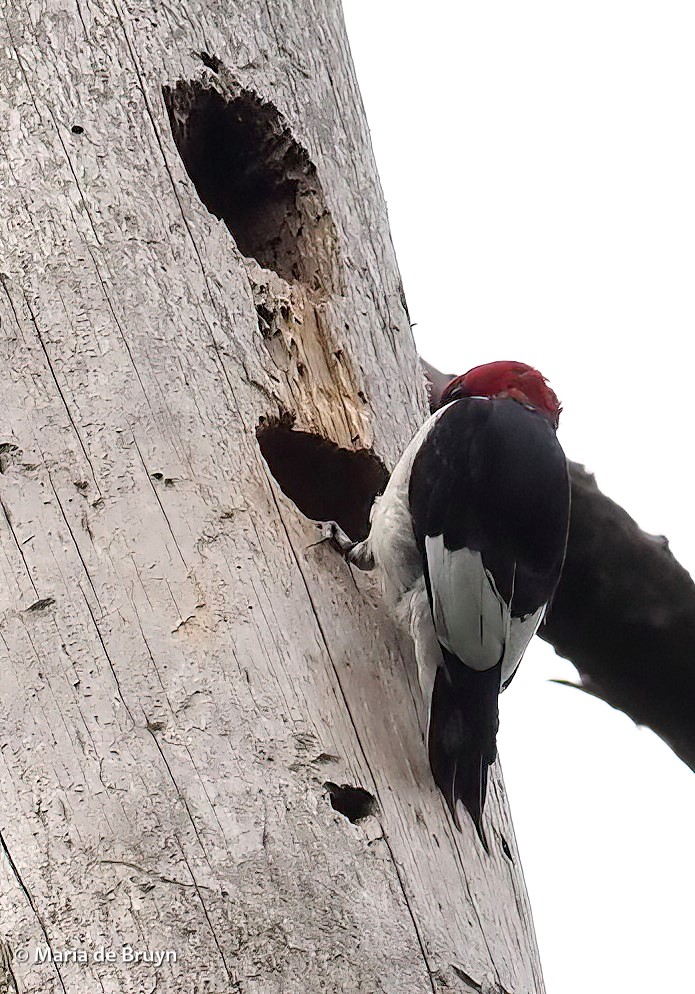
Above it, a red-headed woodpecker (see right) was maintaining a nest. A red-bellied woodpecker was also visiting higher up.

While we watched, the young one continued scanning the skies while calling out to its parents. The baby persisted in watching from the nest, which was only lined with wood chips. Unlike other birds, pileated parents do not line their nests with nesting material such as soft grasses.


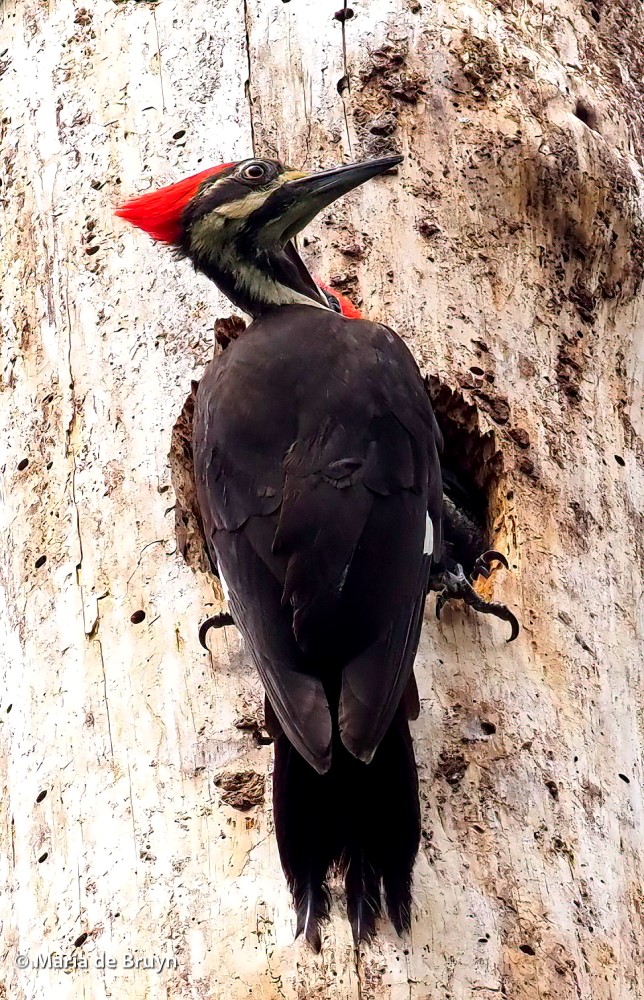
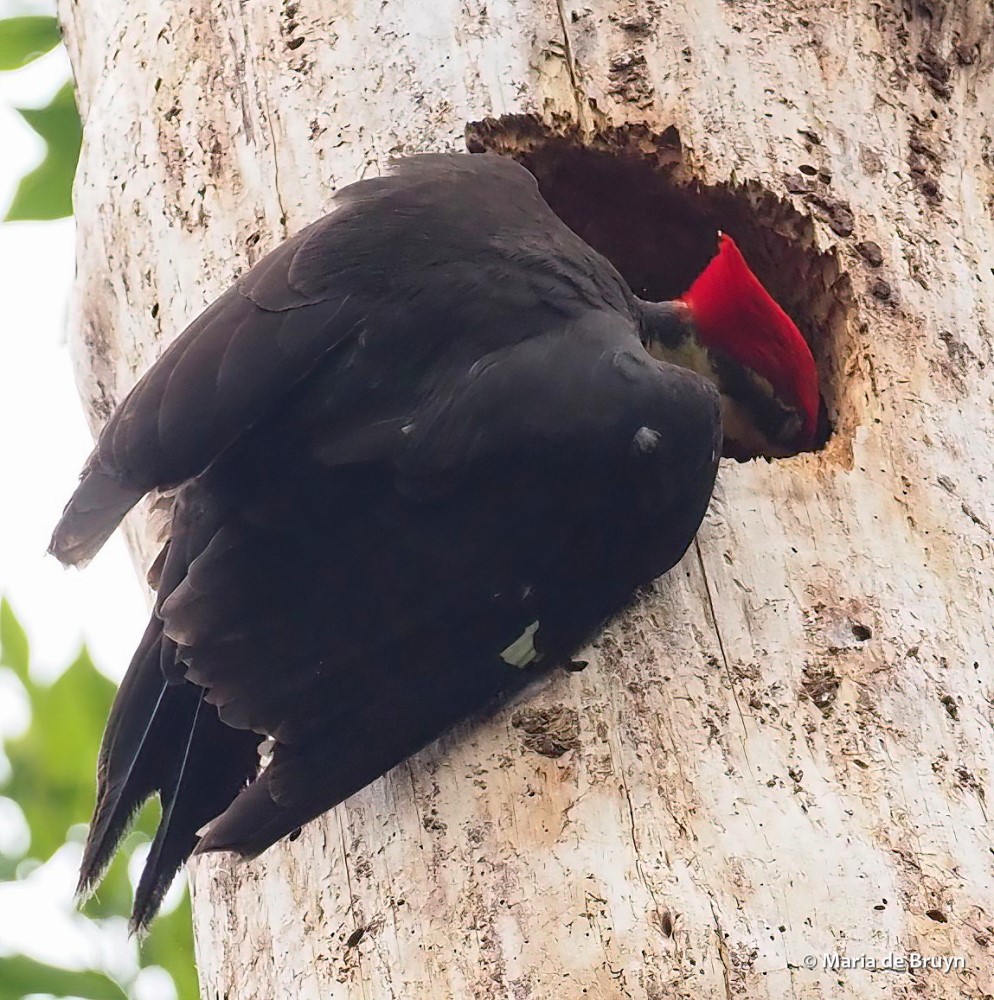
Occasionally, the parents answered and, after about 15-20 minutes, one flew over to check us out. It was the father, who could be identified by his red crest that extended down to his bill and the red cheek or moustache stripe (right photo). The left photo shows a female who was foraging in a tree on another occasion. Her red crest is only on top of her head and her cheek stripe is black.


The young one looked back into the nest; I wondered whether another nestling might be there. No one else peered out at that moment and we speculated as to whether one might already have fledged as two had been seen the previous day. When the father visited the nest, still only one baby showed itself, so we didn’t know whether there might be another one around (nests usually have 1-3 babies).


The father fed his offspring by regurgitating whatever he had been eating. The pileated woodpeckers’ diet comprises mostly carpenter ants (40-97% of their diet in various studies), supplemented by other insects including worms, caterpillars, roaches, flies, and grasshoppers.


They also eat nuts and wild fruit. If you have a garden and want to attract them, they like persimmons and many berries, including those of poison ivy, sumacs, dogwoods, elderberries, greenbriers and sassafrass.  

Many landowners tend to clear their yards and gardens of fallen logs and dead standing trees. I keep several woodpiles in various spots as the decomposing wood is home to many of the insects that the pileated woodpeckers and other birds need for their diet.

Papa took off again, leaving a satisfied young one behind (at least for the time being).

These woodpeckers are the largest in North America (15.8-19.3 in/40-49 cm), since the ivory-billed woodpeckers have been declared extinct. They are monogamous and luckily have plenty of opportunities to find mates. Pileated woodpeckers had been in serious decline in the 18th-19th centuries as forests were logged for the timber industry and to clear land for ranches and farms. Since then, they have rebounded to just over 2.5 million individuals.

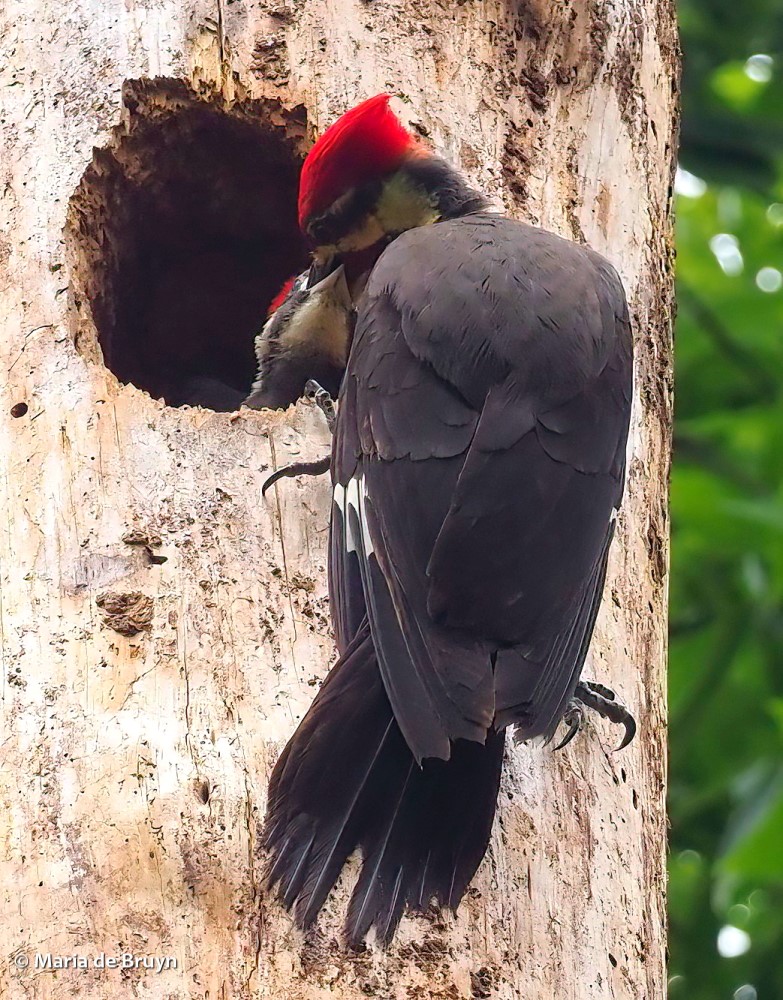
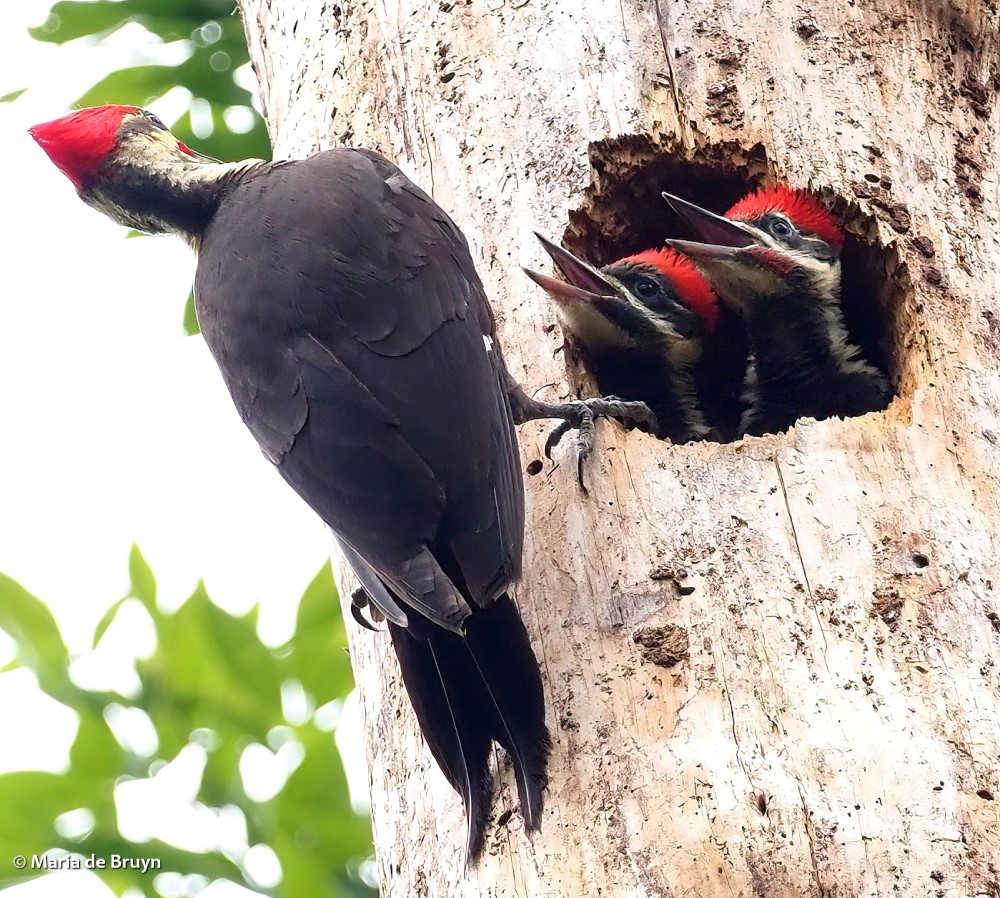
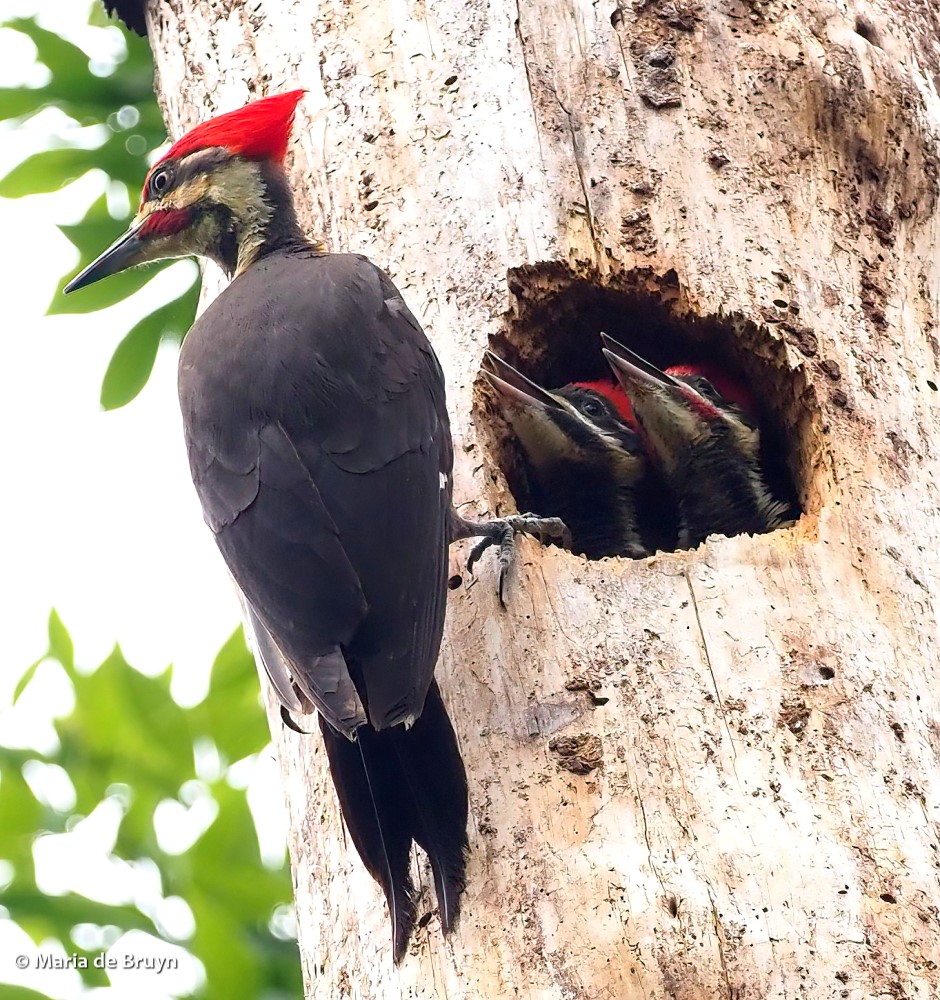
I realized when I looked at my photos later that I had not been paying enough attention to the coloring of the parents and offspring. When I went away for a short time and then returned, mama pileated was visiting the nest. In addition, whereas I had been watching a female nestling first, now a male baby was calling out for food. A view of the two looking up, shows the male’s red cheek stripes were obvious, but I had been oblivious at the time. The female is on the left and the male is on the right.


The next time that papa returned, the male offspring stuck his head out for a feeding.


Papa didn’t want to play favorites, so he stuck his head in the nest to apparently call them both to come out.

They opened their beaks wide, begging for food.


Papa let them ask for a while, sticking his tongue out at them as they begged.


He also decided to take out some fecal matter. I don’t know how long the nestlings had been in there (they usually grow in the nest for a month), but a clean nest is desirable.


After the babies fledge, they may stay with their parents for up to three months.


I’m so glad that Carol and her sister Donna, near whose home the nest is located, invited me to come see the family. It was time well spent as it got my mind completely off an ongoing series of problems complicating my life lately. Hope seeing these photos was also a bright moment for you!

Yellowstone National Park. Part 6: “Fire burn and cauldron bubble”!

When my friend Joan and I visited Yellowstone National Park in May 2022, we were interested in seeing other thermal features in addition to the Mammoth Hot Springs. A major part of the Park is actually a super-volcano, with a caldera measuring 43 by 28 miles (70 x 45 km). It has half of all the world’s geysers, as well as other hydrothermal features (i.e., more than 10,000)!

A visit to the Old Faithful geyser was rewarding for Joan, but perhaps less so for me and others who decided to stand outside nearby. (Joan watched from inside a building with viewing windows.)

I’d seen it from afar before but now thought it would be interesting to be closer. When the awaited eruption occurred (happening about every 69 minutes or so in 2022), I hadn’t realized that I would just get soaked and see only spume and clouds! You readers can see an eruption online without getting wet!


Information about Yellowstone often reiterates that the geysers and other hotspots are always changing because of the geothermal dynamics propelling them. Earthquakes can affect them, and human vandalism can also end a geyser’s “life”. For example, in the 19th century, visitors would throw coins into geysers, which eventually plugged up the vents. (No one claims that the visitors pictured here did this; these parents must have been preoccupied keeping watch over their large brood!)


Photo on display in the Park Museum

When I was in high school, our assigned reading included older English texts, including work by Shakespeare. I found the stories interesting, but the language used did not appeal to me, except for an occasional phrase. The line “Fire burn and cauldron bubble” from Macbeth has a nice rhythm and it came to mind when we stopped to watch the mud pots.

The mud pots are hot springs which are so acidic that they dissolve the rock around them. Microorganisms help convert the emerging hydrogen sulfide gas into sulfuric acid; that breaks the nearby rock into a porridge-like clay which bubbles as gases gurgle through them.

Waiting for shapes to emerge from the thick moving masses was not at all boring. Instead, it made for a nice quiet, contemplative time — and judging by how many people were standing quietly and waiting for shapes to pop up, this was a shared experience. A video of one mud pot can be seen by clicking this link.

The area known as the Artists’ Paintpots was more colorful, even though we didn’t have sunny weather to highlight their hues.

There was vegetation here and there, making for some interesting scenes.


The Norris Geyser Basin is Yellowstone’s oldest, hottest and most changeable area. The National Park Service notes: “Norris has the greatest water chemistry diversity among Yellowstone’s hydrothermal areas. Multiple underground hot water reservoirs exist here and as their water levels fluctuate, concentrations of chloride, sulfate, iron, and arsenic change. Although Norris is known for its acid features, it also has alkaline hot springs and geysers.”

Norris has two main areas. The Porcelain Basin is bare of trees and vegetation. The Porcelain Springs, named for the milky colors of the deposited minerals, are the fastest changing area in the Norris Geyser Basin.

Fumaroles, the hottest hydrothermal features (up to 280°F/138°C) dotted the landscape in the Porcelain Basin. Where the steam and gases spewing from the holes are rich in sulfur, the feature is called a solfatara. Where the gases are mostly carbon dioxide, the fumarole is called a mofette. The sound of the fumarole can be quite loud, as in this video, sometimes sounding like hissing or whistling.

The Back Basin area has more wooded scenery. It was fascinating to see that there were mounds of bison dung in various places near fumaroles. I asked a park ranger how the bison could travel in those areas and whether they were ever injured.


She said that groups of bison will rest around the vents in winter. Their heavy fur apparently insulates them well and they can withstand the heat. She did note, however, that bison have been seen with burns on their legs, so they can be somewhat hurt by the heated clay ground.


Visitors should stay alert even when remaining on boardwalks. In 1989, the Porkchop Geyser threw rocks into the air; fortunately, no one was hurt.

In the early Park days, visitors were invited to bathe in the hot pools but that is fortunately no longer the case.


Where thermal colors are green, chlorophyll-containing algae predominate.

Where yellow is the dominant color, sulfur abounds and heat-loving and -tolerant creatures (thermophiles) use it to create energy.

The Cistern Spring is a beautiful pool that shows blue, green and brown colors with sunlight. These colors are produced by thermophilic algae and bacteria. They, in turn, are accompanied by tiny insects, such as ephidrid fly larvae that feed on bacteria. Spiders and dragonflies then feed on the flies.

We returned a couple times to see some of the famous features because the first day we visited them, it was rainy and then snowed with lots of cold wind. There was so much steam we could scarcely see the colored pools of water; only some features close to boardwalks were clearly visible.

Signs warned that it was a windy area, and the warning was certainly warranted! (Even so, some visitors were perturbed and complained about being subjected to sleet and flurries during their outing!)

The Excelsior Geyser used to erupt regularly in the 1880s and then stopped. In September 1985, it erupted again for 47 hours and again stopped. It was dormant and not very visible during our visit.

At Grand Prismatic Spring, which has stunning blue, green, yellow and rusty orange coloring, we saw mostly gray steam and mud-like rivulets on one visit.

I spoke with a man in a group of people including grandma, who was heavily bundled up in a wheelchair. He remarked that they had been there the previous day, when it was warm, sunny and scarcely windy at all. (Spring weather is extremely changeable at Yellowstone, not only day to day but within a day as well.) Their group had seen the beautiful colors of the Grand Prismatic and it made for a perfect outing since they had come to celebrate a wedding held on the spot. That was really an auspicious start to the married life of the lucky couple!

All in all, we didn’t get many spectacular views of the colorful thermals, but we did learn a lot. A future visit with warmer and sunnier periods would be something nice to anticipate. Nevertheless, the cold, windy, and partly wet days certainly did not dampen our overall enthusiasm. The visions of bubbling mud pots will last a long time, too.

Next up: a few blogs with some of my springtime sightings and then a visit back to Yellowstone to see some small mammals and Western birds.

Marvelous moments making my day, including a real surprise

Before going back to Yellowstone National Park to view some more thermals (in a blog), I’d like to share a few moments that brought me delight during some recent difficult days. Even when I’m not feeling well or needing to deal with unexpected troubles, I always try to make time to go out for a walk as being in nature usually brings some calm and joy.

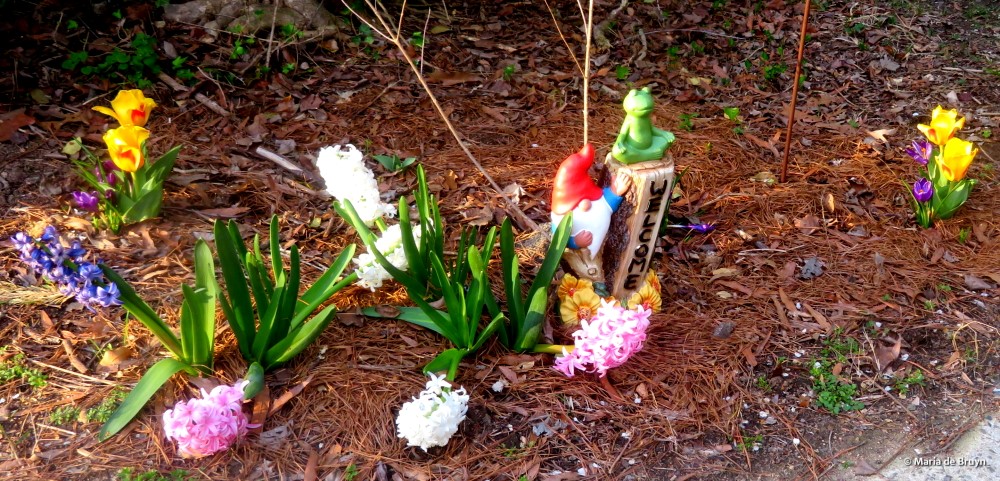
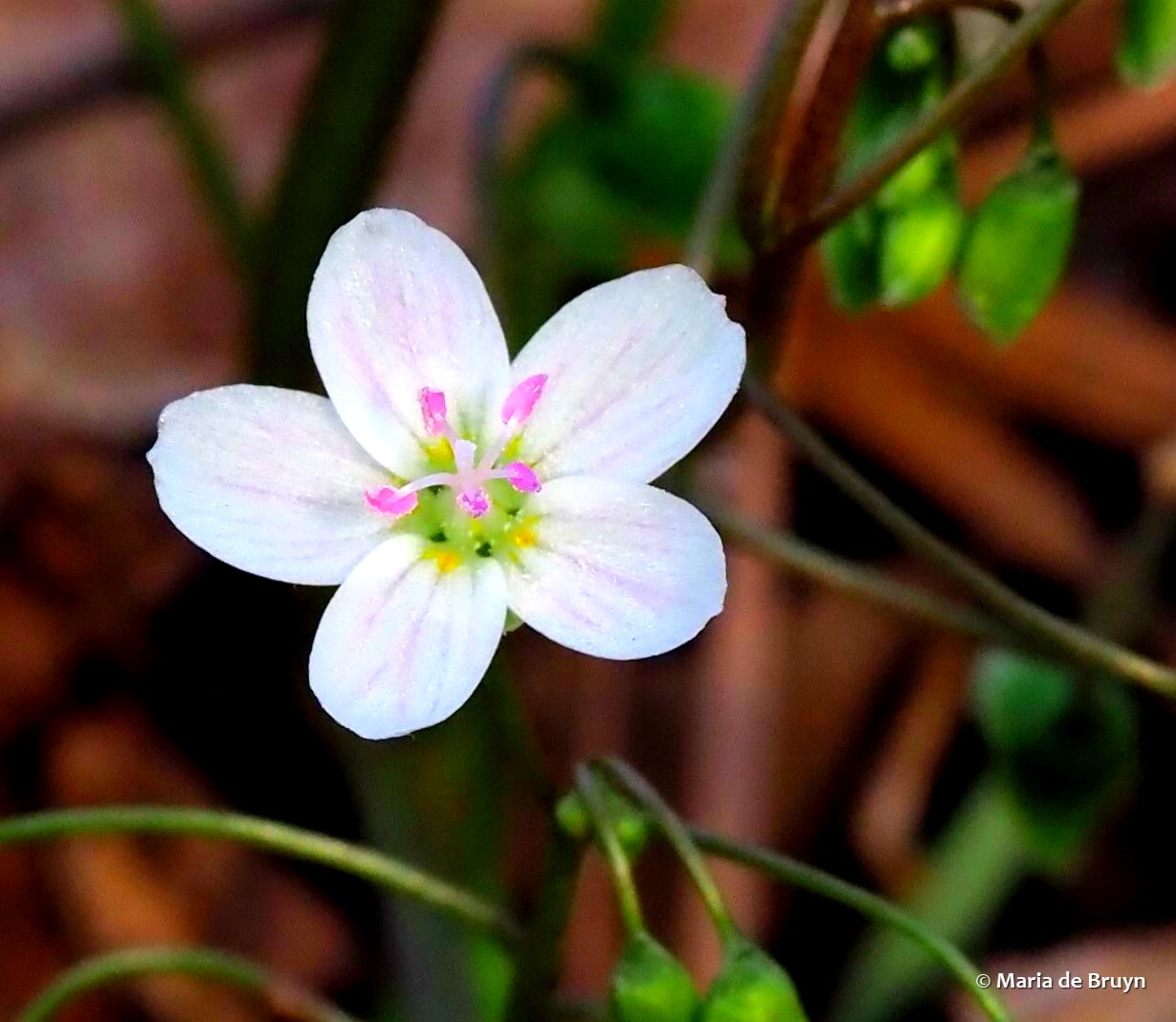
Although our area is currently having some cooler winter weather, we had quite a few days of unseasonably warm temperatures the past weeks and spring has sprung at least a couple weeks early. Emerging blooms have made for some happy sightings, both in my garden and out in natural areas. Daffodils were among the first to appear. Spring beauties (Claytonia virginica) are appearing in many places.

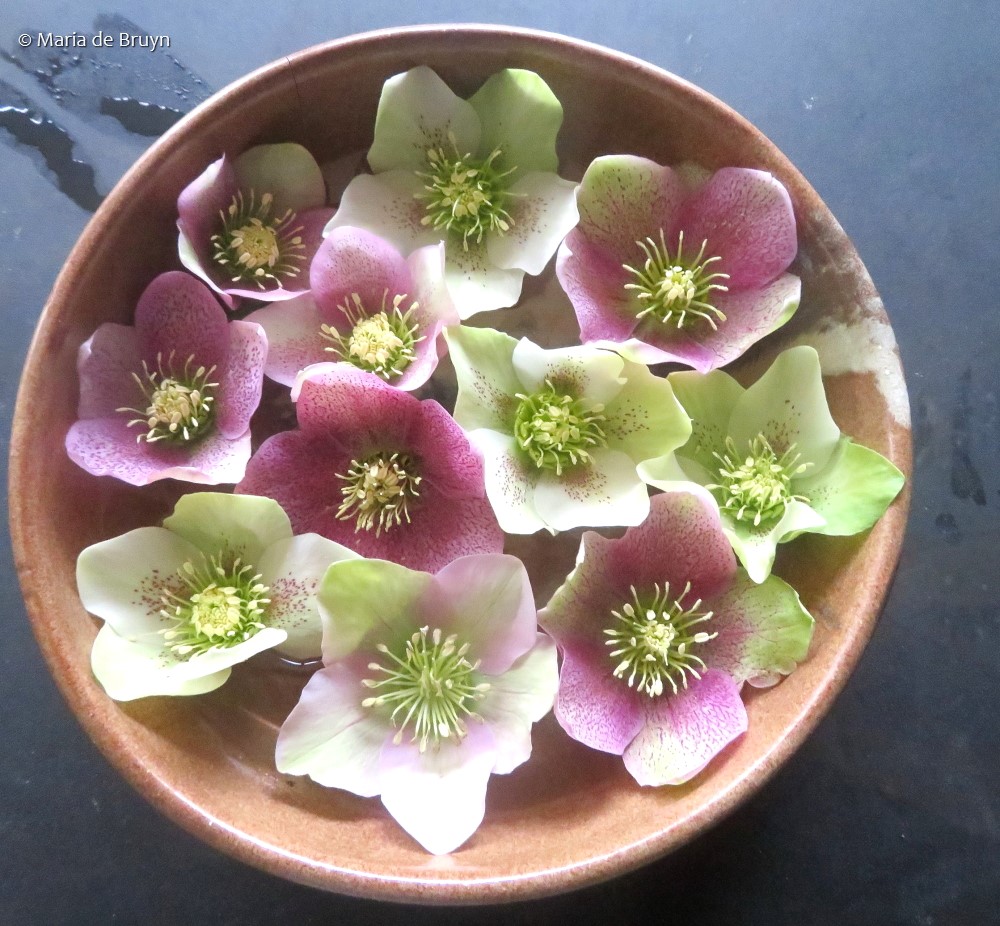
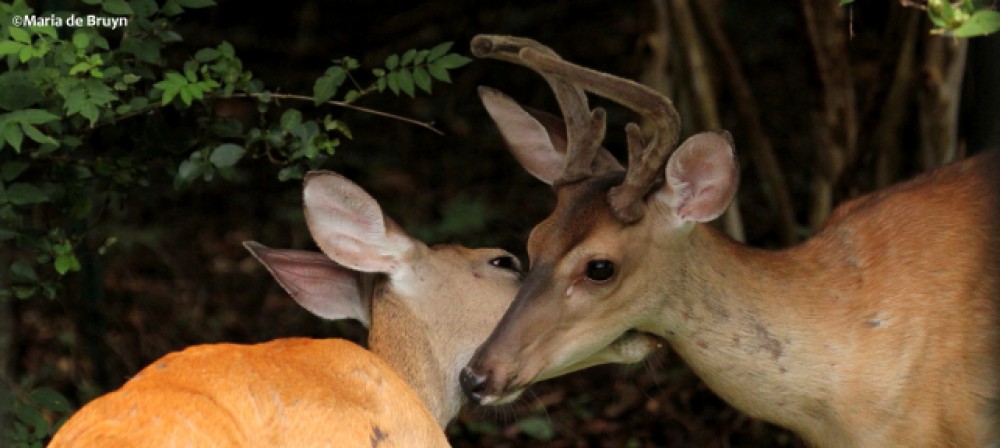
Hellebores (also known as lenten roses) were also very early bloomers and they are still going strong. A neighborhood white-tailed deer family (Odocoileus virginianus) enjoys resting among them in the back garden. Because the blooms droop, putting some in a bowl of water brings a better view of their beauty — and my cats are tempted to drink from the new water container.

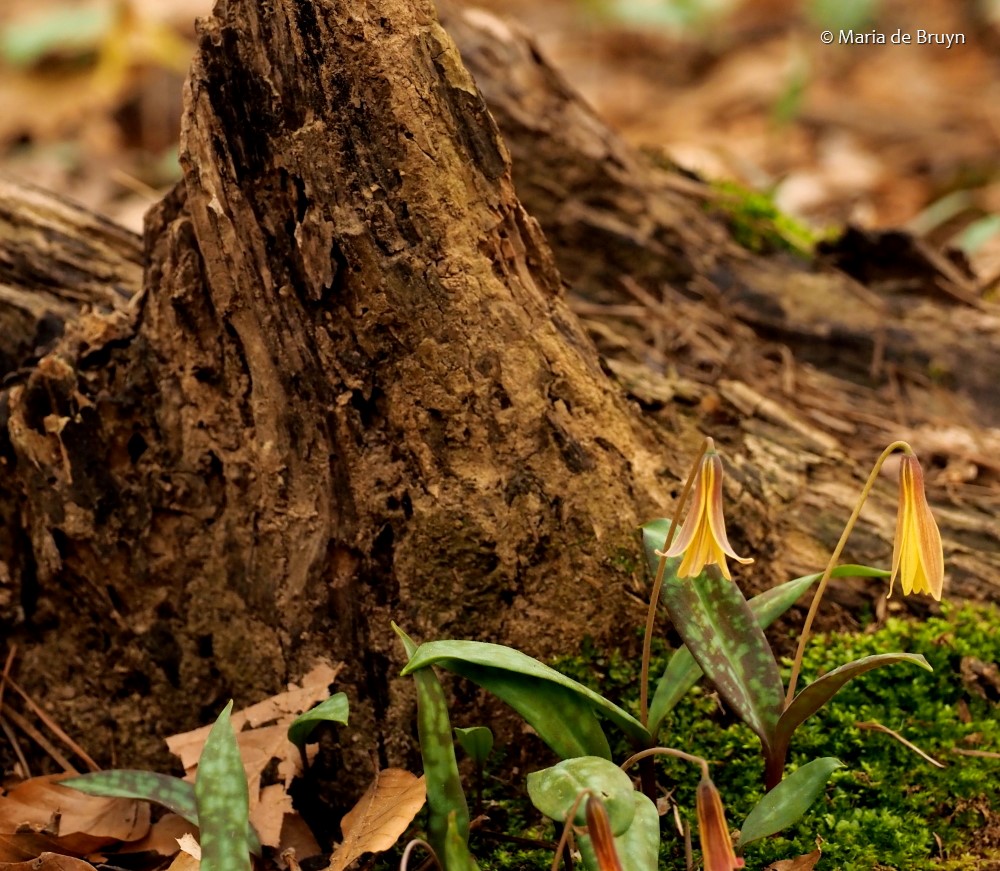
Trout lilies (Erythronium americanum, right) seem to be popping up alongside all the trails that I walk. Often they are growing near trees or stumps left behind by fallen trees.

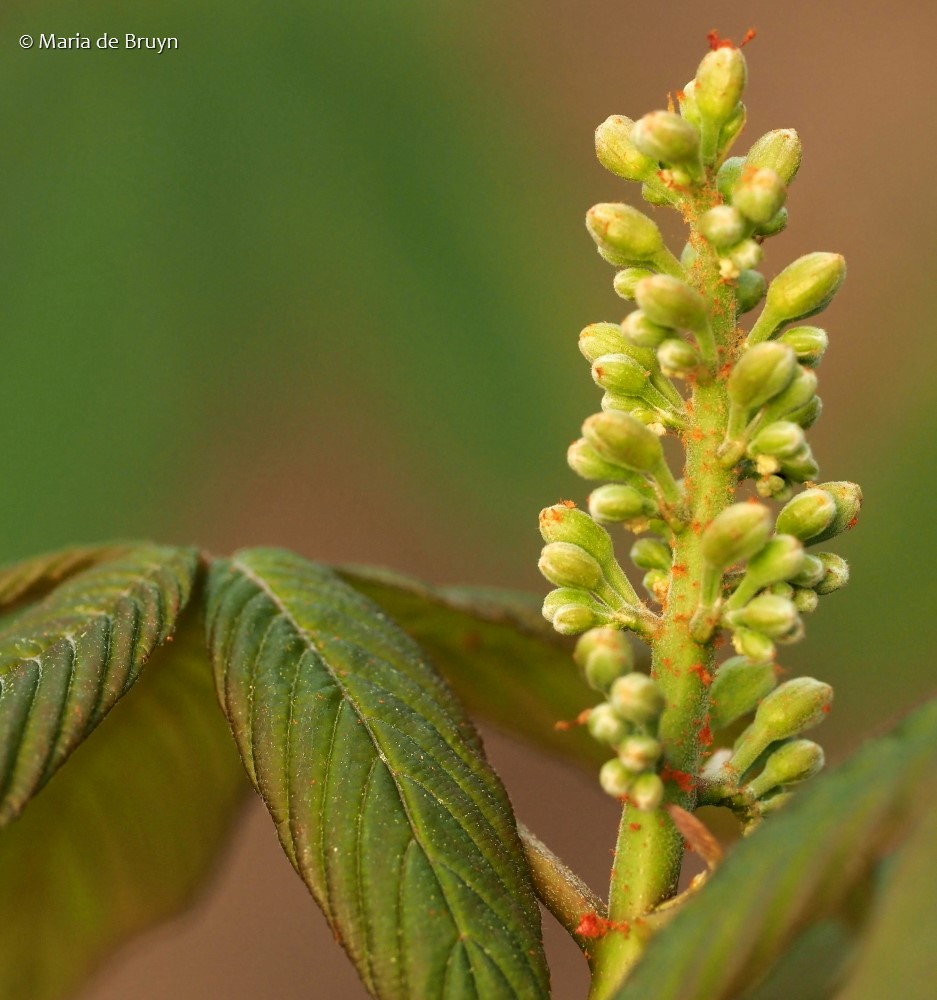
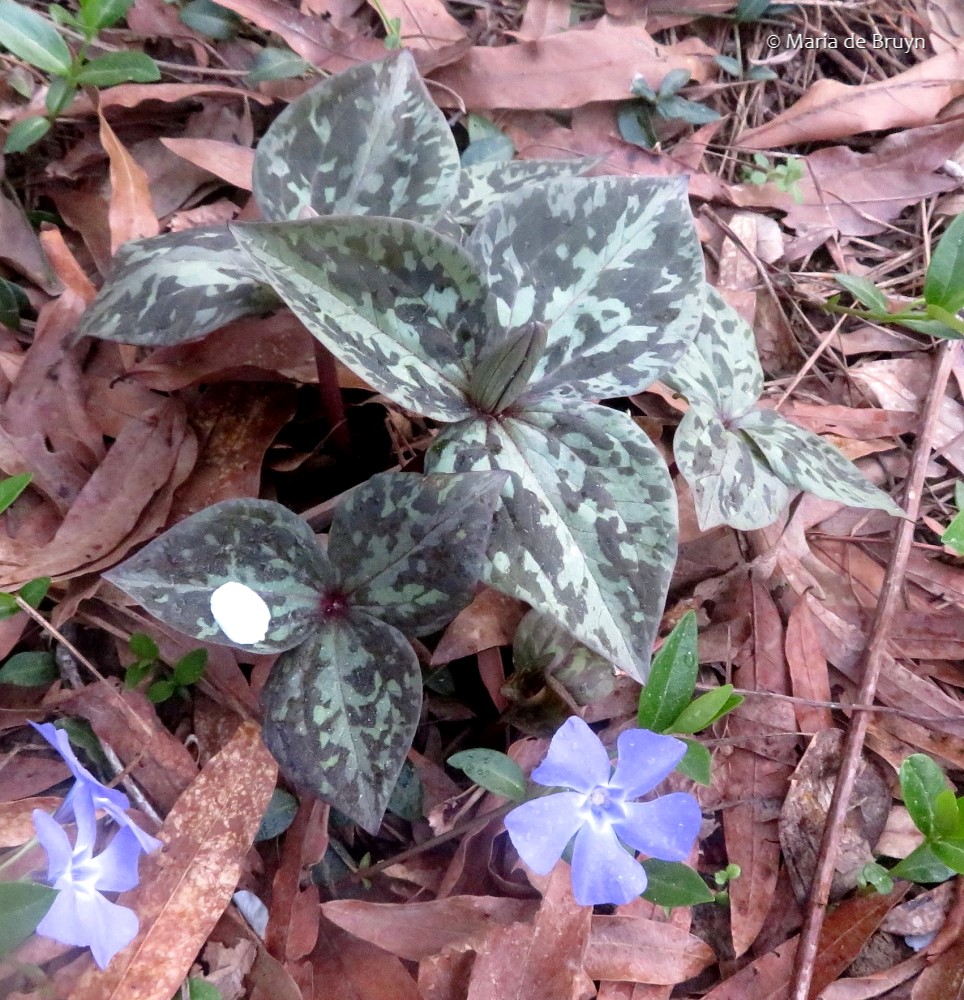
In my yard, I transplanted a red buckeye (Aesculus pavia) and it is doing well in its new spot. My yellow buckeye (Aesculus flava) isn’t blooming, but there was one in the woods that was covered with small insects (below left). I was quite pleased to see a trillium (below right) getting ready to bloom for the first time in my front garden,


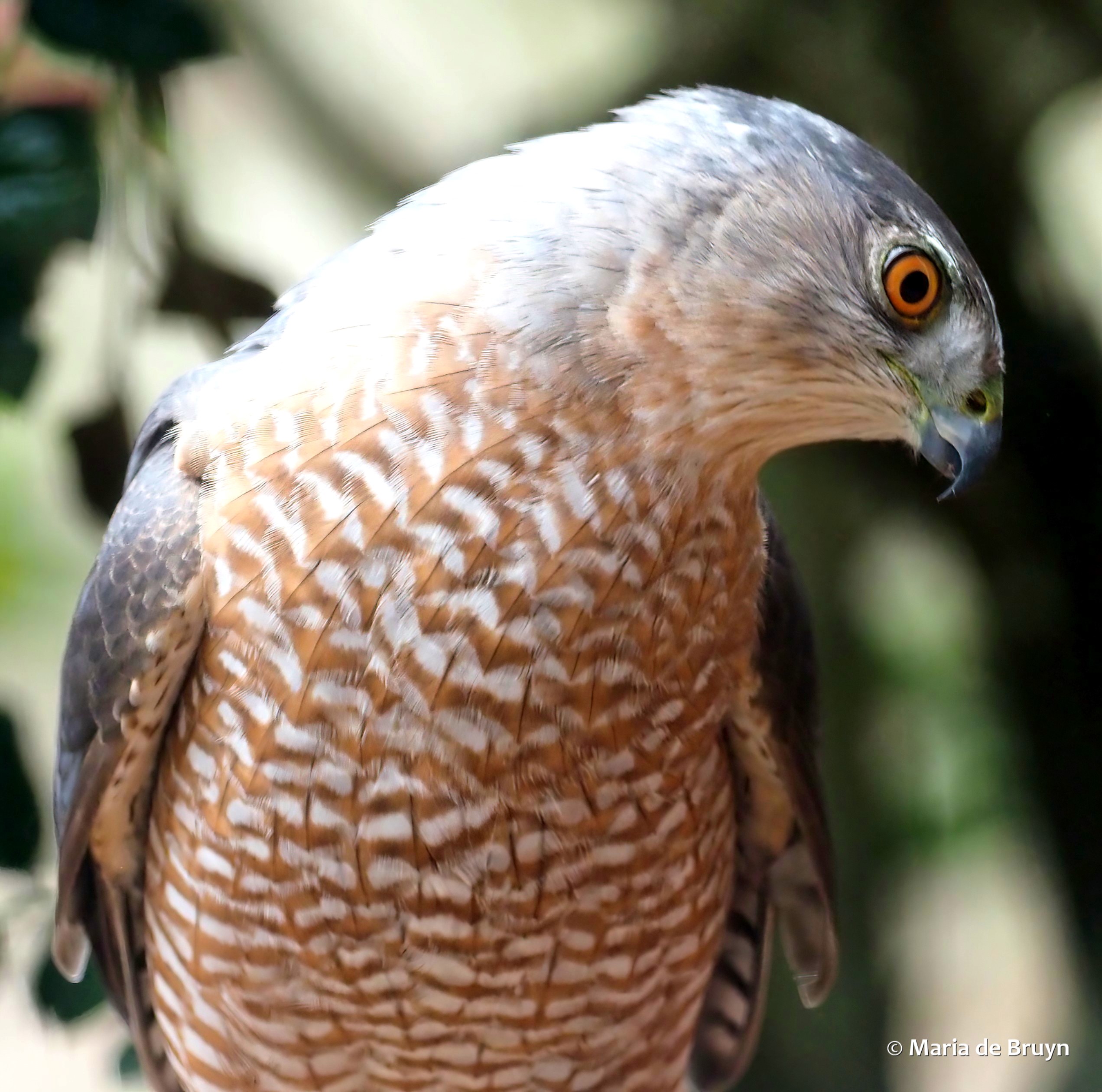
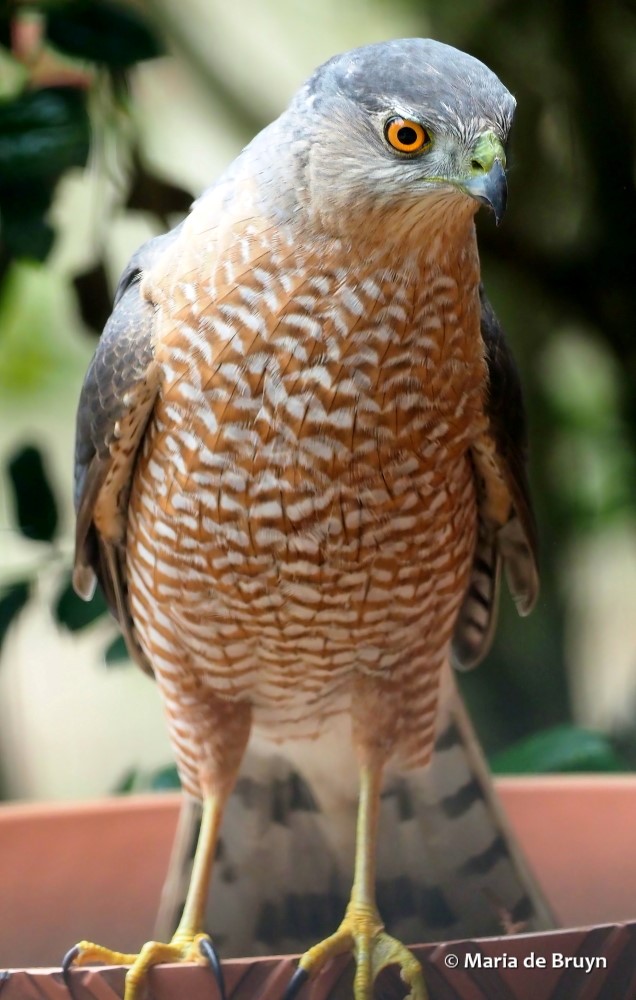
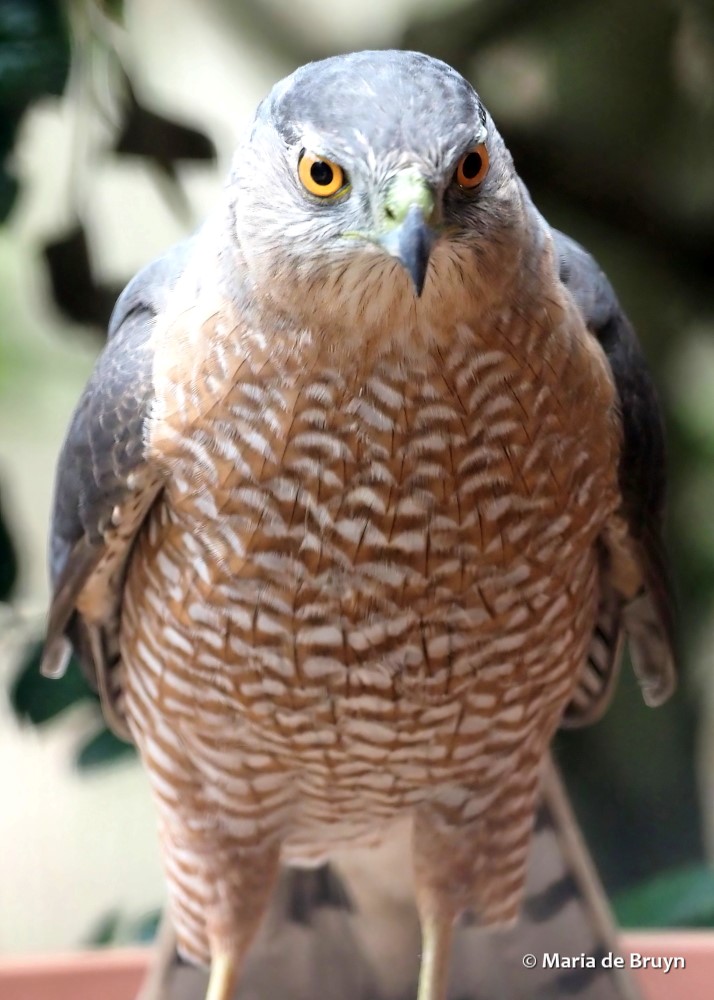
The other day when I looked out my front window to see if any new plants had appeared, I was surprised to see an unexpected visitor sitting on a plant pot on the porch. It was the resident Cooper’s hawk (Accipiter cooperii), who comes by often to see if she can pick off one of the feeder birds for a meal. (The bird is quite large, which leads me to think it is a female.)

A favored hunting technique is to drive another bird into the front porch window in order to pick up the stunned prey before it recovers and flies away. She apparently thought that she had managed to accomplish this maneuver and was looking for her meal.


Perhaps she also was looking for a chipmunk, however, as they often come up onto the porch. After seeing me staring at her, she decided to leave.

My most interesting recent encounter was with another bird of prey. After walking through a park for more than an hour, I set off on a new trail and encountered a bench there. I had decided to sit for 5 minutes and just look around when I suddenly heard a loud call quite near behind me.


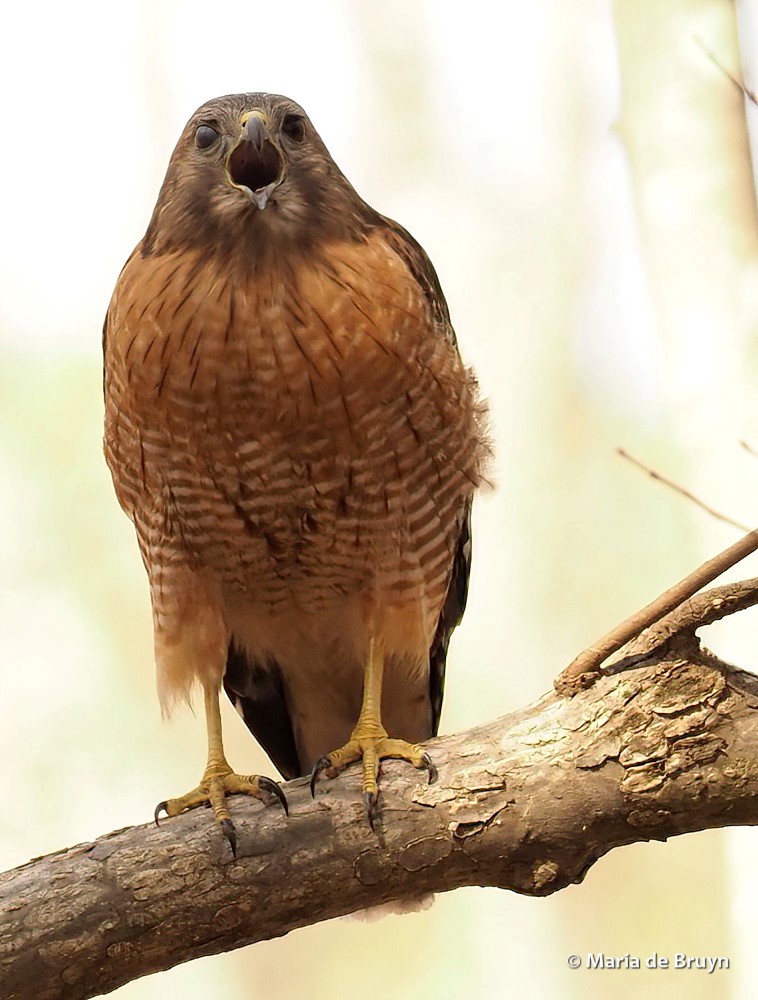
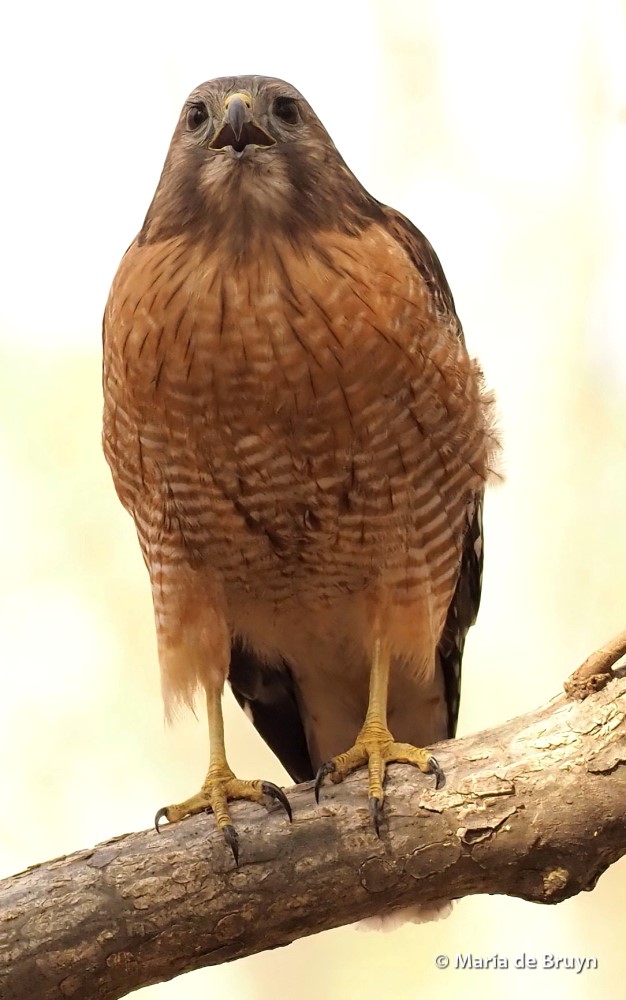
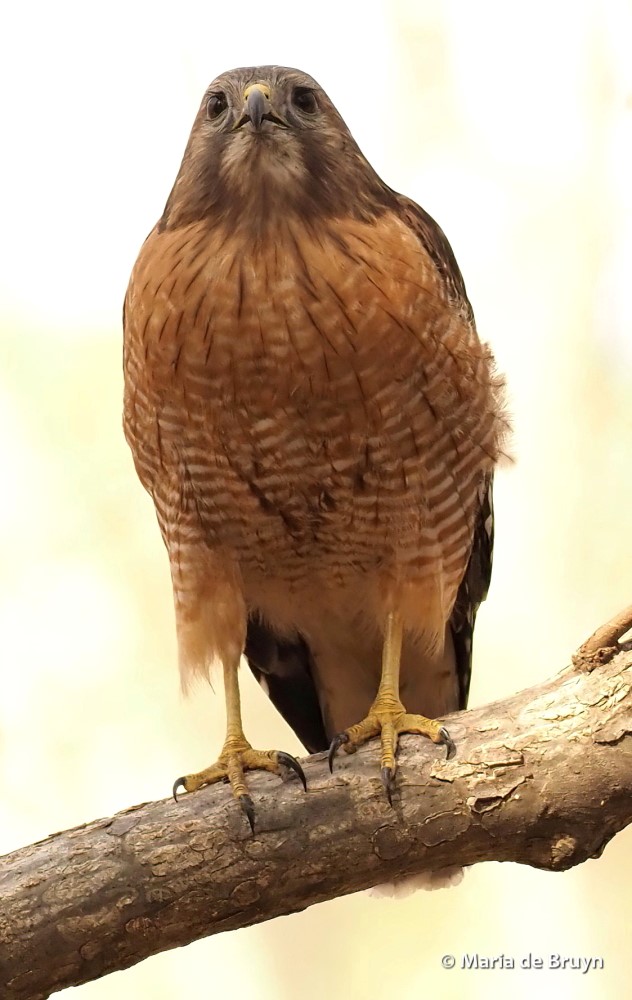
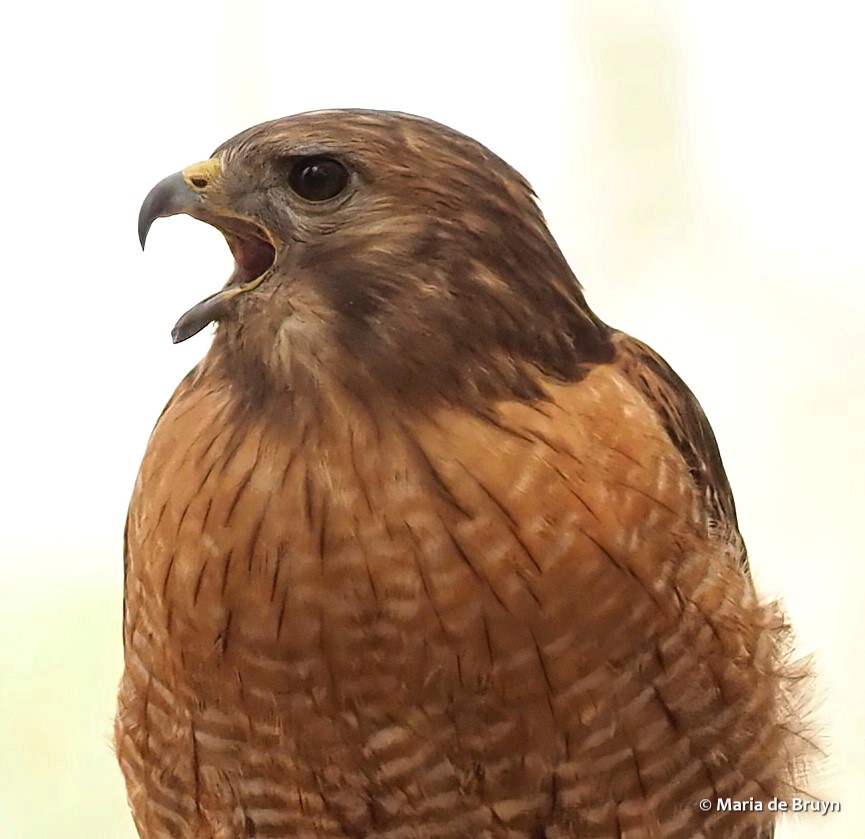
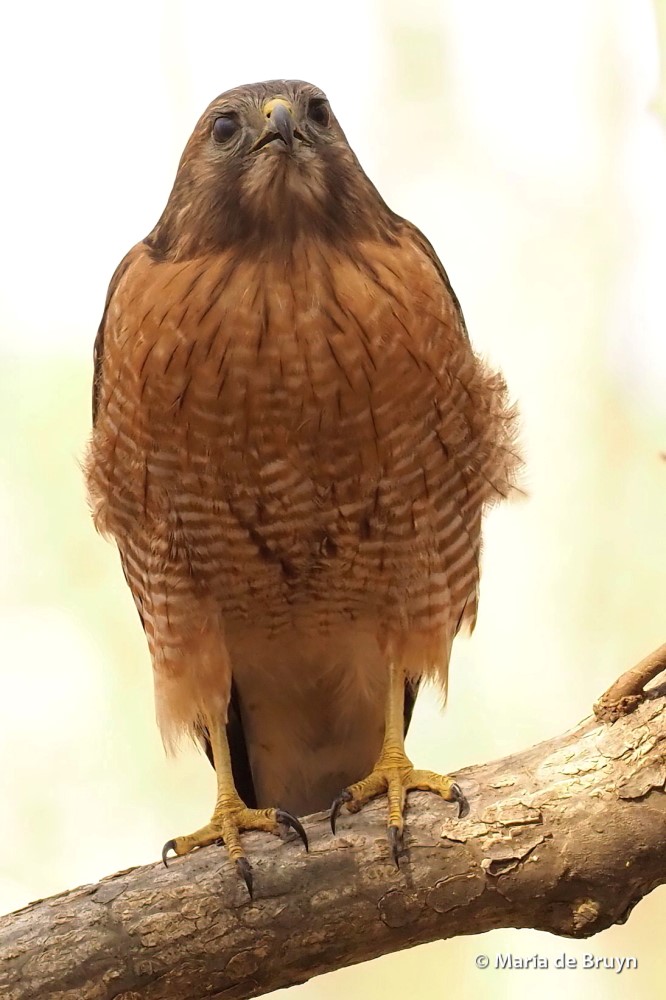
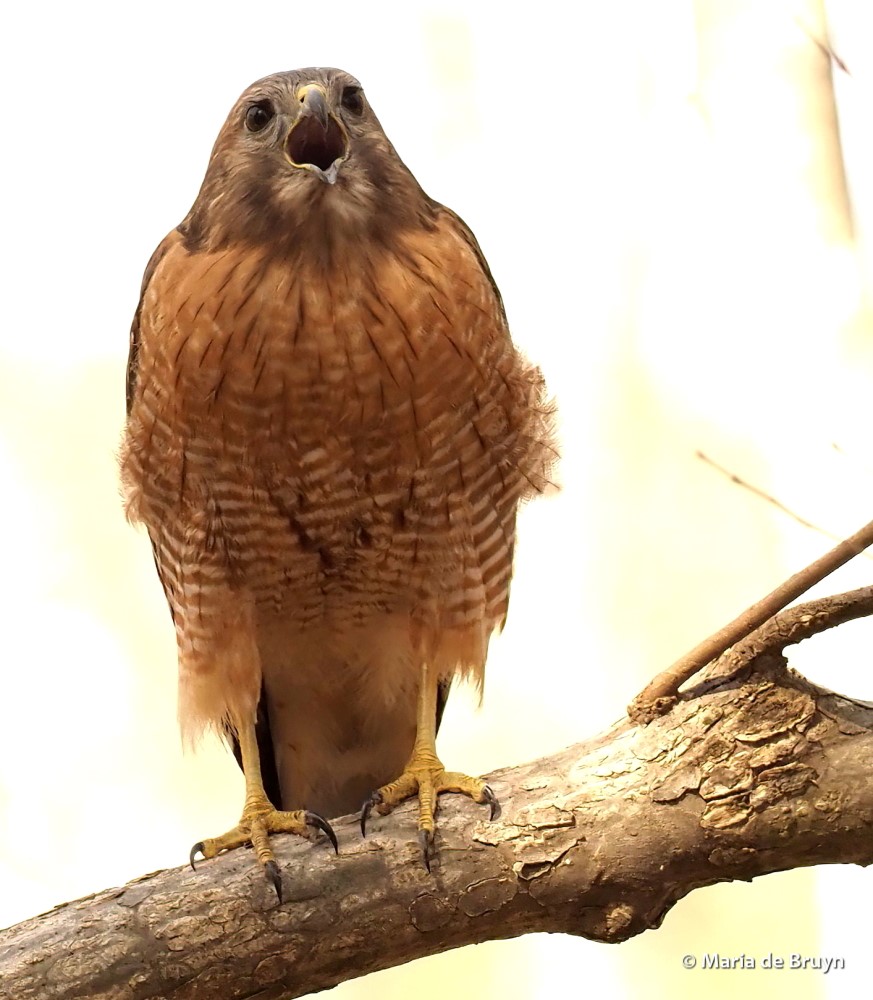
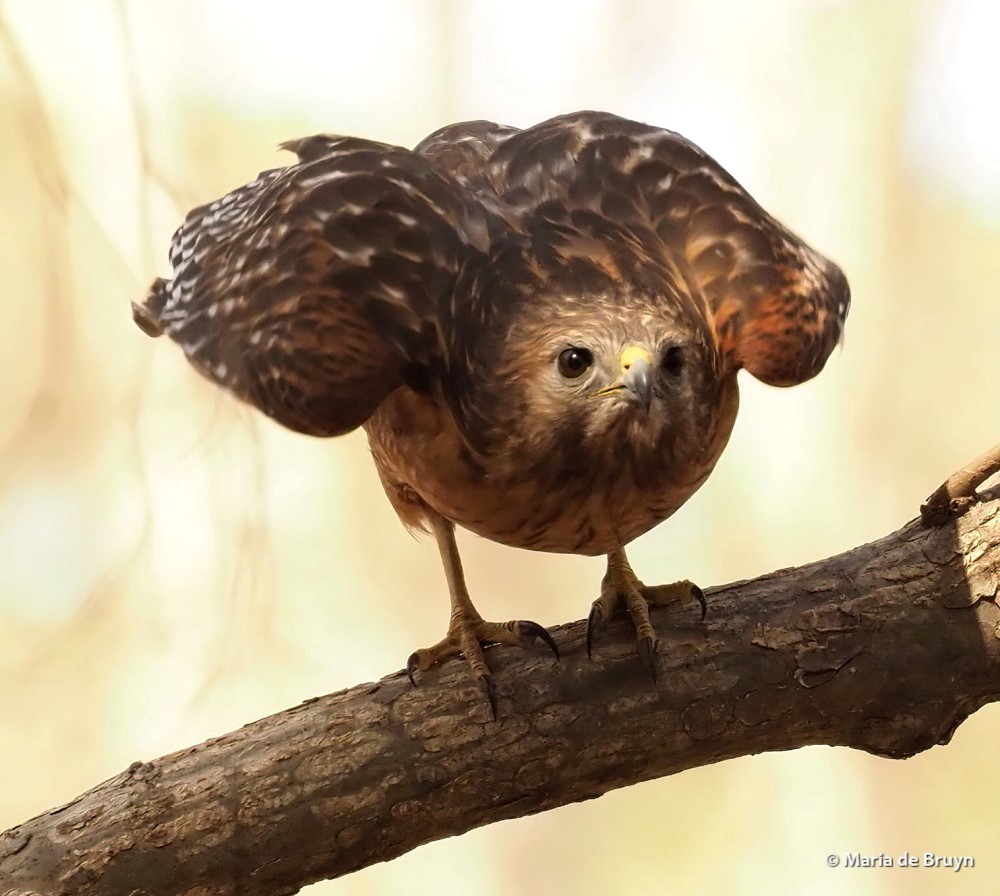
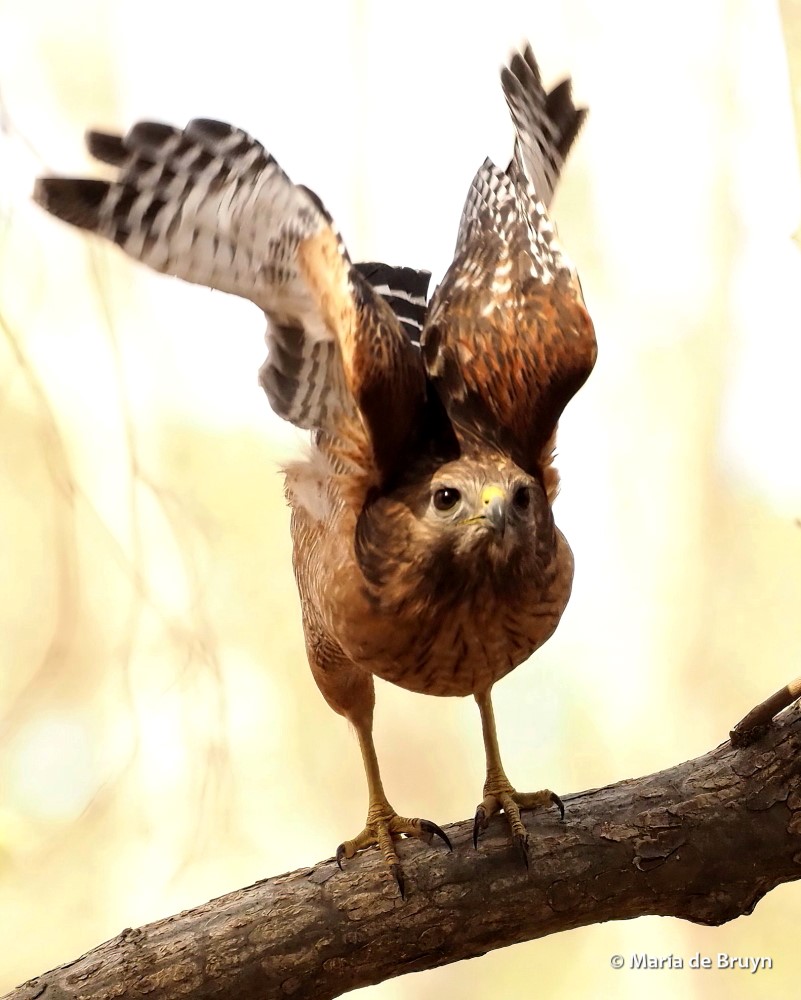
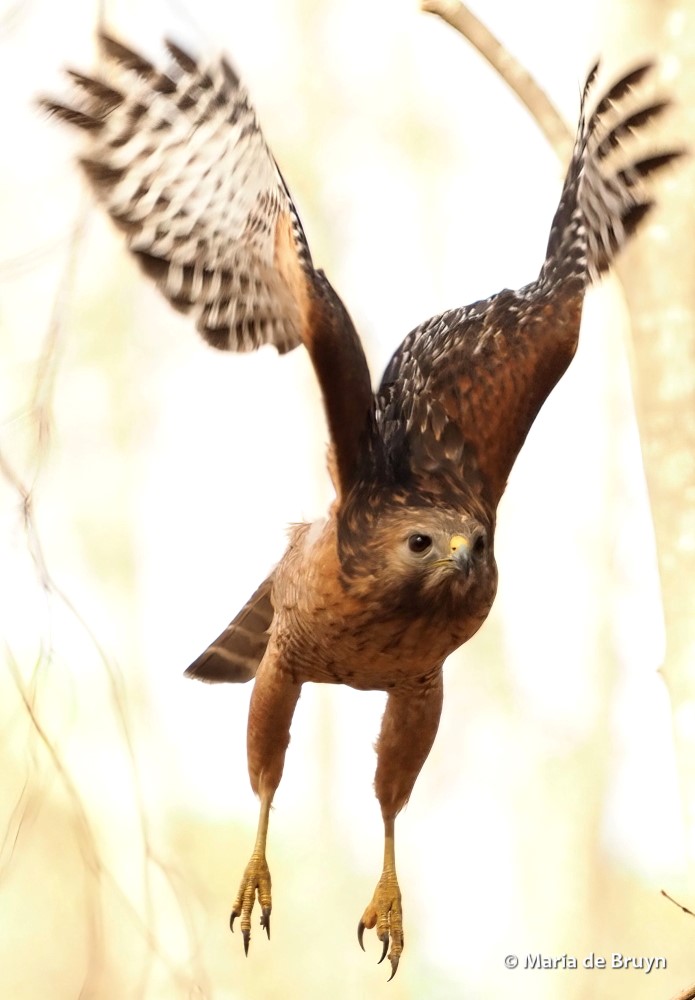
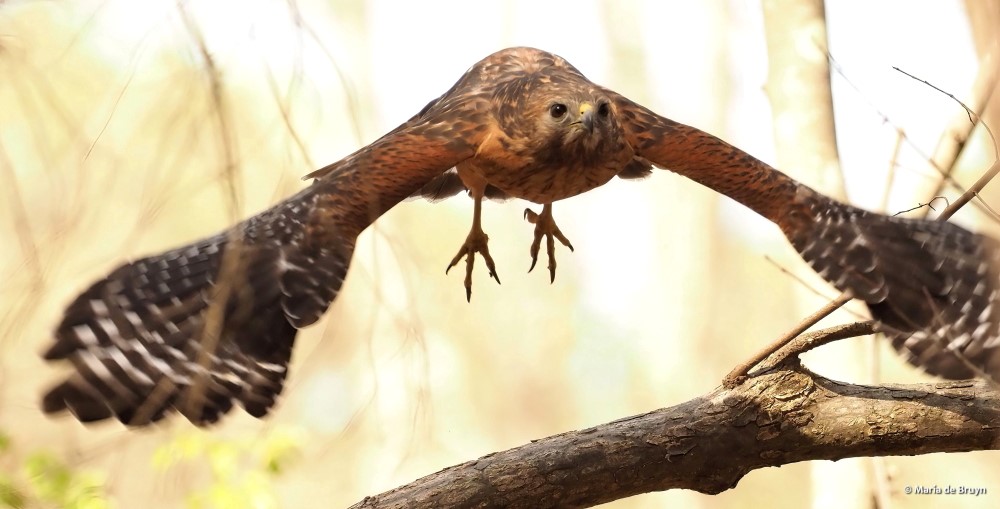
When I turned, there was a gorgeous red-shouldered hawk (Buteo lineatus) sitting on a low branch about 15 feet (4.5 m) from me. I took a couple photos without moving from my place and the hawk just gazed at me.


This bird was so beautiful that I just admired it for a while before taking some more photos. And then my avian neighbor began calling again.


These periods of calling and looking around silently went on for a while and I was really curious about how long the bird would stay there. It seemed like a really long time, perhaps because we were both so engrossed with looking at one another. (In reality, the time on my camera showed that our encounter lasted about 10 minutes or so.)

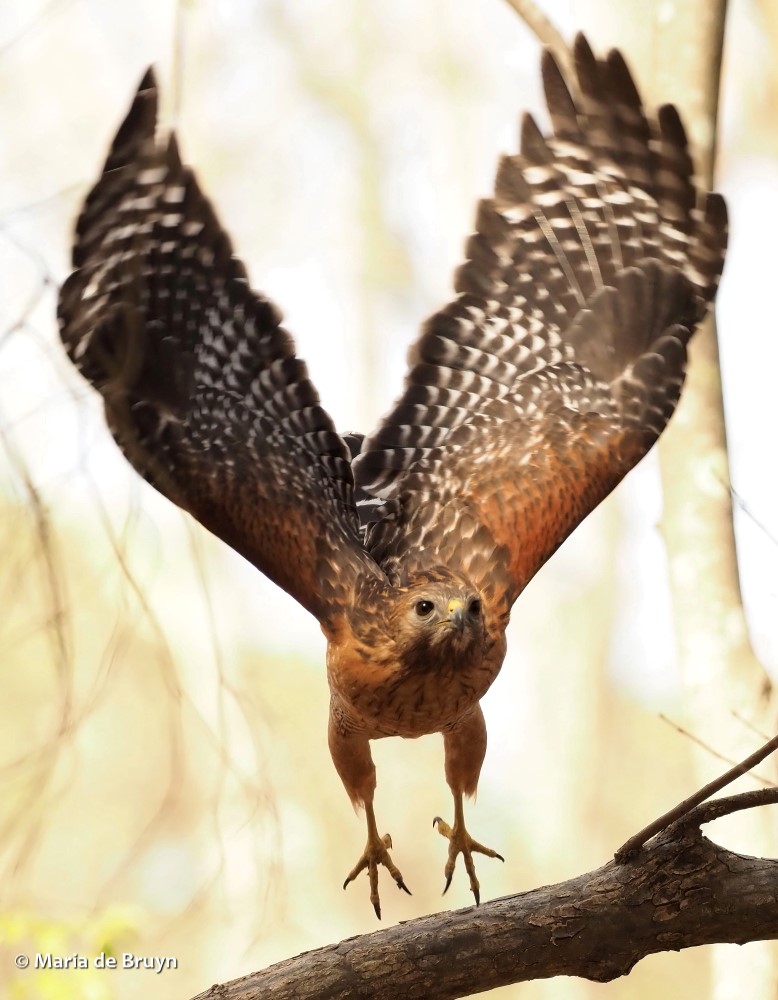
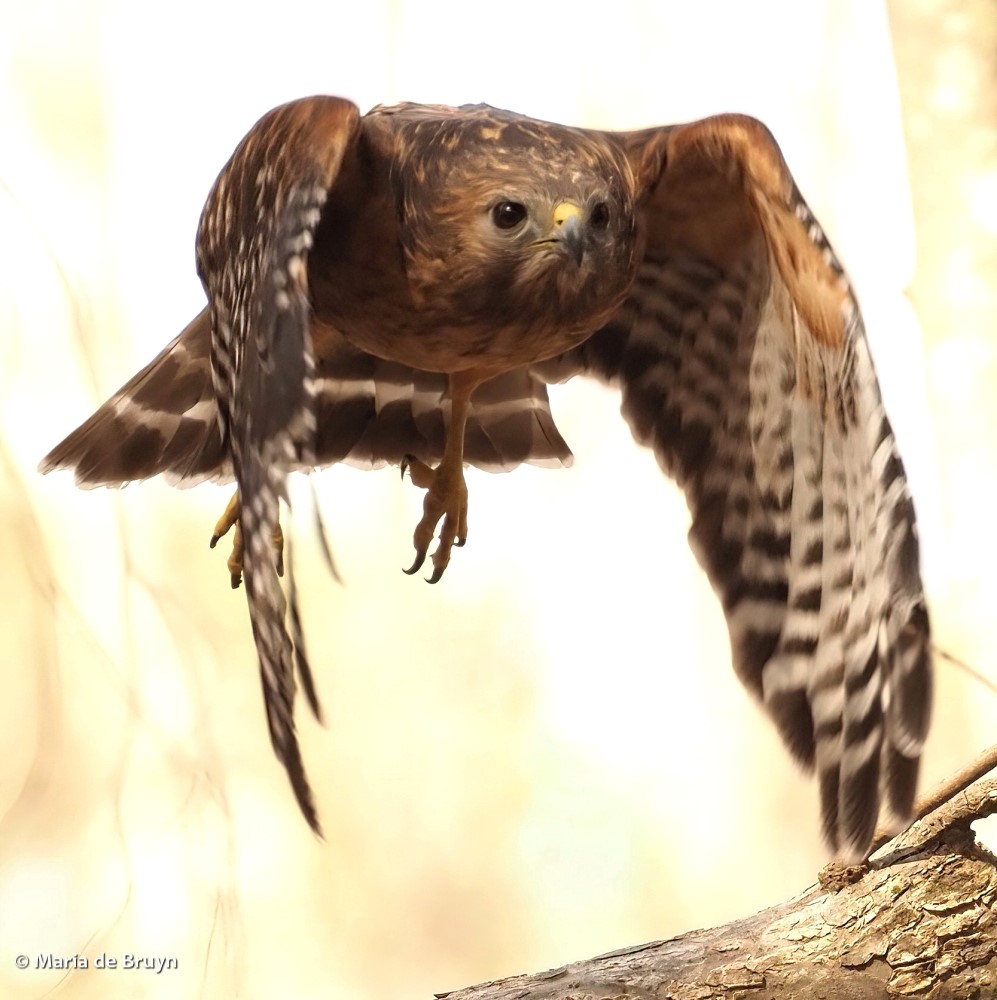
After a while, my calling companion decided to take off and I figured that would be the end of our visit.

I wondered where the hawk would go.


It turned out to be to a branch a little further away and higher up where there would be a better overview of what was moving around the forest. I watched the stunning raptor for a little while longer and then left it to get on with its surveying in peace. After that, I saw a few more interesting wildlife encounters, but it was that mutual observation session with the bird of prey that made the biggest impression on me that day.
Hope you have had a nice time outdoors, too!


World Wildlife Day 2023 and Nature Photo Challenge #2: Eyes

Cooper’s hawk

Isn’t the intense gaze of the Cooper’s hawk above captivating? It can relate to both parts of the double theme for this short blog, as a symbol of the wildlife many people wish to conserve worldwide and as a fellow being with eyes that mesmerize.

Today is World Wildlife Day, a day celebrated to honor our earth’s wildlife and the 1973 Convention on International Trade in Endangered Species of Wild Fauna and Flora (CITES). This year’s theme for this commemorative day is “Partnerships for Wildlife Conservation.”

The term “wildlife” can have two meanings. Some dictionaries and organizations use the word to refer to all animals (mammals, insects, amphibians, reptiles, birds, etc.) that are not domesticated by human beings. Others have expanded the term to also include plants.

Cleared fire line before a controlled burn

I contribute to the goal of wildlife conservation by volunteering at a local nature reserve to help with its upkeep. Our volunteer group, called the “Green Dragons”, removes invasive plants, plants native vegetation, and clears fire lines when controlled burns are done. The photo above shows such a line; it is patrolled by volunteers to watch for and quench sparks that might ignite materials outside the area being burned.

Our Green Dragons group cleared a fire line earlier this week and we were able to relocate several marbled salamanders to an area that will not be burned.

Fellow volunteer Mark also found and relocated a young brown snake.

We hope the weather collaborates and makes it possible to complete the burn before many of the animals begin brooding their young.

One reason so many people want to conserve wildlife and natural areas is because they enjoy watching the non-human life that sustains our planet. We sometimes don’t stop to think about how the animals also spend time observing us.

Fellow blogger Denzil Nature has challenged us to stop and consider the eyes that animals use to see us. Some have eyes that appear at least somewhat similar to ours. The dark eyes of the Eastern chipmunk, black racer snake, and short-horned grasshopper could fall into that category.


And then we have the wondrous insects who have compound eyes so very different from ours. The blue dasher dragonfly provides a nice example of that.

If you want to learn more about how different members of the animal world look at life, check out the wonderful book by Ed Yong, An Immense World. It’s fascinating and you can learn a lot about how various wildlife species experience the world using other senses as well! And perhaps it will inspire you to think of new ways to contribute to conserving wildlife.