When it’s time to eat your own skin

Several years ago, I bought a couple hard polyethylene pond liners and dug two large holes in my clay and rock-filled back yard. I wanted to have a pond area and figured that two big tubs would be easier to manage and clean than maintaining an in-ground pond. So far, that has been the case except for the fact that I couldn’t keep any fish – a great blue heron managed to eat all the fish I had over the course of about 2-3 years.

That doesn’t mean my pond is not populated, however. Indeed, all the water sources in my yard have residents. Some are unwanted – for example, the mosquito larvae that I admittedly kill with mosquito dunk. The Cope’s gray tree frogs (Hyla chrysoscelis) have a preference for my rain barrels. Somehow they manage to crawl inside even when a lid is on and they deposit hundreds of eggs per season.


Fortunately, not all of the frog eggs hatch or my yard would be overrun and the sound in the evenings would be overwhelming. Even the half-dozen or so current adults manage to produce quite a loud concert series – I’m surprised neighbors haven’t asked me to do something to tamp down the sound!

I used to have bullfrogs in my container ponds but haven’t seen them this year. Instead, my neighbors have been lovely green frogs (Rana clamitans). One grew to a very large size and he was joined by two others of a bit smaller stature.

They aren’t very noisy, mostly croaking in the late afternoon. It must have been that sound that attracted another neighborhood resident whom I spotted one day sitting on a nest box next to the pond. The red-shouldered hawks (Buteo lineatus) have spent time watching the pond before when in the mood for frog legs; this was a young hawk who had obviously been in the pond as evidenced by his wet plumage.

The pond was quiet for a few days and I thought the hawk must have had a good meal. And then, slowly, the frogs began to emerge again. There are three that sit on the rocks surrounding the larger pond although one is a bit smaller. This makes me think the hawk might have gotten one but that a juvenile frog was now accompanying the larger pair.


When my pond “greenies” croak, they don’t seem to get very large inflated vocal sacs. At the NC Botanical Garden, fellow photographer Mary showed me a green frog that she had been photographing and he croaked a couple times. It went too fast to get a good shot so I offered to make him “talk” by croaking at him. My pathetic attempt at imitating him really was quite pitiful, but amazingly did evoke a response. His vocal sac didn’t get really large either though.

One day, I spotted one of the yard frogs sitting on a rock, opening and closing its mouth without making a sound.


When I looked more closely, it seemed to have some membrane hanging on its side.

Then I saw that it was partly in the frog’s mouth and the amphibian was tugging away at it. I wondered if he was sick.

It turns out that he was perfectly healthy and staying that way by eating his own skin! These amphibians regularly shed their skin because it would otherwise harden and make it difficult for them to absorb oxygen while underwater, where they spend a considerable amount of time. So periodically, they scrunch themselves together and then stretch to break the skin so that it can be pulled off, leaving supple skin behind to better enable the “breathing” method called cutaneous gas exchange.

But why do the frogs then eat their skin? It actually has many nutrients, including calcium and proteins. I have no idea if the skin has any taste and whether they enjoy ingesting it. It seemed to be a bit of a laborious process when I watched this frog go through the process. Added to that is the fact that they actually use their eyeballs to push food down their throats and you discover that our froggy friends have quite a unique digestive process!


Outside my yard, I’ve not seen too many frogs this year. There was a lovely little Northern cricket frog (Acris crepitans) out and about on one of my walks.

More recently, I’ve been seeing Fowler’s toads (Anaxyrus fowleri) in the woods and parks.


At the NC Botanical Garden, I had the chance to see some rather large tadpoles sharing a pond with smaller ones.

It was interesting to see that the tadpoles first develop their hind legs and then their front legs before eventually losing their tails.

Finally, one more type of interesting creature I’ve been observing lately on walks are land snails. They don’t really belong in a blog that is about amphibians but it’s unlikely I’ll be writing one about mollusks any time soon. So, I’ll leave you here with a few photos of what I thought were some snails with beautifully spiraled shells. Have a good day or evening!


Hopping into springtime

I’ve been planning new blogs for quite some time; then I keep taking new photos that will fit into them and the blog writing gets delayed. But two days ago, I saw such a cool natural event that I resolved to produce a blog quickly and here it is!

One welcome feature of springtime is that many insects emerge from their over-wintering spots. Some are bugs we dislike (mosquitoes, ticks and chiggers), but others are fascinating and wonderful members of our natural systems. Pollinators like this spicebush swallowtail (Papilio troilus) keep our gorgeous plants and important food crops going and many bugs provide other wildlife with meals.

On my trip to Costa Rica last year, our guide not only pointed out birds but also some mammals and insects. He had developed an interest in treehoppers, a group of insects with about 3200 species worldwide that specialize in eating plant sap. He was unable to find any to show me, but I resolved to keep an eye open for them when I returned home. I had forgotten that I had seen my first one the year before, a pretty green Ceresini species.

As I stared at plants during nature walks, I was lucky and managed to find my first treehoppers when I was actually looking for them. These were of a dark-colored species (Acutalis tartarea) that favors the sap of black locust trees, sunflowers, goldenrod and ragweeds.

The treehoppers, which are related to leafhoppers and cicadas, are popular with some entomologists because many species have elaborate “helmets” at the top of their heads. I got to see my first example of this type on my recent walk when I happened to find a young oak tree with numerous nymphs and recently eclosed (emerged) adult oak treehoppers (Platycostis vittata).

The mother treehopper is known for staying close to the nymphs to protect them against wasps and other predators.

The hoppers get plant sap by piercing plant stems with their beaks. The nymphs have extensible anal ducts that deposit the sap away from their bodies. This is important because the concentrated excess sap, called honeydew, can get moldy.


The honeydew attracts ants, which like the sugar-rich liquid, so the hoppers and ants have a mutually beneficial relationship.

Just how the helmet develops into an unusual shape has been a source of investigation. One team of entomologists theorized that the helmet was formed by body parts that were actually modified wings. Another researcher countered that this was impossible and that the helmet was an unusual pronotum — the foremost dorsal section of the thorax. More recently, a third group of evolutionary biologists postulated that the helmet is indeed a section of pronotum but one that developed with the aid of genes that code for wings.

In various species, the pronotum has developed into a quite unusual and oddly shaped appendage; examples can be seen in this article. When the helmet resembles a plant thorn, it is thought to aid in camouflage.

When I discovered the group of oak treehoppers, one was just in the process of emerging from its nymph form. A friend who saw the photo remarked that it reminded her of the film Alien but this process was slow and deliberate and not a heart-thumping explosive emergence as shown in the movie.

As you can see, the oak treehopper is quite a beautiful insect with its pristine white body decorated with pink/red stripes and hints of yellow. They made me think of mints and Candy Stripers (a sign of our times when almost anything makes me think of health and health-related concerns. For younger readers: young female volunteers who work under nurses’ supervision in hospitals used to wear pink and white striped smocks and thus got the name Candy Striper).

Not all the adults had the horned pronotum; some had rounded heads.

This close-up of a hopper’s face could evoke all kinds of thoughts. I thought it looked as if it had a pig’s snout. Another friend thought it looked like a grumpy old man. What do you think when you see this visage?

Or about this one, with its head upside down? (It looks a bit more “innocent”, don’t you think?)

In any event, I found these insects just adorable and I felt very privileged to have had the chance to see them emerge into adulthood. It turns out that in this species, older individuals may change color, turning a dull brown or green color. Some mottled forms may be blue with yellowish spots. It would be interesting to see those forms as well one day – or perhaps one of the other treehoppers with a different fabulous helmet!I hope you, too, are able to get out in nature during these social distancing times so that you can connect with the wonderful wildlife around us!

Awesome amphibians in Costa Rica

During my two trips to Costa Rica (so far?), it was my good fortune to see different kinds of animals besides the birds which were the focus of the trips. There are a lot of interesting amphibians and reptiles to see; in this blog, we’ll see some of the amphibians that I managed to photograph. I was ultimately able to identify almost all of them except the one to the right; if anyone can tell me which frog this is, it would be appreciated!


One of the most famous frogs in the country is the little (0.75-1 inch) strawberry poison dart frog (Oophaga pumilio), also known as the blue jeans frog because many individuals have a bright red upper body accented by a bright blue lower half. It turns out that the species has an estimated 15-30 color variations – in 2000, totally blue individuals were seen at the La Selva Field Station.

The female lays 3-5 eggs on a leaf and the male then keeps the eggs hydrated with water he transports in his cloaca. After the eggs hatch and tadpoles emerge, the female frog transports them on her back and deposits each one separately in a small pool formed in the crevice or hole of a tree or a large bromeliad. There, the tadpoles consume only unfertilized eggs that their mother feeds, a practice called obligatory oophagy,


The feeding habits of the adults (certain ant and mite species) are what makes them poisonous when touched or eaten. Their skin is toxic and humans should wash their hands vigorously after touching them.

A very tiny frog that we saw last year was the common tink frog (also called dink frog; Diasporus diastema). I’m not absolutely certain that the two shown below are tink frogs but think they are. These tiny frogs change color, having grayish brown skin with spots or bars during the day and a pale tan or pink color at night, when it is most active.


A somewhat larger amphibian that we saw at the same pond as the tink was the hourglass tree frog (Dendropsophus ebraccatus). Part of the species name comes from the Latin term ebraccata, which means “without trousers”. Some people call this frog the “pantless frog” because they think the smooth yellow thighs that contrast with its highly patterned back make it look as if it is not wearing pants. These individuals had patterns on their thighs, however!

The attractive hourglass frogs were in an amorous mood when we spotted them. The female chooses her mate and he mounts her to deposit his sperm. She then will seek out a suitable place for her eggs, either in the water or a leaf overhanging water. When the arboreal eggs hatch, the tadpoles roll off the leaf into the water below.

These frogs are of interest to scientists because their skin contains bioactive peptides which have anti-fungal and anti-bacterial properties and might even have therapeutic properties useful in treating diabetes.


The pond had quite a few frogs in residence and several brilliant forest frogs (Lithobates warszewitschii)were among them. They are slender-looking frogs with pointy heads. Their sides are apparently always darker in color than their backs.


Their coloring seems to vary somewhat, being browner in some individuals and featuring more green highlights in others. They tend to have yellow spots on their legs.

They do not have vocal sacs or slits but do make trilling sounds.


We were lucky to catch a glimpse of a red-eyed tree frog (Agalychnis callidryas) at the pond. Although some lodges will ask you to avoid using a flashlight during night-time walks to see amphibians, it’s very difficult to spot them without some use of a light. That’s how we managed to spot the tree frog.

We came across the Canal Zone tree frog (Boana rufitela) taking a daytime nap, right out in the open on a large leaf next to a walking path. This frog is also known as the red-webbed or scarlet-webbed treefrog. It used to have the scientific name Hypsiboas rufitelus, which was changed for a reason I couldn’t determine.

The smoky jungle frog (Leptodactylus pentadactylus) is Costa Rica’s largest frog species; males grow to as much as 7.3 inches (18.5 cm). The adults are so big that they can eat small mammals (e.g., bats), small birds and lizards. They have some interesting characteristics. In contrast to the little blue jeans frogs, who only lay 5 or fewer eggs, female smoky jungle frogs lay about 1000 eggs at a time! They can secrete copious amounts of mucus, which makes them difficult to hold for predators; in addition, these secretions are toxic. They can even vaporize the toxin, causing people to sneeze and get swollen eyes.

What has further contributed to making them famous is the alarm call that they emit when captured; some liken it to a human person screaming. It doesn’t sound like that to me; rather, what I heard in a video sounds to me like a sound that a distressed cat might make.

That brings us to Costa Rica’s largest amphibian, the cane toad, also known as the marine toad. They are not only this Central American’s biggest amphibian, though; they are the largest toad in the world, growing as long as 9 inches long (22.86 cm) and weighing up to 3.5 lbs (1.59 kg).

This animal has also gotten a new scientific name; while it used to be called the Bufo marinus, it is now known as the Rhinella marina. Like some of the frogs, this toad has toxic skin and they are especially dangerous for dogs.

They were introduced to different countries to control pests as they have voracious appetites. Now they are considered an invasive species and pests themselves.

In 2018, I came across these toads in different places. There are a few living around a fountain in the hotel in San José where our tour groups stayed; they enjoy taking a shower under the running water.

To end today’s offering, I’ll show you the frog that really fascinated me most — the reticulated glass frog (Hyalinobatrachium valerioi). Our guide, Cope (who showed us the awesome spectacled owls and bats shown in previous blogs), led us to this awesome amphibian. It has a green and yellow back but its ventral (abdominal) skin is completely transparent! The frog’s heart is covered by white tissue and its liver and digestive tract are also white. Here you see the male frog on a leaf guarding eggs – he actually looks pretty much like the egg masses!

Isn’t nature endlessly interesting? Next blog: Costa Rican reptiles!

Marvelous mammals, part 2 – at parks and reserves

Some of the mammals that I see when visiting parks and nature reserves are the same as my yard visitors (see the previous blog). For example, on a recent walk at a wetland area, an Eastern gray squirrel (Sciurus carolinensis) decided to engage me in conversation as I walked under its tree. It would descend a few feet, look at me intently and utter sounds.


I responded (in English) and it would look at me quizzically, ascend the tree and then turn around to come closer again.

This went on for about 10 minutes. When I walked further on, another squirrel was perched on a small limb eating a snack and stopped to observe me as I passed under its tree. There was some communication going on between us, although I confess that I wasn’t sure what she was saying.


Other mammals I only see rarely in my yard but a little more often in public natural areas. An example is the groundhog (Marmota monax), which also goes by the common name of woodchuck.

Last year, I had a groundhog come up on my front porch where I had a container garden; it was really enjoying the tomatoes to my surprise! More recently, a friend and I were stopped on a road through agricultural fields when a groundhog emerged from a culvert. The animal looked around at its leisure and then eventually retreated to the culvert when our car began moving forward.


And then there are mammals that I don’t see at all where I live since my yard is not close to wetlands, bogs or rivers. A recent trip to the North Carolina (NC) Atlantic Coast gave me a chance to see a muskrat (Ondatra zibethicus), which some Native Americans called a musquash. Fellow birders alerted me to its presence as it was sitting at the edge of a small pond where they had been watching water birds.

The muskrat can be distinguished from the nutria, which looks very similar, by a couple features explained to me by a park employee. The muskrat has much less prominent whiskers than the nutria and its tail has somewhat flattened sides. Overall, they are smaller than nutria. I do think a muskrat I saw in our nearby Haw River was fairly big.

Muskrats dig burrows into river banks and the sides of ponds and canals; sometimes, they also will construct a large lodge atop mud and roots in marshes. Their babies are born blind and hairless; as they mature, they get either brown (70%) or black fur (30%).

At the coast, we also got to see the nutria (Myocastor coypus), swimming at the edge of a wetland near a road. These rodents are native to South America and were introduced to the USA in the 1800s; they are now found in 22 states. In North Carolina, they are only found in the coastal and Eastern parts of the state.


Nutrias are larger than muskrats and smaller than beavers; their very white whiskers are distinctive.

They construct floating platforms with vegetation on which they rest, groom and eat. They may live in colonies of up to 15-20 individuals. Their eyesight is poor and they sense danger through their sense of hearing.

They are considered a nuisance animal as they can convert marshes to open water and are known to eat farmers’ crops. Their numbers have partly been kept down in NC because of hunting (trapping) and partly because they have an elevated mortality during cold winters, to which they are not adapted. I’m guessing that the nutria will not have an easy future in this state.

Another water-loving mammal that has had problems with humans is the North American beaver (Castor canandensis). One of my book clubs is currently reading Eager: The Surprising, Secret Life of Beavers and Why They Matter by Ben Goldfarb. He details how they were trapped and killed by the millions when Europeans arrived in North America and how this changed much of the landscape throughout the country – often causing a deteriorating environment.

In NC, the last native beaver was trapped in 1897; we only have them now because the NC Wildlife Resources Commission reintroduced beavers in the 1930s. Still, these mammals often face negative reactions from human neighbors, who frequently have them “removed”.

Goldfarb details different ways in which humans and beavers can peacefully co-exist. He notes one way (among many others) in which they can be quite beneficial: “As the climate warms, more precipitation is falling as rain rather than snow. Instead of remaining in snowpack and gradually melting throughout the course of the spring and summer and fall and keeping rivers and streams wet well into the dry season, now all that precipitation is falling as rain. Any entity that can store water on the landscape, that can keep water high in some of these mountain headwaters in places like the Cascades or the Sierra, becomes incredibly valuable. What stores water better than a beaver? Basically nothing.”

Beavers live in a several places not far from my home. At the Sandy Creek Park, the beavers were posing a challenge as their dams had led to flooding of a paved path which makes the park more accessible to people in wheelchairs, with strollers, etc. Beaver deceivers (pond levelers) have been installed and the pond level has decreased; the beavers appear to be adjusting to the new situation.

At another site, neighboring home-owners took sides on whether the beavers were a community benefit. Some were in favor of the beavers and hired wildlife biologists to help them figure out how to install beaver deceivers. Others opposed the mammals’ presence (defacing a fan’s tribute to the beavers on a bridge) and a homeowners association had a beaver lodge destroyed and the wetland drained in order to drive the beavers away. The variety of wildlife in the area immediately declined greatly.


As the NC Wildlife Resources Commission notes: “By damming streams and forming shallow ponds, beavers create wetlands. These wetlands provide habitat for a tremendous diversity of plants, invertebrates, and wildlife, such as waterfowl, deer, bats, otter, herons, songbirds, raptors, salamanders, turtles, frogs, and fish.”

Fortunately, one lodge was left there and a pair of beavers, who mate for life, is still in residence. Their lodge is currently also being used by another water-loving mammal that I love to see — the American river otter (Lutra canadensis lataxina). On a recent very overcast day, I was lucky to see three of them.

These beautiful mammals have also lost much ground in the USA due to trapping, wetland drainage and water pollution.

The otters look for food in the beaver-maintained pond, diving into the murky water and coming up covered in mud. This requires vigorous grooming, which they do sitting on the lodge. On the day I saw them, three were busy with this task. One pair helped each other.

A third otter was busy cleaning him/herself without help. It was interesting to see how the sleek muddy fur was licked clean.

S/he also used the lodge higher up as a toilet area. Geese have had a nest atop the lodge so it has proved useful as a multi-functional structure.

Otters are perhaps more popular than groundhogs, muskrats and beavers because they can be playful and people enjoy watching them. The restoration of otters throughout NC also benefited the state in another way – river otters captured in the Eastern part of NC were donated to the state of West Virginia and NC received wild turkeys in return, leading to restoration of a population of these wild birds in the state.

My biggest treat lately has been watching Atlantic bottlenose dolphins (Tursiops truncatus) off the NC coast. They swim close enough to shore that you can at least see their flippers emerge from the water. While other birders on our trip were intent on identifying avian species such as gannets, gulls, pelicans, etc. I was busy photographing two pods of dolphins that were swimming by.

These intelligent animals form groups of about 10-25 individuals; I saw about 5-10 swimming near one another. That was exciting; many years ago, I had gone on a boat trip with my nephew to see dolphins, but we failed to see any on that trip.

I discovered that there are certain dolphin families that inhabit the waters of NC’s Outer Banks: Onion and his family summer around Nags Head and winter around Beaufort. Since we were at Nags Head in the winter, the dolphins I saw may have been a different family.

A few animals that I’d hoped to see on my trip to the Outer Banks in January were the black bear, coyote and red wolf. The man who organizes the annual black bear festival in Plymouth told me that it was unlikely we would see bears since the mothers would be in their dens and other bears would also not come out much with the sudden fall in temperature we had that weekend. He was right and we also didn’t see coyotes or wolves. I did discover some scat, indicating some mammal had been on the road. Perhaps I’ll be lucky and see one of the resident coyotes at the nature reserve where I volunteer soon; one can always hope!

Marvelous mammals, part 1 – at the homestead

Judging from how many blogs I’ve written about birds, you might assume that I’m mainly a devotee of avian wildlife but that is certainly not the case. Without a doubt, I do love birds, but I really enjoy observing, learning about and photographing all kinds of other wildlife.  Fortunately, my own yard provides me with some opportunities for that as I have a number of regular mammalian visitors. Sometimes, their visits entail a bit of drama but often their presence is quite peaceful.

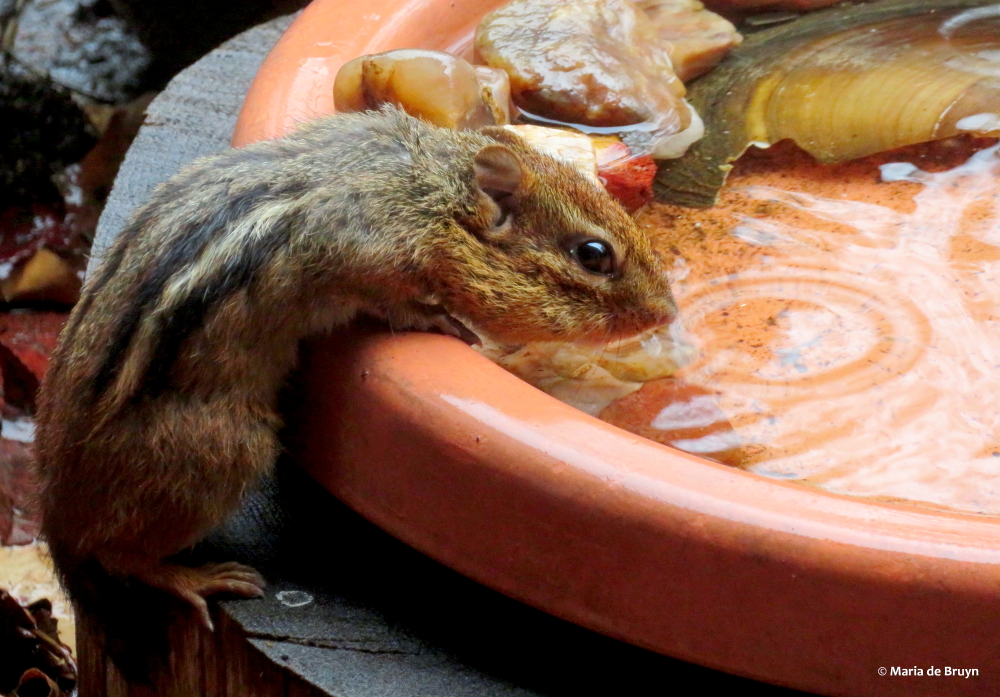
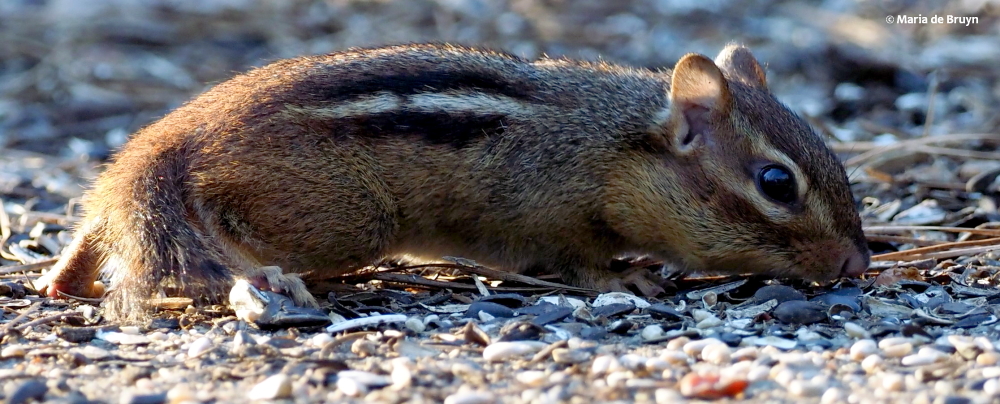
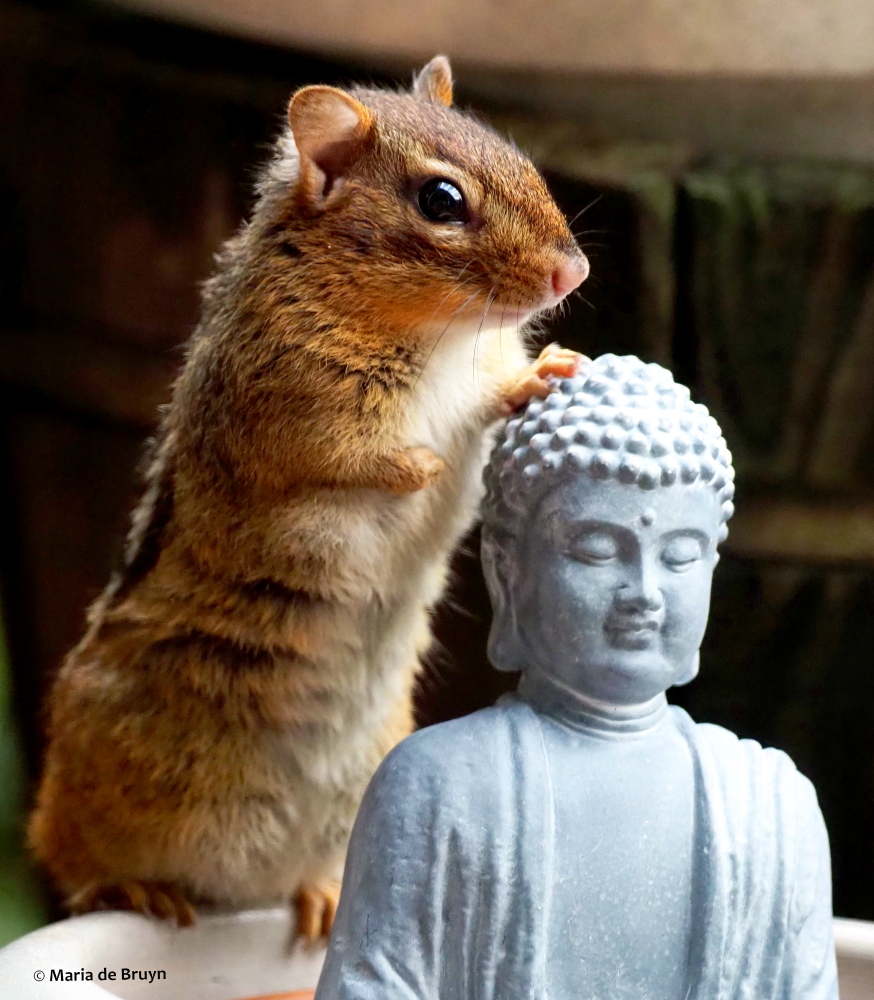
The Eastern chipmunks (Tamias striatus) like to visit the front porch to see if there’s something of interest among the potted plants or to take a drink from a water source.

These cute little rodents are more than willing to mingle with the ground-feeding birds looking for seed under the feeders. They scurry away as fast as their little legs will carry them when birds of prey appear – and they can certainly run quickly!


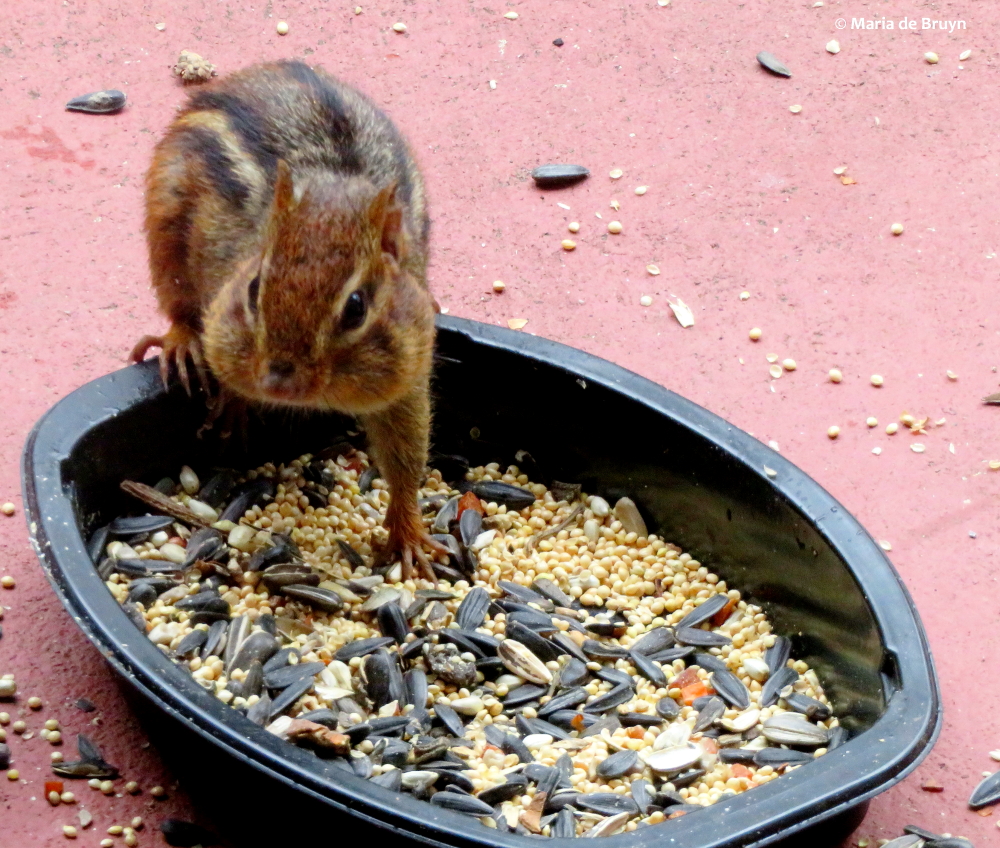
When it’s very cold, I sometimes offer them a small tray of seed just for themselves on the porch. They scarf down the goodies, filling their cheek pouches to what seems like almost bursting before dashing away to store the goodies for later consumption.


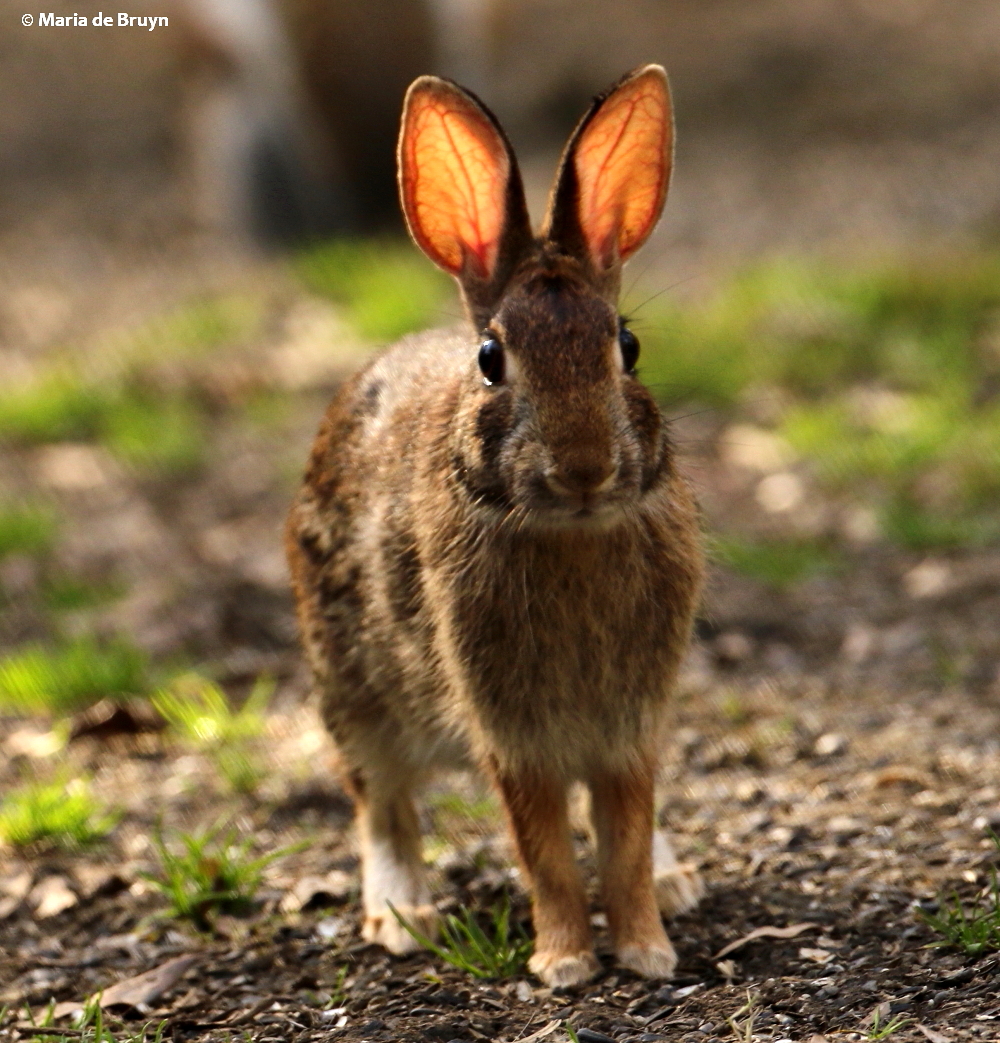
A pair of Eastern cottontail rabbits (Sylvilagus floridanus) lives in my yard and both mom and dad are very good about taking care of their young. I don’t see them much in the winter but expect they will be out and about again in the spring, doing their “leapfrogging” courtship ritual.

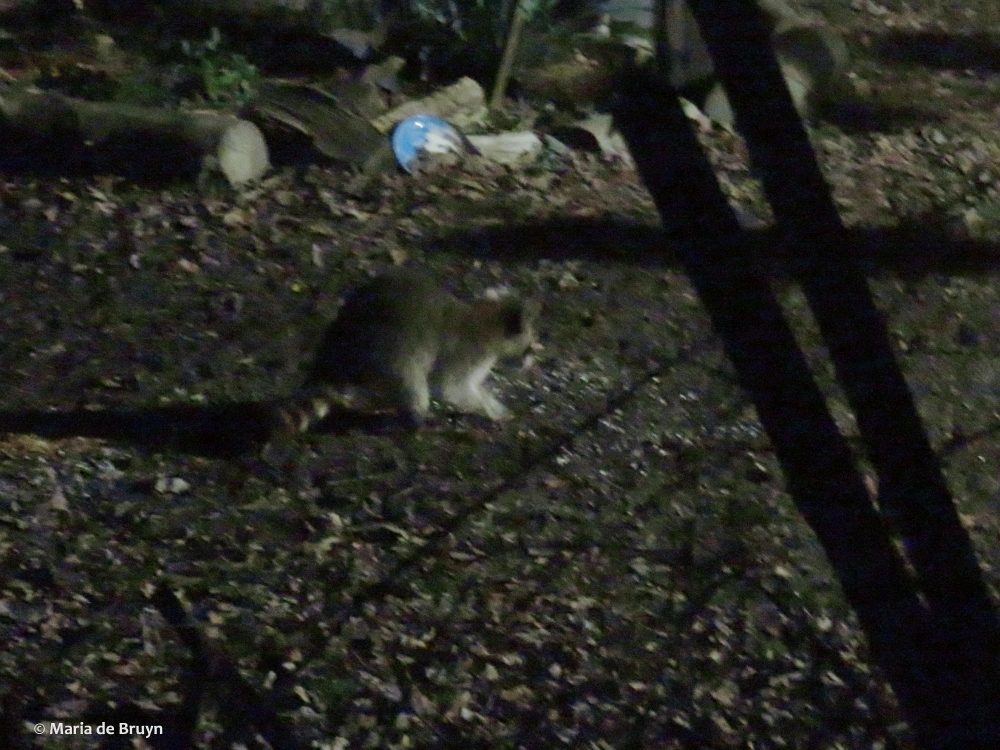
When it’s breeding season, I may see raccoons (Procyon lotor) in the daytime but lately they have been coming to the yard at night to pick up whatever seed is left on the ground from the daytime visitors. My wildlife cam caught a not-so-clear photo of this happening.

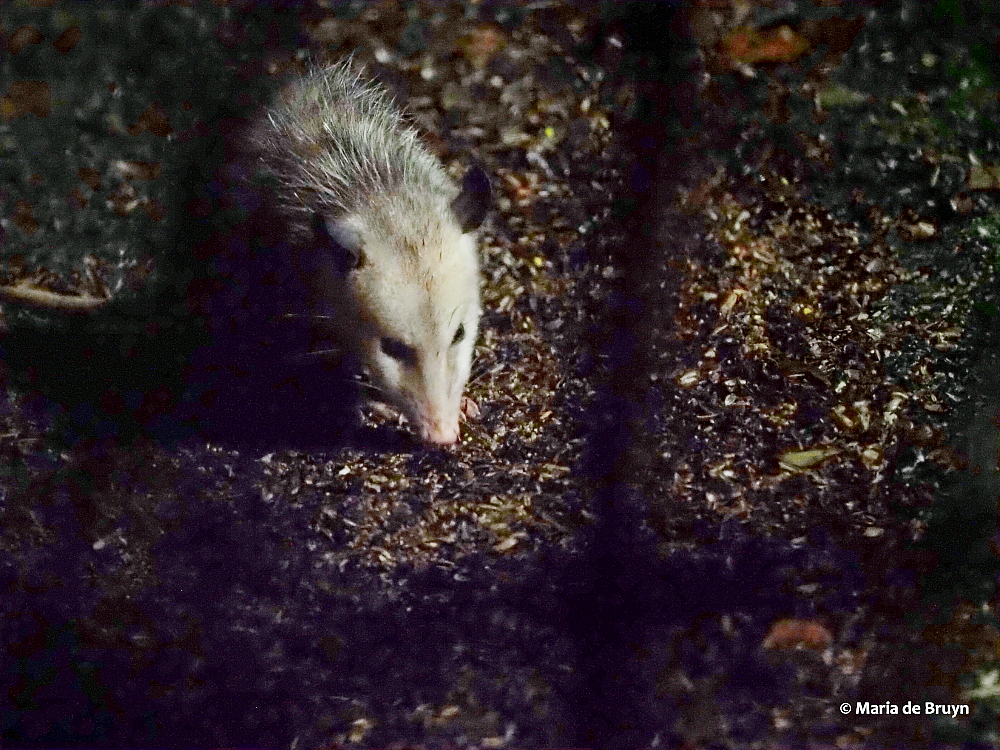
Another visitor who mostly comes at night is the opossum (Didelphis virginiana), one of my favorites given their propensity to eat lots and lots of ticks! Many people seem to think that they are ugly or scary, but I actually think they are kind of cute.

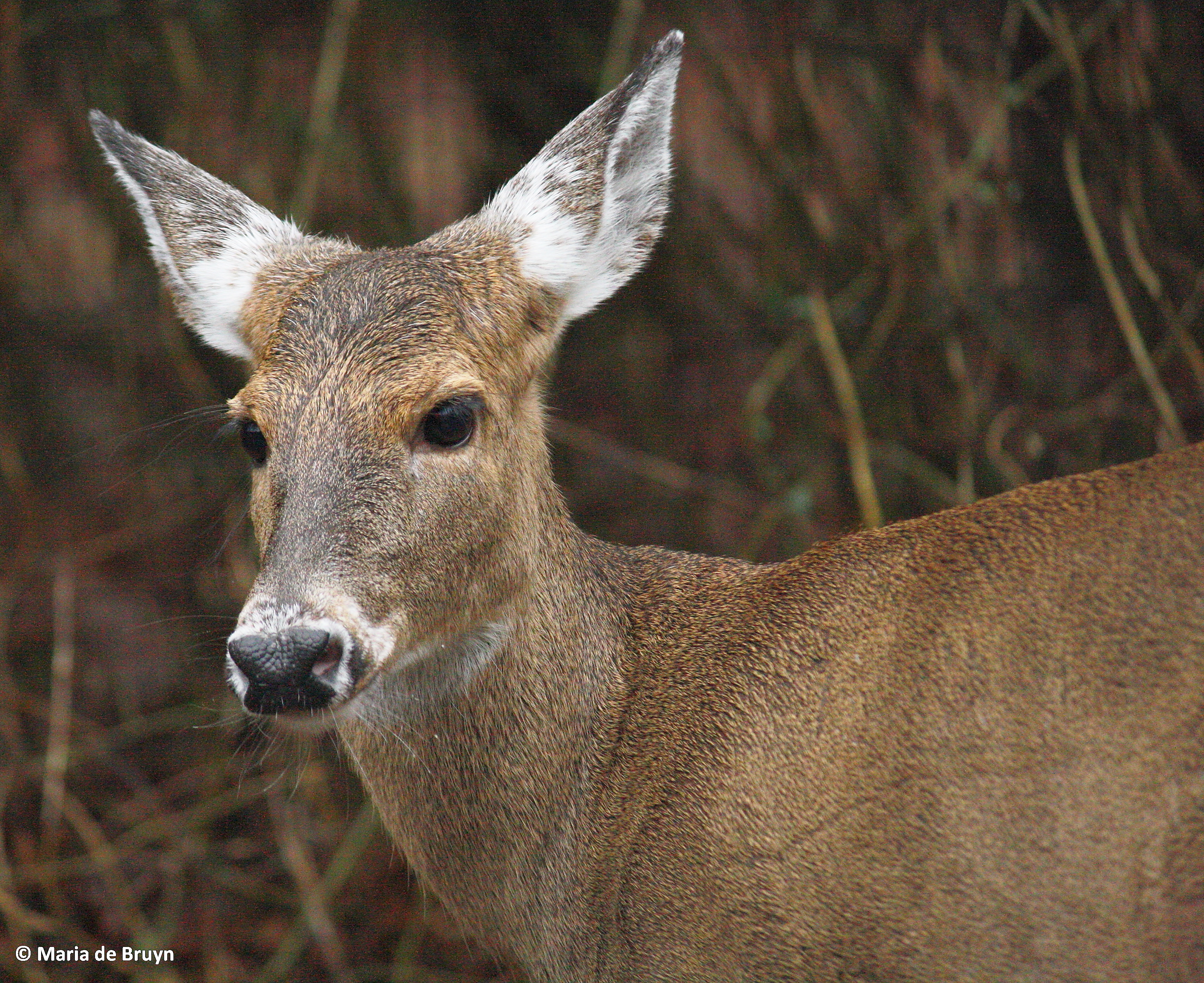
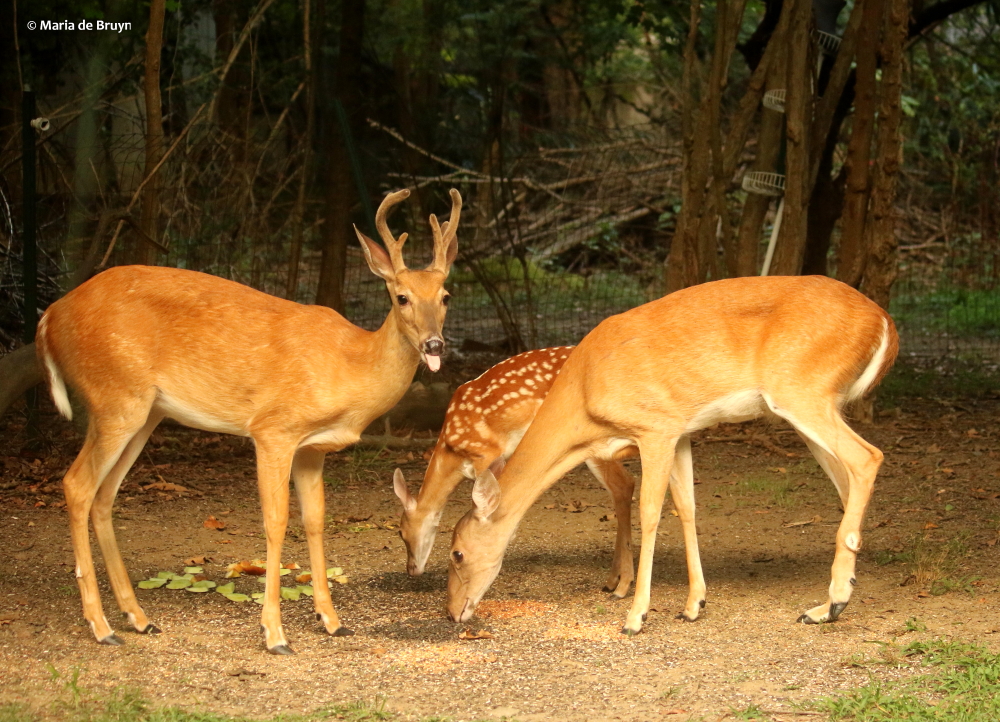
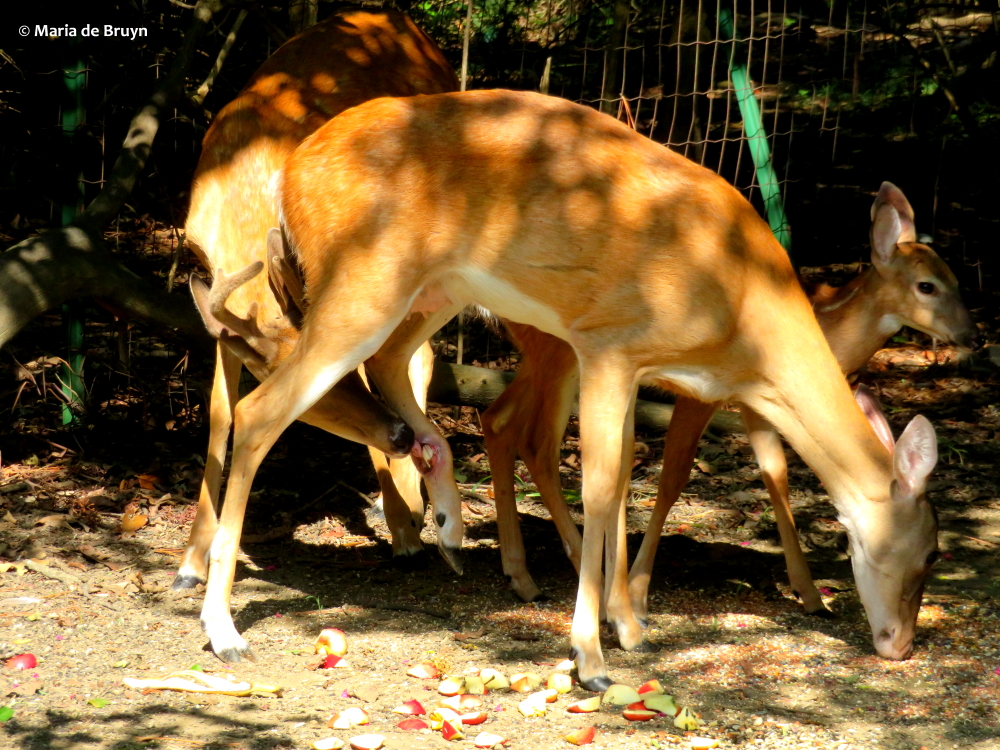
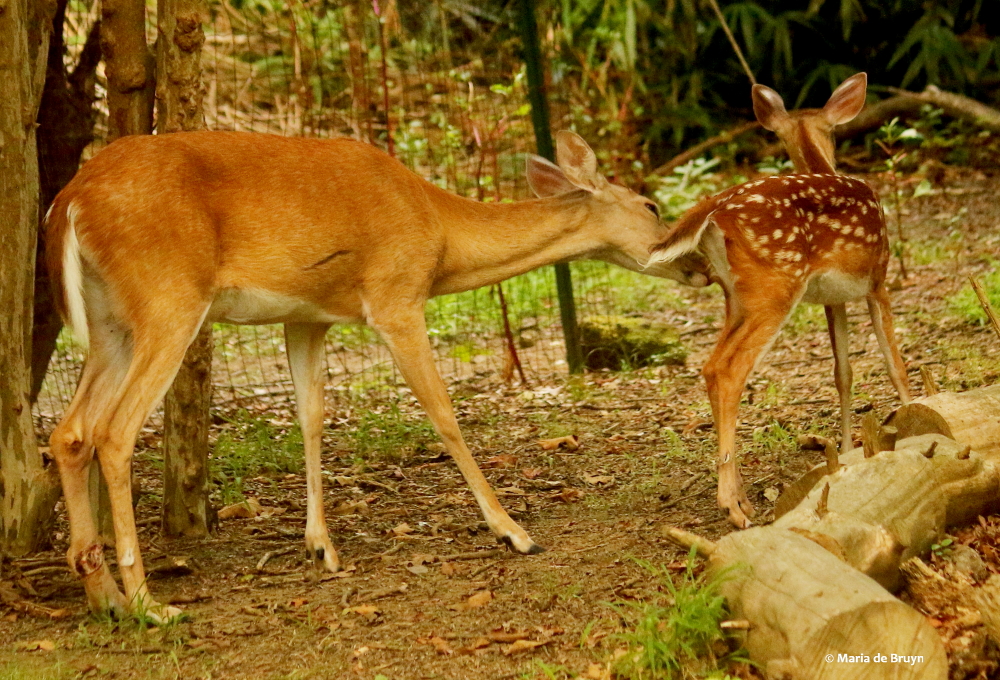
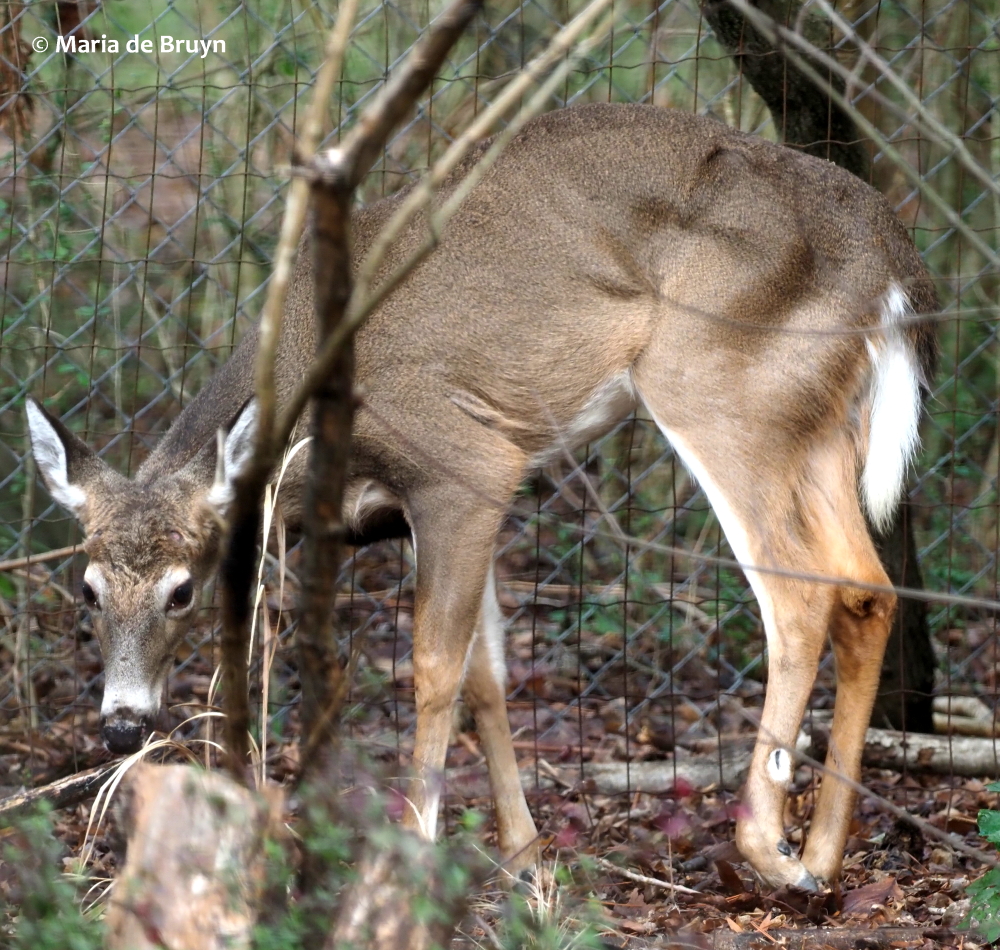
The largest mammalian visitors I see daily are the white-tailed deer (Odocoileus virginianus). I’ve loved them ever since I got to know a particular individual, whom I named Schatje (Dutch for “dear”). She approached me when she was a yearling and made friends with me, sitting next to me in the grass and thereafter bringing her newborn fawns to the yard right after their births. She unfortunately died in a car accident after some years, but through her I learned to really appreciate these mammals.

Some people dislike deer intensely because they eat their flowers and prized shrubs. But I’ve found that consistent application of a deer repellent on my plants keeps them off the vegetation that I want to preserve. Also, I let them eat bird seed and sometimes apple slices that I put out for the ground-feeding birds like white-throated sparrows, Eastern towhees, dark-sided juncos, American crows (the apple lovers) and brown thrashers.

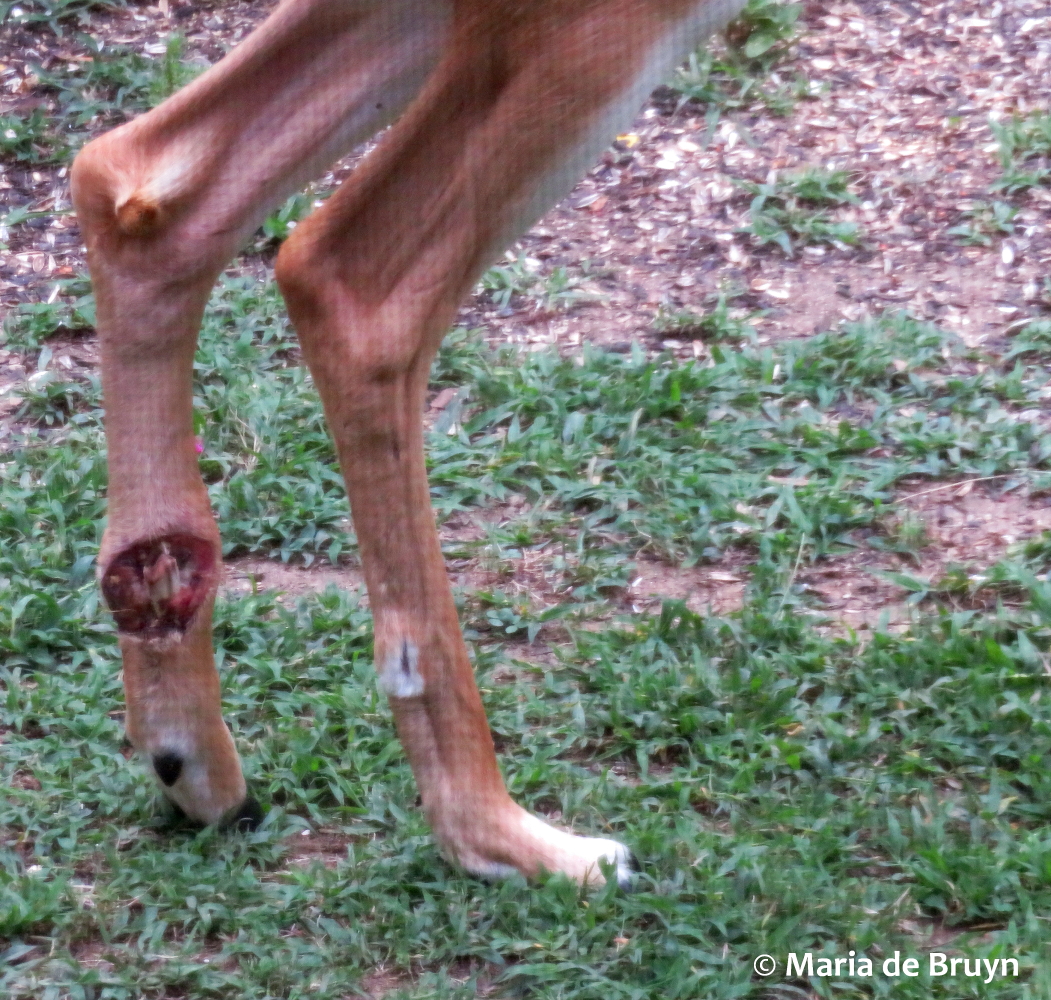
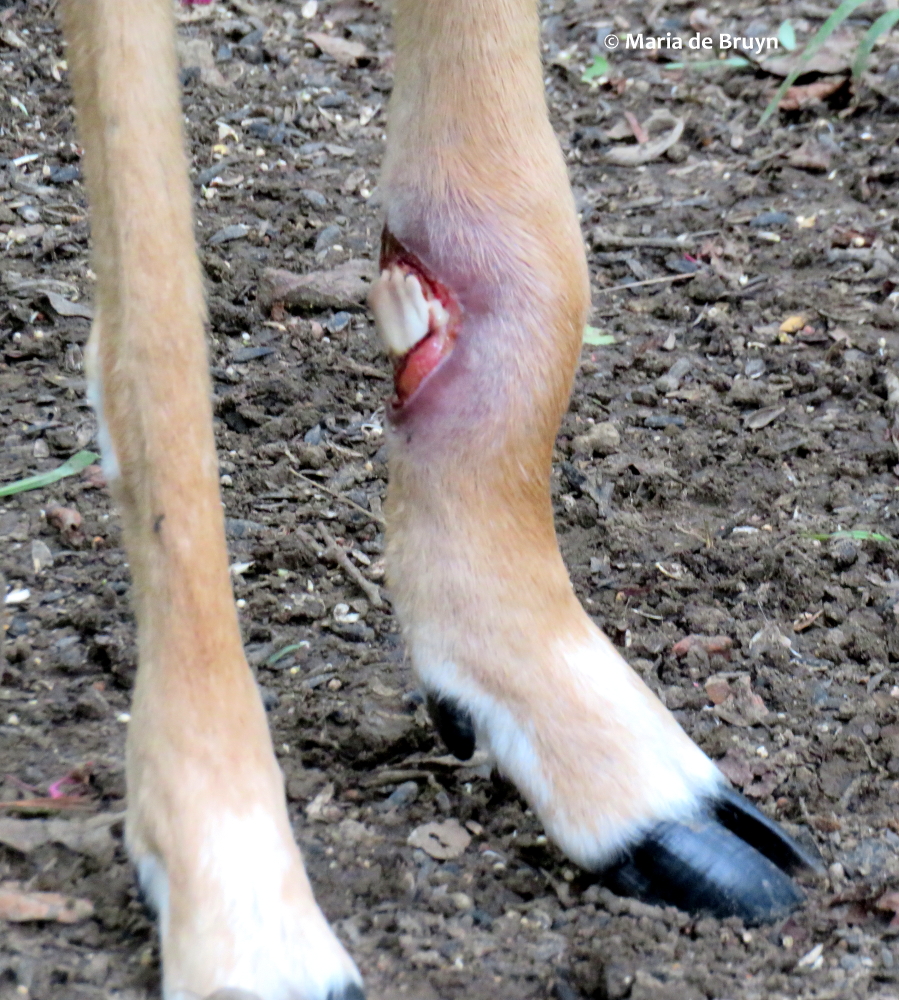
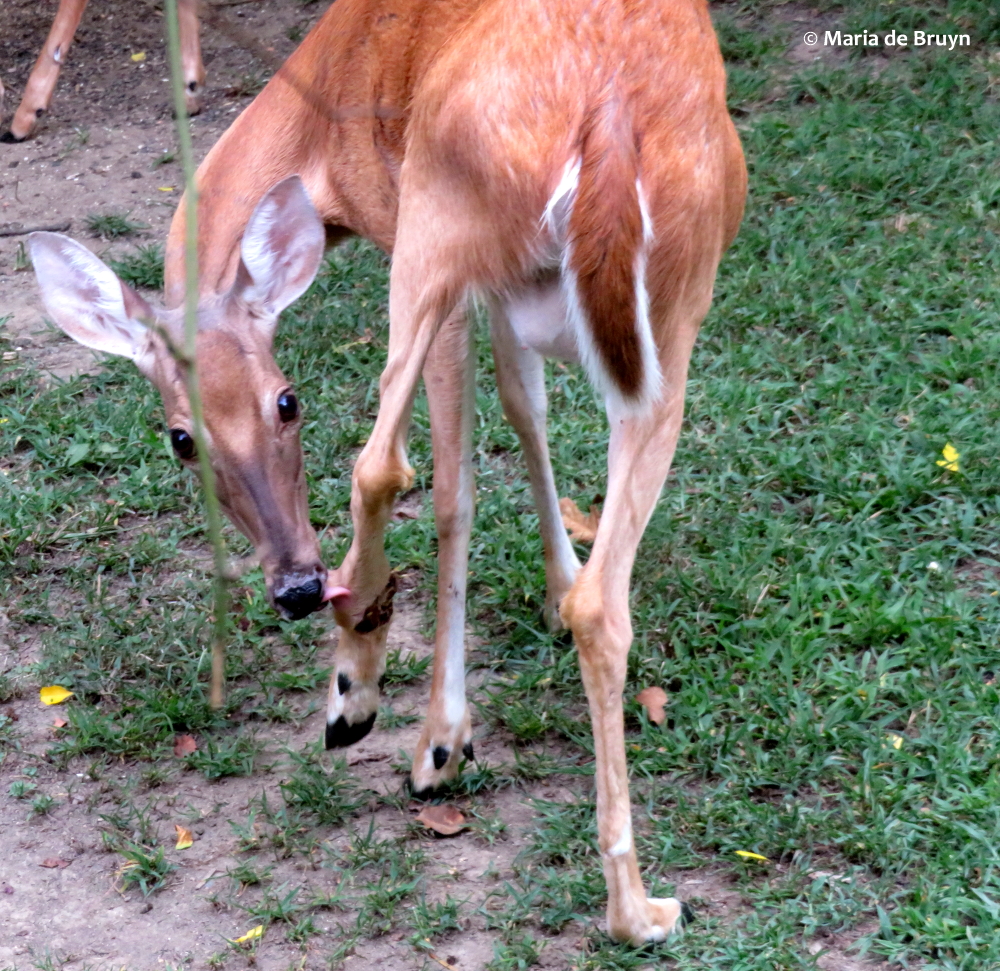
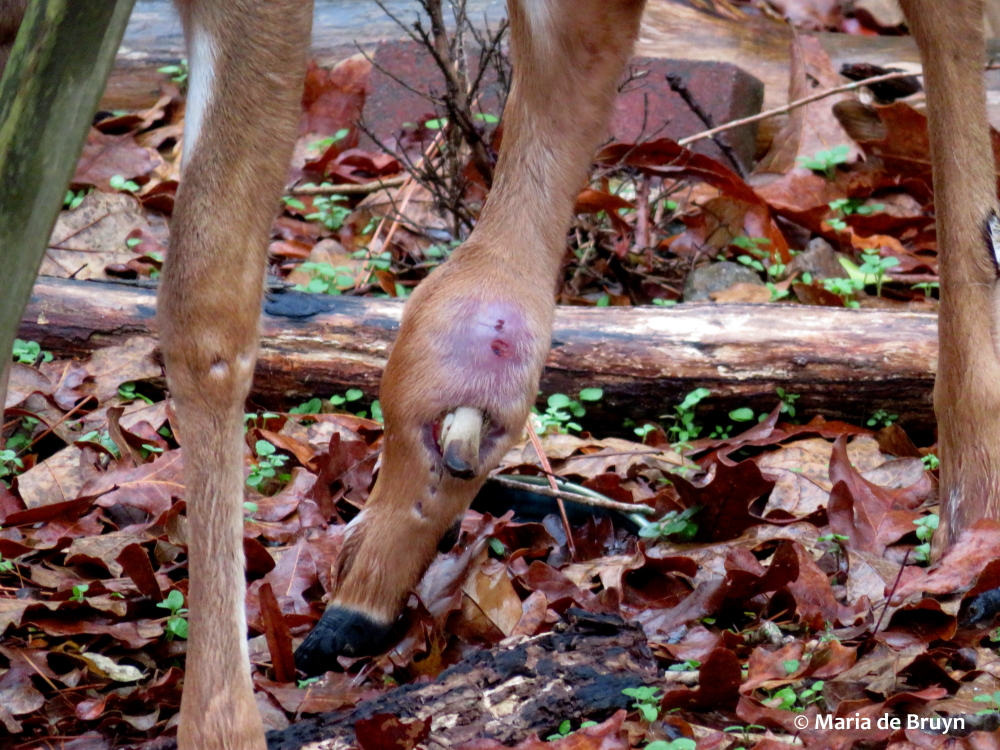
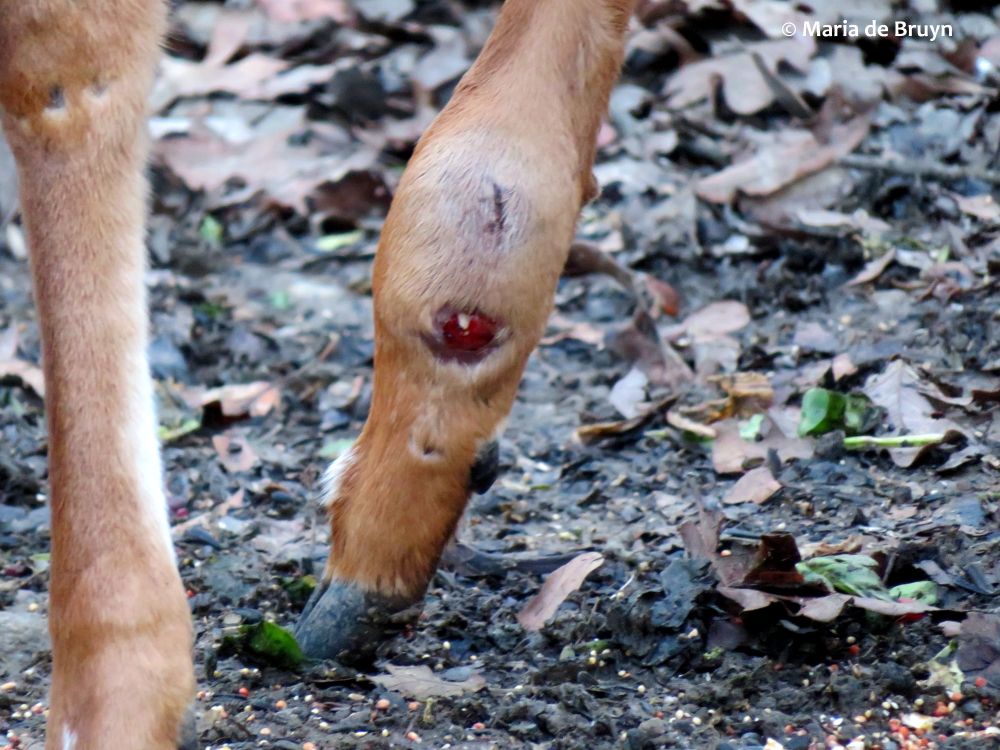
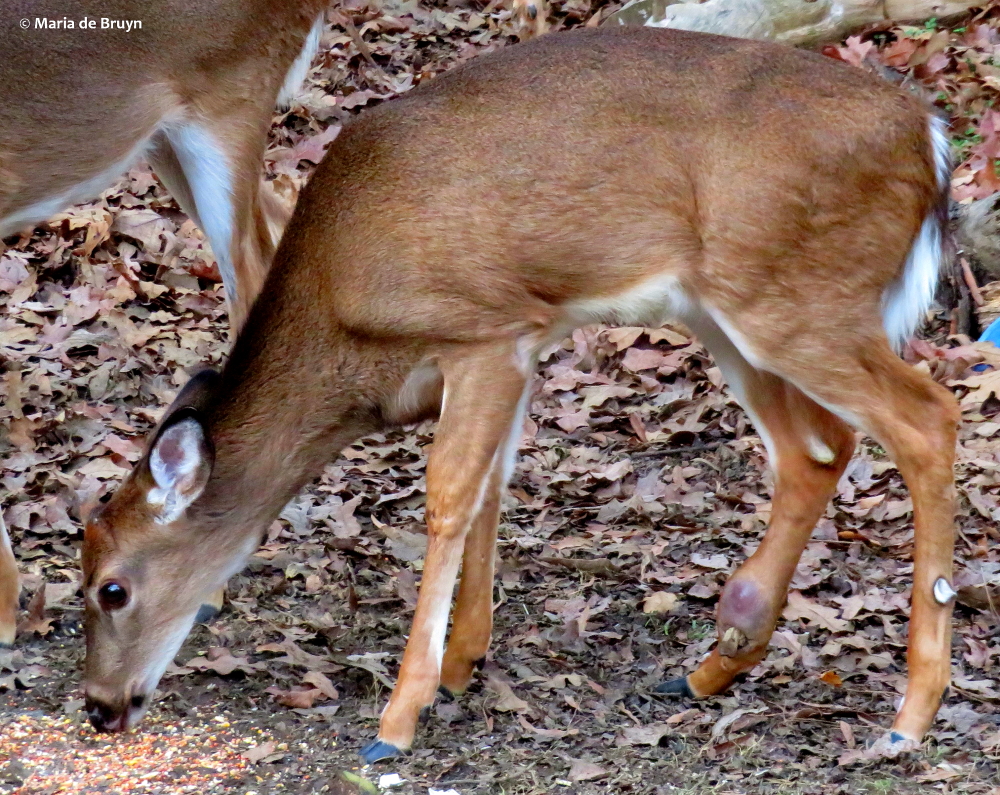
So I’ve been watching the deer for many years now and a very odd occurrence happened over the past half year. At least four deer have appeared with broken hind legs or feet. When “Mama”, a doe with twins, showed up with a terrible break on her leg, I wondered if it happened when she jumped a fence. The bone was jutting out and it was obviously very painful. She hobbled on three legs.

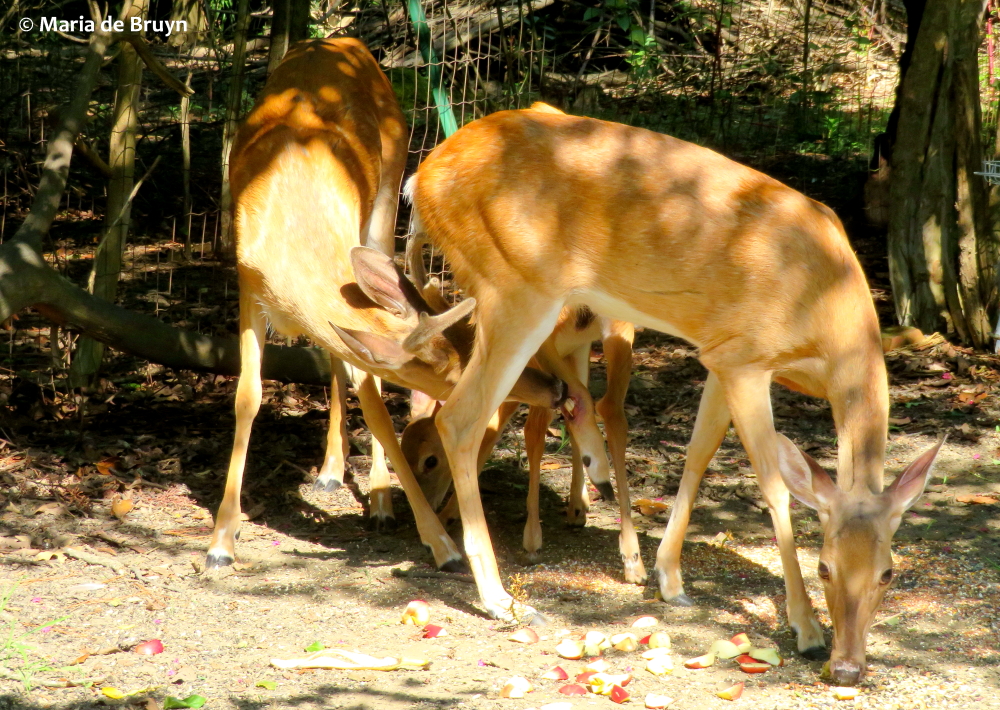
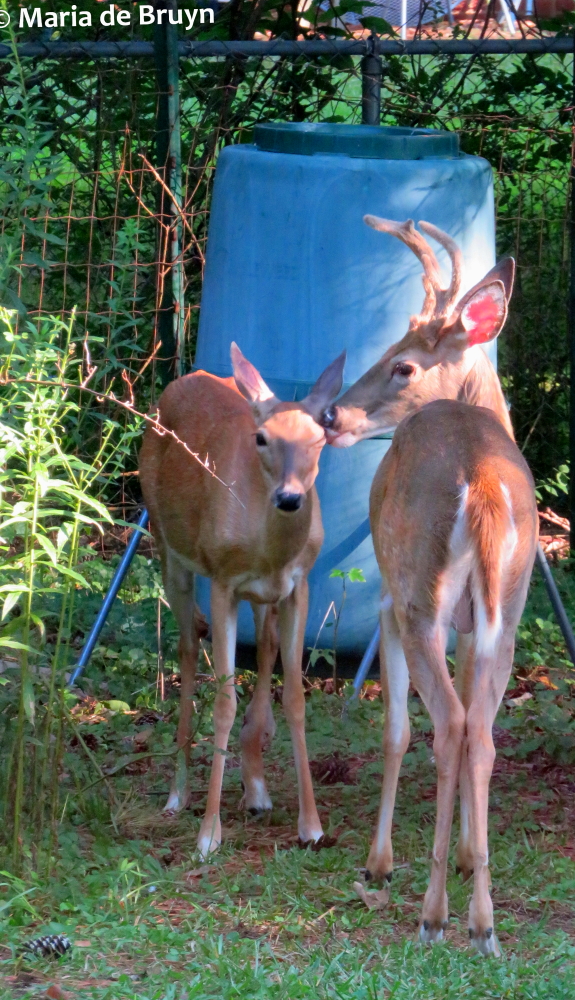
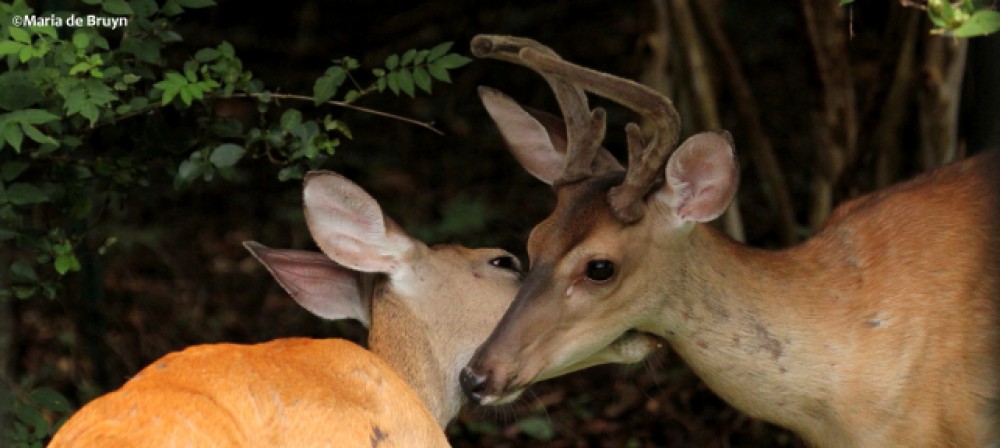
What was amazing was the fact that her two-year-old son began caring for her. He already had a nice set of antlers and by rights should have left to join the stag group in the neighborhood, but he stayed with her and tended the wound, licking it, and also grooming her! I had not heard of a stag doing that before, so I named him Sweetie. He stayed with her for months!

Mama kept caring for her twins (a male and female). (The past couple years, she had only had male offspring so that cut down on the number of deer we might otherwise have had). And she tended her wound on her own as well.

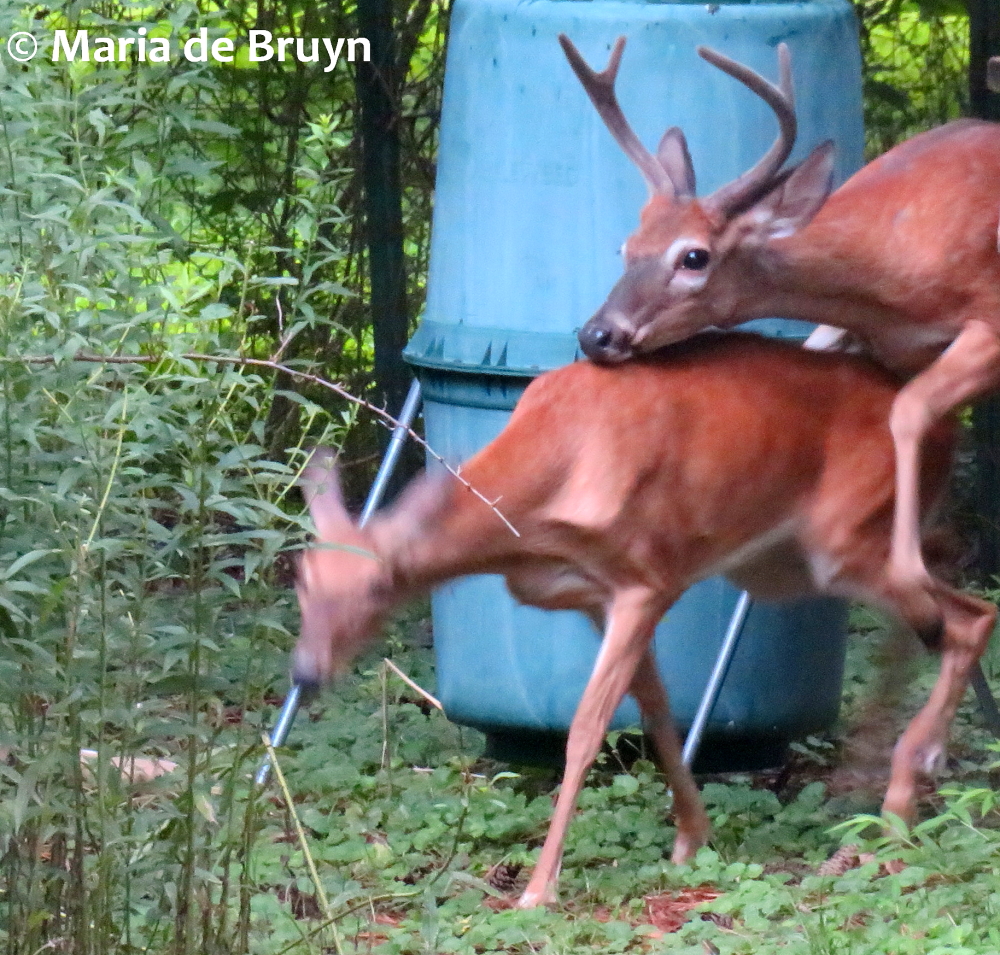
Mama also had to withstand the advances of the dominant neighborhood stag, who was intent on mating with her. Sweetie tried to be there to fend off the interloper, but he had to give in and move off as he was no match for the big buck. Mama tried to get away, but he kept trying to mount her – unsuccessfully, since her back quarters would collapse as she could not bear any weight on the broken leg. She finally got away and ran, which must have been terribly painful for her.


Mama could not stand up for herself with the hurt leg so she began being bullied by another doe who showed up. That deer, who I called Bossy, was ill-tempered and a bit nasty; she even would chase her own son away from seed on the ground, even when her son also got a broken leg!

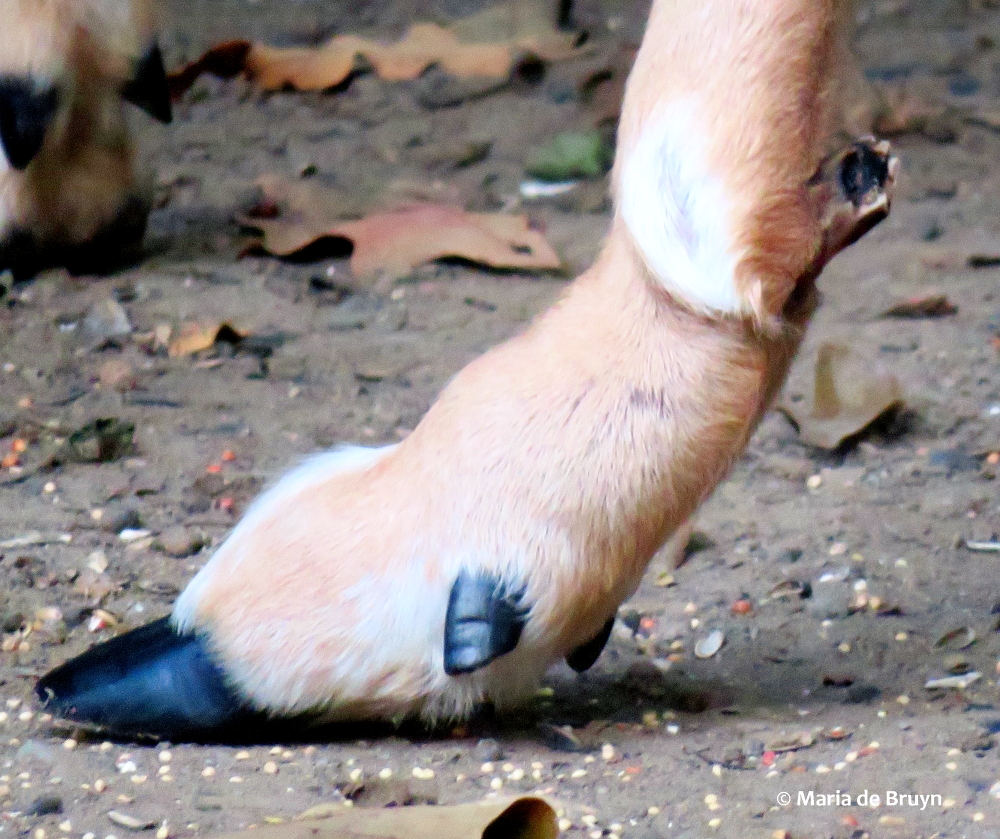
Then two adult males turned up with breaks – one had a broken foot. I wondered if someone was feeding them deer corn, which can be bad for their health and affect their hooves so that perhaps leg breaks would happen more easily. Or was someone taking potshots at them? It remains a mystery, but I’ve learned that the deer can overcome something like this although the healing takes months.

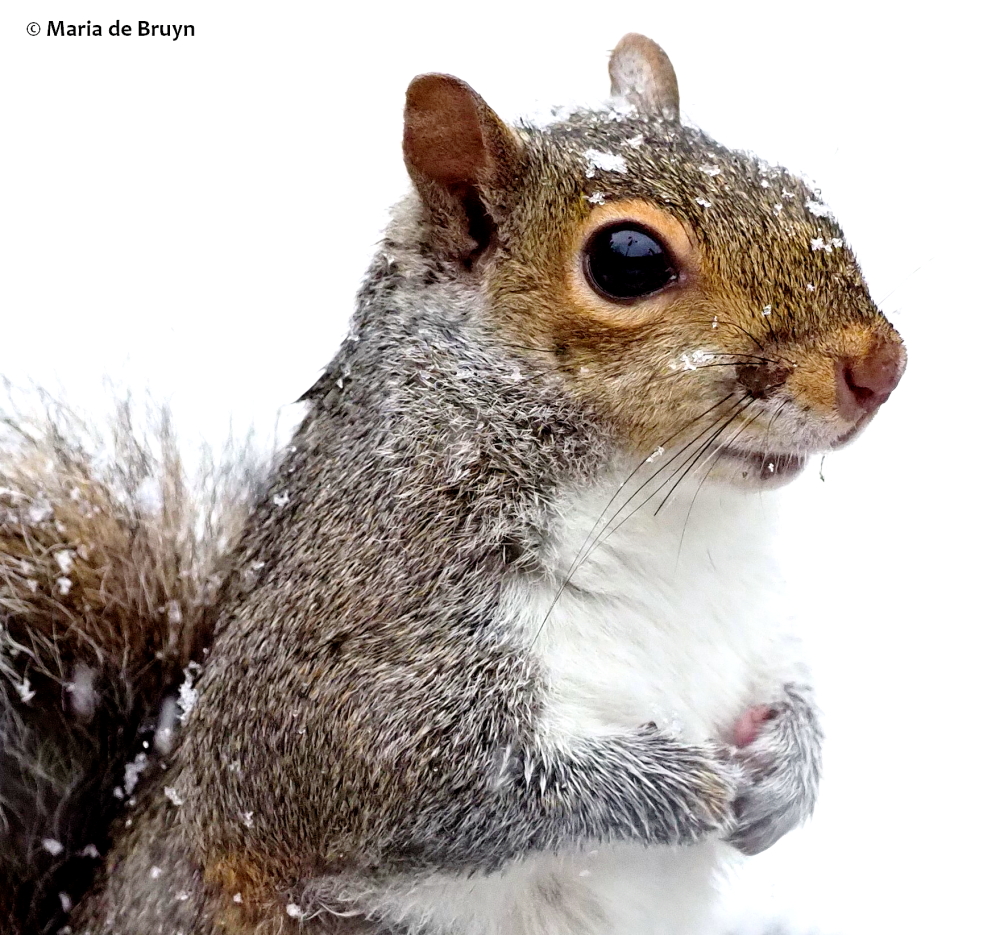
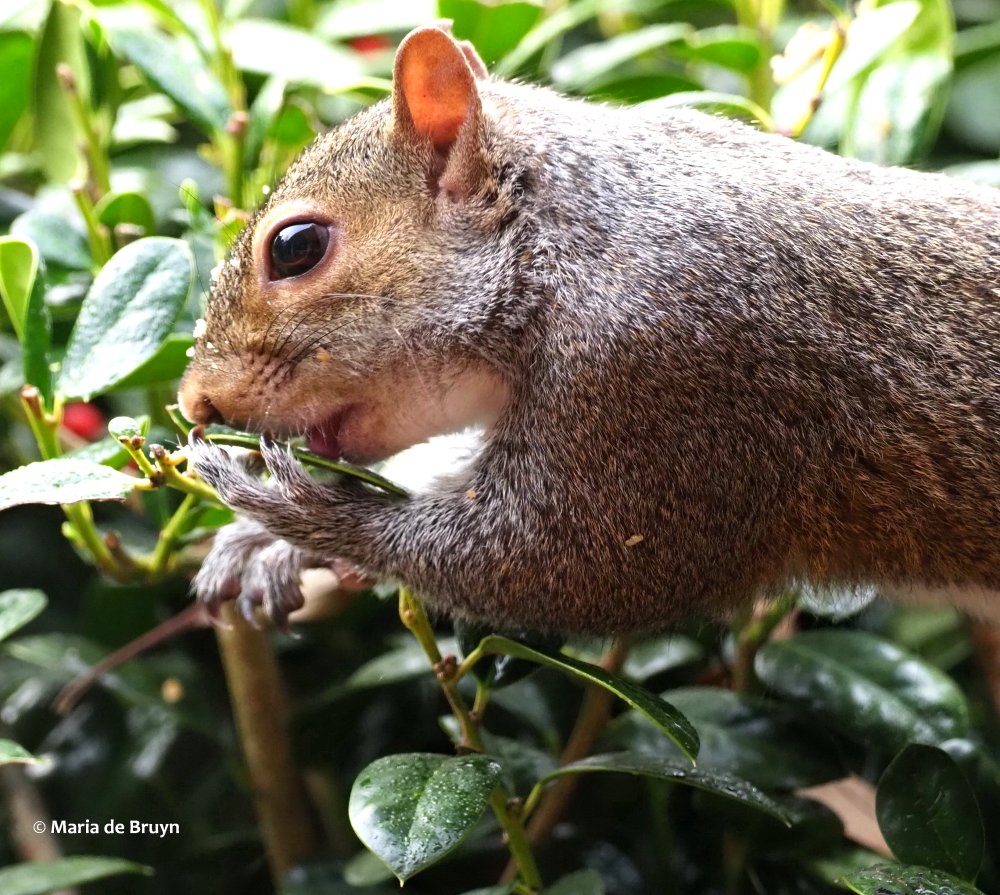
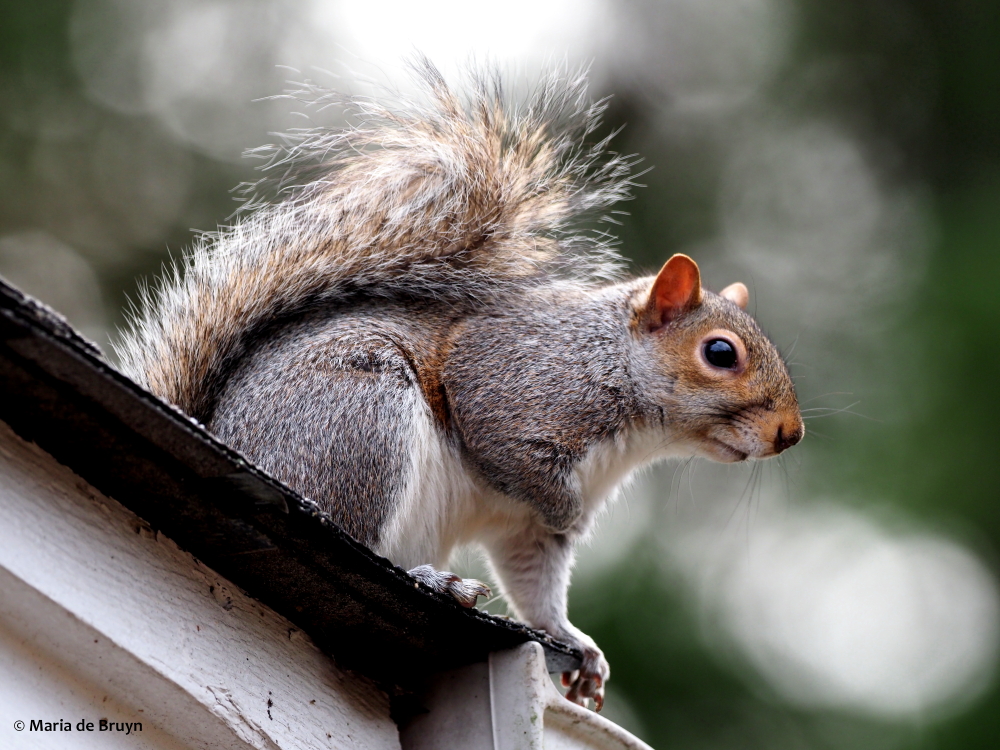
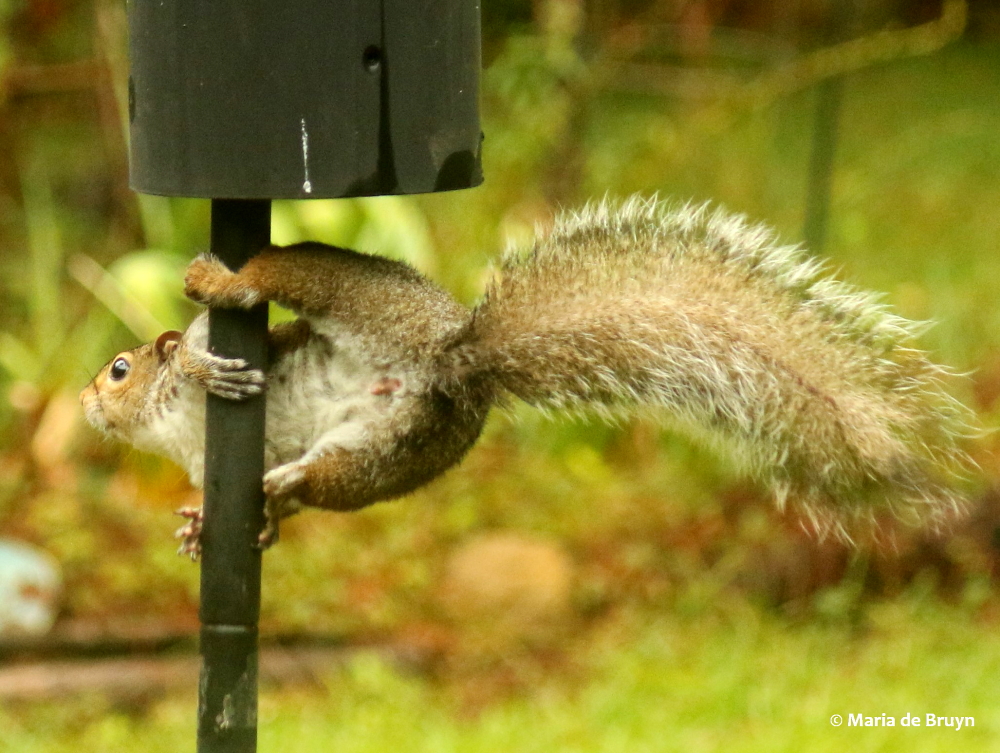
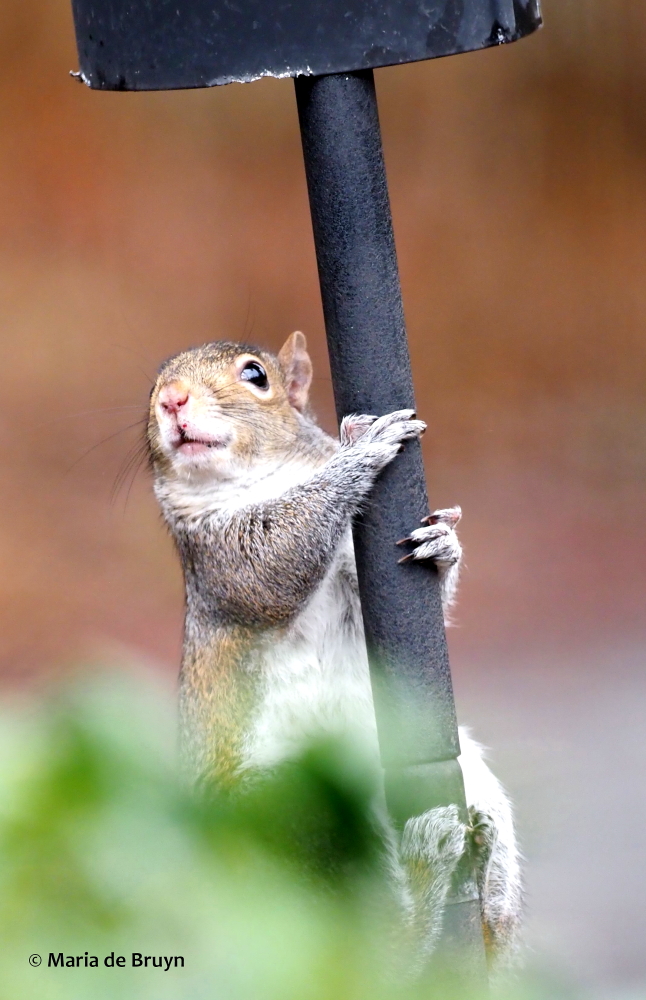
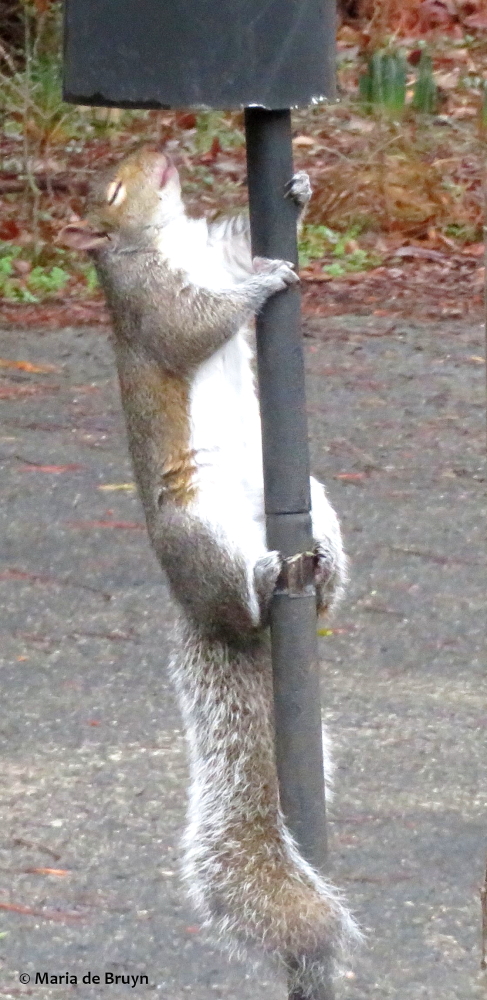
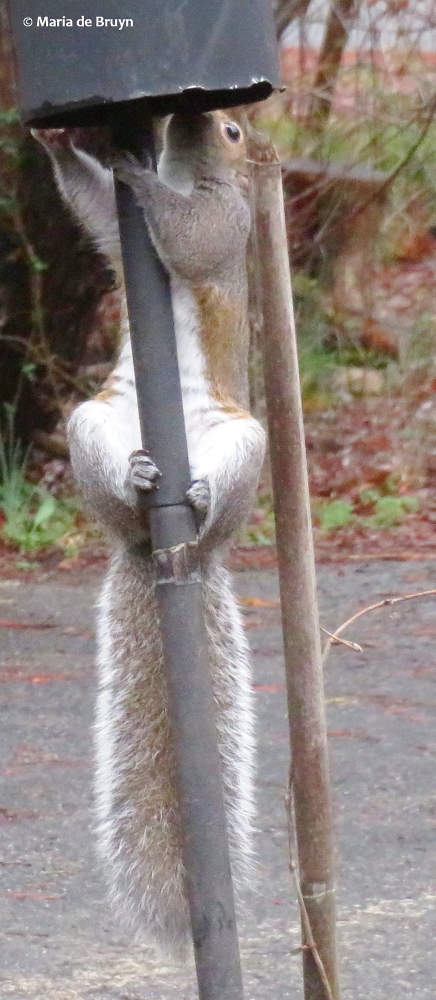
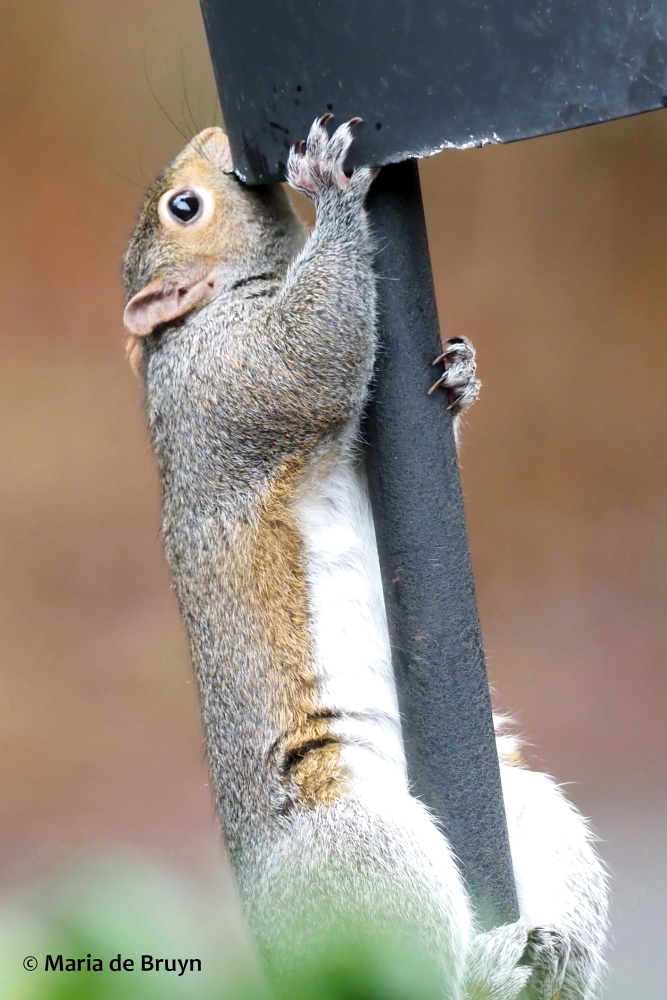
And then we come to my “nemesis” yard mammal, the Eastern gray squirrel (Sciurus carolinensis). As all bird-feeding people know, squirrels will do their utmost to eat all and any bird food that is put out — this has generated an industry devoted to producing squirrel baffles and “squirrel-proof” feeders. Even when I had smeared a bit of suet on a holly bush for the ruby-crowned kinglet who was sometimes crowded away from the feeder, a squirrel discovered the treat there and consumed what s/he could.

I’ve been fairly fortunate in having the baffles work until recently, when a couple squirrels used their little brains to figure out ways to get around them. It was my belief that I had put the feeder poles sufficiently far from the roof or large tree branches so that the squirrel couldn’t make the leap. One kept trying over and over and finally succeeded in lengthening his/her “long jump”!

I moved the poles further away. But two poles were about five feet apart and I then saw a squirrel use a strategy that really looked very clever to me. S/he would take a run at one pole, launch him/herself onto the pole at high velocity just under the baffle and then turn to vault from that height up and over the baffles on the neighboring pole! I really did admire the creature’s ingenuity and gained a new respect for their intelligence.
After moving the feeder poles further apart, I then noticed that a couple feeders on one pole were being emptied quickly. Looking out my window one day, I saw a squirrel perched atop the pole, enjoying seed after having managed to move the baffles down the pole. How was s/he doing that?


I set aside time to watch and discovered the squirrel’s secret.


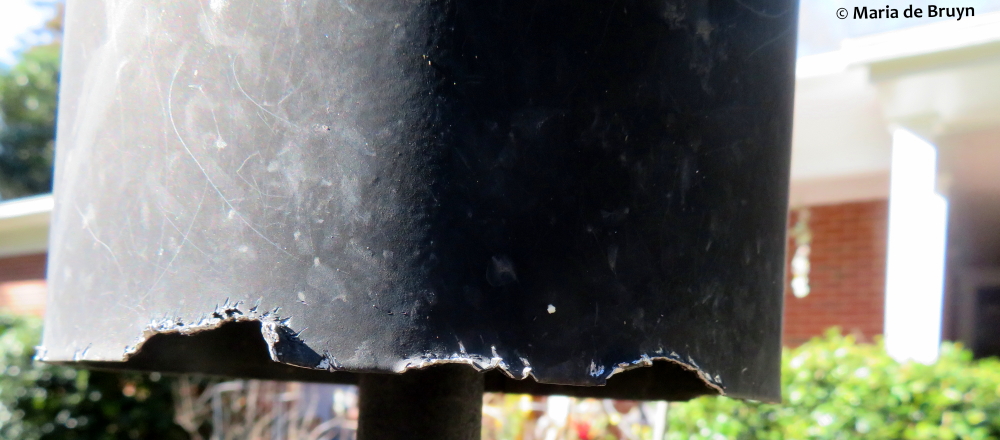
The animal was hanging onto the raccoon baffle, biting it and jerking down at the same time. This eventually loosened the screws in the apparatus on which the baffle rested so that the baffle finally slid down the pole!


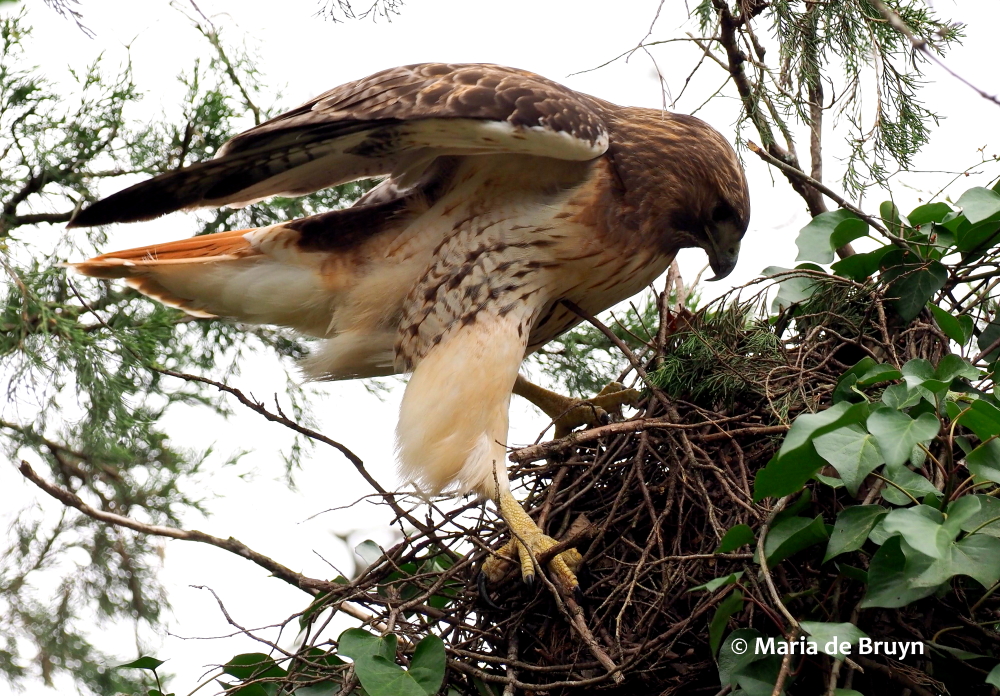
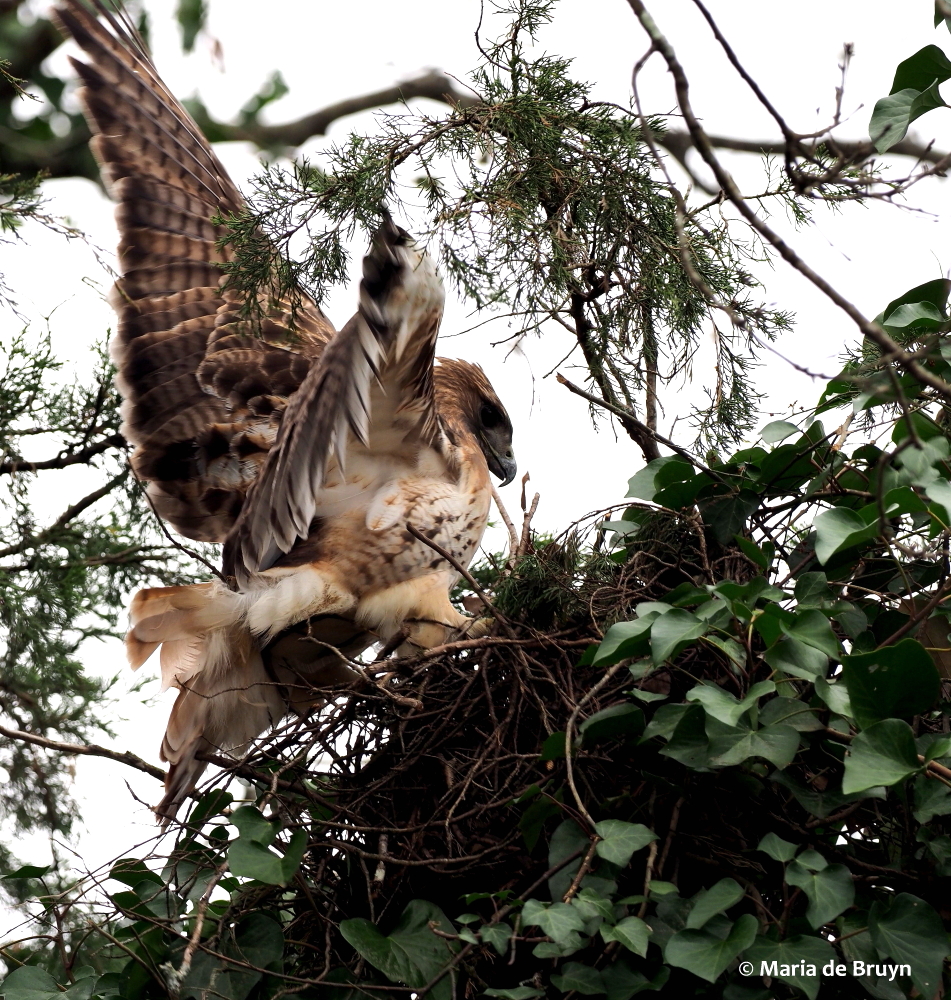
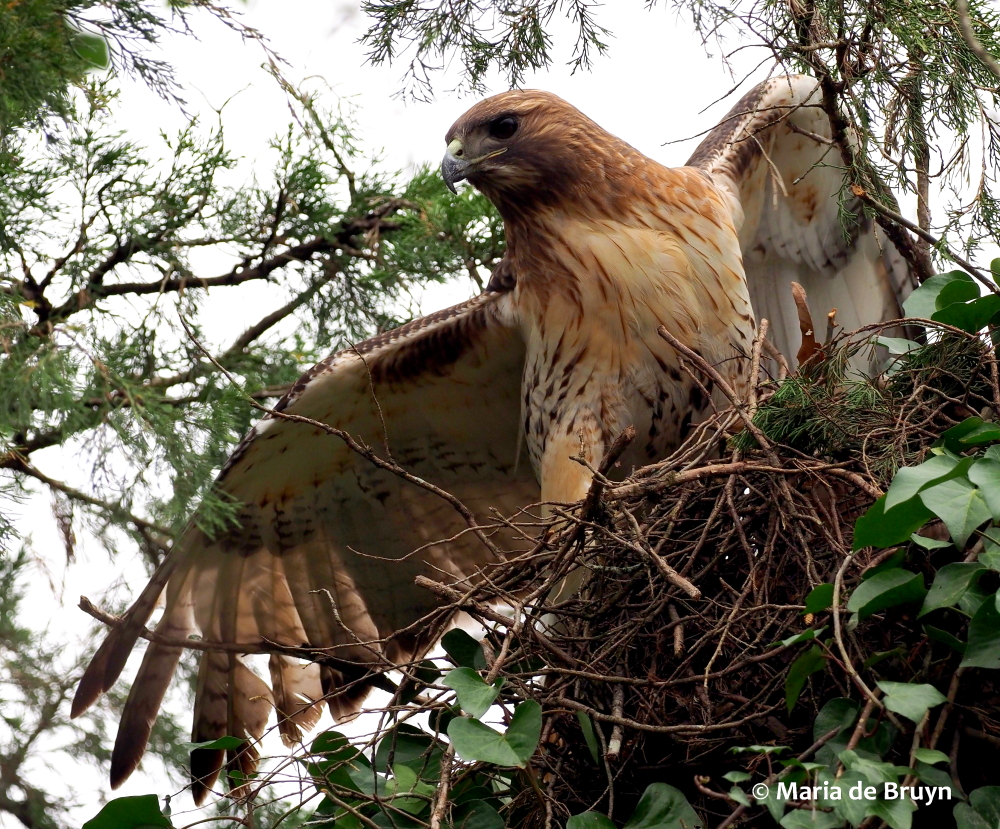
The screws have now been tightened and the next move is up to the squirrels. They are clever and tenacious. This was further brought home to me when a red-tailed hawk (Buteo jamaicensis) recently landed on a squirrel nest and did its best to extricate the mammal with its claws. The hawk eventually had to leave without its envisioned meal.

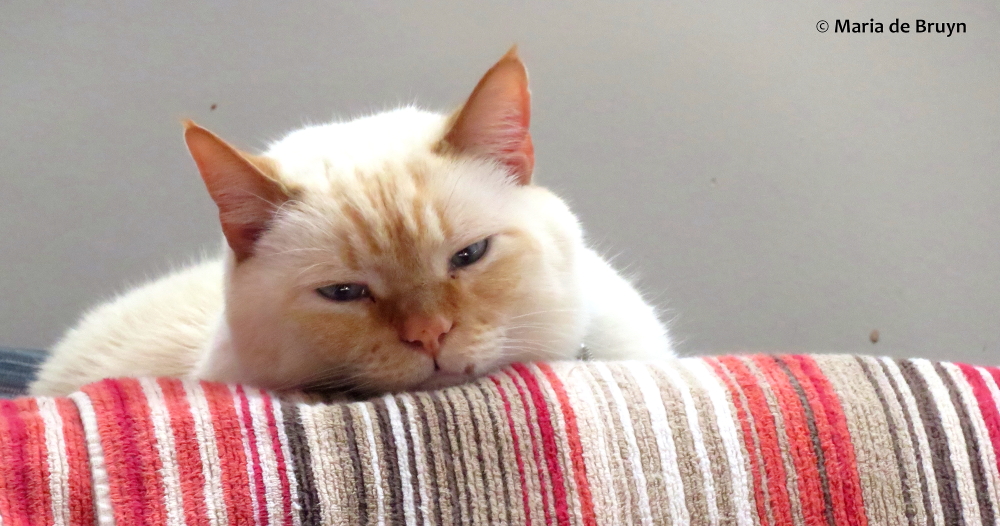
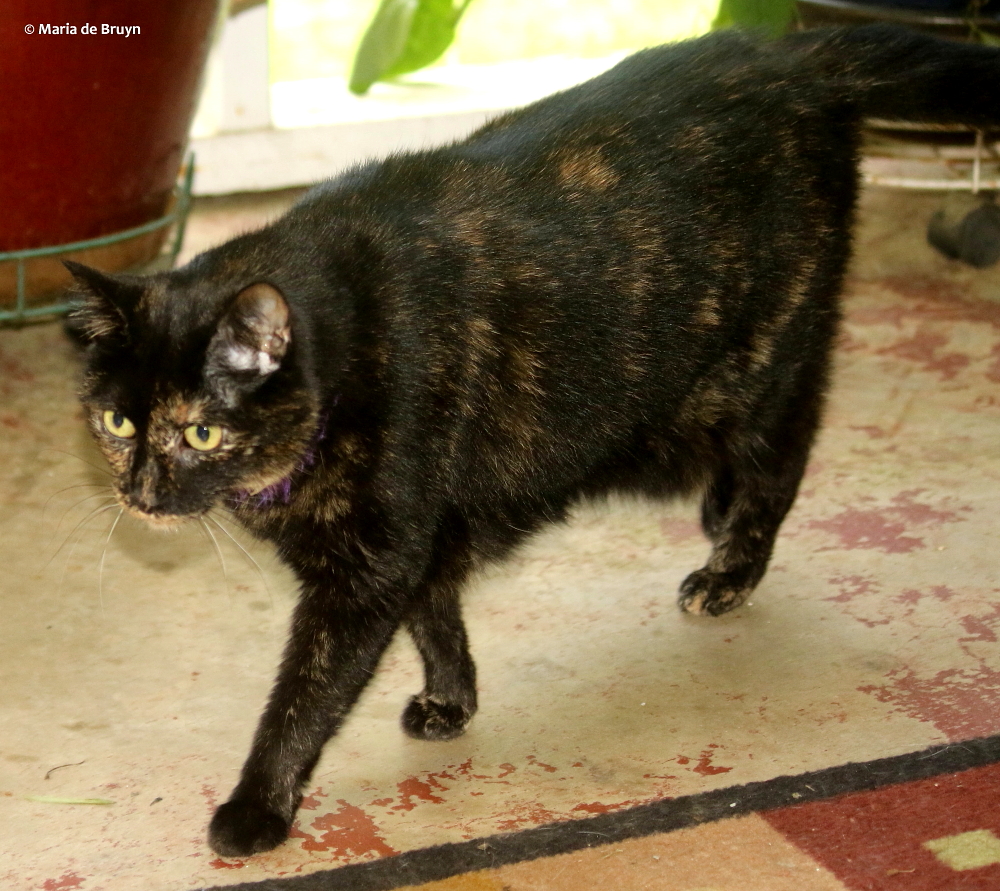
The yard mammals are certainly entertaining. If any of you readers have had interesting experiences with them, I’d love to hear about them in comments on this blog’s page! (Except for cats running free outside – goodbye from my two indoor cats, Ogi and Moasi!)