Costa Rican rambles 6A – Los Cusingos

Finally, back to Costa Rica (in memory)! The past couple months were very busy and often stressful for me, so it is so very nice to again look back to the wonderful days we had looking for Central American birds (and other wildlife) in Costa Rica. On the fourth day of our 9-day trip, we moved to another hotel for a couple nights, stopping several times along the way to bird along roads. The photos from this day were not that great, but they do provide an impression of what we were seeing.

Before we left, we birded the grounds of the hotel where we had spent the night. There were some pretty flowers and a white-crested coquette hummingbird (Lophornis adorabilis), as well as a rather large long-horned borer beetle (perhaps Callipogon barbatus species, but that’s not certain).

We spent some time peering into a rather dark and dense brushy area, looking for uncommon wrens. I was able to photograph a rufous-breasted wren (Pheugopedius rutilus) with some difficulty. Then, just before boarding our bus, a yellow-headed caracara (Milvago chimachima) perched in a nearby tree, giving us some nice views.


Our first stop, however, was a park called Los Cusingos, which is a property formerly owned by US botanist Alexander Skutch. He lived there for 63 years until his death at the age of 99 years. While Skutch earned an income collecting plants for museums, his passion was birds and he wrote more than 40 books and 200 papers on ornithonology.


Now his former home is part of a bird sanctuary run by the Tropical Science Center and you can see a variety of birds, like this buff-throated saltator (Saltator maximus) and the yellow-olive flycatcher (Tolmomyias sulphurescens).


The staff had put out fruit on a feeding station to attract birds and this brought in several, including a female Cherrie’s tanager (Ramphocelus costaricensis) and a golden-hooded tanager (Tangara larvata).


The station was also very attractive to a red-tailed squirrel (Sciurus granatensis), who was not in the least perturbed by our presence nearby.

We set off onto the trails in search of new avian species but also had time to admire many types of trees and plants, which I still must identify. Some had very sharp spines.

The dense foliage with a little sun creating dappled views made photography a challenge for me. But I did get a couple photos of a little bird called the plain xenops (Xenops minutus).

As we hiked, a few beautiful butterflies appeared; the one with orange spots was, I believe, a crimson patch (Chlosyne janais) and the other was a zebra-striped hairstreak (Panthiades bathildis).

A chestnut-sided warbler (Setophaga pensylvanica), familiar to me from North Carolina, put in an appearance and a lovely little lesser greenlet (Hylophilus decurtatus) peered out from some large leaves.

A summer tanager (Piranga rubra), which I’ve been lucky to have in my own yard, was a pleasure to see, as was a spot-crowned euphonia (Euphonia imitans).


One of my favorite birds, of which I unfortunately had blurry photos, was the entertaining red-capped manakin (Ceratopipra mentalis). He stayed very high in the canopy and was sometimes behind leaves but, when he emerged, he did a great sideways moonwalk back and forth on the branch, which was part of his courtship behavior. What a very cool sighting!


Back near the entrance to the reserve, there were some lovely orchids and a brilliant green honeycreeper (Chlorophanes spiza) to see us off as we set off on the road – to be continued in the next blog!


Costa Rican rambles 3 – Parque Nacional Los Quetzales and Miriam’s restaurant

Our usual daily trip routine in Costa Rica began on the first day: coffee and tea at 5:45 a.m. (except the last day when we had it at 4:30 a.m.!) – birding – breakfast around 7 a.m. – travel & birding – lunch around noon-1 p.m. – travel and birding – dinner/supper around 7 p.m. And on two nights we went owling after supper. One of our group members tracked our steps – over 8 days, we walked and hiked a bit more than 50 miles. This meant that although I ate more than usual, I didn’t gain any weight, which was an added bonus!

On the first day, we set off for the National Park Los Quetzales, passing small settlements and villages along the way. Between them, we saw the rolling hills and mountains covered with lots of vegetation – this was the end of the dry season, so when the rainy season begins the scenery must be even much more lush.


We were going to see several species of birds which are endemic only to parts of Costa Rica and Panama, which was a treat for the birders who keep life lists counting how many species of birds they have seen.

The day had an overcast start, which made photographing the birds at Los Quetzales a bit challenging. Sometimes they blended in really well with the vegetation in which they perched and discerning them was a bit of a feat (especially if you don’t have binoculars). One of the first birds we found was the slaty flowerpiercer (Diglossa plumbea). The male has a rich blue-gray color while the female is a much drabber olive gray – it was her upturned beak that helps her pierce the base of flowers for nectar that helped me ID her in the photos.


The black-capped flycatcher (Empidonax atriceps) gave me some issues, too, until one finally alighted atop a plant – giving me a chance for a quick, backlit photo before he flew off.

There were many flowering bushes and shrubs and bees were buzzing among them. A timberline wren hopped around these bushes, but I was unable to get a photo of her. I did succeed in getting some shots of a couple volcano hummingbirds (Selasphorus flammula), who were very active – challenging one another and hunting insects. These very small hummingbirds only breed in the mountains of Costa Rica and Panama; they are only 3 inches (7.5 cm cm) long and very quick flyers. One ended up posing for a while!


A sooty-capped bush tanager – also called a sooty-capped chlorospingus (Chlorospingus pileatus) was scurrying about the same bushes. At first, I couldn’t get any photos of him, but finally he emerged from behind some leaves. At our lunch stop, I was able to get a close-up photo of this species.


A large-footed finch (Pezopetes capitalis) made its arrival known as s/he perched in a nearby tree branch; a few hours later, I was able to get a closer photo of this bird, too. This is one of the larger birds we saw, almost reaching 8 inches (20.3 cm) in length.


Another larger bird, the sooty thrush (Turdus nigrescens) posed prettily atop a tree. These 10-inch long (24 cm) birds behave similarly to American robins, rooting around in leaves for insects and spiders.

The flame-throated warbler (Oreothlypis gutturalis) showed up nicely against the green foliage.


In some flowering bushes nearby, a fiery-throated hummingbird (Panterpe insignis) put in an appearance. These hummers are larger than the small volcano hummingbirds.  Like other hummers, their brilliant colors may only show up when the light rays hit their feathers at just the right angle. My only shot demonstrating a bit of their fiery beauty was unfortunately a bit blurry.


A black and yellow silky flycatcher (Phainoptila melanoxantha, below) was hopping around in a distant leafy tree and then finally emerged for a couple minutes before flying off to another leafy abode. In contrast to many of the other birds who dine on insects, these birds favor berries and plant materials. A yellow-winged vireo (Vireo carmioli, right) emerged briefly, rounding out our endemic species sightings.


Before leaving the park, I was lucky to see a forest forager (otherwise known as a branch bird) and some lichens growing on the ground. 😉

For lunch, we stopped at Miriam’s restaurant, a well-known birding station in the San Gerardo de Dota area. In addition to a very nice lunch menu, there are nectar and fruit feeders behind the eatery, which attracted a large number of birds when we first visited (a return visit a few days later had very few birds – perhaps they were all busy with nests and insect feeding by then). Besides the rufous-collared sparrows (Zonotrichia capensis), there were gorgeous flame-colored tanagers (Piranga bidentata) – both males and females/immature males.


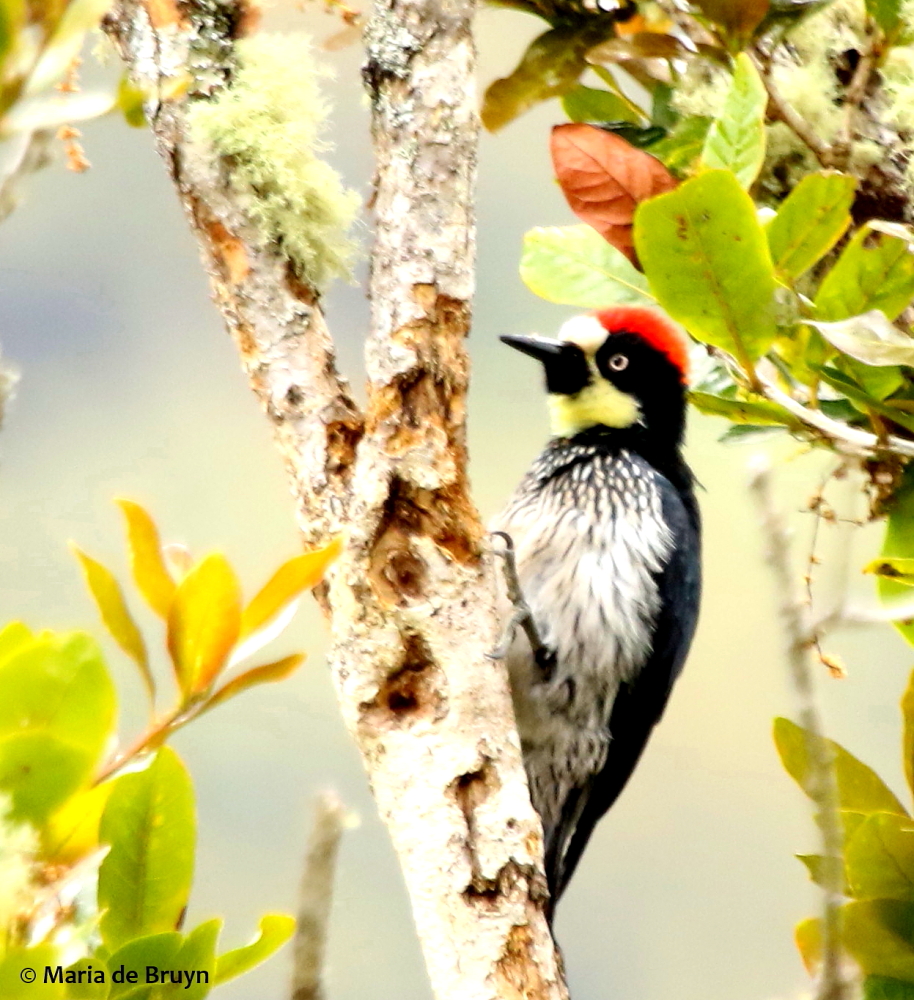
A group of five acorn woodpeckers (Melanerpes formicivorus) came to enjoy the fruit, perfectly willing to share the space with the other birds. These birds, which are also seen in the Western USA, do eat lots of different nuts but insects and fruit are obviously also desired meals.


There were three main species of hummingbirds at the nectar feeders. According to some bird websites, the white-throated mountain gem is only found in Panama, while the very similar gray-tailed mountain gem (Lampornis cinereicauda) is seen in southern Costa Rica. They are beautiful birds, with the females sporting a cinnamon-colored breast and the males a blue-purple crown when the light hits their feathers just right.


The Talamanca hummingbird males (Eugenes spectabilis) have a brilliant gorget and forehead when the lighting is right. The females of this large hummer species lack this coloring but also have a prominent white spot behind their eyes.


My favorite hummingbird at this stop was the lesser violetear (Colibri cyanotus). They have a subtle violet color underneath their eyes and pretty bands of blue in different shades on their tails.


Next up – our visit to the Bosque del Tolomuco!

** Thanks to Janet Kurz for the group photo