Crabs save human lives!

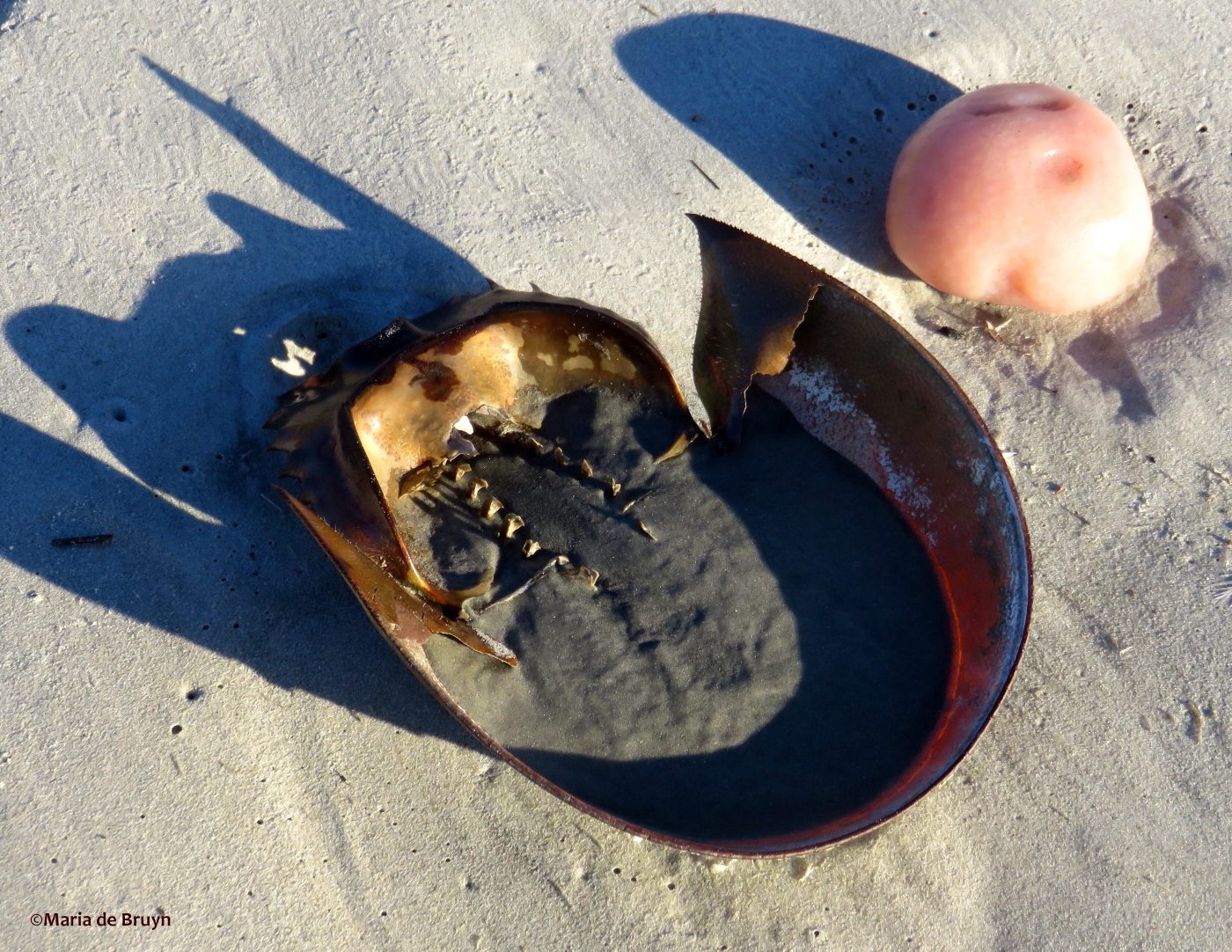
horseshoe crab IMG_0182_1©Maria de Bruyn resOn a trip to Huntington Beach State Park in South Carolina, we took a few walks along the Atlantic shoreline. There I saw the remains of numerous horseshoe crabs (Limulus polyphemus) as their empty shells were scattered among sea pork and sea weed on the beach.

Horseshoe crabs, which can become quite large, live in shallow ocean waters on soft sandy or muddy bottoms. They occasionally come on shore to mate. Behind their five sets of legs (the remains of which are seen in the photos below), they have book gills, which exchange respiratory gases. Two gills are seen sticking up in the center of the first photo.

horshoecrab IMG_0115_1©Maria de Bruyn horseshoe crab IMG_0117_1©Maria de Bruyn res

The gills are also occasionally used by the crabs to swim, which they usually do upside down.

horseshoe crab IMG_8506©Maria de Bruyn resWhen I posted photos of my crab shell spottings on Project Noah, a fellow Noah member informed me that the horseshoe crabs are used in medicine. So I decided to read up on them and discovered how they are utilized. These crabs have hemocyanin instead of hemoglobin in their blood to carry oxygen (this colors their blood blue). Their blood also contains amebocytes, which defend these creatures against pathogens. The blood of the horseshoe crabs is harvested to obtain the amebocytes to make a product that used to detect bacterial endotoxins in human medical applications.

The US Food and Drug Administration mandates that any intravenous drugs and forms of medical equipment that come into contact with patients’ bodies must pass through horseshoe crab blood to help rule out contamination with endotoxins. This includes items such as needles, surgical implants and pacemakers.
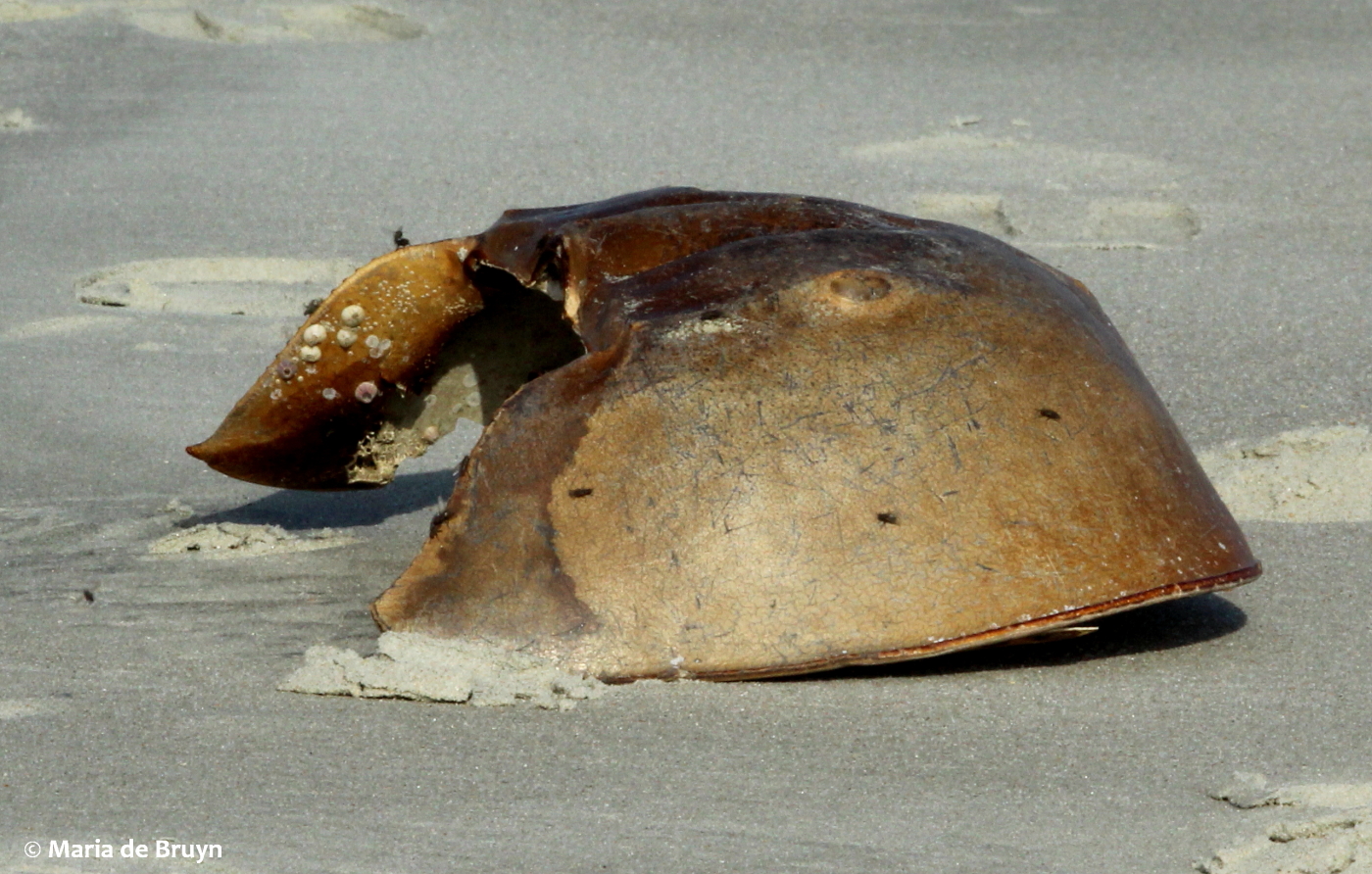
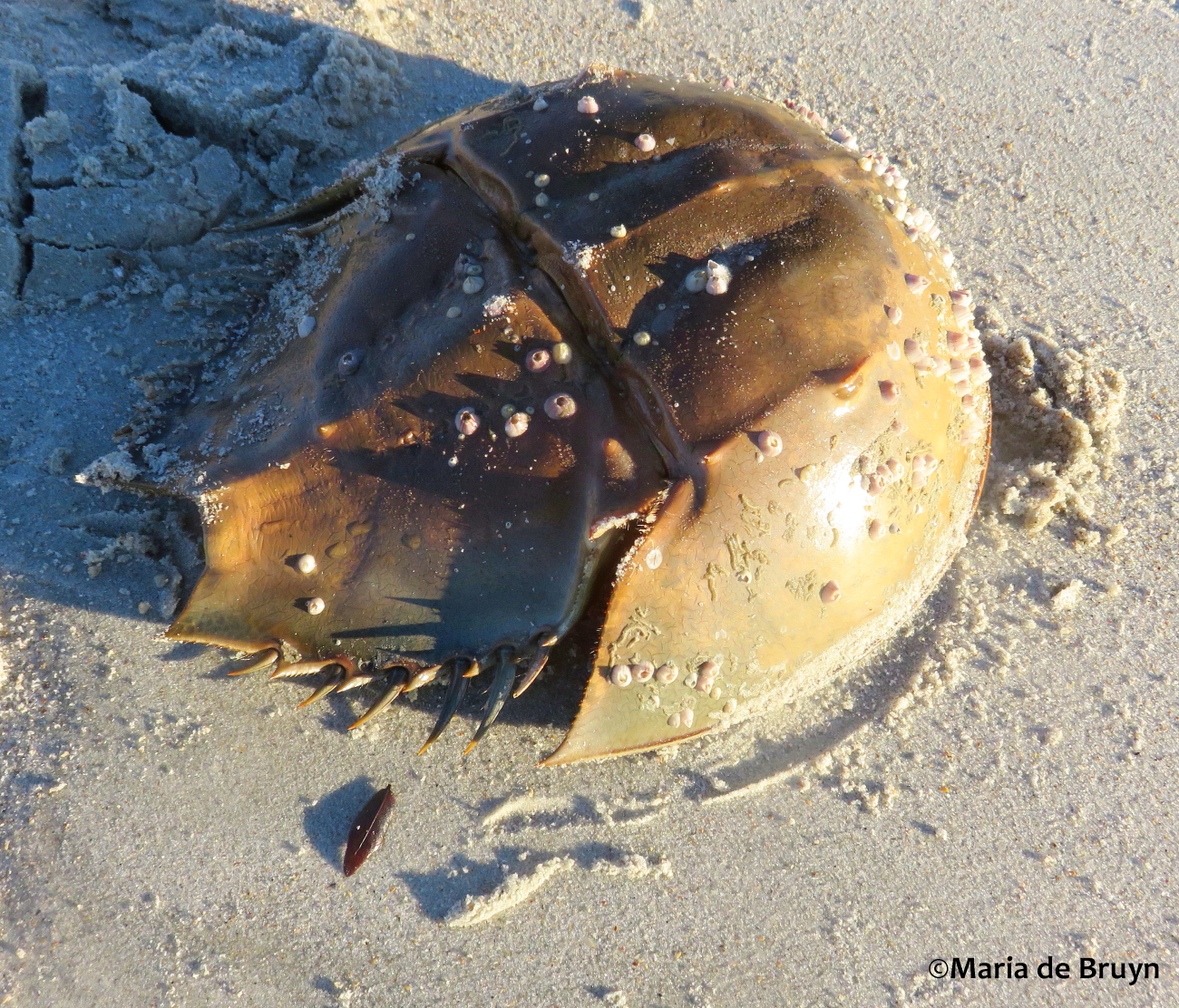
horseshoe crab IMG_8503©Maria de Bruyn res horseshoe crab IMG_0124_1©Maria de Bruyn res

horseshoe crab IMG_0164_1©Maria de Bruyn resTo obtain the supplies, about 600,000 crabs are caught each year and drained of about 30% of their blood before being returned to the ocean. Some 10-30% of the crabs do not survive the procedure and others are injured, becoming unable to mate and reproduce. As a consequence of the harvests, these magnificent arthropods, whose lineage dates back 450 million years ago, are now becoming threatened and alternative toxin-detection methods are needed. There is a website devoted to these interesting crabs. Walks on the beach can lead to new knowledge as well as enjoyment!

Pines, habitat loss and endangered woodpeckers

longleaf pine IMG_0016©Maria de Bruyn resLongleaf pine trees (Pinus palustris) grow for 100-150 years before they reach full size and they can live as long as 500 years. Their extremely long needles give the young trees the look of a spike with grass growing out of it. At the tops of trees, the long, fanned out needles paint a pretty picture when silhouetted against the sky, even on overcast and dull days.

longleaf pine IMG_0015©Maria de Bruyn res

RED-COCKADED WOODPECKER IMG_9109©Maria de Bruyn RESUnfortunately, the longleaf pine forests have dwindled in size as a result of logging and this has contributed to the endangerment of a unique bird – the red-cockaded woodpecker (Picoides borealis).


The longleaf pine has a rough bark and plentiful resin, so much so that tree stumps impregnated with the resin will not rot. The heartwood of the old pines also becomes saturated with the resin.

longleaf pine IMG_9042©Maria de Bruyn reslong-leaf pine IMG_9025©Maria de Bruyn res

When the longleaf pine forests were still plentiful, the red-cockaded woodpecker evolved into a very specialized bird species as far as nesting is concerned. They mainly nest in longer-lived longleaf pines, preferring trees that are infected with red heart fungus as this softens the wood and makes it easier for the birds to dig out a nest cavity. They are the only woodpecker species that makes nest cavities in living rather than dead trees.

longleaf pine IMG_9035©Maria de Bruyn resThe nest cavities are constructed by a family of birds and completing one can take as long as two years (or longer). The families work on several cavities at a time and you will find clusters of trees with nest holes in given areas. The cavities are pecked out in such a way that the tree releases resin around the nest hole and you will see trees that are covered with long thick strands of resin coming down from nests.

The woodpeckers employ this tactic because the heavy flow of resin helps to keep tree-climbing snakes away from their nests, eggs and chicks. A breeding male will scout various nest cavities and then roost in the most recent cavity with the heaviest flow of pitch. The female lays the eggs and then the male incubates them during the night-time hours.

red-cockaded woodpecker IMG_9103©Maria de Bruyn resRaising the young becomes a cooperative effort as older sons remain with the parents and help incubate, brood and feed the babies. Family groups can range from three to nine or more members. The female offspring only rarely stay with their breeding parents as they move off in search of their own mates.

These woodpeckers mainly eat insects, including ants, beetles, roaches, and wood-boring insects as well as caterpillars and spiders. The family will forage as a group and sometimes also eat fruit and berries. Their abandoned nest cavities are used by other birds and small mammals.

red-cockaded woodpecker IMG_9152 ©Maria de BruynThe species is now considered vulnerable to extinction, with only about 12,500 of these birds remaining in the Southern United States. This is equivalent to about one per cent of the original population of this woodpecker. In response, there are now conservation efforts being undertaken to preserve the longleaf pine forests as habitat for the red-cockaded woodpeckers.


long-leaf pine IMG_0013©Maria de Bruyn resAt the Santee Coastal Reserve Wildlife Management Area in South Carolina, as well as in the Sandhills areas of South and North Carolina, forest rangers and others are working to enhance the longleaf pine forests for the birds. Controlled burns are clearing out dense undergrowth as the woodpeckers prefer sites with less deciduous growth; you can see them foraging quite low on trees.

In some areas, wildlife management projects are trying to help out the birds by creating artificial cavities, into which man-made nests are inserted. Restrictor plates around the holes also serve to stop other species from enlarging the holes or shape of the nest hole so that the red-cockaded woodpeckers will keep using them.

longleaf pine IMG_9040©Maria de Bruyn res longleaf pine IMG_9030©Maria de Bruyn res

At the Santee Coastal Reserve, several such nest holes can be observed alongside other trees where the birds are making their own nest cavities. Trees with nest holes are banded with white tape so that rangers can keep an eye on the woodpeckers’ activity.

longleaf pine IMG_9046©Maria de Bruyn resRED-COCKADED WOODPECKER IMG_9229©Maria de Bruyn RES

It is heartwarming to see the efforts being made to restore the longleaf pine forests and the habitat for the woodpeckers – perhaps this will prevent this species from going extinct. And the National Wildlife Federation has stated that research shows that long-leaf pine forests will be especially well adapted to coping with environmental changes caused by global warming.

RED-COCKADED WOODPECKER IMG_9214©Maria de Bruynred-cockaded woodpecker IMG_9165 ©Maria de Bruyn

Owls – raptors with fantastically functional feathers

Barred owl IMG_9617© Maria de Bruyn resThe owl is the wisest of all birds because the more it sees, the less it talks. – African Proverb

The world likes to have night-owls, that it may have matter for wonder. – German proverb

Sayings about wise owls are well known and may account for the names given to a group of owls – a wisdom, study or parliament. On the other hand, in some cultures, owls are associated with bad luck, death and the stealing of souls. Owl fossils date back as far as 58 million years ago! These appealing birds have been depicted in in cave paintings in France, in Egyptian hieroglyphics and in Mayan art. There are about 200 species of owls around the world and they are found on all continents except Antarctica and a few remote islands.

Owl anatomy

Barred owl eye feathers IMG_9802©Maria de BruynresOwls have interesting anatomical features. Like humans, they have binocular vision as a result of their upright posture and forward-facing eyes. A circle of feathers around each eye, as seen in the barred owl  (Strix varia) here, can be adjusted to focus and channel sound to their ears (which are asymmetrical in many species!). These feathers can magnify sound as much as 10 times, giving them acute hearing.

Barred owl IMG_9832©Maria de Bruyn signed res

Like bald eagles, owls have three eyelids: one is used to blink, another for sleeping and the third – the nictitating membrane – helps them keep their eyes clean and healthy. Because they cannot turn their eyes within their bony eye sockets, owls must rotate their heads up to 270 degrees to look around. They are far-sighted and cannot see clearly right in front of their eyes, but their distance vision is very good, especially in low light.

Barred owl IMG_9117©Maria de Bruyn resOwl feathers have fringes with different degrees of softness, which helps muffle sound when they fly.

Screech owl IMG_3069©Maria de Bruyn resSome owls, like the Eastern screech owl (Megascops asio) have tufts of feathers on their heads; the function of these might be to indicate a bird’s mood, to show aggression or to help keep the bird camouflaged.

Screech owl rehabilitated by CLAWS that serves as an educational bird

Behaviors

Different owl species make different sounds for finding mates or announcing their presence to potential competitors. These sounds help ornithologists and birders locate and identify species.  For example, the barred owl is said to have a call that sounds like “who cooks for you?”

These carnivorous birds usually swallow their prey whole (depending on the size of the animals such as fish, mice, rats, hares). Scientists who study their diets use owl pellets as an aid; the owls regurgitate bones, scales and fur in these pellets. The larger owls will also detach body parts they don’t wish to eat. For example, colleagues speculated that it was a great horned owl (Bubo virginianus) that took down a red-tailed hawk (Buteo jamaicensis) at a local nature reserve recently, leaving behind an entire wing that wouldn’t have provided much nutrition.

great horned owl IMG_3065©Maria de Bruyn resred-tailed hawk IMG_2745©Maria de Bruyn res

Great horned owl rehabilitated by CLAWS in Chapel Hill, NC. This bird was shot in the eye and cannot be released again; it serves as an educational bird.

The main threats to owl survival today include habitat loss, pesticides and human predation due to negative superstitions. There are fortunately efforts to preserve owls where they may be seen as beneficial. For example, a barn owl may eat up to 1000 mice each year, so that farmers try to attract them to help control rodents in agricultural fields. Projects to re-introduce barn owls (Tyto alba) are taking place in the Czech Republic and the United States. The local Audubon Society to which I belong has a barn owl project, in which they have placed barn owl nest boxes in various places in an effort to attract these birds as more permanent residents. It would be very cool to see the boxes occupied one day!

Barn owl project IMG_6412© Maria de BruynBarn owl box IMG_2501©Maria de Bruyn

Check out CLAWS, a wildlife rescue and rehabilitation center in North Carolina! http://www.nc-claws.org/