Caterpillars with fuzzy hair-dos

This past year, I was having trouble getting good shots of birds hidden in foliage so, inspired by fellTiger moth caterpillar 3 IMG_8012©Maria de Bruynow contributors to Project Noah, I tried my hand at photographing more insects. This opened up another fascinating wildlife world to me and I’ve been learning about different species of flies, bees, hoppers, and moths.
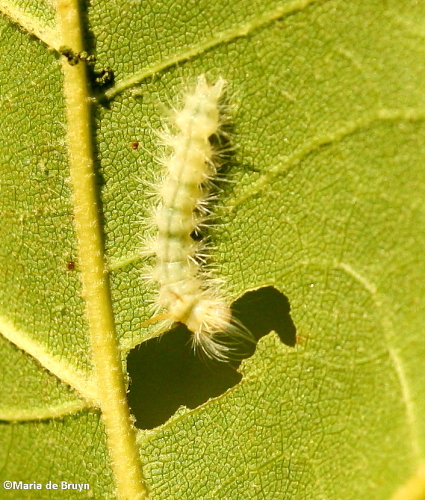
I had always thought of butterflies as the “beauties” of the insect kingdom but found out that the moths can be simply stunning (another blog to come). Moth caterpillars are really interesting, too – and there are so many kinds with fuzzy bodies. At an early stage, their hairs or bristles (setae) may be short, as seen in this Tiger moth IMG_0332©Maria de Bruynpale tiger moth; as they grow, the setae become longer like those in the dark tiger moth.
TheSycamore tussock moth IMG_0144©Maria de Bruyn Sycamore tussock moth caterpillar (Halysidota harrisii) is a fancy variety, with hairs  that give its face a bit of an “old man” look (droopy mustaches). Though not considered one of the stinging caterpillars (read on to find out about them), the hairs have been known to cause hives if a person touches them. If one lands on you, use a twig or leaf to remove it gently.

The BandeBanded tussock moth IMG_3930©Maria de Bruynd tussock moth (Halysidota tessellaris) shown below also has a beautiful caterpillar with long tufts on its head and posterior.

Two caterpillars have been nicknamed woolly bears. The Virginia tiger moth (Spilosoma virginica) caterpillar, which can vary widely in color, is known as the yellow woolly bear in its pale color variation.
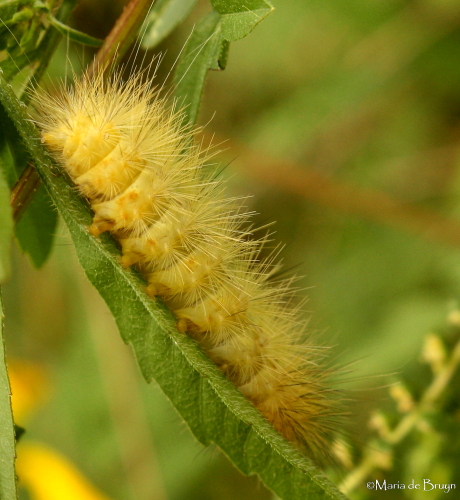
Virginia tiger moth caterpillar IMG_0917©Maria de BruynVirginia tiger moth IMG_9202©Maria de Bruyn res

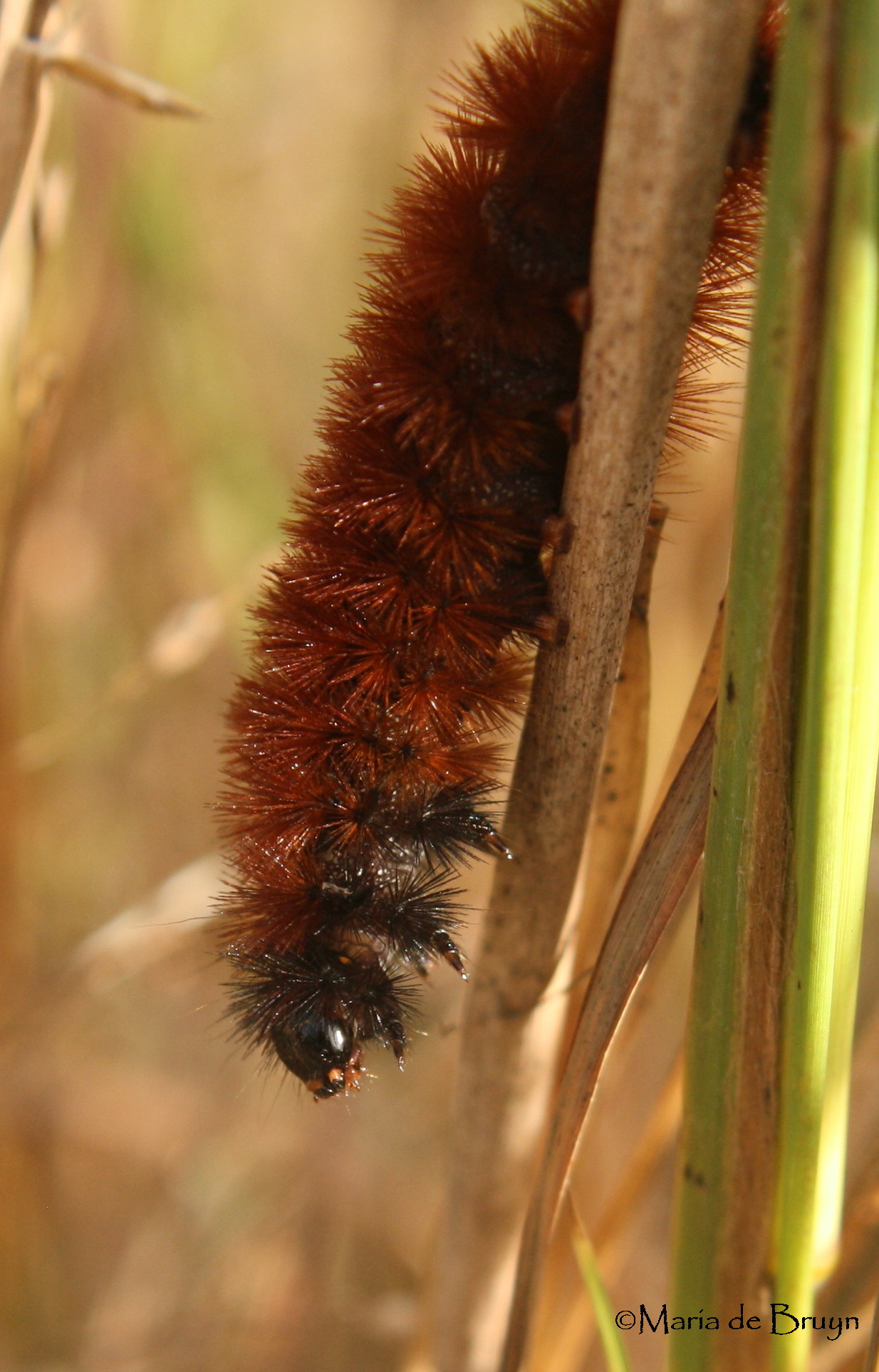
The banded woolly bear caterpillar of the Isabella tiger moth (Pyrrharctia Isabella) even has whole festivals devoted to it in places like Banner Elk, a mountain town in North Carolina. There is a myth that if this caterpillar has a thick brown stripe, the winter will be mild; if the brown stripe is narrow, we will have a severe winter. This year, I saw caterpillars with narrow and wide stripes, so I wonder what it will be.
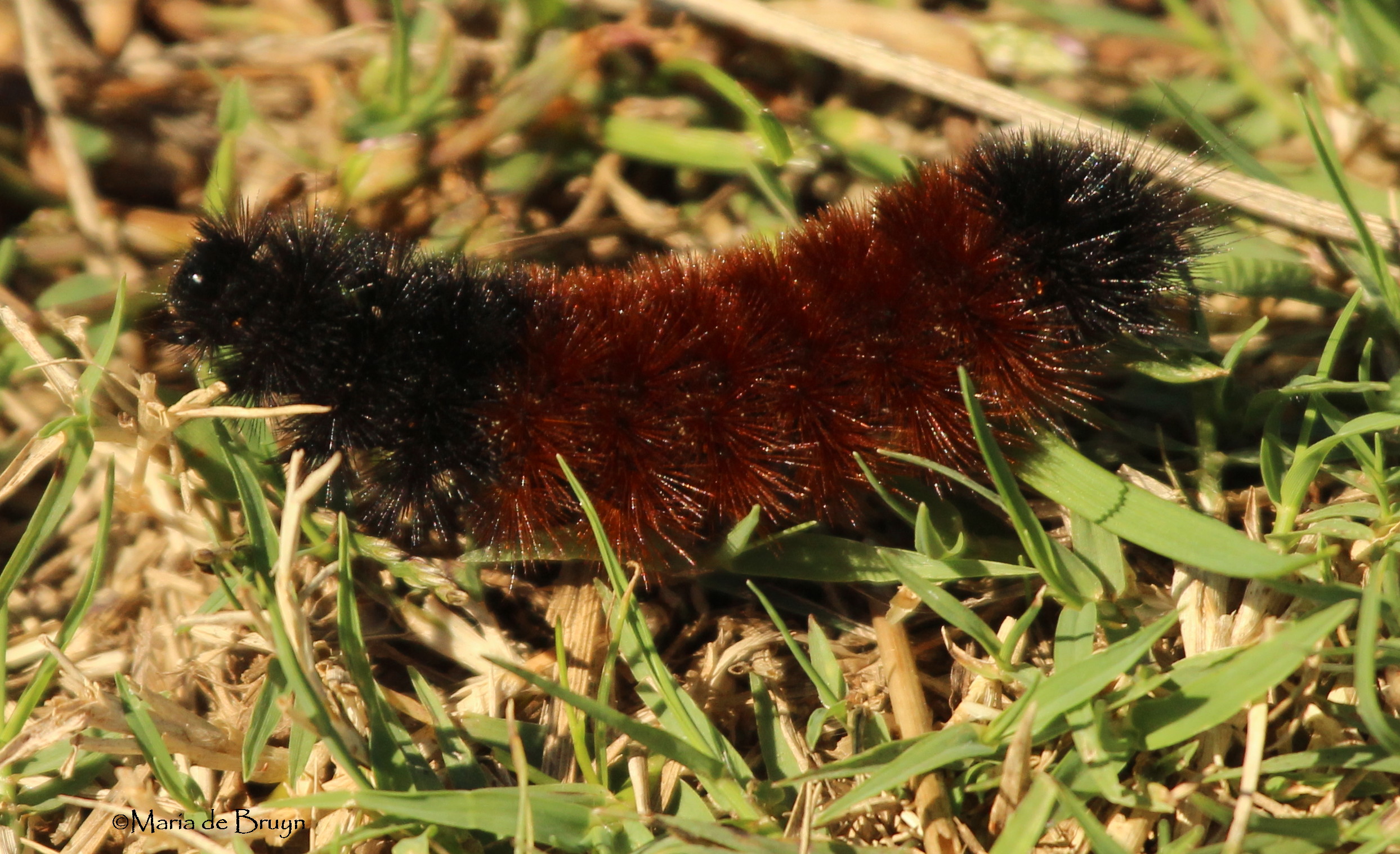
Isabella tiger moth IMG_8604©Maria de Bruyn

The Fall webworm moth caterpillar (Hyphantria cunea) is especially well-known for the communal webbed nests that they create on shrubs and in trees. They can vary in color from yellow to gray with two light stripes along their sides. The adult moth is a beauty; in the northern states, it is mostly white but in the South it can have dark spots on its fore-wings.
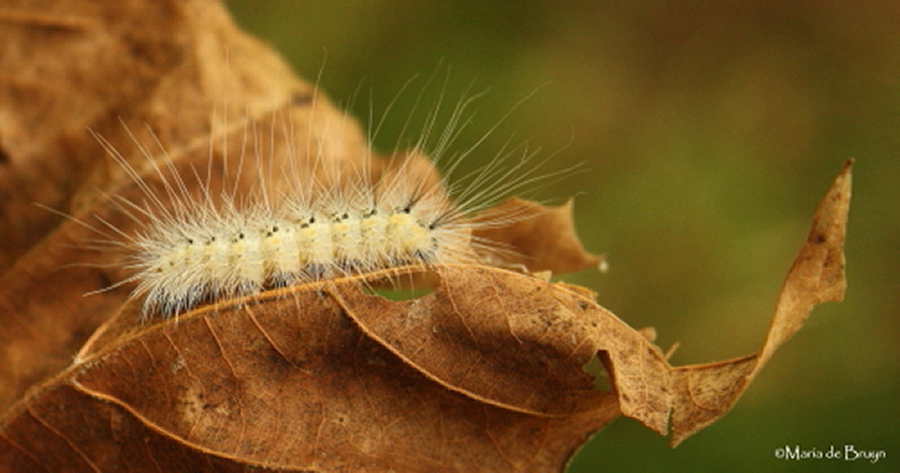
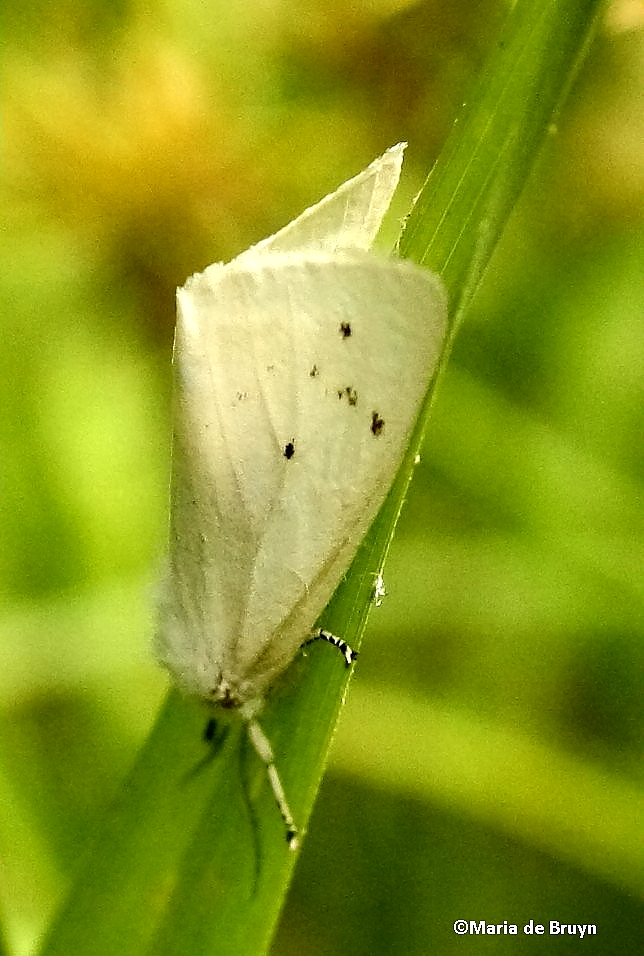
Fall webworm moth IMG_9141©Maria de Bruyn resFall webworm moth Hyphantria IMG_6582 ©Maria de Bruyn signed

Some of the hairy caterpillars are known as “stinging caterpillars”. They do not inject venom like bees and wasps but their hollow hairs contain toxins, which are designed to protect them from predators. When another being – including humans – brushes against the hairs, they break away and release the toxin. This can cause varying reactions, including mild to intense burning, stinging pain and itching. Depending on the species, a person might also experience rashes, swelling and inflammation, numbness and even fever and nausea. The reactions can be especially serious for people with sensitive skin and allergies.
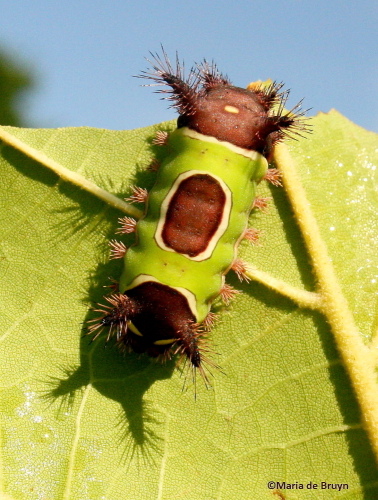
Saddleback caterpillar moth IMG_2647©Maria de BruynresI didn’t know about this until this year; fortunately, I did not pick up any of the stinging caterpillars since I try not to disturb the creatures I photograph. That was a good decision when I came across the Saddleback moth caterpillar  (Acharia stimulea), which is quite an eye-catching individual. This slug-type caterpillar isn’t quite as hairy as some other species but causes some of the more severe reactions. I hope to find some new hairy caterpillars next year!

Next blog: Weaver bird nests

Animals that carry ticks

Thanks for visiting my blog! So, this edition is about a part of my beautiful world that is actually not so appealing to me, but it does represent some of my learning about nature over the past few years. The photos aren’t beautiful, but they do show something interesting (at least to me). Be forewarned! (And next week, back to some nice bird photos.)

Many proponents of getting rid of deer in our town argue that this will help eradicate the ticks that carry Lyme disease, Rocky Mountain spotted fever and other tick-borne diseases. It is true that ticks get on the deer, but what many people don’t know is that other animals transport these nasty little bloodsuckers as well.

According to the NC State University Department of Entomology, ticks go through four stages in their development – egg, larva, nymph, adult. The developing ticks need blood meals, with most species taking it from a different type of host at each stage. As seen in the photo of the poor white-tailed deer (Odocoileus virginianus) below, the ticks start out tiny but swell up tremendously when they have had a meal.

deer with several ticks IMG_6000 ©Maria de Bruynres

The larvae of the dog tick (Dermacentor variabilis), which can carry Rocky Mountain spotted fever, take blood from white-footed field mice and pine or meadow voles (Microtus pennsylvanicus), like the one pictured here. The nymphs go for somewhat bigger mammals such as opossums or raccoons, while the adults prefer meals from humans and dogs. Black-legged tick (Ixodes scapularis) larvae and nymphs feed on small mammals and lizards, while the nymphs and adults also seek out larger mammals, including dogs and deer. Eastern cottontail rabbits (Sylvilagus floridanus) are another tick host.

meadow vole IMG_4712©Maria de BruynRabbit with tick  IMG_8196©Maria de Bruynres

In the past couple years, the first wildlife that I have seen carrying ticks in the spring are birds – common grackles (Quiscalus quiscula) seem to be a favorite host, although I’ve seen them on other birds as well. The ticks can sense body heat and will even drop down from a tree onto another living species. This undoubtedly accounts for the first tick that gave me a bite requiring antibiotics to prevent Rocky Mountain spotted fever. It was during a visit to an exotic wildlife sanctuary that has been surrounded by an electric fence for more than 30 years so that no deer have been there for decades.

Common grackle 4 ©Maria de BruynCommon grackle 1 ©Maria de Bruyn

Ticks also wait in the grass to latch onto animals – and people – walking by. Fortunately, I’ve never found ticks on my indoor-outdoor cat, but I have found them on me after being in the yard and out on nature walks. Different techniques for loosening their grip have worked well – a new skill that I had never anticipated learning. There are few animal species that I really dislike, but I must admit that ticks are definitely one of them. But I also know now that eradicating deer is not the solution to getting rid of the ticks.

Next blog: Big Blue – my avian nemesis!

Wonderful woodpeckers

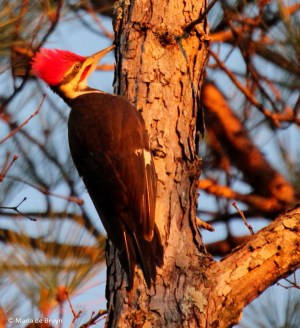
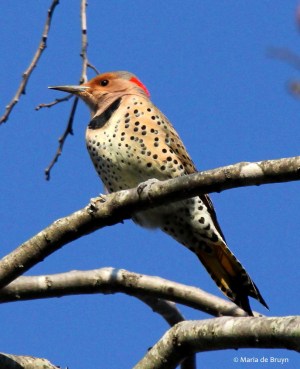
For my first posting, I’d like to focus on woodpeckers. These birds live in many areas of the world and there are several species that I’ve been lucky to see in my yard and on my travels. Many of those I’ve seen have bits of red or a hint of yellow color, like the pileated woodpecker ((Dryocopus pileatus, below left). Some are occasional visitors, like the Northern flicker (Colaptes auratus, below right) that was perched on my persimmon tree.

Pileated woodpecker (Dryocopus pileatus) seen in the woodsNorthern flicker (Colaptes auratus) on my persimmon tree

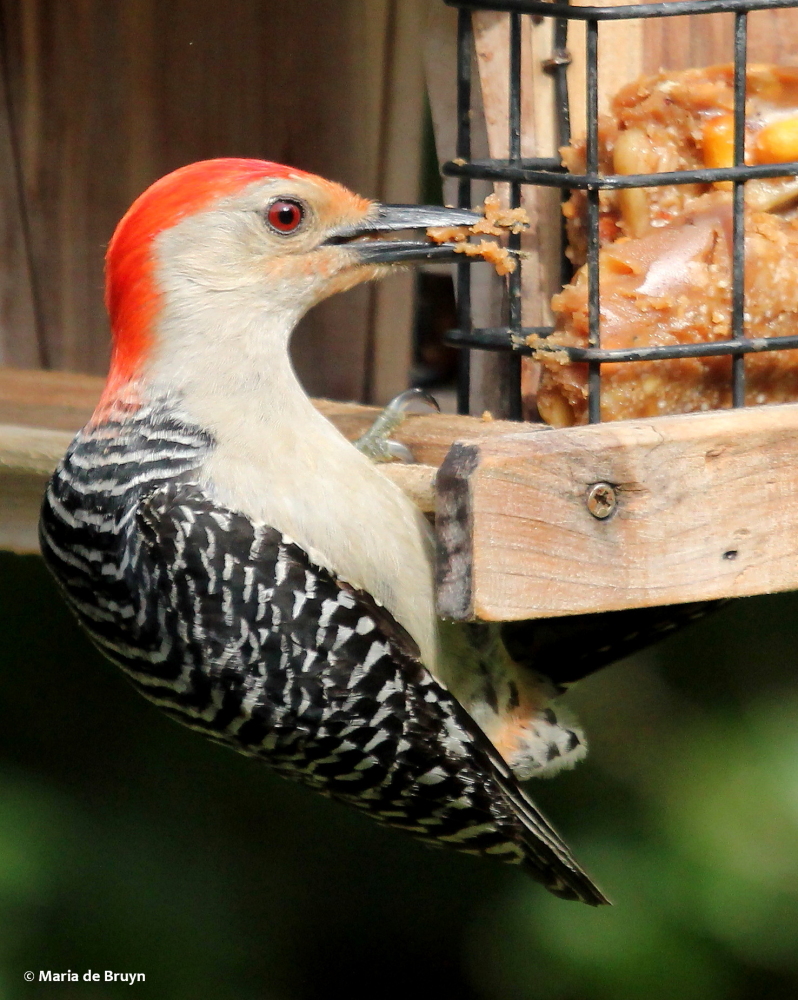
The downy woodpeckers (Picoides pubescens), like the male on the left below, and the red-bellied woodpeckers (Melanerpes carolinus), such as this male to his right, come to my feeders every day.

Downy woodpecker MdB signedred-bellied IMG_8847

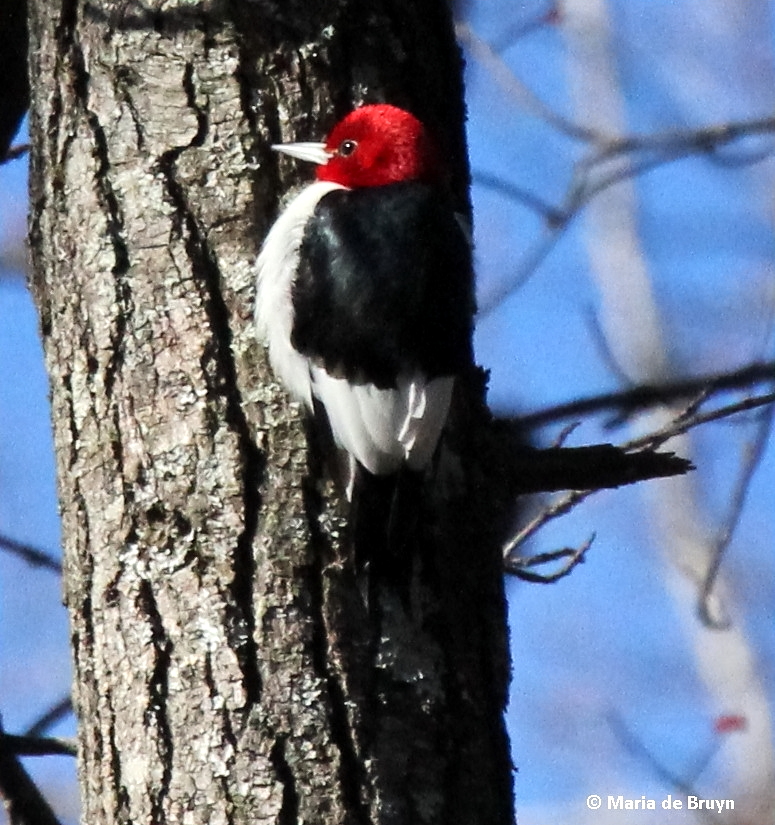
Some of these birds are difficult to photograph, like the beautiful red-headed woodpeckers (Melanerpes erythrocephalus) that sometimes frustrate me because they go behind leaves or stay at a really far distance so that getting a good shot of them is very hard!

Red-headed woodpecker IMG_9884© Maria de Bruyn

What’s really interesting about woodpeckers is that these birds have adapted over time to protect their brains from damage when they repeatedly peck away at wood, trees, utility poles, trash cans — or my rain gutters, making a VERY loud sound as they try to attract mates! Woodpeckers can tap up to 8,000-12,000 times a day (22 times per second)! So how do they protect themselves from this jarring activity?

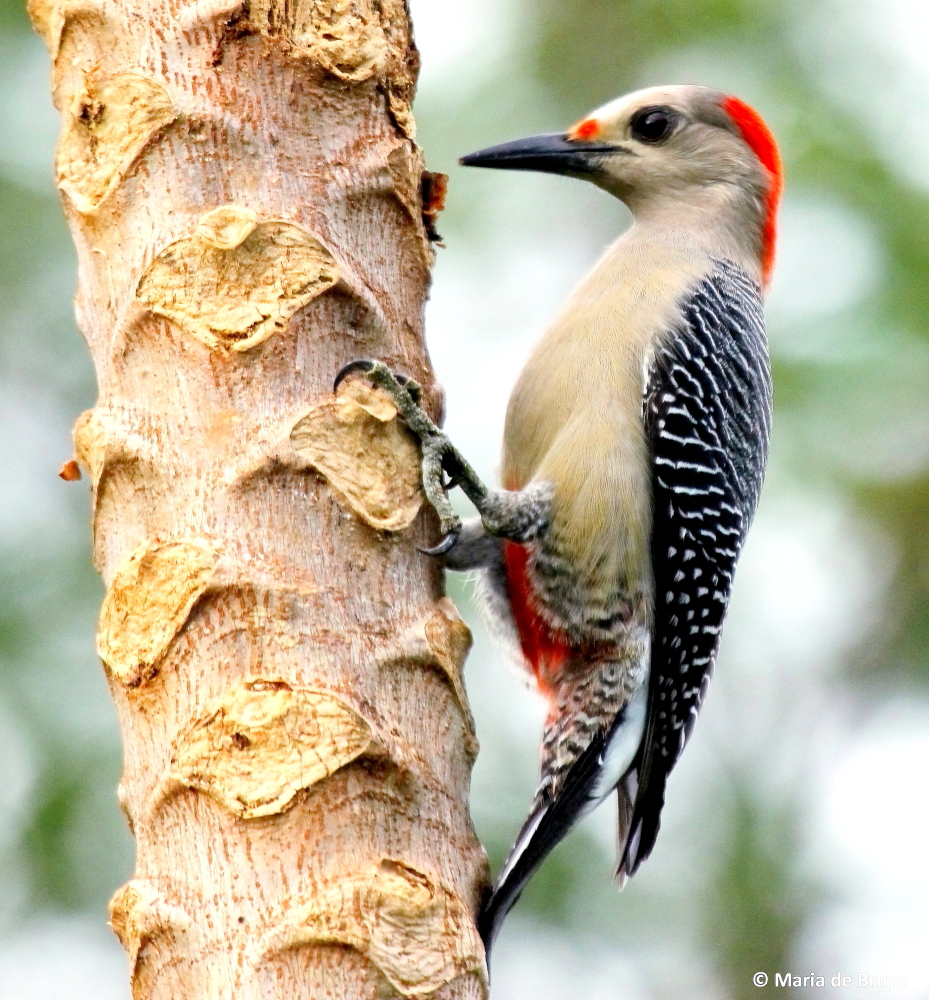
Their brains are protected within their skulls and they only make contact with an object for a very short time with each peck. Just before they peck on wood, they close a thick eyelid (called the nictitating membrane) to protect their eyes from wood chips and special feathers protect their nostrils. They also have strong muscles at the base of their beaks that act as shock absorbers to lessen the impact of the hard pecking. In fact, In fact, scientists used studies of the golden-fronted woodpecker ‘s head and neck when they designed a shock absorption system to protect microelectronics!

Golden-fronted woodpecker IMG_0357 MdB

Golden-fronted woodpecker (Melanerpes aurifrons) that I saw in Mexico

Woodpeckers are important in nature because they help control insect populations. Their nest cavities are also used by birds and animals (deer mice, raccoons, flying squirrels) that cannot create cavities themselves. A few species will use nest boxes. A downy woodpecker used a bluebird box in my yard as its night-time refuge over the past winter.

downy woodpecker IMG_0299 MdB

Next blog: deer antlers!