“Nuts” for nuts!

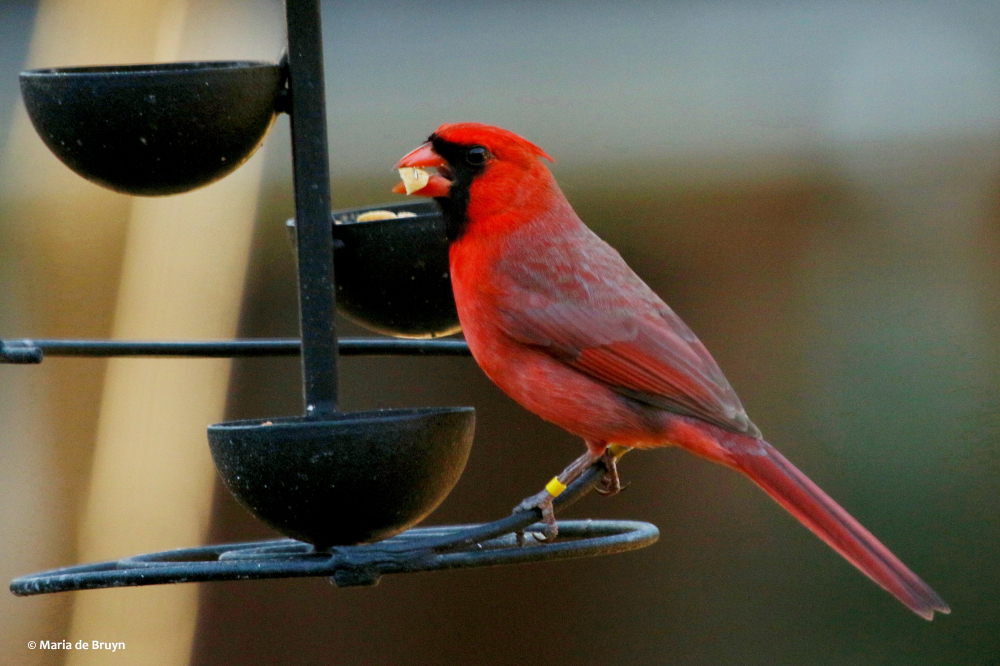
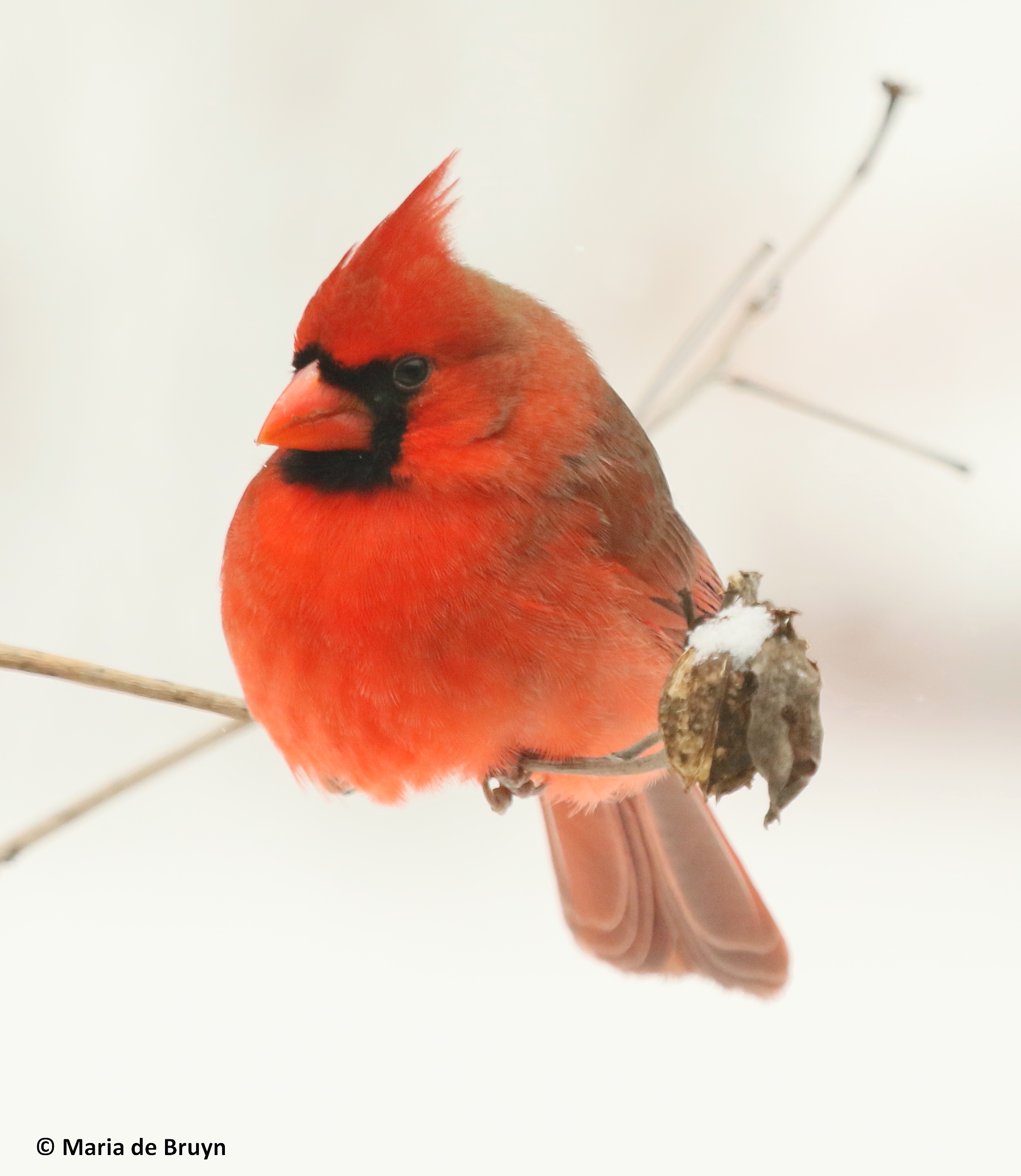
A primary source of nutrition for many birds is nuts.This high-calorie food provides them with dietary fat, which can be especially welcome during the colder months. As nuts ripen, you can see the birds flying by, carrying acorns and beechnuts, as well as seeds of various kinds. Some birds are especially suited to eating nuts with their thicker, cone-shaped bills, which are shaped to help them crack open pods and seed cases. Northern cardinals (Cardinalis cardinalis), sparrows, grosbeaks, finches and woodpeckers are seed and nut lovers.

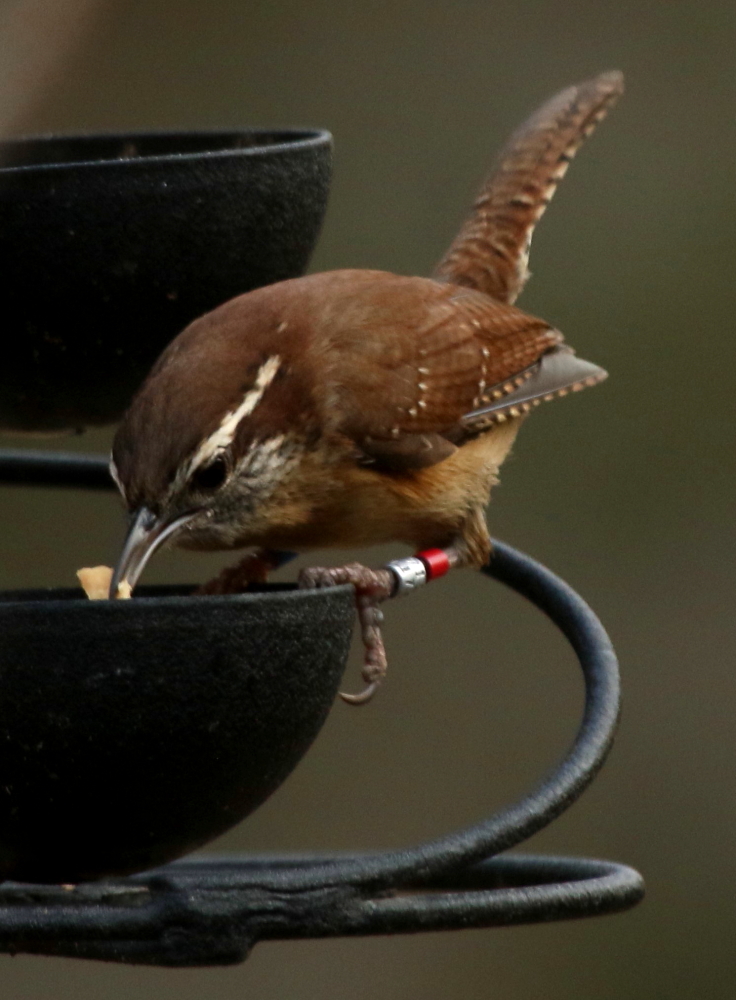
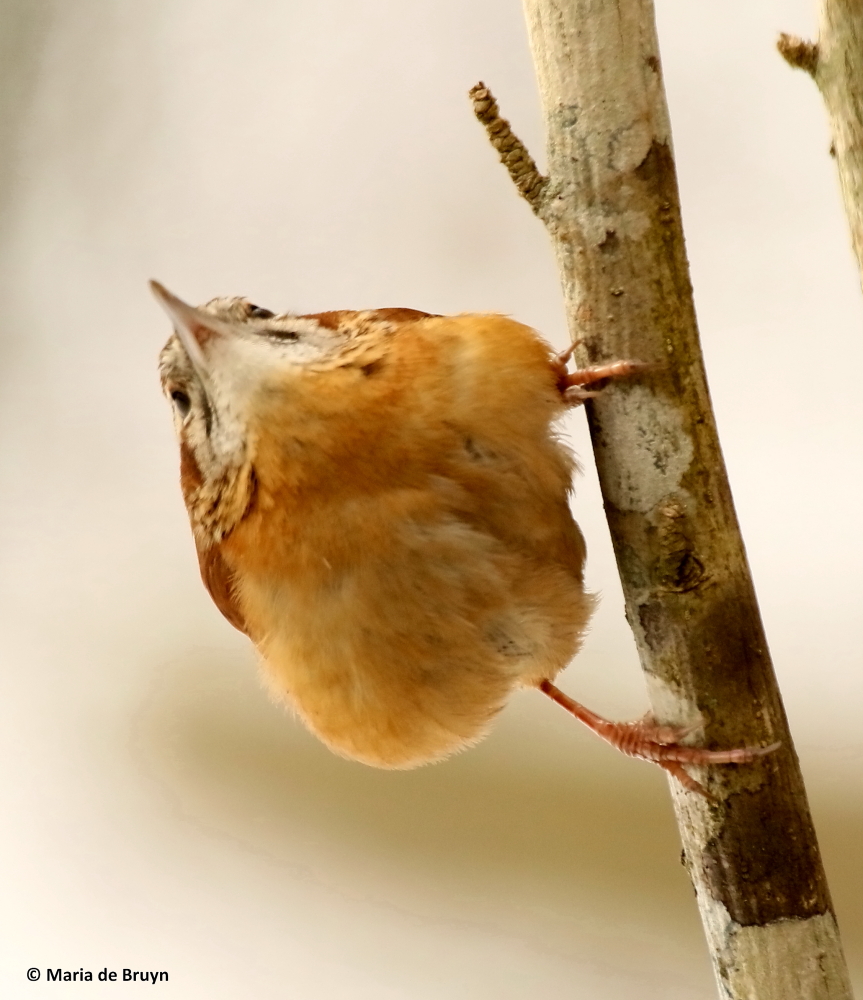
I had been lax in providing my yard birds with these culinary treats except for sunflower seeds and the seed pods in my yard trees. So one day early last year, I purchased a nut and seed holder and proceeded to give them peanuts, which are not actually nuts but the seed of a legume (Arachis hypogaea). This makes no difference to the birds like the Carolina wren (Thryothorus ludovicianus) of course.

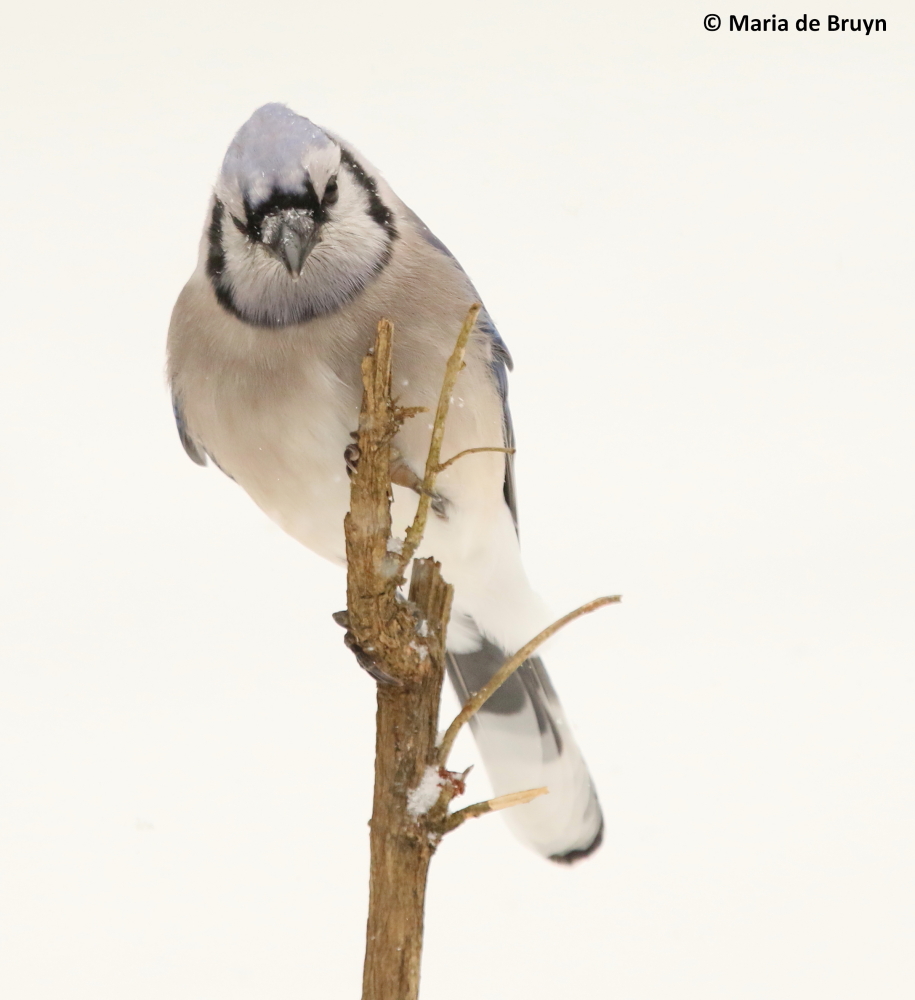
I first tried peanuts in the shell and an occasional blue jay and tufted titmouse would stop by. However, they didn’t seem to want to put much time into removing the nuts from the shells and I didn’t really want the shells littering the ground either.

Then in the spring I put out some shelled peanuts from a container I’d bought for my own consumption and the avian visitors were delighted. Reading about peanut feeding informed me that I should avoid giving salted peanuts. I couldn’t readily find unsalted ones at the grocery store, so I began removing the salt, either by shaking the nuts in a paper bag or by washing off the salt.

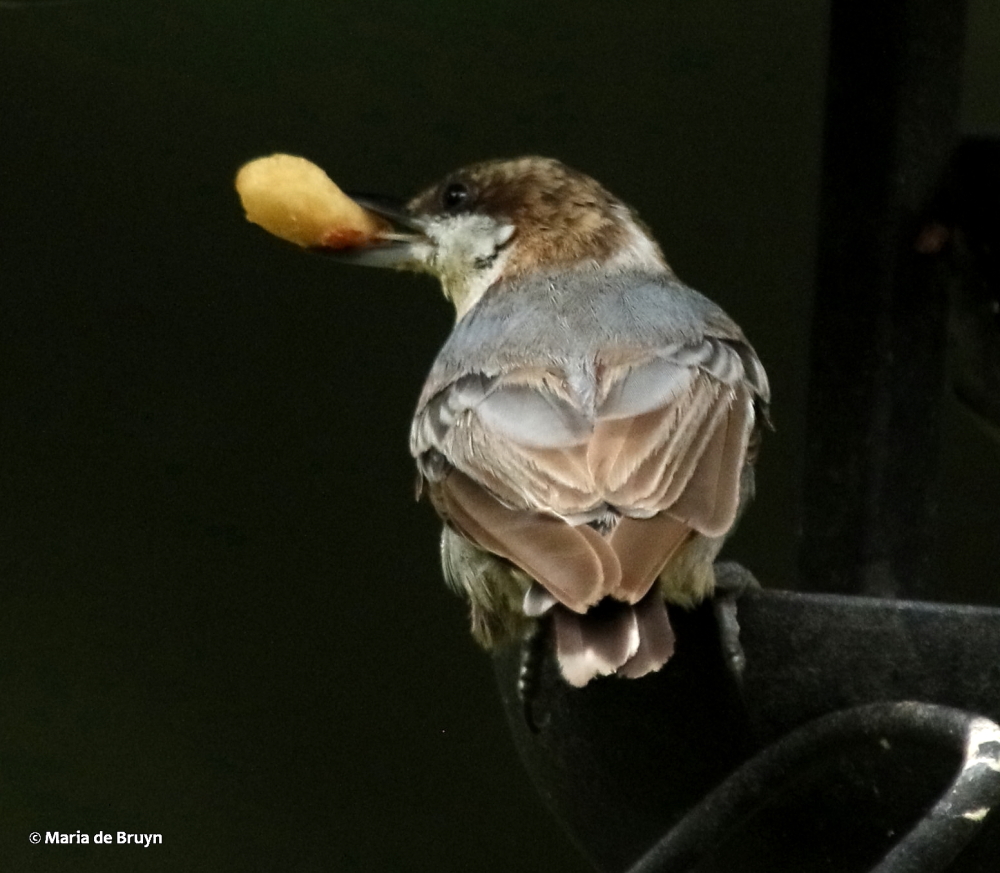
   

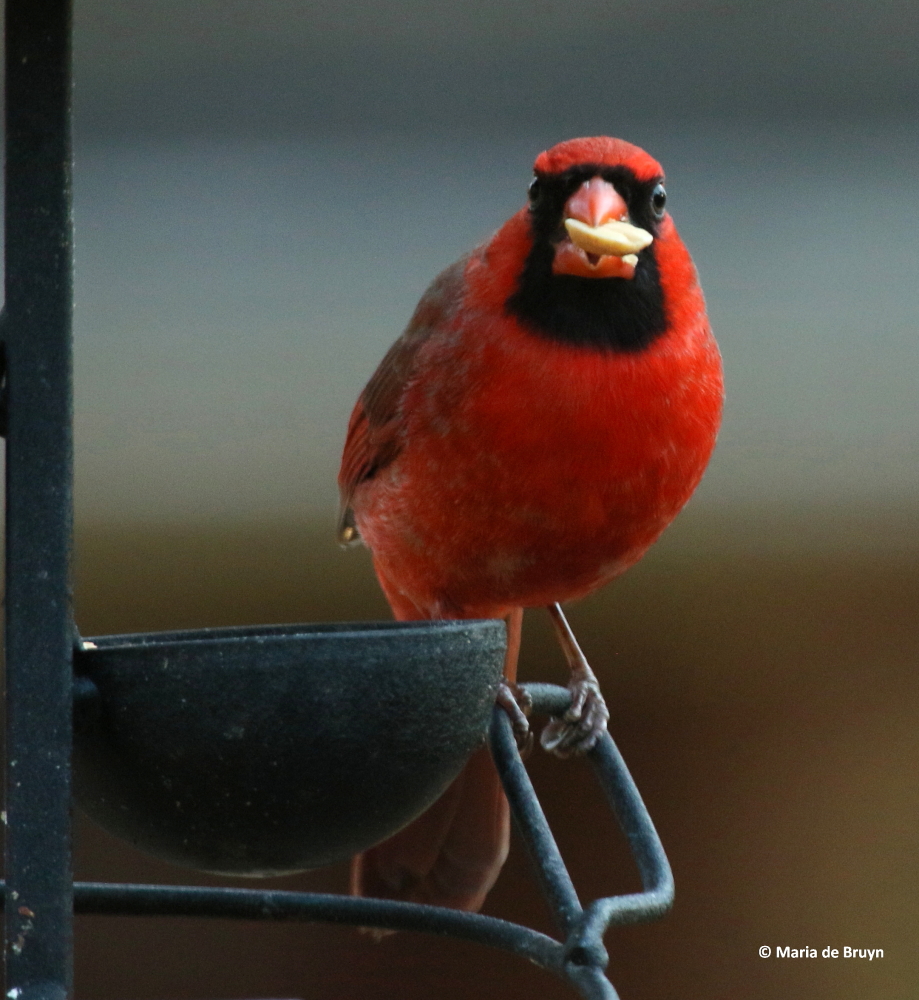
Northern cardinal                                            Brown-headed nuthatch (Sitta pusilla)

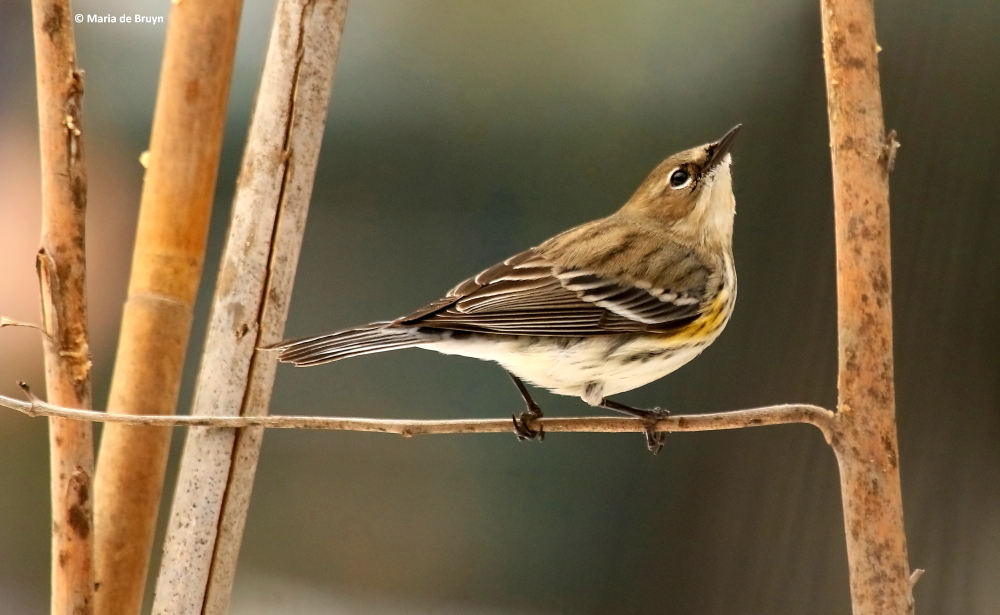
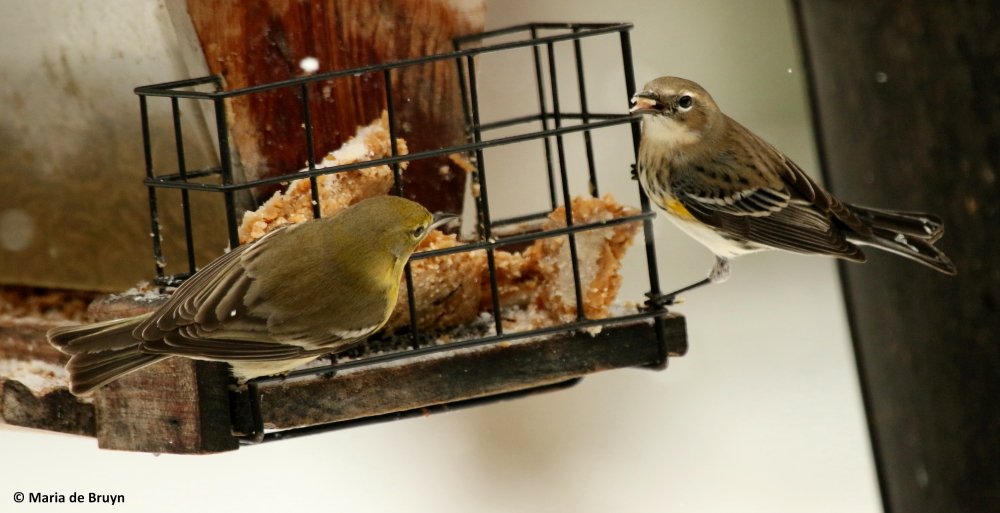
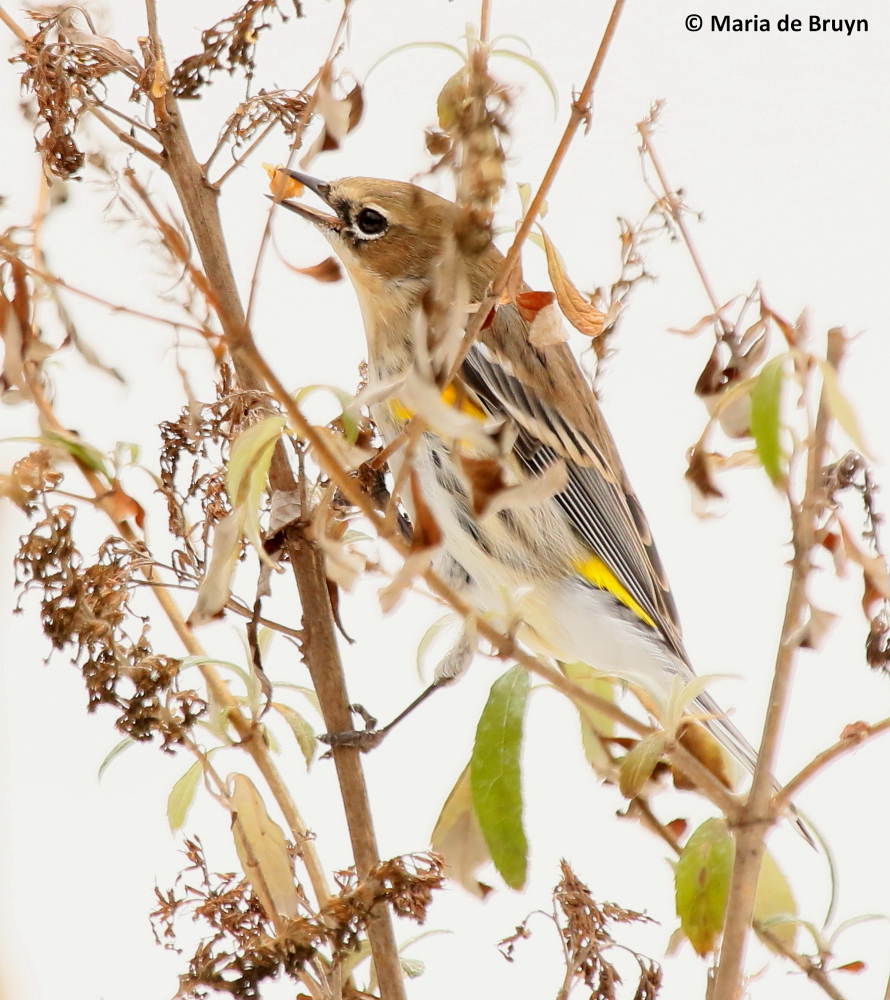
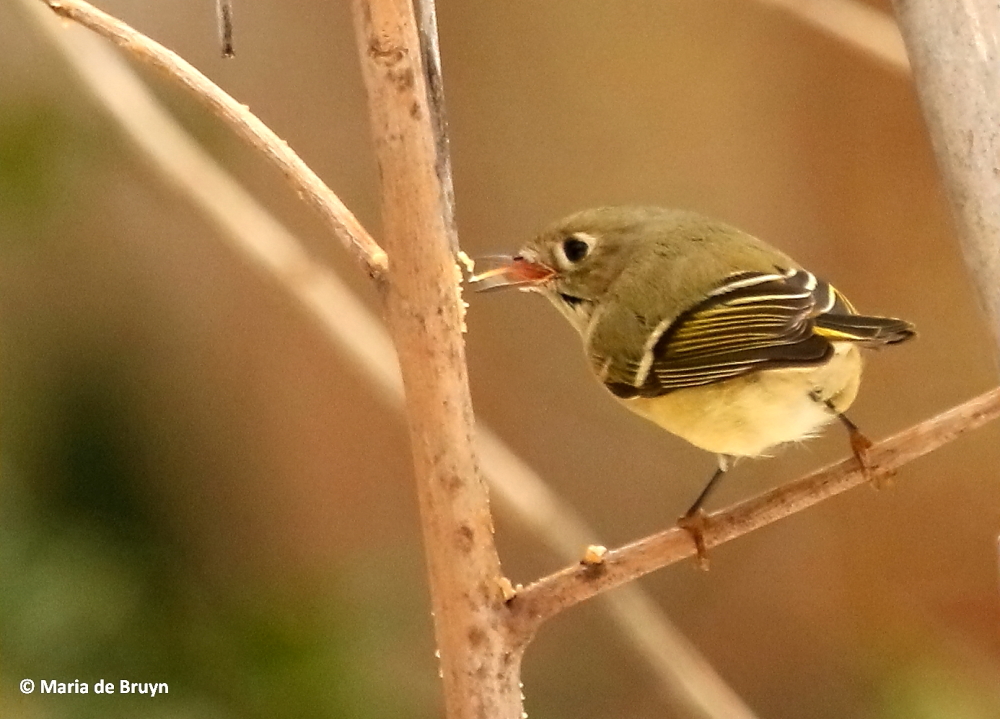
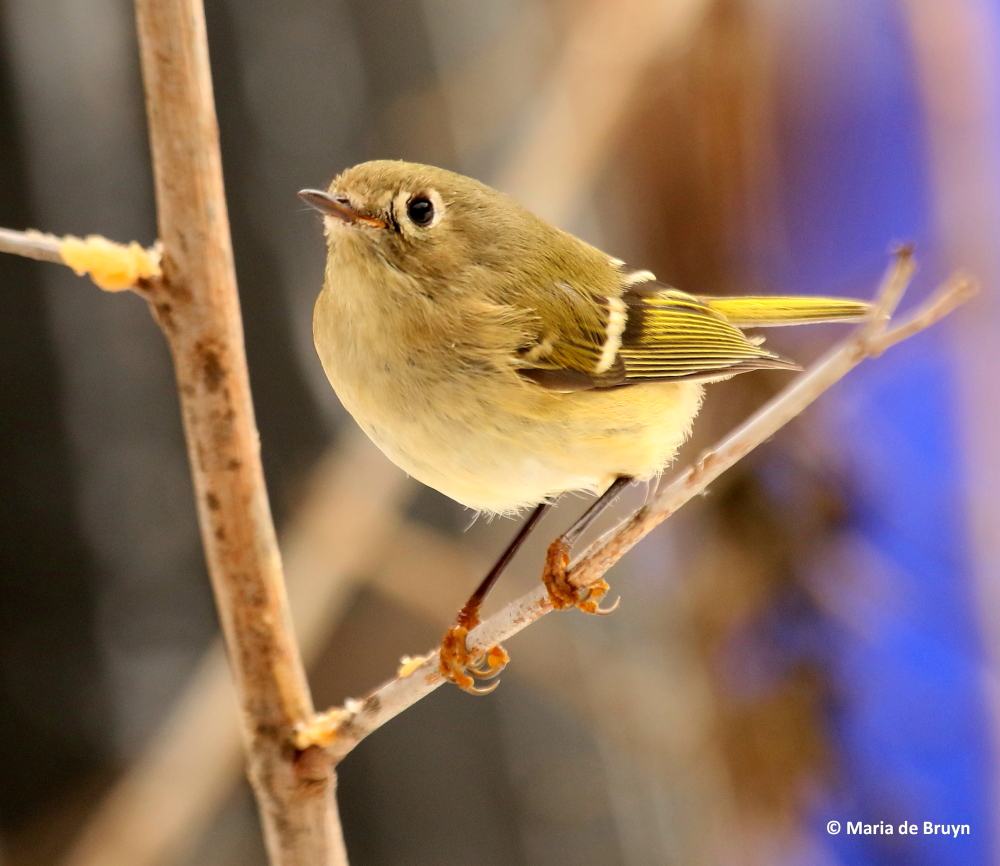
Before they left for the summer, the yellow-rumped warbler (Setophaga coronata) and ruby-crowned kinglet (Regulus calendula) tried the peanuts, too. Sometimes I wondered if the kinglet was also not looking for insects around the peanut feeder.


My choice to provide nuts was a big hit; I was rewarded with a procession of individuals of varied species who came by to quickly gulp or carry off a tasty nut. Some are pictured below – they came at different times of the day.
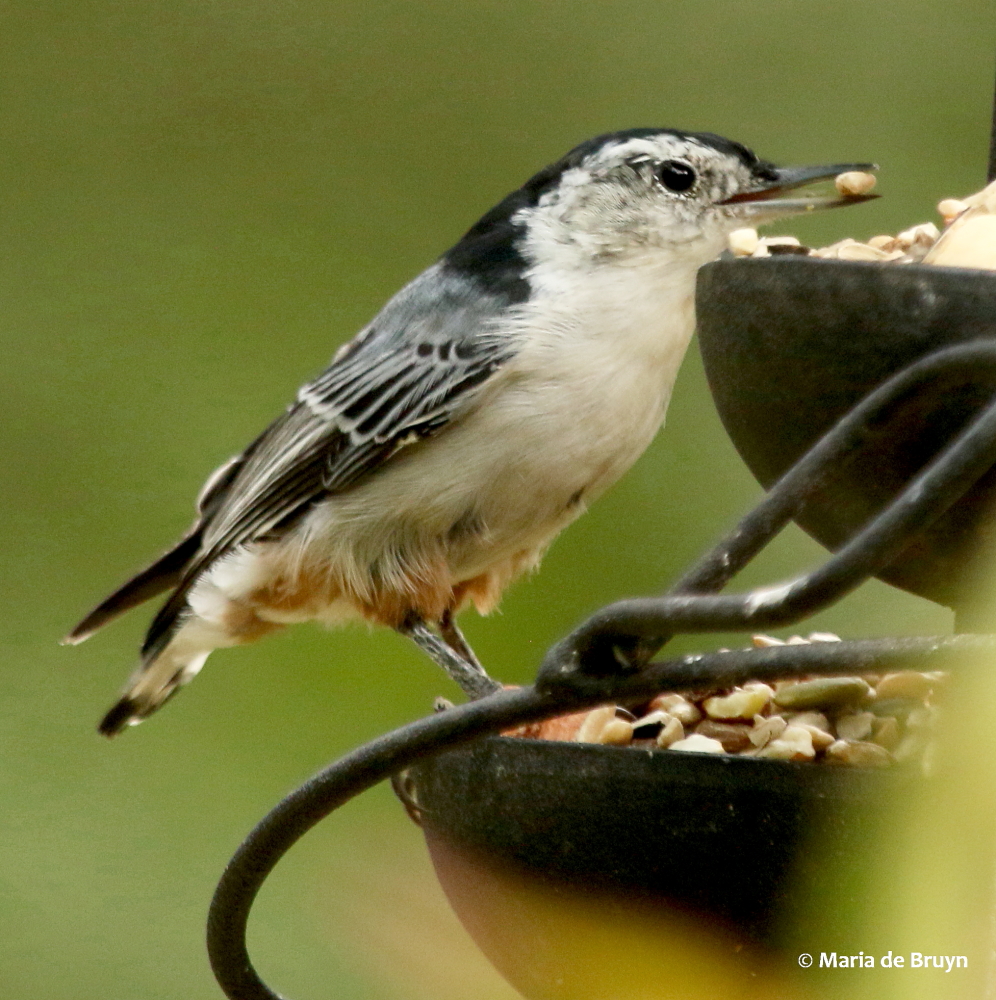
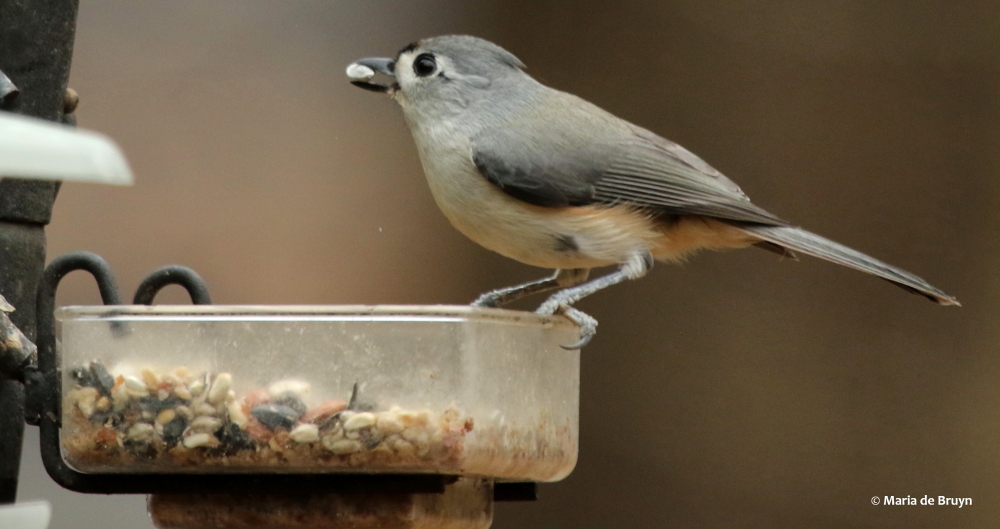
 

White-breasted nuthatch (Sitta carolinensis)     Tufted titmouse (Baeolophus bicolor)
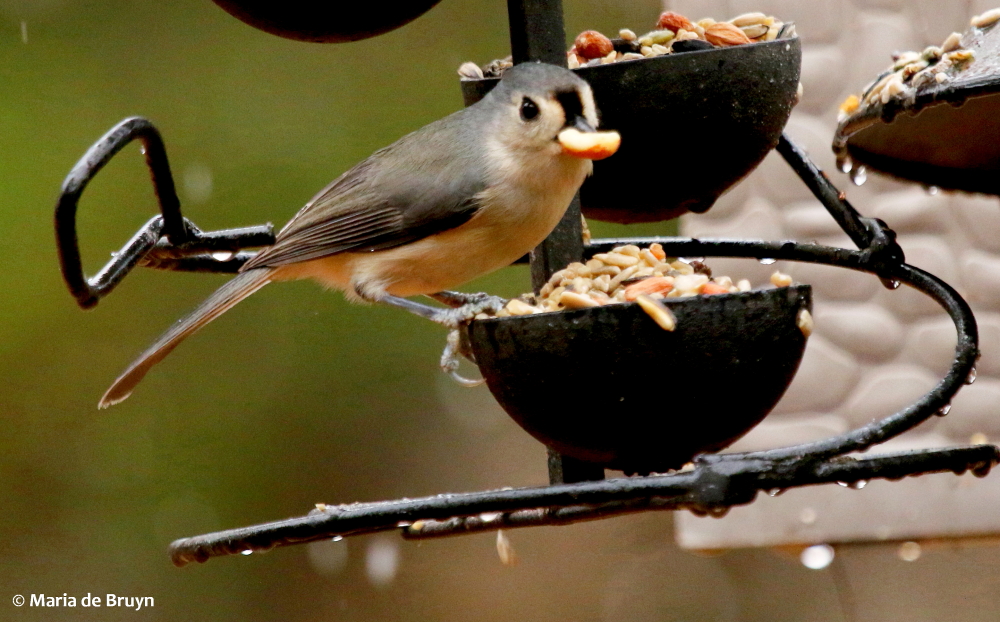
    

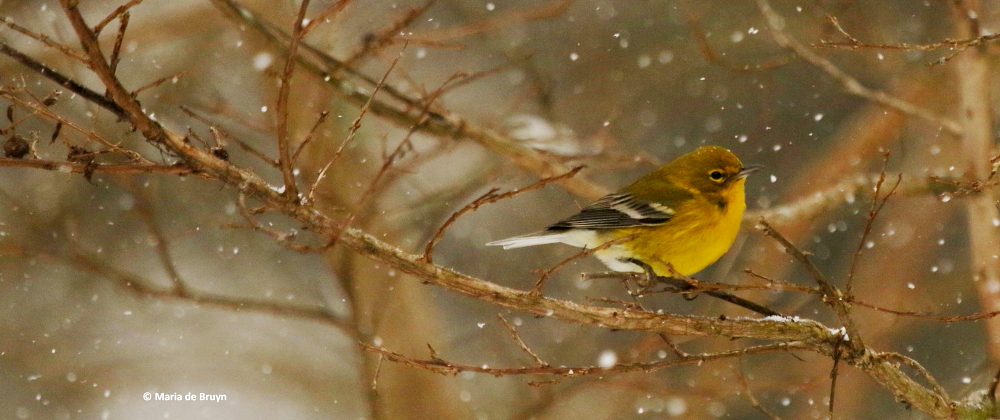
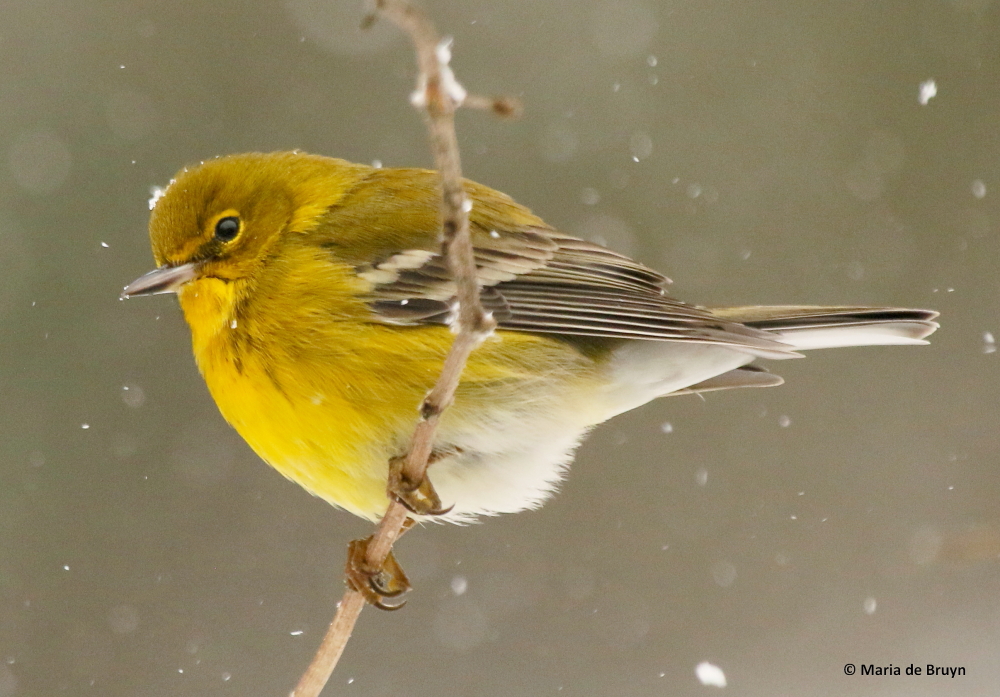
Tufted titmouse                                                       Pine warbler (Setophaga pinus)


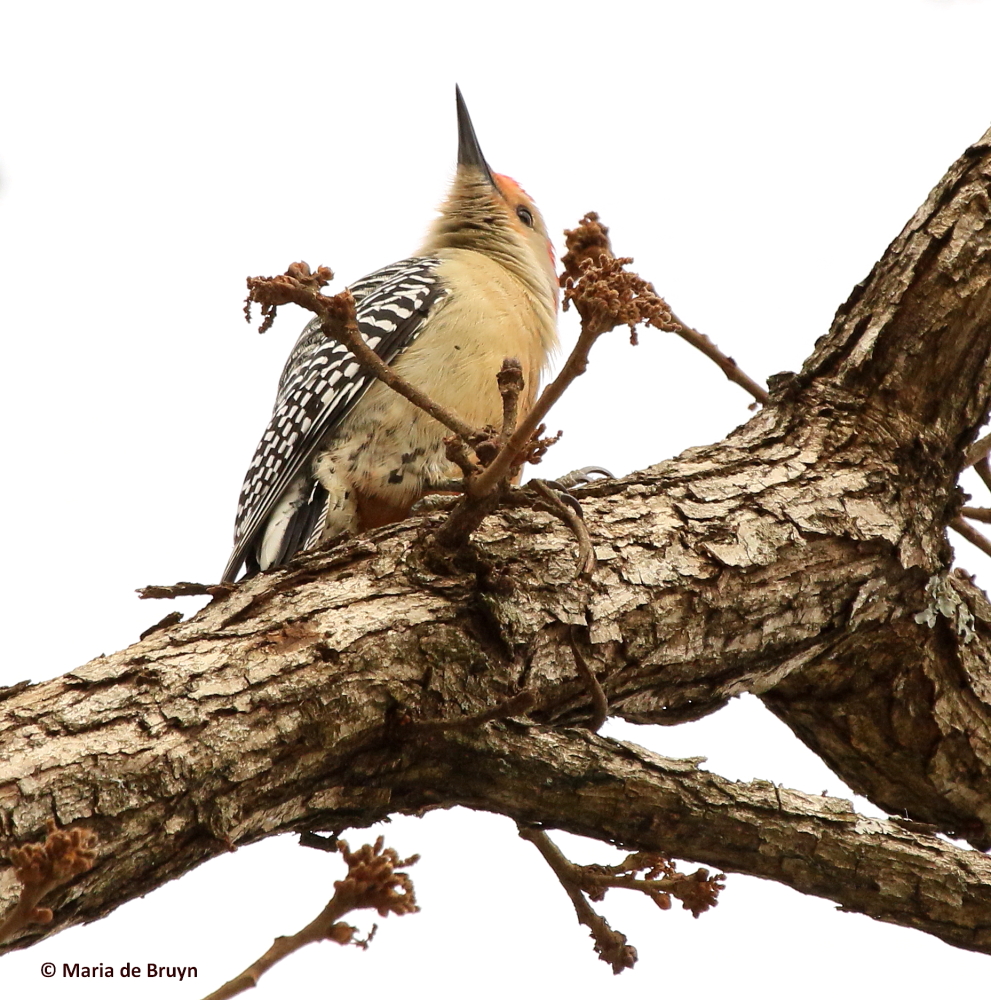
Red-bellied woodpecker (Melanerpes carolinus)      Northern cardinal


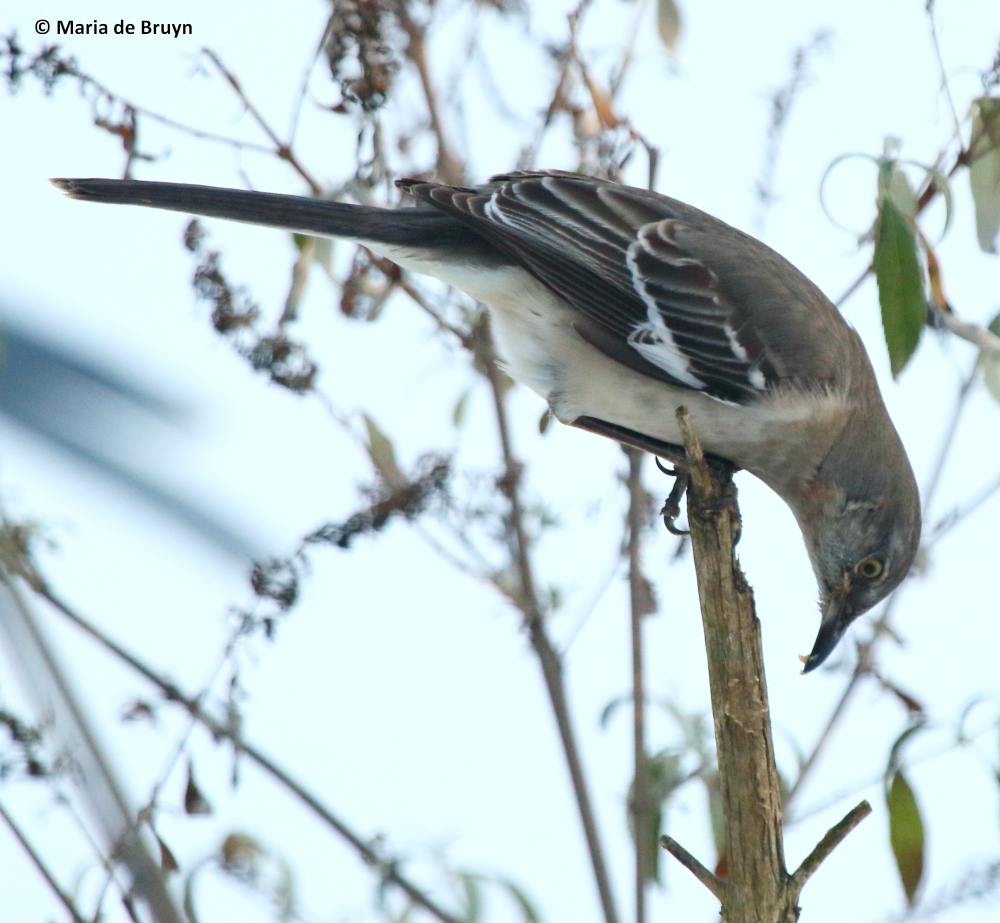
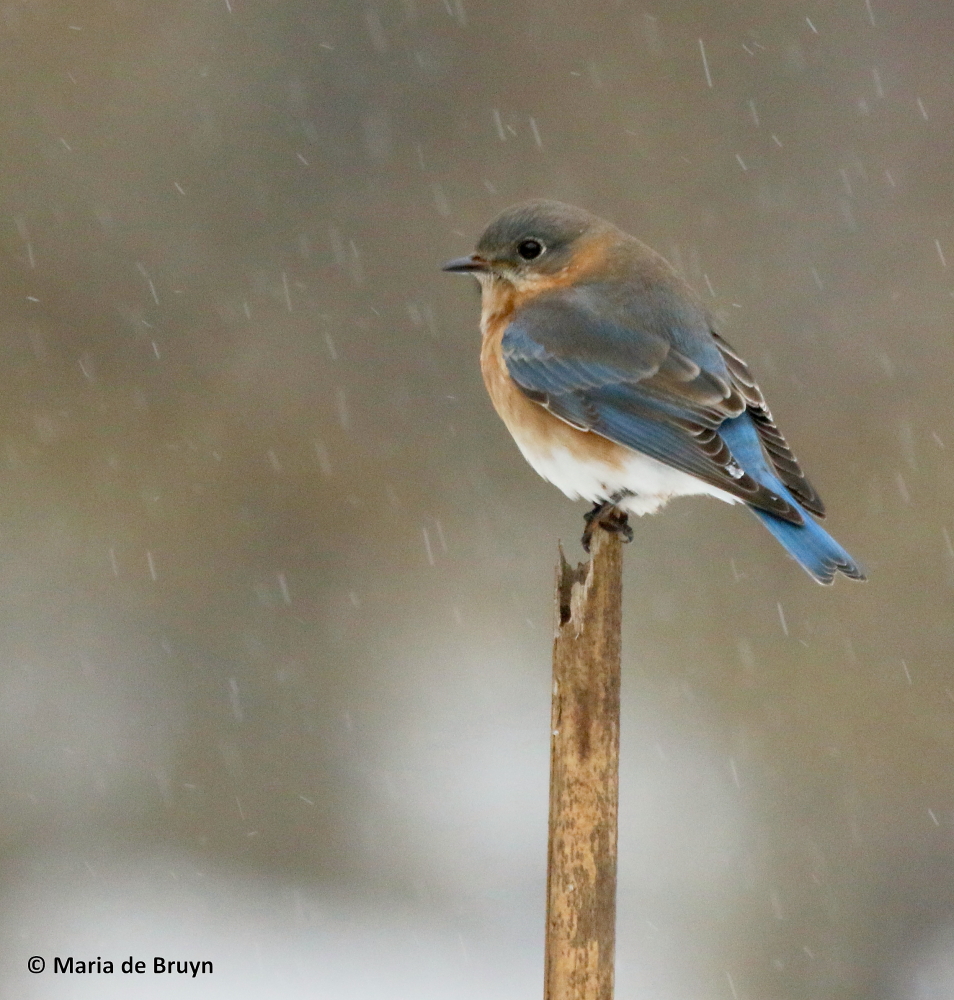
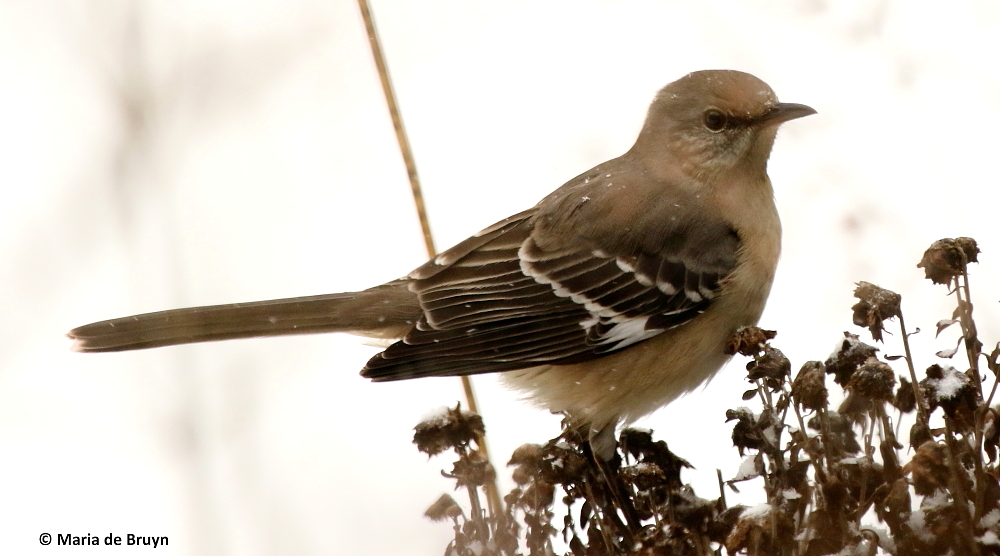
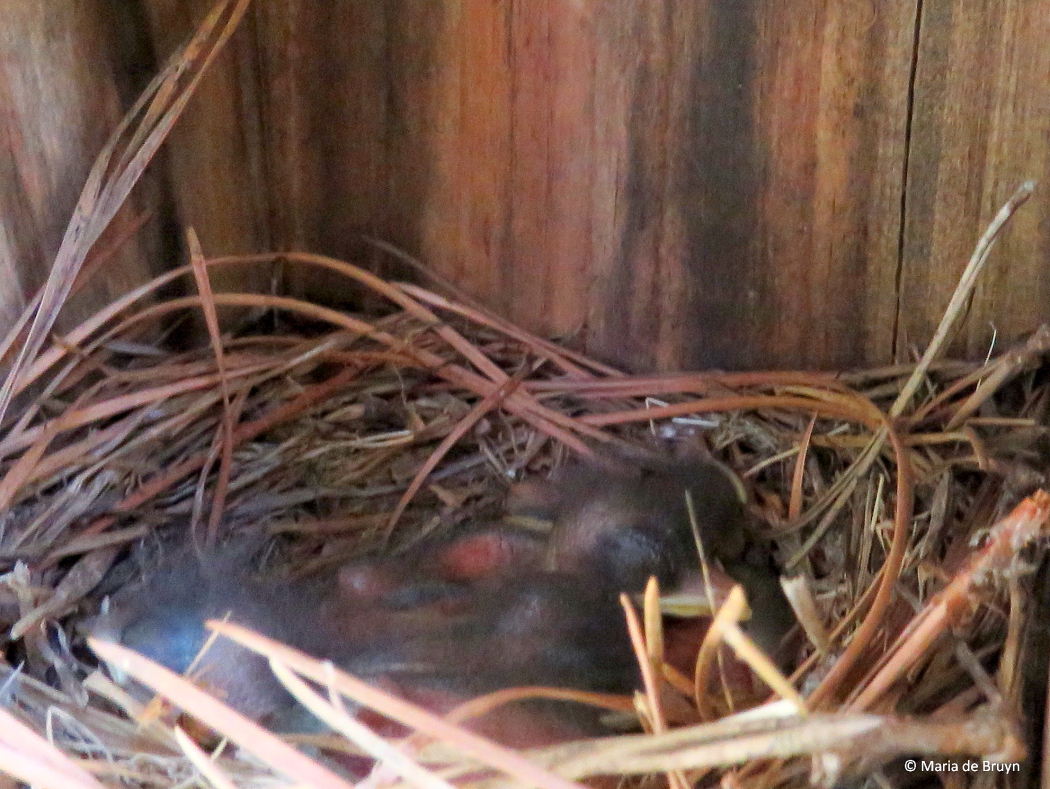
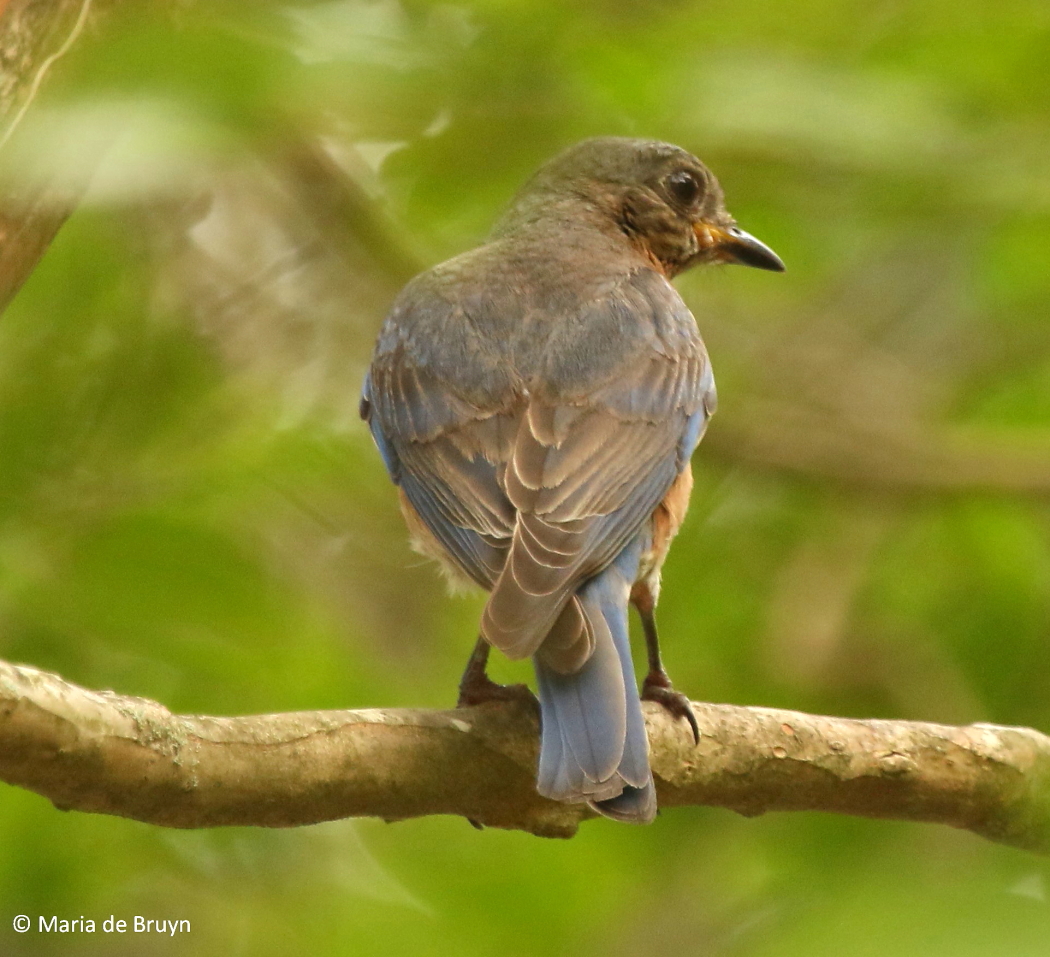
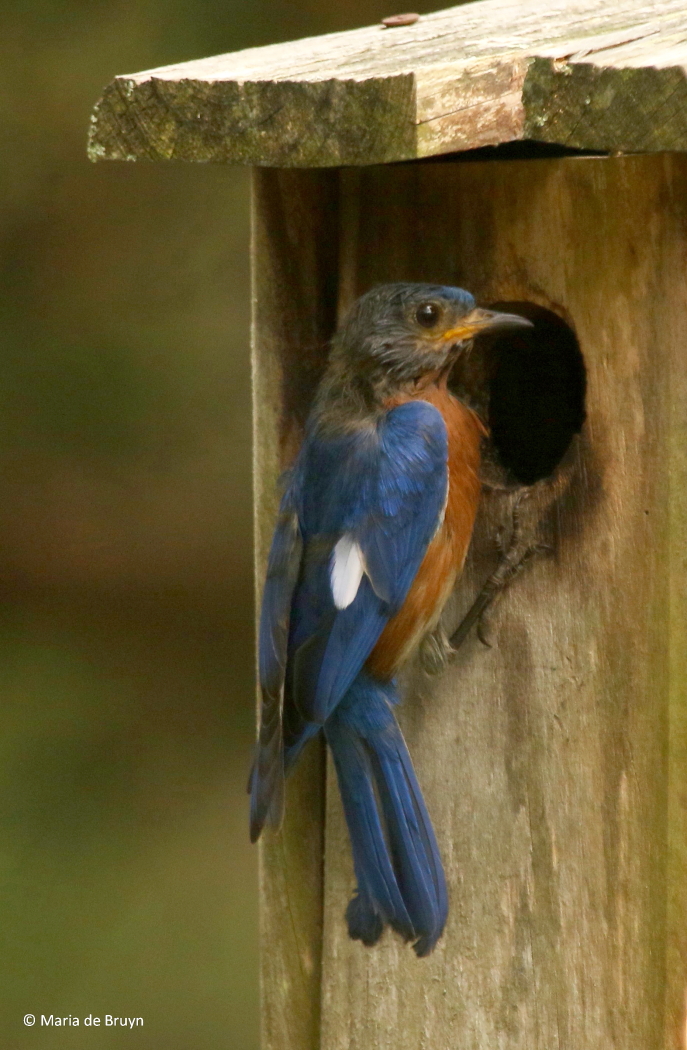
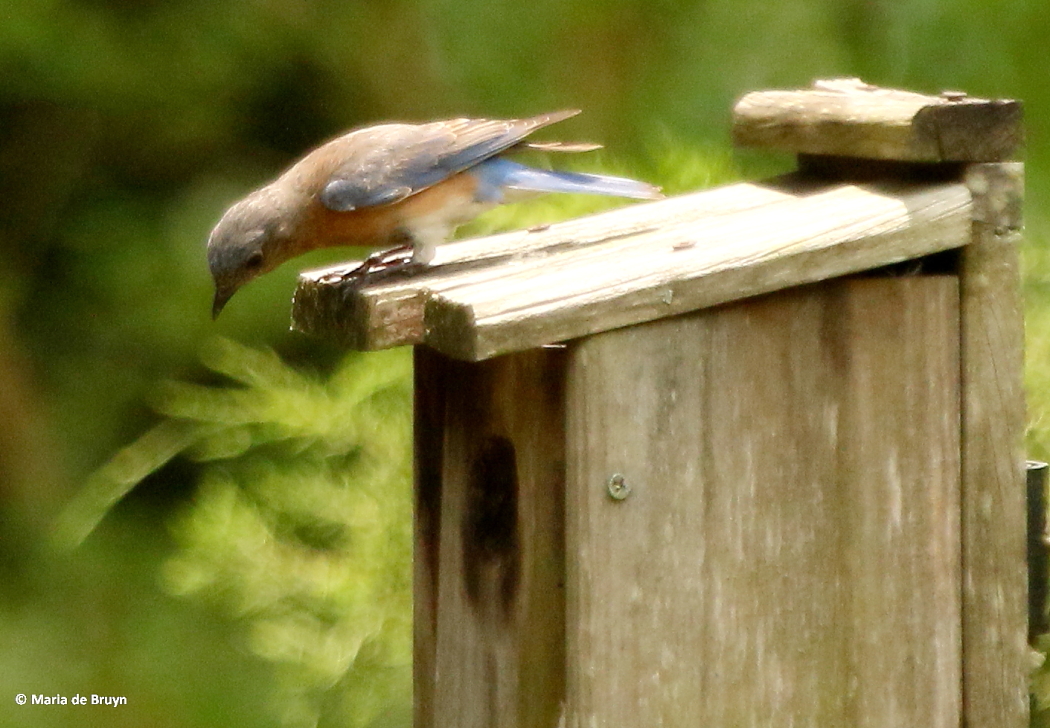
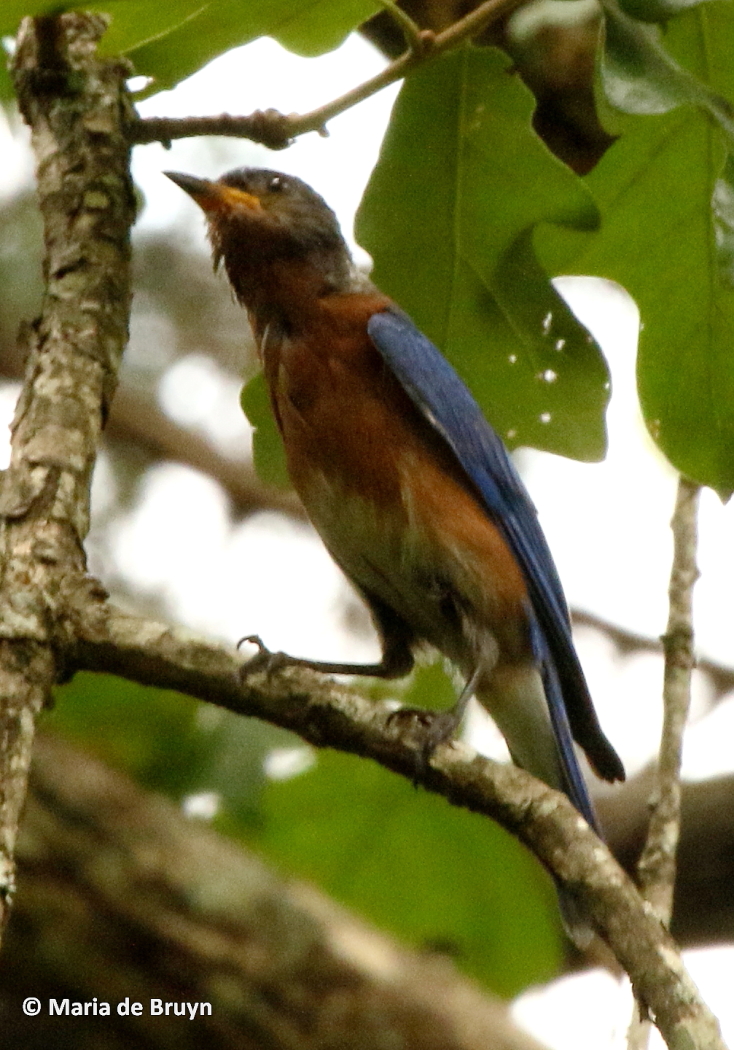
Gray catbird (Dumetella carolinensis)        Eastern bluebird (Sialia sialis)
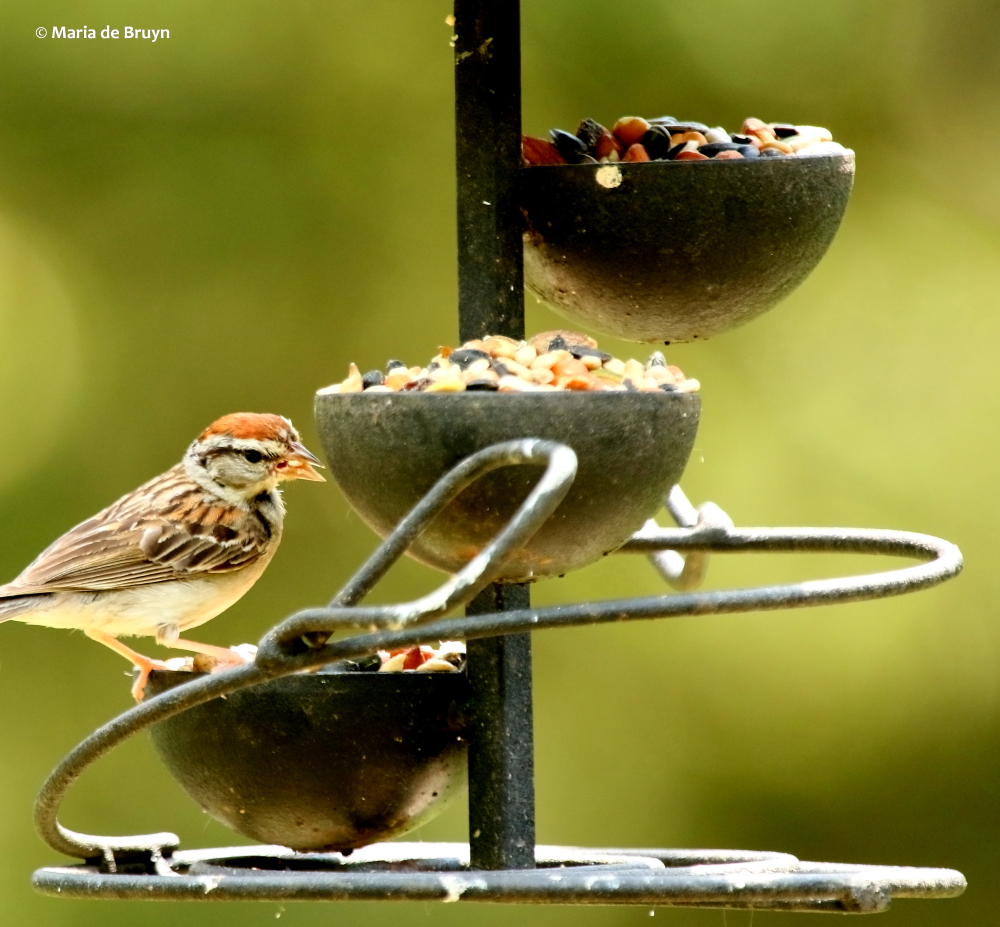
       

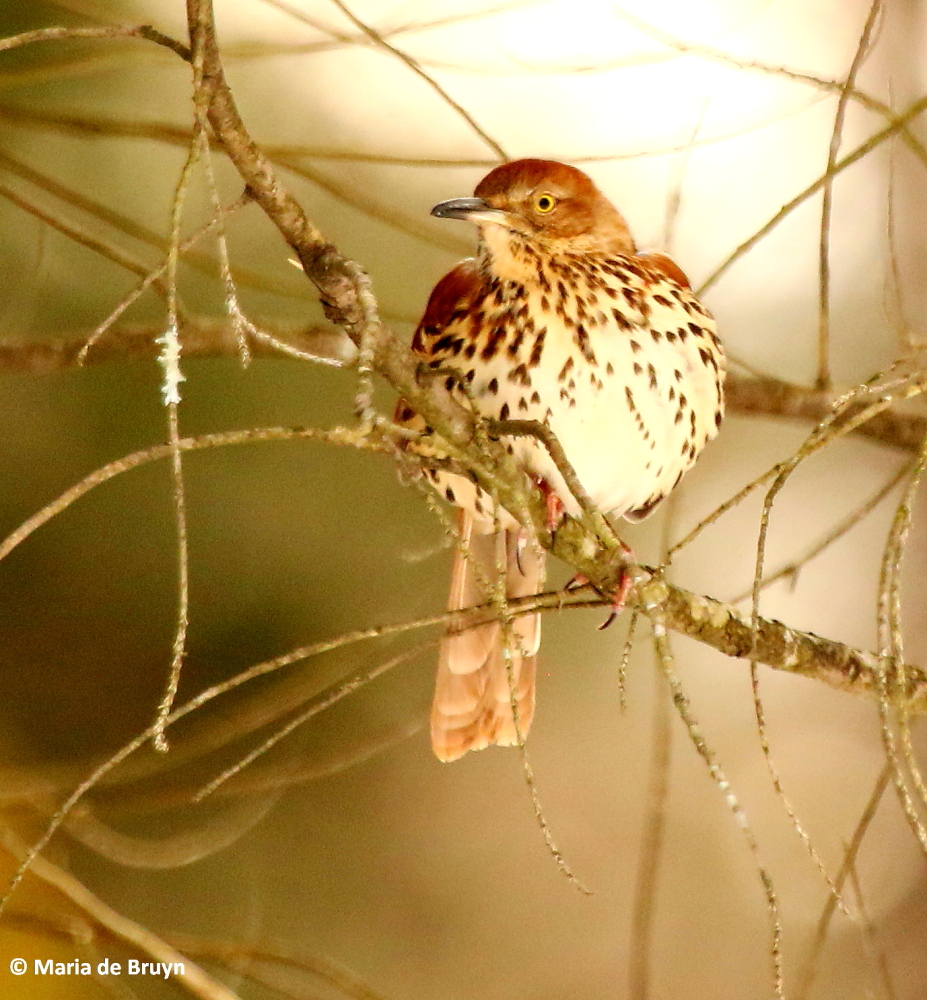
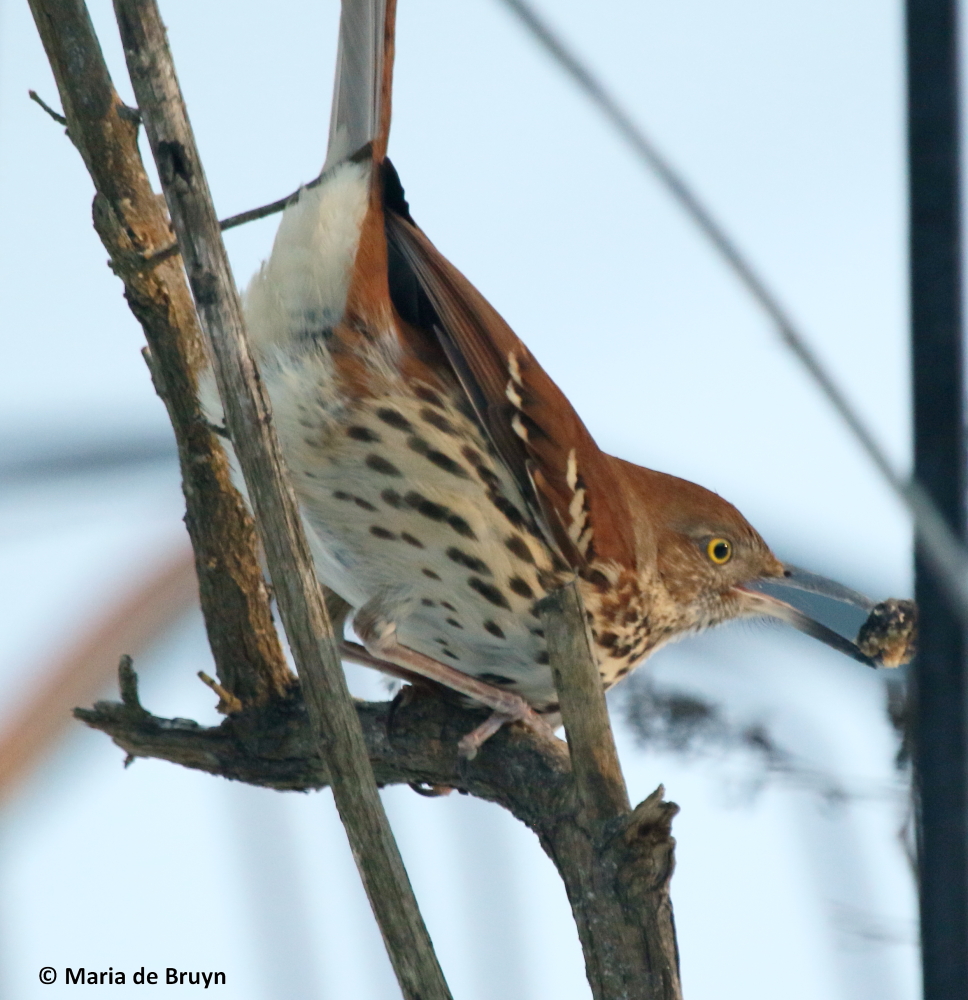
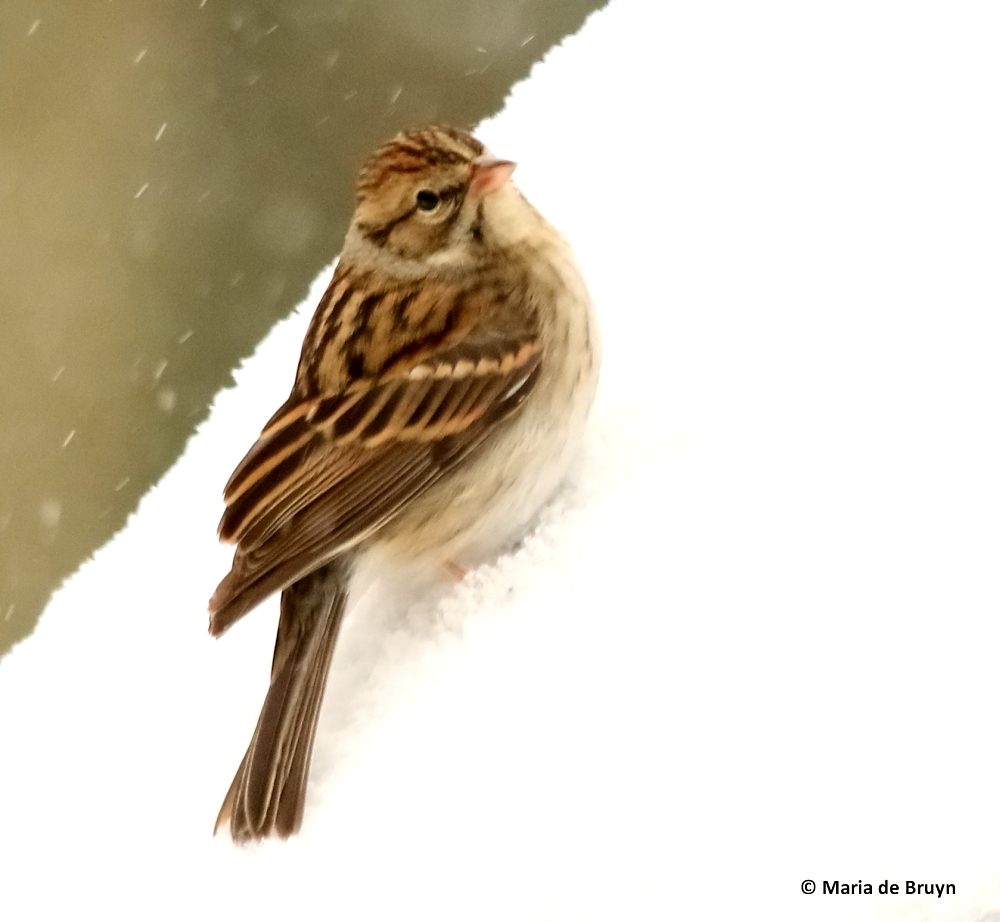
Chipping sparrow (Spizella passerina)         Brown thrasher (Toxostoma rufum)

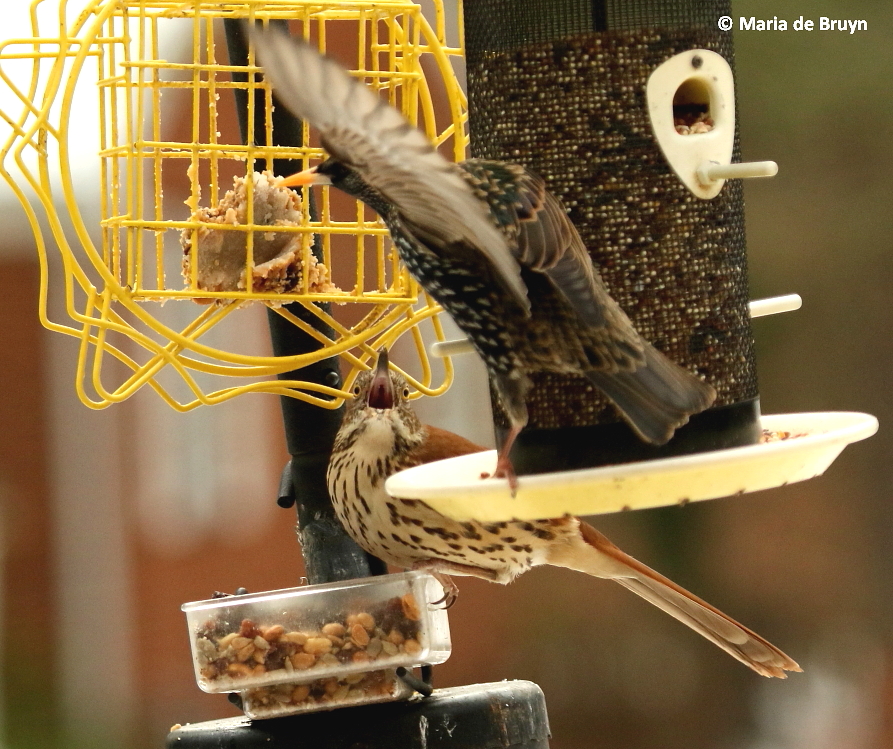
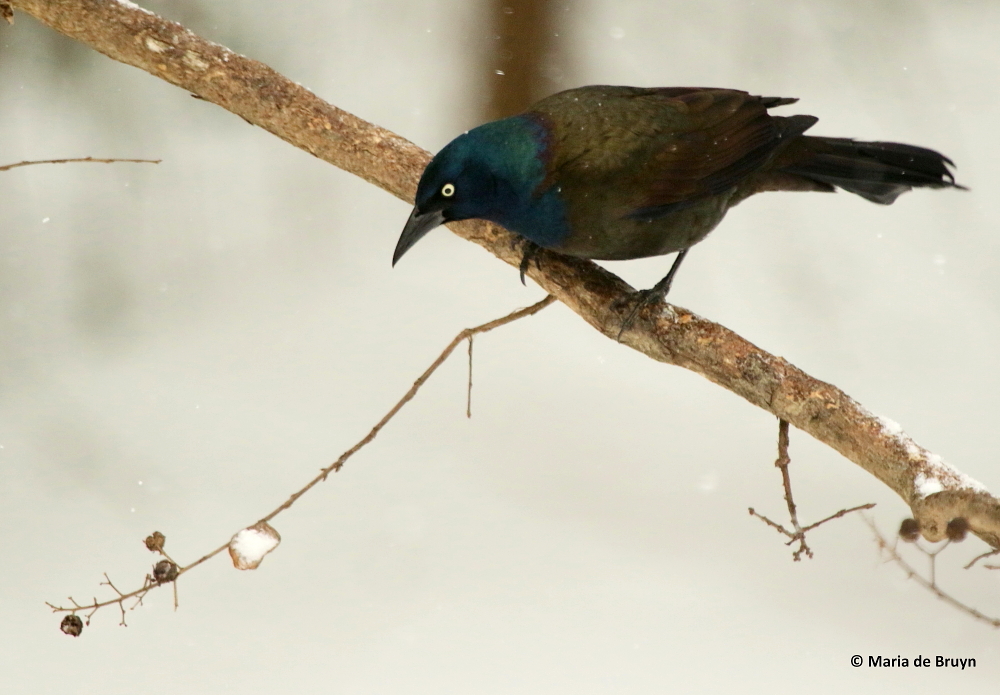
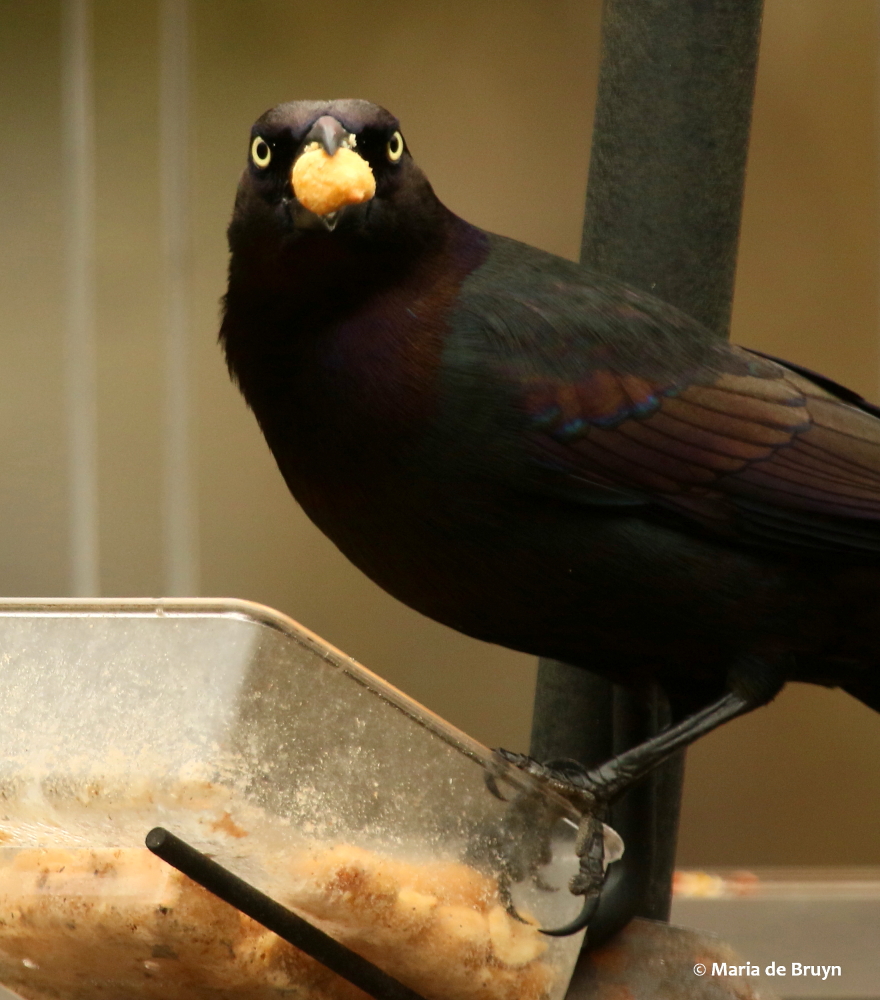
The common grackles (Quiscalus quiscula) will sometimes break down the nuts (and are quite messy about it, compared to the chickadees and titmice), but they will also swallow the treats whole.
  

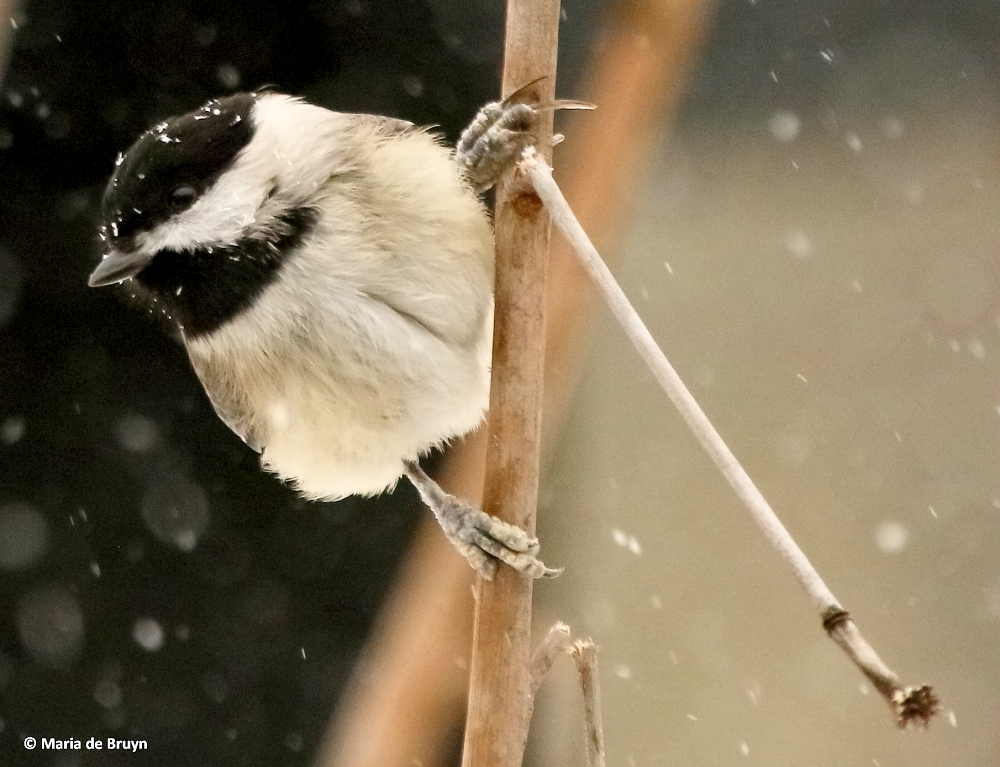
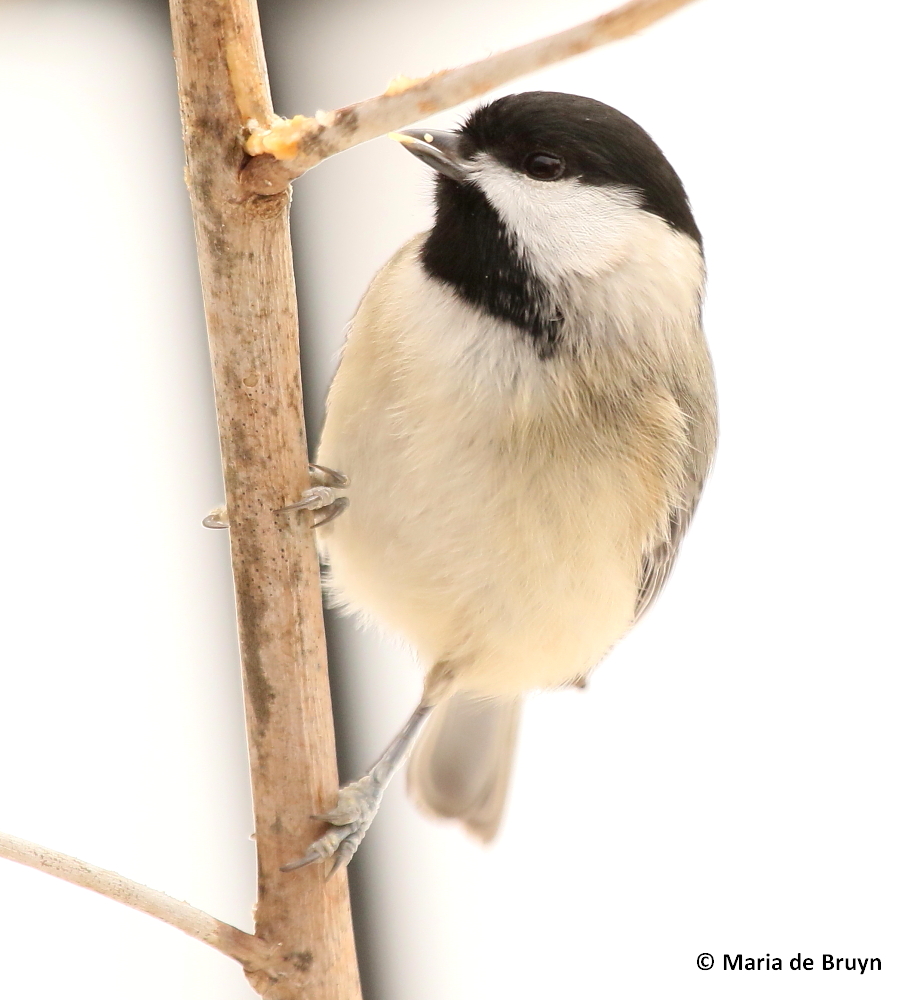
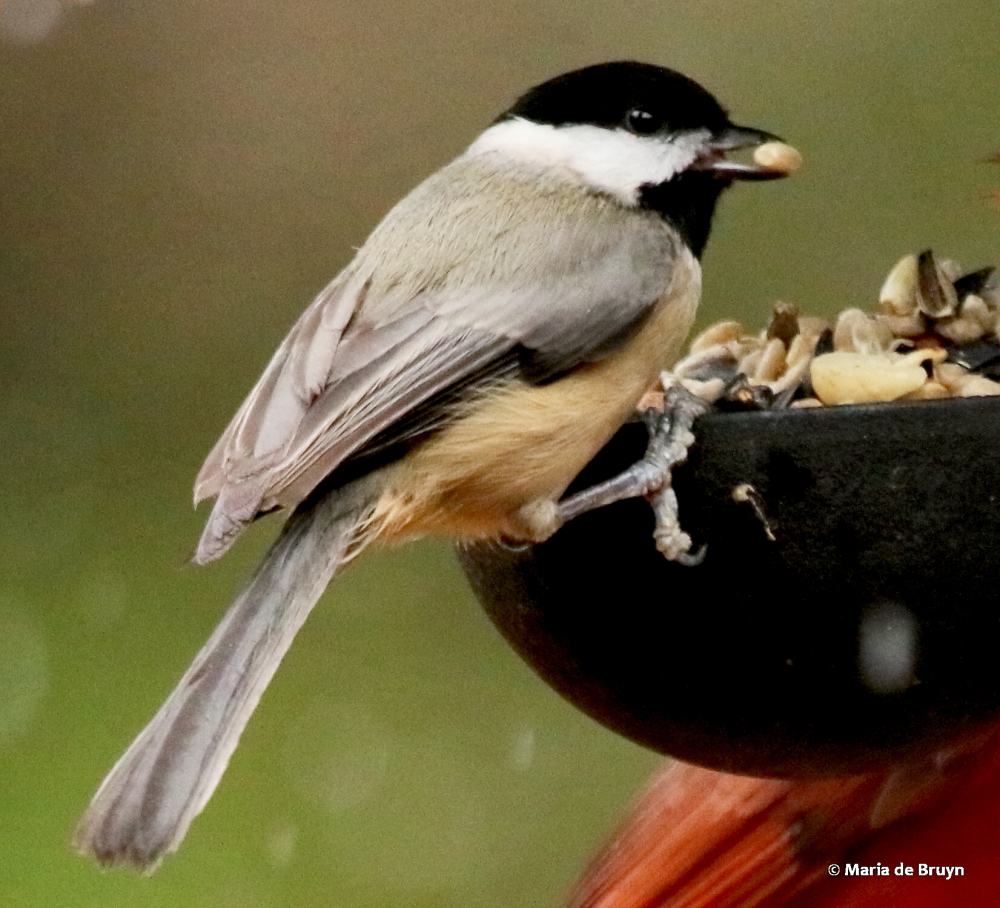
Others are intent on breaking the peanuts into smaller pieces that are easier to get down; this seems especially true for the smaller birds like the Carolina chickadee (Poecile carolinensis) below. Here we also see Riley, my banded Carolina wren, enjoying a treat.
   

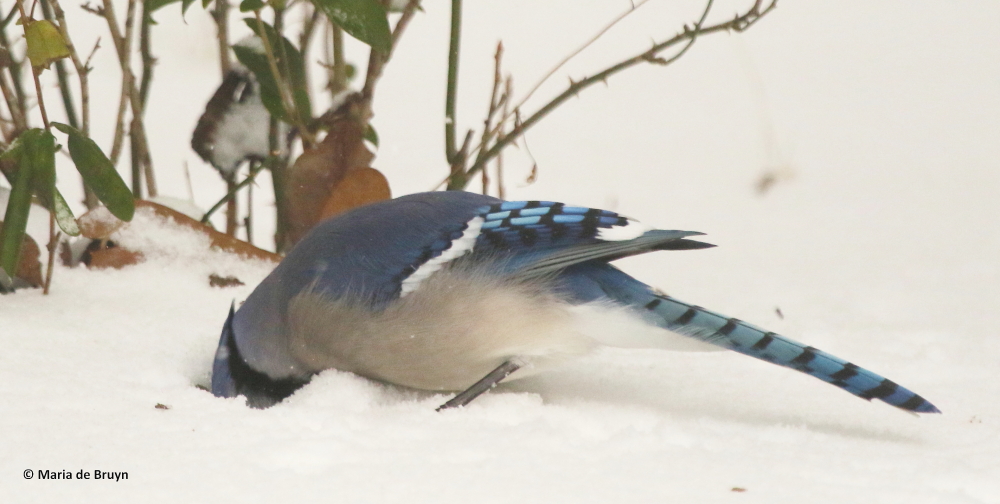
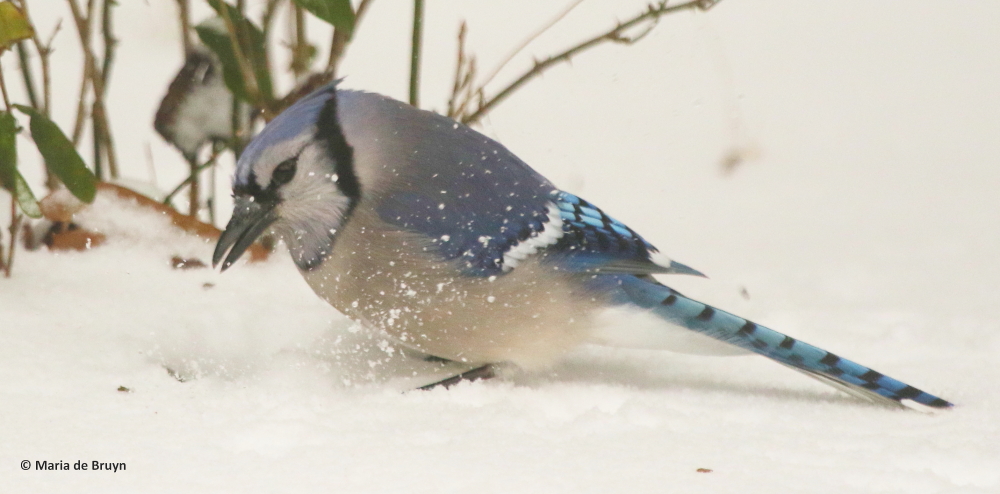
The blue jays (Cyanocitta cristata) often gulp down some nuts quickly and then try to carry off several nuts at a time.
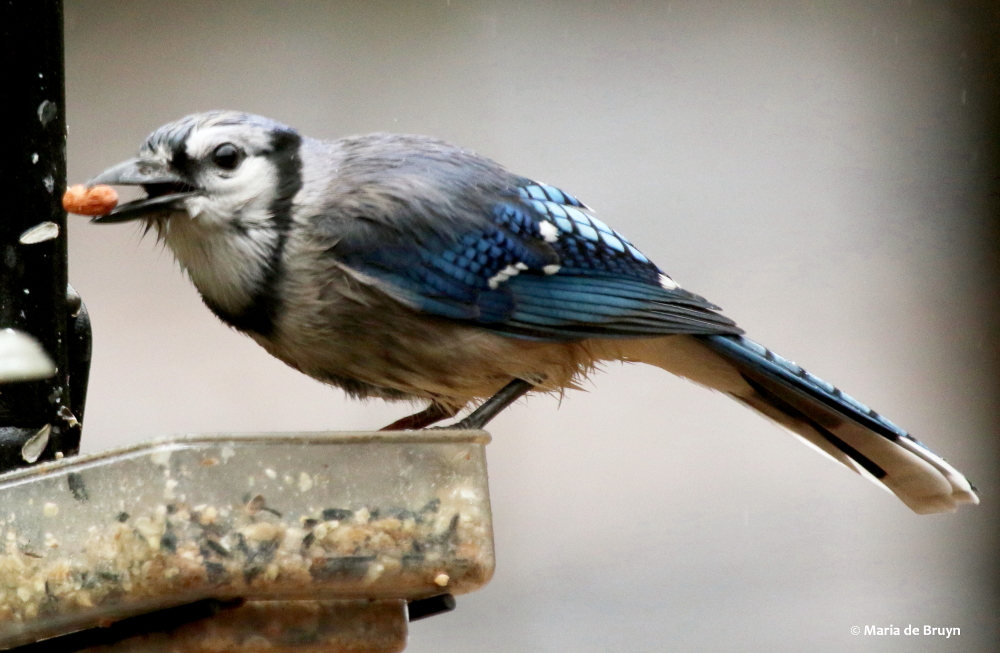
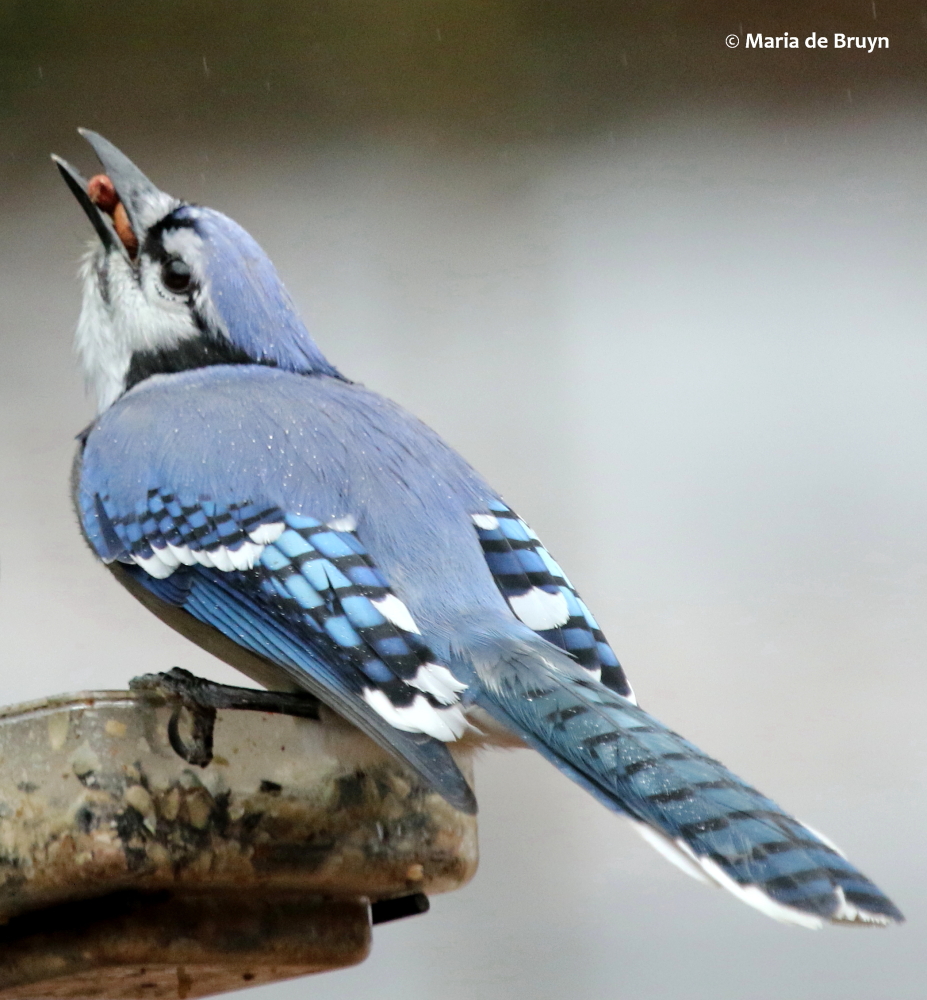
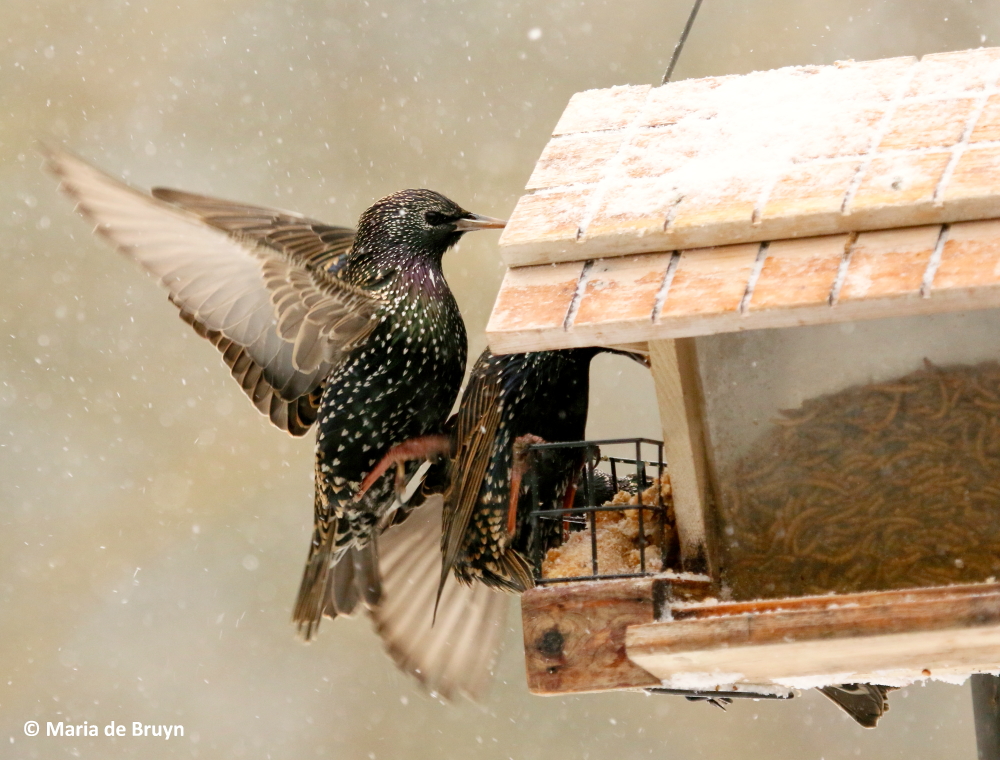
One good thing about the peanuts is that thankfully the starlings (Sturnus vulgaris) and brown-headed cowbirds (Molothrus ater) don’t appear fond of them (they gulp down the dried mealworms, however, as if that food is going out of style). One will occasionally sample a nut, but they never seem to want a second.

As time passed, I realized that the peanut feeding strategy was rewarding me with frequent avian visitors, but was also rather costly. In the autumn, I began putting out a less expensive fruit and nut mix. This has also proved very popular and various species of birds are willing to share space at the feeders. The chickadees especially will feed alongside others, like the house finches and Northern cardinal below.
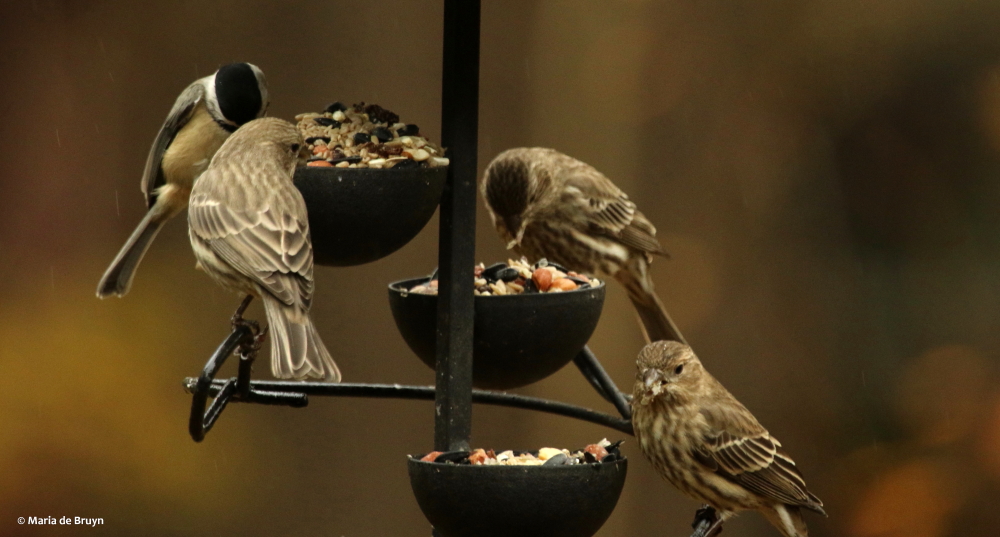
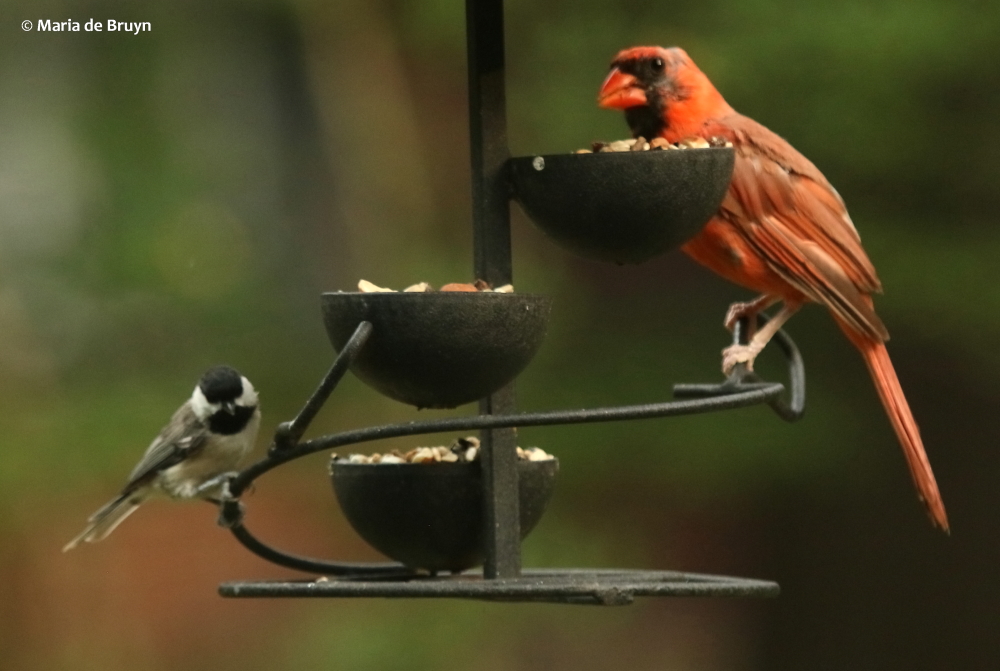
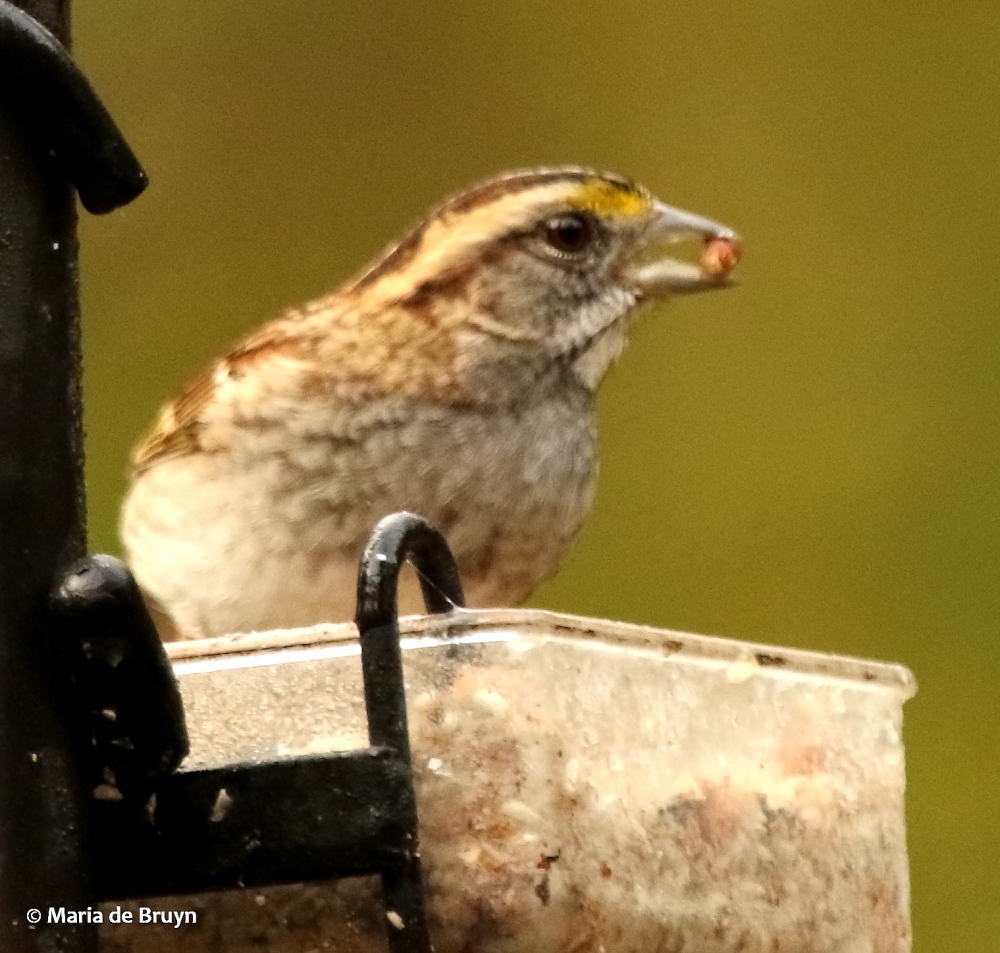
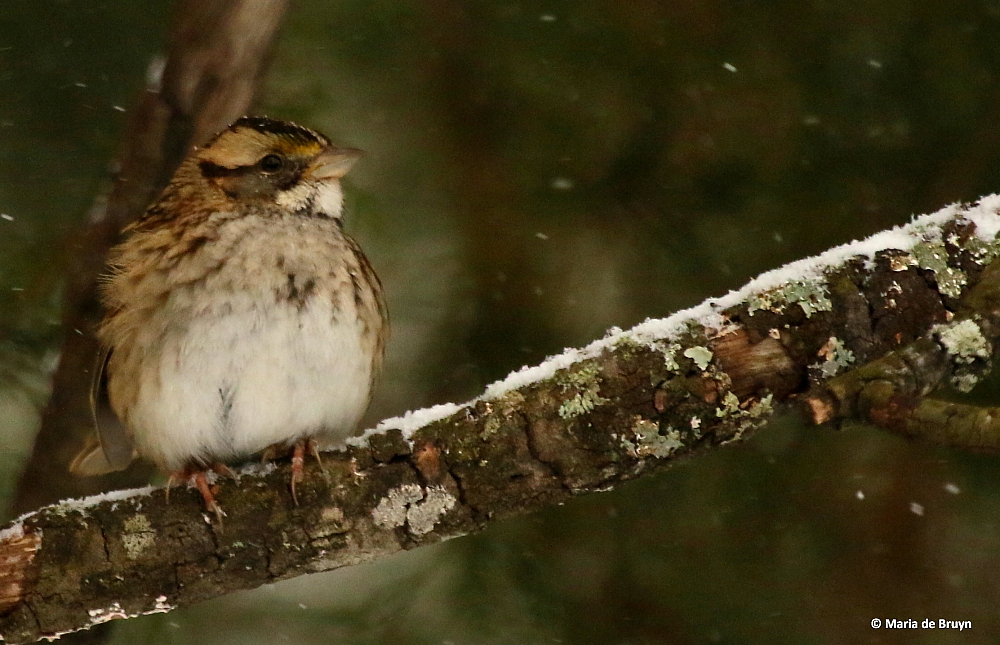
Species that usually forage on the ground, like the white-throated sparrows (Zonotrichia albicollis), also make occasional forays to the nut feeder.

When the nut feeders are empty, it’s not uncommon to see birds sitting atop them; when they see me, some will call out, as if saying, “Hey, fill up that feeder, please!” And I usually accommodate them, especially when it is very cold, as has been the case the first days of 2018 – we have had a record-breaking stretch of days in which the temperature did not rise above freezing, an unusual occurrence for our southern state of North Carolina.
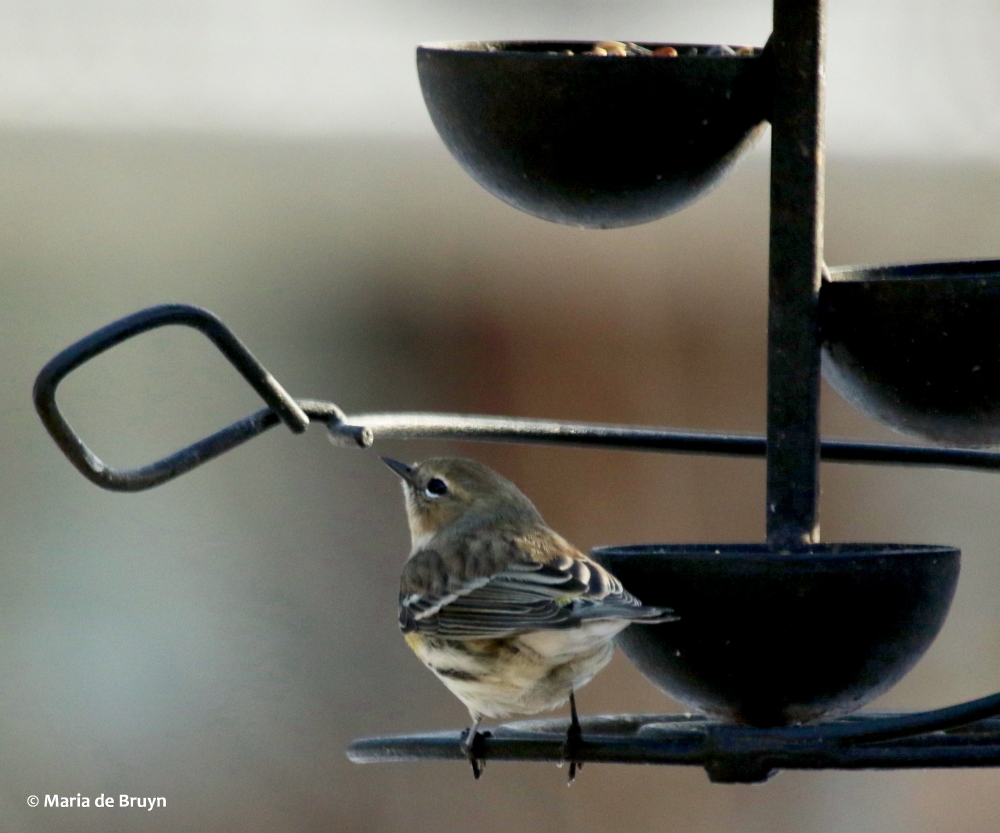
 

Yellow-rumped warbler  (Setophaga coronata)  House finch (Haemorhous mexicanus)

The nut feeders have also been very attractive to the resident Eastern gray squirrels (Sciurus carolinensis), one of whom has been VERY persistent in devising ways to get onto the feeders. Each time s/he succeeds, I change the position of the feeders or stumps and branches nearby. Currently, that clever rodent hasn’t been able to get up there. In compensation, I occasionally throw a handful of nuts on the ground.
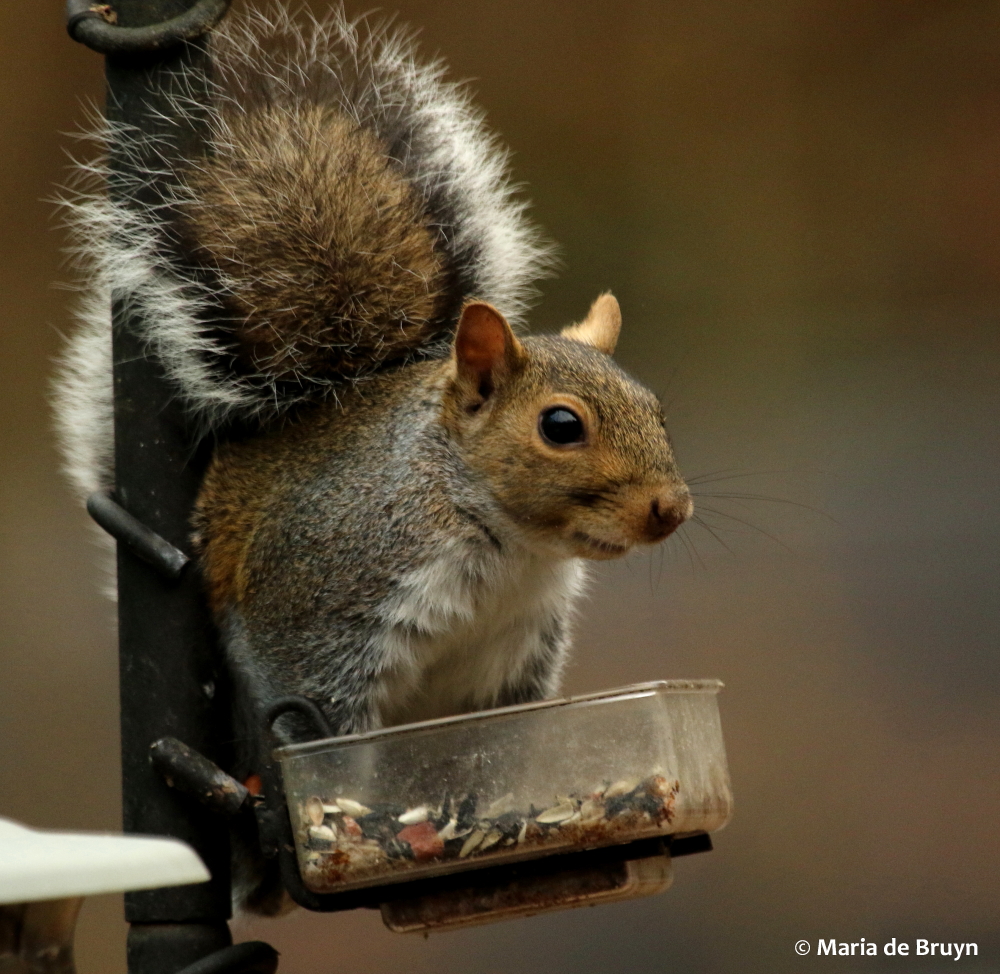
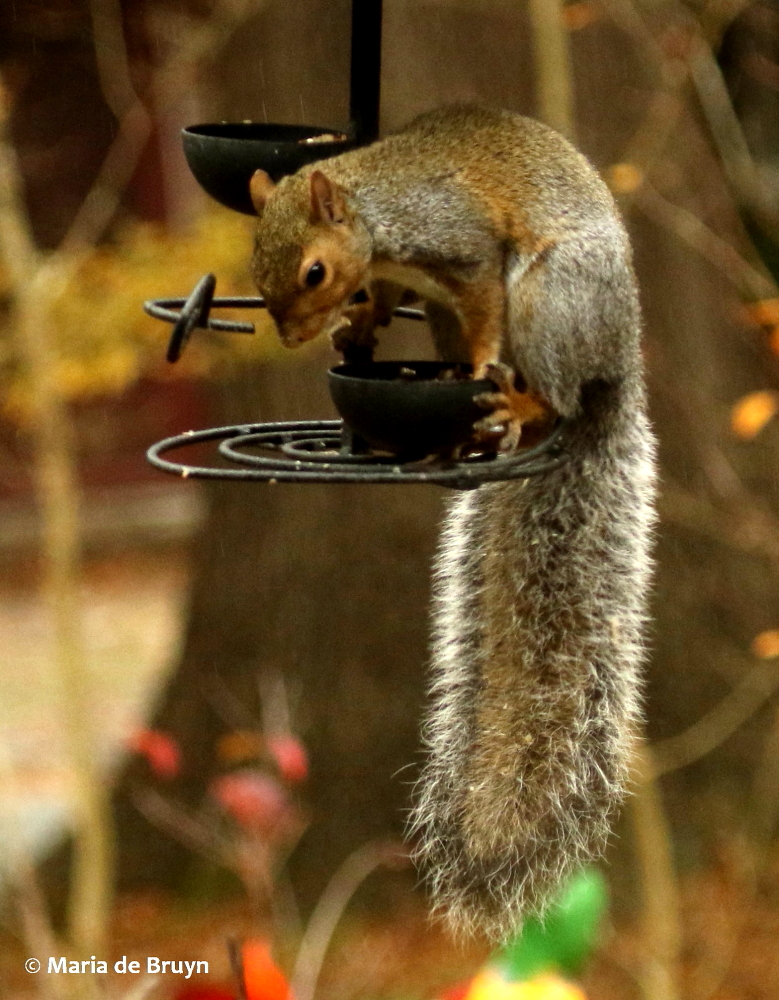
             

So, not all the birds are “nuts” for nuts, but plenty of species think they’re mighty fine! They are definitely a worthwhile addition to the birders’ array of feeder offerings.
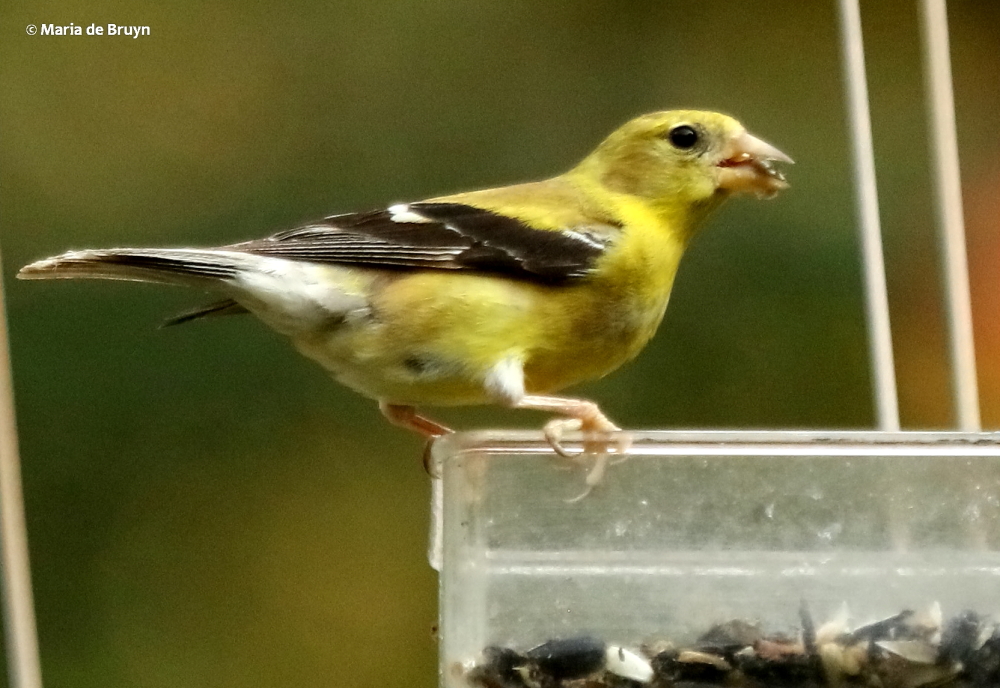
American goldfinch (Spinus tristis)


Avian generations in the making – part 3B: fledgling and post-fledgling care

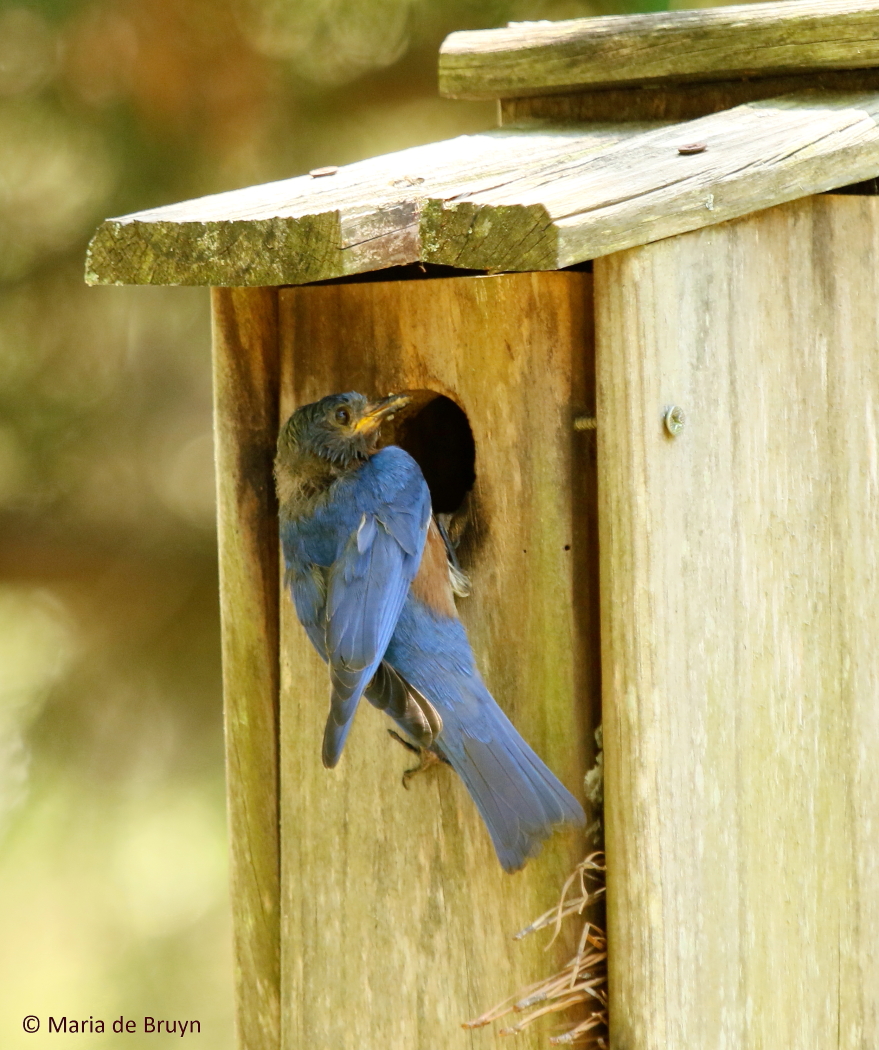
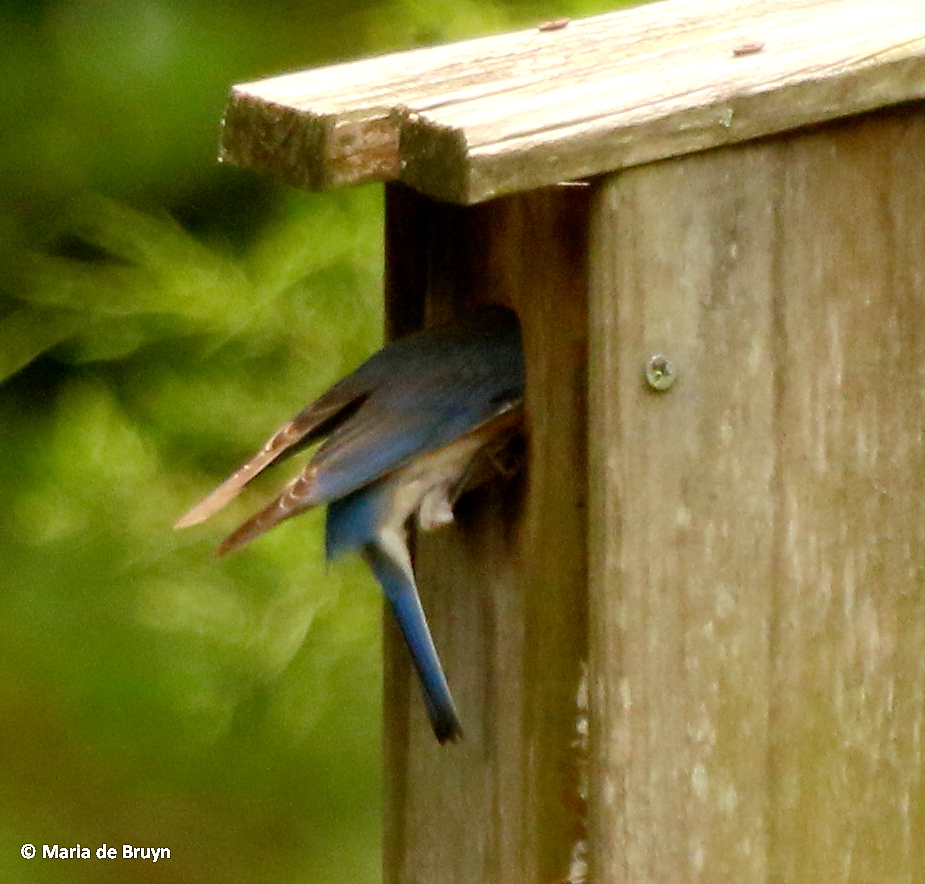
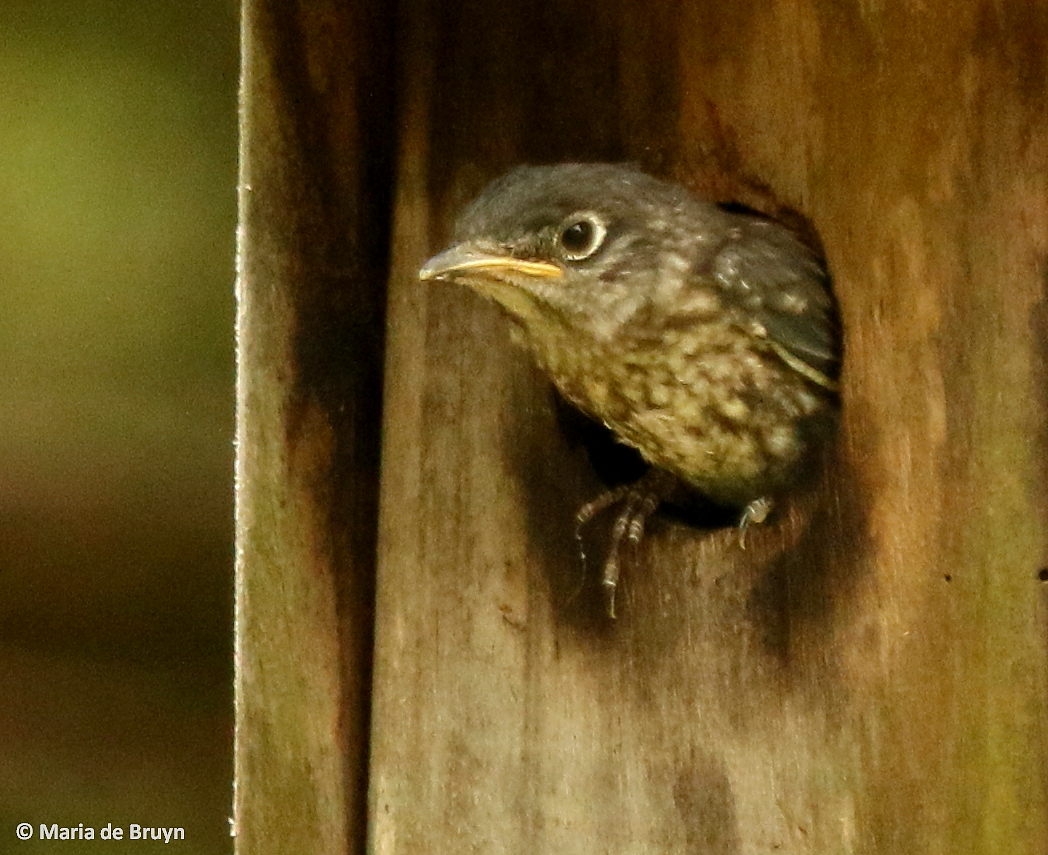
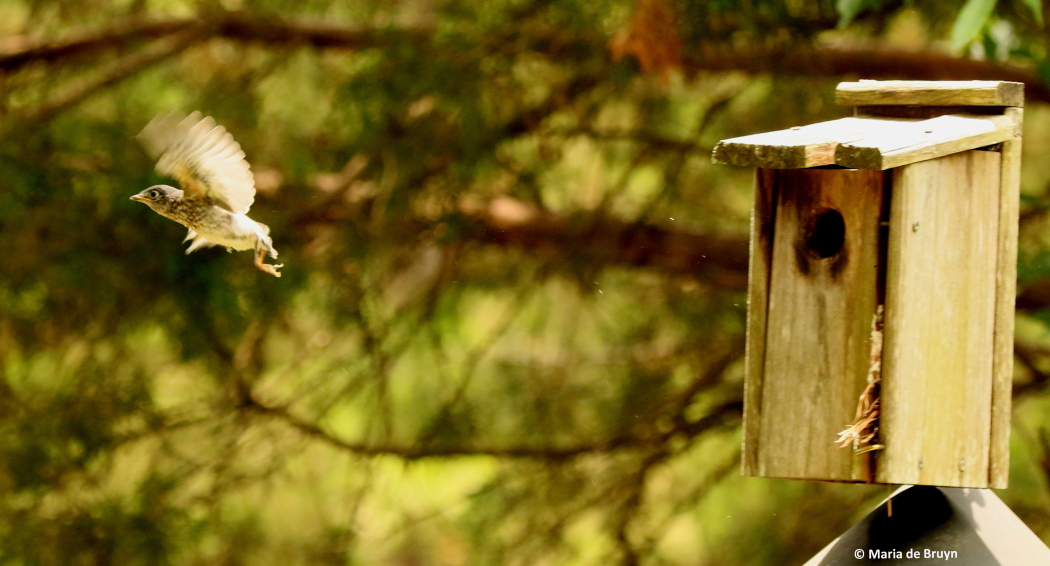
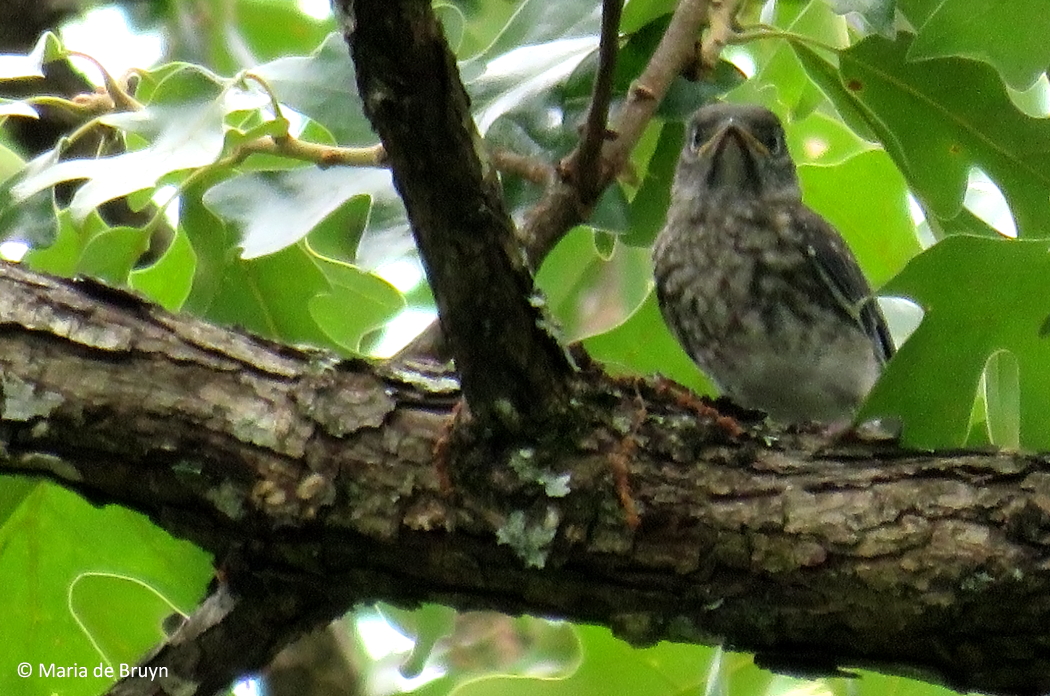
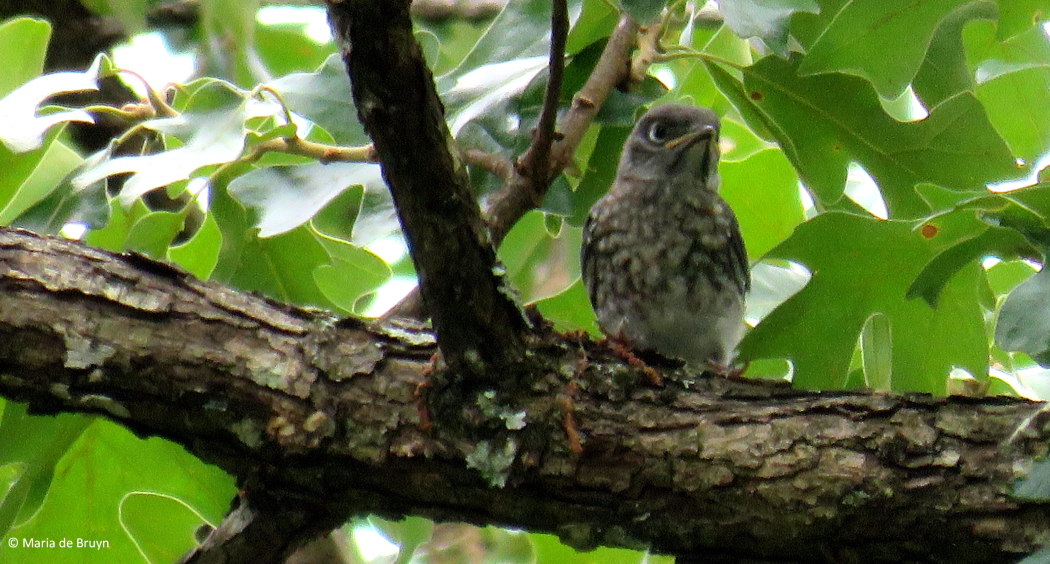
The number of days after hatching when young altricial birds leave the nest is fairly predictable for many species; knowing those approximate dates is helpful if you want to plan a day to watch fledging happen. I can often arrange to sit and watch a nest box on the appointed day for several hours.This has enabled me to see several broods of Eastern bluebirds and brown-headed nuthatches make their leaps to freedom on the path to adulthood.

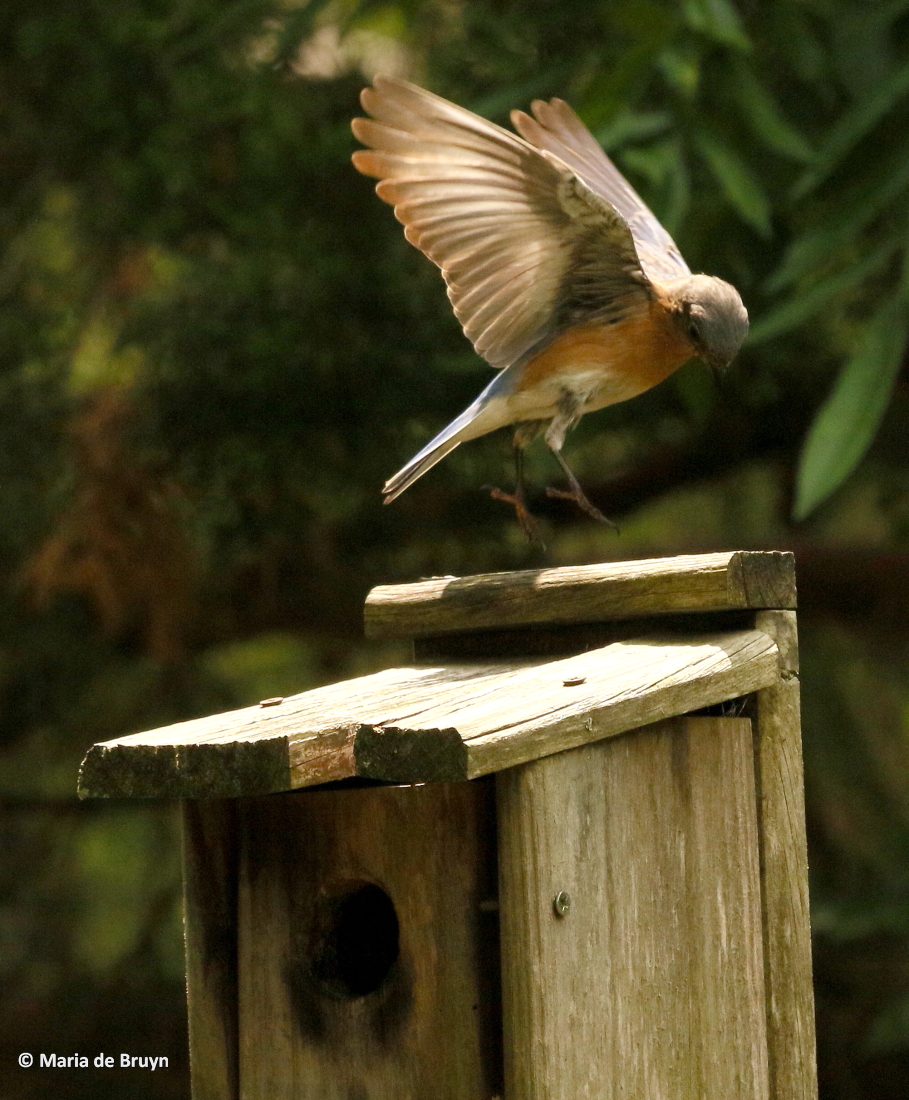
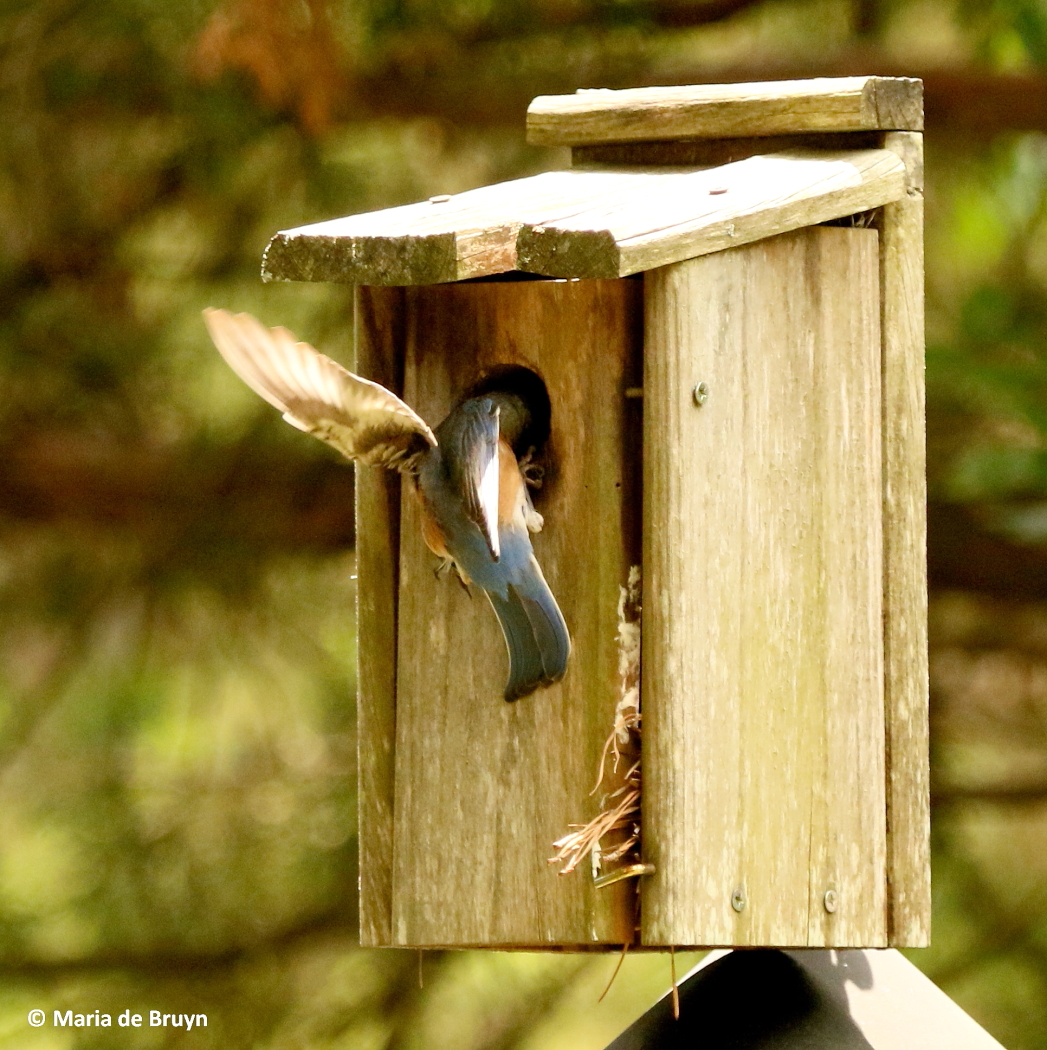
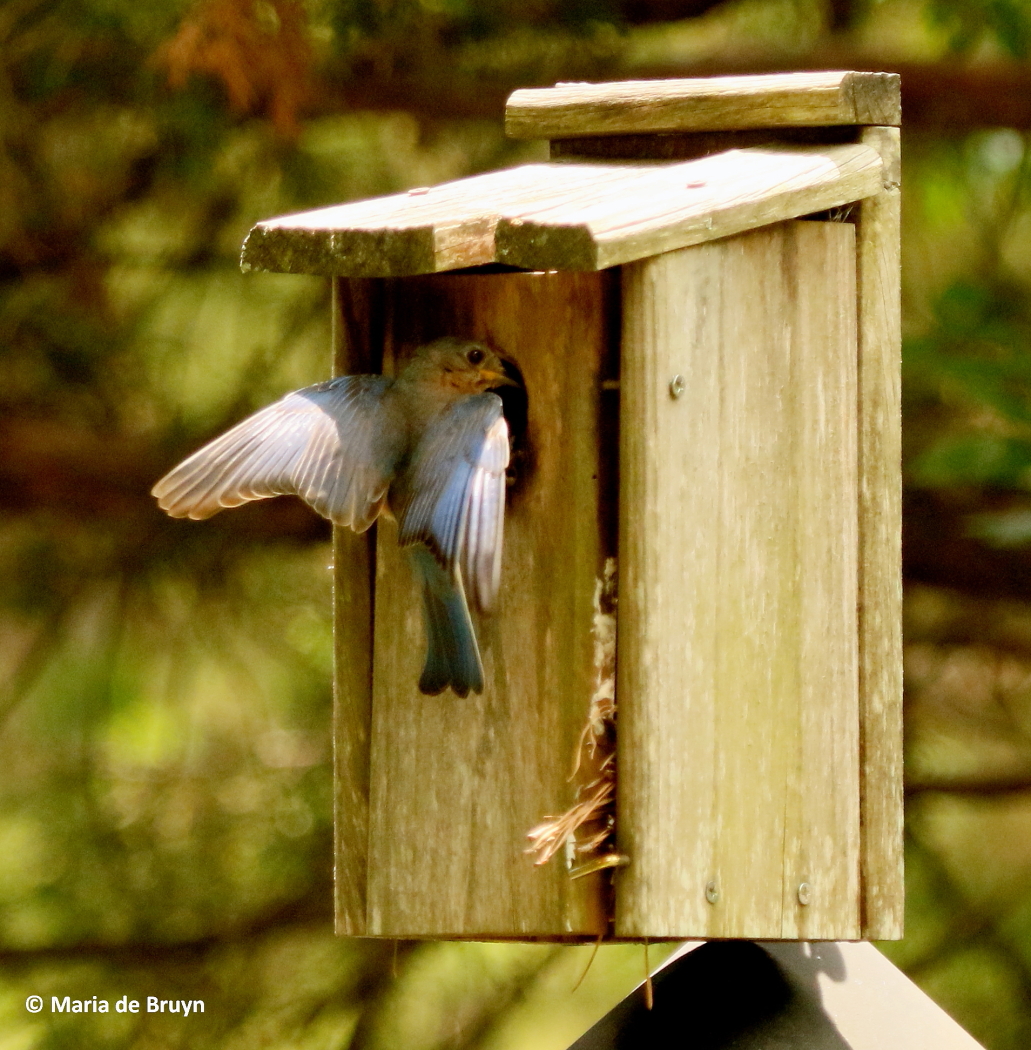
When it is time for fledging, parent birds encourage their babies to leave the nest. They may entice them by perching nearby with some food but not bringing it to them. Or they fly to the box with food and then go to a branch instead of feeding. The Eastern bluebirds (Sialia sialis) in my yard will hover in front of the nest box like a hummingbird, sometimes with food in their mouths; perhaps they are showing the young ones that flight involves flapping wings.

While in some species, parents appreciate help from older children in caring for a current brood, Eastern bluebirds apparently do not. This may be because they see the previously fledged young as competitors for food. In my yard, father bluebird especially was chasing the young of earlier nests away from the feeders, not only when they begged but also when they fed themselves.


When fledging day arrived for the bluebirds’ third brood, one of the older siblings (I’m not sure if it was a female or male) was very interested in seeing the third brood fledge. He imitated his parents, hovering in front of the nest box so the young ones could see him.


Again, however, the parent bluebirds chased him away.

This did not deter the immature bird, however. He waited for the parents to go get food and again took on encouraging the young siblings. It was fascinating to watch!


The parents returned and drove him off with a show of bad temper.

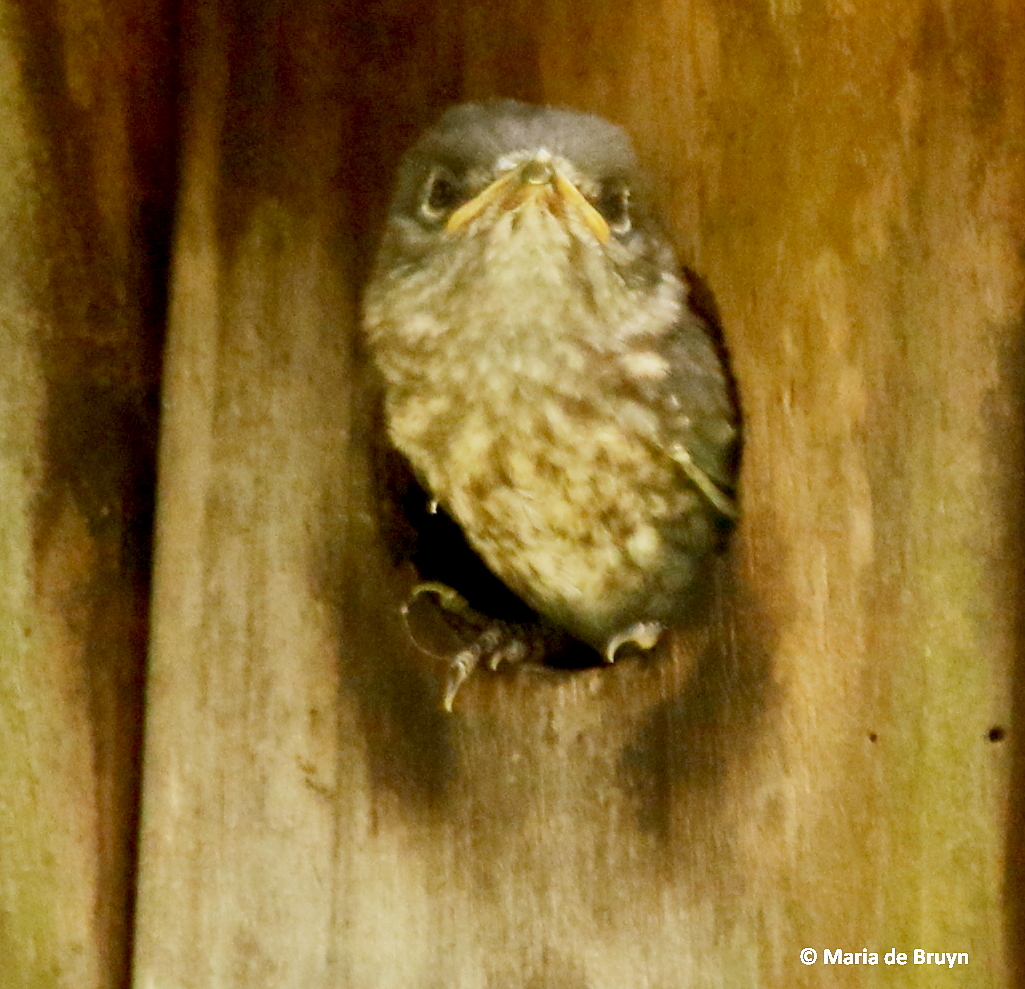
Eventually, the babies did fly out of the nest box into a nearby crepe myrtle. There, they continued to call for food with a wide-open mouth.


This gaping behavior stimulates the parents to feed their offspring and the offspring can be very insistent and persistent in begging for food.


Eastern starling (Sturnus vulgaris)


Carolina wrens (Thryothorus ludovicianus)
  

Common grackle (Quiscalus quiscula)     Royal tern   (Thalasseus maximus)

This behavior can go on for days, especially when the young ones cannot yet fly, like this recently fledged Northern mockingbird (Mimus polyglottos).


The birds that feed their young ones on the ground, like the American robins (Turdus migratorius) have it a bit easier than those that feed juveniles perched on wires, like these barn swallows (Hirundo rustica).


I can imagine that the mother and father get to a point of thinking, “Enough already!” as those large fledglings continue to beg for food; this parent Northern cardinal (Cardinalis cardinalis) did not seem willing to go out for yet another bug for the young one.

But some young birds can be very insistent, even when it is obvious that they are now fully capable of finding some food on their own. This parent chipping sparrow (Spizella passerina) seemed willing to be a feeder for a while longer.


The parent-child feeding routine that often catches people’s eye is when a young brown-headed cowbird is being fed by a (non-voluntary) adoptive parent. For example, here we see a male hooded warbler (Setophaga citrina) bringing food to a brown-headed cowbird baby (Molothrus ater) after the youngster spent quite a while loudly crying out for a meal and hopping around on branches after the parent to convince him that he needed to be fed.


Of course, at a certain point the parents do stop feeding and the young set off on their own. They may check out nearby nest boxes, either scouting homes for next season or looking for roosting boxes for the cold winter nights, like these Eastern bluebirds. They may groom a bit to remove the last bits of fluffy feathers, like this red-shouldered hawk (Buteo lineatus). And then they are ready to spend an autumn and winter getting ready to repeat the cycle, this time as the parent birds. And we can look forward to watching the process again. 😊


Outwitting the starlings during Winter Storm Helena

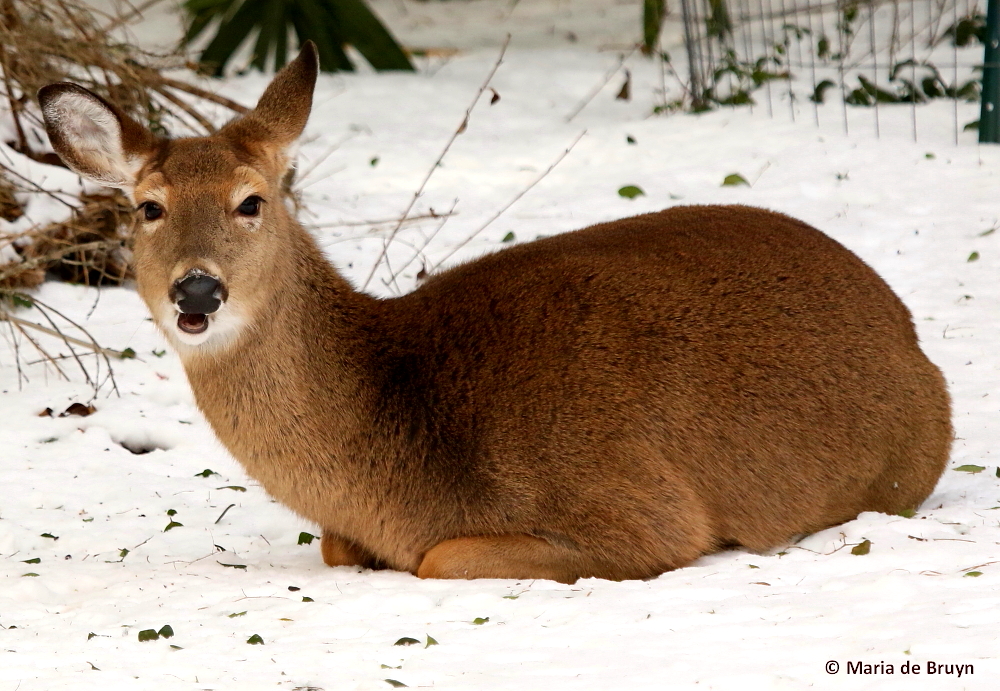
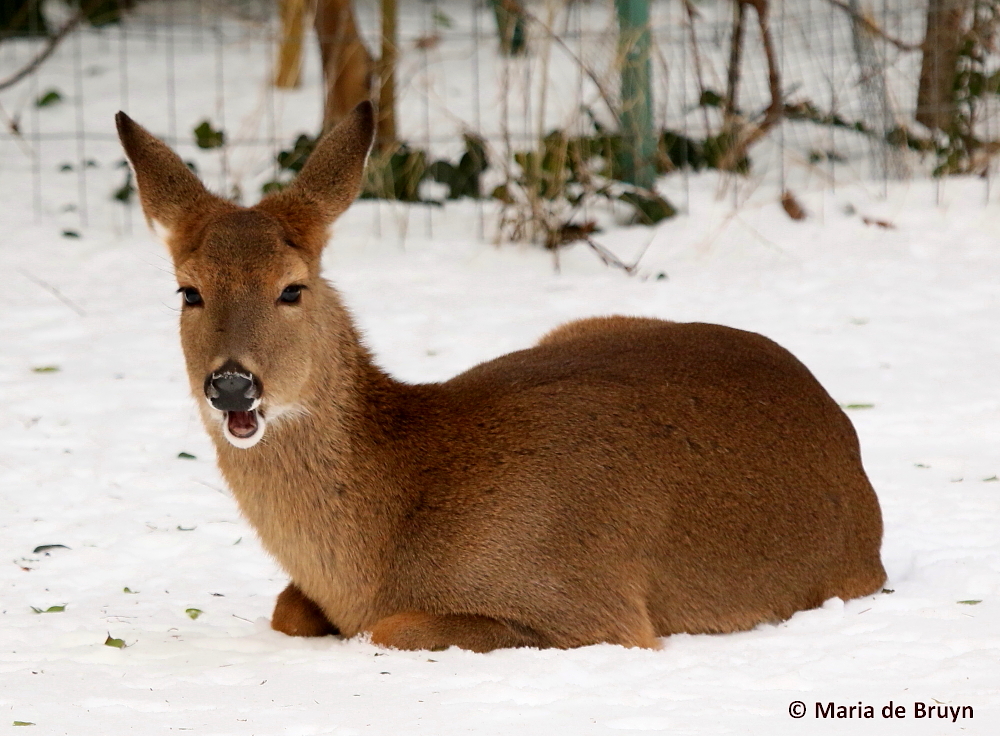
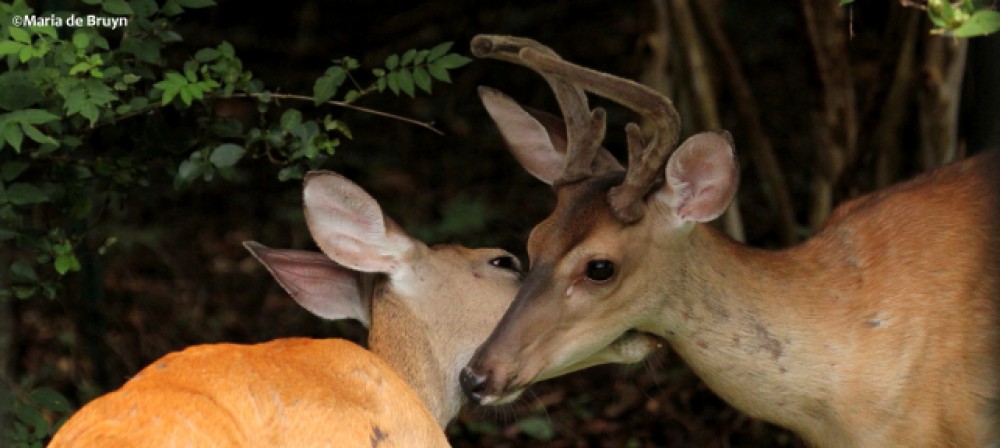
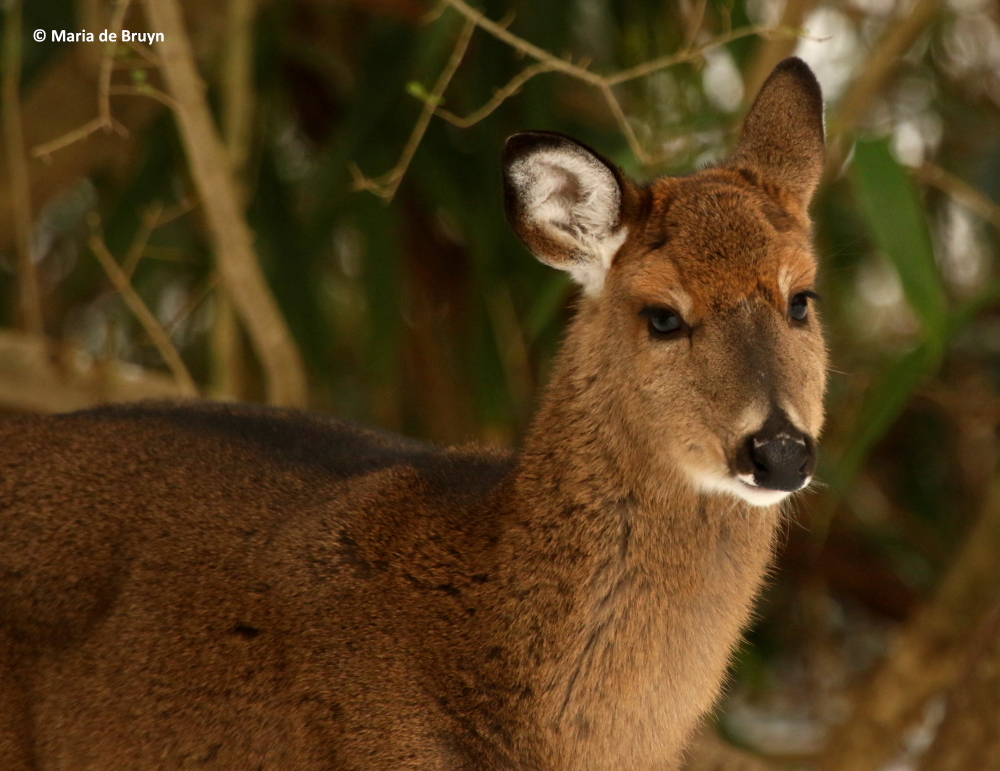
white-tailed-deer-i77a4029-maria-de-bruyn-resSo this past weekend, our part of North Carolina dealt with Winter Storm Helena, which brought us 83 straight hours of below-freezing temperatures (e.g., -9C/15F but we had lower) and a need to bundle up really well if venturing outside. (It also brought me a realization that winter storms are being named like hurricanes.) The first morning, when I went out to fill the bird feeders, I didn’t put on gloves or a cap and dealt with hypothermia symptoms when I finally went inside. I had on triple layers after that! The deer had their fur puffed up and seemed to be coping well.

The frigid air made me feel very sorry for the wildlife, although living outdoors is, of course, what they do and what they have evolved to accommodate. (I did hear today, however, of some birds and small animals that were found frozen to death!) With the snow covering the ground, it turned out the birds were more than happy to visit the feeders and piles of food I had strewn on the snow for the ground feeders.

yellow-rumped-warbler-i77a4305-maria-de-bruyn-res

Not only did I have many types of birds coming round, but also record numbers of them. Some birds, like the yellow-rumped warblers (Setophaga coronata, above), usually tend to visit on their own and are not happy with their species mates in the vicinity but during these days, I had four of them alighting near feeders at a time. The same was true for the colorful pine warblers (Setophaga pinus) although they didn’t come close to each other.

yellow-rumped-warbler-i77a3138-maria-de-bruyn-res

pine-warbler-i77a2441-maria-de-bruyn-res

The Carolina wrens (Thryothorus ludovicianus) and Carolina chickadees (Poecile carolinensis) don’t seem to have too many problems with sharing space and visited the feeders in the same way they always do – quick flights to and fro from nearby tree and shrub branches.

carolina-wren-i77a3873-maria-de-bruyn-res   carolina-chickadee-i77a2710-maria-de-bruyn-res

brown-thrasher-i77a4236-maria-de-bruyn-res


Most of the birds were fairly content to be in close proximity to one another during the snow days. The brown thrashers (Toxostoma rufum) did get very cross with one another, however, when they came too close to one another and chased their rivals away.

Sometimes a bird would go off and rummage in the snow, like this blue jay (Cyanocitta cristata).


blue-jay-i77a2776-maria-de-bruyn-res blue-jay-i77a2770-maria-de-bruyn-res

european-starling-i77a2674-maria-de-bruyn-resThe biggest challenge for me was keeping the suet and meal worms in supply, mainly because the European starlings (Sturnus vulgaris) show up in large groups and gulp down food at a speedy pace. The other birds nibble but the starlings seem to inhale food as if they have vacuum cleaners in their throats. They can get grumpy with one another and don’t mind landing atop each other to get a foothold on the feeder.

brown-thrasher-i77a3641-maria-de-bruyn-resI was pleased that the other species of birds are learning to cope with them, no longer being intimidated to fly away when these greedy avians arrive. However, they may get displaced from a feeder just because the bulky starlings take up so much room and never wait their turn to get a spot. The larger birds, like the thrashers and red-bellied woodpeckers, may express their displeasure to the starlings while trying to hold their ground. Other people report common grackles (Quiscalus quiscula) as feeder dominant birds but they are well behaved at my house.

common-grackle-i77a3068-maria-de-bruyn-res

suet-i77a3541-maria-de-bruyn-res

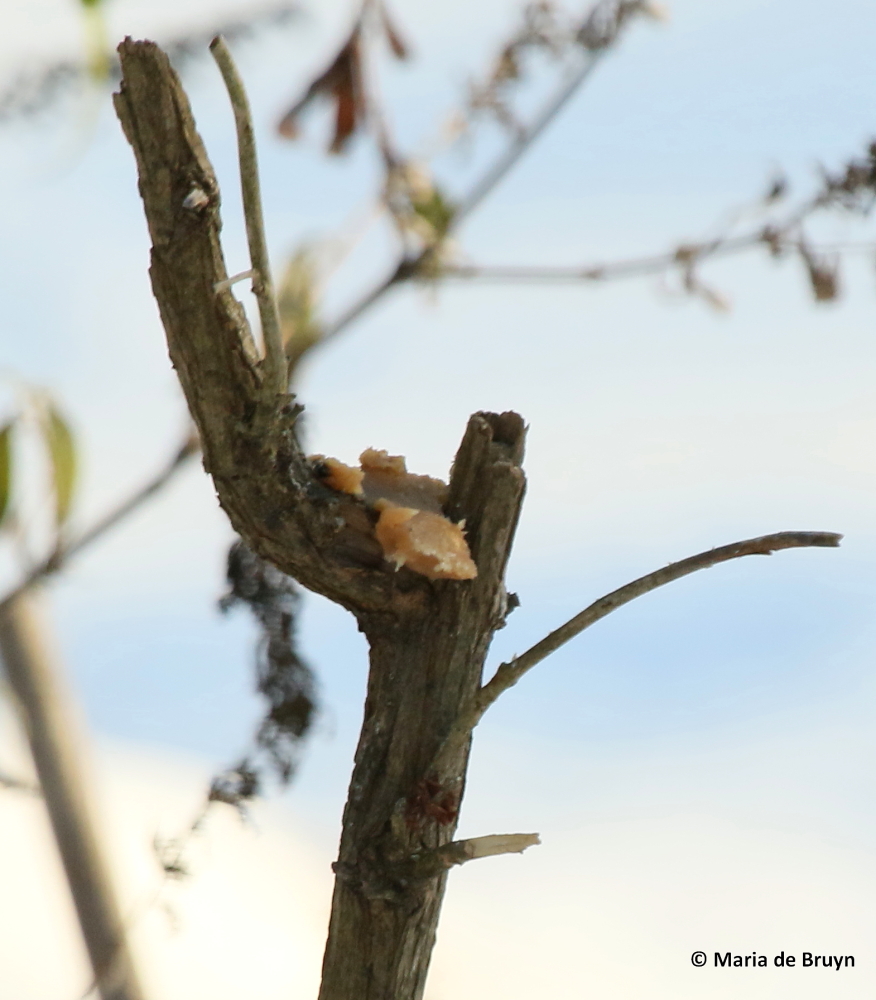
So, what was I going to do? Some of my feeders are set in a flower garden and I had left the dried stalks of sage, butterfly bush and scarlet mallow standing. They don’t look pretty but the birds love sitting on them near the feeders as they digest a bite before getting another. So I began smearing suet on the stalks, which are not sturdy enough to hold the starlings.

The yellow-rumped warblers and chickadees were pleased, as was my faithful ruby-crowned kinglet (Regulus calendula) and the Carolina chickadee.

yellow-rumped-warbler-i77a3913-maria-de-bruyn-res  carolina-chickadee-i77a4283-maria-de-bruyn-res

ruby-crowned-kinglet-i77a4167-maria-de-bruyn-res

To my surprise, even the larger Northern mockingbird (Mimus polyglottos) and brown thrashers discovered and sampled the suet-laden stalks.

northern-mockingbird-i77a3629-maria-de-bruyn-res   brown-thrasher-i77a3607-maria-de-bruyn-res

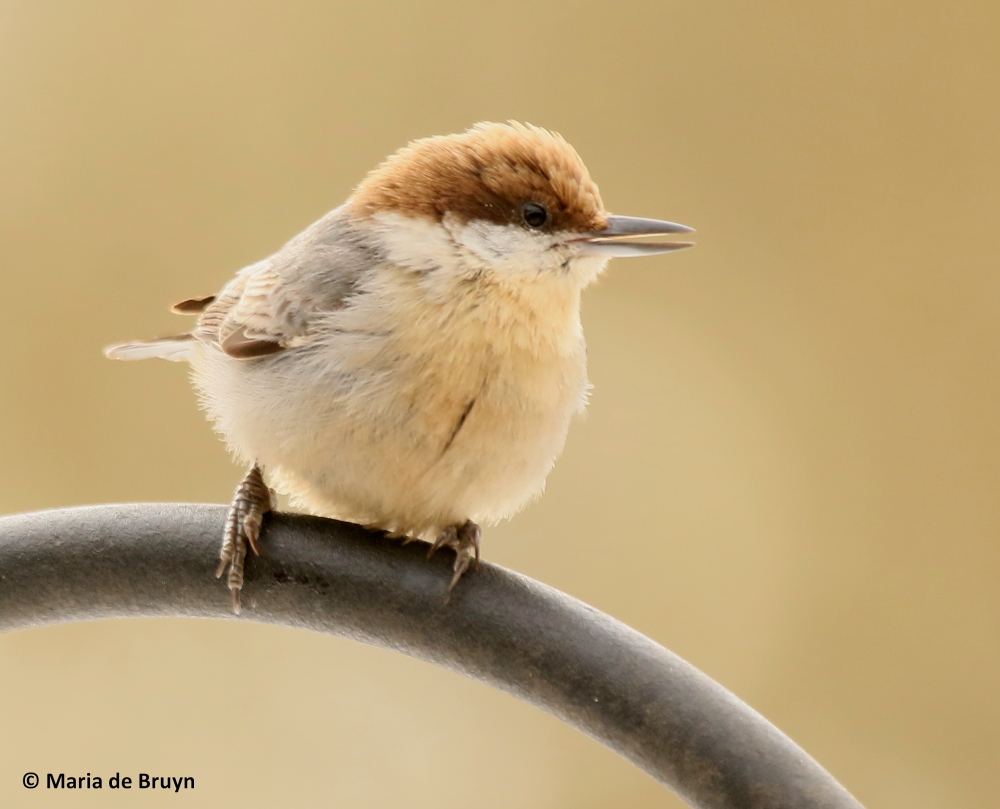
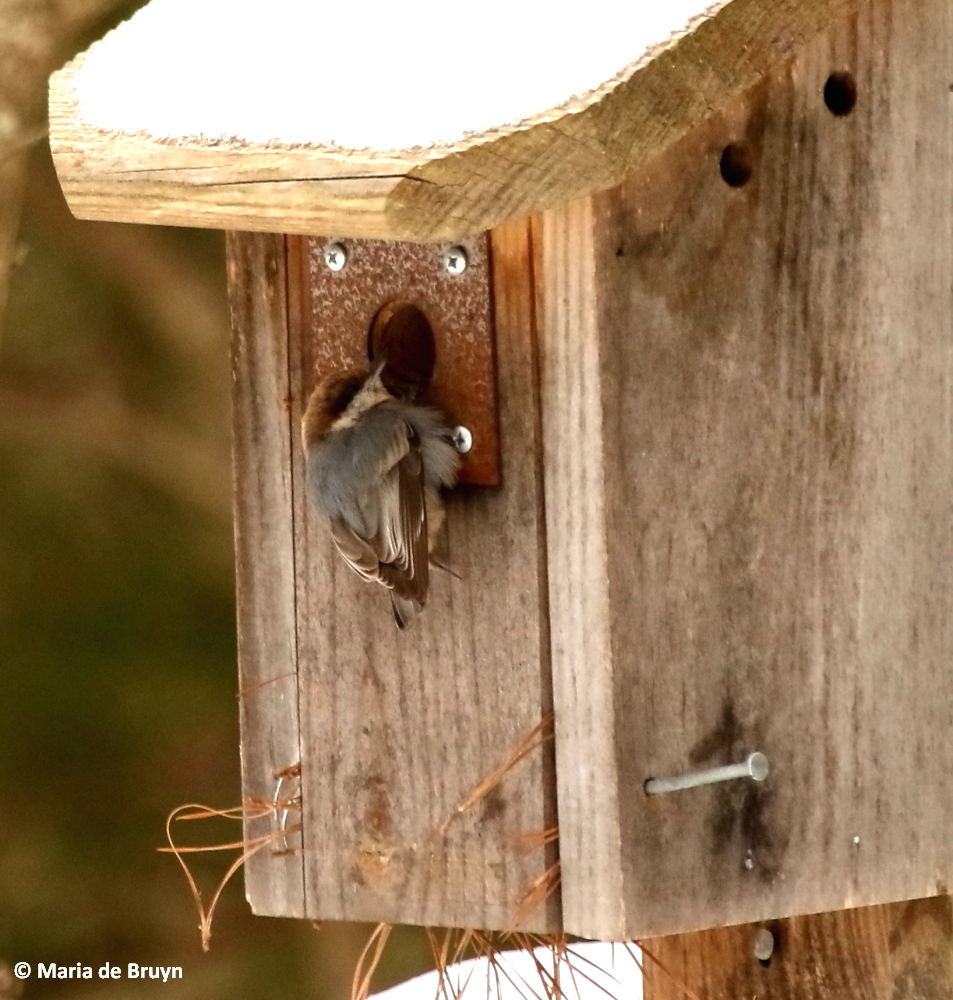
Following advice from the Bird Sleuth program, I had stuffed the bluebird and nuthatch boxes with pine needles and wool in case the birds wanted to shelter there overnight. I don’t know if any of them did, but the brown-headed nuthatches (Sitta pusilla) were again checking out their preferred nest box, so perhaps they did roost there overnight.

brown-headed-nuthatch-i77a3959-maria-de-bruyn-res    brown-headed-nuthatch-i77a4183-maria-de-bruyn-res

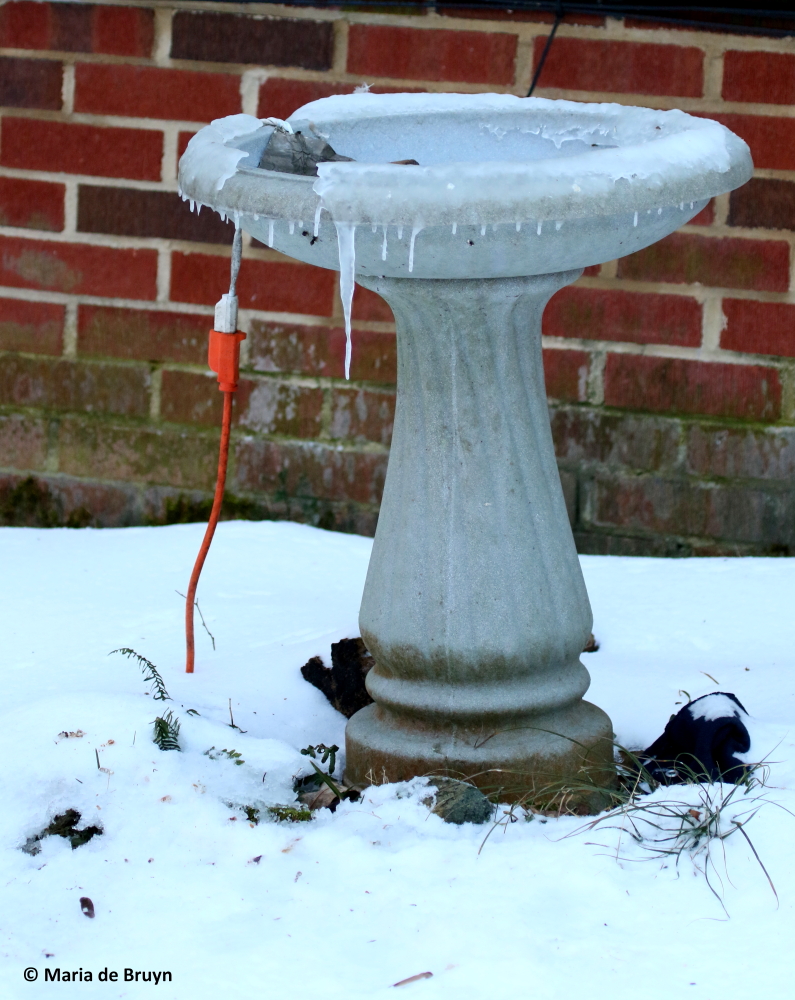
heated-fountain-i77a3586-maria-de-bruyn-res


I was filling the heated bird bath daily, too, as it became a popular drinking fountain.

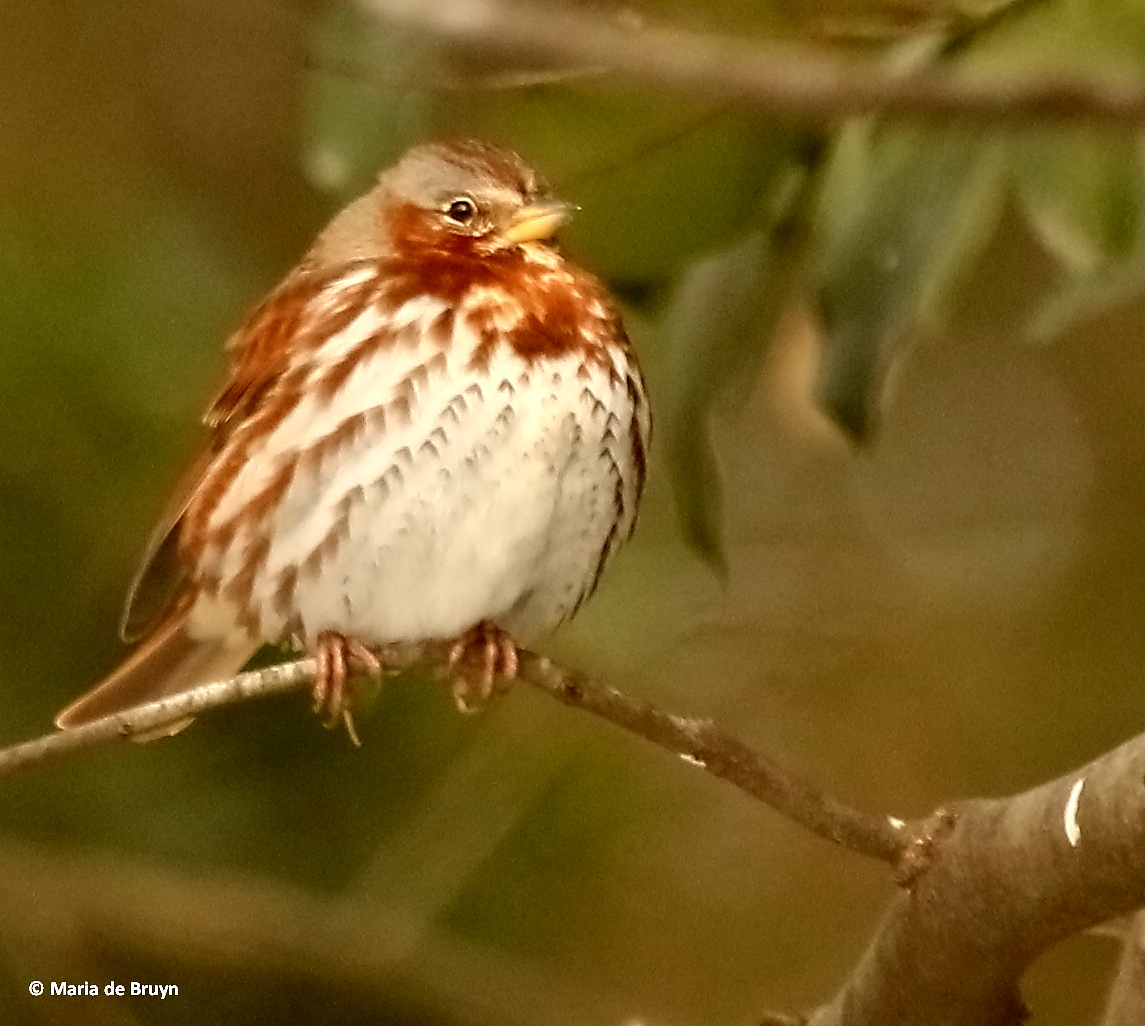
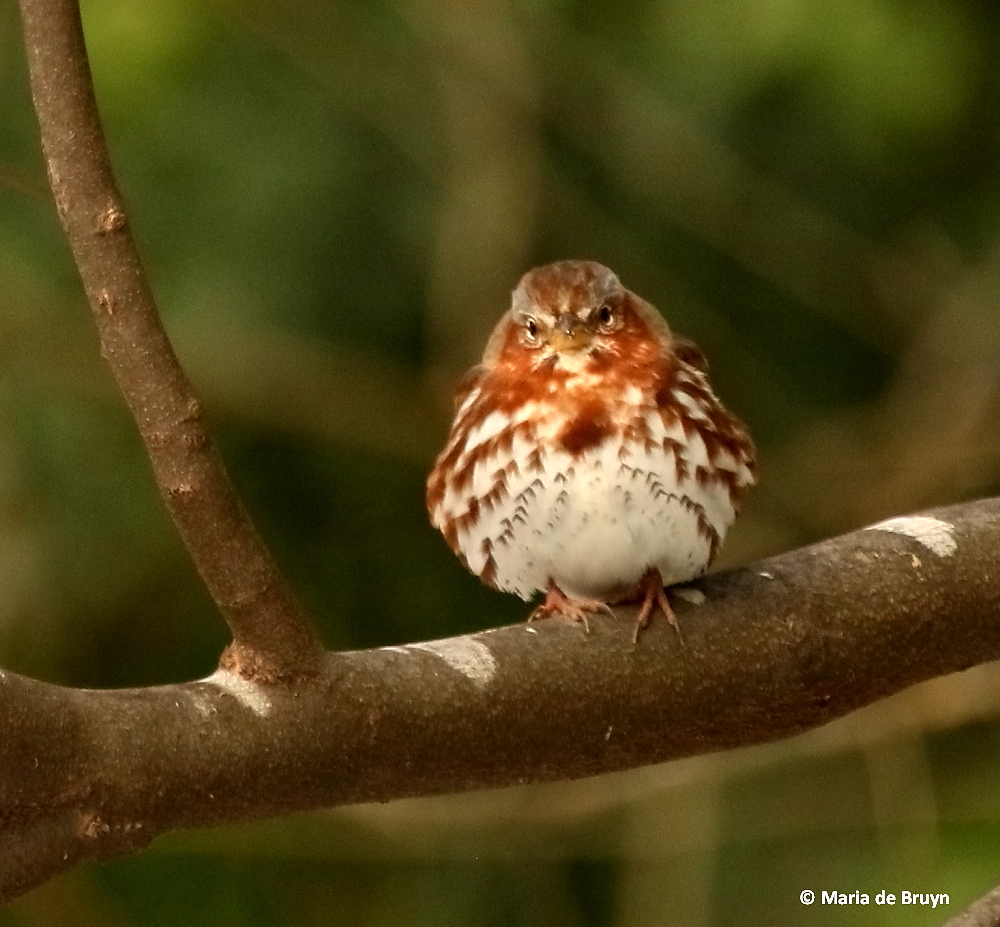
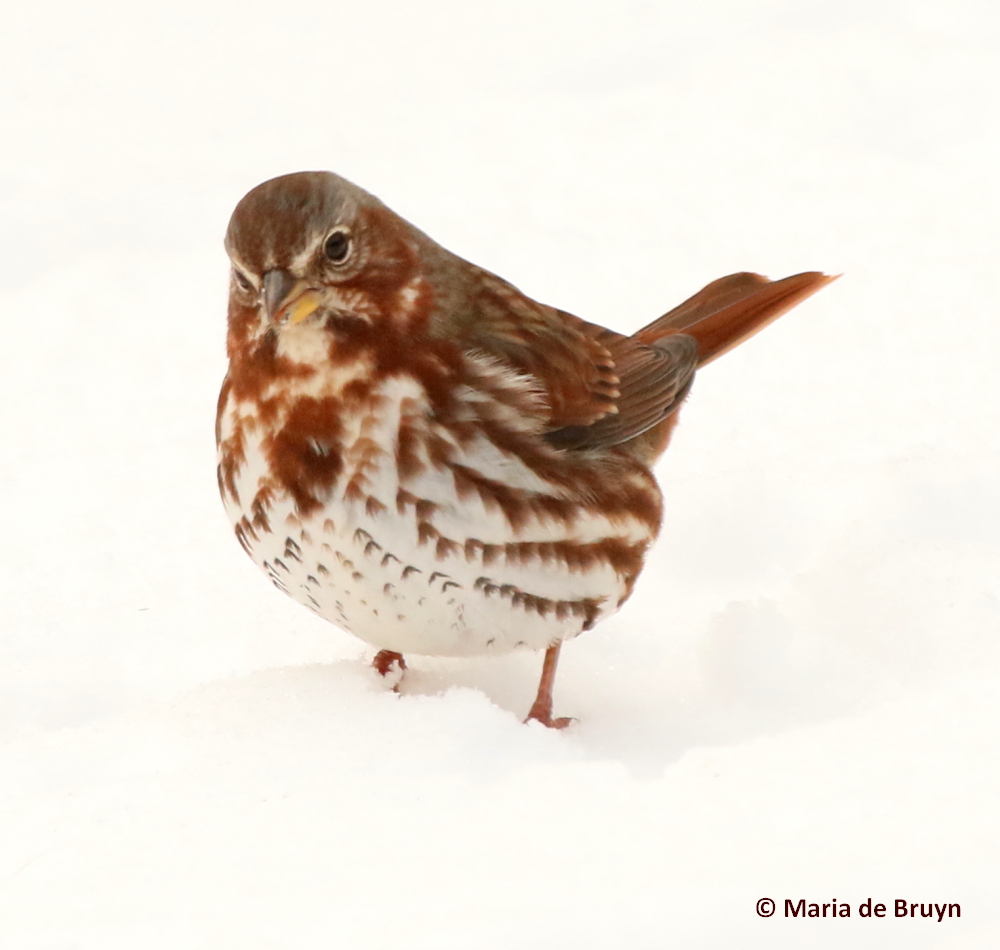
The thrill of the wintery snow days for me was a new yard visitor, a gorgeous fox sparrow (Passerella iliaca). I have never had one here before so it was a wonderful surprise and discovery. (I’m still hoping that a red-breasted nuthatch will turn up, too.)


fox-sparrow-i77a4347-maria-de-bruyn  fox-sparrow-i77a4348-maria-de-bruyn-res

fox-sparrow-i77a3773-maria-de-bruyn-res

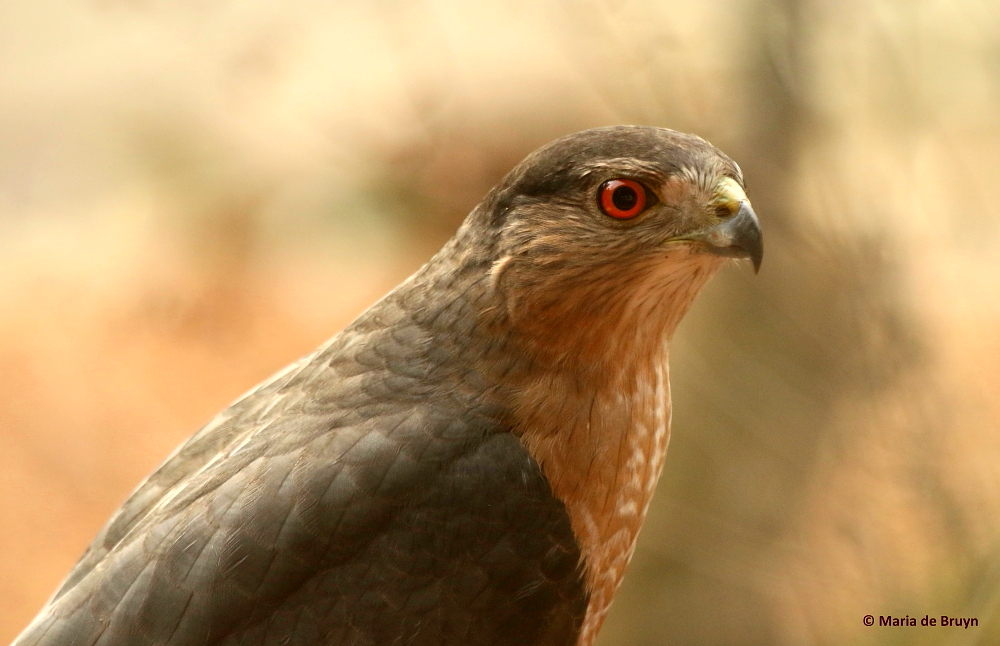
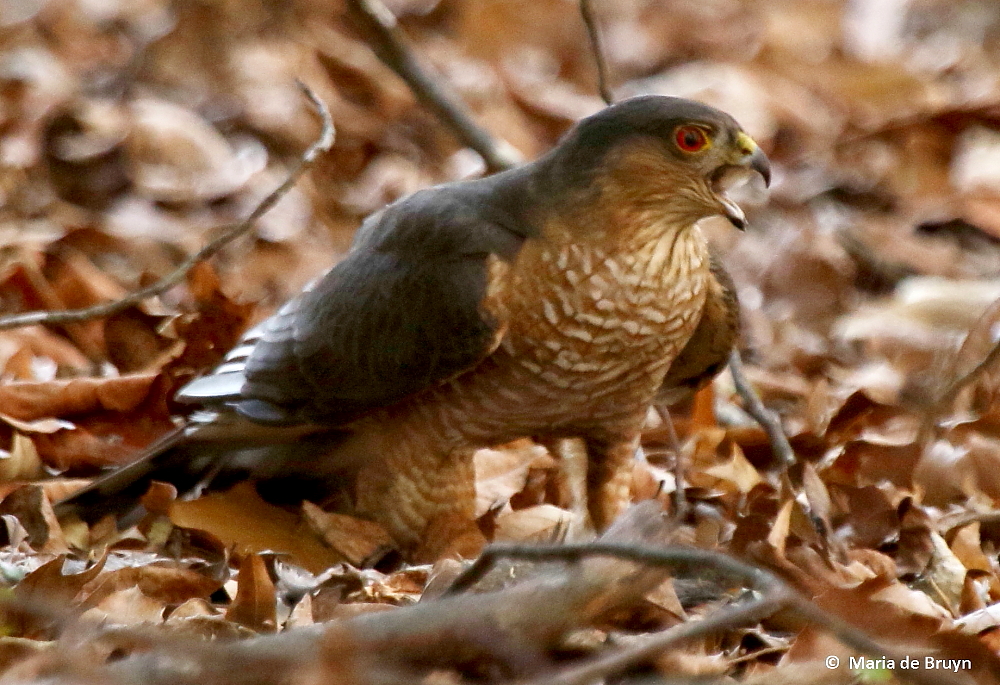
The birds “missing” from the storm gathering were the hawks. I’ve had a Cooper’s hawk  (Accipiter cooperii) visiting for years, but recently discovered that a sharp-shinned hawk (Accipiter striatus) is also taking birds from my yard. As they look quite similar, the sharpie may have been coming around for some time and I just never realized it. They were both here in the last couple weeks, but neither one made an appearance during the storm.

coopers-hawk-i77a1341-maria-de-bruyn-res   sharp-shinned-hawk-i77a8520-maria-de-bruyn-res

Our two neighborhood white-tailed does (Odocoileus virginianus) and their three offspring came by, obviously finding my yard a peaceful and safe space to rest.

white-tailed-deer-i77a4432-maria-de-bruyn-res   white-tailed-deer-i77a4431-maria-de-bruyn-res

So I’ll end with some “beauty shots” from the snow days as the snow and ice are now melting. In two days’ time, we are supposed to be having temperatures of 68F/20C or higher! And then we can wait out the rest of January as well as February and March to see if we get any more winter storms.

white-throated-sparrow-i77a2733-maria-de-bruyn-res

White-throated sparrow (Zonotrichia albicollis)

chipping-sparrow-i77a2830-maria-de-bruyn-res

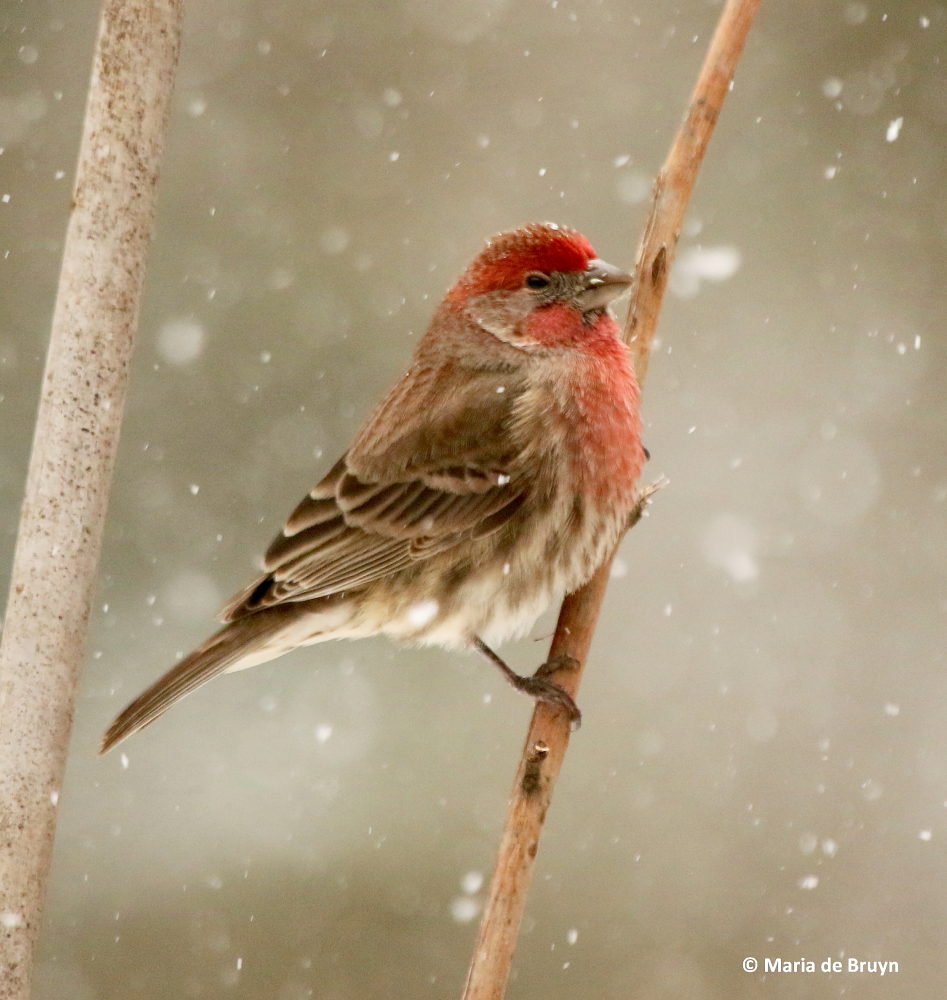
     house-finch-i77a2852-maria-de-bruyn-res

Chipping sparrow (Spizella passerina)        House finch (Haemorhous mexicanus)

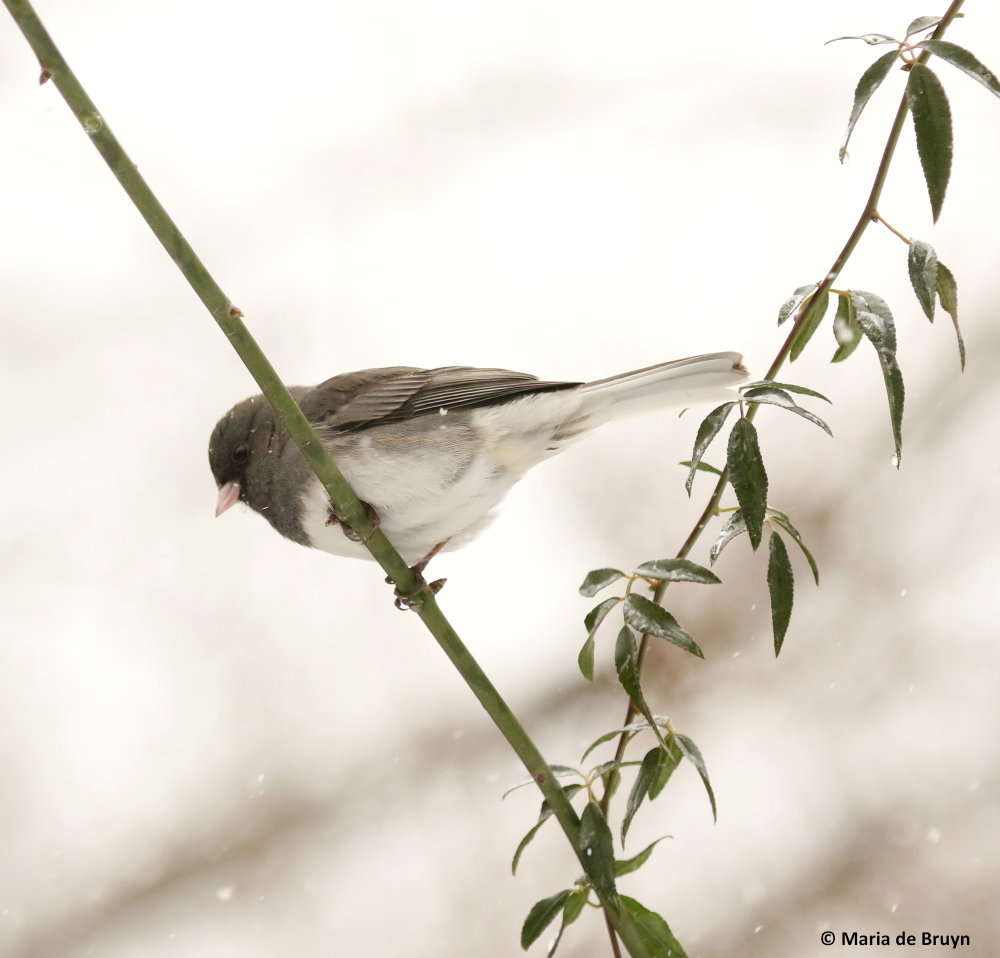
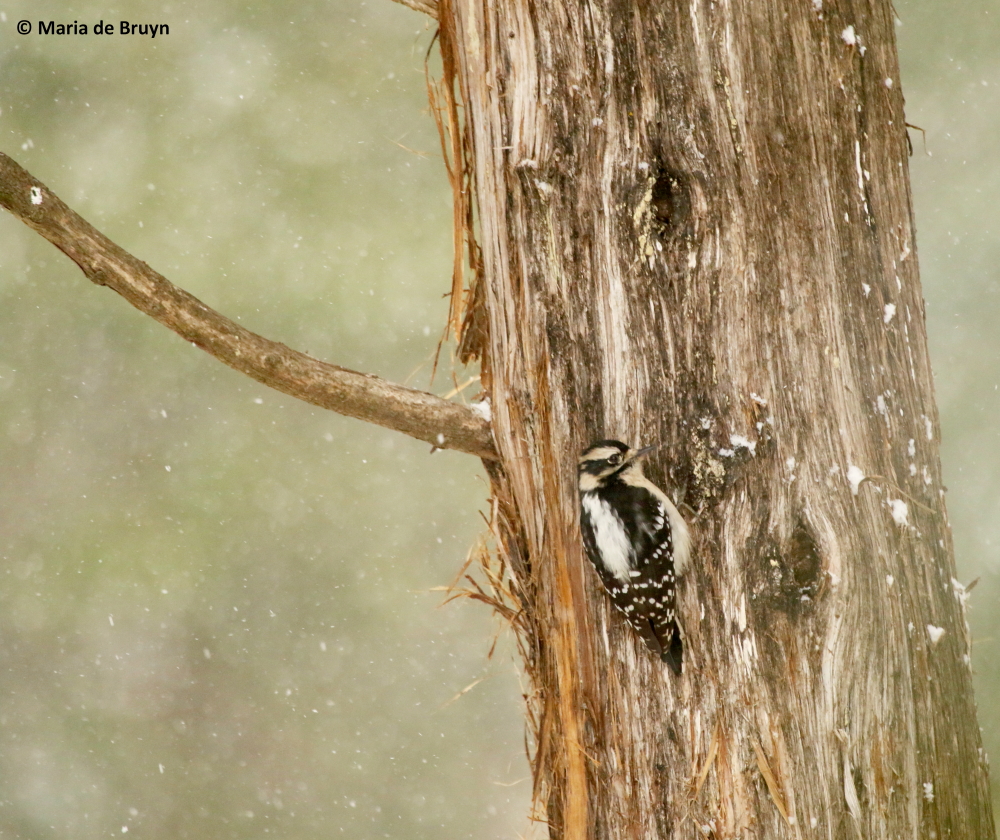
dark-eyed-junco-i77a2590-maria-de-bruyn-res  downy-woodpecker-i77a2810-maria-de-bruyn-res

Dark-eyed junco (Junco hyemalis)          Downy woodpecker (Dryobates pubescens)

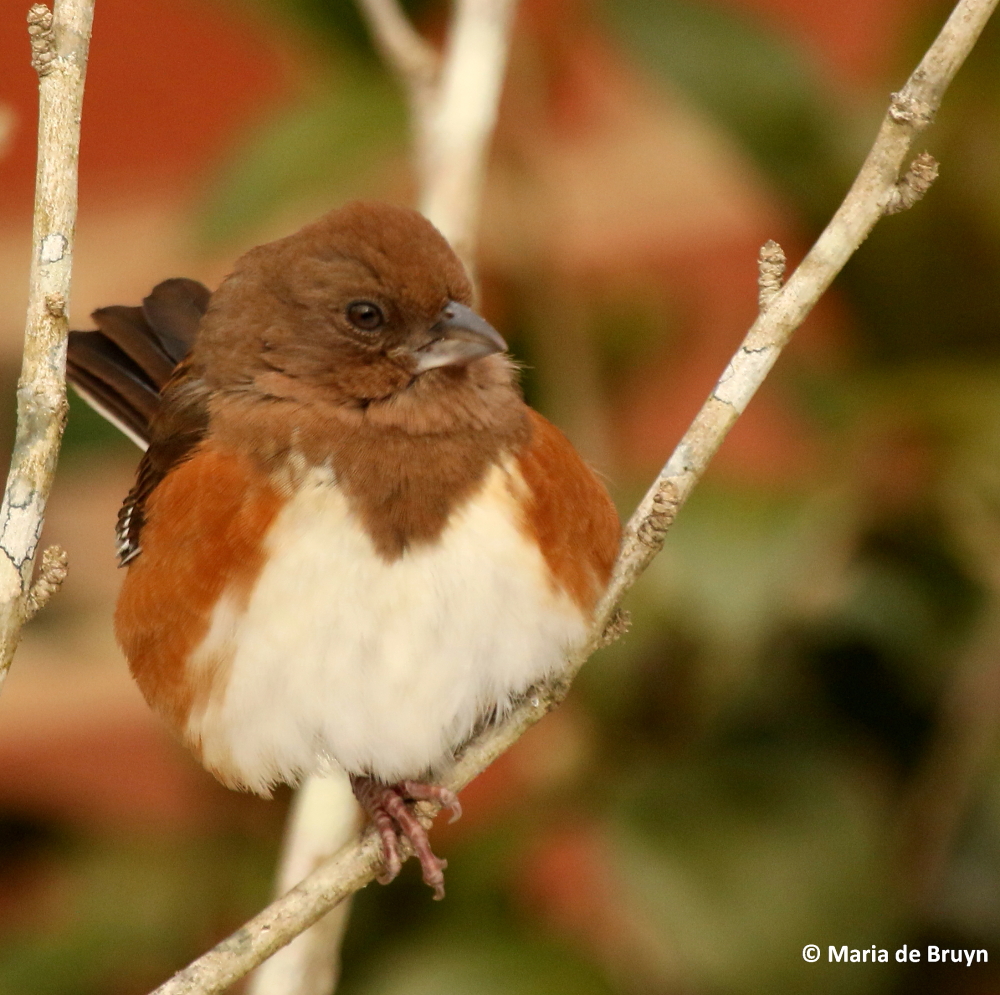
eastern-towhee-i77a4111-maria-de-bruyn-res    northern-cardinal-i77a3099-maria-de-bruyn-res

Eastern towhee (Pipilo erythrophthalmus)      Northern cardinal (Cardinalis cardinalis)

blue-jay-i77a2858-maria-de-bruyn-res     eastern-bluebird-i77a2285-maria-de-bruyn-res

Blue jay                                                       Eastern bluebird (Sialia sialis)

red-bellied-woodpecker-i77a4047-maria-de-bruyn-res       ruby-crowned-kinglet-i77a4263-maria-de-bruyn-res

Red-bellied woodpecker (Melanerpes carolinus)     Ruby-crowned kinglet

northern-mockingbird-i77a2714-maria-de-bruyn-res   pine-warbler-i77a2657-maria-de-bruyn-res

Northern mockingbird                                              Pine warbler


My nemesis birds!

european-starling-dk7a5386-maria-de-bruyn-resIn the birding world, a “nemesis bird” often refers to a species of bird that is eluding a birder intent on adding to their life list of bird species seen in person. For me, however, a nemesis bird is one that is emptying my feeders and depriving other birds of their bit of nutritional goodness because it descends in such great numbers that no one else has a chance. Which bird is this? It’s the European starling (Sturnus vulgaris), a bird which I admittedly find visually beautiful but rather unattractive as far as temperament goes.

northern-mockingbird-i77a9648-maria-de-bruyn-resOther birders who spend time attracting birds to their yards often comment on how Northern mockingbirds (Mimus polyglottos) chase other birds away – those in my yard feed quite happily alongside other species, however, and even wait their turn for the suet feeders. Another large bird, the brown thrasher (Toxostoma rufum), does the same. In fact, most of the species that visit my yard are content to share feeder space and/or wait their turn.

brown-thrasher-img_9913-maria-de-bruyn-res     sharing-feeders-i77a9154-maria-de-bruyn-res

american-crow-dk7a2281-maria-de-bruyn-resOther species that are called “bully birds” include common grackles (Quiscalus quiscula, below), who can look quite beautiful with iridescent feathers, blackbird species and house sparrows. The grackles and red-winged blackbirds (Agelaius phoeniceus) in my yard have not been too dominant; they do sometimes come in numbers but let other birds near. I haven’t had crowds of grackles lately and when they’ve come, their main concern was to attempt to drive away the American crows (Corvus brachyrhynchos, above), so my main foe has been the starlings.

common-grackle-dk7a2236-maria-de-bruyn-res   common-grackle-i77a1447-maria-de-bruyn-res

They discovered my yard as a buffet about a year ago and introduced their young to the feasting area this past summer.

european-starling-dk7a3396-maria-de-bruyn-res  european-starling-dk7a3404-maria-de-bruyn-res


european-starling-dk7a5233-maria-de-bruyn-res


What is striking to me is the fact that they not only will “yell” at other species to go away but also compete vigorously with one another for a spot at the platform and other feeders, indicating a rather nasty disposition.

european-starling-dk7a5130-maria-de-bruyn-res   european-starling-dk7a0871-maria-de-bruyn-res

european-starling-i77a7396-maria-de-bruyn-res

The young starlings pick up on this behavior quickly.

If I come outside, they quickly fly off and roost high up in the tallest trees; sometimes, they will actually fly off to another place in the neighborhood. Clapping my hands and banging on the window will also get them to leave. However, they stick around to assess whether I will appear and if I don’t come out, they are back in short order.

european-starling-i77a1048maria-de-bruyn-res

pine-warbler-dk7a0358-maria-de-bruyn-res


Their first love turned out to be the dried mealworms, which are a big hit with the Eastern bluebirds (Sialia sialis), tufted titmice (Baeolophus bicolor), Carolina chickadees (Poecile carolinensis), Carolina wrens (Thryothorus ludovicianus) and pine warblers (Setophaga pinus, left) among other species.

eastern-bluebird-i77a6862-maria-de-bruyn-res  eastern-bluebird-i77a9596-maria-de-bruyn-res

tufted-titmouse-img_4143-maria-de-bruyn-res   tufted-titmouse-i77a9678-maria-de-bruyn-res

carolina-chickadee-i77a9738-maria-de-bruyn-res   carolina-wren-i77a7312-maria-de-bruyn-res

It’s always a pleasure to see the banded birds return, like the Carolina wren below.

carolina-wren-i77a9548-maria-de-bruyn-res   carolina-wren-i77a9547-maria-de-bruyn-res

When five or more starlings gather around a feeder, they literally gulp the mealworms down, making short shrift of a good-sized supply.

european-starling-dk7a0937-maria-de-bruyn-res   european-starling-dk7a2433-maria-de-bruyn-res

northern-cardinal-i77a2061-maria-de-bruyn-resI began putting out only mixed seed, sunflower seeds (Helianthus annuus) and my home-made vegetarian suet, the latter being a favorite for many species: the bluebirds, chickadees, wrens, titmice, yellow-rumped warblers (Setophaga coronata), brown-headed nuthatches (Sitta pusilla), Northern cardinals (Cardinalis cardinalis, left), and downy and red-bellied woodpeckers (Picoides pubescens and Melanerpes carolinus).

yellow-rumped-warbler-i77a9778-maria-de-bruyn-res

brown-headed-nuthatch-i77a6423-maria-de-bruyn-res

downy-woodpecker-dk7a1967-maria-de-bruyn-res   downy-woodpecker-dk7a1961-maria-de-bruyn-res

red-bellied-woodpecker-i77a4258maria-de-bruyn-res red-bellied-woodpecker-dk7a0440-maria-de-bruyn-res

My resident ruby-crowned kinglet (Regulus calendula) hasn’t returned this winter (though I hope he is just late), so he doesn’t have to compete with the much, much larger starlings for his beloved meals.

ruby-crowned-kinglet-img_1776-maria-de-bruyn-res  ruby-crowned-kinglet-dk7a0538-maria-de-bruyn-res

european-starling-dk7a5647-maria-de-bruyn-resTo my dismay, when the starlings discovered no mealworms were available, they decided that suet could be a nice substitute. Oy vey! They manage to empty the suet holders in record time.

I waited to put out the suet until I saw no starlings in any of the tall trees surrounding the yard.

european-starling-img_0035-maria-de-bruyn-res

european-starling-i77a7189-maria-de-bruyn-resThe smaller birds came but this lasted only a little while. Soon the starlings showed up, leading me to think that either “scout” or “watch birds” were left behind to warn the flock when preferred food arrived, or they had a tremendous sense of smell that led them to my yard. It does turn out that starlings use their sense of smell to identify plants for their nests, so who’s to say they don’t use it to find food, too?


red-bellied-woodpecker-dk7a1833-maria-de-bruyn-resOne bird advice website recommends avoiding sunflower seeds as “bully birds” prefer them. Well, so far, the starlings have assiduously avoided any seeds. So a couple days ago, I filled all the feeders with seed except for the suet feeders – and I stood outside next to them so that the songbirds could have a go at the suet without their bigger avian neighbors chasing them away. It was gratifying to see the little ones enjoy a bit of suet while the starlings perched high above, unwilling to come down in my presence. Today, it was raining persistently but the songbirds were flying to and fro among the feeders so I put suet in three holders and some mealworms in one.

For an hour or so, they had the dried worms and peanut butter-based treat to themselves; then a starling appeared. I went outside but this particular bird didn’t seem to mind. When three of its compatriots arrived and saw me, they swooped away so the little birds still could grab some suet and mealworms.

european-starling-i77a9669-maria-de-bruyn-res

Now I’ll wait to see if the starlings begin eating the seed or finally move on or stay away for longer periods. I’m guessing as long as there is occasional suet, they will leave their scouts in place to warn them when a tasty meal is available. And I do want to put out some mealworms now and again so I don’t disappoint the chickadees and wrens who greet me with loud twittering when I approach empty feeders. Non-birders probably think that’s silly (to put it mildly) but I think bird lovers will understand….

Leaping into the wide – and sometimes wet – world!

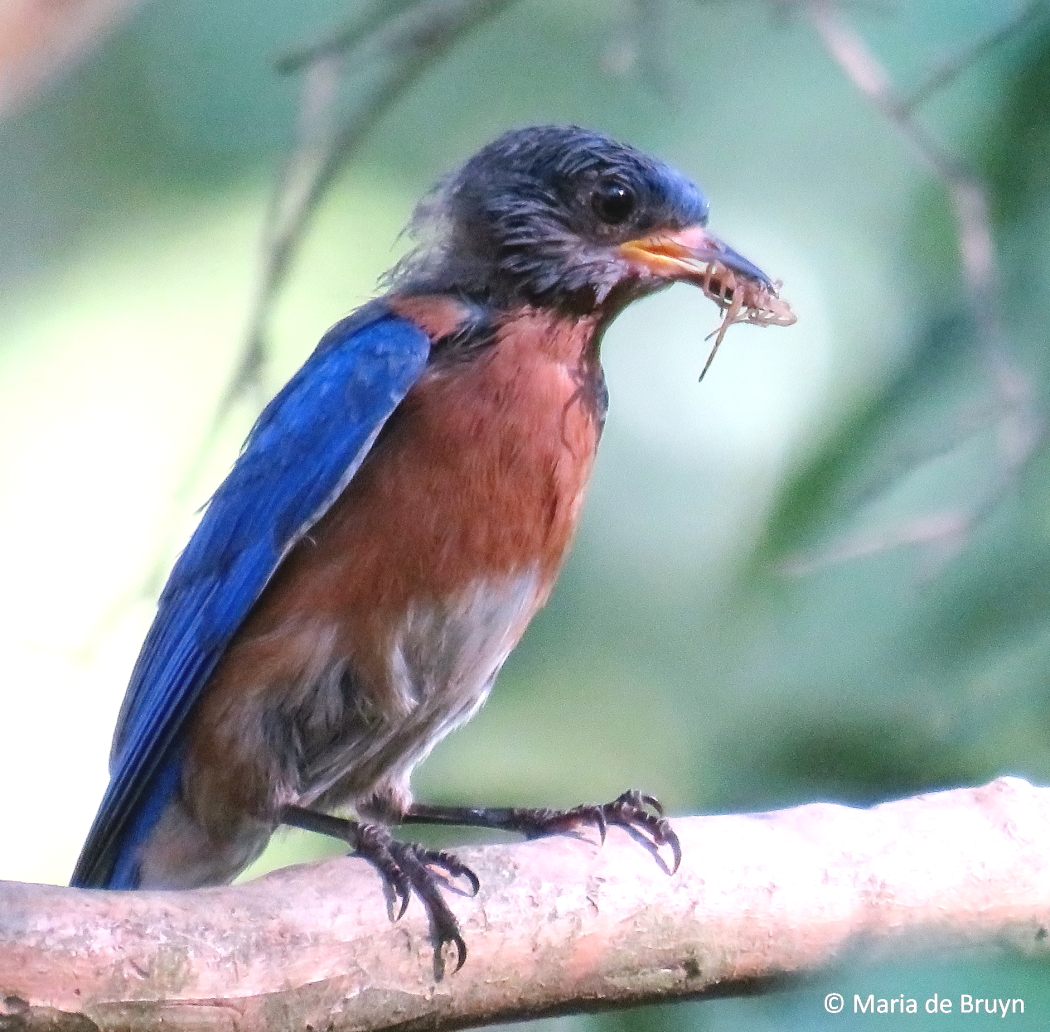
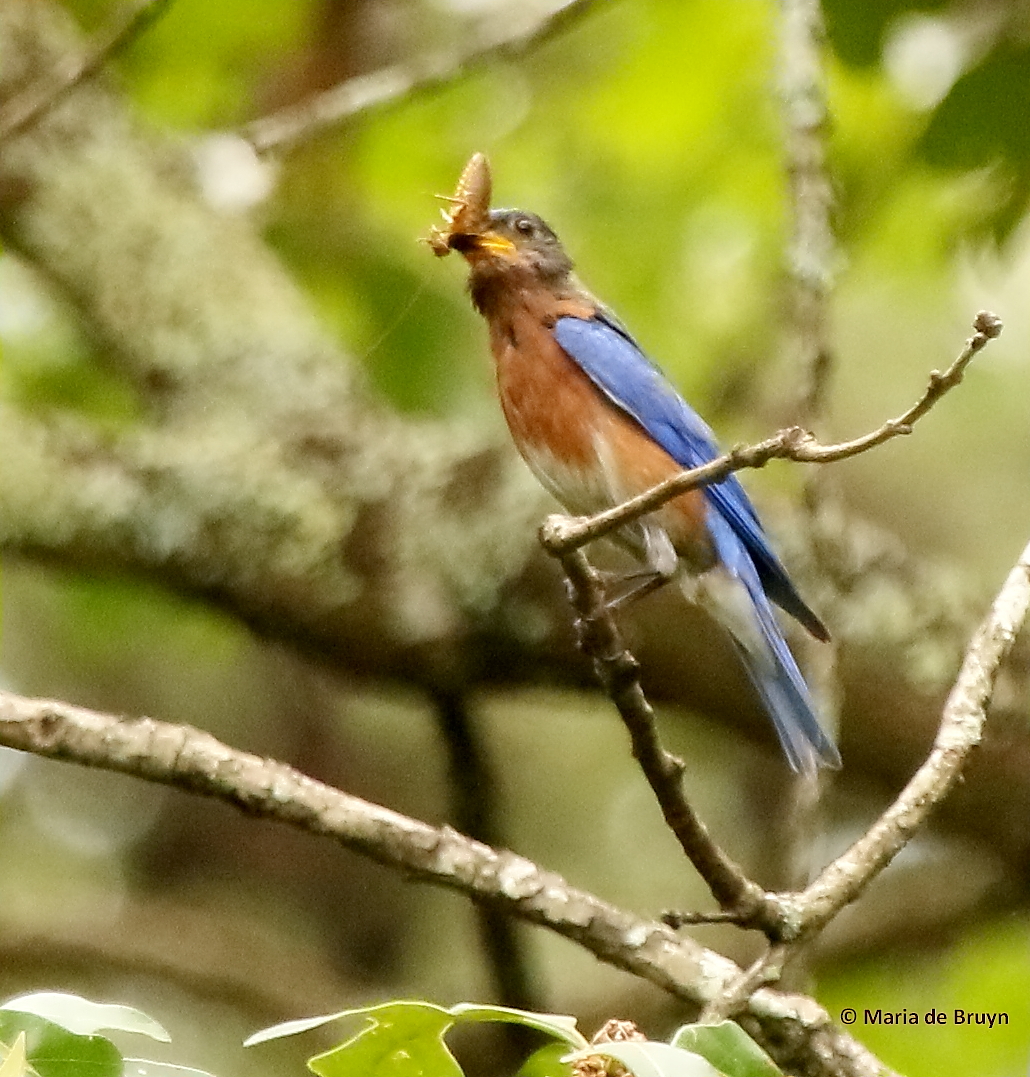
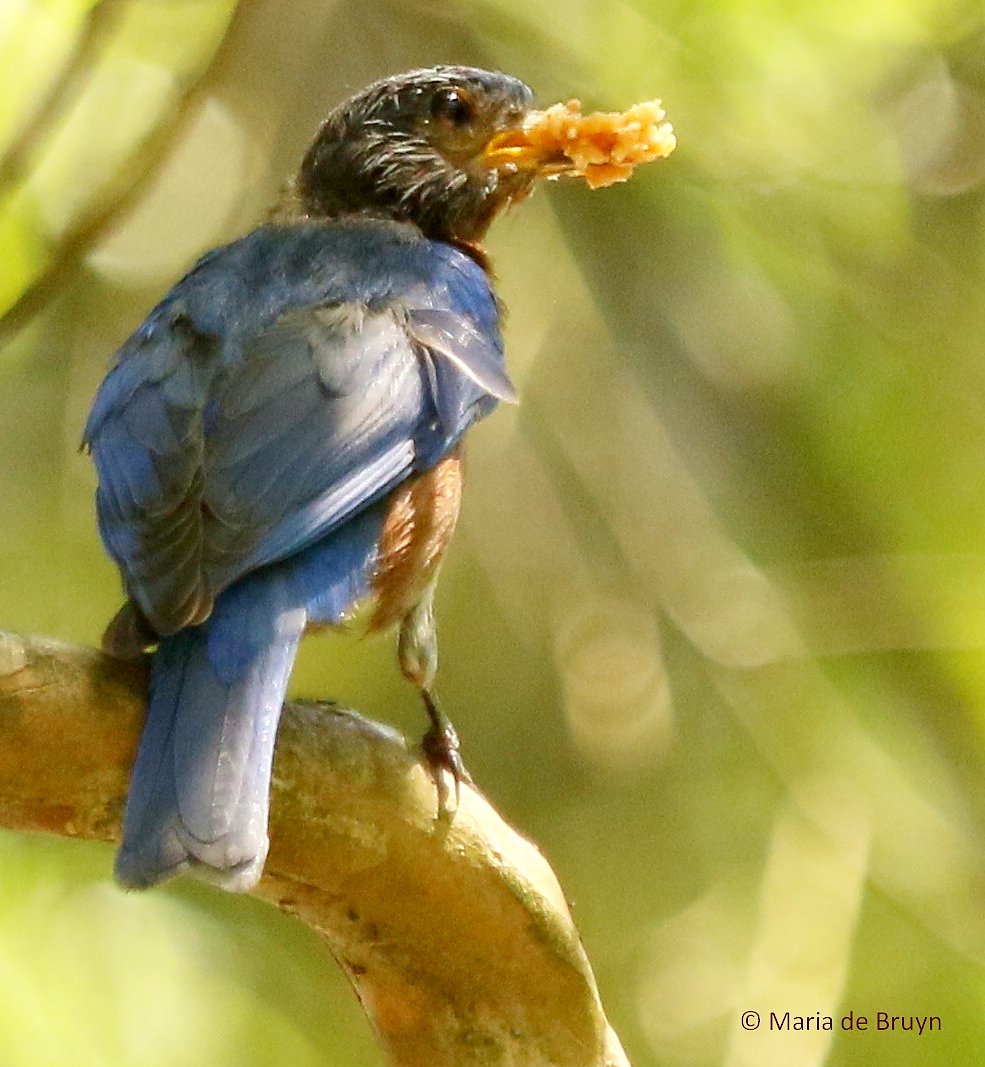
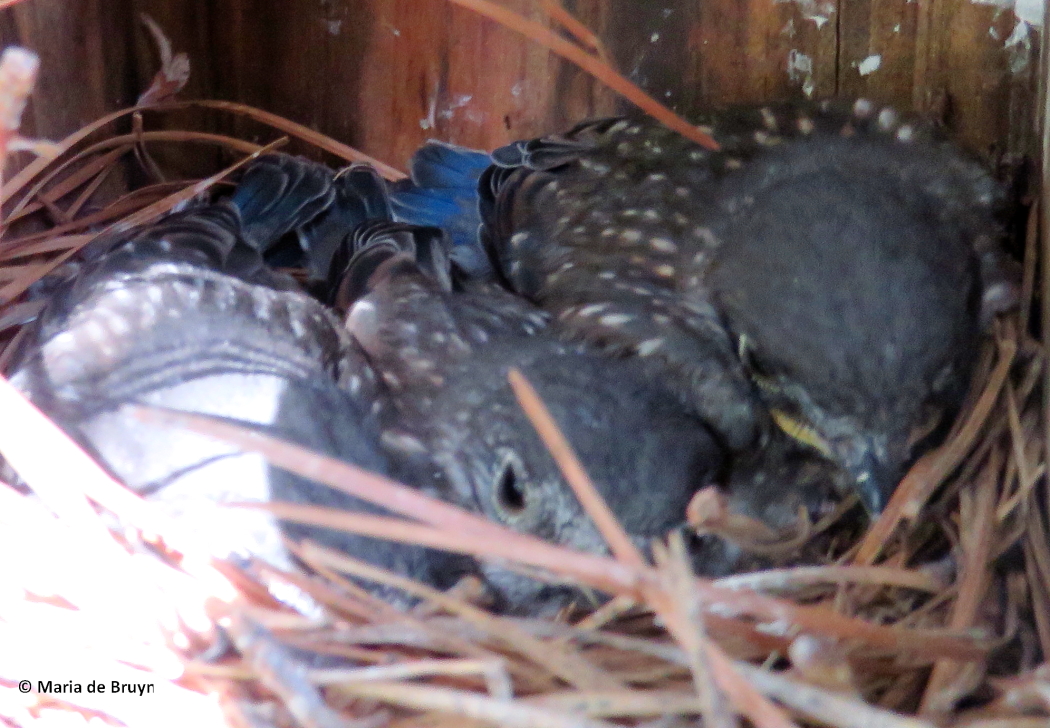
Eastern bluebird IMG_2991© Maria de Bruyn resEarlier this past week, I calculated that the Eastern bluebird (Sialia sialis) babies in my front-yard nest box were close to fledging. I knew approximately when mom had finished laying her eggs (four in total), so that I could guess when they reached normal fledging age (16-18 days after hatching). When I looked at the nest on 10 June, I saw that there were only three babies; I have no clue what happened to egg No. 4.  But the three survivors were progressing well as mom and dad made frequent forays to gather caterpillars and insects for them.

Eastern bluebird IMG_2819© Maria de Bruyn res Eastern bluebird I77A5733© Maria de Bruyn res

Eastern bluebird I77A8417© Maria de Bruyn

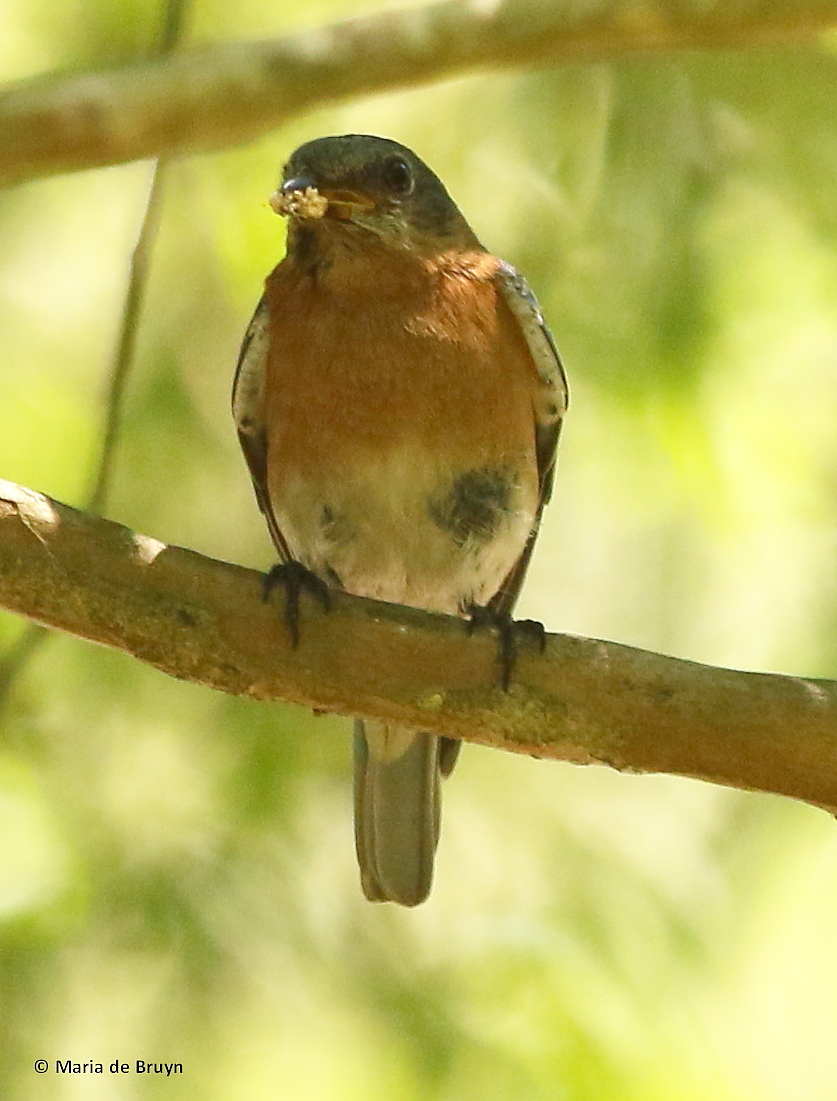
Occasionally, the male and also the female bluebird, identifiable by her subtler coloring and her brood patch, would visit the suet and meal worm feeders for a fast food repast for themselves. It was hard work keeping their growing offspring fed!

Eastern bluebird I77A6411 © Maria de Bruyn         Eastern bluebird I77A5769© Maria de Bruyn

They also had to let one of their older offspring from a previous brood know that they were no longer going to feed him, even when he begged.

Eastern bluebird IMG_1509© Maria de Bruyn res

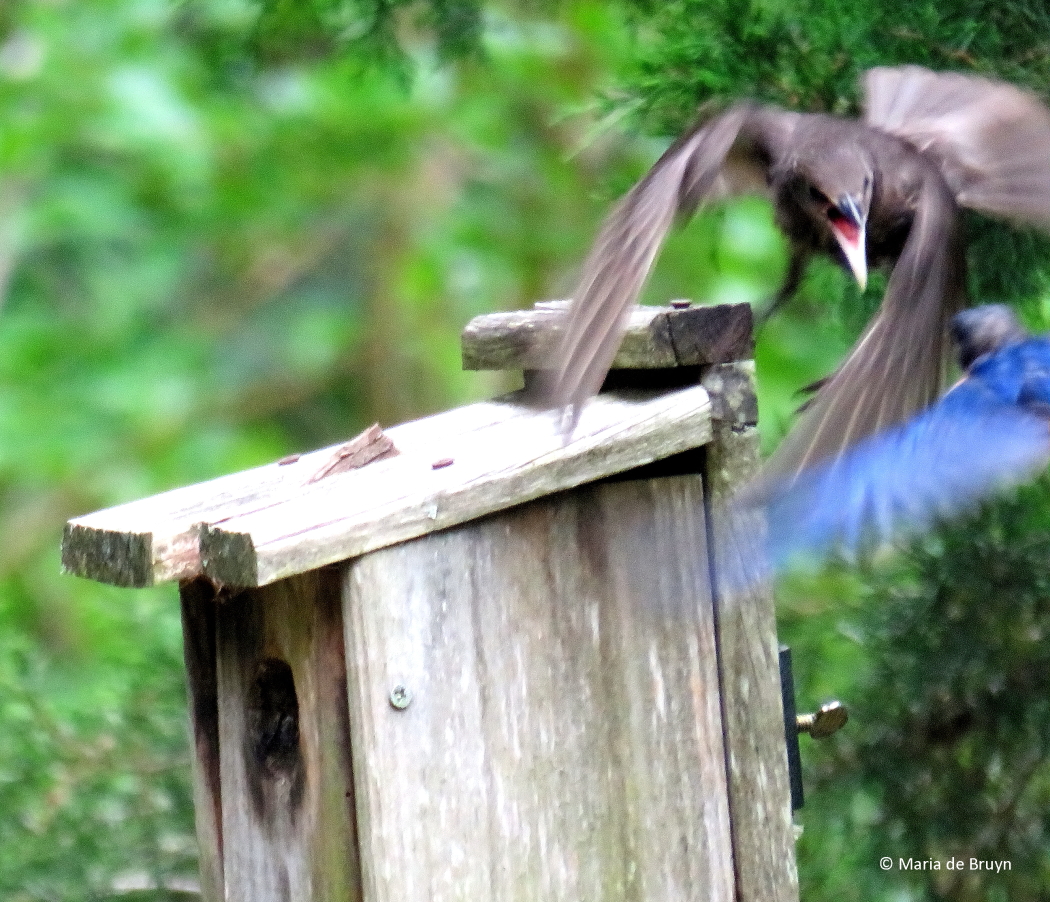
As fledging time neared, mom and dad had to contend with other birds coming near the box. Dad was especially angry with a young starling (Sturnus vulgaris) who wanted to settle on top of the box. Starlings have been known to eat young birds and papa bluebird was obviously taking no chances! (I just caught the action out of the corner of my eye so the photos aren’t great but do give an idea of the argument!). The parents also chased away squirrels from the tree in front of the box, which alerted me to the fact that fledging was probably imminent since the parents become especially protective at this time. I started using a smaller camera with a very long zoom (but somewhat lesser photo quality) as they weren’t excited by me being too close either.

Eastern bluebird IMG_3841© Maria de Bruyn res     Eastern bluebird IMG_3840© Maria de Bruyn res

Eastern bluebird IMG_4618© Maria de Bruyn res

On Wednesday, I checked the box before going out for the morning and there were still three babies there. When I came home a few hours later, mama and papa were sitting on branches, with or without food, calling to their little ones to come on out. They would also fly to the box for a quick look inside.

Eastern bluebird I77A7702© Maria de Bruyn res           Eastern bluebird I77A7729 © Maria de Bruyn res

Mama also repeated behavior I had seen last year – flying to the box, standing on top and then hovering in front of the hole as a form of encouragement.  When she and dad left, I approached to take a look and discovered bluebird baby No. 1 had already flown away. This meant that the parents had to watch the first baby out in the trees somewhere, as well as their two lagging offspring in the box.

Eastern bluebird I77A8584© Maria de Bruyn res        Eastern bluebird I77A8791© Maria de Bruyn res

Eastern bluebird I77A8592© Maria de BruynAt one point, mother bluebird seemed a bit fed up – she flew over to the box (without food) and finally entered, staying inside for a good 60-90 seconds at least. I imagined her giving the babies a lecture about how they had to be courageous and willing to jump.

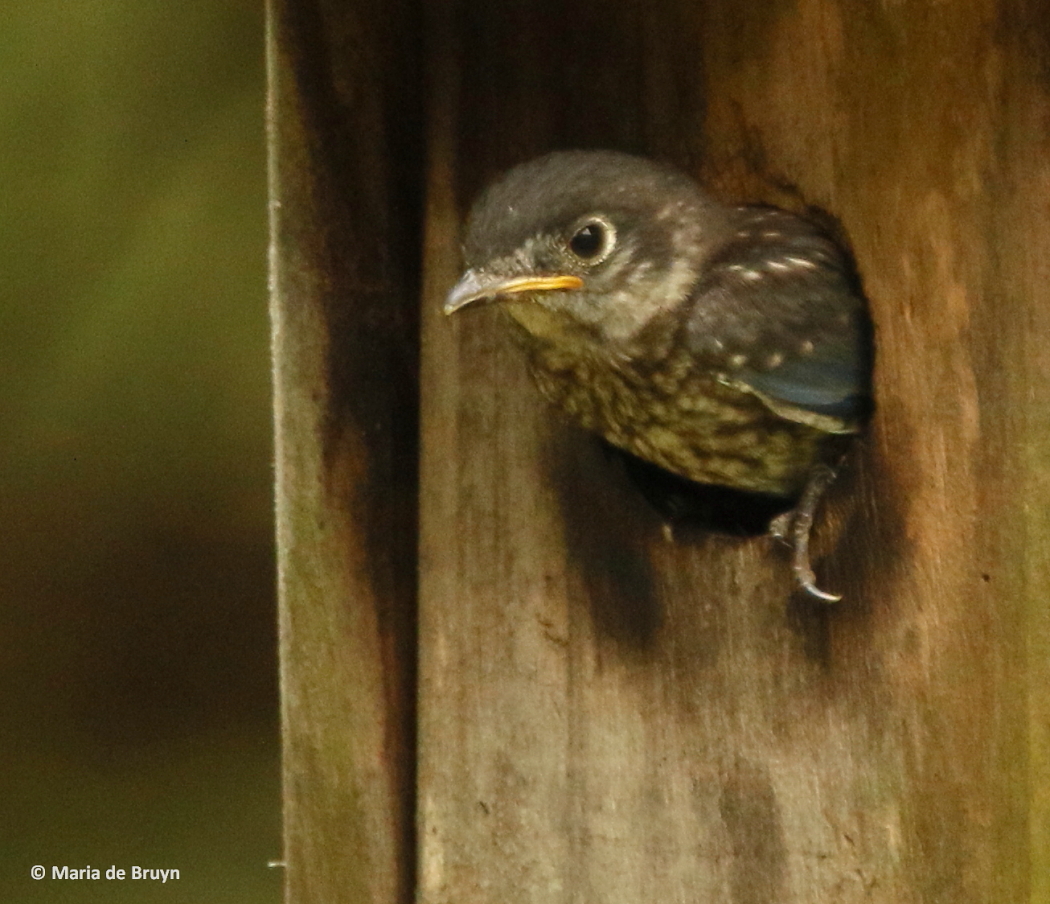
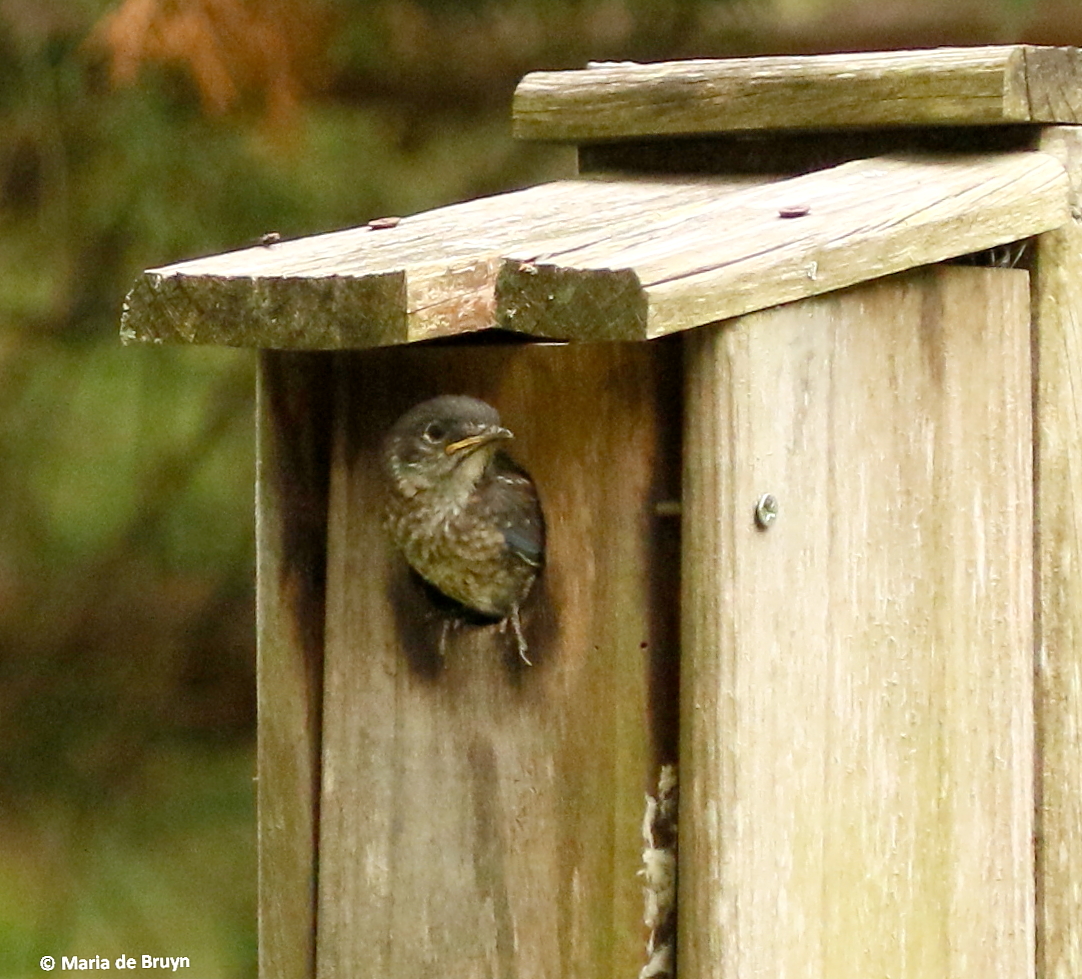
Her admonishments seemed to have had an effect; the babies began calling loudly from inside their birth home. Finally, after about 30 minutes, one poked its head out to take a look at the big wide world. Mom and dad seemed glad, waiting together in the tree to see how long it would take baby No. 2 to join them.

Eastern bluebird I77A8685© Maria de Bruyn    Eastern bluebird I77A8648© Maria de Bruyn

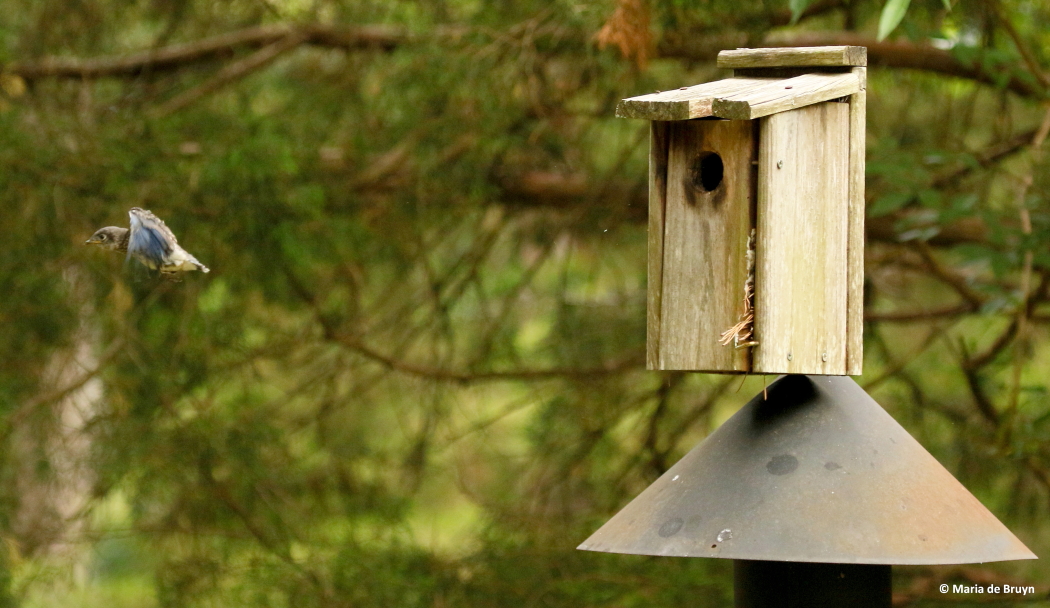
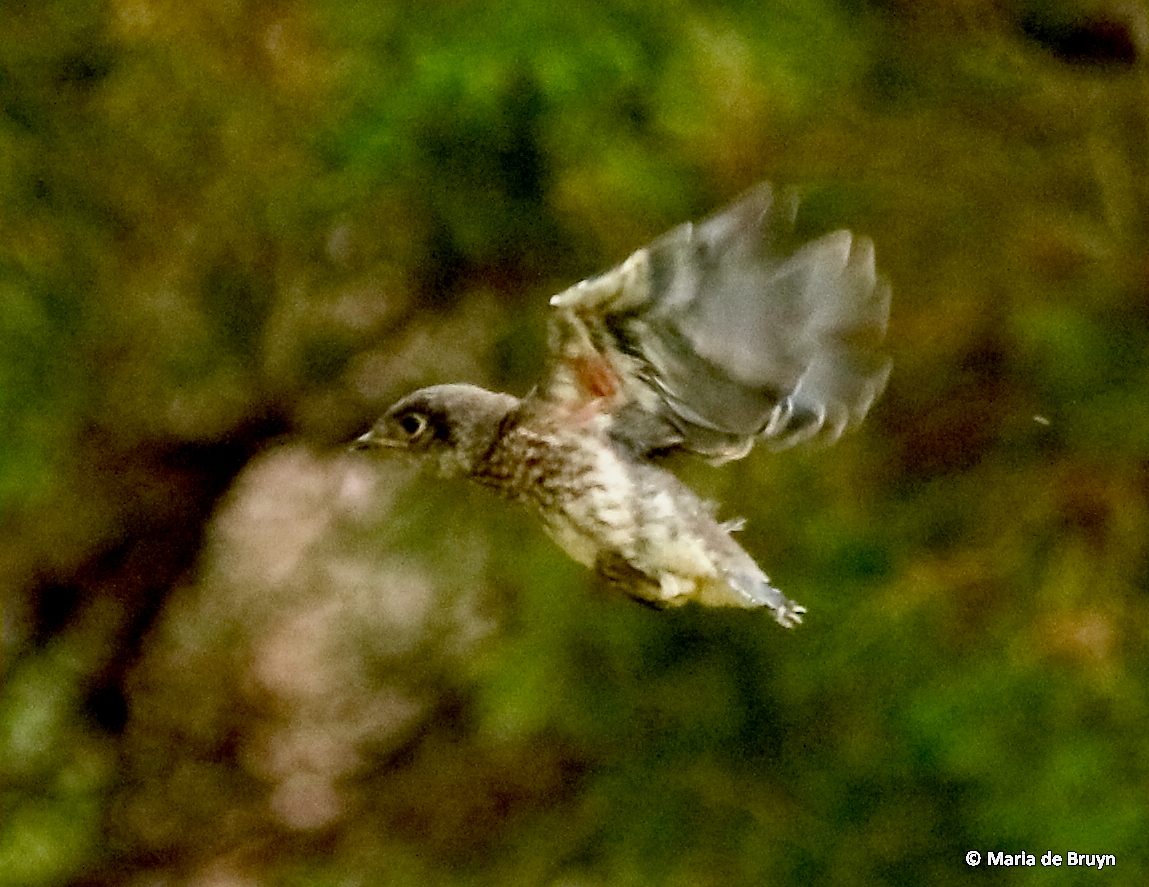
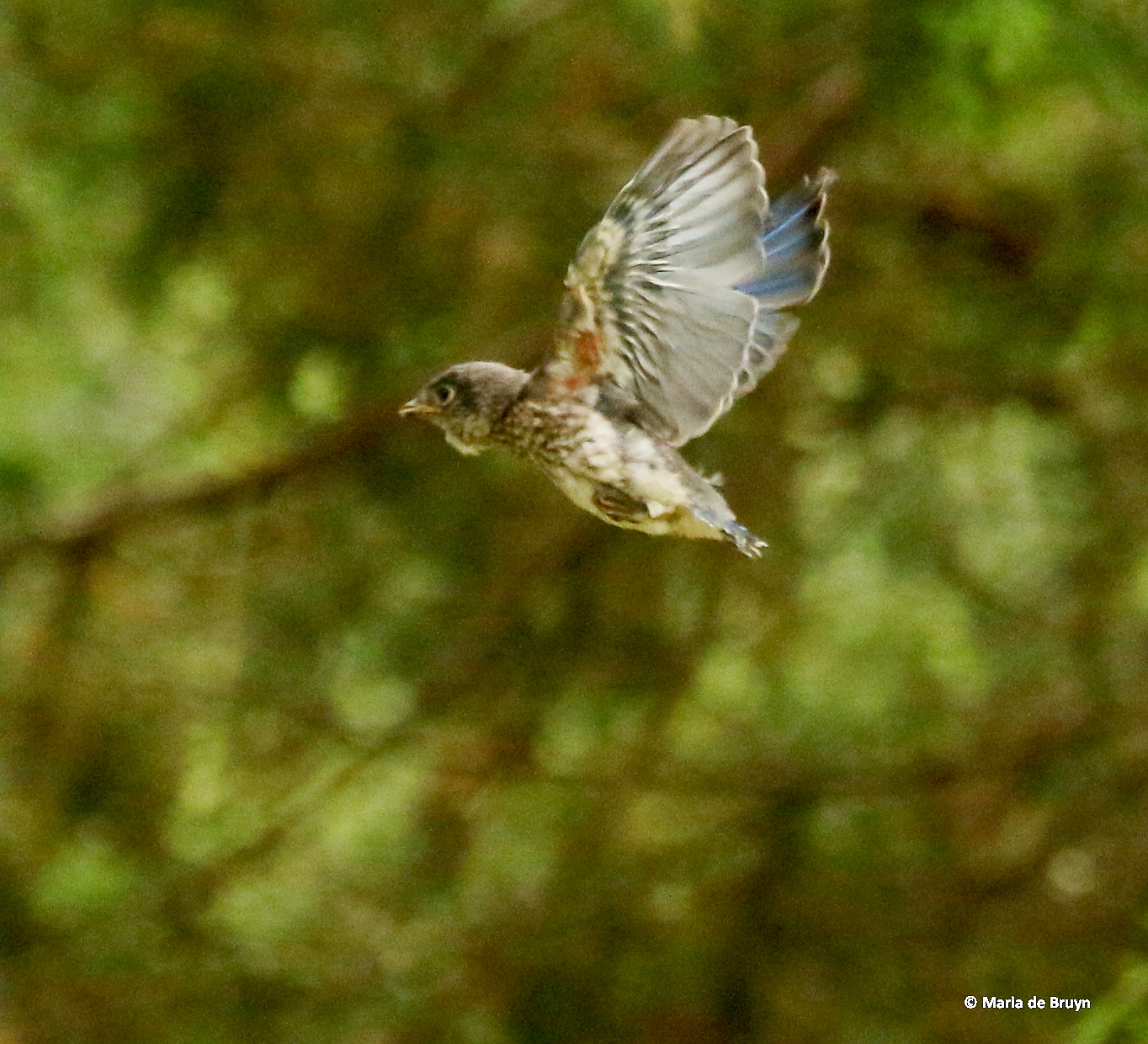
The baby looked around a lot, also staring at me; s/he went back inside and then looked out a few more times, finally taking the great leap into the outside world. Baby 2 was a very strong flier – not even alighting in the tree in front of the box but circling around to land high in a juniper and then in a tall oak tree behind the box.

Eastern bluebird I77A8746© Maria de Bruyn res

Eastern bluebird I77A8877© Maria de Bruyn res


Sibling No. 3 took a little while longer and mama bluebird again went to the box to give encouragement. The baby then spent a little more time observing the new environment and also made a strong flight out.

Eastern bluebird I77A8899© Maria de Bruyn res Eastern bluebird I77A8891© Maria de Bruyn res

Eastern bluebird I77A8861© Maria de Bruyn res  Eastern bluebird I77A8925© Maria de Bruyn

Eastern bluebird I77A8930© Maria de Bruyn res Eastern bluebird I77A8931© Maria de Bruyn     Eastern bluebird I77A8932© Maria de Bruyn res

It rained that night and I hoped that the bluebird babies were ok; between the thunderstorms and a neighbor’s cat who comes to hunt birds in my yard, their environment seemed precarious for their first days of life. In the afternoon, I was happy to see papa bluebird feeding one of the three babies at the top of an oak tree. Mama was also flying around up there, so I assumed they were all hanging out in the high branches.

Eastern bluebird IMG_4723© Maria de Bruyn        Eastern bluebird IMG_4777© Maria de Bruyn res

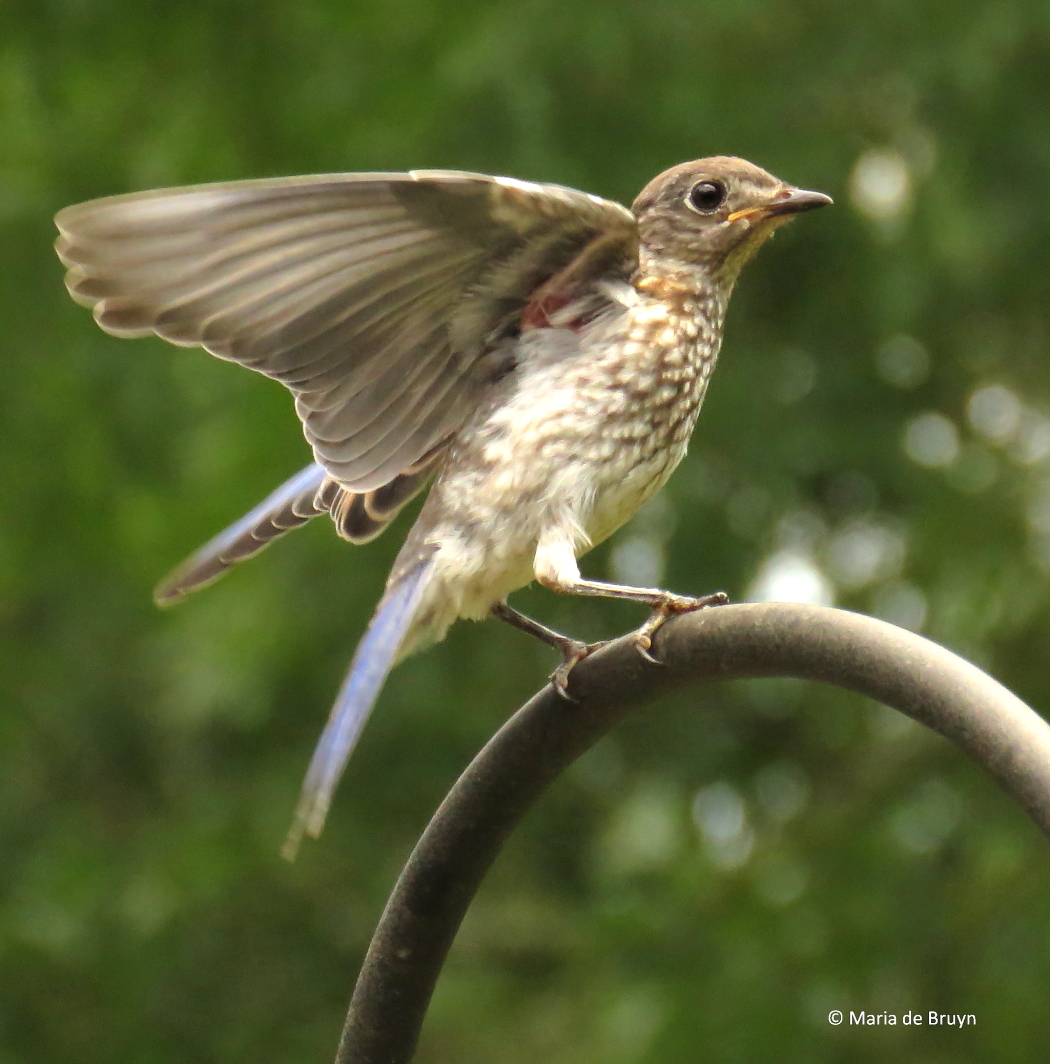
Thursday night, it rained heavily again for many hours; Friday was an easier day and night. I haven’t seen the fledglings again yet but have seen their parents coming for suet and meal worms and flying up to the oak tree, so I assume at least a couple are there. I look forward to seeing their speckled selves at the feeders along with their parents – and will be curious to see if their parents go for a third brood this year.

Eastern bluebird IMG_4779© Maria de Bruyn res