An hour at a local pond

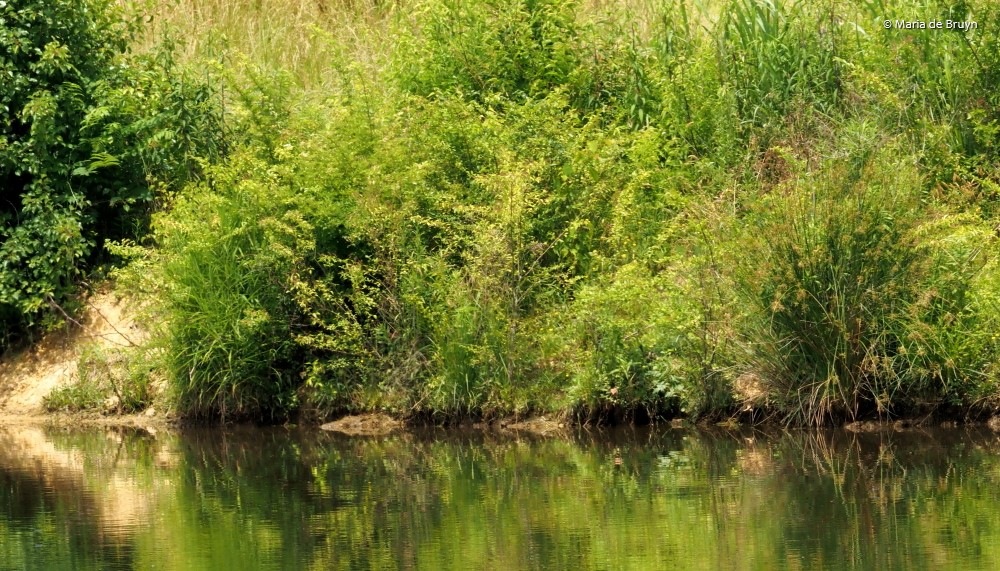
There is a pond in the county where I live that used to be a real hot spot for birds and other wildlife. The dairy farm fields around it had lots of native vegetation, which was very welcoming to avian wildlife.

A couple years ago, the farmers retired, and the property was purchased by a vineyard owner to expand his holdings. He cut down most of the vegetation around the pond and along the road bordering the fields. He has turned most of the fields into vineyards, keeping only small portions untouched where birds can still find some refuge.
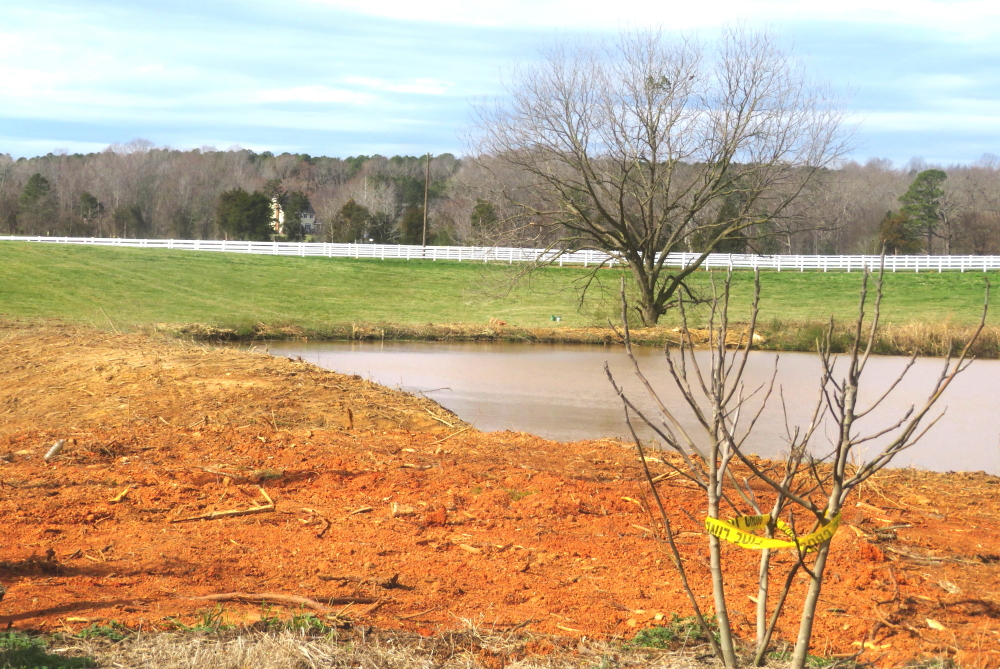
I used to see a yellow-billed cuckoo return from migration to a small patch of trees there every spring. This now is a thing of the past. However, some pond-edge vegetation had been regenerated, and a little bit was planted, so some birds are hanging in there. They still make for some interesting birding. Here is what I saw on a recent visit.
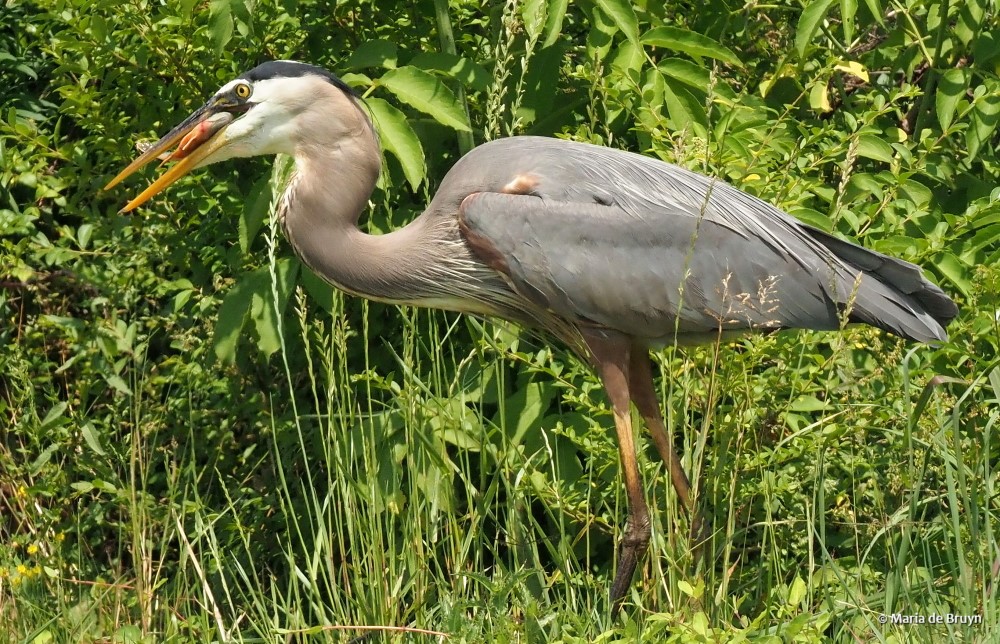
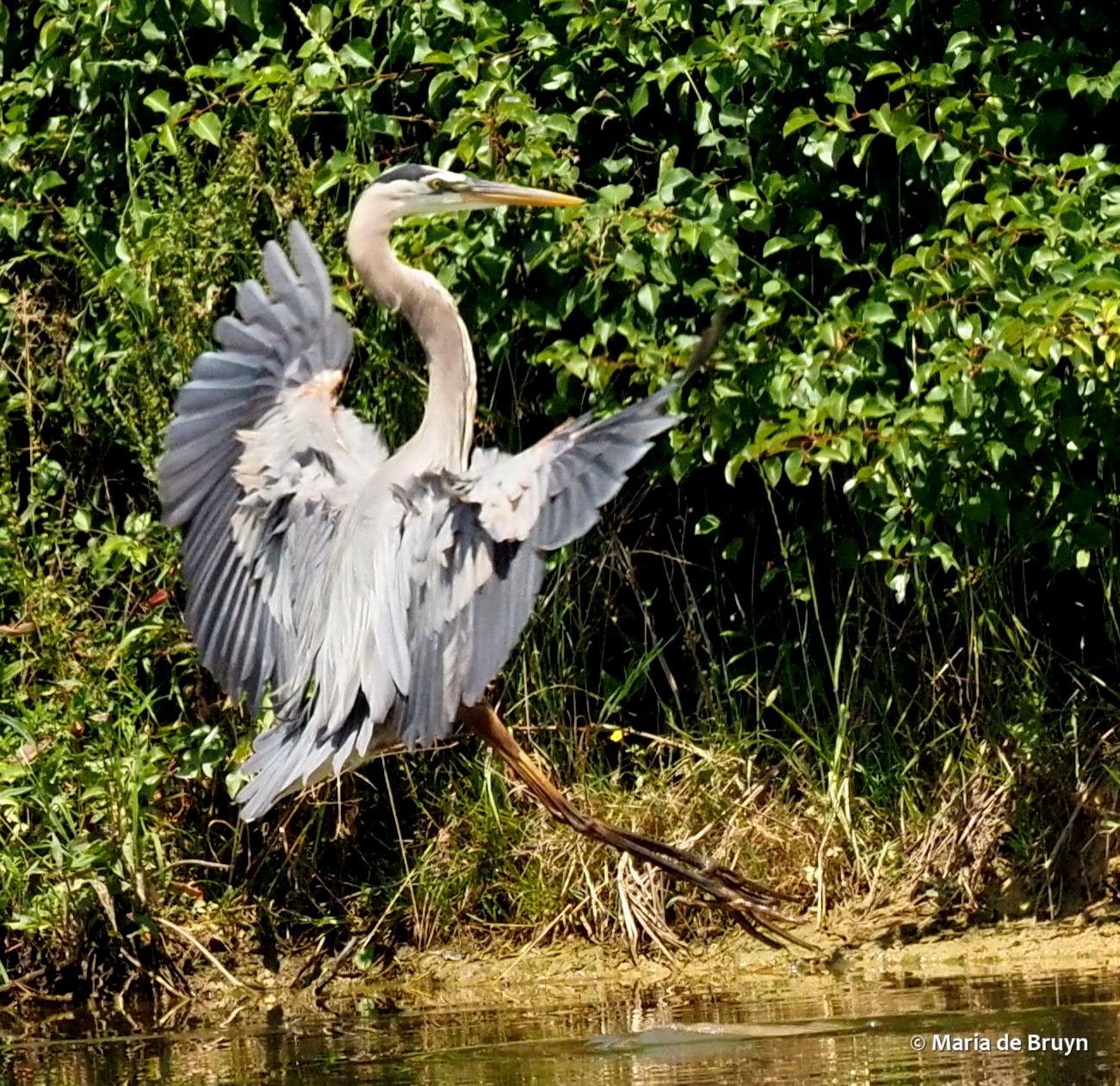
The largest birds that keep returning to the pond are the great blue herons. Sometimes there is one; other times there are two or three. Occasionally a green heron flies in or over but none stopped by on this occasion.

The heron often has good days fishing there. I often see him/her snag at least one fish and often more than one.

The heron stalks along the pond and frequently flies across to the other side for a change of venue. Perhaps the fish manage to hide well once they realize s/he is stalking them.
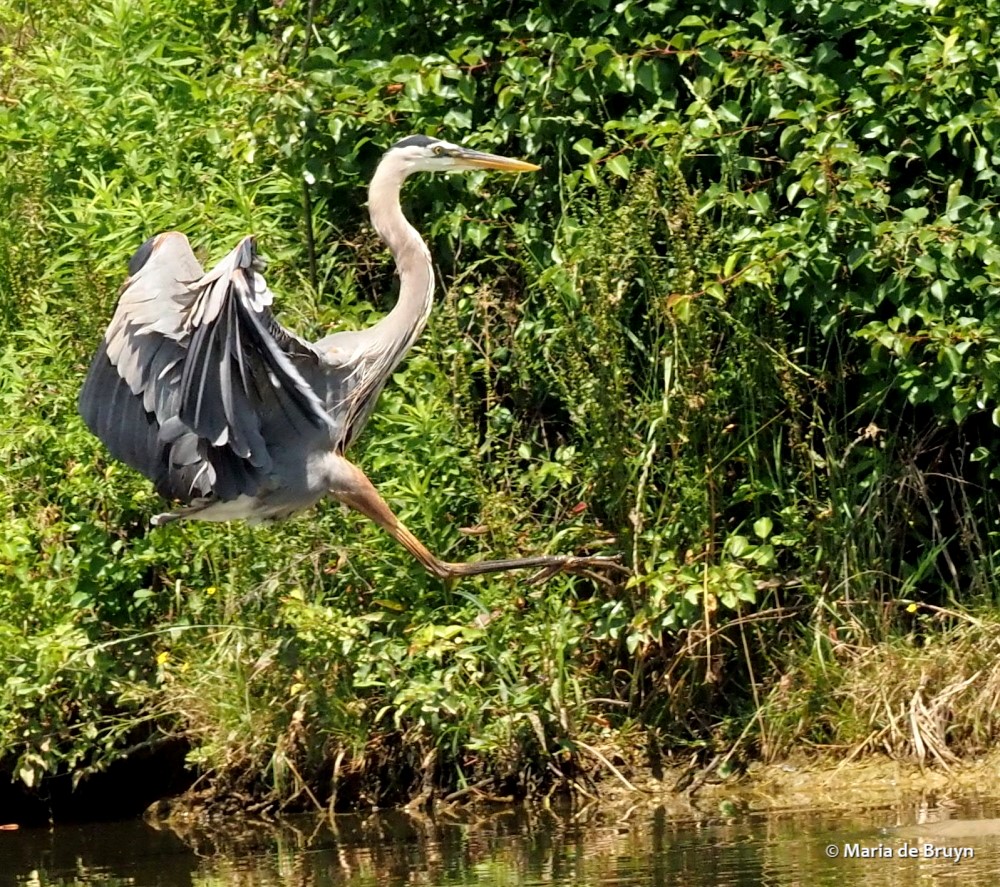
It’s wonderful to see the heron’s wings spread as the bird alights and then begins stalking again.

Eastern bluebirds had taken advantage of an electrical installation next to the pond (which also serves as a resource for the local fire department as needed). They not only used it as a perch for bug seeking but also built a nest inside it. I wondered what the new owner would do.
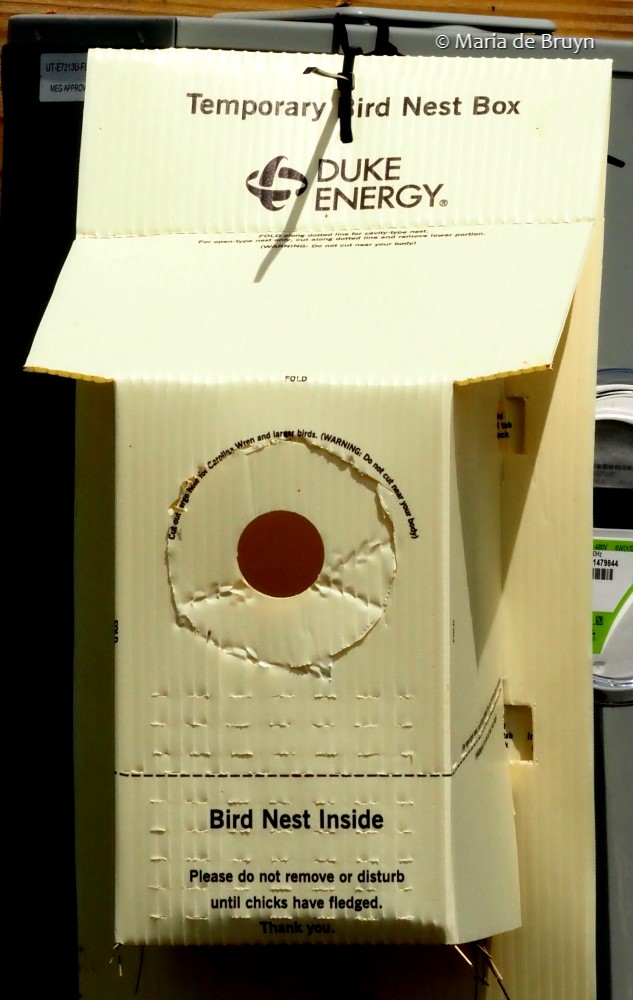


To my great surprise, his problem was solved by the local electricity company. They removed the birds’ original nest and put it into a temporary nest box!
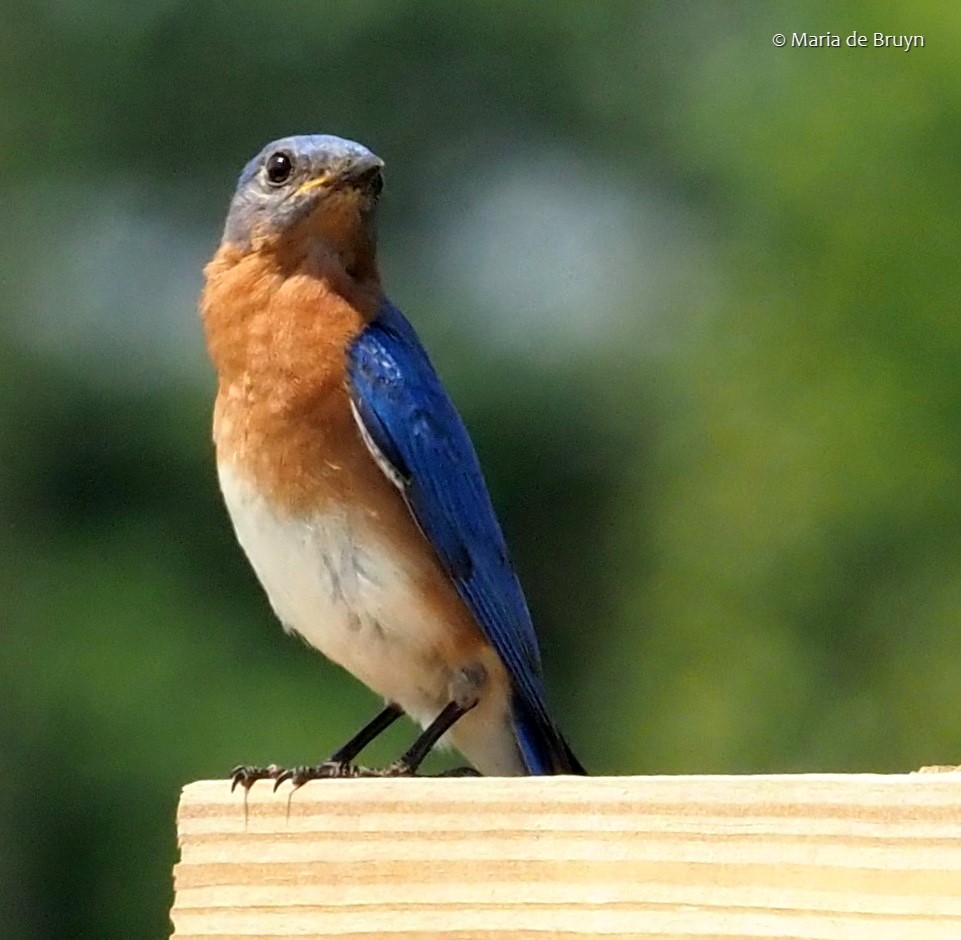
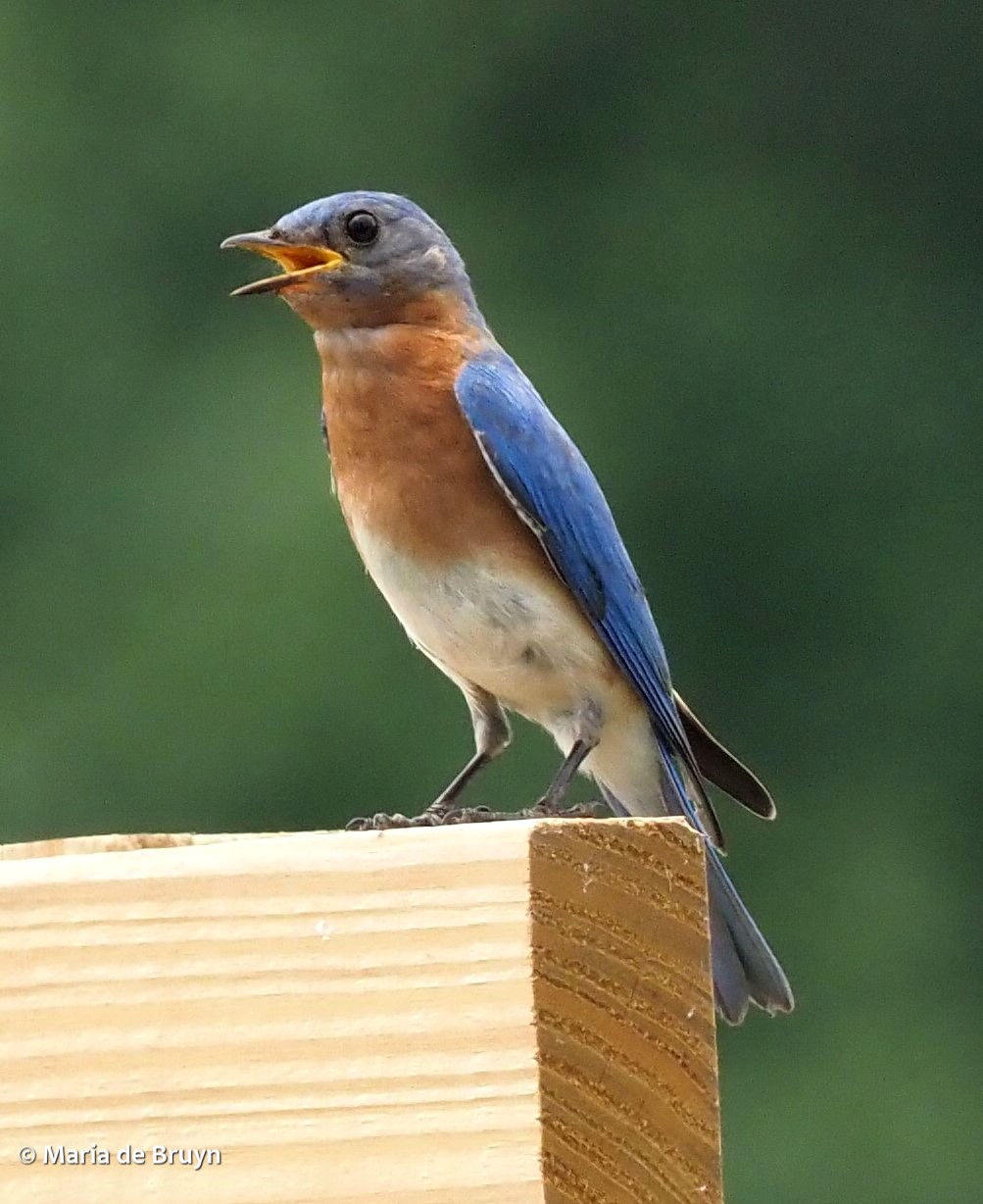
    

Mom and Dad bluebird were guarding the nest space, but it looked like they were still getting used to the new digs.

While watching the bluebirds, I suddenly heard a commotion in front of me, but I couldn’t see what was happening behind the bushes at the pond’s edge (I’m short!). However, I could tell that a bird was in distress. I wondered if one of the huge snapping turtles had caught a duckling. I walked further along and saw one of the two resident female wood ducks (above) swimming away from the area.
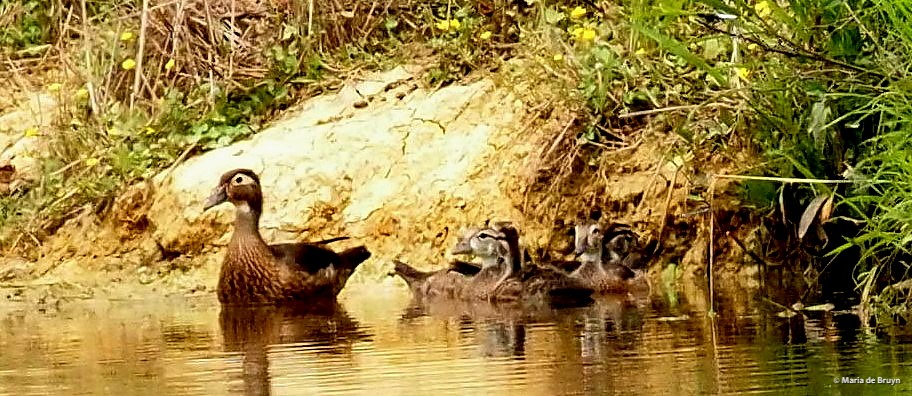
No ducklings followed and I feared the worst. One mother had five ducklings (above) while the one swimming away had lost one a few weeks before. Now I wondered if she had lost others, too. Luckily, I later saw her return to the area and shepherd four ducklings across the water to the other side.


In the small bit of meadow immediately adjacent to the pond, red-winged blackbirds are now nesting. One pair has a nest close to the road and they are warning visitors away with constant flights along the pond’s edge, while the male calls repeatedly.


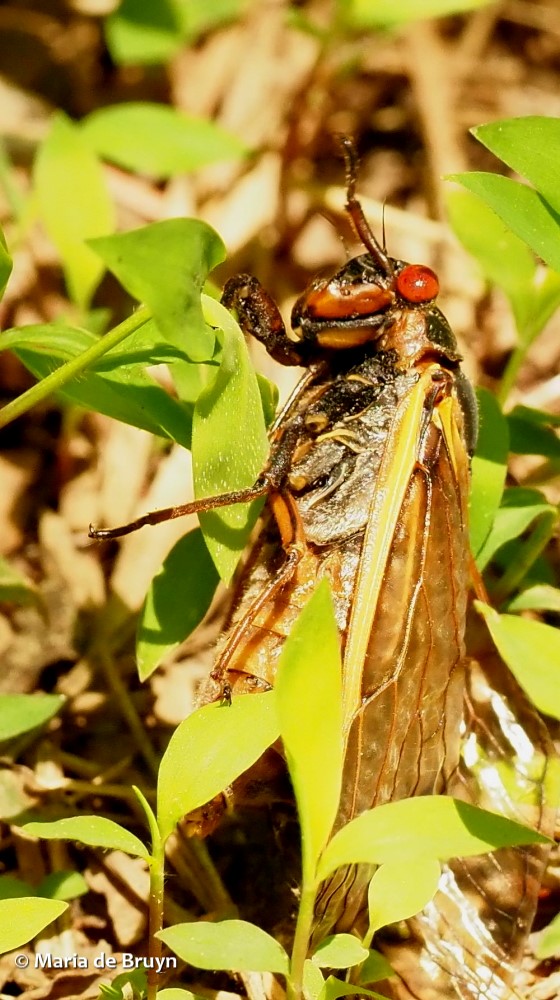
The female was taking breaks from warning-off flights to enjoy an occasional meal, at this time consisting of one of the remaining periodical cicadas that emerged recently.

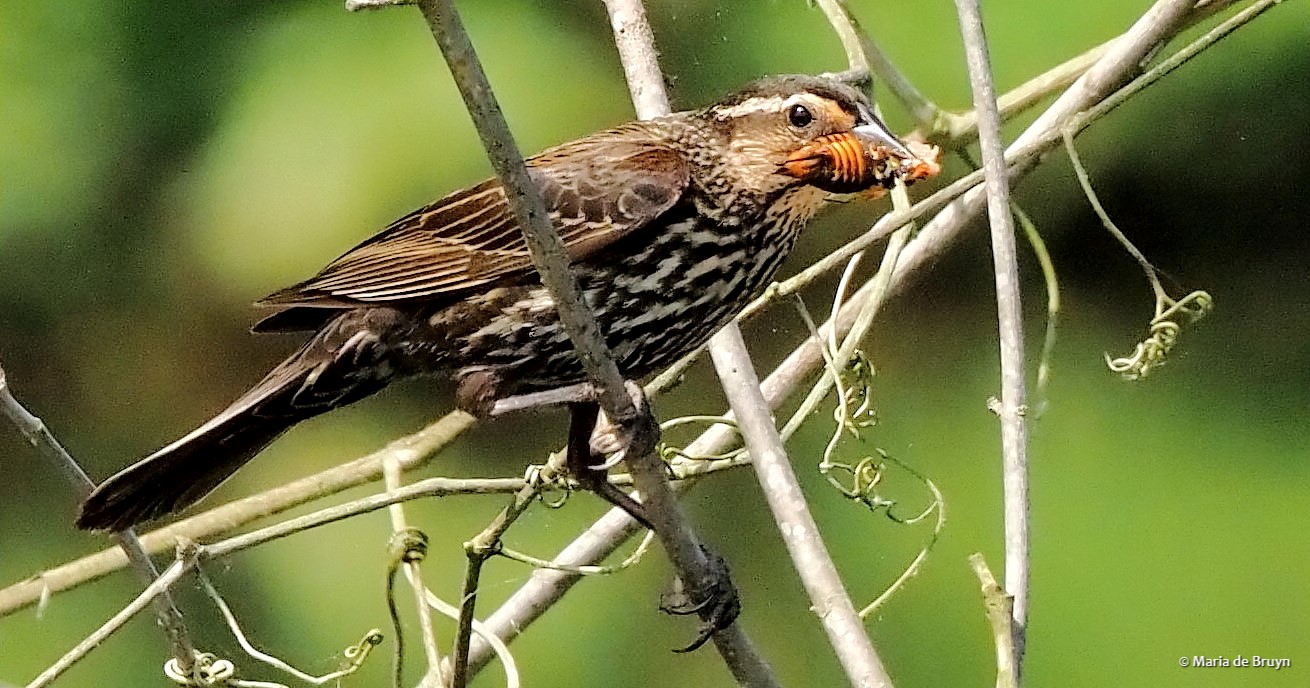
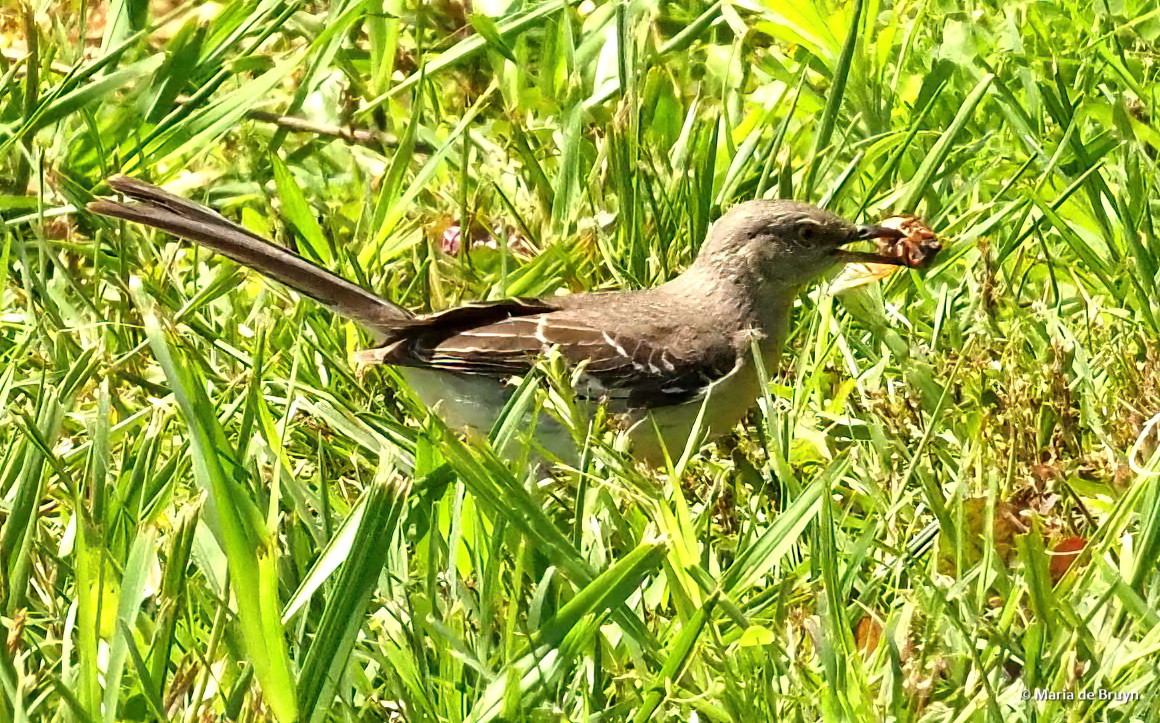
She wasn’t the only one seeking these insect delicacies. Two Northern mockingbirds were also intently examining the area under a tree for them. One finally had success in snagging a cicada. (For more about the cicadas, see my previous two blogs!)


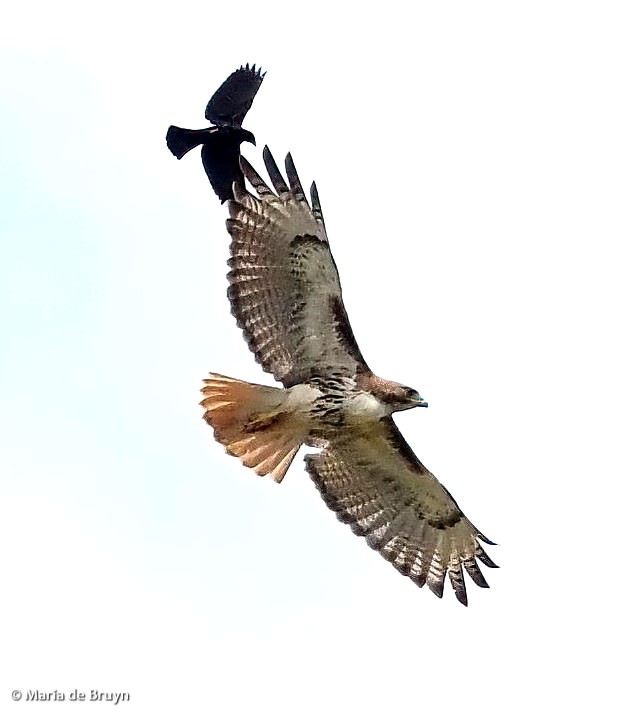
The male red-winged blackbird was very busy keeping “intruders” as far as away as possible from their nest. He warned off the great blue heron, who was actually pretty far away. (He is flying away from the heron on the left side of the photo.)

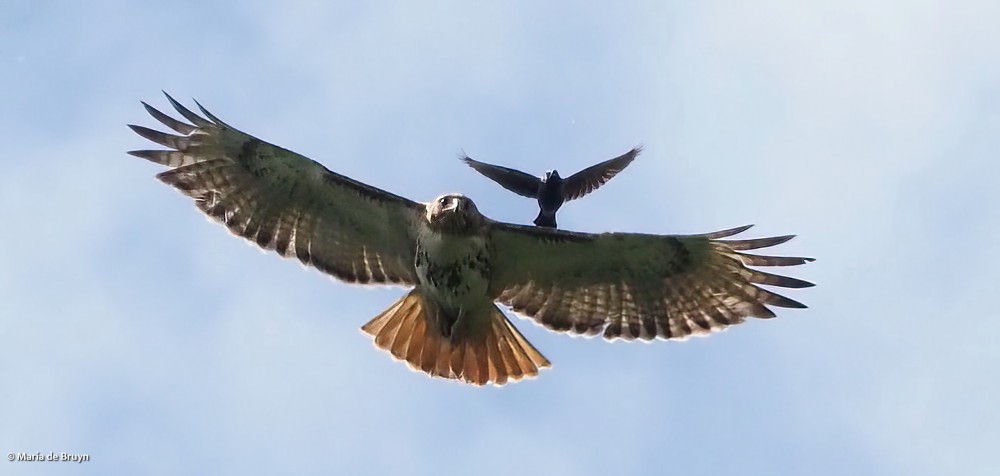
He also went after a red-tailed hawk, who appeared soaring overhead.
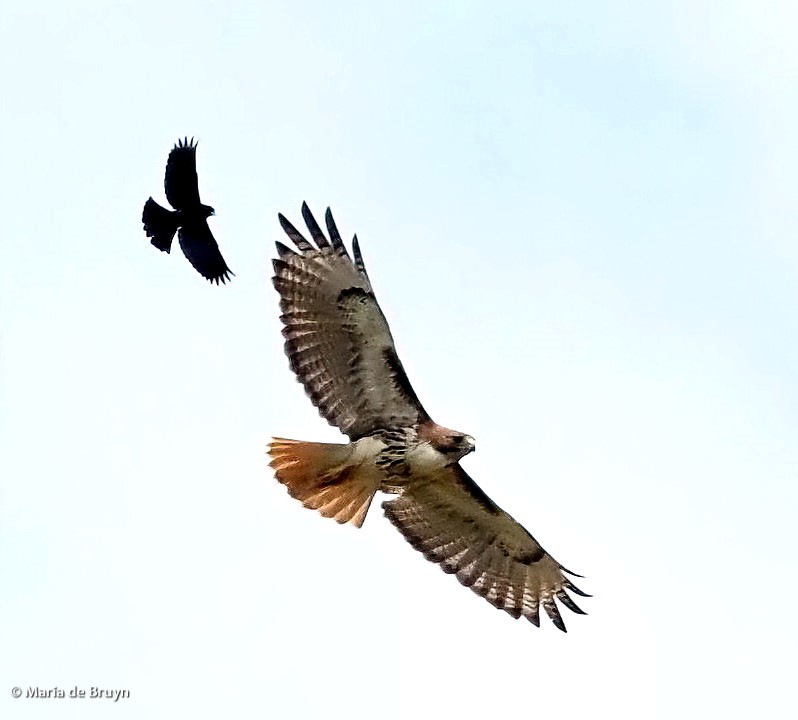
Common grackles, often present at this pond, will also chase away these hawks. There weren’t any around to join in the foray this time, but the photos below taken at another pond show how they go after the red-tails.

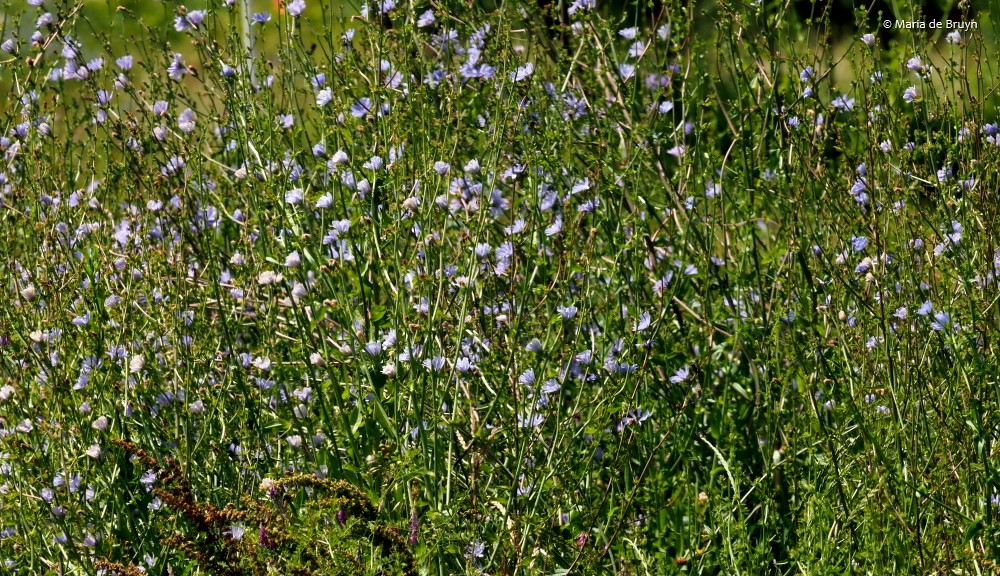
I looked at a small patch of chicory across the road to see if any bobolinks, grosbeaks or meadowlarks were around. I love this plant and planted some seeds in my own yard, hoping to attract more pollinators and birds. So far, they have not sprouted.
 

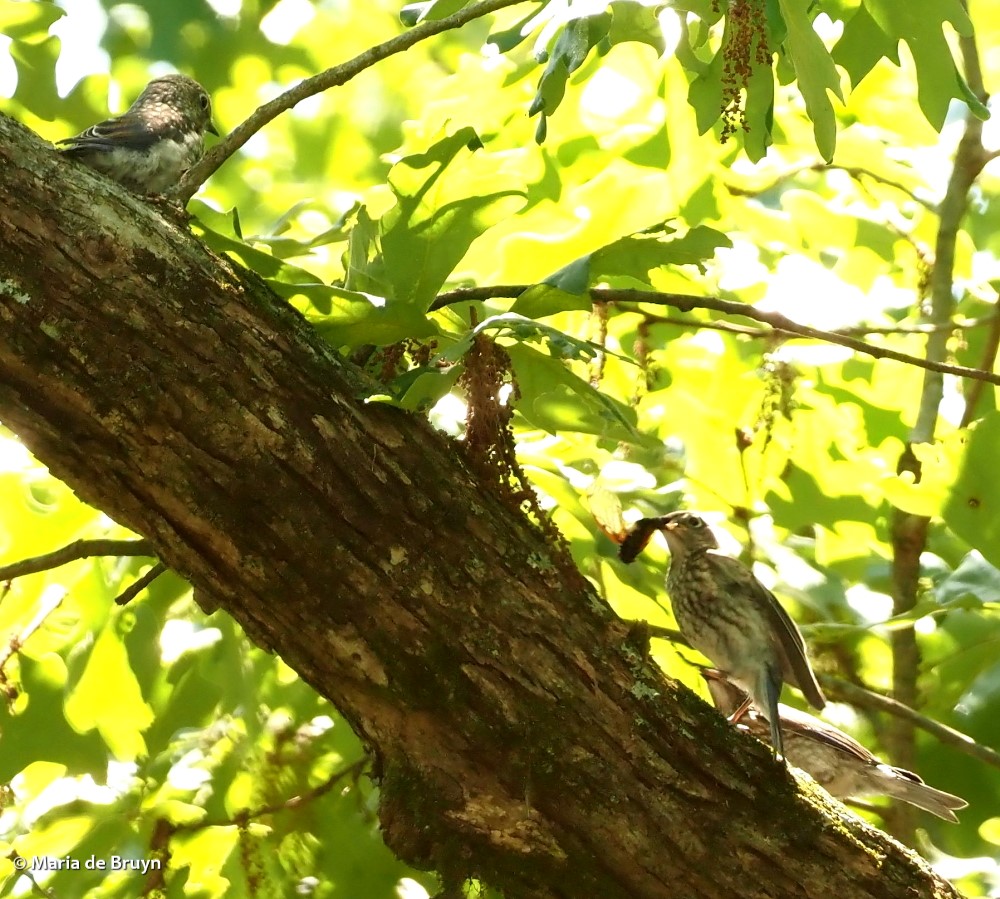
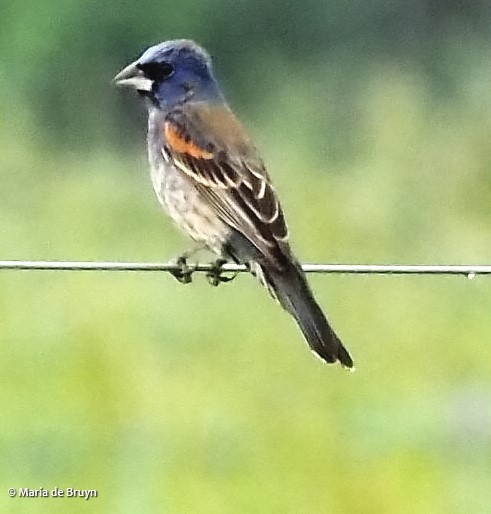
Below you see a young blue grosbeak and a pair of Eastern meadowlarks who were in the patchy field spots another time.
 

Usually, several types of swallows frequent the pond, including purple martins, tree swallows, barn swallows and Northern rough-winged swallows. I only saw a couple of the latter this day and only got poor flight photos as my camera began acting up, refusing to focus.

Staring hard across the pond, I did manage to spot three killdeer, four least sandpipers and a couple other sandpipers that I couldn’t immediately identify. I later learned that they were semipalmated sandpipers, which I hadn’t seen there yet. (If you click on the photo, you see it larger; then go back to the blog.)

That hour at the pond didn’t turn out to be a super one for capturing stellar photos, but it was definitely a great one for relaxing, observing the action and appreciating nature again!
They’re baaaack!!! — and so am I! Part 2

But the Great Southern Brood of periodical cicadas is getting ready to leave…!

Having heralded their appearance in my previous blog, I’d like to share a bit here about what these insects are now facing as they expend their remaining energy on ensuring the survival of their species.

Some of our community members (both animal and human) are as appreciative as I am that these creatures are here. In listserv postings, a few people have commented, for example:

  • Sounds great.
  • I guess I am rare in thinking they are cool. It feels other worldly….
  • And it’s all about SEX. Just think about all those teenage hot-rodders gunning their engines to attract attention. They’re all saying “Come and get me baby. I’m HOT.” After years underground, you would be, too.

It’s almost impossible to miss the cicada phenomenon where I live unless you have hearing or vision problems or can’t get outside. Their calls for gathering and hooking up can reach a level of 100 decibels and this continues for hours on end.

The sounds can vary a bit because the Great Southern Brood comprises several species of periodical cicadas with somewhat different songs.

However, it seems that quite a few people don’t pay attention to the broadcast or print news. Despite the considerable coverage given to the cicadas’ appearance, inquiries about the ongoing noise continue in listservs, irritating some community members:

  • Please stop asking about the sound cicadas make! Please! And if someone answers, why do 50 people feel the need to respond? I feel that so much of the posts are so religious. Does anyone else feel this way?… I didn’t mean religious! I meant repetitive!
  • Cicadas are a plague sent from God signaling the End Of Time. The purple glow in the sky last night [Northern Lights] was the Rapture, and, since we’re still here … well, there’s that…
  • If you don’t like it, stop looking at the posts.

The numbers of cicadas we’re seeing really is amazing. They need an enormous population because that is how they ensure some will live long enough to reproduce. These insects have no physical or chemical defense mechanisms at all. Many will succumb to diseases and predators.

One particularly strange phenomenon is a fungus that attacks the cicadas. Massospora cicadina has evolved to target periodical cicadas. The cicada nymphs can become infected when they dig their way out of the soil.

The fungus is a chalky white substance that destroys their reproductive organs but does not kill the insect. As the infection progresses, the male cicada continues to move around and tries to mate. Eventually, the back part of its abdomen drops off and we can see the white fungal growth. But the cicada doesn’t die from this and continues trying to find a mate!

Image by Katja Schulz, CC BY 4.0. Reproduced with permission from  <https://creativecommons.org/licenses/by/4.0&gt;, via Wikimedia Commons

The cicadas also have no means to fend off predators and they are a highly desired food source for other creatures. Those who eat them include snakes, spiders, beetles, wasps, opossums, squirrels, raccoons, frogs, dogs and even people.

This unfortunate individual died early on during the cicada emergence and the local ants found it on my driveway.

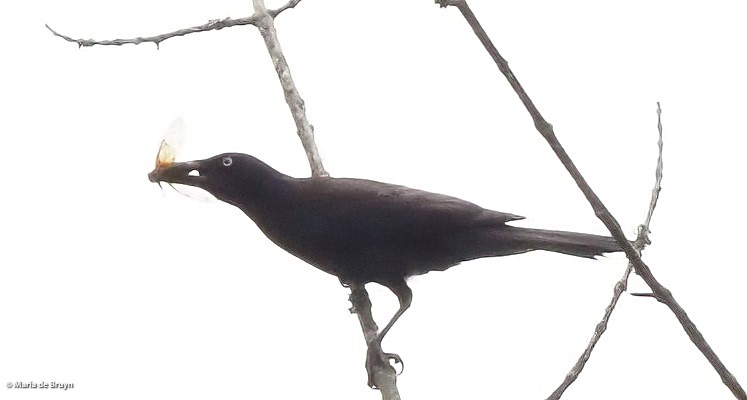
These cicadas are especially vulnerable to avian predation. I’ve now seen different species of birds chowing down on them, including grackles (below) and robins.

The red-bellied woodpeckers seem to have a particular fondness for them. A young woodpecker was hoping that its parents would provide them as a meal, but the parents were eating the insects themselves.

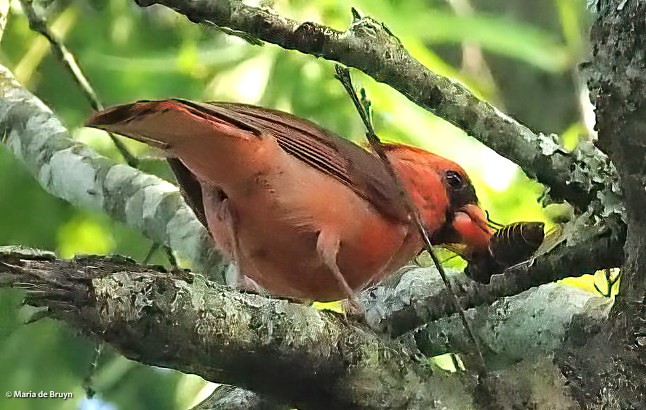
A Northern cardinal stopped by for a meal.

The resident male Eastern bluebird in my yard was supervising his three rapidly maturing fledglings in their efforts to catch and consume the large insects.

His mate was already tending another nest of 5 eggs, so he was occasionally feeding her as well, including cicada tidbits.

Given the enormous numbers of cicadas that have arrived, some are managing to stay alive and healthy so they can mate. The females may lay as many as 600 eggs in nests dug into plant stems.

After 6-10 weeks, the eggs hatch and the nymphs crawl down to the earth to go underground for their 13-year “hibernation” period.  There they will eat sap from tree roots, undergo their molting and live out their lives with the people walking above or near them having no idea that they are there.

My chances of seeing the members of Brood XIX again are likely not so great, but perhaps some of you readers who live in the northeastern USA may get to see them emerge again then. If so, I hope you will find them fascinating, too!


They’re baaaack!!! — and so am I! Part 1

The Great Southern Brood is here!

It’s been over a half year since I’ve written a blog (although I’ve penned a monthly newspaper column and a few articles in the meantime). Numerous concerns including ill health kept leading to blog postponements. Fortunately, I’ve been able to continue my nature observations, a boon to keeping things on a somewhat even keel. And lately it’s been my privilege to see some interesting creatures and to witness behaviors I’d not seen before in person.

The immediate inspiration for resuming my blogs has been the emergence of the Great Southern Brood XIX (Magicicada spp.) of periodical cicadas — an animal species which humans only get to see every 13 years! This is the largest cicada brood in eastern North America, which is the only geographical area where they occur. I’ll share some of my current sightings and interesting tidbits about them and hope you enjoy this in a two-part blog.

Periodical cicada eggs, laid above ground, hatch into nymphs which then go underground to pass through five juvenile stages before emerging 13 years later by the hundreds of thousands (even millions!). After emergence, they only live a few weeks, purely for the purpose of finding a mate and reproducing their species.

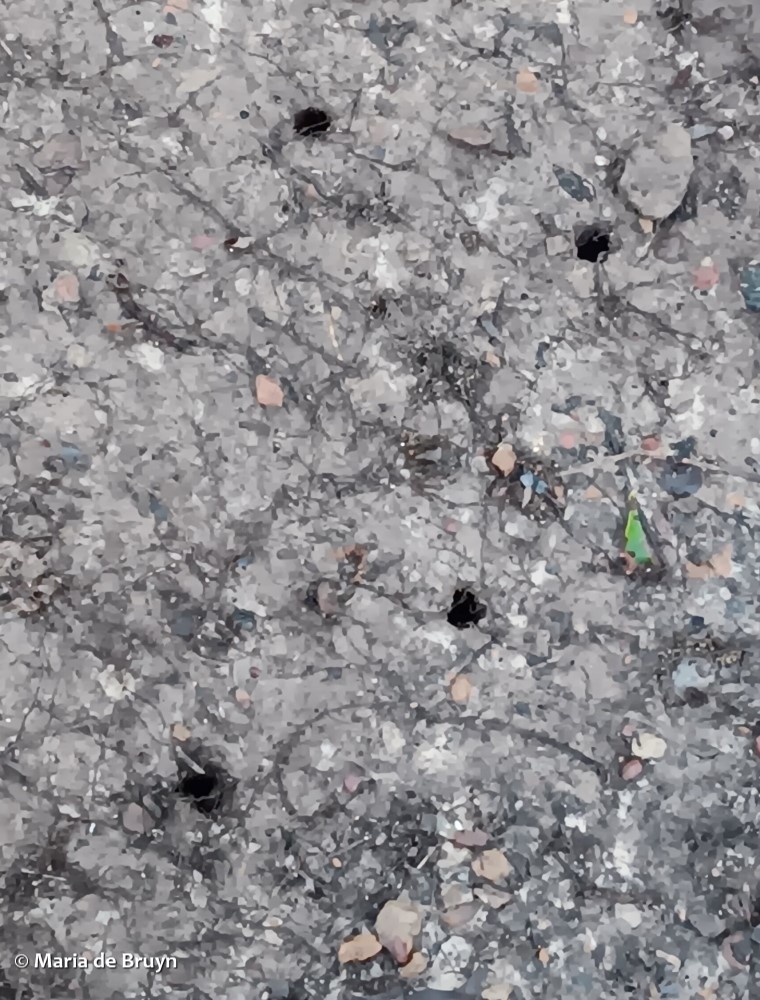
One of the first noticeable things to alert humans to the coming “deluge” of cicadas, seen above, is the appearance of numerous holes in the earth as they tunnel out to the fresh air. This happens when the ground reaches a temperature of about 64°F/17.8°C.

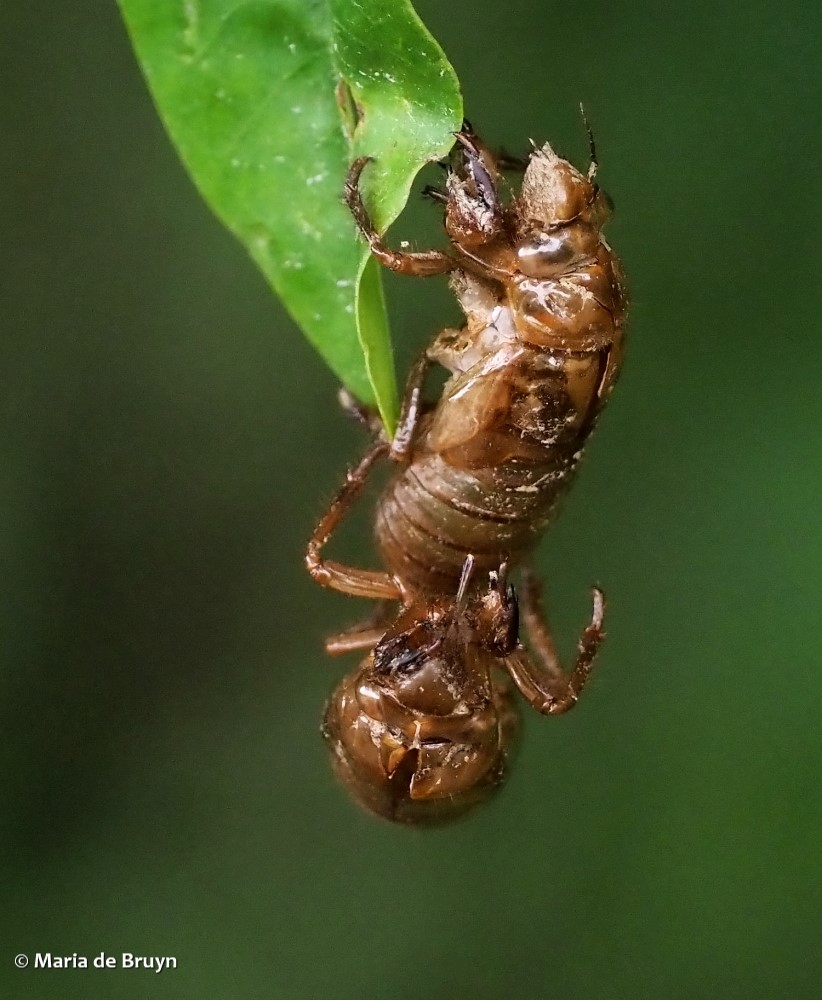
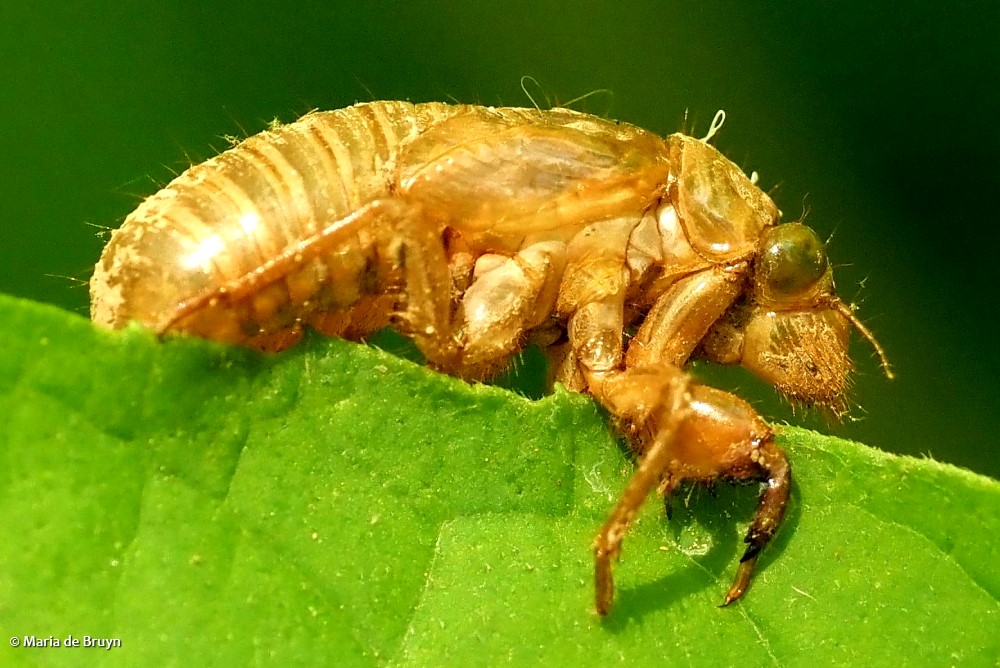
What emerges from the holes are brownish-tan nymphs, who crawl onto plant stems and tree trunks. Underground, they will have undergone four moulting periods as they grew during the past 13 years.

The vegetation becomes laden with these still immature insects almost everywhere you look.


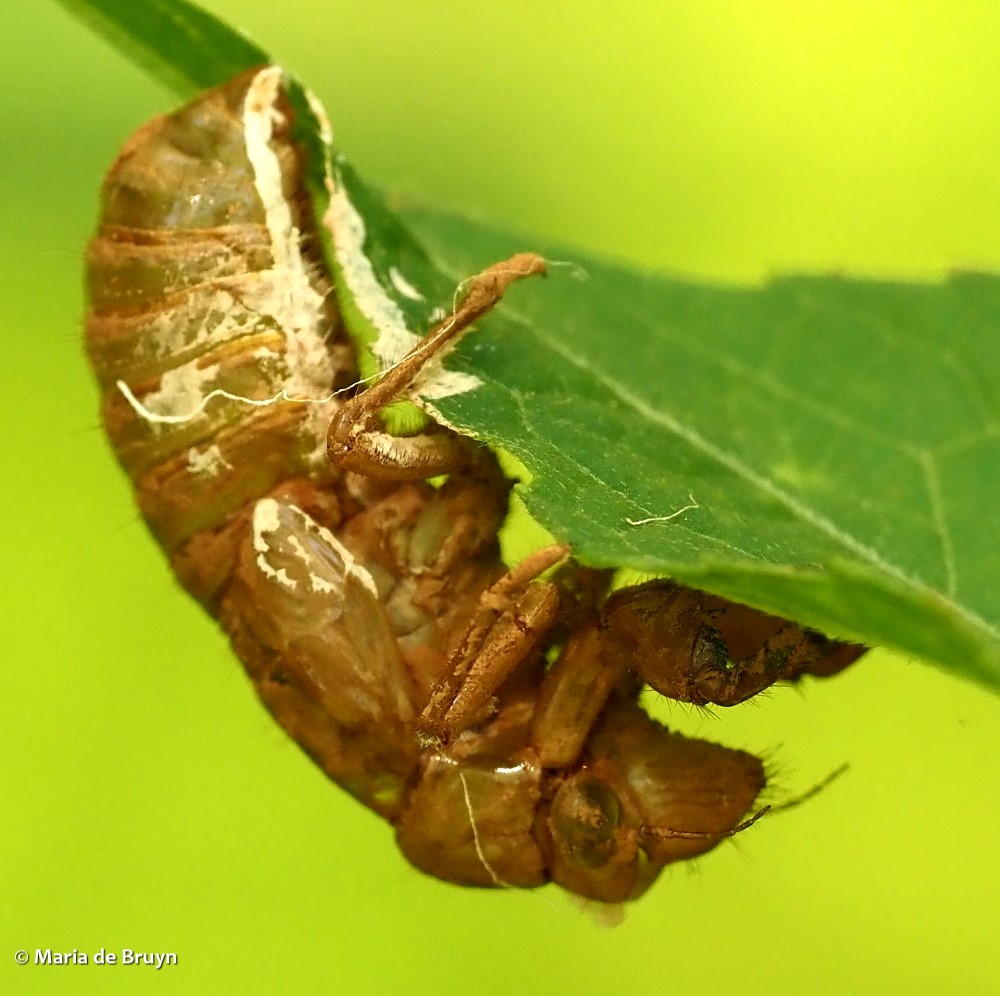
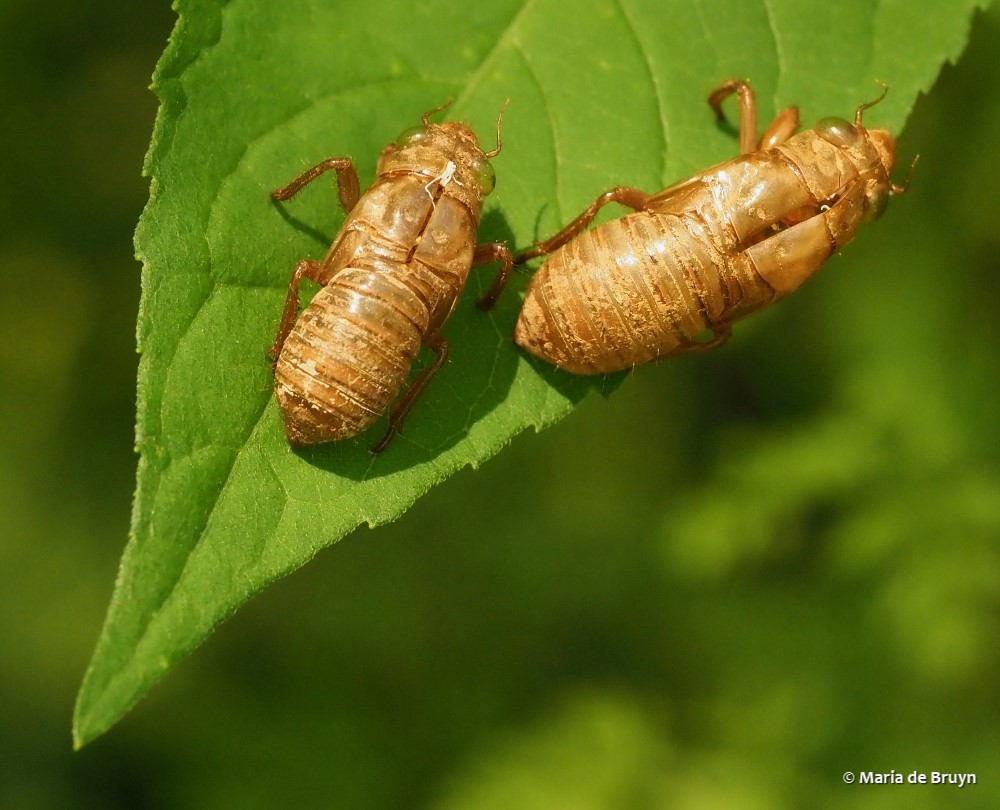
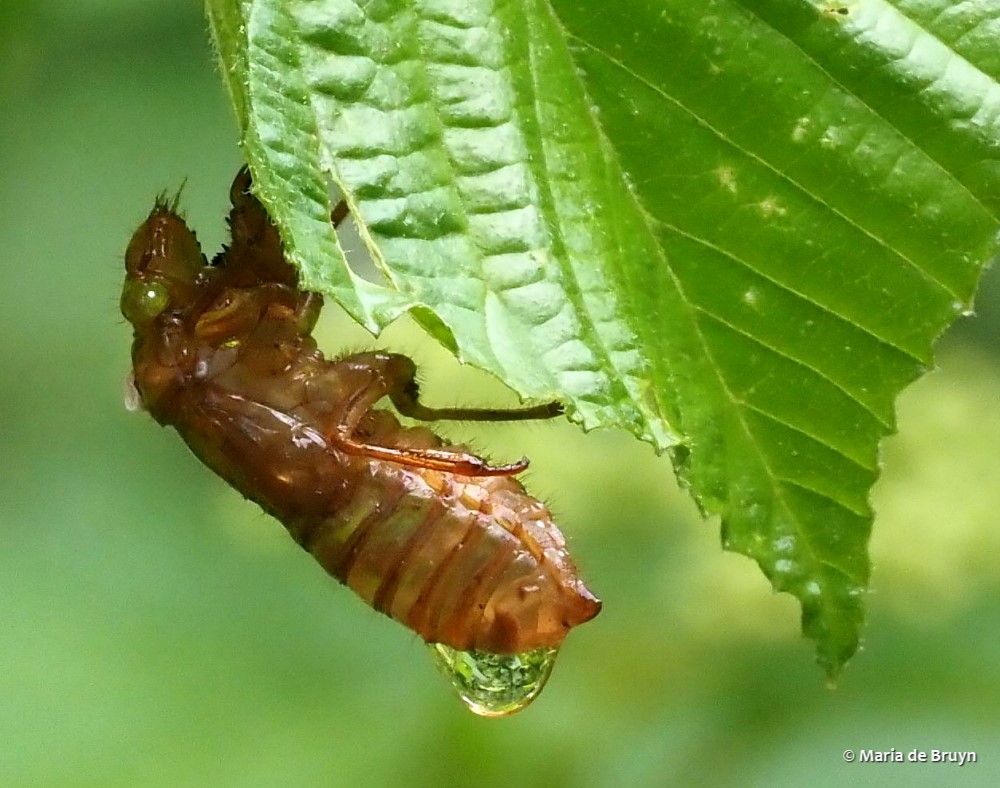
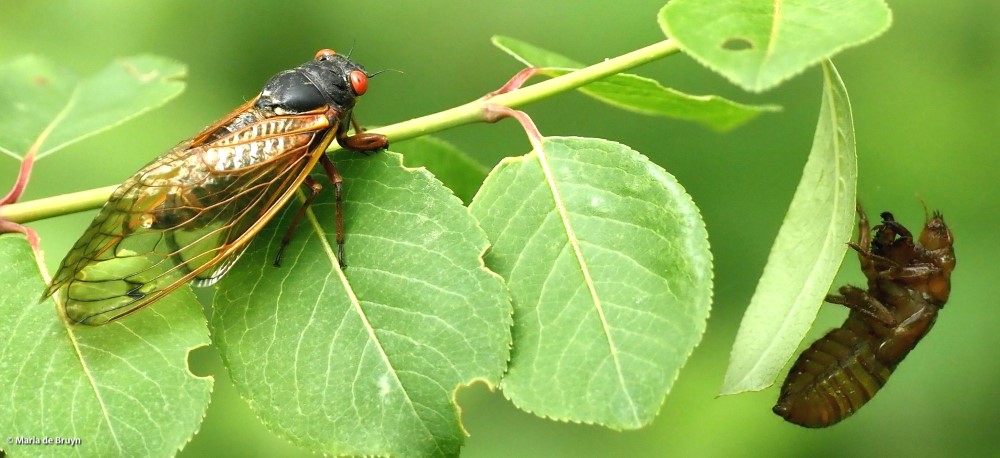
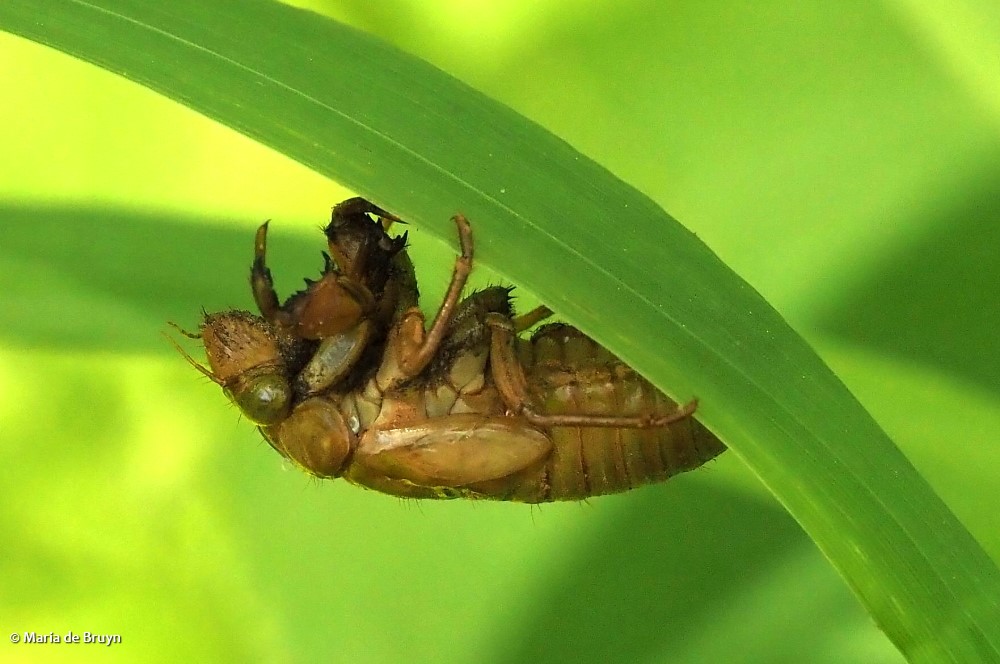
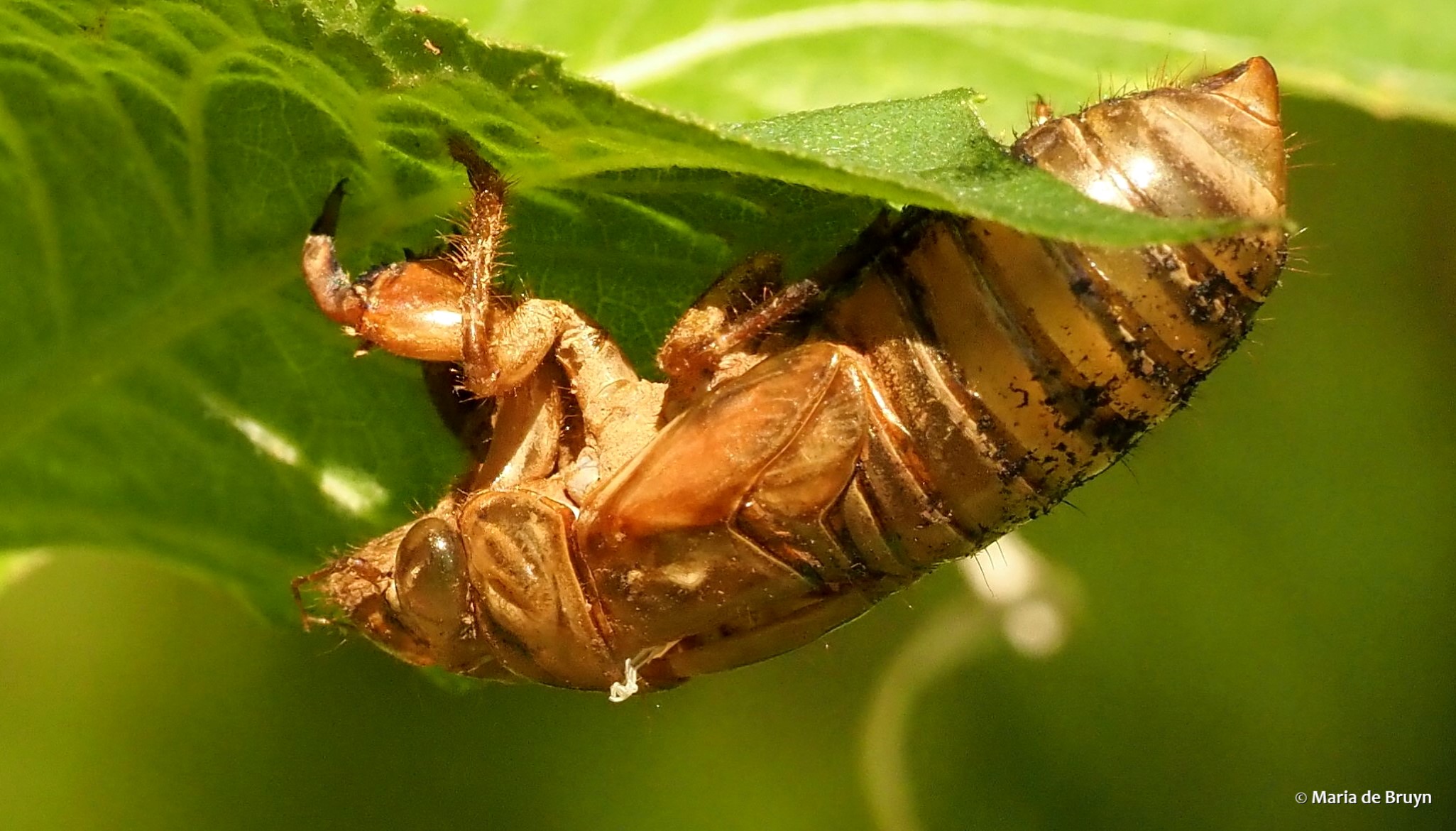
The adults emerge from their last exoskeleton through the back, which splits open. If you look carefully below, you can see one emerging on the right.

The newly emerged cicadas then undergo a quick maturation process within an hour or so.

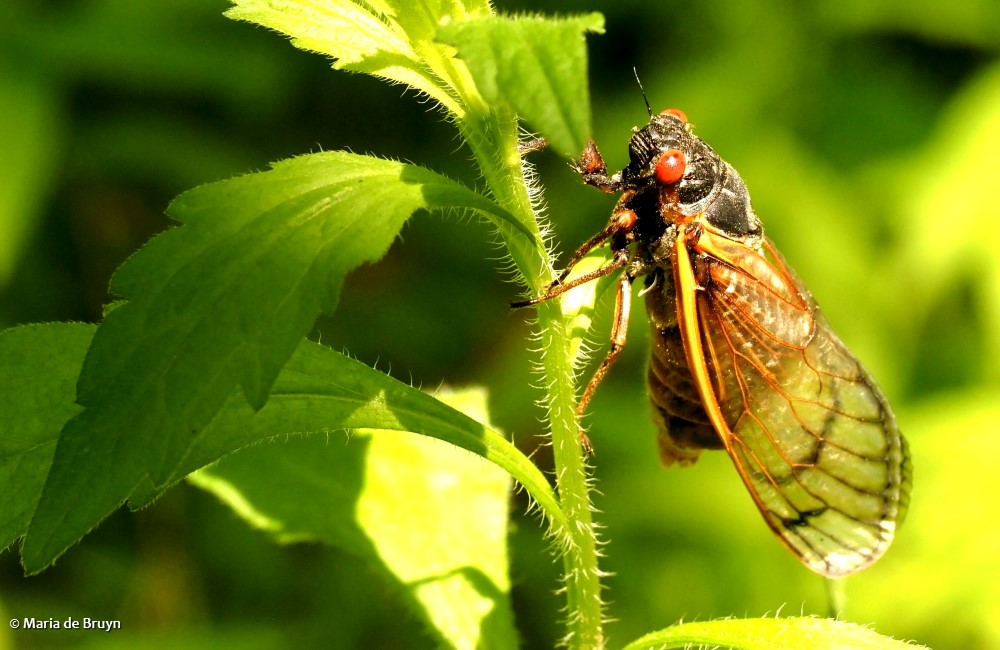
They must unfurl and flex their new wings.

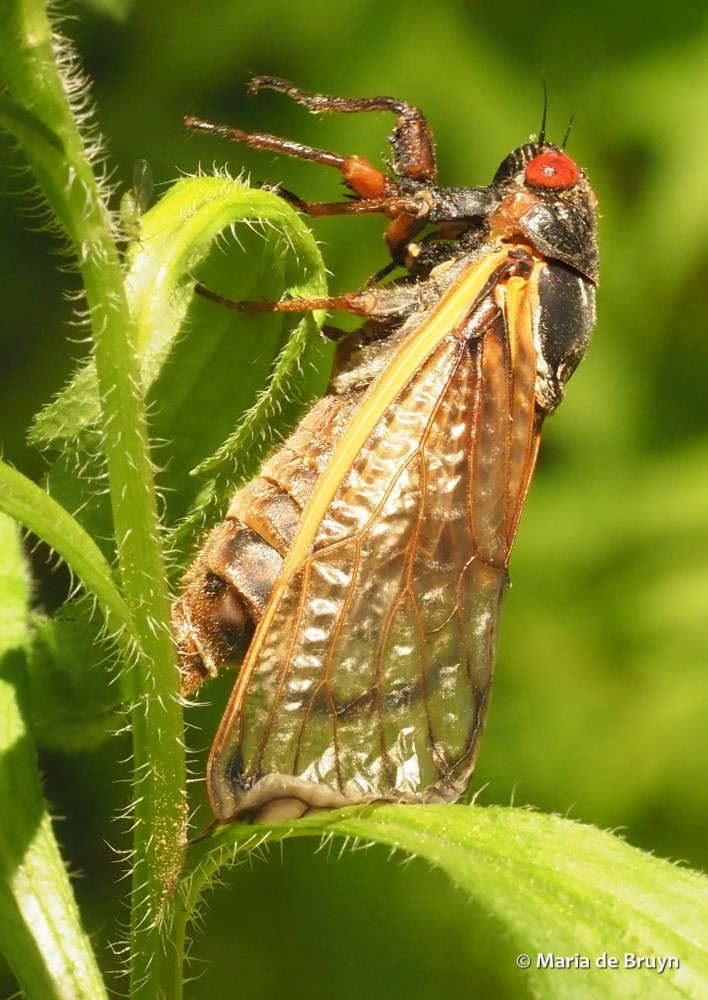
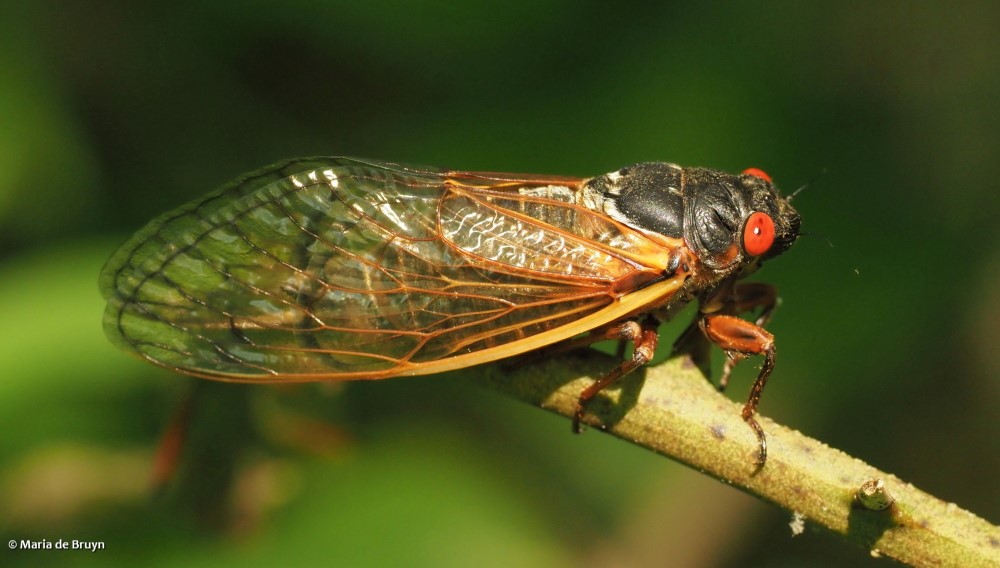
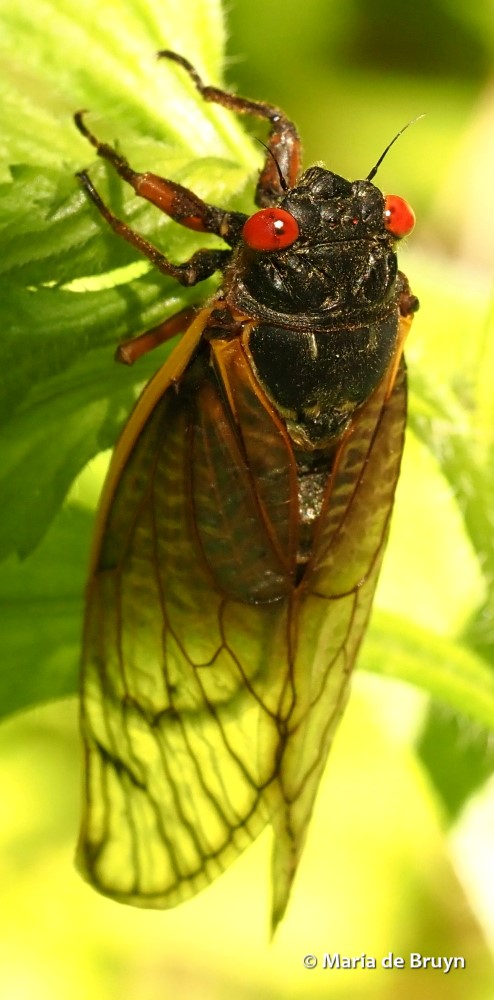
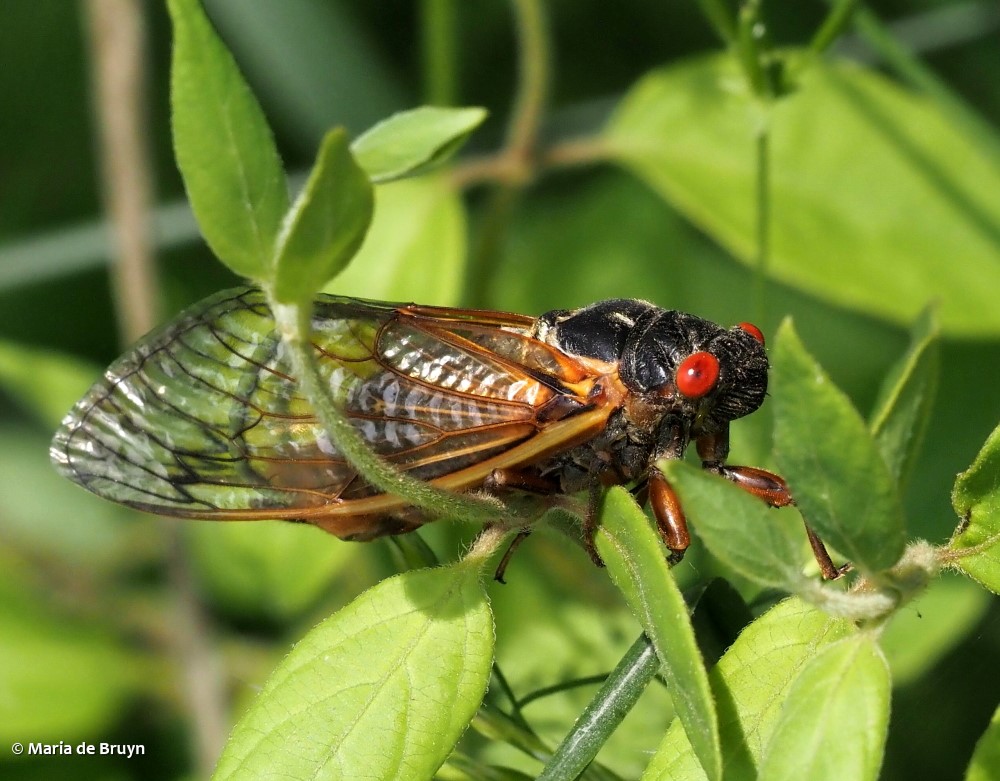
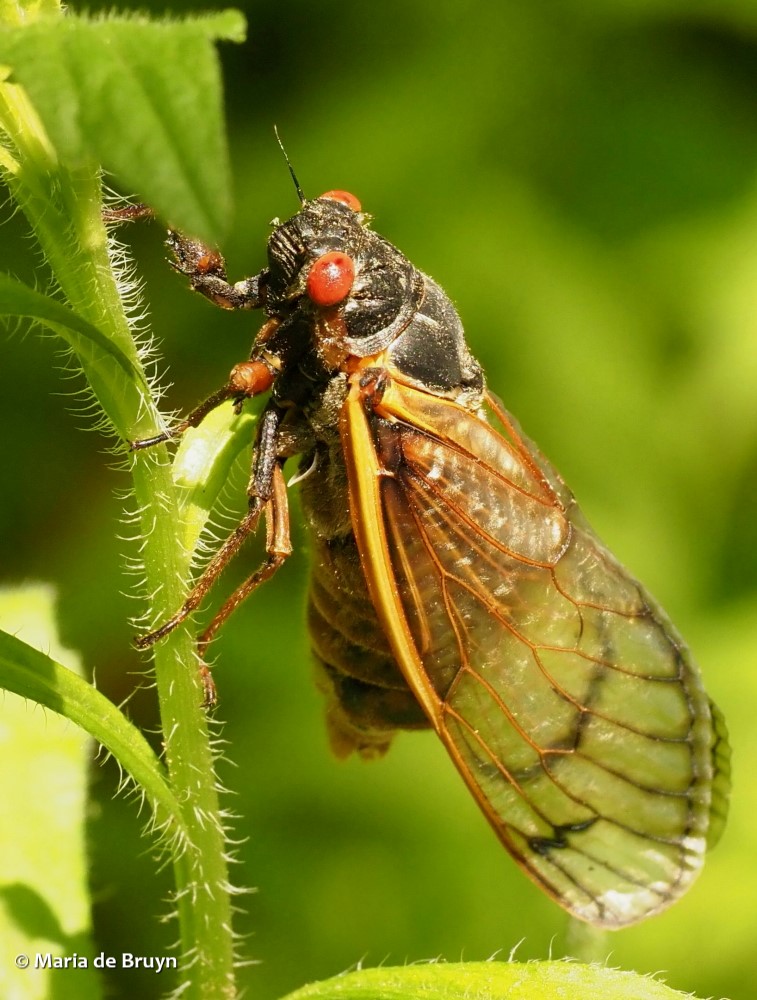
Their orange eyes take on a deep red — in my view mesmerizing — hue.


Seen head-on, their faces look to me as if there is a car grill in the middle.

The adults can’t fly right away after emergence but must make several attempts to get airborne.

When the adults are ready to meet, the males begin making calls and songs, using a pair of ridged membranes on their abdomens. Some calls are a sign to gather; others are alarm calls made when the cicadas are handled.


Their hollow abdomens are thought to act as a resonating chamber, increasing the volume of their already-loud sounds, When they gather in groups of hundreds and more, the volume can be astounding, reaching the level of a chainsaw or motorcycle.


In our area, numerous inquiries on neighborhood listservs commented on the growing and ongoing noise:

  • Is there a sound like a siren going off that you can hear? It seems to be getting louder.
  • Perhaps the machines grinding rocks to expand I 40 [highway].
  • Alien invasion 😂
  • The noise is continual with no change in pitch or volume. Sounds man made.
  • This is some sort of machine or something running all day long.
  • I was so intrigued as well that I called the energy company to investigate the cause of the intense noise!
  • Miniature Flying UFOs made to look like Cicadas.
  • This morning, I walked inside my house looking 👀 for the toilet that I thought was running.

Some people made analogies for what they thought the cicada ‘songs’ were like:

  • To me it sounds like alien spaceships are landing – just like in a 1950’s creature feature.
  • It sounds like the flying saucers in old 1950s movies.
  • I think the 13-year bunch sound like the phasers on the original Star Trek show.
  • To me they sound just like 18wheel rigs all revving up their engines.
  • The sound to me is like “environmental tinnitus”. 🙂 [Response] Exactly, but it actually helps my tinnitus!
  • Sounds like heavy traffic in another decade or two with everyone driving electric vehicles. [Response] My hybrid has that same sound (only quieter) to warn people/animals that I am backing up. When my car is operating under battery power, it’s silent, so manufacturers added that sound to warn people and wildlife away. You are so right. That may be the sound of the future. AAAAGH!

Others appreciated this natural phenomenon:

  • Sounds great.
  • I guess I am rare in thinking they are cool. It feels other worldly….
  • And it’s all about SEX. Just think about all those teenage hot-rodders gunning their engines to attract attention. They’re all saying “Come and get me baby. I’m HOT.” After years underground, you would be too.

Finally, some listserv readers tired of all the comments after a while:

  • Please stop asking about the sound Cicadas make! Please! And if someone answers, why do 50 people feel the need to respond? I feel that so much of the posts are so religious. Does anyone else feel this way?… I didn’t mean religious ! I meant repetitive!
  • Cicadas are a plague sent from God signalling the End Of Time. The purple glow in the sky last night [Northern Lights] was the Rapture, and, since we’re still here … well, there’s that…
  • If you don’t like it stop looking at the posts.

In the next blog, I’ll explain a bit more about the periodical cicadas’ vulnerabilities and life cycle. And hopefully you’ll enjoy seeing some more photos of these creatures who won’t see the light again until 2037!

Yellowstone National Park. Part 6: “Fire burn and cauldron bubble”!

When my friend Joan and I visited Yellowstone National Park in May 2022, we were interested in seeing other thermal features in addition to the Mammoth Hot Springs. A major part of the Park is actually a super-volcano, with a caldera measuring 43 by 28 miles (70 x 45 km). It has half of all the world’s geysers, as well as other hydrothermal features (i.e., more than 10,000)!

A visit to the Old Faithful geyser was rewarding for Joan, but perhaps less so for me and others who decided to stand outside nearby. (Joan watched from inside a building with viewing windows.)

I’d seen it from afar before but now thought it would be interesting to be closer. When the awaited eruption occurred (happening about every 69 minutes or so in 2022), I hadn’t realized that I would just get soaked and see only spume and clouds! You readers can see an eruption online without getting wet!


Information about Yellowstone often reiterates that the geysers and other hotspots are always changing because of the geothermal dynamics propelling them. Earthquakes can affect them, and human vandalism can also end a geyser’s “life”. For example, in the 19th century, visitors would throw coins into geysers, which eventually plugged up the vents. (No one claims that the visitors pictured here did this; these parents must have been preoccupied keeping watch over their large brood!)


Photo on display in the Park Museum

When I was in high school, our assigned reading included older English texts, including work by Shakespeare. I found the stories interesting, but the language used did not appeal to me, except for an occasional phrase. The line “Fire burn and cauldron bubble” from Macbeth has a nice rhythm and it came to mind when we stopped to watch the mud pots.

The mud pots are hot springs which are so acidic that they dissolve the rock around them. Microorganisms help convert the emerging hydrogen sulfide gas into sulfuric acid; that breaks the nearby rock into a porridge-like clay which bubbles as gases gurgle through them.

Waiting for shapes to emerge from the thick moving masses was not at all boring. Instead, it made for a nice quiet, contemplative time — and judging by how many people were standing quietly and waiting for shapes to pop up, this was a shared experience. A video of one mud pot can be seen by clicking this link.

The area known as the Artists’ Paintpots was more colorful, even though we didn’t have sunny weather to highlight their hues.

There was vegetation here and there, making for some interesting scenes.


The Norris Geyser Basin is Yellowstone’s oldest, hottest and most changeable area. The National Park Service notes: “Norris has the greatest water chemistry diversity among Yellowstone’s hydrothermal areas. Multiple underground hot water reservoirs exist here and as their water levels fluctuate, concentrations of chloride, sulfate, iron, and arsenic change. Although Norris is known for its acid features, it also has alkaline hot springs and geysers.”

Norris has two main areas. The Porcelain Basin is bare of trees and vegetation. The Porcelain Springs, named for the milky colors of the deposited minerals, are the fastest changing area in the Norris Geyser Basin.

Fumaroles, the hottest hydrothermal features (up to 280°F/138°C) dotted the landscape in the Porcelain Basin. Where the steam and gases spewing from the holes are rich in sulfur, the feature is called a solfatara. Where the gases are mostly carbon dioxide, the fumarole is called a mofette. The sound of the fumarole can be quite loud, as in this video, sometimes sounding like hissing or whistling.

The Back Basin area has more wooded scenery. It was fascinating to see that there were mounds of bison dung in various places near fumaroles. I asked a park ranger how the bison could travel in those areas and whether they were ever injured.


She said that groups of bison will rest around the vents in winter. Their heavy fur apparently insulates them well and they can withstand the heat. She did note, however, that bison have been seen with burns on their legs, so they can be somewhat hurt by the heated clay ground.


Visitors should stay alert even when remaining on boardwalks. In 1989, the Porkchop Geyser threw rocks into the air; fortunately, no one was hurt.

In the early Park days, visitors were invited to bathe in the hot pools but that is fortunately no longer the case.


Where thermal colors are green, chlorophyll-containing algae predominate.

Where yellow is the dominant color, sulfur abounds and heat-loving and -tolerant creatures (thermophiles) use it to create energy.

The Cistern Spring is a beautiful pool that shows blue, green and brown colors with sunlight. These colors are produced by thermophilic algae and bacteria. They, in turn, are accompanied by tiny insects, such as ephidrid fly larvae that feed on bacteria. Spiders and dragonflies then feed on the flies.

We returned a couple times to see some of the famous features because the first day we visited them, it was rainy and then snowed with lots of cold wind. There was so much steam we could scarcely see the colored pools of water; only some features close to boardwalks were clearly visible.

Signs warned that it was a windy area, and the warning was certainly warranted! (Even so, some visitors were perturbed and complained about being subjected to sleet and flurries during their outing!)

The Excelsior Geyser used to erupt regularly in the 1880s and then stopped. In September 1985, it erupted again for 47 hours and again stopped. It was dormant and not very visible during our visit.

At Grand Prismatic Spring, which has stunning blue, green, yellow and rusty orange coloring, we saw mostly gray steam and mud-like rivulets on one visit.

I spoke with a man in a group of people including grandma, who was heavily bundled up in a wheelchair. He remarked that they had been there the previous day, when it was warm, sunny and scarcely windy at all. (Spring weather is extremely changeable at Yellowstone, not only day to day but within a day as well.) Their group had seen the beautiful colors of the Grand Prismatic and it made for a perfect outing since they had come to celebrate a wedding held on the spot. That was really an auspicious start to the married life of the lucky couple!

All in all, we didn’t get many spectacular views of the colorful thermals, but we did learn a lot. A future visit with warmer and sunnier periods would be something nice to anticipate. Nevertheless, the cold, windy, and partly wet days certainly did not dampen our overall enthusiasm. The visions of bubbling mud pots will last a long time, too.

Next up: a few blogs with some of my springtime sightings and then a visit back to Yellowstone to see some small mammals and Western birds.

Helping monarch butterflies thrive

If you follow news about nature, you may have come across warnings that the monarch butterfly (Danaus plexippus) has been in rather dire straits for many years now.


These lovely orange and black butterflies live from 6 to 8 weeks when they are adults engaged in reproduction. Those who live in the Eastern USA participate in a multi-generational migration process between Canada and central Mexico. The last generation to emerge in late summer is able to delay its sexual maturity to undertake the last leg of the migratory journey (called reproductive diapause) and may live up to 8 months. Individual butterflies may travel as far as 1200-3000 miles to get to their warmer over-wintering grounds.


Since the 1980s, the Eastern US monarch population has declined by about 80%, mainly because the only food source for their caterpillars has been disappearing. Milkweeds used to grow abundantly in agricultural areas and along roadsides and ditches, but people have been eradicating the plants from fields and using herbicides and mowing to remove them along roads.

Climate change has also affected the butterflies’ breeding and migratory patterns so that reproduction has been reduced.

One way to help out the monarchs is to plant native (not exotic!) milkweeds in your own yard and any other natural spaces to which you have access. I’ve been doing it around my home and as a volunteer for the Mason Farm Biological Reserve. This year, I was lucky enough to be a beneficiary of a milkweed give-away organized by some local high-school students, so I had two types of the plants in my yard.


The ones that I had originally planted were common milkweed (Asclepias syriaca). These plants have large globular clusters of flowers that range in color from pinkish to purple. They do not have blooms their first year but that doesn’t stop the caterpillars from eating their leaves.


Butterfly weed (also known as butterfly milkweed; Asclepias tuberosa) is a bit more delicate and “exuberant” in appearance, with small clusters of orange, reddish and yellow flowers. These were the plants that I was gifted by the students and I was happy to see them grow quickly to exhibit their beautiful blooms.

According to Wikipedia, the butterfly milkweed is not a preferred plant for the monarch but this year the butterflies seemed much more attracted to it than to the common milkweed. After a few visits from some butterflies, I began seeing caterpillars and at one point counted 17 crawling up and down the various plants.

They were especially prevalent on the butterfly weed in my front yard and were munching the plants to bare stems very quickly.


To make sure they had enough food, I transferred some of them to the common milkweeds in my back yard – these were larger plants with much broader leaves and I thought this would ensure their healthy development. Frass (poop) was being left on the remaining leaves and the ground surrounding the plants.


It was rewarding to see three caterpillars make it to the chrysalis stage; the other caterpillars crawled away before I could see where they went, and I didn’t find them suspended from any plants. The first one had attached itself to a bare sapling and, unfortunately, the next day it had disappeared, leaving only the silken thread by which it had been suspended.

The caterpillars store milkweed glycosides in their bodies, making them toxic to many other animals. They still have many predators, however, including wasps, spiders, other insects, lizards, toads and mice. I resolved to save at least one chrysalid if I could.

I got to see the second chrysalis being formed (see the video, which is a little shaky at times). When the caterpillar is ready to undergo the pupation stage, it attaches itself to a plant stem by making a silk pad as an anchor (called a cremaster). Then it inserts the hooks at the end of its abdomen into the pad and hangs down. When the caterpillar forms a J shape, this signals the change to a chrysalis will soon be underway.

Starting from the head, the outer skin is shed, rolling up as the new covering develops. The shed skin may remain at the silk pad or fall off.


Slowly the stripes of the caterpillar disappear, and the chrysalis takes on a shiny even green hue, with some golden accent spots.


I kept that chrysalis, as well as a third one I saw the next morning, in my house and waited for them to darken. This signals the butterfly is almost through developing inside.

One morning I found the newly emerged monarch from the second chrysalis drying its wings. I took it outside so that it could fly free and then begin its trip to Mexico. (I also took the third one outside when it darkened but the twig holding it disappeared.)


You, too, could contribute to their propagation by planting some milkweed if you have an area for this. Autumn is the best time to plant seeds, but you can try it in the spring as well. Common milkweed typically doesn’t flower during its first year, but butterfly weed will give you flowers in its first season; the latter plants may be slow to emerge at first.

Both of these milkweed varieties are perennials so be sure to remember where you planted them. Common milkweed may spread out with time, while butterfly weed remains where you put it.


Other flowering plants will attract the adult monarchs, too, for nectaring, such as asters and lantana.


And then sit back next year and wait for the monarchs to arrive, happy in the knowledge that you have contributed to maintaining a favorable environment for their survival.

More ideas on how you can participate in the drive to save this iconic butterfly are detailed on a U.S. Fish & Wildlife Service website: https://www.fws.gov/savethemonarch/