More otter fun — for the mammals and me!

Part 3: Communication and play

The otter family that I observed this past January captivated me and I photographed them often. Here are a few more scenes from their life that I hope you enjoy seeing.

The otter that caught the very big bass kept that fish to itself even when the other two stayed close. The pair never tried to grab the prey. Finally, I concluded that the lucky hunter must be the parent and the other two the offspring.

After some time, the non-dining pair left the prize behind and the successful hunter took some pauses in consuming the large meal.

After the young mammals disappeared into the water, I assumed that they might have swum back to the beaver lodge, where they had been residing the past days. Otters shelter either in burrows that beavers have made or in natural hollows created under tree roots.

The beaver lodge in this pond appeared ideal for their purposes; they played on it, rested on it and appeared to be going into a burrow underneath as well.

River otters communicate in two ways — through olfactory and auditory signals. Their scent marking is done in two ways.

Their hind feet have plantar pad scent glands which are used to mark various areas.  Biologists believe that the otters transmit messages about identity, reproductive and social status by leaving glandular scents as well as anal secretion deposits on scent mounds that can be used for years.

River otters have a reputation for being playful and this group lived up to that. They dove after one another and wrestled on the ice. Sometimes all three were engaged and sometimes it was a pair exercise.

One day, after I had visited several times, their curiosity seemed to get the better of them.

Previously they had only observed me from a distance while going about their daily life. This time, they spent some time at a stump and then after a time, all turned and stared at me.

Finally, two of them began swimming under the ice in my direction, occasionally breaking through to see how close they had come to me.

One decided to chill out by a nearby stump in the water, perhaps waiting to see if I would get in the pond with them. When I just stayed still and watched, they finally regrouped and began fishing again closer to a weedy section of the pond.

The last couple times I visited the pond, I didn’t see the trio. Perhaps they had fished enough in this area and decided to go to another spot for a while so as not to deplete the available stores of fish — even though our temperatures have suddenly increased, there is no guarantee that we won’t have icy days ahead in later February or early March, so their natural pantries may be running a bit low.

I’ll miss seeing them — and hope they do return The river otters are one of the few animal species I get to see who can look like they’re smiling! 😊 😊


Continued otter fun – for the mammals and me!

Part 2: surviving and dining in winter

One otter or two above? My otter friends produced an unusual portrait for me one day while they were running around an icy pond. 😊 It looked as if they had brought an extremely long family member with them!

Continued observation showed, of course, that the resident otters (Lontra canadensis) were all of normal stature. During much of the time that I was able to watch them, the temperatures were very low for North Carolina. In our central area of the state, temperatures in January 2025 were the 18th coldest ever recorded, averaging 36.6°F (2.6°C°F). Some days had significantly low temperatures, such as 17°F (-8.3°C) on 23 January.

That weather meant that the local ponds were partly or mostly frozen and had very icy waters indeed. In this and my next blog, I’ll share with you what I observed and learned about how river otters function in such cold conditions.

Their unique metabolism has several features that collectively enable them to survive in extreme cold.

  • Their very thick, water-repellent fur covers a dense undercoat that traps air. This fur is 10 times denser than that of the bobcat or red fox, with 585 hairs per square mm.
  • The trapped air acts as a buffer against the cold.
  • A thin blubber layer underneath their skin provides a second thermal barrier. (It also gives them extra energy when there is limited food availability.)
  • Shivering increases their internal body temperature.
  • Their high basal metabolism increases when they are actively swimming and diving, which also generates heat and helps them maintain a steady body temperature.
  • Their high metabolic rate enables them to pass food through their digestive system in about 60 minutes.

I was sometimes amazed at how quickly they caught one fish after another and now understand how they could process so much food in a short time. Their 36 teeth, including 4 long canines, obviously help them process the food they capture.

The otters also have corporal features that make their food hunting efficient:

  • Their ears and eyes are high on their heads, enabling them to swim more easily at the water’s surface.
  • They can swim both forwards and backwards, as well as tread water while surveying their surroundings.
  • They are near-sighted, which may improve their underwater vision.
  • Their whiskers are very sensitive, enabling them to more easily capture prey on dark nights or in murky waters.
  • Their ears close under water.
  • Their feet have five webbed toes as well as non-retractable claws.
  • Their traction on slippery surfaces is increased through heel pads on their hind feet.

The otter family that I observed on several occasions was very adept at catching fish. The NC Wildlife Organization notes that they sometimes collaborate in hunting by herding fish.

The pond otters whom I was watching had certain spots that they kept open in the ice, often diving down and coming up with another fish each time. In this video (click here) you can see one enjoying a meal.

Since I know very little about freshwater fish, I posted a couple photos on a fish identification page to find out just what the otters were eating. Group members debated a bit but then came up with these IDs.

Otters with bluegill sunfish (Lepomis macrochirus)

Otter with a large largemouth bass (Micropterus nigricans)

Biologists say that otters prefer to go after slow-moving fish, including catfish, carp, bass, suckers, and sunfish. Some of the fishing enthusiasts shared about what they had seen otters eat. (Then two men made negative comments and insulted the group moderator, so I removed the photos and left the group so as not to foment more dissension among that group’s adherents.) Here are some of their comments:

  • Otters are such cool animals! Have seen a couple groups while fishing/hunting this year in NC!
  • They’ll eat most any fish. Where I live they have cleaned out nearly all the fish in the ponds near the river. My old pond was teeming with fish when I owned it and now it holds a fraction of the fish it once did.
  • Ours eat a lot of eels. Ophelia/Smith Point, Virginia.
  • Here in New Hampshire I saw them eating what appeared to be fallfish last year.
  • I used to see otters pull rainbow trout out of the river when I lived in Idaho.
  • I hate otter and kill em every chance I get within season…I have had them drag 40 pound catfish out of my ponds and eat them…

It always saddens me when people develop a hatred for an animal (with the possible exceptions of ticks, mosquitoes and chiggers). In any case, I love the otters and will share with you how I saw them play in the next blog.


Two “otterly” fun months — otters at three ponds

The past two months brought me some really rewarding wildlife sightings. While birding, I learned new things about a couple avian species (see The Wild Side). But my main wildlife entertainment came from discovering and watching otters at three ponds. (A reminder: if you click on a photo, it enlarges; to get back to the blog, back space.)

My first sighting came on 29 November 2024 at a pond near a large housing development. I’d been looking to see if the beavers were at their lodge when I suddenly spotted some movement low in the water. To my amazement, four beautiful otters came swimming by, heading in the direction of the beaver lodge (photo above). They kept themselves fairly hidden behind vegetation and then went to sit and play on the lodge behind some brush and small trees growing on the beavers’ home.

My next sighting was very unexpected, at a pond that had lost a lot of wildlife because the vineyard owner who purchased the surrounding farmland had cut down almost all the trees, shrubs and vegetation for miles around.

Because some migrating waterfowl still occasionally show up at the formerly lively pond, I visited there hoping to spot at least a few ducks. I was surprised to see a round head and sinuous body emerging from the water.

To my delight, I got to watch not just one but two otters swimming about and successfully nabbing fishy meals. One seemed to be less wary of people watching; the other would only stay in sight for a short time and then head to the pond bank underneath a lone standing tree as long as people were around.

I’m not sure what kind of fish they were catching, but they seemed to be enjoying good meals.

My next sighting was at the Sandy Creek Park in a nearby town. An otter suddenly popped up and began swimming low in the water among the vegetation. Then it swam across the pond to a beaver lodge and there caught some animal for a meal.

The mammal was quite far away and my camera lens wasn’t strong enough to get good views. In the end, I figured that it had caught a crayfish or something similar.

My best views of otters came when I returned to the pond where I had first spotted the quartet. Despite repeated visits, I didn’t see four of them anymore but only a trio.

It might be that the fourth one was a male who went off on his own. When winter comes and food is less accessible, otter groups tend to disperse so that each family member has access to food and food stores are not depleted.

River otters tend to roam over a specific territory, staying in one spot for one to four weeks. In the summertime, they may travel within an area of 20 square miles, but in winter they expand their territory upwards to about 60 square miles to maximize their success in finding food.

Fish are a dietary staple, especially in winter, but they also eat crayfish, crabs, turtles, amphibians, reptiles, insects, and even occasionally birds or small mammals. Besides the otter at Sandy Creek Park, I only saw them eating fish, but it was amazing how many fish they could catch and eat in quick succession.

In fact, their ability to almost always come up with a fish after going under water or dunking their head into the pond must account for the fact that the resident great blue heron tended to stick close to them. The heron would watch intently where they were fishing and when they moved to another area of the pond, the large bird would follow.

At one point, the heron stayed so close to a fishing otter that I wondered if the large bird was going to attempt to snatch a fish away, but that didn’t happen!

The hungry avian finally did catch fish, too.

In my next blog, I’ll show you some of the otters’ successful winter fishing forays, let you know how they manage to keep swimming in icy waters and outside temperatures of 15-30°F, and let you see how the otters were playing.


Nature Photo Challenge – Wild Animals

While I edit photos for my next “regular” blog, I was inspired by Denzil’s 28th Nature Photo Challenge to post a few photos of wild animals I’ve encountered. While I could have chosen to show some of the more exotic ones (e.g., rhinos, elephants, lions, etc.), I thought I’d introduce you to some species that live in my general area.

Among the insects that I enjoy watching are the snowberry clearwing moths (Hemaris diffinis). The first time I saw a clearwing moth at some distance, I wondered if there was a tiny hummingbird with which I was totally unfamiliar. When I got closer, I realized it was no hummer but some amazing kind of flying insect. I still find them fascinating creatures.

The saddleback moth caterpillar (Acharia stimulea) is another favorite from the insect world. Fortunately, I found out that they have a painful sting before I ever touched one. This past week, I was lucky to see one twice. The first time was when John, an odonate expert of my acquaintance, called me over to see one he had found. He had unfortunately been stung but said the pain was tolerable: I hope he didn’t suffer for long. Several days later, I spotted another saddleback while on another nature walk.

 The bright golden color of a common sawfly caught my eye after having seen the first saddleback. It was quite a striking fly with its black and white “decorative” highlights.

Shortly afterwards, my day was made when I spotted one of my favorite spiders, an adorable jumping spider that had caught itself a sizeable meal.

A couple days ago I startled an Eastern rat snake (Pantherophis alleghaniensis) as I passed by it on a path. I hadn’t realized it was there until the herp reared up and quickly crossed the path in front of me. I think we were both startled and I didn’t manage to get a photo. Today I did a U-turn to hop out of my car to carry an Eastern box turtle  (Terrapene carolina Carolina) to safety as it began crossing a busy road. One woman stopped to thank me, while another driver gave me a somewhat irritated look. The turtle above was not the rescue but had similar colors to the turtle today.

My pond is quite alive with lots of tadpoles and small frogs. This green frog (Lithobates clamitans) is one of the larger aquatic yard denizens.

I haven’t seen a wide variety of mammals lately except for the ubiquitous Eastern chipmunks, gray squirrels, Eastern cottontail rabbits and Eastern white-tailed deer in my yard. It’s always a treat for me to see some of the aquatic ones when out on walks, such as the river otters (Lontra canadensis) and the North American beaver (Castor canadensis).

I’ve seen the hispid cotton rats (Sigmodon hispidus) in three different North Carolina nature reserves. To my surprise, this year I also spotted one in my backyard, but I only saw it once. They are known to scurry away quickly when spotted.

And then there are the birds — they are by far the order of animals that I see most often and most easily. They are also delightful because of their great variety. Just recently, I saw a rare avian visitor to my yard, the black-and-white warbler (Mniotilta varia). I usually see them in nature reserves.

In contrast, the lovely little chipping sparrows (Spizella passerina) are birds that I often see in my yard and at my feeders. This pair was resting in a tree top near a former dairy farm, which is now being turned into a vast vineyard. Much of the birds’ habitat has been removed during this changeover to my great disappointment.

One bird that still remains in that area is the solitary sandpiper (Tringa solitaria), which is easily recognizable by its habit of bobbing its rear end as it walks along shores looking for food.

The sandpiper is not the only shorebird currently drawing birders in our area. Many varied species have been turning up at local lakes, giving birders the opportunity to see “lifers” (birds seen in person for the first time). The limpkin (Aramus guarauna) is one such bird for me — it was a treat to see it looking for clams and molluscs at a local lake.

Next blog: making acquaintance with a bird I’d like to imitate!


Aquatic mammals making my day! Part 1

1 river otter P1154270© Maria de Bruyn res

While I love all wildlife, many of my blogs feature birds because my chances of seeing them are greater than seeing other animals. Mammals are a favorite of mine, however, and aquatic mammals are always a pleasure to see since spotting them is not always easy. That is certainly the case for the cute river otters (Lontra canadensis) like the one above.

4 otter PC251157© Maria de Bruyn

These river and pond residents are among the most elusive mammalian water residents for me.  At one pond that I visit regularly, they appear to have adopted an abandoned beaver lodge as their home. There, it is usually movement caught out of the corner of my eye that alerts me to their presence.

2 otter PC251094 © Maria de Bruyn res

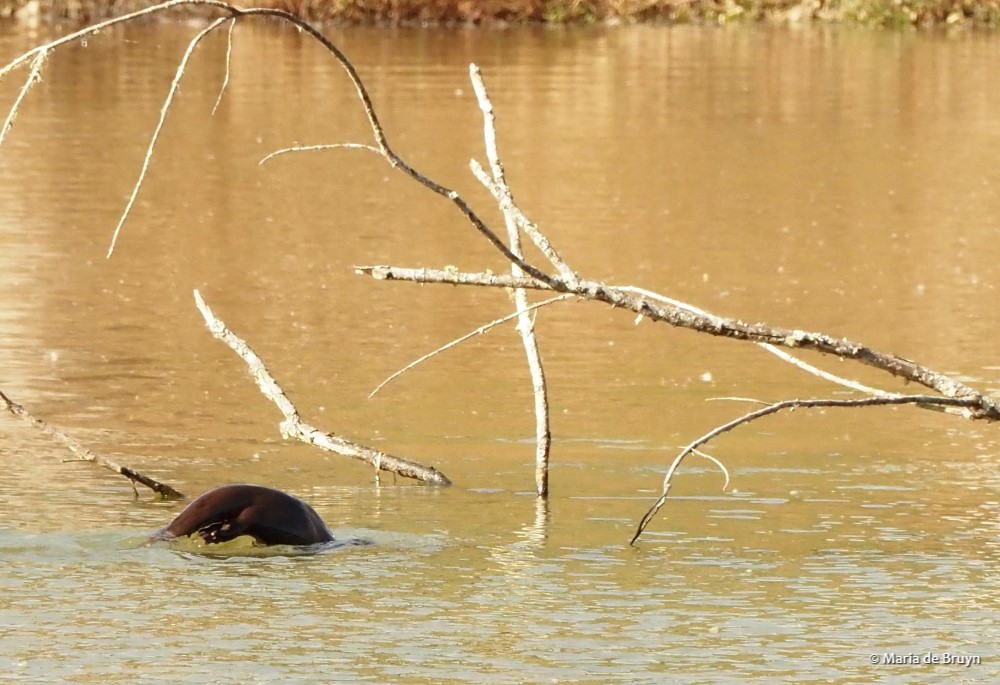
Sometimes a view of the rump and tail is all I get as they barely lift their heads out of the water. It’s interesting to know, however, that their tail comprises up to 40% of their body length, helps speed them up to 8 mph (13 Km/h) in the water, and helps them dive up to 36 feet (11 m).

3 otter PA309843© Maria de Bruyn res

5 otter PA309953© Maria de Bruyn resThe otters don’t always appreciate spectators. Sometimes, they emerge from the water briefly and give me a view shrouded by vegetation before they dive back down. That’s frustrating when you’re trying to get a nice photo, but at least I’ve never scared them enough for them to sound their alarm scream, which apparently can be heard up to 1.5 m/2.4 km away!

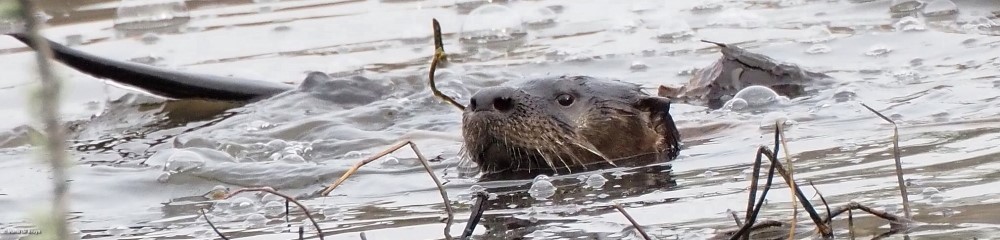
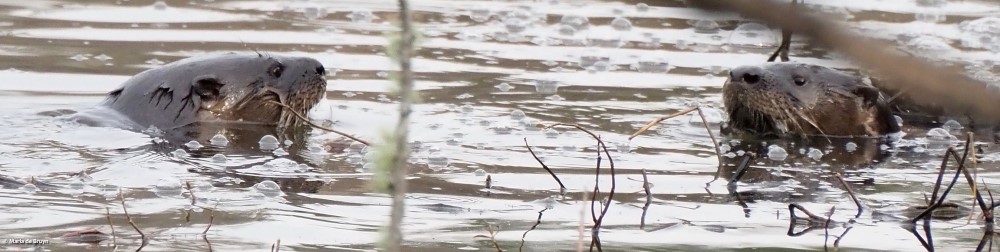
8 beaver lodge IMG_0294© Maria de Bruyn resThe other day at another pond, I was lucky enough to see a pair close to shore. They were foraging and when they finally disappeared, they appeared to have entered a beaver lodge located next to a walking path (seen here). The beavers may have abandoned this lodge as they have at least two others in this park.
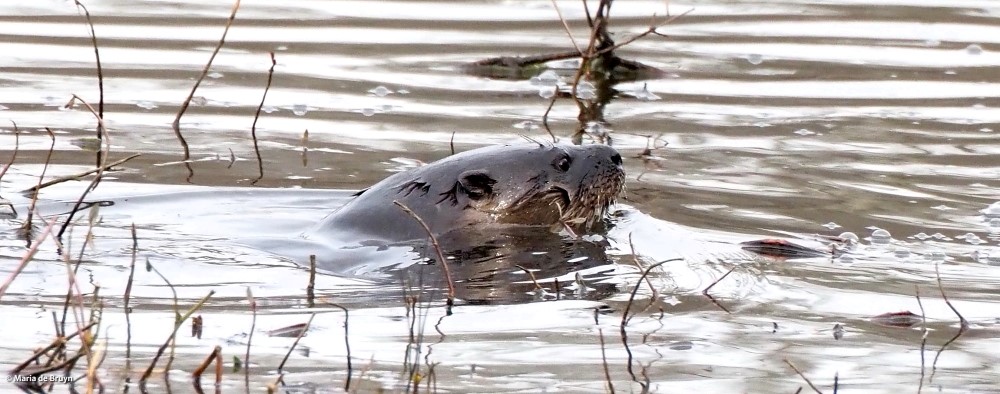
6 river otter P1154288 © Maria de Bruyn res

Researchers have not yet agreed on when otters enter their breeding season; it could be winter, late spring or summertime according to different studies. In any case, it seemed to me like this might be a mated pair.

7 river otter P1154340© Maria de Bruyn res

As they swam around, the couple would occasionally come together.

9 river otter P1154298 © Maria de Bruyn res

10 river otter P1154319 © Maria de Bruyn res

They didn’t stop to frolic, however, even though otters are known for their playfulness. They did blow some bubbles and I’ve learned that they can close their nostrils during dives to keep water out of their noses. Seeing them was a real treat! And their presence should indicate good fortune for the Sandy Creek Park since river otters are considered an indicator species that signal good water quality.

11 river otter P1154272 © Maria de Bruyn

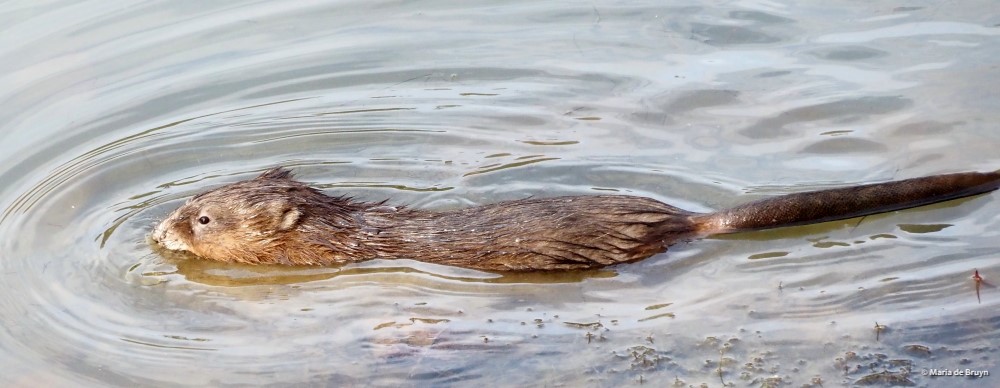
In September, I wrote about seeing muskrats (Ondatra zibethicus) and North American beavers at a third reserve. Since then, I’ve had the good fortune to see both species there several times. The muskrats have especially graced me with their presence.

12 muskrat PC173212© Maria de Bruyn res

14 Brumley pond IMG_0308© Maria de Bruyn resThat’s lucky because last year our county had its 12th driest December month on record over the past 128 years. This was quite evident at the pond, which appeared to have shrunk by at least 30-40% during the autumn and early winter drought (my estimate). I’ve been surprised to see these animals still living there.

Because muskrats don’t tolerate dry heat well, they’ve been designated an indicator species for the effects of long-term climactic drying. Recent research has shown that their numbers and response to this phenomenon should be taken into account in scientific and environmental policy-making.

13 muskrat PC312704 © Maria de Bruyn res

To deal with dry heat, these mammals regulate blood flow to their feet and tail through a mechanism called regional heterothermia. This enables them to keep these appendages cooler than their body’s core. Another interesting anatomical feature is the muskrats’ specialized nostrils, which they can use to trap and recycle air after removing more oxygen before exhalation.

16 muskrat PC048728 © Maria de Bruyn res

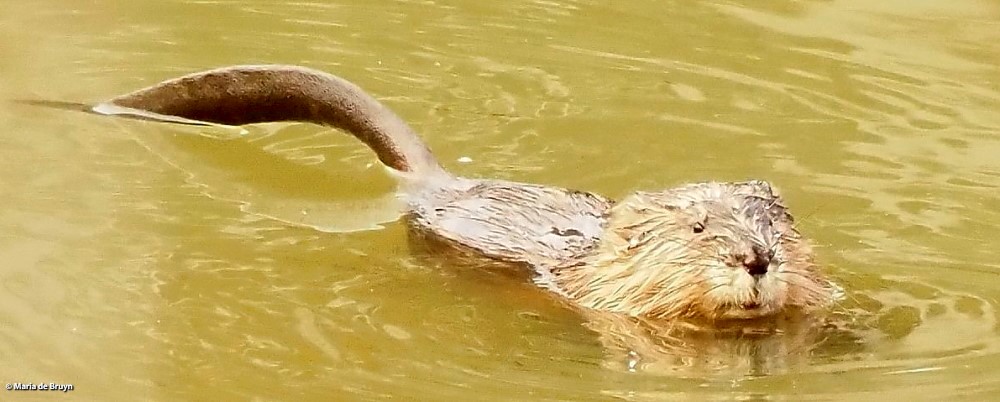
At this particular pond, I’ve discovered that if I wait patiently for at least 20 minutes or so without other people walking by, it’s likely that one of the resident muskrats will surface to go for a swim and/or to forage for weedy food. (They can stay submerged for up to 15-17 minutes, so patience is warranted.) It’s often the appearance of small bubbles that alerts me to their presence and location.

18 muskrat PC048731© Maria de Bruyn res

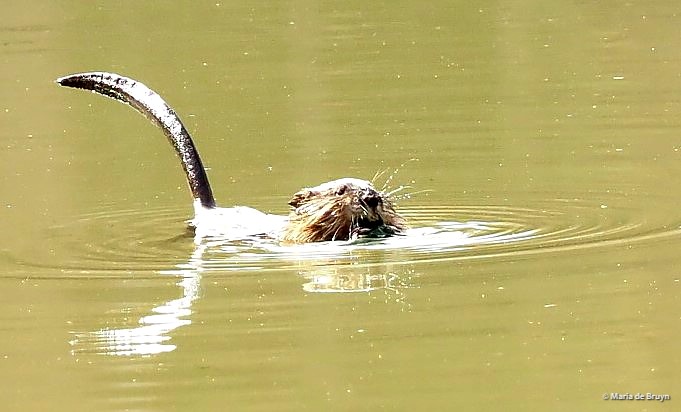
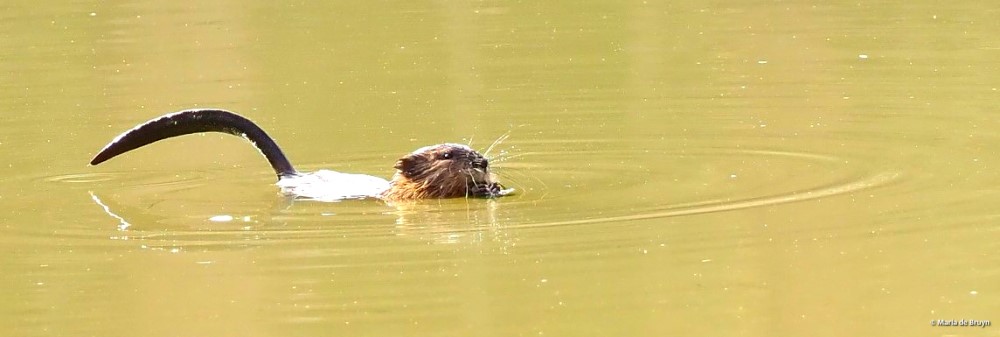
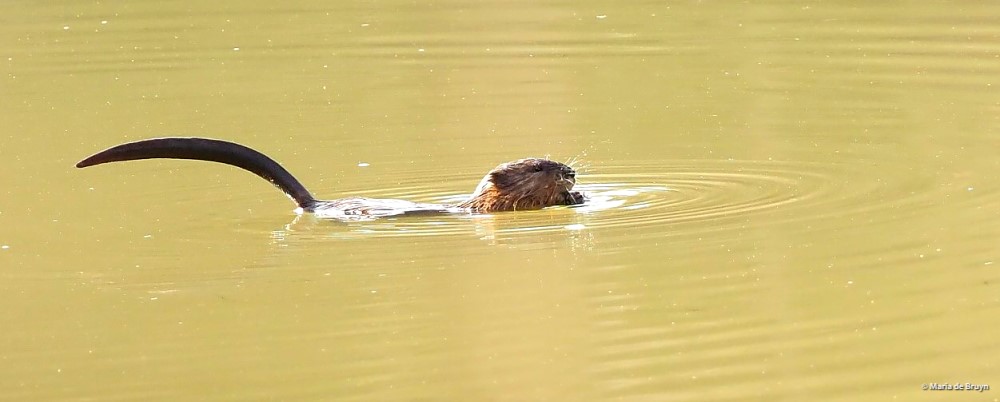
Sometimes they emerge with their tails held high as if waving a signal flag – “I’m here!”

17 muskrat PC048698© Maria de Bruyn res

The muskrats dive down and come up with a mouth full of vegetation which they chew while swimming or sitting near the shore. They can also eat underwater since they’re able to chew with their mouth closed because they can close their lips behind their incisors.

20 muskrat PC048695© Maria de Bruyn res

Muskrats prefer to live in areas with at least 4-6 ft (1.2-1.8 m) of water where they build tunnels that lead from the pond or marsh bottom into burrows dug into banks. I now know approximately where their burrow is located as I’ve seen them emerge and submerge in a particular spot.

19 muskrat PC048688© Maria de Bruyn res

Our area just had a snowfall of 2.3 inches (5.8 cm) which will be melting in the coming days. Hopefully, the next time I visit this pond it will be fuller, and the muskrat residents will have a more spacious swimming and eating area. And then they will have good reason to wave their tails in celebration!  (Apologies for the less than stellar photos as I’ve had to use a short lens lately. Hope to have my long lens back soon. The photos in part 2 of this aquatic mammal series are better!)

21 muskrat PC312678© Maria de Bruyn res (2)