They’re baaaack!!! — and so am I! Part 2

But the Great Southern Brood of periodical cicadas is getting ready to leave…!
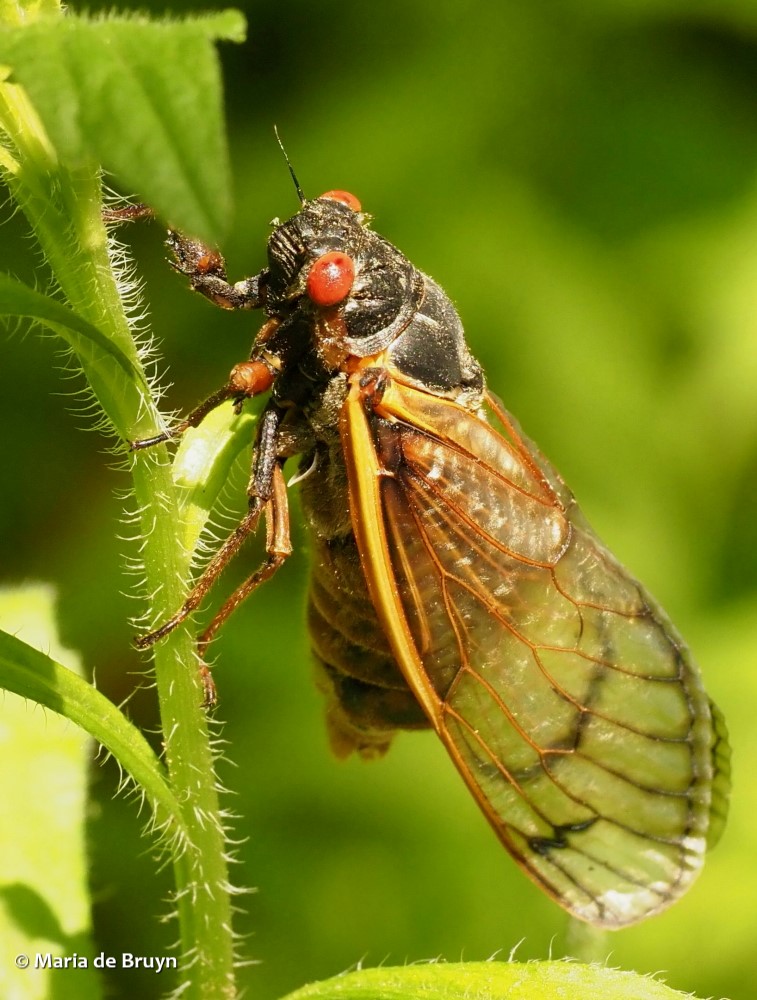
Having heralded their appearance in my previous blog, I’d like to share a bit here about what these insects are now facing as they expend their remaining energy on ensuring the survival of their species.

Some of our community members (both animal and human) are as appreciative as I am that these creatures are here. In listserv postings, a few people have commented, for example:

  • Sounds great.
  • I guess I am rare in thinking they are cool. It feels other worldly….
  • And it’s all about SEX. Just think about all those teenage hot-rodders gunning their engines to attract attention. They’re all saying “Come and get me baby. I’m HOT.” After years underground, you would be, too.

It’s almost impossible to miss the cicada phenomenon where I live unless you have hearing or vision problems or can’t get outside. Their calls for gathering and hooking up can reach a level of 100 decibels and this continues for hours on end.

The sounds can vary a bit because the Great Southern Brood comprises several species of periodical cicadas with somewhat different songs.
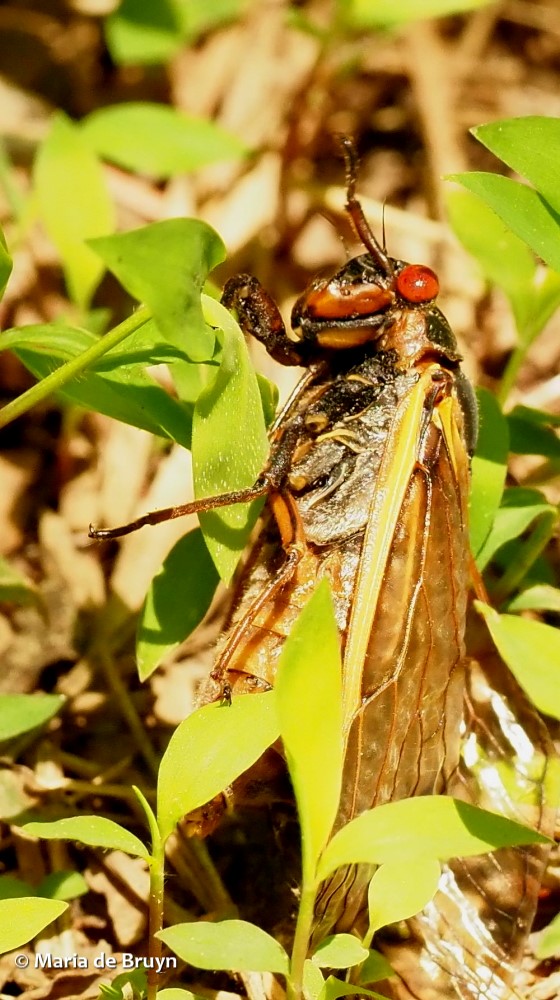
However, it seems that quite a few people don’t pay attention to the broadcast or print news. Despite the considerable coverage given to the cicadas’ appearance, inquiries about the ongoing noise continue in listservs, irritating some community members:

  • Please stop asking about the sound cicadas make! Please! And if someone answers, why do 50 people feel the need to respond? I feel that so much of the posts are so religious. Does anyone else feel this way?… I didn’t mean religious! I meant repetitive!
  • Cicadas are a plague sent from God signaling the End Of Time. The purple glow in the sky last night [Northern Lights] was the Rapture, and, since we’re still here … well, there’s that…
  • If you don’t like it, stop looking at the posts.

The numbers of cicadas we’re seeing really is amazing. They need an enormous population because that is how they ensure some will live long enough to reproduce. These insects have no physical or chemical defense mechanisms at all. Many will succumb to diseases and predators.

One particularly strange phenomenon is a fungus that attacks the cicadas. Massospora cicadina has evolved to target periodical cicadas. The cicada nymphs can become infected when they dig their way out of the soil.
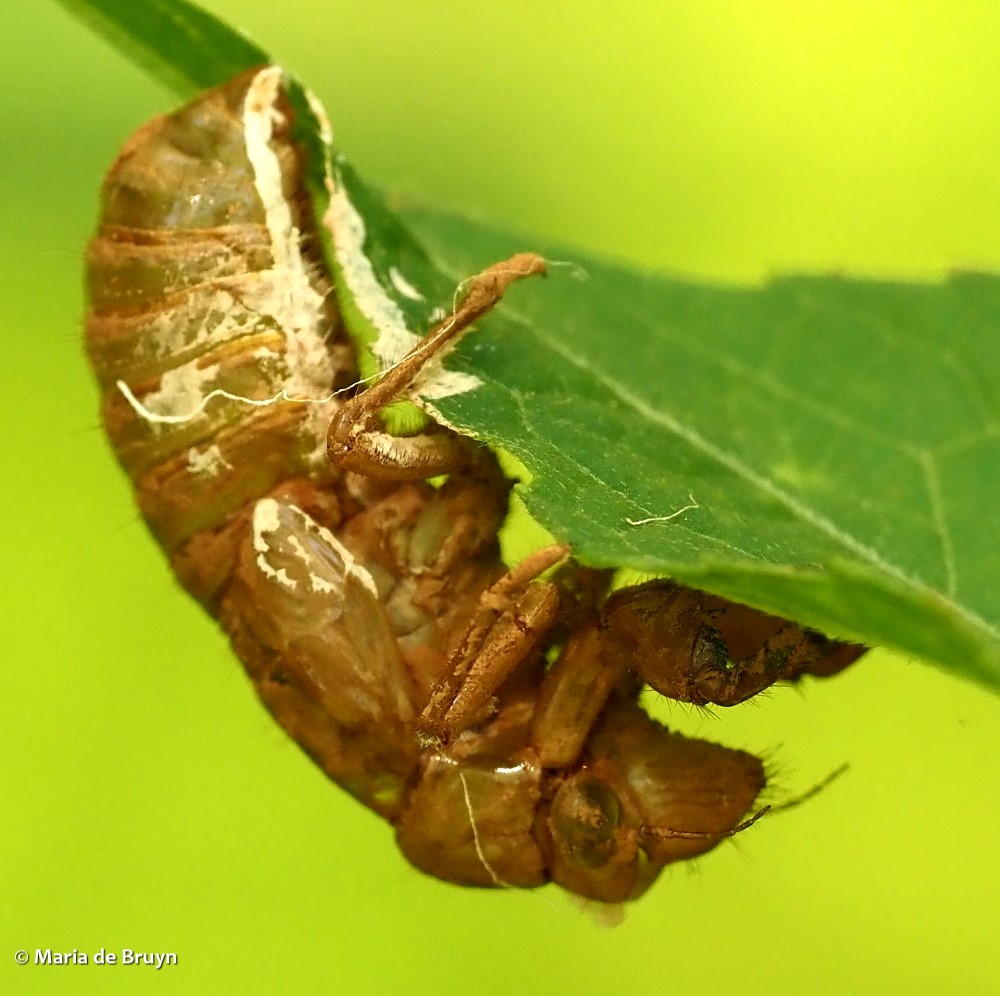
The fungus is a chalky white substance that destroys their reproductive organs but does not kill the insect. As the infection progresses, the male cicada continues to move around and tries to mate. Eventually, the back part of its abdomen drops off and we can see the white fungal growth. But the cicada doesn’t die from this and continues trying to find a mate!

Image by Katja Schulz, CC BY 4.0. Reproduced with permission from  <https://creativecommons.org/licenses/by/4.0&gt;, via Wikimedia Commons

The cicadas also have no means to fend off predators and they are a highly desired food source for other creatures. Those who eat them include snakes, spiders, beetles, wasps, opossums, squirrels, raccoons, frogs, dogs and even people.

This unfortunate individual died early on during the cicada emergence and the local ants found it on my driveway.

These cicadas are especially vulnerable to avian predation. I’ve now seen different species of birds chowing down on them, including grackles (below) and robins.
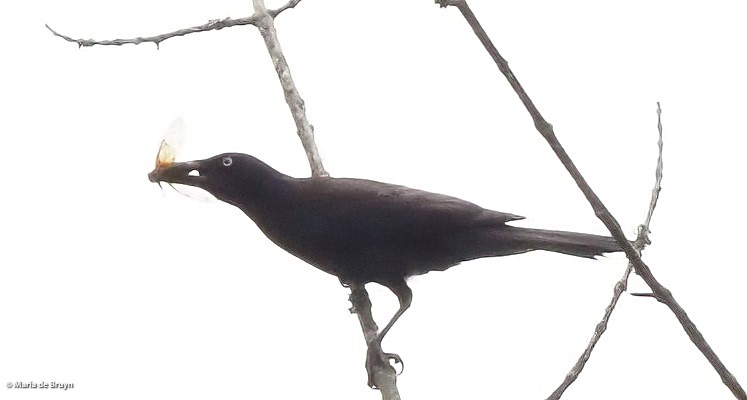
The red-bellied woodpeckers seem to have a particular fondness for them. A young woodpecker was hoping that its parents would provide them as a meal, but the parents were eating the insects themselves.

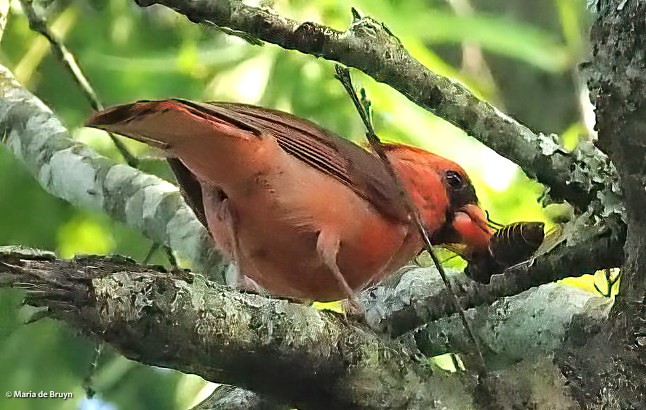
A Northern cardinal stopped by for a meal.
The resident male Eastern bluebird in my yard was supervising his three rapidly maturing fledglings in their efforts to catch and consume the large insects.

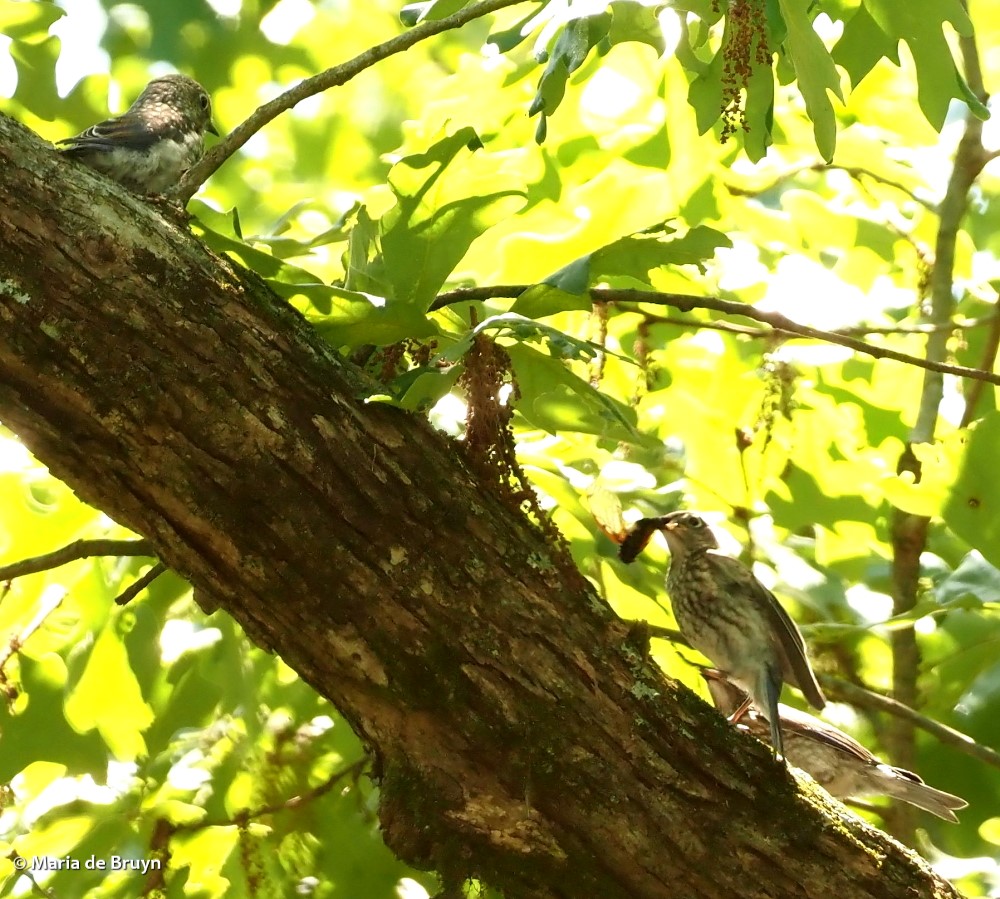
His mate was already tending another nest of 5 eggs, so he was occasionally feeding her as well, including cicada tidbits.

Given the enormous numbers of cicadas that have arrived, some are managing to stay alive and healthy so they can mate. The females may lay as many as 600 eggs in nests dug into plant stems.
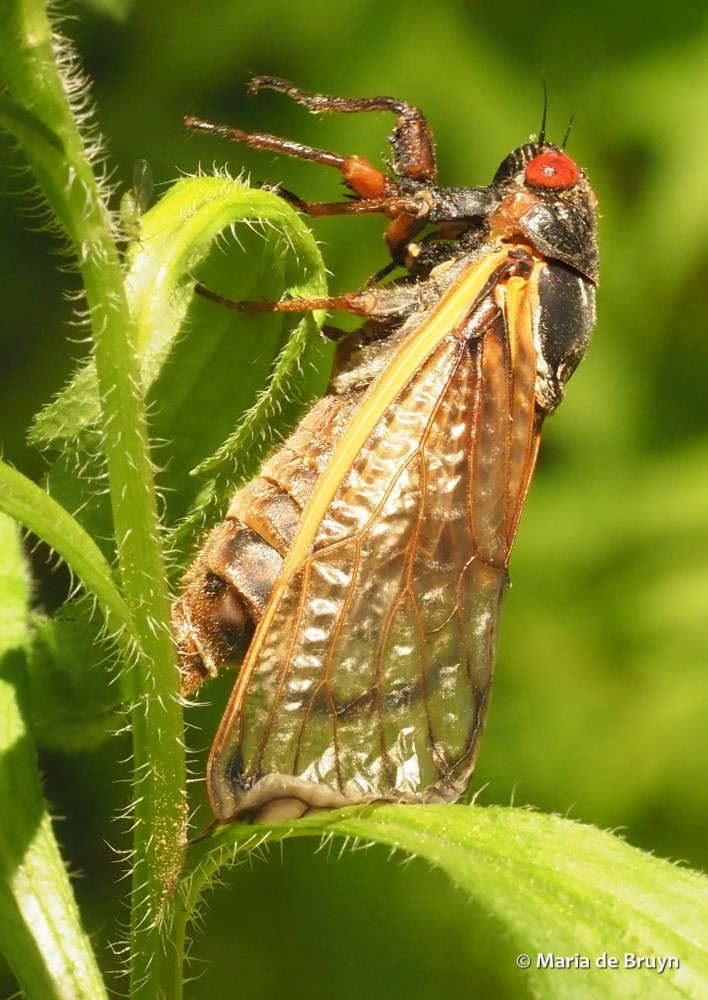
After 6-10 weeks, the eggs hatch and the nymphs crawl down to the earth to go underground for their 13-year “hibernation” period.  There they will eat sap from tree roots, undergo their molting and live out their lives with the people walking above or near them having no idea that they are there.
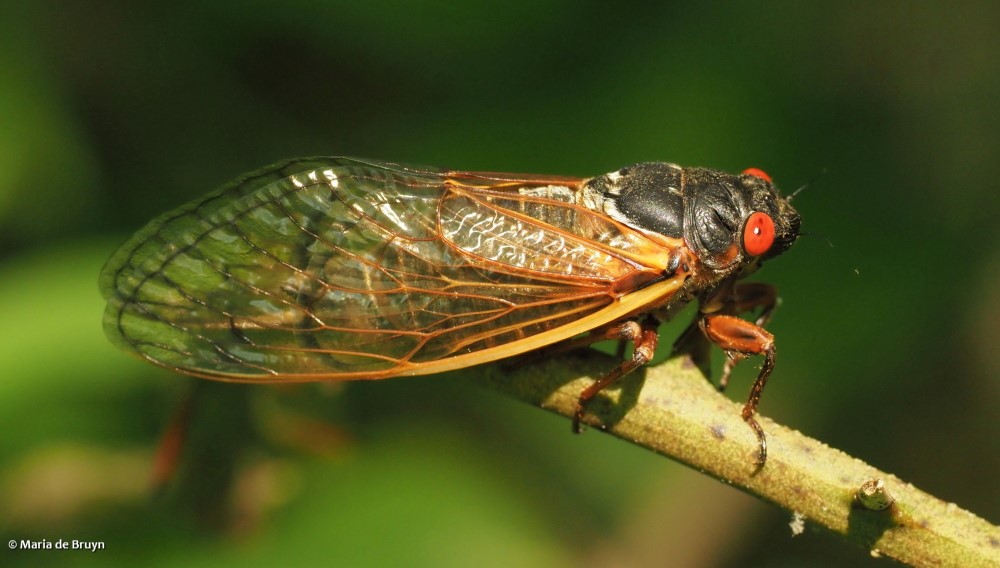
My chances of seeing the members of Brood XIX again are likely not so great, but perhaps some of you readers who live in the northeastern USA may get to see them emerge again then. If so, I hope you will find them fascinating, too!


They’re baaaack!!! — and so am I! Part 1

The Great Southern Brood is here!

It’s been over a half year since I’ve written a blog (although I’ve penned a monthly newspaper column and a few articles in the meantime). Numerous concerns including ill health kept leading to blog postponements. Fortunately, I’ve been able to continue my nature observations, a boon to keeping things on a somewhat even keel. And lately it’s been my privilege to see some interesting creatures and to witness behaviors I’d not seen before in person.

The immediate inspiration for resuming my blogs has been the emergence of the Great Southern Brood XIX (Magicicada spp.) of periodical cicadas — an animal species which humans only get to see every 13 years! This is the largest cicada brood in eastern North America, which is the only geographical area where they occur. I’ll share some of my current sightings and interesting tidbits about them and hope you enjoy this in a two-part blog.

Periodical cicada eggs, laid above ground, hatch into nymphs which then go underground to pass through five juvenile stages before emerging 13 years later by the hundreds of thousands (even millions!). After emergence, they only live a few weeks, purely for the purpose of finding a mate and reproducing their species.

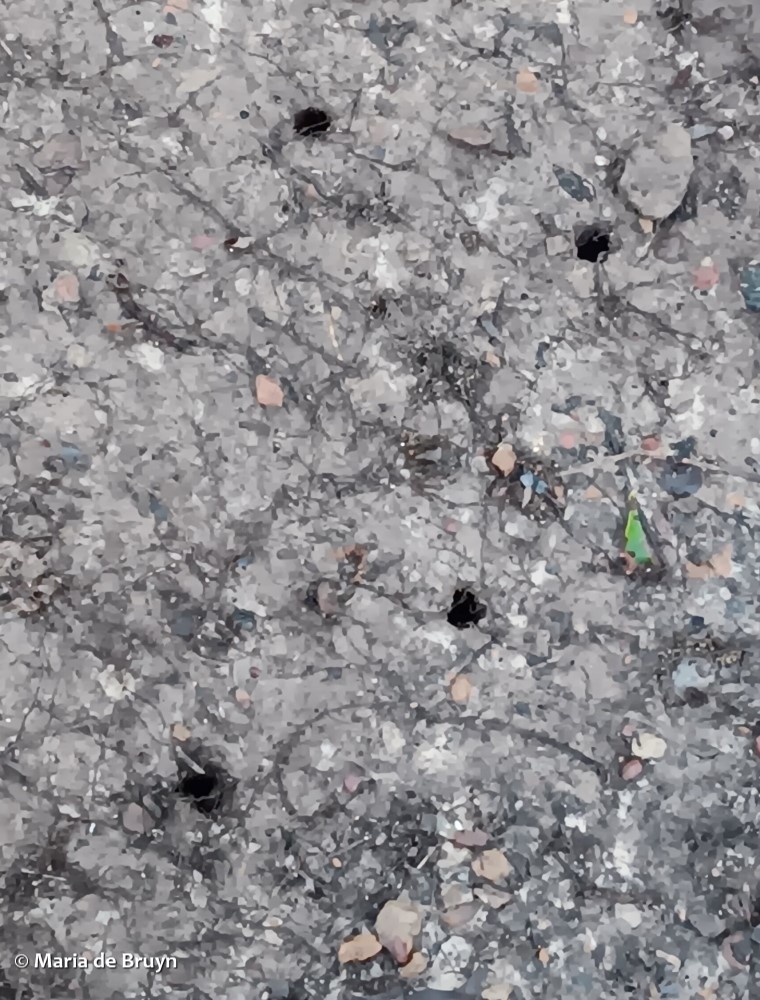
One of the first noticeable things to alert humans to the coming “deluge” of cicadas, seen above, is the appearance of numerous holes in the earth as they tunnel out to the fresh air. This happens when the ground reaches a temperature of about 64°F/17.8°C.

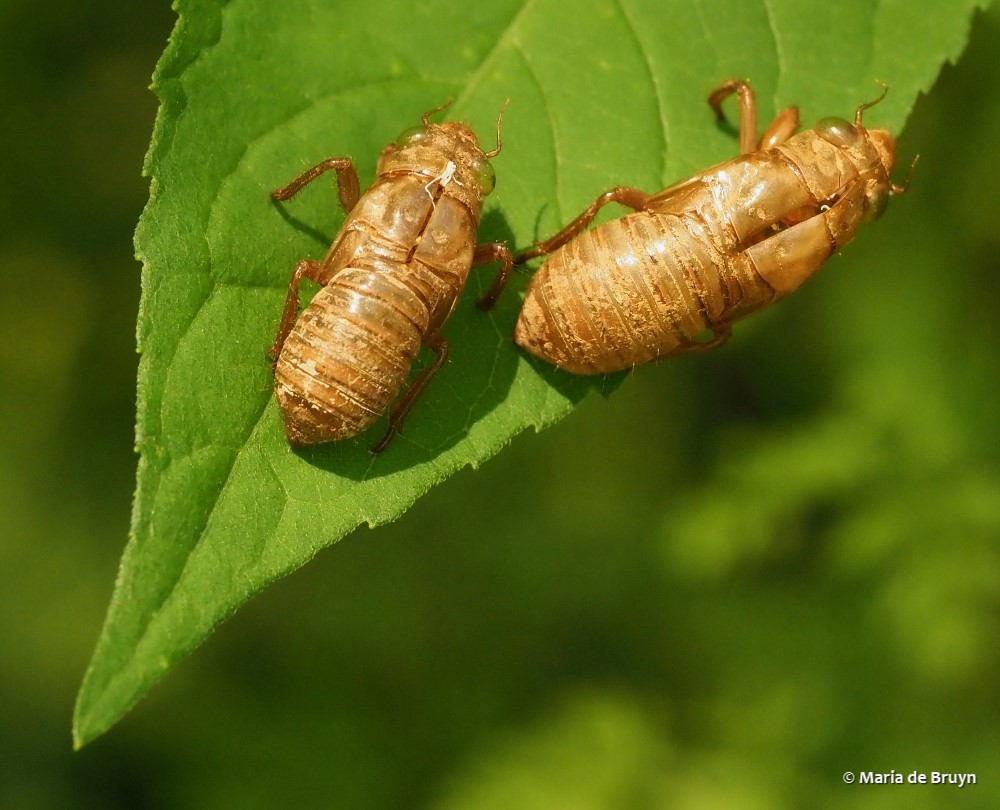
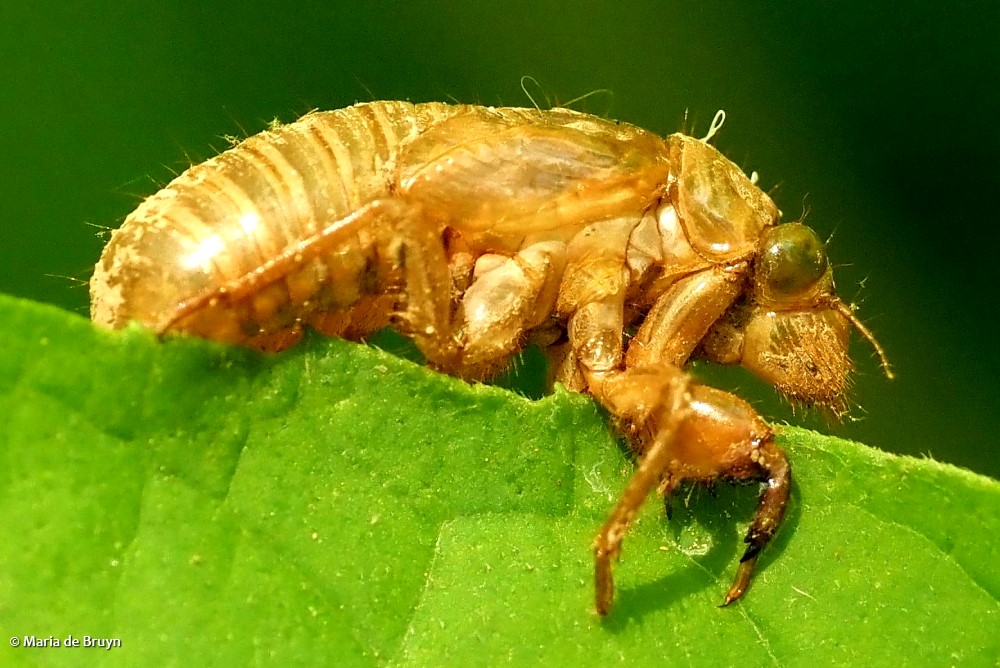
What emerges from the holes are brownish-tan nymphs, who crawl onto plant stems and tree trunks. Underground, they will have undergone four moulting periods as they grew during the past 13 years.

The vegetation becomes laden with these still immature insects almost everywhere you look.


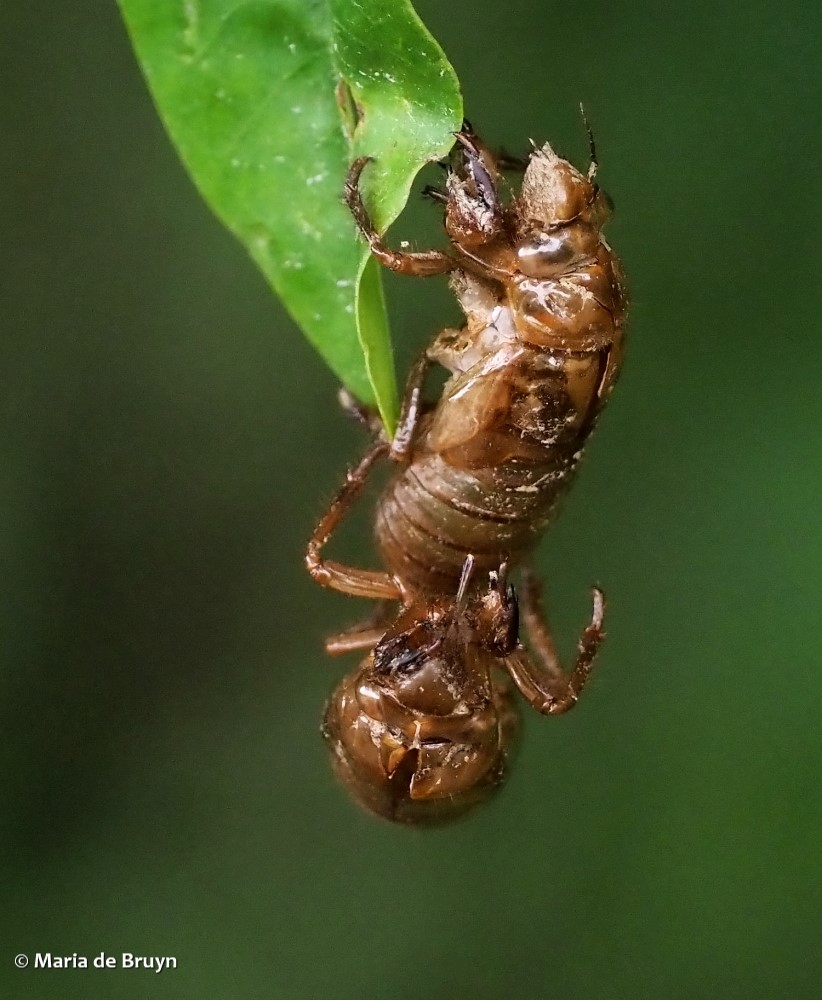
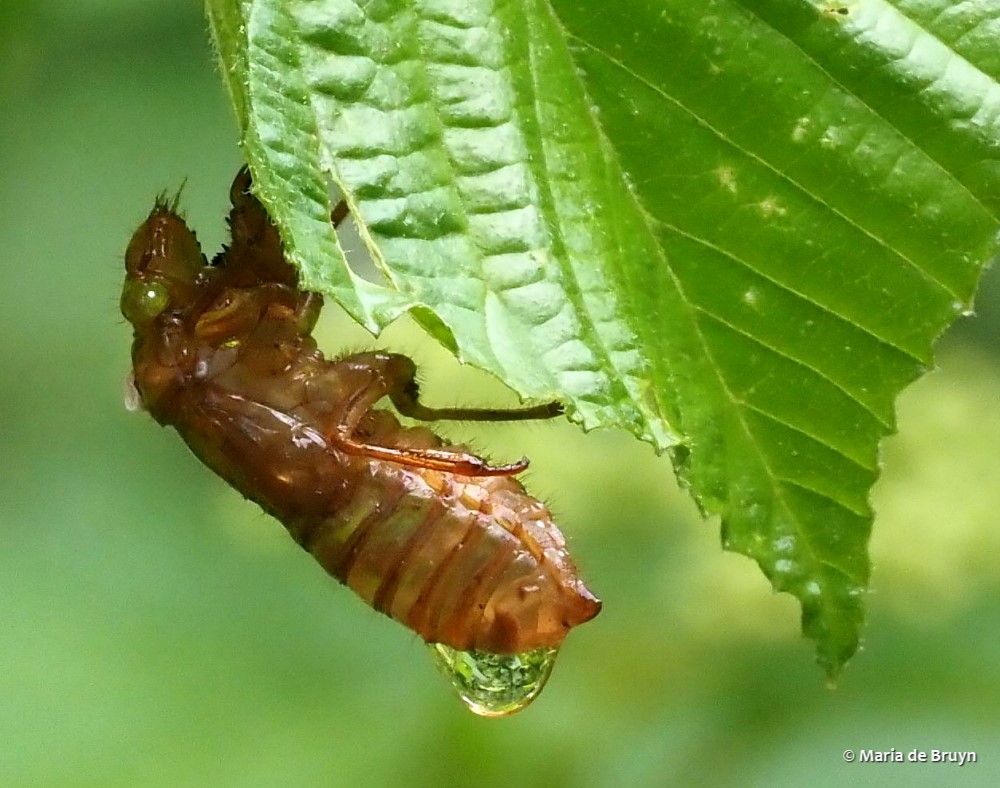
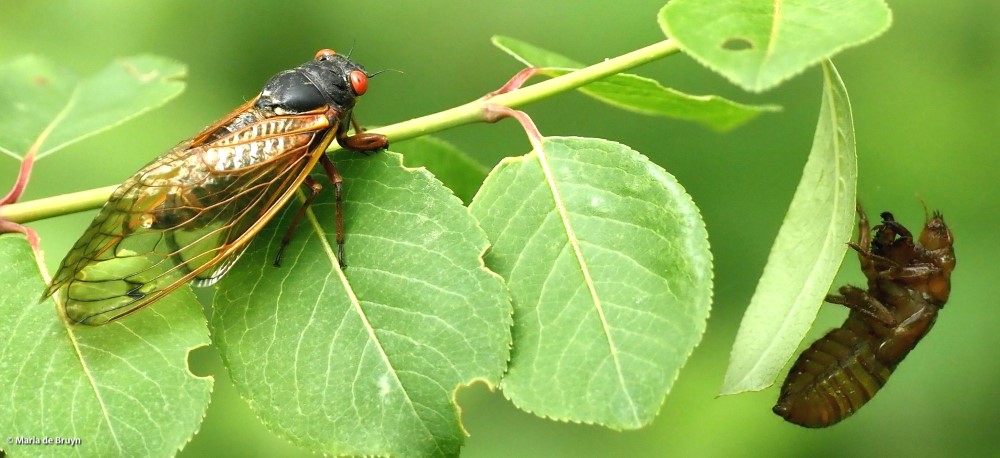
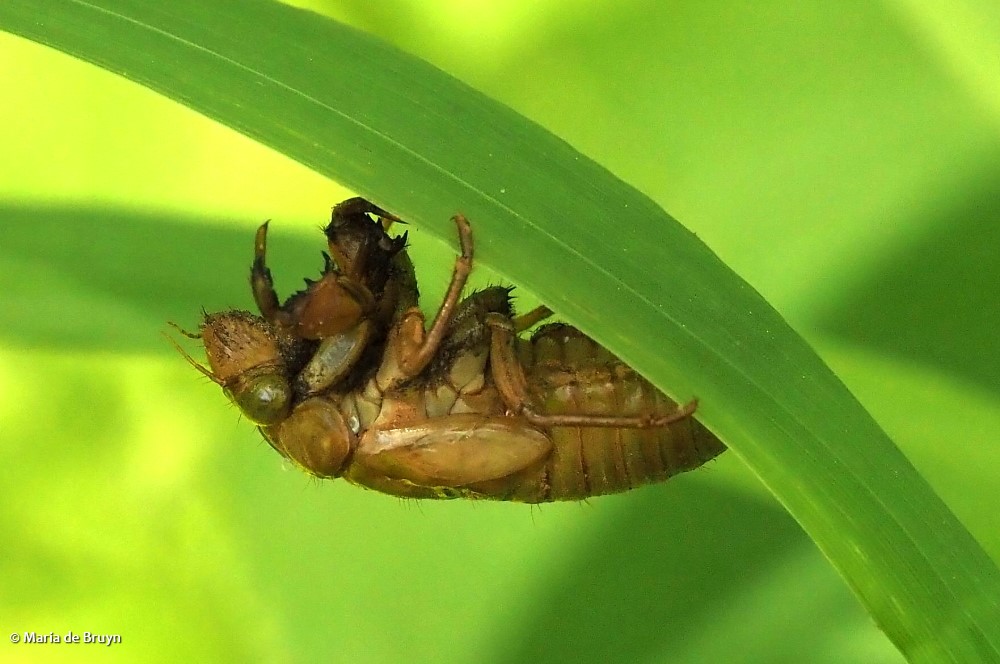
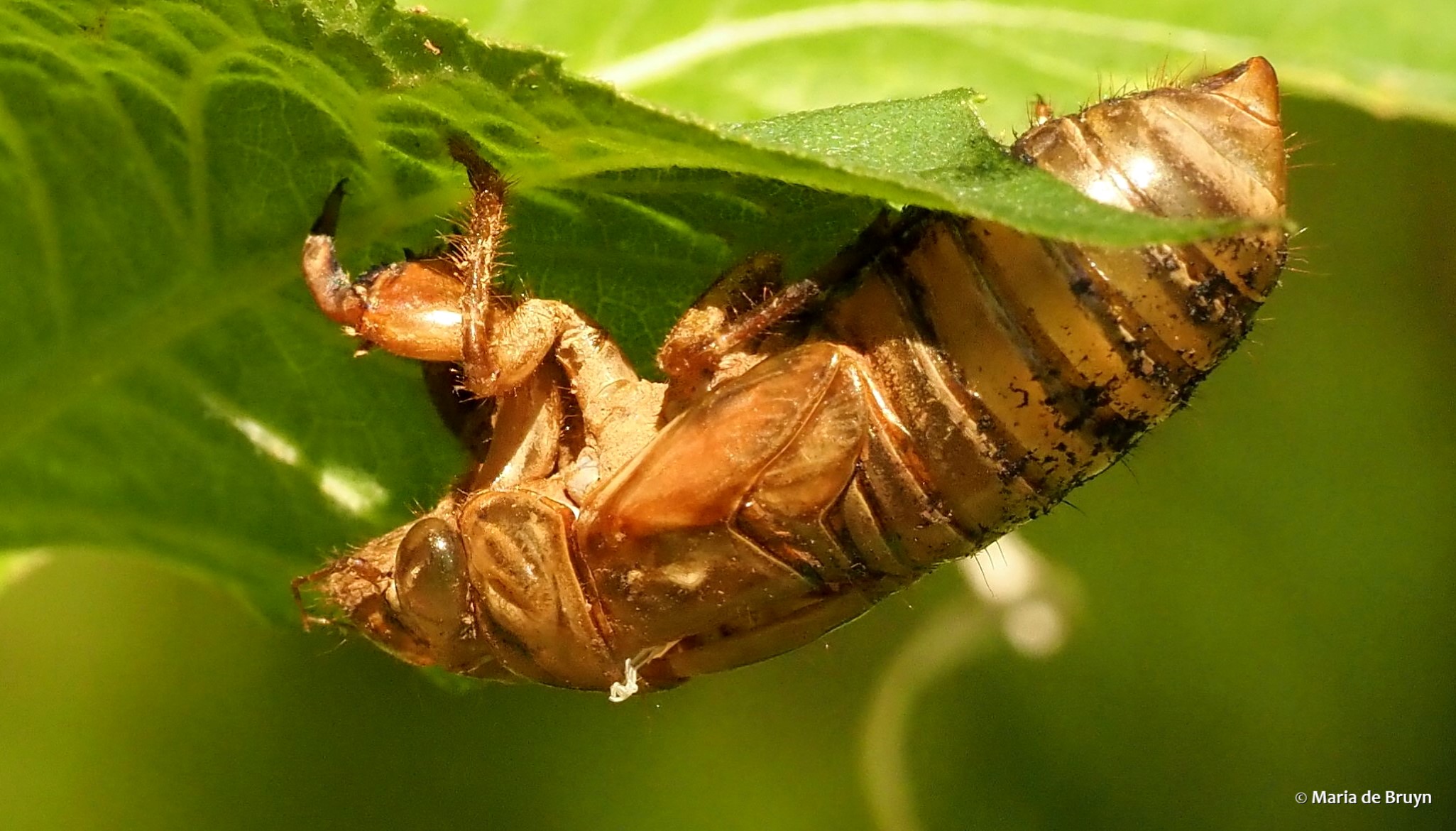
The adults emerge from their last exoskeleton through the back, which splits open. If you look carefully below, you can see one emerging on the right.

The newly emerged cicadas then undergo a quick maturation process within an hour or so.

They must unfurl and flex their new wings.

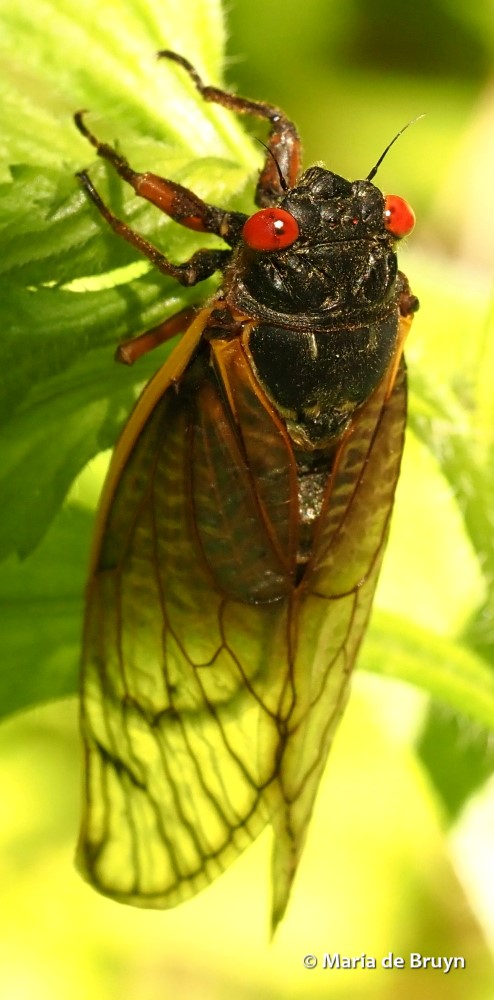
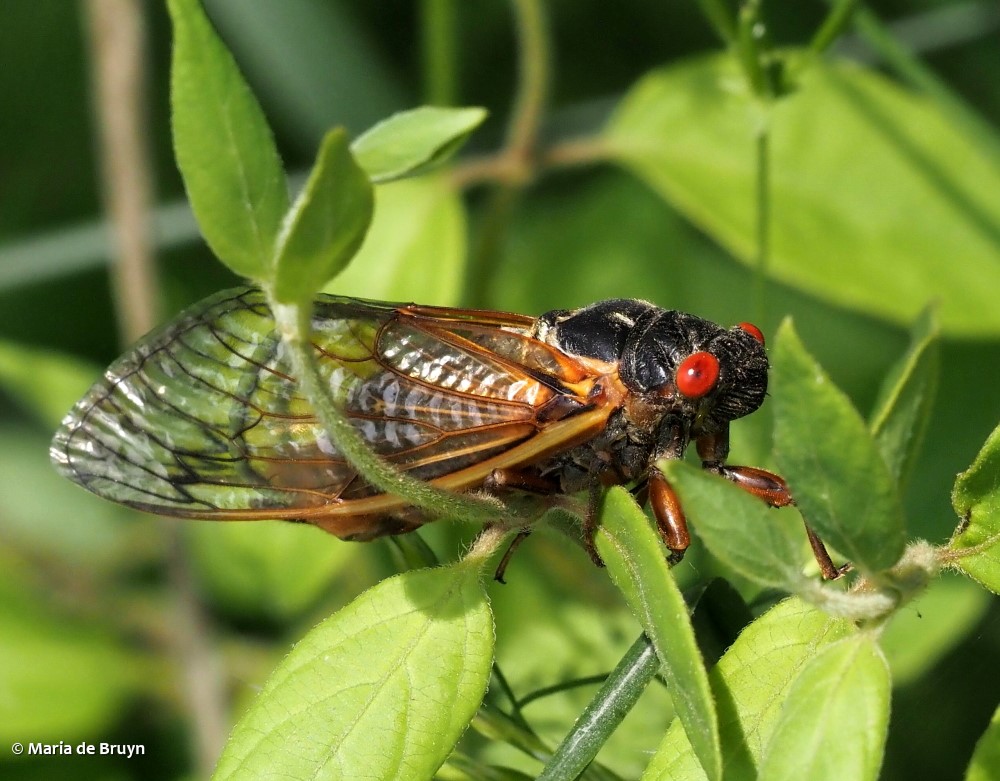
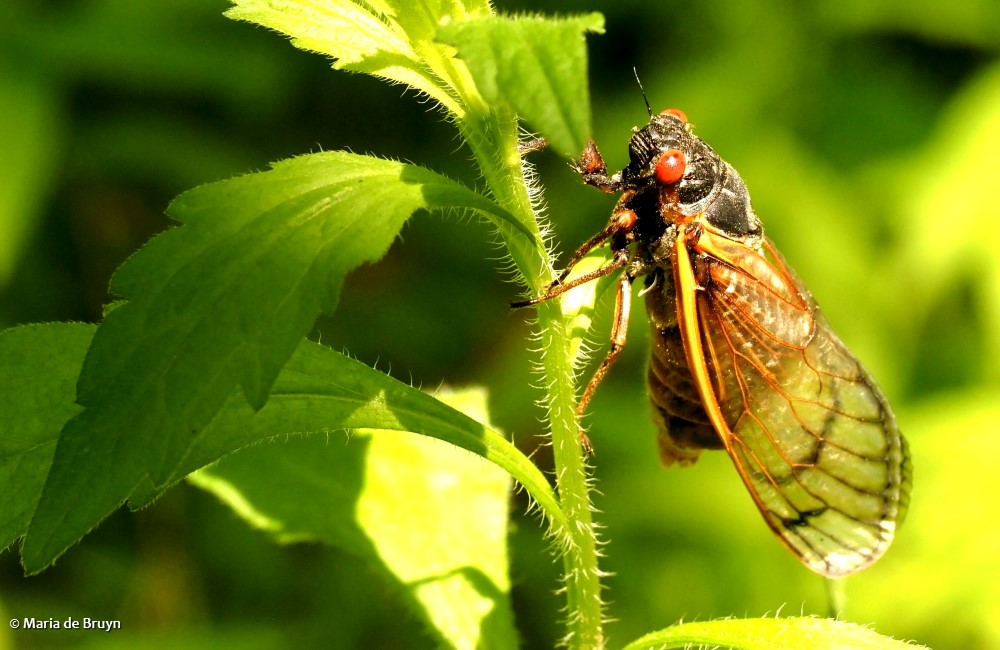
Their orange eyes take on a deep red — in my view mesmerizing — hue.


Seen head-on, their faces look to me as if there is a car grill in the middle.

The adults can’t fly right away after emergence but must make several attempts to get airborne.

When the adults are ready to meet, the males begin making calls and songs, using a pair of ridged membranes on their abdomens. Some calls are a sign to gather; others are alarm calls made when the cicadas are handled.


Their hollow abdomens are thought to act as a resonating chamber, increasing the volume of their already-loud sounds, When they gather in groups of hundreds and more, the volume can be astounding, reaching the level of a chainsaw or motorcycle.


In our area, numerous inquiries on neighborhood listservs commented on the growing and ongoing noise:

  • Is there a sound like a siren going off that you can hear? It seems to be getting louder.
  • Perhaps the machines grinding rocks to expand I 40 [highway].
  • Alien invasion 😂
  • The noise is continual with no change in pitch or volume. Sounds man made.
  • This is some sort of machine or something running all day long.
  • I was so intrigued as well that I called the energy company to investigate the cause of the intense noise!
  • Miniature Flying UFOs made to look like Cicadas.
  • This morning, I walked inside my house looking 👀 for the toilet that I thought was running.

Some people made analogies for what they thought the cicada ‘songs’ were like:

  • To me it sounds like alien spaceships are landing – just like in a 1950’s creature feature.
  • It sounds like the flying saucers in old 1950s movies.
  • I think the 13-year bunch sound like the phasers on the original Star Trek show.
  • To me they sound just like 18wheel rigs all revving up their engines.
  • The sound to me is like “environmental tinnitus”. 🙂 [Response] Exactly, but it actually helps my tinnitus!
  • Sounds like heavy traffic in another decade or two with everyone driving electric vehicles. [Response] My hybrid has that same sound (only quieter) to warn people/animals that I am backing up. When my car is operating under battery power, it’s silent, so manufacturers added that sound to warn people and wildlife away. You are so right. That may be the sound of the future. AAAAGH!

Others appreciated this natural phenomenon:

  • Sounds great.
  • I guess I am rare in thinking they are cool. It feels other worldly….
  • And it’s all about SEX. Just think about all those teenage hot-rodders gunning their engines to attract attention. They’re all saying “Come and get me baby. I’m HOT.” After years underground, you would be too.

Finally, some listserv readers tired of all the comments after a while:

  • Please stop asking about the sound Cicadas make! Please! And if someone answers, why do 50 people feel the need to respond? I feel that so much of the posts are so religious. Does anyone else feel this way?… I didn’t mean religious ! I meant repetitive!
  • Cicadas are a plague sent from God signalling the End Of Time. The purple glow in the sky last night [Northern Lights] was the Rapture, and, since we’re still here … well, there’s that…
  • If you don’t like it stop looking at the posts.

In the next blog, I’ll explain a bit more about the periodical cicadas’ vulnerabilities and life cycle. And hopefully you’ll enjoy seeing some more photos of these creatures who won’t see the light again until 2037!

Hopping into springtime

I’ve been planning new blogs for quite some time; then I keep taking new photos that will fit into them and the blog writing gets delayed. But two days ago, I saw such a cool natural event that I resolved to produce a blog quickly and here it is!

One welcome feature of springtime is that many insects emerge from their over-wintering spots. Some are bugs we dislike (mosquitoes, ticks and chiggers), but others are fascinating and wonderful members of our natural systems. Pollinators like this spicebush swallowtail (Papilio troilus) keep our gorgeous plants and important food crops going and many bugs provide other wildlife with meals.

On my trip to Costa Rica last year, our guide not only pointed out birds but also some mammals and insects. He had developed an interest in treehoppers, a group of insects with about 3200 species worldwide that specialize in eating plant sap. He was unable to find any to show me, but I resolved to keep an eye open for them when I returned home. I had forgotten that I had seen my first one the year before, a pretty green Ceresini species.

As I stared at plants during nature walks, I was lucky and managed to find my first treehoppers when I was actually looking for them. These were of a dark-colored species (Acutalis tartarea) that favors the sap of black locust trees, sunflowers, goldenrod and ragweeds.

The treehoppers, which are related to leafhoppers and cicadas, are popular with some entomologists because many species have elaborate “helmets” at the top of their heads. I got to see my first example of this type on my recent walk when I happened to find a young oak tree with numerous nymphs and recently eclosed (emerged) adult oak treehoppers (Platycostis vittata).

The mother treehopper is known for staying close to the nymphs to protect them against wasps and other predators.

The hoppers get plant sap by piercing plant stems with their beaks. The nymphs have extensible anal ducts that deposit the sap away from their bodies. This is important because the concentrated excess sap, called honeydew, can get moldy.


The honeydew attracts ants, which like the sugar-rich liquid, so the hoppers and ants have a mutually beneficial relationship.

Just how the helmet develops into an unusual shape has been a source of investigation. One team of entomologists theorized that the helmet was formed by body parts that were actually modified wings. Another researcher countered that this was impossible and that the helmet was an unusual pronotum — the foremost dorsal section of the thorax. More recently, a third group of evolutionary biologists postulated that the helmet is indeed a section of pronotum but one that developed with the aid of genes that code for wings.

In various species, the pronotum has developed into a quite unusual and oddly shaped appendage; examples can be seen in this article. When the helmet resembles a plant thorn, it is thought to aid in camouflage.

When I discovered the group of oak treehoppers, one was just in the process of emerging from its nymph form. A friend who saw the photo remarked that it reminded her of the film Alien but this process was slow and deliberate and not a heart-thumping explosive emergence as shown in the movie.

As you can see, the oak treehopper is quite a beautiful insect with its pristine white body decorated with pink/red stripes and hints of yellow. They made me think of mints and Candy Stripers (a sign of our times when almost anything makes me think of health and health-related concerns. For younger readers: young female volunteers who work under nurses’ supervision in hospitals used to wear pink and white striped smocks and thus got the name Candy Striper).

Not all the adults had the horned pronotum; some had rounded heads.

This close-up of a hopper’s face could evoke all kinds of thoughts. I thought it looked as if it had a pig’s snout. Another friend thought it looked like a grumpy old man. What do you think when you see this visage?

Or about this one, with its head upside down? (It looks a bit more “innocent”, don’t you think?)

In any event, I found these insects just adorable and I felt very privileged to have had the chance to see them emerge into adulthood. It turns out that in this species, older individuals may change color, turning a dull brown or green color. Some mottled forms may be blue with yellowish spots. It would be interesting to see those forms as well one day – or perhaps one of the other treehoppers with a different fabulous helmet!I hope you, too, are able to get out in nature during these social distancing times so that you can connect with the wonderful wildlife around us!

A lucky, lucky day with monarch guardian angels!

Yesterday my day turned out quite differently from my modest expectations – it was very lucky and truly a day for gratitude.

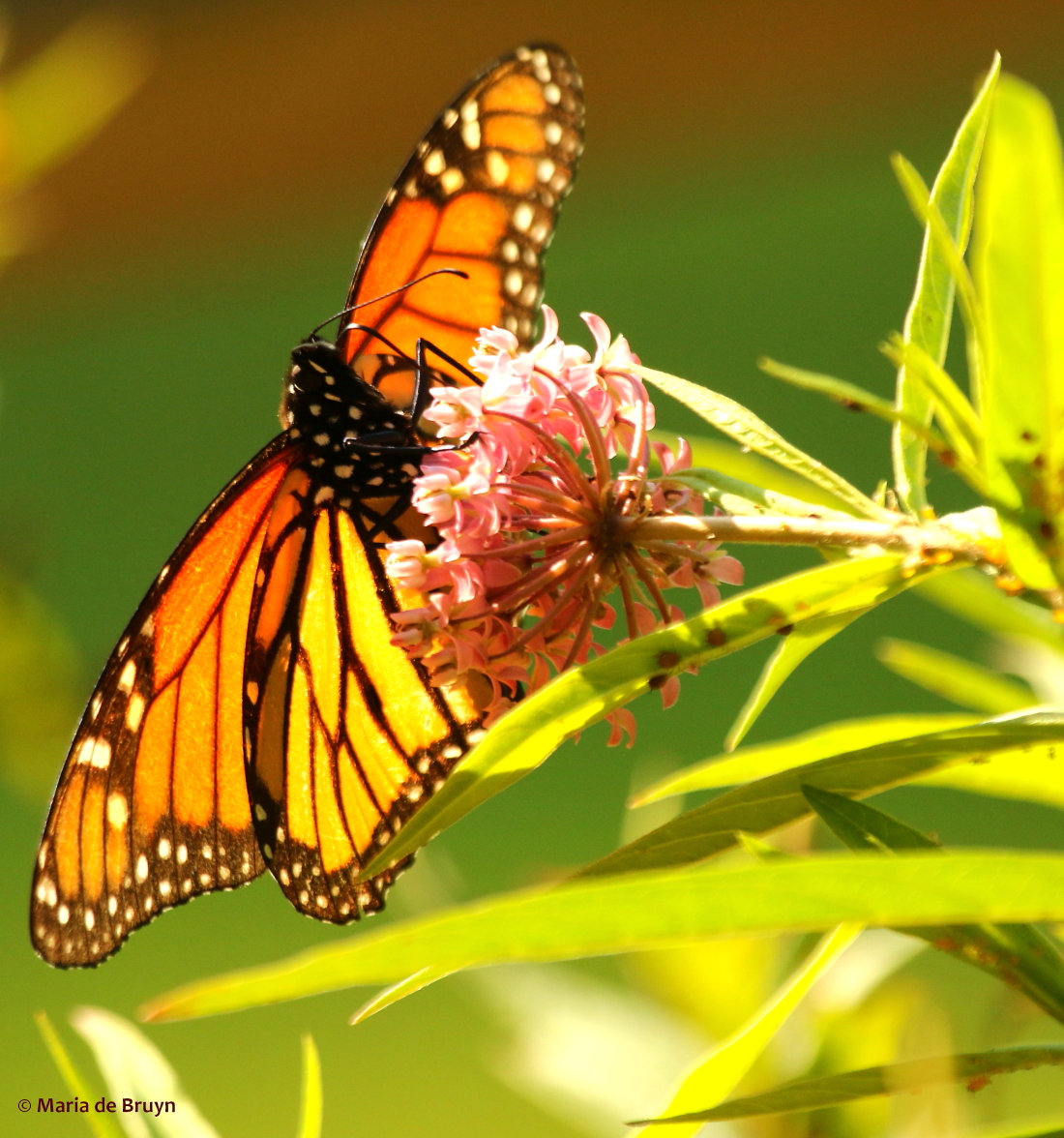
In mid-August, I had seen a female monarch butterfly (Danaus plexippus) at Sandy Creek Park, an exciting find and testimony to the usefulness of planting milkweed there. John Goebel, Sandy Creek patron, manager and care-taker extraordinaire, had planted about five types of milkweed in anticipation of welcoming these guests and it had paid off.

monarch DK7A7941© Maria de Bruyn res monarch DK7A7842© Maria de Bruyn res

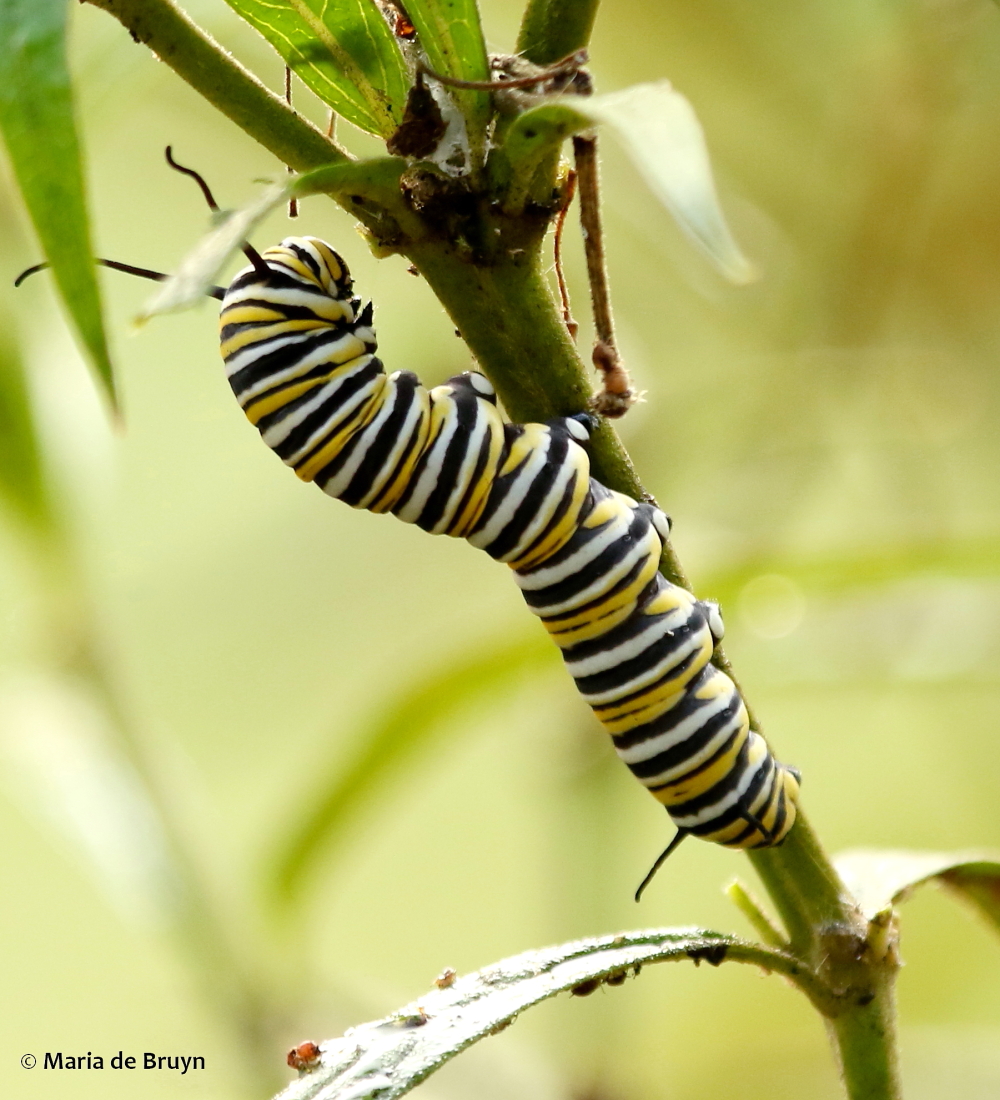
A few days ago, on Facebook, the Friends of Sandy Creek Park group announced that the one male and two female monarch butterflies spotted in the butterfly garden had left behind quite a few offspring. As I had not seen a monarch caterpillar in person before, I took off early for the park, where I found three people assembled to count them.  John Goebel kindly told me something about the monarch life cycle.

monarch DK7A6427© Maria de Bruyn resmonarch DK7A6518© Maria de Bruyn res

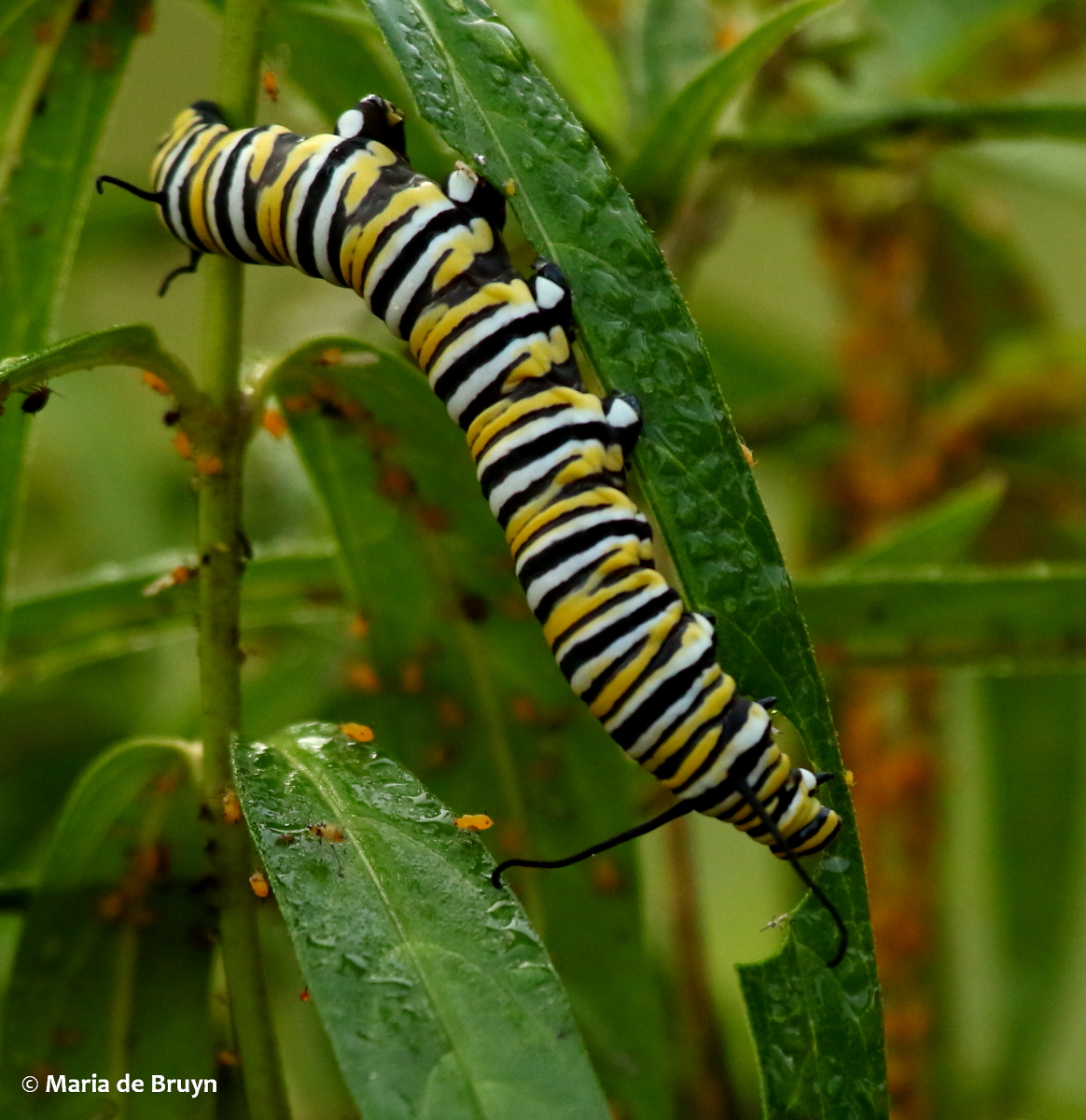
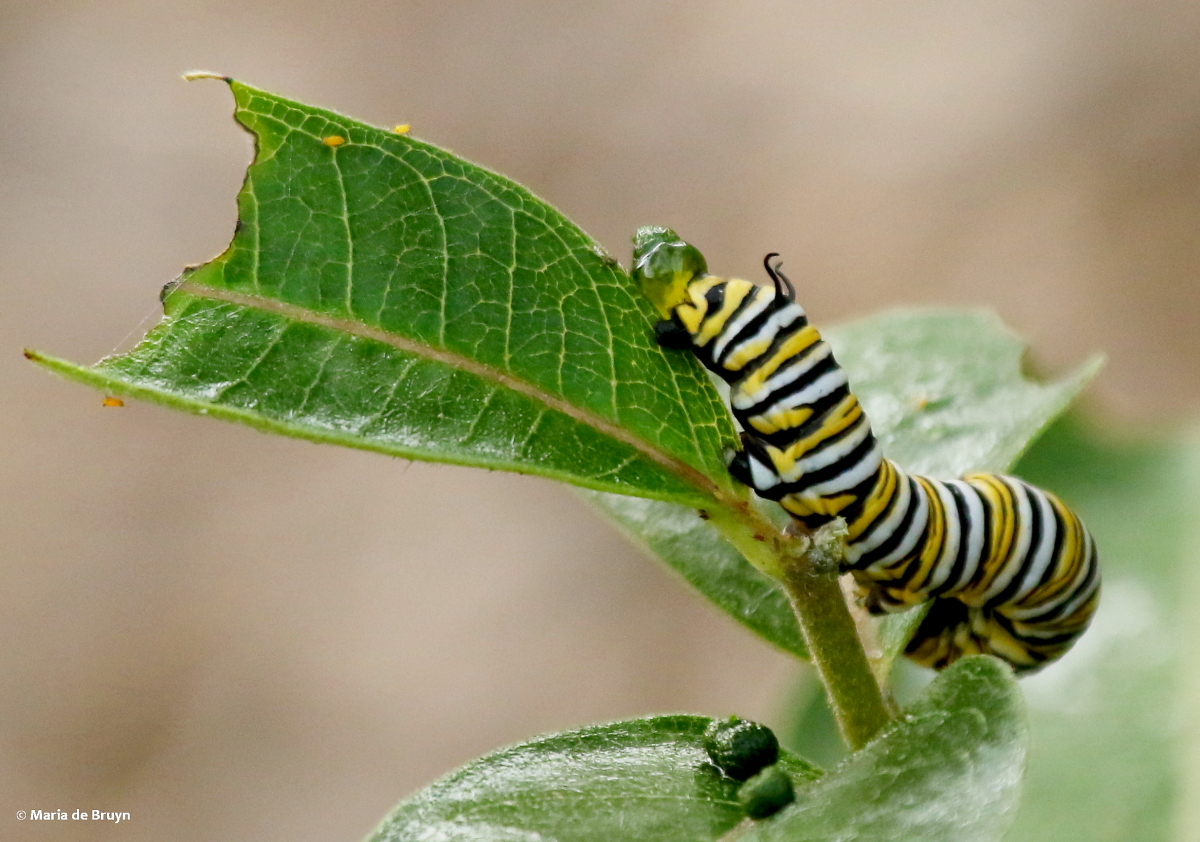
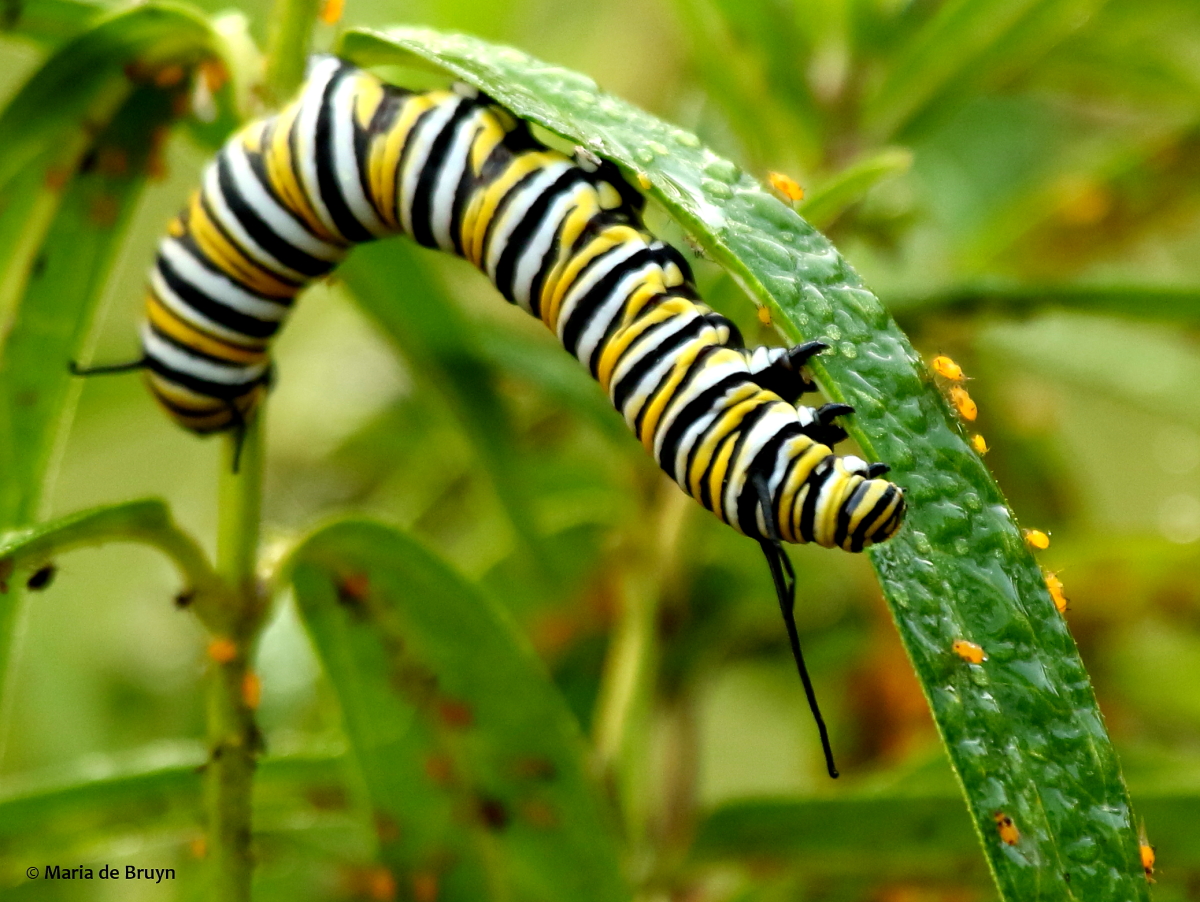
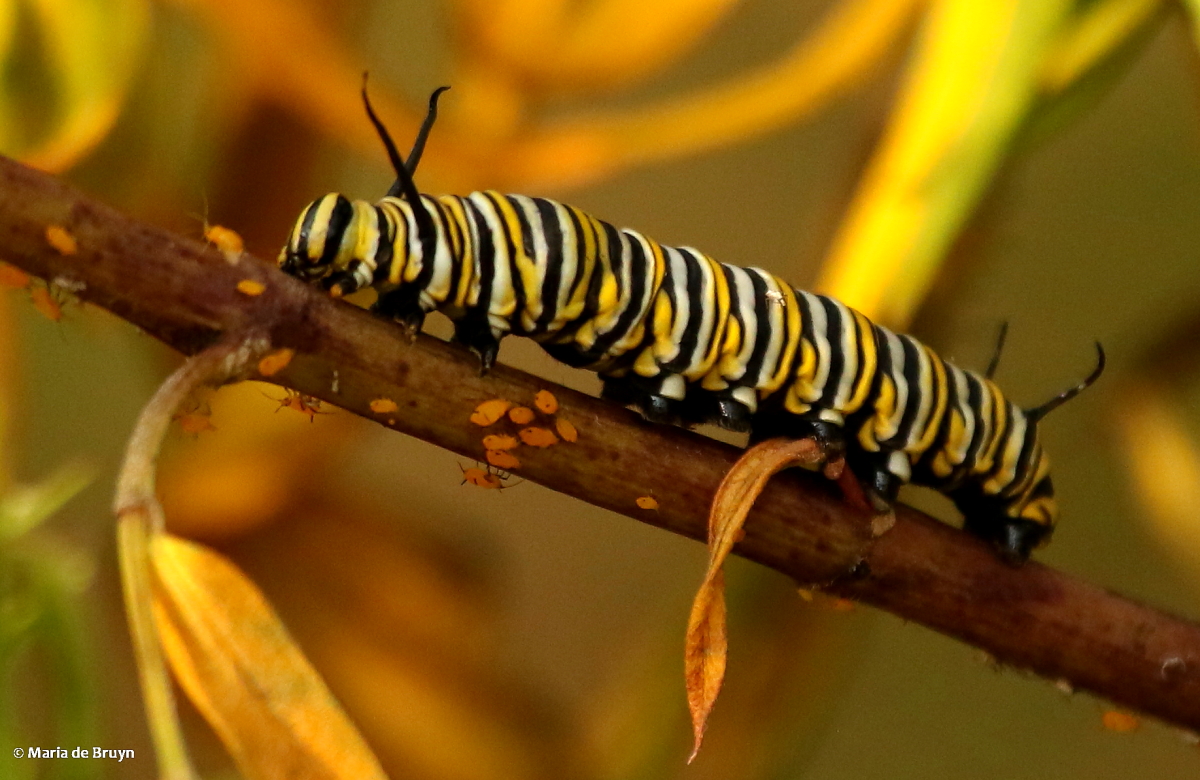
He pointed out several larger caterpillars, noting that they were stage 4 or 5 larva. The eggs hatch about 4 days after being laid. The larvae eat the plant on which they were born, shedding their skins four times as they grow, a process taking 10 to 14 days. These stages of growth are called instars.

monarch munching © Maria de Bruyn res monarch DK7A6460© Maria de Bruyn res

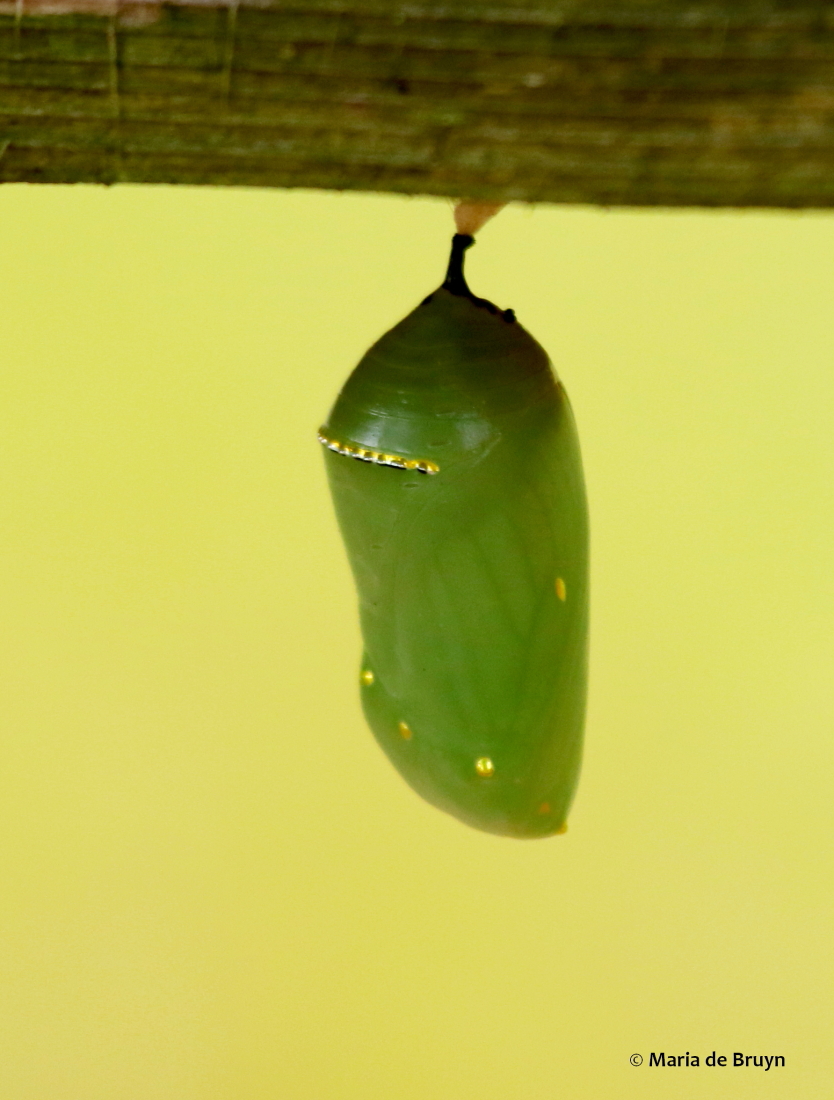
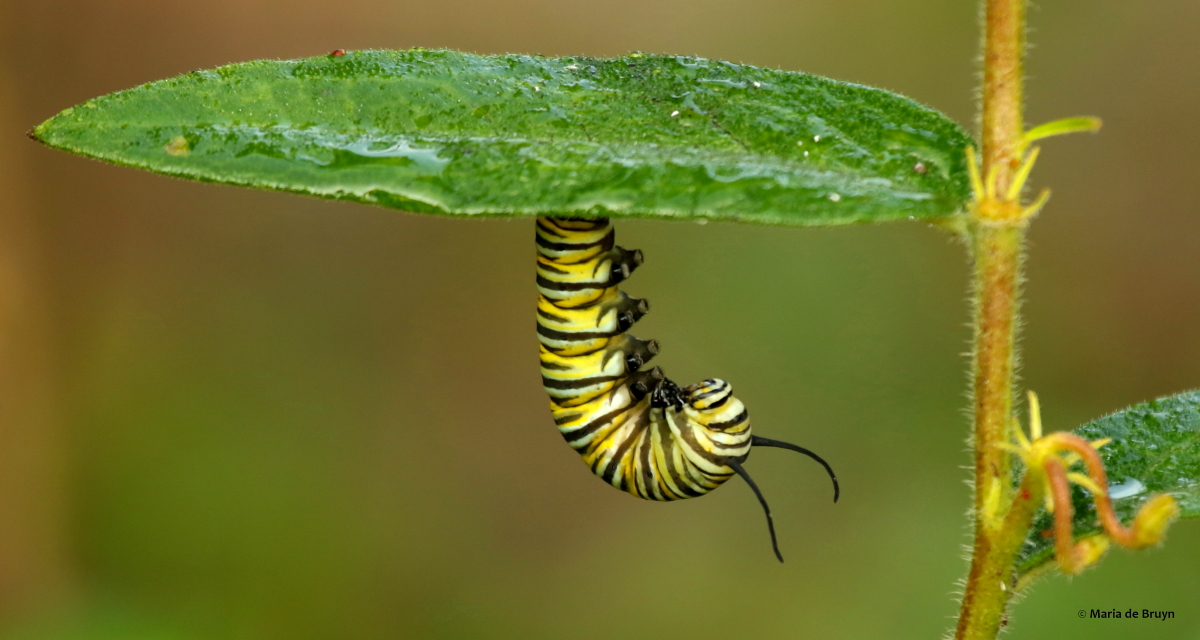
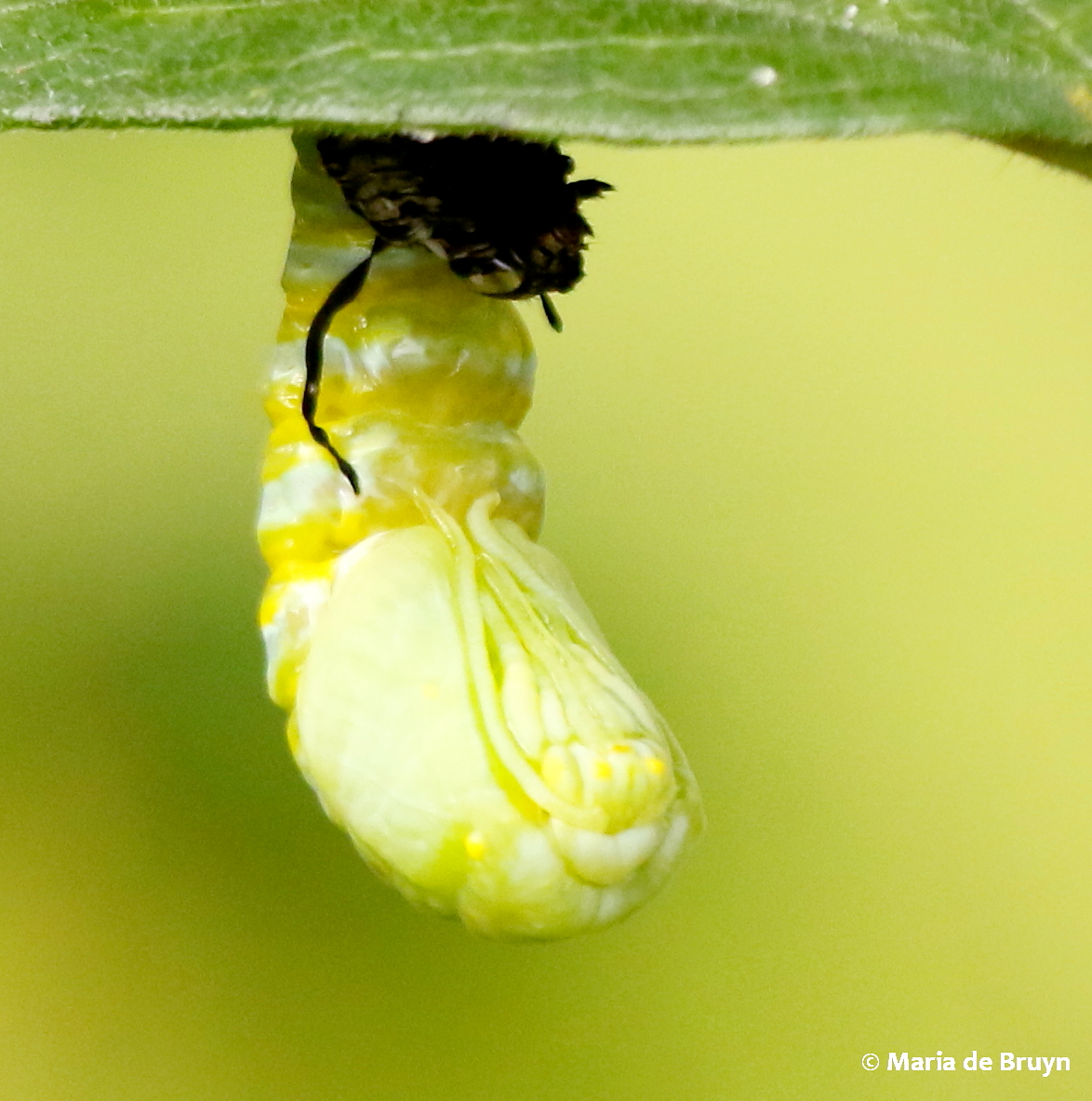
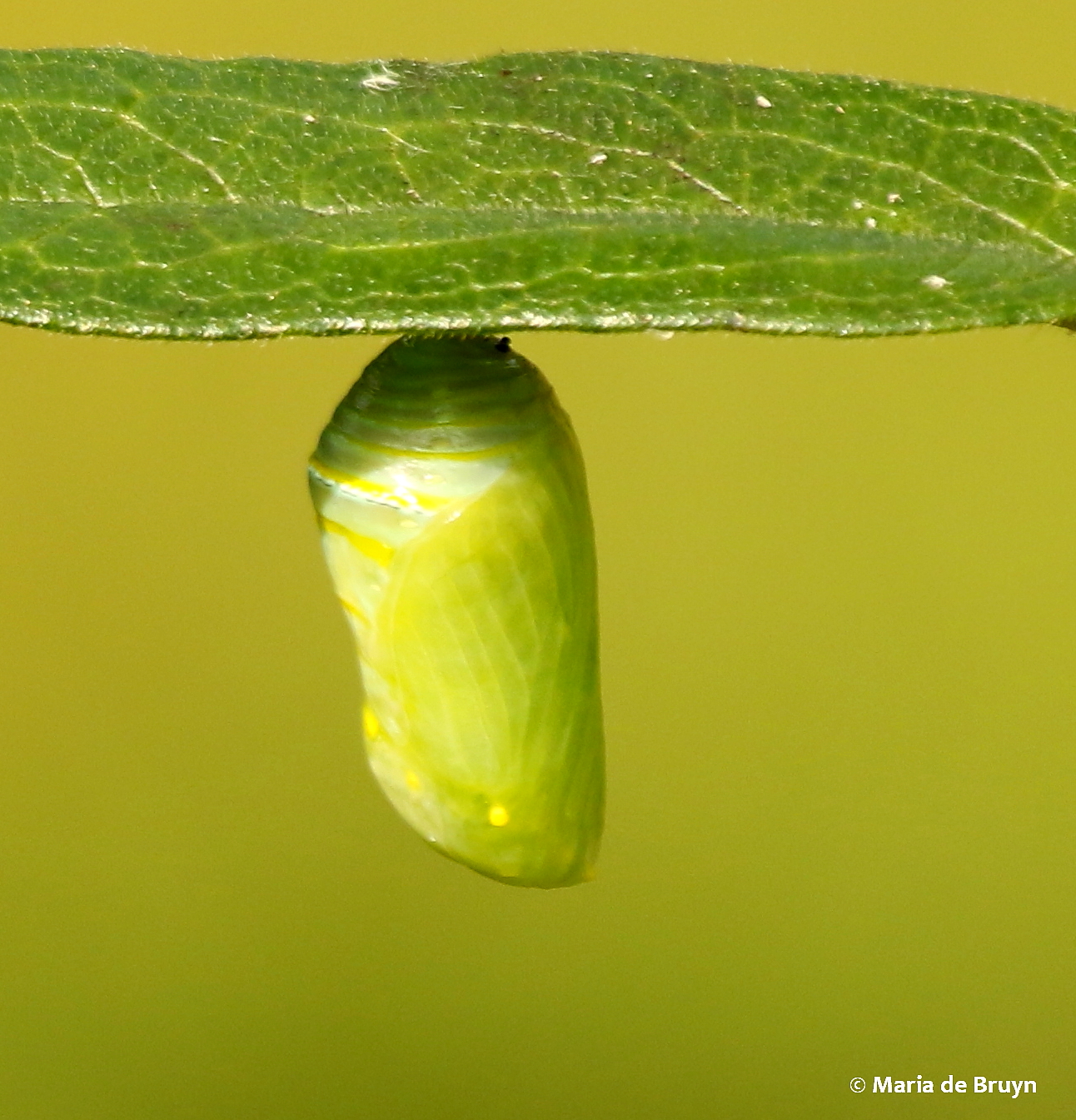
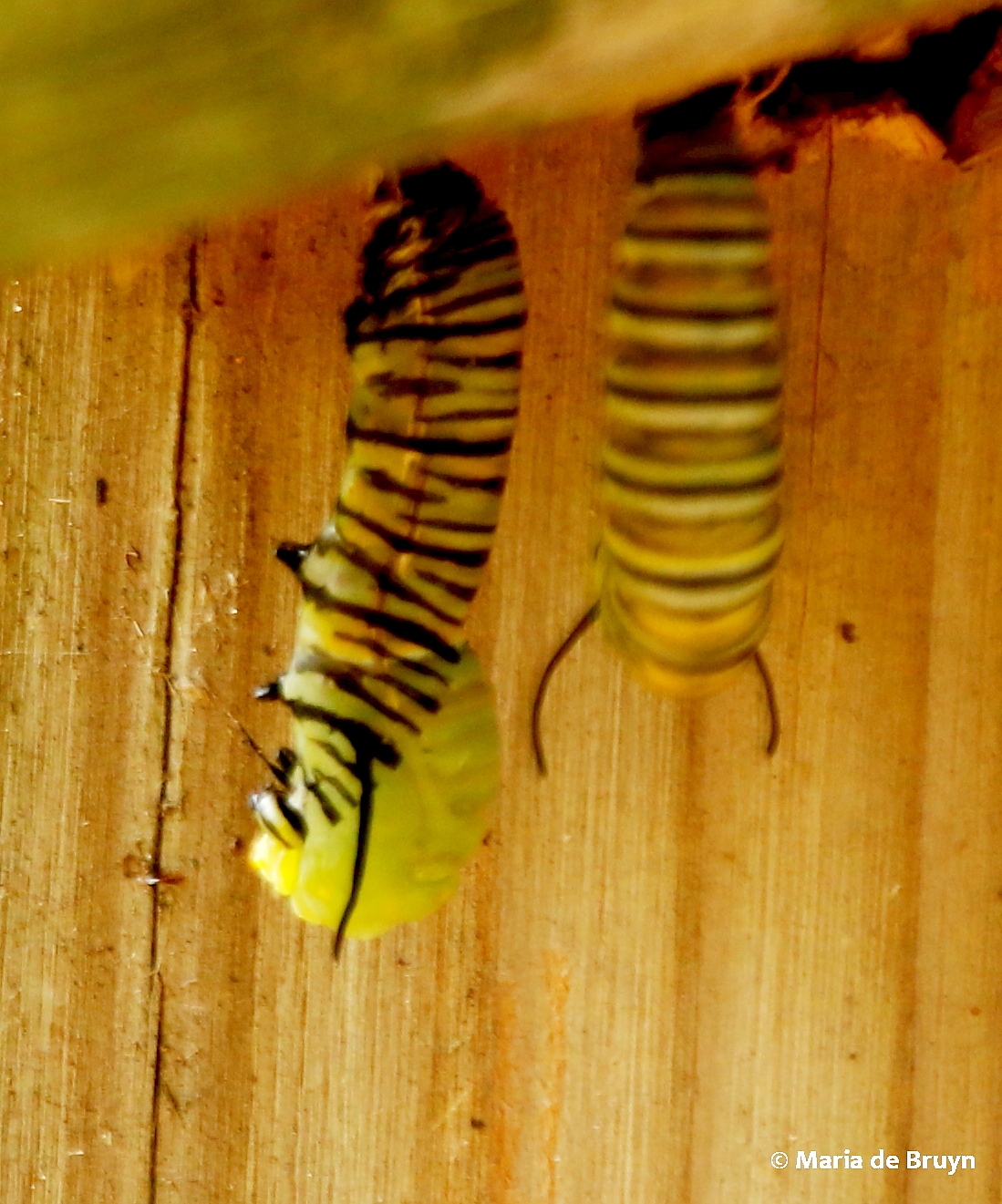
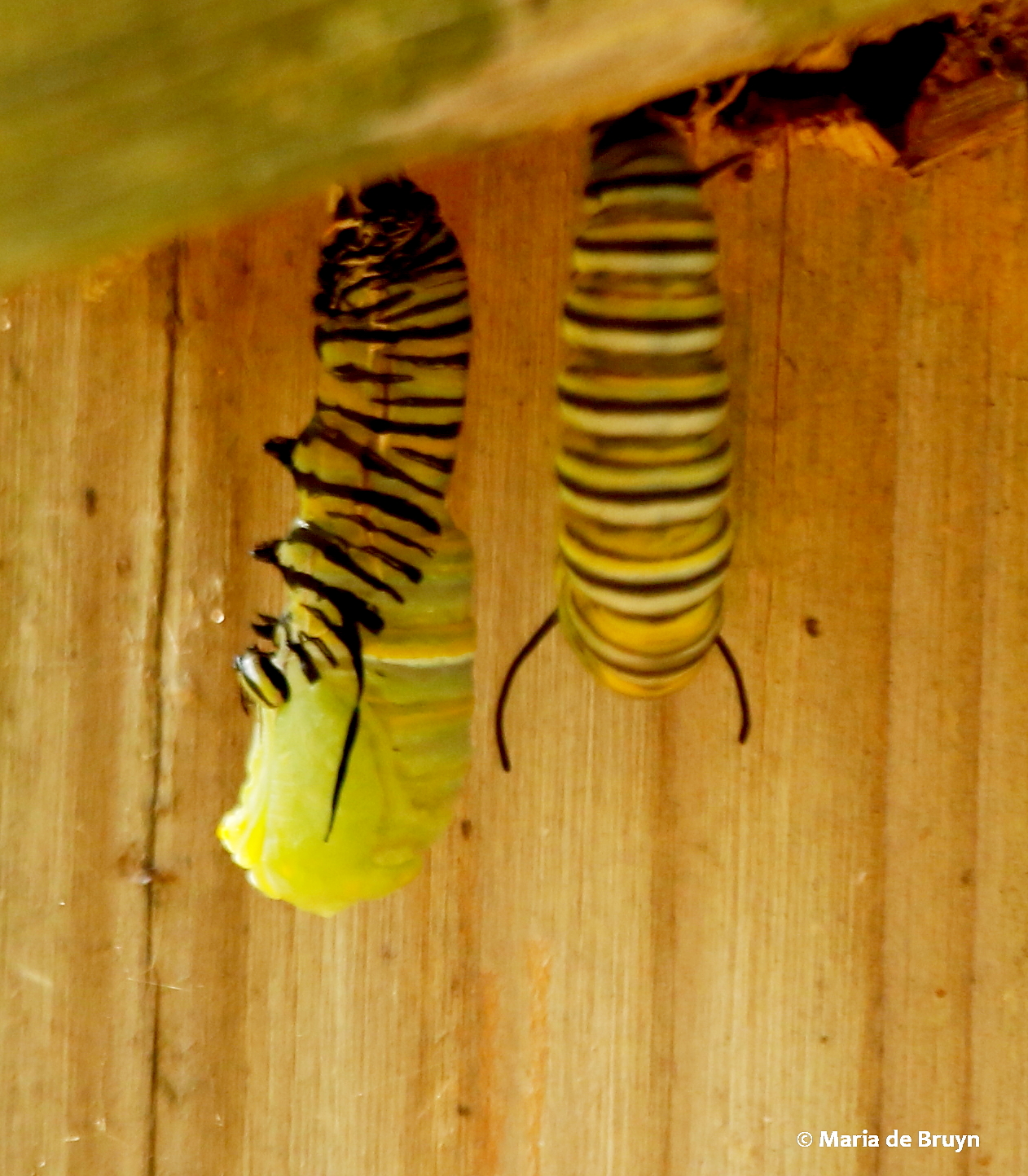
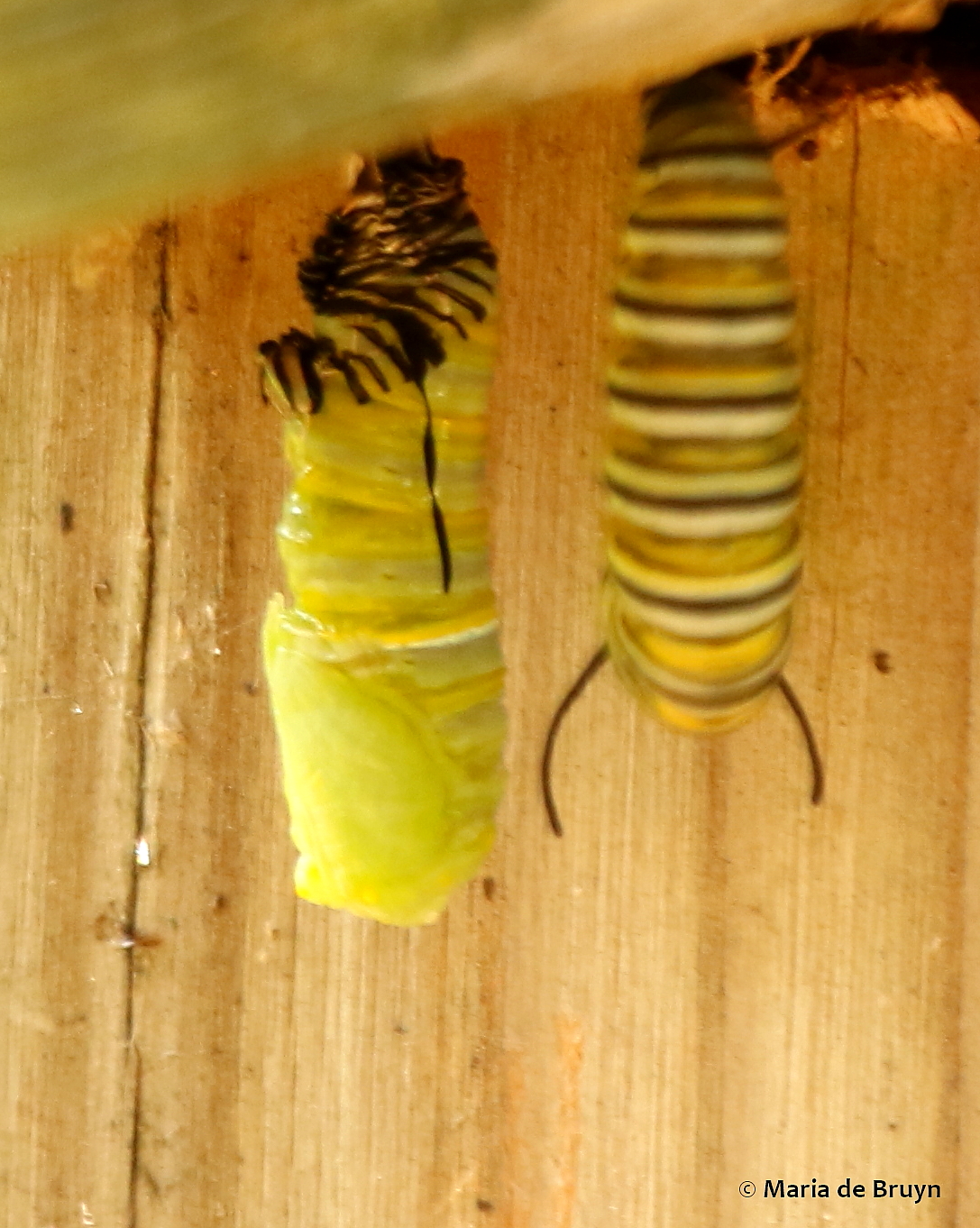
monarch DK7A6441© Maria de Bruyn resIn stage 5, the large larvae look for a protected and hidden spot where they can attach themselves vertically. They use their spinneret (not only spiders have them!) to make a silk pad from which they then suspend themselves, hanging down in the form of a letter J. The culmination of this procedure occurs when they straighten out, a sign, John told me, that pupation was imminent, with the caterpillar turning into a bright green chrysalis. There was already one chrysalis when I arrived with two other caterpillars hanging nearby.


The milkweed plants were attracting plenty of insect action. Many stems were yellow and orange as they were covered with milkweed bug nymphs and aphids. I photographed several of the 43 caterpillars counted, including a small early-stage newbie, and a number of large specimens that were very busy munching on leaves.

monarch DK7A6489© Maria de Bruyn res

After a while, I moved on to photographing caterpillars of moth species and looked around for birds or other interesting insects. Then an unexpected and unfortunate event arose and I had to high-tail it to the bathroom (thank goodness Sandy Creek has one that is open much of the year!).

Emerging from the bathroom and walking down the path to my car to go home, I felt chagrin that my nature walk had to be cut short. But if it hadn’t been for the bathroom visit near the milkweed plants necessitated by my gastrointestinal emergency, I would have missed a first-time experience. As I strolled to my car, I glanced again at the hanging caterpillars and noticed one had straightened out. I balanced the need to go home to shower and change clothes with the desire to see a caterpillar become a chrysalis. I had cleaned myself as well as possible and no one else was around, so I stayed.

monarch DK7A7327© Maria de Bruyn resmonarch DK7A6569© Maria de Bruyn res

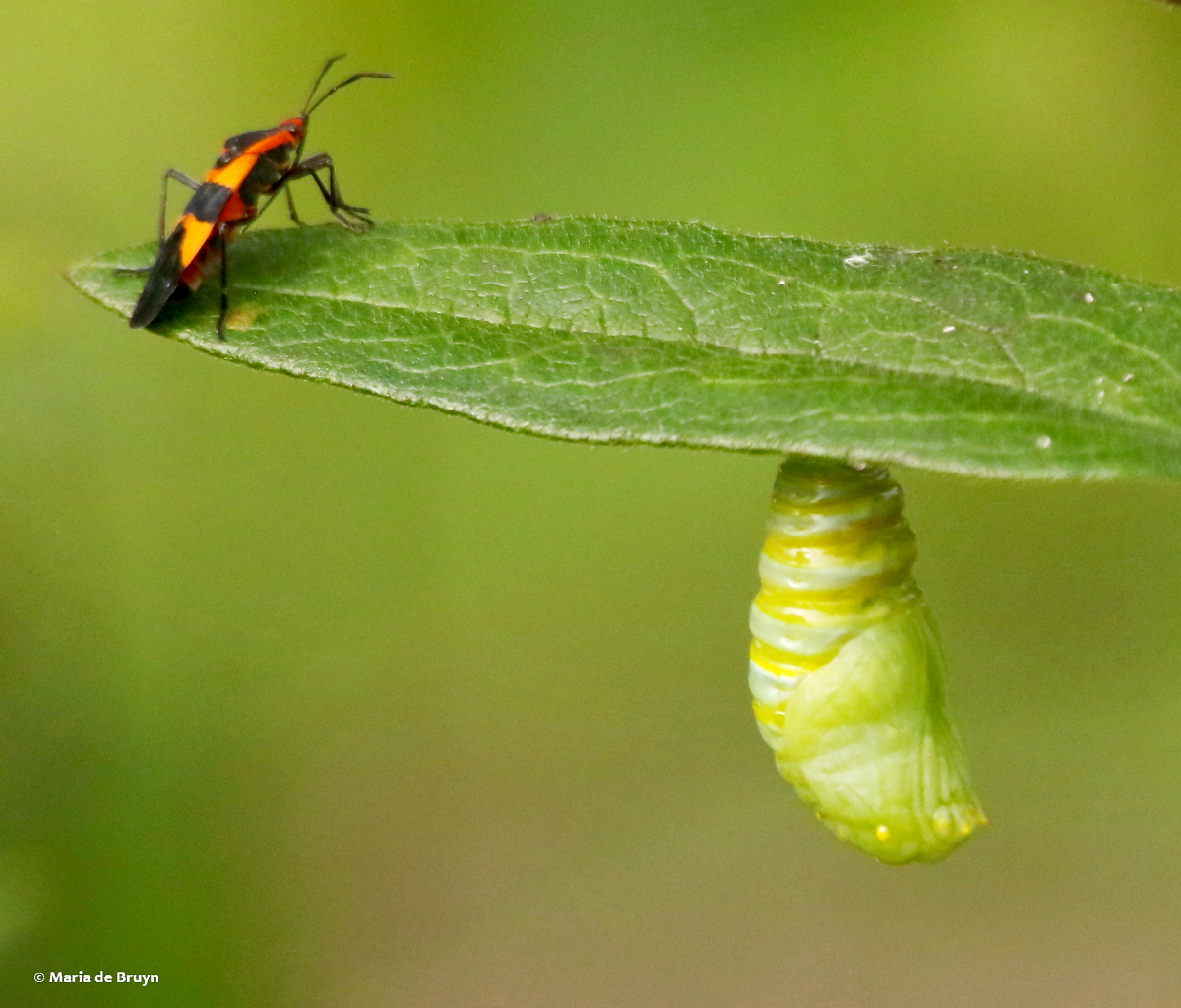
The caterpillar that I was watching was hanging quietly on a leaf; the only action came from a small milkweed bug (Lygaeus kalmia) and a large milkweed bug (Oncopeltus fasciatus) that marched back and forth on top, so I turned to the side to photograph an adventurous sibling that had climbed to the top of a nearby plant.

monarch DK7A7265© Maria de Bruyn resmonarch DK7A7357© Maria de Bruyn res

When I looked back, the pupation had already begun and was progressing apace.

monarch DK7A7391© Maria de Bruyn resmonarch DK7A7447© Maria de Bruyn

monarch DK7A7467© Maria de Bruyn resmonarch DK7A7526© Maria de Bruyn

John had mentioned that it could take under a minute; this caterpillar was a little bit slower but the transformation was quick indeed. I’d seen videos of this before but seeing it live in the wild was awesome. And I got my own bit of video showing the last bit of larval skin dropping off the chrysalis.

monarch DK7A7623© Maria de Bruyn resThe large milkweed bug came back to perch over the chrysalis. Later, John moved this chrysalis because the leaf of the plant could fall off before the 10- to 14-day pupation period is over – everyone wants all the larvae to become full-grown adult butterflies who can undertake the long migration to Florida or, more likely, Mexico. Their loss of habitat in both the United States and Mexico is devastating to the species and action to prevent further losses is still needed.

monarch DK7A8180© Maria de Bruyn

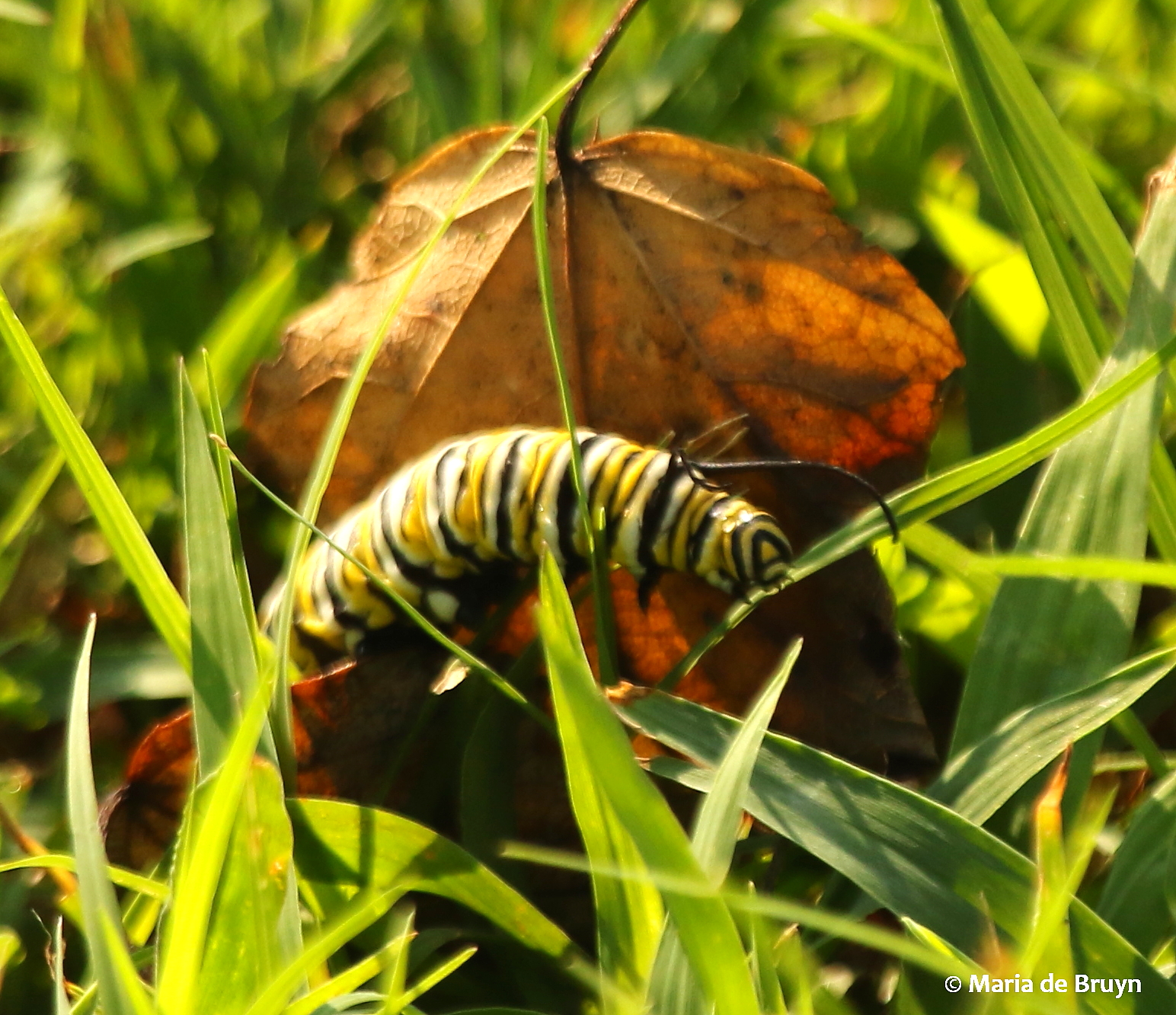
As I again prepared to leave, I noticed that one of the other hanging caterpillars was straightening out, so I decided to wait a little while in the hope I would see a second pupation. After watching one caterpillar approach and climb a nearby tree and seeing another trundling through the grass toward the parking lot (presumably headed for a tree further away), I focused on the hanging caterpillar.

monarch DK7A8532© Maria de Bruynmonarch DK7A8481© Maria de Bruyn res

Sure enough, the pupation began – in this case, even more rapidly than the first one I witnessed.

monarch DK7A8552© Maria de Bruynmonarch DK7A8588© Maria de Bruyn

monarch DK7A8642© Maria de Bruynmonarch DK7A8961© Maria de Bruyn res

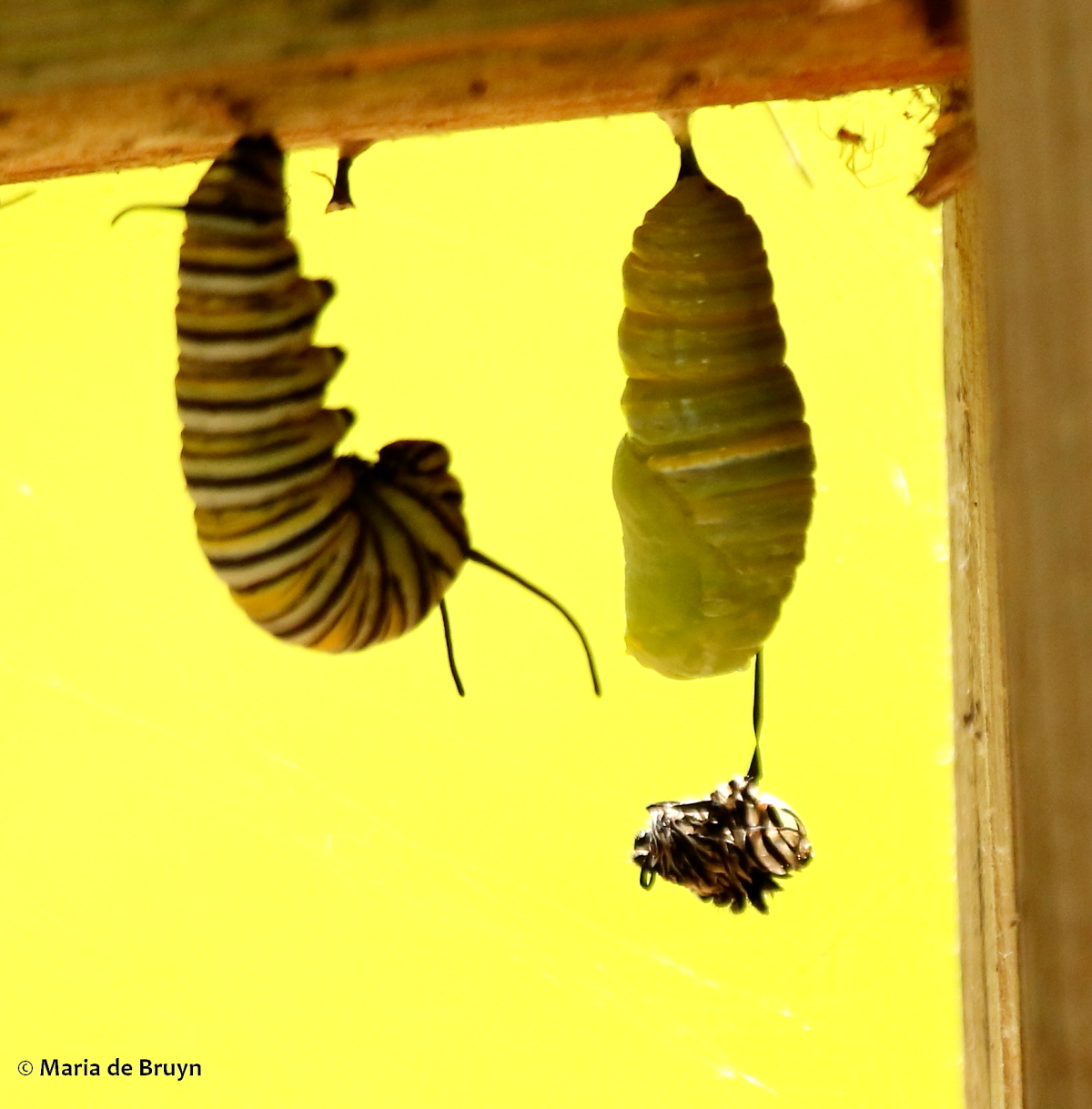
A difference with this transformation was that the last little bit of caterpillar did not drop off but remained suspended at the bottom of the chrysalis. Most likely, it will fall off later, which is important; if it remains attached, it could damage the emerging butterfly.

MONARCH buttterfly 1© Maria de Bruyn resWatching this part of the butterflies’ metamorphosis was an exciting event. I didn’t wait fora third pupation, however, as I really did need to get home. On the way back, I nearly had a collision with another car – perhaps leading the other driver to need a shower, too. At home, I later almost fell on my face as one of my cats wound himself through my legs as I walked so that I came very close to tripping. Both accidents in the making didn’t happen, thank goodness, so maybe the monarch pupae had become my guardian angels for the day. In any event, I did have lots to be thankful for!


For more information:

http://monarchlab.org/biology-and-research/biology-and-natural-history/breeding-life-cycle/life-cycle

http://www.learner.org/jnorth/tm/monarch/ChrysalisFormationLPB.html


Hoppers – insects not frogs!

leafhopper IMG_7673©Maria de BruynMuch of the insect world consists of animals that we usually don’t even see or notice because: a) we don’t know they exist and therefore don’t look for them and b) they are tiny and only well visible with an enlarging lens. But once you get a good look at them, they turn out to be fascinating and sometimes quite attractive. One group of these insects is the hoppers – leaf- and planthoppers, that is, like the gray lawn leafhopper (Exitianus exitiosus) to the left.

As their name indicates, leaf- and planthoppers jump to get around, but they also move by flying, scuttling sideways like crabs, or walking slowly or quickly along plant stems and leaves. Both juveniles and adults are very aware of what is around them and if you do manage to spot one, you’ll see that they are watching you and, for example, may move underneath a leaf to get away from you.This broad-headed sharpshooter (Oncometopia orbona) stayed still for a moment.

Broad-headed sharpshooter IMG_9350©Maria de Bruyn (2)

Acanaloid hopper nymph IMG_8738©Maria de BruynLeafhoppers are only 1/16 to 5/8 of an inch (2-15 mm) long. About 20,000 different leafhoppers have been described around the world; they feed by sucking plant sap from grass, shrubs, or trees. Planthoppers, some of which look like leaves and may be a bit bigger, also feed on plants.The nymphs (juveniles) are tiny, too, as seen in this photo where you see my fingertip above the nymph of an Acanaloid planthopper .

Leafhoppers, such as the speckled sharpshooter (Paraulacizes irrorata) below generally have wide, flattened and pointy heads with large eyes.

speckled sharpshooter IMG_1059©Maria de Bruynsigned

Planthoppers come in different forms and, in tropical countries, some of them are quite unique. While many keep their wings flat against their bodies, the derbid planthopper (Mysidia mississippiensis) looks like Derbid planthopper IMG_0717©Maria de Bruyn (2)a delicate little fly while resting.

Leafhoppers’ hind legs are covered with hairs that help them spread a secretion over their body which is water repellant. Some planthopper nymphs’ back legs have gears that help them jump away in the blink of an eye.

Versute sharpshooter IMG_1179©Maria de Bruyn (2) Versute sharpshooters (Graphocephala versuta) in love


Broad-headed sharpshooter 772©Maria de Bruyn

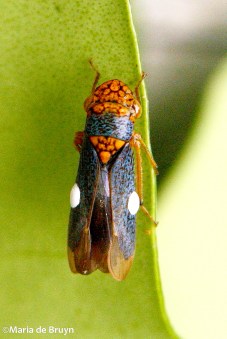
The female broad- headed sharpshooter (Oncometopia orbona) develops white spots on her wings, which are egg brochosomes; these indicate she is ready to oviposit (lay eggs). These spots are made of a white waxy secretion that she places there; they dry to look like “chalky” spots. After she inserts her eggs into a plant, she uses her hind legs to scrape off the brochosomes onto the oviposition site as a way of hiding the eggs from predators.


Leaf- and planthopper nymphs can look as if they are completely different insects from the adult forms. As they mature, they begin to look similar to adults but are often of a different color and don’t yet have full wings. Below you see the colorful adult glassy-winged sharpshooter (Homalodisca vitripennis) and below that some nymphs of this leafhopper.

glassy-winged sharpshooter IMG_8955©Maria de BruynGlassy-winged sharpshooter IMG_8996©Maria de Bruyn

Glassy-winged sharpshooter nymph IMG_9008©Maria de BruynGlassy-winged sharpshooter nymph IMG_8910©Maria de Bruyn

As juveniles, hoppers go through a process called ecdysis. They pass through several stages to reach adulthood, molting and leaving behind their old exoskeleton in order to grow. They are called instars during these stages.

Leafhopper ecdysis IMG_9286©Maria de BruynLeafhopper ecdysis IMG_9325©Maria de Bruyn

Leafhopper ecdysis IMG_9379©Maria de BruynThe instar stages of the same hopper can look very different from one another, including color changes. Some of the nymphs, with their striped faces and big eyes, look to me as if they’d be great models for cartoon characters or Halloween masks like these coppery leafhopper juveniles (Coelidia olitoria).

Coppery leafhopper nymph IMG_9631©Maria de BruynCoppery leafhopper nymph IMG_2058©Maria de BruynCoppery leafhopper nymph IMG_2070©Maria de Bruyn (2)

Acanaloniid planthopper nymph Acanalonia bivittata IMG_8201©Maria de BruynresPlanthopper nymphs, like the two-striped planthopper (Acanalonia bivittata) and the Acanalonia servillei below, are known for producing waxy strands from their bodies which repel water. These strands also help protect them from predators, who might grab onto the showy white hairs, which break off so that the hopper can escape. The nymphs can ultimately be entirely covered in white wax.

Two-striped planthopper nymph IMG_9517©Maria de BruynAcanaloniid Planthopper nymph Acanalonia servillei IMG_8943©Maria de Bruyn

The colors and patterns on the adults can be quite beautiful, especially on the leafhoppers in the area where I live. The planthoppers tend to be white, gray or green. The colors on the coppery leafhopper are wonderful and varied.

Coppery leafhopper IMG_9646©Maria de Bruyn resCoppery leafhopper IMG_2160©Maria de Bruyn

Citrus flatid planthopper IMG_3201©Maria de BruynFlatid planthopper IMG_8772©Maria de Bruyn

Citrus flatid planthopper (Metcalfa pruinosa) and flatid planthopper (Acanalonia conica)

Sharpshooter Sibovia occatoria IMG_0126© Maria de BruynRed-banded leafhopper IMG_6376©Maria de BruynsignedLeafhopper Texananus IMG_1546©Maria de Bruyn

Sharpshooter (Sibovia occatoria), Red-banded sharpshooter (Graphocephala coccinea) and leafhopper (Texananus)

Leaf hopper Chlorotettix IMG_7677 M de BruynLeafhopper - Coelidia IMG_2649©Maria de Bruynhopper 4 IMG_8029©Maria de Bruynsigned
Leafhopper (Chlorotettix), leafhopper (Coelidia) and leafhopper (unidentified species)

As tiny as these insects are, they can be parasitized and play host to even smaller insects. This flatid planthopper (Ormenoides venusta), for example, was carrying red mites that weren’t harming it but hitching a ride. It must be annoying though.

Flatid planthopper Ormenoides venusta IMG_9737©Maria de BruynFlatid planthopper Ormenoides venusta IMG_9763©Maria de Bruyn

hopper 4 IMG_8036©Maria de BruynsignedI imagine there are many more interesting behaviors to observe with the hoppers. Maybe one day I will get a macro lens so that I can really get some good photos of these cute little insects. In the meantime, as there are several thousand species in North America, I can look forward to finding new ones – with my camera in hand as I wouldn’t be able to see anything but specks on plants without it!