The (somewhat) varied life of a Mason Farm Biological Reserve volunteer

Today marks the third anniversary for my work as a Green Dragon – volunteers who help maintain the 367-acre Mason Farm Biological Reserve in Chapel Hill, North Carolina. On Tuesdays, a small group gathers to carry out tasks assigned by Neville, who is the Land Manager for this and two other preserves managed by the North Carolina Botanical Garden/UNC.

Neville, string-trimming Japanese stiltgrass (Microstegium vimineum)
 While we work, we can listen to the songs and calls of lovely birds, like the winter wren (Troglodytes hiemalis), and if we’re lucky, we can see wildlife like painted turtles, raccoons, opossums and coyotes (Canis latrans).

Being outdoors and helping keep the Reserve a peaceful and beautiful area for research and enjoyment of the natural world provides me with a feeling of civic contribution, as well as satisfaction, chances for discovery and learning, and well-being. So I’d like to share with you a bit of what we do in a lengthier blog than usual.


 One of our major tasks is helping make a dent in the eradication process for invasive plants. Some have found their way to the Reserve through natural dispersal mechanisms (seeds carried by the wind and wildlife), while others were unfortunately introduced by humans who didn’t know at the time just how destructive the plants would become in overshadowing native vegetation. Cutting down Chinese and Japanese wisteria vines (Wisteria sinensis, W. floribunda) is a recurrent job.
Some invasives are really beautiful and it’s easy to see why they are still sold in some garden shops, like oriental bittersweet (Celastrus orbiculatus) and porcelain berry (Ampelopsis glandulosa); they are really attractive plants – nevertheless, we remove them when feasible. Autumn and thorny olive (Elaeagnus umbellata and E. pungens) are two others that grow as vines or shrubs.


 Another botanical foe is buckthorn (Rhamnus species), a shrub which can grow into a small tree when unchecked. It has nasty thorns which can pierce clothing and shoes and when it gets older and larger, a weed wrench and extra manpower may be needed to get it out of the ground. On the other hand, pulling up the “baby” buckthorns, especially after rain, can be much easier, though unkind work for your back.


Volunteer Pete wields a weed wrench; the small buckthorns can be pulled by hand
 When digging holes into some areas, you may come upon salamanders – this female marbled salamander (Ambystoma opacum) was guarding her eggs when we uncovered her (and quickly covered her again).
The buckthorn produces prolific black berries which are a great favorite of the cedar waxwings (Bombycilla cedrorum) – flocks will descend to enjoy the sweet treat.


The cedar waxwings also really like privet (Ligustrum sinense and L. japonicum), which produces numerous black berries a little smaller than the buckthorn. The privet also produces many offspring but when they are very young, they are quite easy to pull up. The privets that grow into trees, however, pose the same challenges as the large buckthorns, calling for multiplied manpower to extract them from the ground and resulting in exhaltation when success is achieved.


While working on invasive eradication, we often come upon smaller wildlife, like American toads (Anaxyrus americanus, formerly Bufo americanus), bullfrogs (Lithobates catesbeianus), green and gray tree frogs (Hyla cinereal and H. chrysoscelis/versicolor), spring peepers (Pseudacris crucifer) and rat snakes (Pantherophis obsoletus).


The many brush piles dotting the landscape in the Reserve, both in wooded areas and fields, are the result of our labors – providing birds and small animals with ready-made homes and hiding places.

Volunteer Giles and Neville pile up privet and buckthorn
A second major task is planting native plants in various areas of the Reserve – seedlings and young plants are provided by the Botanical Garden and Land Manager and may include flowering species such as Hibiscus and cardinal flowers (Lobelia cardinalis), fruiting shrubs like common elderberry (Sambucus nigra Canadensis), and varied grasses.


 When we do this in summer, the temperatures can get quite high early in the day; water breaks are welcome, as shown by Mason Farm Green Dragon supreme – Bill, who has been volunteering since 2004!
We put in flags to mark the new plantings in case they will need some watering to thrive. When the weather is hotter and drier, watering takes place right away to give the young vegetation a better chance at survival. It’s a real pleasure to see the plants take hold and flower!


 Some plants are fire-dependent, meaning their environment must be burned with some regularity if they are to survive and thrive.
Prescribed burns are therefore done at Mason Farm to mimic the natural fires which took place centuries ago before development took over many areas. Woods and fields are burned every few years and great attention is paid to the weather, taking care that no high winds are predicted that could carry embers far away to start fires in unwanted areas. The Green Dragons helped clear fire lines last week for a recent burn – raking away leaves and twigs and bark from areas where the fire will normally die out.


 Members of the fire team receive instructions on their roles – the fire starters ignite the leaves and grasses in stages, pausing to see how fast the fire is moving and how the wind is blowing.

Several people will serve as spotters, watching the fire lines to ensure that any escaping embers are put out and some team members clear areas around trees and snags that will be protected against burning (e.g., because they provide homes for woodpeckers).

Where the leaf litter is not 100% dry, some areas will burn and others will remain untouched.

Dry grasses can catch quickly and the spreading fire generates intense heat as the flames spread rapidly across a field.


 My concern is always that not all animals will make it out in time. Fellow volunteer Giles spotted a broad-tipped conehead katydid (Neoconocephalus triops), which he carried to a safe spot. I hope that the Eastern box turtles (Terrapene carolina carolina) have dug down deeply enough to be unharmed by the spreading fire. We saw grasshoppers and bugs fleeing the field being burned this past week and I was happy to see a pair of hispid cotton rats (Sigmodon hispidus) rush out.


After the fire is mostly burned out, the team walks the edges to tamp out still burning places. The next day, the woods and field look mostly gray, black and sere but experience has taught me that in a few weeks they will begin turning green again.


There is one more task we carry out which is less frequent but also important – aiding in construction and some clean-up in the Reserve. When funding was received for a boardwalk to make a bog area more accessible after rain, volunteers associated with the Botanical Garden and New Hope Audubon Society as well as Green Dragons built the sections of the board walk, transported them to the site and installed them.


 Visitors were very happy with the new walkway but it turned out that the flooding which occurs when Morgan Creek overflows its banks with heavy rains can sometimes be strong enough to lift up boardwalk sections, necessitating repairs. When funds are available, a new solution will be sought to hold the boardwalk more permanently in place.


The researchers who make “temporary” structures when conducting their studies (e.g., bird blinds, platforms, etc.) unfortunately do not always remove these when their research is done. When time permits, we have helped clear away some of this garbage. We also helped repair a sign and the entry road and parking lot after flooding.


Our volunteer crew is usually a small group of retired persons and a couple students (2-5 people). We’d love to have more people join us so we could get more done and have more input for our conversations covering a range of topics such as botany, geology, wildlife observation, music, sports, travel and current events. The volunteer time of Tuesday mornings unfortunately rules out people who have jobs requiring their presence there on weekdays but we remain hopeful that new volunteers will join us. If you live in the local area and are interested, contact the volunteer coordinator at the NC Botanical Garden!

 Among the insects that I enjoy watching are the snowberry clearwing moths (Hemaris diffinis). The first time I saw a clearwing moth at some distance, I wondered if there was a tiny hummingbird with which I was totally unfamiliar. When I got closer, I realized it was no hummer but some amazing kind of flying insect. I still find them fascinating creatures.
 The bright golden color of a common sawfly caught my eye after having seen the first saddleback. It was quite a striking fly with its black and white “decorative” highlights.
 Shortly afterwards, my day was made when I spotted one of my favorite spiders, an adorable jumping spider that had caught itself a sizeable meal.

 My pond is quite alive with lots of tadpoles and small frogs. This green frog (Lithobates clamitans) is one of the larger aquatic yard denizens.

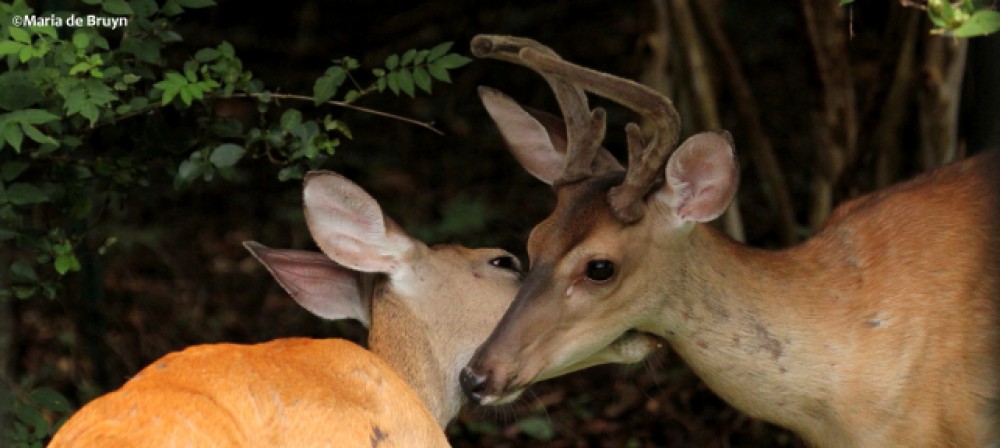
 I haven’t seen a wide variety of mammals lately except for the ubiquitous Eastern chipmunks, gray squirrels, Eastern cottontail rabbits and Eastern white-tailed deer in my yard. It’s always a treat for me to see some of the aquatic ones when out on walks, such as the river otters (Lontra canadensis) and the North American beaver (Castor canadensis).


 In contrast, the lovely little chipping sparrows (Spizella passerina) are birds that I often see in my yard and at my feeders. This pair was resting in a tree top near a former dairy farm, which is now being turned into a vast vineyard. Much of the birds’ habitat has been removed during this changeover to my great disappointment.
 One bird that still remains in that area is the solitary sandpiper (Tringa solitaria), which is easily recognizable by its habit of bobbing its rear end as it walks along shores looking for food.


 My beautiful world