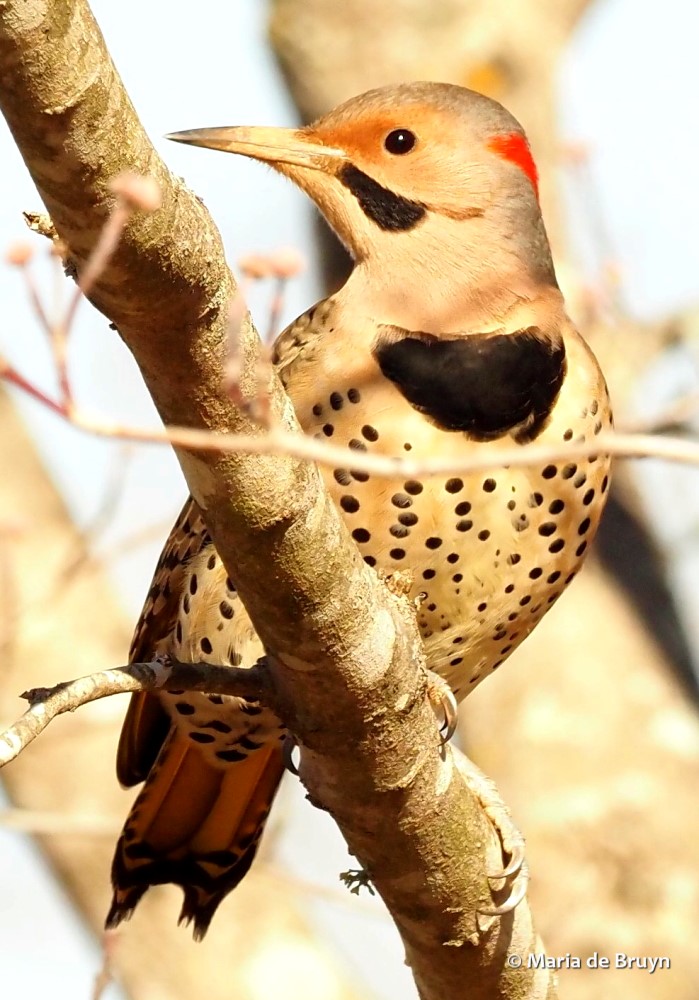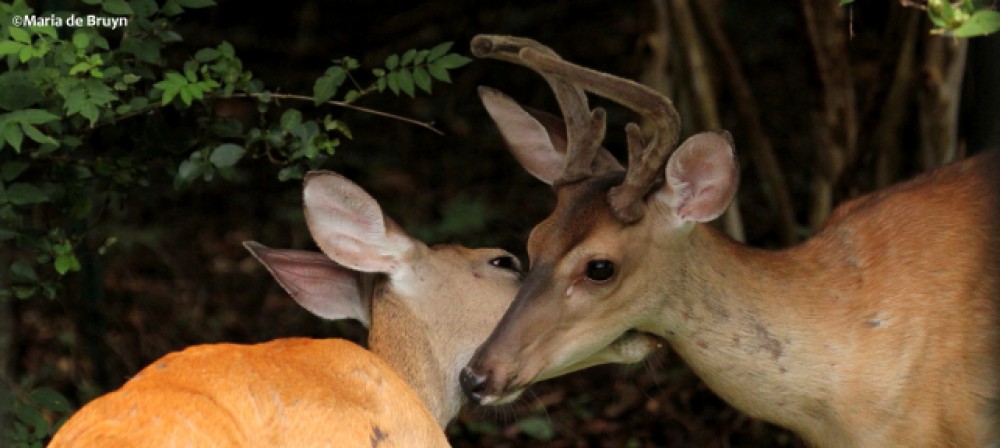
They’re baaaack!!! — and so am I! Part 1

The Great Southern Brood is here!

It’s been over a half year since I’ve written a blog (although I’ve penned a monthly newspaper column and a few articles in the meantime). Numerous concerns including ill health kept leading to blog postponements. Fortunately, I’ve been able to continue my nature observations, a boon to keeping things on a somewhat even keel. And lately it’s been my privilege to see some interesting creatures and to witness behaviors I’d not seen before in person.

The immediate inspiration for resuming my blogs has been the emergence of the Great Southern Brood XIX (Magicicada spp.) of periodical cicadas — an animal species which humans only get to see every 13 years! This is the largest cicada brood in eastern North America, which is the only geographical area where they occur. I’ll share some of my current sightings and interesting tidbits about them and hope you enjoy this in a two-part blog.

Periodical cicada eggs, laid above ground, hatch into nymphs which then go underground to pass through five juvenile stages before emerging 13 years later by the hundreds of thousands (even millions!). After emergence, they only live a few weeks, purely for the purpose of finding a mate and reproducing their species.
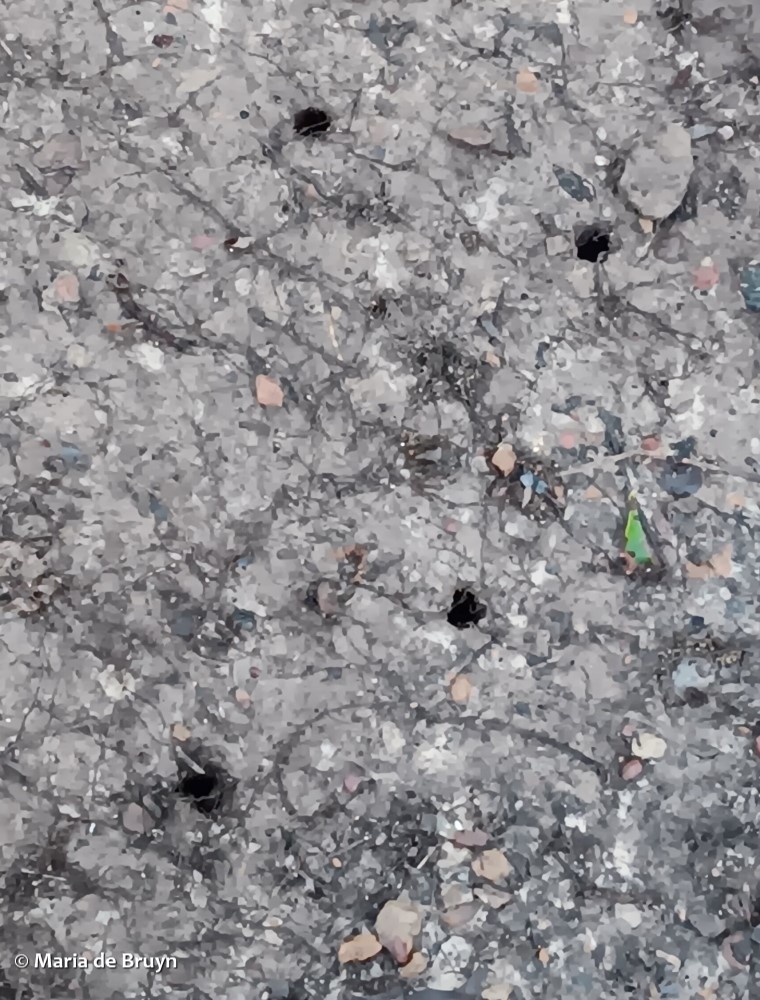
One of the first noticeable things to alert humans to the coming “deluge” of cicadas, seen above, is the appearance of numerous holes in the earth as they tunnel out to the fresh air. This happens when the ground reaches a temperature of about 64°F/17.8°C.
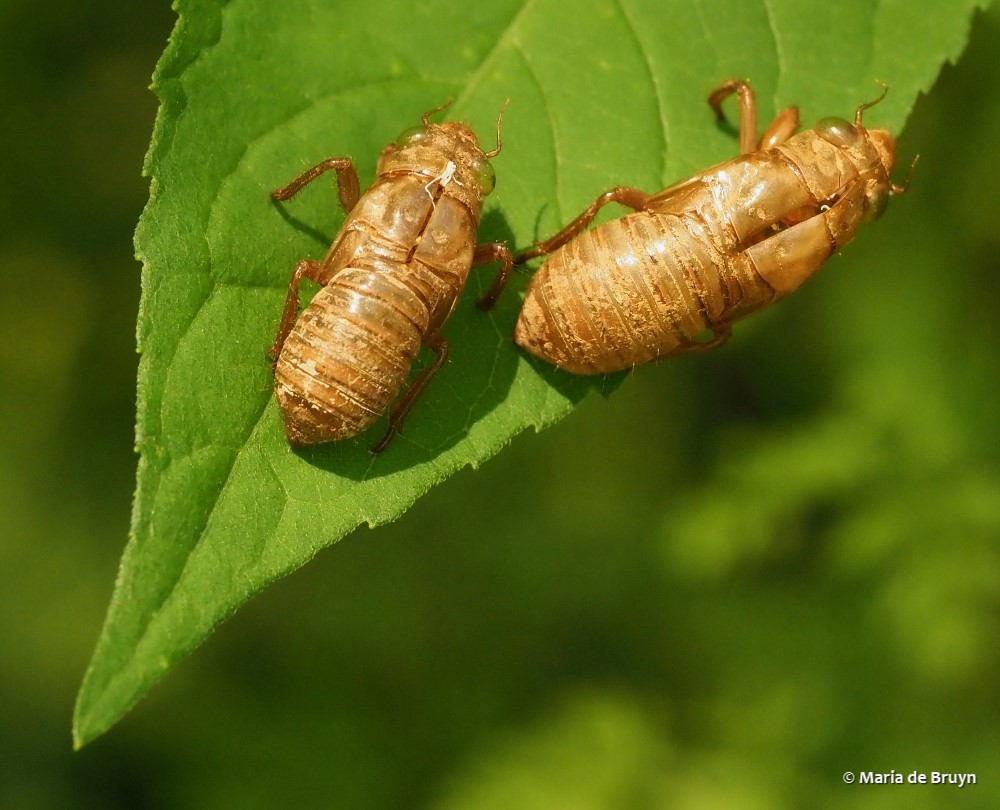
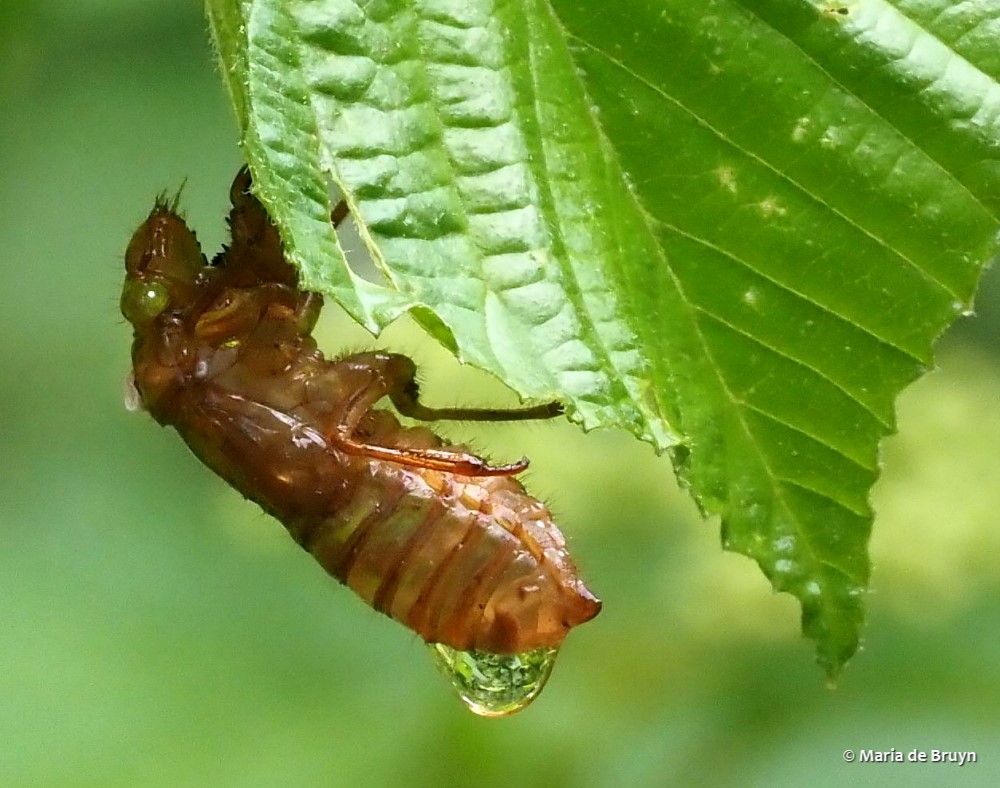
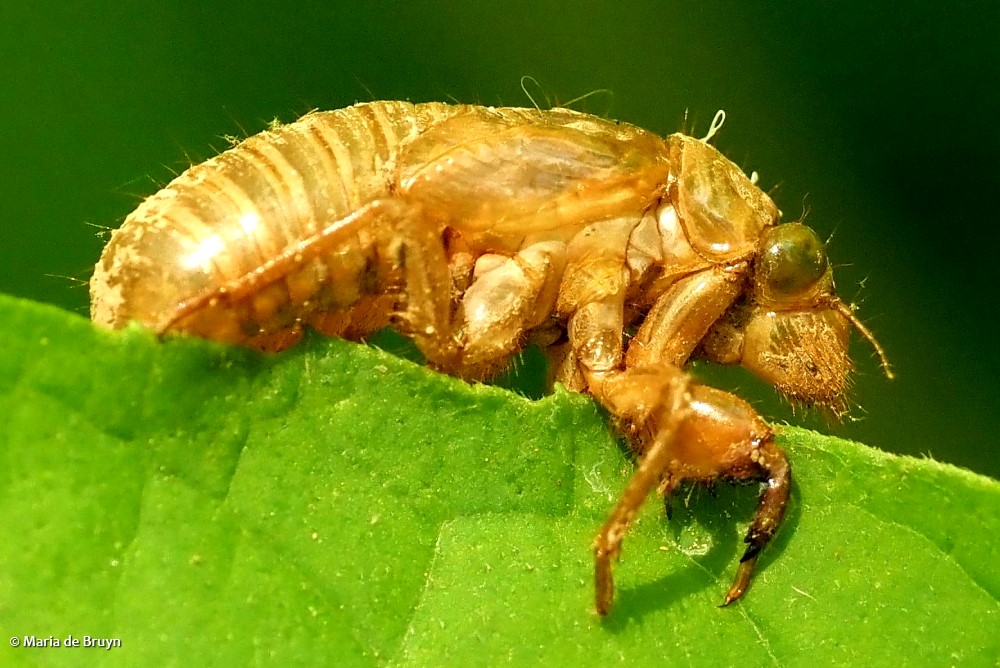
What emerges from the holes are brownish-tan nymphs, who crawl onto plant stems and tree trunks. Underground, they will have undergone four moulting periods as they grew during the past 13 years.
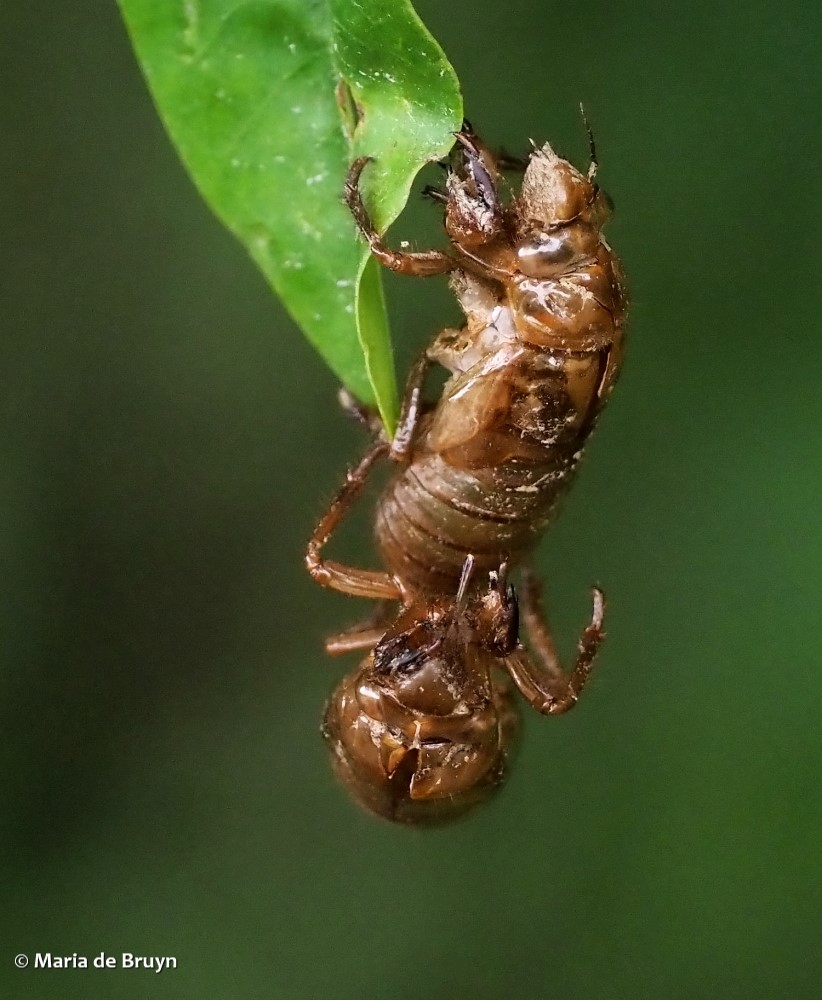
The vegetation becomes laden with these still immature insects almost everywhere you look.


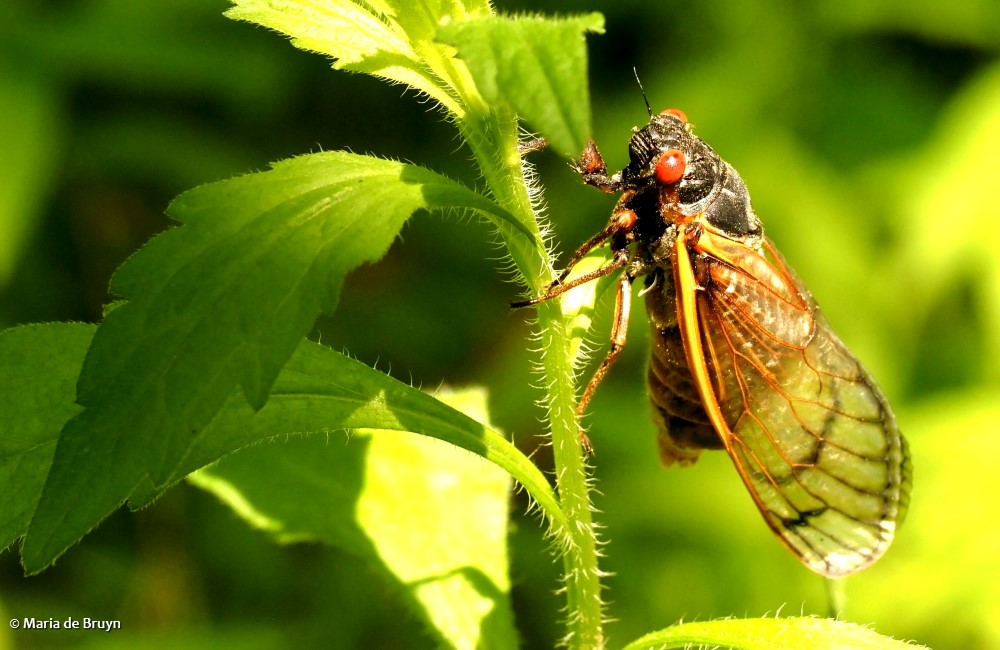
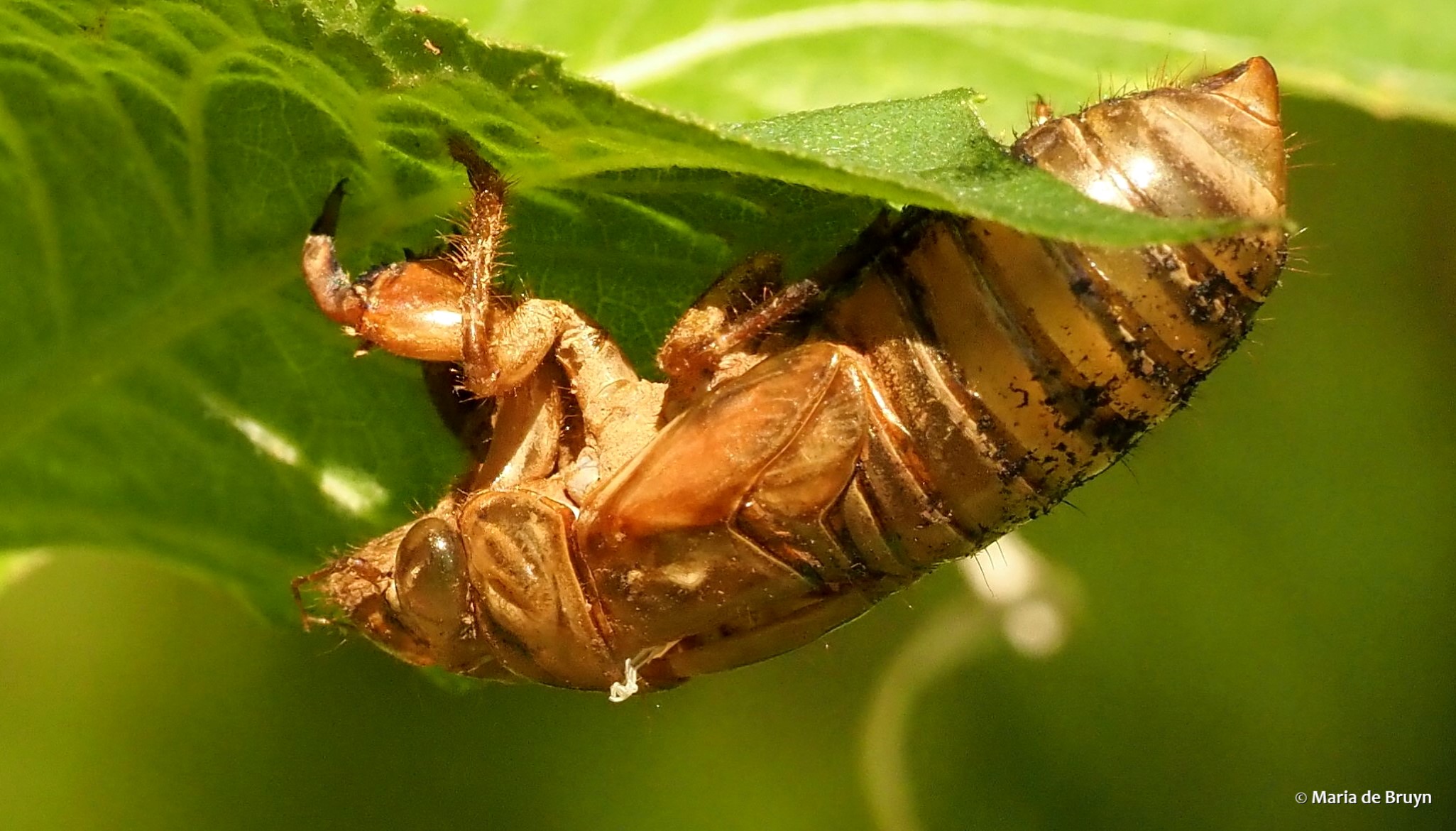
The adults emerge from their last exoskeleton through the back, which splits open. If you look carefully below, you can see one emerging on the right.
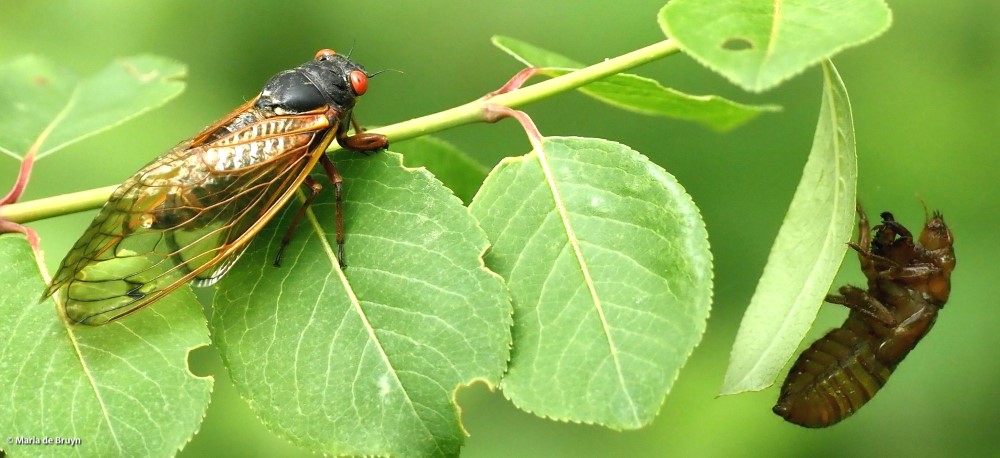
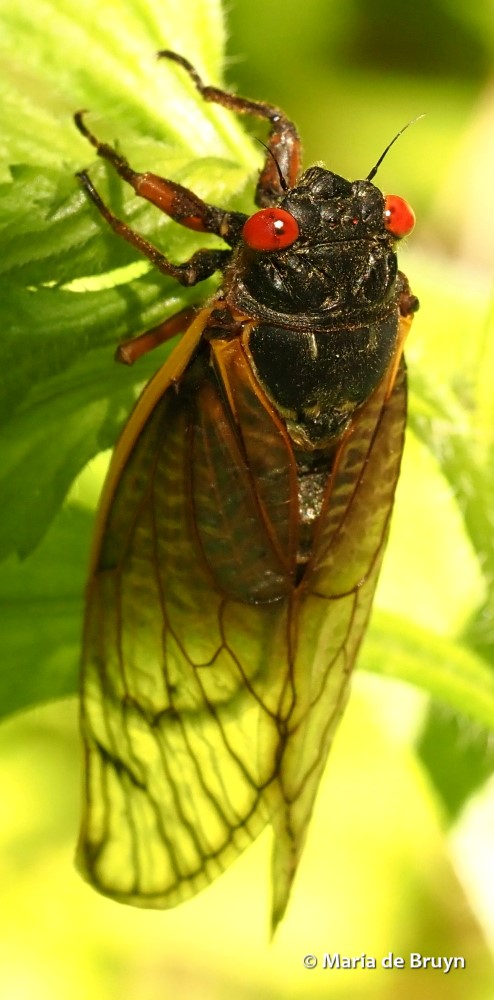
The newly emerged cicadas then undergo a quick maturation process within an hour or so.

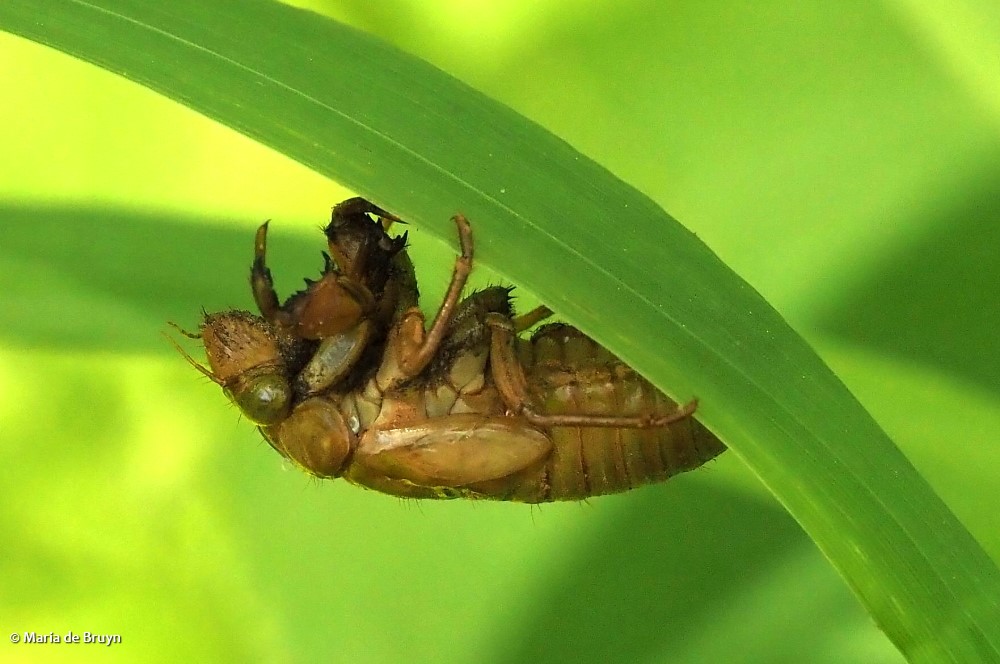
They must unfurl and flex their new wings.

Their orange eyes take on a deep red — in my view mesmerizing — hue.


Seen head-on, their faces look to me as if there is a car grill in the middle.

The adults can’t fly right away after emergence but must make several attempts to get airborne.

When the adults are ready to meet, the males begin making calls and songs, using a pair of ridged membranes on their abdomens. Some calls are a sign to gather; others are alarm calls made when the cicadas are handled.
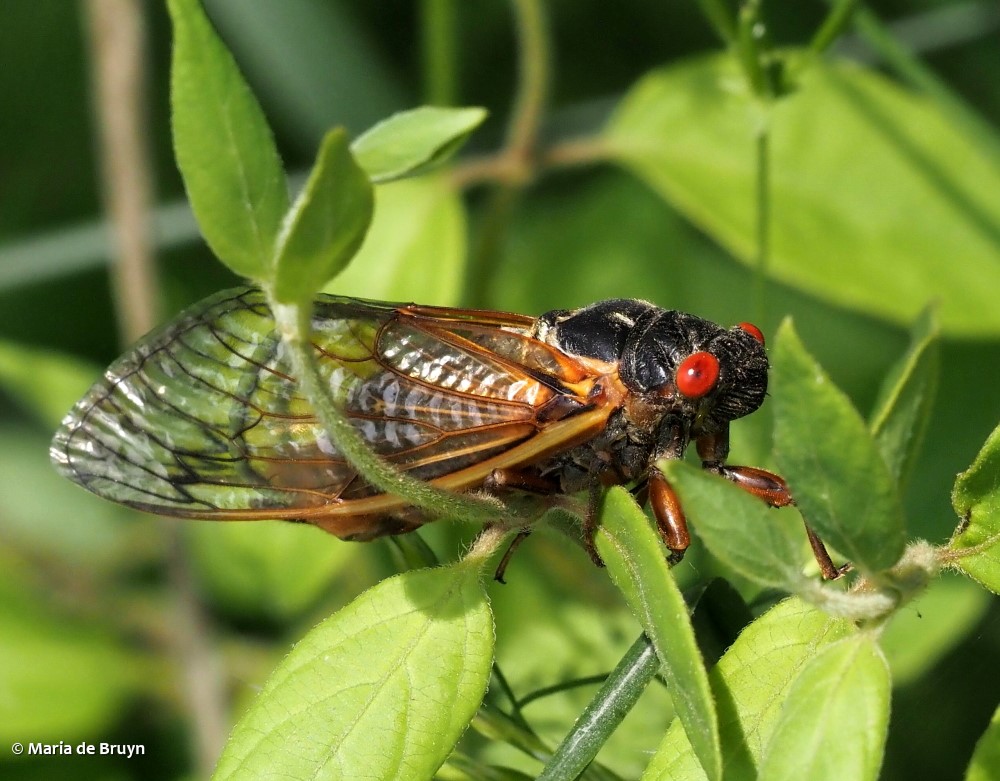


Their hollow abdomens are thought to act as a resonating chamber, increasing the volume of their already-loud sounds, When they gather in groups of hundreds and more, the volume can be astounding, reaching the level of a chainsaw or motorcycle.


In our area, numerous inquiries on neighborhood listservs commented on the growing and ongoing noise:

  • Is there a sound like a siren going off that you can hear? It seems to be getting louder.
  • Perhaps the machines grinding rocks to expand I 40 [highway].
  • Alien invasion 😂
  • The noise is continual with no change in pitch or volume. Sounds man made.
  • This is some sort of machine or something running all day long.
  • I was so intrigued as well that I called the energy company to investigate the cause of the intense noise!
  • Miniature Flying UFOs made to look like Cicadas.
  • This morning, I walked inside my house looking 👀 for the toilet that I thought was running.

Some people made analogies for what they thought the cicada ‘songs’ were like:

  • To me it sounds like alien spaceships are landing – just like in a 1950’s creature feature.
  • It sounds like the flying saucers in old 1950s movies.
  • I think the 13-year bunch sound like the phasers on the original Star Trek show.
  • To me they sound just like 18wheel rigs all revving up their engines.
  • The sound to me is like “environmental tinnitus”. 🙂 [Response] Exactly, but it actually helps my tinnitus!
  • Sounds like heavy traffic in another decade or two with everyone driving electric vehicles. [Response] My hybrid has that same sound (only quieter) to warn people/animals that I am backing up. When my car is operating under battery power, it’s silent, so manufacturers added that sound to warn people and wildlife away. You are so right. That may be the sound of the future. AAAAGH!
Others appreciated this natural phenomenon:

  • Sounds great.
  • I guess I am rare in thinking they are cool. It feels other worldly….
  • And it’s all about SEX. Just think about all those teenage hot-rodders gunning their engines to attract attention. They’re all saying “Come and get me baby. I’m HOT.” After years underground, you would be too.
Finally, some listserv readers tired of all the comments after a while:

  • Please stop asking about the sound Cicadas make! Please! And if someone answers, why do 50 people feel the need to respond? I feel that so much of the posts are so religious. Does anyone else feel this way?… I didn’t mean religious ! I meant repetitive!
  • Cicadas are a plague sent from God signalling the End Of Time. The purple glow in the sky last night [Northern Lights] was the Rapture, and, since we’re still here … well, there’s that…
  • If you don’t like it stop looking at the posts.

In the next blog, I’ll explain a bit more about the periodical cicadas’ vulnerabilities and life cycle. And hopefully you’ll enjoy seeing some more photos of these creatures who won’t see the light again until 2037!

My welcome American crow friends

On numerous occasions over the past months, I’ve had ideas for new blogs and set aside photos for posting. But then other things crop up that need to be handled (health, car/house issues and a monthly newspaper column) and I put off blogging. So when fellow blogger Denzil asked his followers to post some photos of corvids, it was a great opportunity to share with you some of my latest photos of favorite visitors to my yard.

A pair of crows have been coming to visit my yard for many years now. I’ve had numerous opportunities to see them courting and looking for treats at bird feeders (and occasional pieces of apple that I put out when they come by). Above, one of them was addressing me and then gave him/herself a kind of creepy look when s/he covered her/his eyes with the nictitating membrane.

Each year, mom and dad return with their newest brood in tow. Sometimes I think offspring from previous years also join the group as this year I’ve had 6 or 7 of them come by at a time.

They are fond of several kinds of bird food that I put out for other birds, including dried mealworms and my homemade suet.

They hang their big bodies off the feeders and then usually fly down to consume whatever morsels they have gotten.

They are a loquacious lot, communicating loudly among themselves much of the time.

They are loudest, however, when they gather together to chase off the red-tailed and Cooper’s hawks who also live in the neighborhood. The crow family does not like them at all and make it known to all their neighbors, avians and humans alike. The other birds are likely happy with their alarm calls as they disappear when warned of hawks in the vicinity.

And then the corvids can also relax, enjoying drinks and bathing in the yard birdbaths. When they appear to have enjoyed a treat, I sometimes find “gifts” left behind in the  brightest birdbath. One day, when I apparently had not given them something special for some time, they took off with a small ceramic turtle that they often would leave in the birdbath after a visit. I now wonder if they gifted another neighbor with that trinket.

Their visits are always welcome to me, perhaps because I haven’t seen them harassing any of the smaller birds. Denzil’s suggestion to post about corvids was a nice reminder of the birding pleasure “my” family of crows brings along.

Learning to love an over-protective bird

When house wrens (Troglodytes aedon) first began visiting my yard some years ago, I was not aware that they are extremely protective parents. I didn’t see them as often as birds of other species since they don’t come to my feeders and were not using nest boxes.


The past couple years, however, they have become more comfortable in my yard and began building their nests in boxes after all. This became problematic for me and especially the other species who use the boxes — Eastern bluebirds, Carolina chickadees and brown-headed nuthatches. The reason?

House wrens do their utmost to drive other birds out of their territory so that there is no competition for food needed by their nestlings and fledglings. This protectiveness makes them go so far as to peck other birds’ eggs, which they have done with chickadees and bluebirds in my yard.

Very unfortunately (and upsetting to me), they even killed two nestling nuthatches one year. The other two nuthatch babies managed to fledge. This behavior led a birder, Althea Sherman, to launch a crusade against house wrens in scientific journals in the early 1900s. Now, there are instructions online on how the wrens can be discouraged, for example, on a website devoted to bluebirds.

This year, Eastern bluebirds (Sialia sialis) were tending four eggs in one box and a house wren tried to invade. The parents were very protective and successfully drove the wren away (photo below). Another pair of bluebirds had nested early and managed to guide their young to fledging. They then abandoned my backyard for nesting and the house wrens had no rivals for nest boxes in that area for the rest of breeding season.

House wrens are one of the bird species banded in my yard each year for the Smithsonian Institution’s Neighborhood Nestwatch program. This year the bird bander noticed their nest with babies in a backyard nest box, so she upped the chances of catching one by counting on their extremely protective nature.

A net was put up not far from the box and the bird bander played the call of another house wren. This resulted in both mama and papa wren getting inadvertently caught up in the net while trying to drive away the intruder. They were both banded and then immediately let go so they could resume feeding their babies.

The four woodpiles in my backyard were like a larder for them because they host a plethora of insects.


And the house wrens are obviously not that choosy about which insects they eat. Mama and Papa brought a large variety to their ever-hungry nestlings.


The parents were also very good at keeping the nest clean.

The three nestlings appeared to be producing numerous fecal sacs so that mom and dad were constantly checking the nest for them and flying them away.


At one point, it was interesting that when the male wren brought a large insect to the nest, he handed it over to the female, who was waiting a bit after having just given the babies food.


Eventually, the large meal was delivered to the nestlings.


As the days went by, the nestlings became louder and more insistent on being fed and the parents scarcely paused in their efforts to keep the meals coming and the nest clean. It must have been a relief for the parents when the babies finally left the nest box because they could now take a breather now and then.


Right after fledging, the parents were still busy. The fledglings had not yet flown far so I could see the first post-fledging feeding session for one young wren.

I had learned that house wrens sometimes incorporate spider egg sacs into the nests they build because the hatched spiders eat nest parasites and thereby help protect the developing nestlings! The parents also fed mother spiders and egg sacs to their young. Just after fledging I caught a circle-of-life moment when a parental wren fed a mother spider with her attached egg sac to a fledgling – the death of the poor insect furthered the life of the new bird.

I could see and hear the parent house wrens continuing to feed the fledglings that afternoon. But after a while they appear to have moved to another yard, where they likely weren’t dealing with humans closely watching.


The Eastern bluebirds have a new nest in my front yard now with four eggs, so my nest watching can continue for a while. And the juvenile birds of other species coming to the feeders are entertaining, too.

The porch as a place of peril

It’s been quite a while since my last blog; other things keep getting in the way of my writing! In any case, I’d promised you a tale of a close encounter with a hawk; here it finally is!

1 Cooper's hawk P5034652© Maria de Bruyn res

Immature Cooper’s hawk

I really enjoy watching raptors and, fortunately, I see them regularly on my nature walks. While I can spend quite a while just watching them soar, build nests and care for their young, I admittedly don’t always enjoy seeing them eat.

2 barred owl P4137980© Maria de Bruyn res sgd

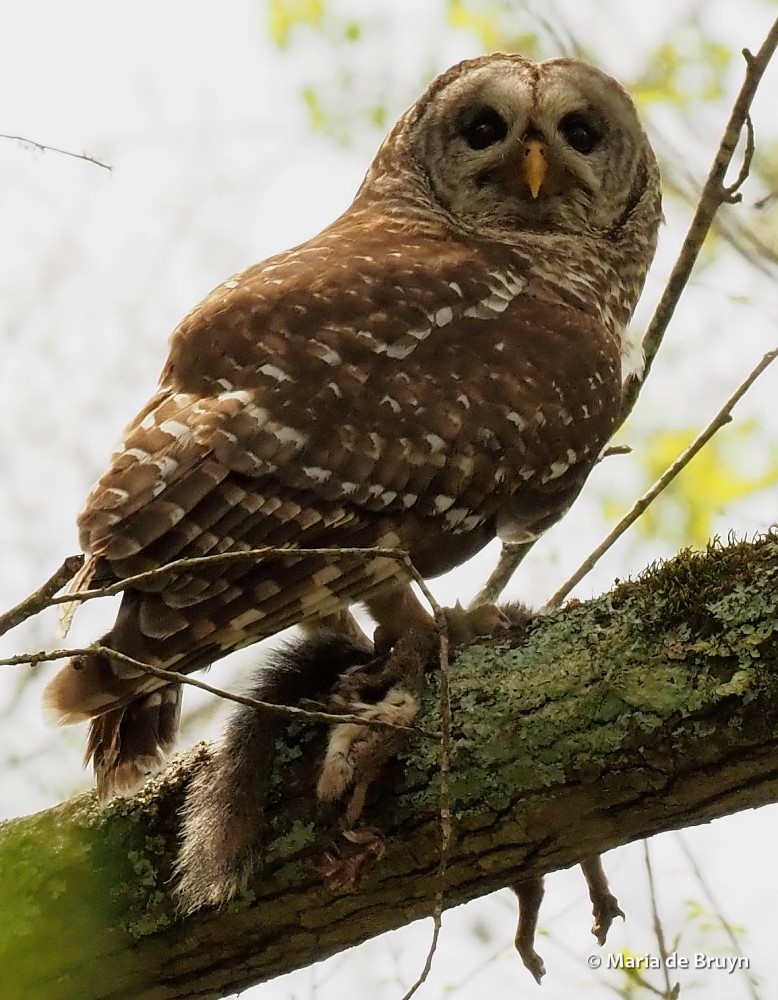
When songbirds eat insects, they dismantle and swallow them fairly quickly. When raptors dine, they rarely gulp down their food. Meals can last quite some time while they dismember their prey, as was the case for the barred owl above (Strix varia) who was eating a squirrel.

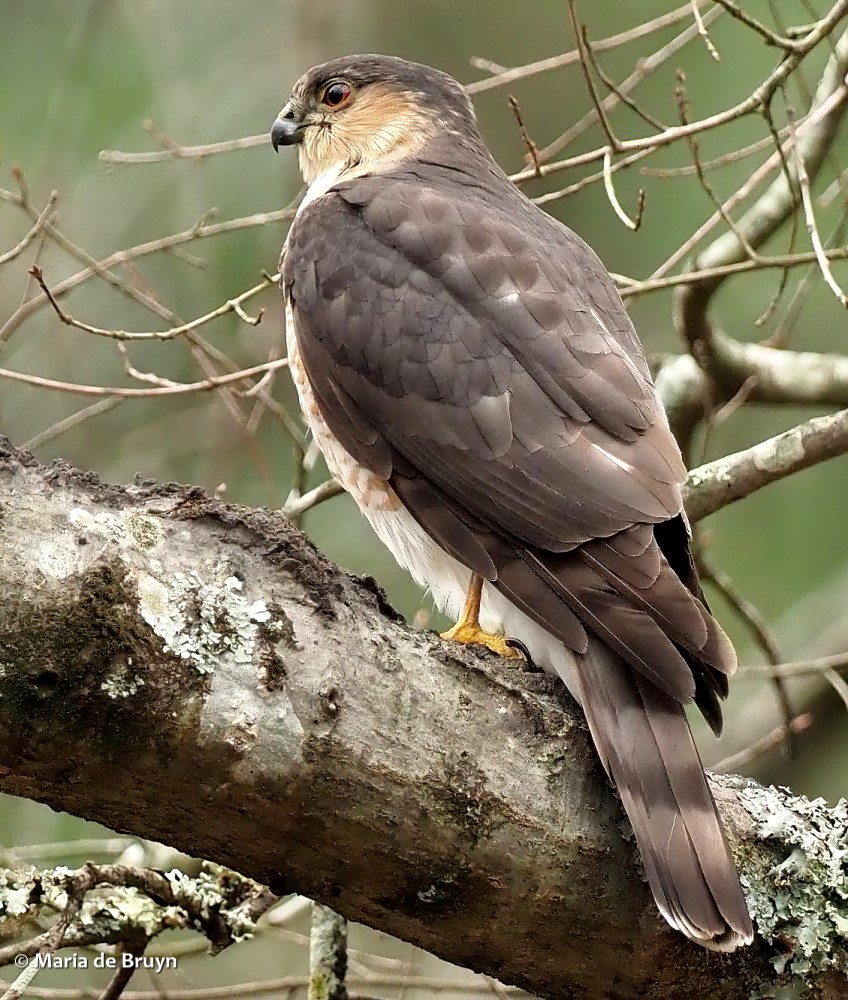
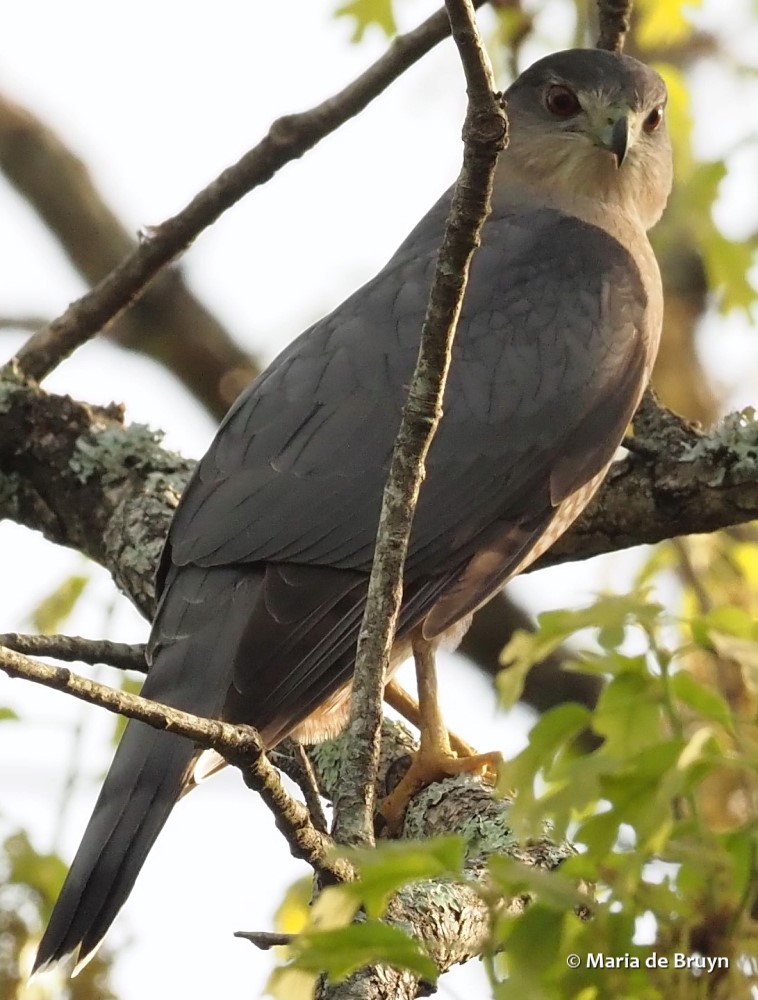
The hawks whom I see often include four species that frequent my neighborhood, including my yard — the red-shouldered hawk (Buteo lineatus), the red-tailed hawk (Buteo jamaicensis), the Cooper’s hawk (Accipiter cooperii) and the sharp-shinned hawk (Accipiter striatus).

3 sharp-shinned hawk P2121916 © Maria de Bruyn res ed      4 sharp-shinned hawk P2121932 © Maria de Bruyn-res ed

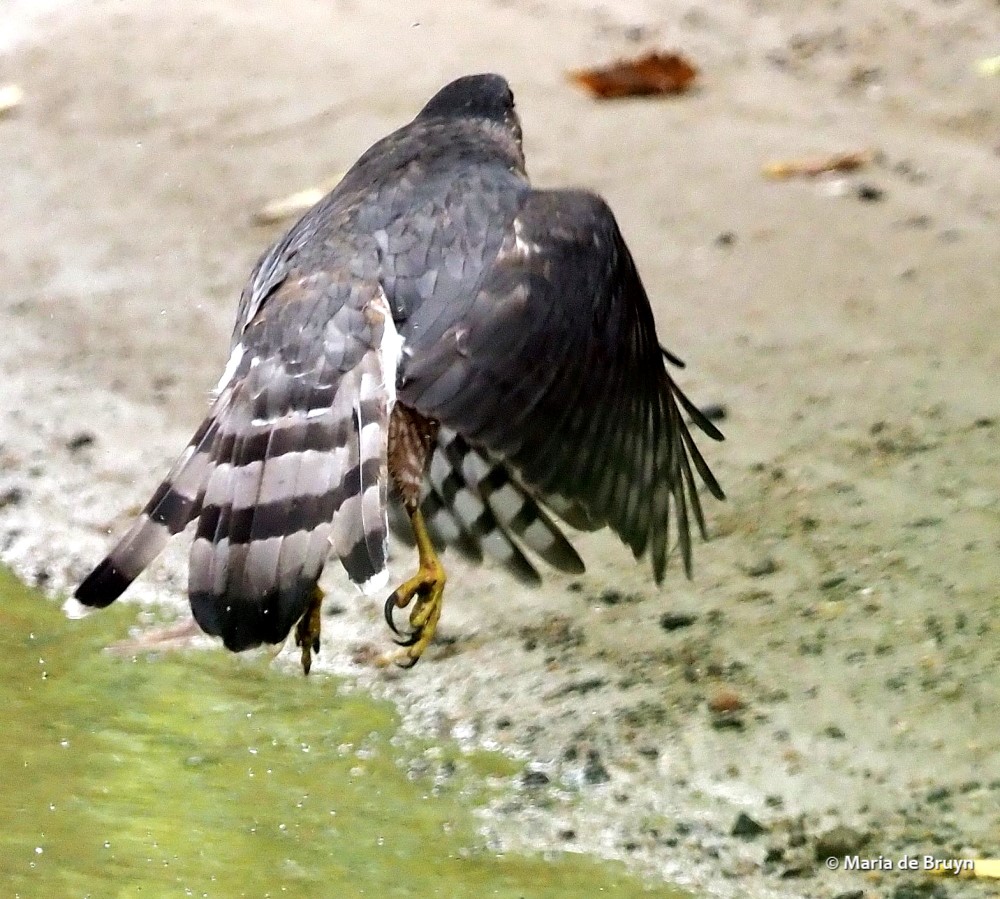
The Cooper’s and sharp-shinned hawks are the most frequent visitors. To inexperienced birders, they look very similar. Size is one clue to identity with a sharp-shinned hawk averaging 10-14 inches in length (jay- or dove-sized, 25-35 cm), and a Cooper’s hawk being about crow-sized, averaging 15-20 inches long (38-51 cm). The sharp-shinned hawks (seen above and below) don’t seem to visit as often as the Cooper’s hawks.

5 sharp-shinned hawk P2121946© Maria de Bruyn-res ed

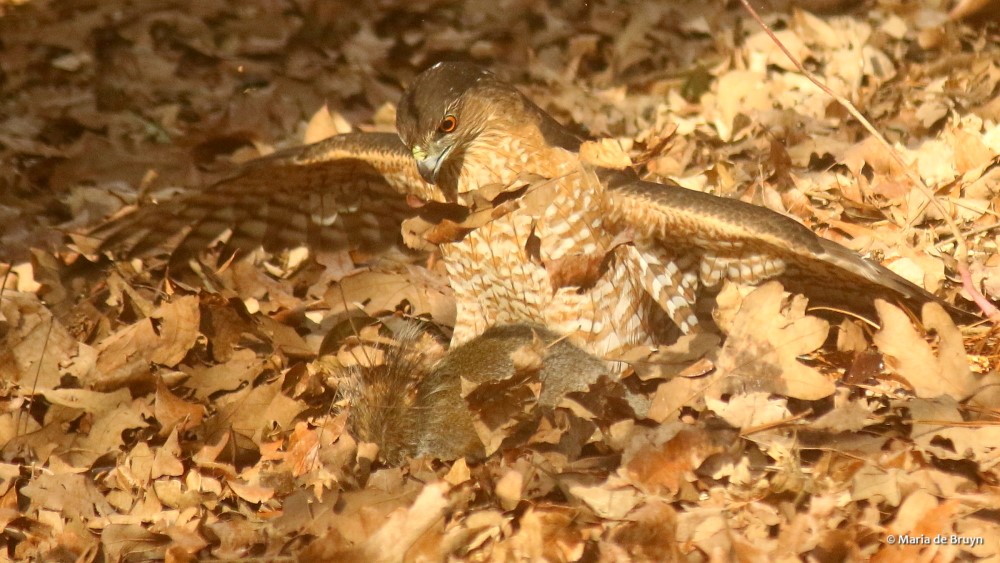
In 2019, a hawk caught a squirrel in my yard. Until recently, I was convinced that she was a red-shouldered hawk, but I decided to ask for confirmation from a raptor ID group on Facebook.

6 Cooper's hawk 2G0A3950© Maria de Bruyn res (2)

The experts informed me that she was an exceptionally large Cooper’s hawk. One commented: “Largest female Cooper’s are around 21 ounces; obese Eastern Gray Squirrels are around that but most we see are little more than half that. And even cargo helicopters strain to lift much more than their own weight. So unless I see rocket assists on a Sharp-shinned (maxing out at around 7 ounces) they can’t lift the full carcass of an adult EG Squirrel.”

7 Cooper's hawk 2G0A3959© Maria de Bruyn res (2)

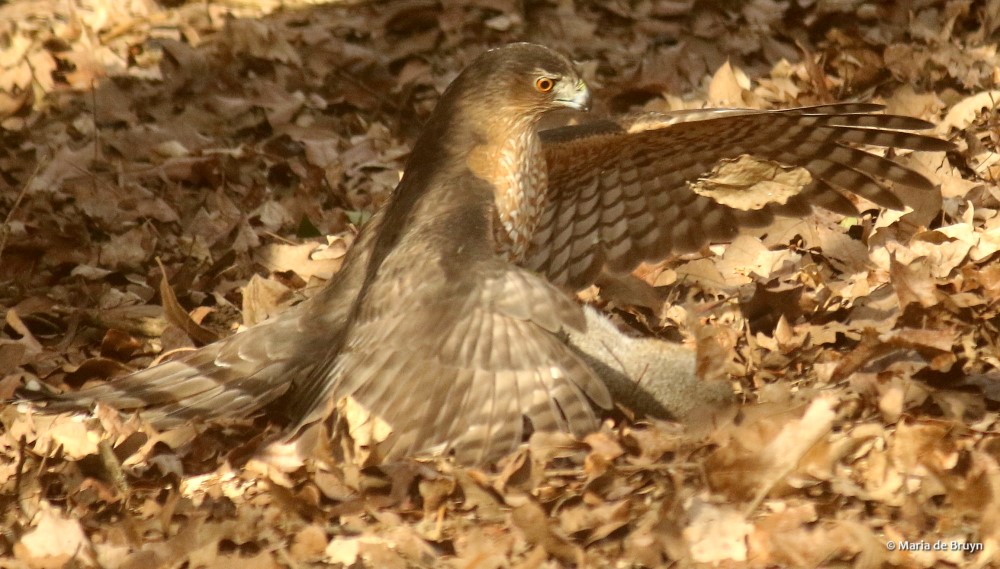
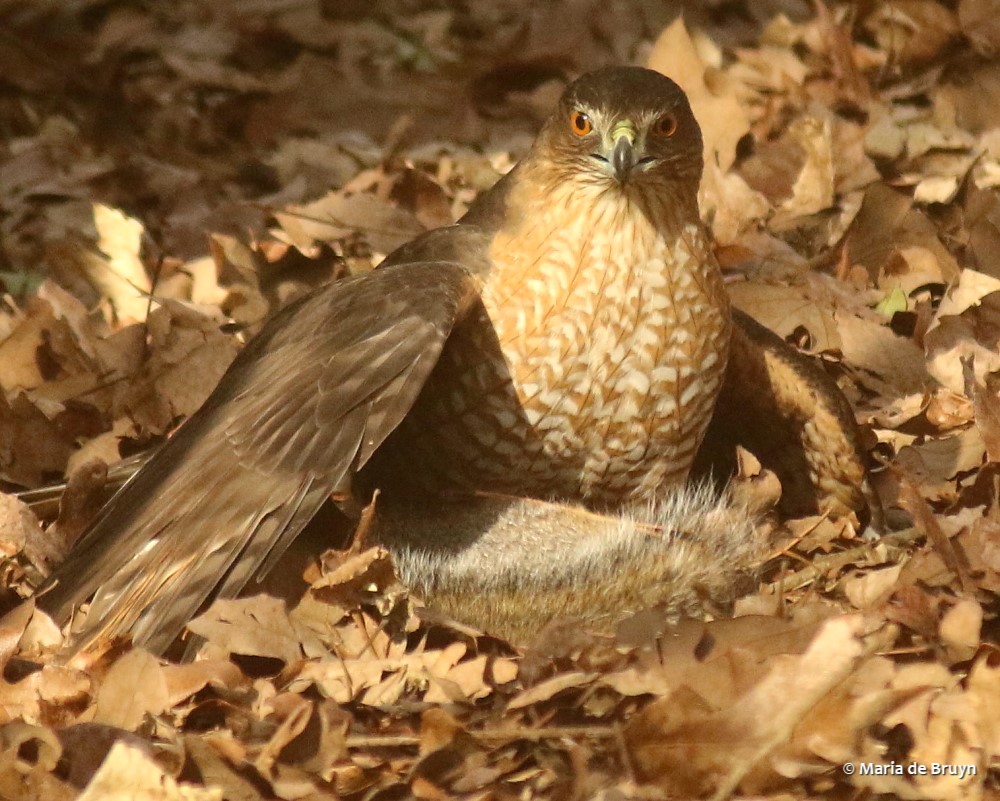
The female Cooper’s hawks are up to one-third larger in size than the males and she was a hefty individual. Nevertheless, she had her work cut out in subduing the squirrel.

8 Cooper's hawk 2G0A3949© Maria de Bruyn res (2)

While she was trying to hold onto and kill the rodent, a pair of crows began harassing her, but she held her ground.

9 Cooper's hawk 2G0A3963© Maria de Bruyn res (2)

Ultimately, she was able to put the squirrel out of its misery and she finally flew off with it to consume her meal elsewhere.

10 Cooper's hawk 2G0A4002© Maria de Bruyn res (2)

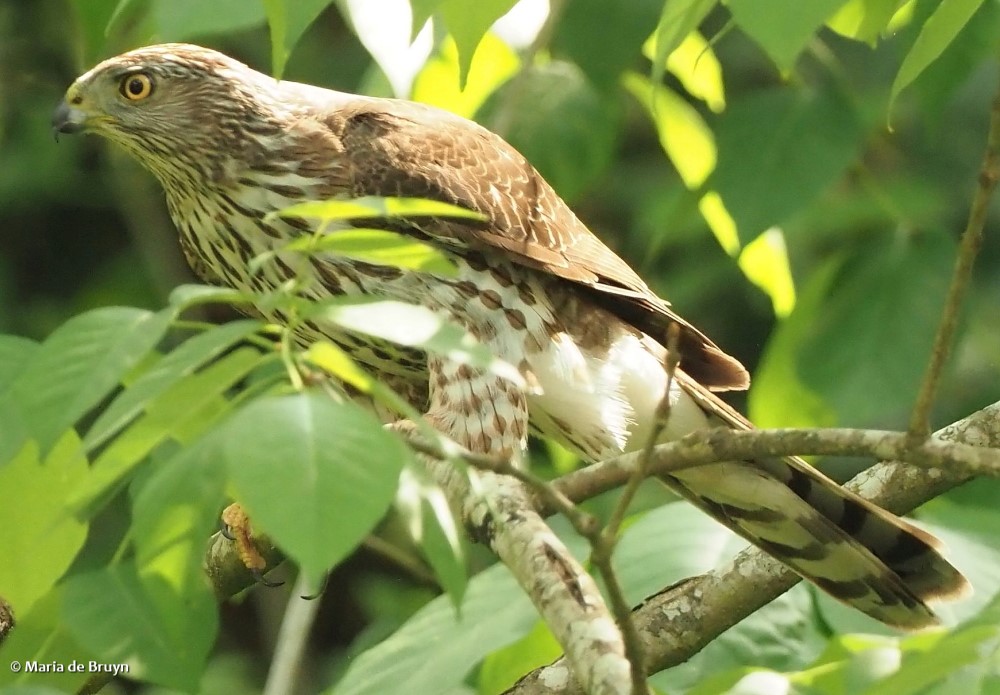
This year, I’ve had a young Cooper’s hawk come by; she was born in 2021 and seemed to be searching for something to make her day.

11 Cooper's hawk P5034613© Maria de Bruyn ed res

12 Cooper's hawk P5034638 © Maria de Bruyn res

13 Cooper's hawk P5034654 res

Above you see her eye covered by the nictitating membrane

My most surprising — and definitely hair-raising — encounter with a hawk occurred this past April. I was sitting in a porch chair in front of my living room window. As I looked down to record bird species for an online birding site, I heard a hard collision into the window right next to my head. A male brown-headed cowbird (Molothrus ater) fell into my lap.15 brown-headed cowbird PB137591© Maria de Bruyn res

He was completely stunned, and as I looked down, he slid off my lap. Then I looked up to see if he was being chased. That was indeed the case — a large Cooper’s hawk was coming right toward my face with his/her legs extended in front with widely-spread claws ready to grab prey. Of course, I had no time to take a photo, but the photo below of another Cooper’s hawk shows a bit what those claws are like. Their enlarged rear talons are about 0.67-0.85 in long (17-21.7 mm) in males and 0.78-1.05 in (19.8-26.7 mm) in female hawks. 

16 Cooper's hawk PA064226© Maria de Bruyn res (2)

My amazement at the proximity of the incoming raptor so stunned me that I waited a second or two before waving my arm and yelling to the bird to stop — s/he was only about 3 feet from me! The bird had been so focused on the prey, that my shout made the raptor try to “backpedal” in mid-air.

17 Cooper's hawk P3105244© Maria de Bruyn res ed

The hawk tumbled a bit, righted herself (I assume the size indicated a female) and then she shot up over the porch and house. The cowbird died and I laid him in the front yard, thinking she or another predator might take him. The next day, the cowbird was untouched, so I buried him.

18 Cooper's hawk P4138413 © Maria de Bruyn res (2)

The encounter occupied my thoughts for quite a long time afterwards. I felt incredibly lucky those claws had not reached my face or head with terrible results. It had not occurred to me that my front porch could be a place of potential avian-caused peril, but I learned a good lesson that day — always pay attention to your surroundings and stay alert when predators could be nearby!

Next blog: a few shots of some red-tailed and red-shouldered hawks that I’ve enjoyed taking over the past couple years.


Fabulous flickers – my faves!

Several birders of my acquaintance have a particular love for warblers. These birds often have stunning plumage, and it changes in many species between breeding and non-breeding seasons. I enjoy seeing the warblers, too, but it’s the woodpeckers that tend to keep me watching for longer periods when they appear. And I’m lucky that all the local species visit my yard at least occasionally, like the Northern flicker that startled a brown thrasher one year.

Unlike warblers, the woodpeckers’ plumage doesn’t often evoke words of wonder and appreciation. They don’t change from breeding to non-breeding plumage and some species even look almost identical. But I find them fascinating; my favorite (although I really like them all) is that stunning and fabulous flicker.

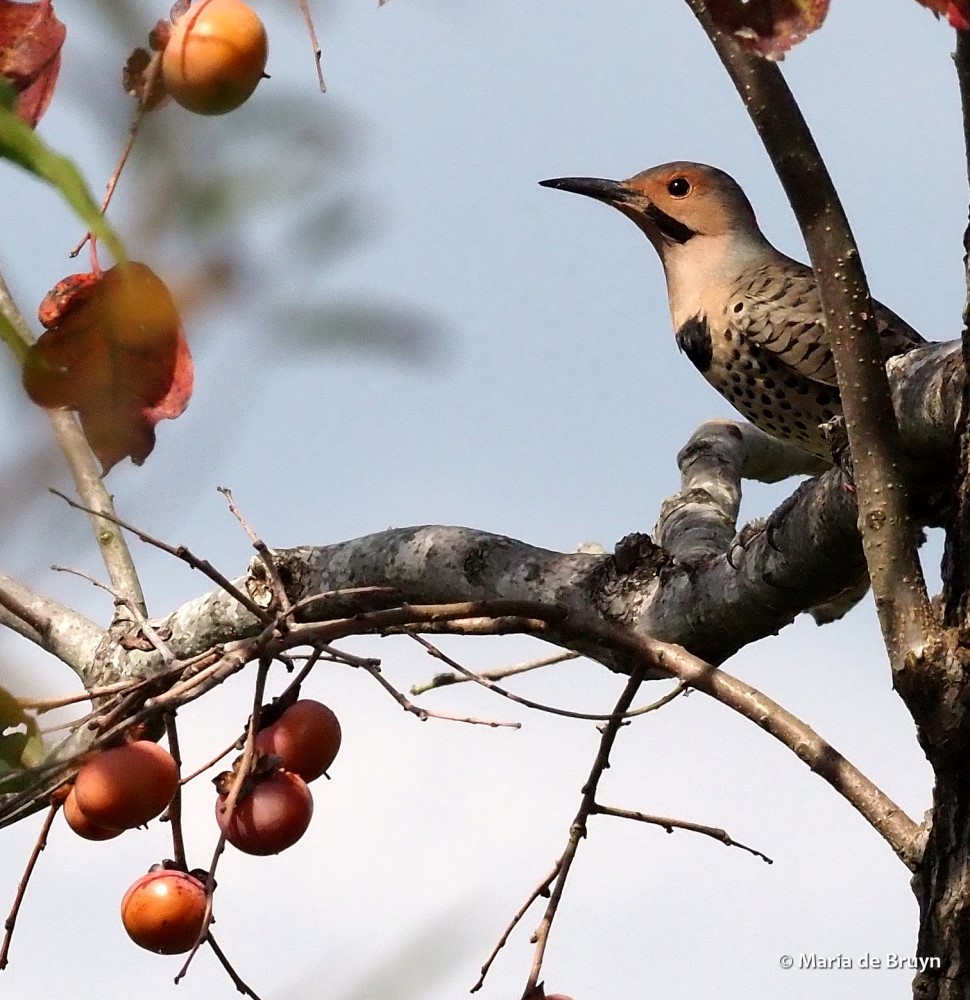
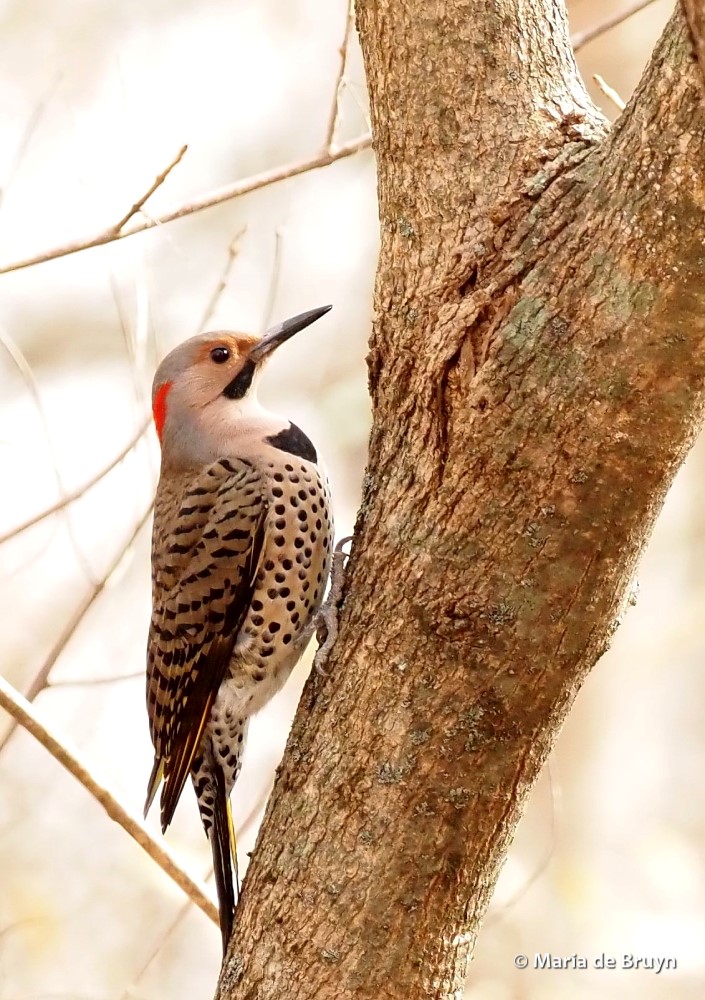
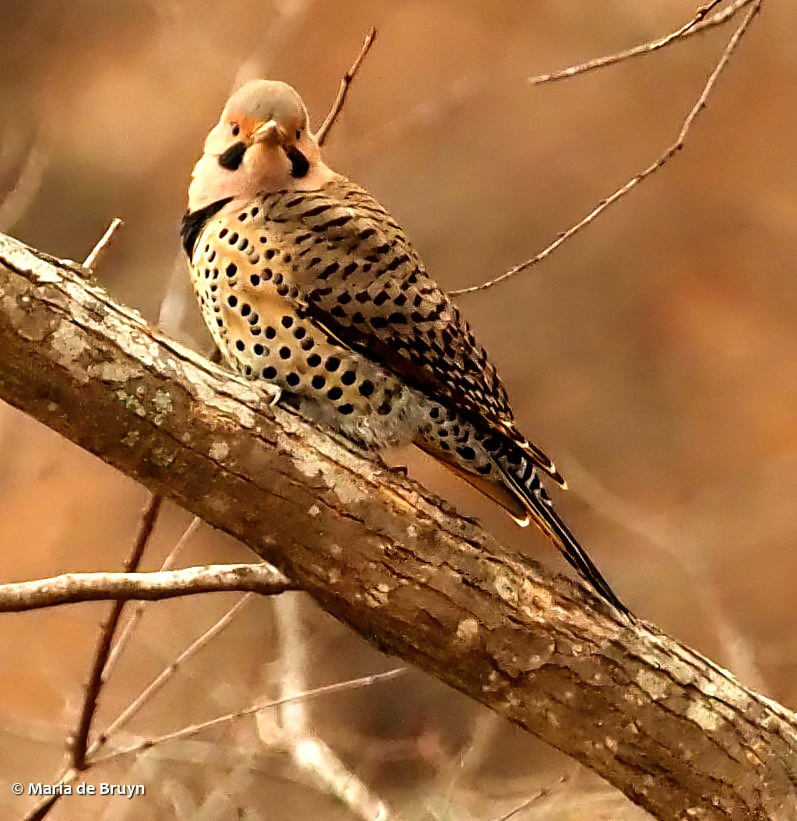
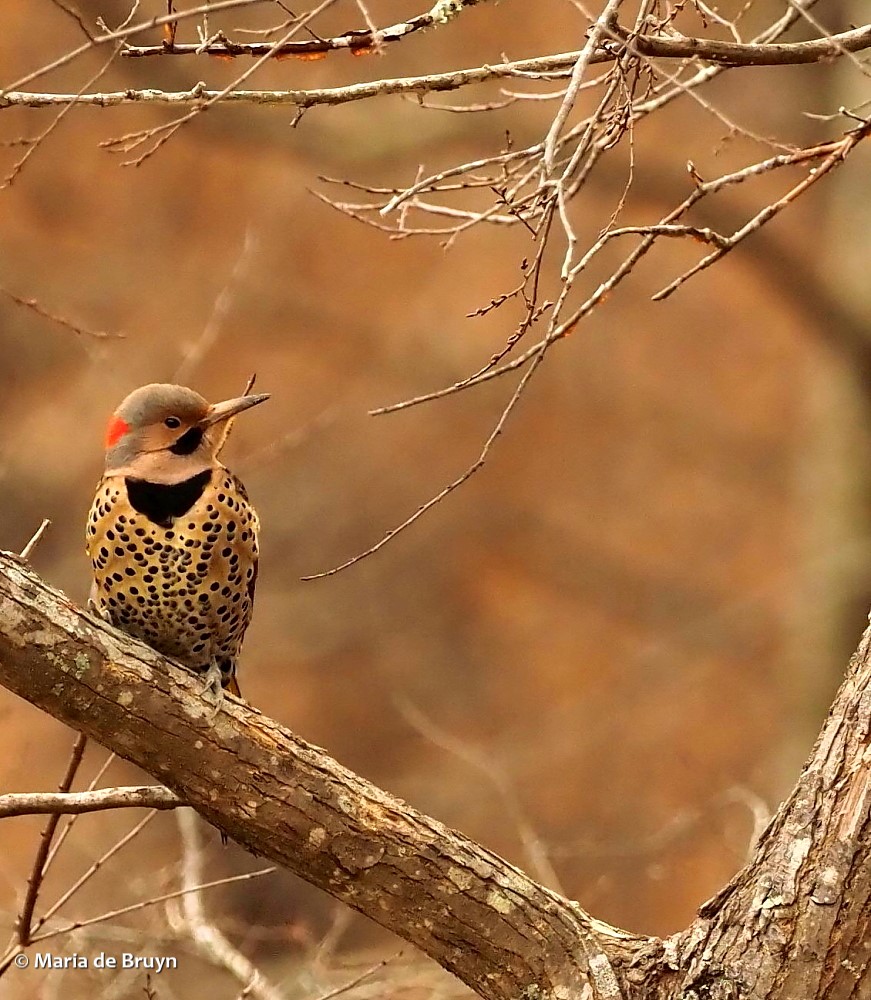
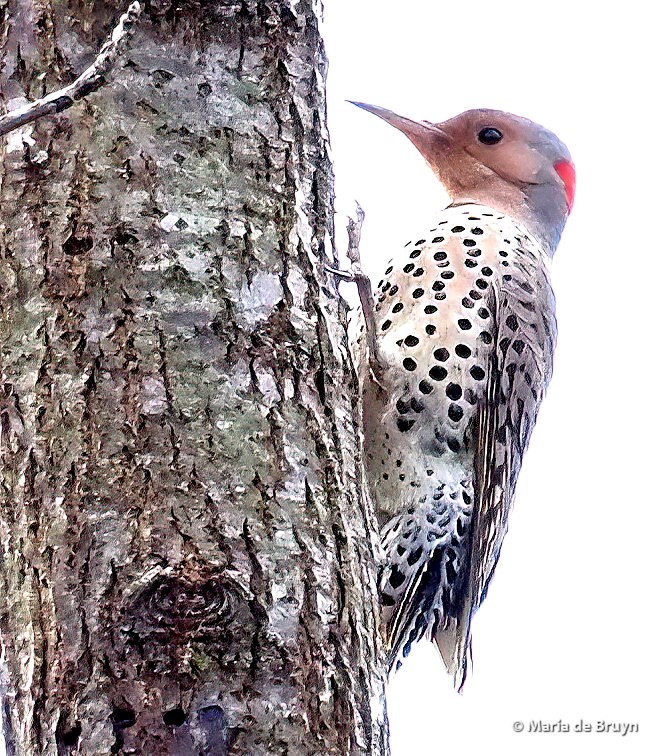
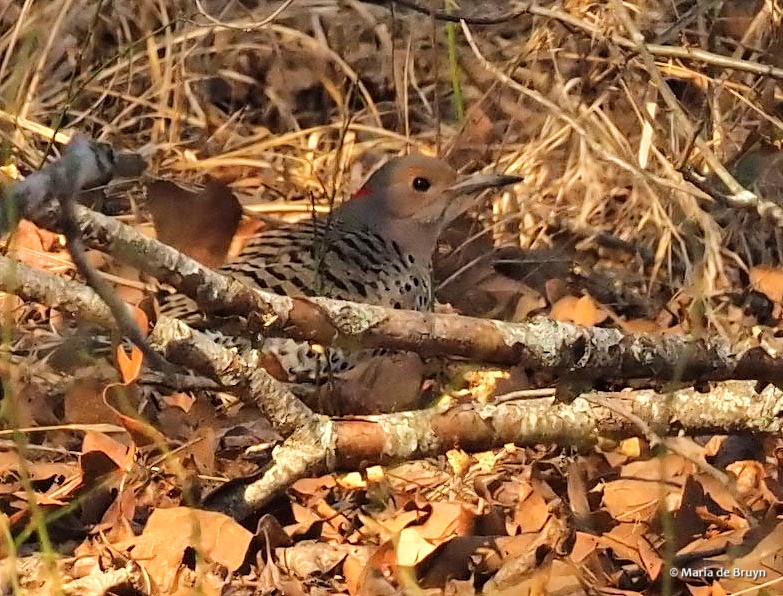
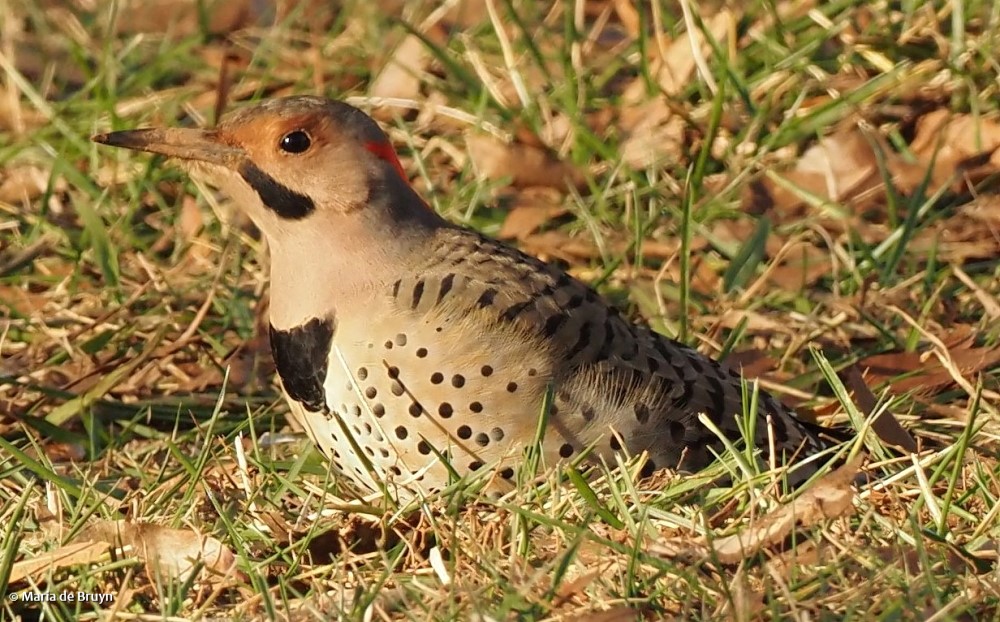
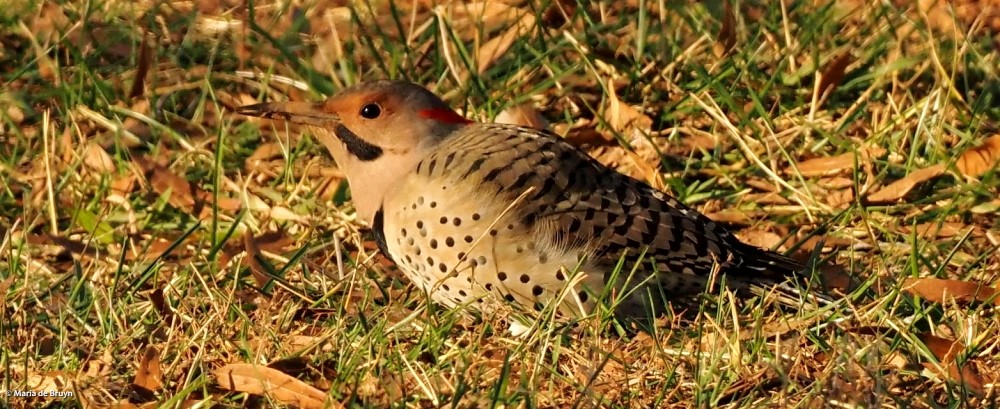
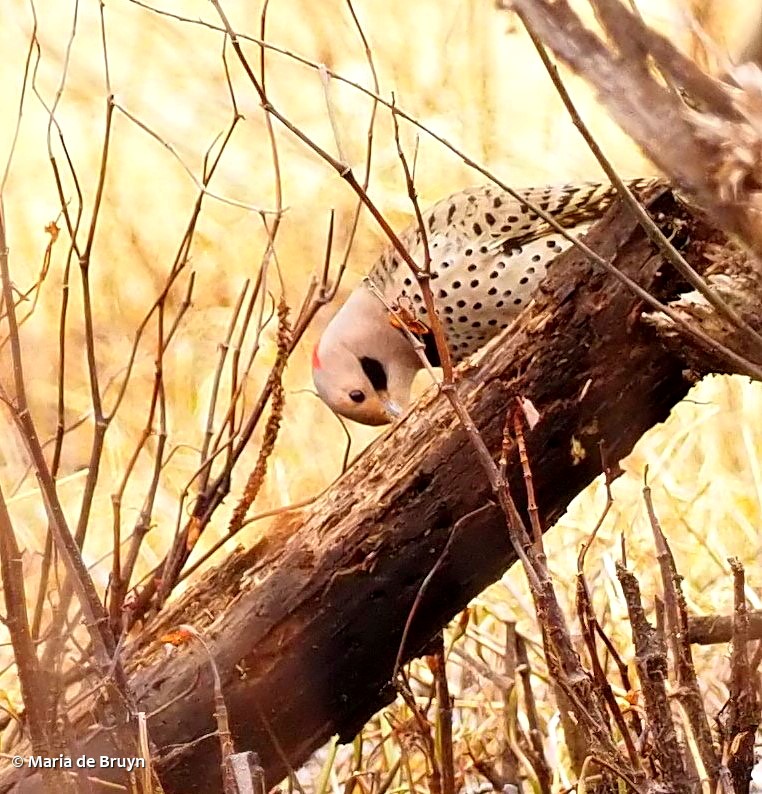
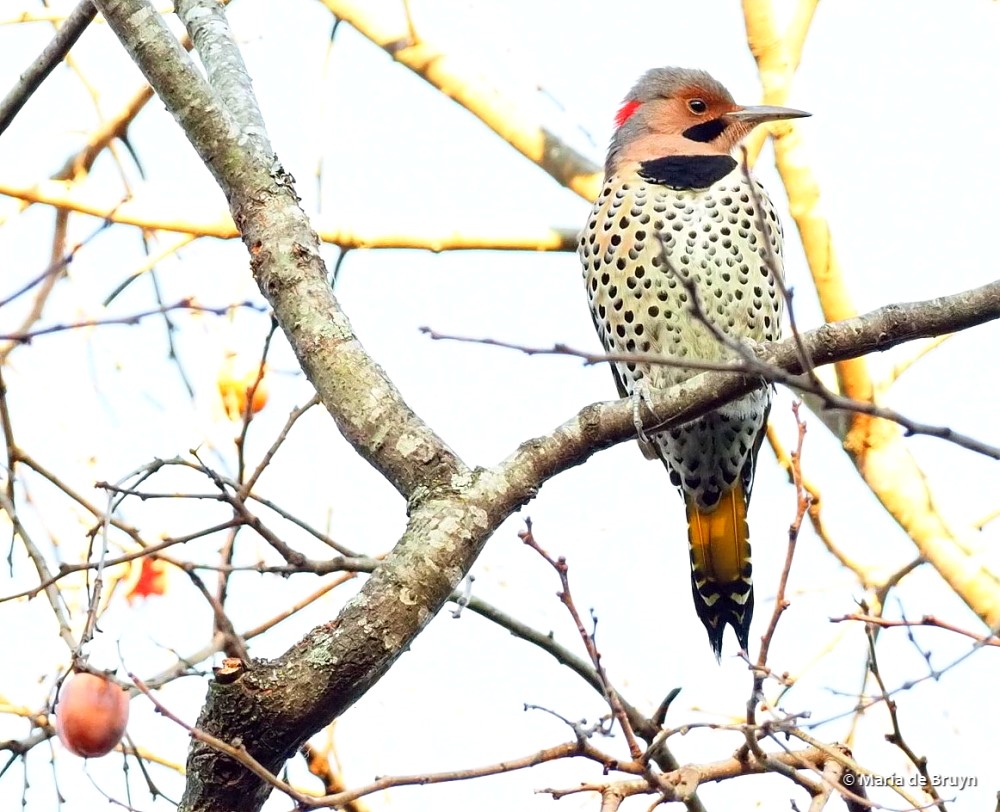
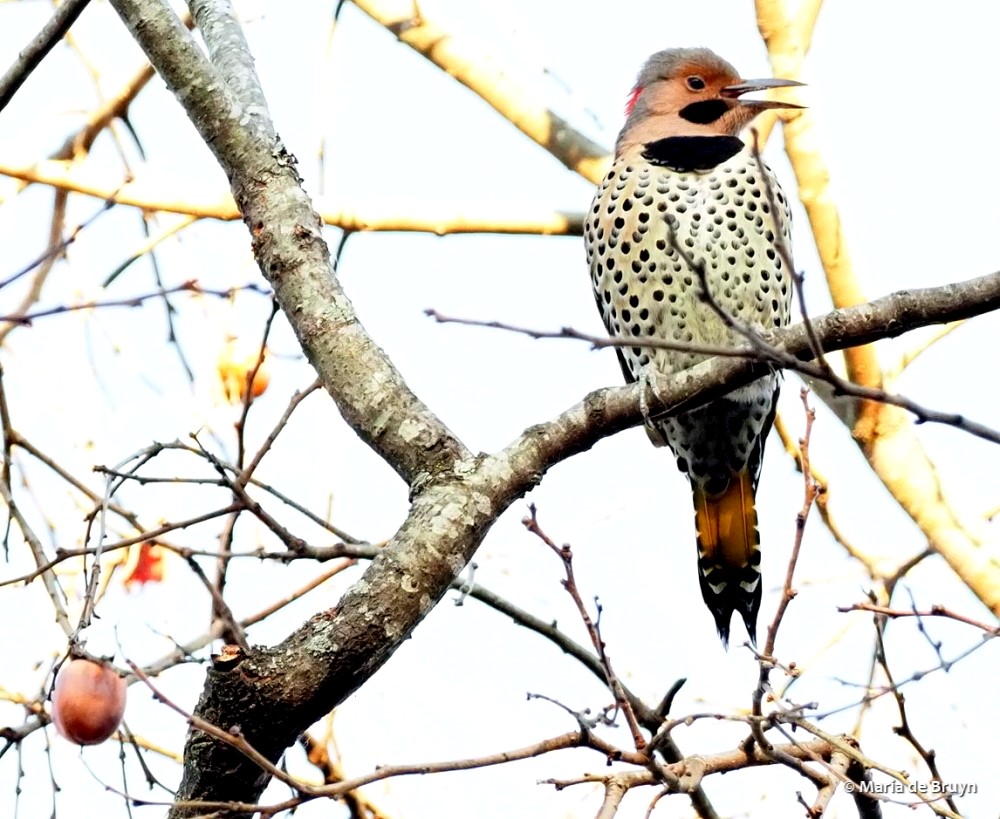
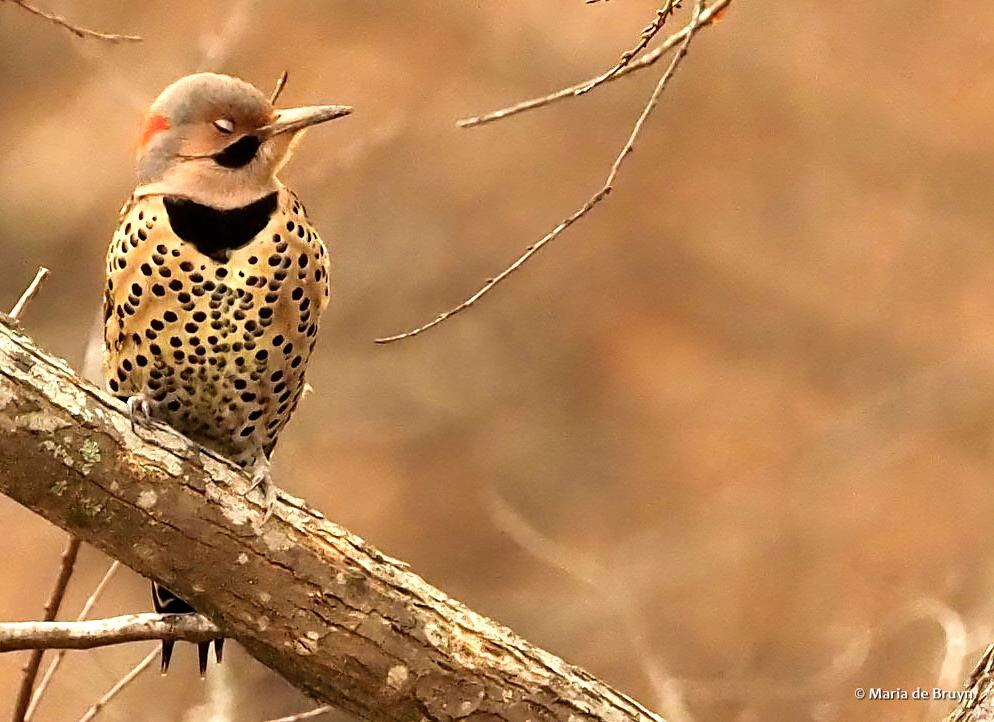
There are two major kinds of flickers in the USA. In the West, the main subspecies has reddish feathers in flight and is called red-shafted. In the East, we have yellow-shafted flickers (Colaptes auratus auratus). When these birds are simply perched, you mostly just see their muted tan coloring with dark spots on the breast.

4 Northern flicker PC061413 © Maria de Bruyn res sgd

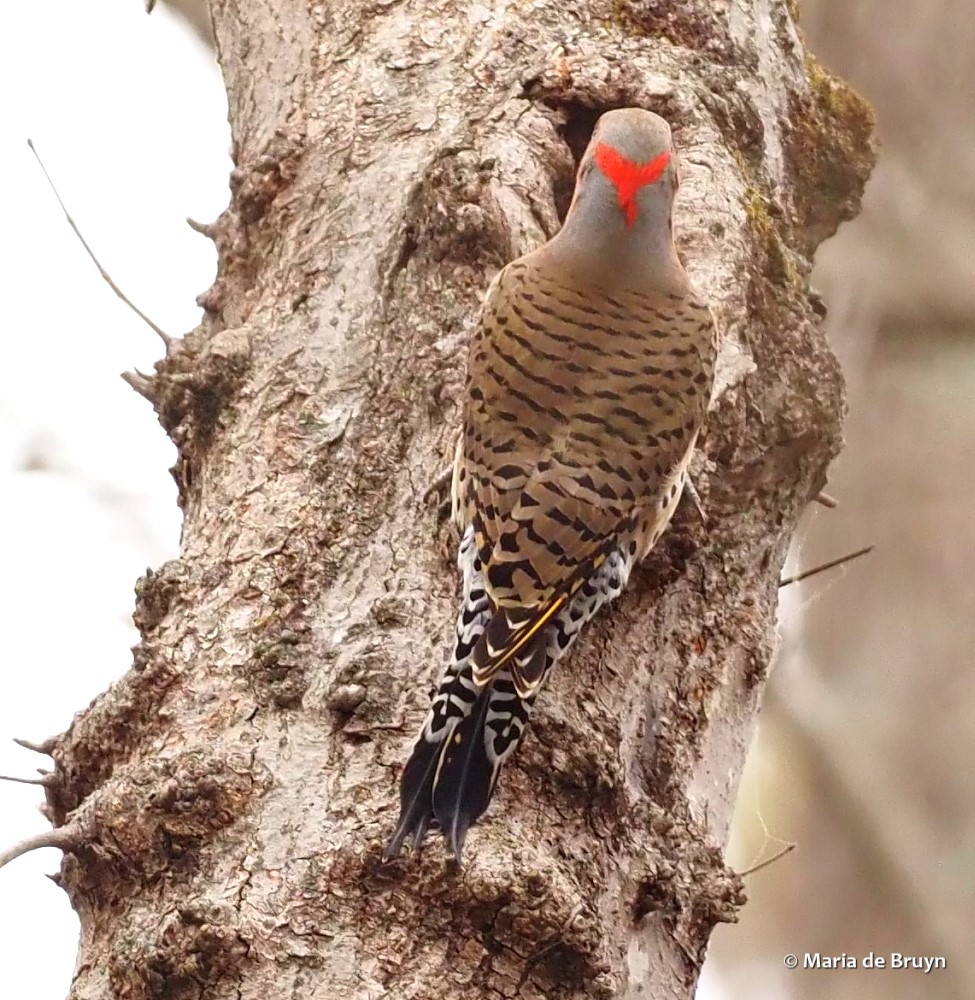
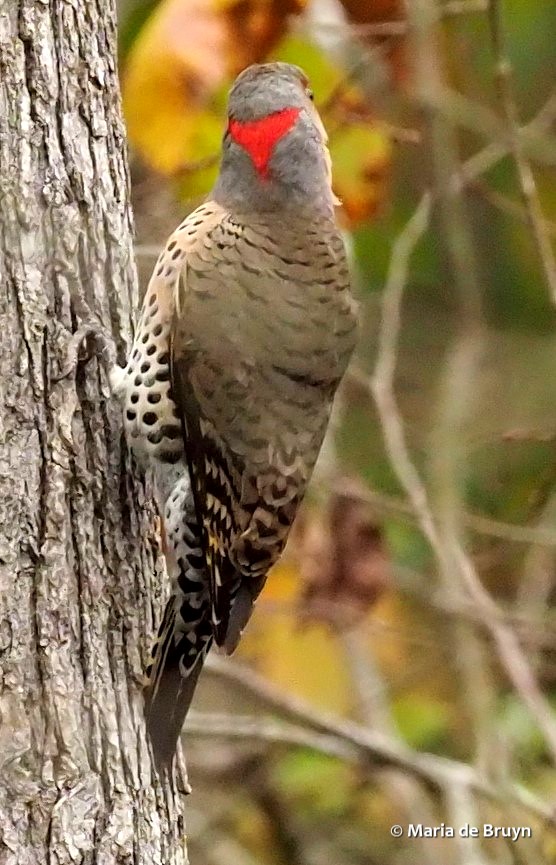
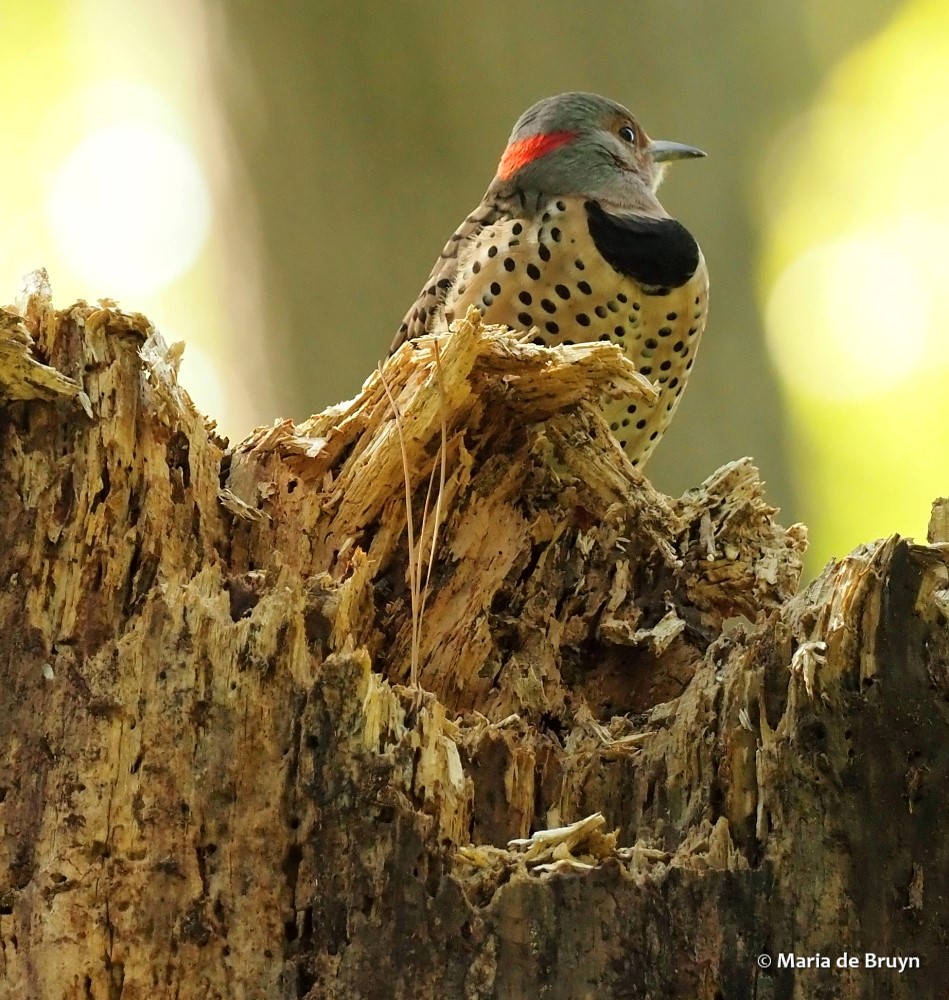
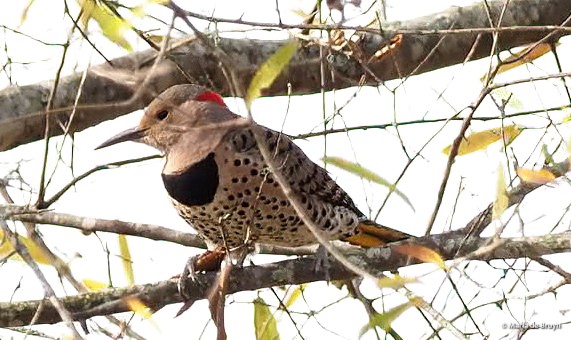
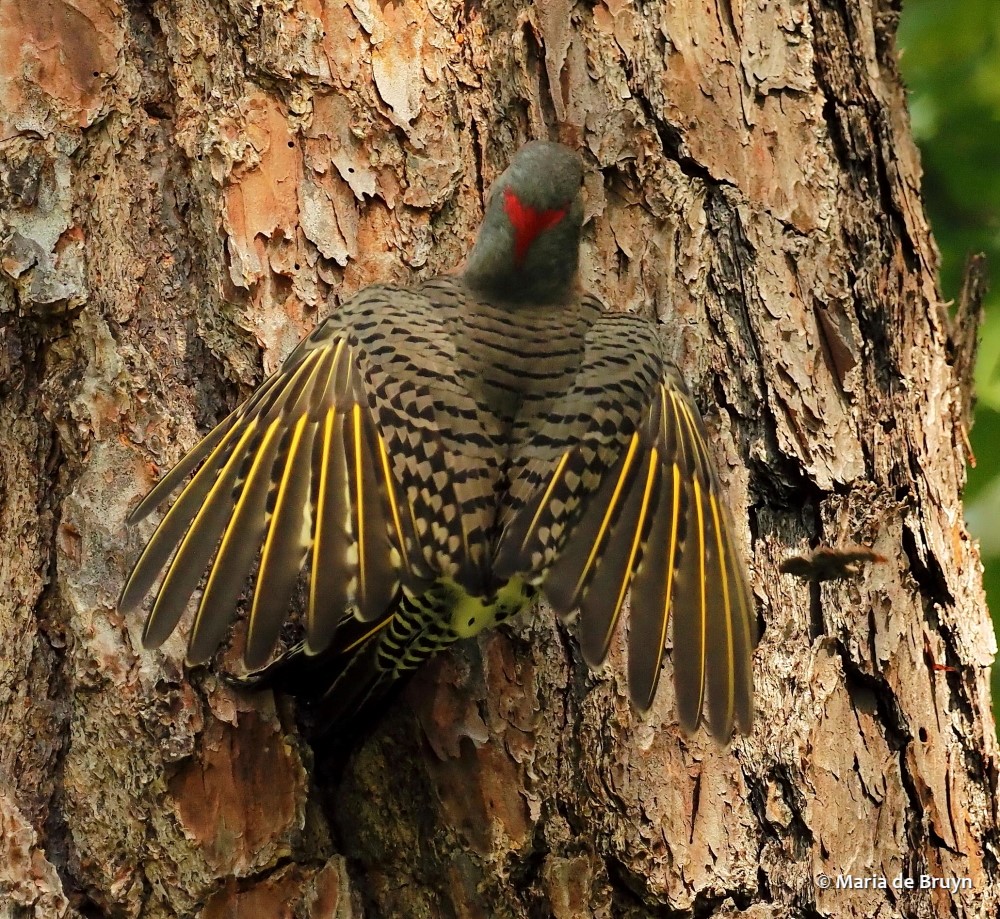
From the back, you can see a red heart-shaped spot on their neck.

5 Northern flicker PC099651 © Maria de Bruyn sgd

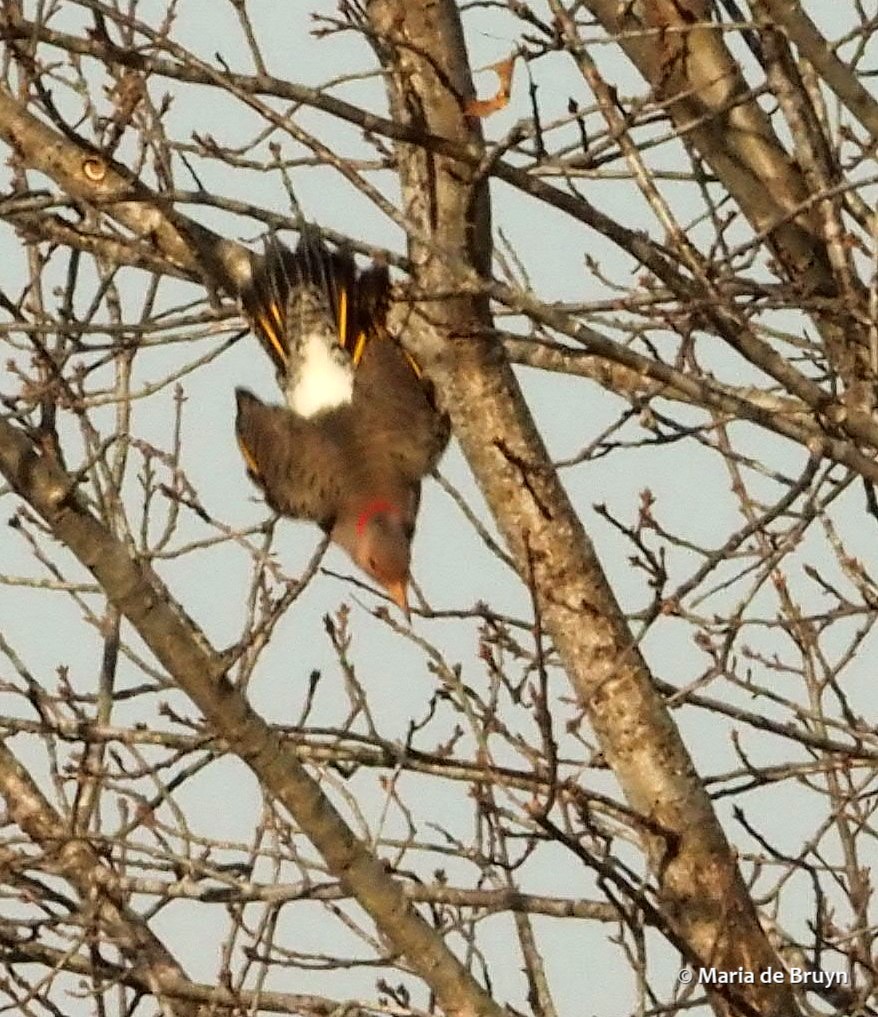
When they fly away, you may also see a white patch on their back near the base of the tail.

The males have a thick black “mustache” extending from the beak.

12 Northern flicker P1300399© Maria de Bruyn res

The females lack this feature.

9 Northern flicker P9209500 © Maria de Bruyn res sgd

11 Northern flicker PB296255 © Maria de Bruyn-ed

10 Northern flicker P1050369 © Maria de Bruyn-ed

In reviewing the photos I’ve taken of them, it appears that I see the males more frequently than the females. The males also seem less reluctant to come out into the open when I’m observing them. This is anecdotal, of course, but I do wonder if the females are generally shyer.

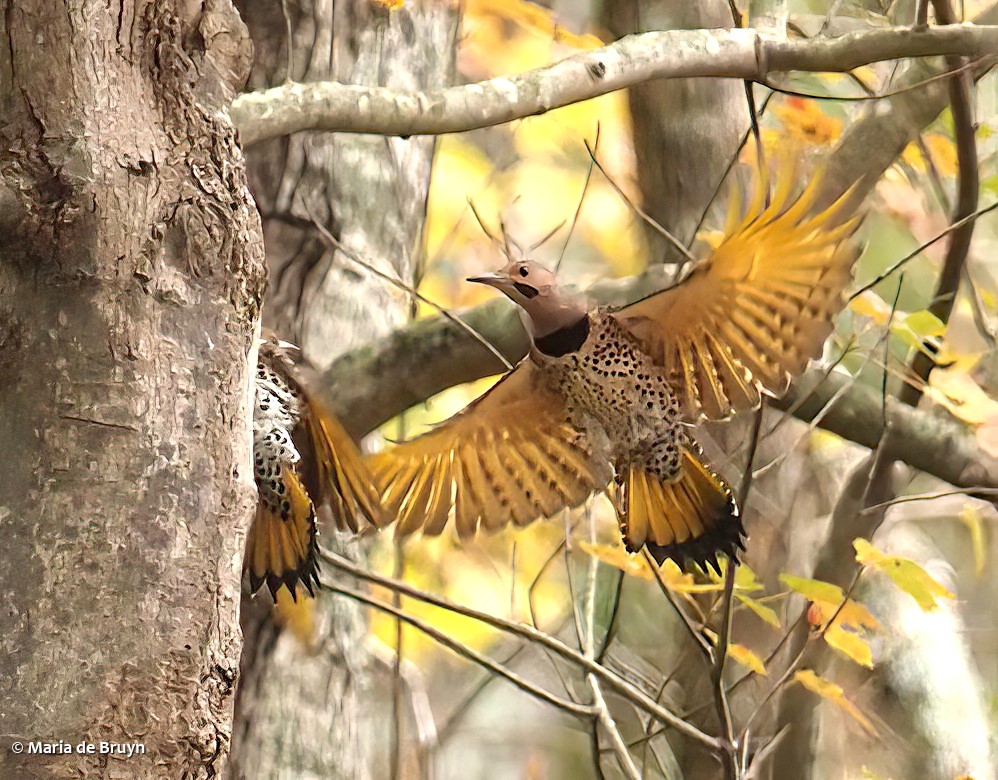
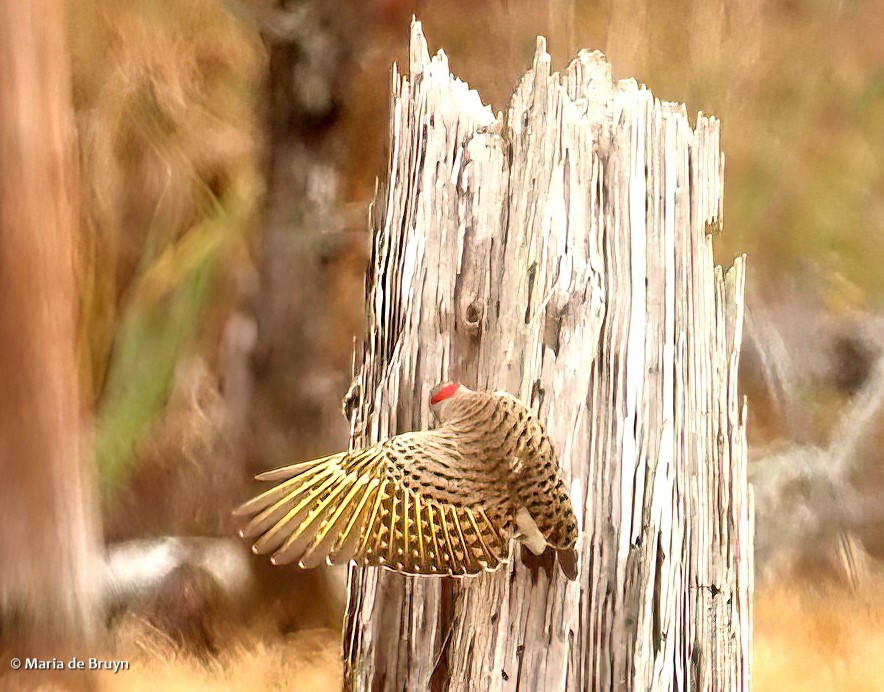
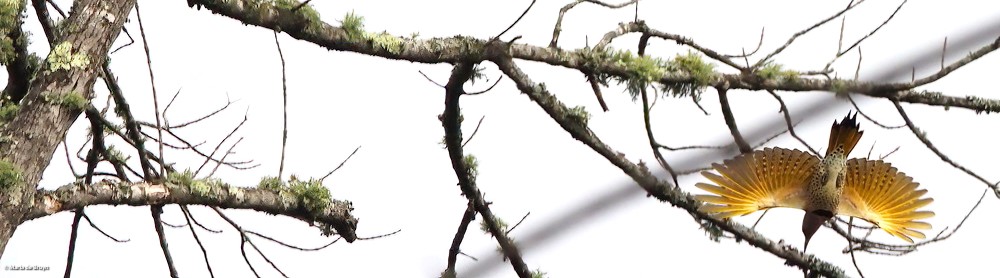
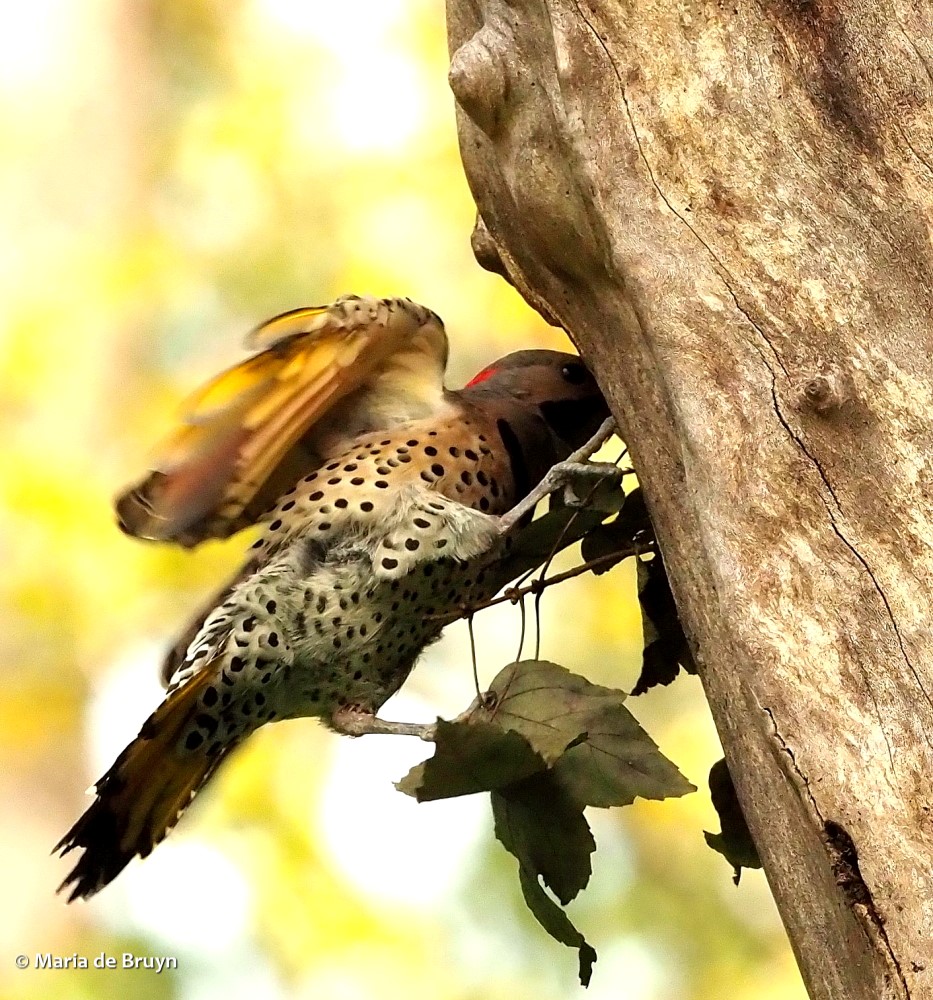
It’s when they take off in flight with wings spread or when they flutter their wings while balancing on branches that you get to see their marvelous yellow feathers.

13 Northern flicker P9209948 © Maria de Bruyn res

14 Northern flicker PB041778 © Maria de Bruyn-sgd res

15 Northern flicker PC099864 © Maria de Bruyn-res sgd

16 Northern flicker P2032611© Maria de Bruyn res-sgd

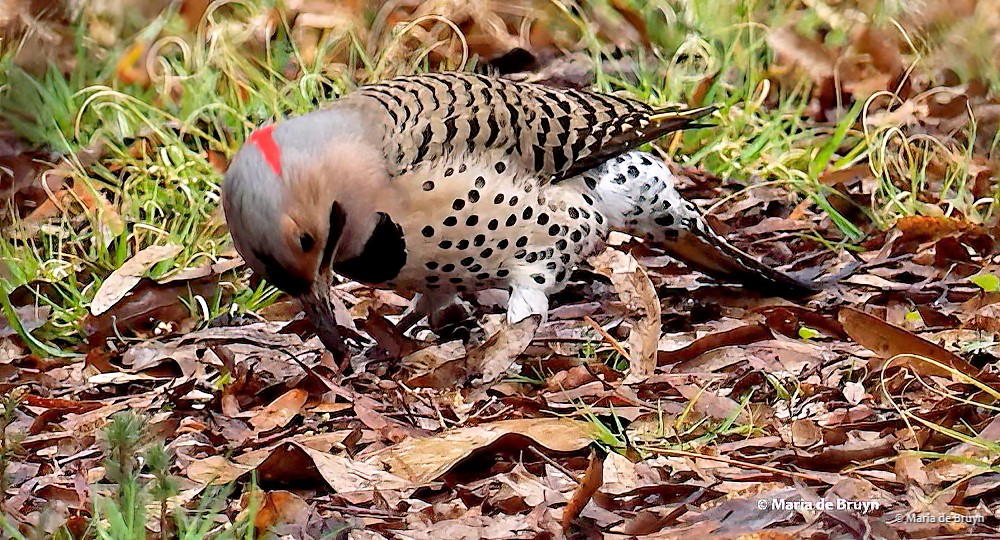
The flickers distinguish themselves as the woodpecker species that very often seeks its food on the ground. Their preferred meals comprise insects, although in winter they also forage for fruit and seeds.

17 Northern flicker P3030826© Maria de Bruyn res sgd

They stick their long bills deep into the ground when looking for a favored food — ants. Many articles online say that one flicker’s stomach was found to contain more than 5,000 ants but I couldn’t find the original study reporting that finding anywhere.

18 Northern flicker P1279550© Maria de Bruyn sgd

Barbs on the flickers’ lengthy tongues help them catch the ants and other insects, such as flies, butterflies, and moths.

19 Northern flicker PC152102 © Maria de Bruyn res sgd

These birds have an elongated hyoid bone that helps support their tongue, which can extend up to 2 inches (5 cm) beyond their bill. This also comes in handy when they are probing snags and fallen logs for meals.

20 Northern flicker PC151992 © Maria de Bruyn res sgd

Northern flickers also have large salivary glands that re-coat their tongues with a sticky substance each time they stick them out — an extra aide in catching those ants!

21 Northern flicker PC099801 © Maria de Bruyn sgd

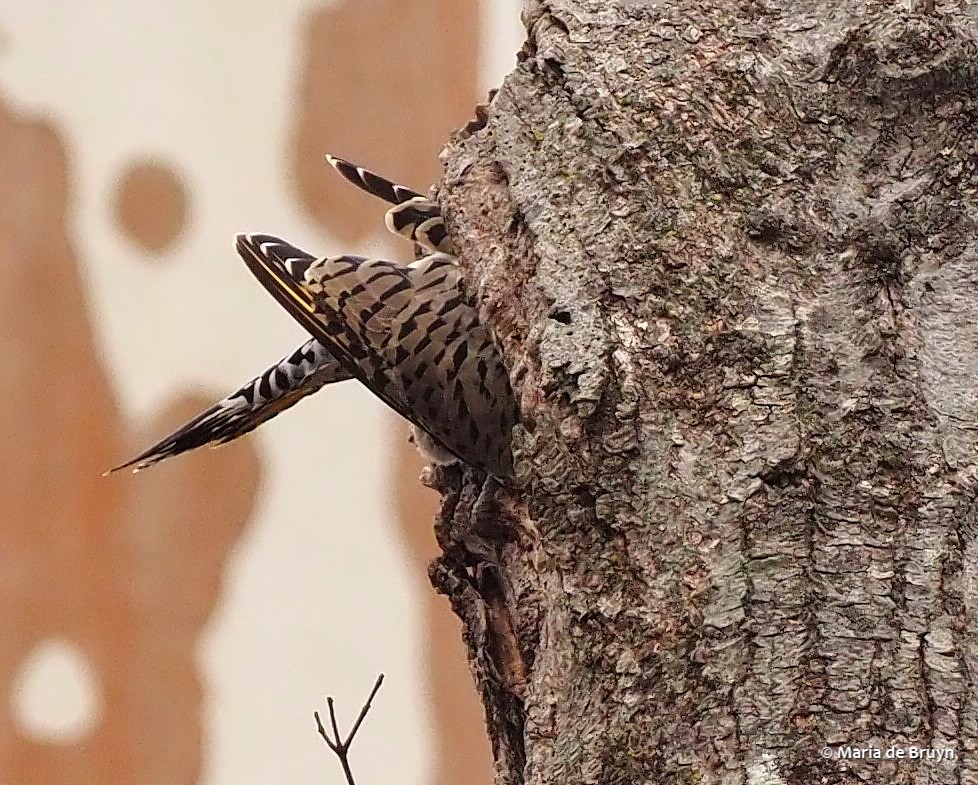
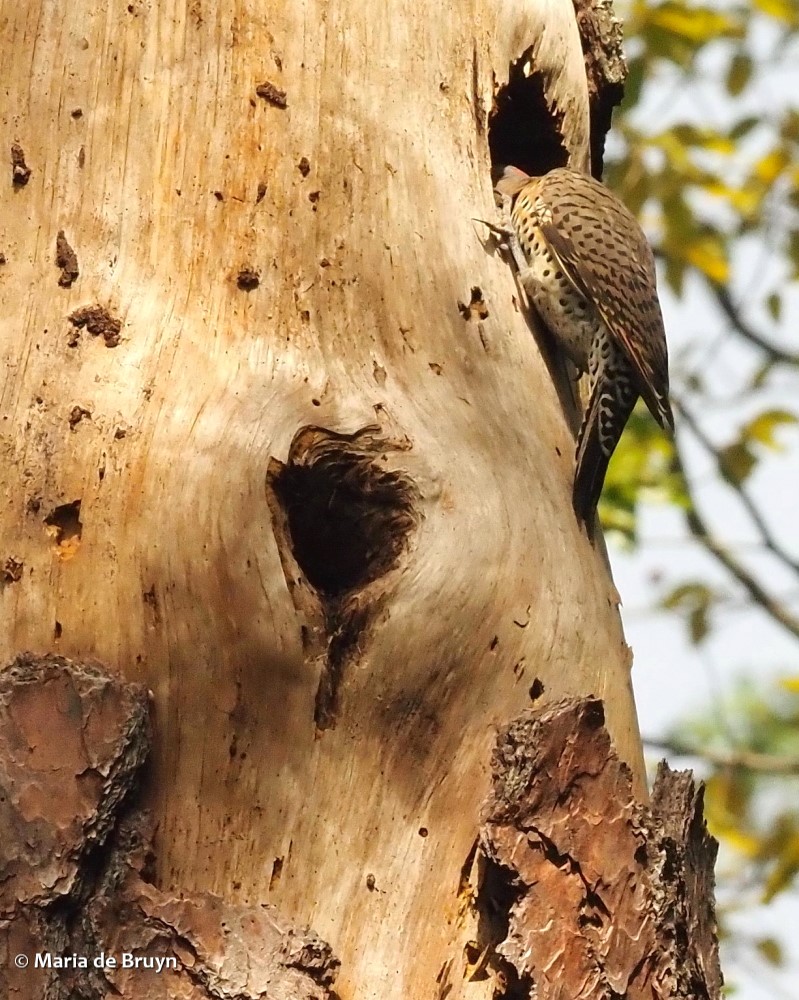
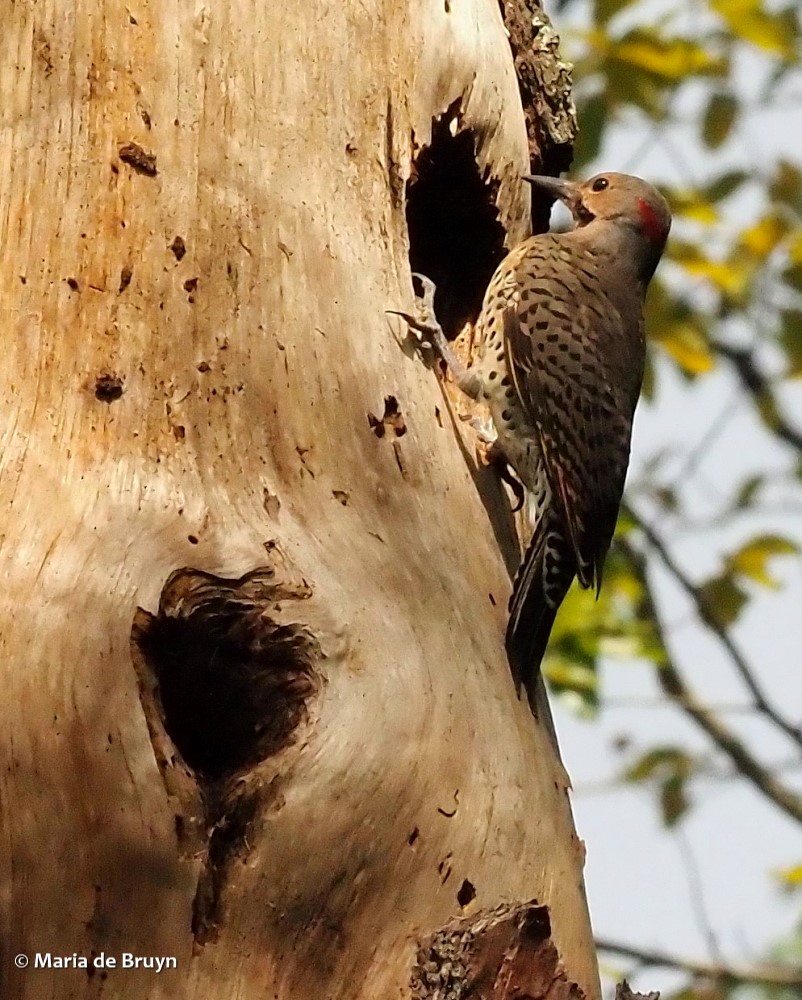
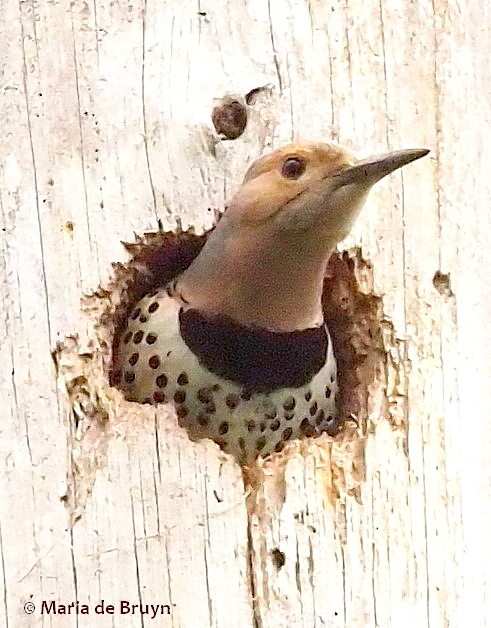
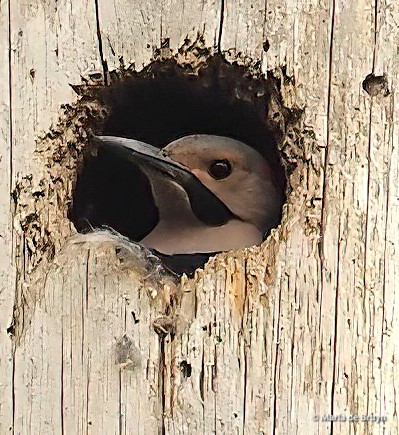
When you see flickers in trees around springtime, they are often looking for nesting spots. They may choose trees with softer wood in which to excavate holes or they may use nesting cavities created by other birds.

24 Northern flicker P9198553 © Maria de Bruyn res sgd

22 Northern flicker P9198517 © Maria de Bruyn res sgd

23 Northern flicker PC099751 © Maria de Bruyn

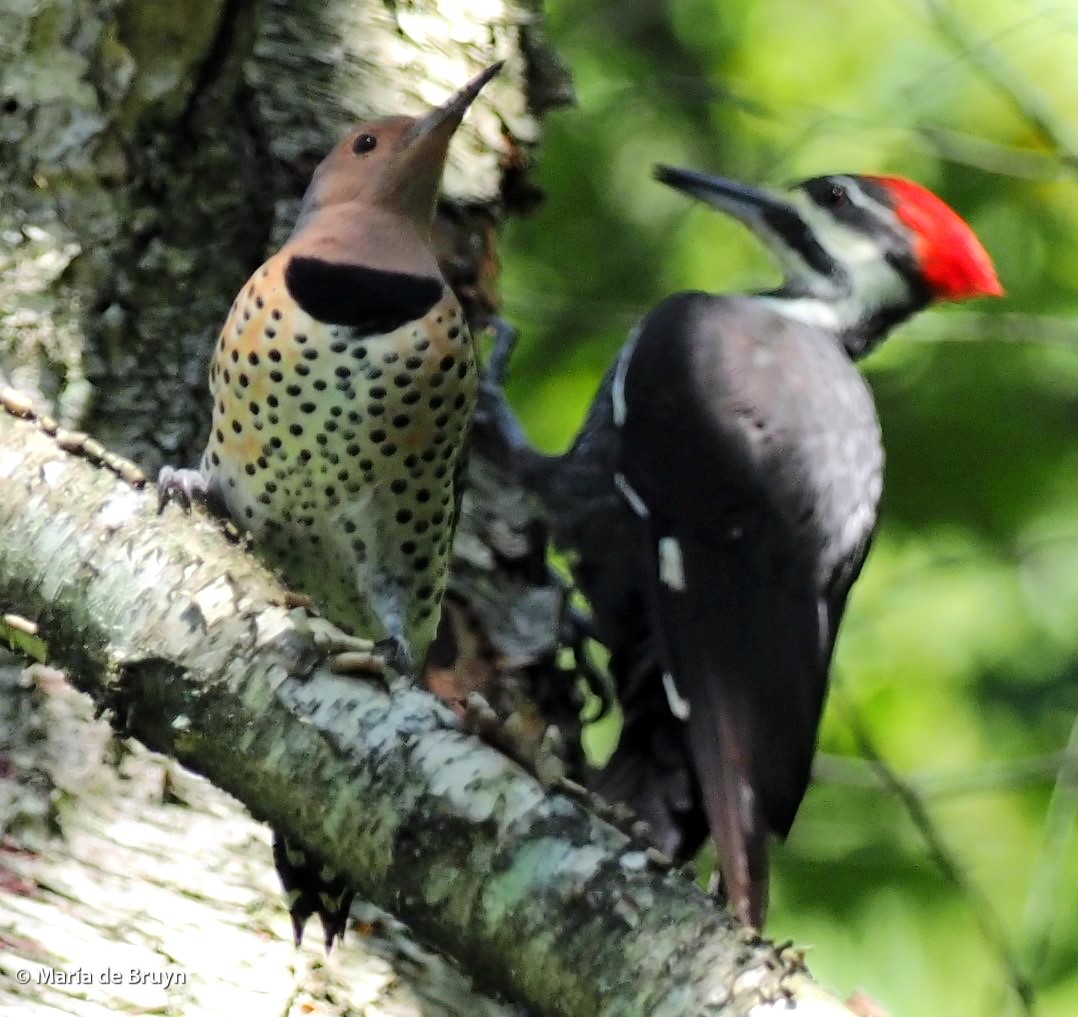
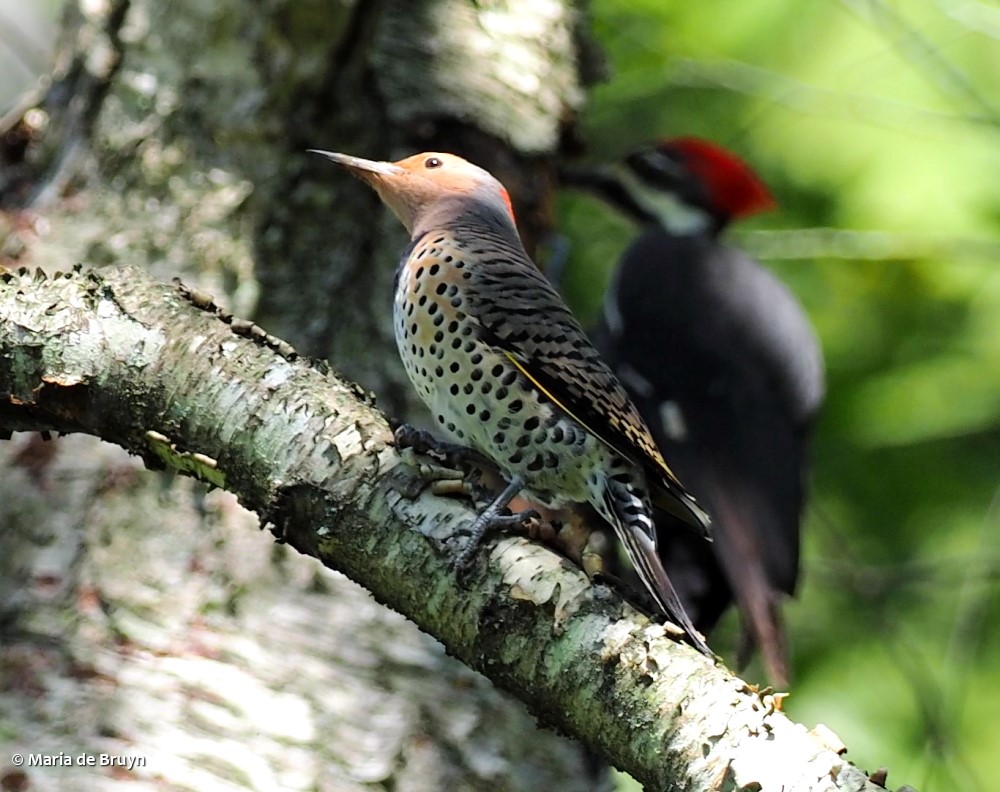
A couple years ago, I discovered flickers following around pileated woodpeckers as they moved from tree to tree to peck holes.

25 Northern flicker P9209692 © Maria de Bruyn

26 Northern flicker P9209697 © Maria de Bruyn res sgd

I wasn’t quite sure why the flickers were pursuing their larger cousins, but now I think they were checking out holes that the larger woodpeckers had made for nests. This seems to be a recurring behavior as this year I saw flickers (in the same natural area) starting the same behavior. The pileated woodpeckers don’t seem to mind too much.

27 Northern flicker P9198613 © Maria de Bruyn res sgd

28 Northern flicker P9198614 © Maria de Bruyn. res sgd

In another natural area, the flickers have used cavities made by red-headed woodpeckers for their nests. The two species seem fine with brooding their young in the same snag at the same time.

29 Northern flicker P4217370© Maria de Bruyn res

30 Northern flicker P4291831 © Maria de Bruyn res sgd

The flickers can live up to 8-9 years at least and likely migrate back to the same areas each nesting season.

31 Northern flicker PB158825 © Maria de Bruyn res sgd

While the overall numbers of Northern flickers are decreasing, they are not considered a threatened species.

32 Northern flicker PB158826 © Maria de Bruyn res sgd

34 Northern flicker PC152197 © Maria de Bruyn resThey adapt well to living around human settlements but can be threatened by fewer available nest sites due to urban development, snag removals, and competition for nest holes, as well as heat waves that affect nestlings and wildfires that destroy their habitats.
I hope these beauties stay around my living space for a long time to come!

33 Northern flicker P1300407 © Maria de Bruyn-res sgd