Flashing wings as a hunting technique

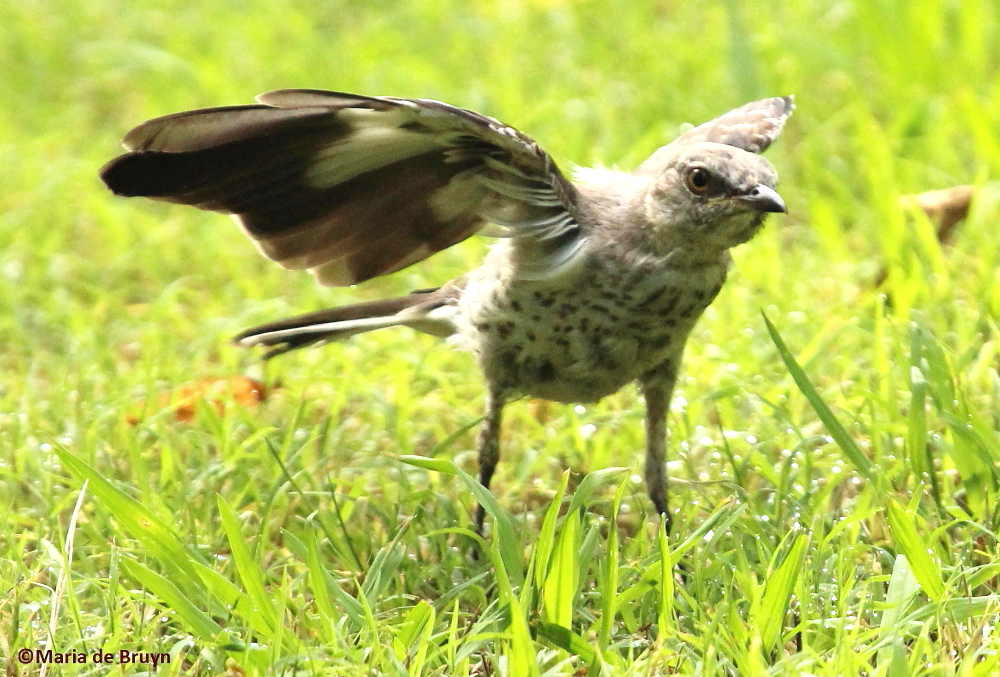
Northern mockingbird IMG_2475©Maria de Bruyn resLast year, during a nature walk, I witnessed young Northern mockingbirds (Mimus polyglottos) displaying odd behavior as they strutted around on the ground. They would walk and hop a bit and then suddenly spread their wings wide and wider still, then close them and continue pecking on the ground.

Some research on the Internet revealed that they were engaged in a phenomenon known as wing flashing. There are various theories about why mockingbirds flash their wings -– to startle insects, ward off predators, attract a mate. So far, there is no scientific consensus on why they do this.

Northern mockingbird IMG_8889©Maria de BruynresNorthern mockingbird IMG_8904©Maria de Bruynres

Having seen both adult and juvenile birds performing this behavior again this year, however, I’ve become convinced it is part of their hunting technique. Those who promote this idea have suggested that the sudden appearance of the bird’s white wing-bars startles insects, but others argue that insects are not alarmed by the color white.

Northern mockingbird IMG_2816©Maria de Bruyn res

Northern mockingbird IMG_2604©Maria de Bruyn res

My own theory is that when the mockingbirds flash their wings, it creates air currents and disturbs the grasses, thereby uncovering and rustling up bugs. This year I clearly saw the birds catching and consuming insects just after a completed wing flash.

snowy egret IMG_3610© Maria de Bruyn

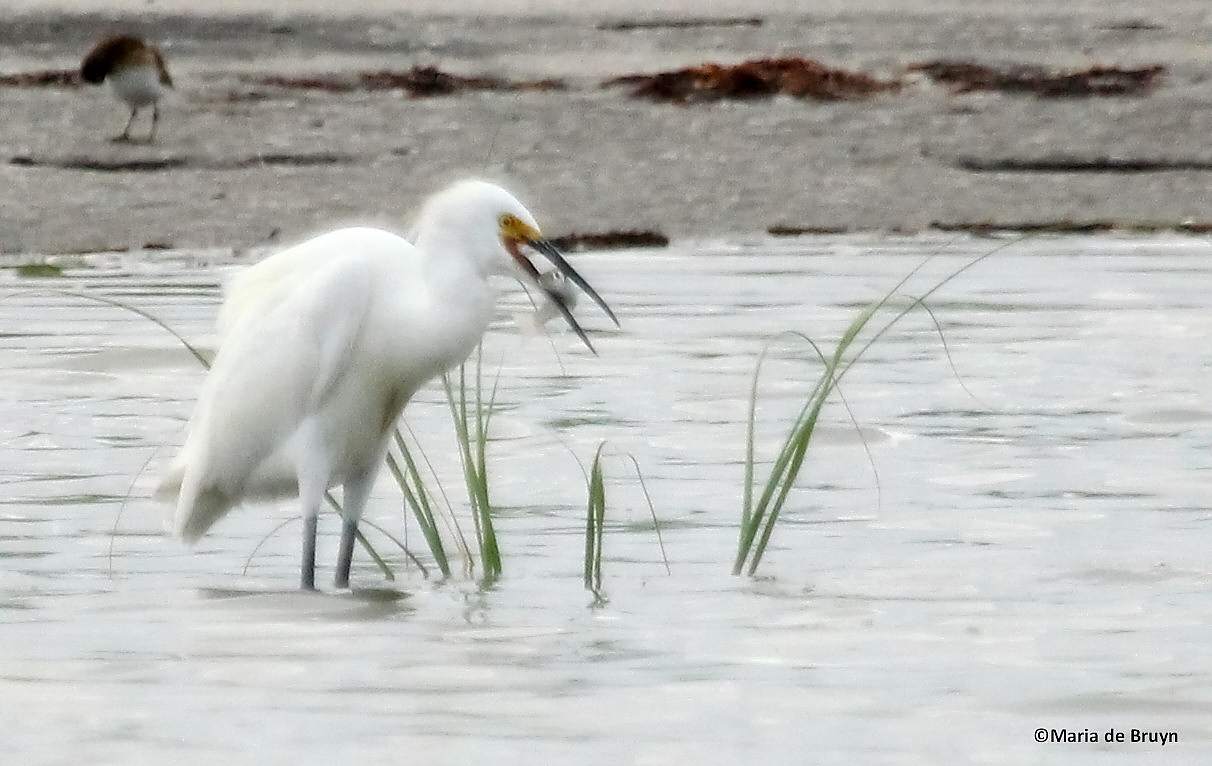
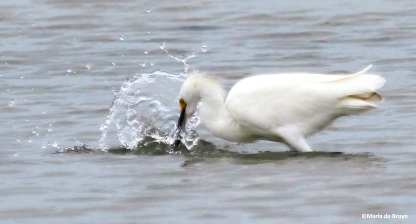
Later in the summer, I witnessed a similar kind of wing flashing used as a hunting technique by an entirely different species, the snowy egret (Egretta thula). These elegant white birds have long black legs ending in feet that look like they are covered with yellow rubber gloves. They stalk the shallows of waterways such as marshes and ponds looking for prey. The bird I saw was fishing in tidal pools along the Atlantic Ocean shore.

snowy egret IMG_3286© Maria de Bruyn

snowy egret IMG_3270© Maria de Bruyn

It is thought that the egrets use their large feet to stir up the sand underwater so that they can more easily see potential food as they forage. Part of the time, they will simply stand like statues, waiting for a fish to swim nearby so that they can suddenly plunge their long beaks into the water to get their meal.

snowy egret IMG_3313©Maria de BruynThis worked at least part of the time for this particular bird, as s/he got a few fish down. It required a lot of patience, however.

snowy egret IMG_3423© Maria de Bruyn res

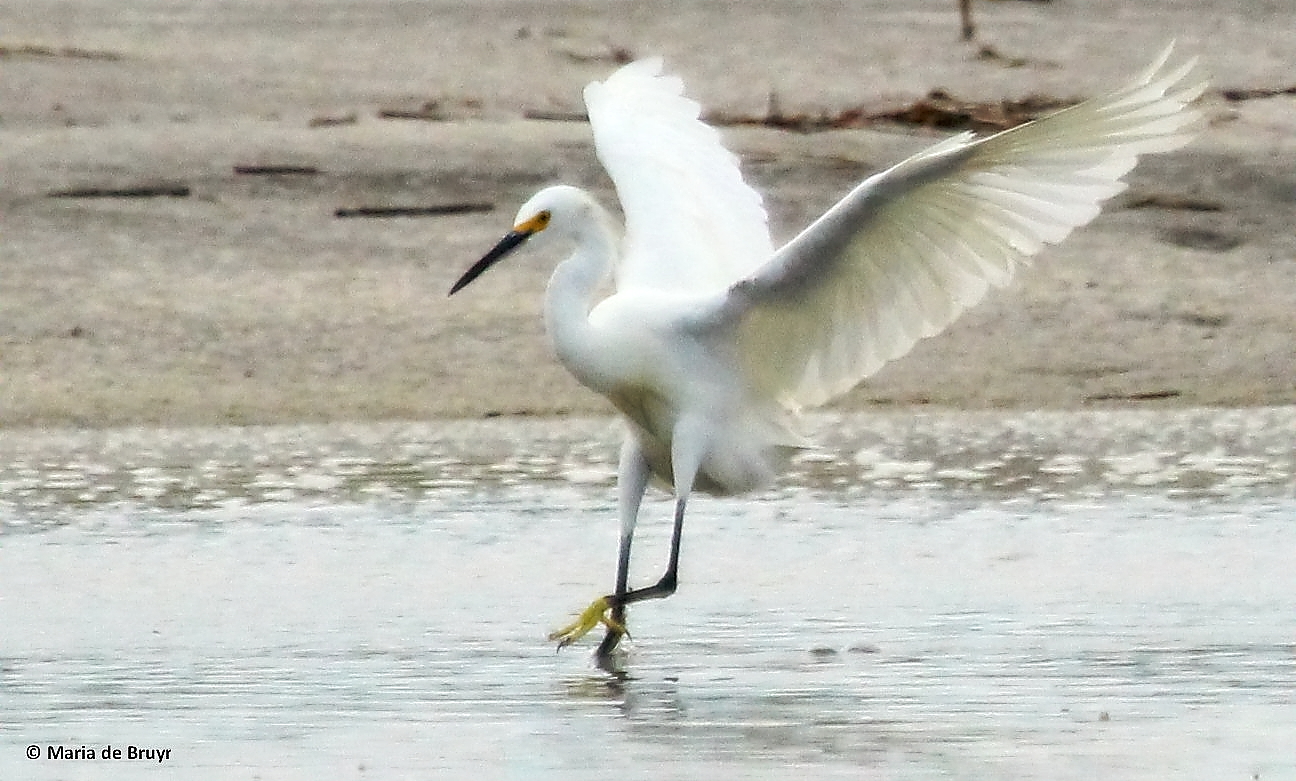
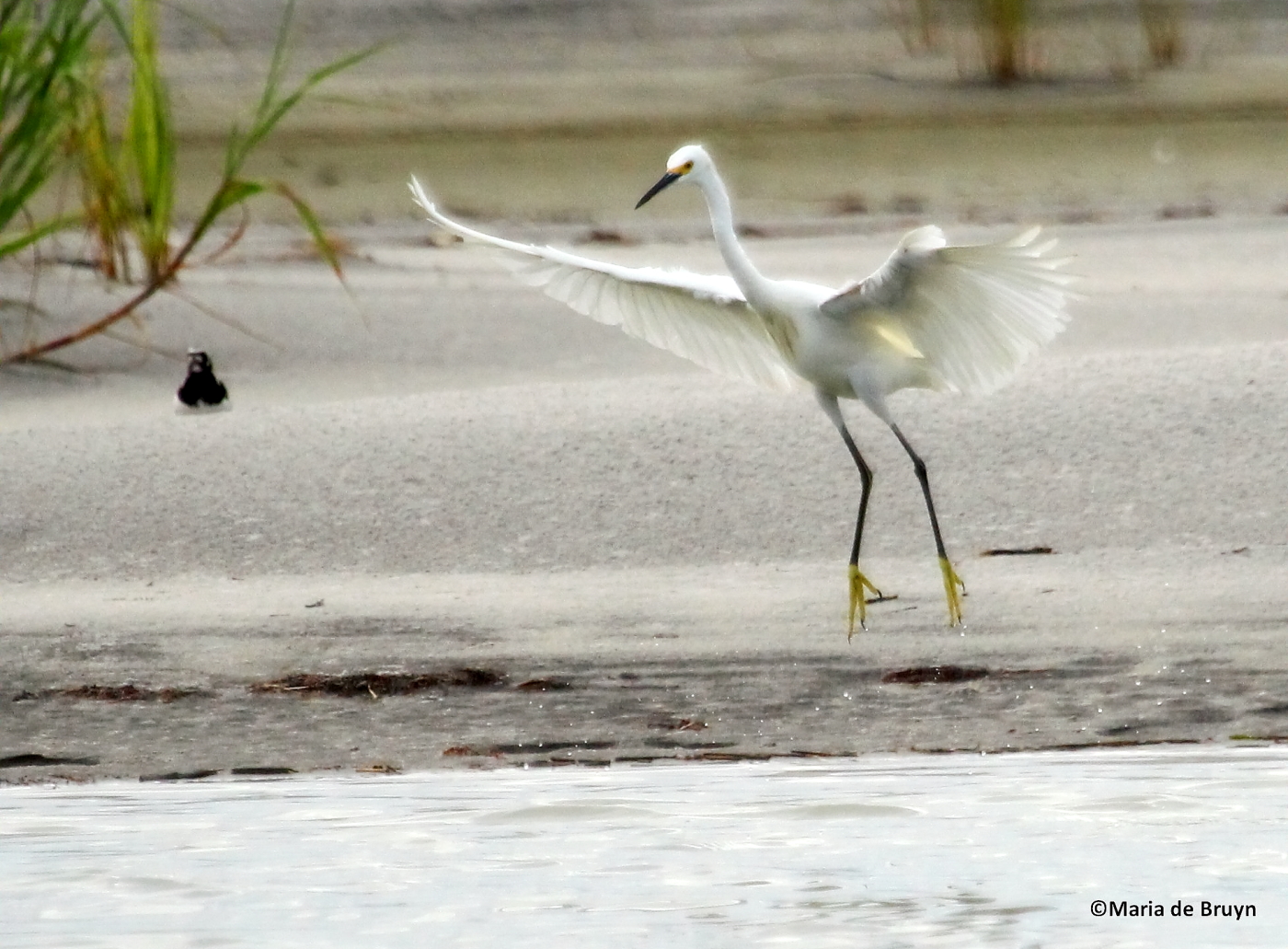
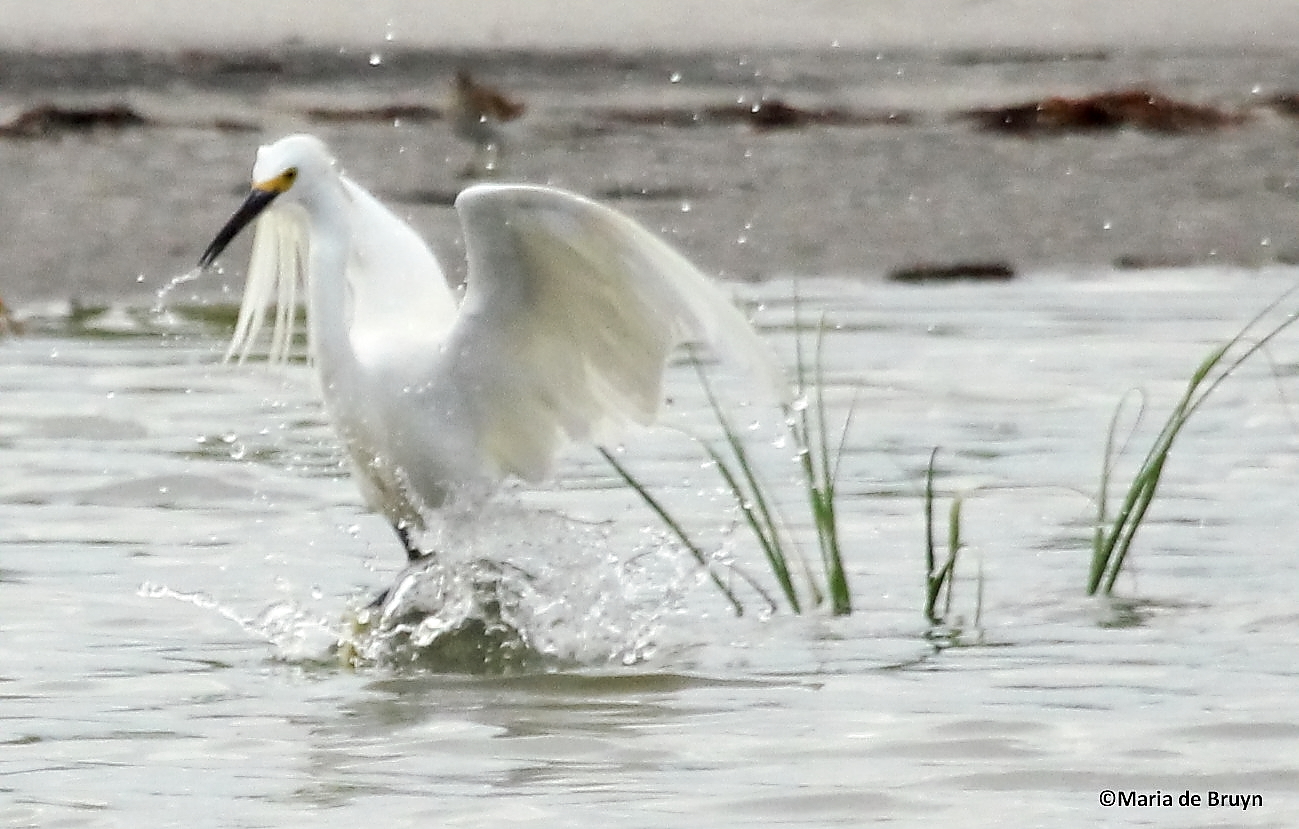
At a certain point, the bird decided on a more active approach. S/he flew to another tidal pool and then began running to and fro in the water, flapping his/her wings open and closed.
snowy egret IMG_3575© Maria de Bruynsnowy egret IMG_3574© Maria de Bruyn

Occasionally, this was complemented by a leap into the air and plunge into the water – obviously behavior calculated to startle and scare up the fish lurking below the water’s surface.
snowy egret IMG_3606© Maria de Bruynsnowy egret IMG_3617© Maria de Bruyn

snowy egret IMG_3623© Maria de BruynThe tactic worked.

It was fascinating for me to see two such different bird species using their wings in a similar fashion as a hunting method. One of the things I love about wildlife watching -– you can always see and learn something new!

snowy egret IMG_3659© Maria de Bruyn

Owls – raptors with fantastically functional feathers

Barred owl IMG_9617© Maria de Bruyn resThe owl is the wisest of all birds because the more it sees, the less it talks. – African Proverb

The world likes to have night-owls, that it may have matter for wonder. – German proverb

Sayings about wise owls are well known and may account for the names given to a group of owls – a wisdom, study or parliament. On the other hand, in some cultures, owls are associated with bad luck, death and the stealing of souls. Owl fossils date back as far as 58 million years ago! These appealing birds have been depicted in in cave paintings in France, in Egyptian hieroglyphics and in Mayan art. There are about 200 species of owls around the world and they are found on all continents except Antarctica and a few remote islands.

Owl anatomy

Barred owl eye feathers IMG_9802©Maria de BruynresOwls have interesting anatomical features. Like humans, they have binocular vision as a result of their upright posture and forward-facing eyes. A circle of feathers around each eye, as seen in the barred owl  (Strix varia) here, can be adjusted to focus and channel sound to their ears (which are asymmetrical in many species!). These feathers can magnify sound as much as 10 times, giving them acute hearing.

Barred owl IMG_9832©Maria de Bruyn signed res

Like bald eagles, owls have three eyelids: one is used to blink, another for sleeping and the third – the nictitating membrane – helps them keep their eyes clean and healthy. Because they cannot turn their eyes within their bony eye sockets, owls must rotate their heads up to 270 degrees to look around. They are far-sighted and cannot see clearly right in front of their eyes, but their distance vision is very good, especially in low light.

Barred owl IMG_9117©Maria de Bruyn resOwl feathers have fringes with different degrees of softness, which helps muffle sound when they fly.

Screech owl IMG_3069©Maria de Bruyn resSome owls, like the Eastern screech owl (Megascops asio) have tufts of feathers on their heads; the function of these might be to indicate a bird’s mood, to show aggression or to help keep the bird camouflaged.

Screech owl rehabilitated by CLAWS that serves as an educational bird

Behaviors

Different owl species make different sounds for finding mates or announcing their presence to potential competitors. These sounds help ornithologists and birders locate and identify species.  For example, the barred owl is said to have a call that sounds like “who cooks for you?”

These carnivorous birds usually swallow their prey whole (depending on the size of the animals such as fish, mice, rats, hares). Scientists who study their diets use owl pellets as an aid; the owls regurgitate bones, scales and fur in these pellets. The larger owls will also detach body parts they don’t wish to eat. For example, colleagues speculated that it was a great horned owl (Bubo virginianus) that took down a red-tailed hawk (Buteo jamaicensis) at a local nature reserve recently, leaving behind an entire wing that wouldn’t have provided much nutrition.

great horned owl IMG_3065©Maria de Bruyn resred-tailed hawk IMG_2745©Maria de Bruyn res

Great horned owl rehabilitated by CLAWS in Chapel Hill, NC. This bird was shot in the eye and cannot be released again; it serves as an educational bird.

The main threats to owl survival today include habitat loss, pesticides and human predation due to negative superstitions. There are fortunately efforts to preserve owls where they may be seen as beneficial. For example, a barn owl may eat up to 1000 mice each year, so that farmers try to attract them to help control rodents in agricultural fields. Projects to re-introduce barn owls (Tyto alba) are taking place in the Czech Republic and the United States. The local Audubon Society to which I belong has a barn owl project, in which they have placed barn owl nest boxes in various places in an effort to attract these birds as more permanent residents. It would be very cool to see the boxes occupied one day!

Barn owl project IMG_6412© Maria de BruynBarn owl box IMG_2501©Maria de Bruyn

Check out CLAWS, a wildlife rescue and rehabilitation center in North Carolina! http://www.nc-claws.org/

Resplendent remiges and rectrices – bird beauty from behind

The other day asMourning dove IMG_6565©Maria de Bruyn res I was photographing birds at my feeders, I was struck by the beauty of this bird’s feathers as they lay across its back. The muted colors are wonderful and the scalloped-edge pattern is marvelous. It made me take a look at other birds’ feathers as seen from behind and how they vary in position and shape. I hope you enjoy this short tour and have some fun identifying the birds shown – many are very easy for experienced birders but perhaps some are not for beginning birdwatchers. The answers will be added to the blog next week.

So, we are focusing here on flight feathers, namely the remiges and rectrices. The remiges – or wing feathers – help the bird get lift when flying and support the bird during flight. The rectrices – tail feathers – give the bird stability and provide control.

Red fox sparrow IMG_5745© Maria de Bruyn resHouse finch M de Bruyn resCardinal IMG_6227©Maria de Bruyn res

The outer “vane” (part of the feather above the shaft) is narrower than the inner vane, so the wing feathers are asymmetrical. The tail feathers, on the other hand, are symmetrical in shape and pattern. The “primary” wing feathers are narrower and can be rotated individually, while the secondary remiges are shorter and lie together, even when the bird is flying.

In some species, the wing feathers may reveal a spot of color on the bird’s back when they are not folded completely over one another.

Yellow-rumped warbler IMG_6461©Maria de BruynresHouse finch IMG_6255©Maria de Bruyn res

The feathers also serve other functions, such as keeping the bird warm and dry.

Ruby-throated hummingbird IMG_4221©Maria de BruynresMandarin duck IMG_1605©Maria de Bruyn resHoopoe IMG_4314©Maria de Bruyn res

In some species, the males develop especially resplendent rectrices in thRed-collared widowbird 390©Maria de Bruynreseir breeding plumage – a definite attempt to attract mates.

Interestingly, the total weight of a bird’s feathers is about 2-3 times more than the weight of its bones!

One final quiz question – which bird has the fewest overall feathers and which species has the most?

Next week: curious deer