Surprise gifts from Mother Nature in 2018 – part 1: birds

On the last day of January 2019, I thought it would still be ok to post a couple blogs on some surprises I encountered the past year. Almost always when I go out on nature walks, I encounter something new – a species of wildlife or plant that I have not seen before or an interaction between species not previously observed. So, I wanted to share a few of those delightful surprises from 2018. In this blog, I focus on birds; in the next part, other kinds of wildlife will be featured.

As I mentioned in a previous blog, my own front yard was the scene of my biggest surprise last year when a snowstorm brought feeder visitors whom I had never seen before and who rarely come to the state where I live. The evening grosbeaks were just stunning.


They were not the only grosbeaks who treated me with their beauty, however. I’ve had rose-breasted grosbeaks (Pheucticus ludovicianus) visit the feeders before, but they still always elicit my appreciation with their bright colors.


In late October, an osprey (Pandion haliaetus) made me stop for a photo as the other birds of its species had already gone south for the winter. The bird was perched on a branch extended over a pond and had to unfortunately contend with a persistent crow that was harassing it. After some time, the sea eagle finally took off with the crow in pursuit – it seemed that the osprey might have injured its wing and perhaps that accounted for a delayed departure to warmer climes.


Although the pursuit photos are not high-quality, you can see a gap in the osprey’s wing and perhaps it was waiting for healing before it undertook a very long journey.


On another day, I was near a wetland when an unexpected visitor flew onto a branch above me. Green herons (Butorides virescens) usually keep their distance from me; I regretted that it was overcast and the lighting was not wonderful for my close-up portrait of this colorful immature bird.


A more muted bird, but lovely nonetheless, is the Northern mockingbird (Mimus polyglottus). When I saw this individual in late December, I was thinking that it must be difficult for them to find food as the vegetation shrivels and insects are in hiding. At that moment, the bird dropped to the ground and was foraging – coming up with a bug to prove that they still could find sustenance in the cold temperatures!


The mockingbirds are often solitary except for breeding season. Some people complain that they are aggressive towards other birds at their feeders but those in my yard are not that way at all. They share space at feeders and don’t chase anyone else away. When it is mating and nesting time, however, they can become quite territorial and are very protective of their nests. This seasonal “grumpiness” was brought home to me one day along a country road when I witnessed a pair of mockingbirds driving a third bird – rival? Intruder? – away from their roosting spot.

When large flocks of gulls and double-crested cormorants (Phalacrocorax auratus) visited a small local lake because of a shad die-off, I had the chance to watch them for a while. One day, it was interesting to observe how one cormorant wanted to jump up on a floating platform, but another bird didn’t want him/her there. They faced off with open beaks – the bird wanting to get out of the water won.


It’s always interesting to me to watch birds as they forage for sustenance. When I think of woodpeckers, my thoughts immediately turn to nuts and insects, which I think of as their staple diets. So it was a surprise to me to see this red-bellied woodpecker (Melanerpes carolinus) dining at length one day on nice ripe persimmons – a bird with a sweet tooth!


Well, I probably shouldn’t say “sweet tooth” but “sweet tongue”. Woodpeckers don’t have teeth but they have exceptionally long tongues that can be wrapped around their brains inside their skulls when not being used to extract insects and other food morsels from crevices.

Another bird that has a long tongue is the great blue heron (Ardea herodius). One day, I came across this bird on its favorite roosting log obviously trying to dislodge something that had gotten stuck – or perhaps something that tasted foul. I hadn’t really seen the species’ tongue before, so the bird gave me some good views.


The effort of shaking its head also led it to protect its eye with the nictating membrane.

Because tufted titmice (Baeolophus bicolor) visit my bird feeders daily to get nuts and, to a lesser extent, seeds, I associate them completely with that type of diet. It was that assumption that made me do a double-take when I spotted a titmouse on a walk with a long spaghetti-like object dangling from its beak. It didn’t seem like a grass stalk so when I lifted my camera to look through the zoom lens, I discovered it had a worm snake (Carphophis amoenus amoenus) in its beak – a finding that really did astound me.


As I took photos, the bird finally flew further away and unfortunately dropped the reptile when it came close to a creek. I felt a bit guilty, thinking I might have disturbed its meal but after waiting about 5 minutes, the bird suddenly flew up with the snake back in its beak! It obviously really wanted to hang on to that prize!


And now on to part 2 of my 2018 surprises – some more reptiles and amphibians, bugs and mammals!

My special bird in autumn 2018

Well, having had time to finally process photos as the year end approaches, I’m “on a roll” with posting blogs in contrast to other months in 2018. I have two more to post on mammals this year. This one is to commemorate a real birding treat that came to me during the snowstorm that was featured in my last two blogs.


There had been reports on birding sites and listservs that some bird species which usually don’t come too far south during the winter were on the move this year to warmer climes. They included birds that sometimes arrive in North Carolina (NC) in winter, but who don’t always come in large numbers (an “irruption”) such as pine siskins (Spinus pinus, above) and purple finches (Haemorhous purpureus, below).


I’ve also been lucky to see red-breasted nuthatches (Sitta canadensis), another irruption species, either in my yard or on nature walks.


So why are they coming here in numbers?  It turns out that trees in the northern boreal forests are not producing enough food sources that these birds need to survive winter weather such as conifer seeds and berries (from trees such as hemlock, spruce, firs, alders and larch).

What was really exciting for birders in NC, however, was that some other bird species are also seeking new winter foraging areas. They include redpolls, crossbills and the gorgeous evening grosbeaks (Coccothraustes vespertinus) who are seen here only rarely.

I had only ever seen a photo of these grosbeaks and thought it would be fun to see one in person. Members of a listserv mentioned that these grosbeaks had been spotted in Virginia, just above the NC border, so we should be prepared to perhaps see them.

On my visits to the Brumley Nature Preserve, I spent time in the spruce areas in the hope of spotting one, but I had no such luck. And then as the snow was falling heavily on the first morning of our snowstorm, I caught sight of a bright yellow and black bird on a feeder as I looked out my window. Lo and behold, when I grabbed my camera I discovered a male evening grosbeak on a feeder!

What was even more exciting was that he was accompanied by two female birds, both of whom were very lovely as well. I took lots of photos.

They finally flew off and I counted myself very lucky indeed. A while later, when the snow had stopped for a while, I was watching the feeders again and the threesome returned to my delight. They fed and then rested on feeder poles.

I tried to go outside quietly so I could photograph them without a window between us but they were quite skittish and left quickly as soon as I appeared. They flew to the tops of nearby tall pines and then disappeared off into the distance. They were not shy when I stood in front of the living room window, however.

The trio reappeared a third time and I stayed behind the window to admire them. It was interesting to see how they could look different, depending on their posture. The bird above looked “tall” as it fed next to the Eastern bluebird. And then the other looked fat and fluffy on the feeder pole – even looking as if it had an outsized head when it leaned forward a bit!


They left in the afternoon and did not return, even when it snowed again the next day. A fellow birder who lives northwest of me spotted a male evening grosbeak on one of her feeders that day – the birds were obviously en route to another destination. I hope they found a good food source area for the rest of the winter. And my photos will remind me of their wonderful visit, which made this snowstorm one to remember. 😊

Snowy portraits – part 2

The larger birds were very obvious at the feeders during our North Carolina snowstorm in early December, but they weren’t the only ones taking advantage of the fact that I spent considerable time knocking snow off feeders and a bird bath, filling feeders up multiple times daily and spreading seed repeatedly on the snow for the ground-feeding wildlife.

The Carolina wrens (Thryothorus ludovicianus), who live in the various yard woodpiles, mostly stayed on the ground but occasionally flew up to a feeder. They also spent time clinging to the brick walls of the house, I assume in search of spiders and other small insects that stay there.

Their slightly larger brethren in shades of brown, the Eastern towhees (Pipilo erythrophthalmus), have taken up residence in the holly shrubs and a privet bush near the front-yard feeders. From there, they can emerge to hop around under the feeders (sporadically flying up to perch on a feeder, too) with a place close by to which they can escape when feeling threatened.


Both house finches (Haemorhous mexicanus, left) and pine siskins (Spinus pinus, below) came to eat seeds at the platform feeders. Though the finches are larger than the siskins, the female finches and siskins look very similar to me and I usually need to look through my zoom lens to see them clearly.


The photo below is a nice one for differentiating them. The female finch on the left has a thicker bill and a slightly larger and bulkier size. The pine siskin on the right has a thinner bill and hints of yellow on its slender flanks.

Another pair of birds that can be difficult to differentiate are the male house and purple finches. The purple finch (Haemorhous purpureus, below) looks like it has been dipped in raspberry juice to put color all over its body. While some male house finches also have very bright red hues, the color does not spread everywhere on their bodies.


The tufted titmouse (Baeolophus bicolor, below) and dark-eyed junco (Junco hyemalis) are both subtle beauties in shades of gray but easily distinguishable.


The junco’s pink bill gives it a delicate look in my opinion.


The chipping sparrows (Spizella passerina) and white-throated sparrows (Zonotrichia albicollis) are both daily visitors to my feeding stations regardless of the weather. The “chippies” are here year-round, while the white-throated sparrows (right) are only resident in the autumn, winter and spring. The somewhat smaller chippies usually sit on the feeders, while the white-throats mostly seek food on the ground; both will venture into the others’ areas, however.

Two very different birds share a common feeding method for gathering suet. Both the ruby-crowned kinglet (Regulus calendula, below left) and yellow-rumped warbler (Setophaga coronata, below right) hover in front of the feeder as if they are imitating hummingbirds, snatching a bite to eat as they “balance” mid-air. Both will eventually alight on the feeder, though, and then eat at a more leisurely pace.

The bright little pine warbler (Setophaga pinus) also loves suet but never hovers at the feeder. S/he will wait until other birds have cleared the space and then clutch the frame to have multiple bites of the fatty food. During windy intervals of stormy weather, this plucky bird also holds its ground, clutching the feeder pole so as not to blow away.


The downy woodpeckers (Picoides pubescens) are never scared off the feeders by anyone. Their larger red-bellied cousins are often a bit hesitant to visit but the downies can’t be kept away. Like them, the Eastern bluebirds (Sialia sialis) also don’t let the presence of other avians put them off – they are willing to share space.

This doesn’t mean the bluebirds won’t show a bit of temper, especially toward their own species mates, but they generally get along with everyone.

And the bluebirds visit regardless of the atmospheric conditions, sometimes looking stunning with their bright dry plumage and sometimes looking a bit bedraggled when the pouring rain and thickly falling snow wet their feathers completely. Beginning birders might wonder if these are the same birds, but fortunately the bluebirds seem to dry out quickly to regain their usual beauty.


There were a few more birds that came along during the storm (one featured in the next blog!), including Carolina chickadees, Northern cardinals (Cardinalis cardinalis, left) and red-winged blackbirds. Snow and ice storms and pouring rain can be a drag in many ways for the human species but for birders, these “bad-weather” interludes can certainly be a boon for easy armchair and window watching!

An avian buffet appears!

In the town where I live, there is a private lake in a neighborhood of single-family homes. The little body of water was created by developers who dammed a local creek; now a neighborhood association levies annual fees for use of the lake for swimming, fishing and boating. In the past month, the neighborhood residents were surprised by an influx of birds that they do not usually see and some photos of the new avian visitors began circulating.

Given my interest in wildlife and birds, some colleagues passed on a couple of photos to me and one couple kindly invited me to come visit so that I could see the new arrivals in person. They were especially curious about the identity of a few ducks. When I arrived, no ducks were in sight, but at least 80 double-crested cormorants (Phalacrocorax auratus) were hanging out in crowds on two floating docks.

Their tightly-packed presence had displaced the Canada geese (Branta canadensis), who are more common lake residents. A group of 11 geese were off in the distance on shore leaving the open water to the visiting avian groups.

Some of the cormorants couldn’t fit onto the platforms, so they swam around in the company of the many dozens of ring-billed gulls (Larus delawarensis) of all ages who were swarming the waters as well.

From time to time, the gulls would begin edging their way onto the platforms, eventually taking up space vacated by the cormorants. There are both adult and immature gulls in the crowd.

From time to time, the gulls launch themselves into the air for aerial forays which end in dives down to pick up a fish, of which there still seem to be plenty. This is because the shad population with which the lake was apparently stocked is dying off as a whole.

Why is this happening? I don’t know the species of shad with which the lake was stocked, but it appears that threadfin shad (Dorosoma petenense) are common in the Southeastern USA and often introduced as forage fish for the bass and catfish that fisher-people seek. The shad are very sensitive to changes in water temperature; when it goes below about 42° F (5.5° C), they expire. In the past 6 weeks, we had an unusual early winter storm with about 8-11 inches of snow, followed by days and days of cold rains. Sometimes, it is cold 24 hours long; other days have nights and dawns below freezing and then afternoon temperatures of 50-60° F (10-17° C). The shad die-off is a result.


The newly arrived birds are obviously enjoying the easy pickings. When the gulls drop down to snatch a fish, they are almost always pursued by other gulls who try to make them drop the prize.


Even when they alight with a fish firmly held in their beaks, other gulls harass them in an attempt to make them give up the meal.


The shad often appear to be too large for the gulls to swallow. I saw several gulls try to position them to get them down their gullets but the fish just wouldn’t go down. So they drop the fish in the water and then try to pick off pieces for easier eating, while fending off neighboring gulls.


It is unclear to me how the birds who don’t usually populate the lake in winter knew that a spontaneous buffet had appeared. In addition to the cormorants and gulls, a group of seven bald eagles (Haliaeetus leucocephalus) was also fishing when I visited. There were some almost full adult eagles (with mostly white heads and tails) and several immature birds of varying ages (eagles reach maturity at 5 years of age). I guess that they came over from Jordan Lake, which is quite a fair distance away. Searching the Internet has not yet given me an answer to this question.

I didn’t see the eagles harass gulls who had gotten a fish but they were very carefully watching one another. When the eagle below managed to get a snack, other immature eagles closely followed him/her. A sub-adult who got a fish was harassed by an immature bird as well.


The eagles soared overhead and were joined at one point by a beautiful red-tailed hawk (Buteo jamaicensis). The larger raptors let the hawk fly alongside them with no problem.

It was quite a chilly morning when I got to see the visiting aquatic birds, so I only stayed a short time. But my friends invited me to return for another visit, which I hope to do soon as there is no telling how long it will take the visiting birds to eat the easily available shad. And the ducks? I was able to get one rather indistinct photo of a threesome across the lake and helpful folks in a Facebook group confirmed my guess – they are ruddy ducks (Oxyura jamaicensis). Maybe I can get a decent photo of them next time. 🙂

Growing up barred – Part 3: Strife and affection

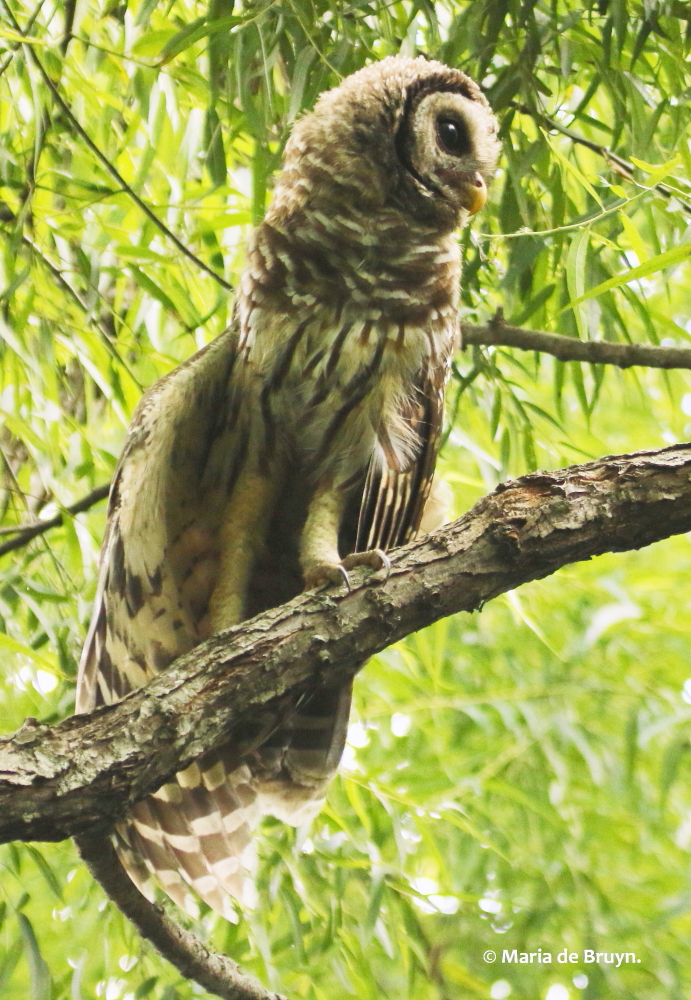
In the nest, baby barred owls (Strix varia) are vulnerable to predators including hawks, weasels, raccoons and other owls. When they are out on their own and already able to fly, they eventually have less to fear. Their main predator becomes the one owl larger than they are in North Carolina, the great horned owl.

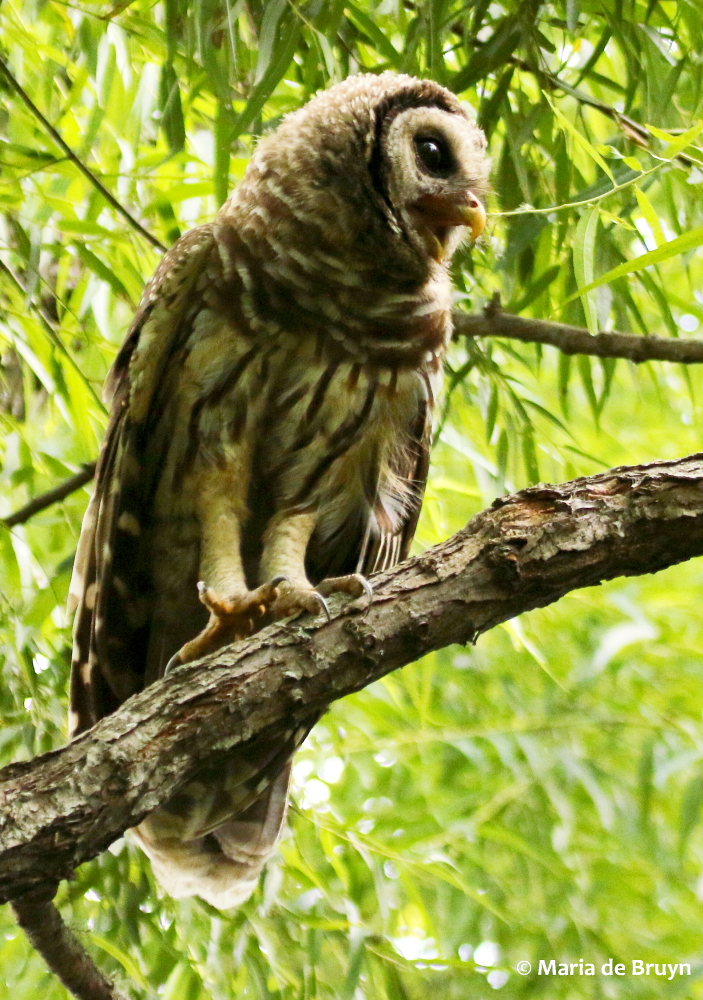
As pointed out in the previous blog, however, they can be fearsome predators to many other species of animals including songbirds, woodpeckers and other avian species. On a few occasions, I noticed the young owls at the Mason Farm Biological Reserve gazing about with expressions that seemed to express wonder and confusion.

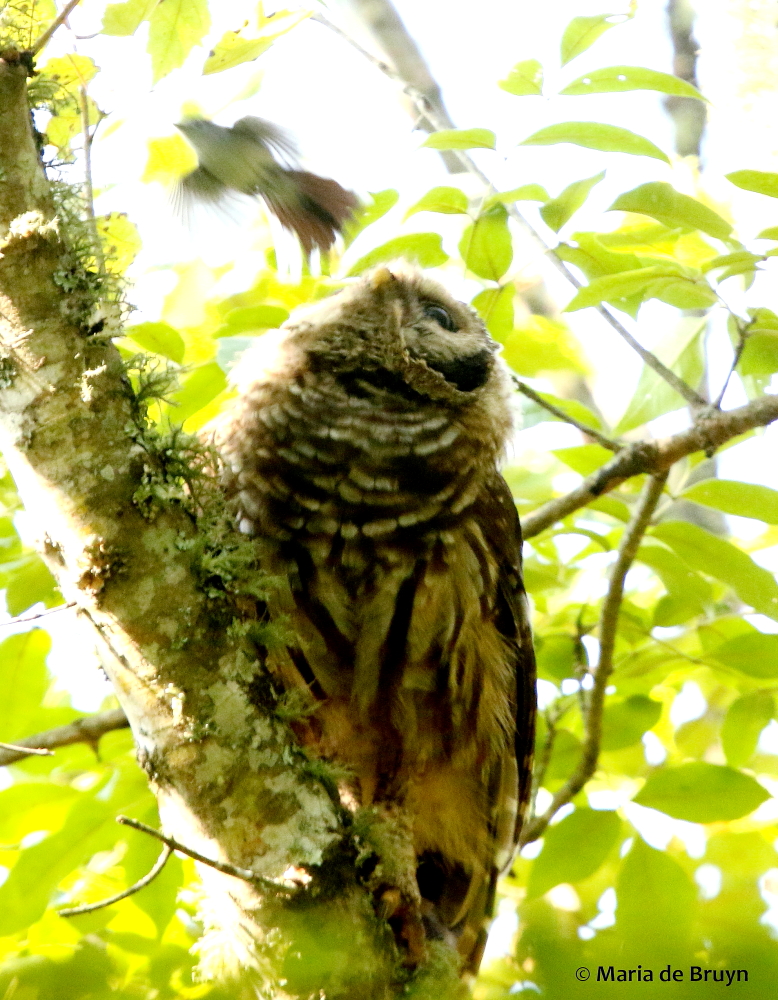
It turned out that they were being dive-bombed by members of a very small bird species, the blue-gray gnatcatchers (Polioptila caerulea). The owlets seemed to have no interest in pursuing the gnatcatchers, but they were perching in areas where the small birds had had their nests so the little gnatcatchers did their best to drive the owls away.


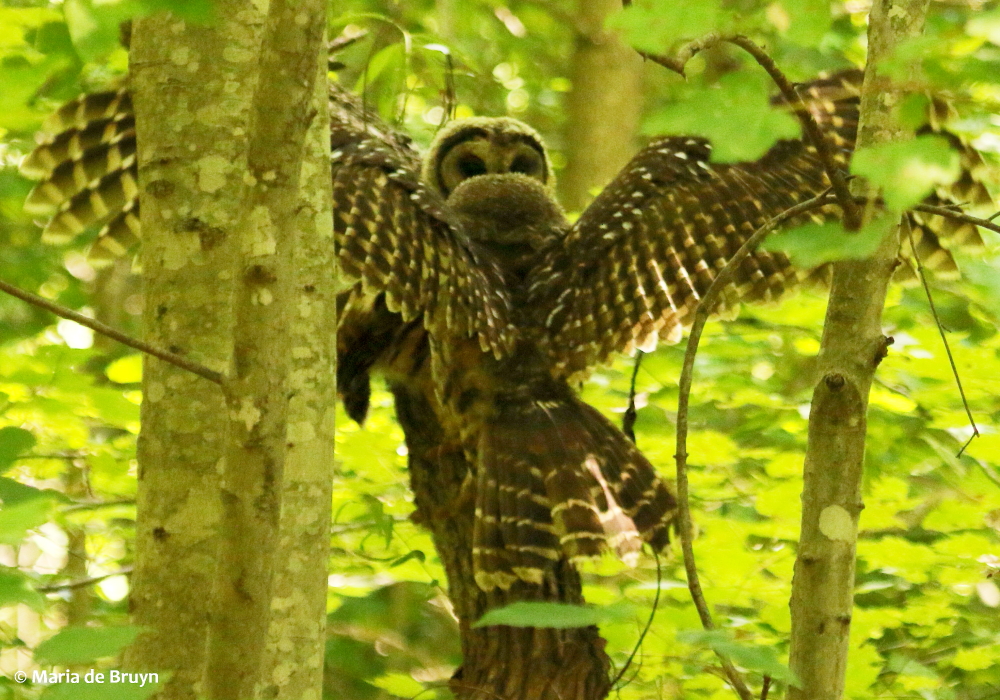
One day, they succeeded. The owls flew to the other side of a path through a bog. One landed on a branch right over my head and looked down at me with what I imagined was an expression of “Hey, what did I do???”

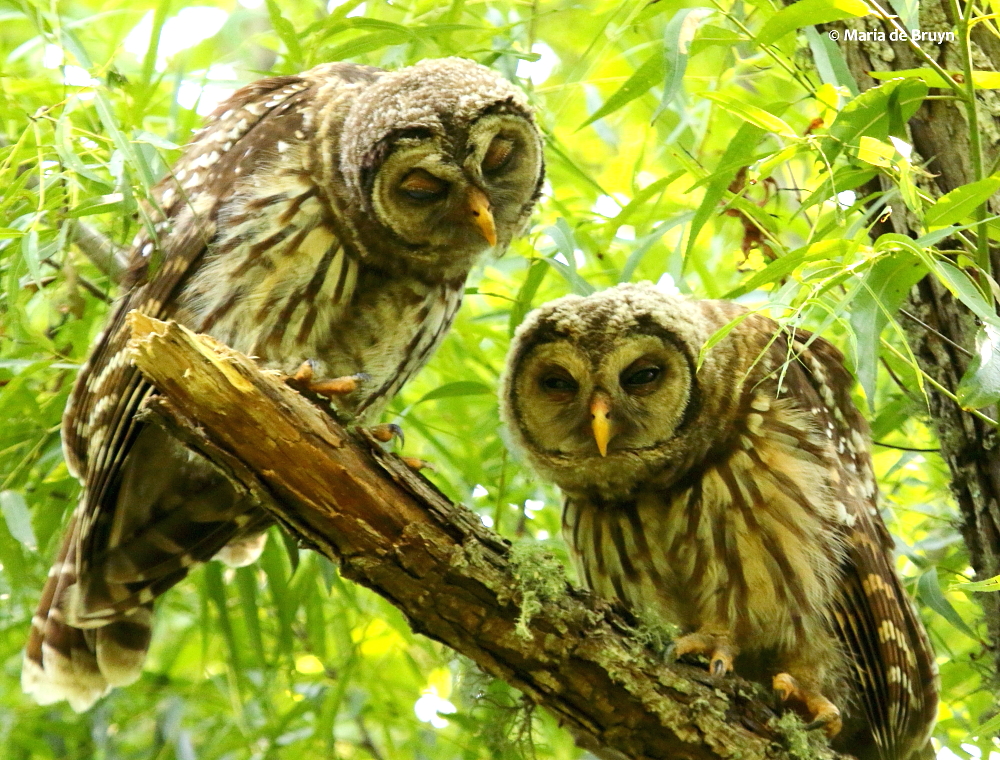
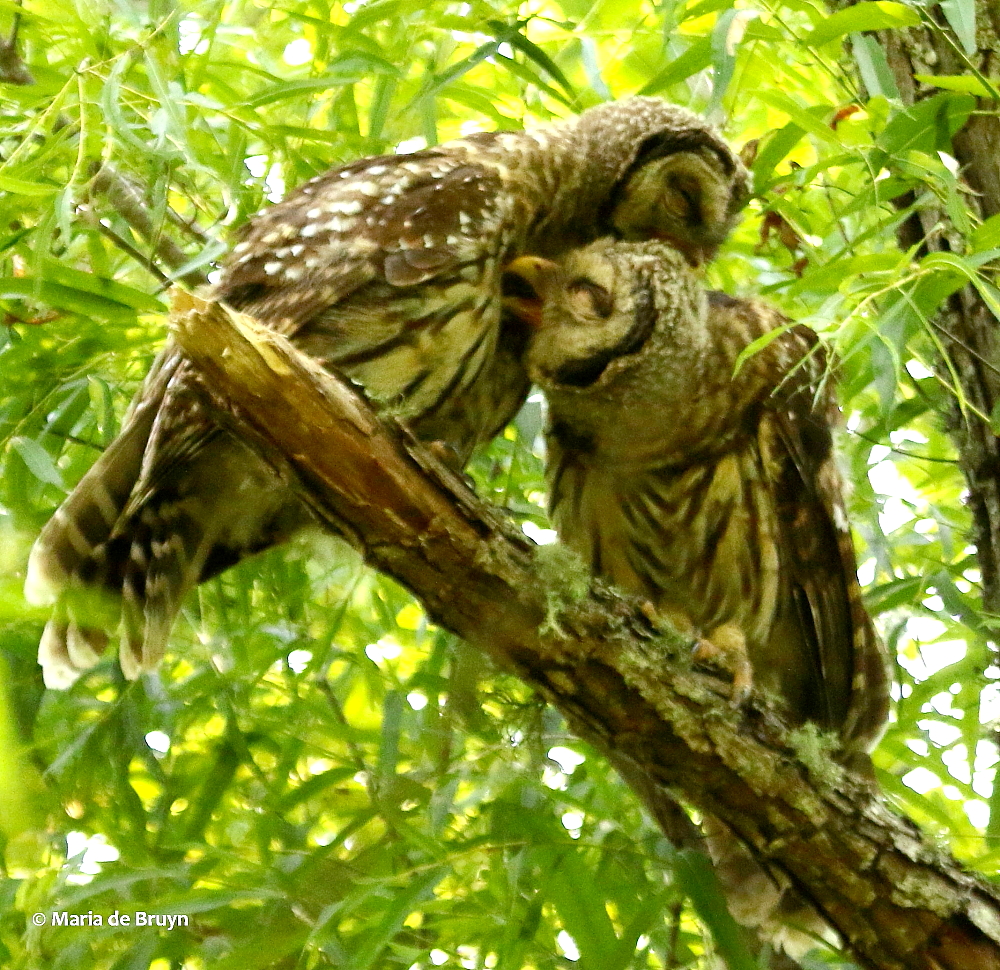
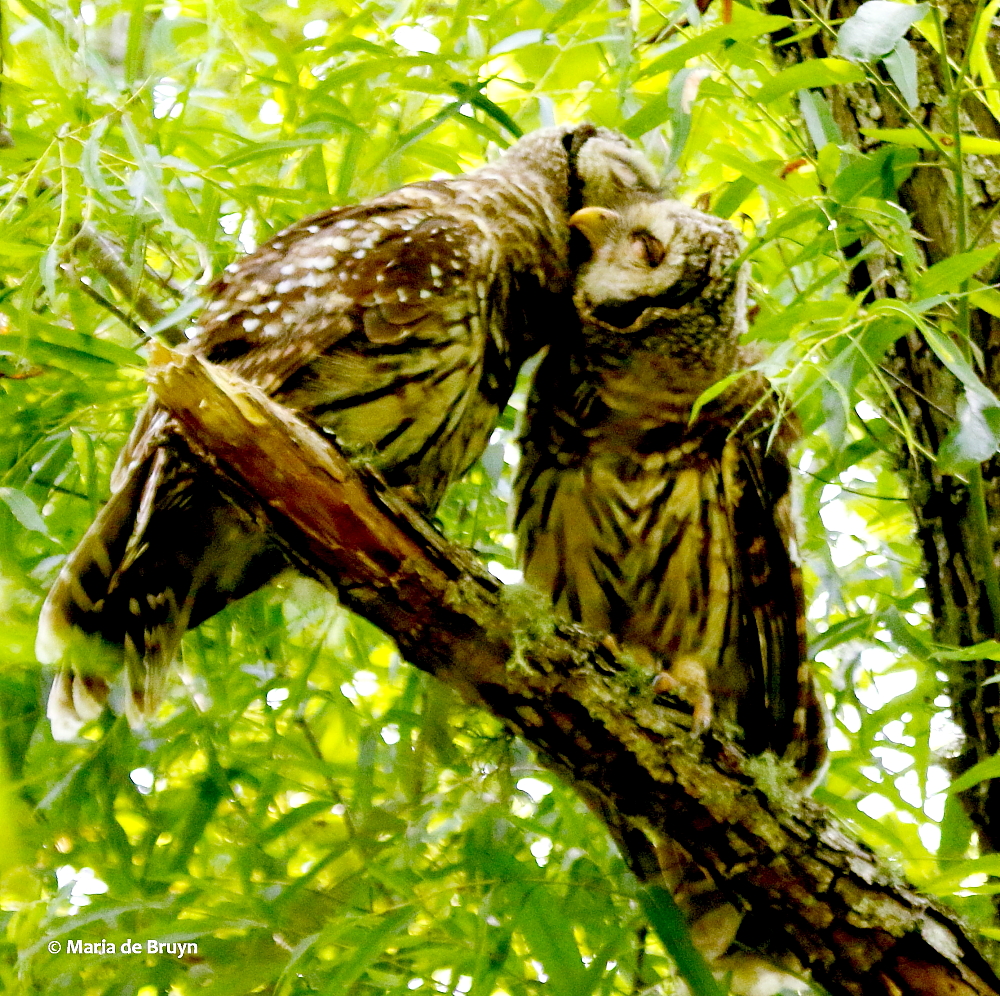
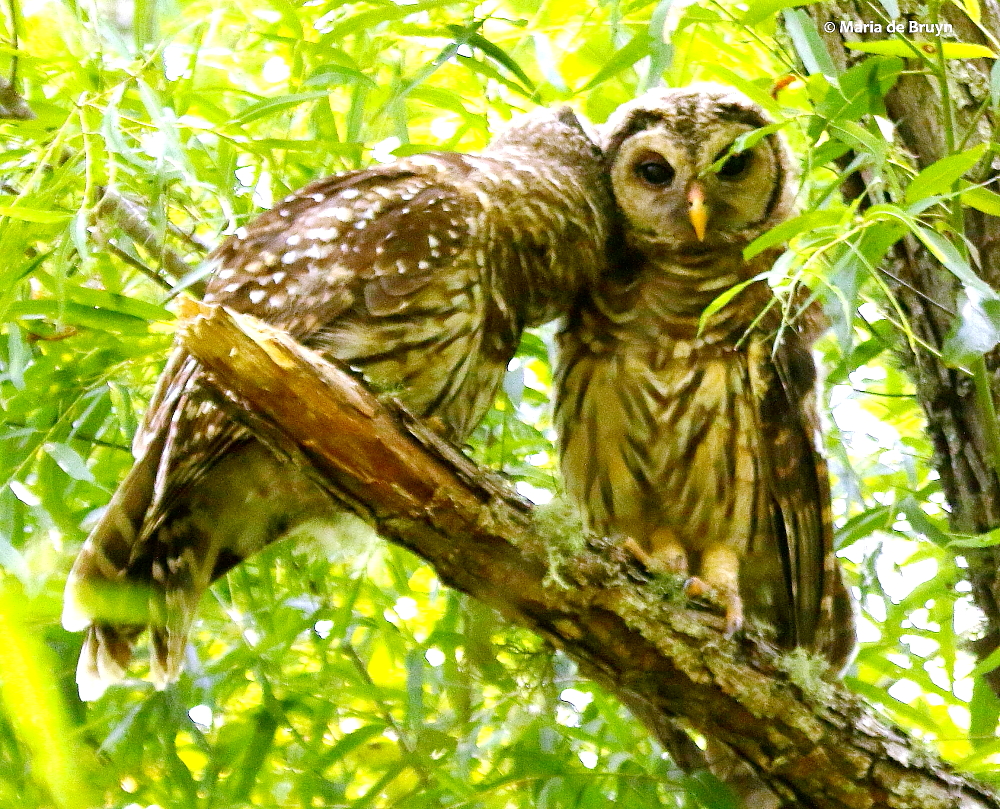
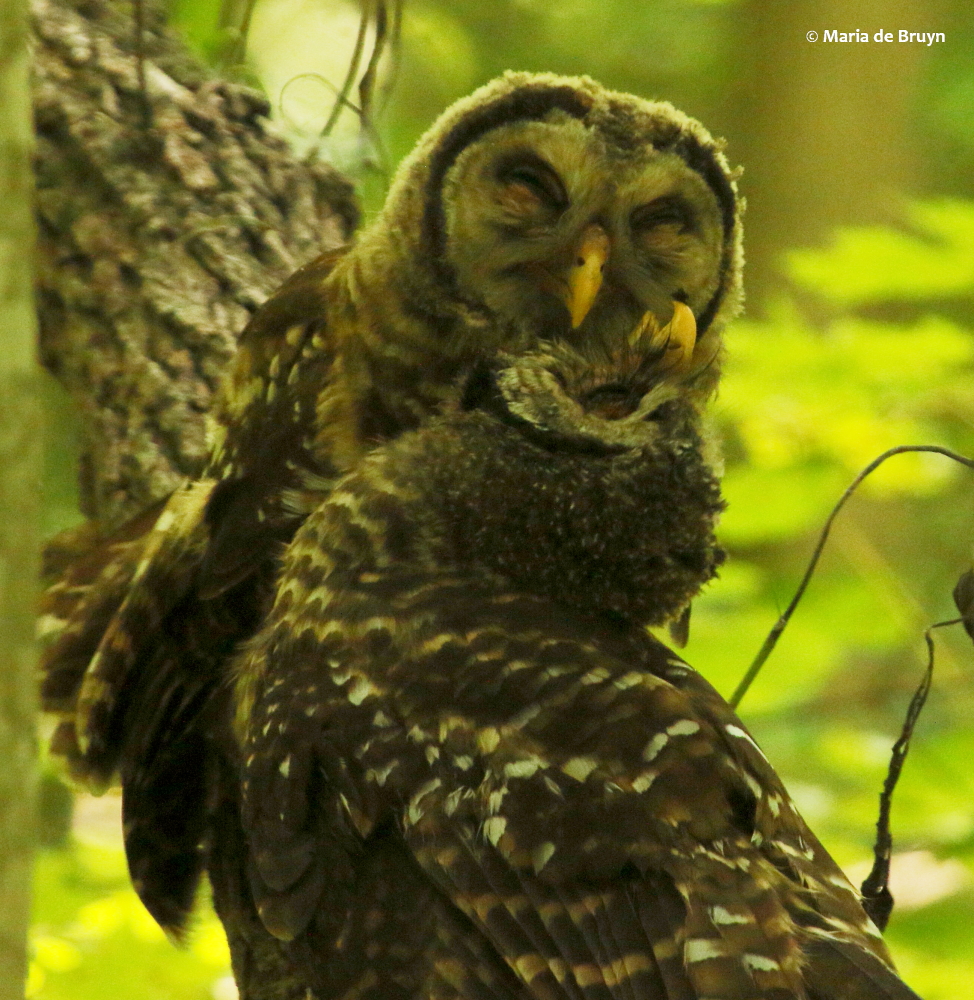
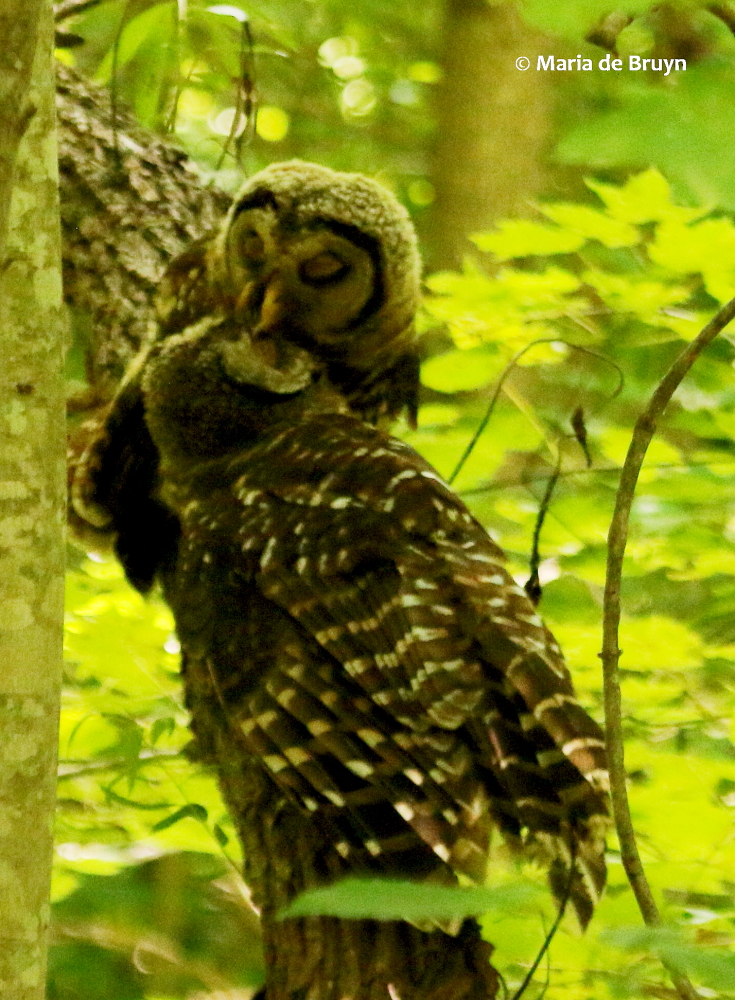
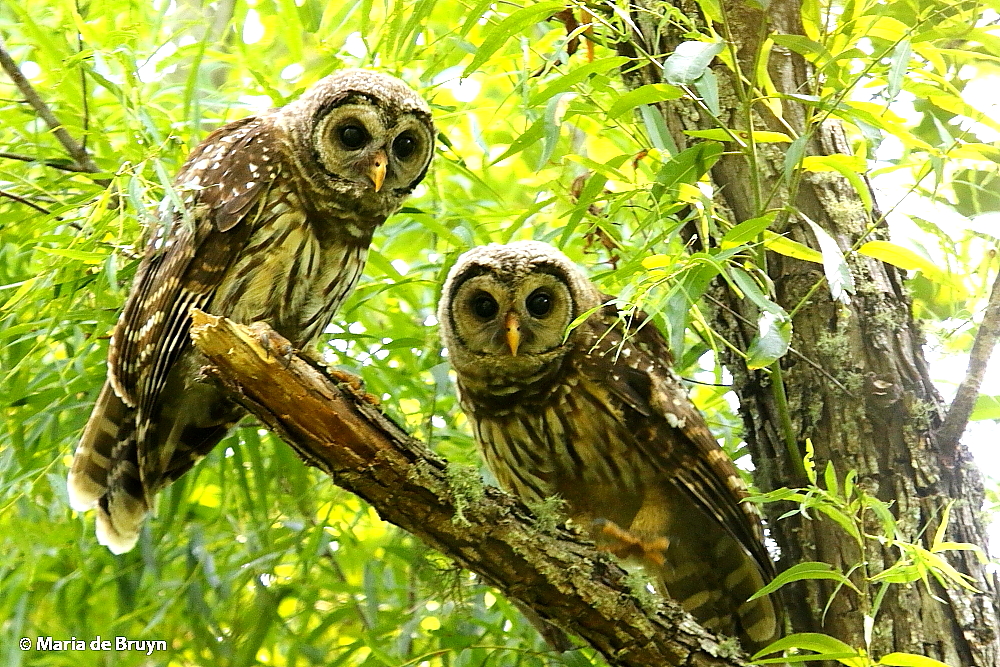
The young owls were very affectionate with one another. They often perched next to or near one another.


They often sat close together, expressing what looked to me like affection.


When they were apart, they would vocalize. It would have been cool to be privy to the meaning of their communications.


The young birds seemed to enjoy nuzzling and grooming each other.


When I stopped seeing the young owls in their usual haunts, I figured the time had come for them to separate and seek out a mate and new territory. Mated owls usually establish nests about 400 yards away from other barred owls although some nests have been observed as close as 100 to 200 yards apart. The young owls may not have flown very far away but they did need to leave their parents’ area. I hope they made it and was happy to have had the opportunity to watch them mature. My next goal for owls – to see a species in the wild that I have not yet seen (e.g., great grey owl, screech owl, barn owl, etc.). I hope you, too, have the chance to see members of this avian group up close!