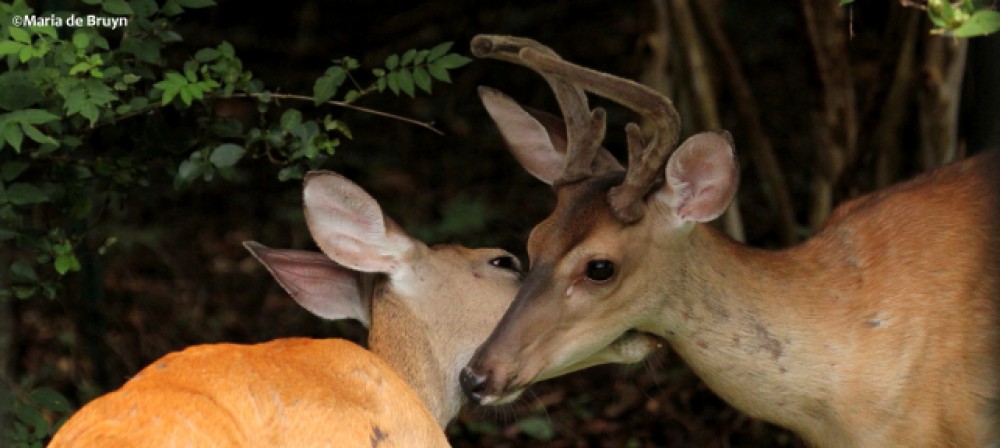
Do deer like treats? Of course, they do!

deer bird seed IMG_3127© Maria de BruynAnyone who has lived in proximity to white-tailed deer (Odocoileus virginianus) know that they have a great appetite for all types of vegetation, including garden flowers that people plant in their yards. This has been a cause of strife between humans and the deer (at least, from the humans’ point of view), even though I and other people have found that deer repellants – both home-made and store-bought – work really well to keep deer from eating plants we wish to keep.

I also have a 5-foot fence around my vegetable garden. In theory, the deer could jump this but the trick is to make the garden long and narrow since the deer calculate how much space they have to land on the other side of the fence. If it looks like the space is too small, they won’t try to jump eveIMG_5431© Maria de Bruynn if they see and smell delicious veggies inside – I know this is true as I’ve watched them figuratively “lick their lips” outside my garden but never attempt to get into it.

The deer’s four-chambered stomach enables it to eat a variety of food. In spring and summer, they prefer green plants, including grasses; in the autumn, they go for corn, acorns and other nuts. In the winter-time, deer eat twigs and buds of trees. They also eat fruit, such as the berries on privet trees, lichens and other fungi.

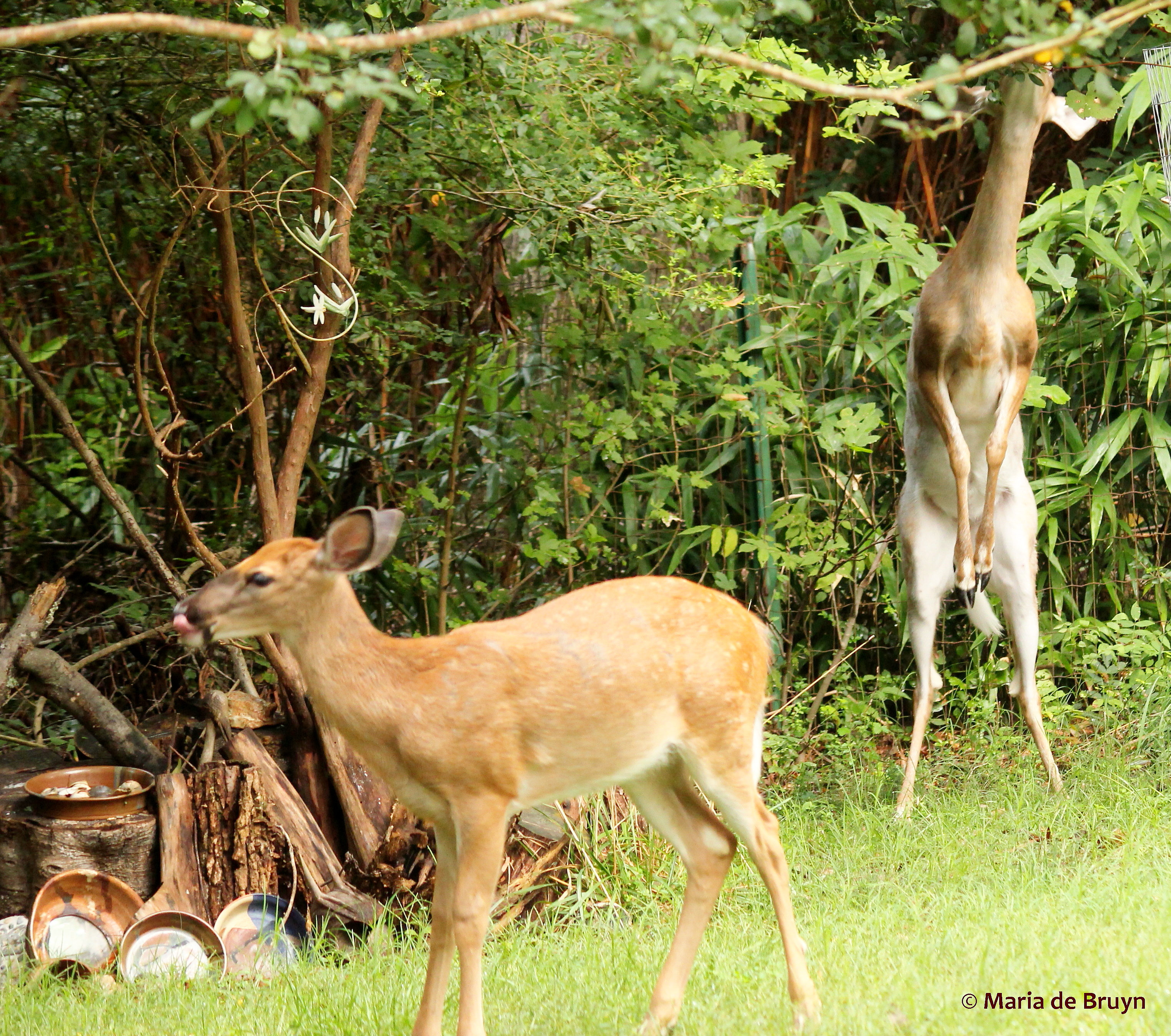
Stip at apple treeStip and privet IMG_1648© Maria de Bruyn

To get to the privet berries, they need to reach the tree branches and their good sense of balance comes in handy. The does do it often in my back yard and the fawns watch them carefully so they can try it, too. Surprisingly, the fawns can stand on their hind legs pretty well when they are only a few months old.

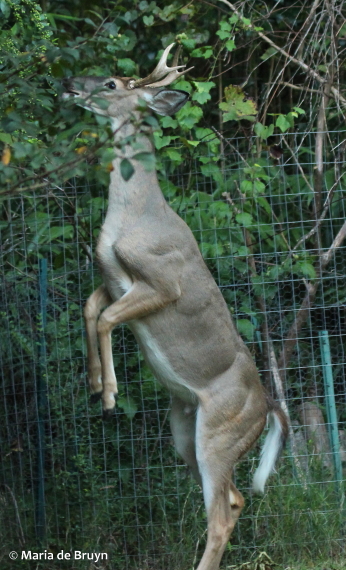
Nezhoni and apple tree 3©Maria de BruynBuck and privet IMG_5243© Maria de Bruyn

Besides privet berries, they like grape leaves (which can be high when the grapevines climb up the privet) and apples. The big bucks will also have a go at it but I don’t see them lifting their bulky bodies up often.

The deer also enjoy treats, just as we may like sweets and birds have a fondness for suet. Bird seed is one treat they like. If the deer are very hungry, they can lick up all the bird seed put out for the ground feeders, but when they are feeling well fed, they will just have a little and leave seed for the birds (and squirrels). The deer’s fondness for bird seed can be strong; if you don’t hang your feeders high enough, they can clean out a feeder in a short time.
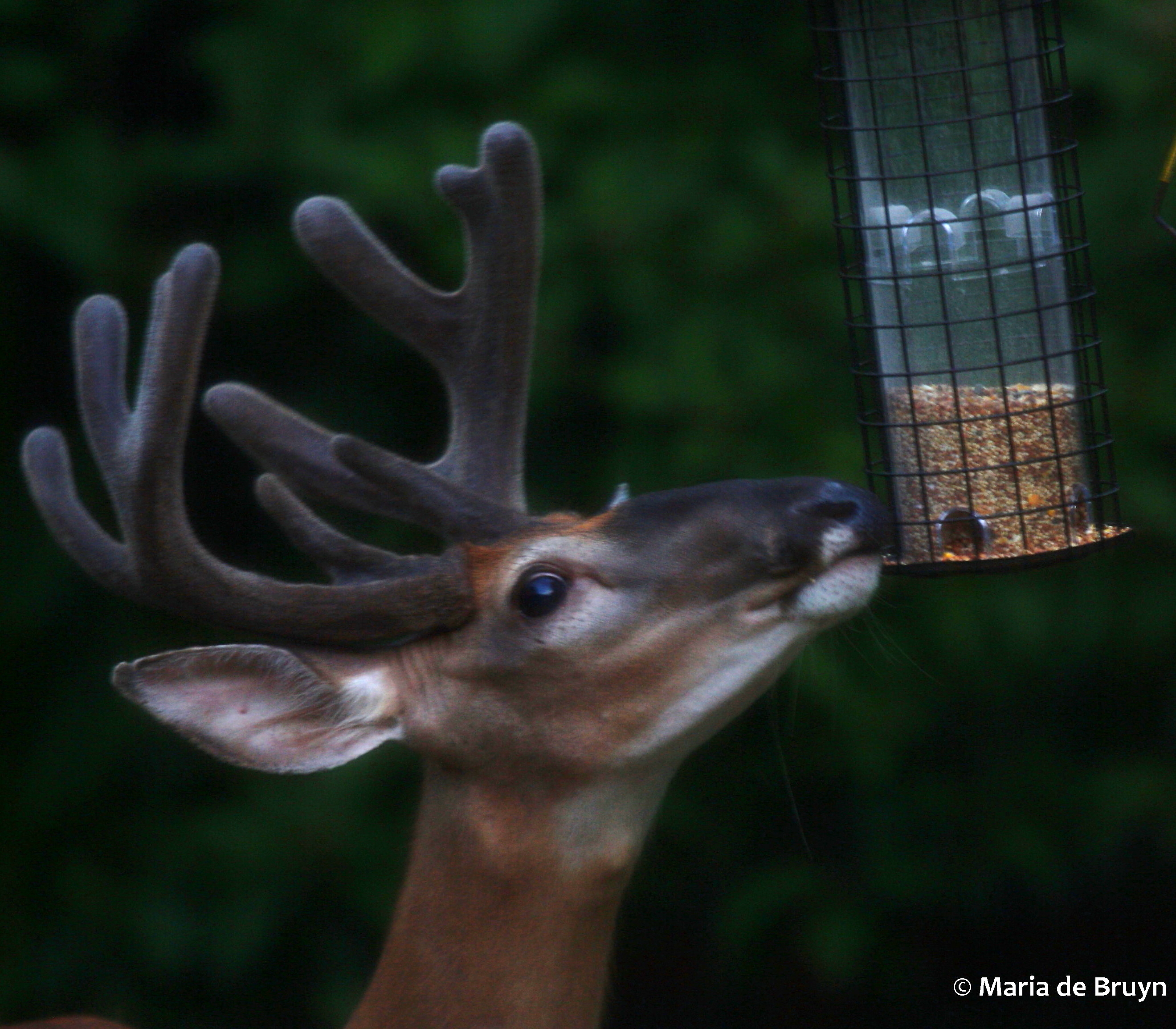
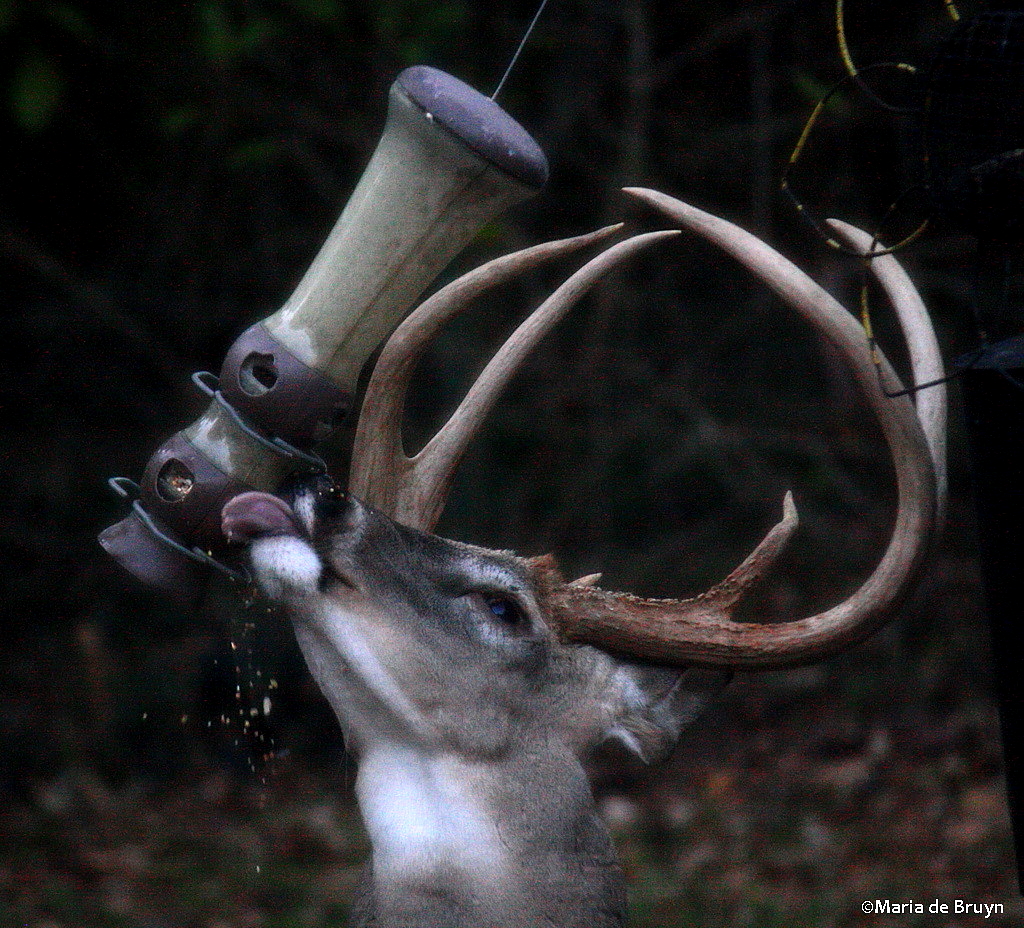
emptying bird feeder at night©Maria de Bruynwhite-tailed deer MdB 3 buck

My biggest surprise concerning a deer treat came from Schatje, my “dear deer” friend of five years. One summer, I noted that the hummingbird feeder was emptying quickly and I just thought the hummers were very thirsty. Then one day, I looked outside to see Schatje enjoying a sweet drink. It turned out she was extremely fond of nectar and eventually I had to hang the feeder higher so she wouldn’t drink all the contents a couple times a day!
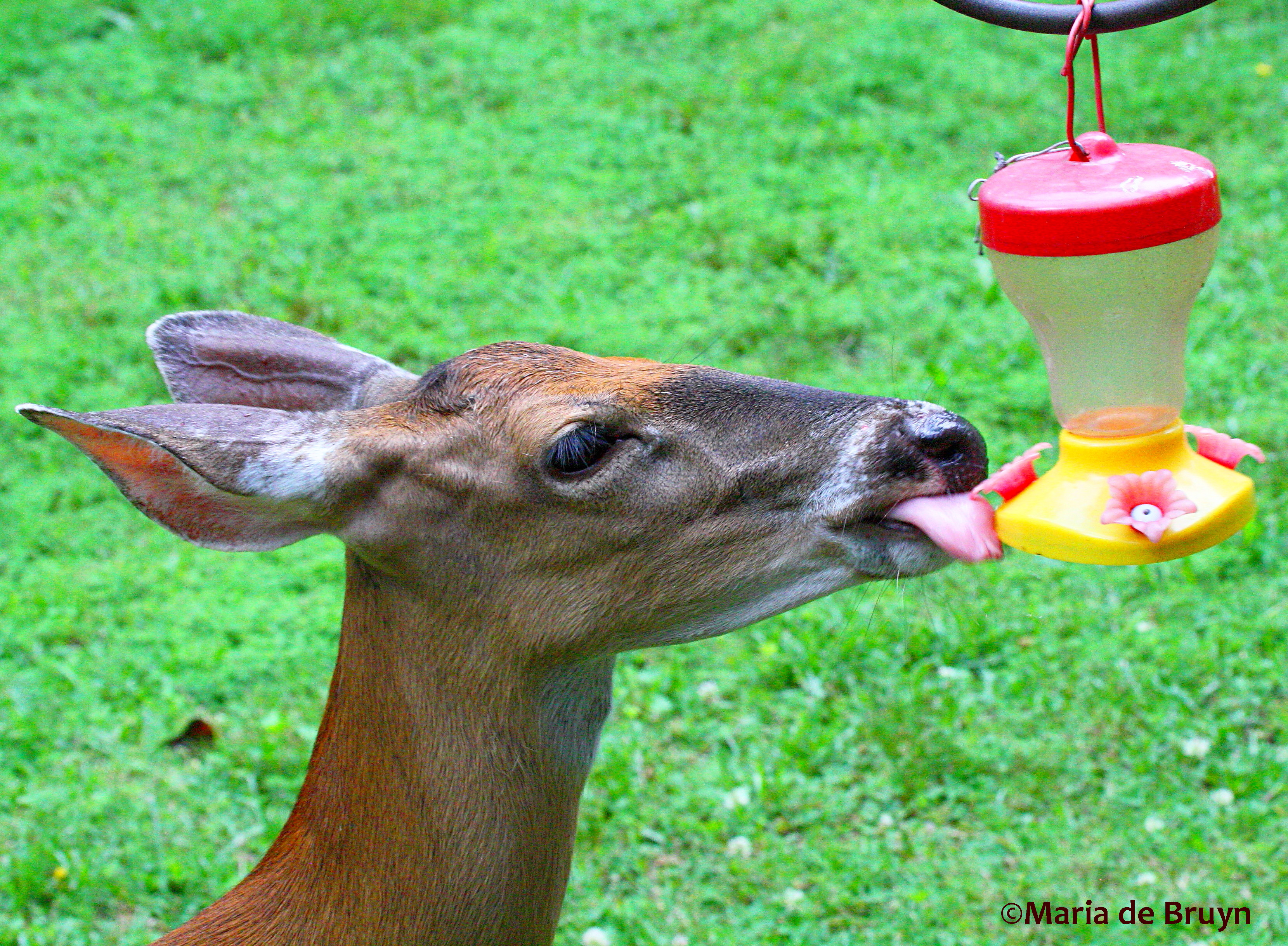
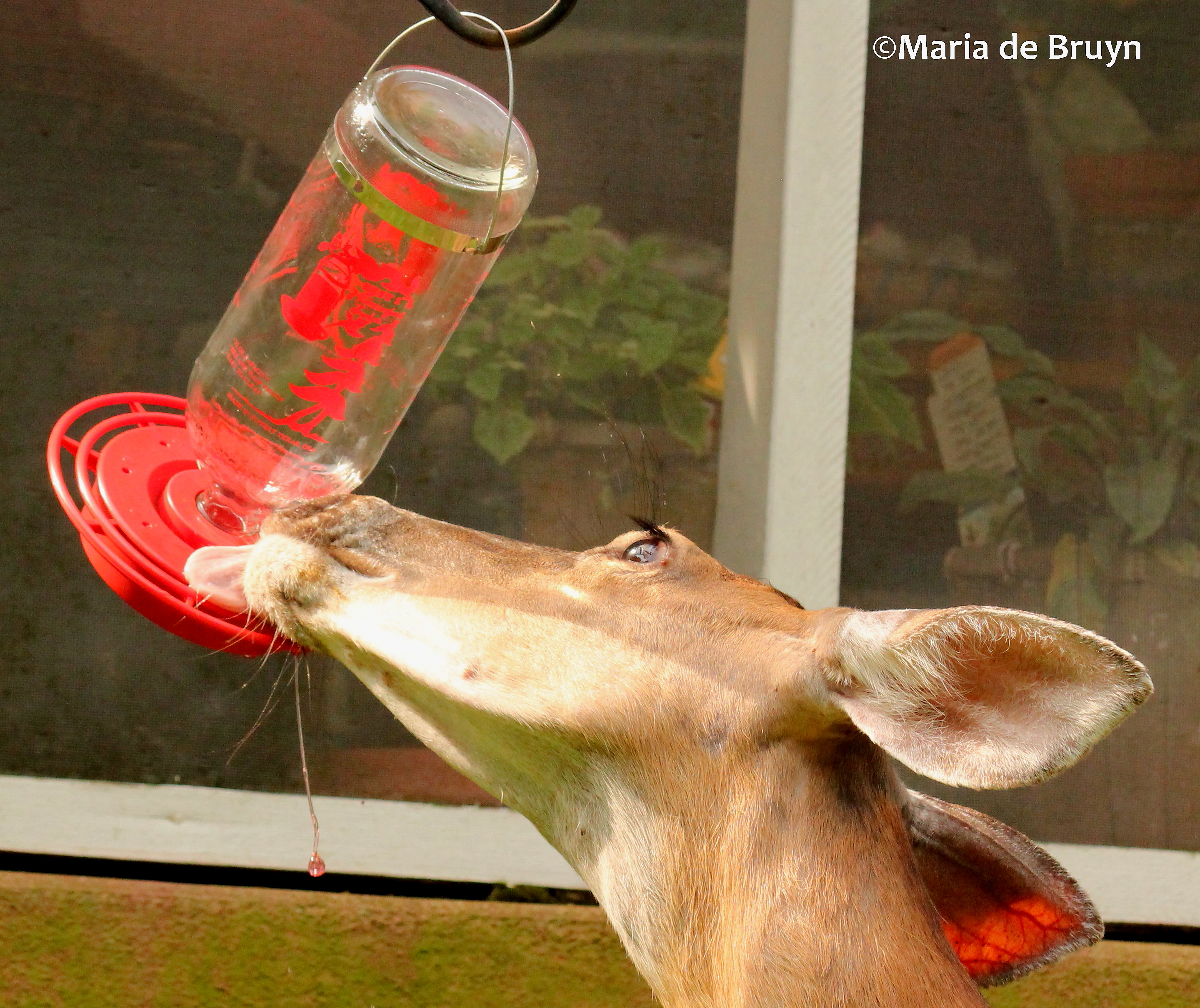
white-tailed  deer Schatje 1 ©Maria de Bruyn signedSchatje nectar IMG_1727©Maria de Bruyn

This winter has been especially cold and the local deer family have had to rely on their winter diet of fungi, leaves and twigs a lot. Though they likely are not anticipating spring, I’m sure they will be glad when it gets here, just like me!

Next week: squirrel treats

Deer and their curiosity

Don-tso and Schatje were both very sweet animals who enriched my life, but they were very different personalities. Don-tso, whose Native American name represented a spirit who sits by your shoulder and warns you of danger, lived up to that name. She was a delicate small cat, rescued as a feral kitten from the streets of Amsterdam, who remained anxious and extremely cautious throughout her life. Even after a decade, I could not approach and pick her up; time spent on my lap was always on her terms and at times of her choosing. She was nevertheless very loving and brave.

Schatje (Dutch word for “dear”) was a wild deer who chose to befriend me and one other neighbor, approaching us as a young doe. We are usually warned not to let urban deer grow accustomed to us as this can endanger them – when they trust people, it makes them vulnerable to those who want to hurt or eradicate them. Schatje was so persistent, however, that I broke that rule and got to know her very well over a five-year period.

Jonahay and Schatje IMG_1752 ©Maria de BruynBoth Don-tso and Schatje were very curious. This came home to me one summer day when a strange incident occurred. My other cat, Jonahay, had become agitated when Schatje came near and when I tried to move him away, he displaced his aggression and attacked Don-tso who was nearest to him. As I tried to intervene between Jonahay and Don-tso, I felt a nudge behind me – Schatje had marched up and was trying to get a good look at what was happening! As she approached, little Don-tso gathered up her courage and stood her ground – she was actually ready to spring at Schatje, who was considerably larger! I finally got Don-tso and Jonahay into the house and things calmed down.

Don-tso says not too close M de BruynOver the years, as I’ve watched Schatje’s family and other deer visit my yard, it’s become apparent how observant and curious they are. Undoubtedly, their curiosity plays a role in their survival skills – it pays for them to notice changes in the environment that could pose a danger or threat to their well-being. Sudden changes – movement and sound – will evoke the well-known white-tailed deer response where they raise their tails like warning flags and stamp their feet.

Ne-zhoni alarm©Maria de Bruyn

In other cases, however, when something in the environment has changed during their absence, they will investigate. Scientists believe that this curiosity provides them with information that can be helpful in knowing, for example, where they might find new sources of food or possible obstacles in their way when they want to make a quick escape. When I have made new additions to my yard, some of the deer – most noticeably Schatje and her offspring – have taken quite some time to examine them through sight, smell and touch.

Schatje looks at bird photo ©Maria de Bruyn

If new yard art moves, it may take a while before they approach and some individuals will never get close. Others are braver, however, like these young ones; the doe exploring the whirling bird did so after about four days of cautious investigation, coming a bit closer each day.

deer with whirling bird IMG_5574© Maria de Bruyn resattracted to toys ©Maria de Bruyn

 The deer can also be curious about other animals, like this fawn who wanted to get close to a squirrel – who definitely was not interested in any togetherness.

Deer with squirrel IMG_2151©Maria de BruynWhile I may not meet another deer who is as trustingly curious as Schatje, her descendants will most likely continue to explore my yard and satisfy their curiosity about any changes happening here. And in doing so, they will help satisfy some of my curiosity about deer behavior!

Animals that carry ticks

Thanks for visiting my blog! So, this edition is about a part of my beautiful world that is actually not so appealing to me, but it does represent some of my learning about nature over the past few years. The photos aren’t beautiful, but they do show something interesting (at least to me). Be forewarned! (And next week, back to some nice bird photos.)

Many proponents of getting rid of deer in our town argue that this will help eradicate the ticks that carry Lyme disease, Rocky Mountain spotted fever and other tick-borne diseases. It is true that ticks get on the deer, but what many people don’t know is that other animals transport these nasty little bloodsuckers as well.

According to the NC State University Department of Entomology, ticks go through four stages in their development – egg, larva, nymph, adult. The developing ticks need blood meals, with most species taking it from a different type of host at each stage. As seen in the photo of the poor white-tailed deer (Odocoileus virginianus) below, the ticks start out tiny but swell up tremendously when they have had a meal.

deer with several ticks IMG_6000 ©Maria de Bruynres

The larvae of the dog tick (Dermacentor variabilis), which can carry Rocky Mountain spotted fever, take blood from white-footed field mice and pine or meadow voles (Microtus pennsylvanicus), like the one pictured here. The nymphs go for somewhat bigger mammals such as opossums or raccoons, while the adults prefer meals from humans and dogs. Black-legged tick (Ixodes scapularis) larvae and nymphs feed on small mammals and lizards, while the nymphs and adults also seek out larger mammals, including dogs and deer. Eastern cottontail rabbits (Sylvilagus floridanus) are another tick host.

meadow vole IMG_4712©Maria de BruynRabbit with tick  IMG_8196©Maria de Bruynres

In the past couple years, the first wildlife that I have seen carrying ticks in the spring are birds – common grackles (Quiscalus quiscula) seem to be a favorite host, although I’ve seen them on other birds as well. The ticks can sense body heat and will even drop down from a tree onto another living species. This undoubtedly accounts for the first tick that gave me a bite requiring antibiotics to prevent Rocky Mountain spotted fever. It was during a visit to an exotic wildlife sanctuary that has been surrounded by an electric fence for more than 30 years so that no deer have been there for decades.

Common grackle 4 ©Maria de BruynCommon grackle 1 ©Maria de Bruyn

Ticks also wait in the grass to latch onto animals – and people – walking by. Fortunately, I’ve never found ticks on my indoor-outdoor cat, but I have found them on me after being in the yard and out on nature walks. Different techniques for loosening their grip have worked well – a new skill that I had never anticipated learning. There are few animal species that I really dislike, but I must admit that ticks are definitely one of them. But I also know now that eradicating deer is not the solution to getting rid of the ticks.

Next blog: Big Blue – my avian nemesis!