
In different countries, the bird genus Platalea has given rise to similar common names for birds in this group, all based on their unique bills. In Dutch, lepelaar used to mean “maker of spoons” but now the first dictionary definition refers to this type of bird. Spanish speakers gave these avians the moniker “spatula bird” (pájaro espátula), while in many other languages they are called the “spoon birds” (Romanian, Icelandic, Bahasa Indonesia, Shona, etc.). In English, we call this unique animal the spoonbill.

Many people find spoonbills fascinating, including me, so it was with happy anticipation that I traveled to see an immature roseate spoonbill (Platalea ajaja) that had decided to forage in our county. When I arrived, I scanned the cow pond where the bird had been seen, but the only animals there were several large cows! I decided not to wait around since the cattle were enjoying the water and it was unlikely any birds were going to join them.
A couple days later, I returned, parked along the road and walked up to the fence to peer down at the pond again. A great egret (Ardea alba, below) was foraging, some barn swallows (Hirundo rustica) were occasionally swooping over the water, and some Canada geese (Branta canadensis) were wandering around but no spoonbill was in sight.

 In contrast to other birds, spoonbills do not vocalize much except for some low grunts made while they are feeding. I didn’t hear any bird sound and after some 20 minutes or so, I thought perhaps the young spoonbill had decided to move on. Then suddenly s/he emerged from grasses bordering the pond and I was able to observe the bird for quite some time.

 There are six spoonbill species worldwide; the roseate spoonbill lives in North, Central and South America. The other five species have white plumage, while the roseate spoonbill adults have a white neck, bare head, bright pink back and rump feathers and a greyish bill. The immature birds have feathered heads their first three years and pale pink feathers. The color on our county’s visitor showed up more brightly when the sky was overcast rather than sunny.
The spoonbills’ coloration comes from their food. Their diet consists of crustaceans, snails, fish and aquatic insects found in both fresh and salt water. Aquatic invertebrates have pigments called carotenoids and when the spoonbills eat them, their feathers turn pink.
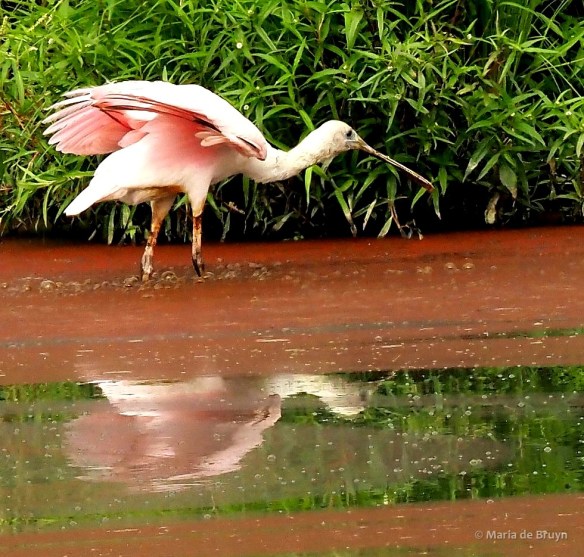
Depending on the birds’ age, location and breeding status, the color intensity can vary from a pale pink to very bright magenta or carmine.


 When chicks are born, they do not yet have a spoon-shaped bill; it only begins to flatten out when they are 9 days old; the final shape is achieved by 39 days. The bill can be 5.7 to 7.1 inches long (14.5-18 cm). It is about an inch wide just beneath the birds’ eyes and then widens to about 2 inches at the end.
It might seem that these very large bills could make life difficult for the spoonbills but they use these spatula-like appendages efficiently when feeding. Their nostrils are located at the base of the bill so that they can breathe while foraging.

Their technique is to stalk slowly, leaning forward with their bills submerged as they swing their heads from side to side. Israeli scientists discovered that when the bill sways back and forth, it creates tiny whirlpools that suck up prey submerged in the water. When the prey touches the bird’s bill, it snaps shut as nerves at the bill tip are stimulated; the prey is then usually swallowed whole.

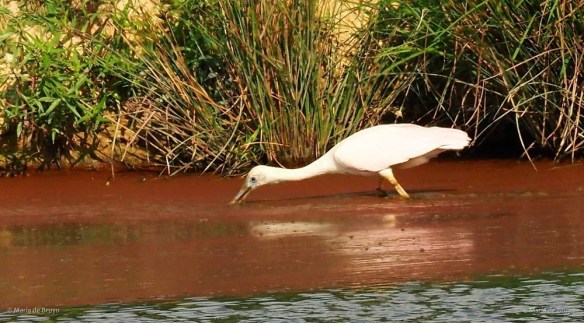
Spoonbills prefer to feed in shallow water that is usually less than 5 inches deep. This would account for the fact that the spoonbill I watched was making circuits around the edge of the pond, never going into the center.


One thing in particular struck me as the cow pond bird walked and stalked. When s/he raised his/her head and opened the bill, it looked to me as if the spoonbill was laughing or at least looking very friendly and smiling!


 In the USA, spoonbills have traditionally bred in Florida, Louisiana and Texas. After breeding, they disperse. It is especially year-old birds who are increasingly being seen along the Eastern coast. To find them further inland had been more unusual but in recent years they seem to be moving away from the coast as well. This year several spoonbills have been spotted in the Piedmont region in addition to our Orange County visitor.

 By the late 1800s, the roseate spoonbill was endangered in North America because the birds were either killed for their feathers (to make decorative screens, fans and hats) or they abandoned their nests because they were near great egrets who were being killed for the millinery trade. When that trade ended, their numbers rebounded but rising sea levels, degradation of water quality and loss of wetlands has now decreased their breeding sites. The spoonbills are still listed as a species of concern in Florida and Louisiana.

As climate change progresses, increasing numbers of roseate spoonbills are starting to move north. Protection of wetlands in our and other Eastern states would therefore benefit this species, as well as other animals that depend on this type of habitat. And more of us outside the southernmost states may get the chance to observe these unique birds in the future!
 As spring progresses, we’re seeing ever more mammals on the move. They’re mating and having young and in search of extra sustenance for these activities. The animals whom we unfortunately see dead alongside — or on — roads often include members of the rodent group: groundhogs, squirrels and chipmunks.


 A rodent that we may see much more often in yards, parks, public gardens and along trails are the Eastern gray squirrels (Sciurus carolinensis). Some people find them amusing to watch, while others wish they would just go away — especially birders who end up spending more on bird food than they planned because these clever rodents find innumerable ways to get up onto bird feeders. Facebook groups for birders regularly have postings by people asking for suggestions on how to thwart squirrels from gaining access to their feeders.
 I, too, continue with ongoing efforts to outwit these feeder marauders. They are not shy, coming up on the front porch to look in on my indoor cats.

 In my yard, they have gnawed at the bottom of a baffle designed to keep them off poles as they try to pull it down. Their ability to chew through plastic and metal may be one reason that they manage to keep their dentition to “normal” lengths since their teeth grow about 6 inches per year.


 Many nature observers do admire squirrels’ cleverness. For example, squirrels spend a lot of time hiding food in caches dug in the ground. To outwit other squirrels and rodents who might be watching, they will prepare a hole, pretend to deposit food, and cover it up. Then they will go somewhere else where they don’t see a rival watching and hide the food in another place.

 A rodent that many people tend to like more than groundhogs and squirrels is the diminutive Eastern chipmunk (Tamias striatus). The “cuteness” factor undoubtedly plays a role as these active little animals do tend to look a bit endearing.


 My beautiful world