Busy as a bee is no joke! Our hardworking pollinators – pretty and persevering!

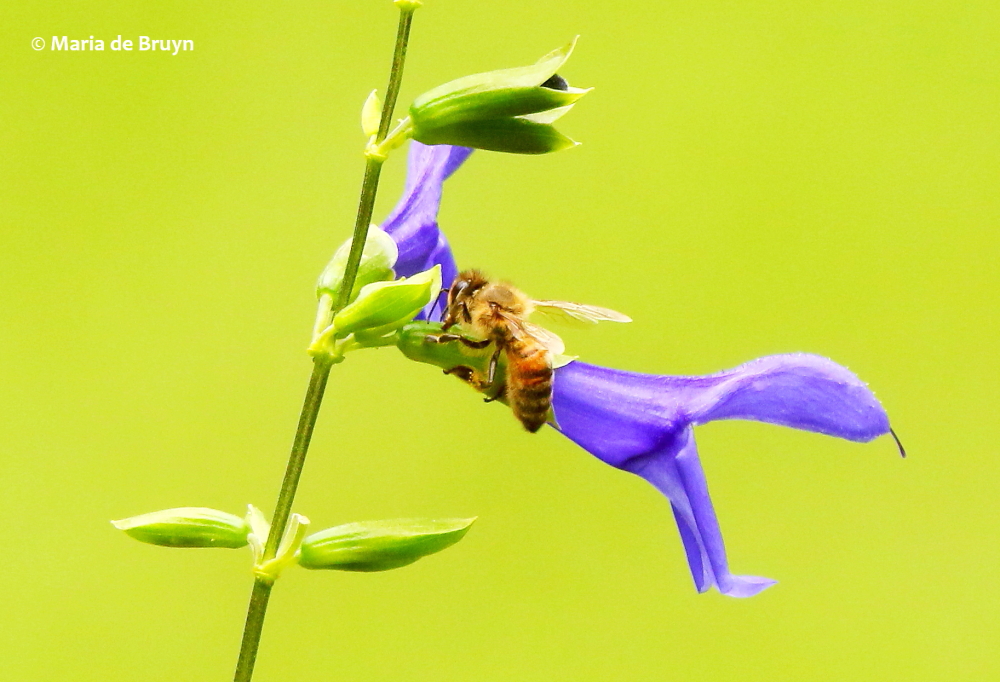
honey-bee-brazilian-sage-i77a1269-maria-de-bruyn-resHere it is, 7 November, and the honey bees were still busily working over the Brazilian sage, lantana and chrysanthemums in my garden. The Eastern carpenter bees were absent today, perhaps because of the cold night we had, but a few butterflies were flying among the flowers. We know that some of our pollinators are in serious trouble, but my garden has nevertheless been blessed this year with a steady stream of pollinating visitors who were to be seen on the varied blooms morning, noon and almost night.
bees02fin02


I’d enjoyed seeing the bees, butterflies and syrphid flies in the past, but started paying even more attention to them as pollinators this year as I worked on the “Healthy Bee, Healthy Me” project initiated by the non-profit organization Keep Durham Healthy.
 

eastern-tiger-swallowtail-i77a8131-maria-de-bruyn-res



The project expresses its goal as follows: “…to establish educational pollinator gardens in proximity to pre-existing community gardens to ensure the sustainability of nectar and pollen sources for our honey bees, native bees, butterflies and other pollinators throughout the year, and to increase the yield of the food crops grown within the community gardens.” Some of my photos were used in one of their interpretive garden signs and next year more community gardens will join the project.
hummingbird-clearwing-moth-i77a3130maria-de-bruyn-res

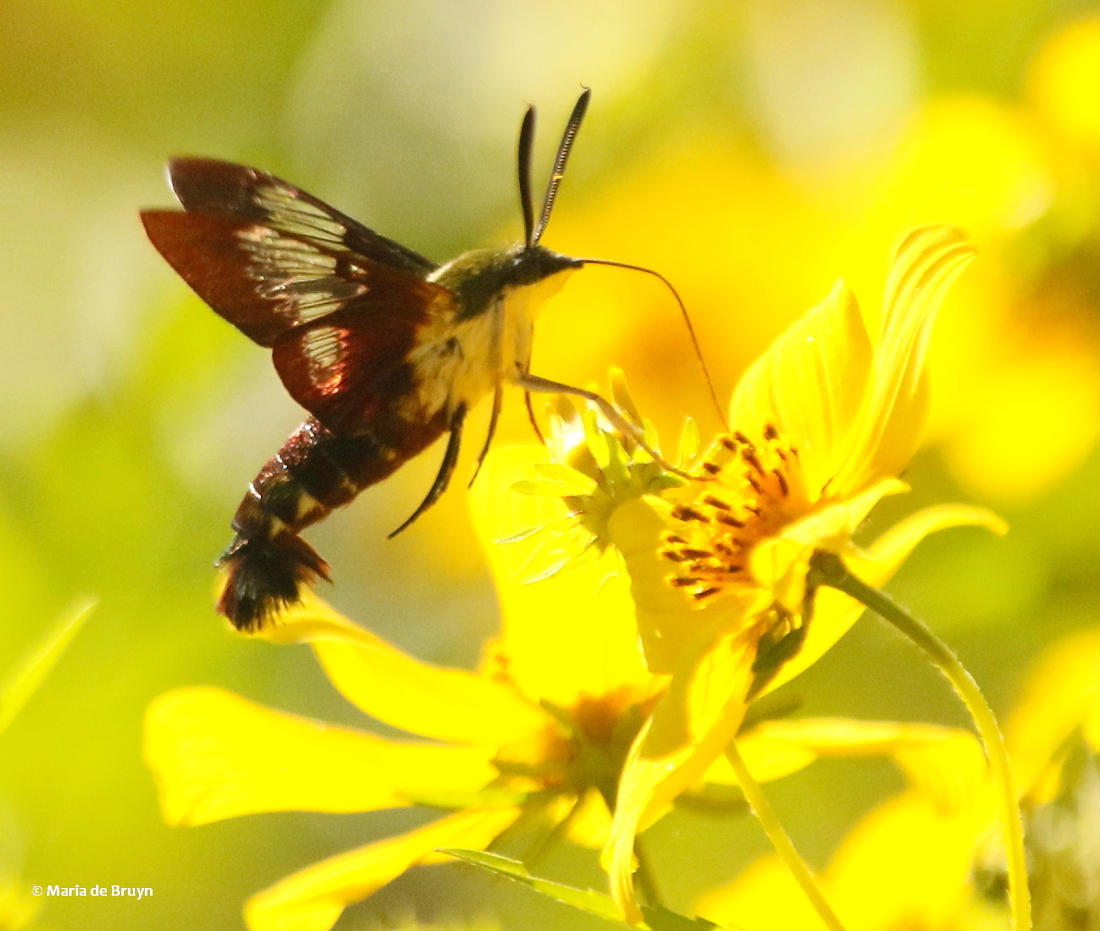
Science knows that more than 250,000 plants are pollinated by over 100,000 different types of animals, but not all plants require assistance from pollinators for fertilization. In abiotic pollination, fertilization occurs without another organism as an intermediary – for example, through movement of pollen from male vegetative anthers to female stigma by the wind (called anemophily) or water (called hydrophily). However, much fertilization occurs with assistance from biotic vectors, which not only include bees, butterflies and flies but also moths, birds and mammals (e.g., lemurs, squirrels, opossums, monkeys and bats; here you see a hummingbird clearwing moth – Hemaris thysbe – getting nectar.) How cool is that!
honey-bee-i77a5677-maria-de-bruyn-res


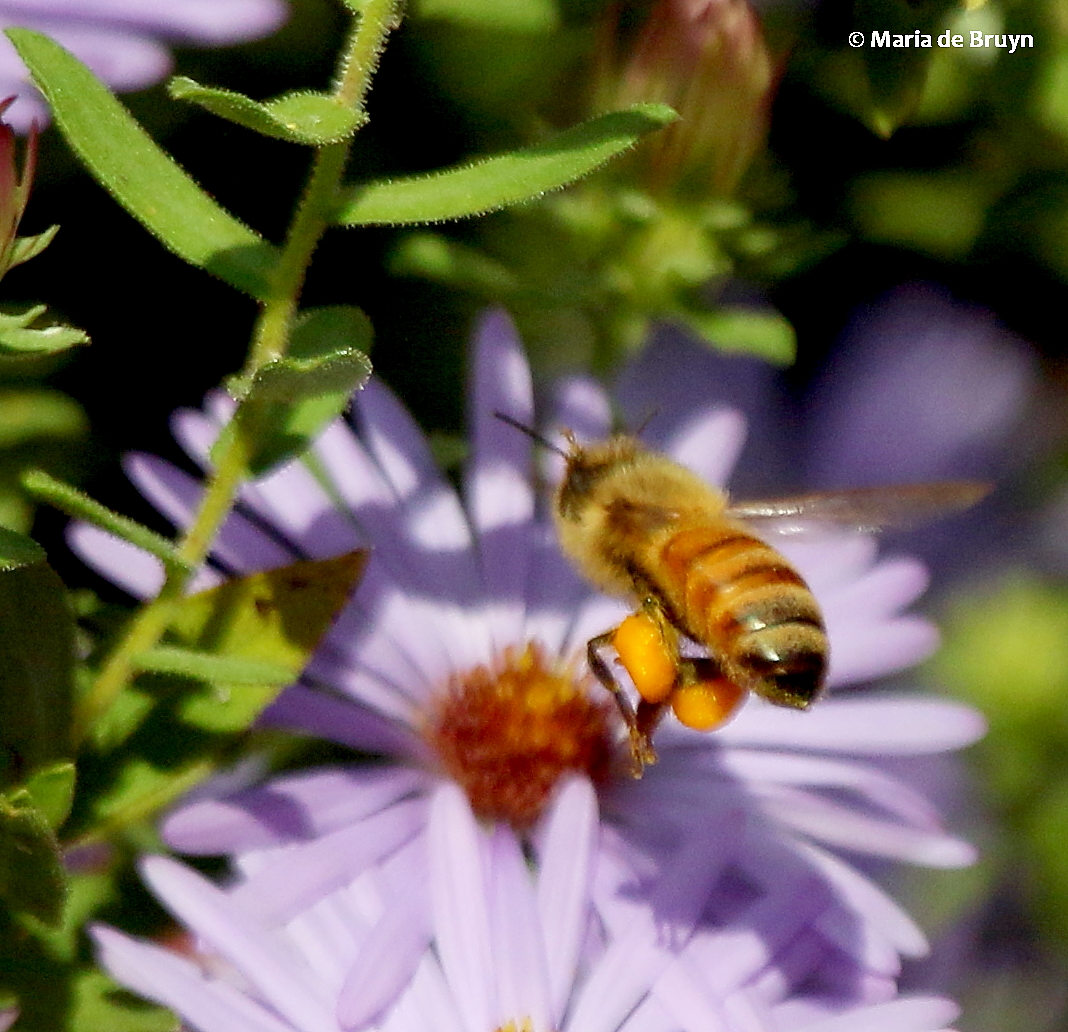
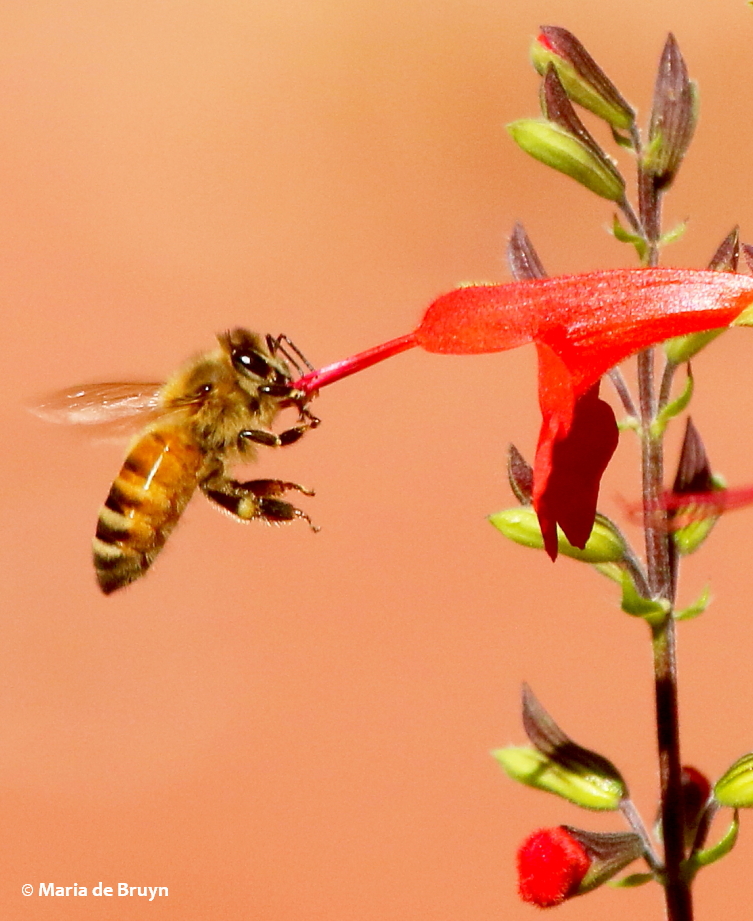
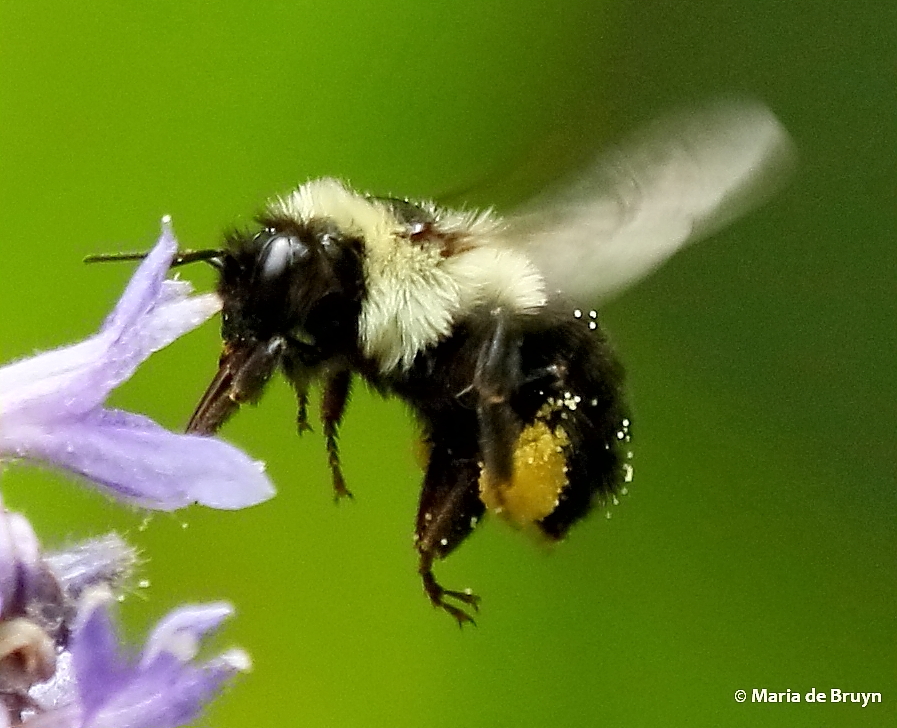
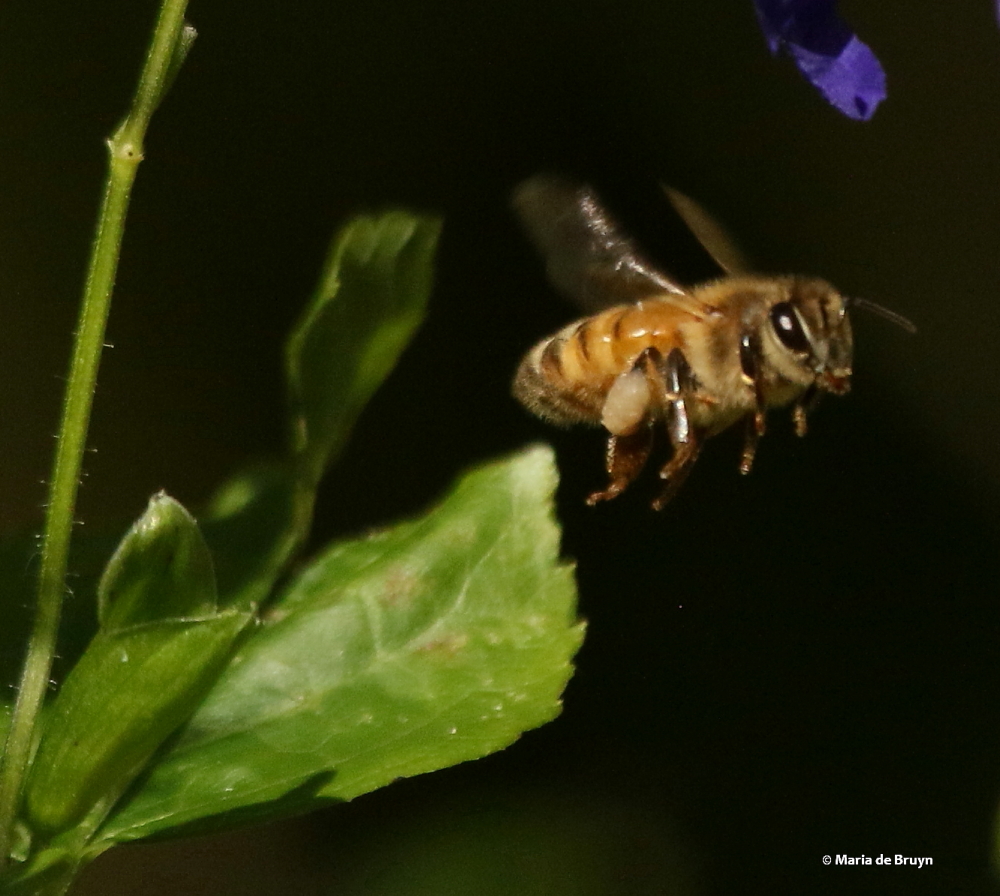
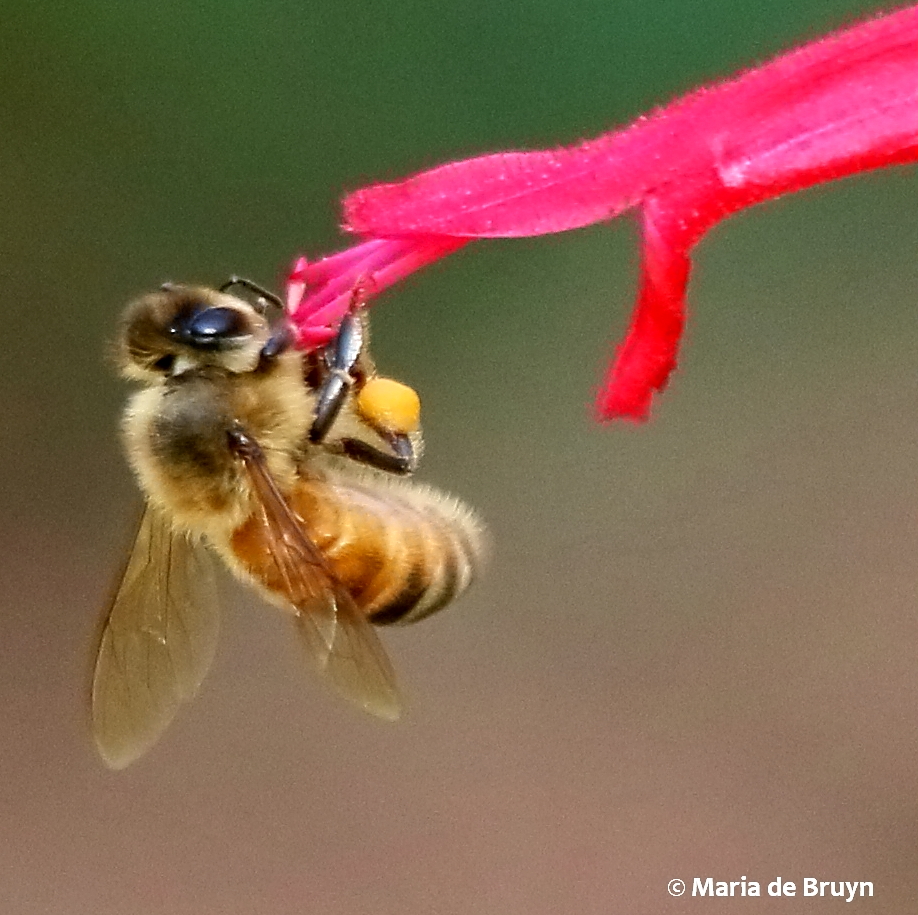
The most efficient pollinators are the bees. Some species like honey bees (Apis mellifera) and bumble bees have pollen baskets (corbiculae) on their legs – a concave portion of their hind leg in which pollen can be stored as a ball. It starts out small but eventually gets fairly big so their little tibia begin to look like barbells. The color of the pollen can differ from bright yellow to brown to red to white, depending on the pollen of the flowers visited most often.
 

american-bumble-bee-i77a0763-maria-de-bruyn2-res    american-bumble-bee-male-img_5492-maria-de-bruyn-bg

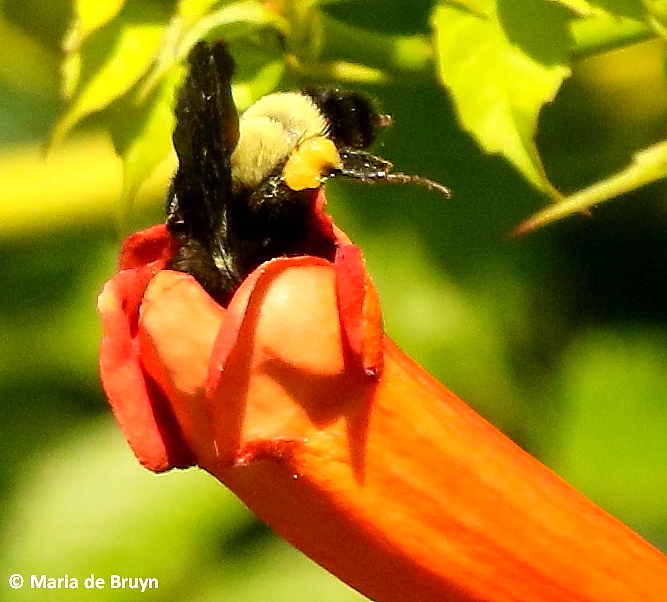
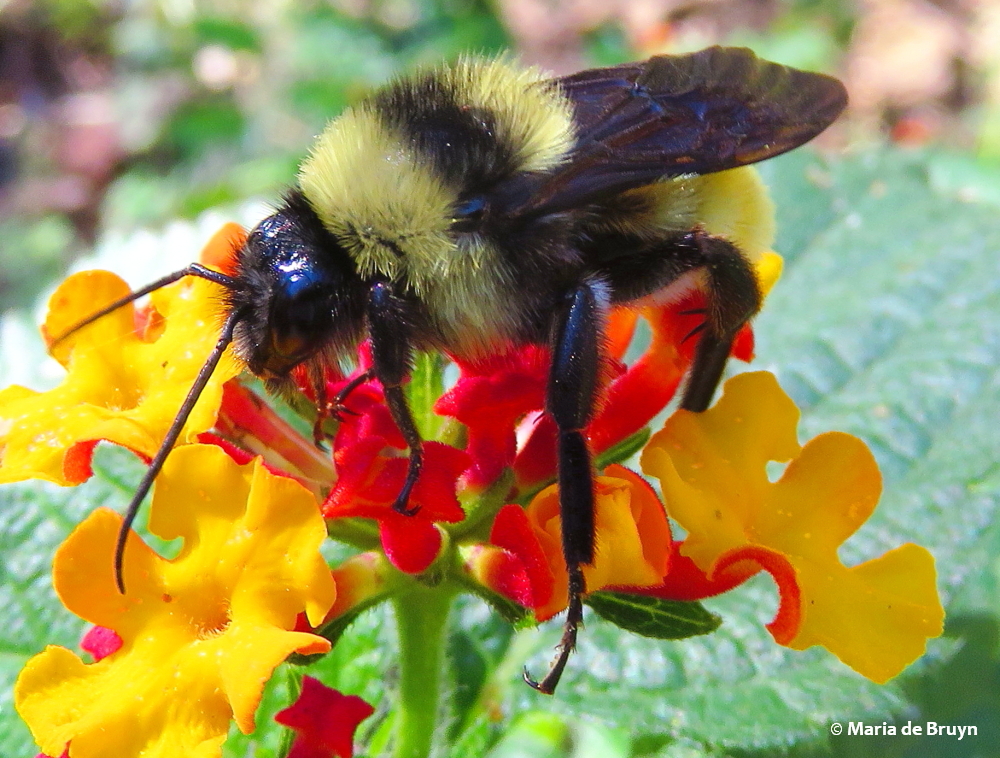
American bumble bee (Bombus pensylvanicus)
common-eastern-bumble-bee-bombus-impatiens-i77a9625-maria-de-bruyn-bg

Common Eastern bumble bee (Bombus impatiens)
honey-bee-i77a8142-maria-de-bruyn-res      honey-bee-i77a2099-maria-de-bruyn

Honey bees

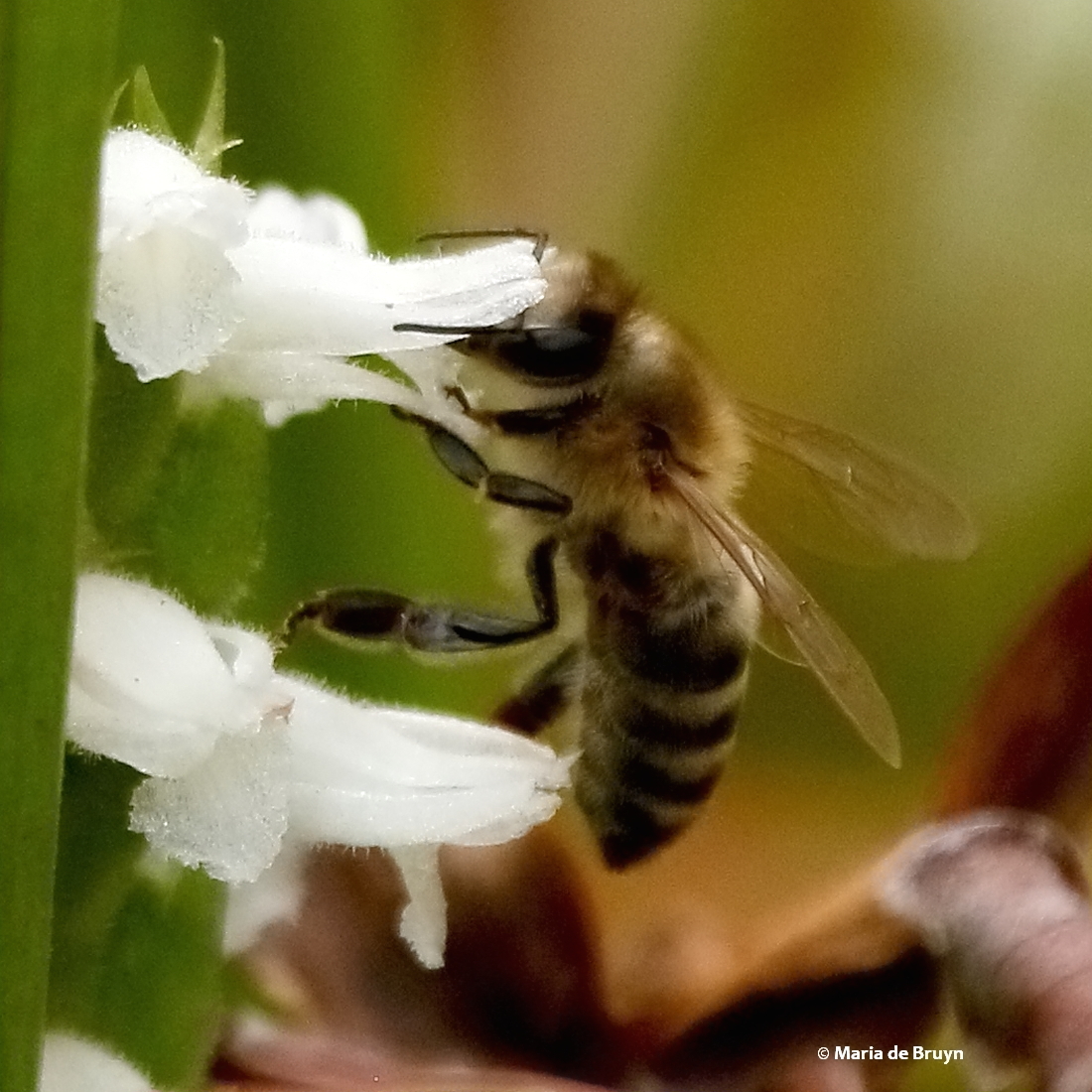
The attractive little honey bees, which vary in their coloring, are known to pollinate about one-third of the popular foods eaten by humans, including items such as tomatoes, peas, beans and other fruit.
honey-bee-i77a7652-maria-de-bruyn-res    honey-bee-i77a6542-maria-de-bruyn-res

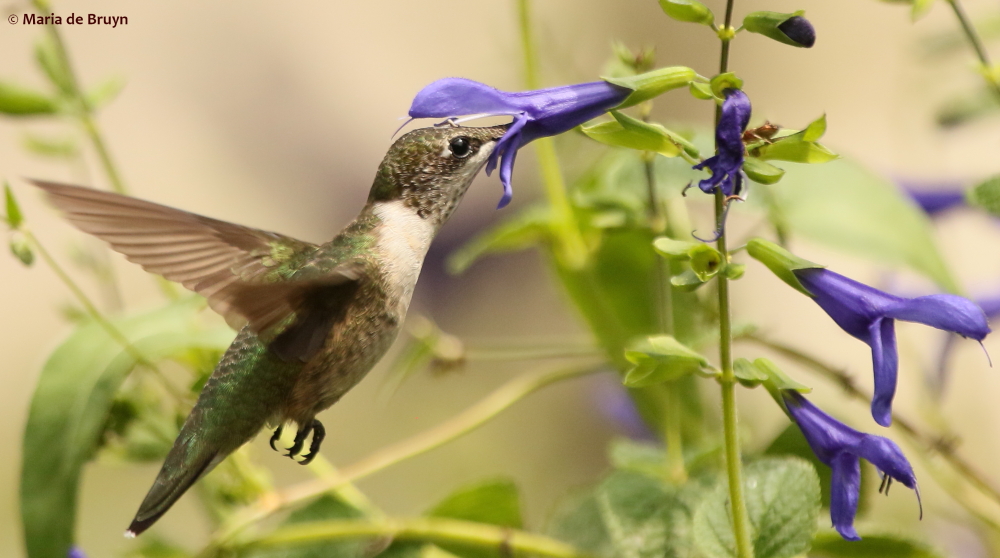
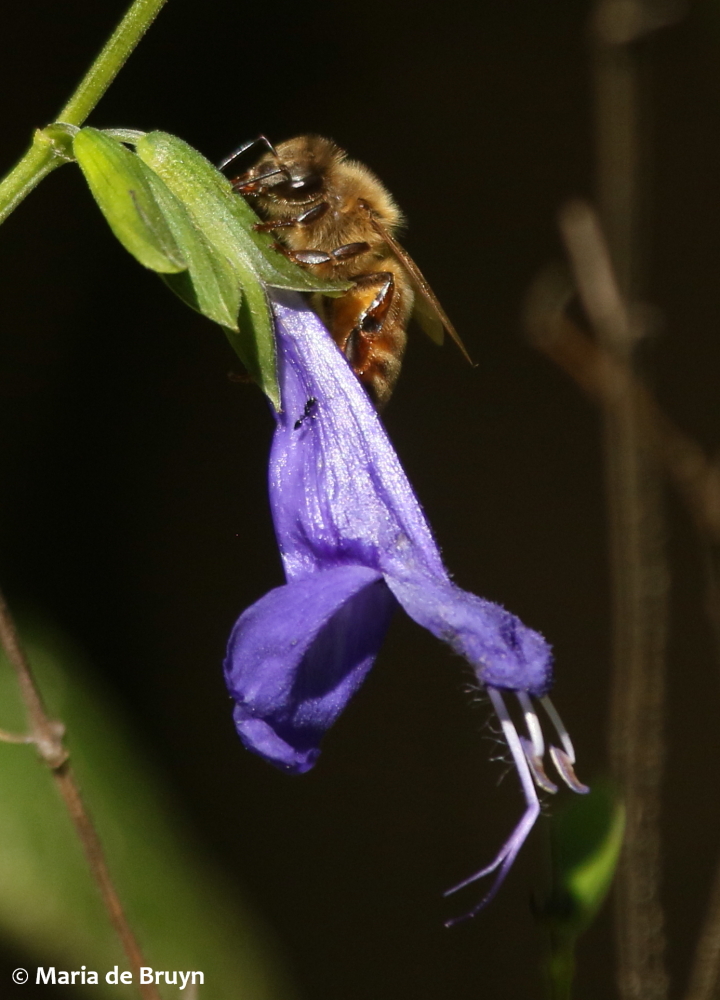
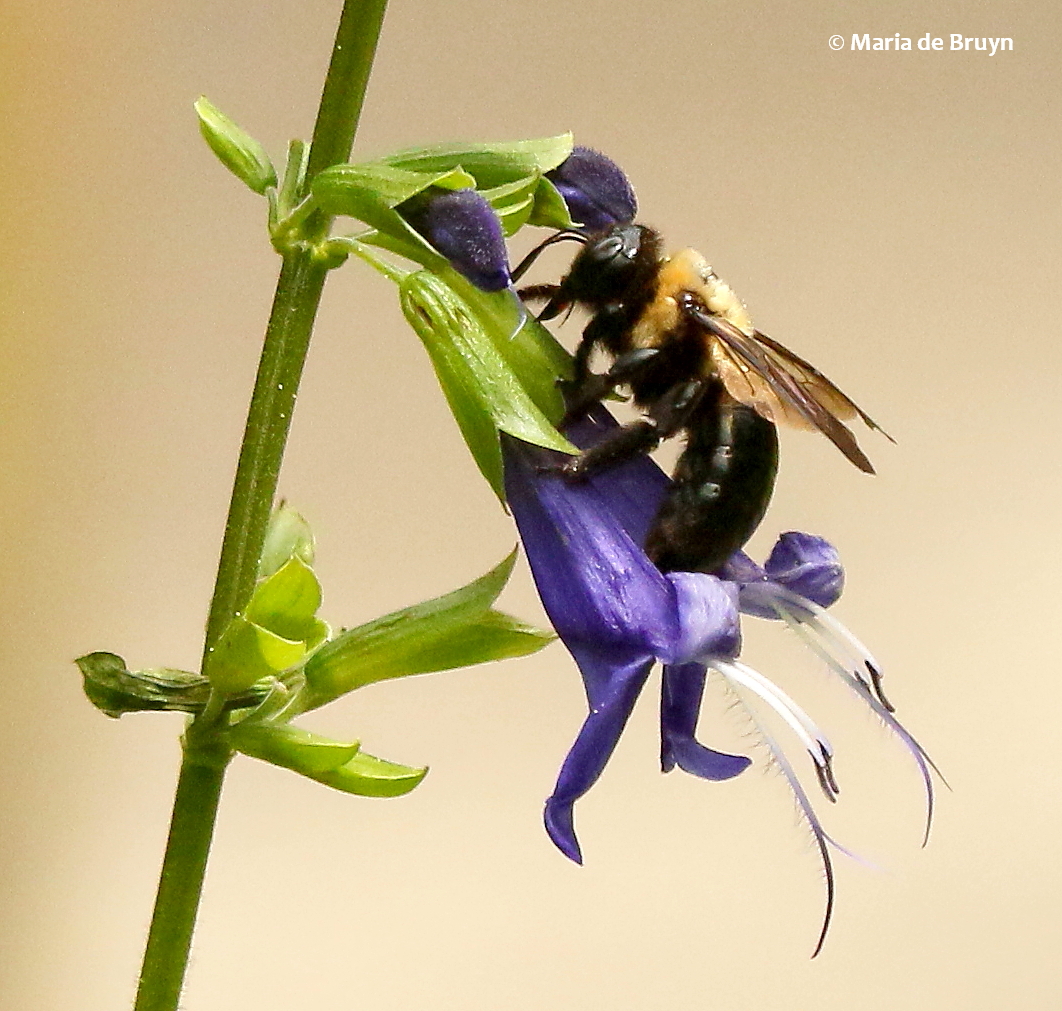
ruby-throated-hummingbird-i77a1315-maria-de-bruyn-resWhen visiting tubular flowers, like the Brazilian sage (Salvia guaranitica), the bees don’t look for nectar by entering the flower as do the ruby-throated hummingbirds (Archilochus colubris) with their long bills. Rather, they alight on the base of the corolla tube so that they can drill down into the flower to extract the nectar at the source.
honey-bee-i77a7849-maria-de-bruyn-res       de-bruyn-maria-carpenter-bee-brazilian-sage-2-i77a7250

Honey bee                                                  Eastern carpenter bee (Xylocopa virginica)

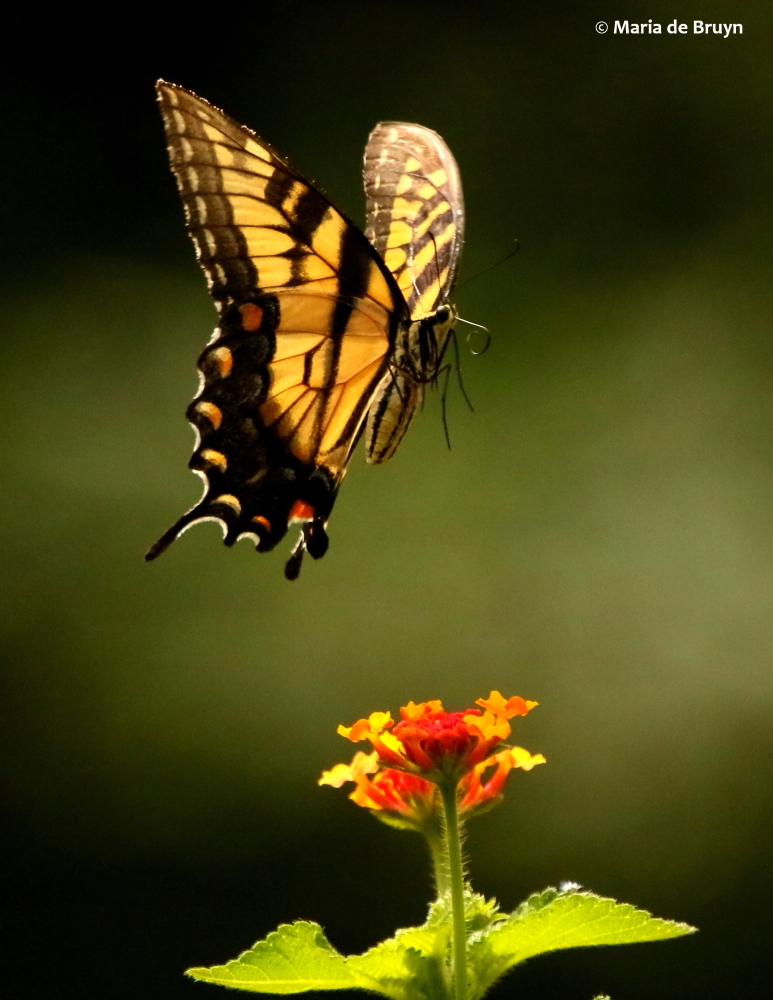
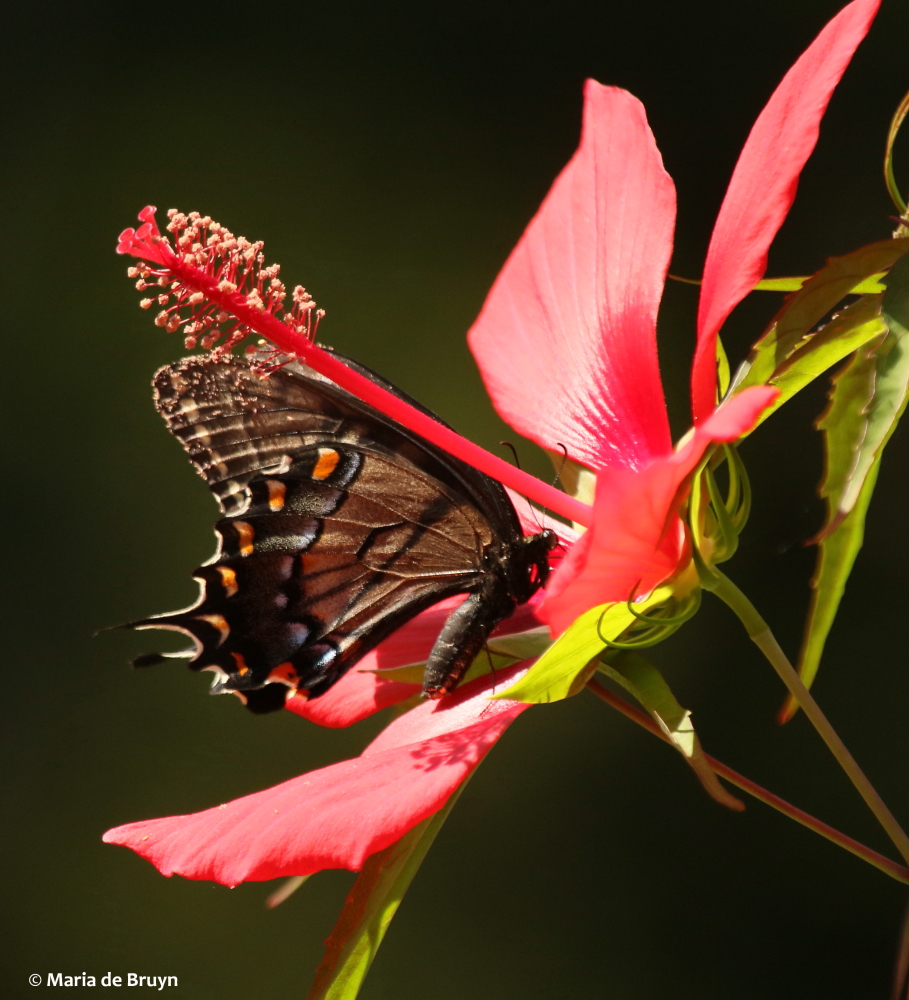
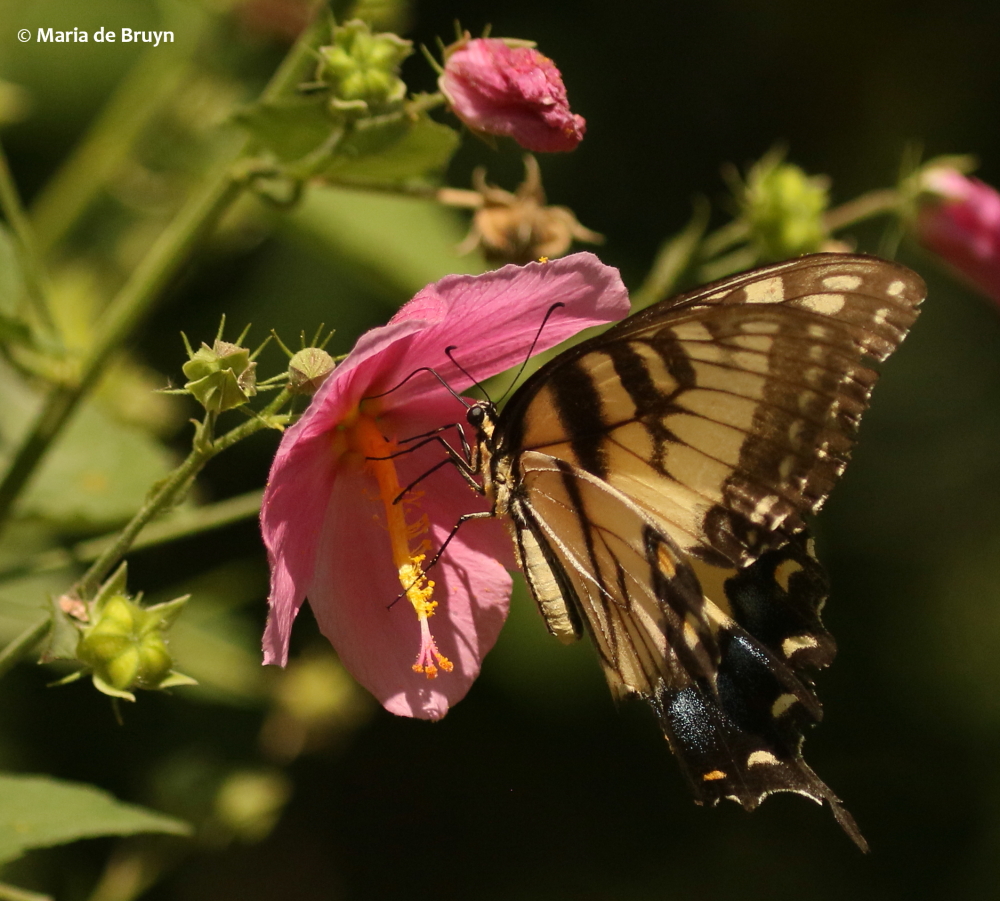
The clearwing moths and butterflies, like the Eastern tiger swallowtails (Papilio glaucus), have long tongues that they use to probe the flowers as they hover. Nevertheless, they can get pollen on their legs or bodies and transport it to another plant, although they are not as efficient at this as, for example, the sweat bees and carpenter bees.
eastern-tiger-swallowtail-pollen-i77a5259-maria-de-bruyn-res    eastern-tiger-swallowtail-i77a3693maria-de-bruyn-res

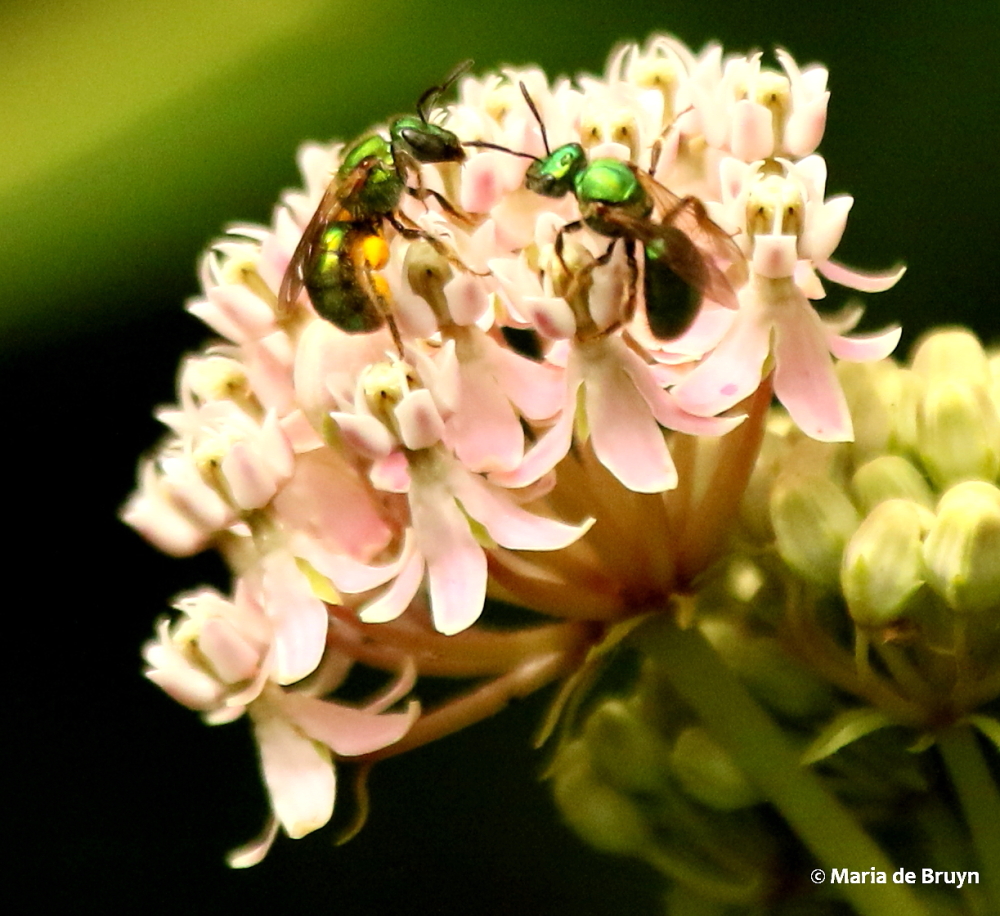
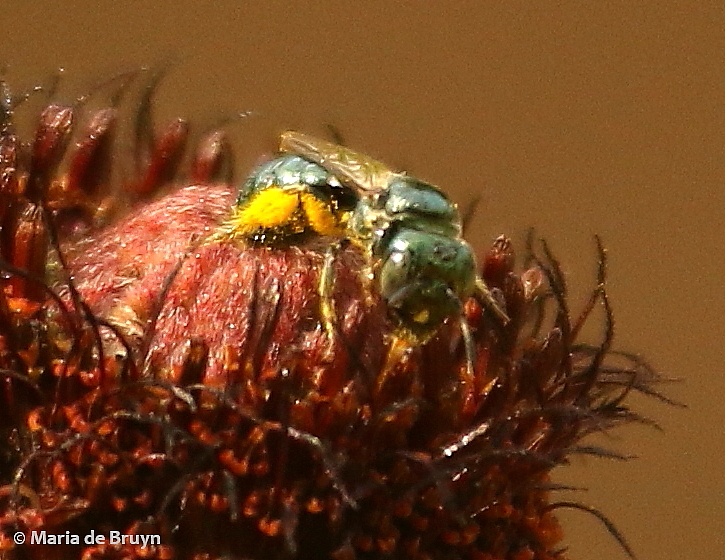
These bees have scopae rather than pollen baskets on their legs, i.e., structures comprising dense masses of compressed hairs into which pollen grains are pressed.
small-carpenter-bee-ceratina-dk7a0015-maria-de-bruyn-res-signed

Small carpenter bee (Ceratina)

sweat-bee-on-milkweed-i77a7861-maria-de-bruyn-res

Female sweat bees (Augochlorella)

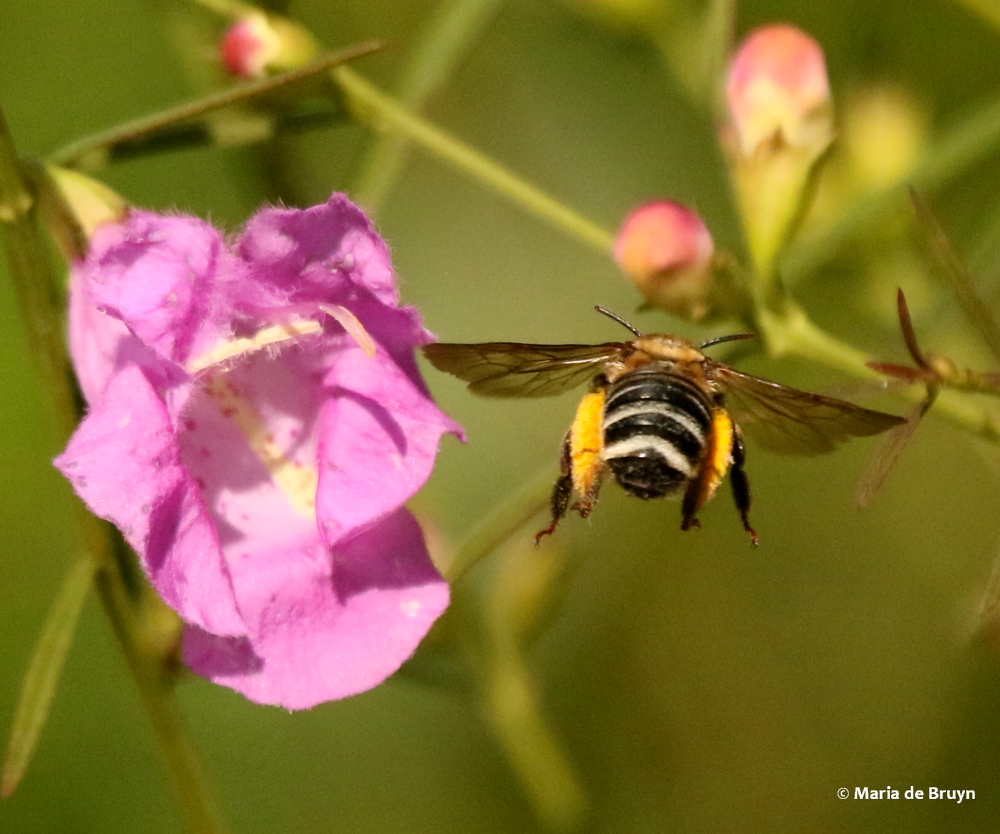
long-horned-bee-melissodes-i77a3343-maria-de-bruyn-res   long-horned-bee-melissodes-i77a3428-maria-de-bruyn-res

Long-horned bee (Melissodes)

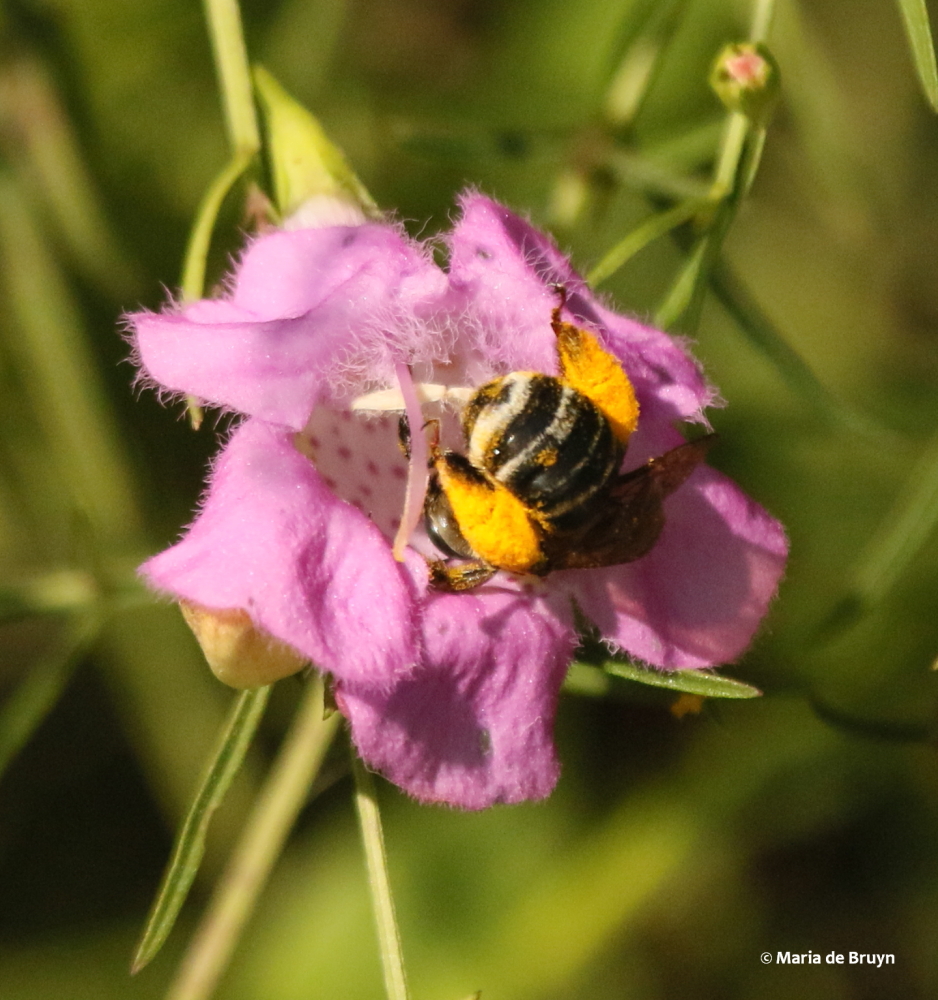
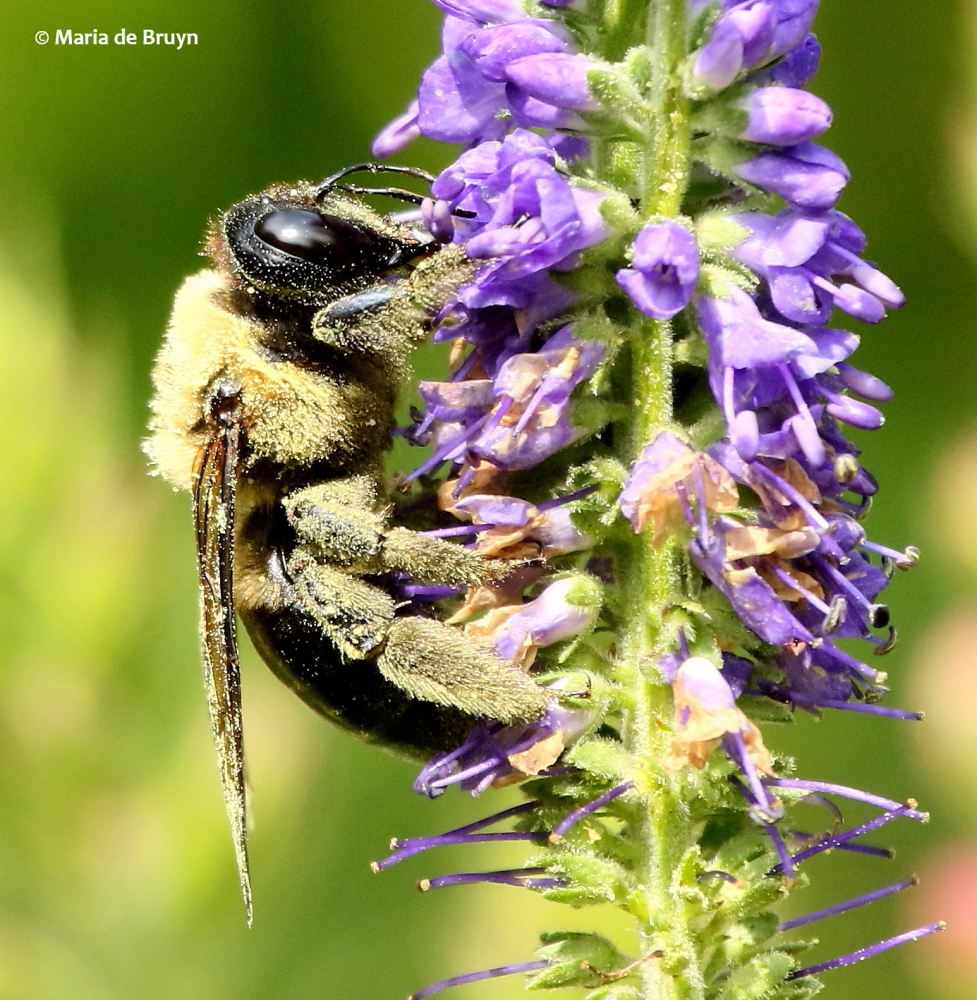
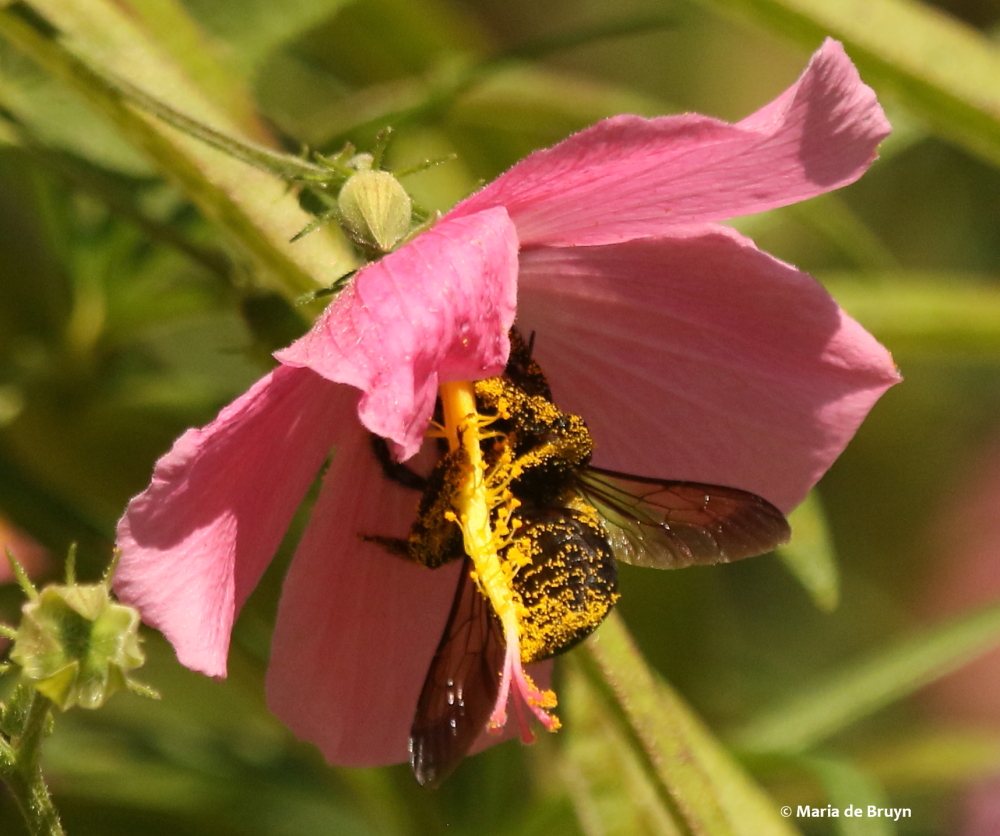
Sometimes the bees manage to get their whole bodies covered with pollen, which can make species identification more difficult but creates some interesting views.
eastern-carpenter-bee-i77a2601-maria-de-bruyn-res    eastern-carpenter-bee-i77a3750maria-de-bruyn-res

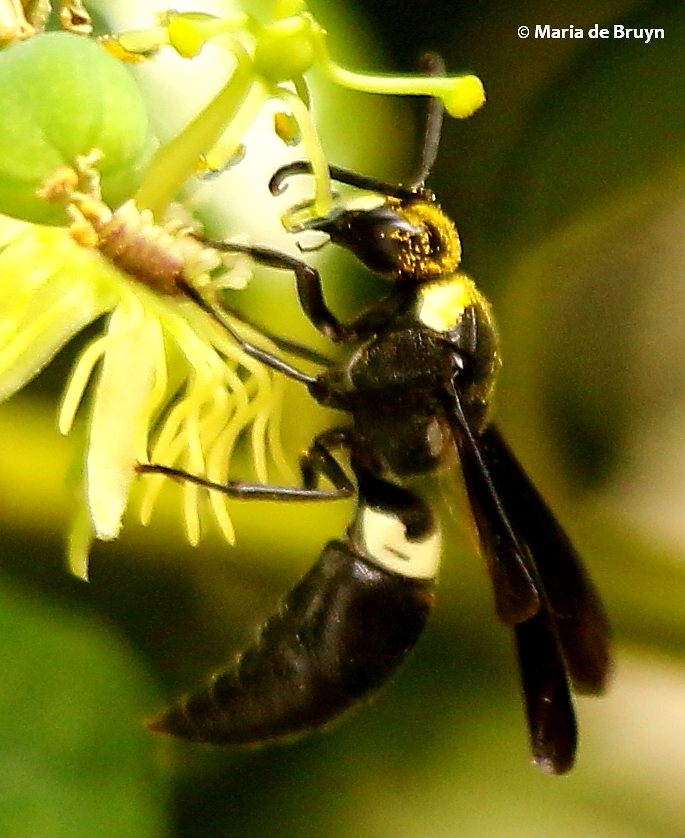
four-toothed-mason-wasp-monobia-quadridens-i77a2039-maria-de-bruyn-bgWasps can carry pollen as I saw almost daily when the four-toothed mason wasps (Monobia quadridens) visited my yellow passionflowers (Passiflora lutea). Here you can see the pollen collecting on the head of a male, whose sex can be determined by the fact he has 7 abdominal segments and curved antennae (females have straight antennae and 6 abdominal segments). How’s that for a bit of obscure information for the non-entomologist?

The syrphid flies, often known as bee mimics, help pollinate, too. A number of these flies are honey-bee size and can be confused with the bees easily.
flat-tailed-leaf-cutter-bee-i77a4043-maria-de-bruyn-res

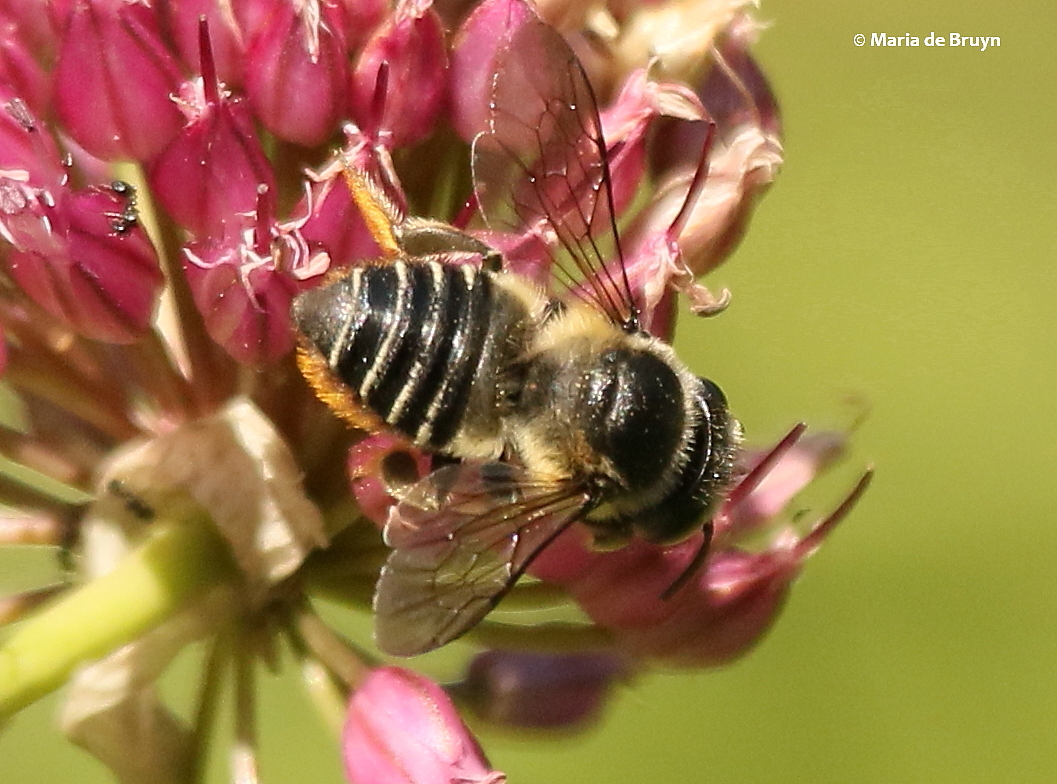
Flat-tailed leaf-cutter bee (Megachile mendica)
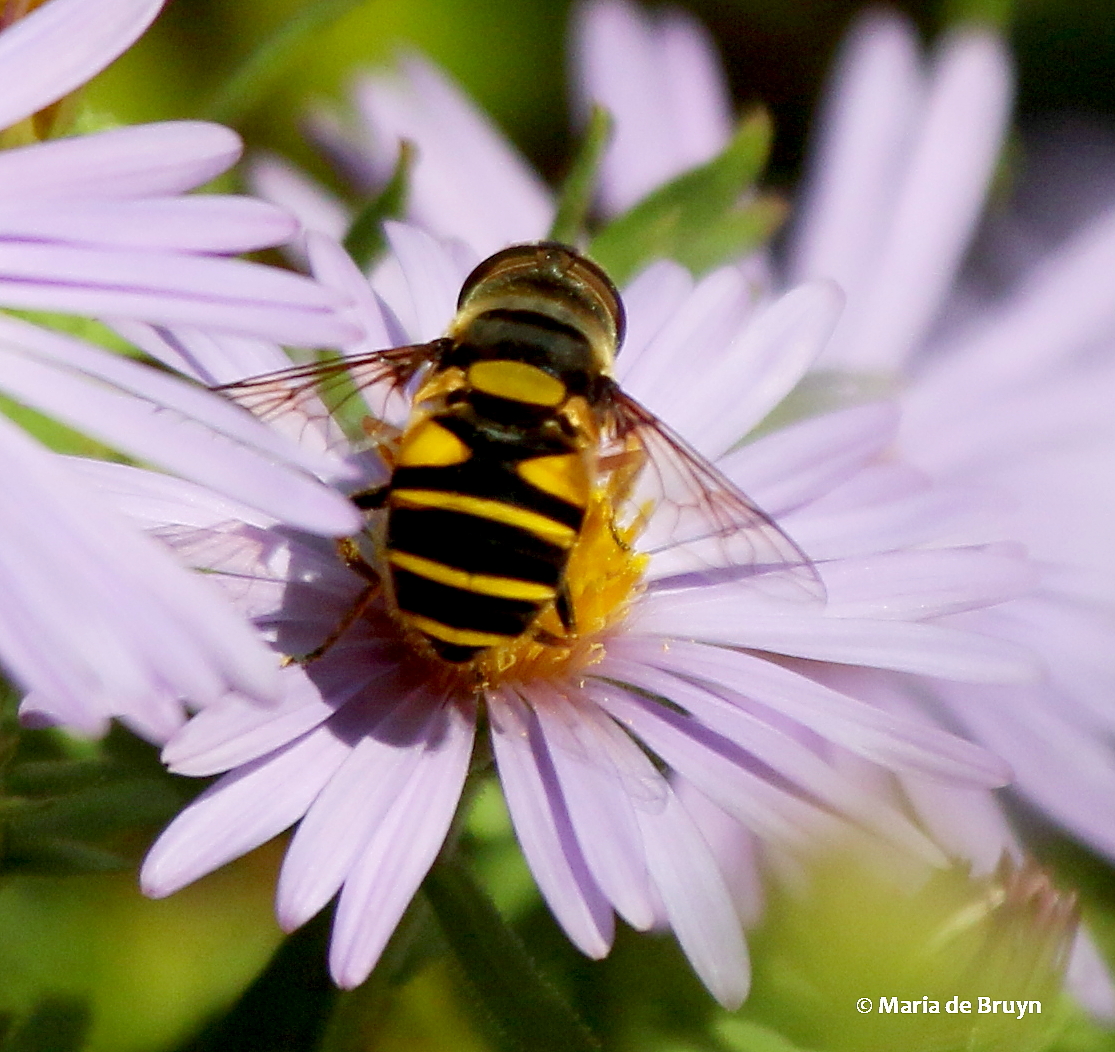
transverse-flower-fly-eristalis-transversa-i77a2116-maria-de-bruyn

Transverse flower fly (Eristalis transversa)
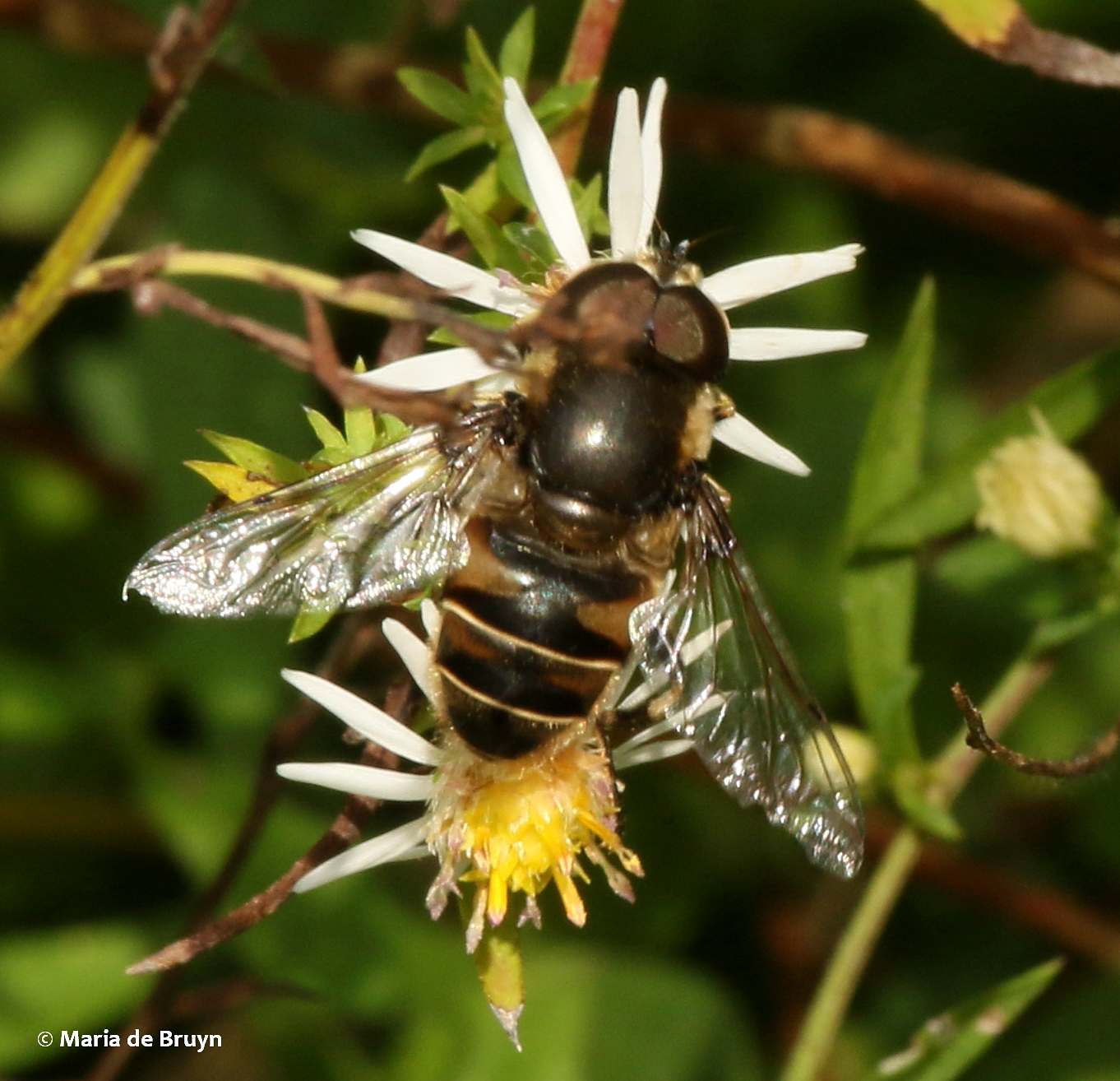
syrphid-fly-eristalis-dimidiata-i77a2060-maria-de-bruyn

Syrphid fly (Eristalis dimidiata)

Others are itsy bitsy, tiny flyers that can have pretty interesting abdominal patterns. I couldn’t see the patterns even with my glasses on; enlarging the photos revealed their beauty, which could make for interesting fabric patterns in my opinion.
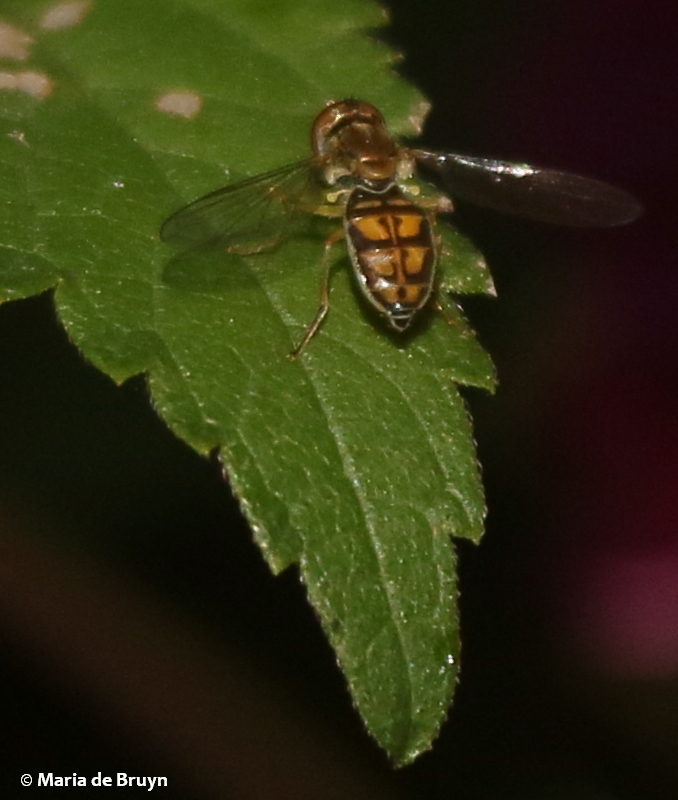
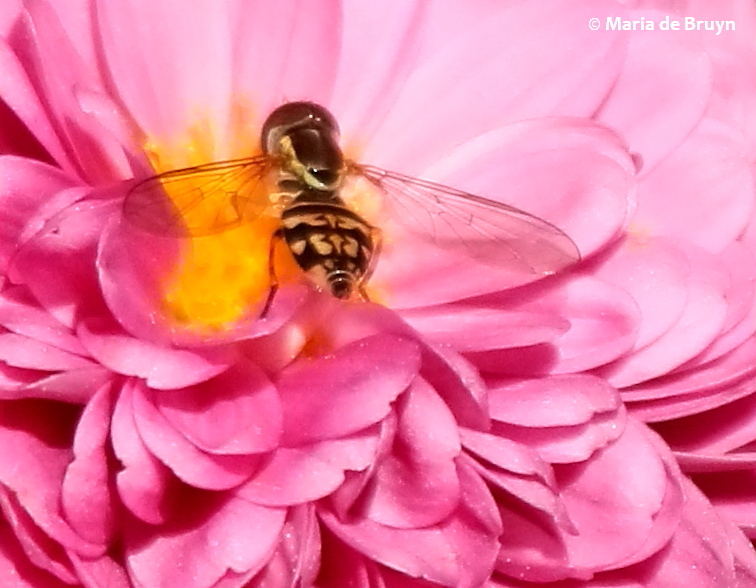
syrphid-fly-toxomerus-marginatus-i77a5952-maria-de-bruyn-res   syrphid-fly-toxomerus-geminatus-i77a5943-maria-de-bruyn-res

Syrphid fly (Toxomerus marginatus)                      Syrphid fly (Toxomerus geminatus)
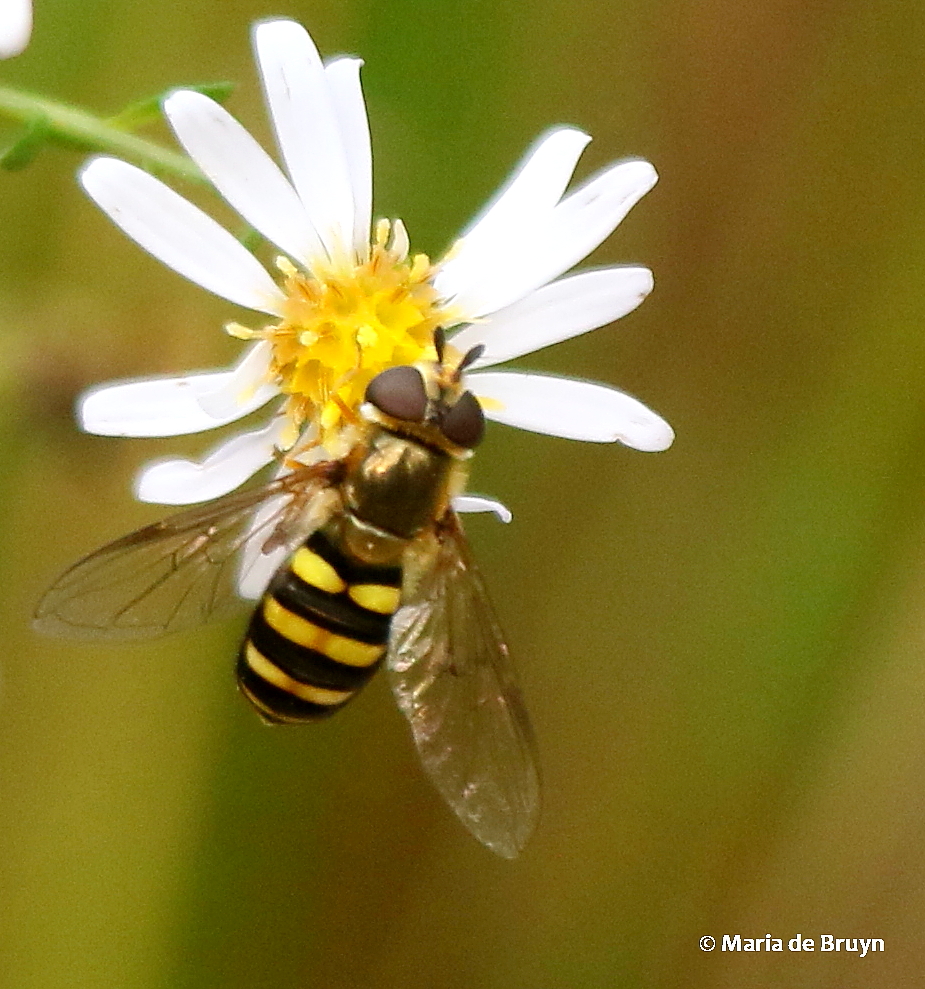
syrphid-fly-eupeodes-subgenus-metasyrphus-i77a6061-maria-de-bruyn

Syrphid fly with a lovely golden sheen (Eupeodes subgenus Metasyrphus)

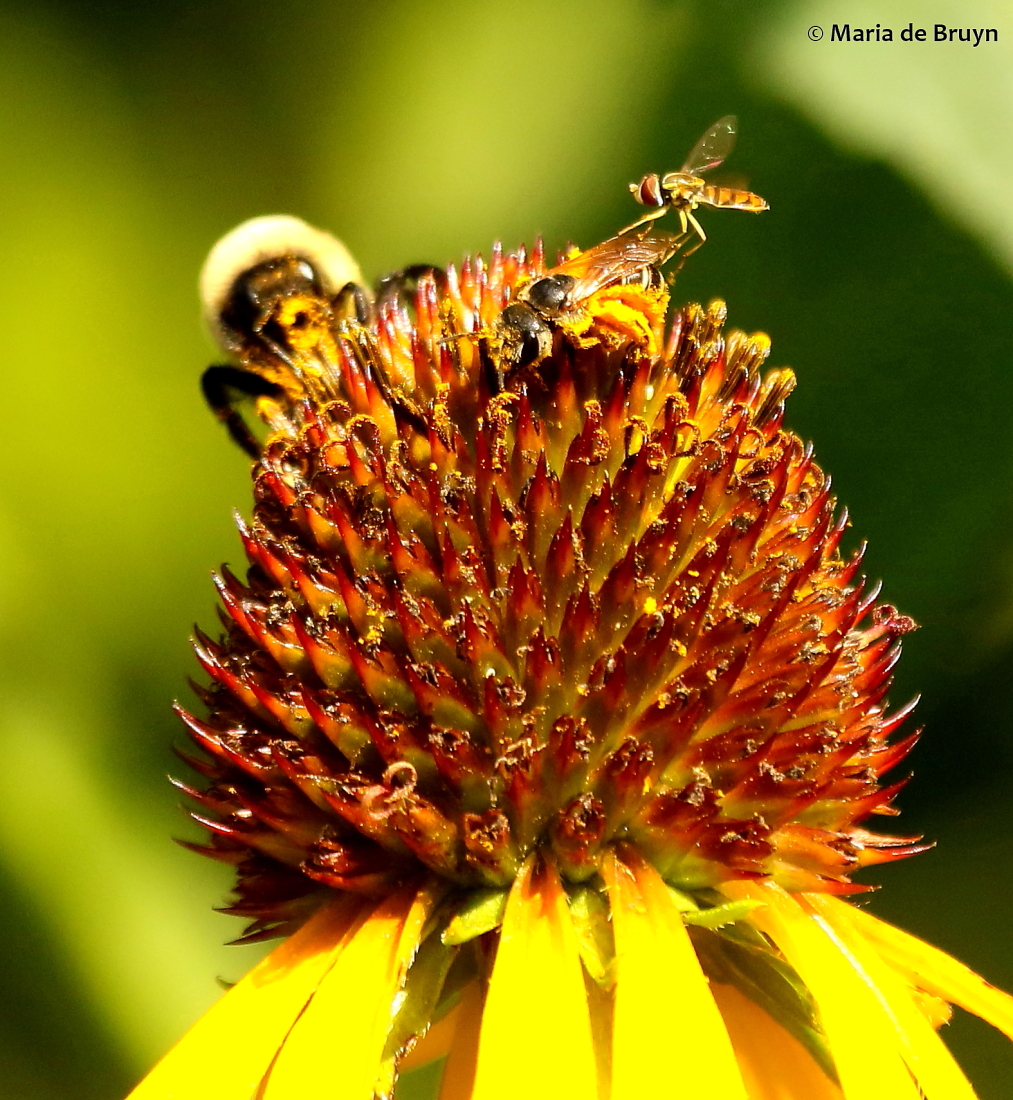
The pollinators don’t appear to begrudge one another nectar – different species will share space on particularly popular plants.
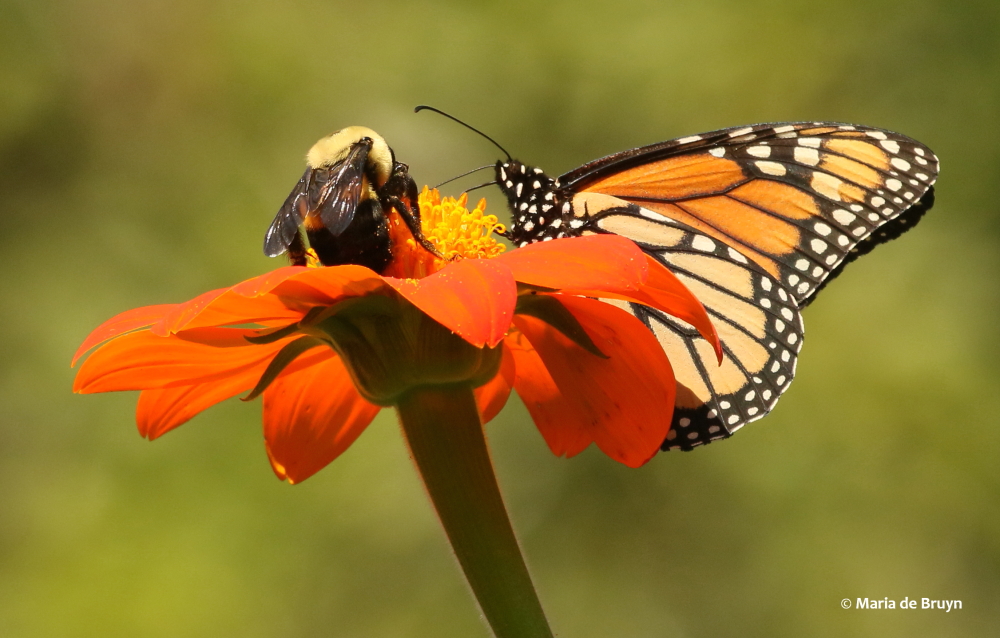
monarch-and-eastern-carpenter-bee-i77a4010maria-de-bruyn-res

Eastern carpenter bee and monarch butterfly (Danaus plexippus)
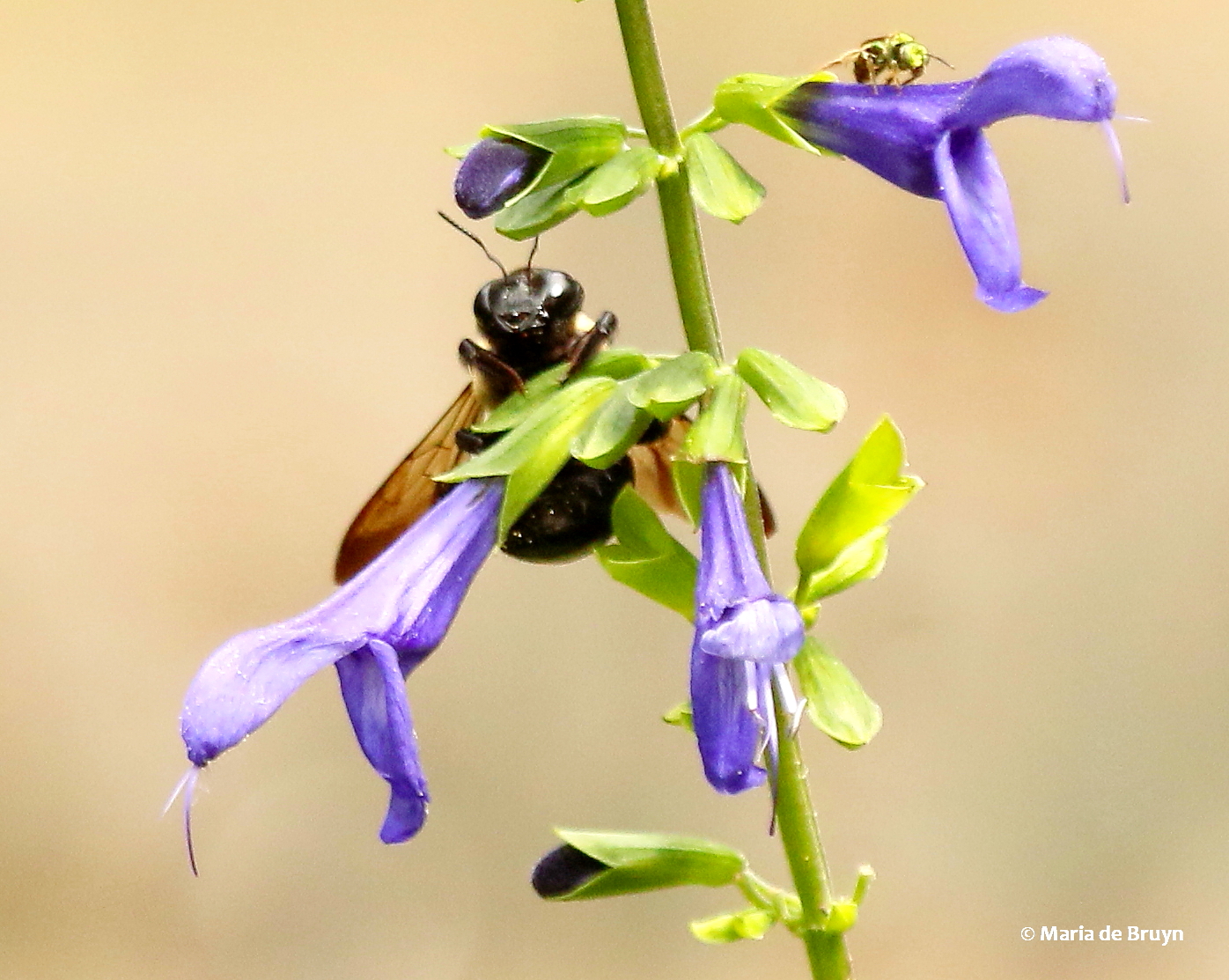
bumble-bee-brazilian-sage-i77a7263-maria-de-bruyn-res

Eastern carpenter bee and sweat bee

bumble-bee-halictus-sweat-bee-toxomerus-marginatus-i77a6296-maria-de-bruyn-res

Eastern carpenter bee, sweat bee and syrphid fly

Occasionally, the pollinators do not live out their usual short lifespans as predators catch them for food. This Chinese mantis (Tenodera sinensis) had been eyeing a bumble bee and was slowly moving toward it but the bee flew off before the mantis could complete its lunge. Later the mantis managed to snag a honey bee, however.
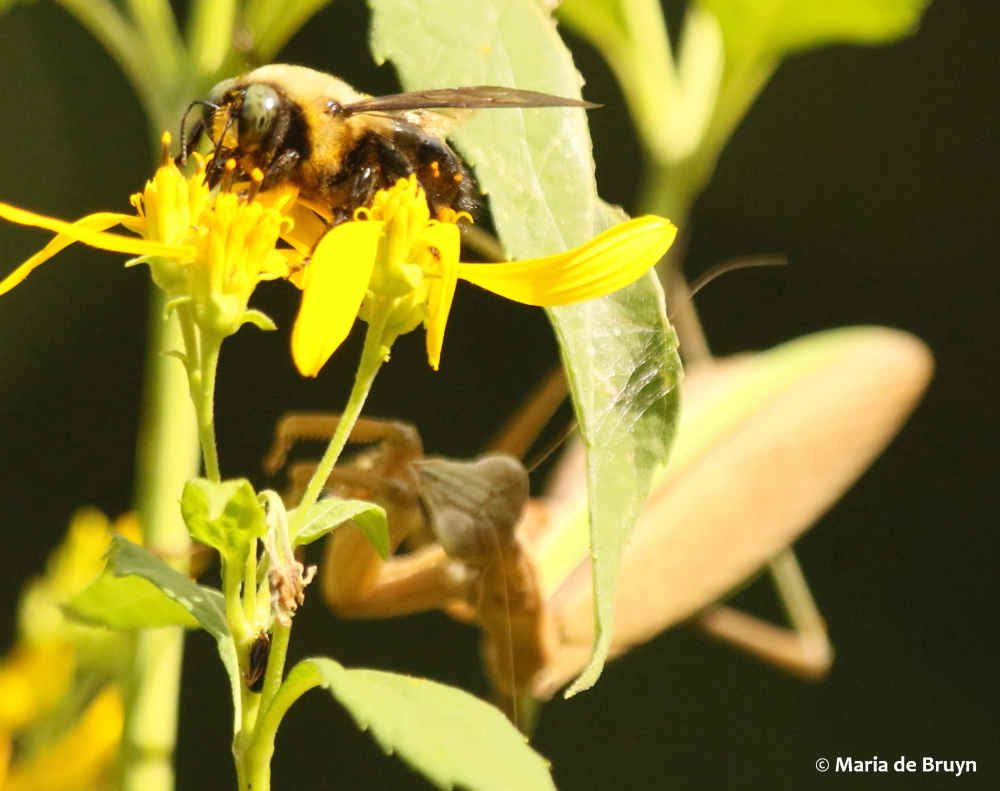
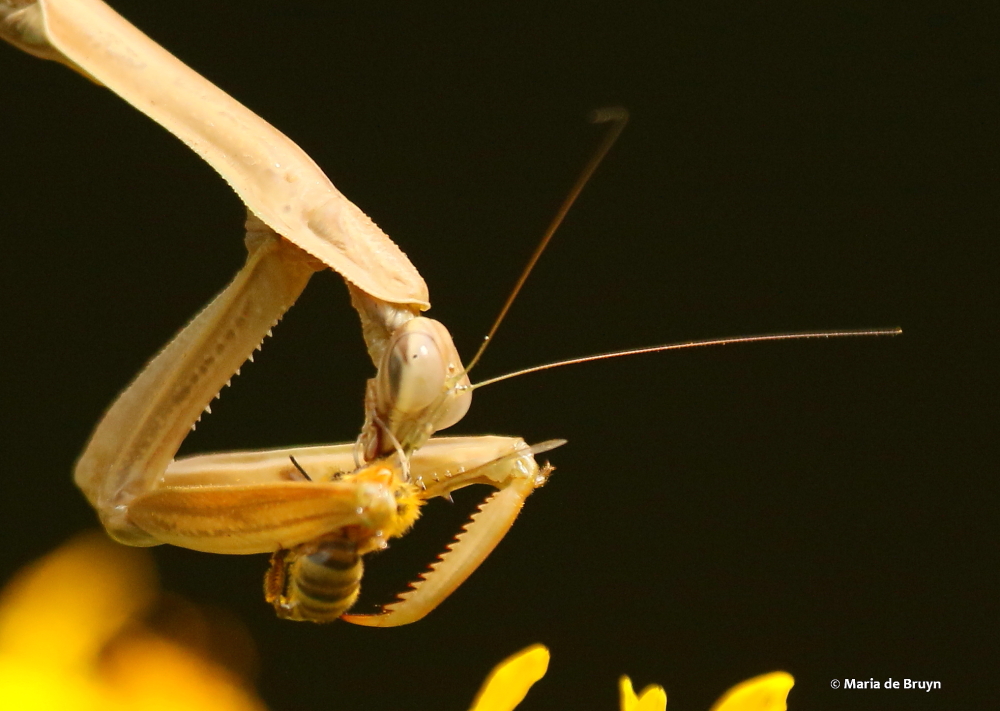
chinese-mantis-eastern-carpenter-bee-i77a4937maria-de-bruyn-res   chinese-mantis-and-honey-bee-i77a4795maria-de-bruyn-res

robber-fly-bumblebee-77a2813maria-de-bruyn


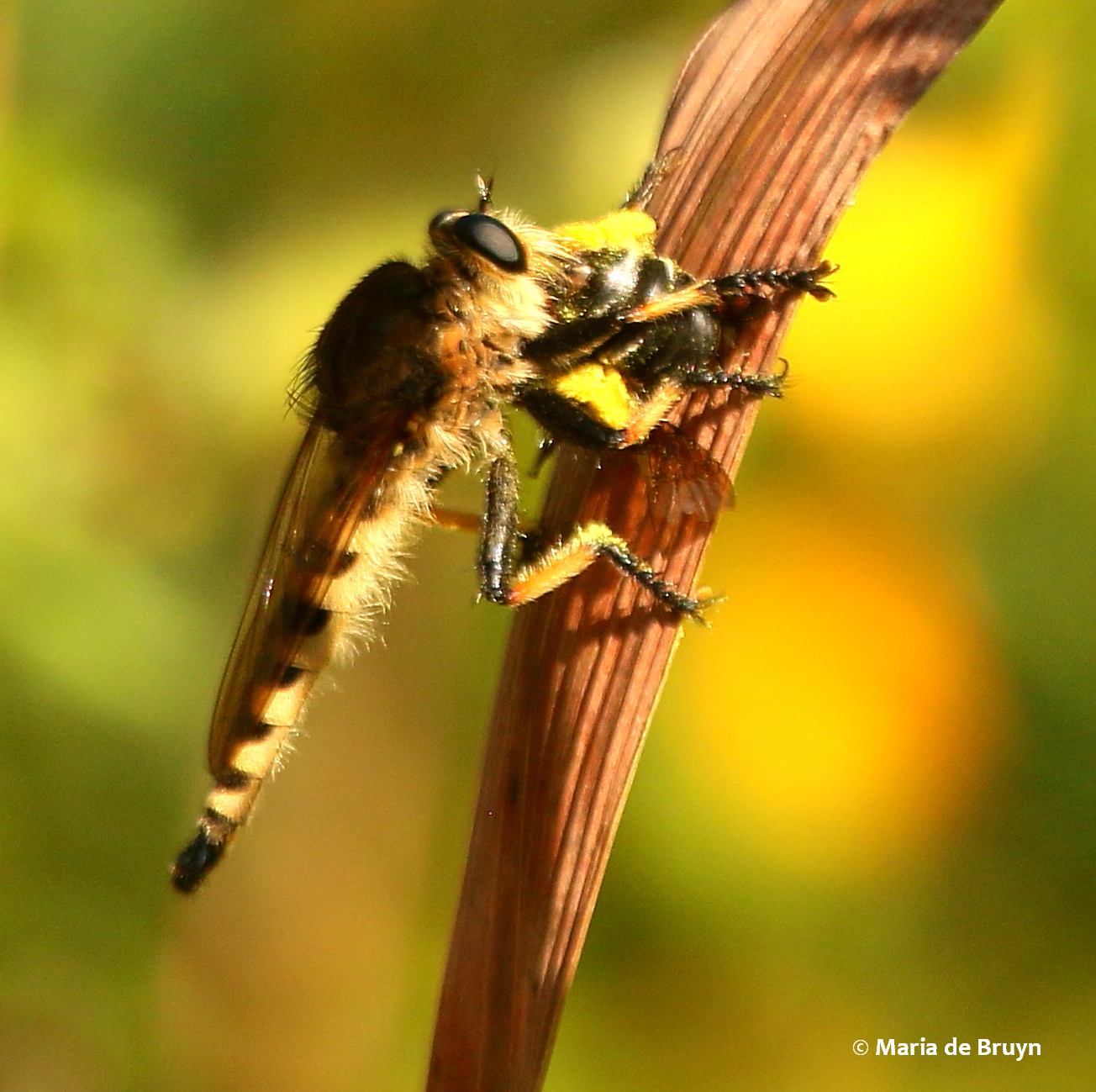
While on a walk one day, I suddenly was startled by the loudest buzzing I had ever heard, coming up behind me. It sounded angry, intense and was rather piercing for a buzz. I turned just in time to witness a giant robber fly (Promachus) settle on a grass stem with a bumble bee that it had just caught. The buzzing stopped fairly quickly as the fly proceeded to ingest its meal.
 

eastern-carpenter-bee-i77a7906-maria-de-bruyn-signed-res

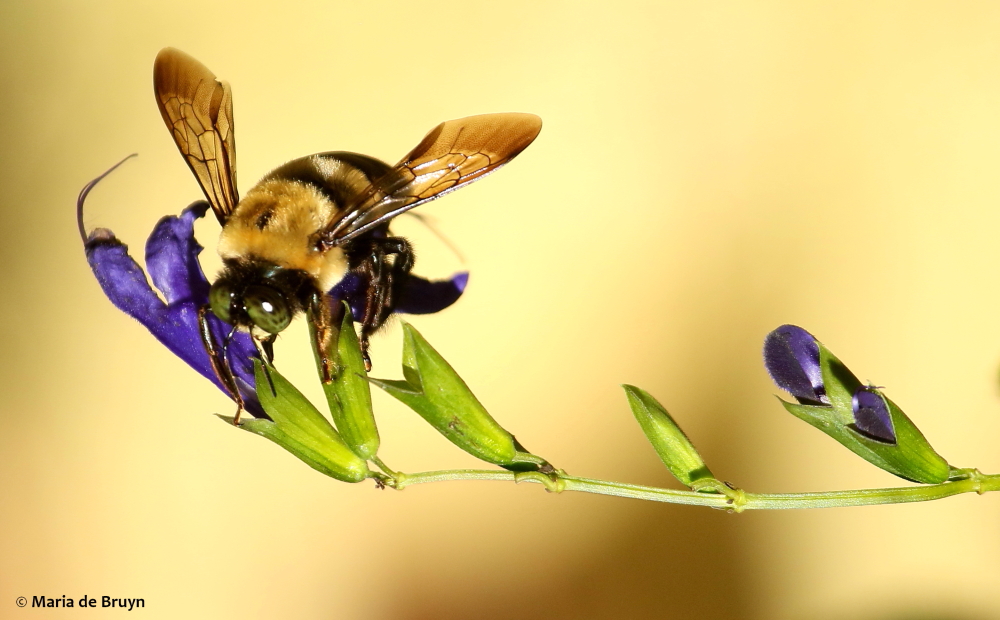
Various organizations and agencies, including the US Fish and Wildlife Service, are drawing attention to the endangerment of pollinator species. The main threats include loss and degradation of habitat as we pave over an increasing amount of natural space and plant lawns instead of native plants in yards. Using pesticides in landscaping areas is further threatening many of the insects on which pollination depends.
eastern-carpenter-bee-i77a6424-maria-de-bruyn-res3


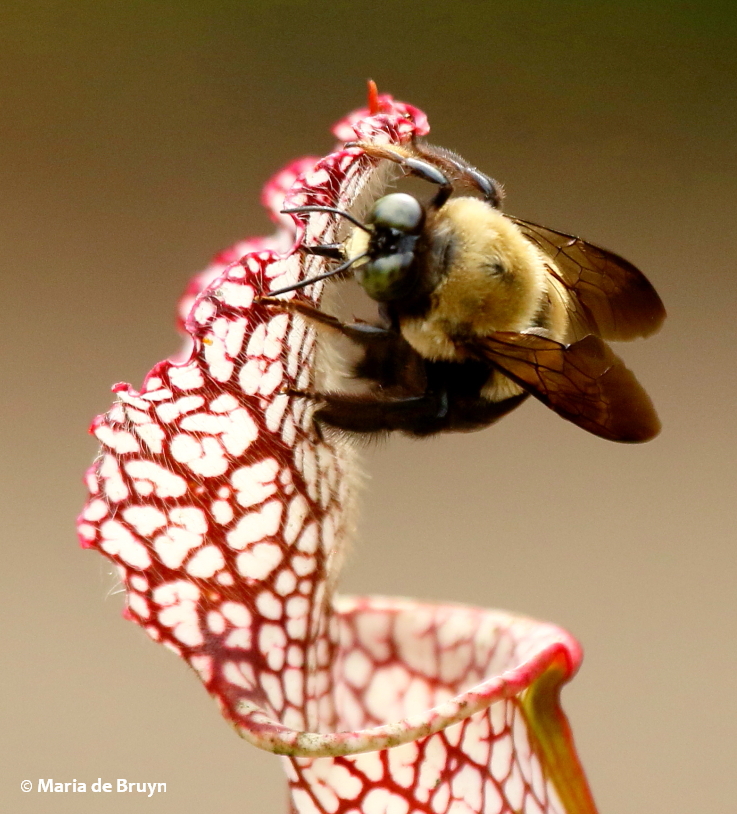
Planting pollinator gardens is a way in which we all can contribute to saving our pollinators; if you don’t have your own yard, you can volunteer with a project to create a community garden. And then you can watch these fascinating insects with appreciation for their contributions to us!

My hummer summer, part 2 — beauty in flight, beauty at rest

ruby-throated-hummingbird-i77a8438-maria-de-bruynIn my previous blog, I mentioned that the ruby-throated hummingbirds (Archilocus colubris) had a greater variety of flowering plants to visit in my yard this year and that increased the size and diversity of their nectar buffet. The availability of multiple food sources also meant that they spent a bit more time visiting – they didn’t just dash to a feeder, perch or hover for a drink and then take off. They visited feeders, different blooms and took little rests between meals, giving me numerous chances to watch them and practice my hummingbird photography – a win-win for both us!

ruby-throated-hummingbird-i77a7246-maria-de-bruyn-res


One of their favorite flowers were the lantanas (Lantana), which are also a favorite of mine as they attract many smaller pollinators such as bees and butterflies and are still profusely blooming in the latter half of October.


ruby-throated-hummingbird-i77a6866-maria-de-bruyn-res

ruby-throated-hummingbird-i77a7168-maria-de-bruyn-res

ruby-throated-hummingbird-i77a1023-maria-de-bruyn-res


This year, several types of sage brightened my gardens. Some deep blue Brazilian sage plants (Salvia guaranitica), kindly donated to me by Gail, a fellow birder, added color and provided the hummers with deep blooms into which they could insert their long bills.


ruby-throated-hummingbird-i77a1315-maria-de-bruyn-res

ruby-throated-hummingbird-i77a7519-maria-de-bruyn-resA small-leaf sage (also known as Festival or little-leaf sage, Salvia microphylla “San Carlos Festival”) provided an ongoing splash of deep red blooms that attracted the hummers over and over again. This plant not only graced the garden in the summer but is still blooming profusely now, making it another one of my favorites. A couple other different red sages and a red beebalm (Monarda didyma) were good nectar choices but they didn’t bloom as long or in such abundance. Perhaps next year, they will have gained strength.

ruby-throated-hummingbird-i77a7782-maria-de-bruyn-res

ruby-throated-hummingbird-i77a1160-maria-de-bruyn-resThe two stonecrop plants (Hylotelephium Autumn joy), in my front garden, with their rounded bunches of little pink flowers, had hummer visitors on a few occasions, but these are not one of their preferred blooms. The milkweed plants (Asclepias syriaca) also only had a few visits as far as I could tell.


ruby-throated-hummingbird-i77a1086-maria-de-bruyn-res


And it was the same story for the blue balloon flower (Platycodon grandiflorus), which does get its fair share of bees.


ruby-throated-hummingbird-i77a2198-maria-de-bruyn-resI had planted cardinal flowers (Lobelia cardinalis), which unfortunately didn’t get any flowers. I did see a bird visiting this plant species near Bolin Creek, however. The same happened with a trumpet vine (Campsis radicans), but at a vine cluster near the Haw River I saw how they inserted their heads entirely into the tubular blooms.

ruby-throated-hummingbird-i77a5851-maria-de-bruyn-res

ruby-throated-hummingbird-i77a6177-maria-de-bruyn-res


In between feedings, the hummingbirds will perch to watch for intruders into “their space”. But they also will take sun-baths, pointing their faces upward and puffing themselves up.

ruby-throated-hummingbird-i77a8401-maria-de-bruyn-res


They will then change shape, stretching their necks and spreading their wings and tail feathers to expose as much of their bodies as possible to the sunlight.

ruby-throated-hummingbird-i77a6885maria-de-bruyn-res   ruby-throated-hummingbird-i77a6891maria-de-bruyn-res

They may relieve themselves while they are in flight and then later take a little power nap of a few seconds.

ruby-throated-hummingbird-i77a1170-maria-de-bruyn-res       ruby-throated-hummingbird-i77a0553-maria-de-bruyn-res

ruby-throated-hummingbird-i77a7826-maria-de-bruyn-res

Grooming is also a frequent activity – these little avians make sure that they stay just as beautiful as the sweet flowers that they frequent!

ruby-throated-hummingbird-i77a6905-maria-de-bruyn-res   ruby-throated-hummingbird-i77a8283-maria-de-bruyn

When the males turn their heads so that the light hits them in different ways, they do a nice job of demonstrating that their bright gorget colors are not in the feathers themselves but the result of prism cells in their feathers that change how the light is reflected depending on the angle we see.

ruby-throated-hummingbird-i77a1126-maria-de-bruyn-res    ruby-throated-hummingbird-i77a1120-maria-de-bruyn-res

ruby-throated-hummingbird-i77a6366-maria-de-bruyn-resWhen they’re done sun bathing, grooming and resting, the hummingbirds need to take off again. However, their feet are so tiny that they can’t walk and, when they lift off, they also don’t have the foot strength to push.  So they rise into the air using the power of their wings, quickly flapping as they set off and rapidly reaching their usual rate of about 50-53 beats per second.

ruby-throated-hummingbird-2-i77a5105-maria-de-bruyn-res

ruby-throated-hummingbird-i77a9703-maria-de-bruyn-res

ruby-throated-hummingbird-i77a7167-maria-de-bruyn-resMy last summer hummingbird residents appear to have left for their Central American wintering grounds on 7 October, just before Hurricane Matthew arrived in North Carolina. I really hope that they were able to get through the windy environment without problems as they began their long migratory journeys and I am already looking forward to seeing them arrive next spring. In the meantime, I’m keeping a couple feeders up in case another hummer species decides to over-winter here – and the Carolina chickadees (Poecile carolinensis), Northern cardinals (Cardinalis cardinalis) and tufted titmice (Baeolophus bicolor) can continue to use the ant guards over the feeders as their preferred watering holes.


My hummer summer, part 1 – guarding the home front!

ruby-throated-hummingbird-i77a2165-maria-de-bruyn-res


Just like human beings, some birds like to hang out in groups, while others are more solitary in nature, coming together mainly to reproduce. A prime example of the latter group are the ruby-throated hummingbirds (Archilochus colubris).


ruby-throated-hummingbird-i77a7336-maria-de-bruyn-res2This past summer, some health and other problems led to my spending a good deal of time at home. The upside was that being a bit home-bound gave me plenty of opportunities to observe the comings and goings of these gorgeous little flyers and to learn more about their behavior towards one another.

I had at least four ruby-throats – and probably more as I couldn’t distinguish them all – visiting my feeders and yard regularly. A couple had a distinctive trait that helped me identify them, like some white feathers on top of their heads or at the bottom part of their gorgets.

ruby-throated-hummingbird-i77a1237-maria-de-bruyn-res   ruby-throated-hummingbird-i77a9185-maria-de-bruyn-res

ruby-throated-hummingbird-i77a0810-maria-de-bruyn-res


I usually had three or four nectar feeders up in my back yard and two in my front yard. In addition, as the summer progressed, the gardens were filled with increasing numbers of nectar-filled flowers so my home site was a fairly well-stocked larder for them.

The ruby-throats are among the more competitive hummingbirds and don’t really like to share their feeding space with others, although a friend and I visited a birder in a nearby town who had more than a dozen feeders up and many dozens of hummers visiting his back yard every day, feeding right next to one another. At my house, I suppose guarding their food source is an instinctual imperative, since they do consume half their own weight in nectar each day.

ruby-throated-hummingbird-i77a0514-maria-de-bruyn-res

ruby-throated-hummingbird-i77a8255-maria-de-bruyn-resThe tiny birds were quite intent on protecting their territory from intruders. Only thing was, several of them considered my feeders THEIR territory, so there was a continual rotation of birds perched in nearby trees and shrubs to watch for “invaders”. Once spotted, the newly arrived hummers would have the current “resident” bird swoop down on them (at up to 60 miles per hour!), frequently chittering like mad as a warning to “get out of here.”

Sometimes, they would have a little “challenge flight ballet” as they confronted one another, until one gave up and flew off – sometimes across the street, sometimes to the yard on the other side of the house, and sometimes to a nearby tree or shrub at the side of the house.

ruby-throated-hummingbird-i77a8257-maria-de-bruyn-res   ruby-throated-hummingbird-i77a8256-maria-de-bruyn-res

ruby-throated-hummingbird-i77a9443-maria-de-bruyn-resThere was one particular male hummer who seemed particularly aggressive – or perhaps possessive is a better term as I never saw him body slam a rival; he just made sure that the other bird would leave. I recognized him as he often chose exactly the same spots on a nearby Rose of Sharon, a willow oak and a cedar as his watching posts,

Some of those who were run off didn’t travel far, however. They would fly to a nearby tree or shrub and wait to see if Hummer No. 1 would leave.

ruby-throated-hummingbird-i77a0290-maria-de-bruyn-res       ruby-throated-hummingbird-i77a1099-maria-de-bruyn-res

ruby-throated-hummingbird-i77a5725-maria-de-bruyn-resScientists have determined that the brain section responsible for memory and learning – the hippocampus – is five times larger in hummingbirds than in woodpeckers, seabirds and songbirds. They memorize where feeders and nectar flowers are and can remember when they last fed there. They can even estimate how long it will take each flower to fill up with nectar again.

ruby-throated-hummingbird-i77a6553-maria-de-bruyn-res


The hummers’ memory is long-term, too – they recall not only where feeders are placed in their breeding territories but also in places along their yearly migration routes! Wouldn’t it be nice if we had such great memories making GPS and maps less of a necessity?


ruby-throated-hummingbird-i77a7716-maria-de-bruyn-resAnother behavior I observed several times was a hummer hovering in front of me, especially when the nectar feeders were getting low. Scientists have determined that they can recognize the people who replenish their food sources, which makes for a delightful encounter as one chirps at you while suspended in front of your face with its wings flapping at 60 beats per second!

While guarding their home turf, they may stick out their tongues briefly after feeding.

ruby-throated-hummingbird-i77a5099-maria-de-bruyn-res   ruby-throated-hummingbird-i77a2353-maria-de-bruyn-res

ruby-throated-hummingbird-i77a9404-maria-de-bruyn-res


However, if you see one with its tongue stuck out permanently, this can be a sign of a fungal infection (often acquired from dirty feeders). Their tongues swell with the infection and they can no longer drink with these anatomical, elastic micro-pumps.


ruby-throated-hummingbird-i77a8243-maria-de-bruyn-res


Often death ensues, so it’s important to keep the nectar feeders clean!


Coming up in part 2: the beauty of the hummingbirds at rest and in flight


Rain drops, dewdrops and frost – Mother Nature’s adornments

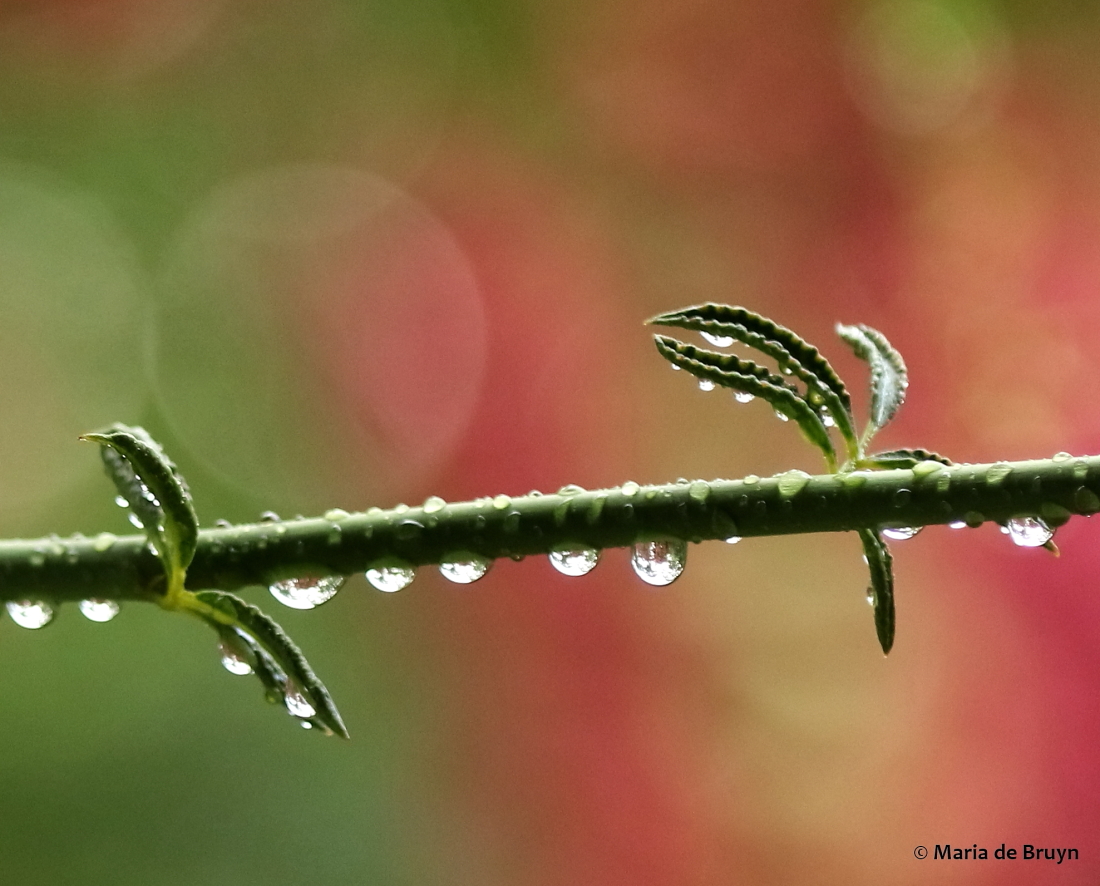
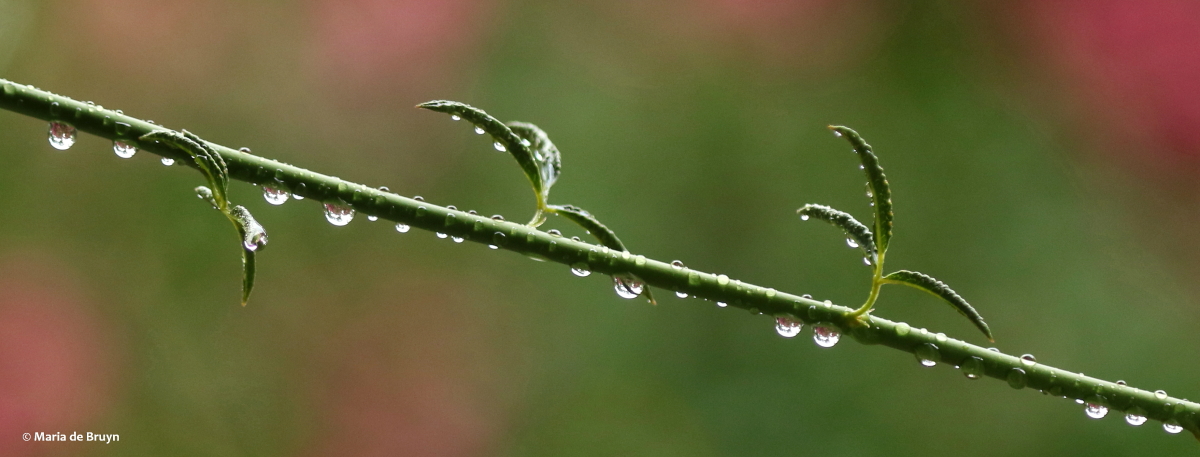
rain drops IMG_8843© Maria de Bruyn resDewdrops in the early morning, raindrops during the day, and frost covering everything outdoors can be seen merely as various manifestations of heavenly water on earth, but another way of looking at them can be as nature’s jewels. When light and sunshine illuminate the drops and crystals, they lend an air of elegance and beauty to whatever they have covered.

When it rains, leaves and blooms may look uniformly slick with moisture but we often see them covered in rain drops. Have you ever wondered why the rain drops are of different sizes?

dewdrops IMG_7571© Maria de Bruyn res day lily with rain drops IMG_5259© Maria de Bruyn res

The US Geological Survey’s Water Science School reports that water vapor wraps around particles in the air (salt, smoke, dust) which are of different sizes; then when the drops begin falling to earth, they bump into other drops and merge. The drops that merge with more “neighbors” become larger. Rain drops suspended from branches and leaves are quite lovely.

rain drops DK7A8019© Maria de Bruyn res rain drops DK7A8052© Maria de Bruyn 2 res

rain drops DK7A8020© Maria de Bruyn resruby-throated hummingbird DK7A8190© Maria de Bruyn resThey often roll right off birds’ feathers but occasionally adhere, as was the case for this ruby-throated hummingbird (Archilochus colubris) at a feeder sheltered by a roof overhang.

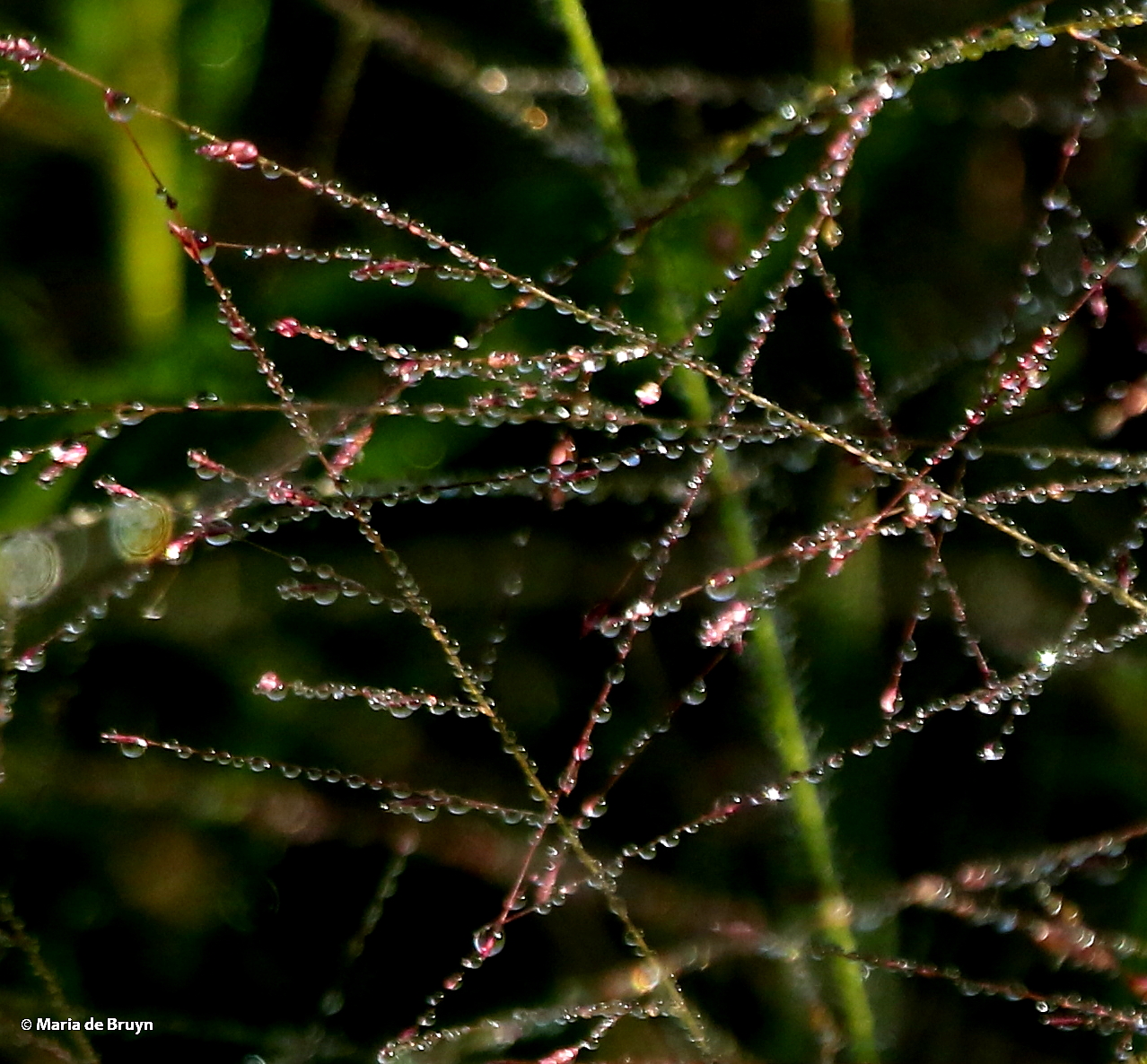
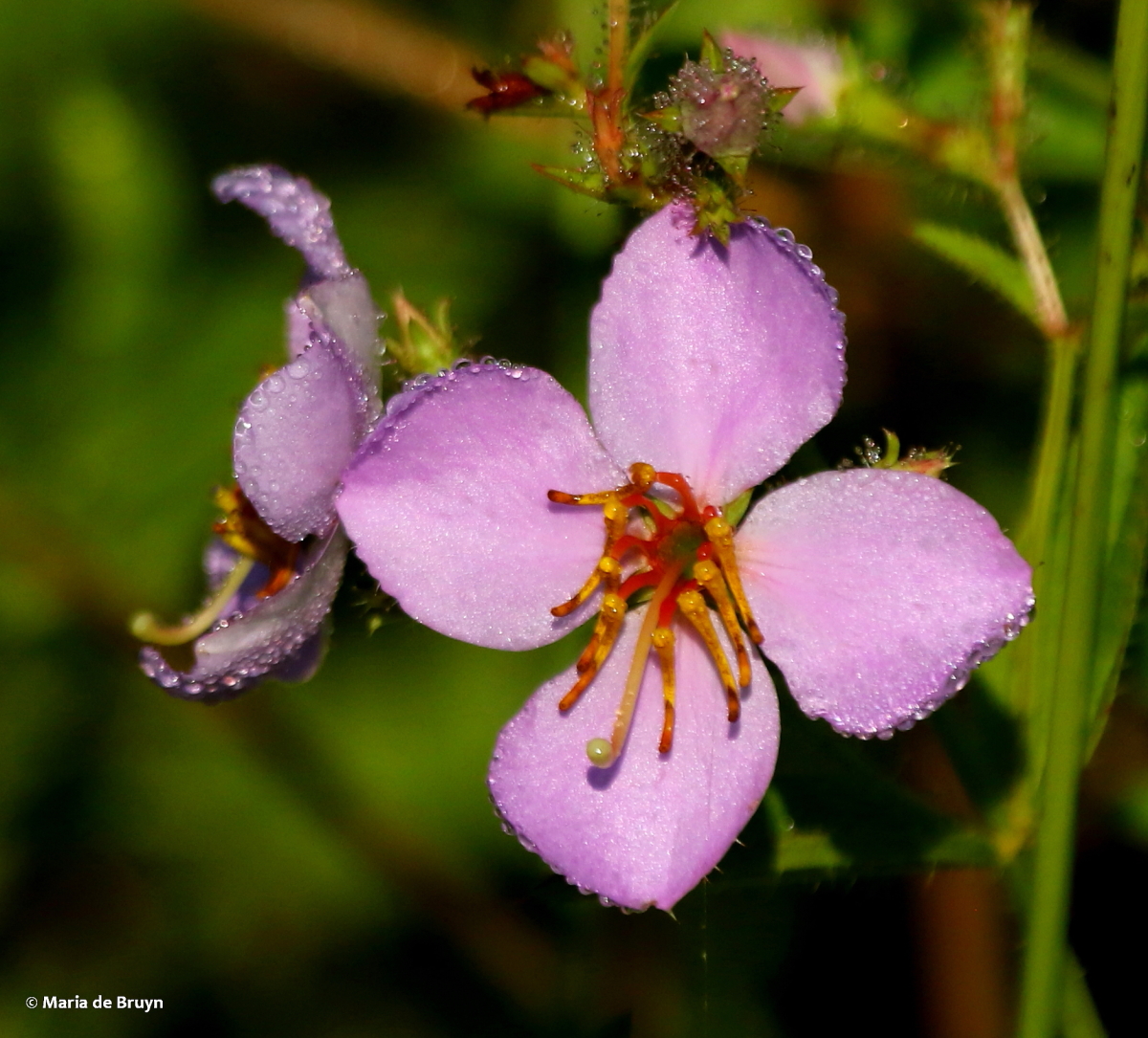
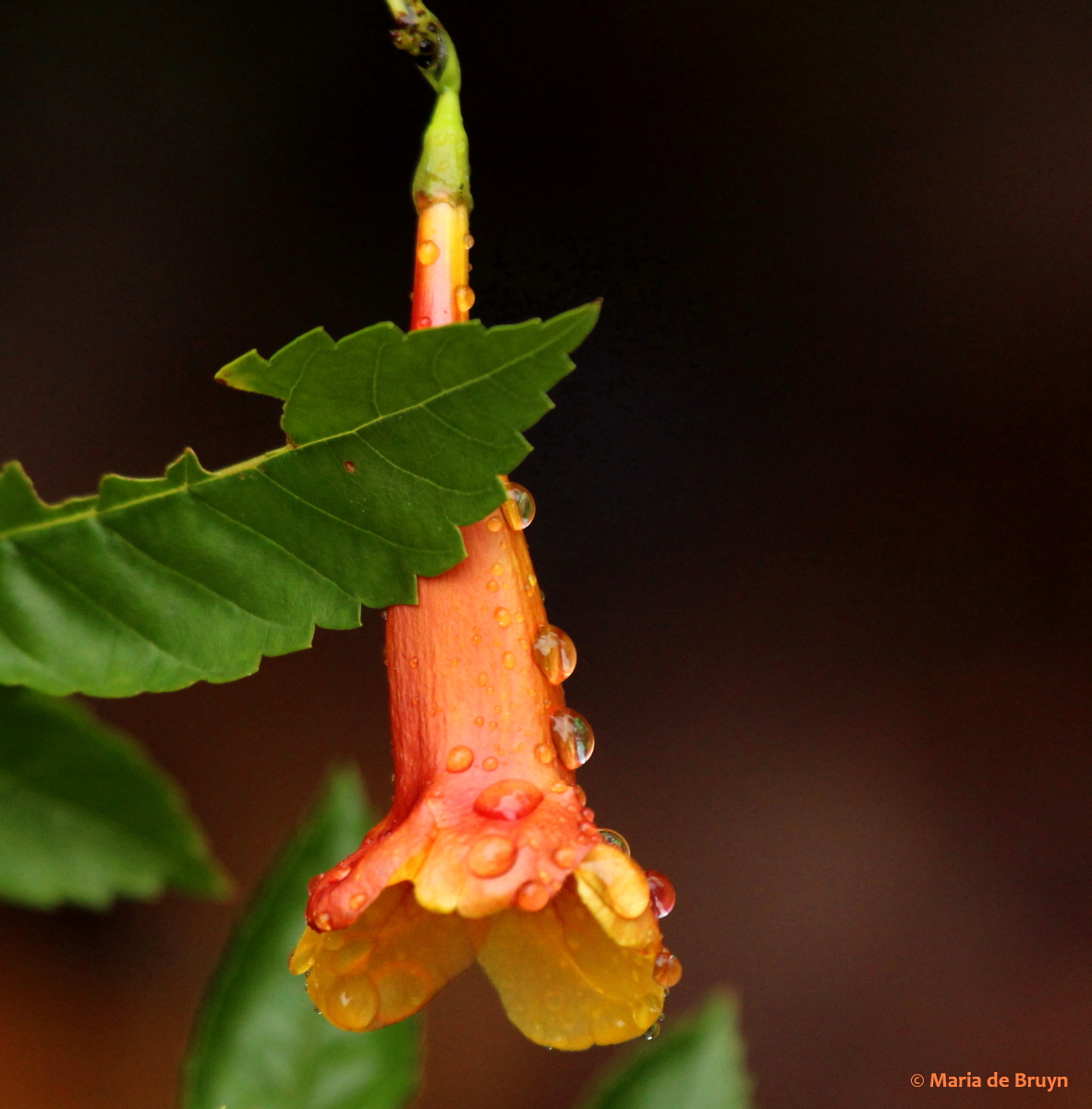
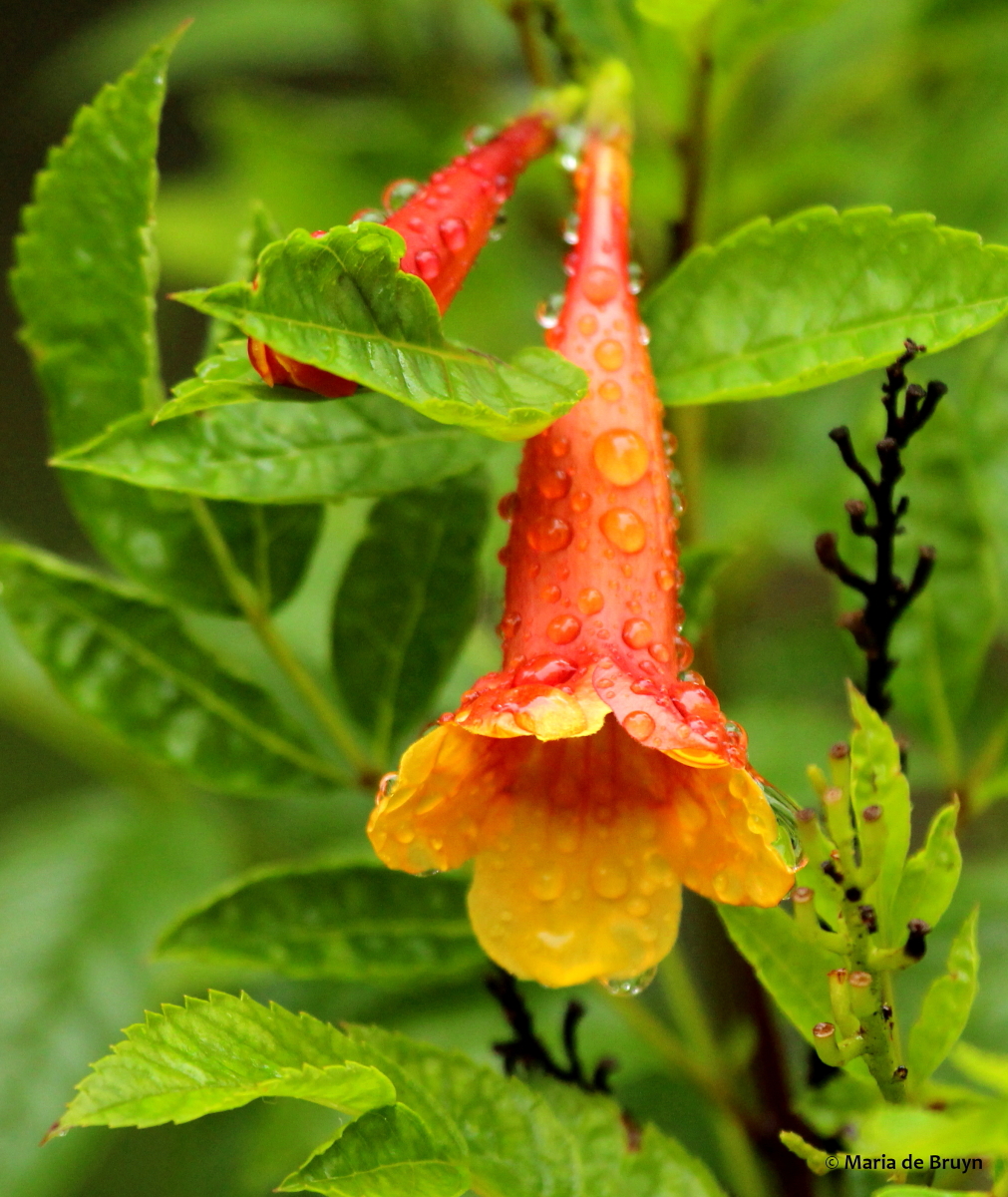
Dew – water droplets on surfaces of objects and vegetation – forms when an exposed surface cools down by radiating its heat and the moisture in the atmosphere then condenses faster than it evaporates. It looks beautiful on flowers and other plants, such as these grasses, the Virginia meadow beauty (Rhexia virginica) and the Orange mahogany esperanza (Tecoma stans “Orange Mahogany”).

dewdrops DK7A2989© Maria de Bruyngrass dewdrops DK7A3012© Maria de Bruyn res

Virginia meadow beauty DK7A3083© Maria de Bruyn res

Orange mahagony esperanza IMG_6425© Maria de Bruyn res Orange mahagony esperanza IMG_6414© Maria de Bruyn res

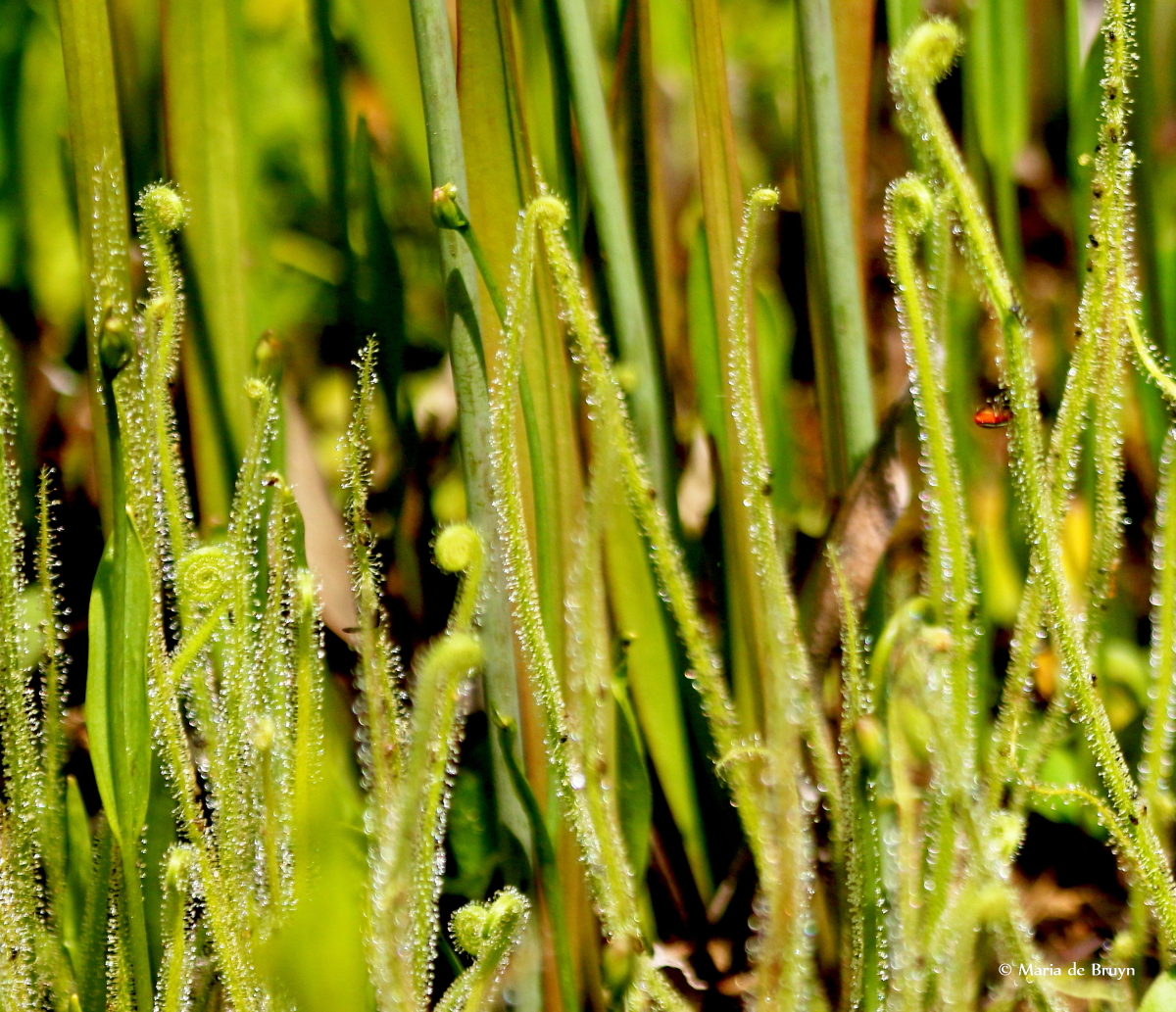
Some plants actually mimic dewdrops, like Tracey’s sundew.

Tracy's sundew DK7A5228© Maria de Bruyn res Tracy's sundew IMG_4952© Maria de Bruyn

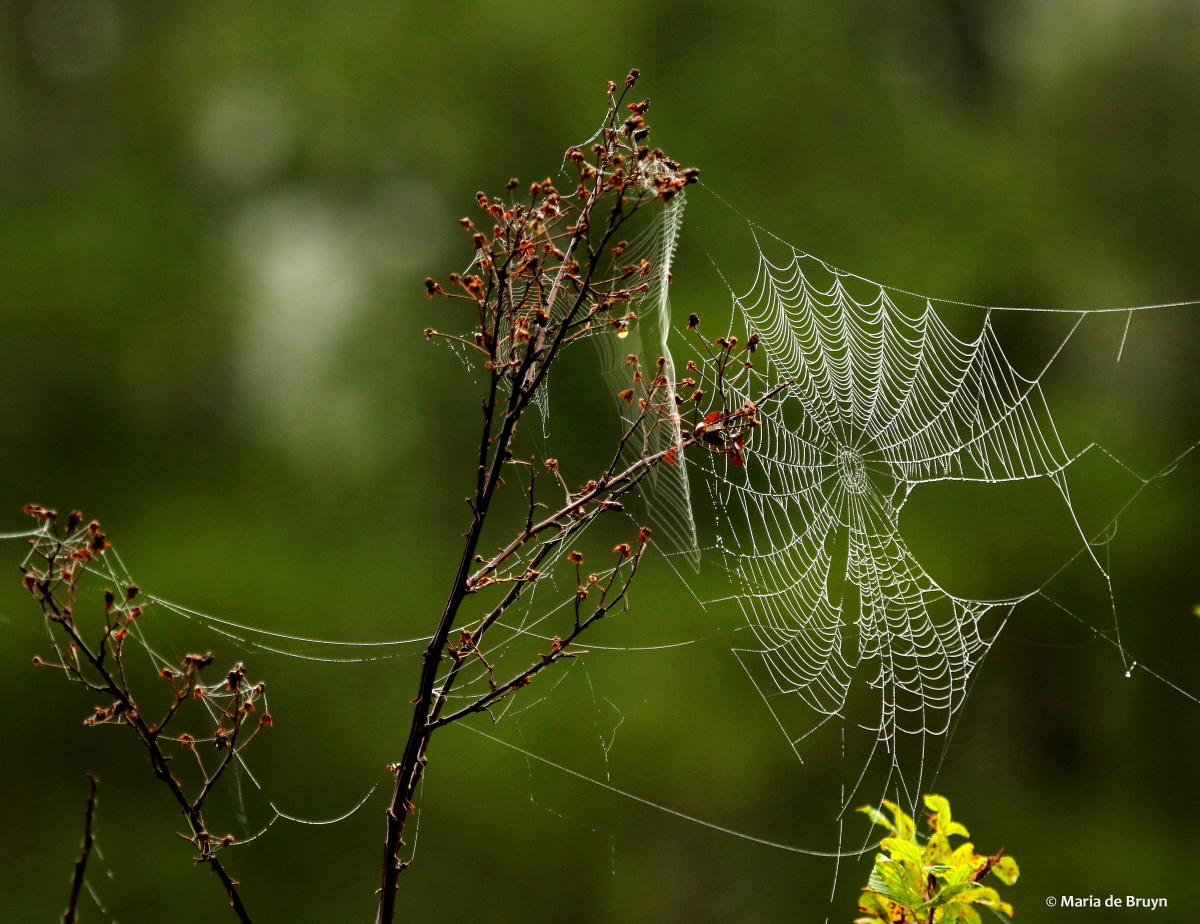
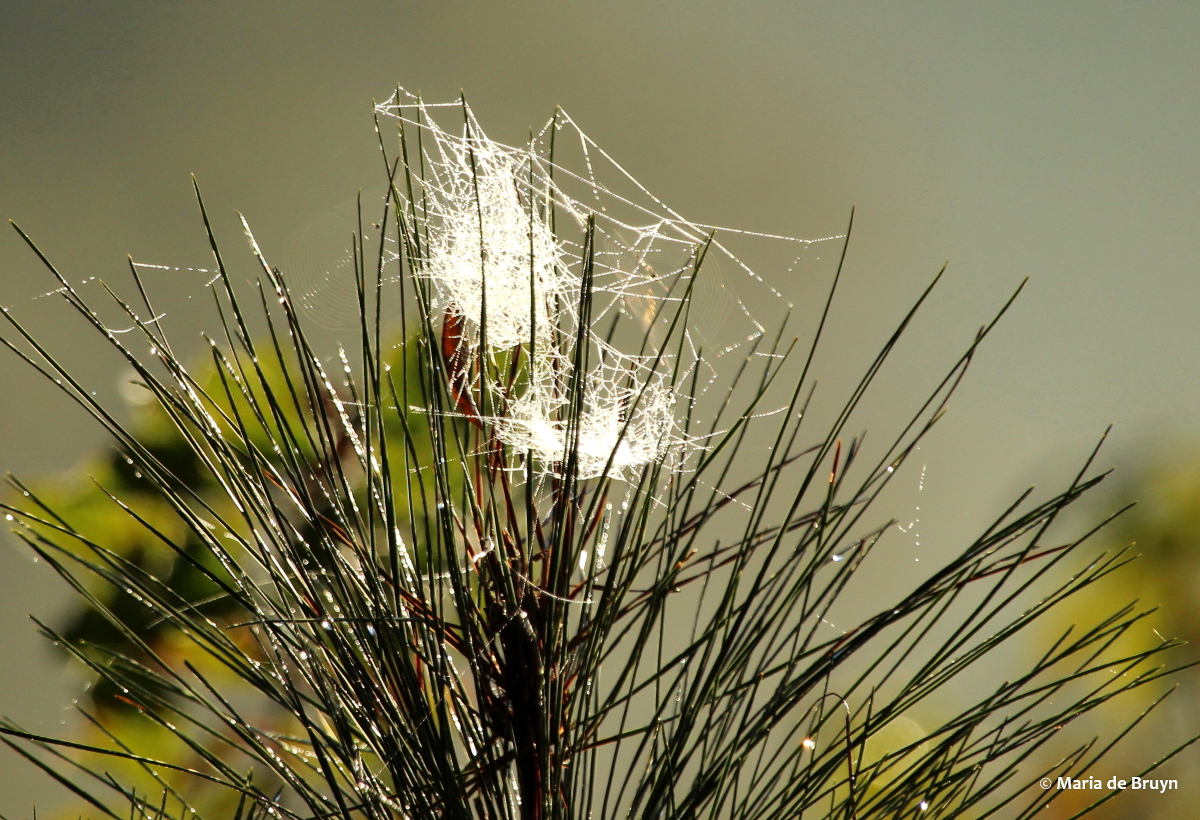
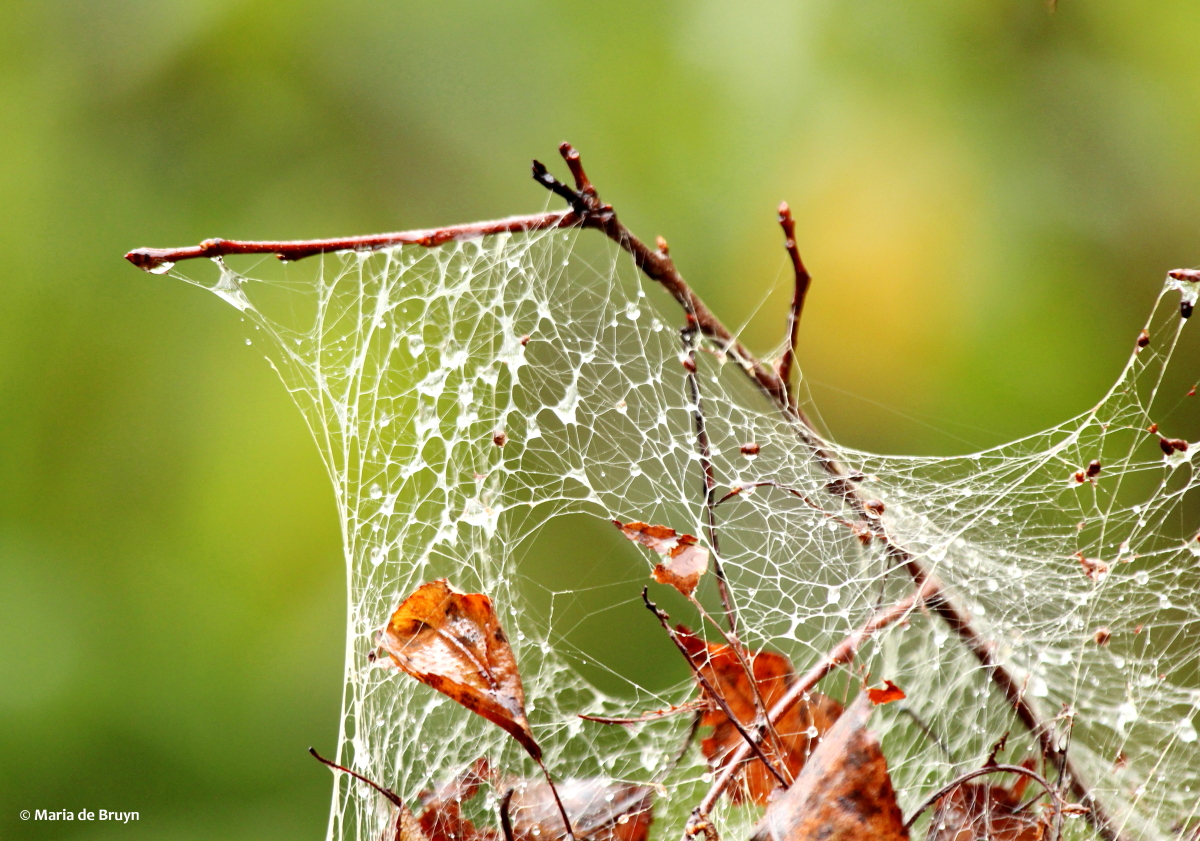
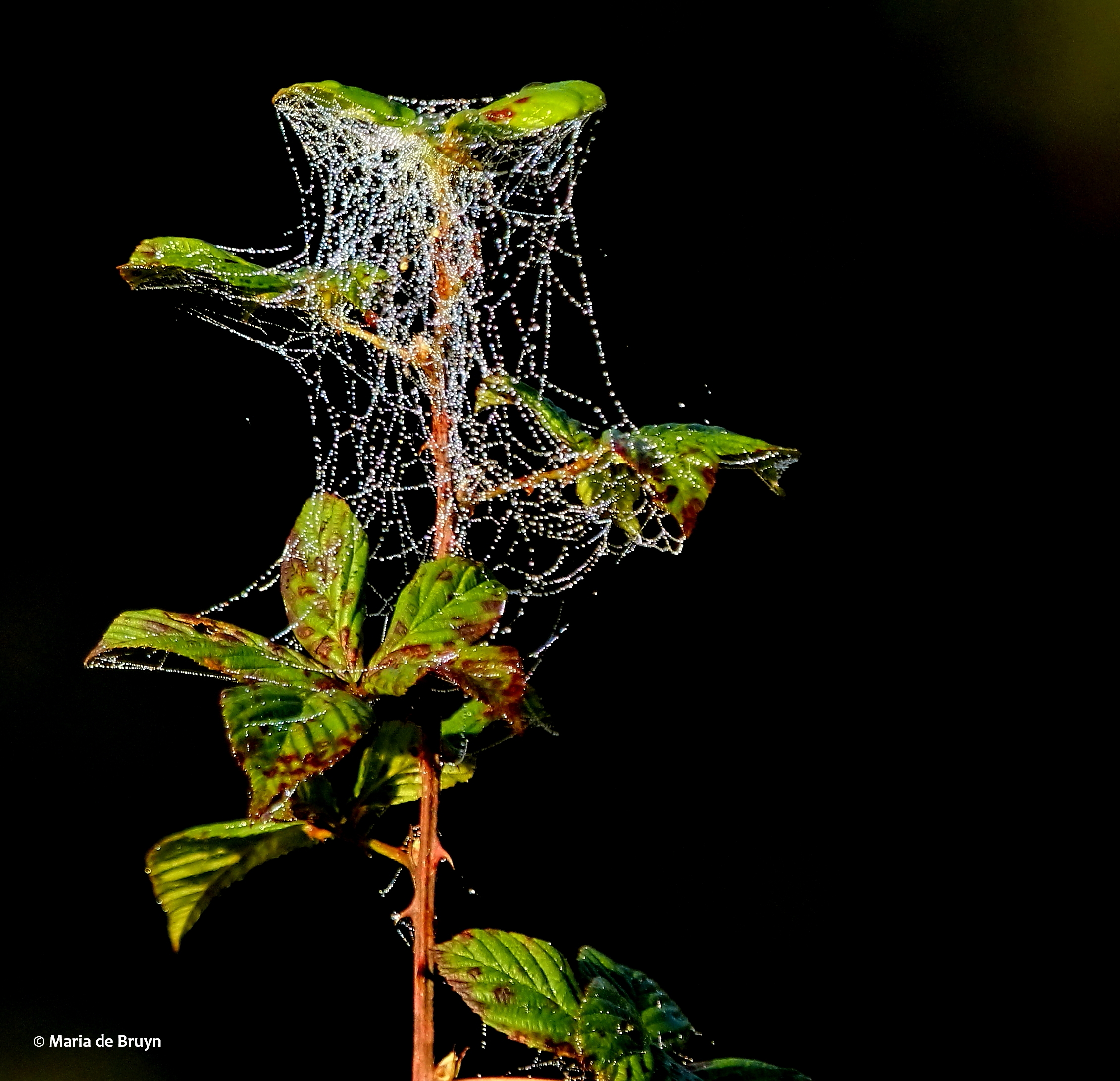
On spider webs, water and ice droplets outline the architecture created by the arachnids, showing off the symmetry and beauty of the lines.

spider web DK7A6479© Maria de Bruyn res spider web with dewdrops IMG_2683©Maria de Bruyn res

spider web with dewdrops IMG_6438© Maria de Bruyn res spider web with dewdrops IMG_6396© Maria de Bruyn res

sheetweb dwarf spider IMG_0959©Maria de Bruynsigned


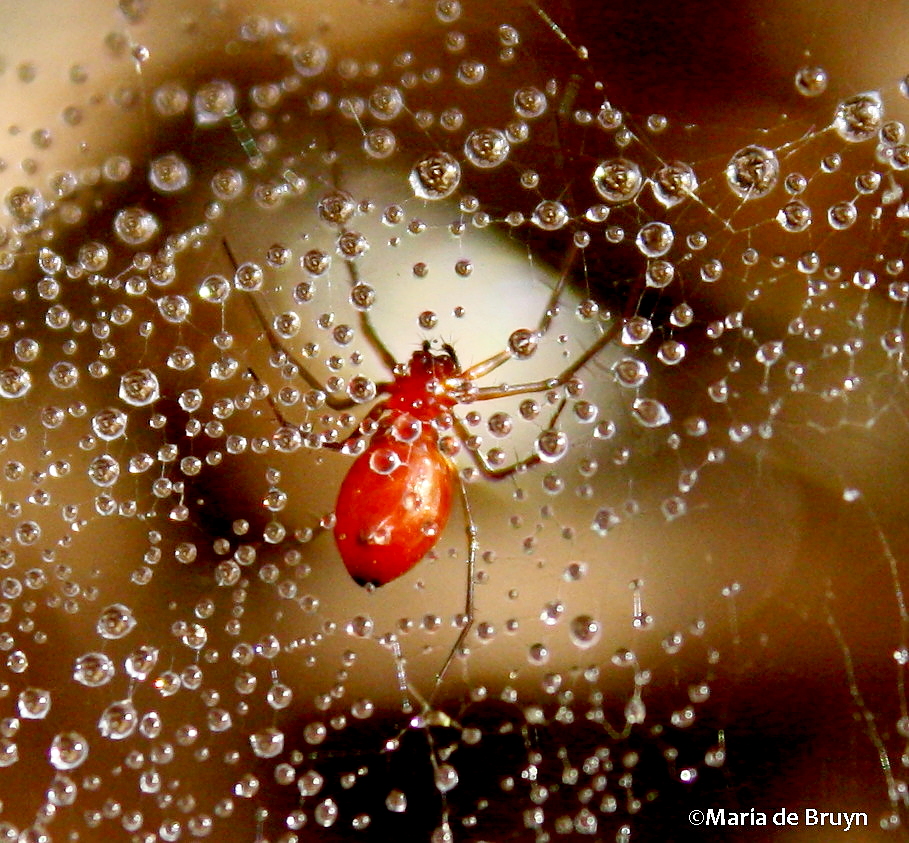
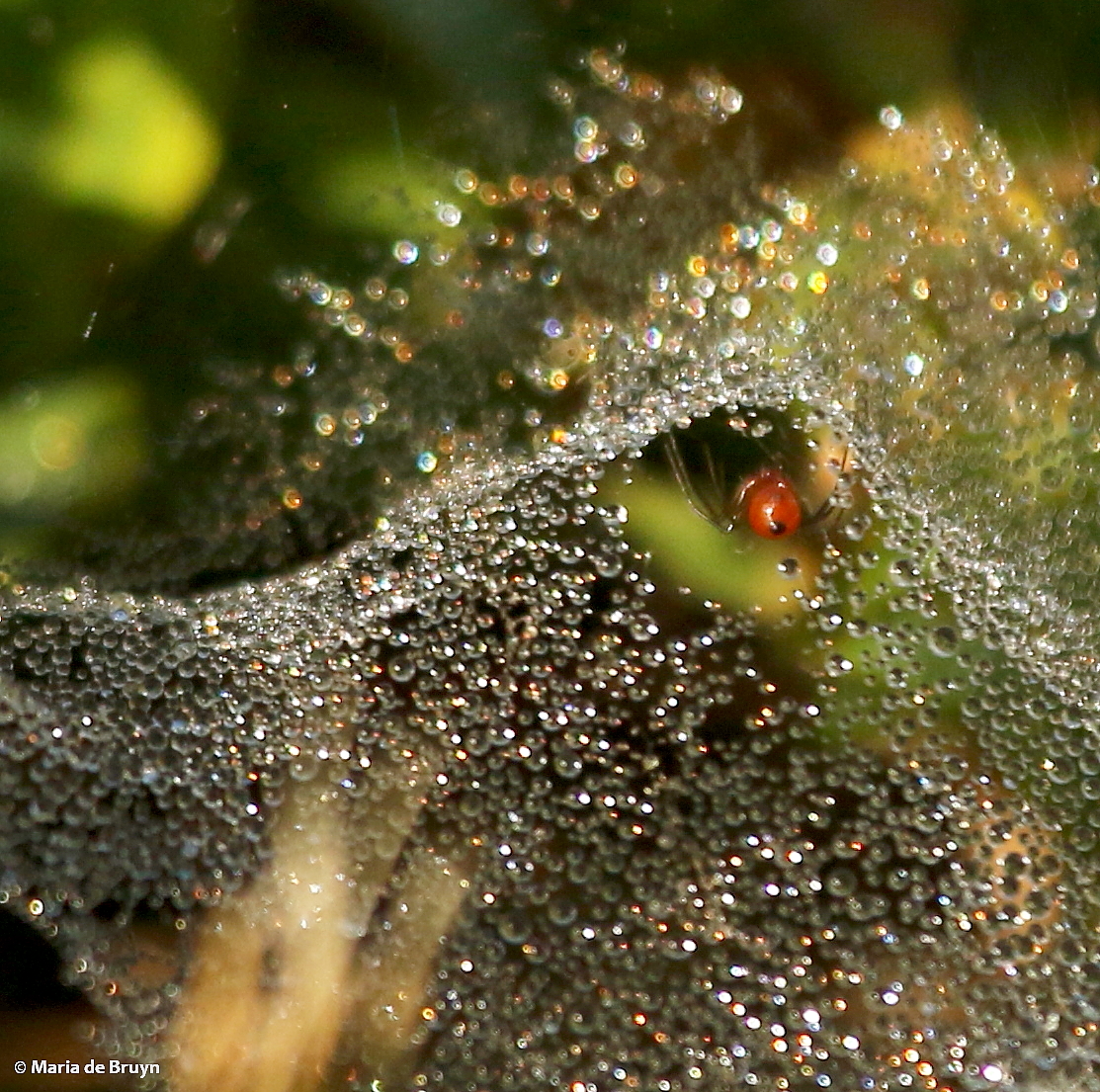
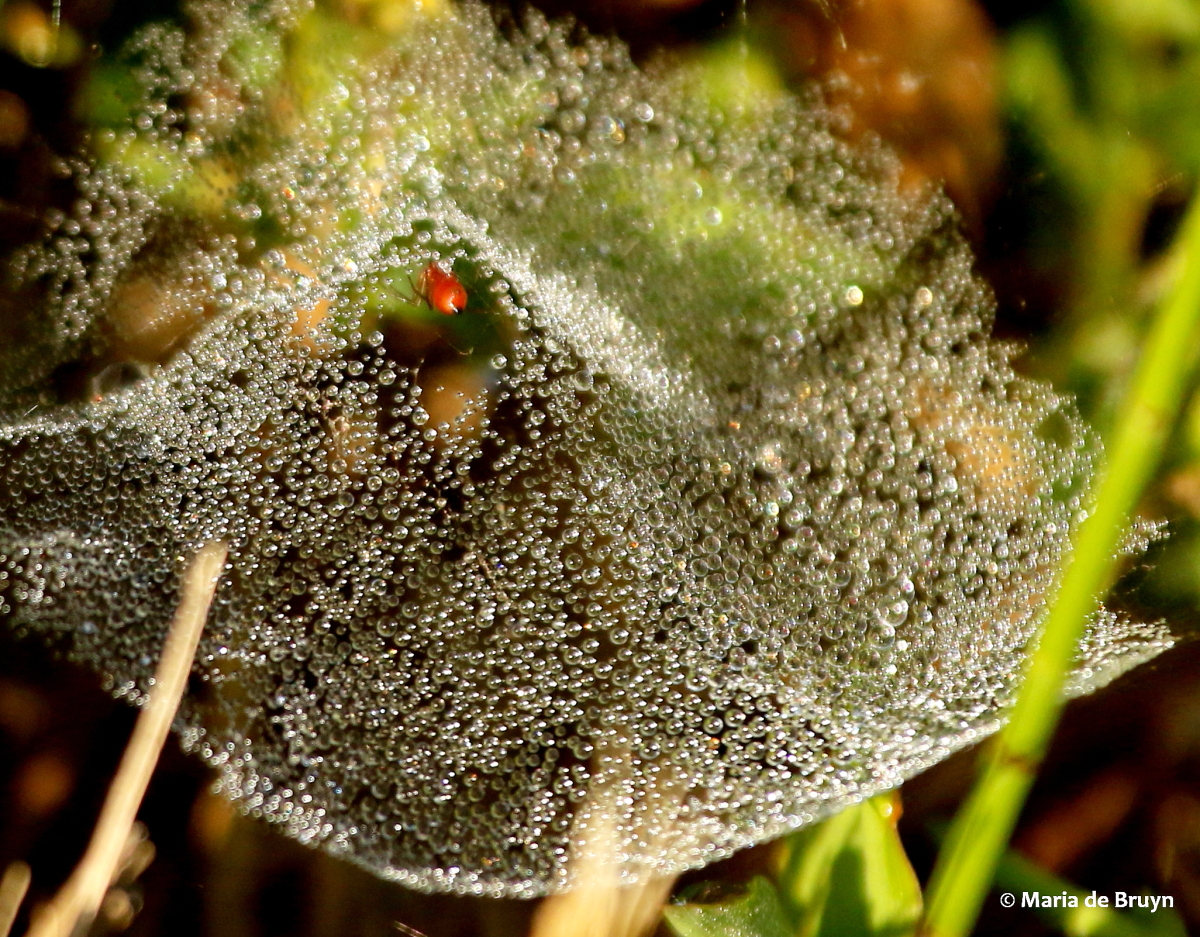
The webs of sheetweb dwarf spiders (Florinda coccinea), often not so visible in the grass, become quite noticeable when covered in dewdrops and then you can often spot the little red spider hanging underneath waiting for its prey.

sheetweb spider DK7A4086© Maria de Bruyn sheetweb dwarf spider DK7A4076© Maria de Bruyn res

spider web splendor IMG_2727©Maria de Bruyn res


In this case, the plant looked like a natural jewelry stand for strings of glass or diamond beads.

It was interesting for me to learn that the Indian Institute of Management Ahmedabad (IIMA) and the International Organisation for Dew Utilization (OPUR) created a dew harvesting system for a semi-arid area in India. Their condensers can collect more than 200 liters of dew each night from October through May and could provide an additional water source for people in arid coastal regions.

Leaves and flowers, like this coral honeysuckle (Lonicera sempervirens) can seem bedecked with glistening jewels when the ice crystals of frozen dewdrops adhere to their surfaces and edges.

Coral honeysuckle DK7A6792© Maria de Bruyn resCoral honeysuckle DK7A6805© Maria de Bruyn res

frosty morning leaves IMG_7351©Maria de Bruyn Nat GeoFrost may appear to be translucent or crystal clear; when a mass of crystals are together, they look white in color because they scatter light in all directions. The ice crystals of wind frost (also known as advection frost) arise when a very cold wind blows over tree branches, leaves and flowers; they can form gorgeous borders on these surfaces.

Early morning can be a great time for nature walks – beautiful sunrises, brisk (or cooler) temperatures and awakening wildlife make for interesting viewing. And raindrops, dew and frost can add extra scenes of beauty for us to appreciate!

A varied palate – hummingbirds’ choice of foods

DK7A2925© Maria de Bruyn res

As promised, one more blog on hummingbirds before I move to another topic; their presence always brings me enjoyment and I know other people who are enamored with these tiny birds, too. Also, although autumn has come, I still have a couple ruby-throated hummingbirds (Archilochus colubris) at my feeders. And a couple days ago I had the privilege of seeing a species new to me, the buff-bellied hummingbird (Amazilia yucatanensis), which has only visited the state of North Carolina once before (at least as far as human witnesses are concerned)!

DK7A2528© Maria de Bruyn resThe hummers have a varied diet, including mainly insects (mosquitoes, gnats, fruit flies, small bees), spiders, tree sap and sweet nectar (or sugar water). They tend to feed about 5-10 times per hour during the day and need about 10 calories of nutrition each day.


It is a lot easier to catch them drinking nectar than catching insects (apologies for the blurred photos)!

DK7A0749© Maria de Bruyn (2) res

DK7A7171© Maria de BruynDK7A2814© Maria de Bruyn

DK7A7808© Maria de Bruyn


Hummingbirds use their long tubular tongues as elastic micro-pumps to obtain nectar. This enables them to lick a flower up to 20 times per second as they gather food. And although we can’t see it when just looking at them, they have forked tongues (like snakes)!


DK7A0391© Maria de Bruyn res ruby-throated hummingbird DK7A1076© Maria de Bruyn res

DK7A4497© Maria de Bruyn2The hummers visit a variety of flowers to drink their sweet nectar, often preferring orange or red flowers but certainly not avoiding others.In my garden, this includes cardinal flowers (Lobelia cardinalis), hollyhocks (Alcea), yellow passionflower (Passiflora lutea) and lantana (Lantana).

ruby-throated hummingbird DK7A0820© Maria de BruynDK7A0555© Maria de Bruyn res

In nature reserves, I’ve seen them visiting morning glories (Ipomoea), ironweed (Vernonia) and trumpet vines (Campsis radicans).

DK7A2213© Maria de Bruyn resDK7A3392© Maria de Bruyn res

DK7A2289© Maria de Bruyn res


Their long bills, tubular tongues and slim bodies make it easy for them to drink from long flowers, but sometimes they will simply pierce the base of a flower to obtain nectar, or use a hole already made there by an insect.

DK7A2915© Maria de Bruyn resDK7A2428© Maria de Bruyn res

Light-colored flowers are not shunned as food sources, however!

DK7A7178© Maria de Bruyn (2) resDK7A7142© Maria de Bruyn res

DK7A7165© Maria de Bruyn res

Bean plants and gerbera daisies (Gerbera)  were on the menu at the Translating Traditions farm.

DK7A7360© Maria de Bruyn resDK7A7381© Maria de Bruyn res

At my house, the hummers visit the nectar feeders with great regularity, presumably because the food is very easily available there. A little known fact about the hummingbirds is that, compared to all other birds, their brains are the largest in comparison to body size. They remember where feeders are from year to year and also can recognize the people who fill the feeders. When the nectar is low and I appear, a hummer will sometimes hover and chitter in my direction at length; I really do think it is warning me that it’s time to prepare another serving.

ruby-throated hummingbird DK7A8190© Maria de Bruyn res

The buff-bellied hummingbird breeds in Mexico and south Texas. When they migrate, it is in a north-eastern direction, but the only previous recorded visit of one to North Carolina was in 2007. Now there is one hanging out at a couple’s home in the town of Winston-Salem, so I accompanied three fellow birders to go see it. Our 90-minute drive there was rewarded by a view of the bird within about 15 minutes and we stayed for almost two hours watching it come and go along with some ruby-throated hummingbirds.

buff-bellied hummingbird DK7A1131© Maria de Bruynbuff-bellied hummingbird DK7A1171© Maria de Bruyn

These hummingbirds have bellies with a light orange-yellow hue, brighter orange tail feathers and a bright green back and head. In contrast to the ruby-throated hummingbird’s straight dark bill, they have a reddish, curved bill. These lovely little birds appear to be the least studied species among the hummingbirds in the USA.

rufous hummingbird IMG_1789 M de Bruyn


Two years ago, I had a rufous hummingbird (Selasphorus rufus) visit my nectar feeder after he had migrated here in winter from the far North. This year, I’ll leave at least one feeder up again after the ruby-throats take off for warmer climes in case some wintering hummers need food. And I’ll look forward to seeing my regular residents again next summer!


More information:

http://www.livescience.com/51904-hummingbird-tongue-pump.html

http://www.nytimes.com/2015/09/08/science/the-hummingbirds-tongue-how-it-works.html?_r=0