Continued otter fun – for the mammals and me!

Part 2: surviving and dining in winter

One otter or two above? My otter friends produced an unusual portrait for me one day while they were running around an icy pond. 😊 It looked as if they had brought an extremely long family member with them!

Continued observation showed, of course, that the resident otters (Lontra canadensis) were all of normal stature. During much of the time that I was able to watch them, the temperatures were very low for North Carolina. In our central area of the state, temperatures in January 2025 were the 18th coldest ever recorded, averaging 36.6°F (2.6°C°F). Some days had significantly low temperatures, such as 17°F (-8.3°C) on 23 January.

That weather meant that the local ponds were partly or mostly frozen and had very icy waters indeed. In this and my next blog, I’ll share with you what I observed and learned about how river otters function in such cold conditions.

Their unique metabolism has several features that collectively enable them to survive in extreme cold.

  • Their very thick, water-repellent fur covers a dense undercoat that traps air. This fur is 10 times denser than that of the bobcat or red fox, with 585 hairs per square mm.
  • The trapped air acts as a buffer against the cold.
  • A thin blubber layer underneath their skin provides a second thermal barrier. (It also gives them extra energy when there is limited food availability.)
  • Shivering increases their internal body temperature.
  • Their high basal metabolism increases when they are actively swimming and diving, which also generates heat and helps them maintain a steady body temperature.
  • Their high metabolic rate enables them to pass food through their digestive system in about 60 minutes.

I was sometimes amazed at how quickly they caught one fish after another and now understand how they could process so much food in a short time. Their 36 teeth, including 4 long canines, obviously help them process the food they capture.

The otters also have corporal features that make their food hunting efficient:

  • Their ears and eyes are high on their heads, enabling them to swim more easily at the water’s surface.
  • They can swim both forwards and backwards, as well as tread water while surveying their surroundings.
  • They are near-sighted, which may improve their underwater vision.
  • Their whiskers are very sensitive, enabling them to more easily capture prey on dark nights or in murky waters.
  • Their ears close under water.
  • Their feet have five webbed toes as well as non-retractable claws.
  • Their traction on slippery surfaces is increased through heel pads on their hind feet.

The otter family that I observed on several occasions was very adept at catching fish. The NC Wildlife Organization notes that they sometimes collaborate in hunting by herding fish.

The pond otters whom I was watching had certain spots that they kept open in the ice, often diving down and coming up with another fish each time. In this video (click here) you can see one enjoying a meal.

Since I know very little about freshwater fish, I posted a couple photos on a fish identification page to find out just what the otters were eating. Group members debated a bit but then came up with these IDs.

Otters with bluegill sunfish (Lepomis macrochirus)

Otter with a large largemouth bass (Micropterus nigricans)

Biologists say that otters prefer to go after slow-moving fish, including catfish, carp, bass, suckers, and sunfish. Some of the fishing enthusiasts shared about what they had seen otters eat. (Then two men made negative comments and insulted the group moderator, so I removed the photos and left the group so as not to foment more dissension among that group’s adherents.) Here are some of their comments:

  • Otters are such cool animals! Have seen a couple groups while fishing/hunting this year in NC!
  • They’ll eat most any fish. Where I live they have cleaned out nearly all the fish in the ponds near the river. My old pond was teeming with fish when I owned it and now it holds a fraction of the fish it once did.
  • Ours eat a lot of eels. Ophelia/Smith Point, Virginia.
  • Here in New Hampshire I saw them eating what appeared to be fallfish last year.
  • I used to see otters pull rainbow trout out of the river when I lived in Idaho.
  • I hate otter and kill em every chance I get within season…I have had them drag 40 pound catfish out of my ponds and eat them…

It always saddens me when people develop a hatred for an animal (with the possible exceptions of ticks, mosquitoes and chiggers). In any case, I love the otters and will share with you how I saw them play in the next blog.


Two “otterly” fun months — otters at three ponds

The past two months brought me some really rewarding wildlife sightings. While birding, I learned new things about a couple avian species (see The Wild Side). But my main wildlife entertainment came from discovering and watching otters at three ponds. (A reminder: if you click on a photo, it enlarges; to get back to the blog, back space.)

My first sighting came on 29 November 2024 at a pond near a large housing development. I’d been looking to see if the beavers were at their lodge when I suddenly spotted some movement low in the water. To my amazement, four beautiful otters came swimming by, heading in the direction of the beaver lodge (photo above). They kept themselves fairly hidden behind vegetation and then went to sit and play on the lodge behind some brush and small trees growing on the beavers’ home.

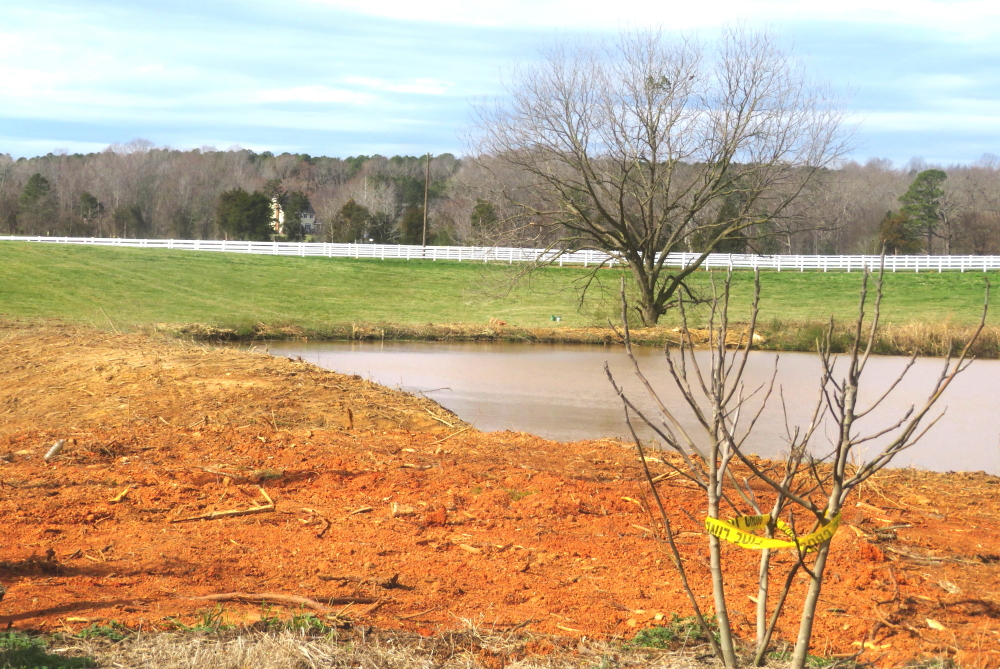
My next sighting was very unexpected, at a pond that had lost a lot of wildlife because the vineyard owner who purchased the surrounding farmland had cut down almost all the trees, shrubs and vegetation for miles around.

Because some migrating waterfowl still occasionally show up at the formerly lively pond, I visited there hoping to spot at least a few ducks. I was surprised to see a round head and sinuous body emerging from the water.

To my delight, I got to watch not just one but two otters swimming about and successfully nabbing fishy meals. One seemed to be less wary of people watching; the other would only stay in sight for a short time and then head to the pond bank underneath a lone standing tree as long as people were around.

I’m not sure what kind of fish they were catching, but they seemed to be enjoying good meals.

My next sighting was at the Sandy Creek Park in a nearby town. An otter suddenly popped up and began swimming low in the water among the vegetation. Then it swam across the pond to a beaver lodge and there caught some animal for a meal.

The mammal was quite far away and my camera lens wasn’t strong enough to get good views. In the end, I figured that it had caught a crayfish or something similar.

My best views of otters came when I returned to the pond where I had first spotted the quartet. Despite repeated visits, I didn’t see four of them anymore but only a trio.

It might be that the fourth one was a male who went off on his own. When winter comes and food is less accessible, otter groups tend to disperse so that each family member has access to food and food stores are not depleted.

River otters tend to roam over a specific territory, staying in one spot for one to four weeks. In the summertime, they may travel within an area of 20 square miles, but in winter they expand their territory upwards to about 60 square miles to maximize their success in finding food.

Fish are a dietary staple, especially in winter, but they also eat crayfish, crabs, turtles, amphibians, reptiles, insects, and even occasionally birds or small mammals. Besides the otter at Sandy Creek Park, I only saw them eating fish, but it was amazing how many fish they could catch and eat in quick succession.

In fact, their ability to almost always come up with a fish after going under water or dunking their head into the pond must account for the fact that the resident great blue heron tended to stick close to them. The heron would watch intently where they were fishing and when they moved to another area of the pond, the large bird would follow.

At one point, the heron stayed so close to a fishing otter that I wondered if the large bird was going to attempt to snatch a fish away, but that didn’t happen!

The hungry avian finally did catch fish, too.

In my next blog, I’ll show you some of the otters’ successful winter fishing forays, let you know how they manage to keep swimming in icy waters and outside temperatures of 15-30°F, and let you see how the otters were playing.


A cold but rewarding day at the pond!

On 29 November our area had its first really cold morning of the season, dawning at 25°F (-3.88°C). I fortunately had gotten my spring bulbs and seeds in the ground a few days earlier, so I was mostly ok with it except feeling bad for the outside critters having to deal with morning frost in the coming weeks.

There were still a few very hardy flowers blooming in the yard; a few were eaten by the deer, which was ok with me. However, the neighborhood honeybees had slim pickings, which may be why I suddenly found them swarming the nectar feeder which I’ve left in place in case a winter hummer shows up!

So before doing needed grocery shopping, I stopped at a local pond. The parking area near the path to the water is in an area usually filled with birds but scarcely any wildlife was to be seen. A song sparrow briefly popped up, but it was very quiet. Finally, I heard some pecking and there was a yellow-bellied sapsucker working on a new row of sap holes in a nearby tree.


Walking towards the pond, I crossed a bridge over the feeder creek. Usually, this area has numerous birds but not a sound or movement was present. When I started nearing the pond, I finally spotted mallard ducks — 16 as far as my count through the trees could tell.

A pair of geese was perched on a stump, and they seemed to be just chilling out, preening, paddling and resting.

Scarcely any other birds were around; a few sparrows popped up quickly and some turkey vultures were parked in area trees.
   

Finally, I noticed the great blue heron perched on the beaver lodge, not moving a muscle or feather. Its statue imitation was impressive. I began walking back and forth along the shore, hoping to spot wildlife but the cold even had the bugs laying low.

After a while, I figured it was cold enough to make the visit shorter than usual when I was stopped by the sight of a couple new dark lumps on the beaver lodge behind dried vegetation..

It turned out to be a couple of otters — a delightful sighting to be sure even if not clear as they were far away behind dried vegetation.

After waiting to see if the otters would leave their resting spot, I decided they had settled down for a lengthy nap. As I turned to leave, I suddenly saw movement and the two otters slipped into the water, with me turning and trying to get a few quick photos.

They swam quickly to the beaver dam, crossed and dropped down to the lower swamp on the other side.

I counted myself lucky to have seen them and was pleased with this unexpected encounter. I stared at the dam hoping for some movement, saw nothing and again began to leave when suddenly a head popped up again.

To my astonishment, not one, not two, but four otters came over the dam and swam over to the far shore behind the beaver lodge. They were going fast and I only got glimpses, but it was still so rewarding to see them.

They were underwater much of the time but finally popped into view at the edge of the pond vegetation behind the lodge.

They were obviously feeding on something, but it wasn’t possible to see what they were catching.

They moved along the shoreline, swimming together and alone.

The otters must have been having considerable feeding success because the heron left the beaver lodge and began following them along the shoreline.

I tried to follow along on the other side of the pond and caught glimpses of them until they disappeared into a vegetation-heavy area of the pond. The heron kept following them so they must have been good guides to where the foraging was rewarding.

It finally became time to really call an end to my pond visit, so I left along the path which was still almost wholly silent without bird song. Back near my car, the sapsucker was still busy in the same tree working on the same line of new sap holes. The woodpecker had obviously found itself a good feeding spot and I felt fortunate, too, to have had a surprise encounter with those beautiful sleek water mammals at the pond.


This sighting was indeed something to be thankful for the day after Thanksgiving. It followed my chance a few days earlier to see our county’s first tundra swan on record. A friend alerted me to its presence and many people went to our county’s water reservoir, where the bird was hanging out far across the lake. Some very cool sightings to mark a holiday week! 😊

(Apologies for the somewhat blurry photos but the wildlife was fairly distant and my camera lens is no longer working optimally. But I still wanted to share the good fortune of these wildlife sightings!)

Small, feisty and fascinating — my favorite herons!

Well, time has passed again quite quickly since my last blog (at least for me), but I hope you find this posting worth the wait! I’d like to introduce you to my favorite herons.

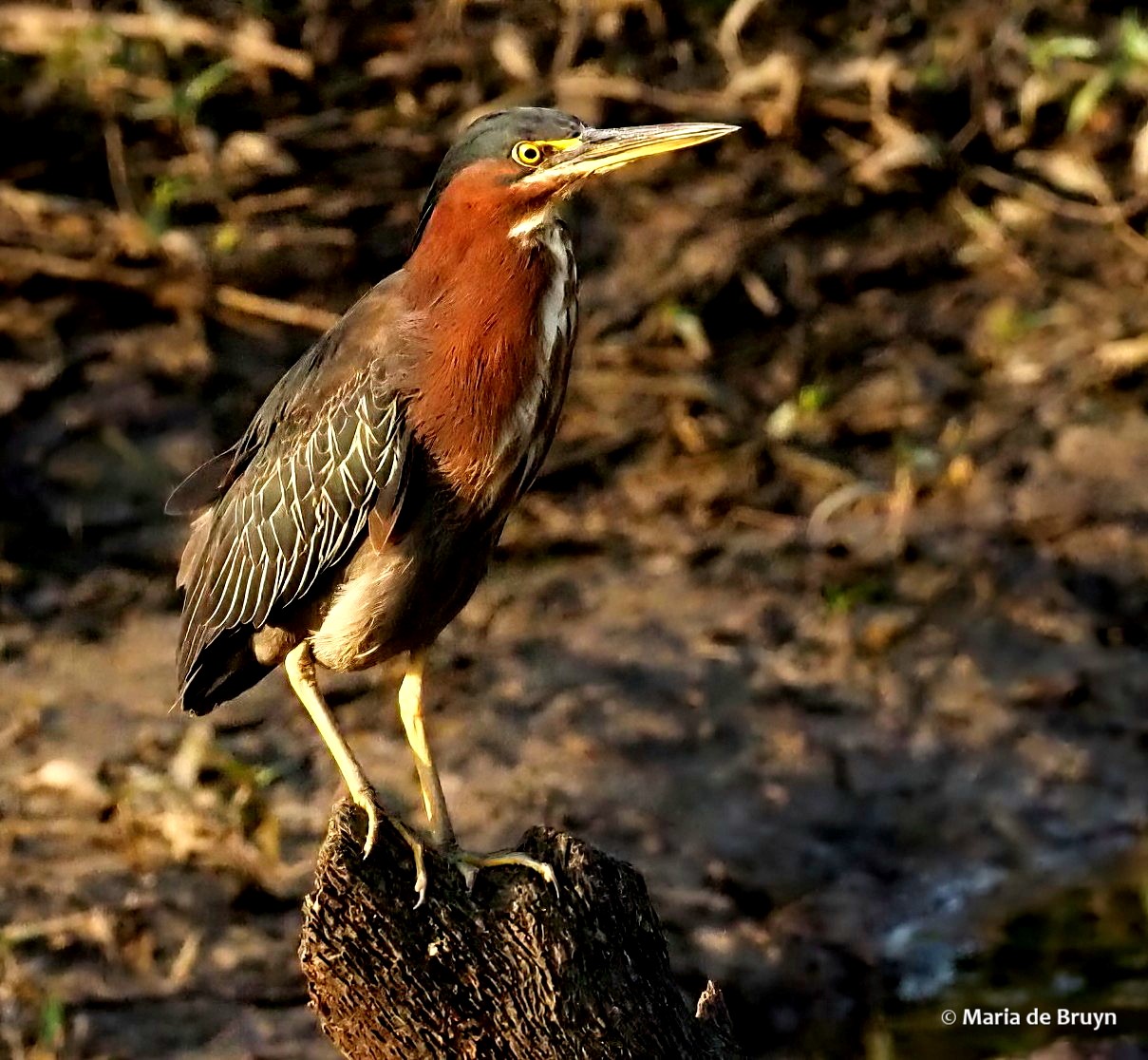
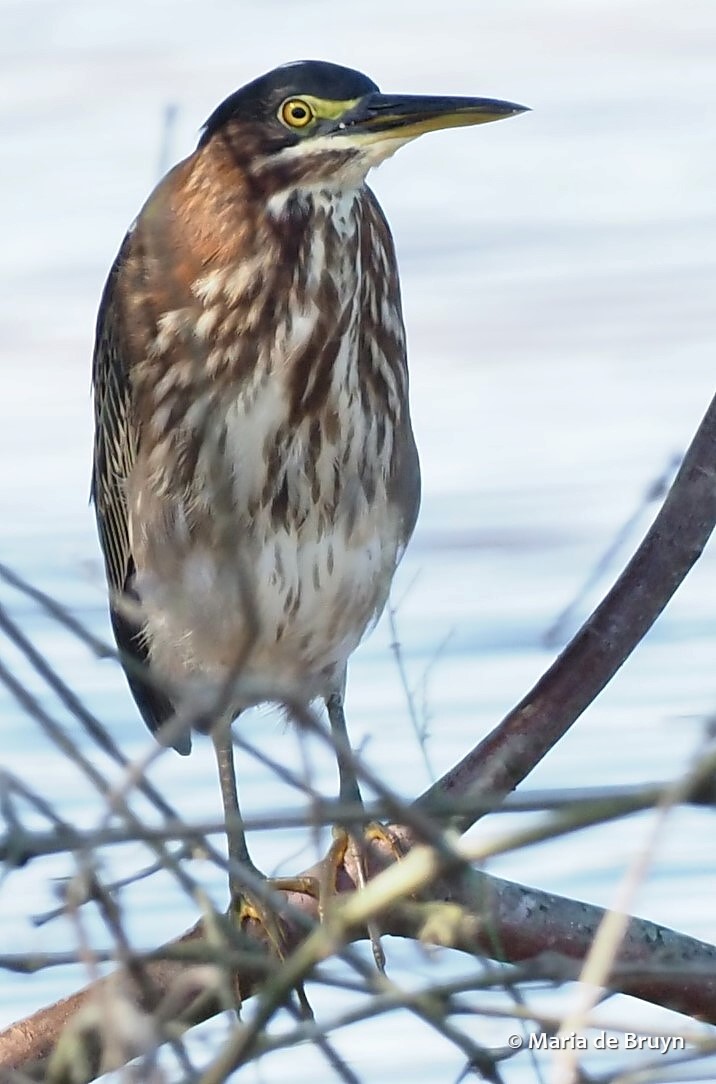
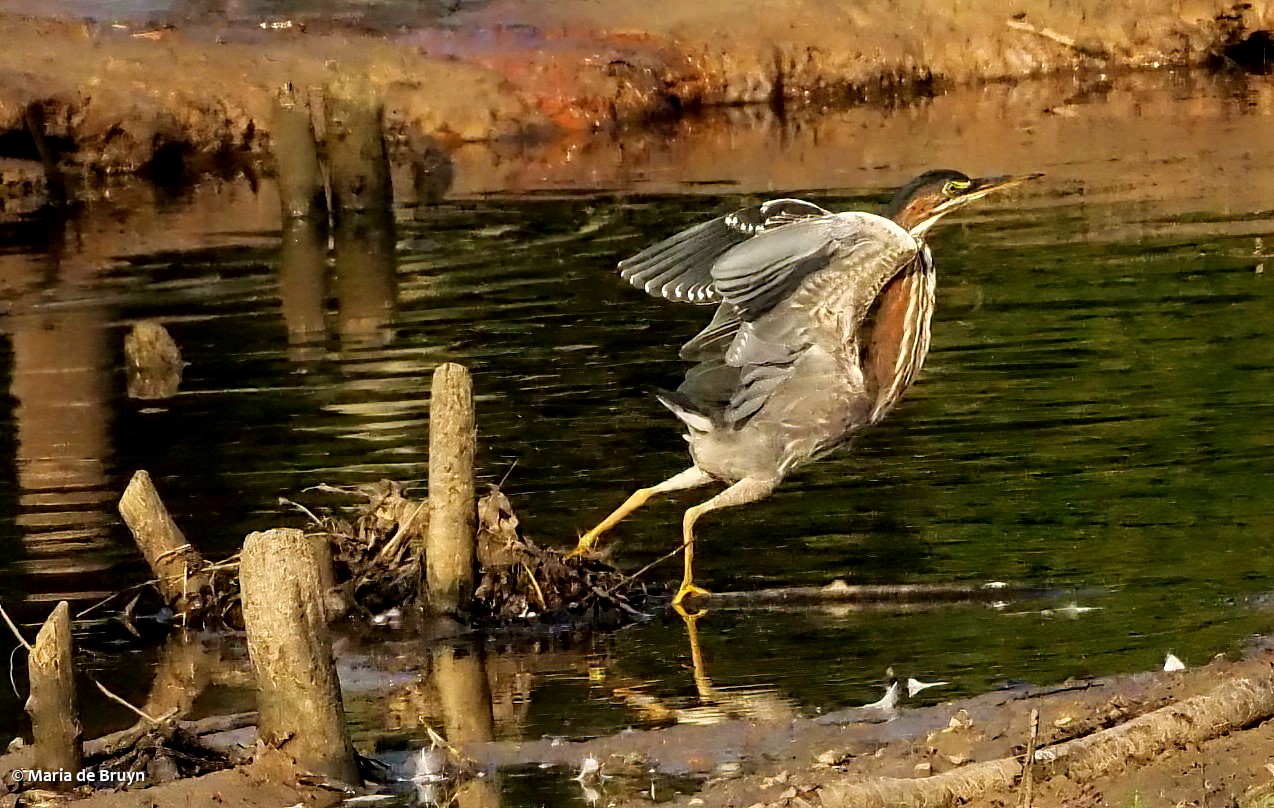
There are 16 heron species in the USA, and many are fairly large birds. But my favorite is the smallest one — the green heron (Butorides virescens)!

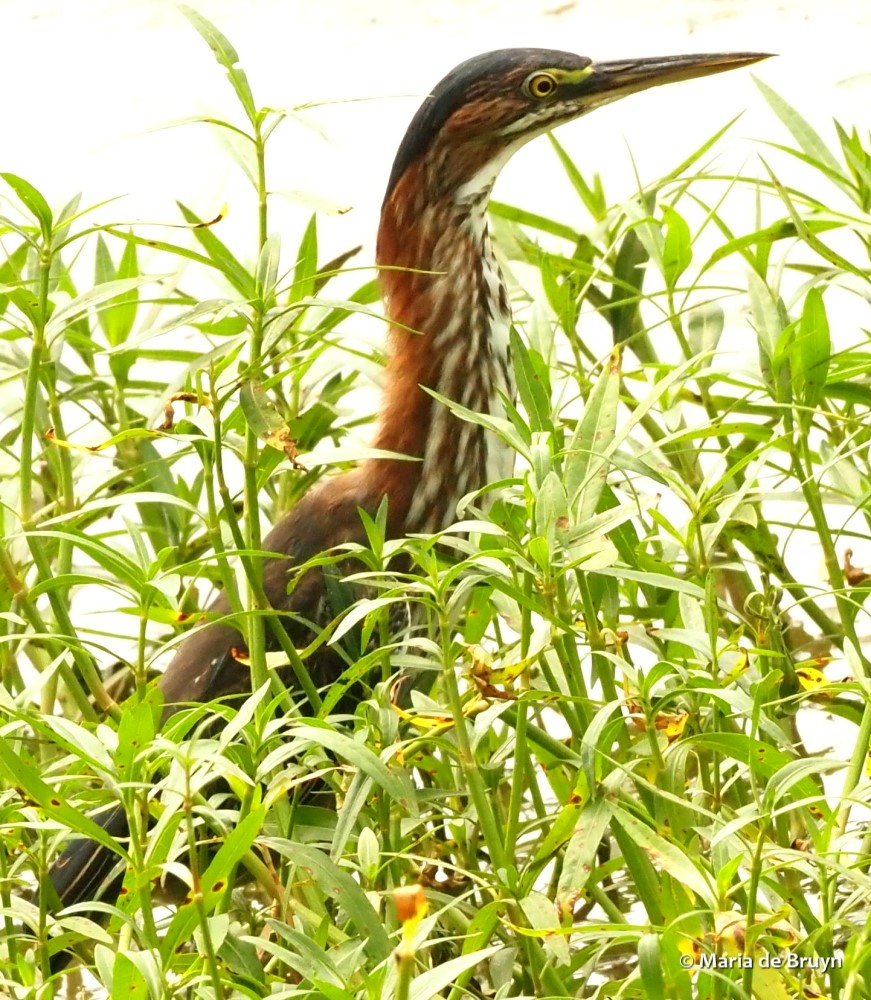
They are sometimes considered rather “secretive” birds, avoiding being out in the open or in full sight. When they sit and stalk near vegetation, they can indeed be difficult to spot.

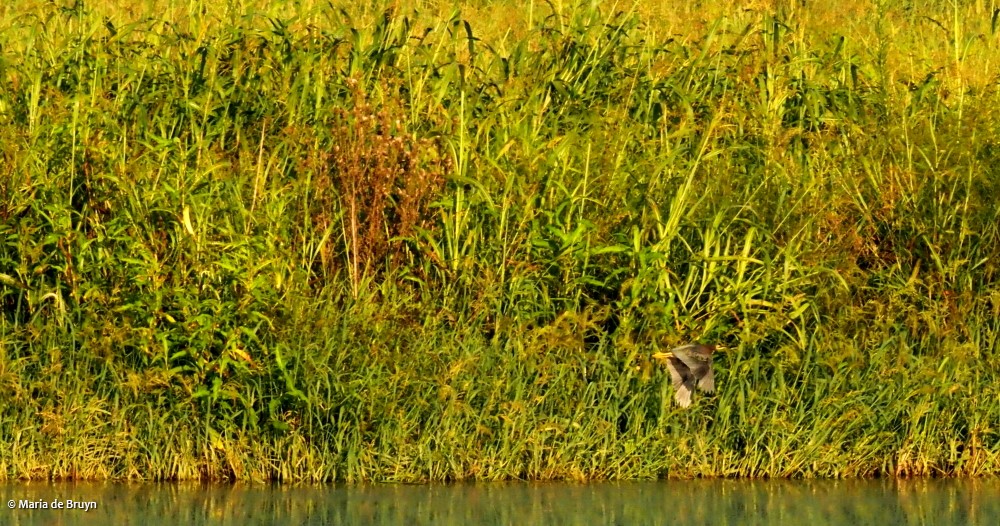
Even when flying, they can blend in well with background bushes and trees.

This year I was fortunate enough to see them out and about fairly often. They accommodated birders by staying for a while at four different ponds and a small lake.

What used to be a decent pond behind a shopping center was drained a couple years back and became a barren and often trashy area. The beavers who helped keep it water-filled were chased away. But when our area had copious rains in late summer this year, the pond filled partly and sometimes fully. A pair of green herons took up residence for several weeks alongside mallards, a lone hooded merganser, a young ibis, some egrets and little blue herons.


Green herons are known by various common names, some of which I find rather weird:

  • Fly-up-the-creek (likely inspired by their swift flight when startled or disturbed)
  • Poke (perhaps referring to how they forage)
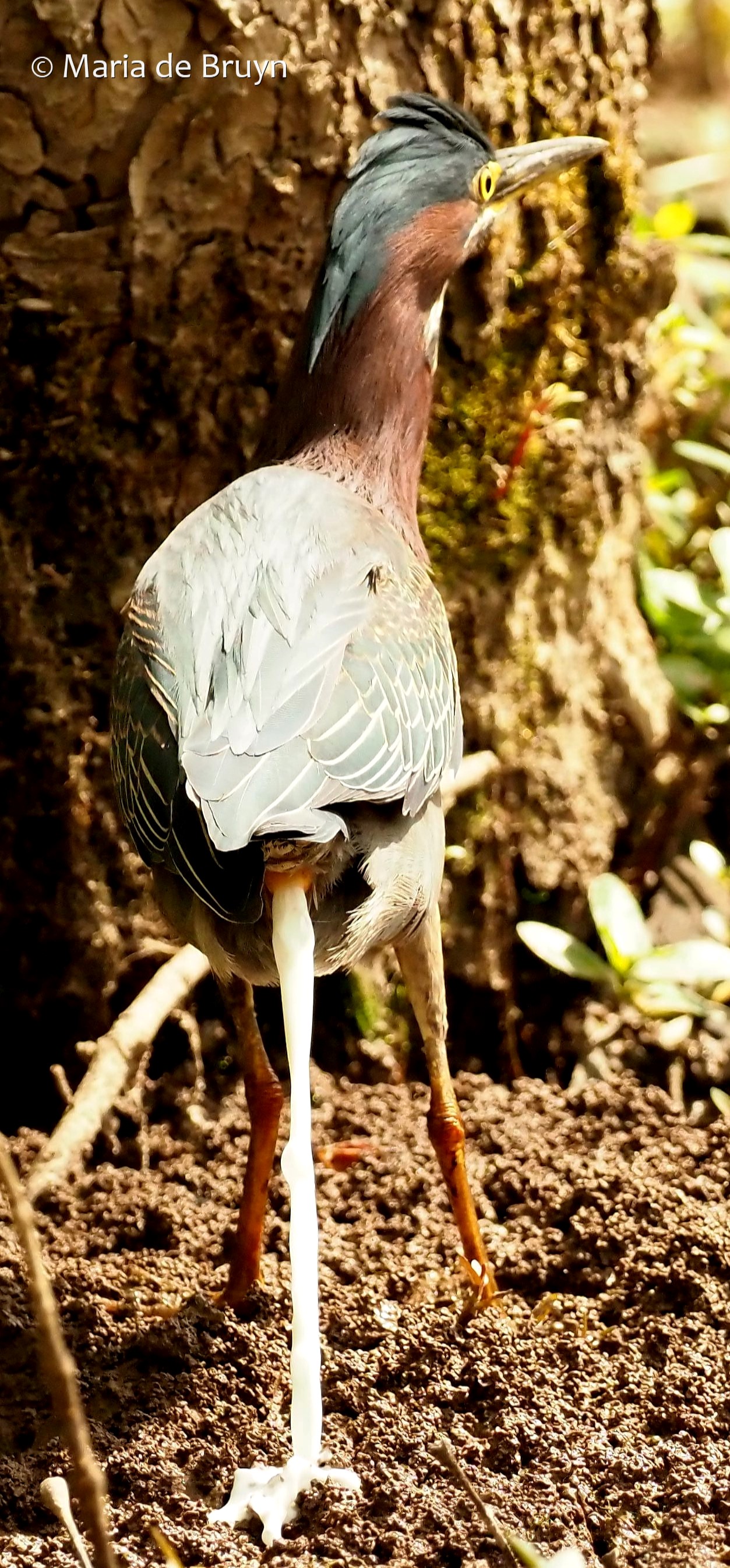
  • Shitepoke (referring to their projected fecal matter; see left!)
  • Chalkline
  • Indian Hen and
  • Chucklehead.

In my experience, great blue herons tend to ignore people for the most part, but the greens always seem very aware of our presence and sometimes curious about why we’re watching. So, I might be inclined to give them a nickname like Puzzlers, befitting their sometimes-intent perusal of watchers.


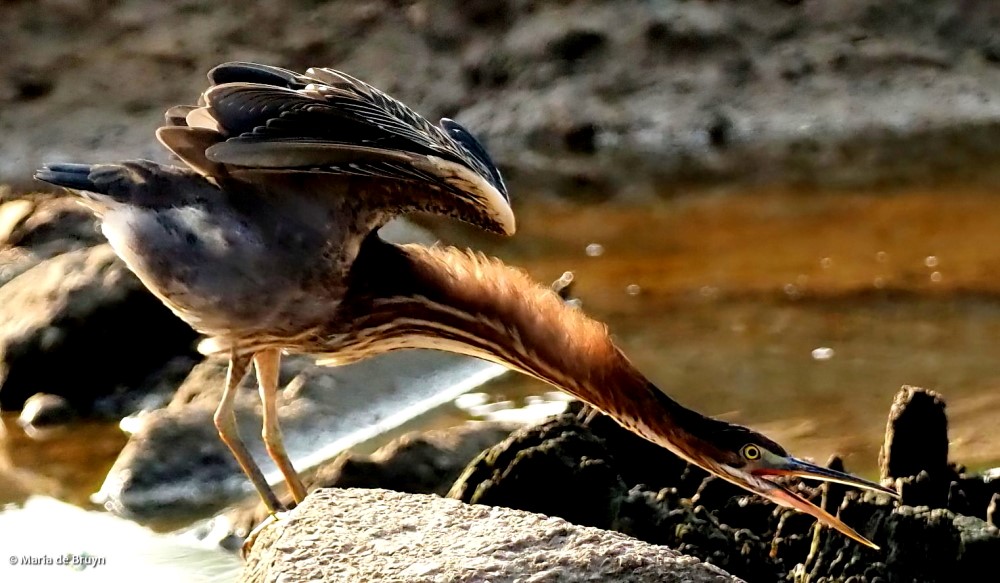
When not stalking prey, these herons often perch or stand with their long neck pulled in and they look like they’re hunching their shoulders. When you see their neck extended, though, you get a good idea of how tall they can be!


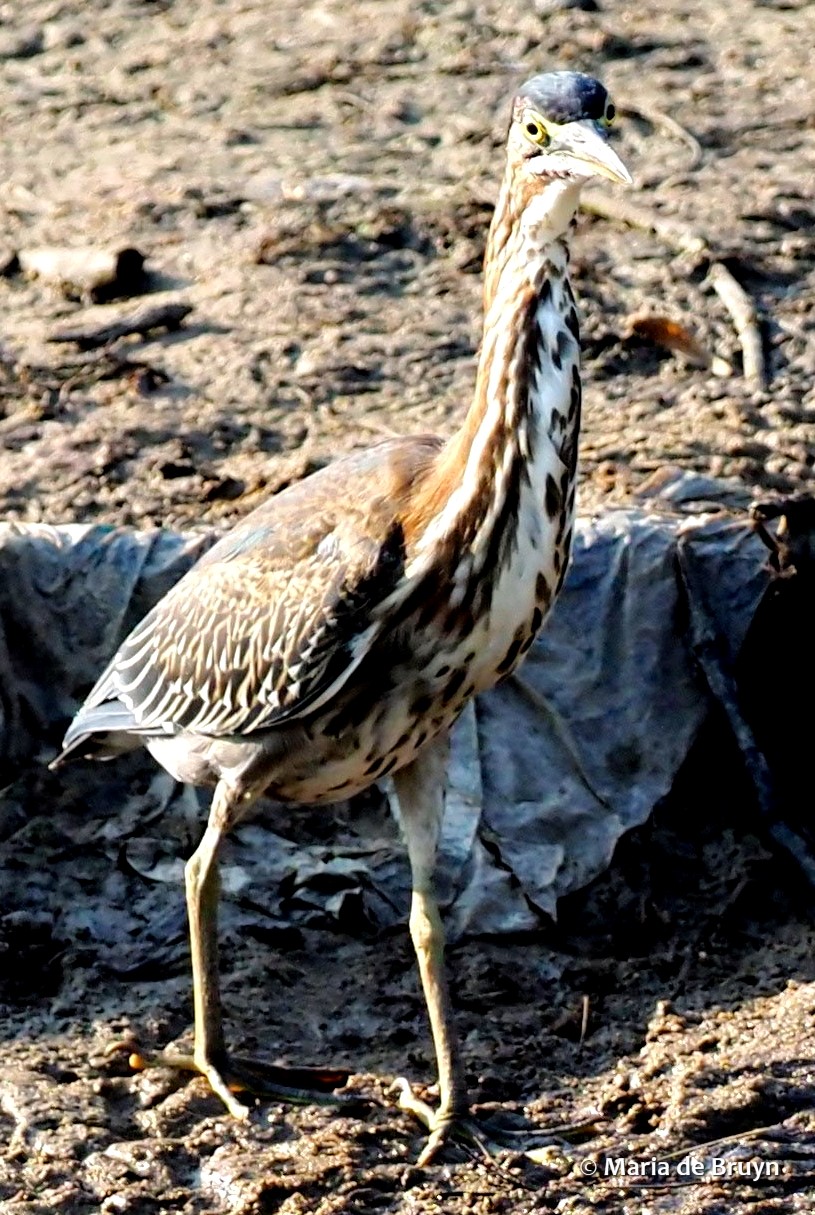
Other herons are not quite as colorful as the greens. These small herons change their appearance much more, displaying feathers of white, cream, chestnut, green, brown, gray and black colors. This is set off against a pair of yellow or orange legs, making for quite an attractive bird.


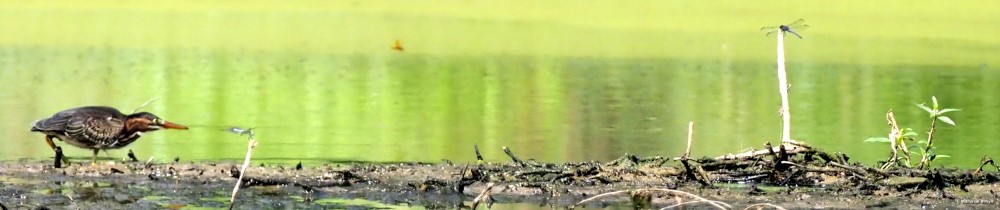
The green herons are among the tool-users of the animal world. They fetch different items to serve as bait to lure fish to the water’s surface, including insects, bread, leaves or feathers. They mostly look for prey while wading along waterways or stalking in shallow areas. Occasionally, they also go after prey in deeper water, evening diving in and needing to swim back to land.

Their diet can be varied, including animals such as frogs, tadpoles, lizards, crayfish, snakes, dragonflies, grasshoppers and other insects, and sometimes small rodents.

This summer I saw one green heron catch a very large frog that was at least as long as its beak, if not longer. Unfortunately, I didn’t get a clear photo as my camera has been malfunctioning. ☹

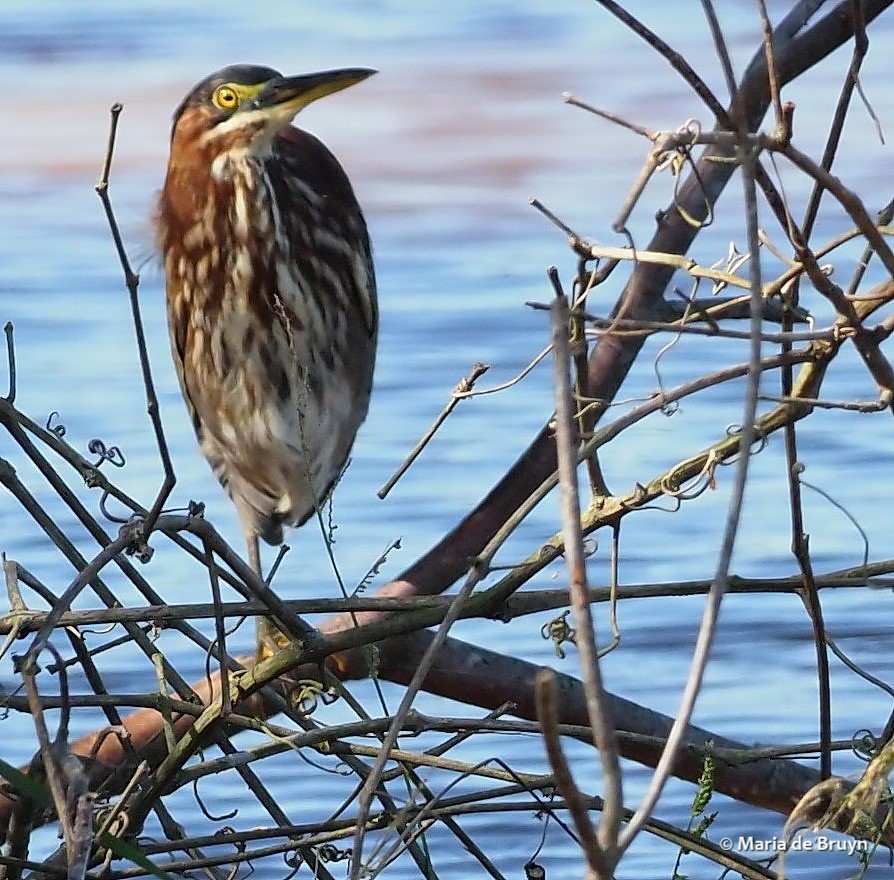
After watching them often, it’s still not entirely clear to me why they sometimes raise their crests. Perhaps it’s a way of warning those around them that they are on the alert and not willing to share space. I do think it gives them an attractive look, although they can be stunning when simply resting on a branch while they survey the surrounding area.

At the end of August, I thought the greens had begun moving on to their winter abodes as I wasn’t spotting them. But then a few days ago, I caught one chilling out at a vineyard pond with no other wading birds in sight.


My late summer sighting was perched on branches at the pond’s edge, standing on one leg. Since a large snapping turtle was floating right behind him/her, I hoped that the other leg was simply tucked up under its feathers — and luckily, that was correct.

A threat to these entertaining birds is the alteration and loss of wetlands, which are proceeding quickly. Green herons are not (yet) among the birds whose survival is threatened as a species and individuals can live as long as 9 years. Nevertheless, this year the U.S. Fish and Wildlife Service reported that wetland loss rates have increased by 50% since 2009 and North Carolina, where I live, was particularly affected.

This continuing decline can only be stopped with more action to preserve existing wetlands, as well as measures to deal with the effects of climate change. I very much hope that I’ll be able to continue seeing the green herons and other wetlands wildlife for a long time to come.

An hour at a local pond

There is a pond in the county where I live that used to be a real hot spot for birds and other wildlife. The dairy farm fields around it had lots of native vegetation, which was very welcoming to avian wildlife.

A couple years ago, the farmers retired, and the property was purchased by a vineyard owner to expand his holdings. He cut down most of the vegetation around the pond and along the road bordering the fields. He has turned most of the fields into vineyards, keeping only small portions untouched where birds can still find some refuge.

I used to see a yellow-billed cuckoo return from migration to a small patch of trees there every spring. This now is a thing of the past. However, some pond-edge vegetation had been regenerated, and a little bit was planted, so some birds are hanging in there. They still make for some interesting birding. Here is what I saw on a recent visit.

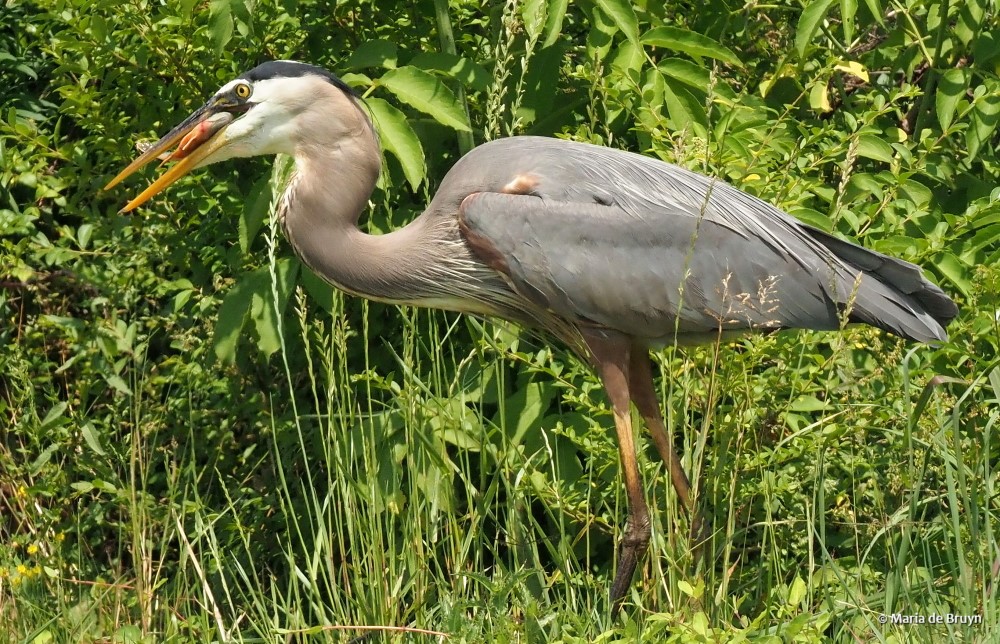
The largest birds that keep returning to the pond are the great blue herons. Sometimes there is one; other times there are two or three. Occasionally a green heron flies in or over but none stopped by on this occasion.

The heron often has good days fishing there. I often see him/her snag at least one fish and often more than one.

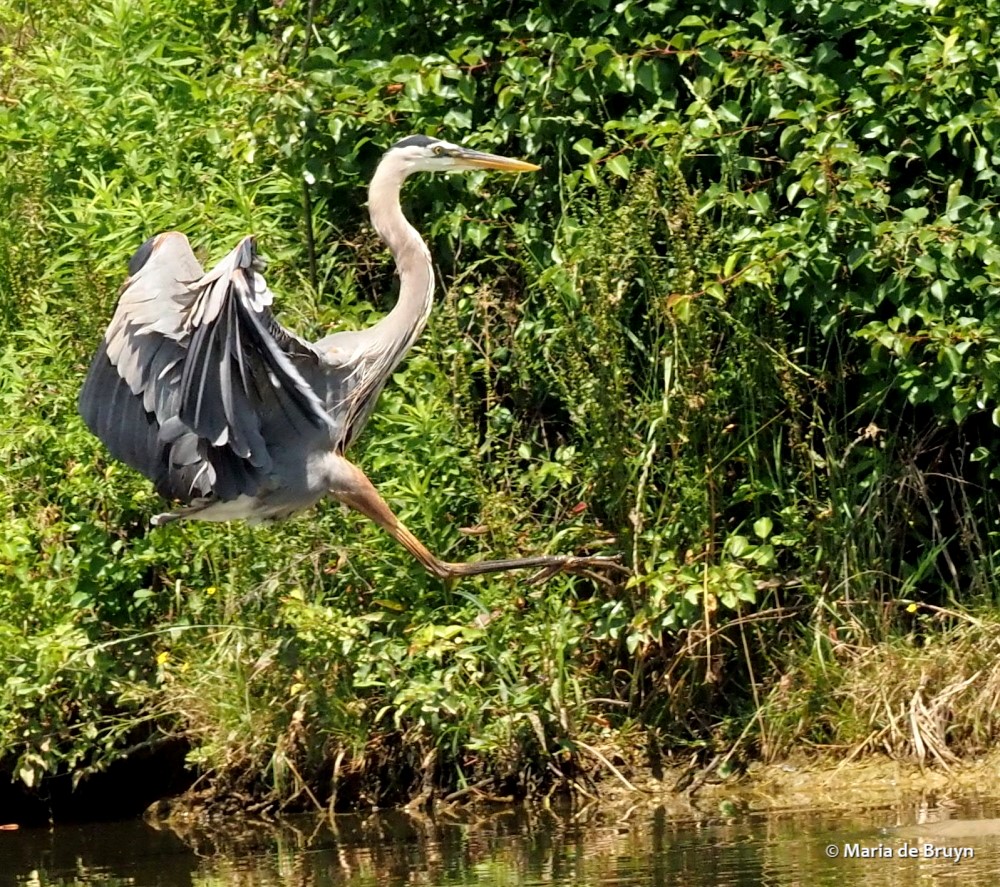
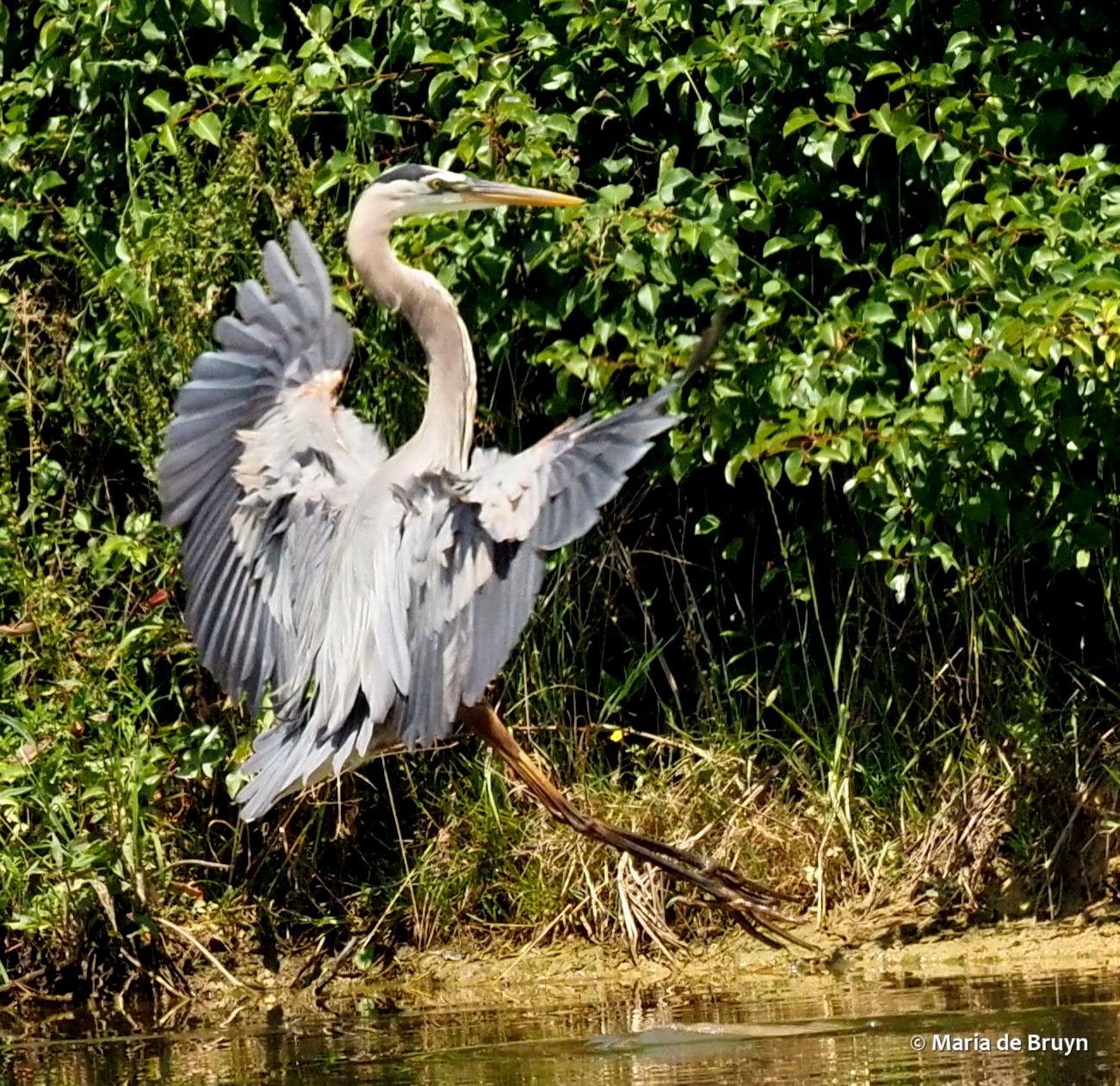
The heron stalks along the pond and frequently flies across to the other side for a change of venue. Perhaps the fish manage to hide well once they realize s/he is stalking them.

It’s wonderful to see the heron’s wings spread as the bird alights and then begins stalking again.

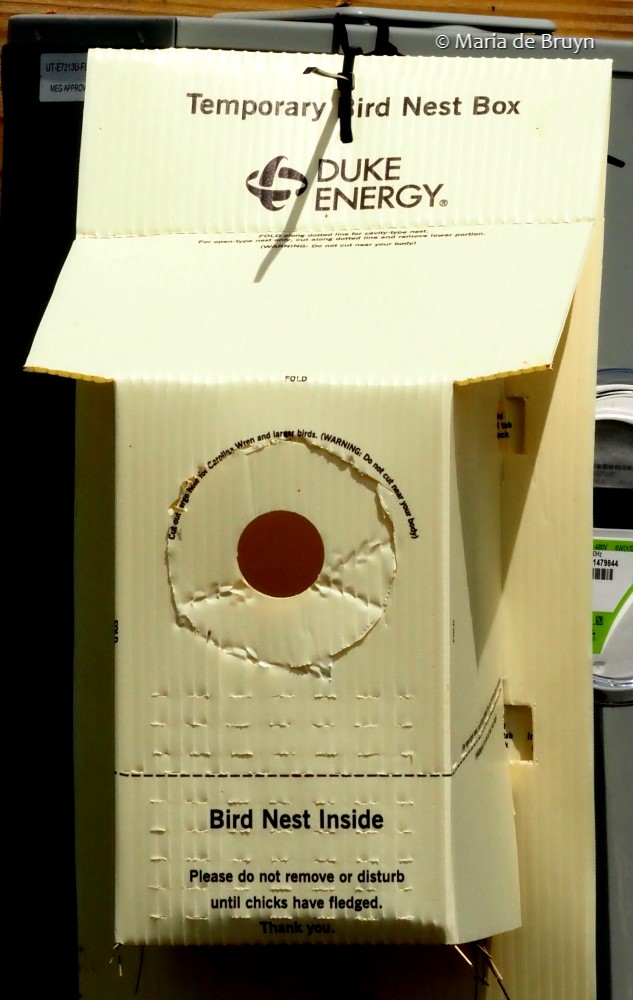
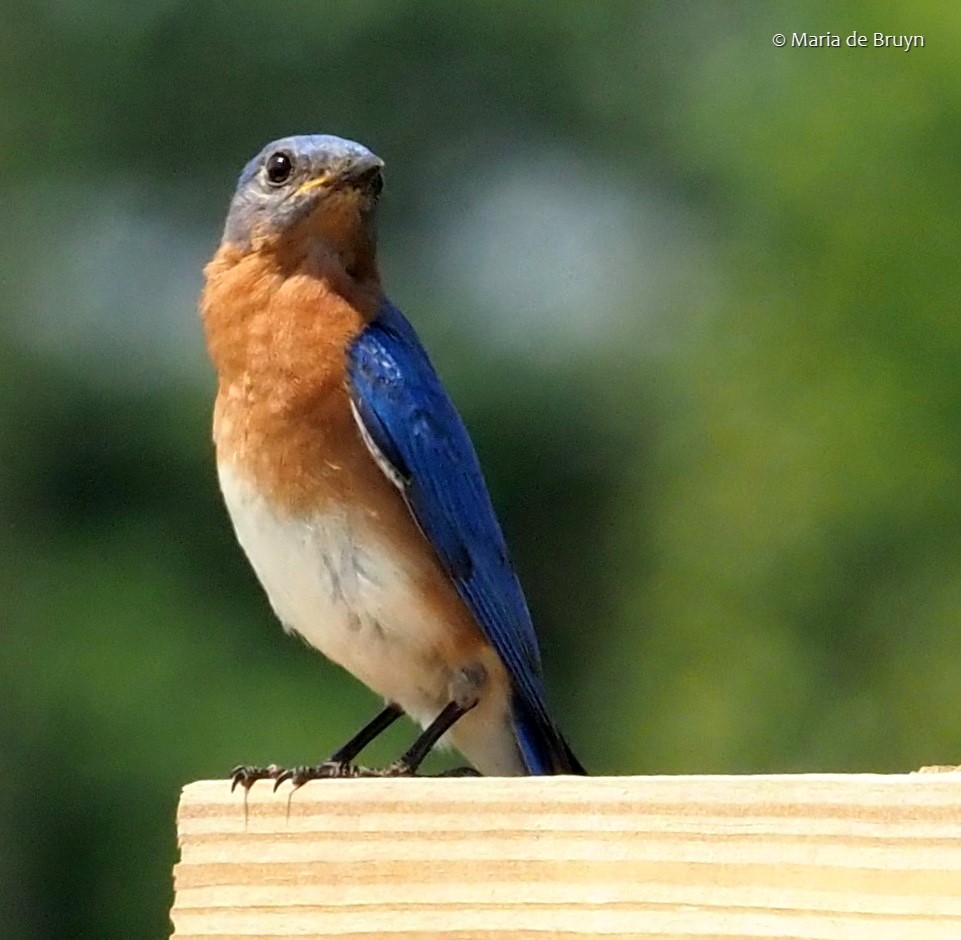
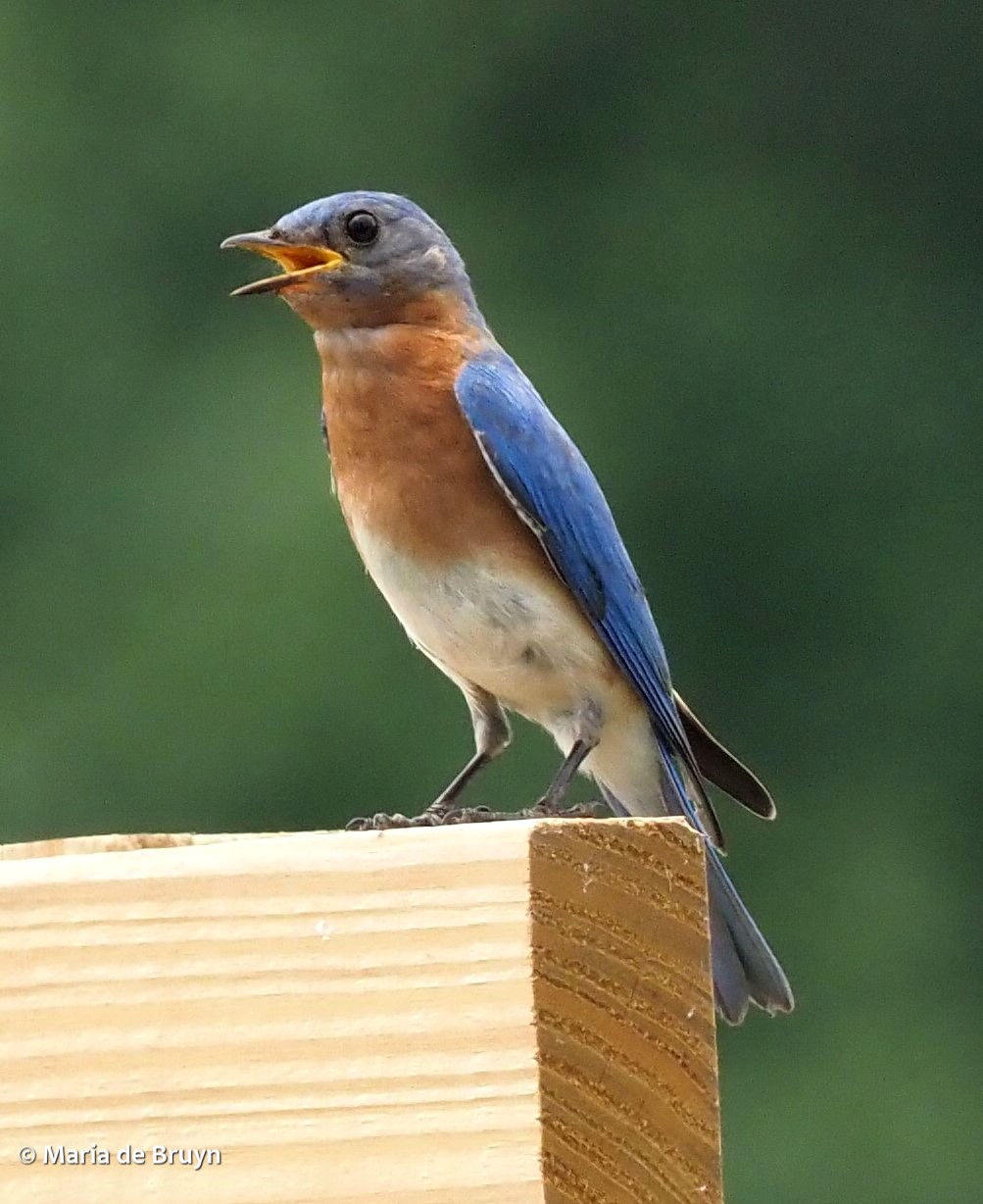
Eastern bluebirds had taken advantage of an electrical installation next to the pond (which also serves as a resource for the local fire department as needed). They not only used it as a perch for bug seeking but also built a nest inside it. I wondered what the new owner would do.


To my great surprise, his problem was solved by the local electricity company. They removed the birds’ original nest and put it into a temporary nest box!


Mom and Dad bluebird were guarding the nest space, but it looked like they were still getting used to the new digs.

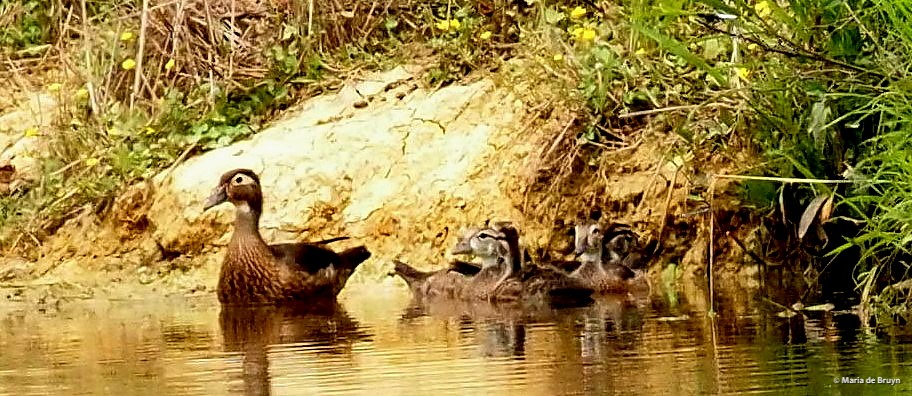
While watching the bluebirds, I suddenly heard a commotion in front of me, but I couldn’t see what was happening behind the bushes at the pond’s edge (I’m short!). However, I could tell that a bird was in distress. I wondered if one of the huge snapping turtles had caught a duckling. I walked further along and saw one of the two resident female wood ducks (above) swimming away from the area.

No ducklings followed and I feared the worst. One mother had five ducklings (above) while the one swimming away had lost one a few weeks before. Now I wondered if she had lost others, too. Luckily, I later saw her return to the area and shepherd four ducklings across the water to the other side.


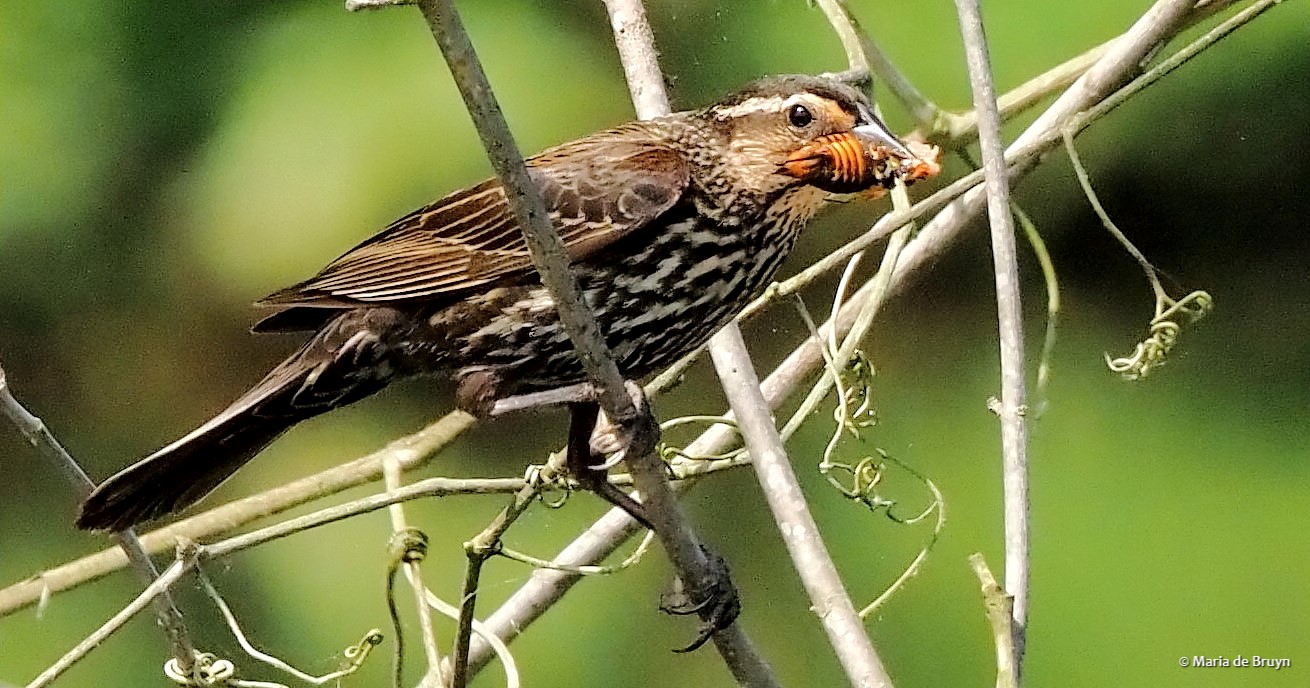
In the small bit of meadow immediately adjacent to the pond, red-winged blackbirds are now nesting. One pair has a nest close to the road and they are warning visitors away with constant flights along the pond’s edge, while the male calls repeatedly.


The female was taking breaks from warning-off flights to enjoy an occasional meal, at this time consisting of one of the remaining periodical cicadas that emerged recently.

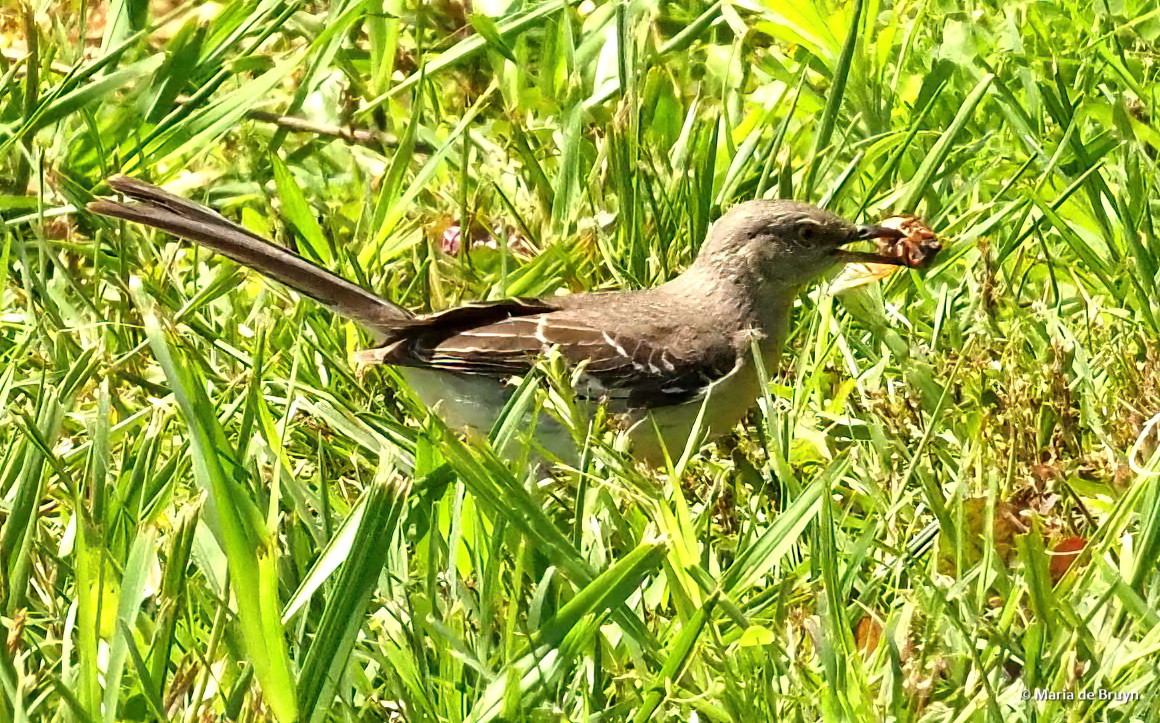
She wasn’t the only one seeking these insect delicacies. Two Northern mockingbirds were also intently examining the area under a tree for them. One finally had success in snagging a cicada. (For more about the cicadas, see my previous two blogs!)


The male red-winged blackbird was very busy keeping “intruders” as far as away as possible from their nest. He warned off the great blue heron, who was actually pretty far away. (He is flying away from the heron on the left side of the photo.)

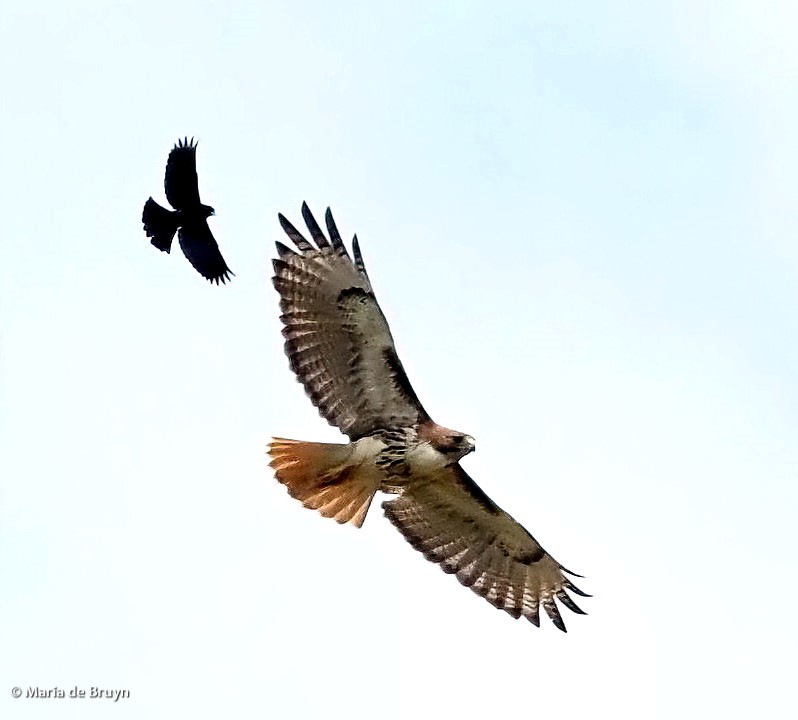
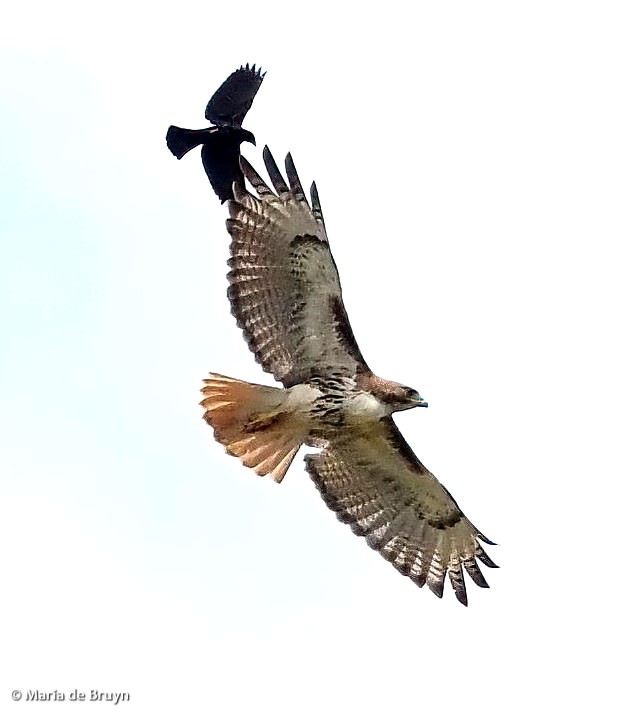
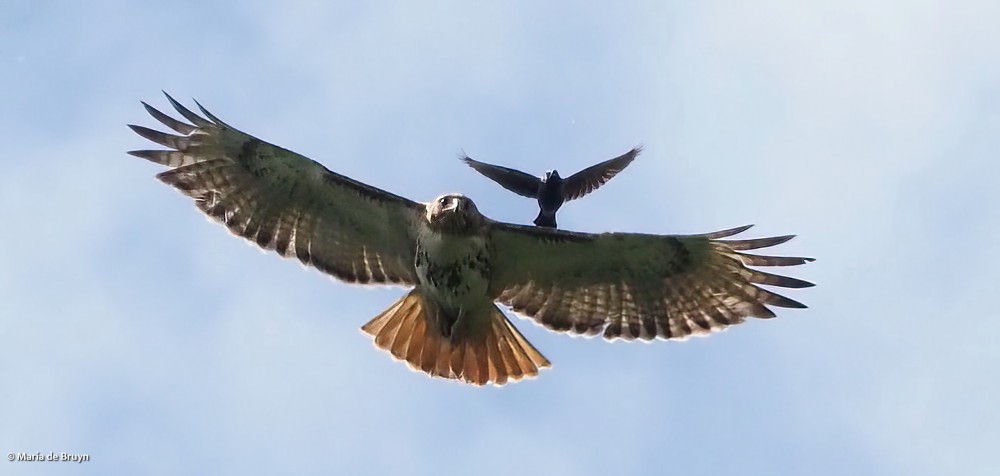
He also went after a red-tailed hawk, who appeared soaring overhead.

Common grackles, often present at this pond, will also chase away these hawks. There weren’t any around to join in the foray this time, but the photos below taken at another pond show how they go after the red-tails.

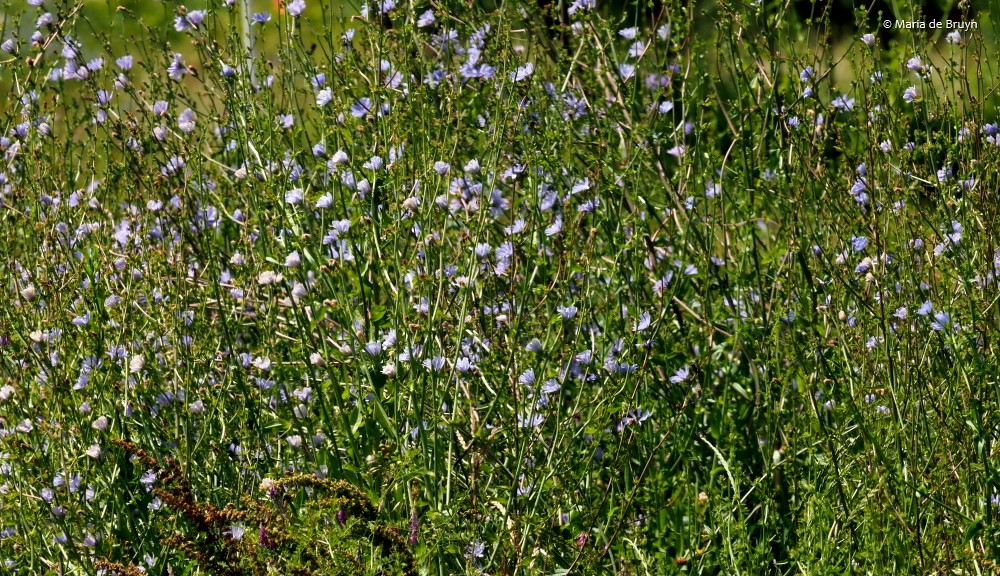
I looked at a small patch of chicory across the road to see if any bobolinks, grosbeaks or meadowlarks were around. I love this plant and planted some seeds in my own yard, hoping to attract more pollinators and birds. So far, they have not sprouted.


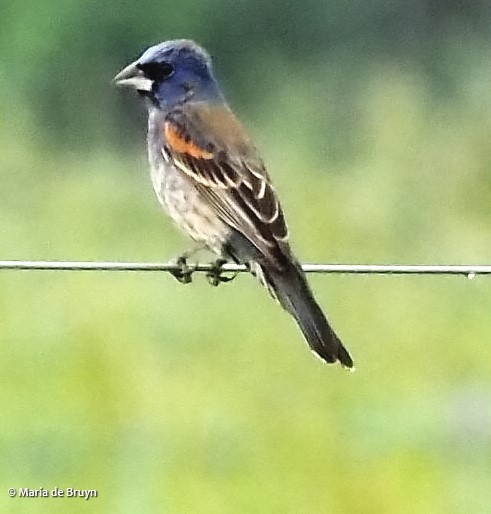
Below you see a young blue grosbeak and a pair of Eastern meadowlarks who were in the patchy field spots another time.


Usually, several types of swallows frequent the pond, including purple martins, tree swallows, barn swallows and Northern rough-winged swallows. I only saw a couple of the latter this day and only got poor flight photos as my camera began acting up, refusing to focus.

Staring hard across the pond, I did manage to spot three killdeer, four least sandpipers and a couple other sandpipers that I couldn’t immediately identify. I later learned that they were semipalmated sandpipers, which I hadn’t seen there yet. (If you click on the photo, you see it larger; then go back to the blog.)

That hour at the pond didn’t turn out to be a super one for capturing stellar photos, but it was definitely a great one for relaxing, observing the action and appreciating nature again!