They’re baaaack!!! — and so am I! Part 2

But the Great Southern Brood of periodical cicadas is getting ready to leave…!
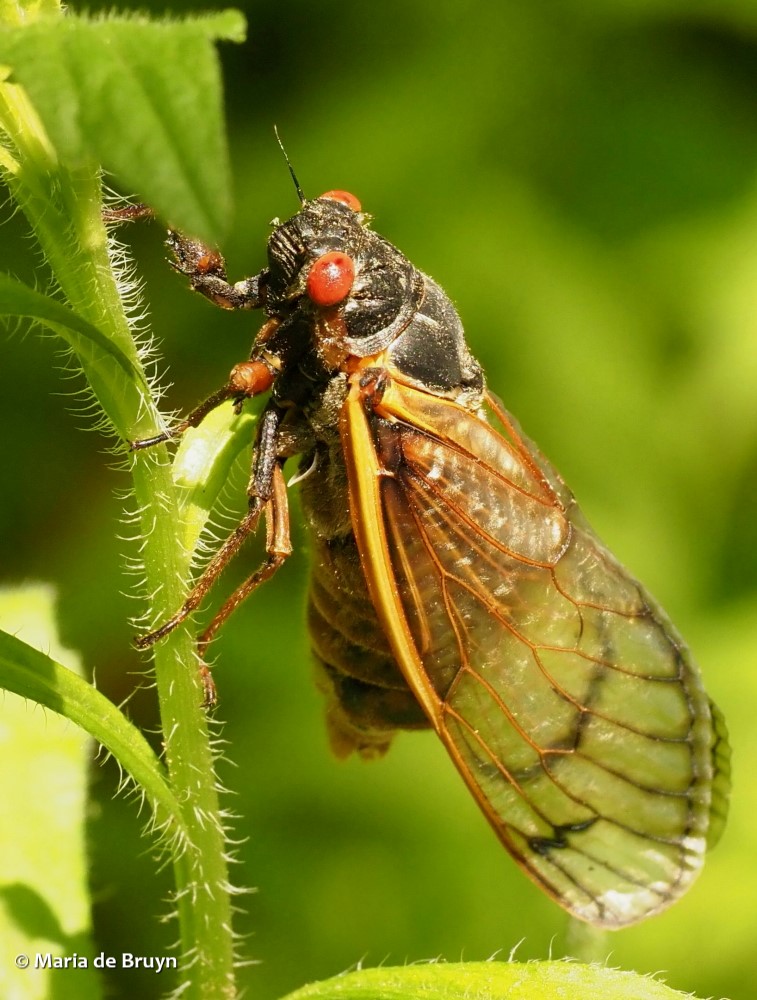
Having heralded their appearance in my previous blog, I’d like to share a bit here about what these insects are now facing as they expend their remaining energy on ensuring the survival of their species.

Some of our community members (both animal and human) are as appreciative as I am that these creatures are here. In listserv postings, a few people have commented, for example:

  • Sounds great.
  • I guess I am rare in thinking they are cool. It feels other worldly….
  • And it’s all about SEX. Just think about all those teenage hot-rodders gunning their engines to attract attention. They’re all saying “Come and get me baby. I’m HOT.” After years underground, you would be, too.

It’s almost impossible to miss the cicada phenomenon where I live unless you have hearing or vision problems or can’t get outside. Their calls for gathering and hooking up can reach a level of 100 decibels and this continues for hours on end.

The sounds can vary a bit because the Great Southern Brood comprises several species of periodical cicadas with somewhat different songs.
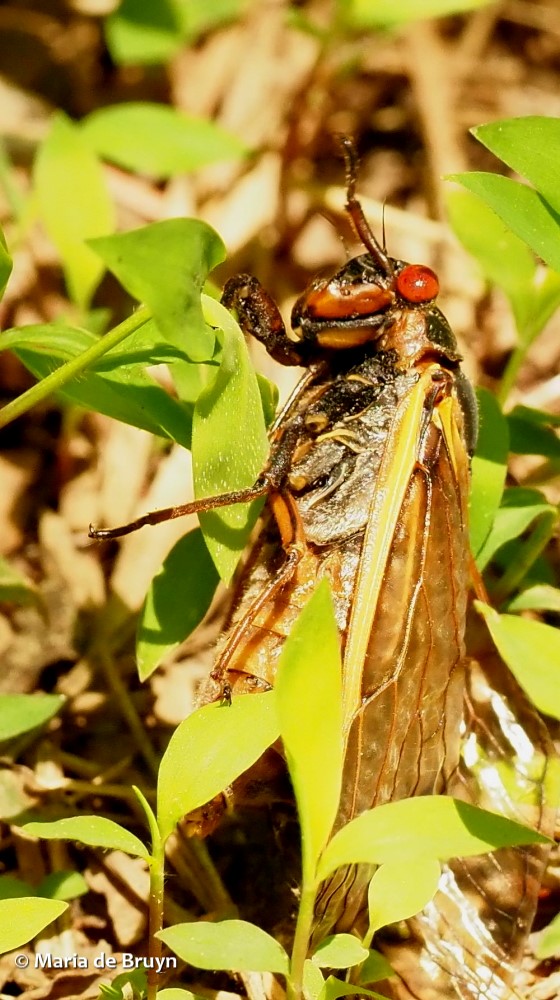
However, it seems that quite a few people don’t pay attention to the broadcast or print news. Despite the considerable coverage given to the cicadas’ appearance, inquiries about the ongoing noise continue in listservs, irritating some community members:

  • Please stop asking about the sound cicadas make! Please! And if someone answers, why do 50 people feel the need to respond? I feel that so much of the posts are so religious. Does anyone else feel this way?… I didn’t mean religious! I meant repetitive!
  • Cicadas are a plague sent from God signaling the End Of Time. The purple glow in the sky last night [Northern Lights] was the Rapture, and, since we’re still here … well, there’s that…
  • If you don’t like it, stop looking at the posts.

The numbers of cicadas we’re seeing really is amazing. They need an enormous population because that is how they ensure some will live long enough to reproduce. These insects have no physical or chemical defense mechanisms at all. Many will succumb to diseases and predators.

One particularly strange phenomenon is a fungus that attacks the cicadas. Massospora cicadina has evolved to target periodical cicadas. The cicada nymphs can become infected when they dig their way out of the soil.
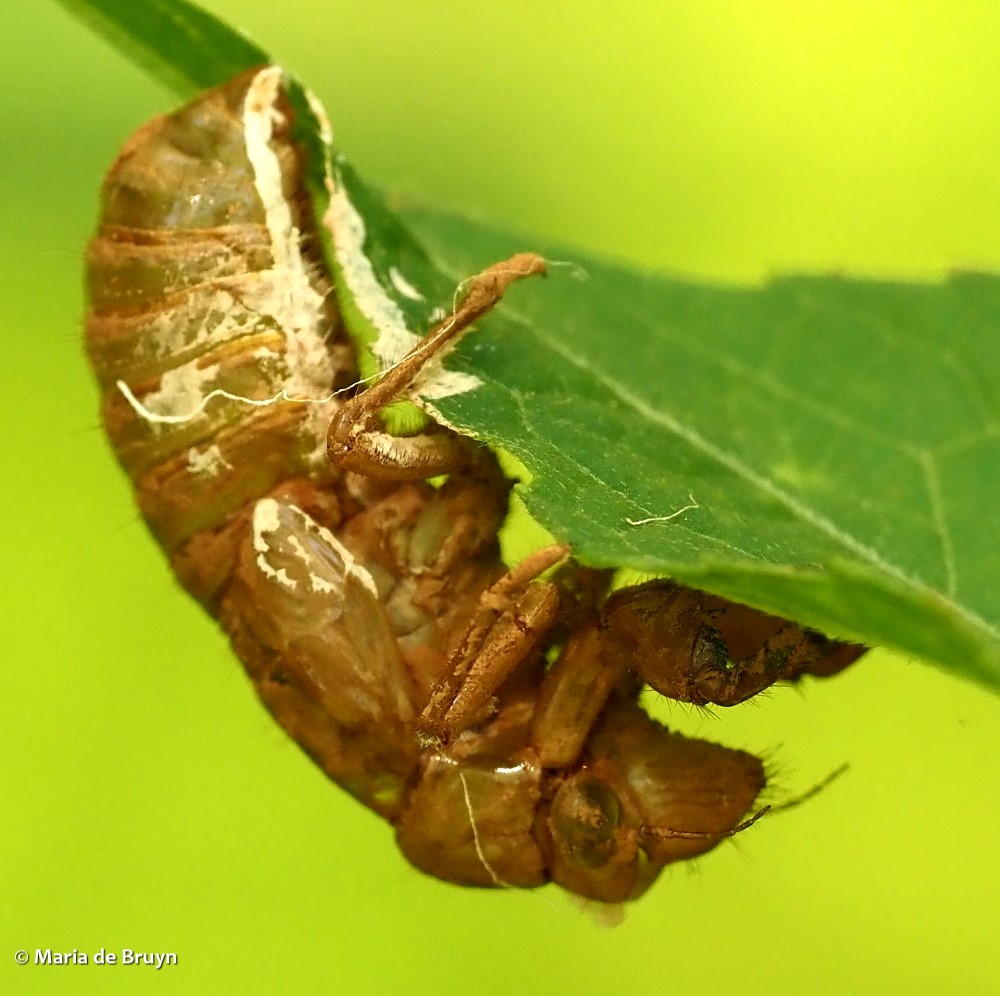
The fungus is a chalky white substance that destroys their reproductive organs but does not kill the insect. As the infection progresses, the male cicada continues to move around and tries to mate. Eventually, the back part of its abdomen drops off and we can see the white fungal growth. But the cicada doesn’t die from this and continues trying to find a mate!

Image by Katja Schulz, CC BY 4.0. Reproduced with permission from  <https://creativecommons.org/licenses/by/4.0&gt;, via Wikimedia Commons

The cicadas also have no means to fend off predators and they are a highly desired food source for other creatures. Those who eat them include snakes, spiders, beetles, wasps, opossums, squirrels, raccoons, frogs, dogs and even people.

This unfortunate individual died early on during the cicada emergence and the local ants found it on my driveway.

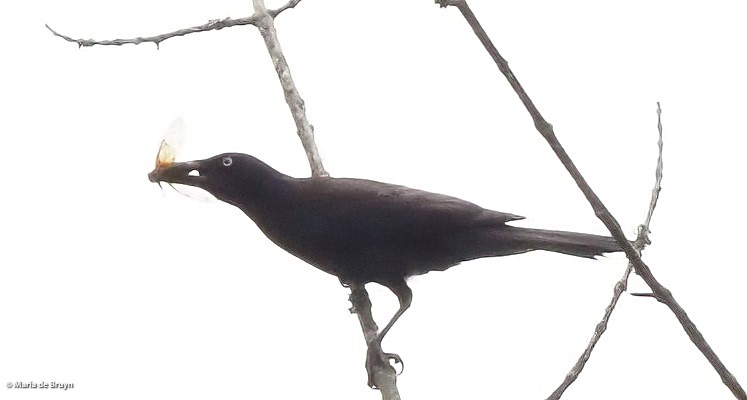
These cicadas are especially vulnerable to avian predation. I’ve now seen different species of birds chowing down on them, including grackles (below) and robins.
The red-bellied woodpeckers seem to have a particular fondness for them. A young woodpecker was hoping that its parents would provide them as a meal, but the parents were eating the insects themselves.

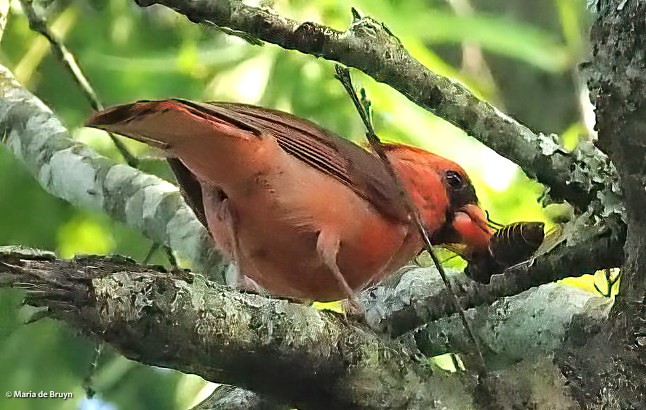
A Northern cardinal stopped by for a meal.
The resident male Eastern bluebird in my yard was supervising his three rapidly maturing fledglings in their efforts to catch and consume the large insects.

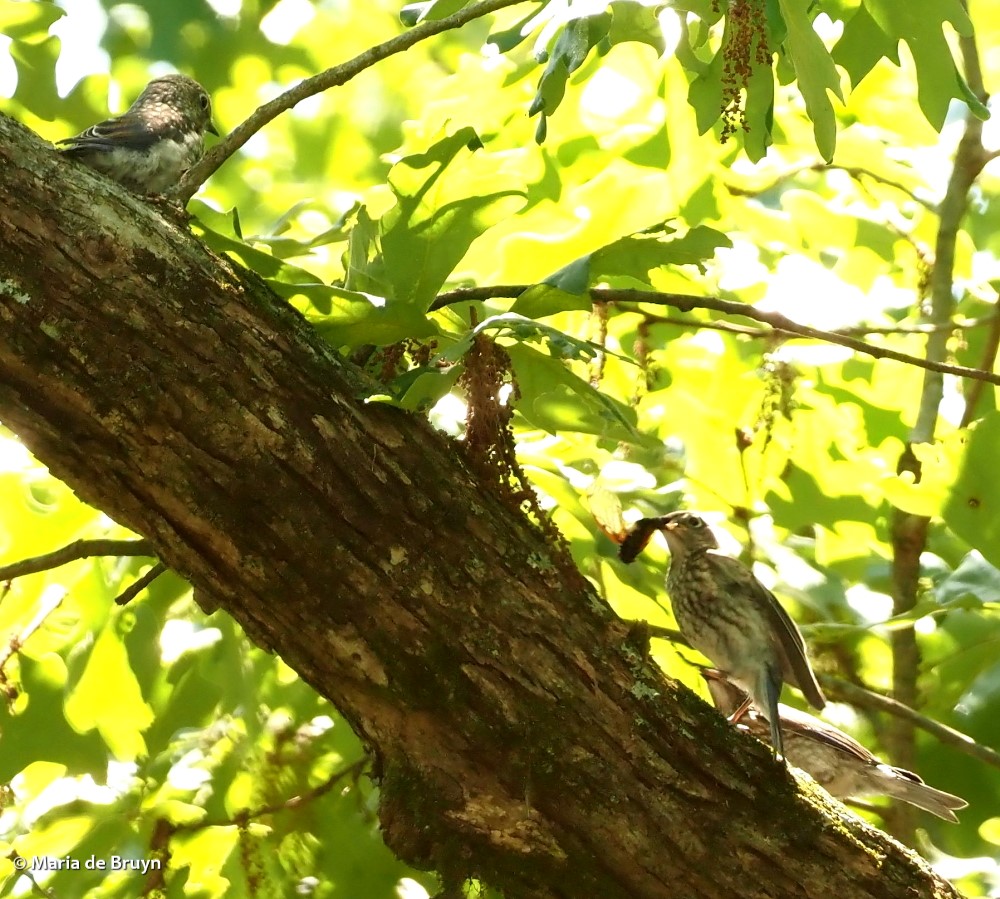
His mate was already tending another nest of 5 eggs, so he was occasionally feeding her as well, including cicada tidbits.

Given the enormous numbers of cicadas that have arrived, some are managing to stay alive and healthy so they can mate. The females may lay as many as 600 eggs in nests dug into plant stems.
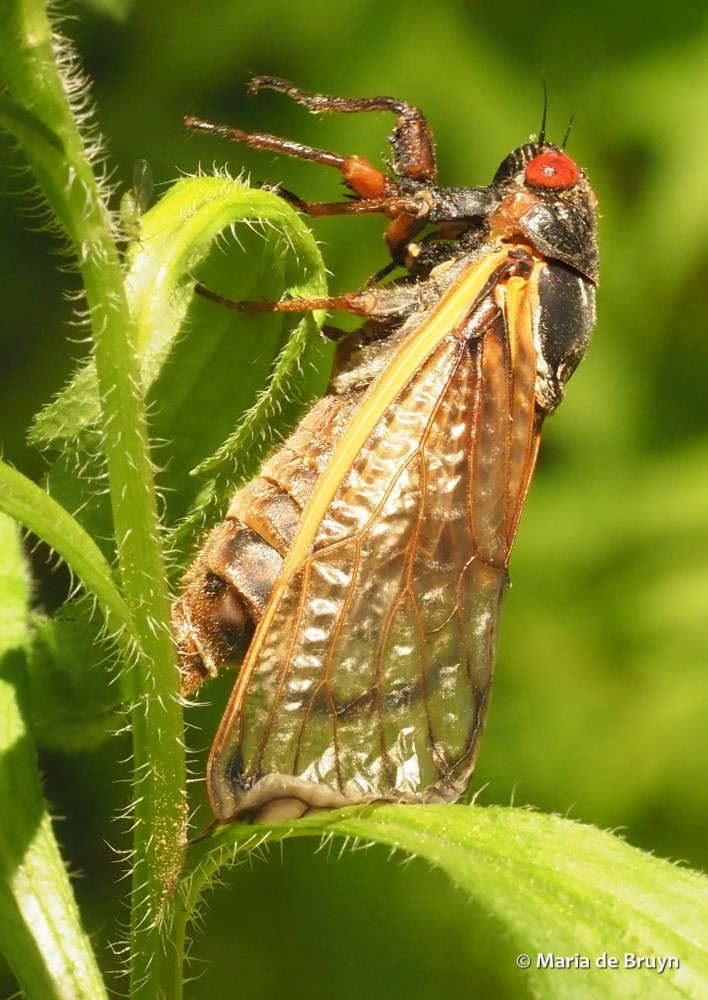
After 6-10 weeks, the eggs hatch and the nymphs crawl down to the earth to go underground for their 13-year “hibernation” period.  There they will eat sap from tree roots, undergo their molting and live out their lives with the people walking above or near them having no idea that they are there.
My chances of seeing the members of Brood XIX again are likely not so great, but perhaps some of you readers who live in the northeastern USA may get to see them emerge again then. If so, I hope you will find them fascinating, too!


They’re baaaack!!! — and so am I! Part 1

The Great Southern Brood is here!

It’s been over a half year since I’ve written a blog (although I’ve penned a monthly newspaper column and a few articles in the meantime). Numerous concerns including ill health kept leading to blog postponements. Fortunately, I’ve been able to continue my nature observations, a boon to keeping things on a somewhat even keel. And lately it’s been my privilege to see some interesting creatures and to witness behaviors I’d not seen before in person.

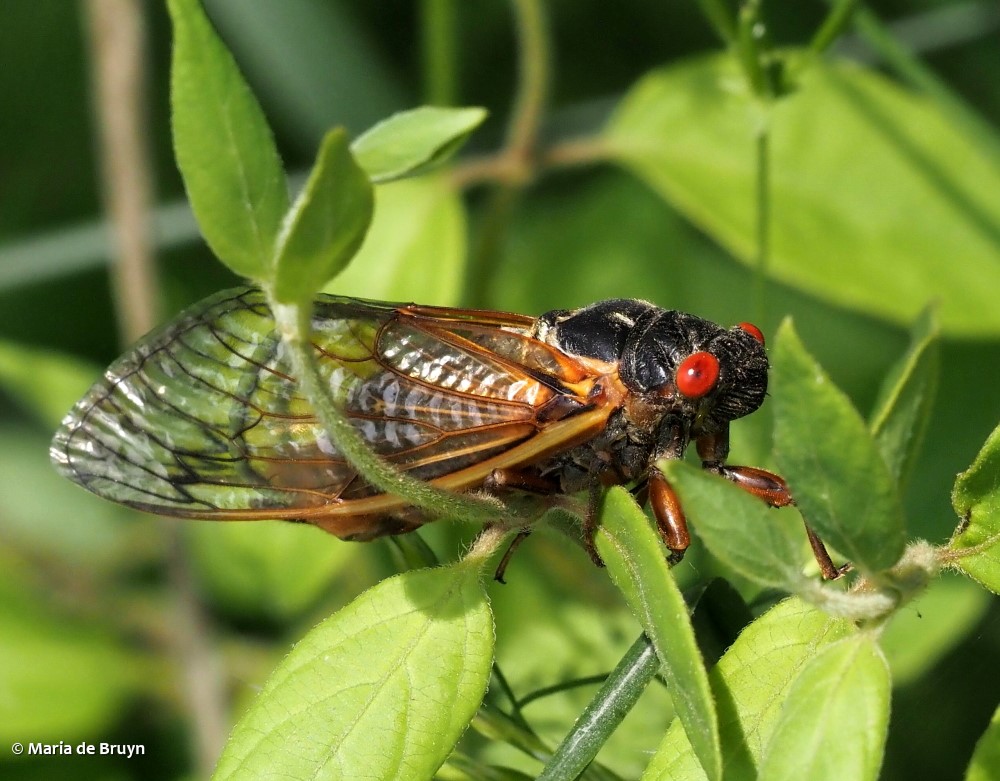
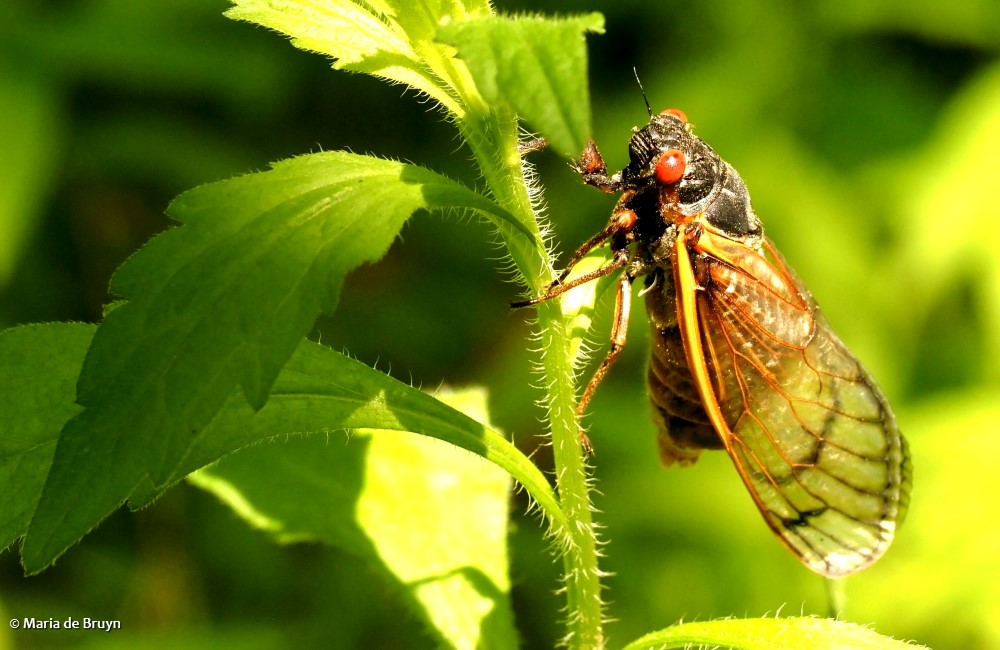
The immediate inspiration for resuming my blogs has been the emergence of the Great Southern Brood XIX (Magicicada spp.) of periodical cicadas — an animal species which humans only get to see every 13 years! This is the largest cicada brood in eastern North America, which is the only geographical area where they occur. I’ll share some of my current sightings and interesting tidbits about them and hope you enjoy this in a two-part blog.

Periodical cicada eggs, laid above ground, hatch into nymphs which then go underground to pass through five juvenile stages before emerging 13 years later by the hundreds of thousands (even millions!). After emergence, they only live a few weeks, purely for the purpose of finding a mate and reproducing their species.

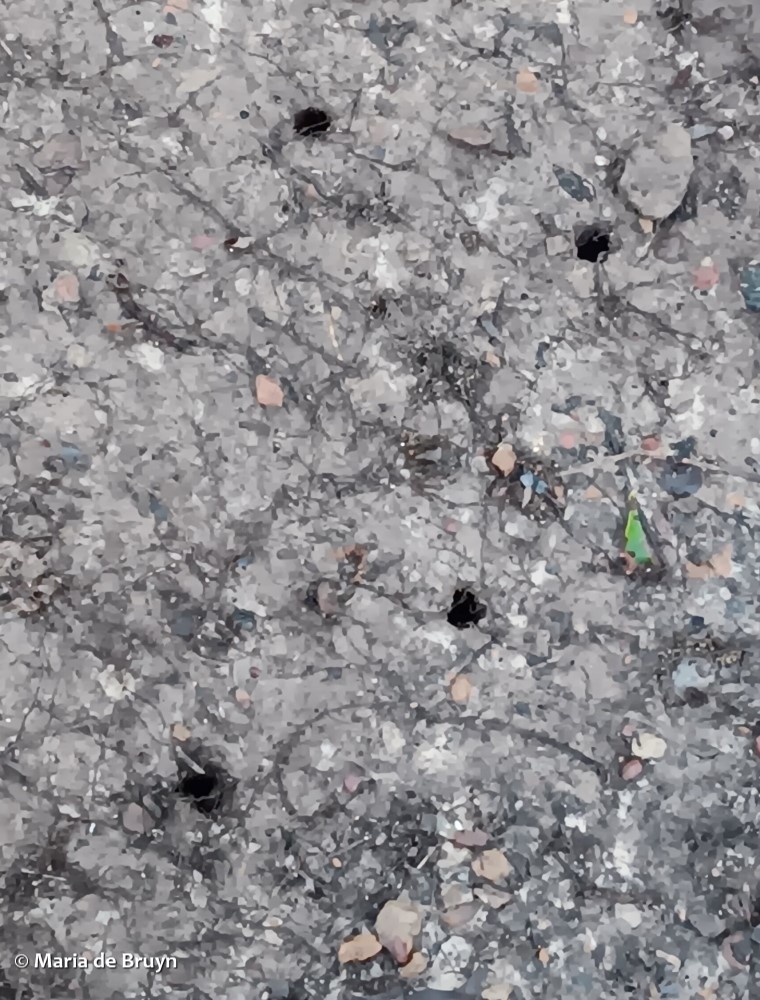
One of the first noticeable things to alert humans to the coming “deluge” of cicadas, seen above, is the appearance of numerous holes in the earth as they tunnel out to the fresh air. This happens when the ground reaches a temperature of about 64°F/17.8°C.

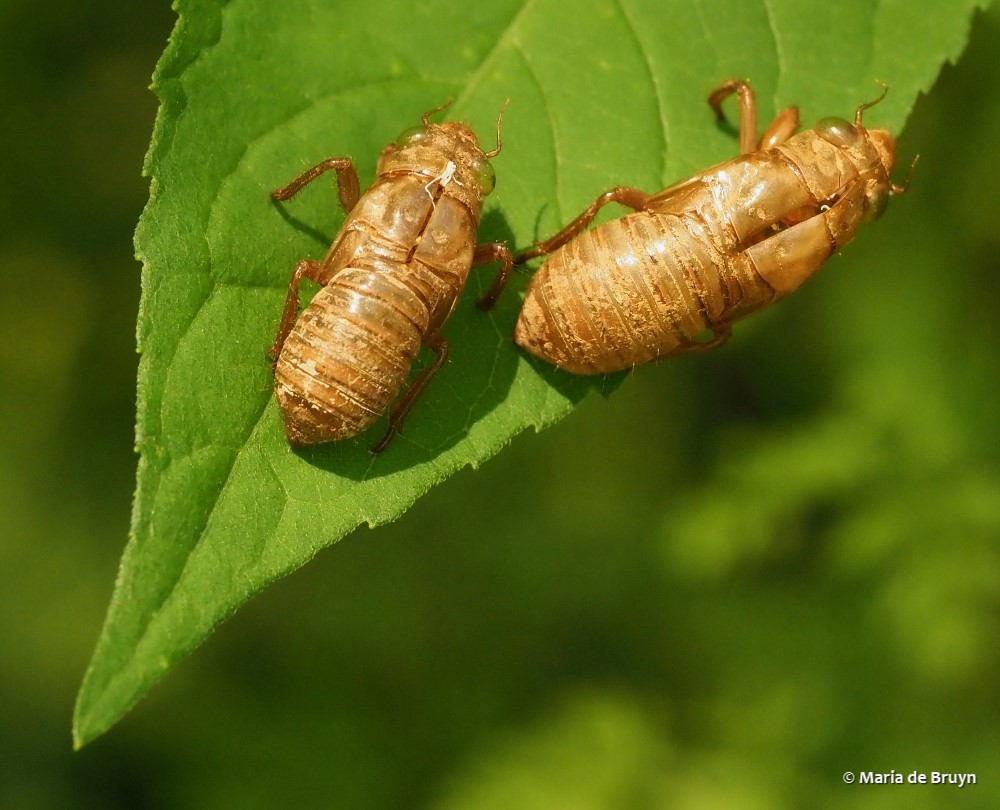
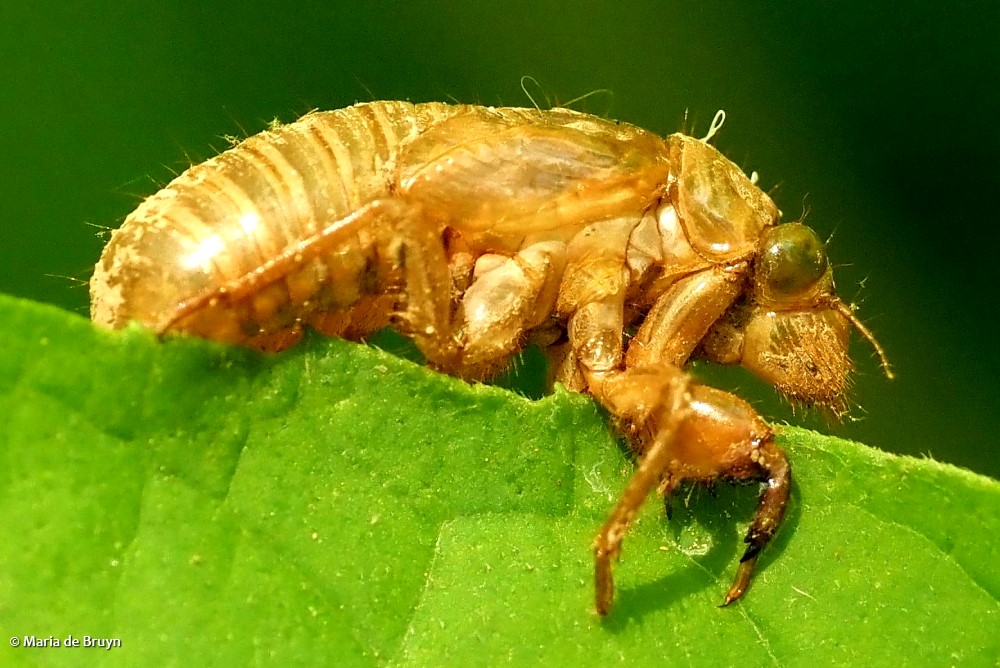
What emerges from the holes are brownish-tan nymphs, who crawl onto plant stems and tree trunks. Underground, they will have undergone four moulting periods as they grew during the past 13 years.

The vegetation becomes laden with these still immature insects almost everywhere you look.


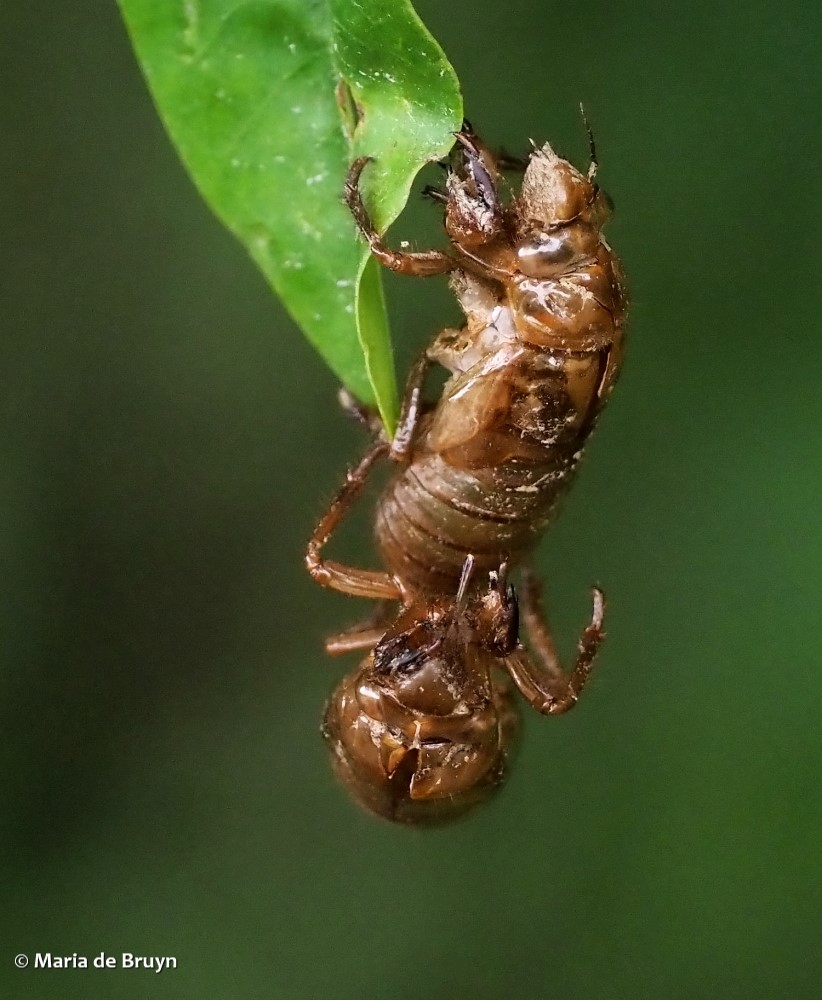
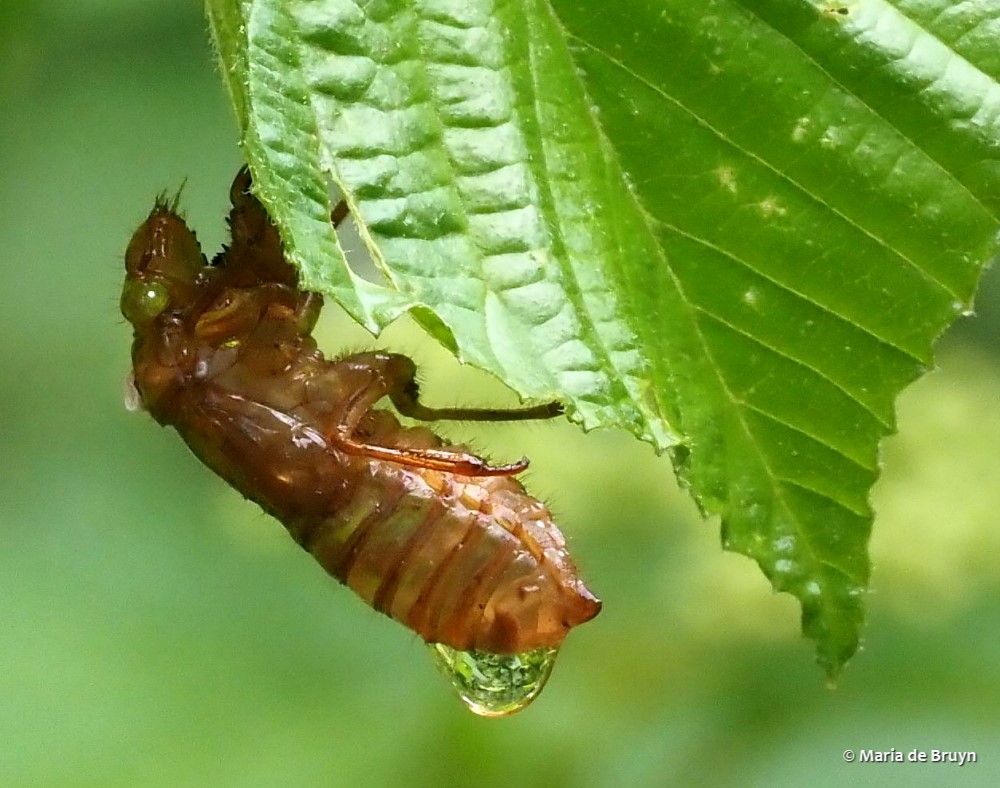
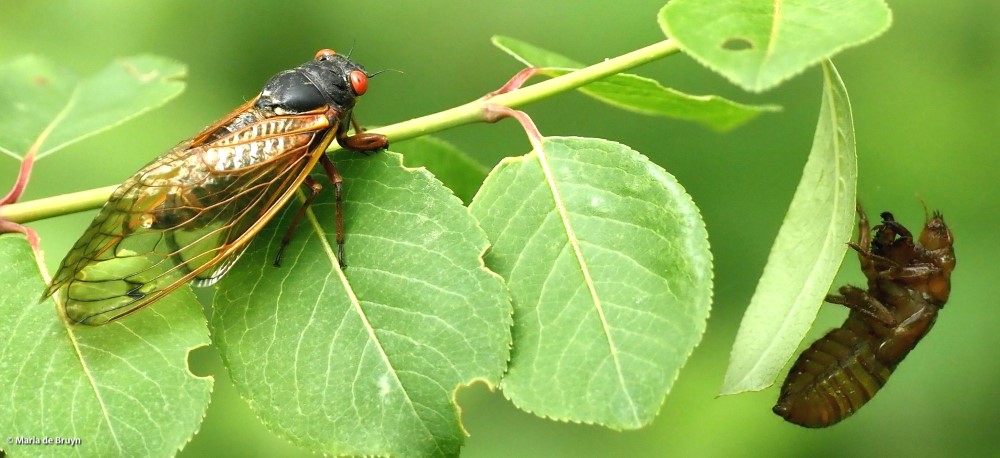
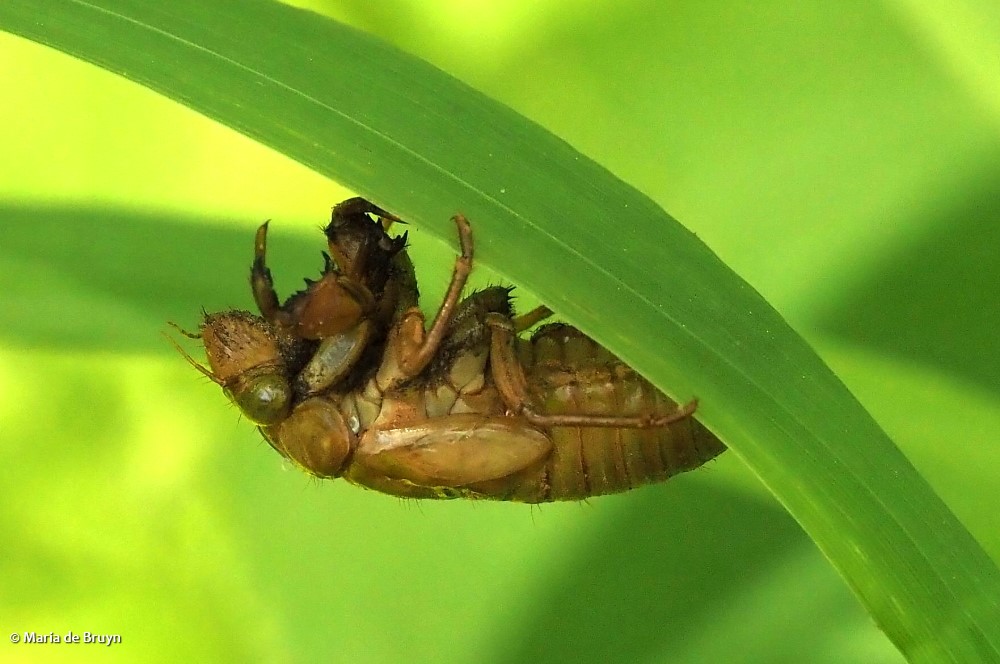
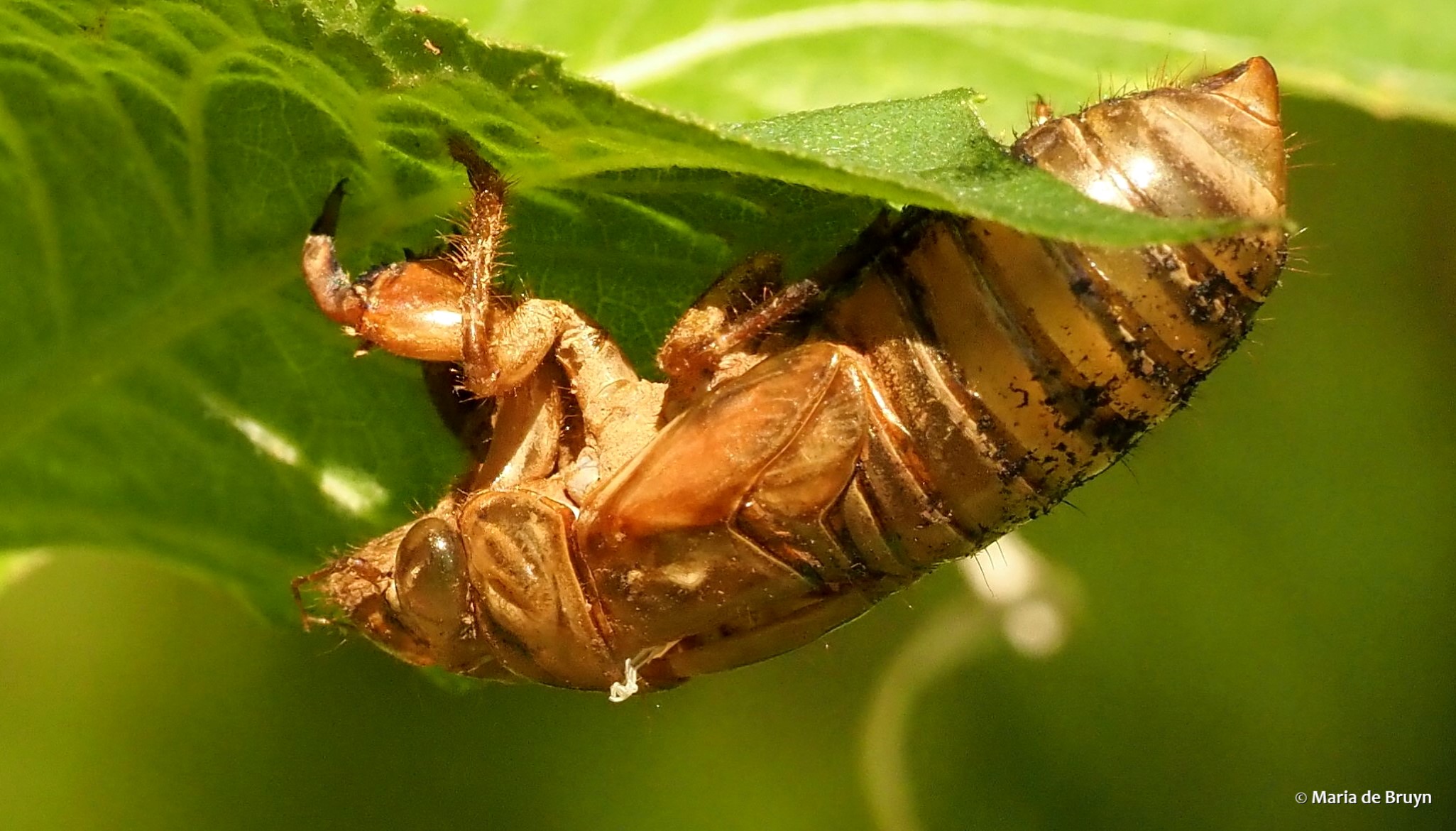
The adults emerge from their last exoskeleton through the back, which splits open. If you look carefully below, you can see one emerging on the right.

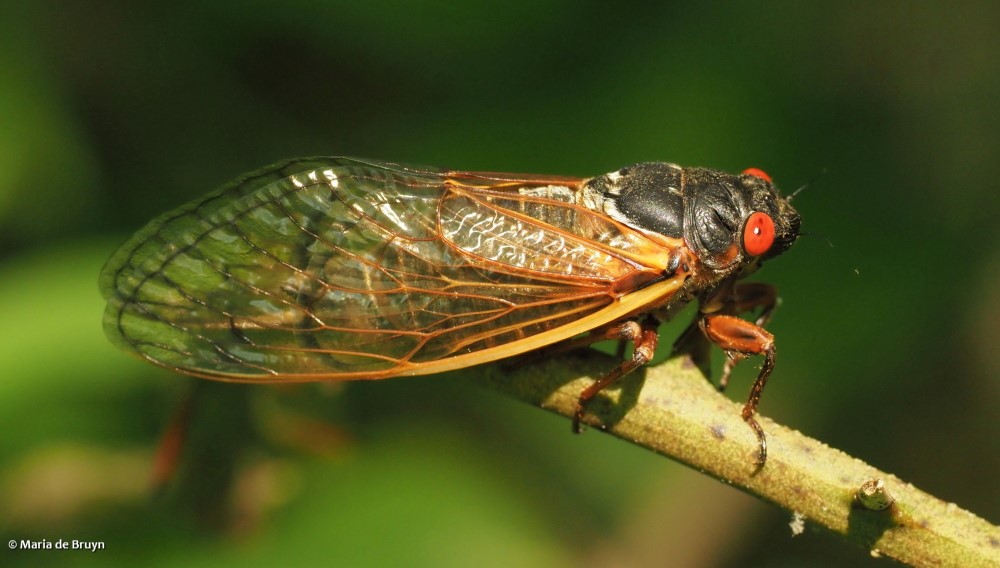
The newly emerged cicadas then undergo a quick maturation process within an hour or so.

They must unfurl and flex their new wings.

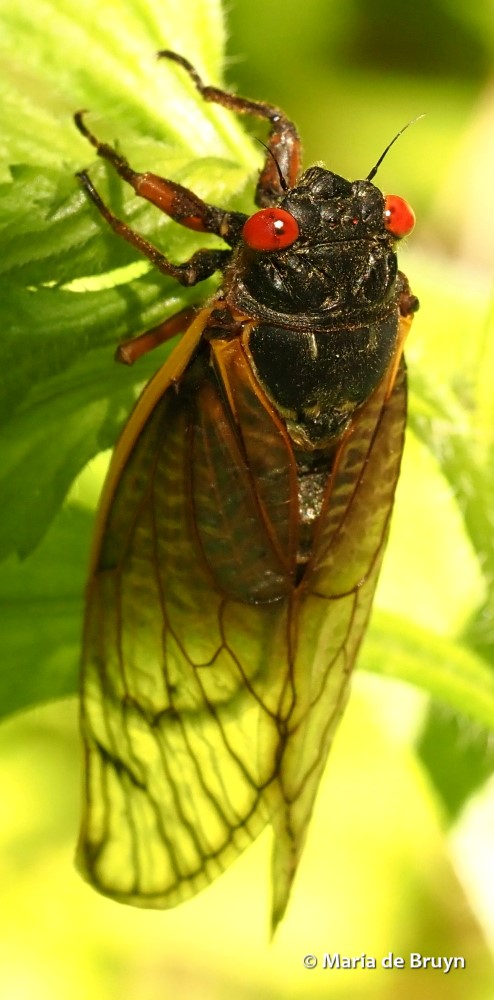
Their orange eyes take on a deep red — in my view mesmerizing — hue.


Seen head-on, their faces look to me as if there is a car grill in the middle.

The adults can’t fly right away after emergence but must make several attempts to get airborne.

When the adults are ready to meet, the males begin making calls and songs, using a pair of ridged membranes on their abdomens. Some calls are a sign to gather; others are alarm calls made when the cicadas are handled.


Their hollow abdomens are thought to act as a resonating chamber, increasing the volume of their already-loud sounds, When they gather in groups of hundreds and more, the volume can be astounding, reaching the level of a chainsaw or motorcycle.


In our area, numerous inquiries on neighborhood listservs commented on the growing and ongoing noise:

  • Is there a sound like a siren going off that you can hear? It seems to be getting louder.
  • Perhaps the machines grinding rocks to expand I 40 [highway].
  • Alien invasion 😂
  • The noise is continual with no change in pitch or volume. Sounds man made.
  • This is some sort of machine or something running all day long.
  • I was so intrigued as well that I called the energy company to investigate the cause of the intense noise!
  • Miniature Flying UFOs made to look like Cicadas.
  • This morning, I walked inside my house looking 👀 for the toilet that I thought was running.

Some people made analogies for what they thought the cicada ‘songs’ were like:

  • To me it sounds like alien spaceships are landing – just like in a 1950’s creature feature.
  • It sounds like the flying saucers in old 1950s movies.
  • I think the 13-year bunch sound like the phasers on the original Star Trek show.
  • To me they sound just like 18wheel rigs all revving up their engines.
  • The sound to me is like “environmental tinnitus”. 🙂 [Response] Exactly, but it actually helps my tinnitus!
  • Sounds like heavy traffic in another decade or two with everyone driving electric vehicles. [Response] My hybrid has that same sound (only quieter) to warn people/animals that I am backing up. When my car is operating under battery power, it’s silent, so manufacturers added that sound to warn people and wildlife away. You are so right. That may be the sound of the future. AAAAGH!

Others appreciated this natural phenomenon:

  • Sounds great.
  • I guess I am rare in thinking they are cool. It feels other worldly….
  • And it’s all about SEX. Just think about all those teenage hot-rodders gunning their engines to attract attention. They’re all saying “Come and get me baby. I’m HOT.” After years underground, you would be too.

Finally, some listserv readers tired of all the comments after a while:

  • Please stop asking about the sound Cicadas make! Please! And if someone answers, why do 50 people feel the need to respond? I feel that so much of the posts are so religious. Does anyone else feel this way?… I didn’t mean religious ! I meant repetitive!
  • Cicadas are a plague sent from God signalling the End Of Time. The purple glow in the sky last night [Northern Lights] was the Rapture, and, since we’re still here … well, there’s that…
  • If you don’t like it stop looking at the posts.

In the next blog, I’ll explain a bit more about the periodical cicadas’ vulnerabilities and life cycle. And hopefully you’ll enjoy seeing some more photos of these creatures who won’t see the light again until 2037!

My welcome American crow friends

On numerous occasions over the past months, I’ve had ideas for new blogs and set aside photos for posting. But then other things crop up that need to be handled (health, car/house issues and a monthly newspaper column) and I put off blogging. So when fellow blogger Denzil asked his followers to post some photos of corvids, it was a great opportunity to share with you some of my latest photos of favorite visitors to my yard.

A pair of crows have been coming to visit my yard for many years now. I’ve had numerous opportunities to see them courting and looking for treats at bird feeders (and occasional pieces of apple that I put out when they come by). Above, one of them was addressing me and then gave him/herself a kind of creepy look when s/he covered her/his eyes with the nictitating membrane.

Each year, mom and dad return with their newest brood in tow. Sometimes I think offspring from previous years also join the group as this year I’ve had 6 or 7 of them come by at a time.

They are fond of several kinds of bird food that I put out for other birds, including dried mealworms and my homemade suet.

They hang their big bodies off the feeders and then usually fly down to consume whatever morsels they have gotten.

They are a loquacious lot, communicating loudly among themselves much of the time.

They are loudest, however, when they gather together to chase off the red-tailed and Cooper’s hawks who also live in the neighborhood. The crow family does not like them at all and make it known to all their neighbors, avians and humans alike. The other birds are likely happy with their alarm calls as they disappear when warned of hawks in the vicinity.

And then the corvids can also relax, enjoying drinks and bathing in the yard birdbaths. When they appear to have enjoyed a treat, I sometimes find “gifts” left behind in the  brightest birdbath. One day, when I apparently had not given them something special for some time, they took off with a small ceramic turtle that they often would leave in the birdbath after a visit. I now wonder if they gifted another neighbor with that trinket.

Their visits are always welcome to me, perhaps because I haven’t seen them harassing any of the smaller birds. Denzil’s suggestion to post about corvids was a nice reminder of the birding pleasure “my” family of crows brings along.

Our largest North American woodpecker — a real delight!

During nesting season, we have a good chance of seeing many birds whom we might not notice otherwise because they’re out in the open, collecting nesting material and scrounging for as much food as possible because they have hungry mouths to feed. I was very grateful to my friend Carol when she told me about a pileated woodpecker (Dryocopus pileatus) nest where the babies might be fledging soon. Pileated woodpeckers are also nesting somewhere near my home, but I rarely see them.

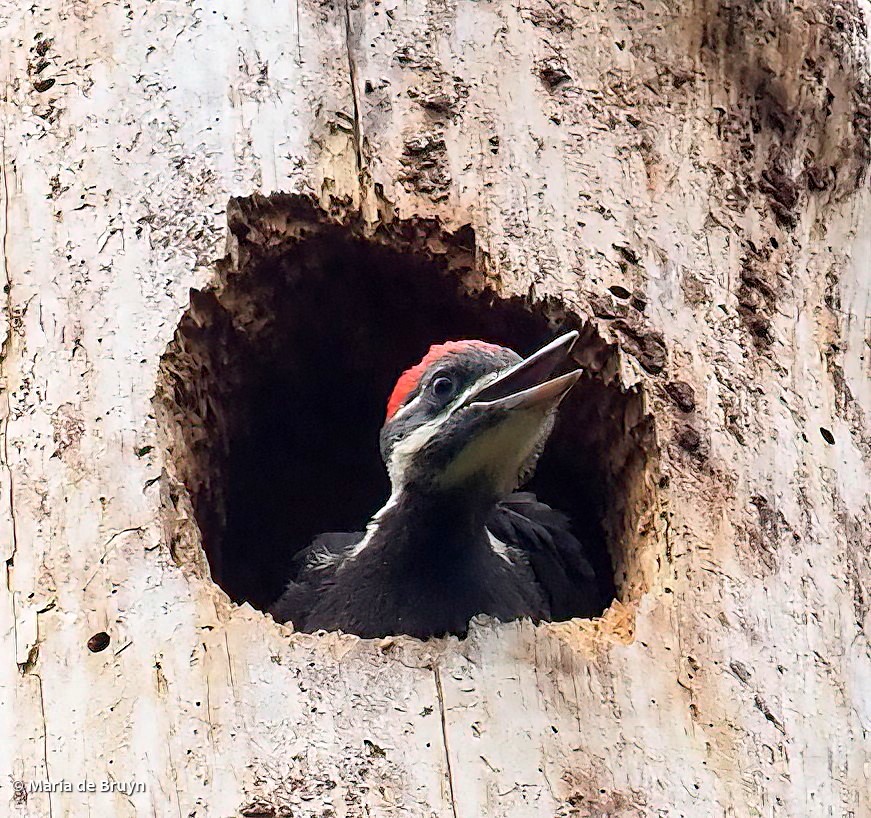
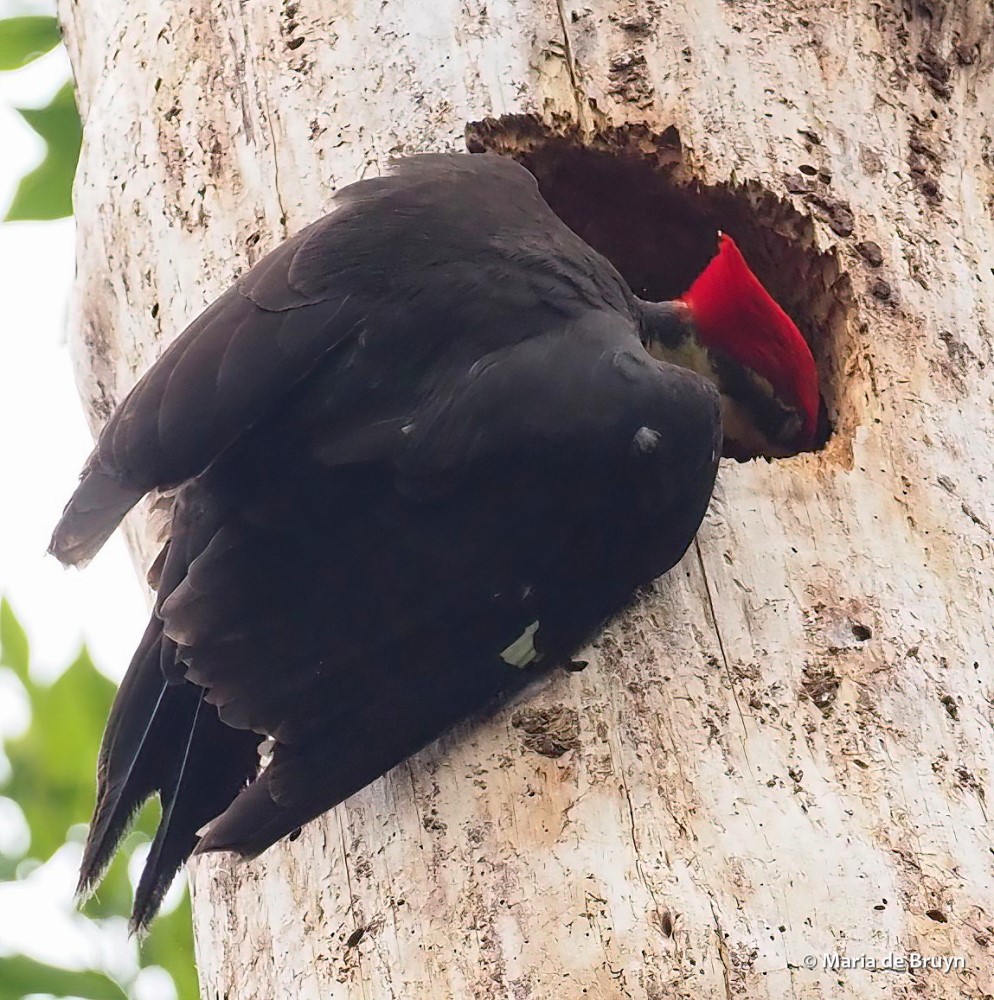
When we arrived at the nesting site, one baby was poking its head out of the oblong nest hole about two-thirds the way up a very tall snag.


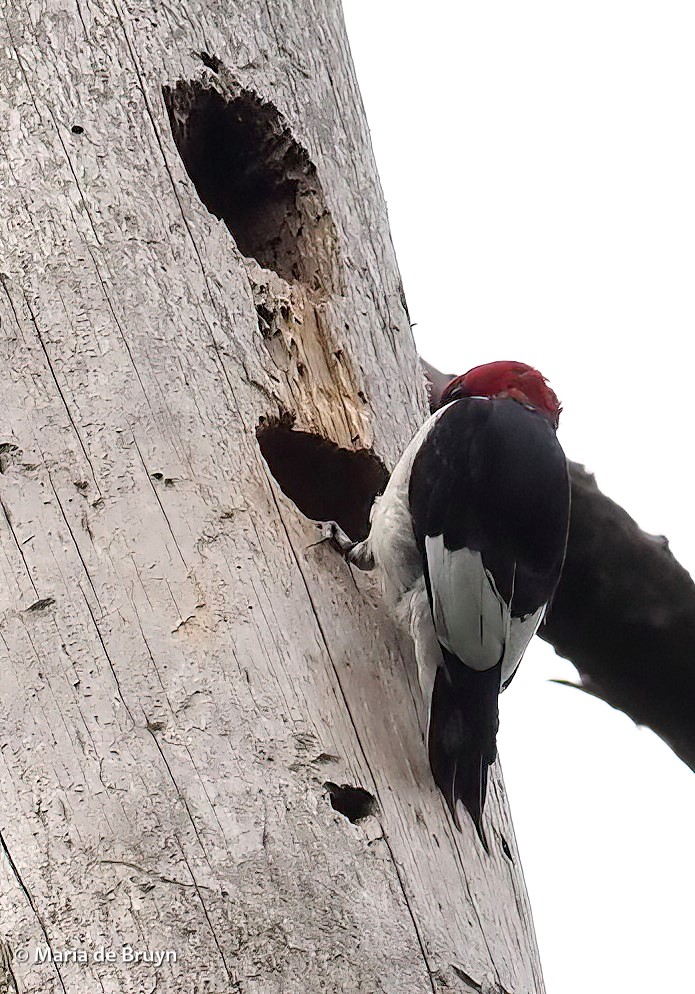
Above it, a red-headed woodpecker (see right) was maintaining a nest. A red-bellied woodpecker was also visiting higher up.

While we watched, the young one continued scanning the skies while calling out to its parents. The baby persisted in watching from the nest, which was only lined with wood chips. Unlike other birds, pileated parents do not line their nests with nesting material such as soft grasses.


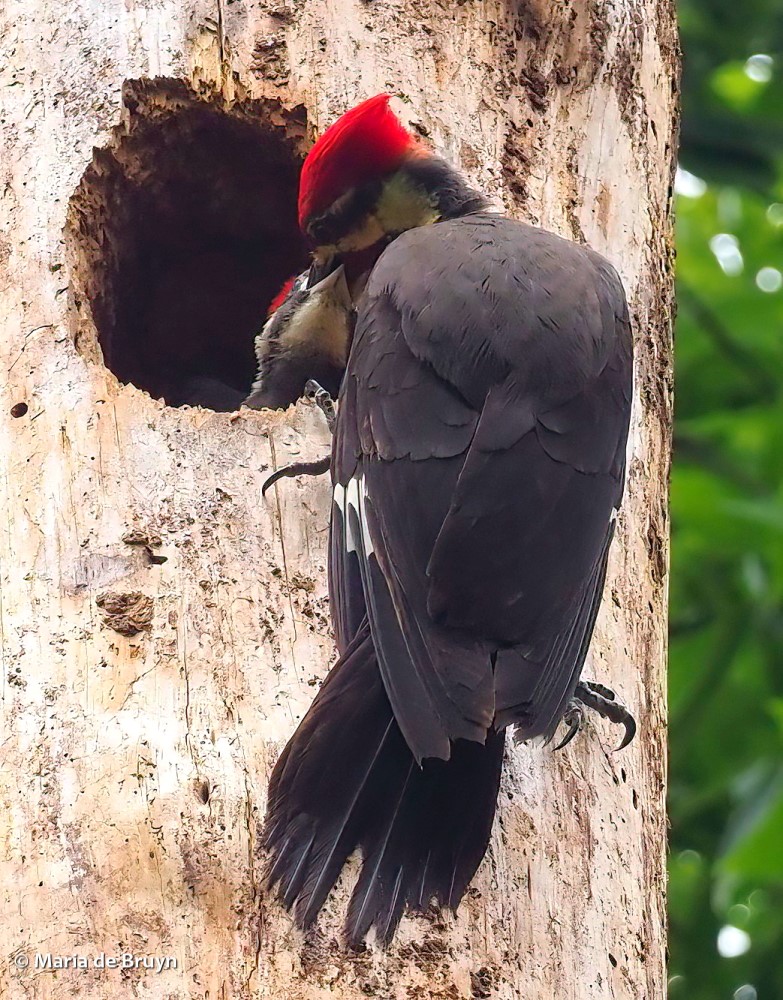
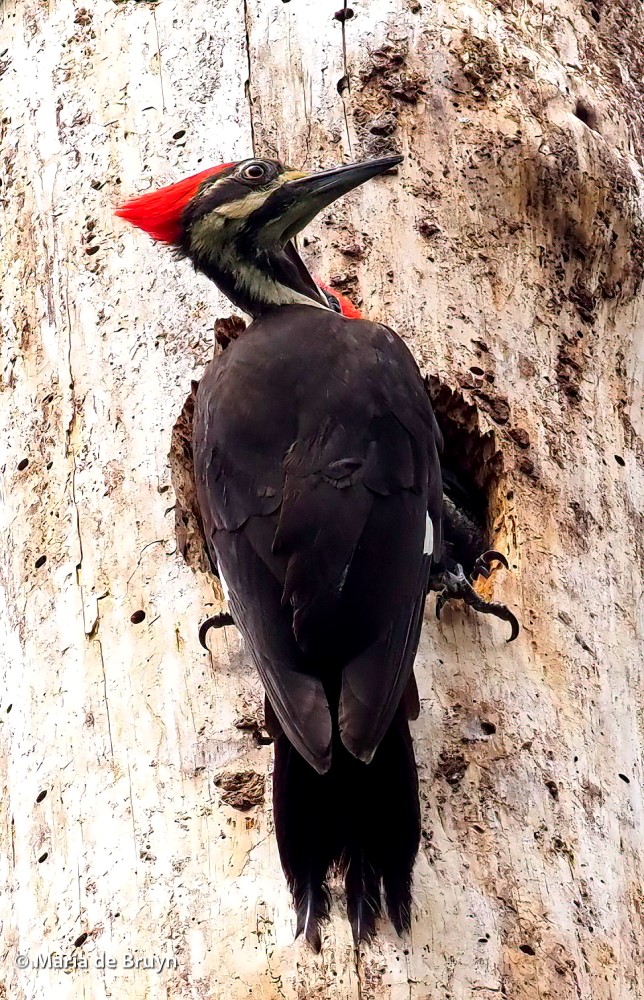
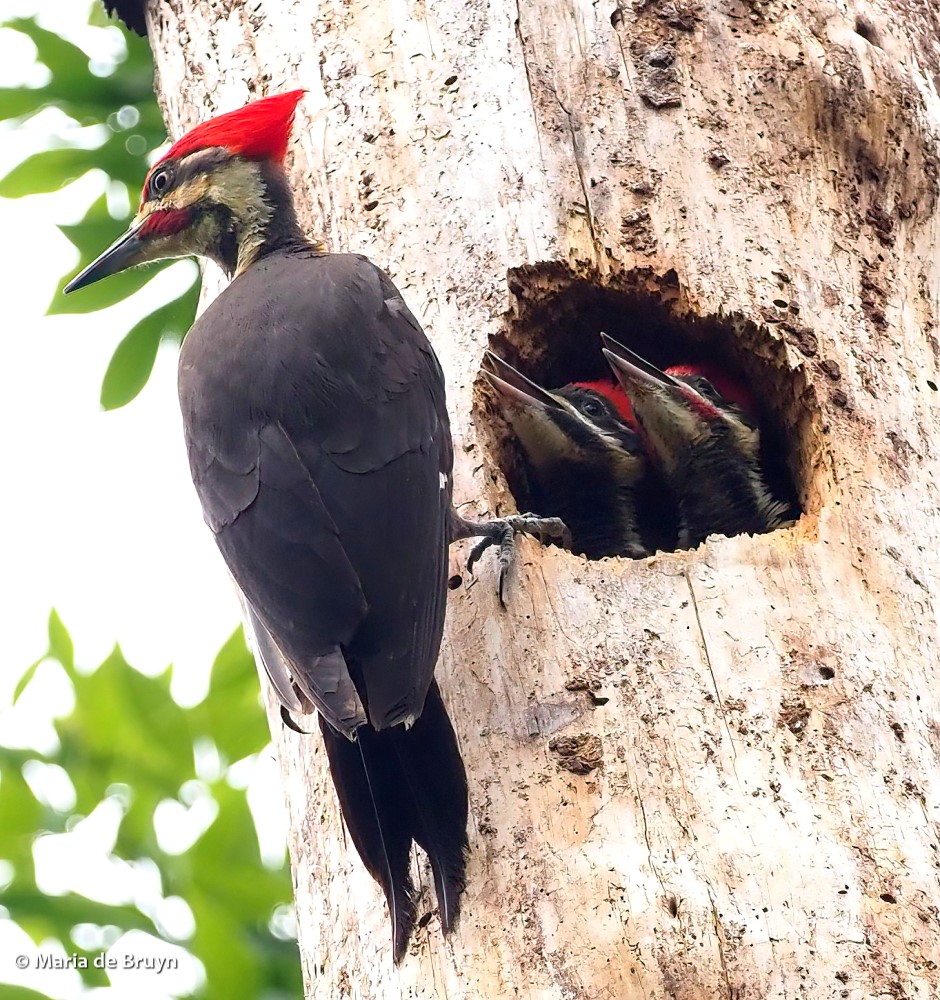
Occasionally, the parents answered and, after about 15-20 minutes, one flew over to check us out. It was the father, who could be identified by his red crest that extended down to his bill and the red cheek or moustache stripe (right photo). The left photo shows a female who was foraging in a tree on another occasion. Her red crest is only on top of her head and her cheek stripe is black.


The young one looked back into the nest; I wondered whether another nestling might be there. No one else peered out at that moment and we speculated as to whether one might already have fledged as two had been seen the previous day. When the father visited the nest, still only one baby showed itself, so we didn’t know whether there might be another one around (nests usually have 1-3 babies).


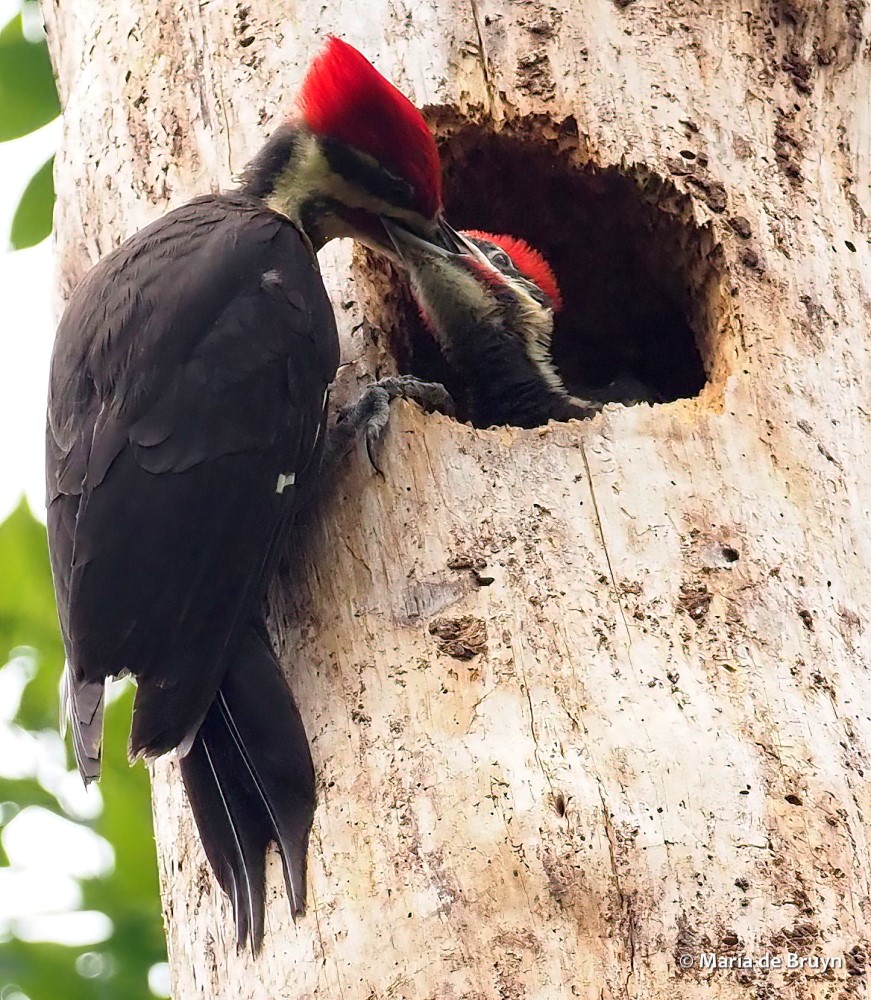
The father fed his offspring by regurgitating whatever he had been eating. The pileated woodpeckers’ diet comprises mostly carpenter ants (40-97% of their diet in various studies), supplemented by other insects including worms, caterpillars, roaches, flies, and grasshoppers.


They also eat nuts and wild fruit. If you have a garden and want to attract them, they like persimmons and many berries, including those of poison ivy, sumacs, dogwoods, elderberries, greenbriers and sassafrass.  

Many landowners tend to clear their yards and gardens of fallen logs and dead standing trees. I keep several woodpiles in various spots as the decomposing wood is home to many of the insects that the pileated woodpeckers and other birds need for their diet.

Papa took off again, leaving a satisfied young one behind (at least for the time being).

These woodpeckers are the largest in North America (15.8-19.3 in/40-49 cm), since the ivory-billed woodpeckers have been declared extinct. They are monogamous and luckily have plenty of opportunities to find mates. Pileated woodpeckers had been in serious decline in the 18th-19th centuries as forests were logged for the timber industry and to clear land for ranches and farms. Since then, they have rebounded to just over 2.5 million individuals.

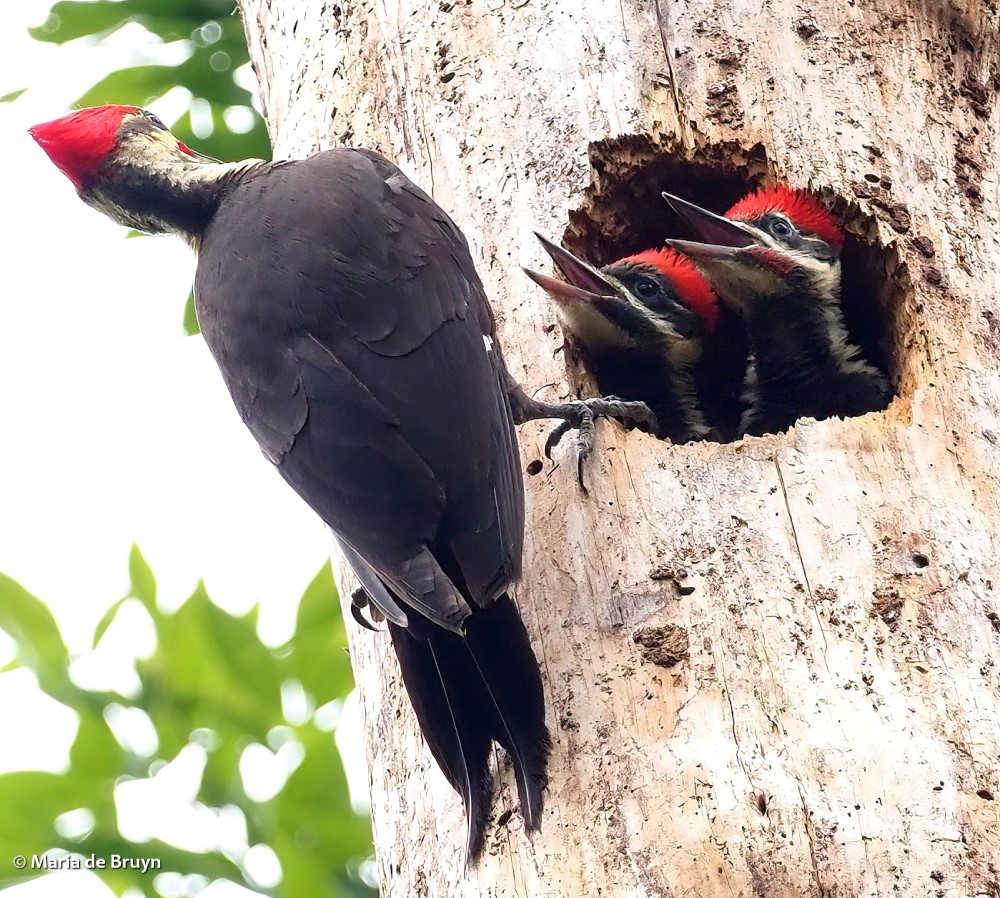
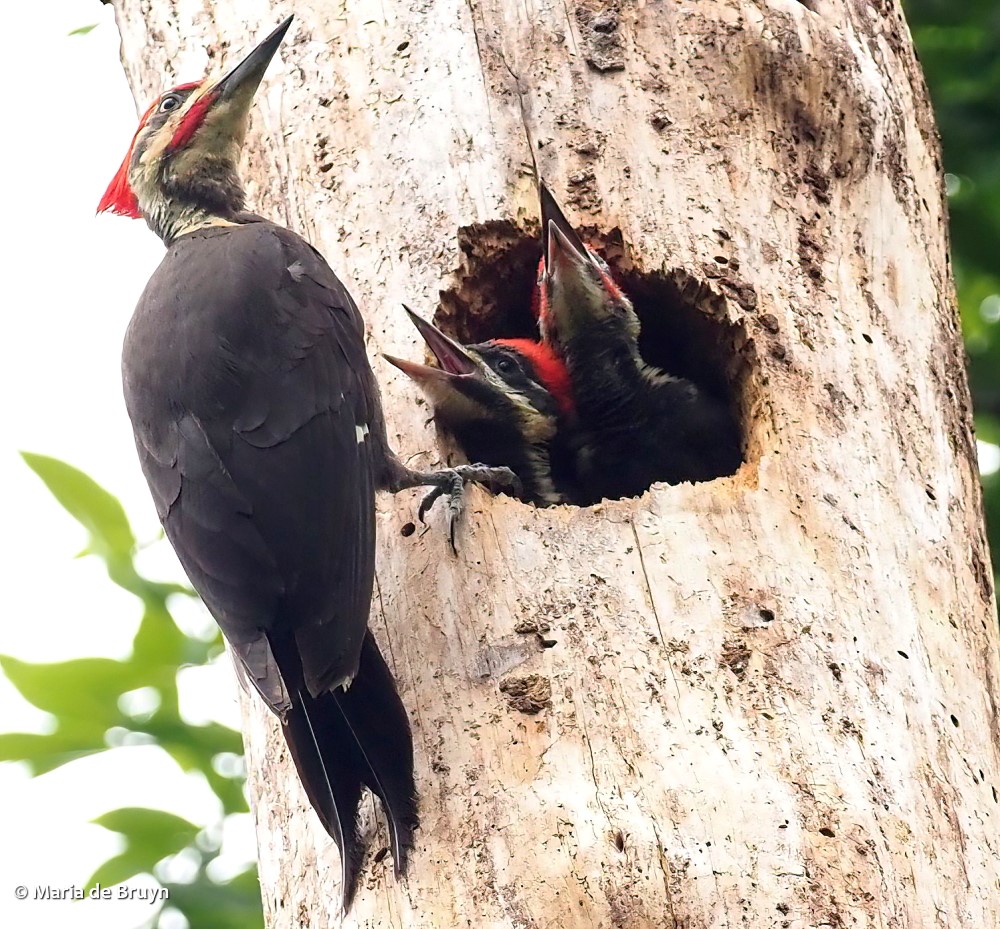
I realized when I looked at my photos later that I had not been paying enough attention to the coloring of the parents and offspring. When I went away for a short time and then returned, mama pileated was visiting the nest. In addition, whereas I had been watching a female nestling first, now a male baby was calling out for food. A view of the two looking up, shows the male’s red cheek stripes were obvious, but I had been oblivious at the time. The female is on the left and the male is on the right.


The next time that papa returned, the male offspring stuck his head out for a feeding.


Papa didn’t want to play favorites, so he stuck his head in the nest to apparently call them both to come out.

They opened their beaks wide, begging for food.


Papa let them ask for a while, sticking his tongue out at them as they begged.


He also decided to take out some fecal matter. I don’t know how long the nestlings had been in there (they usually grow in the nest for a month), but a clean nest is desirable.


After the babies fledge, they may stay with their parents for up to three months.


I’m so glad that Carol and her sister Donna, near whose home the nest is located, invited me to come see the family. It was time well spent as it got my mind completely off an ongoing series of problems complicating my life lately. Hope seeing these photos was also a bright moment for you!

Yellowstone National Park: Part 4. An unplanned and unexpected encounter!

As my friend Joan and I traveled through Yellowstone, we saw bison everywhere, in herds, small groups and sometimes in pairs or alone. Quite often this was on the road, so that we needed to be aware it might take us longer than planned to get to a particular place.

The many reports of human-bison encounters which I had seen and read about over the years made me quite aware of how dangerous it can be for a person to come close to a bison. They are huge animals – adults weighing between 1,200-2,000 pounds and standing 4-6 feet tall. If provoked or alarmed, they can be quite dangerous.

I was not above making derogatory comments about how thoughtless people took risks when they approached bison. For example, one day we stopped along a road and watched bison crossing the Yellowstone River, swimming with difficulty against the rapid currents.

Some park visitors had stopped down the road and a couple got out and descended into the valley, headed for the river. They apparently were hoping to get some close-up photos and I made some disparaging remarks about how they were taking unnecessary risks and should turn around.

A few days later, however, I discovered that not all encounters are the result of thoughtlessness.

Joan and I had stopped at a valley overlook where Park authorities had laid out a walking trail. It was a good distance from any hills and several people were out hiking the trail. As we both like to walk, we decided to go down to the trail as well.

As Joan walks faster than me and because I stop often to photograph, she went on ahead. I meandered along taking photos of plants, birds and what I thought were prairie dogs, but which were likely Uinta ground squirrels. There were some bison far down the valley, but they were mostly heading up into the hills, so we felt ok walking on the trail.

After a while, I was nearing the river and wanted to photograph some green-winged teal. As I approached their spot, Joan came walking back to my surprise. I’d thought she would go on for a while, but she said some people ahead of her were following the trail as it ascended a hill, and they were not that far from some bison. She didn’t want to be around any mammal-people encounters so she decided to return. I said I’d come back when I had photographed the ducks.

The sun was shining nicely and the teal were swimming back and forth. I checked my vicinity and saw no people or animals; the rodents had gone into their dens.

As I stood taking pictures, I suddenly heard a soft sound behind me, kind of like a grunt or snort. I slowly turned right with my camera still held up to my face and found myself facing a small group of bison with the lead male watching me from some yards away.

This is not the bison that faced me: I was not taking photos or making any noise at this point!

Joan had been watching from above the valley at the parking place along with a couple other people. She’d seen the bison come up over a hill and walk toward me, but she was too far away to let me know. I never heard them – or smelled them as the wind was blowing in their direction.

Not the bison who was examining me!

Joan considered calling 911 but phone coverage can be spotty. She also briefly thought about how to get medical help if something happened but hoped a ranger would come quickly as they did seem to magically appear all over the park when needed. We saw them often when groups of people stopped at roadsides.

Again – not the bison who was examining me!

In the meantime, I quickly considered my options. I can’t run; even if I could, it would be useless as bison have been clocked at 40-45 mph (65-70 km/h). I knew enough not to challenge the bison in any way, quickly looking away so I wasn’t gazing into the male leader’s eyes. I kept the camera with its long lens up in front of my face. Slowly, I pivoted back left towards the direction of the river, facing away from the bison. Then I stood completely motionless (camera still up in front of my face). I don’t know how long I stood there but at some point, I heard movement further away to my right and dared a look. The bison leader and his group had decided that I posed no threat and they had moved on down the valley.

I waited, still standing stock still, until they were a good distance away. I had to take a couple photos of the – now far off – group and then began walking as quickly as I could manage down the return path.

Photo heavily cropped; they were very distant!

My feelings were mixed: shock at what had happened, relief that I had known what to do in order not to provoke the bison, and elation that I had survived the close encounter unscathed. It also taught me that not all human-bison encounters are the result of complete stupidity – I was on a path laid out for visitors, there had been no bison nearby when we began walking, several other people had been on the trail and so I hadn’t suspected anything could happen. I likely won’t hike any paths at the park again if bison are in sight, even far away.

I continue to be in awe of the magnificent bison. I’m glad my love of wildlife and instincts helped me through a safe encounter and this will certainly be one of my most vivid travel memories. And I’ll continue to be as careful and watchful as I can when I go out into nature.