A gathering of gorgeous grosbeaks

If you know birders, you’ve undoubtedly heard that this 2020-21 winter season marks an “irruption” year – a period when large numbers of certain bird species migrate to places where they’re usually not seen. This year is especially notable because it is one of the largest mass migrations that has taken place in about 25 years.

The scientists who study irruptions are calling this season a “superflight,” because all the species in the finch family that breed in the boreal forests of the northern USA and Canada have been moving south. Here in the Piedmont, we’ve been lucky to see several of these species.

The finches that have drawn the most attention from local birders are the evening grosbeaks (Coccothraustes vespertinus) with their eye-catching colors and plumage. They tend to move about in flocks and when they land at feeders, they appear more than willing to share with other birds, like a red-bellied woodpecker (above) or pine siskins (below).

When they land on a feeder, however, they may crowd out others due to their size.

While the evening grosbeaks don’t seem quarrelsome like some other birds, they may still have territorial defense encounters when they are vying for food. Perhaps that is what happened to this female with what appears to be a slight injury below her eye. It is unlikely that it would have come from escaping another type of assault as it has been reported that they have no known predators!

The females are subtly colored in shades of gray-beige with touches of green and yellow on their flanks, neck and near their throat. Their wings are marked with black and white patches.


Their coloring may look a bit different depending on the quality of the light and how overcast the day is.

The males are eye-catching due to their vibrant yellow and black plumage, featuring a notable dark yellow stripe over the eyes and a bright white patch on black wings.

Both females and males have the very thick, conical bills characteristic of their species.

Watching them at breeding time would be interesting as it does not involve song but instead features the males dancing for their prospective mates.

In the summer, the evening grosbeaks eat insects, including the spruce budworm, which is a tiny caterpillar. Their winter diet includes large seeds, berries and tree buds; maple samaras (papery winged seeds) and sunflower seeds are favorites (especially the gray-striped kind).

In 2018, a few individual evening grosbeaks were spotted in the Triangle but not many people had the chance to see them. I was fortunate to have three visit my feeders for an afternoon when it was snowy.

This year, none have visited me, but they have been very present in our area, especially at the feeders of bird enthusiasts Bert Fisher and Leto Copeley. This lovely couple welcomed birders to visit their yard by appointment (with limited numbers of visitors wearing masks in the large area).


Bert kindly updated everyone on the birds’ comings and goings. Their number increased over time to a high count of over 60 birds seen at one time. They often sit high in the trees of the wooded property and then suddenly descend to sit in groups on platform feeders and to pick up fallen seed on the ground.

Over time, the evening grosbeaks have expanded their “territory” over the Northeastern USA, partly in response to increased planting of boxelders (Acer negundo, a type of maple) as shade trees. The seeds of the box elder are available throughout the winter and are a preferred food for these large finches.

Like numerous other bird species, evening grosbeak populations have declined steeply over time. Between 1966 and 2015, their numbers on the East Coast declined by 97%. Continued logging of forests in northern North America, avian diseases, aerial spraying of insects and climate change may all contribute to further reductions of this group of birds.

Researchers are now collaborating in an Evening Grosbeak Project that aims to compare flight calls, genetics and breeding behaviors of five distinctive sub-groups in this species. They are distinguished by the types of calls that they make and birders are asked to help out by submitting recordings to the eBird website.

It appears that Type 3 (Coccothraustes vespertinus vespertinus, the most irruptive of all five sub-groups) is the call type which has traveled to our area. It has a call that is similar to that of a house sparrow.

Some northeastern grosbeaks are now being tracked by the Project. An avian ecologist with the Pennsylvania Natural Heritage Program recently was able to band 47 birds so that sightings of them elsewhere can be reported. He also put a new model of solar radio tracking tags on 29 of the birds, which can help monitor their movements throughout their lifetime.

Evening grosbeaks can live well into their teens; the oldest banded individual was found when he was 16 years and 3 months. Perhaps some of those visiting us this year have been here before during food-poor periods up North. It will be interesting to see when they next decide to visit our area in the future and hopefully a few will visit me.


I’ve added some of the trees that tend to attract them, such as winterberries, maples and crabapples, to complement the junipers, pines and elms in my yard, so the welcome mat will be out!

Some beauty to offset a distressing week

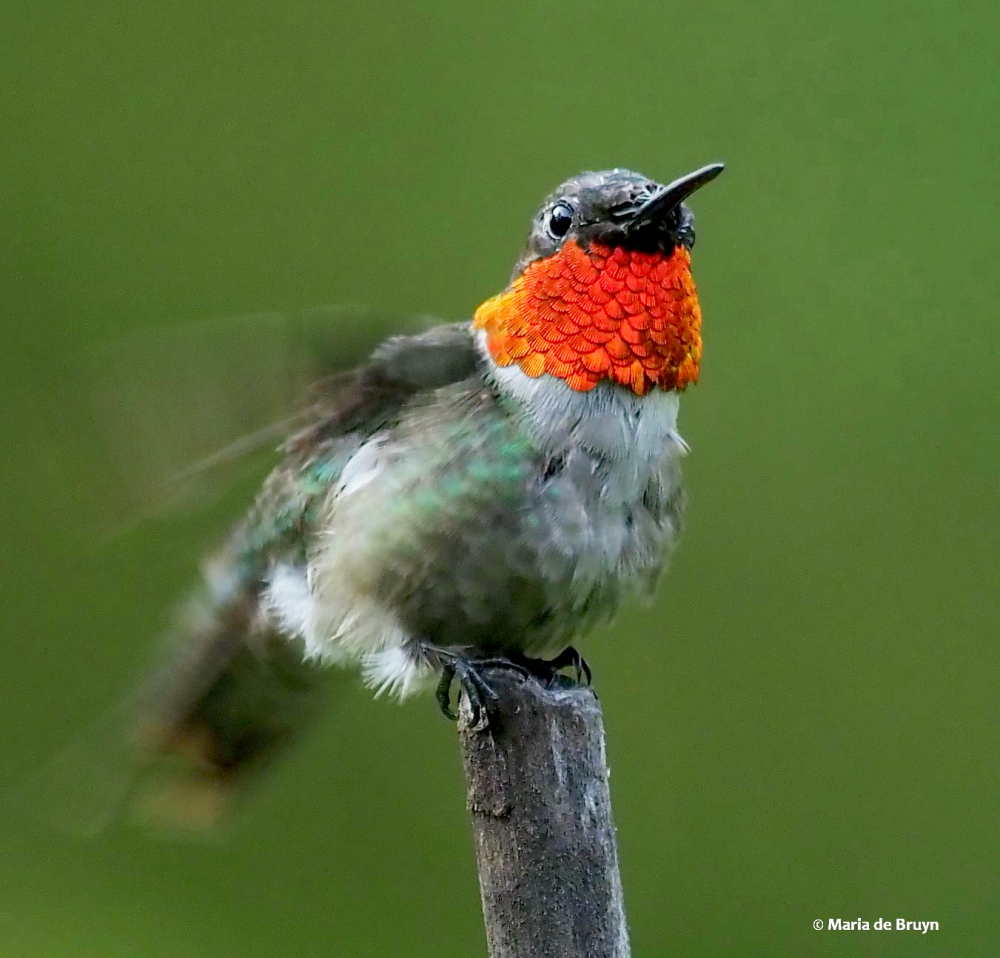
This past week in the USA has been rather distressing as far as health and politics are concerned. The COVID epidemic is wreaking havoc and then humans wrought havoc during a procedure intended to be part of a peaceful transition of governmental power. So we can all use a bit of distraction to remind us there is also still beauty in the world and I’ll end my last trio of posts with one more view of hummingbirds – this time featuring the one species that visits my home every year, the ruby-throated hummingbird (Archilochus colubris).

Fortunately, my yard now has several types of plants that offer the hummers natural nectars to complement their primarily insectivorous diet.

The rose of Sharon (Hibiscus syriacus) flowers are a popular feeding site.

They are also fond of the blue-black sage (Salvia guaranitica). My original plants were a gift from birding friend, Gail; now they are growing in four areas of the yard. Sometimes a hummer doesn’t want to hover but uses a nearby prop to offer some less strenuous feeding. And then the bird can close its eyes to thoroughly enjoy the sweet sap.

Hot lips sage shrubs (Salvia microphylla ‘Hot Lips‘), which I got at a garden center, have proved to be popular feeding sites. This is quite a hardy plant.

The hummers also like going to the lantanas (Lantana) and the yellow passionflower (Passiflora lutea), which kindly came to my yard on its own.


Another popular plant is the butterfly bush (Buddleia davidii).  Many recommend against planting this bloomer because it can be invasive. However, some garden centers have developed varieties that scarcely seed and that must be what I luckily got as it has never appeared anywhere else in the yard in more than a decade.

It also attracts butterflies, bees, syrphid flies and hummingbird moths, so I’m quite happy with my butterfly bush.

The ruby-throats also do like their nectar, however. After visiting various flowers, they often take a seat near or on the nectar feeder so they can sip at their leisure.


They will also do their best to keep other hummers away from the nectar feeder — even when I have as many as three or four feeders available.

They keep an eye out for intruders.

When a rival appears, it can lead to confrontations. Mostly these involve aggressive displays and chasing one another; only very rarely have I seen them actually physically engage.

This past summer, a few laid-back moments occurred when they tolerated one another.

It’s not only the males who are aggressive; female hummers can also be quite protective of feeding grounds. This past year, it seemed that I had mostly males visiting. While a female hummer can have one or two red spots under her chin, usually that is the beginning of a young male developing his ruby-throat.

It can be fun to watch as more spots appear with passing days.


Eventually, the males get their fully developed gorget, which can be quite stunning.

The red hue is very dependent on how the light hits their feathers. In some cases, the red feathers almost look black.


The hummers take care to groom their feathers.

They take advantage of the rain to have a shower.

There are times when they look a bit scruffy, however. That is when they molt. This process of replacing old feathers with new ones usually takes place on their wintering grounds. This past summer, the hummers seemed to have lingered longer than usual and began molting before their trips further south.

White feathers appear more and more as molting proceeds. And feathers come loose before falling away.

They can look a bit scruffy during this time.

Eventually, they get back to their pretty selves. It always stays fun to watch them flying — at least for me. That is when you can see their tiny feet better.

And you get an idea of how rapidly their small wings move as they hover and soar.

They can beat their wings up to 70 times per second!

It doesn’t seem to me that I’ll ever tire of watching these tiny fliers; they always are entertaining. I hope seeing some photos of them in action have provided you with a brief respite from the worries of the world, too.

Flying shades of bronze, brown and copper

While the hummingbirds “clothed” in vibrant green and blue hues in Costa Rica are really wonderful (previous blog), I found out that I’m really attracted to some hummers with more subdued hues as well. The photo above is probably my favorite hummingbird photo of my 2019 trip — that long-billed hermit (Phaethornis longirostris) was simply gorgeous!

Before showing you some other shots of this stunner, let’s look at some other hummers with hues of bronze and copper. The rufous-tailed hummingbird (Amazilia tzacatl) is a smaller bird but a pleasure to see as it flits from bloom to bloom.

These medium-sized hummers defend their nectaring territories vigorously, which may lead to some ruffled feathers. Scratching an itch can also lead to the same condition.

The bronzy hermit (Glaucis aeneus) has a long, curved bill which is useful for the types of flowers where it seeks nectar. It is known to be a fast flyer and is said to only stay a few seconds at each feeding site, so I feel lucky to have gotten a photo of it!

When I saw the black-bellied hummingbird (Eupherusa nigriventris), I immediately fell in love.To me, it looked like this male had had a crew cut and then covered himself with black velvet.

The females of the species do not have black bellies but are also pretty.

Another species that really caught my fancy was the brown violetear (Colibri delphinae). They are very muted in color, which is what makes the color patches really stand out.

The blue-green throat feathers shine. And the violet stripe behind the eye is certainly eye-catching!

It must be the real contrast between the overall subdued coloration and the vivid color patches that attracts me. As other birders moved on, I stayed behind to watch them for a while.

I would enjoy seeing this hummer in person again!

I will leave you with a couple more photos of the wonderful long-billed hermit. The lengthy curved beak and long tail feathers make for a very attractive presence.

And this elegant hummingbird also has a distinctive mating behavior. Up to 25 males will gather in a lek (a communal area where courtship displays are done) and begin wiggling their tail feathers. They then compete to sing a song that will induce a female to choose them as the sire for their young!

Seeing a courtship contest among the long-billed hermits must really be a wonderful experience. But I’m just glad I got to see this species at all and hope perhaps to do so in person one more time!

Next blog: one more view of hummers — this time in North Carolina.

Costa Rican greens and blues

As 2021 proceeds, I hope to post more blogs than last year. In some cases, I’ll manage by showing mostly photographs with little commentary as researching the blogs usually takes a fair amount of time. So to start out with a mainly pictorial blog series, I’d like to share some older photos that I took in 2019 during a visit to the lovely country of Costa Rica with a fun-loving group of birders.

In addition to seeing beautiful tanagers, trogons and other birds, we had the good fortune to see many gorgeous hummingbirds. In this posting, I’ll feature some hummers with primarily green and blue colors. A few I haven’t been able to ID, like the ones above and below, and any suggestions from readers as to species are welcome. The one immediately below right might be a female purple mountain gem….


We often got really good views of these small birds at feeding stations set up for birders and other tourists at hotels, restaurants, people’s homes and nature parks. The feeders tended to attract crowds — both of people and birds!


The green-crowned brilliant (Heliodoxa jacula) is an interesting species as it can look very different depending on the bird’s sex and age.

It is a fairly large hummer. The females have spotted breasts, while young birds are distinguished by an orange or buff-colored throat. (You can see a larger image by clicking on a photo and then back arrow to get back to the blog.)


The green thorntail (Discosura conversii) is a smaller bird that lives in the forest canopy of the Caribbean slopes. The first one shown is what I believe is a female, but my ID is uncertain. The bird’s common name is related to the male’s thin tail feathers.


The purple-throated mountain gem (Lampornis calolaemus) is another small bird that can make a big impression when the light falls just right on its brilliant throat. It’s interesting to read that the brightly-colored males of this species tend to be dominant over others in their home territories.


Here in North Carolina, the ruby-throated hummingbirds tend to be known as rather intolerant of other birds near their feeding areas. The various species we saw at feeding stations in Costa Rica often seemed to get along fairly well – at least at the nectar feeders if not around their preferred flowers. Perhaps it was there that the custom arose of calling a flock of hummers a “charm”. The purple-crowned fairy hummingbird (Heliothryx barroti, right) certainly is charming!

The scaly-breasted hummingbird (Phaeochroa cuvierii) looks a great deal to me like a female green-crowned brilliant, so my ID of this hummer may be wrong.

I think I got the blue-hued lesser violetear hummers (Colibri cyanotus), shown below, right. They are really lovely birds.


I’ll end this blog with a few photos of a large, spectacular hummer with almost iridescent blue coloring, the violet sabrewing (Campylopterus hemileucurus). These were really impressive birds that could keep you in rapt attention.


Next up: a virtual photo tour of some of the brown, bronze and reddish-hued hummers that we got to see.

Serendipity in a stressful year

2020 has turned out to be quite a stress-filled series of months on multiple fronts, so unexpected pleasures and delights are very welcome. For birders in North Carolina (NC), that scenario has luckily been playing itself out this fall and winter. Several unexpected and unusual birds have been spotted in our state, including a Kirtland’s warbler, vermilion flycatcher, MacGillivray’s warbler, and sandhill cranes.

Many bird lovers have traveled to catch sight of these surprising visitors. While I’ve mostly avoided groups the past nine months as part of my COVID-avoiding measures, last week I did join the human migration to an NC home about 20 miles away to see a bird that is normally only found in the northwestern United States – a varied thrush (Ixoreus naevius).

The opportunity to see this lovely bird was offered to the local community by homeowners Tony Hewitt and Marla Wolf. They generously allowed people to come to their suburban yard (by appointment) to watch over the backyard fence to catch sight of the thrush.

When I visited on a “slow” day, it was easy to socially distance oneself from other birders and photographers. Only a couple other people were there for a while (and I was alone some of the time) waiting for the thrush to make an appearance. Everyone wore masks, some having double masked as well.

The varied thrushes normally migrate back and forth in the area stretching from Alaska, through Canada, down to northern California, as shown by this map from the Cornell Lab of Ornithology. The website remarks that a few of these birds occasionally wander outside their normal range to the Midwest and Northeast. Seeing one in the southeastern USA is highly unusual.

Map credit: https://www.allaboutbirds.org/guide/Varied_Thrush/maps-range#

This robin-sized bird is a real stunner – his orange, grey, yellow and white feathers grow in a wonderful pattern. The colors seem to vary a bit, depending on the quality of the light falling on them and the background against which you see him. But he is handsome from any angle – front, side or back!

Something I found particularly interesting was a pattern of wavy lines in his tail feathers when the light hit them in a certain way. This was not something that I saw mentioned in descriptions of its physical characteristics. The observation made me want to photograph the thrush again to see if this would show up again.


It is interesting to note that one varied thrush crossed the Atlantic and turned up in Great Britain in 1982. It was a unique bird since it represented a rare variant of the species in which the orange feather coloration has become all white. Only five such representatives of this mutation have been recorded since 1921.

In its home range, the varied thrush prefers to stay in dense, coniferous forests near water. The NC visitor is taking advantage of a backyard nook that Marla designed with multiple shrubs and some open space.

The home is not far from a lake, but the thrush is taking advantage of a bird bath for drinks, which Marla kindly had moved so that it was better visible for visiting birders looking over the fence.

Varied thrushes usually feed on insects, foraging on the ground and often under dense cover.

The thrush’s insectivorous diet can be wide-ranging and include ants, beetles, caterpillars, crickets, earthworms, millipedes, snails and spiders.


They also eat berries, either in trees or on the ground, during the autumn and winter months. 

Our NC celebrity bird is obviously enjoying seeds furnished daily by Tony and Marla.

A notice placed by Tony near fence announced that the thrush seemed to come out in the open every 30 minutes or so. It turned out that this was indeed the case the first hour that I was there; then the bird came after a couple 15-minute intervals.

He certainly seemed to be a creature of habit because I noticed that after eating, he would go back into the dense undergrowth for several minutes and then re-emerge to take a couple drinks at the bird bath. Eating obviously was making him thirsty and noticing this habit meant it was possible to get “camera-ready” for another appearance.

When it is breeding time, male varied thrushes begin to establish territories and confront other males with threat displays. These begin with the bird cocking his tail and turning it towards his rival, while he lowers his wings. If the rival bird does not go away, the thrush will lower his head, raise and fan his tail and then spread his wings out to the side.

Obviously, our NC bird had no rivals around but there were many other birds foraging in the ground underneath the feeders. They included Northern cardinals, white-throated sparrows, pine siskins and downy woodpeckers among others. And it seemed that “our” thrush was sometimes warning them off.

Or perhaps he was just flashing his wings to scare up insects hiding in the fallen leaves.

There are still large numbers of varied thrushes, with an estimate of some 20 million in the current global breeding population. However, the North American Breeding Bird Survey recorded a cumulative decline of the species of 73% between 1966 and 2015. Logging, wildfires and forest fragmentation are ongoing threats to their breeding habitat.

This is only the fifth time that a varied thrush has been seen in North Carolina. The first sighting was in 2005; three other birds were seen in 2010. No one has any idea what got this year’s bird so far off-course during its migration and no one knows how long it will stay around.

Tony and Marla have kept a visitors’ book (with hand sanitizer available for signers) and many people have been recording their visit. When I visited, more than 110 people had already come by, including some birders from Virginia and Tennessee. More people have since stopped by the Hewitt-Wolf residence to admire this vagrant bird. We are grateful to them for giving us this opportunity!

It’s apparent that the serendipitous sojourn of this gorgeous bird has been a welcome gift to many people – both those who saw it in person and those who’ve admired photos distributed through facebook groups. We hope the bird will survive the winter here and be able to return to its home grounds out West so that its journey has a happy ending!