An hour at a local pond

There is a pond in the county where I live that used to be a real hot spot for birds and other wildlife. The dairy farm fields around it had lots of native vegetation, which was very welcoming to avian wildlife.

A couple years ago, the farmers retired, and the property was purchased by a vineyard owner to expand his holdings. He cut down most of the vegetation around the pond and along the road bordering the fields. He has turned most of the fields into vineyards, keeping only small portions untouched where birds can still find some refuge.
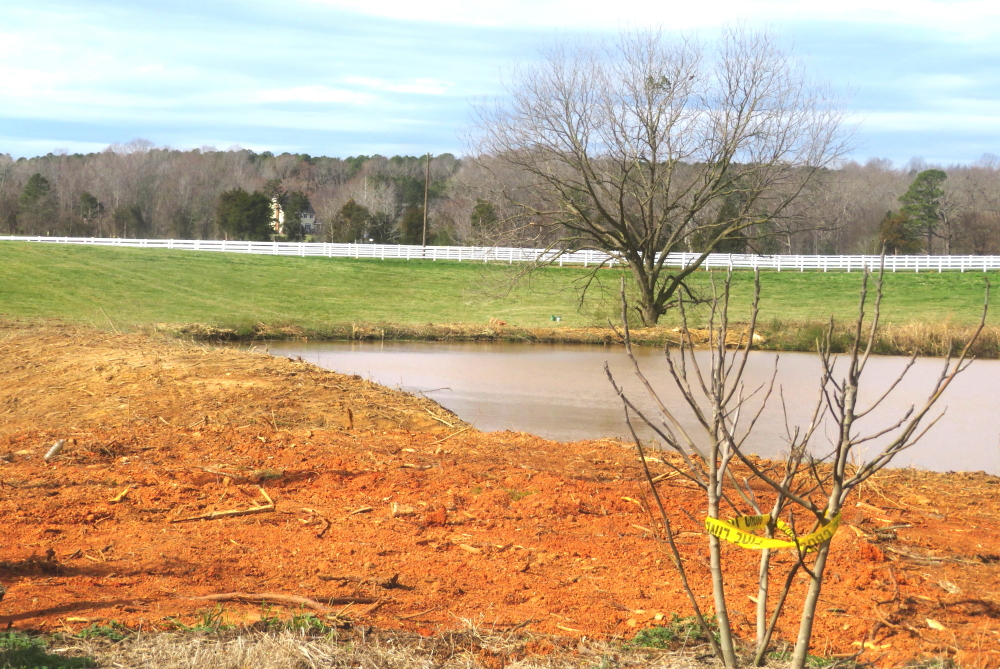
I used to see a yellow-billed cuckoo return from migration to a small patch of trees there every spring. This now is a thing of the past. However, some pond-edge vegetation had been regenerated, and a little bit was planted, so some birds are hanging in there. They still make for some interesting birding. Here is what I saw on a recent visit.
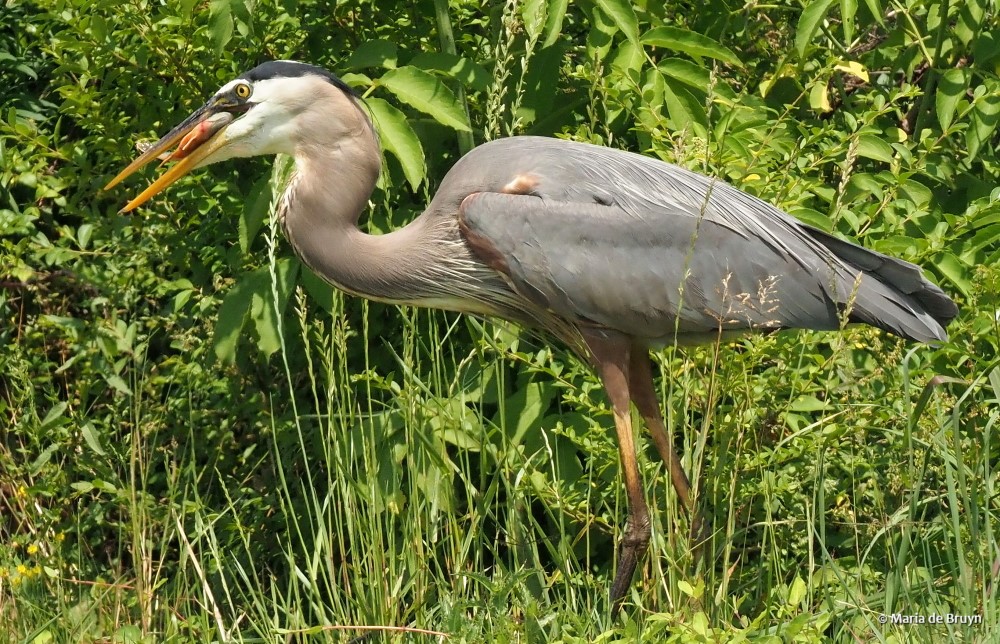
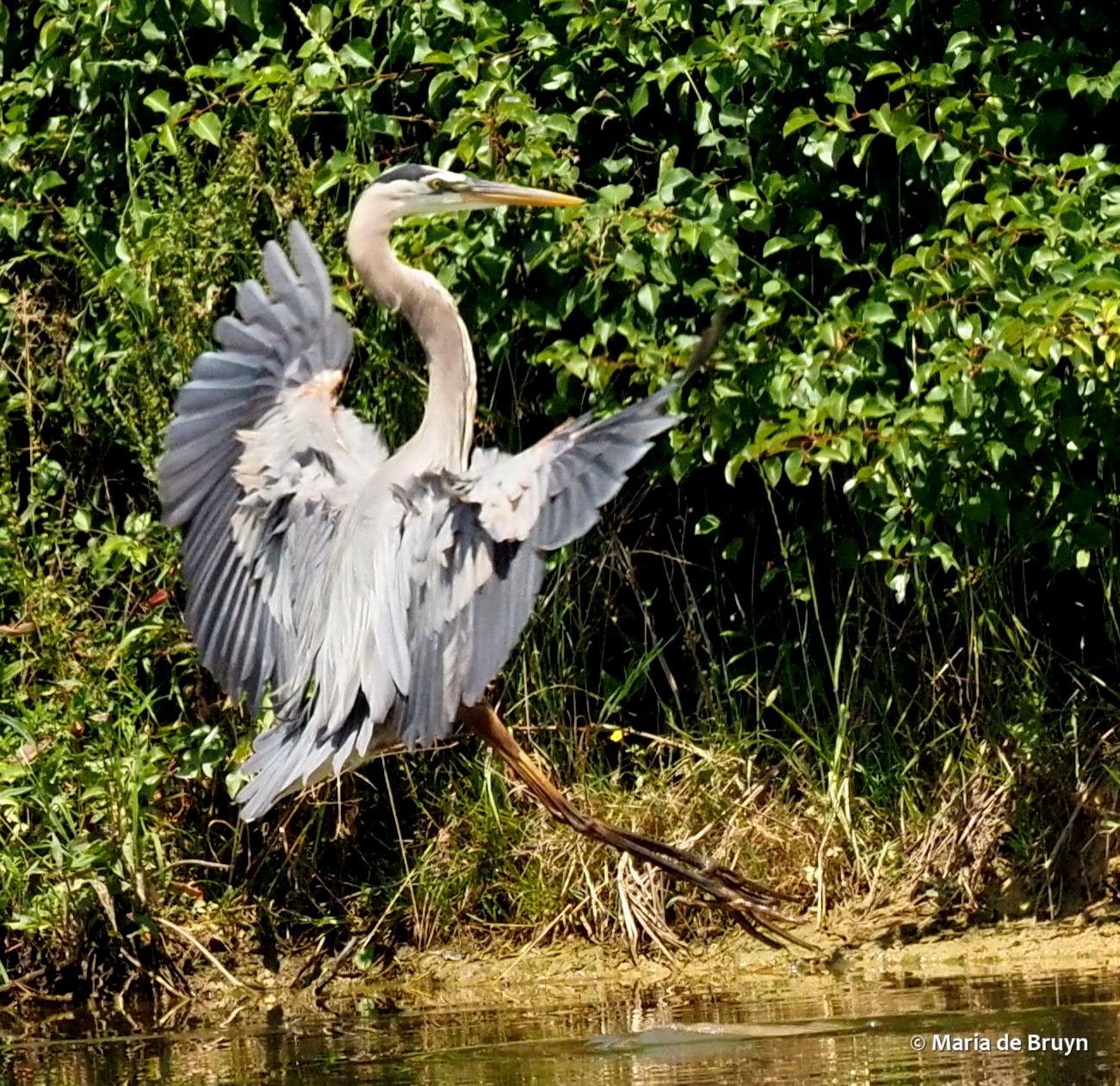
The largest birds that keep returning to the pond are the great blue herons. Sometimes there is one; other times there are two or three. Occasionally a green heron flies in or over but none stopped by on this occasion.

The heron often has good days fishing there. I often see him/her snag at least one fish and often more than one.

The heron stalks along the pond and frequently flies across to the other side for a change of venue. Perhaps the fish manage to hide well once they realize s/he is stalking them.
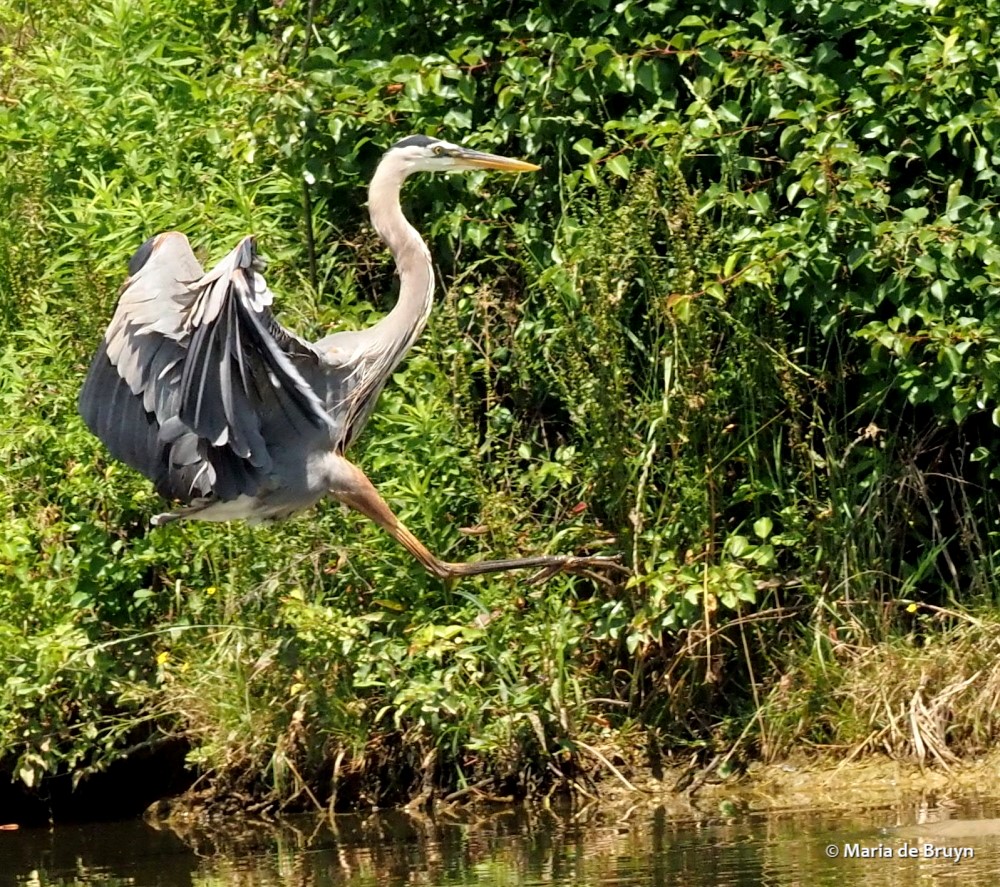
It’s wonderful to see the heron’s wings spread as the bird alights and then begins stalking again.

Eastern bluebirds had taken advantage of an electrical installation next to the pond (which also serves as a resource for the local fire department as needed). They not only used it as a perch for bug seeking but also built a nest inside it. I wondered what the new owner would do.
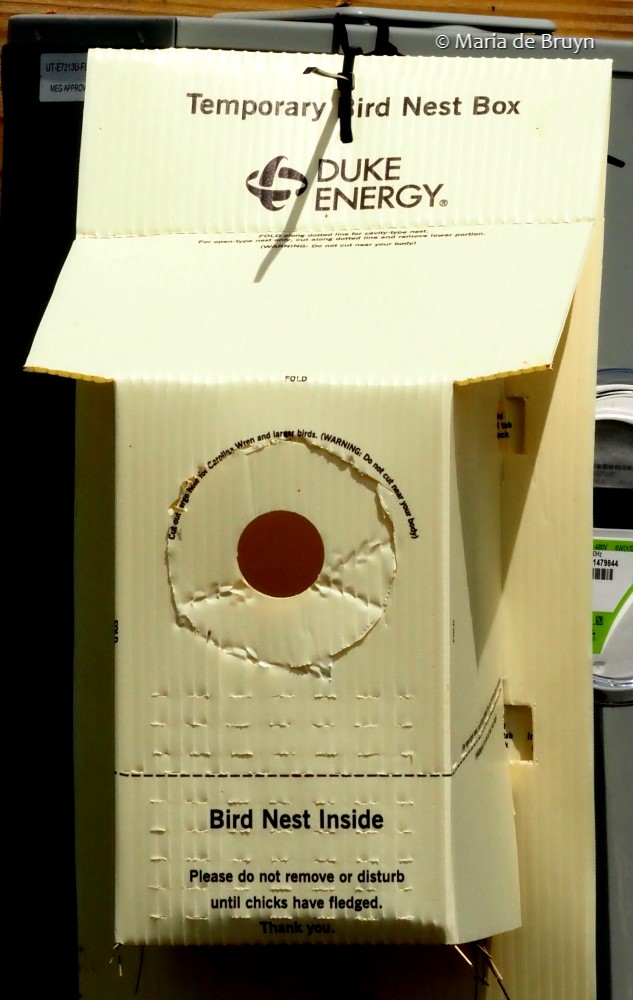


To my great surprise, his problem was solved by the local electricity company. They removed the birds’ original nest and put it into a temporary nest box!
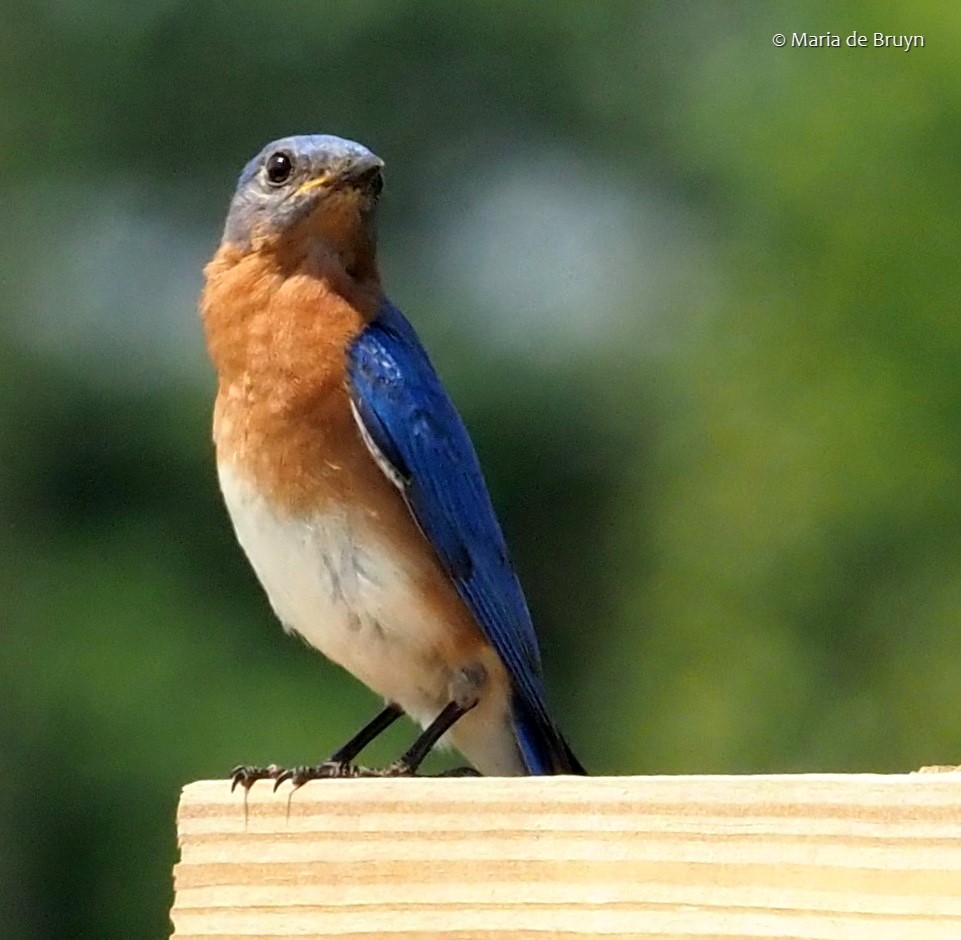
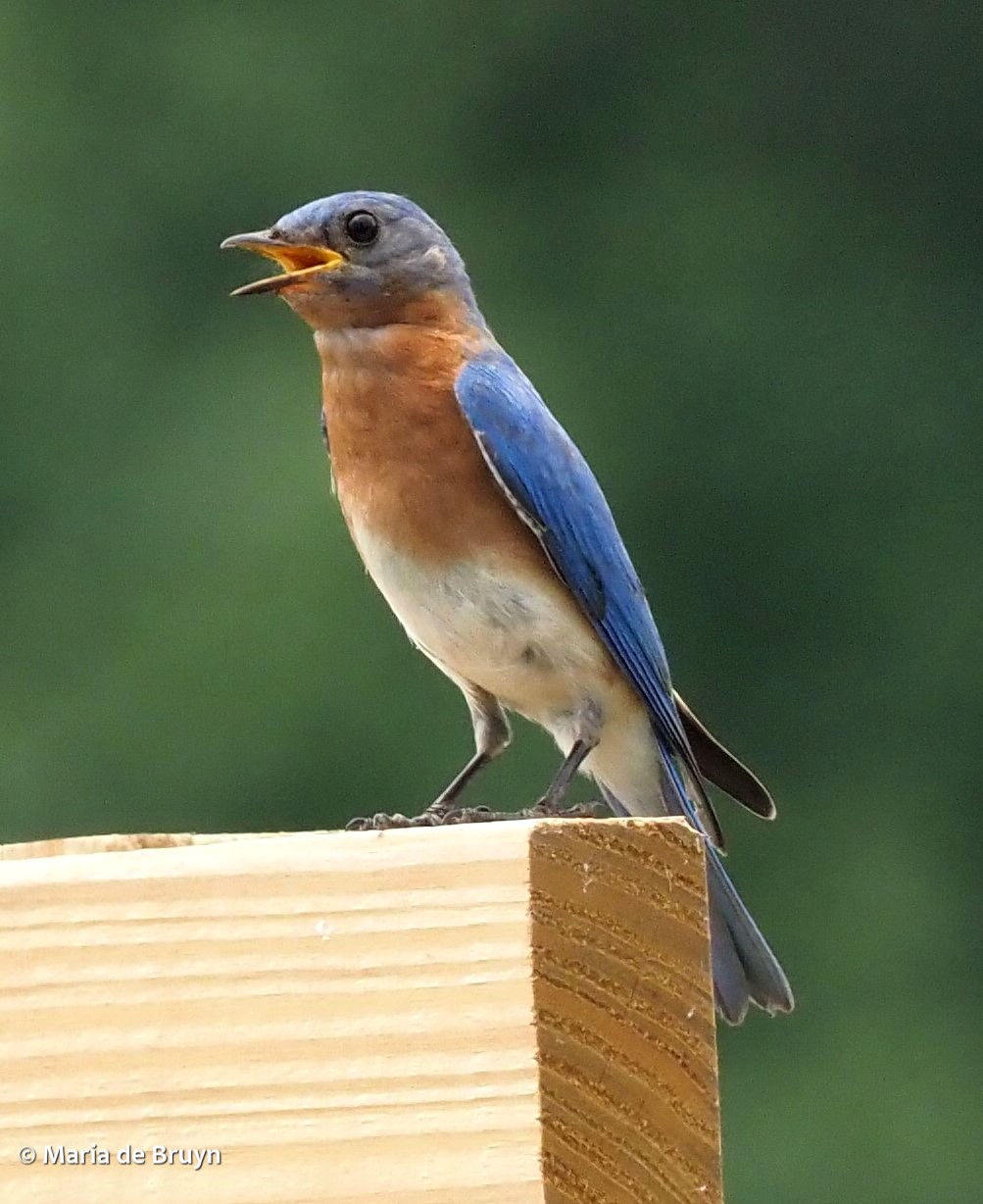
    

Mom and Dad bluebird were guarding the nest space, but it looked like they were still getting used to the new digs.

While watching the bluebirds, I suddenly heard a commotion in front of me, but I couldn’t see what was happening behind the bushes at the pond’s edge (I’m short!). However, I could tell that a bird was in distress. I wondered if one of the huge snapping turtles had caught a duckling. I walked further along and saw one of the two resident female wood ducks (above) swimming away from the area.
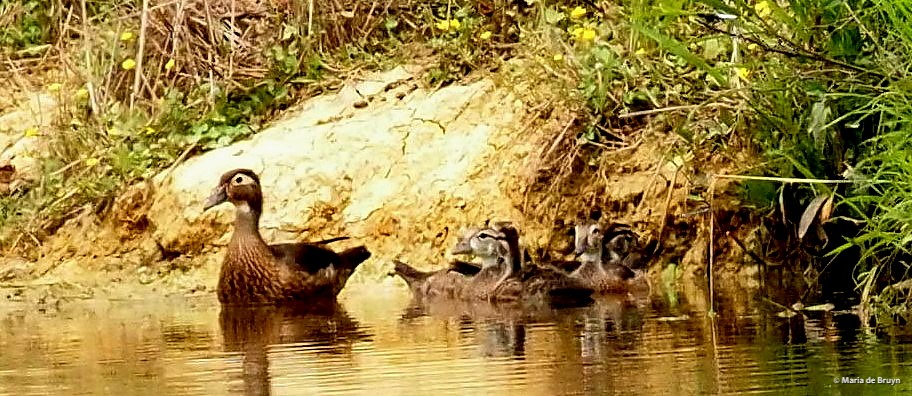
No ducklings followed and I feared the worst. One mother had five ducklings (above) while the one swimming away had lost one a few weeks before. Now I wondered if she had lost others, too. Luckily, I later saw her return to the area and shepherd four ducklings across the water to the other side.


In the small bit of meadow immediately adjacent to the pond, red-winged blackbirds are now nesting. One pair has a nest close to the road and they are warning visitors away with constant flights along the pond’s edge, while the male calls repeatedly.


The female was taking breaks from warning-off flights to enjoy an occasional meal, at this time consisting of one of the remaining periodical cicadas that emerged recently.

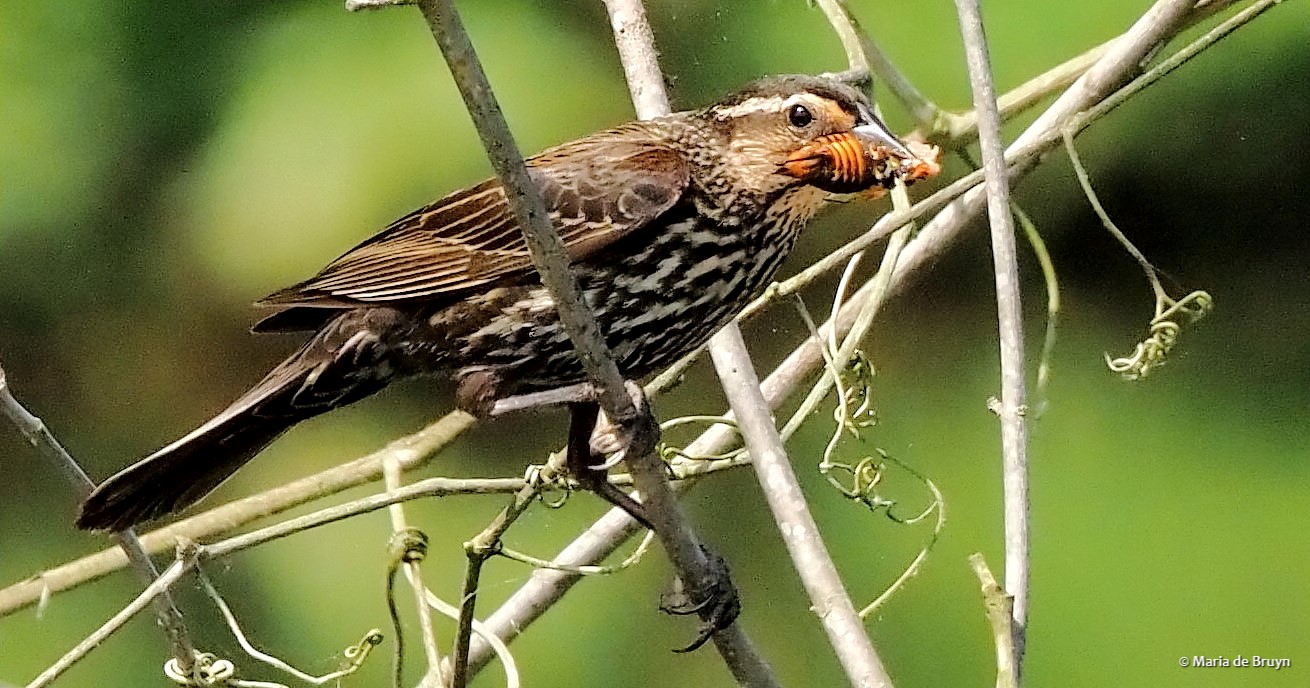
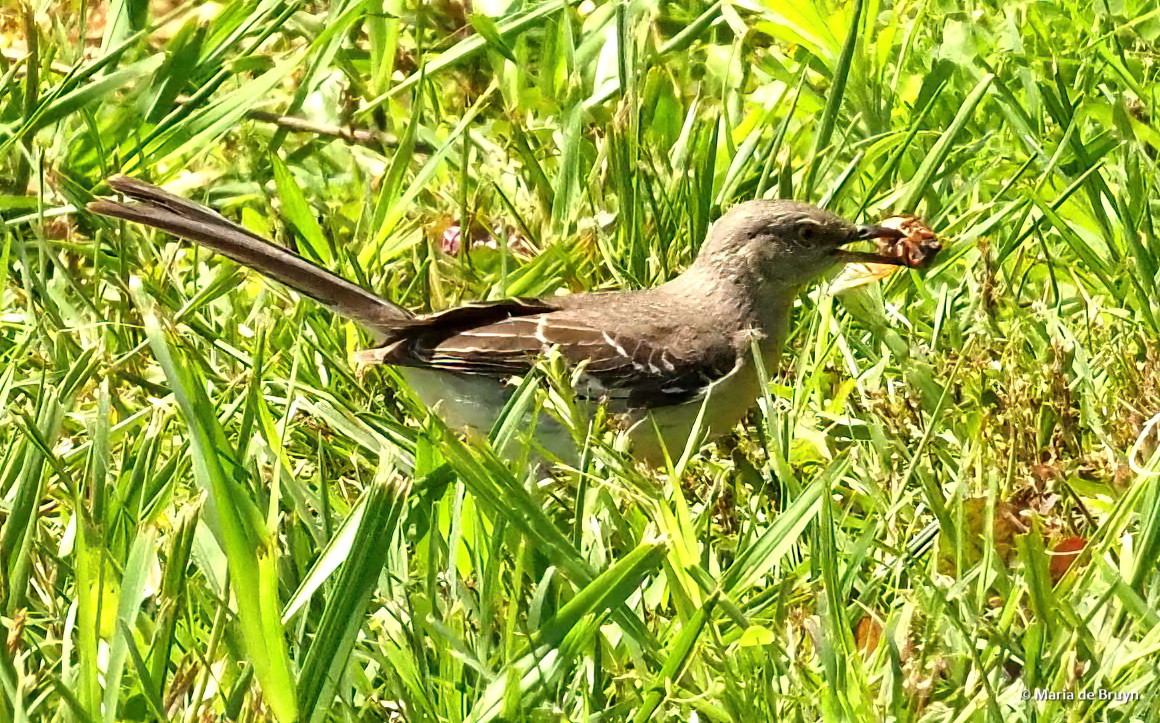
She wasn’t the only one seeking these insect delicacies. Two Northern mockingbirds were also intently examining the area under a tree for them. One finally had success in snagging a cicada. (For more about the cicadas, see my previous two blogs!)


The male red-winged blackbird was very busy keeping “intruders” as far as away as possible from their nest. He warned off the great blue heron, who was actually pretty far away. (He is flying away from the heron on the left side of the photo.)

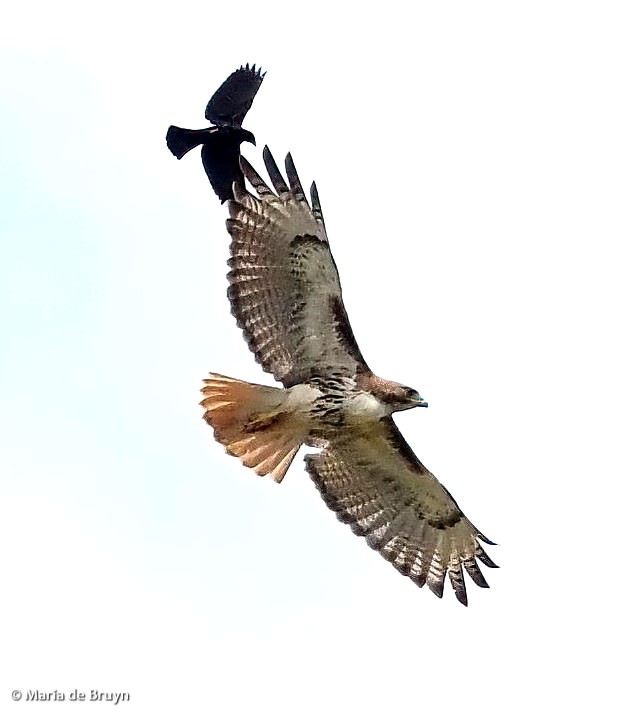
He also went after a red-tailed hawk, who appeared soaring overhead.
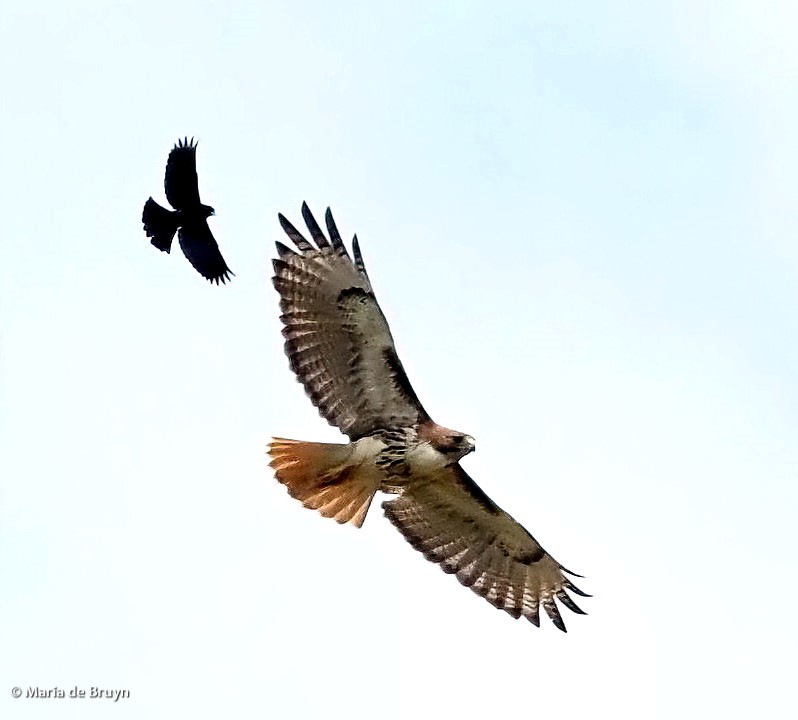
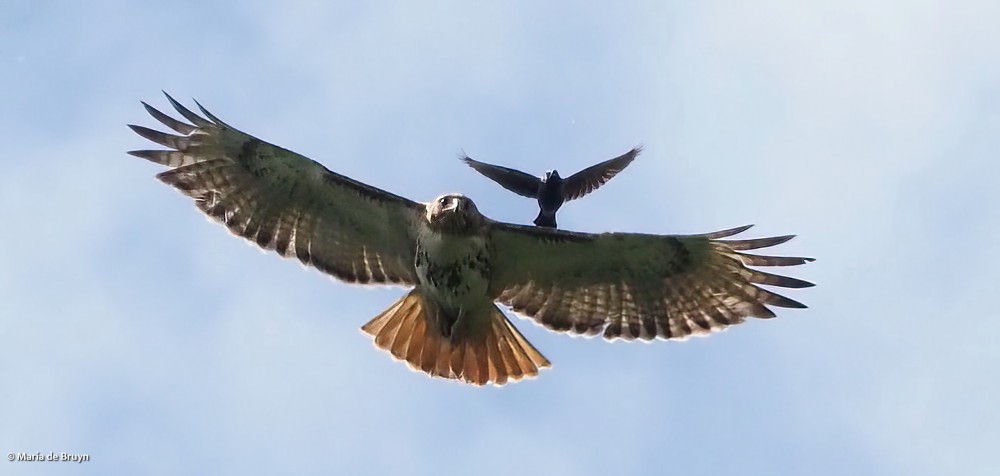
Common grackles, often present at this pond, will also chase away these hawks. There weren’t any around to join in the foray this time, but the photos below taken at another pond show how they go after the red-tails.

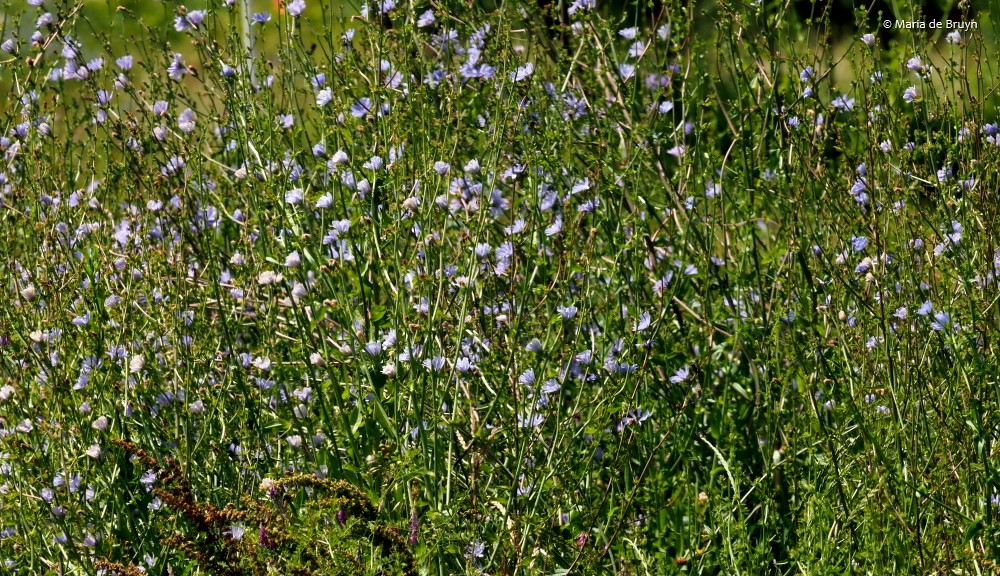
I looked at a small patch of chicory across the road to see if any bobolinks, grosbeaks or meadowlarks were around. I love this plant and planted some seeds in my own yard, hoping to attract more pollinators and birds. So far, they have not sprouted.
 

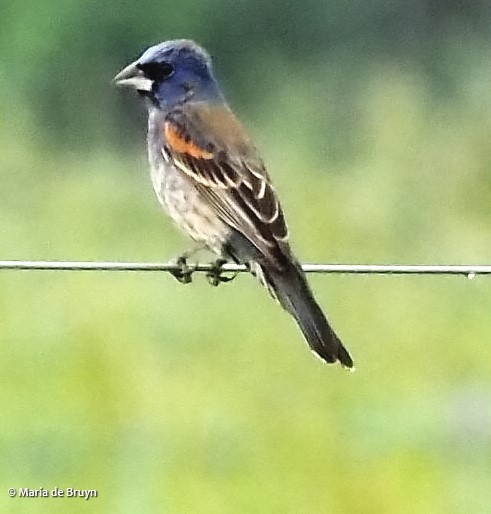
Below you see a young blue grosbeak and a pair of Eastern meadowlarks who were in the patchy field spots another time.
 

Usually, several types of swallows frequent the pond, including purple martins, tree swallows, barn swallows and Northern rough-winged swallows. I only saw a couple of the latter this day and only got poor flight photos as my camera began acting up, refusing to focus.

Staring hard across the pond, I did manage to spot three killdeer, four least sandpipers and a couple other sandpipers that I couldn’t immediately identify. I later learned that they were semipalmated sandpipers, which I hadn’t seen there yet. (If you click on the photo, you see it larger; then go back to the blog.)

That hour at the pond didn’t turn out to be a super one for capturing stellar photos, but it was definitely a great one for relaxing, observing the action and appreciating nature again!

Serendipity in a stressful year

2020 has turned out to be quite a stress-filled series of months on multiple fronts, so unexpected pleasures and delights are very welcome. For birders in North Carolina (NC), that scenario has luckily been playing itself out this fall and winter. Several unexpected and unusual birds have been spotted in our state, including a Kirtland’s warbler, vermilion flycatcher, MacGillivray’s warbler, and sandhill cranes.

Many bird lovers have traveled to catch sight of these surprising visitors. While I’ve mostly avoided groups the past nine months as part of my COVID-avoiding measures, last week I did join the human migration to an NC home about 20 miles away to see a bird that is normally only found in the northwestern United States – a varied thrush (Ixoreus naevius).

The opportunity to see this lovely bird was offered to the local community by homeowners Tony Hewitt and Marla Wolf. They generously allowed people to come to their suburban yard (by appointment) to watch over the backyard fence to catch sight of the thrush.

When I visited on a “slow” day, it was easy to socially distance oneself from other birders and photographers. Only a couple other people were there for a while (and I was alone some of the time) waiting for the thrush to make an appearance. Everyone wore masks, some having double masked as well.

The varied thrushes normally migrate back and forth in the area stretching from Alaska, through Canada, down to northern California, as shown by this map from the Cornell Lab of Ornithology. The website remarks that a few of these birds occasionally wander outside their normal range to the Midwest and Northeast. Seeing one in the southeastern USA is highly unusual.

Map credit: https://www.allaboutbirds.org/guide/Varied_Thrush/maps-range#

This robin-sized bird is a real stunner – his orange, grey, yellow and white feathers grow in a wonderful pattern. The colors seem to vary a bit, depending on the quality of the light falling on them and the background against which you see him. But he is handsome from any angle – front, side or back!

Something I found particularly interesting was a pattern of wavy lines in his tail feathers when the light hit them in a certain way. This was not something that I saw mentioned in descriptions of its physical characteristics. The observation made me want to photograph the thrush again to see if this would show up again.


It is interesting to note that one varied thrush crossed the Atlantic and turned up in Great Britain in 1982. It was a unique bird since it represented a rare variant of the species in which the orange feather coloration has become all white. Only five such representatives of this mutation have been recorded since 1921.

In its home range, the varied thrush prefers to stay in dense, coniferous forests near water. The NC visitor is taking advantage of a backyard nook that Marla designed with multiple shrubs and some open space.

The home is not far from a lake, but the thrush is taking advantage of a bird bath for drinks, which Marla kindly had moved so that it was better visible for visiting birders looking over the fence.

Varied thrushes usually feed on insects, foraging on the ground and often under dense cover.

The thrush’s insectivorous diet can be wide-ranging and include ants, beetles, caterpillars, crickets, earthworms, millipedes, snails and spiders.


They also eat berries, either in trees or on the ground, during the autumn and winter months. 

Our NC celebrity bird is obviously enjoying seeds furnished daily by Tony and Marla.

A notice placed by Tony near fence announced that the thrush seemed to come out in the open every 30 minutes or so. It turned out that this was indeed the case the first hour that I was there; then the bird came after a couple 15-minute intervals.

He certainly seemed to be a creature of habit because I noticed that after eating, he would go back into the dense undergrowth for several minutes and then re-emerge to take a couple drinks at the bird bath. Eating obviously was making him thirsty and noticing this habit meant it was possible to get “camera-ready” for another appearance.

When it is breeding time, male varied thrushes begin to establish territories and confront other males with threat displays. These begin with the bird cocking his tail and turning it towards his rival, while he lowers his wings. If the rival bird does not go away, the thrush will lower his head, raise and fan his tail and then spread his wings out to the side.

Obviously, our NC bird had no rivals around but there were many other birds foraging in the ground underneath the feeders. They included Northern cardinals, white-throated sparrows, pine siskins and downy woodpeckers among others. And it seemed that “our” thrush was sometimes warning them off.

Or perhaps he was just flashing his wings to scare up insects hiding in the fallen leaves.

There are still large numbers of varied thrushes, with an estimate of some 20 million in the current global breeding population. However, the North American Breeding Bird Survey recorded a cumulative decline of the species of 73% between 1966 and 2015. Logging, wildfires and forest fragmentation are ongoing threats to their breeding habitat.

This is only the fifth time that a varied thrush has been seen in North Carolina. The first sighting was in 2005; three other birds were seen in 2010. No one has any idea what got this year’s bird so far off-course during its migration and no one knows how long it will stay around.

Tony and Marla have kept a visitors’ book (with hand sanitizer available for signers) and many people have been recording their visit. When I visited, more than 110 people had already come by, including some birders from Virginia and Tennessee. More people have since stopped by the Hewitt-Wolf residence to admire this vagrant bird. We are grateful to them for giving us this opportunity!

It’s apparent that the serendipitous sojourn of this gorgeous bird has been a welcome gift to many people – both those who saw it in person and those who’ve admired photos distributed through facebook groups. We hope the bird will survive the winter here and be able to return to its home grounds out West so that its journey has a happy ending!


Costa Rica – varied landscapes and fabulous flora. Part 2 – heliconias and special plants

During the rainy winter season, Costa Rica’s foliage is abundant, lush, varied and beautiful. For plant lovers, it is awesome; for birders, it’s very cool and also very challenging.        In many places, the tall trees, like the Cecropias, towered over mid-canopy trees, shrubs and ground cover, creating dense foliage where we were challenged to spot birds on twigs and behind leaves.


When you are in the rain and cloud forests and wearing glasses, it can also be frustrating – in some areas where we were birding, my spectacles (a nice old-fashioned word!) fogged up every half-second.


Our guide used a laser pointer (the green spot on the right) to indicate when he had found a bird among the leaves — “Look a foot or two to the left, right, above or below” — and we attempted to locate the winged visual target. Sometimes I found the bird and other times, I just couldn’t focus with glasses that required constant wiping and getting good photos was really out of the question.

Fortunately, photographing plants was somewhat easier than creating avian portrait. Heliconias (of which there are about 200 species) can be seen throughout Costa Rica. They are very attractive with their elaborate “inflorescences” – flower heads that include stems/stalks, bracts (modified leaves or scales from which a flower emerges) and the blooms themselves. The large colorful hanging or erect structures on them might seem to be the flowers but those are the bracts.

Some heliconias are called false birds of paradise as they closely resemble the Asian birds of paradise flowers (Strelitzia reginae).


Others are called by avian and animal names as well.

Lobster claw (Heliconia caribaea)


Expanded lobster claw (Heliconia latispatha)


Parrot’s beak (Heliconia and Heliconia psittacorum)

One yellow flower is called the rattlesnake plant (Calathea crotalifera); it was featured in a “Garden of wisdom” at the Santa Elena Cloud Forest Reserve.

The name comes from the bract’s resemblance to a rattlesnake’s tail. Our guide told us that venomous yellow pit vipers will wait in the plant to ambush hummingbirds that come to feed on the flowers. Eyelash pit vipers will return to familiar ambush sites during spring bird migration!

Some of the foliage was enormous in size. The elephant ear (Xanthosoma) is a plant with huge leaves that can be seen along roadsides and in nature reserves. Other large leaf plants, likely philodendron species, serve as insect food.


Mushrooms similar to those we see in North Carolina were in almost all the habitats we visited. Here are just a few of them.


At one point, we birded near a small coffee (Coffea) plantation.

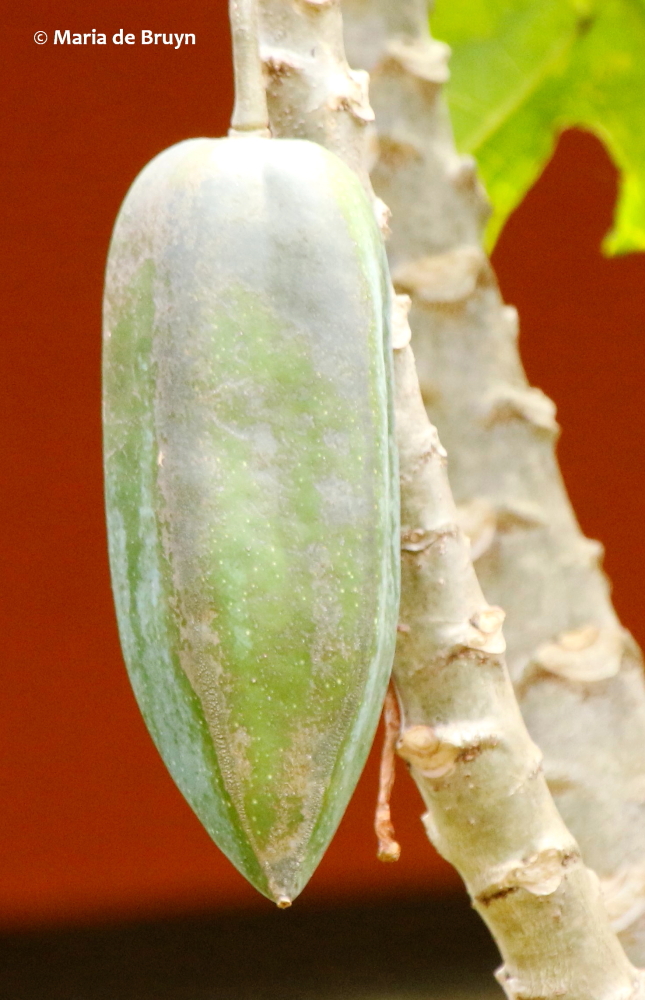
In one of the reserves, we came across cacao trees (Theobroma cacao). A member of our group touched the sticky insides of one fallen fruit and found it quite smelly.

Various species of palms were common and we were able to see some in bloom.


Elsewhere, we saw how small trees are pruned to form living fences along fields.


One of the most interesting plants we saw was the Columnea consanguinea. The green leaves are distinguished by translucent red heart-shaped patches on their undersides. These are visible from above the leaves as yellow-green areas.


The purpose of these markings is to attract the plant’s main pollinator, the green-crowned brilliant hummingbird (Heliodoxa jacula).


When they see the yellow-green/red hearts, they know the plant’s inconspicuous flowers will be lying nearby against the plant’s stem.


This plant with aerial roots had been cut off somehow; it was now in the process of covering itself with a gel-like substance, intended to discourage animals from chewing on it before the roots reached the ground.

Here are a few more lovely flowering plants that I couldn’t identify but certainly enjoyed seeing.


To conclude this focus on Costa Rican plants, I’d like to show a photo kindly shared by Nan DeWire – it reflected our attitude as we toured the marvelous natural areas.

The next Costa Rica blog will feature some of the mammals which we were lucky to encounter as we moved from place to place. However, a quick side trip to North Carolina will take place first to document a lucky event for a birder.

Costa Rican rambles 7B – Cerro Buena Vista and a night prowl


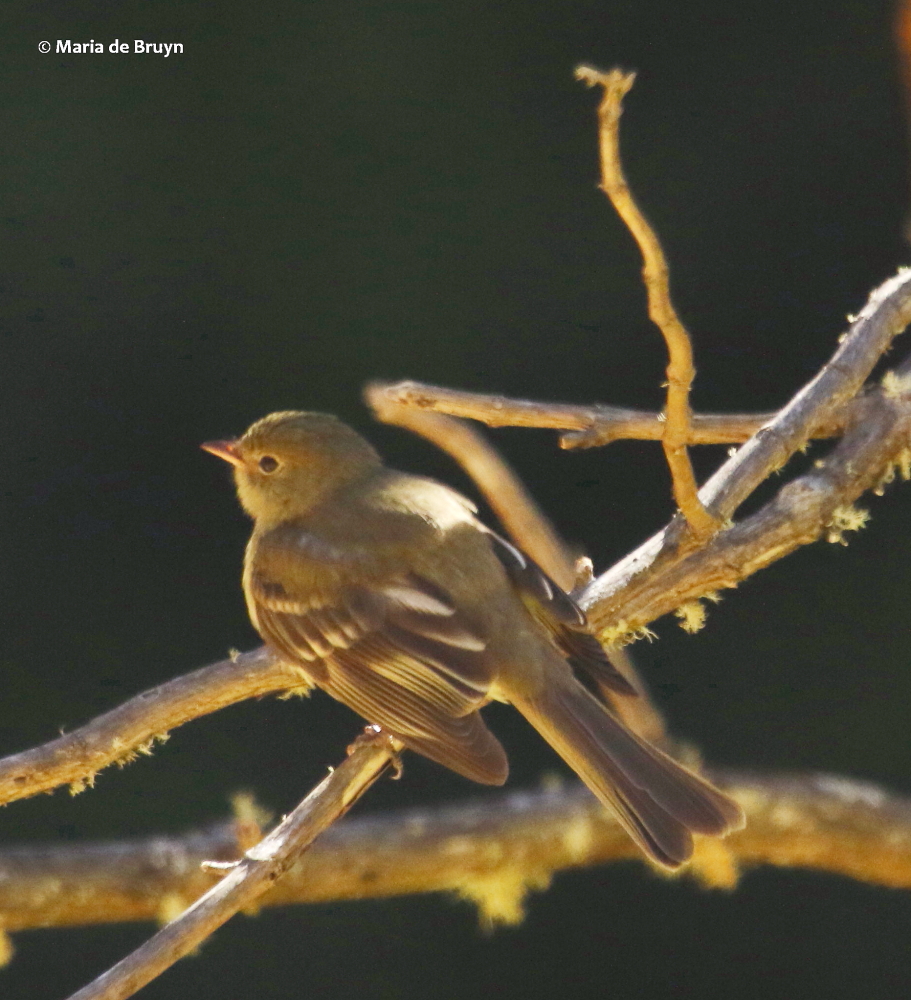
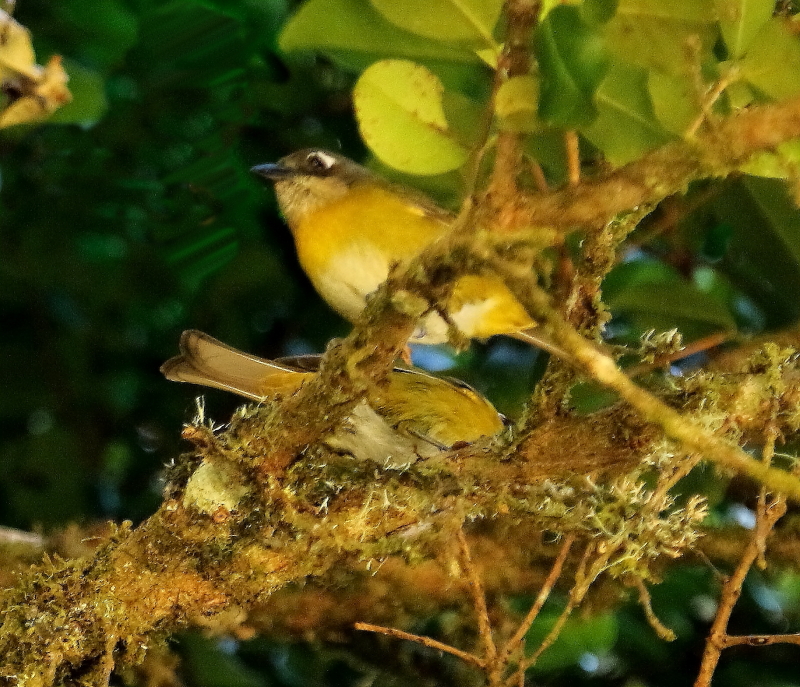
After seeing the beautiful green and blue emerald swift lizard, our attention went back to birds and we rewarded with sightings of a few gorgeous little yellow birds – a yellow-winged vireo (Vireo carmioli) and yellowish flycatcher (Empidonax flavescens).

Since I photograph insects to contribute to BugGuide in the USA, I was watching for them in Costa Rica, too. Insect galls on plant stems and leaves were in evidence and a blue damselfly (Argia pulla) posed for a moment.

A yellow weevil was a fascinating find – those blunt-nosed small insects make me think of Pinodchio.

Then – to the delight of everyone in our party – we had the good fortune to see a resplendent quetzal (Pharomachrus mocinno) fly across our path. We had caught sight of a couple flying high over the Lodge before setting off for our hike, but this bird actually perched not too far away, not staying very long at all but giving me a minute to step around a fellow birder and get a couple shots.

A hairy woodpecker (Leuconotopicus villosus), a more familiar bird for us, looked down on us from high above and a flame-throated warbler (Oreothlypis gutturalis) brought another spot of color to our upward trek.


When we started down to make it back in time for lunch, we had time to examine the surrounding flowers and then were lucky to see yet another emerald swift lizard, also kown as the green spiny lizard (Sceloporus malachiticus).

After a meal, it was a treat to see a collared redstart (Myioborus torquatus).


A black-thighed grosbeak (Pheucticus tibialis) gave us another yellow-hued sighting before our attention turned to birds with more subdued coloring – an ochraceous wren (Troglodytes ochraceus) which made me think of hobbits in woods for some reason, some ruddy treerunners (Margarornis rubiginosus) and a spangle-cheeked tanager (Tangara dowii).


A black-faced solitaire (Myadestes melanops) graced us with its presence before we took an afternoon break. Some of our fellow birders went to rest, but Janet invited me to her cabin where we had the rare pleasure of seeing a lesser violetear hummingbird (Colibri cyanotus) sitting on her nest! When she flew off after a while to get some sustenance, we noted that she had not yet laid any eggs.


Then, as I scanned the surrounding trees from Janet’s balcony, I discovered another nest, occupied by the young of a gray-tailed hummingbird (Lampornis cinereicauda). It was not easy to see but peering through the leaves, I managed to get a shot of the hummer stuffing some food down an offspring’s throat.


Janet’s balcony was a wonderful birding spot – the next visitor was a gorgeous red-headed barbet (Eubucco bourcierii). A flame-colored tanager (Piranga bidentata) was yet another brilliantly hued avian visitor.

Walking along the nearby roads, I saw the horses (Equus ferus caballus) used for tourists’ horse-back riding galloping along – beautiful, well-fed animals to be sure.


We soon left on our next excursion to the Páramo zone (montane shrub- and grassland mountaintop environment), where we scaled the Cerro Buena Vista (“Good View Mountain”) by van. This region contains the highest point of the Pan American Highway in Central America (3492 meters or 11456.69 feet in elevation). The peak harbors telecommunications equipment and is noteworthy for the many bird species endemic to this area.


The one for which we were especially looking was the volcano junco (Junco vulcani), a great bird that was not shy at all and posed for us in numerous positions and at great length.

After leaving the mountaintop, we descended to the rainforest and there spotted a black guan (Chamaepetes unicolor).


Our day ended with a night prowl after dinner, looking for the dusky nightjar (Antrostomus saturatus). And we were lucky enough to have one fly right in when it heard the playback of a compatriot on our birding guide’s sound system!


Well satisfied, I retired to a good night’s sleep after catching a rather large cranefly-type insect, which I let go outside. I wanted to be prepared for our next day’s adventures with the wildlife beauties of Costa Rica.

Costa Rican rambles 7A – the Sueños del Bosque lodge and environs

And now my Costa Rican wildlife travelogue continues after a long absence. Busy projects and chores, a vacation abroad and illness all conspired to delay the writing of this next installment, And now one of my photo software programs is refusing to work, making photo processing a real pain. But I was still able to get some shots to share of beautiful creatures in the Costa Rican Talamanca highlands. 😊


We started our fourth day early, first going out to see if we could find local favorites at sites near the Sueños del Bosque (dreams of the forest) Lodge. Located near the town of San Gerardo de Dota, the elevation is 7200 feet at this spot. A few busloads of other birding enthousiasts were also there; the guides all knew one another.

When our guide ran into his brother – also a birding guide – we were told about a spot where some spotted wood quail were hanging out. I did get a photo but it was still so dark, that the photo was not all that great. Our next venture was to a spot where the resplendent quetzal had been seen – a few people with binoculars didn’t have much trouble spotting a really distant pair of birds building a nest across a valley, but I bird with a telelens and had no such luck. So I admired the flowers and plants– and saw some very nice ones throughout the day as you can see below.


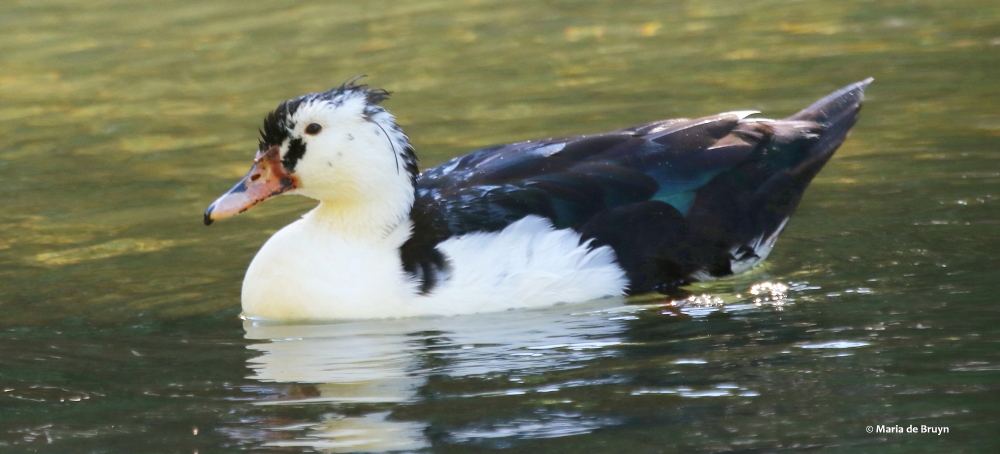
Back at the Lodge, we had time to look for birds near our rooms and the dining area. This cute little mountain elaenia (Elaenia frantzii) was a pleasure to behold. The lodge’s pond had numerous domestic ducks in residence, including a crested duck (Anas platyrhynchos domesticus).


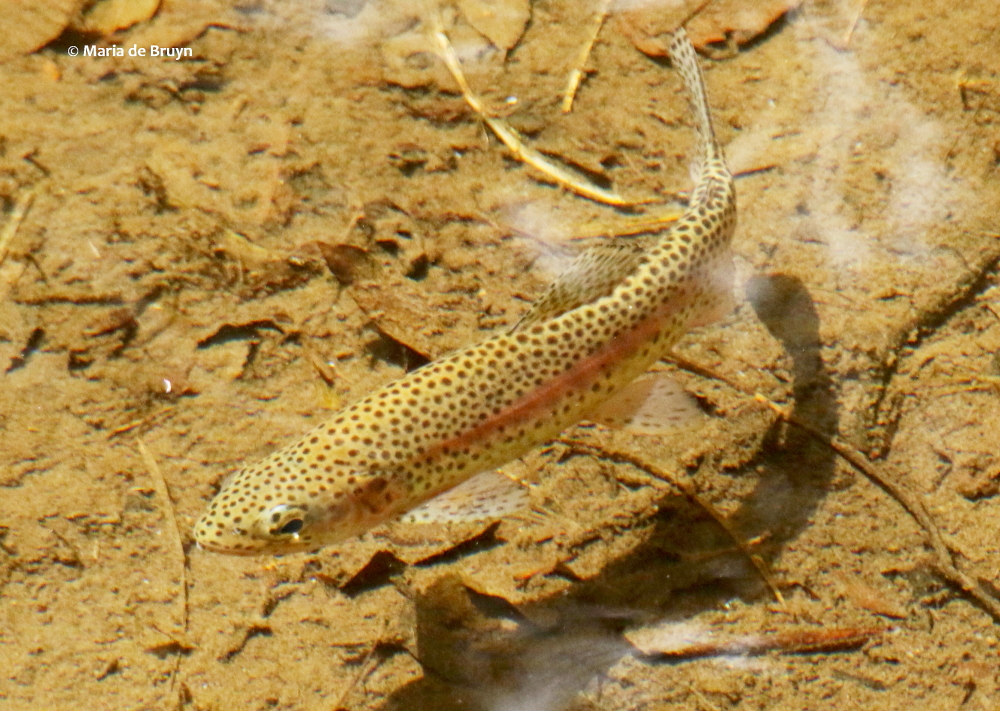
Next, we took a walk along trails leading away from the Lodge up the mountain. We passed a stream, stocked with rainbow trout, which were imported by Efraín Chacón, who discovered the Rio Savegre Valley and built the visitors’ accommodations.


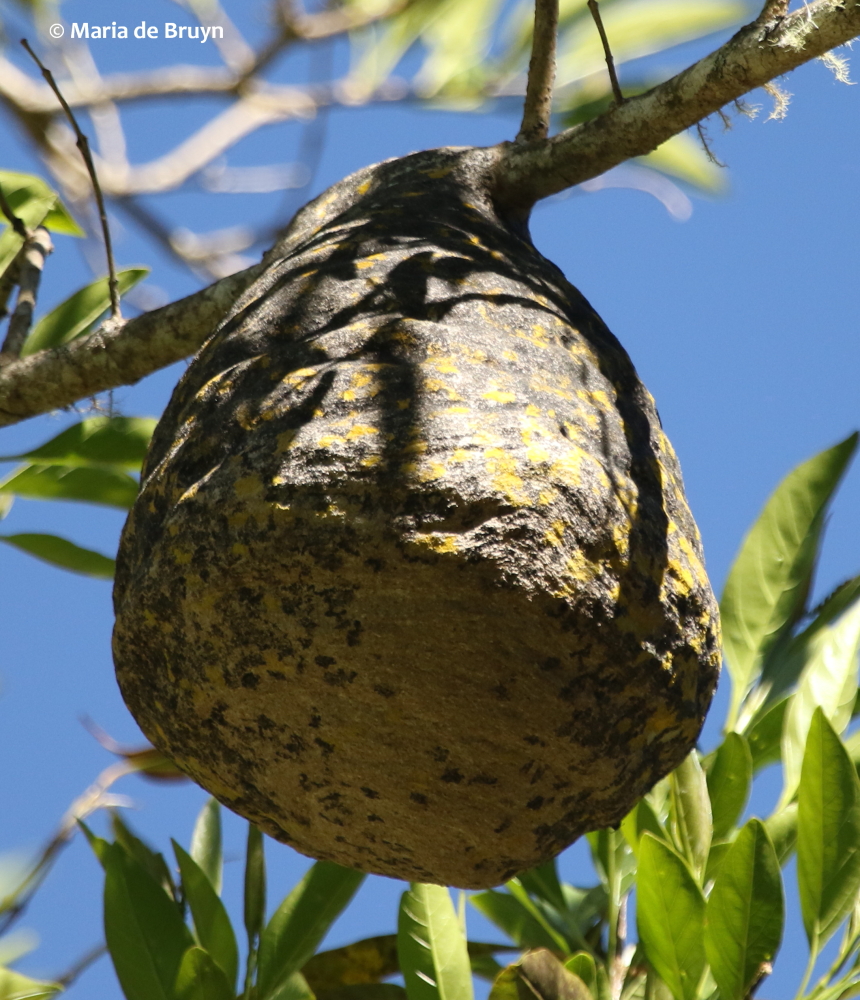
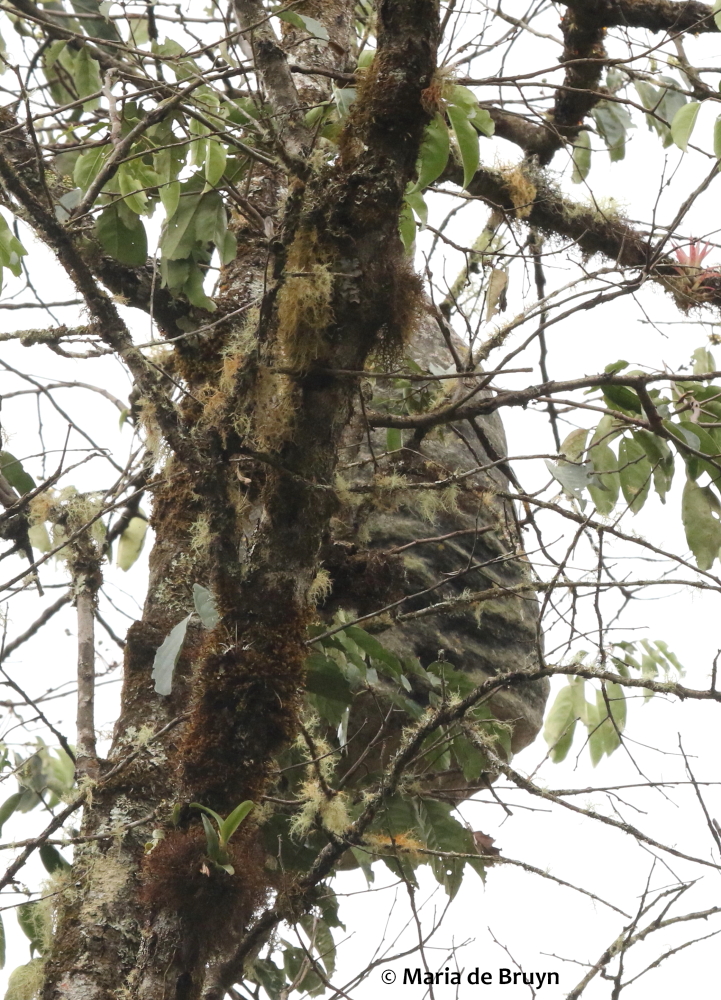
Wasp nests were hanging above our heads in the trees in several places.


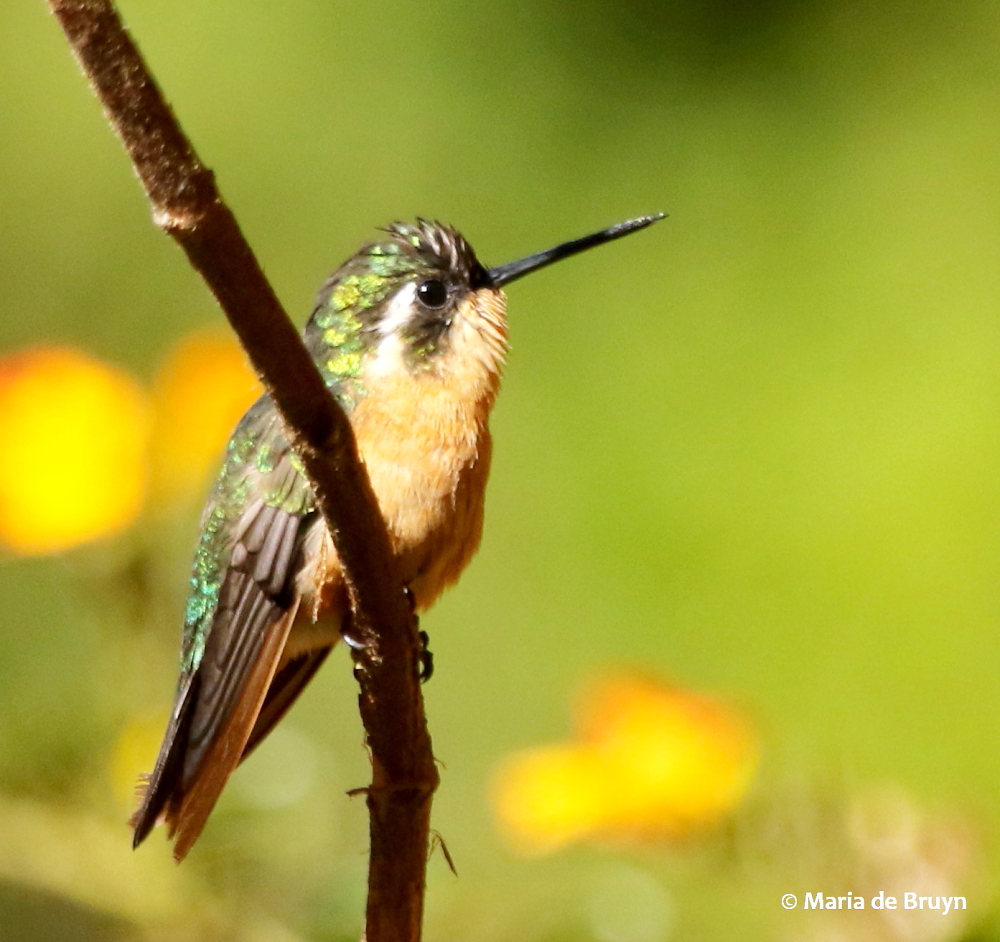
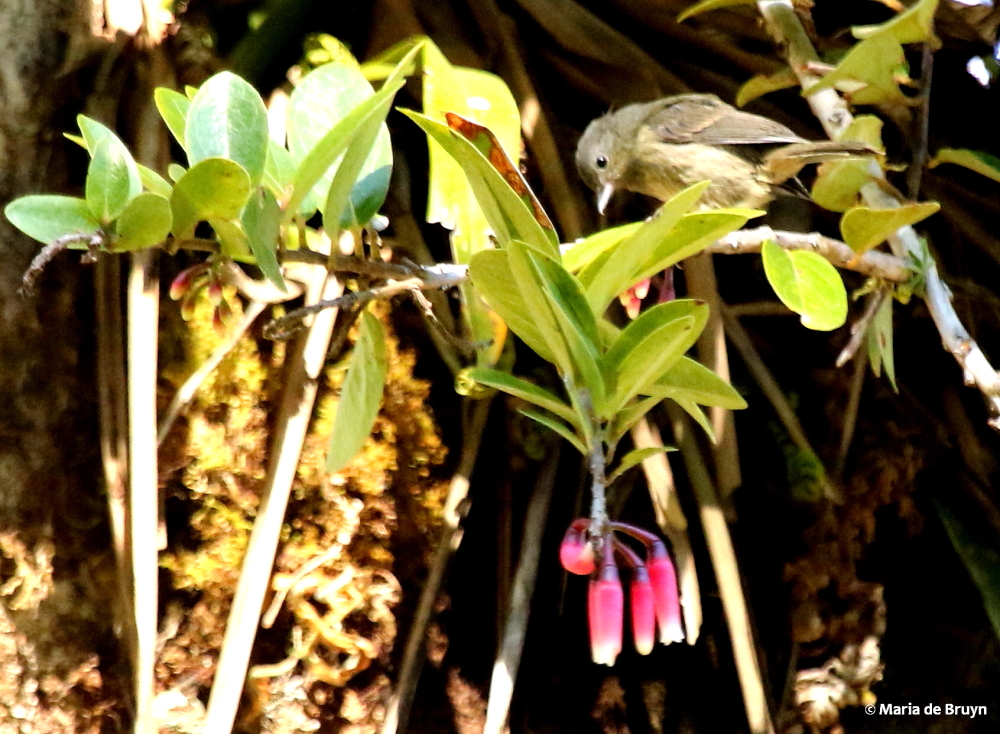
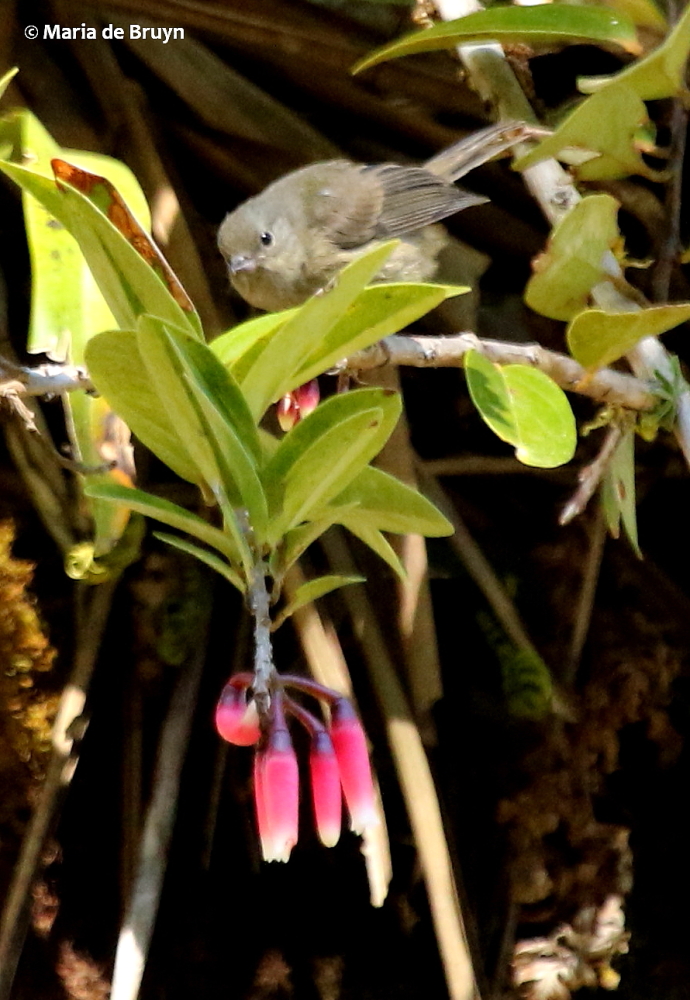
A beautiful white-throated mountain gem hummingbird (Lampornis castaneoventris) gave us a good view as it perched nearby, and a small grayish bird that I haven’t  yet identified was flitting about the flowers as well.


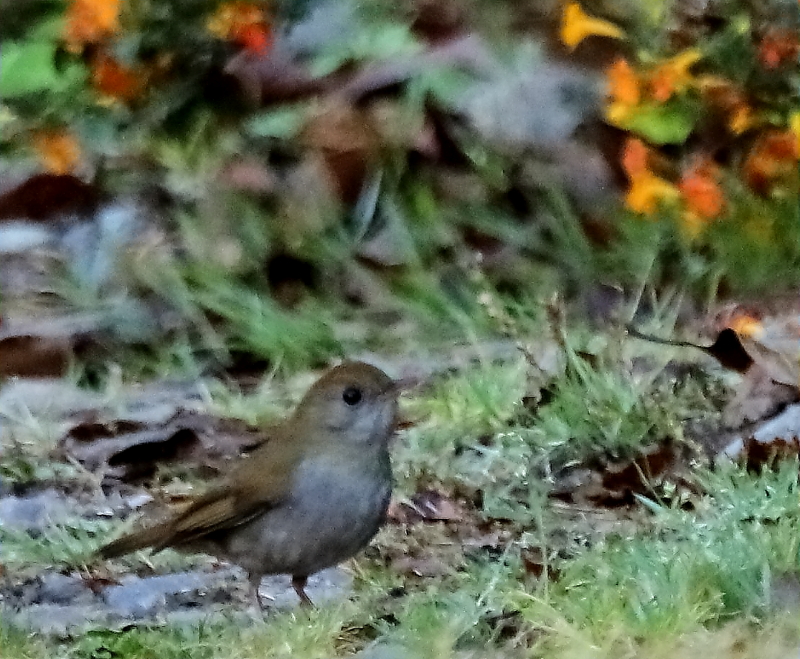
A black-billed nightingale thrush (Catharus gracilirostris) was smaller than I would have expected. Two tanagers showed themselves briefly – a sooty-capped bush tanager (Chlorospingus pileatus) and a pair of common bush tanagers (Chlorospingus flavopectus).


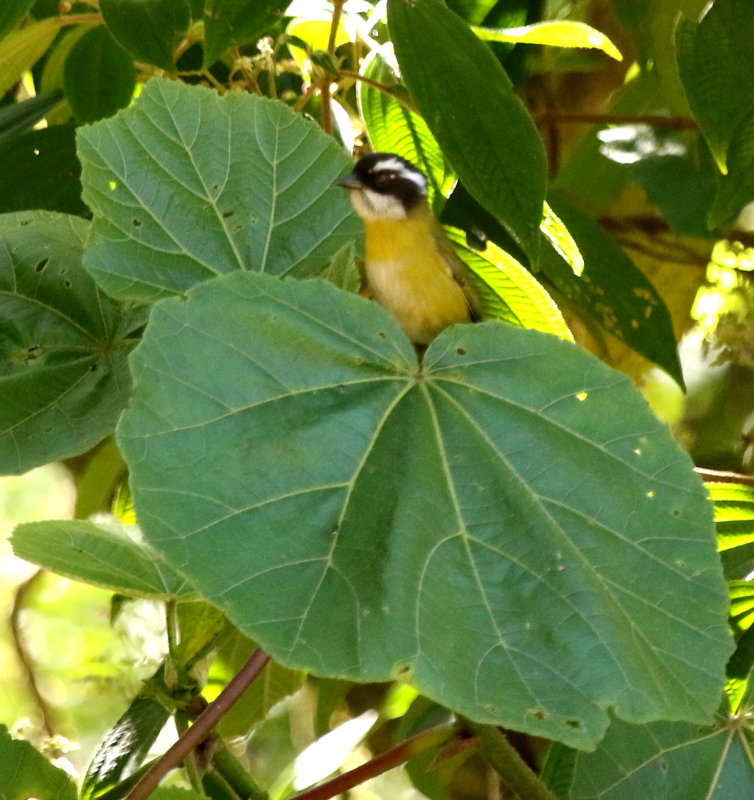
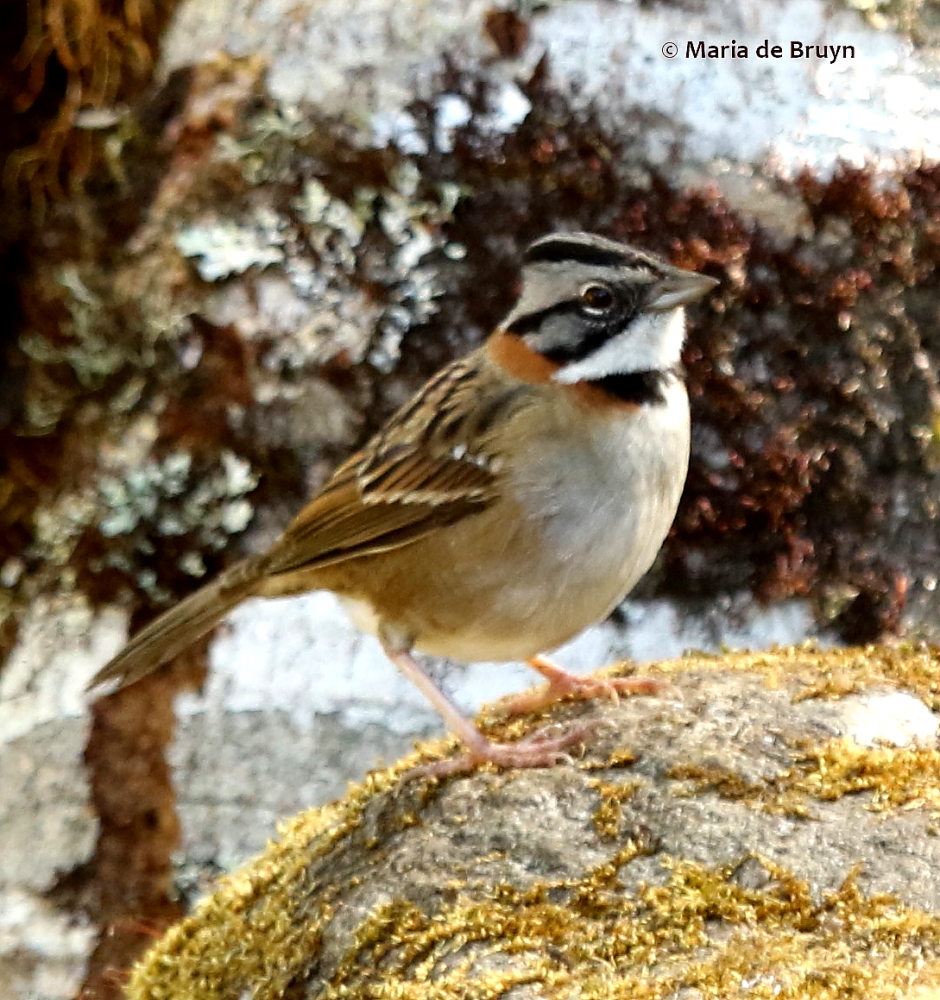
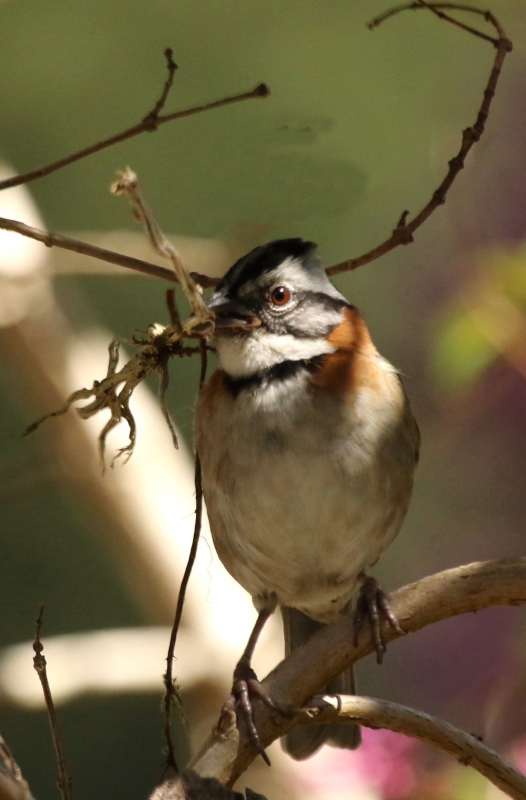
A rufous-collared sparrow (Zonotrichia capensis) was busy collecting material for a nest.


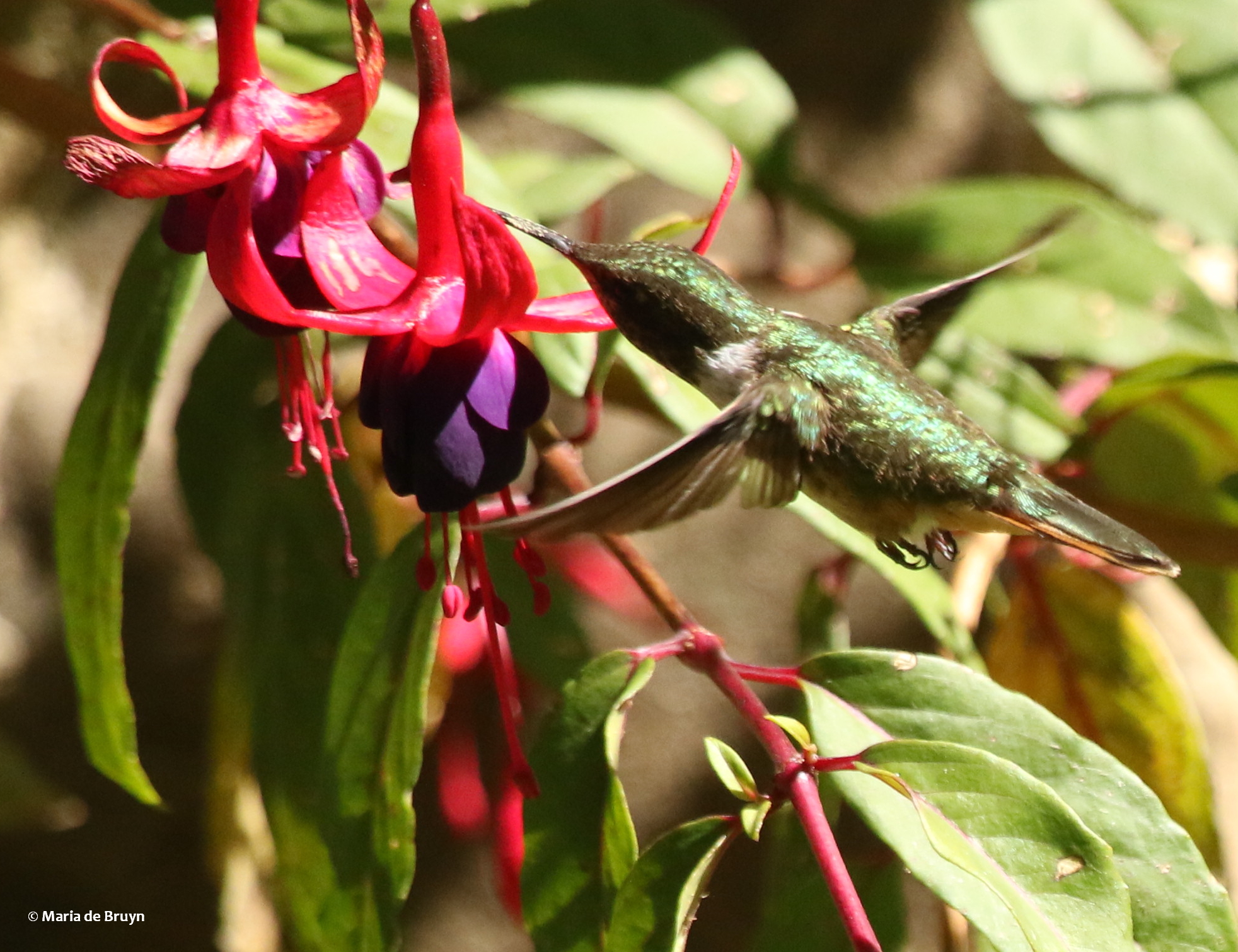
A hummingbird was busy having a meal, while a sulphur-winged parakeet (Pyrrhura hoffmani) had a little rest and watched us.


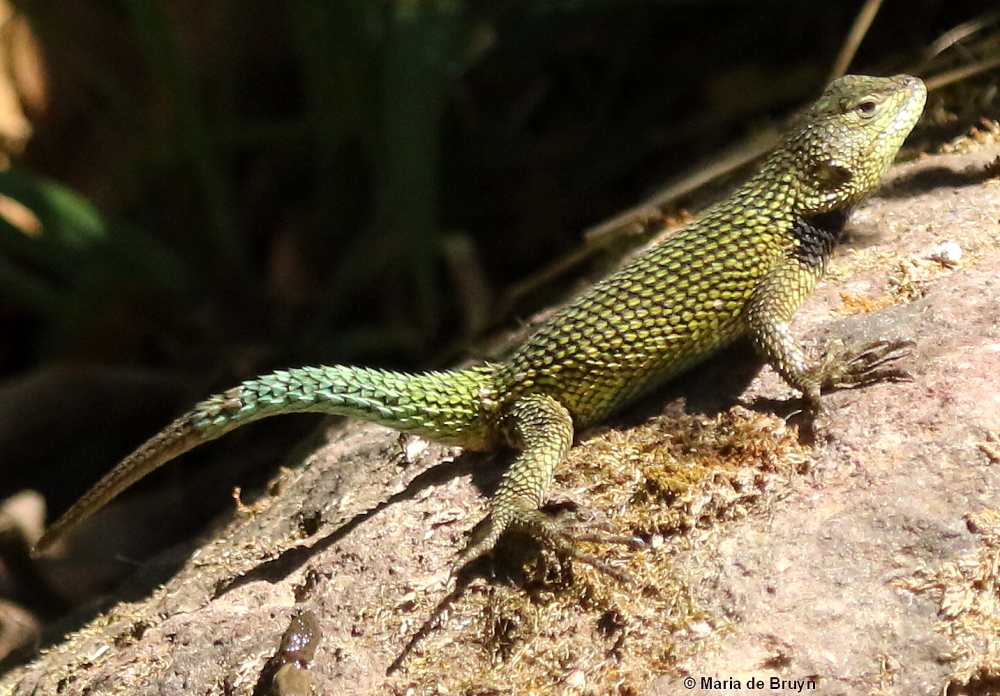
For those of us interested in all wildlife besides birds, a treat was running into an emerald swift lizard (Sceloporus malachiticus) along the trail. We admired the reptile’s beautiful colors before setting up further along the rising path. (More on this day’s excursion follows in the next blog!)