Quebec chronicles – passerines with yellow and green colors, part 2

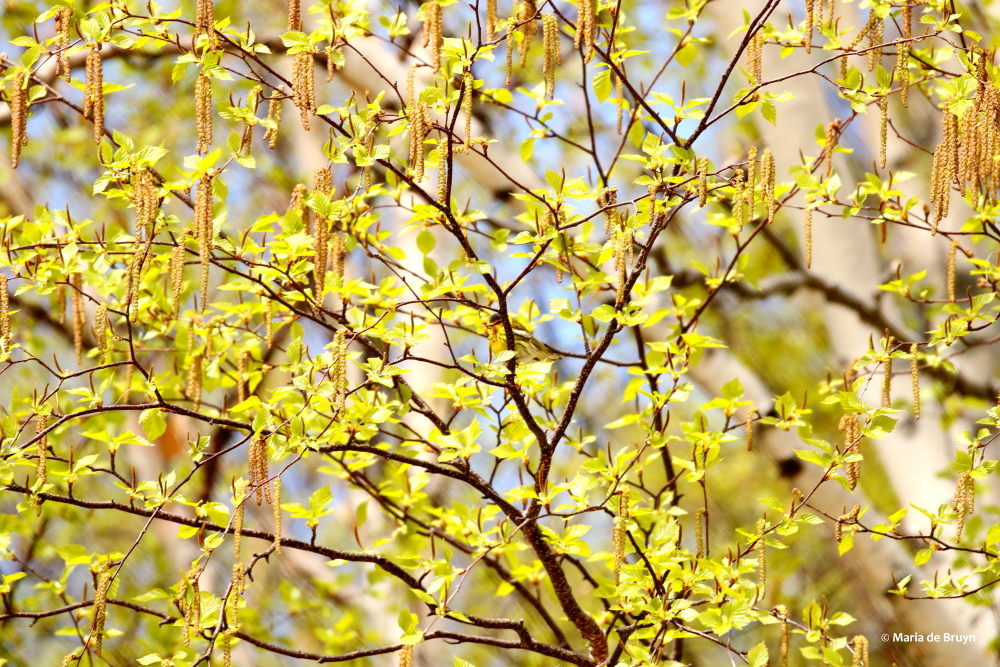
My last “bird blog” from Quebec! The passerine birds that we admired during our trip there included the vireos and grosbeaks. But I saved one warbler for this blog since I often had to look at the photos to be sure which species I had seen. The Tennessee warbler (Oreothlypis peregrina) could namely be mistaken for a Philadelphia vireo if it goes by quickly and you are not an experienced or expert birder. (It also can be easily mistaken for a female black-throated blue warbler.)

This very charming bird seemed to be everywhere we visited in great abundance. I had seen one last summer in North Carolina; now I got to see dozens of these little beauties.


Like the bay-breasted warbler, it specializes in eating the spruce budworms and hence its numbers wax and wane along with the availability of this food source.It was gleaning in all kinds of trees as well as along the shore, however, and obviously also looking for other types of food.


Besides insects, this bird also likes nectar and gets it by piercing flowers at the base of their stems on trees.


On the one day that it rained, I saw one waiting out the shower in a yard tree. On another morning, I surprised a Tennessee taking a bath in a little puddle formed by a streamlet flowing from a yard to the street where we were staying. The bird was still wet but fluttered its wings and dried off very quickly, looking fresh and pretty for a possible new partner.


The Philadelphia vireo (Vireo philadelphicus) is another attractive avian. It has the same coloring as the Tennessee warbler but has a bit of a hook at the end of its bill.

Like the Tennessee warblers, they migrate to Mexico and environs during the winter. Their meals of choice are insects and some berries (e.g., bayberry and dogwood). The birding websites and Wikipedia do not have anywhere near the same amount of information on this species as some others, so they likely have not been studied very much.


One day as I walked a path in one of the nature reserves, a Philadelphia vireo followed me a bit as I walked, finally perching on a nearby branch and fluffing its feathers. S/he looked like someone showing off a party dress.


The blue-headed vireo (Vireo solitarius) is a much darker bird, with olive-green feathers, a blue-gray crown and white “spectacles”. I haven’t seen many in North Carolina and I only saw two in Quebec – decidedly a somewhat shyer bird than many of the others that crossed my paths.

Finally, some birds that gave me very good looks were the stunning evening grosbeaks (Coccothraustes vespertinus).

These birds only very rarely show up in the Piedmont area of North Carolina in the winter but last year I had the privilege of having a male and two females visit my feeders for one day. During this trip, we visited a neighborhood where a whole flock was busy feeding in the trees.

The males have rich deep yellow coloring offset by white and black accents on their heads, wings and tails. At one feeder, I was surprised to see one male apparently feeding another. It turns out that they may be territorial in wintertime around food sources but in the spring and summer, they are quite social and tolerant because there is a greater abundance of insects, buds, berries and seeds.


The females are much more muted in color with light yellow highlights against a pale gray background but they also have beautiful patterned black and white wing feathers. Their light yellow-lime-green beaks serve well to break apart seeds.


The oldest evening grosbeak on record reached the age of 16 years, 3 months. It appears that their numbers may be decreasing, although the population as a whole is not yet at risk. I look forward to another “irruptive” year, when they expand their winter territory – perhaps I’ll have a couple unexpected visitors again!

Quebec chronicles – passerines with yellow colors, part 1

People who journey to the Tadoussac Dunes area in Quebec during spring bird migration often are focused mainly on one type of bird. They are members of the group of passerine birds, i.e., birds that perch using four toes – three that face forward and one that faces backwards. The “new world warblers” (also called wood warblers) are a subgroup of passerines that are only found in the Western hemisphere. They are featured in this blog and include some of my favorite photos from our trip. The next blog, passerines part 2, will feature other bird species that perch.

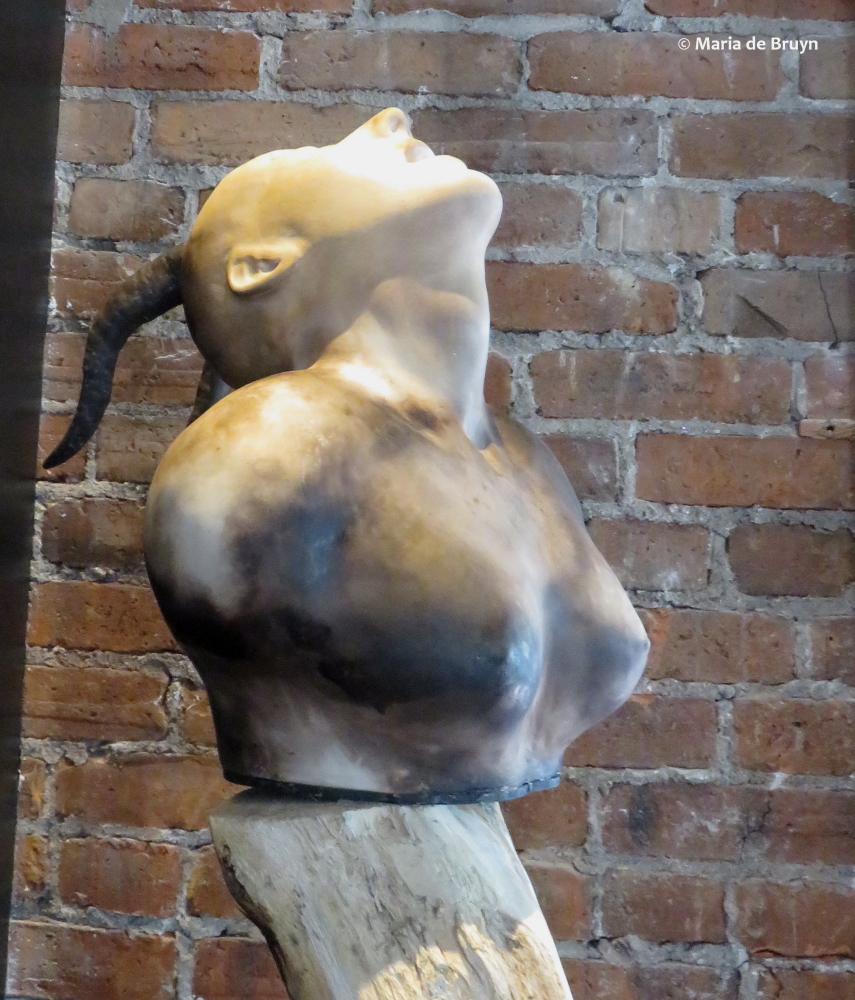
The warblers really are quite beautiful in their breeding plumage and many birders spend long periods of time searching them out and admiring them. This often involves looking up at treetops since many species forage for insects in mid- and high forest canopies. This may lead to a condition in humans called “warbler neck”, the result of staying for a prolonged time in the posture indicated to the left. (The statue was in the lobby of our Quebec hotel and was called “Force intérieure” (inner force) by Julie Lajoie.)

One warbler that we didn’t need to strain to see was the Cape May (Setophaga tigrina), which was named for Cape May, New Jersey, where it was first observed by ornithologist Alexander Wilson in 1811. After that, these birds weren’t seen again in that area for more than a century!
The males really do call attention to themselves with their bright breeding colors – a distinctive rusty cheek patch, yellow throat and collar, dark crown and lots of vertical black stripes going down its sides and chest.

In spring, this warbler migrates almost 3,000 miles from the West Indies to the coniferous forests of Canada and the northern US to breed. As the fist-sized songbird flies north, its diet adapts to the environment. During winter among the palm trees, the Cape May drinks berry juice and the nectar from flowers thanks to its unusual semi-tubular and curled tongue. (It will also drink from nectar feeders!) But in summer in the boreal forests, it eats insects—especially the spruce budworm—with a special gusto.

The male and female build a nest together near the top of a tree (35-60 feet high!) and the female tries to prevent others from seeing the nest. She namely will not enter the nest directly but goes up and down the trunk of the tree, entering from below.

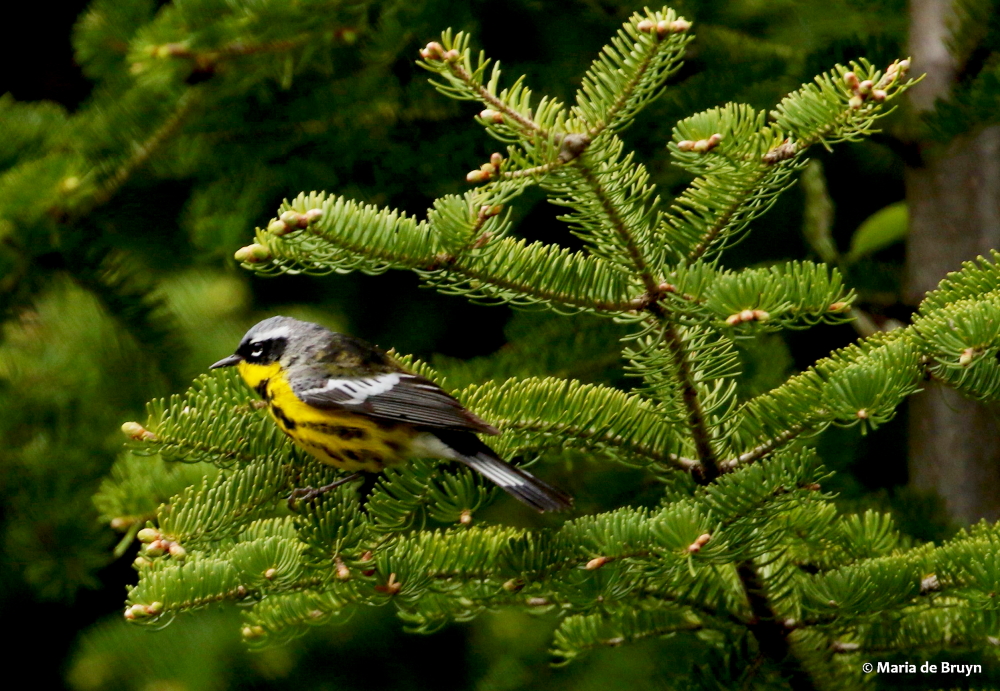
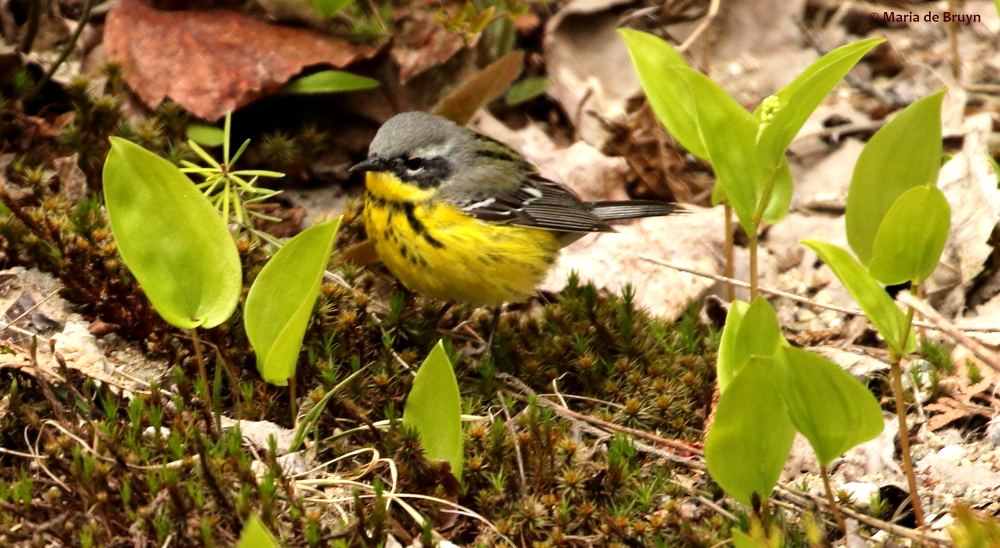
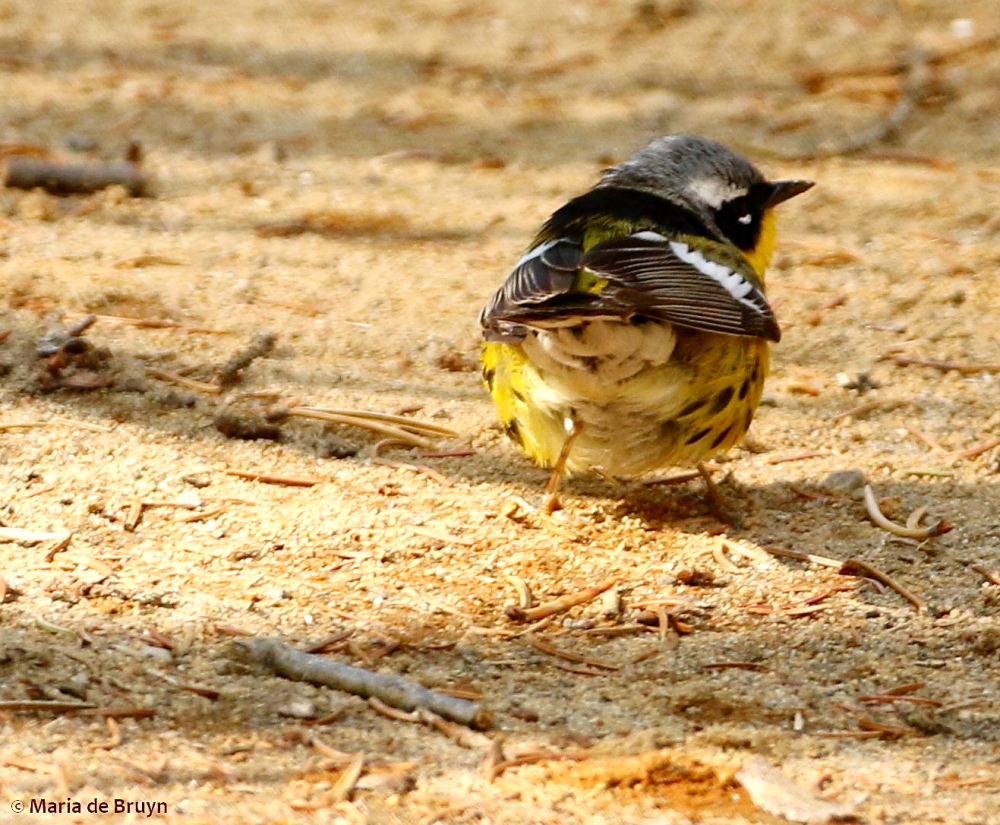
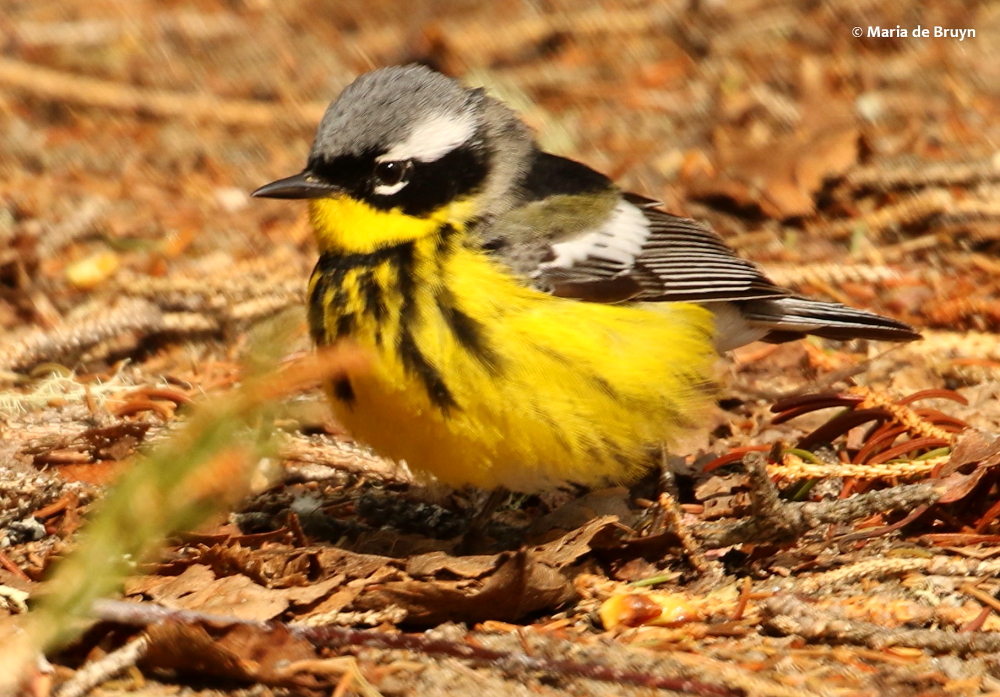
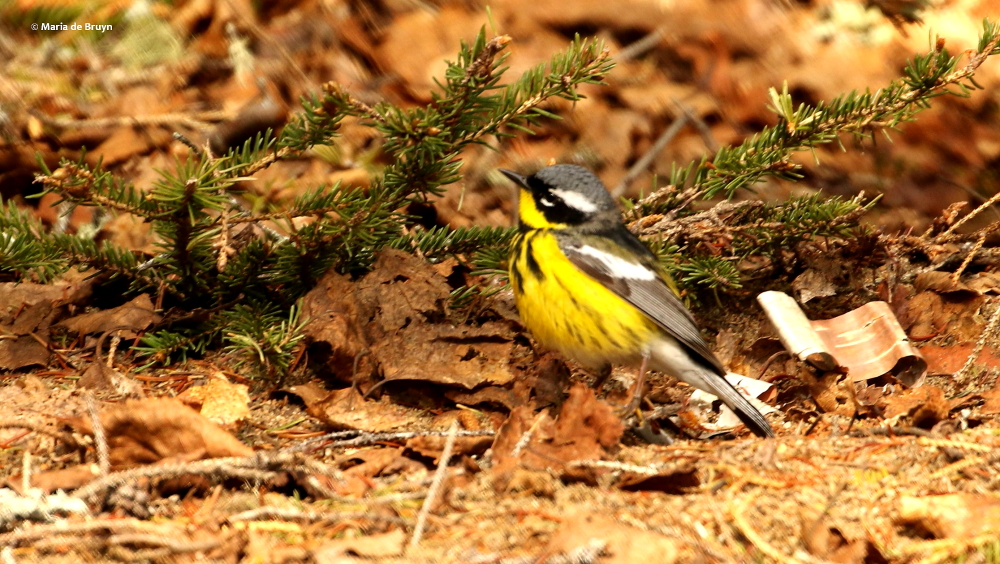
A second seemingly ubiquitous bird at our migration destination was the magnolia warbler (Setophaga magnolia). Like the Cape May, the male in breeding attire has vertical black stripes on a yellow chest but his face is marked by a black mask topped by a white stripe.


Most of my sightings of this species involved individuals looking for insects on the ground. At one point, it was interesting to see a “Maggie” fluttering his wings over sandy spots in the dunes, obviously to scare up insects that he then quickly grabbed. My attempts to get a photo of the fluttering were unsuccessful but it was very cool to watch.


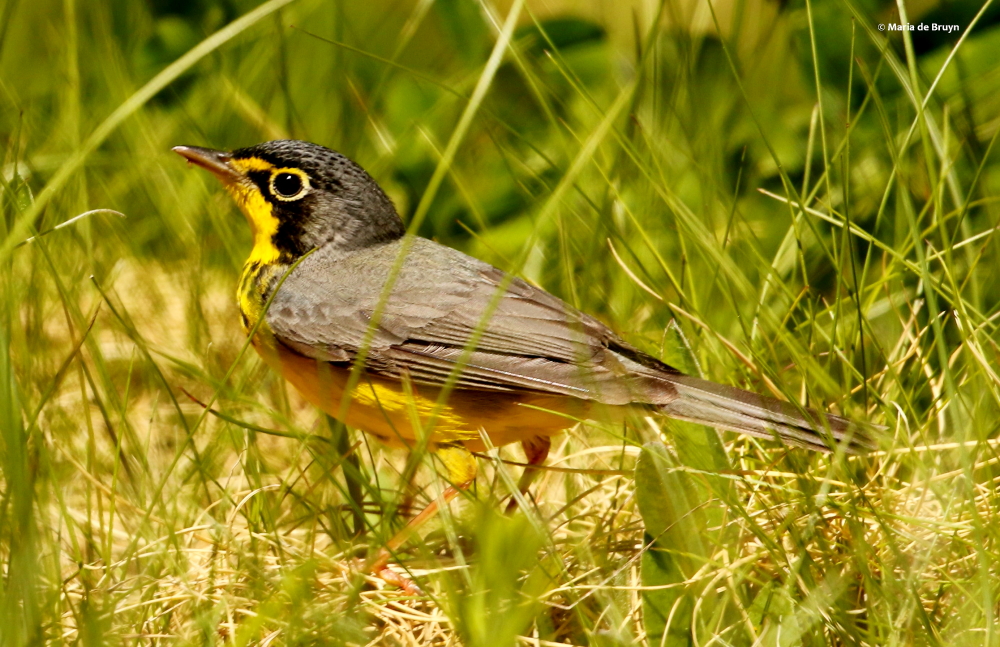
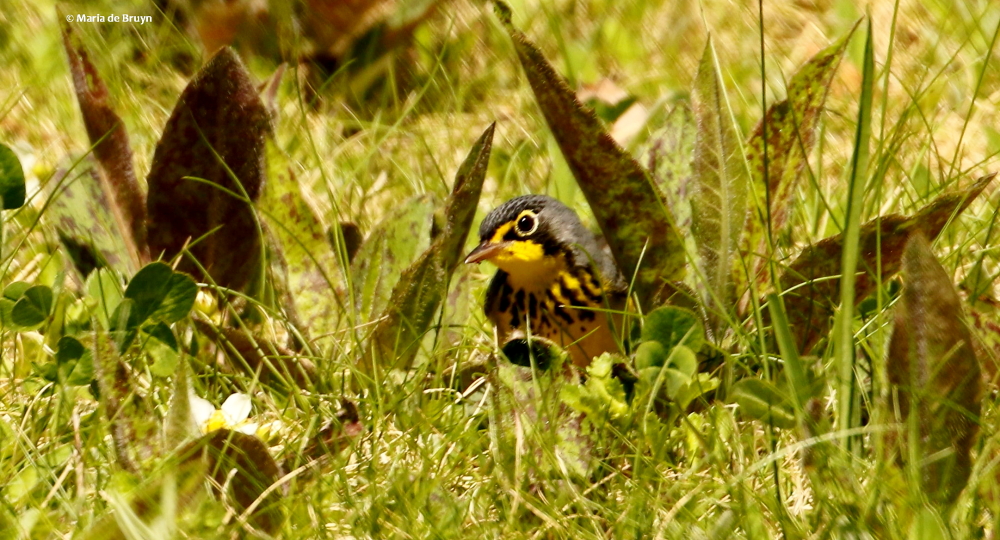
Another warbler that sports a black “necklace” against a yellow breast is the Canada warbler (Cardellina canadensis). Males and females look similar except that the male has a bit longer tail and somewhat darker breast stripes.


Some of these birds spend the summer in the Appalachian Mountains of western North Carolina (NC), but I had not seen one before. Towards the end of our trip, a Canada warbler decided to forage in the yard of the house where we were staying – finally, I was able to get some good looks at him!

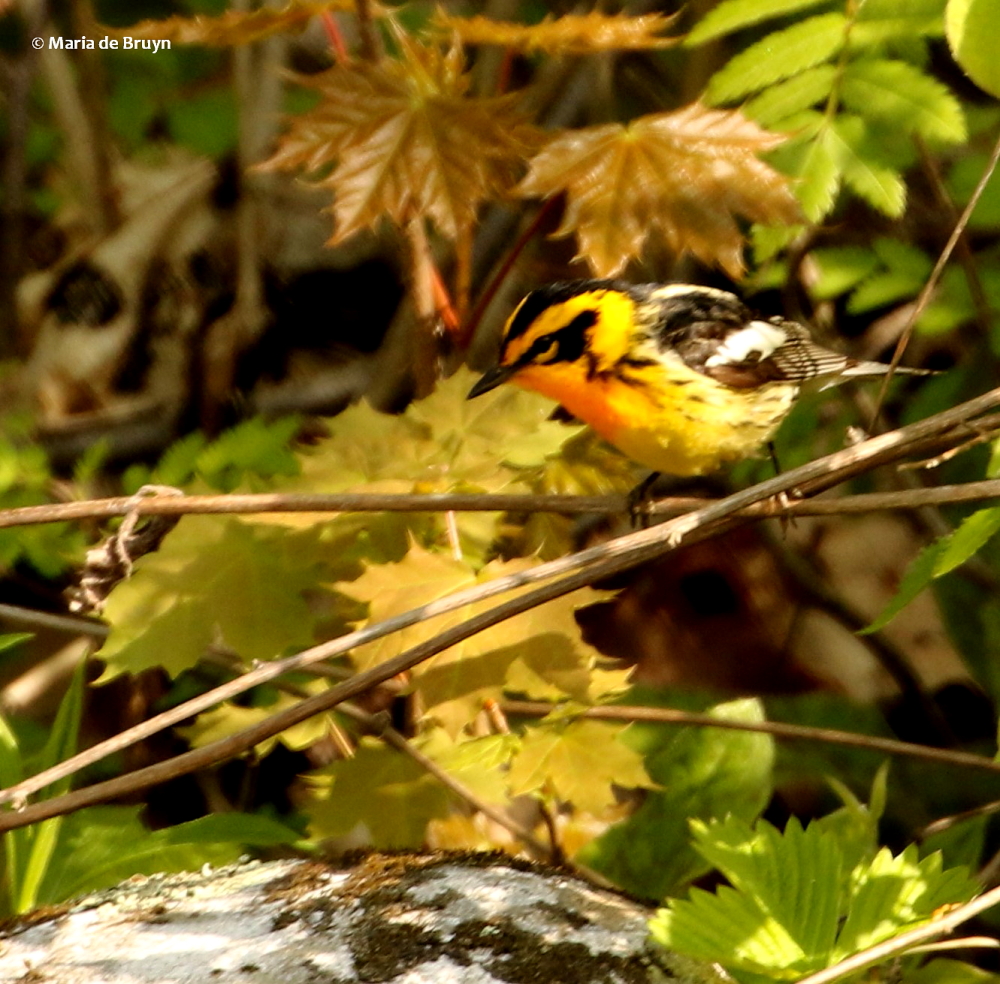
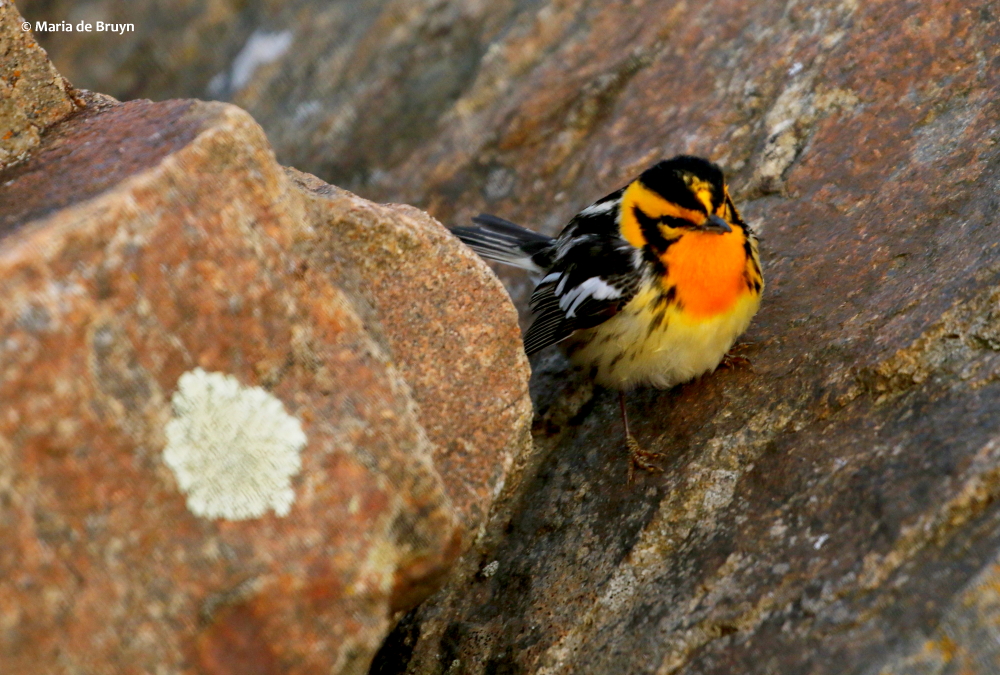
The male Blackburnian warbler (Setophaga fusca) also has black breast stripes but against a white background. His face is quite striking with a flame-orange throat against a yellow and black head.  The female is somewhat more muted in coloration but also quite lovely.


These birds do not appear to be shy around people. One was grabbing insects in a grassy patch near a parking lot and not at all perturbed when five of us stopped nearby to take portrait shots.

Another was intent on getting insects among the rocks alongside a pier.


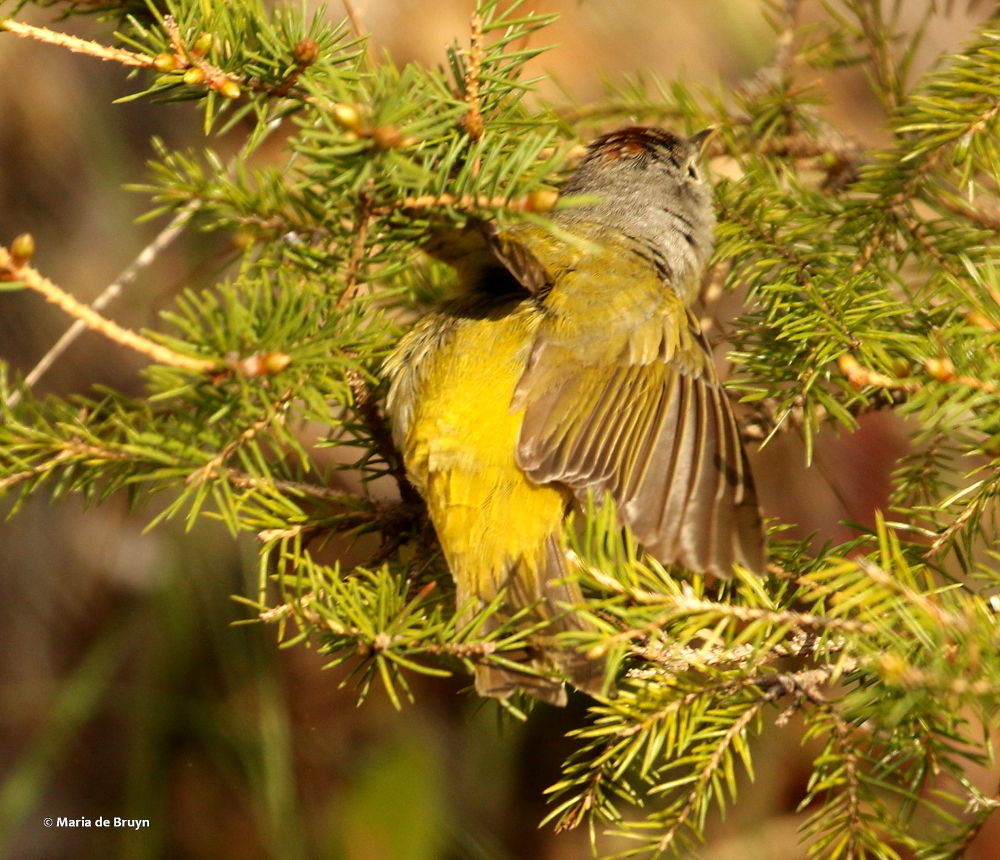
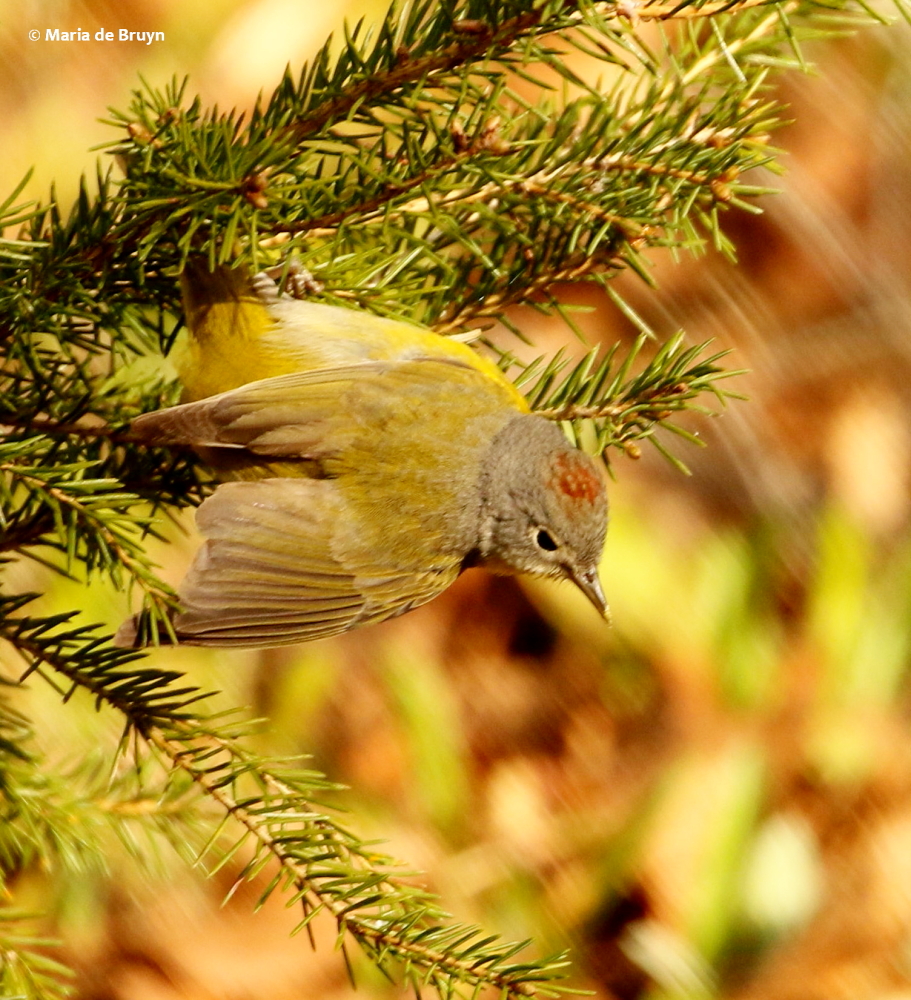
The Nashville warbler (Oreothlypis ruficapilla) was a lifer for me, fairly easy to distinguish by its rufous cap.


An interesting bit of information about them is that they sometimes use porcupine quills in constructing their nests, which they locate on the ground under shrubs!

The Wilson’s warbler (Cardellina pusilla) also has a distinctive cap, but when I got to see one around dusk one day, it didn’t feel like turning around to face me. It was nevertheless another lifer.

They spend a lot of time in the understory and nest on the ground, but that apparently doesn’t make them easier to spot!

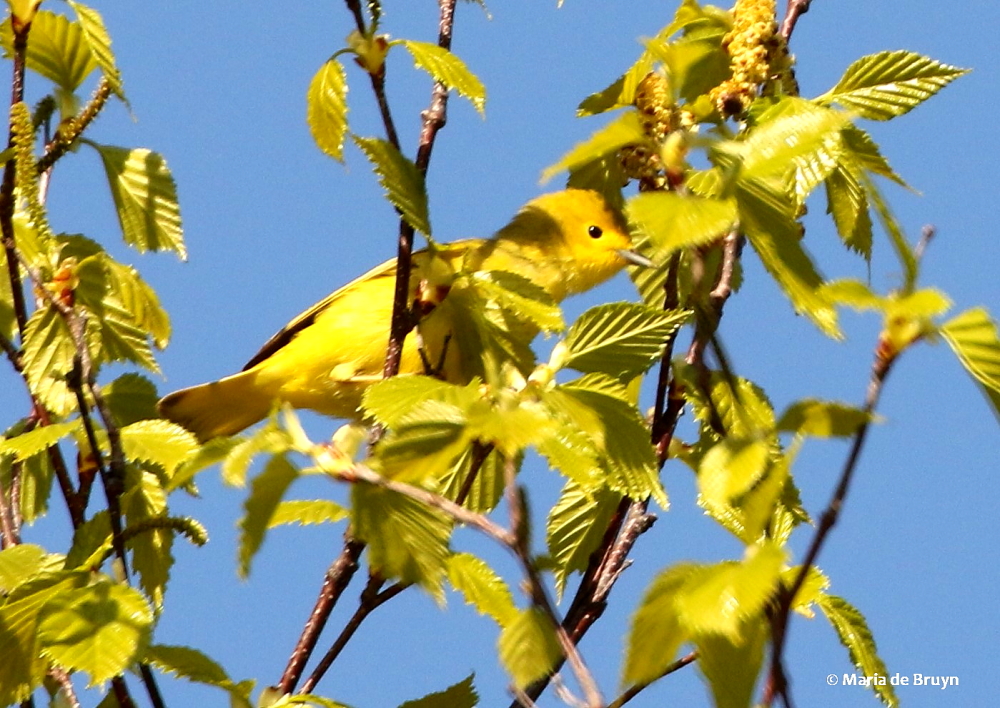
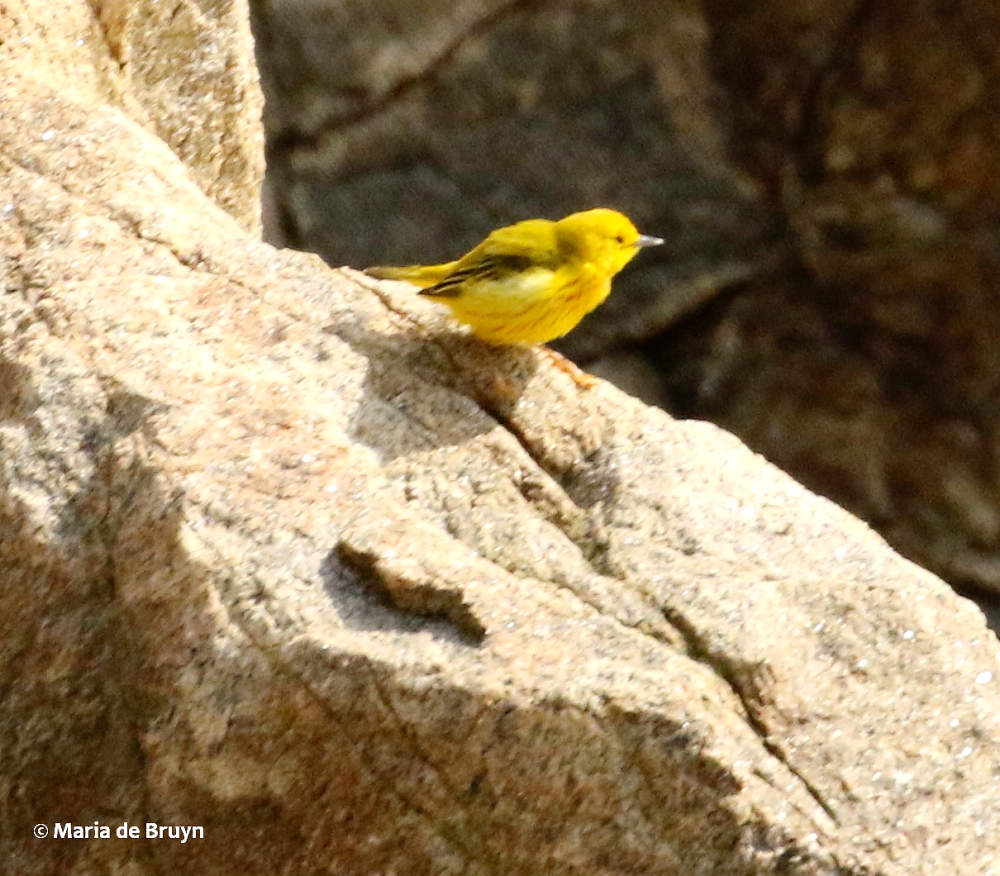
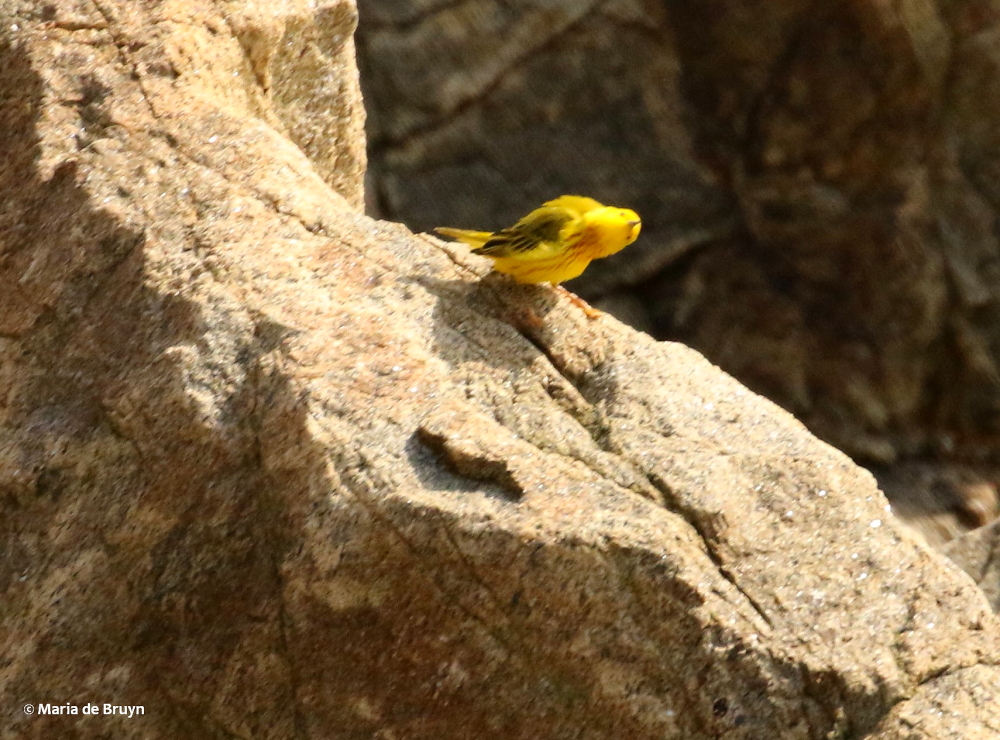
One warbler that I have seen several times in NC is the tiny yellow warbler (Setophaga petechia). They tend to like being near wetlands and streams and this has proved to be the case for my spottings. I have seen them near a water ditch in one reserve as well as near the Haw River. In Quebec, I also saw one searching for insects in the rocks bordering a pier.


You can see that this warbler has reddish striping on its chest and that is what I’ve noted in the birds seen in my area. However, below you can see a male bird without striping; our local guide said that a number of birds that breed in Quebec do not develop any striping but remain entirely yellow.


A behavior that distinguishes them from many other birds is that they are capable of recognizing when a brown-headed cowbird has laid one of its eggs in their nest. The yellow warblers try to avoid raising the nest parasite by smothering the cowbird egg with a new layer of nest materials. If they had already laid eggs of their own, they then produce a new clutch; sometimes, they just build a new nest elsewhere.

Another warbler that is quite familiar to me is the yellow-rumped warbler (Setophaga coronata). A group spends the winter at my yard feeders and begin changing into their breeding plumage shortly before migrating north. In Quebec, I got to see them in their full coloration, and they were handsome indeed!

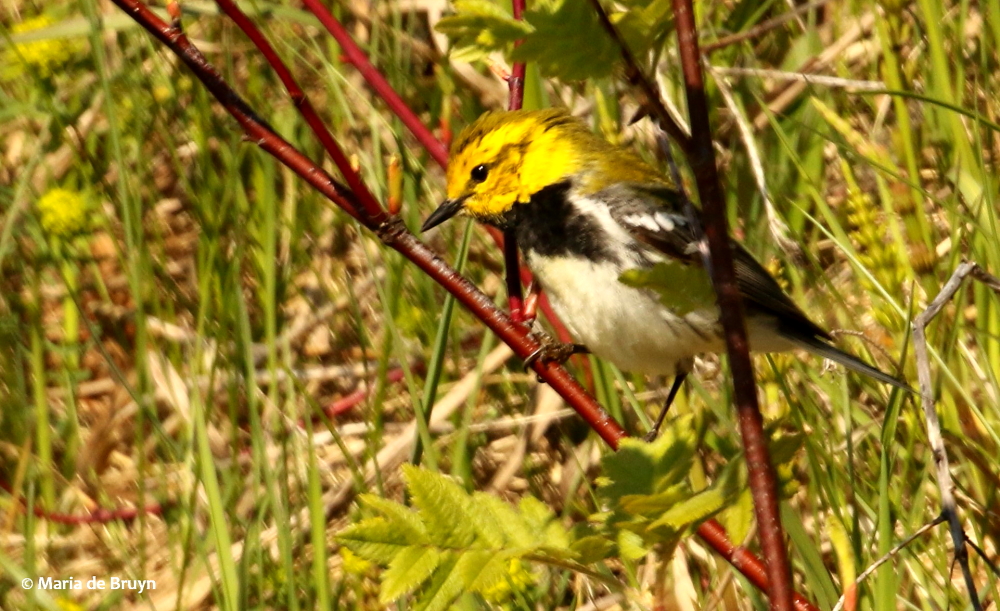
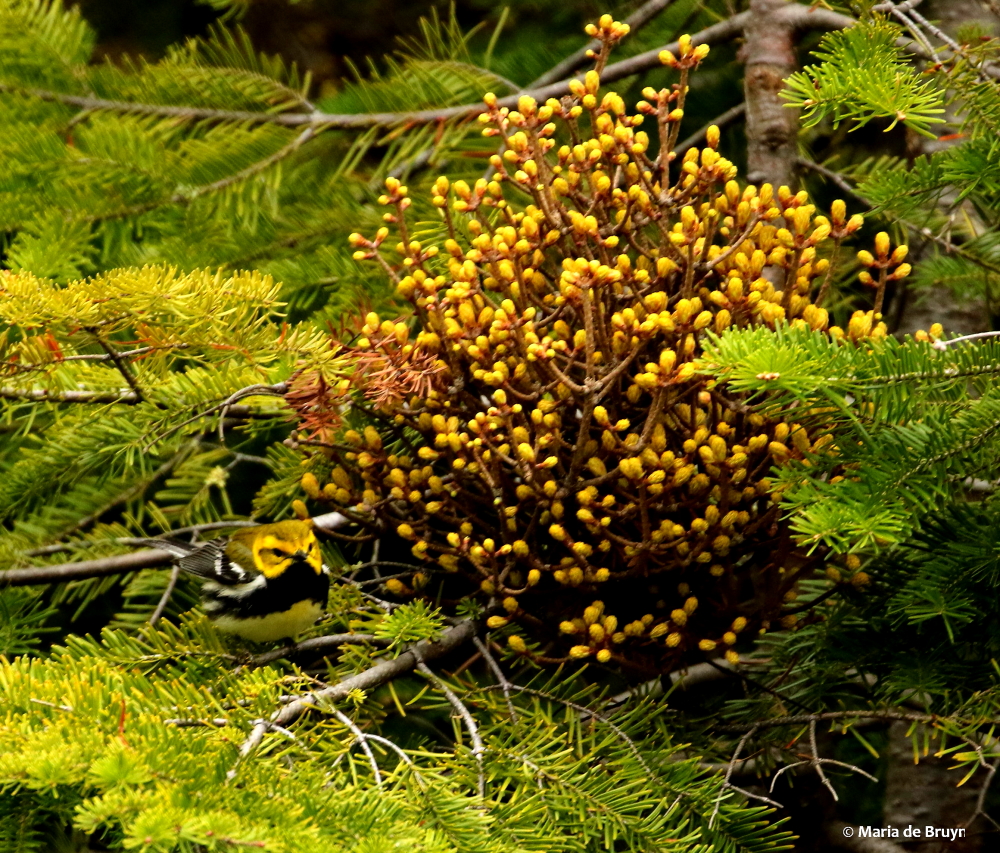
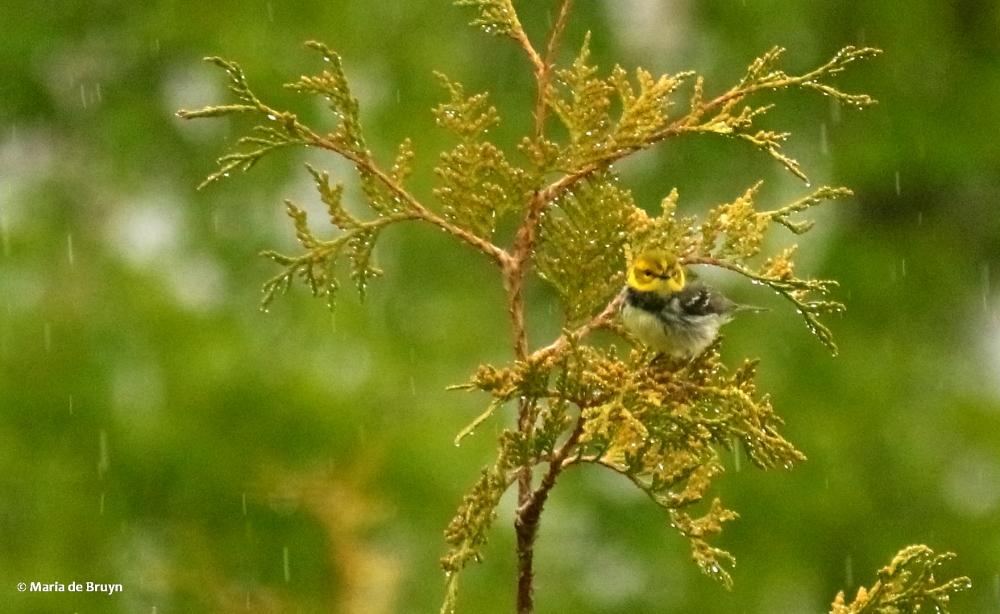
My final bird for this blog is also one I’ve seen before, but I found it simply stunning when watching it in the Canadian trees. The black-throated green warbler (Setophagahy virens) as the striped warblers but the brightness of the yellow and black coloring on the breeding male is wonderful to see.

They seemed to “color-match” some of the trees in which I watched them foraging.


In other cases, they complemented the deep green of the deciduous evergreen trees in which they were perching.


These birds particularly like caterpillars but eat a wide variety of insects. An interesting behavior observed by researchers concerns its singing – the males really like to belt it out, with one male having been recorded singing 466 songs in one hour!


Having observed these wood warblers in their breeding habitat, I now have an increased understanding of why birders are willing to endure warbler necks. 😊

Quebec chronicles – the non-avian wildlife

While birding has become a beloved pastime for me, I think of myself mostly as a wildlife photographer. I enjoy observing (new) insects, reptiles and mammals as much as I like seeing birds and find their behaviors just as fascinating. So I was also on the lookout for non-avian wildlife during our recent migration trip.

You could tell that springtime was flourishing as plants were putting out new leaves and buds. There were gorgeous red (Trillium erectum) and white trilliums (Trillium grandiflorum).


Fiddlehead ferns were popping up everywhere. And a new flower for me was the white baneberry (Actaea pachypoda).

Yellow trout lilies (Erythronium americanum) were emerging and red columbines (Aquilegia canadensis) dangled their pretty red and yellow blooms.

Red osier dogwoods (Cornus sericea) were in meadows at one park and in the area where we were staying, multiple shadbush (serviceberry, Amelanchier) trees were in bloom.

Quite an unusual plant turned up in Pointe au Pic near an area with local shops. I had not seen one like this before – a helpful member of a plant identification group told me it was a rhubarb (Rheum).

The dandelions (Taraxacum officinale) we saw were very large in comparison to those I’ve seen in North Carolina (NC). Interesting is that the official name in French is “pissenlit”, which literally translated would be “piss in bed” (although proper French speakers would say “Pisse au lit”). In any event, dandelions can not only be eaten in salads but also be used as a diuretic, so perhaps centuries ago the French Quebeçois were referring to the flower’s properties in describing it. Another French name for the bloom is “lion’s teeth” or “dents de lion” (from which the English word dandelion came).

The insects were taking advantage of those edible yellow flowers; both spiders and ants were busy crawling around them.


A beautiful syrphid fly was also busy getting its meal, while an unknown moth flitted down to rest in the middle of a road.

There were butterflies at the shorelines, like this Lucia azure (Celastrina lucia) and mussel shells rested on rocks.


A spur-throated grasshopper (Melanoplus) was hanging out on a pissenlit, and a diamondback moth (Plutella xylostella) turned up in a photo of another plant (not a great photo but a lifer insect for me).

A beautiful honey bee (Apis mellifera) was covered in pollen.

Another new insect for me was the tricolored bumble bee (Bombus ternarius).

A few mammals appeared during our spring vacation, although not the hoped-for moose. (We unfortunately saw one black bear, but it had been hit on the road.) On several days, I caught sight of white-tailed deer (Odocoileus virginianus) bounding away, both in the area where we were staying and in the parks that we visited. I managed to catch a glimpse of an Eastern chipmunk, too, but it wouldn’t come out from behind some twigs for a photo shoot.

Much more cooperative were the American red squirrels (Tamiasciurus hudsonicus), which feed primarily on conifer cone seeds. They also enjoy other foods such as mushrooms, which were beginning to grow profusely like this nice morel.

The chickarees (another name for these rodents) were often out and about along the roadway where our rental house was located.

On one day, I ran into a small squirrel that seemed to have a problem with its left eye. However, it might have been a trick of the light. I tried to get another view, but the little rodent wouldn’t let me get around to its other side to take a photo. In any event, they are beautiful little creatures (generally smaller than the large gray squirrels that reside in my yard).

A very pleasant surprise during our trip was running into some groundhogs (Marmota monax, also known as whistle pigs and woodchucks). It is said that they tend to avoid swampy areas and like open fields and meadows but both woodchucks we saw were spotted near water. The first one we saw popped up near a cove on a paved road leading down to the water. The mammal was surprised by our group which had occupied a space between the water and nearby vegetation areas.


We tried to stay in one area so the groundhog could go around us, but s/he was uncertain about passing us, making several forays in our direction, turning around and then heading back again to get to the bushes and trees.


Finally, the groundhog screwed up its courage and ran at high speed past us and disappeared into the trees.


A couple days later, one of our group spotted another groundhog that was foraging in the newly leafing out shrubs alongside a creek that ran into a cove. The large rodent was agile and able to climb up into spindly little trees.


Its bulk also made it lose its footing a few times, but the mammal managed to hold on and regain its balance so that it could continue munching on the fresh food. It was delightful watching this beautiful rodent going about its daily business.

Another mammal that proved to be a bit elusive for me (others in our group were able to get some good out-in-the-open views) was the snowshoe hare (Lepus americanus). During our first full day of exploring, we spotted one bounding away into the underbrush, which was quite exciting. Then a few days later in the Tadoussac dunes, a hare suddenly bounded out of nearby shrubs to dash across the sand into another group of shrubs. I didn’t get sharp shots as I only caught sight of it out of the corner of my eye and it was almost gone as I swung my camera around.

The hares that we saw were not yet done changing into their “summer” colors and still had some winter white fur on their impressive huge feet. These mammals begin breeding in mid-March and females may have up to four litters a year. They often communicate with one another using their feet, thumping them on the ground to make messages.

On another day, I spotted a hare foraging in a brushy area. In the winter, they eat twigs, bark and buds but in summer they can enjoy grasses, clover, dandelions and other green plants. This hare was enjoying the fresh food, but I felt sad looking at her (or him) as its head was covered in ticks. I don’t know if the animal was particularly vulnerable because it was young, maybe not completely healthy or just had the bad luck to have sat in a nest of the nasty insects. I hoped that the hare would be able to go on in health after the insects fell off.


The snowshoe hares prefer to be in dense groundcover, so they are somewhat hidden from predators (coyotes, fox, lynx, minks, owls, hawks) while they search for food. Their “cousins” back in my residential area, the Eastern cottontail rabbits (Sylvilagus floridanus) also need to worry about predators (owls, hawks, crows, raccoons) but one pair has become quite relaxed in my yard. Here you see dad (left) and mom (right).

As far as I can tell, they had one surviving offspring. They don’t generally seem too frightened, however, and almost everyday I see them lounging in a relaxed manner in the back yard, in contrast to those beautiful but elusive snowshoe hares. I was glad to have seen the hares though.

Two more Quebec chronicles to go: the “flashy” and yellowish birds and signs of humans along the St. Lawrence Seaway.

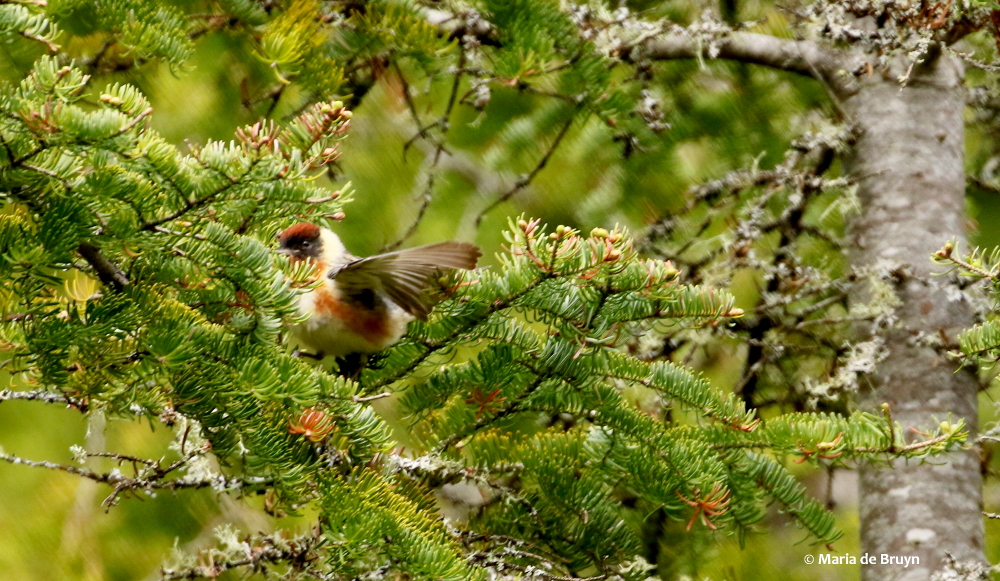
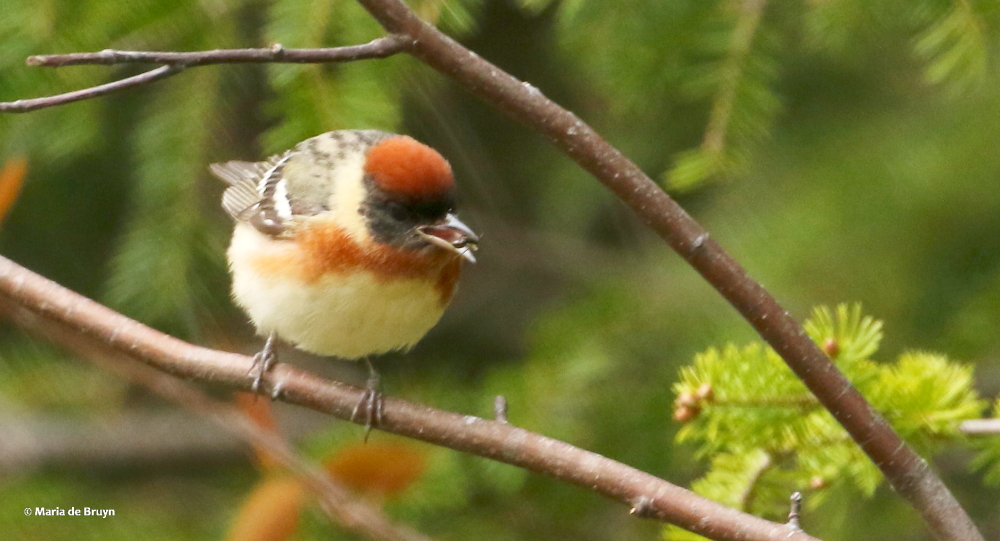
Quebec chronicles – brown and white beauties in abundance!

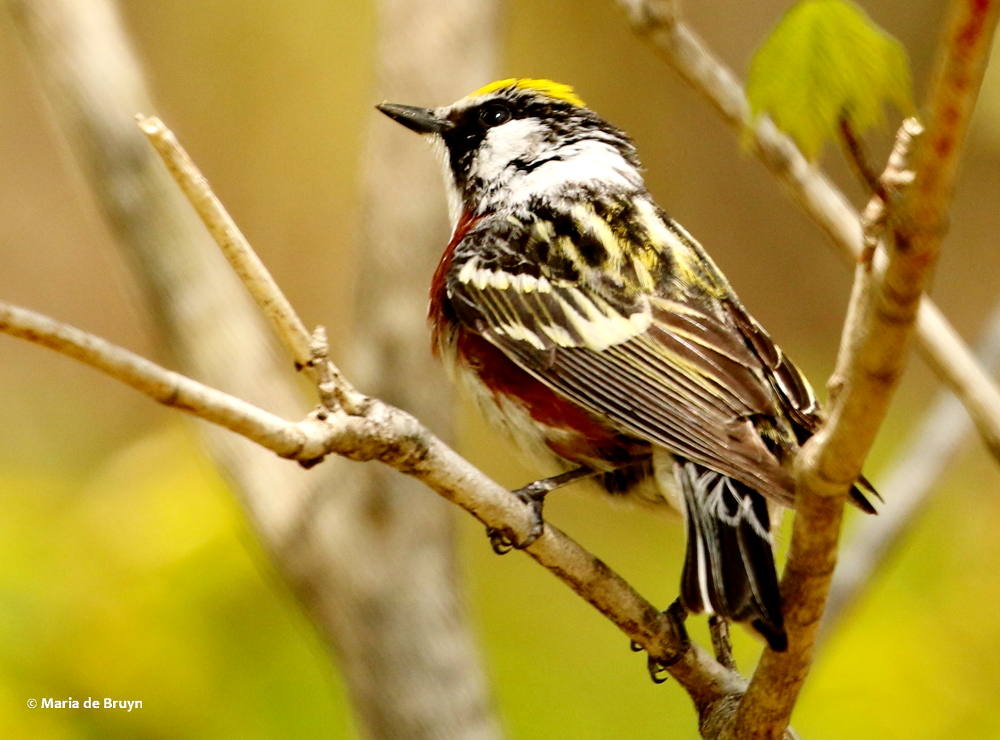
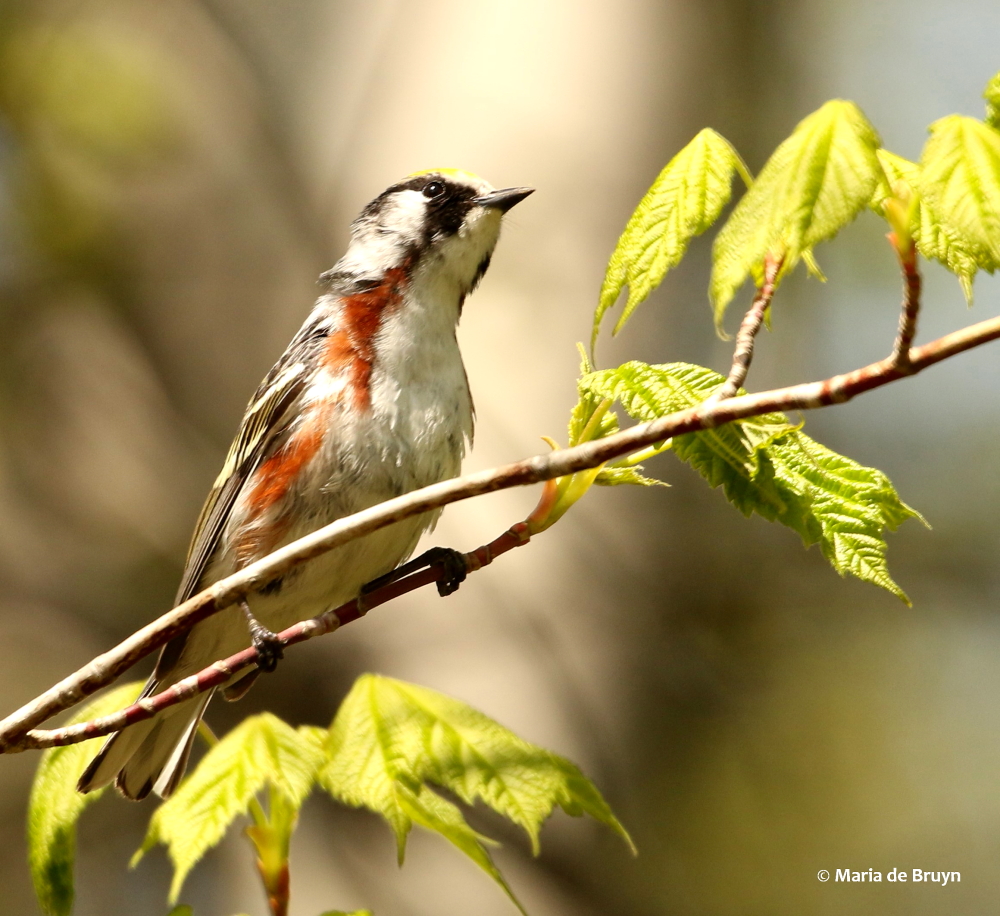
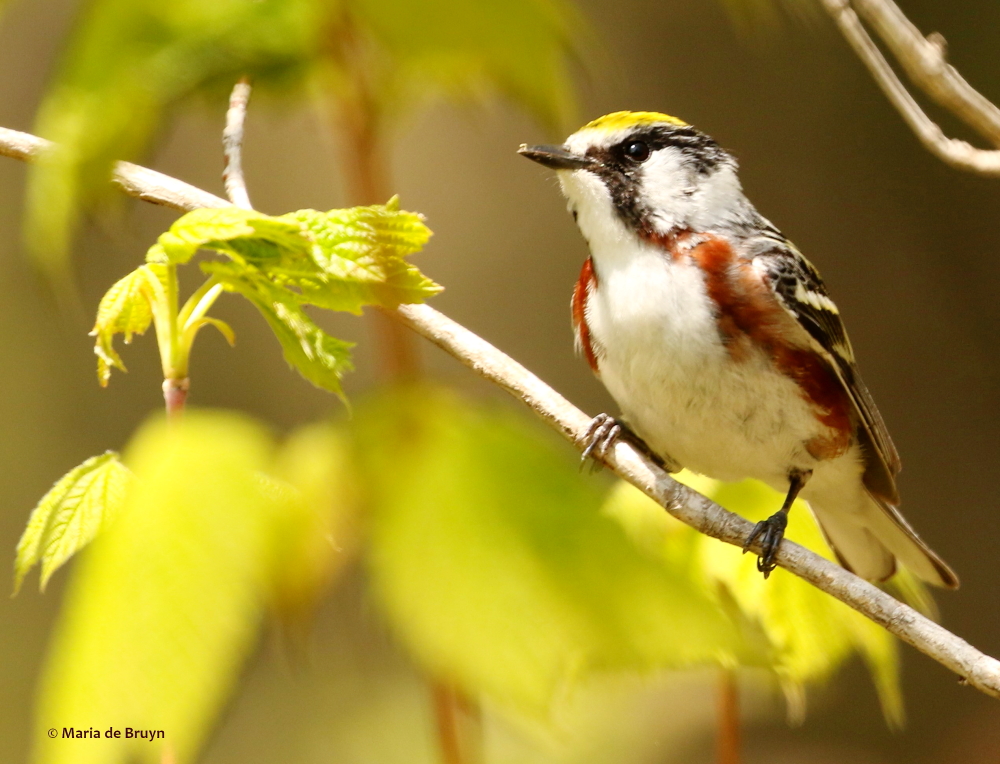
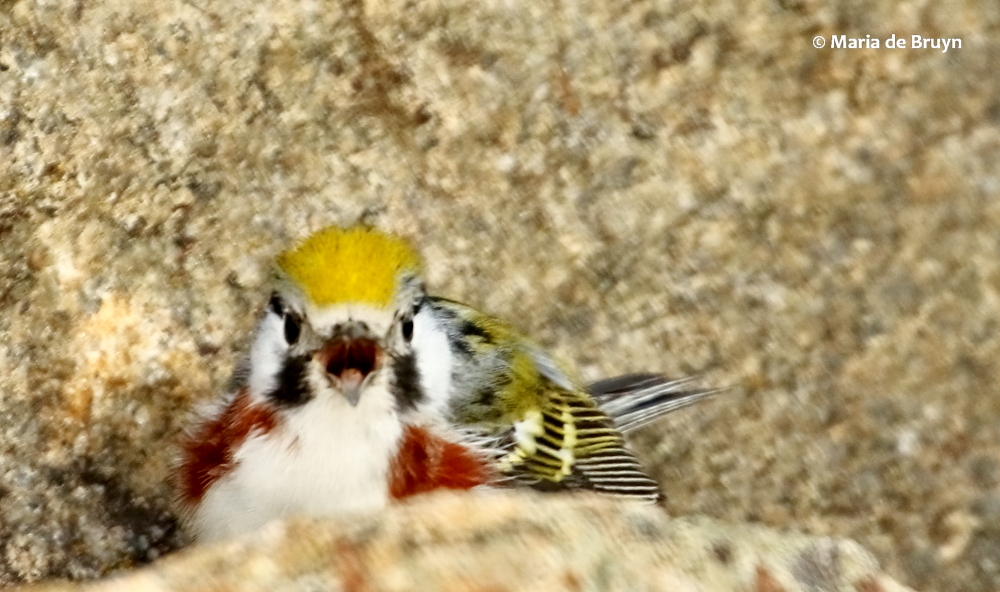
Several years ago, I saw my first chestnut-sided warbler (Setophaga pensylvanica) during breeding season in the mountains of North Carolina. It was a somewhat fleeting sighting but long enough for me to recognize the male’s beauty. My next sighting was a couple years ago when a pair stopped by a local creek during their south-bound migration in the fall. They were still attractive, but I had fallen for their mating season colors. What I didn’t know then was that when they reached their winter destination in some Central American area, they would be likely associating with the same birds with whom they had spent previous winters foraging.

Lucky me, therefore, when I noted that many chestnut-sided warblers were part of the spring migratory crowd in Quebec a couple weeks ago. I saw them in at least five sites and was able to get some nice photos of these beauties.

The Cornell Lab’s All About Birds website advises: “Stay around clearings, road edges, or other disturbed sites with young deciduous trees to find Chestnut-sided Warblers.” They did indeed appear in such places, looking for insects.


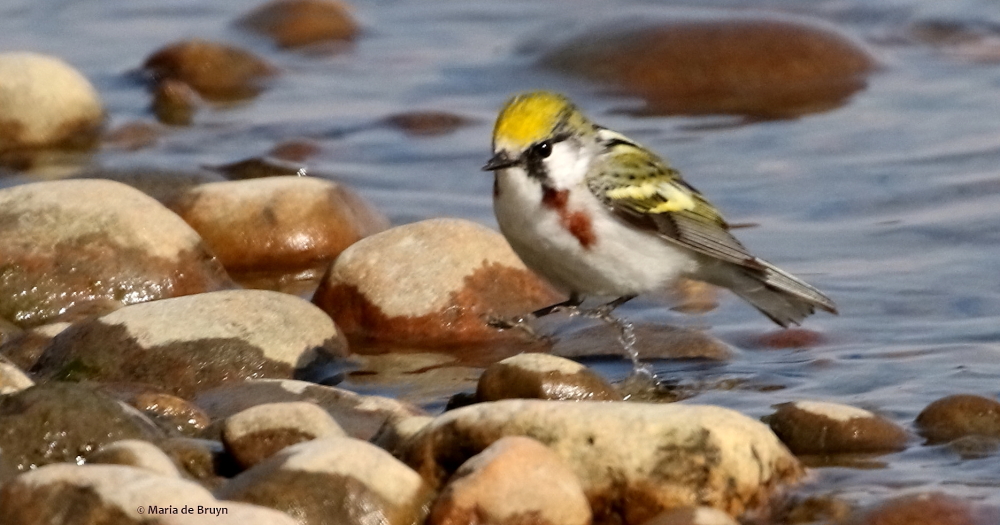
They appear to really like early successional deciduous habitats, e.g., terrains affected by logging, fire, storms and flooding. Clearing of people’s land around their houses may also qualify as a habitat-forming place for these little birds. We also discovered that these colorful warblers look for food among stones, rocks and boulders along bodies of water.


At a small park alongside an inlet of the St. Lawrence Seaway, a chestnut-sided warbler was hopping along the rocky shore seeking caterpillars.


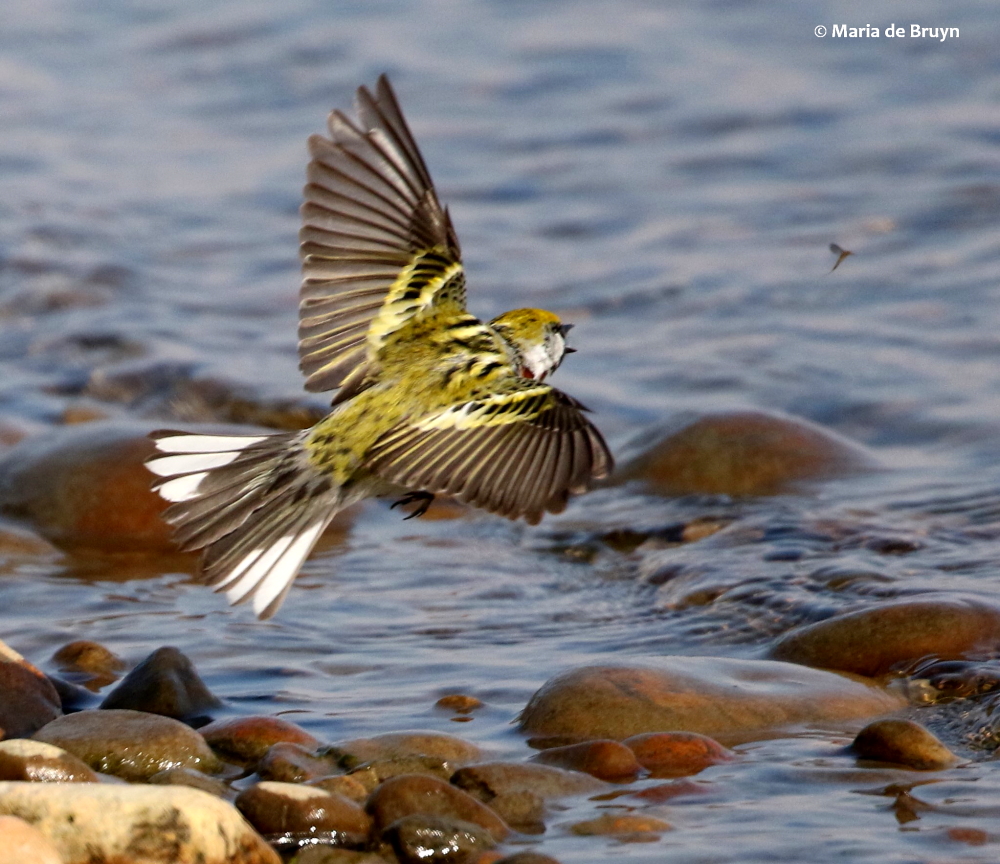
He also flew out over the water from time to time in order to catch insects on the fly.

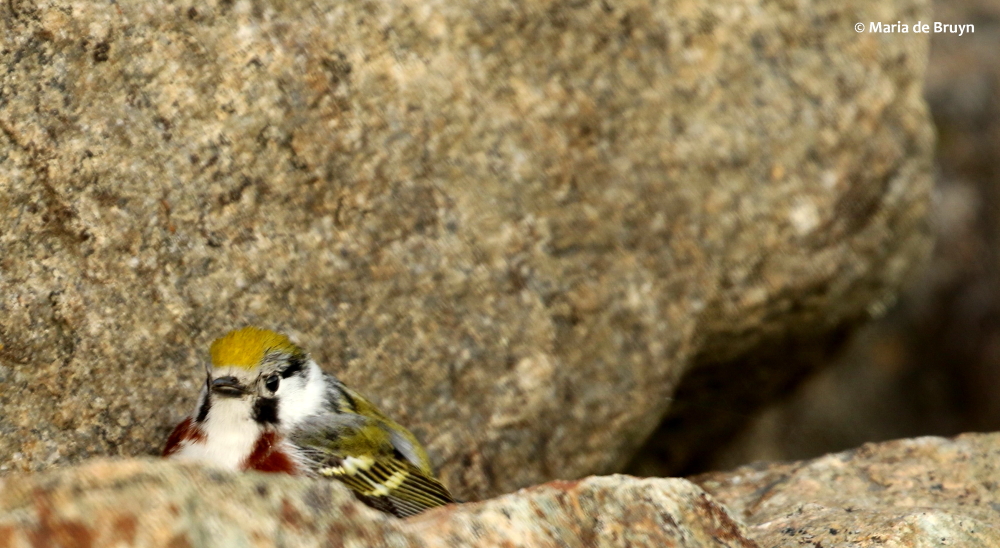
At the St. Irénée quay, a species mate was popping in and out among the large boulders on either side of the pier.

Seeing these beautifully colored birds as they hunted for insects was quite enjoyable. The Rev. Leander S. Keyser, who attended the 1896 World Congress on Ornithology, remarked that the chestnut-sided and blackburnian warblers were like “a sonnet in feathers – lightness of air and sunshine embodied – rhythm caught in a living form” – what a beautiful way of describing them!


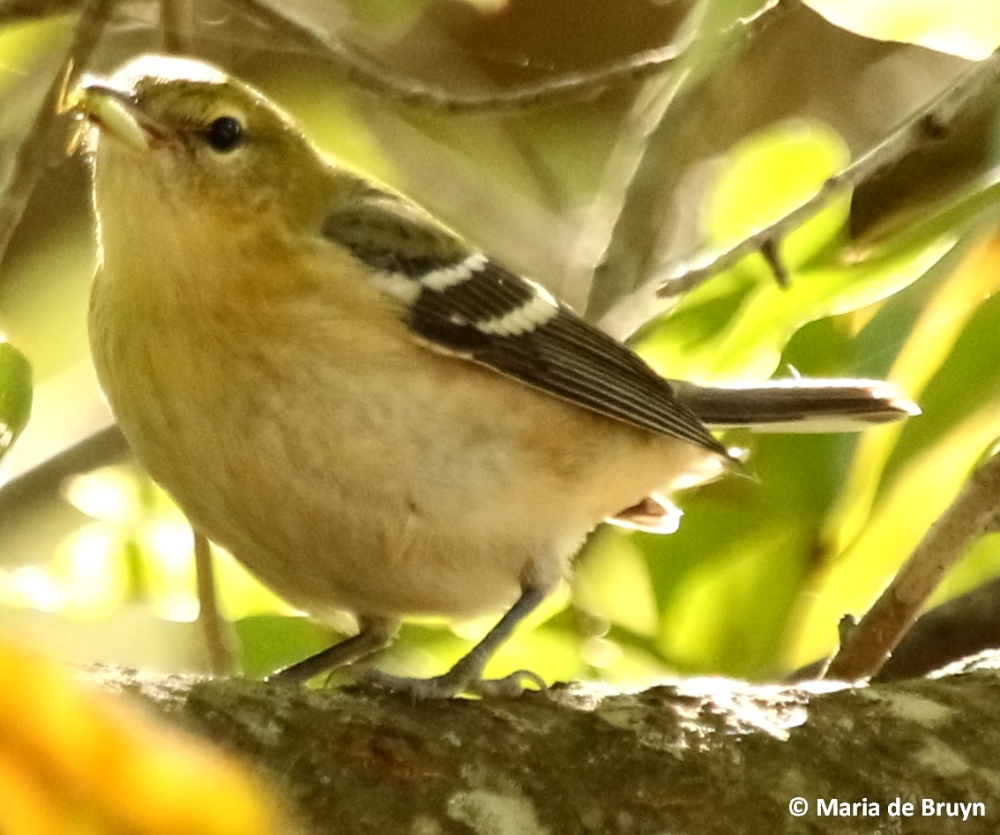
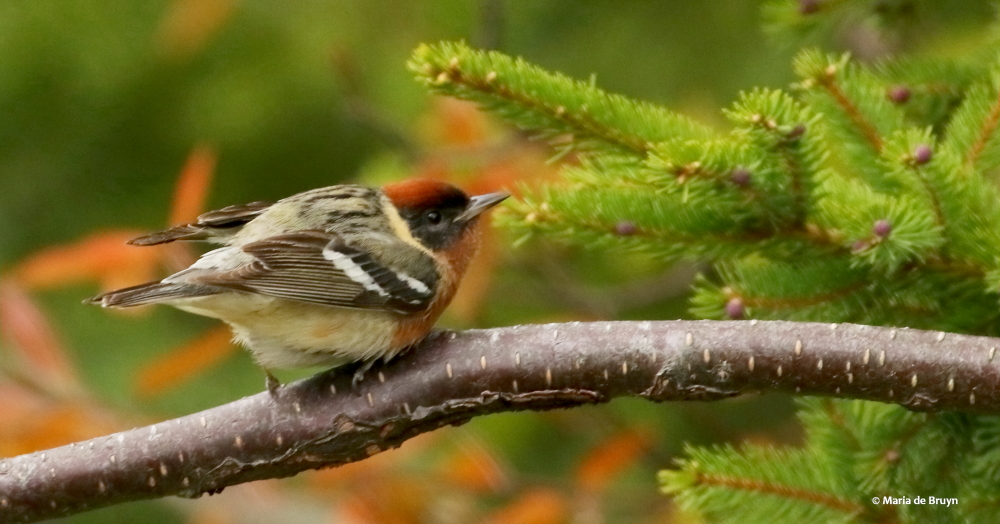
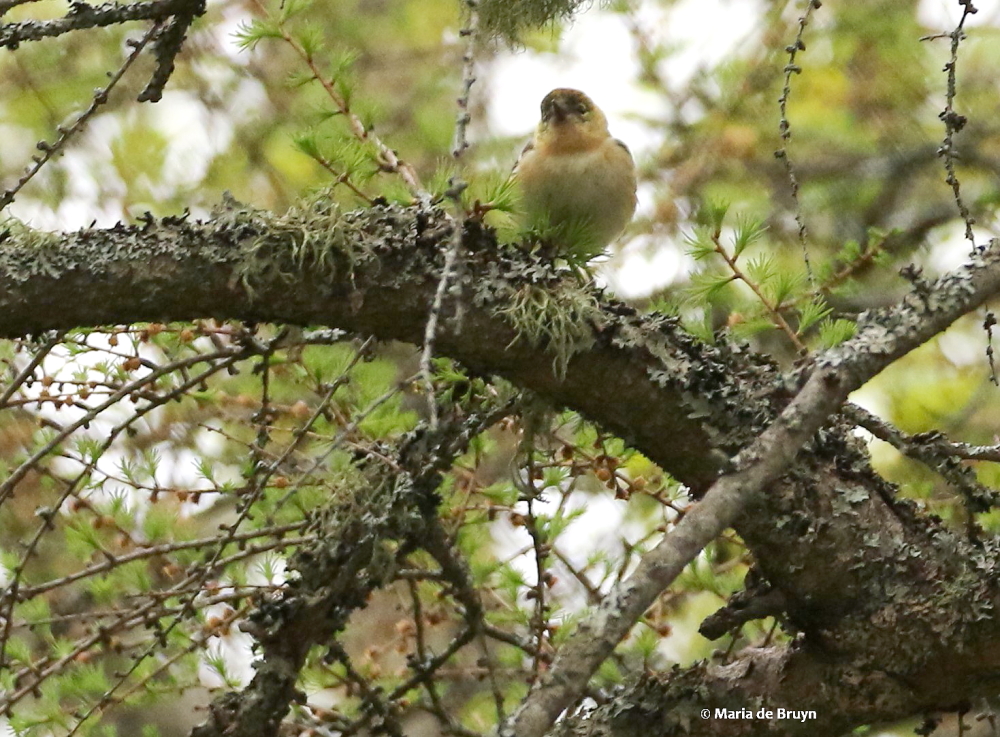
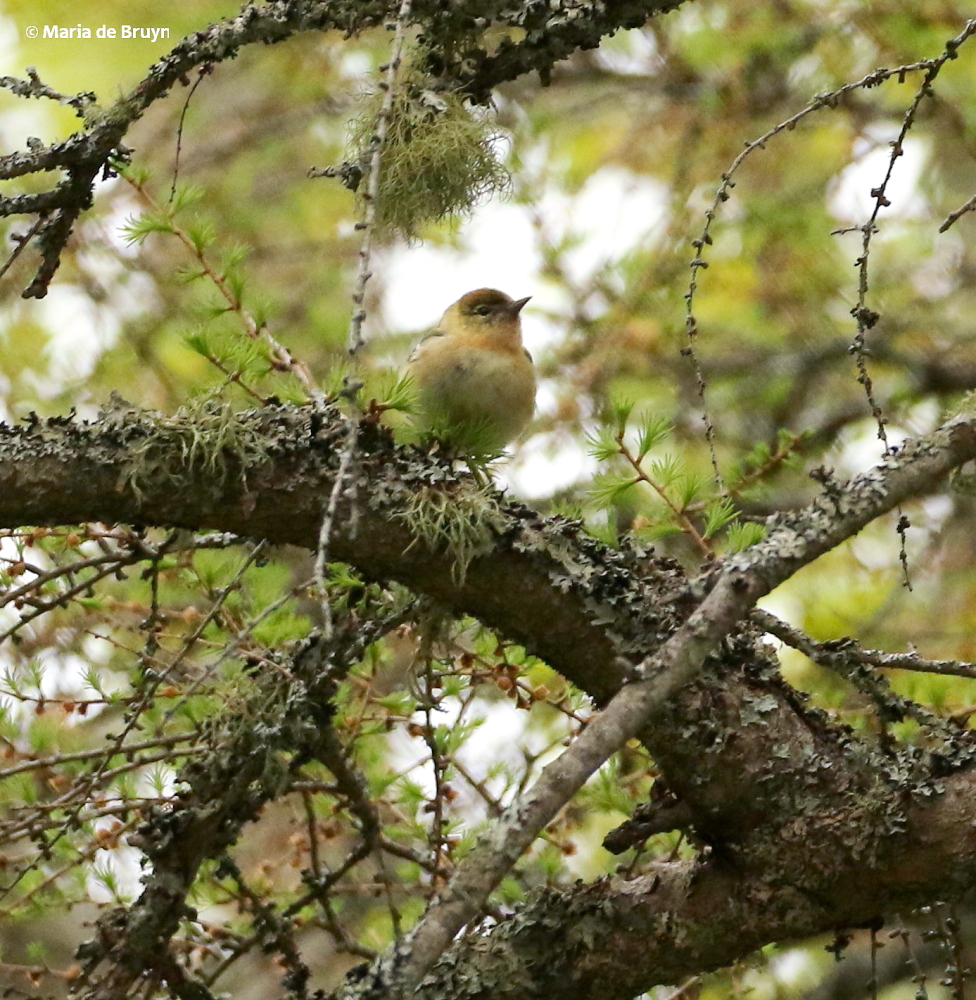
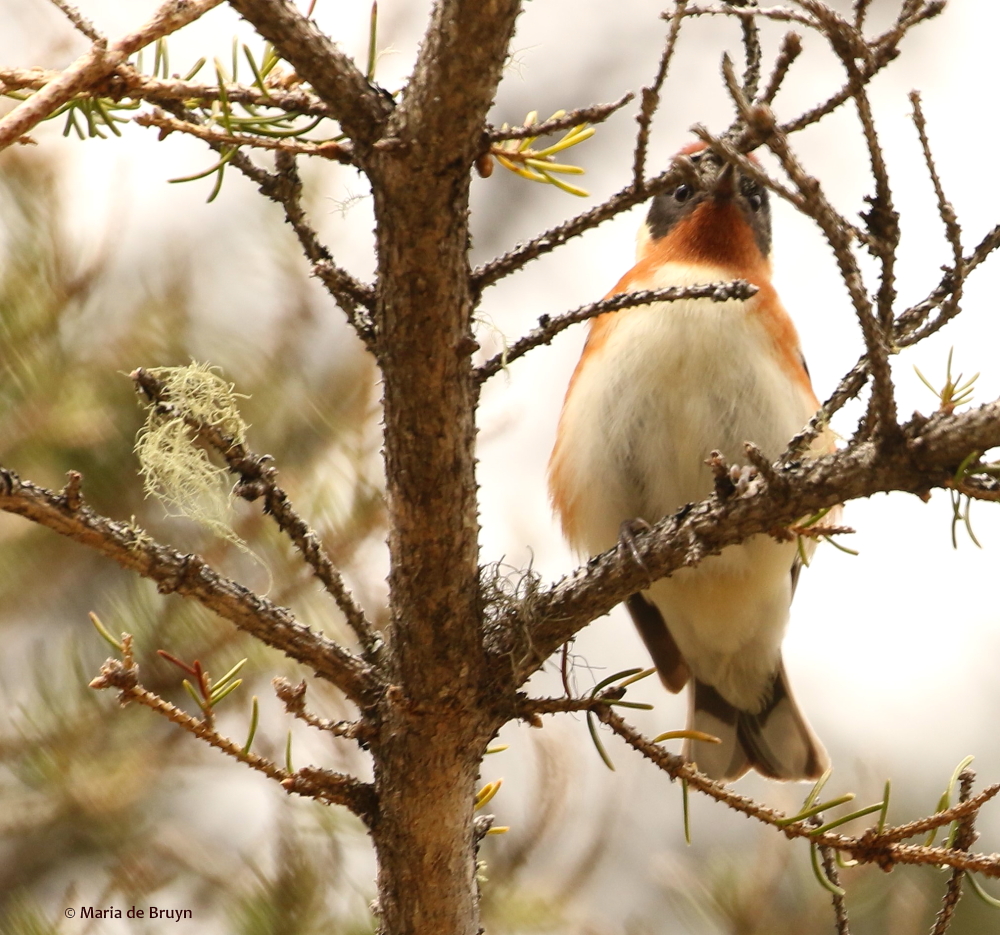
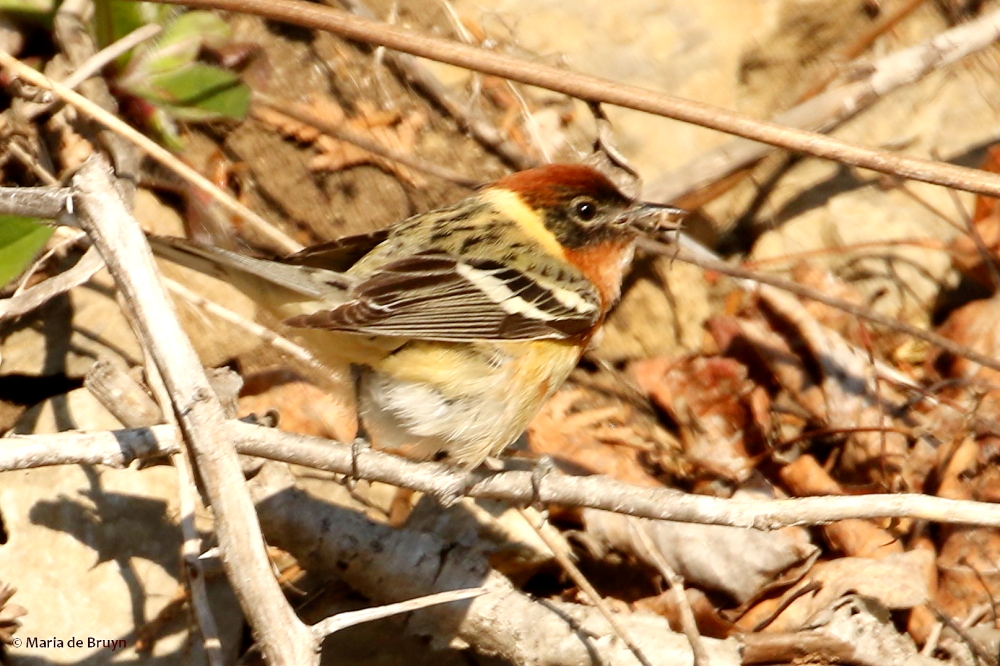
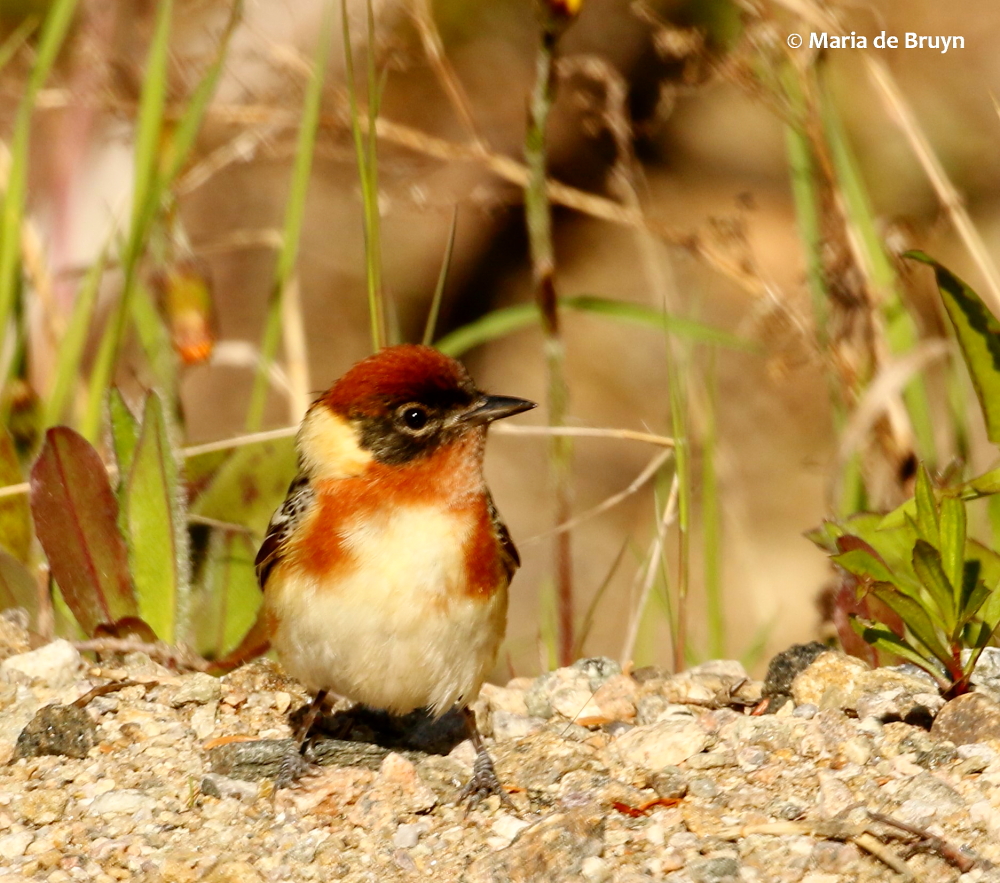
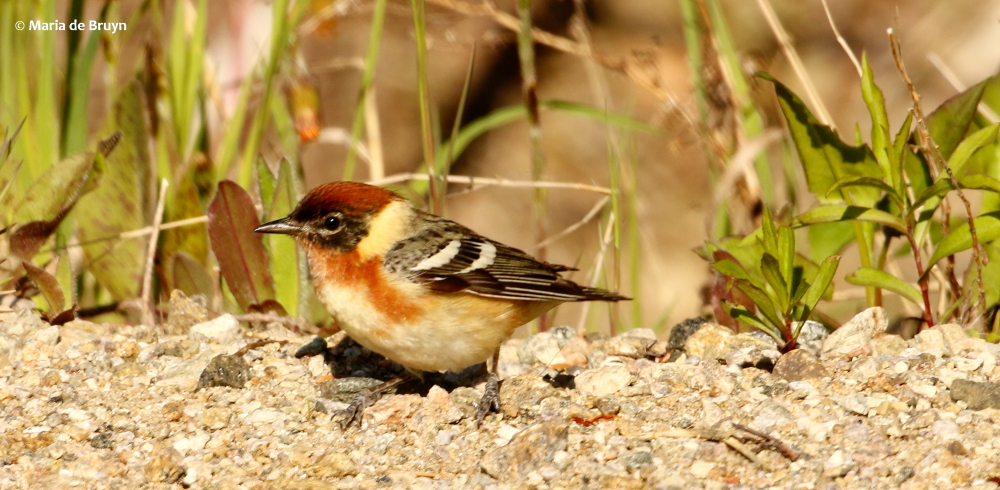
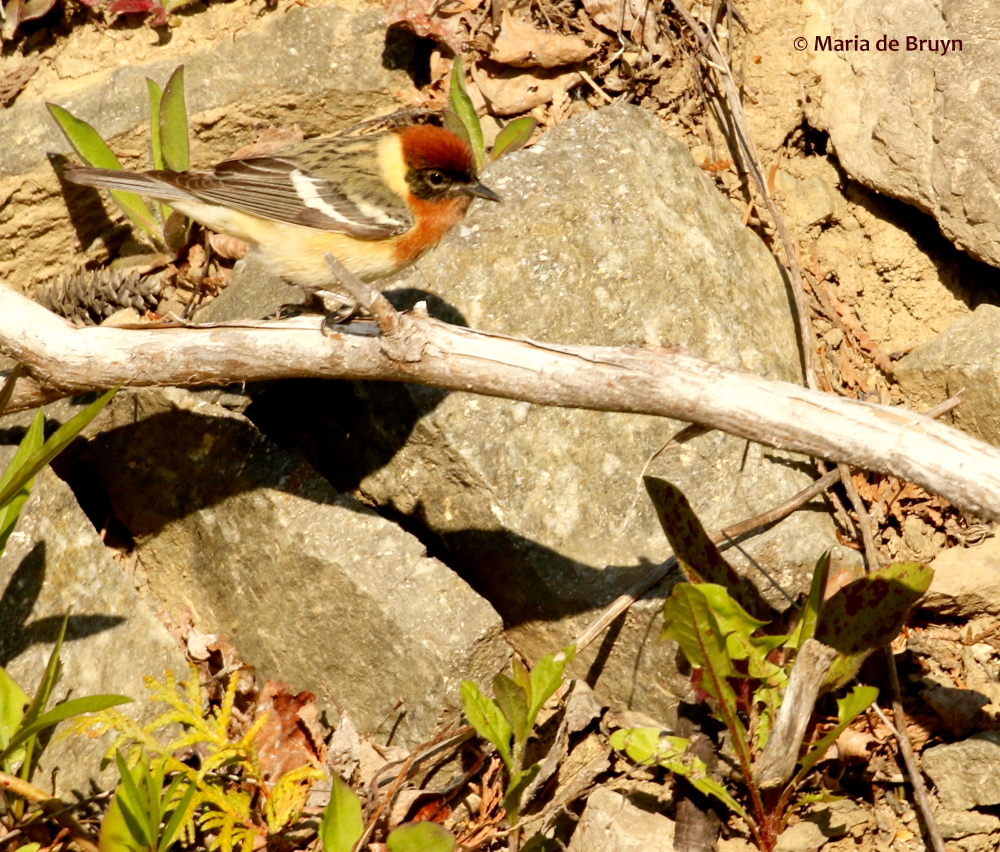
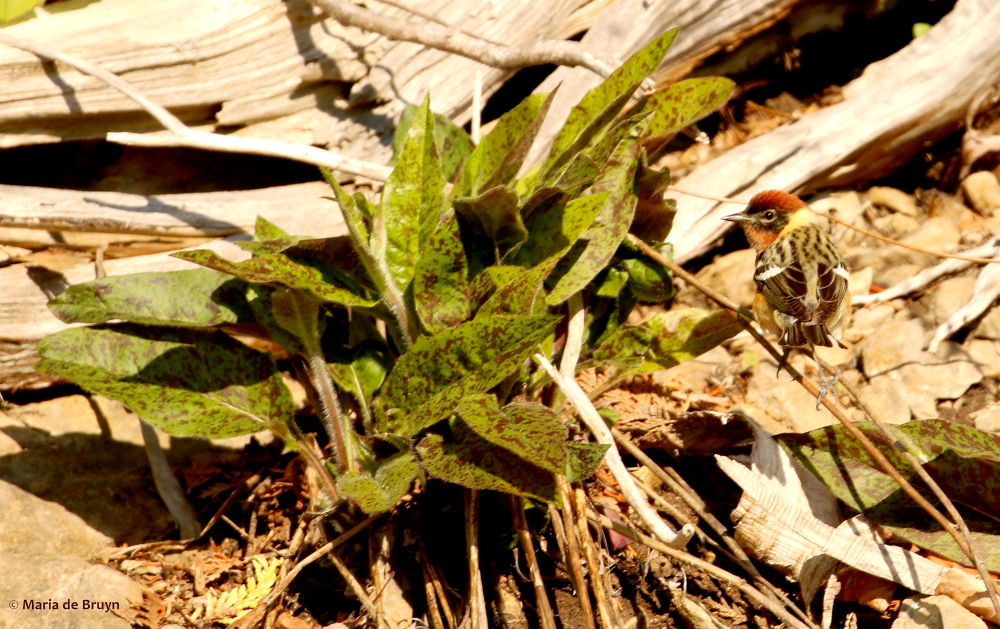
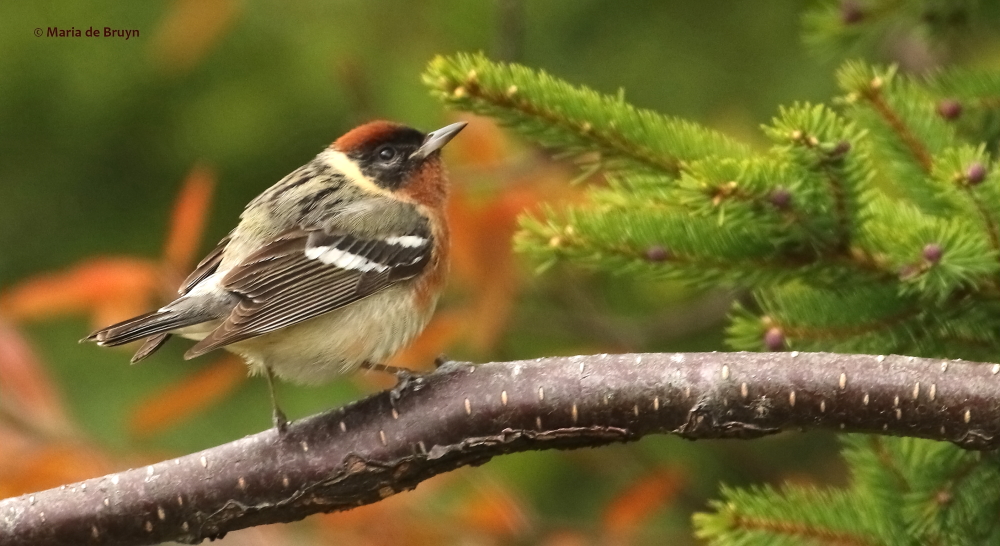
Besides the chestnut-sided warbler, I saw another species which I’d seen with more muted colors in North Carolina – the bay-breasted warbler (Setophaga castanea). In the autumn, they have a yellow-green head and only slight chestnut-colored wash on their flanks; they look very similar to blackpoll warblers during that season and winter.


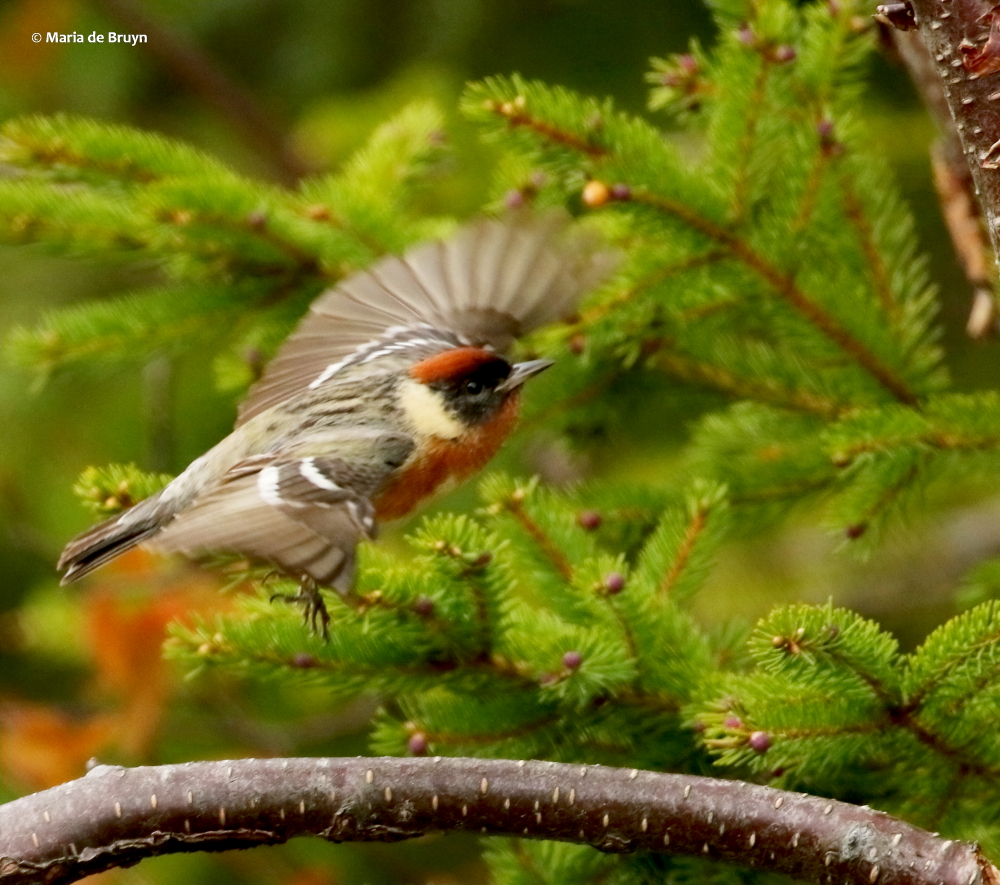
When I saw their breeding plumage in Quebec, it was a real surprise – and a most pleasant one! The bay-breasted warblers immediately became one of the birds I’ve most enjoyed seeing. And as I saw more and more during the week, I never tired of watching (and photographing) them!


During breeding season, these birds eat many more insects than fruit and they were very busy gleaning in the conifers.

In the spring, they specialize in seeking out spruce budworm moth (Choristoneura fumiferana) caterpillars. It was shown in one study that the bay-breasted warblers ate more than 13,000 budworms per 2.5 acres (one hectare) in a period of 41 days. These moths produce larvae that can decimate spruce and fir forests in Canada when their numbers increase greatly. The populations of bay-breasted warblers then fluctuate in conjunction with those of the budworms, which have an “outbreak” every 30-40 years.

In 2004, Boulanger and Arseneault studied this phenomenon and concluded that: “data suggest that outbreak frequency has remained quite stable, with a mean interval of about 40 years between the midpoint of successive outbreaks since the mid-16th century.” It would be interesting if another study could be done to see if the outbreak frequency is changing with climate change. The current population explosion of the budworms began in 2006 and could last until 2021; the government of Quebec is spending $30 million this year to eradicate the moth so the warblers may lose a food source. Their numbers may therefore also decline as a result.

While the fluctuations in their numbers have risen and fallen together with the spruce budworms, their summer habitats may be affected by human interventions. It is estimated that only 4% of these areas are stable so conservation efforts should take this into consideration, especially because their global population numbers have fallen about 74% since 1966.

As these birds forage on tree branches, they tend to move more slowly than some of the other warbler species, taking their time to seek out juicy tidbits. In addition to caterpillars, they eat beetles, flies, moths, leafhoppers and grasshoppers.

The female bay-breasted warblers can be distinguished from their male counterparts by the fact that they lack the black face mask and have lighter bay coloring.

Both sexes seemed to be fairly comfortable with me watching them. They seemed much less shy than some other species of birds. To my complete delight, of course!


An interesting observation is that they tend to like foraging on lichen-covered branches.

In contrast to some of the other warblers, they tend to build their nests in the mid-level tree canopy; that is also where they do a lot of their food hunting. However, as my walks in St. Irénée showed, they are not averse to foraging on the ground!


Since they mostly breed in Canada and spend their winters in Central and South America, seeing them in North Carolina during migration is a treat. Interestingly, the adults tend to migrate along routes west of the Appalachian mountain range and immature birds often migrate along the Eastern US seaboard and coastal areas.


These birds of waxing and waning populations have inspired poets and I can see why. Seeing them in their breeding plumage in Quebec was a wonderful gift. I hope to see them there again one day as they have joined my list of special species that I love. 😊

Life on late winter-early spring farmlands

Although it’s taken me some time to process photos taken earlier this year, I’d still like to share what I was seeing in late winter and early spring when stopping at farm fields. These sometimes muddy and stubble-covered parcels of land can offer wildlife watchers nice views of birds and occasionally other animals, unobstructed by a lot of foliage. So visits to roadside farms and ponds were on my early 2019 nature-walk itineraries.

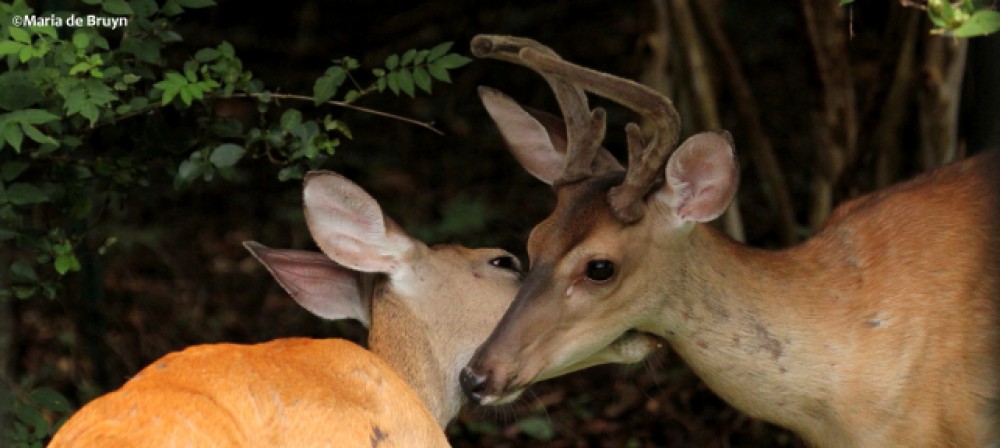
Farm fields are often bordered by stands of trees where animals can retreat if they become disturbed by humans standing around aiming long camera lenses at them. The white-tailed deer (Odocoileus virginianus) above were browsing one morning and seemed unconcerned as I photographed nearby birds. When I turned to watch them specifically though, they decided to move back into the woods bordering the field.

Many farmers put out bird boxes on fences bordering their fields; in early March, the Eastern bluebirds (Sialia sialis) were already checking out and starting to furnish potential nest sites. Here a male was flying away from a nest box while his mate was gathering pine needles.

The fences offer other birds a good vantage point for observation, too. A Northern flicker (Colaptes auratus) perched on a fence post to look around and then flew to a branch high above me.


A bird present in large numbers was the brown-headed cowbird (Molothrus ater). One morning, a friend and I counted some 200 birds in one small group of trees. Many people think they are an invasive species and dislike these birds intensely because they evolved a behavior that can endanger other birds. The cowbirds, who are native to America, were originally present in prairies where they followed the buffalo. This meant they did not stay in one place long enough to tend a nest, so they began laying their eggs in other birds’ nests. The young cowbirds hatch first and then may throw out the other eggs or hatchlings or they eat so ravenously that the other nest mates don’t get enough.

It certainly is disconcerting to see a small warbler feeding a large cowbird fledgling and a couple bird species have been endangered by the behavior. But I don’t dislike the cowbird because of this – they did not choose how to evolve and the behavior developed as an adaptation, not an “evil” practice. They are attractive birds. And the sounds they make are lovely, akin to water droplets falling into a pool.


The American robins (Turdus migratorius) were also present in abundance; they tend to flock together in the winter and early spring. One farm had a boggy area with some cyprus trees and the robins were busy looking for insects among the cyprus “knees” (Taxodium distichum). These woody structures that grow out of the roots may help stabilize the trees when they are standing in water but scientists have not yet definitively identified their purpose.

There were other trees near the cypresses; in one, the cocoon of a Polyphemus moth (Antheraea polyphemus) was hanging high overhead. It also pays to look around to see who is flying u[ ahigh above those trees and fields. It’s not uncommon to see Canada geese (Branta canadensis) flying from one farm pond to another.

Red-tailed hawks (Buteo jamaicensis) soared over different fields I visited.

Red-shouldered hawks (Buteo lineatus) also made an appearance.

And one of my favorite raptors often eluded my efforts to capture a portrait. Only a couple times was I able to catch a beautiful kestrel (Falco sparverius) speeding by in flight.

The robins were feeding in the fields as were several other bird species.


Yellow-rumped warbler (Setophaga coronata)

Savannah sparrow (Passerculus sandwichensis)

Pine warbler (Setophaga pinus)

A pair of Northern mockingbirds (Mimus polyglottos) was taking advantage of numerous cow patties left behind on one farm field in their search for insects. They were flashing their wings repeatedly; I’m convinced that this was behavior designed to scare up bugs so they can catch them easily.


Other birds were following them around in the field, apparently taking advantage of the insect smorgasbord. Two of them were a song sparrow (Melospiza melodia) and a field sparrow (Spizella pusilla).

This year, it was also my good fortune to see a bird new to me in one farm field, the lovely horned lark (Eremophila alpestris). Although these birds are not considered endangered, their numbers declined by 71% between 1966 and 2015.

I couldn’t get close to the larks but one day I did catch a bird taking a dust bath in a gravel and dirt road next to their preferred field. On a second visit to that farm, I again saw a lark in the road and then another lark joined it.

It turns out that female larks perform a courting display that looks very similar to actually taking a dust bath, so I got to see a mating behavior that I hadn’t expected!

Reading about the behavior, I discovered that if male larks see a female who is dust bathing, he may mistake what she’s doing and try to mate with her when she’s not ready.

So reproductive life is a bit difficult for those males, who look so adorable when they raise those head feathers to project two little black horns.I will leave you here with a few more views of a horned lark who was singing and foraging not too very far from the road.