Mammal merriment, misery and markings

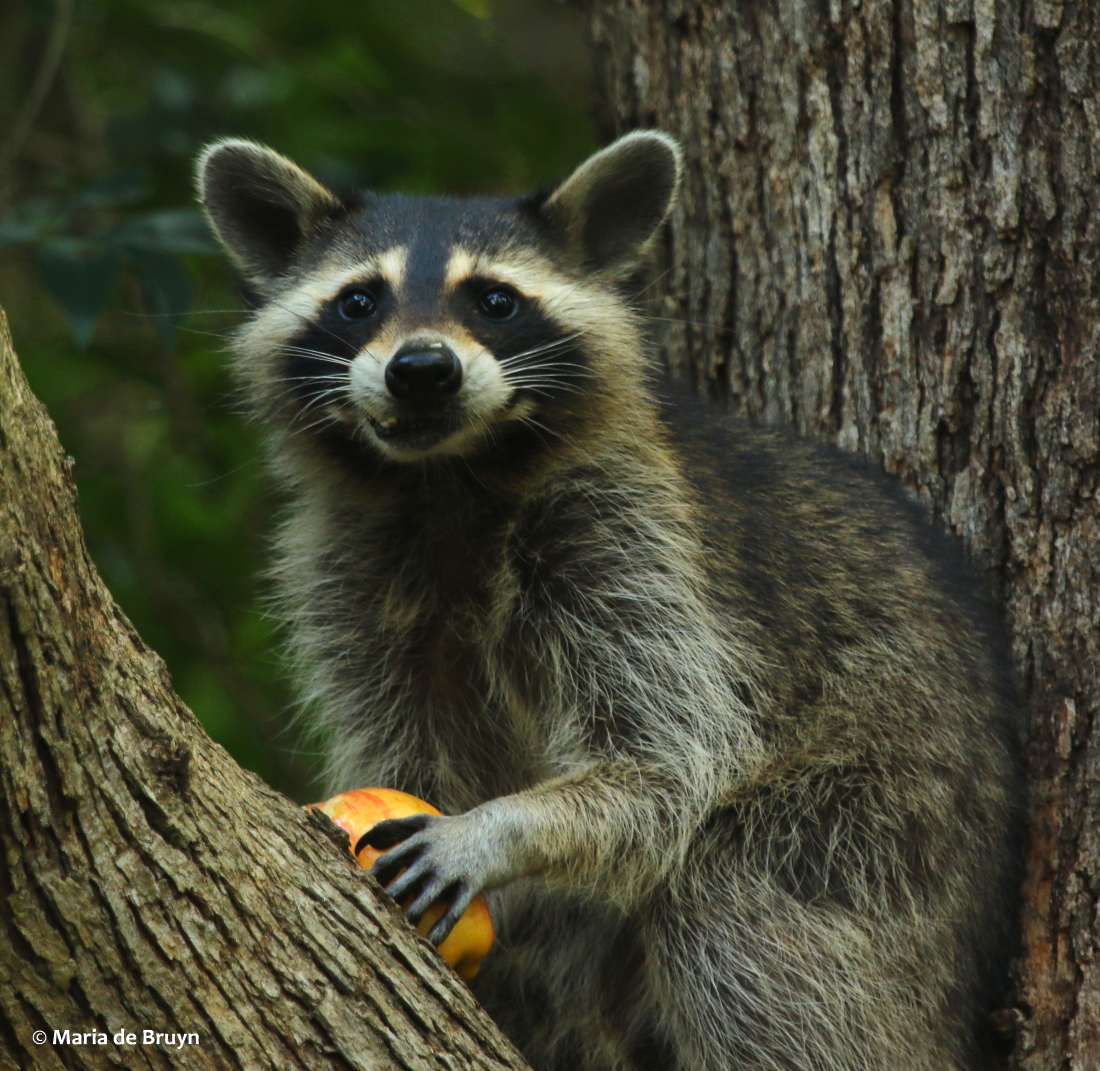
Lately, many of my blogs have been about birds, mostly because they have been the easiest wildlife to photograph during the colder months. The mammals – and insects, reptiles and amphibians – have not been around much and likely have often visited when I’m not watching. I’m fairly certain that raccoons (Procyon lotor) and opossums (Didelphis virginiana) come to my yard after dark; perhaps the odd fox or coyote does as well. Nevertheless, after she stopped weaning her young and since summer ended, I haven’t seen Raquel raccoon all winter.

raccoon DK7A4351© Maria de Bruyn   raccoon DK7A4248© Maria de Bruyn res

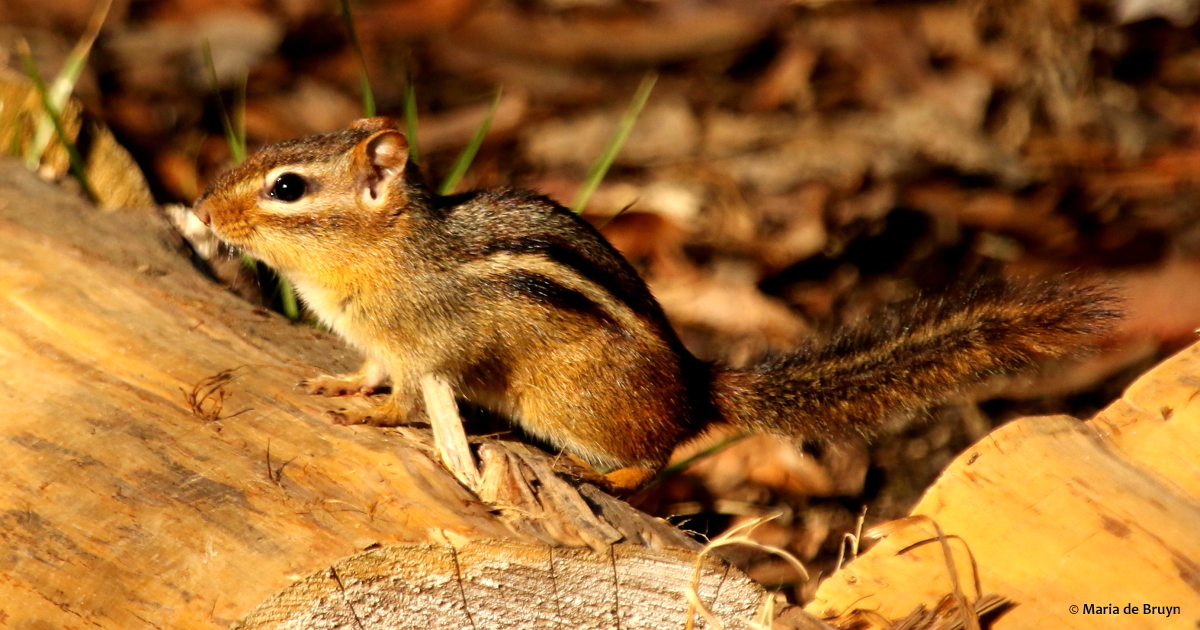
Eastern chipmunk I77A8790© Maria de Bruyn resThere a couple mammals, however, that I can count on to see every day because they have grown accustomed to having a food source at my house. Fallen bird seed (and seed and apples put out deliberately for ground feeders) does not get entirely gobbled up by the avian visitors, leaving pickings for the Eastern gray squirrels (Sciurus carolinensis), Eastern chipmunks (Tamias striatus) and white-tailed deer (Odocoileus virginianus).

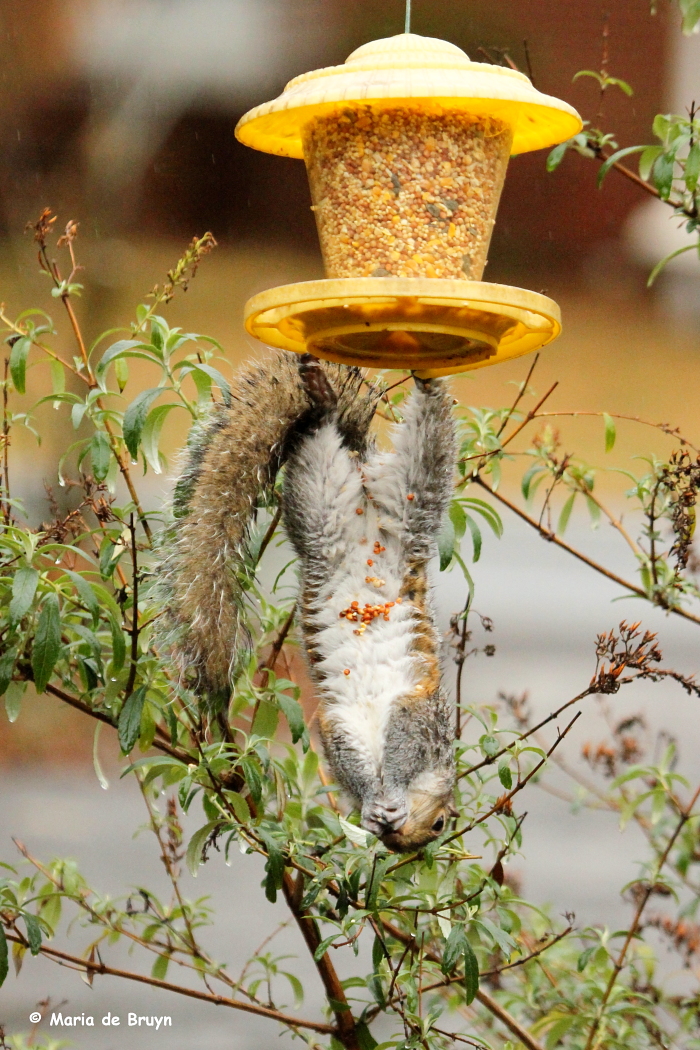
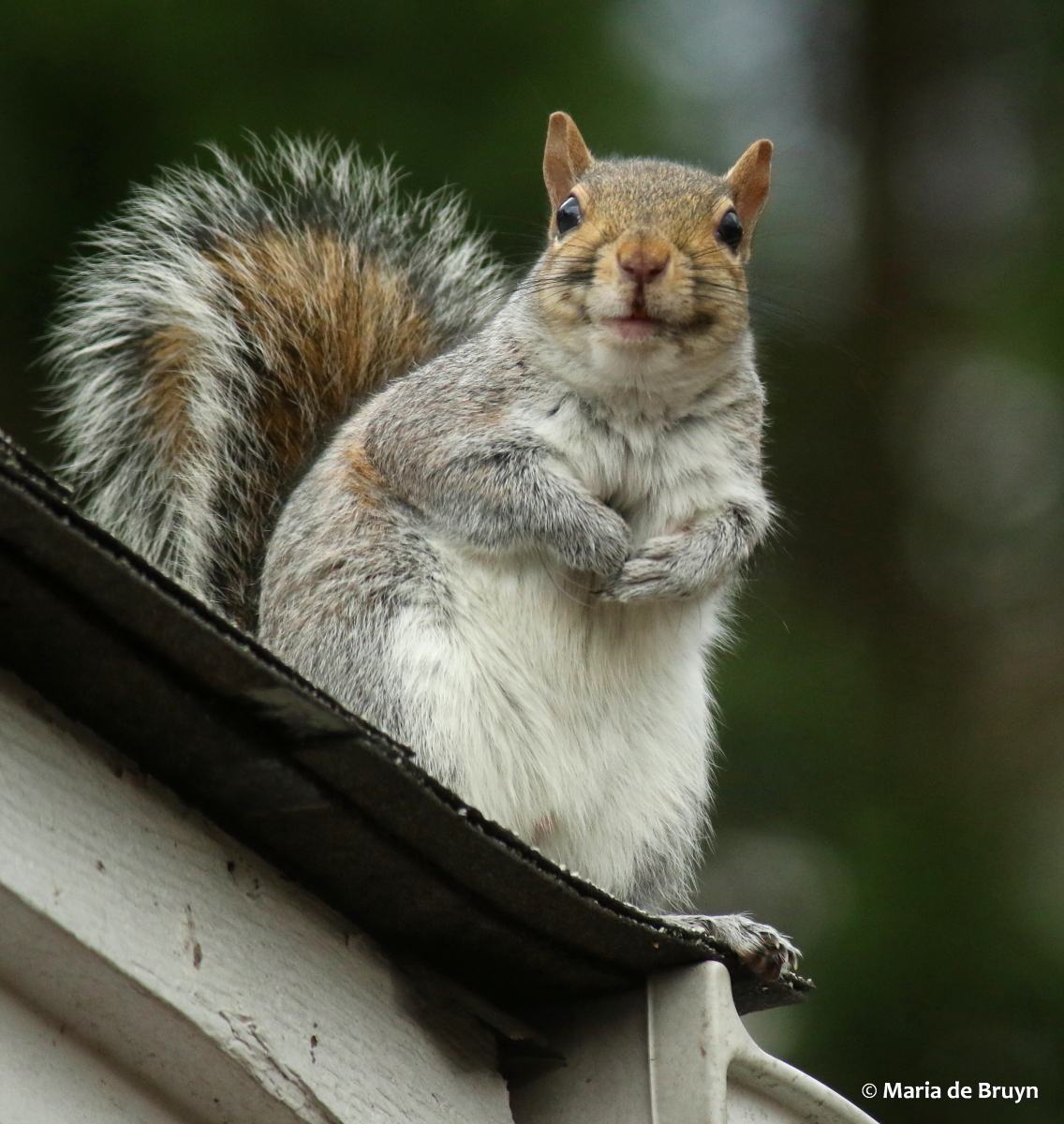
The squirrels keep a watch from the trees and underbrush and appear very quickly after the bird seed is replenished. My combined squirrel and raccoon baffles – and placing the feeder poles at least 10 feet away from any structures from which they launch themselves onto the poles – have proved successful in keeping them from the feeders. But they continue to look for vantage points from which they can attempt a jump to the feeders.
Eastern gray squirrel I77A5504© Maria de Bruyn res  Eastern gray squirrel I77A5494© Maria de Bruyn res

Eastern gray squirrel IMG_3643 mdb


Before I learned how to thwart them, they made off with plenty of seed and suet – one squirrel even carrying off the entire suet feeder when s/he couldn’t get it open. I saw it happening and chased that squirrel, but they were faster than me!

They will share space happily with birds but don’t always want to share with other squirrels or chipmunks.
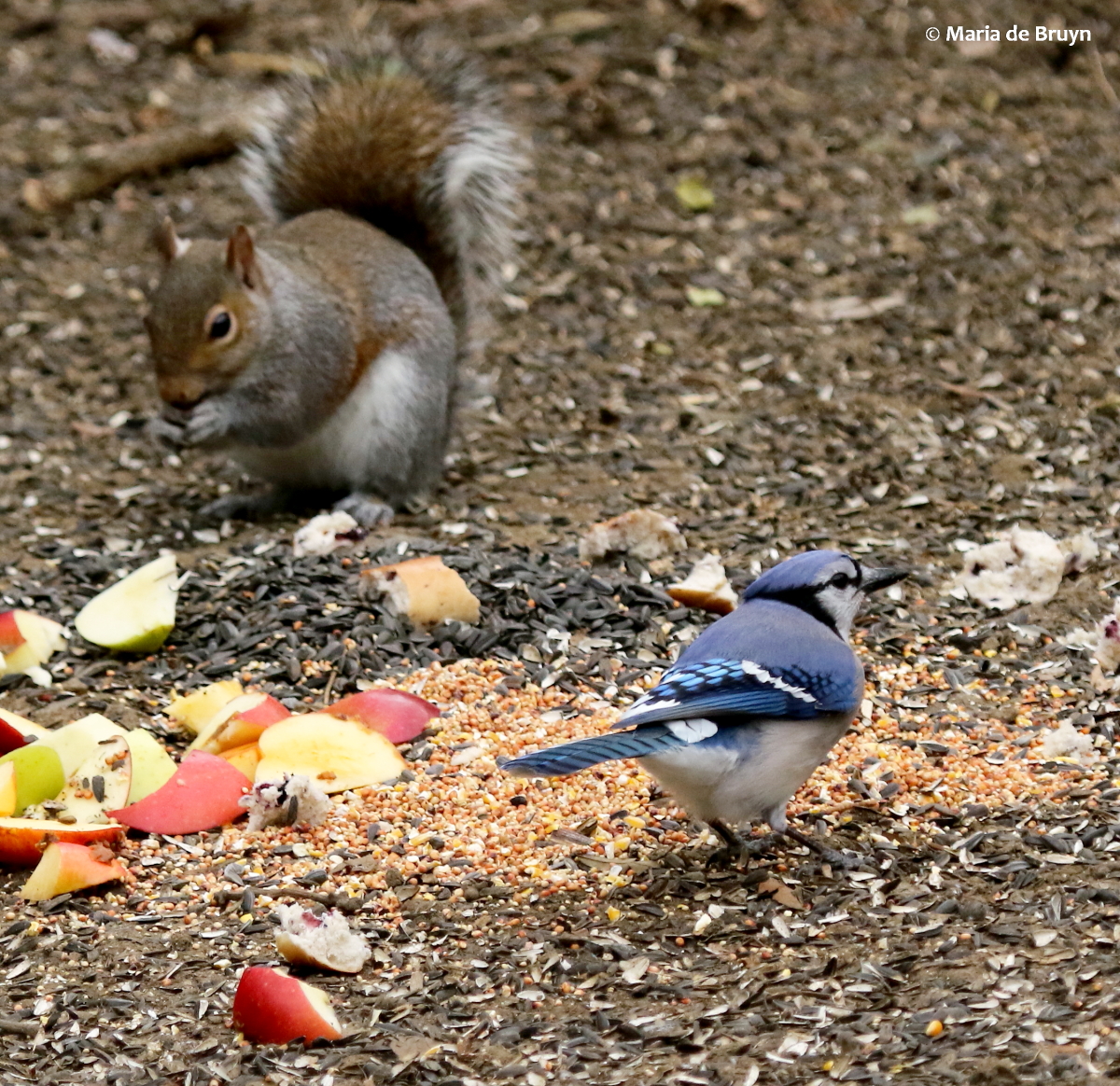
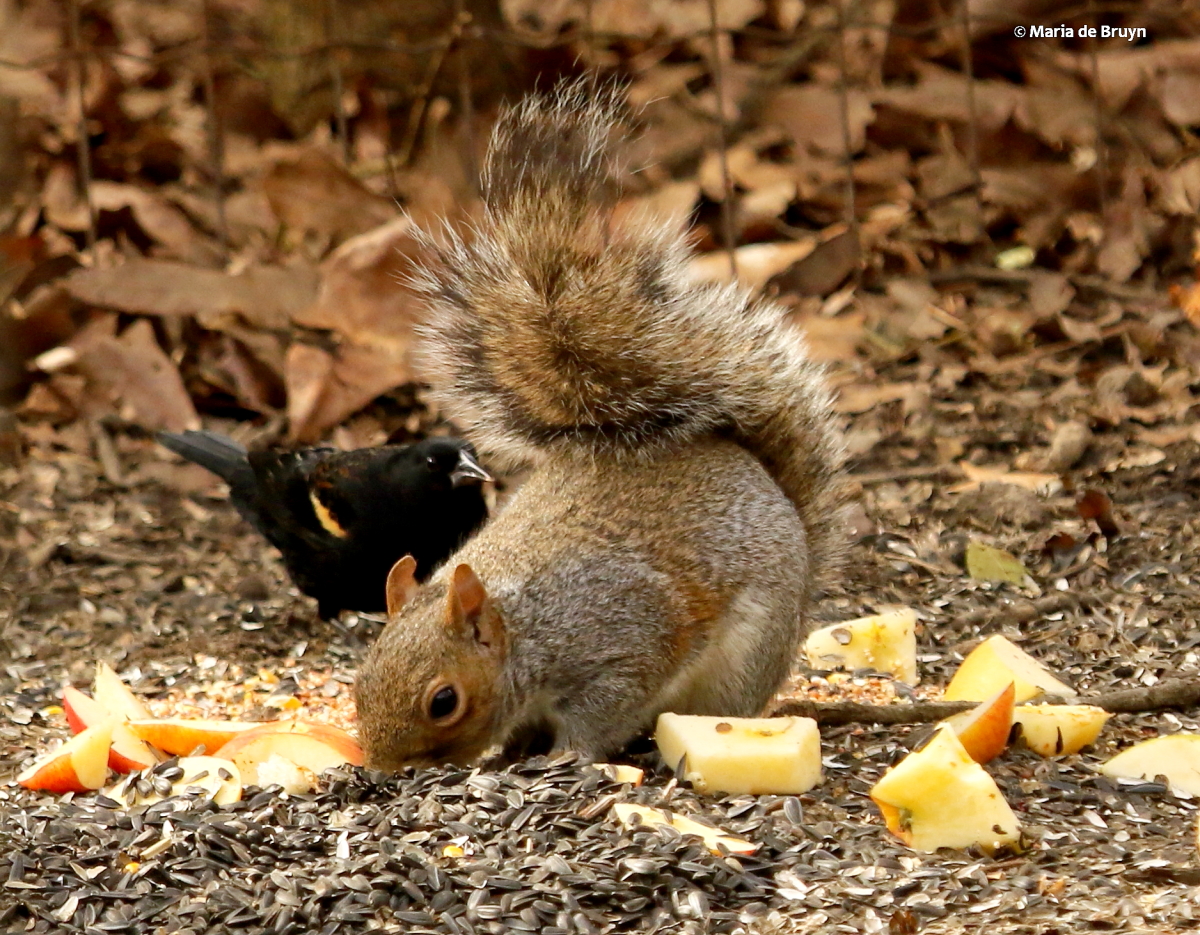


Eastern gray squirrel I77A8350© Maria de Bruyn Eastern gray squirrel I77A0711© Maria de Bruyn res

The chipmunks don’t let that selfish attitude deter them; they just keep a sharp eye out for when a squirrel might turn on them. They wolf down seed after seed, giving themselves a very fat-cheeked countenance!
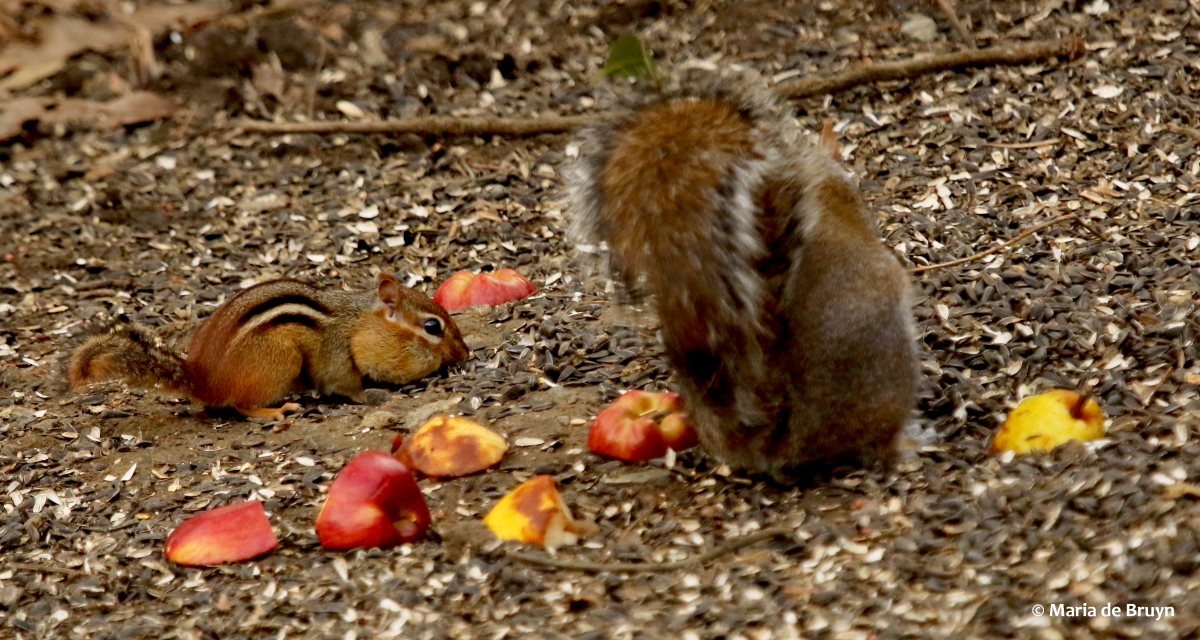
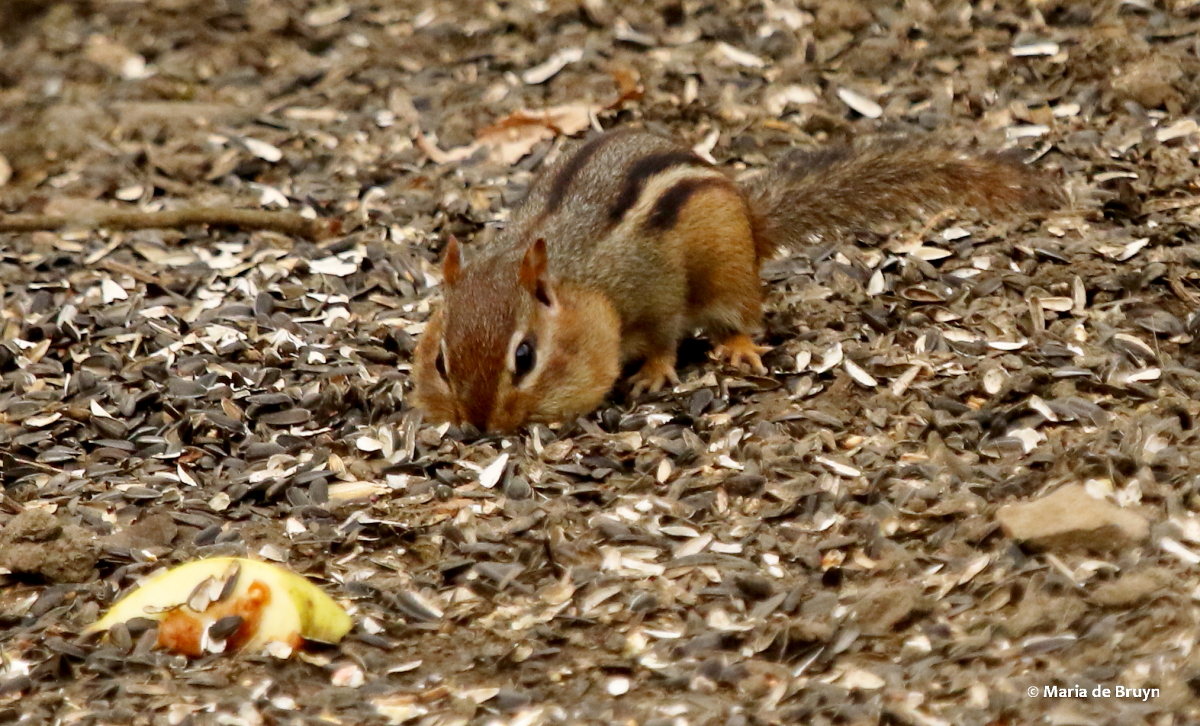
Eastern chipmunk I77A3326© Maria de Bruyn  Eastern chipmunk I77A3335© Maria de Bruyn

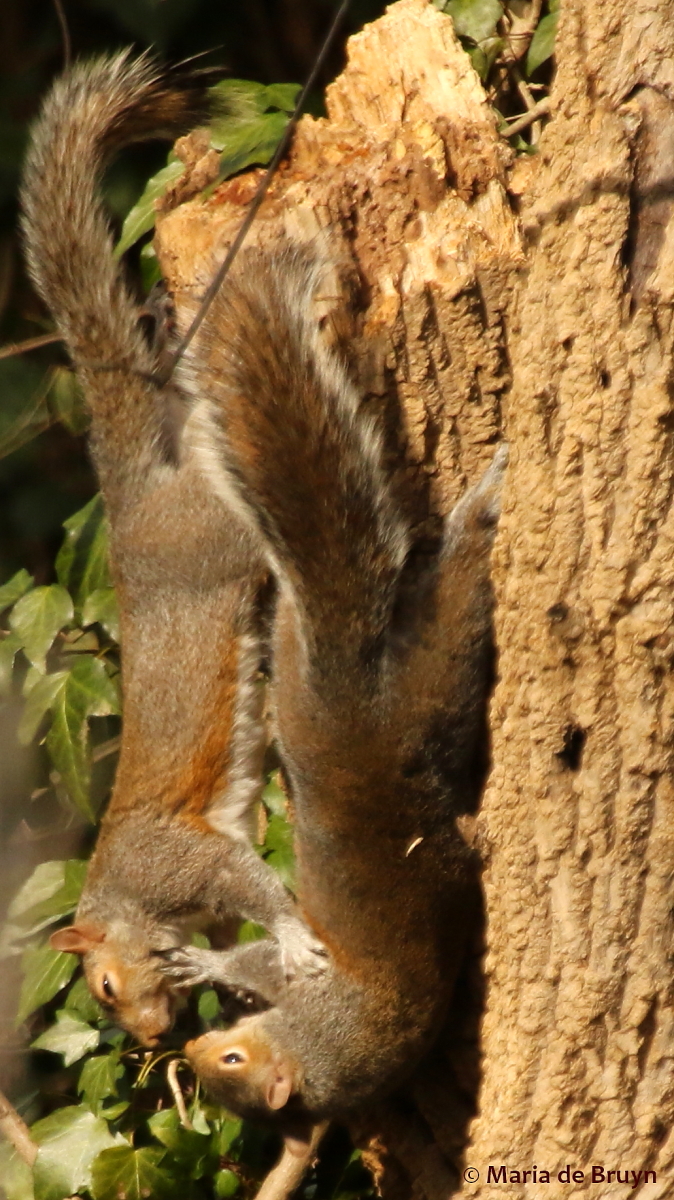
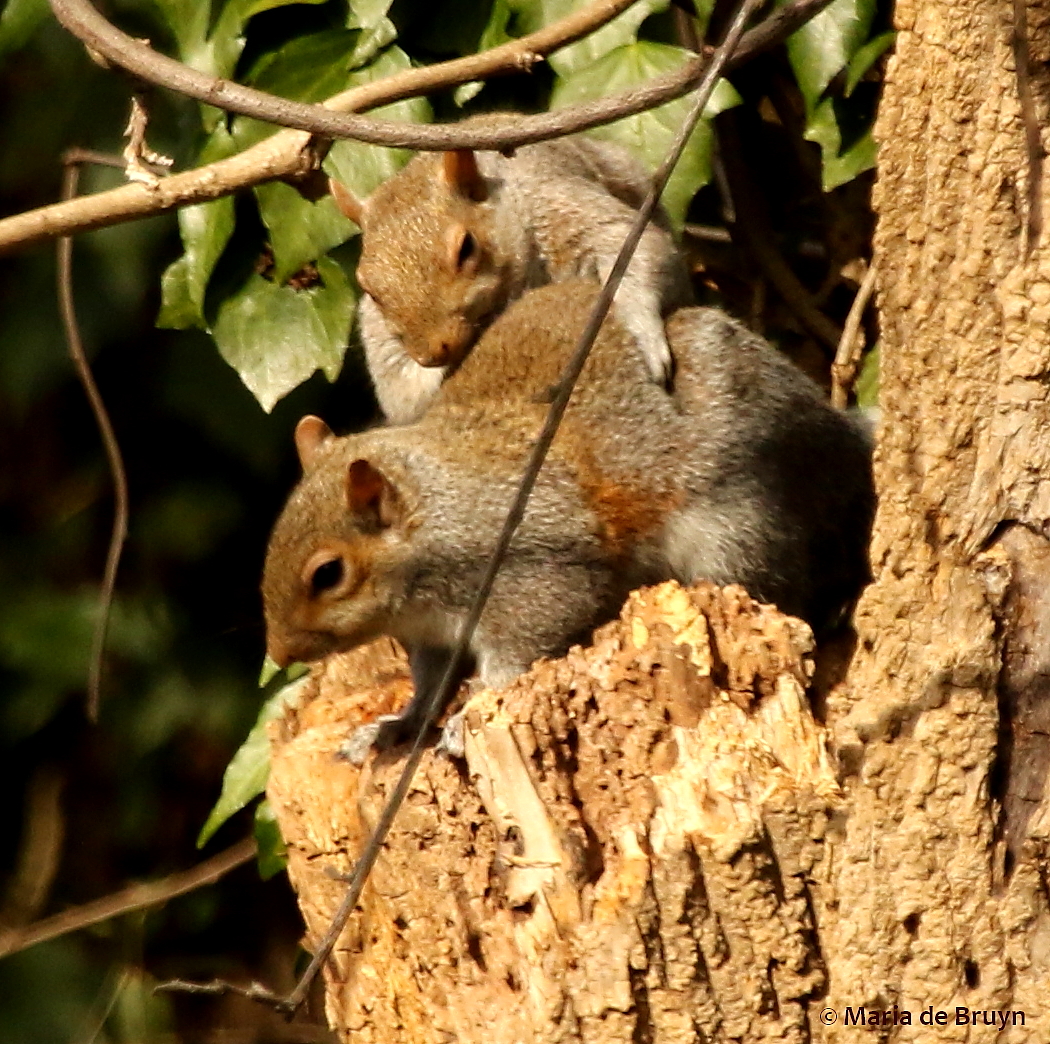
The past few days, the squirrels have continued their chasing, but now it is not always in rivalry or play. Instead, their romantic side is showing and the merriment goes on for a good length of time. They appear to have designated a particular tree stump/snag in my back yard as their trysting spot.
Eastern gray squirrel I77A1104© Maria de Bruyn res              Eastern gray squirrel I77A0980© Maria de Bruyn

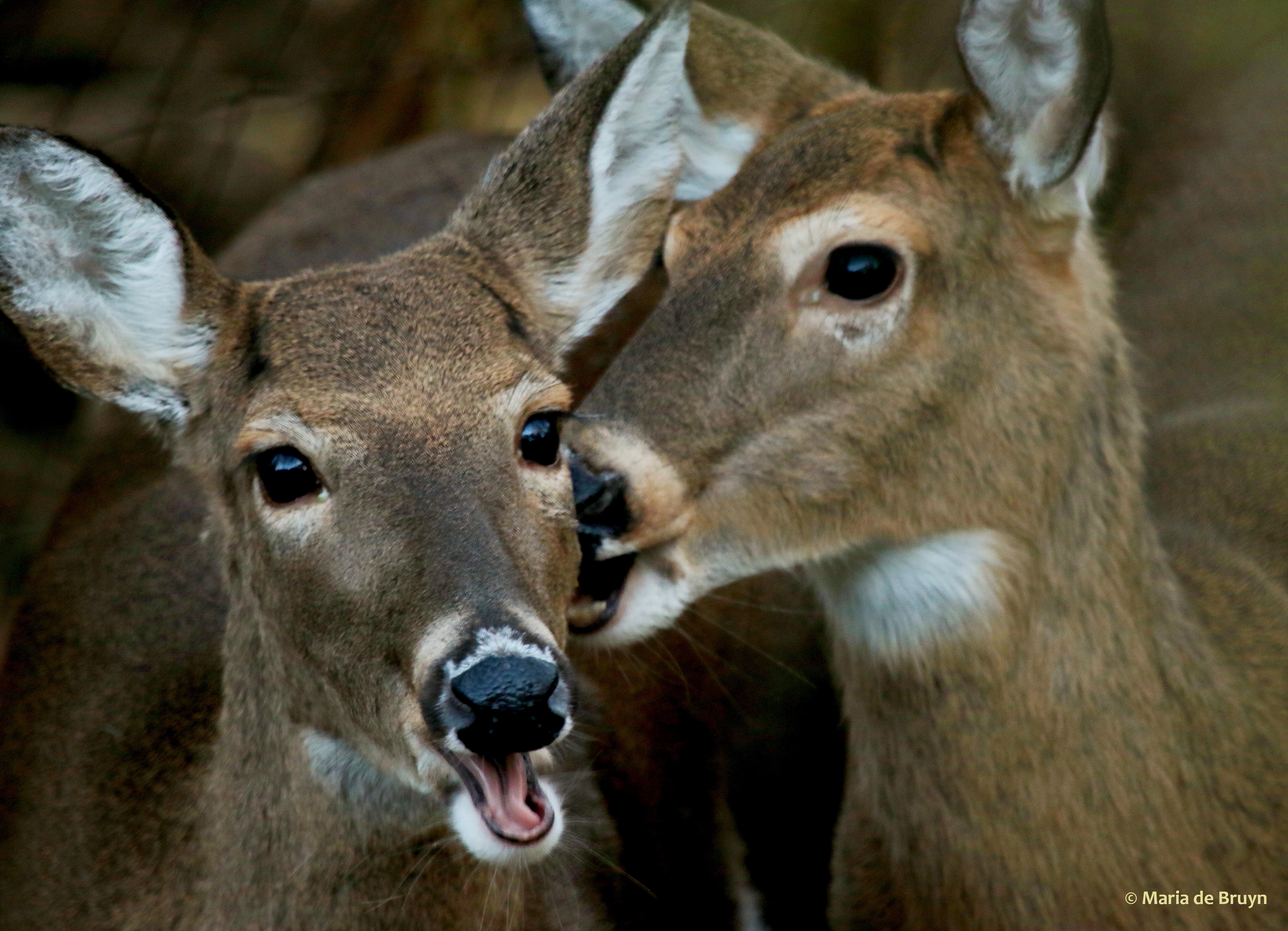
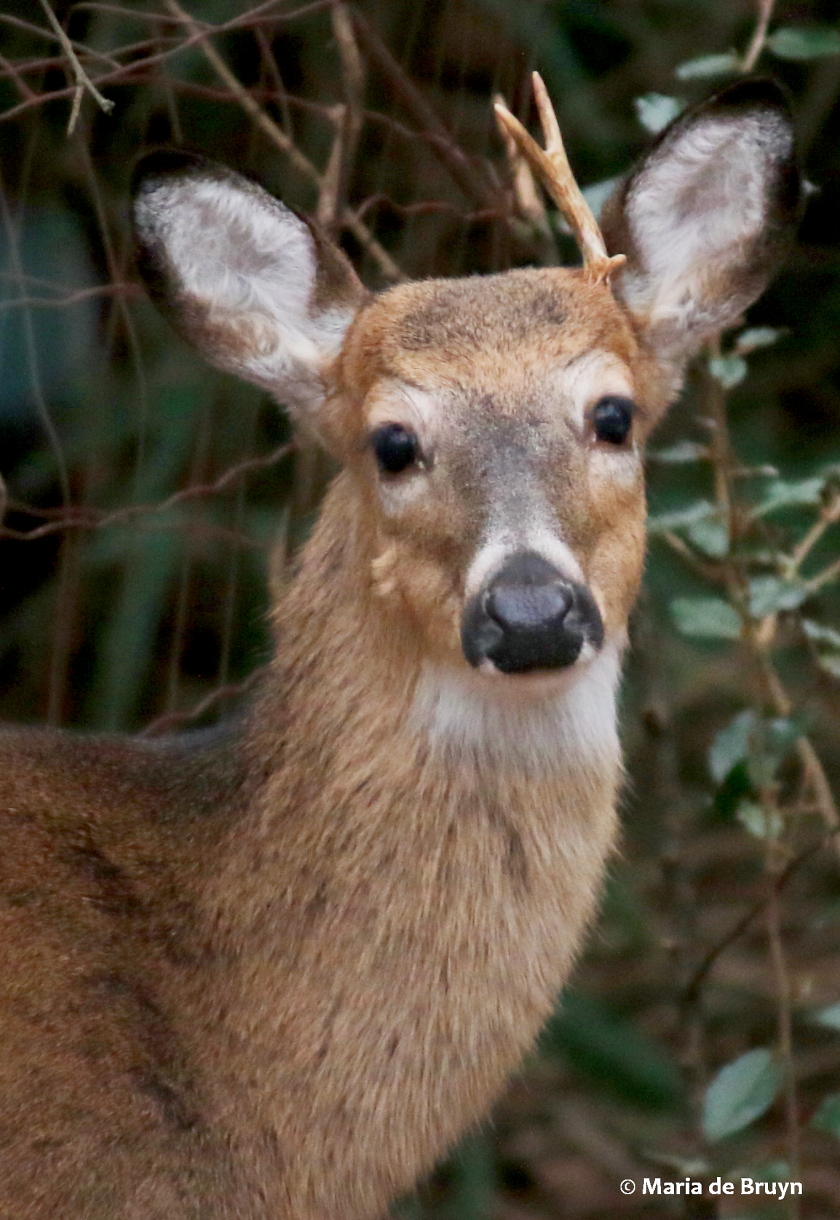
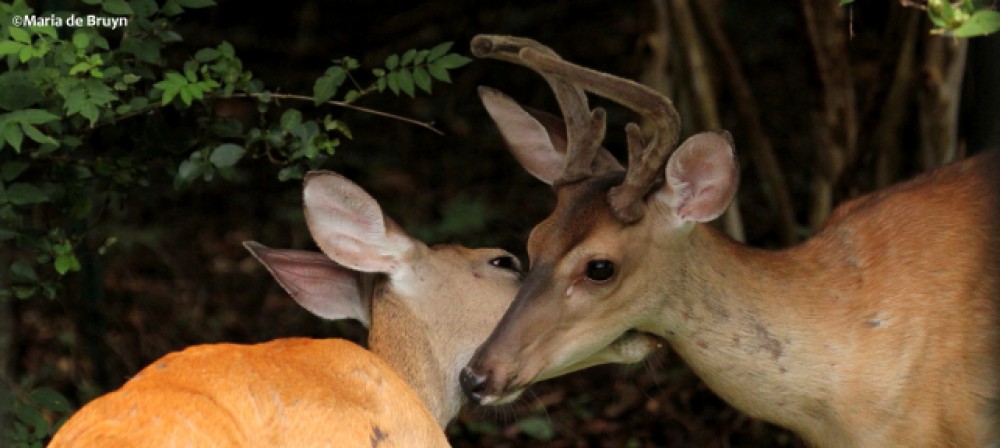
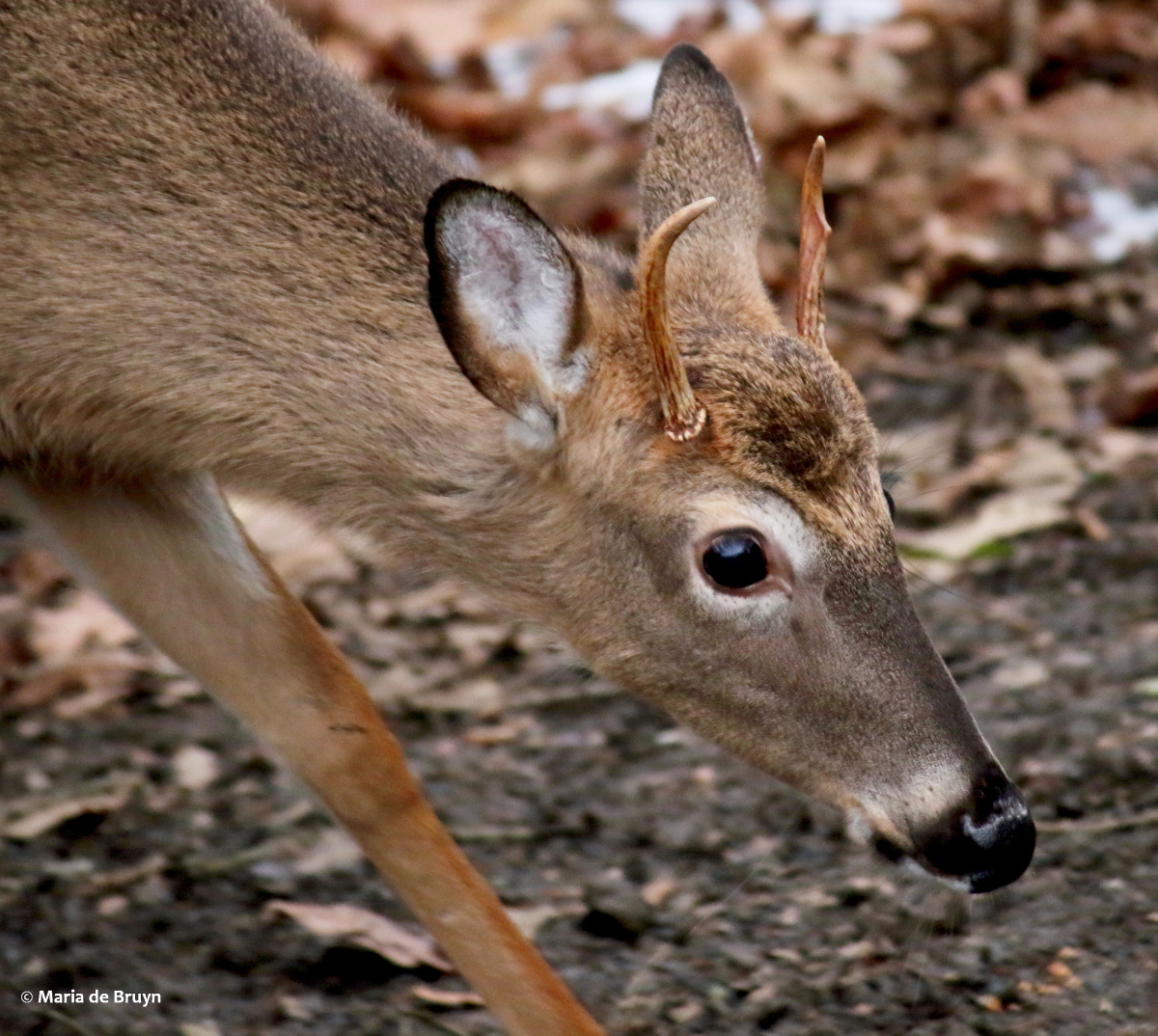
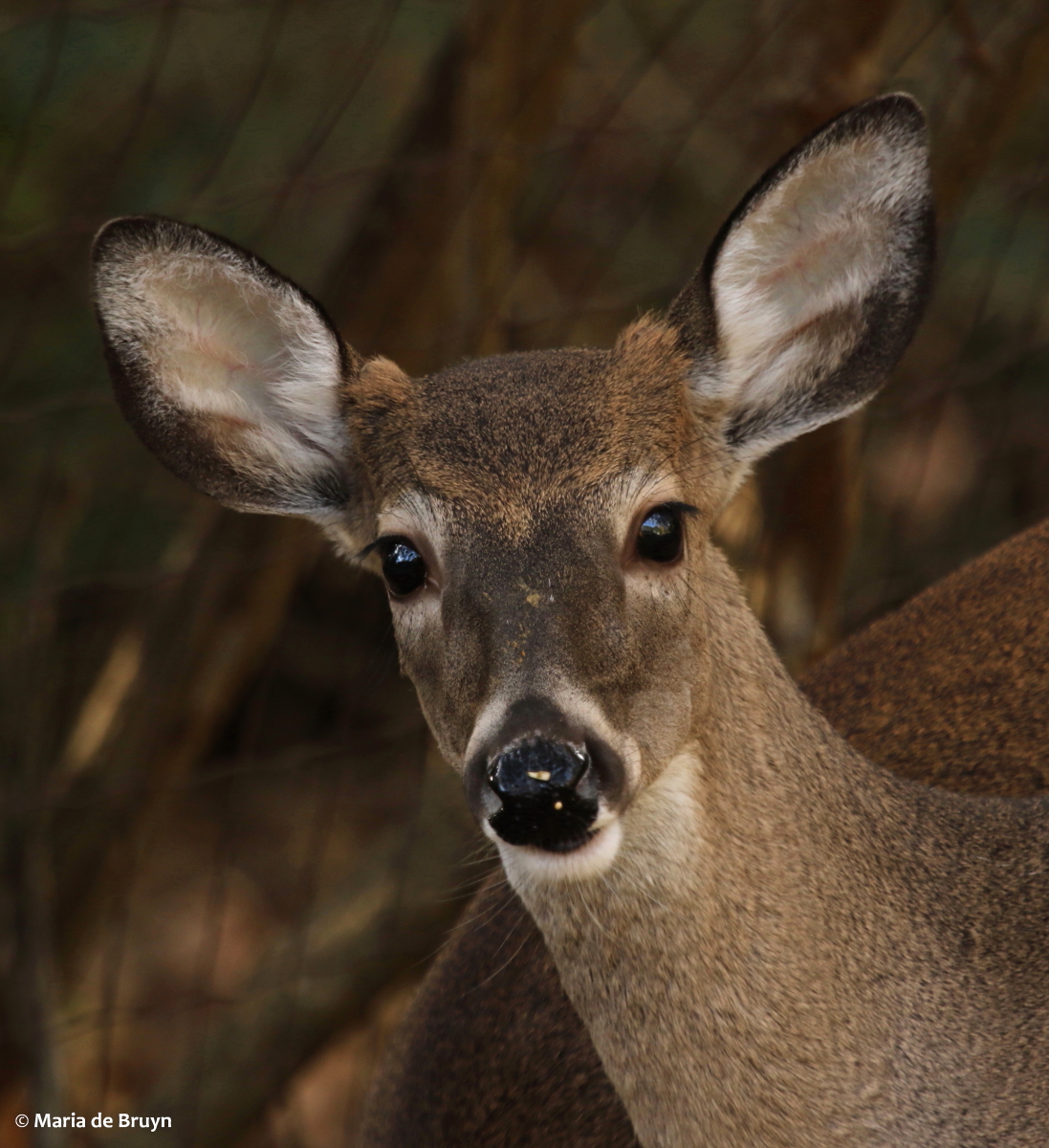
white-tailed deer I77A0963© Maria de Bruyn resThe white-tailed deer carry on their mating elsewhere but I know it’s happening as the males are evidence. Usually, one small family group comes to my home – mom, her one-year-old daughter and one-year-old son (a button buck, so-called for his tiny little antler nubs). They were occasionally accompanied by a couple second-year bucks with little antlers – I suspect mama’s sons from the previous year.
white-tailed deer I77A1367© Maria de Bruyn res    white-tailed deer I77A2025© Maria de Bruyn res

white-tailed deer I77A1366© Maria de Bruyn res


One of them lost one of his antlers early, but whether this was the result of a fight or accident is unknown to me. It seems that mama has allowed an orphaned button buck to join their group occasionally, too.

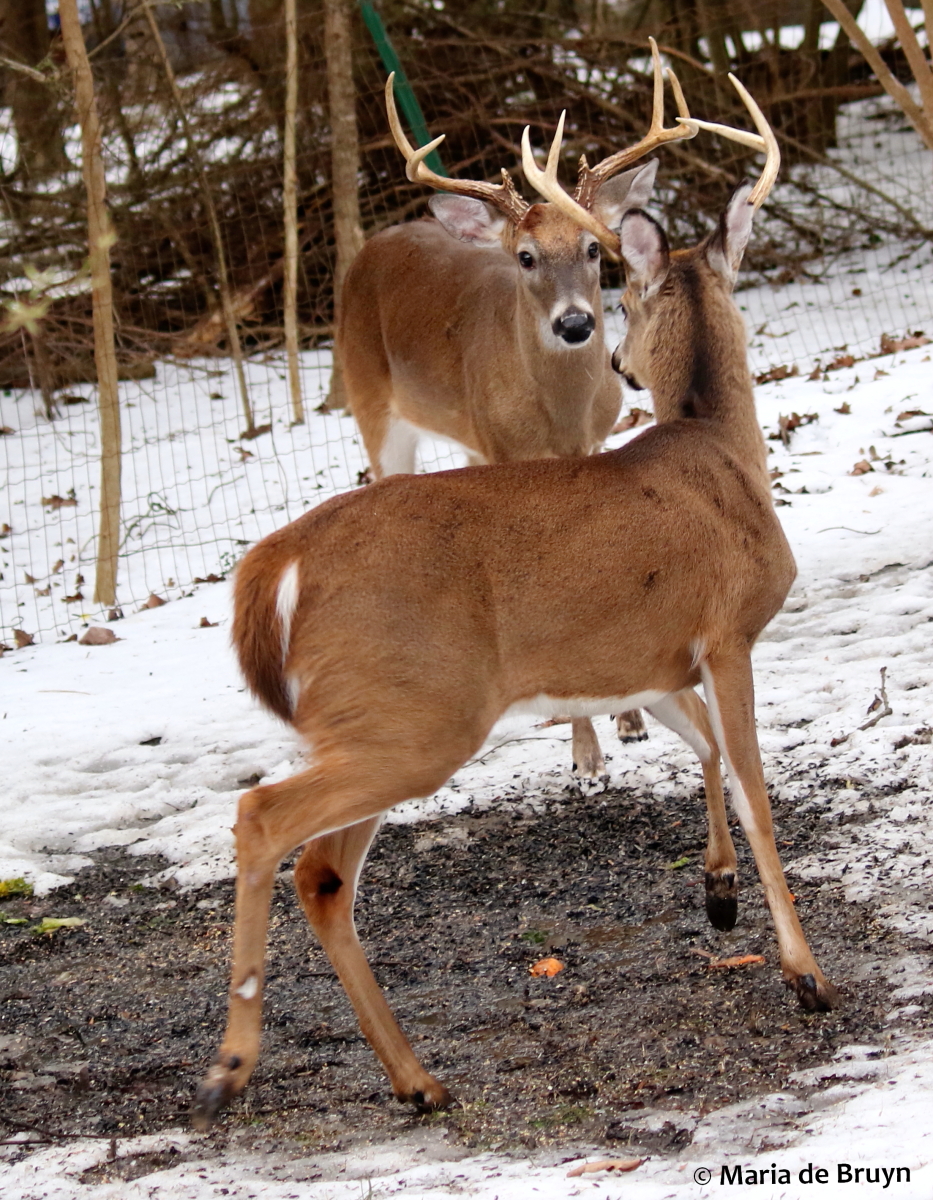
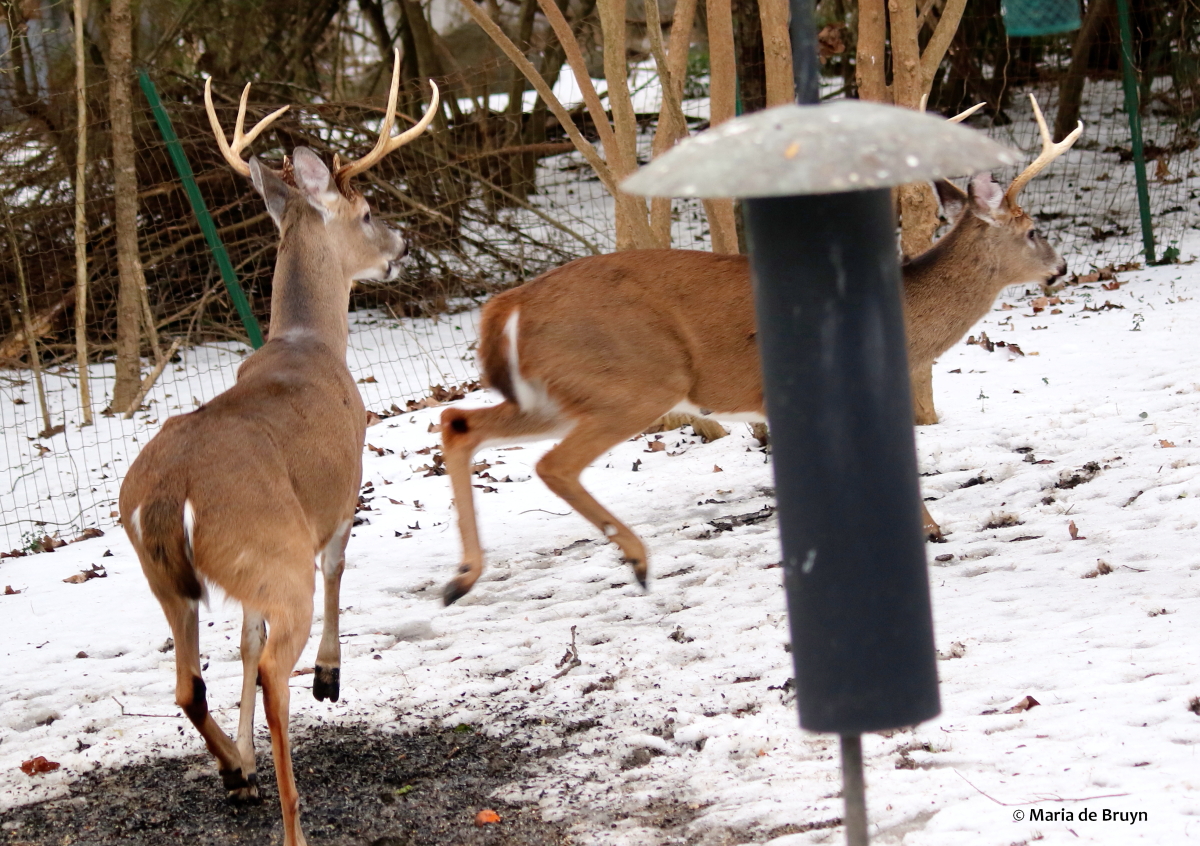
A couple weeks ago, two of the older males came down from the woods in search of does and food in the cold weather. This pair was traveling together but that didn’t stop some rivalry where first-access to the available food was concerned.
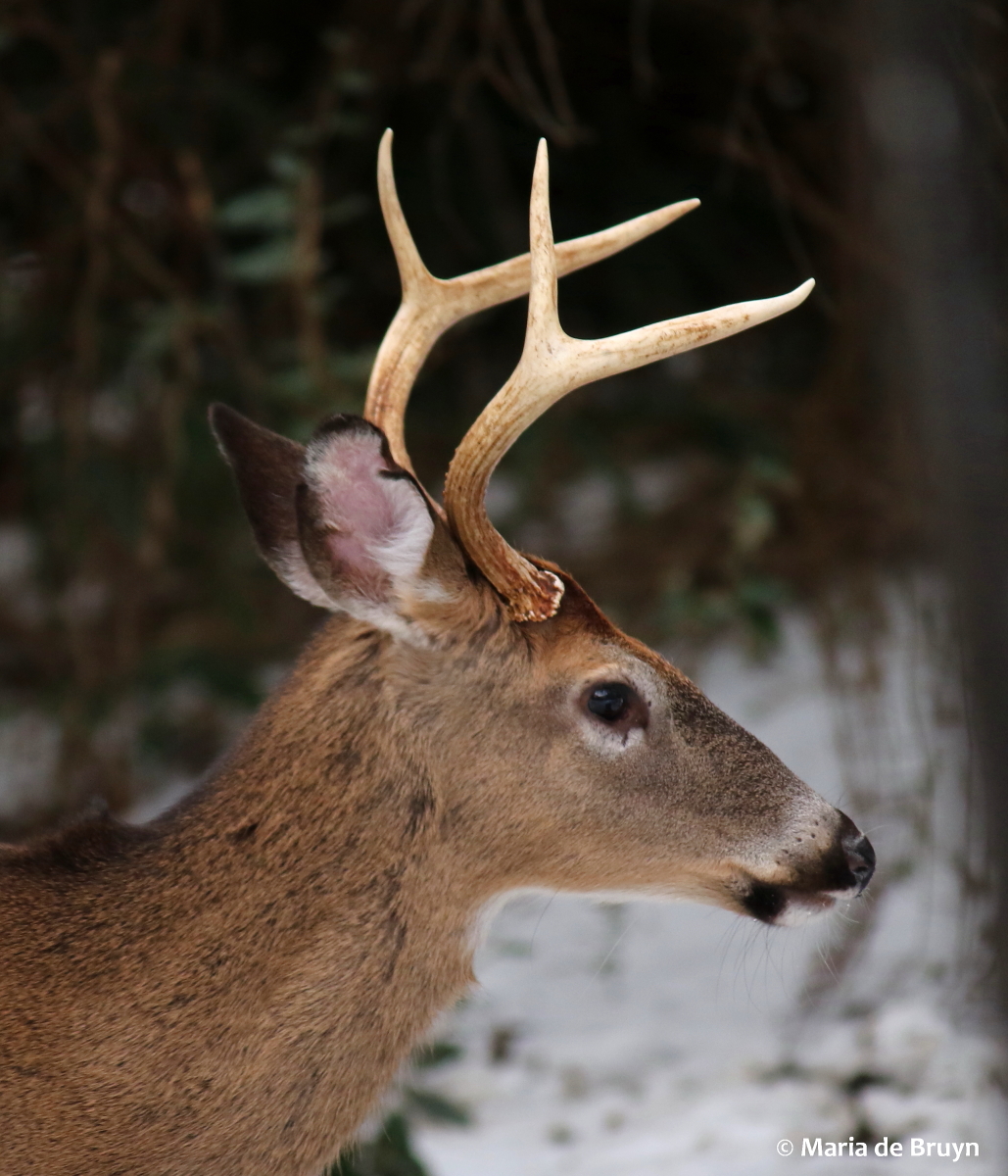
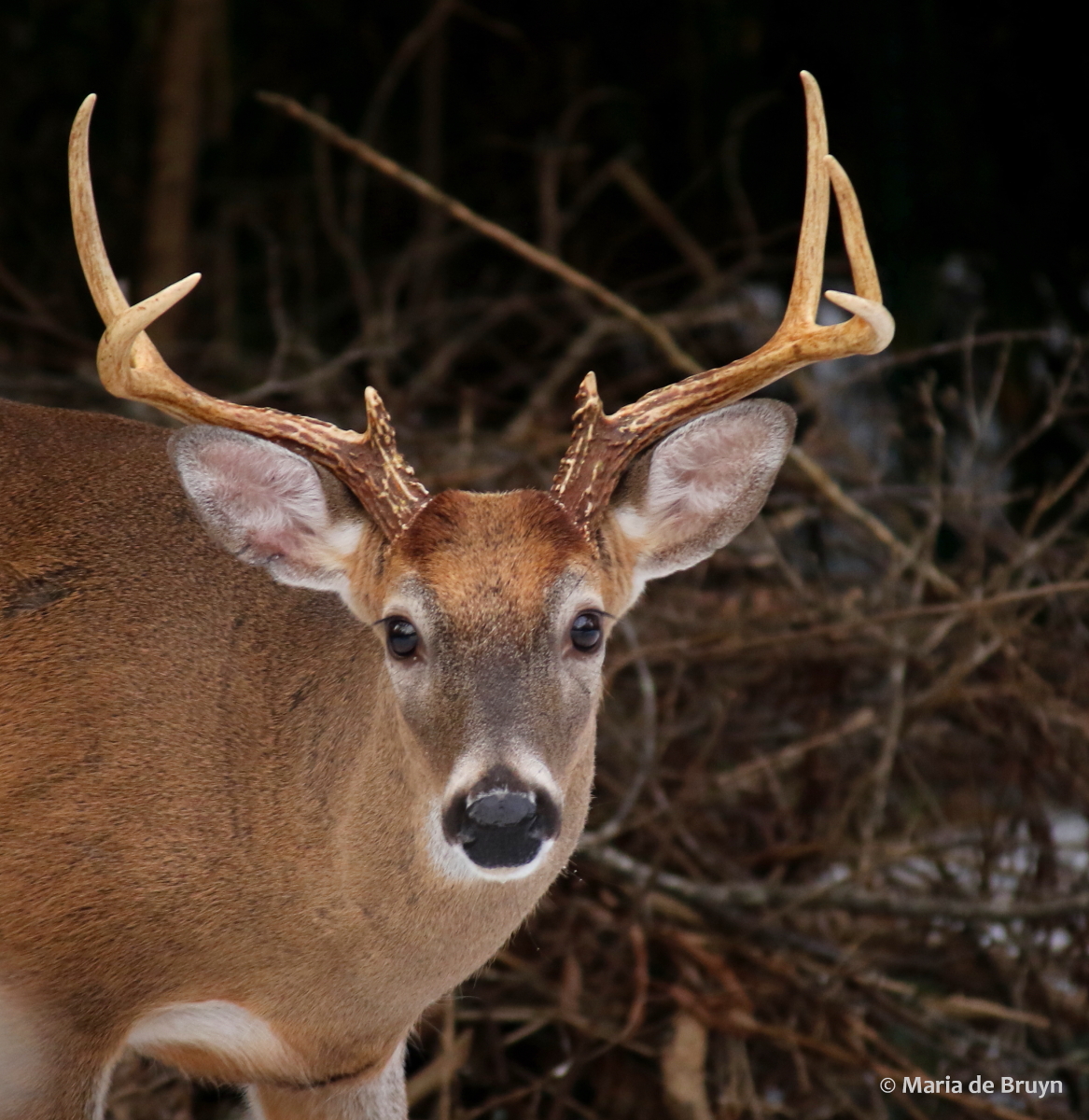
 

white-tailed deer I77A1061© Maria de Bruyn res white-tailed deer I77A1005© Maria de Bruyn res


white-tailed deer I77A1127© Maria de Bruyn res  white-tailed deer I77A1150© Maria de Bruyn res

white-tailed deer I77A1893© Maria de Bruyn res


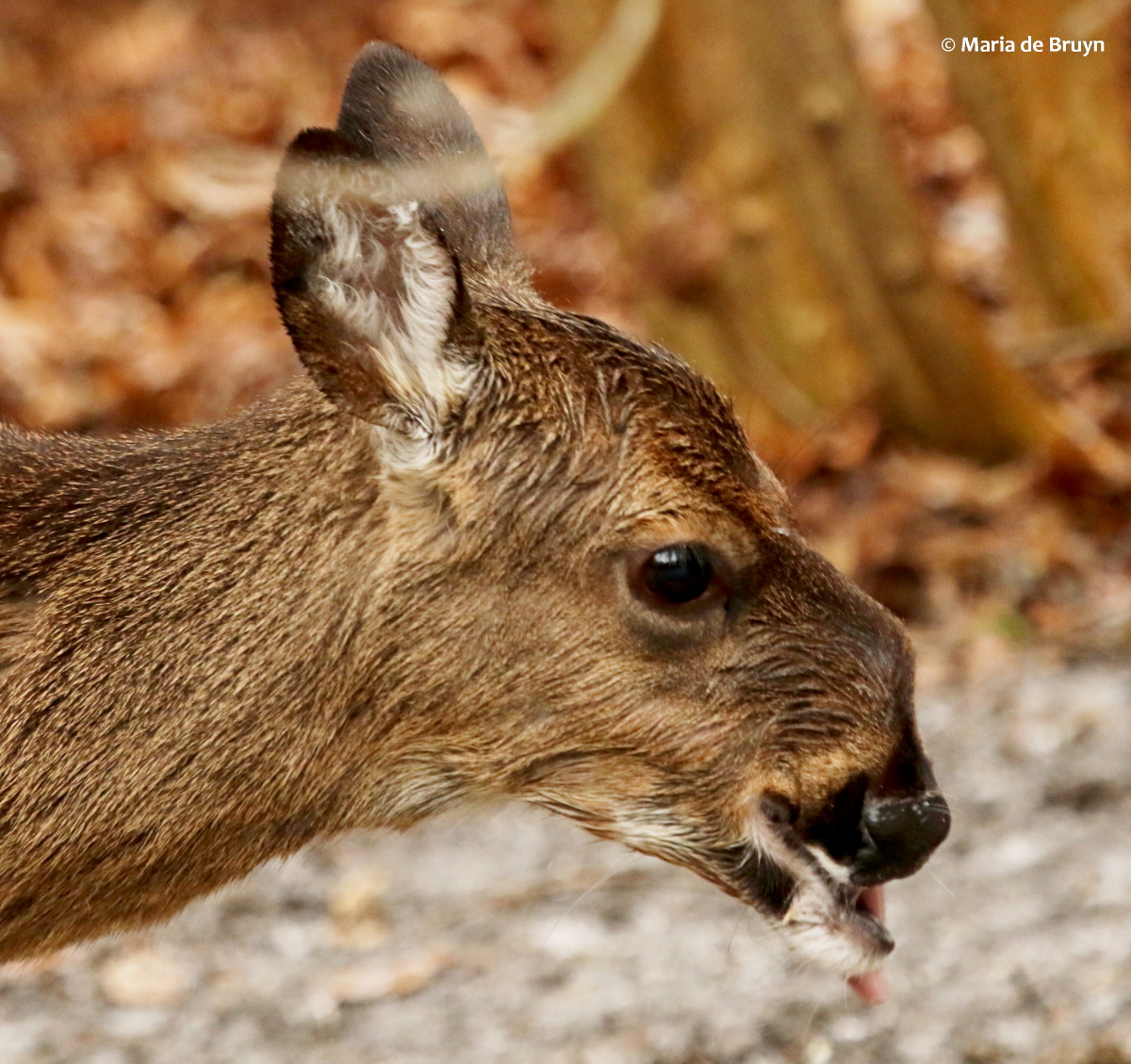
Then one day about a week ago when we had some very icy weather, I was surprised by a new and unfamiliar family group for a day. I didn’t mind them eating some seed and the resident family wasn’t around to chase them away. But then I felt immensely sad as I saw that one of them had been injured. Her tongue was lolling out but it was only when she came into the yard that I saw she must have been in an accident.


I felt miserable for her, seeing her face had been smashed in but after watching for a while, I realized the accident must have happened some time ago as she had no open wounds.
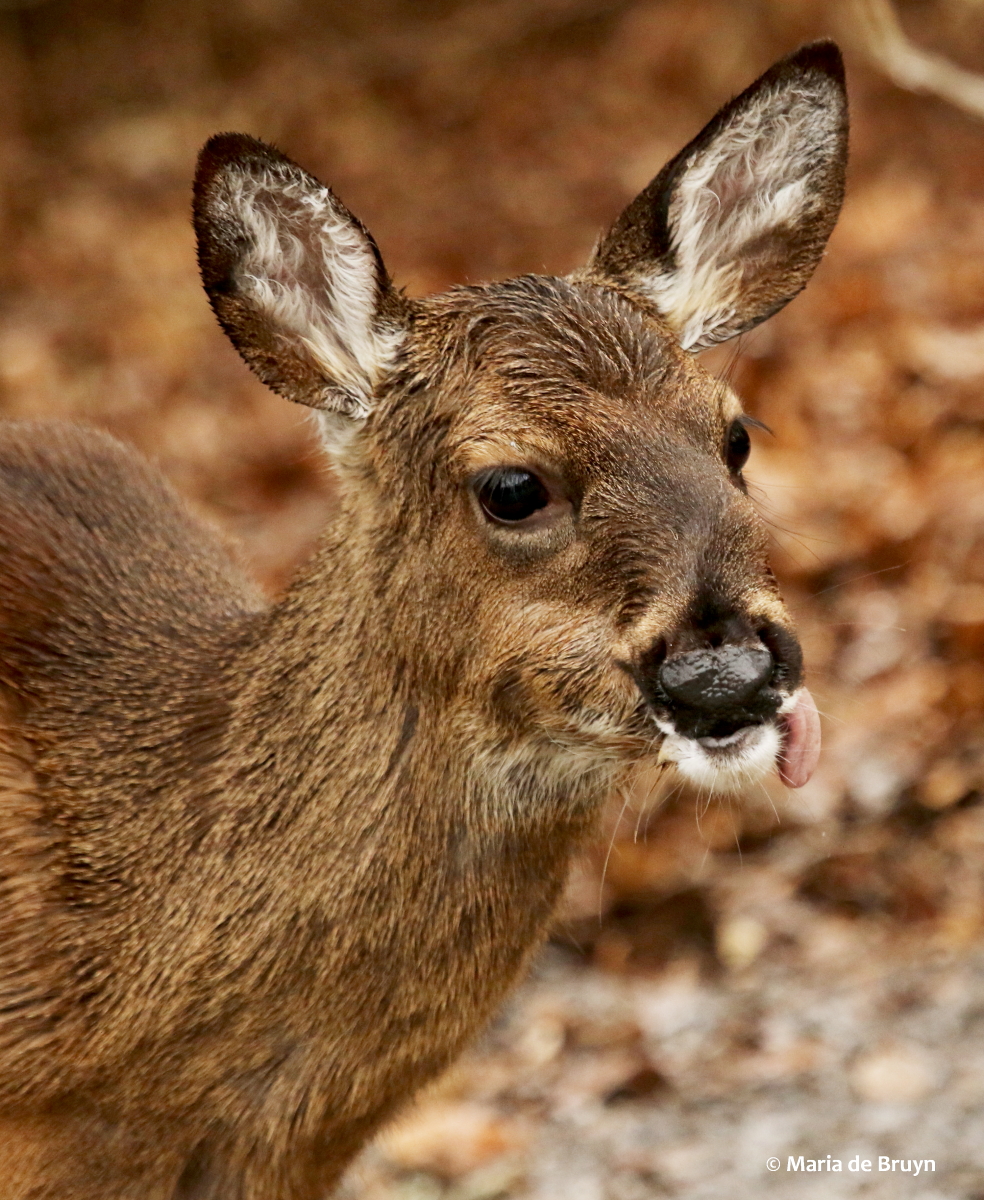
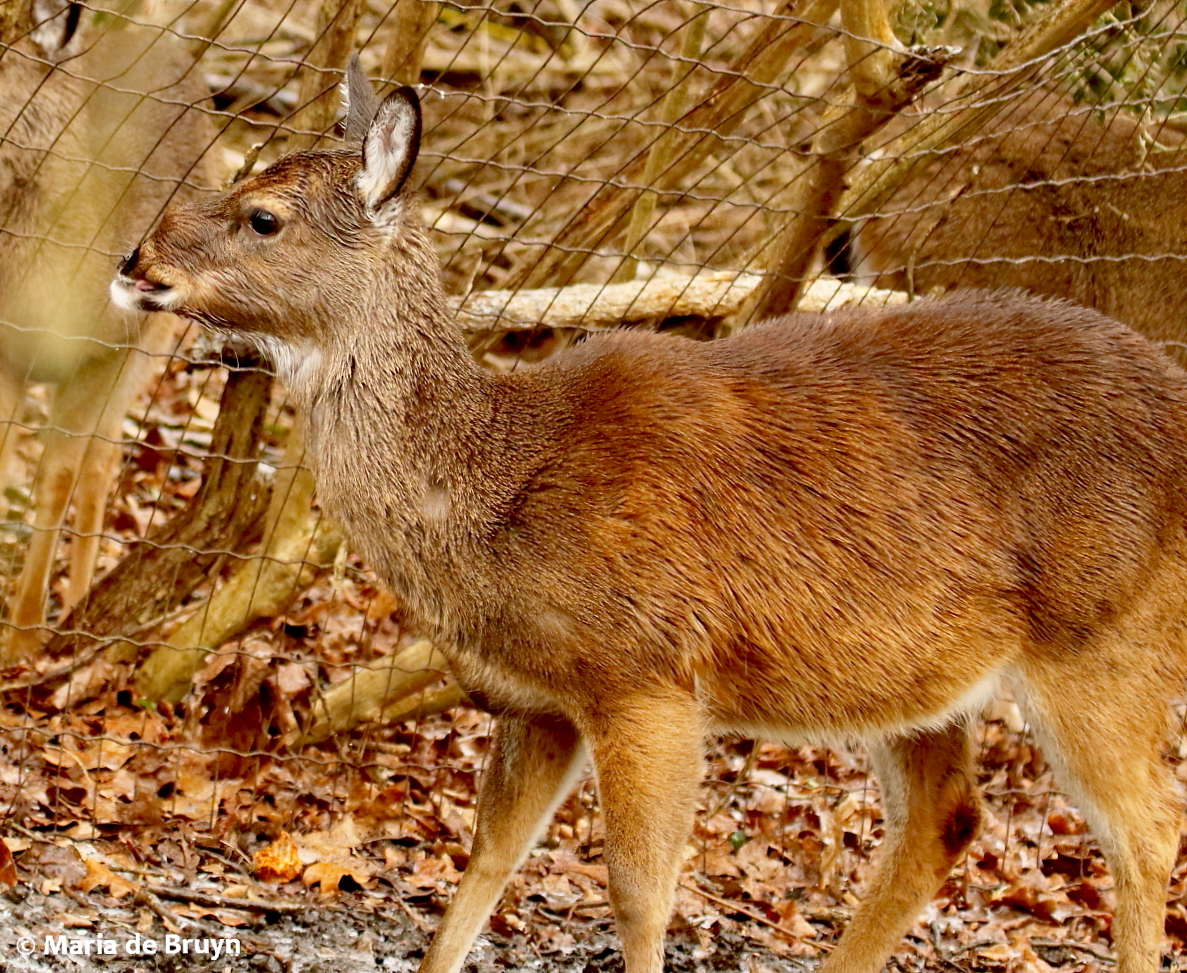
white-tailed deer I77A1917© Maria de Bruyn res white-tailed deer I77A1869© Maria de Bruyn

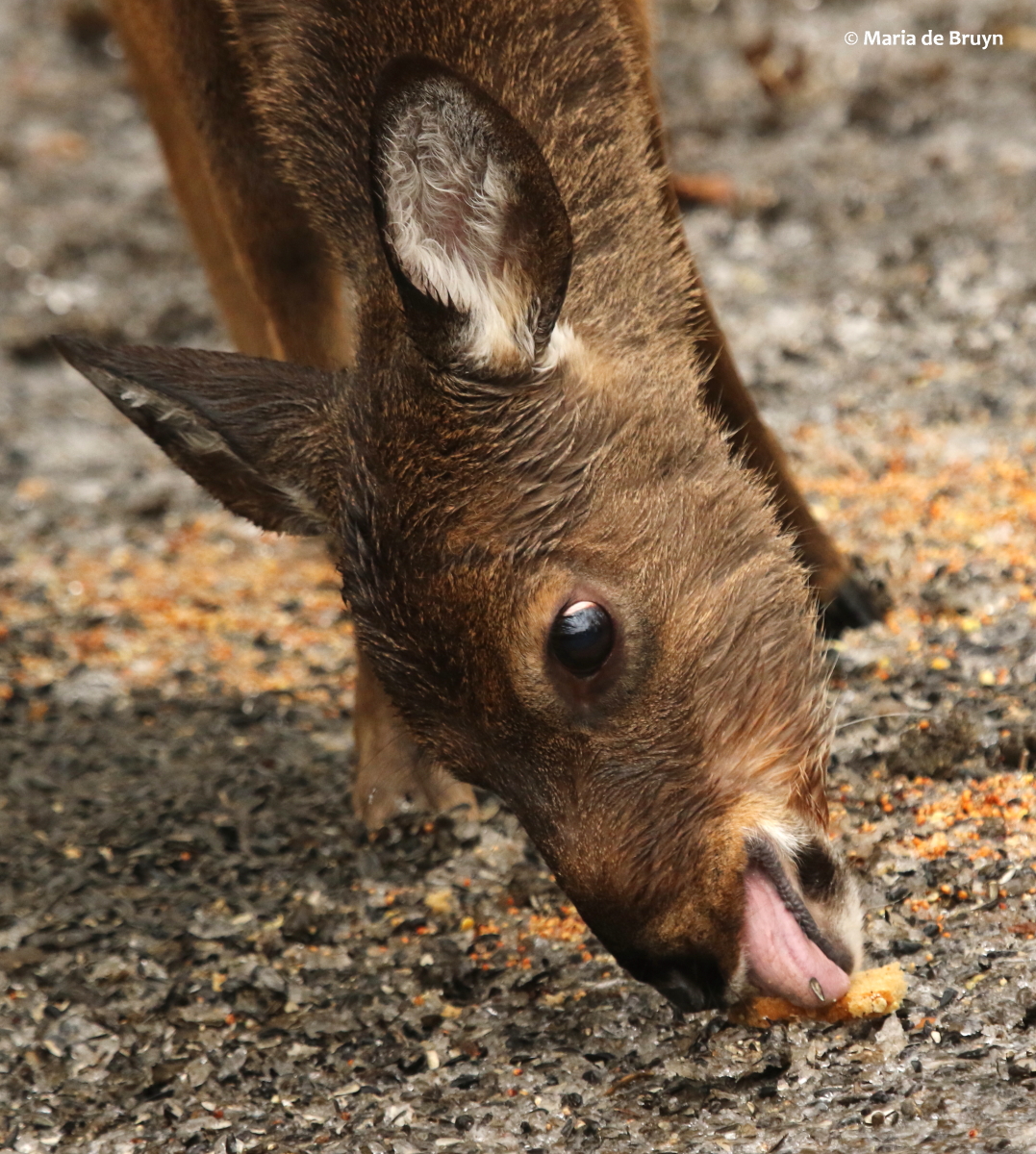
It must have been terribly painful though. I decided to call her Camelia as her profile reminded me of a camel.
white-tailed deer I77A1932© Maria de Bruyn res   white-tailed deer I77A1906© Maria de Bruyn res

white-tailed deer I77A1887© Maria de Bruyn res

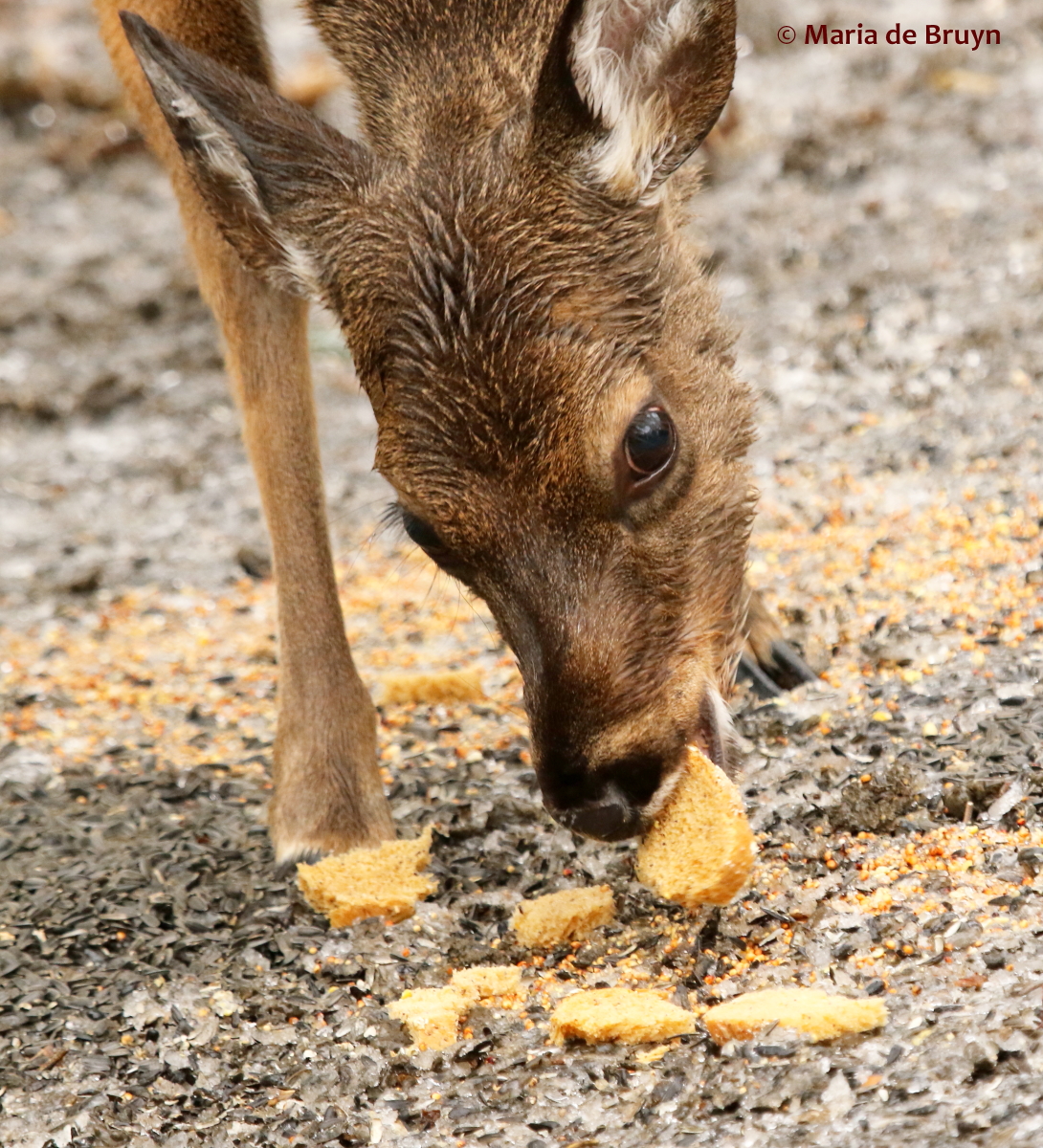
I put out some soft bread for her because I don’t know how easily she can eat. She does seem well-fed, however, so perhaps her disability is not hampering her nutritional intake. I haven’t seen her or her family again and don’t know if they will ever return, but it reminded me of how many deer are hurt and killed in accidents. I continue to think it would be worthwhile for research to continue on reducing deer populations through contraceptive use.


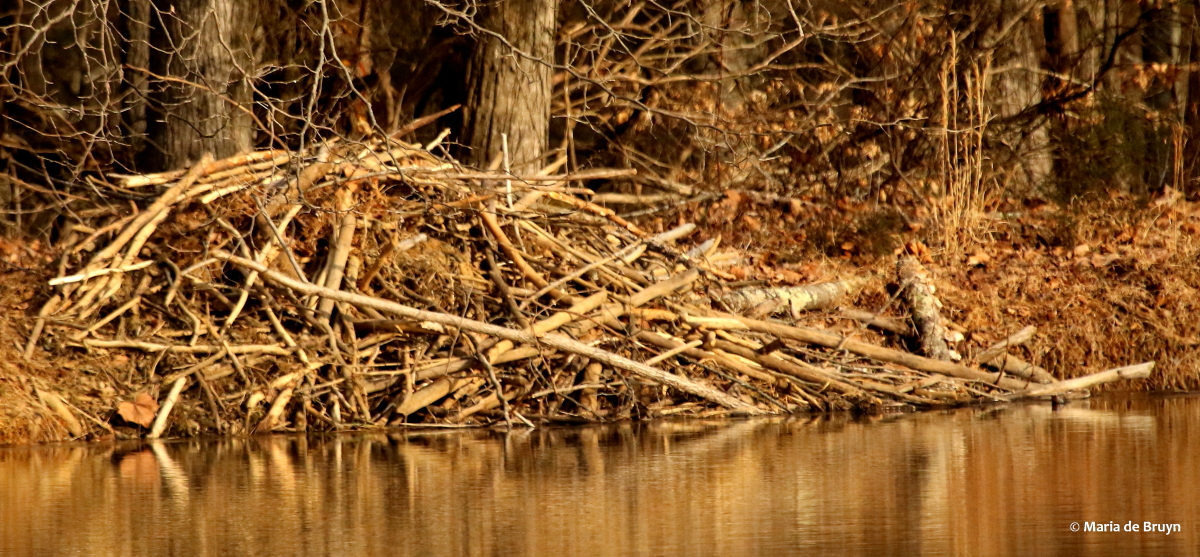
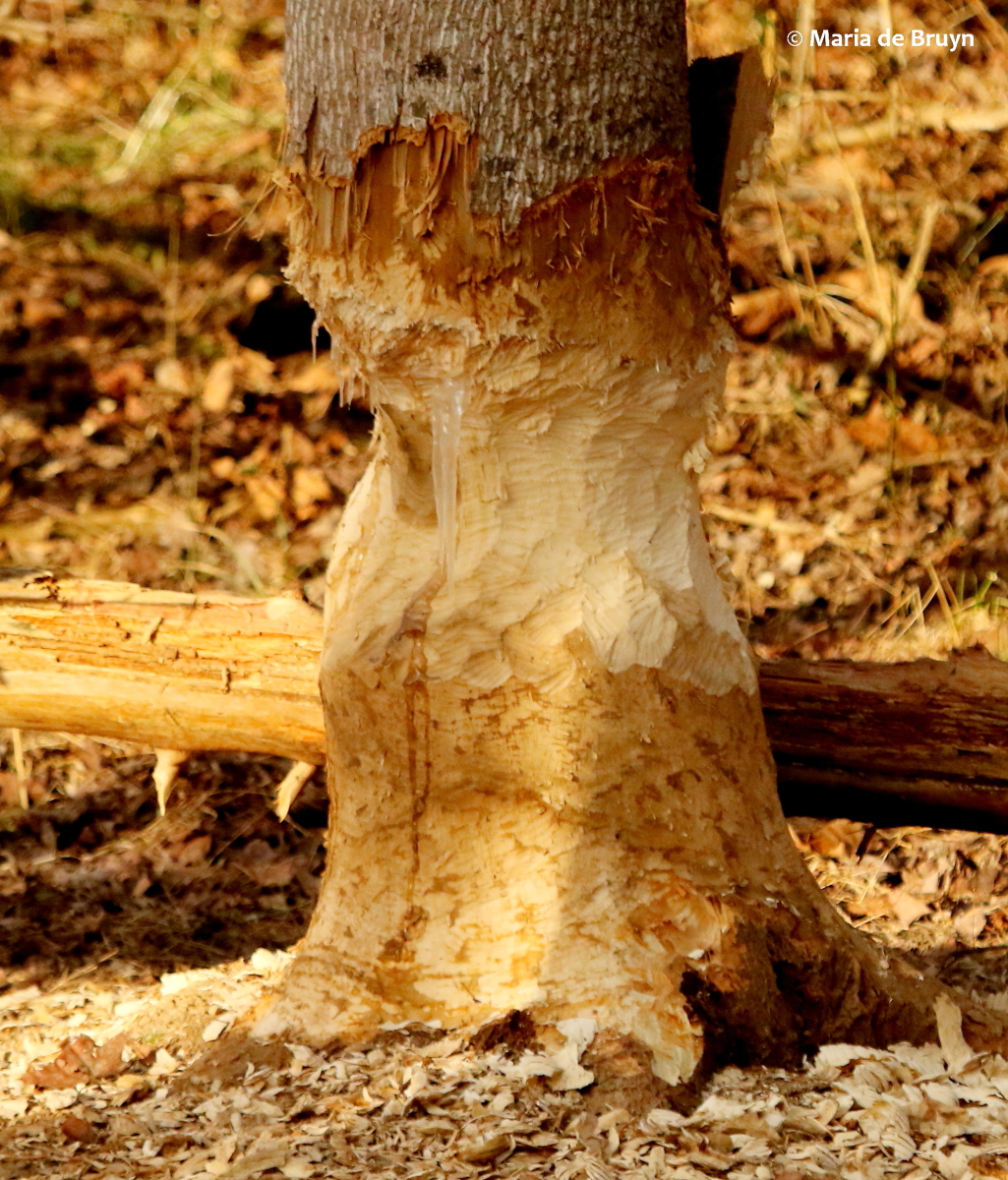
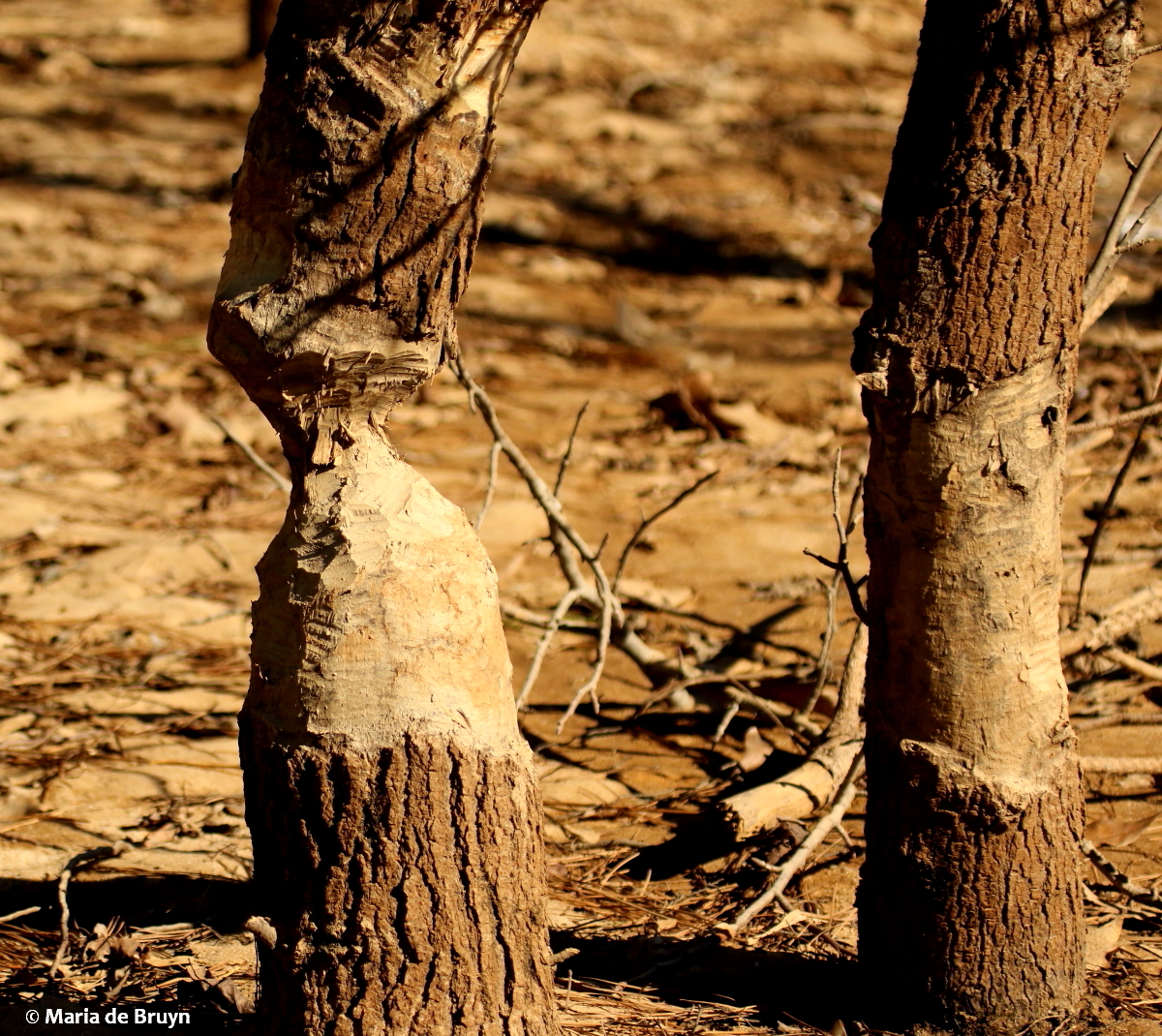
Beaver DK7A4173©Maria de Bruyn resOutside my yard, I’ve been seeing many signs of beavers (Castor canadensis) in the parks and reserves I visit. Their teeth are strong and I recently learned why their teeth are reddish brown – the enamel contains iron!


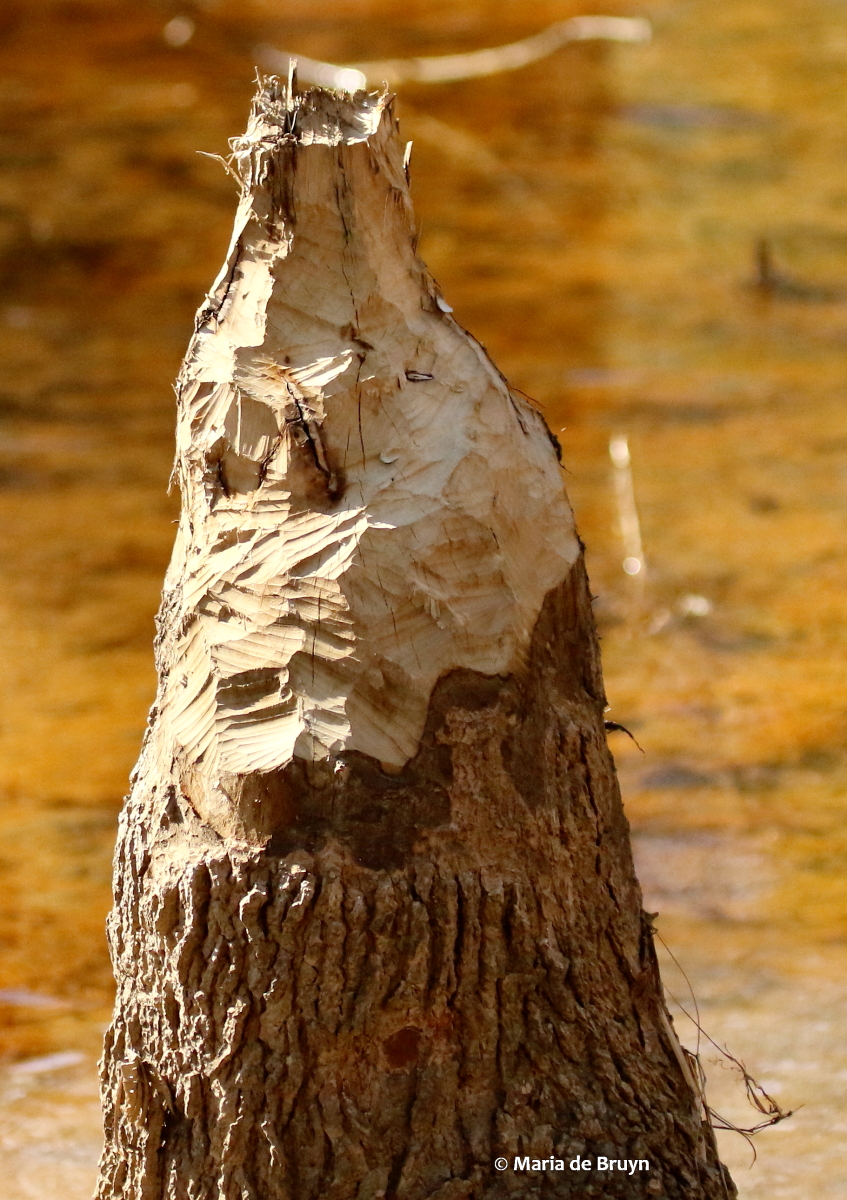
They have left tree stumps, half-gnawed trees and detached trees that they have apparently not yet been able to drag over to their dams and dens.
beaver tree I77A2950© Maria de Bruyn res  beaver I77A0313© Maria de Bruyn res

beaver I77A0125© Maria de Bruyn res  beaver I77A0098© Maria de Bruyn res

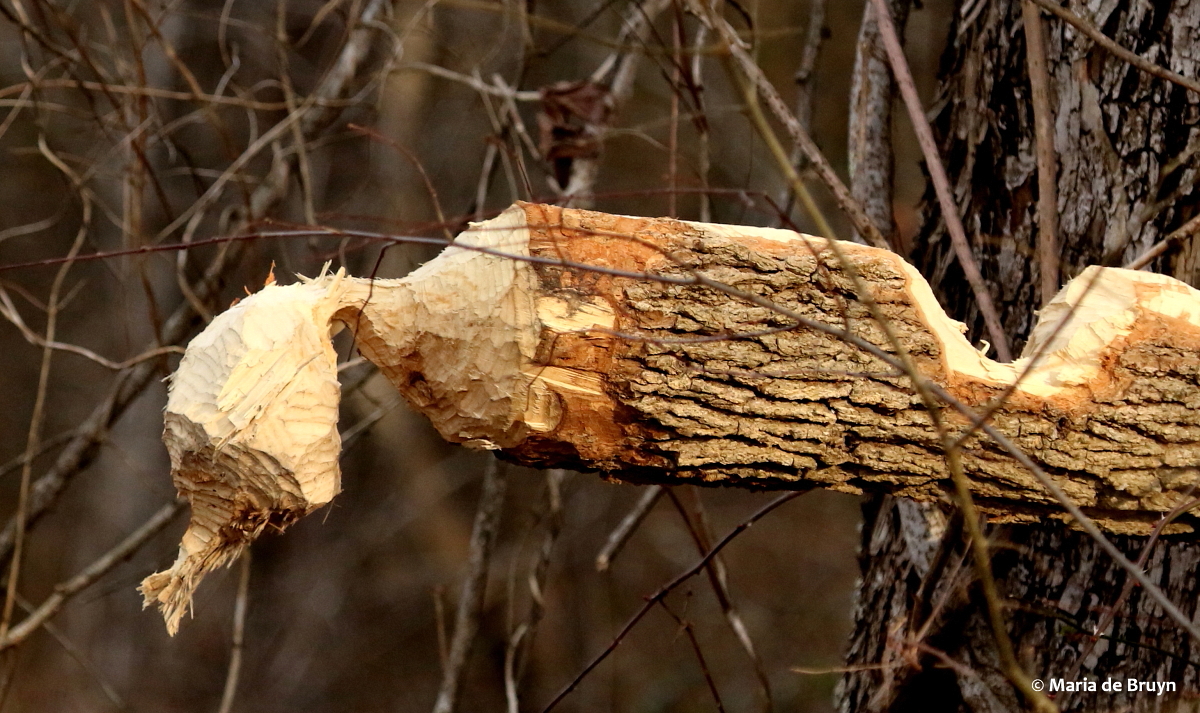
One downed tree in particular looked to me like they had been working on a bird sculpture!
beaver I77A0090© Maria de Bruyn res


Eastern chipmunk I77A6221© Maria de Bruyn resI’m guessing that some of the other animals will be coming out in the daytime soon around my home – at the very least, the frogs and rabbits, whom I have seen only very occasionally. Spring is coming and while I enjoy seasonal variety, I will welcome it with open arms!

A life and death drama on a nature walk

ice DK7A6116©Maria de BruynFrost was sparkling on the grass, dried shrubs and grasses as our small group set out on a birding walk in the local nature preserve. Water in the creeks and bog was frozen in pretty patterns and the air felt crisp (and cold).


ice DK7A6094©Maria de Bruyn

Eastern towhee DK7A5990©Maria de BruynAt first, not many birds seemed to be aroblue jay DK7A5949©Maria de Bruynund but soon we spotted Eastern towhees (Pipilo erythrophthalmus) and numerous sparrow species in the meadows — none really close by but still visible to those with binoculars and a zoom lens. Blue jays (Cyanocitta cristata) were flying from very high treetop to treetop.

After seeing my familiar red-headed woodpecker (Melanerpes erythrocephalus), to whom I’ve given the name “young’un” as I’ve been following her/his progress since s/he was a brown and white juvenile, we saw some Eastern phoebes (Sayornis phoebe) and more sparrows.

Eastern phoebe DK7A6061©Maria de Bruynred-headed woodpecker DK7A6013©Maria de Bruyn

hairy woodpecker DK7A6163©Maria de BruynIn the woods, we saw a ruby-crowned kinglet and a yellow-bellied sapsucker (Sphyrapicus varius). It was when we emerged from the woods into another meadow that we had our most spectacular encounter, however. I spotted a young red-tailed hawk (Buteo jamaicensis) perched in a tree at the meadow’s edge gazing ahead.


red-tailed hawk DK7A6229©Maria de Bruyn red-tailed hawk DK7A6245©Maria de Bruyn

red-tailed hawk DK7A6246©Maria de BruynSuddenly, the bird flew across the field (perhaps 150 feet in a fellow birder’s estimate) to land on a branch in a tree right next to our walking path.

red-tailed hawk DK7A6397©Maria de Bruyn res

After alighting, the bird began staring downwards very intently. We walked a little closer and stopped. The bird didn’t even look in our direction but continued to stare down with great concentration, occasionally looking out ahead.

red-tailed hawk DK7A6380©Maria de Bruyn res red-tailed hawk DK7A6370©Maria de Bruyn res

We came closer and stopped again. Finally, we got right up even with the bird and looked directly at it from about 6-10 feet. It acknowledged our presence but continued to stare down and we couldn’t figure out what it was tracking. Other birds fluttered in nearby branches but it paid them no mind.

red-tailed hawk DK7A6411©Maria de Bruyn red-tailed hawk DK7A6414©Maria de Bruyn

red-tailed hawk DK7A6425©Maria de Bruyn red-tailed hawk DK7A6432©Maria de Bruyn res

When our group began to walk on after taking many photos and admiring the bird’s sharp eyes and even sharper looking talons, I looked intently under the tree, too. And then I spotted the prey — a hispid cotton rat (Sigmodon hispidus), holding still as a statue on a log.

hispid cotton rat DK7A6463©Maria de Bruyn res hispid cotton rat DK7A6449©Maria de Bruyn res

The hawk looked at us, yet kept the rodent in sight. On looking at the photos afterwards, I’m glad that the hawk didn’t decide to fly at us with those talons extended in order to drive us away. After looking at the rat, our group walked on as it looked to be quite a standoff; the rat had several smaller branches between it and the hawk which might make capture difficult.

red-tailed hawk DK7A6509©Maria de Bruyn resred-tailed hawk DK7A6488©Maria de Bruyn res

As my fellow birders tried to spot winter wrens and purple finches, which they had heard, I couldn’t get the hawk and rat out of my mind. So as they went on, I returned to the dramatic scene. As I arrived, the hawk had risen on the branch and was crouching as it looked at me and the rat. It turned on the branch and I just knew that it was getting ready for an attack. Part of me wanted the rat to make it out of there and part of me felt the hawk deserved a meal after such stellar spotting from a distance and patience in watching the prey.

red-tailed hawk DK7A6496©Maria de Bruyn resThe hawk looked at me, crouched again and then dropped down with great fluttering of wings.

red-tailed hawk DK7A6525©Maria de Bruyn red-tailed hawk DK7A6531©Maria de Bruyn res

red-tailed hawk DK7A6532©Maria de Bruyn res red--tailed hawk DK7A6548©Maria de Bruyn res

Those large wings were somewhat caught up in the small branches but it got the rat. It flapped about, perhaps securing a tighter hold on its meal-to-be and then flew up to a nearby branch (behind lots of vegetation so that I couldn’t get a good photo). It sat for a minute or so and then flew back over the meadow into the woods, leaving me with a few blurry photos as testaments of the final act in the drama.

red-tailed hawk DK7A6574©Maria de Bruyn res red-tailed hawk DK7A6585©Maria de Bruyn res

red-tailed hawk DK7A6599©Maria de Bruyn resMy sympathy was certainly with the rat, whose last 30 minutes of life must have been filled with terror as it froze in the hope of escaping the predator. I had to admire the hawk’s concentration and focus, though — that bird was not going to let anything deter it from getting a meal, not even four humans standing a few feet away aiming cameras and phones at it as it perched on that branch. The hawk certainly gave us an unforgettable experience as we may never come so closely eye-to-eye with a wild raptor again.

If you liked this post and/or the photos, could you please “like” it so that I know people enjoyed this posting? Thanks in advance!

Dining out in winter

cardinal and crowd DK7A9445© Maria de Bruyn resIn the spring, summer and fall, when birds have insects and other favorite foods available, many of us see moderate numbers of avian visitors at our feeders — although there are always exceptions, such as parents looking for easy meals to satisfy the voracious appetites of their offspring. Come wintertime, though, we may have whole flocks of different species flying busily to and fro to take food from our feeders.


tufted titmouse IMG_0635© Maria de BruynOur avian friends need to eat more, and more often, in autumn and winter to ensure that they can gain sufficient fat reserves to see them through the cold weather. Some of the smallest birds will consume up to 30% of their body weight. Nuts are a favored food for tufted titmice (Baeolophus bicolor).

cedar waxwing IMG_7967 ©Maria de Bruyn 2

In the autumn, there are still many berries available and these are a popular food. Birds that tend to eat insects much of the year will switch to berries in winter since their prey has died, is dormant and awaiting rebirth in larval form, or otherwise scarce. The berries of honeysuckle (Lonicera), privet (Ligustrum, an invasive plant) and other plants are popular foods for species such as cedar waxwings (Bombycilla cedrorum).

 Holly berries (Ilex opaca) are a favorite for American robins (Turdus migratorius).

American robin IMG_3302 © Maria de Bruyn American robin IMG_0326©Maria de Bruyn res

Pine siskin IMG_6226©Maria de Bruyn resEven when much of the vegetation has dried up, seeds and seed pods remain. Pine siskins (Spinus pinus), downy woodpeckers (Dryobates pubescens) and American goldfinches (Spinus tristis) will feast on the seeds found in the pods of honeysuckles and trumpet vines (Campsis radicans).


American goldfinch IMG_6251 ©Maria de Bruyn res Downy woodpecker IMG_9184M de Bruyn

In some cases, dried leaves and the remains of caterpillar tents form clumps that attract tufted titmice and white-throated sparrows (Zonotrichia albicollis) as they search for sustenance.

tufted titmouse IMG_9714© Maria de Bruyn res white-throated sparrow DK7A6171© Maria de Bruyn res

Pine siskins will eat moss growing on tree trunks. Other birds search the vegetation alongside ponds, like this song sparrow (Melospiza melodia).

pine siskin IMG_7546©Maria de Bruyn ressong sparrow IMG_6959© Maria de Bruyn (2) res

The seed pods of my crepe myrtle trees (Lagerstroemia) are a magnet in winter for various avian species such as pine siskins, white-throated sparrows, red-winged blackbirds (Agelaius phoeniceus) and Northern cardinals (Cardinalis cardinalis), as well as Eastern gray squirrels (Sciurus carolinensis).

white-throated sparrow IMG_2653©Maria de Bruyn respine siskin IMG_8177 ©Maria de Bruyn

Northern cardinal IMG_4887©Maria de Bruyn resred-winged blackbird DK7A7754© Maria de Bruyn res

Eastern gray squirrel IMG_3547© Maria de Bruyn res Eastern gray squirrel IMG_3528© Maria de Bruyn res (2)

Various species of smaller birds will flock together in winter, both for purposes of safety and help in finding food. As the season progresses, the supply of seeds, pods and berries diminishes. In addition, the variety of natural plants has often decreased in urban areas as homeowners remove “weeds” from their yards. Wildlife organizations therefore encourage bird lovers to add native plants to their property, especially those that attract birds, and to provide extra food through feeders.

white-throated sparrow IMG_1608© Maria de Bruyn ruby-crowned kinglet IMG_1635© Maria de Bruyn res

Northern mockingbird DK7A4279© Maria de Bruyn resMaking available mixed seeds, oil-rich sunflower seeds and suet (traditional or vegetarian made with vegetable shortening) will help the birds like this Northern mockingbird (Mimus polyglottos) keep up their energy. And it’s a good idea to keep those feeders filled — did you know that many songbirds are able to collect food in a special storage pouch within their esophagus so that they can then digest it after dark and overnight? This may help account for the fact that certain birds come back to the feeders over and over again within a short span of time.


The area where I live has had a long winter, with alternating days of relatively high temperatures and then very cold days and nights. Crocuses, daffodils and tulips are beginning to emerge in my gardens despite snow and ice and trees and shrubs are beginning to bud, giving the Eastern gray squirrels and house finches (Haemorhous mexicanus) a new source of food. I think that both the birds and I will be happy when spring arrives and stays! In the meantime, I’ll keep the feeders filled.

Eastern gray squirrel DK7A7410© Maria de Bruyn res House finch DK7A0286© Maria de Bruyn res