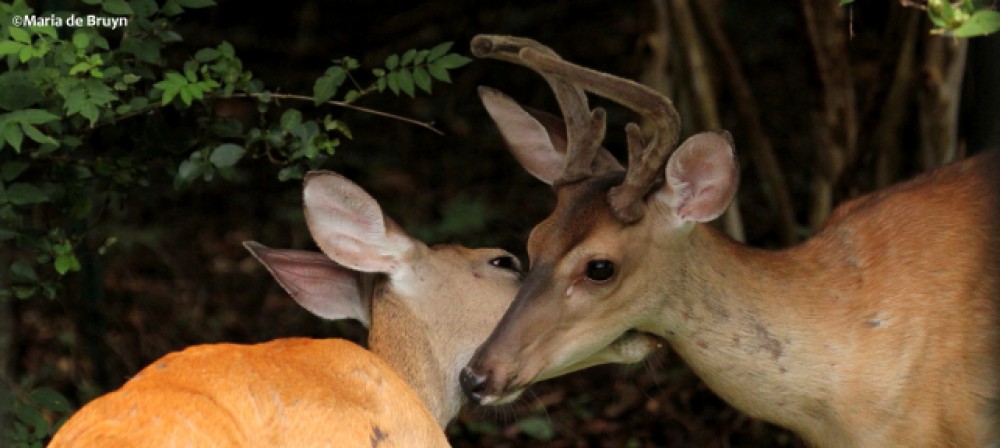
 My original interest in wildlife often centered around mammals; as a child, I was especially fascinated by the larger ones I saw at the zoo like lions, giraffes and bears. Eventually, in my later adult life, I became a birder and then Project Noah led me to begin paying much closer attention to the insect world. Nowadays, I find almost any type of wildlife of interest and look forward to learning more about diverse species.
Investigating insects has taught me that not only are some moths incredibly beautiful – so are some beetles and dragonflies, like the two brilliant blue species described here. I first encountered the dogbane beetle (Chrysochus auratus) on the plant for which it’s named, the white-flowering dogbane (Apocynum cannabinum). This plant is also known as rheumatism root since herbalists have used it to treat that disease, as well as conditions such as syphilis, fever, asthma and dysentery. It is also known as the hemp plant and has been used to make rope.


 The iridescent beetle, which measures less than a half inch and lives 6-8 weeks in summer, feeds on the dogbane as well as milkweed plants. The insects’ wings are blue-green in color and have a gorgeous shimmery shine that looks like metallic copper; depending on the light, the highlights can also look golden or crimson in color.
They have widely spaced antennae with 11-12 segments and their legs look a bit as if they end in heart-shaped pads. Their left mandible is longer than the right one and it fits into a groove in the right (why, I don’t know!).


They mate once a day during the summer and the male will stay on top of the female afterwards for some time to ensure that his sperm can fertilize eggs. After mating, the female lays her eggs on the underside of host plant leaves or on the ground. The larvae feed on roots and pupate underground. After 6-8 weeks, the adults die and we have to wait until next summer to see these little beauties.


A larger metallic blue insect is the ebony jewelwing damselfly (Calopteryx maculata), which can grow to about 2 inches. It is the black-winged males who exhibit the deep blue color on their bodies. The females are a smoky brown-gray in color and display white spots near the tips of their wings.


These damselflies have been studied extensively, so that we know they shelter among a wide variety of plants, including water plants (pickerel weed, duckweed, lilies, cattails) and land plants such as orange jewelweed, button bush, Joe pye weed and poison ivy. The adults frequently rest on low shrubs in sunlit patches.


These damselflies have a large variety of prey that include tiger mosquitoes, gnats, flies, beetles and even dragonflies. If they see you observing them, they will watch you in return, turning their heads to follow your movements

 .
.


 These damselflies are not strong fliers, often fluttering – even when resting on a leaf. Females will also rapidly open and close their wings if they are receptive to a courting male. If they reject the male, they will keep their wings open.
(If you click on the photo, you can see it enlarged.)
 The male will raise his abdomen as part of his courting display.
Females lay their eggs in the soft stems of water plants. And then, after about two weeks of flight, the adults pass away and we await new generations to admire. I’m looking forward to finding out if I discover any more blue jewels in the future!
 The first week after they


 ee a record number of snakes (and Eastern box turtles). It began with a presentation at my camera club when a wildlife photographer brought in a pit viper for photo opportunities. I only had my old point-and-shoot camera with a no longer functioning flash so my photo was not so great; the poor snake’s cage was also surrounded by so many people flashing around it, I had no appetite for trying to get a better shot. I much prefer taking photos of animals in the wild (and sometimes a zoo).
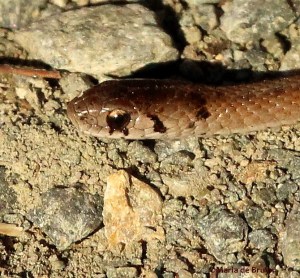 Last year, I saw a few snakes, including at an Audubon Society presentation. In the wild, I came across this thin brown snake (Storeria dekayi) crossing a path at the Mason Farm Biological Reserve. It actually was kind of a pretty with the brown markings on its head. These snakes eat snails, earthworms and slugs, so you might find it useful if they are around your garden to cut down on the plant-eating slugs.
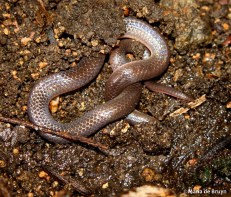 amoenus) in my garden. These smallish snakes (growing to about 15 inches max) are mostly active at night and use their small pointed heads to help root in the soil where they find insects and worms to eat.
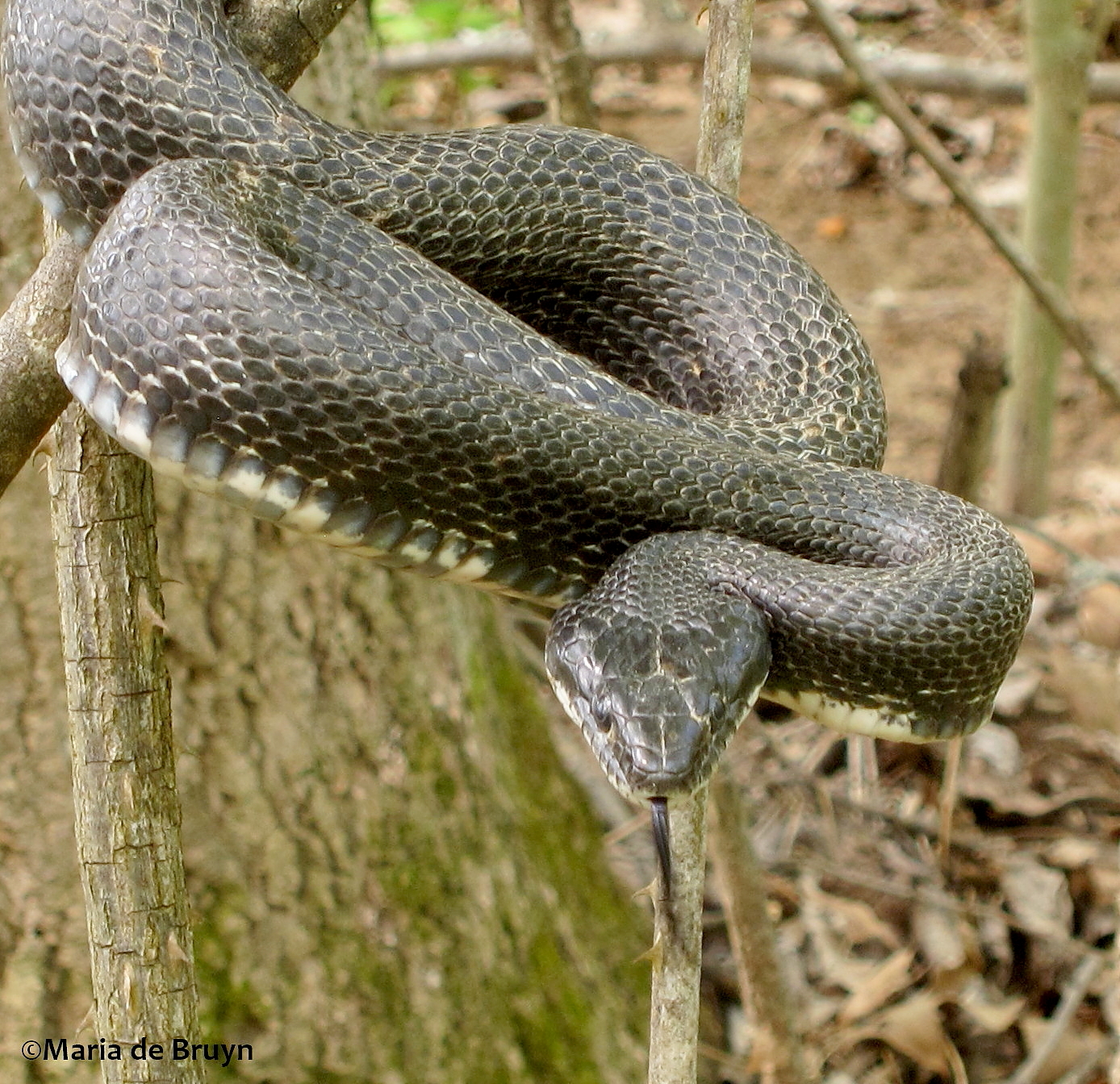


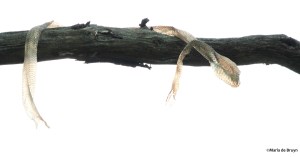 eresting sighting lately has not been a rat snake itself but its skin! They are very good tree climbers and this one obviously decided to shed its skin while hanging on a high tree limb in a park along the Blue Ridge Parkway in the Appalachian Mountains.
 copperhead (Agkistrodon contortrix), the only venomous snake in this part of the state. They can be very beautiful and actually will not attack quickly. When threatened, they will often vibrate their tail and release a musky odor. If they feel they are in danger, however, they will bite – as my next-door neighbor unfortunately discovered when he put his arms around a tree to tie a ribbon on and disturbed an unseen snake on the other side of the tree. He had to go to the hospital and had a severely swollen arm, describing the bite and its after-effects as incredibly painful.
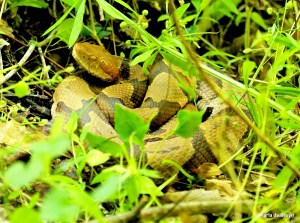 Knowing all this made me incredibly grateful that I encountered this snake on a cool early morning. Just before a nature walk, I needed to relieve myself badly and snuck off a path to do so before other hikers arrived. Perhaps distracted by the idea that someone might come upon me in an ungraceful position, I looked around quickly but obviously not thoroughly enough because as I half-squatted and looked down at my feet, I discovered my right foot was right next to this reptile. I backed away quietly but quickly and only later when I retrieved my camera from the car did I get a shot of this merciful snake.

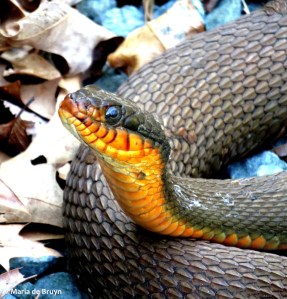 When our volunteer group at Mason Farm recently began a task of preparing wood for a new boardwalk, we discovered another native snake was keeping us company – a red-bellied watersnake (Nerodia erythrogaster). These somewhat short-tempered but beautiful reptiles consume a varied diet but mainly eat amphibians such as frogs, toads, and salamanders.





 My beautiful world