Not a white Xmas but some snowy portraits – part 1

Some of my friends really enjoy having a white Christmas holiday. When I was a child, I enjoyed it as well. Our town would usually have very snowy winters and I remember many times playing in snow piled a couple feet high. From my parents’ second-floor apartment, I liked looking out the window at the icicles, which could grow to 3 or more feet in length. It was disappointing when my mother broke them off, but she didn’t want one to fall and stab a passerby. Now, I think it is nice to see everything covered in freshly fallen snow; melting icicles and frosty dew can be pretty, but one day of this weather is enough for me. (As an adult, I now tend to think of low-income and homeless people who suffer from the cold and the dangers of icy roads.)

Still, seeing the wildlife in the yard and birds at my feeders during our very early Southern winter snowstorm in the first half of December was enjoyable. So in lieu of a white Xmas season, here is a two-part series of snowy portraits. (Remember that you can see a photo larger if you click on it; then just go back to the blog if you want to read more.) First up are the “larger” birds and a couple of the mammals who visited.

It did not take long for the Eastern gray squirrels (Sciurus carolinensis) to begin foraging in the snow; they were already busy on the first gray, darkish morning of our 2-day snowstorm.

 Lately, a family of 5 American crows (Corvus brachyrhynchos) has been visiting my yard often, the parents and three offspring who decided to stick around for a while. Although feeding bread to birds is not recommended, I admittedly do give the crows some whole-wheat pieces now and again as they seem to love them so much. So they come looking for that and occasional pieces of apple that I put out for them.


The brown thrashers (Toxostoma rufum) often feed on the ground but occasionally visit the feeders as well. They sometimes come as a pair but more often arrive as solitary visitors.


The European starlings (Sturnus vulgaris) are very beautiful birds with their winter plumage speckles. They do tend to be ill-tempered birds, however, creating havoc when they alight on feeders, chasing away other species as well as their own family members. Even the evening grosbeaks (Coccothraustes vespertinus), who visited my yard for the first time ever, gave way to the grouchy starlings.


The starlings look nice and peaceful when they sit still on a branch or rest on the snow-covered ground. When they fly up to the feeders, however, I sometimes chase them off. They used to only eat a bit of seed but now have also developed a taste for dried meal-worms and even suet. When a gang of 8-12 come, they can empty feeders in about 20 minutes. ANNOYING! (Both for me and the other birds!)

The blue jays (Cyanocitta cristata) often announce their arrival with loud squawking but tend to settle down fairly quickly. Their blue colors look beautiful against white snow.


The mourning doves are rather placid, slow and amiable birds, not minding if they have to share feeding space with other species, like the Eastern towhee (Pipilo erythrophthalmus). They do sometimes crowd out smaller birds when they alight on a feeder simply because their large bodies leave little extra space.

One dove was happy to sit a while in the snow; another took advantage of my bird bath de-icer to have a drink. I enjoy watching and hearing them, with their harmonious cooing – even their scientific name has a beautiful, melodic sound to it: Zenaida macroura!


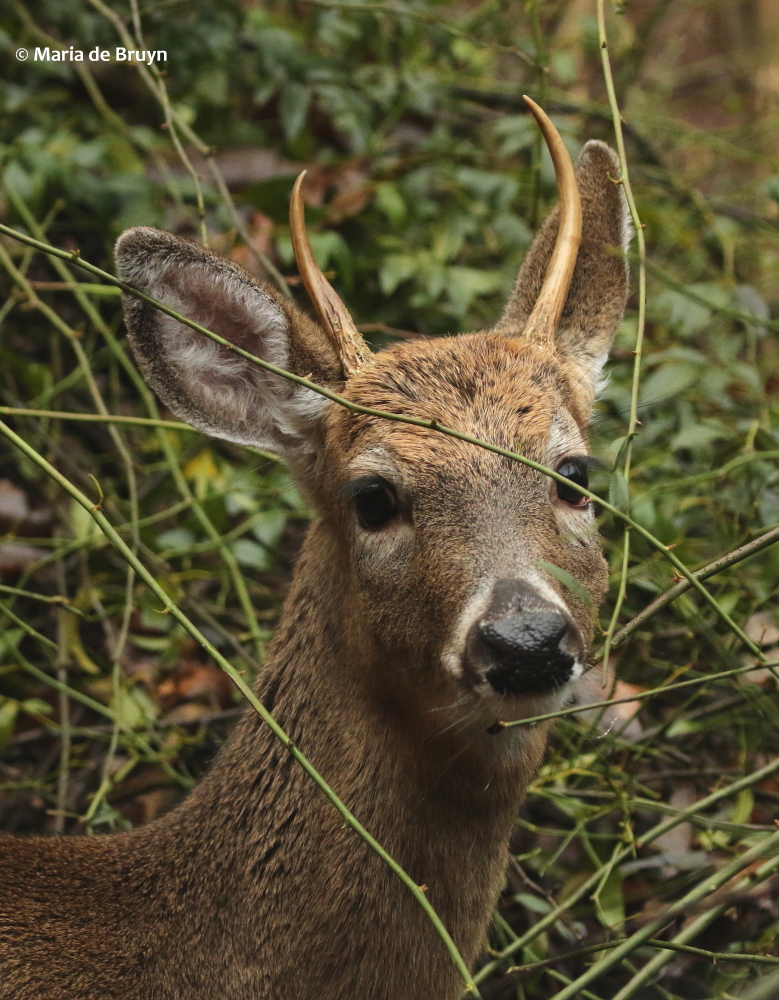
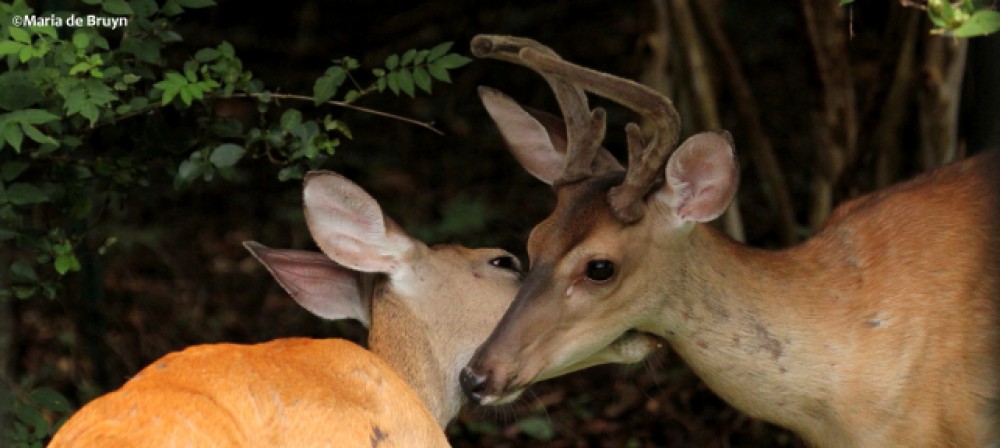
The white-tailed deer (Odocoileus virginianus) came to see how much seed had fallen to the ground as their acorns and beech nuts were covered in white stuff.


The snow was so heavy that it cracked off the tops of some trees into my yard. It also crushed down the Japanese rose (Kerria japonica), which I will have to prune in warmer weather. The fallen branches of both trees and rose did provide the deer with some cold-weather snacks.

And my favorite snow portraits of the “big feeder birds” – the common grackle (Quiscalus quiscula)! The grackles at my feeders don’t really bother other birds, so I don’t dislike them as some other people do.

Those iridescent colors are just gorgeous and some of the bird’s expressions mirror my feelings in facing some recent challenges. But we both move on looking forward to brighter times! 😊


I hope the weather where you live causes you no problems the rest of 2018!


An avian buffet appears!

In the town where I live, there is a private lake in a neighborhood of single-family homes. The little body of water was created by developers who dammed a local creek; now a neighborhood association levies annual fees for use of the lake for swimming, fishing and boating. In the past month, the neighborhood residents were surprised by an influx of birds that they do not usually see and some photos of the new avian visitors began circulating.

Given my interest in wildlife and birds, some colleagues passed on a couple of photos to me and one couple kindly invited me to come visit so that I could see the new arrivals in person. They were especially curious about the identity of a few ducks. When I arrived, no ducks were in sight, but at least 80 double-crested cormorants (Phalacrocorax auratus) were hanging out in crowds on two floating docks.

Their tightly-packed presence had displaced the Canada geese (Branta canadensis), who are more common lake residents. A group of 11 geese were off in the distance on shore leaving the open water to the visiting avian groups.

Some of the cormorants couldn’t fit onto the platforms, so they swam around in the company of the many dozens of ring-billed gulls (Larus delawarensis) of all ages who were swarming the waters as well.

From time to time, the gulls would begin edging their way onto the platforms, eventually taking up space vacated by the cormorants. There are both adult and immature gulls in the crowd.

From time to time, the gulls launch themselves into the air for aerial forays which end in dives down to pick up a fish, of which there still seem to be plenty. This is because the shad population with which the lake was apparently stocked is dying off as a whole.

Why is this happening? I don’t know the species of shad with which the lake was stocked, but it appears that threadfin shad (Dorosoma petenense) are common in the Southeastern USA and often introduced as forage fish for the bass and catfish that fisher-people seek. The shad are very sensitive to changes in water temperature; when it goes below about 42° F (5.5° C), they expire. In the past 6 weeks, we had an unusual early winter storm with about 8-11 inches of snow, followed by days and days of cold rains. Sometimes, it is cold 24 hours long; other days have nights and dawns below freezing and then afternoon temperatures of 50-60° F (10-17° C). The shad die-off is a result.


The newly arrived birds are obviously enjoying the easy pickings. When the gulls drop down to snatch a fish, they are almost always pursued by other gulls who try to make them drop the prize.


Even when they alight with a fish firmly held in their beaks, other gulls harass them in an attempt to make them give up the meal.


The shad often appear to be too large for the gulls to swallow. I saw several gulls try to position them to get them down their gullets but the fish just wouldn’t go down. So they drop the fish in the water and then try to pick off pieces for easier eating, while fending off neighboring gulls.


It is unclear to me how the birds who don’t usually populate the lake in winter knew that a spontaneous buffet had appeared. In addition to the cormorants and gulls, a group of seven bald eagles (Haliaeetus leucocephalus) was also fishing when I visited. There were some almost full adult eagles (with mostly white heads and tails) and several immature birds of varying ages (eagles reach maturity at 5 years of age). I guess that they came over from Jordan Lake, which is quite a fair distance away. Searching the Internet has not yet given me an answer to this question.

I didn’t see the eagles harass gulls who had gotten a fish but they were very carefully watching one another. When the eagle below managed to get a snack, other immature eagles closely followed him/her. A sub-adult who got a fish was harassed by an immature bird as well.


The eagles soared overhead and were joined at one point by a beautiful red-tailed hawk (Buteo jamaicensis). The larger raptors let the hawk fly alongside them with no problem.

It was quite a chilly morning when I got to see the visiting aquatic birds, so I only stayed a short time. But my friends invited me to return for another visit, which I hope to do soon as there is no telling how long it will take the visiting birds to eat the easily available shad. And the ducks? I was able to get one rather indistinct photo of a threesome across the lake and helpful folks in a Facebook group confirmed my guess – they are ruddy ducks (Oxyura jamaicensis). Maybe I can get a decent photo of them next time. 🙂

Growing up barred – Part 3: Strife and affection

In the nest, baby barred owls (Strix varia) are vulnerable to predators including hawks, weasels, raccoons and other owls. When they are out on their own and already able to fly, they eventually have less to fear. Their main predator becomes the one owl larger than they are in North Carolina, the great horned owl.

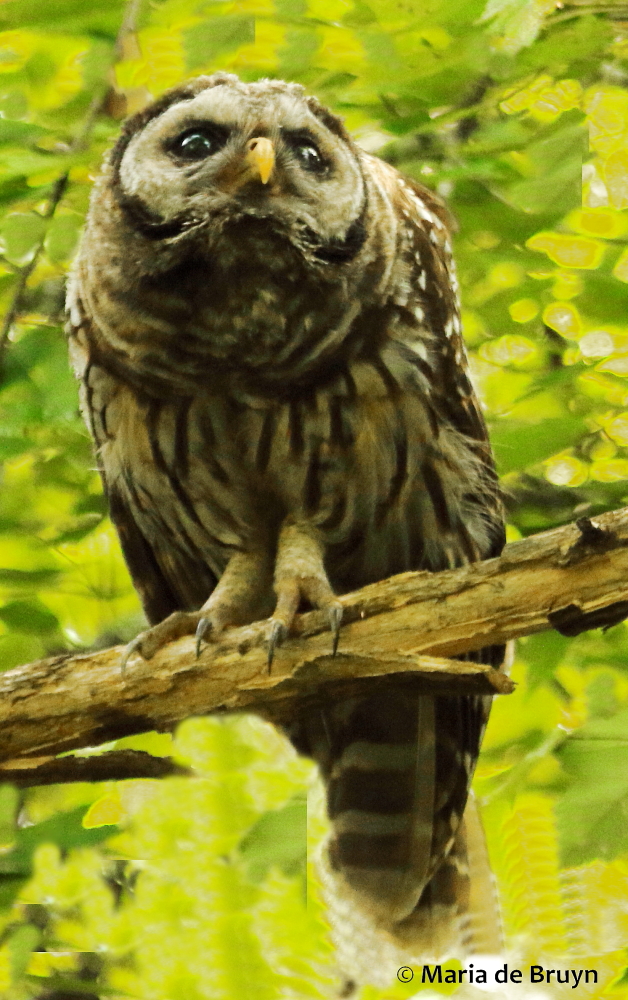
As pointed out in the previous blog, however, they can be fearsome predators to many other species of animals including songbirds, woodpeckers and other avian species. On a few occasions, I noticed the young owls at the Mason Farm Biological Reserve gazing about with expressions that seemed to express wonder and confusion.

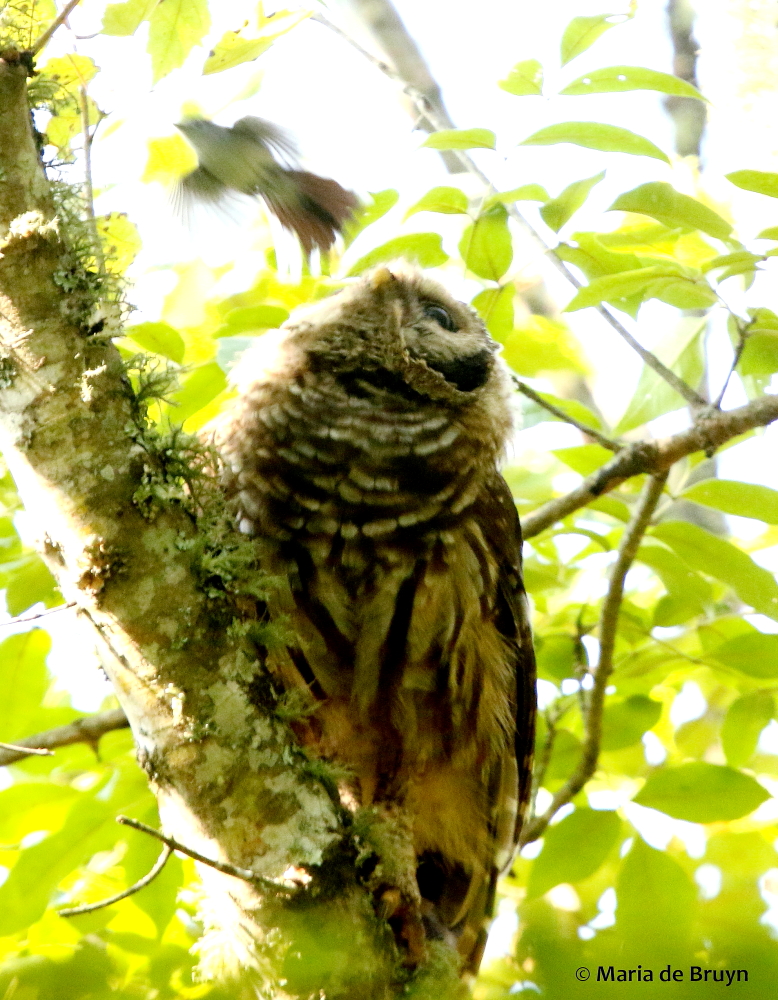
It turned out that they were being dive-bombed by members of a very small bird species, the blue-gray gnatcatchers (Polioptila caerulea). The owlets seemed to have no interest in pursuing the gnatcatchers, but they were perching in areas where the small birds had had their nests so the little gnatcatchers did their best to drive the owls away.


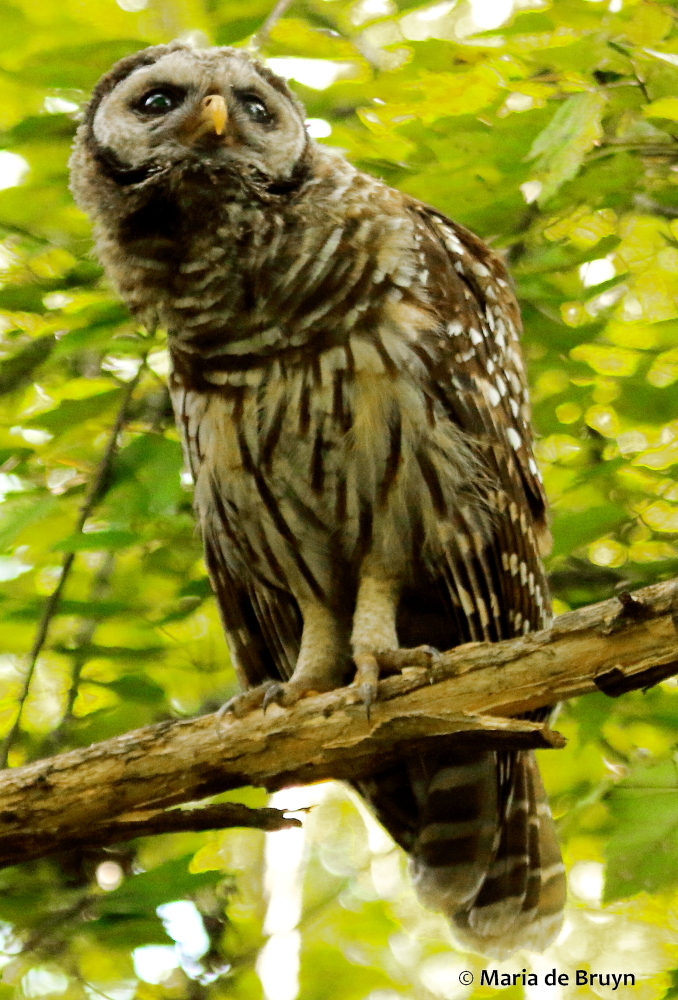
One day, they succeeded. The owls flew to the other side of a path through a bog. One landed on a branch right over my head and looked down at me with what I imagined was an expression of “Hey, what did I do???”

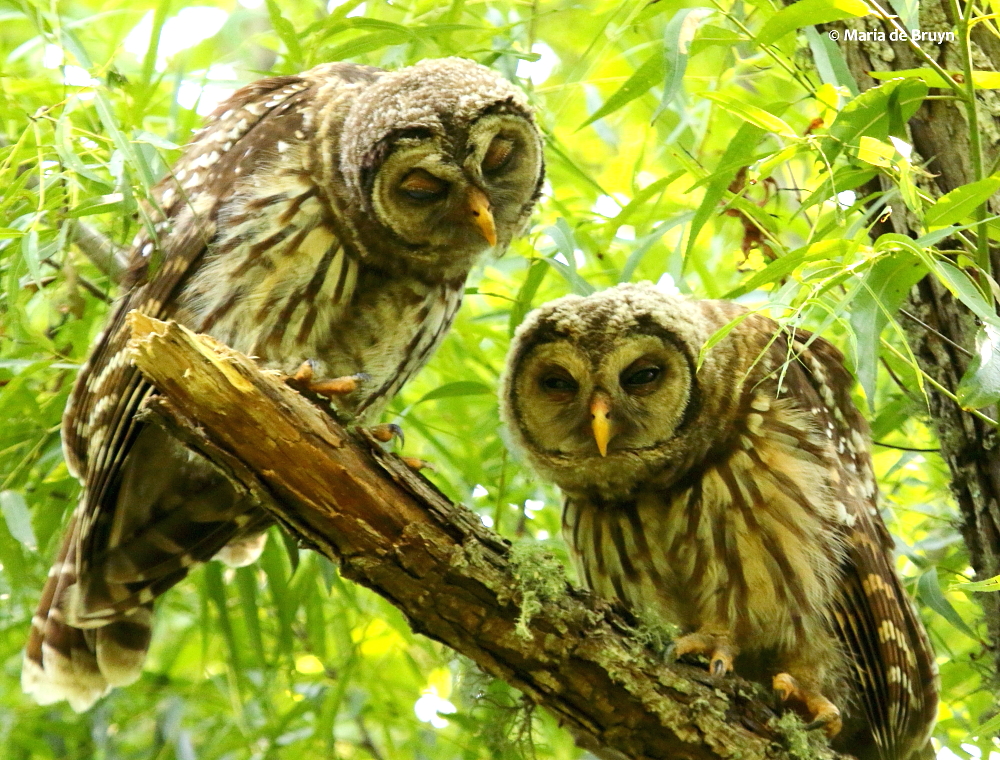
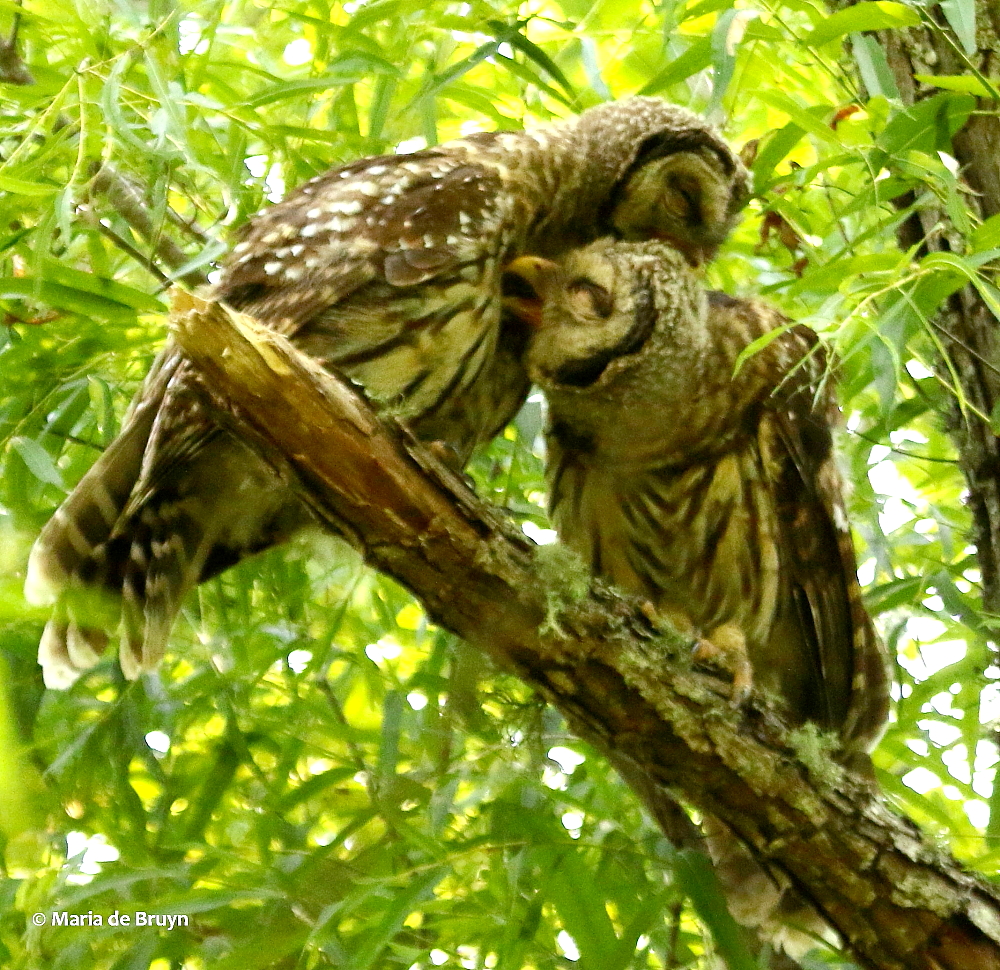
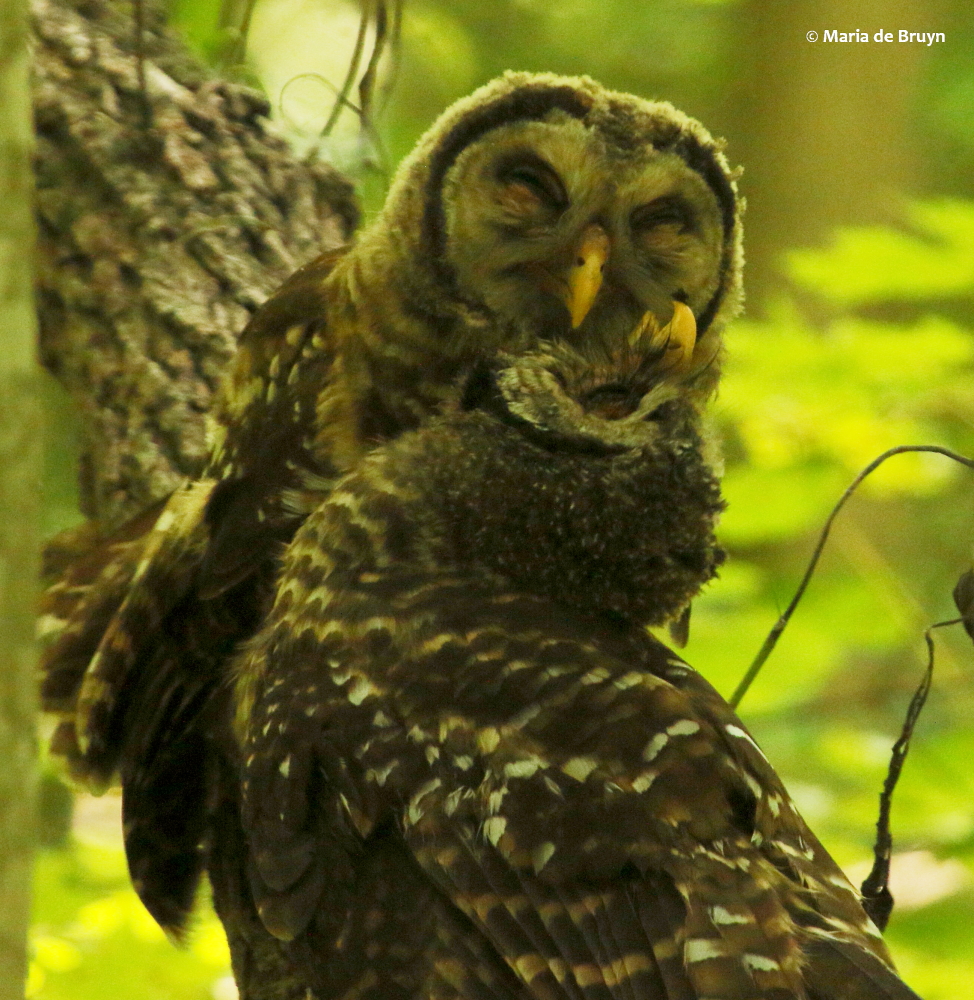
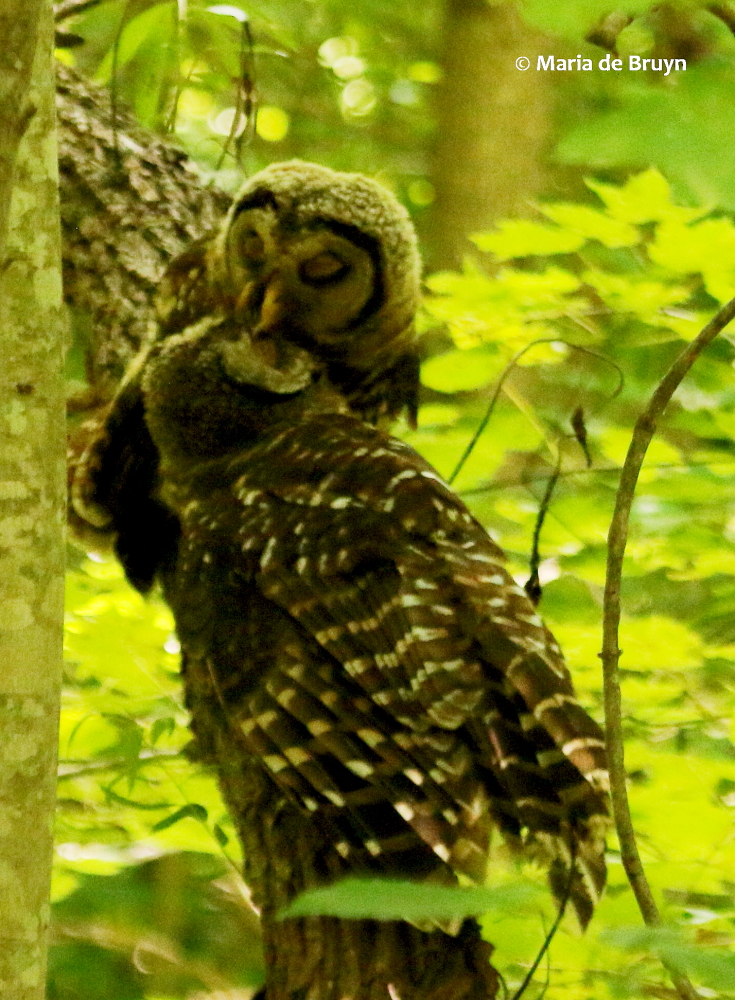
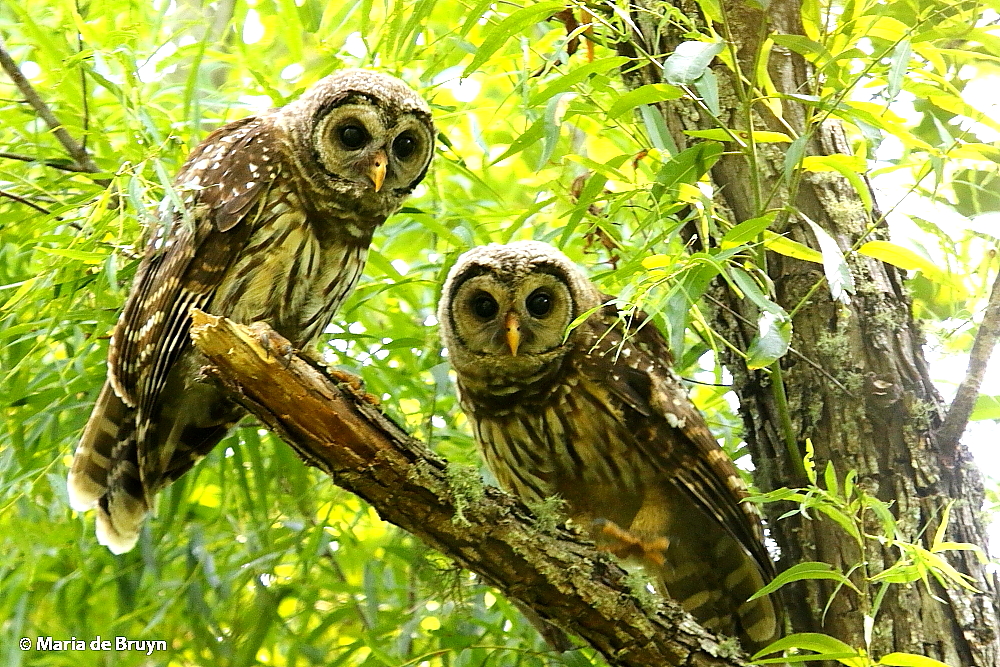
The young owls were very affectionate with one another. They often perched next to or near one another.


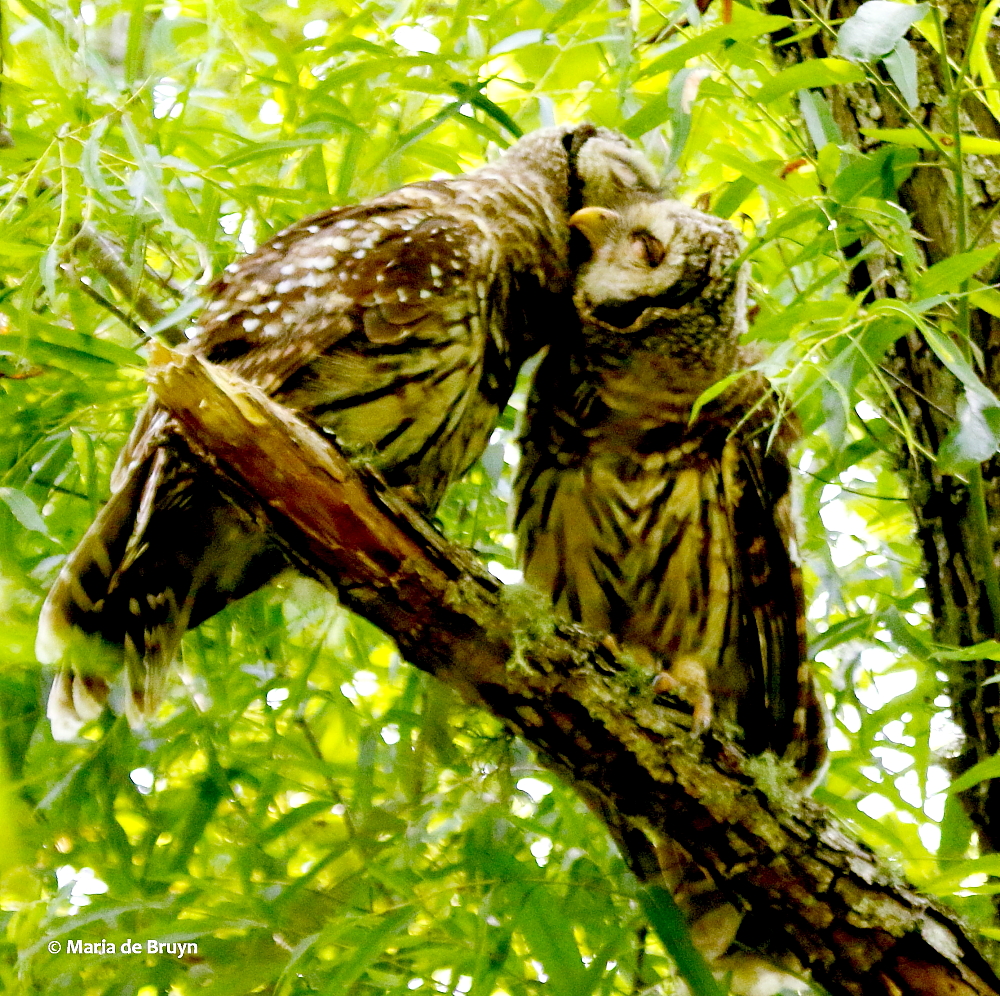
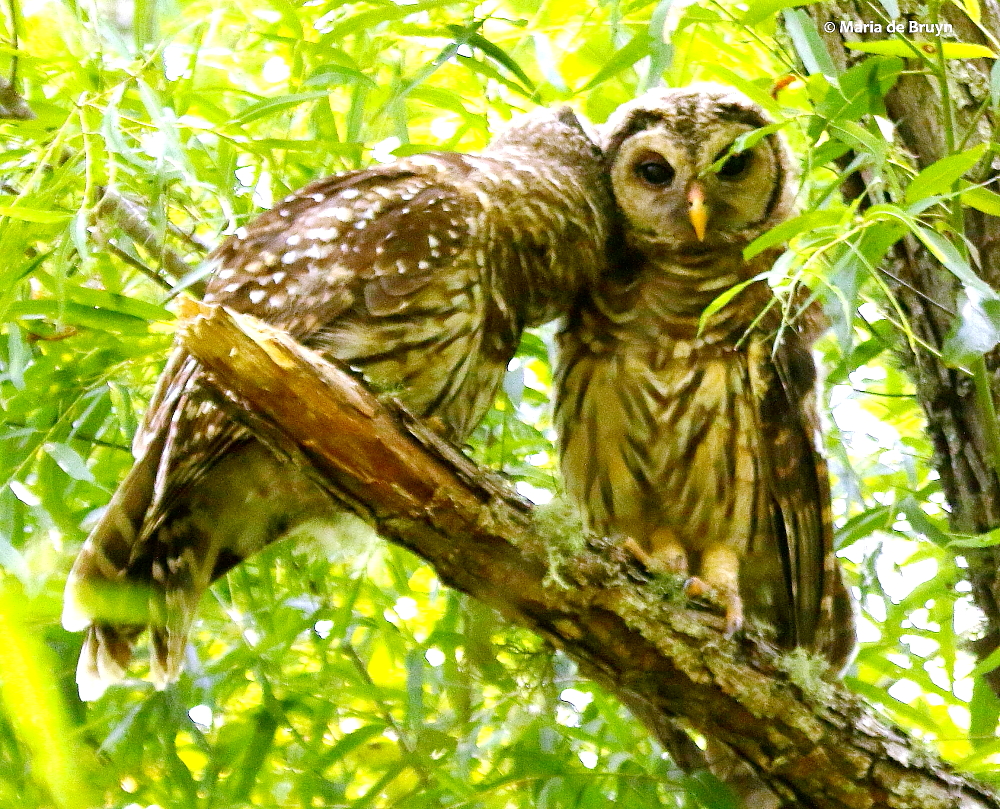
They often sat close together, expressing what looked to me like affection.


When they were apart, they would vocalize. It would have been cool to be privy to the meaning of their communications.


The young birds seemed to enjoy nuzzling and grooming each other.


When I stopped seeing the young owls in their usual haunts, I figured the time had come for them to separate and seek out a mate and new territory. Mated owls usually establish nests about 400 yards away from other barred owls although some nests have been observed as close as 100 to 200 yards apart. The young owls may not have flown very far away but they did need to leave their parents’ area. I hope they made it and was happy to have had the opportunity to watch them mature. My next goal for owls – to see a species in the wild that I have not yet seen (e.g., great grey owl, screech owl, barn owl, etc.). I hope you, too, have the chance to see members of this avian group up close!

Growing up barred – Part 2: personal care

The young barred owls that I observed this past summer at the Mason Farm Biological Reserve could be found rather predictably in two places at the reserve, both of which were near water. They were quite beautiful to see.

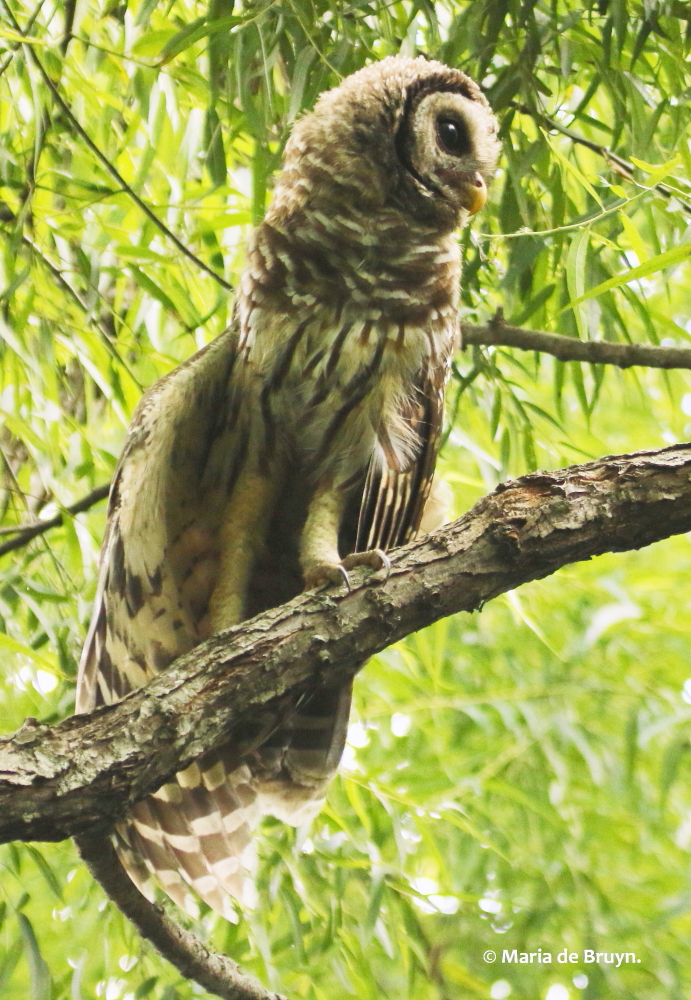
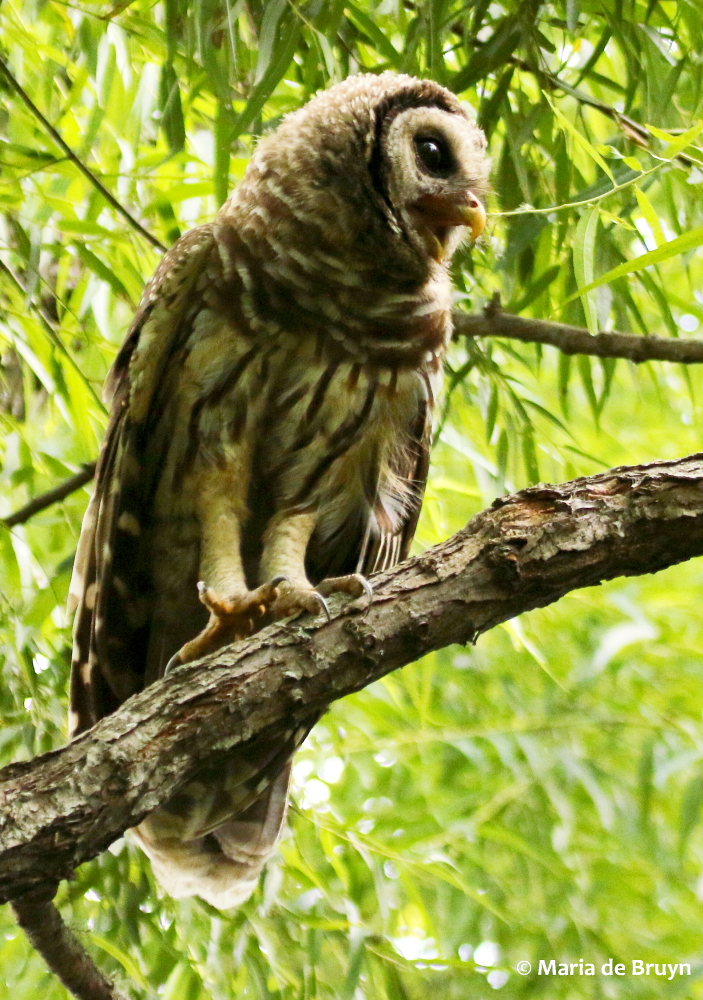
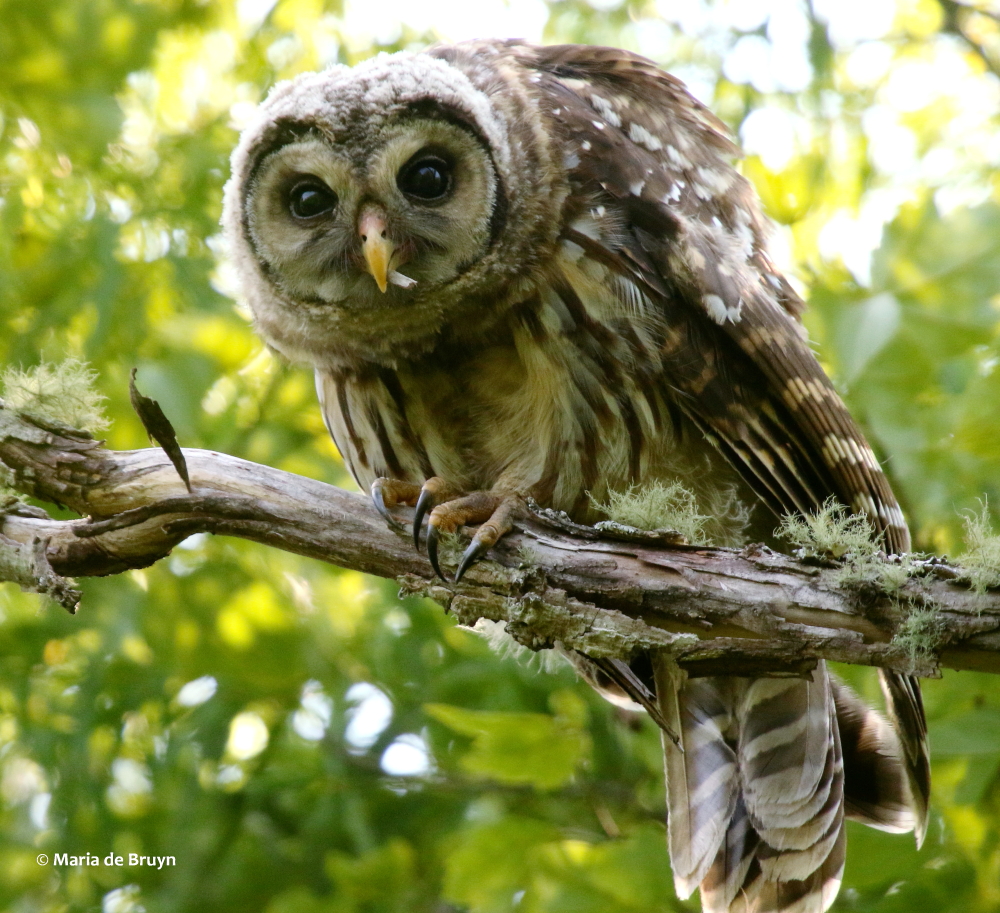
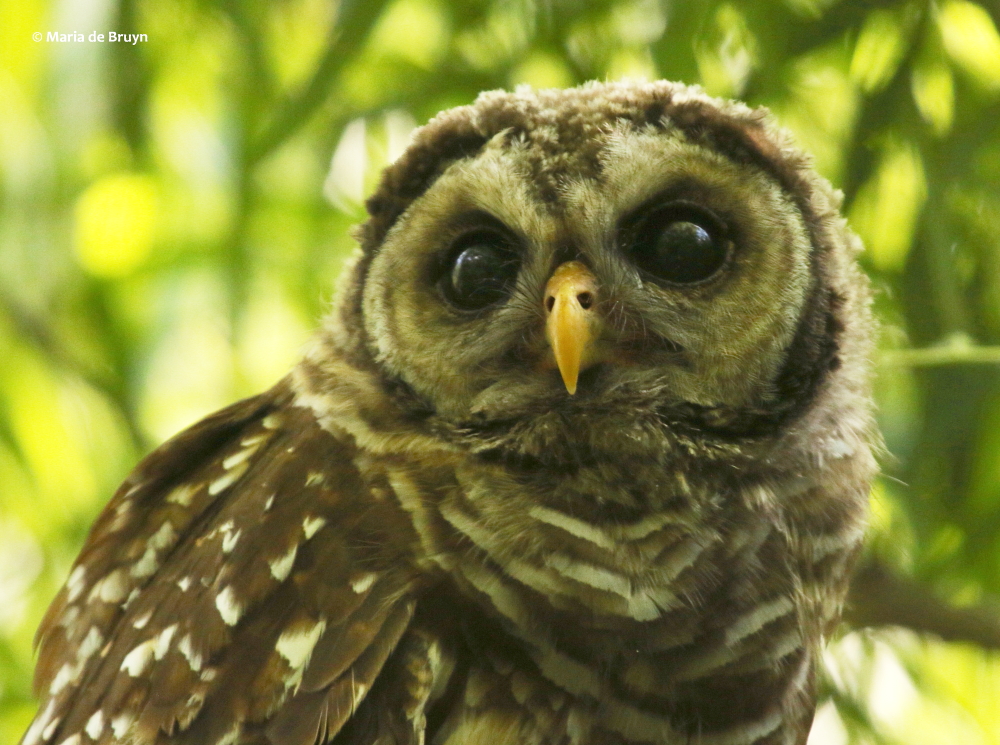
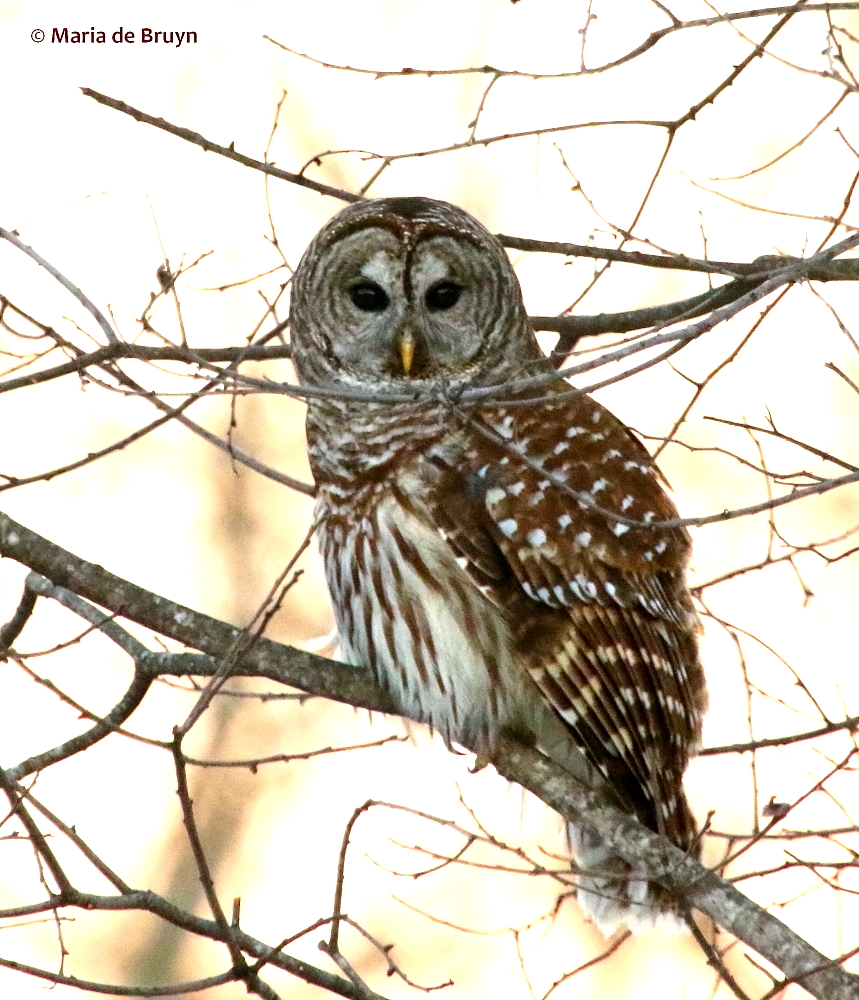
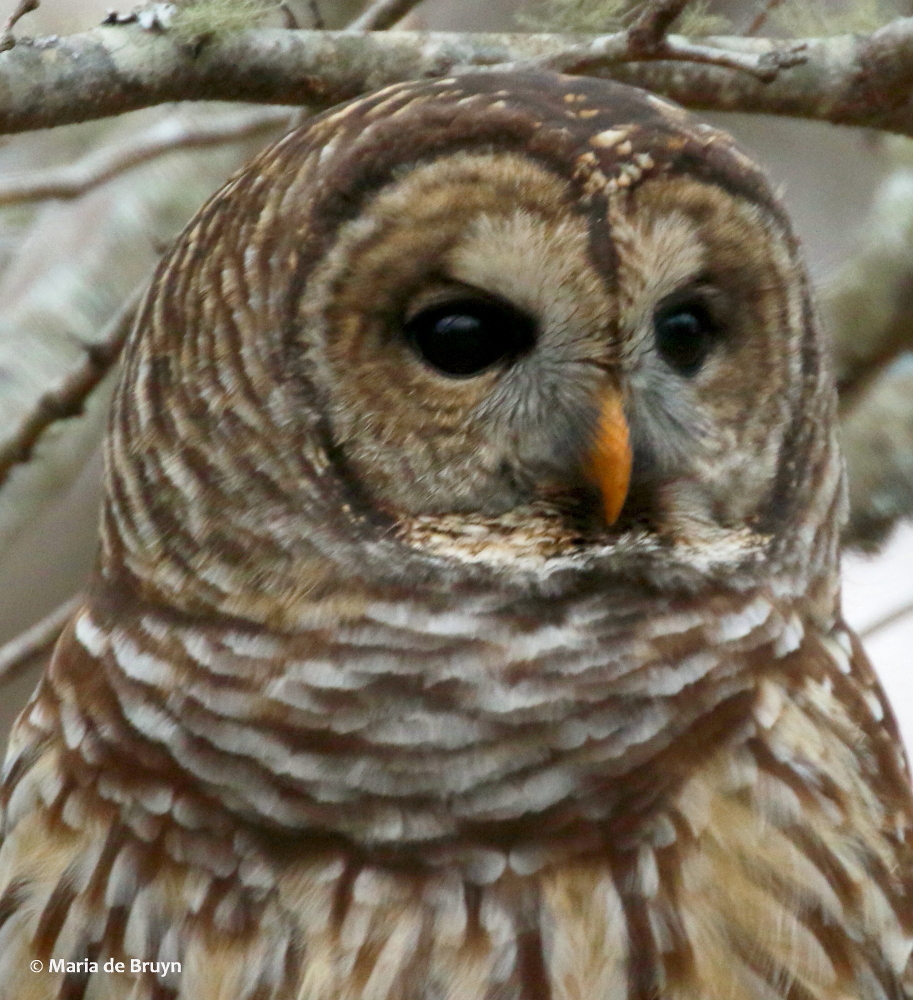
Barred owls (Strix varia) are the only owls in the Eastern USA who have brown rather than yellow eyes. When adult, barred owls have short feathers on their heads but no ear tufts. Their eyelids are also feathered. The juveniles still have fuzzy down feathers on their heads and pink, barely feathered, eyelids as you can see here.


Adult barred owl                                                                Young barred owlet

Their feathers extend down their legs and feet right up to their talons. The owls’ claws are less curved than other raptors’ talons which makes it possible for them to squeeze their prey to death.


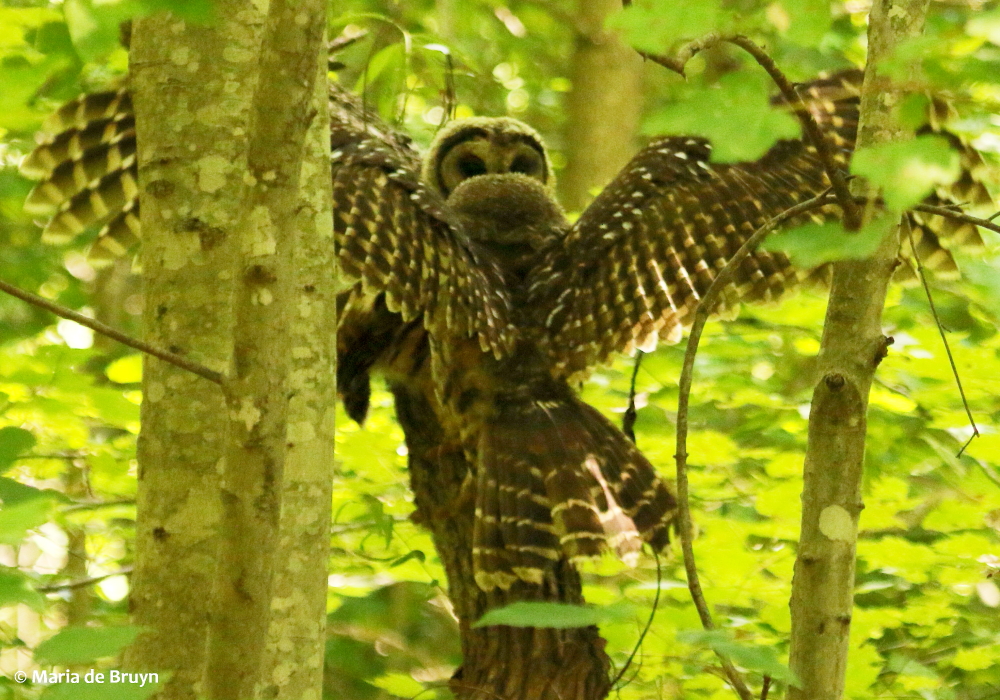
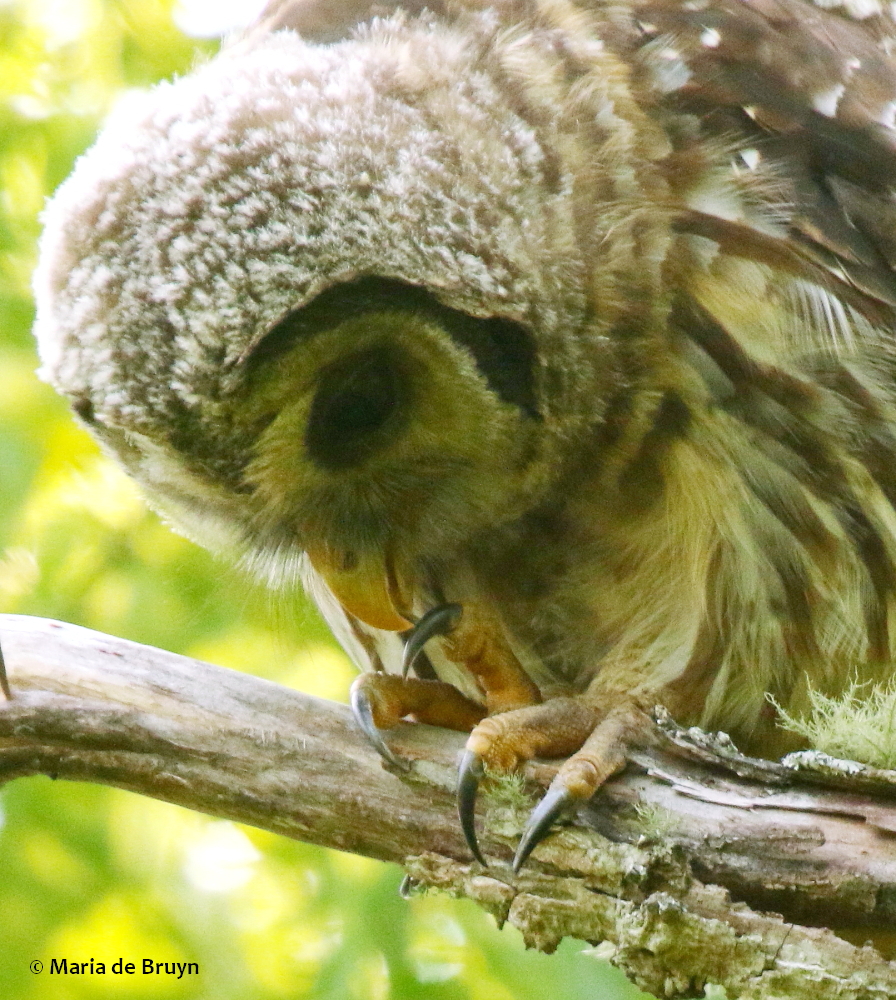
As they grow, the young ones will groom often, pulling out downy feathers.


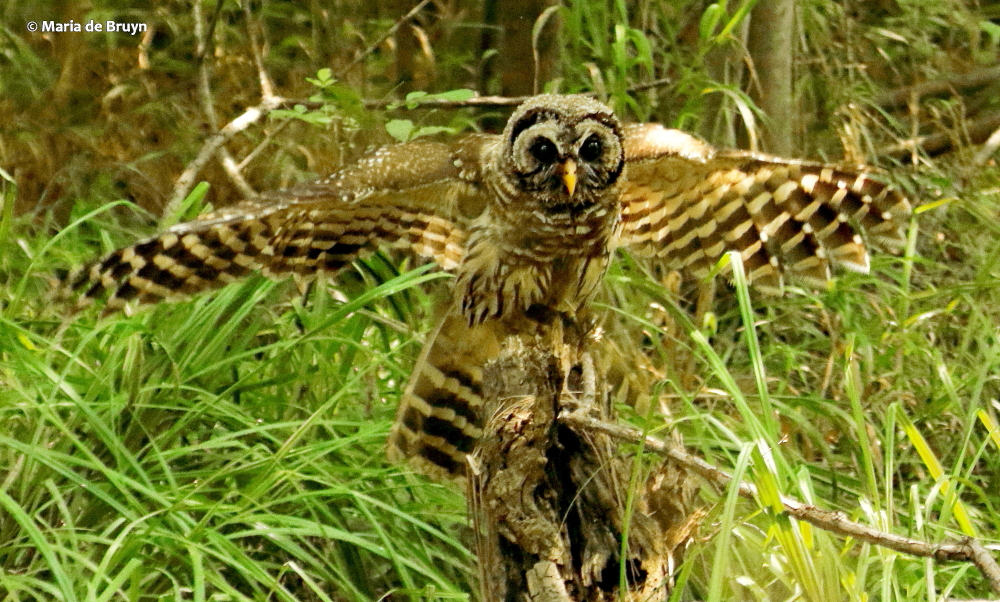
They frequently stretch out their wings and tails when grooming.


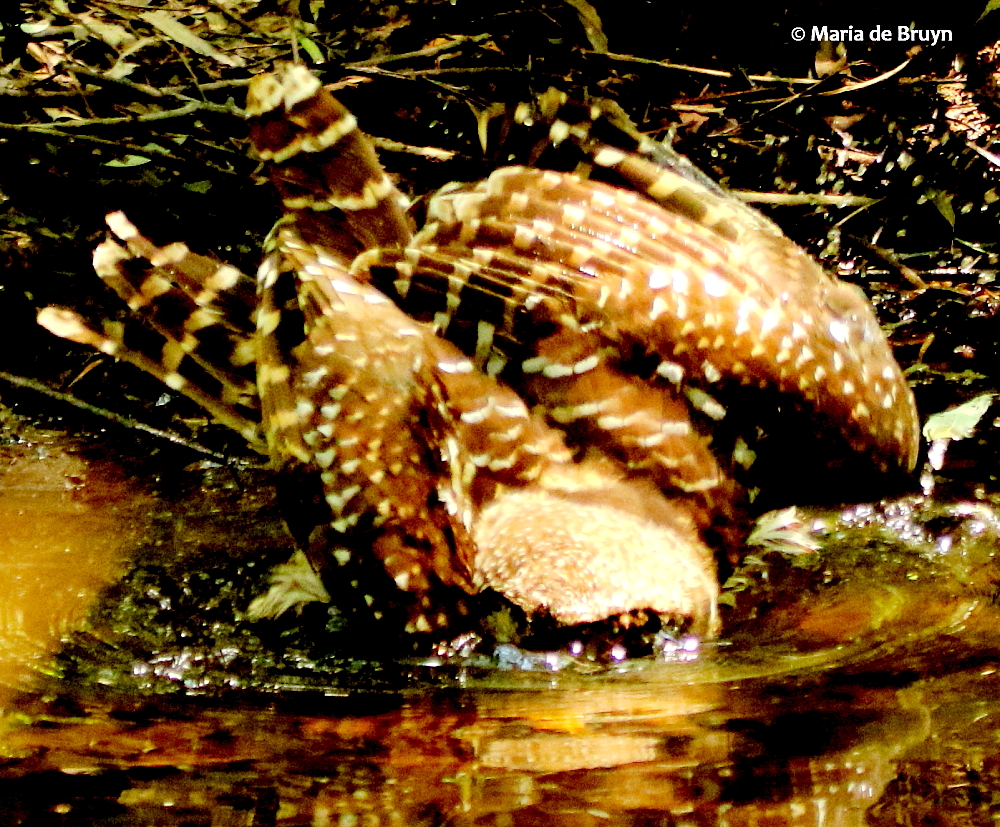
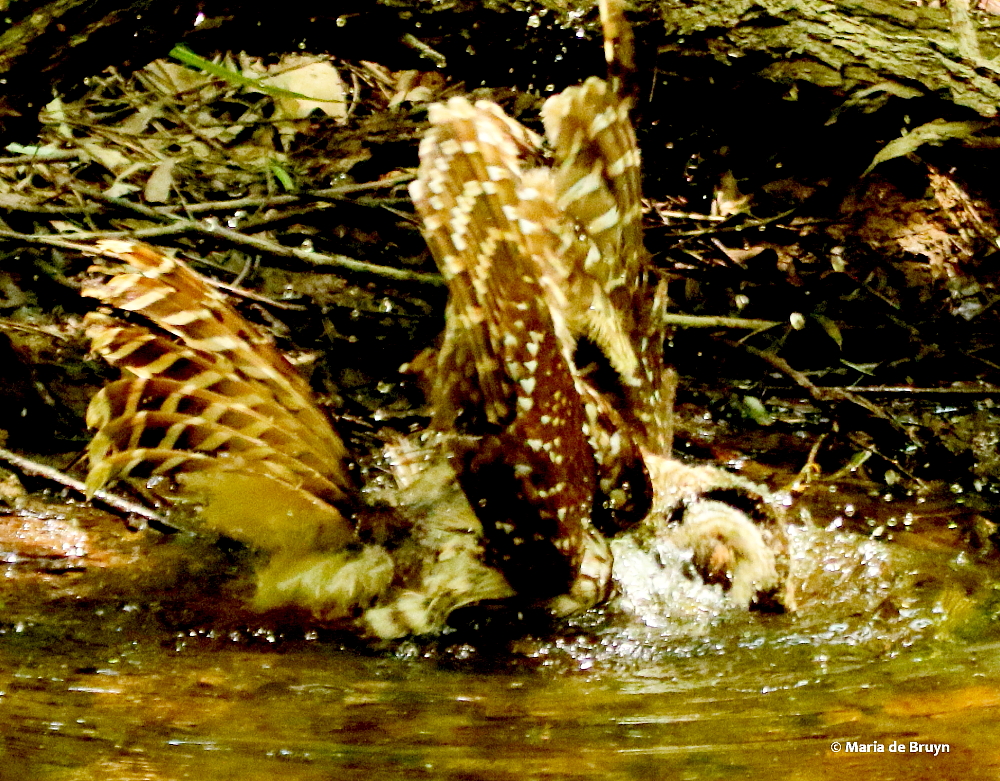
Baths were also a welcome form of personal care.


This was especially so during our very hot summer days. The fact that I was standing about 5 feet away did not deter the owlets from enjoying vigorous dunkings in the water ditch.


I did not see them bathe at the same time; they appeared to take turns. Perhaps each one was keeping watch for the other one when they were vulnerable.

The siblings did indeed seem to be very aware of each other’s activities and when I observed them, they didn’t stray far from one another. The next blog will show a little of their interactions.


Growing up barred – Part 1: becoming independent

From the ages of about 8-19 years, I lived in a house that had a nice backyard and was not too far from some neighborhood woods with a creek. As a child, I read under backyard trees, planted a flower garden and played in the woods with friends. While I became familiar with squirrels, robins, frogs and some bugs and loved being outdoors, I didn’t spend lots of time looking for wildlife. And I never saw an owl in the wild.

Now decades later, I’ve had the good fortune to learn a good deal about various members of the wildlife community while spending time finding and watching them. And in the past couple years, I’ve been privileged to see owls up close in the wild; for example, the owl below was perched next to a pathway at dusk when I walked by a few days ago.

This past summer was unique for me, however, because I was able to observe a pair of juvenile barred owls (Strix varia) at the Mason Farm Biological Reserve as they set off on their life’s journey outside the nest. I’d like to share a bit of what I saw with you in a three-part blog. This one is about them finding their independence. The next two will focus on their grooming and interactions.

Barred owl pairs usually bond for life; if one mate dies, the survivor will seek another partner soon after. They tend 2-4 eggs, which hatch after 4 weeks’ brooding and the young leave the nest after four or five weeks. They remain dependent on their parents for food for some time after that even though they may be almost as large as the adults at 16-25 inches in length (40–63 cm); their wing span can stretch up to 3-4 feet (38-49 in, 96–125 cm).

When I first spotted the young owls in June, they could already fly. Nevertheless, they did need to find their balance occasionally as they perched and moved along branches and snags.


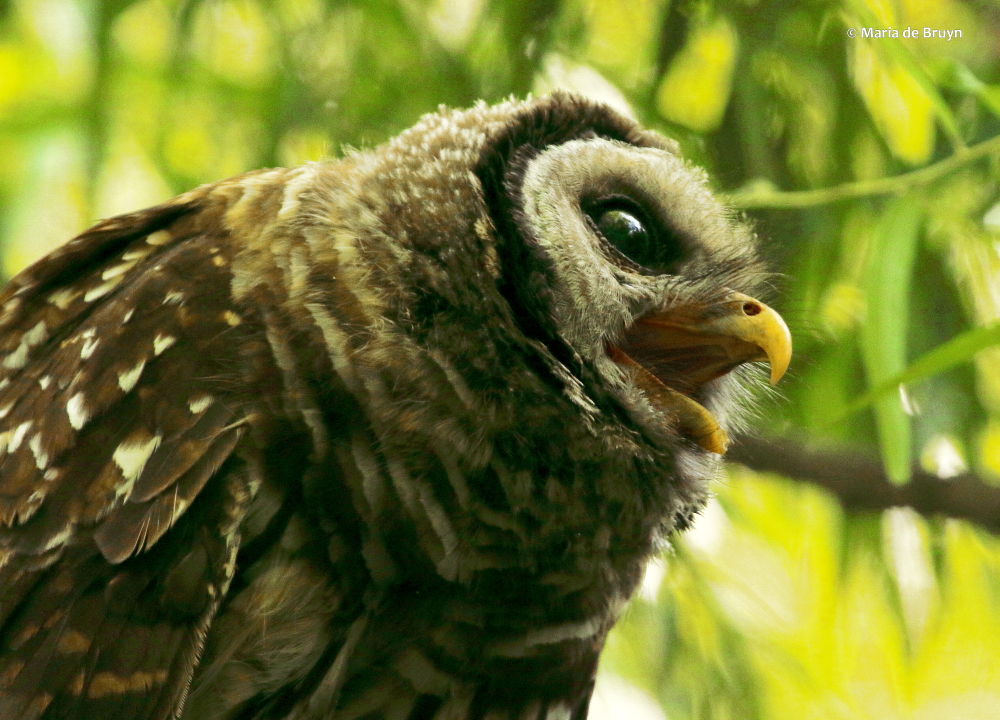
The owlets were making a keening noise the first time I saw them. At first, I didn’t recognize it, and I thought perhaps some small mammal was in distress.

Eventually, the plaintive call helped me locate them above me in a tree. This particular call apparently is used by the babies to call to their parents. I figured mom or dad was close by as the owlets kept looking upwards and eventually the parents did fly in with a meal – crayfish as far as I could tell.


On several occasions over the next 6 weeks or so, I would hear the owlets making that keening call and staring upwards. I figured the parents were nearby, but they were obviously just keeping an eye on their offspring and not feeding them (at least not when I was there).

It was time for the young ones to learn how to get their own meals.  Although barred owls usually hunt at dawn and dusk, the young owls were busy looking for food during the day. The mammals they eat include voles, mice, shrews, squirrels, rats, rabbits, bats, moles, opossums, mink, and weasels. Birds are also a food source and their prey may include woodpeckers, grouse, quails, jays, icterids, doves, pigeons, cardinals, cedar waxwings and grackles. They also eat amphibians, reptiles and insects (e.g., snakes, slugs, lizards, frogs and toads, salamanders, crayfish, turtles, scorpions, beetles, crickets, grasshoppers) and it was the latter group of prey animals that I saw the owlets hunting. Here for example, it appears one young owl had caught a crayfish.

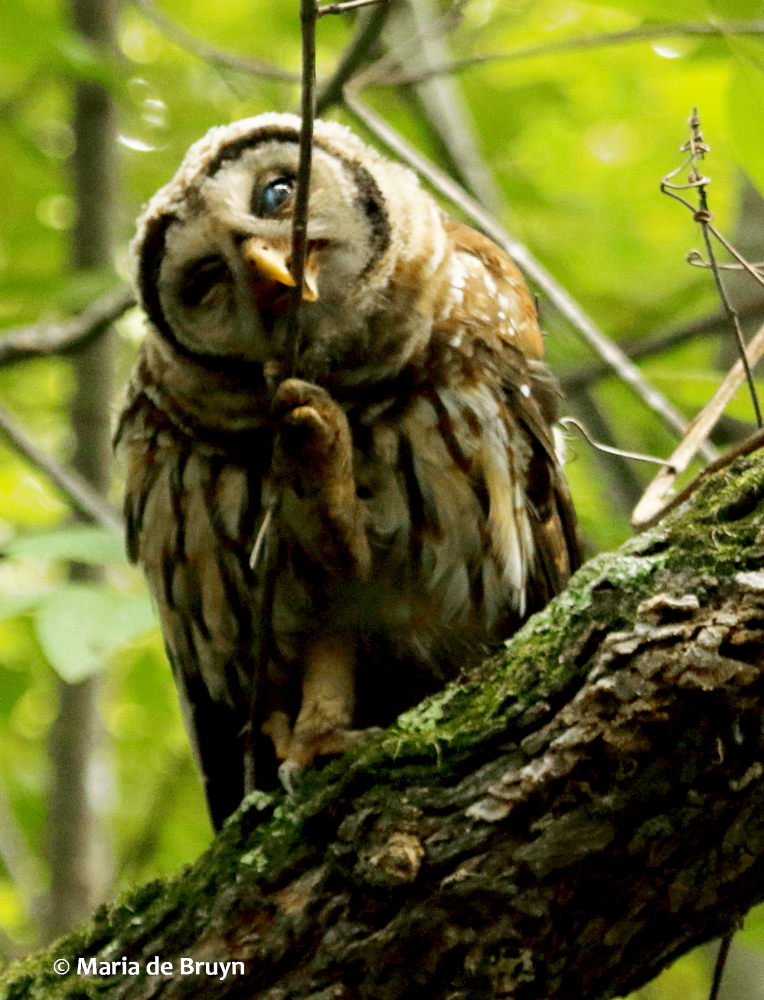
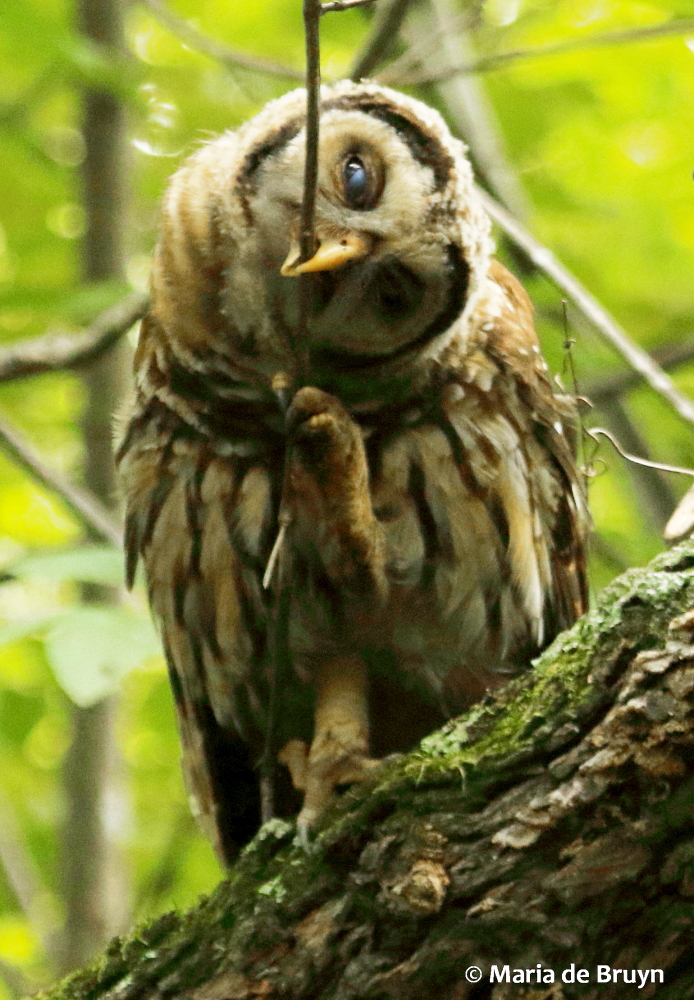
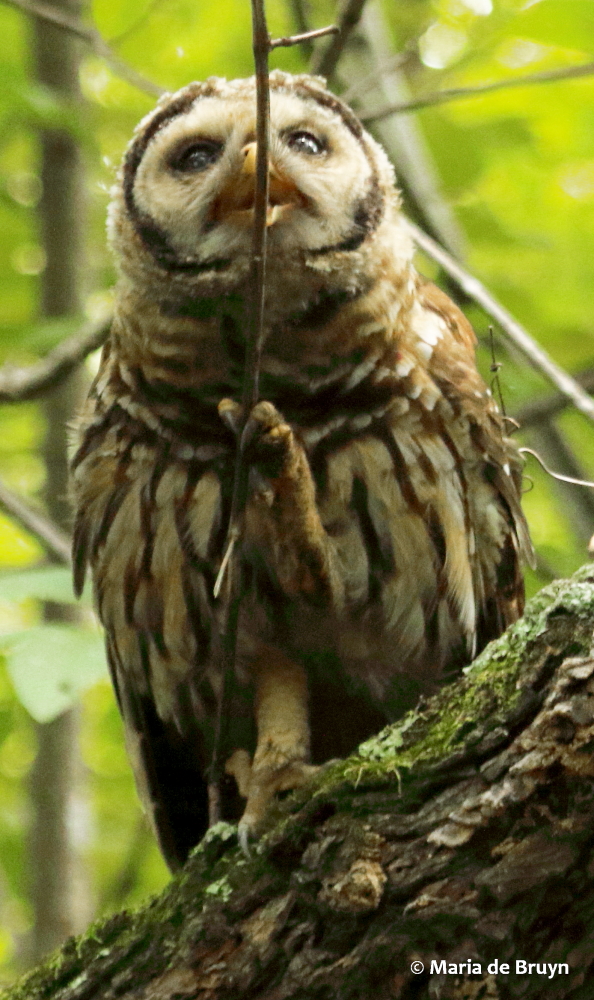
One day, one of the pair was grasping a twig in its beak; I’m not sure what it was doing but it seemed to have some purpose. Perhaps it was testing how strong its beak was.


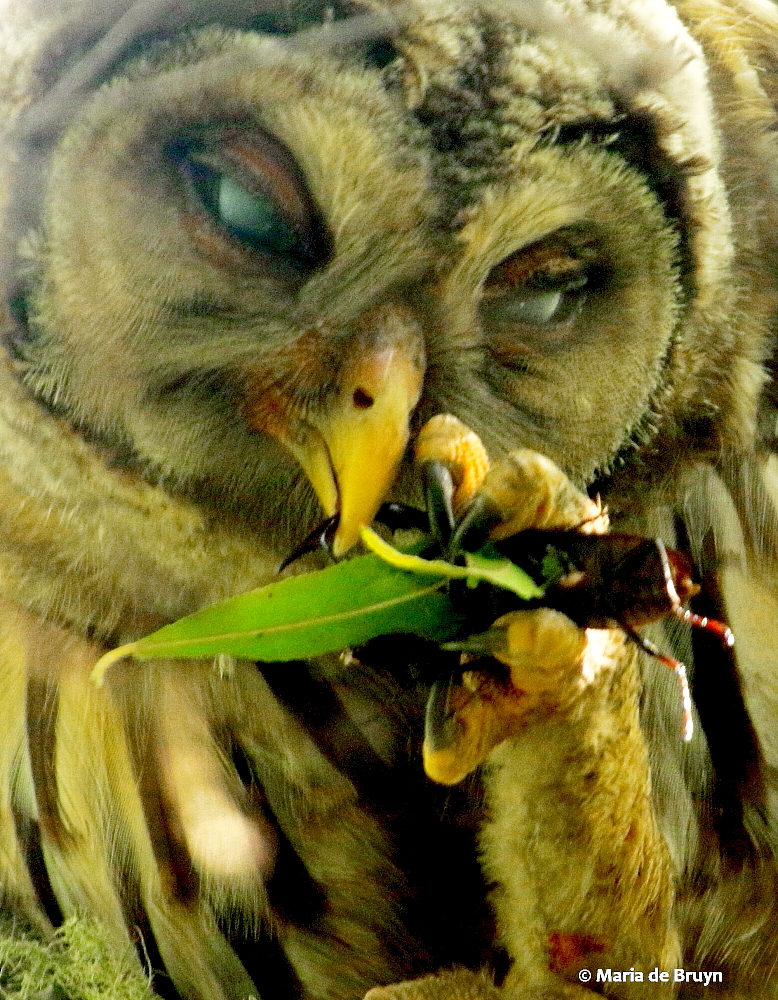
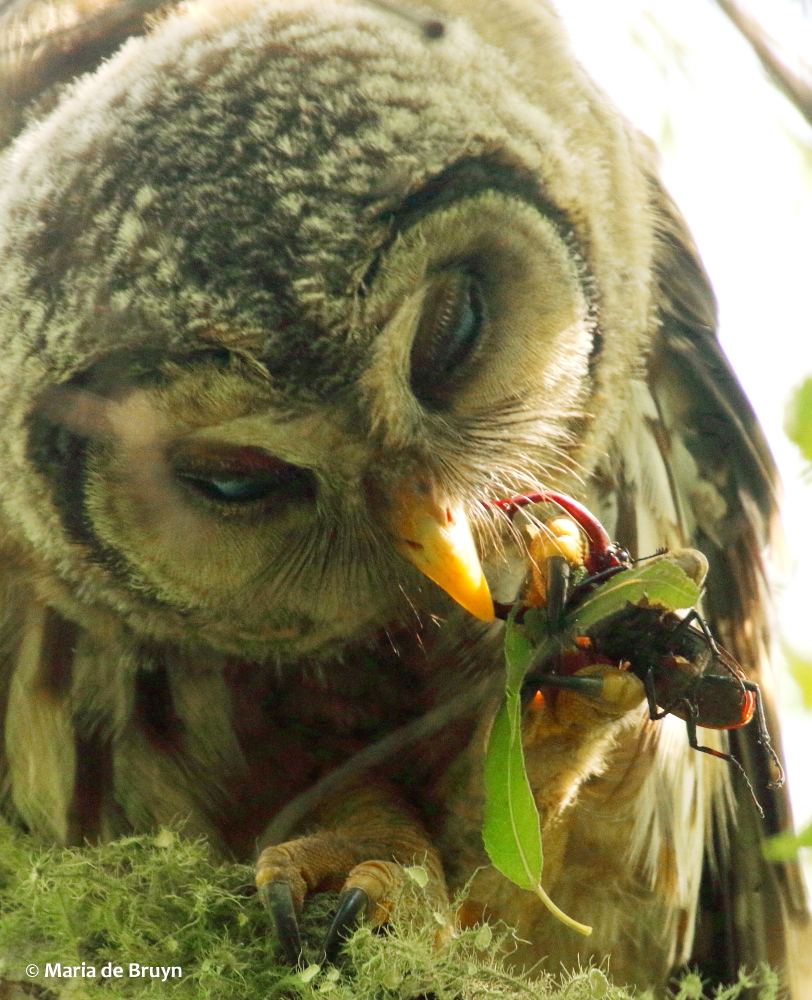
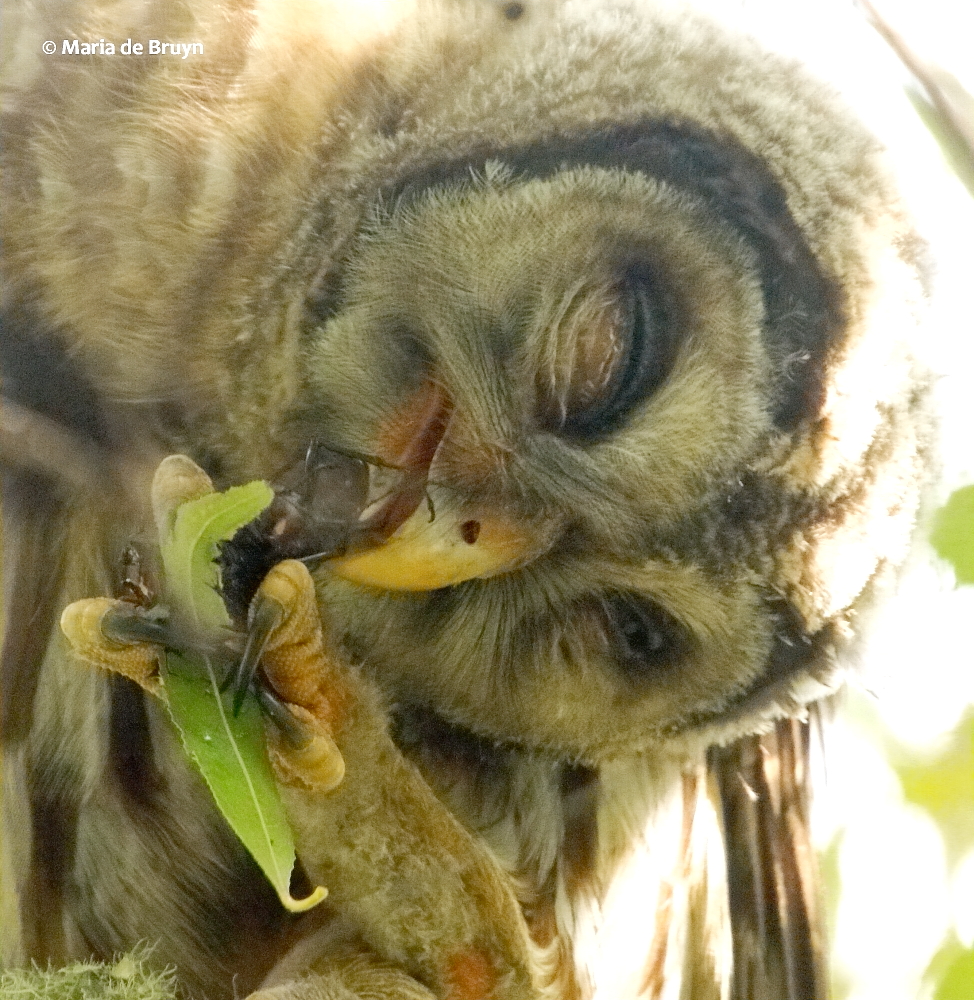
That a strong beak can be an asset became apparent on another occasion. One of the juvenile owls suddenly flew from one tree on the other side of a water ditch to one above my head. There was much rustling of branches and leaves and when I got into a spot where I could see the bird, it became obvious s/he had caught the largest stag beetle I had ever seen at Mason Farm Biological Reserve. It appears that the giant stag beetle (Lucanus elaphus) drinks tree sap, which must have been what it was doing when the owlet got hold of it. The problem for the owl was how to eat the beetle when those large pincers were in the way.


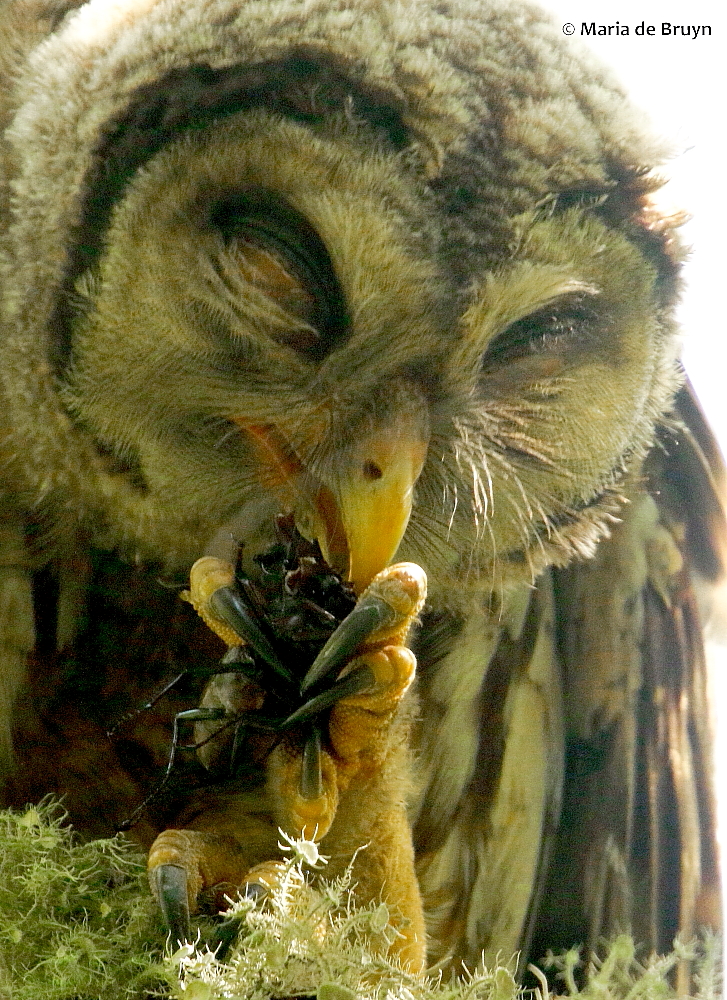
The owl would try to grab hold of a pincer but lose its grip; s/he would turn the beetle around but was having a very difficult time getting those defensive appendages off. This went on for quite a long time, which made me feel a bit sorry for the beetle.


Finally, the owl had success and was able to settle in for a crunchy meal.


They expel the indigestible parts of their prey in owl pellets that they cough up regularly. Here you see the contents of one a friend found under a favorite perching branch at the reserve.

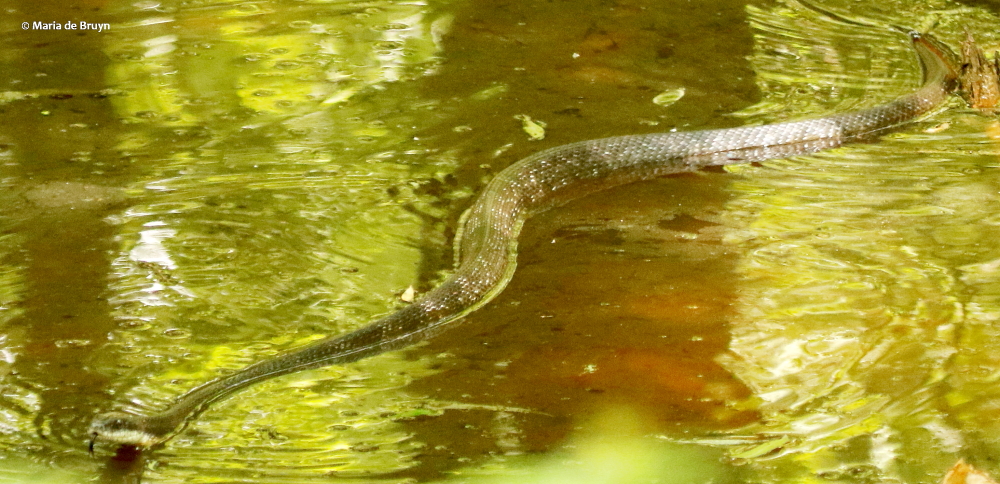
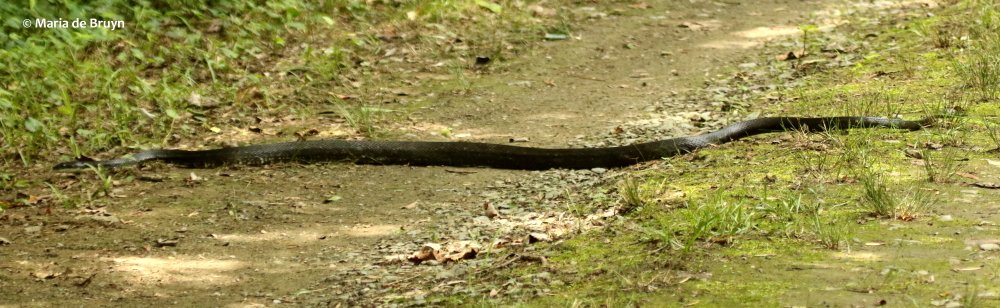
Another day I saw one owlet suddenly fixate on the water ditch.It turned out that quite a large rat snake (Elaphe obsolete; Pantherophis alleghaniensis) was swimming by. The owl watched it carefully as it climbed out of the ditch and eventually crossed the adjacent walking path, never making a move to tackle the reptile. I had remarked on this encounter to the reserve’s land manager, who said it was probably a smart move on the owlet’s part, since the snake was large enough that it could have wrapped around the owl’s head and choked it.

The young owls seemed to have learned a lot about life as a predator as they grew older. It was fascinating watching them explore their world.

Next up: how the owlets cared for themselves.