A bedraggled sort of day

Carolina wren IMG_4876© Maria de Bruyn resFirst, let this lovely Carolina wren (Thryothorus ludovicianus) and me wish you – fellow nature lovers and blog readers – all the best as we look to the future in this year of 2015! May your minor disappointments (life is not always rosy) be compensated by love, laughter, health and happiness in abundance!


Yesterday may have been a minor disappointment for the wildlife here.Hermit thrush IMG_3106© Maria de Bruyn res On Sunday, it was very cold for North Carolina standards. Together with two other Audubon Society volunteers, I was standing at a local lake in 15°F (-9.4°C) weather waiting to see if any bald eagles flew by for inclusion in the quarterly Eagle Count. We didn’t see any, although this lovely hermit thrush (Catharus guttatus) was nearby eating berries.

Monday was warmer but EXTREMELY wet! Two of my cats awakened me at 5 a.m. and I could hear the rain coming down in a veritable deluge. I wondered if I would be able to see the road to drive for an appointment later that morning (it did let up, thank goodness) and also wondered how the birds and animals were keeping in this unpleasant weather.

Northern cardinal IMG_4462© Maria de Bruyn res

Northern cardinal IMG_4049© Maria de Bruyn res


When it’s cold, the birds fluff up their feathers to trap air pockets by their bodies; this helps they retain body heat and stay warmer. Heavier wet feathers don’t seem to fluff well, though. On the other hand, birds’ feathers are covered with an oily or waxy substance that helps water run off, thereby keeping their bodies drier. Those feathers don’t necessarily look pretty though. Many of the birds were indeed looking bedraggled, some to a greater degree and others just a bit like these Northern cardinals (Cardinalis cardinalis).

red-bellied woodpecker IMG_5005© Maria de Bruyn resIt didn’t seem that many birds were hiding in vegetation to get out from under the downpour. Nope – they all appeared to be very hungry and anxious red-bellied woodpecker IMG_4948© Maria de Bruyn resfor a meal like this red-bellied woodpecker (Melanerpes carolinus), who was scolding me for being so close to the feeders!

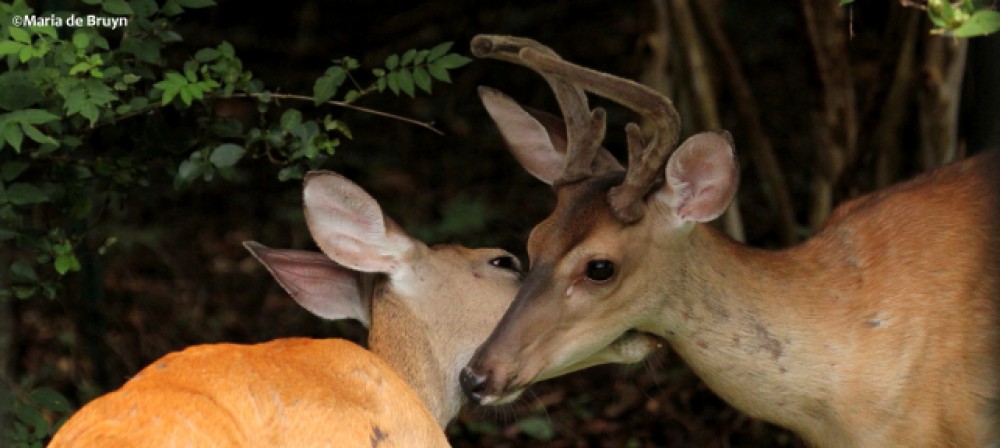
white-tailed deer IMG_4092© Maria de Bruyn resA few white-tailed deer (Odocoileus virginianus) were also wet and hungry, including two visitors to my yard that I had not seen before. They were two bucks, one of whom must have been hit by a car. One of his antlers was broken off and he was hopping along holding up his left hind leg, which had obviously been injured.


white-tailed deer IMG_4063© Maria de Bruyn res white-tailed deer IMG_4001© Maria de Bruyn res

white-tailed deer IMG_4055© Maria de Bruyn resA young doe, who visits regularly, stopped for some bird seed, as did the other buck whose antlers had been shed. Their thick hair was coated in raindrops.

The Eastern gray squirrels (Sciurus carolinensis) can curl their tails up over their backs as a kind of natural umbrella, both on the ground and in trees. This individual, who may have been injured by a predator and escaped, enjoyed some apple – first on the ground and then later in the tree away from the blue jays that were hopping around it.

Eastern gray squirrel IMG_4325© Maria de Bruyn res Eastern gray squirrel IMG_4334© Maria de Bruyn res

Some of the birds definitely looked more presentable than other. The three visiting mockingbirds (Mimus polyglottos) were sleek and beautiful, one using its long tail tobalance as it plucked meal worms from a feeder designed for somewhat smaller birds.

Northern mockingbird IMG_4503© Maria de Bruyn res Northern mockingbird IMG_4467© Maria de Bruyn res

The dark-eyed juncos (Junco hyemalis), Eastern towhees (Pipilo erythrophthalmus) and chipping sparrows (Spizella passerina) looked in fine shape, too.

dark-eyed junco IMG_4802© Maria de Bruyn res dark-eyed junco IMG_4729© Maria de Bruyn res

Eastern towhee IMG_4924© Maria de Bruyn res chipping sparrow IMG_4817© Maria de Bruyn res

The bluebirds (Sialia sialis) varied in appearance; a couple looked groomed but wet, while a couple others looked a bit disheveled.

Eastern bluebird IMG_4587© Maria de Bruyn res Eastern bluebird IMG_4588© Maria de Bruyn res

pine warbler IMG_4569© Maria de Bruyn resThe pine warbler (Setophaga pinus) – usually among the more handsome garden birds – unfortunately looked a sorry sight. Fortunately, when the rain ends, he’ll be able to shake that water off and get back to looking like one of the handsome fellas of the avian neighborhood!

pine warbler IMG_4618© Maria de Bruyn


pine warbler IMG_4842© Maria de Bruyn res

ruby-crowned kinglet IMG_4777© Maria de BruynThe ruby-crowned kinglet’s (Regulus calendulabrown-headed nuthatch IMG_4409© Maria de Bruyn res) oily feather covering seemed to do well in keeping the rainwater at bay, while the brown-headed nuthatch (Sitta pusilla) looked a bit more water-logged.ruby-crowned kinglet IMG_4741© Maria de Bruyn res

The tufted titmouse (Baeolophus bicolor) and Carolina chickadee (Poecile carolinensis) join me in looking forward to dryer and sunnier weather in a few days’ time!

tufted titmouse IMG_4350© Maria de Bruyn resCarolina chickadee IMG_4386© Maria de Bruyn res

Turtles as stepping stones

Northern mockingbird IMG_3689©Maria de Bruyn resOne day when I was at a beautiful nature park in the neighboring city of Durham, I was – of course – looking for wildlife. For a while I watched a Northern mockingbird (Mimus polyglottos) pecking along the path in a quest for insects. It wasn’t until I got to the pond, however, that a scene unfolded which kept me occupied for a while.
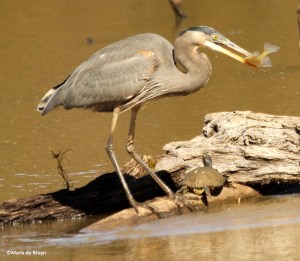
 

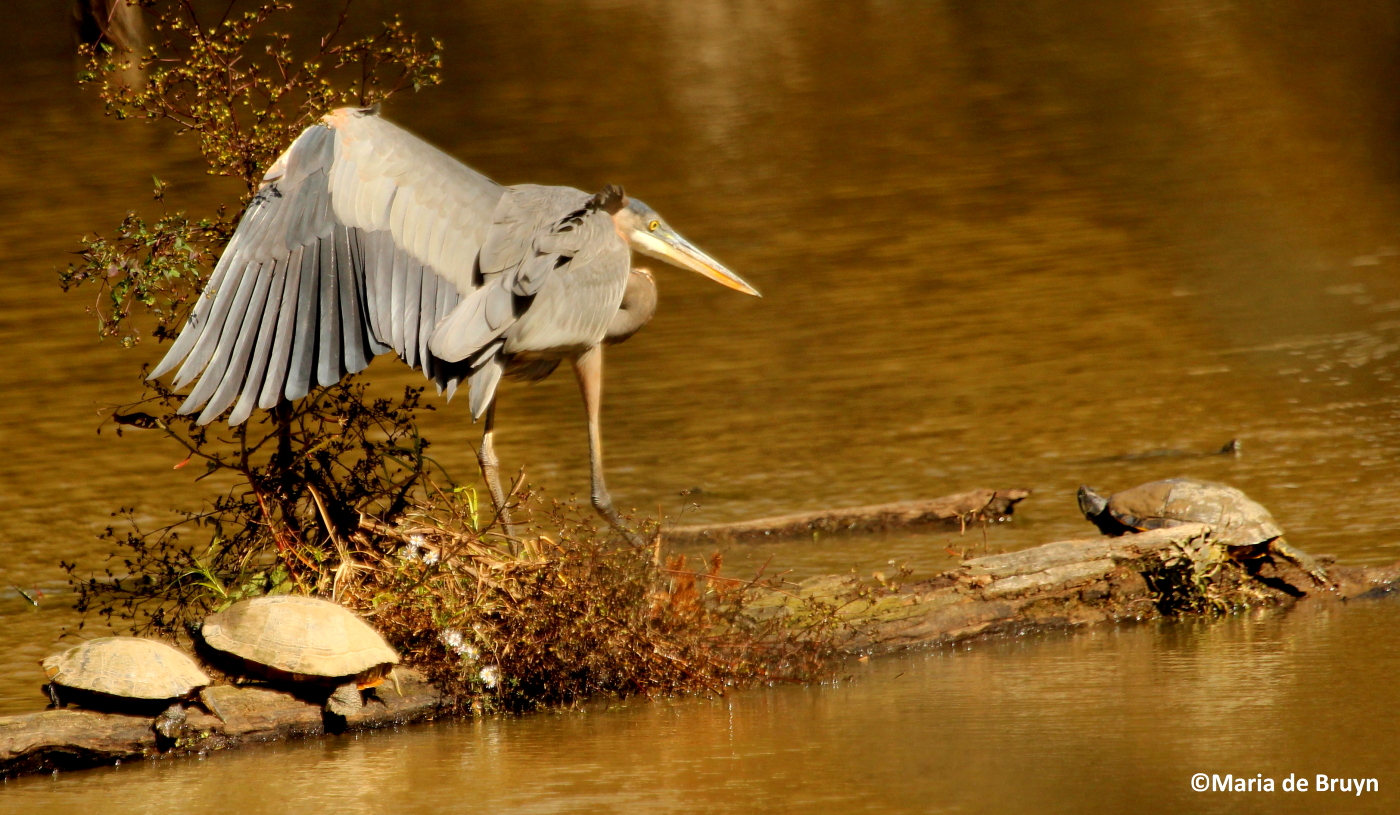
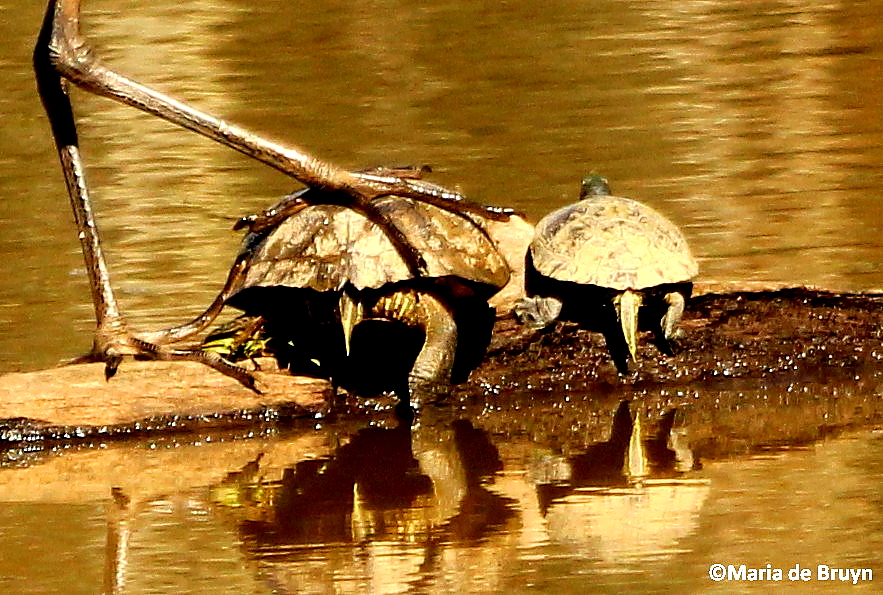
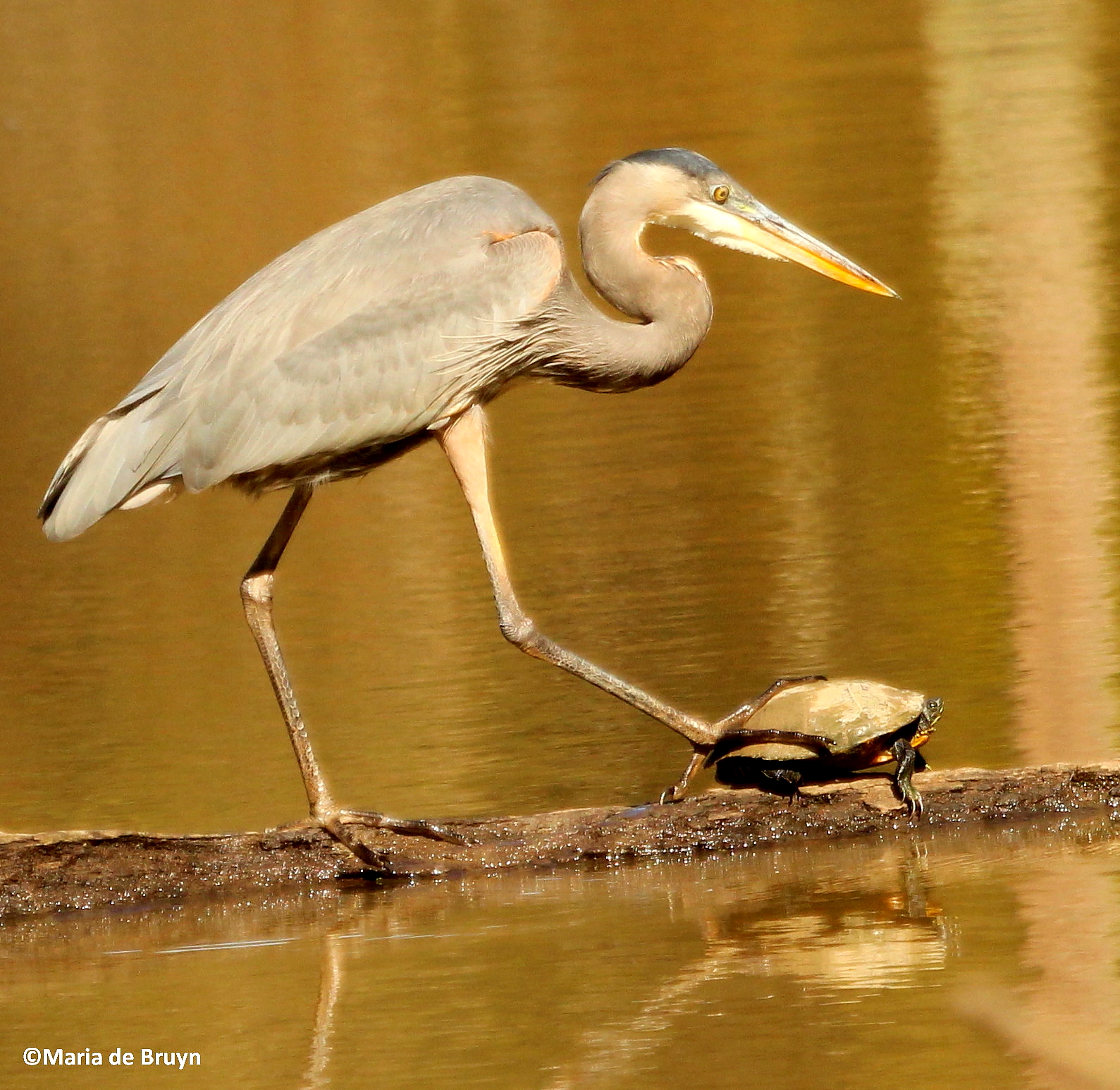
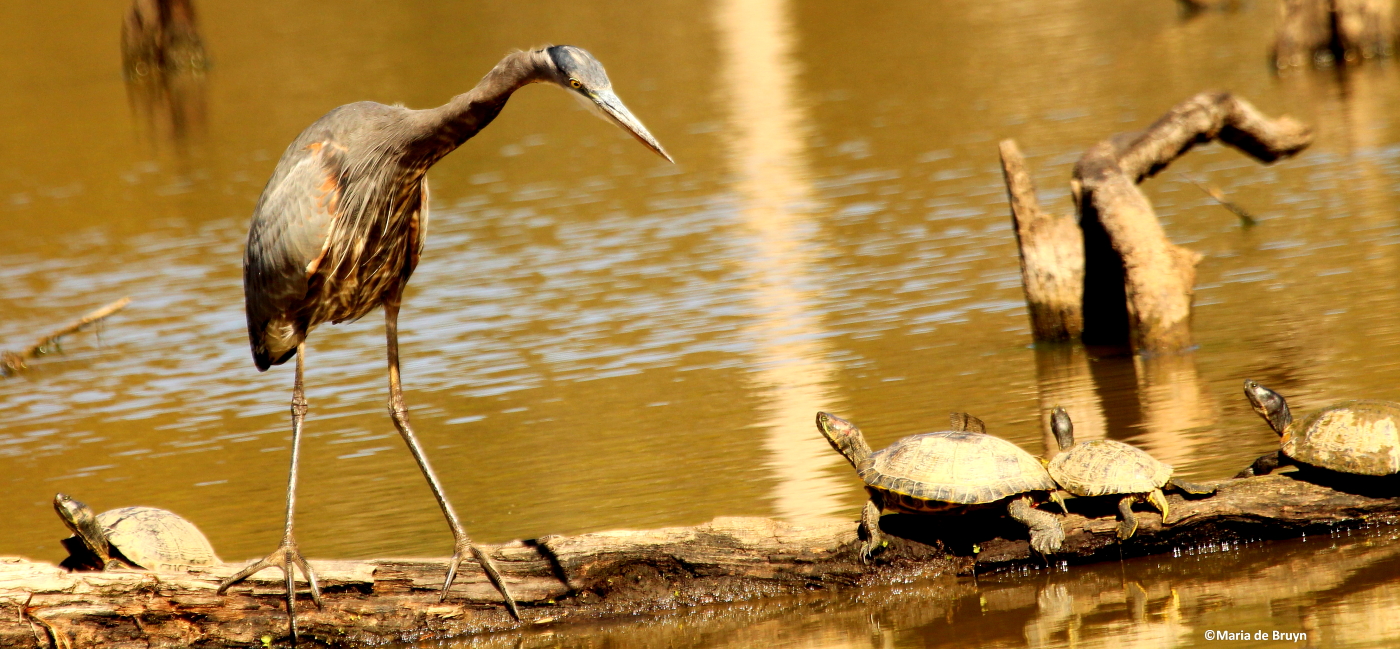
great blue heron IMG_4099©Maria de Bruyn resgreat blue heron IMG_3905©Maria de Bruyn resThe resident great blue heron (Ardea herodias) had stationed him (or her) self at the end of a log on which several pond slider turtles (Trachemys scripta) were basking. He seemed to be staring in their direction, so I wondered if he was considering eating one. After seeing a video of a heron swallowing a groundhog whole, I knew that they can consume quite large meals. After a time, though, it seemed that the bird wasn’t interested in the turtles but in the fish swimming in front of them. After patiently waiting for a time, the heron stabbed and had success!
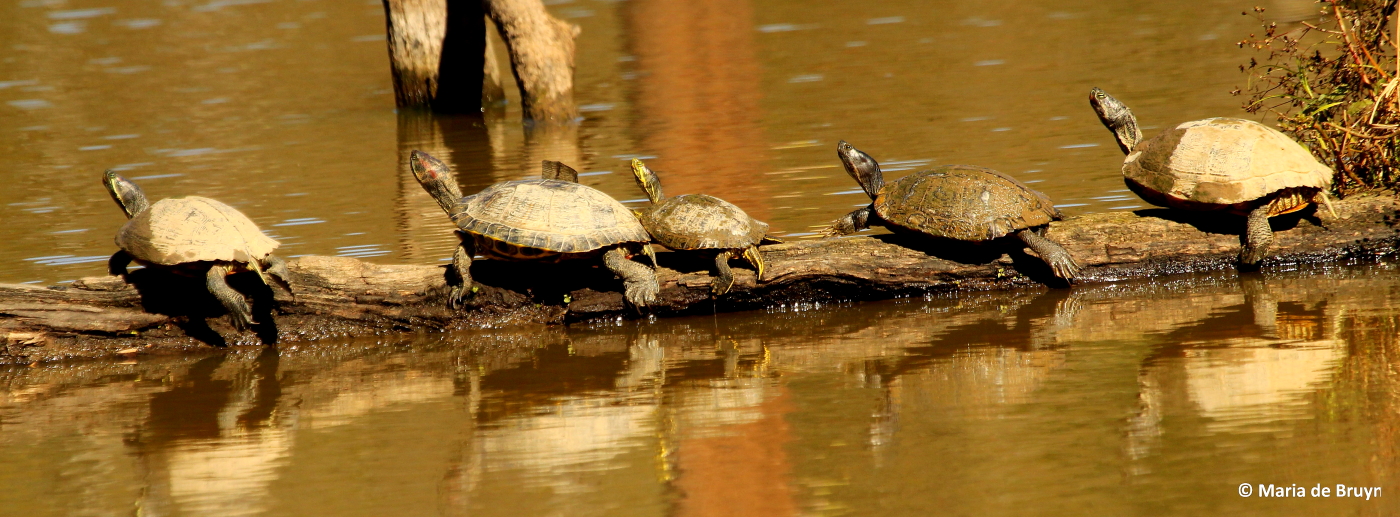
painted turtle IMG_3815© Maria de Bruyn resThe heron decided to move to a new spot, down near the other end of the log. The sun was bright and the pond was filled with many dozens of turtles enjoying the warmth. Whereas red-eared sliders and painted turtles at Mason Farm Biological Reserve will often plop into the water in haste when they sense people nearby, these turtles didn’t seem to care if they were watched from the pond’s edge. But I did think they would move as the heron neared them.

great blue heron IMG_3987©Maria de Bruyn resgreat blue heron IMG_4142©Maria de Bruyn res


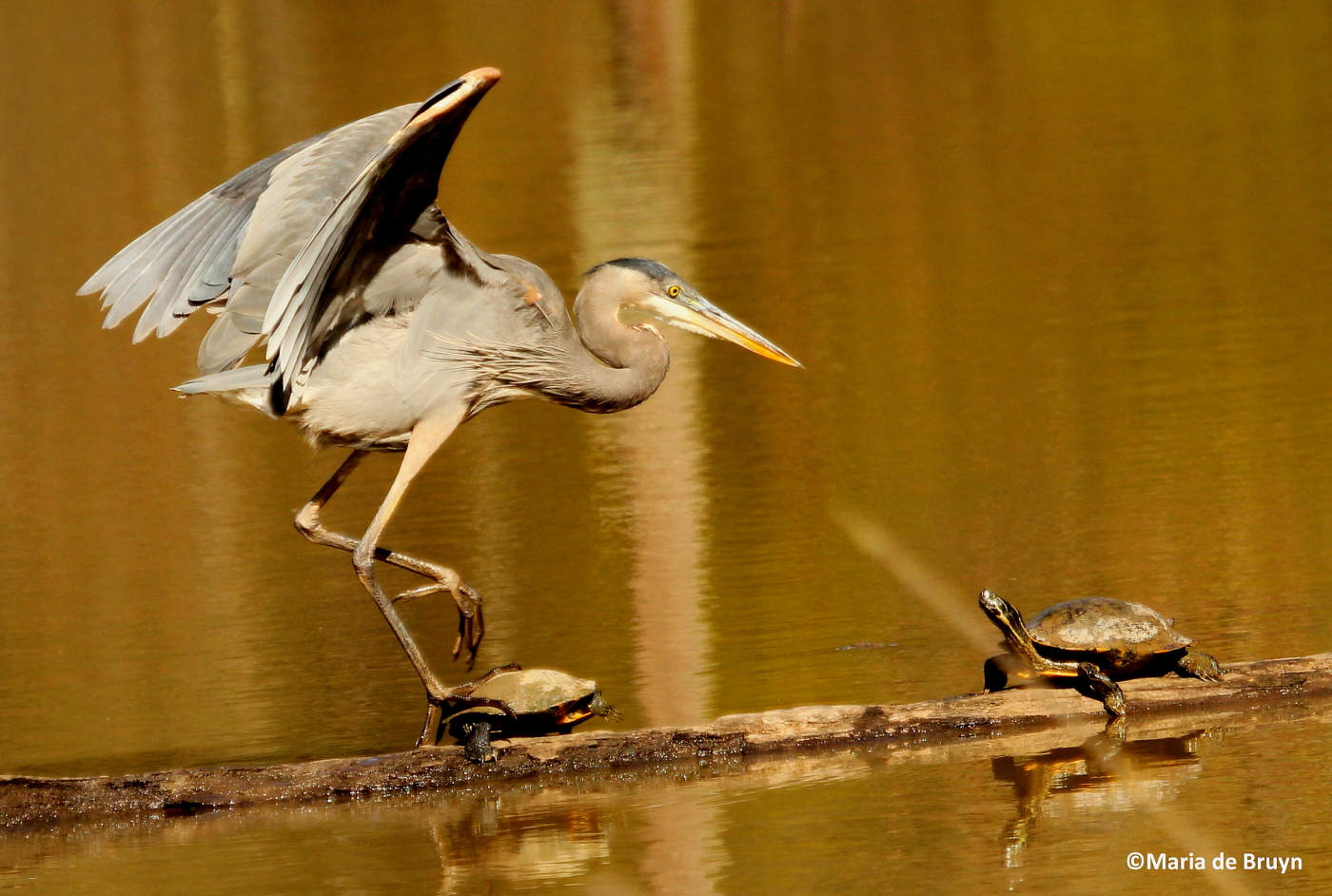
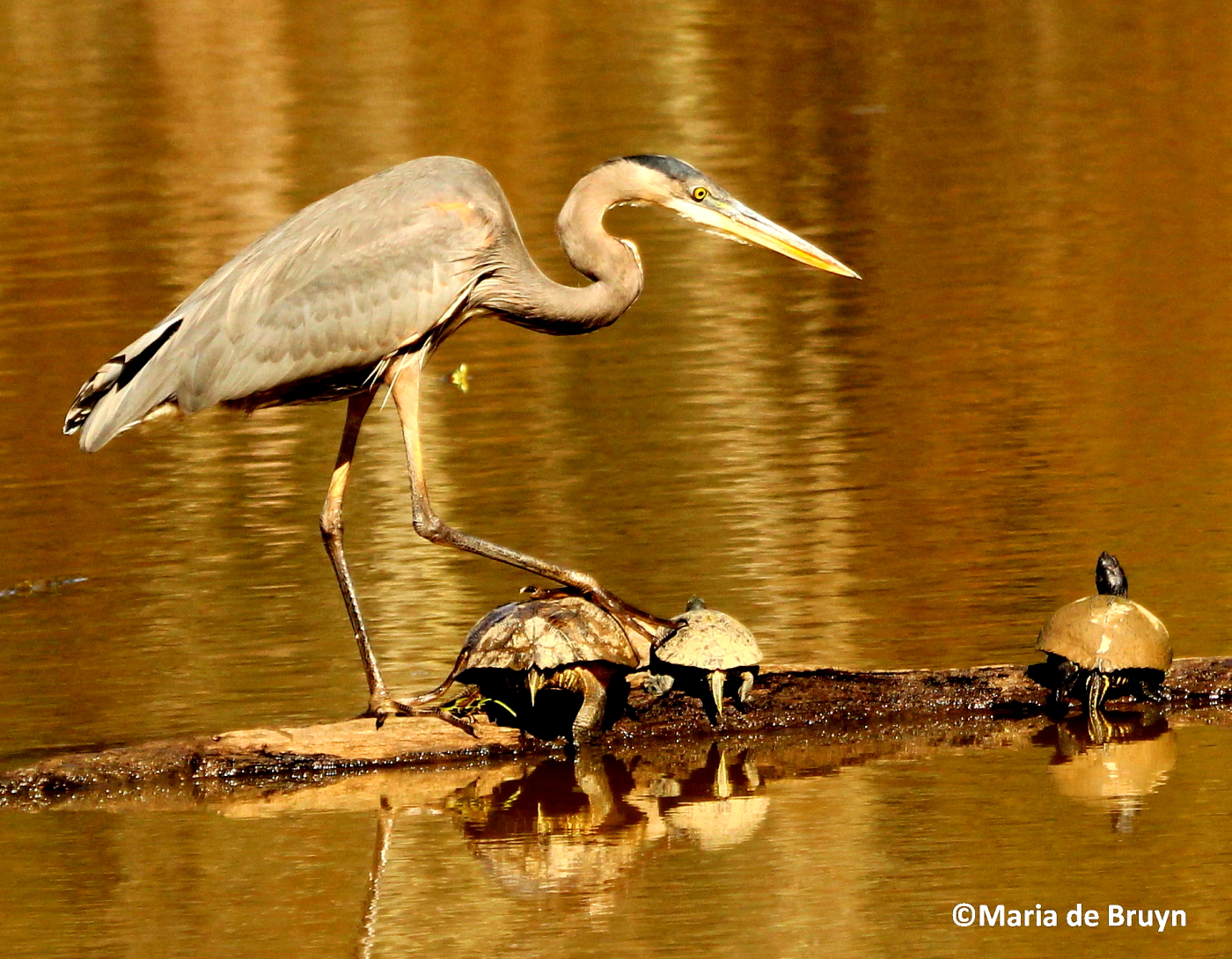
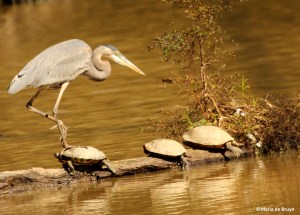
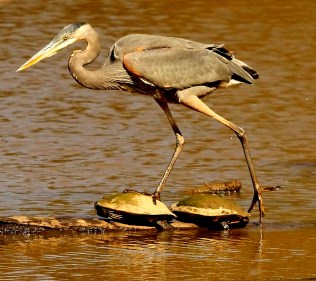
How wrong I was! The turtles saw him coming but they just let the huge bird use their backs as stepping stones!


great blue heron IMG_4160©Maria de Bruyn res   great blue heron IMG_4166©Maria de Bruyn res

great blue heron IMG_4302©Maria de Bruyn res

The bird’s claws completely encircled some turtles as it moved along, occasionally balancing on one leg.

great blue heron IMG_4224©Maria de Bruyn res  painted turtle IMG_4217©Maria de Bruyn 2

I noticed a few turtles with scutes bent up into the air. (Scutes are sections of the carapace.) I began to wonder if this was the result of the heron’s claws snagging on their shells as the bird proceeded.

IMG_3808© Maria de Bruyn 2great blue heron IMG_4297©Maria de Bruyn

If that was true, though, why didn’t the turtles skedaddle out of there when the heron came near? I only saw one turtle plunge into the pond.

great blue heron IMG_4304©Maria de Bruyn respainted turtle IMG_3815© Maria de BruynAt home, I did an Internet search and found out that turtles shed their scutes from time to time and that was apparently what I was seeing. So I learned that turtles shed! Turtles’ shells are extensions of their rib cage and attached to their spine; terrestrial turtles don’t shed but aquatic turtles do shed scutes, which are made of keratin (like the material of horns or fingernails).
5-MdB great blue heron IMG_4339

The heron kept moving along as he wasn’t having much success in the different spots he chose. He did get a couple fish but smaller than his first catch. Eventually, I found that I wasn’t quite as patient as the heron so I finally left after a very entertaining hour of observation. I do so love watching the natural world!

Flashing wings as a hunting technique

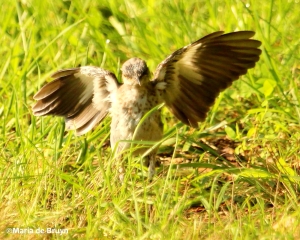
Northern mockingbird IMG_2475©Maria de Bruyn resLast year, during a nature walk, I witnessed young Northern mockingbirds (Mimus polyglottos) displaying odd behavior as they strutted around on the ground. They would walk and hop a bit and then suddenly spread their wings wide and wider still, then close them and continue pecking on the ground.
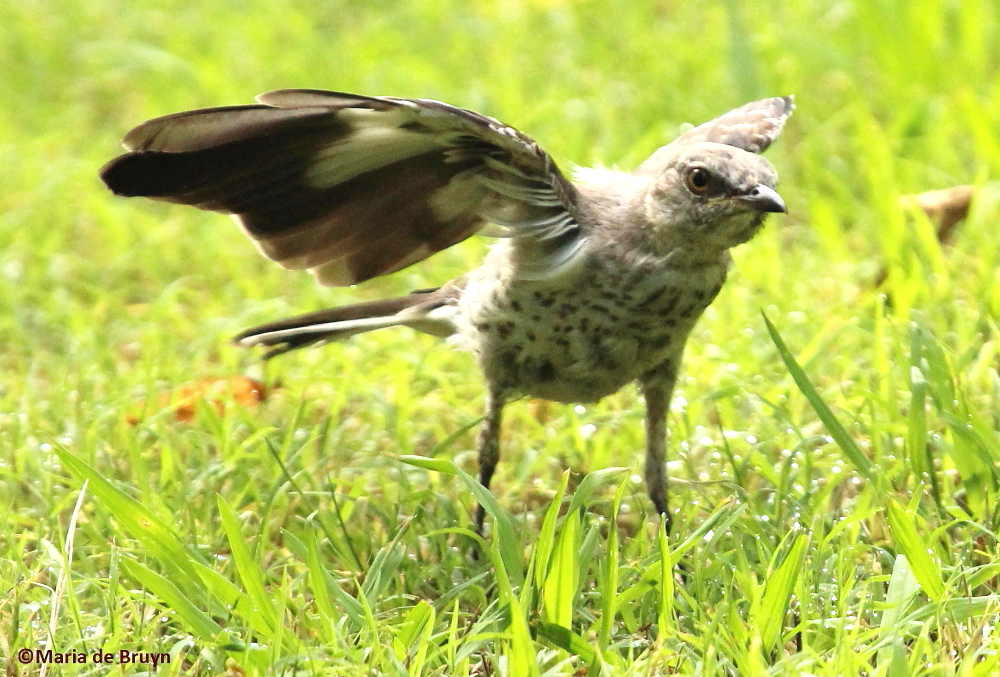
Some research on the Internet revealed that they were engaged in a phenomenon known as wing flashing. There are various theories about why mockingbirds flash their wings -– to startle insects, ward off predators, attract a mate. So far, there is no scientific consensus on why they do this.

Northern mockingbird IMG_8889©Maria de BruynresNorthern mockingbird IMG_8904©Maria de Bruynres

Having seen both adult and juvenile birds performing this behavior again this year, however, I’ve become convinced it is part of their hunting technique. Those who promote this idea have suggested that the sudden appearance of the bird’s white wing-bars startles insects, but others argue that insects are not alarmed by the color white.

Northern mockingbird IMG_2816©Maria de Bruyn res

Northern mockingbird IMG_2604©Maria de Bruyn res

My own theory is that when the mockingbirds flash their wings, it creates air currents and disturbs the grasses, thereby uncovering and rustling up bugs. This year I clearly saw the birds catching and consuming insects just after a completed wing flash.

snowy egret IMG_3610© Maria de Bruyn

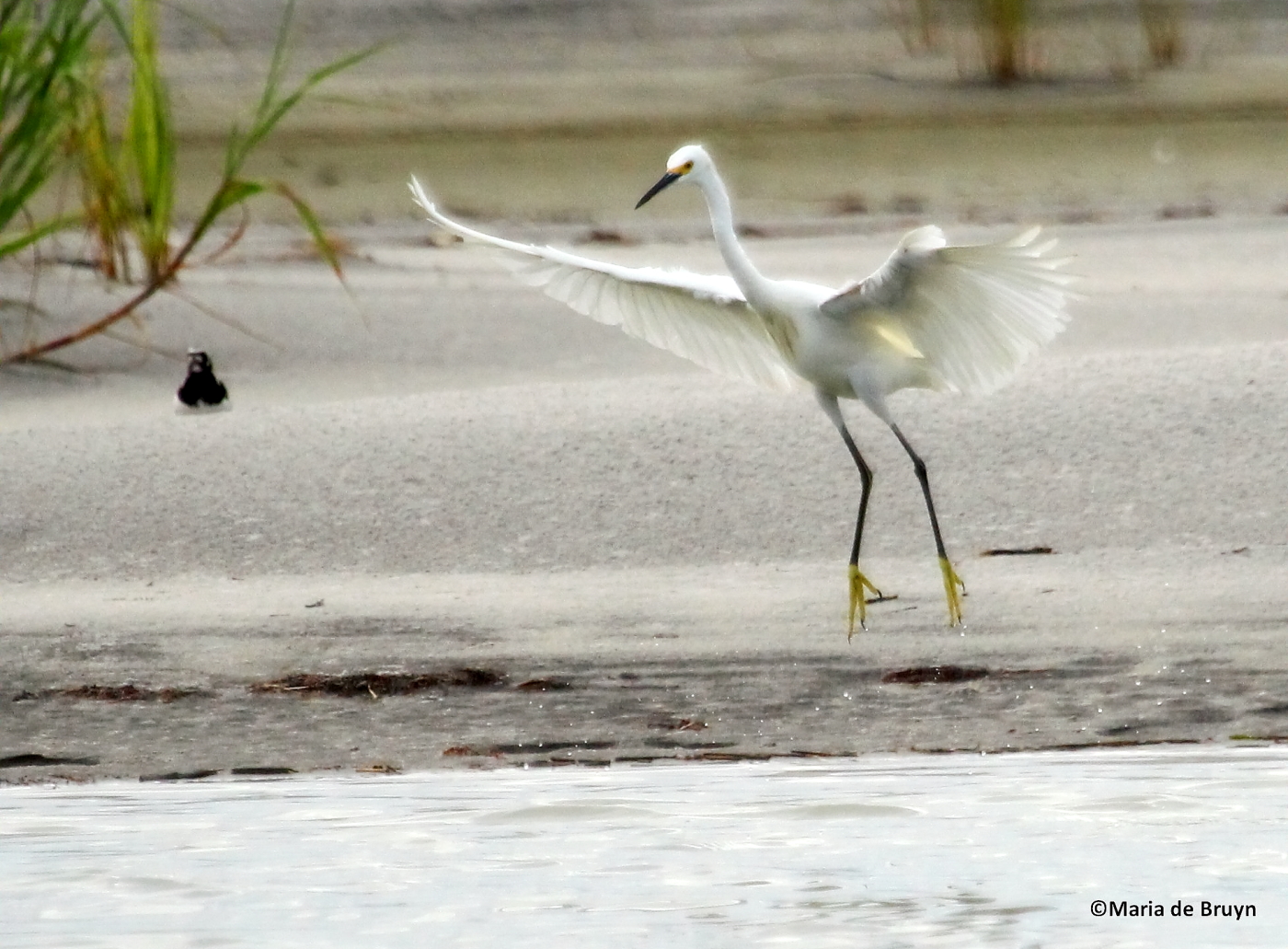
Later in the summer, I witnessed a similar kind of wing flashing used as a hunting technique by an entirely different species, the snowy egret (Egretta thula). These elegant white birds have long black legs ending in feet that look like they are covered with yellow rubber gloves. They stalk the shallows of waterways such as marshes and ponds looking for prey. The bird I saw was fishing in tidal pools along the Atlantic Ocean shore.

snowy egret IMG_3286© Maria de Bruyn

snowy egret IMG_3270© Maria de Bruyn

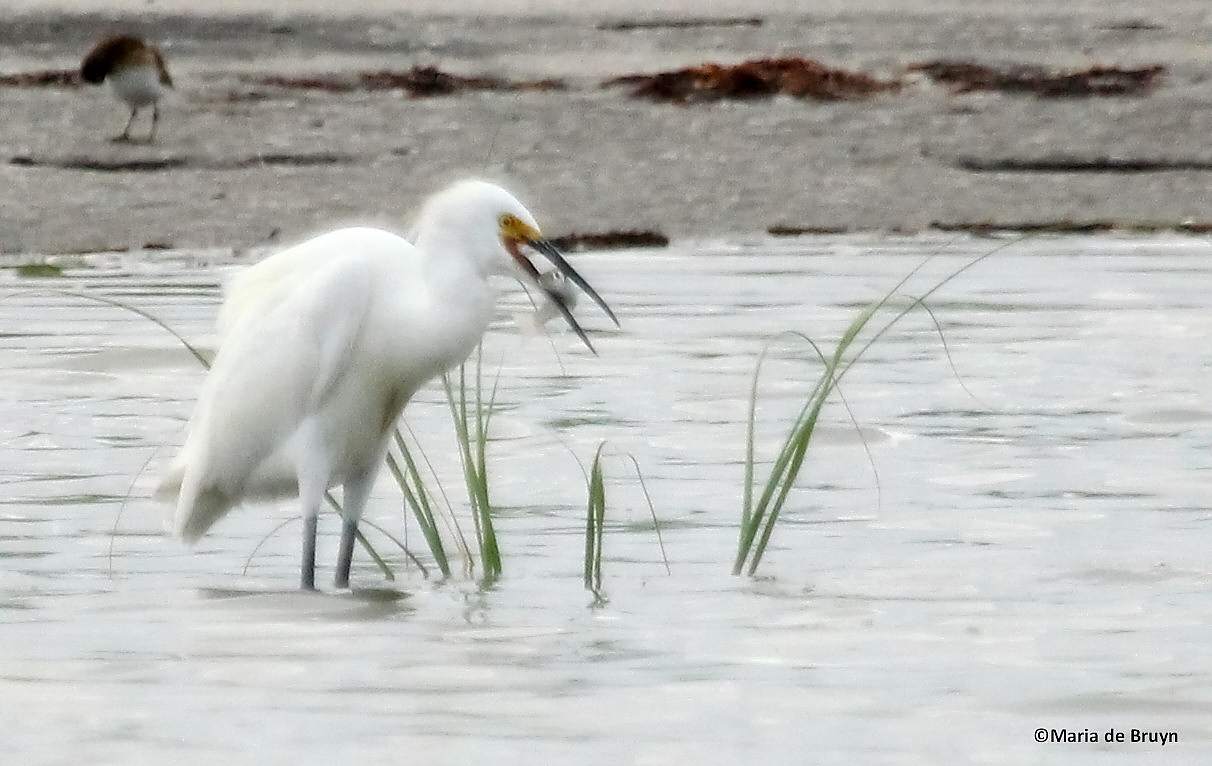
It is thought that the egrets use their large feet to stir up the sand underwater so that they can more easily see potential food as they forage. Part of the time, they will simply stand like statues, waiting for a fish to swim nearby so that they can suddenly plunge their long beaks into the water to get their meal.

snowy egret IMG_3313©Maria de BruynThis worked at least part of the time for this particular bird, as s/he got a few fish down. It required a lot of patience, however.
snowy egret IMG_3423© Maria de Bruyn res

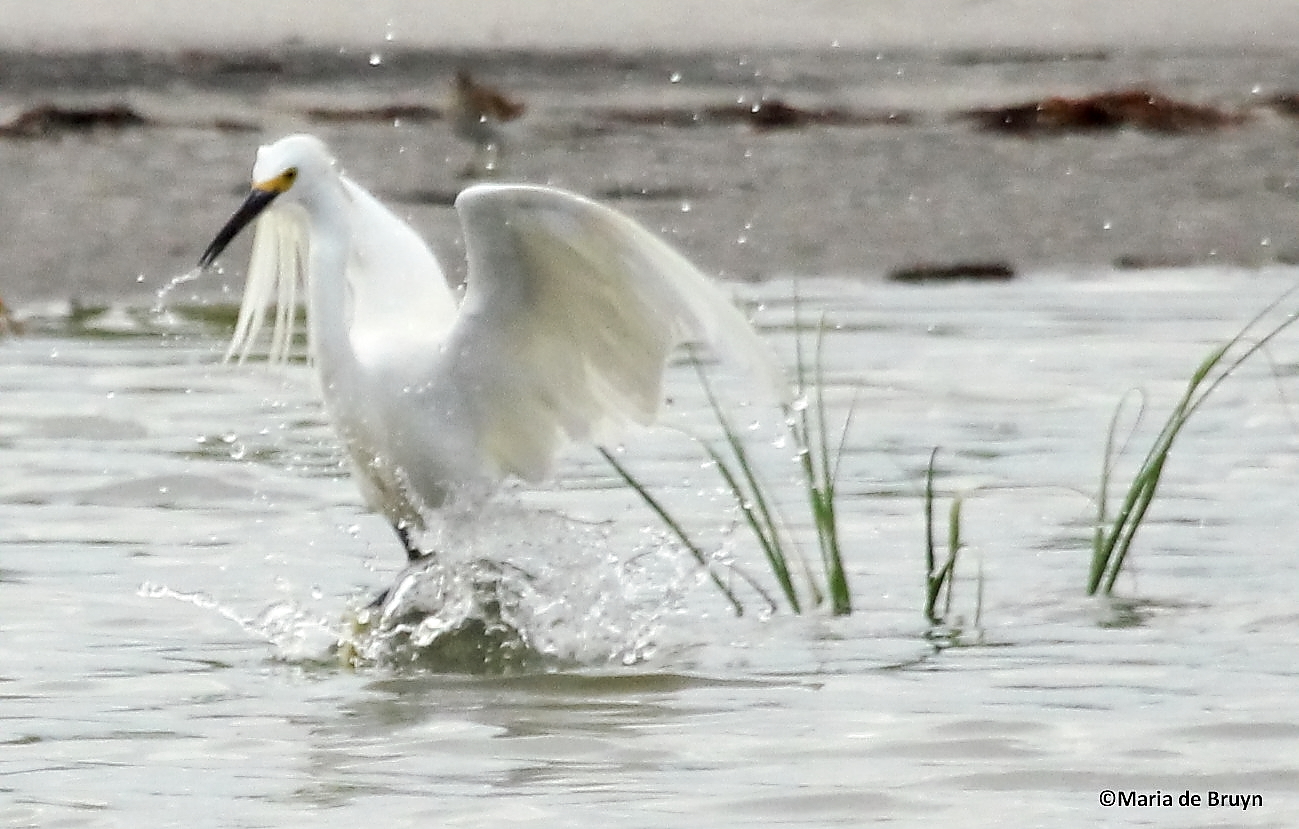
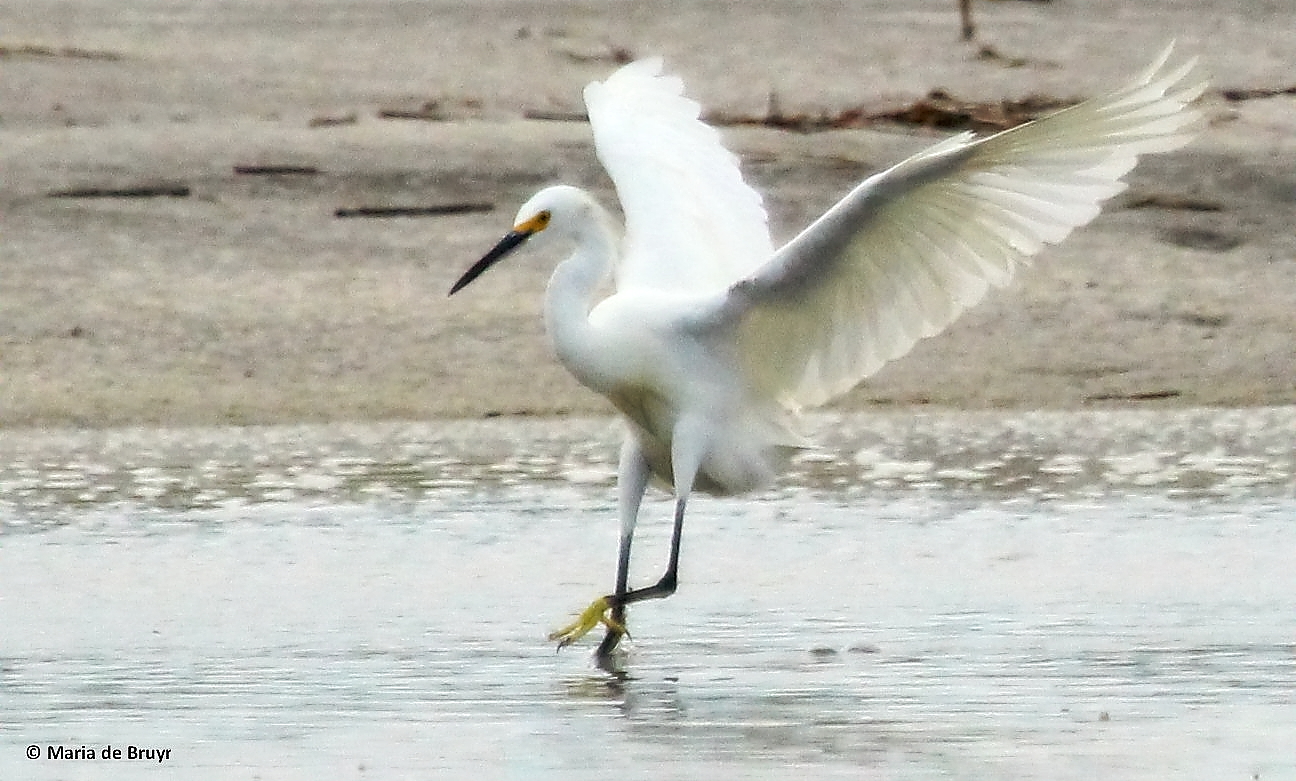
At a certain point, the bird decided on a more active approach. S/he flew to another tidal pool and then began running to and fro in the water, flapping his/her wings open and closed.

snowy egret IMG_3575© Maria de Bruynsnowy egret IMG_3574© Maria de Bruyn

Occasionally, this was complemented by a leap into the air and plunge into the water – obviously behavior calculated to startle and scare up the fish lurking below the water’s surface.

snowy egret IMG_3606© Maria de Bruynsnowy egret IMG_3617© Maria de Bruyn

snowy egret IMG_3623© Maria de BruynThe tactic worked.

It was fascinating for me to see two such different bird species using their wings in a similar fashion as a hunting method. One of the things I love about wildlife watching -– you can always see and learn something new!

snowy egret IMG_3659© Maria de Bruyn

A fruity buffet for the birds!

summer tanager profile IMG_4040©Maria de BruynIn front of a dog park in the small town of Carrboro, NC, there stands a small serviceberry tree, also known as a shadbush or sarvisberry (Amelanchier). This particular specimen has several trunks and was heavily laden with pretty white flowers in the early spring. These turned into bright red berries in late spring, forming a very bountiful buffet for the resident birds and some other wildlife, too!

The variety of species visiting this tree was delightful and led me to go back on several mornings and evenings to observe.

cedar waxwing IMG_1675©Maria de Bruyn2 rescedar waxwing IMG_2159©Maria de Bruyn res

The cedar waxwings (Bombycilla cedrorum) were there in pairs and groups, some of them sweetly feeding one another!

Northern cardinal IMG_4073©Maria de Bruyn2 resNorthern cardinal IMG_2078©Maria de Bruyn2 res

The male and female Northern cardinals (Cardinalis cardinalis) were also huge fans of this tree, returning over and over to have their fill.

Eastern bluebird IMG_4543©Maria de Bruyn reschipping sparrow IMG_2268©Maria de Bruyn2 res

A couple birds seemed only to alight in the tree, not really partaking, like the Eastern bluebirds (Sialia sialis) and chipping sparrows (Spizella passerina). However, those sparrows, like the American robin (Turdus migratorius), might have been just checking out the wares before they dropped to the ground under the tree to enjoy a few berries. That surprised me – especially, the robins whom I have considered to be mainly insectivores and worm-eaters.

chipping sparrow IMG_1626©Maria de Bruyn2 res American robin IMG_4531©Maria de Bruyn res

One day, a trio of Eastern gray squirrels (Sciurus carolinensis) arrived. I thought for sure that they would be stripping the branches clean but they hopped around the tree, sampling here and there. During several visits to the serviceberry, that was the only time I saw them climb into the tree for a snack.

Eastern gray squirrel IMG_2191©Maria de Bruyn2 resEastern gray squirrel IMG_2116©Maria de Bruyn2 res

Other birds seemed to visit only briefly, like the Northern mockingbird (Mimus polyglottos) and the tufted titmouse (Baeolophus bicolor).

Northern mockingbird IMG_4164©Maria de Bruyn2 res tufted titnouse IMG_2122©Maria de Bruyn res

red-bellied woodpecker IMG_1633©Maria de Bruyn2 resThe red-bellied woodpecker (Melanerpes carolinus), on the other hand, was a very frequent visitor – coloring oh so nicely with the host tree! This bird seemed to be also storing some berries for later consumption in the bark of a tree?

red-bellied woodpecker IMG_2094©Maria de Bruyn2 res

red-bellied woodpecker IMG_2007©Maria de Bruyn2 res

Serviceberries are promoted for gardens as a source of delicious fruit for human beings. They are said to be wonderful in jam, pies, ice cream, syrup for pancakes and or in alcoholic drinks. Raw, they taste a little like blueberries with a nice sweet tang.


They were obviously a great hit with a pair of summer tanagers (Piranga rubra). The male colored nicely with the fruit he was eating; he is an example of the only bird in North America that is entirely red!

Summer tanager IMG_1643©Maria de Bruyn res summer tanager IMG_4112©Maria de Bruyn res

The yellow female stood out as she ate berry after berry.

Summer tanager IMG_1955©Maria de Bruyn res summer tanager IMG_4041©Maria de Bruyn res


Cedar apple rust IMG_9380© Maria de BruynAfter watching this spectacle, I have now decided to find one of these shrubs for my own yard. They are unfortunately susceptible to cedar apple rust (Gymnosporangium juniperi-virginianae) which I have in neighboring cedar trees; it doesn’t seem to hurt the cedars but may account for the fact that the apples in my apple tree stay very small even if I haven’t seen signs of the rust on the apple tree leaves. Hopefully, it won’t be a problem as it would be really nice to see the birds at a serviceberry buffet here at home in years to come!


Birds braving winter

American goldfinch IMG_1955©Maria de Bruyn

It’s not unheard to have snow in central North Carolina, but it also isn’t what you’d call a commonplace occurrence. It is a BIG deal when it snows here; if a couple inches of snow or some icing on the roads is expected, schools and businesses close. This is a cause of hilarity among people who originated from points north, but when they realize that many drivers here are not accustomed to winter-weather driving and that the Department of Transportation and towns are not equipped so well to deal with the conditions, they also will often stay inside and not go out on the road.

Carolina wren IMG_0424©Maria de BruynAmerican robin IMG_0326©Maria de Bruyn

When we had two days of snow and ice storms last week, it wasn’t only people who were unhappy. The birds also didn’t seem enamored with the climate change, like the American goldfinch up above (Spinus tristis). They had had a taste of snow at the end of January, but it wasn’t such a strong storm then.  The Carolina chickadee (Poecile carolinensis) was scurrying about looking for food under the snow and the American robin (Turdus migratorius) was enjoying some berries.  The February storm was a bit different though

Mourning dove IMG_2478©Maria de Bruyn

On the first day, when it didn’t snow heavily all at once (it was more a matter of lightly falling snow much of the day), I had a multitude of birds at my feeders – including some that I don’t usually see there. This mourning dove (Zenaida macroura), for example, didn’t scrounge around on the ground in the snow but landed on a feeder to see if there were seeds there.

Other birds flew back and forth between the trees and feeders, like the yellow-rumped warblers (Setophaga coronata), who weren’t always happy to have others sharing the feeders), and the tufted titmice (Baeolophus bicolor).

Yellow-rumped warbler IMG_2618©Maria de BruynTufted titmouse IMG_2355©Maria de Bruyn

When out walking in a furious flurry of fat snowflakes, I ran into a neighbor who does research on bird survival. I mentioned that on the first day of the storm, I had a multitude of birds at my feeders (probably a 100 or so) but now, with this heavier snowfall, not a bird was to be seen. He noted that, given bird’s short lifespans in some cases and the fact that many would be younger, they were likely hunkering down as this was their first encounter with these weather conditions.

Brown thrasher IMG_2127©Maria de Bruyn

Northern cardinal IMG_2375©Maria de Bruyn

Another neighbor down the road and I kept our feeders filled so that our avian friends could rev up their energy stores, like the brown thrasher (Toxostoma rufum) and the Northern cardinals (Cardinalis cardinalis). The birds did their part by fluffing up their feathers to help keep body warmth as much as possible.  And they posed for some nice photos – albeit not with enthusiastic expressions, like this warbler and Northern mockingbird (Mimus polyglottos).

Yellow-rumped warbler IMG_2684©Maria de BruynNorthern mockingbird IMG_3455©Maria de Bruyn

Today, they should all be happy though – we’re expecting temperatures well in the upper 60s F! That should make for happy white-throated sparrows (Zonotrichia albicollis), Eastern towhees (Pipilo erythrophthalmus) and all the other birds visiting my yard!

white-throated sparrow IMG_2564©Maria de BruynEastern towhee IMG_0670©Maria de Bruyn