Mammal merriment, misery and markings

Lately, many of my blogs have been about birds, mostly because they have been the easiest wildlife to photograph during the colder months. The mammals – and insects, reptiles and amphibians – have not been around much and likely have often visited when I’m not watching. I’m fairly certain that raccoons (Procyon lotor) and opossums (Didelphis virginiana) come to my yard after dark; perhaps the odd fox or coyote does as well. Nevertheless, after she stopped weaning her young and since summer ended, I haven’t seen Raquel raccoon all winter.

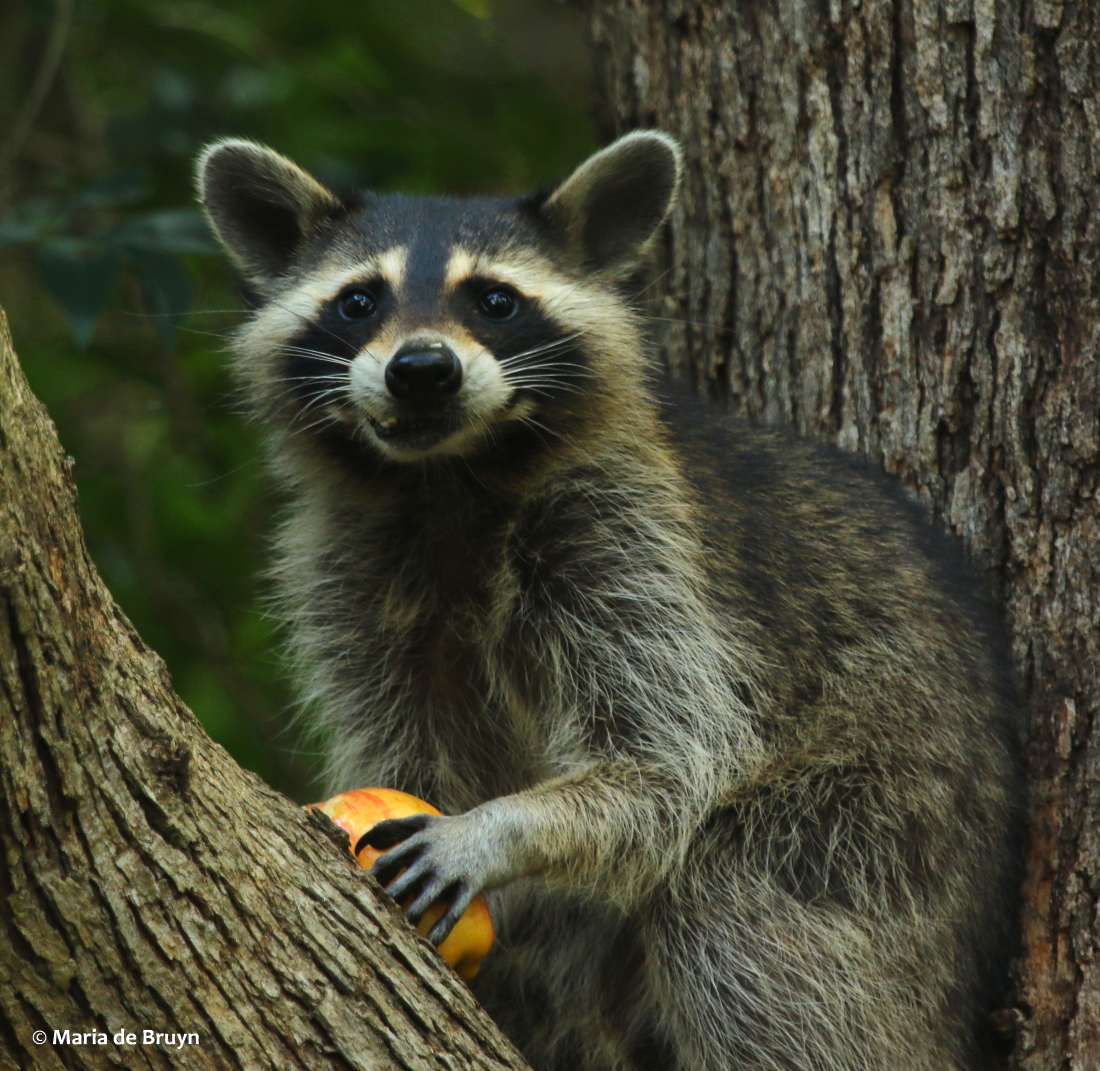
raccoon DK7A4351© Maria de Bruyn   raccoon DK7A4248© Maria de Bruyn res

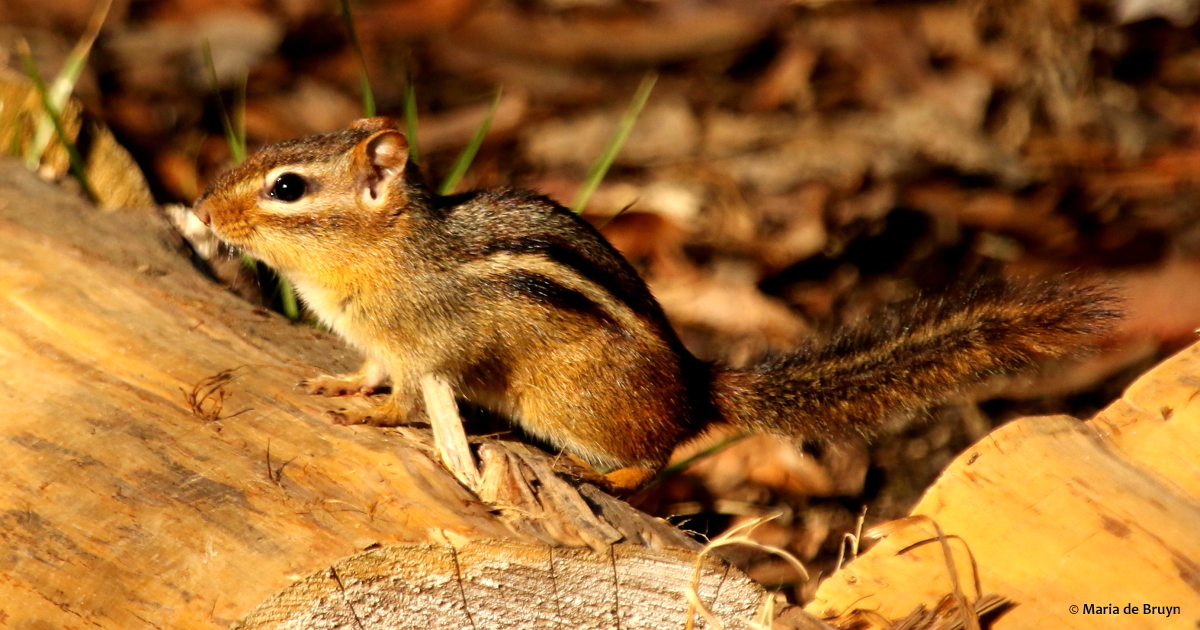
Eastern chipmunk I77A8790© Maria de Bruyn resThere a couple mammals, however, that I can count on to see every day because they have grown accustomed to having a food source at my house. Fallen bird seed (and seed and apples put out deliberately for ground feeders) does not get entirely gobbled up by the avian visitors, leaving pickings for the Eastern gray squirrels (Sciurus carolinensis), Eastern chipmunks (Tamias striatus) and white-tailed deer (Odocoileus virginianus).

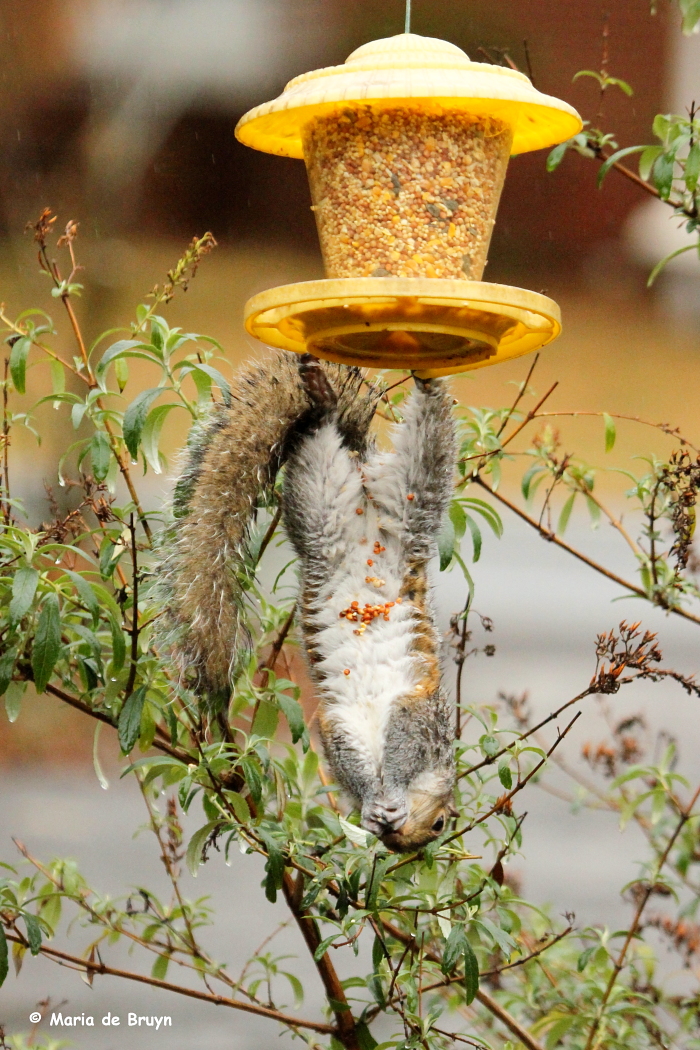
The squirrels keep a watch from the trees and underbrush and appear very quickly after the bird seed is replenished. My combined squirrel and raccoon baffles – and placing the feeder poles at least 10 feet away from any structures from which they launch themselves onto the poles – have proved successful in keeping them from the feeders. But they continue to look for vantage points from which they can attempt a jump to the feeders.
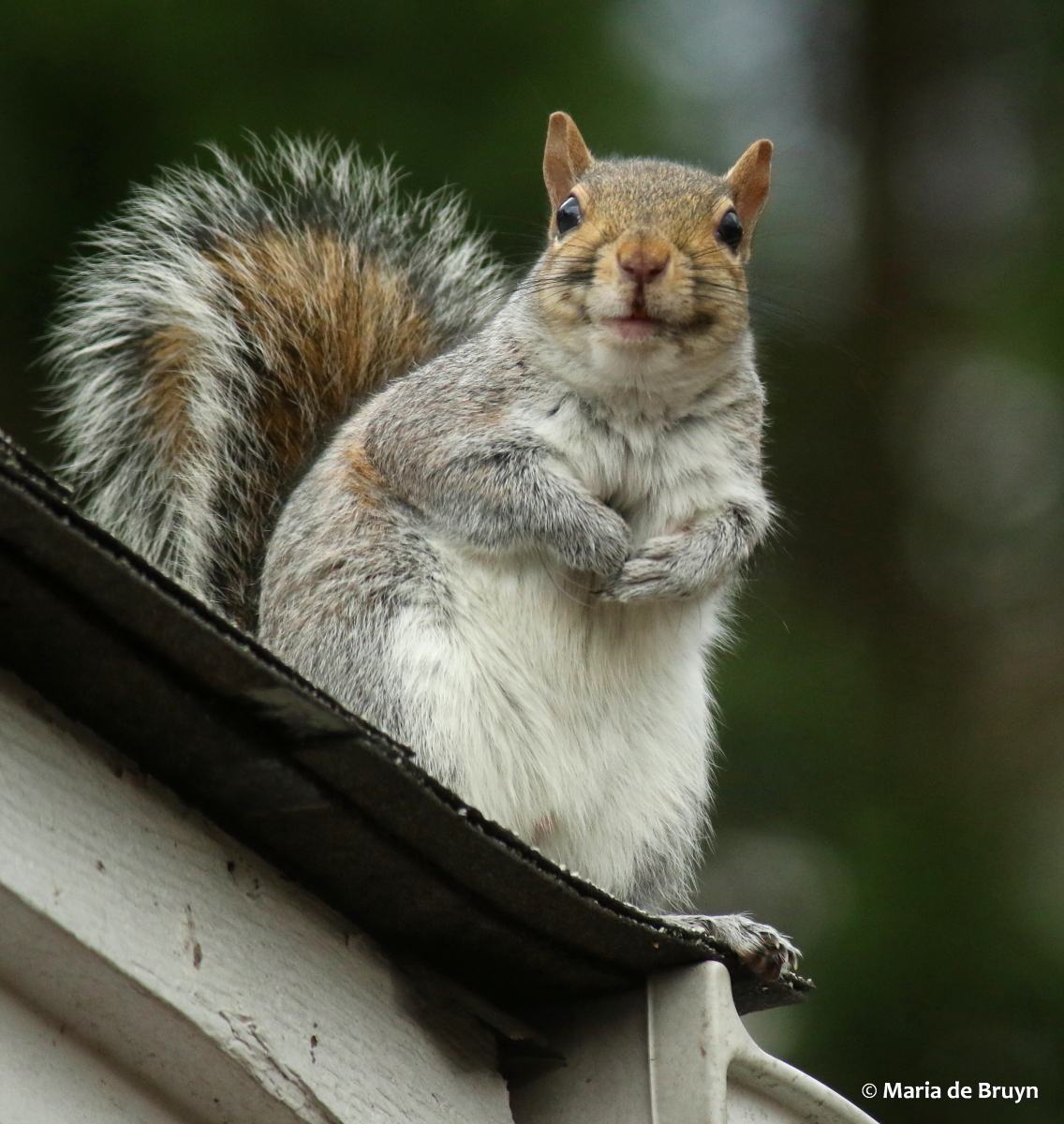
Eastern gray squirrel I77A5504© Maria de Bruyn res  Eastern gray squirrel I77A5494© Maria de Bruyn res

Eastern gray squirrel IMG_3643 mdb


Before I learned how to thwart them, they made off with plenty of seed and suet – one squirrel even carrying off the entire suet feeder when s/he couldn’t get it open. I saw it happening and chased that squirrel, but they were faster than me!

They will share space happily with birds but don’t always want to share with other squirrels or chipmunks.
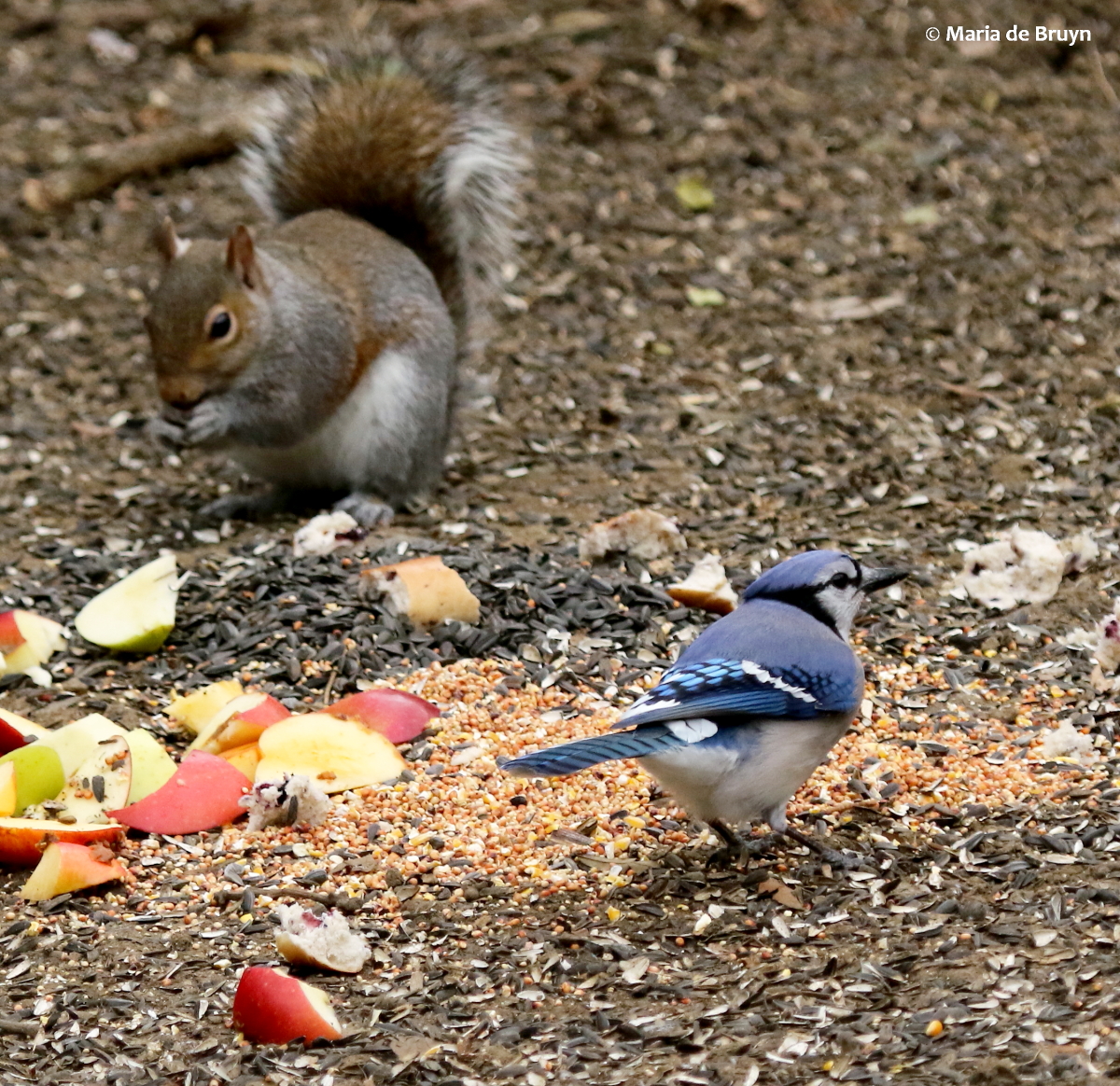
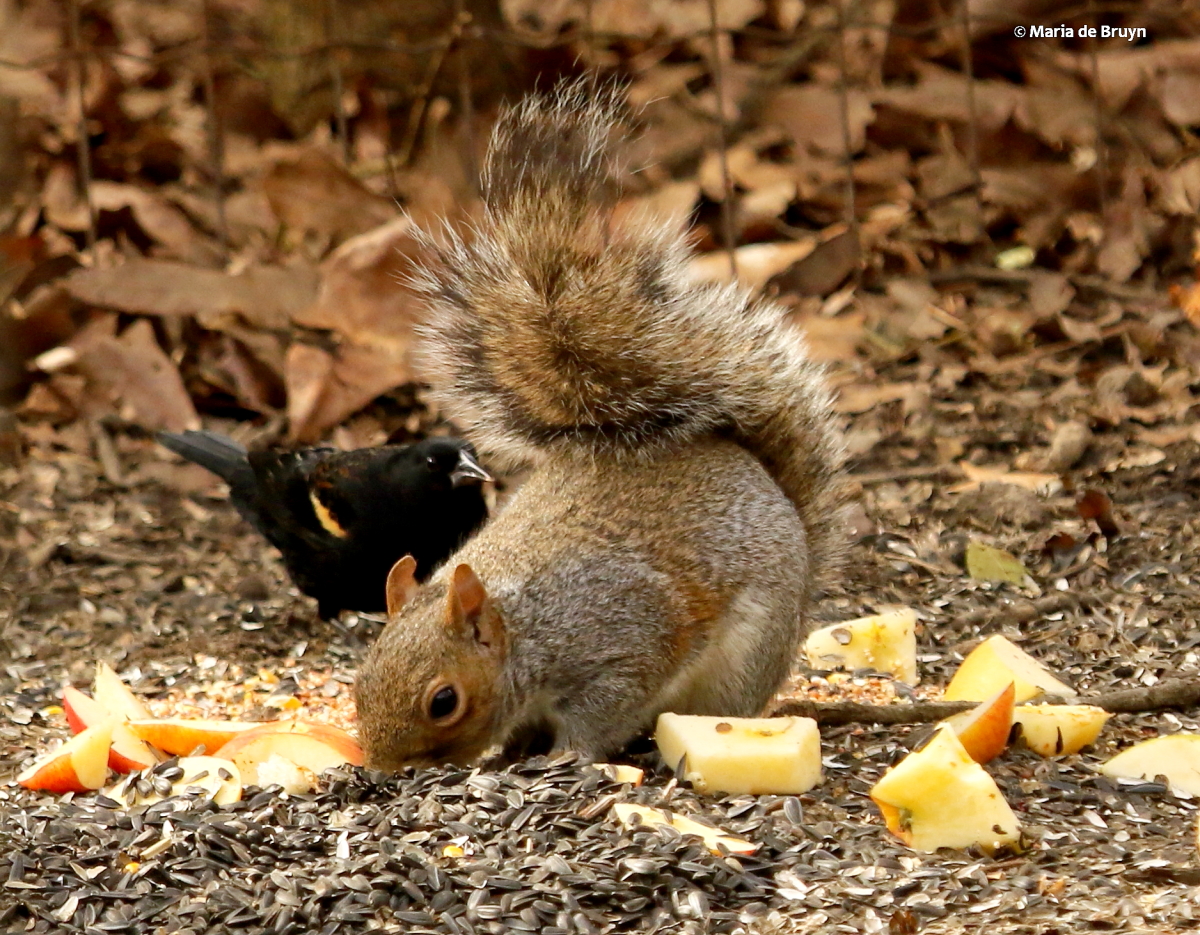


Eastern gray squirrel I77A8350© Maria de Bruyn Eastern gray squirrel I77A0711© Maria de Bruyn res

The chipmunks don’t let that selfish attitude deter them; they just keep a sharp eye out for when a squirrel might turn on them. They wolf down seed after seed, giving themselves a very fat-cheeked countenance!
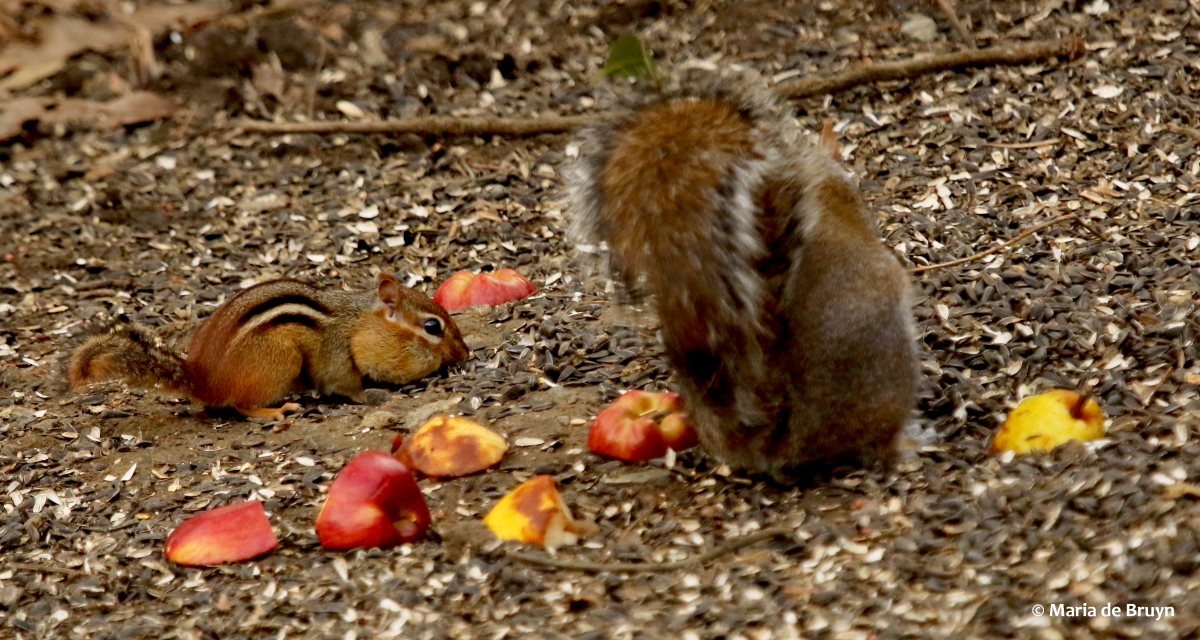
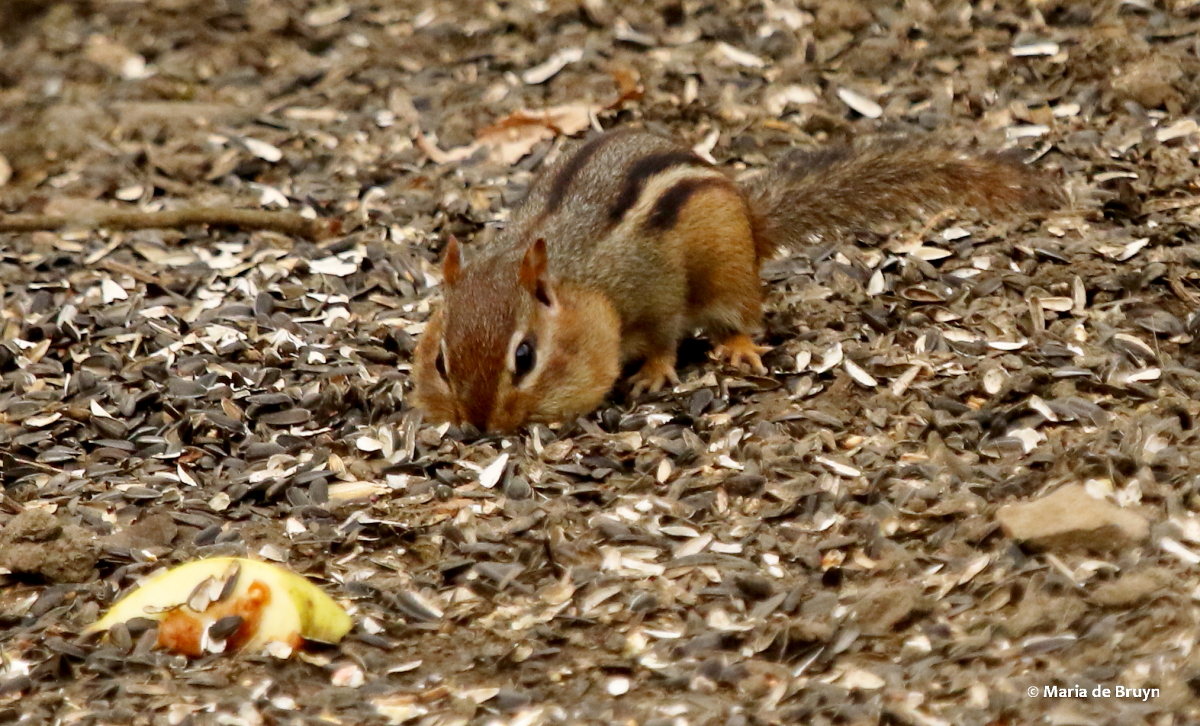
Eastern chipmunk I77A3326© Maria de Bruyn  Eastern chipmunk I77A3335© Maria de Bruyn

The past few days, the squirrels have continued their chasing, but now it is not always in rivalry or play. Instead, their romantic side is showing and the merriment goes on for a good length of time. They appear to have designated a particular tree stump/snag in my back yard as their trysting spot.
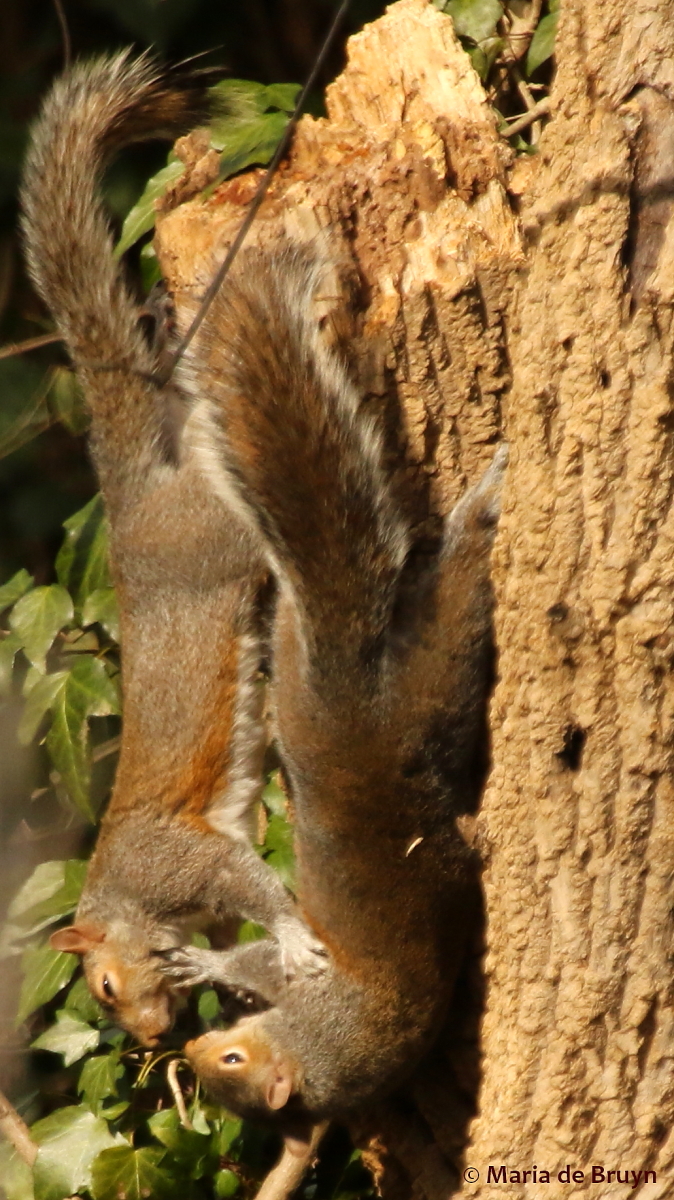
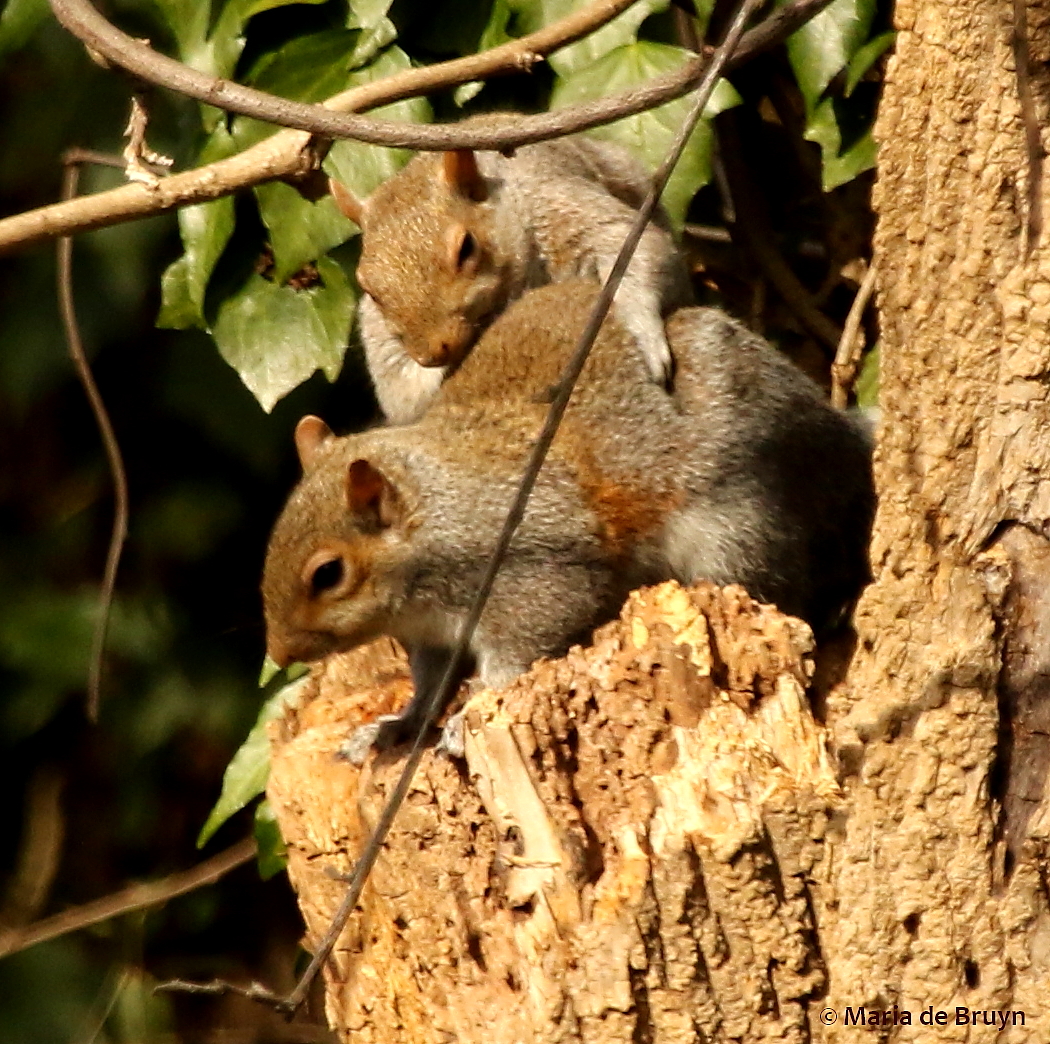
Eastern gray squirrel I77A1104© Maria de Bruyn res              Eastern gray squirrel I77A0980© Maria de Bruyn

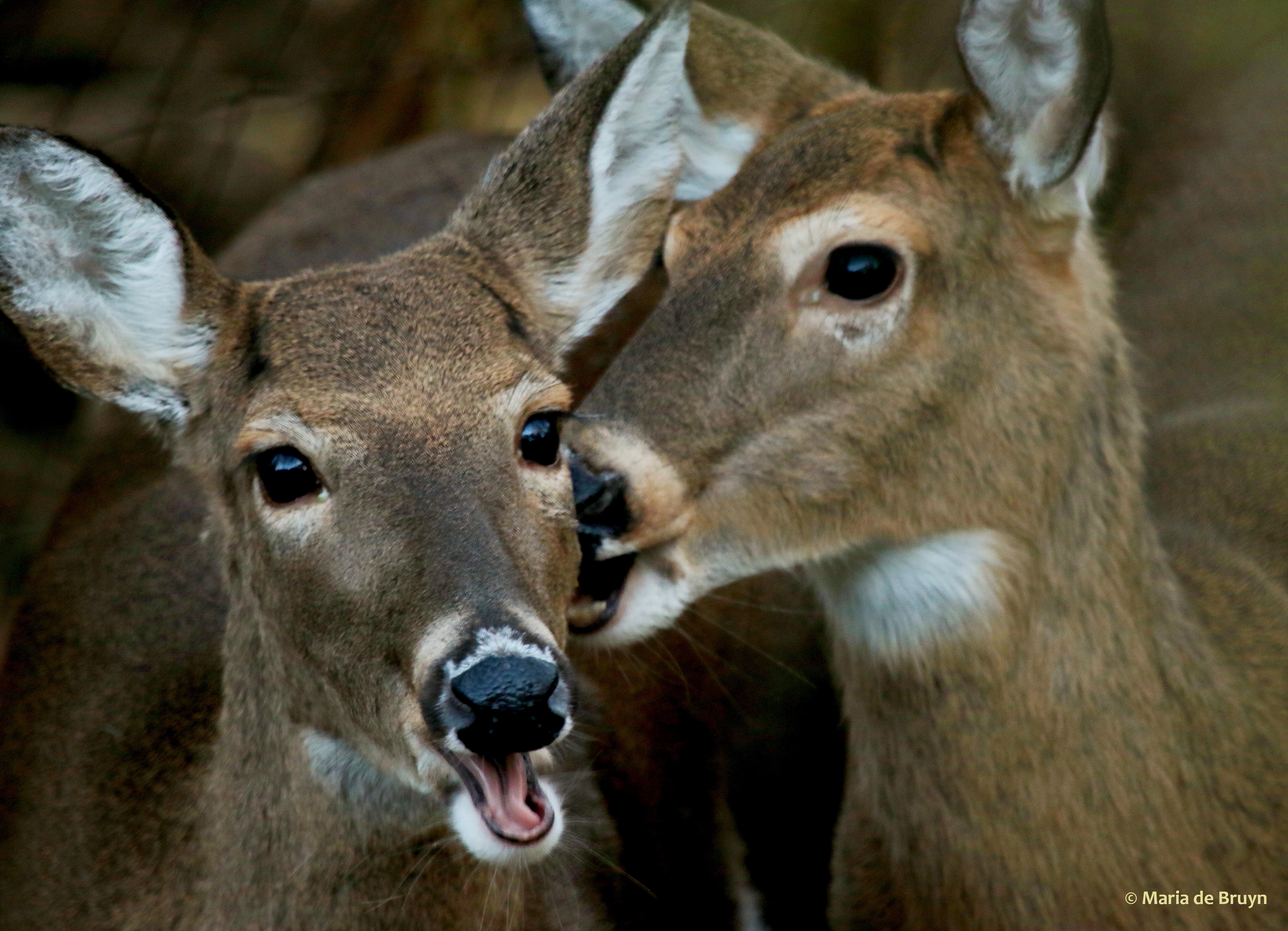
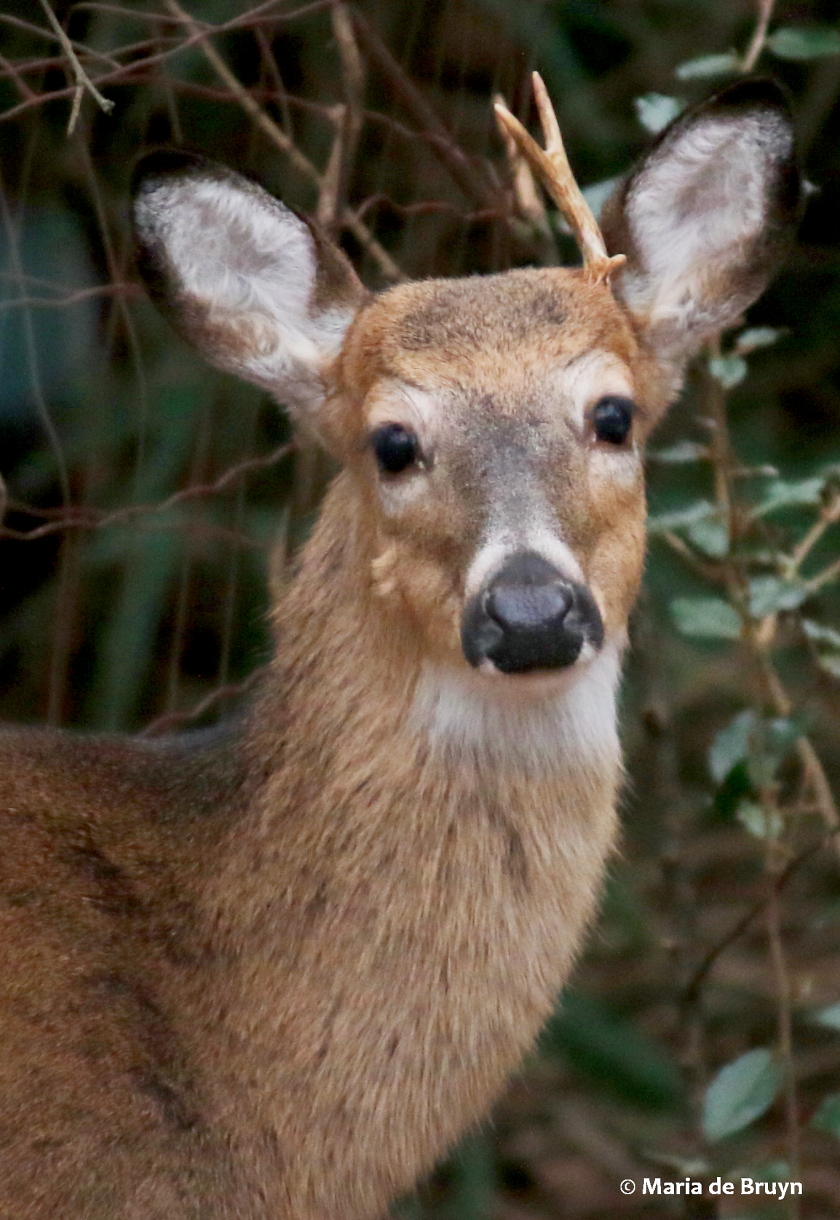
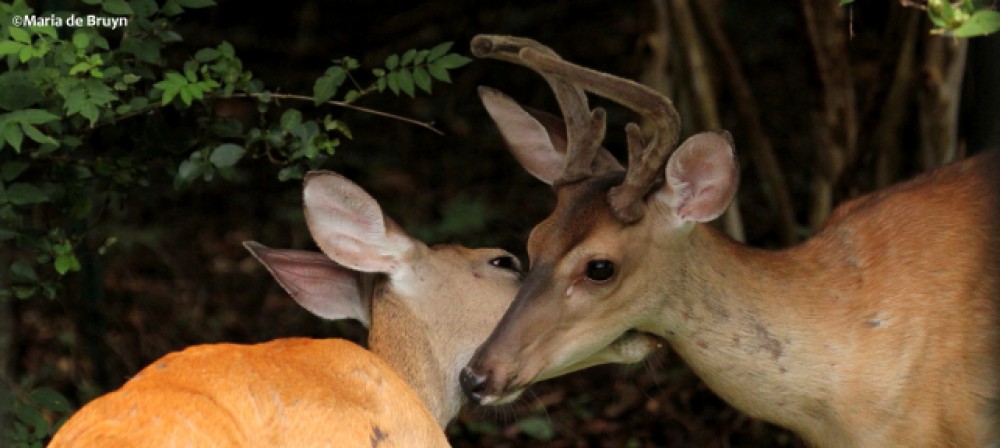
white-tailed deer I77A0963© Maria de Bruyn resThe white-tailed deer carry on their mating elsewhere but I know it’s happening as the males are evidence. Usually, one small family group comes to my home – mom, her one-year-old daughter and one-year-old son (a button buck, so-called for his tiny little antler nubs). They were occasionally accompanied by a couple second-year bucks with little antlers – I suspect mama’s sons from the previous year.
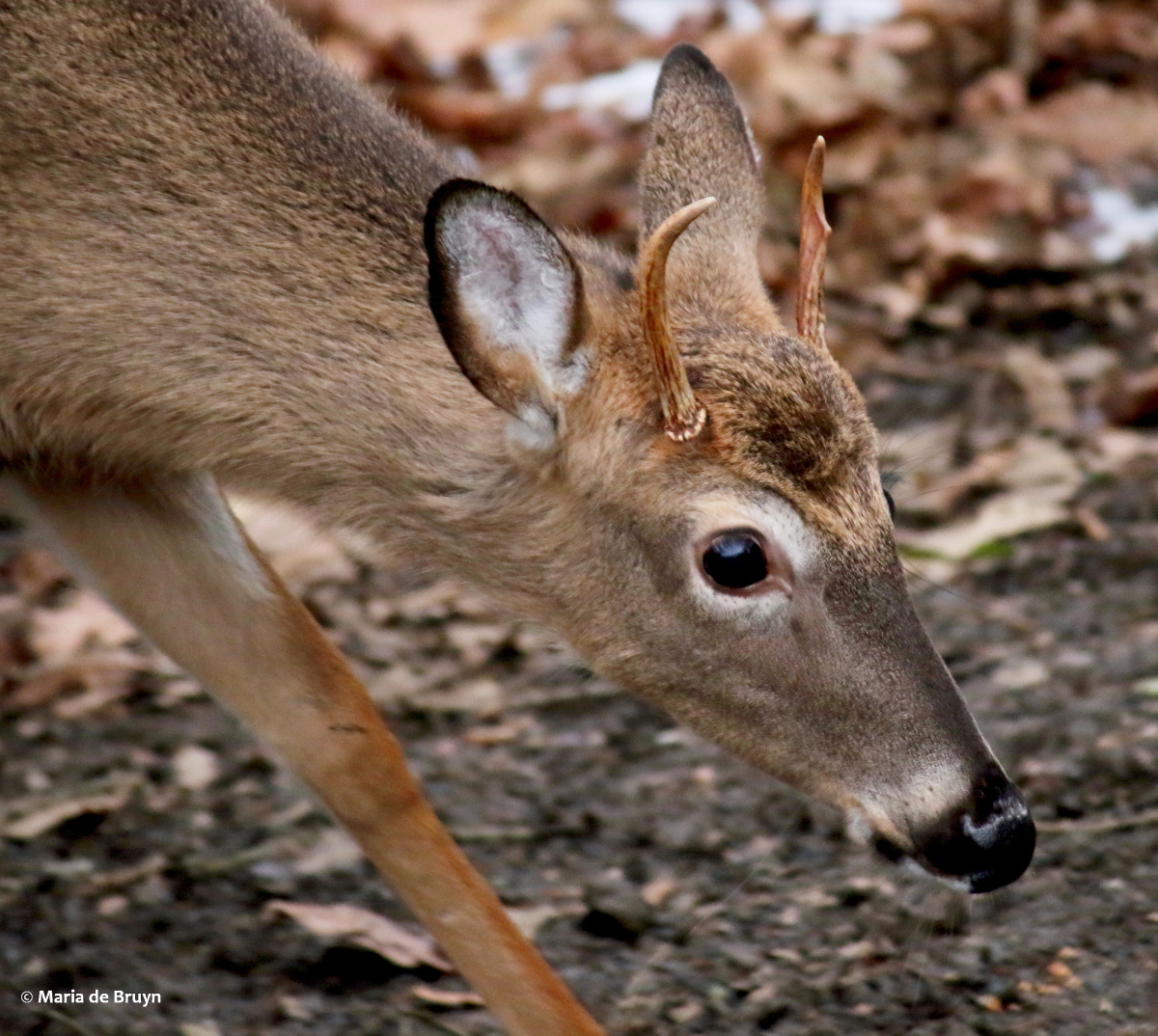
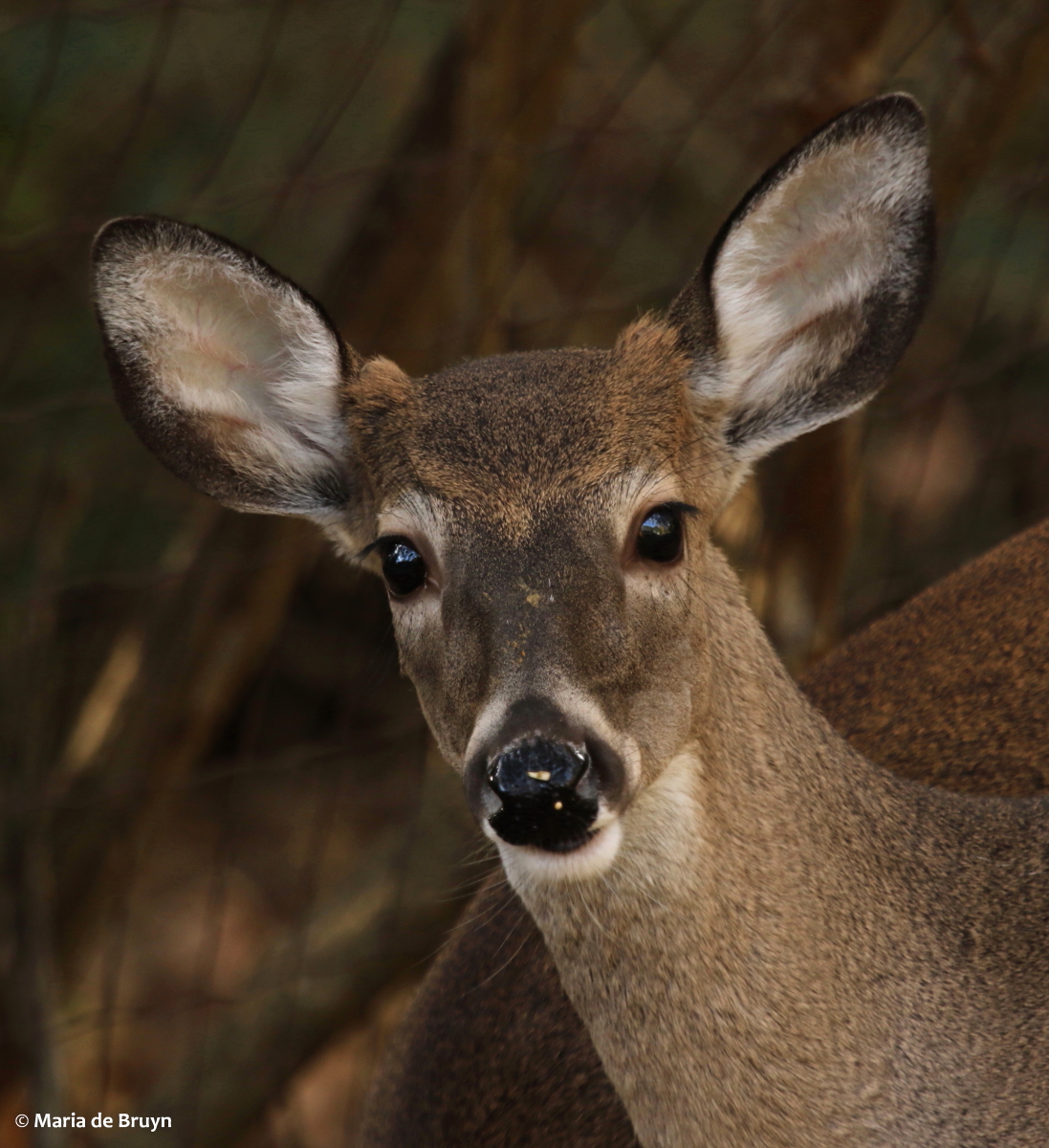
white-tailed deer I77A1367© Maria de Bruyn res    white-tailed deer I77A2025© Maria de Bruyn res

white-tailed deer I77A1366© Maria de Bruyn res


One of them lost one of his antlers early, but whether this was the result of a fight or accident is unknown to me. It seems that mama has allowed an orphaned button buck to join their group occasionally, too.

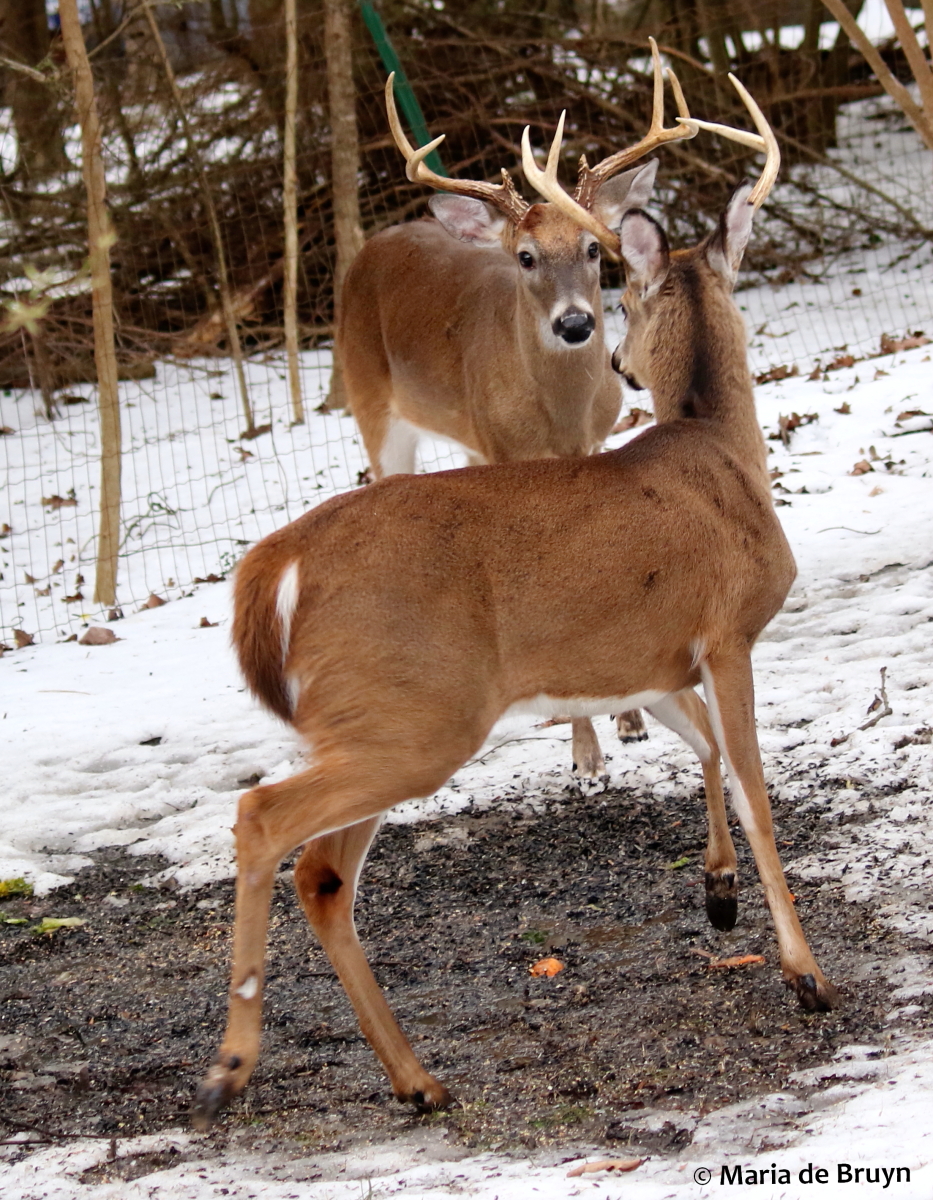
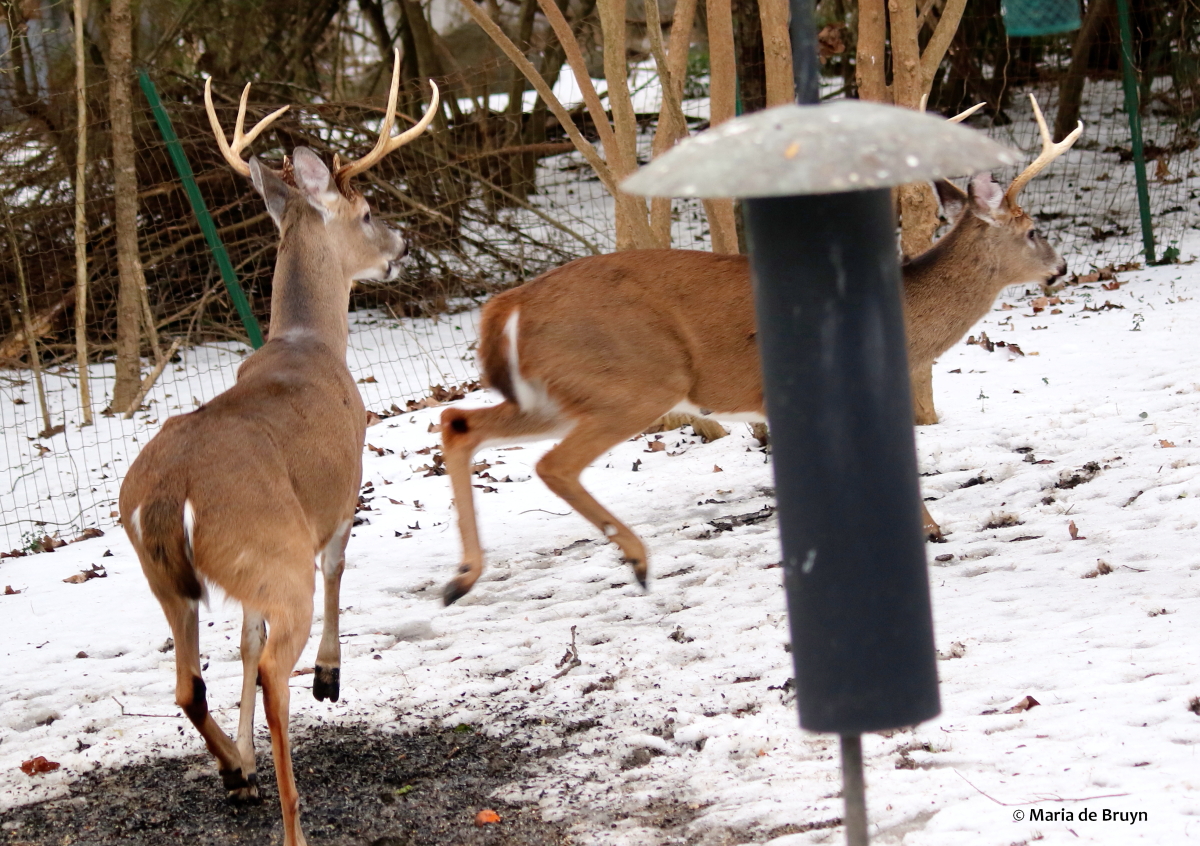
A couple weeks ago, two of the older males came down from the woods in search of does and food in the cold weather. This pair was traveling together but that didn’t stop some rivalry where first-access to the available food was concerned.
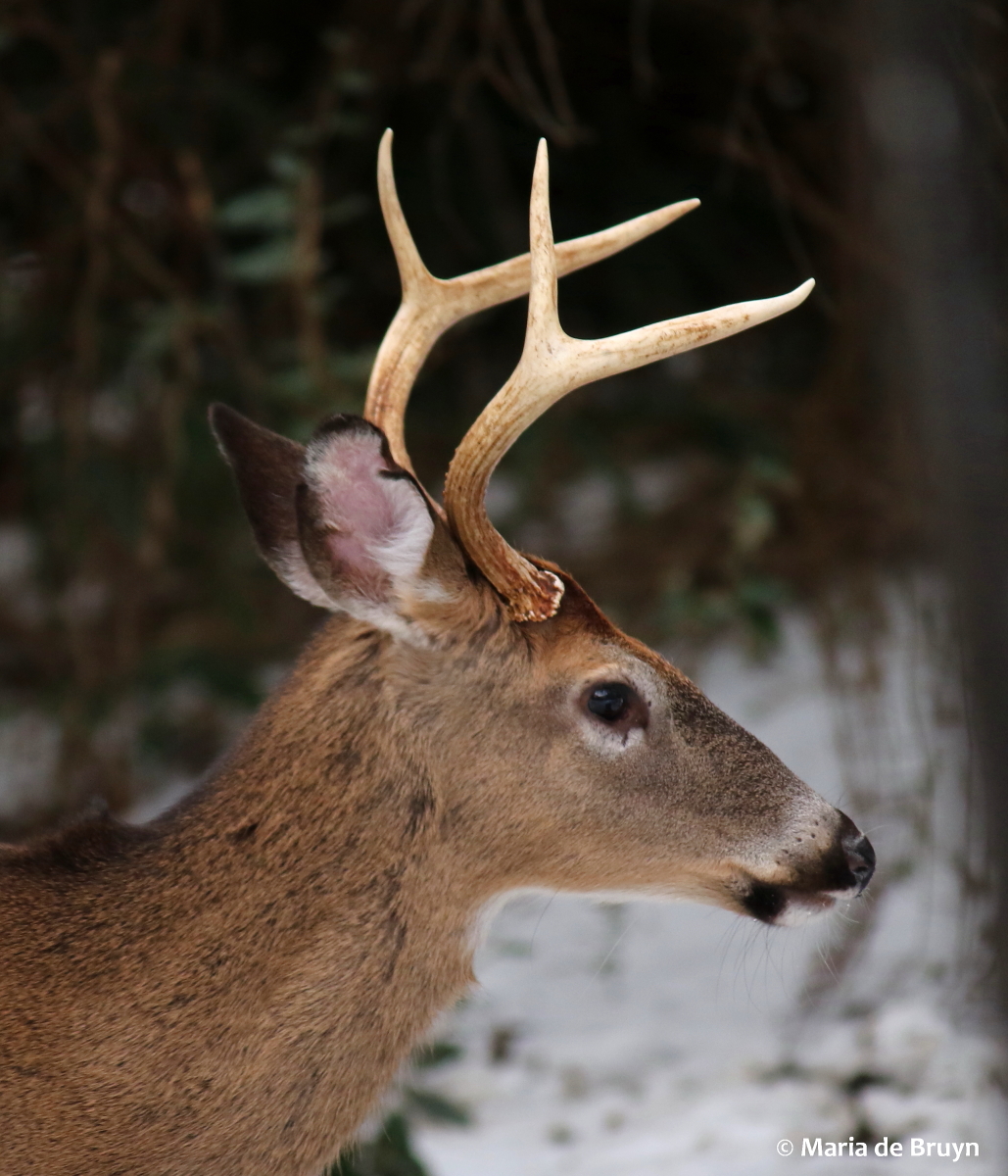
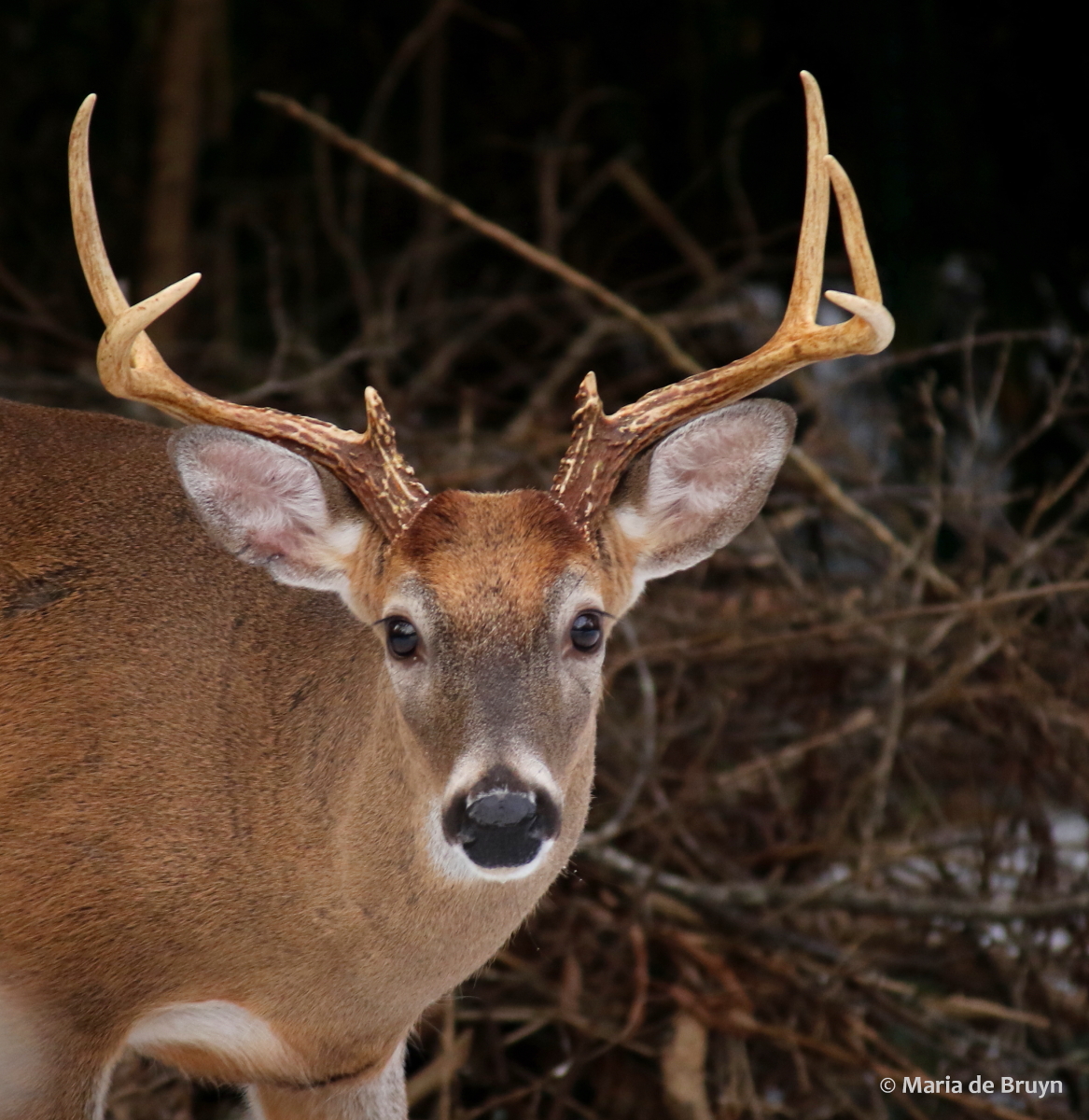
 

white-tailed deer I77A1061© Maria de Bruyn res white-tailed deer I77A1005© Maria de Bruyn res


white-tailed deer I77A1127© Maria de Bruyn res  white-tailed deer I77A1150© Maria de Bruyn res

white-tailed deer I77A1893© Maria de Bruyn res


Then one day about a week ago when we had some very icy weather, I was surprised by a new and unfamiliar family group for a day. I didn’t mind them eating some seed and the resident family wasn’t around to chase them away. But then I felt immensely sad as I saw that one of them had been injured. Her tongue was lolling out but it was only when she came into the yard that I saw she must have been in an accident.


I felt miserable for her, seeing her face had been smashed in but after watching for a while, I realized the accident must have happened some time ago as she had no open wounds.
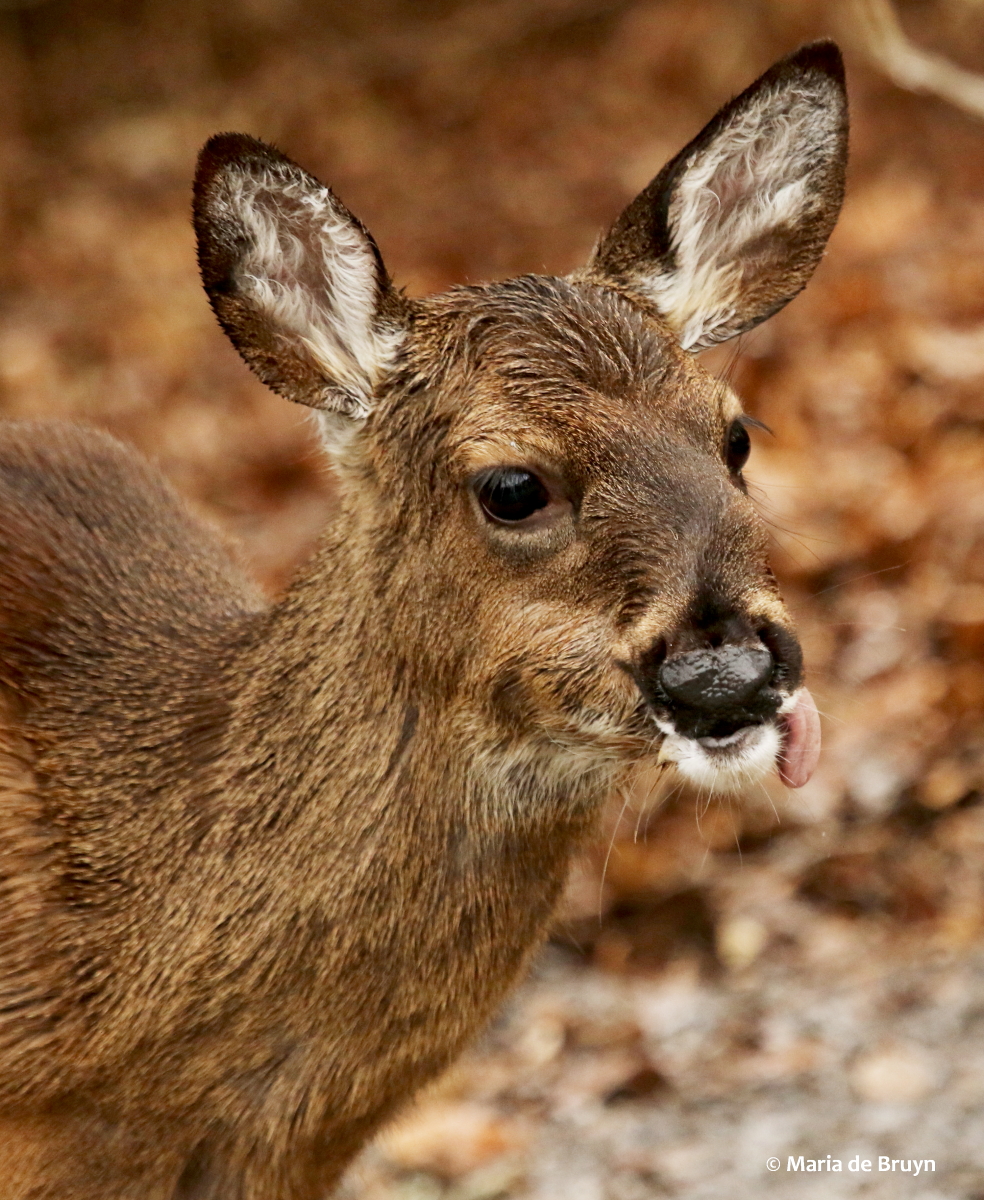
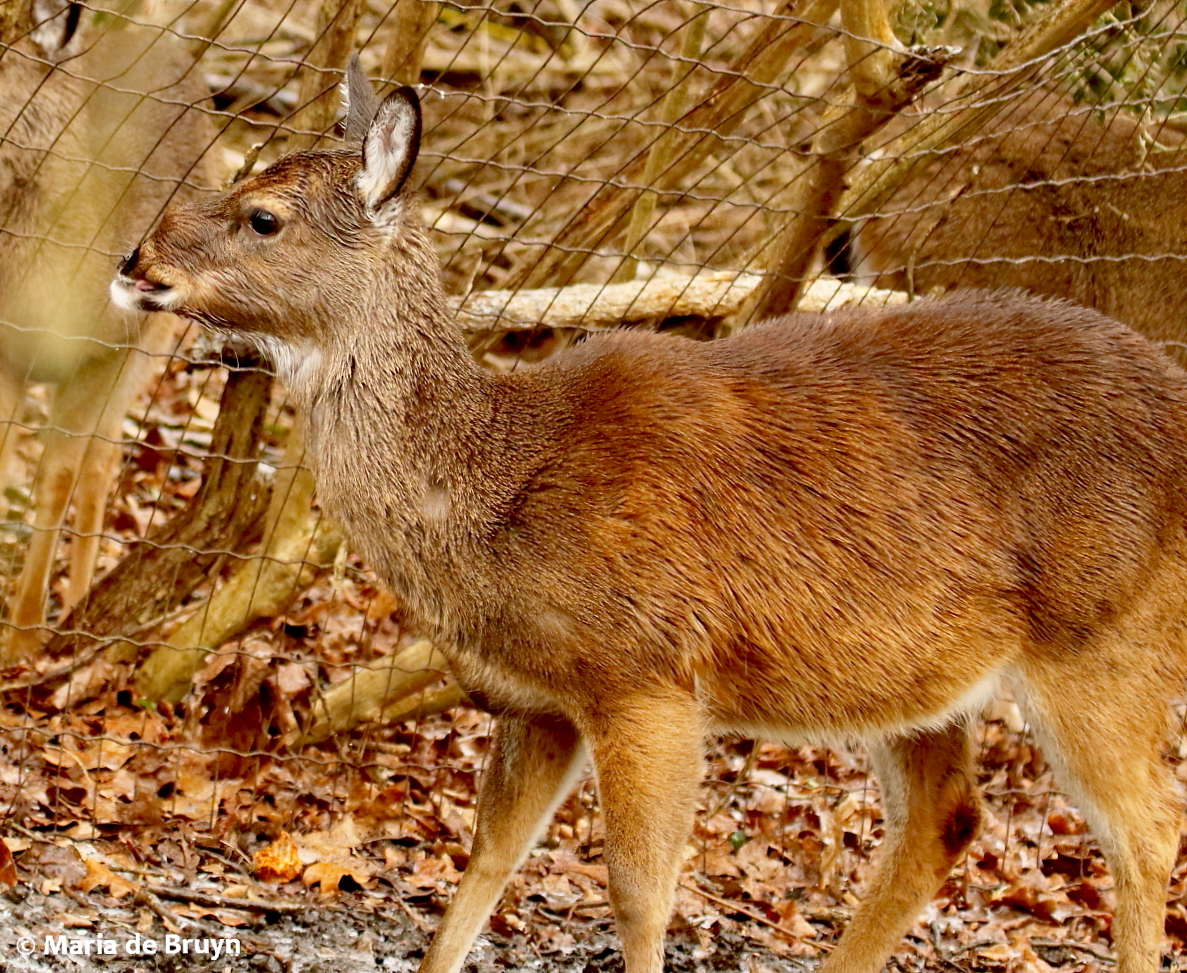
white-tailed deer I77A1917© Maria de Bruyn res white-tailed deer I77A1869© Maria de Bruyn

It must have been terribly painful though. I decided to call her Camelia as her profile reminded me of a camel.
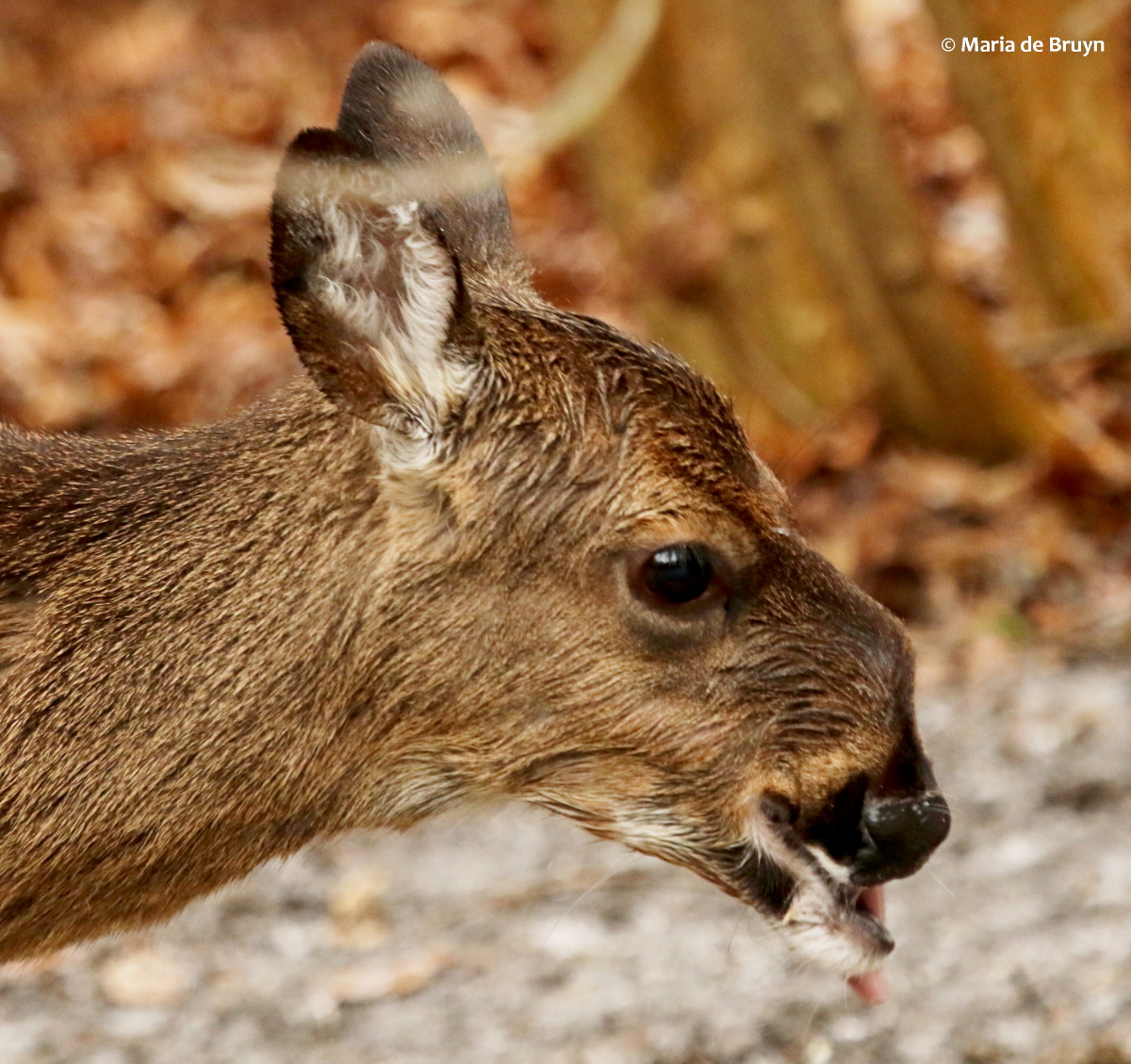
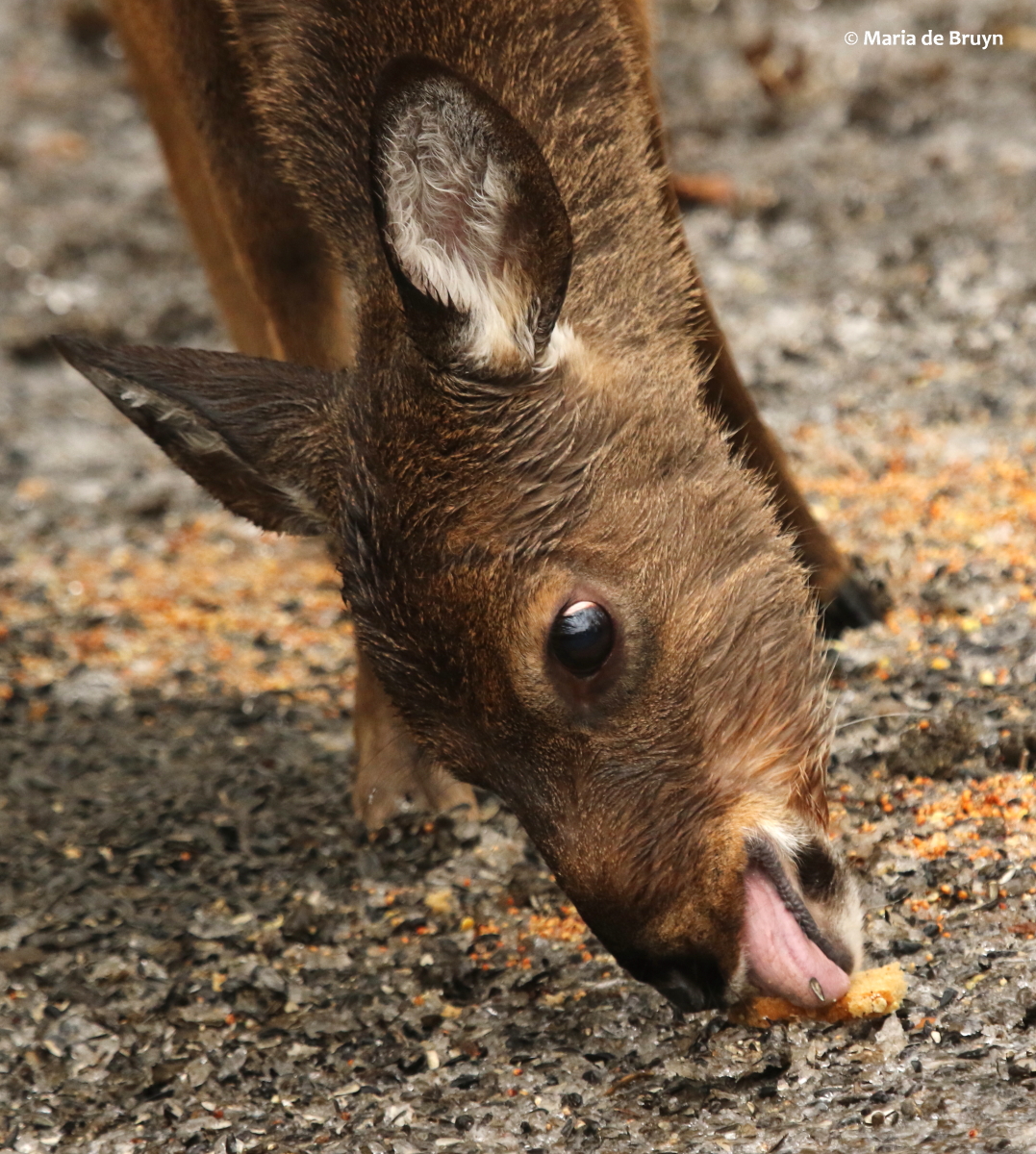
white-tailed deer I77A1932© Maria de Bruyn res   white-tailed deer I77A1906© Maria de Bruyn res

white-tailed deer I77A1887© Maria de Bruyn res

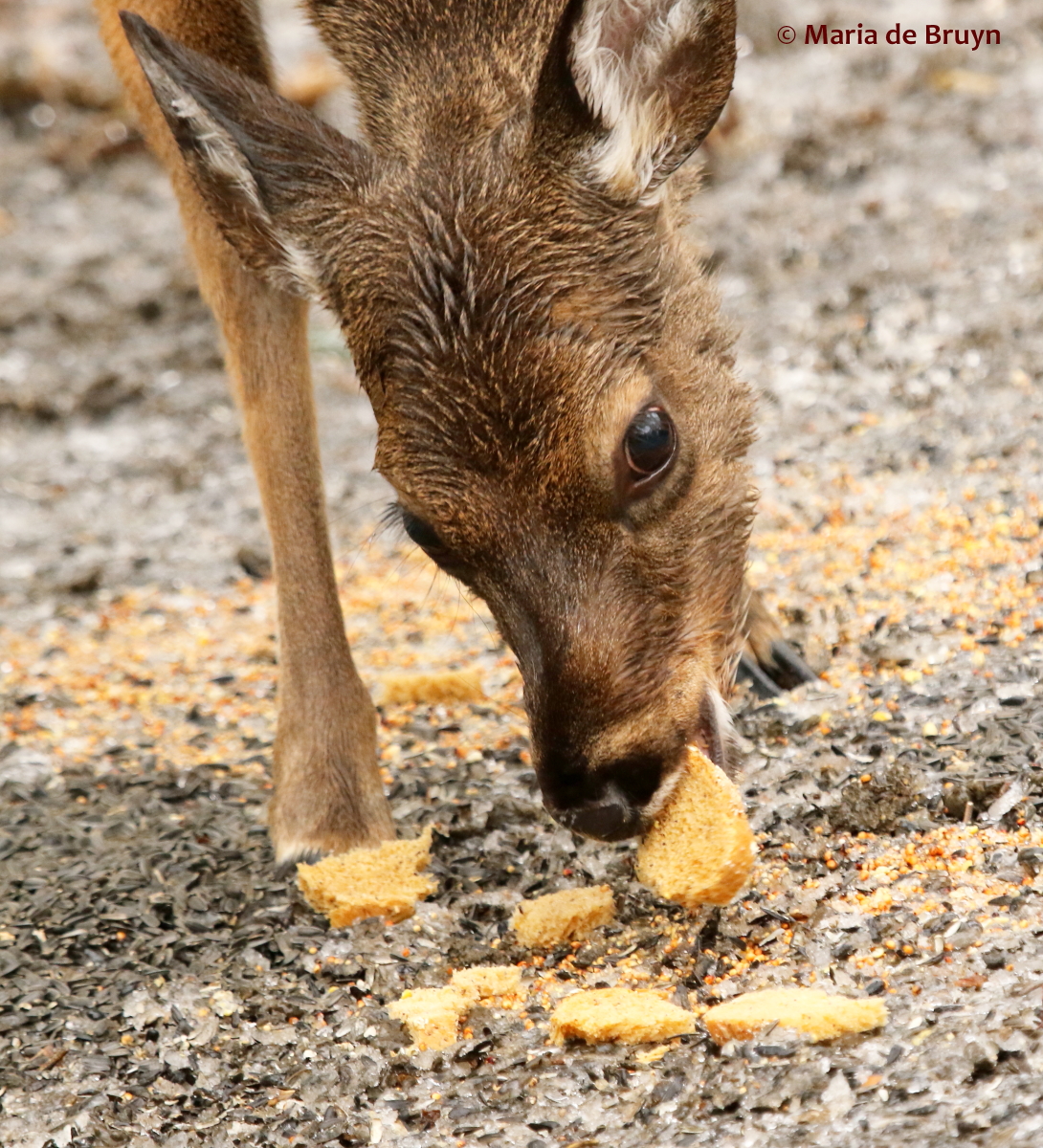
I put out some soft bread for her because I don’t know how easily she can eat. She does seem well-fed, however, so perhaps her disability is not hampering her nutritional intake. I haven’t seen her or her family again and don’t know if they will ever return, but it reminded me of how many deer are hurt and killed in accidents. I continue to think it would be worthwhile for research to continue on reducing deer populations through contraceptive use.


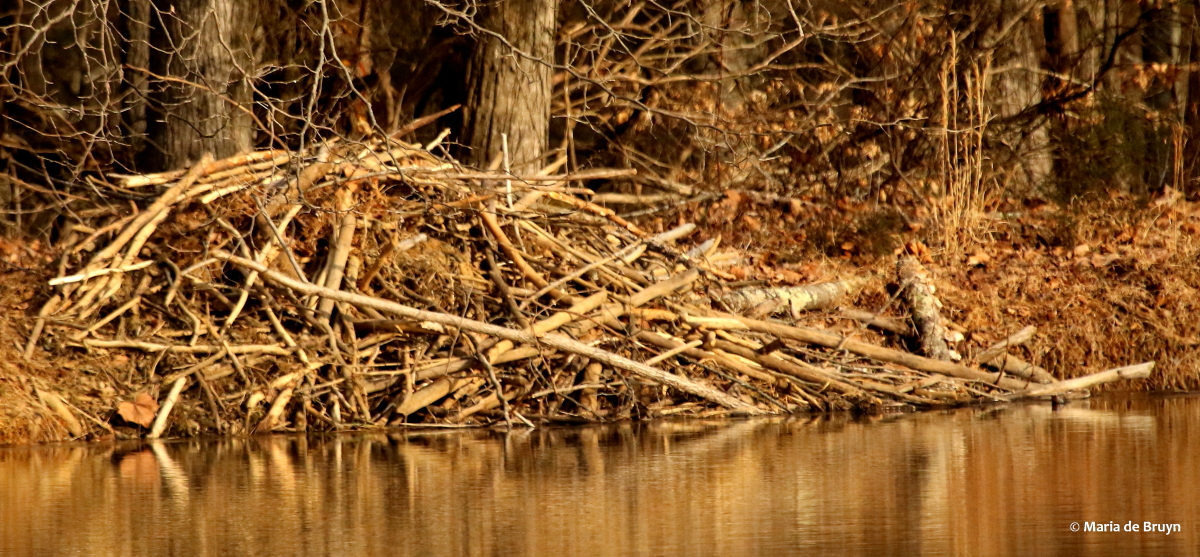
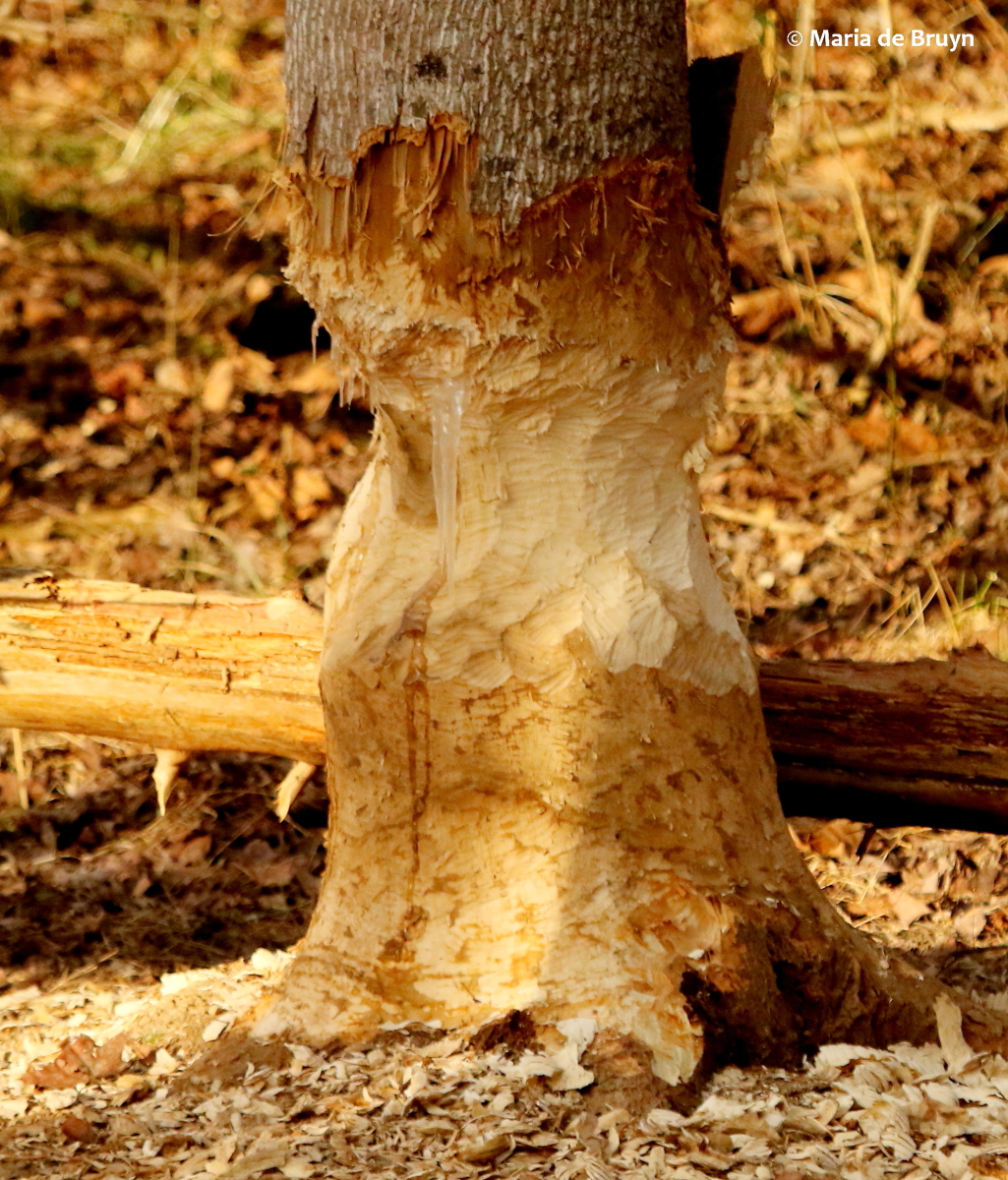
Beaver DK7A4173©Maria de Bruyn resOutside my yard, I’ve been seeing many signs of beavers (Castor canadensis) in the parks and reserves I visit. Their teeth are strong and I recently learned why their teeth are reddish brown – the enamel contains iron!


They have left tree stumps, half-gnawed trees and detached trees that they have apparently not yet been able to drag over to their dams and dens.
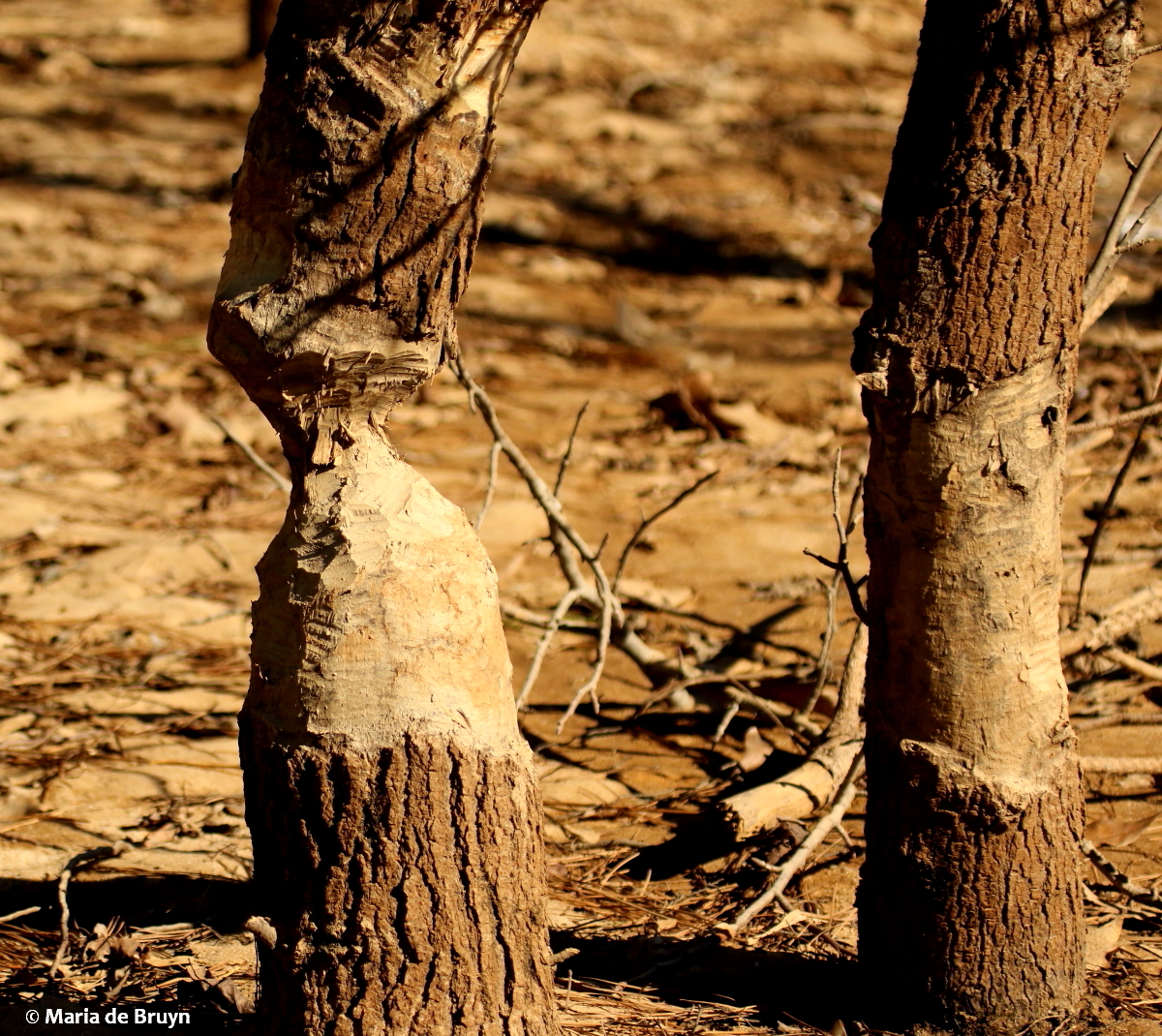
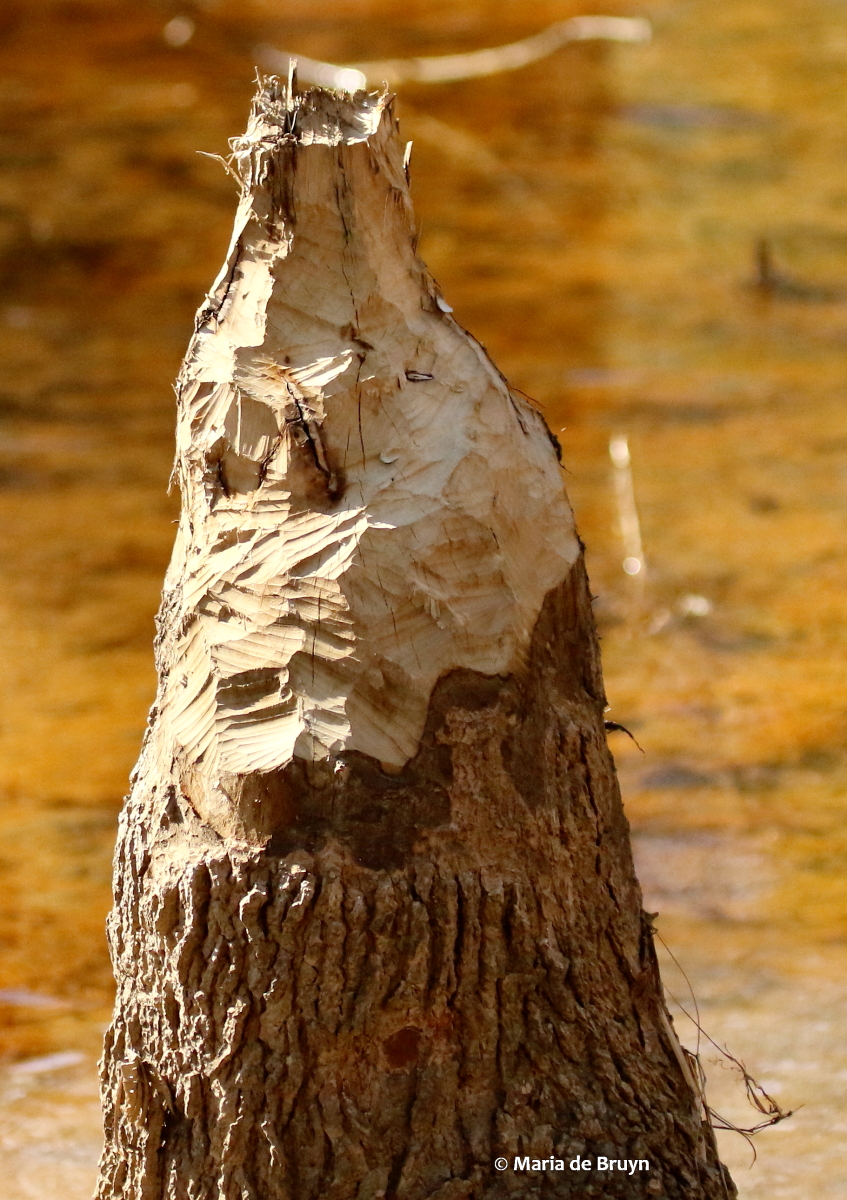
beaver tree I77A2950© Maria de Bruyn res  beaver I77A0313© Maria de Bruyn res

beaver I77A0125© Maria de Bruyn res  beaver I77A0098© Maria de Bruyn res

One downed tree in particular looked to me like they had been working on a bird sculpture!
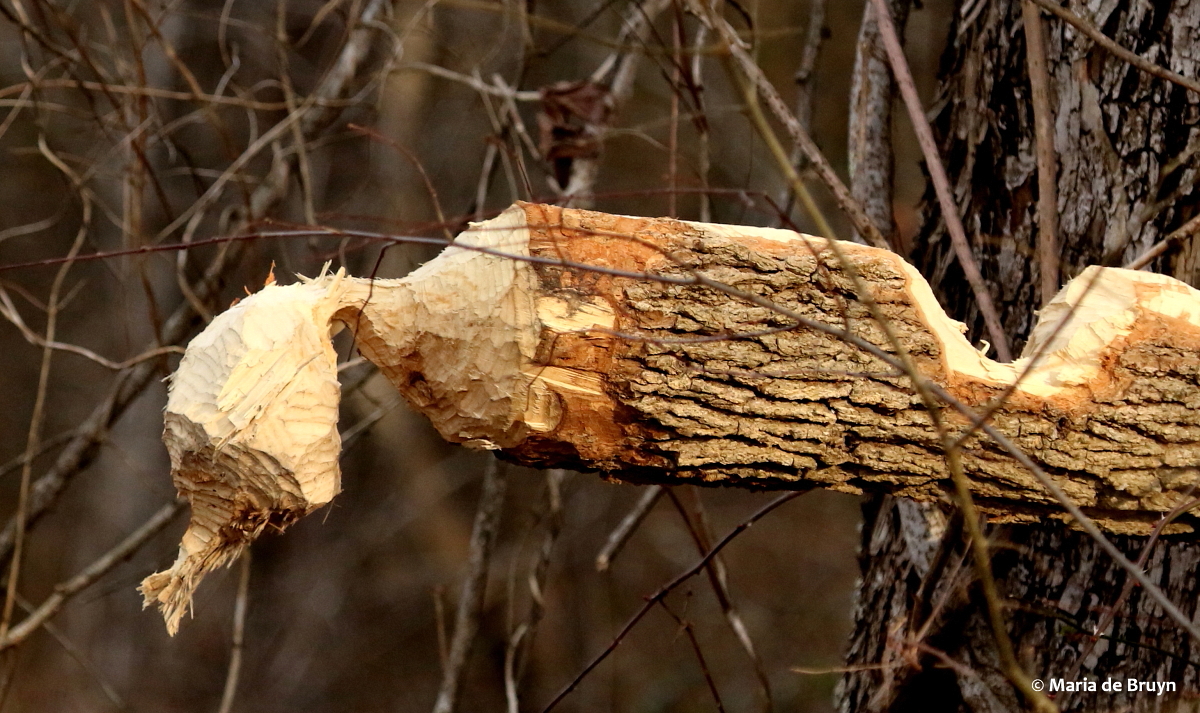
beaver I77A0090© Maria de Bruyn res


Eastern chipmunk I77A6221© Maria de Bruyn resI’m guessing that some of the other animals will be coming out in the daytime soon around my home – at the very least, the frogs and rabbits, whom I have seen only very occasionally. Spring is coming and while I enjoy seasonal variety, I will welcome it with open arms!

A morning at Cane Creek Reservoir

The Orange County water authority maintains two recreational areas where it manages water supplies for our area’s drinking and sewage water. One is the Cane Creek Reservoir, where people can boat, fish, bird and relax. When my morning began yesterday with a distressing family situation, for which I would need to wait for news, I decided to visit the reservoir since getting out into nature always helps me handle stress. My foray was rewarding, both in terms of handling the emotional tension and appreciating the marvelous diversity that nature offers for our appreciation.

marbled orbweaver DK7A5291© Maria de Bruyn resMy walk began with a need to wipe spider webs from my face as our arachnid brethren were busy spinning their webs across walking paths. The marbled orbweaver (Araneus marmoreus) was in the process of building a web, climbing up and down and leaving new silken strands behind as they emerged from the spinneret.

marbled orbweaver DK7A5288© Maria de Bruyn

The walking path also held evidence of the passing of a young white-tailed fawn (Odocoileus virginianus). A Carolina satyr butterfly (Hermeuptychia sosybius) was moving from grass blade to grass stem as I proceeded up a hill.

white-tailed deer DK7A5276© Maria de Bruyn resCarolina Satyr DK7A5279 © Maria de Bruyn res

Eastern bluebird DK7A5392© Maria de BruynFirst birds of the day as I left the woods — a pair of Eastern bluebirds (Sialia sialis) that were roosting on a wire. When a pine warbler (Setophaga pinus) wanted to join them, he was given to understand that his proximity was not appreciated.


pine warbler DK7A5383© Maria de Bruyn res

Next, I caught sight of a Northern mockingbird (Mimus polyglottos polyglottos), very busy grooming near the top of a small tree.

Northern mockingbird DK7A5449© Maria de Bruyn res Northern mockingbird DK7A5443© Maria de Bruyn

Southern magnolia DK7A5439© Maria de Bruyn resA nearby Southern magnolia (Magnolia grandiflora) was mostly laden with rose-colored fruit but one large bloom was still vibrant and visited by smaller and larger bees.

A number of birds were singing but I didn’t recognize their calls and I saw some birds flit from one tree to another but then I caught sight of one that was dipping into the grass to pick up insects and then sitting still on a branch for a while. It was a lovely Eastern phoebe (Sayornis phoebe), a type of flycatcher with a yellow hue.

Eastern phoebe DK7A5586© Maria de BruynEastern phoebe DK7A5722© Maria de Bruyn

This bird flew around a bit, perching in trees, on ropes and barbed wire, providing some nice views of its lovely self.

Eastern phoebe DK7A5670© Maria de Bruyn resEastern phoebe DK7A5825© Maria de Bruyn res

A blue-gray gnatcatcher (Polioptila caerulea), busy as these small birds always seem to be, was gleaning insects from twigs and branches.

blue-gray gnatcatcher DK7A5924© Maria de Bruyn Blue-gray gnatcatcher DK7A5920© Maria de Bruyn blue-gray gnatcatcher 1-de Bruyn, Maria DK7A5944 Supported on the balance beam

Coming up on the shoreline of the reservoir, I first spotted some least sandpipers (Calidris minutilla) foraging at the water’s edge. This is the smallest species of sandpiper and they are also the smallest shorebirds in North America. They looked very pretty in flight.

least sandpiper DK7A6073© Maria de Bruynleast sandpiper DK7A6081© Maria de Bruyn

The sandpipers landed near some killdeer (Charadrius vociferous), who looked very large next to them.

killdeer DK7A6103© Maria de Bruyn res

red-spotted purple DK7A6143© Maria de Bruyn resA red-spotted purple butterfly (Limenitis arthemis astyanax) was mud-puddling on the shore, as was a Sachem skipper butterfly (Atalopedes campestris). A trio of American goldfinches (Spinus tristis) also dropped onto the wet mud for a brief time.


sachem skipper DK7A6355© Maria de Bruynsachem skipper DK7A6368© Maria de Bruyn

american goldfinch DK7A6323© Maria de Bruyn res

Several flocks of Canada geese (Branta canadensis) came in to the little lake. One group surprised me by suddenly veering in my direction and flying right in front of me, so close that they more than filled the screen of my zoom lens.

Canada goose DK7A6472© Maria de Bruyn res Canada goose DK7A6195© Maria de Bruyn res

Canada goose DK7A6205© Maria de Bruyn resCanada goose DK7A6207© Maria de Bruyn res

Near the end of my visit, a fellow birder kindly pointed out two green herons (Butorides virescens) to me. (Having binoculars is a definite advantage for this pursuit!). One was rather far away but another within walking distance so I snuck up on it in stages.

green heron DK7A6717© Maria de Bruyngreen heron DK7A6575© Maria de Bruyn

In the left-hand photo, you can imagine the dinosaur ancestor of this stalker.

At one point, the bird stretched and stared at the sky, moving its head from side to side obviously watching something – it turned out to be a juvenile red-tailed hawk (Buteo jamaicensis).

red-tailed hawk DK7A6633© Maria de Bruyn red-tailed hawk DK7A6631© Maria de Bruyn

My sneaking ever closer to the heron was rewarded when I saw the short bird catch and eat a rather large frog for its brunch. It was sad for the frog, but that is the cycle of life.

green heron DK7A6826© Maria de Bruyn resgreen heron DK7A6850© Maria de Bruyn res

And when I returned home a short while later, I learned that the family emergency had been handled for the time being. Like the fauna, our own cycles of life are also unpredictable.

Backyard citizen science – take 2

As I mentioned a few weeks ago, as part of an eMammal citizen science project, a motion trap camera was placed in my yard for three weeks. I am used to a variety of wildlife passing through and living here, including: white-tailed deer (Odocoileus virginianus), Eastern chipmunks, Eastern cottontail rabbits (Sylvilagus floridanus), opossums, raccoons, Eastern gray squirrels (Sciurus carolinensis), field and house mice and the occasional vole. My hope was that the camera would capture the gray fox that has been wandering our neighborhood lately or maybe even a coyote visiting at night.

The project started with the placement of a camera at knee level on a crepe myrtle tree facing a path through which animals enter and leave my back yard. The objective was to record all the mammal species that visit (or at least those passing in front of the camera) for three weeks.

Jonahay eMammal camera IMG_2971© Maria de Bruyn resAs neighborhood cats come to the yard, I was sure to get some photos of them, if nothing else. My senior deaf cat, who is now suffering from some dementia, only goes out when I accompany him (the other two family cats must stay inside). He checked out the camera right away and I wondered if he was going to pee on it to mark it as a new part of his territory. Instead, he went off to mark another part of the yard.

It was with great anticipation that I looked at the photos on the card after it was taken down, only to discover that the camera may have been aimed too high.

Eastern gray squirrel EK000016© Maria de Bruyn It seems that a squirrel may have been captured one evening, and in another case, it seems an opossum was entering the yard. However, the main captures (and there were not that many) were glimpses of deer.

A rabbit had decided to have a lie-down in front of the camera one day, perhaps 1½ feet away. It was not photographed and the project coordinator told me that the camera has a large blind spot right in front of it extending out roughly 3 feet.

Eastern cottontail DK7A2749© Maria de Bruyn res

unknown EK000547© NCSU


Staring at the night shots made me think in a few instances that some creature had been photographed but I wasn’t really sure if that was it or just my imagination running amok.


white-tailed deer EK000425© Maria de Bruyn res


A few times a deer stopped and the camera got a portrait shot, occasionally with a gesture that in humans might equate to thumbing their noses at something.


white-tailed deer DK7A1403© Maria de Bruyn reswhite-tailed deer EK000212© Maria de Bruyn res

white-tailed deer EK000514© Maria de Bruyn res


A few shots were close-ups.

Other times, we see an ear or the deer’s behind as she moves out of range.


white-tailed deer EK000548© Maria de Bruyn res white-tailed deer EK000073© Maria de Bruyn res

One day, I caught a doe giving the camera a good look; this led to a few blank photos as her face or tongue covered the lens area.

white-tailed deer DK7A3136© Maria de Bruyn res white-tailed deer DK7A3120© Maria de Bruyn resdoe EK000010© NCSUwhite-tailed deer EK000472© Maria de Bruyn res

Despite the paucity of cool camera captures, I enjoyed participating in the project and will consider taking their 30-minute course so I can have a camera placed here for a longer period. And if it is aimed lower, who knows what we may see then!

A bedraggled sort of day

Carolina wren IMG_4876© Maria de Bruyn resFirst, let this lovely Carolina wren (Thryothorus ludovicianus) and me wish you – fellow nature lovers and blog readers – all the best as we look to the future in this year of 2015! May your minor disappointments (life is not always rosy) be compensated by love, laughter, health and happiness in abundance!


Yesterday may have been a minor disappointment for the wildlife here.Hermit thrush IMG_3106© Maria de Bruyn res On Sunday, it was very cold for North Carolina standards. Together with two other Audubon Society volunteers, I was standing at a local lake in 15°F (-9.4°C) weather waiting to see if any bald eagles flew by for inclusion in the quarterly Eagle Count. We didn’t see any, although this lovely hermit thrush (Catharus guttatus) was nearby eating berries.

Monday was warmer but EXTREMELY wet! Two of my cats awakened me at 5 a.m. and I could hear the rain coming down in a veritable deluge. I wondered if I would be able to see the road to drive for an appointment later that morning (it did let up, thank goodness) and also wondered how the birds and animals were keeping in this unpleasant weather.

Northern cardinal IMG_4462© Maria de Bruyn res

Northern cardinal IMG_4049© Maria de Bruyn res


When it’s cold, the birds fluff up their feathers to trap air pockets by their bodies; this helps they retain body heat and stay warmer. Heavier wet feathers don’t seem to fluff well, though. On the other hand, birds’ feathers are covered with an oily or waxy substance that helps water run off, thereby keeping their bodies drier. Those feathers don’t necessarily look pretty though. Many of the birds were indeed looking bedraggled, some to a greater degree and others just a bit like these Northern cardinals (Cardinalis cardinalis).

red-bellied woodpecker IMG_5005© Maria de Bruyn resIt didn’t seem that many birds were hiding in vegetation to get out from under the downpour. Nope – they all appeared to be very hungry and anxious red-bellied woodpecker IMG_4948© Maria de Bruyn resfor a meal like this red-bellied woodpecker (Melanerpes carolinus), who was scolding me for being so close to the feeders!

white-tailed deer IMG_4092© Maria de Bruyn resA few white-tailed deer (Odocoileus virginianus) were also wet and hungry, including two visitors to my yard that I had not seen before. They were two bucks, one of whom must have been hit by a car. One of his antlers was broken off and he was hopping along holding up his left hind leg, which had obviously been injured.


white-tailed deer IMG_4063© Maria de Bruyn res white-tailed deer IMG_4001© Maria de Bruyn res

white-tailed deer IMG_4055© Maria de Bruyn resA young doe, who visits regularly, stopped for some bird seed, as did the other buck whose antlers had been shed. Their thick hair was coated in raindrops.

The Eastern gray squirrels (Sciurus carolinensis) can curl their tails up over their backs as a kind of natural umbrella, both on the ground and in trees. This individual, who may have been injured by a predator and escaped, enjoyed some apple – first on the ground and then later in the tree away from the blue jays that were hopping around it.

Eastern gray squirrel IMG_4325© Maria de Bruyn res Eastern gray squirrel IMG_4334© Maria de Bruyn res

Some of the birds definitely looked more presentable than other. The three visiting mockingbirds (Mimus polyglottos) were sleek and beautiful, one using its long tail tobalance as it plucked meal worms from a feeder designed for somewhat smaller birds.

Northern mockingbird IMG_4503© Maria de Bruyn res Northern mockingbird IMG_4467© Maria de Bruyn res

The dark-eyed juncos (Junco hyemalis), Eastern towhees (Pipilo erythrophthalmus) and chipping sparrows (Spizella passerina) looked in fine shape, too.

dark-eyed junco IMG_4802© Maria de Bruyn res dark-eyed junco IMG_4729© Maria de Bruyn res

Eastern towhee IMG_4924© Maria de Bruyn res chipping sparrow IMG_4817© Maria de Bruyn res

The bluebirds (Sialia sialis) varied in appearance; a couple looked groomed but wet, while a couple others looked a bit disheveled.

Eastern bluebird IMG_4587© Maria de Bruyn res Eastern bluebird IMG_4588© Maria de Bruyn res

pine warbler IMG_4569© Maria de Bruyn resThe pine warbler (Setophaga pinus) – usually among the more handsome garden birds – unfortunately looked a sorry sight. Fortunately, when the rain ends, he’ll be able to shake that water off and get back to looking like one of the handsome fellas of the avian neighborhood!

pine warbler IMG_4618© Maria de Bruyn


pine warbler IMG_4842© Maria de Bruyn res

ruby-crowned kinglet IMG_4777© Maria de BruynThe ruby-crowned kinglet’s (Regulus calendulabrown-headed nuthatch IMG_4409© Maria de Bruyn res) oily feather covering seemed to do well in keeping the rainwater at bay, while the brown-headed nuthatch (Sitta pusilla) looked a bit more water-logged.ruby-crowned kinglet IMG_4741© Maria de Bruyn res

The tufted titmouse (Baeolophus bicolor) and Carolina chickadee (Poecile carolinensis) join me in looking forward to dryer and sunnier weather in a few days’ time!

tufted titmouse IMG_4350© Maria de Bruyn resCarolina chickadee IMG_4386© Maria de Bruyn res

Plenty of persimmon pleasure!

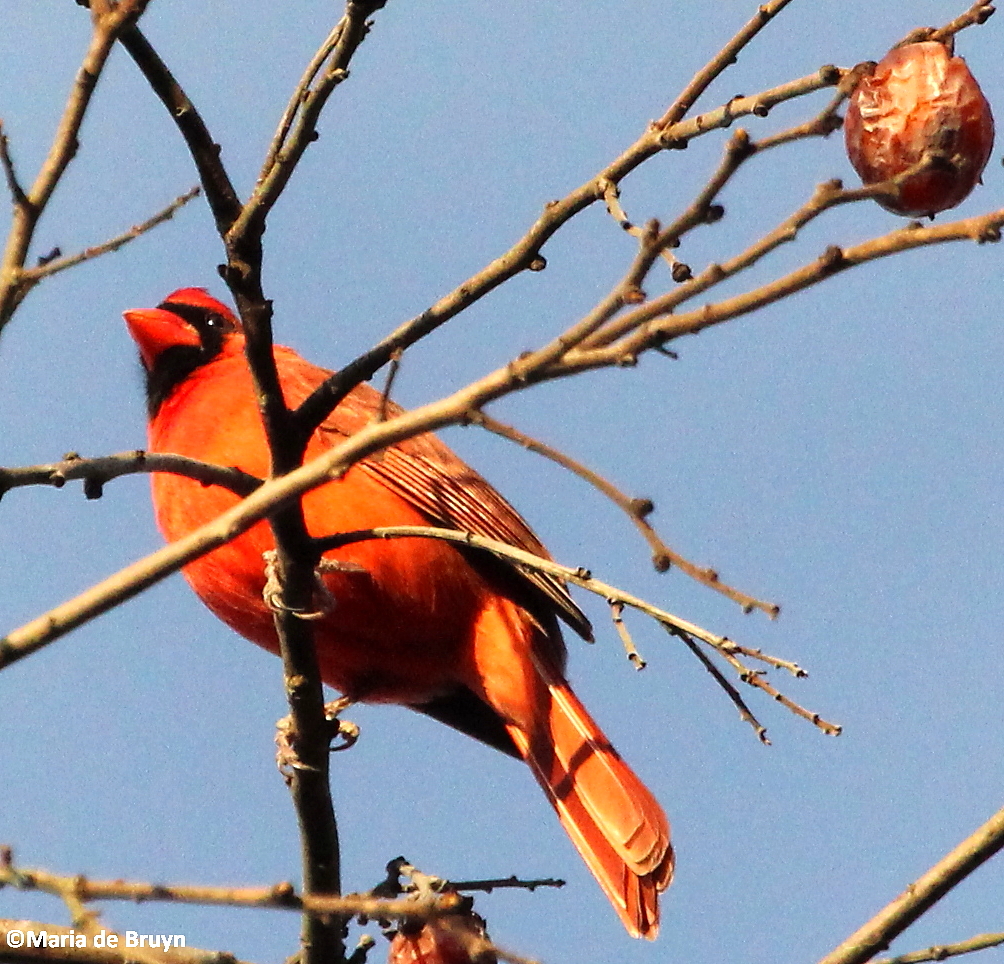
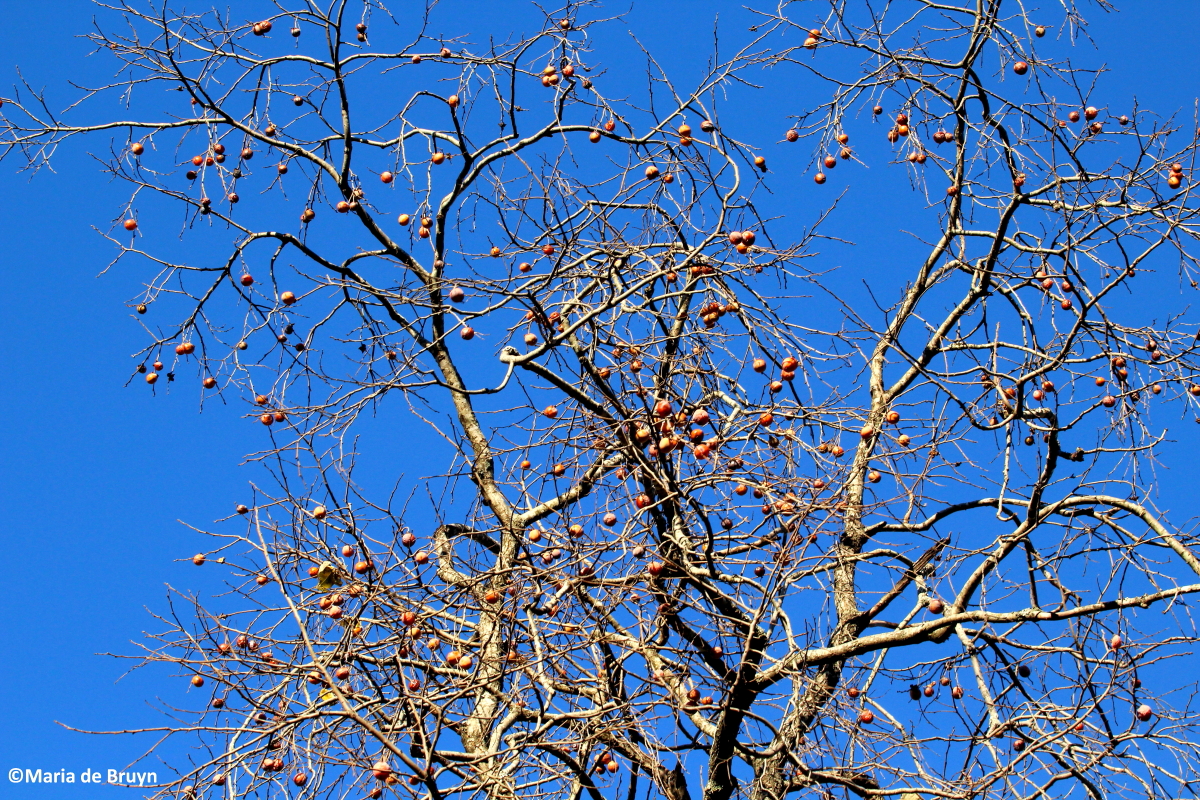
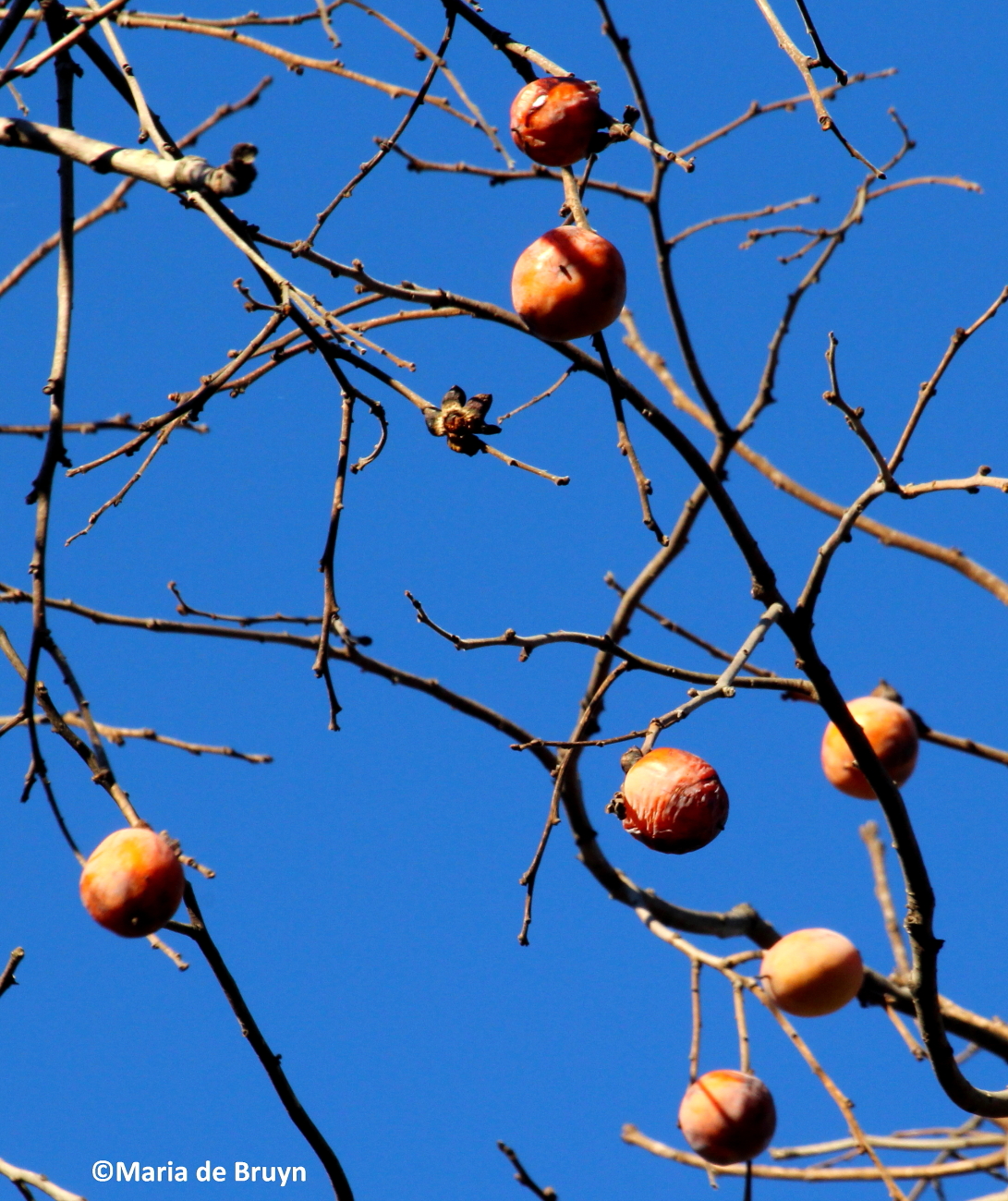
Northern cardinal  IMG_7335© Maria de BruynMy side- and backyards are both blessed with a persimmon tree (Diospyros virginiana) but the one out back only produces small hard fruit for some reason. The large persimmon at the side of my house, however, is the exact opposite. Each year it is laden with fruit; much of it begins falling while the persimmons are still unripe or only half-ripe but plenty remains on the tree through the first frost. You need to have both male and female plants for the fruit to grow, but I don’t know where the male trees are – likely in a neighbor’s yard.

Persimmon tree IMG_6996© Maria de Bruyn resPersimmon tree IMG_6993© Maria de Bruyn res

I’d been warned that an unripe or only partly ripe persimmon would not be tasty and, when I tried one, that advice turned out to be very true. I later tried a really ripe persimmon as so many North Carolinians find it a wonderful fruit, especially in pudding, but I can’t say that it is much to my liking. You won’t find me using persimmons to make tea, wine, beer or bread.

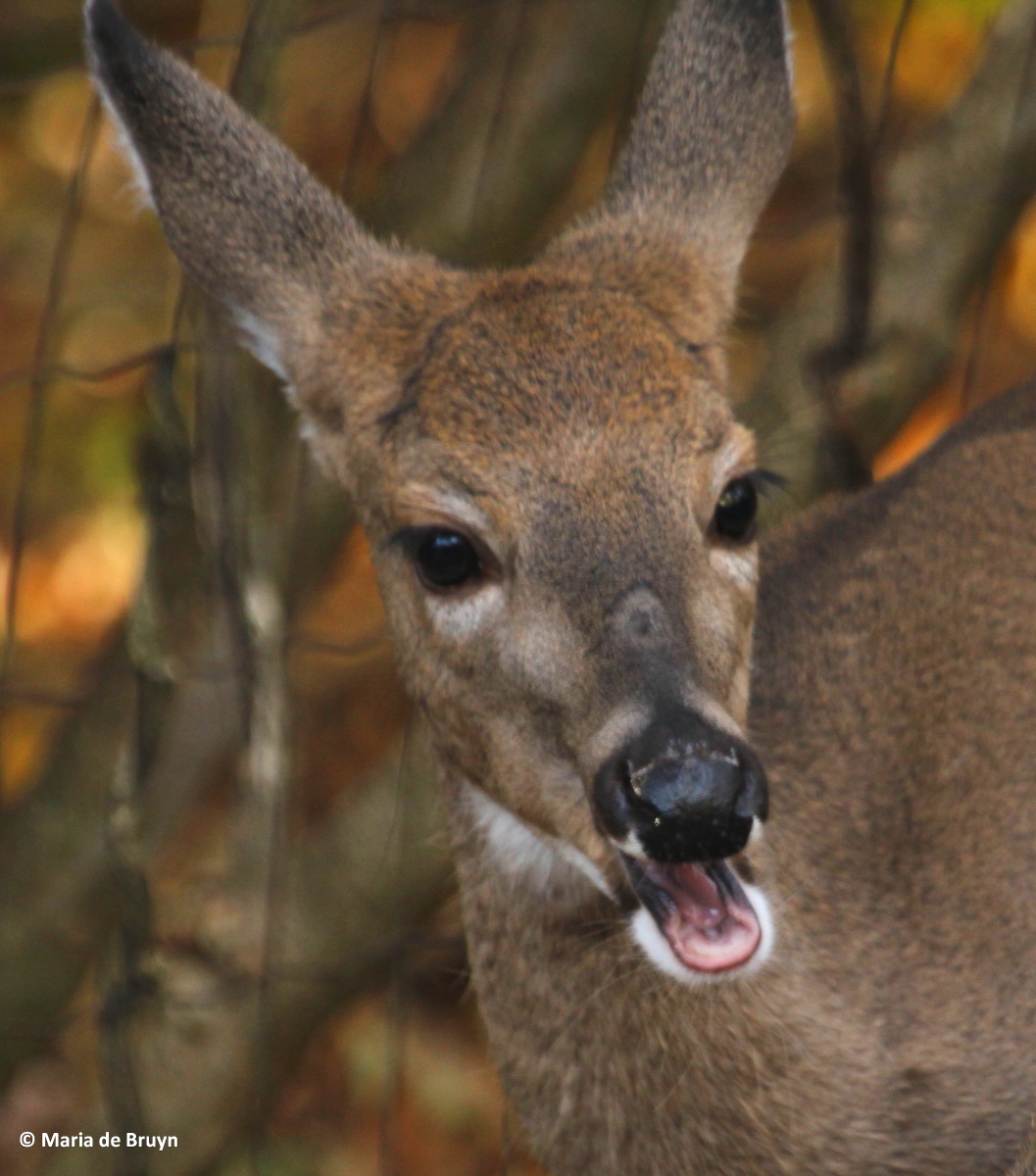
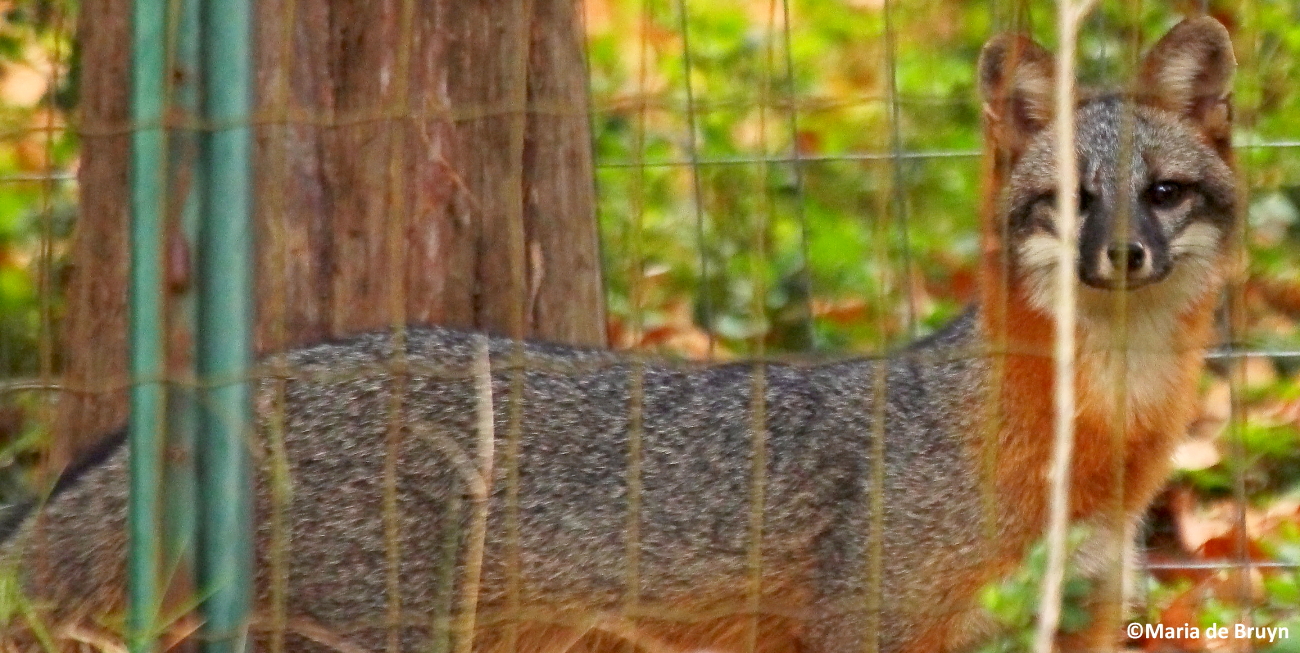
white-tailed deer IMG_9971© Maria de Bruyn resIt is, however, VERY popular with the wildlife that is around my house. The first fallen persimmons are gobbled up by the white-tailed deer (Odocoileus virginianus), who don’t seem to mind a bit of astringent fruit. Our neighborhood has opossums, raccoons, coyotes and gray foxes (Urocyon cinereoargenteus) , but I haven’t seen their persimmon seed-filled scat – I think the deer get the fruit before they have a chance. (Too bad the stem was in front of the fox’s face; I don’t use Photoshop, but you can still see its beauty.)

Gray fox IMG_1124 MdB res

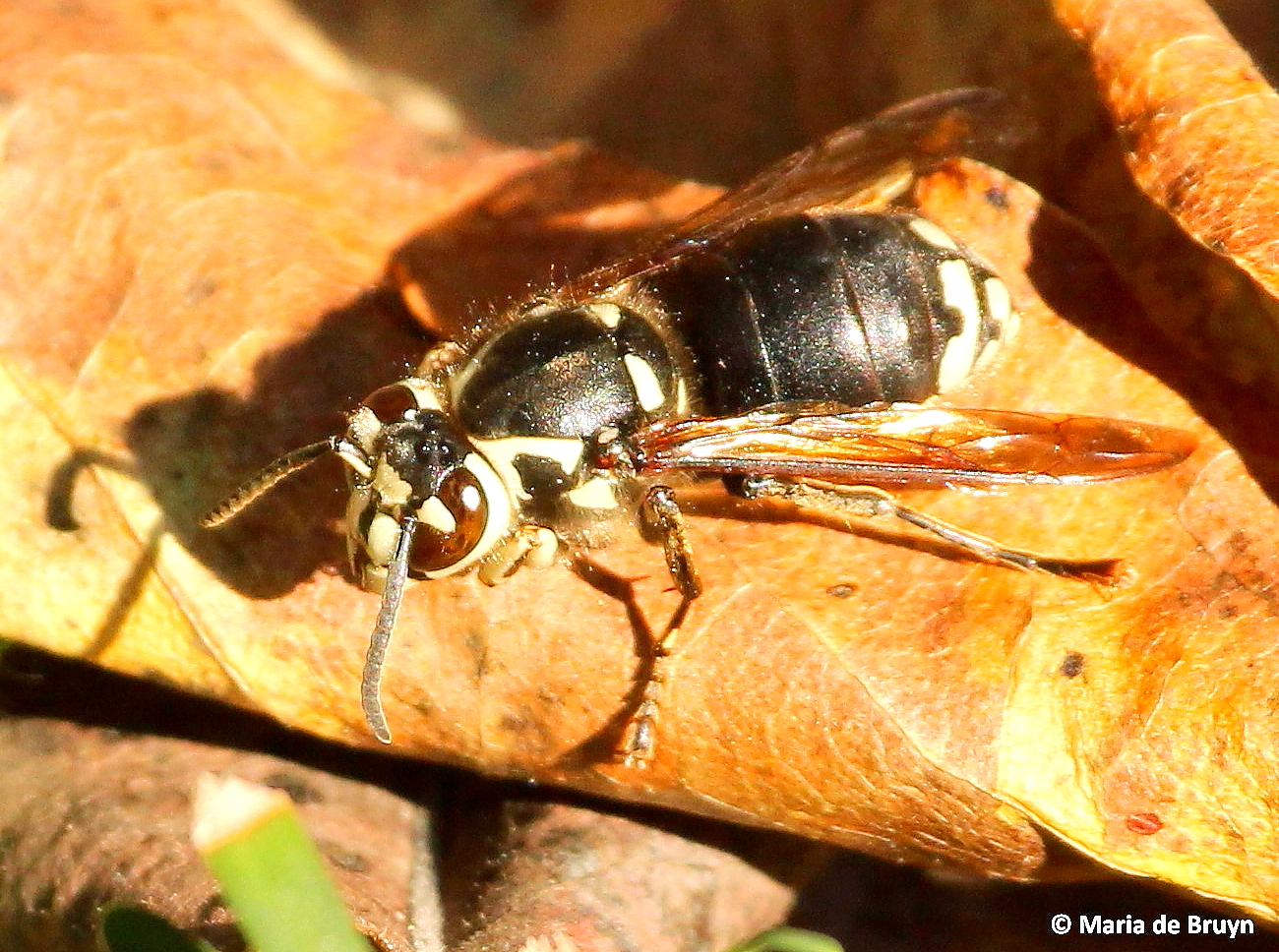
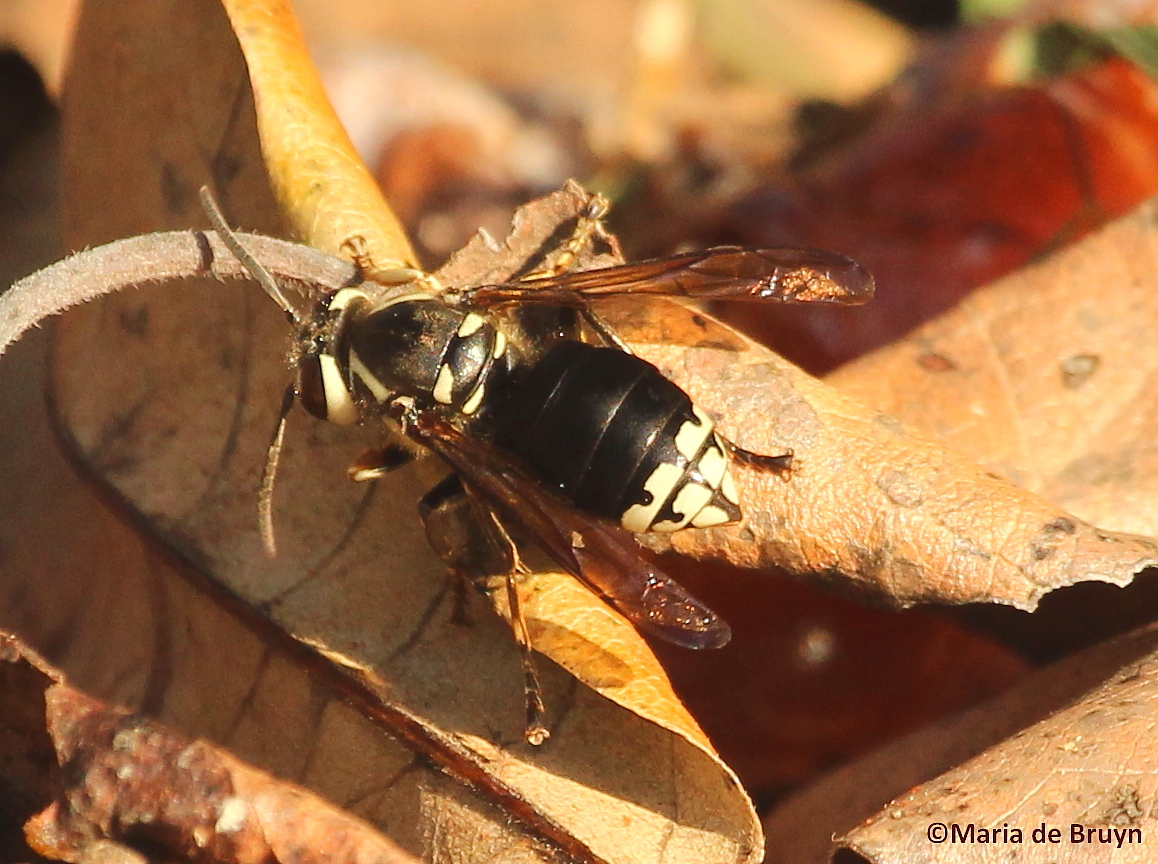
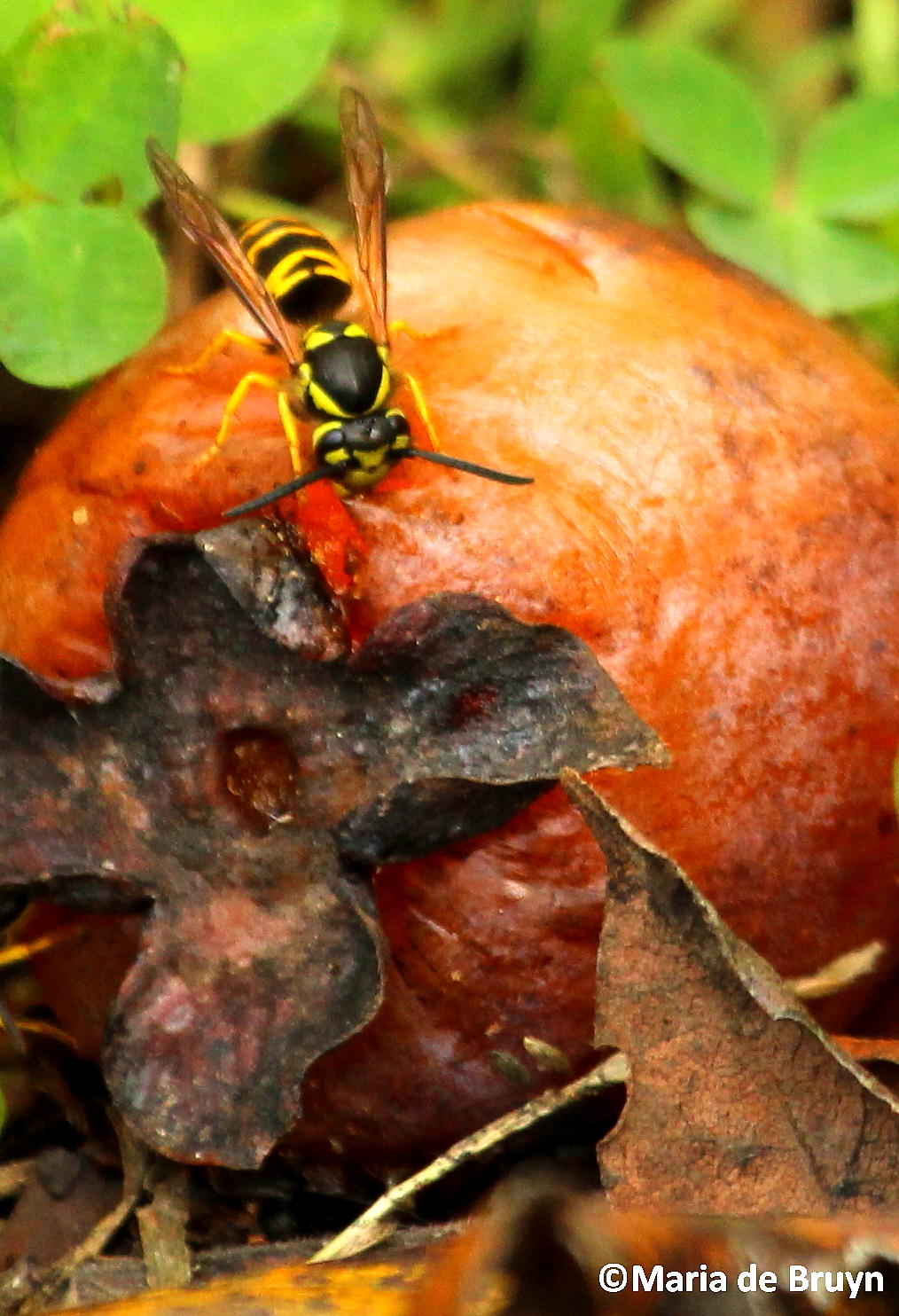
When the large orange berries begin falling on the ground in an ever riper state, the first diners include the bald-faced hornets (Dolichovespula maculata), whose beautiful large nest must be in a neighbor’s tree.

bald-faced hornet IMG_3348©Maria de Bruynbald-faced hornet IMG_3486©Maria de Bruyn

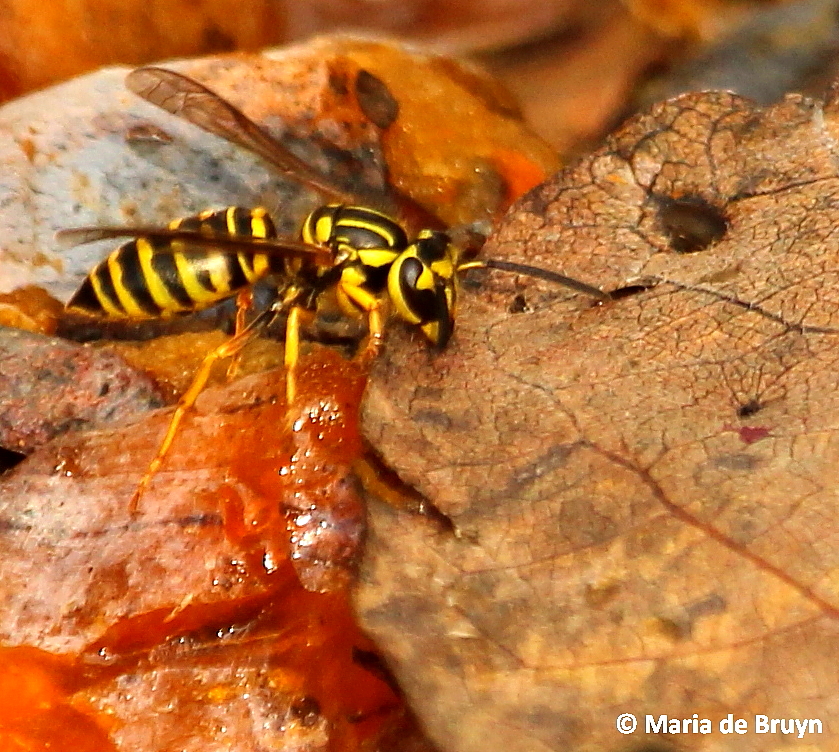
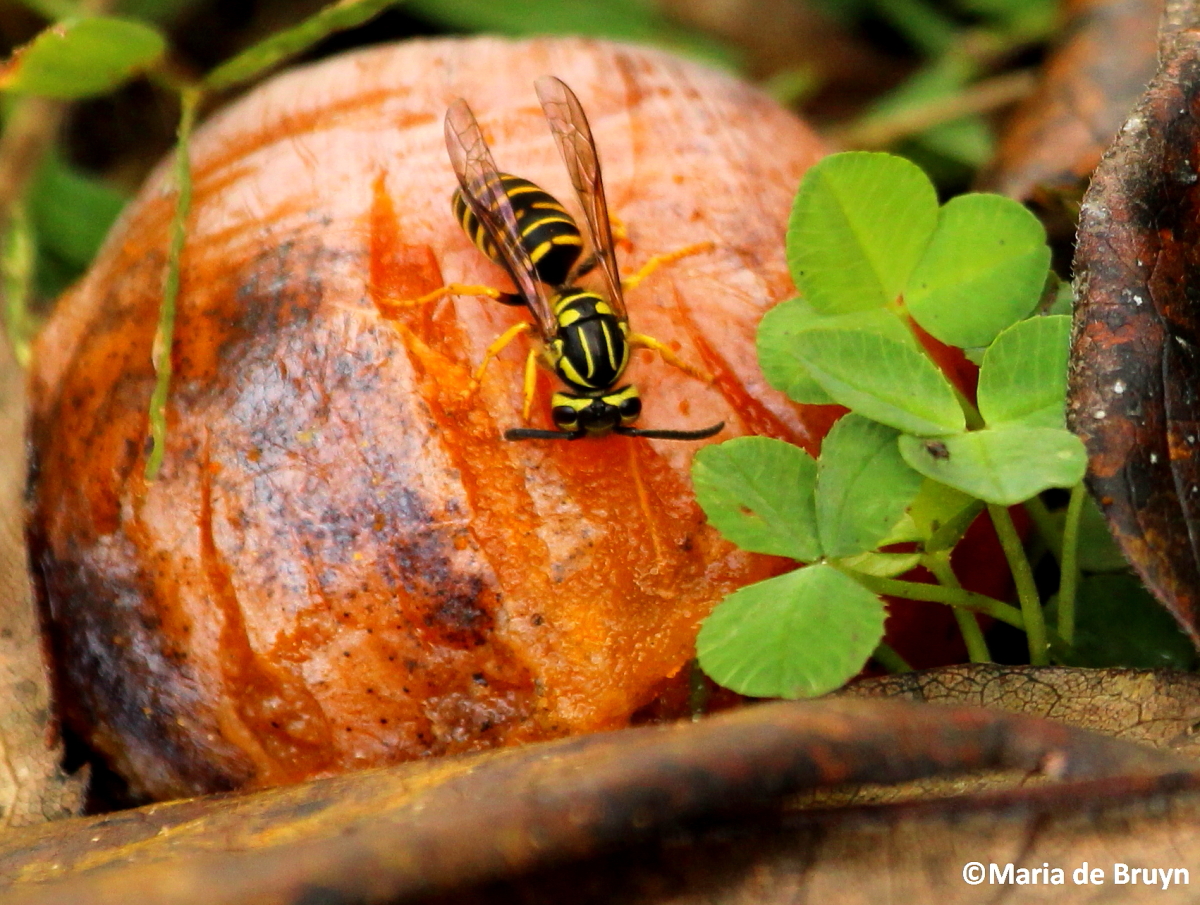
Eastern yellowjacket IMG_2502©Maria de BruynEastern yellowjacket wasps (Vespula maculifrons), which can deliver a very nasty sting, show no interest in a human hovering over the persimmons to get a shot – they are totally engrossed in getting a piece of juicy fruit.

Southern yellowjackets (Vespula squamosa), also painful stingers, act likewise – their focus is entirely on the orange pulp.


Southern yellowjacket IMG_2473©Maria de BruynSouthern yellowjacket IMG_2507©Maria de Bruyn res

Paper wasp polistes metricus IMG_4359©Maria de BruynThe paper wasps (Polistes metricus) dig deep into the persimmon to extract some sweetness.

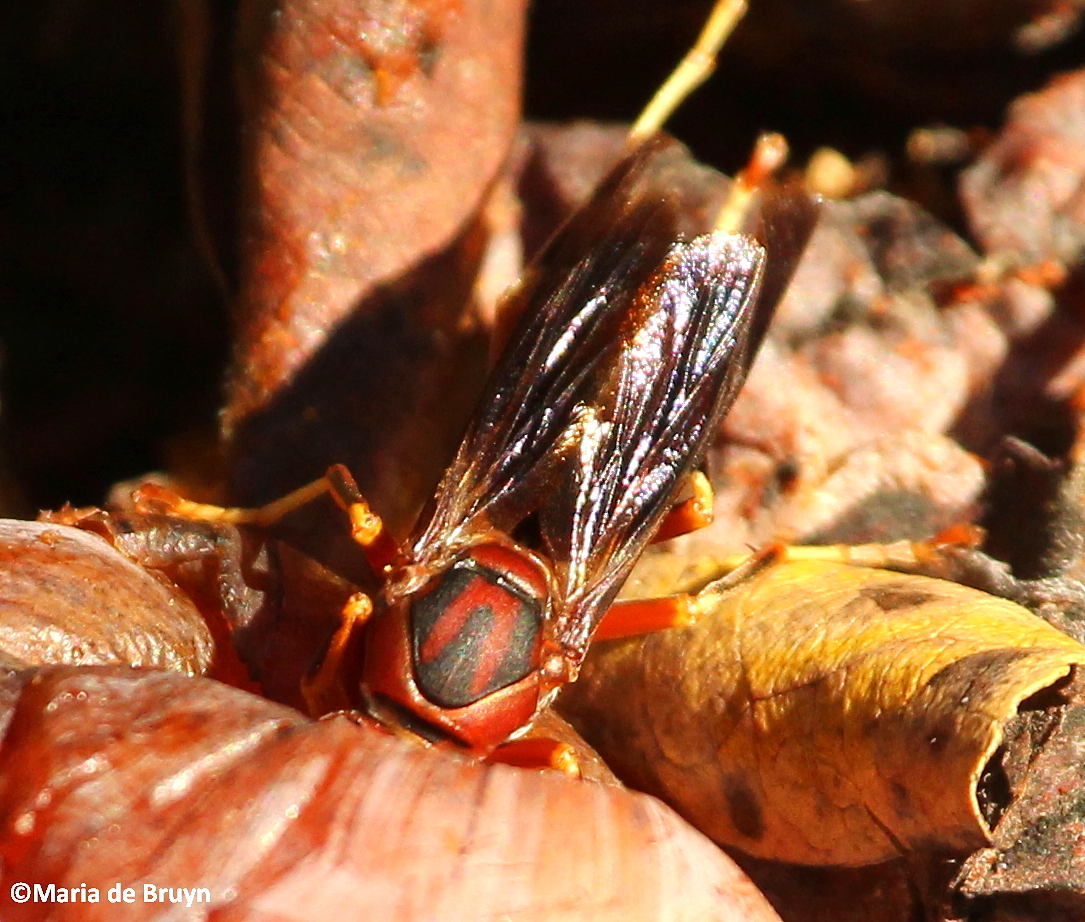
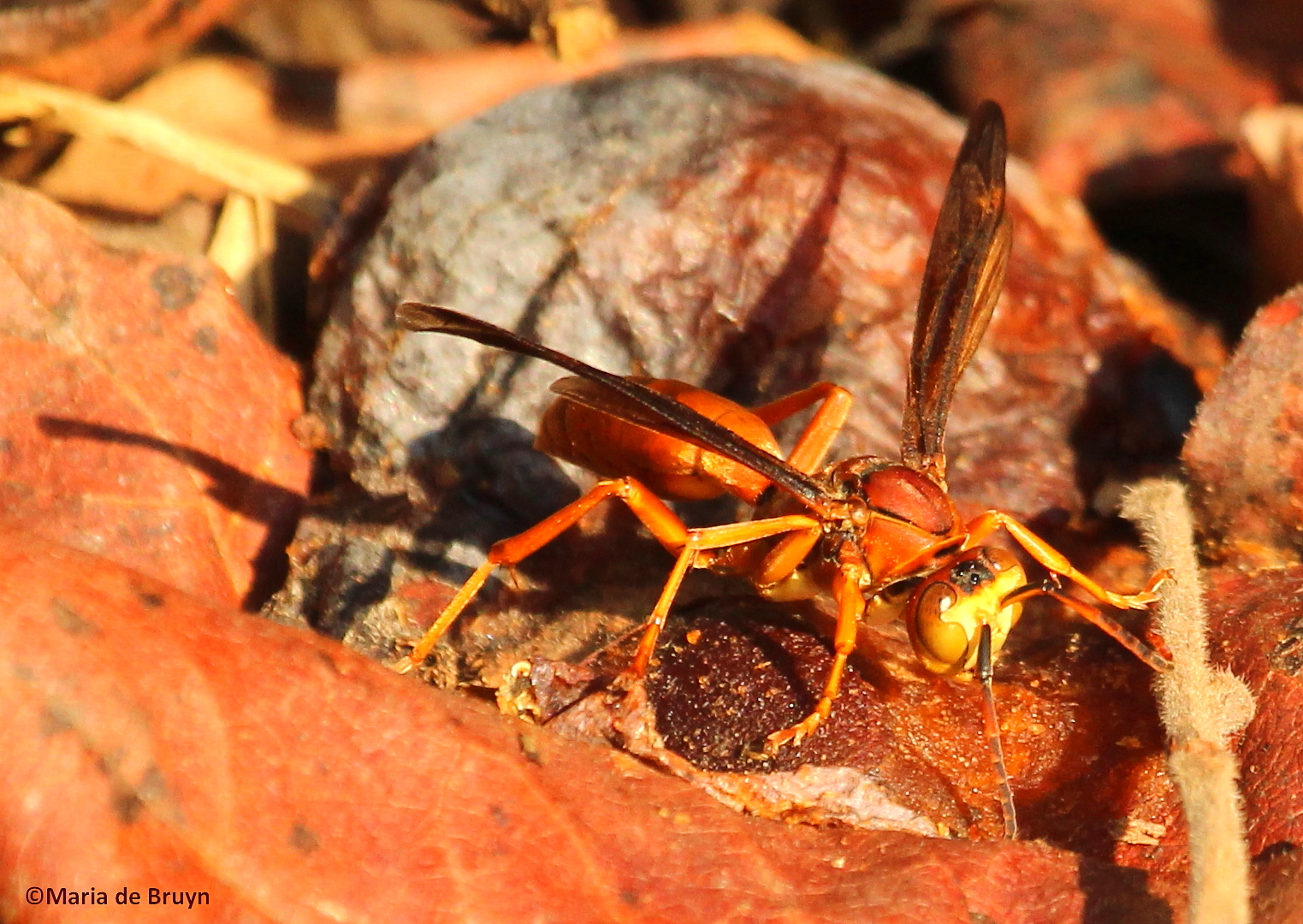
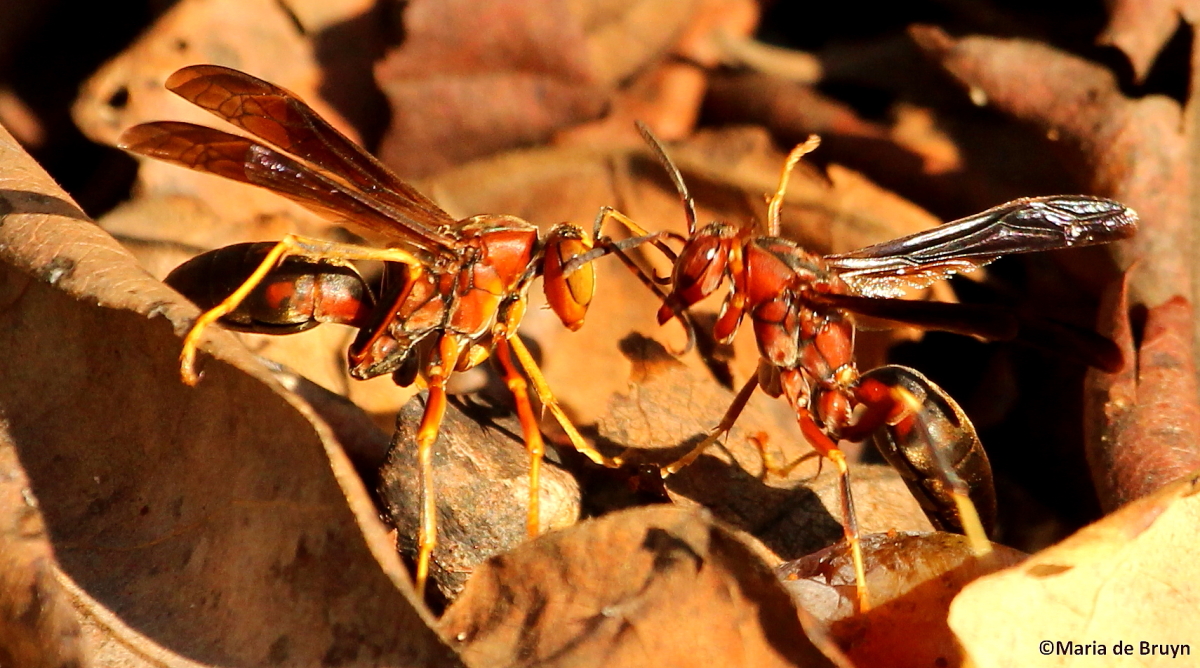
The red wasps (either Polistes carolina or rubiginosus; entomologists can only tell by examining the insect) also enjoy flitting from one fallen fruit to another in search of the sweetest bits. Sometimes they and the paper wasps challenge one another for territory.

Red wasp P carolina IMG_3495©Maria de Bruyn

Paper wasp polistes metricus IMG_3513©Maria de Bruyn res

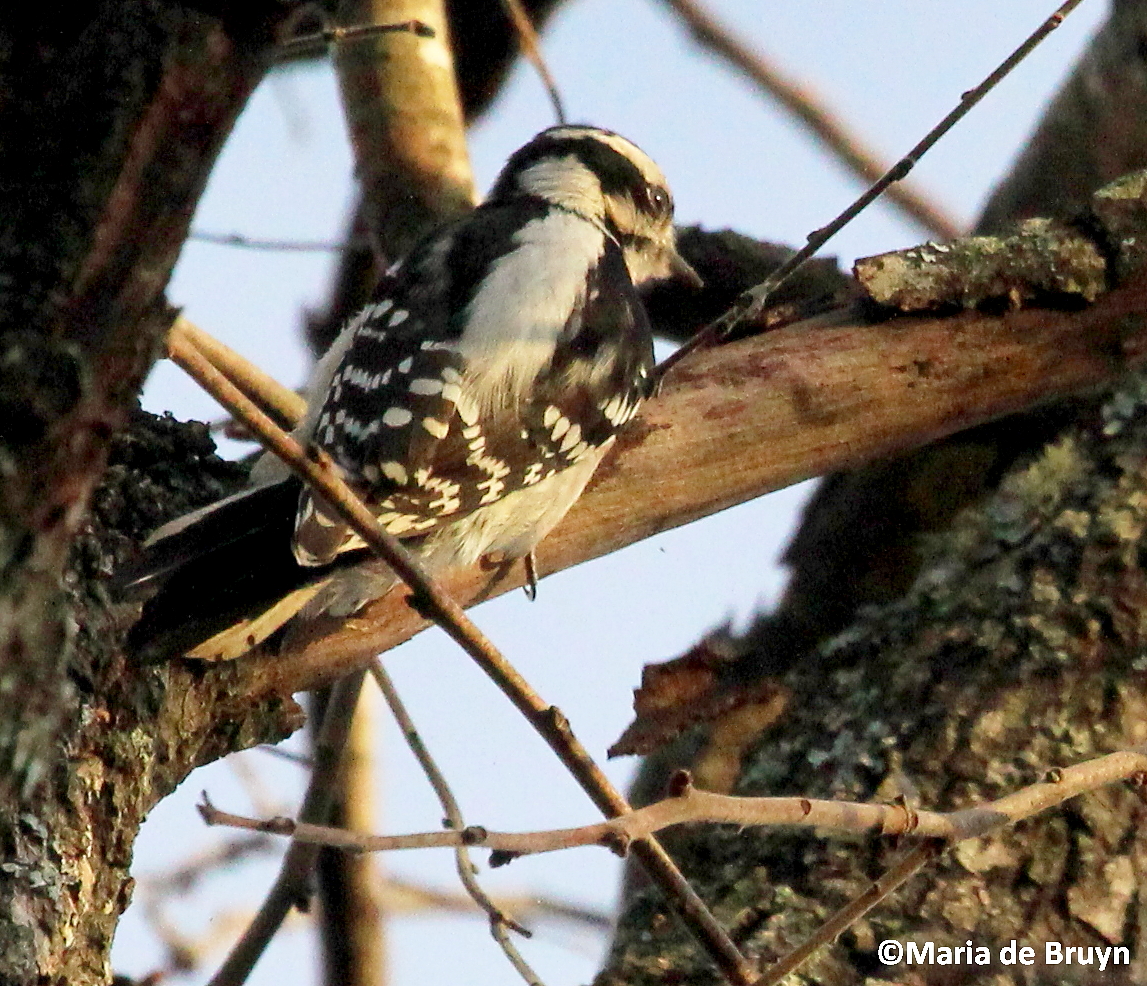
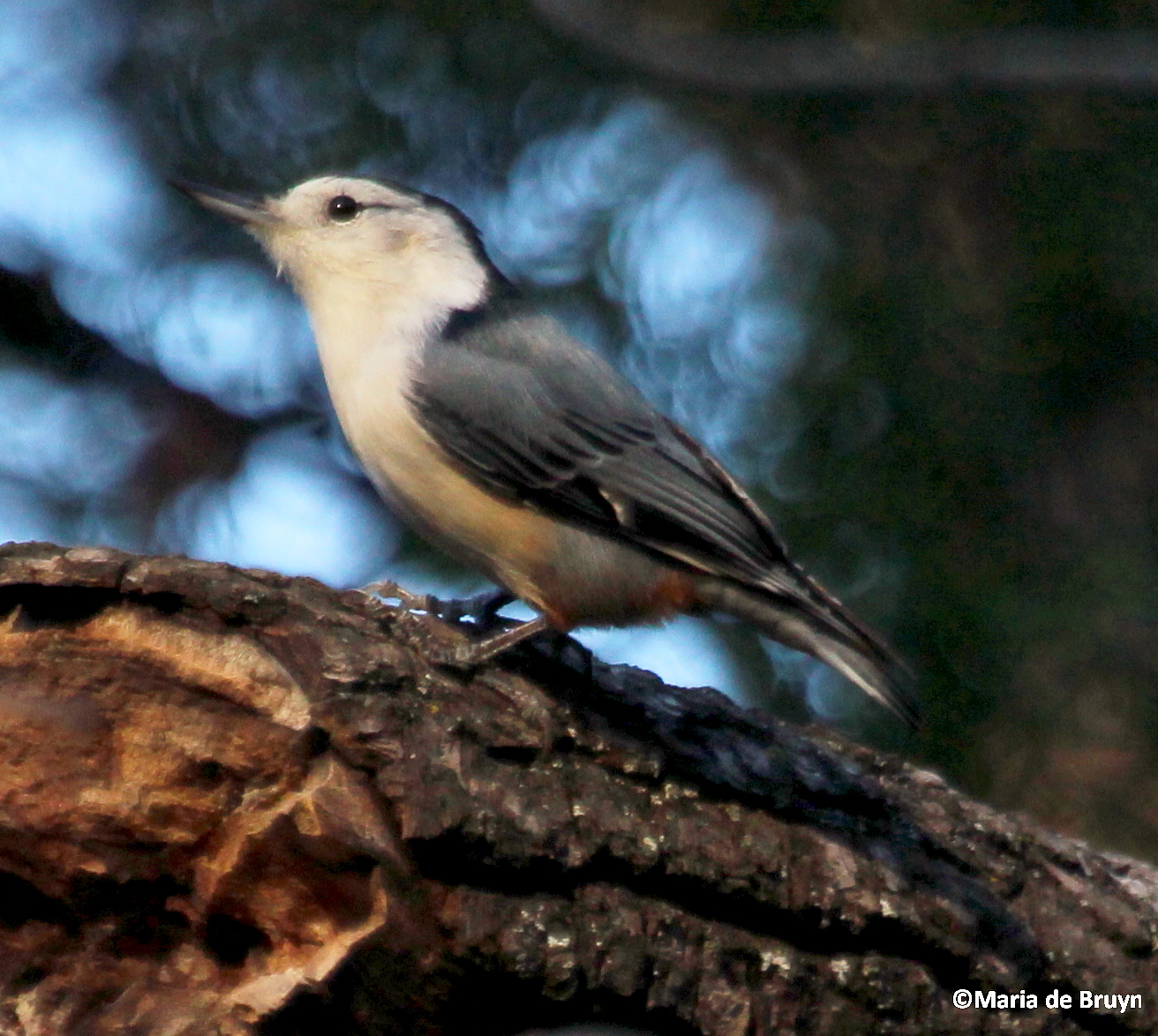
Downy woodpecker IMG_7248© Maria de BruynThe next group of persimmon pickers are the birds. Some birds only visit the tree to rest or look for insects, like the downy woodpecker (Picoides pubescens) and the white-breasted nuthatch (Sitta carolinensis).

White-breasted nuthatch IMG_5997© Maria de Bruyn


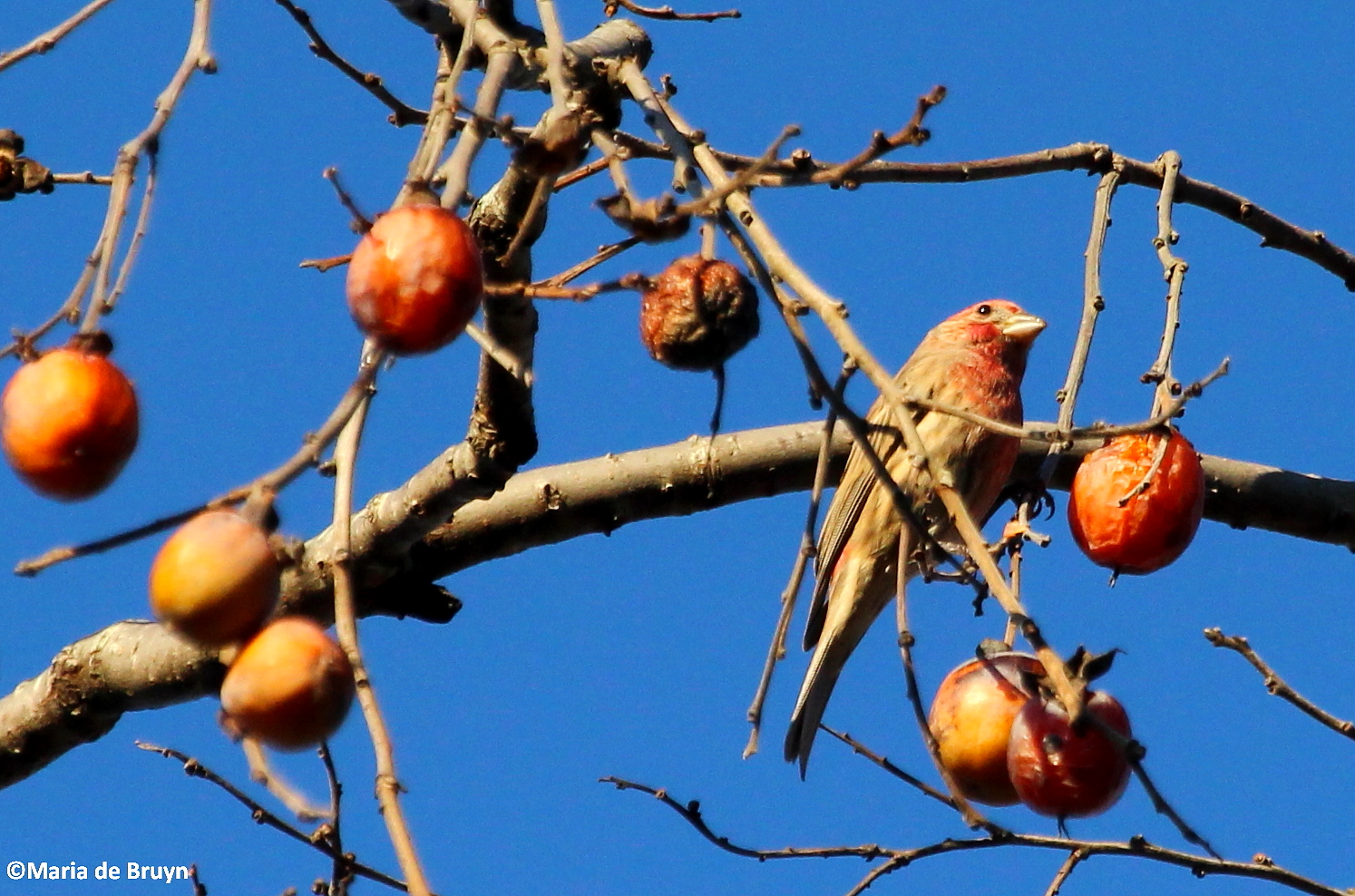
A few birds just rest in the tree and others rest and occasionally peck at a berry, like the house finches (Haemorhous mexicanus).


House finch IMG_5956© Maria de Bruyn

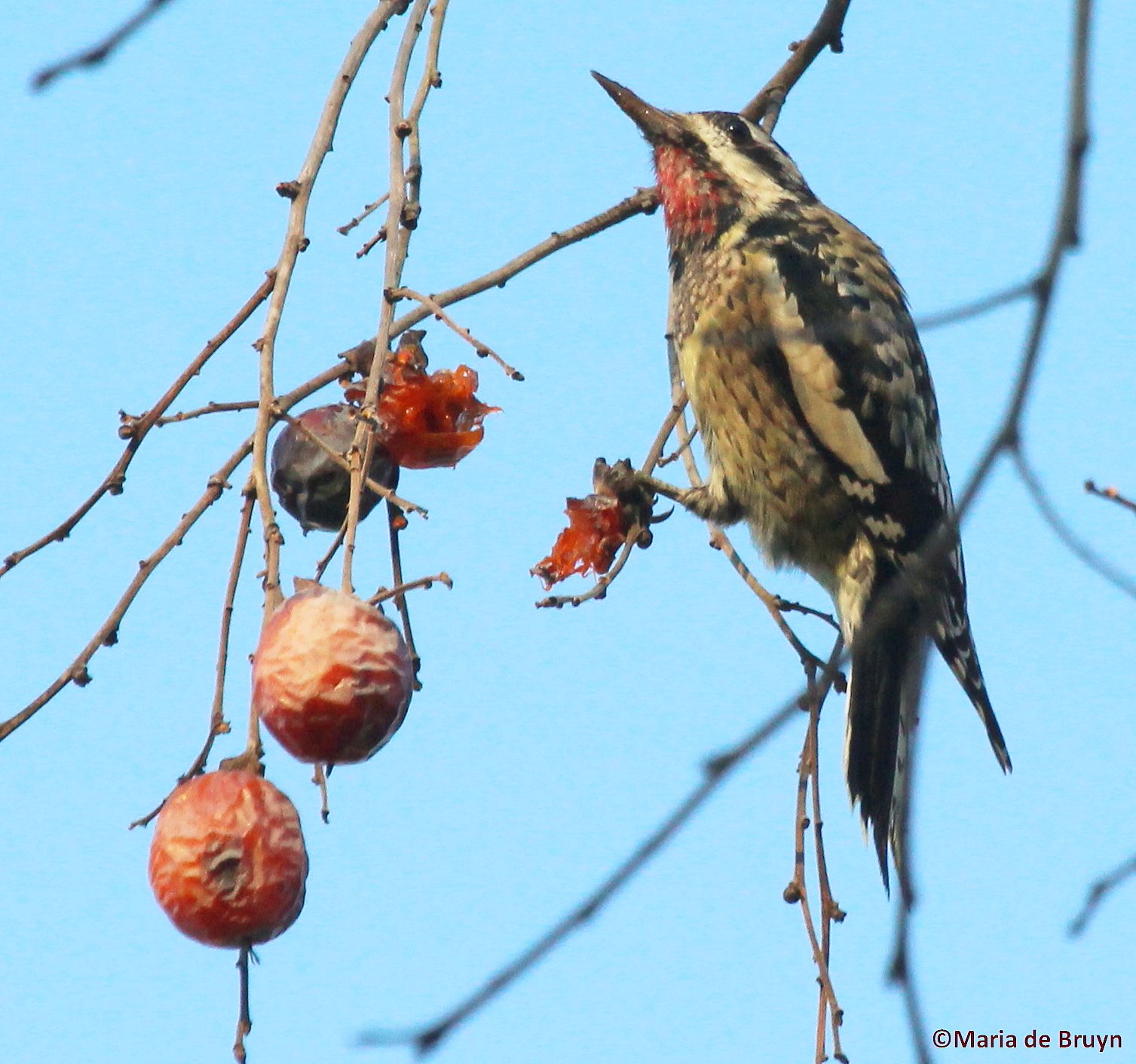
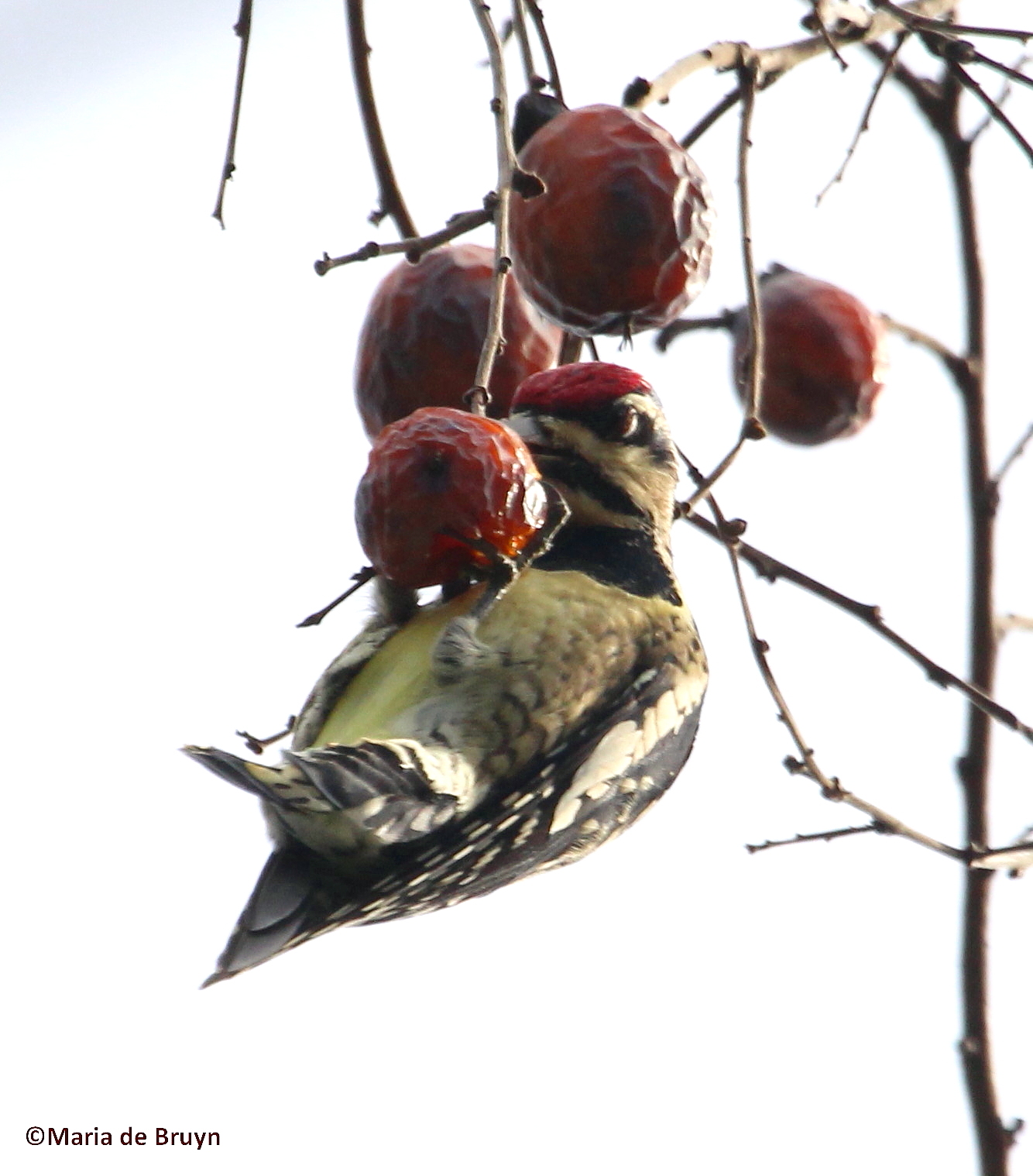
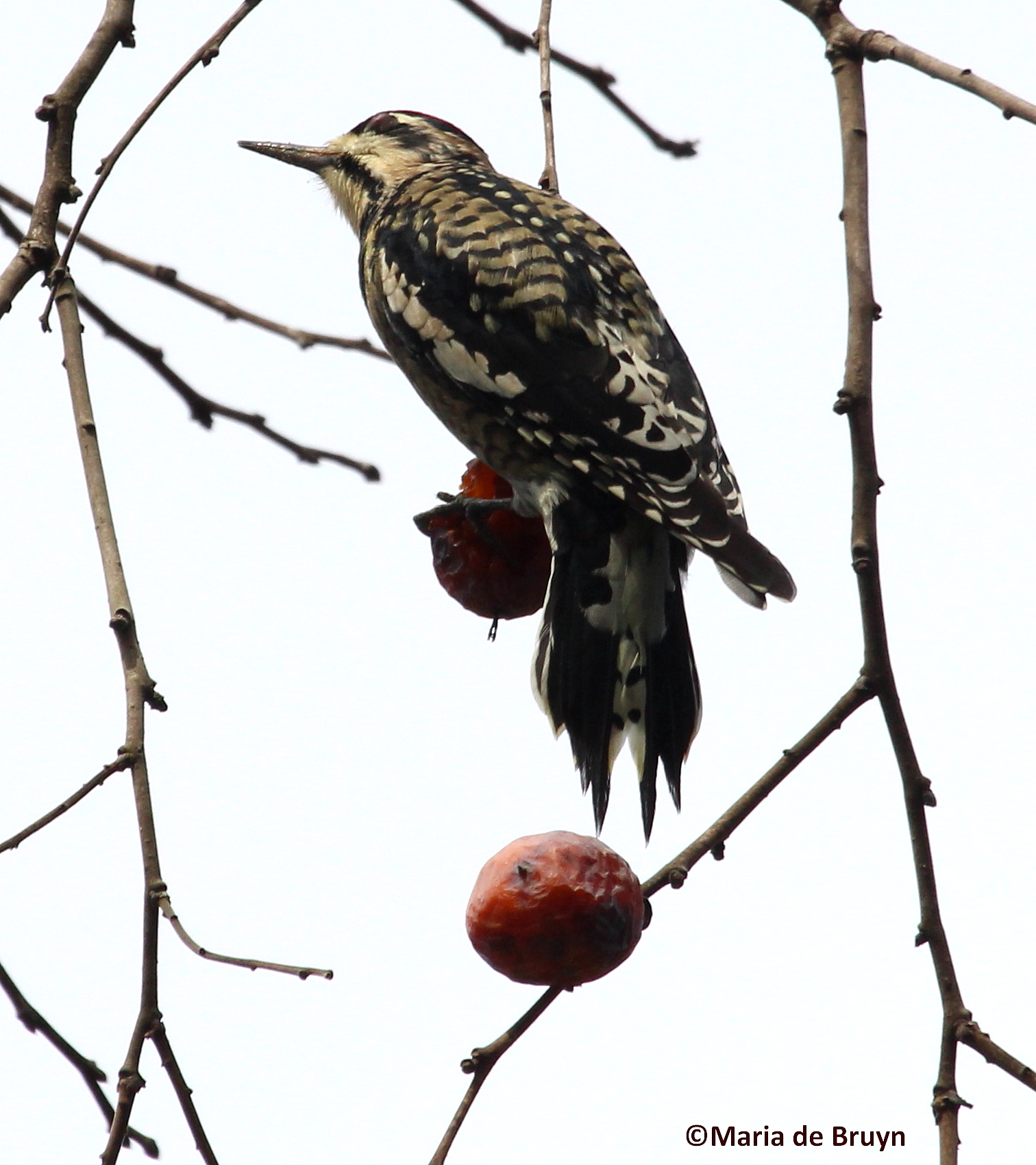
Yellow-bellied sapsucker IMG_8379© Maria de Bruyn The yellow-bellied sapsucker (Sphyrapicus varius) though is a woodpecker that is highly attracted by the fruit. A few of these attractive birds – both adults and juveniles – have been visiting the tree every day for weeks now to enjoy a sweet treat.


Yellow-bellied sapsucker IMG_8263© Maria de BruynYellow-bellied sapsucker IMG_8233© Maria de Bruyn

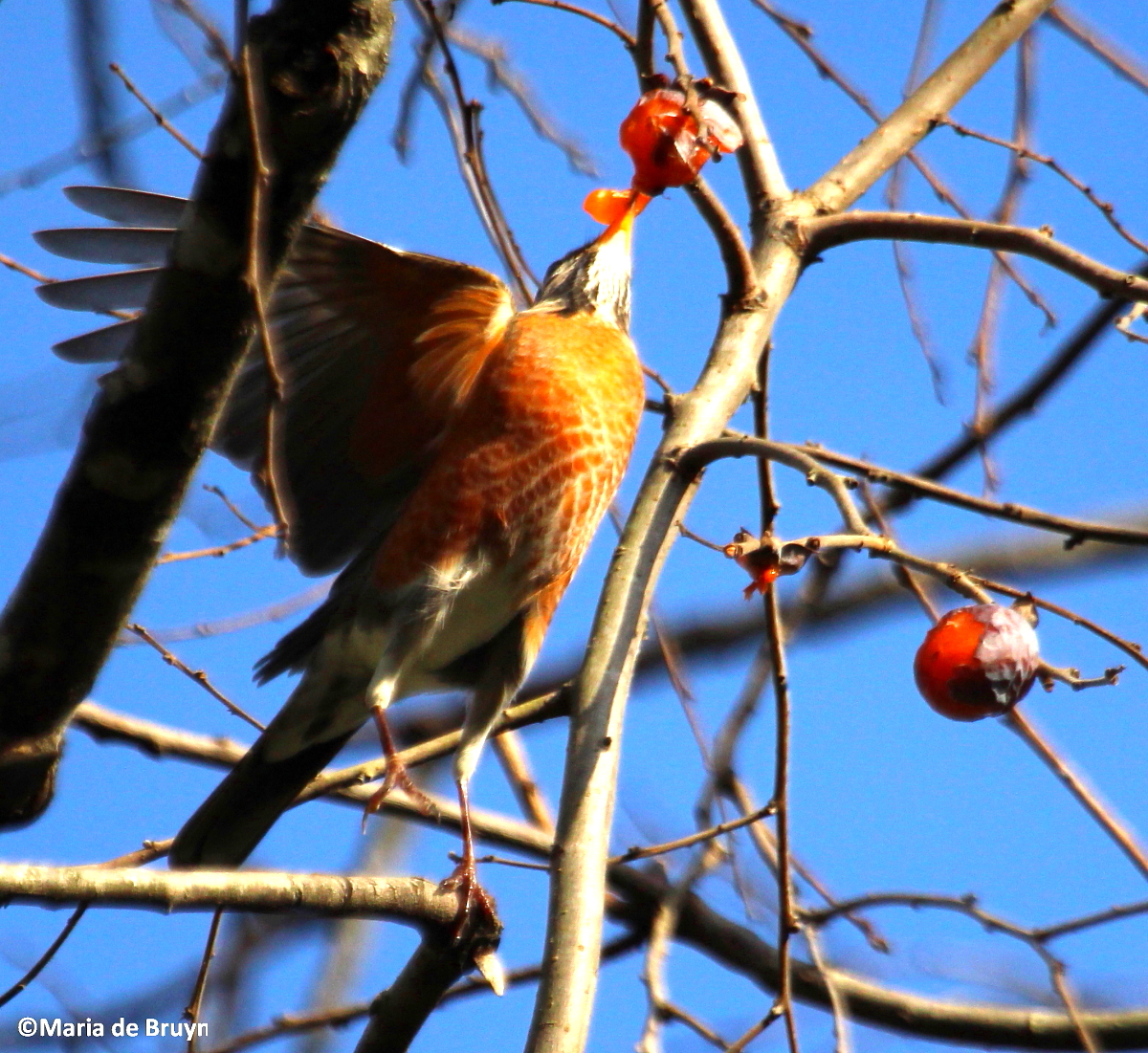
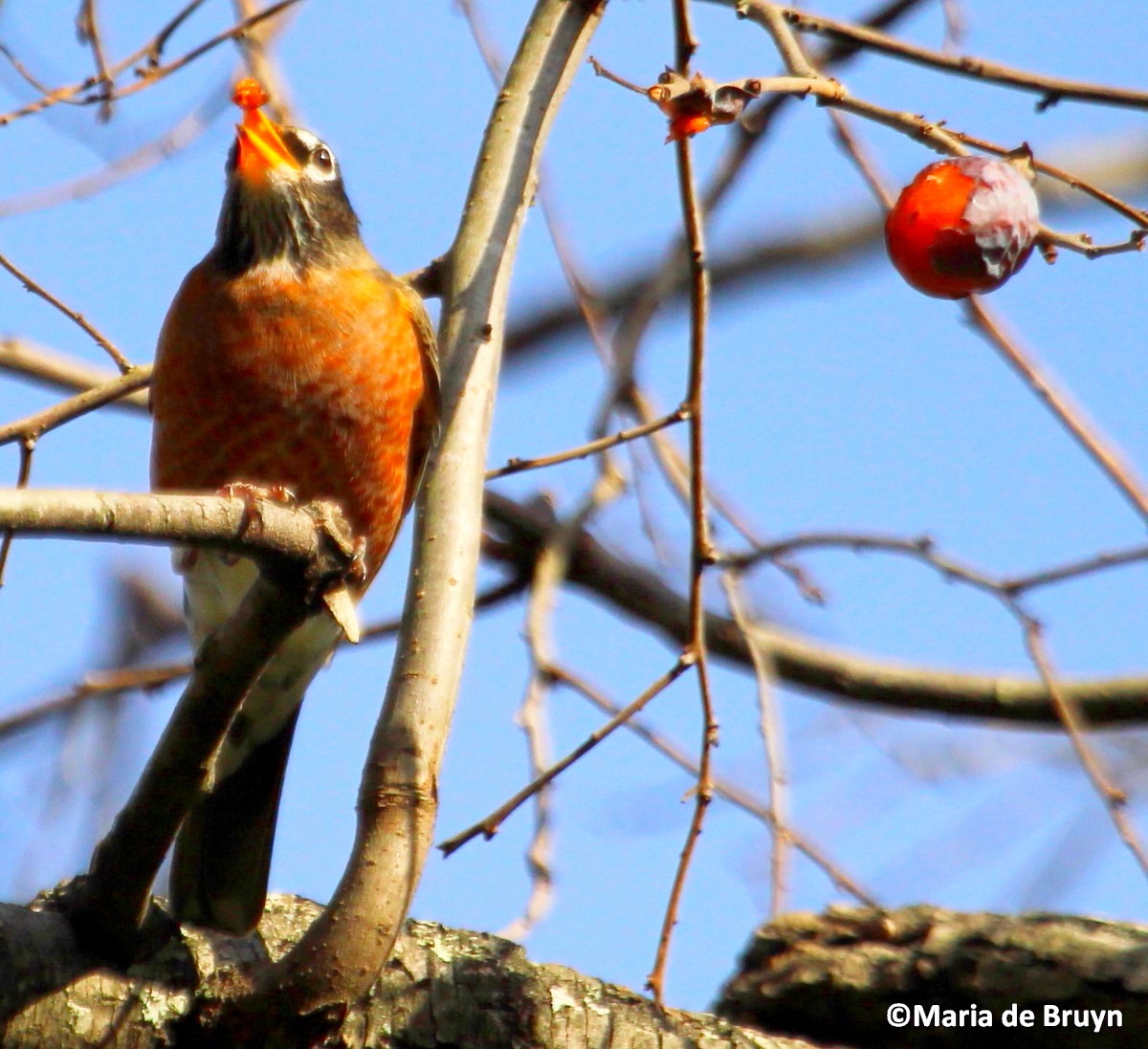
The American robin (Turdus migratorius) will not turn up its beak at a piece of persimmon either. Perhaps next year I should take a leaf from their books and collect a few fruits to try a pudding??

American robin IMG_9826©Maria de Bruyn resAmerican robin IMG_9813©Maria de Bruyn res