Mama and Papa house wren to the rescue!

A few times each day, I walk outside with my 18.5-year-old cat, Jonahay, who is deaf and has some other ailments. He used to be an indoor-outdoor cat until I decided that it was better not to let him roam the neighborhood.


He rarely killed anything; he just wanted to mark his territory (which he still does) and occasionally he would catch moving things and bring them inside.

Thankfully, he didn’t bring me dead birds or animals; I did have to capture baby rabbits, chipmunks and a snake or two so they could go back outside. Now he just walks around and sleeps on the porch with me at his side; chipmunks and squirrels walk by him as they know he won’t chase them.

This afternoon as I was vacuuming, Jonahay came to ask for a walk, so I paused to take him outside for a few minutes. When we got to the side yard, I was surprised by a pair of house wrens (Troglodytes aedon) who were chittering vigorously and loudly in a cedar tree above me. They had not nested in my yard this year but do visit once in a while.


As I moved, they moved with me, continuously calling – their vocalization was very obviously directed at me, but I didn’t see any young ones anywhere so I wasn’t sure why they were so upset.

One of them – the male, I presume – only paused his calling for a few seconds when he groomed a little. I kept looking around for what might be upsetting them but didn’t see anything. Jonahay indicated we could go inside and the wrens had to let me leave.


As I took the vacuum cleaner into the kitchen, which opens onto a screened-in porch, I suddenly noted a few tiny feathers on the floor. If the wrens hadn’t been “yelling” at me, I might have just glanced down and thought they were bits of cat toy or fluff. But now I was more alert!

I called my two other (indoor) cats and they didn’t come, which was suspicious. Even when they look at animals through the windows and screens, they will usually react if I speak to them. When I entered the laundry room on the other side of the kitchen, there were Moasi (shown left)  and Ogi (right), sitting on the washer and dryer watching a juvenile wren perched on the window sill!

I don’t know how the bird got into the house. Likely, it had been early in the morning when I opened the porch door for a few minutes as I put out bird food, but I had not seen the bird on the porch when I re-entered. During the morning and early afternoon, I hadn’t noticed the cats chasing anything either so the mystery remains. I hadn’t been outside much with all my chores so perhaps those parents had been calling for him all that time.

In any event, I shooed Moasi and Ogi out of the room and proceeded to open the window. The little wren jumped into a plastic container near the window and that enabled me to easily move him/her to the open window. The bird waited a minute (enabling me to quickly get his photo) and then flew out to freedom – and obviously to a pair of anxious but effectively protective parents!


An evening at Bolin Creek

After a day waiting for four bluebirds to fledge (next blog!) and a health-care appointment, I decided to forego some chores and instead to spend some time at a bridge over Bolin Creek, a waterway in the local Carolina North Forest which belongs to the University of North Carolina. My naturalist friend Mary discovered that this spot is a favorite bathing spot for birds in the late afternoon and evening. Since the weather forecasters predicted rain most afternoons this week, I decided to make a quick foray there while I had the chance. I knew that photographing the wildlife could be difficult as the sky was dull, overcast and we were expecting a downpour but I was up for the challenge. And once in a while a bit of brightness emerged from behind the clouds to give me some encouragement.

At first, it seemed very quiet – no bird song or buzzing insects; I thought perhaps everyone was hunkering down in anticipation of a coming rainstorm. But then the sky lightened a bit and a handsome robber fly (Promachus) alighted on a nearby leaf. I think this is a red-footed cannibal fly; these insects look like little old men to me.


A little while later, there were suddenly three avian visitors. The female Eastern towhee (Pipilo erythrophthalmus) was the first to take a bath.


The blue-gray gnatcatcher (Polioptila caerulea) didn’t go to the water but flitted overhead.


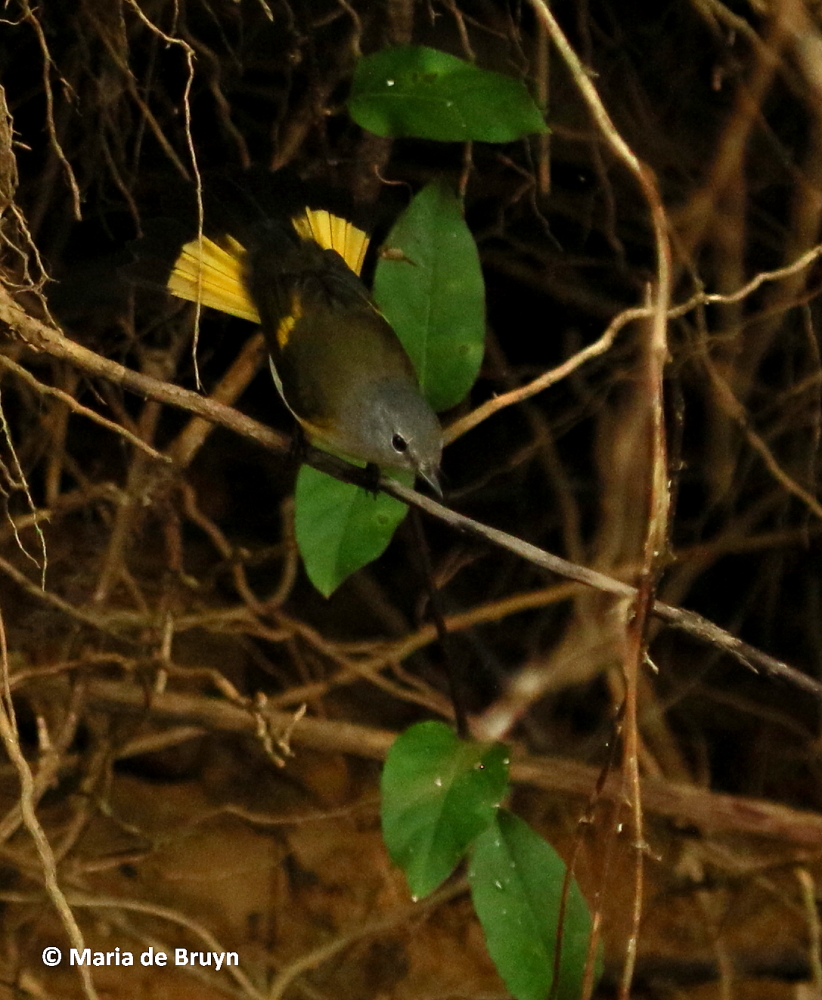
The first of two American redstarts (Setophaga ruticilla) also hopped from branch to branch but eventually ducked behind some rocks to bathe.

A pair of damselflies hung out on the stream rocks; the blue-tipped dancer’s (Argia tibialis) dark purple made it look almost black in the twilight.


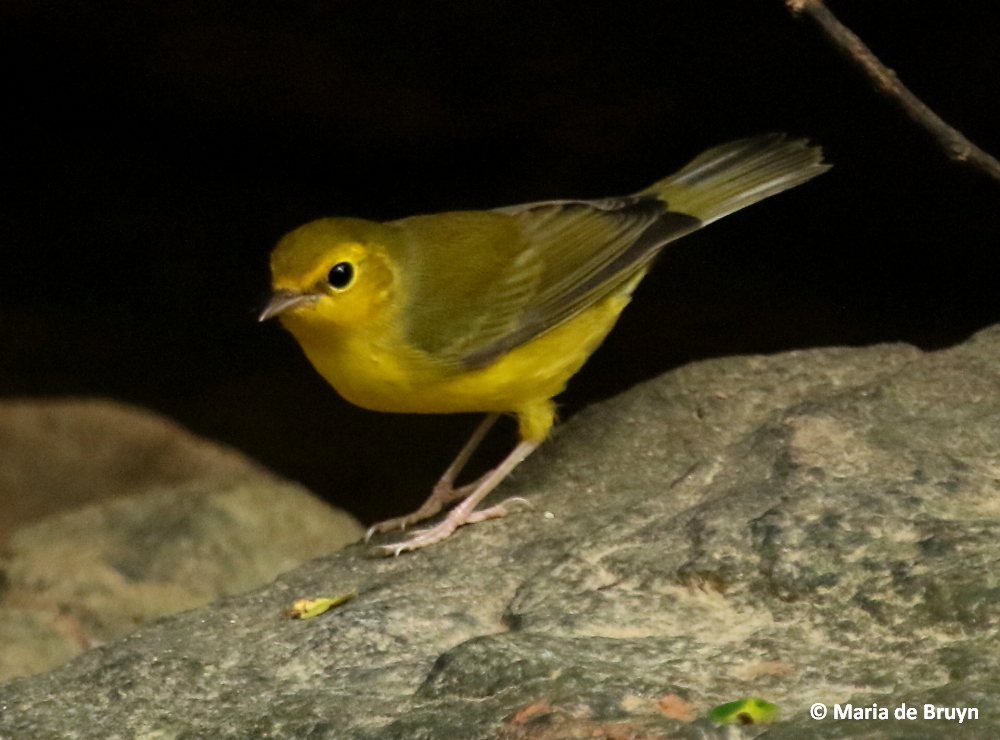
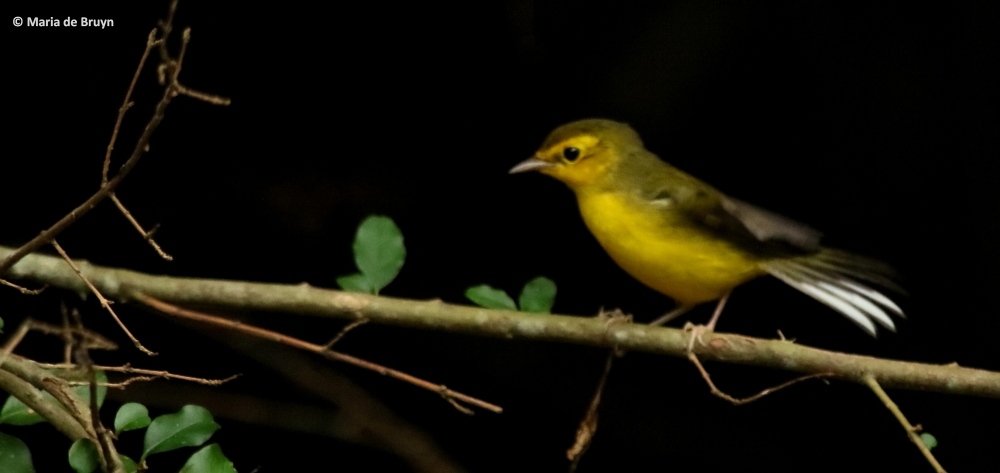
Then a beautiful female hooded warbler (Setophaga citrina) came by for a bath. Her golden feathers shone in the dark foliage and against the stream rocks.


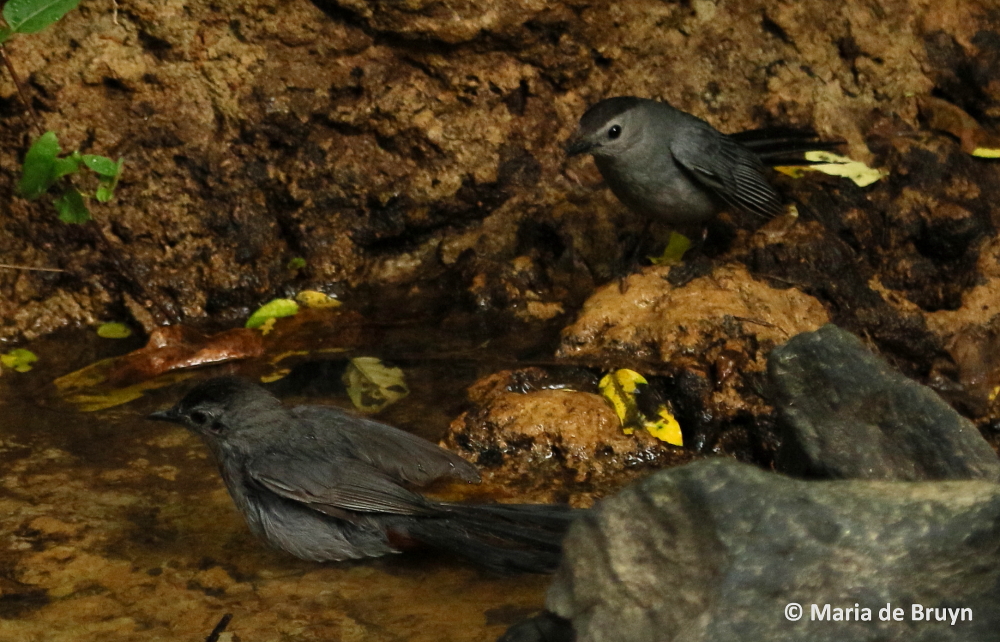
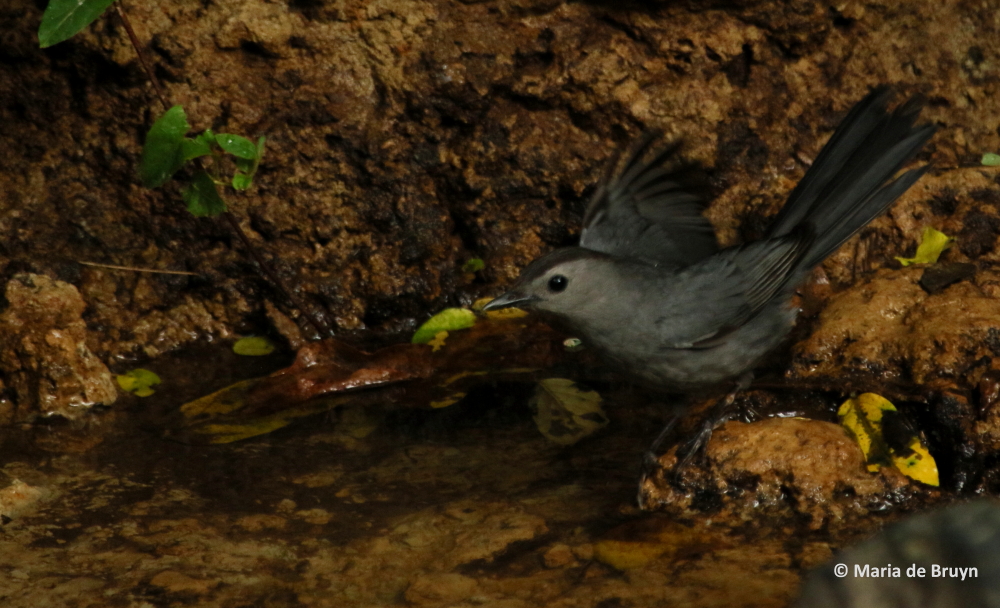
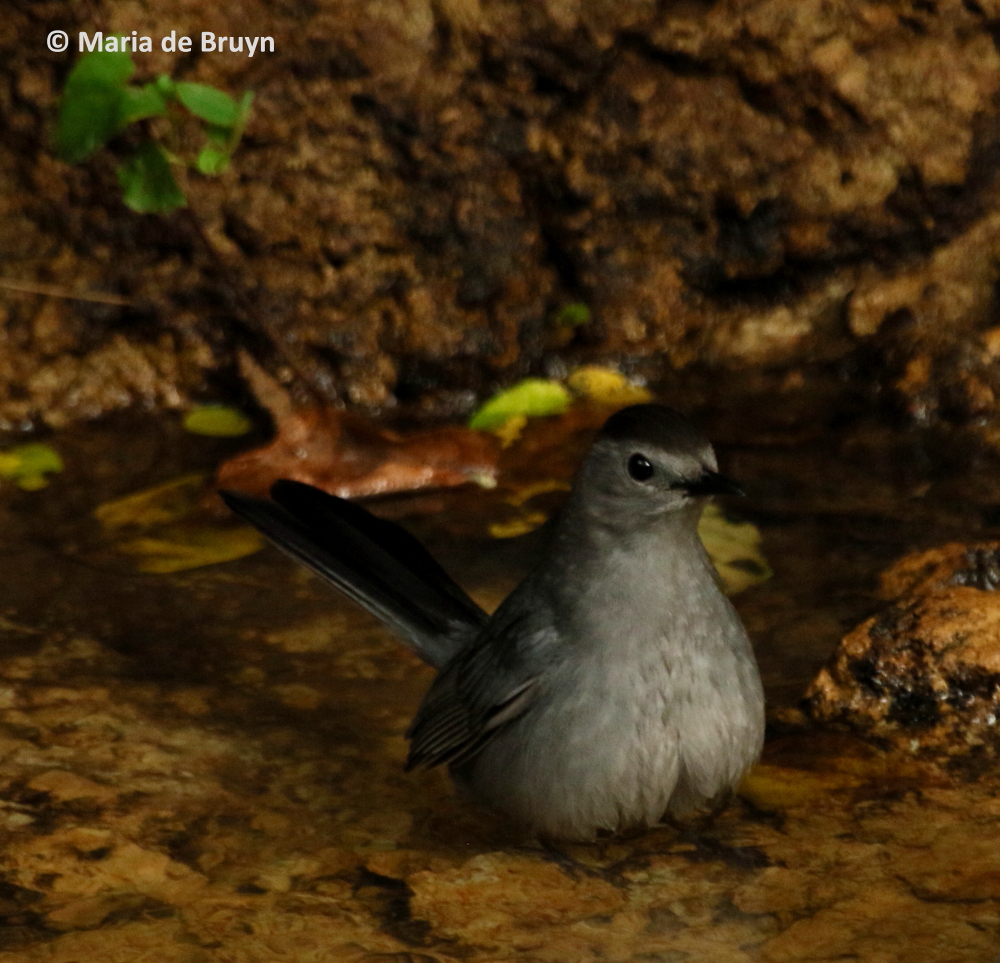
A pair of gray catbirds (Dumetella carolinensis) came together but only one entered the stream for a thorough drenching of its plumage.


The redstarts returned but stayed on the branches as the daylight began leaking away.

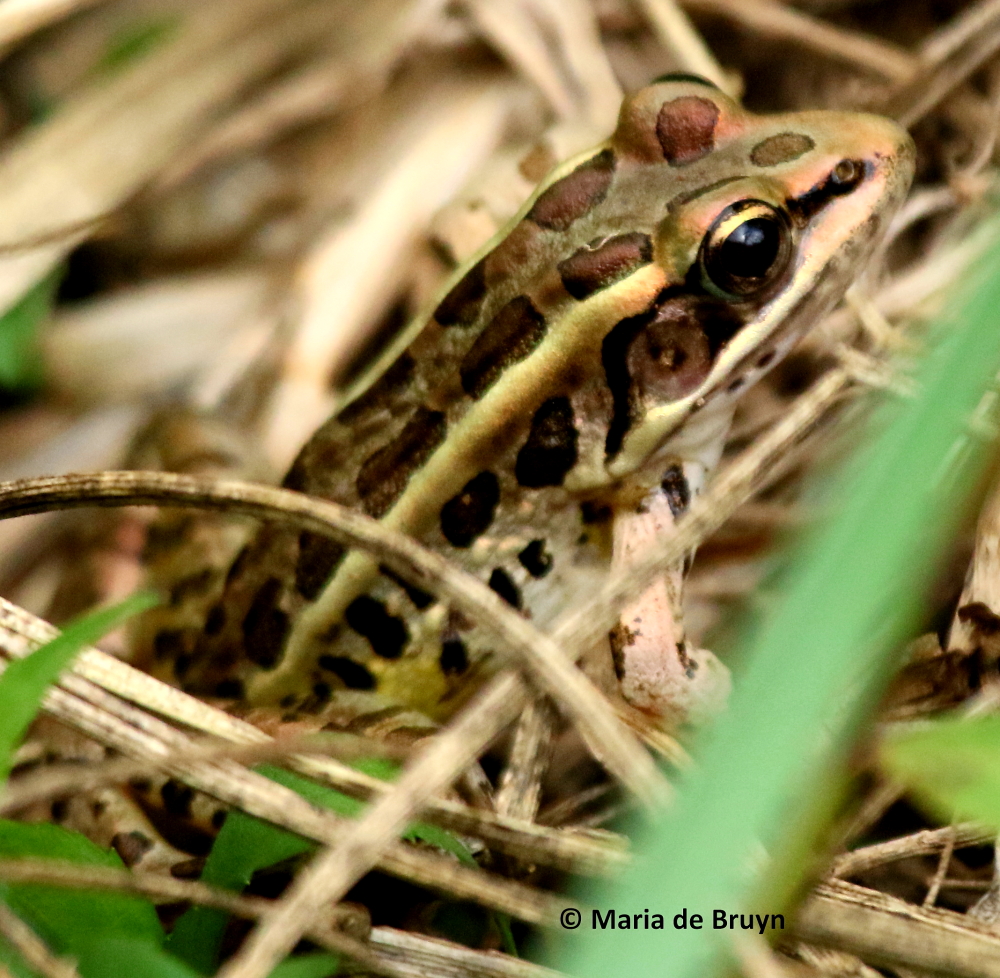
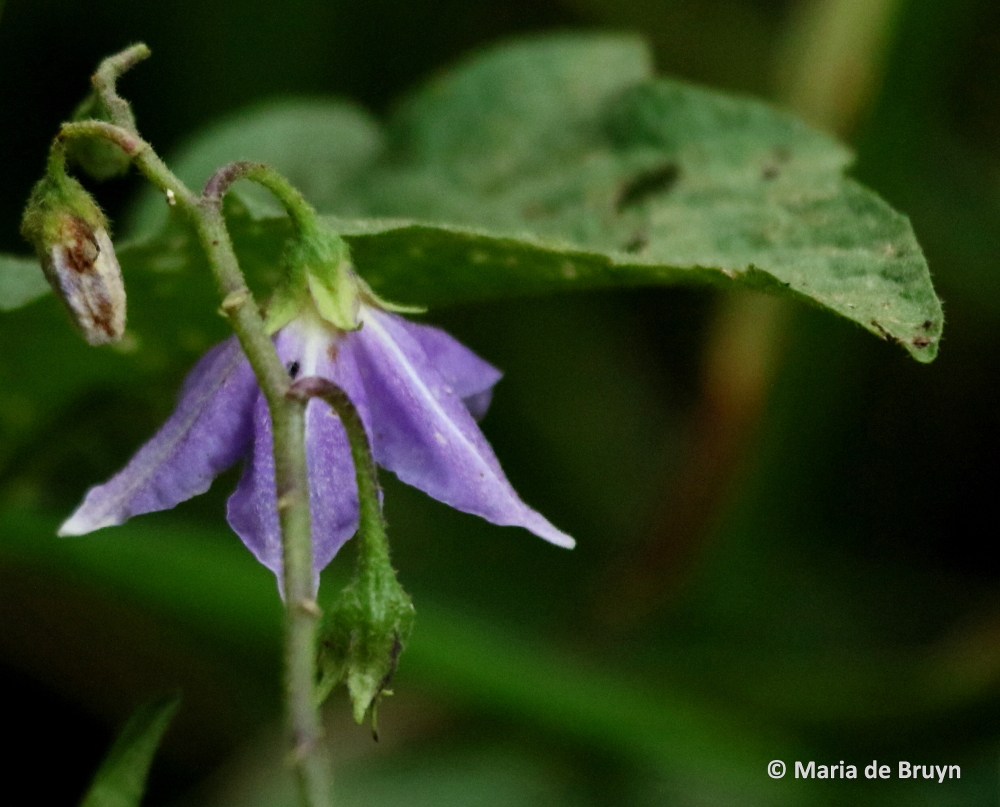
A few other birds were in the vicinity but didn’t come near: American crows, Northern cardinals, a common grackle and two yellow-billed cuckoos. My visit ended when the sky really darkened — I started down the path in an effort to reach my car before the rain began. A Southern leopard frog (Lithobates sphenocephalus) crossed in front of me and paused in the grass, enabling me to get a quick portrait. And then a nettle of beautiful violet color called out for a photo, too. I made it to the car just as the first raindrops fell. Quite an enjoyable impromptu photography session!

A nature walk with some history to ponder

In our area of North Carolina, various nature reserves have some background of historical interest. It may be related to the provenance of the land, the names of the reserve and its trails, or the remnants of structures still in place. A newer reserve in Orange County is the Blackwood Farm Park and it had some historical artefacts which I had not expected to see while I searched for beautiful plants and wildlife of different kinds.

The 152-acre reserve has transformed a former working farm into a place with hiking trails through fields and hilly woodlands, preserved farm buildings (barn, smokehouse, corncrib, milking shed, etc.), and meadows where hay is still sown and harvested every year. The first farmers arrived around 1745 and farming ended with the Blackwood family in the 1980s.


Dogs are allowed but supposed to remain on leash; currently, the trails are for hikers, birders and others who appreciate nature. On my last visit, a small group of dog trainers were putting canines through their paces in front of the old farmhouse, while a few people were chatting at the picnic tables nearby.

In the meantime, a chipping sparrow (Spizella passerina) was extensively grooming itself in one of the shady yard trees.


As I began my walk through the woods, I heard a distinctive bird call and began searching for the scarlet tanager (Piranga olivacea). Lucky me, he came into sight briefly overhead so that I could admire his handsome but fleeting appearance.

The meadows were filled with flowers, including Carolina horsenettle (Solanum carolinense), with its distinctive white and purple flowers, and beautiful moth mullein (Verbascum blattaria), which some botanists consider a weed and rip out in glee when they see it (this happened a few days ago when I was volunteering at another reserve!).


Butterflies, like this American lady (Vanessa virginiensis), were investigating the flowers like me and sometimes feeding on the ground.


The trail through the woods is partly level and then leads up and down hills and across small streams. Some sections are alive with bird sound and others are fairly quiet. Small signs indicate where the reserve property abuts nearby privately-owned farms.

As I came nearer to the forest edge adjoining a meadow with a pond, I came across an unexpected reminder of history. A sign at the entrance to a clearing announced that it was a burial site for slaves who had been owned by farmer Samuel Strayhorn from 1817 to 1847 and visitors are asked to observe the site with appropriate respect.


Archaeological surveying has identified 34 graves, including adults and children; some are marked by stones and others are now indicated by small metal tags.


Oral tradition relates that not only the slaves but some of their descendants were buried here after the Civil War. It is a sobering reminder of a shameful time in the history of this country, but it is good that the site has been preserved and that further historical research is being done to learn more about the enslaved people who lived here.


After spending some time in contemplation and wondering how the slaves’ descendants are faring now, I wandered on, emerging into the pond area where numerous dragonflies were flitting about.


Male blue dasher dragonfly                      Female widow skimmer (Libellula luctuosa)

(Pachydiplax longipennis)

          Banded pennants (Celithemis fasciata)


A couple of amorous damselflies were also in evidence.


Leaving the pond, I entered the woods again and witnessed a pair of six-spotted tiger beetles (Cicindela sexguttata) engaged in mating, but it was not with mutual consent. The iridescent blue male jumped on the greenish female, who did her best to escape. He literally tackled her and at one point had her on her back as he kept hold of her.


She continued trying to escape but he was persistent and finally managed to mount her. She periodically engaged in vigorous shaking, obviously trying to dislodge him but he hung on.


Finally, after some time, she bucked a bit like a horse at a rodeo and threw the male off so that she was able to streak off with great speed. The male remained behind, alone.


A little further on, a black and yellow millipede (Boraria stricta) trundled along the forest floor, its antennae exploring the ground ahead and identifying which obstacles (twigs, stones) it could surmount and which ones it needed to skirt.


At one point, I pondered a tube hung on a tree by someone who was probably doing a study of some kind, rather than making an artistic statement (I hope).


When I left the reserve, a Northern mockingbird (Mimus polyglottos) was flashing its wings near a picnic table, undoubtedly looking for insects as a meal to enjoy there.

My walk that day didn’t result in a wide variety of wildlife spottings, but what I did see was interesting. Coming upon the cemetery was an unexpected educational experience that made the visit well worthwhile. I hope the researchers uncover more information that can be shared with visitors in the future.


Swallow sibling spats – who gets the food??

Mother Nature came through for me again a week ago, treating me to an interesting session of cliff swallow (Petrochelidon pyrrhonota) behavior. (I first thought they were barn swallows but then noted they didn’t have deeply forked tail feathers.) I had noticed the swallows flying high above me as I walked to a favorite birding spot where I hoped to see hummingbirds feeding on the profusely blooming trumpet vines. Instead, I got a lesson on how swallow siblings may interact.

Occasionally a couple birds would come very near one another in flight. My attempts to get good shots were however stymied by their very swift swooping.  As I came upon the structure where I would position myself for the next 80 minutes, I noticed five swallows sitting on a wire, all of them preening and grooming. It was only after taking multiple photos and one flying off that I realized the group included both adults and juveniles.


At one point, all but one flew away; he (assuming a male for convenience’s sake) was alone for a good bit of time. Occasionally, he would stretch his feathers or teeter on the wire; I wondered if he had hurt his wings and was therefore staying put, unable to fly.

It turned out that he was just waiting for a parent to arrive with food. The bird would stretch his wings and put them out a bit to help with balance but otherwise didn’t move except when a parent came within earshot. Then he began fluttering his wings and calling with an open mouth guaranteed to trigger the instinct to stuff something down it.


Sometimes, this meant having to turn his head 180° to get it in the right position for the deposit of an insect. This had the desired results.

The bird was alone on the wire for perhaps 20 minutes or so – and then was joined by a couple others. They looked a bit bigger and more developed but I finally realized that these were the bird’s siblings, who had been doing more to practice their flight capabilities.


“Wire” bird maneuvered his way down the wire in stages to end up right next to, and then almost on top of, one sibling. He almost seemed to be pecking the bird. This did not go down well and finally brother/sister left after wire bird moved back and forth.


The parents arrived sporadically with food, perhaps hoping that wire bird would finally take off – and then he finally did, showing he was not injured at all. I think he simply wanted to have table service and figured staying on the wire with an open mouth was easier than having to try catching lunch on the wing like his siblings.


Two siblings finally decided to perch on the wire, too, all making sure to keep some distance between themselves. Perhaps they were tuckered out after all those flights; one took a few naps between visits from mom and dad.

Wire bird was very good at attracting his parents’ attention so the other two tried to become more vocal and began fluttering their wings more as well. They also moved closer to him, likely hoping to intercept a meal.


Things became a bit more difficult for the parents, who could scarcely alight on the wire before having the food snatched away!


Then, one of the siblings seemed to have had enough of wire bird’s success and approached him – to wire bird’s dismay.

They had a little spat!


Sibling No. 2 also took a turn at wire bird – they seemed to be saying that enough was enough and he had to stop monopolizing mom and dad’s attention, care and feeding.


When a crow arrived, everybody flew off in a panic but it wasn’t long before wire bird was back in place. Mom and dad began arriving much more regularly and the siblings decided being on the wire would be more productive than trying to find their own food. The parents finally began feeding the siblings more and everyone seemed to be pleased with that arrangement.

Towards the end of my 80-minute observation stint, I reflected on how patience showed me much more of what was happening than I had first assumed. If I had left after 20 minutes, I might have gone away feeling sorry for wire bird, thinking he couldn’t fly well and had to rely on his faithful parents. It was only by staying and watching that I saw the nest mates have their spats and I had a new narrative to explain the behavior I was seeing.


It would be so interesting to be a researcher who follows the development of a species, avian or otherwise. When I was younger, I probably didn’t have the amount of patience needed to spend more than an hour in position to see what would happen next. Now it was a sore arm from holding up my heavy camera and zoom lens that ended my session. But I’m grateful that I have the time and calm now to watch and wait and wonder about what will happen next. And other than the camera equipment and gas expenses, it’s an inexpensive way to keep learning and enjoying the fabulous natural areas that still remain.

A morning at the Butterfly House – with birds, butterflies and more!

I have all these ideas for blogs in mind, and photos to accompany them as well, but I keep taking new photos and then get behind in posting. One day, the thought came that I could just not go out to photograph and settle down to writing some blogs, but going out for nature walks as often as possible has become a real need in my life. Scientists are saying that “forest bathing” is good for your health and being outdoors and observing and learning about the flora and fauna certainly contributes to my having a happier state of mind, while contributing to my overall stamina (but not weight loss, more’s the pity). I also enjoy “shoreline, field and meadow, creek, river, and backyard bathing.”

It came to me today, after spending 3.5 hours tearing out invasive plants from my yard, that one blog that doesn’t need to be postponed because I keep getting new shots to include is this one – my visit to the Durham Museum of Life and Science Butterfly House with the Carolinas’ Nature Photographers Association.

The Museum had opened the Butterfly House for the morning for our group alone so that we could take photos for several hours without people walking in front of our shots. The Butterfly House is a 35-foot tall, glassed-in dome with many tropical plants such as the Angel’s Trumpet (Brugmansia). One of the four species of birds living in the conservatory, the Oriental white-eye (Zosterops palpebrosus), was enjoying a meal of tropical flowers. The bird would pluck a petal from the stem and then insert its beak into the base; the white-eyes have a special brush-like appendage at the end of the tongue which helps them forage for nectar and pulp.


The white-eyes were brought into the conservatory to help control leaf pests and ants.


The butterflies were gorgeous and the subject of many photos in our group. The postman butterflies have variations within a species.


Common postman (Heliconius melpomene)


Red postman (Heliconius erato)

Another group were the longwing butterflies.


Cydno longwing (Heliconius cydno)


Sara longwing (Heliconius sara)


Tiger longwing (Heliconius hecale)              Doris longwing (Heliconius doris)


Numata longwing (Heliconius numata)

As we looked at the butterflies that landed low on flowers, we were able to see the Crested wood partridges (Rollulus roulroul) that are endemic to Asia. They breed in the conservatory, laying their eggs behind dense shrubs, and they help control soil pests in the Butterfly House.


Male                                                                        Female

At one point, a museum staff-member brought us a group of insects to see up close. One of them, I certainly would not have touched, although it was fascinating to watch: the Asian forest scorpion (Heterometrus).


The Chilean rose tarantula (Grammaostola rosea) was a really beautiful tarantula that blended in well with the tree against which it was placed.

The dragon-headed katydid (Eumegalodon blanchardi) was an interesting creature. I do think its head looks more like a horseshoe crab, though!


The rhinoceros beetle was nice and shiny – I once saw a young boy in Thailand who had one as a pet; he was taking it for a walk in the forest and it looked to be about as big as his hand.


It’s interesting how the patterns on the dorsal and ventral sides of a butterfly can be so very different – you may need to look up both sides to get a good ID of the species. This is especially true of the Blue morpho (Morpho peleides).


The same is true for the male scarlet peacock (Troides amphrysus)


The female shows similarities in her dorsal and ventral wings.


The owl butterfly (Caligo memnon) was an impressively large individual.


The Malayan birdwing (Troides amphrysus) spent much of its time huddled up against the windows but I was able to catch it on a flower.


Two kinds of black-and-white butterflies were fluttering about, the Asian paper kite (Idea leuconoe) and the zebra mosaic (Colobura dirce) from Central and South America.


There is a glass case in the conservatory that has lines of chrysalids hanging on wires. At any time, you may see one or several butterflies that have just emerged and are unfolding and drying their wings. This individual was perched against the glass for the unfurling, giving an excellent view of beautiful feathery antennae.


There were two more birds in the Butterfly House that were beautiful to see. Both from Australia, the zebra finch (Taeniopygia guttata) was difficult to photograph as it spent a lot of time very high up in the dome.


The most beautiful – to me – was the Gouldian finch (Erythrura gouldiae). The colors are a bit like the American painted bunting but they look as if they were put on in blocks of color like a kind of avian Mondriaan painting. I followed this bird around several times in the hopes of getting some nice photos and finally succeeded in my opinion. I’d love to have this bird coming to my feeders!