Our largest North American woodpecker — a real delight!

During nesting season, we have a good chance of seeing many birds whom we might not notice otherwise because they’re out in the open, collecting nesting material and scrounging for as much food as possible because they have hungry mouths to feed. I was very grateful to my friend Carol when she told me about a pileated woodpecker (Dryocopus pileatus) nest where the babies might be fledging soon. Pileated woodpeckers are also nesting somewhere near my home, but I rarely see them.

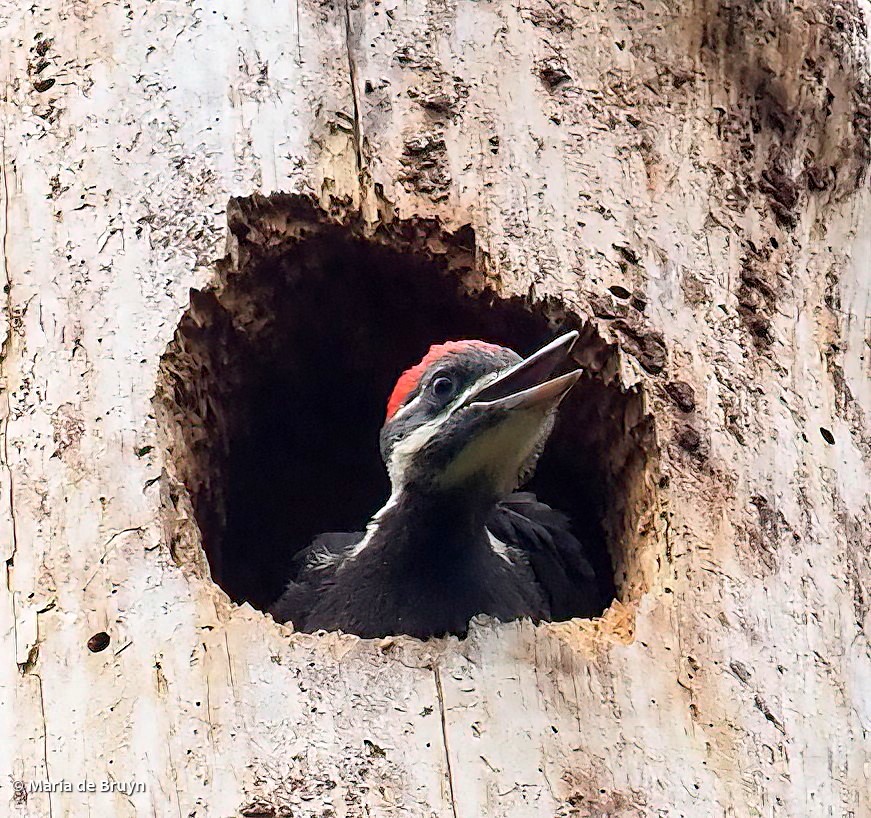
When we arrived at the nesting site, one baby was poking its head out of the oblong nest hole about two-thirds the way up a very tall snag.
 

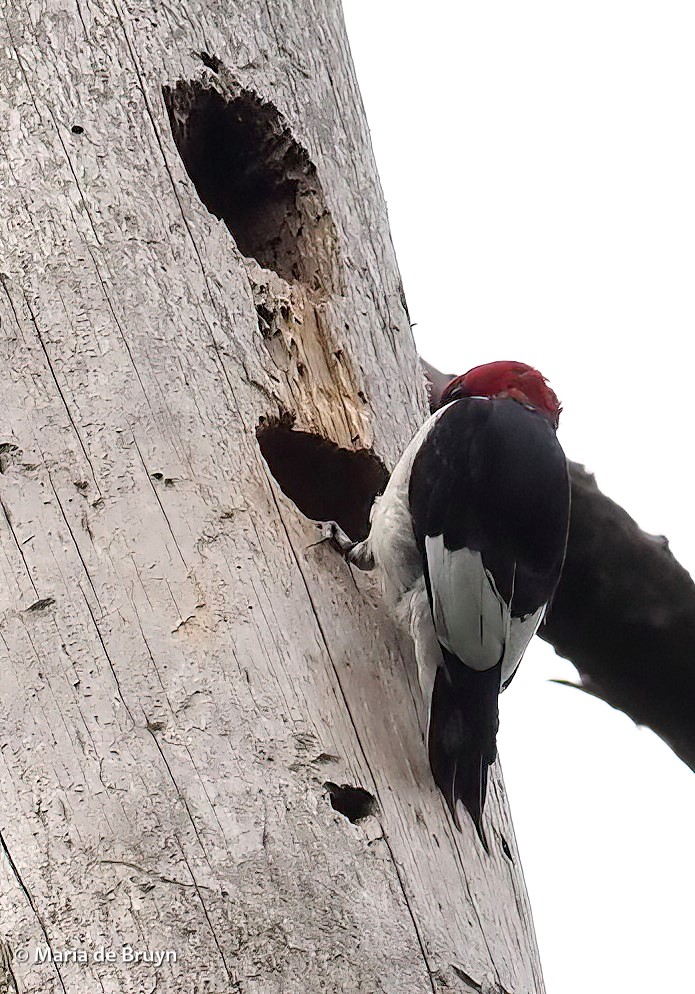
Above it, a red-headed woodpecker (see right) was maintaining a nest. A red-bellied woodpecker was also visiting higher up.

While we watched, the young one continued scanning the skies while calling out to its parents. The baby persisted in watching from the nest, which was only lined with wood chips. Unlike other birds, pileated parents do not line their nests with nesting material such as soft grasses.


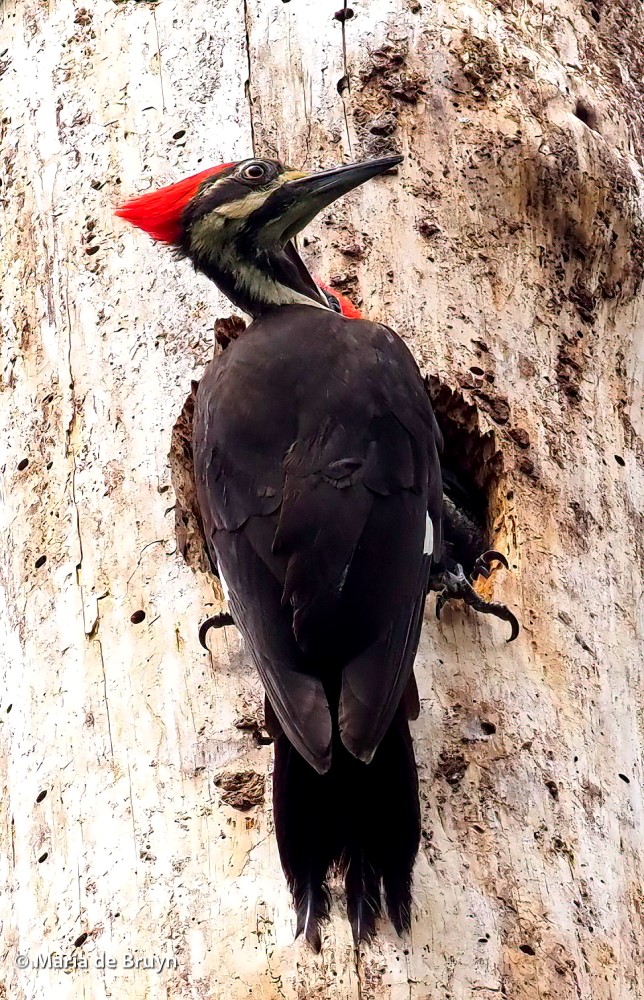
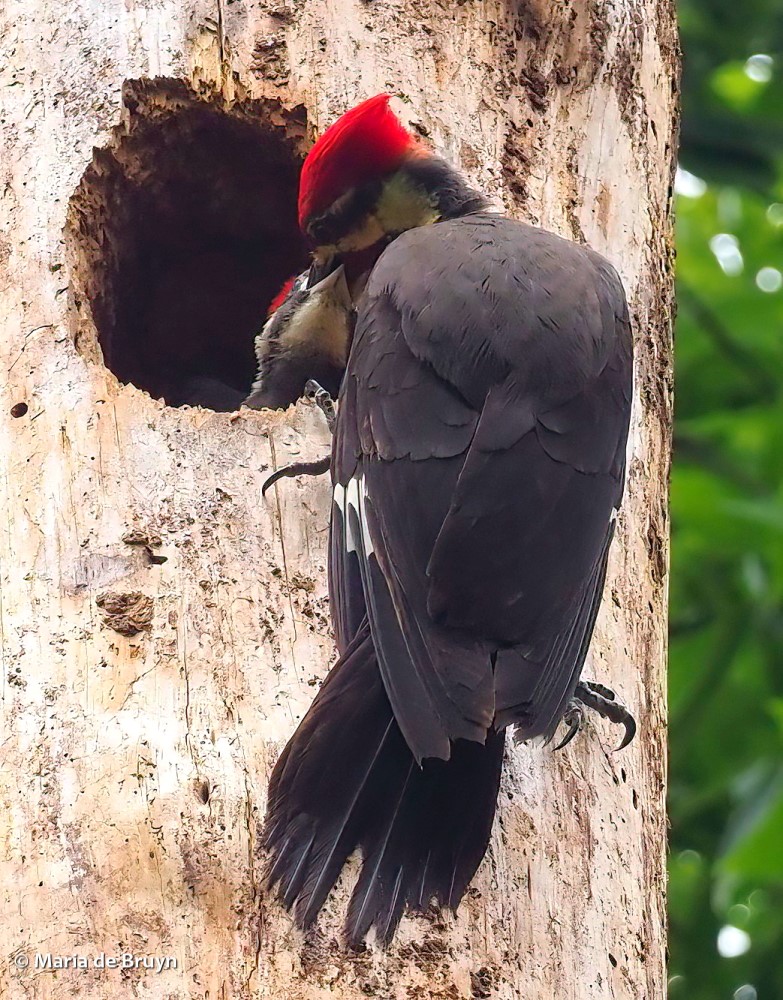
Occasionally, the parents answered and, after about 15-20 minutes, one flew over to check us out. It was the father, who could be identified by his red crest that extended down to his bill and the red cheek or moustache stripe (right photo). The left photo shows a female who was foraging in a tree on another occasion. Her red crest is only on top of her head and her cheek stripe is black.


The young one looked back into the nest; I wondered whether another nestling might be there. No one else peered out at that moment and we speculated as to whether one might already have fledged as two had been seen the previous day. When the father visited the nest, still only one baby showed itself, so we didn’t know whether there might be another one around (nests usually have 1-3 babies).


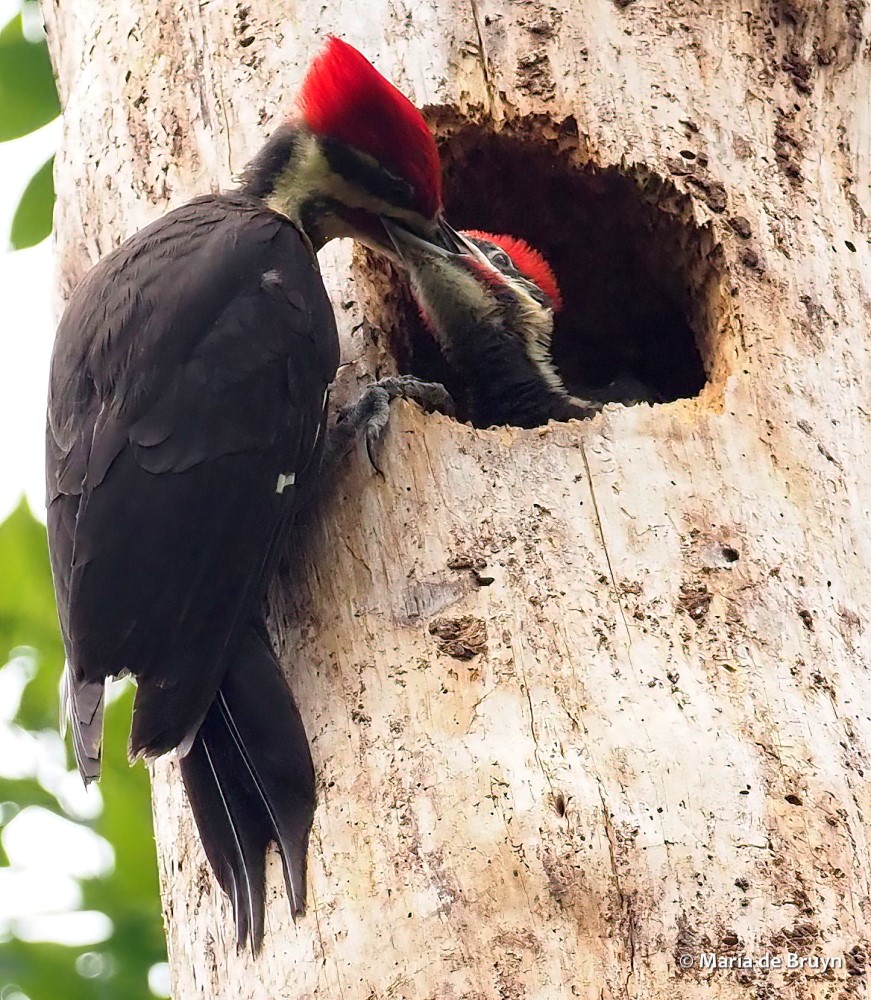
The father fed his offspring by regurgitating whatever he had been eating. The pileated woodpeckers’ diet comprises mostly carpenter ants (40-97% of their diet in various studies), supplemented by other insects including worms, caterpillars, roaches, flies, and grasshoppers.


They also eat nuts and wild fruit. If you have a garden and want to attract them, they like persimmons and many berries, including those of poison ivy, sumacs, dogwoods, elderberries, greenbriers and sassafrass.  
Many landowners tend to clear their yards and gardens of fallen logs and dead standing trees. I keep several woodpiles in various spots as the decomposing wood is home to many of the insects that the pileated woodpeckers and other birds need for their diet.

Papa took off again, leaving a satisfied young one behind (at least for the time being).

These woodpeckers are the largest in North America (15.8-19.3 in/40-49 cm), since the ivory-billed woodpeckers have been declared extinct. They are monogamous and luckily have plenty of opportunities to find mates. Pileated woodpeckers had been in serious decline in the 18th-19th centuries as forests were logged for the timber industry and to clear land for ranches and farms. Since then, they have rebounded to just over 2.5 million individuals.

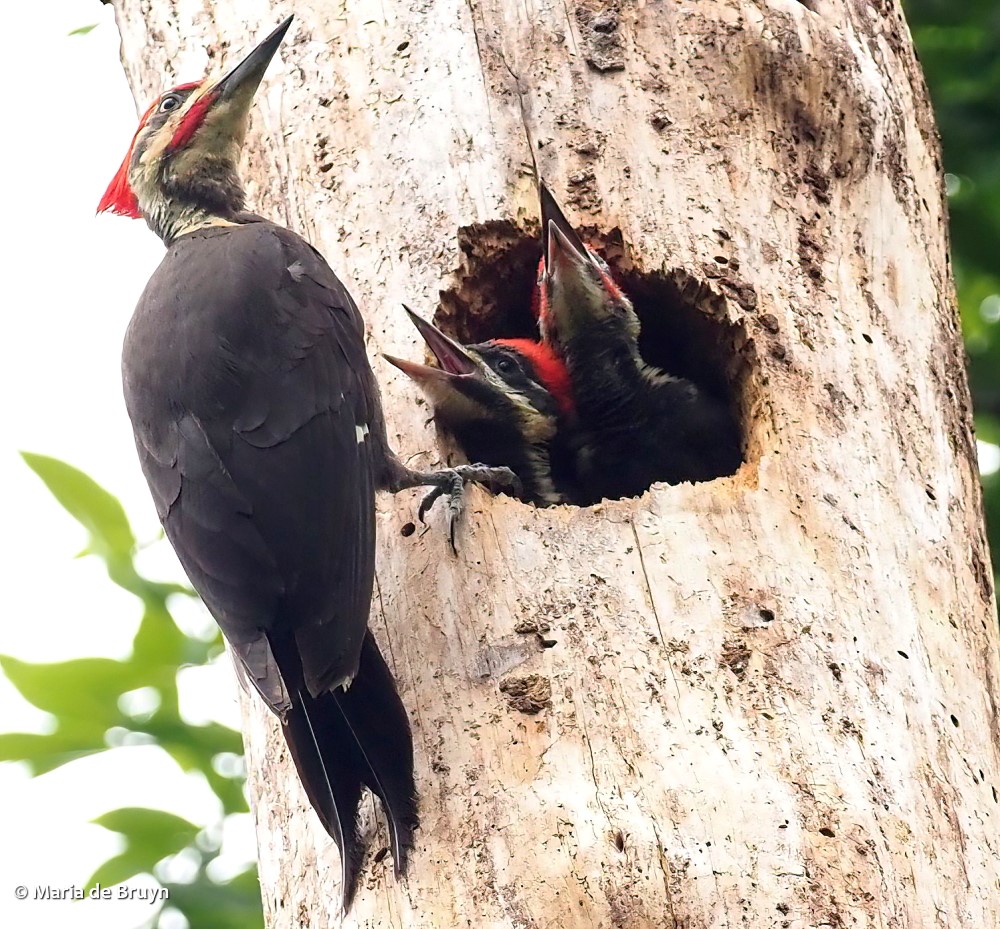
I realized when I looked at my photos later that I had not been paying enough attention to the coloring of the parents and offspring. When I went away for a short time and then returned, mama pileated was visiting the nest. In addition, whereas I had been watching a female nestling first, now a male baby was calling out for food. A view of the two looking up, shows the male’s red cheek stripes were obvious, but I had been oblivious at the time. The female is on the left and the male is on the right.


The next time that papa returned, the male offspring stuck his head out for a feeding.


Papa didn’t want to play favorites, so he stuck his head in the nest to apparently call them both to come out.
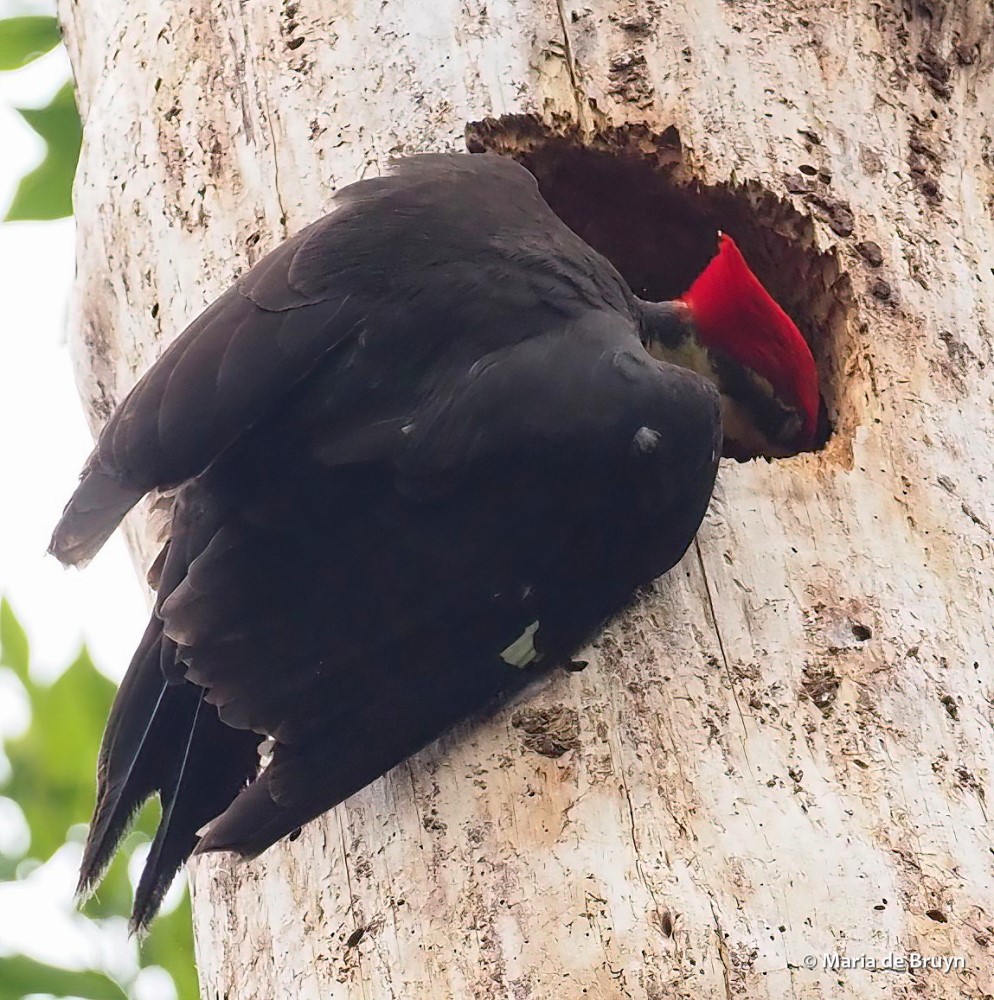
They opened their beaks wide, begging for food.
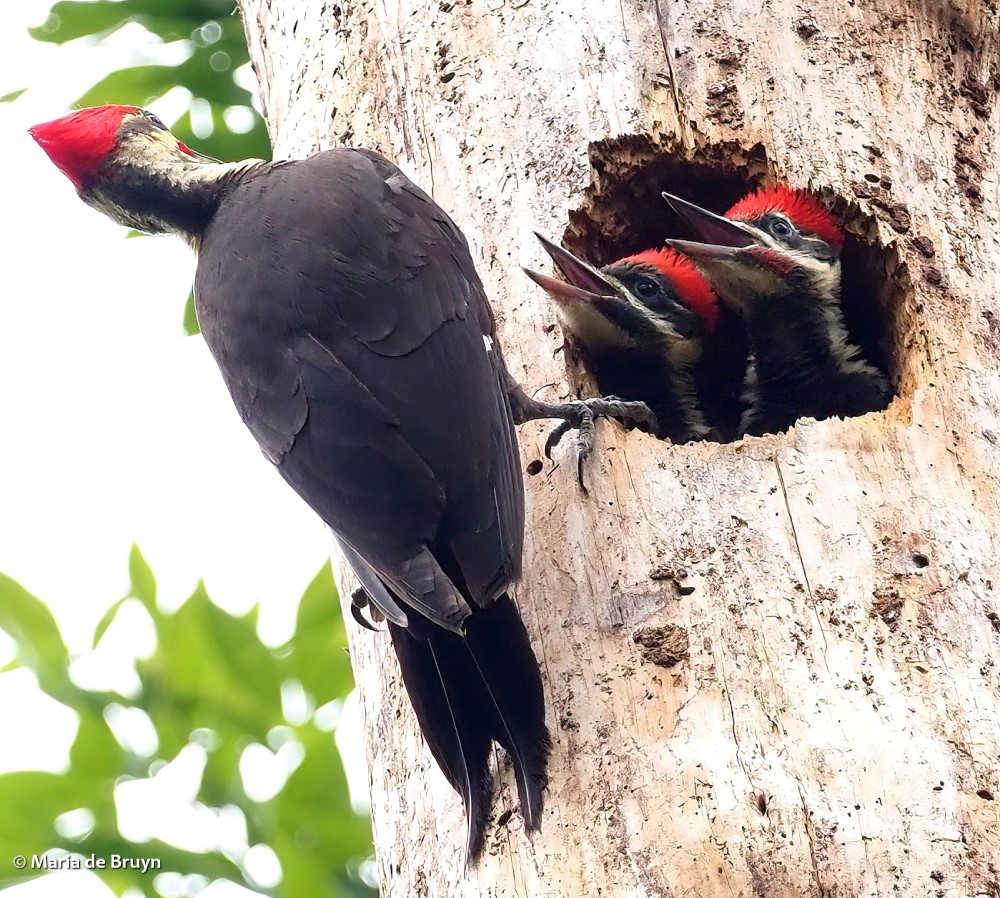
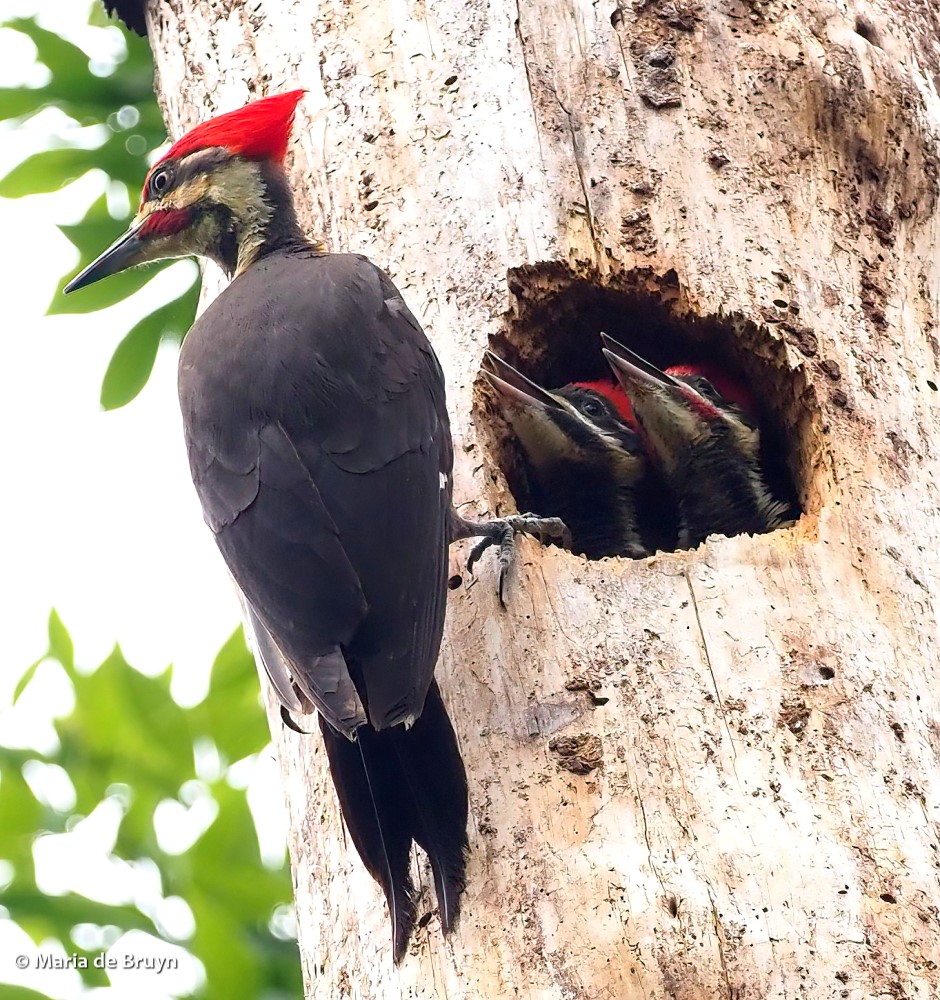
 

Papa let them ask for a while, sticking his tongue out at them as they begged.


He also decided to take out some fecal matter. I don’t know how long the nestlings had been in there (they usually grow in the nest for a month), but a clean nest is desirable.


After the babies fledge, they may stay with their parents for up to three months.
   

I’m so glad that Carol and her sister Donna, near whose home the nest is located, invited me to come see the family. It was time well spent as it got my mind completely off an ongoing series of problems complicating my life lately. Hope seeing these photos was also a bright moment for you!

Yellowstone National Park. Part 6: “Fire burn and cauldron bubble”!

When my friend Joan and I visited Yellowstone National Park in May 2022, we were interested in seeing other thermal features in addition to the Mammoth Hot Springs. A major part of the Park is actually a super-volcano, with a caldera measuring 43 by 28 miles (70 x 45 km). It has half of all the world’s geysers, as well as other hydrothermal features (i.e., more than 10,000)!

A visit to the Old Faithful geyser was rewarding for Joan, but perhaps less so for me and others who decided to stand outside nearby. (Joan watched from inside a building with viewing windows.)

I’d seen it from afar before but now thought it would be interesting to be closer. When the awaited eruption occurred (happening about every 69 minutes or so in 2022), I hadn’t realized that I would just get soaked and see only spume and clouds! You readers can see an eruption online without getting wet!


Information about Yellowstone often reiterates that the geysers and other hotspots are always changing because of the geothermal dynamics propelling them. Earthquakes can affect them, and human vandalism can also end a geyser’s “life”. For example, in the 19th century, visitors would throw coins into geysers, which eventually plugged up the vents. (No one claims that the visitors pictured here did this; these parents must have been preoccupied keeping watch over their large brood!)


Photo on display in the Park Museum

When I was in high school, our assigned reading included older English texts, including work by Shakespeare. I found the stories interesting, but the language used did not appeal to me, except for an occasional phrase. The line “Fire burn and cauldron bubble” from Macbeth has a nice rhythm and it came to mind when we stopped to watch the mud pots.

The mud pots are hot springs which are so acidic that they dissolve the rock around them. Microorganisms help convert the emerging hydrogen sulfide gas into sulfuric acid; that breaks the nearby rock into a porridge-like clay which bubbles as gases gurgle through them.

Waiting for shapes to emerge from the thick moving masses was not at all boring. Instead, it made for a nice quiet, contemplative time — and judging by how many people were standing quietly and waiting for shapes to pop up, this was a shared experience. A video of one mud pot can be seen by clicking this link.

The area known as the Artists’ Paintpots was more colorful, even though we didn’t have sunny weather to highlight their hues.

There was vegetation here and there, making for some interesting scenes.


The Norris Geyser Basin is Yellowstone’s oldest, hottest and most changeable area. The National Park Service notes: “Norris has the greatest water chemistry diversity among Yellowstone’s hydrothermal areas. Multiple underground hot water reservoirs exist here and as their water levels fluctuate, concentrations of chloride, sulfate, iron, and arsenic change. Although Norris is known for its acid features, it also has alkaline hot springs and geysers.”

Norris has two main areas. The Porcelain Basin is bare of trees and vegetation. The Porcelain Springs, named for the milky colors of the deposited minerals, are the fastest changing area in the Norris Geyser Basin.

Fumaroles, the hottest hydrothermal features (up to 280°F/138°C) dotted the landscape in the Porcelain Basin. Where the steam and gases spewing from the holes are rich in sulfur, the feature is called a solfatara. Where the gases are mostly carbon dioxide, the fumarole is called a mofette. The sound of the fumarole can be quite loud, as in this video, sometimes sounding like hissing or whistling.

The Back Basin area has more wooded scenery. It was fascinating to see that there were mounds of bison dung in various places near fumaroles. I asked a park ranger how the bison could travel in those areas and whether they were ever injured.


She said that groups of bison will rest around the vents in winter. Their heavy fur apparently insulates them well and they can withstand the heat. She did note, however, that bison have been seen with burns on their legs, so they can be somewhat hurt by the heated clay ground.


Visitors should stay alert even when remaining on boardwalks. In 1989, the Porkchop Geyser threw rocks into the air; fortunately, no one was hurt.

In the early Park days, visitors were invited to bathe in the hot pools but that is fortunately no longer the case.


Where thermal colors are green, chlorophyll-containing algae predominate.

Where yellow is the dominant color, sulfur abounds and heat-loving and -tolerant creatures (thermophiles) use it to create energy.

The Cistern Spring is a beautiful pool that shows blue, green and brown colors with sunlight. These colors are produced by thermophilic algae and bacteria. They, in turn, are accompanied by tiny insects, such as ephidrid fly larvae that feed on bacteria. Spiders and dragonflies then feed on the flies.

We returned a couple times to see some of the famous features because the first day we visited them, it was rainy and then snowed with lots of cold wind. There was so much steam we could scarcely see the colored pools of water; only some features close to boardwalks were clearly visible.

Signs warned that it was a windy area, and the warning was certainly warranted! (Even so, some visitors were perturbed and complained about being subjected to sleet and flurries during their outing!)

The Excelsior Geyser used to erupt regularly in the 1880s and then stopped. In September 1985, it erupted again for 47 hours and again stopped. It was dormant and not very visible during our visit.

At Grand Prismatic Spring, which has stunning blue, green, yellow and rusty orange coloring, we saw mostly gray steam and mud-like rivulets on one visit.

I spoke with a man in a group of people including grandma, who was heavily bundled up in a wheelchair. He remarked that they had been there the previous day, when it was warm, sunny and scarcely windy at all. (Spring weather is extremely changeable at Yellowstone, not only day to day but within a day as well.) Their group had seen the beautiful colors of the Grand Prismatic and it made for a perfect outing since they had come to celebrate a wedding held on the spot. That was really an auspicious start to the married life of the lucky couple!

All in all, we didn’t get many spectacular views of the colorful thermals, but we did learn a lot. A future visit with warmer and sunnier periods would be something nice to anticipate. Nevertheless, the cold, windy, and partly wet days certainly did not dampen our overall enthusiasm. The visions of bubbling mud pots will last a long time, too.

Next up: a few blogs with some of my springtime sightings and then a visit back to Yellowstone to see some small mammals and Western birds.

Springtime with awesome, beautiful and awe-inspiring insects

This spring of 2021 has offered some delightful chances to see interesting insect species, some of which I’ve noticed before and some that were new or gave me my first opportunity to observe them up close. While not many people aside from entomologists pay much attention to the “creepy crawlies,” they are certainly well worth watching in my view. Including insects in my nature observations greatly enhances my experience of appreciating the natural world.

male giant ichneumon wasp P5068000© Maria de Bruyn res (4)

ichneumon wasp P5067996© Maria de Bruyn res (2)

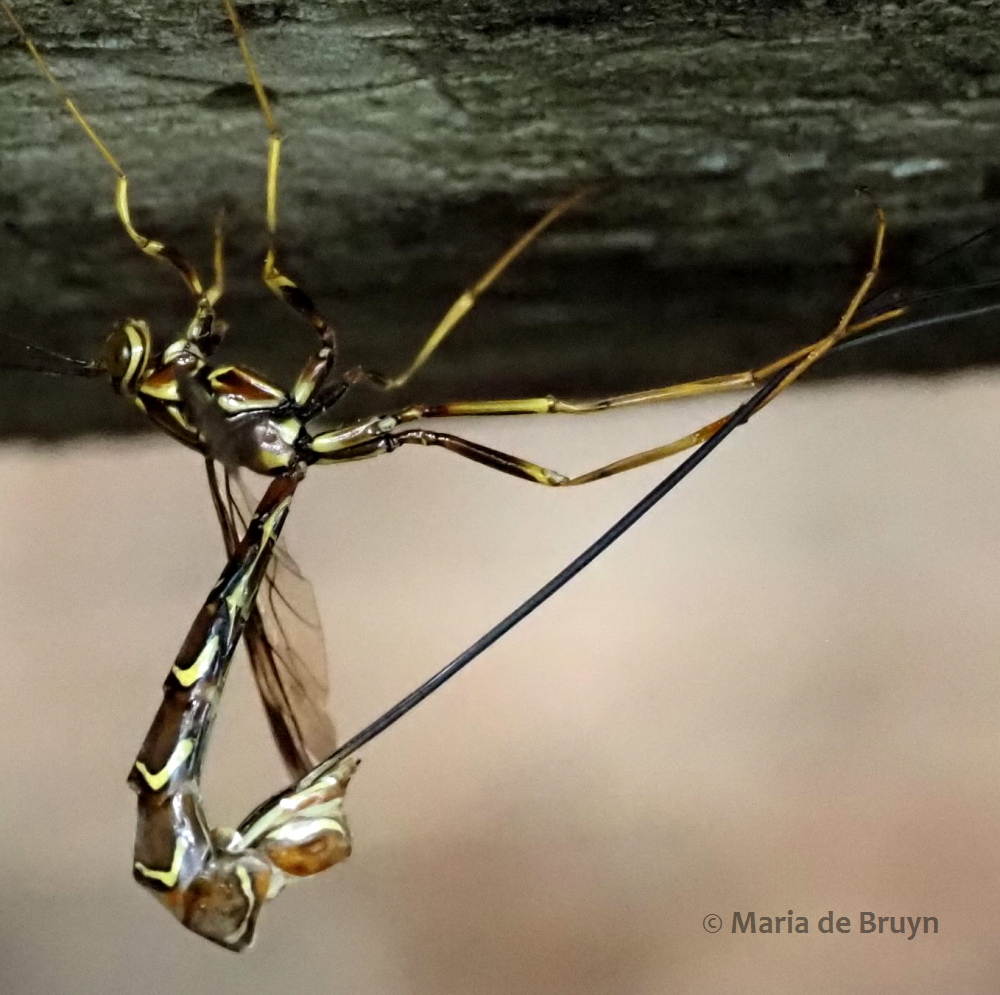
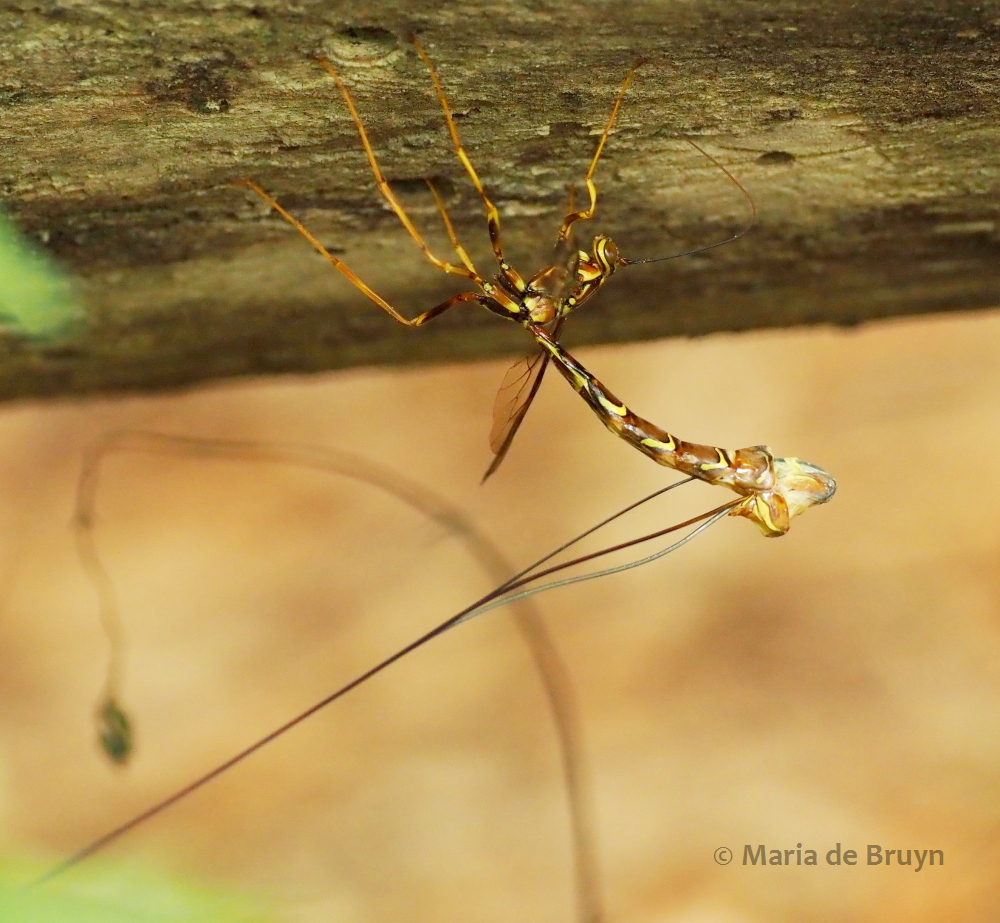
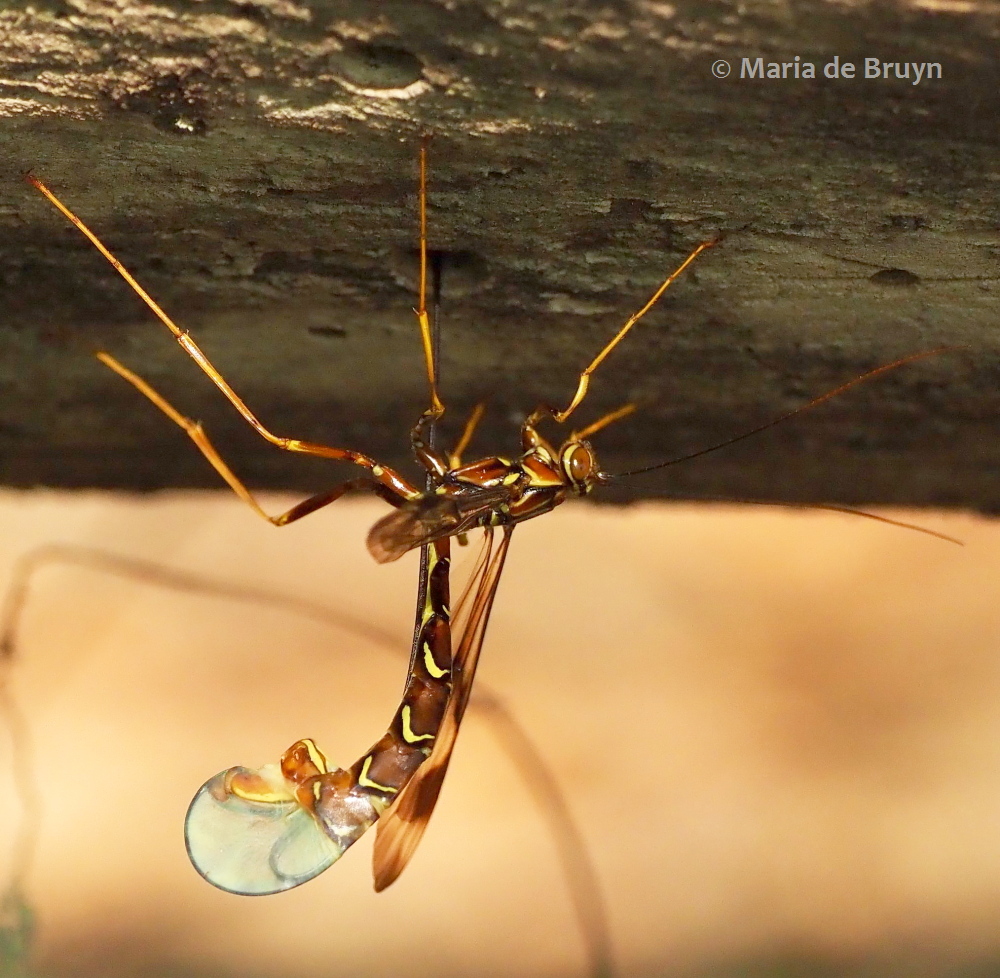
female giant ichneumon wasp P5068007 © Maria de Bruyn res (2)The month of May brought me two especially awe-inspiring events. The first was seeing long-tailed giant ichneumon wasps (Megarhyssa macrurus) preparing for reproduction on a nature trail in Chatham County. It was easy to distinguish the females (right) from the males (above) because they had very long ovipositors (a tubular organ through which a female insect lays stored eggs). In the species I saw, the ovipositor can be 4 inches long!’

female giant ichneumon wasp P5068028© Maria de Bruyn res (2)

There were several male and three female wasps flying about. None of them showed the slightest interest in the large human looming overhead. Even if they had, I needn’t have worried since these wasps don’t sting people. The females were busy pressing their antennae against a disintegrating hardwood log’s bark, aiming to detect vibrations inside.

ichneumon wasp P5068180© Maria de Bruyn res (2)

The mothers-to-be were “listening” for the best spots to lay their eggs by identifying where the larvae of the pigeon tremex horntail wasp (Tremex columba) were buried. Why you ask? The mother ichneumon paralyzes a horntail larva before laying an egg next to it. When her own offspring emerge from the eggs, they will eat those unfortunate horntail larvae while they prepare to overwinter until they emerge as full-grown ichneumon wasps in the spring.

ichneumon wasp P5068058 © Maria de Bruyn res (2)


The giant ichneumon’s ovipositor has three components. In the middle is the ovipositor proper, a filament with two interlocking parts that slide against one another; it is tipped with a cutting edge that can drill through wood. Some researchers have data indicating that the cutting edge may contain some ionized zinc or manganese.

ichneumon wasp P5068164© Maria de Bruyn res (2)

Two other thin filaments called valvulae sheath the central structure and their function is to protect the egg-laying organ. During egg-laying, they arc away from the ovipositor.

ichneumon wasp P5068171© Maria de Bruyn res (2)

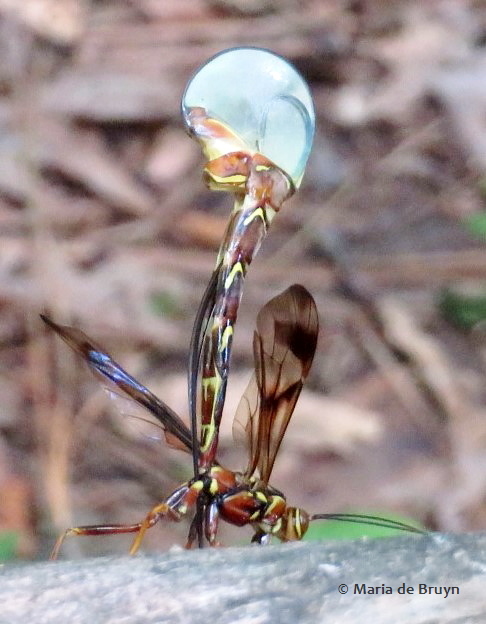
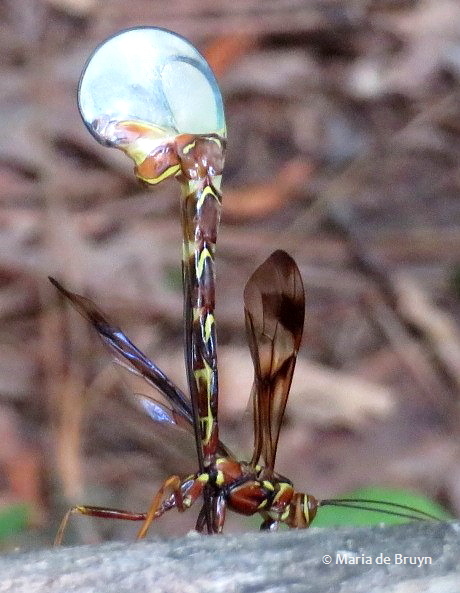
While I watched one female wasp in particular, she sometimes had part of her ovipositor coiled up in a transparent expandable pouch at the end of her abdomen.

ichneumon wasp IMG_2003© Maria de Bruyn res (2) ichneumon wasp IMG_2002 © Maria de Bruyn res (2)

She would push out the ovipositor and appeared to smooth it out with her legs. The literature I read about the wasps did not explain this movement, but I thought she might be pushing eggs down the tube. Watch the video to see what you think! 

When she finished this smoothing movement and had found the right spots for her offspring, the protective lining filaments separated from the ovipositor itself and she inserted it into the log. It was a fascinating process to witness.


female giant ichneumon wasp P5068170 © Maria de Bruyn res (2)

female giant ichneumon wasp P5068109 (© Maria de Bruyn res (2)

Although ichneumon wasps are parasitic, various species are beneficial insects since their larvae feed on insects that harm food crops such as boll weevils, codling moths and asparagus beetles. The adults usually only live about 27 days and may only drink during that time. Their adult goal is to find a mate and then reproduce.

ichneumon wasp P5068014 © Maria de Bruyn res (2)

Another way in which the ichneumon wasps have contributed to human society is by serving as an example for the medical community. The STING Project at the Imperial College in London is investigating options for Minimally Invasive Surgery (MIS) to diagnose and treat various medical pathologies. The research team is now developing a flexible steerable probe that was inspired by the ichneumon wasp’s ovipositor!

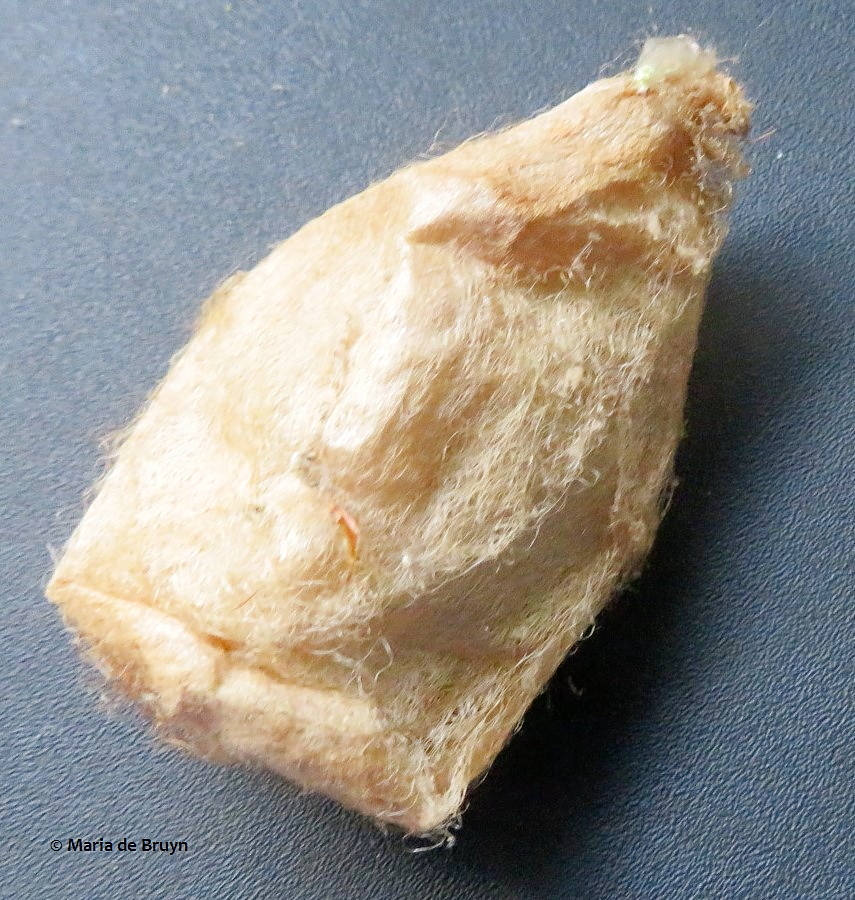
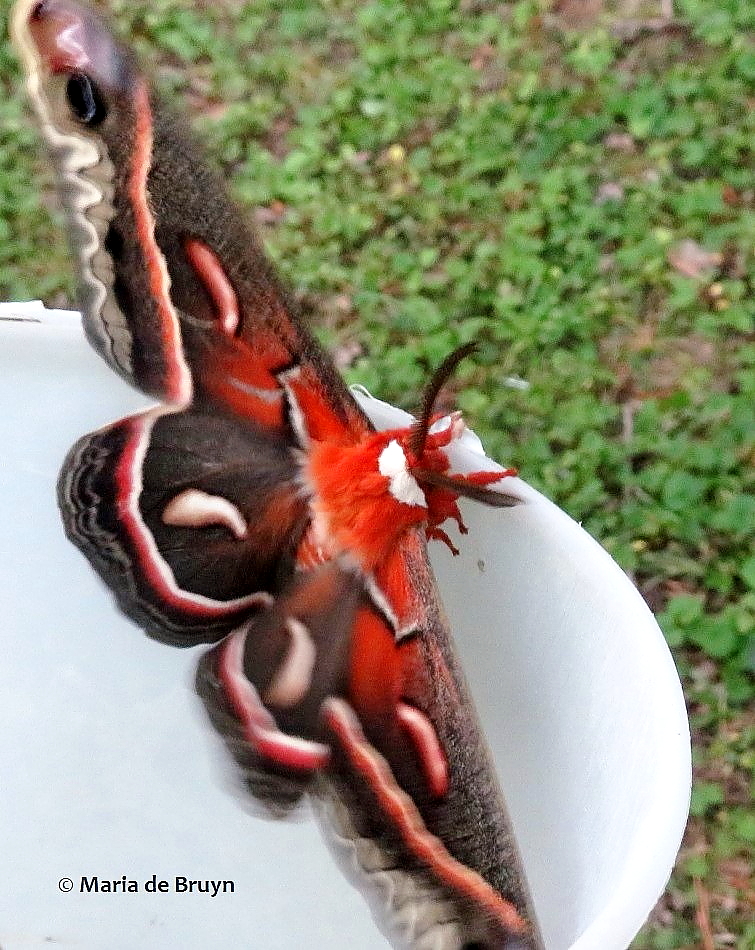
cecropia moth IMG_0019 © Maria de Bruyn (2)My other exciting insect event involved a moth. Last fall, a cecropia moth (Hyalophora cecropia) positioned its cocoon on the door jamb of the women’s restroom at Cane Creek Reservoir. The reservoir’s manager feared that it would be damaged there and asked if I would be willing to care for it over the winter. I took the cocoon home and kept it safe during the fall, winter and much of this spring.
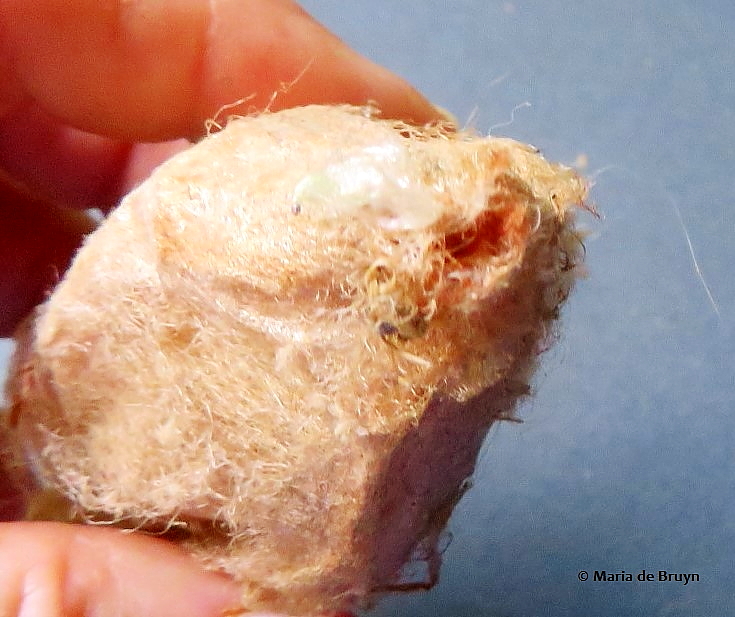
Cecropia moth larvae (caterpillars) are often found on maple, cherry and birch trees. Why this one chose a building as an overwintering site is a bit of a mystery. Since the pupa was going to be dormant all winter, I placed it upright in a large plastic container with a grate over the top and kept it on my screened-in porch.

cecropia moth IMG_0020© Maria de Bruyn (2)Periodically, I would check on it and it seemed to be ok. This was important as these moths are “univoltine” — they only have one generation of offspring per year. Out in nature, the caterpillars may fall victim to parasitic wasps and flies that lay their eggs on them. So it was fortunate that we were able to “rescue” this cocoon.
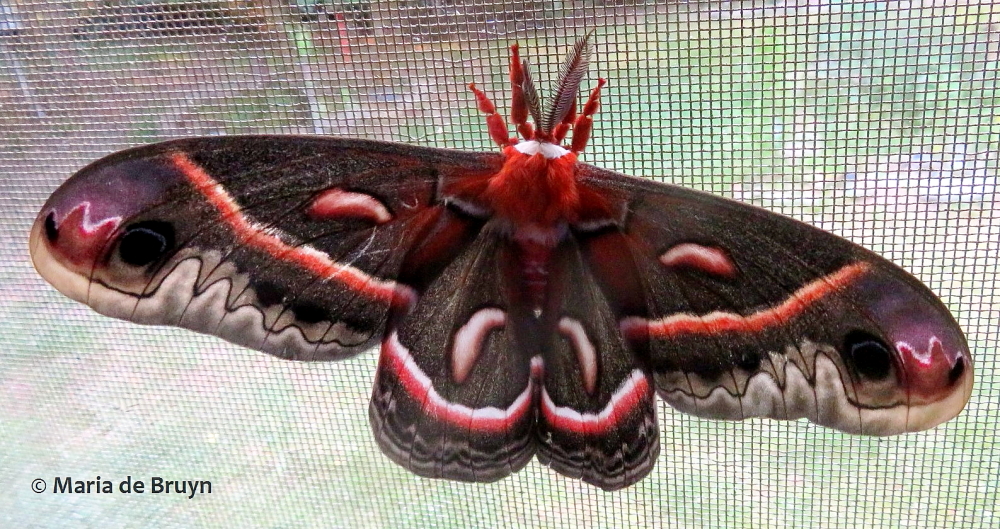
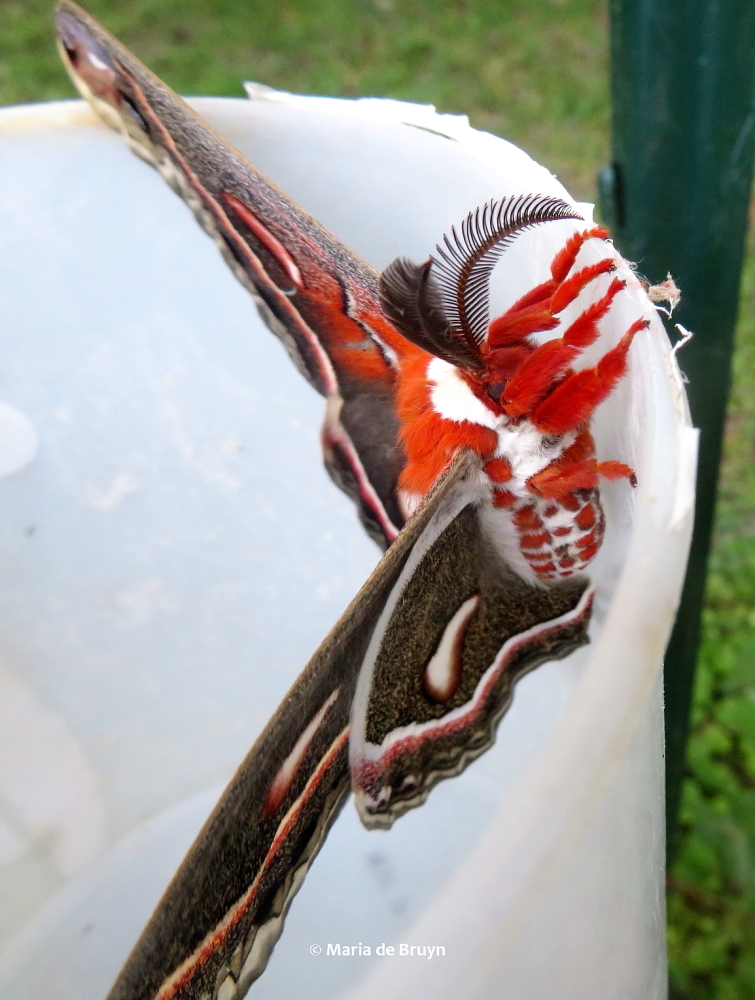
One evening at the end of May, I stopped working on my porch to go inside to watch the news. When I came back after about 20 minutes, I spotted a brilliant large moth on the screen. My youngest cat spotted it at the same time, so I shooed her inside. The cocoon scarcely had a hole in it; I really wish I’d seen how the huge moth got out.

cecropia moth IMG_0006© Maria de Bruyn (2) res

cecropia moth IMG_0003© Maria de Bruyn 2 res

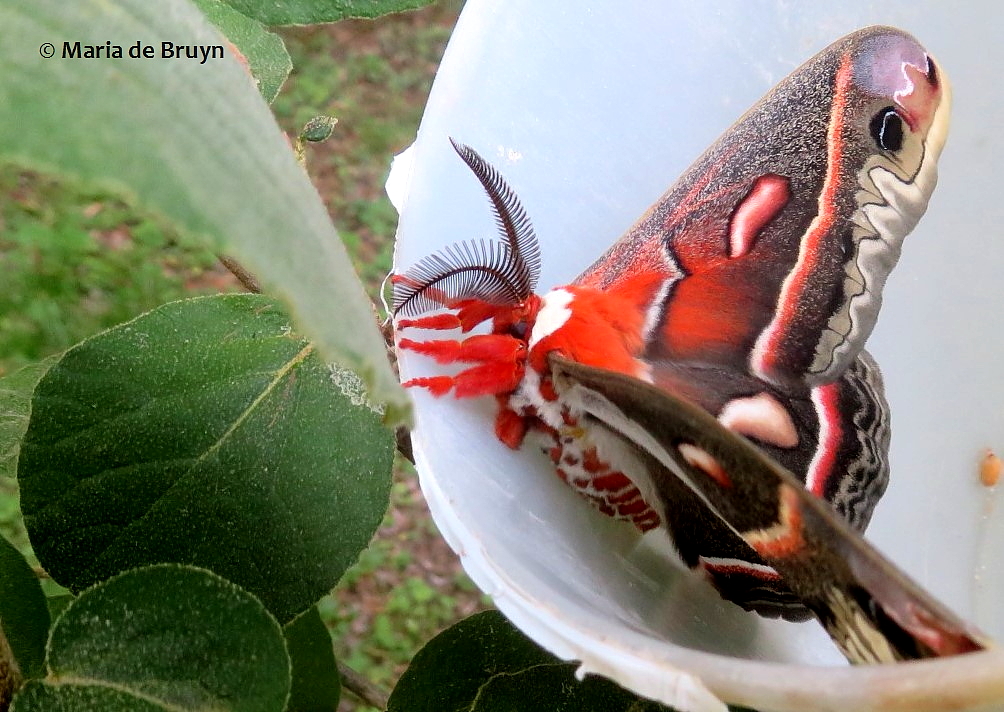
The cecropia moth is North America’s largest moth with a wingspan up to 7 inches. The males and females look similar but the males like this one have larger, more feathery antennae.

cecropia moth IMG_0012© Maria de Bruyn (2) res

Female moths emit pheromones that the males can detect from up to a mile away. After mating, the female lays up to 100 eggs. Both sexes die after about two weeks as they lack functioning mouths and digestive systems and don’t eat.

cecropia moth IMG_0014 © Maria de Bruyn (2) res


The moth’s short adult lifespan must have made this guy anxious to get underway. Or seeing my cat and I hastened his development. One website reported that it takes the moth a few hours to dry before they can open their wings and fly.

cecropia moth IMG_0011© Maria de Bruyn (2) res


However, very soon (perhaps 10 minutes) after I removed him from my porch and took him outside (never touching him with my hands), he began vibrating his wings. In less than a minute, he launched himself upwards and flew towards the top of the nearby tall pine trees, setting off on his quest for a mate.

cecropia moth IMG_0016© Maria de Bruyn (2a) res

I suppose it is possible that the moth had emerged earlier and had crawled away to hide but that seemed unlikely. In any event, he looked like he could fly just fine, and I sincerely hope that he found a mate and that they were able to collaborate in ensuring a new generation of this stunningly beautiful species! And I was grateful for having agreed to overwinter the cocoon as it enabled me to contribute to the propagation of this wonderful moth. In any event, I was enthralled to see what a gorgeous creature he was. These moths are generally nocturnal so seeing him was a treat!

cecropia moth IMG_0017 © Maria de Bruyn (2) res

, , , , , ,

The birdy breeding cycle 2020 – 1: courtship and mating

Although we in the Northern hemisphere are already a little more than a month into summer, many species among our avian friends have not yet completed their breeding cycle. In my yard, many parents are still feeding begging (sometimes almost adult) children. Others are feeding young ones in the nest and some appear to be busy constructing new nests for a second or third brood. So, after a long hiatus in blogging, I decided to feature some of my bird friends, including the American goldfinch pair below (Spinus tristis) as they have worked on their new family lives in 2020.

American goldfinch P7130178 © Maria de Bruyn resSome of these photos go back to early spring. A series of misfortunes (including a crash of my laptop hard drive, a broken camera, loss of Internet) meant that I had a backlog of photos to process and then suddenly a large gap in photos taken. But I managed to recuperate some of the work and hope you enjoy the coming series of posts about the birds’ breeding and family life!

belted kingfisher

Breeding season is heralded by increasing bird song in the meadows, forests, fields and our yards. Males especially sing to attract mates and establish territories, but females treat us to songs and calls, too. This makes it easier to spot birds as the tree foliage gets thicker, especially if you have good hearing!

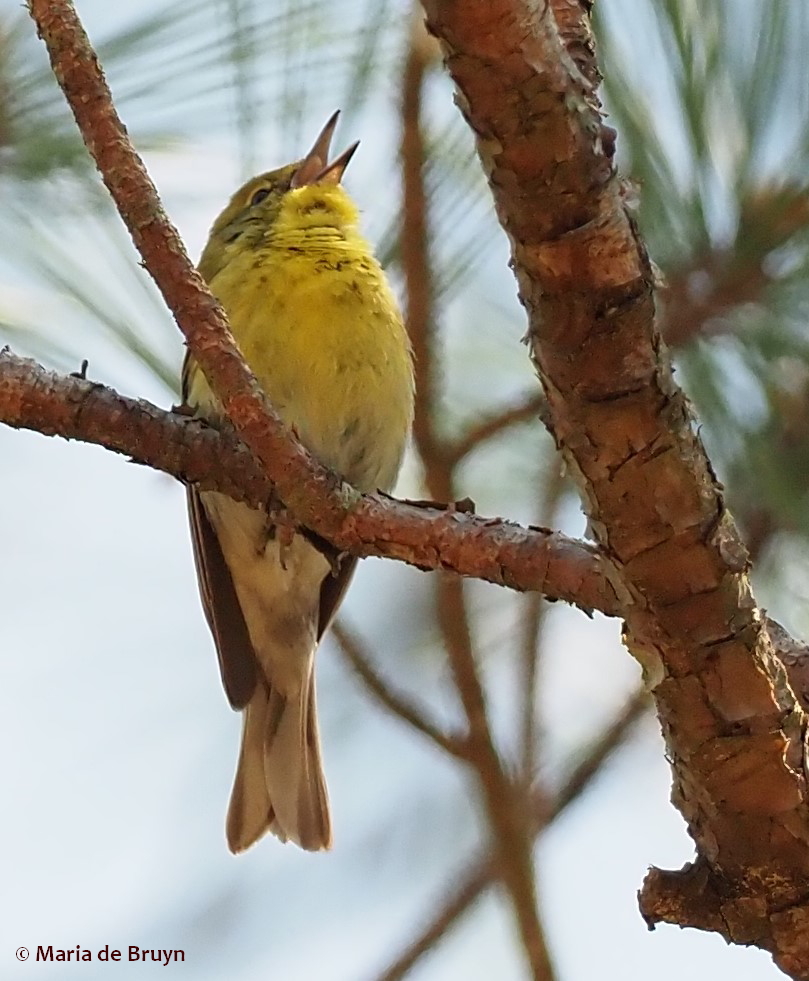
pine warbler P4175086© Maria de Bruyn                     white-eyed vireo P4123164 © Maria de Bruyn res

Pine warbler (Setophaga pinus)            White-eyed vireo (Vireo griseus)

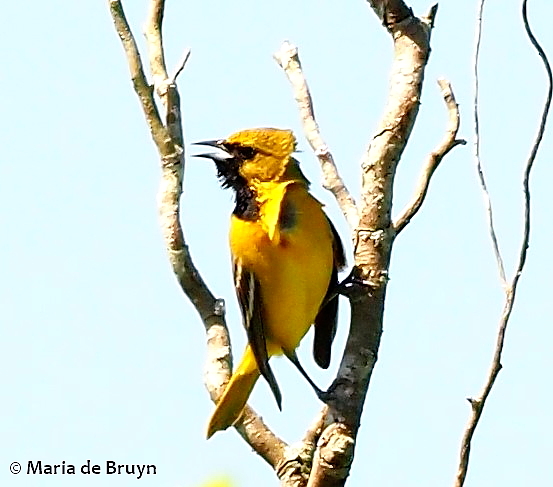
Eastern meadowlark P4279816© Maria de Bruyn res            Orchard oriole P4279889© Maria de Bruyn res

Eastern meadowlark (Sturnella magna)     Orchard oriole (Icterus spurius)

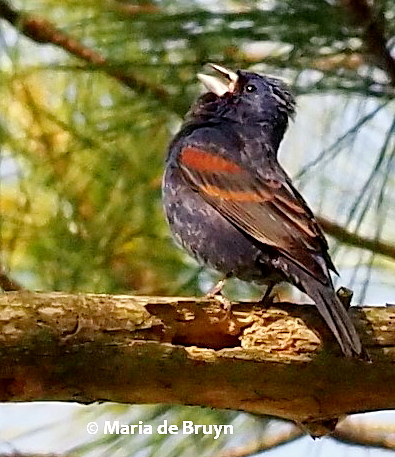
Carolina wren P3316544 © Maria de Bruyn res                 blue grosbeak P4291500© Maria de Bruyn res

Carolina wren (Thryothorus ludovicianus)      Blue grosbeak (Passerina caerulea)

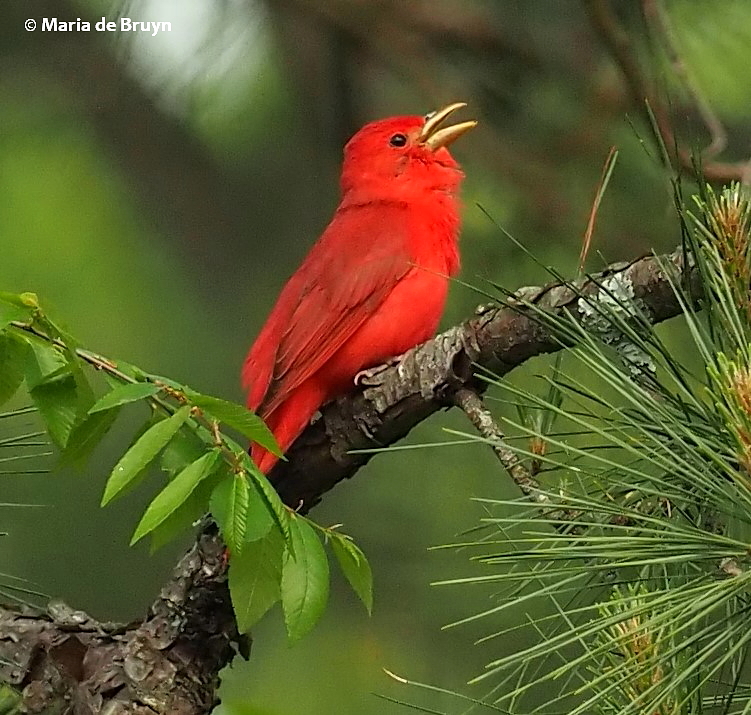
summer tanager P4291520© Maria de Bruyn res

Summer tanager (Piranga rubra)

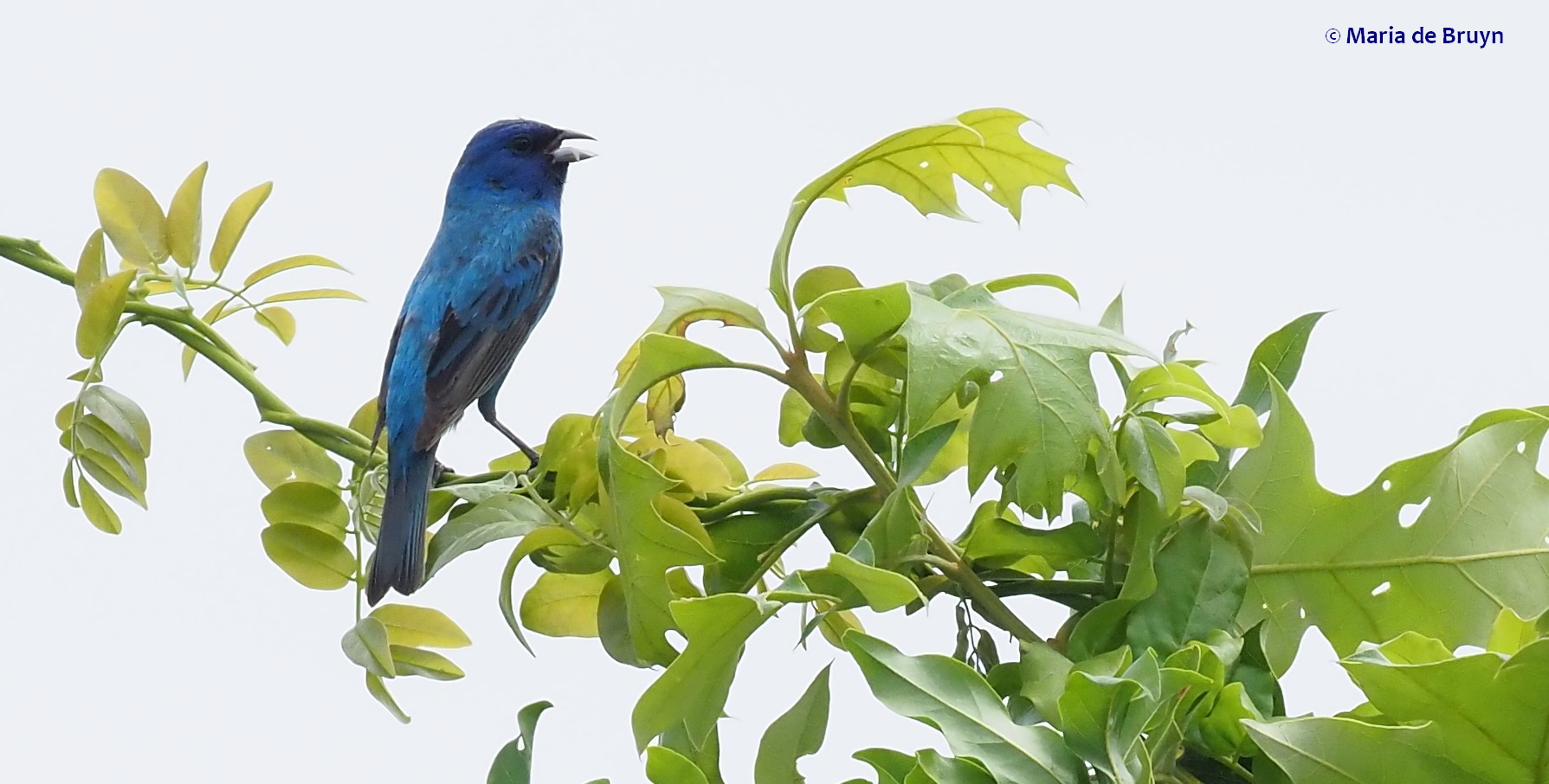
Indigo bunting P6308502© Maria de Bruyn

Indigo bunting (Passerina cyanea)

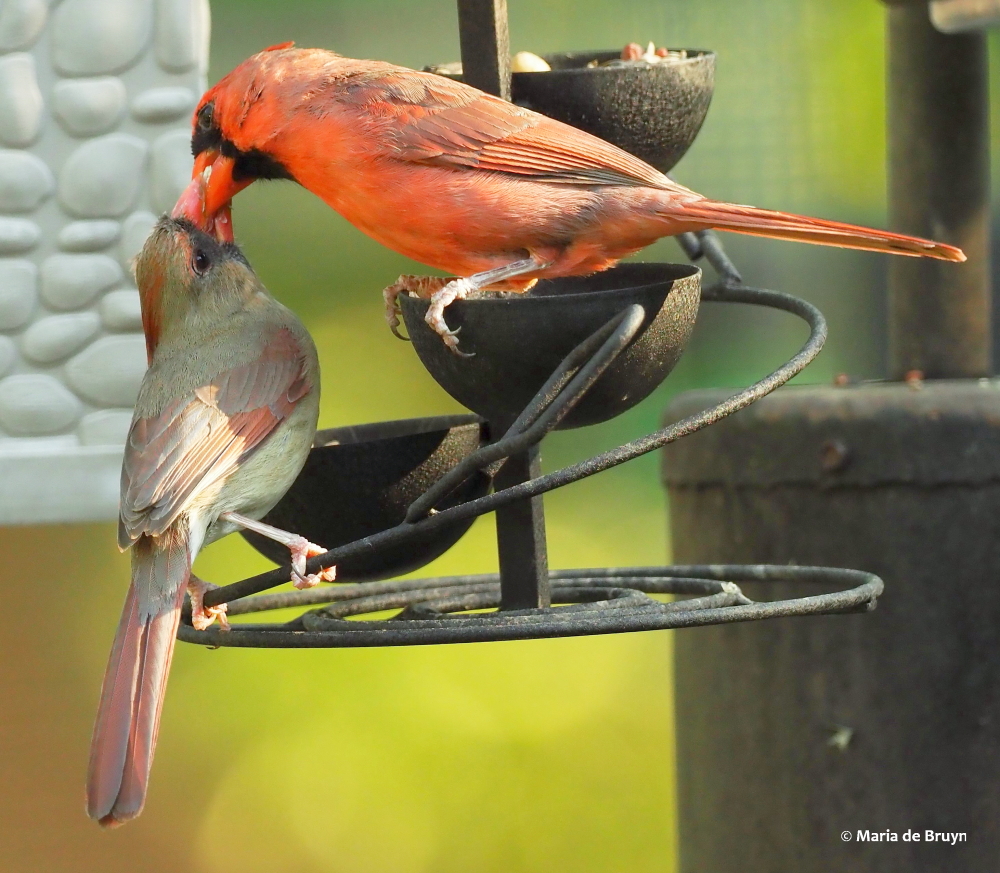
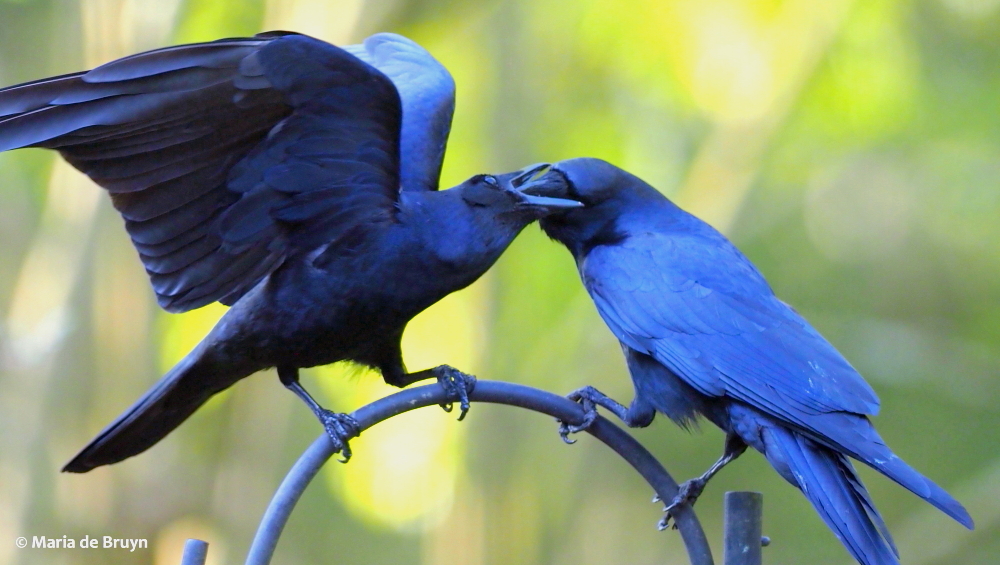
Courtship is usually a sweet behavior to watch in my view. The male Northern cardinals (Cardinalis cardinalis) are especially devoted suitors, seeking out nice morsels to present to their intended mates, while among the American crows (Corvus brachyrhynchos), it’s the females who loudly call to their mates for some tasty bites.

Northern cardinal P4164873© Maria de Bruyn res

American crow P4080661 © Maria de Bruyn res

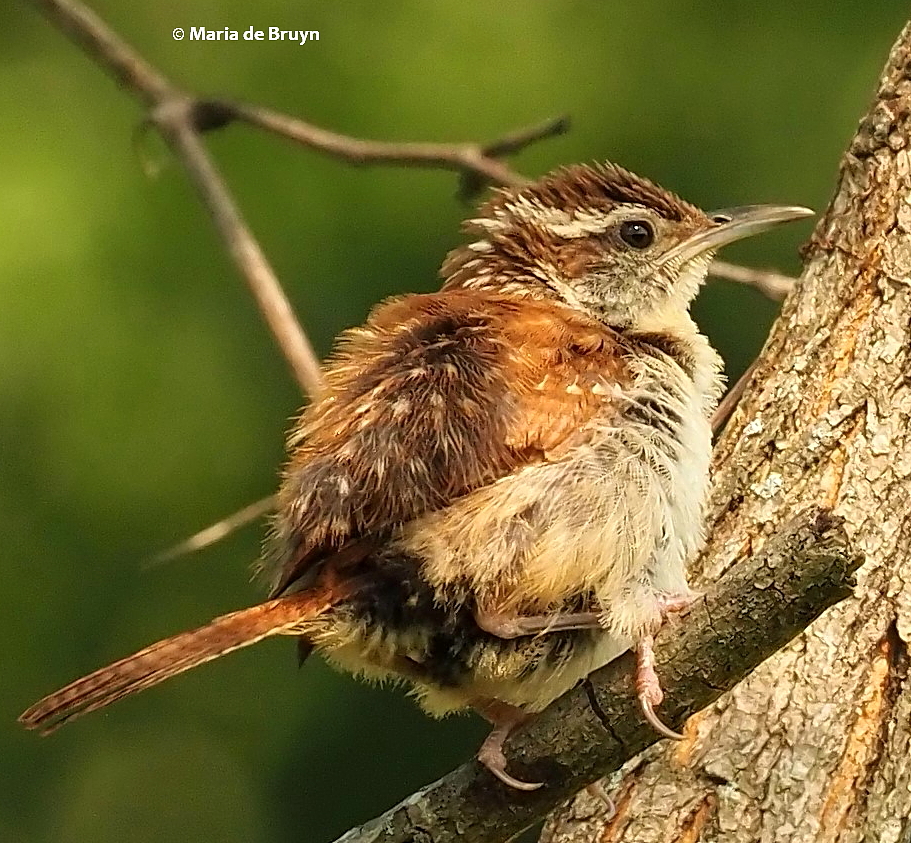
A fact that perhaps many bird lovers do not know is that few male birds have a penis. Like the female birds, most species’ males have a cloaca, a cavity externally located just under the bird’s tail and internally at the end of the digestive tract. Feces, urine, sperm and ova are all deposited in the cloaca. Birds who reproduce with this organ briefly rub their cloacae together (an activity called the “cloacal kiss”) whereby sperm from the male bird’s testes are transferred into the female’s cavity to unite with her eggs. During breeding season, the cloaca is slightly swollen and protrudes a bit from the bird’s body, facilitating the transfer. In the photo of this Carolina wren, you can see a slightly darker area under the tail indicating where the cloaca is found.

Carolina wren P7059955 © Maria de Bruyn res

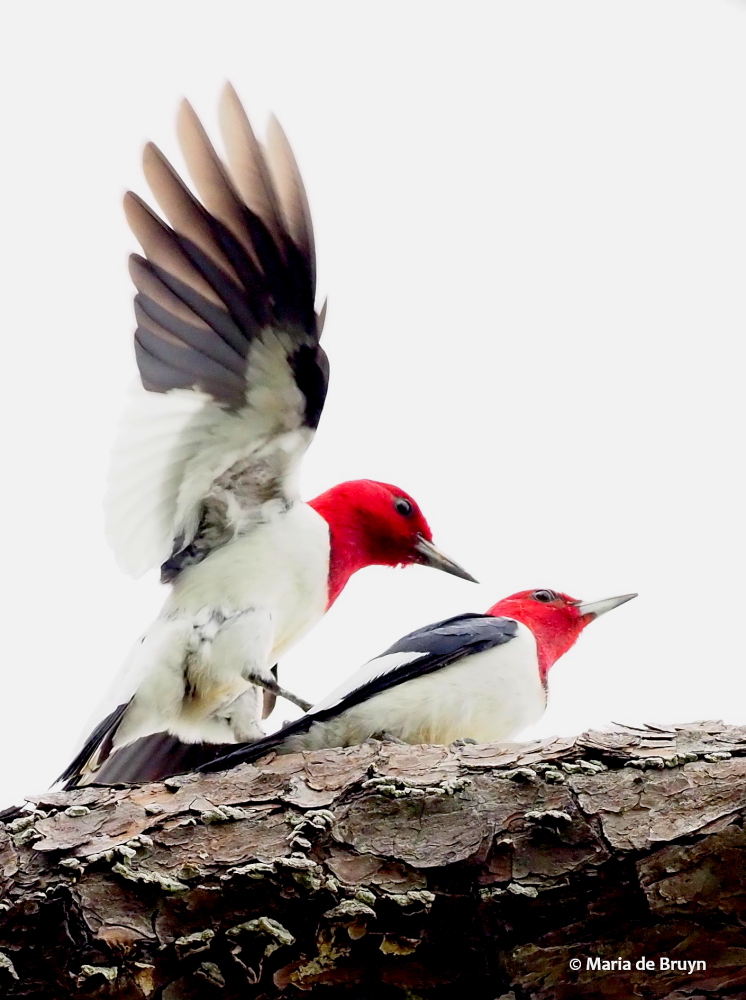
red-headed woodpecker P4217162© Maria de Bruyn res

When ready for mating, the red-headed woodpeckers (Melanerpes erythrocephalus) seem to focus mainly on chasing away rivals and then snatching a quick mating session. The female woodpecker then takes a break from the chase to rest and have a bite to eat.

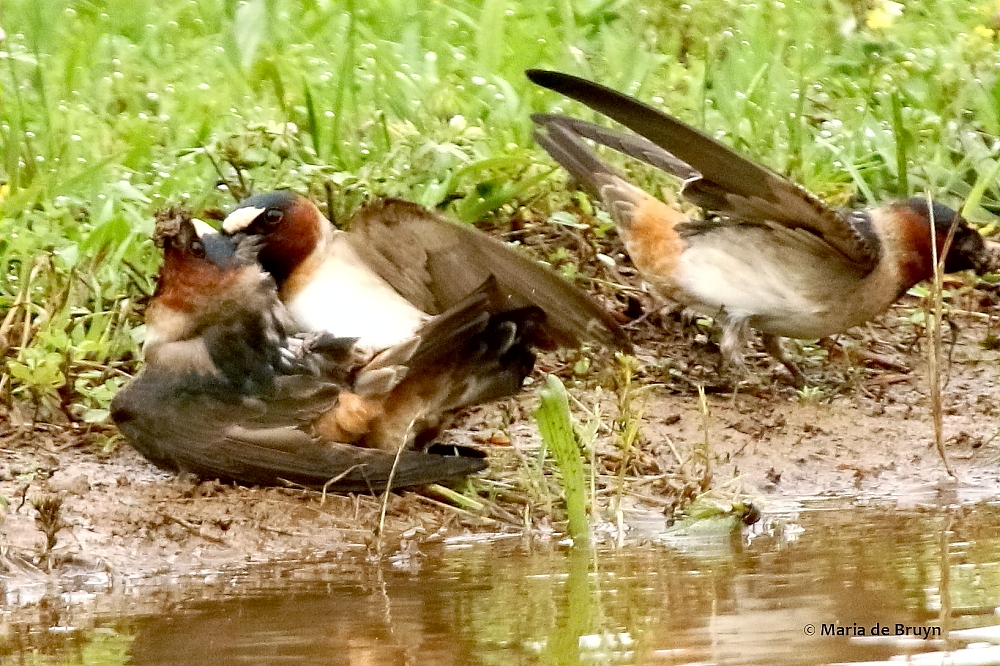
Some cliff swallow males (Petrochelidon pyrrhonota) seem to take advantage of females who are preoccupied with gathering mud for their nests for a quick tryst.

cliff swallows 2G0A3283© Maria de Bruyn res

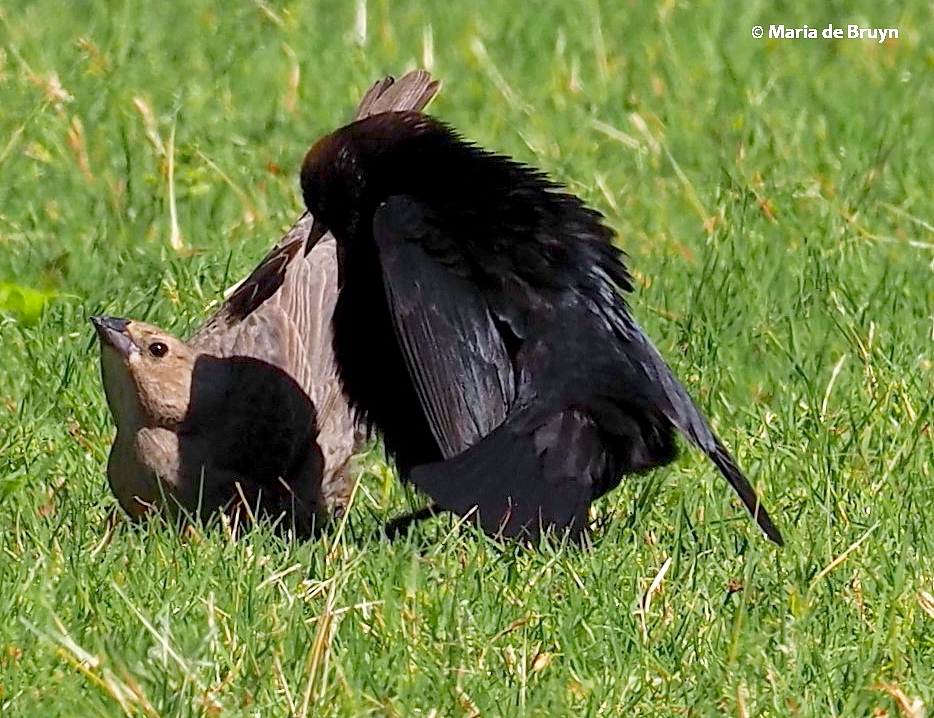
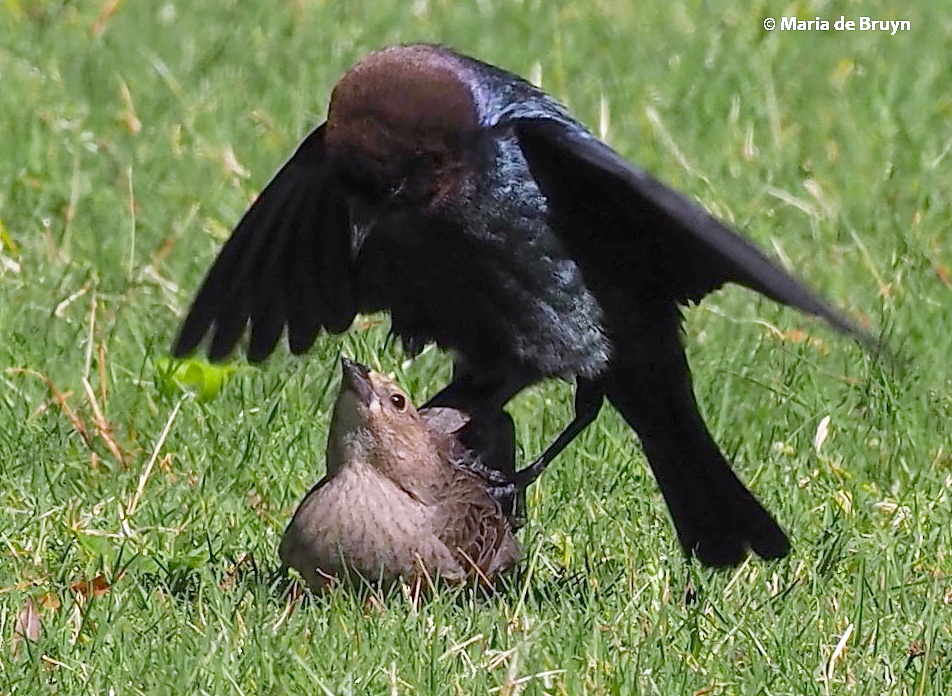
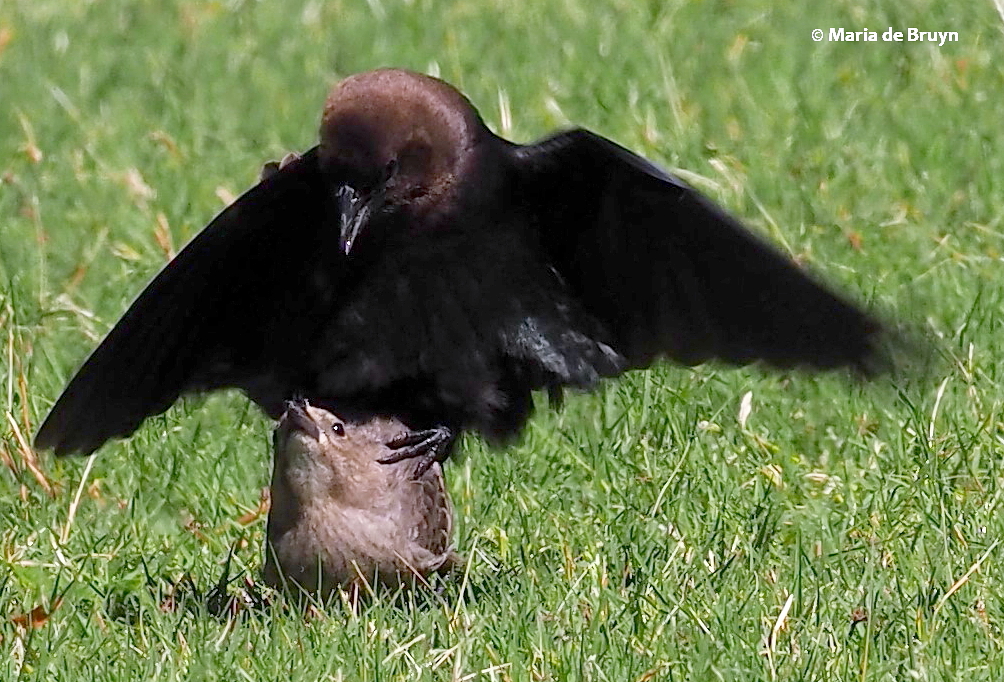
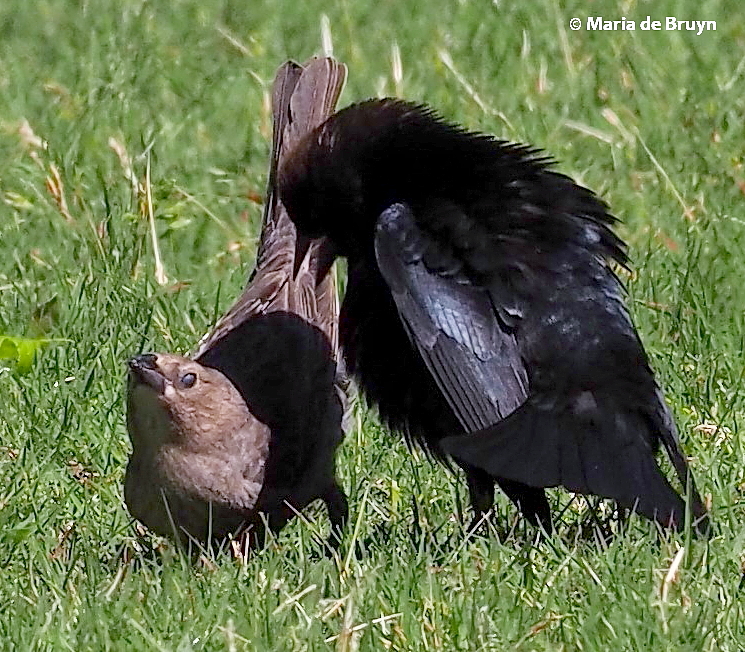
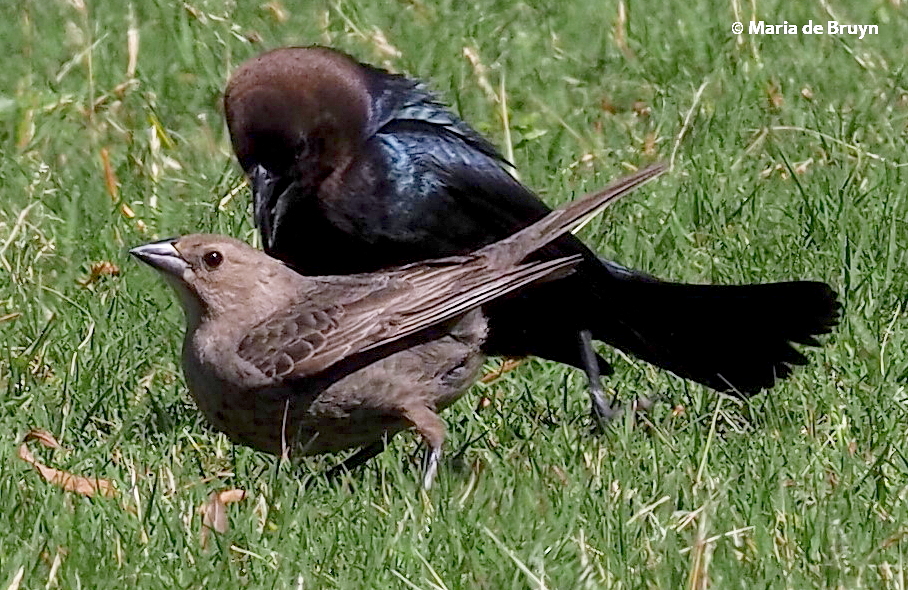
The brown-headed cowbirds (Molothrus ater) seem to take their time for mating. This pair was occupied for at least 5-10 minutes in preparing for the upcoming production of eggs. At times, it seemed like the male was giving the female instructions on what to do once “the deed” was done!

brown-headed cowbird P5097676 © Maria de Bruyn res   brown-headed cowbird P5097677 © Maria de Bruyn res

Many birders do not like the cowbirds because they are parasitic nesters, i.e., they lay an egg in another bird’s nest so that the other bird will raise the young. Since the cowbird baby usually hatches before the other eggs, they either monopolize the food that the foster parents bring or they may even destroy the eggs laid by their foster mother.

brown-headed cowbird P5097682 © Maria de Bruyn res      brown-headed cowbird P5097686© Maria de Bruyn res

It’s been posited that the cowbirds evolved to use this strategy because they followed the bison in migration and therefore couldn’t stay in one place to raise their young. Others believe, however, that the birds developed the practice because dispersing their eggs over several nests gave their young a better chance of reaching adulthood.

brown-headed cowbird P5097689© Maria de Bruyn res

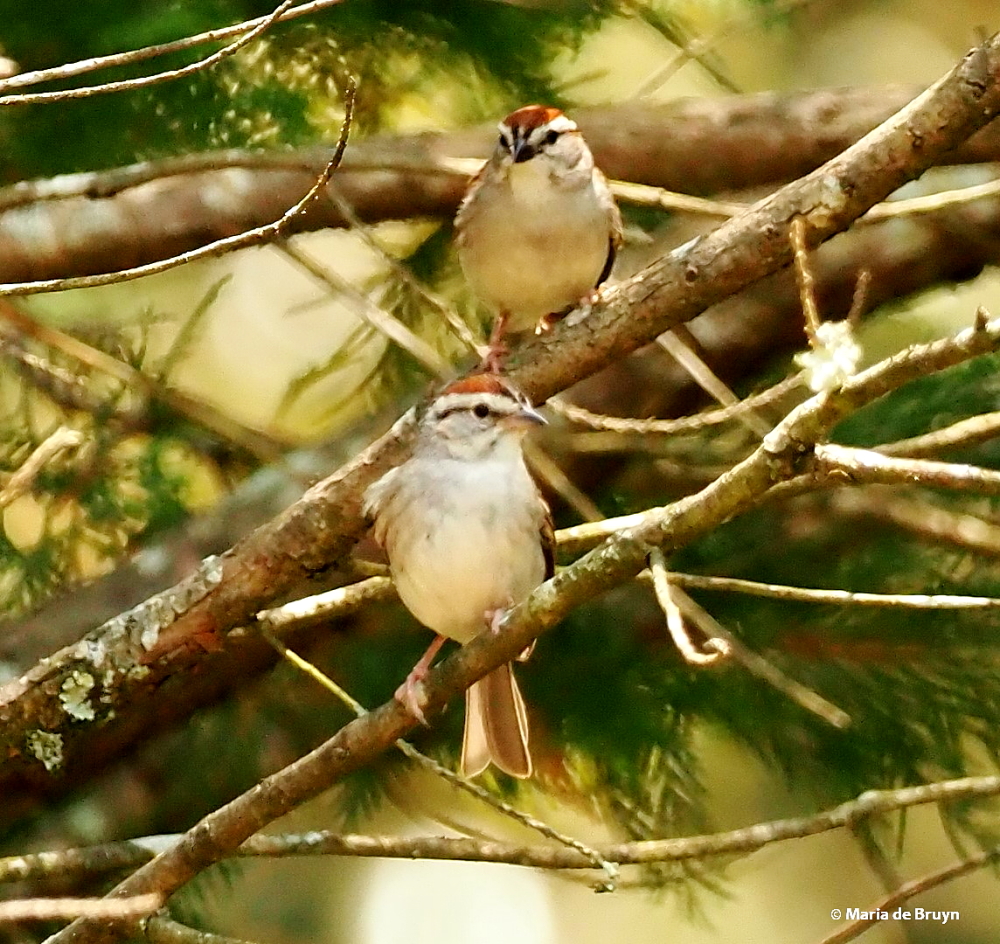
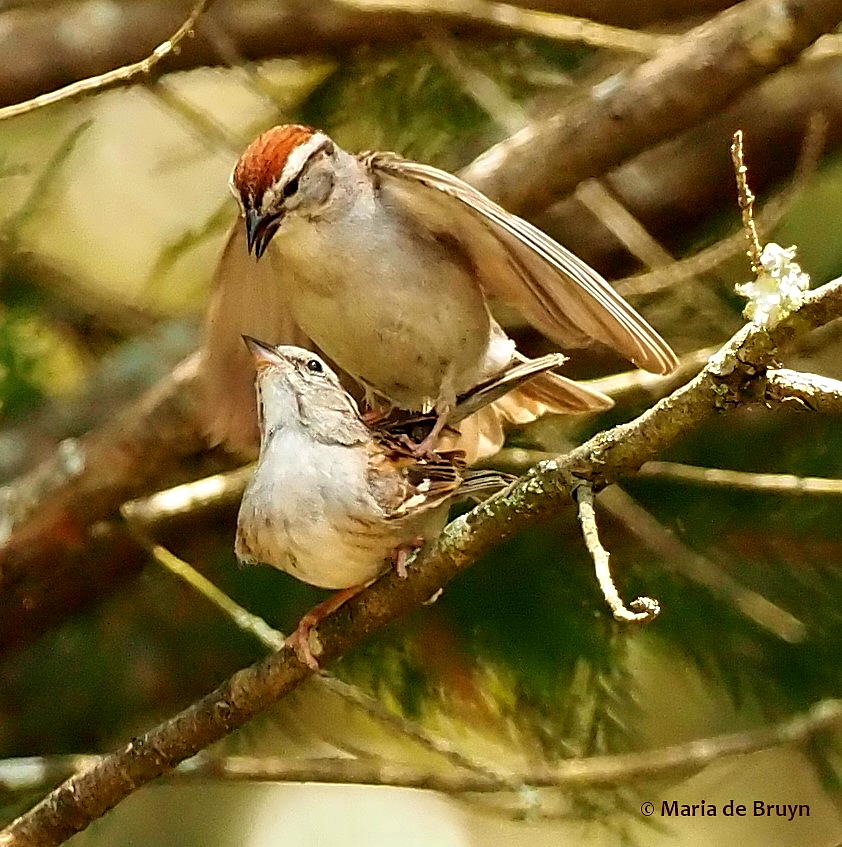
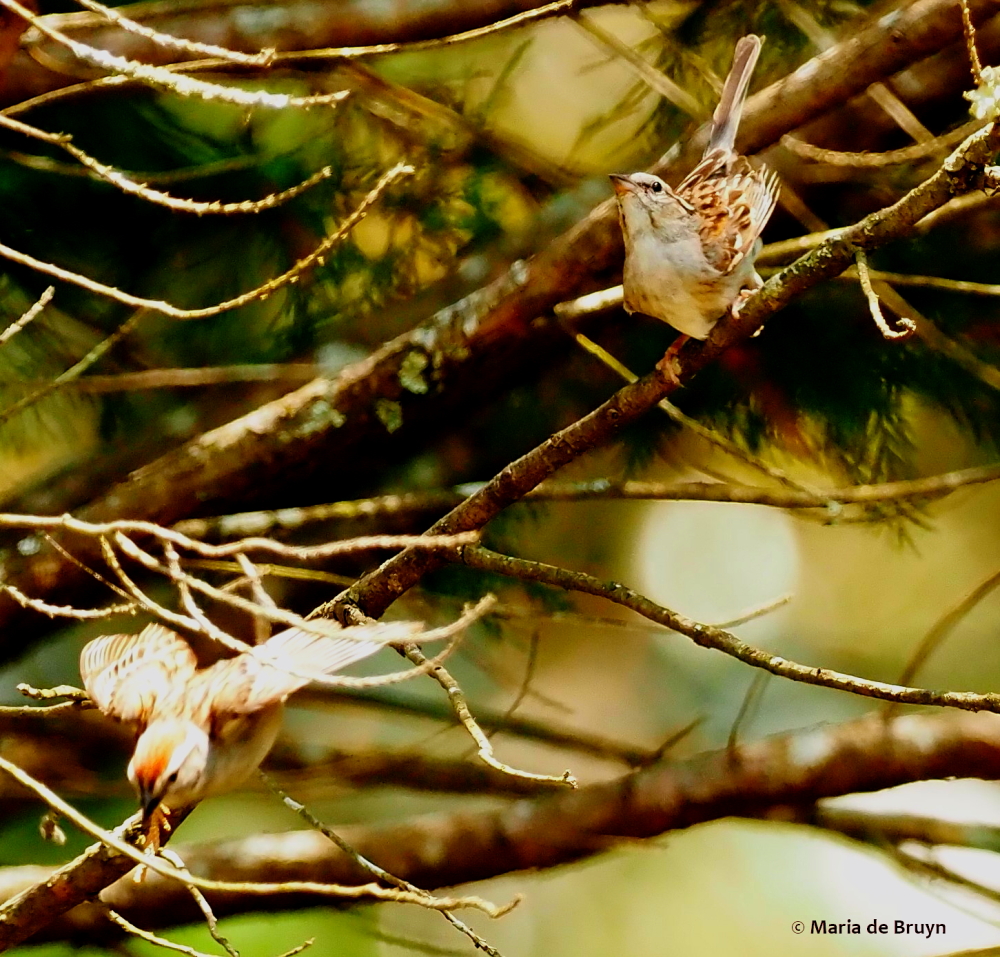
chipping sparrow P6256620© Maria de Bruyn sgd resThe quickest mating scenario I’ve witnessed came from a pair of sweet little chipping sparrows (Spizella passerina). I’d seen the two fluttering together at the feeders and had noted one sparrow chasing another away – which I now think was the victorious suitor driving away a rival. Then one July afternoon, the two flew to a dying cedar and sat close to one another on a branch. Suddenly, Mr. Victory mounted his mate but for what only seemed a few seconds – really very quick work indeed! She sat there with her rear end elevated for a bit and then the two went back to feeding – and soon after I saw them collecting nesting materials.
chipping sparrow P6256622© Maria de Bruyn res    chipping sparrow P6256623© Maria de Bruyn res

The birds in which the males do have a penis include some duck and swan species, ostriches, cassowaries, kiwi and geese. They differ from other birds in that development of the penis is NOT stopped in the male bird embryos during development (the case in cloacal birds).

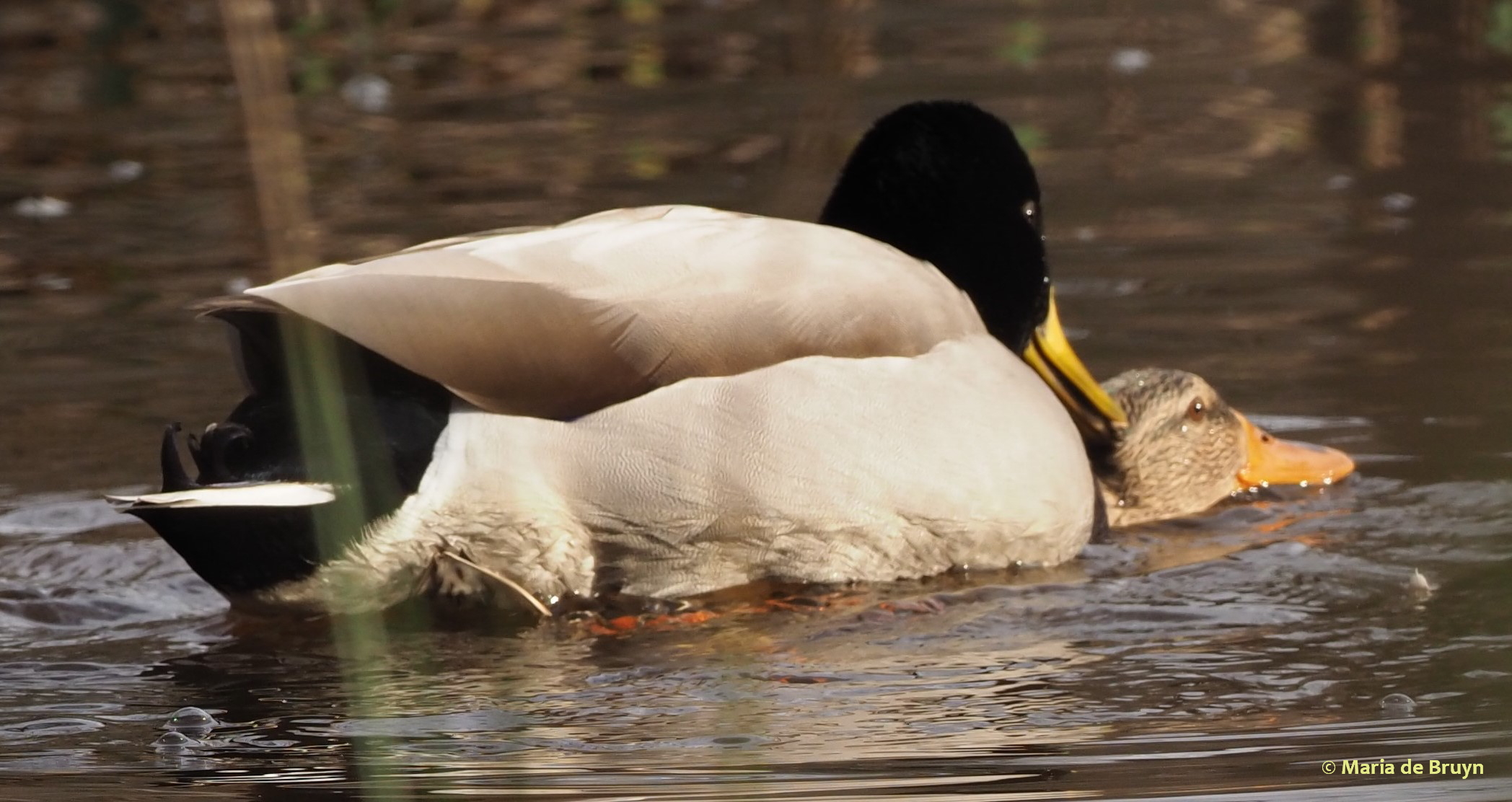
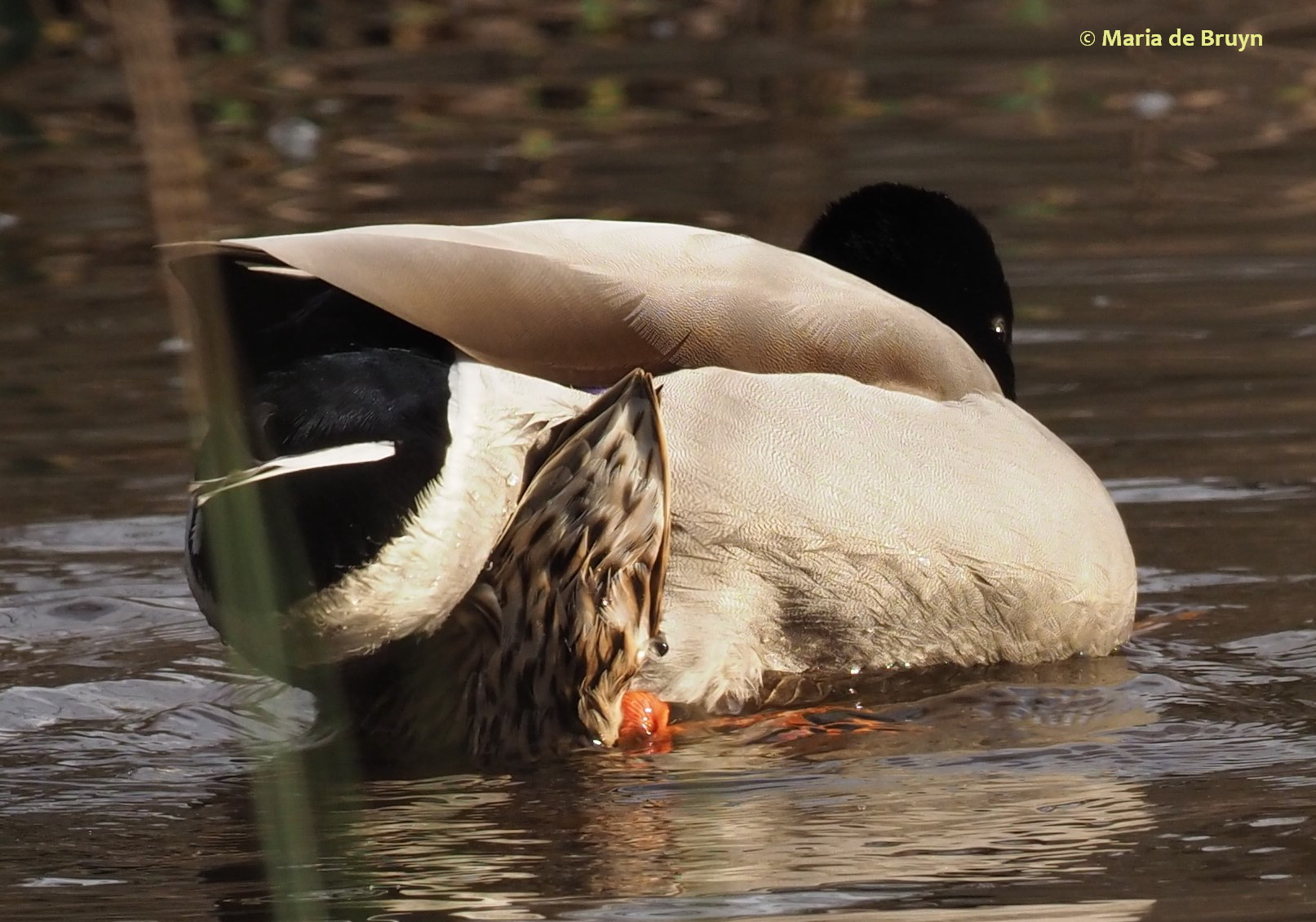
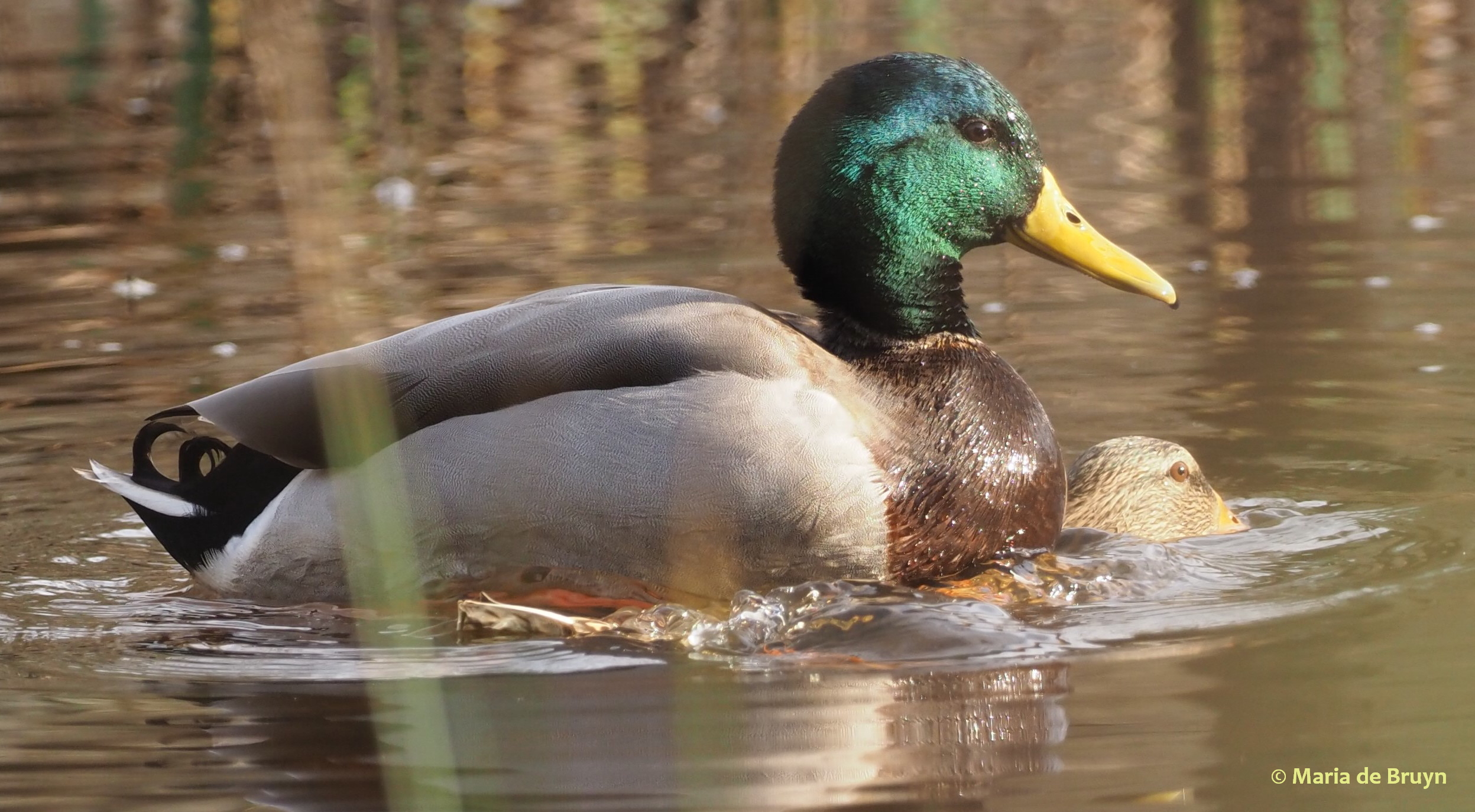
The mallard males (Anas platyrhynchos), like some other ducks, unfortunately do not treat their partners well. They may mount the female very roughly. During a mating, she may be dunked underwater repeatedly and at length; occasionally, this results in her drowning. This behavior has been the subject of various studies and some newspaper articles with sensationalistic headlines (e.g., “The horrible thing you never knew about ducks)”.

Mallard duck P1232837 © Maria de Bruyn

Mallard duck P1232839 © Maria de Bruyn     Mallard duck P1232840© Maria de Bruyn

Once the actual mating is over, the birds devote most of their energy toward building a nest. While female ruby-throated hummingbirds (Archilochus colubris) must construct her nest and tend her babies alone, many other birds cooperate in the venture, like the Eastern bluebirds. Their efforts are featured in the next blog. (And if you’d like to see a previous post on courtship, it is here.)

ruby-throated hummingbird 2G0A4084© Maria de Bruyn res

Hopping into springtime

I’ve been planning new blogs for quite some time; then I keep taking new photos that will fit into them and the blog writing gets delayed. But two days ago, I saw such a cool natural event that I resolved to produce a blog quickly and here it is!

One welcome feature of springtime is that many insects emerge from their over-wintering spots. Some are bugs we dislike (mosquitoes, ticks and chiggers), but others are fascinating and wonderful members of our natural systems. Pollinators like this spicebush swallowtail (Papilio troilus) keep our gorgeous plants and important food crops going and many bugs provide other wildlife with meals.

On my trip to Costa Rica last year, our guide not only pointed out birds but also some mammals and insects. He had developed an interest in treehoppers, a group of insects with about 3200 species worldwide that specialize in eating plant sap. He was unable to find any to show me, but I resolved to keep an eye open for them when I returned home. I had forgotten that I had seen my first one the year before, a pretty green Ceresini species.

As I stared at plants during nature walks, I was lucky and managed to find my first treehoppers when I was actually looking for them. These were of a dark-colored species (Acutalis tartarea) that favors the sap of black locust trees, sunflowers, goldenrod and ragweeds.

The treehoppers, which are related to leafhoppers and cicadas, are popular with some entomologists because many species have elaborate “helmets” at the top of their heads. I got to see my first example of this type on my recent walk when I happened to find a young oak tree with numerous nymphs and recently eclosed (emerged) adult oak treehoppers (Platycostis vittata).

The mother treehopper is known for staying close to the nymphs to protect them against wasps and other predators.

The hoppers get plant sap by piercing plant stems with their beaks. The nymphs have extensible anal ducts that deposit the sap away from their bodies. This is important because the concentrated excess sap, called honeydew, can get moldy.


The honeydew attracts ants, which like the sugar-rich liquid, so the hoppers and ants have a mutually beneficial relationship.

Just how the helmet develops into an unusual shape has been a source of investigation. One team of entomologists theorized that the helmet was formed by body parts that were actually modified wings. Another researcher countered that this was impossible and that the helmet was an unusual pronotum — the foremost dorsal section of the thorax. More recently, a third group of evolutionary biologists postulated that the helmet is indeed a section of pronotum but one that developed with the aid of genes that code for wings.

In various species, the pronotum has developed into a quite unusual and oddly shaped appendage; examples can be seen in this article. When the helmet resembles a plant thorn, it is thought to aid in camouflage.

When I discovered the group of oak treehoppers, one was just in the process of emerging from its nymph form. A friend who saw the photo remarked that it reminded her of the film Alien but this process was slow and deliberate and not a heart-thumping explosive emergence as shown in the movie.

As you can see, the oak treehopper is quite a beautiful insect with its pristine white body decorated with pink/red stripes and hints of yellow. They made me think of mints and Candy Stripers (a sign of our times when almost anything makes me think of health and health-related concerns. For younger readers: young female volunteers who work under nurses’ supervision in hospitals used to wear pink and white striped smocks and thus got the name Candy Striper).

Not all the adults had the horned pronotum; some had rounded heads.

This close-up of a hopper’s face could evoke all kinds of thoughts. I thought it looked as if it had a pig’s snout. Another friend thought it looked like a grumpy old man. What do you think when you see this visage?

Or about this one, with its head upside down? (It looks a bit more “innocent”, don’t you think?)

In any event, I found these insects just adorable and I felt very privileged to have had the chance to see them emerge into adulthood. It turns out that in this species, older individuals may change color, turning a dull brown or green color. Some mottled forms may be blue with yellowish spots. It would be interesting to see those forms as well one day – or perhaps one of the other treehoppers with a different fabulous helmet!I hope you, too, are able to get out in nature during these social distancing times so that you can connect with the wonderful wildlife around us!