The birdy breeding cycle 2020 – 1: courtship and mating

Although we in the Northern hemisphere are already a little more than a month into summer, many species among our avian friends have not yet completed their breeding cycle. In my yard, many parents are still feeding begging (sometimes almost adult) children. Others are feeding young ones in the nest and some appear to be busy constructing new nests for a second or third brood. So, after a long hiatus in blogging, I decided to feature some of my bird friends, including the American goldfinch pair below (Spinus tristis) as they have worked on their new family lives in 2020.

American goldfinch P7130178 © Maria de Bruyn resSome of these photos go back to early spring. A series of misfortunes (including a crash of my laptop hard drive, a broken camera, loss of Internet) meant that I had a backlog of photos to process and then suddenly a large gap in photos taken. But I managed to recuperate some of the work and hope you enjoy the coming series of posts about the birds’ breeding and family life!
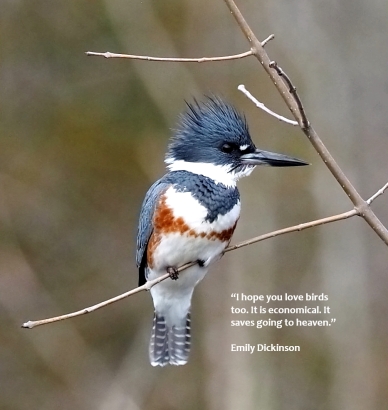
belted kingfisher

Breeding season is heralded by increasing bird song in the meadows, forests, fields and our yards. Males especially sing to attract mates and establish territories, but females treat us to songs and calls, too. This makes it easier to spot birds as the tree foliage gets thicker, especially if you have good hearing!
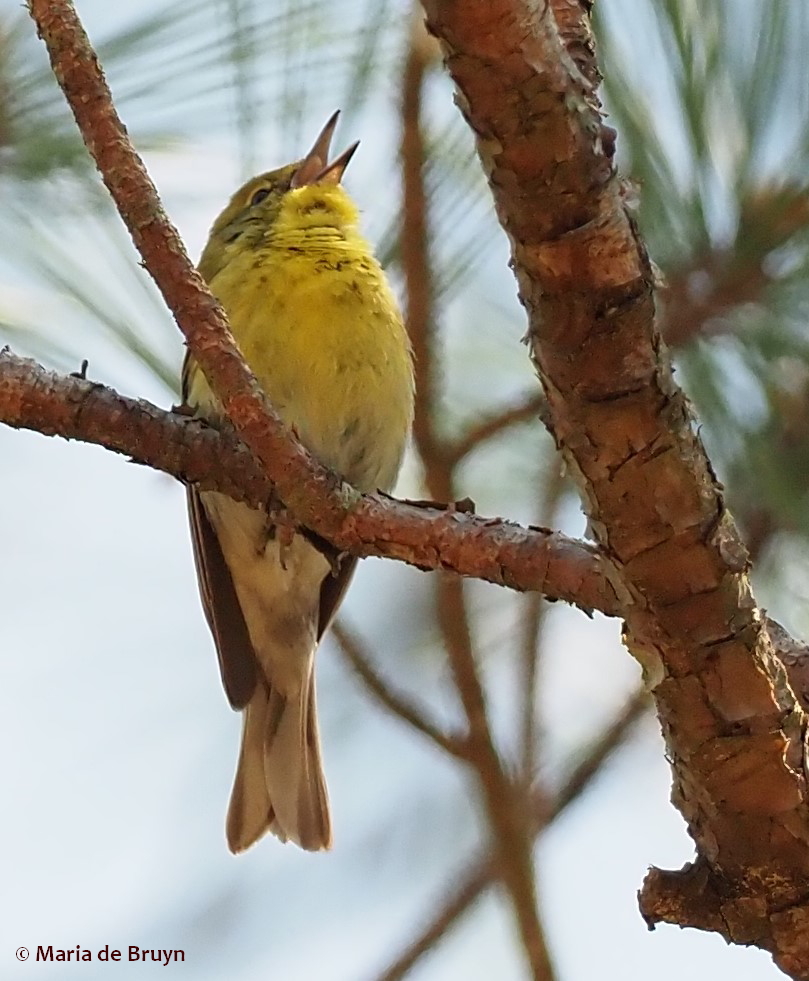
pine warbler P4175086© Maria de Bruyn                     white-eyed vireo P4123164 © Maria de Bruyn res

Pine warbler (Setophaga pinus)            White-eyed vireo (Vireo griseus)

Eastern meadowlark P4279816© Maria de Bruyn res            Orchard oriole P4279889© Maria de Bruyn res

Eastern meadowlark (Sturnella magna)     Orchard oriole (Icterus spurius)

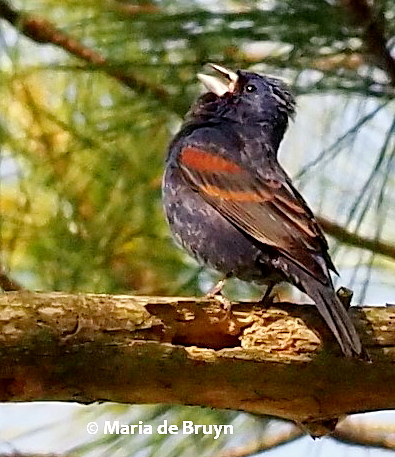
Carolina wren P3316544 © Maria de Bruyn res                 blue grosbeak P4291500© Maria de Bruyn res

Carolina wren (Thryothorus ludovicianus)      Blue grosbeak (Passerina caerulea)

summer tanager P4291520© Maria de Bruyn res

Summer tanager (Piranga rubra)

Indigo bunting P6308502© Maria de Bruyn

Indigo bunting (Passerina cyanea)

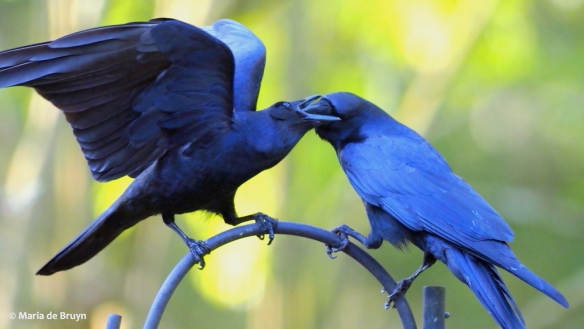
Courtship is usually a sweet behavior to watch in my view. The male Northern cardinals (Cardinalis cardinalis) are especially devoted suitors, seeking out nice morsels to present to their intended mates, while among the American crows (Corvus brachyrhynchos), it’s the females who loudly call to their mates for some tasty bites.

Northern cardinal P4164873© Maria de Bruyn res

American crow P4080661 © Maria de Bruyn res

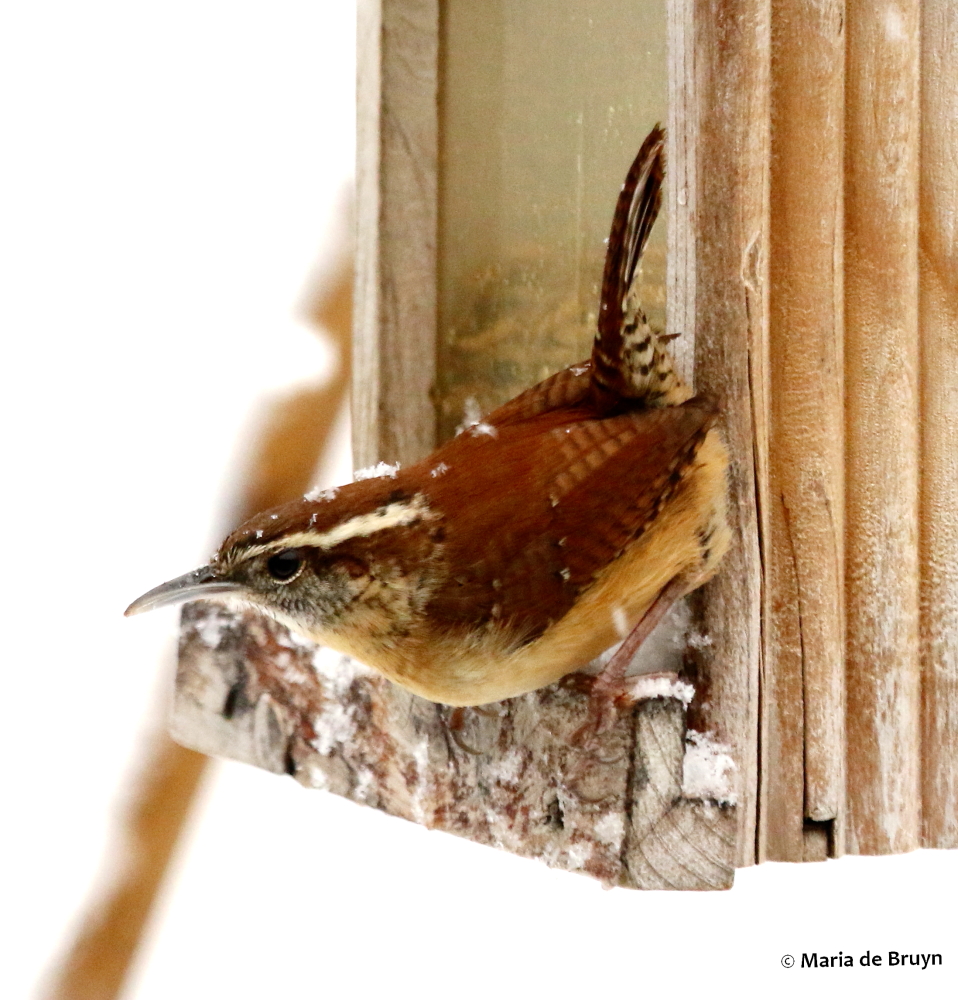
A fact that perhaps many bird lovers do not know is that few male birds have a penis. Like the female birds, most species’ males have a cloaca, a cavity externally located just under the bird’s tail and internally at the end of the digestive tract. Feces, urine, sperm and ova are all deposited in the cloaca. Birds who reproduce with this organ briefly rub their cloacae together (an activity called the “cloacal kiss”) whereby sperm from the male bird’s testes are transferred into the female’s cavity to unite with her eggs. During breeding season, the cloaca is slightly swollen and protrudes a bit from the bird’s body, facilitating the transfer. In the photo of this Carolina wren, you can see a slightly darker area under the tail indicating where the cloaca is found.

Carolina wren P7059955 © Maria de Bruyn res

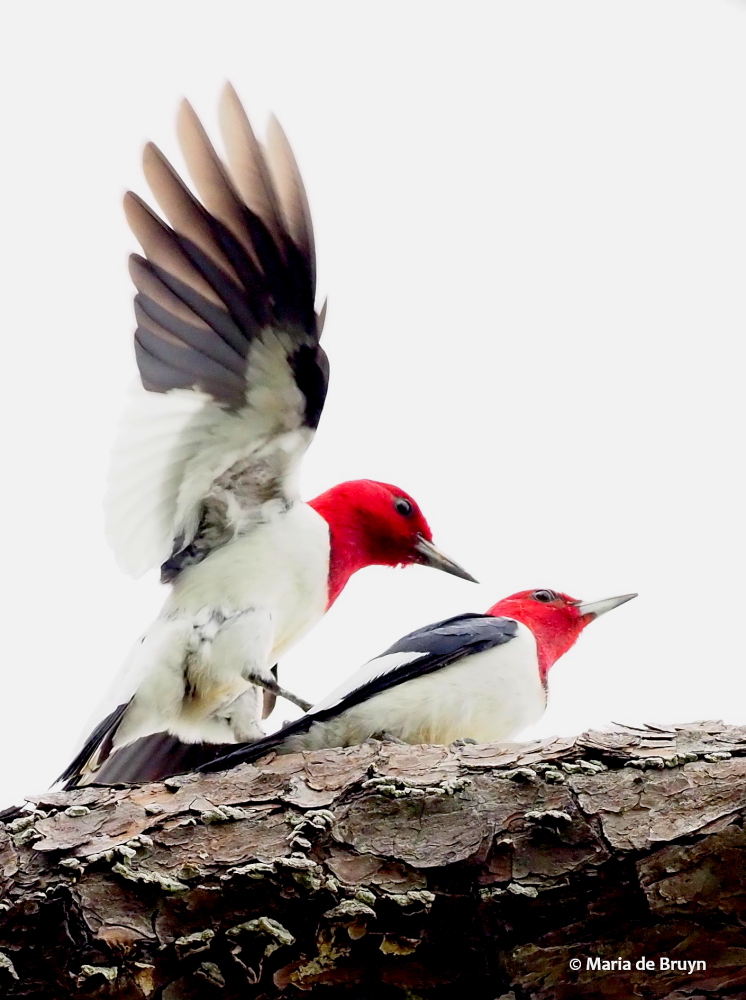
red-headed woodpecker P4217162© Maria de Bruyn res

When ready for mating, the red-headed woodpeckers (Melanerpes erythrocephalus) seem to focus mainly on chasing away rivals and then snatching a quick mating session. The female woodpecker then takes a break from the chase to rest and have a bite to eat.

Some cliff swallow males (Petrochelidon pyrrhonota) seem to take advantage of females who are preoccupied with gathering mud for their nests for a quick tryst.

cliff swallows 2G0A3283© Maria de Bruyn res

The brown-headed cowbirds (Molothrus ater) seem to take their time for mating. This pair was occupied for at least 5-10 minutes in preparing for the upcoming production of eggs. At times, it seemed like the male was giving the female instructions on what to do once “the deed” was done!

brown-headed cowbird P5097676 © Maria de Bruyn res   brown-headed cowbird P5097677 © Maria de Bruyn res

Many birders do not like the cowbirds because they are parasitic nesters, i.e., they lay an egg in another bird’s nest so that the other bird will raise the young. Since the cowbird baby usually hatches before the other eggs, they either monopolize the food that the foster parents bring or they may even destroy the eggs laid by their foster mother.

brown-headed cowbird P5097682 © Maria de Bruyn res      brown-headed cowbird P5097686© Maria de Bruyn res

It’s been posited that the cowbirds evolved to use this strategy because they followed the bison in migration and therefore couldn’t stay in one place to raise their young. Others believe, however, that the birds developed the practice because dispersing their eggs over several nests gave their young a better chance of reaching adulthood.
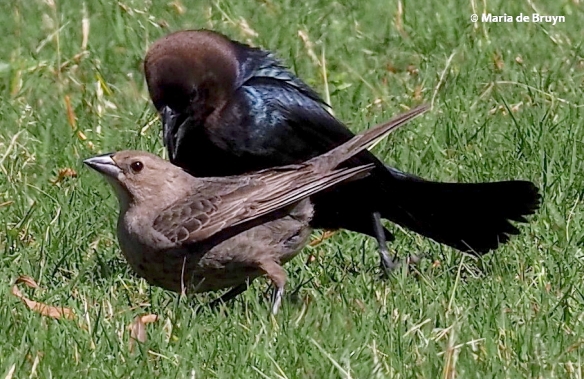
brown-headed cowbird P5097689© Maria de Bruyn res

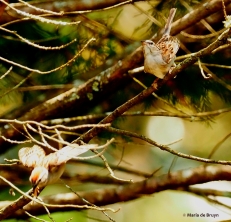
chipping sparrow P6256620© Maria de Bruyn sgd resThe quickest mating scenario I’ve witnessed came from a pair of sweet little chipping sparrows (Spizella passerina). I’d seen the two fluttering together at the feeders and had noted one sparrow chasing another away – which I now think was the victorious suitor driving away a rival. Then one July afternoon, the two flew to a dying cedar and sat close to one another on a branch. Suddenly, Mr. Victory mounted his mate but for what only seemed a few seconds – really very quick work indeed! She sat there with her rear end elevated for a bit and then the two went back to feeding – and soon after I saw them collecting nesting materials.

chipping sparrow P6256622© Maria de Bruyn res    chipping sparrow P6256623© Maria de Bruyn res

The birds in which the males do have a penis include some duck and swan species, ostriches, cassowaries, kiwi and geese. They differ from other birds in that development of the penis is NOT stopped in the male bird embryos during development (the case in cloacal birds).

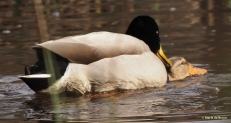
The mallard males (Anas platyrhynchos), like some other ducks, unfortunately do not treat their partners well. They may mount the female very roughly. During a mating, she may be dunked underwater repeatedly and at length; occasionally, this results in her drowning. This behavior has been the subject of various studies and some newspaper articles with sensationalistic headlines (e.g., “The horrible thing you never knew about ducks)”.

Mallard duck P1232837 © Maria de Bruyn

Mallard duck P1232839 © Maria de Bruyn     Mallard duck P1232840© Maria de Bruyn

Once the actual mating is over, the birds devote most of their energy toward building a nest. While female ruby-throated hummingbirds (Archilochus colubris) must construct her nest and tend her babies alone, many other birds cooperate in the venture, like the Eastern bluebirds. Their efforts are featured in the next blog. (And if you’d like to see a previous post on courtship, it is here.)

ruby-throated hummingbird 2G0A4084© Maria de Bruyn res

Snowy portraits – part 2

The larger birds were very obvious at the feeders during our North Carolina snowstorm in early December, but they weren’t the only ones taking advantage of the fact that I spent considerable time knocking snow off feeders and a bird bath, filling feeders up multiple times daily and spreading seed repeatedly on the snow for the ground-feeding wildlife.

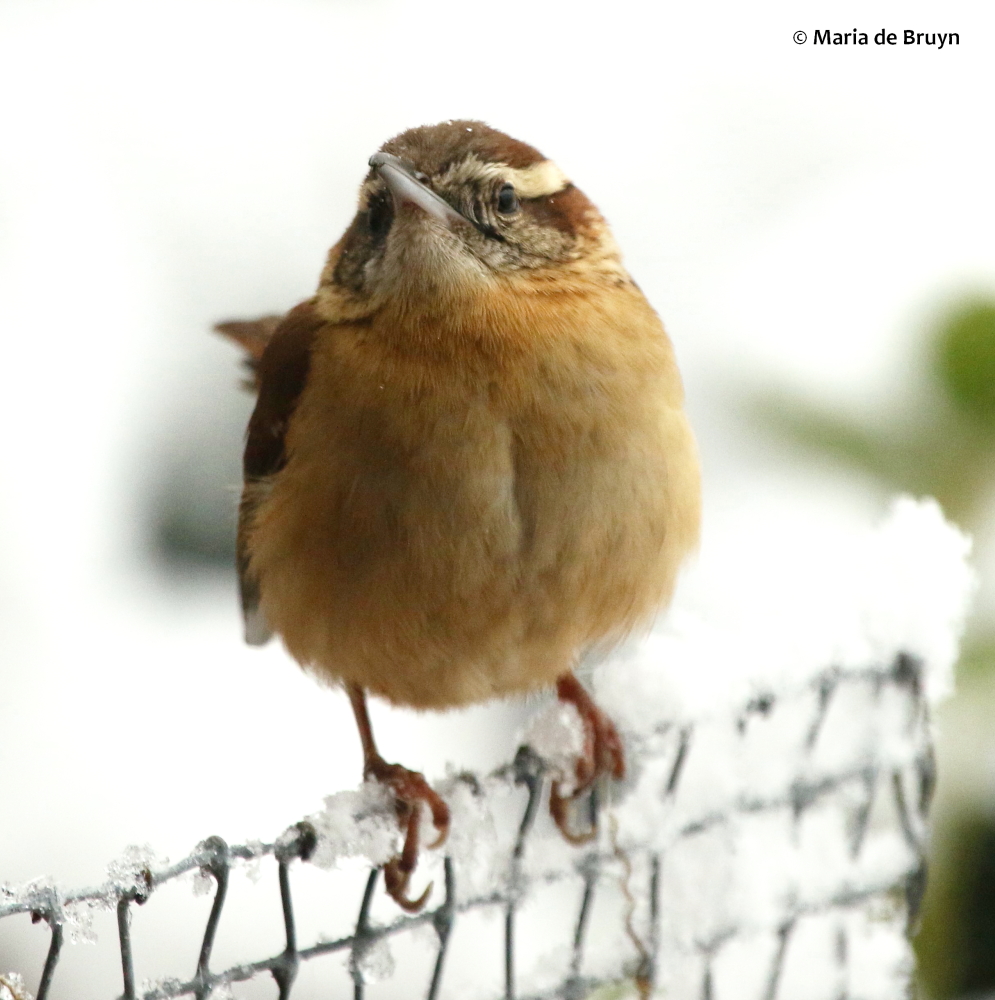
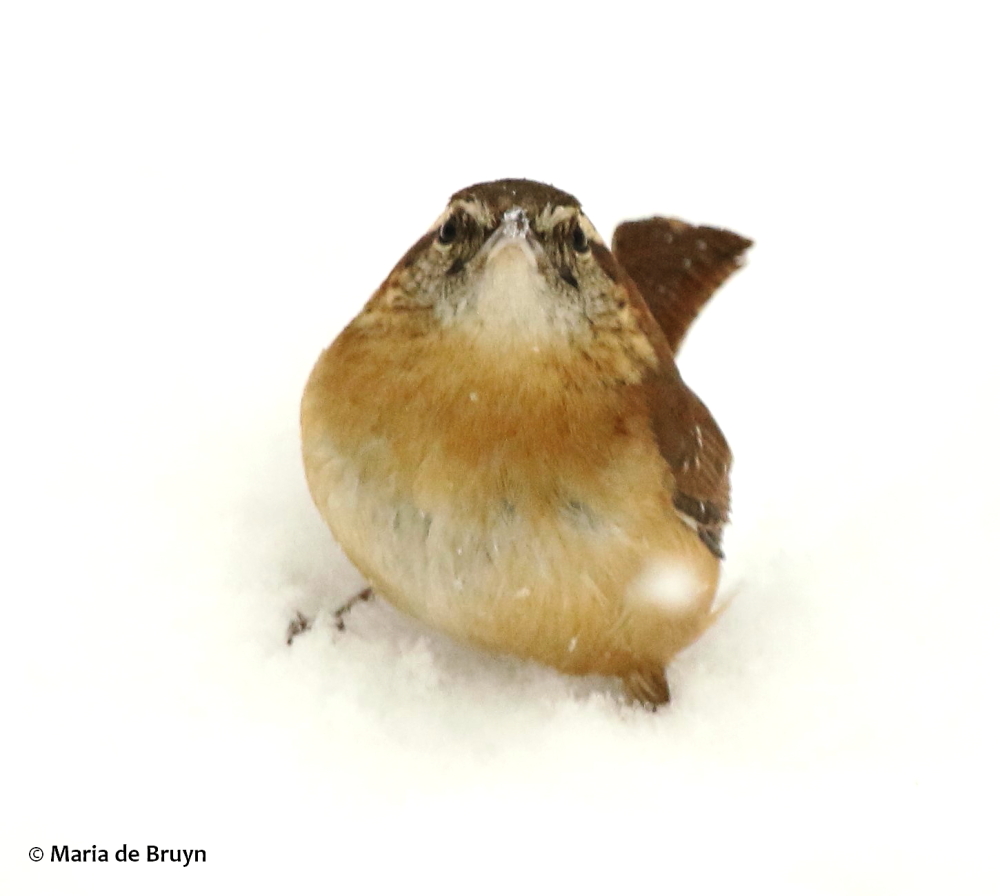
The Carolina wrens (Thryothorus ludovicianus), who live in the various yard woodpiles, mostly stayed on the ground but occasionally flew up to a feeder. They also spent time clinging to the brick walls of the house, I assume in search of spiders and other small insects that stay there.

Their slightly larger brethren in shades of brown, the Eastern towhees (Pipilo erythrophthalmus), have taken up residence in the holly shrubs and a privet bush near the front-yard feeders. From there, they can emerge to hop around under the feeders (sporadically flying up to perch on a feeder, too) with a place close by to which they can escape when feeling threatened.


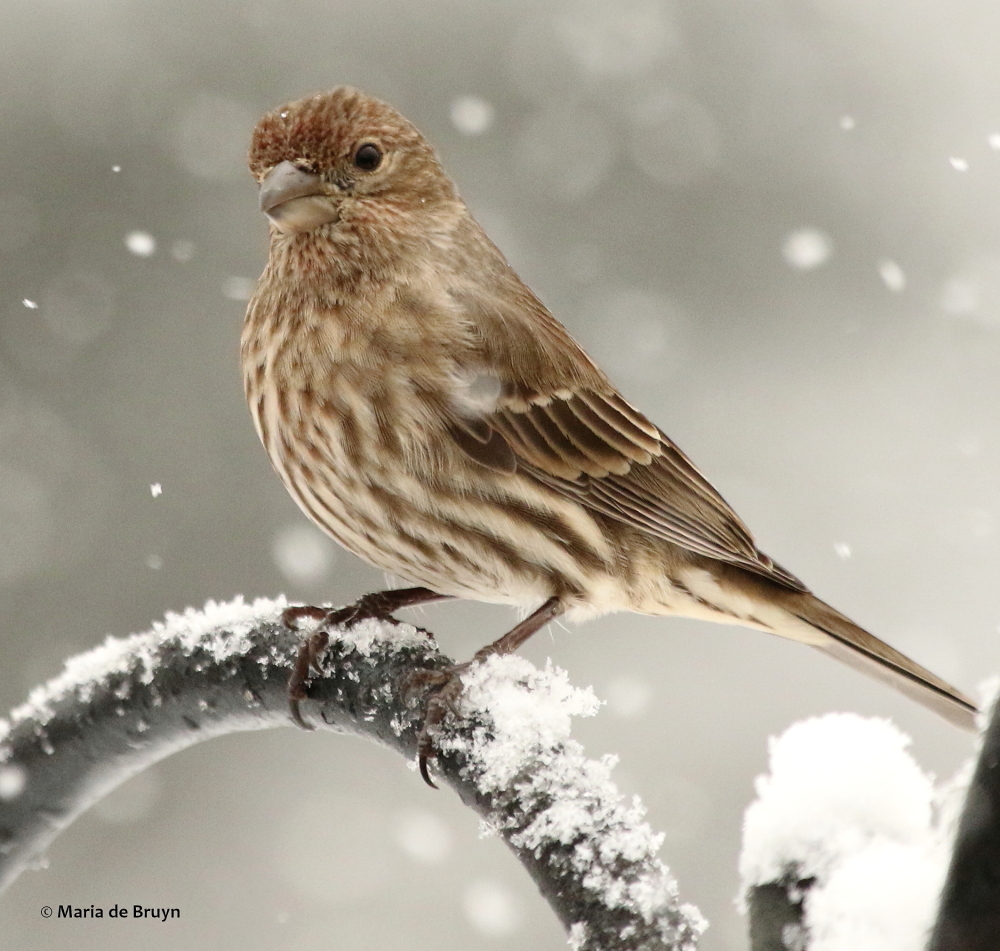
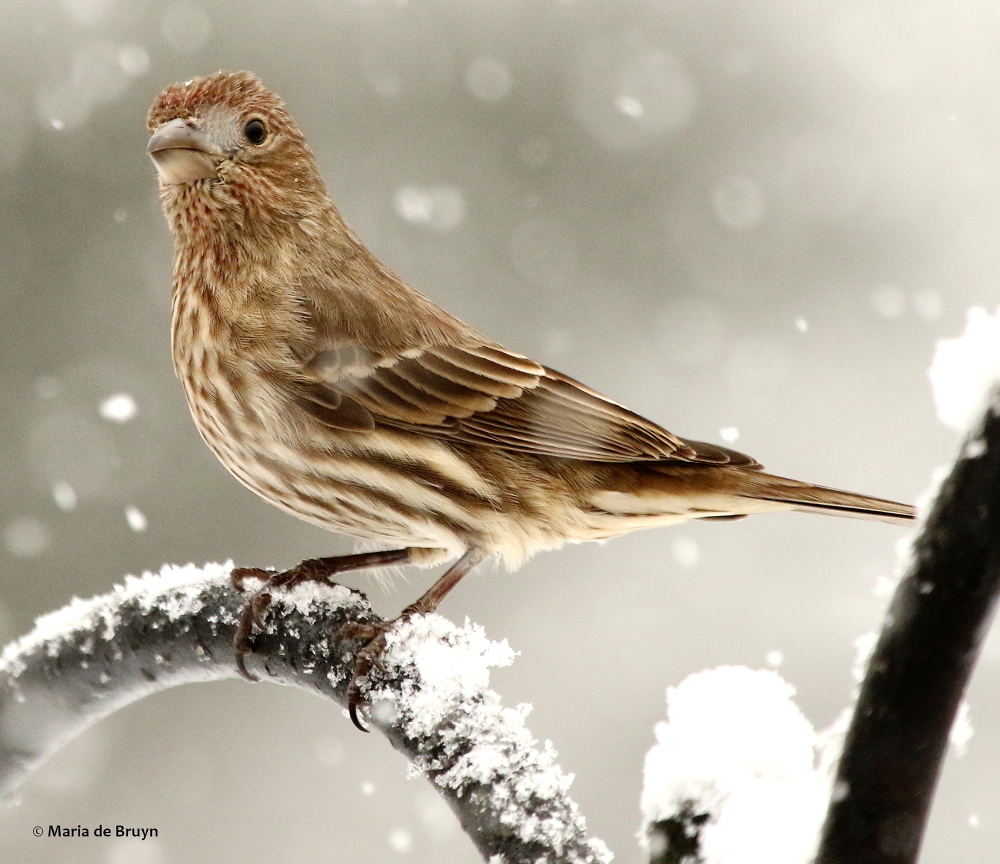
Both house finches (Haemorhous mexicanus, left) and pine siskins (Spinus pinus, below) came to eat seeds at the platform feeders. Though the finches are larger than the siskins, the female finches and siskins look very similar to me and I usually need to look through my zoom lens to see them clearly.


The photo below is a nice one for differentiating them. The female finch on the left has a thicker bill and a slightly larger and bulkier size. The pine siskin on the right has a thinner bill and hints of yellow on its slender flanks.

Another pair of birds that can be difficult to differentiate are the male house and purple finches. The purple finch (Haemorhous purpureus, below) looks like it has been dipped in raspberry juice to put color all over its body. While some male house finches also have very bright red hues, the color does not spread everywhere on their bodies.


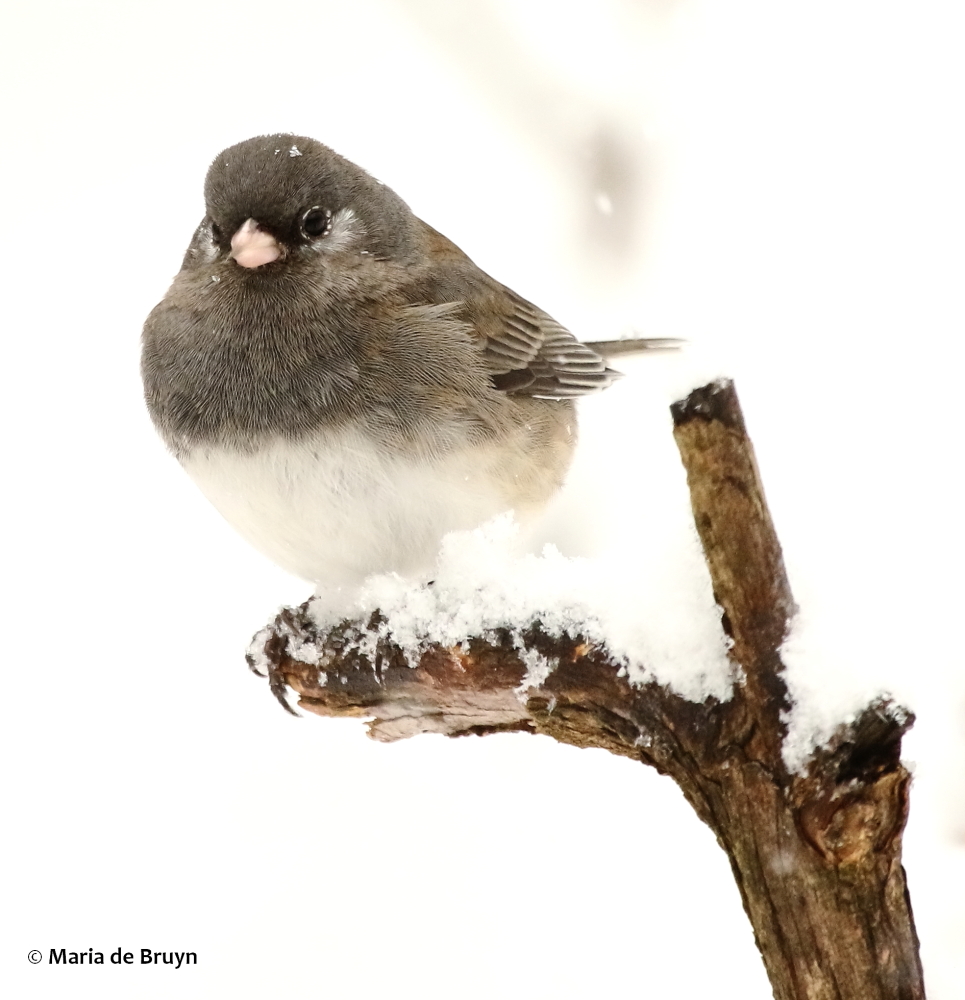
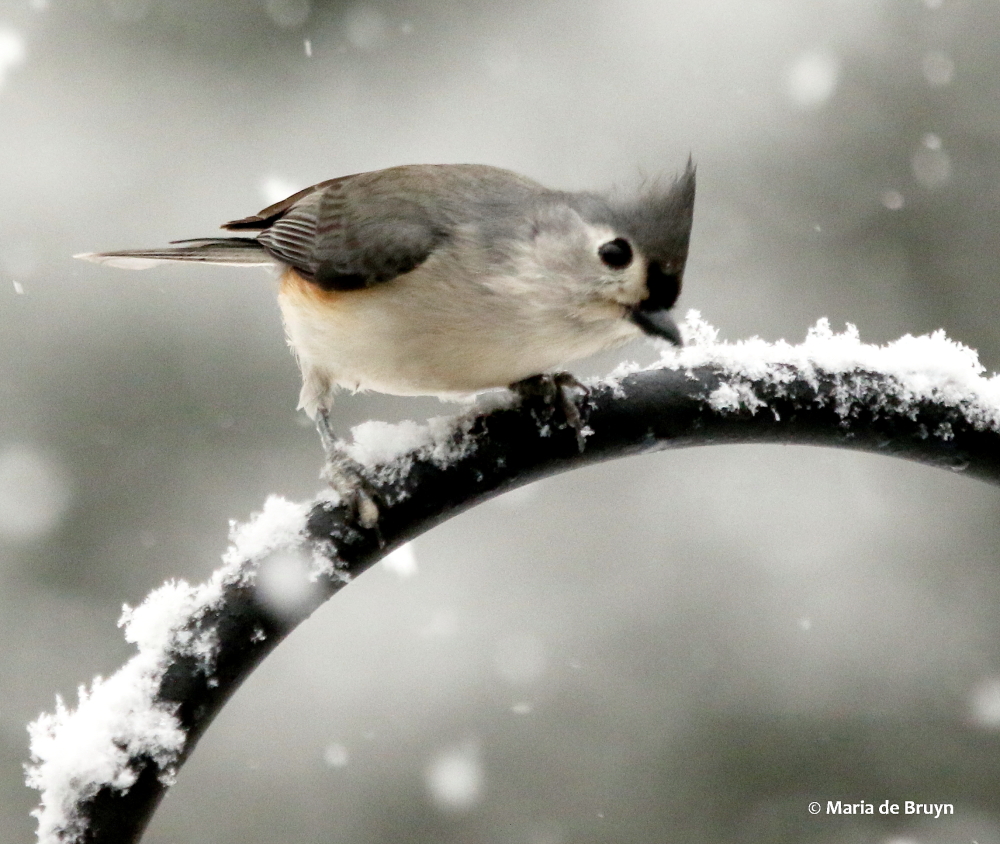
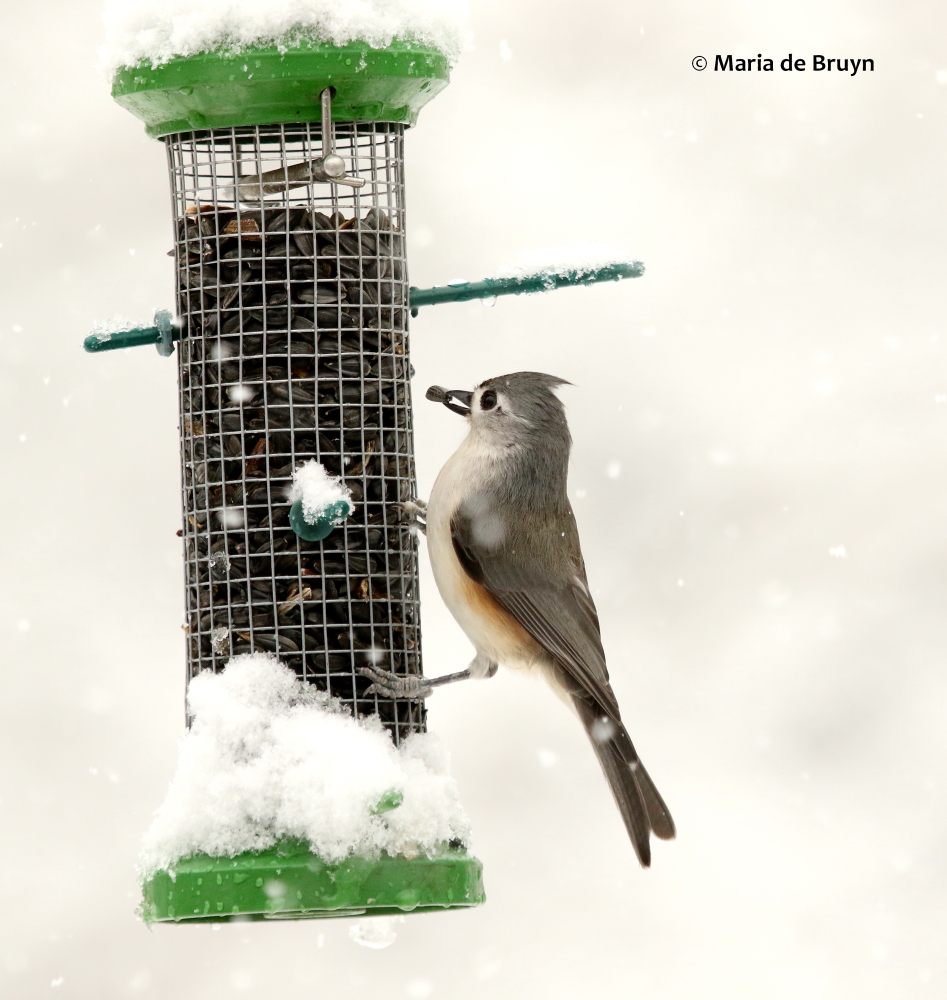
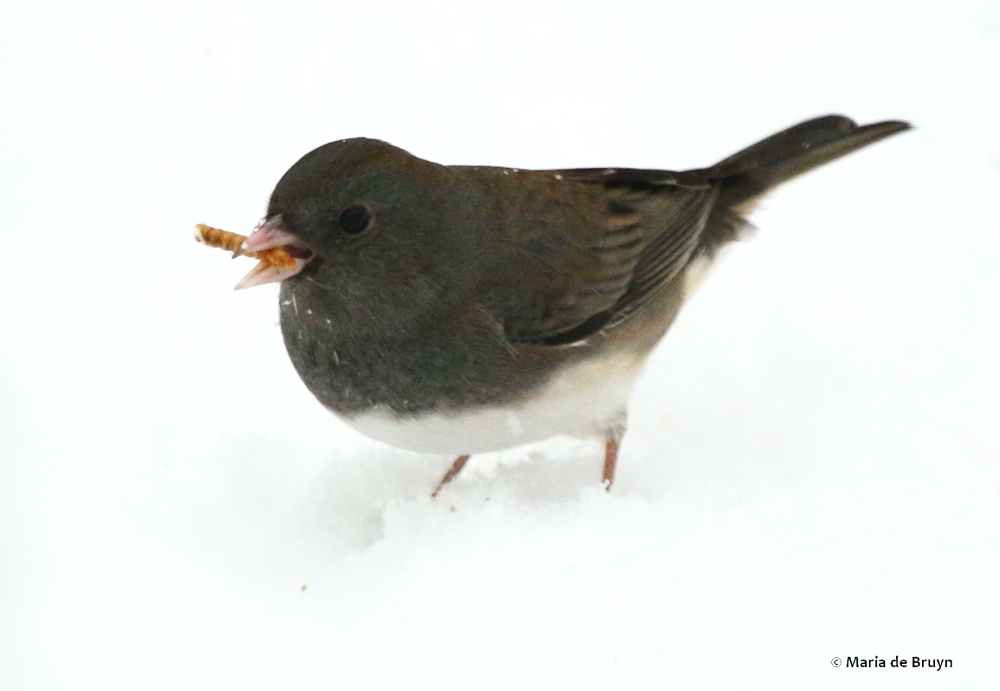
The tufted titmouse (Baeolophus bicolor, below) and dark-eyed junco (Junco hyemalis) are both subtle beauties in shades of gray but easily distinguishable.


The junco’s pink bill gives it a delicate look in my opinion.


The chipping sparrows (Spizella passerina) and white-throated sparrows (Zonotrichia albicollis) are both daily visitors to my feeding stations regardless of the weather. The “chippies” are here year-round, while the white-throated sparrows (right) are only resident in the autumn, winter and spring. The somewhat smaller chippies usually sit on the feeders, while the white-throats mostly seek food on the ground; both will venture into the others’ areas, however.

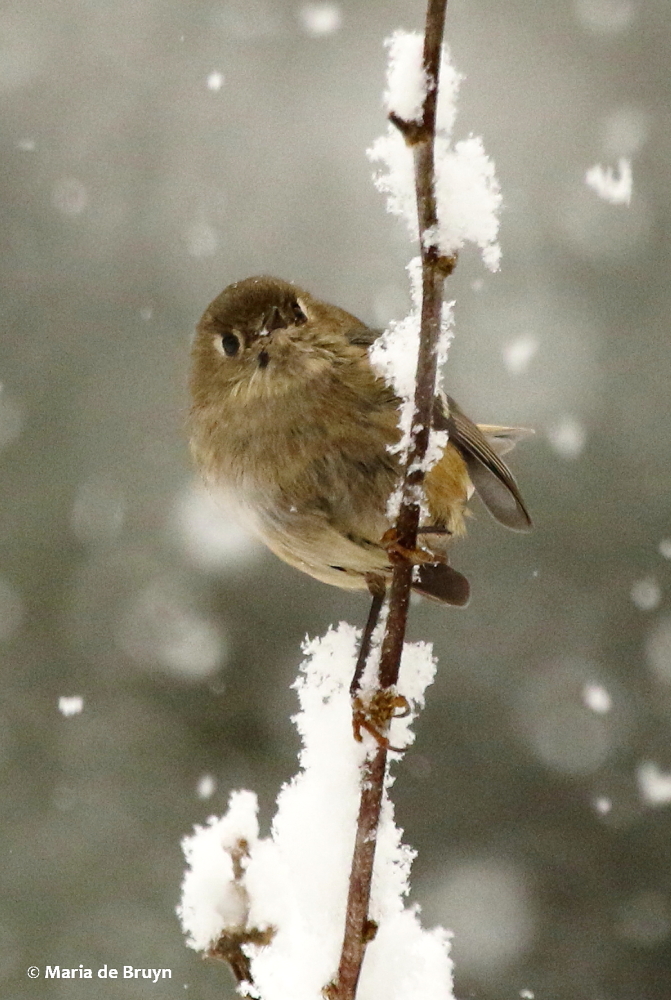
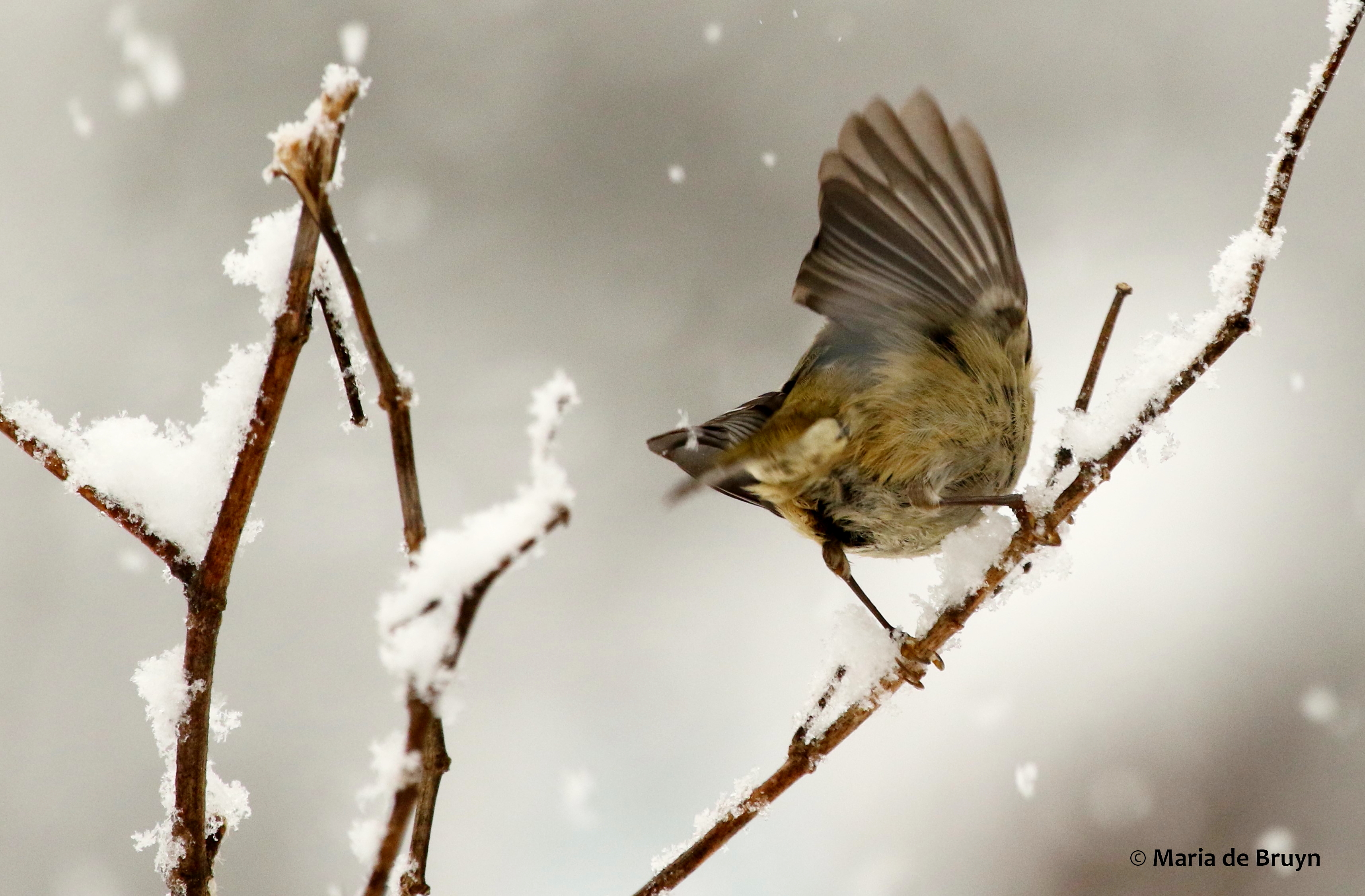
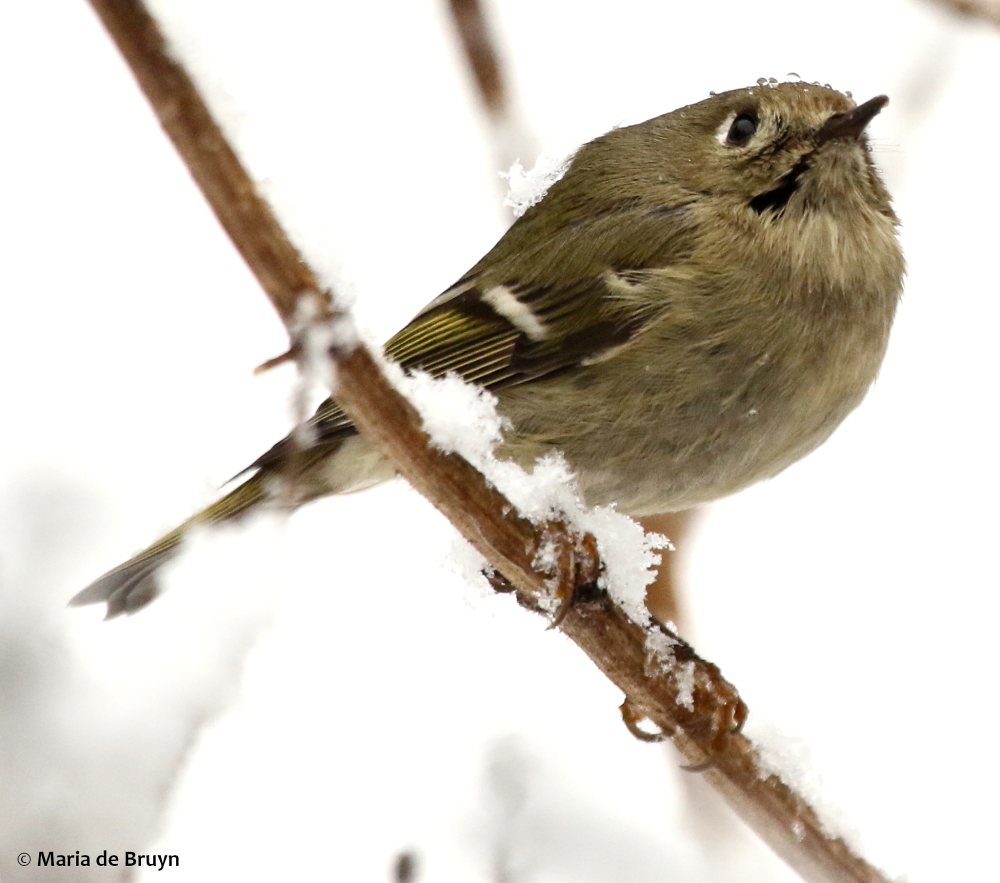
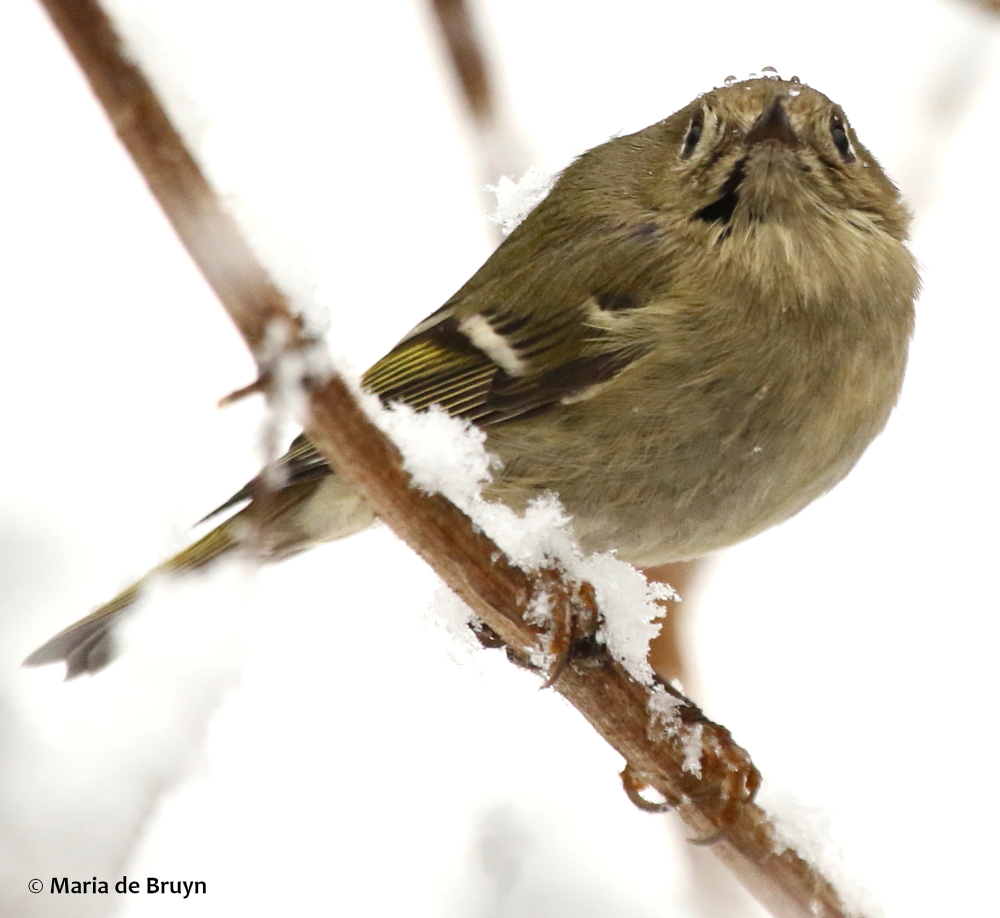
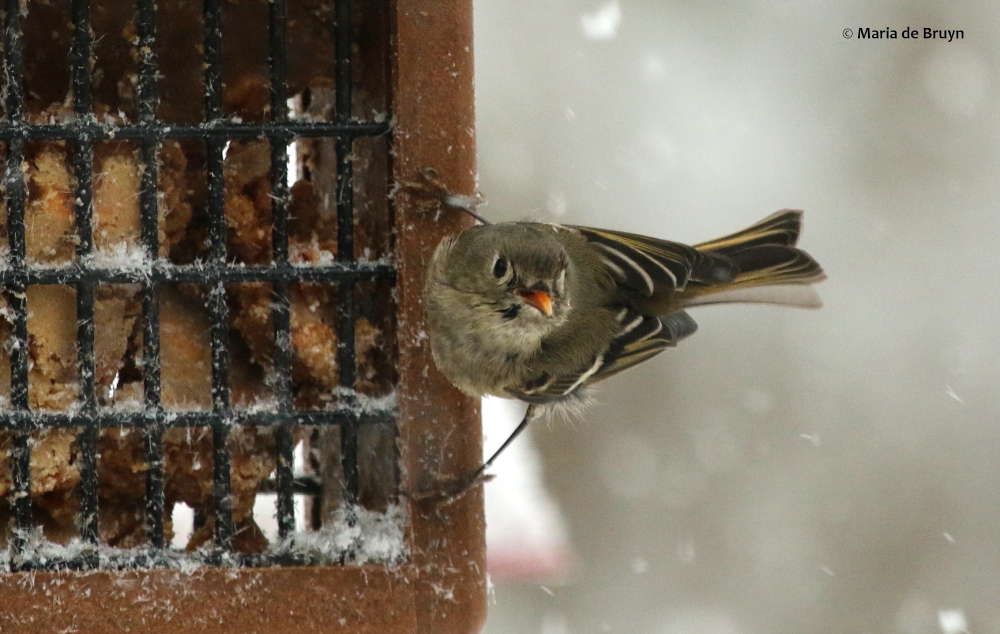
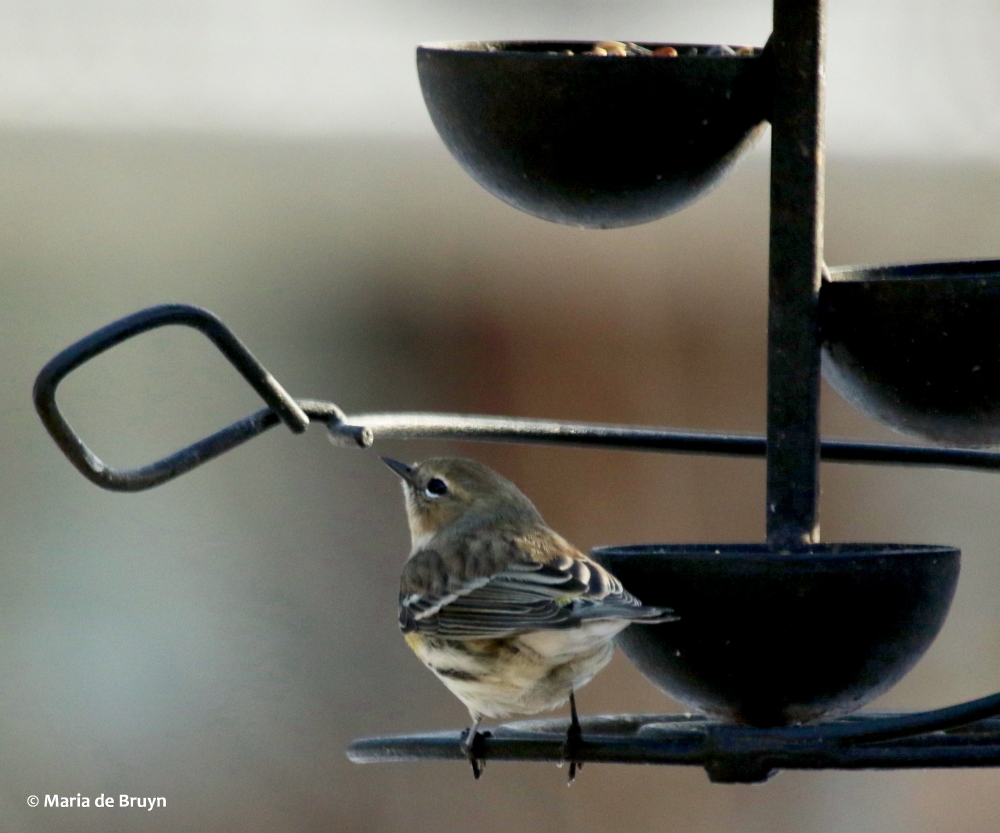
Two very different birds share a common feeding method for gathering suet. Both the ruby-crowned kinglet (Regulus calendula, below left) and yellow-rumped warbler (Setophaga coronata, below right) hover in front of the feeder as if they are imitating hummingbirds, snatching a bite to eat as they “balance” mid-air. Both will eventually alight on the feeder, though, and then eat at a more leisurely pace.

The bright little pine warbler (Setophaga pinus) also loves suet but never hovers at the feeder. S/he will wait until other birds have cleared the space and then clutch the frame to have multiple bites of the fatty food. During windy intervals of stormy weather, this plucky bird also holds its ground, clutching the feeder pole so as not to blow away.


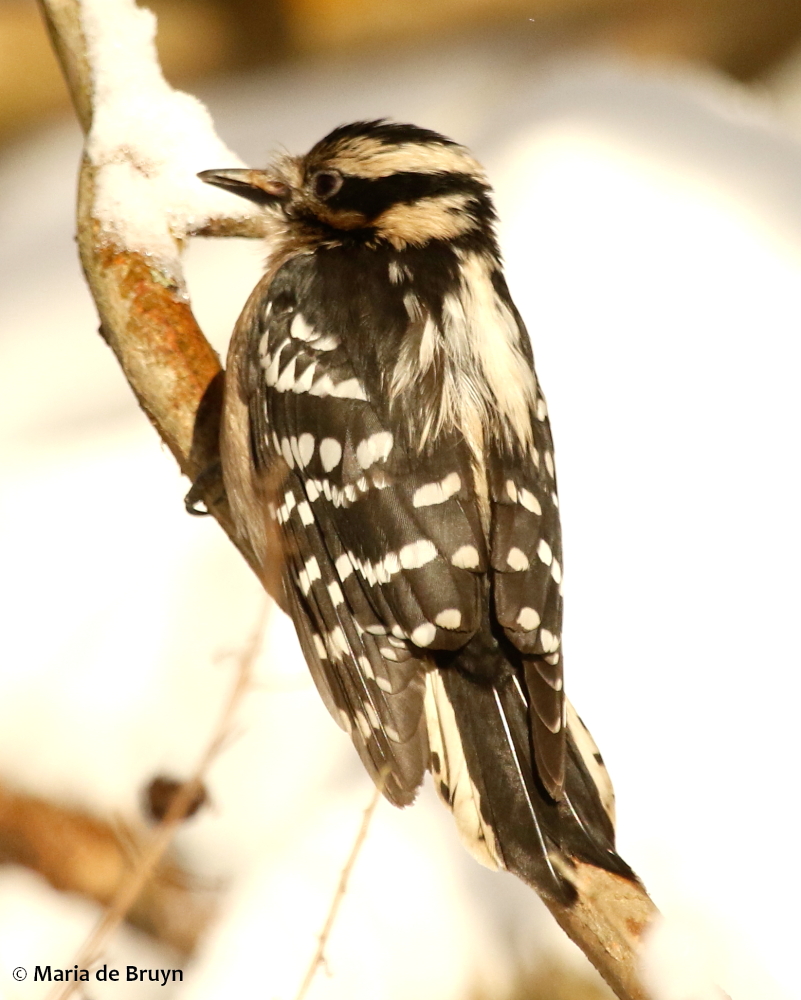
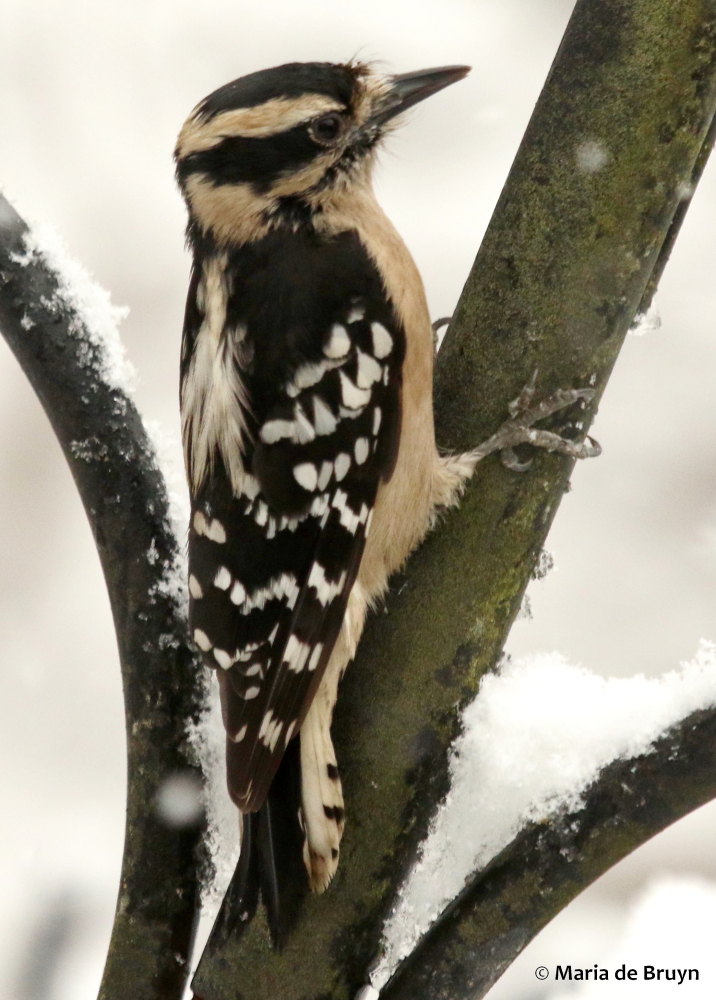
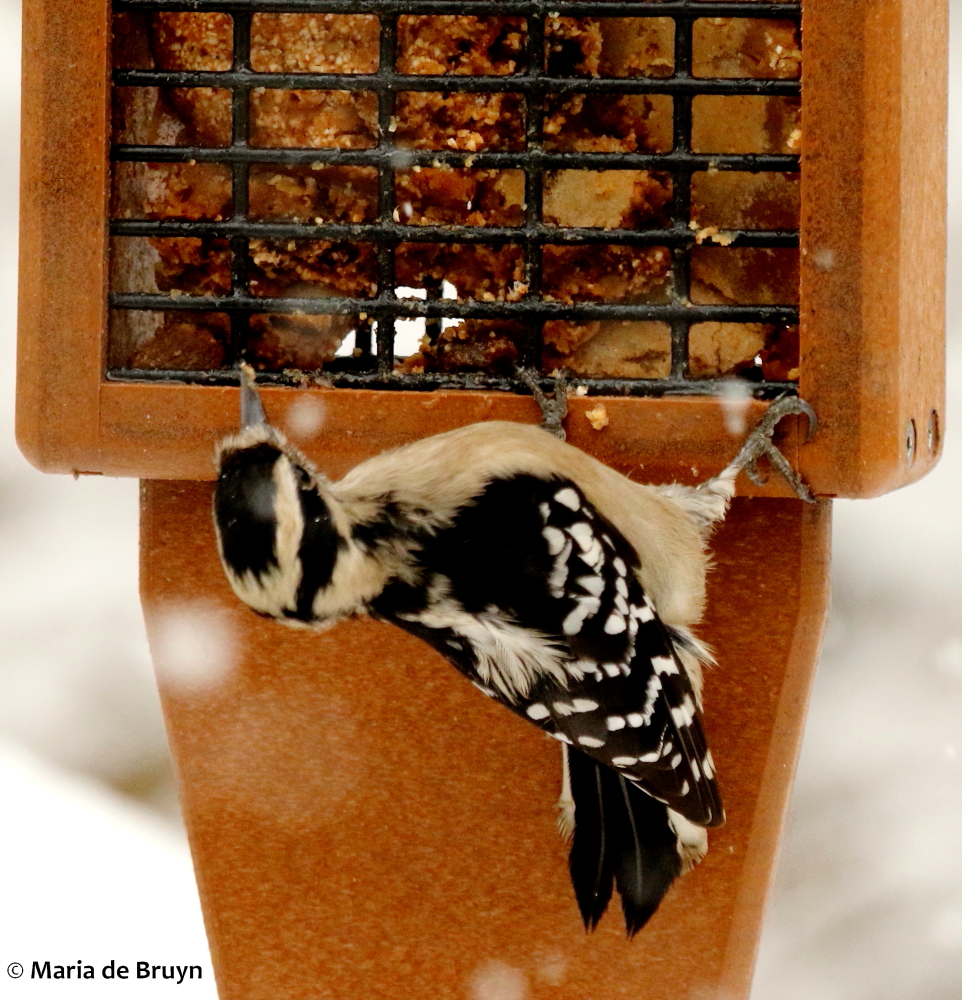
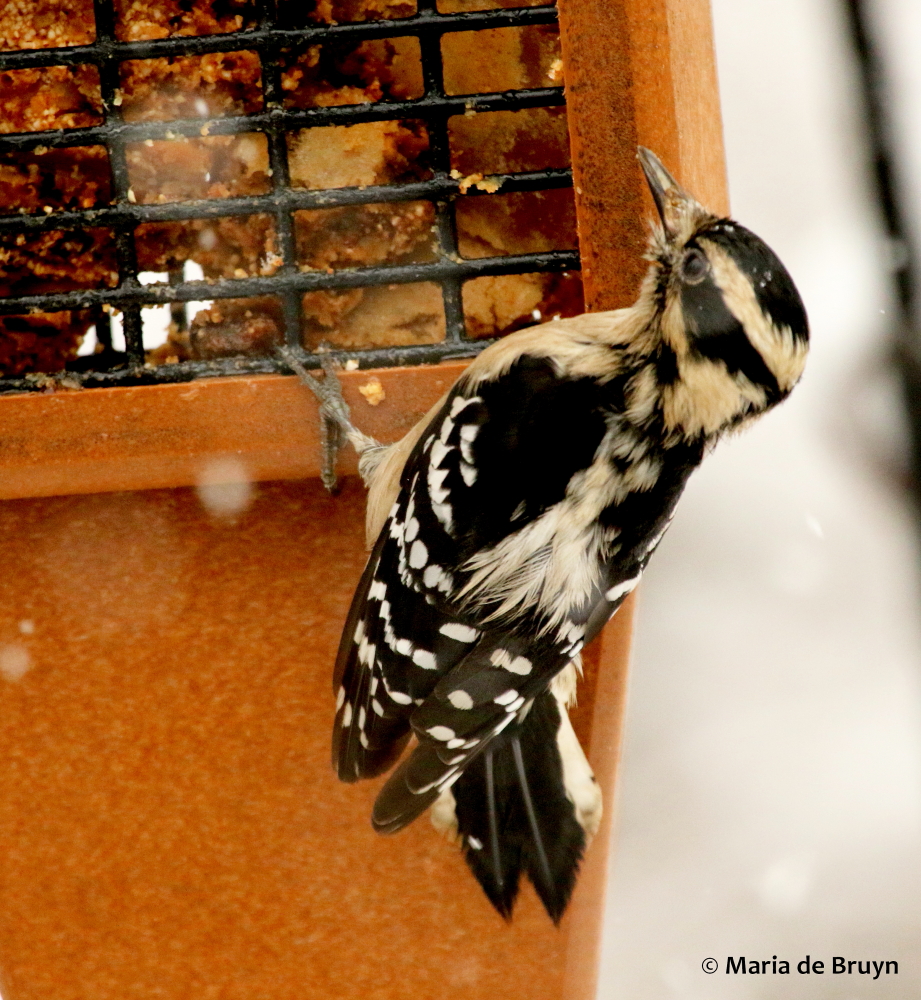
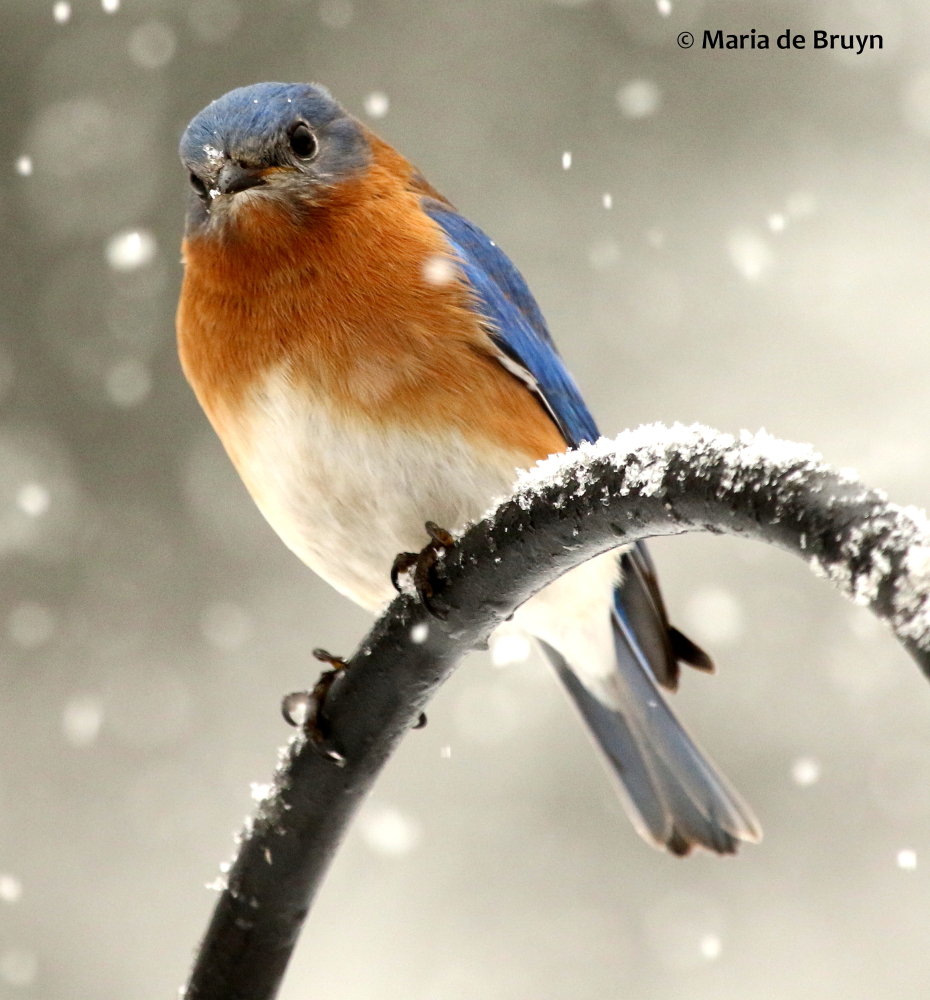
The downy woodpeckers (Picoides pubescens) are never scared off the feeders by anyone. Their larger red-bellied cousins are often a bit hesitant to visit but the downies can’t be kept away. Like them, the Eastern bluebirds (Sialia sialis) also don’t let the presence of other avians put them off – they are willing to share space.

This doesn’t mean the bluebirds won’t show a bit of temper, especially toward their own species mates, but they generally get along with everyone.

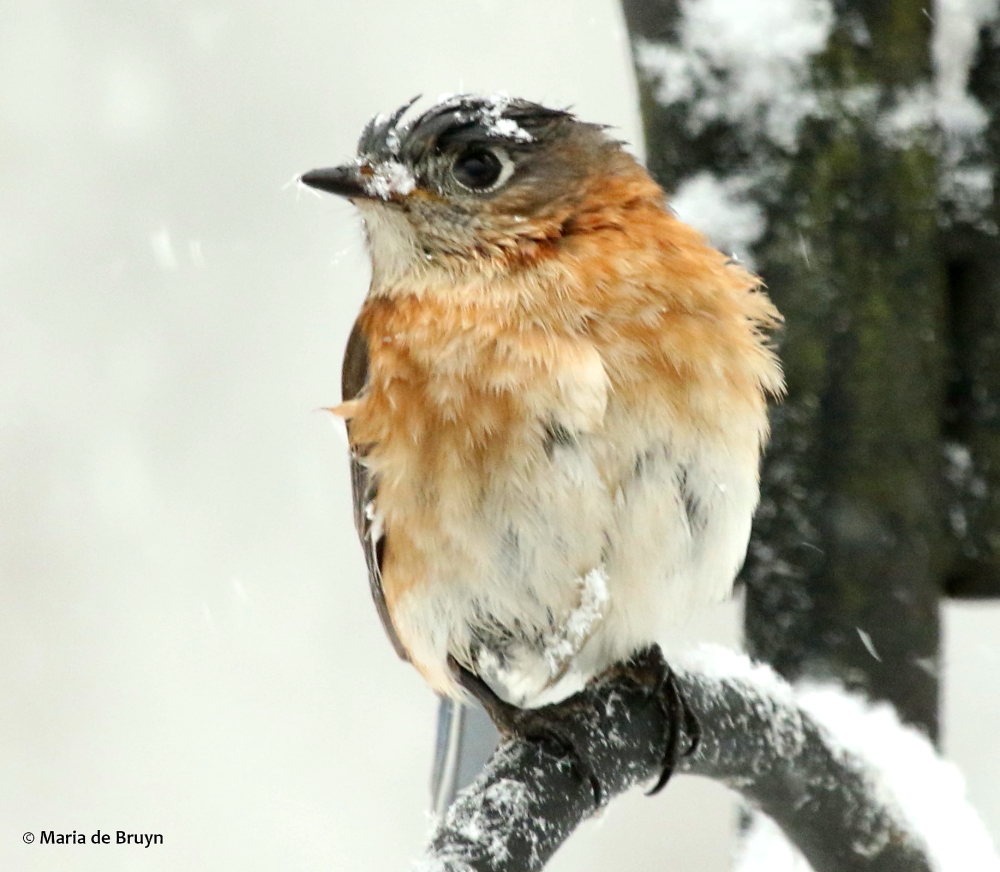
And the bluebirds visit regardless of the atmospheric conditions, sometimes looking stunning with their bright dry plumage and sometimes looking a bit bedraggled when the pouring rain and thickly falling snow wet their feathers completely. Beginning birders might wonder if these are the same birds, but fortunately the bluebirds seem to dry out quickly to regain their usual beauty.


There were a few more birds that came along during the storm (one featured in the next blog!), including Carolina chickadees, Northern cardinals (Cardinalis cardinalis, left) and red-winged blackbirds. Snow and ice storms and pouring rain can be a drag in many ways for the human species but for birders, these “bad-weather” interludes can certainly be a boon for easy armchair and window watching!

Signs of spring in an uncertain season

As tiny snowflakes fall gently from the sky, my thoughts have left Costa Rica for a bit and turned to the weird weather we’ve been having in North Carolina. I didn’t move to this state for its weather but in the time I’ve been here, I’ve grown to appreciate the climate – we have four seasons but the winters have not seemed overly long and the spring and autumn temperatures are often fabulous.


This year, much of February was unseasonably warm in our Piedmont area and people, as well as plants and animals, were enjoying the warm sun and mild temperatures. Crocuses and irises poked their blooms up a bit early and birds were checking out nest boxes.


Butterflies, like this question mark (Polygonia interrogationis) made an appearance (it was getting sustenance from some dog poop left on a bridge!) and Carolina anoles (Anolis carolinensis) emerged to sun in the warmth.


Then on 12 March, we had a day of snow. The male Northern cardinal (Cardinalis cardinalis) and Carolina wren (Thryothorus ludovicianus) sat amid the flakes between trips to the feeders.


The female ruby-crowned kinglet (Regulus calendula) didn’t seem too perturbed, but the male resident was not happy – his bedraggled red crown was in evidence, both when chasing her away from the feeders and when he was just coping with the wet snow.


When I left for my Costa Rican rambles, it looked like the spring weather might give way to colder temperatures; when I returned 10 days later, it was definitely more winter-like. Then, this past weekend, we had a brief respite. Despite a cold morning start, friend Karla and I visited the Guilford County Farm. The farm personnel had marked off a section of the gravel parking lot where killdeer (Charadrius vociferus) had placed a nest with four eggs. When the babies hatch, they can walk away from the nest as soon as their downy feathers dry.


They won’t be able to fly until about 25 days later, but they can feed themselves. The parents will continue tending to and defending them, however. In the meantime, the parents do not come near the nest so as not to draw attention to it and they will try to lead any potential predators away with a broken wing display. They do fly near the nest often, however, and keep an eye on it in between their own feeding sessions.

Karla quickly spotted Wilson’s snipes (Gallinago delicata) flying over the pond and settling at the water’s edge. As we drew closer, we could spot them occasionally, but they blended really well with the vegetation. Below are a couple photos taken at a fair distance with a high ISO and lots of grain – but you can try to see if you can spot the six snipes in the first photo and the two in the second.

Fortunately, one flew in a bit later and I got a couple more recognizable photos!


Some Canada geese (Branta canadensis) flew in and headed for the same corner of the pond.

Then, as I was trying to find the snipe in the grass again, I noticed a killdeer looking for insects nearby.

She was accompanied by a male, who at first seemed to be preening but who was actually trying to impress her with some courtship displays.


The males will show off their feathers for their (potential) mates, especially raising and displaying their bright tail feathers as a fan.

The female would walk away and he would eventually move closer in an attempt to get a response.

Nearby, we saw three Northern mockingbirds (Mimus polyglottos), two of whom seemed to be males battling over a female. Their dispute was very vigorous and lasted quite a long time. In fact, when they flew away, they were still going after one another!


During our continuing walk in the fields and woods near the farm, we saw many other bird species including Eastern meadowlarks, brown creepers, woodpeckers and a pair of kestrels. The woods were kind of strange in that there were very few bird nests visible in the bare trees and also no Eastern gray squirrel nests – in fact, we did not see one squirrel the entire time we were there, which was very odd. An adorable baby donkey (Equus asinus) did greet us as we walked by, though, and our long excursion (about 6 hours) gave us a nice taste of spring. Hopefully, when the snow flurries today end, we will see spring weather come back quickly and be able to enjoy the flora and fauna of this season again. Next blog – back to Costa Rica!


Winter wonderland – the smaller and medium-sized birds

Oddly, during our January snowstorm, the brown-headed and white-breasted nuthatches did not visit my bird feeders – that was unexpected as they really do like the sunflower and other seeds, as well as the home-made suet. Other smaller birds did appear, however, and they filled up on the provided food since finding insects was almost impossible during those days.

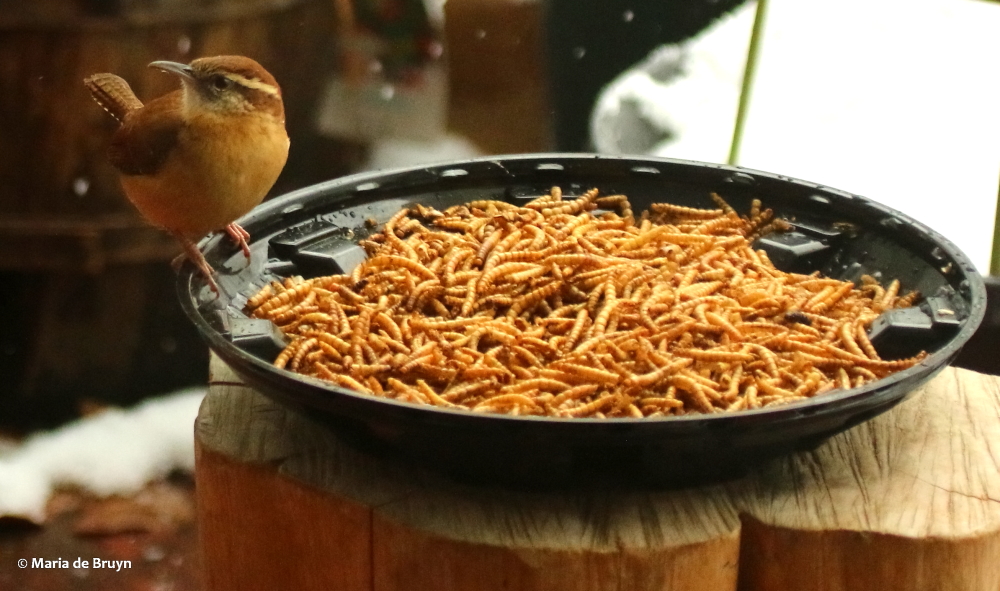
The Carolina wrens (Thryothorus ludovicianus) were fans of the dried meal worms and at one point, I put out an extra tray of these treats on the dry front porch. Other birds are more reluctant to come onto the porch so they had a nice quiet feeding area, although they also spent time perched on the snowy bushes and feeders.


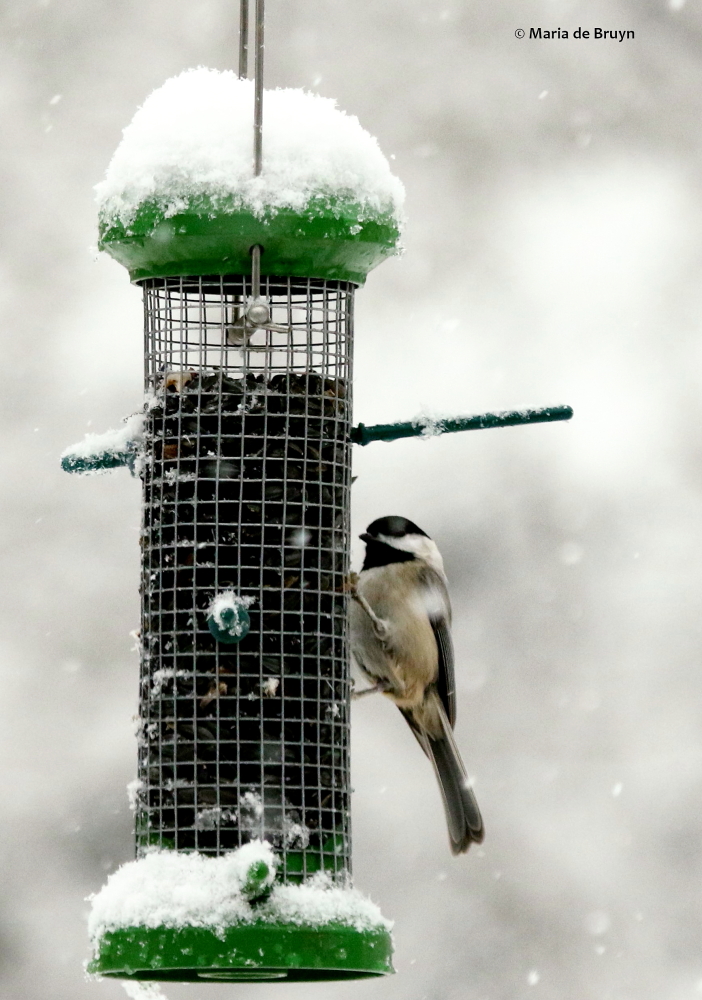
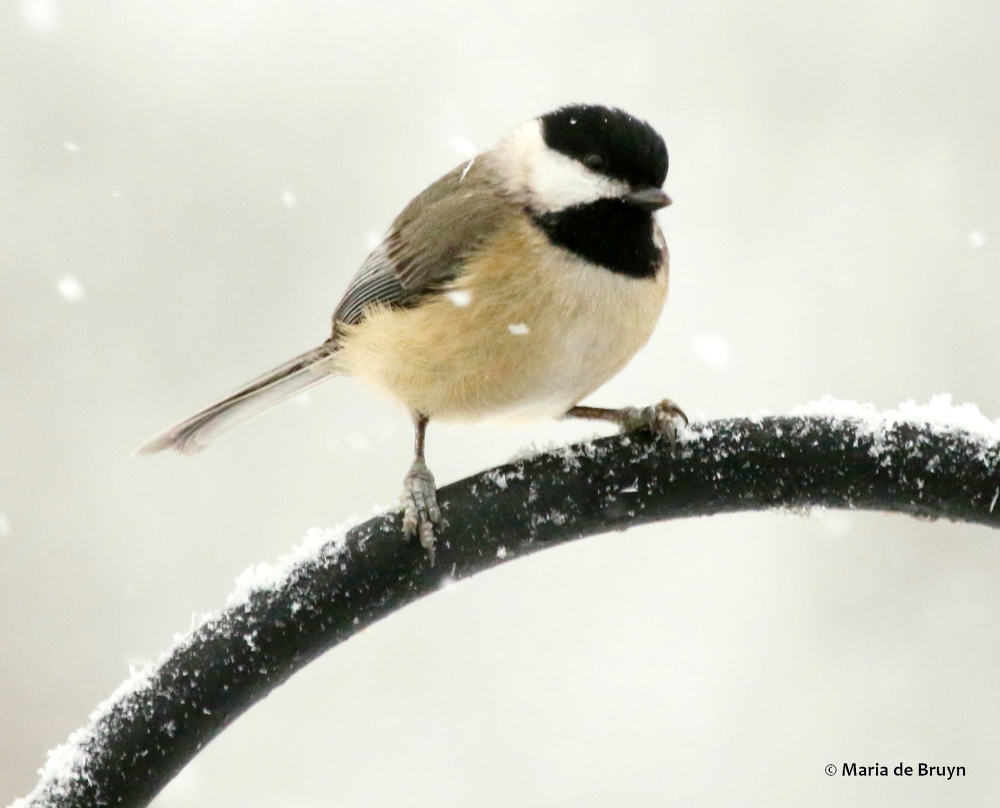
The Carolina chickadees (Poecile carolinensis) worked their way in between the other birds to reach the feeders, sometimes waiting patiently on a feeder pole for their turn.

The ruby-crowned kinglets (Regulus calendula), of which I have two visiting the feeders, were happy with the home-made suet. Occasionally, I smeared a bit of suet on dried flower stalks and they would perch there to snag a bite to eat. Other times, they just waited on a twig until the yellow-rumped warblers had vacated the area so they could eat in peace.


While the downy woodpecker (Picoides pubescens) is slightly larger, they are like the small birds in being somewhat hesitant to approach feeders if there is a crowd. Once on a feeder, they will feed and then hang on to take a look around.


The dark-eyed juncos (Junco hyemalis), who have an understated quiet beauty, were looking for meal worms.


The similarly colored tufted titmouse (Baeoloophus bicolor) often zoomed in on its target of the fruit and nut feeder without taking time to perch first.

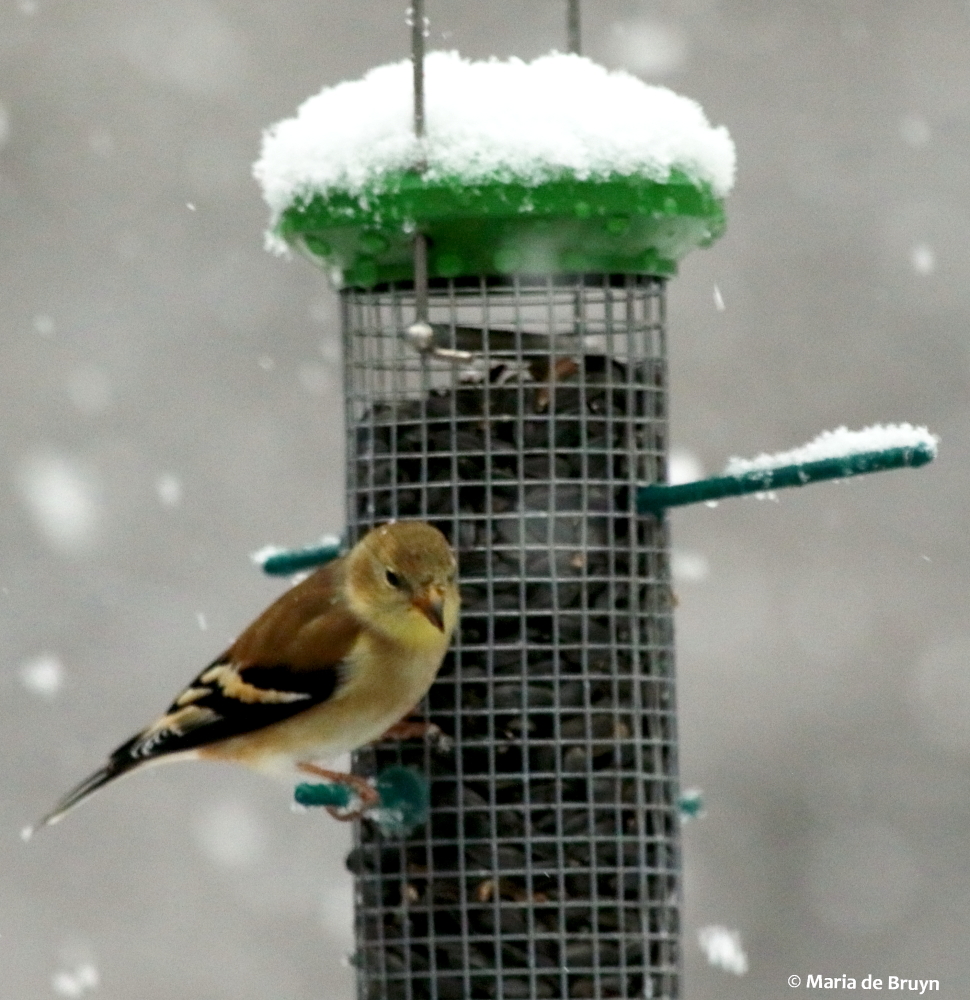
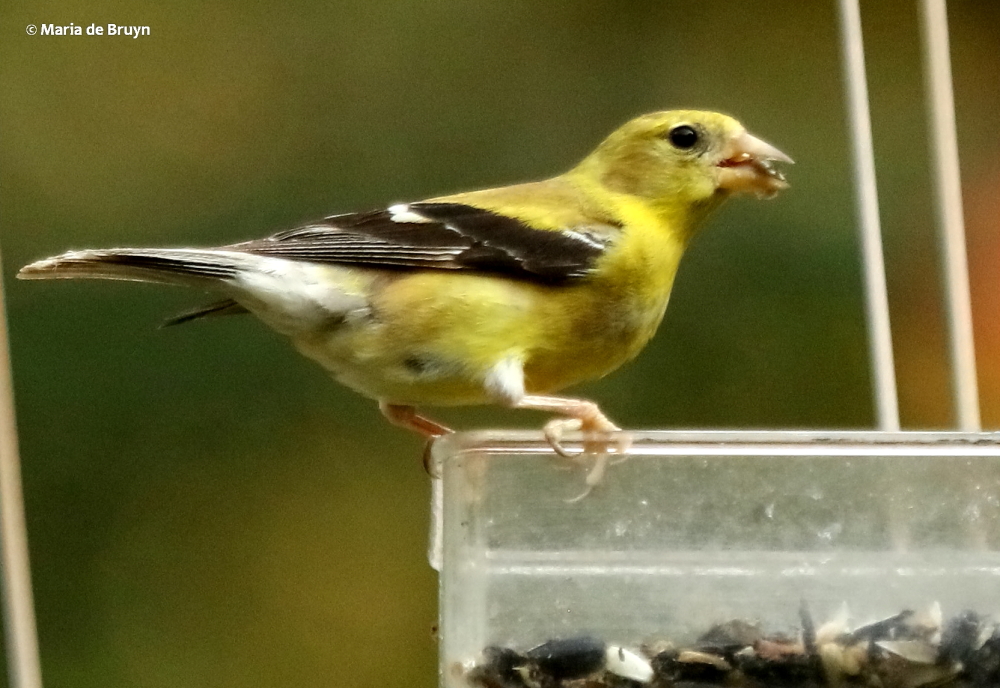
The American goldfinches (Spinus tristis) didn’t come round very much, only snacking on some sunflower seeds. Since they often feed on the crepe myrtle tree seeds, they were likely finding enough food there.

The Eastern bluebirds (Sialia sialis) came in spurts of activity. They always look rather bedraggled when they get wet with snow or rain and perhaps prefer to stay drier under branches until there is a break in the falling moisture. Even wet, though, they are still attractive to me.

The smaller/medium bird group was rounded off by the house finches (Haemorhous mexicanus). The females were looking especially nice. The finches never have spats with anyone and are among the most peaceful feeder birds. Not everyone was like that, however, and the next blog looks at the rowdy ones.


“Nuts” for nuts!

A primary source of nutrition for many birds is nuts.This high-calorie food provides them with dietary fat, which can be especially welcome during the colder months. As nuts ripen, you can see the birds flying by, carrying acorns and beechnuts, as well as seeds of various kinds. Some birds are especially suited to eating nuts with their thicker, cone-shaped bills, which are shaped to help them crack open pods and seed cases. Northern cardinals (Cardinalis cardinalis), sparrows, grosbeaks, finches and woodpeckers are seed and nut lovers.

I had been lax in providing my yard birds with these culinary treats except for sunflower seeds and the seed pods in my yard trees. So one day early last year, I purchased a nut and seed holder and proceeded to give them peanuts, which are not actually nuts but the seed of a legume (Arachis hypogaea). This makes no difference to the birds like the Carolina wren (Thryothorus ludovicianus) of course.

I first tried peanuts in the shell and an occasional blue jay and tufted titmouse would stop by. However, they didn’t seem to want to put much time into removing the nuts from the shells and I didn’t really want the shells littering the ground either.

Then in the spring I put out some shelled peanuts from a container I’d bought for my own consumption and the avian visitors were delighted. Reading about peanut feeding informed me that I should avoid giving salted peanuts. I couldn’t readily find unsalted ones at the grocery store, so I began removing the salt, either by shaking the nuts in a paper bag or by washing off the salt.


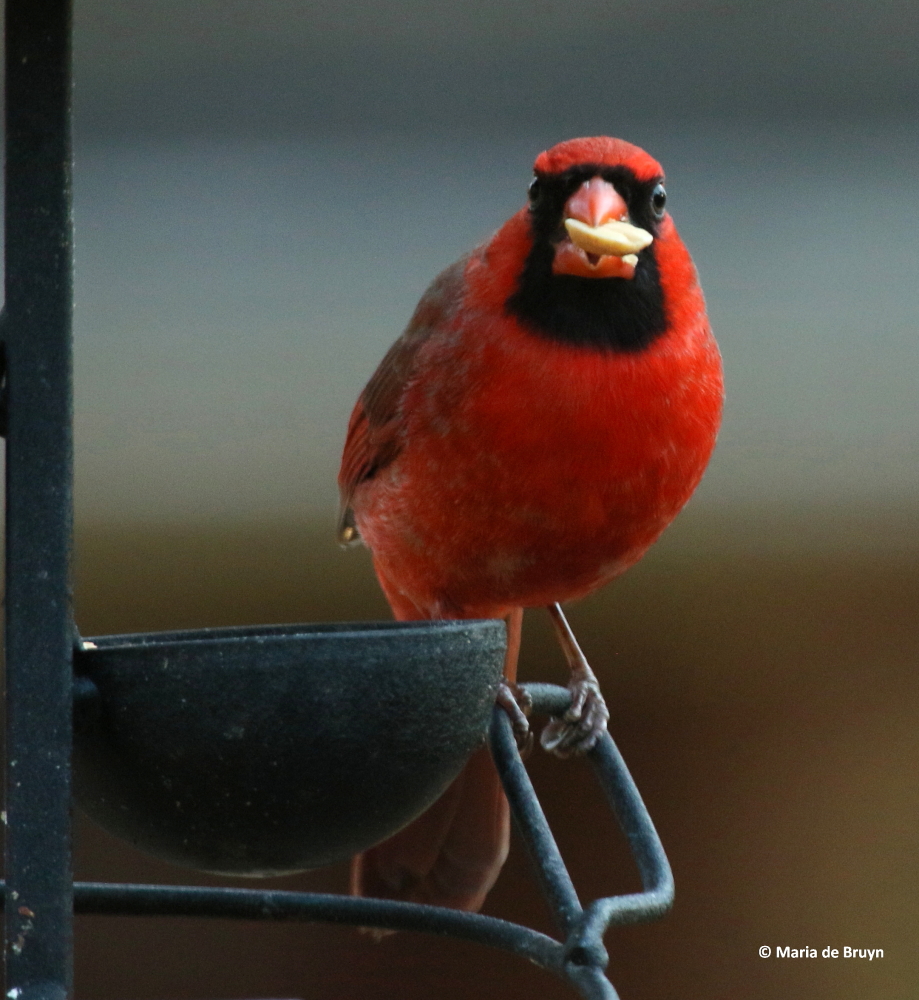
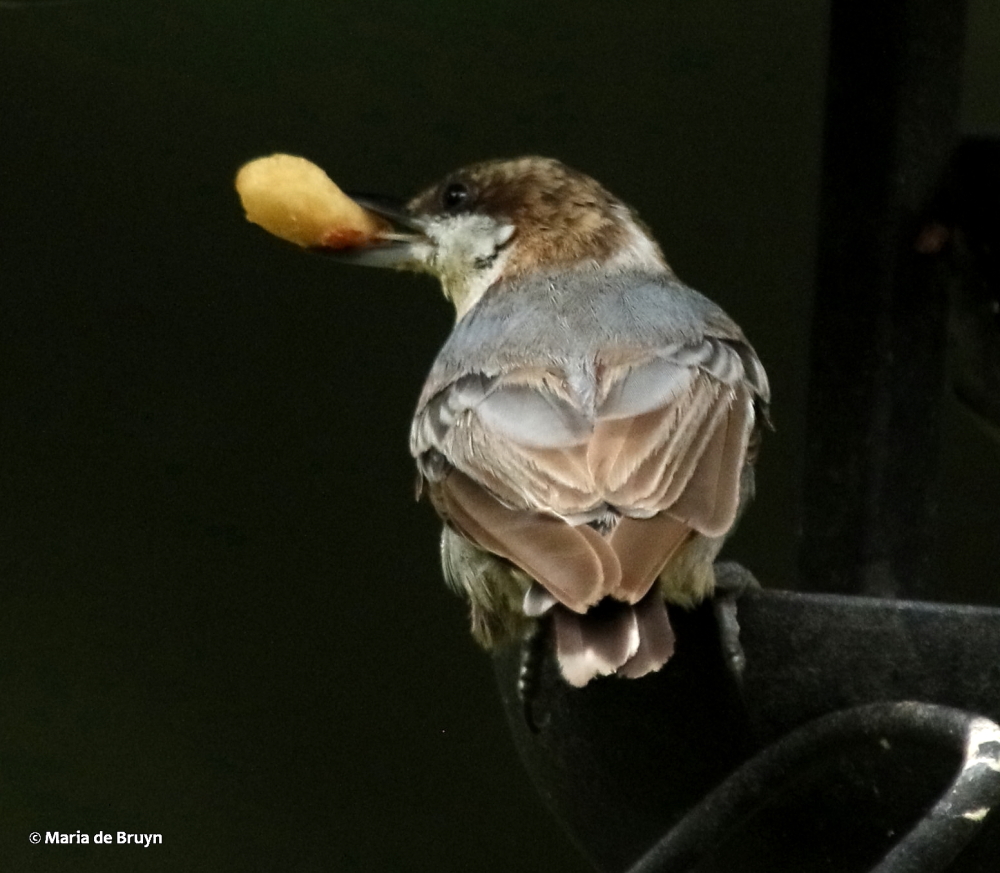
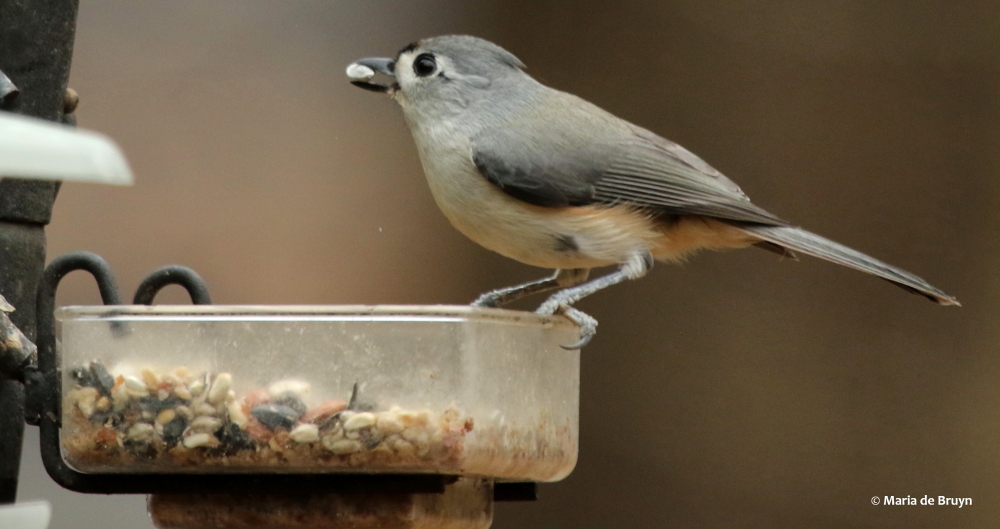
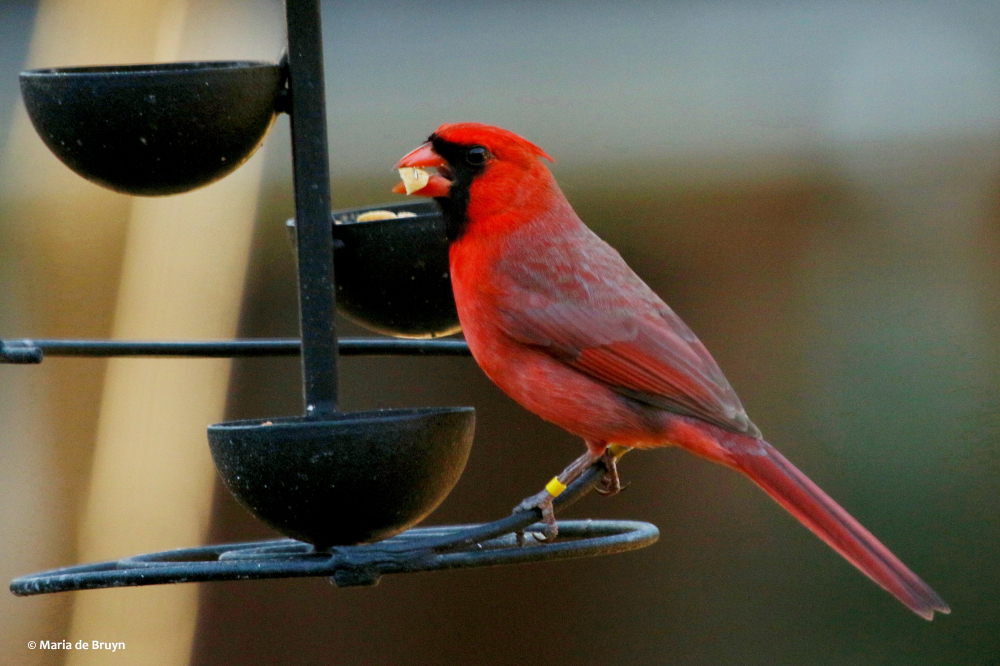
Northern cardinal                                            Brown-headed nuthatch (Sitta pusilla)

Before they left for the summer, the yellow-rumped warbler (Setophaga coronata) and ruby-crowned kinglet (Regulus calendula) tried the peanuts, too. Sometimes I wondered if the kinglet was also not looking for insects around the peanut feeder.


My choice to provide nuts was a big hit; I was rewarded with a procession of individuals of varied species who came by to quickly gulp or carry off a tasty nut. Some are pictured below – they came at different times of the day.


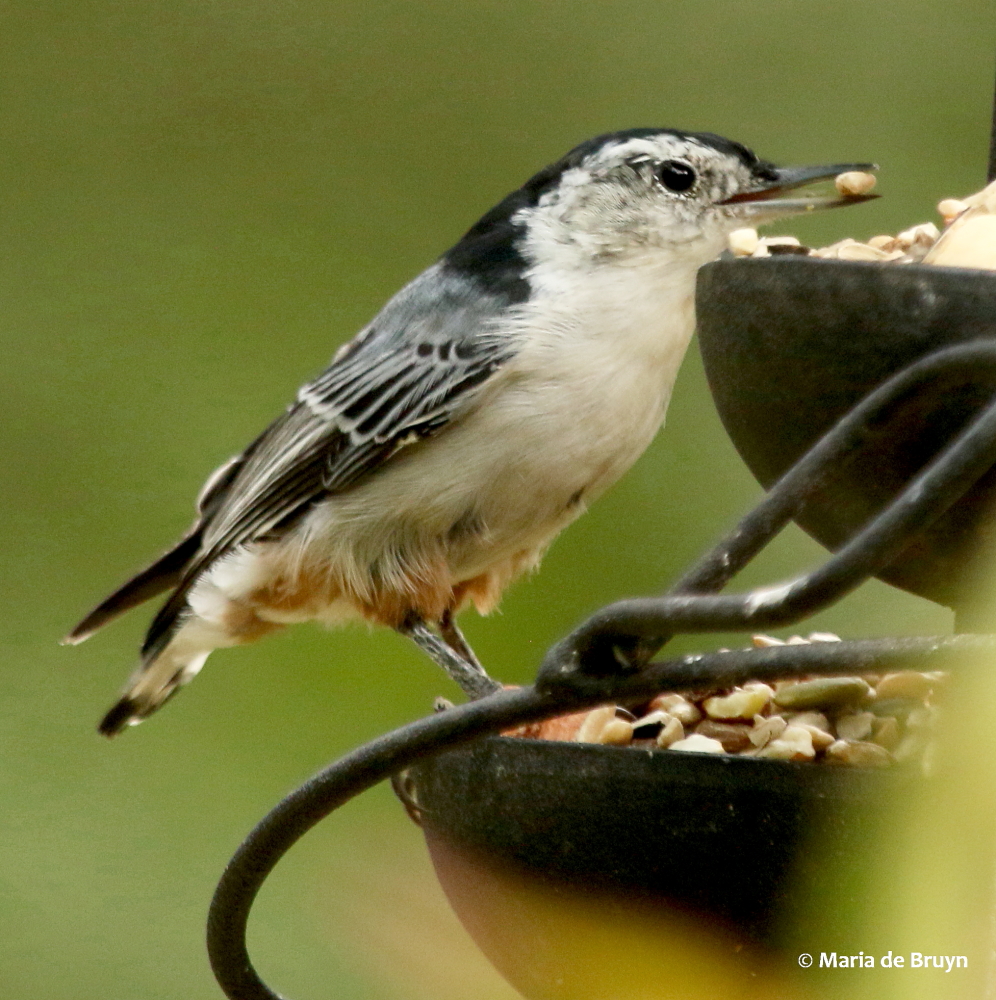
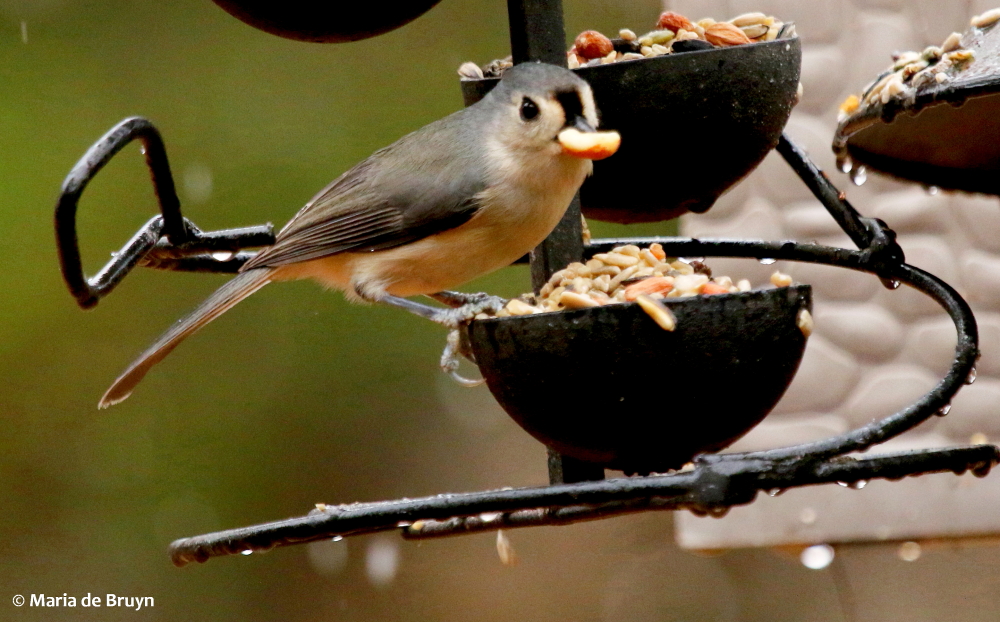
White-breasted nuthatch (Sitta carolinensis)     Tufted titmouse (Baeolophus bicolor)


Tufted titmouse                                                       Pine warbler (Setophaga pinus)


Red-bellied woodpecker (Melanerpes carolinus)      Northern cardinal


Gray catbird (Dumetella carolinensis)        Eastern bluebird (Sialia sialis)


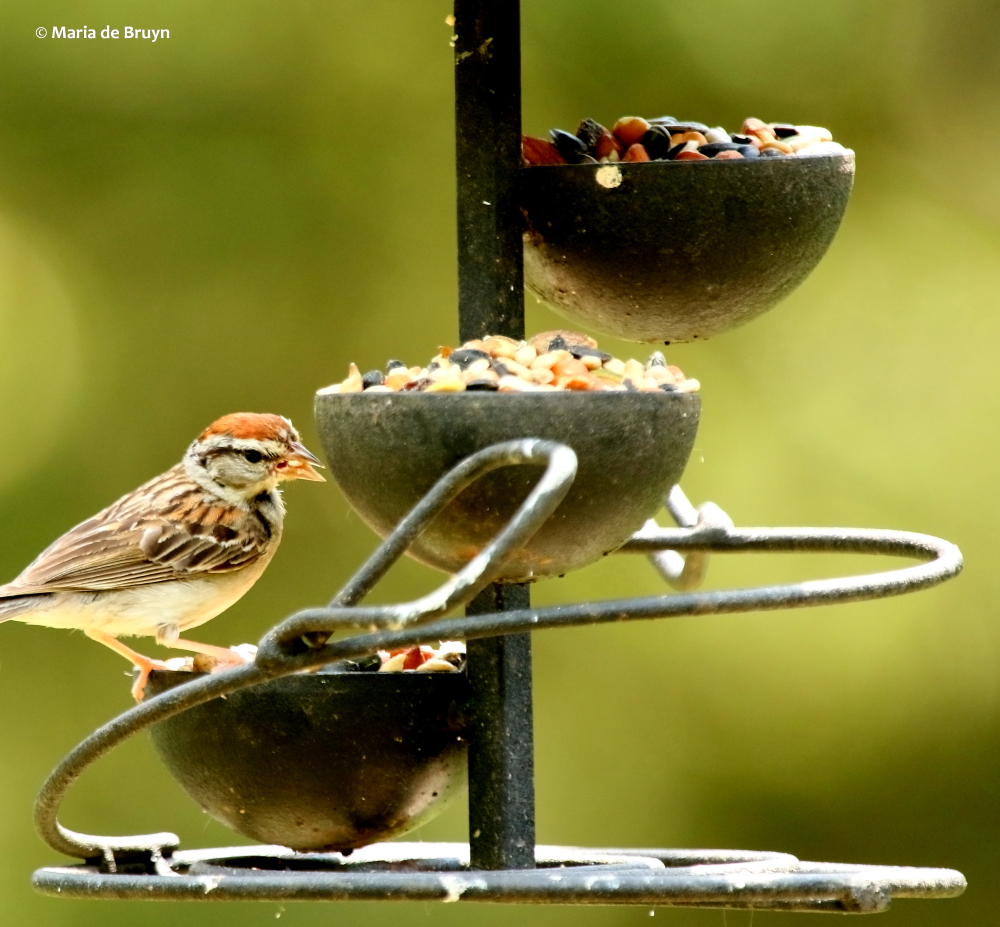
Chipping sparrow (Spizella passerina)         Brown thrasher (Toxostoma rufum)

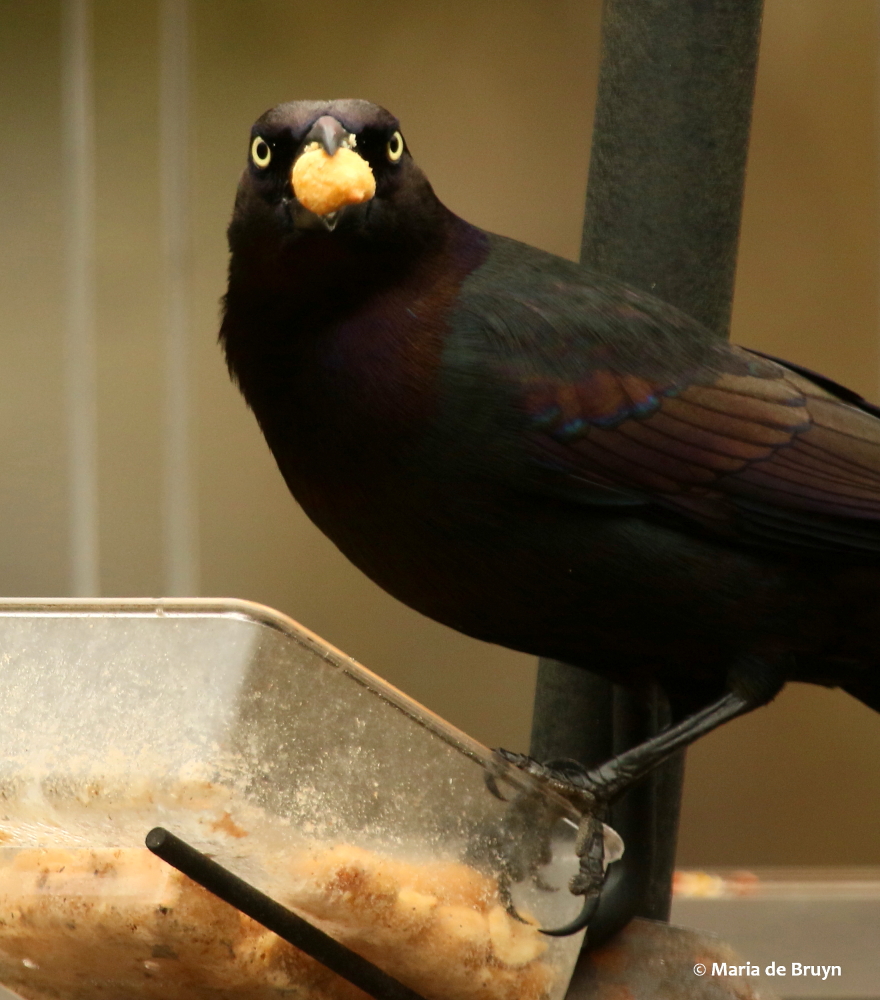
The common grackles (Quiscalus quiscula) will sometimes break down the nuts (and are quite messy about it, compared to the chickadees and titmice), but they will also swallow the treats whole.


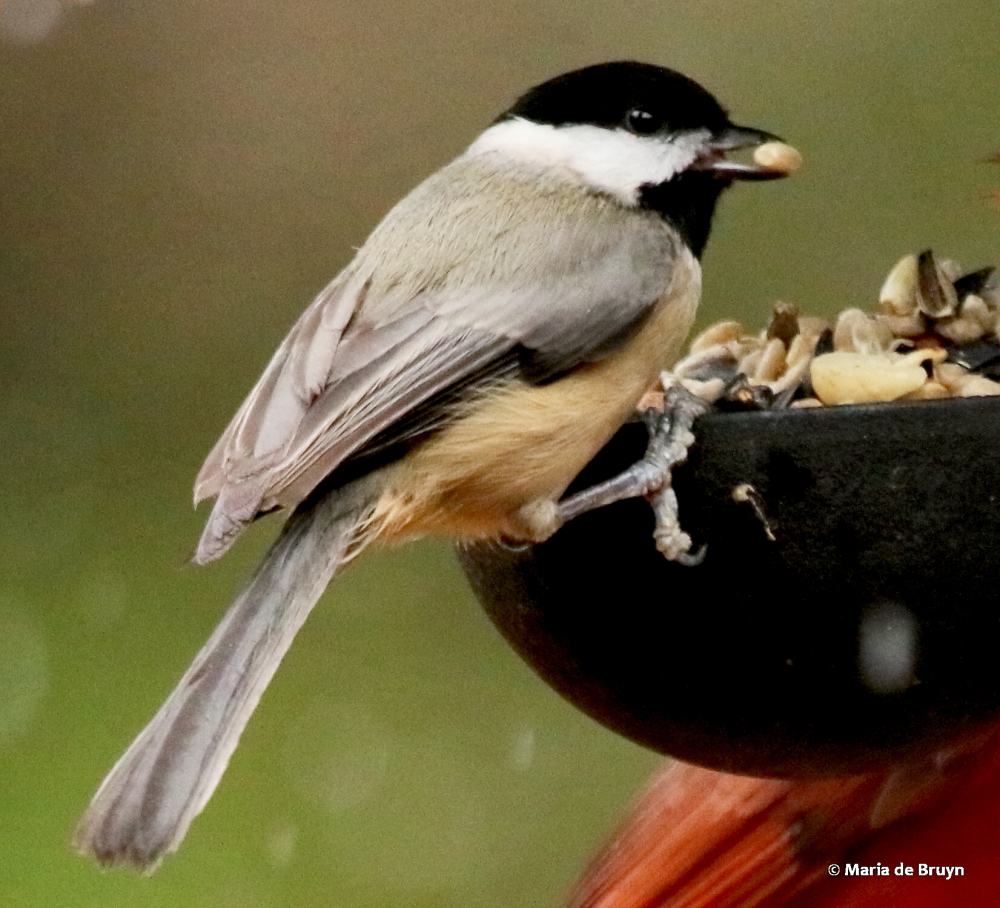
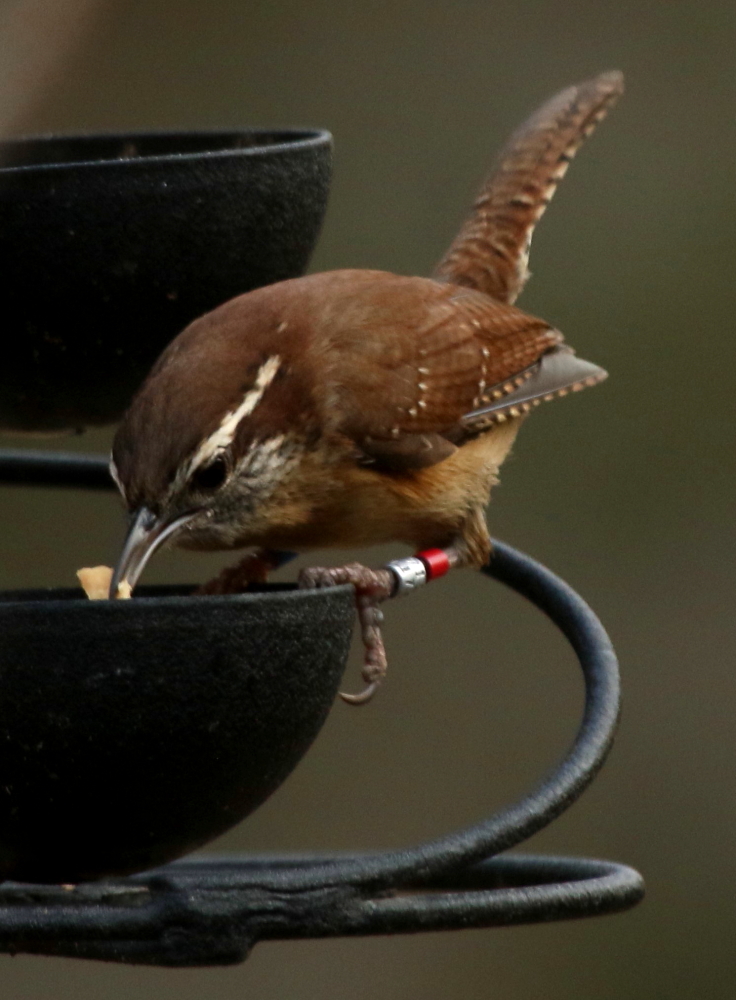
Others are intent on breaking the peanuts into smaller pieces that are easier to get down; this seems especially true for the smaller birds like the Carolina chickadee (Poecile carolinensis) below. Here we also see Riley, my banded Carolina wren, enjoying a treat.


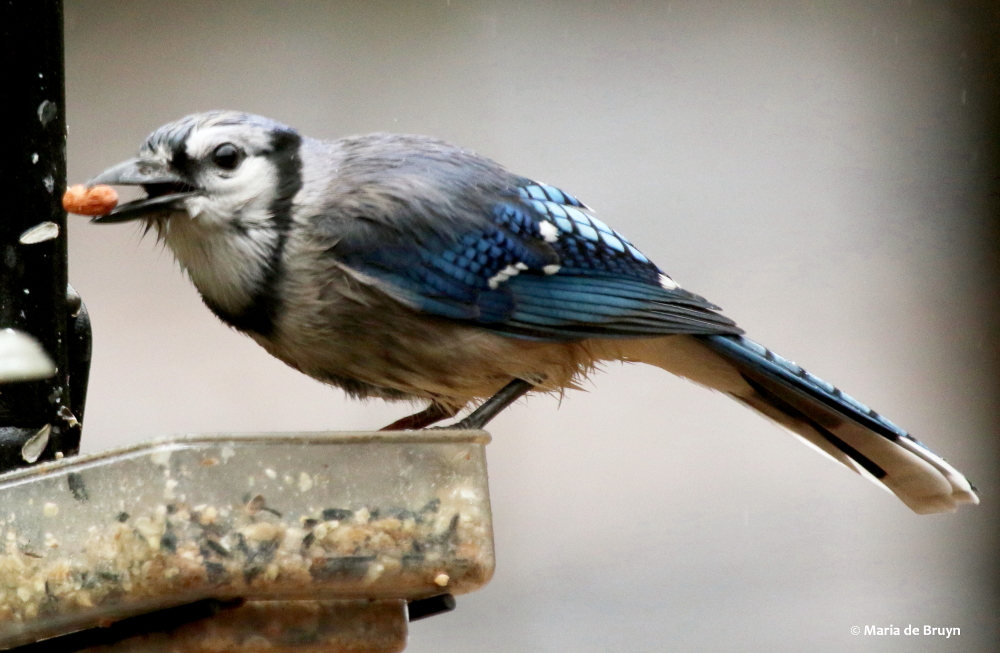
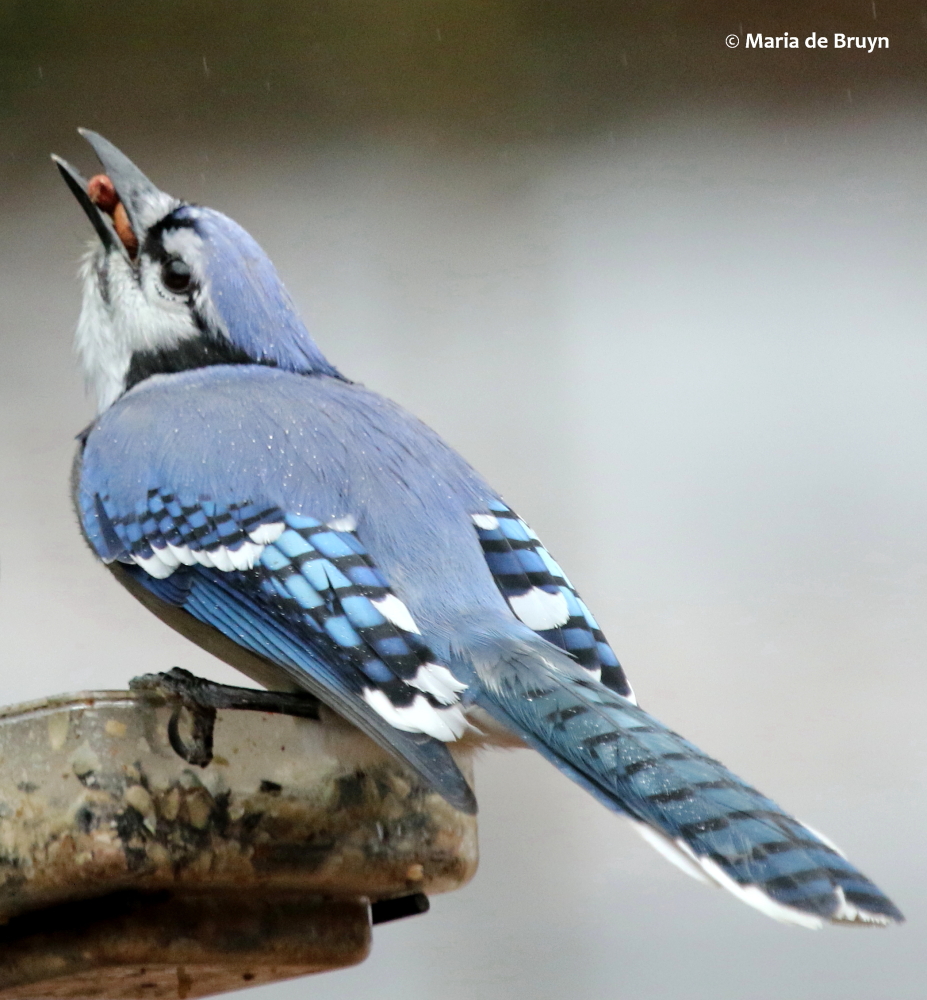
The blue jays (Cyanocitta cristata) often gulp down some nuts quickly and then try to carry off several nuts at a time.

One good thing about the peanuts is that thankfully the starlings (Sturnus vulgaris) and brown-headed cowbirds (Molothrus ater) don’t appear fond of them (they gulp down the dried mealworms, however, as if that food is going out of style). One will occasionally sample a nut, but they never seem to want a second.

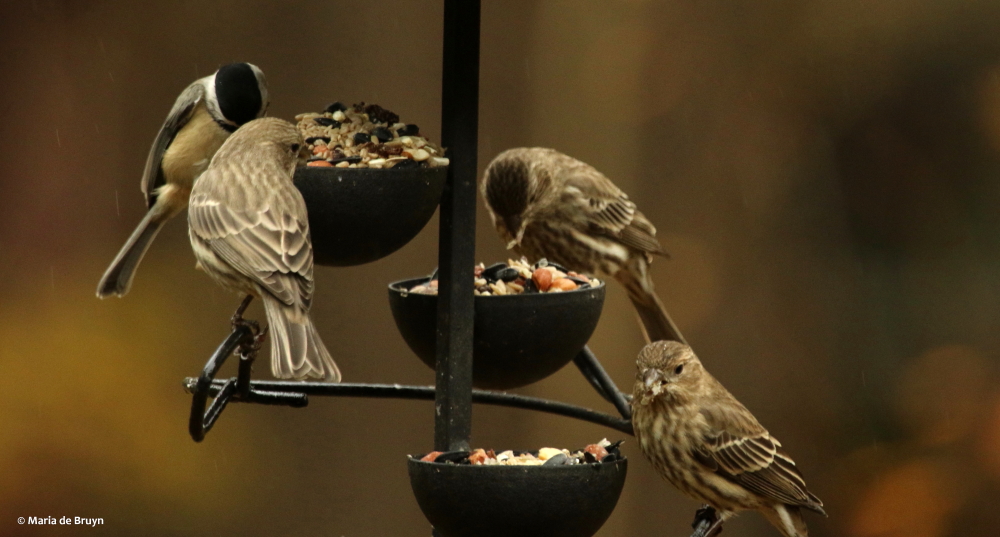
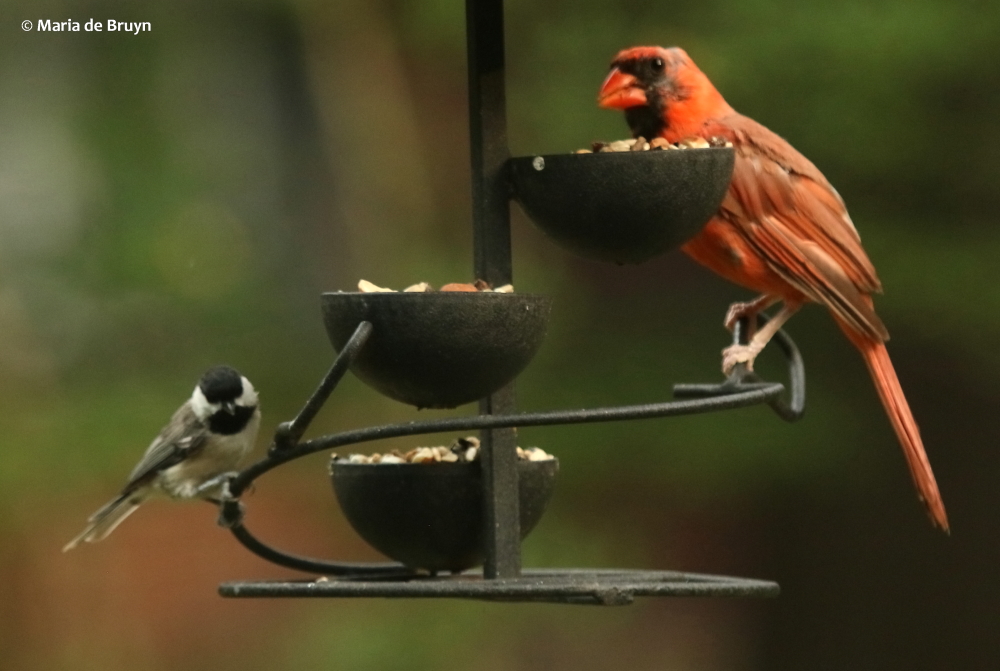
As time passed, I realized that the peanut feeding strategy was rewarding me with frequent avian visitors, but was also rather costly. In the autumn, I began putting out a less expensive fruit and nut mix. This has also proved very popular and various species of birds are willing to share space at the feeders. The chickadees especially will feed alongside others, like the house finches and Northern cardinal below.

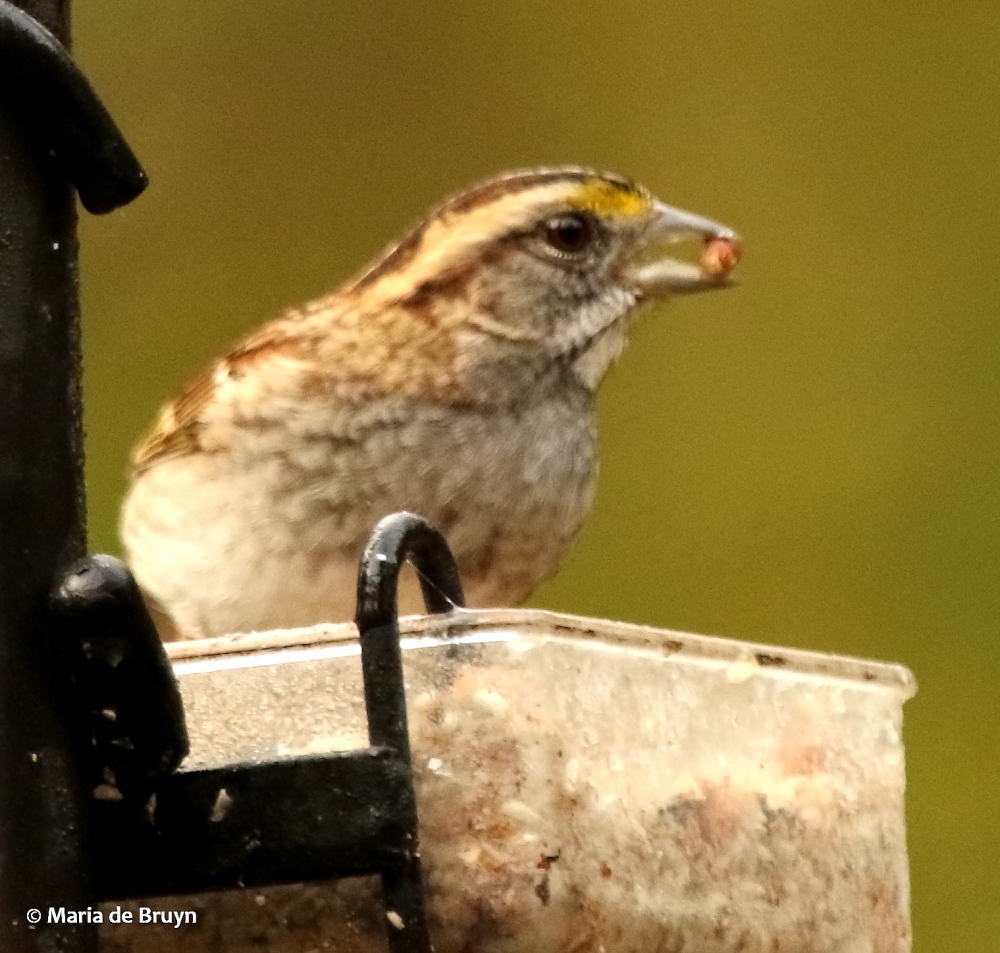
Species that usually forage on the ground, like the white-throated sparrows (Zonotrichia albicollis), also make occasional forays to the nut feeder.

When the nut feeders are empty, it’s not uncommon to see birds sitting atop them; when they see me, some will call out, as if saying, “Hey, fill up that feeder, please!” And I usually accommodate them, especially when it is very cold, as has been the case the first days of 2018 – we have had a record-breaking stretch of days in which the temperature did not rise above freezing, an unusual occurrence for our southern state of North Carolina.


Yellow-rumped warbler  (Setophaga coronata)  House finch (Haemorhous mexicanus)

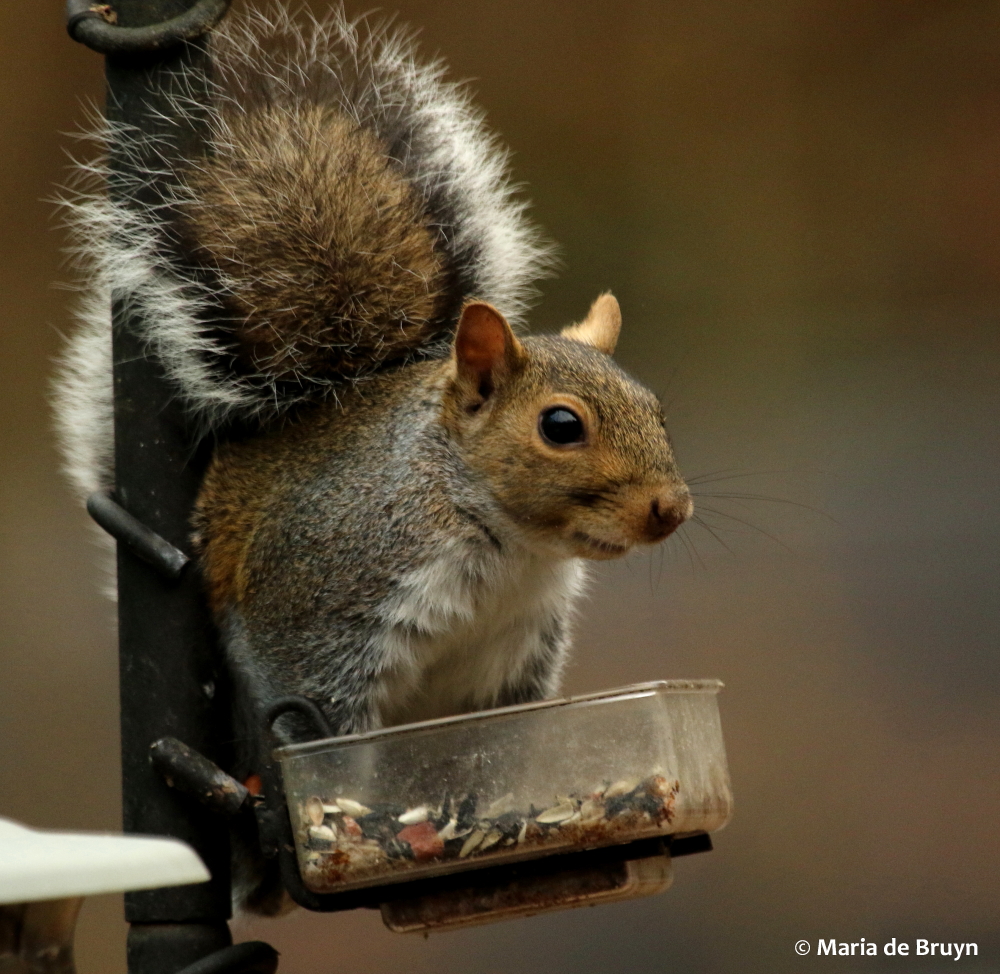
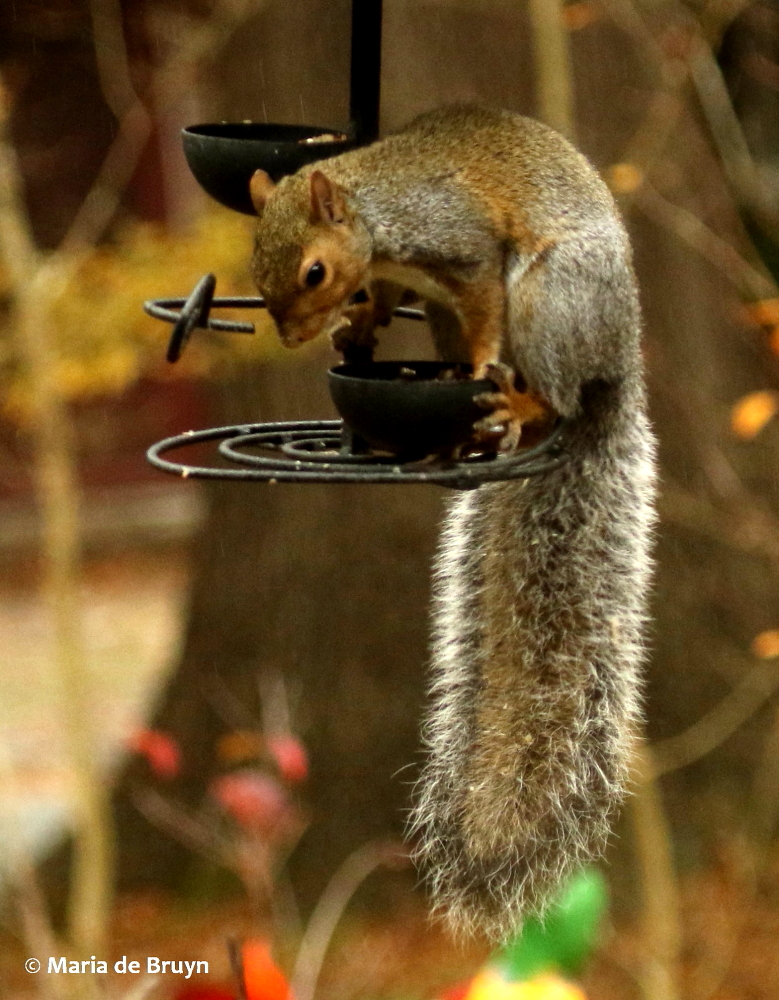
The nut feeders have also been very attractive to the resident Eastern gray squirrels (Sciurus carolinensis), one of whom has been VERY persistent in devising ways to get onto the feeders. Each time s/he succeeds, I change the position of the feeders or stumps and branches nearby. Currently, that clever rodent hasn’t been able to get up there. In compensation, I occasionally throw a handful of nuts on the ground.


So, not all the birds are “nuts” for nuts, but plenty of species think they’re mighty fine! They are definitely a worthwhile addition to the birders’ array of feeder offerings.

American goldfinch (Spinus tristis)