 During a recent visit to Topsail Island, one of my favorite get-away sites, the various gulls, terns and other birds were very busy: resting, eating and investigating beach debris such as twigs, like this great black-backed gull (Larus marinus).
When I looked through my zoom lens and saw two juveniles of the species picking up and dropping items into the sand, I decided to photograph them. Given some deterioration in my eyesight, even through the zoom lens, I thought one of them was examining a large black twig so I shot away. Imagine my surprise when I downloaded the photos to my computer and enlarged them to see what the gull was actually carrying around!

Most of the time, s/he appeared to be grasping the knife by the blade rather than the handle end, which totally amazed me.


The bird would drop the paring knife and then pick it up again.


One time it was by the handle.


I wish I had realized what the gull was doing when I was there so that I could have picked up the utensil but at the time, I was convinced it was a twig and after shooting the series, I turned to other birds.

I posted the photo on a Facebook birding group page with the remark that: “Beach-goers and fishermen need to pay a lot more attention to what they leave behind onshore!” The responses that came were interesting:
– wow…scary the things people leave behind
– I hope he dropped it when he realized how sharp it was!
– Smelled like fish most likely….
– Sometimes they ‘steal’ from us while our backs are turned on a fishing pier!
– Maybe he’s in a gang?
– Considering it’s Topsail, more likely one of Blackbeard’s crew. Nice image of the gull.
And then one person apparently doubted that the photo I had posted was real: “The size of the gull and the size of the knife looks fishy. The knife is only a bit longer than the beak. That must be one big gull. It’s all in the perspective, I guess.” Since I don’t own Photoshop or some other program with which I can combine photos or insert things into photos, I can assure you that the series shows what happened.
While the respondent who mentioned birds stealing items from people is stating a fact, this site was at the end of the island very far from any piers. So I can only assume that some careless human left the knife behind on the beach (like the cell phone cover and plastic that I collected for the garbage that day).
It is well known that the trash on beaches often ends up in the sea, harming animals that ingest it and contributing to large floating garbage piles. On 20 September 2014, the Ocean Conservancy is sponsoring the International Coastal Cleanup — the world’s largest volunteer effort to clean up waterways and the ocean. I don’t live near an ocean but will pick up trash near a large lake in my area. And I urge you all to participate in some way if you can! It may be a drop in the ocean/waterways bucket but the drops add up!


 Several years ago, as I was beginning to photograph wildlife more seriously, I became quite excited at the North Carolina Botanical Garden. Buzzing around some profusely blooming flowers was what I thought might be the smallest hummingbird I had ever seen. I was not used to taking shots of something that was in almost constant motion, but I persisted until I got photos that made it at least a little recognizable. I lost the original photo when both my computer and my back-up hard drive crashed at almost the same time, but I “rescued” one of those first photos from a Word document.
 I soon learned that what I had seen was actually an insect – a hummingbird clearwing moth (Hemaris thysbe) to be precise. This is likely one of the first insects that I ever got enthusiastic about.


 Their caterpillars are called hornworms as they have a horn at the rear; I have not seen one yet but they must be around somewhere. They pupate in leaf litter and on the ground; since I leave the fallen leaves around, I’ve been providing them with a childhood and adolescent home! And that’s good as I really look forward now to welcoming them to my yard each year!
 We usually don’t know who gave a bird species its common name and sometimes may scratch our heads wondering how and why someone ended up choosing a particular name. But birders faithfully learn to identify birds with those names, even when they may seem illogical. For example, many people would have chosen to call red-bellied woodpeckers red-headed woodpeckers since the reddish belly feathers are much less obvious than the red on the back of their heads.


 Much of the insect world consists of animals that we usually don’t even see or notice because: a) we don’t know they exist and therefore don’t look for them and b) they are tiny and only well visible with an enlarging lens. But once you get a good look at them, they turn out to be fascinating and sometimes quite attractive. One group of these insects is the hoppers – leaf- and planthoppers, that is, like the gray lawn leafhopper (Exitianus exitiosus) to the left.
 Leafhoppers are only 1/16 to 5/8 of an inch (2-15 mm) long. About 20,000 different leafhoppers have been described around the world; they feed by sucking plant sap from grass, shrubs, or trees. Planthoppers, some of which look like leaves and may be a bit bigger, also feed on plants.The nymphs (juveniles) are tiny, too, as seen in this photo where you see my fingertip above the nymph of an Acanaloid planthopper .
 a delicate little fly while resting.
 Versute sharpshooters (Graphocephala versuta) in love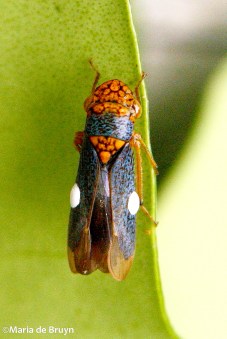


 Planthopper nymphs, like the two-striped planthopper (Acanalonia bivittata) and the Acanalonia servillei below, are known for producing waxy strands from their bodies which repel water. These strands also help protect them from predators, who might grab onto the showy white hairs, which break off so that the hopper can escape. The nymphs can ultimately be entirely covered in white wax.


 I imagine there are many more interesting behaviors to observe with the hoppers. Maybe one day I will get a macro lens so that I can really get some good photos of these cute little insects. In the meantime, as there are several thousand species in North America, I can look forward to finding new ones – with my camera in hand as I wouldn’t be able to see anything but specks on plants without it!
 My beautiful world