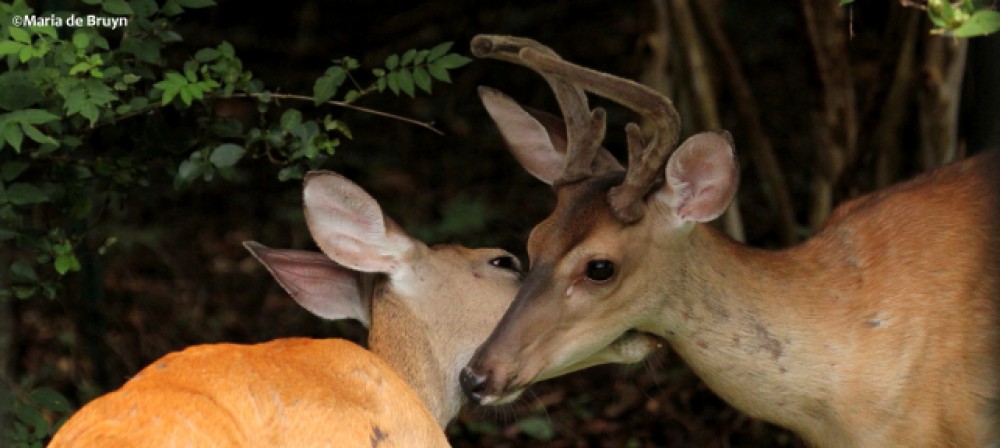
My nature muse and a delightful experience

Dear unseen spirit,

You are a muse for me who permeates the air and leaves and water and earth that form the sphere in which I feel so at home, at rest yet invigorated, excited, awed, happy and amazed in turn and sometimes simultaneously, in a welter of positive emotion and feeling.

Yesterday, you brought me one of those moments. A smallish, perhaps teenaged, painted turtle (Chrysemys picta), with a smooth ebony carapace with some iron oxide-like highlights, was busy laying her eggs. My friend Lucretia and I stopped to watch.

Lucretia had discovered her while walking a fence line near a lake cove, sticking to that border of mostly bare dirt except for some leaves and twigs so she could avoid the longish grass that could very well be harboring ticks and chiggers – the nemesis bugs for birders and naturalists!


Ms Turtle was not quite vertical but leaning like the Tower of Pisa with her bottom in a hole she’d dug and her red-striped front legs anchoring her above. She was using her back legs and toes to move aside dampened clay earth, sometimes moving her body side to side to widen the depression. We wondered how much she’d had to urinate to get the dry ground to a nice malleable consistency; it turns out that painted turtles can store water in their urinary bladder, which helps with buoyancy in the water – and nest digging on land.

When we first stopped, she withdrew her head into her shell and stayed motionless but not for longer than 45 seconds or so. Her natural impulse for self-protection was weaker than her need to procreate, so she resumed moving small mounds of earth.

After some 15 minutes or so, we moved on along the cove, Lucretia noting birds and me looking for dragonflies to photograph. Spring was still in the air with one female widow skimmer (Libellula luctuosa) being chased by 3 to 5 males in an aerial ballet as they sought to be the one who could grab her head and become her temporary mate.

One pair of conjoined dragonflies skimmed the water’s surface while others hovered over water plants or rested on shoreline foliage for a few minutes.

Spangled skimmer (Libellula cyanea)


Eastern amberwing (Perithemis tenera)   Halloween pennant (Celithemis eponina)

Thoughts of Ms Turtle came back to me and I cut my insect investigations short to go back around the cove to her birthing site. Lucretia was already there and waved me over – she’d just seen Ms Turtle expel two white eggs, which I saw below her tail as she resumed her back-leg maneuvering of damp earth. She was now covering the eggs and perhaps that is also what she had been doing when we arrived. Painted turtles lay from 1 to 11 eggs and we wondered if she had already laid some and was covering them in layers.

At any rate, she was now obviously done with placing her progeny in the nest and was filling in the hole. She deliberately and meticulously grasped balls of soft earth and maneuvered them over the eggs. Her instincts were good and she apparently was doing this all by feel as she couldn’t see what she was doing. Her back legs unerringly found the next clump to move into position and she was quite thorough in making sure it was placed and smoothed over in just the right spot.

The process was slow but careful and as she gathered in the mud, her body began going more and more horizontal – a really noticeable change from when we first saw her more or less standing on end to deposit her clutch.

Ms Turtle was no longer bothered by our presence at all – nothing was going to stop her completing the process, although she occasionally did pause for a moment or two. She’d been at this for at least 70 minutes or so – or perhaps longer if she’d already laid some eggs before our arrival. Lucretia commented on what a hard worker she was!

When Ms Turtle was finally entirely horizontal, resting on the packed earth that was even with its surroundings, she took one more precaution to prevent predators (e.g., snakes, chipmunks, squirrels, foxes, raccoons) from finding her developing offspring. She used her back legs to draw in leaves and twigs to top off the dirt over the nesting site so that it looked exactly like the surroundings!

This, too, was done deliberately and carefully and by feel – never once did she turn around to look at what she’d done. In fact, when she was finished, she set off at an angle to trundle rapidly through the grass to the lake, never casting an eye on the covered nest.


We vowed to investigate egg incubation times (on average, 72 days, making 19 August a possible hatching day) and Lucretia tied a paper towel on the fence in front of the site so we could re-locate it. I also tied some weeds into the mesh of the fence.


In the meantime, Ms Turtle was making good time to the lake and we saw her tip over the shoreline edge, only to end up on her back. Within 10 seconds, she’d righted herself and plopped into the water, briefly floating and then submerging.


We spoke about her wonderful work – even if instinctual, it was amazing to watch and we felt privileged to have borne witness to it. Suddenly, not far off-shore, up popped Ms Turtle; she floated at the water’s surface enjoying a well-earned rest after her double labors (birthing and excavation/reconstruction). Her carapace glistened and she was a beauty to see and admire.

It would be super to be able to see her hatchlings emerge in August. I don’t know if we will be so lucky but recalling their mother’s construction of a nursery will be a great nature memory for sure. And who knows what new event you, my nature muse, will bring along in the meantime – when I arrived home, two of the Eastern bluebird (Sialia sialis) had hatched!

Mother Nature, you always delight and/or edify to be sure!

Many thanks! Maria


The beautiful “baker” bird

Recently, I’ve had the good fortune to observe a small bird at close quarters that I had only seen in a couple glimpses in the past, the ovenbird (Seiurus aurocapilla). Like the ruby-crowned and golden-crowned kinglets, this little avian also has a stripe atop its head. Like the golden-crowned kinglet, the stripe is always visible and orange in color, blending in nicely with its other muted brownish and cream colors.


The ovenbird gets its name from the shape of its nest, which is built on the ground in a shape reminiscent of an outdoor or Hopi oven. It is domed and has a side entrance and can be difficult to see.

The ovenbirds spend the winters in the Caribbean region and Central America and then come North for the summer breeding season. My sightings of the singing male have been at our local nature reserve, Mason Farm Biological Reserve, where I volunteer as an invasive plant eradicator and sometime planter of native flowers.


The male sings a three- to-five note call in the spring as part of his courting behavior and the call varies among individuals. When males are in neighboring territories, they will sing together in duets and it can be difficult to know how many birds are singing.


The sound is so loud that you expect to see a much larger bird and his song inspired poet Robert Frost to dedicate a poem to him.


If he is sitting on a branch, you can eventually find him but it can be a challenge since they prefer to reside in forests with heavy canopy cover so that it is fairly dark.


Once you see him, you may be able to watch for a while as they don’t seem to be very wary of people. This individual let me observe as he groomed on a low tree branch, pausing now and again to let out a few notes.


These birds prefer areas with heavy leaf litter for their homes – the leaves provide cover for their ground nests and they blend in really, really well as they scurry about foraging in the leaves for insects, worms and snails to eat. Both the females and males participate in feeding the fledglings until they can fly at about 30 days.

When they emerge into a patch with a bit of sunlight filtering down through the leaves overhead, you have a bit better chance to see them. Otherwise, you may end up staring at ground cover until you catch a bit of movement and can zero in on the motion to see them.


Photographing the bird is a challenge since they spend their time in areas with so little direct light. My first photos were a bit dark, but then I increased the ISO on my camera considerably (a tip from fellow photographer, Mary – thanks!) and the photos were a bit better. Still, the somewhat darker photos reflect the environment in which you discover these little troubadour warblers. Now that I know where to look for them, I hope to see them more often in years to come.

Back to blogging with the golden crowns!

Litter boxes scrubbed, bird feeders filled, other chores waiting but I’ve decided to end my blogging hiatus on this rainy and somewhat gloomy Sunday morning. This and my next blog will feature two of my favorite birds and then I hope to treat you with a nesting saga as spring is well underway.

With a lovely ruby-crowned kinglet visiting my yard every year for the past four years, I’ve developed a particular fondness for this tiny avian species. This past autumn and winter, my partiality expanded to include their jeweled cousins, the golden-crowned kinglets (Regulus satrapa), who seemed to have favored our geographical area with an irruption (an ecological term for a sudden increase in an animal population). Whereas in previous years, I felt lucky to catch a glimpse of a golden crown during their months-long stay in North Carolina, they appeared to be everywhere this past winter and in full view to boot.


The golden-crowned kinglets are about the same size as the ruby crowns and similar in overall body color except that they also have a black eyebrow stripe.

While the ruby-crowned males only flash their red crests when mating or upset, however, the golden crowns have a permanent yellow stripe atop their heads.


The male golden crowns can sometimes be distinguished by the fact that there will be a hint of red in their golden crest.


Like the ruby crowns, these little insect foragers are in constant movement as they scour branches, shrubs and plants for a meal. Their varied diet includes beetles, flies, crickets, butterflies, spiders, and bees and wasps. In the winter, they will also eat some seeds.


Searching for the insects often means they hang upside down from branches as they look at the underside and in crevices for their next bite to eat.


They also hover mid-air to snatch an insect or fly.

The golden crowns sometimes sit still a bit longer than ruby crowns so that you have a chance to get off a few photographic shots before they resume their dietary searching. And this year, one of those photos placed me among the winners in a small local competition.

These birds are not much bigger than hummingbirds, but like the hummers, they also undertake a long migration twice yearly. Their winters are spent throughout North America but for breeding they travel to the far North and mountainous Northwestern areas of this hemisphere.

This year, many places had mild winters but if they arrive in the North before spring-like temperatures arrive, they are able to survive nights as cold as –40 degrees; sometimes, they huddle together to keep a bit of warmth. Their lifespan is several years, with the oldest recorded golden crown being a banded male who was at least 6 years and 4 months when he was recaptured in Minnesota in 1976.


This species prefers life in coniferous forests but it seems if a few spruce and pines are around, they will settle in. I saw them in a small and somewhat sparsely vegetated area near a senior center, an arboretum, along the Haw River, and in the woods and bogs of various nature reserves.


In the United States, the number of golden-crowned kinglets declined 75% between 1966 and 2014. Habitat loss has contributed to this. However, spruce reforestation in the Eastern USA may have contributed to a more recently seen increase in numbers of kinglets. I’m very glad that they are not (yet) an endangered species and I hope we get to see them a lot next winter, too!

The sad spring saga of Sassy squirrel

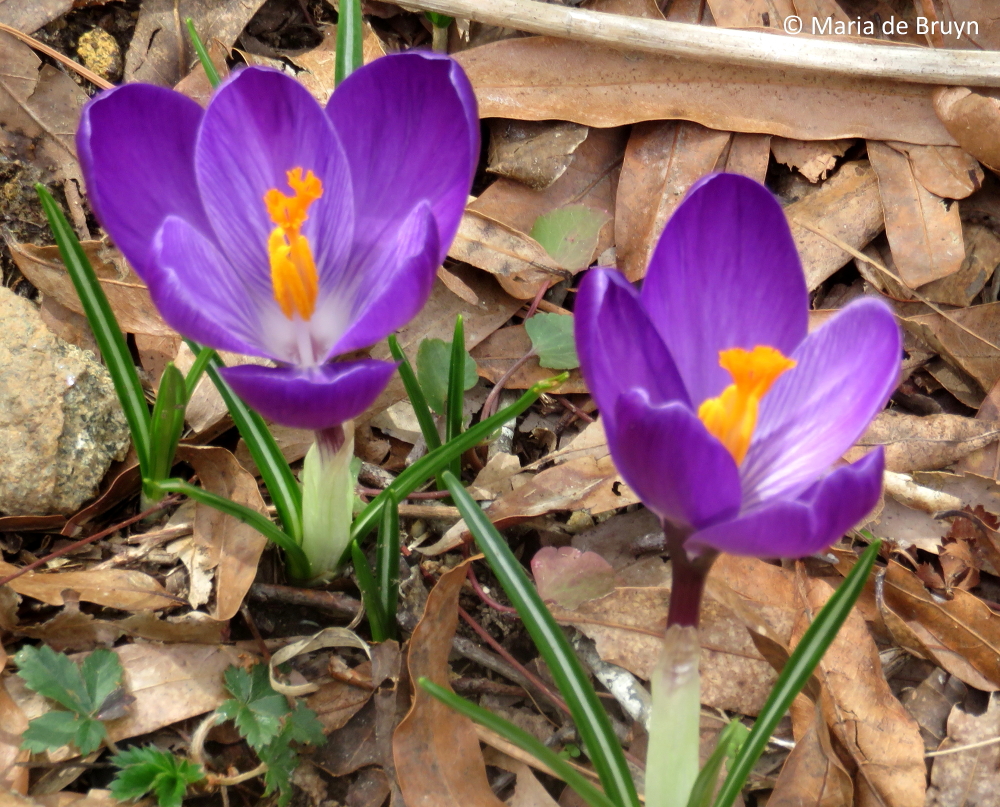
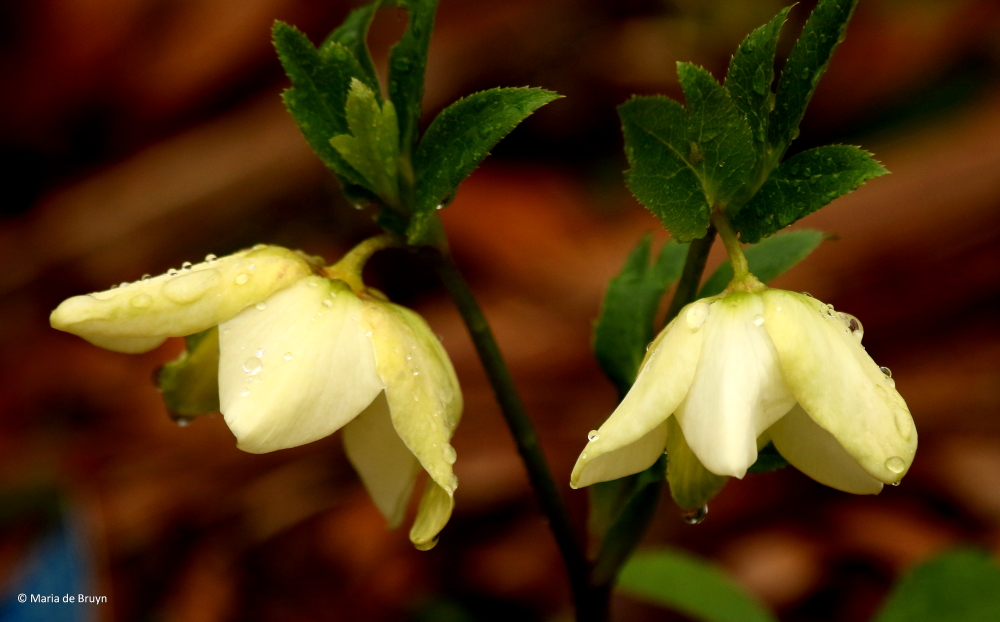
cape-may-warbler-i77a5989-maria-de-bruyn-2resSpring has come early to North Carolina, leading to some early bird migration (like this Cape May warbler, Setophaga tigrina, on its way North), avian courtship and nest building, as well as spring blossoms already emerging in profusion. My garden has seen some lovely flowers, both cultivated and wild: daffodils (Narcissus), crocuses (Crocus), winter jasmine (Jasminum nudiflorum), henbit (Lamium amplexicaule) and lenten rose (Helleborus orientalis).

daffodil-i77a2964-maria-de-bruyn-res    daffodil-i77a2325-maria-de-bruyn-res

crocus-img_1813-maria-de-bruyn-res   crocus-img_1790-maria-de-bruyn-res

winter-jasmine-i77a0793-maria-de-bruyn-res    henbit-i77a1155-maria-de-bruyn-res

lenten-rose-i77a2951-maria-de-bruyn-res lenten-rose-i77a1903-maria-de-bruyn-res

lenten-rose-i77a2970-maria-de-bruyn-res

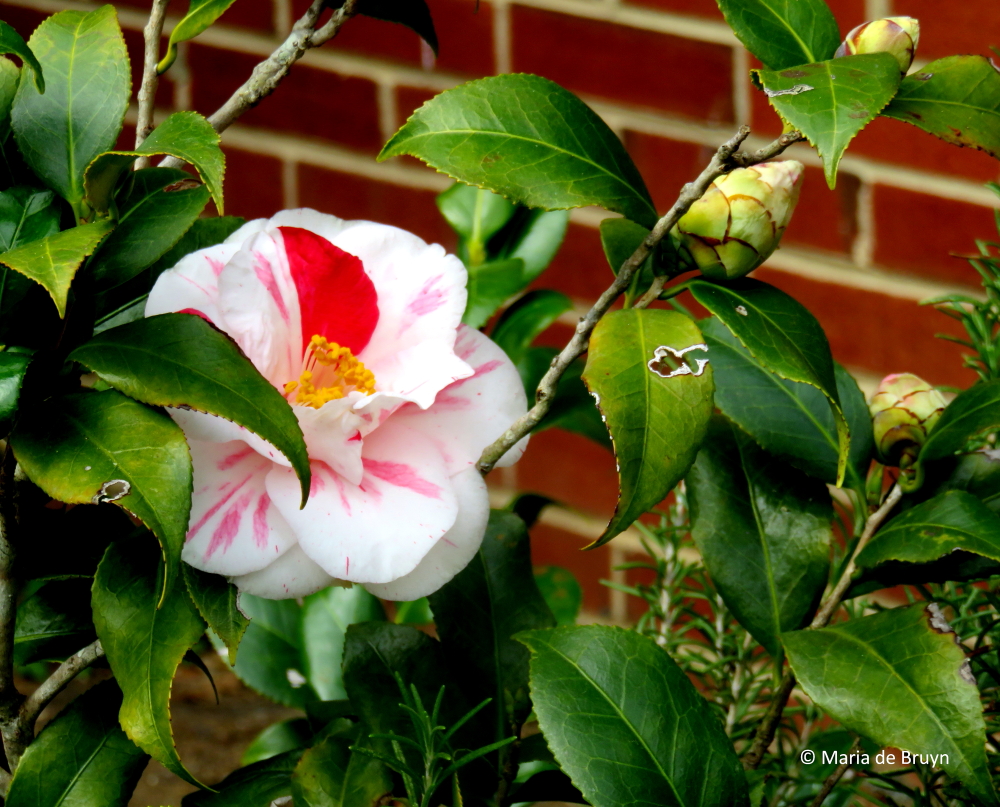
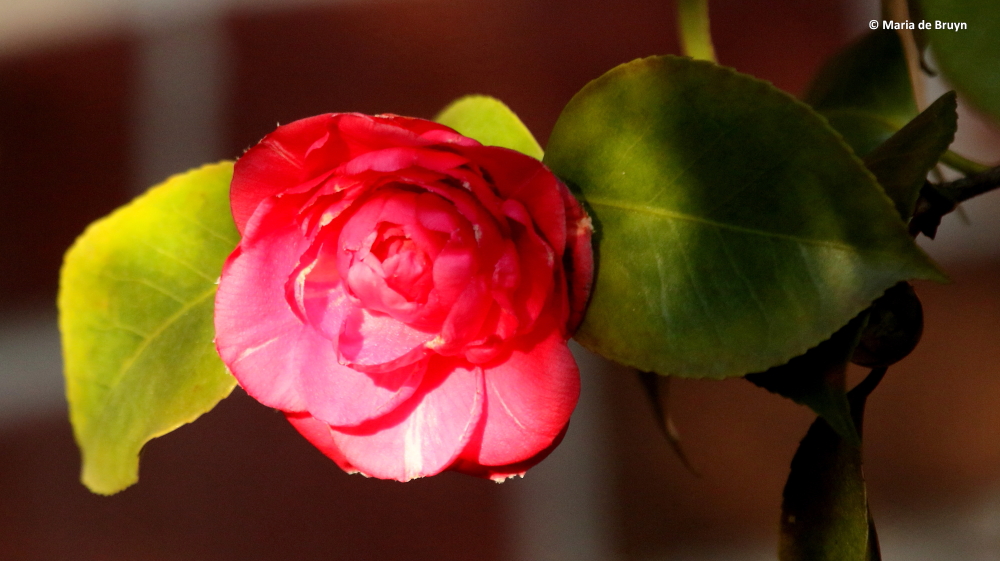
My camellias ( Camellia) bloomed in much greater profusion than ever before.

camellia-img_1816-maria-de-bruyn-res    camellia-i77a1922-maria-de-bruyn-res

The shrubs and trees also sent out their buds weeks “ahead of schedule” – since the past month was the warmest recorded February in this area, my plants advanced their springtime blossoming, including the serviceberry (Amelanchier arborea), viburnums, dogwoods (Cornus kousa and Cornus florida) and common elderberry (Sambucus nigra).

serviceberry-i77a1965-maria-de-bruyn-res  tree-i77a1949-maria-de-bruyn-res

tree-i77a1963-maria-de-bruyn-res tree-i77a1950-maria-de-bruyn-res

My new blueberry bushes burgeoned with delicate little flowers, but the past two nights I had to cover them up so that they wouldn’t shrivel up as the temperatures dropped below freezing.

eastern-gray-squirrel-i77a0079-maria-de-bruyn-res


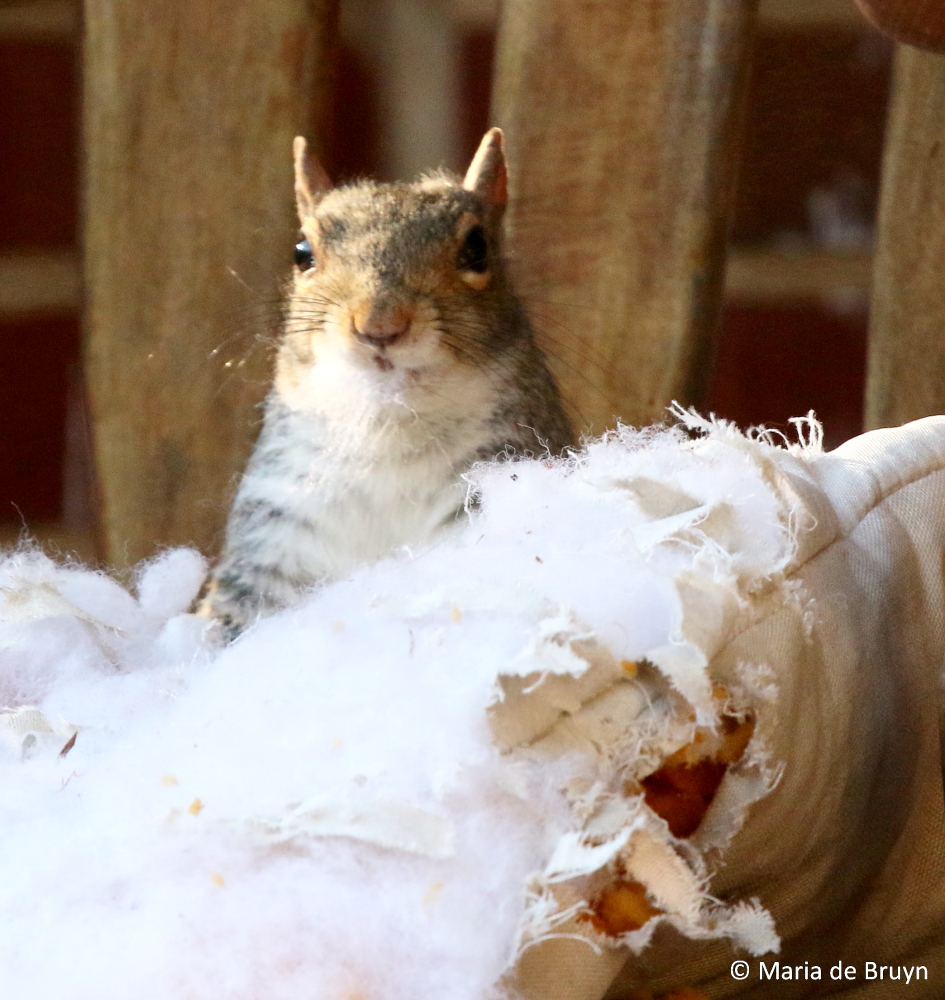
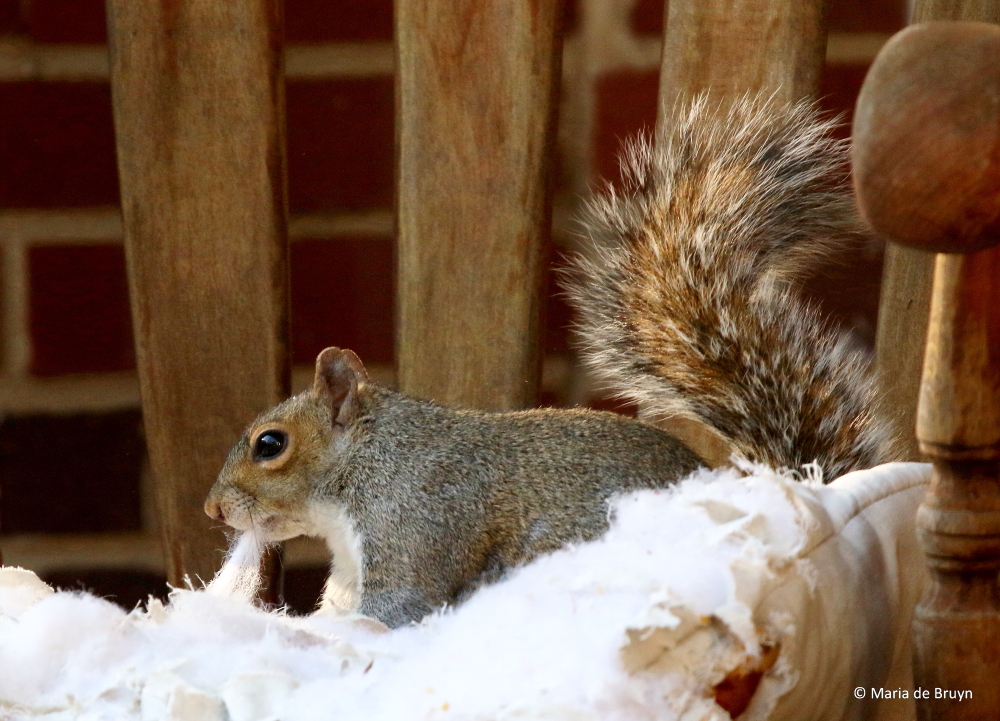
It wasn’t only the plant and bird life responding to the unusually changing season, though, as I discovered when I finally noticed the altered pillow on my front porch rocking chair. I first saw that the cloth covering the pillow had been torn; upon closer examination, I saw that the pillow had been opened up with its filling tufting up in places.


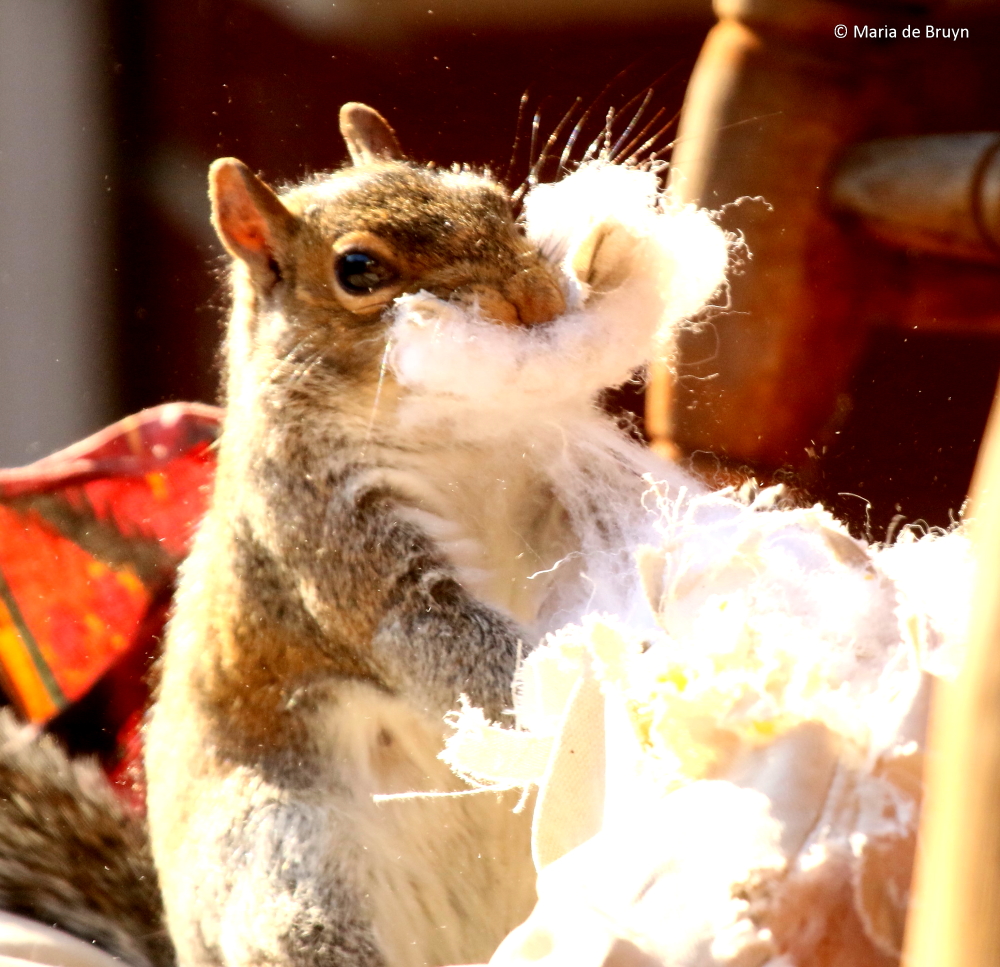
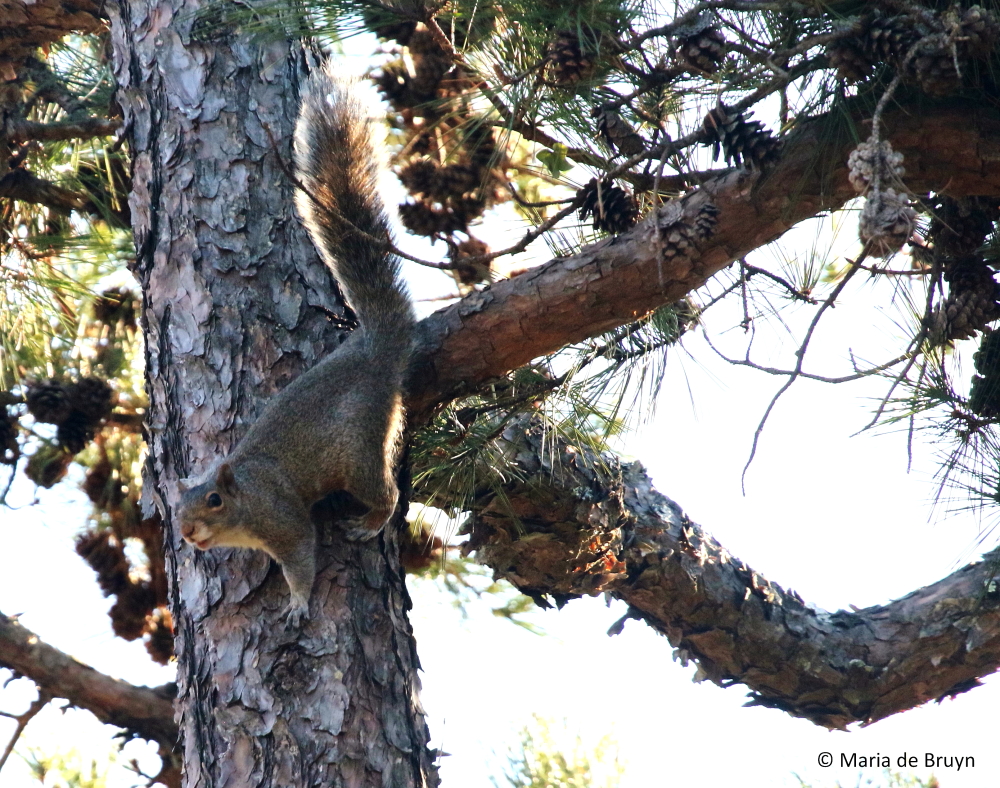
eastern-gray-squirrel-i77a0093-maria-de-bruyn-resWhen I began watching the rocker in addition to the bird feeders, I discovered the culprit – an industrious Eastern gray squirrel (Sciurus carolinensis), whom I named Sassy as she shows no fear, just a little caution.

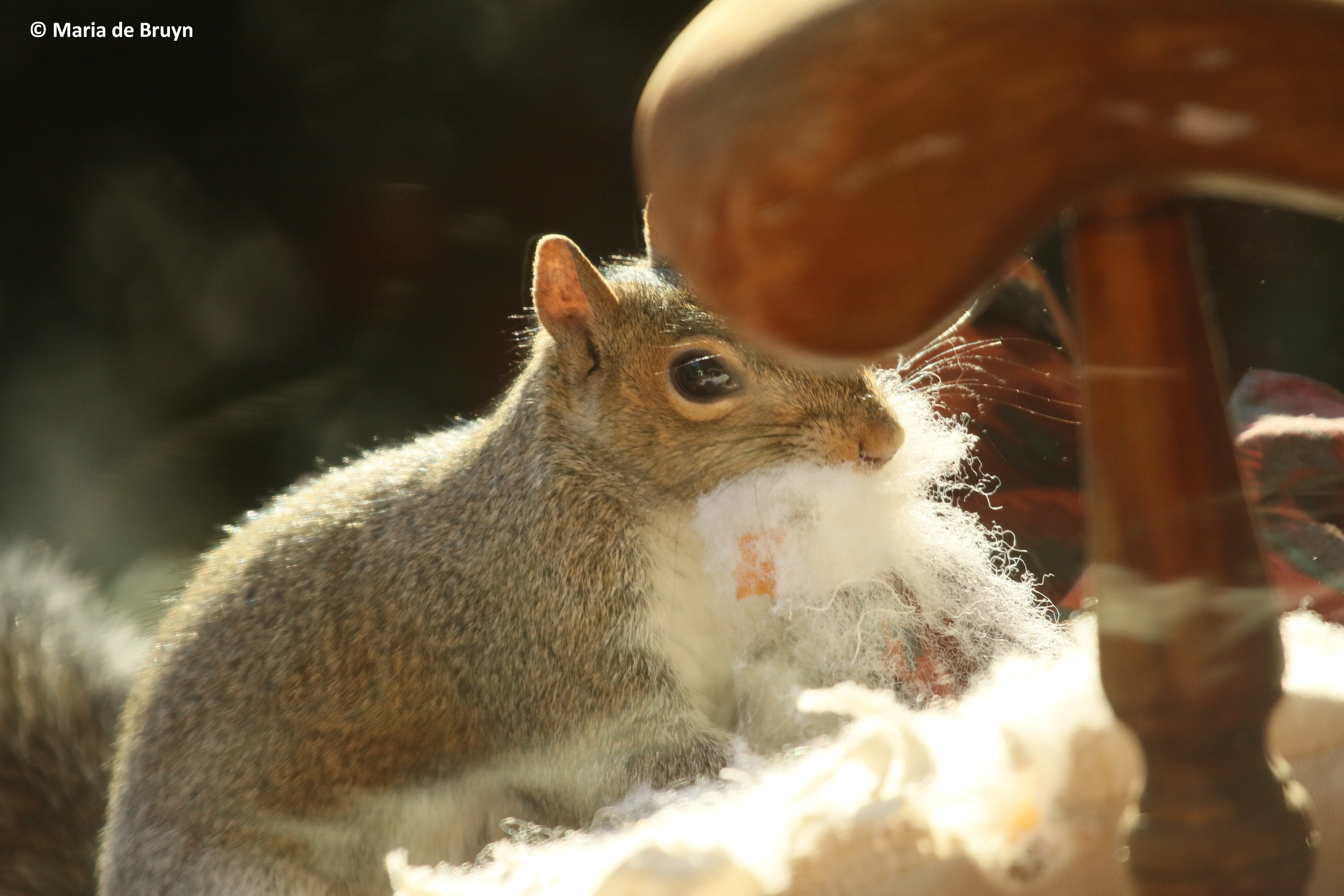
Sassy is quite bold, coming up onto the porch even when I’m seated there. She keeps an eye on me but goes about her business in a calm and confident mood. This was also the case for her nest building activities. She perched on the pillow and used her teeth to tear out the insides.

eastern-gray-squirrel-i77a9708-maria-de-bruyn  eastern-gray-squirrel-i77a0073-maria-de-bruyn-res

She then manipulated the tufts with her paws and teeth to form them into neat little oblong packages that she could easily transport in her mouth.

eastern-gray-squirrel-i77a9795-maria-de-bruyn-res eastern-gray-squirrel-i77a9796-maria-de-bruyn-res

eastern-gray-squirrel-i77a9801-maria-de-bruyn-res eastern-gray-squirrel-i77a9802-maria-de-bruyn-res

Sometimes, she added some dried leaves to the mixture.

eastern-gray-squirrel-i77a1995-maria-de-bruyn-res

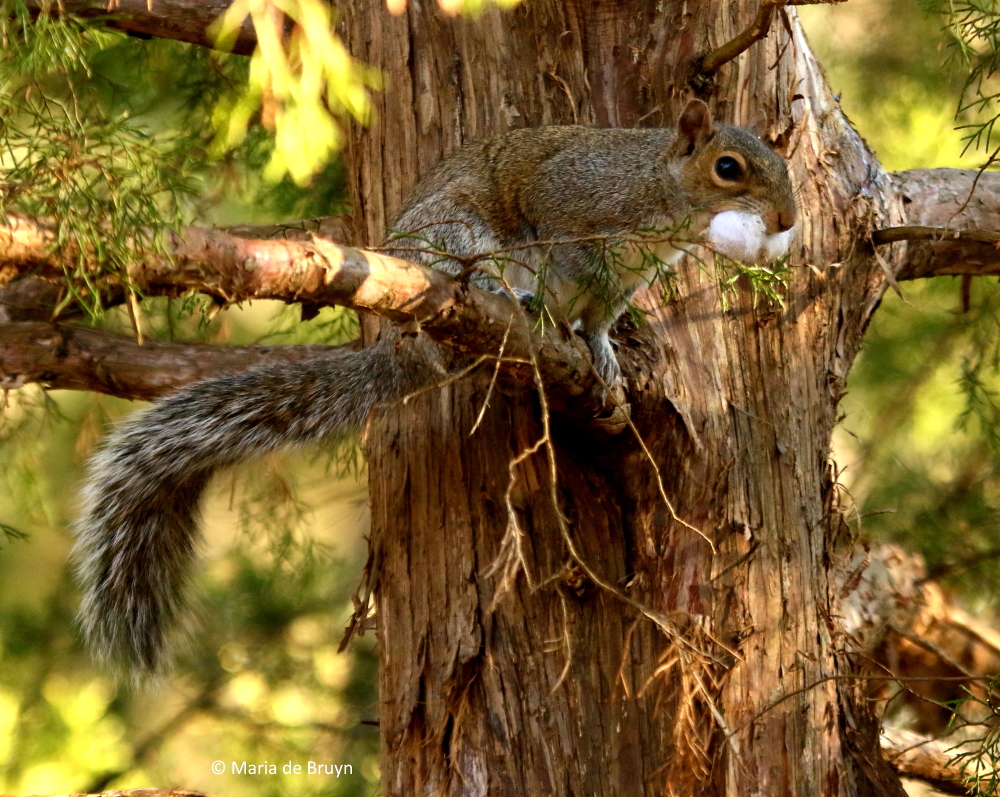
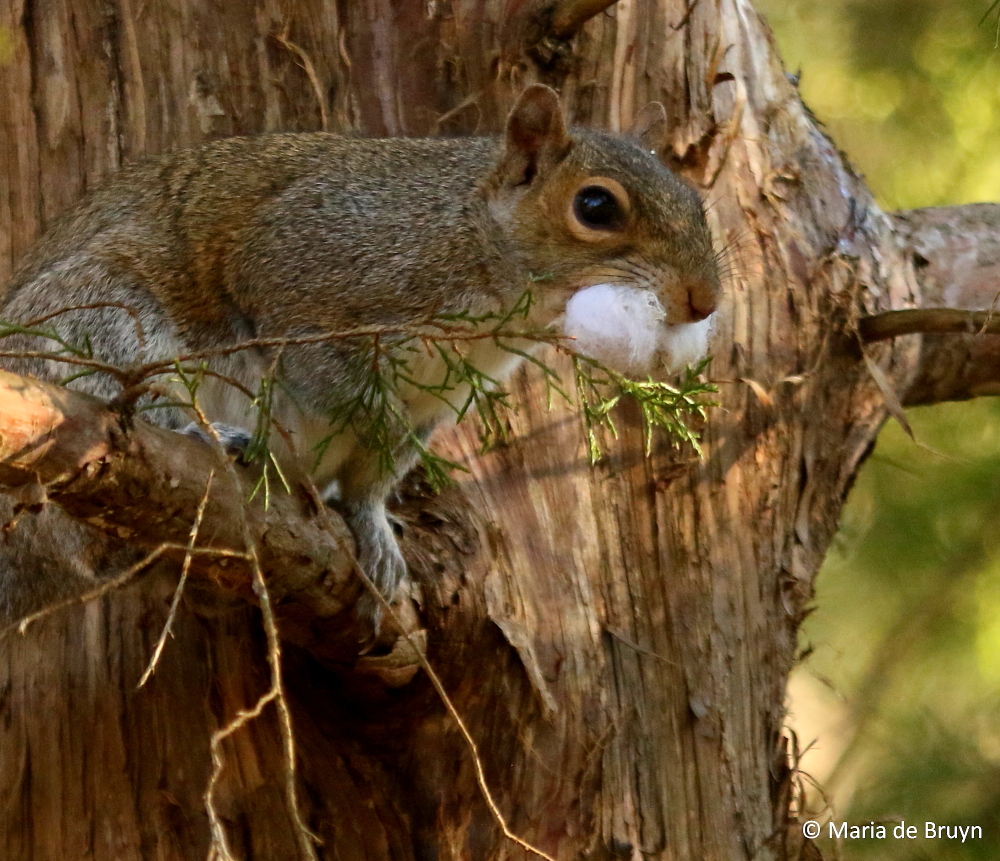
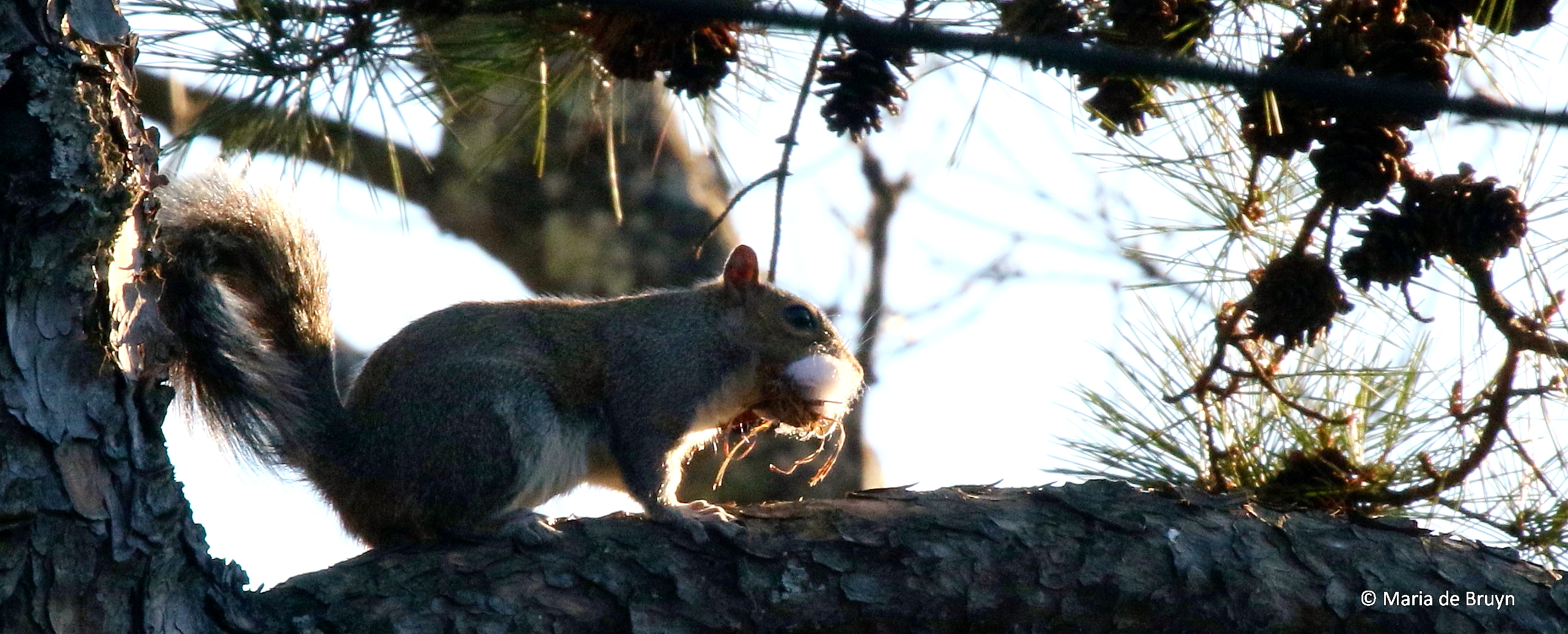
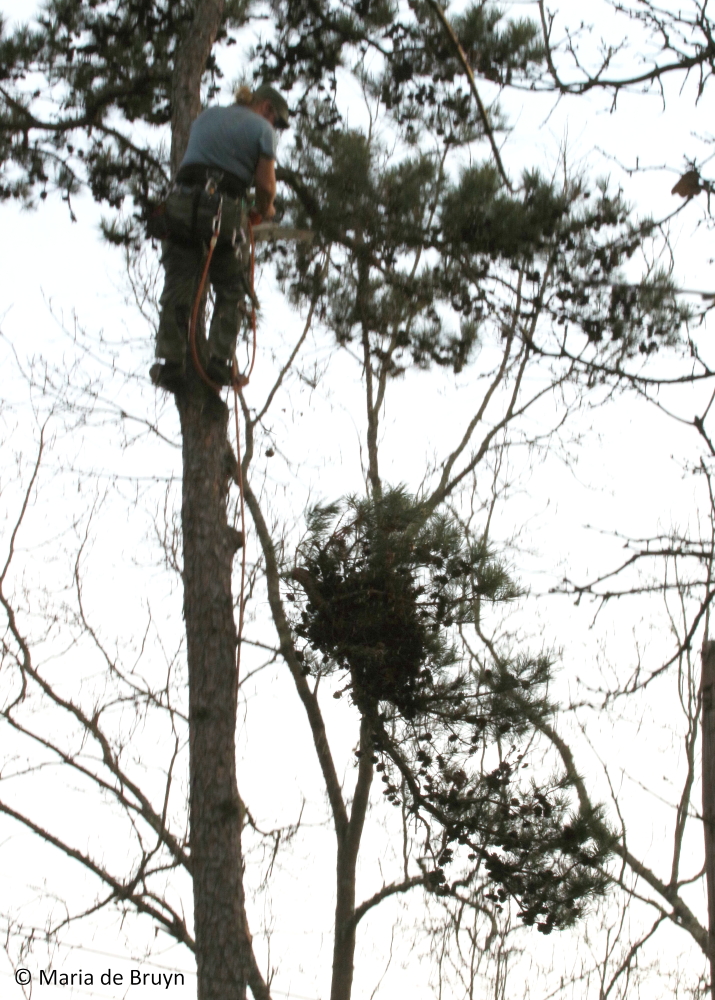
When her mouth was filled with enough material, she left to transport it to the nest that she was constructing – as it turned out, high in a loblolly pine (Pinus taeda) in a neighbor’s front yard. As I followed behind her, she stayed aware of my movements.

eastern-gray-squirrel-i77a0107-maria-de-bruyn-reseastern-gray-squirrel-i77a0108-maria-de-bruyn-res

Then she crossed the street and scurried up the tree, where she deposited her “mattress stuffing” among the leaves and other materials lining the nest.

eastern-gray-squirrel-i77a0125-maria-de-bruyn-res  eastern-gray-squirrel-i77a0139-maria-de-bruyn

Since Sassy was so very industrious and the pillow was no longer salvageable, I left it out for her. She returned for several days, systematically dismantling her found source of nest material and carrying off her little woolly trophies.

eastern-gray-squirrel-i77a0099-maria-de-bruyn-res eastern-gray-squirrel-i77a0093-maria-de-bruyn-res

When the stuffing began to disperse with the wind, I finally gathered it up and threw out what was left, figuring she had had plenty of manmade contributions to her home.

eastern-gray-squirrel-i77a0142-maria-de-bruyn-res eastern-gray-squirrel-i77a9817-maria-de-bruyn-res

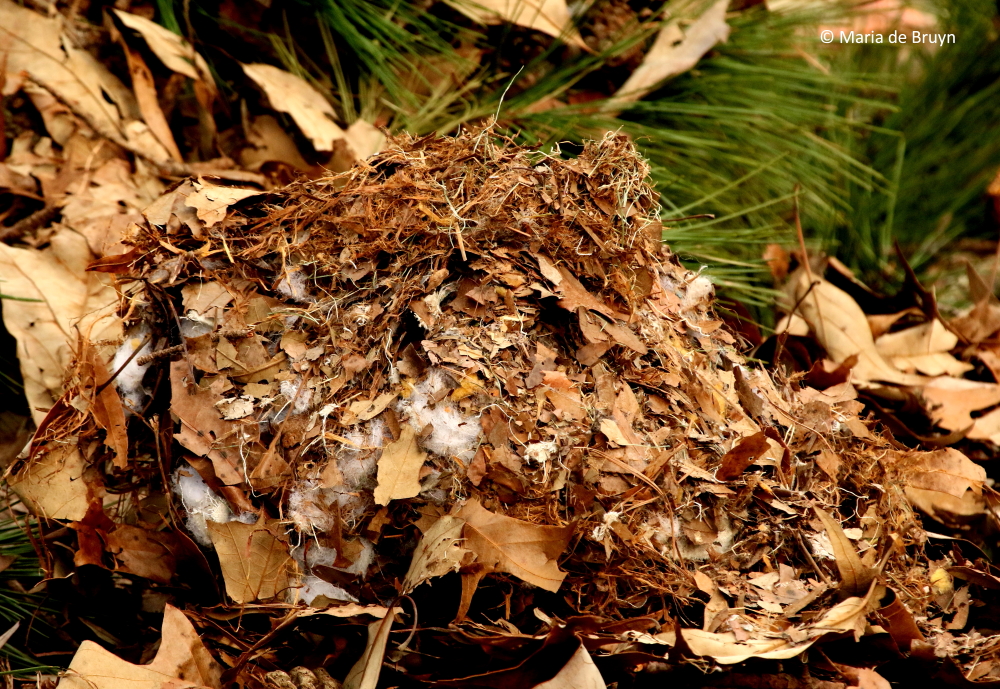
Then a couple days later, I was dismayed on her behalf to see that the new neighbors had decided to remove the tree where her nest was located. The landscapers said Sassy’s nest was not a factor in their decision; they just thought the tree was in the way. I watched with sadness as Sassy’s tree was dismantled and her nest plunged to the ground.

squirrel-nest-i77a9820-maria-de-bruyn-res  squirrel-nest-i77a2239-maria-de-bruyn-res

squirrel-nest-i77a2248-maria-de-bruyn-res

I didn’t see where Sassy was during this event but am sure she was watching from some other vantage point. I felt badly for her – all her innovative and dedicated work was destroyed. Of course, people lose their homes, too, to flooding, fires, tornadoes, etc.  and that is horrible. But I still regretted that this hard-working mammal had lost her home as well.

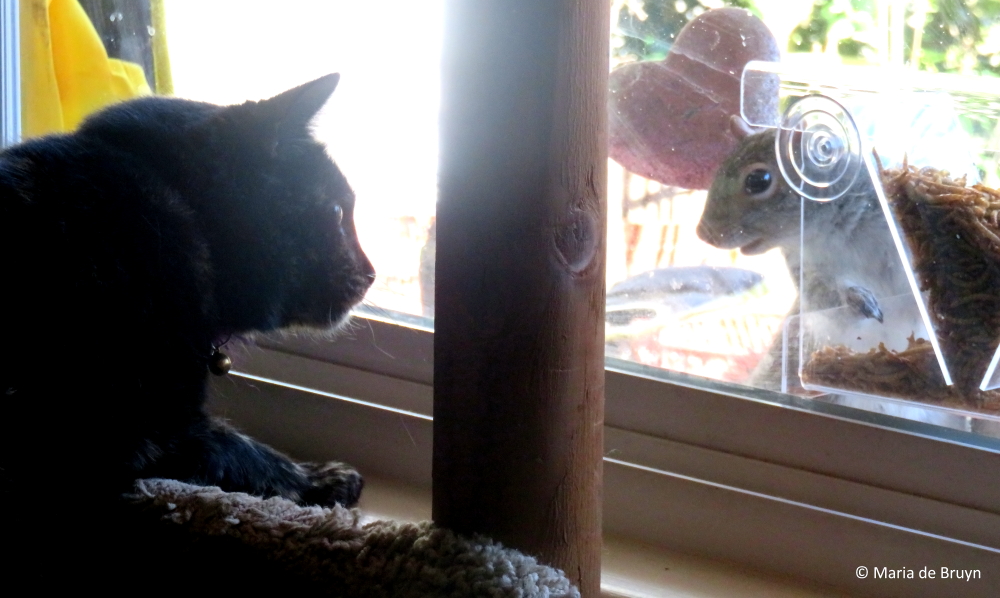
I presume Sassy has been building a new nest elsewhere. And given her boldness, I’m fairly certain that she was the squirrel I saw yesterday afternoon who had decided that she likes dried mealworms.

eastern-gray-squirrel-img_1911-maria-de-bruyn-res

As my feline companion Moasi watched from her cat tree perch in the living room, Sassy was busy on the other side of the window chowing down on the worms in a new window feeder that I had actually bought for the Carolina wrens and chickadees, who often perch on the chair in front of the window.

eastern-gray-squirrel-img_1920-maria-de-bruyn-res

flower-i77a3037maria-de-bruyn-res


Sassy didn’t seem to mind Moasi watching her and she wasn’t fazed when I approached either. It was only when I knocked on the window that she finally descended to the porch and then left for the yard. I like to think that Sassy has made a new home and is now busy getting extra nutrition for the babies to come. And spring continues to unfold with temperatures varying from 24 to 70 degrees and above!

Pulling privet, banishing buckthorn and mimicking Mother Nature

The (somewhat) varied life of a Mason Farm Biological Reserve volunteer

sign-dk7a3365-maria-de-bruyn-res

Today marks the third anniversary for my work as a Green Dragon – volunteers who help maintain the 367-acre Mason Farm Biological Reserve in Chapel Hill, North Carolina. On Tuesdays, a small group gathers to carry out tasks assigned by Neville, who is the Land Manager for this and two other preserves managed by the North Carolina Botanical Garden/UNC.

neville-img_4702-maria-de-bruyn-res

Neville, string-trimming Japanese stiltgrass (Microstegium vimineum)

winter-wren-i77a8901-maria-de-bruynWhile we work, we can listen to the songs and calls of lovely birds, like the winter wren (Troglodytes hiemalis), and if we’re lucky, we can see wildlife like painted turtles, raccoons, opossums and coyotes (Canis latrans).

coyote-i77a8913-maria-de-bruyn-res


Being outdoors and helping keep the Reserve a peaceful and beautiful area for research and enjoyment of the natural world provides me with a feeling of civic contribution, as well as satisfaction, chances for discovery and learning, and well-being. So I’d like to share with you a bit of what we do in a lengthier blog than usual.

sign-img_0076-maria-de-bruyn-res sign-dk7a2339-maria-de-bruyn-res

wisteria-cutting-img_0427-maria-de-bruyn-resOne of our major tasks is helping make a dent in the eradication process for invasive plants. Some have found their way to the Reserve through natural dispersal mechanisms (seeds carried by the wind and wildlife), while others were unfortunately introduced by humans who didn’t know at the time just how destructive the plants would become in overshadowing native vegetation. Cutting down Chinese and Japanese wisteria vines (Wisteria sinensis, W. floribunda) is a recurrent job.
Some invasives are really beautiful and it’s easy to see why they are still sold in some garden shops, like oriental bittersweet (Celastrus orbiculatus) and porcelain berry (Ampelopsis glandulosa); they are really attractive plants – nevertheless, we remove them when feasible. Autumn and thorny olive (Elaeagnus umbellata and E. pungens) are two others that grow as vines or shrubs.

oriental-bittersweet-8-oriental-bittersweet-img_5343m-de-bruyn-signed   porcelainberry-img_0739-2maria-de-bruyn

buckthorn-i77a2455-maria-de-bruyn-signed-resAnother botanical foe is buckthorn (Rhamnus species), a shrub which can grow into a small tree when unchecked. It has nasty thorns which can pierce clothing and shoes and when it gets older and larger, a weed wrench and extra manpower may be needed to get it out of the ground. On the other hand, pulling up the “baby” buckthorns, especially after rain, can be much easier, though unkind work for your back.

buckthorn-img_5724-maria-de-bruyn-res

pete-img_1764-maria-de-bruyn-res  buckthorn-img_4403-maria-de-bruyn-signed-res

Volunteer Pete wields a weed wrench; the small buckthorns can be pulled by hand

marbled-salamander-img_3320maria-de-bruyn-resWhen digging holes into some areas, you may come upon salamanders – this female marbled salamander (Ambystoma opacum) was guarding her eggs when we uncovered her (and quickly covered her again).

The buckthorn produces prolific black berries which are a great favorite of the cedar waxwings (Bombycilla cedrorum) – flocks will descend to enjoy the sweet treat.

cedar-waxwing-i77a6144-maria-de-bruyn-res   cedar-waxwing-i77a6020-maria-de-bruyn-res

The cedar waxwings also really like privet (Ligustrum sinense and L. japonicum), which produces numerous black berries a little smaller than the buckthorn. The privet also produces many offspring but when they are very young, they are quite easy to pull up. The privets that grow into trees, however, pose the same challenges as the large buckthorns, calling for multiplied manpower to extract them from the ground and resulting in exhaltation when success is achieved.

privet-img_1234-maria-de-bruyn-res privet-img_1233-maria-de-bruyn-res

privet-img_1262-maria-de-bruyn-res

buckthorn-img_5597-maria-de-bruyn-res


While working on invasive eradication, we often come upon smaller wildlife, like American toads (Anaxyrus americanus, formerly Bufo americanus), bullfrogs (Lithobates catesbeianus), green and gray tree frogs (Hyla cinereal and H. chrysoscelis/versicolor), spring peepers (Pseudacris crucifer) and rat snakes (Pantherophis obsoletus).

american-toad-img_0013-maria-de-bruyn-res  bullfrog-img_0226-maria-de-bruyn-res

buckthorn-img_4403-maria-de-bruyn-signed-res  frog-i77a3959-maria-de-bruyn-res

copes-gray-tree-frog-img_6145-maria-de-bruyn-res   spring-peeper-img_4391-maria-de-bruyn-res

rat-snake-img_3470-maria-de-bruyn-res

The many brush piles dotting the landscape in the Reserve, both in wooded areas and fields, are the result of our labors – providing birds and small animals with ready-made homes and hiding places.

brush-piles-img_4394-maria-de-bruyn-res

Volunteer Giles and Neville pile up privet and buckthorn

A second major task is planting native plants in various areas of the Reserve – seedlings and young plants are provided by the Botanical Garden and Land Manager and may include flowering species such as Hibiscus and cardinal flowers (Lobelia cardinalis), fruiting shrubs like common elderberry (Sambucus nigra Canadensis), and varied grasses.

grasses-are-hollow-img_0274maria-de-bruyn-signed-res   planting-img_0217maria-de-bruyn-res

bill-resting-sore-back-img_0284maria-de-bruyn-signedWhen we do this in summer, the temperatures can get quite high early in the day; water breaks are welcome, as shown by Mason Farm Green Dragon supreme – Bill, who has been volunteering since 2004!

We put in flags to mark the new plantings in case they will need some watering to thrive. When the weather is hotter and drier, watering takes place right away to give the young vegetation a better chance at survival. It’s a real pleasure to see the plants take hold and flower!

grasses-img_1282-maria-de-bruyn-signed-res   aaron-watering-asters-img_0277maria-de-bruyn-signed

flame-i77a0237-maria-de-bruyn-resSome plants are fire-dependent, meaning their environment must be burned with some regularity if they are to survive and thrive.

Prescribed burns are therefore done at Mason Farm to mimic the natural fires which took place centuries ago before development took over many areas. Woods and fields are burned every few years and great attention is paid to the weather, taking care that no high winds are predicted that could carry embers far away to start fires in unwanted areas. The Green Dragons helped clear fire lines last week for a recent burn – raking away leaves and twigs and bark from areas where the fire will normally die out.

flame-i77a0238-maria-de-bruyn-res flame-i77a0239-maria-de-bruyn-res

neville-i77a0232-maria-de-bruyn-resMembers of the fire team receive instructions on their roles – the fire starters ignite the leaves and grasses in stages, pausing to see how fast the fire is moving and how the wind is blowing.


flame-i77a0239-maria-de-bruyn-res   johnny-i77a0244-maria-de-bruyn-res

Several people will serve as spotters, watching the fire lines to ensure that any escaping embers are put out and some team members clear areas around trees and snags that will be protected against burning (e.g., because they provide homes for woodpeckers).

fire-team-img_1400-maria-de-bruyn-res

Where the leaf litter is not 100% dry, some areas will burn and others will remain untouched.

flame-i77a0246-maria-de-bruyn-res

Dry grasses can catch quickly and the spreading fire generates intense heat as the flames spread rapidly across a field.

i77a0266-maria-de-bruyn-res  ignition-img_1404-maria-de-bruyn-res

flame-i77a0276-maria-de-bruyn-res  flame-i77a0274-maria-de-bruyn-res

broad-tipped-conehead-katydid-neoconocephalus-triops-img_1403-maria-de-bruyn-resMy concern is always that not all animals will make it out in time. Fellow volunteer Giles spotted a broad-tipped conehead katydid (Neoconocephalus triops), which he carried to a safe spot. I hope that the Eastern box turtles (Terrapene carolina carolina) have dug down deeply enough to be unharmed by the spreading fire. We saw grasshoppers and bugs fleeing the field being burned this past week and I was happy to see a pair of hispid cotton rats (Sigmodon hispidus) rush out.

eastern-box-turtle-img_4536-maria-de-bruyn-res  eastern-box-turtle-img_5682-maria-de-bruyn-res

After the fire is mostly burned out, the team walks the edges to tamp out still burning places. The next day, the woods and field look mostly gray, black and sere but experience has taught me that in a few weeks they will begin turning green again.

neville-i77a0286-maria-de-bruyn-res     fire-team-i77a0282-maria-de-bruyn-res

There is one more task we carry out which is less frequent but also important – aiding in construction and some clean-up in the Reserve. When funding was received for a boardwalk to make a bog area more accessible after rain, volunteers associated with the Botanical Garden and New Hope Audubon Society as well as Green Dragons built the sections of the board walk, transported them to the site and installed them.

img_8306maria-de-bruyn-res  img_8549maria-de-bruyn-res

flooding-img_1936-maria-de-bruyn-resVisitors were very happy with the new walkway but it turned out that the flooding which occurs when Morgan Creek overflows its banks with heavy rains can sometimes be strong enough to lift up boardwalk sections, necessitating repairs. When funds are available, a new solution will be sought to hold the boardwalk more permanently in place.


mason-farm-img_4883-maria-de-bruyn-res mason-farm-img_4877-maria-de-bruyn-res

The researchers who make “temporary” structures when conducting their studies (e.g., bird blinds, platforms, etc.) unfortunately do not always remove these when their research is done. When time permits, we have helped clear away some of this garbage. We also helped repair a sign and the entry road and parking lot after flooding.

bill-img_0227-maria-de-bruyn-res   bill-img_0229-maria-de-bruyn-res

re-installing-the-map-img_0189maria-de-bruyn-signed-res

road-repair-img_4866-maria-de-bruyn-res

buckthorn-img_5725-maria-de-bruyn-res

Our volunteer crew is usually a small group of retired persons and a couple students (2-5 people). We’d love to have more people join us so we could get more done and have more input for our conversations covering a range of topics such as botany, geology, wildlife observation, music, sports, travel and current events. The volunteer time of Tuesday mornings unfortunately rules out people who have jobs requiring their presence there on weekdays but we remain hopeful that new volunteers will join us. If you live in the local area and are interested, contact the volunteer coordinator at the NC Botanical Garden!