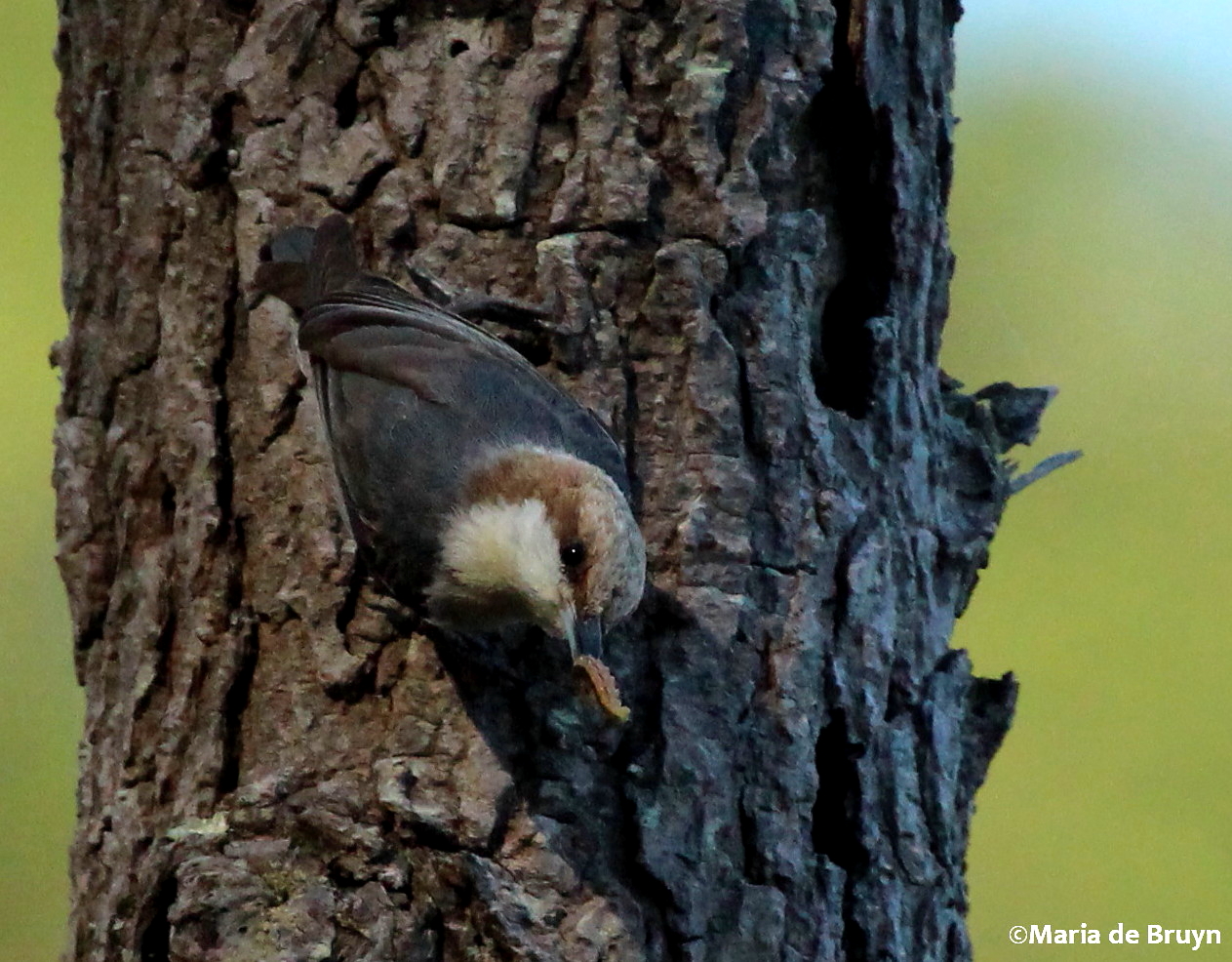
Brown-headed nuthatches – examples of conscientious and industrious parenthood!

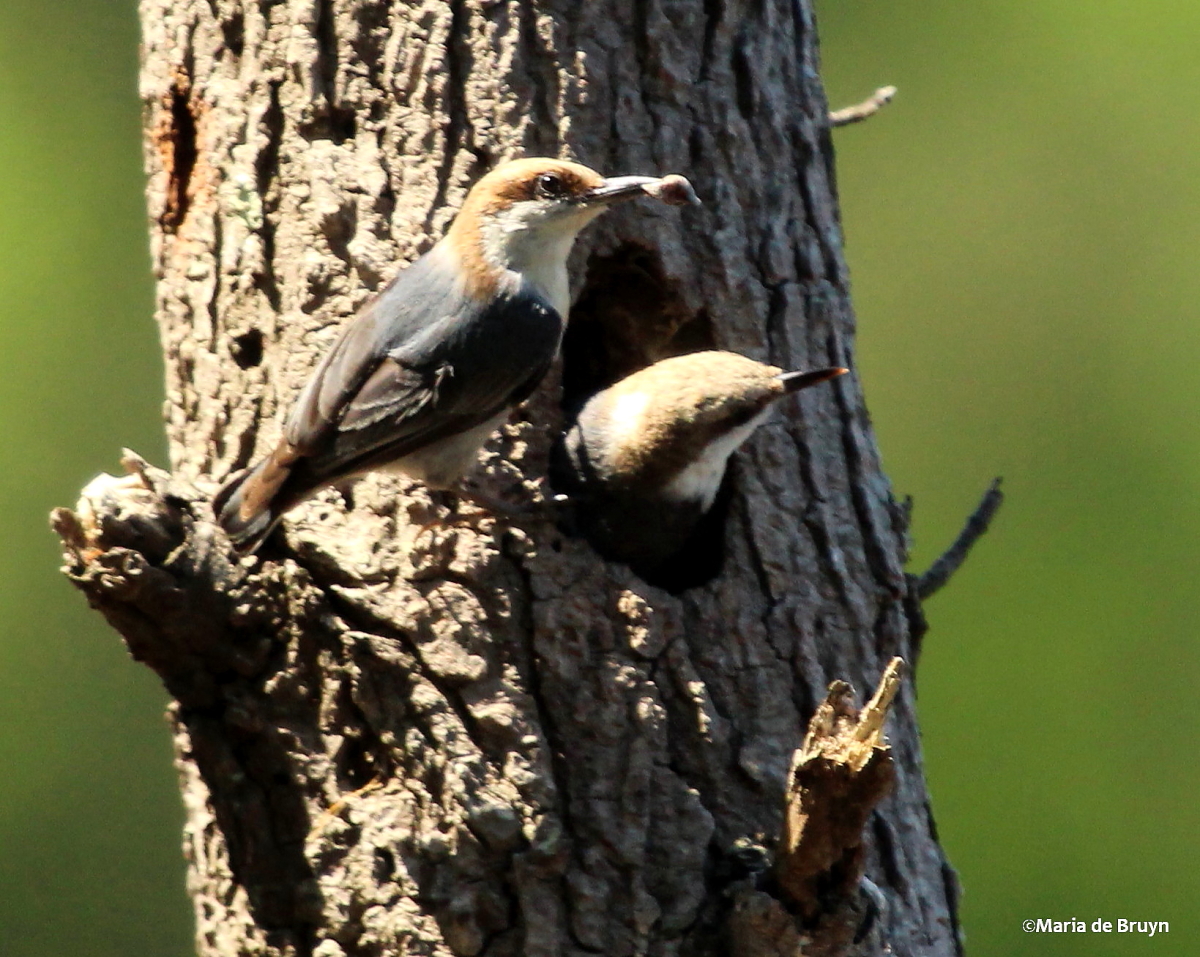
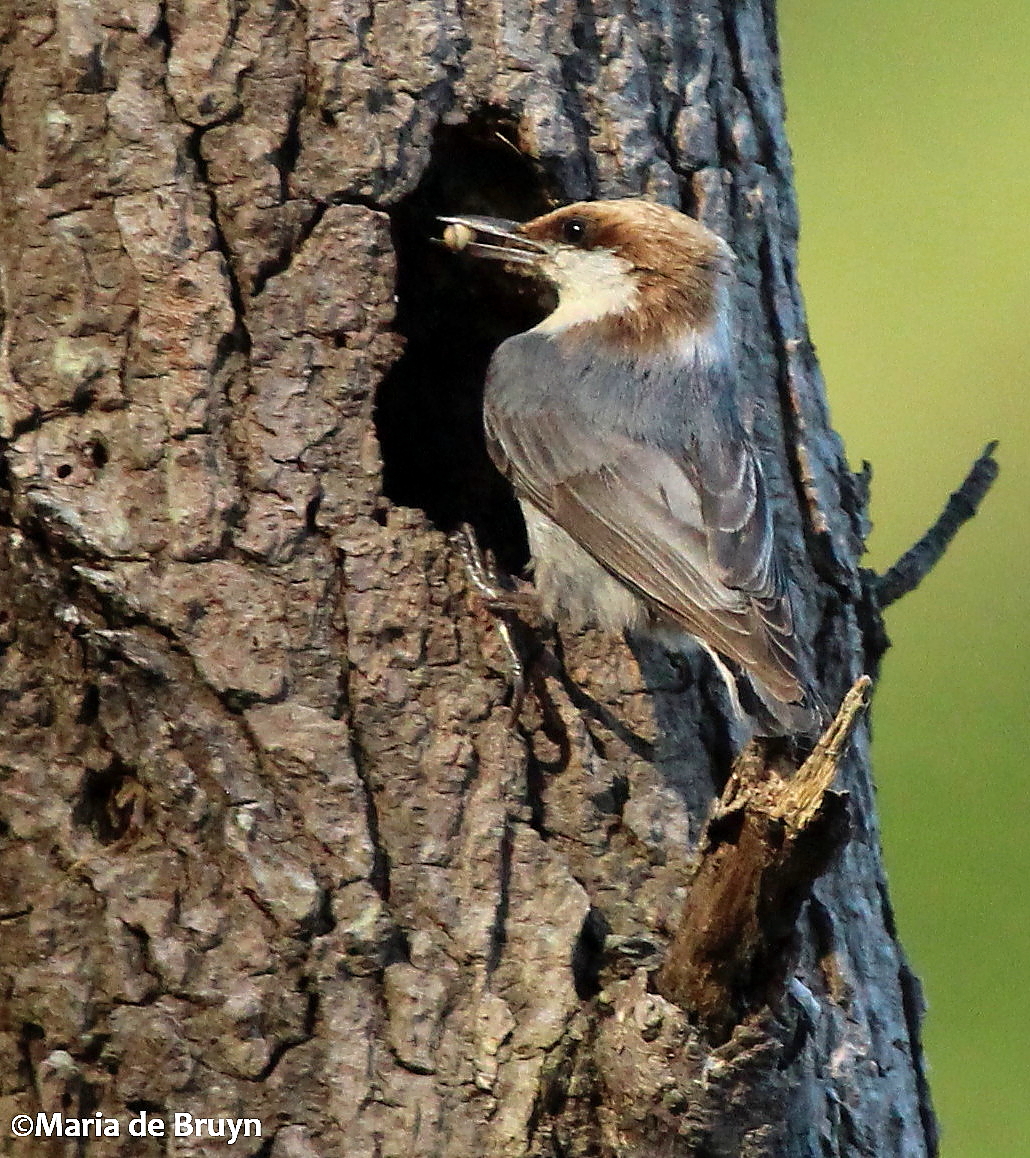
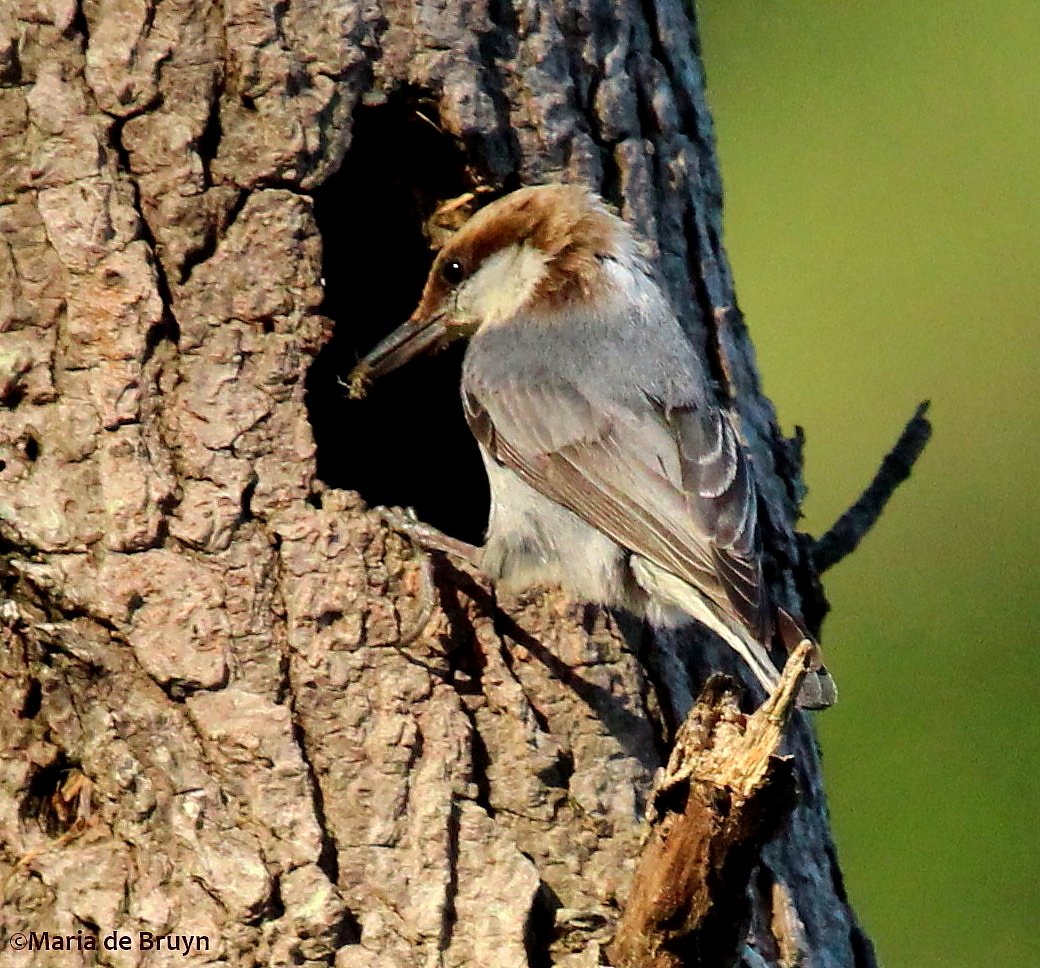
IMG_3634©Maria de BruynLast weekend, when walking the woods along Jordan Lake in order to write a blog for the NC Audubon Society, I happened upon a thin dead tree standing in the water at the shore’s edge. Just then as I was looking it up and down, a brown-headed nuthatch (Sitta pusilla) flew up and made its way down the trunk to a hole where it obviously had a nest. That was a treat and I watched the mom and dad fly to and fro with provisions for the brood.

Yesterday, I decided to return and see if the industrious pair was still working on meals for their brood. They were indeed and I watched for quite a long time, wondering how they could see anything down in the nest where it has to be pretty dark.
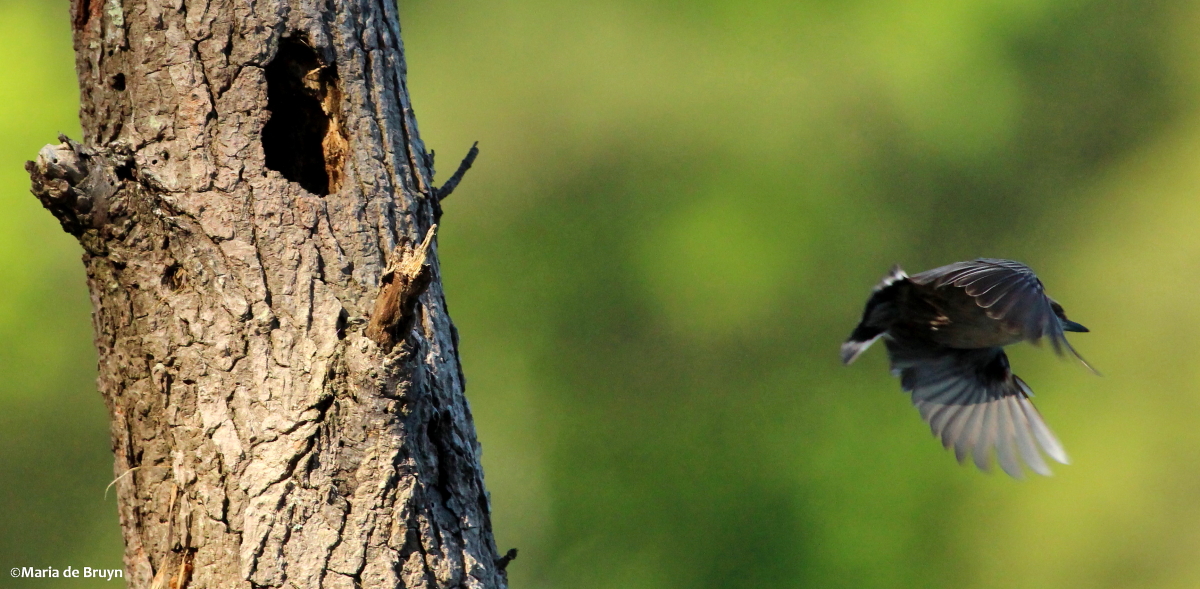
brown-headed nuthatch IMG_3690©Maria de BruynresThese lovely little birds are native to the Southeastern US and there is a small population in the Bahamas; they don’t live in any other countries so they really are kind of special. In addition, since 1966, the population has declined by 45% because they are losing nesting habitats (dead and pine trees) to deforestation and urbanization.
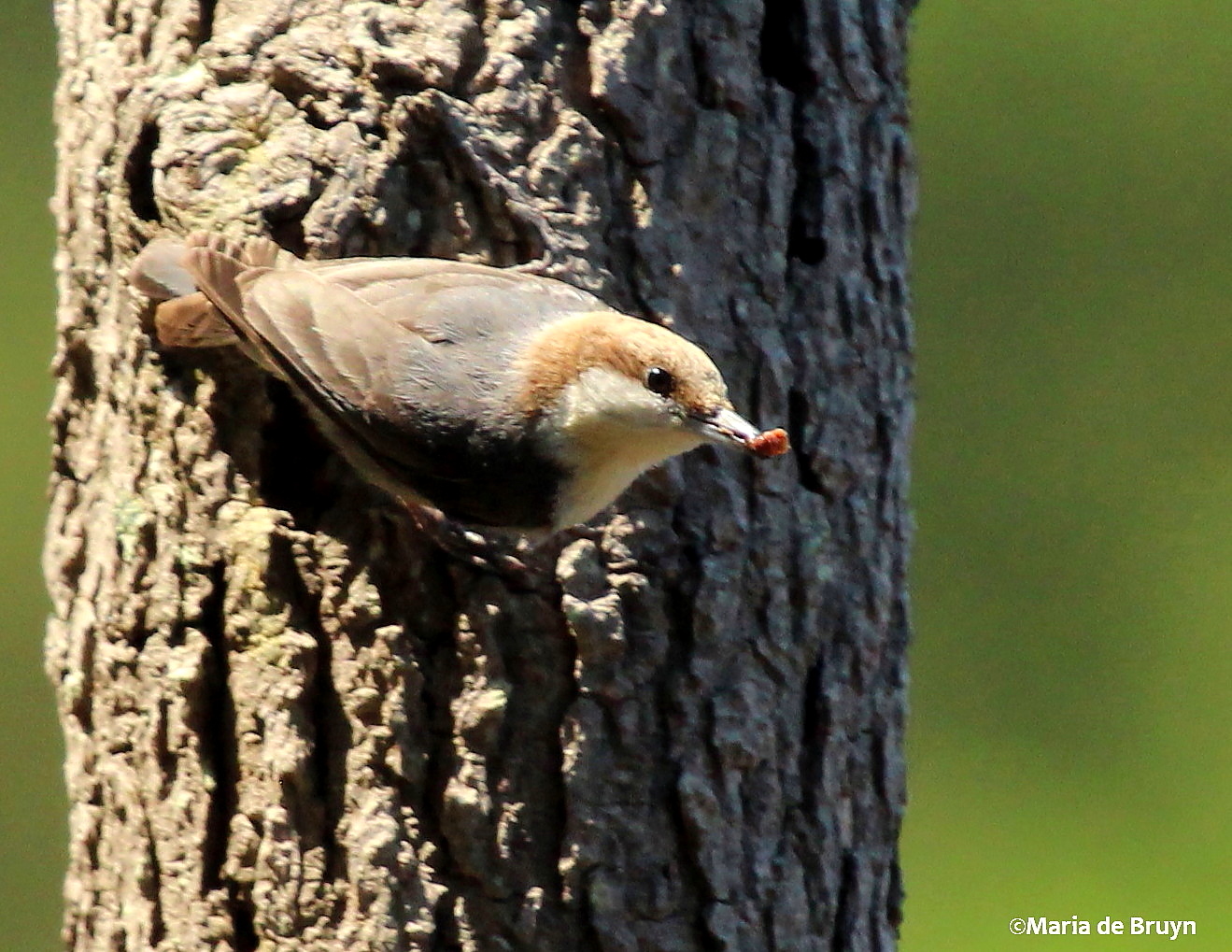
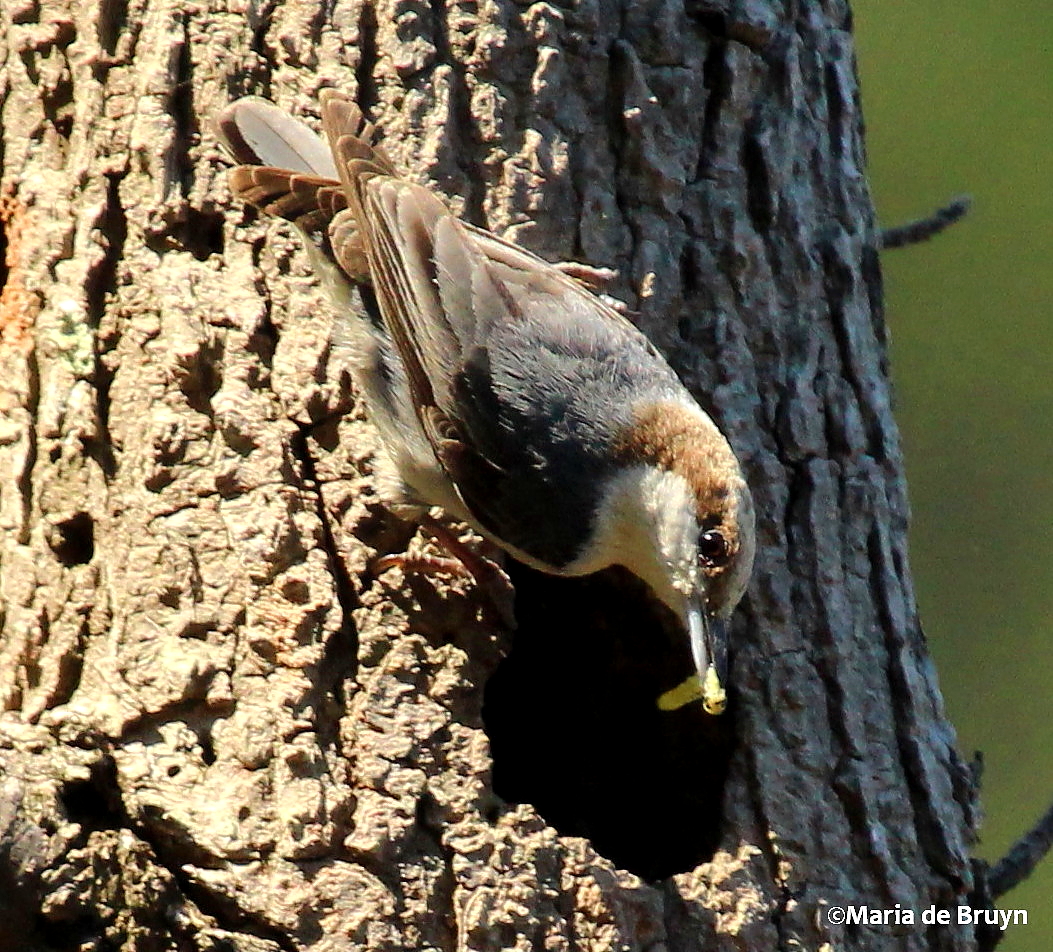
IMG_4116©Maria de Bruyn IMG_4031©Maria de Bruyn brown-headed nuthatch IMG_4136©Maria de Bruyn res

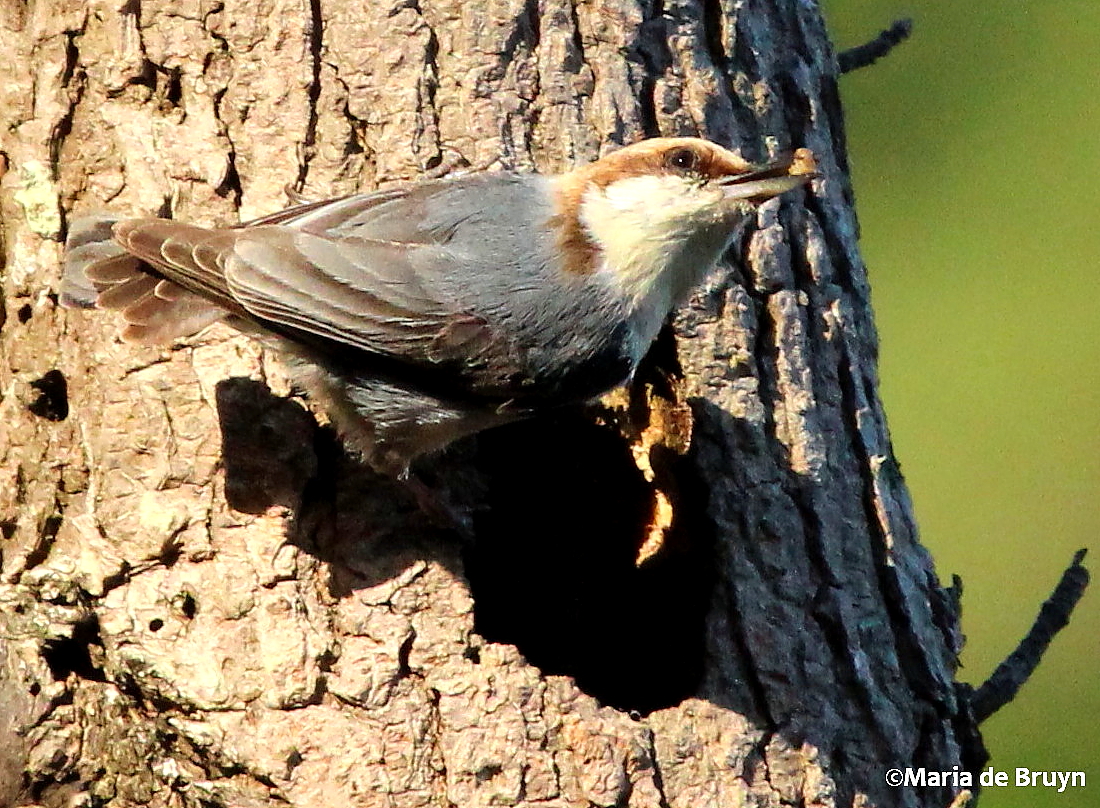
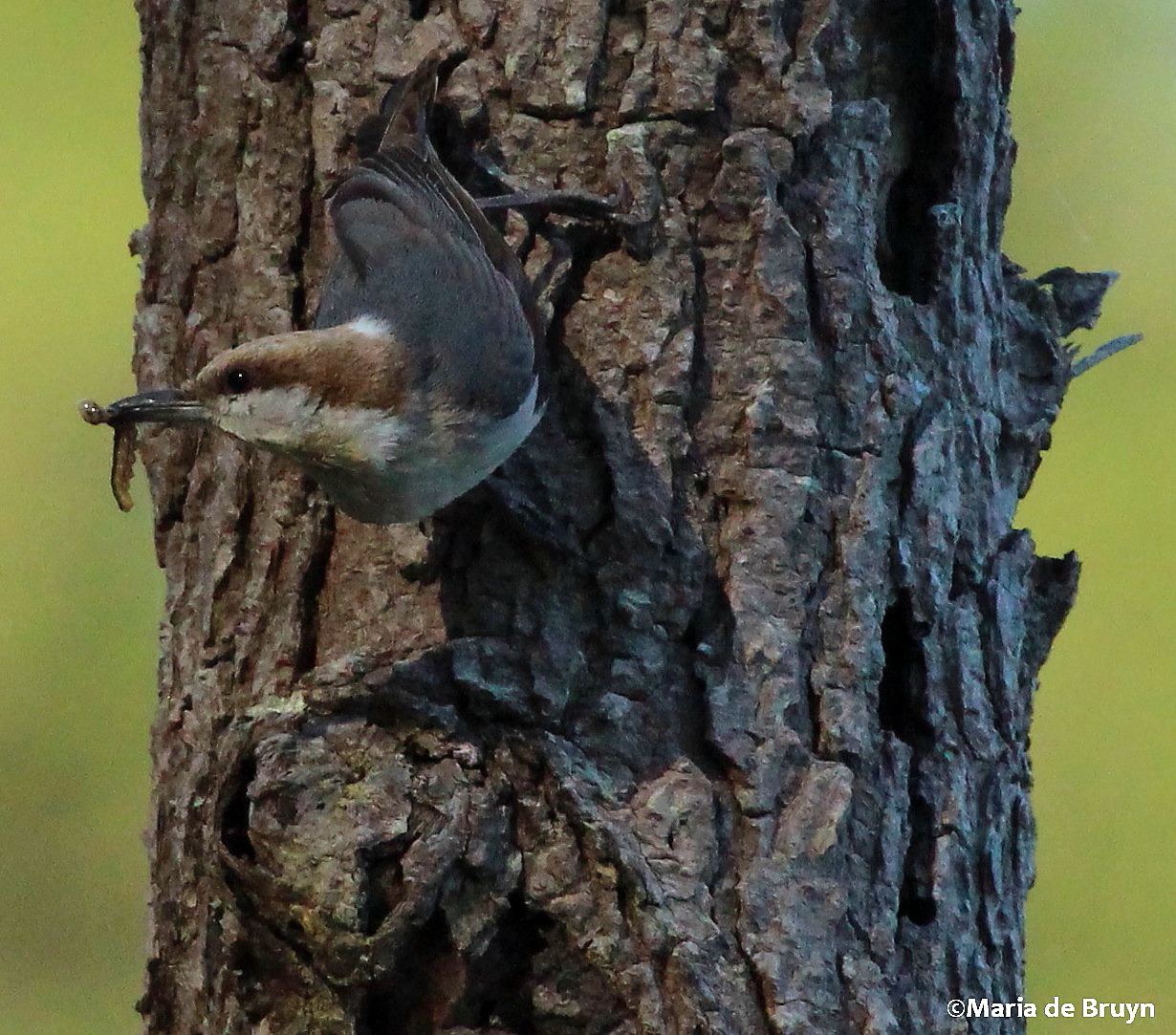
The parents were most often alternating their meal runs, but occasionally they would arrive simultaneously or very close in time. They would usually alight on the trunk above the nest hole and then work their way down – they can descend head-first, which is a handy trait.
IMG_3726©Maria de Bruyn IMG_3684©Maria de Bruyn IMG_3669©Maria de Bruyn

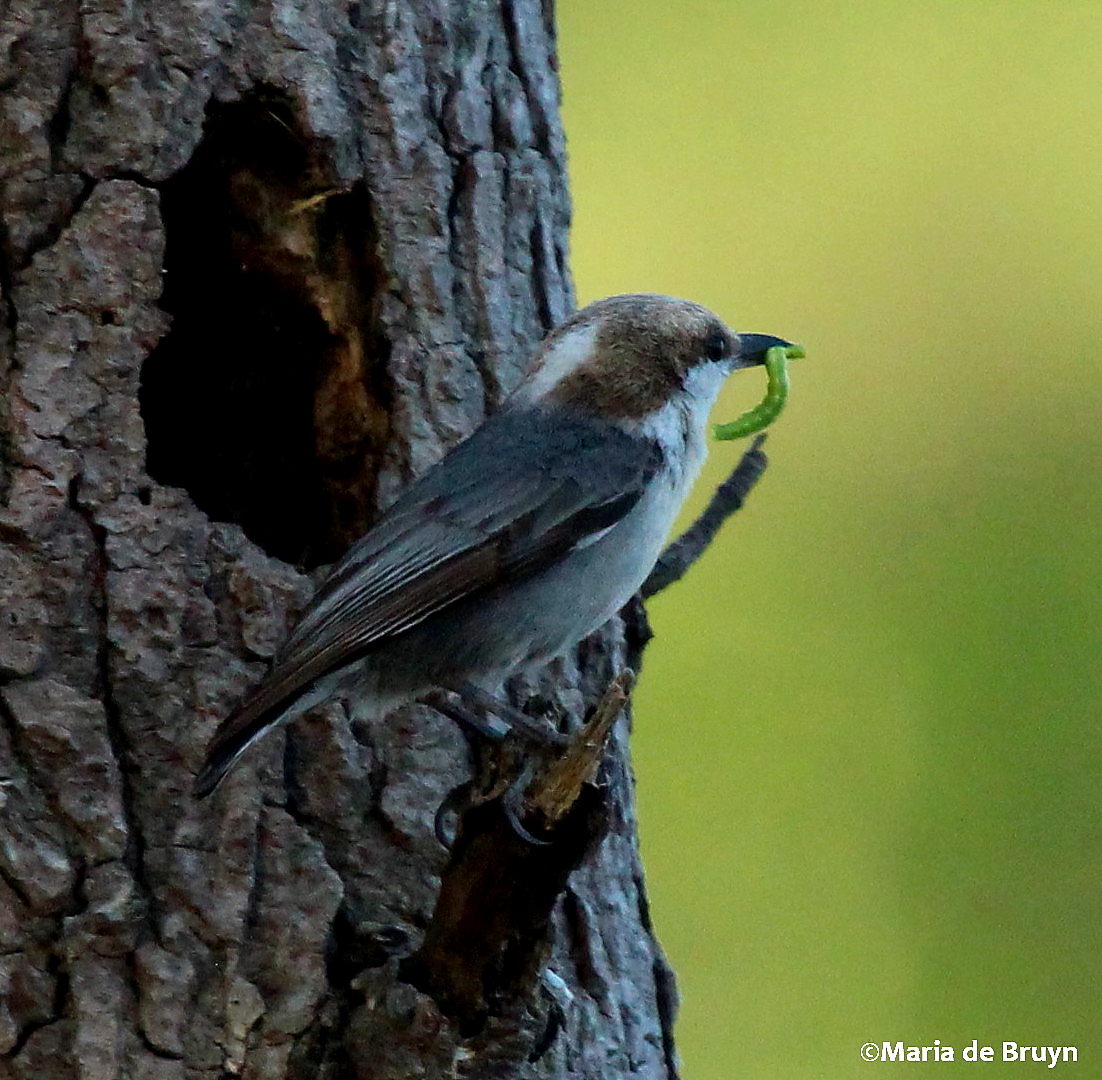
Occasionally, though, they would alight right by the hole or work their way upwards from a little further down the tree trunk. They seemed very concentrated on their task but I learned that they were definitely keeping an eye on me because when I took up a position a bit closer to the tree for some better shots, they just hopped about in other trees waiting for me to step back again. Which I did, of course.
IMG_3639©Maria de Bruyn IMG_3627©Maria de Bruyn

Though I didn’t witness it, these small birds are tool-users, sometimes using a piece of bark to pry up tree bark in search of insects; they may even carry the tool with them. They certainly were bringing their babies varied meals, including moth caterpillars and insects of various kinds.
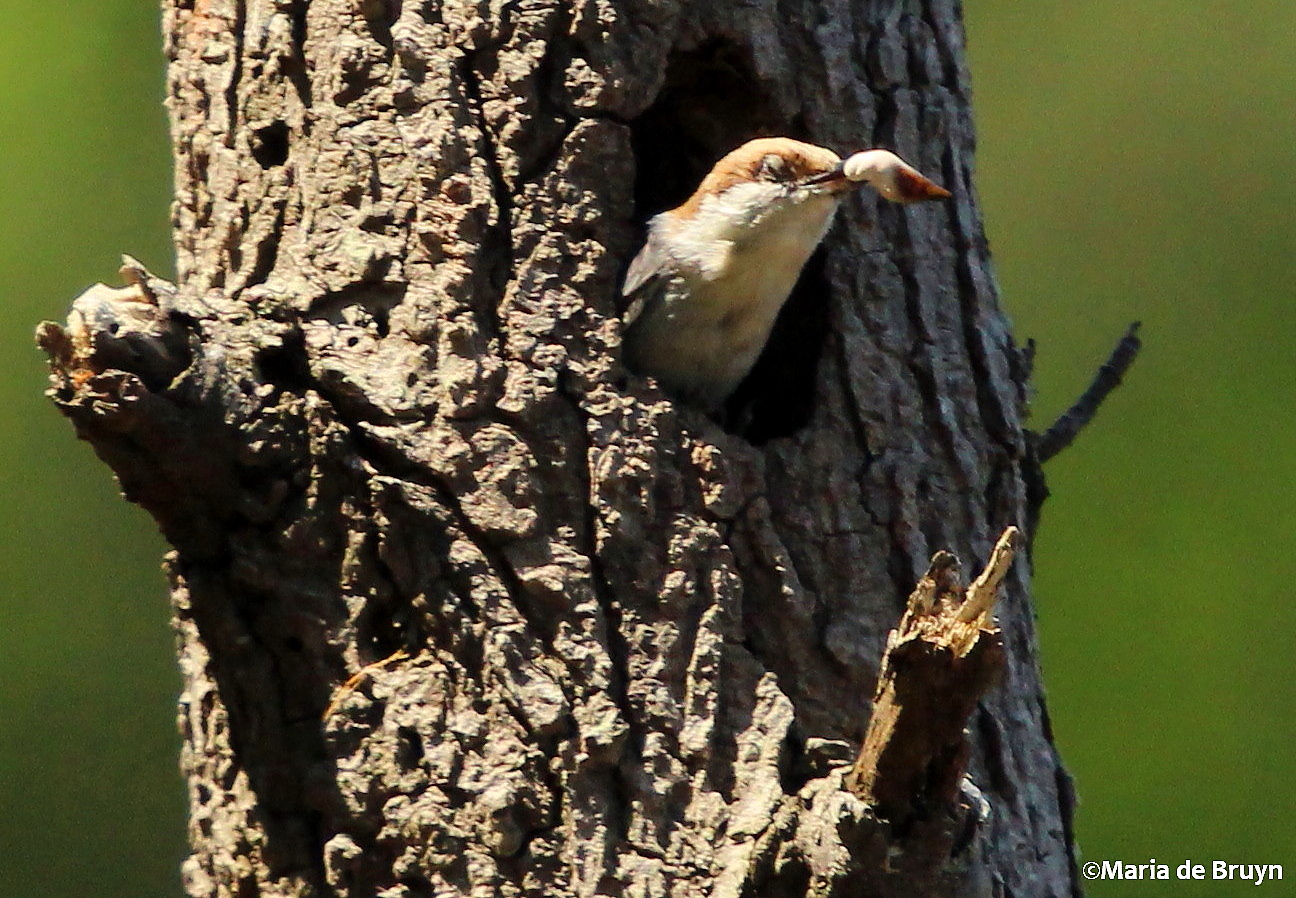
IMG_4164©Maria de BruynThese parents were fastidious, too, removing fecal sacs from the nest with some regularity. I had hoped to see these birds in action when using a nuthatch box I put up in my yard, but a pair of Carolina chickadees (Poecile carolinensis) are currently raising a brood there.
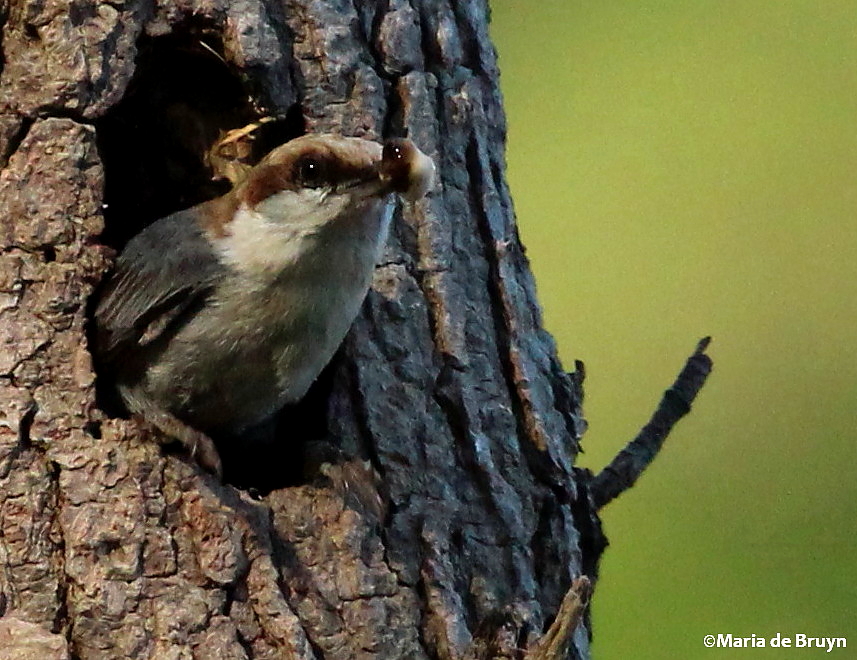


brown-headed nuthatch IMG_4197©Maria de Bruyn resIMG_3658©Maria de Bruyn

The nestlings fledge after about 18 days so I may be too late to see anything when I return sometime this coming week, but it sure would be cool to see them leave the nest!
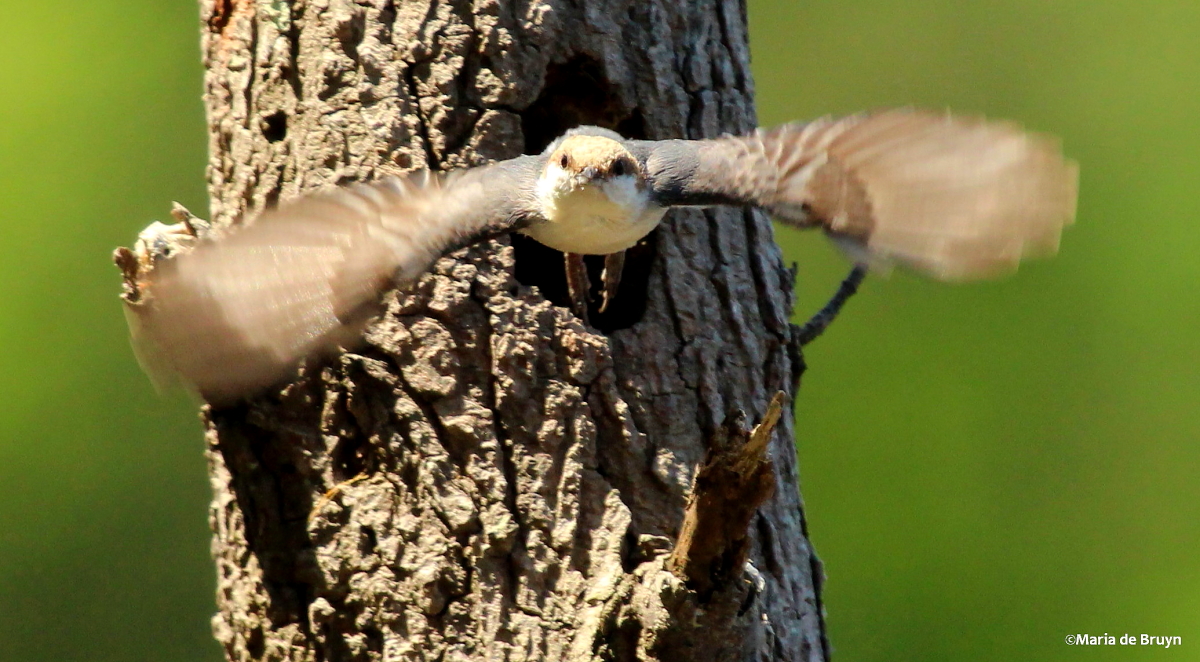
brown-headed nuthatch IMG_4149©Maria de Bruyn res

So, you may ask – what happened to the blog on springtime creatures I announced last time? Well, the various birds species are working so hard and demonstrating their parenting skills so nicely right now, I decided to focus on that for a little while! Next time – those squatter Chickadees in my yard!

Birds braving winter

American goldfinch IMG_1955©Maria de Bruyn

It’s not unheard to have snow in central North Carolina, but it also isn’t what you’d call a commonplace occurrence. It is a BIG deal when it snows here; if a couple inches of snow or some icing on the roads is expected, schools and businesses close. This is a cause of hilarity among people who originated from points north, but when they realize that many drivers here are not accustomed to winter-weather driving and that the Department of Transportation and towns are not equipped so well to deal with the conditions, they also will often stay inside and not go out on the road.

Carolina wren IMG_0424©Maria de BruynAmerican robin IMG_0326©Maria de Bruyn

When we had two days of snow and ice storms last week, it wasn’t only people who were unhappy. The birds also didn’t seem enamored with the climate change, like the American goldfinch up above (Spinus tristis). They had had a taste of snow at the end of January, but it wasn’t such a strong storm then.  The Carolina chickadee (Poecile carolinensis) was scurrying about looking for food under the snow and the American robin (Turdus migratorius) was enjoying some berries.  The February storm was a bit different though

Mourning dove IMG_2478©Maria de Bruyn

On the first day, when it didn’t snow heavily all at once (it was more a matter of lightly falling snow much of the day), I had a multitude of birds at my feeders – including some that I don’t usually see there. This mourning dove (Zenaida macroura), for example, didn’t scrounge around on the ground in the snow but landed on a feeder to see if there were seeds there.

Other birds flew back and forth between the trees and feeders, like the yellow-rumped warblers (Setophaga coronata), who weren’t always happy to have others sharing the feeders), and the tufted titmice (Baeolophus bicolor).

Yellow-rumped warbler IMG_2618©Maria de BruynTufted titmouse IMG_2355©Maria de Bruyn

When out walking in a furious flurry of fat snowflakes, I ran into a neighbor who does research on bird survival. I mentioned that on the first day of the storm, I had a multitude of birds at my feeders (probably a 100 or so) but now, with this heavier snowfall, not a bird was to be seen. He noted that, given bird’s short lifespans in some cases and the fact that many would be younger, they were likely hunkering down as this was their first encounter with these weather conditions.

Brown thrasher IMG_2127©Maria de Bruyn

Northern cardinal IMG_2375©Maria de Bruyn

Another neighbor down the road and I kept our feeders filled so that our avian friends could rev up their energy stores, like the brown thrasher (Toxostoma rufum) and the Northern cardinals (Cardinalis cardinalis). The birds did their part by fluffing up their feathers to help keep body warmth as much as possible.  And they posed for some nice photos – albeit not with enthusiastic expressions, like this warbler and Northern mockingbird (Mimus polyglottos).

Yellow-rumped warbler IMG_2684©Maria de BruynNorthern mockingbird IMG_3455©Maria de Bruyn

Today, they should all be happy though – we’re expecting temperatures well in the upper 60s F! That should make for happy white-throated sparrows (Zonotrichia albicollis), Eastern towhees (Pipilo erythrophthalmus) and all the other birds visiting my yard!
white-throated sparrow IMG_2564©Maria de BruynEastern towhee IMG_0670©Maria de Bruyn

Tundra swans, snow geese and Canada geese, too – beauty by the tens of thousands

Tundra swans IMG_8442©Maria de Bruyn

When the tundra swans (Cygnus columbianus) and snow geese (Chen caerulescens) leave the Arctic and sub-Arctic tundras and climes of northern North America to over-winter along the coasts of the United States, those of us who live further south get to enjoy the marvelous spectacle of tens of thousands of these birds gathering together. They appear in huge masses and smaller family groups to feed and then swirl through the skies in an aerial ballet as they settle down to feed again or spend the night in a marsh or on a lake or pond. Witnessing these enormous conglomerations of birds really is an unforgettable experience.

Tundra swans IMG_8440©Maria de BruynThe tundra swan – also known as the whistling swan in North America – is a large, graceful bird. Its diet is varied, ranging from aquatic plants and some molluscs (mostly during the summer) to seeds, grains and tubers like potatoes in the winter. In North Carolina, where they migrate during winter, you can find immense flocks foraging in open agricultural fields before they settle for the night (in winter, these birds sleep mostly on the water; during the breeding season, these monogamous birds sleep mainly on land).

tundra swan IMG_8676©Maria de Bruyn signed res

The adult swans are entirely white except for a black bill, while the immature birds are first a dusty gray color that eventually turns white; the young swans also have a pinkish bill.

Tundra swans IMG_6457©Maria de Bruyn signed res

During a birding trip to the Outer Banks of North Carolina, our Audubon group was privileged to witness the tundra swans returning to a lake in the Pocosin Lakes National Wildlife Refuge one night.

Tundra swans IMG_6446©Maria de Bruyn res

It was like watching a black wave moving back and forth across the orange sky at dusk, while being surrounded by a tremendous volume of honking (not whistling!). Afterwards, I and others regretted that we hadn’t thought to film this so we had a record of the sound. I think we were just so mesmerized that it didn’t occur to us to do that. Here you can hear what their calls are like. For us, it was impressive as we were listening to the sounds of a flock of about 20,000 strong! http://www.allaboutbirds.org/guide/tundra_swan/sounds

Tundra swans IMG_6439©Maria de Bruyn signed res

The snow goose, like the tundra swan, migrates in the winter to North Carolina from the uppermost parts of North America; like the swans, they forage in winter agricultural fields in large groups. There are two color variations: some are almost entirely white, while the “blue morph” variation has a white head but blue-gray body feathers. Our birding group was lucky to see another aerial ballet at Pocosin Lake National Wildlife Refuge put on by the snow geese.

Snow goose IMG_6334©Maria de Bruyn2 res

As a member of our group excitedly called, “They’re rising!” an enormous flock surged up from the lake, flew back and forth just a little and then settled.

Snow goose IMG_6330©Maria de Bruyn signed res

A minute later, they repeated the process and we watched as the swirling cloud rose and fell, just moving side to side a bit. They were very far across the lake from us, so it wasn’t possible to get great shots but at least I had evidence of the sighting!

Snow goose IMG_6341©Maria de Bruyn signed res

The other birds that we saw in some numbers were the more familiar Canadian geese (Branta canadensis). They are commonly seen in our area so it didn’t seem quite so special to spot them at the coast, but they passed by in flocks and beautiful formations that were well worth watching.

Canada goose IMG_5955©Maria de Bruyn signed resCanada goose IMG_6041©Maria de Bruyn res

Canada goose IMG_8306©Maria de Bruyn signed res 2These were the only geese that we were able to see up close a bit; here you see a pair at Lake Mattamuskeet National Wildlife Refuge.

I had seen starling murmurations before and was quite impressed with those. Witnessing the gigantic flocks of tundra swans and snow geese was equally fascinating – if you get a chance to see such large groups, do stop to watch them!

Squirrels love fruit!

eastern gray squirrel IMG_1449©Maria de Bruyn res

As you may know, our furry, agile, smart little friends, the Eastern gray squirrels (Sciurus carolinensis), are fond of all kinds of vegetable matter. Acorns, nuts and seed are a favorite: they will chew through the screen of a backyard porch to get to bird seed (as my neighbors learned after leaving a bag of it there), chew through the plastic lids of food buckets in which I was keeping bird seed outside (the seed is now kept indoors) and spend lots of time contemplating how they can overcome baffles and other barriers designed to keep them off bird feeders.

At my house, they are somewhat lucky since I also put some seed under feeders for the ground-feeding birds such as dark-eyed juncos, white-throated sparrows, mourning doves, Eastern towhees and sometimes Northern cardinals and blue jays. The squirrels will amiably scurry about beside the birds to consume some sunflower seeds or millet. I also give the squirrels a treat now and then by putting out fruit bought from the reduced-produce rack at the supermarket, where I can buy veggies that the supermarket would otherwise throw away.

IMG_8399©Maria de BruynEastern gray squirrel IMG_5039©Maria de Bruyn

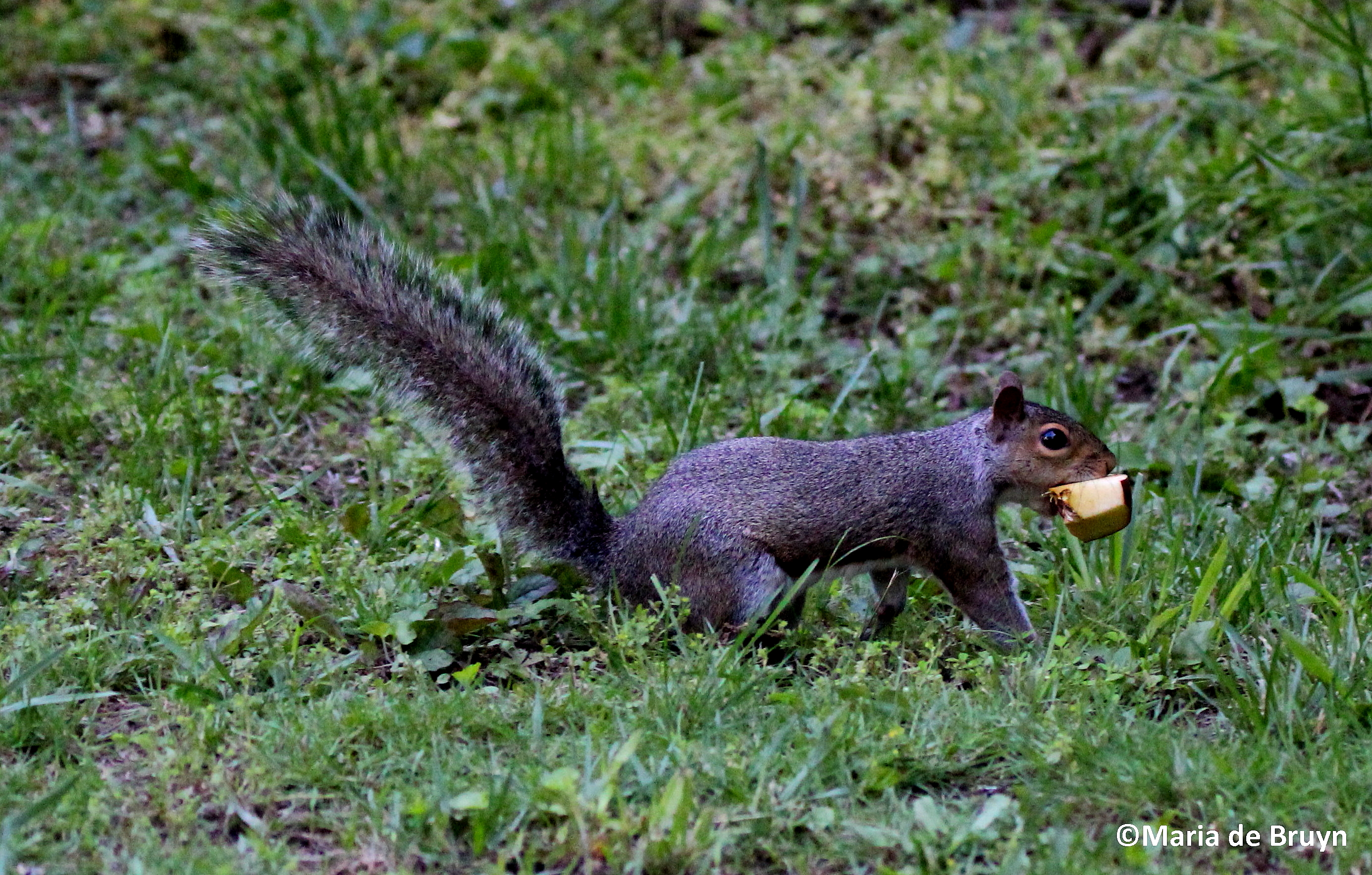
Apples are a common treat and the squirrels often eat those on the spot, although they may feel a need to carry away their meal to enjoy it at some distance from their family members. Blueberries and plums are nice, too.

Eastern gray squirrel IMG_7166©Maria de BruynEastern gray squirrel IMG_3723©Maria de Bruyn 2013 (2)

The squirrels’ tastes in fruit have surprised me on occasion though. After learning that banana peels mushed up at the base of azaleas will help their growth and blooming, I took to putting overripe bananas by those plants. Sometimes, when checking the next day, I would find the peels someplace else in the yard and then realized that squirrels enjoy a tasty banana now and then. When I put out oranges in an attempt to attract orioles, the citrus didn’t last long once the resident tree rodents discovered them.

eastern gray squirrel IMG_8424©Maria de Bruyn

Squirrels will hoard food for later consumption, hiding the fruits of their labor in numerous spots around their territory. According to Wikipedia, each squirrel will make several thousand such caches every season! If they think they are being watched, they will also pretend to bury food in a cache, while actually hiding the morsel in their mouth to bury it someplace else later. Clever indeed!
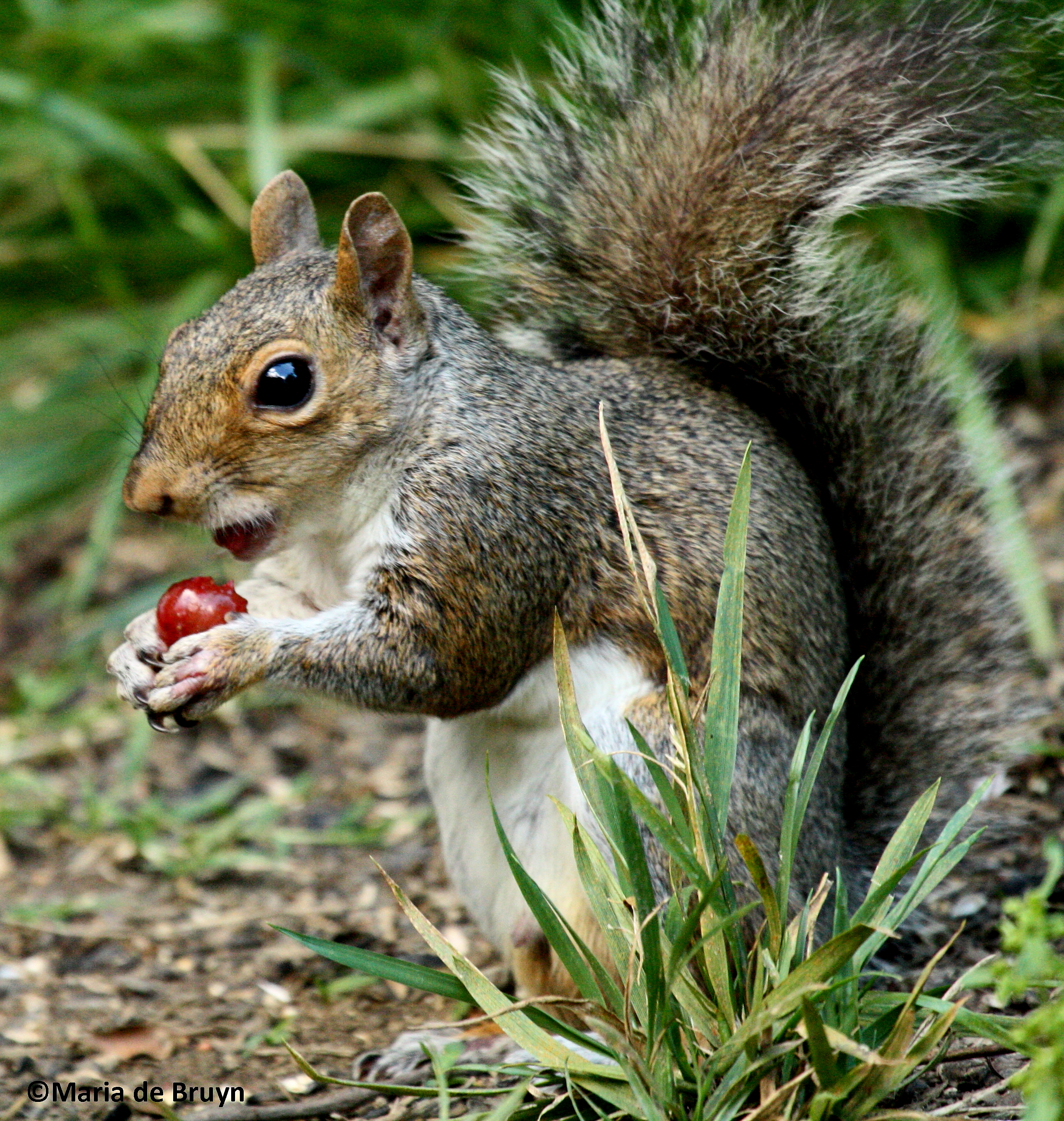
Eastern gray squirrel IMG_8965©Maria de BruynI must admit, though, that I had not expected to see a squirrel assiduously burying grapes one day. Researchers have found that that they will eat the most perishable acorns right away, while caching those that will stay preserved the best. So what made this squirrel think that the grapes she was burying would last underground? Unless this was one sneaky squirrel who was just temporarily hiding her/his bounty until s/he could enjoy those grapes in relative solitude.

I’m looking forward to spring when I can sit outside to watch the squirrels ‘ behavior some more; the yard can be a real learning lab!
For more information see: http://articles.courant.com/2004-10-21/features/0410210319_1_squirrels-bury-acorn

Do deer like treats? Of course, they do!

deer bird seed IMG_3127© Maria de BruynAnyone who has lived in proximity to white-tailed deer (Odocoileus virginianus) know that they have a great appetite for all types of vegetation, including garden flowers that people plant in their yards. This has been a cause of strife between humans and the deer (at least, from the humans’ point of view), even though I and other people have found that deer repellants – both home-made and store-bought – work really well to keep deer from eating plants we wish to keep.

I also have a 5-foot fence around my vegetable garden. In theory, the deer could jump this but the trick is to make the garden long and narrow since the deer calculate how much space they have to land on the other side of the fence. If it looks like the space is too small, they won’t try to jump eveIMG_5431© Maria de Bruynn if they see and smell delicious veggies inside – I know this is true as I’ve watched them figuratively “lick their lips” outside my garden but never attempt to get into it.

The deer’s four-chambered stomach enables it to eat a variety of food. In spring and summer, they prefer green plants, including grasses; in the autumn, they go for corn, acorns and other nuts. In the winter-time, deer eat twigs and buds of trees. They also eat fruit, such as the berries on privet trees, lichens and other fungi.

Stip at apple treeStip and privet IMG_1648© Maria de Bruyn

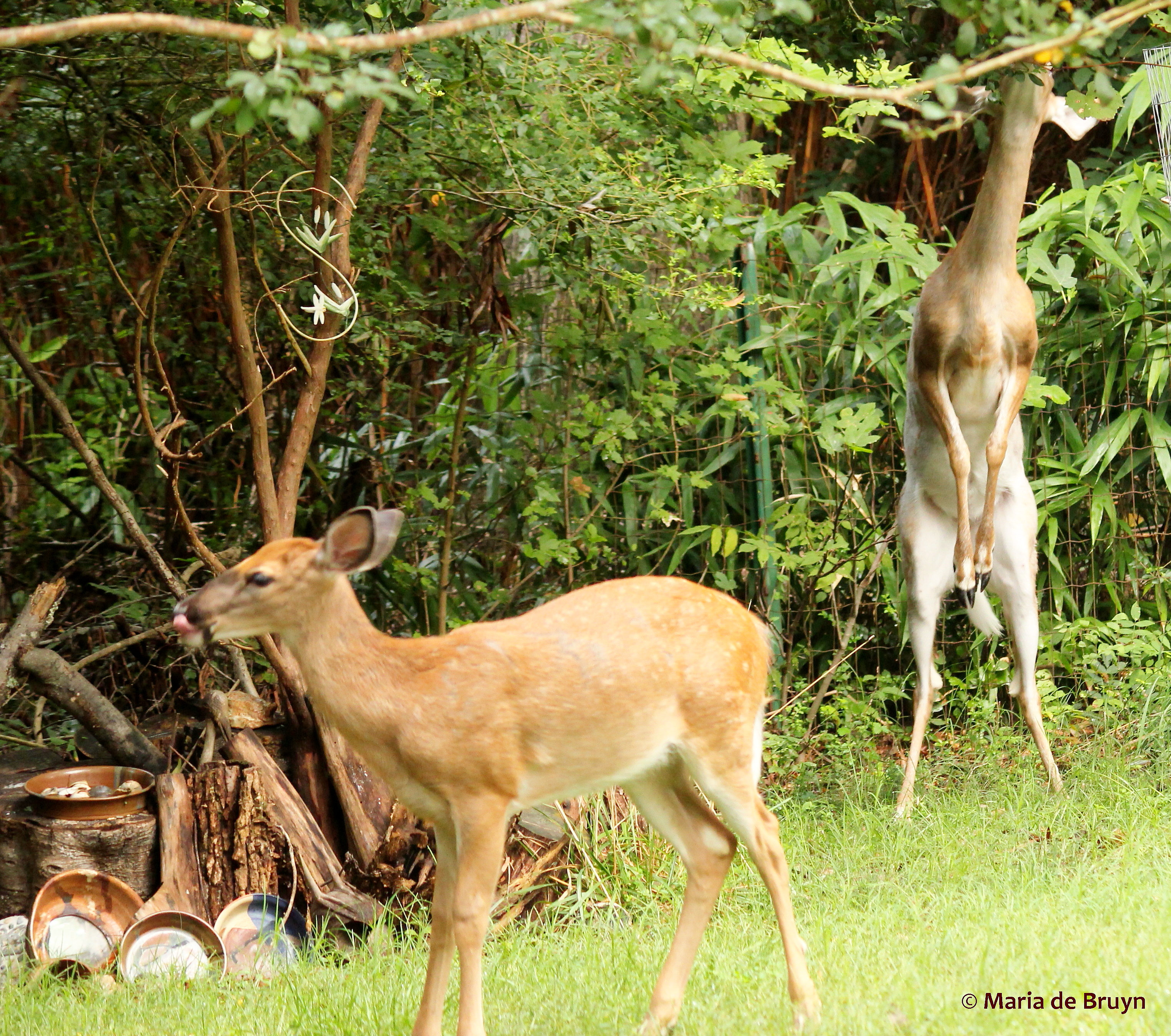
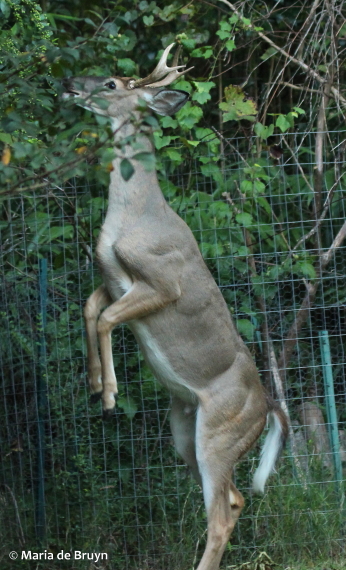
To get to the privet berries, they need to reach the tree branches and their good sense of balance comes in handy. The does do it often in my back yard and the fawns watch them carefully so they can try it, too. Surprisingly, the fawns can stand on their hind legs pretty well when they are only a few months old.

Nezhoni and apple tree 3©Maria de BruynBuck and privet IMG_5243© Maria de Bruyn

Besides privet berries, they like grape leaves (which can be high when the grapevines climb up the privet) and apples. The big bucks will also have a go at it but I don’t see them lifting their bulky bodies up often.

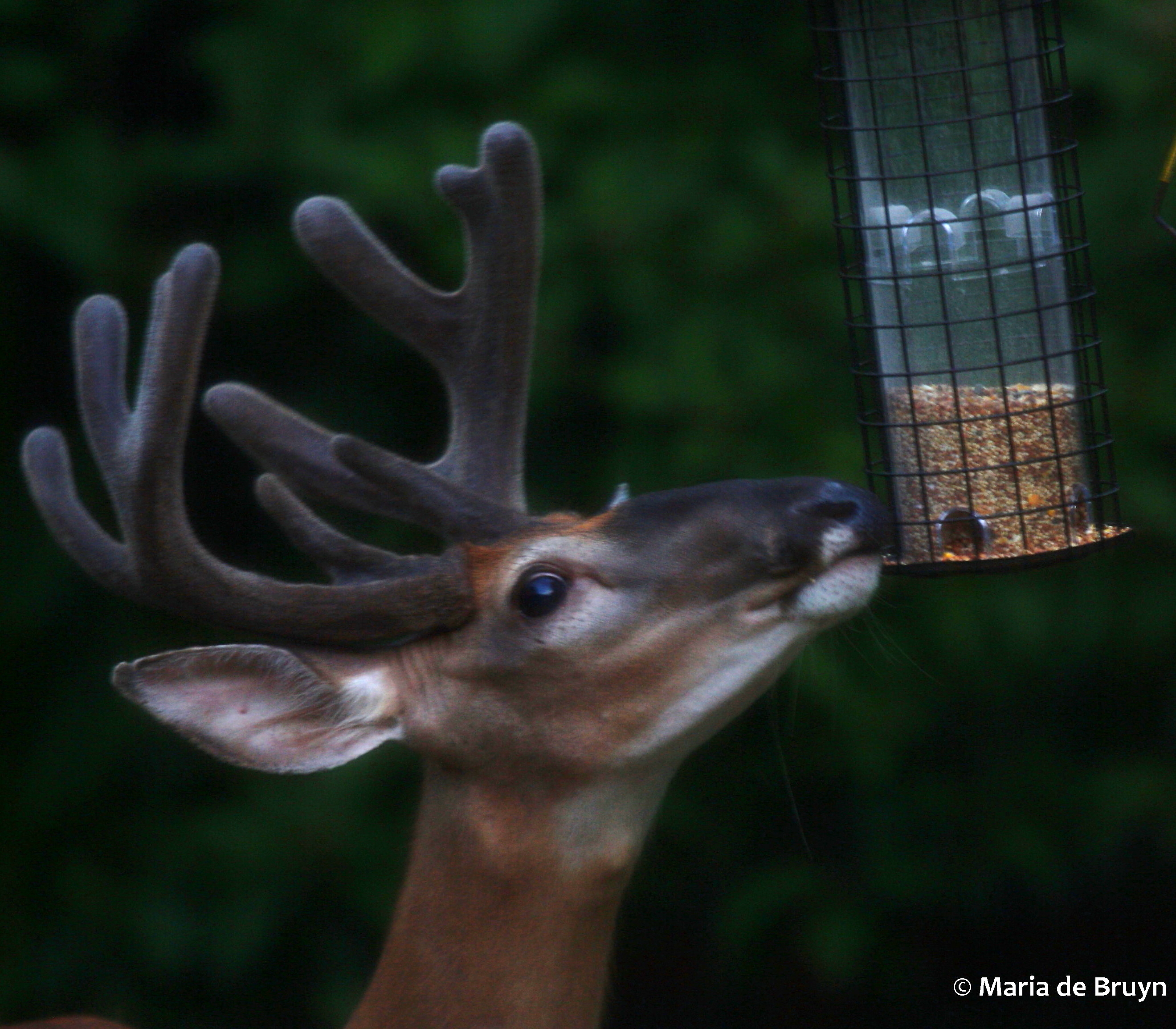
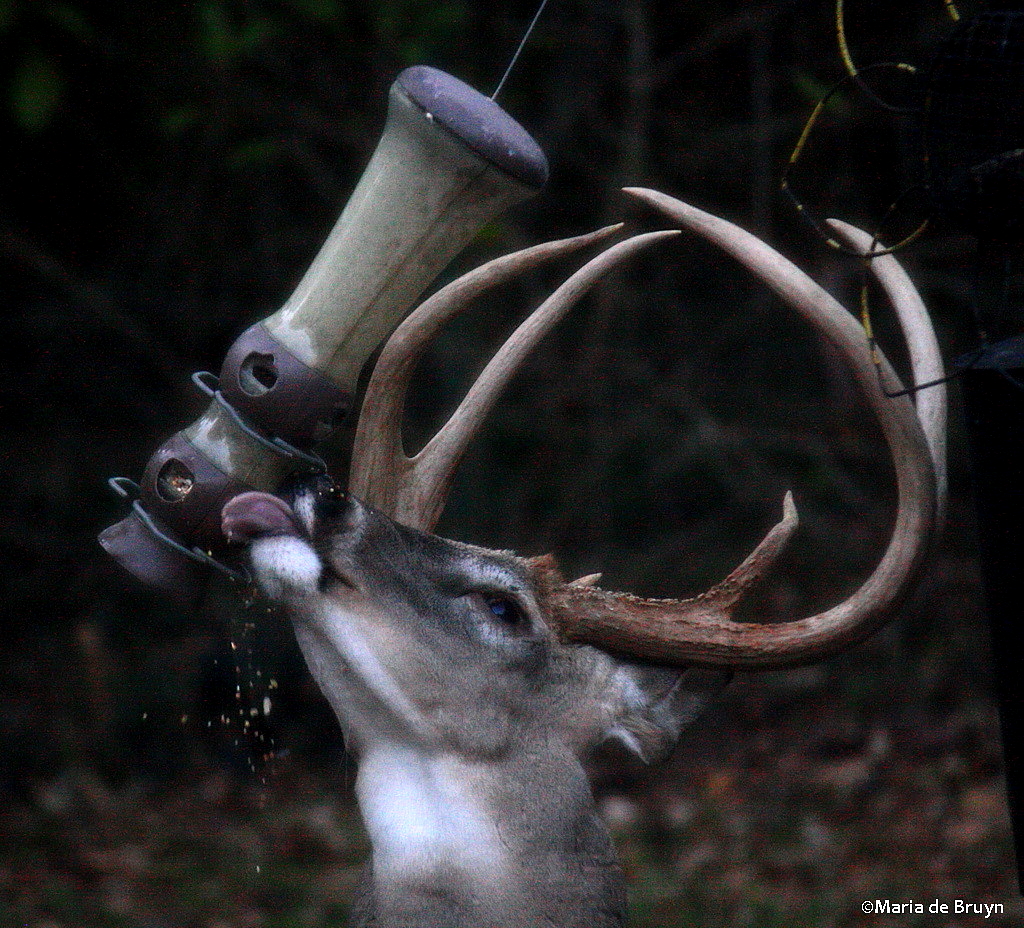
The deer also enjoy treats, just as we may like sweets and birds have a fondness for suet. Bird seed is one treat they like. If the deer are very hungry, they can lick up all the bird seed put out for the ground feeders, but when they are feeling well fed, they will just have a little and leave seed for the birds (and squirrels). The deer’s fondness for bird seed can be strong; if you don’t hang your feeders high enough, they can clean out a feeder in a short time.

emptying bird feeder at night©Maria de Bruynwhite-tailed deer MdB 3 buck

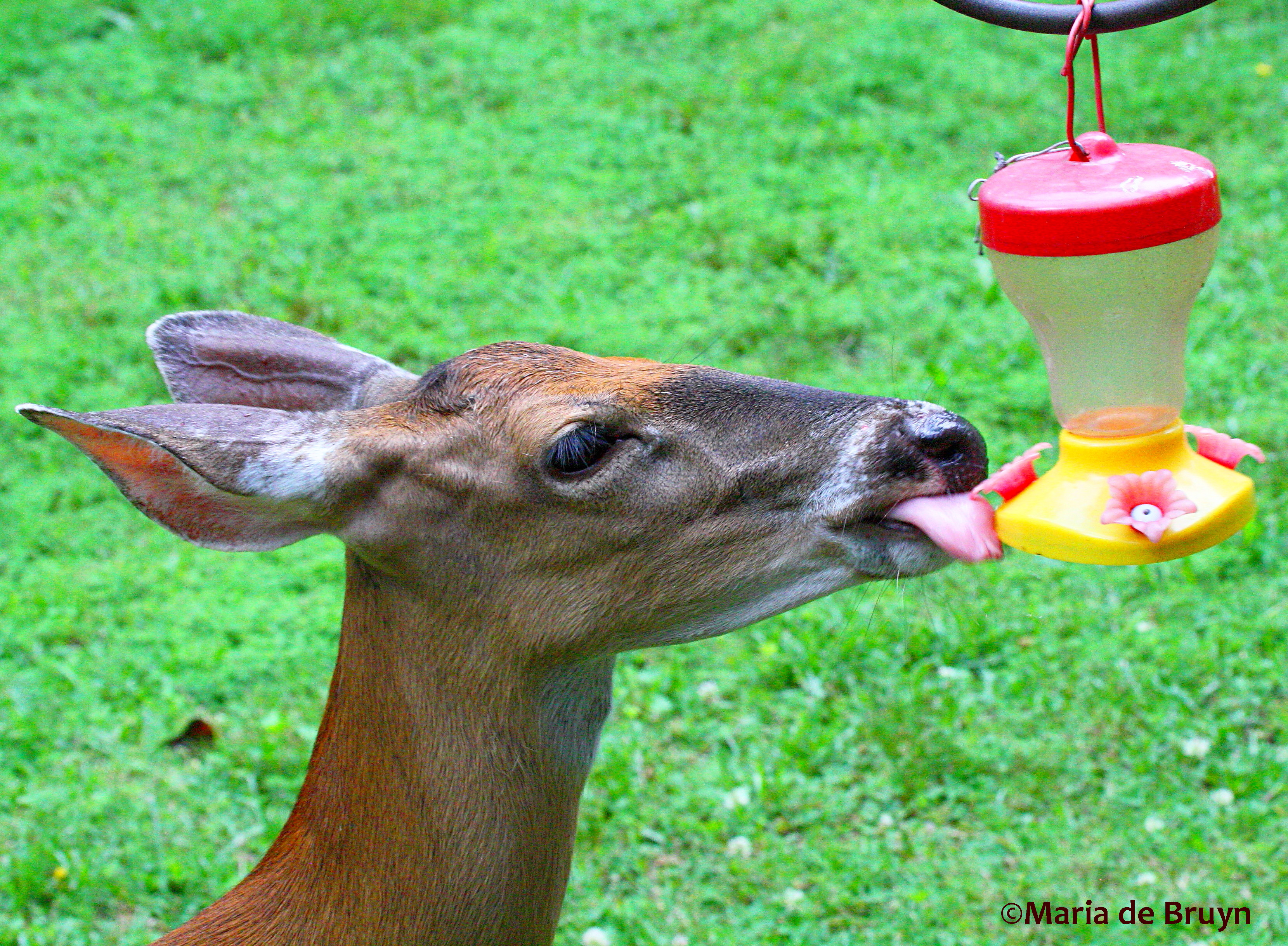
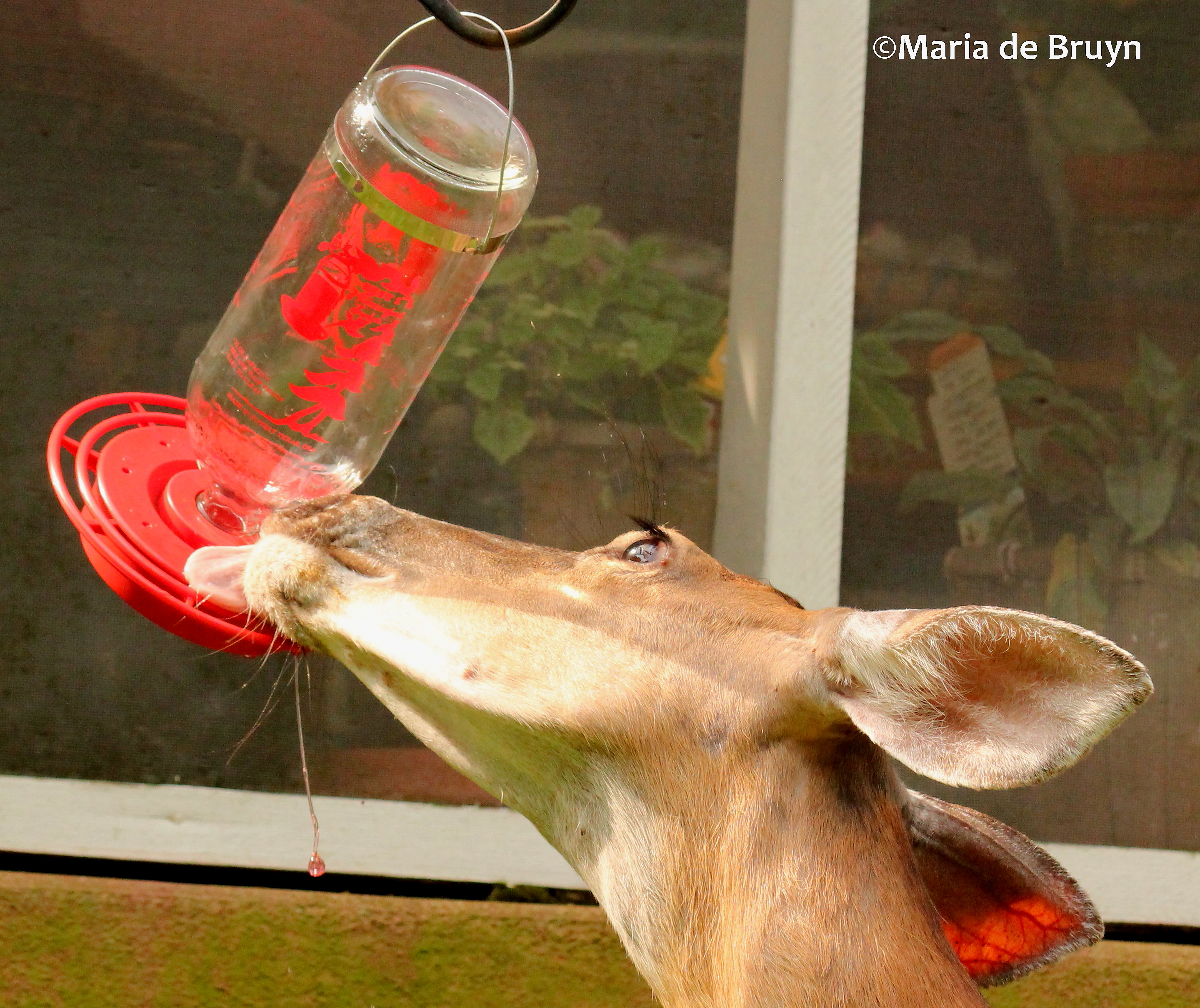
My biggest surprise concerning a deer treat came from Schatje, my “dear deer” friend of five years. One summer, I noted that the hummingbird feeder was emptying quickly and I just thought the hummers were very thirsty. Then one day, I looked outside to see Schatje enjoying a sweet drink. It turned out she was extremely fond of nectar and eventually I had to hang the feeder higher so she wouldn’t drink all the contents a couple times a day!

white-tailed  deer Schatje 1 ©Maria de Bruyn signedSchatje nectar IMG_1727©Maria de Bruyn

This winter has been especially cold and the local deer family have had to rely on their winter diet of fungi, leaves and twigs a lot. Though they likely are not anticipating spring, I’m sure they will be glad when it gets here, just like me!

Next week: squirrel treats