Tundra swans, snow geese and Canada geese, too – beauty by the tens of thousands

Tundra swans IMG_8442©Maria de Bruyn

When the tundra swans (Cygnus columbianus) and snow geese (Chen caerulescens) leave the Arctic and sub-Arctic tundras and climes of northern North America to over-winter along the coasts of the United States, those of us who live further south get to enjoy the marvelous spectacle of tens of thousands of these birds gathering together. They appear in huge masses and smaller family groups to feed and then swirl through the skies in an aerial ballet as they settle down to feed again or spend the night in a marsh or on a lake or pond. Witnessing these enormous conglomerations of birds really is an unforgettable experience.

Tundra swans IMG_8440©Maria de BruynThe tundra swan – also known as the whistling swan in North America – is a large, graceful bird. Its diet is varied, ranging from aquatic plants and some molluscs (mostly during the summer) to seeds, grains and tubers like potatoes in the winter. In North Carolina, where they migrate during winter, you can find immense flocks foraging in open agricultural fields before they settle for the night (in winter, these birds sleep mostly on the water; during the breeding season, these monogamous birds sleep mainly on land).

tundra swan IMG_8676©Maria de Bruyn signed res

The adult swans are entirely white except for a black bill, while the immature birds are first a dusty gray color that eventually turns white; the young swans also have a pinkish bill.

Tundra swans IMG_6457©Maria de Bruyn signed res

During a birding trip to the Outer Banks of North Carolina, our Audubon group was privileged to witness the tundra swans returning to a lake in the Pocosin Lakes National Wildlife Refuge one night.

Tundra swans IMG_6446©Maria de Bruyn res

It was like watching a black wave moving back and forth across the orange sky at dusk, while being surrounded by a tremendous volume of honking (not whistling!). Afterwards, I and others regretted that we hadn’t thought to film this so we had a record of the sound. I think we were just so mesmerized that it didn’t occur to us to do that. Here you can hear what their calls are like. For us, it was impressive as we were listening to the sounds of a flock of about 20,000 strong! http://www.allaboutbirds.org/guide/tundra_swan/sounds

Tundra swans IMG_6439©Maria de Bruyn signed res

The snow goose, like the tundra swan, migrates in the winter to North Carolina from the uppermost parts of North America; like the swans, they forage in winter agricultural fields in large groups. There are two color variations: some are almost entirely white, while the “blue morph” variation has a white head but blue-gray body feathers. Our birding group was lucky to see another aerial ballet at Pocosin Lake National Wildlife Refuge put on by the snow geese.

Snow goose IMG_6334©Maria de Bruyn2 res

As a member of our group excitedly called, “They’re rising!” an enormous flock surged up from the lake, flew back and forth just a little and then settled.

Snow goose IMG_6330©Maria de Bruyn signed res

A minute later, they repeated the process and we watched as the swirling cloud rose and fell, just moving side to side a bit. They were very far across the lake from us, so it wasn’t possible to get great shots but at least I had evidence of the sighting!

Snow goose IMG_6341©Maria de Bruyn signed res

The other birds that we saw in some numbers were the more familiar Canadian geese (Branta canadensis). They are commonly seen in our area so it didn’t seem quite so special to spot them at the coast, but they passed by in flocks and beautiful formations that were well worth watching.

Canada goose IMG_5955©Maria de Bruyn signed resCanada goose IMG_6041©Maria de Bruyn res

Canada goose IMG_8306©Maria de Bruyn signed res 2These were the only geese that we were able to see up close a bit; here you see a pair at Lake Mattamuskeet National Wildlife Refuge.

I had seen starling murmurations before and was quite impressed with those. Witnessing the gigantic flocks of tundra swans and snow geese was equally fascinating – if you get a chance to see such large groups, do stop to watch them!

Belted kingfishers and me

Belted kingfisher IMG_9360f© Maria de Bruyn

Since my “career” as a birder is still rather short, especially in comparison to some birders I know, I still quite regularly see “lifers”. These are first-time spottings of birds in the wild when you can identify them reliably. While I enjoy seeing the more common birds in my area time and again, it is the lifers that often evoke a happy grin when I get a good photo. More often than not, though, my first photos of a lifer are a bit blurry, partial as the bird is hidden in foliage or otherwise imperfect. It is only with repeated sightings that the photos seem to improve – though that also isn’t always the case.

An example of this is my “relationship” with the belted kingfisher (Megaceryle alcyon).  Although worldwide there are more than 90 species of kingfishers, the United States and Canada only have three and it is the belted variety that is most often seen. “Belted” refers to the band of bluish-gray color across the white underparts of the bird’s body; both males and females have this. Females also have a reddish color band, making them even more attractive than the males, which is not so usual among our avian friends.

The first time I saw a belted kingfisher was in October 2012; it was Belted kingfisher IMG_9690Dacross Jordan Lake, about a 30-minute drive from my home, in a tree. Only when it flew by once at high speed was I able to get a half-way decent shot of what I think was a female.

My next sightings were in a mangrove swamp in Mexico in December 2013. One day, I saw a female fly by over the mangrove trees in the distance.

Belted kingfisher IMG_9364F© Maria de BruynTwo days later, at the same place, I saw male. What was exciting about that spotting was that the bird began fishing right in front of me. He would circle the swamp, hover a couple seconds and then fold his wings to drop like a bullet into the water, completely submerging. The action was fast and my photos were blurred again, but I was able to document that he had caught a meal.

Belted kingfisher IMG_1853© Maria de BruynBelted kingfisher IMG_1855© Maria de BruynBelted kingfisher IMG_1860© Maria de Bruyn

Belted kingfisher IMG_1864© Maria de BruynBelted kingfisher IMG_5279©Maria de BruynresMy fourth sighting was in the late afternoon this past week, January 2014. As I was walking in a forested area near a creek, I saw a flash of a blue head and white on the wings and at first thought that a blue jay had streaked by me. But then the odd, kind of loud warbling call caught my attention – it was definitely not a jay. The bird perched on a tree limb about 100 feet or more ahead of me and I suspected that it might be a kingfisher but doubted it, too, as I thought they needed to be around more open bodies of water. This is not the case – they just need to be around water that doesn’t freeze over so they always have access to their fishy diets, as well as amphibians, small crustaceans, insects, small mammals and reptiles. They nest in burrows dug horizontally into the banks of waterways and both parents cooperate in feeding and raising the young.

Belted kingfisher IMG_5442©Maria de BruynresBelted kingfisher IMG_5388©Maria de Bruynres

I began taking photos from far away as I neared the kingfisher; when I would get within about 30 feet, he would take off again. This scenario repeated itself over and over again as I tried to get some shots of the bird not hidden by branches, twigs and dried foliage. I finally did get some photos, again not of the best quality as it was getting towards dusk and the bird was still pretty far away.

Belted kingfisher IMG_5420©Maria de BruynresBoth sexes have a dark head with crested feathers and quite large bills; this juvenile – male, I believe – showed his crest over and over as he called and bobbed up and down on his various perches. I think it is the crest that helped give him a – what struck me as – crabby look. He was very impressive though.

Belted kingfisher IMG_5442©Maria de Bruynres

When I next see a belted kingfisher, it won’t be a “lifer” sighting but my goal now is to get a good close-up shot; time will tell if I succeed!

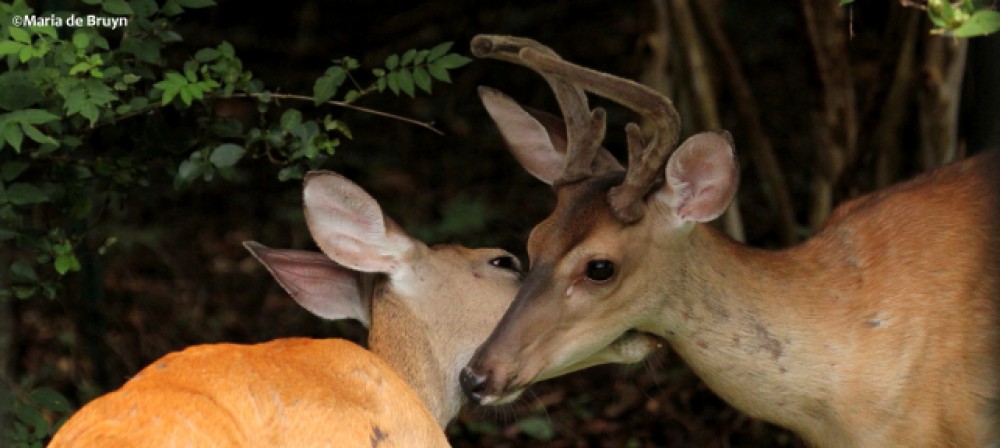
Next blog: deer and their efforts to get food

Owls – raptors with fantastically functional feathers

Barred owl IMG_9617© Maria de Bruyn resThe owl is the wisest of all birds because the more it sees, the less it talks. – African Proverb

The world likes to have night-owls, that it may have matter for wonder. – German proverb

Sayings about wise owls are well known and may account for the names given to a group of owls – a wisdom, study or parliament. On the other hand, in some cultures, owls are associated with bad luck, death and the stealing of souls. Owl fossils date back as far as 58 million years ago! These appealing birds have been depicted in in cave paintings in France, in Egyptian hieroglyphics and in Mayan art. There are about 200 species of owls around the world and they are found on all continents except Antarctica and a few remote islands.

Owl anatomy

Barred owl eye feathers IMG_9802©Maria de BruynresOwls have interesting anatomical features. Like humans, they have binocular vision as a result of their upright posture and forward-facing eyes. A circle of feathers around each eye, as seen in the barred owl  (Strix varia) here, can be adjusted to focus and channel sound to their ears (which are asymmetrical in many species!). These feathers can magnify sound as much as 10 times, giving them acute hearing.

Barred owl IMG_9832©Maria de Bruyn signed res

Like bald eagles, owls have three eyelids: one is used to blink, another for sleeping and the third – the nictitating membrane – helps them keep their eyes clean and healthy. Because they cannot turn their eyes within their bony eye sockets, owls must rotate their heads up to 270 degrees to look around. They are far-sighted and cannot see clearly right in front of their eyes, but their distance vision is very good, especially in low light.

Barred owl IMG_9117©Maria de Bruyn resOwl feathers have fringes with different degrees of softness, which helps muffle sound when they fly.

Screech owl IMG_3069©Maria de Bruyn resSome owls, like the Eastern screech owl (Megascops asio) have tufts of feathers on their heads; the function of these might be to indicate a bird’s mood, to show aggression or to help keep the bird camouflaged.

Screech owl rehabilitated by CLAWS that serves as an educational bird

Behaviors

Different owl species make different sounds for finding mates or announcing their presence to potential competitors. These sounds help ornithologists and birders locate and identify species.  For example, the barred owl is said to have a call that sounds like “who cooks for you?”

These carnivorous birds usually swallow their prey whole (depending on the size of the animals such as fish, mice, rats, hares). Scientists who study their diets use owl pellets as an aid; the owls regurgitate bones, scales and fur in these pellets. The larger owls will also detach body parts they don’t wish to eat. For example, colleagues speculated that it was a great horned owl (Bubo virginianus) that took down a red-tailed hawk (Buteo jamaicensis) at a local nature reserve recently, leaving behind an entire wing that wouldn’t have provided much nutrition.

great horned owl IMG_3065©Maria de Bruyn resred-tailed hawk IMG_2745©Maria de Bruyn res

Great horned owl rehabilitated by CLAWS in Chapel Hill, NC. This bird was shot in the eye and cannot be released again; it serves as an educational bird.

The main threats to owl survival today include habitat loss, pesticides and human predation due to negative superstitions. There are fortunately efforts to preserve owls where they may be seen as beneficial. For example, a barn owl may eat up to 1000 mice each year, so that farmers try to attract them to help control rodents in agricultural fields. Projects to re-introduce barn owls (Tyto alba) are taking place in the Czech Republic and the United States. The local Audubon Society to which I belong has a barn owl project, in which they have placed barn owl nest boxes in various places in an effort to attract these birds as more permanent residents. It would be very cool to see the boxes occupied one day!

Barn owl project IMG_6412© Maria de BruynBarn owl box IMG_2501©Maria de Bruyn

Check out CLAWS, a wildlife rescue and rehabilitation center in North Carolina! http://www.nc-claws.org/

Resplendent remiges and rectrices – bird beauty from behind

The other day asMourning dove IMG_6565©Maria de Bruyn res I was photographing birds at my feeders, I was struck by the beauty of this bird’s feathers as they lay across its back. The muted colors are wonderful and the scalloped-edge pattern is marvelous. It made me take a look at other birds’ feathers as seen from behind and how they vary in position and shape. I hope you enjoy this short tour and have some fun identifying the birds shown – many are very easy for experienced birders but perhaps some are not for beginning birdwatchers. The answers will be added to the blog next week.

So, we are focusing here on flight feathers, namely the remiges and rectrices. The remiges – or wing feathers – help the bird get lift when flying and support the bird during flight. The rectrices – tail feathers – give the bird stability and provide control.

Red fox sparrow IMG_5745© Maria de Bruyn resHouse finch M de Bruyn resCardinal IMG_6227©Maria de Bruyn res

The outer “vane” (part of the feather above the shaft) is narrower than the inner vane, so the wing feathers are asymmetrical. The tail feathers, on the other hand, are symmetrical in shape and pattern. The “primary” wing feathers are narrower and can be rotated individually, while the secondary remiges are shorter and lie together, even when the bird is flying.

In some species, the wing feathers may reveal a spot of color on the bird’s back when they are not folded completely over one another.

Yellow-rumped warbler IMG_6461©Maria de BruynresHouse finch IMG_6255©Maria de Bruyn res

The feathers also serve other functions, such as keeping the bird warm and dry.

Ruby-throated hummingbird IMG_4221©Maria de BruynresMandarin duck IMG_1605©Maria de Bruyn resHoopoe IMG_4314©Maria de Bruyn res

In some species, the males develop especially resplendent rectrices in thRed-collared widowbird 390©Maria de Bruynreseir breeding plumage – a definite attempt to attract mates.

Interestingly, the total weight of a bird’s feathers is about 2-3 times more than the weight of its bones!

One final quiz question – which bird has the fewest overall feathers and which species has the most?

Next week: curious deer

Weaver birds – avian architects par excellence!

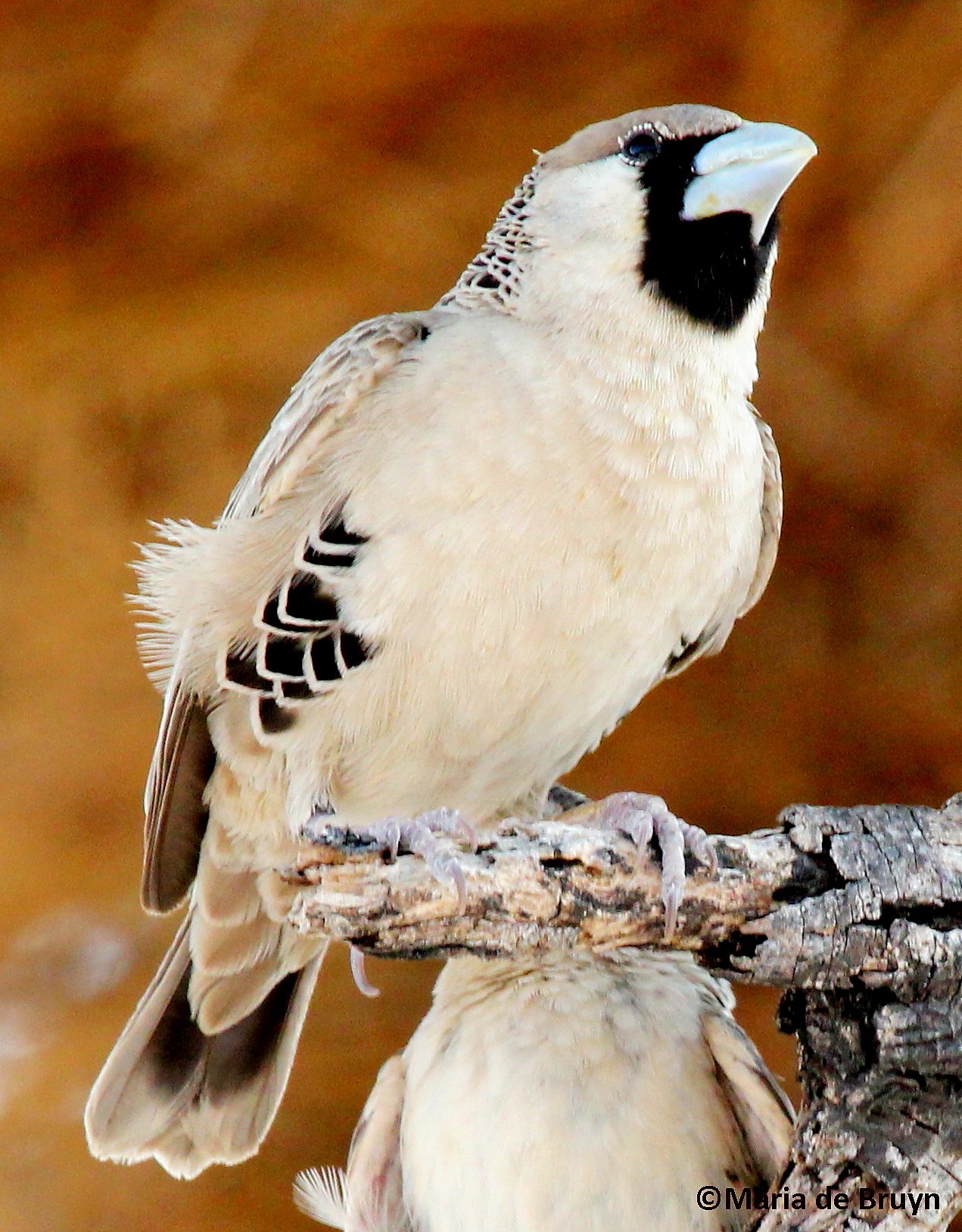
sociable weaver IMG_4297©Maria de BruynWatching different species of birds build their nests in the spring can be quite entertaining, but the most amazing nests that I’ve been privileged to see can’t be found in my immediate environment — those of the sociable weaver birds (Philetairus socius geminus), which I encountered in Namibia. (Their architectural feats are rivaled by those of the bower birds, which I haven’t been able to see in person yet – maybe one day!).

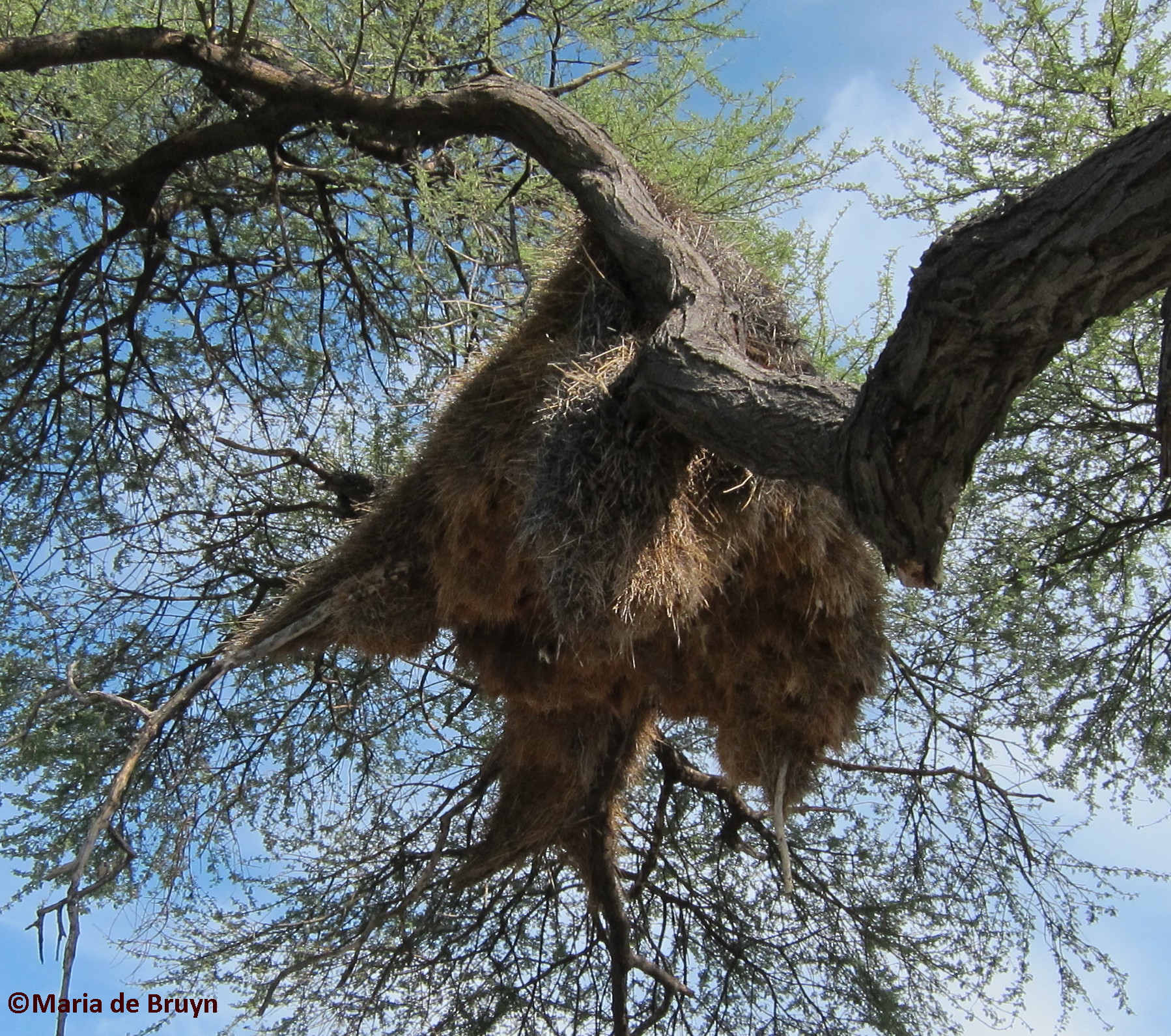
The sociable weavers are birds native to Southern Africa, where stiff grasses grow that are a main component of their large communal nests. The males build these shared homes in trees and on telephone and utility poles; they are the largest nests built by any bird and can house more than 100 pairs of several generations. Some nests have been occupied for more than a century and may weigh several tons!

Sociable weaver bird nest IMG_6610 ©Maria de Bruynres

sociable weaver bird nest IMG_6604©Maria de Bruyn

The nests are a technological marvel, highly structured and providing a more advantageous temperature inside compared to outside. The central chambers retain heat and are used for roosting at night. The birds use the outer rooms in the daytime to get some shade. The nesting chambers are lined from top to bottom with soft plant material, fur, cotton, and fluff, while sharp spikes of straw or twigs protect the entrances against predators such as Cape cobra snakes. Some birds appear to be caught, however.

sociable weaver IMG_4290©Maria de Bruynsociable weaver birds IMG_4284©Maria de Bruyn

The sociable weavers may not breed during periods of low rainfall and a considerable number (sometimes more than half) of the birds in a colony may not breed in a given season. Under typical conditions, sociable weaver birds raise up to four broods per breeding cycle, with nearly all pairs being assisted by helpers; for example, older birds may help care for younger siblings and unrelated hatchlings. Interestingly, other species of birds may also share these nests, including red-headed finches, rosy-faced lovebirds, pied barbets, familiar chats, ashy tits and pygmy falcons.

 baglafecht weaver IMG_1506 MdBweaver bird nest IMG_3560 ©Maria de BruynBaglafecht weaver (Ploceus baglafecht) in Kenya

Among other types of weaver birds, the males also are the nest builders, hoping to attract females with beautifully constructed homes. They can use their strong, conical beaks and feet to actually tie knots in the grasses used to form the nests, making the nests sturdier.

Weaver bird nests IMG_6570©Maria de Bruynresweaver bird nests IMG_6552©Maria de Bruynres

The male sparrow weavers of Africa build “apartment-house” nests, in which numerous birds live in separate but neighboring flask-shaped homes that are entered through tubes at the bottom.

The buffalo weavers, on the other hand, make large stick nests that are untidy outside but may have spherical woven nests inside.

red-billed weaver ©Maria de Bruyn

Red-billed buffalo weaver (Bubalornis niger) in South Africa

The bluebirds and robins here can make some nice-looking nests, but the weaver bird nests are among my real favorites!

Next blog: to be determined!