Delight in small packages

ruby-throated hummingbird M de Bruyn signed (2) res

Ruby-throated hummingbird IMG_6085©Maria de BruynOne bird that seems to almost universally delight people and bring smiles to their days are the hummingbirds. These wonderful little fliers now only live in the Western hemisphere of our earth, but two 30-million-year-old hummingbird fossils were discovered in Germany so they did live elsewhere.

There are more than 300 species – some very, very colorful and some with gorgeous long tails or long curved beaks. Central and South America have spectacular species and one of the Nazca line drawings in Peru depicts a hummingbird. Only eight species breed in the United States.

Here in Chapel Hill, I’ve had the pleasure to see two species – the ruby-throated hummingbird (Archilochus colubris) and the rufous hummingbird (Selasphorus rufus). The ruby-throated (named for the male’s brilliant neck feathers) are here in spring, summer and fall and then they migrate further south, crossing the 500 miles (800 km) of the Gulf of Mexico in one non-stop flight!

Ruby-throated hummingbird IMG_8991©Maria de Bruyn resRuby-throated hummingbird IMG_4837©Maria de Bruyn

The rufous species migrates here from further up north in the wintertime; they will go as far as Alaska to spend the winter and can tolerate below freezing temperatures.rufous hummingbird IMG_1789 M de Bruynrufous hummingbird IMG_2022 MdB

Ruby-throated hummingbird IMG_7541©Maria de BruynRESThe smallest bird species is the Bee hummingbird, which weighs less than a cent coin. On average, the ruby-throated hummingbird weighs less than a US five-cent coin.

They flap their little wings about 50 times per second but increase this to as much as 200 wing beats per second. This rapid motion makes a humming sound, which varies according to the species. Their quick flight allows them to hover as well as fly backwards and upside down.


ruby-throated hummingbird IMG_3498Ruby-throated hummingbird male IMG_5433©Maria de Bruyn res


ruby-throated hummingbird IMG_3293 MdBTheir little feet help them perch but they cannot hop or walk on them.

These little birds need to eat about half their weight in sugar every day, which is why you see them returning to feeders quite often. When there is not enough food, they can go into a hibernation-like state, slowing their metabolism to 1/15th of its normal rate.

Their hearts can beat as quickly as 1260 beats per minute and they take 250 breaths per minute, even when they are sitting still!

Ruby-throated hummingbird IMG_1482©Maria de Bruynres


Hummingbirds do not suck up nectar but quickly lap it up with tIMG_5526©Maria de Bruynheir tongues, which have tubes running down their lengths.

To ensure they have enough food, they can sometimes defend their feeding areas vigorously against other hummers that they consider intruders. This happens a lot at my feeders but they are so fast that it’s very difficult to get good shots of it.


ruby-throated hummingbirds IMG_0729 MdB resRuby-throated hummingbird IMG_2379©Maria de Bruynres2

ruby-throated hummingbirds IMG_0728 MdB res

They eventually will tolerate others in their vicinity (sometimes). They live 3-12 years and perhaps the ones they don’t mind having around are related.

Ruby-throated hummingbird IMG_2742©Maria de Bruynres

It is better not to put food dyes into nectar and brown or raw sugar should not be used to prepare it as these types of sugar contain iron, which can kill hummingbirds if they get too much over a certain period of time. They like sugar water with 25% sugar, although apparently nectar with 35% sugar is even more to their liking.

Ruby-throated hummingbird IMG_7711©Maria de Bruyn resRuby-throated hummingbird IMG_5921©Maria de Bruyn res2

I have yet to find a hummingbird nest made with spider silk and lichens in my yard but hope to see one in the future so that I can say I’ve not only seen the biggest bird egg (ostrich) but also the smallest!

Ruby-throated hummingbird IMG_5925©Maria de Bruyn (2) res

The exuberance of youth!

White-tailed deer IMG_3548© Maria de BruynSad and distressing events in the private and public spheres conspired to make the past 10 days rather depressing; it seemed every time I looked at the news, there was just more to grieve about. A nature walk always helps get my mind off that stuff and I often discover new things to boot.

Sometimes, though, I don’t even have to leave the house to get a little bit of cheer. Young white-tailed deer fawns (Odocoileus virginianus) can exhibit such exuberance when they feel they are in a safe place that you almost feel like joining them in dashing, darting and jumping in delight.

White-tailed deer IMG_3571© Maria de BruynWhite-tailed deer IMG_7393©Maria de Bruyn

This year, the local deer family did not produce many offsWhite-tailed deer IMG_3478©Maria de Bruynpring, undoubtedly adjusting to the urban environment. We have had very little rain this summer and their food supplies have dwindled way down. The ground-feeding birds do not always get to the seed first.

Four does, whom I am calling Mama, Plain Jane, White Spot and Grandma, visit my yard several times a day, sometimes alone and sometimes in the company of one or two others. At first, they were accompanied by one fawn, whom I was calling Baby. Baby could be the offspring of Mama or White Spot; oddly, I have seen both of them nursing her. I believe Plain Jane is the mother of a second fawn that showed up later; the two babies sometimes come together now.

White-tailed deer IMG_0469©Maria de BruynGrass has dried up, shrubs have shriveled and even my normally flowering plants are having a hard time. The deer are very hungry; I saw one nibbling on a crepe myrtle tree – something I had never seen in the more than 14 years I have lived here. Most of the time, my bird feeders are up high but when I hung one lower, Grandma took advantage of my forgetfulness. I don’t mind if they eat some of the bird seed and I have left some grapevine leaves for them as well.

I keep my fingers crossed that Baby will make it since a neighbor a couple blocks away, informed me that a fawn fell prey to coyotes there. (Perhaps that one belonged to either Mama or White Spot and accounts for both of them caring for Baby??) A fox was strolling through my yard the other day so the predators are certainly around. When no perceived danger is near, Baby really demonstrates what the verb “gamboling” is all about.

White-tailed deer IMG_3523©Maria de BruynWhite-tailed deer IMG_3597© Maria de BruynWhite-tailed deer IMG_7430©Maria de BruynWhite-tailed deer IMG_7385©Maria de Bruyn

When they get going, these little fawns can reach high speeds – and fly a little bit!

White-tailed deer IMG_3599© Maria de Bruyn

Sometimes, it looks a bit like they are demonstrating a deer yoga pose.White-tailed deer IMG_3596© Maria de Bruyn

Since I spray the plants I want to keep with deer repellant and I am ok with the family eating other plants, I have no problem with their frequent visits. In fact, I look forward to seeing them and having Baby lift my spirits!

Next blog: another wildlife spirit-lifter!

White-tailed deer IMG_3485©Maria de Bruyn

Thrushes – speckles and spots, or not

Learning to “bird” (i.e., spot birds and determine what species they are) is no easy matter. There are guides that have color-coded pages so you can begin by looking for birds that are primarily of the color of the one at which you happen to be looking, but then the females and males can differ greatly and the young can look very different from their parents, too.
Hermit thrush IMG_1357©Maria de Bruyn blogIf you can learn something about “families”, that will help you narrow down your search in other guides. So I began associating the family of thrushes with birds that have spotted breasts. I discovered that is true for some of the avian species that have the word thrush in their name, like the hermit thrush (Catharus guttatus) with its reddish tail and the wood thrush (Hylocichla mustelina, below right) with a really beautiful song.

Hermit thrush IMG_1359©Maria de Bruyn blogwood thrush IMG_5416©Maria de Bruyn blog

Wikipedia says that a characteristic of this bird family is that most species are of a gray or brown color, often with speckled under parts. But you can’t count on that being a definitive trait. For example, the large brown thrasher (Toxostoma rufum, below left) is not in the thrush family but its speckles and streaks are more than obvious. And the lovely little ovenbird (Seiurus aurocapilla, below right) with an orange stripe on its head looks similar to the hermit thrush but is actually a member of the warbler family.

brown thrasher IMG_8217©Maria de Bruyn resOvenbird IMG_0044© Maria de Bruyn blog

You can’t count on the name to help out either. The Louisiana waterthrush (Parkesia motacilla) is not a thrush at all but a somewhat larger warbler species that places its nest near water.

Louisiana waterthrush IMG_1260©Maria de Bruyn blog

American robin IMG_3049©Maria de Bruyn resOn the other hand, I was surprised to find out that American robins (Turdus migratorius) are thrushes. But then I saw that the young robins do have speckled breasts – very obvious on this one to the left.

And I learned that Eastern bluebirds (Sialia sialis) are a thrush species, too – those spots are also evident in the young!


Eastern bluebird IMG_6155©Maria de Bruyn resEastern bluebird IMG_5850©Maria de Bruyn

It turns out that Eurasian (common) blackbirds (Turdus merula) are thrushes, too. The males, like this one seen in Switzerland, are all black but the females show some spotting.

Eurasian blackbird male 6 MdB blogEurasian blackbird female 3 MdBblog

Nevertheless, speckling and spotting are no clear-cut clues to thrushes and common names can be confusing and deceiving. Perhaps I should give up on examining bird breasts to help figure out what species they are. Enjoying the birds, their behavior and their appearance is a much better birding experience for me than aiming to become an identification or birding expert!

Green and red (and gold) insect jewels

Continuing on from my last blog about the strikingly blue-colored dogbane beetles and ebony jewelwing damselflies, I’ll now focus on some other brightly colored insects – beetles and flies of metallic greens and reds.

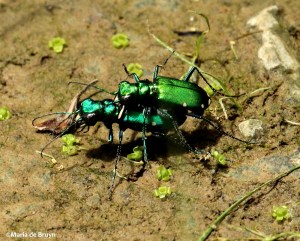
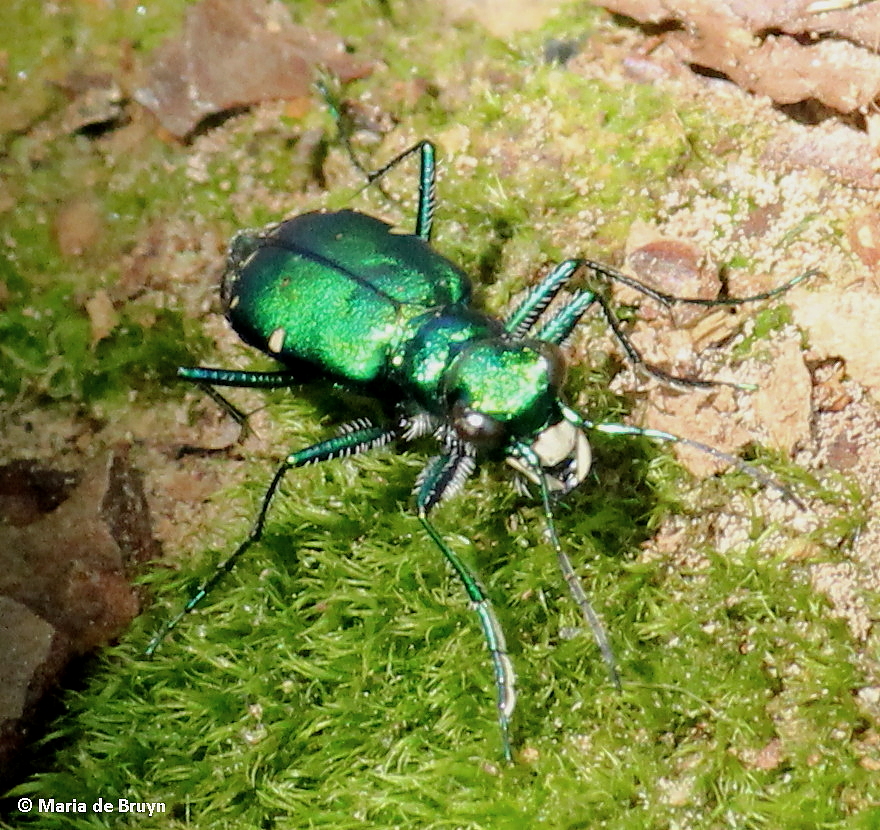
The six-spotted tigesix-spotted tiger beetle IMG_0116©Maria de Bruyn resr beetle (Cicindela sexguttata) seems to have color variations ranging from bluish-green through a brilliant forest green.
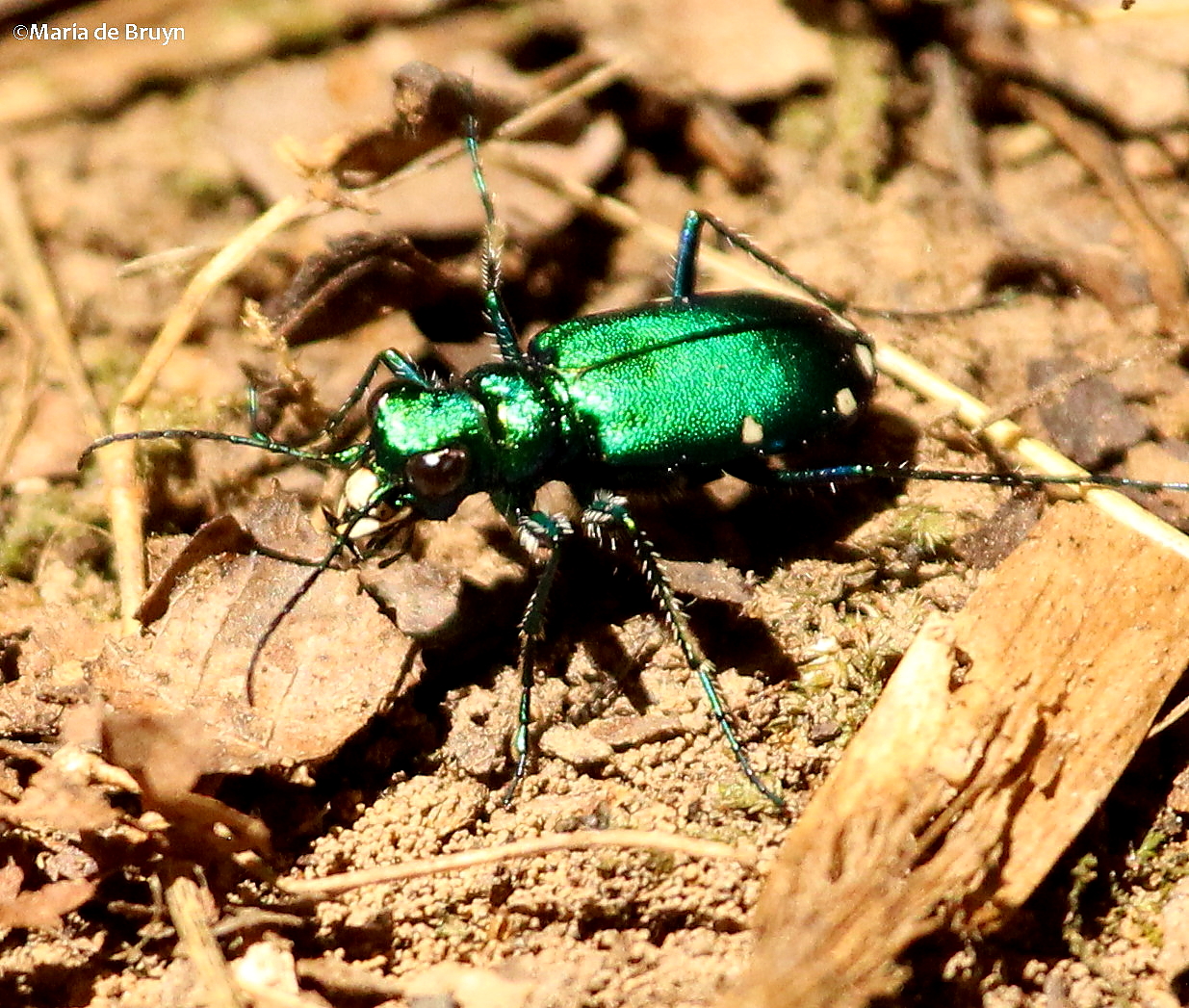
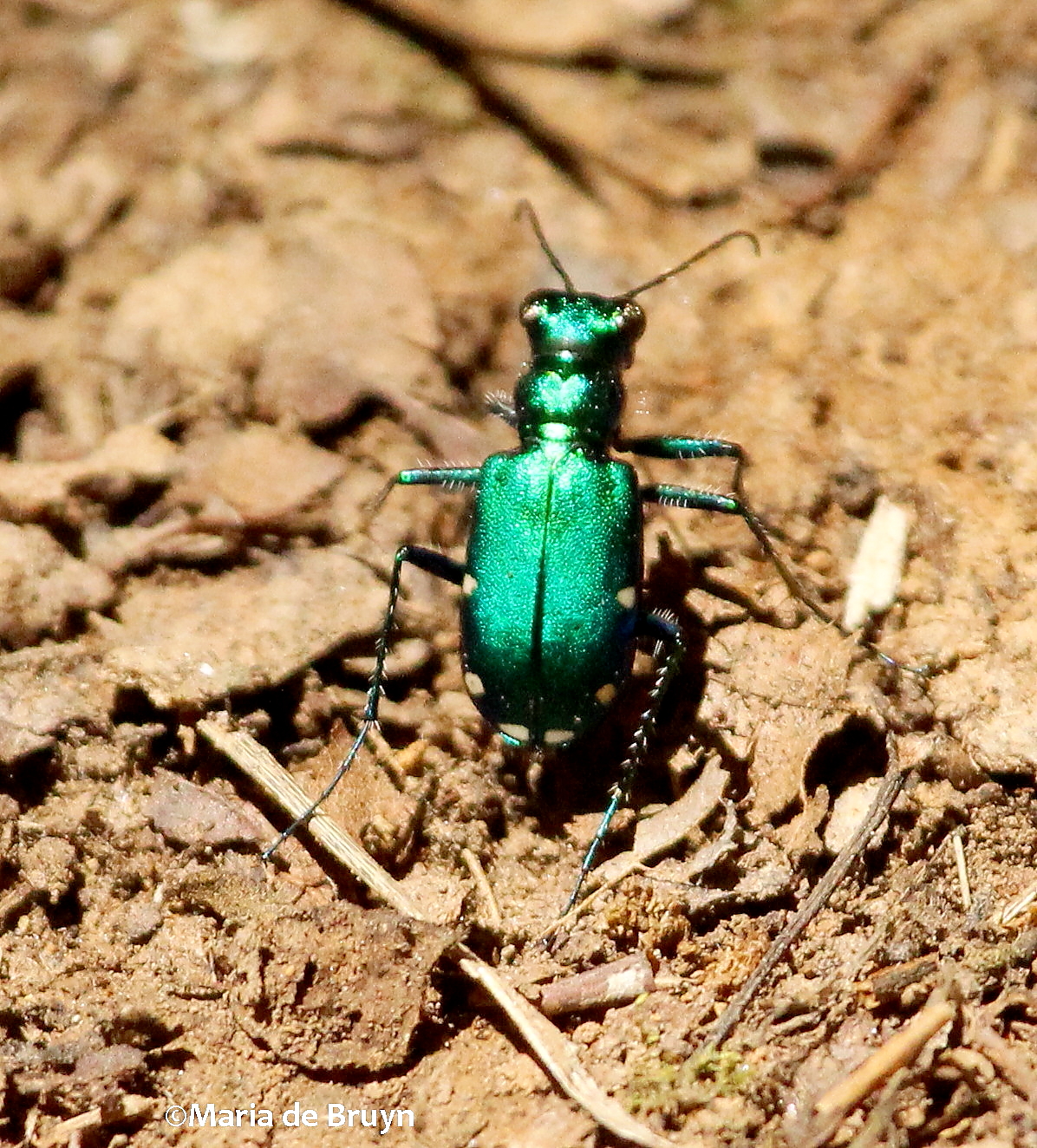
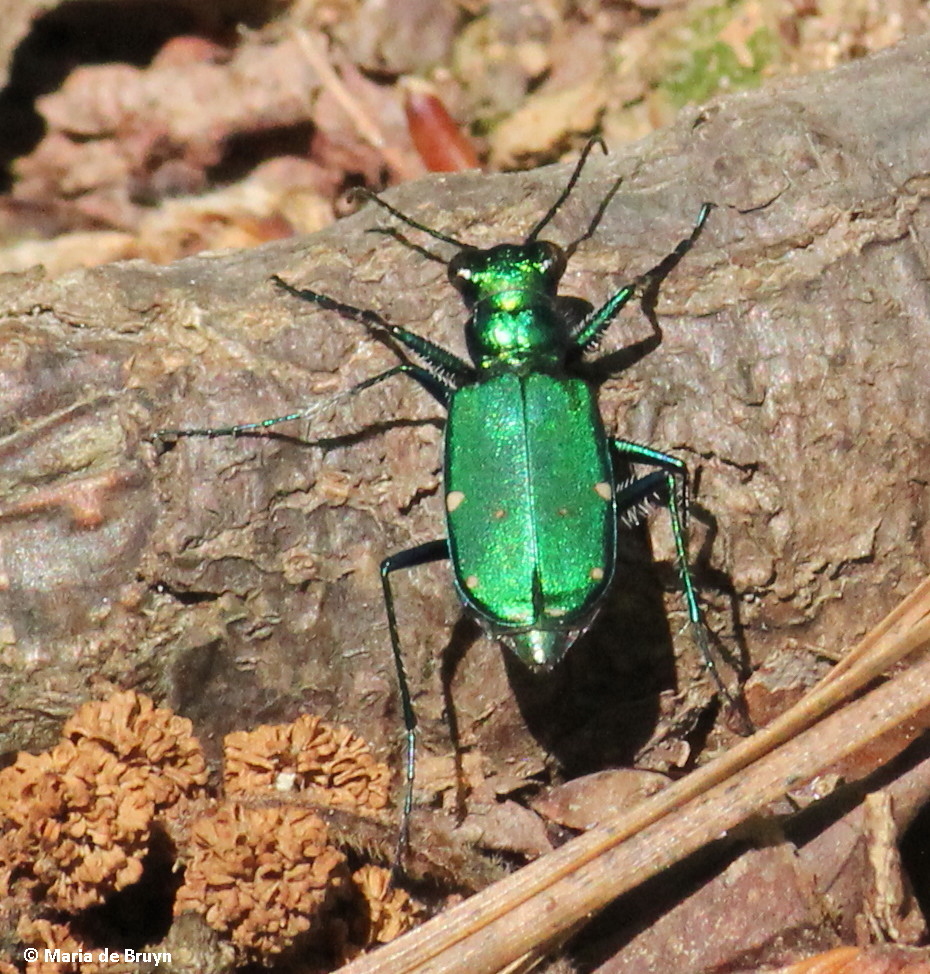
Their coloring extends all over their bodies, including their legs and heads, interrupted by six white spots marking the back edges of their wings and by large white mandibles (jaw bones).

six-spotted tiger beetle IMG_6894©Maria de Bruynsix-spotted tiger beetle IMG_6905©Maria de Bruyn

These fairly long-lived beetles (up to 5 years) look a bit fierce with those large jaws and they do bite, but they don’t go after people, unless perhaps you tried to handle them and they get pissed off. They are pretty quick runners and fliers, though. Their prey includes ants, spiders, caterpillars and other insects.

six-spotted tiger beetle IMG_5664six-spotted tiger beetle IMG_5659

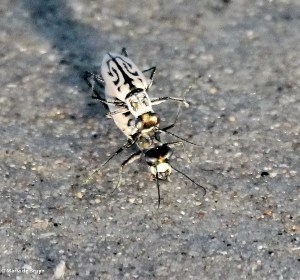
Southern white beach tiger beetle IMG_7171 mdbThey have a beautiful cousin at the North Carolina beaches, the Southern white beach tiger beetle (Cicindela dorsalis media). Though not a shiny insect, they look as if they are made of ivory with an inlaid ebony pattern. Early September seems to be mating time for these insects; when I took this photo, there were many dozens of pairs going at it all over the beach. In some cases, the females were trying to shake off the males, who were hanging on rather desperately.
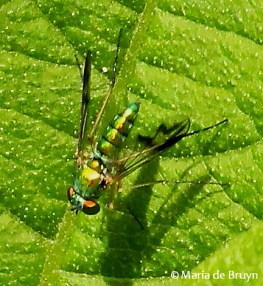
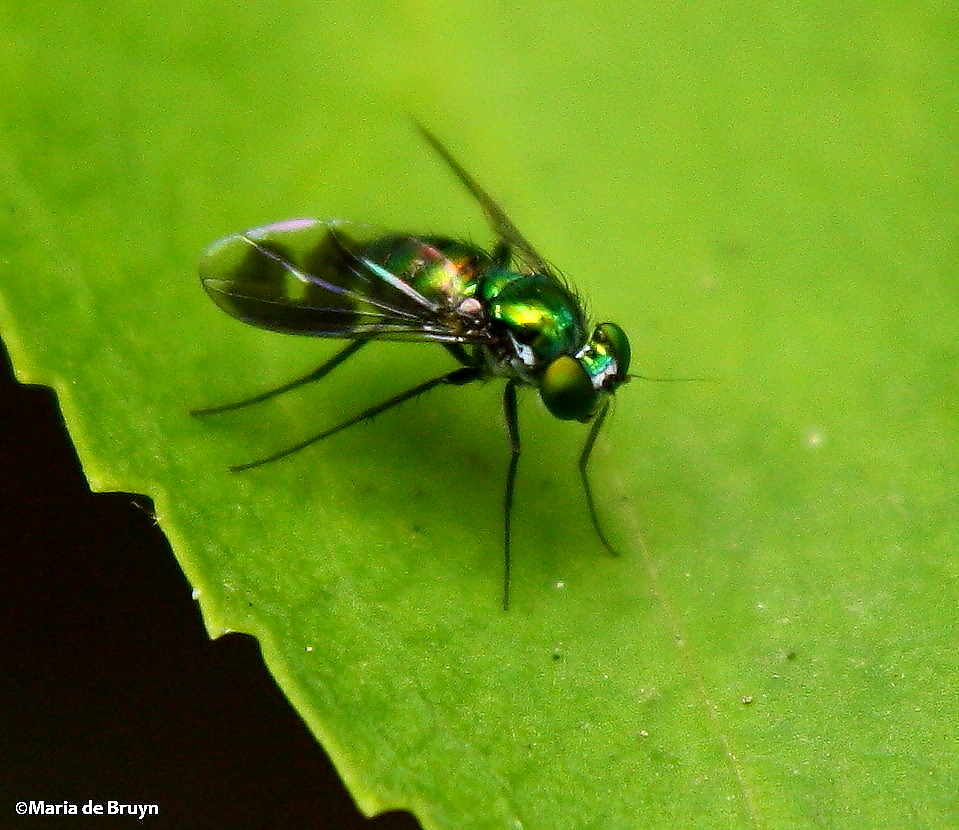
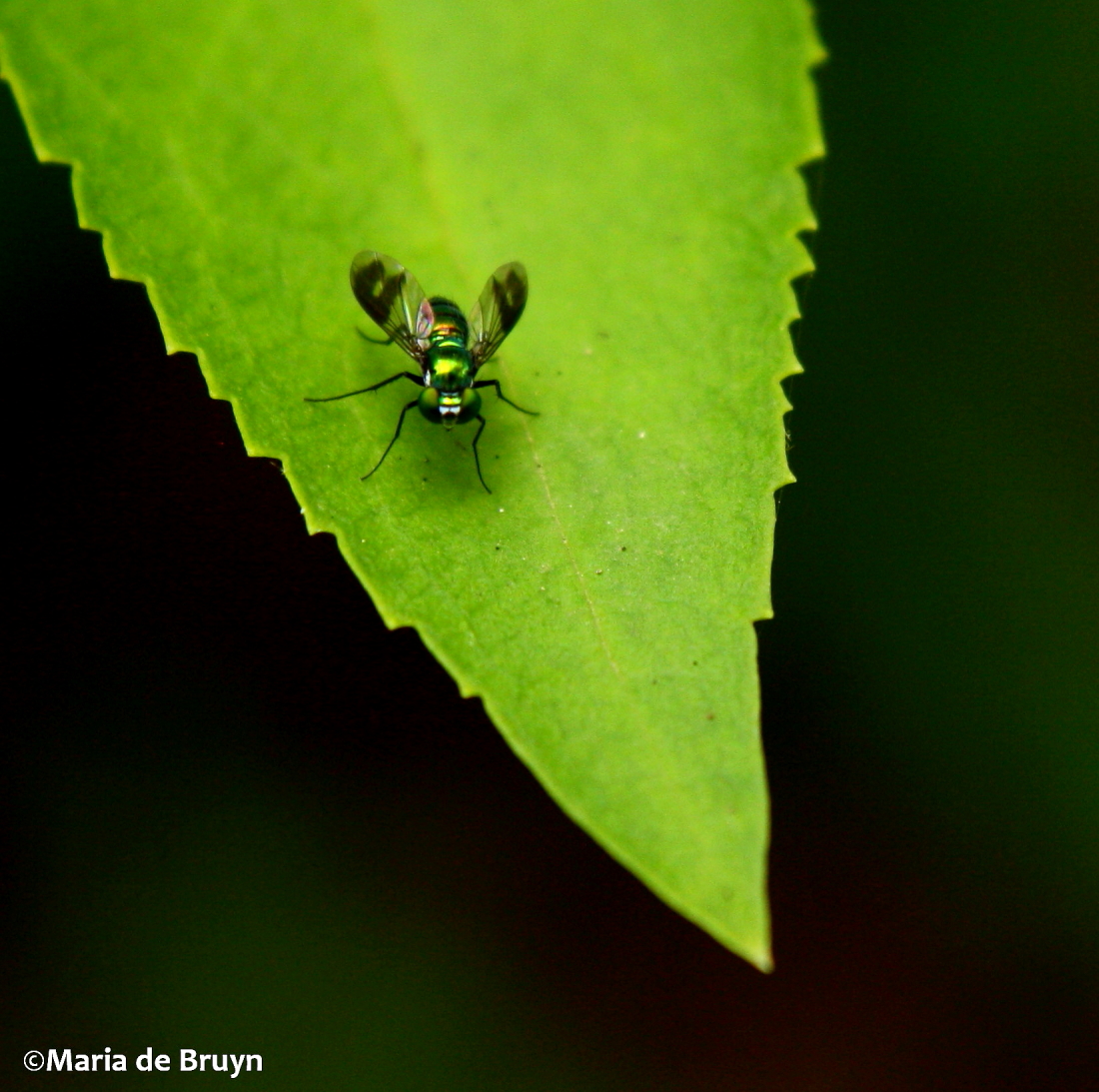
Some of the small flies (1-9 mm or 0.04-0.4 in) are green beauties. The long-legged fly (Condylostylus) comes in various hues.long-legged fly IMG_1425 M de Bruyn

Long-legged fly IMG_9536© Maria de Bruyn

These tiny fliers tend to have long legs and prominent eyes. Some have clear wings, while others have a pattern, such as this one with black on its wings.

long-legged fly IMG_1425 M de BruynLong-legged fly IMG_9535© Maria de Bruynres

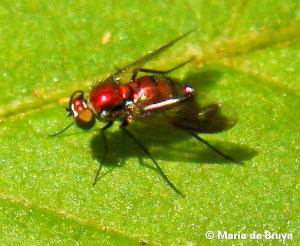
Longlegged  fly Condylostylus patibulatus IMG_4304 Maria de BruynThere are some red long-legged flies, too. This type of fly eats other insects, including aphids.
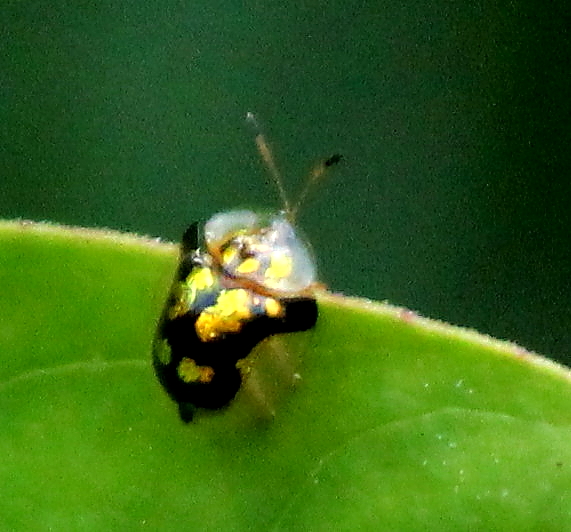
Without a macro lens for my camera, it is a challenge to get good shots of the metallic-looking insects. But one day, I hope to get a more decent shot of this mottled tortoise beetle (Deloyala guttata) that looks like someone put gold leaf on its back!


tortoise beetle IMG_2456©Maria de Bruyn

Next blog – an example of my difficulties with “serious birding”!

Blue jewels of the insect world

dogbane beetle IMG_4382©Maria de Bruyn resMy original interest in wildlife often centered around mammals; as a child, I was especially fascinated by the larger ones I saw at the zoo like lions, giraffes and bears. Eventually, in my later adult life, I became a birder and then Project Noah led me to begin paying much closer attention to the insect world. Nowadays, I find almost any type of wildlife of interest and look forward to learning more about diverse species.

Investigating insects has taught me that not only are some moths incredibly beautiful – so are some beetles and dragonflies, like the two brilliant blue species described here. I first encountered the dogbane beetle (Chrysochus auratus) on the plant for which it’s named, the white-flowering dogbane (Apocynum cannabinum). This plant is also known as rheumatism root since herbalists have used it to treat that disease, as well as conditions such as syphilis, fever, asthma and dysentery. It is also known as the hemp plant and has been used to make rope.

dogbane IMG_9002©Maria de Bruyn res     dogbane beetle IMG_4298©Maria de Bruyn res

dogbane beetle IMG_4351©Maria de Bruyn resThe iridescent beetle, which measures less than a half inch and lives 6-8 weeks in summer, feeds on the dogbane as well as milkweed plants. The insects’ wings are blue-green in color and have a gorgeous shimmery shine that looks like metallic copper; depending on the light, the highlights can also look golden or crimson in color.

They have widely spaced antennae with 11-12 segments and their legs look a bit as if they end in heart-shaped pads. Their left mandible is longer than the right one and it fits into a groove in the right (why, I don’t know!).

dogbane IMG_1372

dogbane beetle IMG_4046©Maria de Bruyn res

dogbane beetle IMG_2461©Maria de Bruyn res

They mate once a day during the summer and the male will stay on top of the female afterwards for some time to ensure that his sperm can fertilize eggs. After mating, the female lays her eggs on the underside of host plant leaves or on the ground. The larvae feed on roots and pupate underground. After 6-8 weeks, the adults die and we have to wait until next summer to see these little beauties.

dogbane beetle IMG_4006©Maria de Bruyn res  dogbane beetle IMG_4035©Maria de Bruyn res

A larger metallic blue insect is the ebony jewelwing damselfly (Calopteryx maculata), which can grow to about 2 inches. It is the black-winged males who exhibit the deep blue color on their bodies. The females are a smoky brown-gray in color and display white spots near the tips of their wings.

Ebony jewelwing IMG_7773©Maria de Bruyn res   Ebony jewelwing IMG_7870©Maria de Bruyn res

These damselflies have been studied extensively, so that we know they shelter among a wide variety of plants, including water plants (pickerel weed, duckweed, lilies, cattails) and land plants such as orange jewelweed, button bush, Joe pye weed and poison ivy. The adults frequently rest on low shrubs in sunlit patches.

Ebony jewelwing IMG_7808©Maria de Bruyn resEbony jewelwing IMG_7890©Maria de Bruyn res

These damselflies have a large variety of prey that include tiger mosquitoes, gnats, flies, beetles and even dragonflies. If they see you observing them, they will watch you in return, turning their heads to follow your movements

Ebony jewelwing IMG_7909©Maria de Bruyn resEbony jewelwing IMG_7919©Maria de Bruyn res.

Ebony jewelwing IMG_7831©Maria de Bruyn resEbony jewelwing IMG_7821©Maria de Bruyn res

Ebony jewelwing damselfly female IMG_1085© Maria de BruynThese damselflies are not strong fliers, often fluttering – even when resting on a leaf. Females will also rapidly open and close their wings if they are receptive to a courting male. If they reject the male, they will keep their wings open.

(If you click on the photo, you can see it enlarged.)


Ebony jewelwing IMG_7812©Maria de Bruyn res1The male will raise his abdomen as part of his courting display.Ebony jewelwing IMG_7738©Maria de Bruyn res

Females lay their eggs in the soft stems of water plants. And then, after about two weeks of flight, the adults pass away and we await new generations to admire. I’m looking forward to finding out if I discover any more blue jewels in the future!