
Note: this long posting is likely nicer to see on a laptop than a phone!
 During my first spring visit to Yellowstone National Park in 2016, we encountered black bears (Ursus americanus) throughout the national reserve. When a mother bear with her little cubs was spotted, park visitors stopped often to watch the playful young, especially when they were practicing tree climbing.
 During my 2022 visit, we did not see black bears but had the good fortune to see quite a few grizzly bears (Ursus arctos horribilis). Some were quite light in color, while others had dark fur. A mama grizzly and her cub were the first mammals we saw (due to my friend Joan’s sharp eyes!) and we must have seen at least one or two every day. (If not a live bear, there were plenty of them featured in artwork in Gardiner.)
 Rangers were often present at our sightings or arrived shortly after we did. They mostly warned humans to keep considerable distance from the bears, but we also saw them shooing the bears away from roads when many people were passing by.
(The bears below were shooed back up the hill; the white spots on the photo are snowflakes.)
 The “hump” on the grizzlies’ shoulders helped us identify them since black bears lack this feature. Also, when walking on all fours, the grizzly’s rump is lower than its shoulders. The impressive grizzly claws are also much longer than those of black bears.
 Sometimes we spotted the grizzlies grazing far away in fields. A few times, we had the good fortune to spot a mother bear with her young cubs.
 One mother in particular gave us wonderful views as she wandered about with her triplets. That was lucky for us as grizzlies have one of the lowest reproductive rates of North American terrestrial mammals.


They are not sexually mature before the age of 5 years. After mating in the summer, implantation of the embryo is delayed until the female hibernates. She could miscarry if she does not ingest sufficient calories and nutrients during the summer. She also will not mate again until her cubs have reached three years of age.


 One of the most interesting foods that the grizzly bears eat is the adult form of the army cutworm, called the miller moth (Euxoa auxiliaris). This moth has the highest known percentage of body fat of any animal, comprising up to 72% of its body weight! The moths fly from low-lying farmlands to crevices in mountain slide rocks, where the bears go in late summer to dig them out. It’s estimated that a grizzly can eat up to 40,000 moths in a day, thereby ingesting up to 20,000 calories.
One of the grizzlies’ competitors for food, particularly carcasses, are the coyotes (Canis latrans). These beautiful canids are unfortunately detested by many people, as related by Dan Flores in his informative book Coyote America: A Natural and Supernatural History.
 At one point, we saw numerous cars parked along a road and stopped to see what everyone was observing. There was a coyote feeding on a large carcass that had already been partly consumed.
 The coyote was engrossed in getting some meat off the bone, which was apparently not an easy task. These canids usually eat deer and smaller prey such as little mammals (rabbits, hares, rodents), birds, reptiles and amphibians, and invertebrates. It was not entirely clear to me what this prey had been.
 A fascinating coyote behavior is that they sometimes collaborate with badgers to dig up rodents. They even appear to like these fierce predators as people have seen coyotes licking a badger’s face or laying their heads on the badger’s body. A decorated jar found in Mexico dating back to the years 1250-13oo showed this relationship.
 Unfortunately, although the coyote figures prominently in Native American/Indian folklore, the US government has initiated and supported efforts to eradicate the species altogether. From 1947 to 1956, about 6.5 million coyotes were killed in the American West. However, these intelligent animals have managed to survive and eventually spread to the eastern United States (where they are now again unfortunately detested by considerable numbers of people).
 In Yellowstone, the larger ungulates on which the predators such as bears, coyotes and wolves feed include elk and moose. As mentioned in a prior blog, elk (Cervus canadensis) can be seen up close in Gardiner, the town at Yellowstone’s northern entrance, where they wander through the streets and rest in people’s yards. A more melodious name for them is wapiti, used by the Shawnee and Cree peoples. It refers to the animal’s white rump.
 To me, the elk appeared quite large but they “only” measure about 4-5 feet in height. The males’ antlers can grow up another 4 feet, however, giving them a much taller appearance.
 The males also have another interesting characteristic — their bugling, which is used to attract mates and mark their territories. This sound is the loudest call of any members of the deer family. The males produce it by roaring and whistling simultaneously!

Because elk prefer colder weather, they are more visible to Yellowstone visitors in the late autumn, winter and early spring. We saw females and young elk in town and spotted the males out in the valleys. They are very social animals and one of the largest herds (about 11,000 members in 2022) is known as the “Jackson Elk Herd”, which migrates between southern Yellowstone and the National Elk Refuge in Wyoming.

The other large, hoofed animal which we glimpsed one day was a moose (Alces alces). This ungulate is the largest member of the deer family, reaching a height of 6 feet (1.8 m) and a weight of up to 1,000 lb (450 kg).
 We saw a male — identifiable by the antlers which were just beginning to grow — as he grazed in a marshy area beside the road.
 Besides eating tree and shrub bark, leaves and twigs, they enjoy eating aquatic plants in ponds and streams. This can have a downside for them. Sometimes, they unknowingly eat snails while foraging and the snails can carry parasitic brain worms.
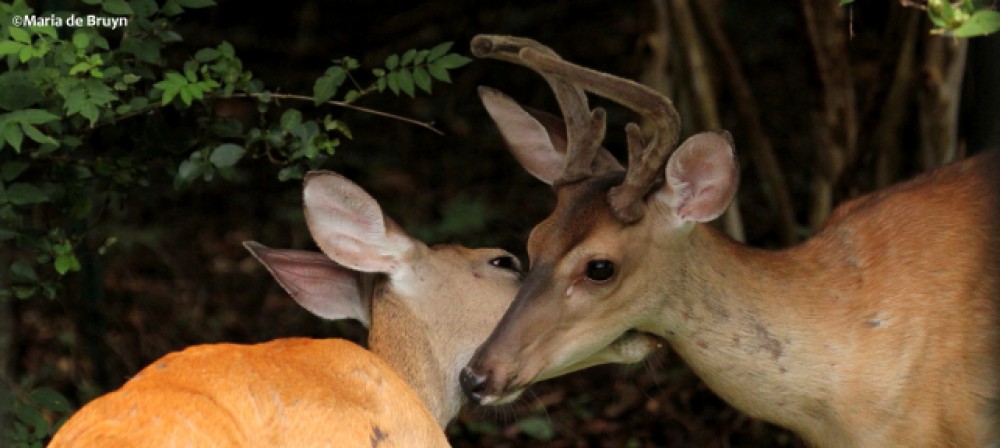
 In Gardiner, we also often saw mule deer (Odocoileus hemionus). They can be distinguished from white-tailed deer by their large ears, which measure about 75% of the length of their heads!
 They also have a white tail with a black tip, while white-tailed deer lack that feature.
 I found them to have a sweet face.


The final ungulate that we had the pleasure to see at Yellowstone were the fast-footed pronghorn antelopes (Antilocarpa americana).
 These small-hoofed creatures are not as fast as cheetahs but can sustain their speedy gait for a longer period of time, reaching speeds of up to 60 mph.
 The pronghorns not only travel rapidly; they also may travel for long distances. During the winter of 2011, monitoring of a pronghorn herd showed that they had achieved the longest terrestrial migration in the continental USA (not counting Alaska).
 While both sexes have horns, those of the female pronghorns are mere bumps, while the males display unique backward-pointing horns that grow up to 12 inches long. (The one grazing below had impressions in the fur on its back that looked like claw marks to me!)
 According to the Natural Resources Conservation Service of Montana, “Pronghorns existed in North America at the same time as predators like the dire wolf, saber-toothed cat, and American cheetah, all of which are long extinct. Scientists believe the pronghorn’s excellent vision and extreme fleetness are adaptations to survive these super predators.”
It’s fascinating that so many of the animals living in Yellowstone National Park have been in this area for thousands of years. An upcoming blog will feature smaller mammals after taking another visit to thermal attractions in the park. Before that, I’ll post a couple blogs about some of the wildlife I’m seeing here at home. 😊
 On numerous occasions over the past months, I’ve had ideas for new blogs and set aside photos for posting. But then other things crop up that need to be handled (health, car/house issues and a monthly newspaper column) and I put off blogging. So when fellow blogger Denzil asked his followers to post some photos of corvids, it was a great opportunity to share with you some of my latest photos of favorite visitors to my yard.


 And then the corvids can also relax, enjoying drinks and bathing in the yard birdbaths. When they appear to have enjoyed a treat, I sometimes find “gifts” left behind in the brightest birdbath. One day, when I apparently had not given them something special for some time, they took off with a small ceramic turtle that they often would leave in the birdbath after a visit. I now wonder if they gifted another neighbor with that trinket.













 My beautiful world
