A morning at the Butterfly House – with birds, butterflies and more!

I have all these ideas for blogs in mind, and photos to accompany them as well, but I keep taking new photos and then get behind in posting. One day, the thought came that I could just not go out to photograph and settle down to writing some blogs, but going out for nature walks as often as possible has become a real need in my life. Scientists are saying that “forest bathing” is good for your health and being outdoors and observing and learning about the flora and fauna certainly contributes to my having a happier state of mind, while contributing to my overall stamina (but not weight loss, more’s the pity). I also enjoy “shoreline, field and meadow, creek, river, and backyard bathing.”

It came to me today, after spending 3.5 hours tearing out invasive plants from my yard, that one blog that doesn’t need to be postponed because I keep getting new shots to include is this one – my visit to the Durham Museum of Life and Science Butterfly House with the Carolinas’ Nature Photographers Association.

The Museum had opened the Butterfly House for the morning for our group alone so that we could take photos for several hours without people walking in front of our shots. The Butterfly House is a 35-foot tall, glassed-in dome with many tropical plants such as the Angel’s Trumpet (Brugmansia). One of the four species of birds living in the conservatory, the Oriental white-eye (Zosterops palpebrosus), was enjoying a meal of tropical flowers. The bird would pluck a petal from the stem and then insert its beak into the base; the white-eyes have a special brush-like appendage at the end of the tongue which helps them forage for nectar and pulp.


The white-eyes were brought into the conservatory to help control leaf pests and ants.


The butterflies were gorgeous and the subject of many photos in our group. The postman butterflies have variations within a species.


Common postman (Heliconius melpomene)


Red postman (Heliconius erato)

Another group were the longwing butterflies.


Cydno longwing (Heliconius cydno)


Sara longwing (Heliconius sara)


Tiger longwing (Heliconius hecale)              Doris longwing (Heliconius doris)


Numata longwing (Heliconius numata)

As we looked at the butterflies that landed low on flowers, we were able to see the Crested wood partridges (Rollulus roulroul) that are endemic to Asia. They breed in the conservatory, laying their eggs behind dense shrubs, and they help control soil pests in the Butterfly House.


Male                                                                        Female

At one point, a museum staff-member brought us a group of insects to see up close. One of them, I certainly would not have touched, although it was fascinating to watch: the Asian forest scorpion (Heterometrus).


The Chilean rose tarantula (Grammaostola rosea) was a really beautiful tarantula that blended in well with the tree against which it was placed.

The dragon-headed katydid (Eumegalodon blanchardi) was an interesting creature. I do think its head looks more like a horseshoe crab, though!


The rhinoceros beetle was nice and shiny – I once saw a young boy in Thailand who had one as a pet; he was taking it for a walk in the forest and it looked to be about as big as his hand.


It’s interesting how the patterns on the dorsal and ventral sides of a butterfly can be so very different – you may need to look up both sides to get a good ID of the species. This is especially true of the Blue morpho (Morpho peleides).


The same is true for the male scarlet peacock (Troides amphrysus)


The female shows similarities in her dorsal and ventral wings.


The owl butterfly (Caligo memnon) was an impressively large individual.


The Malayan birdwing (Troides amphrysus) spent much of its time huddled up against the windows but I was able to catch it on a flower.


Two kinds of black-and-white butterflies were fluttering about, the Asian paper kite (Idea leuconoe) and the zebra mosaic (Colobura dirce) from Central and South America.


There is a glass case in the conservatory that has lines of chrysalids hanging on wires. At any time, you may see one or several butterflies that have just emerged and are unfolding and drying their wings. This individual was perched against the glass for the unfurling, giving an excellent view of beautiful feathery antennae.


There were two more birds in the Butterfly House that were beautiful to see. Both from Australia, the zebra finch (Taeniopygia guttata) was difficult to photograph as it spent a lot of time very high up in the dome.


The most beautiful – to me – was the Gouldian finch (Erythrura gouldiae). The colors are a bit like the American painted bunting but they look as if they were put on in blocks of color like a kind of avian Mondriaan painting. I followed this bird around several times in the hopes of getting some nice photos and finally succeeded in my opinion. I’d love to have this bird coming to my feeders!

The beautiful “baker” bird

Recently, I’ve had the good fortune to observe a small bird at close quarters that I had only seen in a couple glimpses in the past, the ovenbird (Seiurus aurocapilla). Like the ruby-crowned and golden-crowned kinglets, this little avian also has a stripe atop its head. Like the golden-crowned kinglet, the stripe is always visible and orange in color, blending in nicely with its other muted brownish and cream colors.


The ovenbird gets its name from the shape of its nest, which is built on the ground in a shape reminiscent of an outdoor or Hopi oven. It is domed and has a side entrance and can be difficult to see.

The ovenbirds spend the winters in the Caribbean region and Central America and then come North for the summer breeding season. My sightings of the singing male have been at our local nature reserve, Mason Farm Biological Reserve, where I volunteer as an invasive plant eradicator and sometime planter of native flowers.


The male sings a three- to-five note call in the spring as part of his courting behavior and the call varies among individuals. When males are in neighboring territories, they will sing together in duets and it can be difficult to know how many birds are singing.


The sound is so loud that you expect to see a much larger bird and his song inspired poet Robert Frost to dedicate a poem to him.


If he is sitting on a branch, you can eventually find him but it can be a challenge since they prefer to reside in forests with heavy canopy cover so that it is fairly dark.


Once you see him, you may be able to watch for a while as they don’t seem to be very wary of people. This individual let me observe as he groomed on a low tree branch, pausing now and again to let out a few notes.


These birds prefer areas with heavy leaf litter for their homes – the leaves provide cover for their ground nests and they blend in really, really well as they scurry about foraging in the leaves for insects, worms and snails to eat. Both the females and males participate in feeding the fledglings until they can fly at about 30 days.

When they emerge into a patch with a bit of sunlight filtering down through the leaves overhead, you have a bit better chance to see them. Otherwise, you may end up staring at ground cover until you catch a bit of movement and can zero in on the motion to see them.


Photographing the bird is a challenge since they spend their time in areas with so little direct light. My first photos were a bit dark, but then I increased the ISO on my camera considerably (a tip from fellow photographer, Mary – thanks!) and the photos were a bit better. Still, the somewhat darker photos reflect the environment in which you discover these little troubadour warblers. Now that I know where to look for them, I hope to see them more often in years to come.

Late arrivals and late departures

Since a ruby-crowned kinglet (Regulus calendula) began visiting my suet feeders several years ago, I’ve looked forward to his arrival each autumn so that I can watch him at leisure during the winter months. This past season, however, I began to fear that he had decided to go elsewhere or, more sadly, might have passed away and wouldn’t be coming around again. I did see members of the species at the Haw River in late November and one was feeding on seeds to my surprise.

Then, finally, on the 26th of December, Rudy turned up at my feeders – weeks later than usual but to my great delight! And where did he go for a bite to eat? In the past, he loved my suet but now he, too, was feeding at one of the seed feeders!

Shortly thereafter, I discovered I now had two ruby crowns in residence as they began vying with one another to claim the suet area as their territory. After thinking that I would have no jeweled visitor this winter, it turned out I had two, leading to a happy dance as I gazed out of my living room window.


The golden-crowned kinglets (Regulus satrapa) have a single feather covering each nostril; this doesn’t appear to be the case for the ruby crowns. Their tongues are often in sight when they open their mouths in anticipation of getting a bite. I wondered if the tongue is sticky to help them snatch food while hovering; an online search did not net me any references about kinglet tongues, however.

Normally, these hyper-active tiny birds seek insects and arthropods as meals, including spiders, pseudoscorpions, aphids, bees, wasps, beetles and ants. But my home-made suet has proved to be a big draw (also for other birds with whom they must compete for space).


The ruby-crowned kinglets will often hover in front of a feeder, sticking out their tongue to snag a bit of suet before they fly to a perch.

As winter progressed, it looked like the yellow-rumped warblers (Setophaga coronata) decided to copy their style, also hovering and snatching on occasion.


I decided to leave the dry stalks of the scarlet mallow and butterfly bush in place this past winter so they had perches close to the feeders. They made a nice “studio” for some portraits!

After a while, since there was a lot of traffic at the feeders, I began smearing suet on the mallow stalks, which proved to be a big hit. The ruby crowns alighted and fed calmly, a big change from their usual frenetic pace. (A few other birds also enjoyed this option, including the Eastern bluebirds and yellow-rumped warblers.)


Sometimes, they went through a bit of head contortion to snag some of the treat.


These kinglets surprised me again in January when they began visiting the peanut feeder, too. I watched as they pecked off tiny bits of peanut; I suspect they also might have been looking for ants or other insects around the nuts.


When it rains, these little avians can look quite bedraggled! But they didn’t appear bothered by the snow flurries.

Normally, these birds are in what seems to be constant motion, scarcely stopping for a second in their quest for food. A large privet bush near my feeders, however, has become a resting and hiding spot for them. (Yes, I know, privets are invasive plants and should be removed but this particular shrub provides a get-away for the feeder birds when the sharp-shinned and Cooper’s hawks fly in for a raid and the catbirds love to build their nests in this particular site.)


I continued seeing ruby crowns during my nature walks, although not as reliably as in my own yard. They were in residence at the Jordan Lake woods and a small wooded area near Chapel Hill’s Senior Center.


One day at the Haw River, I witnessed a territorial dispute between two males who were claiming certain trees as their own.


I stopped seeing the ruby crowns at my feeders around the end of March and assumed that they had embarked on their migration up North for breeding season. On 9 April, I was surprised to see one in the woods bordering Jordan Lake.

On 18 April, one appeared in a cedar tree in my yard.

And then on the 22nd of April, I spotted one high in the leafy branches of a willow oak in my front yard. I’m guessing that perhaps this bird was stopping for a rest as it traveled from further South on its way up North; I didn’t see it visit the suet feeder.


I miss my little kinglet companions in the spring and summer; hopefully, they won’t wait so long to appear again later this year.


Back to blogging with the golden crowns!

Litter boxes scrubbed, bird feeders filled, other chores waiting but I’ve decided to end my blogging hiatus on this rainy and somewhat gloomy Sunday morning. This and my next blog will feature two of my favorite birds and then I hope to treat you with a nesting saga as spring is well underway.

With a lovely ruby-crowned kinglet visiting my yard every year for the past four years, I’ve developed a particular fondness for this tiny avian species. This past autumn and winter, my partiality expanded to include their jeweled cousins, the golden-crowned kinglets (Regulus satrapa), who seemed to have favored our geographical area with an irruption (an ecological term for a sudden increase in an animal population). Whereas in previous years, I felt lucky to catch a glimpse of a golden crown during their months-long stay in North Carolina, they appeared to be everywhere this past winter and in full view to boot.


The golden-crowned kinglets are about the same size as the ruby crowns and similar in overall body color except that they also have a black eyebrow stripe.

While the ruby-crowned males only flash their red crests when mating or upset, however, the golden crowns have a permanent yellow stripe atop their heads.


The male golden crowns can sometimes be distinguished by the fact that there will be a hint of red in their golden crest.


Like the ruby crowns, these little insect foragers are in constant movement as they scour branches, shrubs and plants for a meal. Their varied diet includes beetles, flies, crickets, butterflies, spiders, and bees and wasps. In the winter, they will also eat some seeds.


Searching for the insects often means they hang upside down from branches as they look at the underside and in crevices for their next bite to eat.


They also hover mid-air to snatch an insect or fly.

The golden crowns sometimes sit still a bit longer than ruby crowns so that you have a chance to get off a few photographic shots before they resume their dietary searching. And this year, one of those photos placed me among the winners in a small local competition.

These birds are not much bigger than hummingbirds, but like the hummers, they also undertake a long migration twice yearly. Their winters are spent throughout North America but for breeding they travel to the far North and mountainous Northwestern areas of this hemisphere.

This year, many places had mild winters but if they arrive in the North before spring-like temperatures arrive, they are able to survive nights as cold as –40 degrees; sometimes, they huddle together to keep a bit of warmth. Their lifespan is several years, with the oldest recorded golden crown being a banded male who was at least 6 years and 4 months when he was recaptured in Minnesota in 1976.


This species prefers life in coniferous forests but it seems if a few spruce and pines are around, they will settle in. I saw them in a small and somewhat sparsely vegetated area near a senior center, an arboretum, along the Haw River, and in the woods and bogs of various nature reserves.


In the United States, the number of golden-crowned kinglets declined 75% between 1966 and 2014. Habitat loss has contributed to this. However, spruce reforestation in the Eastern USA may have contributed to a more recently seen increase in numbers of kinglets. I’m very glad that they are not (yet) an endangered species and I hope we get to see them a lot next winter, too!

The sad spring saga of Sassy squirrel

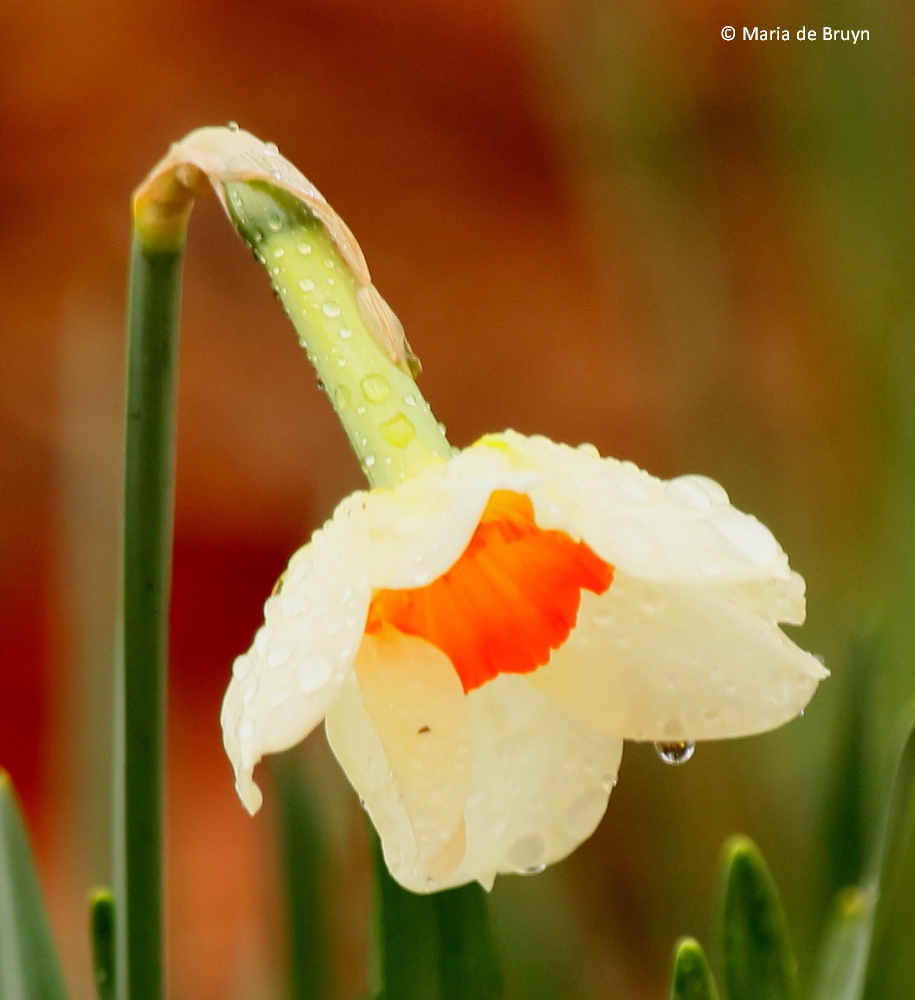
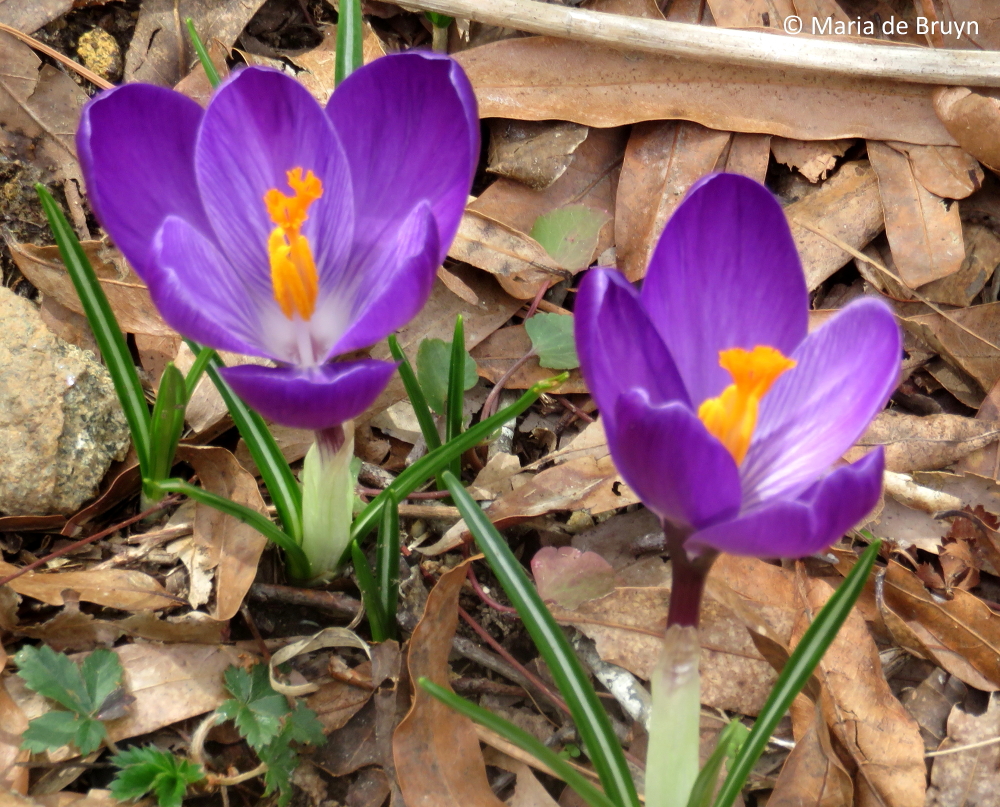
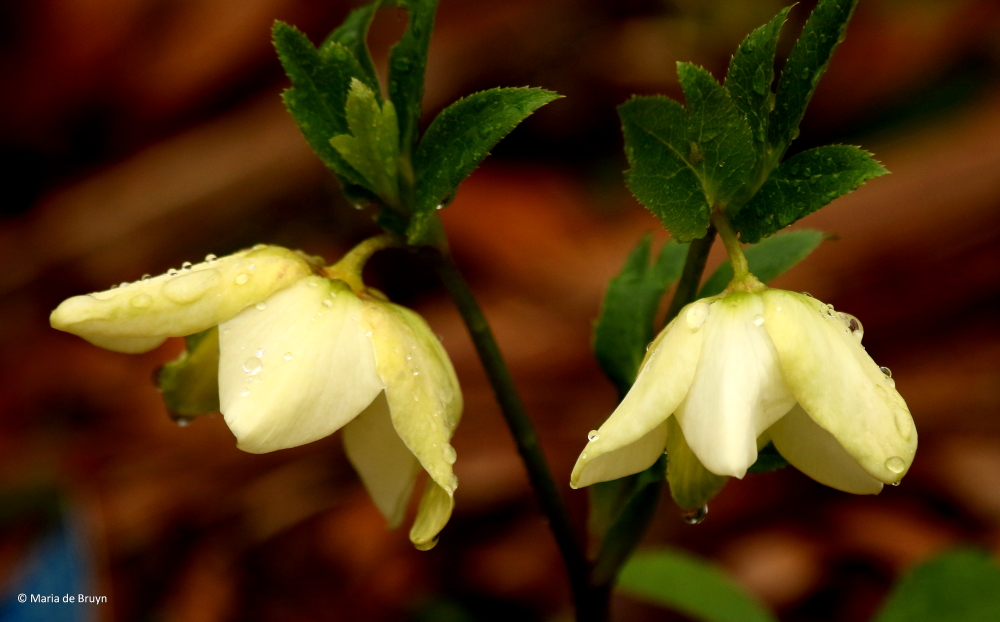
cape-may-warbler-i77a5989-maria-de-bruyn-2resSpring has come early to North Carolina, leading to some early bird migration (like this Cape May warbler, Setophaga tigrina, on its way North), avian courtship and nest building, as well as spring blossoms already emerging in profusion. My garden has seen some lovely flowers, both cultivated and wild: daffodils (Narcissus), crocuses (Crocus), winter jasmine (Jasminum nudiflorum), henbit (Lamium amplexicaule) and lenten rose (Helleborus orientalis).

daffodil-i77a2964-maria-de-bruyn-res    daffodil-i77a2325-maria-de-bruyn-res

crocus-img_1813-maria-de-bruyn-res   crocus-img_1790-maria-de-bruyn-res

winter-jasmine-i77a0793-maria-de-bruyn-res    henbit-i77a1155-maria-de-bruyn-res

lenten-rose-i77a2951-maria-de-bruyn-res lenten-rose-i77a1903-maria-de-bruyn-res

lenten-rose-i77a2970-maria-de-bruyn-res

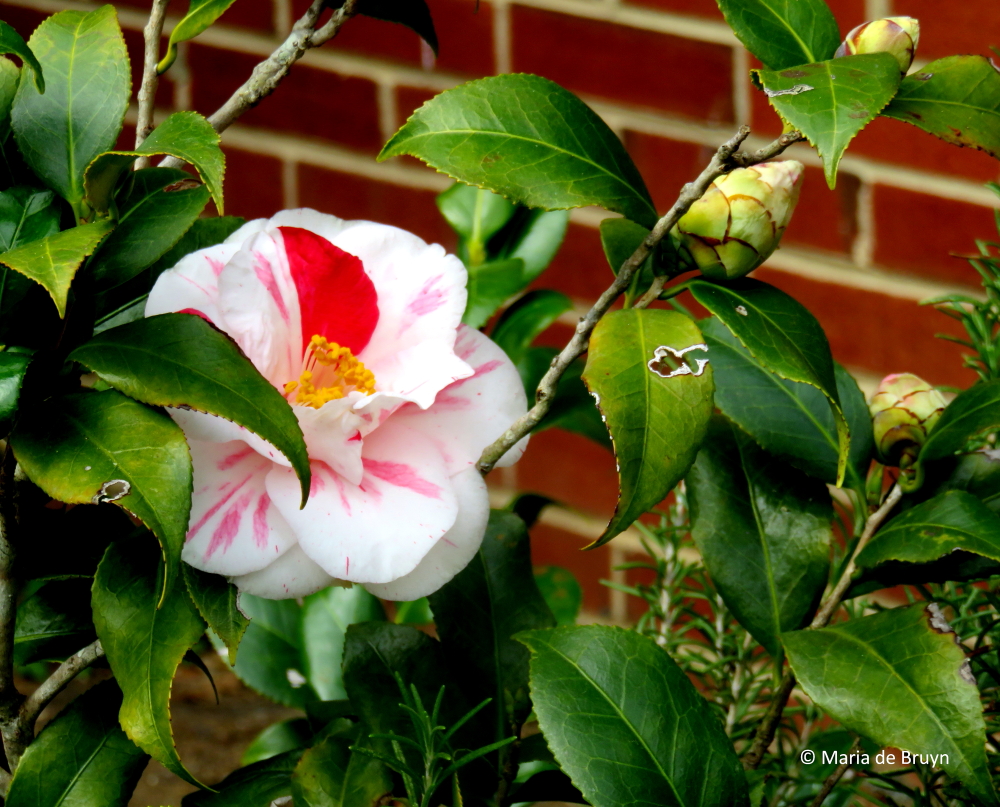
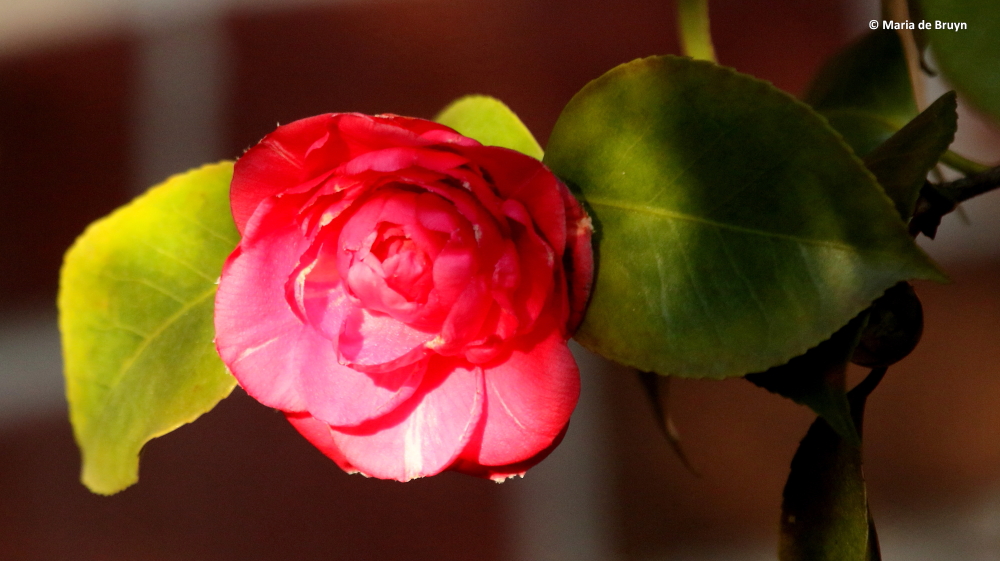
My camellias ( Camellia) bloomed in much greater profusion than ever before.

camellia-img_1816-maria-de-bruyn-res    camellia-i77a1922-maria-de-bruyn-res

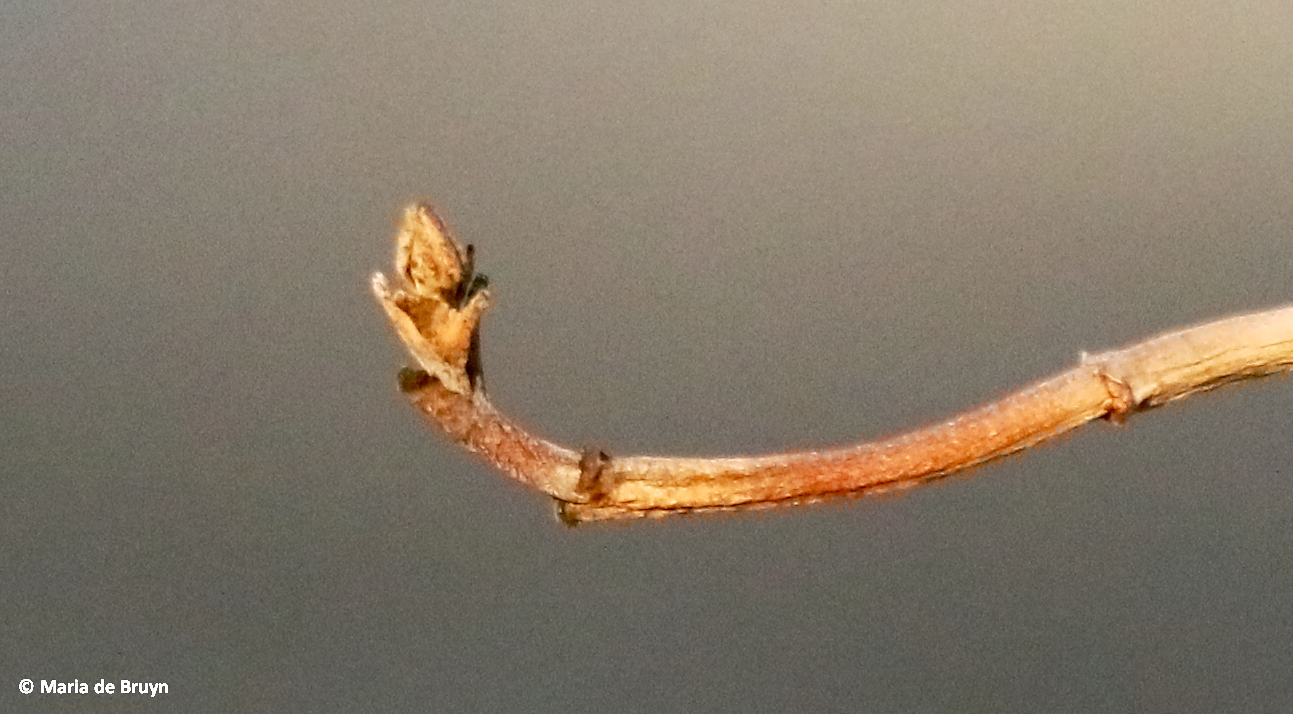
The shrubs and trees also sent out their buds weeks “ahead of schedule” – since the past month was the warmest recorded February in this area, my plants advanced their springtime blossoming, including the serviceberry (Amelanchier arborea), viburnums, dogwoods (Cornus kousa and Cornus florida) and common elderberry (Sambucus nigra).

serviceberry-i77a1965-maria-de-bruyn-res  tree-i77a1949-maria-de-bruyn-res

tree-i77a1963-maria-de-bruyn-res tree-i77a1950-maria-de-bruyn-res

My new blueberry bushes burgeoned with delicate little flowers, but the past two nights I had to cover them up so that they wouldn’t shrivel up as the temperatures dropped below freezing.

eastern-gray-squirrel-i77a0079-maria-de-bruyn-res


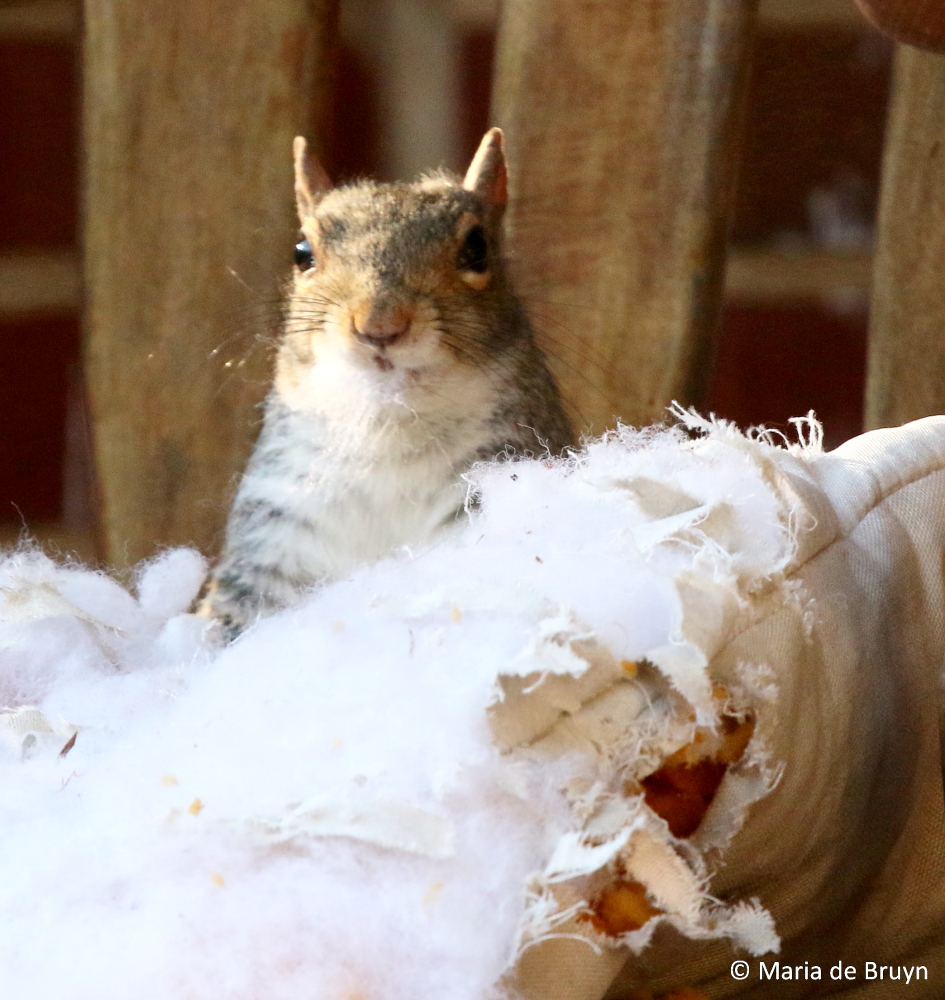
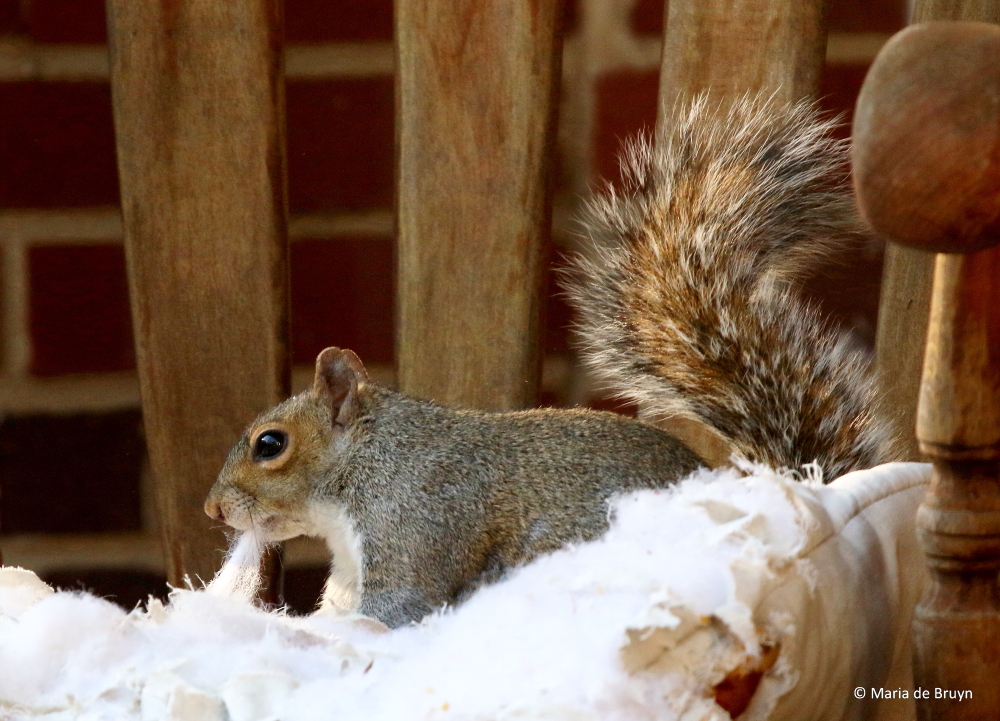
It wasn’t only the plant and bird life responding to the unusually changing season, though, as I discovered when I finally noticed the altered pillow on my front porch rocking chair. I first saw that the cloth covering the pillow had been torn; upon closer examination, I saw that the pillow had been opened up with its filling tufting up in places.


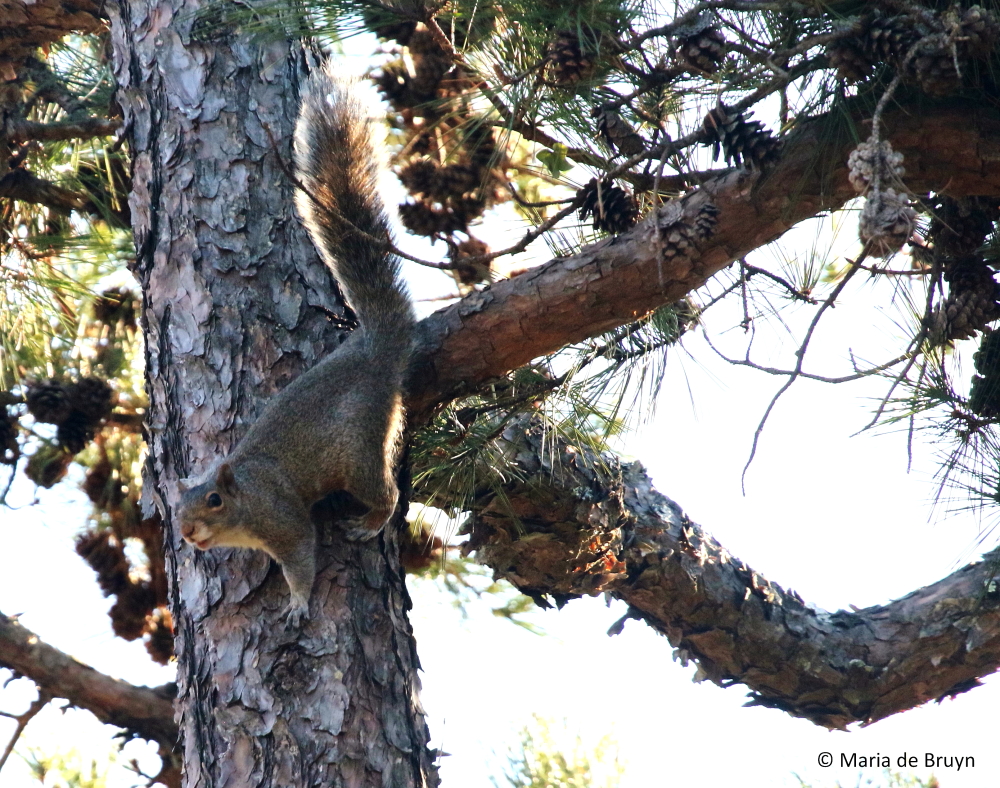
eastern-gray-squirrel-i77a0093-maria-de-bruyn-resWhen I began watching the rocker in addition to the bird feeders, I discovered the culprit – an industrious Eastern gray squirrel (Sciurus carolinensis), whom I named Sassy as she shows no fear, just a little caution.

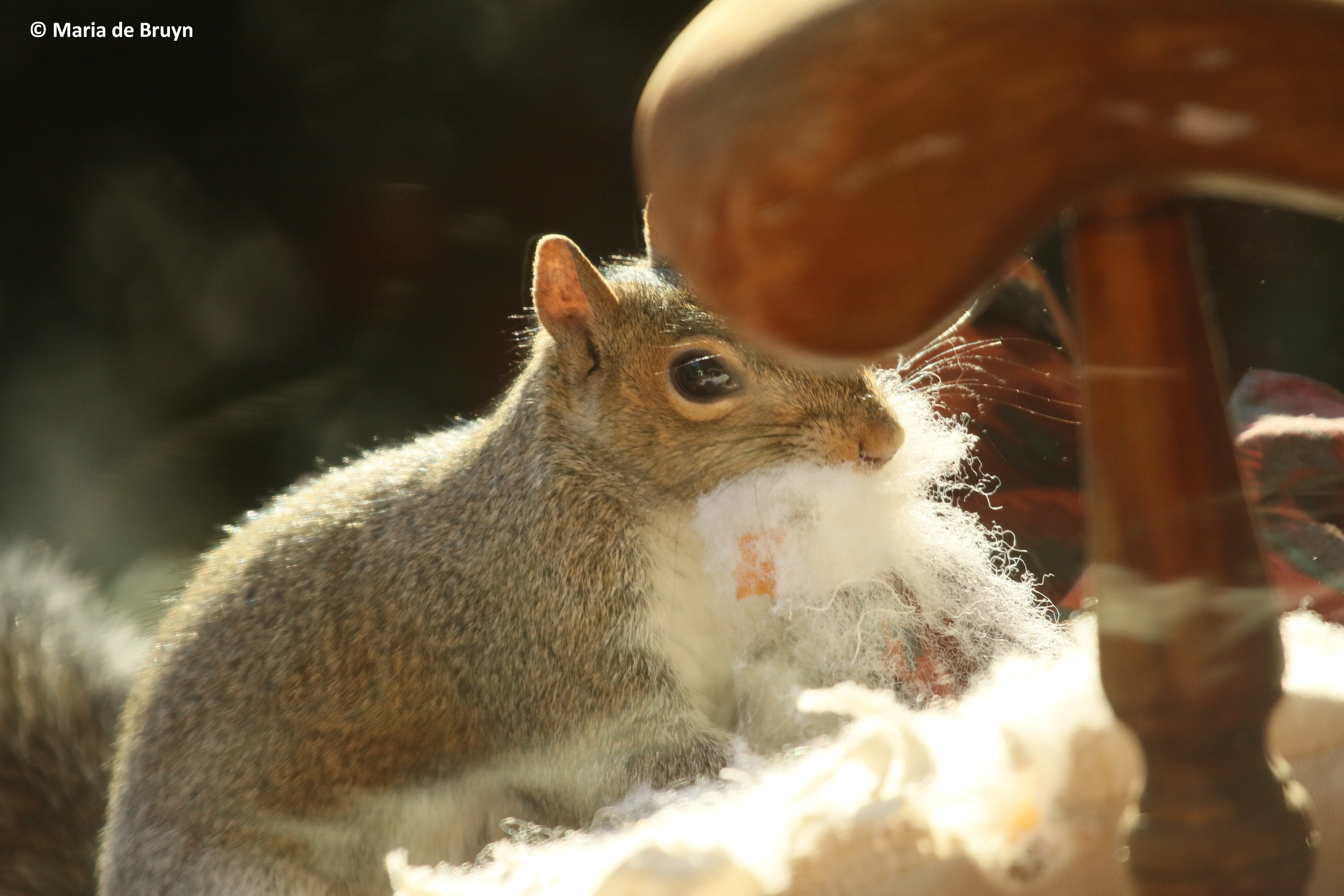
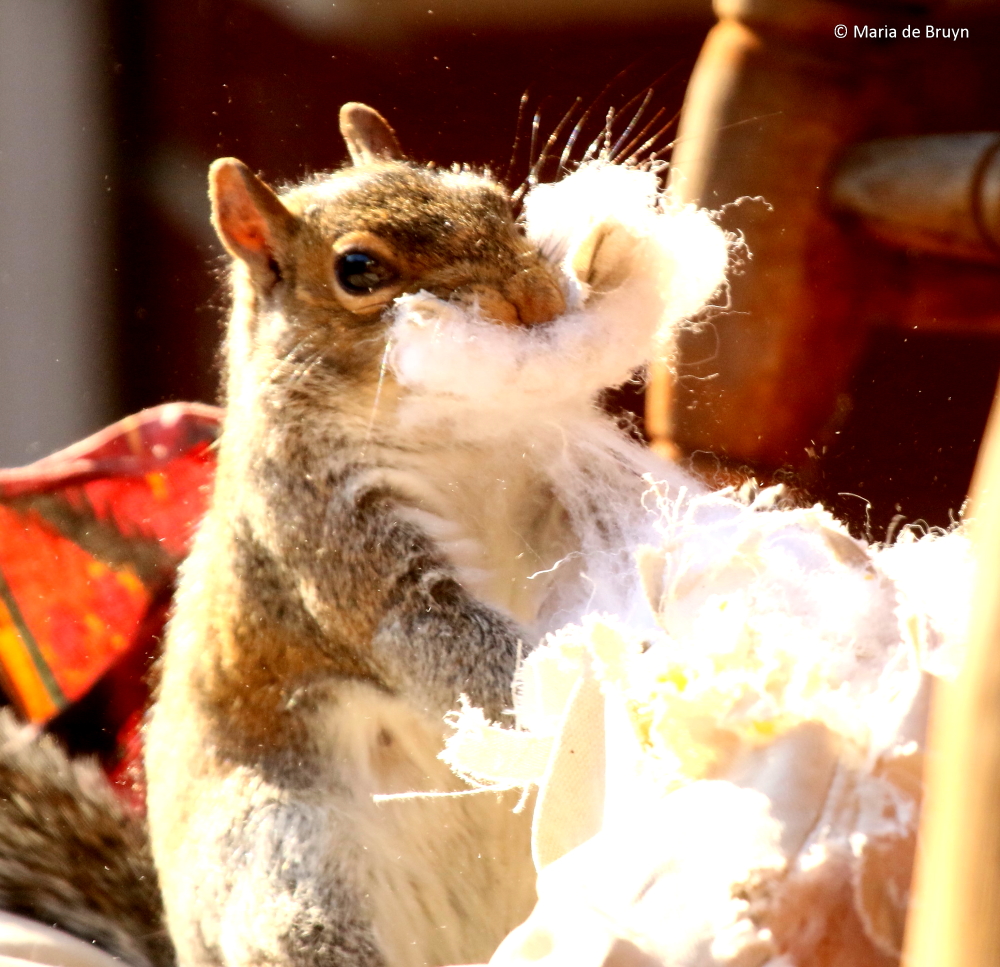
Sassy is quite bold, coming up onto the porch even when I’m seated there. She keeps an eye on me but goes about her business in a calm and confident mood. This was also the case for her nest building activities. She perched on the pillow and used her teeth to tear out the insides.

eastern-gray-squirrel-i77a9708-maria-de-bruyn  eastern-gray-squirrel-i77a0073-maria-de-bruyn-res

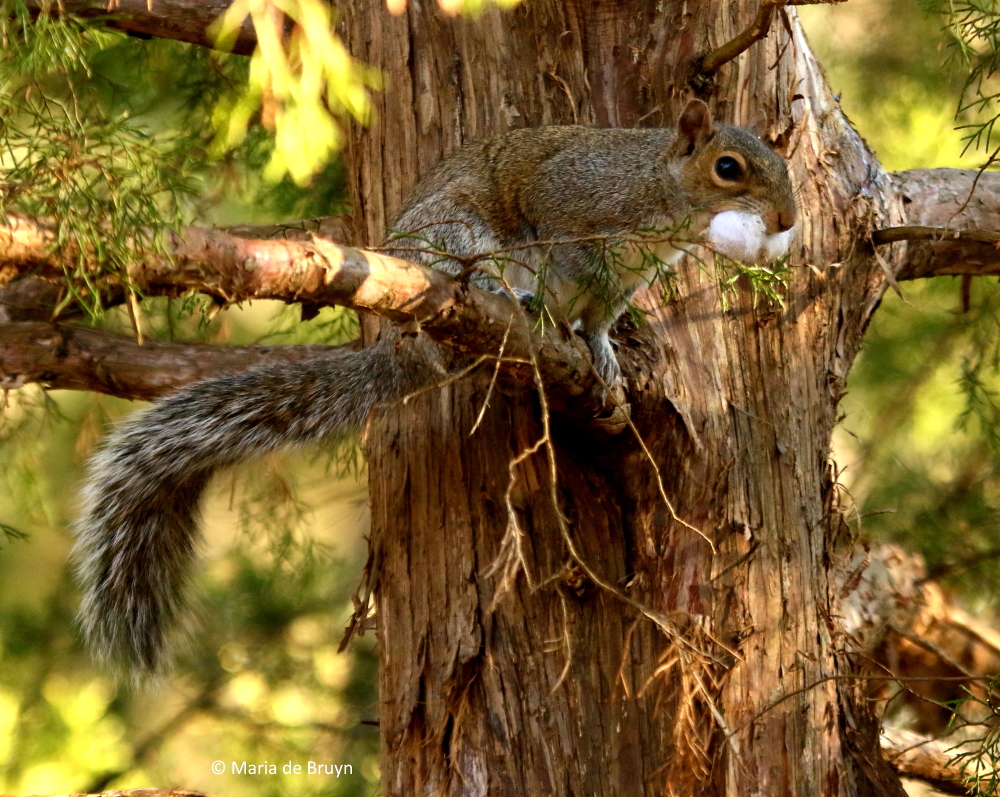
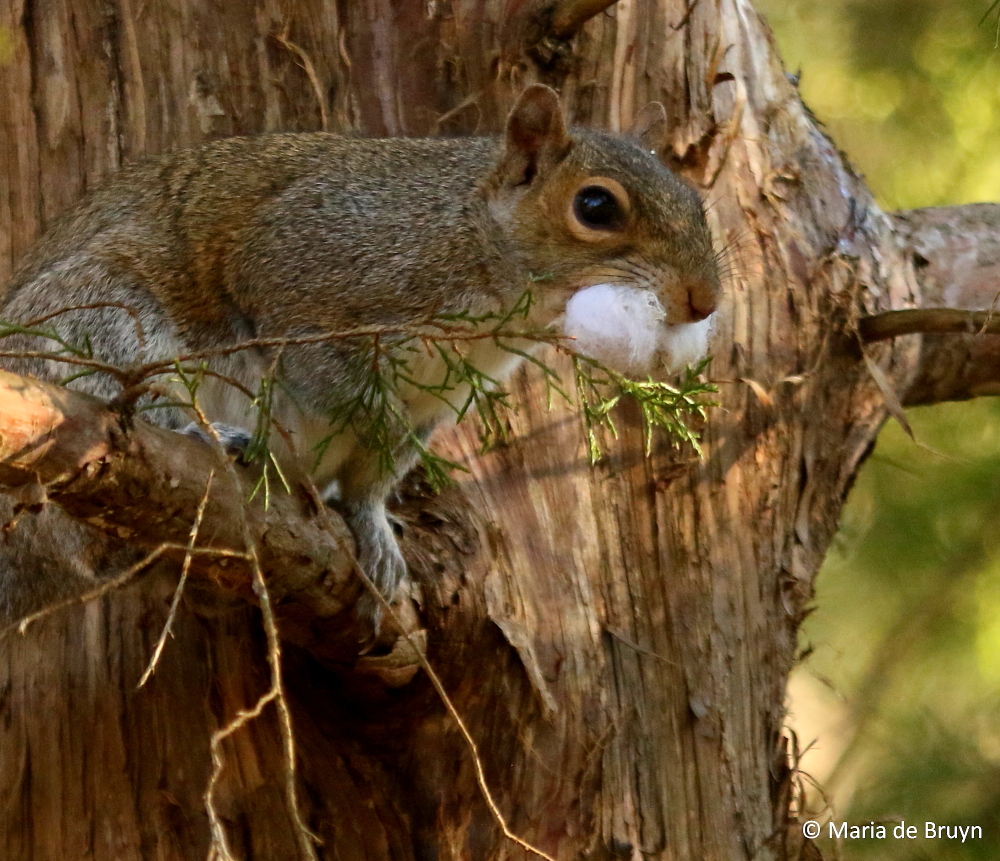
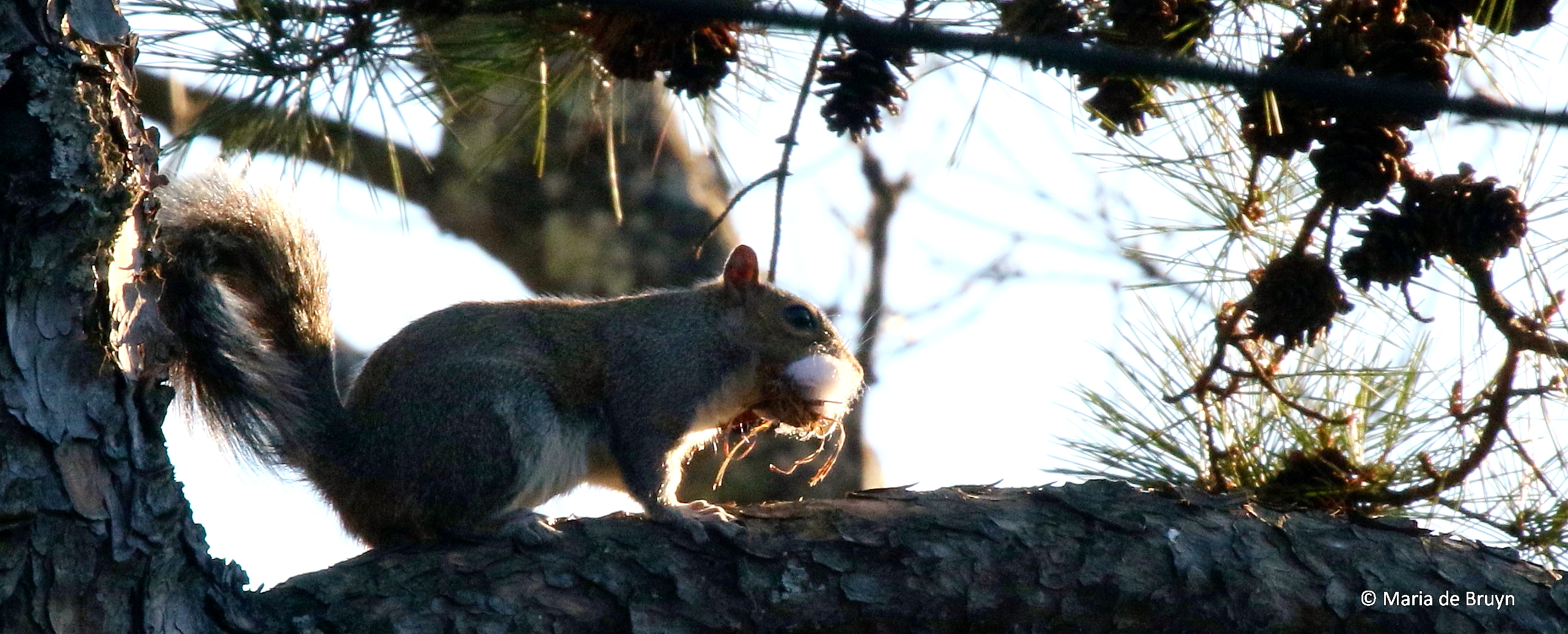
She then manipulated the tufts with her paws and teeth to form them into neat little oblong packages that she could easily transport in her mouth.

eastern-gray-squirrel-i77a9795-maria-de-bruyn-res eastern-gray-squirrel-i77a9796-maria-de-bruyn-res

eastern-gray-squirrel-i77a9801-maria-de-bruyn-res eastern-gray-squirrel-i77a9802-maria-de-bruyn-res

Sometimes, she added some dried leaves to the mixture.

eastern-gray-squirrel-i77a1995-maria-de-bruyn-res

When her mouth was filled with enough material, she left to transport it to the nest that she was constructing – as it turned out, high in a loblolly pine (Pinus taeda) in a neighbor’s front yard. As I followed behind her, she stayed aware of my movements.

eastern-gray-squirrel-i77a0107-maria-de-bruyn-reseastern-gray-squirrel-i77a0108-maria-de-bruyn-res

Then she crossed the street and scurried up the tree, where she deposited her “mattress stuffing” among the leaves and other materials lining the nest.

eastern-gray-squirrel-i77a0125-maria-de-bruyn-res  eastern-gray-squirrel-i77a0139-maria-de-bruyn

Since Sassy was so very industrious and the pillow was no longer salvageable, I left it out for her. She returned for several days, systematically dismantling her found source of nest material and carrying off her little woolly trophies.

eastern-gray-squirrel-i77a0099-maria-de-bruyn-res eastern-gray-squirrel-i77a0093-maria-de-bruyn-res

When the stuffing began to disperse with the wind, I finally gathered it up and threw out what was left, figuring she had had plenty of manmade contributions to her home.

eastern-gray-squirrel-i77a0142-maria-de-bruyn-res eastern-gray-squirrel-i77a9817-maria-de-bruyn-res

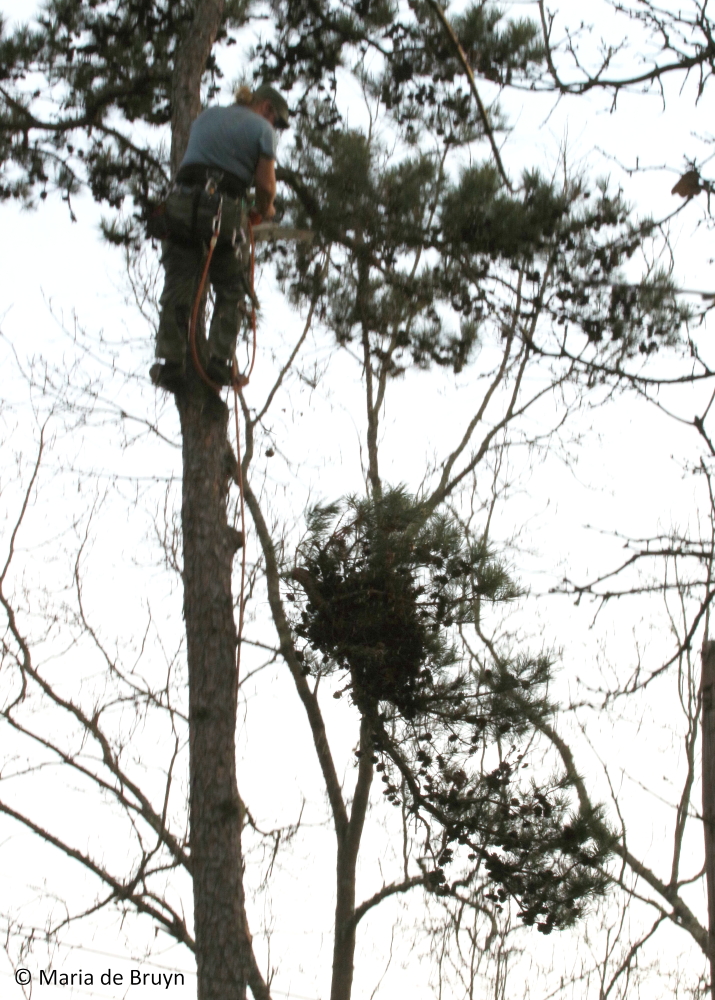
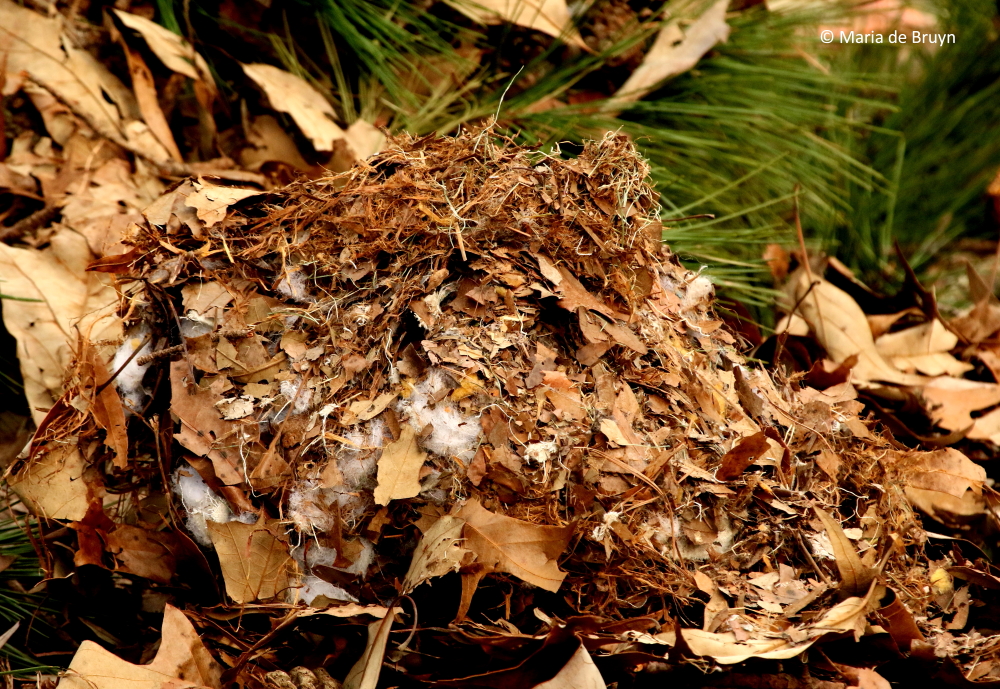
Then a couple days later, I was dismayed on her behalf to see that the new neighbors had decided to remove the tree where her nest was located. The landscapers said Sassy’s nest was not a factor in their decision; they just thought the tree was in the way. I watched with sadness as Sassy’s tree was dismantled and her nest plunged to the ground.

squirrel-nest-i77a9820-maria-de-bruyn-res  squirrel-nest-i77a2239-maria-de-bruyn-res

squirrel-nest-i77a2248-maria-de-bruyn-res

I didn’t see where Sassy was during this event but am sure she was watching from some other vantage point. I felt badly for her – all her innovative and dedicated work was destroyed. Of course, people lose their homes, too, to flooding, fires, tornadoes, etc.  and that is horrible. But I still regretted that this hard-working mammal had lost her home as well.

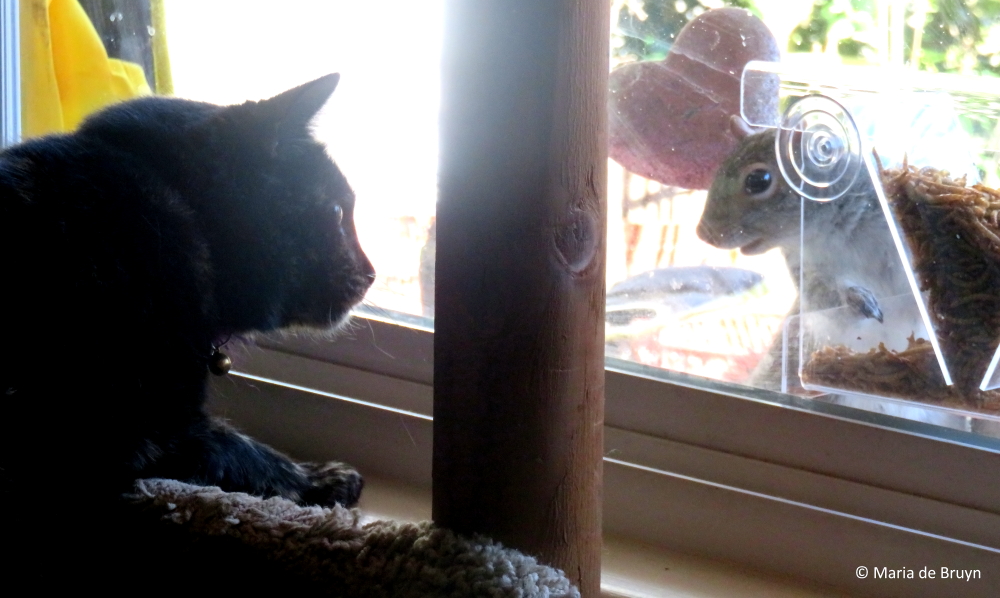
I presume Sassy has been building a new nest elsewhere. And given her boldness, I’m fairly certain that she was the squirrel I saw yesterday afternoon who had decided that she likes dried mealworms.

eastern-gray-squirrel-img_1911-maria-de-bruyn-res

As my feline companion Moasi watched from her cat tree perch in the living room, Sassy was busy on the other side of the window chowing down on the worms in a new window feeder that I had actually bought for the Carolina wrens and chickadees, who often perch on the chair in front of the window.

eastern-gray-squirrel-img_1920-maria-de-bruyn-res

flower-i77a3037maria-de-bruyn-res


Sassy didn’t seem to mind Moasi watching her and she wasn’t fazed when I approached either. It was only when I knocked on the window that she finally descended to the porch and then left for the yard. I like to think that Sassy has made a new home and is now busy getting extra nutrition for the babies to come. And spring continues to unfold with temperatures varying from 24 to 70 degrees and above!