My hummer summer, part 1 – guarding the home front!

ruby-throated-hummingbird-i77a2165-maria-de-bruyn-res


Just like human beings, some birds like to hang out in groups, while others are more solitary in nature, coming together mainly to reproduce. A prime example of the latter group are the ruby-throated hummingbirds (Archilochus colubris).


ruby-throated-hummingbird-i77a7336-maria-de-bruyn-res2This past summer, some health and other problems led to my spending a good deal of time at home. The upside was that being a bit home-bound gave me plenty of opportunities to observe the comings and goings of these gorgeous little flyers and to learn more about their behavior towards one another.

I had at least four ruby-throats – and probably more as I couldn’t distinguish them all – visiting my feeders and yard regularly. A couple had a distinctive trait that helped me identify them, like some white feathers on top of their heads or at the bottom part of their gorgets.

ruby-throated-hummingbird-i77a1237-maria-de-bruyn-res   ruby-throated-hummingbird-i77a9185-maria-de-bruyn-res

ruby-throated-hummingbird-i77a0810-maria-de-bruyn-res


I usually had three or four nectar feeders up in my back yard and two in my front yard. In addition, as the summer progressed, the gardens were filled with increasing numbers of nectar-filled flowers so my home site was a fairly well-stocked larder for them.

The ruby-throats are among the more competitive hummingbirds and don’t really like to share their feeding space with others, although a friend and I visited a birder in a nearby town who had more than a dozen feeders up and many dozens of hummers visiting his back yard every day, feeding right next to one another. At my house, I suppose guarding their food source is an instinctual imperative, since they do consume half their own weight in nectar each day.

ruby-throated-hummingbird-i77a0514-maria-de-bruyn-res

ruby-throated-hummingbird-i77a8255-maria-de-bruyn-resThe tiny birds were quite intent on protecting their territory from intruders. Only thing was, several of them considered my feeders THEIR territory, so there was a continual rotation of birds perched in nearby trees and shrubs to watch for “invaders”. Once spotted, the newly arrived hummers would have the current “resident” bird swoop down on them (at up to 60 miles per hour!), frequently chittering like mad as a warning to “get out of here.”

Sometimes, they would have a little “challenge flight ballet” as they confronted one another, until one gave up and flew off – sometimes across the street, sometimes to the yard on the other side of the house, and sometimes to a nearby tree or shrub at the side of the house.

ruby-throated-hummingbird-i77a8257-maria-de-bruyn-res   ruby-throated-hummingbird-i77a8256-maria-de-bruyn-res

ruby-throated-hummingbird-i77a9443-maria-de-bruyn-resThere was one particular male hummer who seemed particularly aggressive – or perhaps possessive is a better term as I never saw him body slam a rival; he just made sure that the other bird would leave. I recognized him as he often chose exactly the same spots on a nearby Rose of Sharon, a willow oak and a cedar as his watching posts,

Some of those who were run off didn’t travel far, however. They would fly to a nearby tree or shrub and wait to see if Hummer No. 1 would leave.

ruby-throated-hummingbird-i77a0290-maria-de-bruyn-res       ruby-throated-hummingbird-i77a1099-maria-de-bruyn-res

ruby-throated-hummingbird-i77a5725-maria-de-bruyn-resScientists have determined that the brain section responsible for memory and learning – the hippocampus – is five times larger in hummingbirds than in woodpeckers, seabirds and songbirds. They memorize where feeders and nectar flowers are and can remember when they last fed there. They can even estimate how long it will take each flower to fill up with nectar again.

ruby-throated-hummingbird-i77a6553-maria-de-bruyn-res


The hummers’ memory is long-term, too – they recall not only where feeders are placed in their breeding territories but also in places along their yearly migration routes! Wouldn’t it be nice if we had such great memories making GPS and maps less of a necessity?


ruby-throated-hummingbird-i77a7716-maria-de-bruyn-resAnother behavior I observed several times was a hummer hovering in front of me, especially when the nectar feeders were getting low. Scientists have determined that they can recognize the people who replenish their food sources, which makes for a delightful encounter as one chirps at you while suspended in front of your face with its wings flapping at 60 beats per second!

While guarding their home turf, they may stick out their tongues briefly after feeding.

ruby-throated-hummingbird-i77a5099-maria-de-bruyn-res   ruby-throated-hummingbird-i77a2353-maria-de-bruyn-res

ruby-throated-hummingbird-i77a9404-maria-de-bruyn-res


However, if you see one with its tongue stuck out permanently, this can be a sign of a fungal infection (often acquired from dirty feeders). Their tongues swell with the infection and they can no longer drink with these anatomical, elastic micro-pumps.


ruby-throated-hummingbird-i77a8243-maria-de-bruyn-res


Often death ensues, so it’s important to keep the nectar feeders clean!


Coming up in part 2: the beauty of the hummingbirds at rest and in flight


Can you go home again? Apparently so!

brown-headed-nuthatch-i77a3736-maria-de-bruyn-res


This year, I had the good fortune to see both brown-headed nuthatches (Sitta pusilla) and Eastern bluebirds (Sialia sialis) raise broods in some of my nest boxes. I saw the babies fledge, which was truly an enjoyable event.


eastern-bluebird-i77a7134-maria-de-bruyn-res

For some time, the parents continued feeding their babies after they left home, but eventually they got to the point that they could catch or find their own food. As summer progressed, the parents and children both visited my feeders and it was gratifying to see the families thrive. Then during September and October, I saw a behavior that I don’t remember from years past.

brown-headed-nuthatch-i77a7426-maria-de-bruyn-resbrown-headed-nuthatch-i77a7439-maria-de-bruyn-res

The nuthatches started to return to their nest box almost daily. They didn’t check out nearby boxes but went to their original home and today they are still visiting there, sitting on top, fluttering around it and looking inside.

tufted-titmouse-i77a7417-maria-de-bruyn-res

Their frequent visits seem to have intrigued a local tufted titmouse (Baeolophus bicolor) who decided to take a look in their box, too,but that was only a one-time visit as far as I could see.

It’s not only the parents doing this, but also one or more of their offspring. So how true is the saying “you can never go home again” (origin a novel by Thomas Wolfe)? It originally meant that you can’t recapture exactly how things were in your youth because changes take place in situations and places. But people do often journey back to the places where they grew up and apparently birds do, too! Maybe they are wondering if their nest box is still the same good place for a home.

brown-headed-nuthatch-i77a7459-maria-de-bruyn-resbrown-headed-nuthatch-i77a7441-maria-de-bruyn-res

i77a0203-maria-de-bruyn-res


The bluebirds began doing the same with their home nest box as well. They take turns flying from nearby branches to cling to the box and investigate the now empty dwelling. While the nuthatches just lean and peer inside, the bluebirds eventually go inside for a bit.


eastern-bluebird-i77a9732-maria-de-bruyn-res brown-headed-nuthatch-i77a9653-maria-de-bruyn-res


Oddly, there seems to be some contention involved. For example, when this pair was investigating, they had a little tiff for some reason.

eastern-bluebird-i77a9722-maria-de-bruyn-res eastern-bluebird-i77a9725-maria-de-bruyn-res

eastern-bluebird-i77a9723-maria-de-bruyn-res eastern-bluebird-i77a9726-maria-de-bruyn-res

I can only guess that the birds are checking out the nest boxes in anticipation of next year’s nesting season. The nuthatches and bluebirds will begin breeding again around March, although nuthatches might already begin building a new nest as early as December. It will also be interesting to see if they end up roosting in the boxes during the colder winter nights.

brown-headed-nuthatch-i77a4527-maria-de-bruyn-resWatching the nuthatches and bluebirds nest, fledge and feed is an enjoyable pastime and I’m looking forward to seeing them repeat the process next year. In the meantime, perhaps I’ll continue seeing them around the nest boxes this winter – as Pliny the Elder said, “Home is where the heart is” and something is sure attracting them back! (And yes, I know, that is a bit of anthropomorphizing.)

Braeburn Farm is for the birds!

I don’t often get the chance to visit a farm (other than organized farm tours, which are a bit pricey and then might be crowded). Last year, I was invited to one during an annual llama shearing, which was educational. This year, however, I’ve had the chance to visit Braeburn Farm four times so far because the owner and manager have decided to make it a nature reserve as well as a cattle farm. Nick, the land manager, is a birder who is more than willing to share his knowledge with the visitors.

pond I77A6227© Maria de Bruyn res

My first visit to this farmland/nature reserve was in the early spring to see Wilson’s snipes at one of the five ponds. By late June, these birds had moved on but the ponds were now harboring mallards (Anas platyrhynchos), red-winged blackbirds (Agelaius phoeniceus), belted kingfishers (Megaceryle alcyon) and killdeer (Charadrius vociferous).

mallard duck I77A7320© Maria de Bruyn res     red-winged blackbird I77A6920© Maria de Bruyn res

belted kingfisher I77A6936© Maria de Bruyn (2)   killdeer I77A6934© Maria de Bruyn res

My quest to see green herons at one pond was unsuccessful, but my 20-minute walk there was accompanied by the non-stop screaming of a red-tailed hawk (Buteo jamaicensis), who called both from tree tops and the air as she circled overhead.

red-tailed hawk I77A6030© Maria de Bruyn res   red-tailed hawk I77A6044© Maria de Bruyn res

A non-native bird who might greet you as you come down the road near the farm manager’s home is a helmeted guineafowl (Numida meleagris), the sole survivor of a neighbor’s flock. This bird now comes to visit the domestic chickens (Gallus gallus domesticus) at Braeburn, perhaps seeking some companionship in addition to the easily available chicken feed.

helmeted guineafowl I77A5648© Maria de Bruyn res    chicken I77A6958© Maria de Bruyn (2)

chicken I77A6949© Maria de Bruyn resThe farm chickens are in a large pen while other chickens run free, including one with a wild hairdo.

A trio of wild turkeys left the woods and entered a field during one of my visits but they were at a considerable distance; still, I could say I had seen them that day! The Eastern meadowlarks (Sturnella magna) have often been visible at a distance in the fields, but on my last visit I saw one a bit closer on a fence post, giving me the chance to enjoy its beautiful plumage.


Eastern meadowlark I77A8597© Maria de Bruyn    Eastern meadowlark I77A5898© Maria de Bruyn

Eastern kingbird I77A5683© Maria de Bruyn res


Eastern kingbirds (Tyrannus tyrannus) can be seen in many of the fields and on wires. They take advantage of the ponds to snag dragonfly meals and the dry grasses provide materials for nests.


Eastern kingbird I77A7653© Maria de Bruyn        Eastern kingbird I77A7099© Maria de Bruyn res

They also pose very prettily on the shrubbery!

Eastern kingbird I77A7007© Maria de Bruyn   Eastern kingbird I77A6380© Maria de Bruyn res

grasshopper sparrow I77A7118© Maria de Bruyn res


The grasshopper sparrows (Ammodramus savannarum) are numerous, which was lovely for me as this species was a lifer for me. If you approach on foot, they fly off, but Nick said they are so used to his motorized cart, they stay put as he chugs on by!


grasshopper sparrow I77A6976© Maria de Bruyn res      grasshopper sparrow I77A5738© Maria de Bruyn res

Savannah sparrow I77A8690© Maria de Bruyn res


In the spring, when we had gone to see the snipes, we were lucky to see savannah sparrows (Passerculus sandwichensis) running about in the grass (I had at first thought we were seeing field mice scurrying about).


orchard oriole I77A7271© Maria de Bruyn resIn June, a pair of orchard orioles (Icterus scpurius) had built a nest in a tree bordering one pond and I was excited to see two babies just days before they fledged. The father was feeding them and brought one baby a large cricket, which seemed to be too large for it swallow easily. Dad tried to help by pushing it down but when I left, the insect was still sticking out of baby’s mouth and its sibling was still hungry, too.

orchard oriole I77A7475© Maria de Bruyn res

orchard oriole I77A7510© Maria de Bruyn    orchard oriole I77A7500© Maria de Bruyn

barn swallow I77A7161© Maria de Bruyn resThe barn swallows (Hirundo rustica) adopted an abandoned barn as their hotel of choice. When I visited in June, the young had just been fledging; they and their parents were circling the barn and resting on fences nearby, showing off their beautiful colors.

In July, a few stragglers remained in nests. Some that had taken the great leap were hanging around outside, even clutching the barn wall.

barn swallow I77A7062© Maria de Bruyn res        barn swallow IMG_4527© Maria de Bruyn

barn swallow I77A7145© Maria de Bruyn res

barn swallow I77A7139© Maria de Bruyn res

Others were enjoying the view on a wire line, together with some purple martins.

barn swallow I77A6990© Maria de Bruyn res

The fence posts and other farm structures offer resting places for various birds, like the Eastern wood peewee (Contopus virens), chipping sparrow (Spizella passerina), house finches (Haemorhous mexicanus) and Eastern bluebirds (Sialia sialis).

Eastern wood-peewee I77A6694© Maria de Bruyn res    Eastern wood peewee I77A6675© Maria de Bruyn res

chipping sparrow I77A6665© Maria de Bruyn res   house finch I77A6529© Maria de Bruyn res

Eastern bluebird I77A5859© Maria de Bruyn res  Eastern bluebird I77A5847© Maria de Bruyn res

turkey vulture I77A7105© Maria de Bruyn res


The turkey vultures (Cathartes aura) take advantage of the cattle’s well-water stations to get a drink, but then may retire to a tree branch for a bit of sunning. Nick likes them better than the black vultures, who had killed a newborn calf when its mother wasn’t taking care of it.


turkey vulture I77A7107© Maria de Bruyn res    turkey vulture IMG_4469© Maria de Bruyn res

Northern mockingbird I77A7669© Maria de Bruyn res


Other birds, like the Northern mockingbirds (Mimus polyglottos) and great-crested flycatchers (Myiarchus crinitus) enjoy the view from the vantage of high branches in trees.


great-crested flycatcher I77A7199© Maria de Bruyn res     great-crested flycatcher I77A7193© Maria de Bruyn res

While the 500-acre farm is mostly advertised in relation to its beef and opportunities to hold events such as receptions there, the farm management is now increasingly promoting it as a place for wildlife observation as well. The biodiversity in birds, mammals, insects, reptiles and plants is wonderful and my next blog will focus on examples of the non-avian wildlife to be seen there. If you’d like to visit the farm, do contact them!

Birds and blooms at Sandy Creek Park – more of the “good ones”

moon I77A9993© Maria de Bruyn res

Birds are a favorite photographic subject of mine, even though catching them in late spring and summer is challenging when the lush foliage offers them many places to hide. Their songs and calls and warbles tell me that they are there, but often I need to wait quite a while until I finally catch a flutter of movement out of the corner of my eye to locate them.


white-eyed vireo I77A0007©Maria de Bruyn

One early morning, when the moon was still in the sky, I was fortunate enough to see a lot of fluttering in trees near the park’s parking lot – and I discovered an immature white-eyed vireo (Vireo griseus) with a parent who looked as if she or he was really practicing forbearance.

white-eyed vireo I77A0010©Maria de Bruyn      white-eyed vireo I77A0006©Maria de Bruyn

Carolina wren I77A0188©Maria de Bruyn res

Nearby, a Carolina wren (Thryothorus ludovicianus) was singing loudly; these little avians have an outsized voice so that you can hardly miss them even when they are hidden behind leaves.

A handsome male goldfinch (Spinus tristis) was in a field, while a female was visiting the coneflowers (Echinacea), of which there were various species in the cultivated butterfly garden.


American goldfinch I77A0382©Maria de Bruyn res American goldfinch I77A0177©Maria de Bruyn res

coneflower I77A7325© Maria de Bruyn res      coneflower I77A6365© Maria de Bruyn res   coneflower I77A6250© Maria de Bruyn res

Eastern bluebird I77A6188© Maria de Bruyn res


Other birds were busy finding insect meals, like the male, female and immature Eastern bluebirds (Sialia sialis).


Eastern bluebird I77A6022© Maria de Bruyn res    Eastern bluebird I77A5558© Maria de Bruyn res

Common grackle I77A6377© Maria de Bruyn res


The common grackle (Quiscalus quiscula) scored a meal, while the pine warbler (Setophaga pinus) and blue-gray gnatcatcher (Polioptila caerulea) were busy in the trees searching for caterpillars and insects.

Other birds (and mammals, I think) had been getting crayfish from the ponds but I guess there were so many that they only ate the tastiest parts.

Pine warbler I77A5605© Maria de Bruyn res   Pine warbler I77A5598© Maria de Bruyn


blue-gray gnatcatcher I77A0302©Maria de Bruyn res     crayfish IMG_4926©Maria de Bruyn res

The American robins (Turdus migratorius) were looking for earthworms on the ground, and the song sparrows (Melospiza melodia) alternated between the ground and shrubs in their search for food.

American robin IMG_0550© Maria de Bruyn res     song sparrow I77A6195© Maria de Bruyn

The male red-winged blackbirds (Agelaius phoeniceus) were calling and flying from shrub to shrub, showing off their handsome black plumage with a red highlight.

red-winged blackbird I77A6090© Maria de Bruyn res  red-winged blackbird I77A6126© Maria de Bruyn res

Over at a nearby pond, the Northern rough-winged swallows (Stelgidopteryx serripennis) were swooping over the water and then sharing space on a snag; meanwhile, a mother wood duck (Aix sponsa) led her brood along the shoreline.

rough-winged swallow I77A0234© Maria de Bruyn res    wood duck I77A7225© Maria de Bruyn

In a tree beside another pond, the immature great blue herons (Ardea herodias) were still at their nest at the start of June; later in the month, they were no longer hanging out there.

great blue heron IMG_0430© Maria de Bruyn res   great blue heron IMG_0402© Maria de Bruyn res

milkweed I77A0079©Maria de Bruyn res


Botanists can have a great time at Sandy Creek, too. The milkweed plants in the butterfly garden attract both butterflies and bees.

Carolina horsenettles (Solanum carolinense) are common but pretty little plants, while the orange jewelweed (Impatiens capensis) enjoys a good reputation as having stem juice that relieves the pain caused by poison ivy for many people.

Carolina horsenettle I77A5581© Maria de Bruyn res      orange jewelweed I77A0511© Maria de Bruyn res

The fairywand (Chamaelirium luteum) grows profusely on the edges of Sandy Creek ponds and the swamp rose (Rosa palustris) sprouts near them as well.

fairywand I77A7293© Maria de Bruyn res      swamp rose Rosa palustris I77A5621© Maria de Bruyn res

Japanese honeysuckle I77A5711© Maria de Bruyn res


Japanese honeysuckle (Lonicera japonica), an invasive plant, attracts pollinators but so does the more vibrant and native coral honeysuckle (Lonicera sempervirens L.).


coral honeysuckle I77A0159© Maria de Bruyn res      coral honeysuckle I77A0127© Maria de Bruyn 2 res

In the fields, you can see lovely brown-eyed Susans (Rudbeckia) and coreopsis.

Brown-eyed Susan IMG_0504© Maria de Bruyn res  brown-eyed Susan IMG_0497© Maria de Bruyn res


coreopsis flower IMG_0494© Maria de Bruyn res   coreopsis flower IMG_0486© Maria de Bruyn res

Stoke's aster I77A6353© Maria de Bruyn resThe cultivated garden in the park gets plenty of color from the Stoke’s asters (Stokesia laevis) and red bee balm (Monarda didyma), which is a real magnet for hummingbirds. I recently bought a couple for my home garden and was rewarded with seeing the hummers visit them within 2 days.


red bee balm I77A7307© Maria de Bruyn res    red bee balm I77A6390© Maria de Bruyn res

What makes my walks so interesting is discovering new species. A native grass (Bromus) was lovely; helpful facebook group members gave me suggestions for possible species but we couldn’t narrow it down. The group also helped me identify a plant that I hadn’t seen before, a Germander (Teucrium canadense).

grass Bromus IMG_4811© Maria de Bruyn res   Germander Teucrium canadense I77A0544© Maria de Bruyn res

I managed to find an ID myself for a common flower that seems to grow all over the place – the Asiatic dayflower (Commelina communis). It is considered an invasive plant and is on the watch list for North Carolina, but I have to say that I find it quite attractive. Each flower blooms for only one day and to me they look like little faces and make me smile. And so I continue learning as each new walk invariably ends up teaching me something new. Enjoy your day!

Asiatic dayflower Commelina communis I77A0667© Maria de Bruyn res    Asiatic dayflower I77A0677© Maria de Bruyn res

Leaping into the wide – and sometimes wet – world!

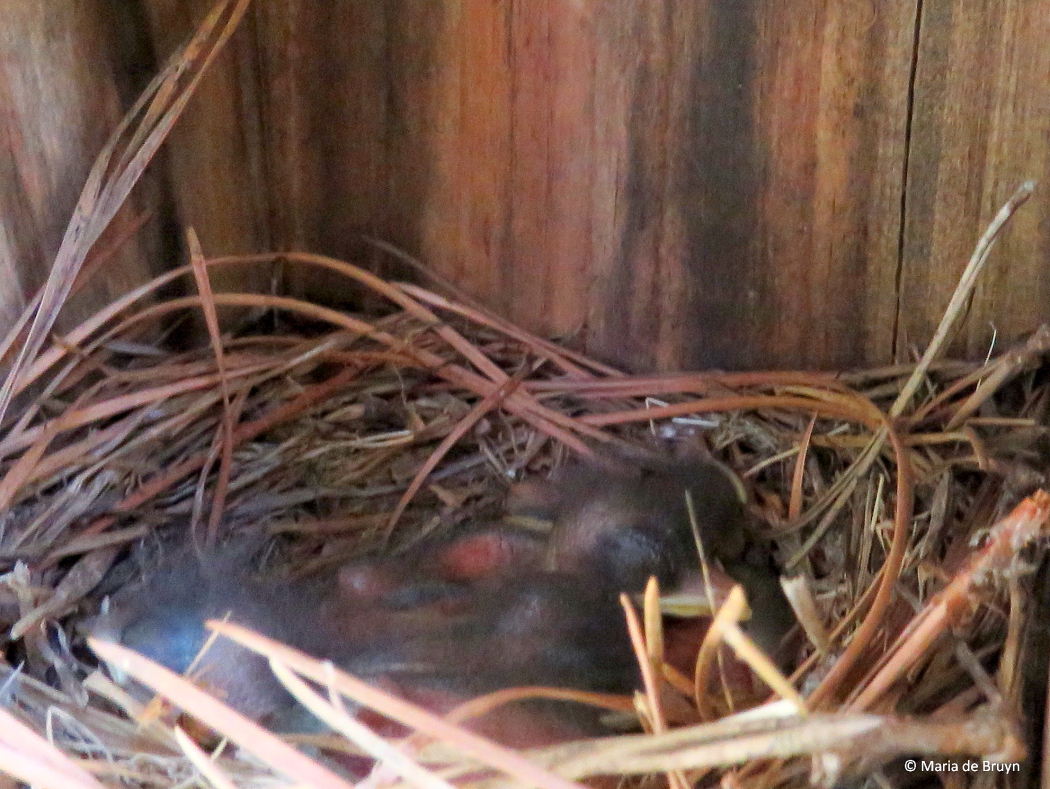
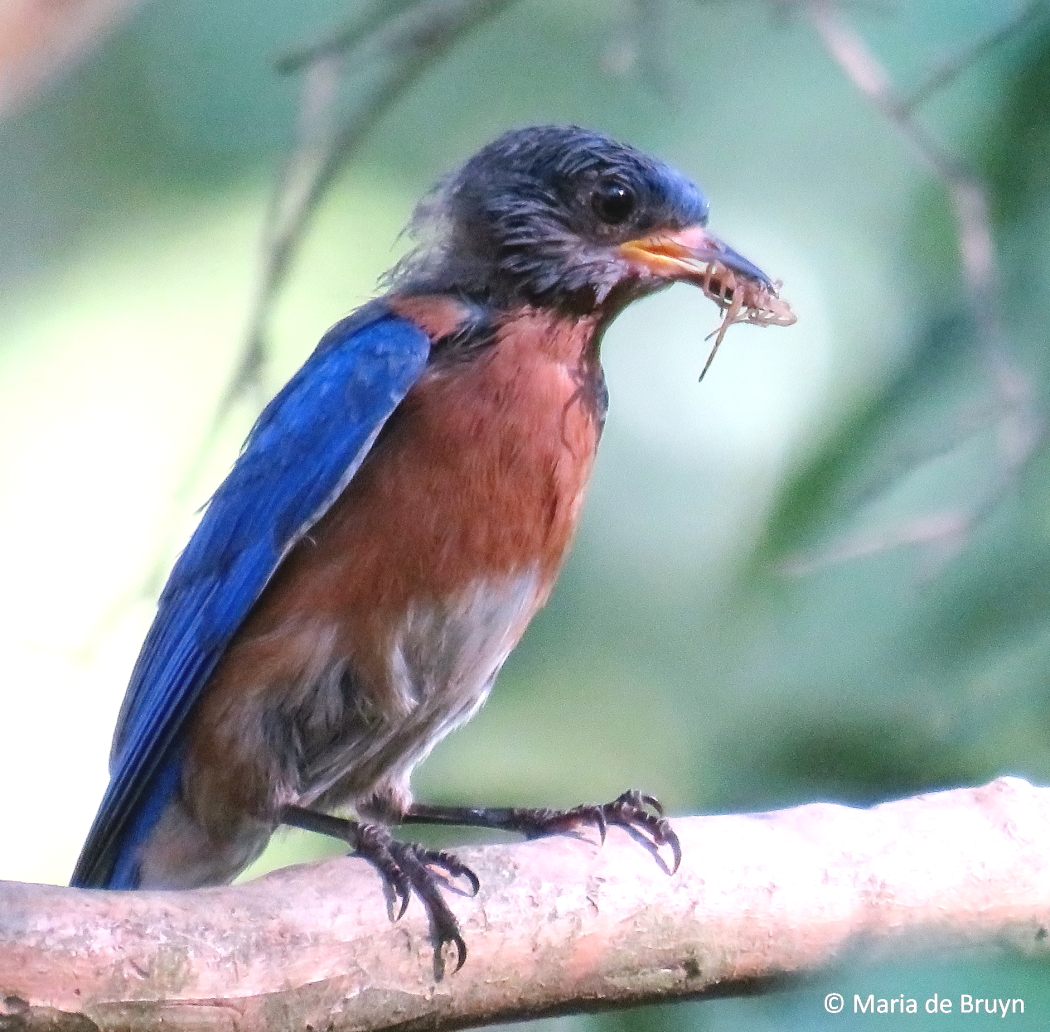
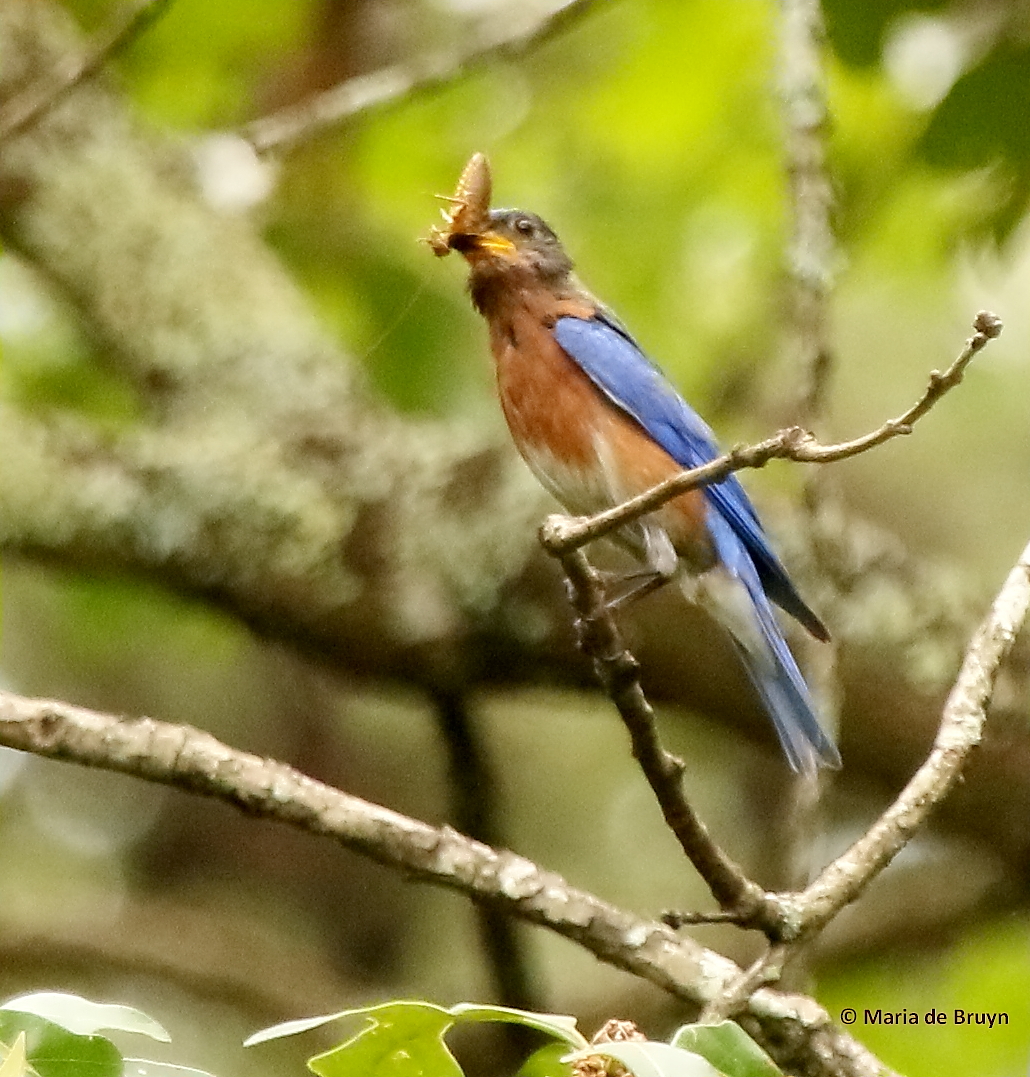
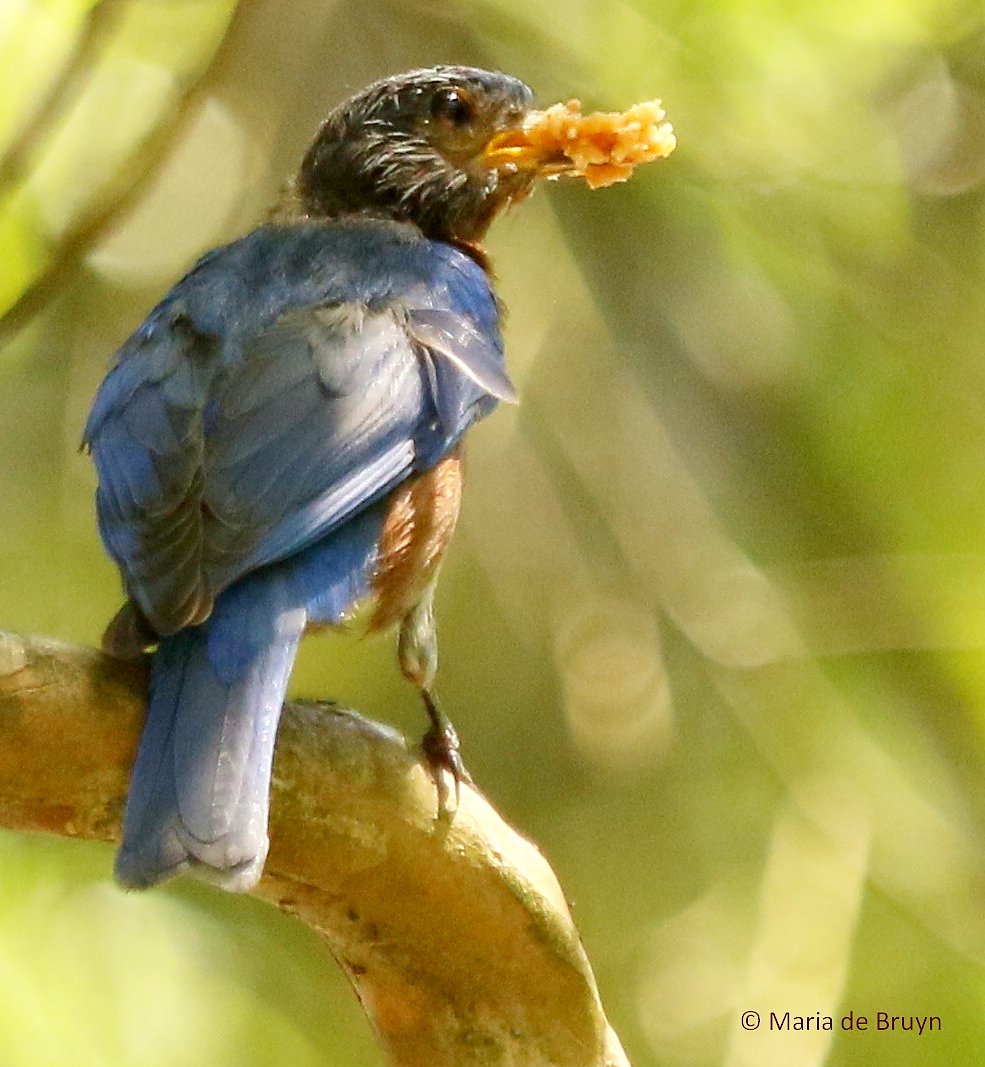
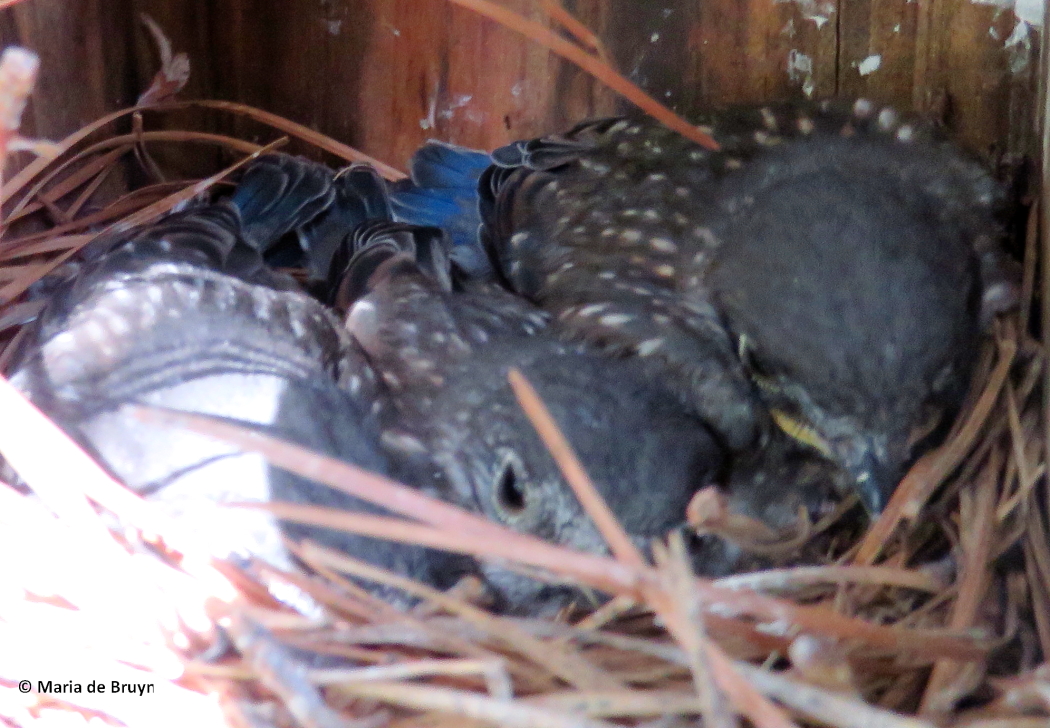
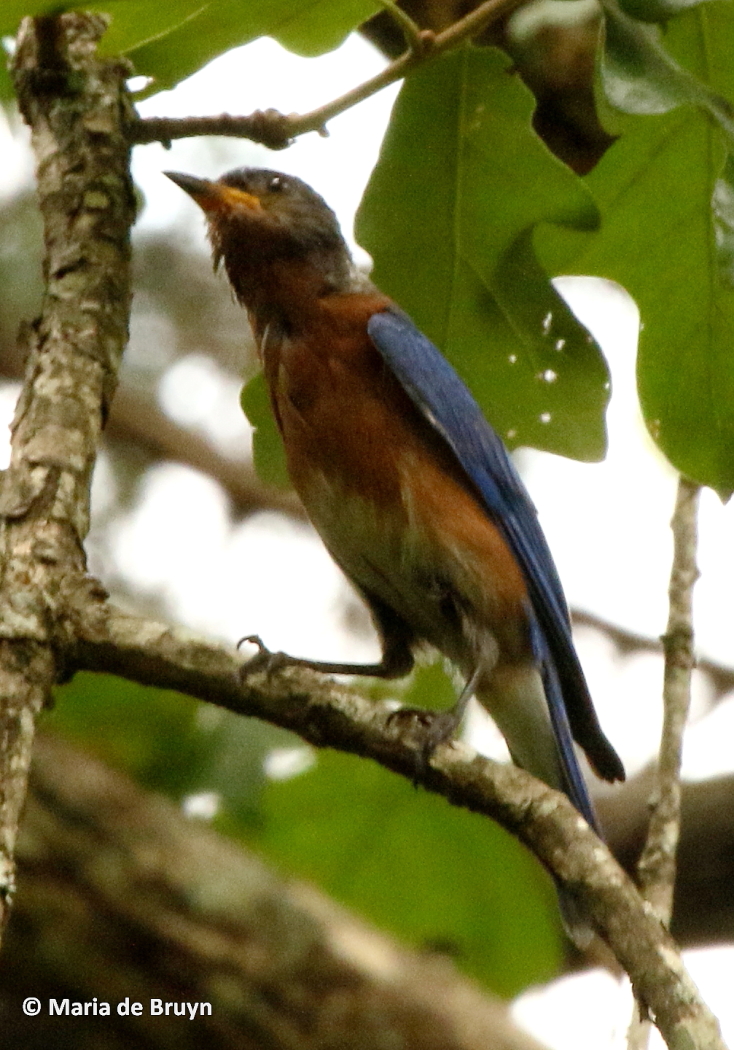
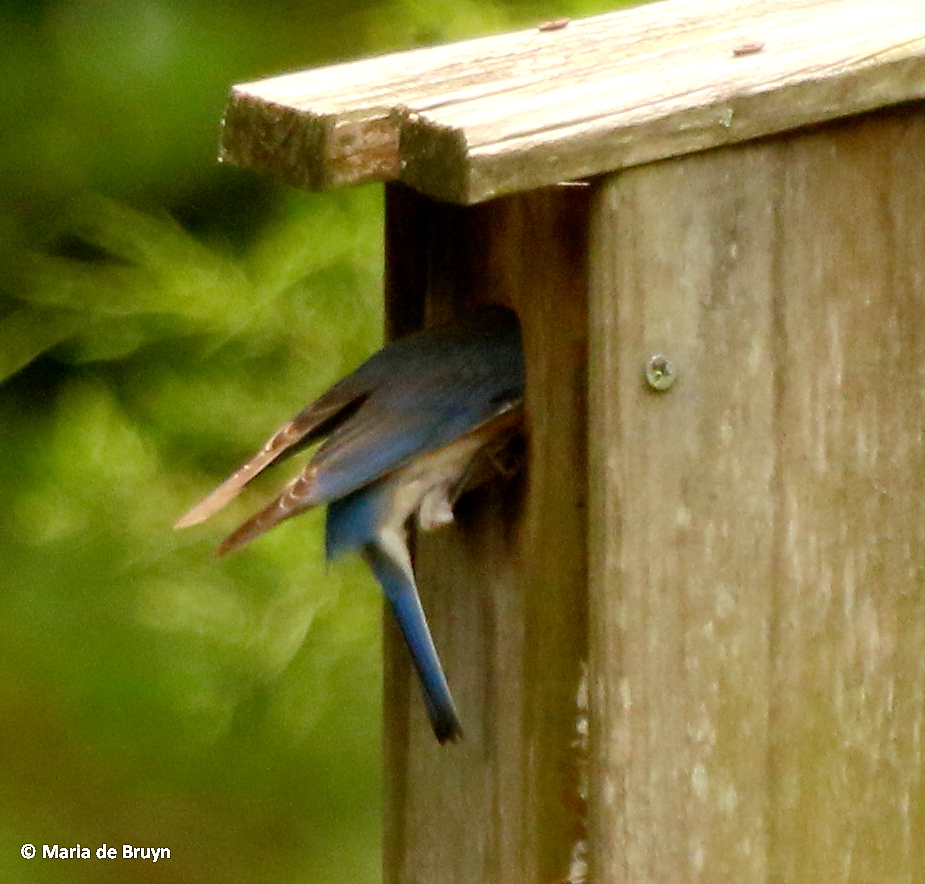
Eastern bluebird IMG_2991© Maria de Bruyn resEarlier this past week, I calculated that the Eastern bluebird (Sialia sialis) babies in my front-yard nest box were close to fledging. I knew approximately when mom had finished laying her eggs (four in total), so that I could guess when they reached normal fledging age (16-18 days after hatching). When I looked at the nest on 10 June, I saw that there were only three babies; I have no clue what happened to egg No. 4.  But the three survivors were progressing well as mom and dad made frequent forays to gather caterpillars and insects for them.

Eastern bluebird IMG_2819© Maria de Bruyn res Eastern bluebird I77A5733© Maria de Bruyn res

Eastern bluebird I77A8417© Maria de Bruyn

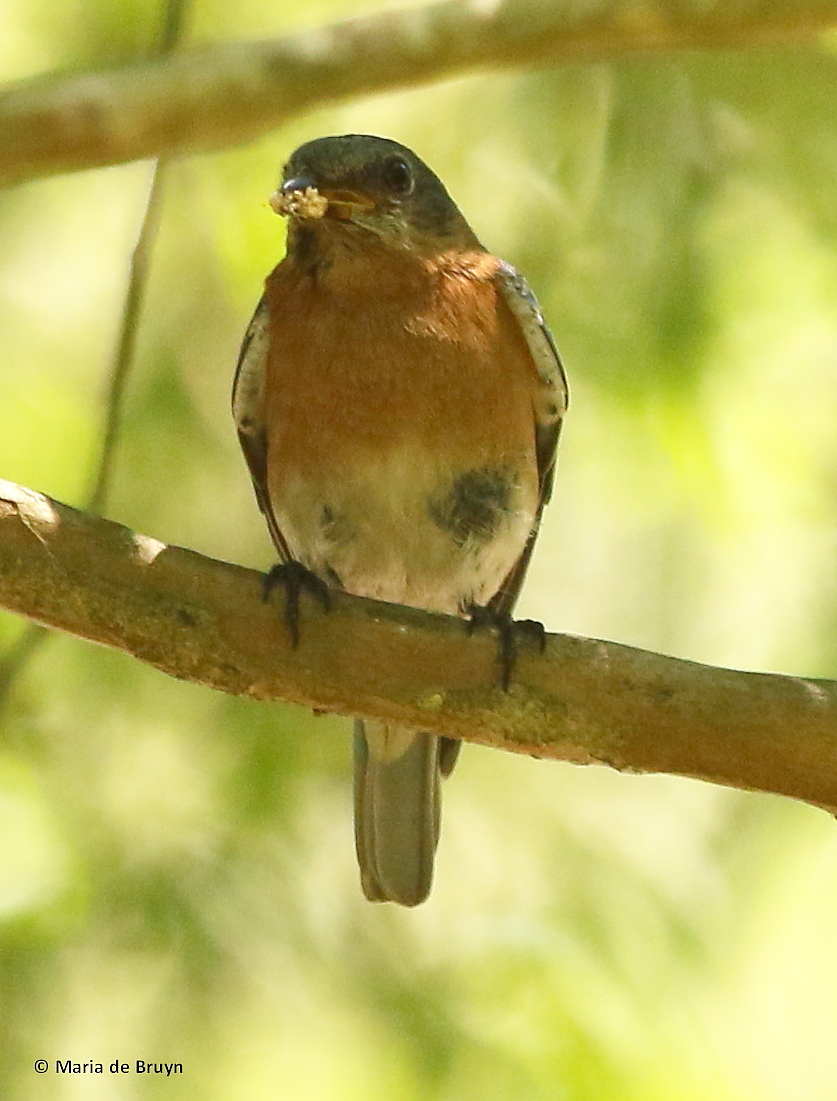
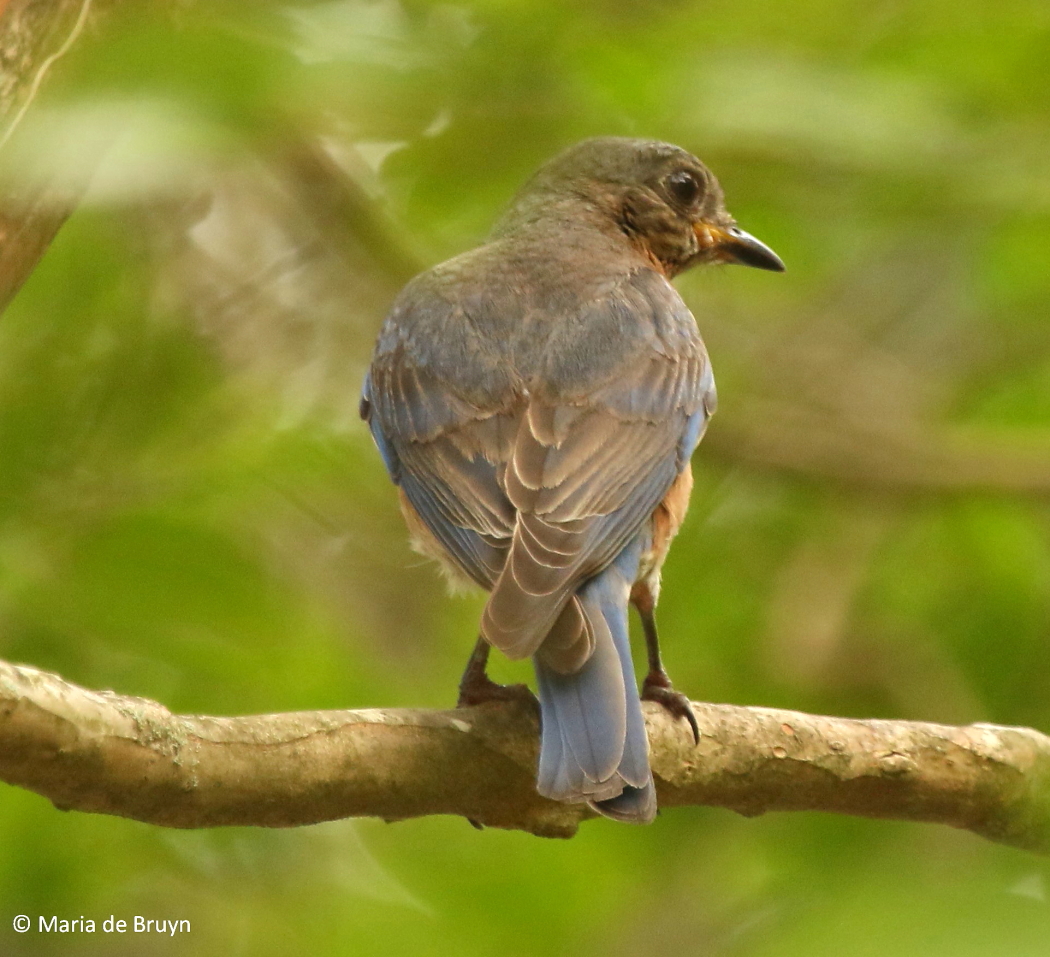
Occasionally, the male and also the female bluebird, identifiable by her subtler coloring and her brood patch, would visit the suet and meal worm feeders for a fast food repast for themselves. It was hard work keeping their growing offspring fed!

Eastern bluebird I77A6411 © Maria de Bruyn         Eastern bluebird I77A5769© Maria de Bruyn

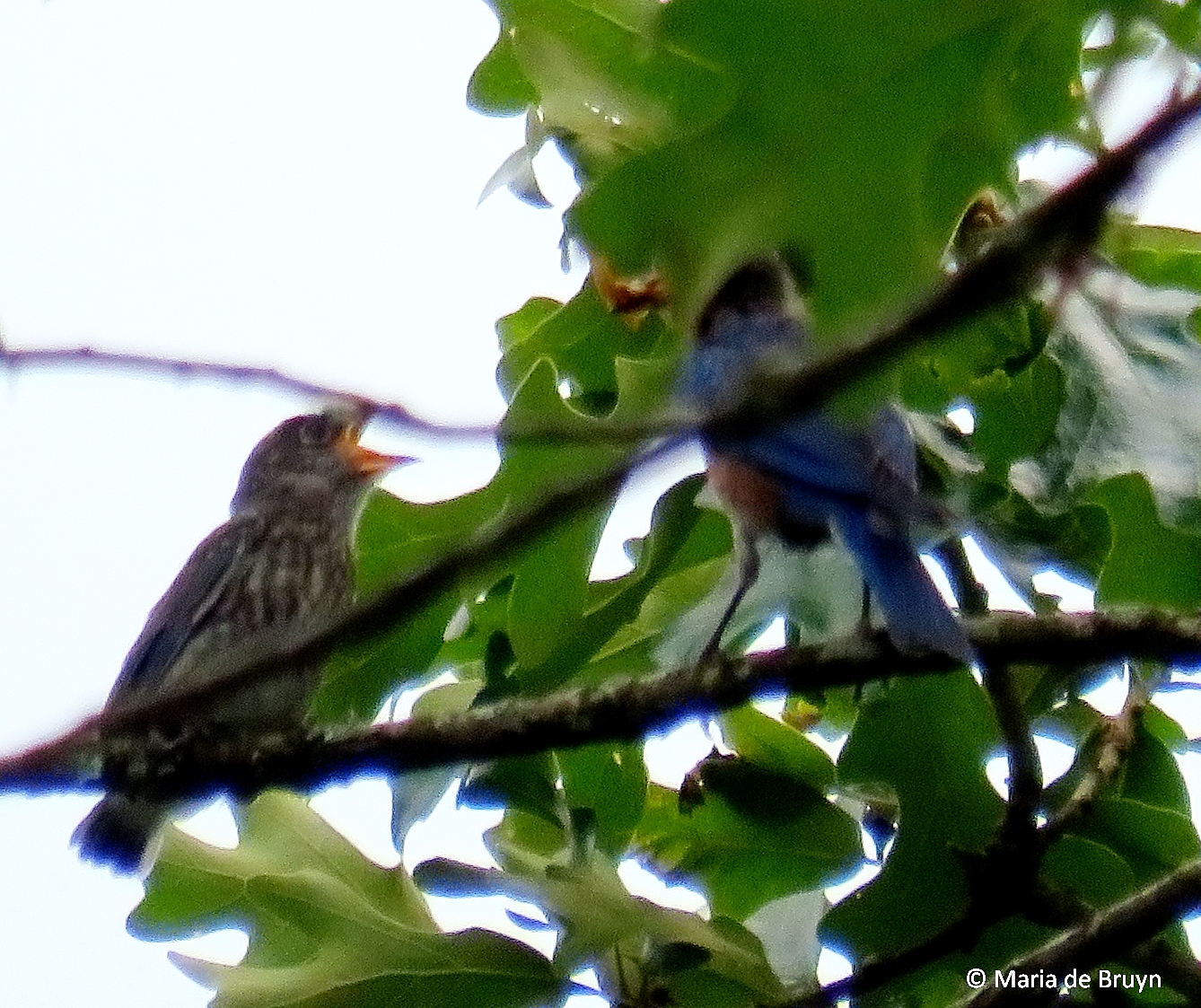
They also had to let one of their older offspring from a previous brood know that they were no longer going to feed him, even when he begged.

Eastern bluebird IMG_1509© Maria de Bruyn res

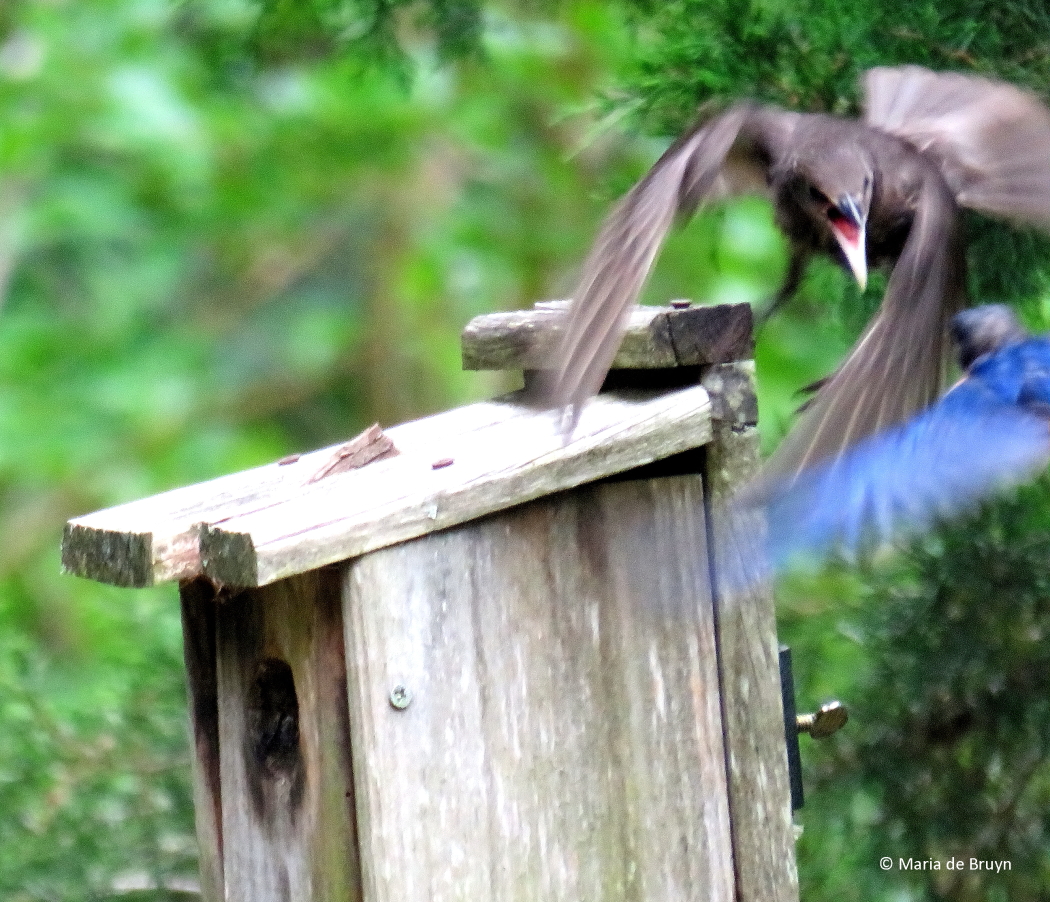
As fledging time neared, mom and dad had to contend with other birds coming near the box. Dad was especially angry with a young starling (Sturnus vulgaris) who wanted to settle on top of the box. Starlings have been known to eat young birds and papa bluebird was obviously taking no chances! (I just caught the action out of the corner of my eye so the photos aren’t great but do give an idea of the argument!). The parents also chased away squirrels from the tree in front of the box, which alerted me to the fact that fledging was probably imminent since the parents become especially protective at this time. I started using a smaller camera with a very long zoom (but somewhat lesser photo quality) as they weren’t excited by me being too close either.

Eastern bluebird IMG_3841© Maria de Bruyn res     Eastern bluebird IMG_3840© Maria de Bruyn res

Eastern bluebird IMG_4618© Maria de Bruyn res

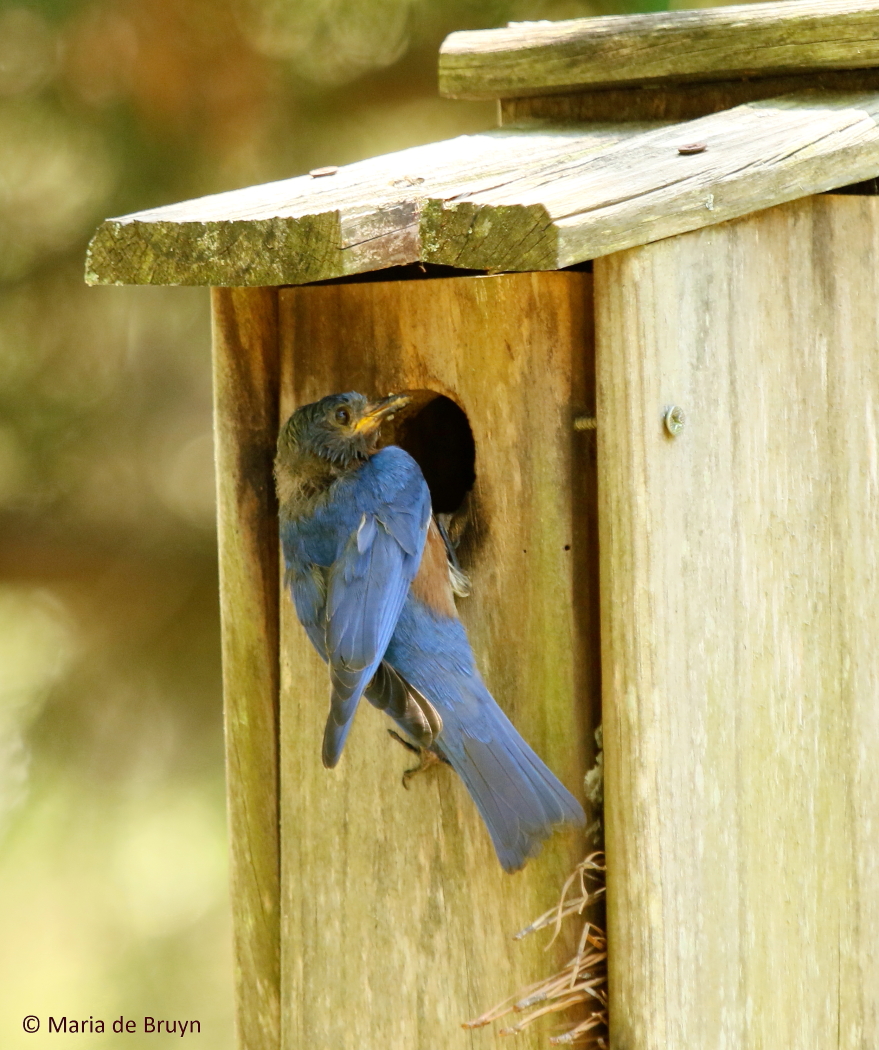
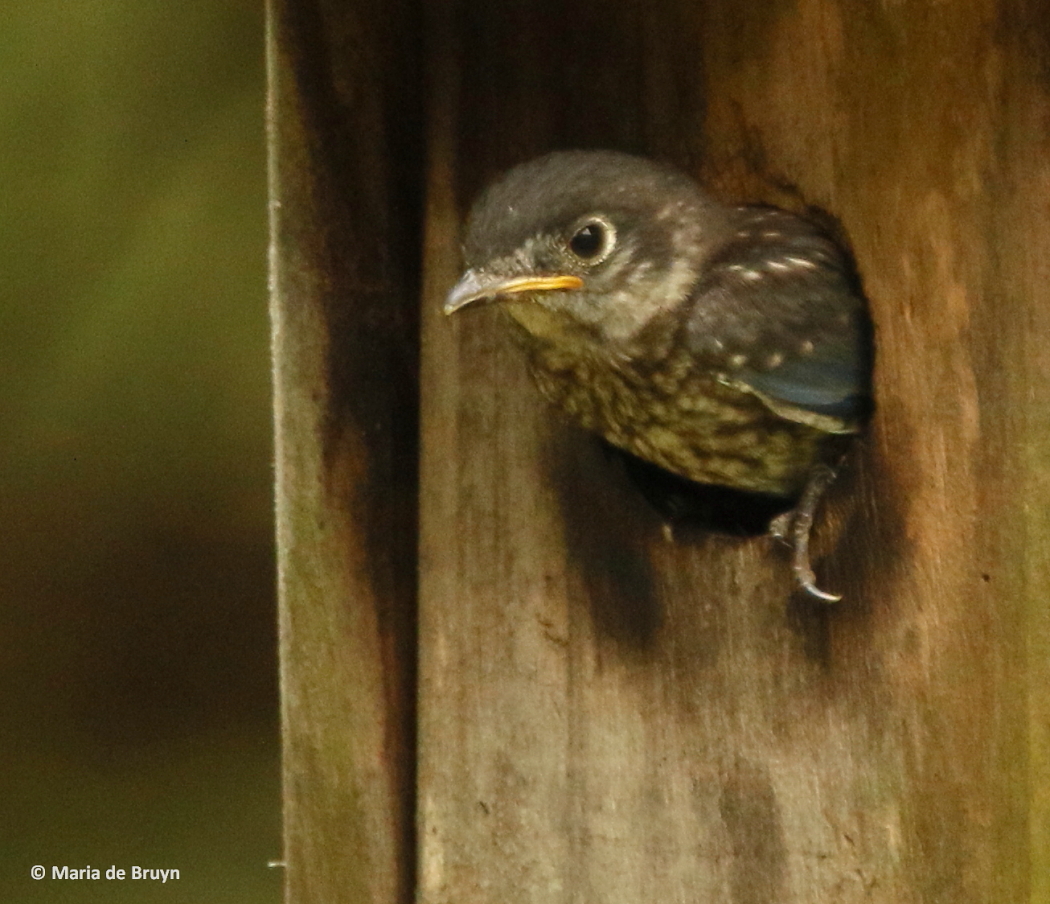
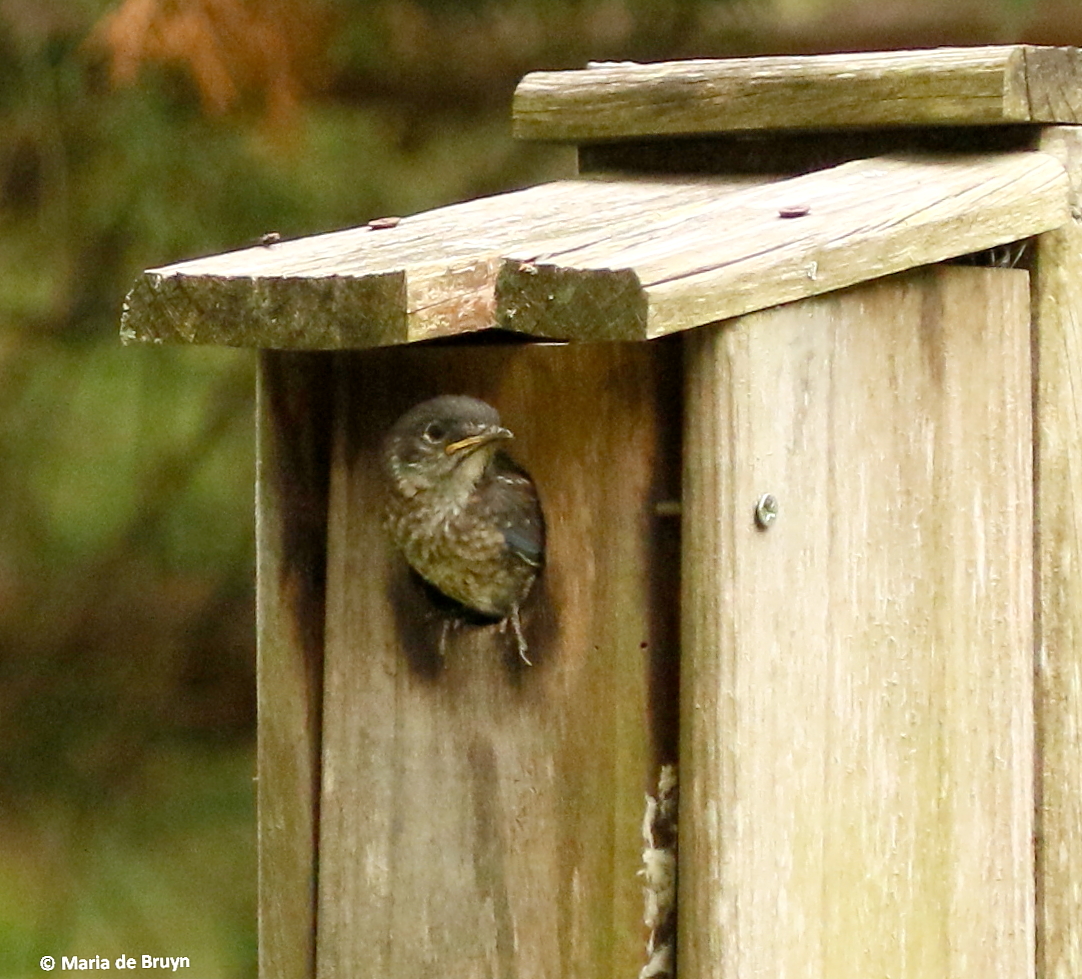
On Wednesday, I checked the box before going out for the morning and there were still three babies there. When I came home a few hours later, mama and papa were sitting on branches, with or without food, calling to their little ones to come on out. They would also fly to the box for a quick look inside.

Eastern bluebird I77A7702© Maria de Bruyn res           Eastern bluebird I77A7729 © Maria de Bruyn res

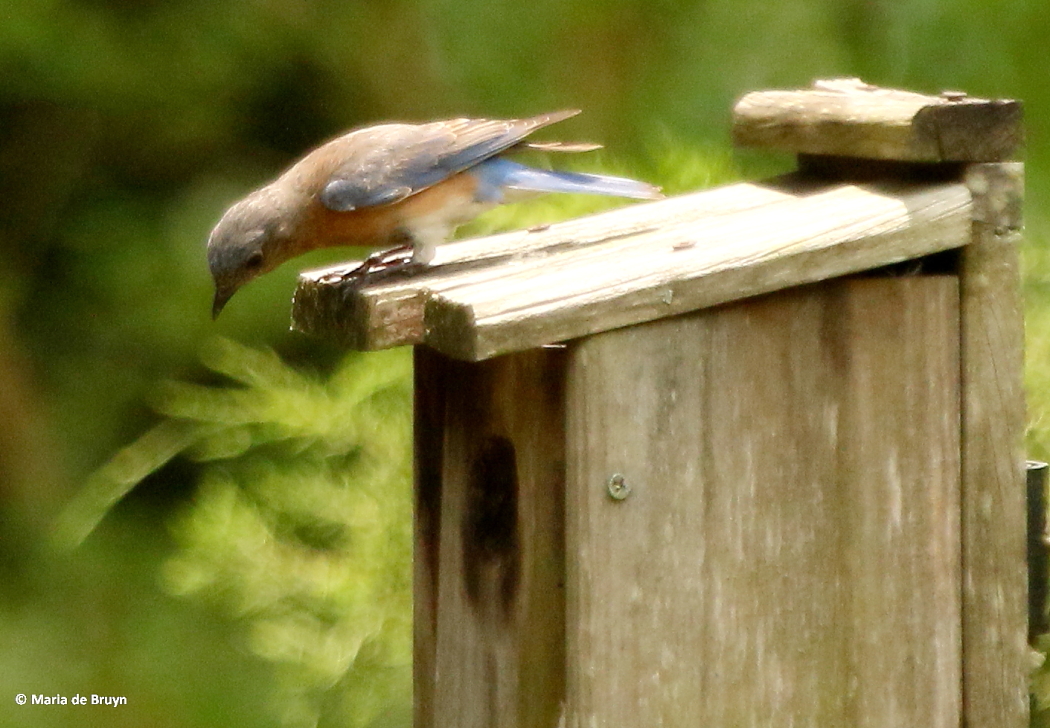
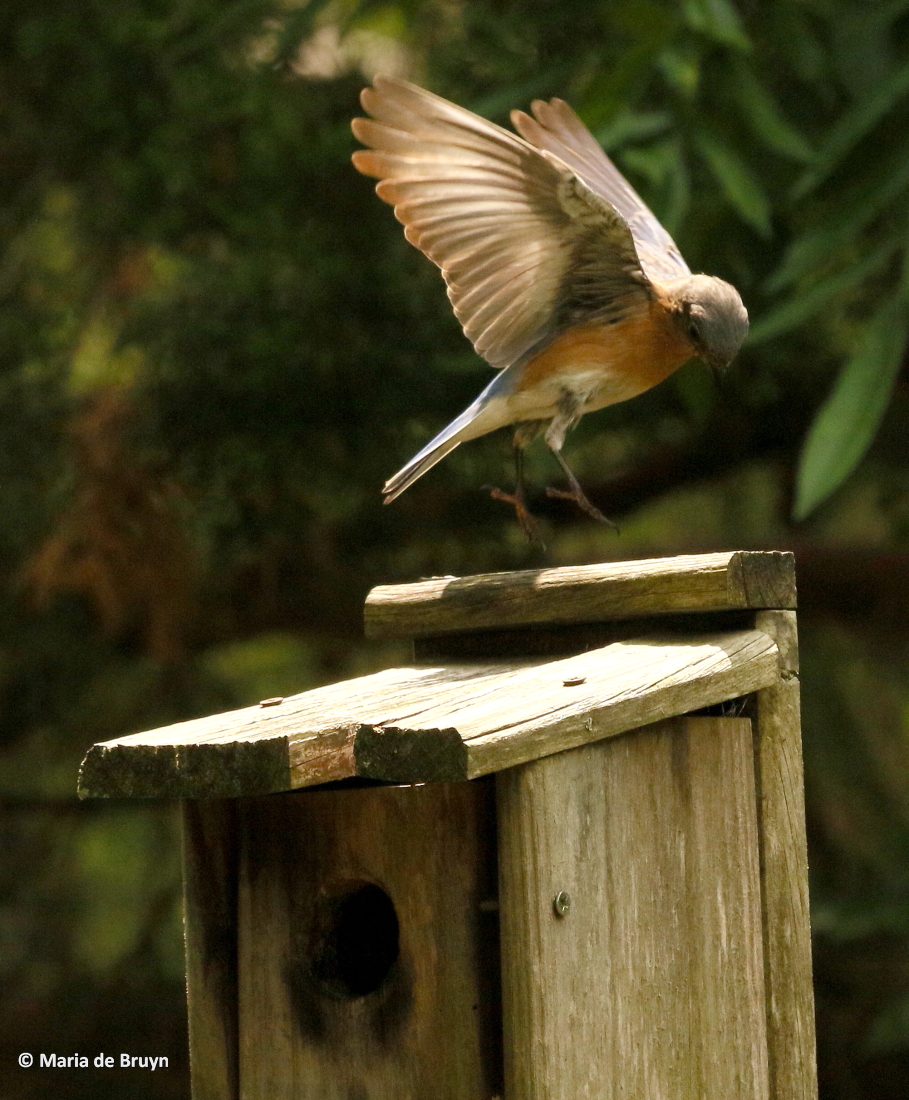
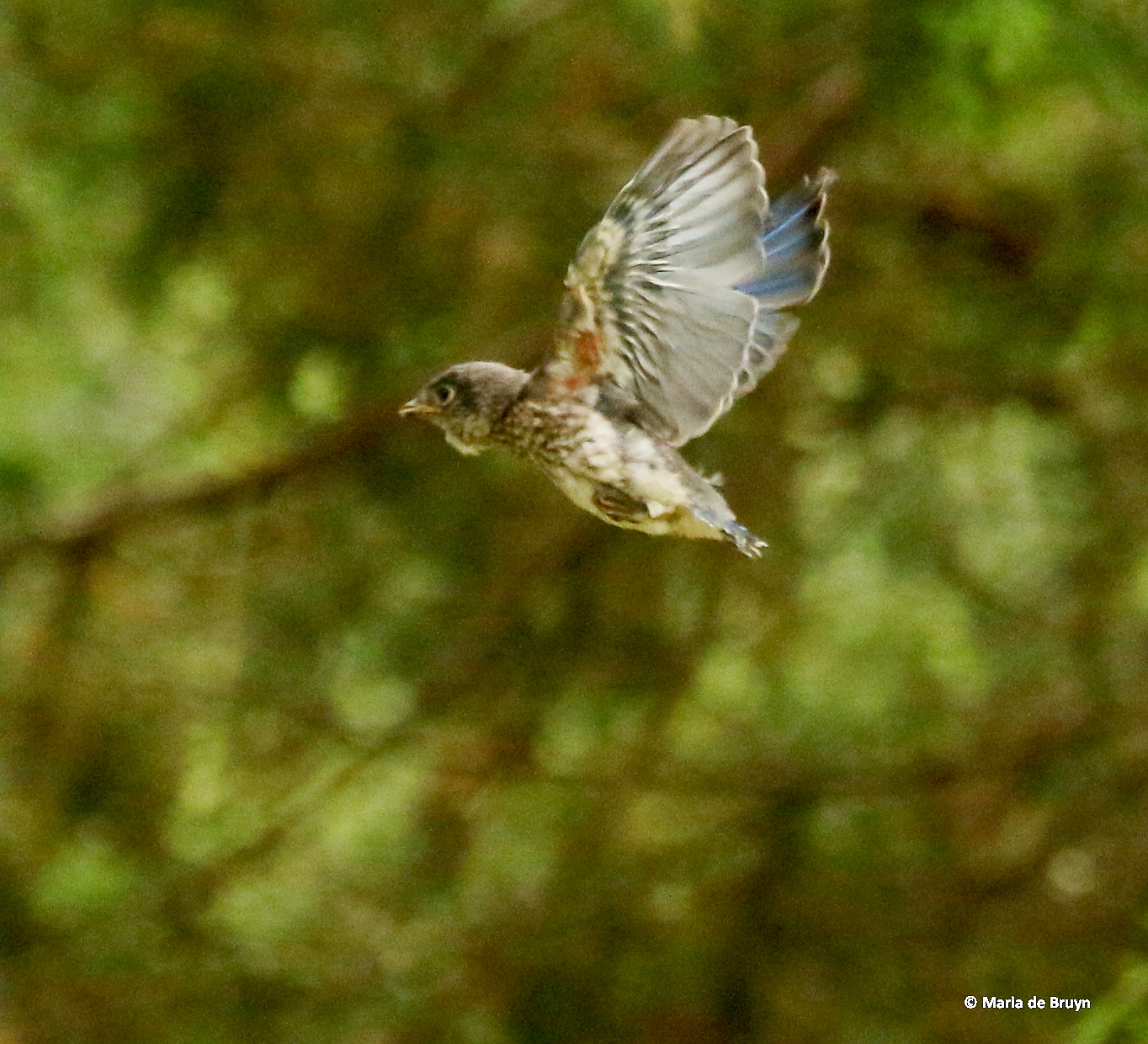
Mama also repeated behavior I had seen last year – flying to the box, standing on top and then hovering in front of the hole as a form of encouragement.  When she and dad left, I approached to take a look and discovered bluebird baby No. 1 had already flown away. This meant that the parents had to watch the first baby out in the trees somewhere, as well as their two lagging offspring in the box.

Eastern bluebird I77A8584© Maria de Bruyn res        Eastern bluebird I77A8791© Maria de Bruyn res

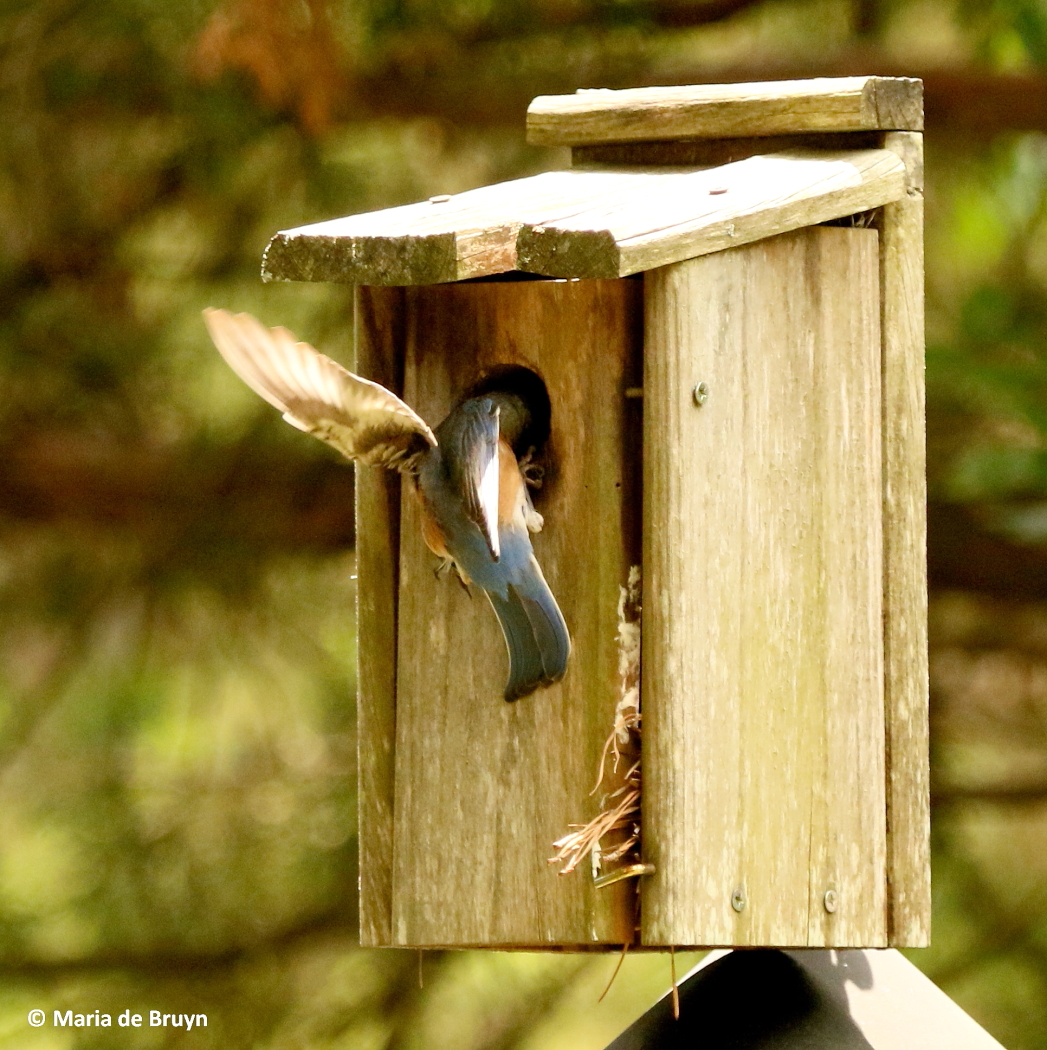
Eastern bluebird I77A8592© Maria de BruynAt one point, mother bluebird seemed a bit fed up – she flew over to the box (without food) and finally entered, staying inside for a good 60-90 seconds at least. I imagined her giving the babies a lecture about how they had to be courageous and willing to jump.

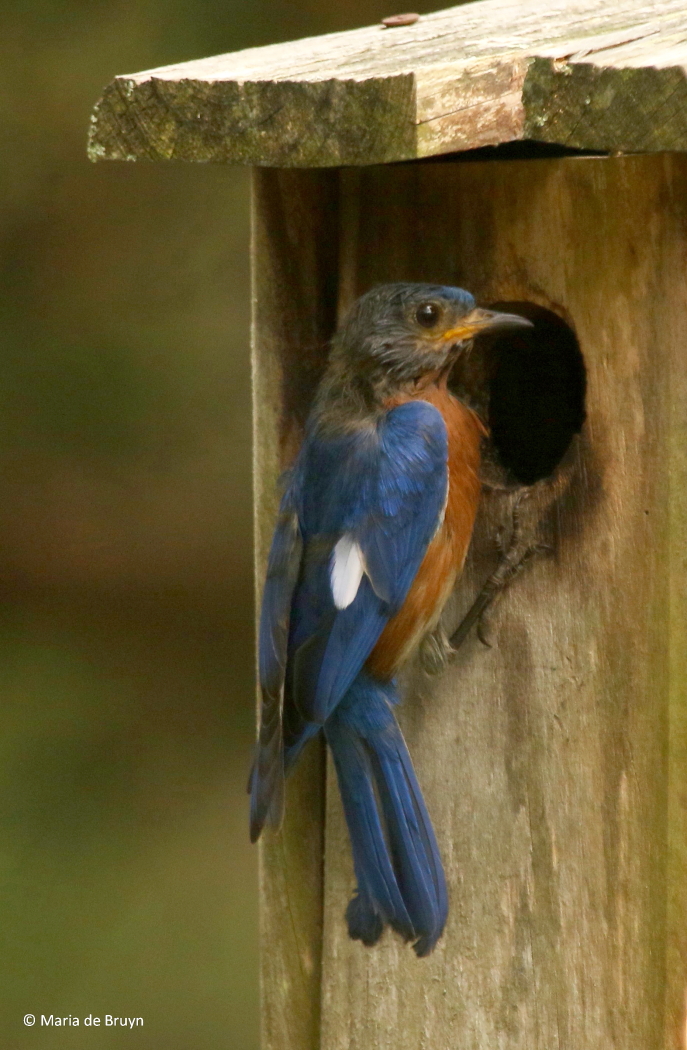
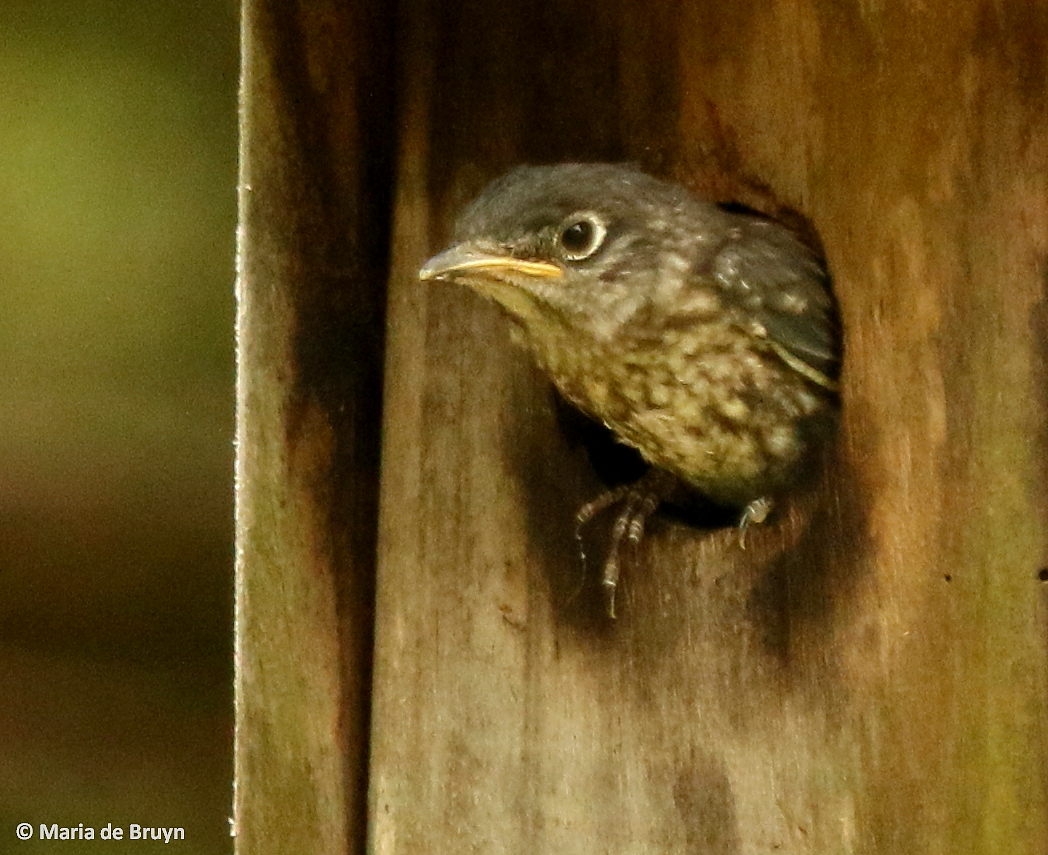
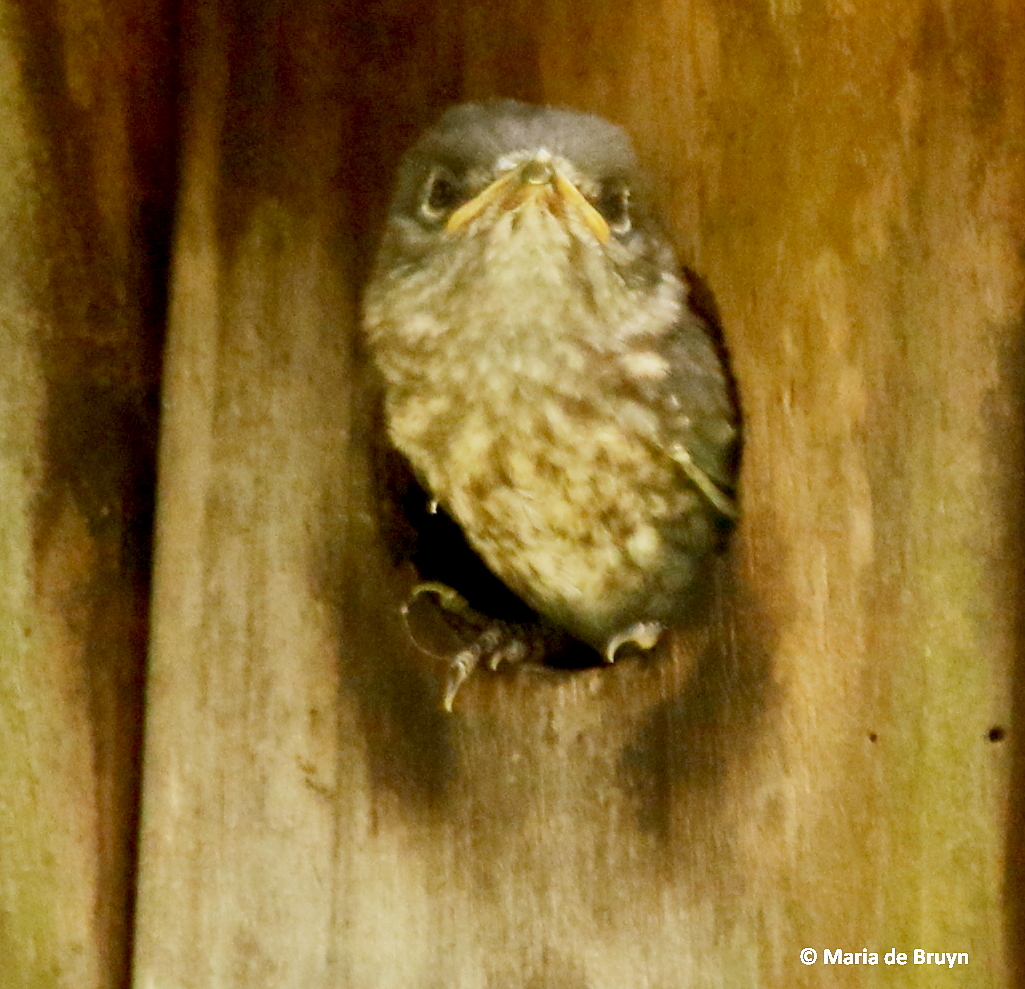
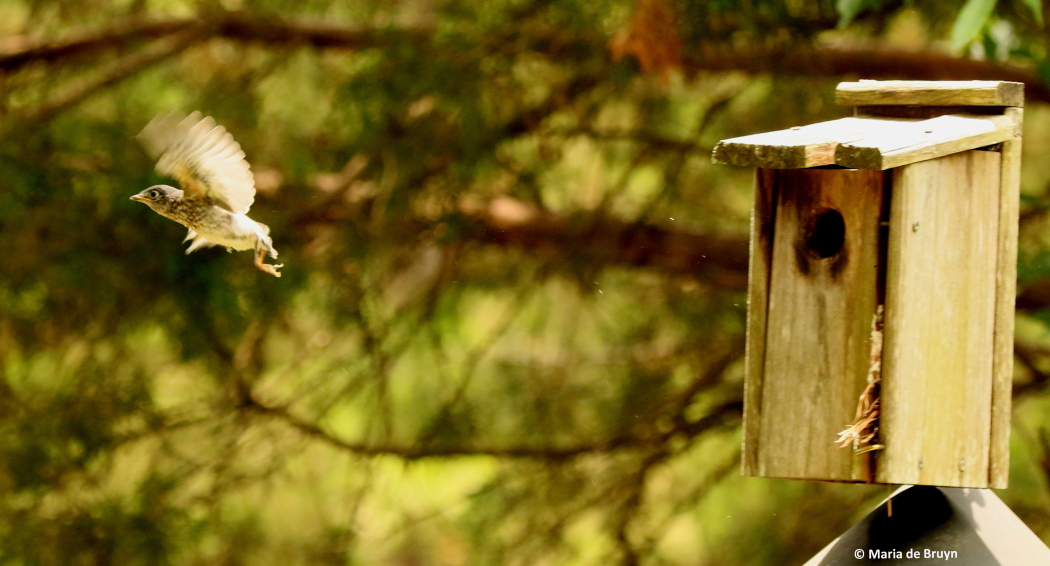
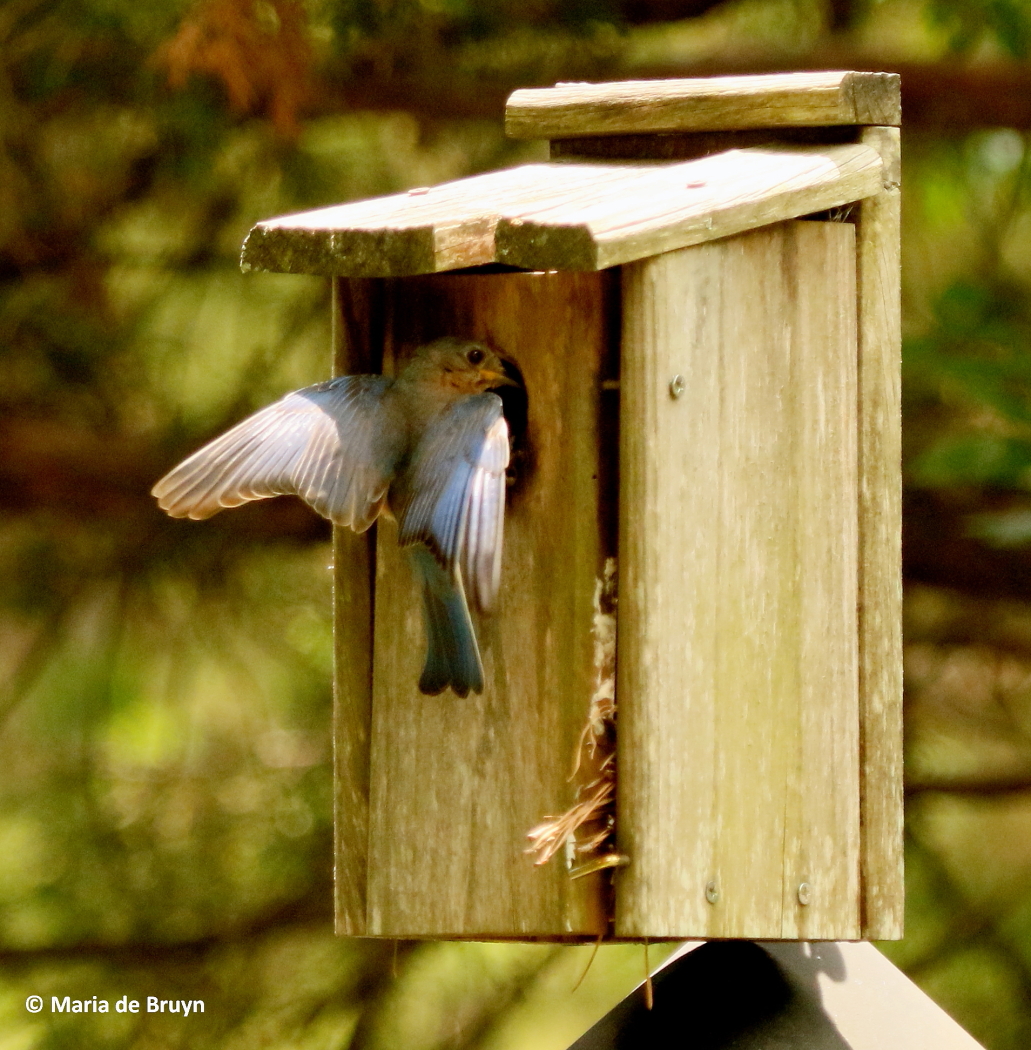
Her admonishments seemed to have had an effect; the babies began calling loudly from inside their birth home. Finally, after about 30 minutes, one poked its head out to take a look at the big wide world. Mom and dad seemed glad, waiting together in the tree to see how long it would take baby No. 2 to join them.

Eastern bluebird I77A8685© Maria de Bruyn    Eastern bluebird I77A8648© Maria de Bruyn

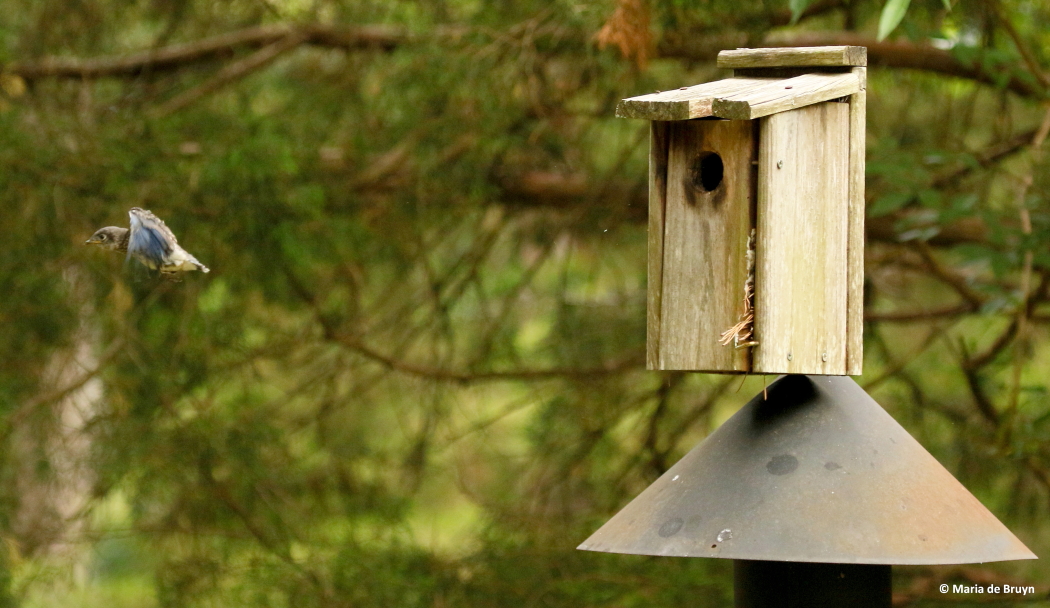
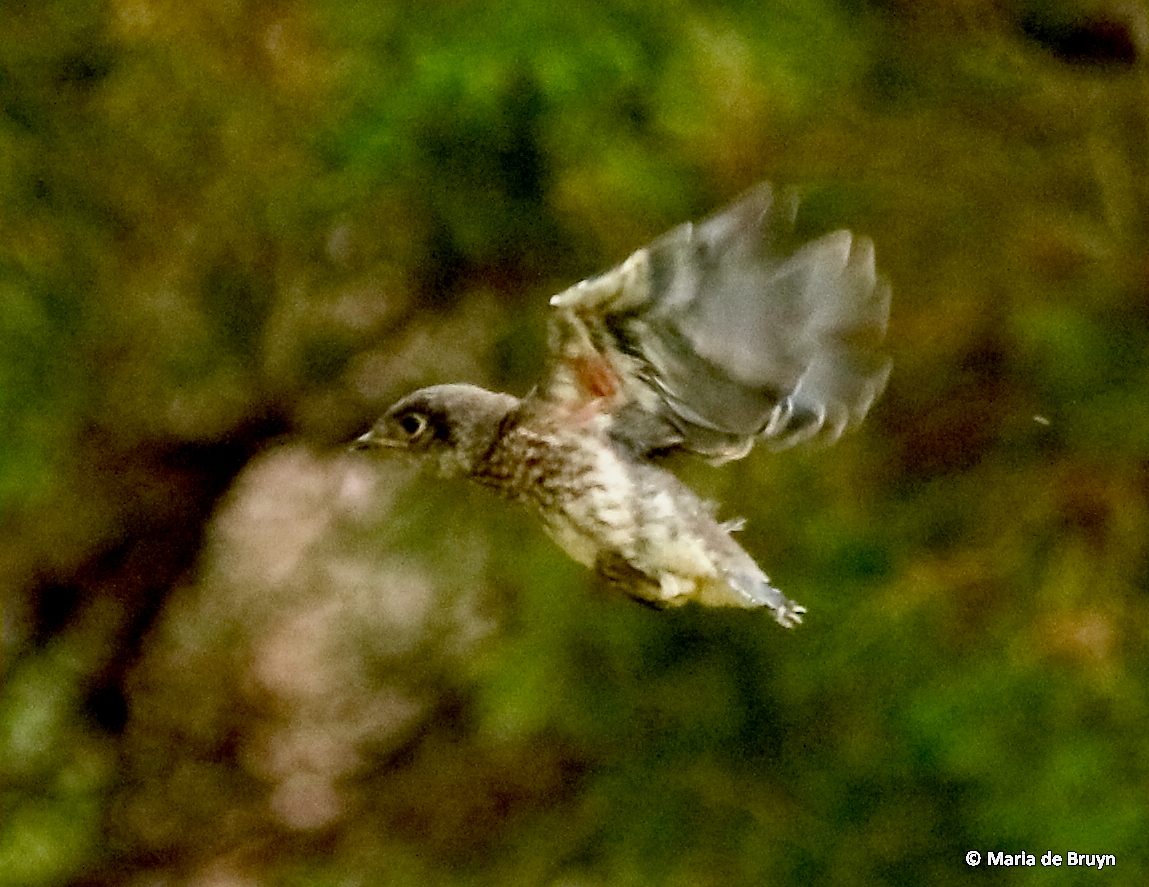
The baby looked around a lot, also staring at me; s/he went back inside and then looked out a few more times, finally taking the great leap into the outside world. Baby 2 was a very strong flier – not even alighting in the tree in front of the box but circling around to land high in a juniper and then in a tall oak tree behind the box.

Eastern bluebird I77A8746© Maria de Bruyn res

Eastern bluebird I77A8877© Maria de Bruyn res


Sibling No. 3 took a little while longer and mama bluebird again went to the box to give encouragement. The baby then spent a little more time observing the new environment and also made a strong flight out.

Eastern bluebird I77A8899© Maria de Bruyn res Eastern bluebird I77A8891© Maria de Bruyn res

Eastern bluebird I77A8861© Maria de Bruyn res  Eastern bluebird I77A8925© Maria de Bruyn

Eastern bluebird I77A8930© Maria de Bruyn res Eastern bluebird I77A8931© Maria de Bruyn     Eastern bluebird I77A8932© Maria de Bruyn res

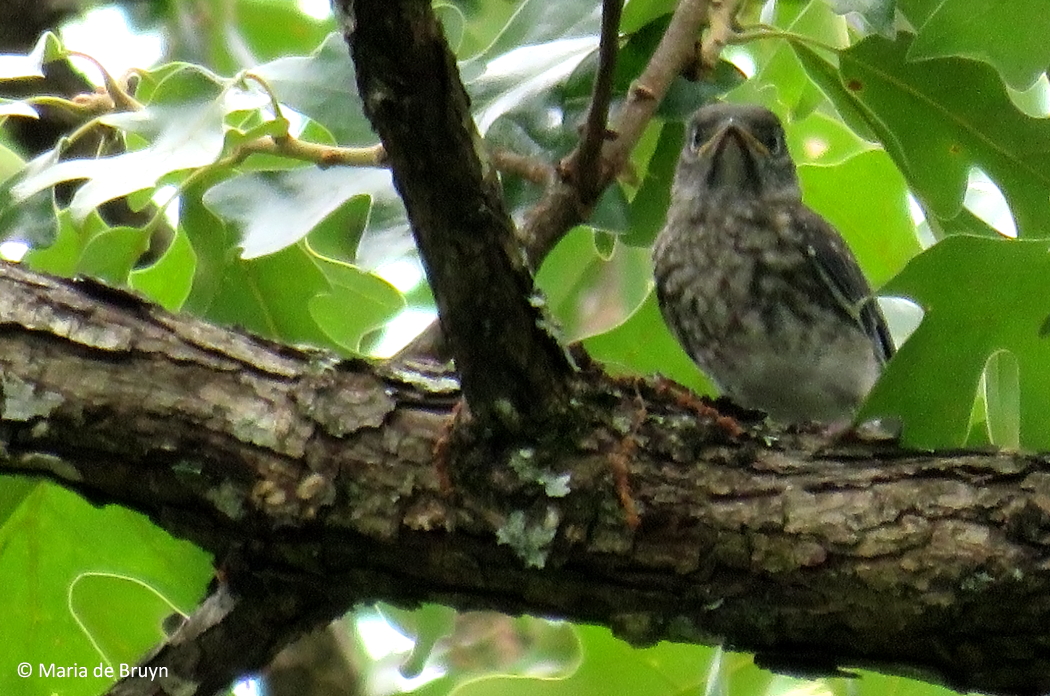
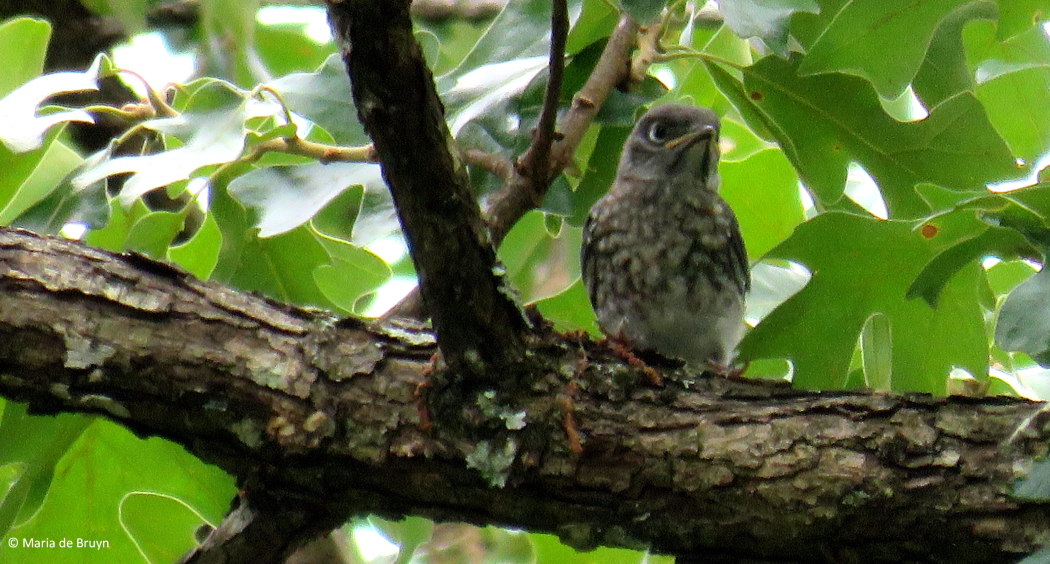
It rained that night and I hoped that the bluebird babies were ok; between the thunderstorms and a neighbor’s cat who comes to hunt birds in my yard, their environment seemed precarious for their first days of life. In the afternoon, I was happy to see papa bluebird feeding one of the three babies at the top of an oak tree. Mama was also flying around up there, so I assumed they were all hanging out in the high branches.

Eastern bluebird IMG_4723© Maria de Bruyn        Eastern bluebird IMG_4777© Maria de Bruyn res

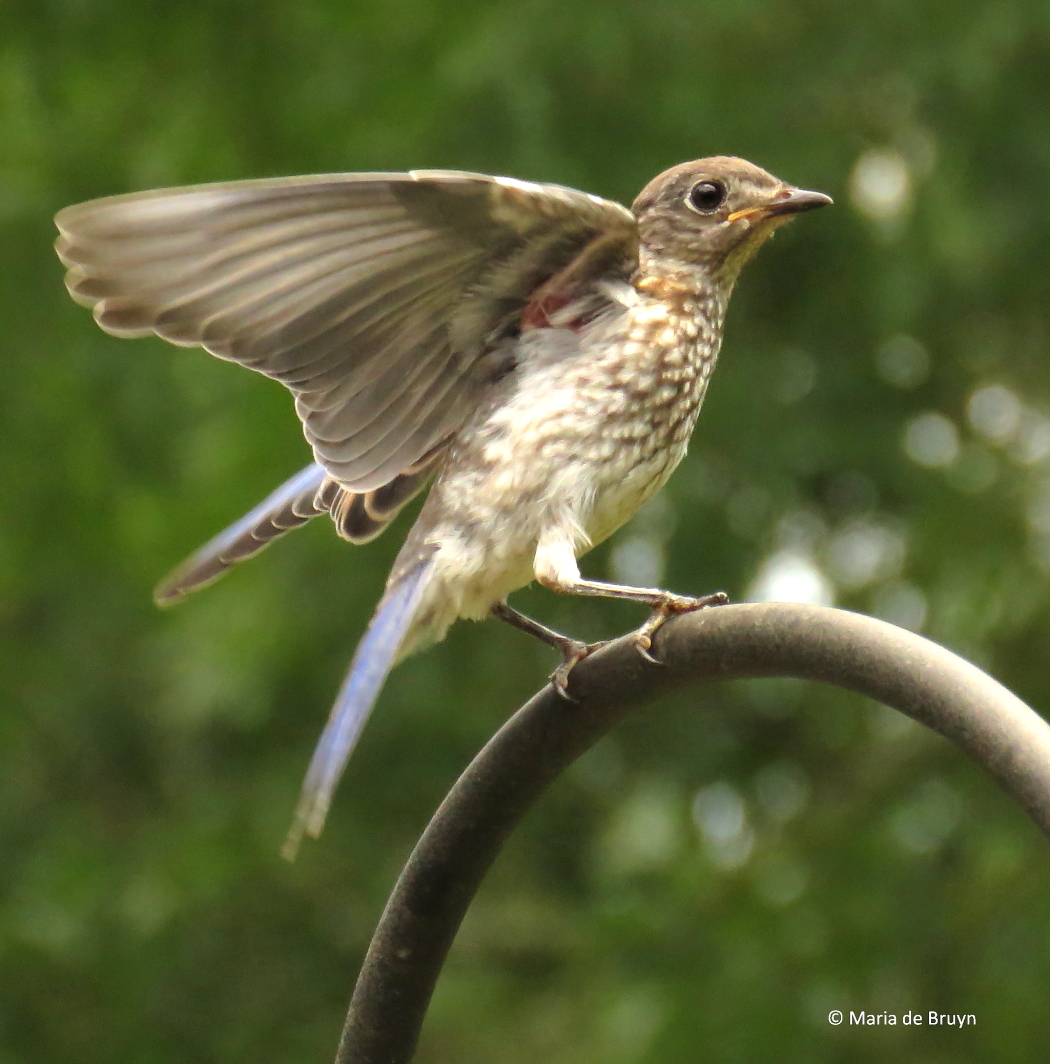
Thursday night, it rained heavily again for many hours; Friday was an easier day and night. I haven’t seen the fledglings again yet but have seen their parents coming for suet and meal worms and flying up to the oak tree, so I assume at least a couple are there. I look forward to seeing their speckled selves at the feeders along with their parents – and will be curious to see if their parents go for a third brood this year.

Eastern bluebird IMG_4779© Maria de Bruyn res