Back to blogging with the golden crowns!

Litter boxes scrubbed, bird feeders filled, other chores waiting but I’ve decided to end my blogging hiatus on this rainy and somewhat gloomy Sunday morning. This and my next blog will feature two of my favorite birds and then I hope to treat you with a nesting saga as spring is well underway.

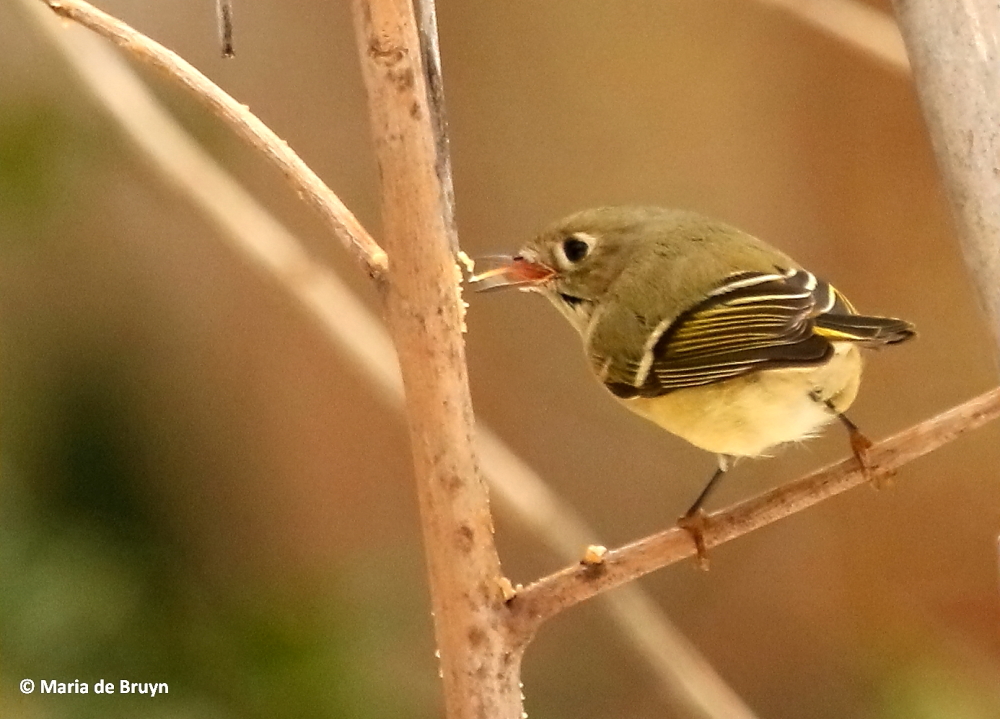
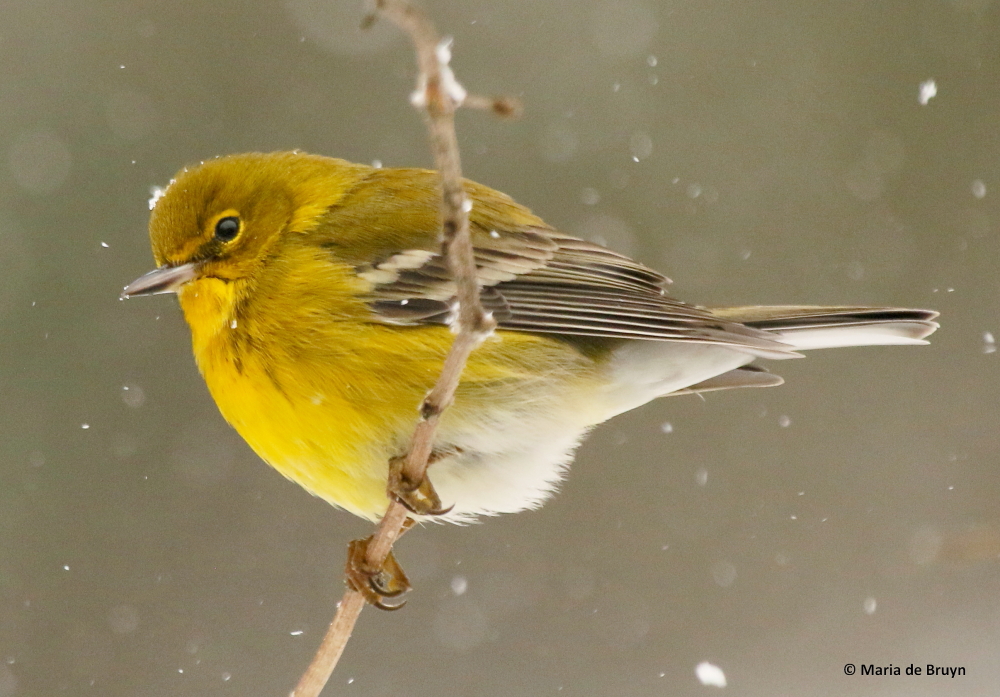
With a lovely ruby-crowned kinglet visiting my yard every year for the past four years, I’ve developed a particular fondness for this tiny avian species. This past autumn and winter, my partiality expanded to include their jeweled cousins, the golden-crowned kinglets (Regulus satrapa), who seemed to have favored our geographical area with an irruption (an ecological term for a sudden increase in an animal population). Whereas in previous years, I felt lucky to catch a glimpse of a golden crown during their months-long stay in North Carolina, they appeared to be everywhere this past winter and in full view to boot.


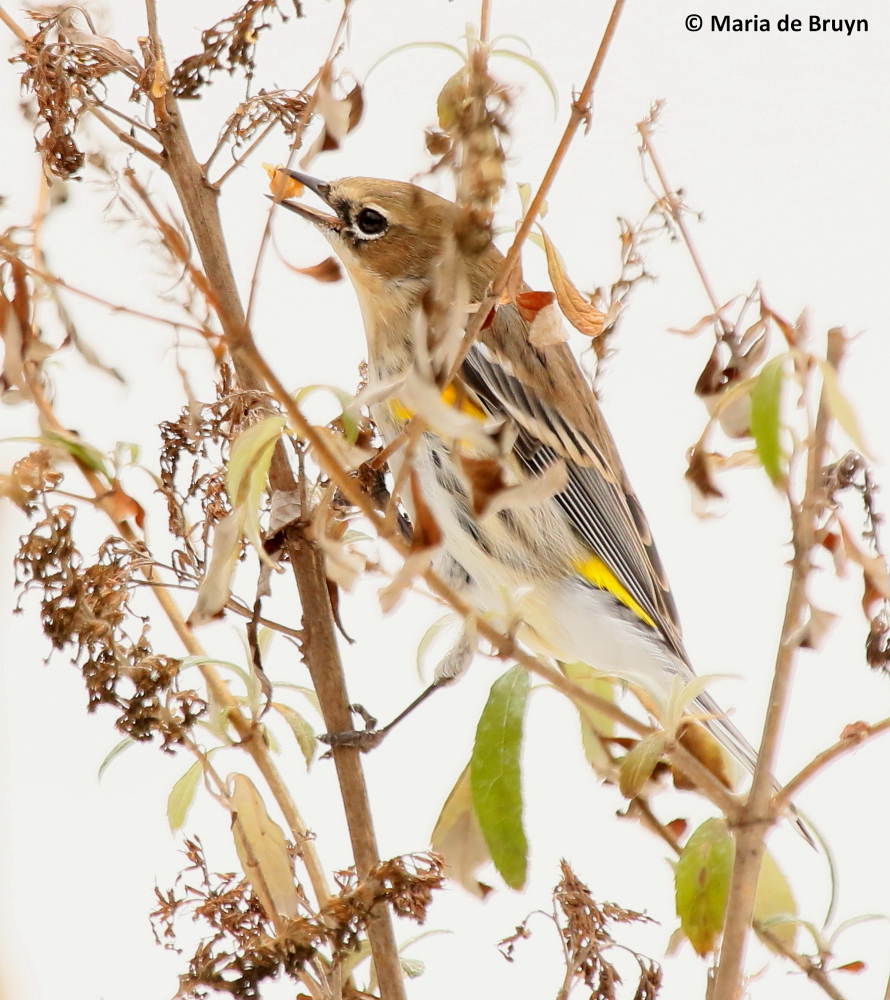
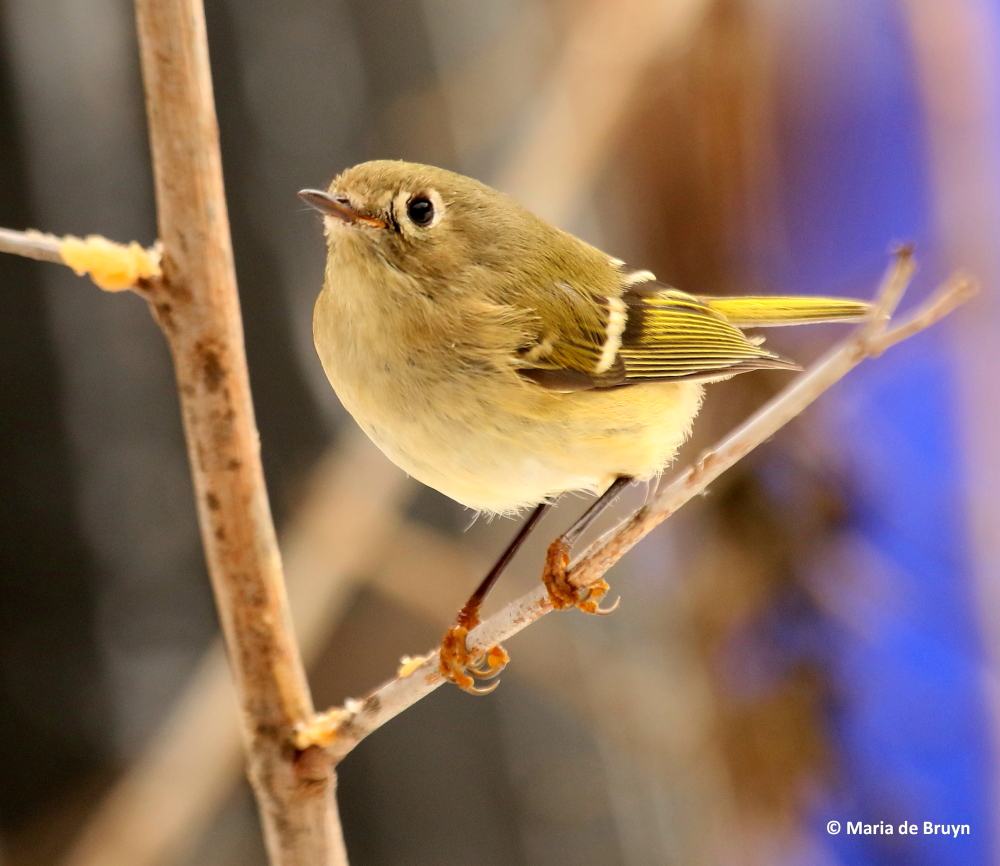
The golden-crowned kinglets are about the same size as the ruby crowns and similar in overall body color except that they also have a black eyebrow stripe.

While the ruby-crowned males only flash their red crests when mating or upset, however, the golden crowns have a permanent yellow stripe atop their heads.


The male golden crowns can sometimes be distinguished by the fact that there will be a hint of red in their golden crest.


Like the ruby crowns, these little insect foragers are in constant movement as they scour branches, shrubs and plants for a meal. Their varied diet includes beetles, flies, crickets, butterflies, spiders, and bees and wasps. In the winter, they will also eat some seeds.


Searching for the insects often means they hang upside down from branches as they look at the underside and in crevices for their next bite to eat.


They also hover mid-air to snatch an insect or fly.

The golden crowns sometimes sit still a bit longer than ruby crowns so that you have a chance to get off a few photographic shots before they resume their dietary searching. And this year, one of those photos placed me among the winners in a small local competition.

These birds are not much bigger than hummingbirds, but like the hummers, they also undertake a long migration twice yearly. Their winters are spent throughout North America but for breeding they travel to the far North and mountainous Northwestern areas of this hemisphere.

This year, many places had mild winters but if they arrive in the North before spring-like temperatures arrive, they are able to survive nights as cold as –40 degrees; sometimes, they huddle together to keep a bit of warmth. Their lifespan is several years, with the oldest recorded golden crown being a banded male who was at least 6 years and 4 months when he was recaptured in Minnesota in 1976.


This species prefers life in coniferous forests but it seems if a few spruce and pines are around, they will settle in. I saw them in a small and somewhat sparsely vegetated area near a senior center, an arboretum, along the Haw River, and in the woods and bogs of various nature reserves.


In the United States, the number of golden-crowned kinglets declined 75% between 1966 and 2014. Habitat loss has contributed to this. However, spruce reforestation in the Eastern USA may have contributed to a more recently seen increase in numbers of kinglets. I’m very glad that they are not (yet) an endangered species and I hope we get to see them a lot next winter, too!

The sad spring saga of Sassy squirrel

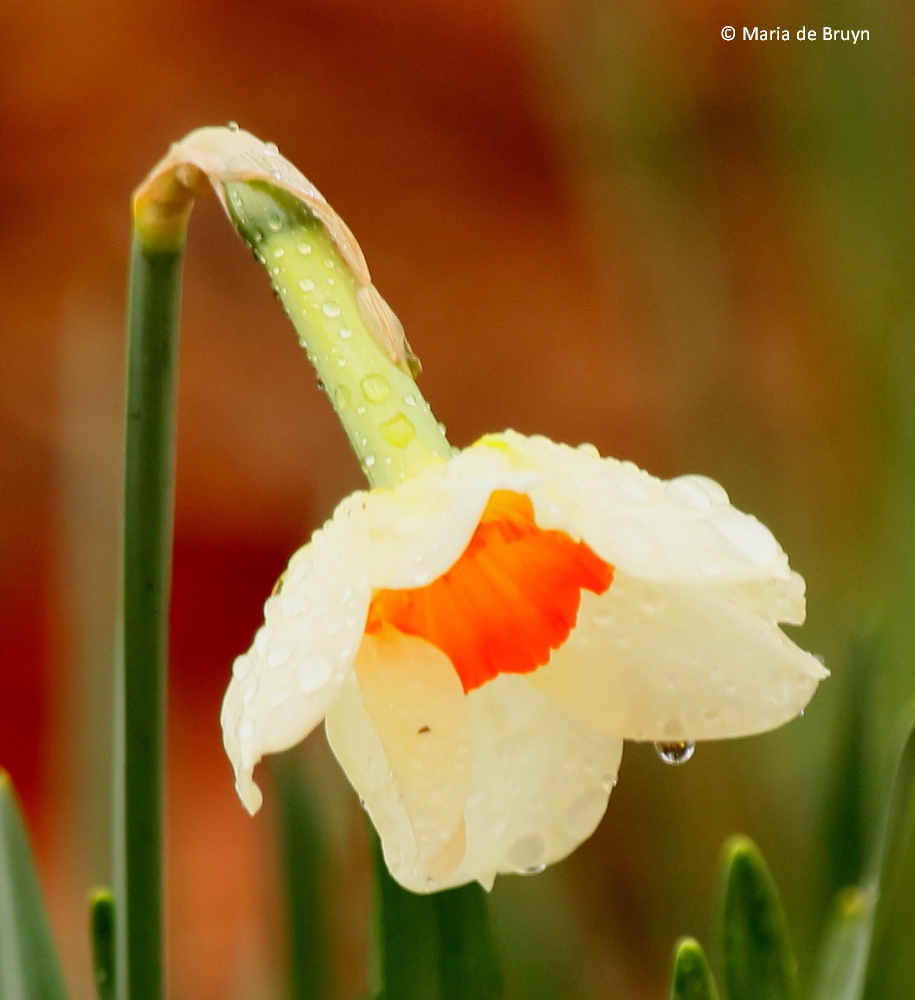
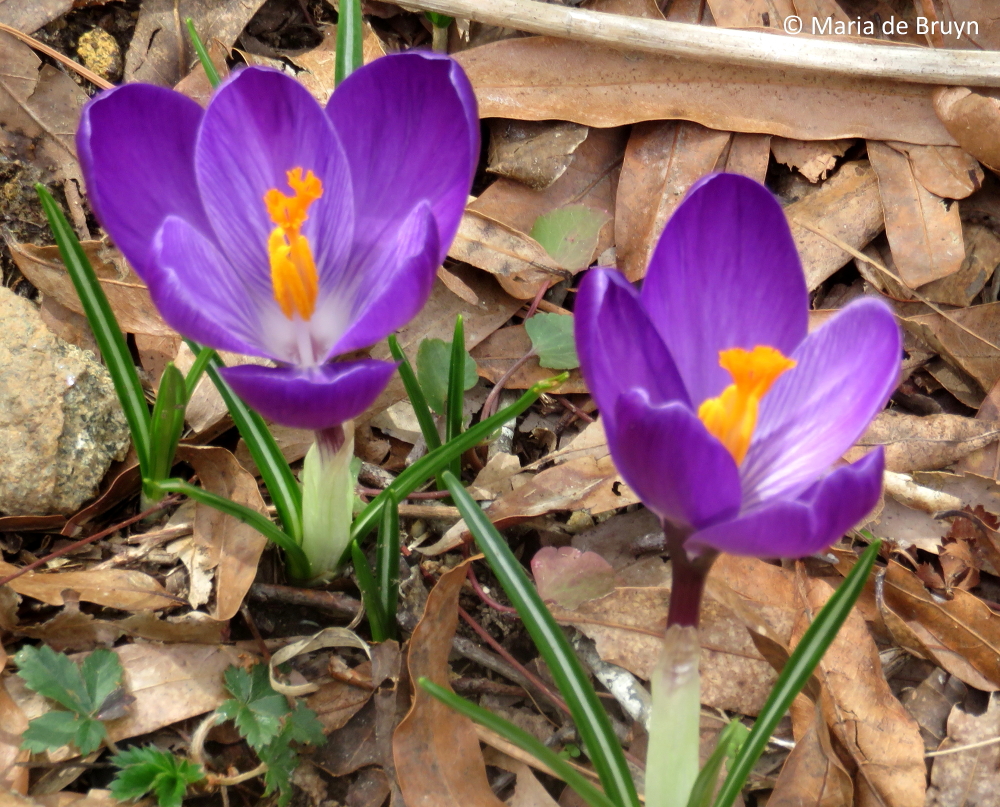
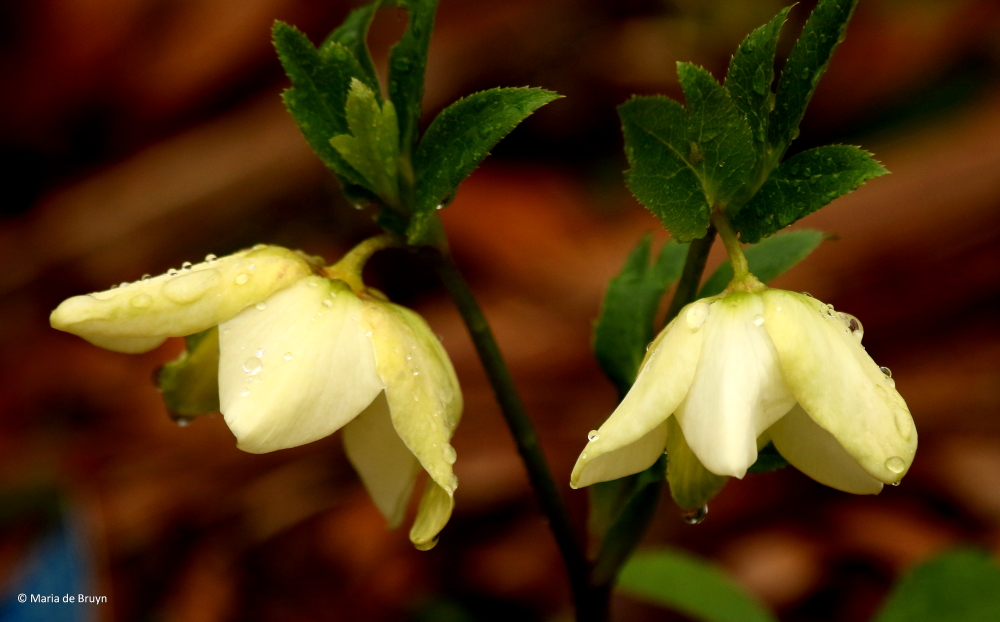
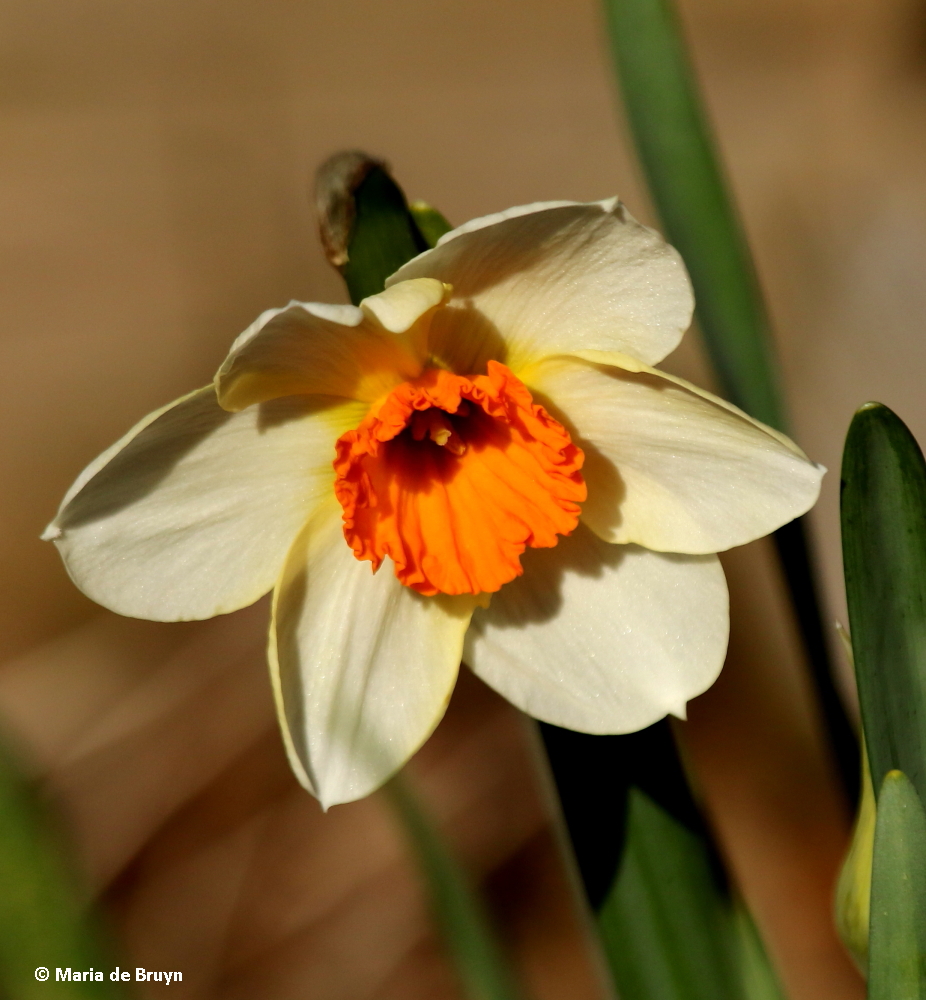
cape-may-warbler-i77a5989-maria-de-bruyn-2resSpring has come early to North Carolina, leading to some early bird migration (like this Cape May warbler, Setophaga tigrina, on its way North), avian courtship and nest building, as well as spring blossoms already emerging in profusion. My garden has seen some lovely flowers, both cultivated and wild: daffodils (Narcissus), crocuses (Crocus), winter jasmine (Jasminum nudiflorum), henbit (Lamium amplexicaule) and lenten rose (Helleborus orientalis).

daffodil-i77a2964-maria-de-bruyn-res    daffodil-i77a2325-maria-de-bruyn-res

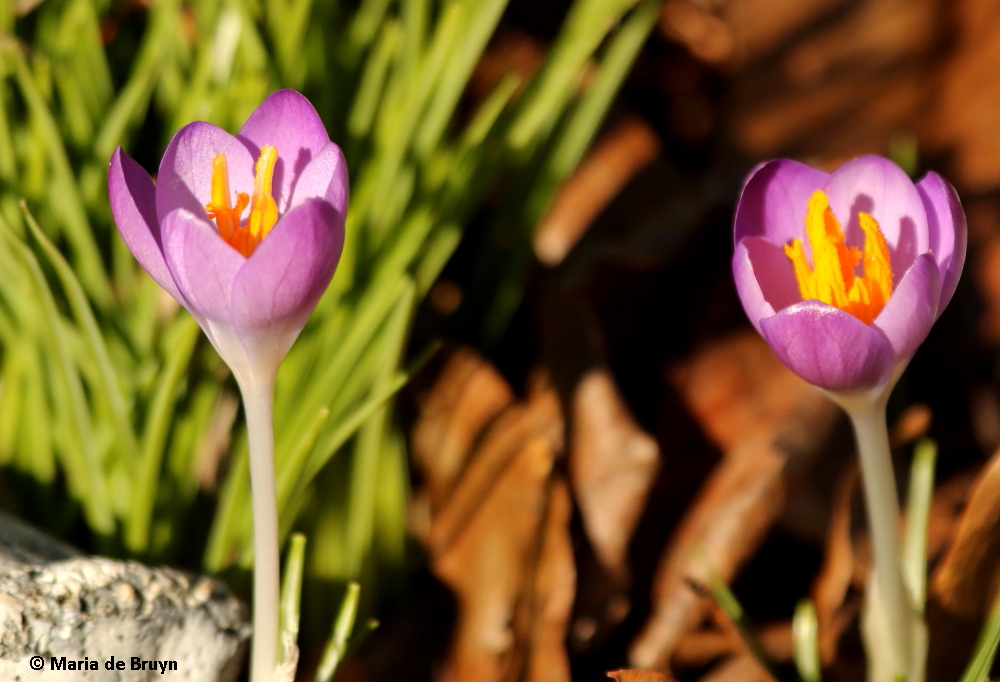
crocus-img_1813-maria-de-bruyn-res   crocus-img_1790-maria-de-bruyn-res

winter-jasmine-i77a0793-maria-de-bruyn-res    henbit-i77a1155-maria-de-bruyn-res

lenten-rose-i77a2951-maria-de-bruyn-res lenten-rose-i77a1903-maria-de-bruyn-res

lenten-rose-i77a2970-maria-de-bruyn-res

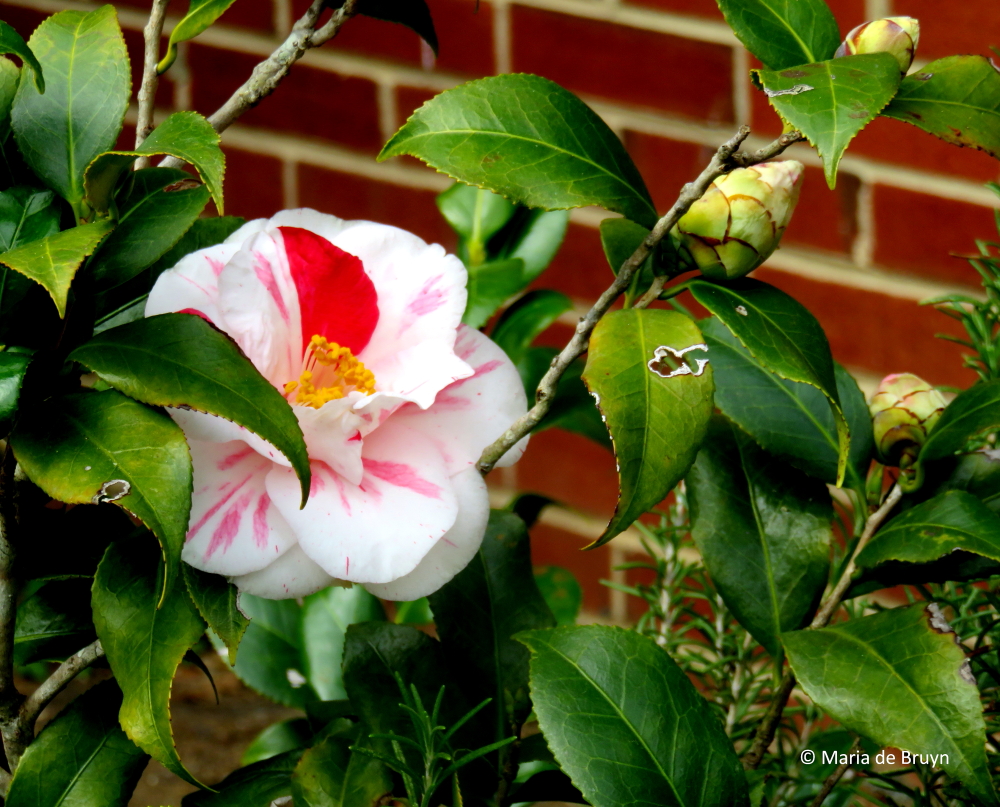
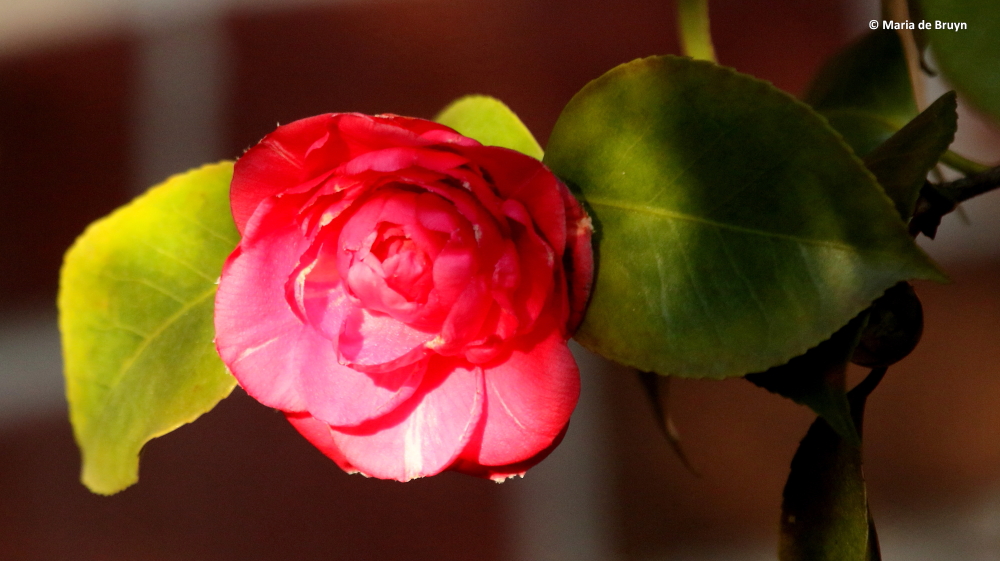
My camellias ( Camellia) bloomed in much greater profusion than ever before.

camellia-img_1816-maria-de-bruyn-res    camellia-i77a1922-maria-de-bruyn-res

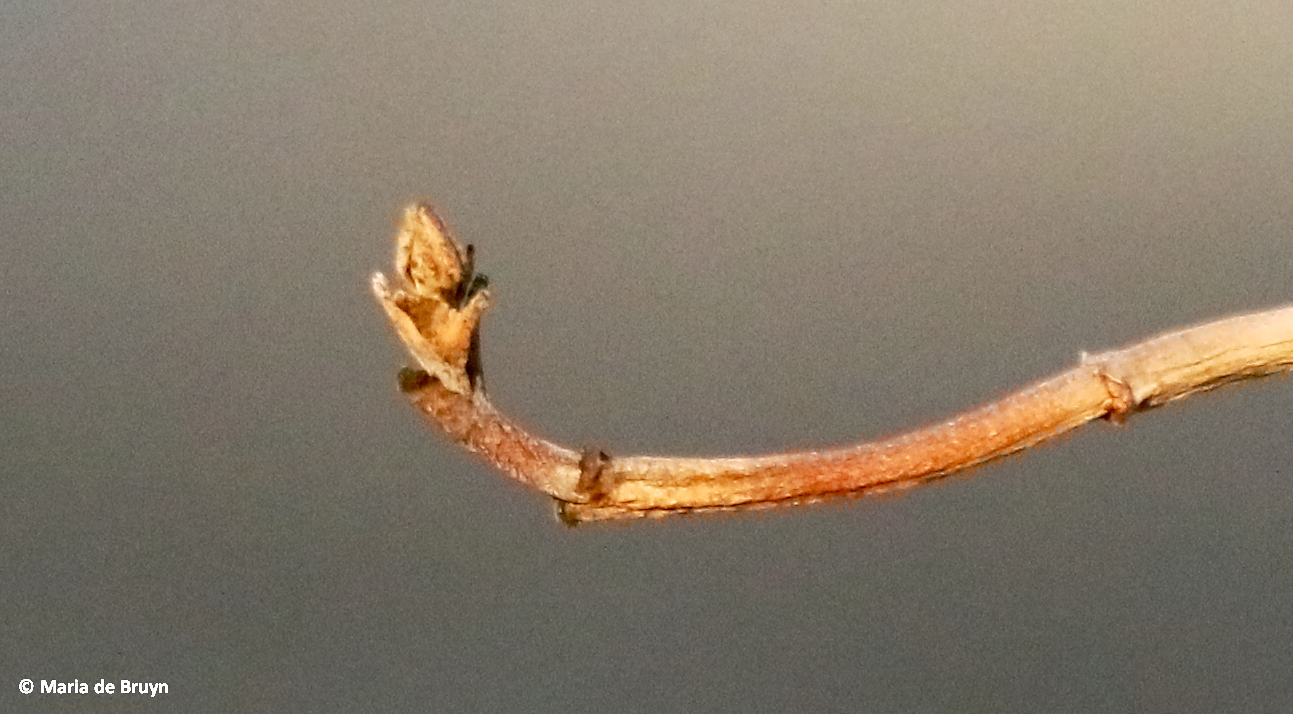
The shrubs and trees also sent out their buds weeks “ahead of schedule” – since the past month was the warmest recorded February in this area, my plants advanced their springtime blossoming, including the serviceberry (Amelanchier arborea), viburnums, dogwoods (Cornus kousa and Cornus florida) and common elderberry (Sambucus nigra).

serviceberry-i77a1965-maria-de-bruyn-res  tree-i77a1949-maria-de-bruyn-res

tree-i77a1963-maria-de-bruyn-res tree-i77a1950-maria-de-bruyn-res

My new blueberry bushes burgeoned with delicate little flowers, but the past two nights I had to cover them up so that they wouldn’t shrivel up as the temperatures dropped below freezing.

eastern-gray-squirrel-i77a0079-maria-de-bruyn-res


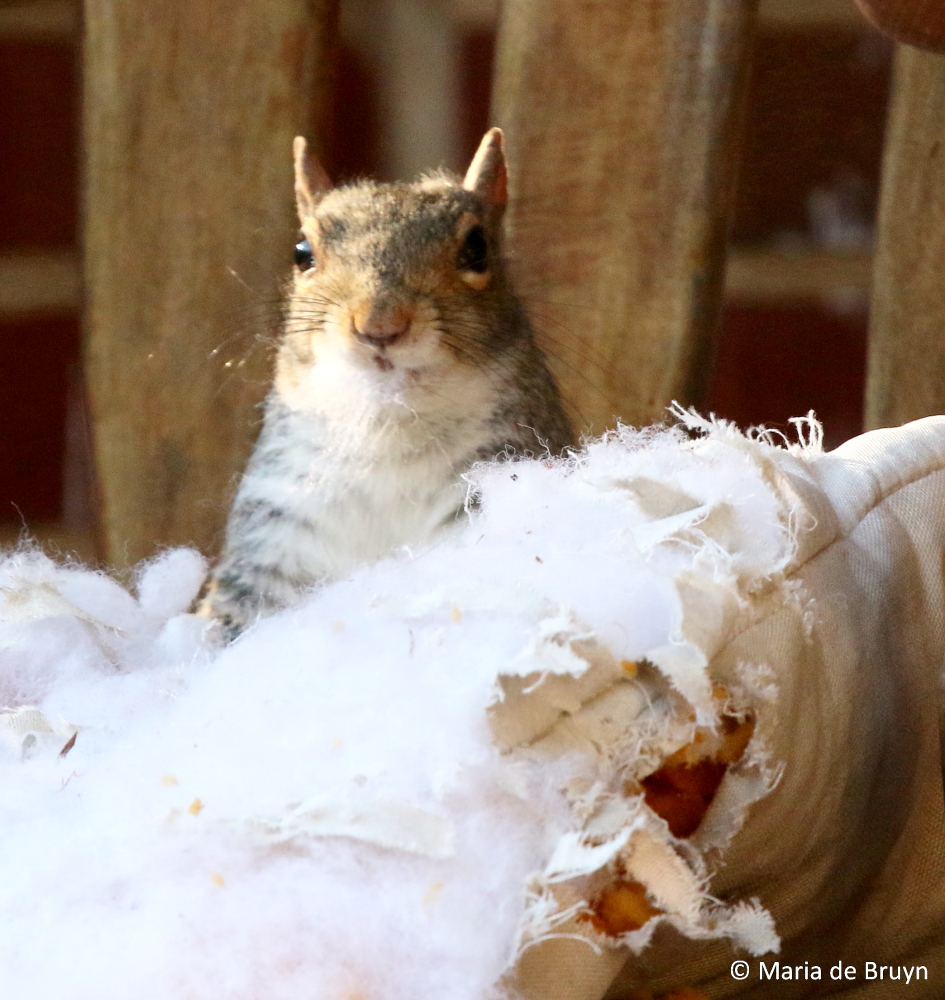
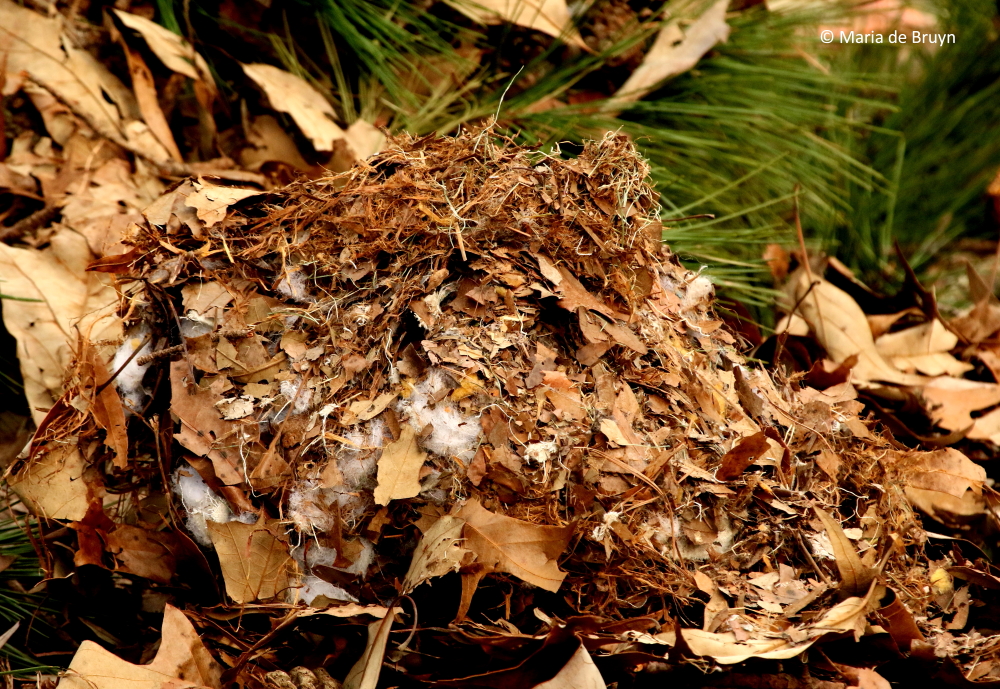
It wasn’t only the plant and bird life responding to the unusually changing season, though, as I discovered when I finally noticed the altered pillow on my front porch rocking chair. I first saw that the cloth covering the pillow had been torn; upon closer examination, I saw that the pillow had been opened up with its filling tufting up in places.


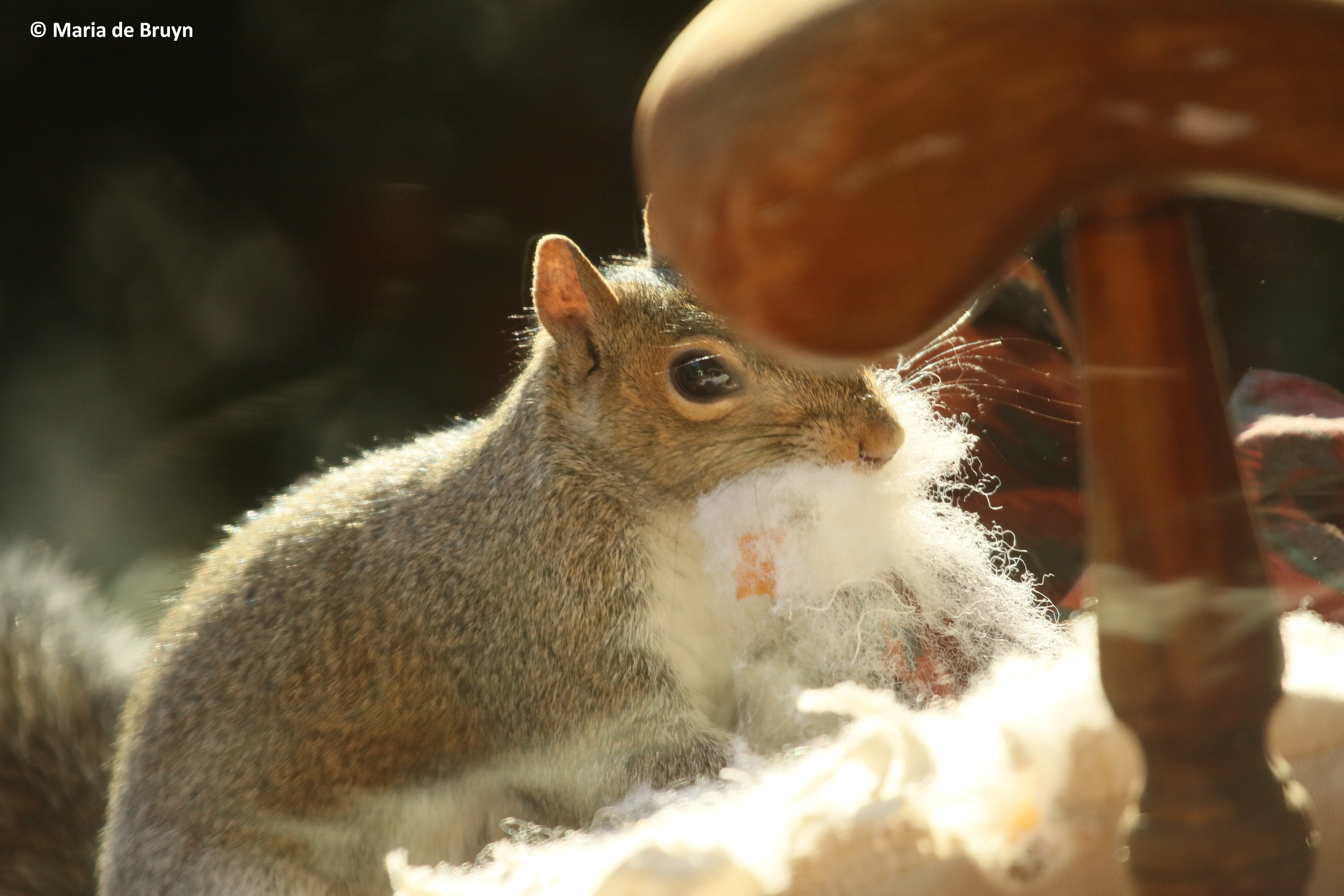
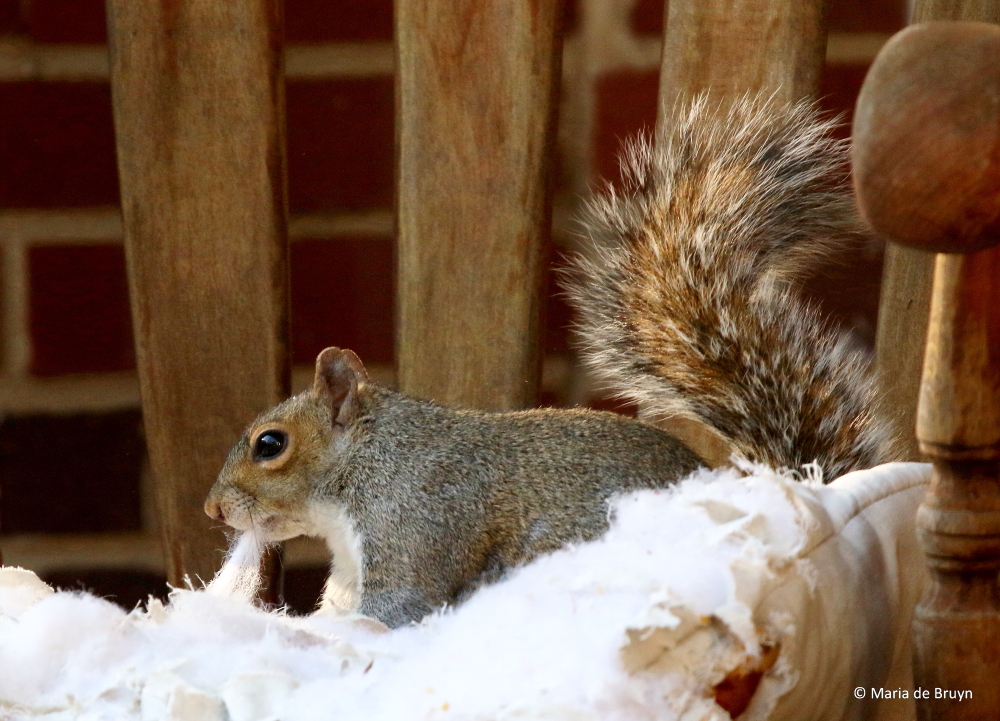
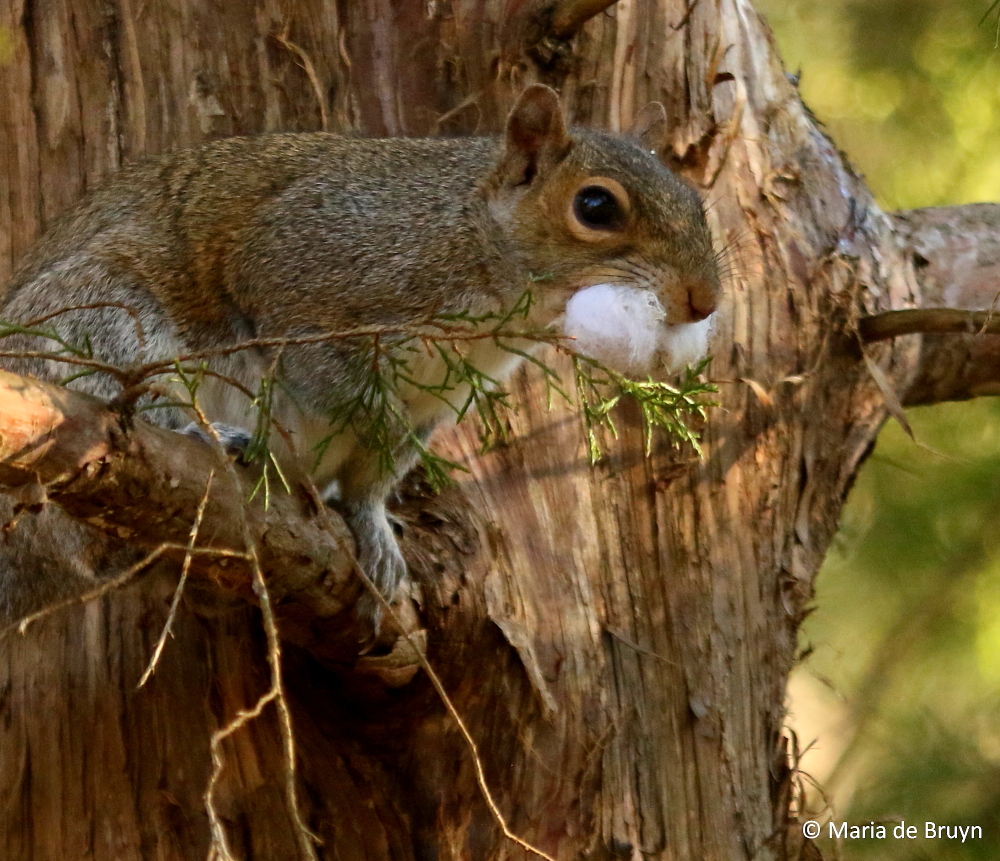
eastern-gray-squirrel-i77a0093-maria-de-bruyn-resWhen I began watching the rocker in addition to the bird feeders, I discovered the culprit – an industrious Eastern gray squirrel (Sciurus carolinensis), whom I named Sassy as she shows no fear, just a little caution.

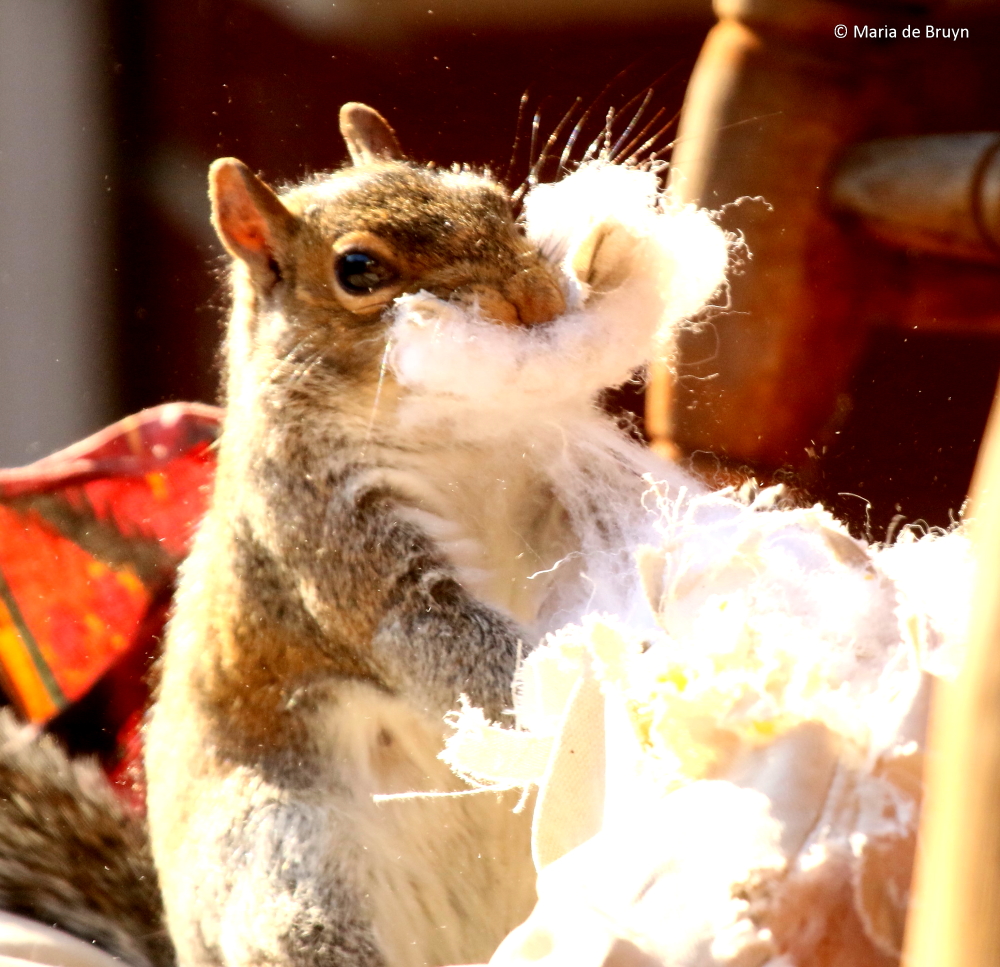
Sassy is quite bold, coming up onto the porch even when I’m seated there. She keeps an eye on me but goes about her business in a calm and confident mood. This was also the case for her nest building activities. She perched on the pillow and used her teeth to tear out the insides.

eastern-gray-squirrel-i77a9708-maria-de-bruyn  eastern-gray-squirrel-i77a0073-maria-de-bruyn-res

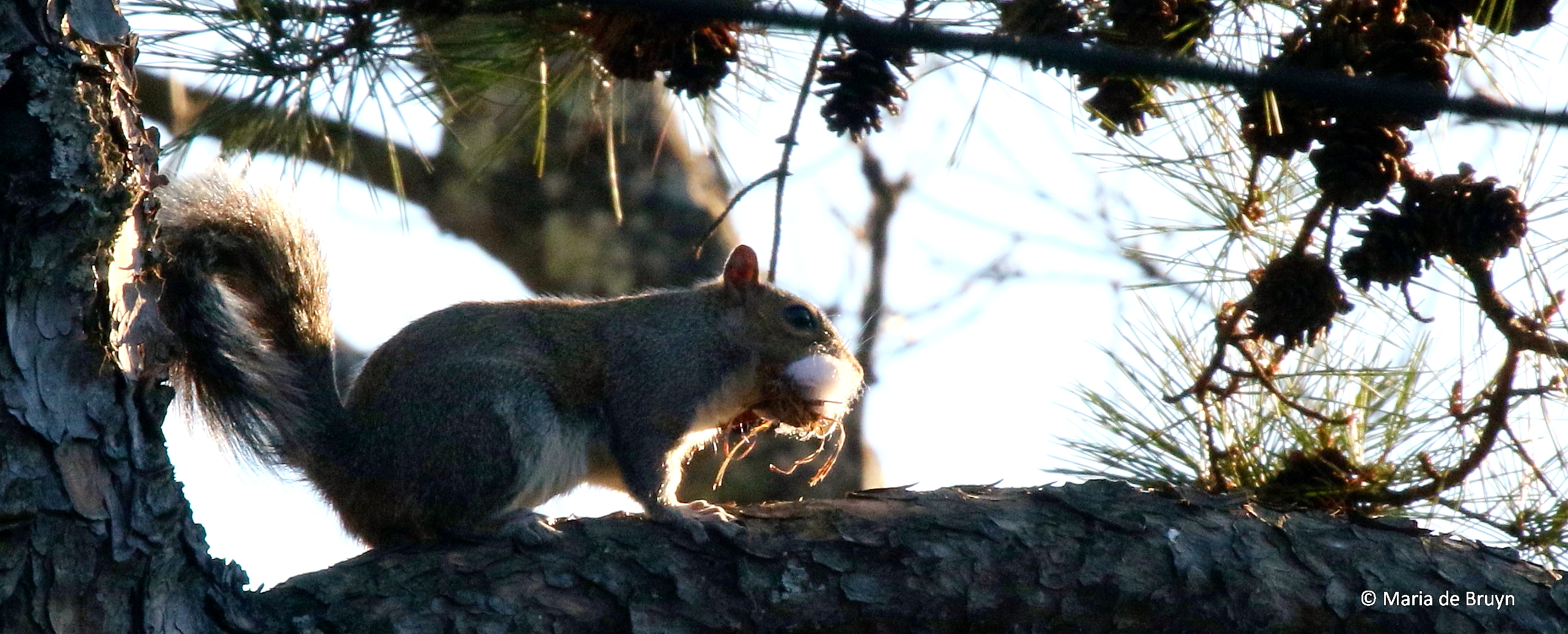
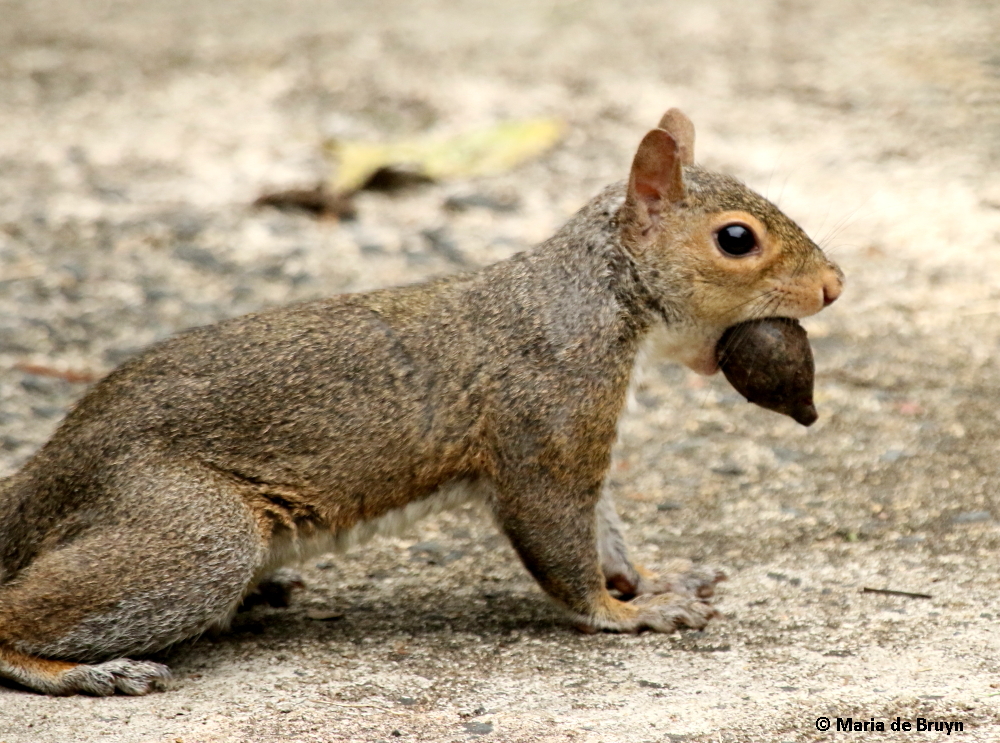
She then manipulated the tufts with her paws and teeth to form them into neat little oblong packages that she could easily transport in her mouth.

eastern-gray-squirrel-i77a9795-maria-de-bruyn-res eastern-gray-squirrel-i77a9796-maria-de-bruyn-res

eastern-gray-squirrel-i77a9801-maria-de-bruyn-res eastern-gray-squirrel-i77a9802-maria-de-bruyn-res

Sometimes, she added some dried leaves to the mixture.

eastern-gray-squirrel-i77a1995-maria-de-bruyn-res

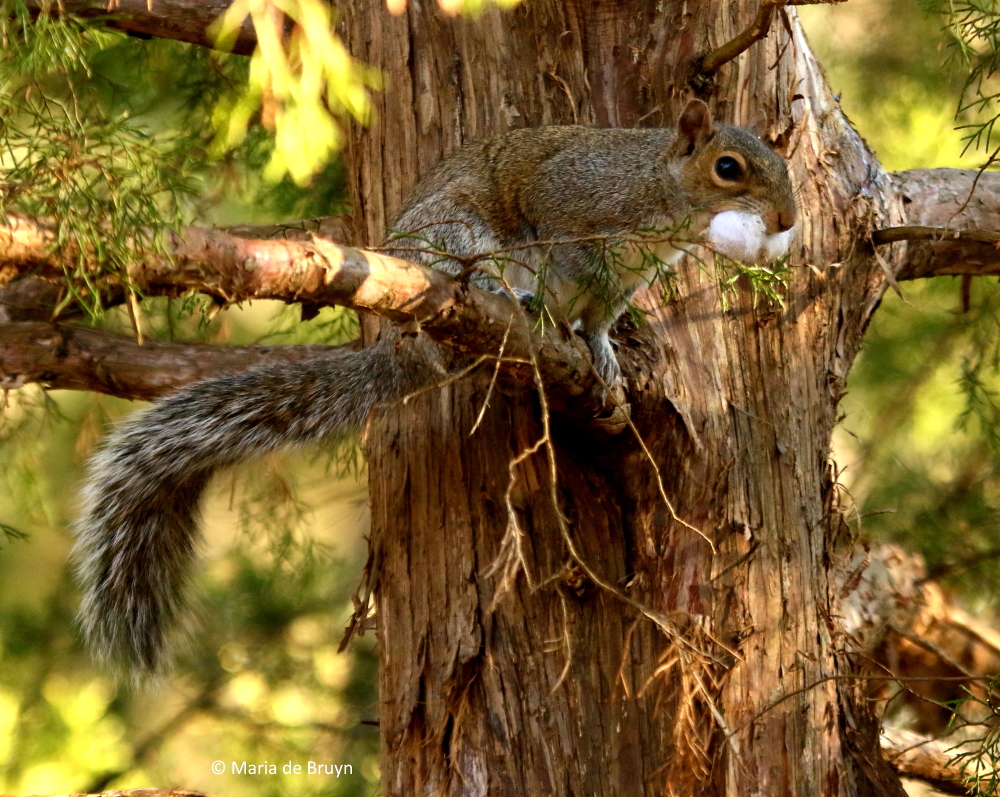
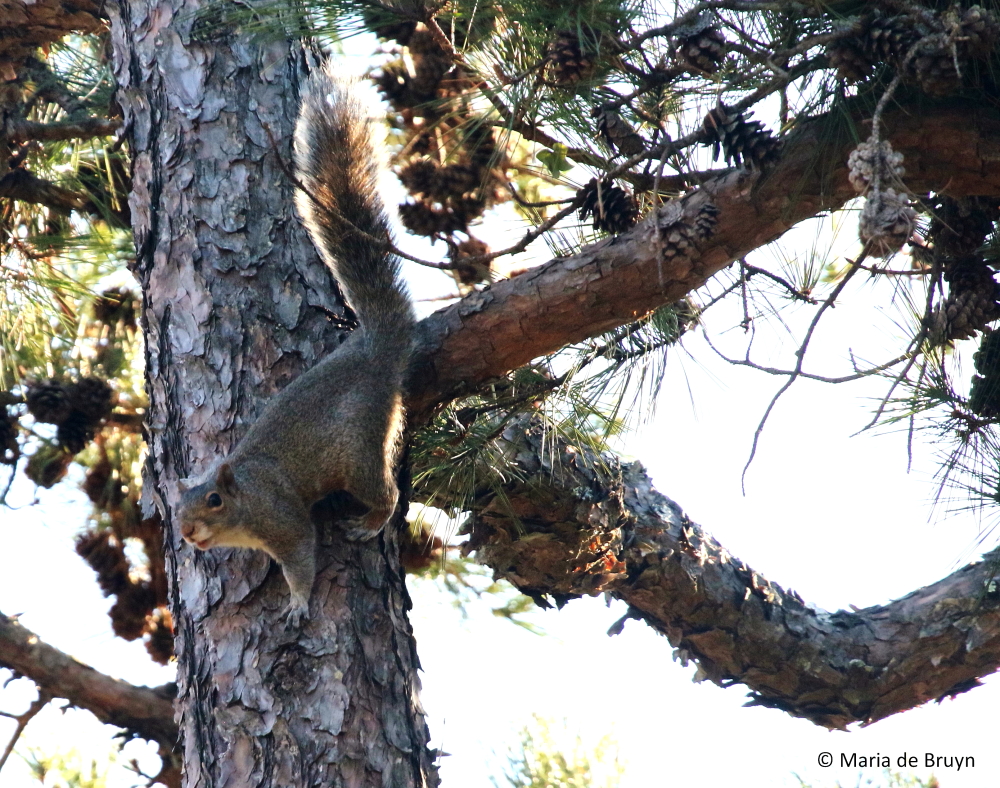
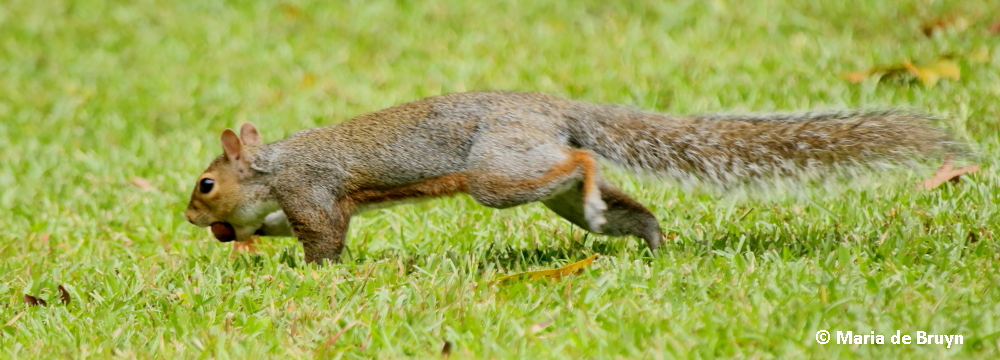
When her mouth was filled with enough material, she left to transport it to the nest that she was constructing – as it turned out, high in a loblolly pine (Pinus taeda) in a neighbor’s front yard. As I followed behind her, she stayed aware of my movements.

eastern-gray-squirrel-i77a0107-maria-de-bruyn-reseastern-gray-squirrel-i77a0108-maria-de-bruyn-res

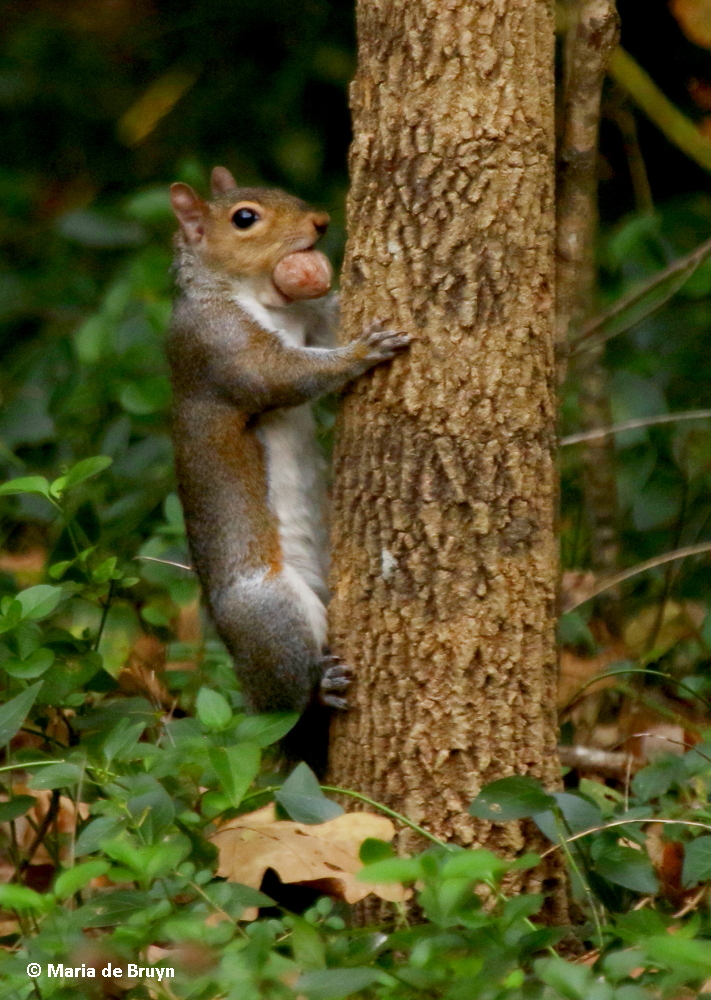
Then she crossed the street and scurried up the tree, where she deposited her “mattress stuffing” among the leaves and other materials lining the nest.

eastern-gray-squirrel-i77a0125-maria-de-bruyn-res  eastern-gray-squirrel-i77a0139-maria-de-bruyn

Since Sassy was so very industrious and the pillow was no longer salvageable, I left it out for her. She returned for several days, systematically dismantling her found source of nest material and carrying off her little woolly trophies.

eastern-gray-squirrel-i77a0099-maria-de-bruyn-res eastern-gray-squirrel-i77a0093-maria-de-bruyn-res

When the stuffing began to disperse with the wind, I finally gathered it up and threw out what was left, figuring she had had plenty of manmade contributions to her home.

eastern-gray-squirrel-i77a0142-maria-de-bruyn-res eastern-gray-squirrel-i77a9817-maria-de-bruyn-res

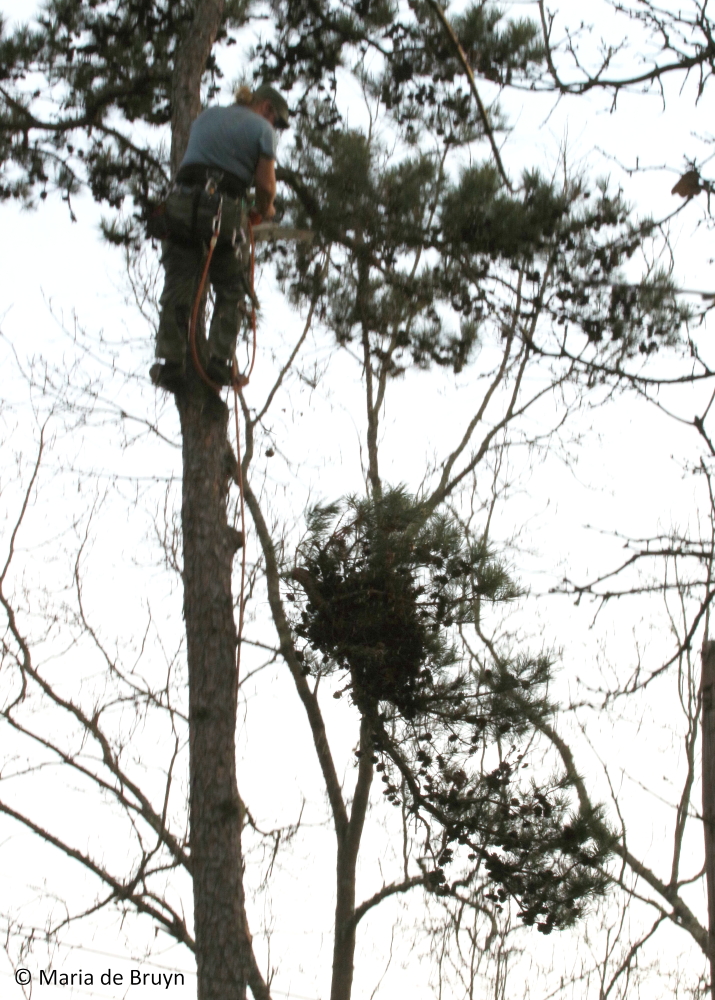
Then a couple days later, I was dismayed on her behalf to see that the new neighbors had decided to remove the tree where her nest was located. The landscapers said Sassy’s nest was not a factor in their decision; they just thought the tree was in the way. I watched with sadness as Sassy’s tree was dismantled and her nest plunged to the ground.

squirrel-nest-i77a9820-maria-de-bruyn-res  squirrel-nest-i77a2239-maria-de-bruyn-res

squirrel-nest-i77a2248-maria-de-bruyn-res

I didn’t see where Sassy was during this event but am sure she was watching from some other vantage point. I felt badly for her – all her innovative and dedicated work was destroyed. Of course, people lose their homes, too, to flooding, fires, tornadoes, etc.  and that is horrible. But I still regretted that this hard-working mammal had lost her home as well.

I presume Sassy has been building a new nest elsewhere. And given her boldness, I’m fairly certain that she was the squirrel I saw yesterday afternoon who had decided that she likes dried mealworms.

eastern-gray-squirrel-img_1911-maria-de-bruyn-res

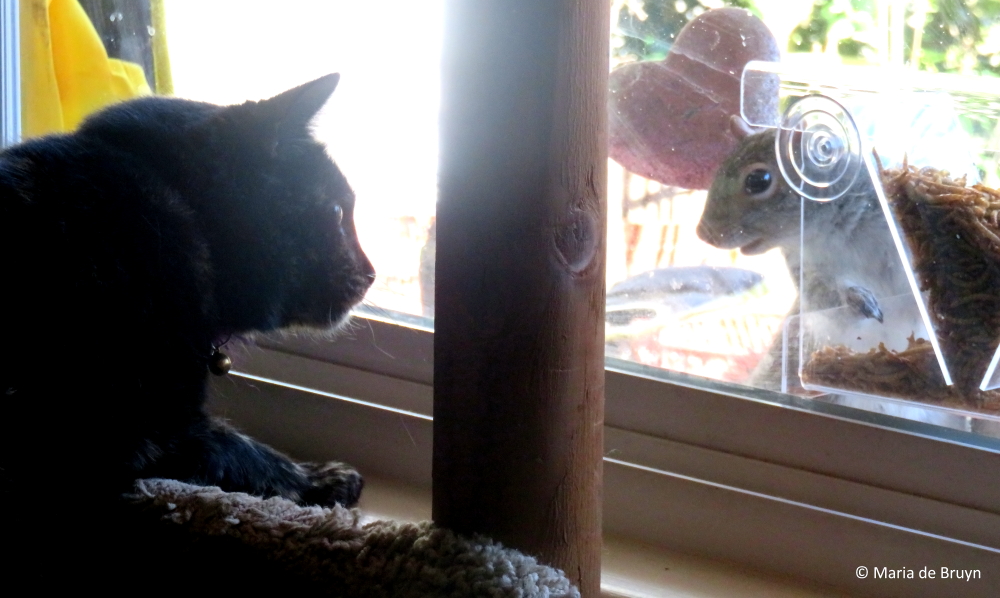
As my feline companion Moasi watched from her cat tree perch in the living room, Sassy was busy on the other side of the window chowing down on the worms in a new window feeder that I had actually bought for the Carolina wrens and chickadees, who often perch on the chair in front of the window.

eastern-gray-squirrel-img_1920-maria-de-bruyn-res

flower-i77a3037maria-de-bruyn-res


Sassy didn’t seem to mind Moasi watching her and she wasn’t fazed when I approached either. It was only when I knocked on the window that she finally descended to the porch and then left for the yard. I like to think that Sassy has made a new home and is now busy getting extra nutrition for the babies to come. And spring continues to unfold with temperatures varying from 24 to 70 degrees and above!

Outwitting the starlings during Winter Storm Helena

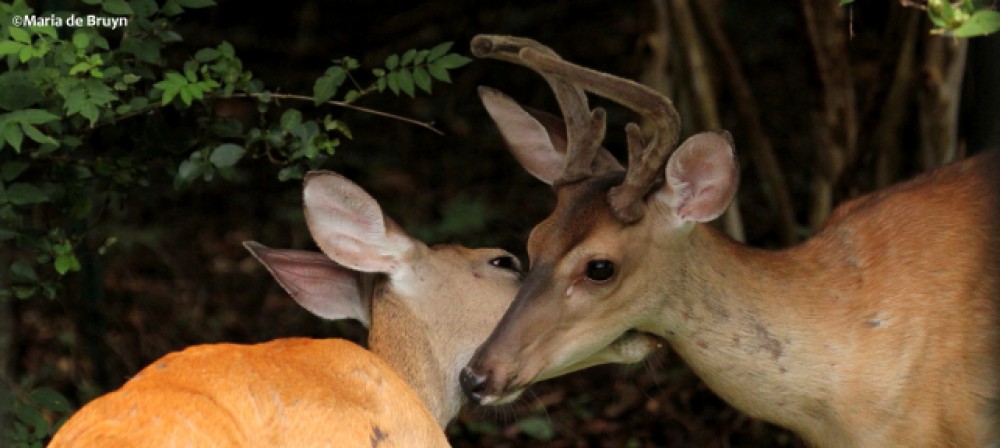
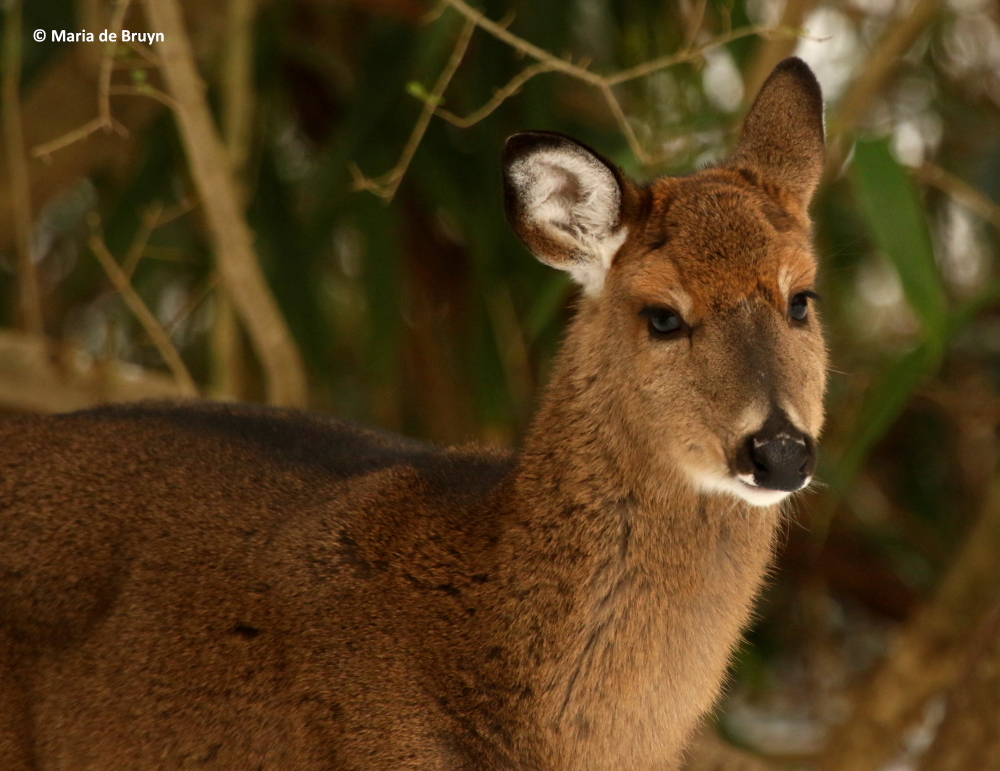
white-tailed-deer-i77a4029-maria-de-bruyn-resSo this past weekend, our part of North Carolina dealt with Winter Storm Helena, which brought us 83 straight hours of below-freezing temperatures (e.g., -9C/15F but we had lower) and a need to bundle up really well if venturing outside. (It also brought me a realization that winter storms are being named like hurricanes.) The first morning, when I went out to fill the bird feeders, I didn’t put on gloves or a cap and dealt with hypothermia symptoms when I finally went inside. I had on triple layers after that! The deer had their fur puffed up and seemed to be coping well.

The frigid air made me feel very sorry for the wildlife, although living outdoors is, of course, what they do and what they have evolved to accommodate. (I did hear today, however, of some birds and small animals that were found frozen to death!) With the snow covering the ground, it turned out the birds were more than happy to visit the feeders and piles of food I had strewn on the snow for the ground feeders.

yellow-rumped-warbler-i77a4305-maria-de-bruyn-res

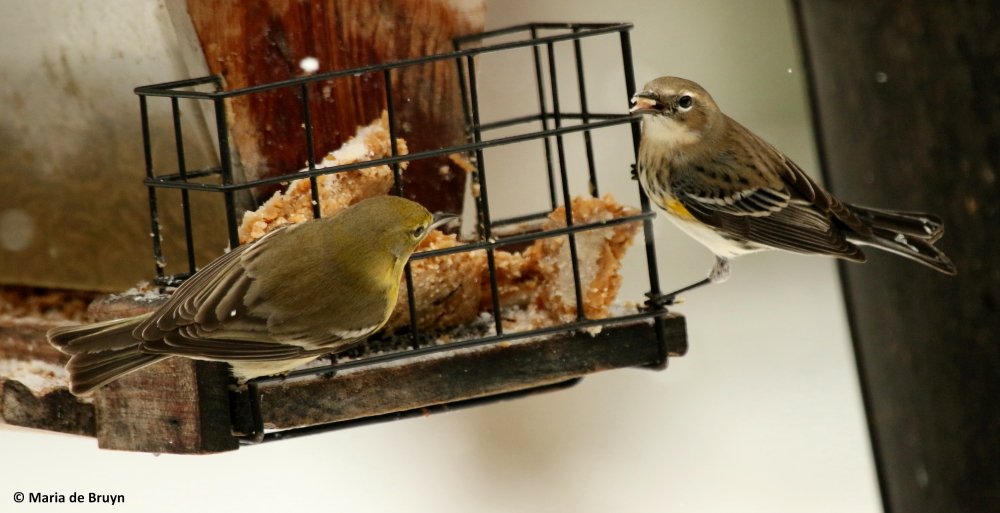
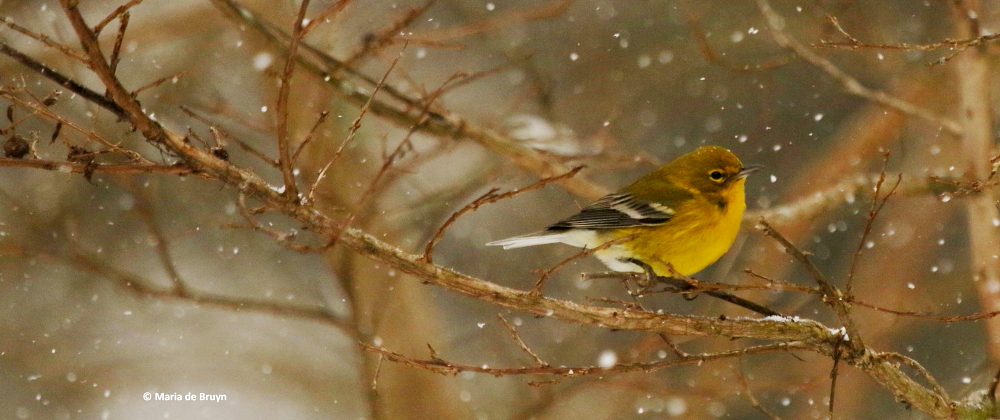
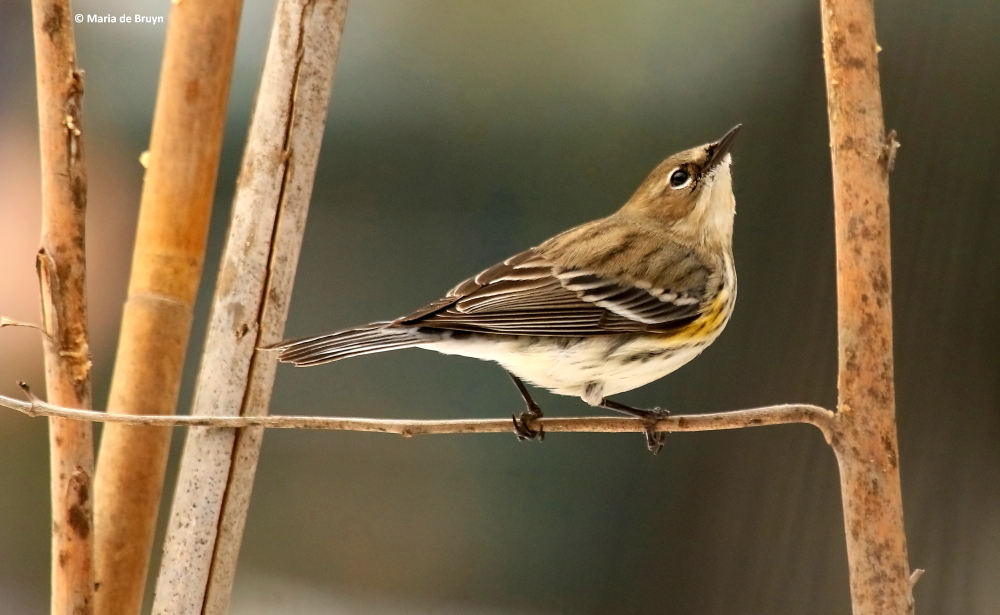
Not only did I have many types of birds coming round, but also record numbers of them. Some birds, like the yellow-rumped warblers (Setophaga coronata, above), usually tend to visit on their own and are not happy with their species mates in the vicinity but during these days, I had four of them alighting near feeders at a time. The same was true for the colorful pine warblers (Setophaga pinus) although they didn’t come close to each other.

yellow-rumped-warbler-i77a3138-maria-de-bruyn-res

pine-warbler-i77a2441-maria-de-bruyn-res

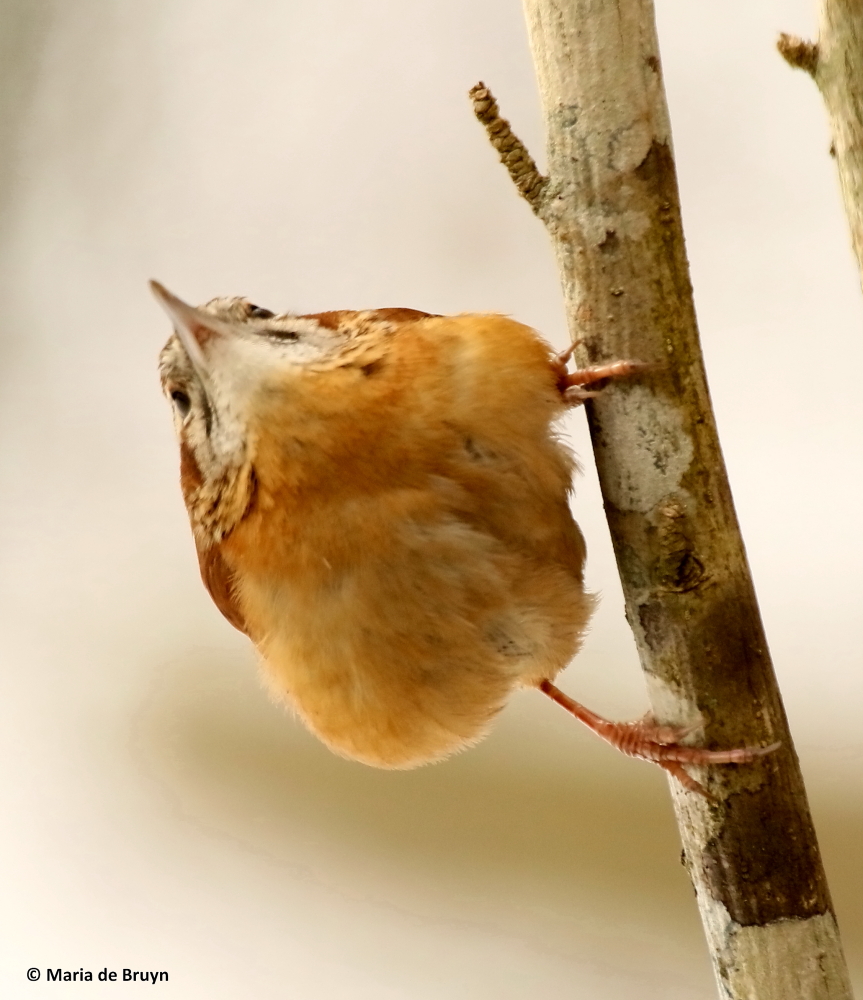
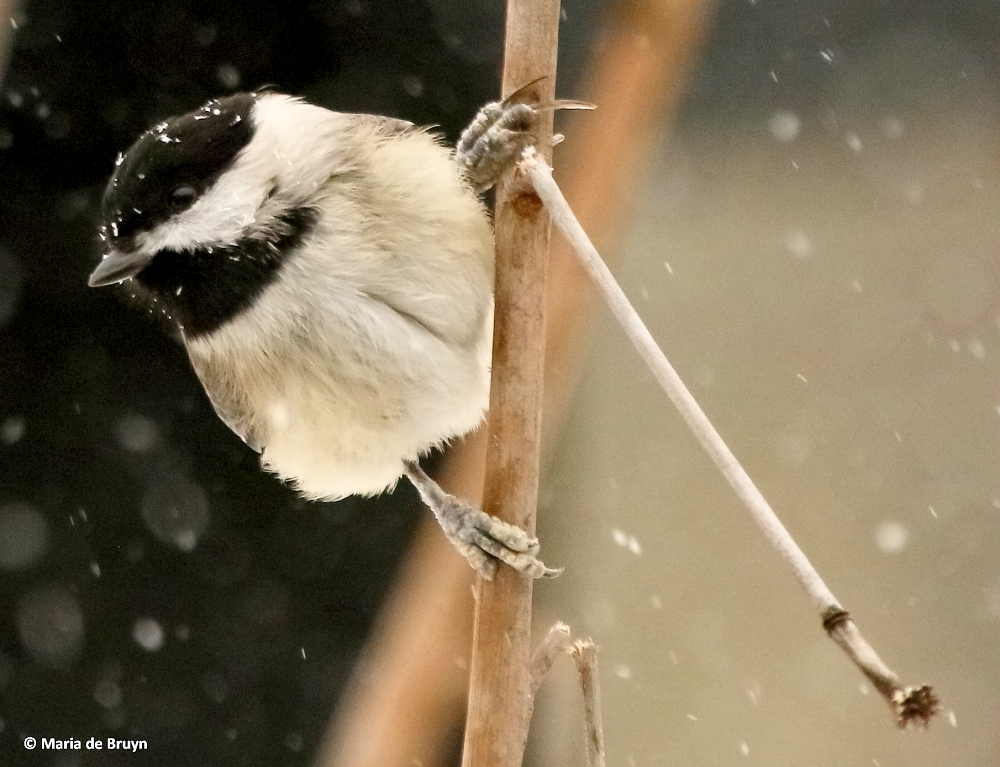
The Carolina wrens (Thryothorus ludovicianus) and Carolina chickadees (Poecile carolinensis) don’t seem to have too many problems with sharing space and visited the feeders in the same way they always do – quick flights to and fro from nearby tree and shrub branches.

carolina-wren-i77a3873-maria-de-bruyn-res   carolina-chickadee-i77a2710-maria-de-bruyn-res

brown-thrasher-i77a4236-maria-de-bruyn-res


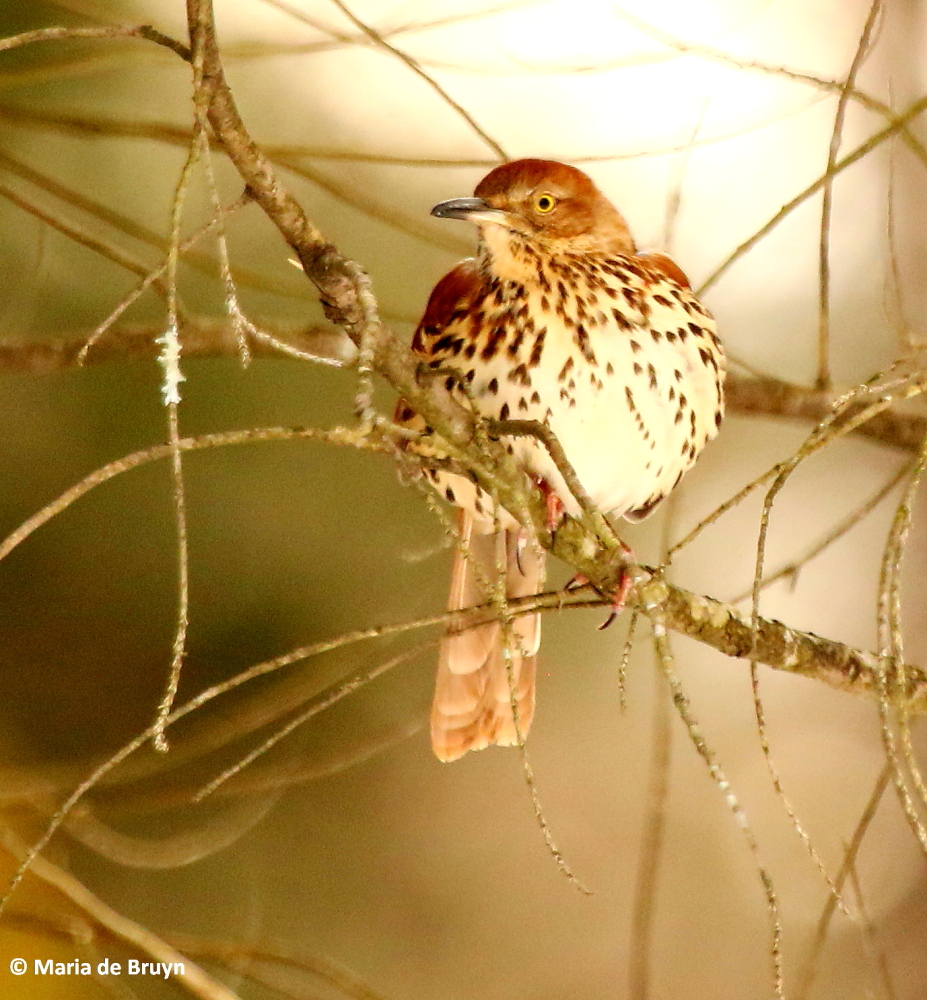
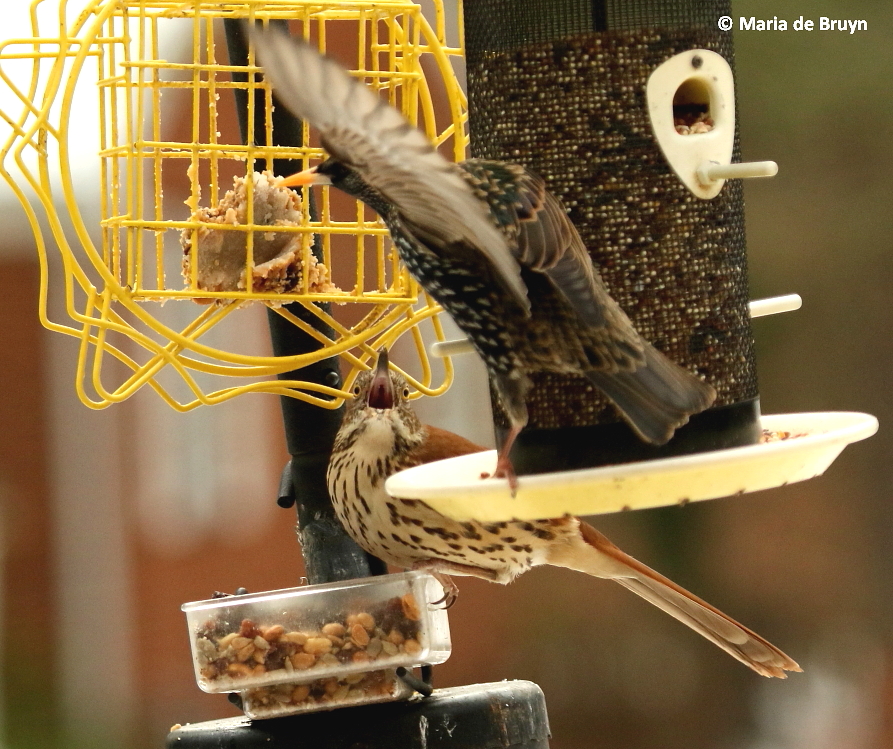
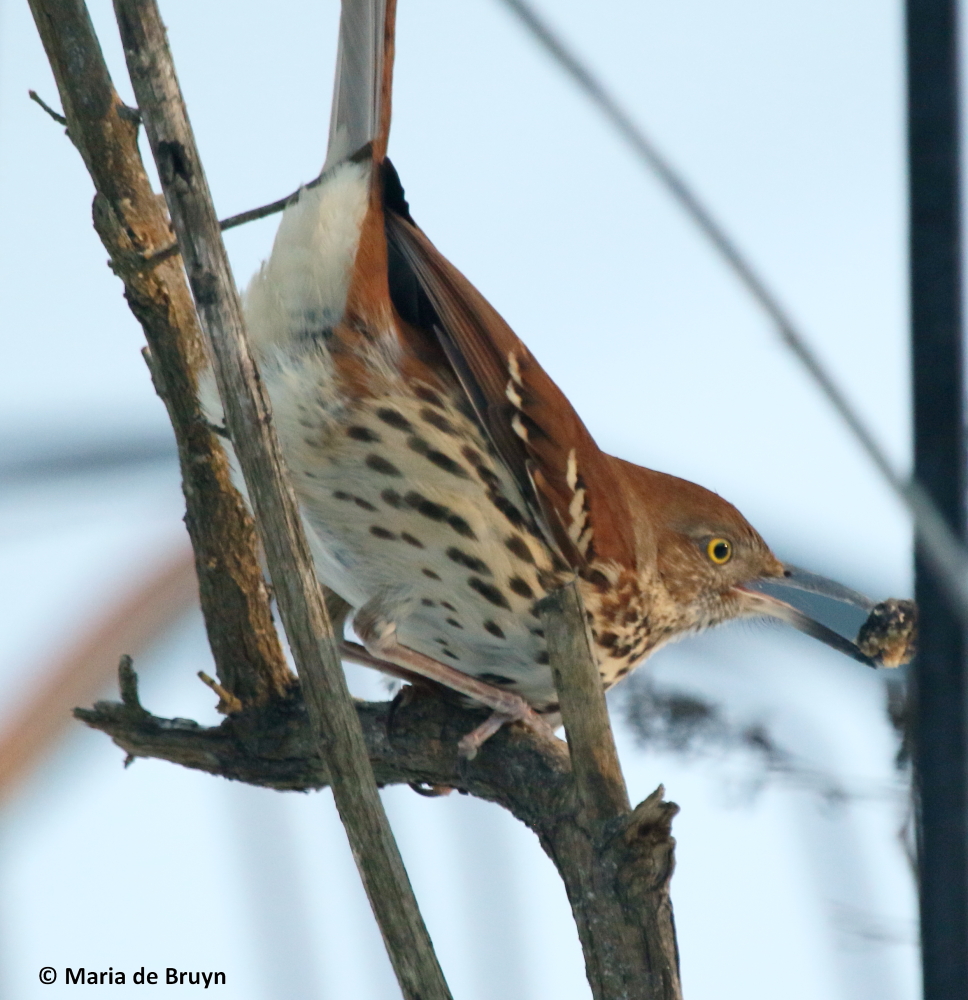
Most of the birds were fairly content to be in close proximity to one another during the snow days. The brown thrashers (Toxostoma rufum) did get very cross with one another, however, when they came too close to one another and chased their rivals away.

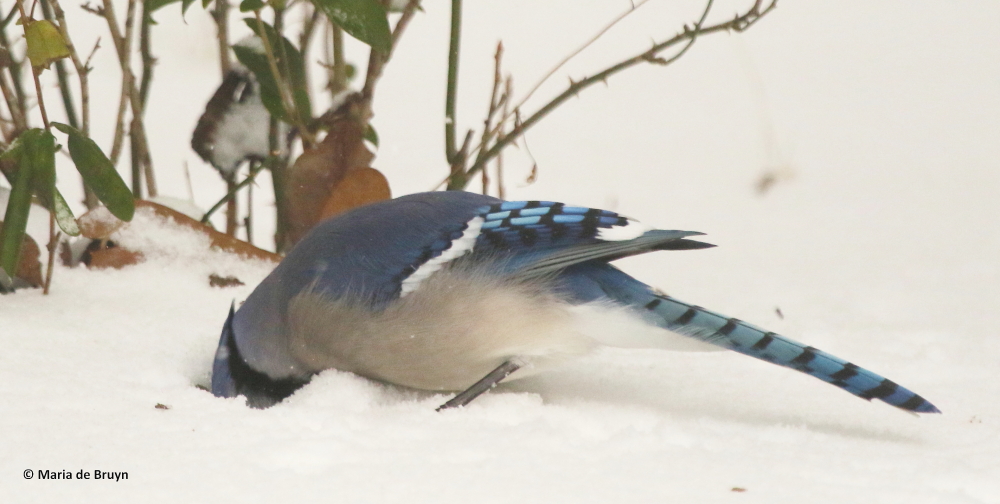
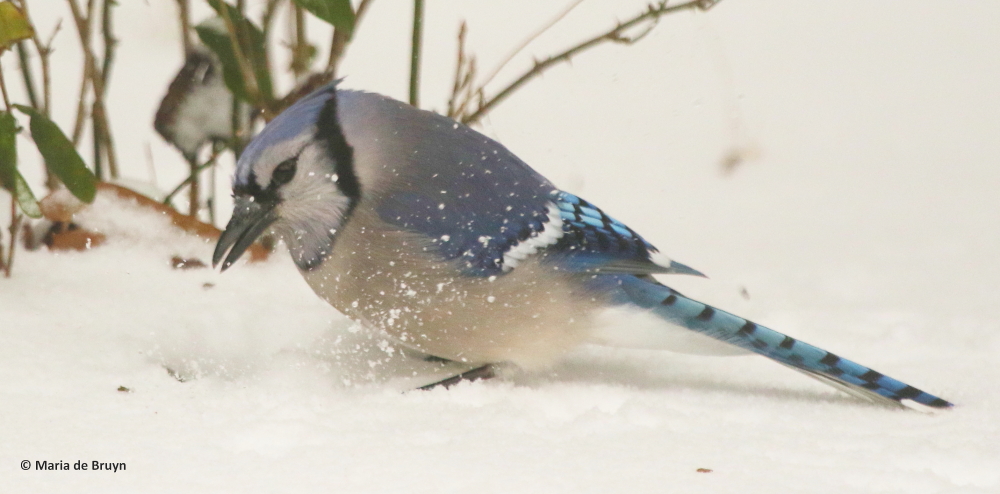
Sometimes a bird would go off and rummage in the snow, like this blue jay (Cyanocitta cristata).


blue-jay-i77a2776-maria-de-bruyn-res blue-jay-i77a2770-maria-de-bruyn-res

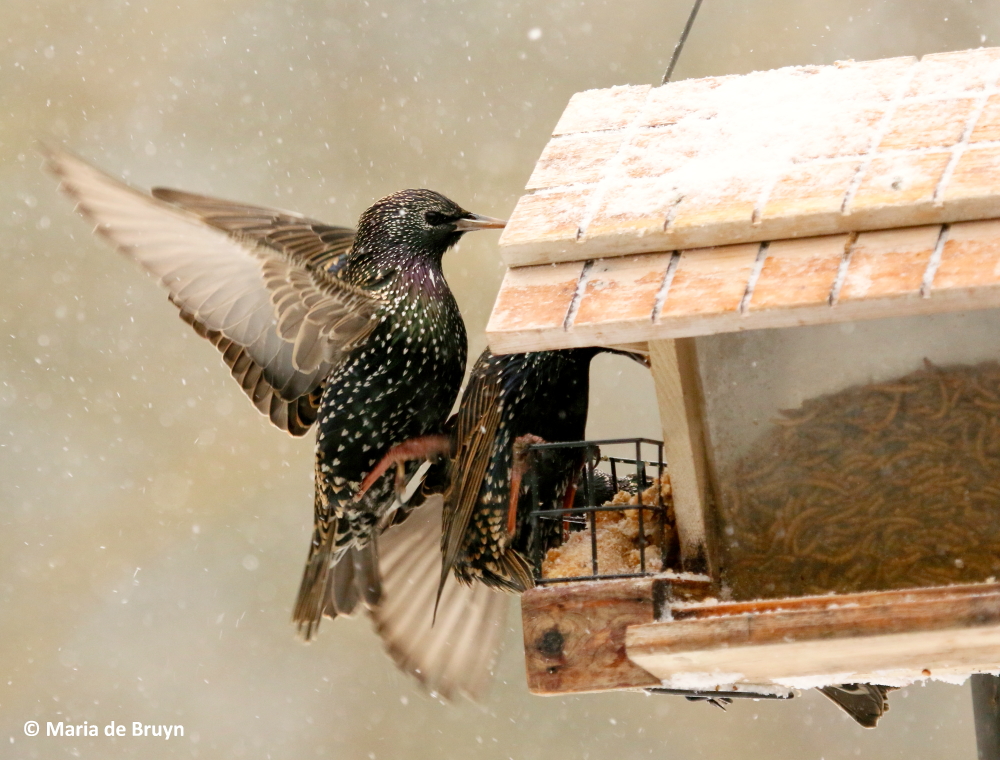
european-starling-i77a2674-maria-de-bruyn-resThe biggest challenge for me was keeping the suet and meal worms in supply, mainly because the European starlings (Sturnus vulgaris) show up in large groups and gulp down food at a speedy pace. The other birds nibble but the starlings seem to inhale food as if they have vacuum cleaners in their throats. They can get grumpy with one another and don’t mind landing atop each other to get a foothold on the feeder.

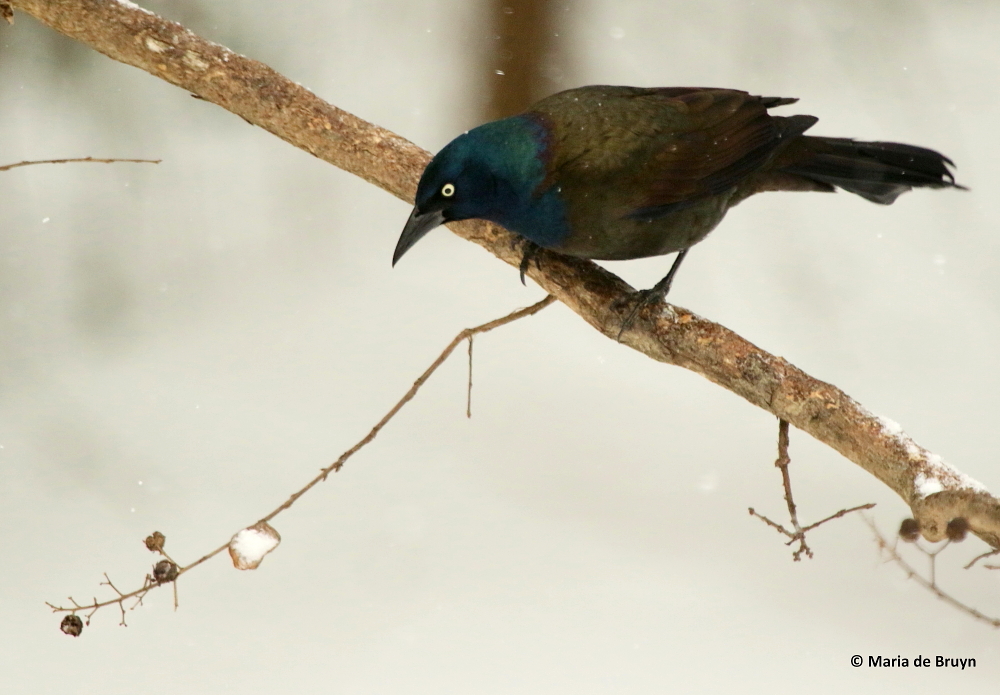
brown-thrasher-i77a3641-maria-de-bruyn-resI was pleased that the other species of birds are learning to cope with them, no longer being intimidated to fly away when these greedy avians arrive. However, they may get displaced from a feeder just because the bulky starlings take up so much room and never wait their turn to get a spot. The larger birds, like the thrashers and red-bellied woodpeckers, may express their displeasure to the starlings while trying to hold their ground. Other people report common grackles (Quiscalus quiscula) as feeder dominant birds but they are well behaved at my house.

common-grackle-i77a3068-maria-de-bruyn-res

suet-i77a3541-maria-de-bruyn-res

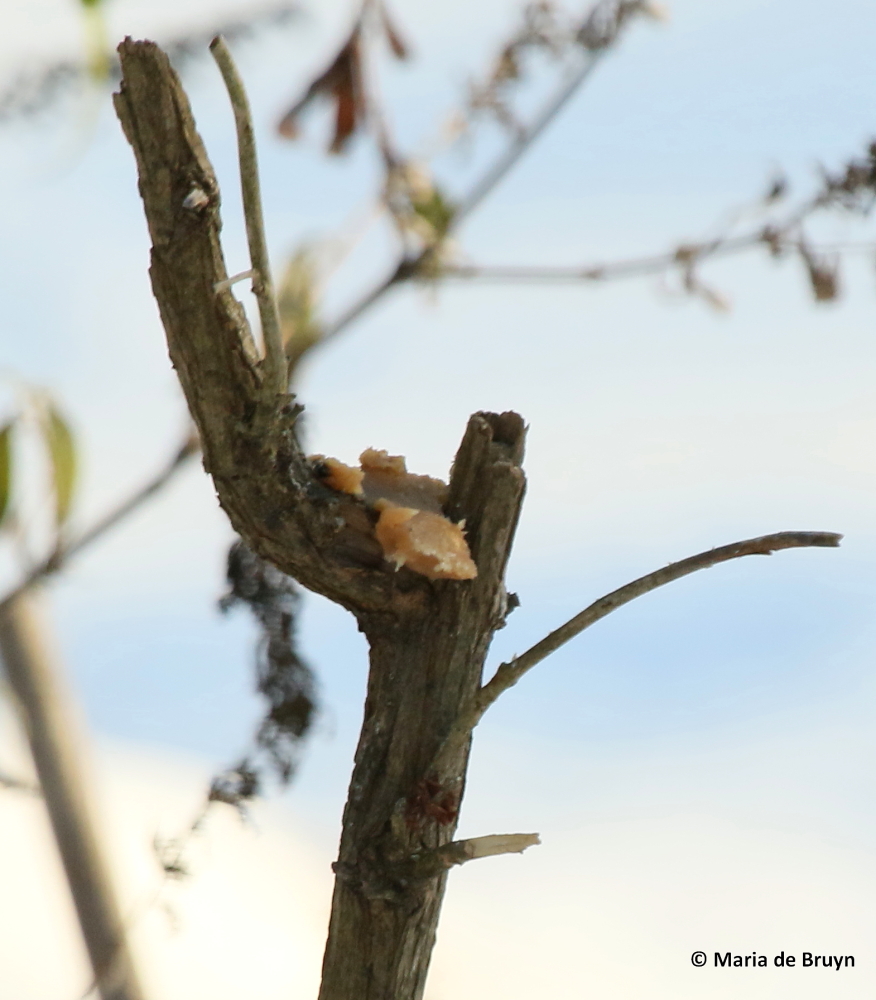
So, what was I going to do? Some of my feeders are set in a flower garden and I had left the dried stalks of sage, butterfly bush and scarlet mallow standing. They don’t look pretty but the birds love sitting on them near the feeders as they digest a bite before getting another. So I began smearing suet on the stalks, which are not sturdy enough to hold the starlings.

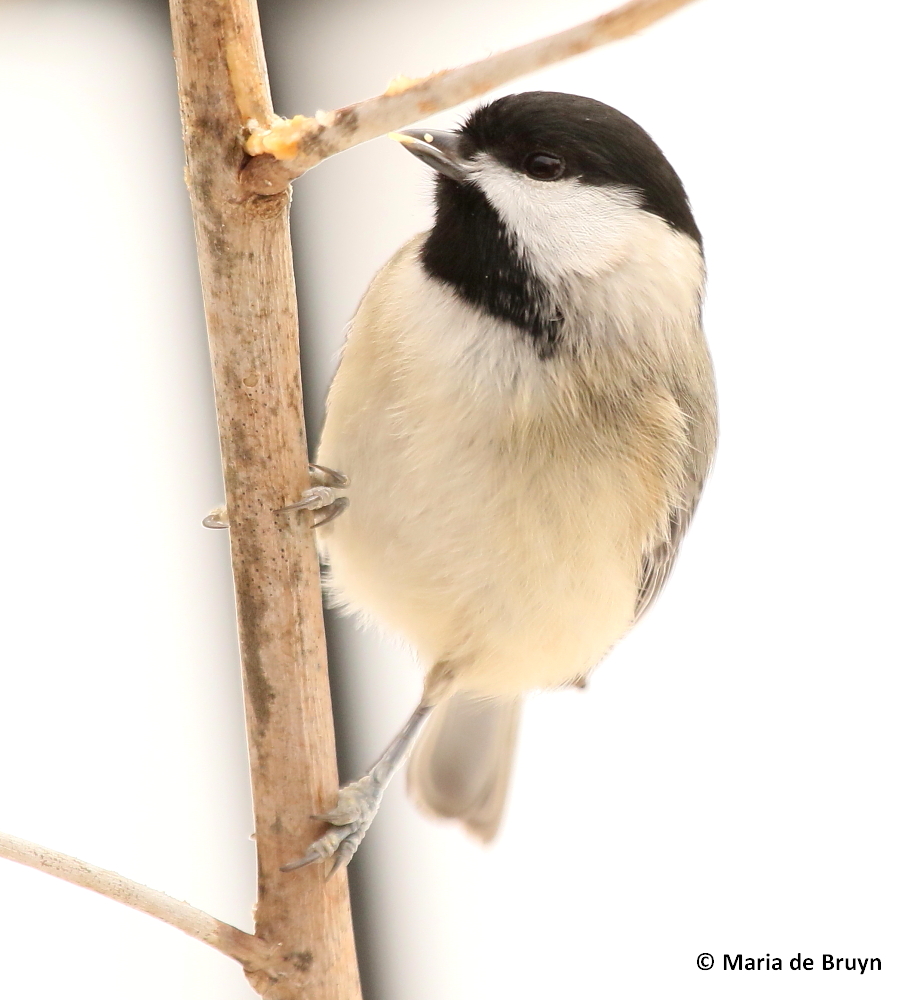
The yellow-rumped warblers and chickadees were pleased, as was my faithful ruby-crowned kinglet (Regulus calendula) and the Carolina chickadee.

yellow-rumped-warbler-i77a3913-maria-de-bruyn-res  carolina-chickadee-i77a4283-maria-de-bruyn-res

ruby-crowned-kinglet-i77a4167-maria-de-bruyn-res

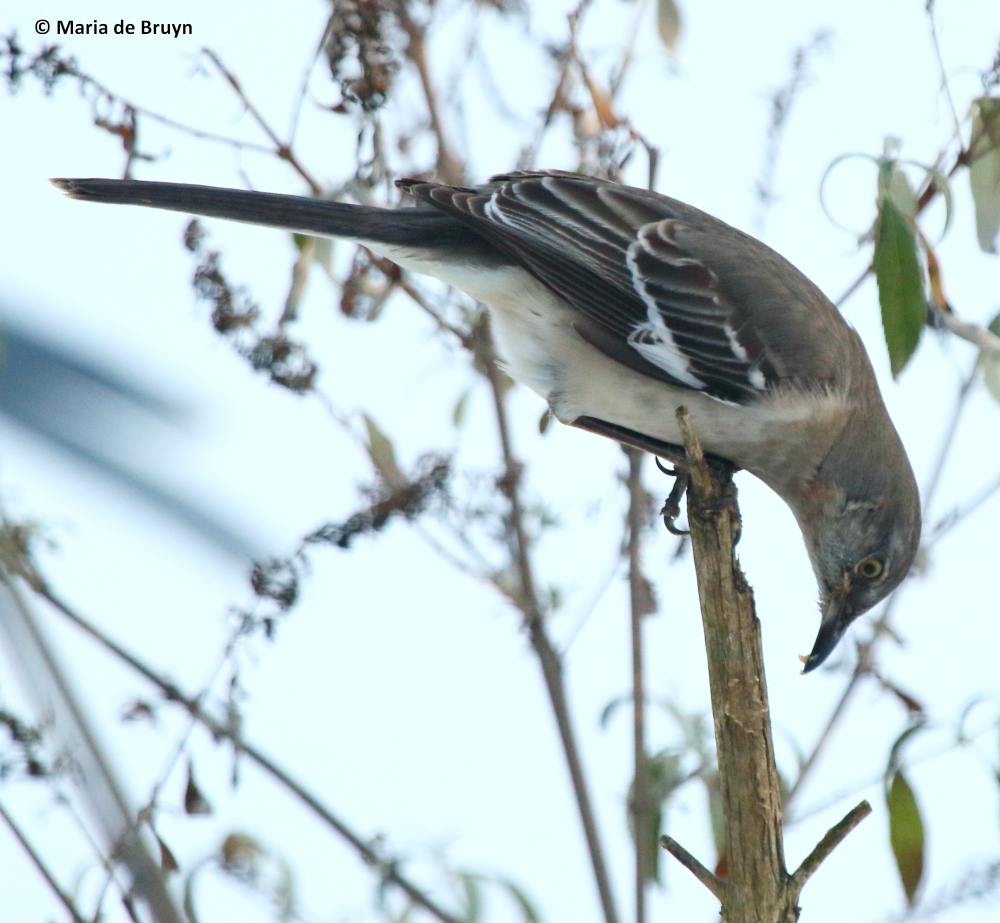
To my surprise, even the larger Northern mockingbird (Mimus polyglottos) and brown thrashers discovered and sampled the suet-laden stalks.

northern-mockingbird-i77a3629-maria-de-bruyn-res   brown-thrasher-i77a3607-maria-de-bruyn-res

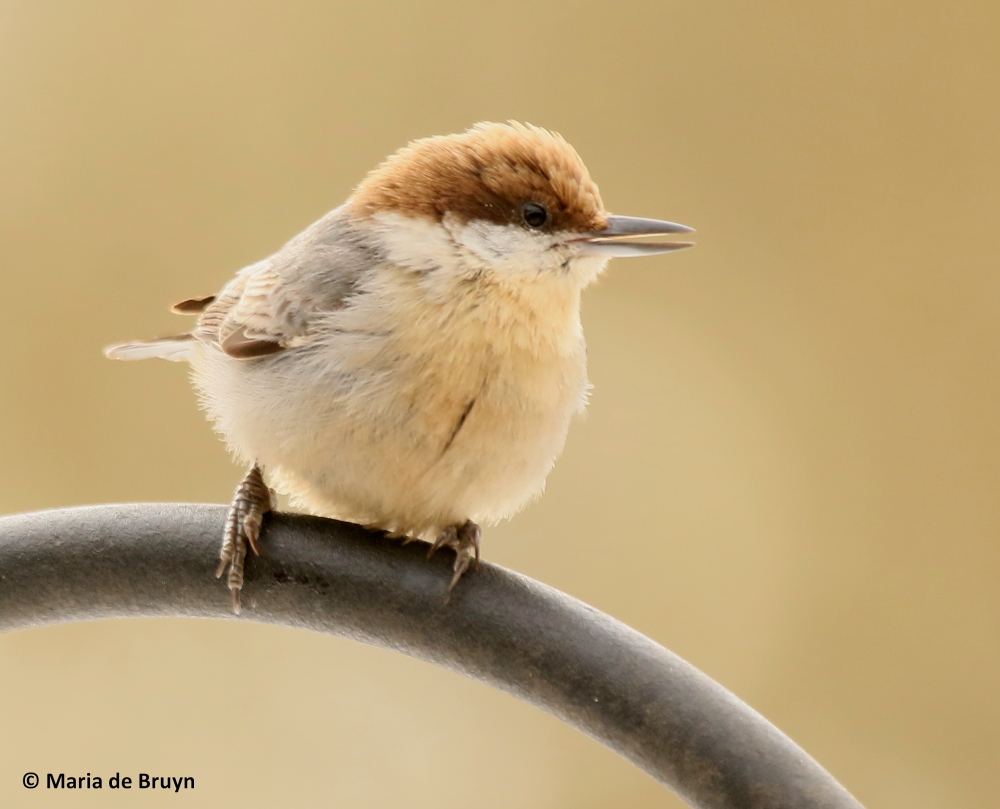
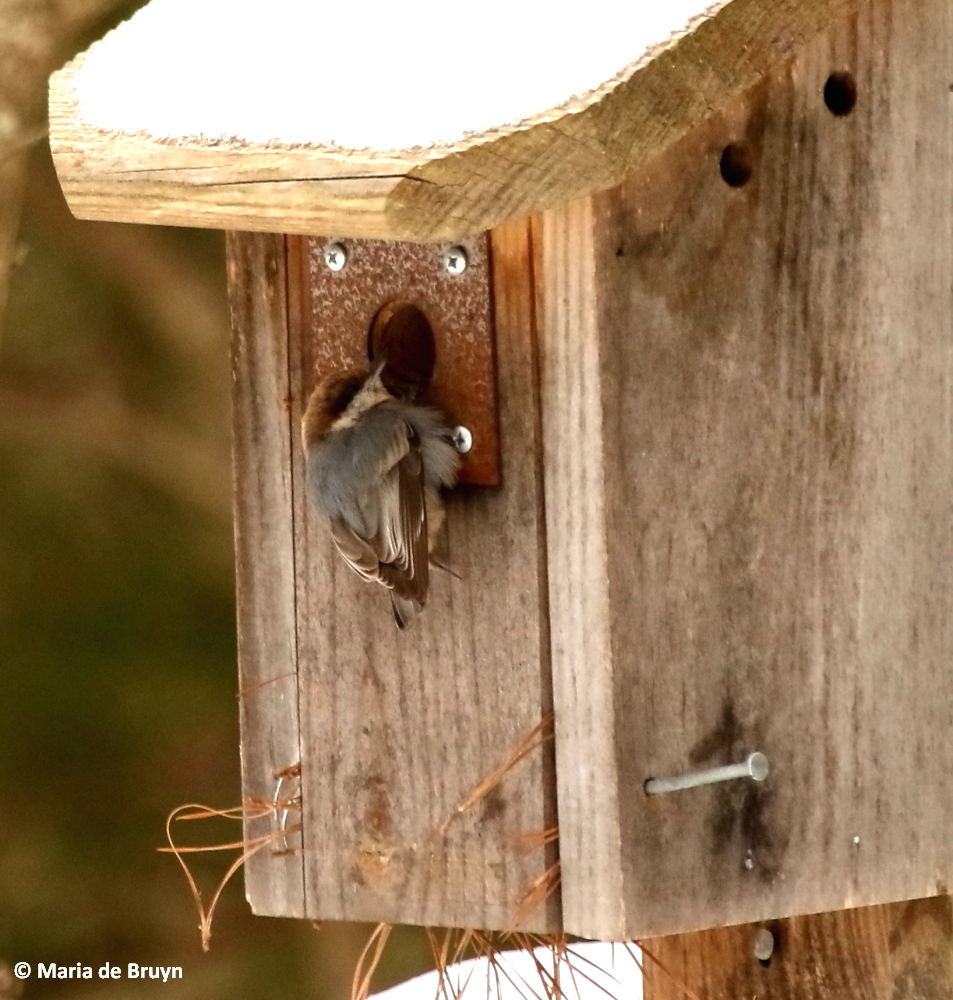
Following advice from the Bird Sleuth program, I had stuffed the bluebird and nuthatch boxes with pine needles and wool in case the birds wanted to shelter there overnight. I don’t know if any of them did, but the brown-headed nuthatches (Sitta pusilla) were again checking out their preferred nest box, so perhaps they did roost there overnight.

brown-headed-nuthatch-i77a3959-maria-de-bruyn-res    brown-headed-nuthatch-i77a4183-maria-de-bruyn-res

heated-fountain-i77a3586-maria-de-bruyn-res


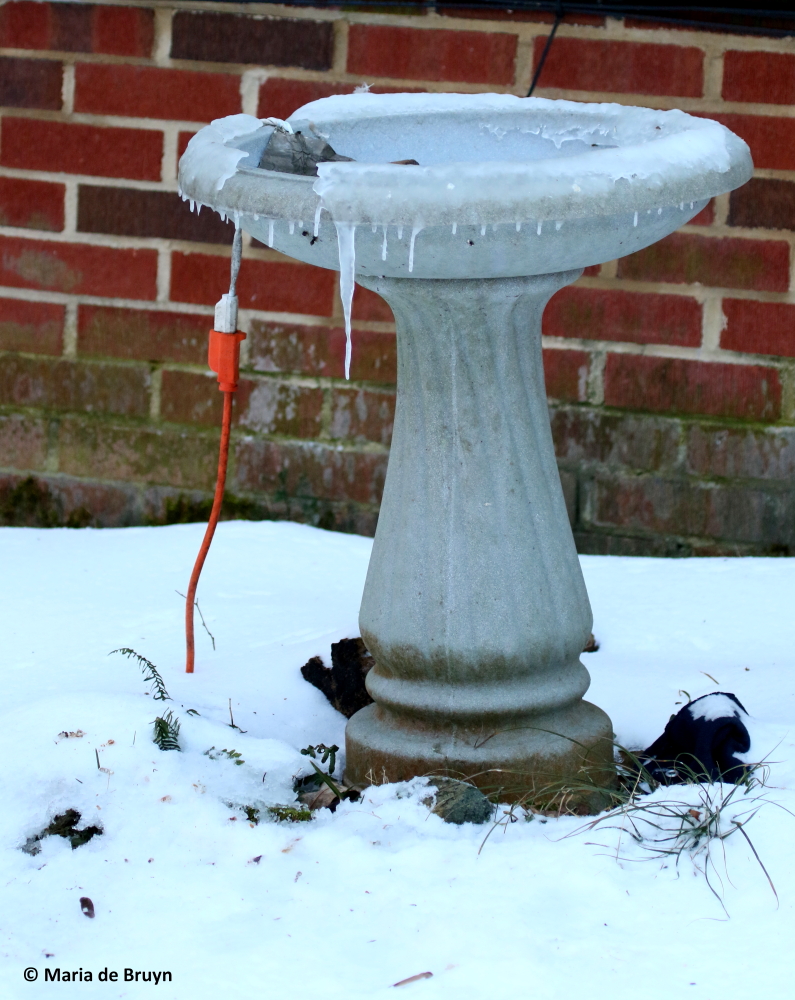
I was filling the heated bird bath daily, too, as it became a popular drinking fountain.

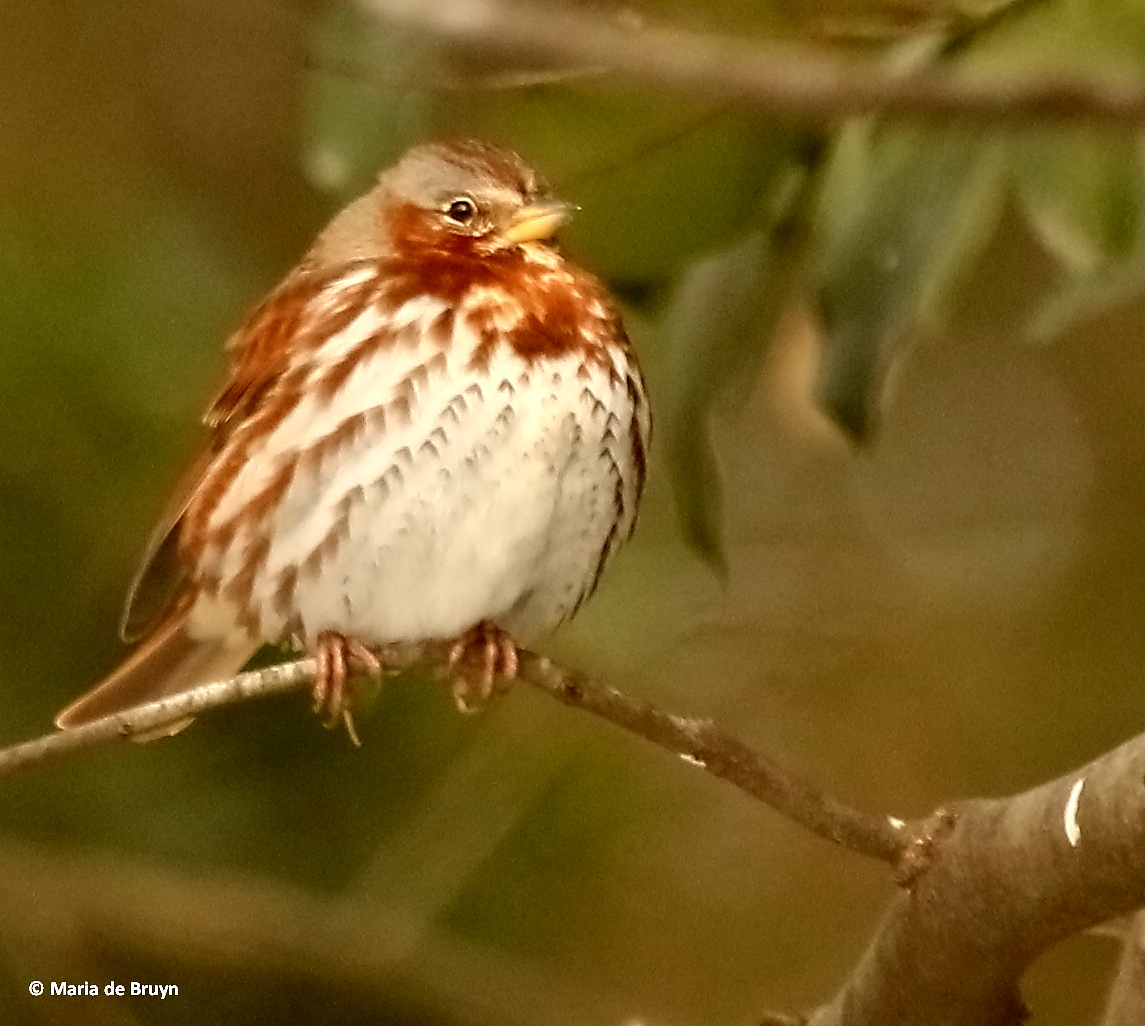
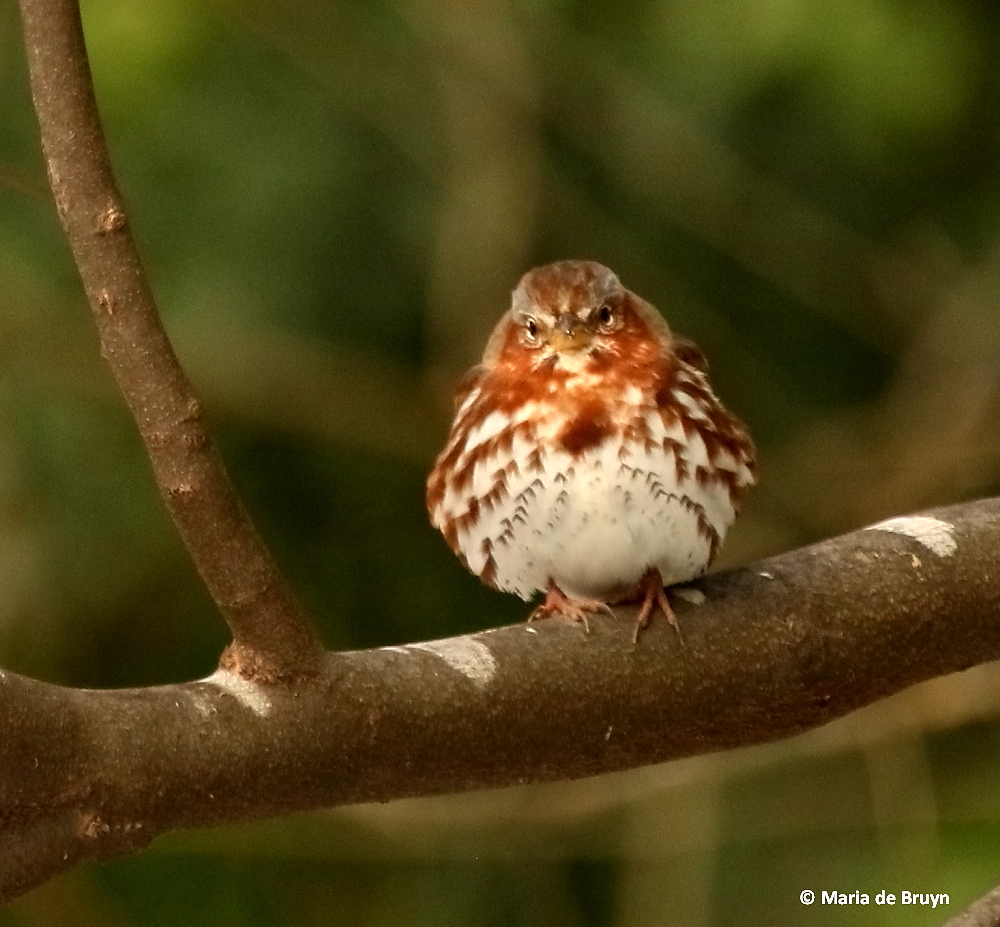
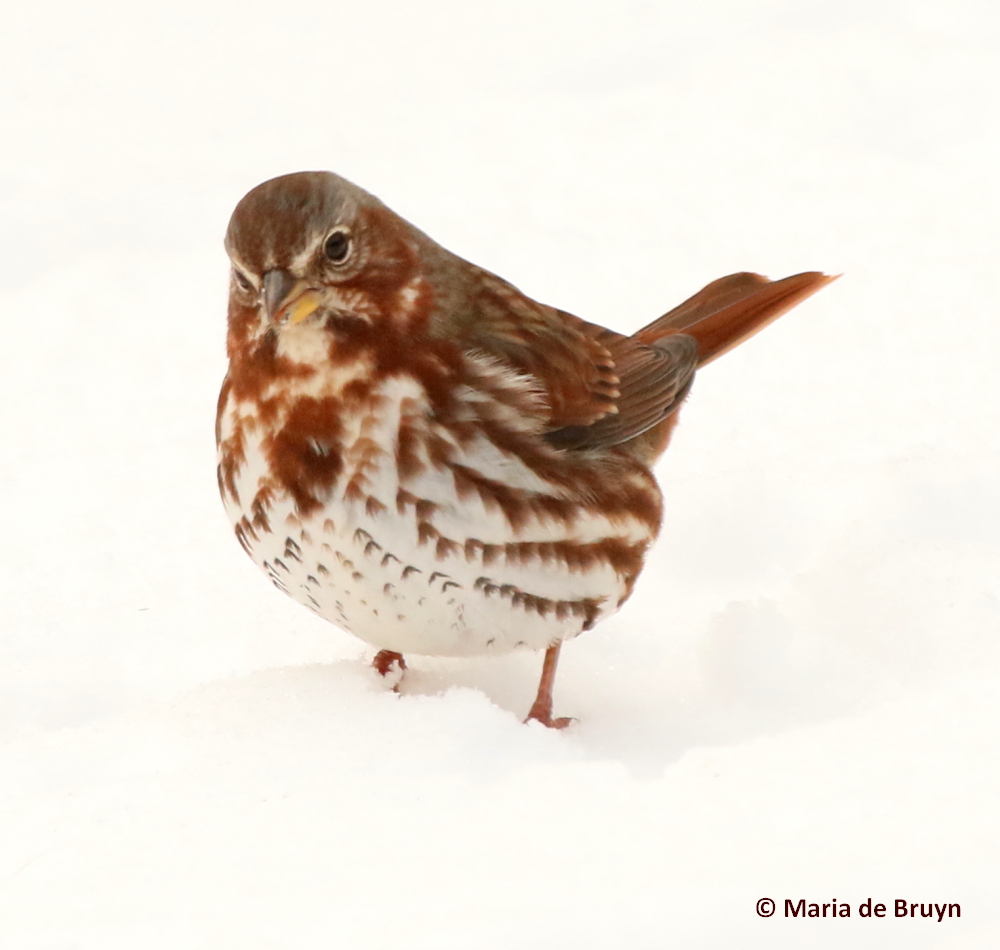
The thrill of the wintery snow days for me was a new yard visitor, a gorgeous fox sparrow (Passerella iliaca). I have never had one here before so it was a wonderful surprise and discovery. (I’m still hoping that a red-breasted nuthatch will turn up, too.)


fox-sparrow-i77a4347-maria-de-bruyn  fox-sparrow-i77a4348-maria-de-bruyn-res

fox-sparrow-i77a3773-maria-de-bruyn-res

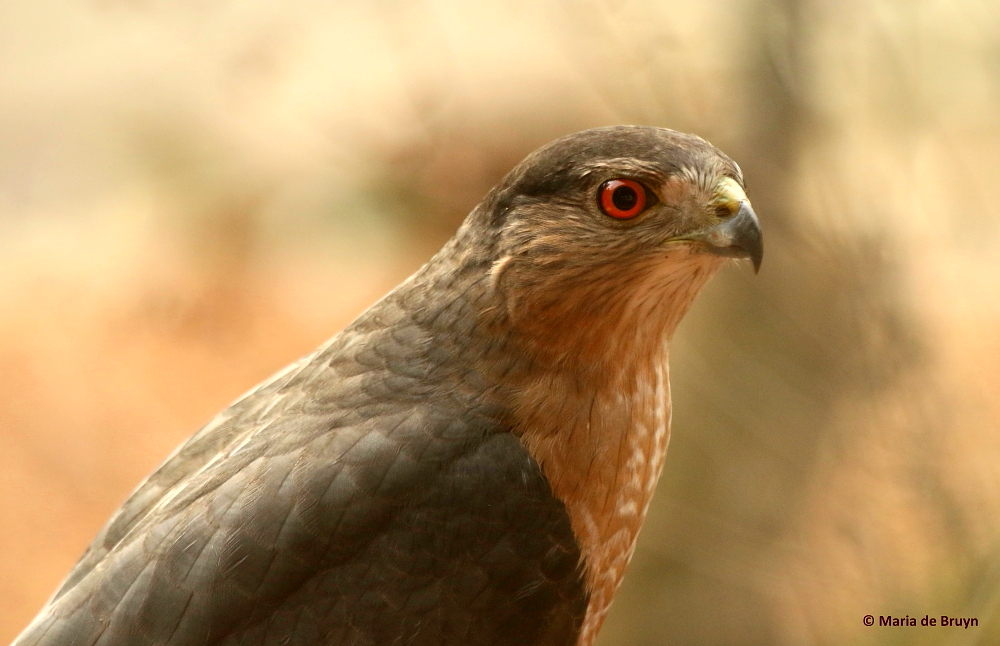
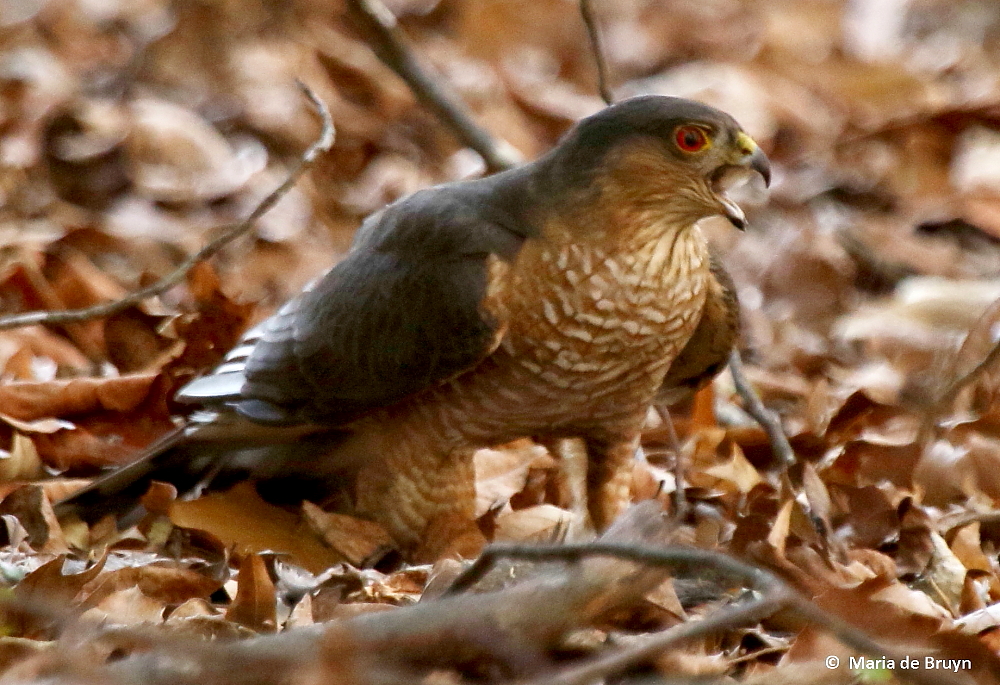
The birds “missing” from the storm gathering were the hawks. I’ve had a Cooper’s hawk  (Accipiter cooperii) visiting for years, but recently discovered that a sharp-shinned hawk (Accipiter striatus) is also taking birds from my yard. As they look quite similar, the sharpie may have been coming around for some time and I just never realized it. They were both here in the last couple weeks, but neither one made an appearance during the storm.

coopers-hawk-i77a1341-maria-de-bruyn-res   sharp-shinned-hawk-i77a8520-maria-de-bruyn-res

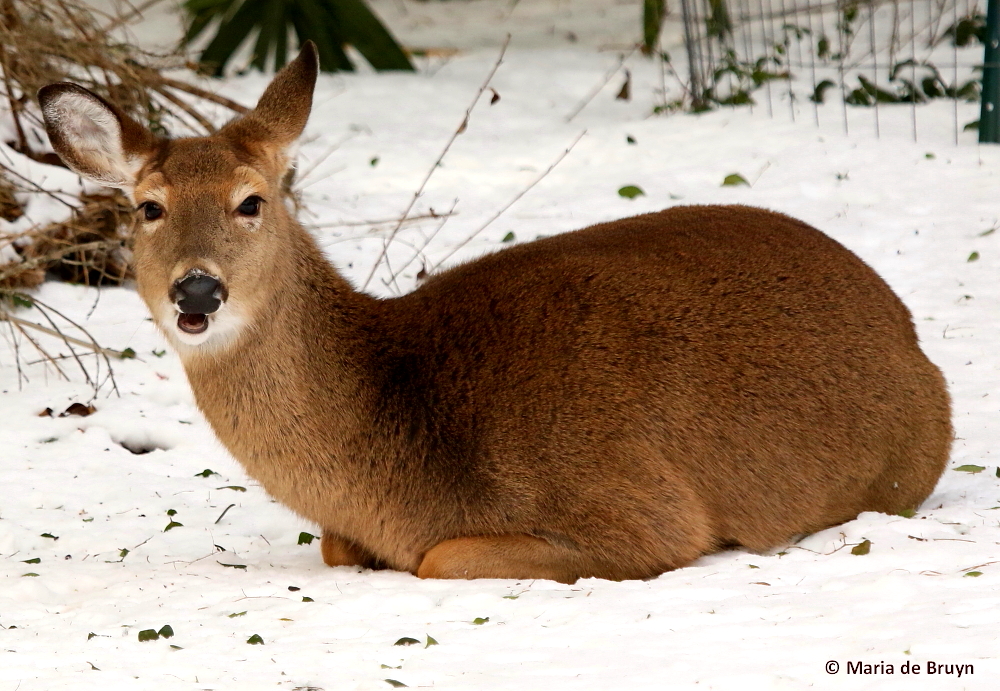
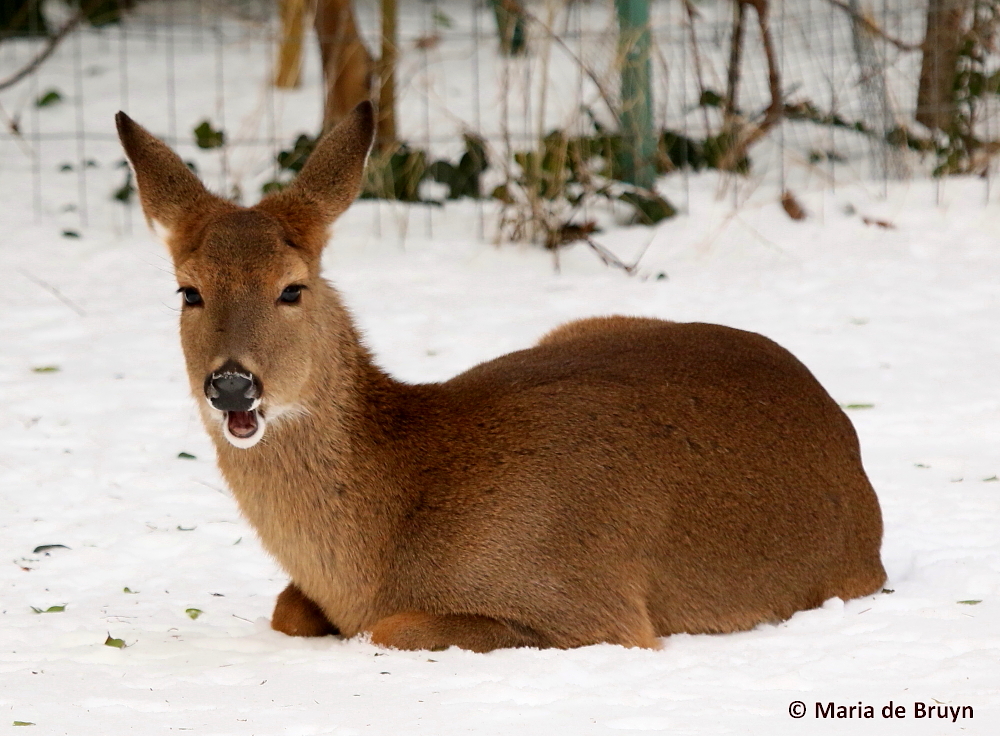
Our two neighborhood white-tailed does (Odocoileus virginianus) and their three offspring came by, obviously finding my yard a peaceful and safe space to rest.

white-tailed-deer-i77a4432-maria-de-bruyn-res   white-tailed-deer-i77a4431-maria-de-bruyn-res

So I’ll end with some “beauty shots” from the snow days as the snow and ice are now melting. In two days’ time, we are supposed to be having temperatures of 68F/20C or higher! And then we can wait out the rest of January as well as February and March to see if we get any more winter storms.

white-throated-sparrow-i77a2733-maria-de-bruyn-res

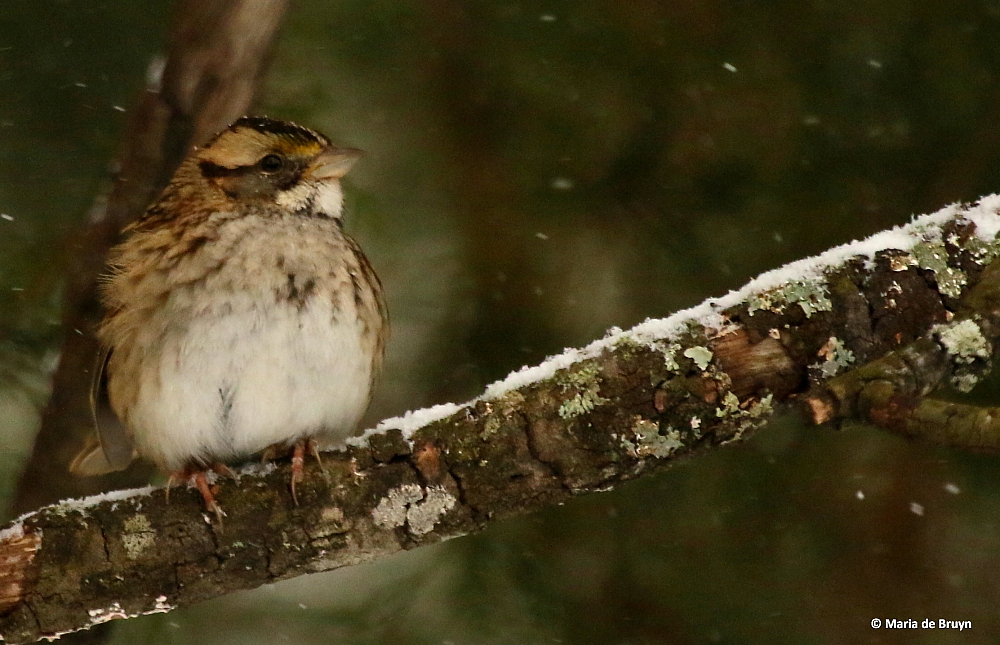
White-throated sparrow (Zonotrichia albicollis)

chipping-sparrow-i77a2830-maria-de-bruyn-res

     house-finch-i77a2852-maria-de-bruyn-res

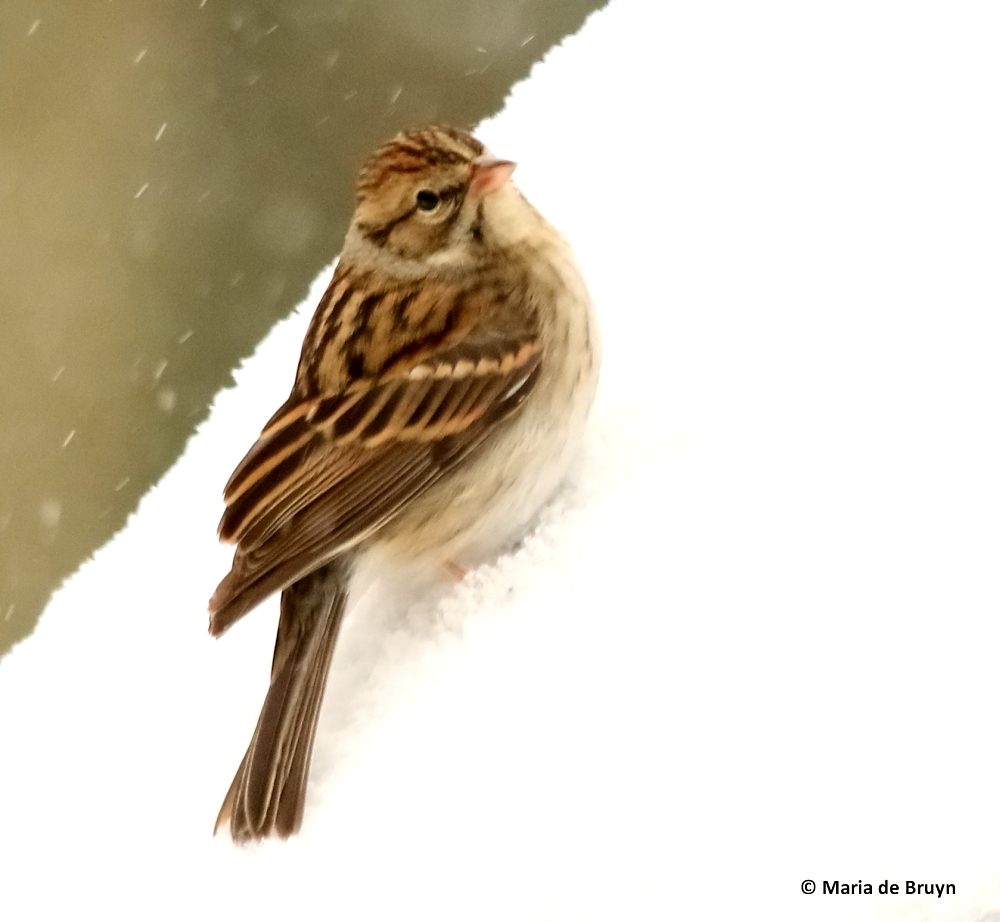
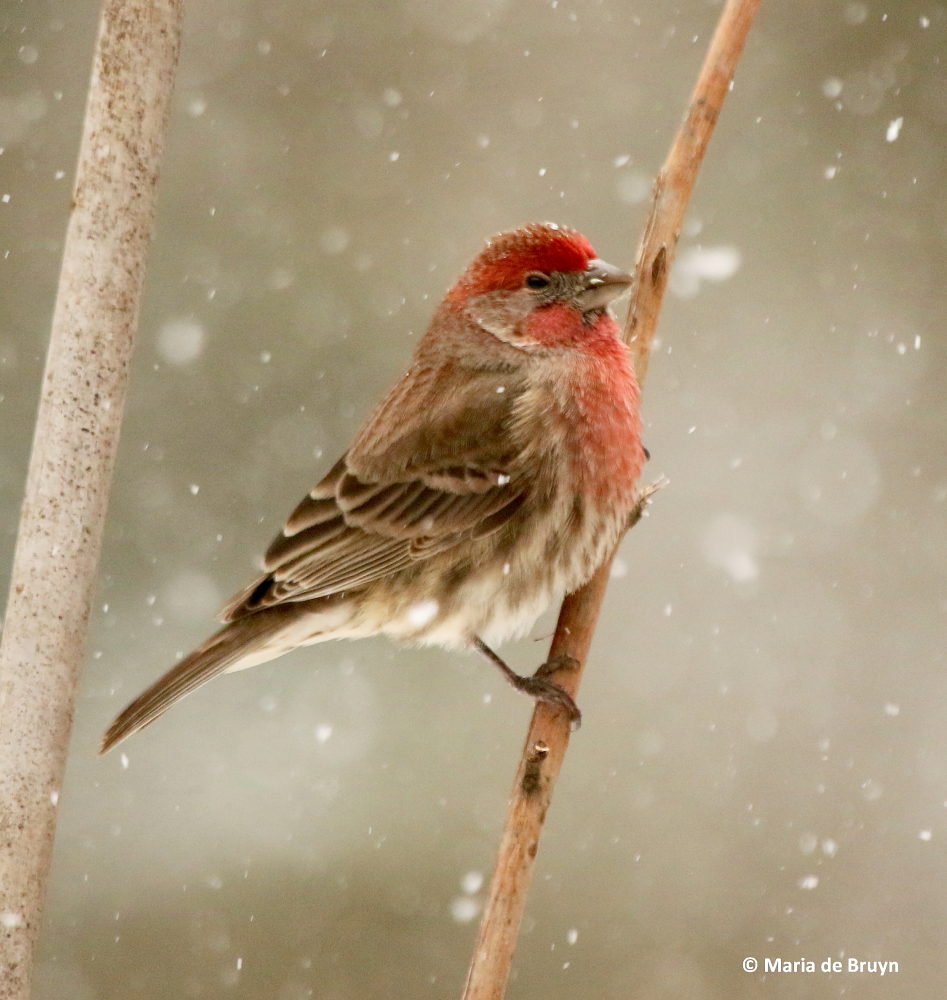
Chipping sparrow (Spizella passerina)        House finch (Haemorhous mexicanus)

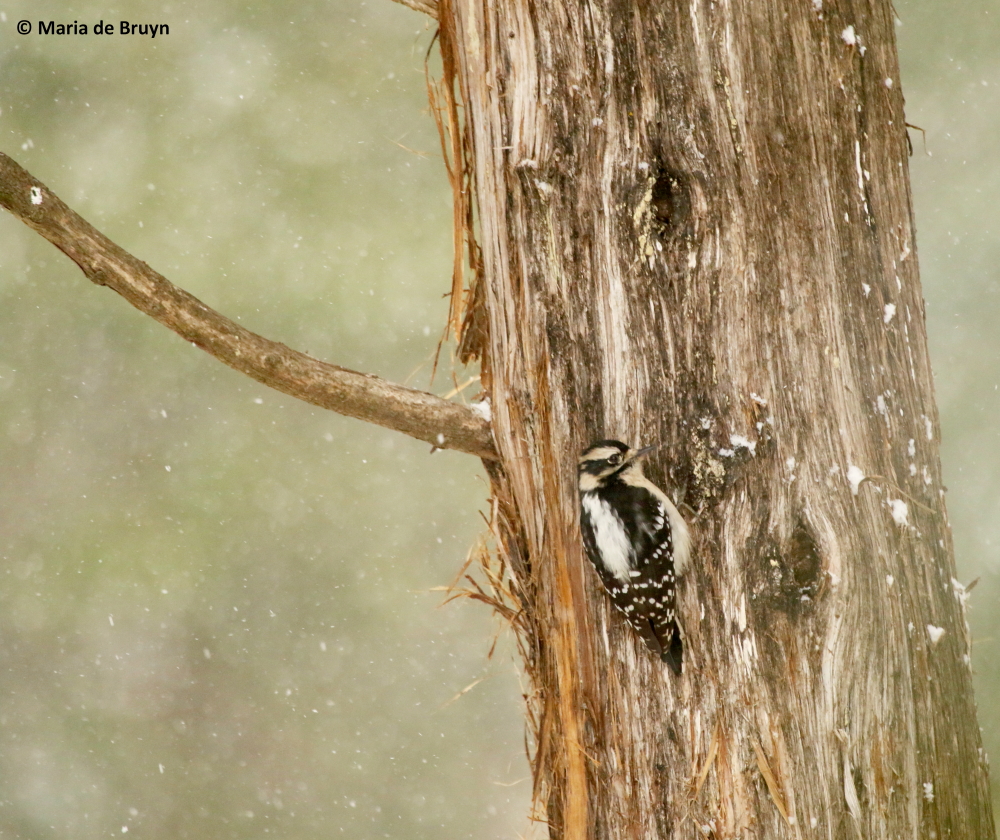
dark-eyed-junco-i77a2590-maria-de-bruyn-res  downy-woodpecker-i77a2810-maria-de-bruyn-res

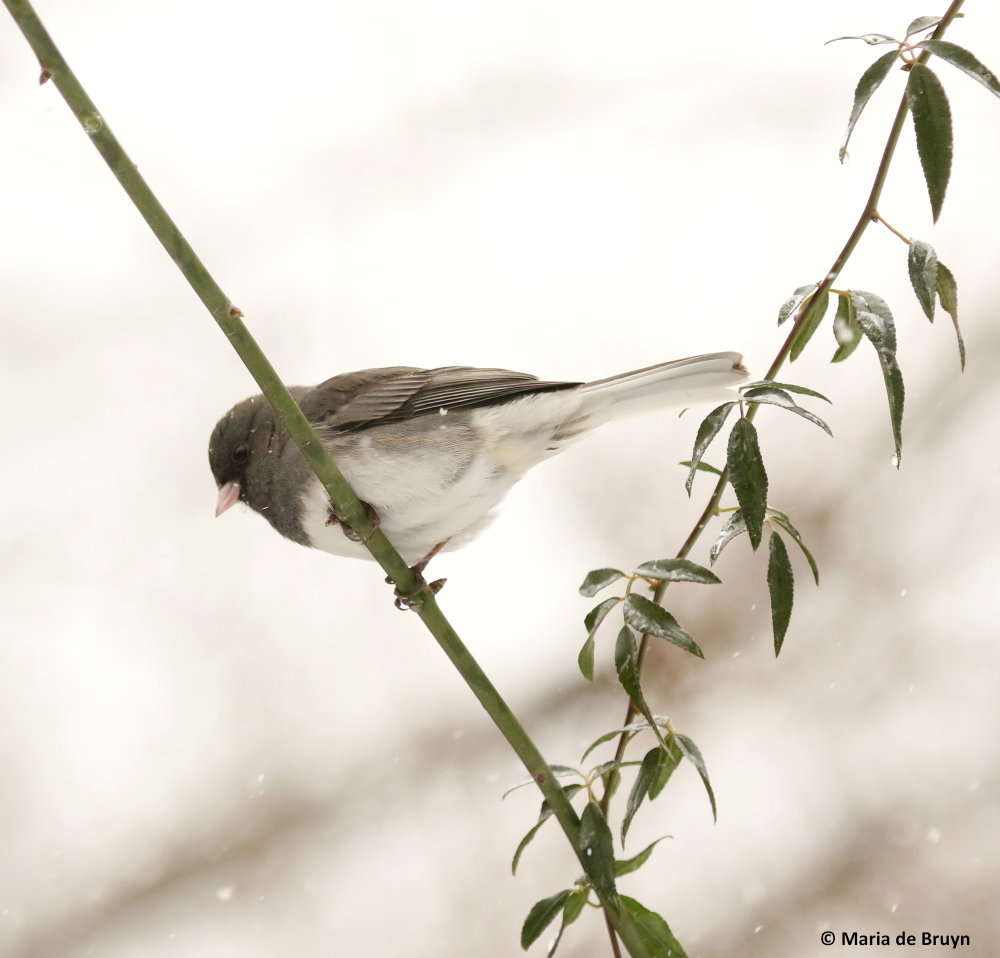
Dark-eyed junco (Junco hyemalis)          Downy woodpecker (Dryobates pubescens)

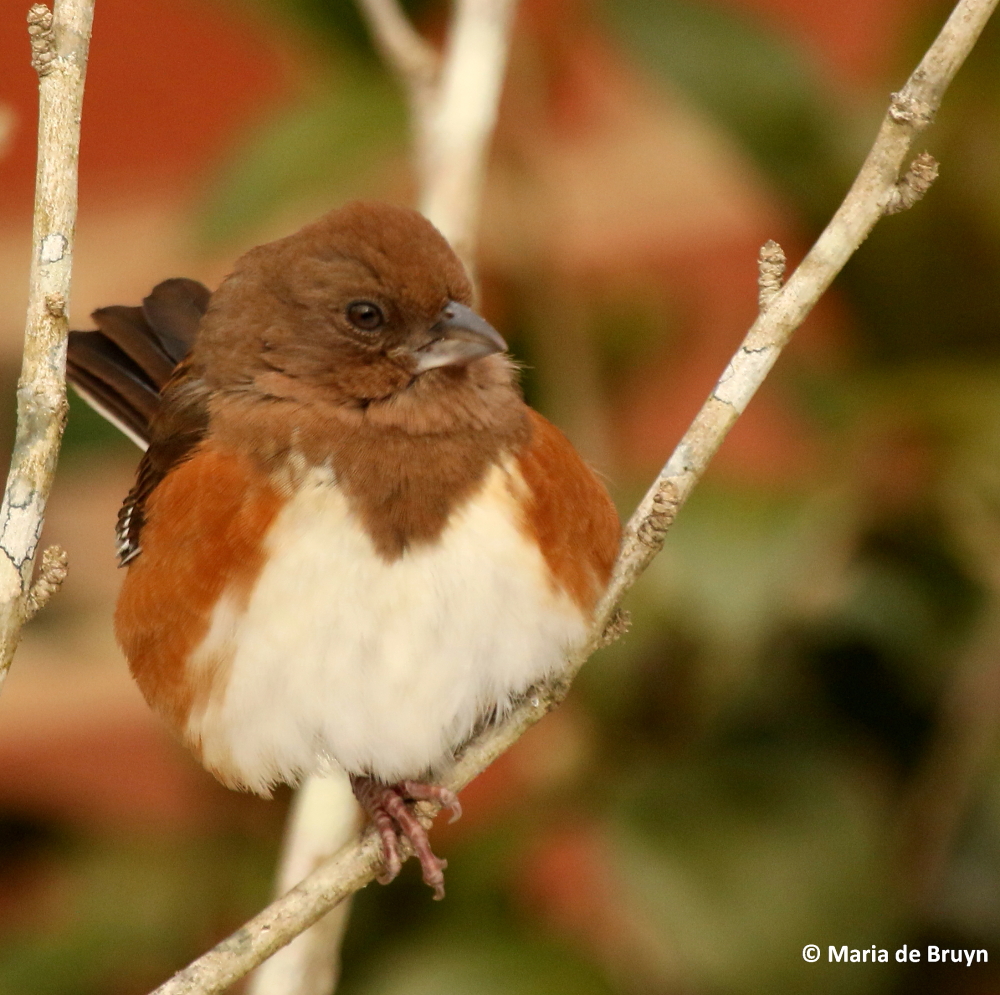
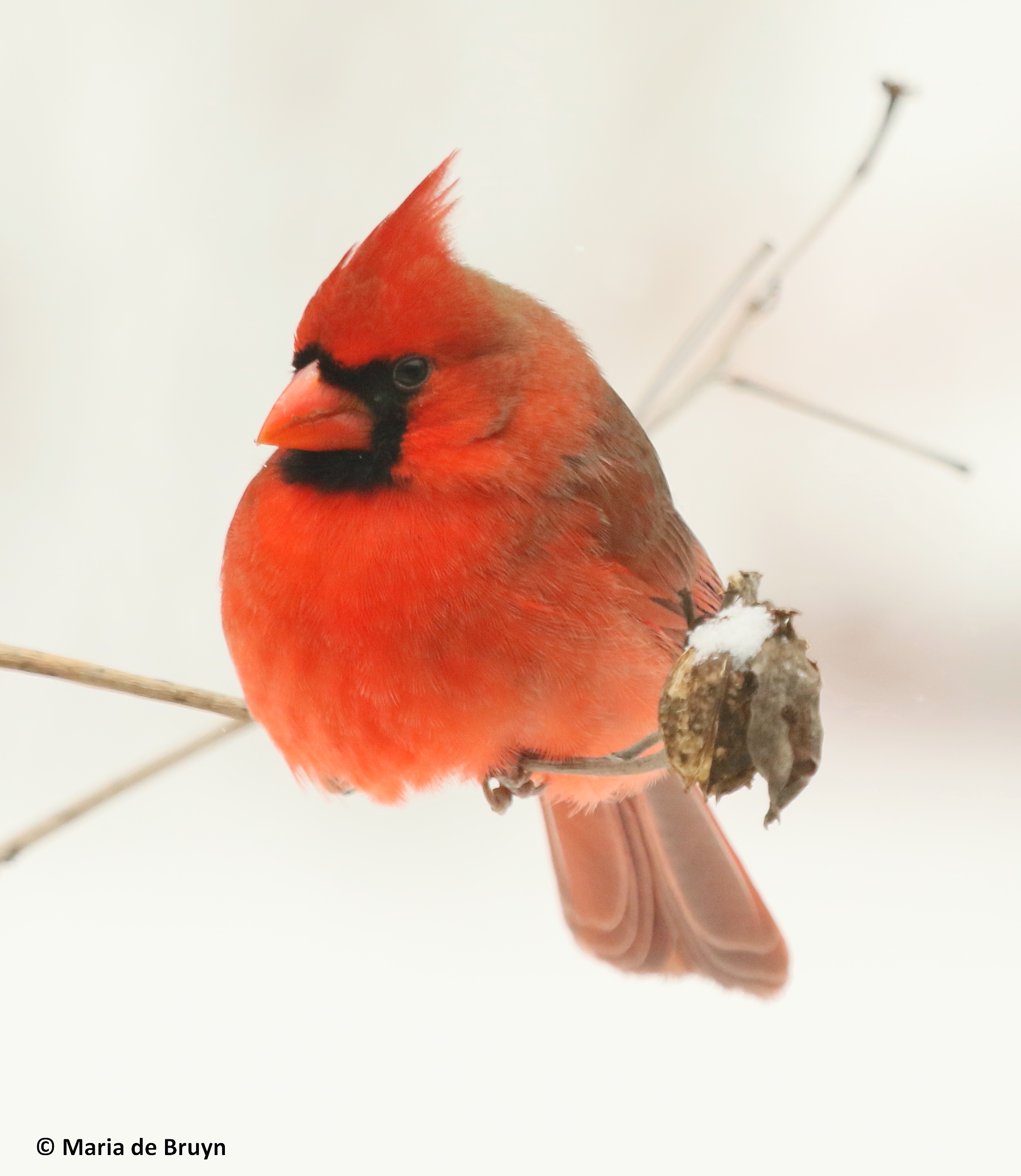
eastern-towhee-i77a4111-maria-de-bruyn-res    northern-cardinal-i77a3099-maria-de-bruyn-res

Eastern towhee (Pipilo erythrophthalmus)      Northern cardinal (Cardinalis cardinalis)

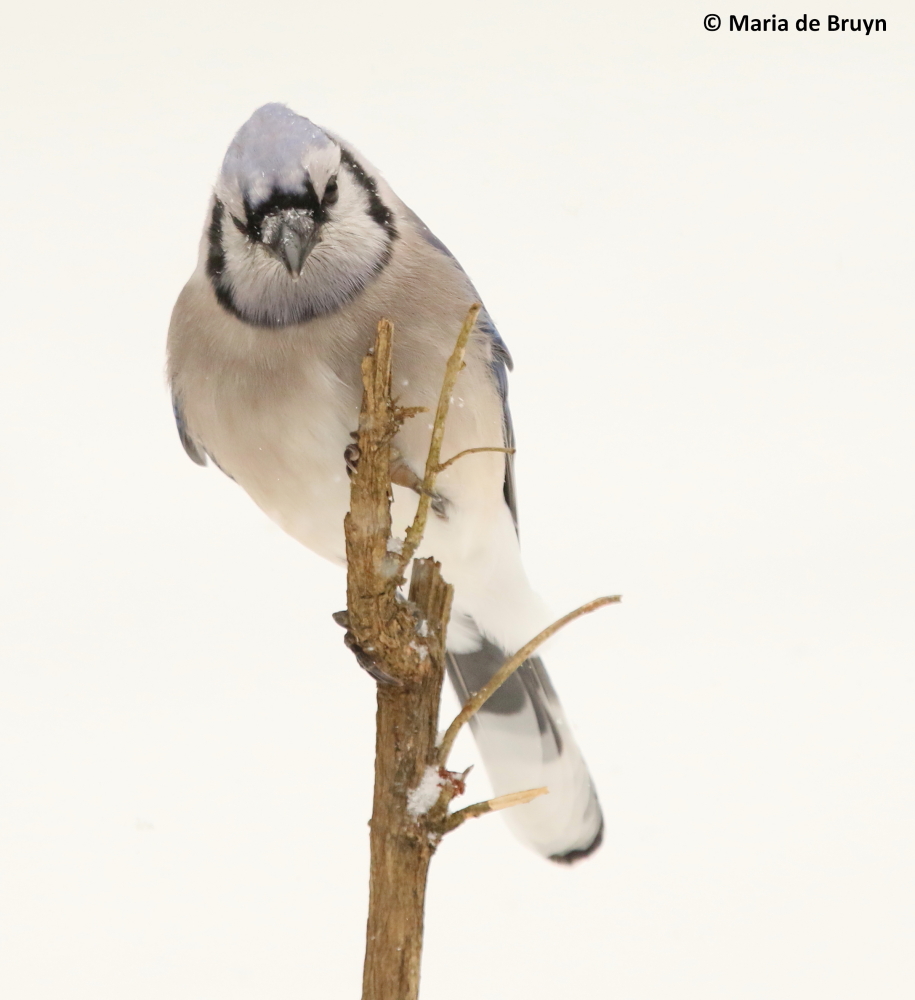
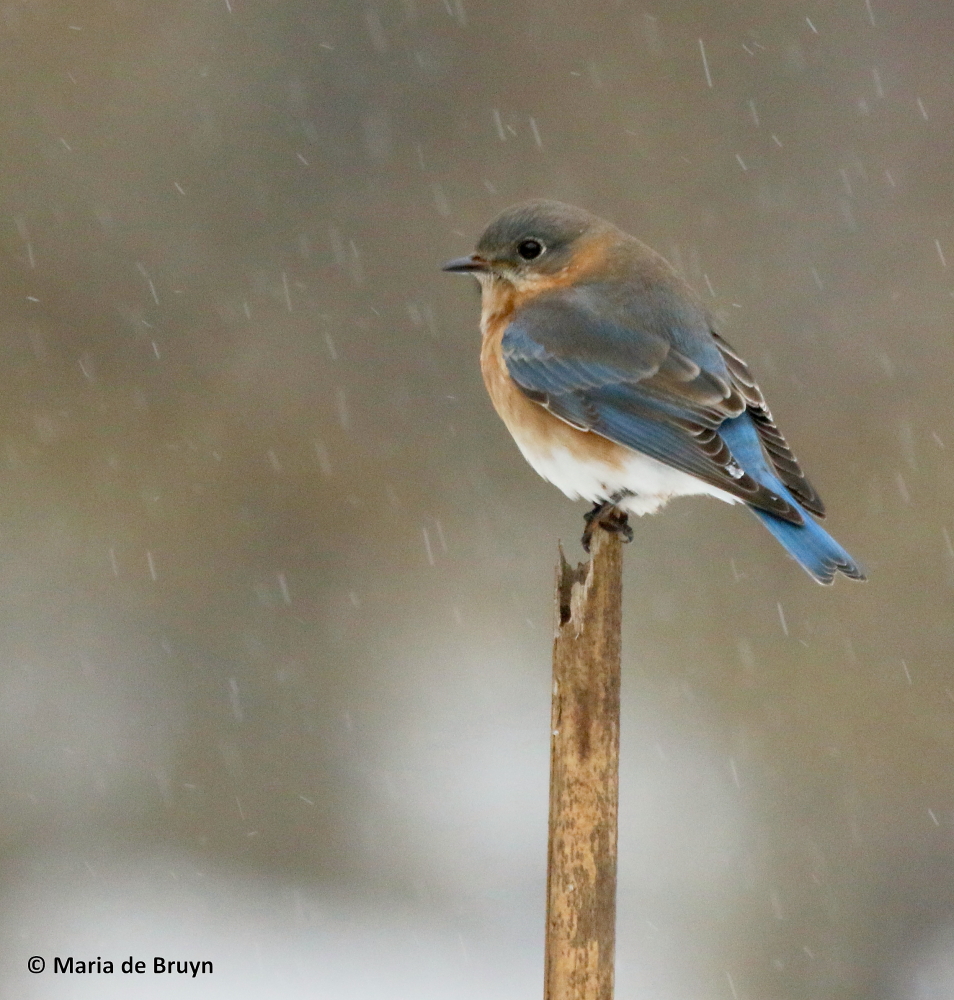
blue-jay-i77a2858-maria-de-bruyn-res     eastern-bluebird-i77a2285-maria-de-bruyn-res

Blue jay                                                       Eastern bluebird (Sialia sialis)

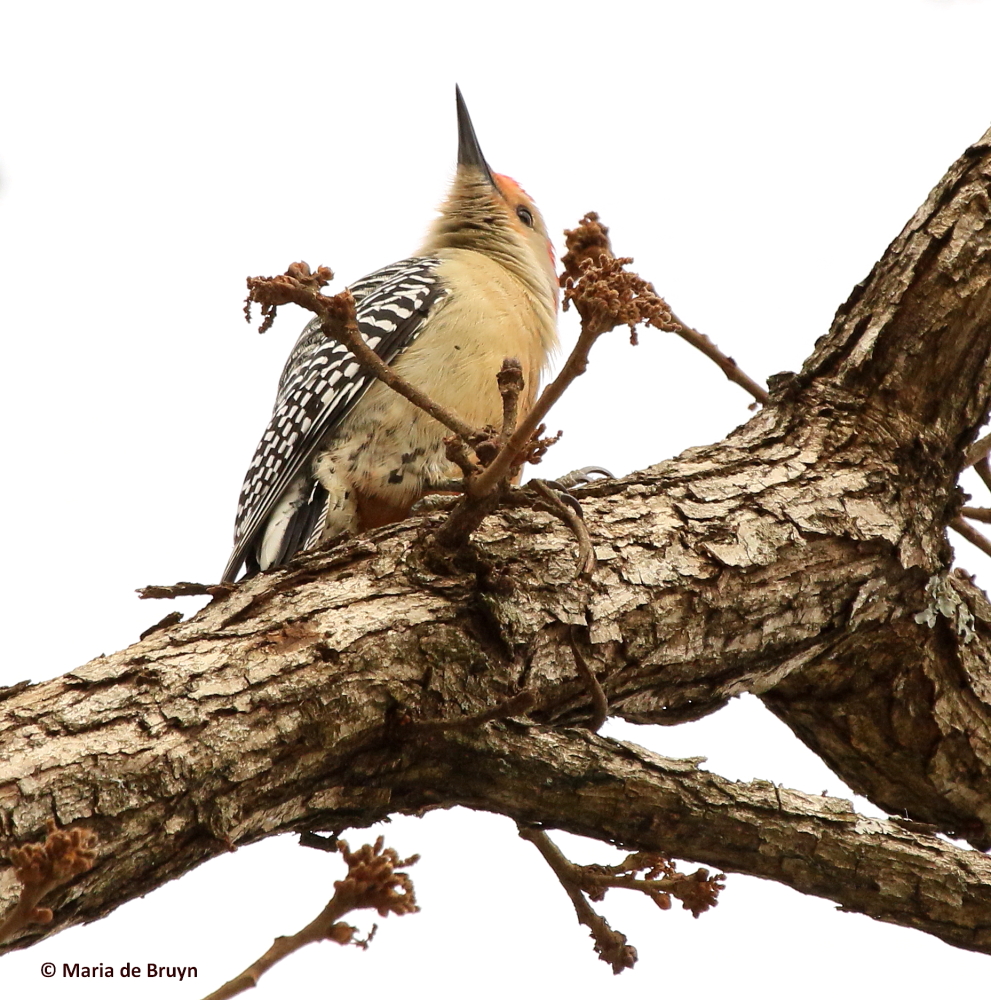
red-bellied-woodpecker-i77a4047-maria-de-bruyn-res       ruby-crowned-kinglet-i77a4263-maria-de-bruyn-res

Red-bellied woodpecker (Melanerpes carolinus)     Ruby-crowned kinglet

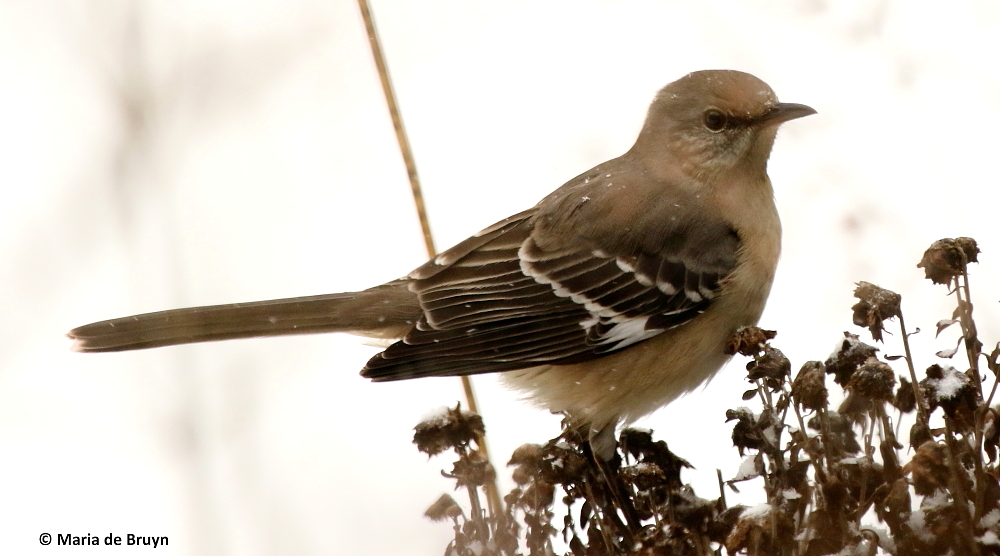
northern-mockingbird-i77a2714-maria-de-bruyn-res   pine-warbler-i77a2657-maria-de-bruyn-res

Northern mockingbird                                              Pine warbler


Love my yard!

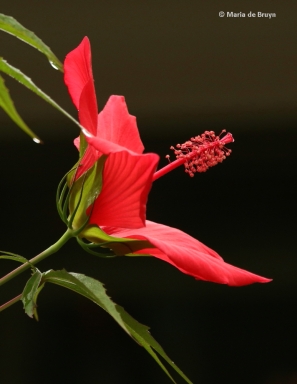
scarlet-mallow-i77a6509-maria-de-bruyn-res2016 began with distress for me, having just been admitted to hospital in considerable pain and worried about expenses. So when I was able to get home again and find diversion from the necessity of self-administering an IV medication twice daily by admiring what nature has to offer in my yard, it was a more-than-welcome event.

Even when my mood is down, walks in nature soothe my spirit since my mind becomes totally absorbed by what I’m observing and there’s no space for any other thoughts. Even aches and pains recede to the background so when I can’t get out to a reserve or park, taking advantage of the little plot of land I call my own is a real delight.
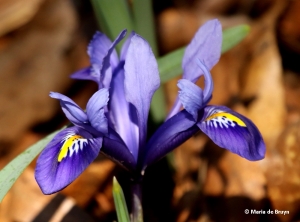
iris-i77a4541maria-de-bruyn-res


The yard has everything – plants, insects, amphibians, reptiles, birds and mammals, which is very cool indeed. Spring and summer are especially lovely with the blooming flowers and I’ve taken care to include many native vegetative species among the plantings.
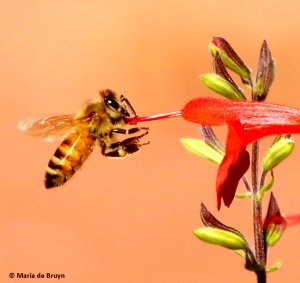
 

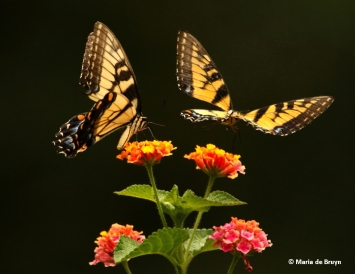
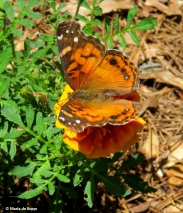
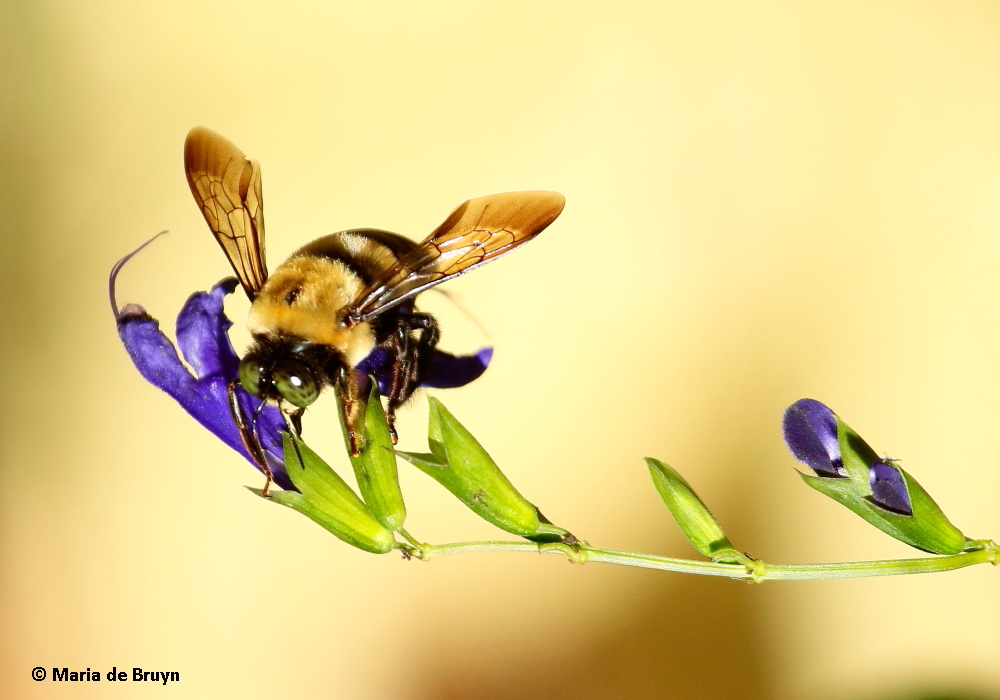
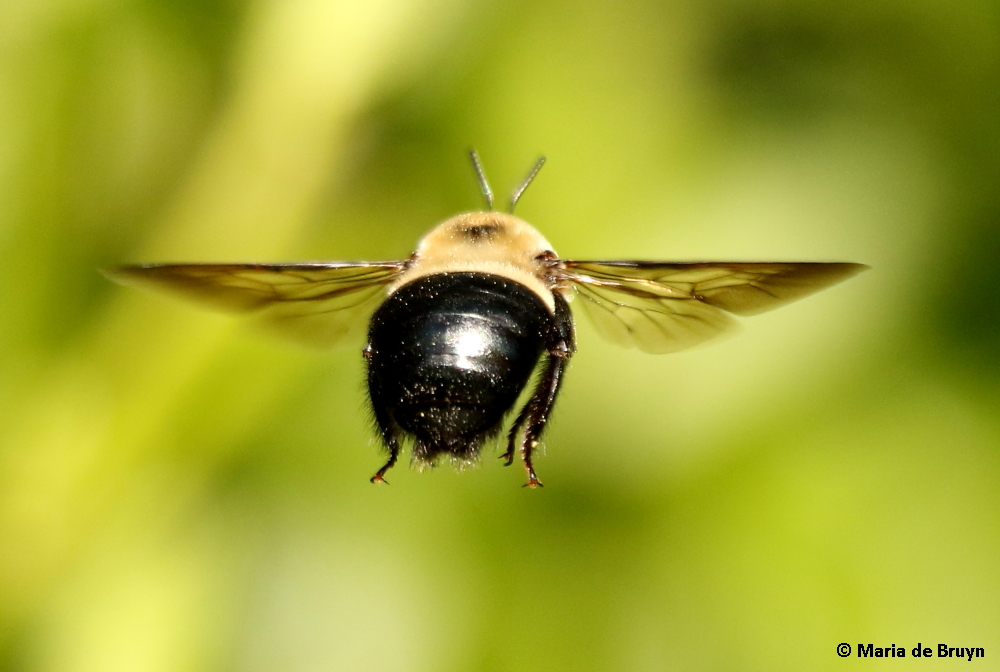
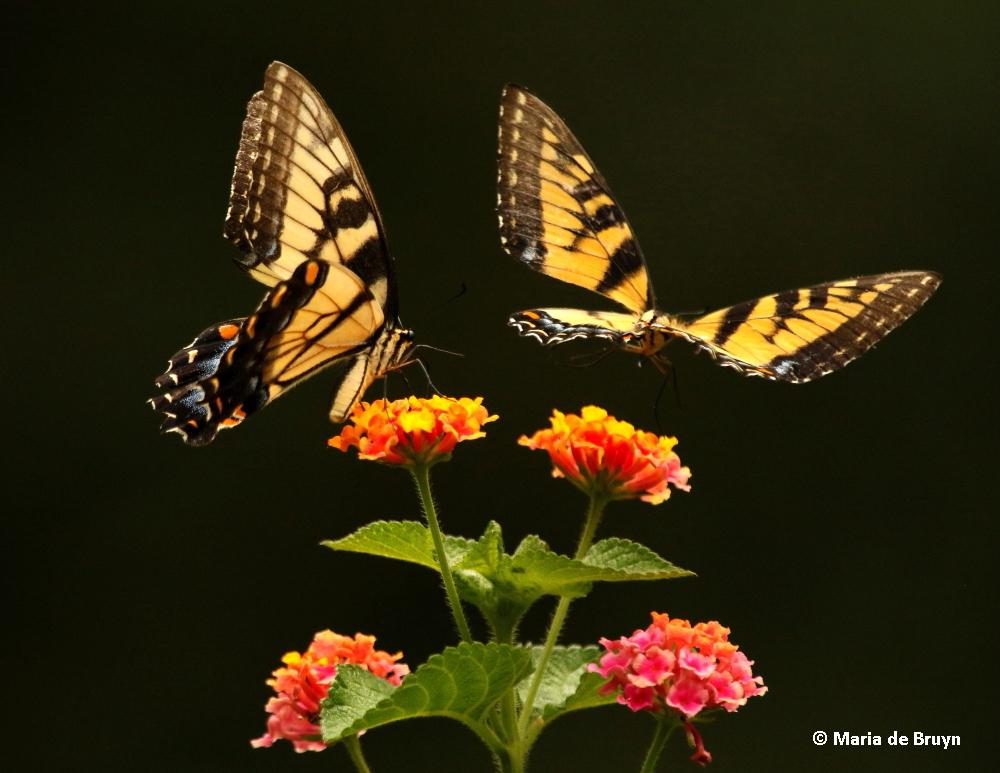
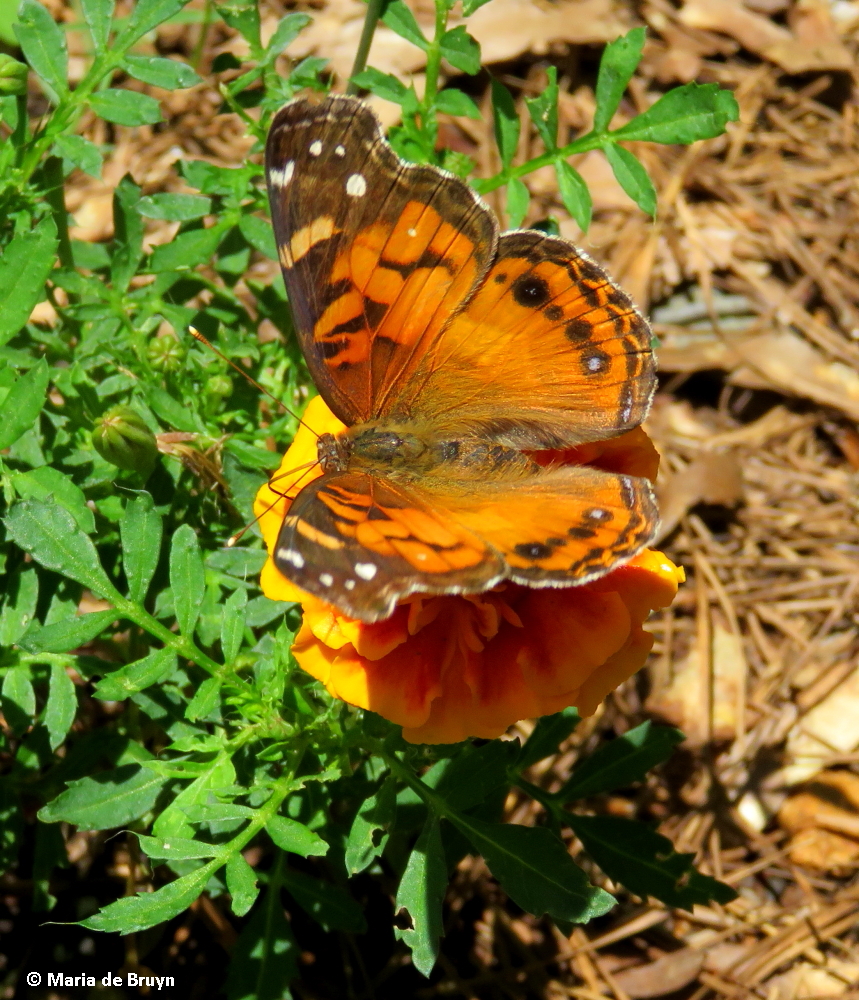
honey-bee-morning-calisthenics-i77a5676-maria-de-bruyn-resThe flowers and shrubs not only attract birds but many species of insects, too, and give me plenty of chances to practice photographing bees in flight and butterflies nectaring. The Eastern carpenter bees (Xylocopa virginica), and European honey bees (Apis mellifera) were good models, as were the Eastern tiger swallowtails (Papilio glaucus) and American lady (Vanessa virginiensis) butterflies.
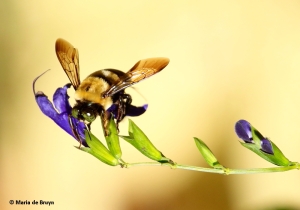
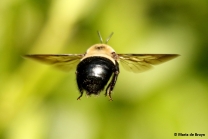
eastern-carpenter-bee-2-i77a7906-maria-de-bruyn-res  eastern-carpenter-bee-i77a8678-maria-de-bruyn-res

eastern-tiger-swallowtail-i77a8669-maria-de-bruyn-res  american-lady-img_0069-maria-de-bruyn-res

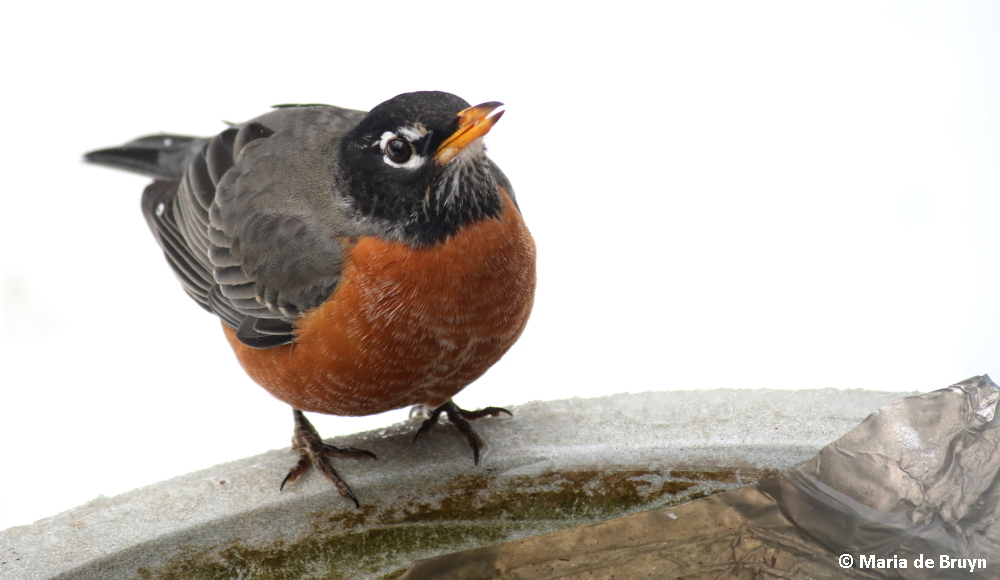
blue-pickerel-weed-i77a3947-maria-de-bruyn-resThe front yard has one small pond with blue pickerel weed (Pontederia cordata) and the back yard has two ponds and a heated bird bath in winter. Deer, raccoons and birds, like this American robin (Turdus migratorius) use these as watering holes.
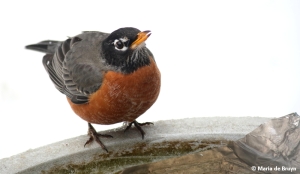
american-robin-i77a9005-maria-de-bruyn-res

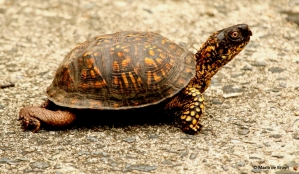
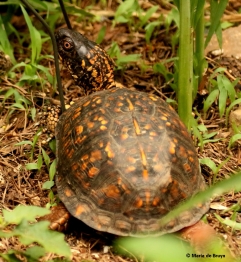
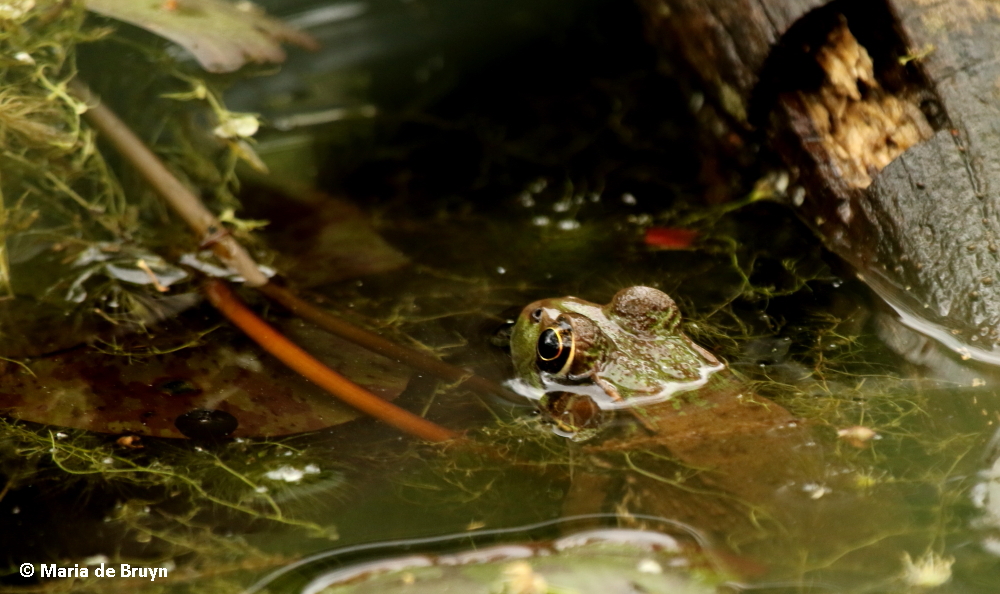
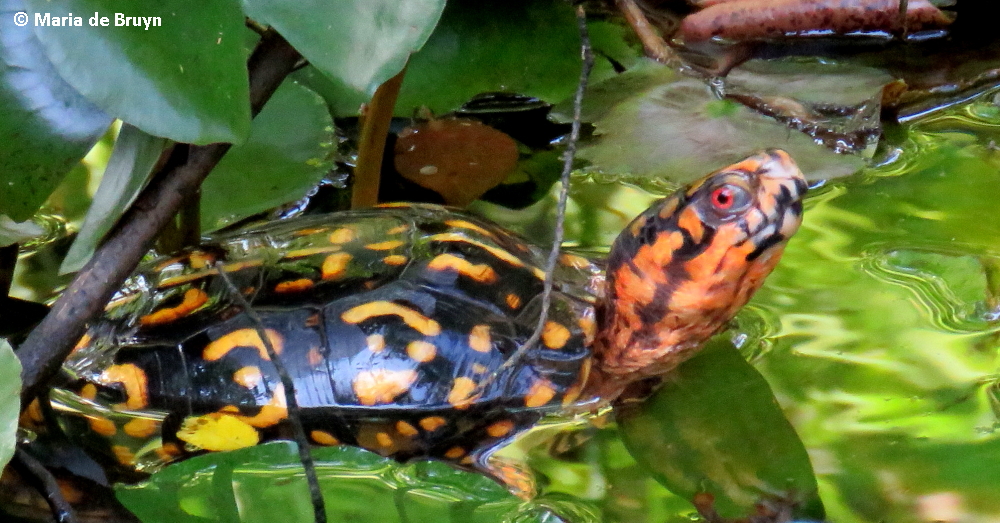
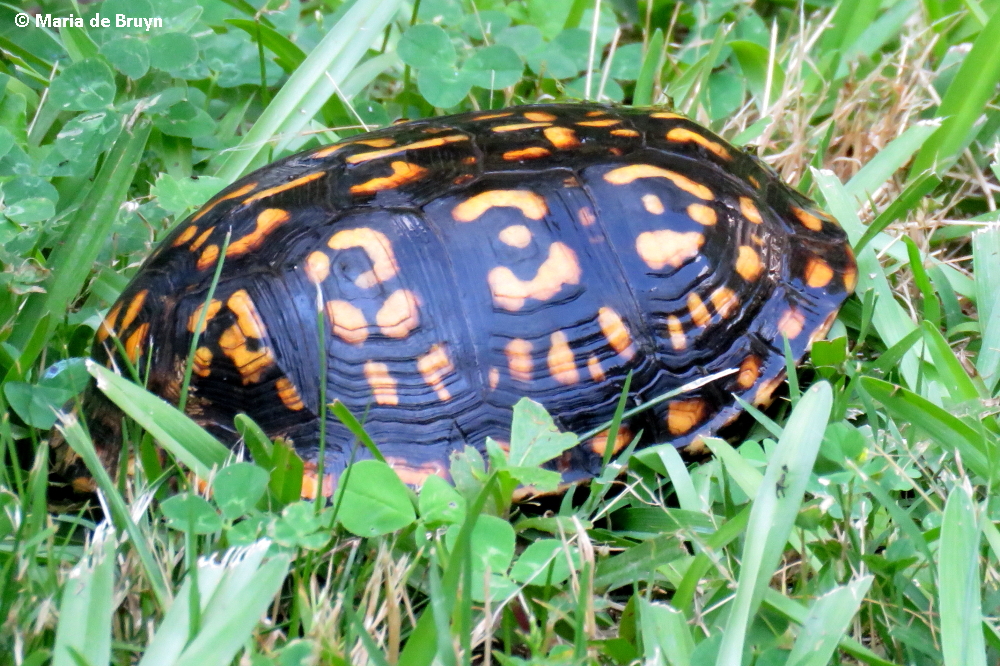
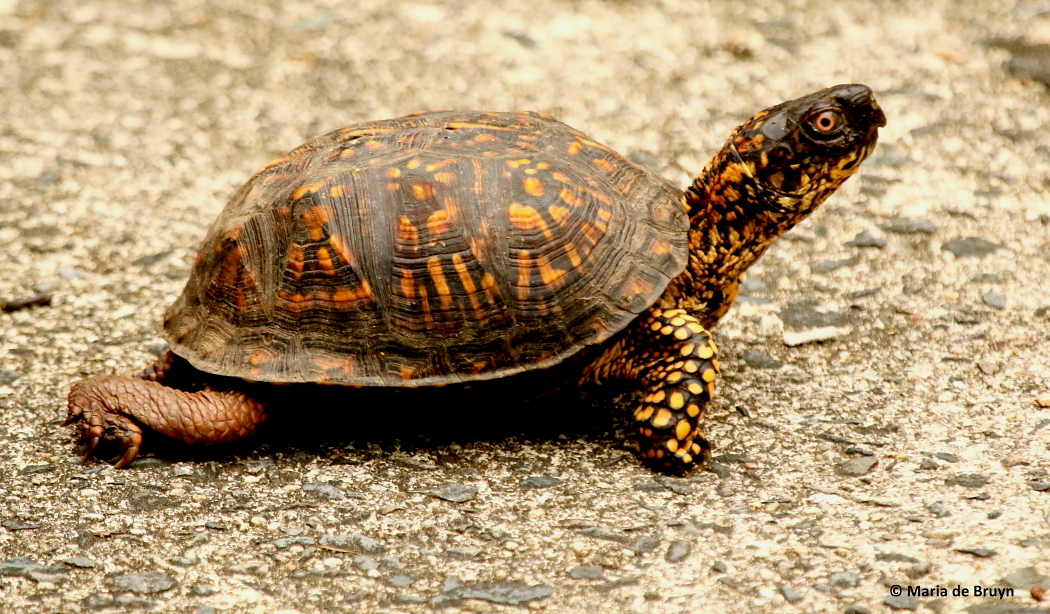
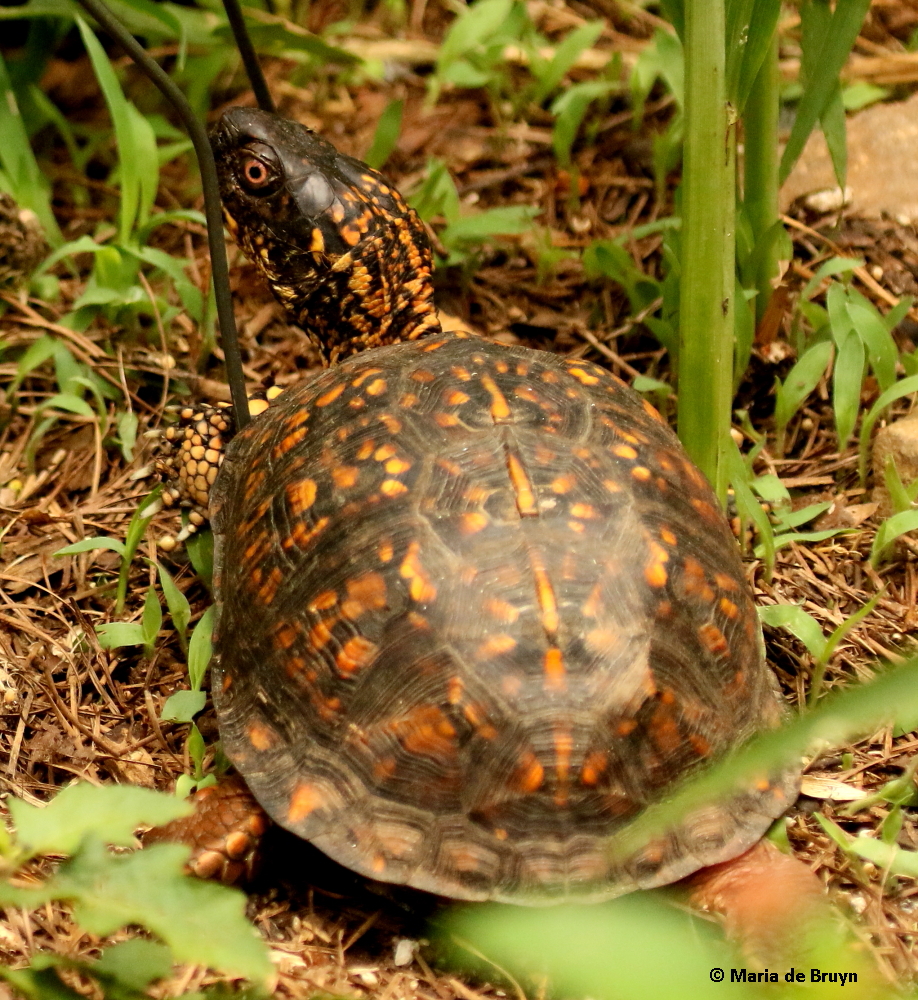
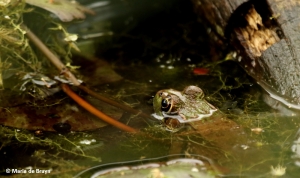
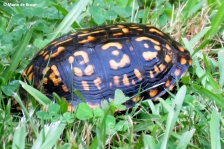
bullfrog-i77a9694-maria-de-bruyn-resFish live in one pond along with green and/or bullfrogs (Lithobates catesbeianus). Occasionally, I’ve had to rescue an adventurous Eastern box turtle (Terrapene carolina carolina) that didn’t seem able to climb out again on the logs provided as bridges out of the water. Other turtles trundle around in other parts of the yard.
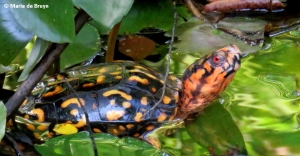
eastern-box-turtle-img_1392-maria-de-bruyn-res    eastern-box-turtle-img_1422-maria-de-bruyn-res

eastern-box-turtle-male-i77a8333-maria-de-bruyn-res   eastern-box-turtle-i77a8380-maria-de-bruyn-res

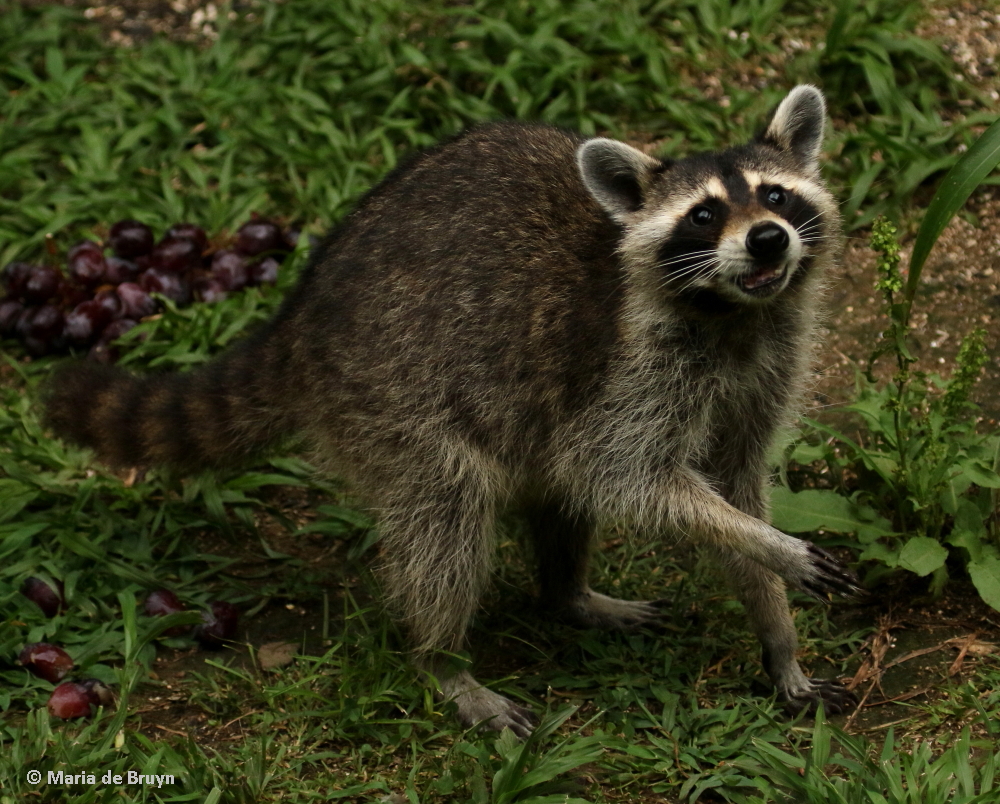
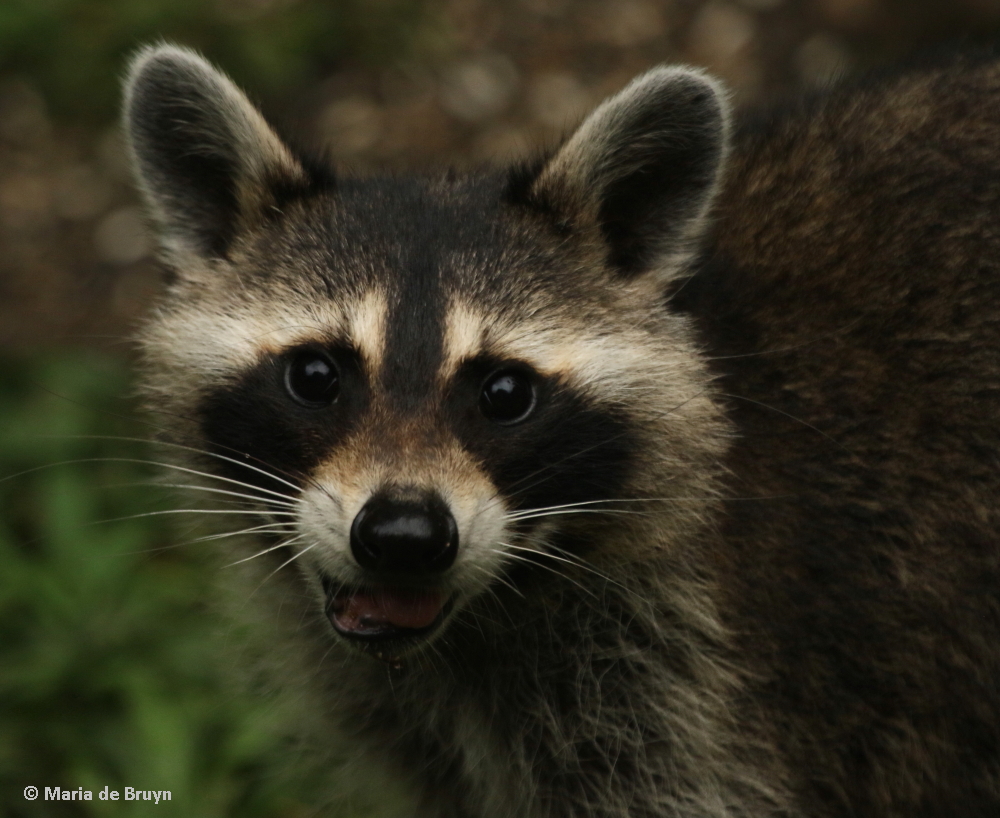
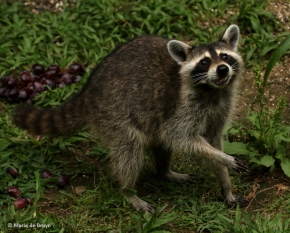
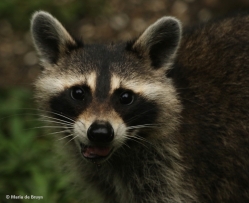
Raquel raccoon (Procyon lotor) and members of her family usually appear at night, as do the local opossums, of whom I have few photos. When Raquel is expecting another brood or in nursing mode, she gets more adventurous and comes round in the daytime.
raccoon-i77a5969-maria-de-bruyn-res   raccoon-i77a5906-maria-de-bruyn-res

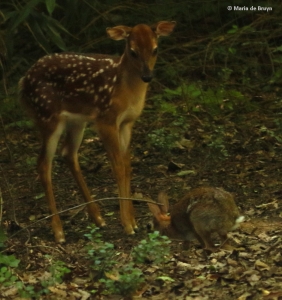
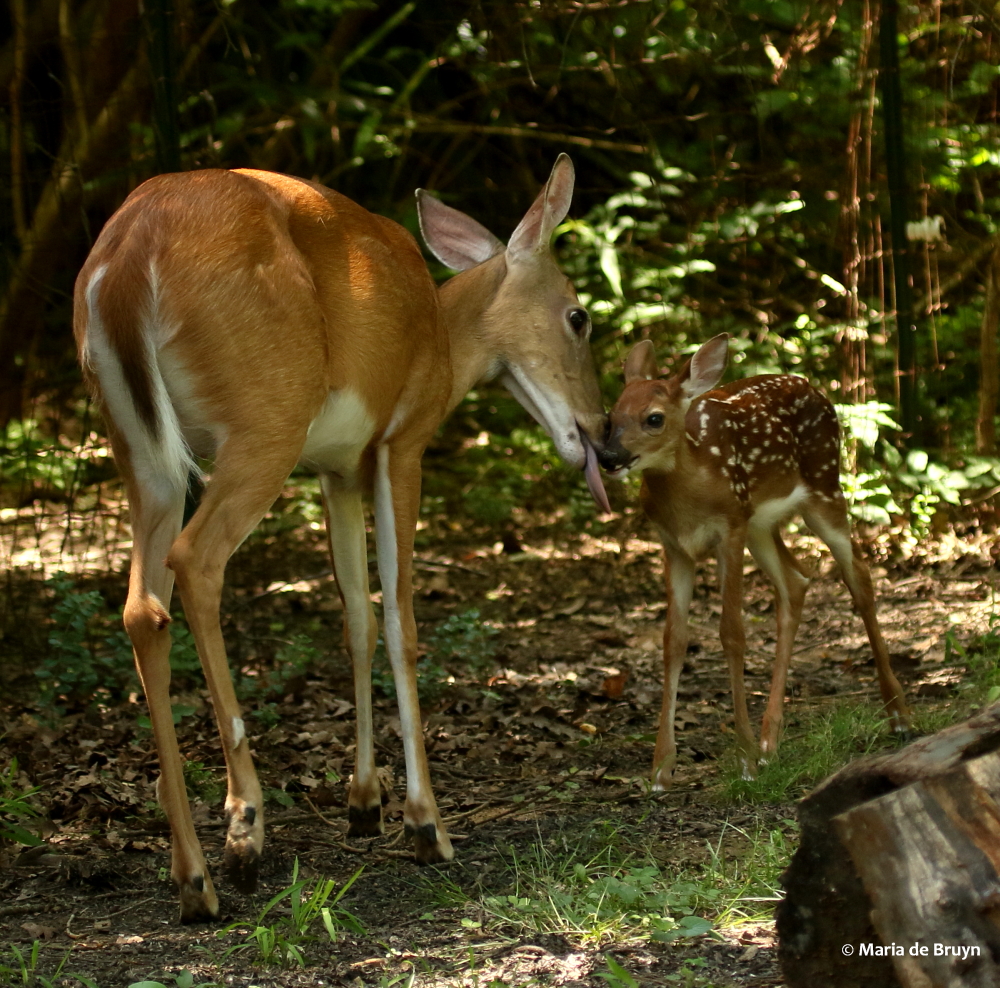
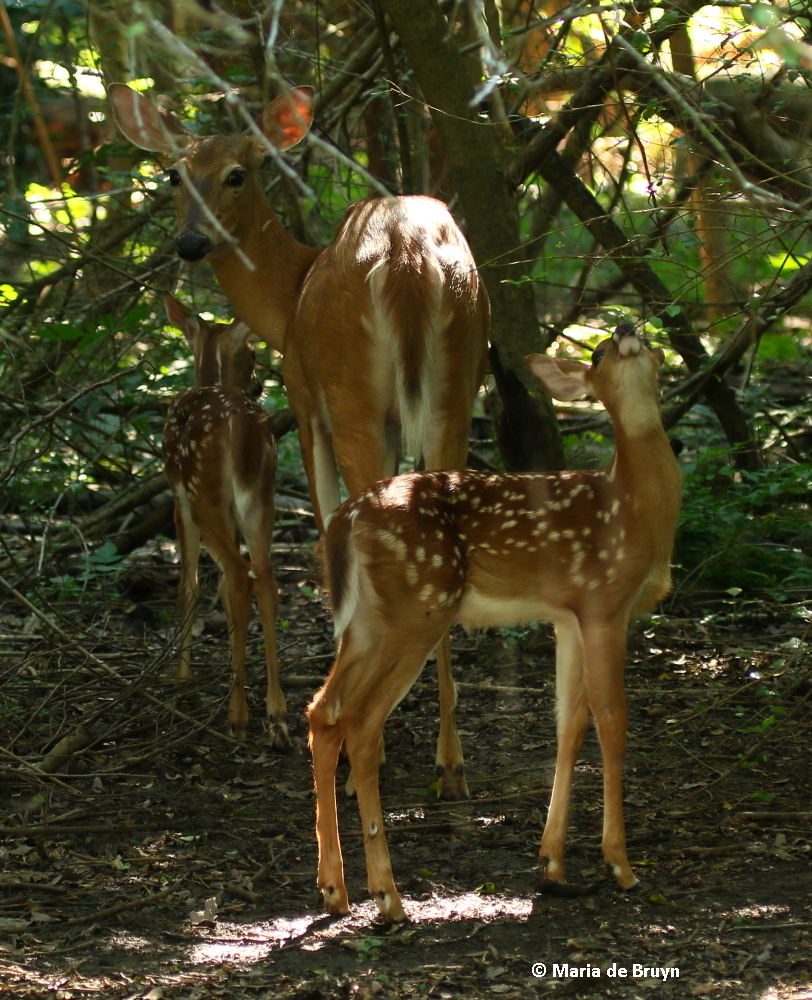
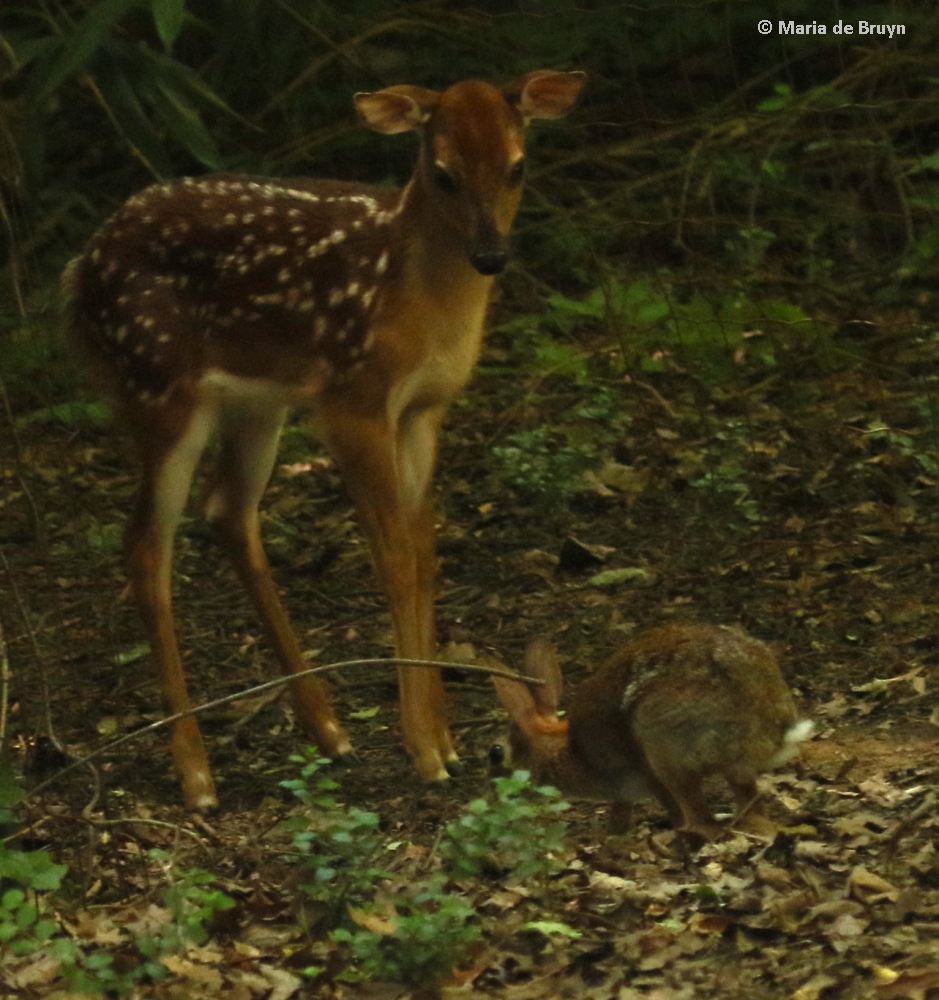
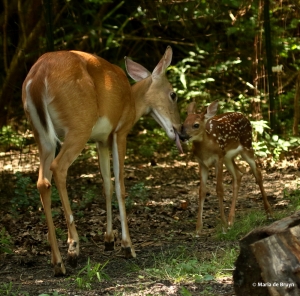
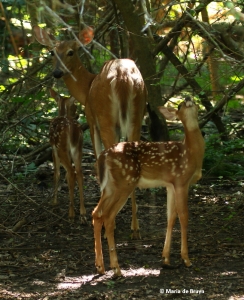
The white-tailed deer (Odocoileus virginianus) come by all months of the year and provide opportunities to see how the fawns learn about the other creatures sharing their space.
white-tailed-deer-i77a7463-maria-de-bruyn white-tailed-deer-i77a2126-maria-de-bruyn-res

white-tailed-deer-i77a7826-maria-de-bruyn-res

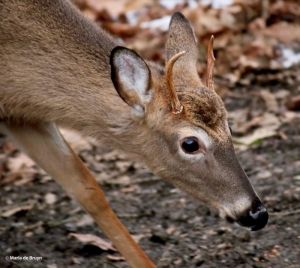
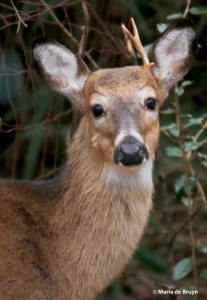
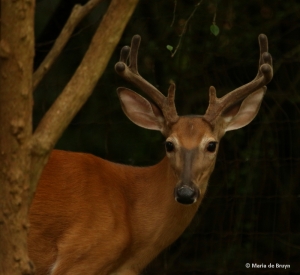
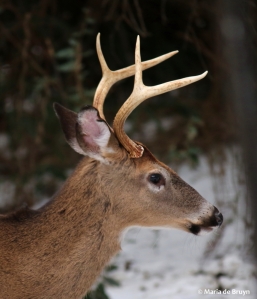
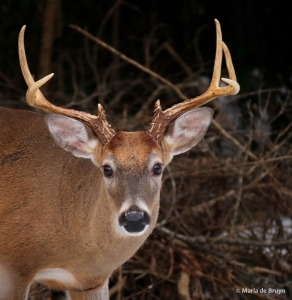
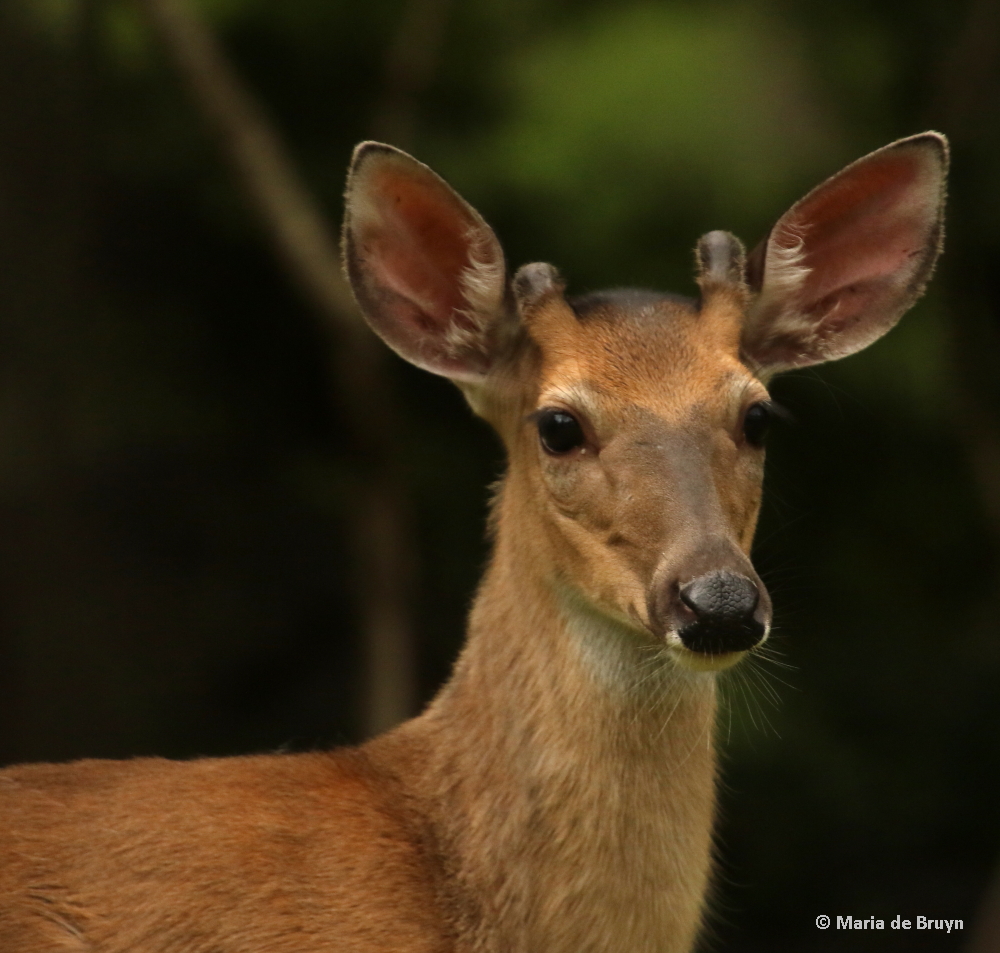
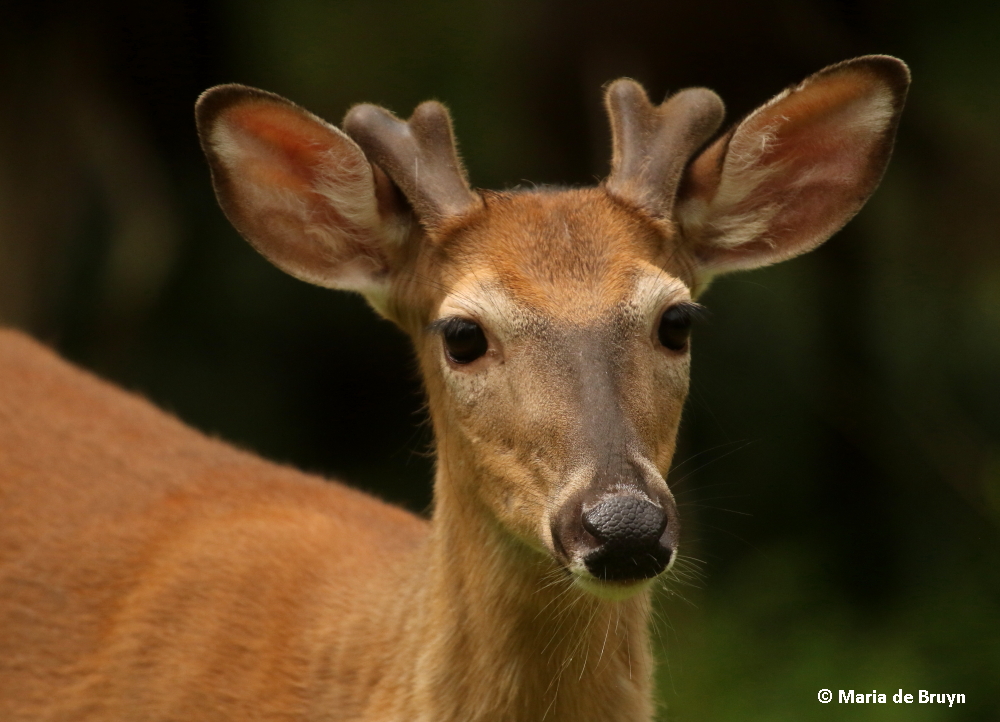
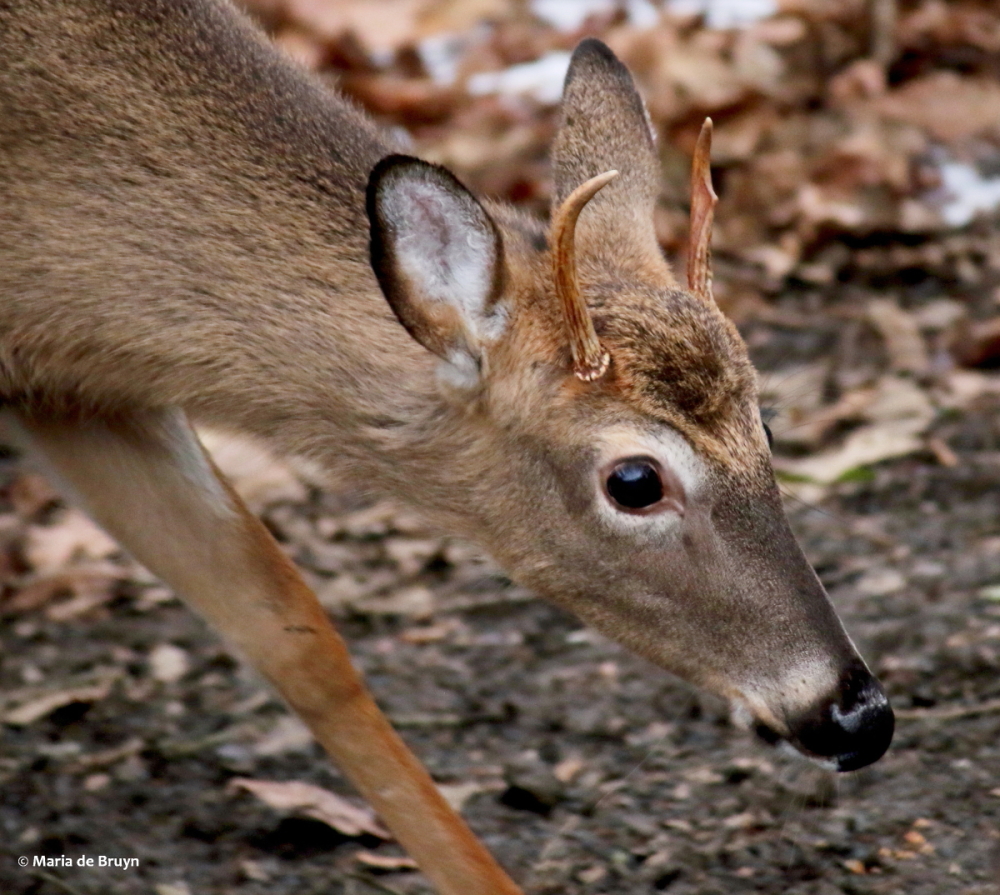
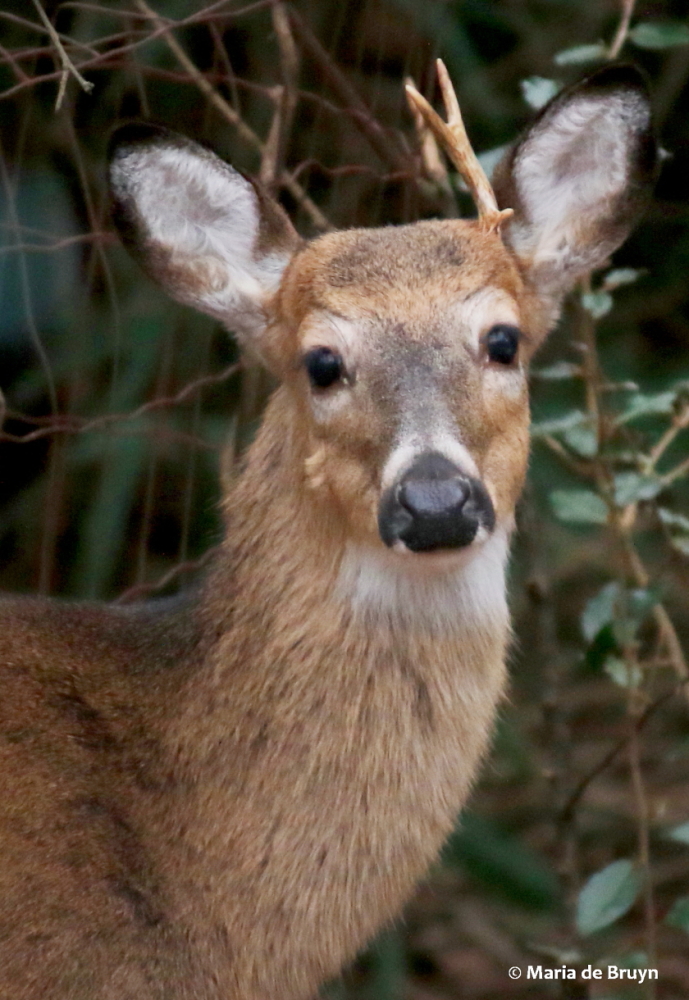
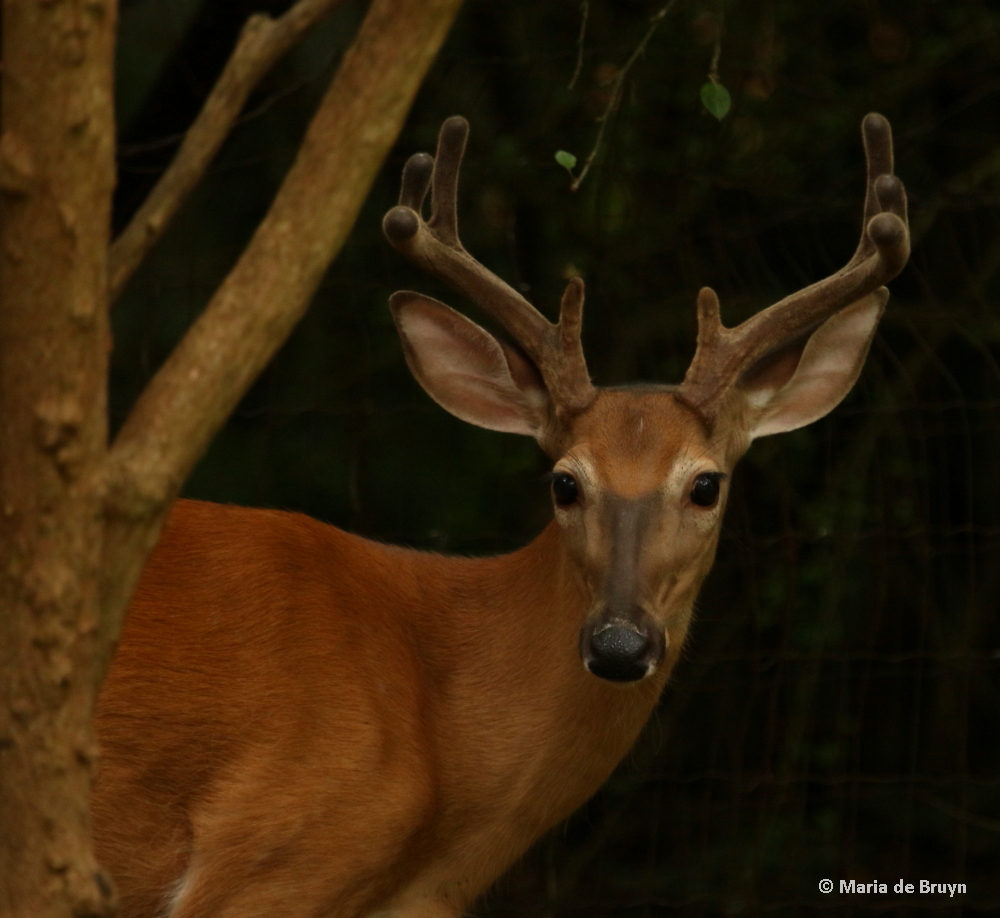
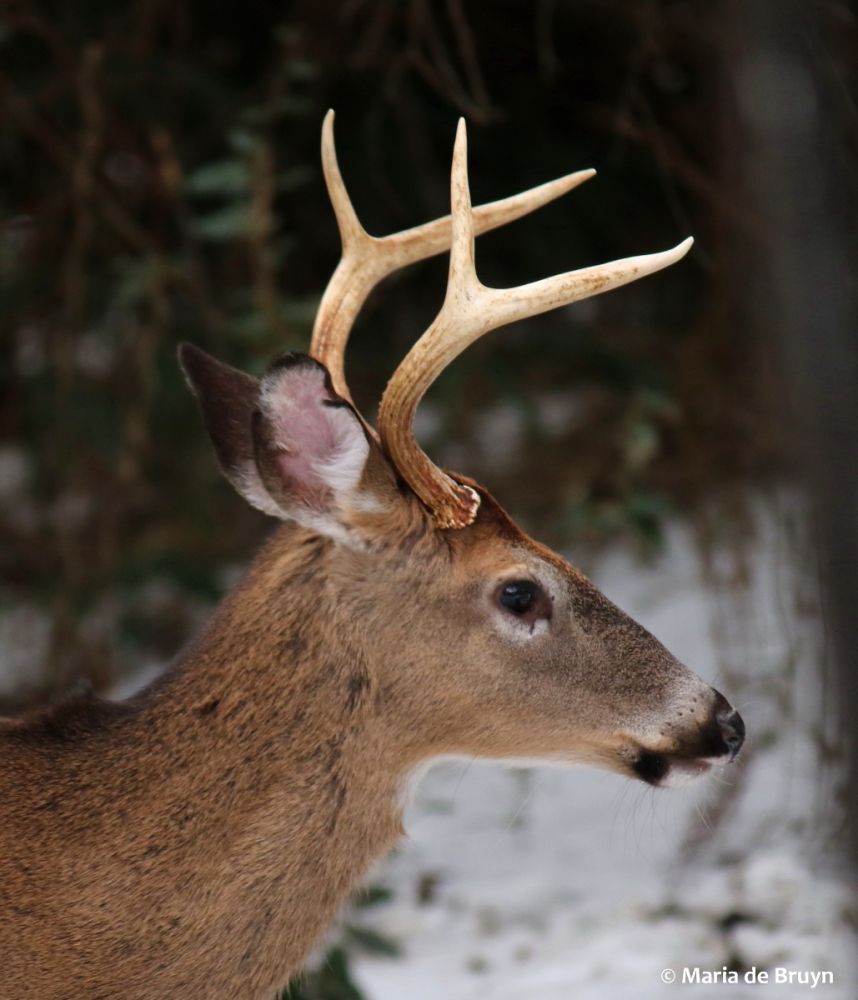
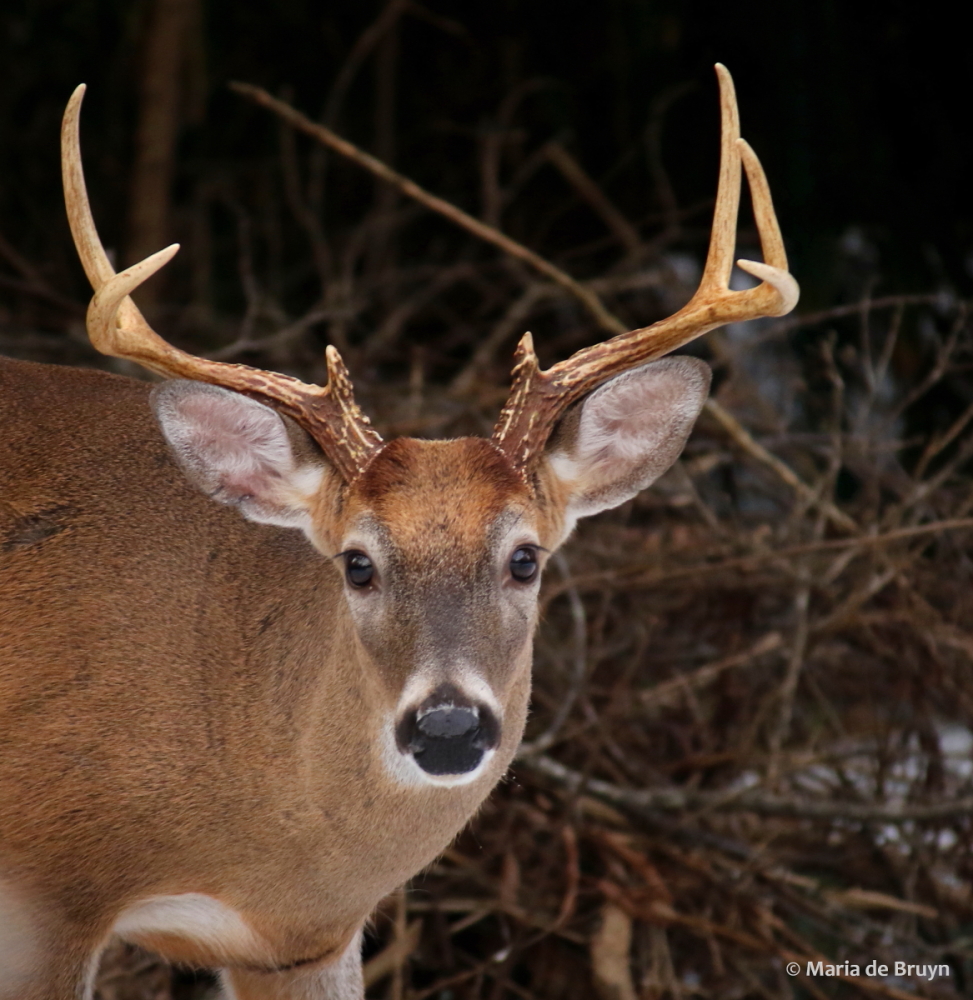
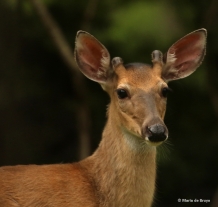
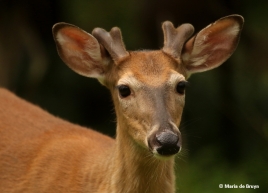
It’s interesting to see how button bucks are followed by yearlings with nubby antlers and eventually grow up to become handsome 5- or more point bucks.
white-tailed-deeri77a4099-maria-de-bruyn-res      white-tailed-deer-i77a4097-maria-de-bruyn-res

white-tailed-deer-i77a1367-maria-de-bruyn-res  white-tailed-deer-i77a1366-maria-de-bruyn-res

white-tailed-deer-i77a9813-maria-de-bruyn-res

white-tailed-deer-i77a1061-maria-de-bruyn-res white-tailed-deer-i77a1005-maria-de-bruyn-res

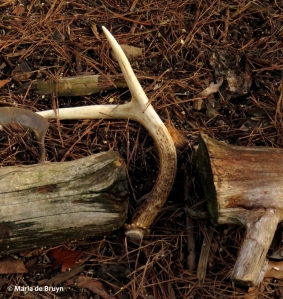
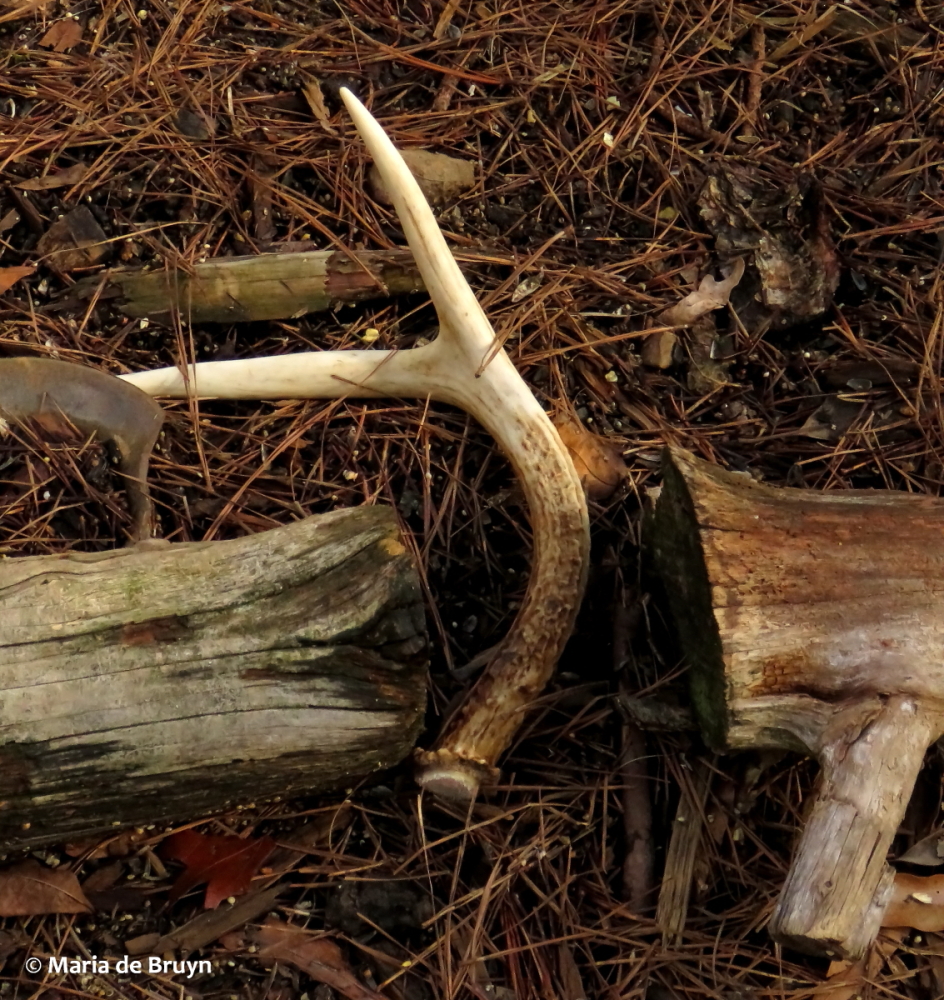
white-tailed-deer-antler-img_1211-maria-de-bruyn-resThis past year, one of the bucks was kind enough to drop one of his antlers in my yard as a souvenir.

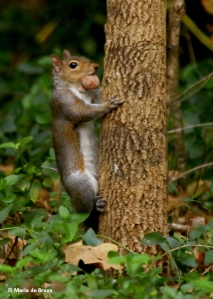
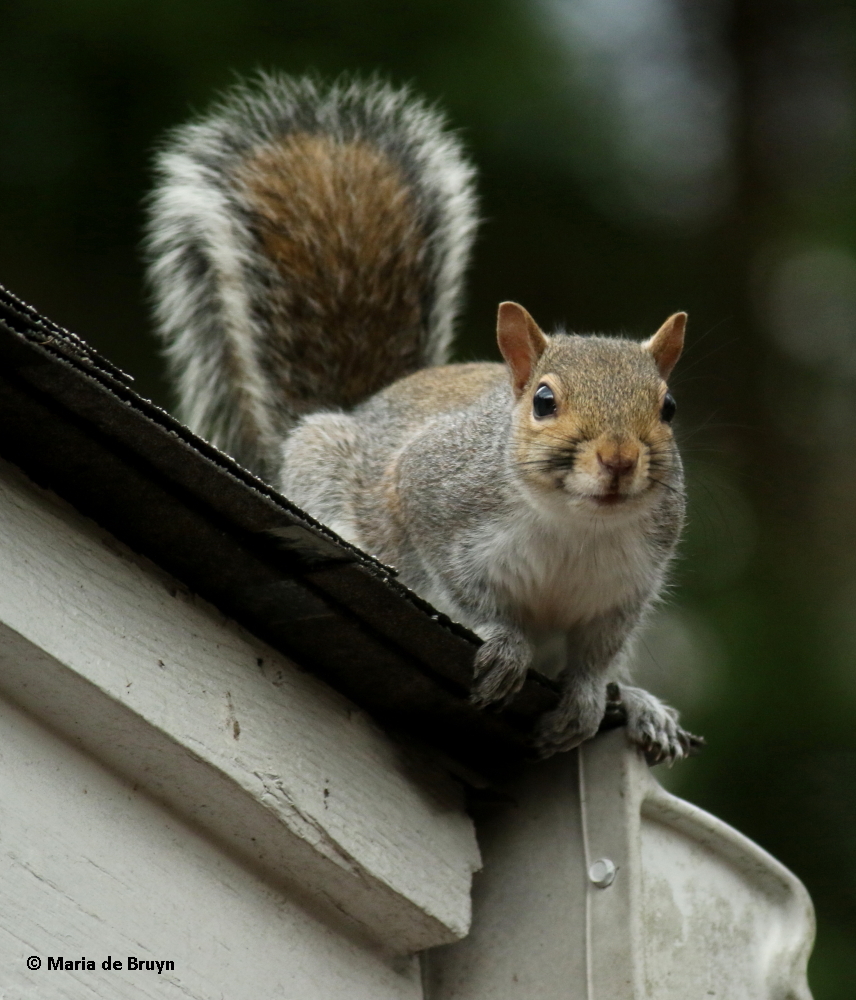
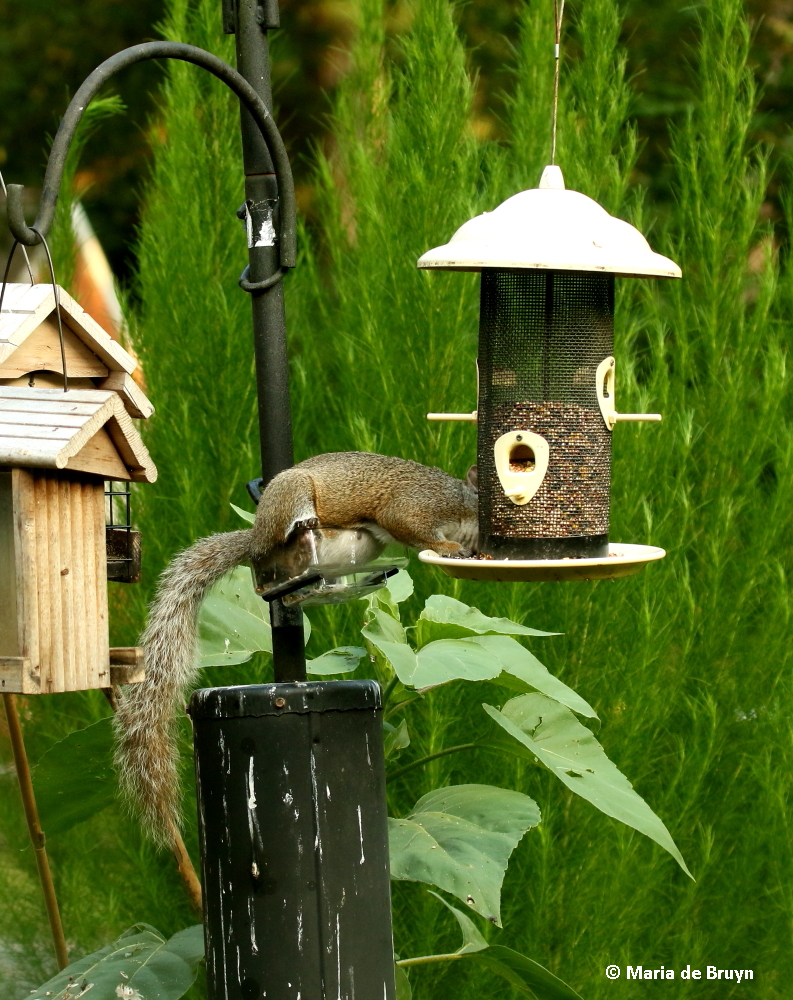
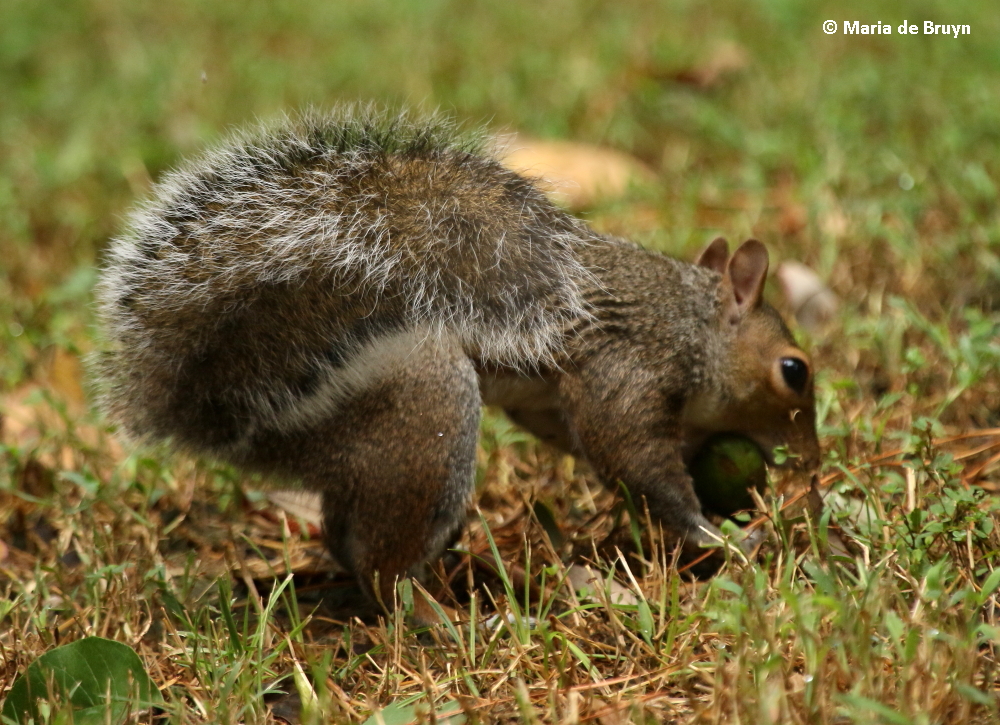
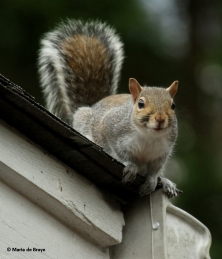
The Eastern gray squirrels (Sciurus carolinensis) provide endless amusement – one way is by investigating various techniques to find a way onto the bird feeders. These are largely unsuccessful, even when they climb up on the roof to see if they can launch themselves far enough to reach a feeder pole. This year, however, one enterprising squirrel managed to finally get onto a feeder by climbing up a rather large sunflower stem that held his/her weight until it bent over close to a pole.
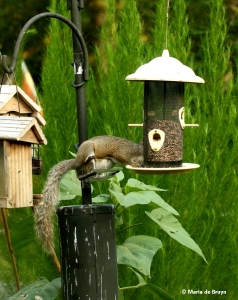
eastern-gray-squirrel-i77a5492-maria-de-bruyn-res   eastern-gray-squirrel-i77a7478-maria-de-bruyn-res

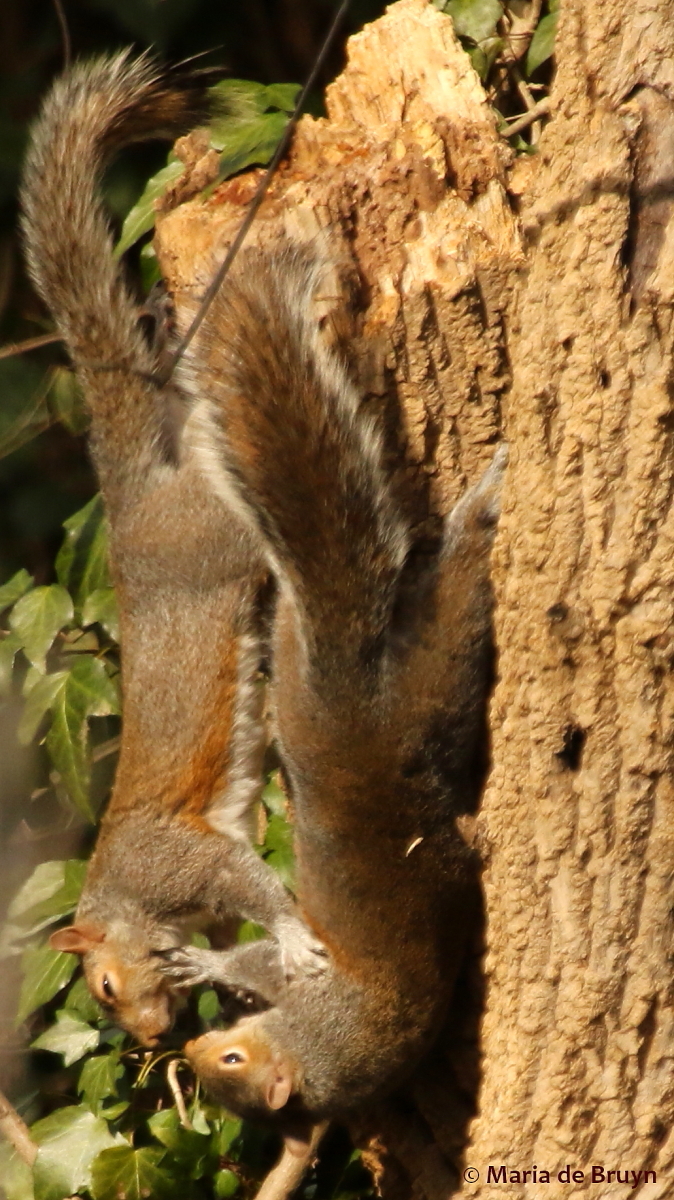
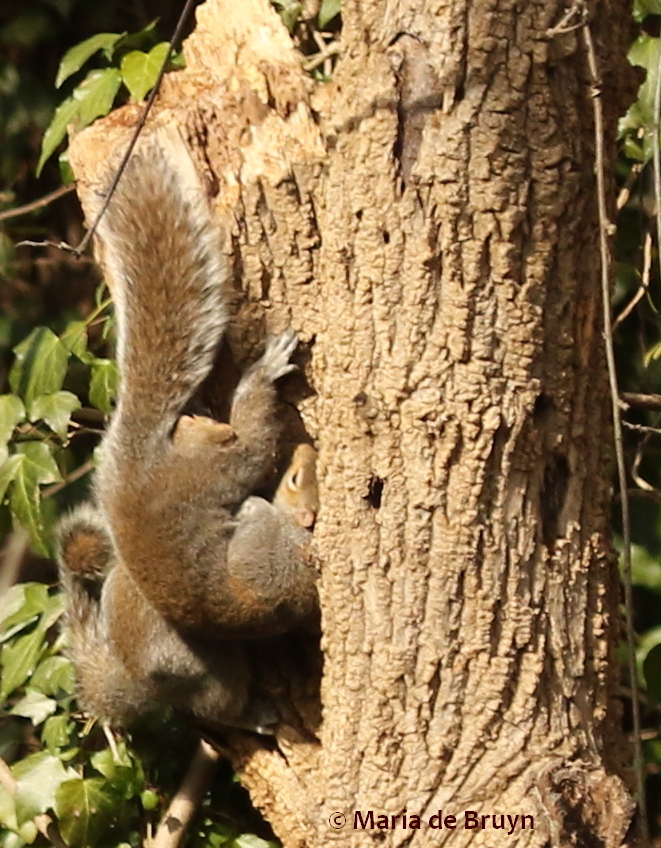
Their antics as they chase one another in play and for amorous purposes, too, are also quite entertaining.

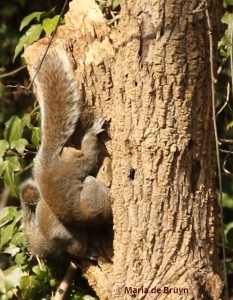
eastern-gray-squirrel-i77a1104-maria-de-bruyn-res      eastern-gray-squirrel-77a0929-maria-de-bruyn

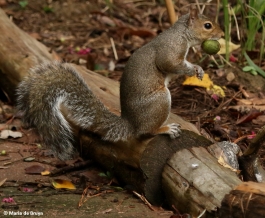
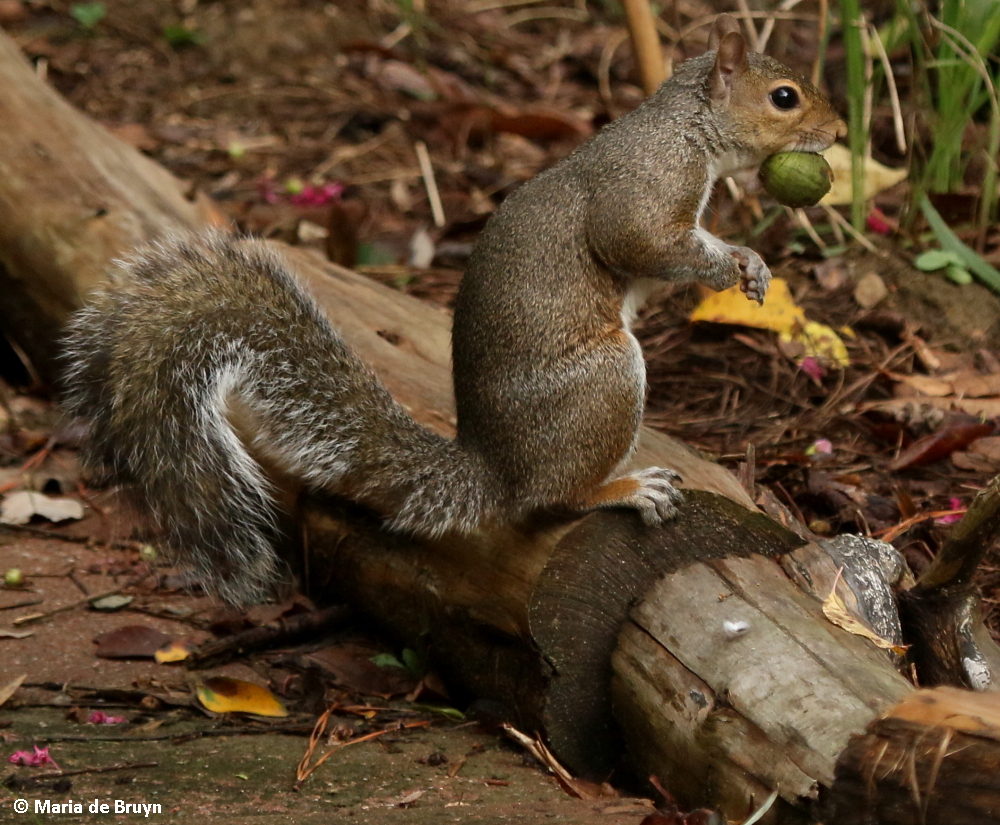
It’s fun to watch them caching seeds as well; sometimes, they decide a spot in the middle of the lawn is the best hiding place!
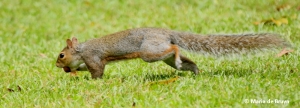
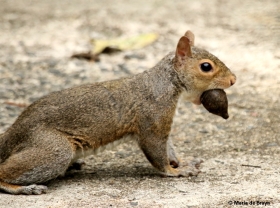
eastern-gray-squirrel-i77a0026-maria-de-bruyn-res

eastern-gray-squirrel-i77a9947-maria-de-bruyn-res   eastern-gray-squirrel-i77a6837-maria-de-bruyn-res

eastern-gray-squirrel-i77a4579-maria-de-bruyn-res   eastern-gray-squirrel-i77a4938-maria-de-bruyn-res

eastern-chipmunk-i77a4007-maria-de-bruyn-res


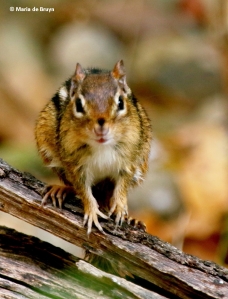
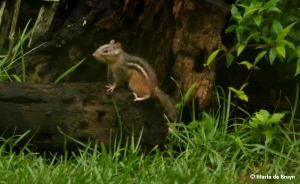
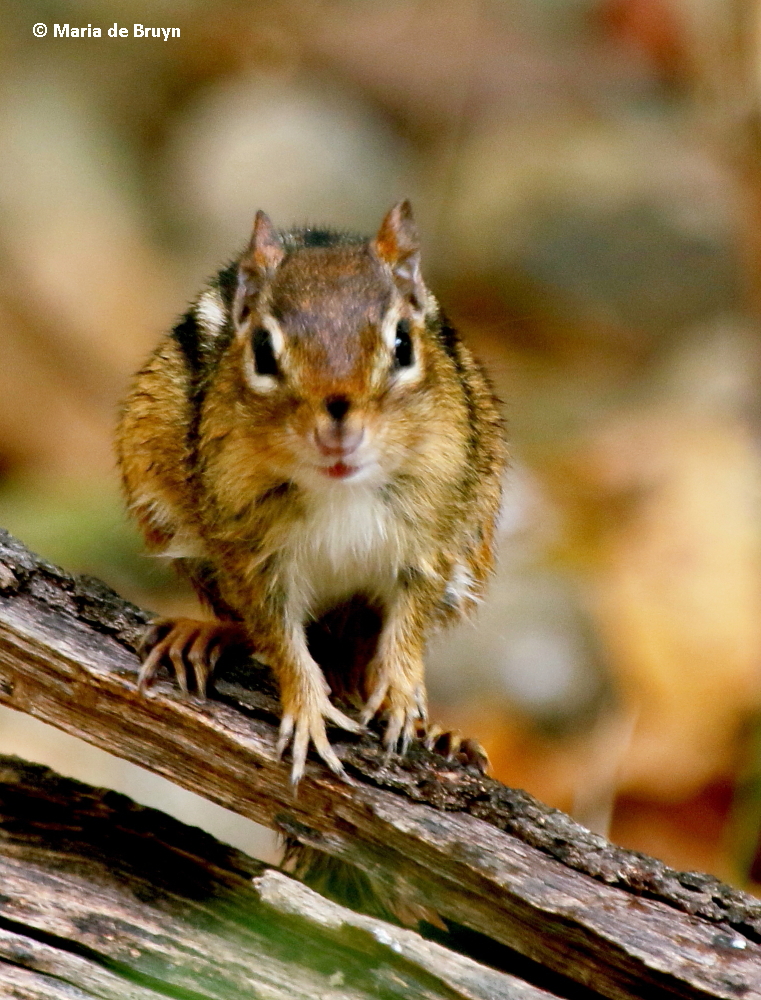
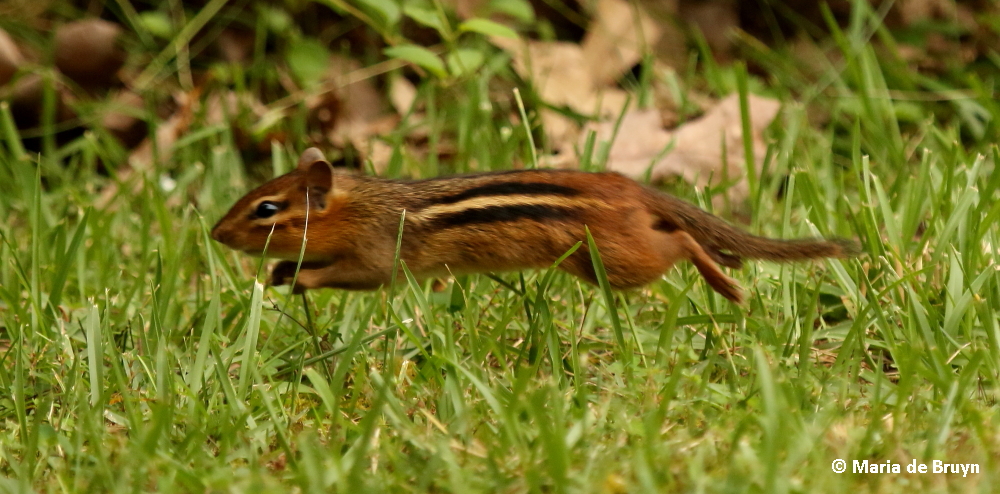
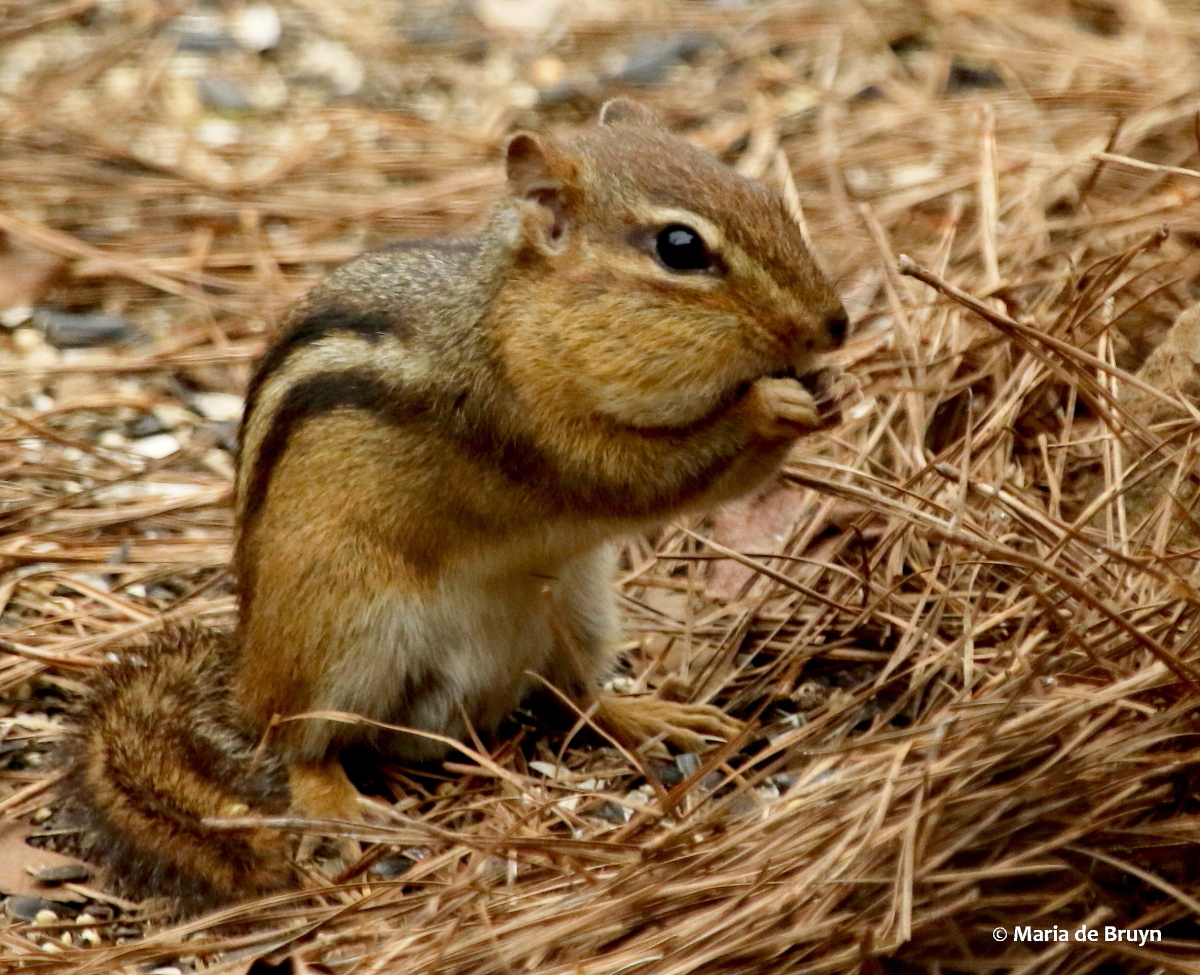
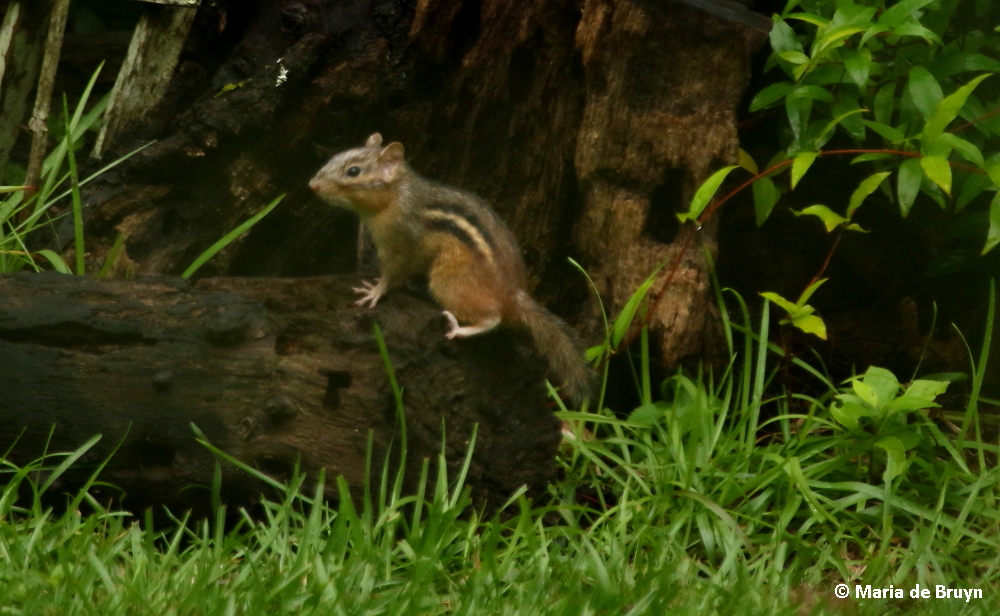
They often will chase non-family members away from the food I put out on the ground – seeds, bits of bread and apples for the birds (crows and catbirds are especially fond of apples). They are usually (not always!) willing to tolerate the Eastern chipmunks (Tamias striatus) who come to get some goodies, too.
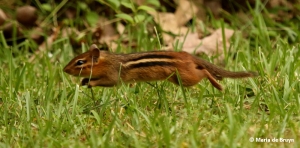
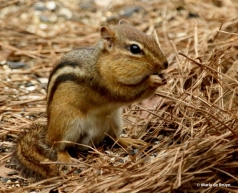
eastern-chipmunk-i77a7935-maria-de-bruyn-res

eastern-chipmunk-i77a8790-maria-de-bruyn-res  eastern-chipmunk-i77a3418-maria-de-bruyn-res

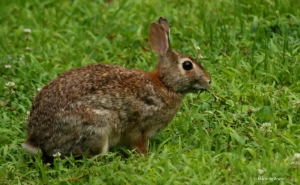
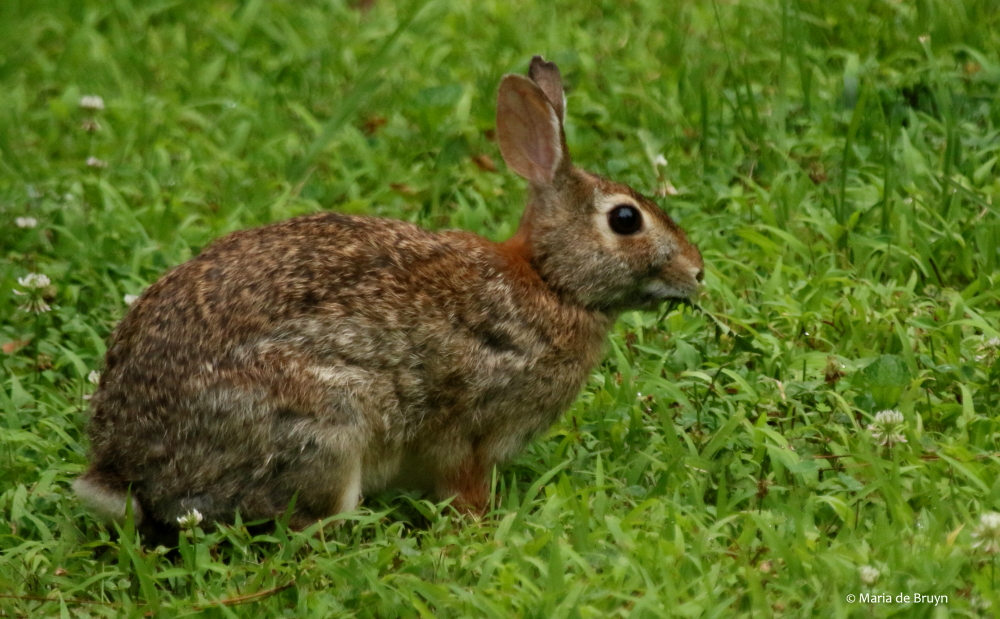
eastern-cottontail-i77a9747-maria-de-bruyn-resThe Eastern cottontail rabbits (Sylvilagus floridanus) don’t often go for the bird food but prefer to munch on the grasses and other plants growing on the “lawn”.

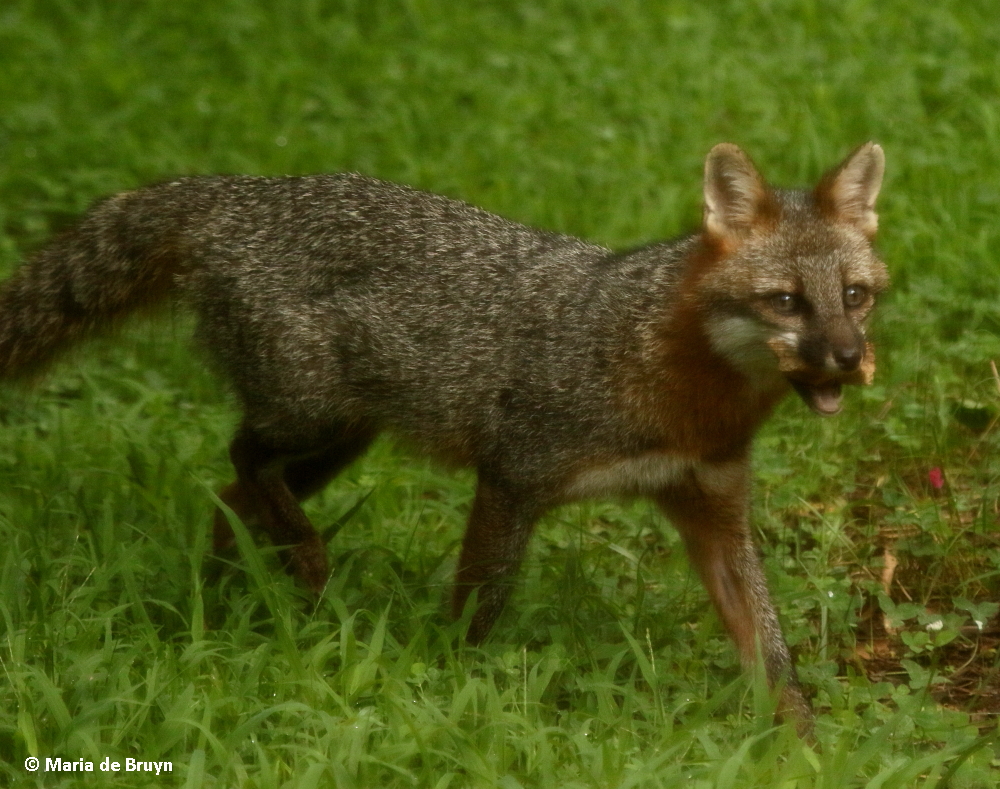
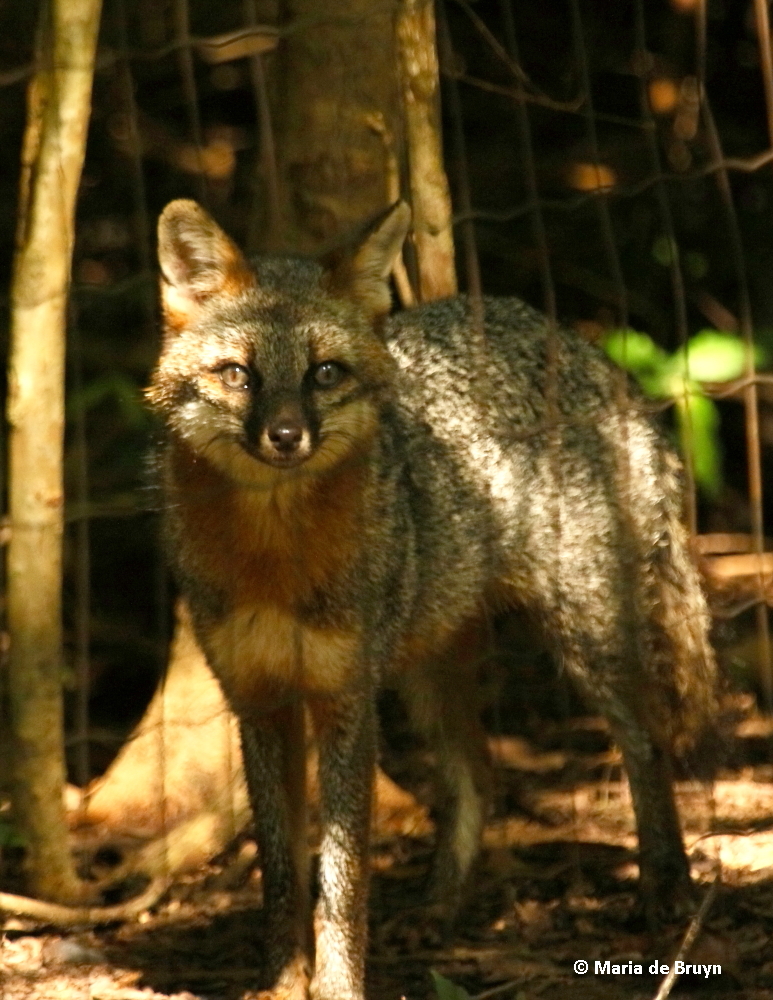
I was surprised this summer when I discovered that the beautiful neighborhood gray fox (Urocyon cinereoargenteus) was fond of bread.
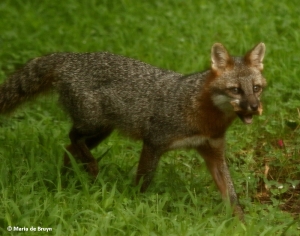
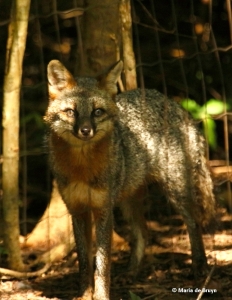
gray-fox-i77a1236-maria-de-bruyn-res gray-fox-faith-i77a1197-maria-de-bruyn-res

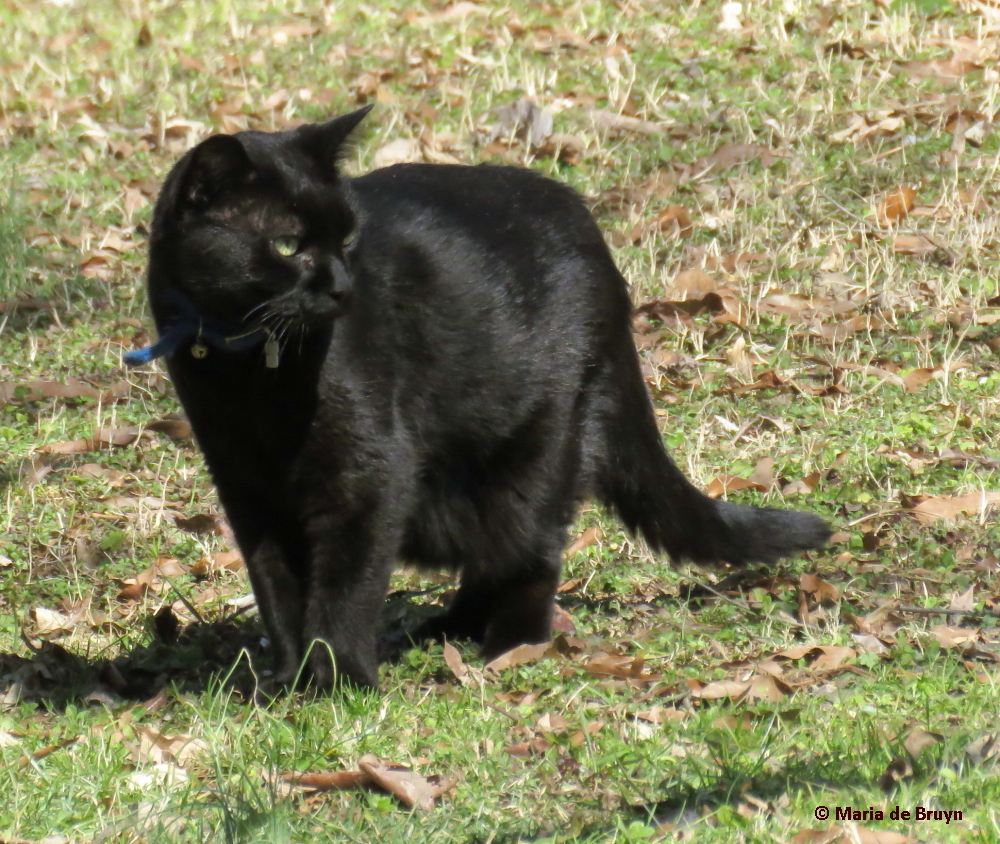
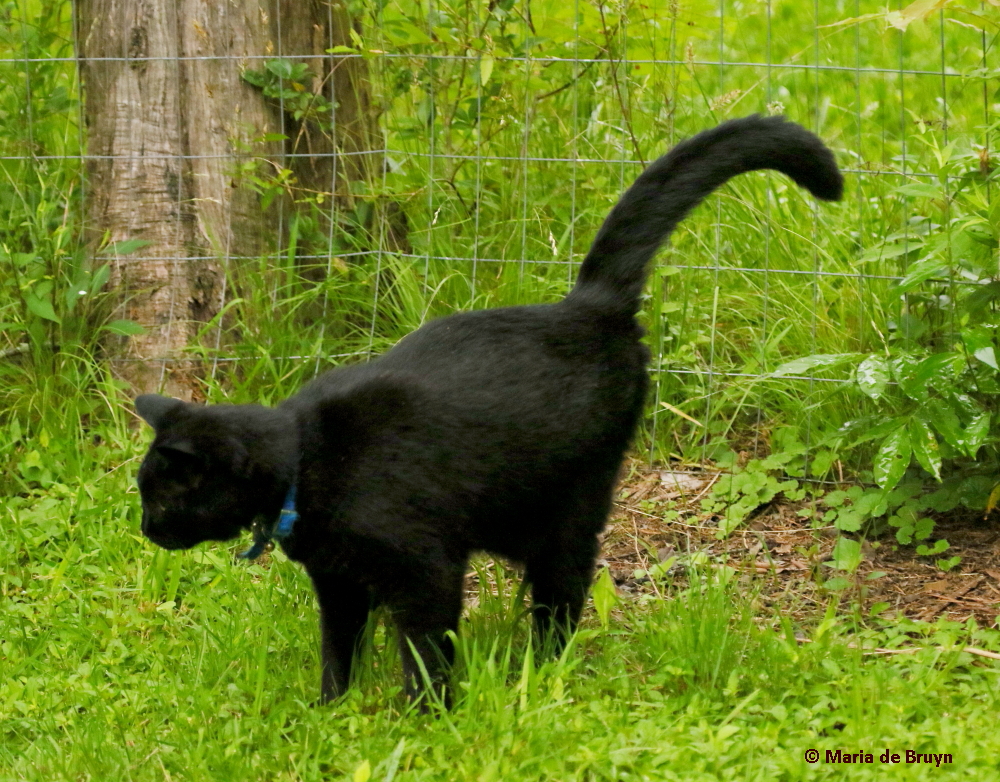
Her presence in the yard reinforced my resolve to no longer let my former indoor-outdoor cat, Jonahay, out by himself anymore. He has almost reached the ripe old age of 18 years and is going strong despite suffering arthritis, mild kidney disease, mild dementia and deafness. But all the years of having roamed outside have preserved a strong will to go outdoors so I take him for walks around the yard, which give him opportunities to mark his territory anew. (My other two cats are strictly indoor felines, although one of them likes to escape now and again.)
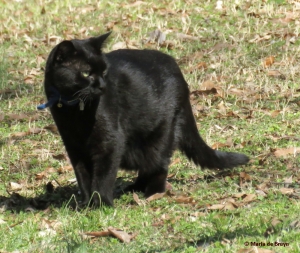
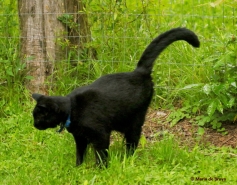
jonahay-img_0058-maria-de-bruyn-res jonahay-i77a5004-maria-de-bruyn-res

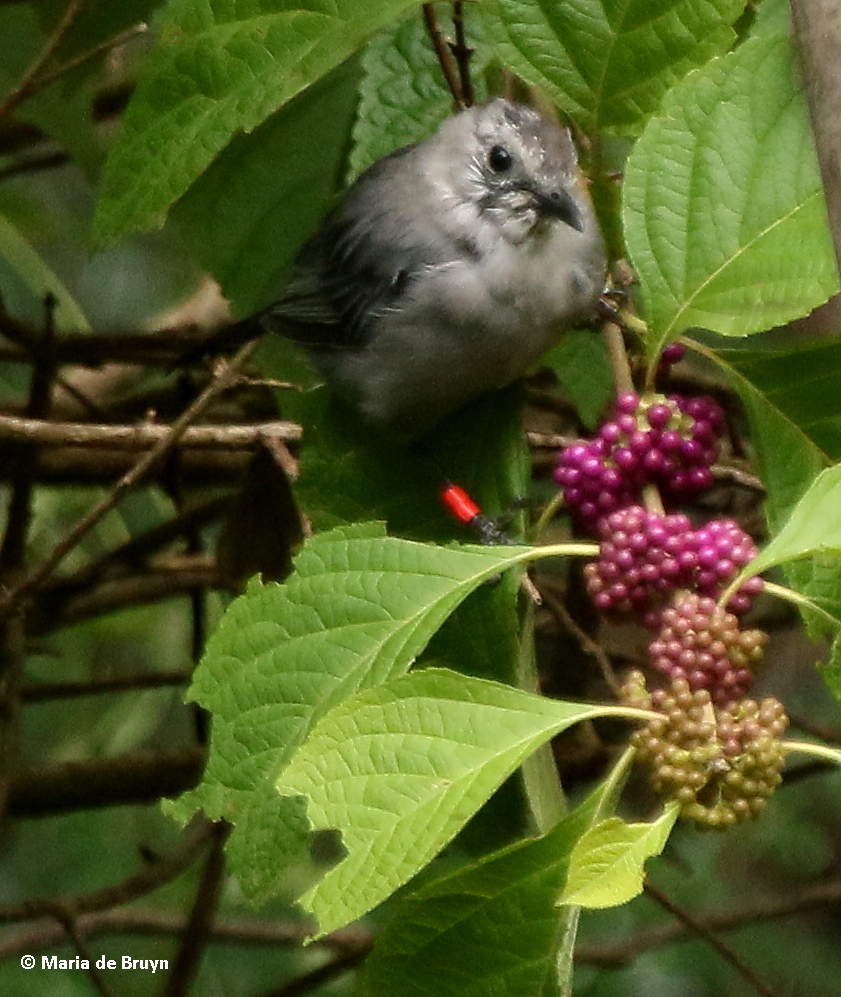
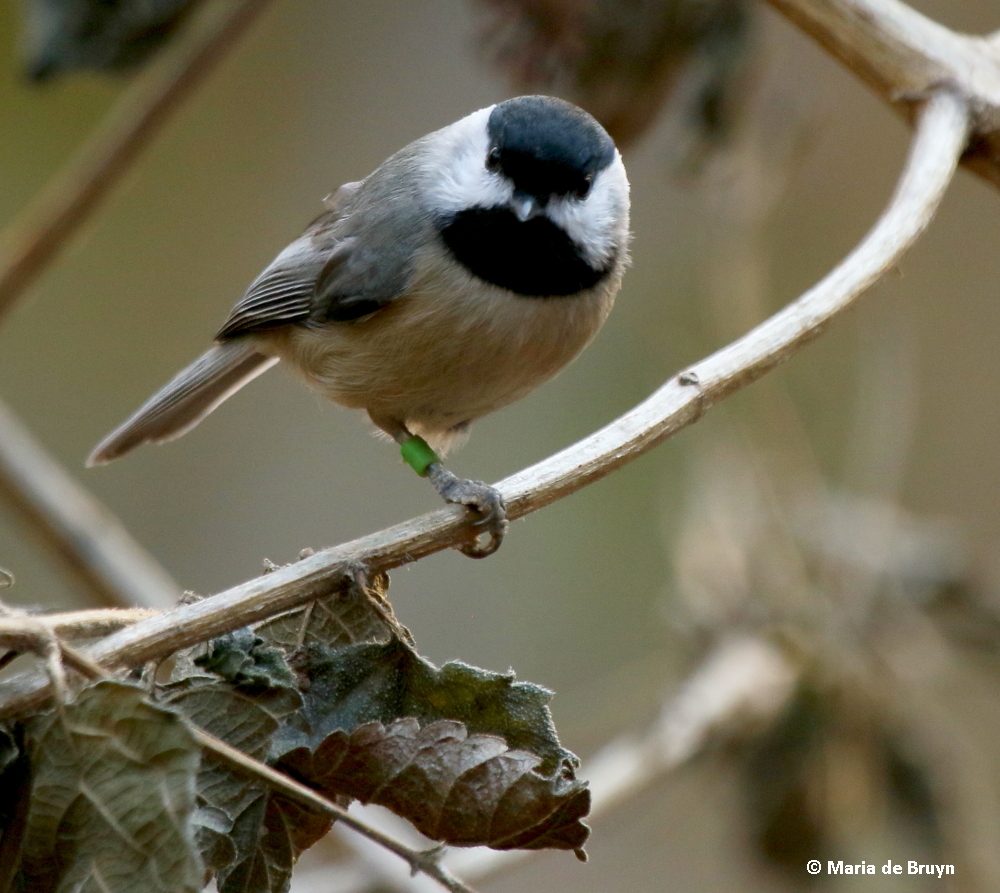
Two years running now, my yard has served as a venue for a citizen-science bird banding exercise and it’s always a pleasure to see banded birds returning to the feeders, like Corey catbird (Dumetella carolinensis) who enjoys American beautyberries. They also include my intrepid Carolina chickadee (Poecile carolinensis), Chantal, who unfortunately lost a leg (I think because she had scaly leg when she was banded and the bands were too tight but I don’t know this for sure). She is a feisty little bird and manages to balance remarkably well on her remaining leg; her daily return is always a joyous sight for me.
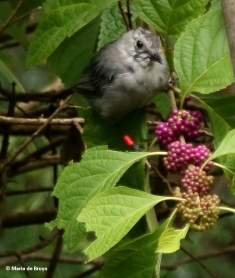
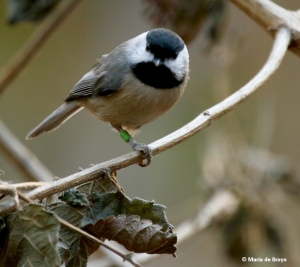
gray-catbird-corey-i77a4763-maria-de-bruyn-res  carolina-chickadee-chantal-i77a7263-maria-de-bruyn-res

sphinx-moth-caterpillar-img_4314-maria-de-bruyn-res


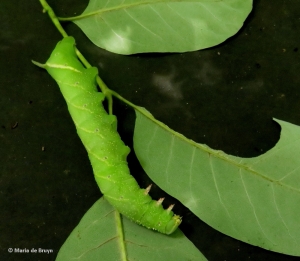
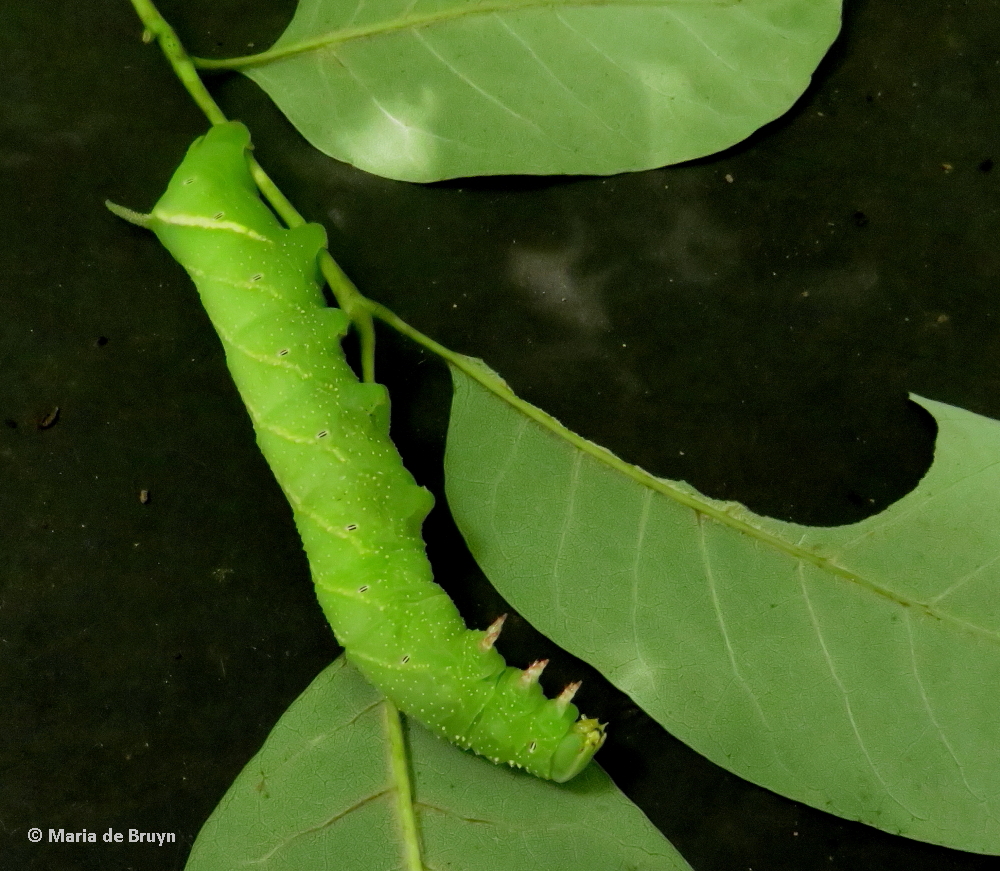
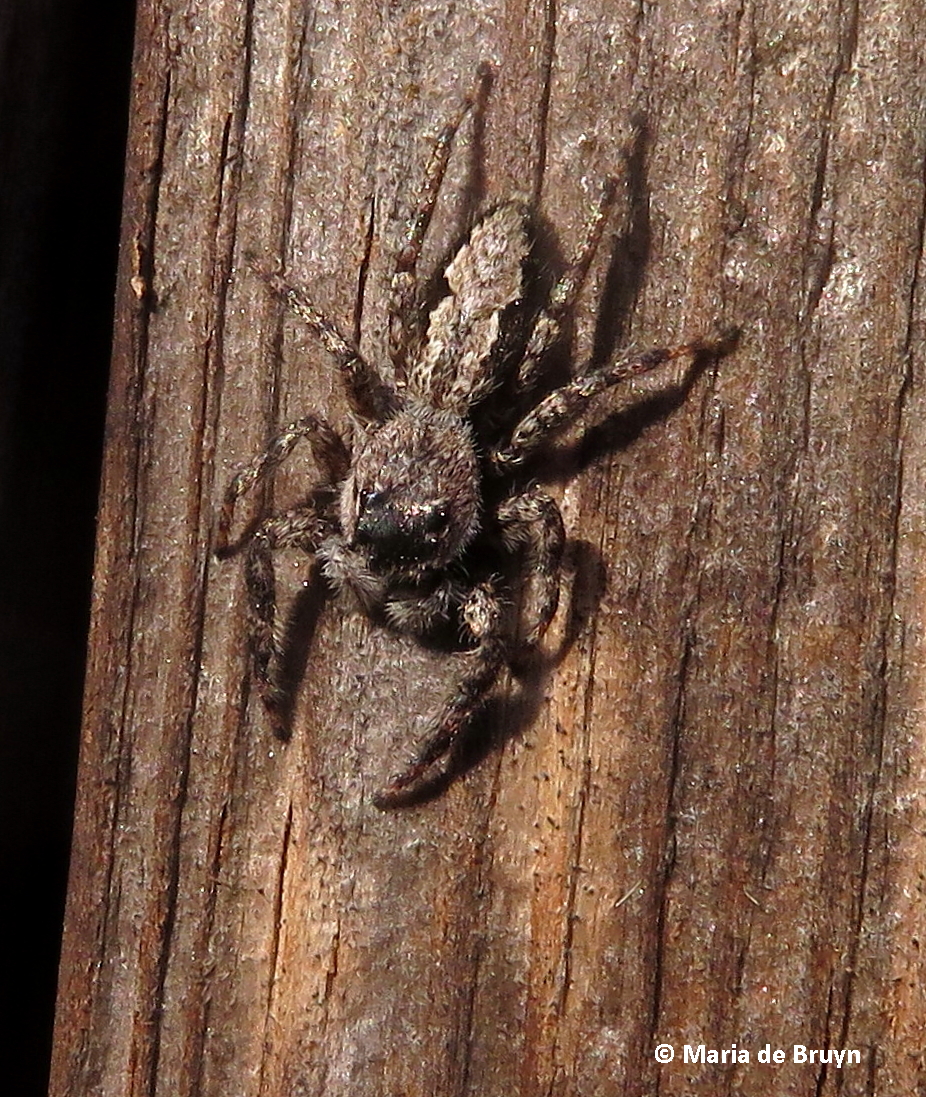
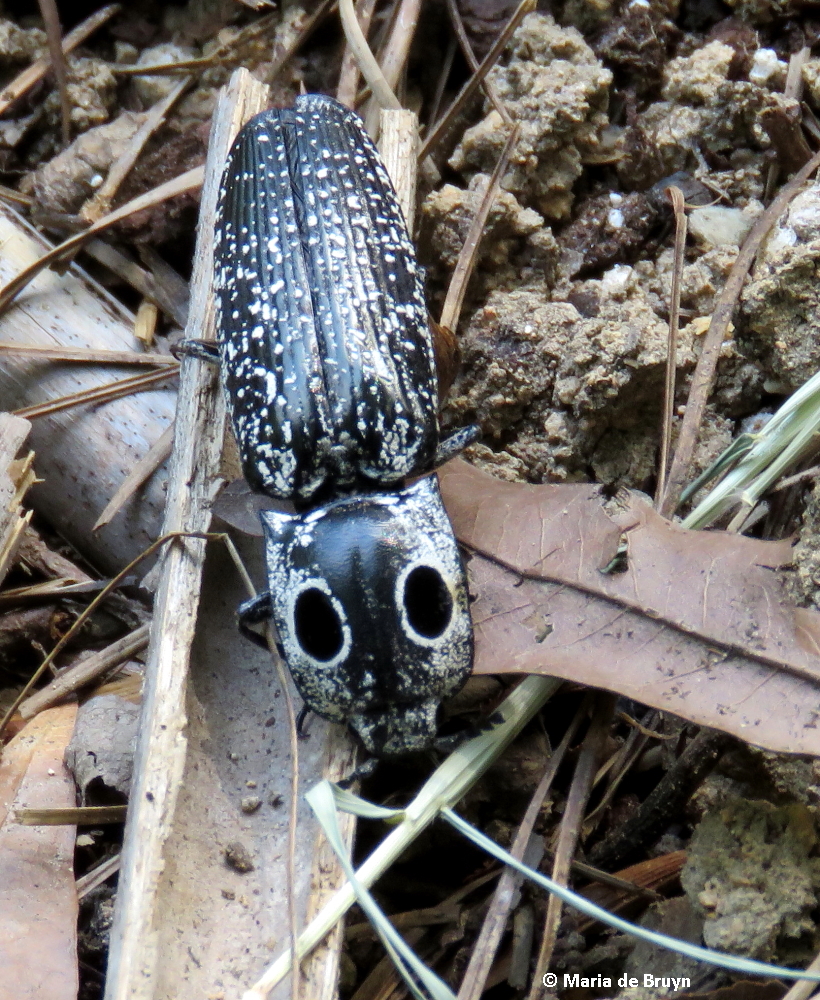
2016 was an exciting year as far as caterpillars went since a large sphinx moth caterpillar (Paonias) graced the yard for the first time (at least that I had noticed).  Cute little jumping spiders (Salticidae) climb onto bird nest boxes and Eastern eyed click beetles (Alaus oculatus) are found in the leaf litter.
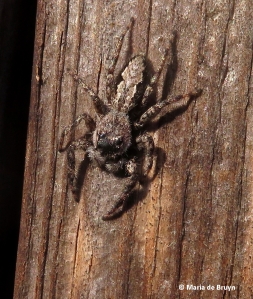
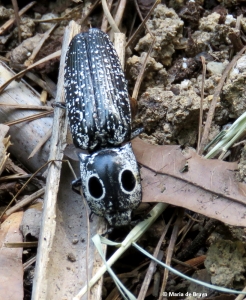
 

jumping-spider-img_0562_1-maria-de-bruyn   click-beetle-img_4582-maria-de-bruyn-res

stink-bug-img_0575maria-de-bruyn-res


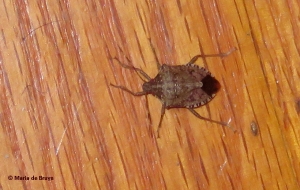
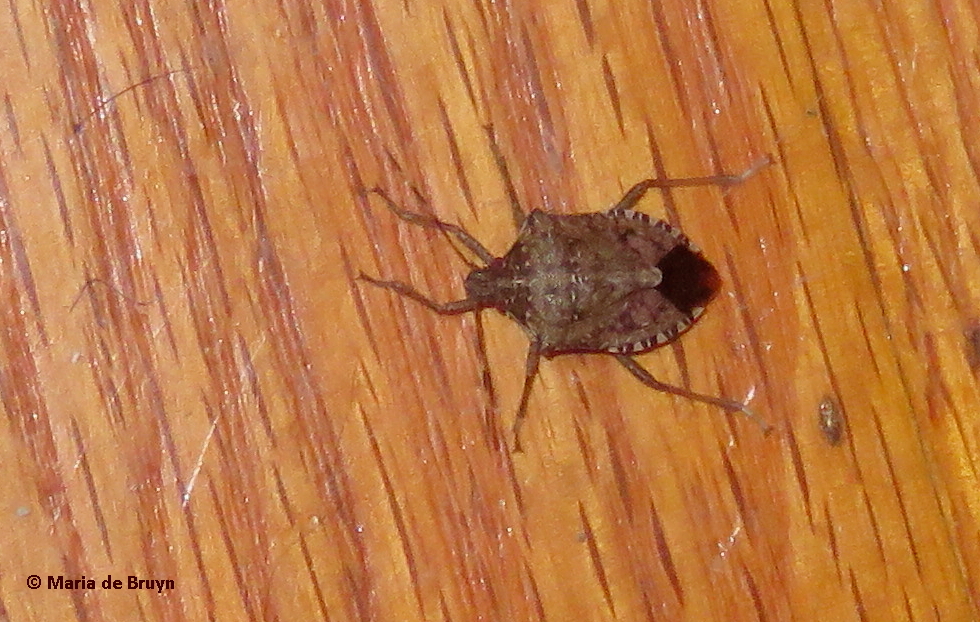
Unfortunately, some of the stink bugs (Halyomorpha) make their way into the house so that I have to take them back outside. One of my cats made the mistake of eating one that I hadn’t got in time and she ended up quite sick, even foaming at the mouth!
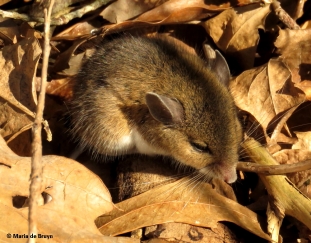
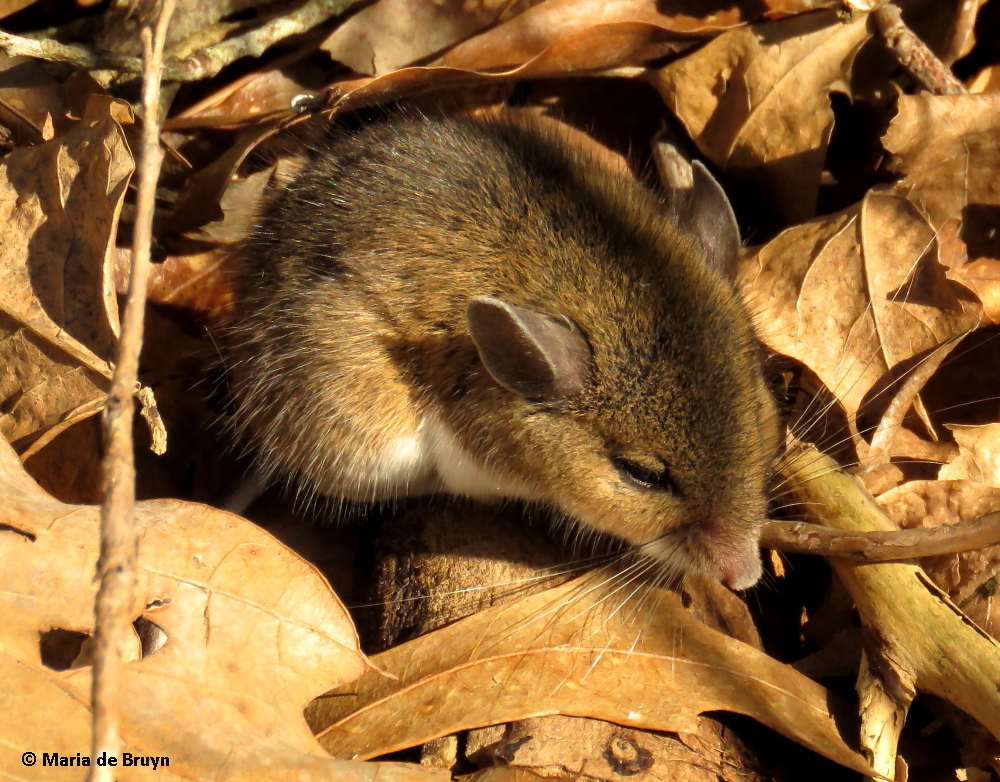
mouse-img_2726-maria-de-bruyn-resOccasionally, mice (Mus) get into the house. The cats don’t eat them and aren’t out to kill them but if they catch one at night and I don’t awaken, the rodent will be dead in the morning. Otherwise, I manage to get hold of the animal (sometimes with a lot of effort) and let it go outside again.

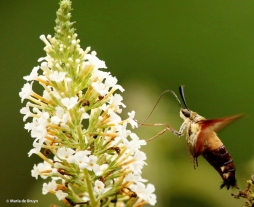
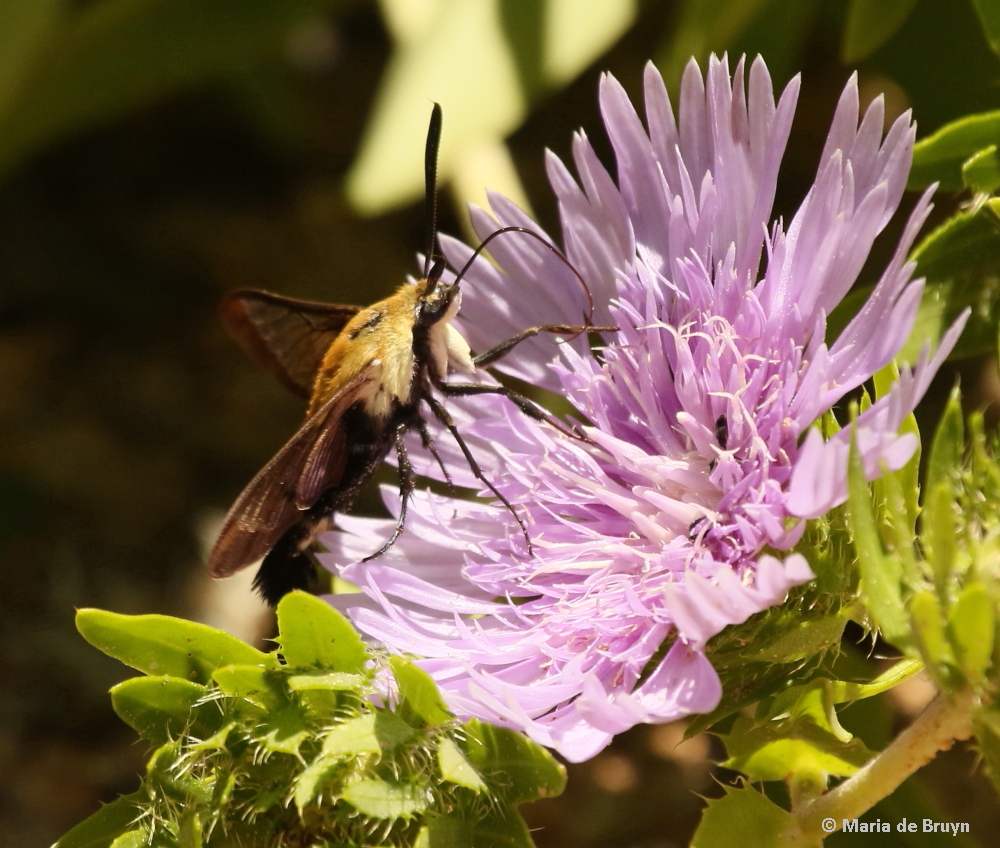
The snowberry (Hemaris diffinis) & hummingbird clearwing moths (Hemaris thysbe) are delightful.
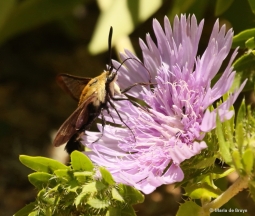
snowberry-clearwing-moth-i77a5324-maria-de-bruyn-res   clearwing-hummingbird-moth-i77a7002-maria-de-bruyn-res

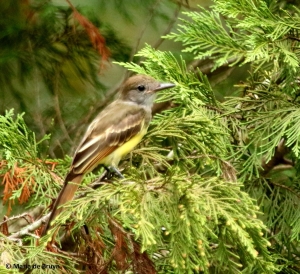
great-crested-flycatcher-i77a6714-maria-de-bruyn-res


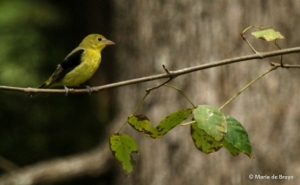
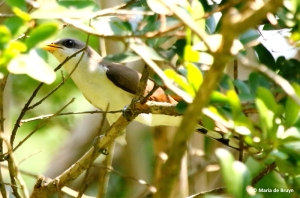
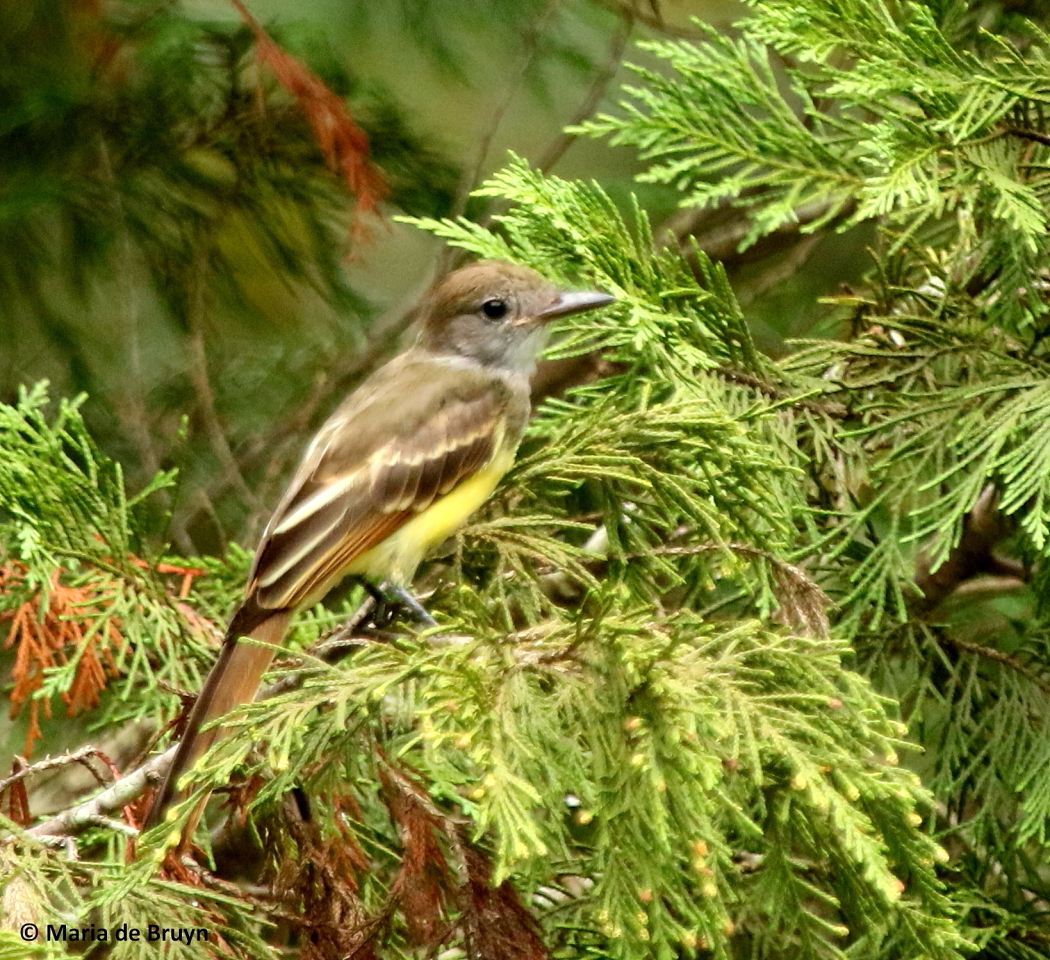
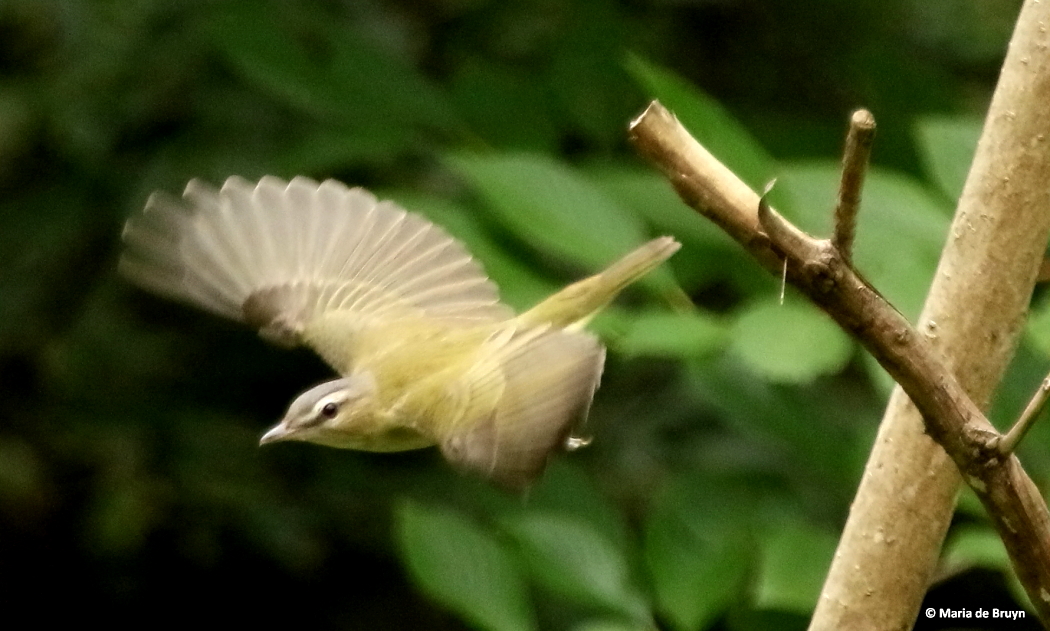
And so were various birds that visited my yard for the first time this year (or at least as far as I had noticed)! They included the black and white warbler, chestnut-sided warbler and Northern parula. Here are three more, plus the beautiful great crested flycatcher (Myiarchus crinitus, left), which I’d seen before but not well.
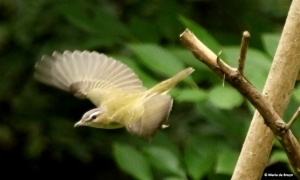
 

red-eyed-vireo-i77a6755-maria-de-bruyn-res

Red-eyed vireo (Vireo olivaceus)

scarlet-tanager-i77a0102-maria-de-bruyn-res

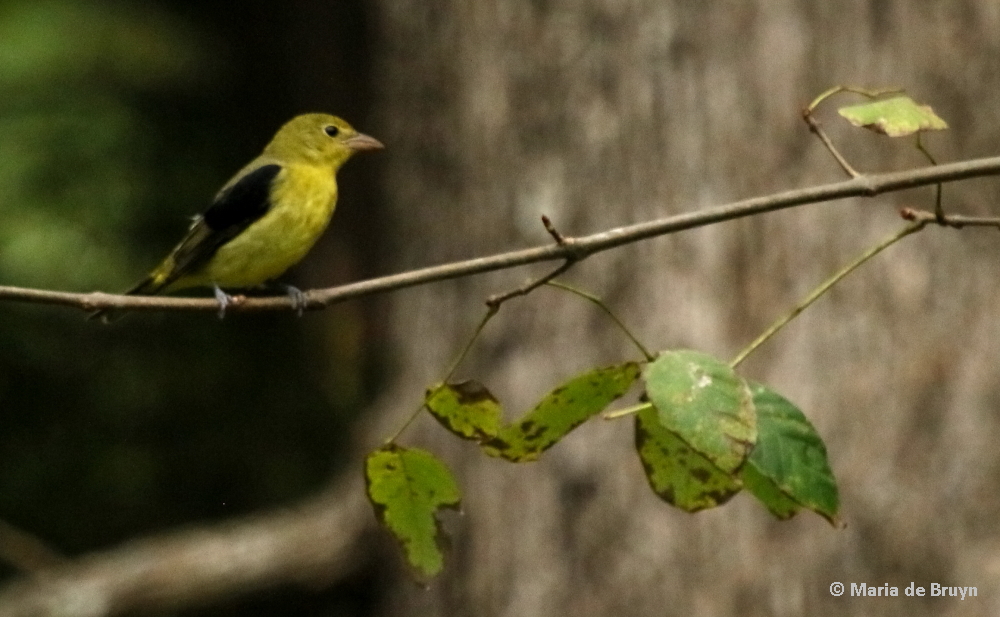
Scarlet tanager (Piranga olivacea)

yellow-billed-cuckoo-i77a1564-maria-de-bruyn-res

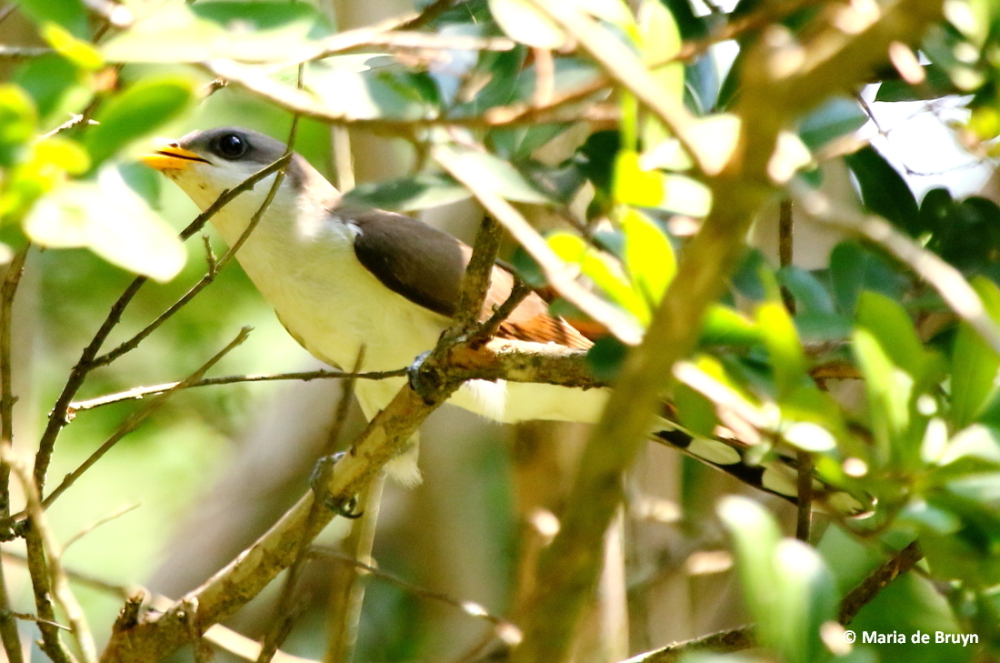
Yellow-billed cuckoo (Coccyzus americanus)
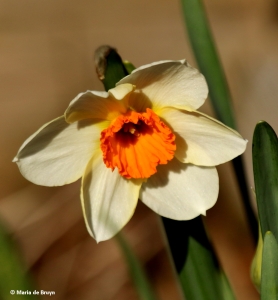
daffodil-i77a8465-maria-de-bruyn-res


I’m so pleased to begin this year in my home and really hope that circumstances in 2017 will allow me to continue enjoying nature, especially in my yard as I work to make it ever more welcoming to the local wildlife. And I hope all of you who read my blog will have many opportunities to get out and appreciate our beautiful natural world, too! Happy New Year to you!


Humankind has not woven the web of life.
We are but one thread within it.
Whatever we do to the web, we do to ourselves.
All things are bound together.
All things connect.

~ Chief Seattle, 1854 ~
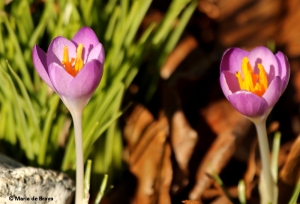
crocus-i77a6296-maria-de-bruyn-res

And now for something different…

indonesia-img_0067-maria-de-bruynRecently, I was pondering what I might choose as a subject for a column that I contribute to a bird club newsletter. And then as I was getting New Year’s cards ready to send, a topic emerged. So as I work on some new wildlife photography blogs, here is one with a bit of a different focus, based on the newsletter article I wrote.

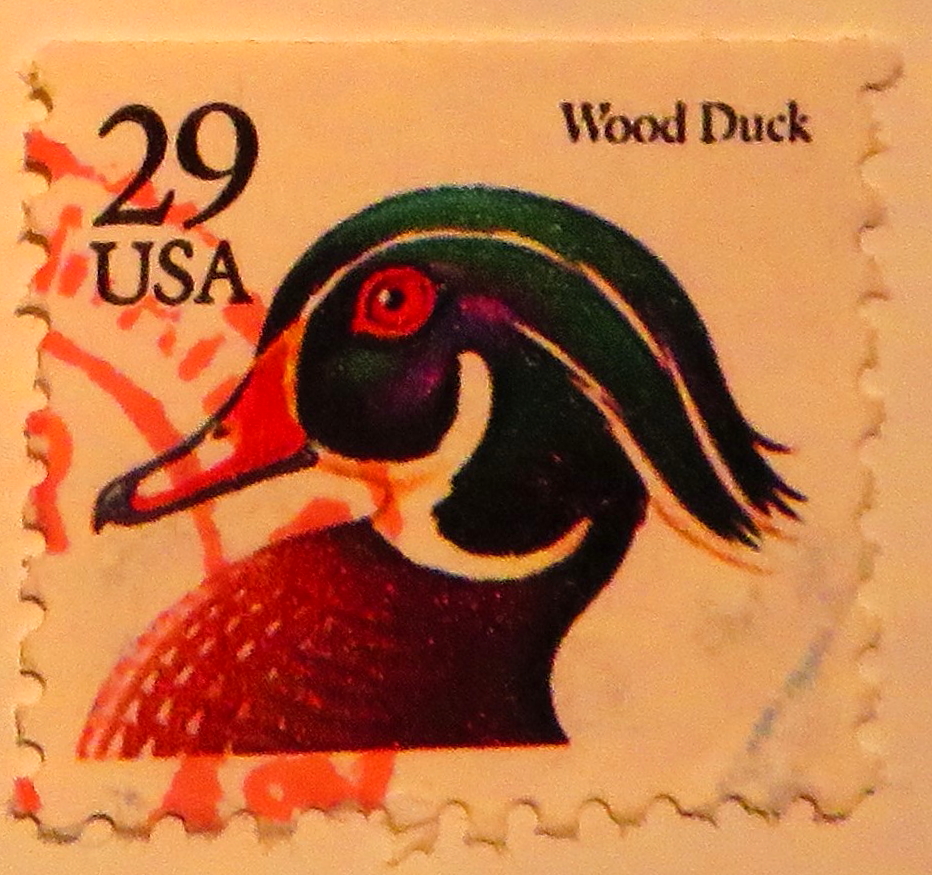
Many birders are focused on a few goals when they go out looking for birds – increasing their life-lists, finding a “nemesis bird” that has continued to elude them, celebrating new birds to add to their yard lists, getting a great photographic shot, exploring a new nature area, etc. But there are other ways to celebrate birds as well and one that might help get young people interested in them is to help them begin a bird stamp collection. Or you might find it fun for yourself!

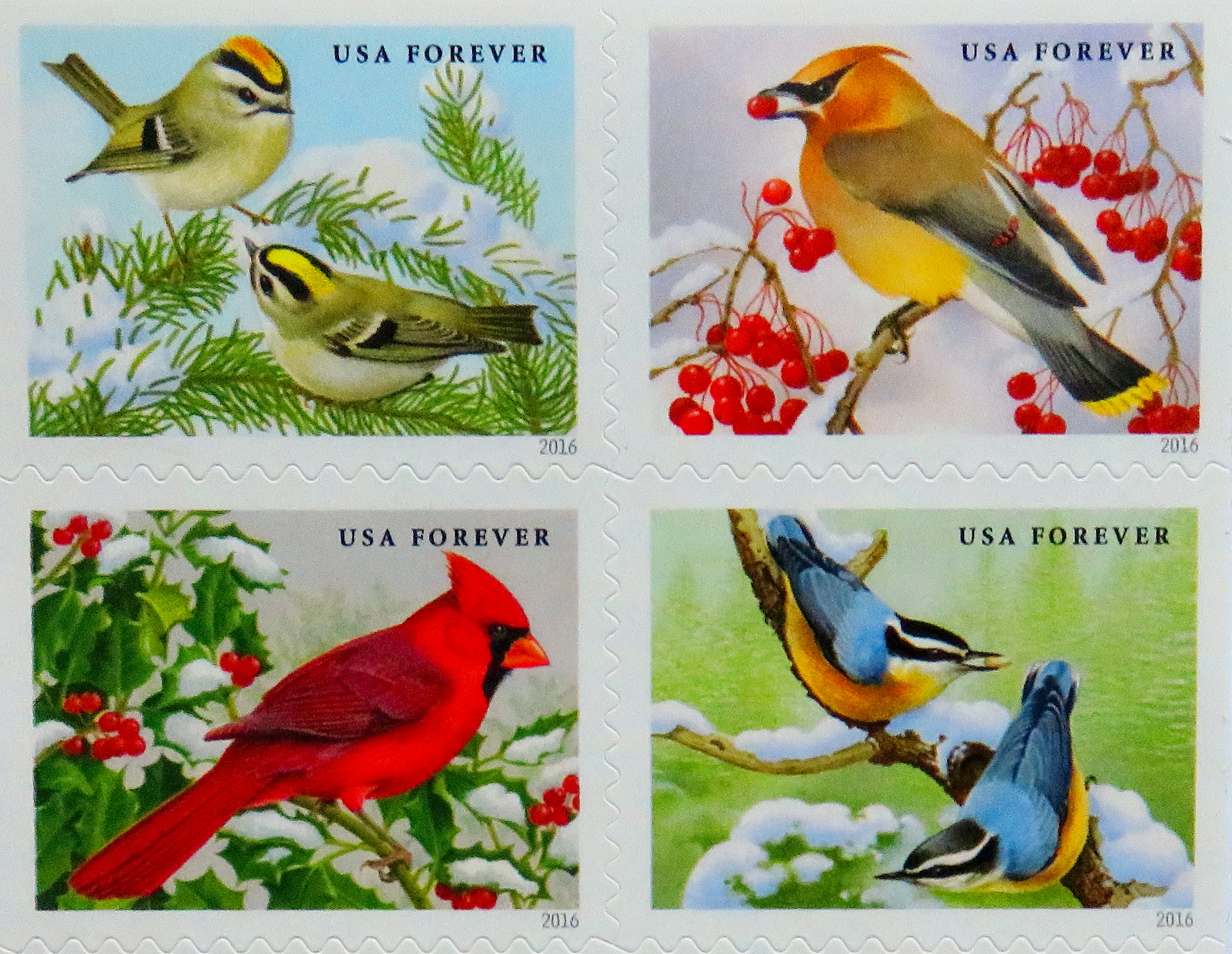
usa-img_0210-maria-de-bruynThe US Postal Service is doing its bit for the stamp collectors with their newest set of stamps issued this month – beautiful songbirds: golden-crowned kinglets, a cedar waxwing, male Northern cardinal and red-breasted nuthatch.

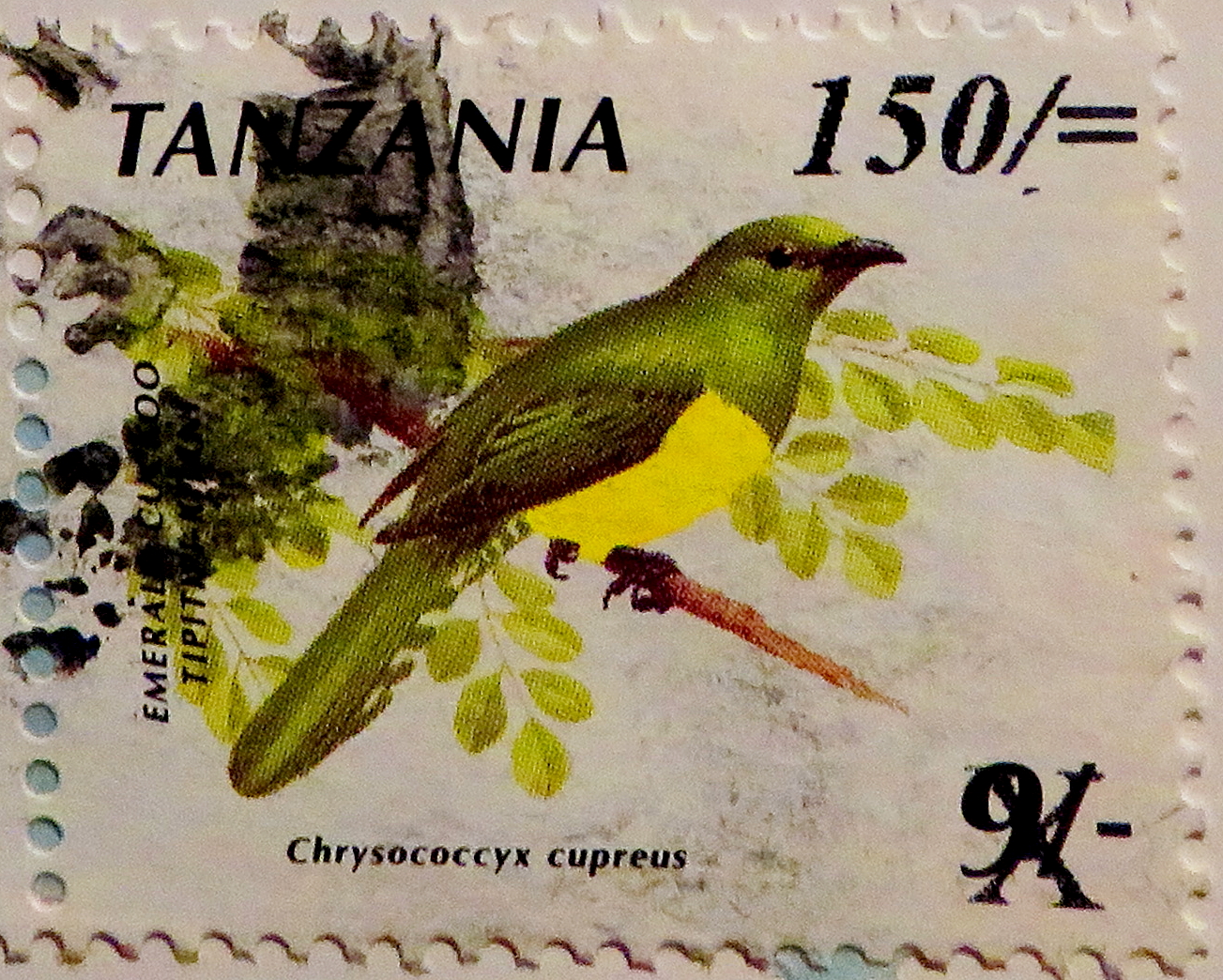
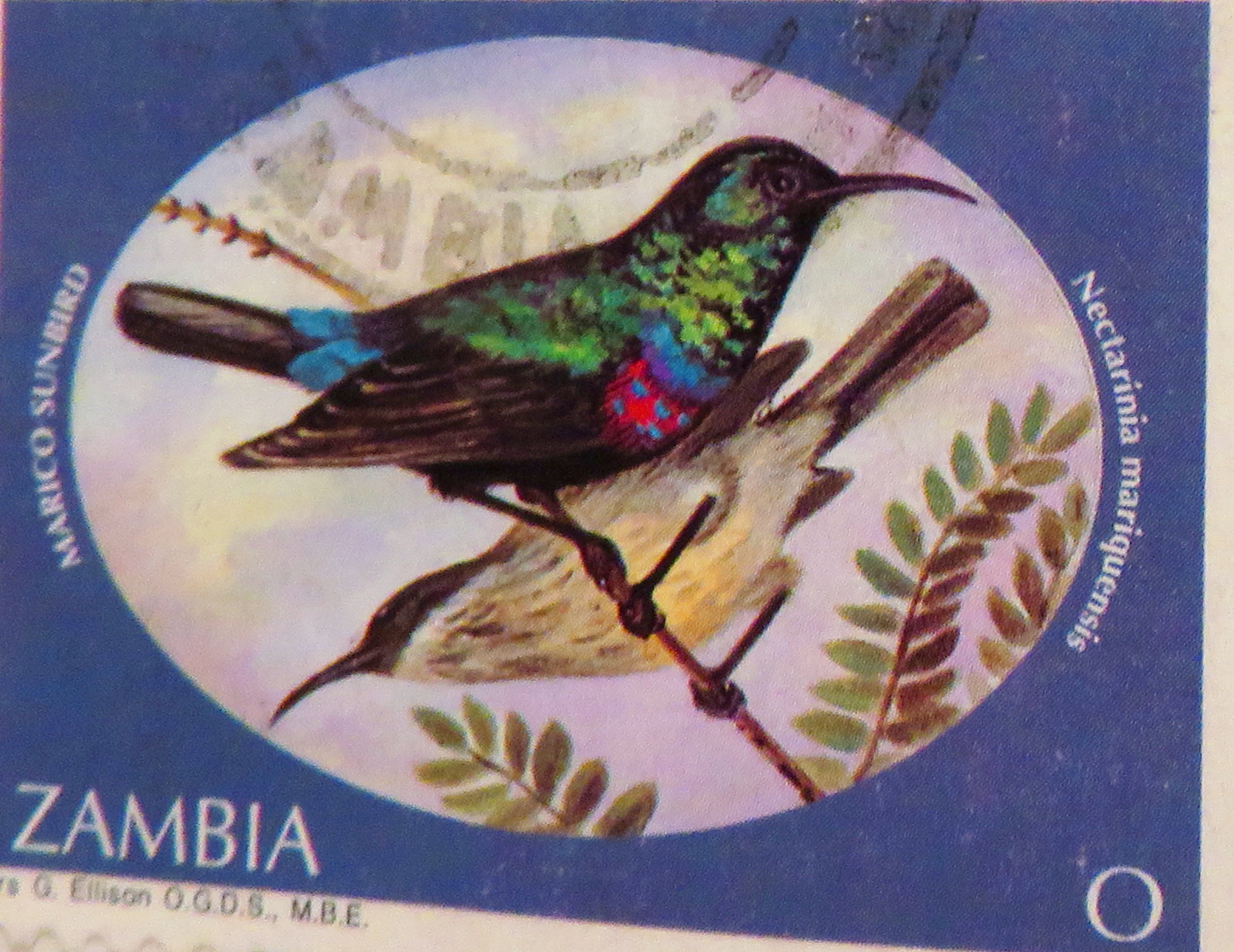
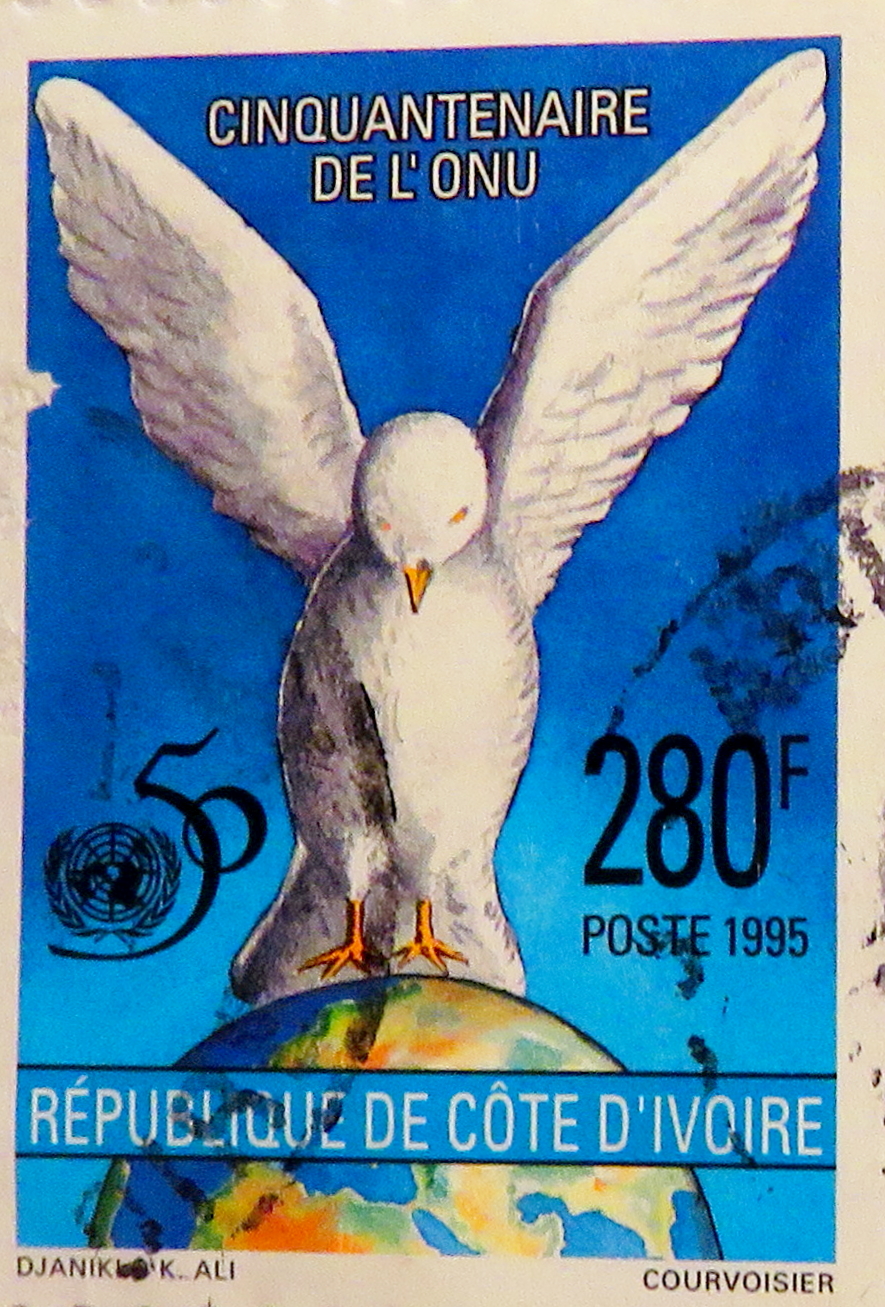
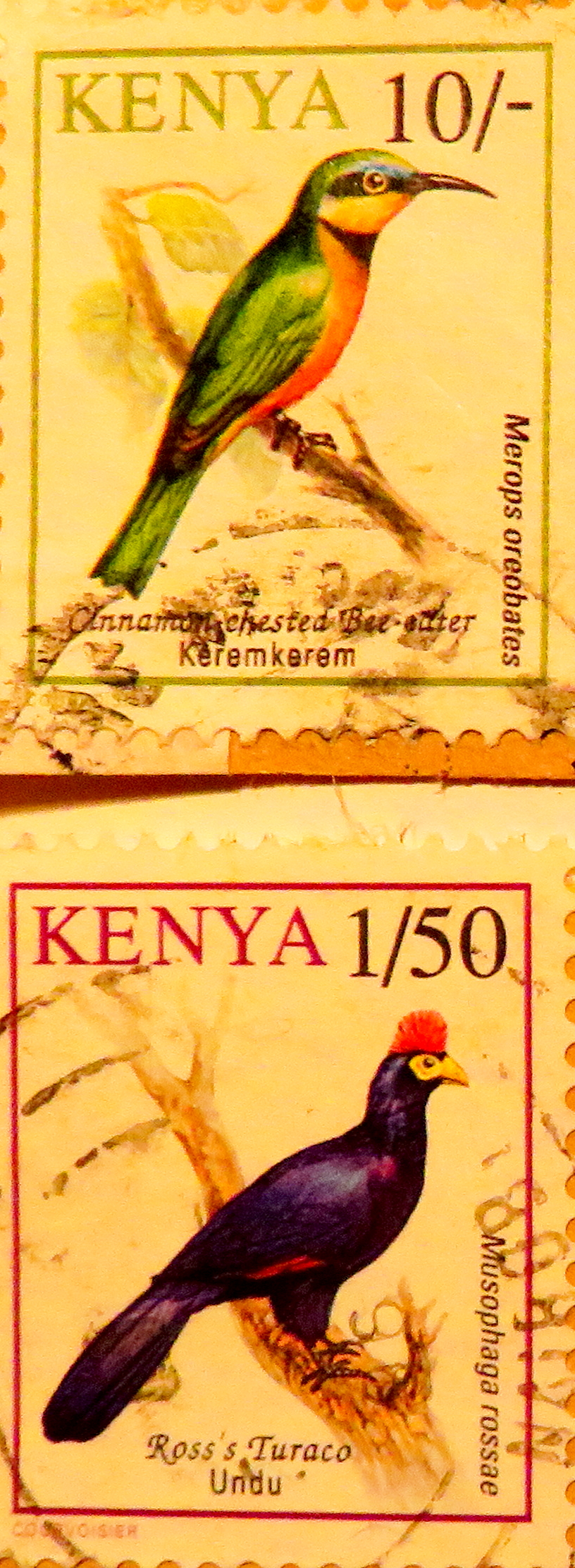
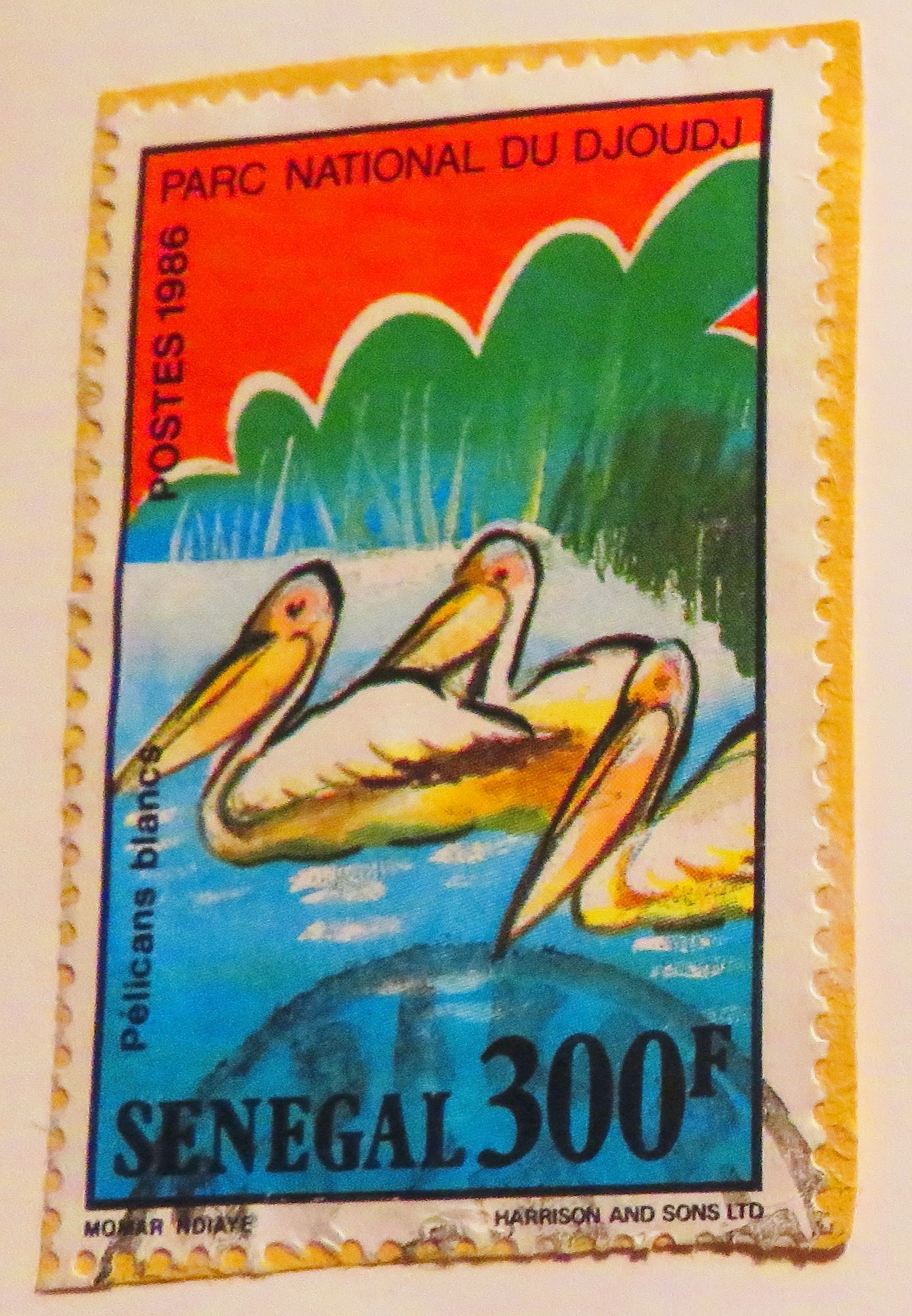
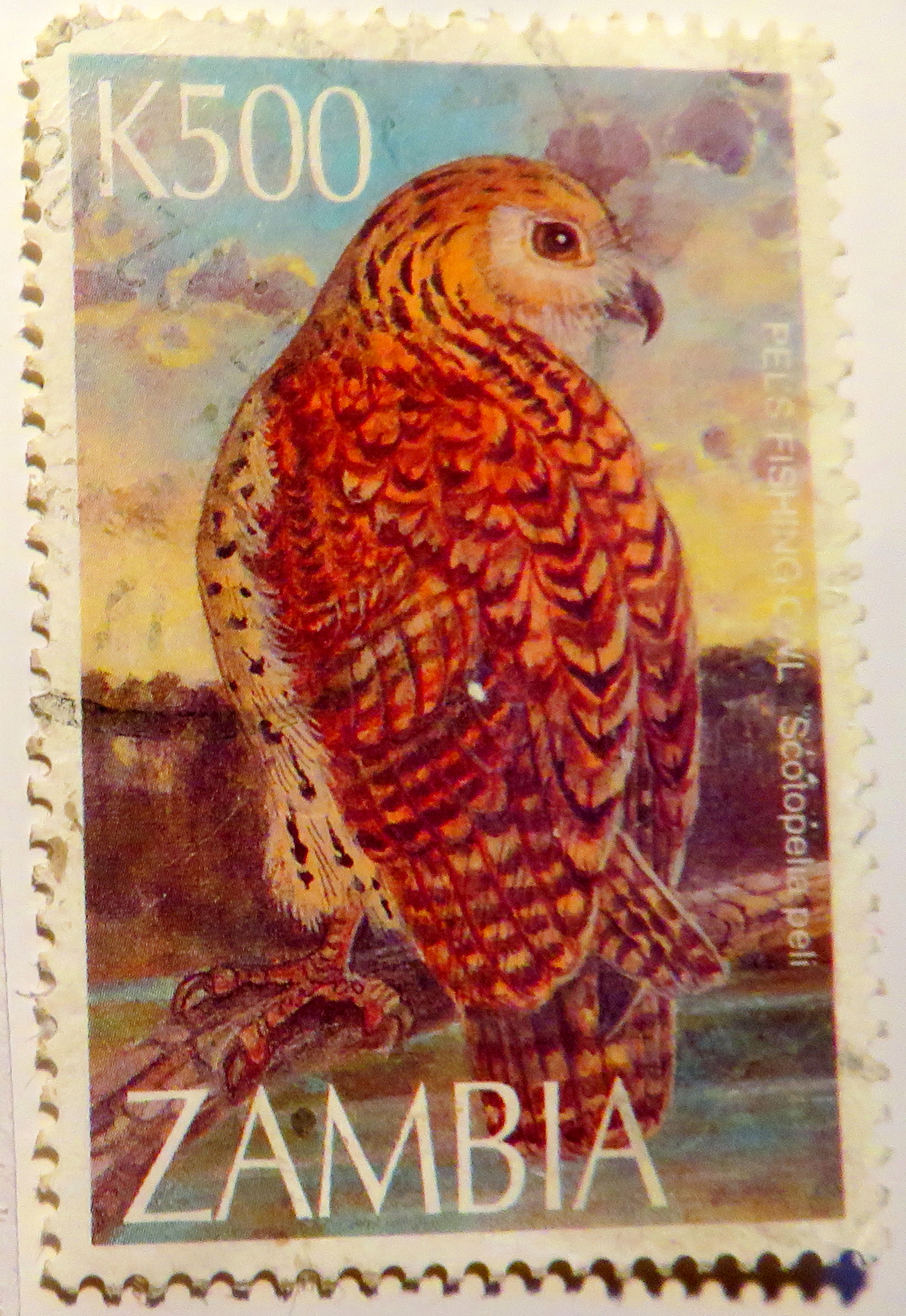
Many other countries also regularly issue stamps honoring popular, unusual and particularly beautiful birds found within their borders. African, Asian and South American countries have particularly disseminated some beauties.

tz-stamp-2-img_0092-maria-de-bruyn  zambia-2-img_0080-maria-de-bruyn   kenya-img_0088-maria-de-bruyn

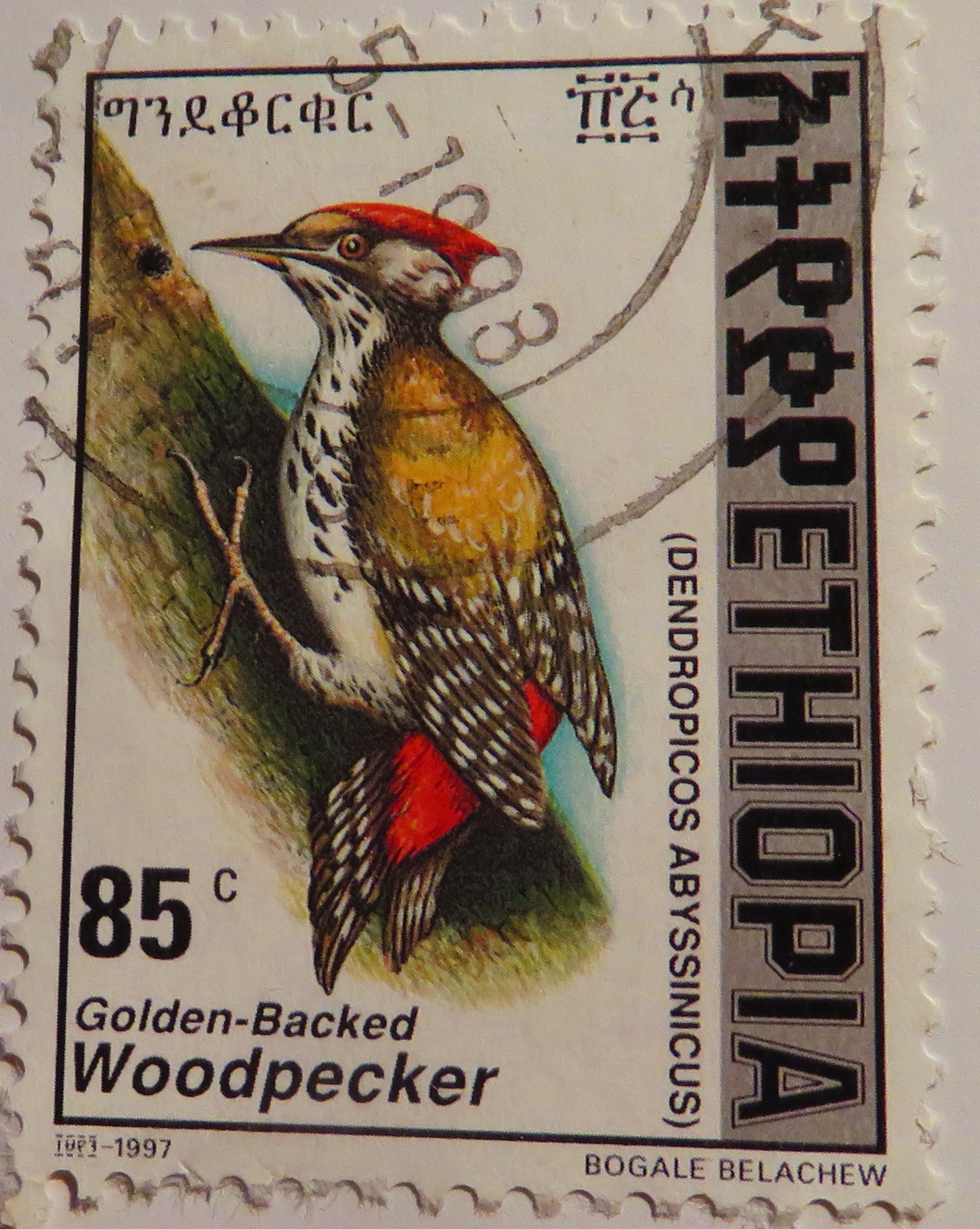
ethiopia-img_0074-maria-de-bruynIn the 1990s, I received lots of “snail mail” from developing countries since I managed a resource center focused on documentation from those nations. Many organizations and individuals sending me envelopes and parcels did not have postage machines, so they put colorful postage on their mailings and quite a few of those stamps featured birds.

Many of the depictions seem true to life and others are more impressionistic.


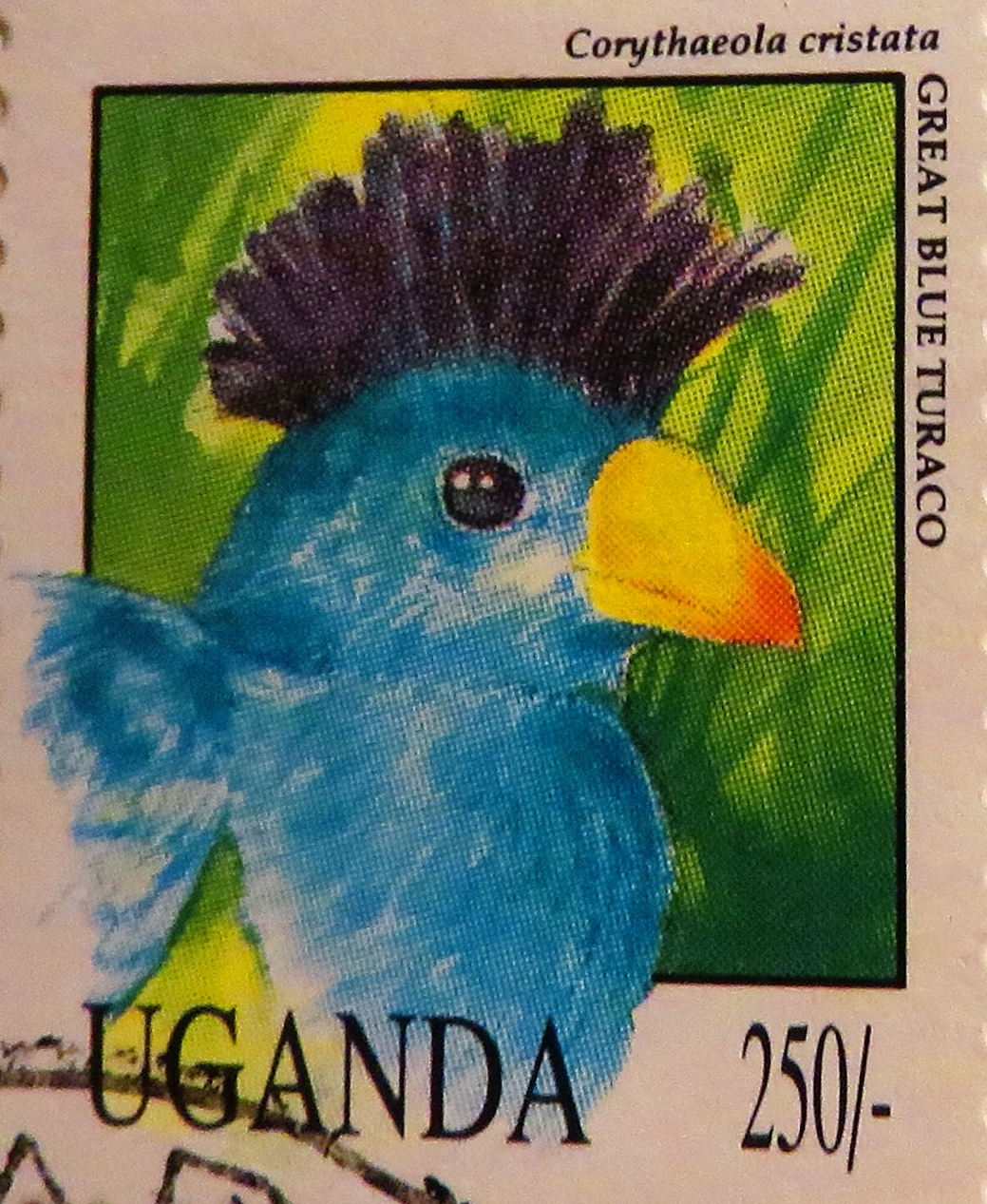
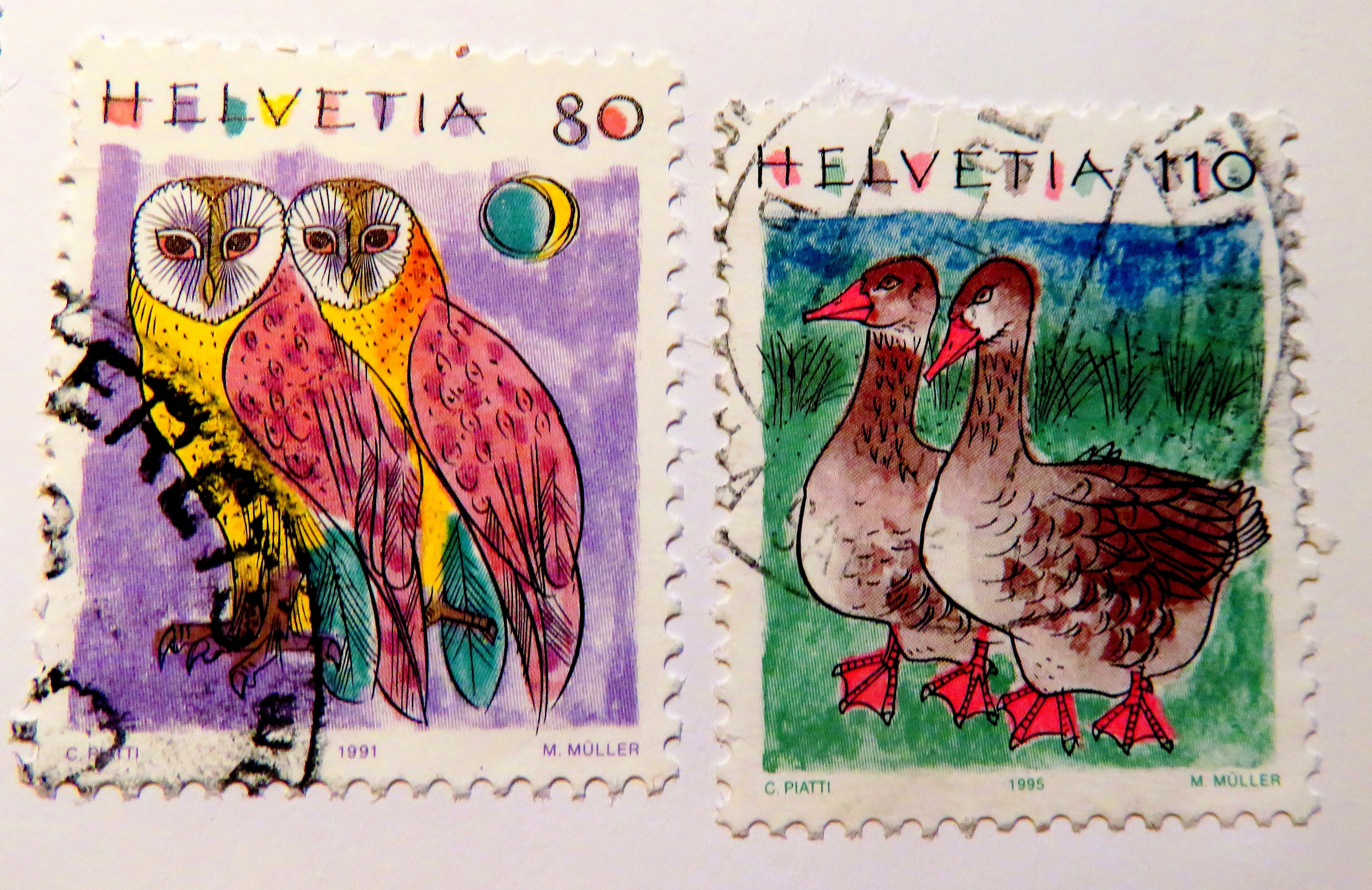
uganda-img_0072-maria-de-bruyn  switzerland-img_0055-maria-de-bruyn  korea-img_0064-maria-de-bruyn

tz-stamp-img_0092-maria-de-bruyn


Not all the stamps have shown birds that would meet everyone’s definition of beautiful but they are interesting.

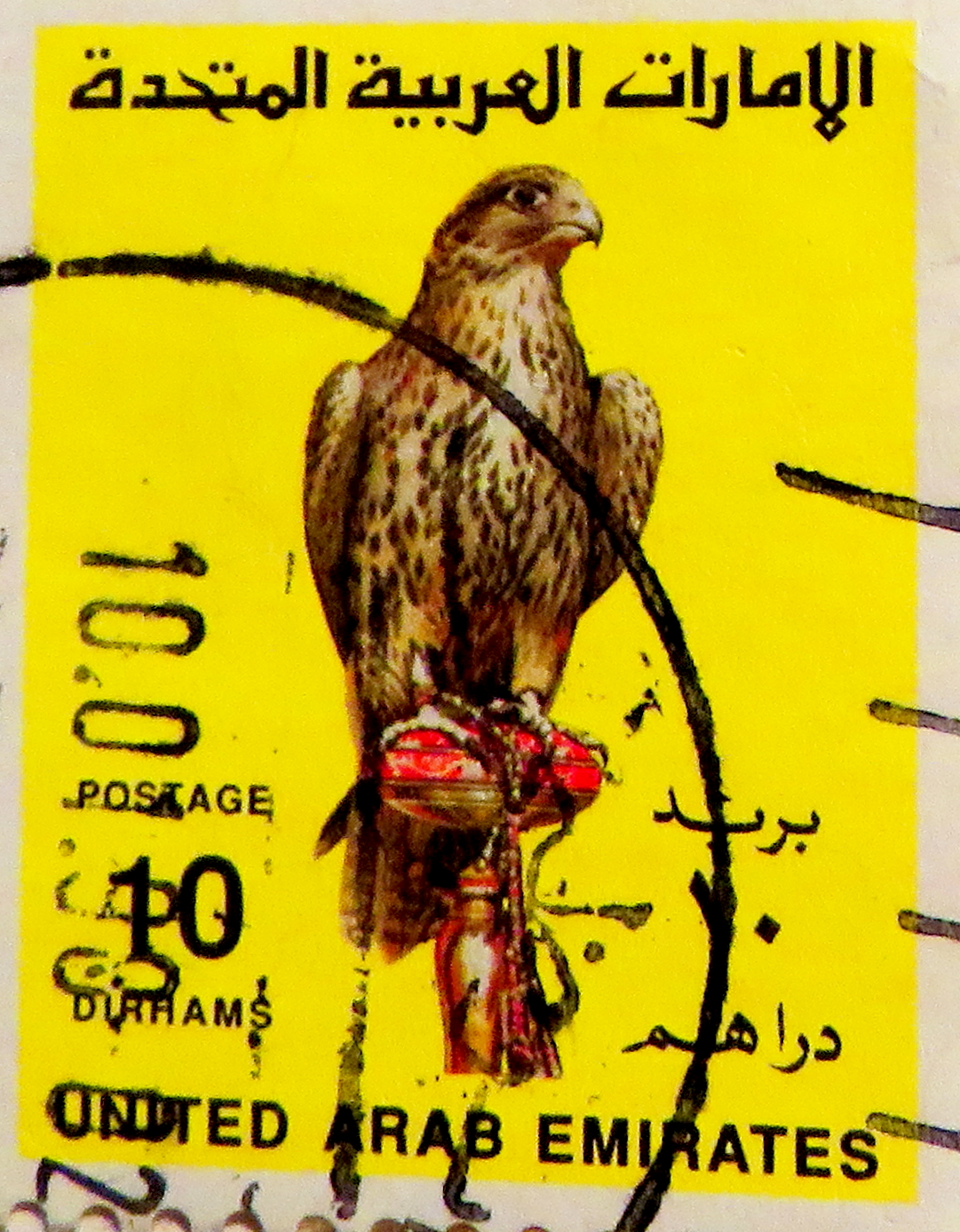
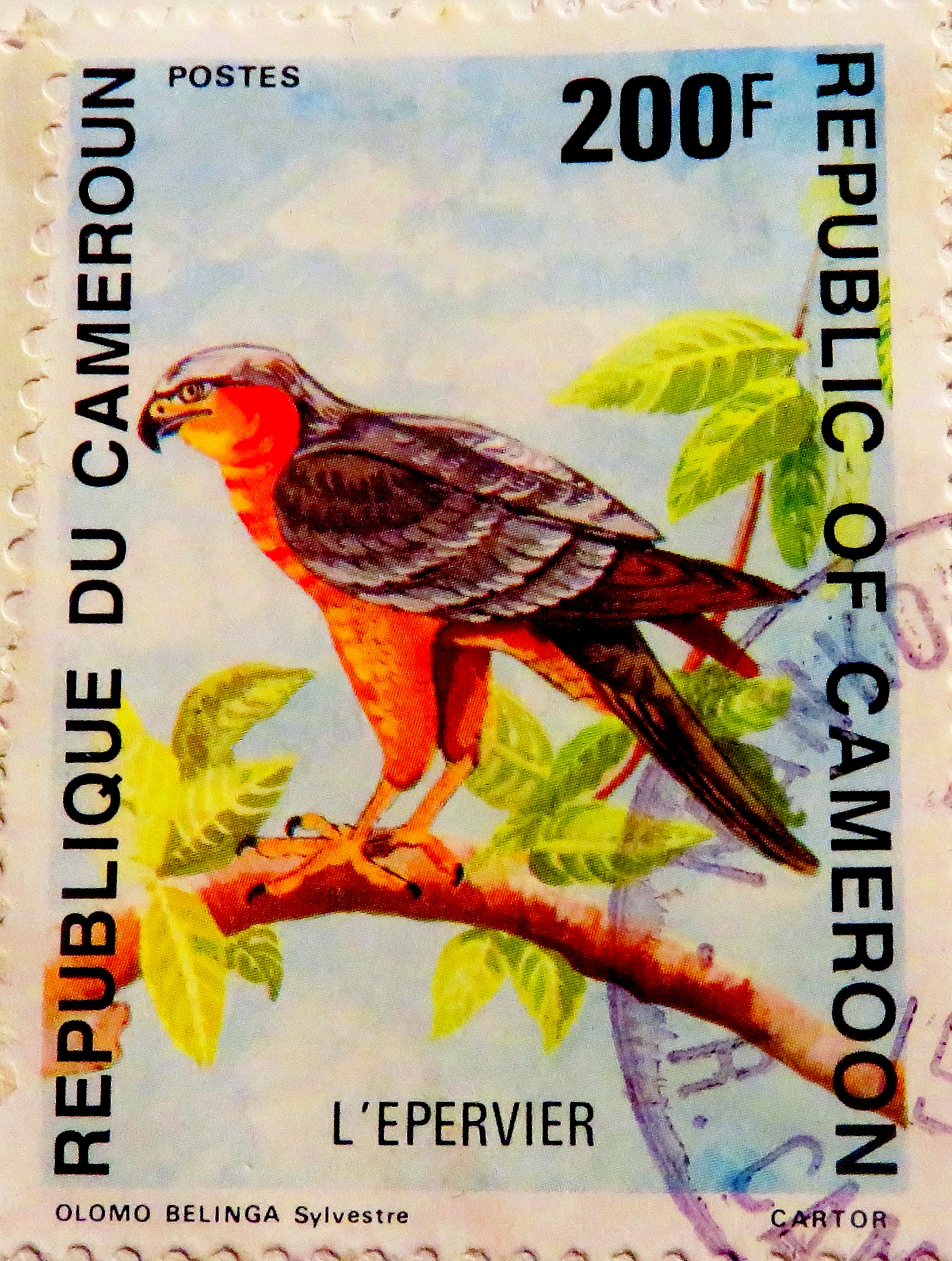
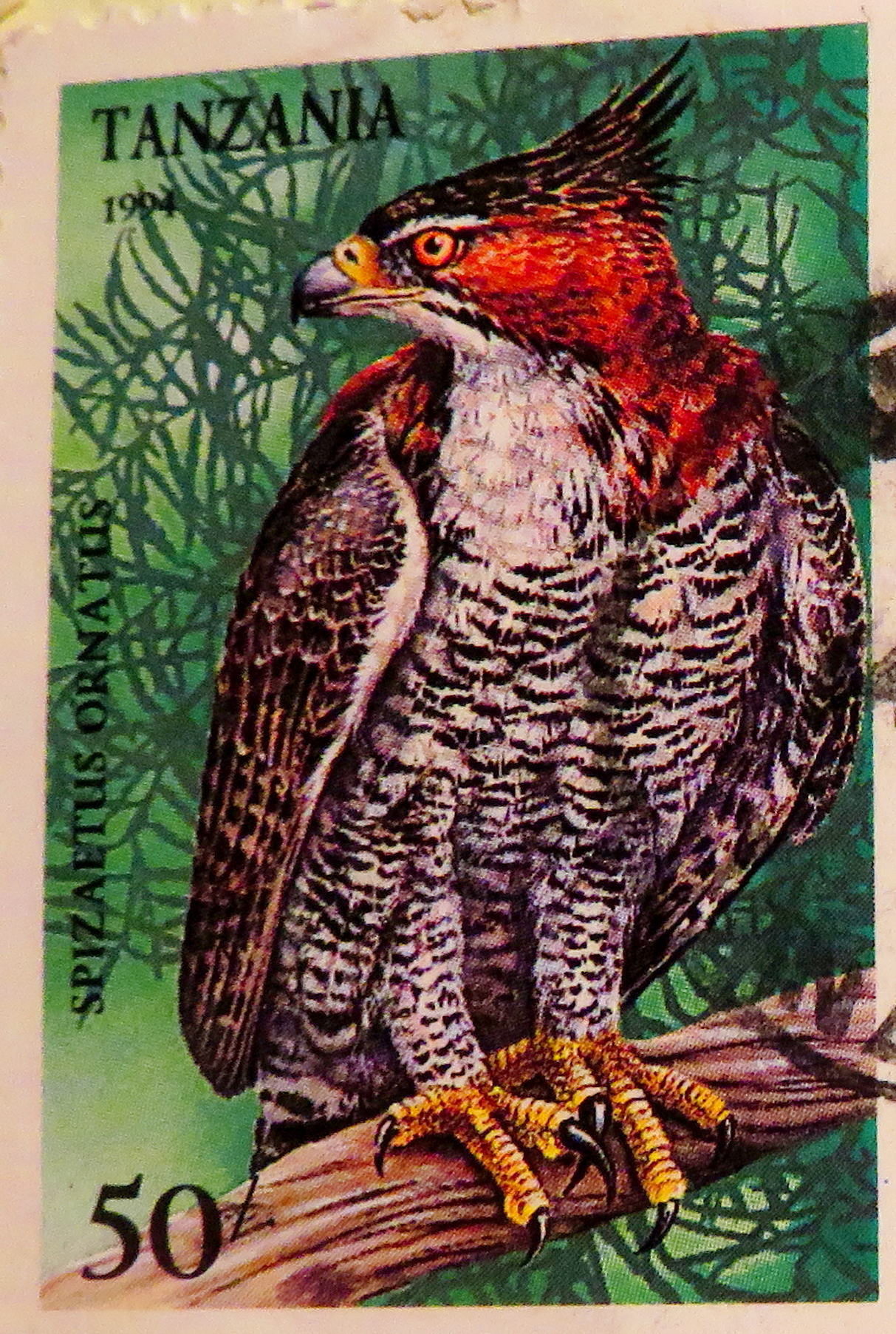
And raptors appear to be a favored subject.


uar-img_0077-maria-de-bruyn   cameroon-img_0059-maria-de-bruyn   tz-stamp-img_0094-maria-de-bruyn-red

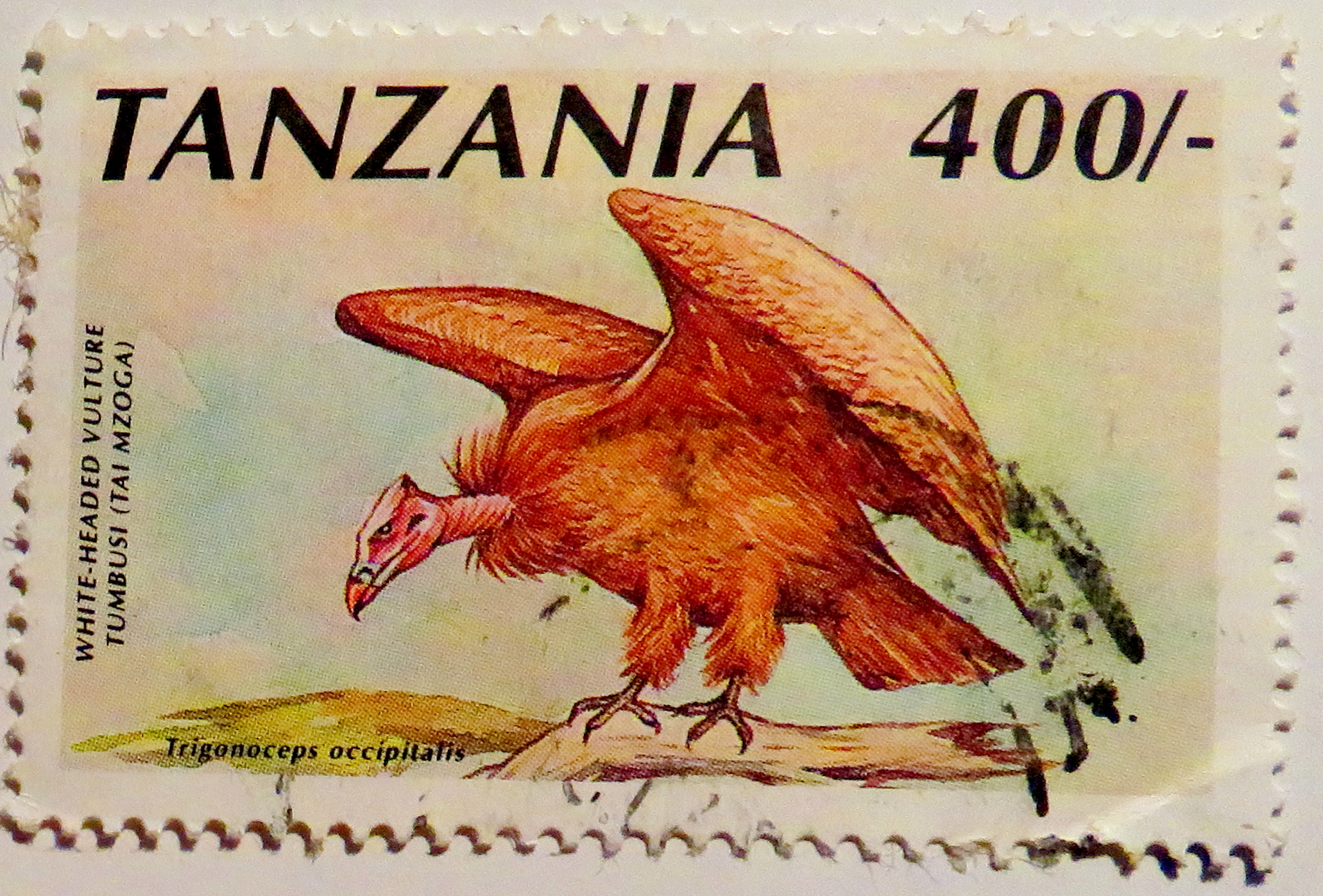
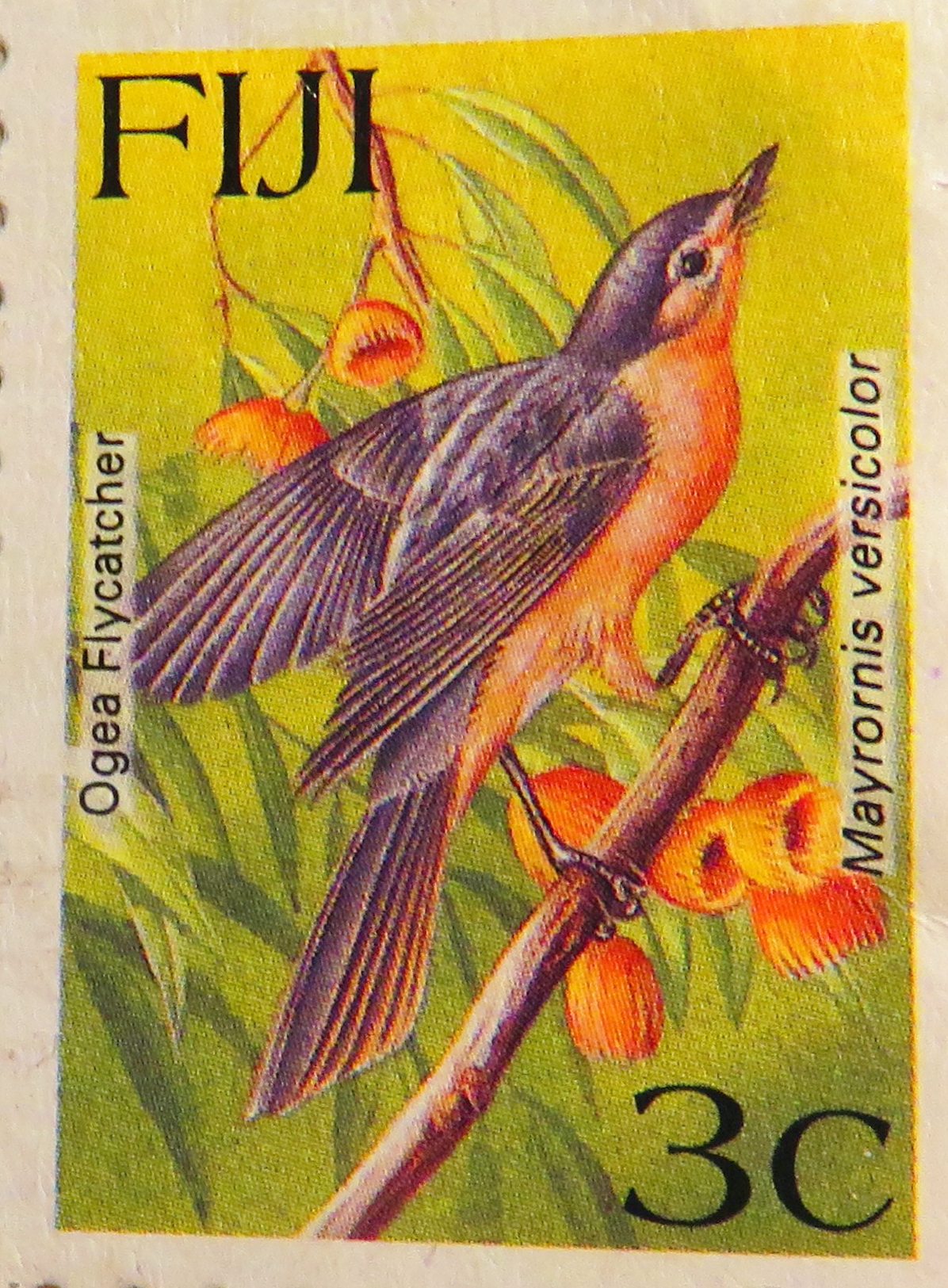
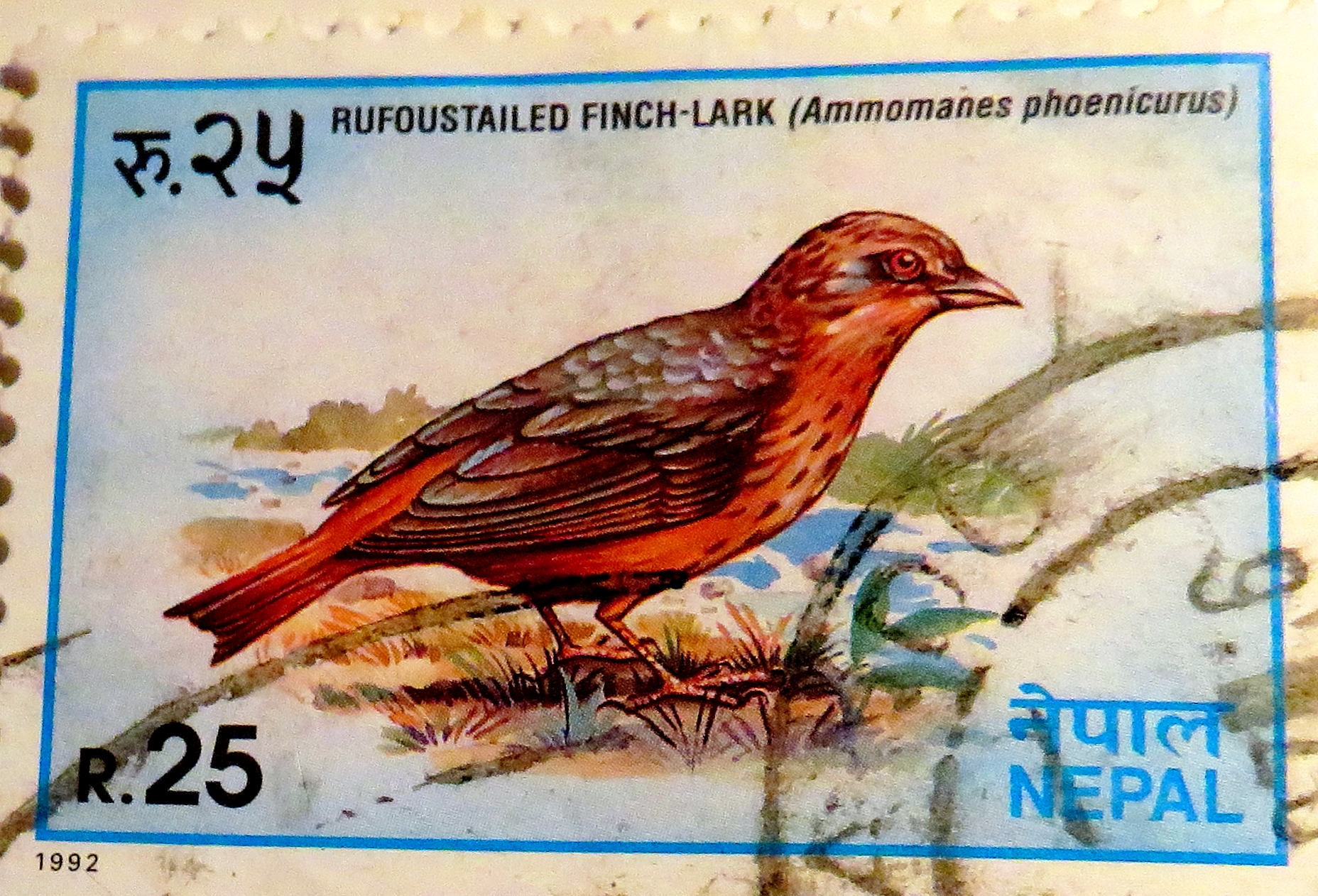
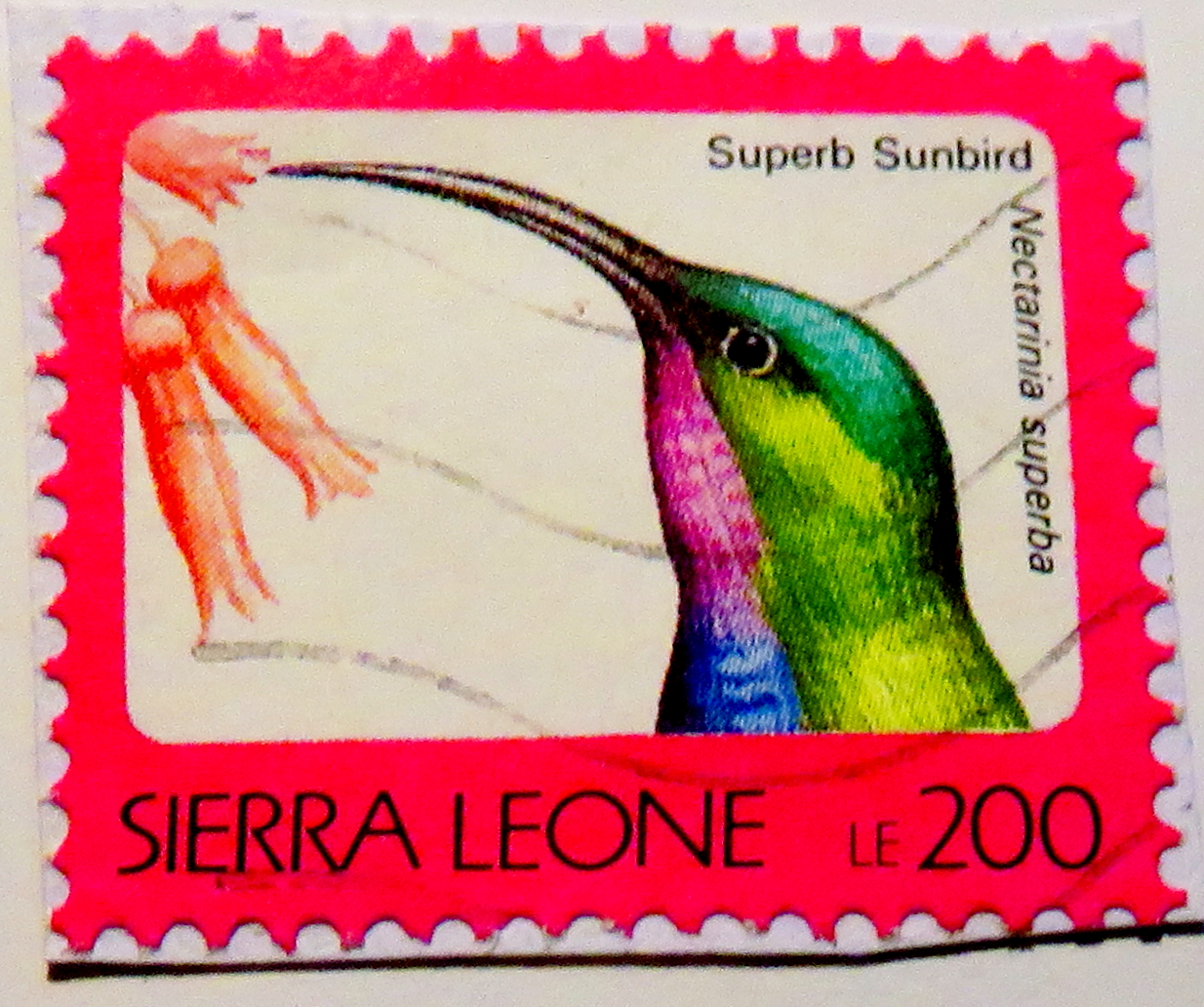
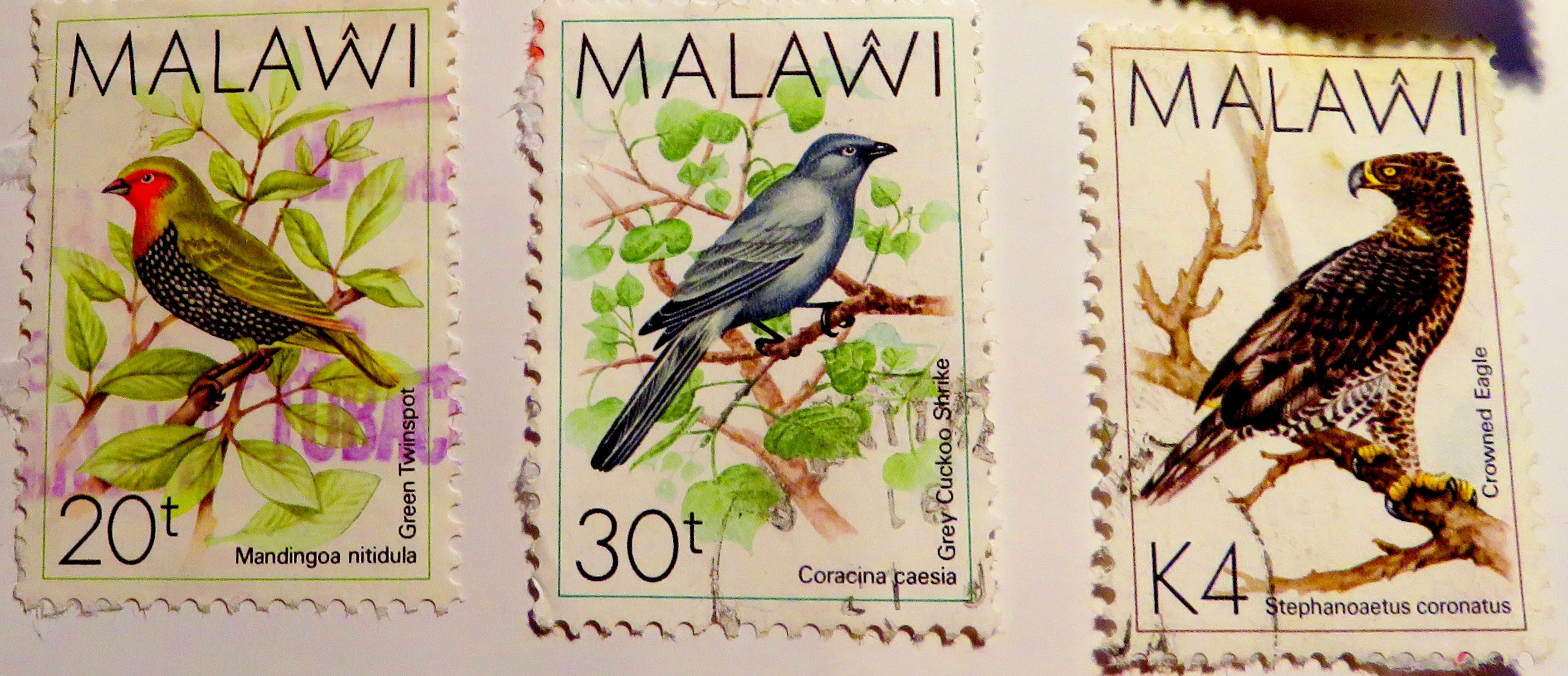
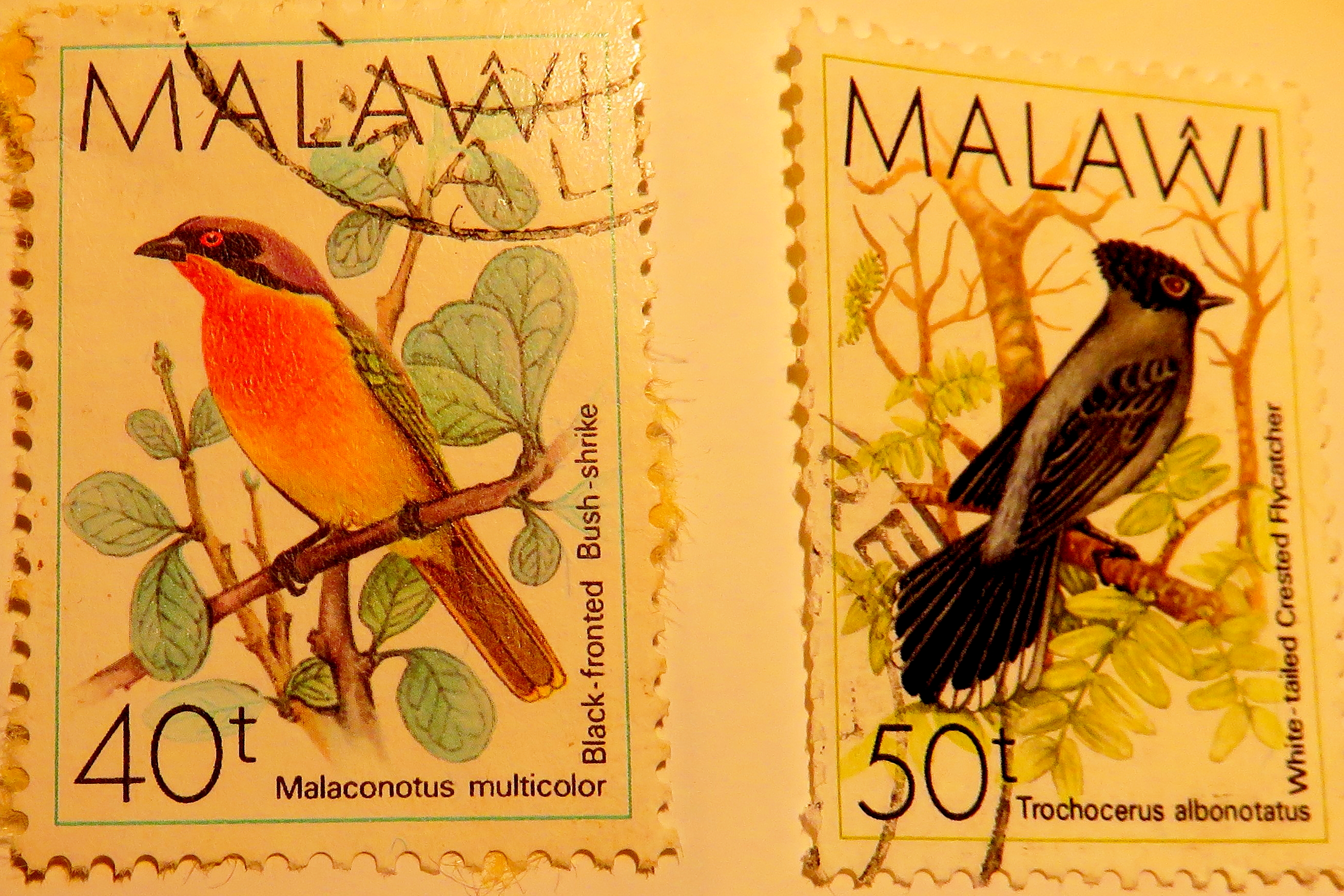
Some stamps not only provide common names but scientific names for the pictured birds.

fiji-img_0062-maria-de-bruyn   nepal-img_0063-maria-de-bruyn  sierra-leone-img_0057-maria-de-bruyn

malawi-img_0084-maria-de-bruyn

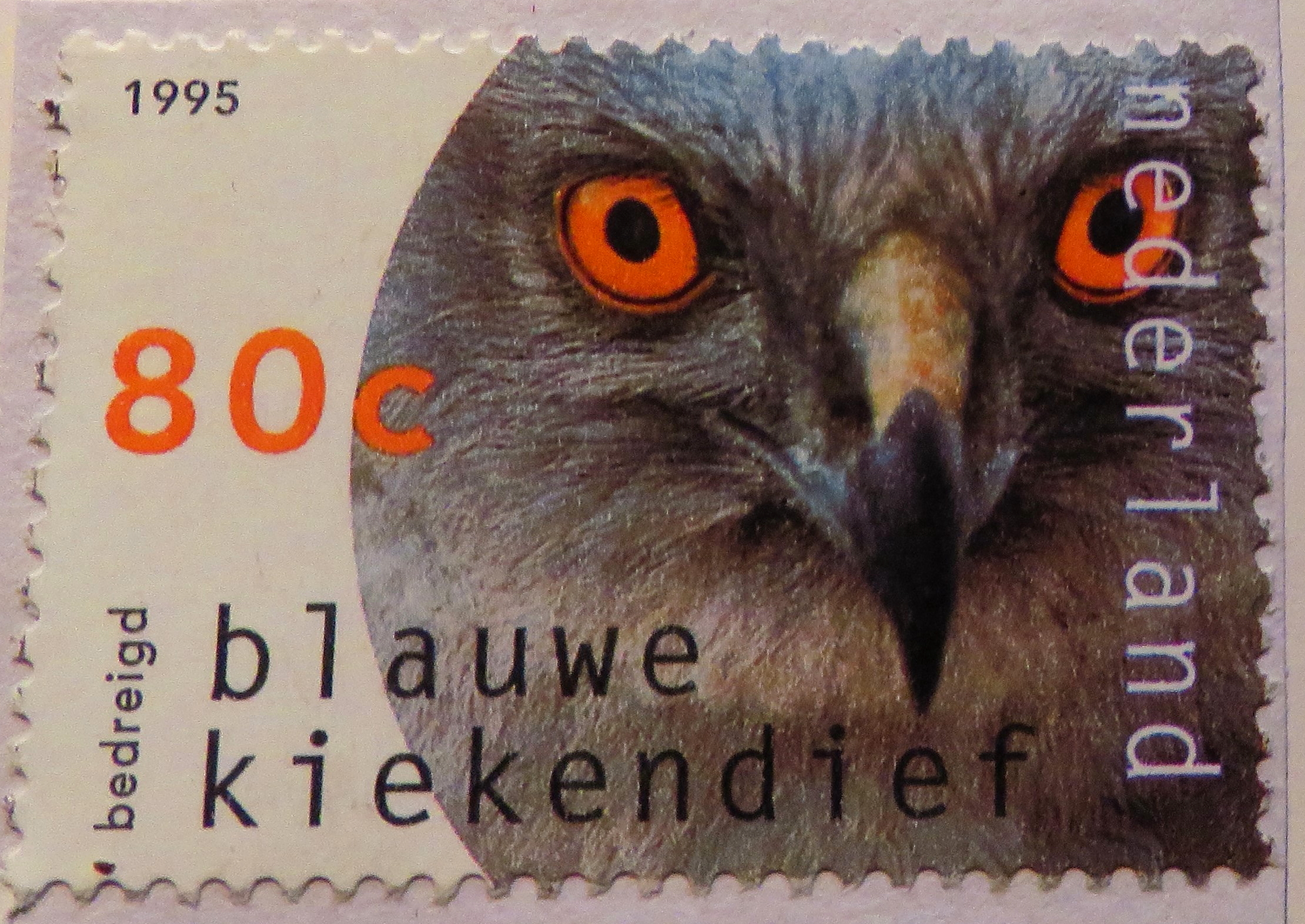
nl-img_0056-maria-de-bruynAnd some, like this one from The Netherlands, memorialize endangered species.

Nowadays, with the advent of electronic documentation, books, reports and email, Twitter and other social media slowly replacing typed or handwritten letters and cards, many of us receive much less “old-fashioned” mail than in years past. (To my regret, I will add, as I still really appreciate a handwritten letter and tangible card with words of greeting – the extra effort put into selecting a card or stationery, putting it into an envelope, addressing it and making sure it has postage is a reminder of people’s caring.)  Granted the electronic messaging is cheaper and faster and some venues allow you to select a “stamp” to add to an ecard, like care2. But receiving paper mail is still an enjoyable event for me – and our neighborhood has quite a nice mailman, too!
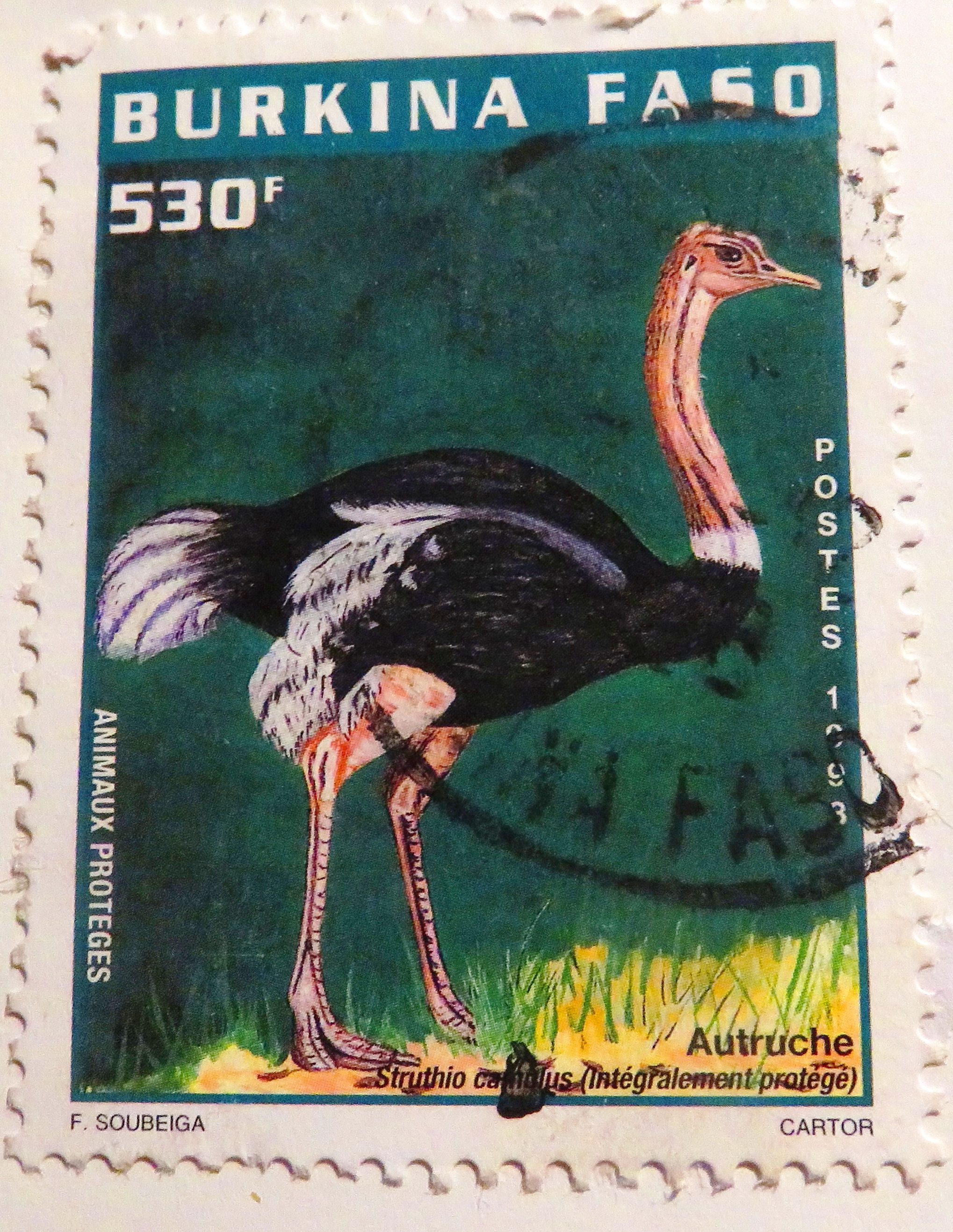
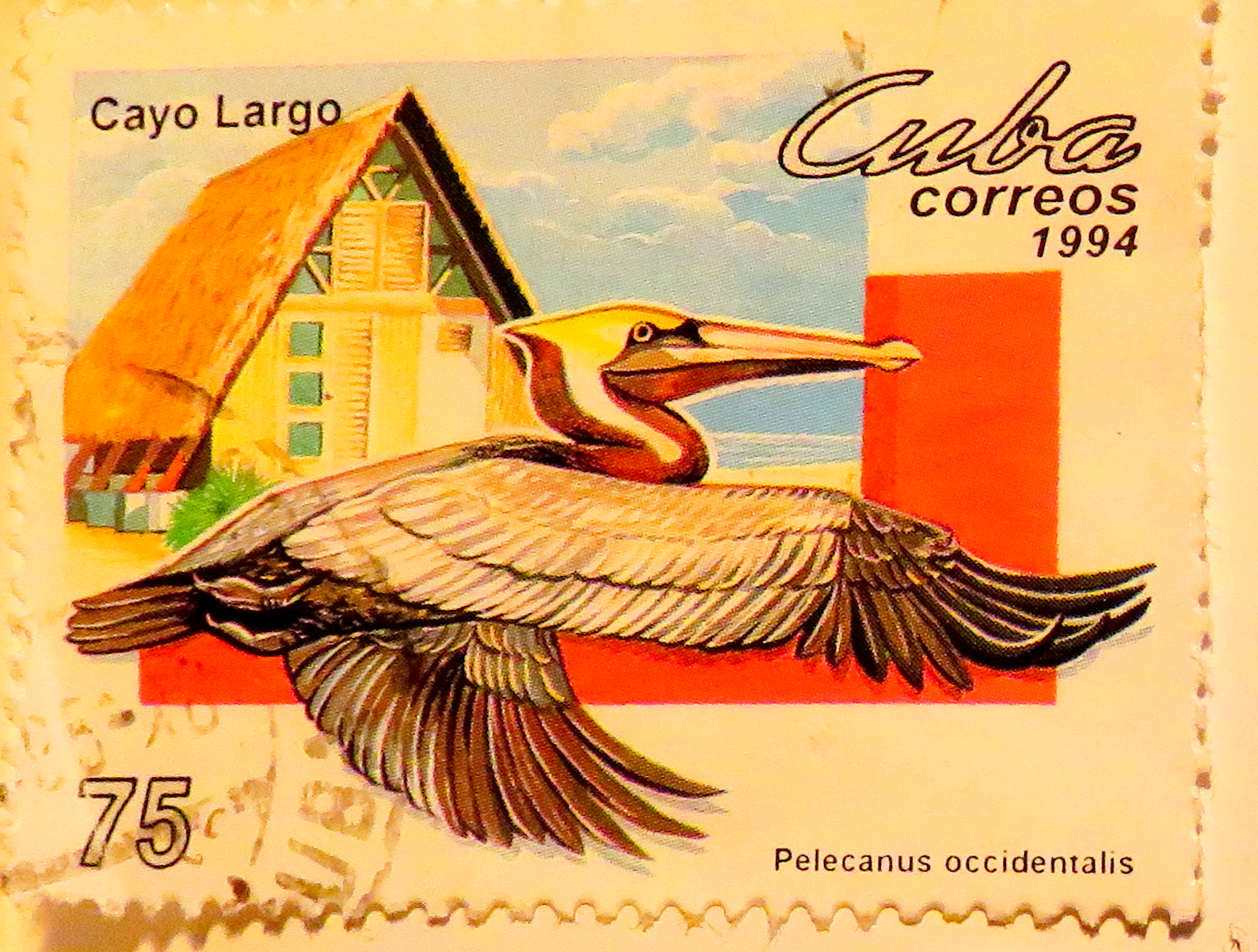
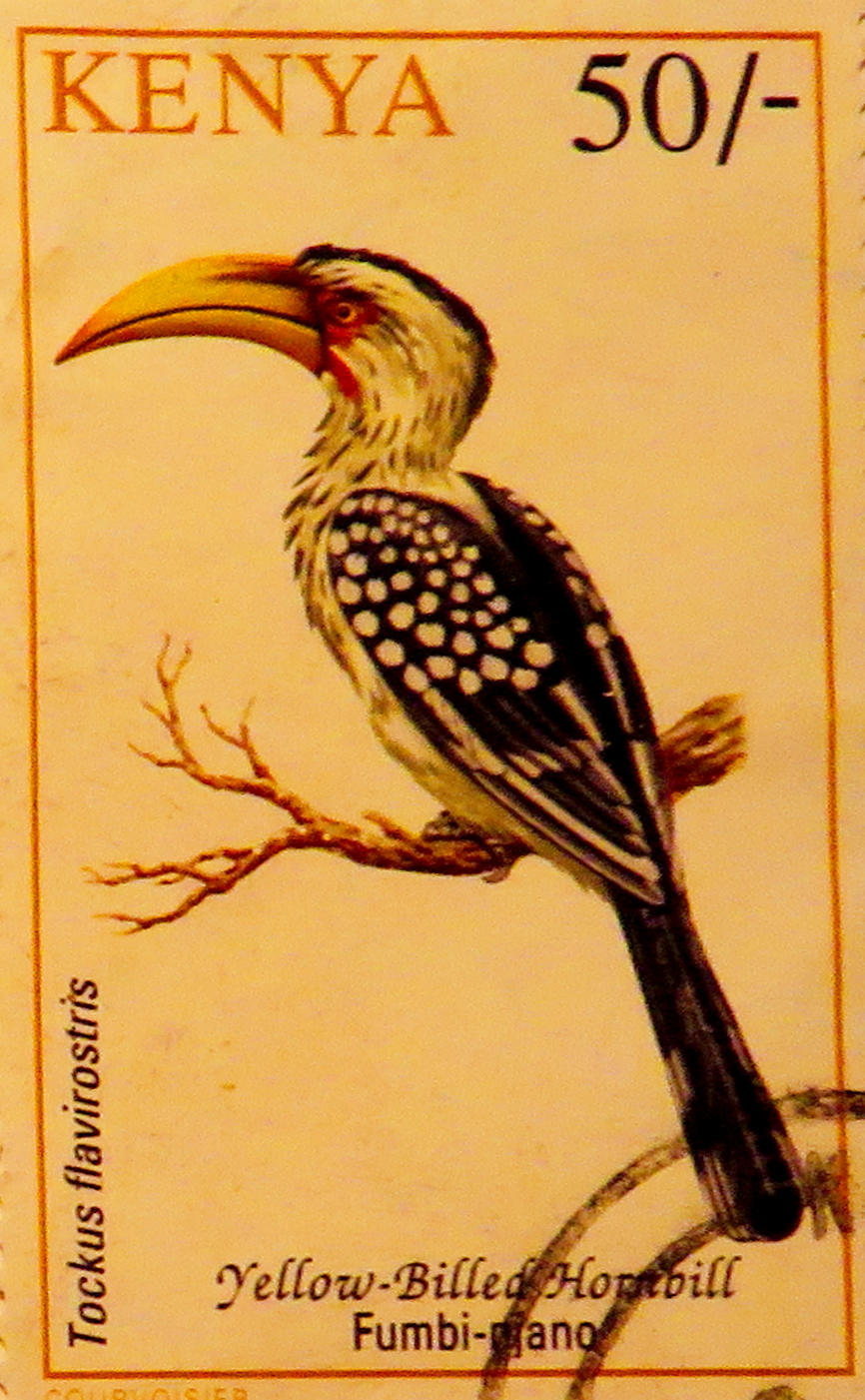
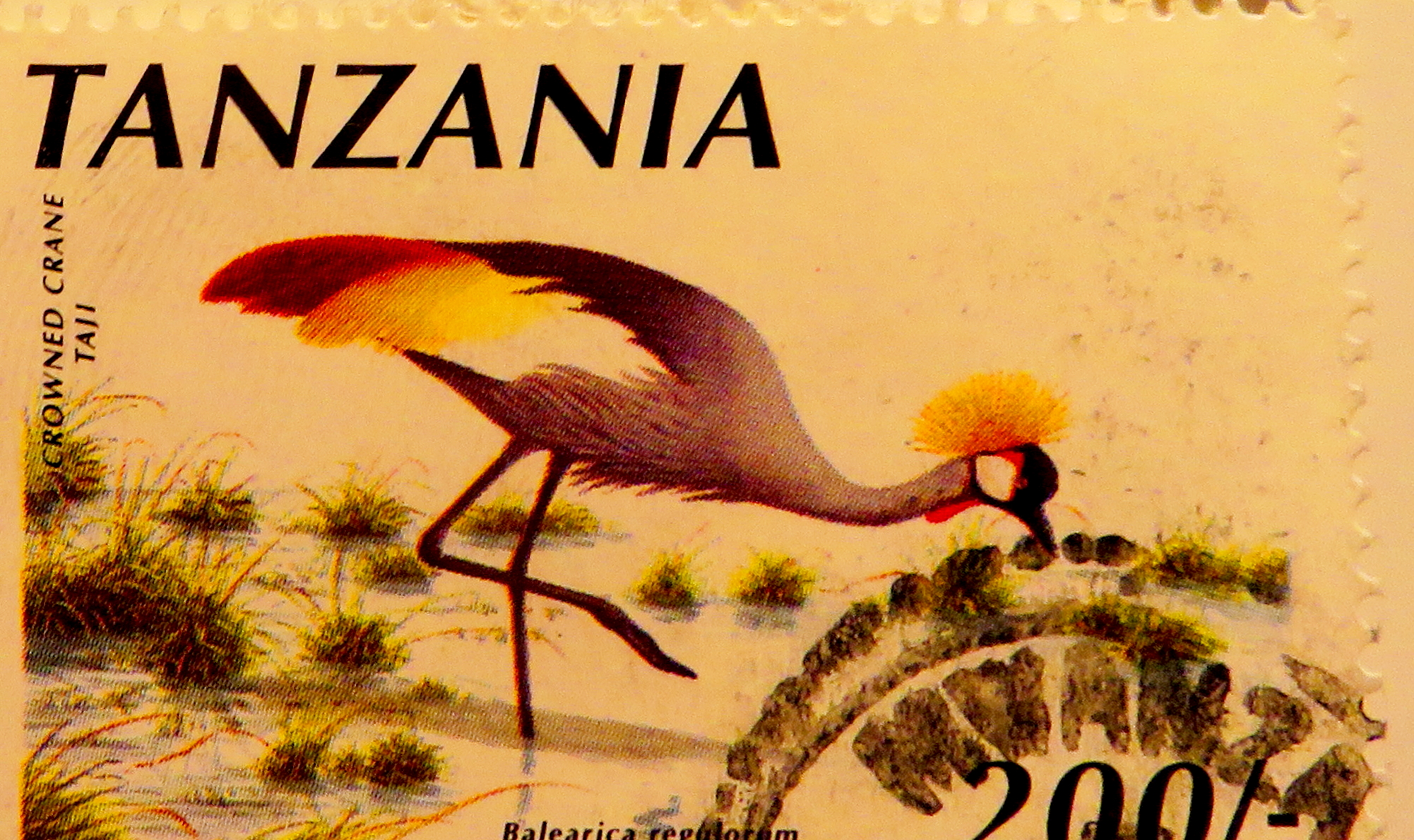
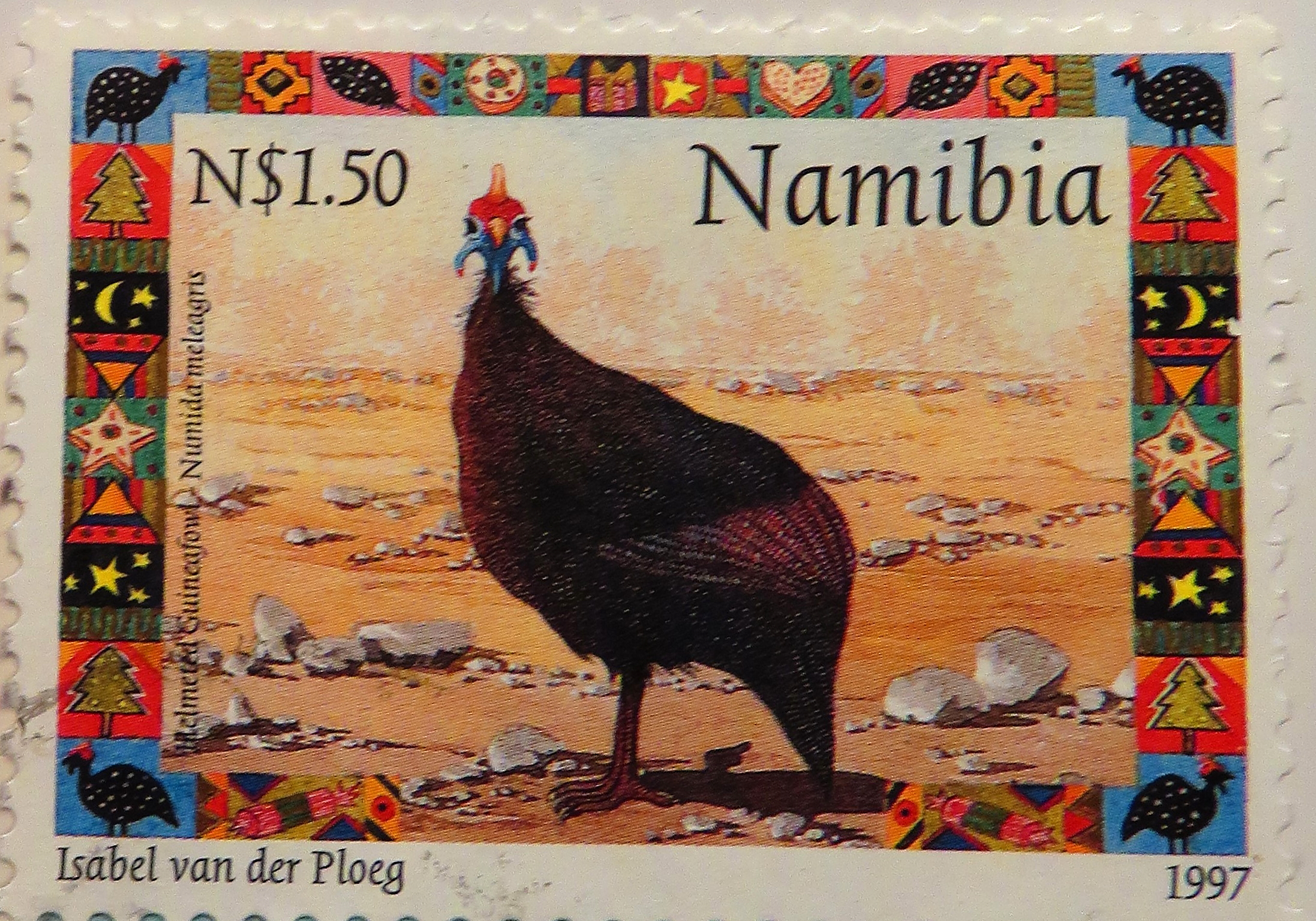
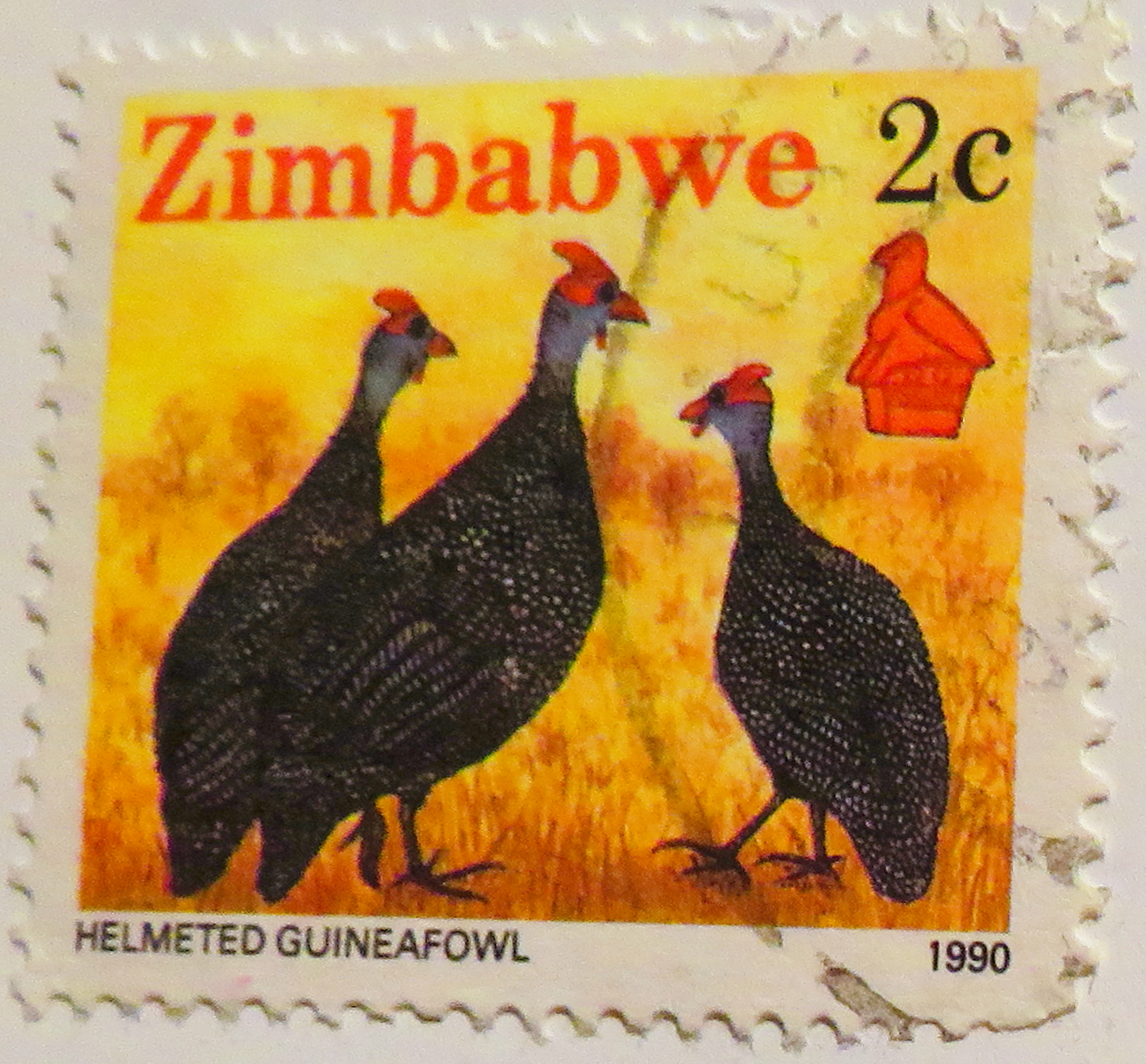
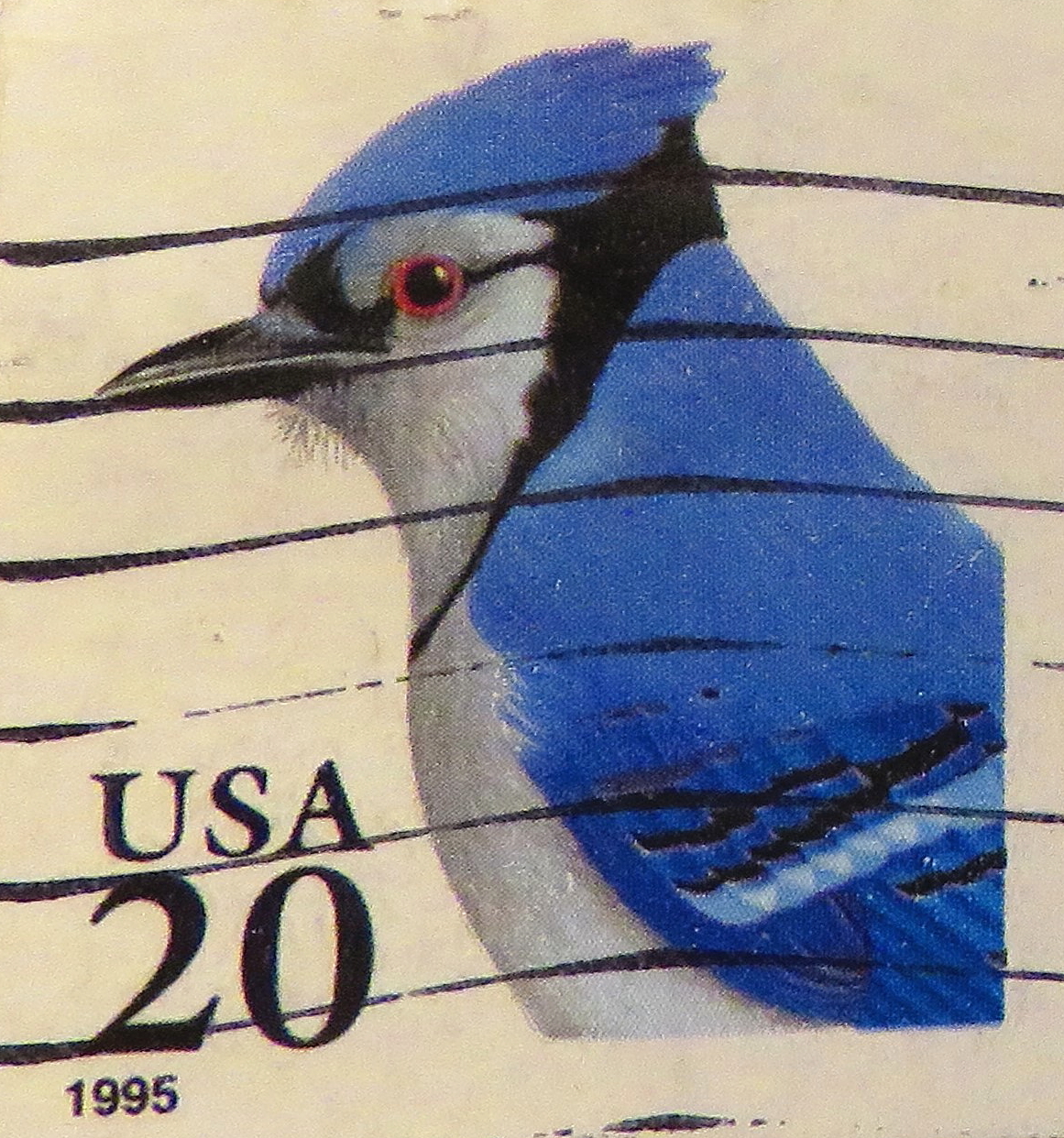
I am pleased to note that my saved stamps include bird species that I’ve had the privilege of seeing in person.

burkina-faso-img_0058-maria-de-bruyn     cuba-img_0050-maria-de-bruyn  kenya-img_0089-maria-de-bruyn

tz-stamp-img_0099-maria-de-bruyn-red   namibia-img_0076-maria-de-bruyn

usa-img_0050-maria-de-bruyn   zimbabwe-img_0077-maria-de-bruyn  usa-img_0051-maria-de-bruyn

If you are interested in this type of hobby and don’t get much paper mail, there are online purveyors of bird stamps where you can purchase items to add to your collection:

http://www.bird-stamps.org/

https://www.postbeeld.com/stamps-shop/bird-postage-stamps

http://www.birdtheme.org/

http://www.avionstamps.com/ambrowCart/shop/show_products.php?search=Birds

ivory-coast-img_0049-maria-de-bruyn


And there is a society dedicated to bird stamp collectors.  So, if you’re looking for a new pastime to while away some time when the weather just doesn’t invite you outdoors to see birds in person, there is an avian-focused option! And maybe you can persuade friends and family to send you some snail mail to support your new avocation. 🙂


ecuador-img_0069-maria-de-bruyn    malawi-img_0085-maria-de-bruyn-red

kenya-img_0091-maria-de-bruyn  senegal-img_0060-maria-de-bruyn  zambia-1-img_0080-maria-de-bruyn