Water-logged and soggy birds

Carolina wren I77A2794© Maria de Bruyn resMy original intent was to write only one more blog this year, but our current weather has induced me to write two (the other will follow on the last day of 2015). During the past week, our region has had more than our “fair share” of rain. Fortunately, the house is not downstream or downhill of flowing water so that flooding is not a concern (and having helped my parents when their home was flooded with about 5 feet of water, I know that is a real pain to say the least). But the yard is so water-logged that small pools of water are scattered in many places and the ground cover squishes when we walk on it. Combined with very high temperatures for this time of year, it seems that El Niño is really making itself known – and the birds like this Carolina wren (Thryothorus ludovicianus) must be getting tired of being water-logged as well!

Sayings such as “like water off a duck’s back” imply that birds don’t really get bothered by water pouring from the heavens, but that is probably only partly true. During recent downpours, I saw – through the back porch screen – a Carolina wren and Northern cardinal (Cardinalis cardinalis) hanging out on a downspout under the house eaves, while a brown-headed nuthatch (Sitta pusilla) clung to the brick wall under the roof overhang to get out of the rain.

brown-headed nuthatch I77A0090© Maria de BruynNorthern cardinal I77A0101© Maria de Bruyn res

Birds that regularly dive underwater do have denser feathers, which helps prevent water from penetrating through to their skin, as is the case for this Canada goose (Branta canadensis).

Canada goose I77A1169© Maria de Bruyn res

But birds’ feathers are not inherently waterproof – when we see water droplets beading on their backs and tails, as in the case of this brown thrasher (Toxostoma rufum) and blue jay (Cyanocitta cristata), it’s because the birds have made them water-resistant to some extent.

Blue jay I77A3141© Maria de Bruyn resbrown thrasher I77A9881© Maria de Bruyn res

This happens in two ways. On the one hand, birds such as pigeons, herons, hawks and owls have special feathers called “powder downs” or “pulviplumes”, which are covered in a dusty powder containing keratin that disintegrates and becomes a waterproof coating. They spread the powder to other feathers while preening.

Great blue heron I77A1220© Maria de Bruyn res

Great blue heron (Ardea herodias)

brown-headed nuthatch I77A0090© Maria de Bruyn resOther birds have a uropygial (preen) gland located at the base of their tails. It produces a substance containing oil and wax that the birds spread on their feathers when they groom. Often, they will rub their head against the preen gland and then spread the oil by rubbing their head against other feathers, a behavior that this female red-winged blackbird (Agelaius phoeniceus) seemed to be doing when she was grooming. The wax then helps make the feathers more flexible and water-resistant, which explains the water beads we see on their feathers when it rains.

dark-eyed junco I77A4085© Maria de Bruyndark-eyed junco I77A9650© Maria de Bruyn res

Dark-eyed junco (Junco hyemalis)

Eastern towhee I77A9682© Maria de Bruyn res Pine warbler I77A9921© Maria de Bruyn res

Eastern towhee (Pipilo erythrophthalmus)

     Pine warbler (Setophaga pinus)

It may be that some birds are less successful in spreading the powder and wax to their head feathers, or they rub all the oil or powder off their heads onto other feathers. This may account for the “bad hair day” look some of them get when it rains for hours on end. These spiky “Mohawks” often appear in Northern cardinals and Eastern bluebirds (Sialia sialis).

Northern cardinal I77A9734© Maria de Bruyn res Northern cardinal I77A9870© Maria de Bruyn res

Eastern bluebird I77A9717© Maria de Bruyn resEastern bluebird I77A9710© Maria de Bruyn res

Other birds seem to especially get soggy feathers on the crowns of their heads just above their eyes. This may be why we see so many of them shaking their heads vigorously to get rid of the dampness on their pates.

Pine warbler I77A9942© Maria de Bruyn res White-throated sparrow I77A2980© Maria de Bruyn res

Pine warbler                                              White-throated sparrow (Zonotrichia albicollis)

Red-bellied woodpecker I77A9724© Maria de Bruyn res


And some birds just get an overall scruffy look when it rains hard, like this red-bellied woodpecker (Melanerpes carolinus).


Eastern bluebird I77A0155© Maria de Bruyn resThe water-logged look does seem to give some birds an angry or disgruntled appearance; I can certainly sympathize since endless days of rain – even in warmer temperatures – is one of my least favorite types of weather. It seems that overcast days and showers are continuing in our local forecast for some time to come. So the poor birds have to put up with the wet weather a while longer. We’ll all appreciate the sunlight when it comes back in force – hopefully soon!

A morning at Cane Creek Reservoir

The Orange County water authority maintains two recreational areas where it manages water supplies for our area’s drinking and sewage water. One is the Cane Creek Reservoir, where people can boat, fish, bird and relax. When my morning began yesterday with a distressing family situation, for which I would need to wait for news, I decided to visit the reservoir since getting out into nature always helps me handle stress. My foray was rewarding, both in terms of handling the emotional tension and appreciating the marvelous diversity that nature offers for our appreciation.

marbled orbweaver DK7A5291© Maria de Bruyn resMy walk began with a need to wipe spider webs from my face as our arachnid brethren were busy spinning their webs across walking paths. The marbled orbweaver (Araneus marmoreus) was in the process of building a web, climbing up and down and leaving new silken strands behind as they emerged from the spinneret.

marbled orbweaver DK7A5288© Maria de Bruyn

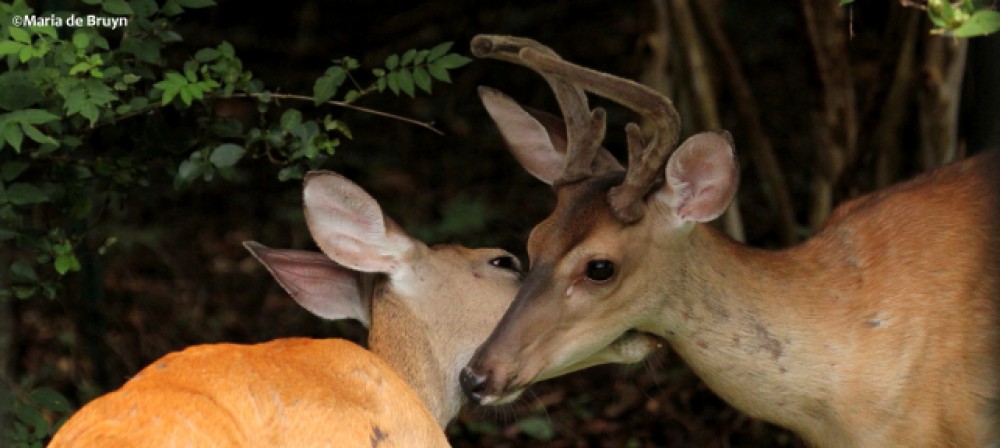
The walking path also held evidence of the passing of a young white-tailed fawn (Odocoileus virginianus). A Carolina satyr butterfly (Hermeuptychia sosybius) was moving from grass blade to grass stem as I proceeded up a hill.

white-tailed deer DK7A5276© Maria de Bruyn resCarolina Satyr DK7A5279 © Maria de Bruyn res

Eastern bluebird DK7A5392© Maria de BruynFirst birds of the day as I left the woods — a pair of Eastern bluebirds (Sialia sialis) that were roosting on a wire. When a pine warbler (Setophaga pinus) wanted to join them, he was given to understand that his proximity was not appreciated.


pine warbler DK7A5383© Maria de Bruyn res

Next, I caught sight of a Northern mockingbird (Mimus polyglottos polyglottos), very busy grooming near the top of a small tree.

Northern mockingbird DK7A5449© Maria de Bruyn res Northern mockingbird DK7A5443© Maria de Bruyn

Southern magnolia DK7A5439© Maria de Bruyn resA nearby Southern magnolia (Magnolia grandiflora) was mostly laden with rose-colored fruit but one large bloom was still vibrant and visited by smaller and larger bees.

A number of birds were singing but I didn’t recognize their calls and I saw some birds flit from one tree to another but then I caught sight of one that was dipping into the grass to pick up insects and then sitting still on a branch for a while. It was a lovely Eastern phoebe (Sayornis phoebe), a type of flycatcher with a yellow hue.

Eastern phoebe DK7A5586© Maria de BruynEastern phoebe DK7A5722© Maria de Bruyn

This bird flew around a bit, perching in trees, on ropes and barbed wire, providing some nice views of its lovely self.

Eastern phoebe DK7A5670© Maria de Bruyn resEastern phoebe DK7A5825© Maria de Bruyn res

A blue-gray gnatcatcher (Polioptila caerulea), busy as these small birds always seem to be, was gleaning insects from twigs and branches.

blue-gray gnatcatcher DK7A5924© Maria de Bruyn Blue-gray gnatcatcher DK7A5920© Maria de Bruyn blue-gray gnatcatcher 1-de Bruyn, Maria DK7A5944 Supported on the balance beam

Coming up on the shoreline of the reservoir, I first spotted some least sandpipers (Calidris minutilla) foraging at the water’s edge. This is the smallest species of sandpiper and they are also the smallest shorebirds in North America. They looked very pretty in flight.

least sandpiper DK7A6073© Maria de Bruynleast sandpiper DK7A6081© Maria de Bruyn

The sandpipers landed near some killdeer (Charadrius vociferous), who looked very large next to them.

killdeer DK7A6103© Maria de Bruyn res

red-spotted purple DK7A6143© Maria de Bruyn resA red-spotted purple butterfly (Limenitis arthemis astyanax) was mud-puddling on the shore, as was a Sachem skipper butterfly (Atalopedes campestris). A trio of American goldfinches (Spinus tristis) also dropped onto the wet mud for a brief time.


sachem skipper DK7A6355© Maria de Bruynsachem skipper DK7A6368© Maria de Bruyn

american goldfinch DK7A6323© Maria de Bruyn res

Several flocks of Canada geese (Branta canadensis) came in to the little lake. One group surprised me by suddenly veering in my direction and flying right in front of me, so close that they more than filled the screen of my zoom lens.

Canada goose DK7A6472© Maria de Bruyn res Canada goose DK7A6195© Maria de Bruyn res

Canada goose DK7A6205© Maria de Bruyn resCanada goose DK7A6207© Maria de Bruyn res

Near the end of my visit, a fellow birder kindly pointed out two green herons (Butorides virescens) to me. (Having binoculars is a definite advantage for this pursuit!). One was rather far away but another within walking distance so I snuck up on it in stages.

green heron DK7A6717© Maria de Bruyngreen heron DK7A6575© Maria de Bruyn

In the left-hand photo, you can imagine the dinosaur ancestor of this stalker.

At one point, the bird stretched and stared at the sky, moving its head from side to side obviously watching something – it turned out to be a juvenile red-tailed hawk (Buteo jamaicensis).

red-tailed hawk DK7A6633© Maria de Bruyn red-tailed hawk DK7A6631© Maria de Bruyn

My sneaking ever closer to the heron was rewarded when I saw the short bird catch and eat a rather large frog for its brunch. It was sad for the frog, but that is the cycle of life.

green heron DK7A6826© Maria de Bruyn resgreen heron DK7A6850© Maria de Bruyn res

And when I returned home a short while later, I learned that the family emergency had been handled for the time being. Like the fauna, our own cycles of life are also unpredictable.

Tundra swans, snow geese and Canada geese, too – beauty by the tens of thousands

Tundra swans IMG_8442©Maria de Bruyn

When the tundra swans (Cygnus columbianus) and snow geese (Chen caerulescens) leave the Arctic and sub-Arctic tundras and climes of northern North America to over-winter along the coasts of the United States, those of us who live further south get to enjoy the marvelous spectacle of tens of thousands of these birds gathering together. They appear in huge masses and smaller family groups to feed and then swirl through the skies in an aerial ballet as they settle down to feed again or spend the night in a marsh or on a lake or pond. Witnessing these enormous conglomerations of birds really is an unforgettable experience.

Tundra swans IMG_8440©Maria de BruynThe tundra swan – also known as the whistling swan in North America – is a large, graceful bird. Its diet is varied, ranging from aquatic plants and some molluscs (mostly during the summer) to seeds, grains and tubers like potatoes in the winter. In North Carolina, where they migrate during winter, you can find immense flocks foraging in open agricultural fields before they settle for the night (in winter, these birds sleep mostly on the water; during the breeding season, these monogamous birds sleep mainly on land).

tundra swan IMG_8676©Maria de Bruyn signed res

The adult swans are entirely white except for a black bill, while the immature birds are first a dusty gray color that eventually turns white; the young swans also have a pinkish bill.

Tundra swans IMG_6457©Maria de Bruyn signed res

During a birding trip to the Outer Banks of North Carolina, our Audubon group was privileged to witness the tundra swans returning to a lake in the Pocosin Lakes National Wildlife Refuge one night.

Tundra swans IMG_6446©Maria de Bruyn res

It was like watching a black wave moving back and forth across the orange sky at dusk, while being surrounded by a tremendous volume of honking (not whistling!). Afterwards, I and others regretted that we hadn’t thought to film this so we had a record of the sound. I think we were just so mesmerized that it didn’t occur to us to do that. Here you can hear what their calls are like. For us, it was impressive as we were listening to the sounds of a flock of about 20,000 strong! http://www.allaboutbirds.org/guide/tundra_swan/sounds

Tundra swans IMG_6439©Maria de Bruyn signed res

The snow goose, like the tundra swan, migrates in the winter to North Carolina from the uppermost parts of North America; like the swans, they forage in winter agricultural fields in large groups. There are two color variations: some are almost entirely white, while the “blue morph” variation has a white head but blue-gray body feathers. Our birding group was lucky to see another aerial ballet at Pocosin Lake National Wildlife Refuge put on by the snow geese.

Snow goose IMG_6334©Maria de Bruyn2 res

As a member of our group excitedly called, “They’re rising!” an enormous flock surged up from the lake, flew back and forth just a little and then settled.

Snow goose IMG_6330©Maria de Bruyn signed res

A minute later, they repeated the process and we watched as the swirling cloud rose and fell, just moving side to side a bit. They were very far across the lake from us, so it wasn’t possible to get great shots but at least I had evidence of the sighting!

Snow goose IMG_6341©Maria de Bruyn signed res

The other birds that we saw in some numbers were the more familiar Canadian geese (Branta canadensis). They are commonly seen in our area so it didn’t seem quite so special to spot them at the coast, but they passed by in flocks and beautiful formations that were well worth watching.

Canada goose IMG_5955©Maria de Bruyn signed resCanada goose IMG_6041©Maria de Bruyn res

Canada goose IMG_8306©Maria de Bruyn signed res 2These were the only geese that we were able to see up close a bit; here you see a pair at Lake Mattamuskeet National Wildlife Refuge.

I had seen starling murmurations before and was quite impressed with those. Witnessing the gigantic flocks of tundra swans and snow geese was equally fascinating – if you get a chance to see such large groups, do stop to watch them!