Warbler watching and migration – a shared pleasure for birders!

black-and-white-warbler-i77a3458-maria-de-bruynAutumn migration in North America has been underway for some weeks and our bird populations in North Carolina are changing in composition. Some birds stay year-round – for example, I see robins, blue jays, Carolina wrens, Carolina chickadees and tufted titmice in all seasons to my great delight. However, other birds who have been here since spring are now getting ready to leave for a southerly jaunt to a place that will be warmer for them in winter – most of the ruby-throated hummingbirds and some gray catbirds have departed already. (I have had a catbird stay year-round but others leave.) Many black and white warblers (Mniotilta varia) will be leaving, too.

american-redstart-i77a4367maria-de-bruyn-resThe Nature Conservancy has noted that the autumn songbird migration is one of the top four migrations in this state. The Audubon Society has even published a guide to this migration and when certain species usually begin their travels. (Left: American redstart male)


This seasonal event means that dedicated birders make special efforts to visit places where it’s likely we’ll see warblers. Many of North America’s 50 species don’t eat seed or suet, so you won’t find them visiting your feeders often. I have found, however, that pine warblers (Setophaga pinus) and yellow-rumped warblers (Setophaga coronata) are pretty social and those who are here for the winter are already joining my “regular” birds at feeding stations. The pine warblers especially like suet (female left, male right below).

pine-warbler-i77a0184-maria-de-bruyn-res        pine-warbler-i77a0409-maria-de-bruyn-8-x-10

The yellow rumps are still looking around a lot for insects; this one snagged a skipper butterfly.

yellow-rumped-warbler-i77a5552-maria-de-bruyn-res

In the autumn, many of these songbirds no longer have their beautiful breeding plumage, which is often so distinctive that you can identify them easily, especially the males. I was lucky enough to see some of those beauties during spring migration as well as in the summer for the ones that spend the warmer months here.

prothonotary-warbler-i77a2854-maria-de-bruyn-res   prothonotary-warbler-i77a9933-maria-de-bruyn-res

Prothonotary warbler male (Protonotaria citrea)

yellow-throated-warbler-img_0418-maria-de-bruyn        prairie-warbler-i77a1622-maria-de-bruyn-res

Yellow-throated (Setophaga dominica) & prairie warblers (Setophaga discolor)

american-redstart-i77a7811-maria-de-bruyn-res


The warblers’ non-breeding coloration is frequently duller and drabber than their breeding plumage. Often only experienced birders can tell some species apart on first sight. Added to that is the fact that young birds don’t yet have their adult plumage and the immature males often look just like adult females. So it is a challenging time for identification, especially for me, but an exciting time for discoveries.


blackpoll-warbler-i77a1289-maria-de-bruyn-resGetting photos of these lovely birds can be tricky since they move about a lot in search of their insect meals. It is ultimately the pursuit of those culinary delights that leads the warblers to migrate South, since the insect population declines dramatically in areas with cold weather.

Nature photographer Mary had discovered a spot where the warblers could bathe in a relatively protected fashion; she kindly shared the location with some of us and a number of avid birders sat with her for hours waiting for the birds to appear. Some of our more “common” avian friends used the site, too, including a gray catbird (Dumetella carolinensis) and a brown thrasher (Toxostoma rufum).

gray-catbird-i77a4922maria-de-bruyn-res    brown-thrasher-i77a4880maria-de-bruyn-res

northern-waterthrush-i77a5013maria-de-bruyn-res


A Northern waterthrush (also a warbler, Parkesia noveboracensis) found the spot enticing.

The trees around the water hosted birds as they looked for insects, like the black-throated blue warblers below (Setophaga caerulescens), seen a few weeks apart.


black-throated-blue-warbler-i77a8117-maria-de-bruyn-res  black-throated-blue-i77a4426maria-de-bruyn-res

A female American redstart (Setophaga ruticilla) spent time working the shrubs surrounding the creek with some success.

american-redstart-i77a4981maria-de-bruyn-res    american-redstart-i77a4996maria-de-bruyn-res

The male redstarts hopped about the branches and rocks hanging over the creek for a while before venturing below to bathe.

american-redstart-i77a7628-maria-de-bruyn-res american-redstart-i77a4217-maria-de-bruyn-res

american-redstart-i77a4477maria-de-bruyn-res  american-redstart-i77a4480maria-de-bruyn-res

The birds appeared to enjoy their bathing spot immensely, sometimes dipping under water over and over again.

american-redstart-i77a4685-maria-de-bruyn-res  american-redstart-i77a4693-maria-de-bruyn-res

american-redstart-i77a4658-maria-de-bruyn   american-redstart-i77a4629-maria-de-bruyn-res

american-redstart-i77a4710-maria-de-bruyn-res


They also didn’t mind sharing the space with each other (or sometimes other species)..

magnolia-warbler-i77a2250-maria-de-bruyn-res


The Magnolia warblers (Setophaga magnolia) did the same, giving me some good looks and making my first in-person sighting of this species (lifer!) quite special.


magnolia-warbler-i77a5161-maria-de-bruyn-res    magnolia-warbler-i77a5184-maria-de-bruyn-res

chestnut-sided-warbler-i77a5210-maria-de-bruyn-res


The chestnut-sided warbler (Setophaga pensylvanica)was a very vigorous bather!

chestnut-sided-warbler-i77a5230-maria-de-bruyn-res

chestnut-sided-warbler-i77a5207-maria-de-bruyn-res    chestnut-sided-warbler-i77a5203-maria-de-bruyn-res

hooded-warbler-i77a4728-maria-de-bruyn-res


A male hooded warbler (Setophaga citrina) made a brief appearance one day, followed by some female and male common yellowthroats (Geothlypis trichas).


common-yellowthroat-i77a4431maria-de-bruyn-2common-yellowthroat-i77a4316maria-de-bruyn-res

Another water body that provided me with some excellent views of warblers was the Haw River. In the small town of Bynum, a bridge crosses the river and gives birders a great vantage point to see birds in the tree canopy close to eye level. There I was able to see two more lifers a couple weeks ago – the first was a bay-breasted warbler (Setophaga castanea).

bay-breasted-warbler-i77a1004-maria-de-bruyn-res    bay-breasted-warbler-i77a1003-maria-de-bruyn-res

blackpoll-warbler-i77a1315-maria-de-bruyn-resThis beauty was followed by another that had me confused. At first, I thought I was seeing a kinglet but this bird was a bit large and then as I got closer looks, I realized it looked like a bay-breasted warbler but had yellow feet. A search on the Internet showed I had seen a blackpoll warbler (Setophaga striata), likely a non-breeding male. Experts on an American Birding Association Internet site confirmed the ID for me.

blackpoll-warbler-i77a1320-maria-de-bruyn-res    blackpoll-warbler-i77a1329-maria-de-bruyn-res

black-and-white-warbler-i77a7204-maria-de-bruyn-resMy migration warbler watching culminated with some exciting finds in my own yard. I was surprised by several I hadn’t seen at home before, including common yellowthroats, a black and white warbler looking for insects in my willow oak and a gorgeous Northern parula (Setophaga americana), who even came to my feeders before pursuing a caterpillar in a Rose of Sharon nearby.

northern-parula-i77a7131-maria-de-bruyn-res   northern-parula-i77a7117-maria-de-bruyn-res

northern-parula-i77a7076-maria-de-bruyn-res


I’m now hoping to see some birds that breed further North during the summer arrive here for their late fall/winter/early spring sojourn, such as a ruby-crowned kinglet who has spent time with me each winter for the last three years. Next time I’ll share some of my pollinator sightings with you, in the hope you find them as fascinating as me. Have a nice day!

My hummer summer, part 2 — beauty in flight, beauty at rest

ruby-throated-hummingbird-i77a8438-maria-de-bruynIn my previous blog, I mentioned that the ruby-throated hummingbirds (Archilocus colubris) had a greater variety of flowering plants to visit in my yard this year and that increased the size and diversity of their nectar buffet. The availability of multiple food sources also meant that they spent a bit more time visiting – they didn’t just dash to a feeder, perch or hover for a drink and then take off. They visited feeders, different blooms and took little rests between meals, giving me numerous chances to watch them and practice my hummingbird photography – a win-win for both us!

ruby-throated-hummingbird-i77a7246-maria-de-bruyn-res


One of their favorite flowers were the lantanas (Lantana), which are also a favorite of mine as they attract many smaller pollinators such as bees and butterflies and are still profusely blooming in the latter half of October.


ruby-throated-hummingbird-i77a6866-maria-de-bruyn-res

ruby-throated-hummingbird-i77a7168-maria-de-bruyn-res

ruby-throated-hummingbird-i77a1023-maria-de-bruyn-res


This year, several types of sage brightened my gardens. Some deep blue Brazilian sage plants (Salvia guaranitica), kindly donated to me by Gail, a fellow birder, added color and provided the hummers with deep blooms into which they could insert their long bills.


ruby-throated-hummingbird-i77a1315-maria-de-bruyn-res

ruby-throated-hummingbird-i77a7519-maria-de-bruyn-resA small-leaf sage (also known as Festival or little-leaf sage, Salvia microphylla “San Carlos Festival”) provided an ongoing splash of deep red blooms that attracted the hummers over and over again. This plant not only graced the garden in the summer but is still blooming profusely now, making it another one of my favorites. A couple other different red sages and a red beebalm (Monarda didyma) were good nectar choices but they didn’t bloom as long or in such abundance. Perhaps next year, they will have gained strength.

ruby-throated-hummingbird-i77a7782-maria-de-bruyn-res

ruby-throated-hummingbird-i77a1160-maria-de-bruyn-resThe two stonecrop plants (Hylotelephium Autumn joy), in my front garden, with their rounded bunches of little pink flowers, had hummer visitors on a few occasions, but these are not one of their preferred blooms. The milkweed plants (Asclepias syriaca) also only had a few visits as far as I could tell.


ruby-throated-hummingbird-i77a1086-maria-de-bruyn-res


And it was the same story for the blue balloon flower (Platycodon grandiflorus), which does get its fair share of bees.


ruby-throated-hummingbird-i77a2198-maria-de-bruyn-resI had planted cardinal flowers (Lobelia cardinalis), which unfortunately didn’t get any flowers. I did see a bird visiting this plant species near Bolin Creek, however. The same happened with a trumpet vine (Campsis radicans), but at a vine cluster near the Haw River I saw how they inserted their heads entirely into the tubular blooms.

ruby-throated-hummingbird-i77a5851-maria-de-bruyn-res

ruby-throated-hummingbird-i77a6177-maria-de-bruyn-res


In between feedings, the hummingbirds will perch to watch for intruders into “their space”. But they also will take sun-baths, pointing their faces upward and puffing themselves up.

ruby-throated-hummingbird-i77a8401-maria-de-bruyn-res


They will then change shape, stretching their necks and spreading their wings and tail feathers to expose as much of their bodies as possible to the sunlight.

ruby-throated-hummingbird-i77a6885maria-de-bruyn-res   ruby-throated-hummingbird-i77a6891maria-de-bruyn-res

They may relieve themselves while they are in flight and then later take a little power nap of a few seconds.

ruby-throated-hummingbird-i77a1170-maria-de-bruyn-res       ruby-throated-hummingbird-i77a0553-maria-de-bruyn-res

ruby-throated-hummingbird-i77a7826-maria-de-bruyn-res

Grooming is also a frequent activity – these little avians make sure that they stay just as beautiful as the sweet flowers that they frequent!

ruby-throated-hummingbird-i77a6905-maria-de-bruyn-res   ruby-throated-hummingbird-i77a8283-maria-de-bruyn

When the males turn their heads so that the light hits them in different ways, they do a nice job of demonstrating that their bright gorget colors are not in the feathers themselves but the result of prism cells in their feathers that change how the light is reflected depending on the angle we see.

ruby-throated-hummingbird-i77a1126-maria-de-bruyn-res    ruby-throated-hummingbird-i77a1120-maria-de-bruyn-res

ruby-throated-hummingbird-i77a6366-maria-de-bruyn-resWhen they’re done sun bathing, grooming and resting, the hummingbirds need to take off again. However, their feet are so tiny that they can’t walk and, when they lift off, they also don’t have the foot strength to push.  So they rise into the air using the power of their wings, quickly flapping as they set off and rapidly reaching their usual rate of about 50-53 beats per second.

ruby-throated-hummingbird-2-i77a5105-maria-de-bruyn-res

ruby-throated-hummingbird-i77a9703-maria-de-bruyn-res

ruby-throated-hummingbird-i77a7167-maria-de-bruyn-resMy last summer hummingbird residents appear to have left for their Central American wintering grounds on 7 October, just before Hurricane Matthew arrived in North Carolina. I really hope that they were able to get through the windy environment without problems as they began their long migratory journeys and I am already looking forward to seeing them arrive next spring. In the meantime, I’m keeping a couple feeders up in case another hummer species decides to over-winter here – and the Carolina chickadees (Poecile carolinensis), Northern cardinals (Cardinalis cardinalis) and tufted titmice (Baeolophus bicolor) can continue to use the ant guards over the feeders as their preferred watering holes.


Can you go home again? Apparently so!

brown-headed-nuthatch-i77a3736-maria-de-bruyn-res


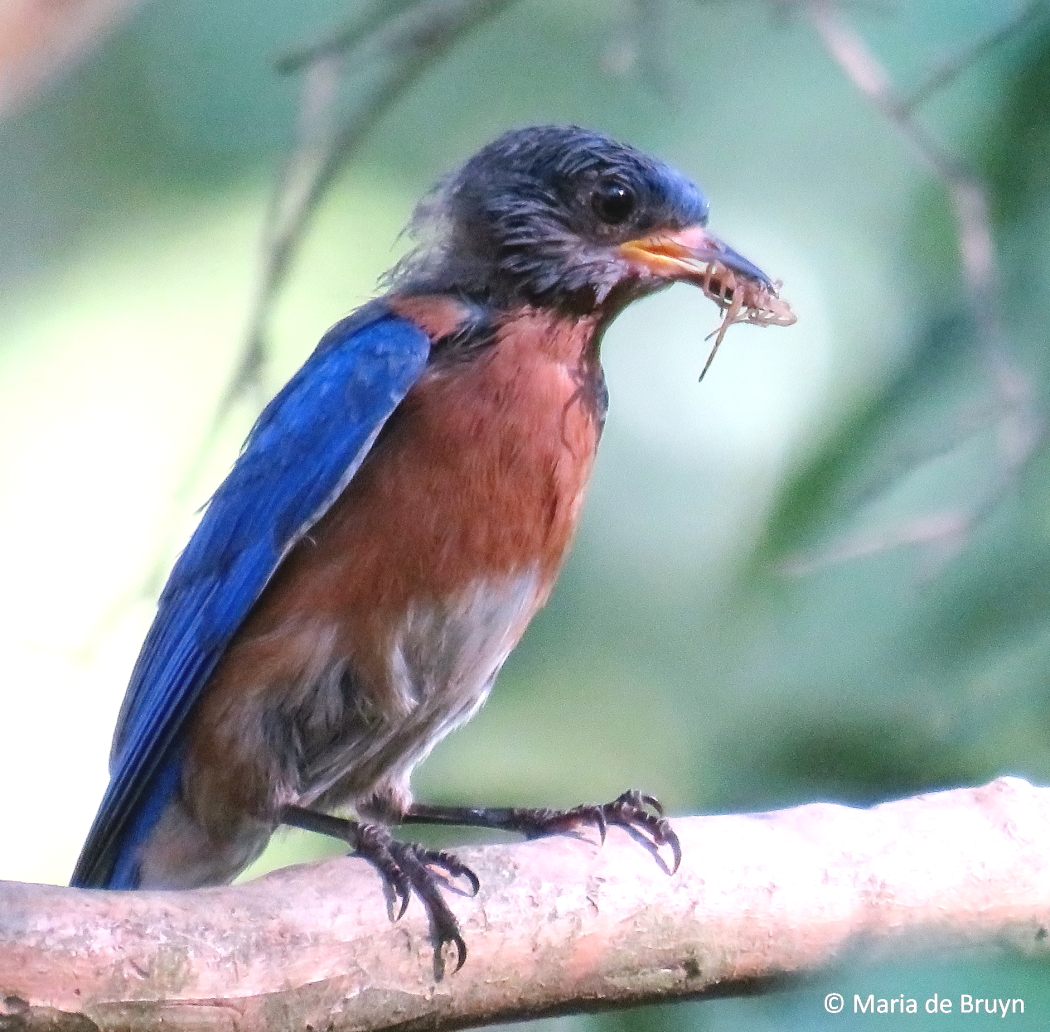
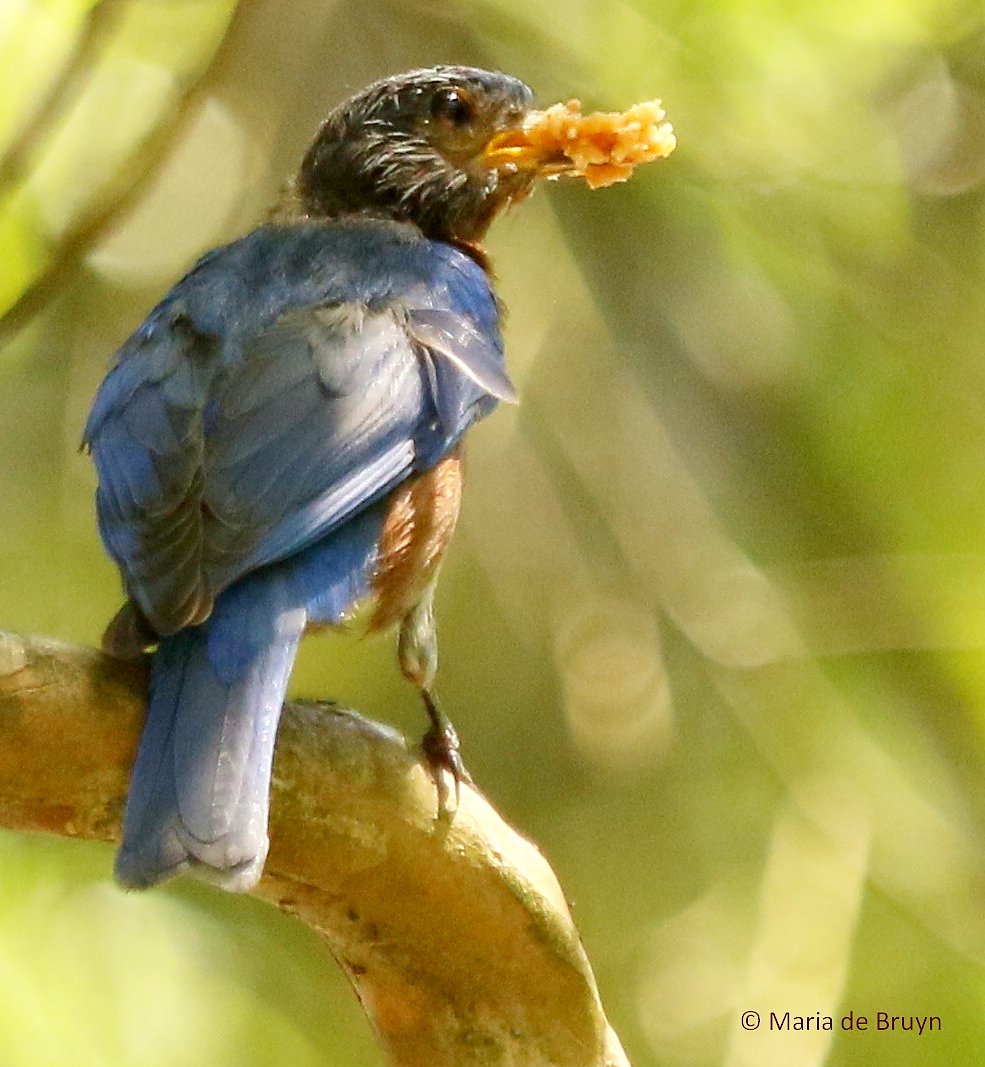
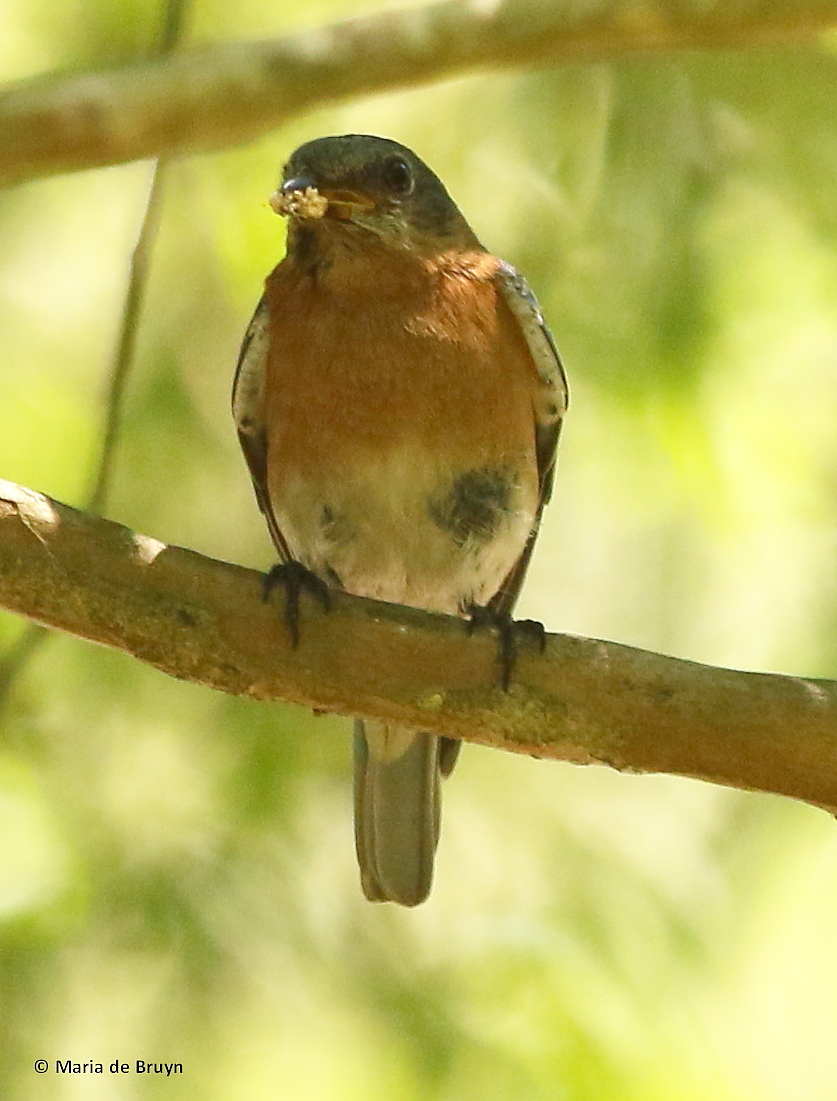
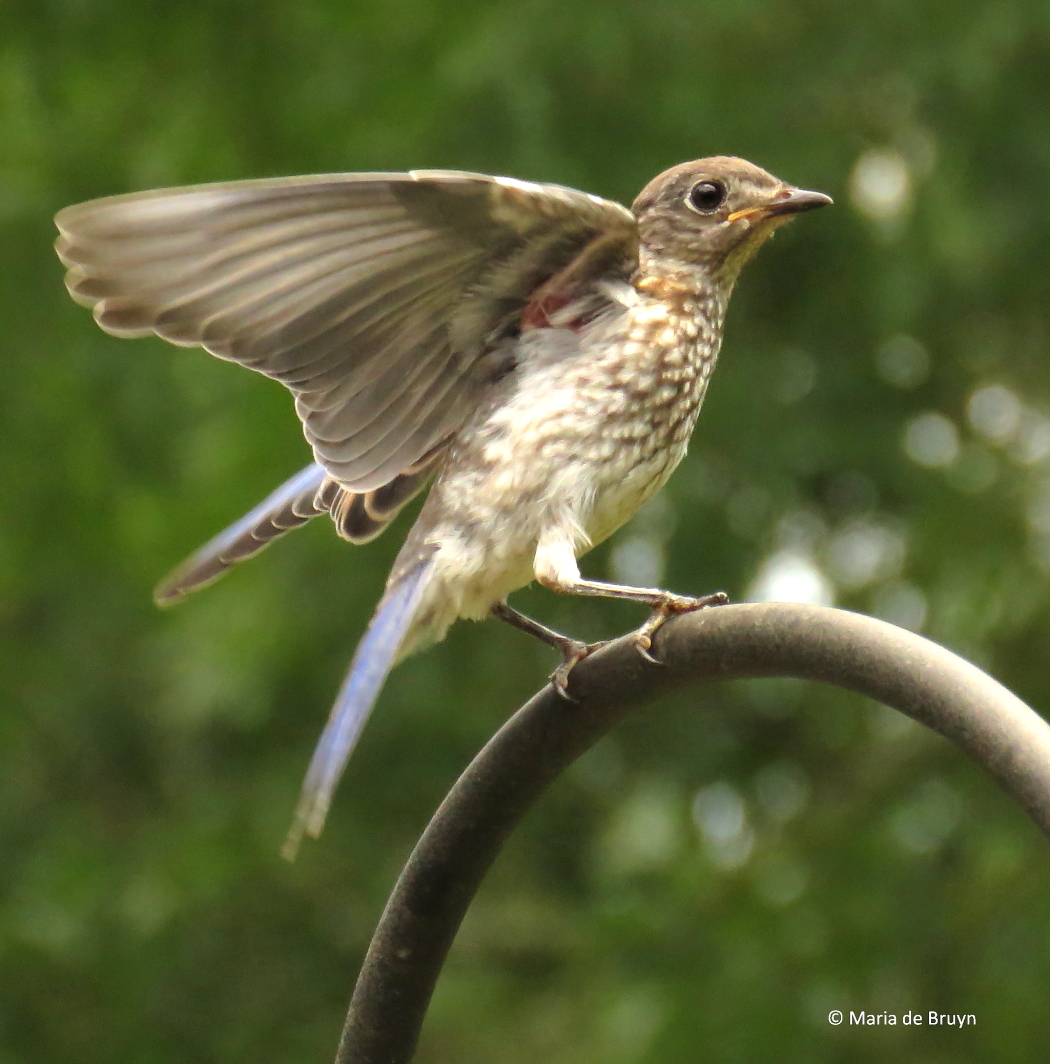
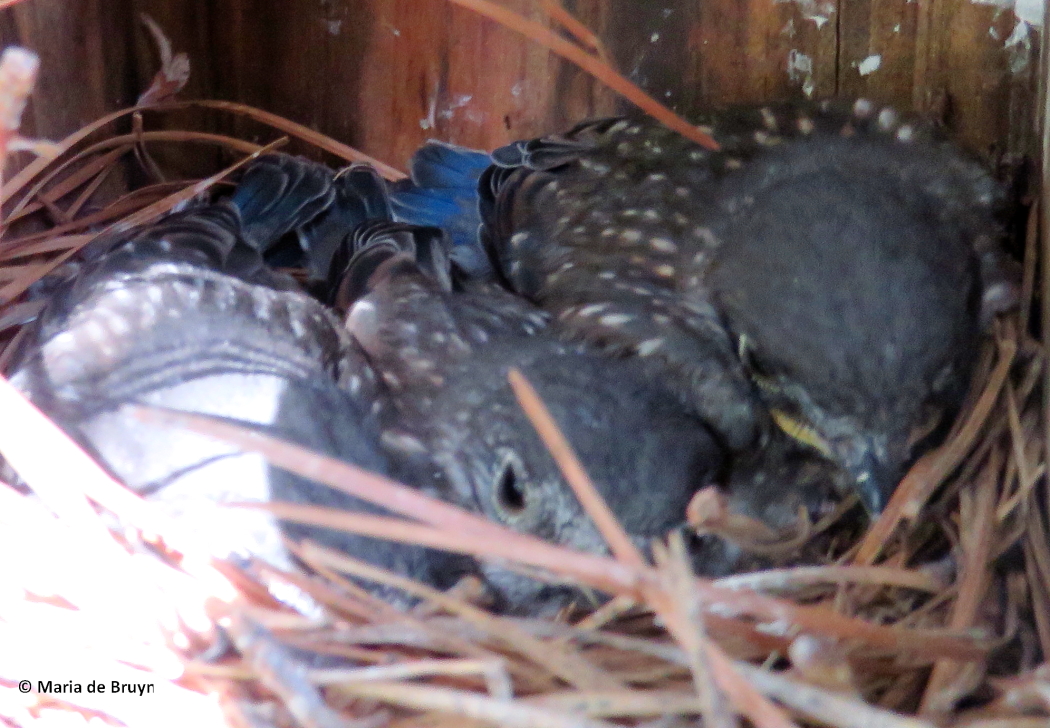
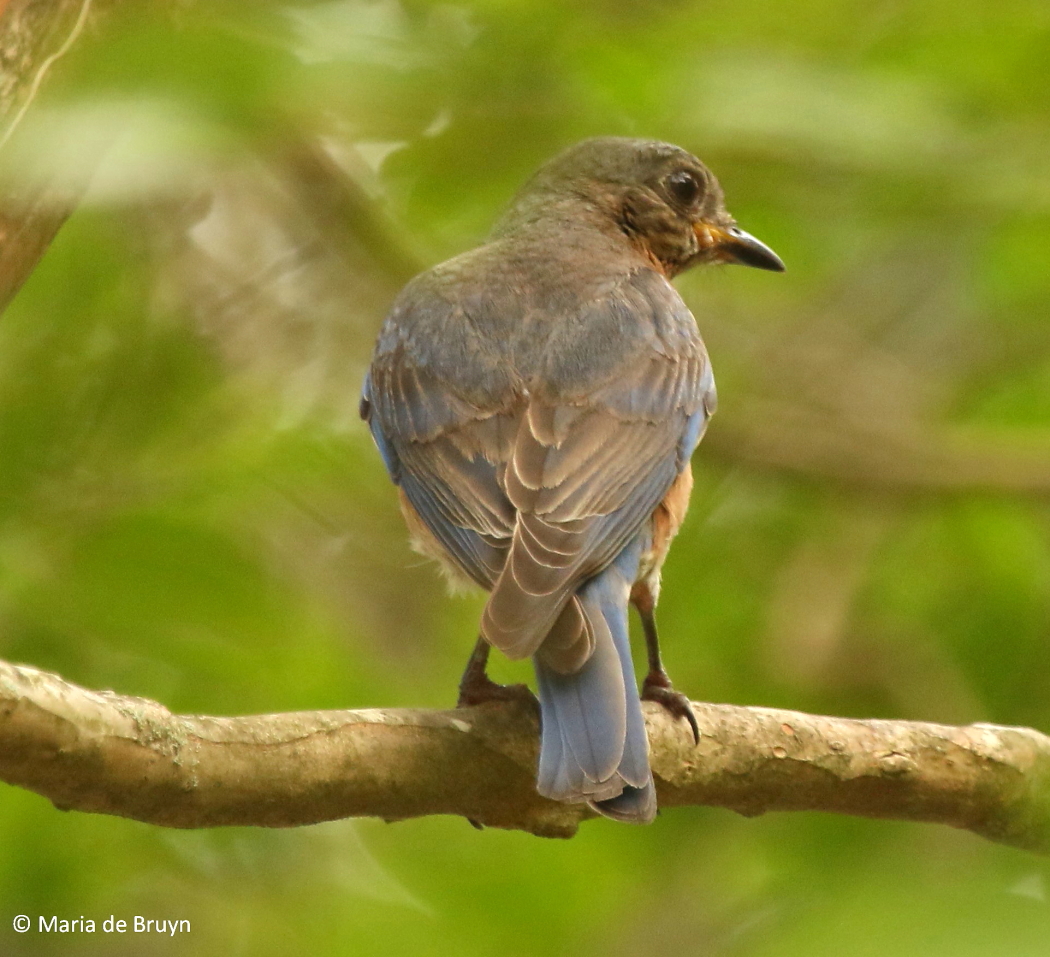
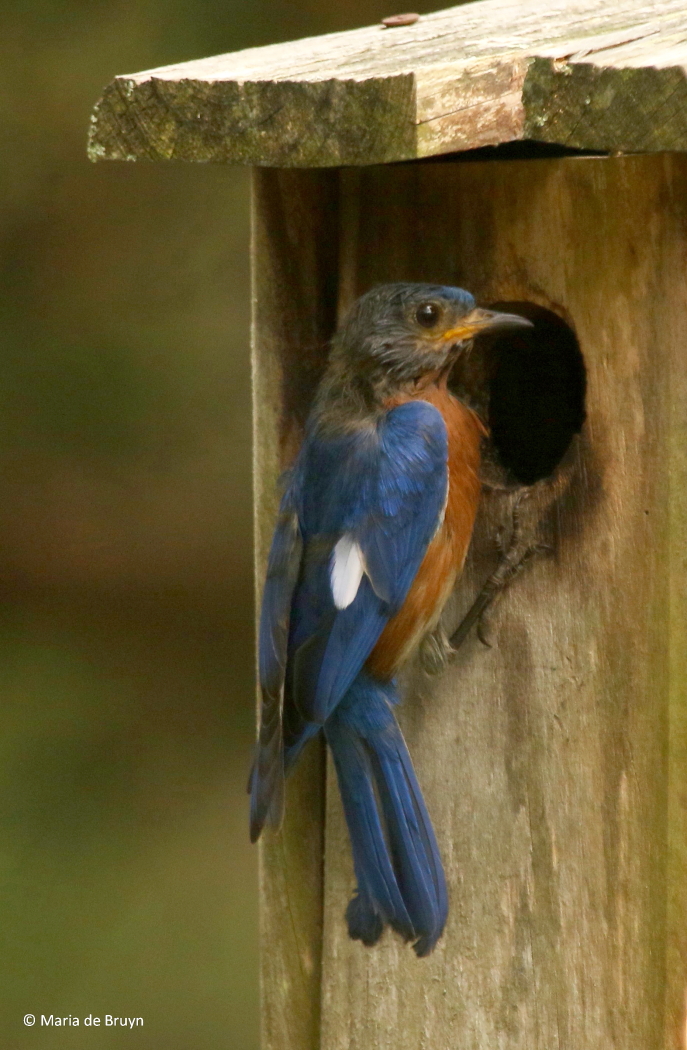
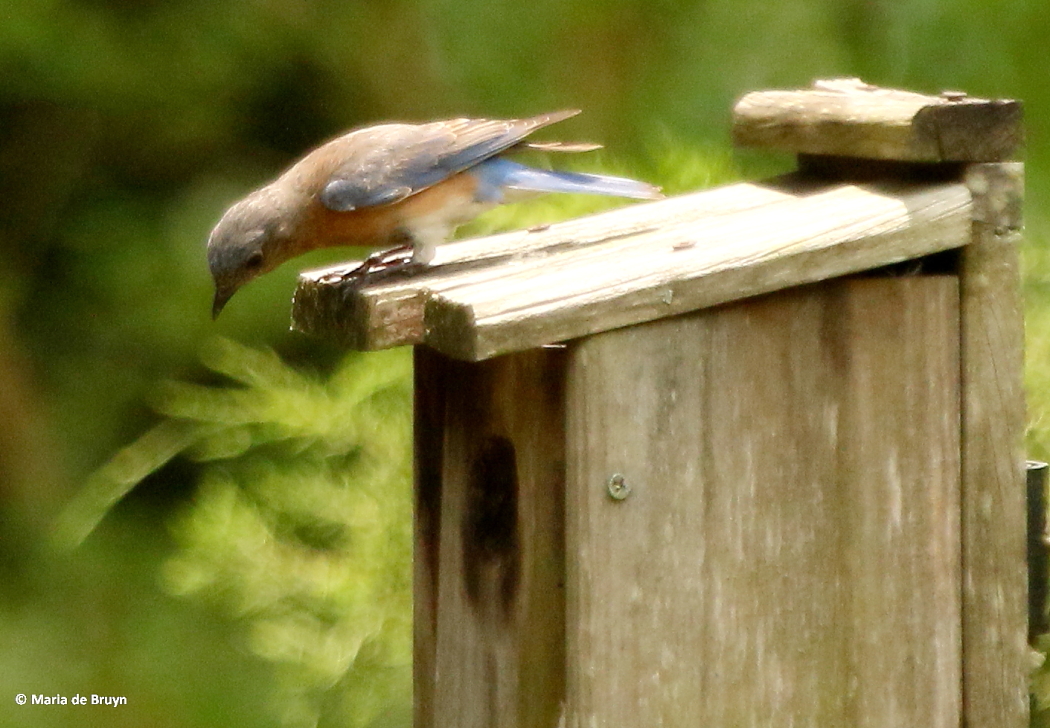
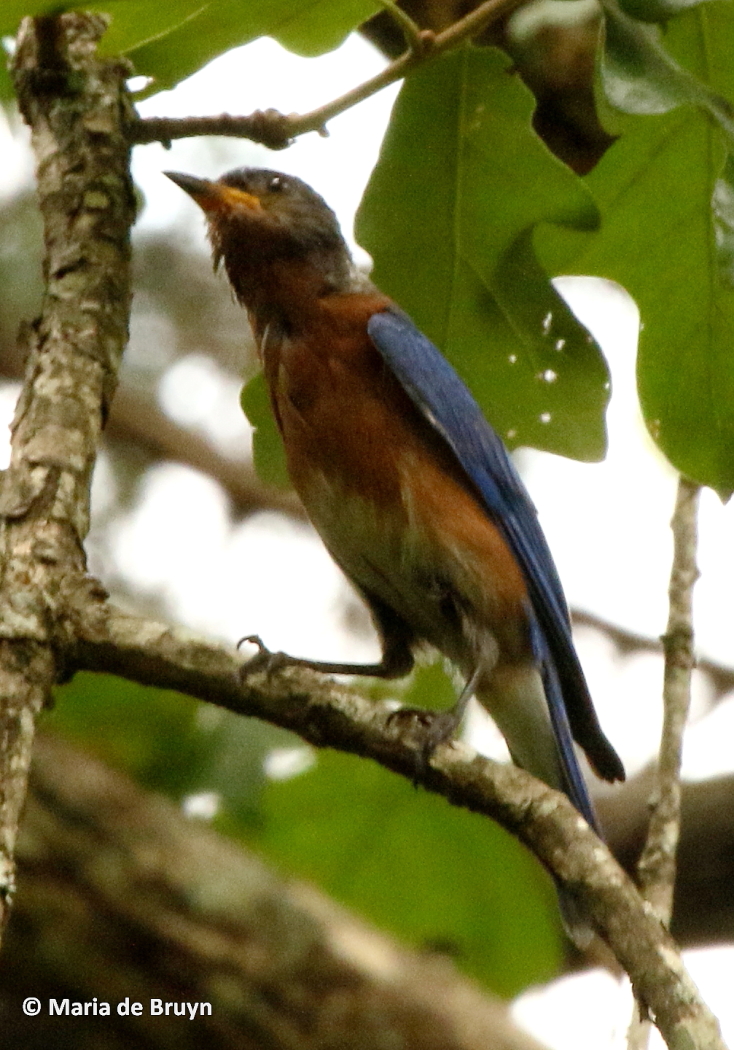
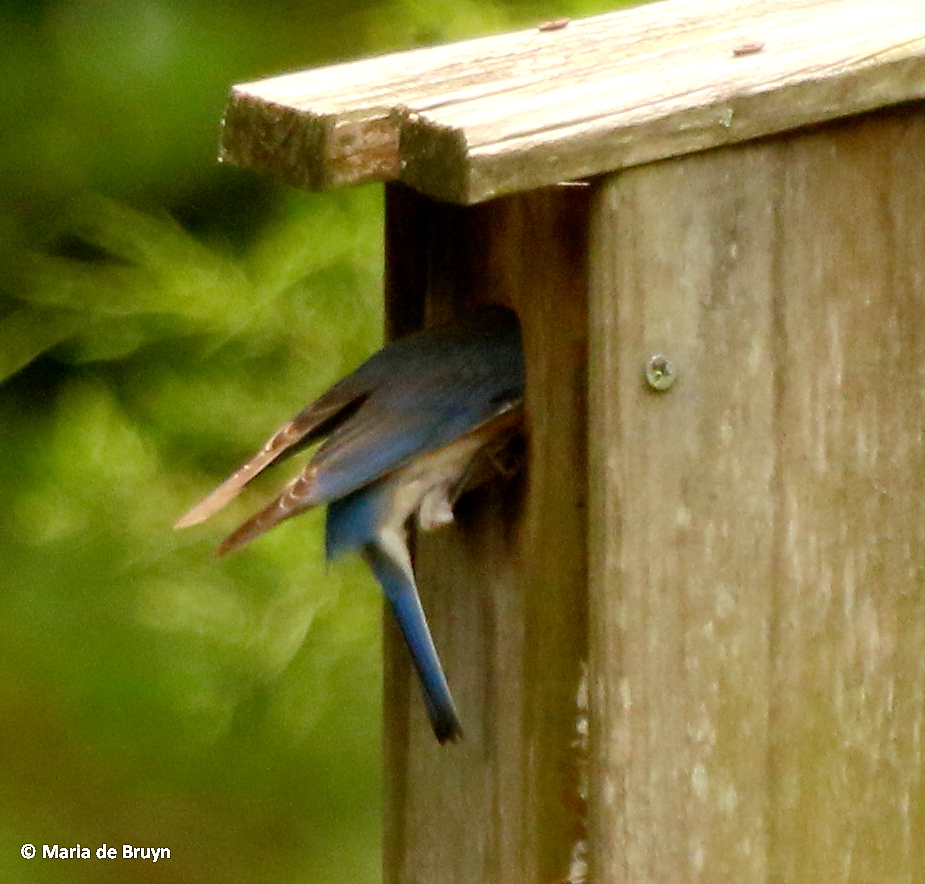
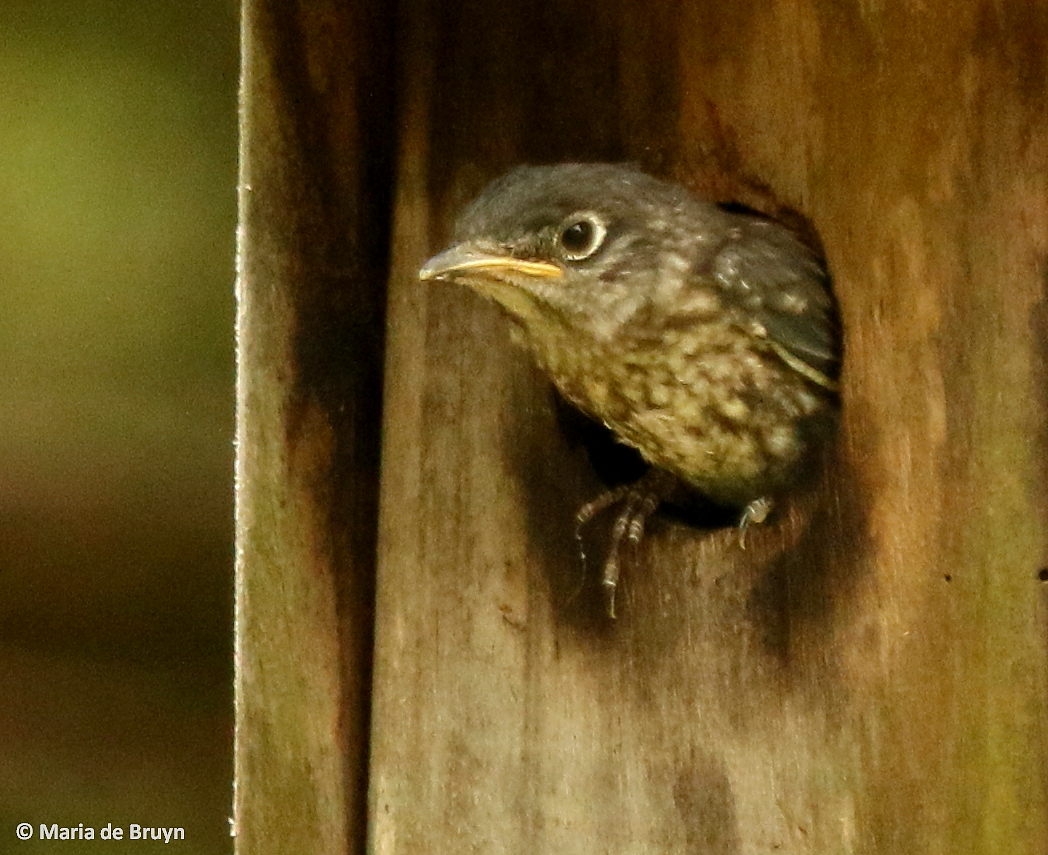
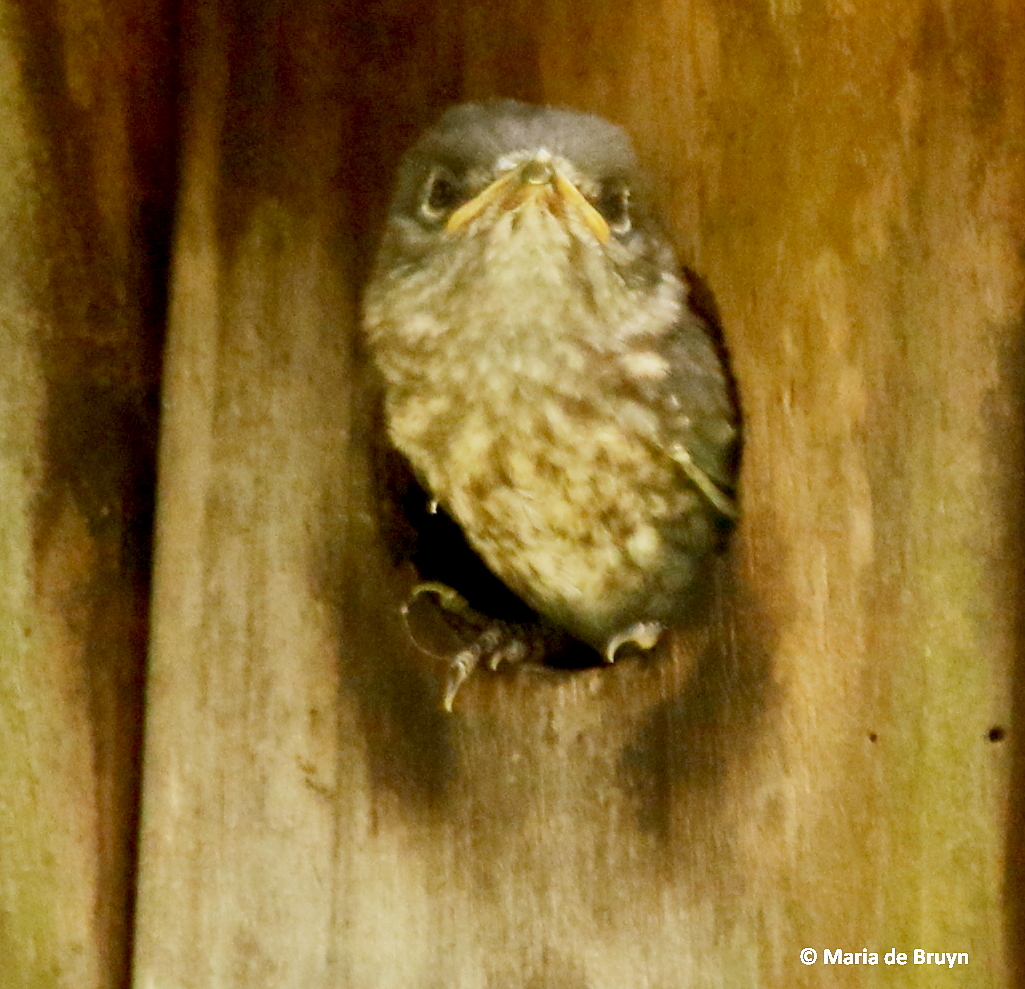
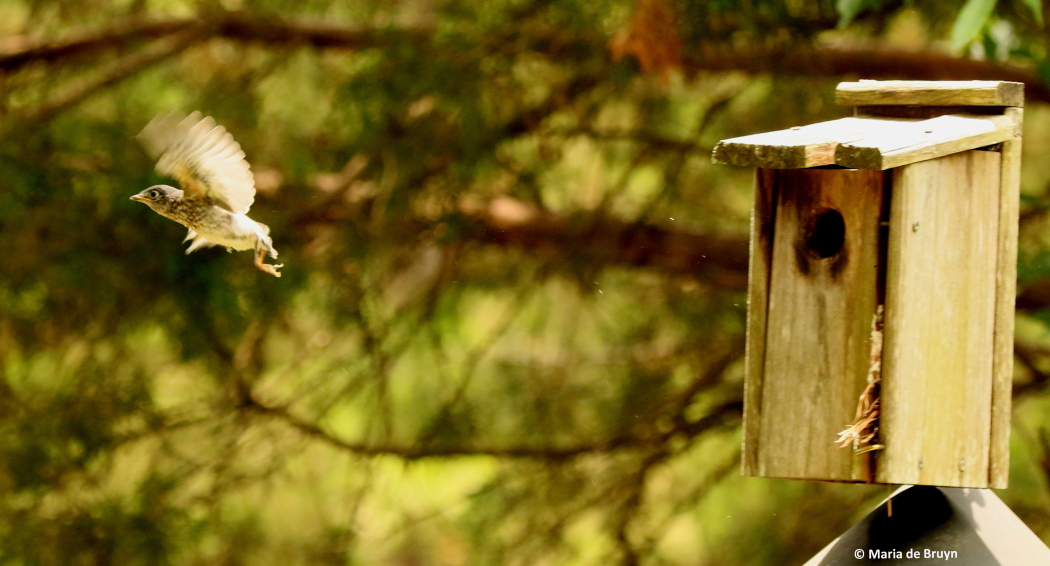
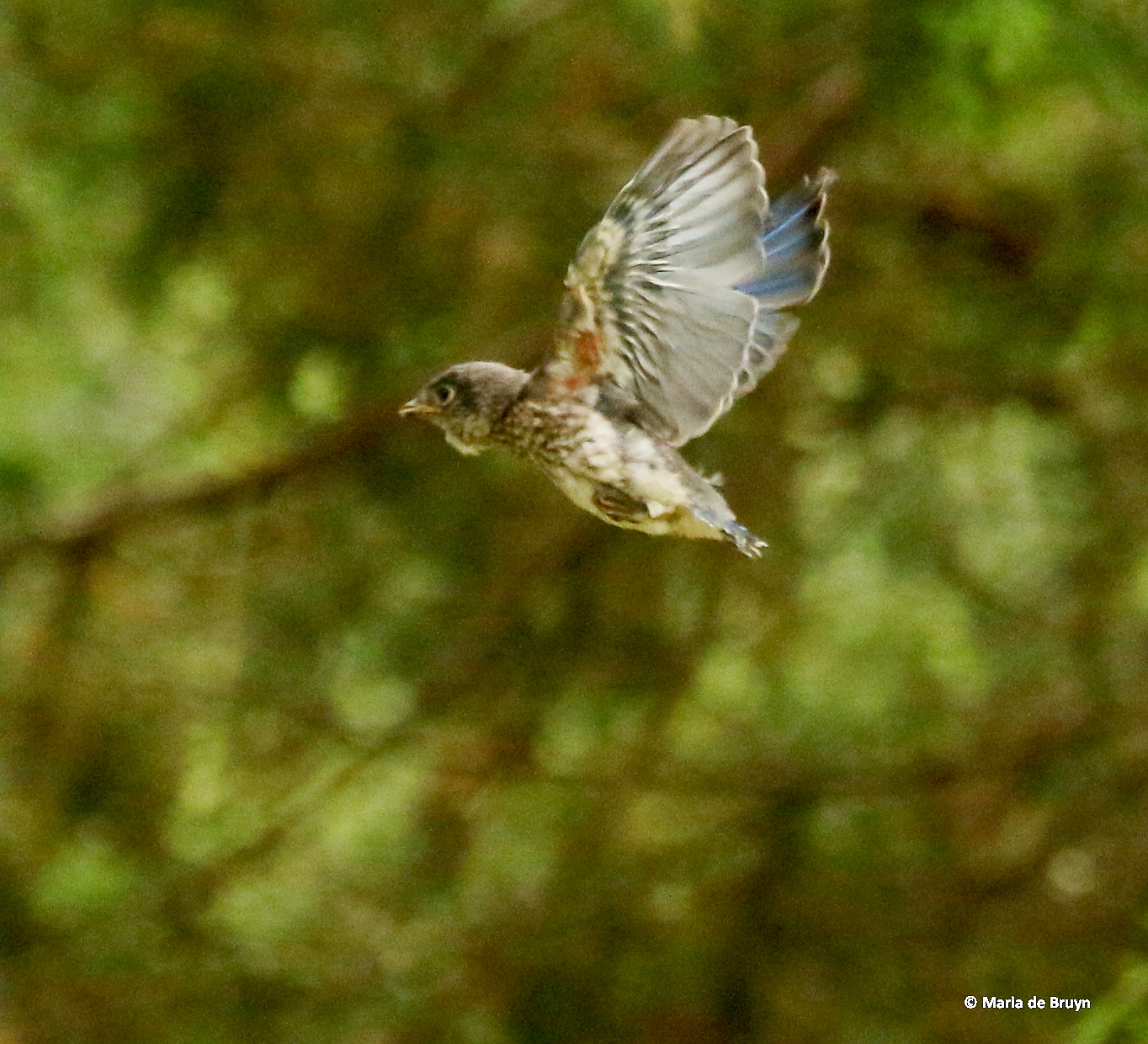
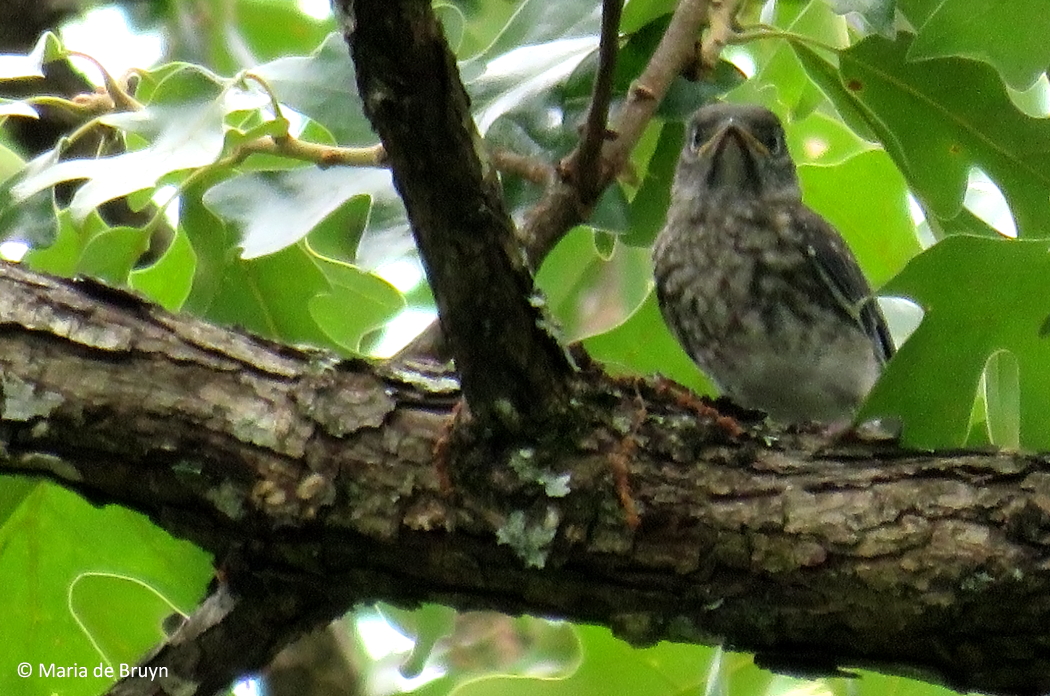
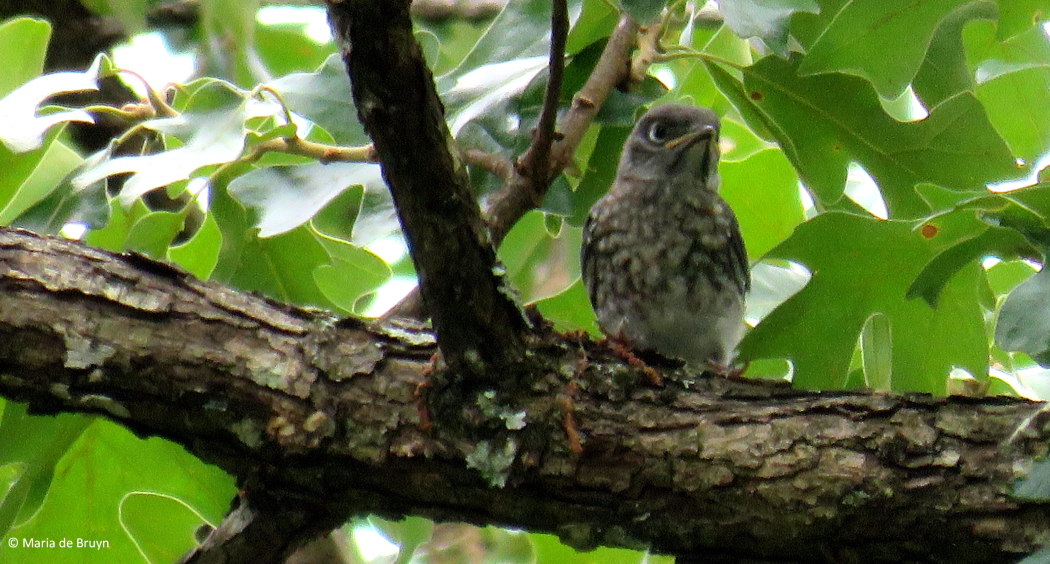
This year, I had the good fortune to see both brown-headed nuthatches (Sitta pusilla) and Eastern bluebirds (Sialia sialis) raise broods in some of my nest boxes. I saw the babies fledge, which was truly an enjoyable event.


eastern-bluebird-i77a7134-maria-de-bruyn-res

For some time, the parents continued feeding their babies after they left home, but eventually they got to the point that they could catch or find their own food. As summer progressed, the parents and children both visited my feeders and it was gratifying to see the families thrive. Then during September and October, I saw a behavior that I don’t remember from years past.

brown-headed-nuthatch-i77a7426-maria-de-bruyn-resbrown-headed-nuthatch-i77a7439-maria-de-bruyn-res

The nuthatches started to return to their nest box almost daily. They didn’t check out nearby boxes but went to their original home and today they are still visiting there, sitting on top, fluttering around it and looking inside.

tufted-titmouse-i77a7417-maria-de-bruyn-res

Their frequent visits seem to have intrigued a local tufted titmouse (Baeolophus bicolor) who decided to take a look in their box, too,but that was only a one-time visit as far as I could see.

It’s not only the parents doing this, but also one or more of their offspring. So how true is the saying “you can never go home again” (origin a novel by Thomas Wolfe)? It originally meant that you can’t recapture exactly how things were in your youth because changes take place in situations and places. But people do often journey back to the places where they grew up and apparently birds do, too! Maybe they are wondering if their nest box is still the same good place for a home.

brown-headed-nuthatch-i77a7459-maria-de-bruyn-resbrown-headed-nuthatch-i77a7441-maria-de-bruyn-res

i77a0203-maria-de-bruyn-res


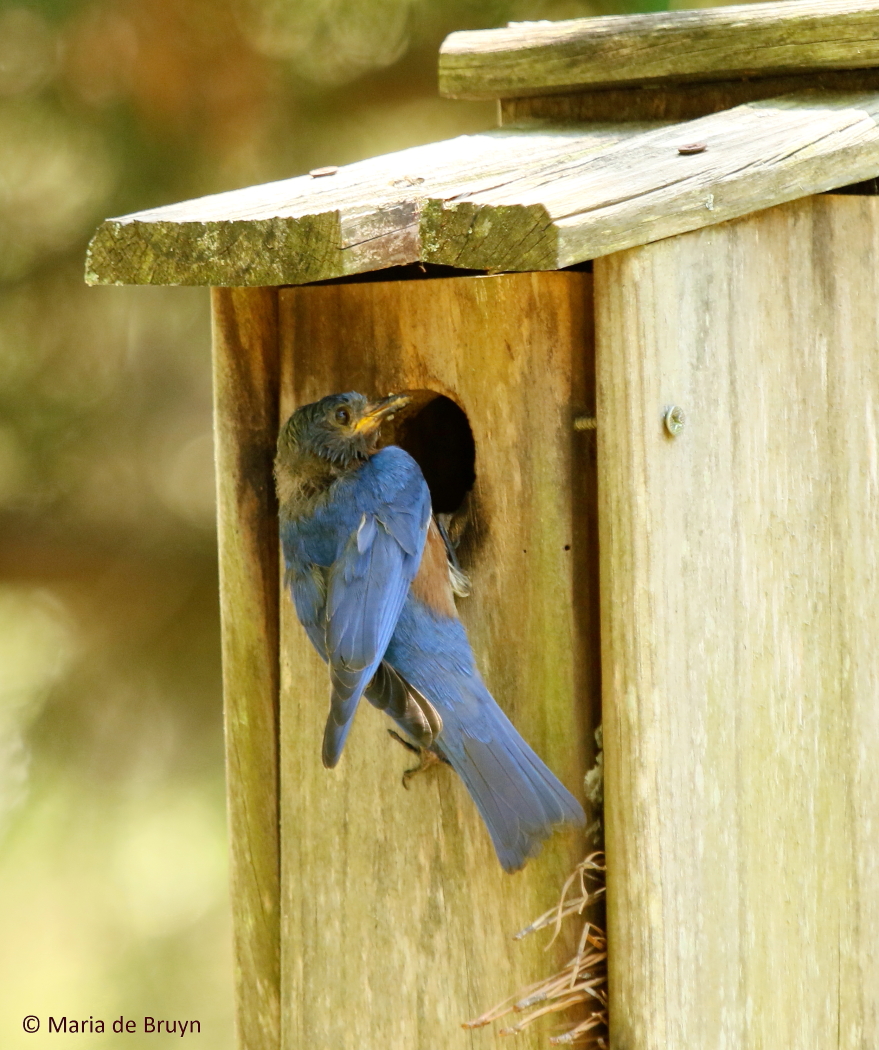
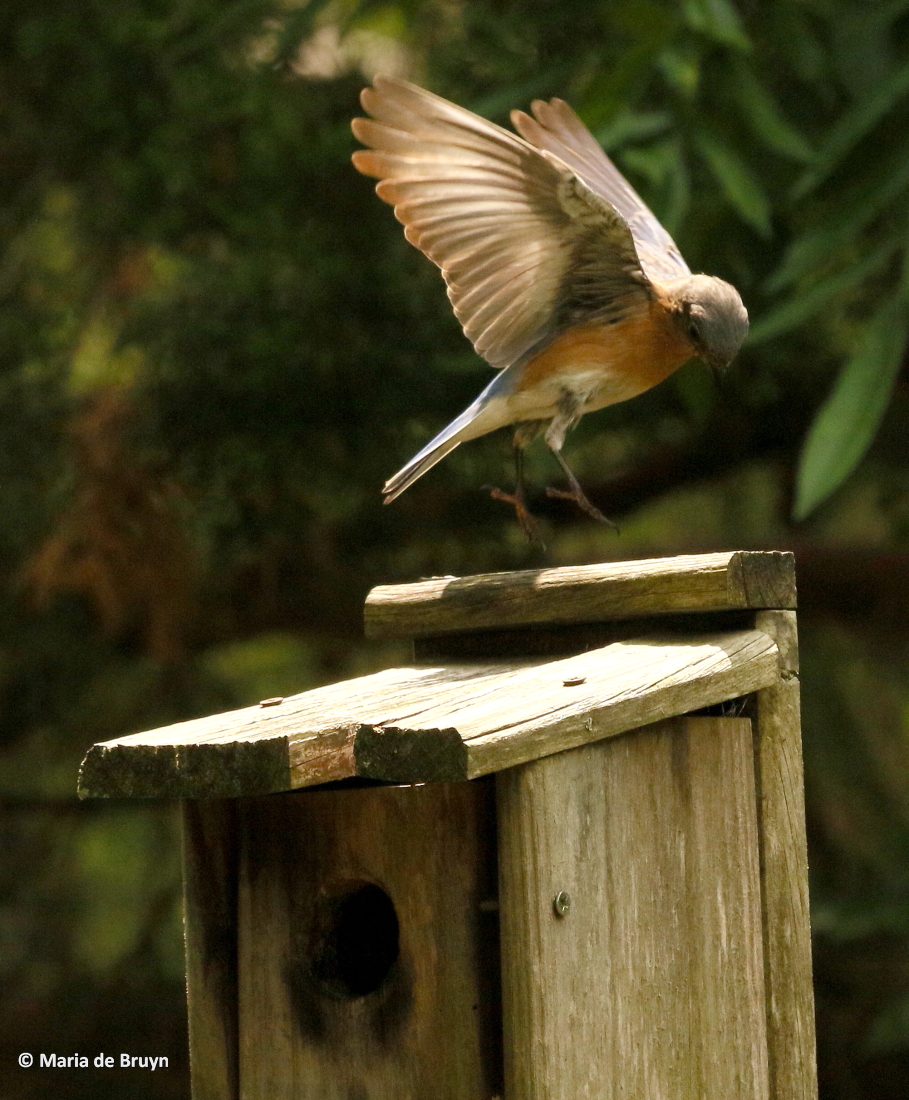
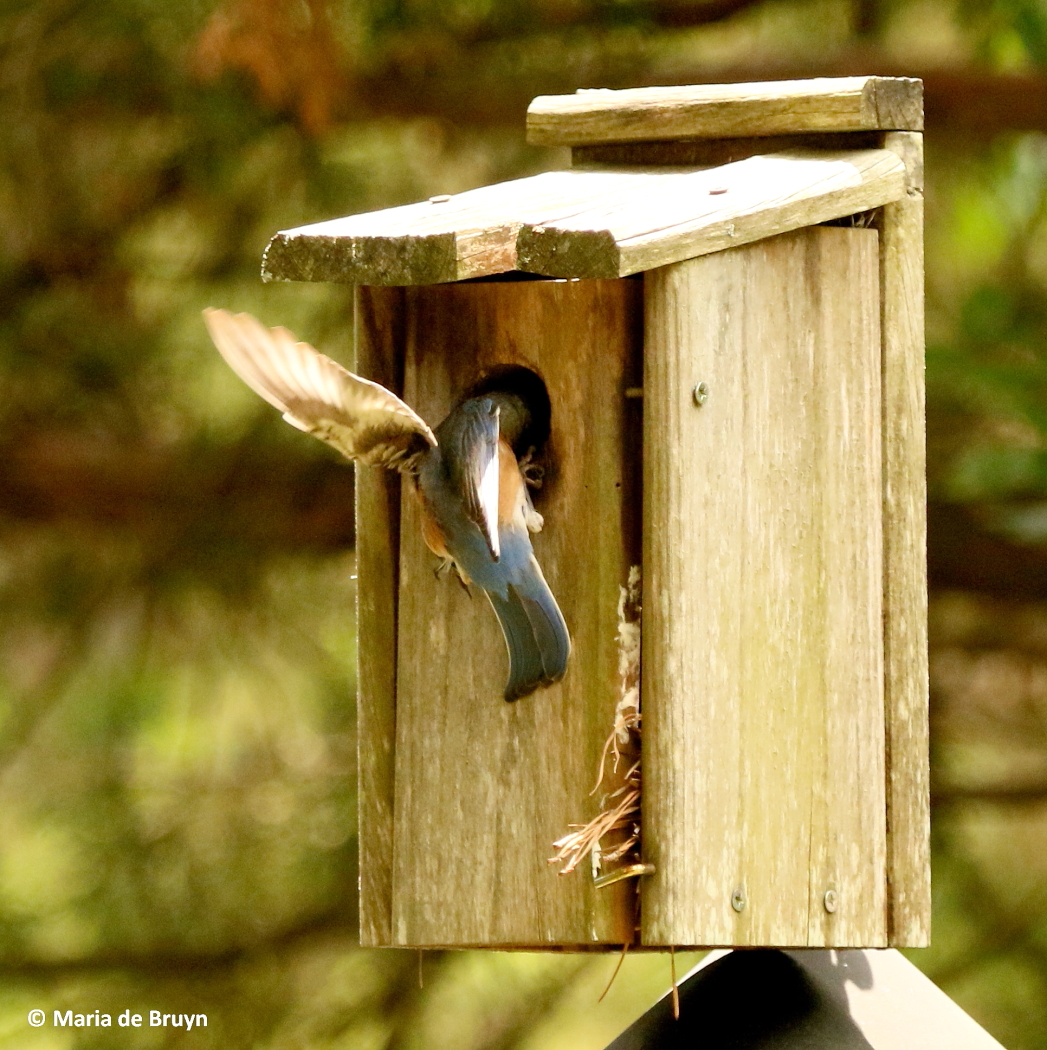
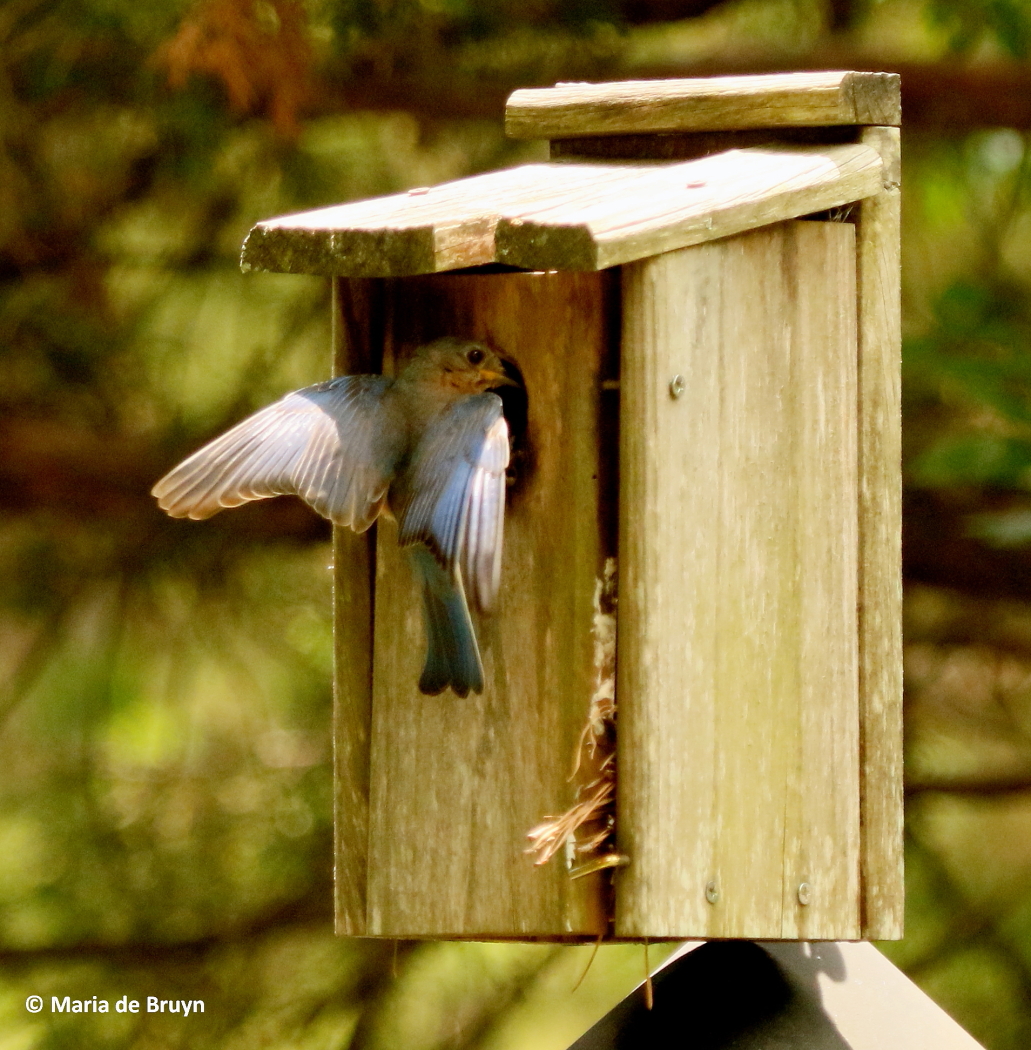
The bluebirds began doing the same with their home nest box as well. They take turns flying from nearby branches to cling to the box and investigate the now empty dwelling. While the nuthatches just lean and peer inside, the bluebirds eventually go inside for a bit.


eastern-bluebird-i77a9732-maria-de-bruyn-res brown-headed-nuthatch-i77a9653-maria-de-bruyn-res


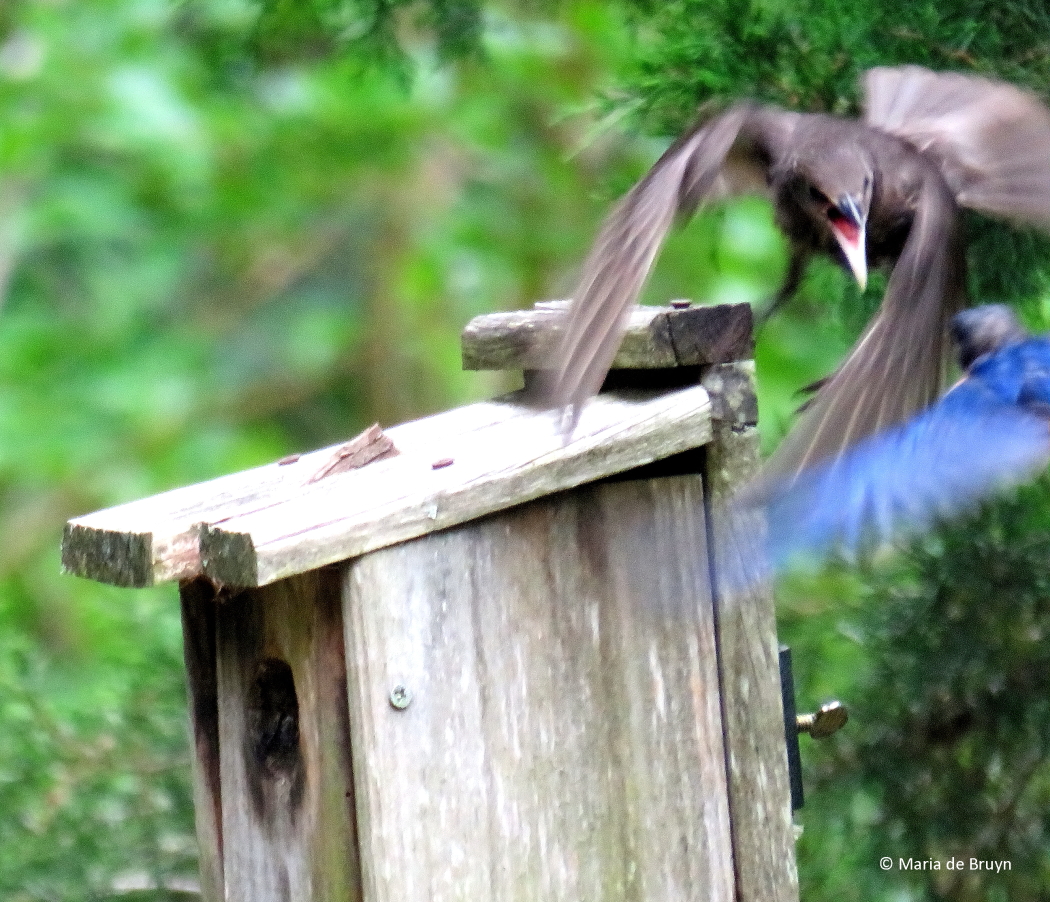
Oddly, there seems to be some contention involved. For example, when this pair was investigating, they had a little tiff for some reason.

eastern-bluebird-i77a9722-maria-de-bruyn-res eastern-bluebird-i77a9725-maria-de-bruyn-res

eastern-bluebird-i77a9723-maria-de-bruyn-res eastern-bluebird-i77a9726-maria-de-bruyn-res

I can only guess that the birds are checking out the nest boxes in anticipation of next year’s nesting season. The nuthatches and bluebirds will begin breeding again around March, although nuthatches might already begin building a new nest as early as December. It will also be interesting to see if they end up roosting in the boxes during the colder winter nights.

brown-headed-nuthatch-i77a4527-maria-de-bruyn-resWatching the nuthatches and bluebirds nest, fledge and feed is an enjoyable pastime and I’m looking forward to seeing them repeat the process next year. In the meantime, perhaps I’ll continue seeing them around the nest boxes this winter – as Pliny the Elder said, “Home is where the heart is” and something is sure attracting them back! (And yes, I know, that is a bit of anthropomorphizing.)

Leaping into the wide – and sometimes wet – world!

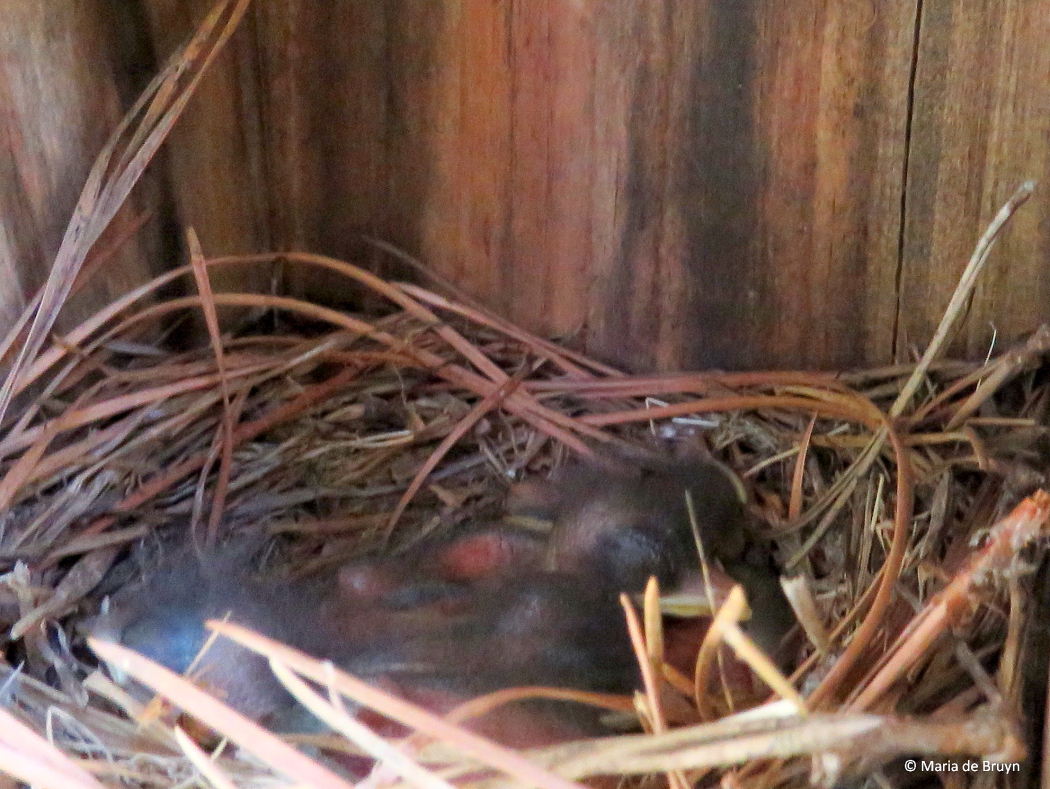
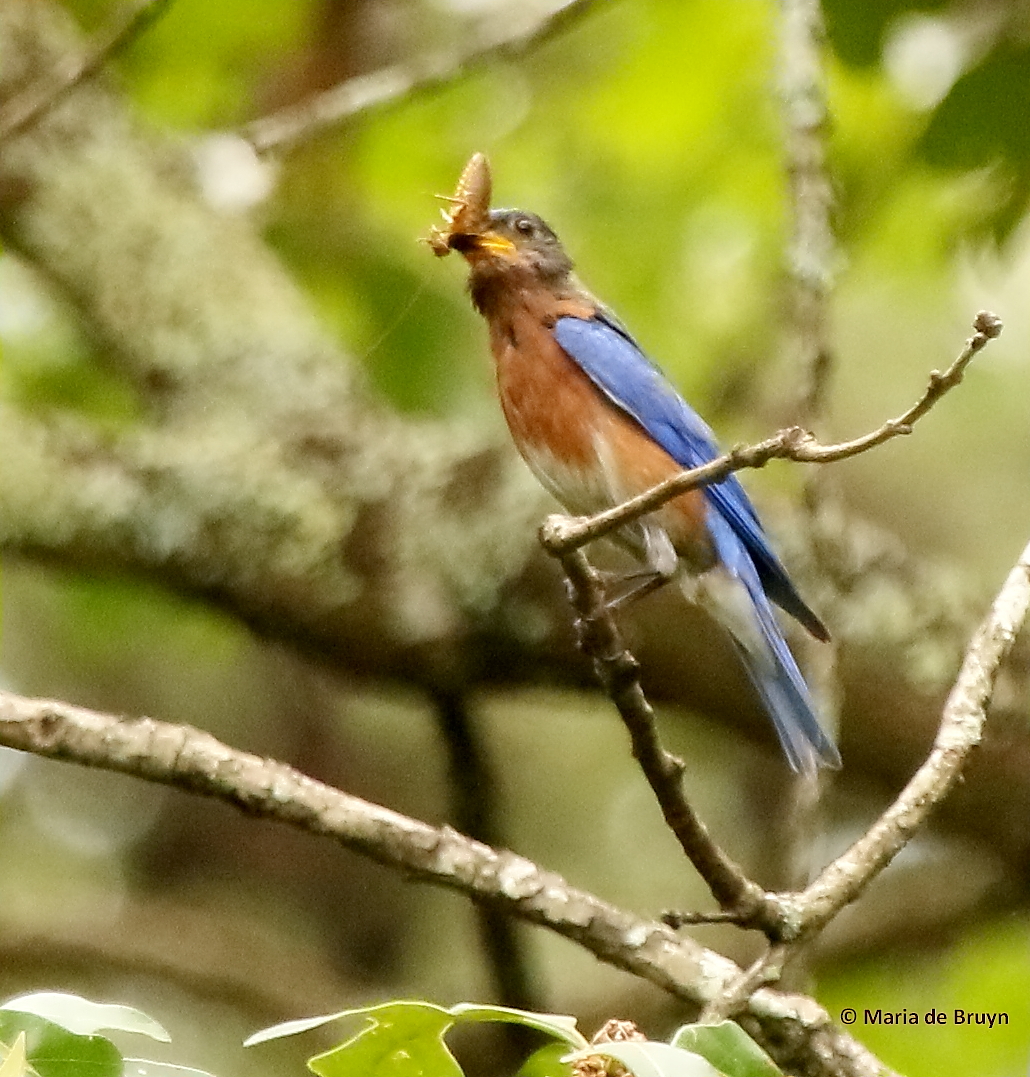
Eastern bluebird IMG_2991© Maria de Bruyn resEarlier this past week, I calculated that the Eastern bluebird (Sialia sialis) babies in my front-yard nest box were close to fledging. I knew approximately when mom had finished laying her eggs (four in total), so that I could guess when they reached normal fledging age (16-18 days after hatching). When I looked at the nest on 10 June, I saw that there were only three babies; I have no clue what happened to egg No. 4.  But the three survivors were progressing well as mom and dad made frequent forays to gather caterpillars and insects for them.

Eastern bluebird IMG_2819© Maria de Bruyn res Eastern bluebird I77A5733© Maria de Bruyn res

Eastern bluebird I77A8417© Maria de Bruyn

Occasionally, the male and also the female bluebird, identifiable by her subtler coloring and her brood patch, would visit the suet and meal worm feeders for a fast food repast for themselves. It was hard work keeping their growing offspring fed!

Eastern bluebird I77A6411 © Maria de Bruyn         Eastern bluebird I77A5769© Maria de Bruyn

They also had to let one of their older offspring from a previous brood know that they were no longer going to feed him, even when he begged.

Eastern bluebird IMG_1509© Maria de Bruyn res

As fledging time neared, mom and dad had to contend with other birds coming near the box. Dad was especially angry with a young starling (Sturnus vulgaris) who wanted to settle on top of the box. Starlings have been known to eat young birds and papa bluebird was obviously taking no chances! (I just caught the action out of the corner of my eye so the photos aren’t great but do give an idea of the argument!). The parents also chased away squirrels from the tree in front of the box, which alerted me to the fact that fledging was probably imminent since the parents become especially protective at this time. I started using a smaller camera with a very long zoom (but somewhat lesser photo quality) as they weren’t excited by me being too close either.

Eastern bluebird IMG_3841© Maria de Bruyn res     Eastern bluebird IMG_3840© Maria de Bruyn res

Eastern bluebird IMG_4618© Maria de Bruyn res

On Wednesday, I checked the box before going out for the morning and there were still three babies there. When I came home a few hours later, mama and papa were sitting on branches, with or without food, calling to their little ones to come on out. They would also fly to the box for a quick look inside.

Eastern bluebird I77A7702© Maria de Bruyn res           Eastern bluebird I77A7729 © Maria de Bruyn res

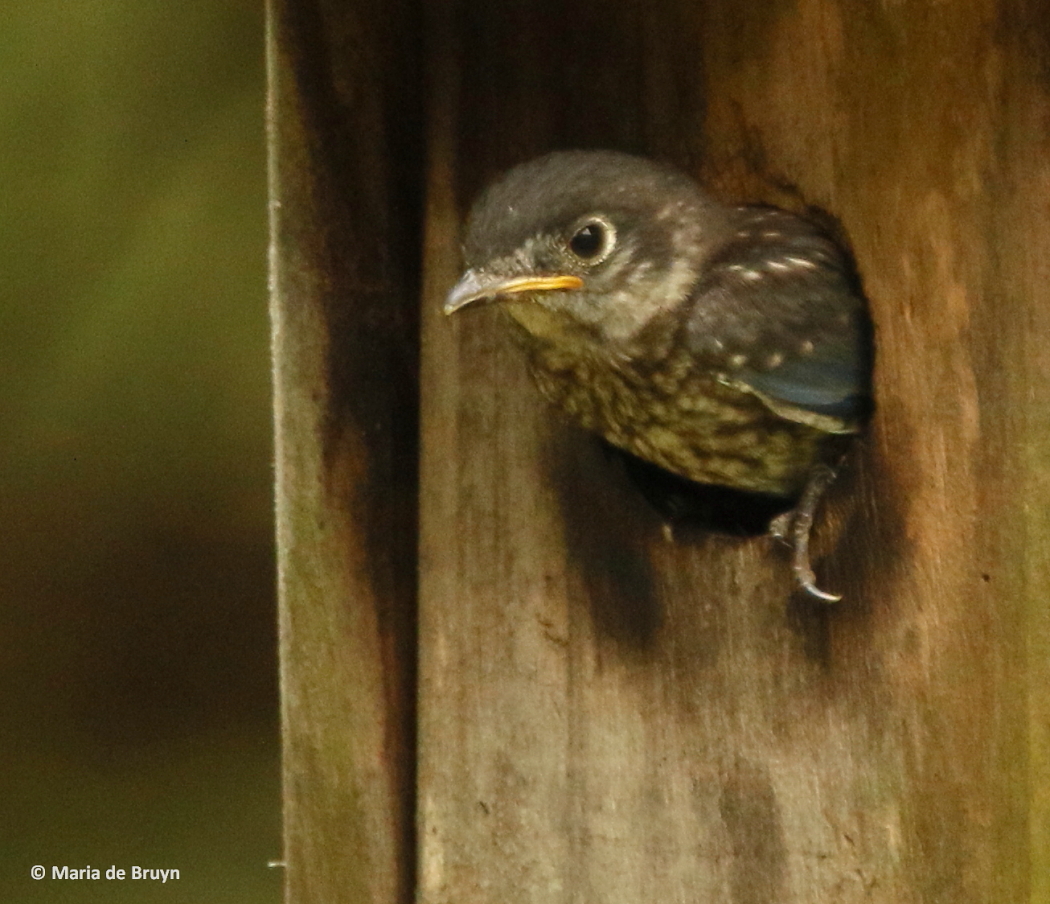
Mama also repeated behavior I had seen last year – flying to the box, standing on top and then hovering in front of the hole as a form of encouragement.  When she and dad left, I approached to take a look and discovered bluebird baby No. 1 had already flown away. This meant that the parents had to watch the first baby out in the trees somewhere, as well as their two lagging offspring in the box.

Eastern bluebird I77A8584© Maria de Bruyn res        Eastern bluebird I77A8791© Maria de Bruyn res

Eastern bluebird I77A8592© Maria de BruynAt one point, mother bluebird seemed a bit fed up – she flew over to the box (without food) and finally entered, staying inside for a good 60-90 seconds at least. I imagined her giving the babies a lecture about how they had to be courageous and willing to jump.

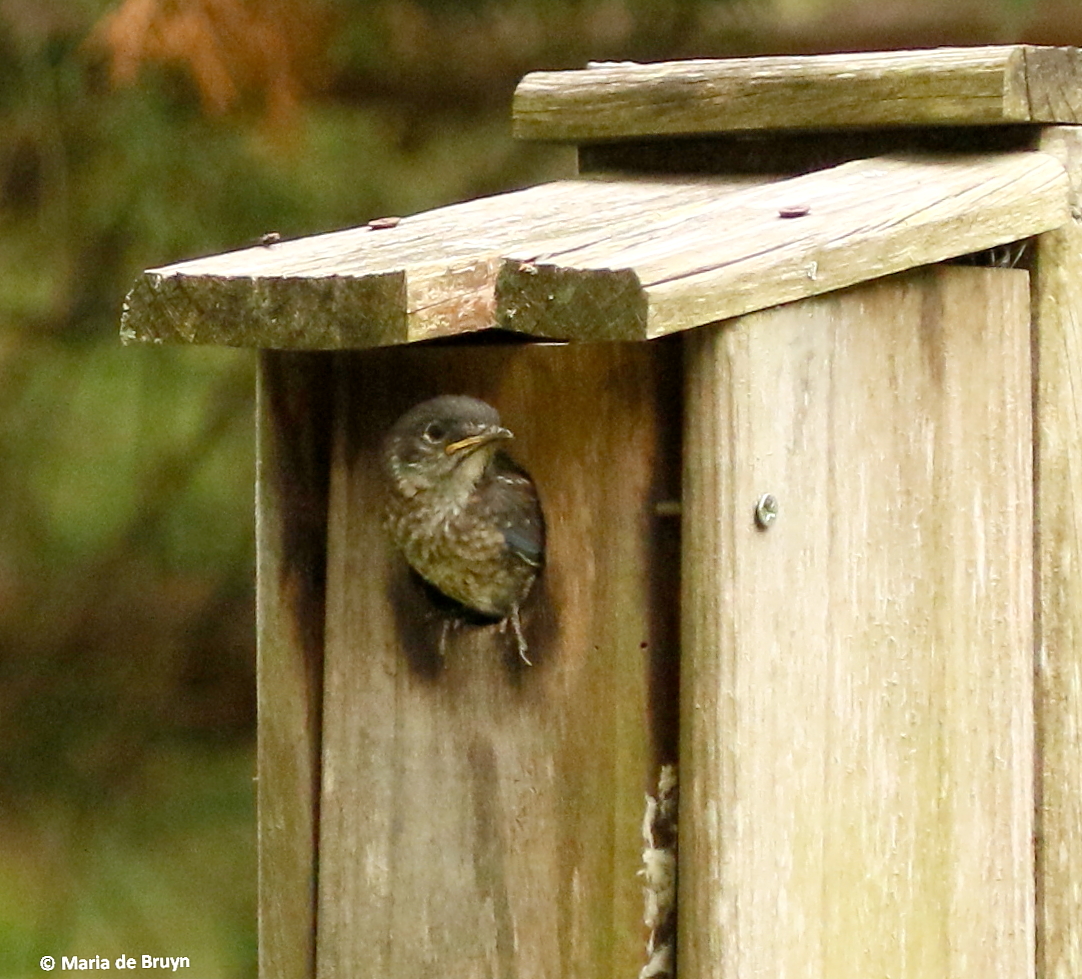
Her admonishments seemed to have had an effect; the babies began calling loudly from inside their birth home. Finally, after about 30 minutes, one poked its head out to take a look at the big wide world. Mom and dad seemed glad, waiting together in the tree to see how long it would take baby No. 2 to join them.

Eastern bluebird I77A8685© Maria de Bruyn    Eastern bluebird I77A8648© Maria de Bruyn

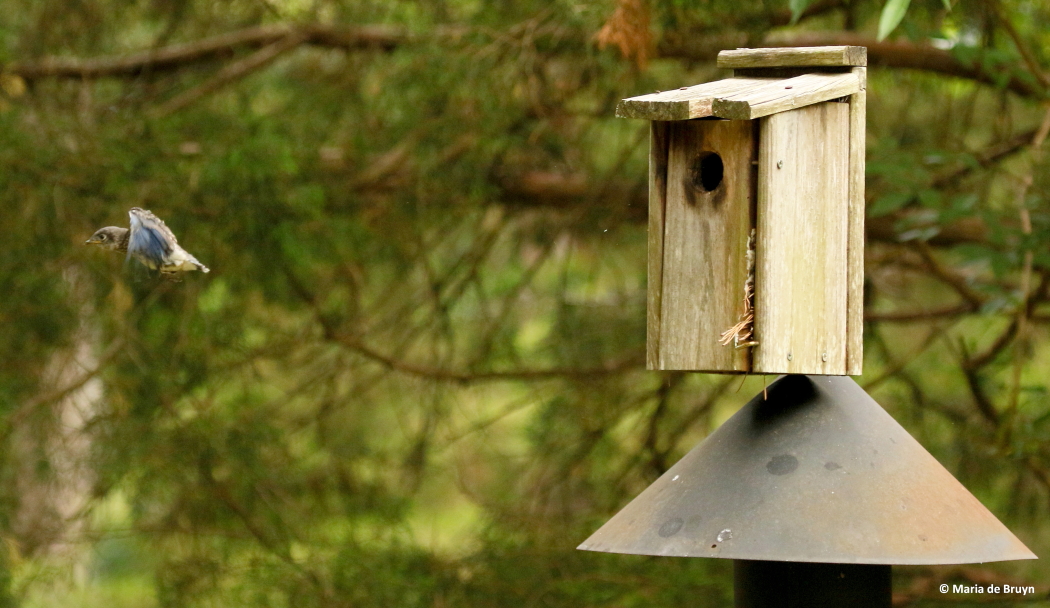
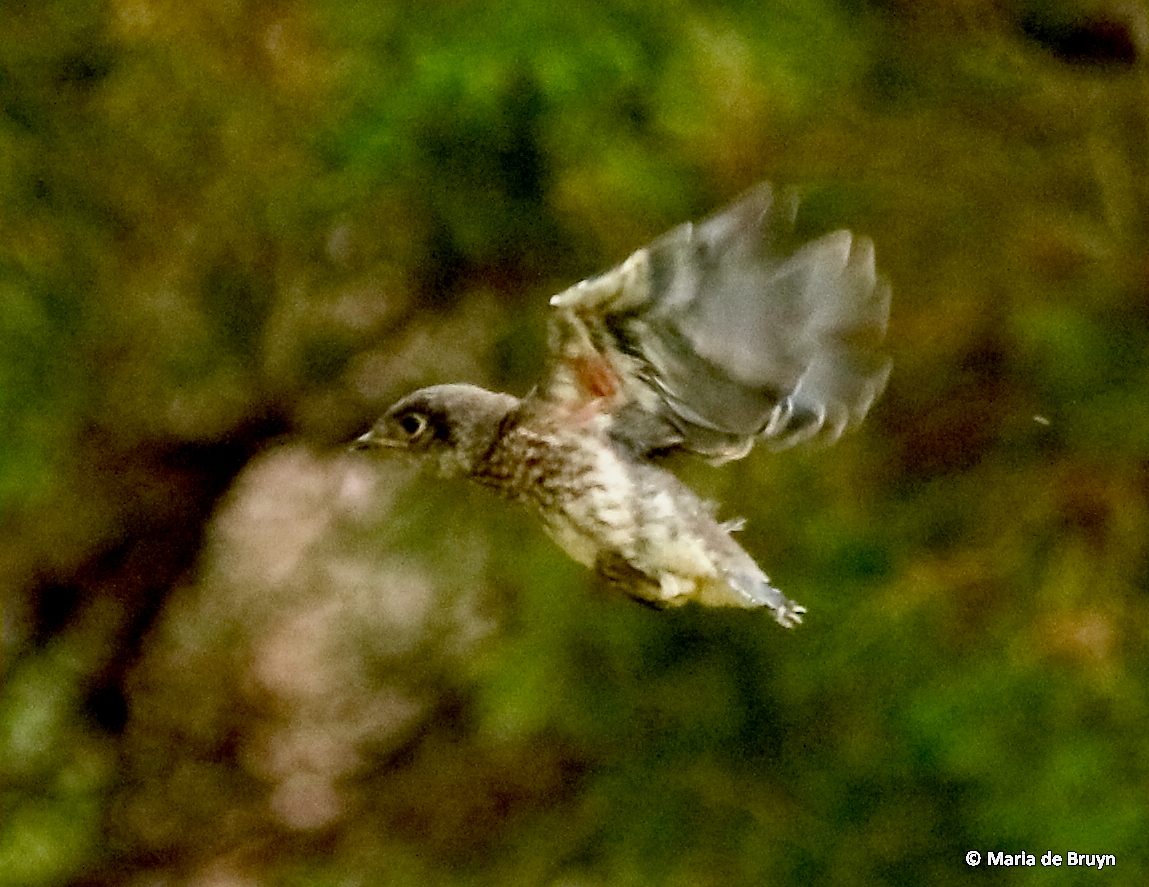
The baby looked around a lot, also staring at me; s/he went back inside and then looked out a few more times, finally taking the great leap into the outside world. Baby 2 was a very strong flier – not even alighting in the tree in front of the box but circling around to land high in a juniper and then in a tall oak tree behind the box.

Eastern bluebird I77A8746© Maria de Bruyn res

Eastern bluebird I77A8877© Maria de Bruyn res


Sibling No. 3 took a little while longer and mama bluebird again went to the box to give encouragement. The baby then spent a little more time observing the new environment and also made a strong flight out.

Eastern bluebird I77A8899© Maria de Bruyn res Eastern bluebird I77A8891© Maria de Bruyn res

Eastern bluebird I77A8861© Maria de Bruyn res  Eastern bluebird I77A8925© Maria de Bruyn

Eastern bluebird I77A8930© Maria de Bruyn res Eastern bluebird I77A8931© Maria de Bruyn     Eastern bluebird I77A8932© Maria de Bruyn res

It rained that night and I hoped that the bluebird babies were ok; between the thunderstorms and a neighbor’s cat who comes to hunt birds in my yard, their environment seemed precarious for their first days of life. In the afternoon, I was happy to see papa bluebird feeding one of the three babies at the top of an oak tree. Mama was also flying around up there, so I assumed they were all hanging out in the high branches.

Eastern bluebird IMG_4723© Maria de Bruyn        Eastern bluebird IMG_4777© Maria de Bruyn res

Thursday night, it rained heavily again for many hours; Friday was an easier day and night. I haven’t seen the fledglings again yet but have seen their parents coming for suet and meal worms and flying up to the oak tree, so I assume at least a couple are there. I look forward to seeing their speckled selves at the feeders along with their parents – and will be curious to see if their parents go for a third brood this year.

Eastern bluebird IMG_4779© Maria de Bruyn res


Winter mornings at Jordan Lake

Mist on the lake I77A5266© Maria de BruynSpending two cold early mornings at Jordan Lake the past couple weeks reinforced my conviction that getting out into nature is a restorative and calming activity. And it doesn’t need to be warm. Although a doctor pronounced me healed after my recent hospitalization and home treatment, it turns out that I’m not completely healthy after all. Starting a new treatment was a bit stressful, but seeing the birds at the lake was a joy.

snag I77A6203© Maria de Bruyn res

Mind you, I’d love to see other wildlife there, but the mammals, reptiles and amphibians have been hiding out or keeping away from areas frequented by people. The fact that it is still hunting season probably makes some of them somewhat shy, too. I did manage to see a fly on one morning though.

fly I77A2979© Maria de Bruyn

The animals do leave behind signs of their presence, however. Tracks in the sand is one give-away that they passed by.

animal tracks I77A2998© Maria de Bruyn res

The beavers (Castor canadensis) leave behind distinctively gnawed tree stumps – and here you can also see one tree that they haven’t quite finished felling yet.

beaver tree I77A2933© Maria de Bruyn res beaver tree I77A2950© Maria de Bruyn res

The shoreline vegetation was decorated with gull feathers in various areas of the lake.

bird feather I77A2711© Maria de Bruyn res bird feather I77A2697© Maria de Bruyn res

heron track I77A2924© Maria de Bruyn res


A sandy track of what I assumed was a great blue heron (Ardea herodias) didn’t produce a bird at that site, but I saw these beauties in flight at two other sites.


great blue heron I77A3926© Maria de Bruyn res

great blue heron I77A2558© Maria de Bruyn res

At one area, I spotted a bird that seemed unfamiliar just as it was turning to take off. Friendly birders online identified it as an American pipit (Anthus rubescens), the first time I had seen this species (known as a “lifer” among the birding crowd). The next week I saw a killdeer (Charadrius vociferous) in the same spot but got a better shot.

American pipit I77A2526© Maria de Bruynkilldeer I77A5908© Maria de Bruyn

The killdeer didn’t hang around too long either, but I was able to get a couple of nice flight photos this time.

killdeer I77A5933© Maria de Bruyn res killdeer I77A5931© Maria de Bruyn res

American crow I77A2810© Maria de Bruyn res


The American crows (Corvus brachyrhynchos) were foraging in the shoreline woods, while the song sparrow was looking for food among the woody detritus left at lakeside.


song sparrow I77A5877© Maria de Bruyn res song sparrow I77A5866© Maria de Bruyn res

In another place, the crows were very loudly making their presence known – it turned out that a red-tailed hawk (Buteo jamaicensis) was perched nearby and they were making sure everyone knew the hawk was there.

red-tailed hawk I77A3850© Maria de Bruyn resAmerican crow I77A3878© Maria de Bruyn res

In the trees near the lake, various birds could be seen: the ruby-crowned kinglet (Regulus calendula) was very busy as usual, flying from a sweet gum (Liquidambar styraciflua) to other trees in rapid succession.

ruby-crowned kinglet I77A5662© Maria de Bruyn ruby-crowned kinglet I77A6049© Maria de Bruyn

At one site, there were many dark-eyed juncos foraging on the ground and taking pauses in the trees and shrubs around. Juncos are actually a type of sparrow and a group of sparrows is known by several names: a crew, a flutter, a meinie, a quarrel and an ubiquity.

dark-eyed junco I77A2838© Maria de Bruyn dark-eyed junco I77A2379© Maria de Bruyn

The downy woodpeckers (Dryobates pubescens) and red-bellied woodpeckers (Melanerpes carolinus) were in evidence at various lake sites.

downy woodpecker I77A2504© Maria de Bruyn resRed-bellied woodpecker I77A5384© Maria de Bruyn res

Overhead, the double-crested cormorants (Phalacrocorax auritus) flew by; they would land and share space with the ring-billed gulls (Larus delawarensis).


double-crested cormorant I77A2731© Maria de Bruyn resring-billed gull I77A3558© Maria de Bruyn res

ring-billed gull I77A2389© Maria de Bruyn res


The ring-billed gulls were numerous and occasionally one swooped down to fish not too far from shore.

ring-billed gull I77A5489© Maria de Bruyn resring-billed gull I77A5497© Maria de Bruyn res

While I was watching, the horned grebes (Odiceps auritus) were more successful in getting meals as they dove into the cold water.

Horned grebe I77A3662© Maria de Bruynhorned grebe I77A3094© Maria de Bruyn

belted kingfisher I77A4014© Maria de BruynA couple times I was very surprised by a bird that suddenly seemed to emerge out of nowhere to fly over my head or just in front of me. That was the case with a beautiful male wood duck (Aix sponsa) and a belted kingfisher (Megaceryle alcyon).


wood duck I77A3719© Maria de Bruyn res wood duck I77A3718© Maria de Bruyn res

bald eagle I77A3030© Maria de BruynAn adult bald eagle (Haliaeetus leucocephalus) soared by just as I was approaching an observation platform in one area; the distance and height were considerable but I managed a shot. A Bonaparte’s gull (Chroicocephalus philadelphia) flew by a little lower, while a Carolina chickadee (Poecile carolinensis) sat still for a portrait.


Bonaparte's gull I77A3962© Maria de Bruyn


Carolina chickadee I77A5806© Maria de Bruyn res

My last avian companions during my latest lake walk were a white-throated sparrow (Zonotrichia albicollis) and a lovely hermit thrush (Catharus guttatus).

white-throated sparrow I77A6115© Maria de Bruynhermit thrush I77A6165© Maria de Bruyn

I returned home on both occasions a satisfied birder!