My squirrel nemesis – a worthy opponent!

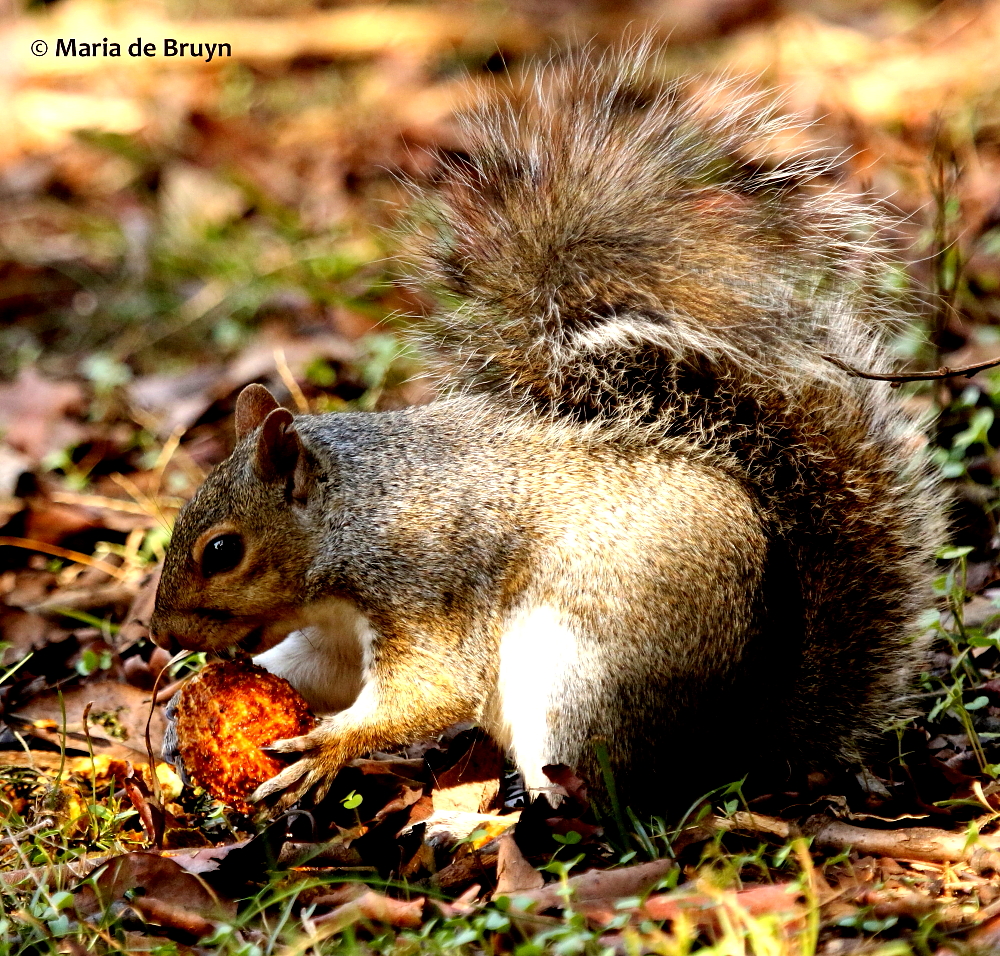
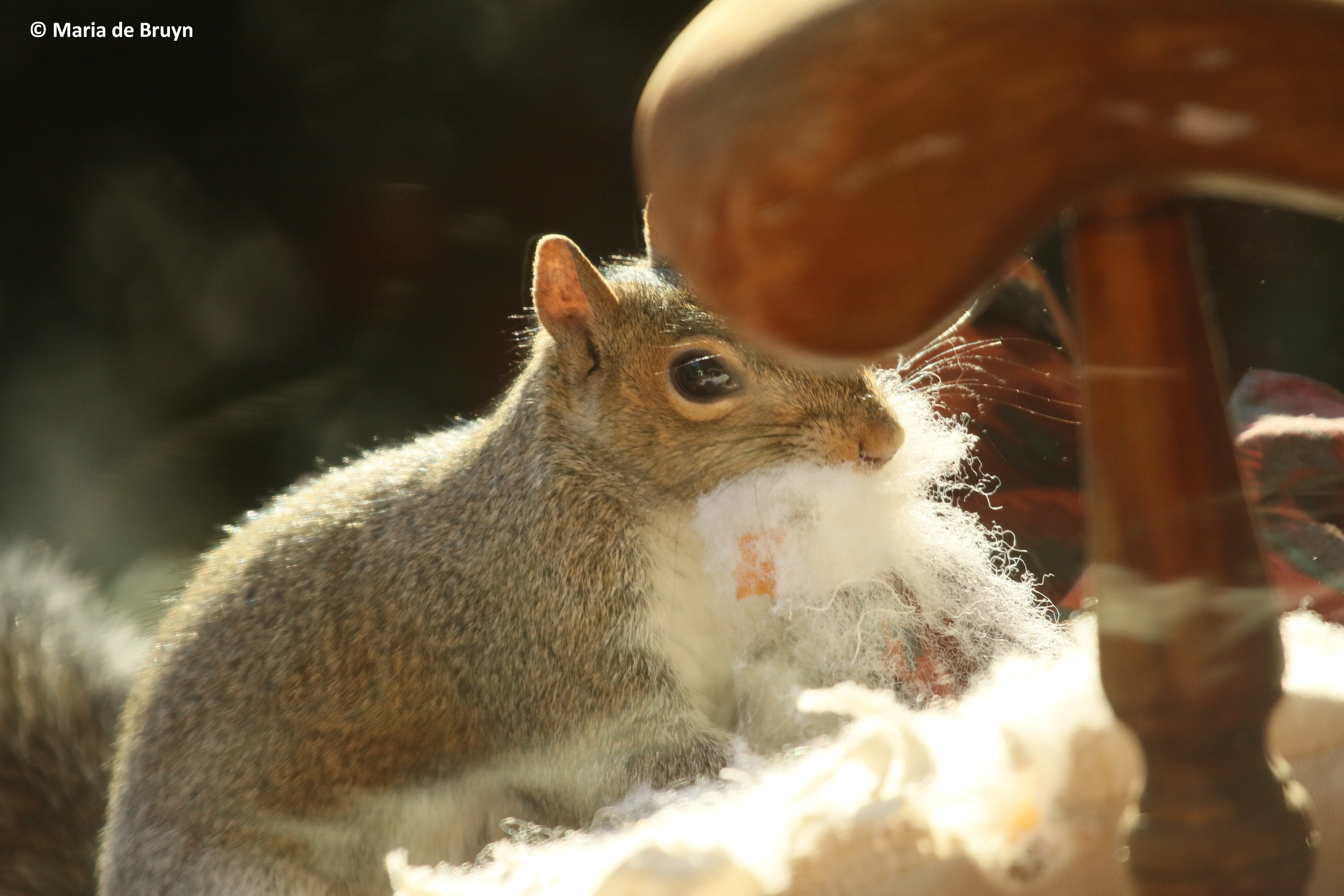
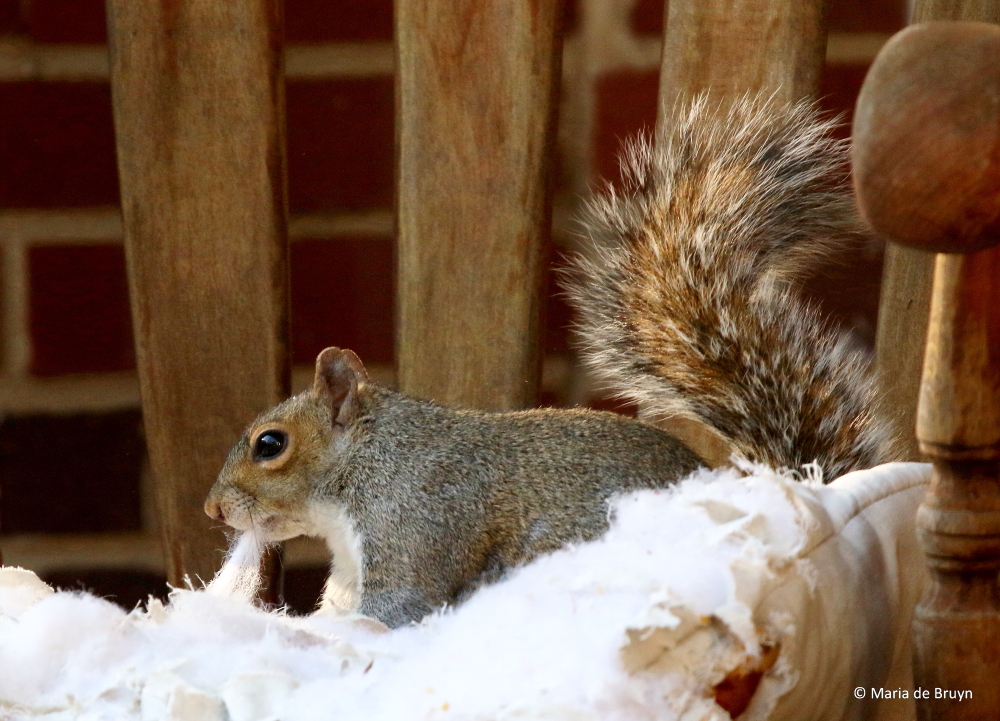
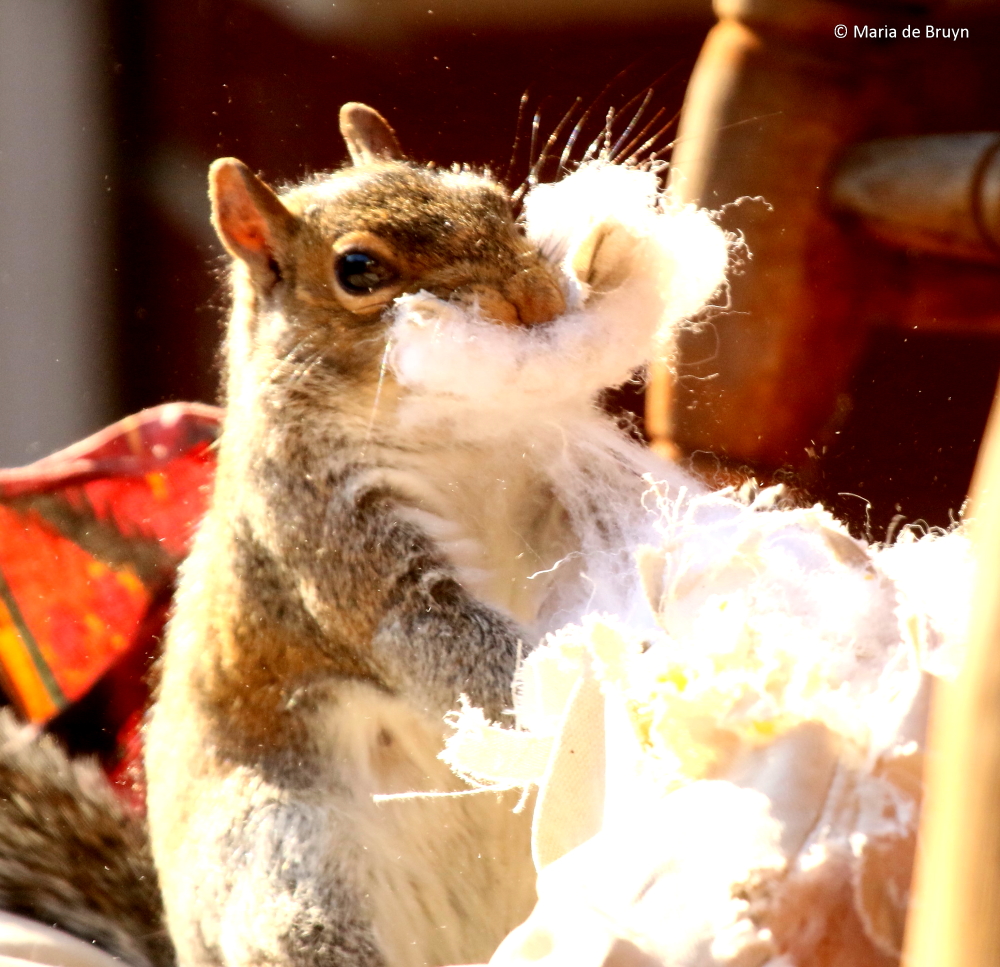
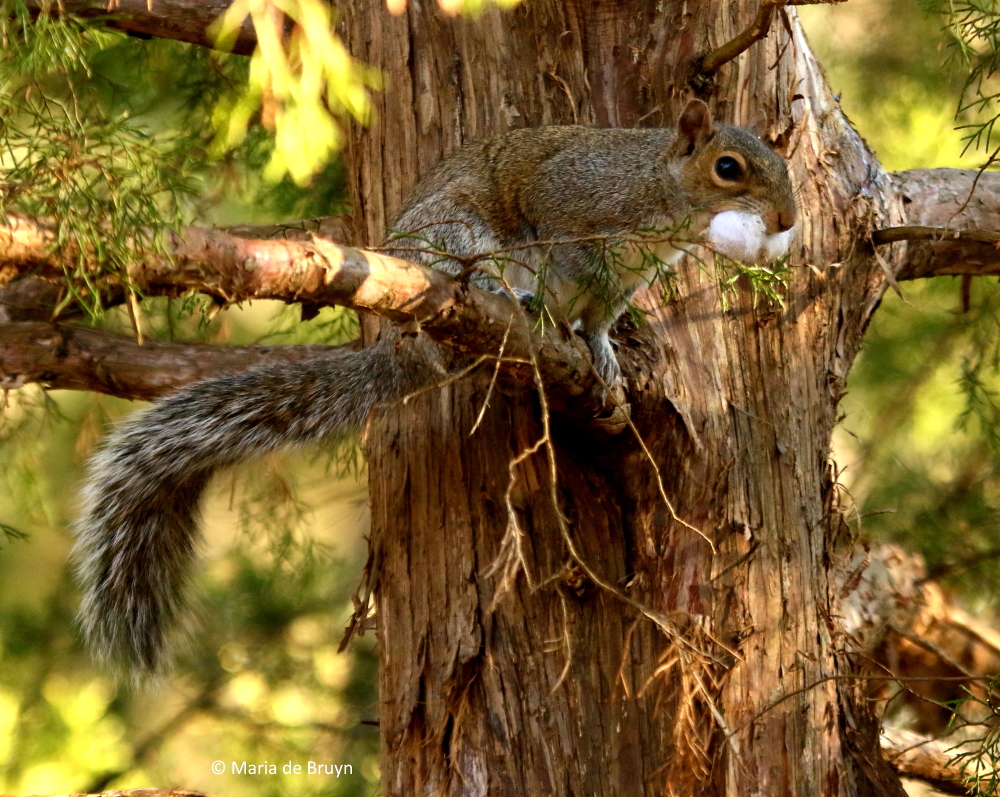
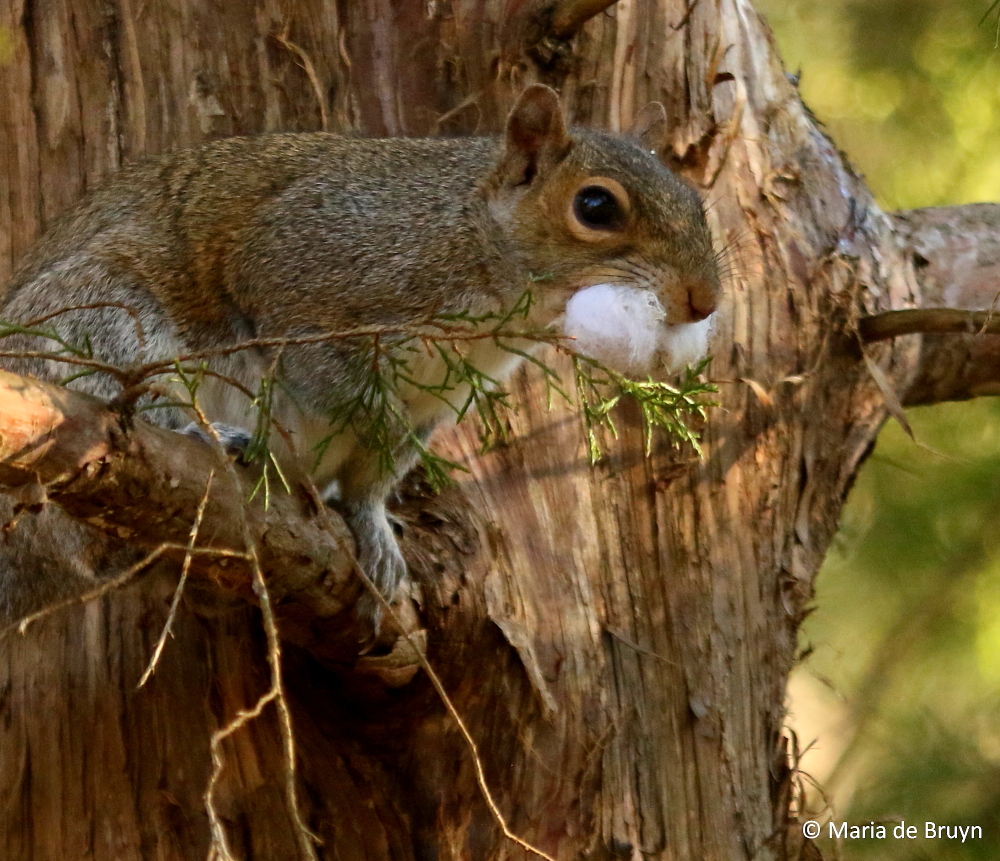
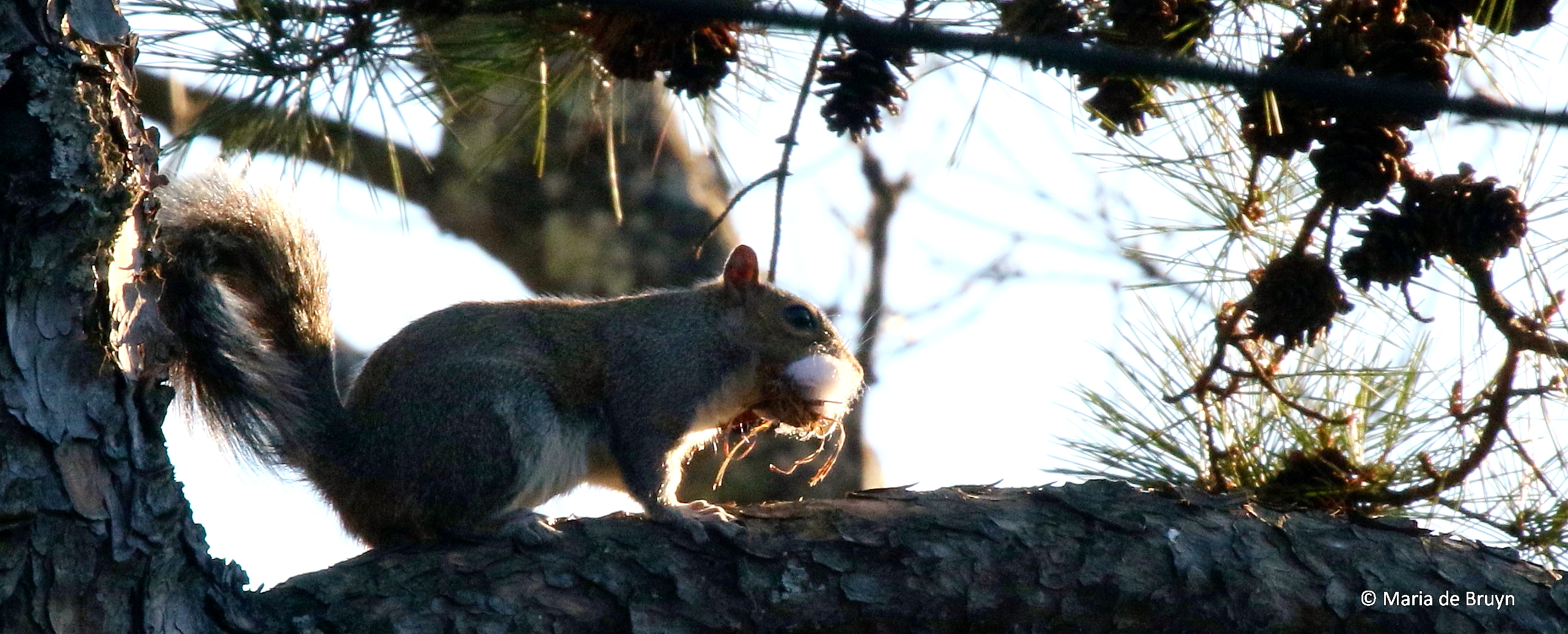
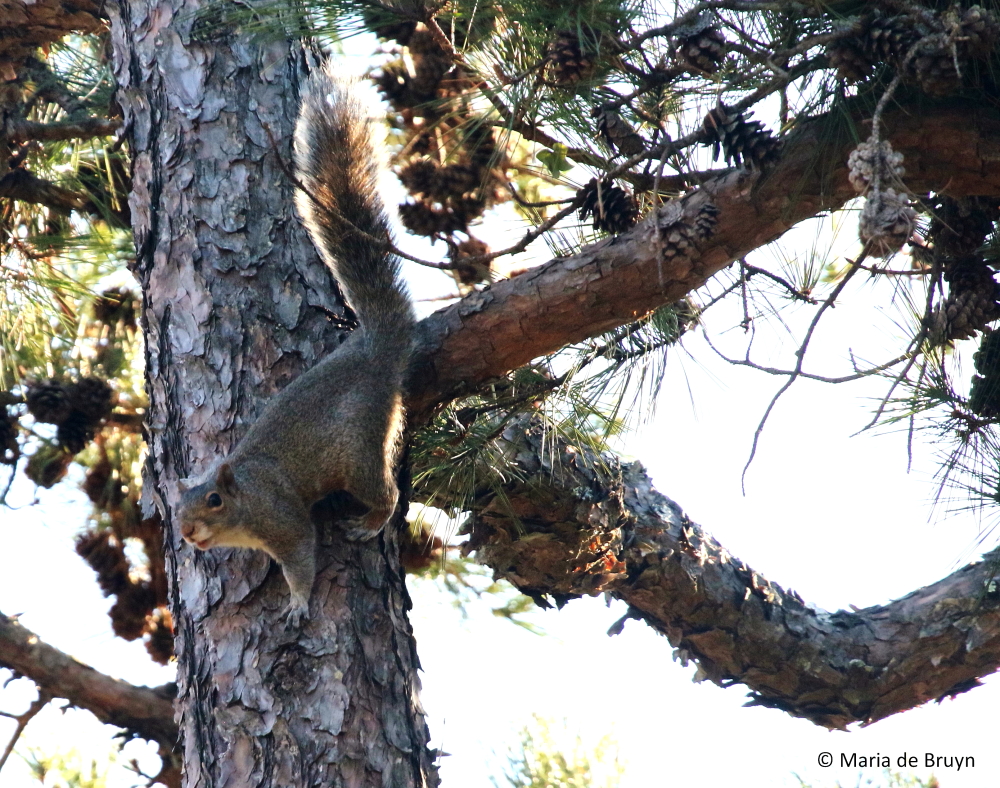
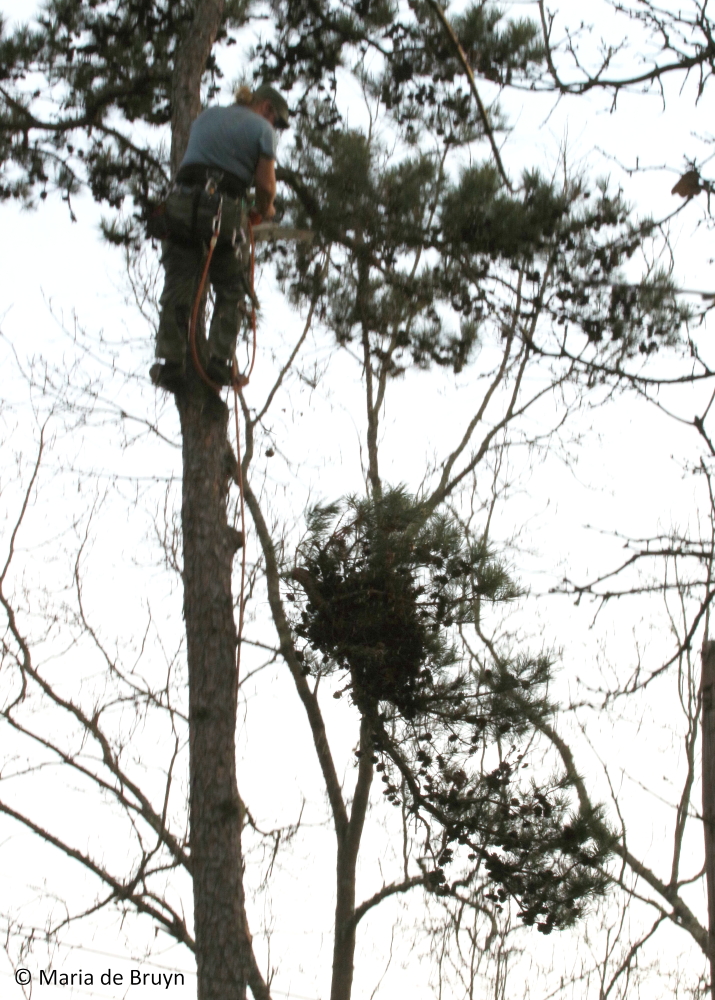
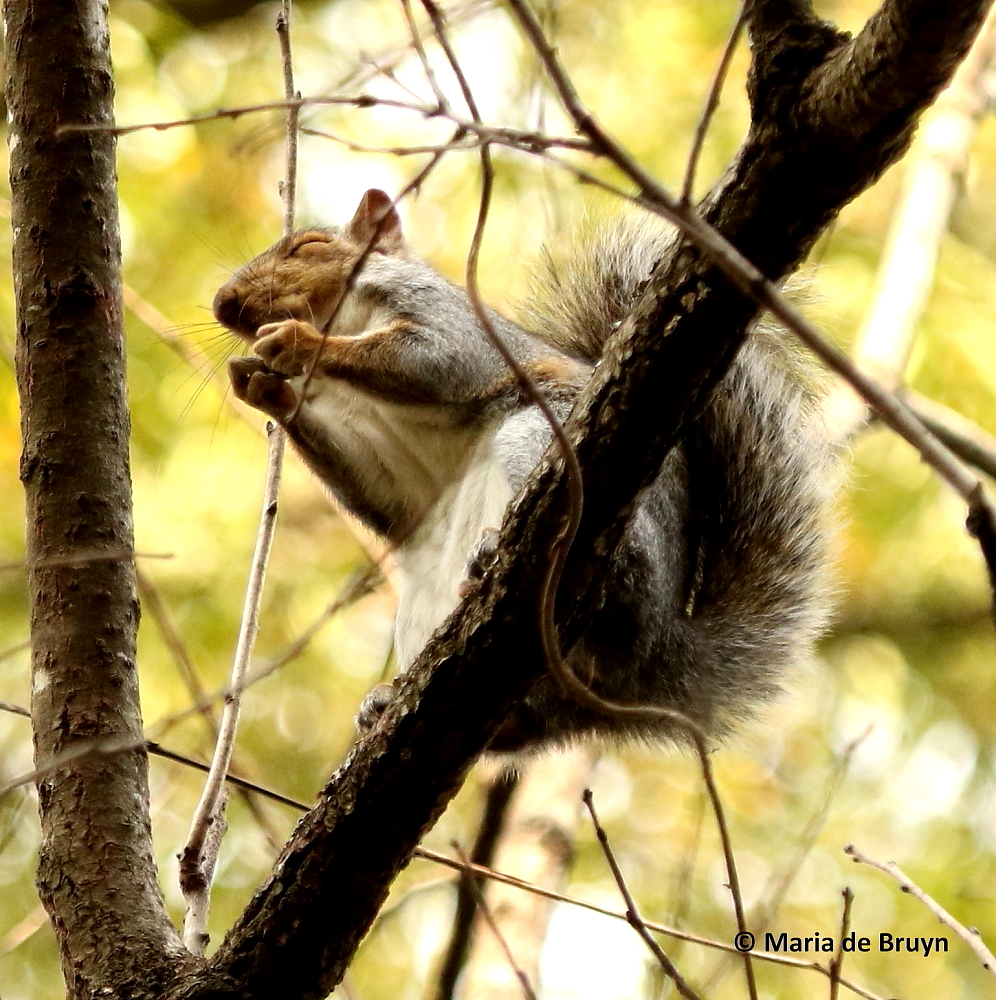
Today is Squirrel Appreciation Day in the USA, a holiday created by Christy Hargrove, a  wildlife rehabilitator affiliated with the Western North Carolina Nature Center. The Eastern gray squirrel species (Sciurus carolinensus) was first recorded in the Carolinas, so I thought I’d honor this wild creature by sharing some photos of the squirrels in my yard who sometimes drive me up the wall with frustration. There is one in particular who can get my ire up. Of course, I realize it may not always be the same creature – perhaps several of “my” squirrels are taking turns in trying to overcome my measures to keep them off my bird feeders. But I do think one in particular is especially tenacious and persistent.
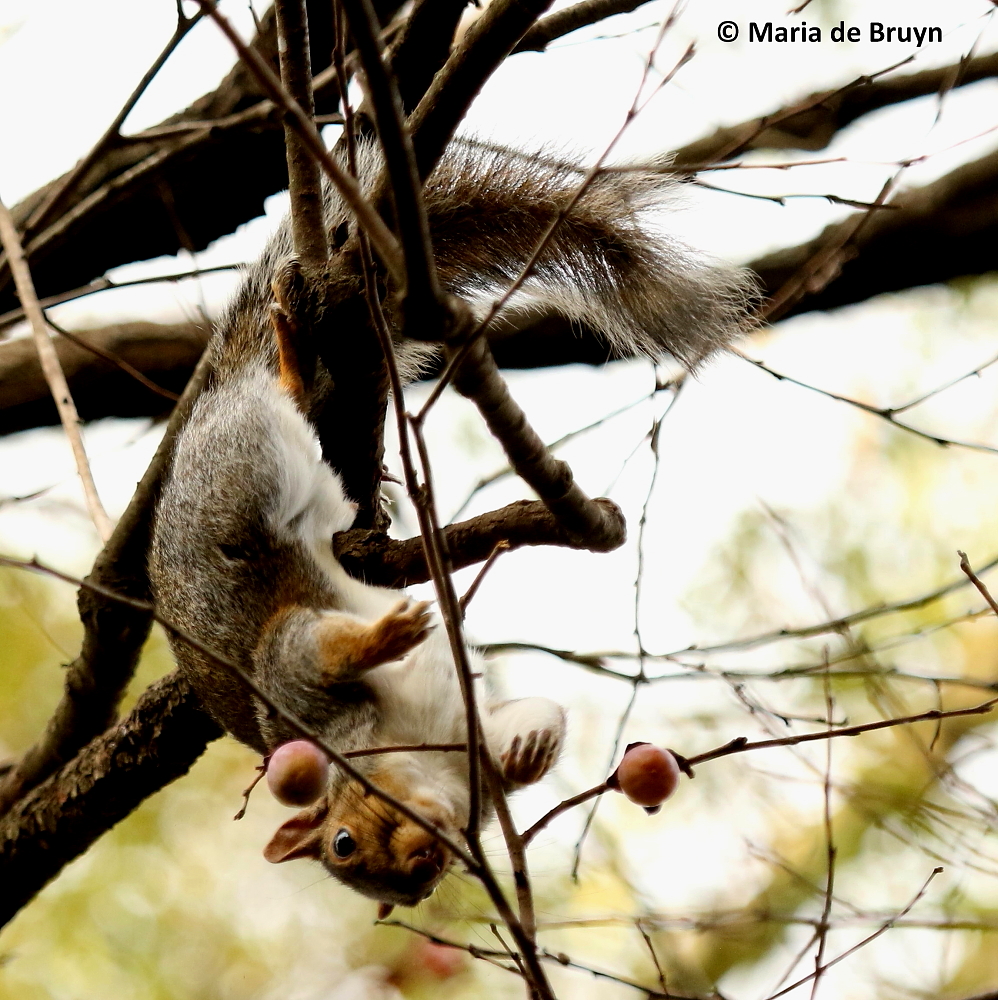
The yard squirrels are lucky since my neighbor has beech trees and I have a couple oak trees that provide plenty of acorns; these mammals therefore have plenty of nuts to store for winter. I periodically see them digging little holes in the lawn and different parts of the garden, “squirreling away” the nuts they have found in the trees. I also saw one burying some grapes that I had put out for the birds; that didn’t seem like a good strategy to me, but I have since learned that they will make temporary caches so perhaps that squirrel was just hoarding a treat for later. They have also occasionally gone after the persimmons.
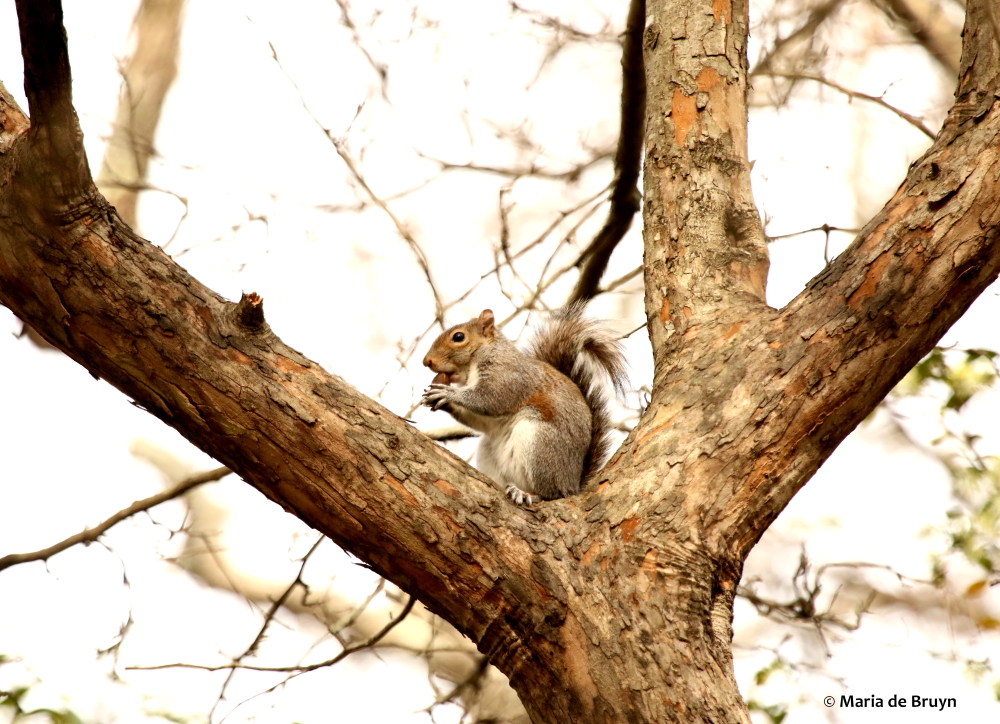
These squirrels aren’t satisfied with the natural bounty of the yard, however. They also want to get the nuts and seeds in my bird feeders, even when they have been able to  partake of the bounty strewn over the earth for the ground-feeding birds.

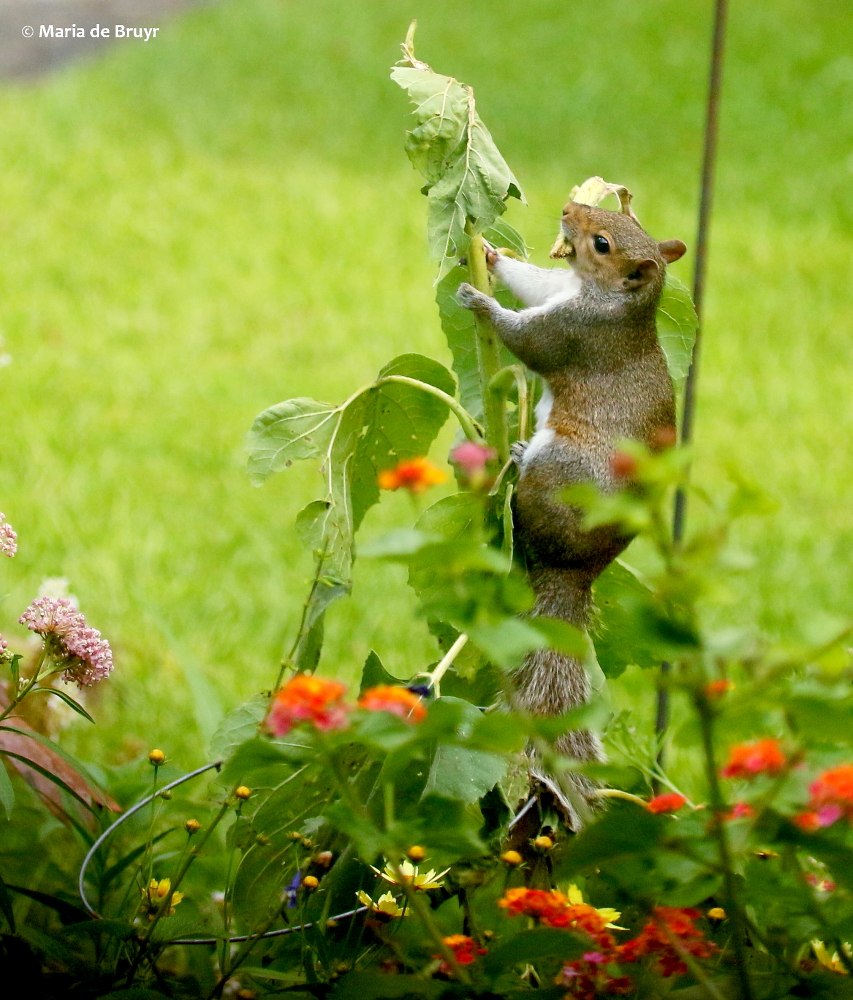
I learned early on that the bird feeder poles need to be at least 10 feet away from the roof of my house and any sturdy shrubs or stumps that they can use as a launching pad to bypass the baffles placed on poles to outwit them. They do go up the raccoon baffle from time to time, testing whether they now might find a way through it but so far that has not been a useful strategy for them. One has managed to climb a thick-stalked sunflower so that it could nip off the seed bud.
I had put a couple stumps in my front flower garden as natural decorations. Then, it appeared that one of the squirrels was using a stump as a launching pad – managing to land above the baffles atop the nut and fruit feeders.
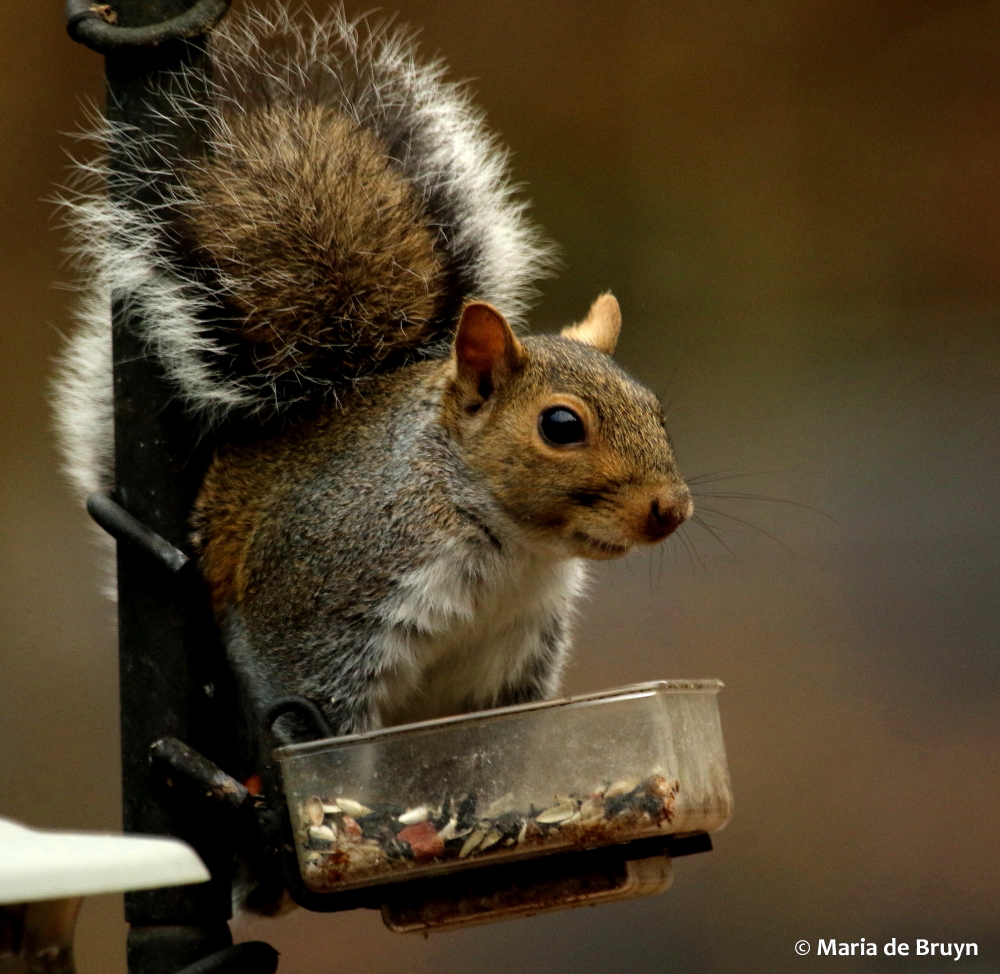
    

I made the mistake of putting an oriole feeder on a pole without a baffle; I didn’t think it would attract the squirrels but apparently the jelly and nectar did appeal to one individual.
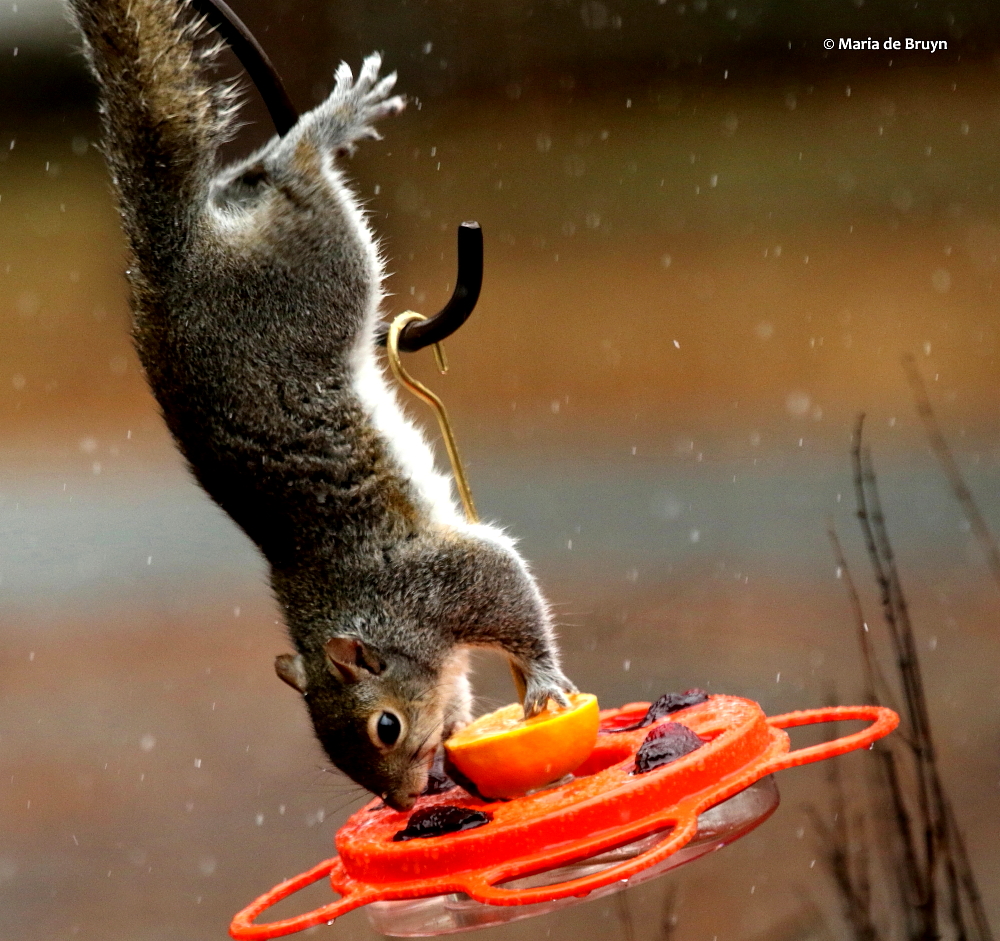
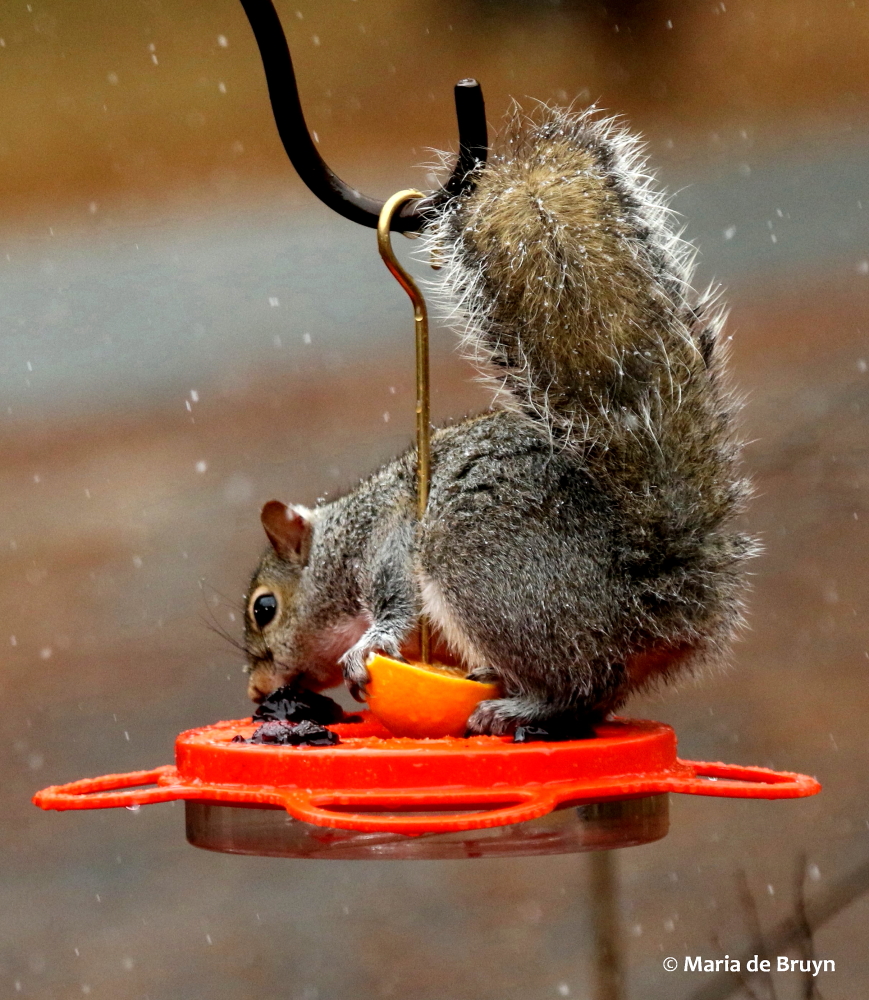
  

Another time I had only a hummingbird nectar feeder on one pole, which seemed rather flimsy. But the squirrel had to check it out all the same, even though there was nothing to its liking there.

As I have been removing invasive plants and shrubs from my yard, I’ve been adding native shrubs and plants. At one point, I thought it would be nice to have a black walnut (Juglans nigra) so I took a couple walnuts home from a park and then planted them in a deep plant pot with lots of soil over it. I had looked around beforehand and didn’t see a squirrel anywhere watching me, so I thought it was ok.

The next morning, I found a pile of walnut husks in the carport next to the plant pot. Then the next day, I saw one of the squirrels making off with the remaining walnut. Apparently, they can re-locate their hoarding caches partly by memory and partly by smell – so this squirrel must have discovered the tasty walnut by its odor (which I couldn’t detect at all).
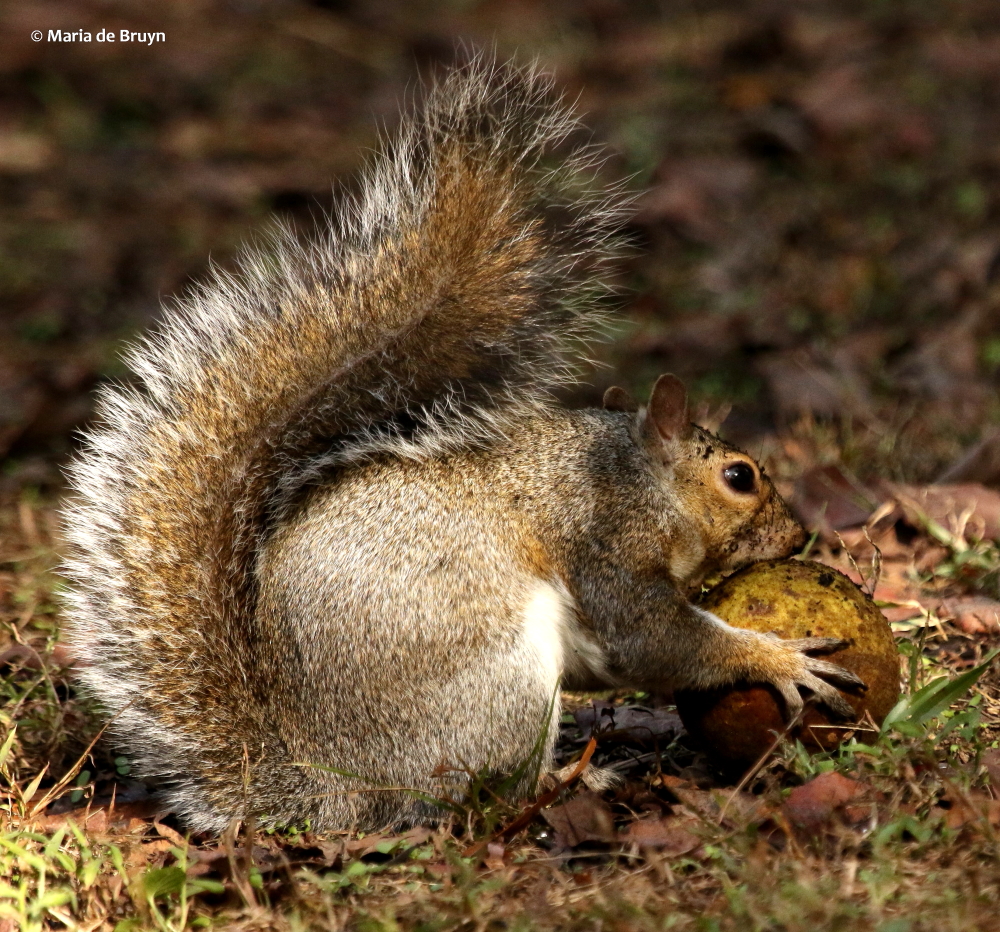
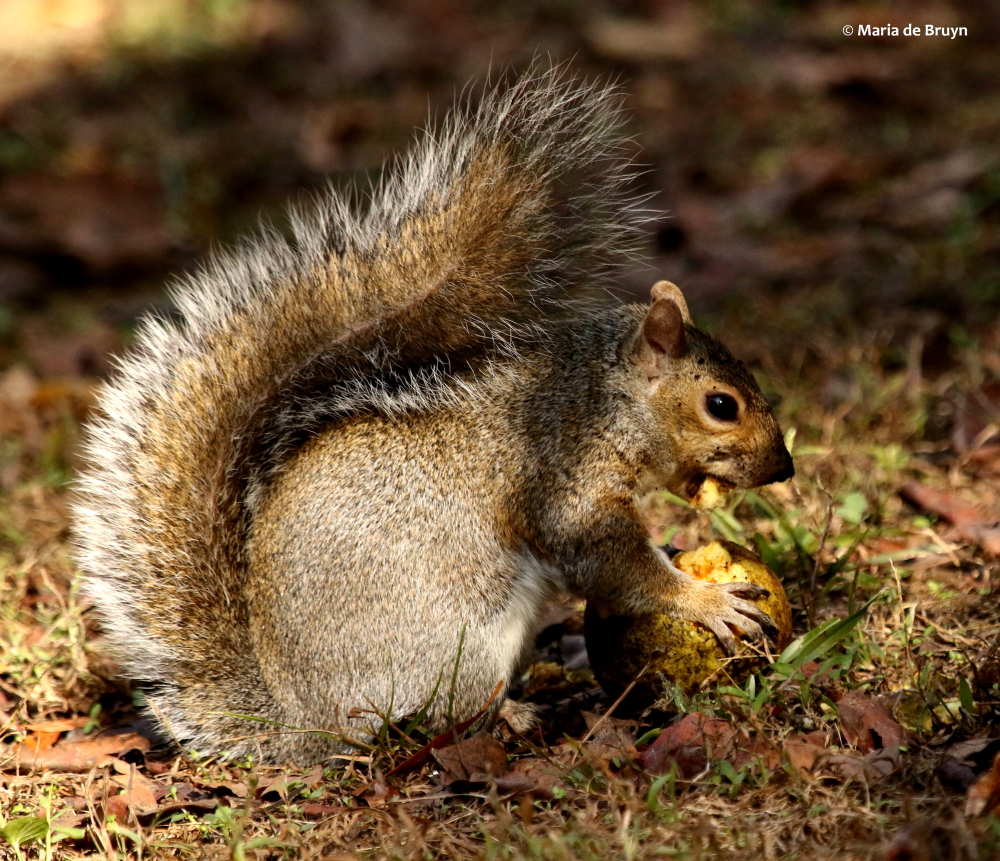


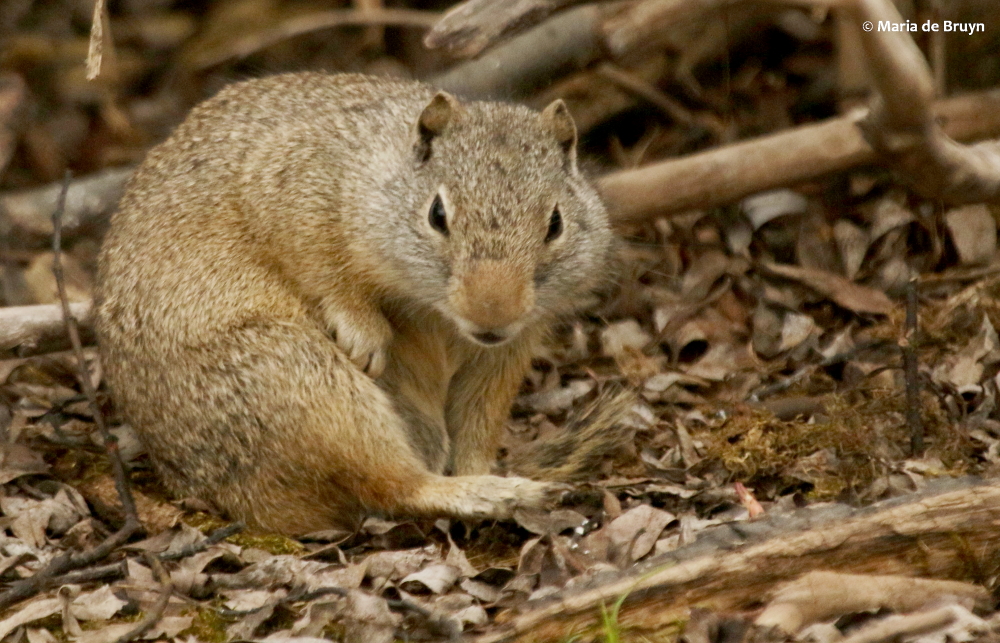
The Eastern gray squirrels are only one of earth’s 200 squirrel species (there are four others in the USA: the fox squirrel, red squirrel, Northern and Southern flying squirrels and the ground squirrels, like this Uinta ground squirrel (Urocitellus armatus) seen in Yellowstone National Park.
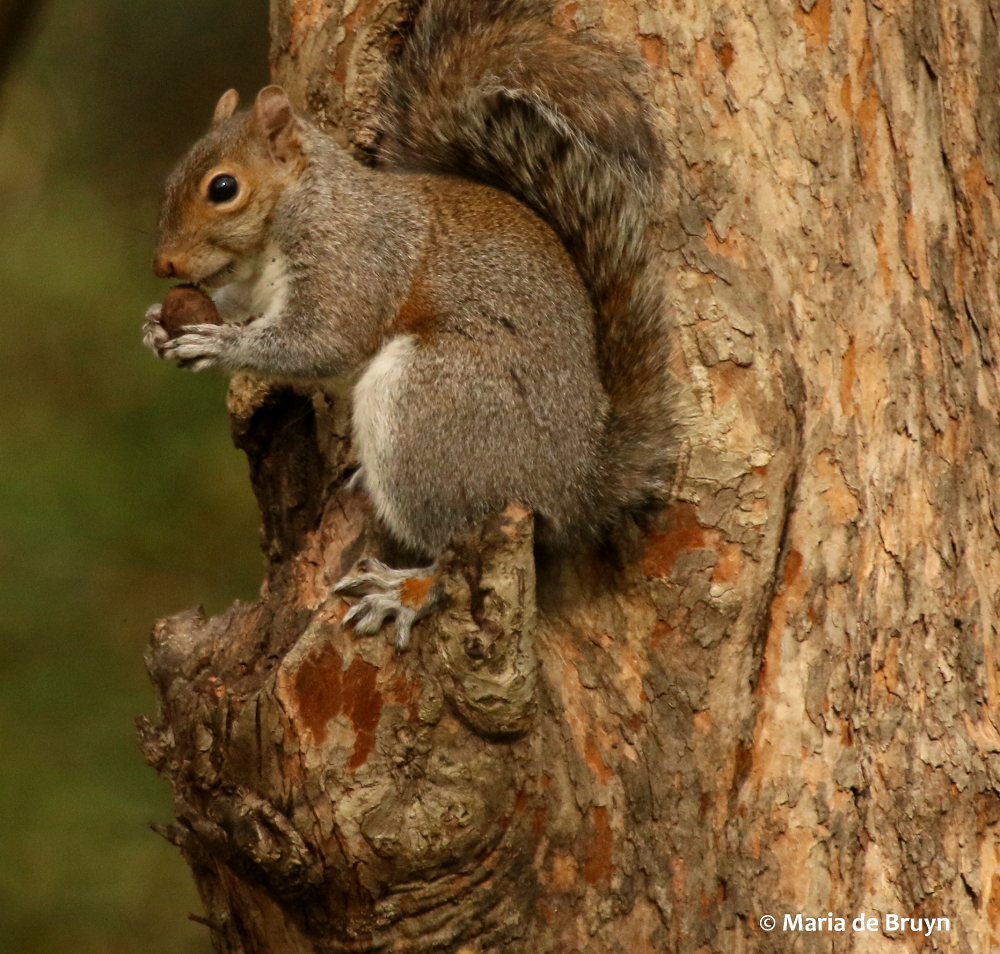
 

I’m glad that I mostly only deal with one species and while I must admit that I don’t appreciate them every day, I always do admire their tenacity, perseverance and ingenuity in finding ways to overcome my strategies for outwitting them. The squirrels are not only a source of food for the neighborhood hawks, but also a source of entertainment for the humans.

The sad spring saga of Sassy squirrel

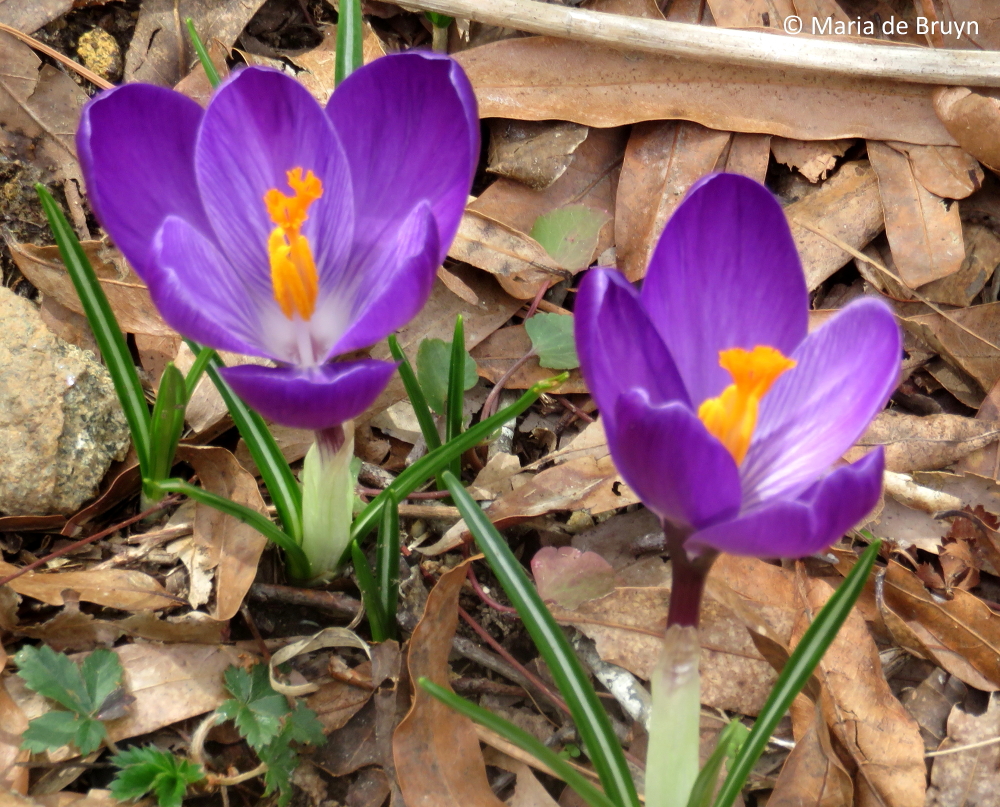
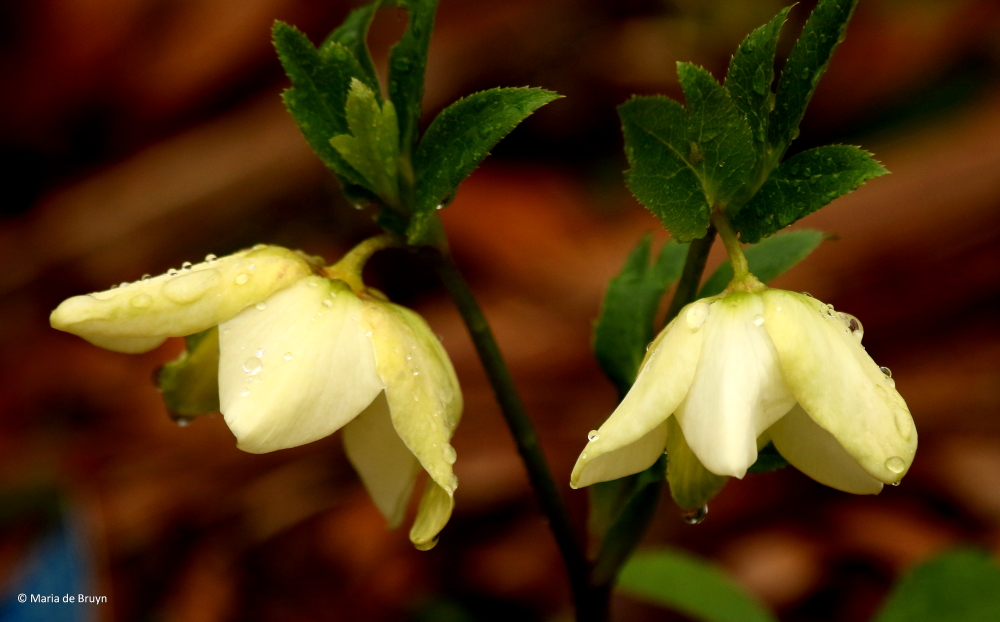
cape-may-warbler-i77a5989-maria-de-bruyn-2resSpring has come early to North Carolina, leading to some early bird migration (like this Cape May warbler, Setophaga tigrina, on its way North), avian courtship and nest building, as well as spring blossoms already emerging in profusion. My garden has seen some lovely flowers, both cultivated and wild: daffodils (Narcissus), crocuses (Crocus), winter jasmine (Jasminum nudiflorum), henbit (Lamium amplexicaule) and lenten rose (Helleborus orientalis).

daffodil-i77a2964-maria-de-bruyn-res    daffodil-i77a2325-maria-de-bruyn-res

crocus-img_1813-maria-de-bruyn-res   crocus-img_1790-maria-de-bruyn-res

winter-jasmine-i77a0793-maria-de-bruyn-res    henbit-i77a1155-maria-de-bruyn-res

lenten-rose-i77a2951-maria-de-bruyn-res lenten-rose-i77a1903-maria-de-bruyn-res

lenten-rose-i77a2970-maria-de-bruyn-res

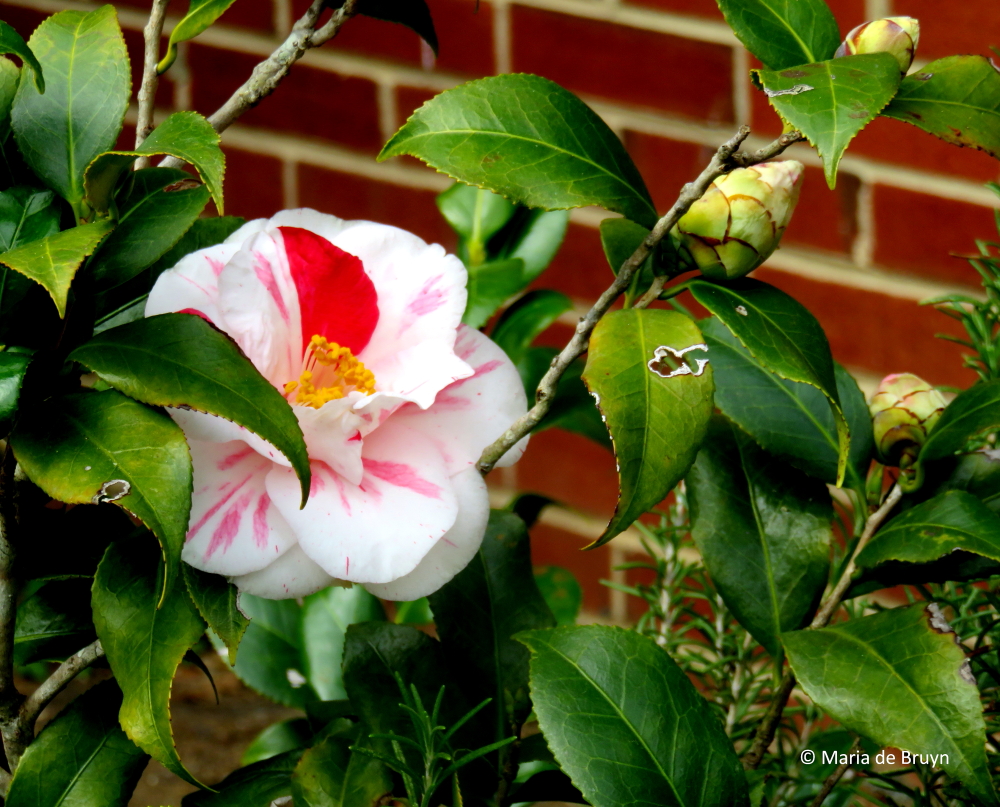
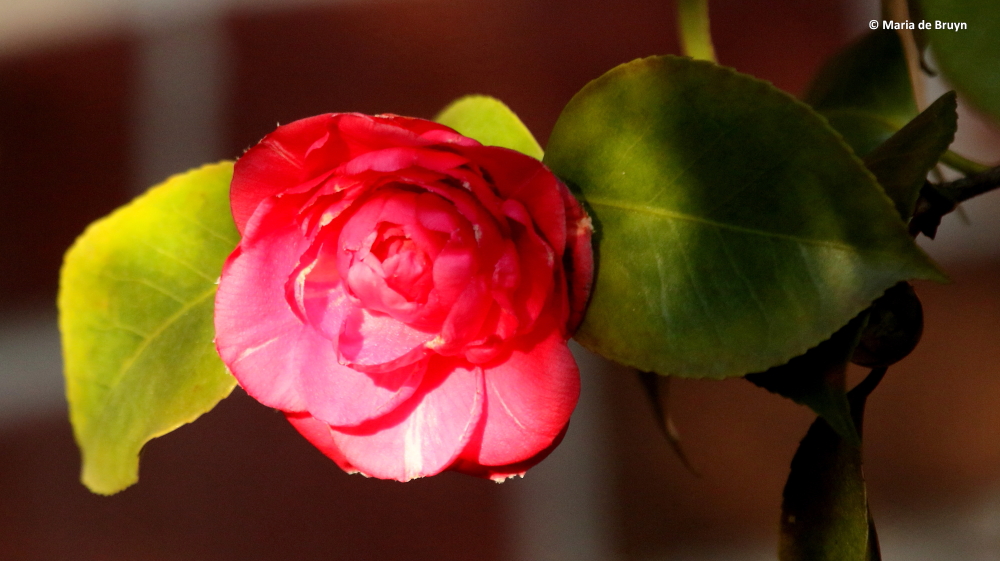
My camellias ( Camellia) bloomed in much greater profusion than ever before.

camellia-img_1816-maria-de-bruyn-res    camellia-i77a1922-maria-de-bruyn-res

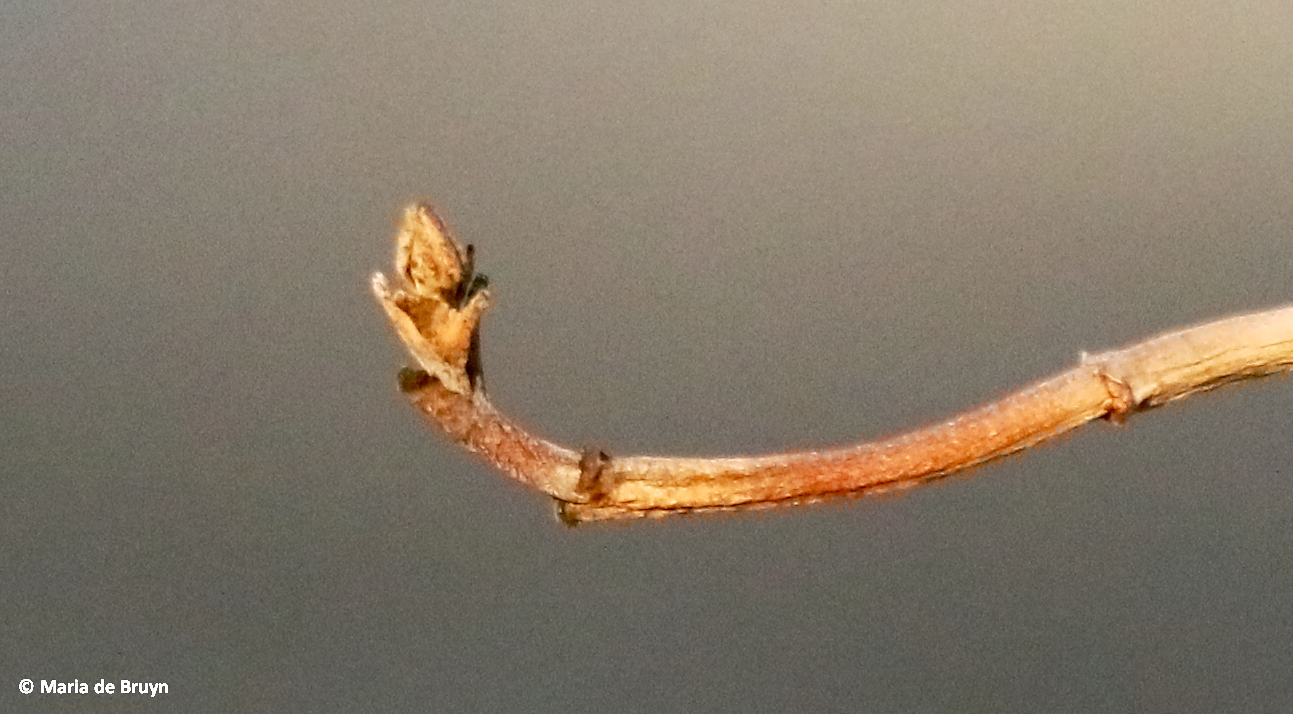
The shrubs and trees also sent out their buds weeks “ahead of schedule” – since the past month was the warmest recorded February in this area, my plants advanced their springtime blossoming, including the serviceberry (Amelanchier arborea), viburnums, dogwoods (Cornus kousa and Cornus florida) and common elderberry (Sambucus nigra).

serviceberry-i77a1965-maria-de-bruyn-res  tree-i77a1949-maria-de-bruyn-res

tree-i77a1963-maria-de-bruyn-res tree-i77a1950-maria-de-bruyn-res

My new blueberry bushes burgeoned with delicate little flowers, but the past two nights I had to cover them up so that they wouldn’t shrivel up as the temperatures dropped below freezing.

eastern-gray-squirrel-i77a0079-maria-de-bruyn-res


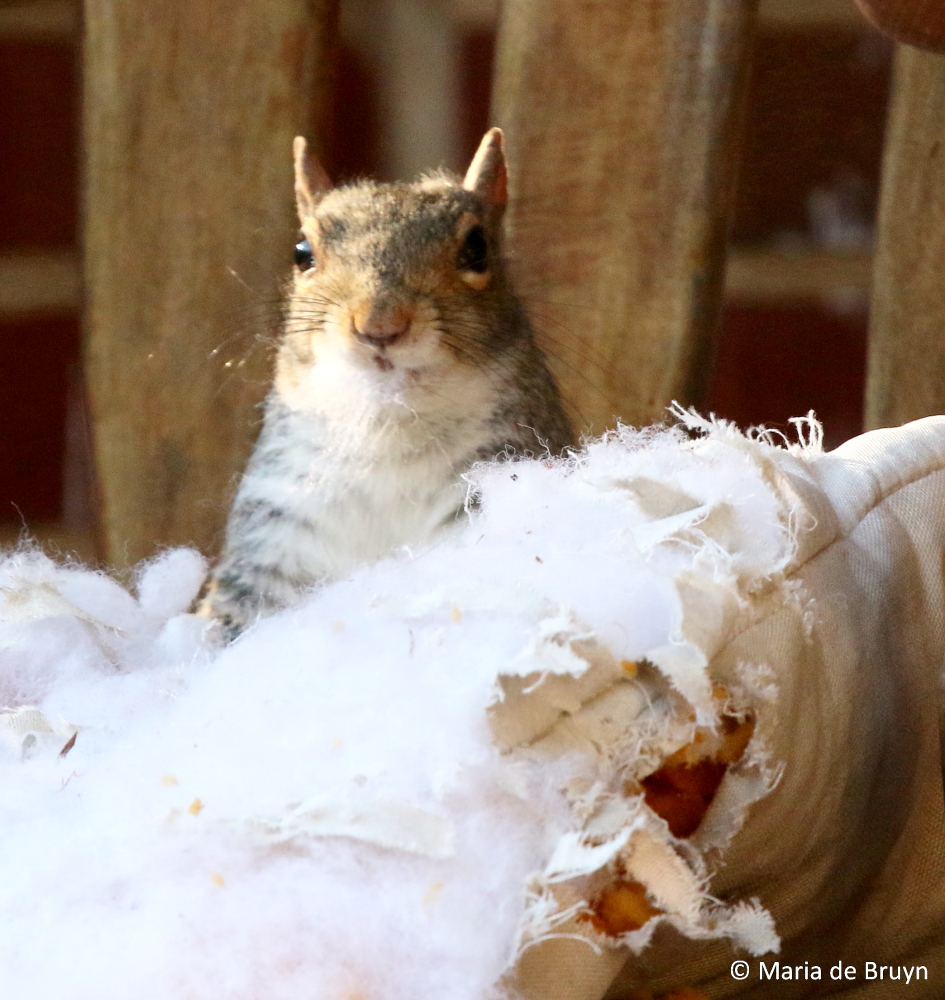
It wasn’t only the plant and bird life responding to the unusually changing season, though, as I discovered when I finally noticed the altered pillow on my front porch rocking chair. I first saw that the cloth covering the pillow had been torn; upon closer examination, I saw that the pillow had been opened up with its filling tufting up in places.


eastern-gray-squirrel-i77a0093-maria-de-bruyn-resWhen I began watching the rocker in addition to the bird feeders, I discovered the culprit – an industrious Eastern gray squirrel (Sciurus carolinensis), whom I named Sassy as she shows no fear, just a little caution.

Sassy is quite bold, coming up onto the porch even when I’m seated there. She keeps an eye on me but goes about her business in a calm and confident mood. This was also the case for her nest building activities. She perched on the pillow and used her teeth to tear out the insides.

eastern-gray-squirrel-i77a9708-maria-de-bruyn  eastern-gray-squirrel-i77a0073-maria-de-bruyn-res

She then manipulated the tufts with her paws and teeth to form them into neat little oblong packages that she could easily transport in her mouth.

eastern-gray-squirrel-i77a9795-maria-de-bruyn-res eastern-gray-squirrel-i77a9796-maria-de-bruyn-res

eastern-gray-squirrel-i77a9801-maria-de-bruyn-res eastern-gray-squirrel-i77a9802-maria-de-bruyn-res

Sometimes, she added some dried leaves to the mixture.

eastern-gray-squirrel-i77a1995-maria-de-bruyn-res

When her mouth was filled with enough material, she left to transport it to the nest that she was constructing – as it turned out, high in a loblolly pine (Pinus taeda) in a neighbor’s front yard. As I followed behind her, she stayed aware of my movements.

eastern-gray-squirrel-i77a0107-maria-de-bruyn-reseastern-gray-squirrel-i77a0108-maria-de-bruyn-res

Then she crossed the street and scurried up the tree, where she deposited her “mattress stuffing” among the leaves and other materials lining the nest.

eastern-gray-squirrel-i77a0125-maria-de-bruyn-res  eastern-gray-squirrel-i77a0139-maria-de-bruyn

Since Sassy was so very industrious and the pillow was no longer salvageable, I left it out for her. She returned for several days, systematically dismantling her found source of nest material and carrying off her little woolly trophies.

eastern-gray-squirrel-i77a0099-maria-de-bruyn-res eastern-gray-squirrel-i77a0093-maria-de-bruyn-res

When the stuffing began to disperse with the wind, I finally gathered it up and threw out what was left, figuring she had had plenty of manmade contributions to her home.

eastern-gray-squirrel-i77a0142-maria-de-bruyn-res eastern-gray-squirrel-i77a9817-maria-de-bruyn-res

Then a couple days later, I was dismayed on her behalf to see that the new neighbors had decided to remove the tree where her nest was located. The landscapers said Sassy’s nest was not a factor in their decision; they just thought the tree was in the way. I watched with sadness as Sassy’s tree was dismantled and her nest plunged to the ground.

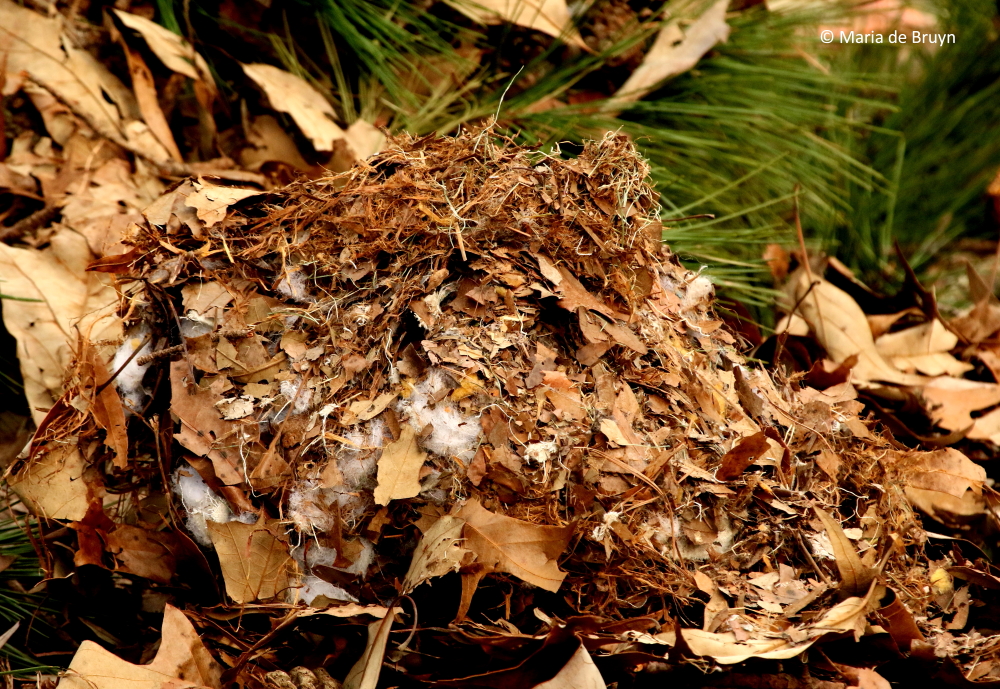
squirrel-nest-i77a9820-maria-de-bruyn-res  squirrel-nest-i77a2239-maria-de-bruyn-res

squirrel-nest-i77a2248-maria-de-bruyn-res

I didn’t see where Sassy was during this event but am sure she was watching from some other vantage point. I felt badly for her – all her innovative and dedicated work was destroyed. Of course, people lose their homes, too, to flooding, fires, tornadoes, etc.  and that is horrible. But I still regretted that this hard-working mammal had lost her home as well.

I presume Sassy has been building a new nest elsewhere. And given her boldness, I’m fairly certain that she was the squirrel I saw yesterday afternoon who had decided that she likes dried mealworms.

eastern-gray-squirrel-img_1911-maria-de-bruyn-res

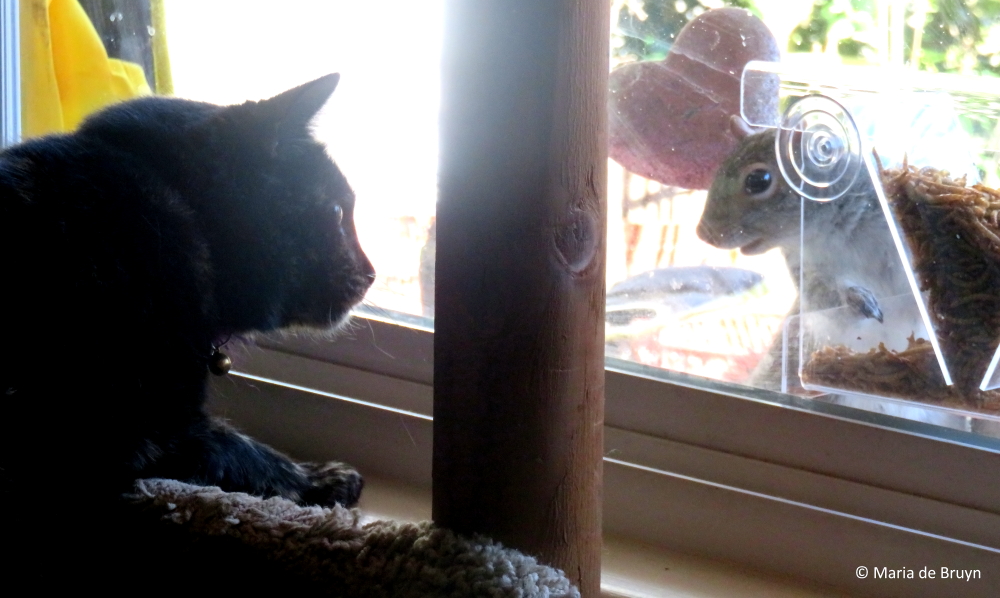
As my feline companion Moasi watched from her cat tree perch in the living room, Sassy was busy on the other side of the window chowing down on the worms in a new window feeder that I had actually bought for the Carolina wrens and chickadees, who often perch on the chair in front of the window.

eastern-gray-squirrel-img_1920-maria-de-bruyn-res

flower-i77a3037maria-de-bruyn-res


Sassy didn’t seem to mind Moasi watching her and she wasn’t fazed when I approached either. It was only when I knocked on the window that she finally descended to the porch and then left for the yard. I like to think that Sassy has made a new home and is now busy getting extra nutrition for the babies to come. And spring continues to unfold with temperatures varying from 24 to 70 degrees and above!

A working farm as a nature reserve

cattle I77A8663© Maria de Bruyn resTo continue the saga of Braeburn Farm, I’d like to introduce you to some of the non-avian wildlife to be found there. As a vegetarian, I’ll admit I was originally a bit reluctant to go there, but I must acknowledge that the farm management does many things to give the cattle a good life.

Red Devon cattle I77A6581© Maria de Bruyn resThey keep their herd of Red Devons (Bos taurus) to about 300 animals and allow the calves to reach the age of at least 3 years. Some cows and bulls are allowed to grow much older (10-12 years or more) and they enjoy a peaceful life before they go to market, rotating through the farm’s varied habitats, which include meadows and fields, ponds, woods and creeks. No pesticides are used in the habitats and the vegetation is allowed to grow as naturally as possible. Farm manager Nick said that when it is time to shift the cows to a new pasture area, he just calls them. The older cows know that they will be enjoying fresh and different veggies so they follow him willingly, leading the rest of the herd along.

My visits in June and July showed how this farm is cultivating biodiversity among plants and wildlife. The fields were dotted with thistles, white clover (Trifolium repens), red clover (Trifolium pratense) and many other plants.

brown-eyed Susan I77A7112© Maria de Bruyn res        Moth mullein Verbascum blattaria I77A5812© Maria de Bruyn res

Brown-eyed Susan (Rudbeckia hirta)                           Moth mullein (Verbascum blattaria)

Bees and butterflies were abundant, showing that the farm’s methods are good for the pollinators.

clouded sulphur I77A6930© Maria de Bruyn res    Clouded skipper I77A7102© Maria de Bruyn

Clouded sulphur (Colias philodice)                             Clouded skipper (Lerema accius)

Least skipper IMG_0155© Maria de Bruyn    Sachem skipper I77A7026© Maria de Bruyn res

Least skipper (Ancyloxypha numitor)          Sachem skipper (Atalopedes campestris)            cabbage white I77A6735© Maria de Bruyn res         monarch I77A6970© Maria de Bruyn res

Cabbage white (Pieris rapae)                      Monarch butterfly (Danaus plexippus)

Leaf-footed bugs (Leptoglossus phyllopus), margined leatherwing soldier beetles (Chauliognathus marginatus), bees and various species of syrphid flies (also known as hoverflies and often mistaken for bees) were exploring the thistles.

leaf-footed bug Leptoglossus phyllopus IMG_4412© Maria de Bruyn res   leaf-footed bug Leptoglossus phyllopus IMG_4400© Maria de Bruyn res

margined leatherwing soldier beetle IMG_4437© Maria de Bruyn resMargined leatherwing soldier beetle

Eastern carpenter bee 2 I77A6964© Maria de Bruyn res            syrphid fly Sphaerophoria I77A5781© Maria de Bruyn

Eastern carpenter bee (Xylocopa virginica)            Syrphid fly (Sphaerophoria)

common oblique syrphid fly Allograpta obliqua IMG_4418© Maria de Bruyn res

Common oblique syrphid fly (Allograpta obliqua)

Syrphid fly - Palpada vinetorum IMG_4422© Maria de Bruyn bg    Syrphid fly - Palpada vinetorum IMG_4422© Maria de Bruyn res

Syrphid fly (Palpada vinetorum)

Elsewhere, the nymph of a wheel bug (Arilus cristatus) moved along large leaves.

Wheel bug - Arilus cristatus IMG_4499© Maria de Bruyn    Wheel bug - Arilus cristatus IMG_4481© Maria de Bruyn res

It pays to look down at your feet as you wander through the fields in the early morning. The grasses are covered in tiny webs that glisten with water droplets. Underneath are the tiny red dwarf sheetweb spiders (Florinda coccinea) that may show themselves if you stay very still.

dwarf sheetweb spider IMG_0117© Maria de Bruyn res     dwarf sheetweb spider IMG_0126© Maria de Bruyn res

dwarf sheetweb spider IMG_0127© Maria de Bruyn   dwarf sheetweb spider IMG_0121© Maria de Bruyn

In the vegetation below you can also see other insects, like the Spur-throated grasshopper (Melanoplus), or the Forage looper moth (Caenurgina erechtea).

spur-throated grasshopper Melanoplus IMG_0152© Maria de Bruyn res      Forage looper I77A5943© Maria de Bruyn res

Various dragonflies and damselflies balance on grasses and sometimes alight on the ground (the former hold their wings out when resting and the damselflies fold their wings along their bodies).

halloween pennant I77A6315© Maria de Bruyn res   halloween pennant Celithemis eponina I77A6337© Maria de Bruyn res

Halloween pennant (Celithemis eponina)

Double-striped American bluet Dancer damselfly I77A6155© Maria de Bruyn res

Double-striped bluet damselfly (Enallagma basidens)

widow skimmer I77A6998© Maria de Bruyn bg

Widow skimmer (Libellula luctuosa)

common whitetail I77A6394© Maria de Bruyn res

Common whitetail (Plathemis lydia)

At the creek crossings, you may see a common sanddragon dragonfly (Progomphus obscurus, a lifer for me!), paper wasps (Polistes) or a viceroy butterfly (Limenitis archippus) having a drink or looking for a mate. The viceroy mimics the monarch but can be distinguished easily with the line crossing its wings horizontally when you see it rest.

Common sanddragon dragonfly I77A6480© Maria de Bruyn res    Common sanddragon dragonfly I77A6508© Maria de Bruyn res

paper wasp Polistes I77A6454© Maria de Bruyn bg       Viceroy I77A6432© Maria de Bruyn res

Walking through the fields, you may also occasionally spot a mammal although they are not as easy to see as the other wildlife. As I trudged around a pond, this white-tailed deer fawn (Odocoileus virginianus) was startled from its hiding place – showing off the part of its anatomy for which the species is named and looking as if s/he was sporting a very large feather.

white-tailed deer I77A6198© Maria de Bruyn res           white-tailed deer I77A6199© Maria de Bruyn res

On one outing, Nick and I spotted a couple darling raccoon kits (Procyon lotor), who wasted no time scurrying for cover when they spotted us.

raccoon I77A7213© Maria de Bruyn res     raccoon I77A7225© Maria de Bruyn res

Red Devon cattle I77A6617© Maria de Bruyn resThe farm is a great place to spend quality time outdoors. You can contact the farm management to schedule a visit and they will instruct on which fields and areas are open for visitation. And if you should wander by mistake into a field with some of the cattle, you needn’t worry as the Red Devons are likely to walk away or just watch you as they are a placid breed. I hope that Braeburn Farm becomes a popular birding and wildlife observation area so that we can continue enjoying visits there.

See anything good?

Sandy Creek path IMG_4981© Maria de Bruyn resThat’s a common question I get when I am out on one of my nature walks. Since I carry a camera with a large zoom lens and often a smaller camera, too, it’s obvious to passersby that I’m out observing nature. And I realize that when they ask the question, what they really want to know is whether I saw anything unusual or spectacular.

A recent walk at Sandy Creek Park in Durham, NC, was a case in point. I told one couple who posed the question that my most memorable sighting so far had been a male ebony jewelwing damselfly (Calopteryx maculata) – the iridescence of its body and wings in the sunlight was wonderful. They smiled a bit uncertainly and the lady of the pair admitted that she didn’t know anything about damselflies as they walked on.

ebony jewelwing I77A0417© Maria de Bruyn res   ebony jewelwing I77A0469© Maria de Bruyn res

Fragile Forktail damselfly I77A0648© Maria de Bruyn resAn hour or so later, another couple asked if I had “seen any good ones?” I repeated my delight in seeing the male damselfly, adding that the female is not as striking with her brown color and white spots. “Yes,” said the man, “that is often the case with other species. In our species, though, it’s the females who shine.” That may be the case some of the time, but my day was made by seeing a female damselfly that was a member of a new species for me – the fragile forktail (Ischnura posita).


My experience is that I find some beauty in almost all the wildlife I see (ticks and chiggers are an exception). So I want to share a few of those “good things” I saw at Sandy Creek Park last month in a two-part blog “tour”. In this first part, I’ll continue on with the insects.

Identifying dragonflies is not easy since the females and males can look quite different. The great blue skimmer (Libellula vibrans) provides an example – the male lives up to his name with a blue hue and large size, but the female shows off her beauty with a brown and yellow abdomen.

great blue skimmer dragonfly I77A0715© Maria de Bruyn res    great blue skimmer dragonfly I77A0741© Maria de Bruyn res

The Eastern pondhawk (Erythemis simplicicollis) has distinctively different appearances as a male and female. The adult male is a blue individual, sometimes with a bit of greenish tint; the female – and the immature males! – is brilliant with different shades of green. I remember being excited when I first spotted a female as their green color is so striking.

Eastern pondhawk I77A0721© Maria de Bruyn res  Eastern pondhawk I77A0749© Maria de Bruyn res

blue dasher I77A0172©Maria de Bruyn resThe blue dasher dragonfly (Pachydiplax longipennis) has some stripes, as do some of the bumble bees. The brown-belted bumble bee (Bombus griseocollis) lives up to its name with a brown stripe, while this American bumble bee (Bombus pensylvanicus) feeding on a trumpet vine (Campsis radicans) has white bands. Like honey bees, the latter bee has pollen baskets (corbicula) on its hind legs in which it stores pollen. I enjoyed watching this individual – s/he would dip down into the flower, back up a bit, and then plunge forward again, almost always keeping the pollen basket above the tip of the flower.

Brown-belted bumble bee I77A0218©Maria de Bruyn res   American bumble bee I77A0763© Maria de Bruyn2 res

Bumble bee I77A6297© Maria de Bruyn res


The pollen gatherers were numerous during both visits and willing to share the sources of their bounty – here you see a bumble bee (Bombus), syrphid fly (Toxomerus marginatus) and sweat bee (Halictus) feeding peacefully together on a coneflower (Echinacea).


Eastern carpenter bee IMG_0768© Maria de Bruyn res


The milkweed plants were attracting many species of pollinators; here an Eastern carpenter bee (Xylocopa virginica) was enjoying a meal.


common buckeye I77A0237© Maria de Bruyn res


While there were many, many bees the days of my visits, there were fewer butterflies but the common buckeye (Junonia coenia) was stunning!


The little wood satyr (Megisto cymela) and dun skipper (Euphyes vestris, to the lower right on the milkweed) were not as colorful, and some people might even call them dull, but they are still nice to see and the Eusarca moth (Eusarca confusaria) was also an evenly colored beauty. I had grown up thinking moths usually fly at night, attracted by lights so it still draws my attention when I see them in the daytime.

Little wood satyr I77A0584© Maria de Bruyn res         Eastern carpenter bee IMG_0804© Maria de Bruyn 2 res

Confused Eusarca moth Eusarca confusaria I77A5701© Maria de Bruyn

Even a somewhat tattered American lady (Vanessa virginiensis) offered a pretty view.

American lady I77A6238© Maria de Bruyn res

The broad-headed sharpshooter (Oncometopia orbona), a leaf hopper, and the spotted pink lady beetle (Coleomegilla maculata) are tiny but such colorful insects that close perusal of the vegetation helps you spot them (and presumably makes it easier for birds to see them, too?).

broad-headed sharpshooter Oncometopia orbona I77A0592© Maria de Bruyn      Spotted pink lady beetle I77A0081©Maria de Bruyn bg

Emerald ash borer trap I77A0719© Maria de Bruyn res


One beetle that we don’t really want to see is the emerald ash borer (Agrilus planipennis), an invasive species that came to the USA from Asia. The larvae of these beetles kill ash trees and the park administrators have hung a trap box for them to determine whether this species has reached the park.


Spotting mammals is not always easy at the park but one day fellow birder Jim was kind enough to alert me to an opossum (Didelphis virginiana) in a tree when we met on a walking path. He told me approximately where it was and I spotted that one and another in a nearby tree; I thought it might be a mother and grown offspring but that was a guess and I certainly couldn’t confirm it. As these are nocturnal animals, it was pretty cool for me to see two in broad daylight. The only marsupial found in the United States and Canada is a beneficial animal for us humans (and other wildlife) as they could eat up to 4000 ticks in a week! 

opossum IMG_0605© Maria de Bruyn res     opossum I77A5788© Maria de Bruyn res

One of the pair demonstrated that they can open their jaws widely – watching him/her slowly stretch that mouth offered me a surprise; I would think it couldn’t go any further and the animal continued to show that s/he could really please a dentist who would like lots of space to investigate those teeth.

opossum I77A5897© Maria de Bruyn res

Eastern cottontail rabbitI77A5578© Maria de Bruyn res


The Eastern cottontail rabbit (Sylvilagus floridanus) was not so lucky, carrying a fat tick in its ear. Too bad the opossums couldn’t come by and groom him/her and remove that pesky arachnid!


The park is not only attractive for the entomologists. Reptile enthusiasts can spot turtles fairly easily, especially in the spring when they are looking for places to lay their eggs. A large painted turtle was crossing a field looking for a spot, while an Eastern mud turtle (Kinosternon subrubrum) was trundling down a paved path one morning, not far from a pond which often has many painted turtles and red-eared sliders (Trachemys scripta elegans), like this one – who must have been a bit bothered by a bird feather caught in its shell.

Eastern mud turtle IMG_0741© Maria de Bruyn res    Red-eared slider I77A5941© Maria de Bruyn2

Which bird could it have been? I’m thinking a swallow – see part 2 of the tour for a view of the species and more of the wonderful biodiversity that can be seen in the park.


Youthful exuberance in Yellowstone

bison IMG_8457© Maria de Bruyn resOne of the frequent wildlife sightings during a visit to Yellowstone National Park are the bison, also known as American buffalo (Bison bison). Sometimes you see a single individual, sometimes a group of 3-5 animals and often larger groups or even huge herds. Females and their calves and males usually hang out in separate groups except when it is breeding season. The males can be distinguished by their somewhat longer horns, larger size (up to 2000 lbs) and heavier beards.  The babies are reddish-brown for their first 2.5 months of life, whereafter they begin to develop the dark brown coloring of their species.

bison I77A7891© Maria de Bruyn res

bison IMG_4583© Maria de BruynDuring my recent visit, I learned that you should not get out of your car near a buffalo – they may look placid but they will attack if they feel provoked and can run over 30 mph. From 1980-1999, triple the number of people were injured by bison as by bears in Yellowstone! In 2015, five people were gored by buffalo.Unfortunately, some people still will approach, as shown in this 1992 video showing some frightening consequences. You may then have to photograph them through (dirty) unopened car windows, which doesn’t make for excellent photos, but you can record what you see as memory reminders.

bison IMG_4562© Maria de Bruyn resIn the wintertime, the bison have thick shaggy coats and these are shed in the spring, so that you see individuals with bare patches of skin alternating with woolly areas.

A park ranger told me that they rub on trees to help remove their winter coats; there are whole areas of forest where many trees have bare spots devoid of bark as a result. The bison also “horn” trees, mostly in the autumn, rubbing their horns on cedars and pines by preference; the trees then emit a fragrance which is thought to be an insect deterrent.

bison IMG_4573© Maria de Bruyn res bison IMG_4569© Maria de Bruyn res

Another sign that buffalo are nearby are the bison wallows – these shallow depressions in the ground are used year after year, both during dry and rainy weather. The wallows have multiple functions, including offering dust and mud covering to protect against insects, a place for resting, grooming and play.

I77A6602© Maria de Bruyn resbison I77A6605© Maria de Bruyn res

bison IMG_4578© Maria de Bruyn res

When walking in meadows, along roads and on hillsides, you can often come across bison dung, popularly known as meadow muffins and buffalo chips. These large deposits used to be used as a fire source as they burn well and could be easily gathered.

Given the bison’s size and their habituation to people in the Park, human beings will find that they not infrequently have to share the road with these mammals. They will cross the road from one side to another and sometimes spend some time ambling down the road, so that you can have one pass within about a foot of your car window.

bison IMG_4563© Maria de Bruyn resbison I77A7869© Maria de Bruyn res

bison I77A7490© Maria de Bruyn res

During these “bison jams”, cars are supposed to stop and give them right of way – we are the intruders in their home after all. You then may see an individual through the car window who has been collared or tagged, presumably for research.

bison I77A1714© Maria de Bruyn resbison I77A1739© Maria de Bruyn res

The bison can have very expressive faces, even if at first sight it seems they always have the same expression. This mother demonstrated when she was nursing her calf.

bison I77A1679© Maria de Bruyn res bison I77A1667© Maria de Bruyn res

bison I77A1624© Maria de Bruyn res

bison I77A1473© Maria de Bruyn res

If you had asked me a month ago which adjectives I might associate with bison, my answer likely would have been something like: massive, placid when undisturbed, woolly, furry, huge, plodding. Playful would not have been on the list, but I discovered that American buffalo babies can be very exuberant and know how to have a good time!

A group of three spent quite some time chasing one another, jumping and leaping – one in particular seemed to be the instigator of the play session.

bison I77A1539© Maria de Bruyn res bison I77A1519© Maria de Bruyn res

bison I77A1441© Maria de Bruyn res  bison I77A1453© Maria de Bruyn res

bison I77A1525© Maria de Bruyn res

bison I77A9171© Maria de Bruyn resAt one point, I was in a car where I could observe a group of bison fording a river very near to the road. It was shallow where they entered but grew deeper toward the middle and other side and it turned out there was a strong current. It posed a challenge to the pregnant bison and the babies were really having a tough go. We watched them struggle across, keeping their chins above water as they slowly progressed while being swept downstream from the adults.

bison I77A9113© Maria de Bruyn res bison I77A9103© Maria de Bruyn res

bison I77A9135© Maria de Bruyn res

Luckily, all of the babies made it to the other side, including one who thought s/he was going after her/his mother when s/he got to the top of the riverbank. s/he trotted after a smaller bison, then was followed by a much larger female who began butting her/him – turned out the baby may have been confused after the strenuous river crossing because the smaller bison was not going to nurse. The mother kept after the baby until finally the young one turned and realized who mom really was!

bison I77A9283© Maria de Bruyn resbison I77A9293© Maria de Bruyn res

bison I77A9321© Maria de Bruyn res

bison I77A1450© Maria de Bruyn resBefore Europeans came to the United States, these magnificent mammals ranged as far as the Atlantic seaboard, meaning they could have been in my neighborhood at one time! Now the wild bison are largely confined to some national parks after almost going extinct in the 19th century and the most genetically pure ones are in Yellowstone. So I’m lucky that I had the chance to observe them several times during my recent trip out West and I’d love to see them there again. 🙂