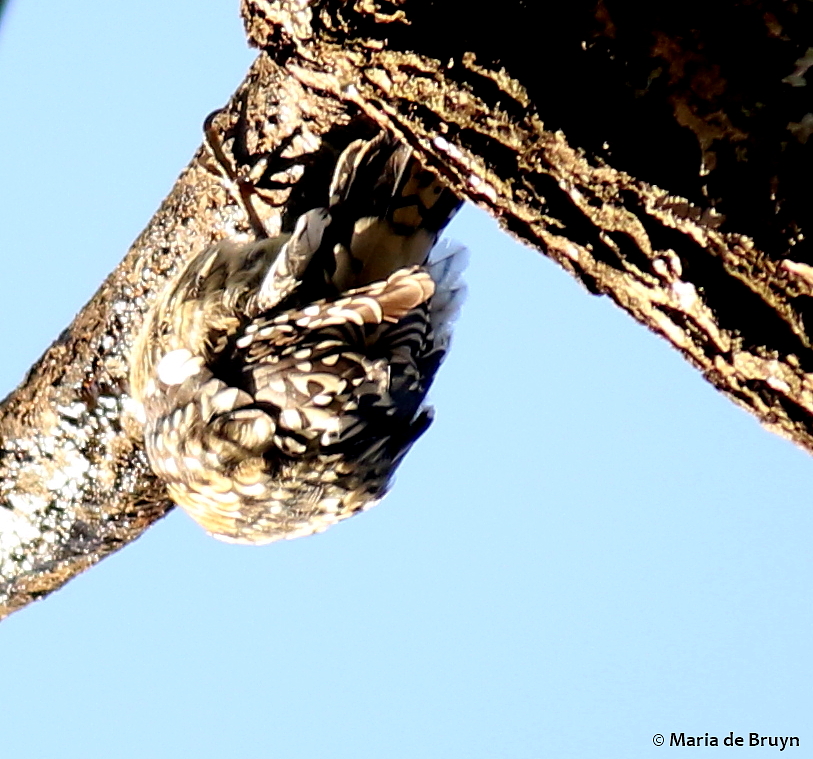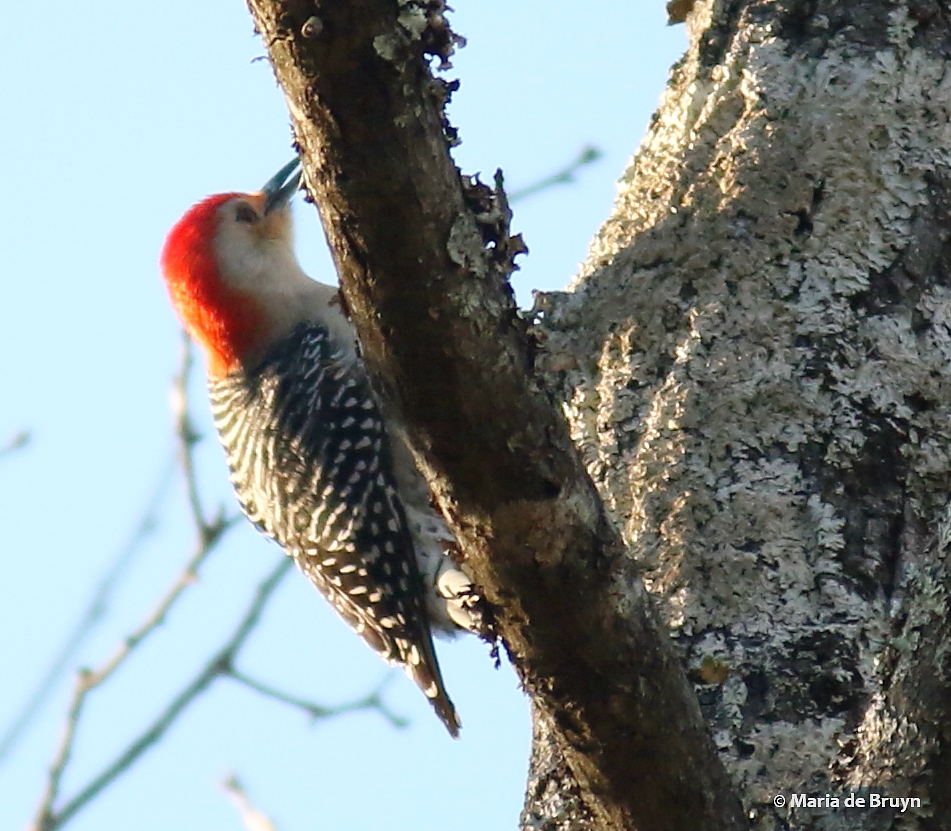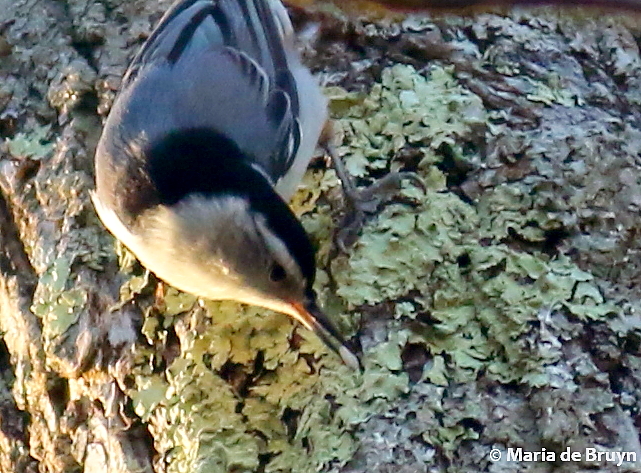
Nest Watch citizen science – 2016 edition

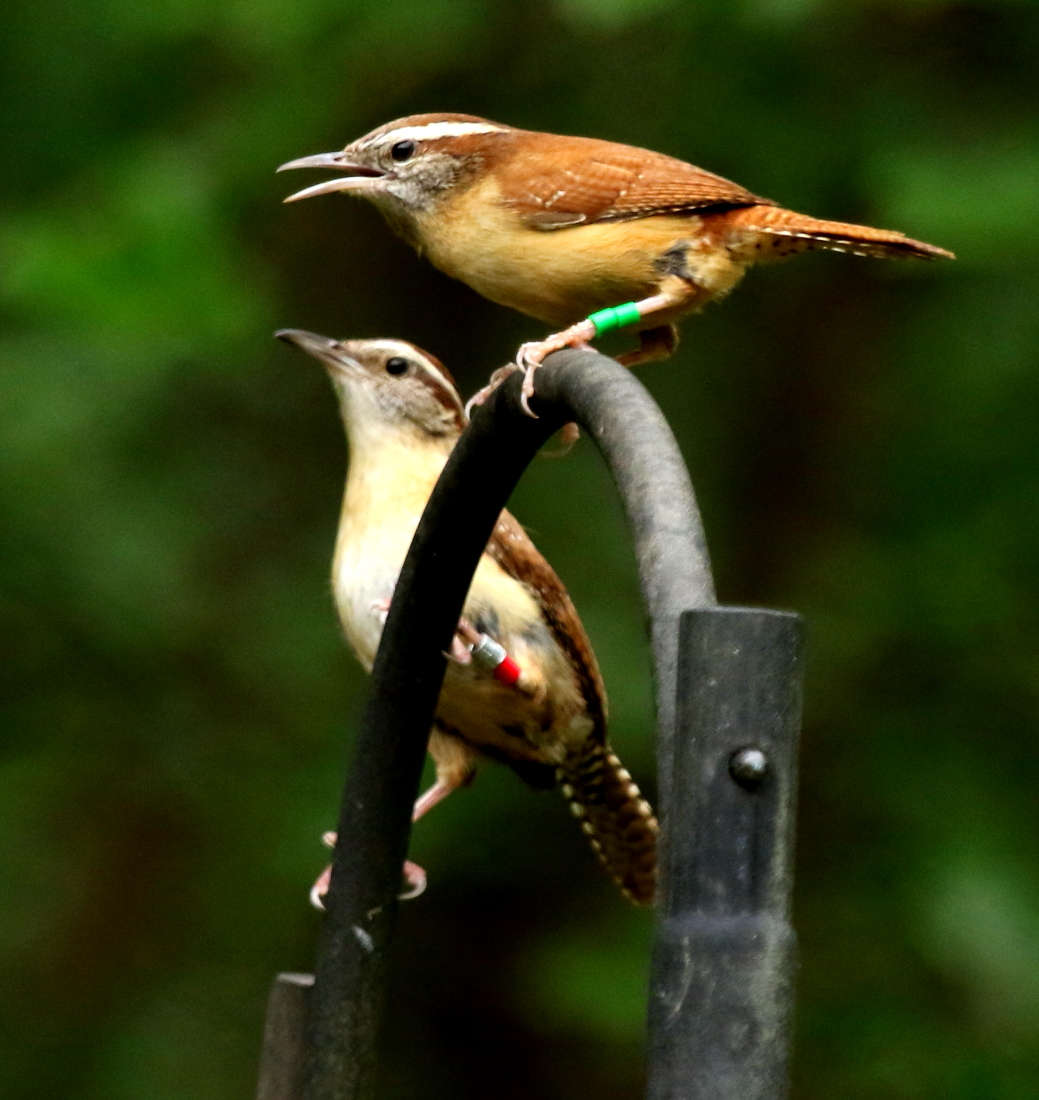
Carolina wren Renee and Riley I77A9074© Maria de Bruyn resLast year, I became a Nest Watch volunteer, which involves having birds banded in your yard so that you can follow and report to researchers the birds’ presence over time as they visit and leave your yard.

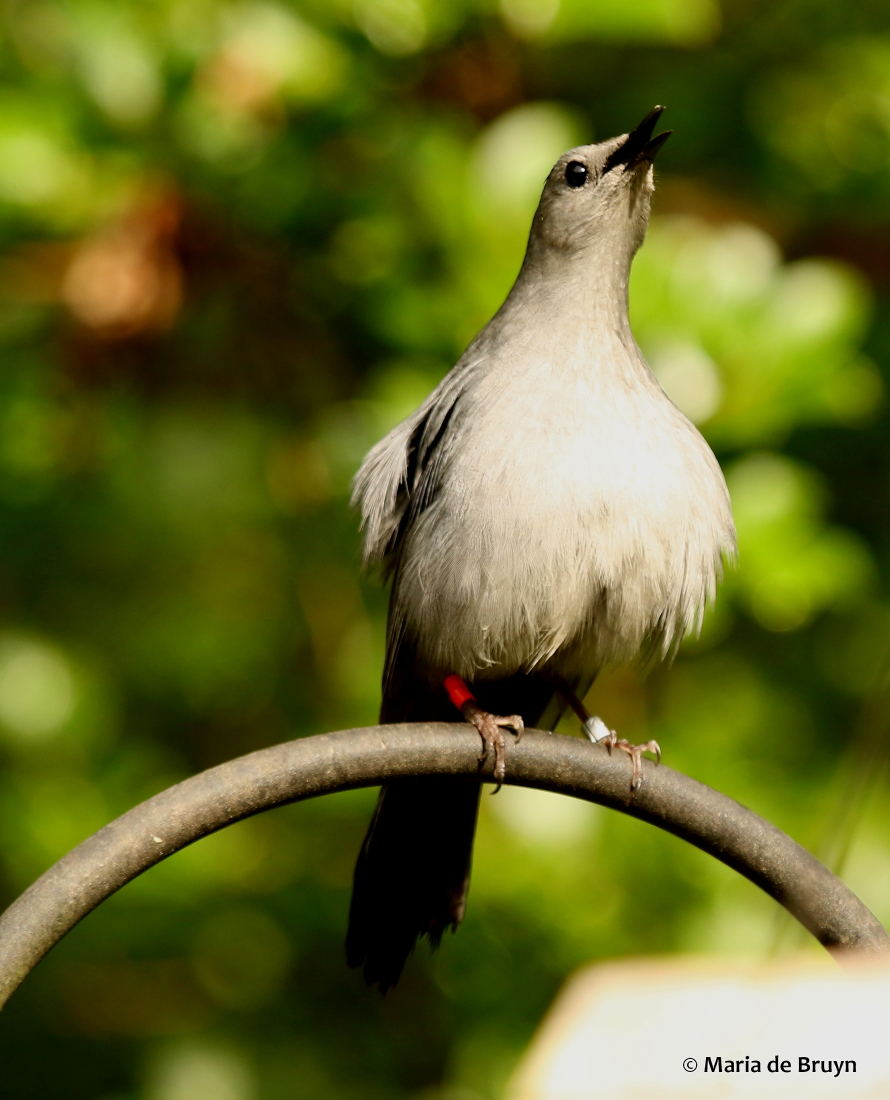
In 2015, we banded six birds. If a bird is only a temporary visitor or if it died outside the yard due to disease, old age or predation, you just won’t see it again and have no idea what became of it. The American robin (Turdus migratorius) that was banded last year never returned. If the birds stick around, however, you have the enjoyment of observing birds you get to know. The three gray-headed catbirds (Dumetella carolinensis) stayed around all summer and fall, and two of them – Camden and Corey – returned to my yard from winter migration a few days ago. They have been accompanied by females whom they appear to be assiduously courting.
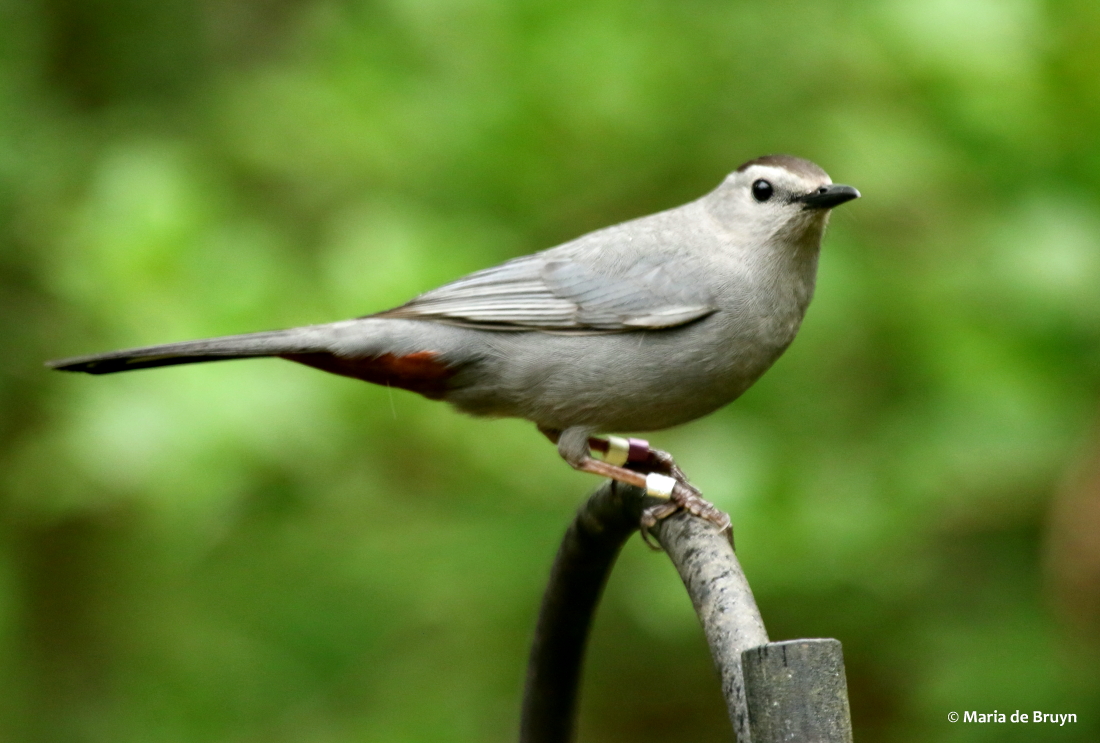
gray-headed catbird Camden I77A8990© Maria de Bruyn res

gray-headed catbird Corey I77A8083© Maria de Bruyn res

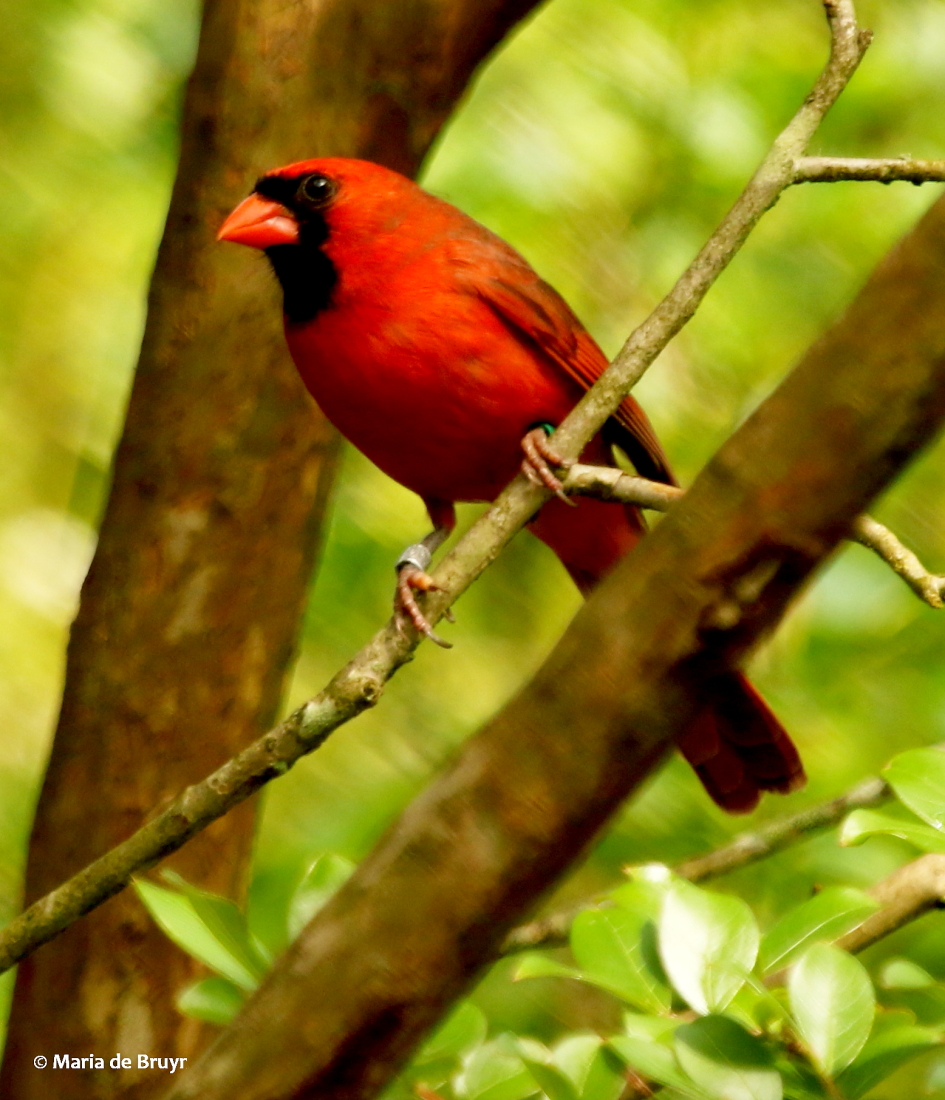
Northern cardinal Clancy I77A8123© Maria de Bruyn resOne Northern cardinal (Cardinalis cardinalis) was banded last year, but Clancy only stayed a few days and then disappeared for the rest of the summer, fall and winter. He suddenly appeared yesterday – perhaps encouraged to spend time at the feeders by the other birds with bracelets.

Three days ago, a second round of banding was done and we put the colorful anklets on a total of 10 birds. They were caught in two mist nets – one near my back garden and one near the backyard feeders.
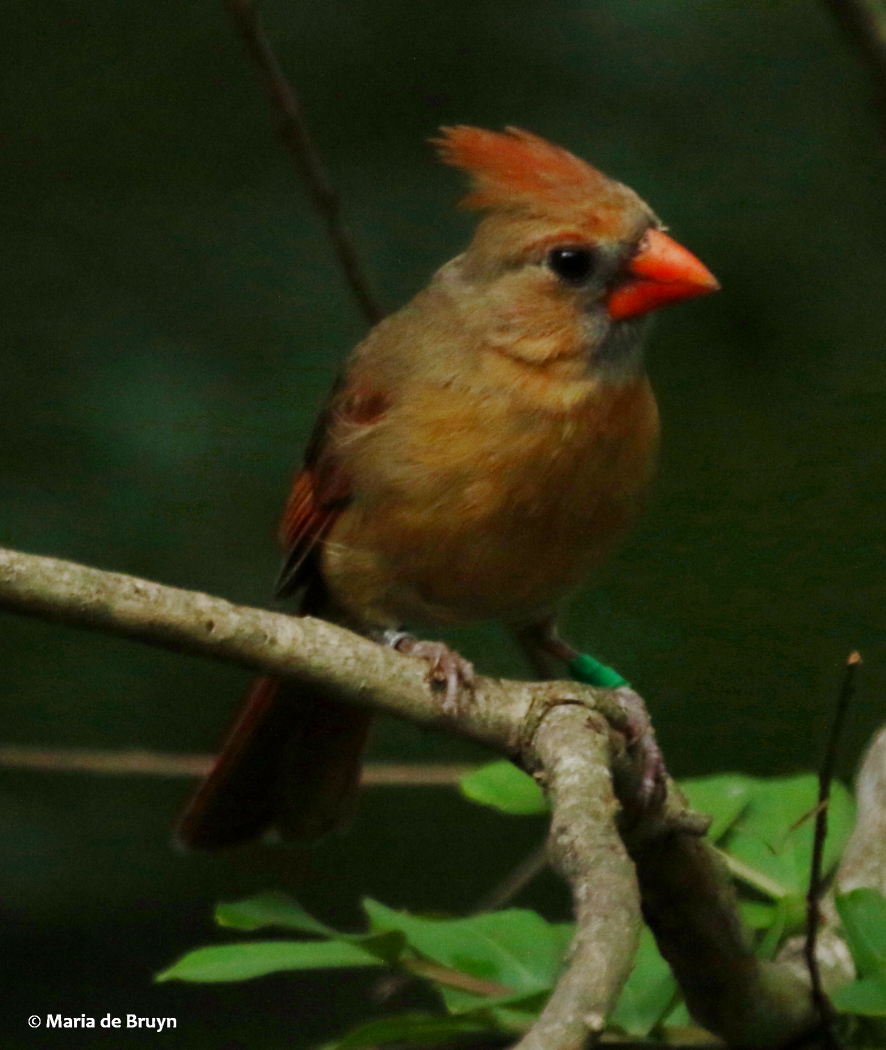
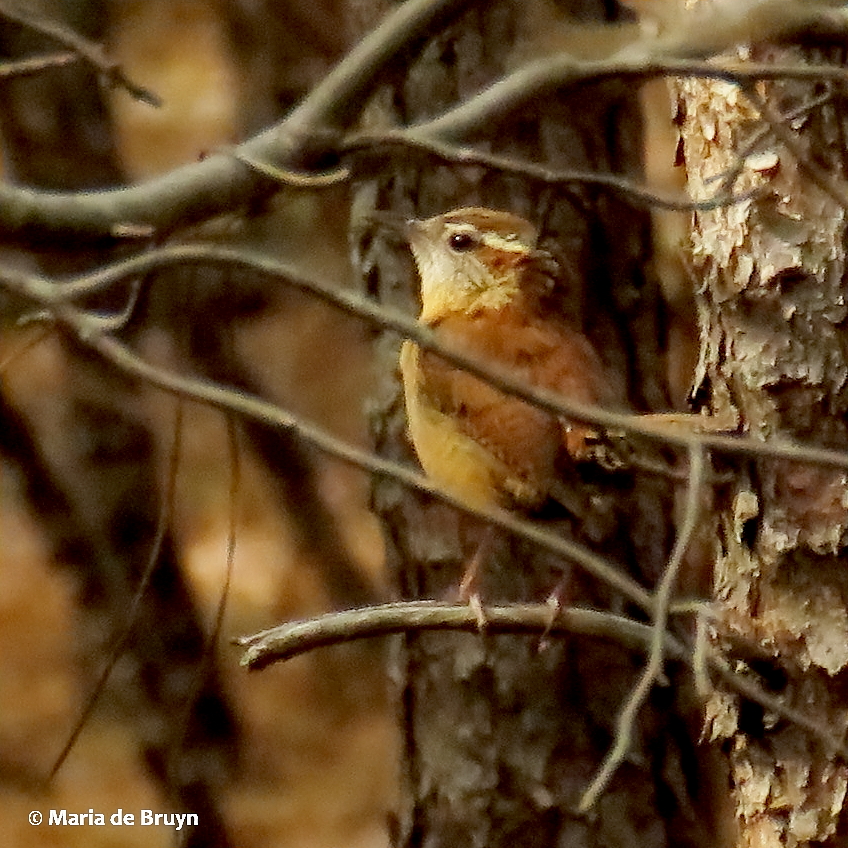
Northern cardinal Camilla I77A9127© Maria de Bruyn resThe nets had just been installed when our first visitor, a female Northern cardinal, was caught. She was not happy and when put in a bag until she could be banded, weighed, examined and measured, she did not remain still and calm. She had a little wait, however, as a female Carolina wren (Thryothorus ludovicianus) flew into the other net at just about the same time, followed by her mate within seconds. As the cardinals can tolerate being in a bag better than the smaller birds, the two wrens were banded first. Alicia let the first one go and then I released the second one, who rested on my palm for a bit. He felt so nice and soft!
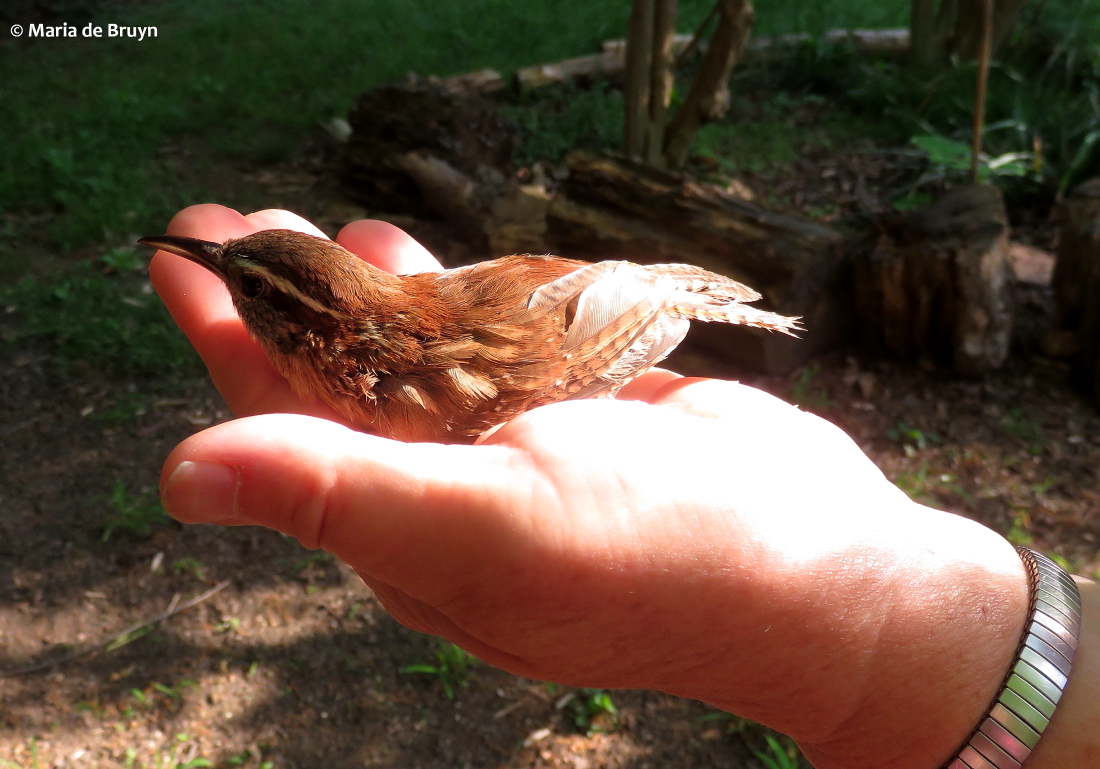
Carolina wren Riley IMG_3832© Maria de Bruyn res

Forty-five minutes later, playback of a house wren’s song (Troglodytes aedon) led to the capture of a male who immediately came to investigate who was invading his territory. His mate, who was busy putting the finishing touches on a nest in a box near the mist net, didn’t go near the net.
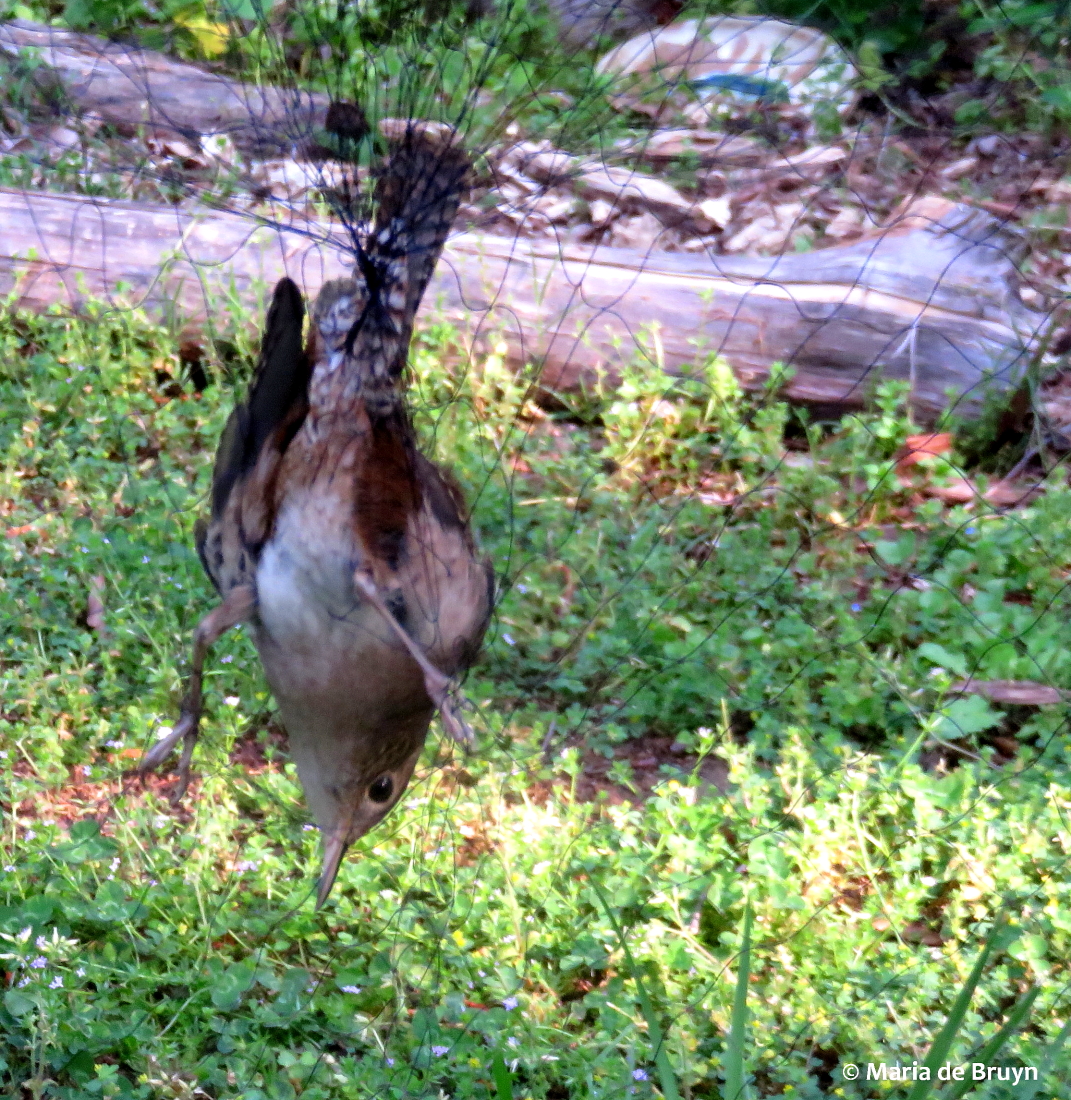
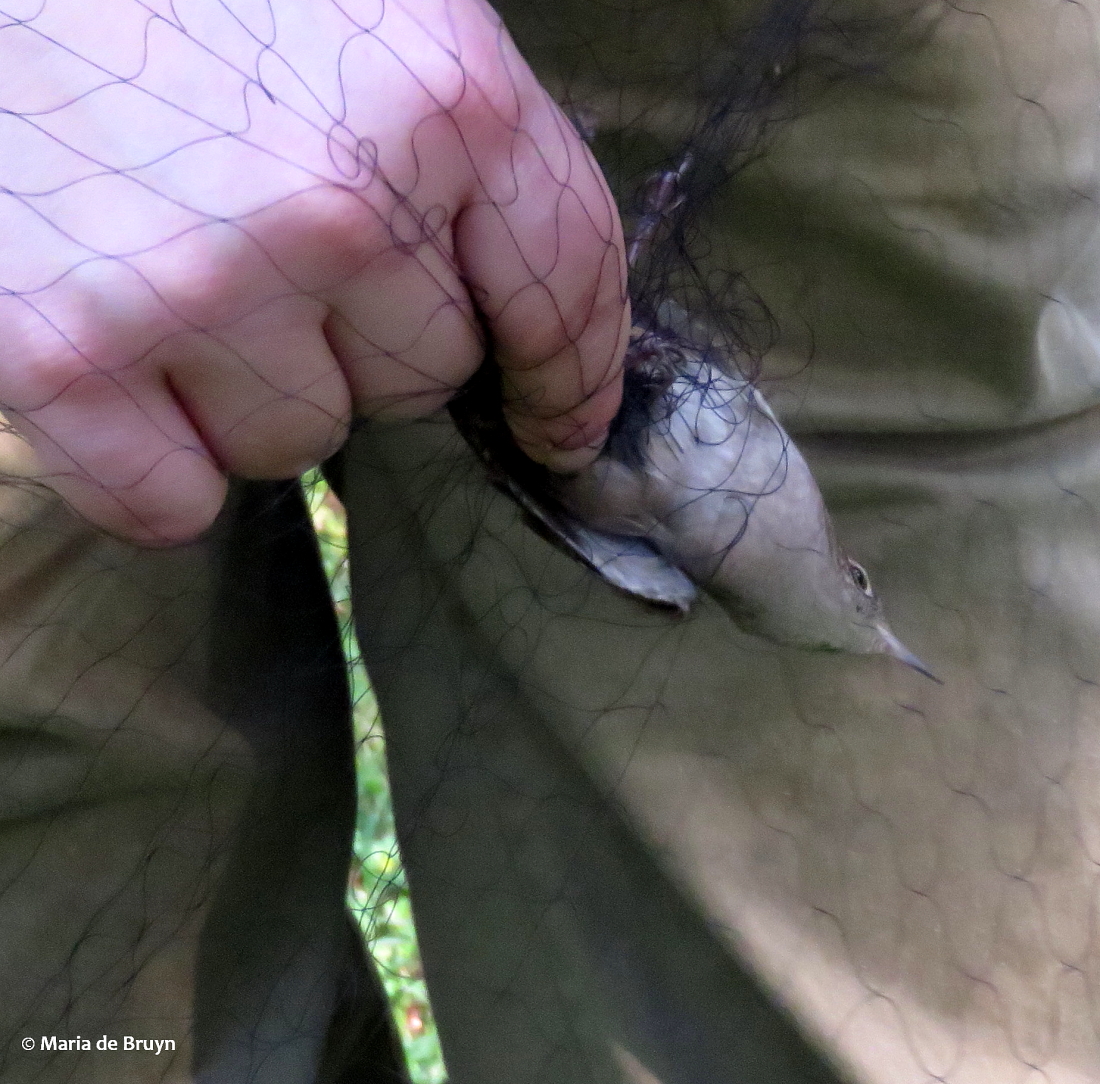
house wren Hans IMG_3842© Maria de Bruyn reshouse wren Hans IMG_3844© Maria de Bruyn res

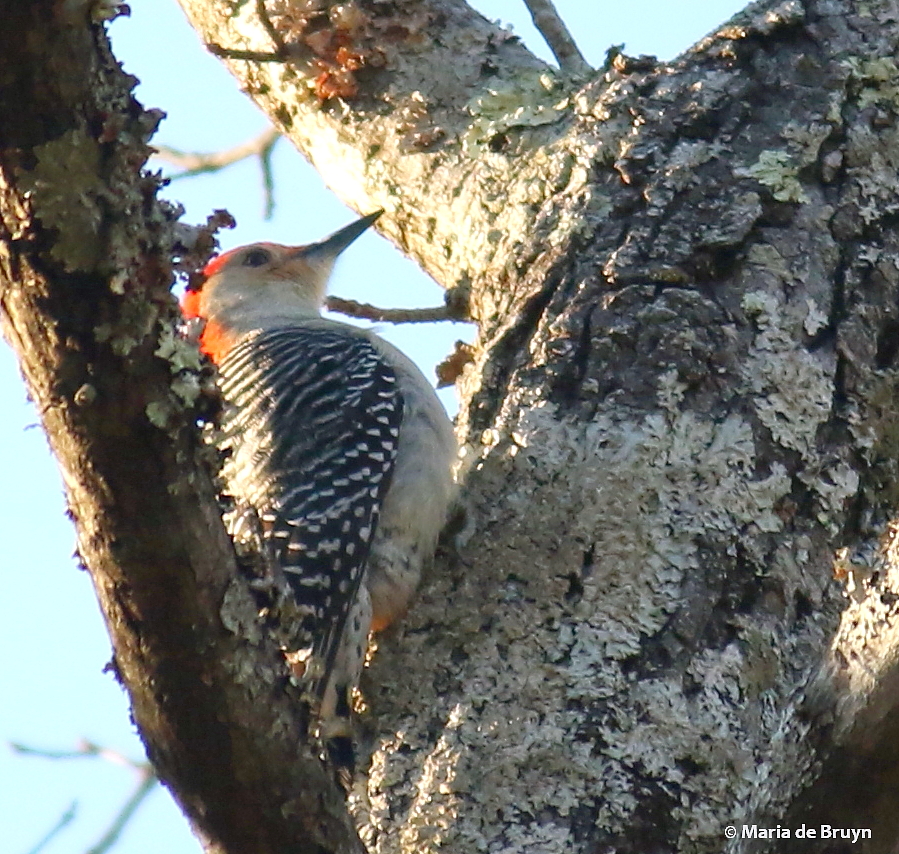
A few birds not targeted for the study ended up tangled in a net. A white-throated sparrow (Zonotrichia albicollis) had beautiful vivid breeding colors on his head. A red-bellied woodpecker (Melanerpes carolinus) was not calm like the sparrow, fluttering his wings constantly as Alicia, the bird bander, got him loose.
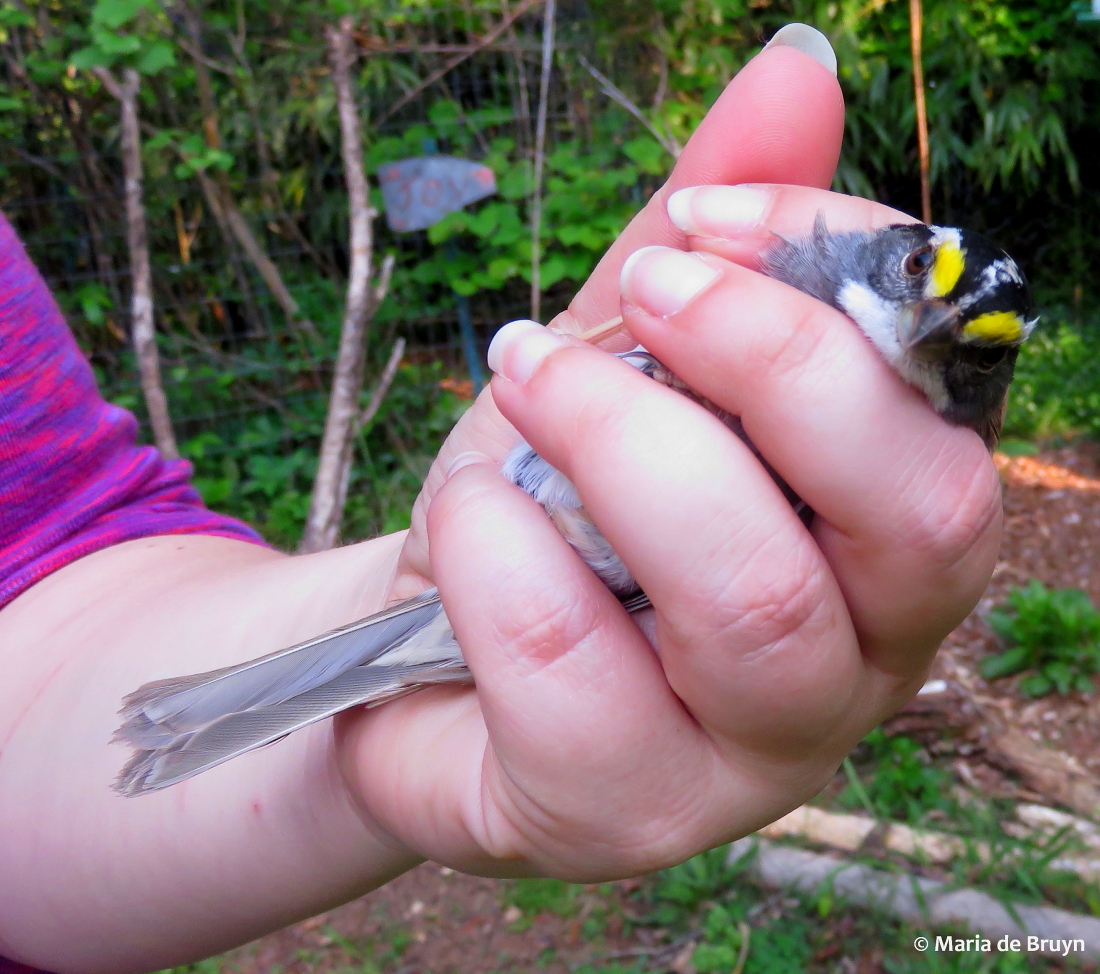
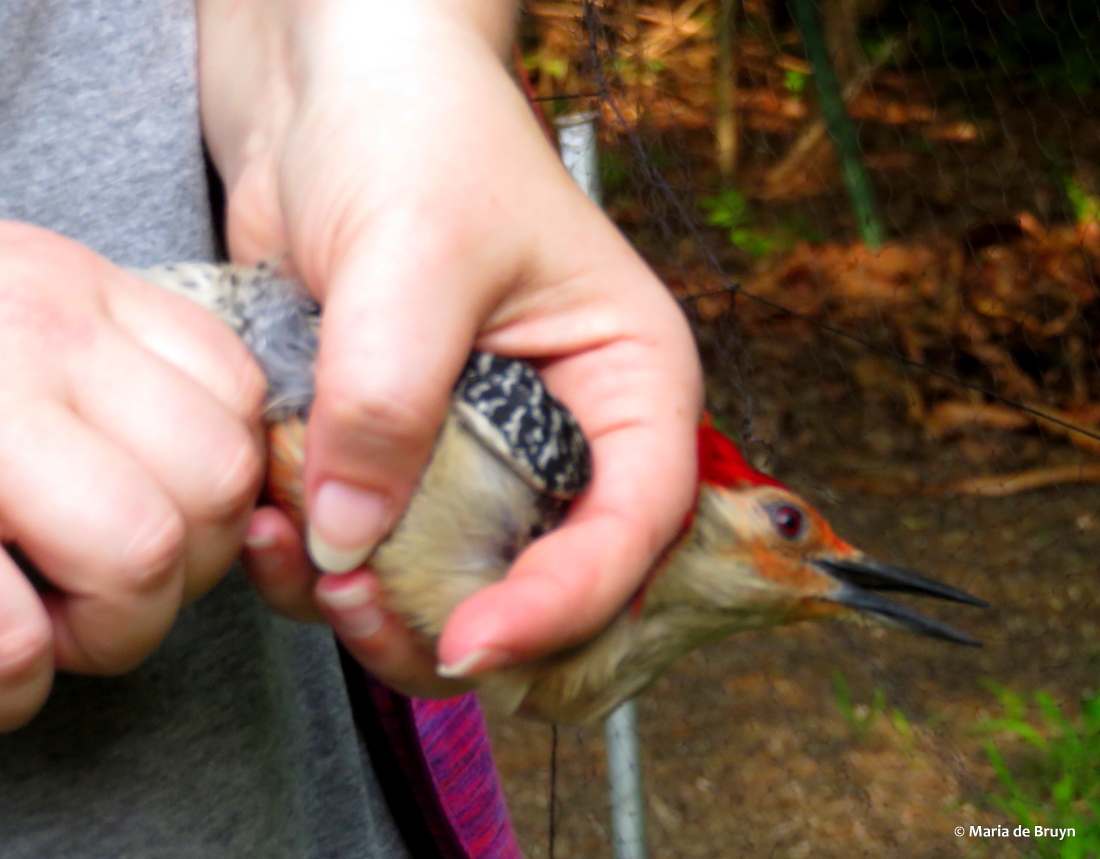
white-throated sparrow IMG_3837© Maria de Bruyn res red-bellied woodpecker IMG_3822© Maria de Bruyn res

Next up were a male cardinal and a female American robin. Like last year, the birds were measured and weighed. Although about the same length, the weight difference between the heaviest Northern cardinal we banded (41.2 oz) and the American robin was striking (79.6oz). The robin’s fondness for worms and other dietary preferences helps account for this. When I let her go, she didn’t feel very heavy in my hand as she rested a second before flying off.
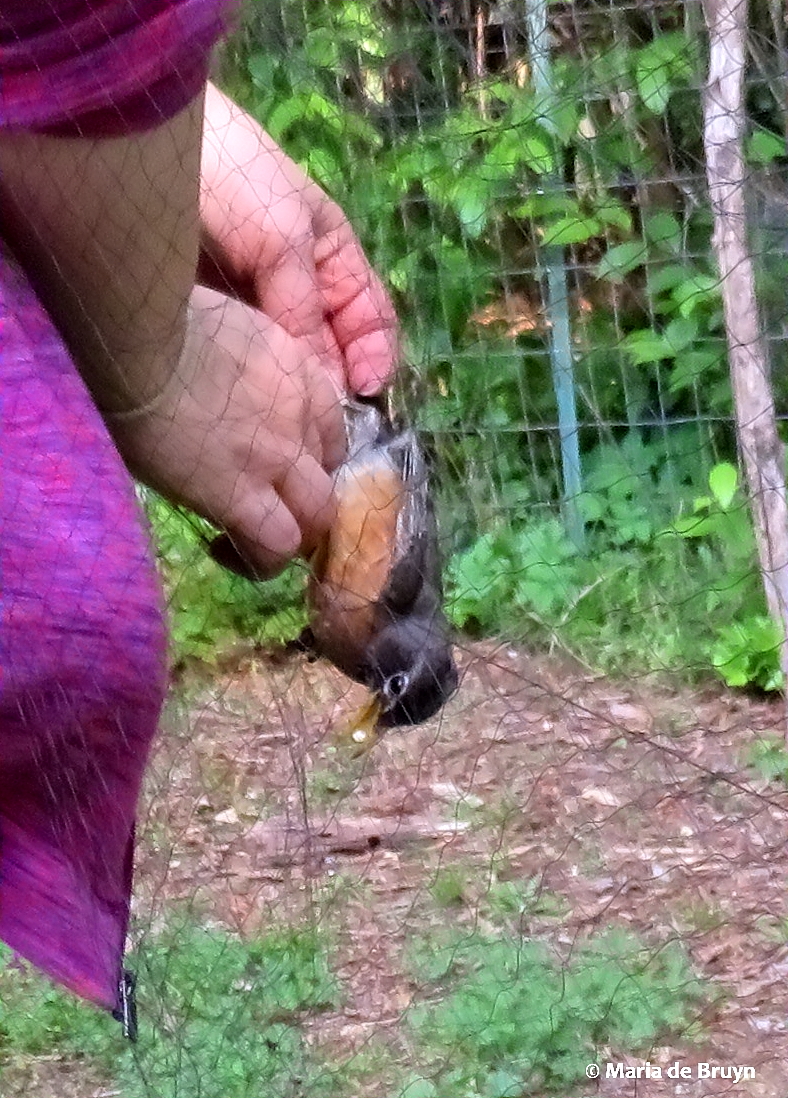
American robin Raisin IMG_3854© Maria de Bruyn

Except for birds that were molting their tail feathers, Alicia also removed the third left tail feather; this is done primarily for stable isotope analysis, which allows a researcher to estimate where the bird was when that feather was grown.
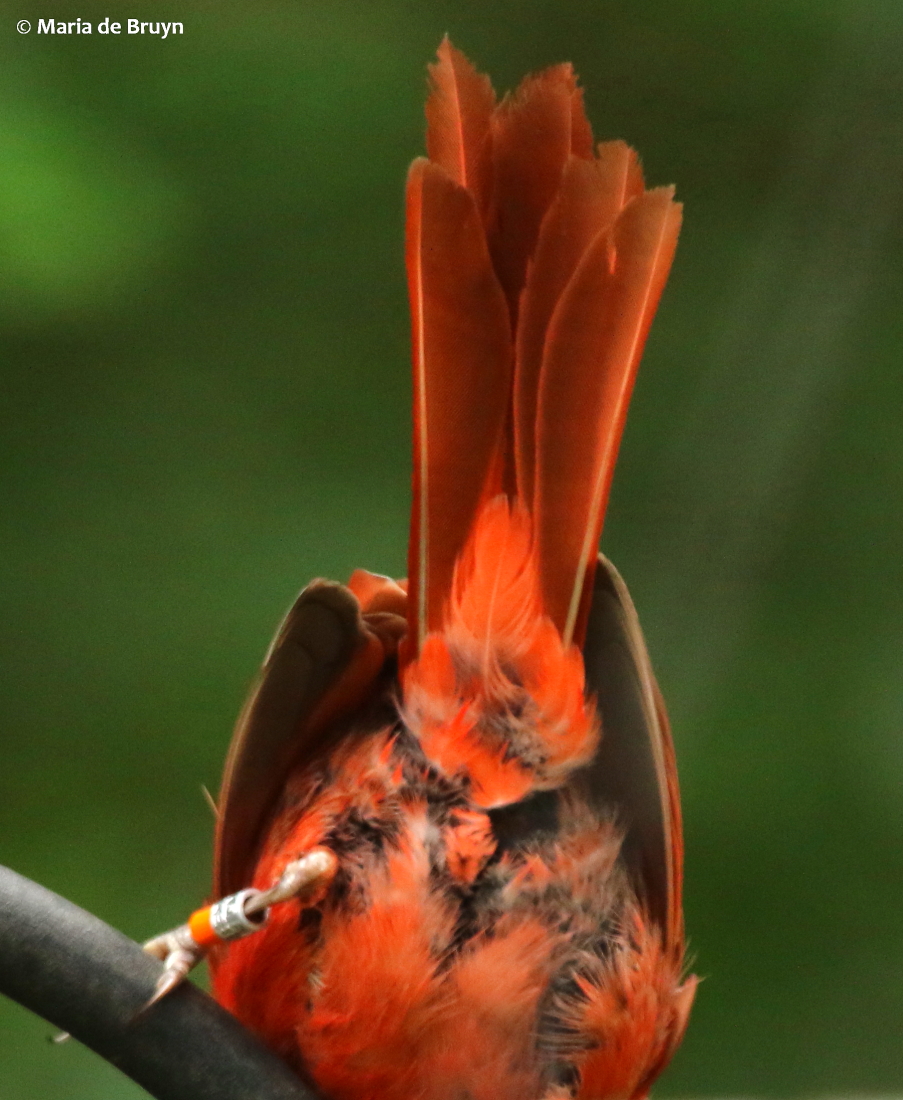
Northern cardinal Crake I77A0559© Maria de Bruyn res

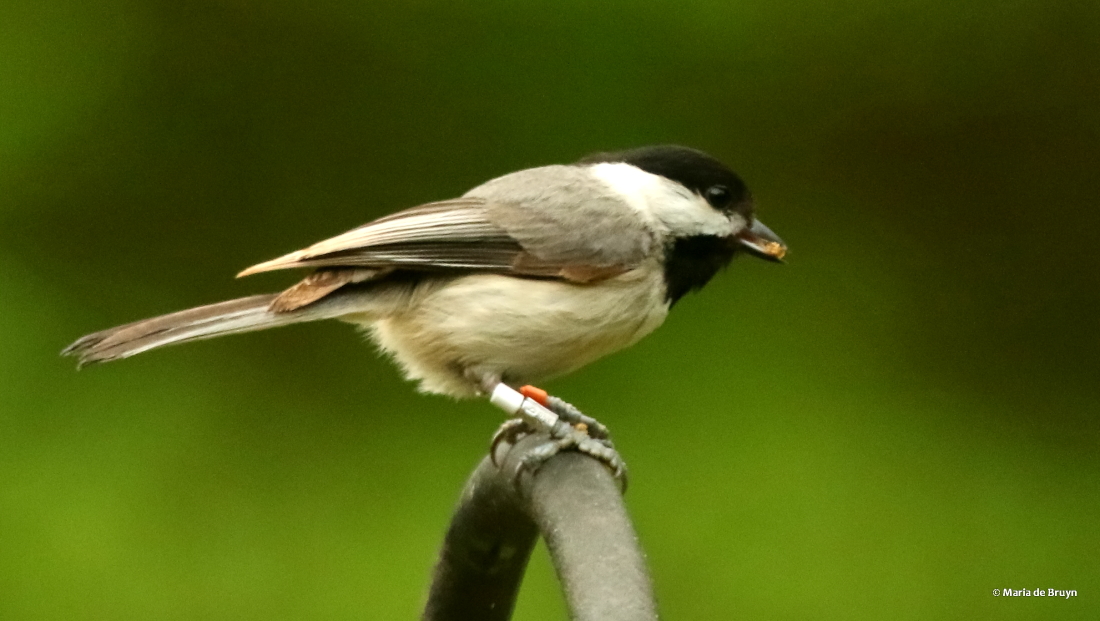
Carolina chickadee Chancey I77A7762© Maria de Bruyn resThe catbirds avoided the mist nets skillfully this year. Playback of their songs drew them to the vicinity but the two pairs visiting the feeders were more interested in chasing each other away from the territory. Alicia hoped that we could get a Carolina chickadee (Poecile carolinensis); with playback we got a male and then, 45 minutes later after banding another cardinal, we got a pair of them.
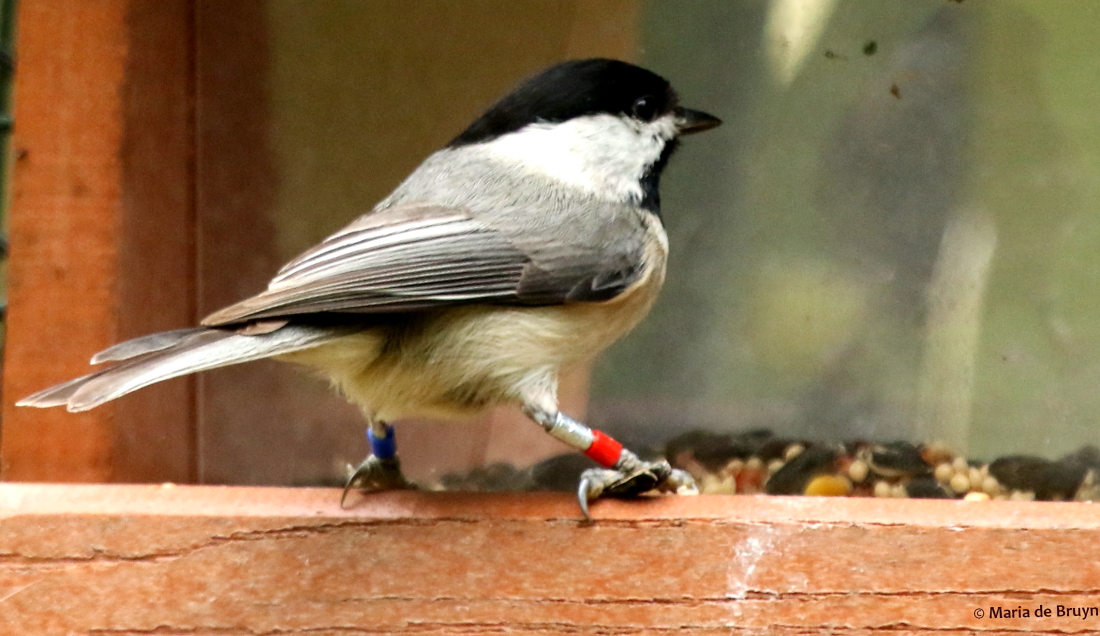
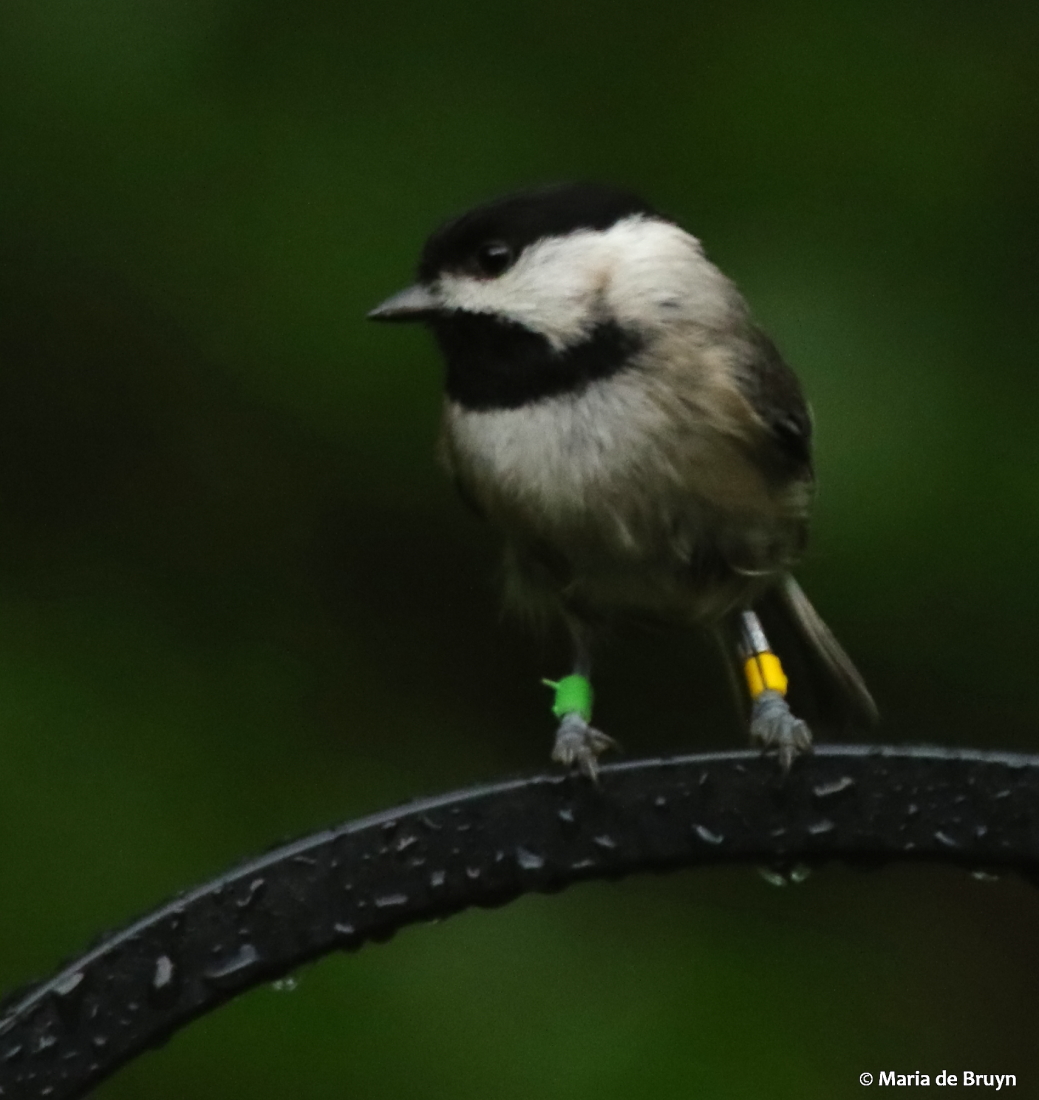
Carolina chickadee Chase I77A0348© Maria de Bruyn res Carolina chickadee Chantal I77A9525© Maria de Bruyn res

Alicia blew on the birds’ undersides (forgive the blurry photo) to assess fat reserves, which are stored along the flanks and up near the furcula by the collar bone. She could also determine sex that way and thought that one chickadee might be developing an egg – hopefully, one of the females who lost a nest to predators in my yard a week ago. The last male chickadee released was out of sorts after the experience; before leaving my hand to fly off rapidly, he turned and bit me as a parting shot.
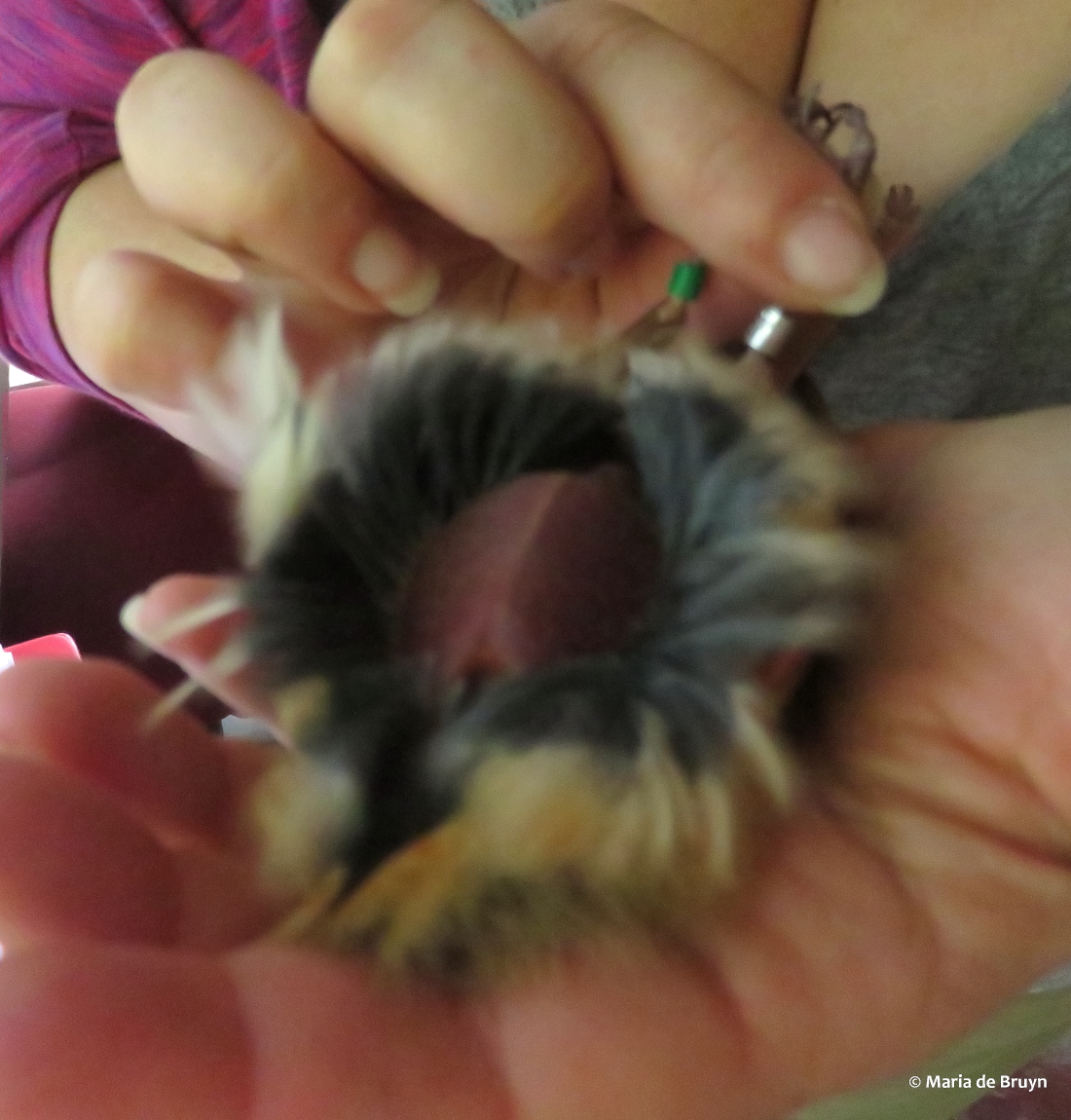
Carolina wren Renee IMG_3813© Maria de Bruyn res Carolina chickadee IMG_3856© Maria de Bruyn res

Alicia had remarked that she hoped no tufted titmouse (Baeolophus bicolor) would be caught; they are not part of the study and she said they are so feisty that their bites can be a bit painful like those of the cardinals. Unfortunately, one leaving a feeder did end up in a net and lived up to its reputation as a feisty bird. A chipping sparrow (Spizella passerina), who was the last bird in a net remained fairly calm as the net was removed from its claws.
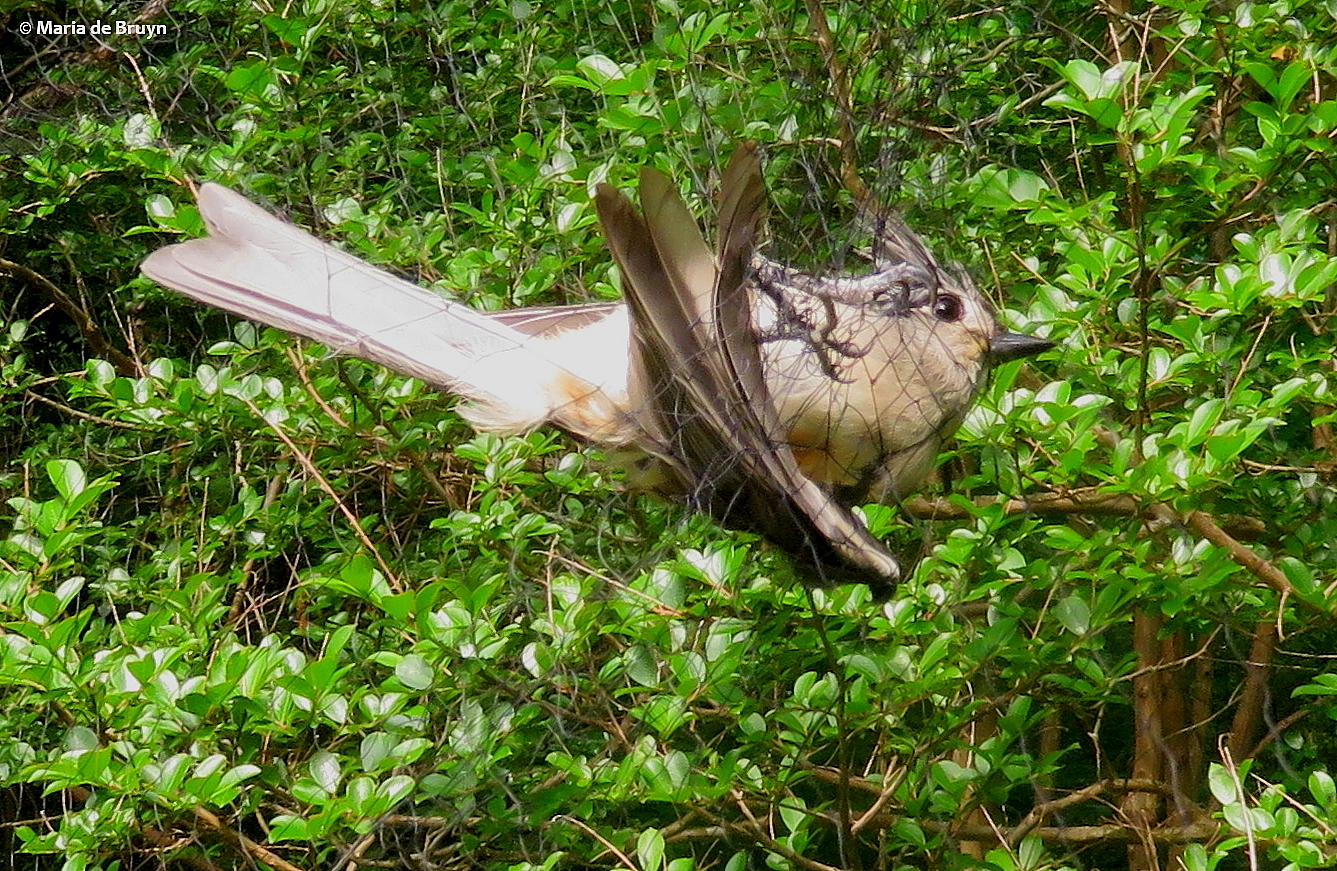
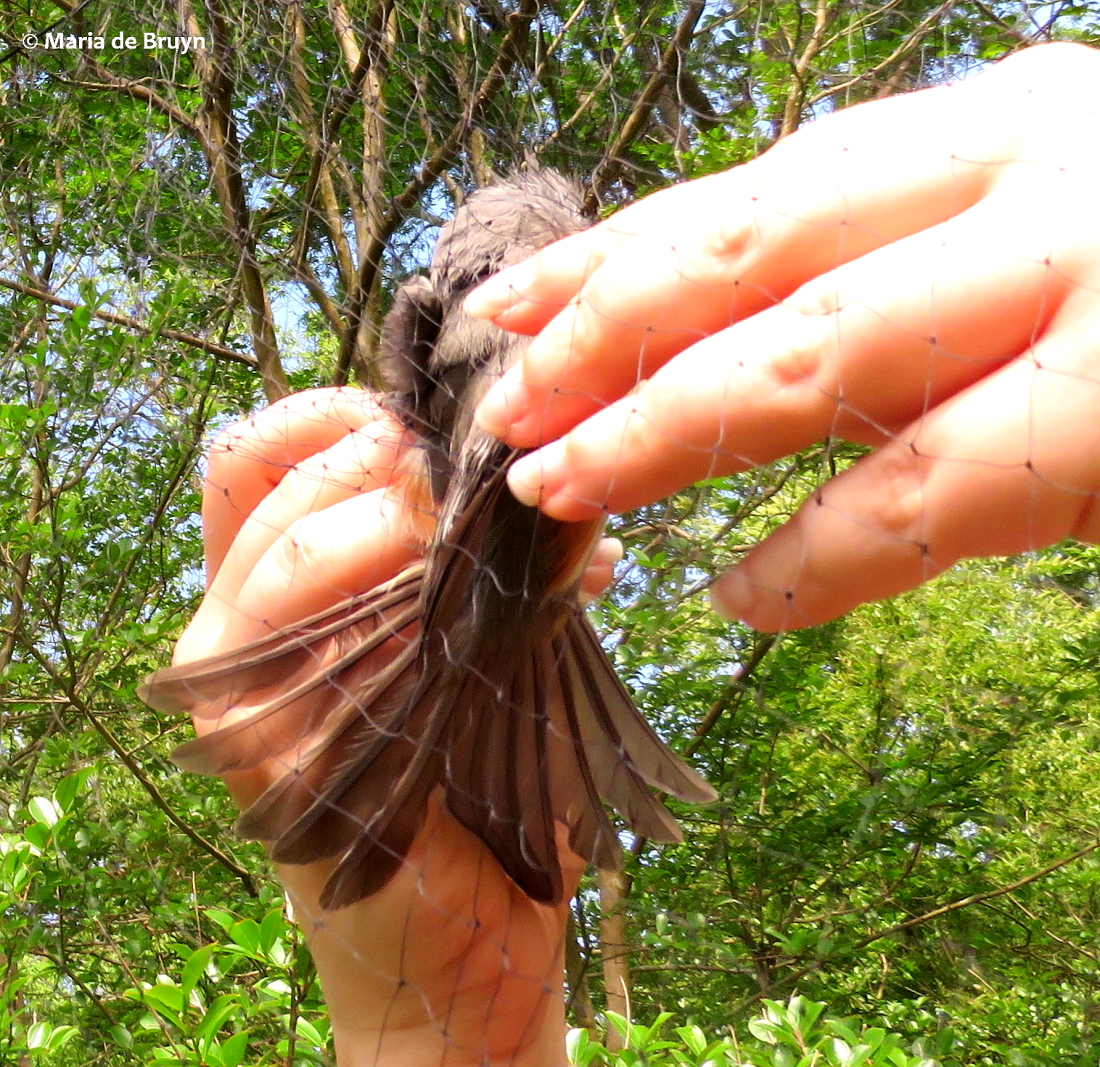
tufted titmouse IMG_3858© Maria de Bruyn res

Tufted titmouse IMG_3861© Maria de Bruyn res

Yesterday, I spent some time watching the feeders and yard to see if all the banded birds had left. Luckily, some of them showed up and were here again today. So here are a few of “my birds” with bling – this is a truly enjoyable citizen science project. 🙂
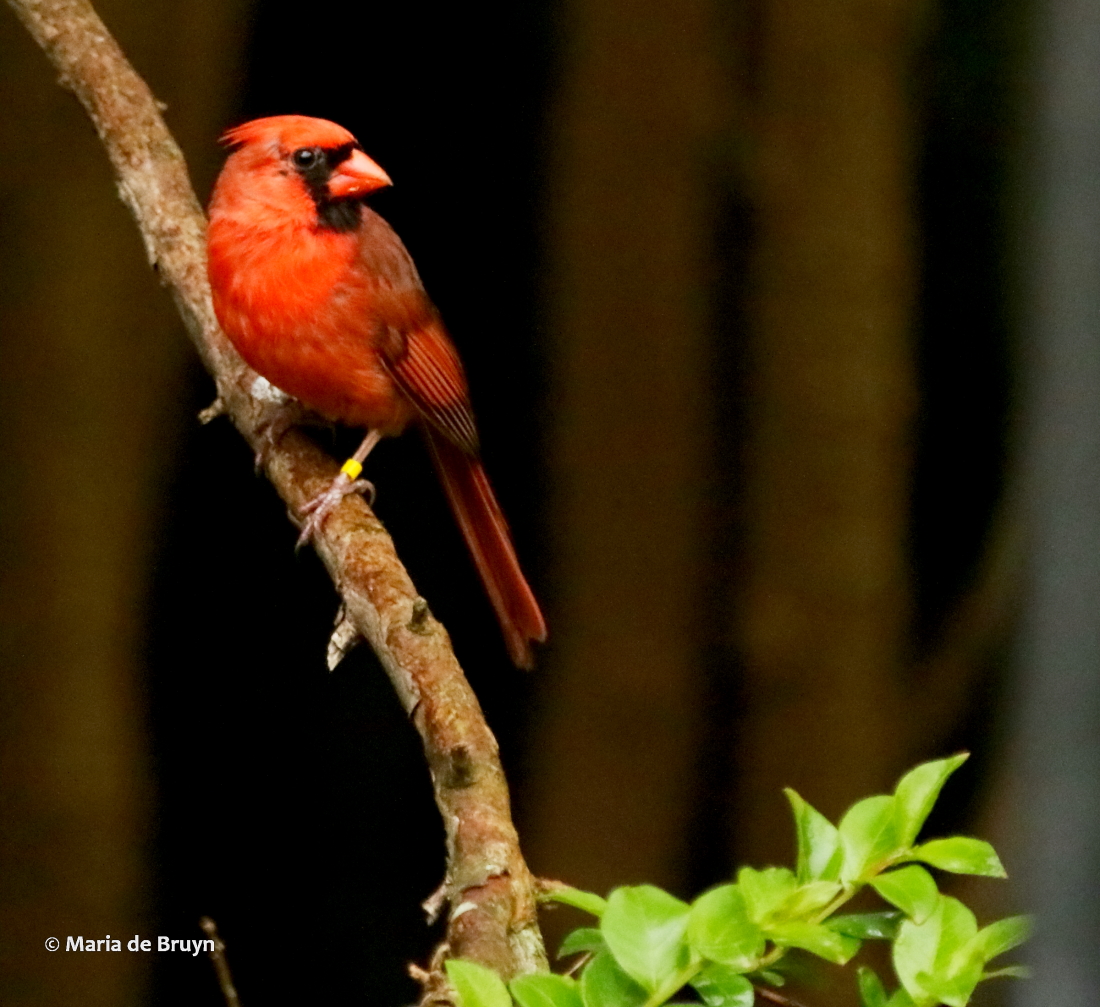
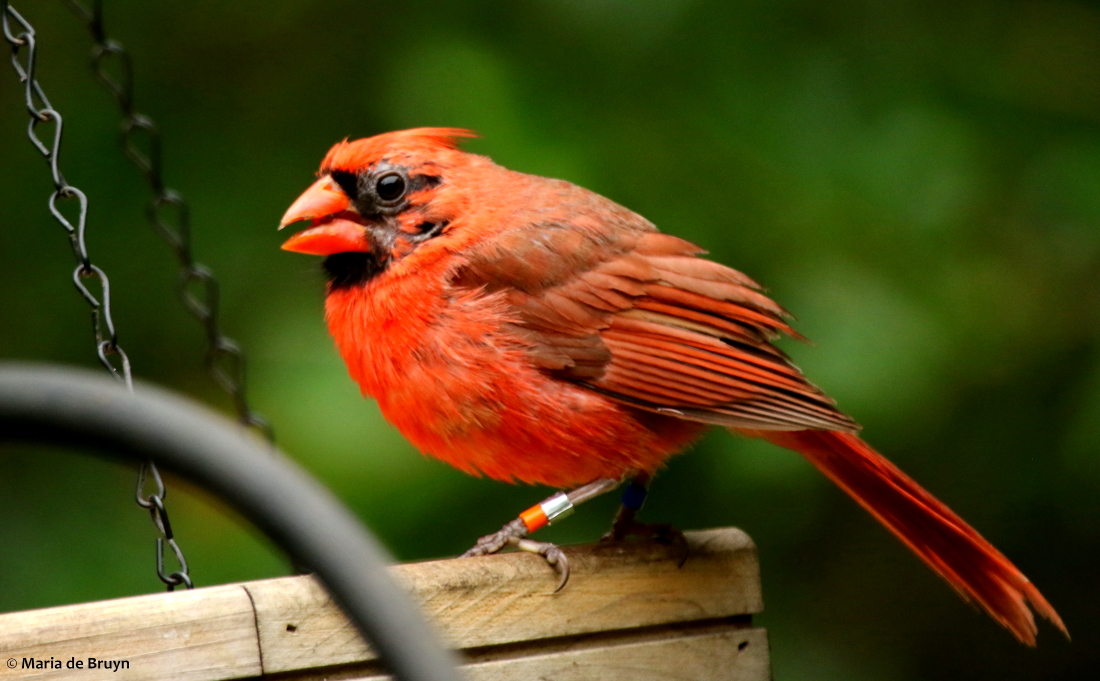
Northern cardinal Clarence I77A0124© Maria de Bruyn res Northern cardinal Crake I77A0593© Maria de Bruyn res

Clarence                                                                       Crake

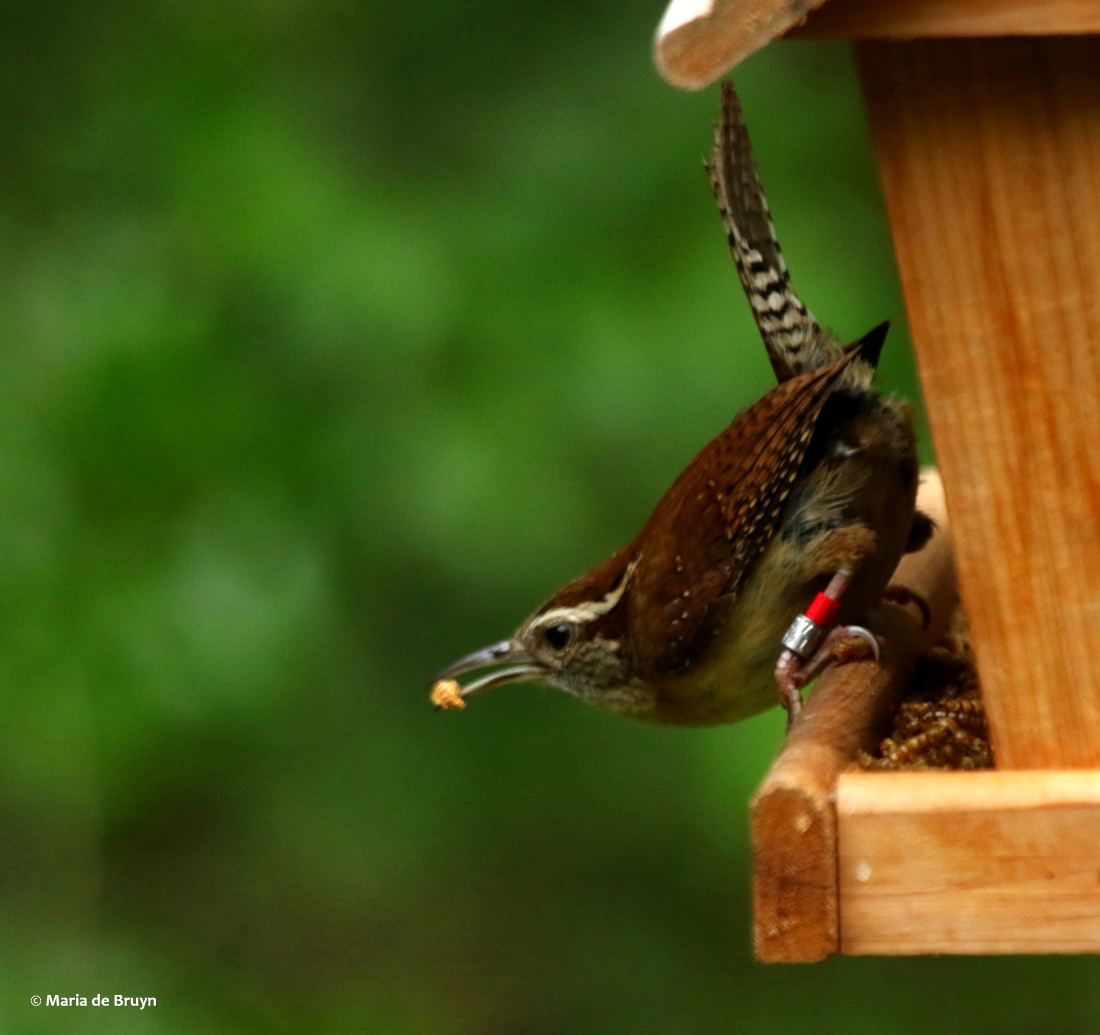
Carolina wren Renee I77A9354© Maria de Bruyn resCarolina wren Riley I77A0508© Maria de Bruyn res

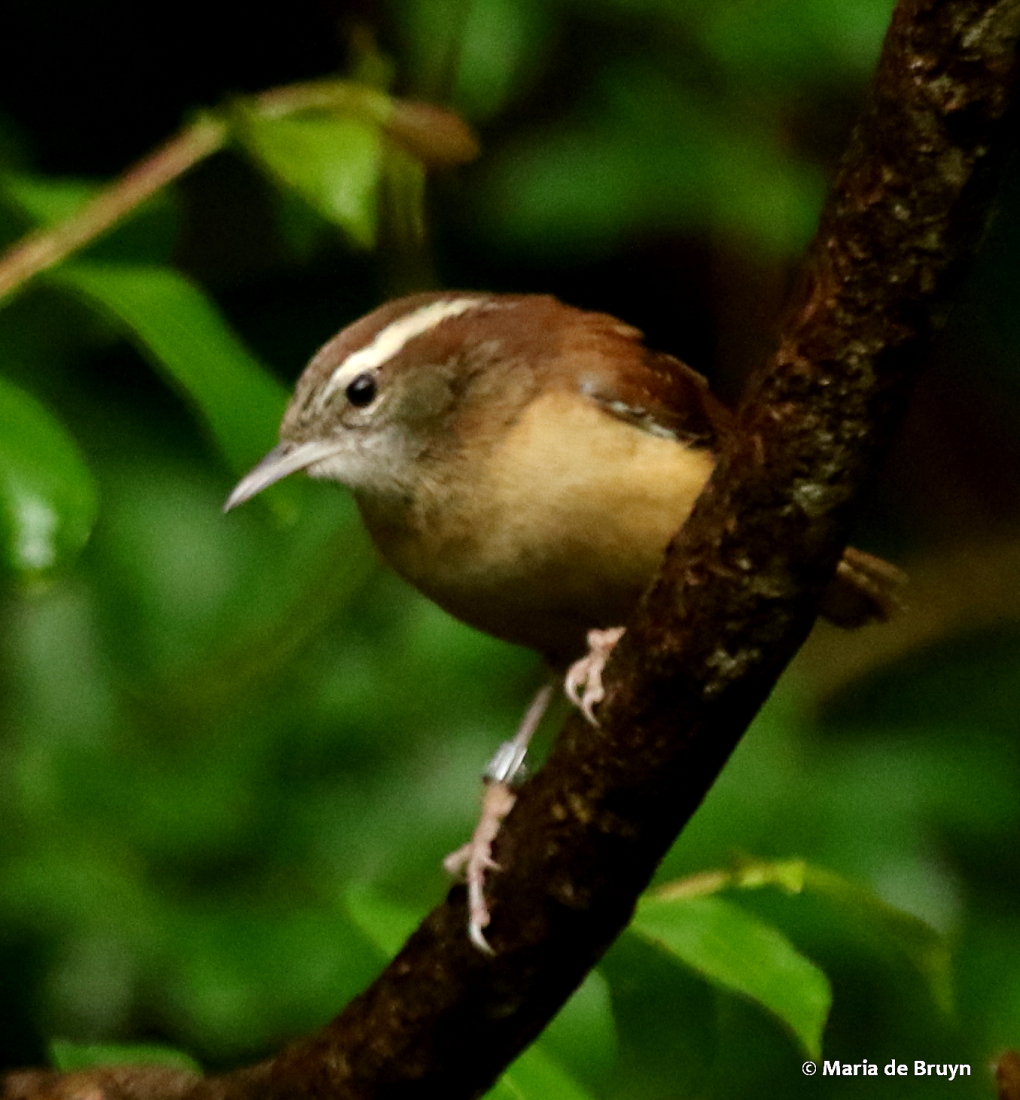
Renee and Riley Carolina wrens
 

Shades of brown at the end of winter

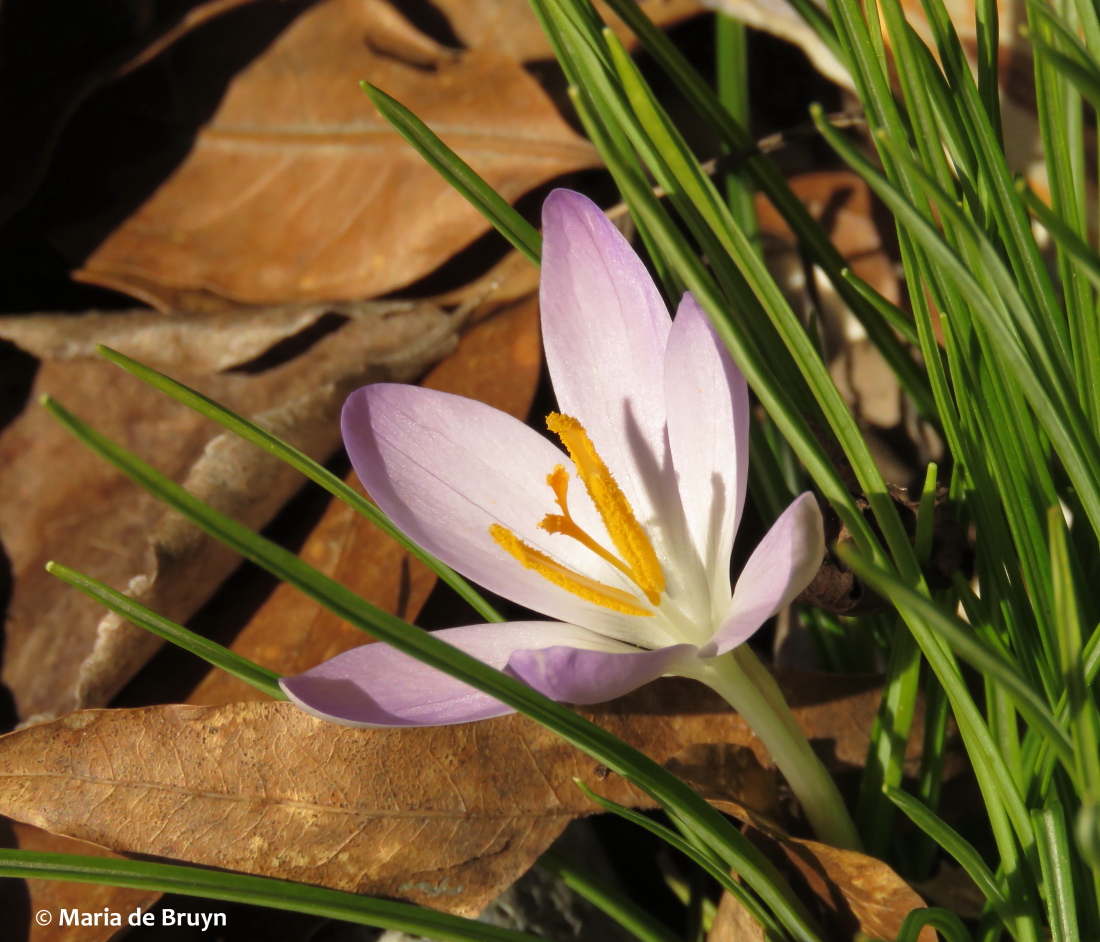
As this crocus (Crocuscrocus IMG_2199© Maria de Bruyn) shows, spring is coming to our part of North Carolina and the last days of winter have not infrequently been warm and sunny. This led me to take a break a couple weeks ago for a walk in our neighborhood woods.

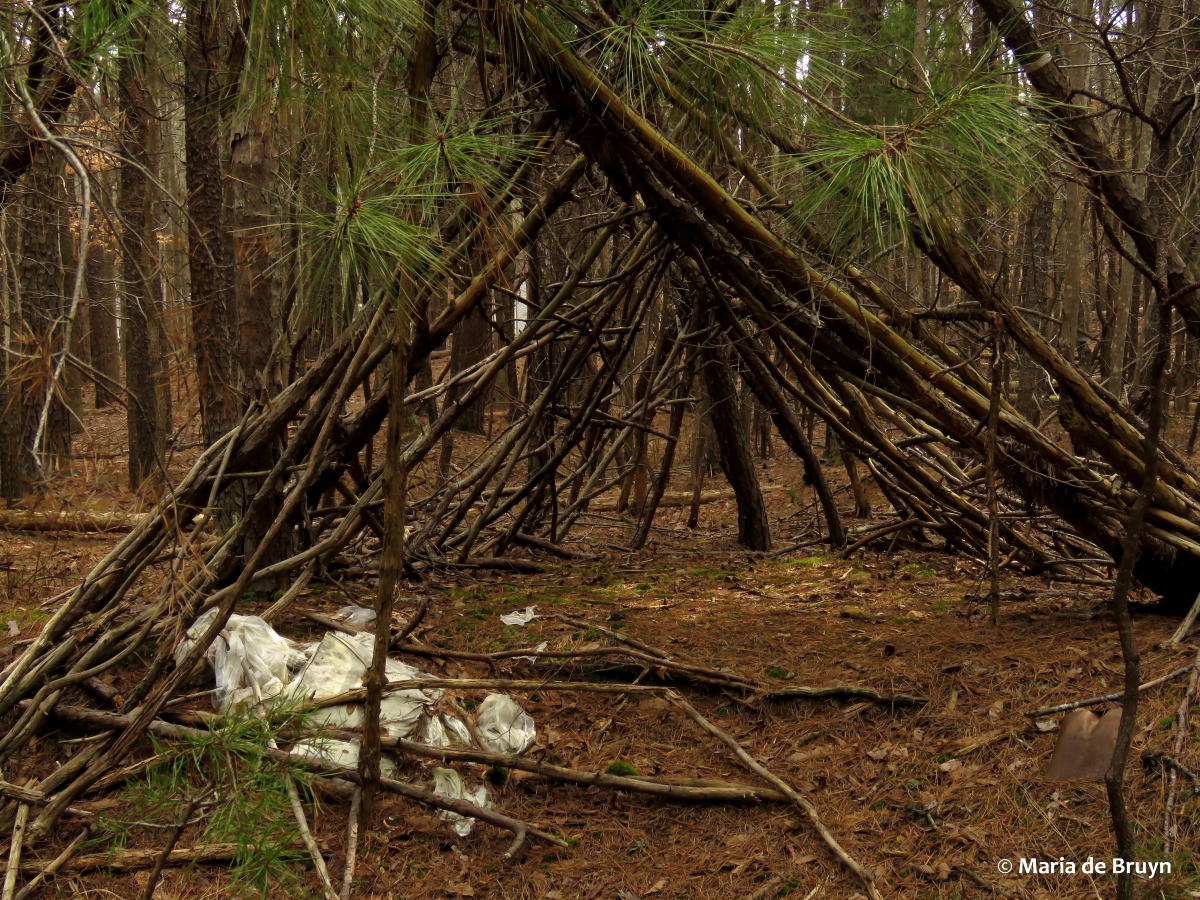
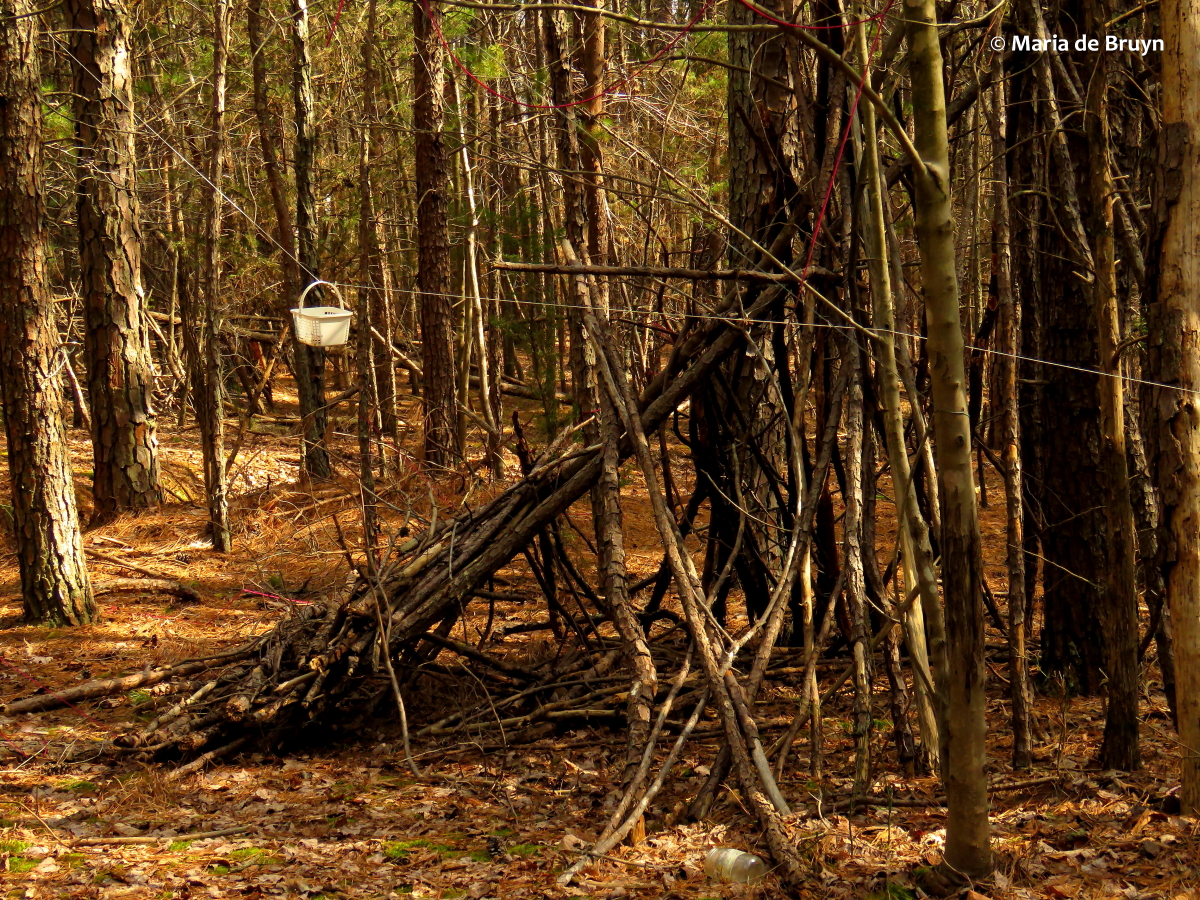
The sunlight filtered through the trees, creating lots of shadows and sunlit patches on the forest floor. I was looking to see if the natural shelters constructed by homeless people still were up and found three. None appeared to have been made or used recently.

homeless shelter IMG_2360© Maria de Bruyn res     homeless shelter IMG_2351© Maria de Bruyn res

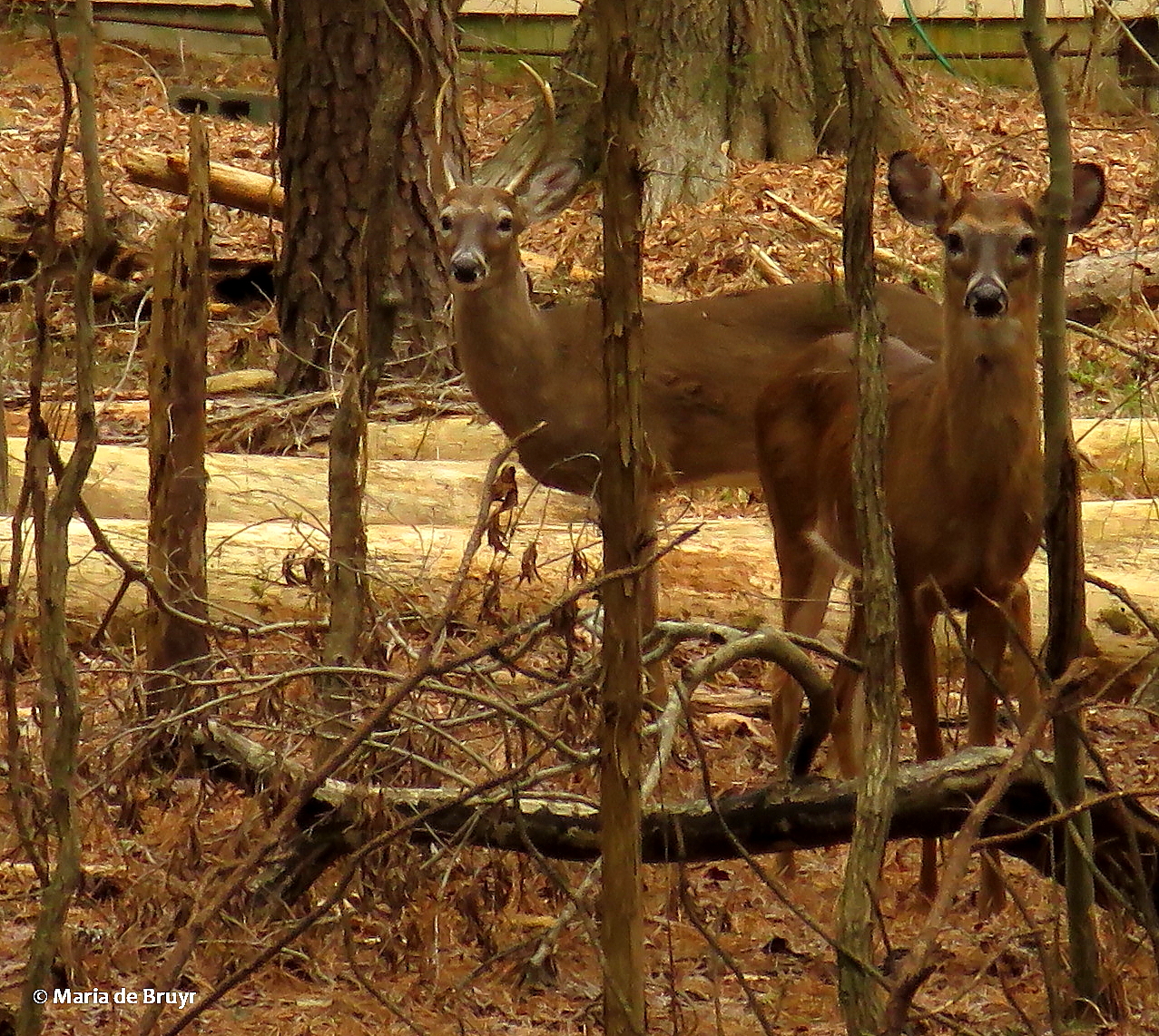
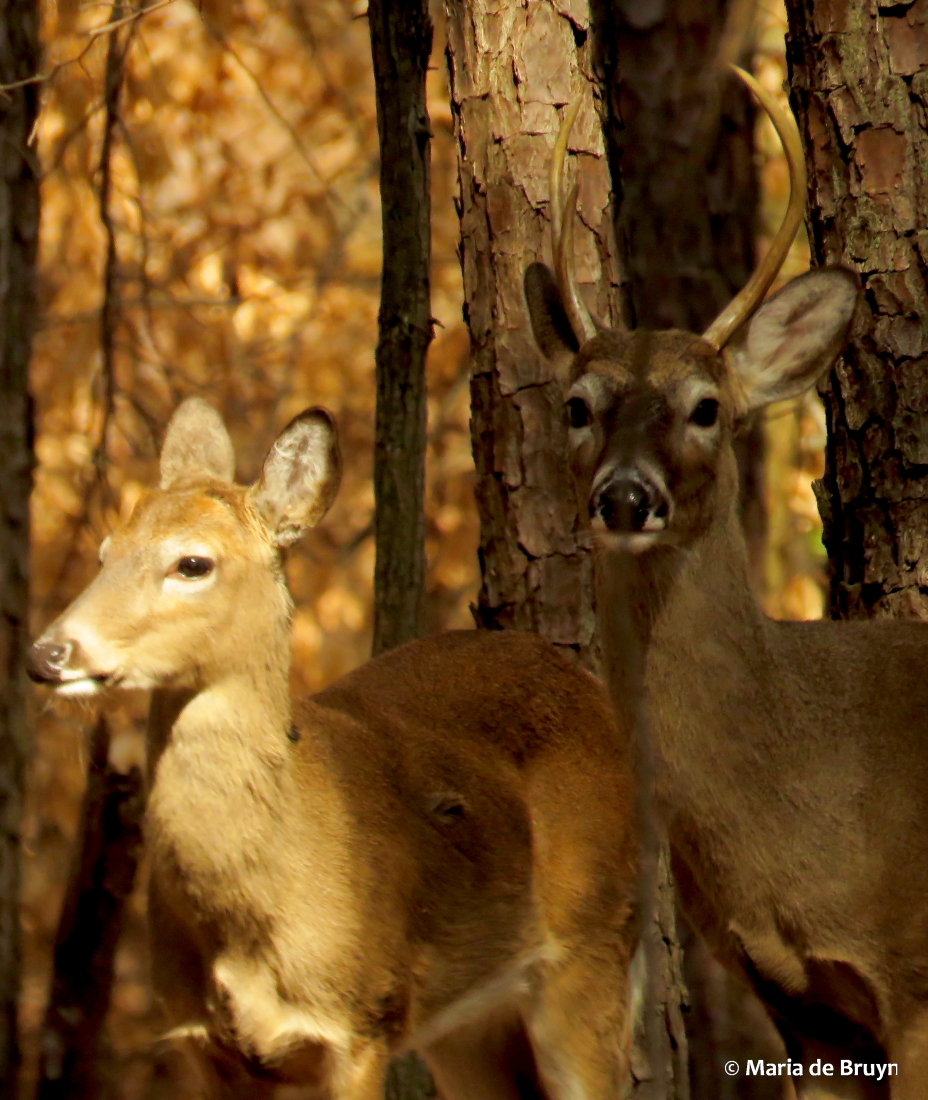
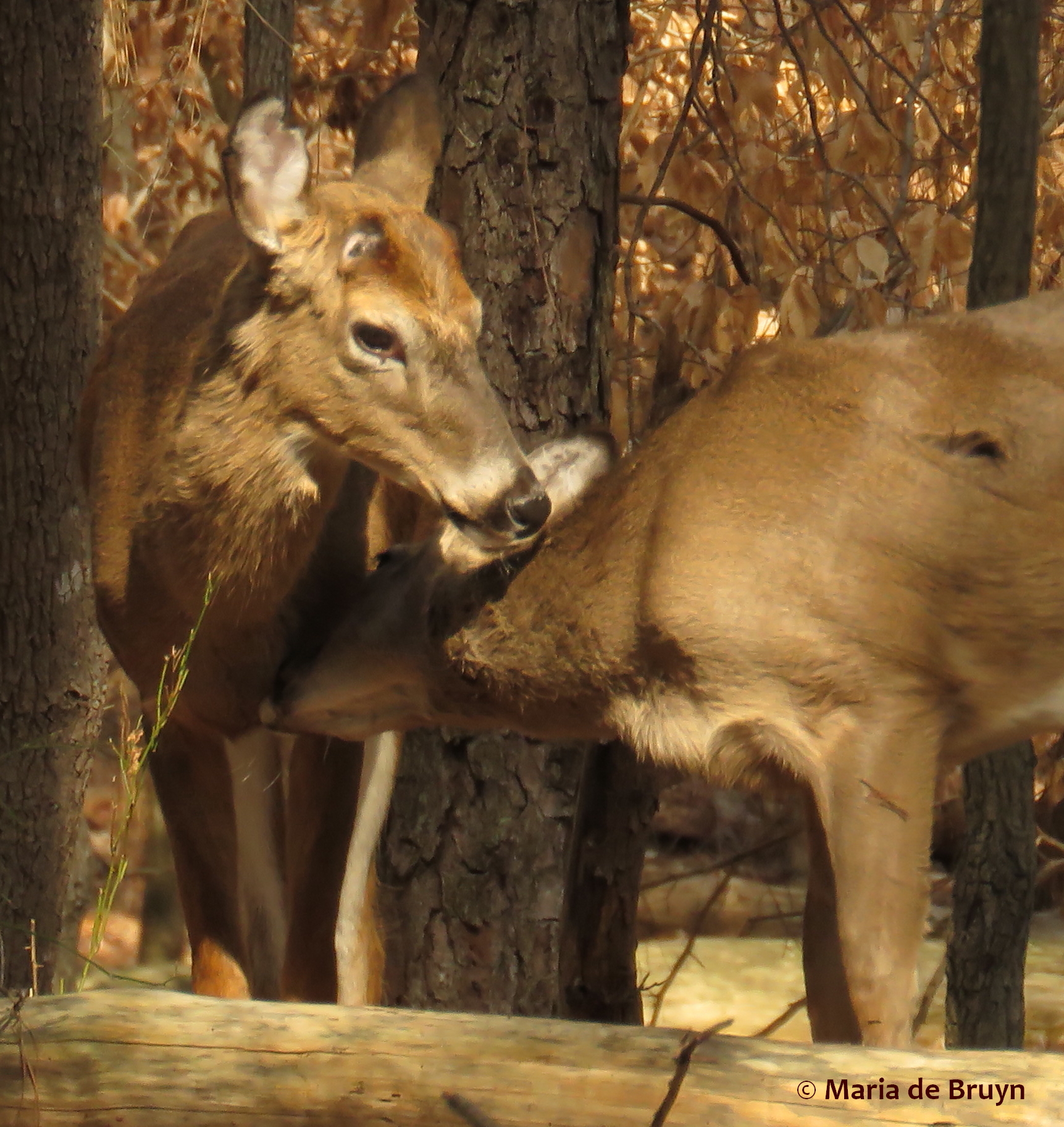
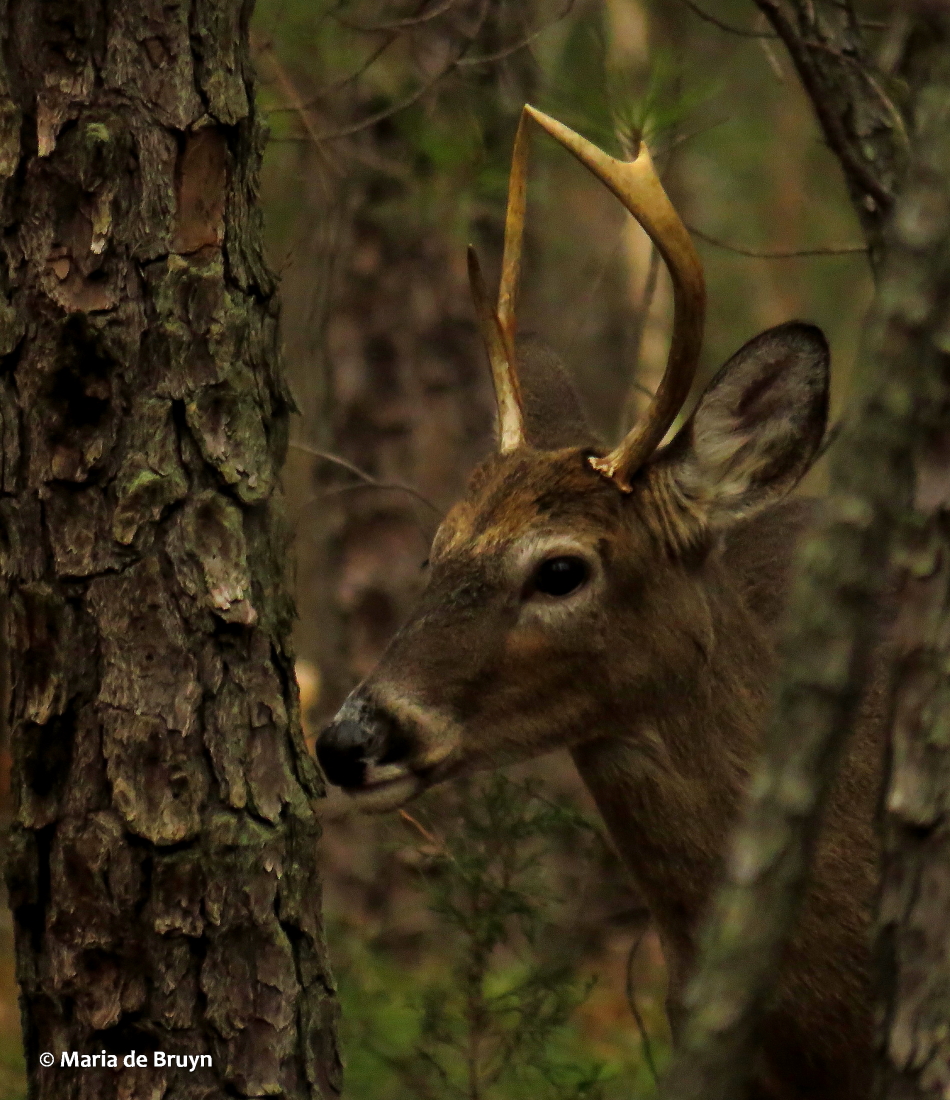
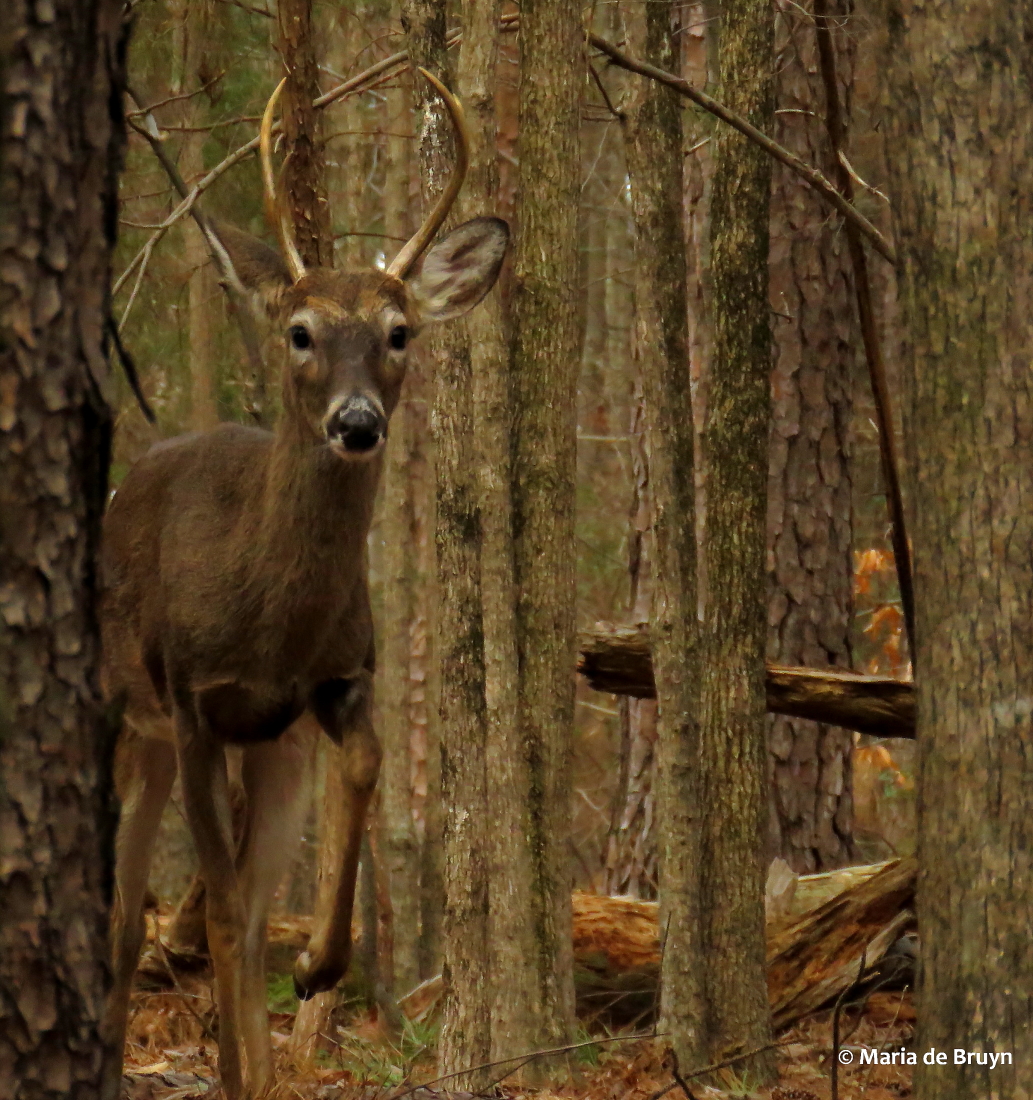
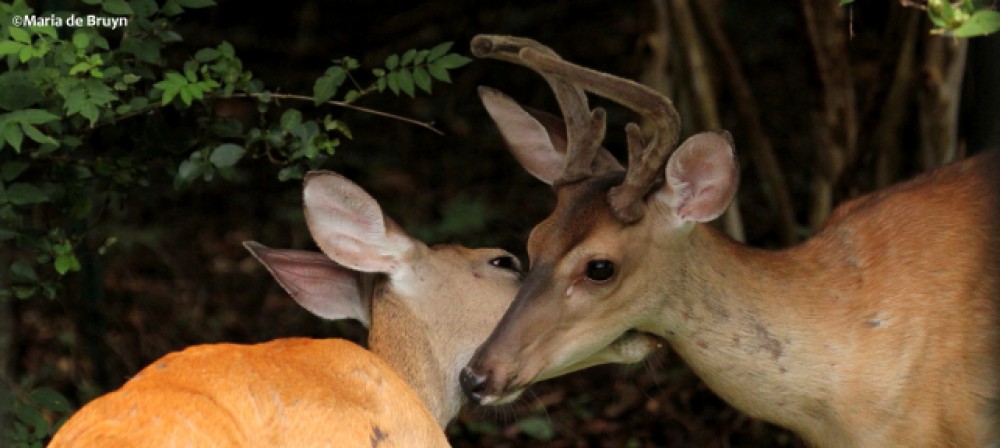
white-tailed deer IMG_2374© Maria de BruynAs I was walking around one to photograph it, my footsteps and movement rustled up some other neighborhood residents, who had been taking a rest at the edge of the woods. Four white-tailed deer (Odocoileus virginianus) got to their feet and gave me some looks of irritation at having disturbed their R&R.

As I walked another way, they began keeping pace with me at a distance. I thought they would just choose another patch to lie in but, for some reason, they decided to see where I was going. At first, I thought it was a buck and some does.

white-tailed deer IMG_2440© Maria de Bruynwhite-tailed deer IMG_2413© Maria de Bruyn


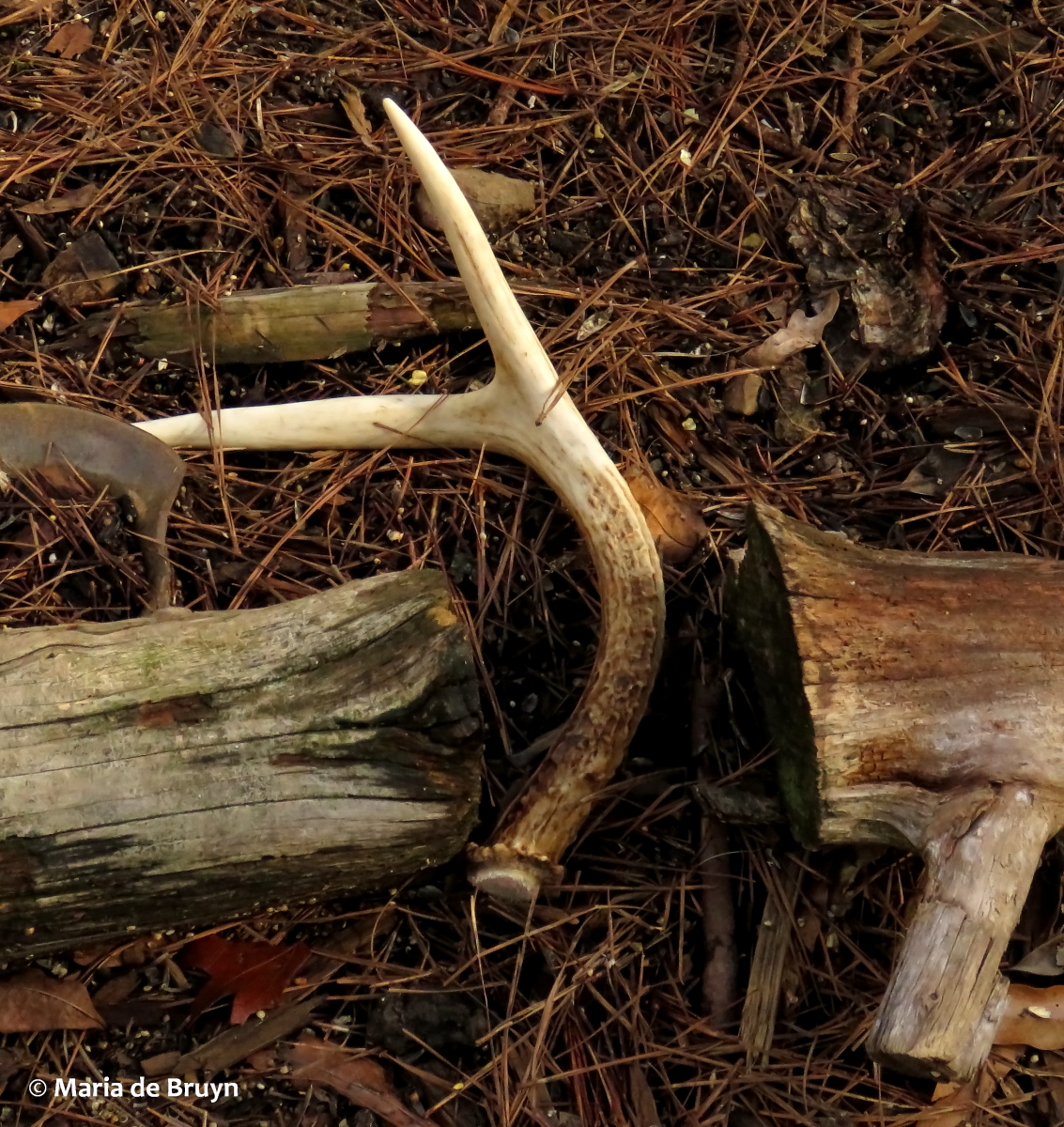
deer antler IMG_1211© Maria de Bruyn resLater, I realized it was a group of bucks, some of whom had already shed their antlers. I kept a lookout for antlers but didn’t see any. However, one local buck had gifted me with one in my front yard recently.

For some odd reason, I rarely see or hear birds in this particular woodsy area, but that day I encountered a Carolina chickadee (Poecile carolinensis) singing away.

Carolina chickadee IMG_2469© Maria de Bruyn


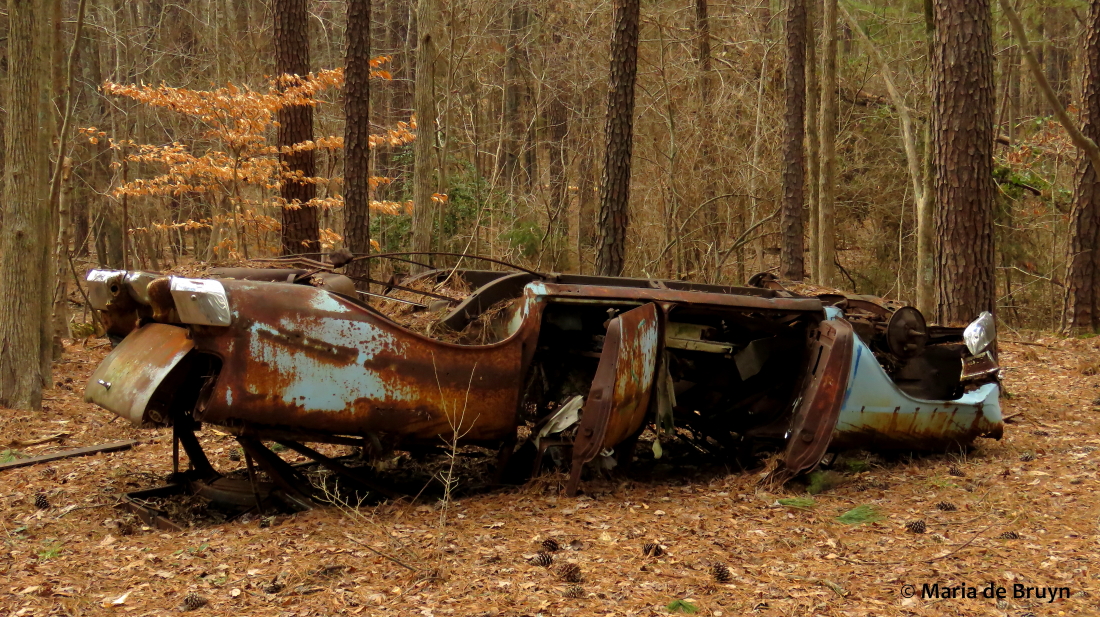
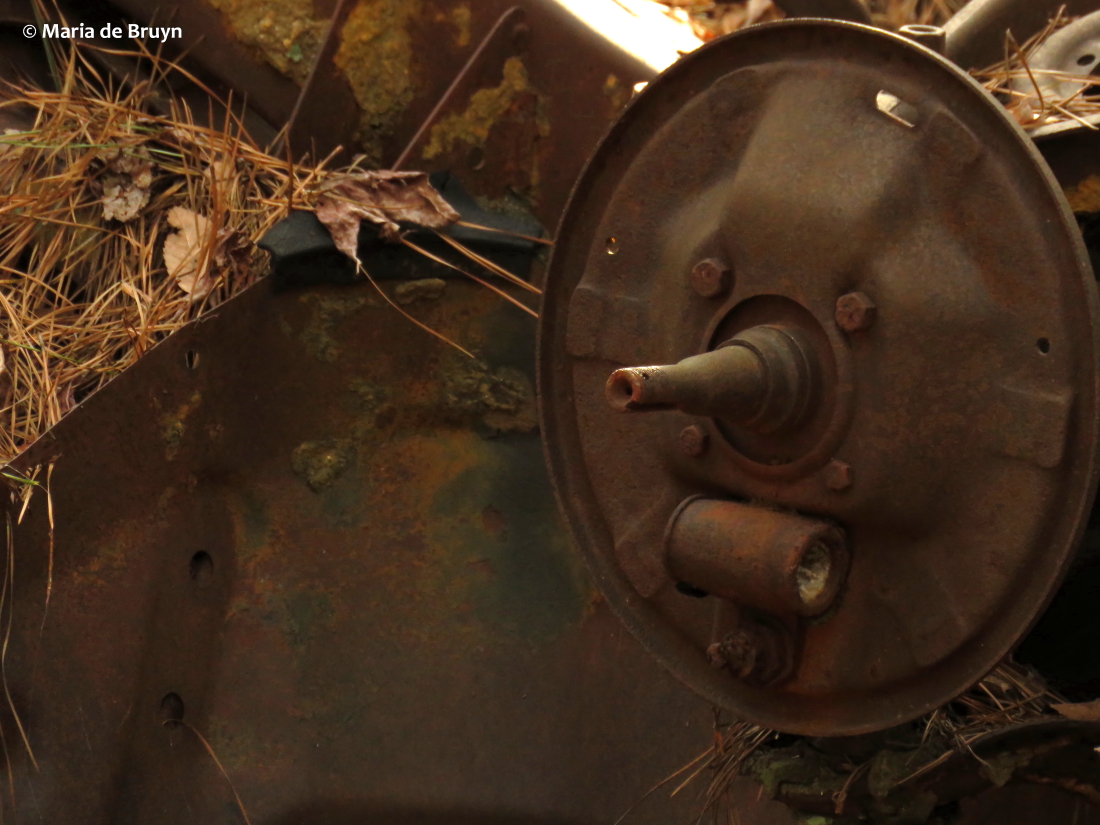
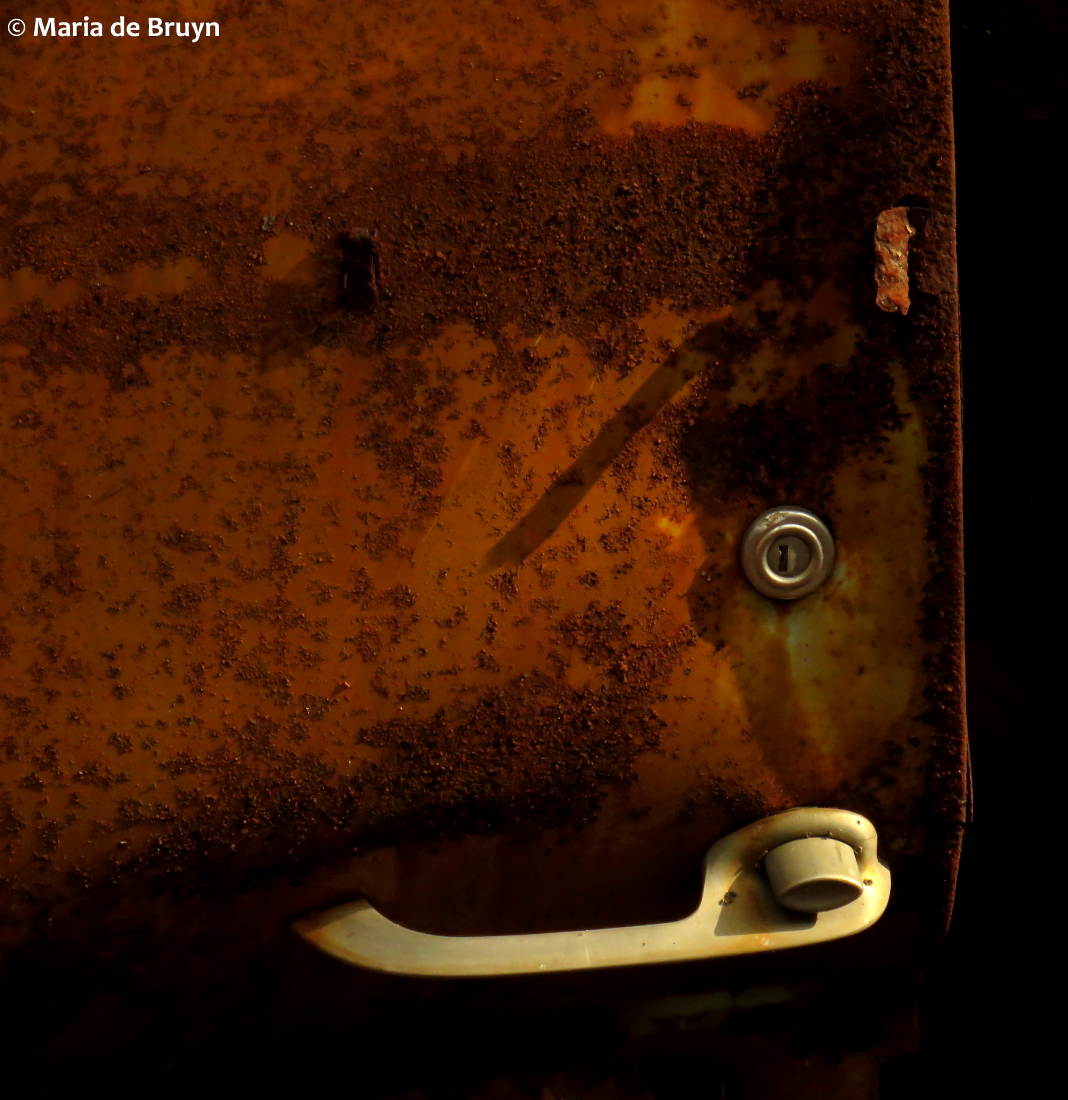
My next stop was to see how the two abandoned cars in these woods were faring. They must have been left here decades ago and have been like evolving metal sculptures as the scouring winds, sun, rain and ice change their appearance.


car IMG_2525 © Maria de Bruyn

car IMG_2558© Maria de Bruyn RES  car IMG_2582© Maria de Bruyn

white-tailed deer IMG_2496 © Maria de BruynAs I was taking photos of the cars, I heard movement behind me and there was the group of deer, still keeping tabs on me. The big male who still had antlers stamped his foot to warn me off, even though I hadn’t turned in their direction. Given his wariness, I certainly wasn’t going to go charging up to them for close-ups!white-tailed deer IMG_2489© Maria de Bruyn

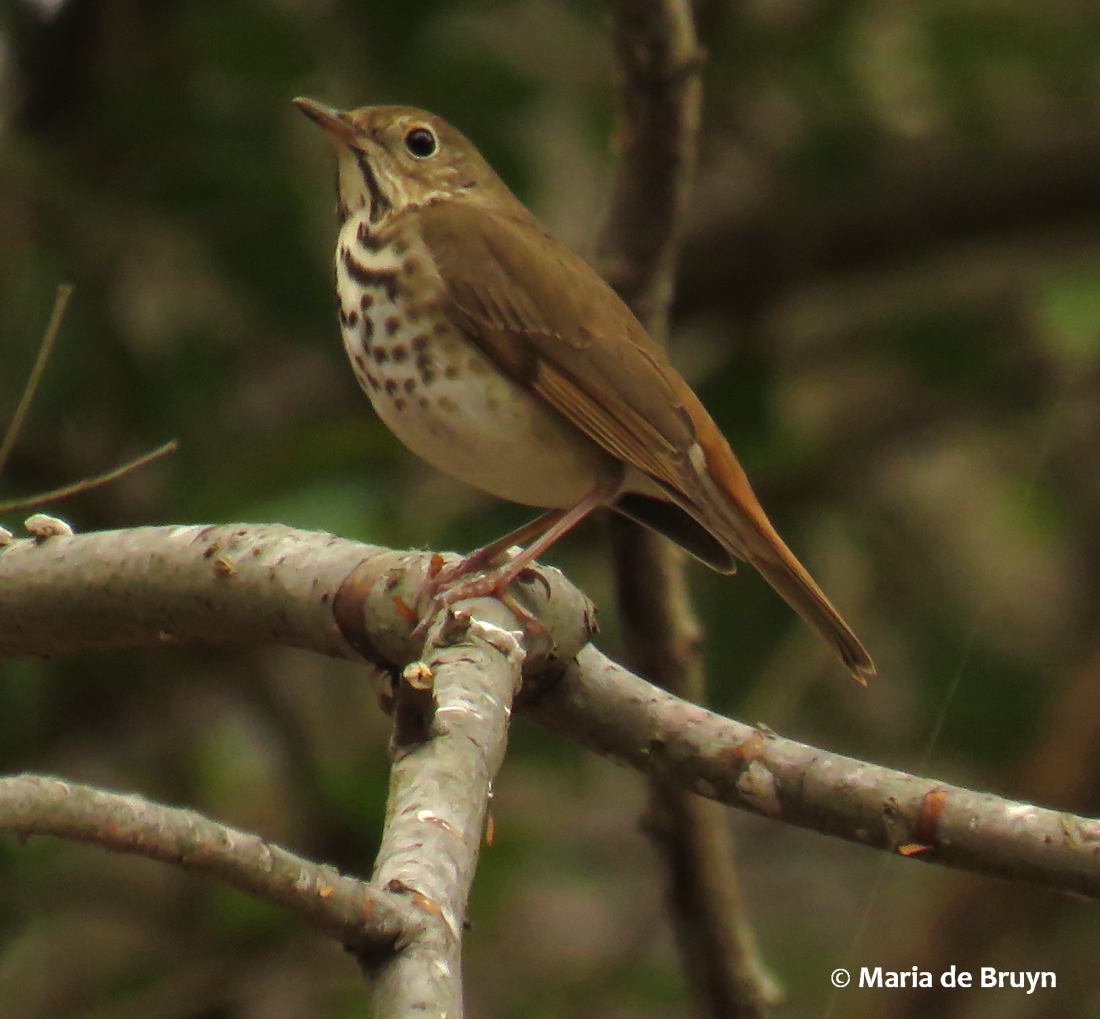
hermit thrush IMG_2614© Maria de Bruyn


My walk ended with some surprising good views of a hermit thrush (Catharus guttatus). They rarely come to my yard so it was lovely to see one in the woods that day. They will likely be migrating soon and we will have new birds to welcome as spring arrives in her full glory. It was a very pleasant winter walk!

Winter mornings at Jordan Lake

Mist on the lake I77A5266© Maria de BruynSpending two cold early mornings at Jordan Lake the past couple weeks reinforced my conviction that getting out into nature is a restorative and calming activity. And it doesn’t need to be warm. Although a doctor pronounced me healed after my recent hospitalization and home treatment, it turns out that I’m not completely healthy after all. Starting a new treatment was a bit stressful, but seeing the birds at the lake was a joy.

snag I77A6203© Maria de Bruyn res

Mind you, I’d love to see other wildlife there, but the mammals, reptiles and amphibians have been hiding out or keeping away from areas frequented by people. The fact that it is still hunting season probably makes some of them somewhat shy, too. I did manage to see a fly on one morning though.

fly I77A2979© Maria de Bruyn

The animals do leave behind signs of their presence, however. Tracks in the sand is one give-away that they passed by.

animal tracks I77A2998© Maria de Bruyn res

The beavers (Castor canadensis) leave behind distinctively gnawed tree stumps – and here you can also see one tree that they haven’t quite finished felling yet.

beaver tree I77A2933© Maria de Bruyn res beaver tree I77A2950© Maria de Bruyn res

The shoreline vegetation was decorated with gull feathers in various areas of the lake.

bird feather I77A2711© Maria de Bruyn res bird feather I77A2697© Maria de Bruyn res

heron track I77A2924© Maria de Bruyn res


A sandy track of what I assumed was a great blue heron (Ardea herodias) didn’t produce a bird at that site, but I saw these beauties in flight at two other sites.


great blue heron I77A3926© Maria de Bruyn res

great blue heron I77A2558© Maria de Bruyn res

At one area, I spotted a bird that seemed unfamiliar just as it was turning to take off. Friendly birders online identified it as an American pipit (Anthus rubescens), the first time I had seen this species (known as a “lifer” among the birding crowd). The next week I saw a killdeer (Charadrius vociferous) in the same spot but got a better shot.

American pipit I77A2526© Maria de Bruynkilldeer I77A5908© Maria de Bruyn

The killdeer didn’t hang around too long either, but I was able to get a couple of nice flight photos this time.

killdeer I77A5933© Maria de Bruyn res killdeer I77A5931© Maria de Bruyn res

American crow I77A2810© Maria de Bruyn res


The American crows (Corvus brachyrhynchos) were foraging in the shoreline woods, while the song sparrow was looking for food among the woody detritus left at lakeside.


song sparrow I77A5877© Maria de Bruyn res song sparrow I77A5866© Maria de Bruyn res

In another place, the crows were very loudly making their presence known – it turned out that a red-tailed hawk (Buteo jamaicensis) was perched nearby and they were making sure everyone knew the hawk was there.

red-tailed hawk I77A3850© Maria de Bruyn resAmerican crow I77A3878© Maria de Bruyn res

In the trees near the lake, various birds could be seen: the ruby-crowned kinglet (Regulus calendula) was very busy as usual, flying from a sweet gum (Liquidambar styraciflua) to other trees in rapid succession.

ruby-crowned kinglet I77A5662© Maria de Bruyn ruby-crowned kinglet I77A6049© Maria de Bruyn

At one site, there were many dark-eyed juncos foraging on the ground and taking pauses in the trees and shrubs around. Juncos are actually a type of sparrow and a group of sparrows is known by several names: a crew, a flutter, a meinie, a quarrel and an ubiquity.

dark-eyed junco I77A2838© Maria de Bruyn dark-eyed junco I77A2379© Maria de Bruyn

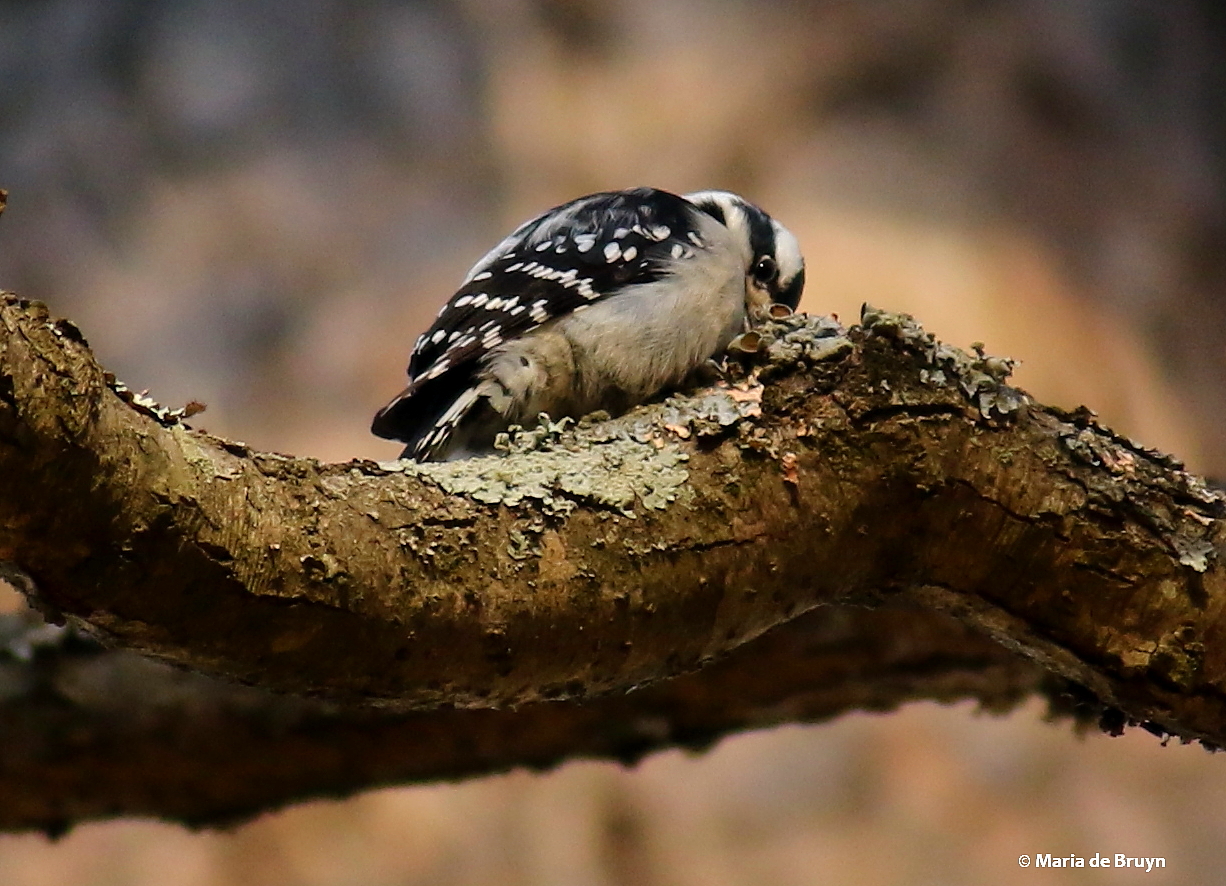
The downy woodpeckers (Dryobates pubescens) and red-bellied woodpeckers (Melanerpes carolinus) were in evidence at various lake sites.

downy woodpecker I77A2504© Maria de Bruyn resRed-bellied woodpecker I77A5384© Maria de Bruyn res

Overhead, the double-crested cormorants (Phalacrocorax auritus) flew by; they would land and share space with the ring-billed gulls (Larus delawarensis).


double-crested cormorant I77A2731© Maria de Bruyn resring-billed gull I77A3558© Maria de Bruyn res

ring-billed gull I77A2389© Maria de Bruyn res


The ring-billed gulls were numerous and occasionally one swooped down to fish not too far from shore.

ring-billed gull I77A5489© Maria de Bruyn resring-billed gull I77A5497© Maria de Bruyn res

While I was watching, the horned grebes (Odiceps auritus) were more successful in getting meals as they dove into the cold water.

Horned grebe I77A3662© Maria de Bruynhorned grebe I77A3094© Maria de Bruyn

belted kingfisher I77A4014© Maria de BruynA couple times I was very surprised by a bird that suddenly seemed to emerge out of nowhere to fly over my head or just in front of me. That was the case with a beautiful male wood duck (Aix sponsa) and a belted kingfisher (Megaceryle alcyon).


wood duck I77A3719© Maria de Bruyn res wood duck I77A3718© Maria de Bruyn res

bald eagle I77A3030© Maria de BruynAn adult bald eagle (Haliaeetus leucocephalus) soared by just as I was approaching an observation platform in one area; the distance and height were considerable but I managed a shot. A Bonaparte’s gull (Chroicocephalus philadelphia) flew by a little lower, while a Carolina chickadee (Poecile carolinensis) sat still for a portrait.


Bonaparte's gull I77A3962© Maria de Bruyn


Carolina chickadee I77A5806© Maria de Bruyn res

My last avian companions during my latest lake walk were a white-throated sparrow (Zonotrichia albicollis) and a lovely hermit thrush (Catharus guttatus).

white-throated sparrow I77A6115© Maria de Bruynhermit thrush I77A6165© Maria de Bruyn

I returned home on both occasions a satisfied birder!


Woodpecker welcome!

My celebration for the arrival of 2016 happened on 21 January, when I had my first nature walk of the year. It was delayed by a hospitalization at the start of the year and home treatments for a couple weeks after that. When a relatively warm and sunny day arrived, I just had to get out there despite still dealing with some recovery-related issues. I chose the North Carolina Botanical Garden as my venue since it has plenty of benches for short rests in between walking. It was simply lovely.

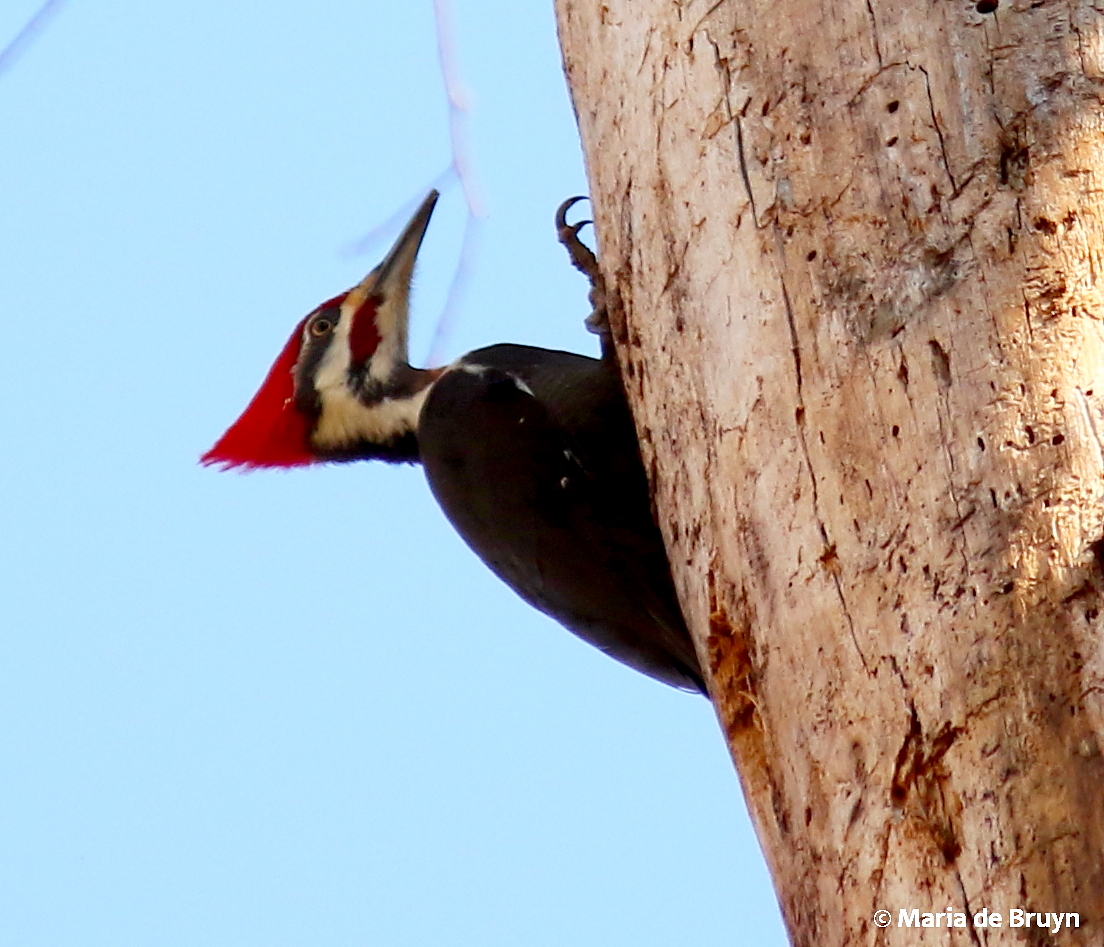
pileated woodpecker I77A7321© Maria de BruynMy first bird of the day was a beautiful male pileated woodpecker (Dryocopus pileatus), a harbinger of the day’s theme – the woodpeckers were my welcome committee!

Loud rhythmic hammering had me searching the snags among the tall trees for the next greeter – it reminded me of the facts I had learned about woodpeckers and their adaptations to a pecking life.

downy woodpecker I77A7372© Maria de BruynIt turned out to be a diminutive downy woodpecker (Dryobates pubescens), whose hammering sounds were enhanced by the hollow stem with which he was busy.

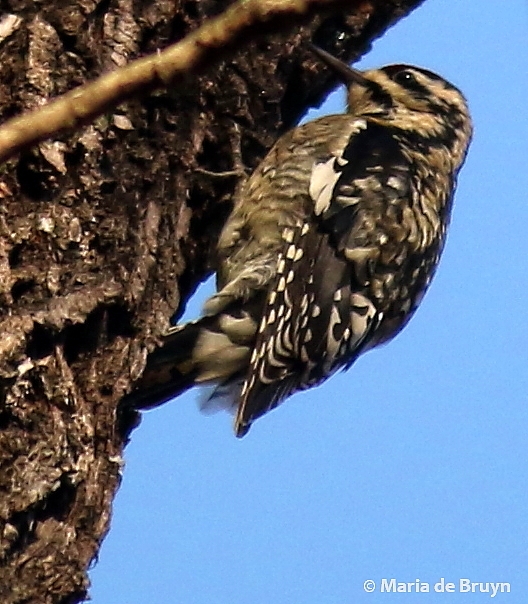
Next up was a lovely female yellow-bellied sapsucker (Sphyrapicus varius) who was very industriously flitting from branch to branch in search of sustenance.

yellow-bellied sapsucker I77A7419© Maria de Bruynyellow-bellied sapsucker I77A7582© Maria de Bruyn

When flattened against tree trunks, she demonstrated how well camouflaged her back feathers make her. A male sapsucker showed it, too.

yellow-bellied sapsucker I77A7476© Maria de Bruyn

yellow-bellied sapsucker I77A7860© Maria de Bruyn res

red-bellied woodpecker I77A8242© Maria de BruynA red-bellied woodpecker (Melanerpes carolinus) rounded out the welcoming committee.

The other birds didn’t disappoint. Several species were in the woods and at the feeders near the Garden’s bird blind. A lovely Carolina chickadee (Poecile carolinensis) flitted about. A tufted titmouse (Baeolophus bicolor) was singing.


Carolina chickadee I77A7639© Maria de Bruyn tufted titmouse I77A7388© Maria de Bruyn


white-breasted nuthatch I77A8203© Maria de Bruyn


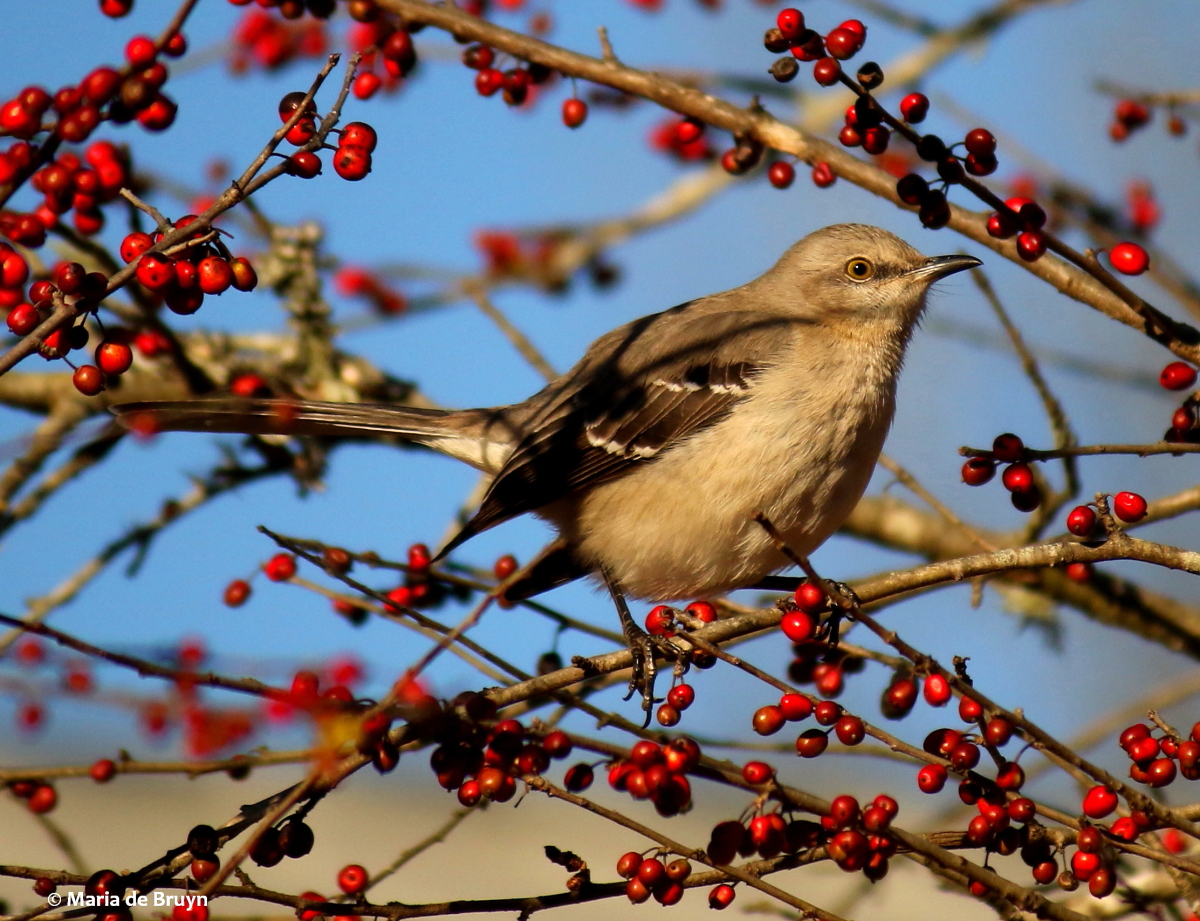
A white-breasted nuthatch (Sitta carolinensis) foraged on tree trunks overhead. A Northern mockingbird (Mimus polyglottos polyglottos) posed among red winter berries.


Northern mockingbird I77A7737© Maria de Bruyn res

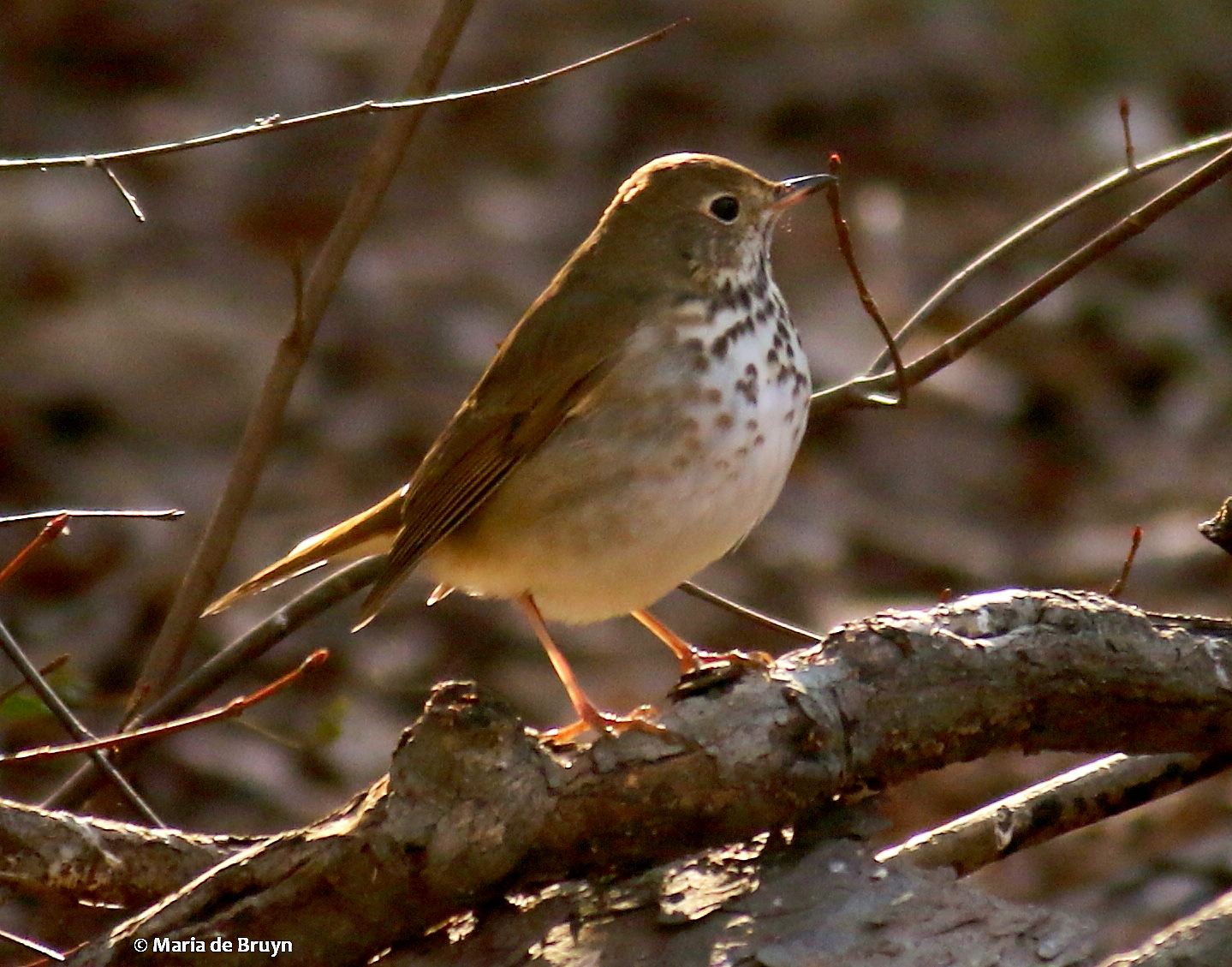
hermit thrush I77A7658© Maria de Bruyn


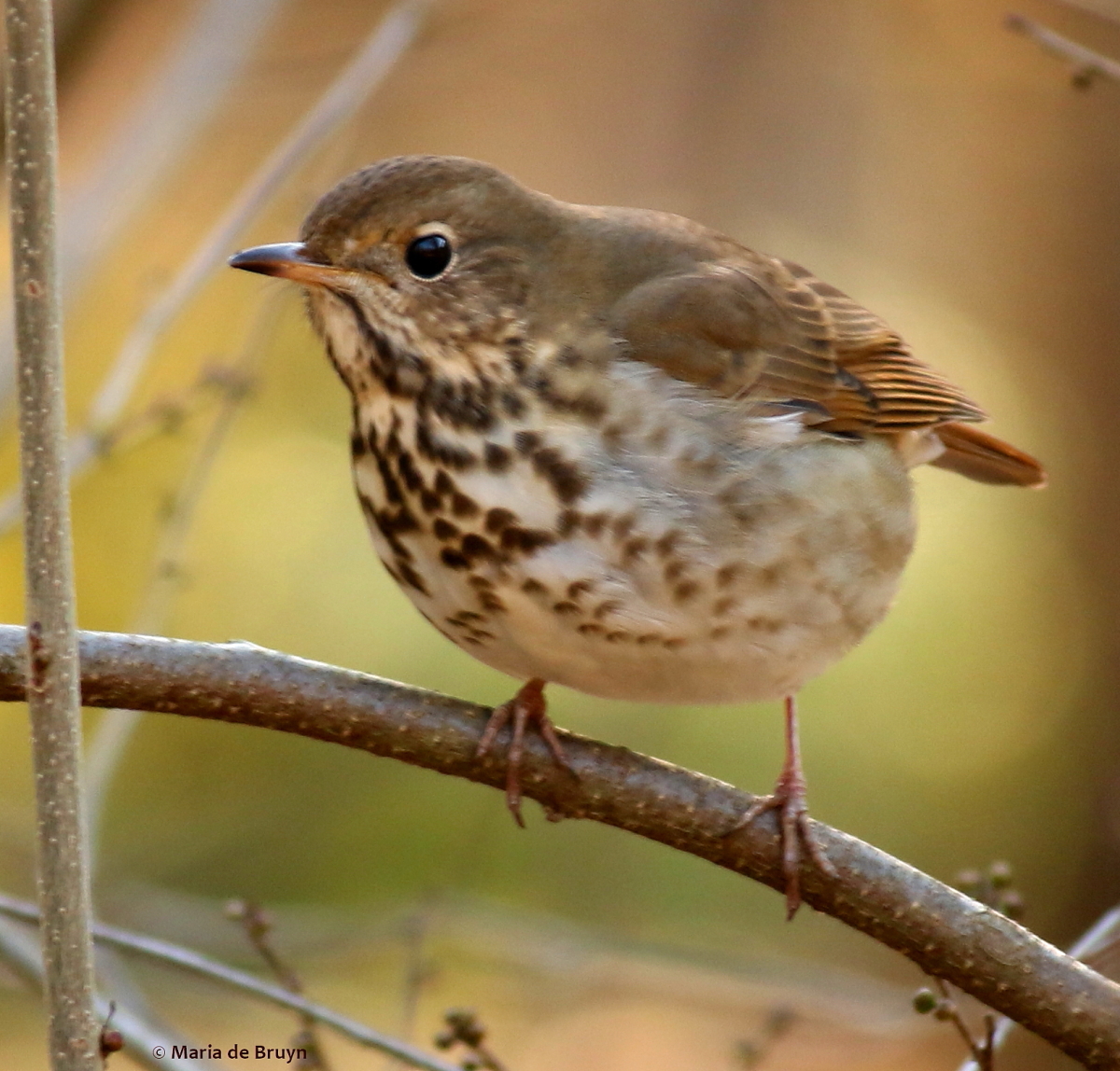
A hermit thrush (Catharus guttatus) emerged near the bird blind, and then the same bird or another seemed to accompany me as I walked another part of the native habitats garden.


hermit thrush I77A7818© Maria de Bruyn

hermit thrush I77A7788© Maria de Bruyn res

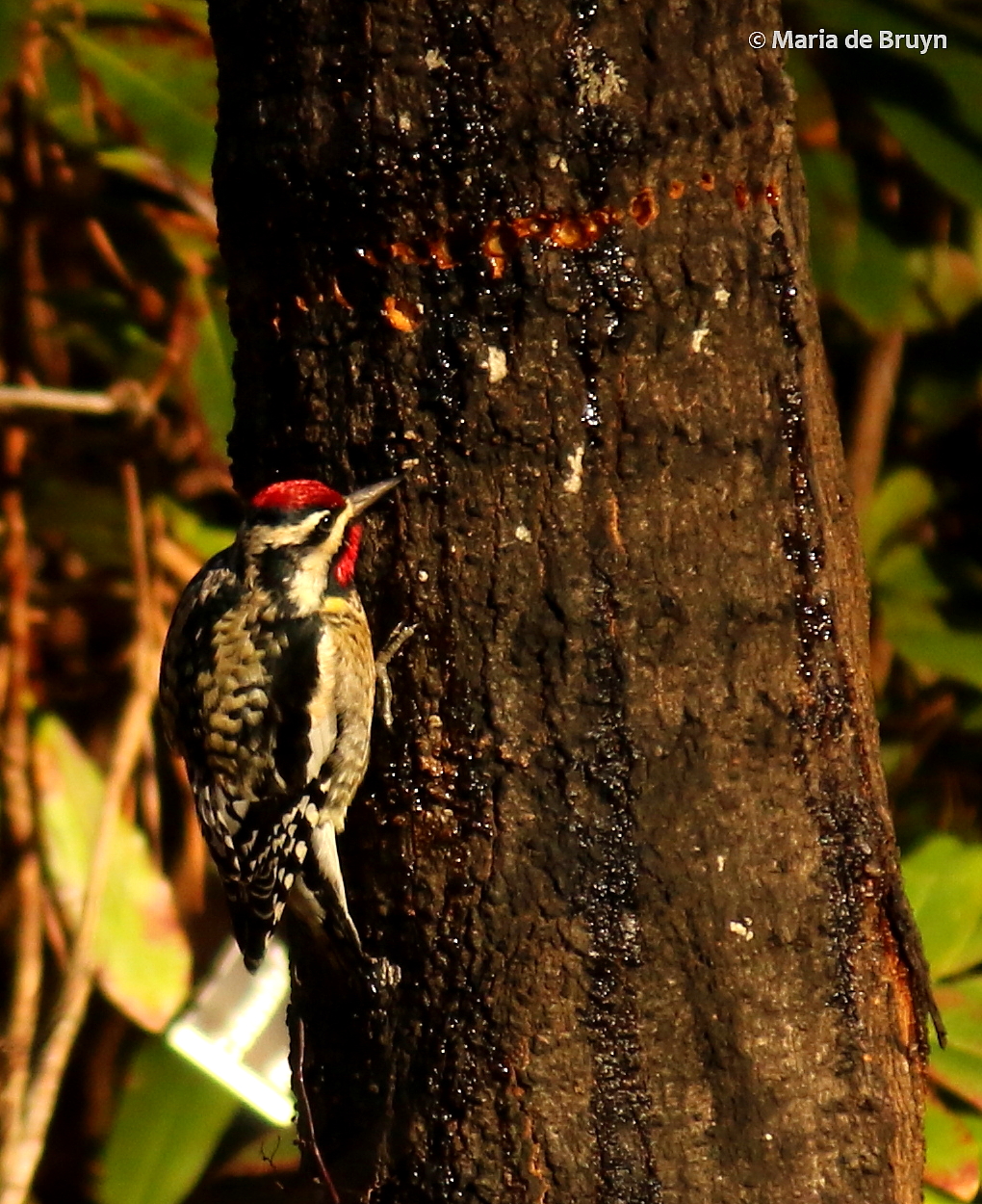
Later, a male sapsucker (identifiable by his red throat) appeared near the Paul Green cabin, where he had been busy working on his sapwells.

yellow-bellied sapsucker I77A7858© Maria de Bruyn res yellow-bellied sapsucker I77A7854© Maria de Bruyn res

Shortly thereafter a downy woodpecker came to the same spot and sampled sap (or something else) from the row of holes left by the sapsucker! That was a nice example of how what one animal does can benefit another, too.

downy woodpecker I77A7912© Maria de Bruyn

downy woodpecker I77A7921© Maria de Bruyn res

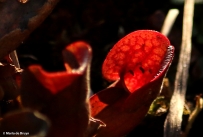
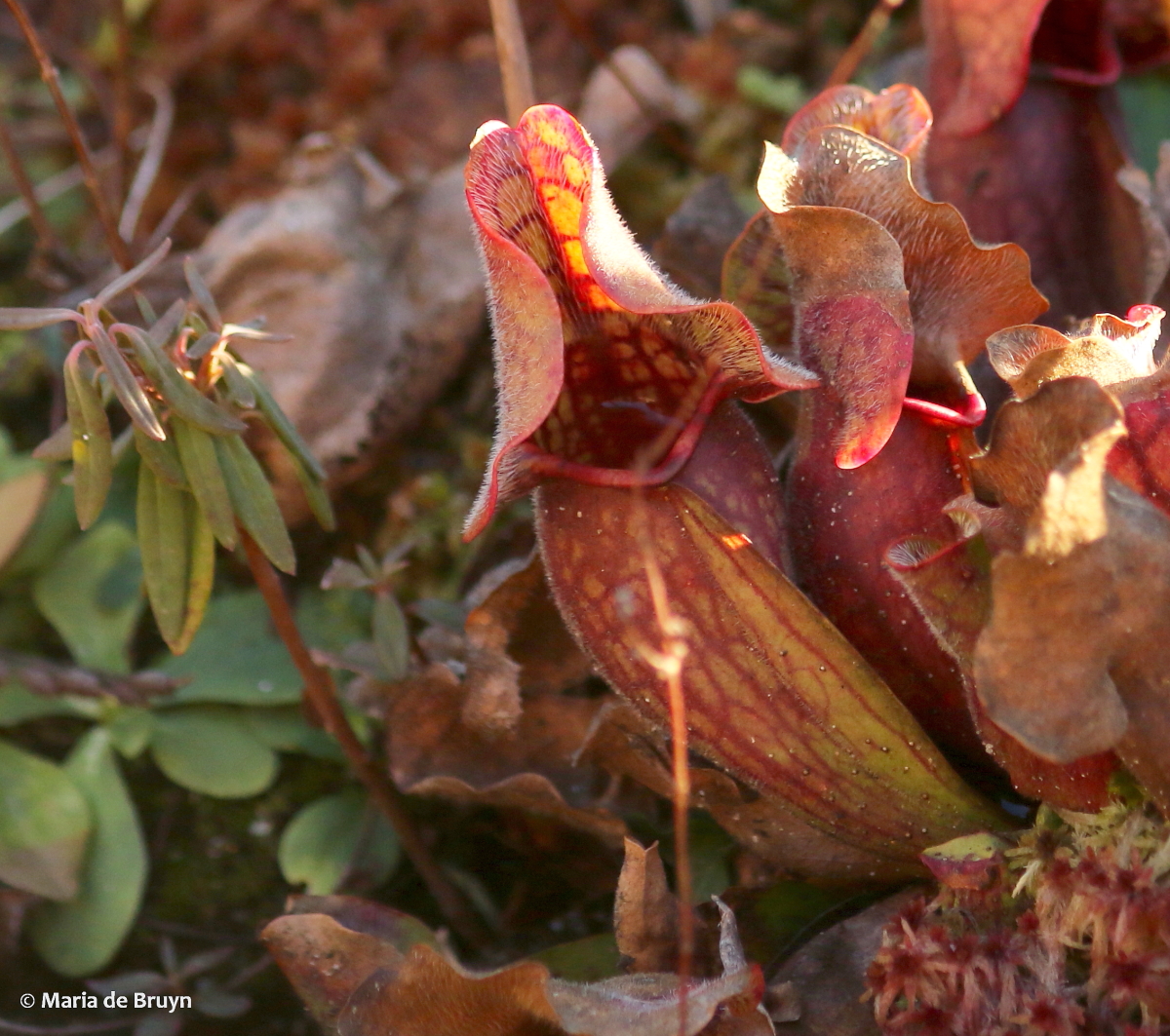
During a plant interlude, I was surprised to see some Southern purple pitcher plants (Sarracenia purpurea) that had not yet shriveled up in the cold.

Southern purple pitcher plant I77A8086© Maria de Bruyn Southern purple pitcher plant I77A8081© Maria de Bruyn res


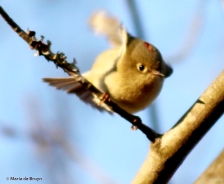
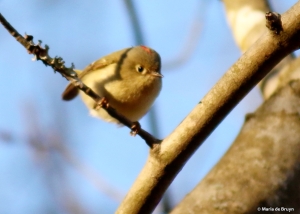
When, I was leaving, a ruby-crowned kinglet (Regulus calendula) alighted overhead,

ruby-crowned kinglet I77A8165© Maria de Bruyn ruby-crowned kinglet I77A8164© Maria de Bruyn

a red-bellied woodpecker arrived, and one more woodpecker made an appearance – a Northern flicker (Colaptes auratus) high up behind some branches in a tall tree. I was using my small zoom lens so the photo quality isn’t great, but you can see that s/he was there.

red-bellied wooodpecker I77A8234© Maria de Bruyn Northern flicker I77A8154© Maria de Bruyn

downy woodpecker I77A8006© Maria de BruynThe only woodpeckers that are common in our town that I missed were the red-headed and hairy woodpeckers – it was truly a woodpecker welcome and a really lovely start to my wildlife photography outings for this year!

Citizen science in my backyard!

Gray-headed catbird DK7A8986© Maria de Bruyn resIt’s been a while since I’ve blogged – not for lack of ideas and photos but due to a dearth of time and energy that was absorbed by multiple troubles with a few cool happenings in between. But now I’m back with some new observations about the beauty and happenings of interest in my natural world and I hope to share some wildlife sightings on a regular basis again.

One activity that I have managed to fit in amid the other goings-on was enrollment in two new (for me) citizen science projects for the Smithsonian Institute. I’m participating in an eMammal project run by the North Carolina Museum of Natural Science and in a multi-year observational study of some common birds. The mammal project is time-limited, so I will report on that in about a month’s time.

Northern mockingbird DK7A8859©Maria de BruynThe bird project will involve tracking visits to my yard by banded birds for several years to come. The target species include American robins (Turdus migratorius), Carolina chickadees (Poecile carolinensis), Carolina wrens (Thryothorus ludovicianus), house wrens (Troglodytes aedon), gray-headed catbirds (Dumetella carolinensis), Northern cardinals (Cardinalis cardinalis) and Northern mockingbirds (Mimus polyglottos, at the right), all of which come to my yard. Song sparrows are the 8th target species but I haven’t seen them at my house. However, I discovered that there is a great crested flycatcher in my trees, although I’ve never seen him (or her) either, so who knows if one will come in the future? In any case, the target birds can live from about 6-10 years on average, so I’ll have an ongoing activity for as long as my eyesight remains reasonable!

bird banding IMG_3291© Maria de Bruyn resmist net IMG_3290© Maria de Bruyn

So how does the bird banding proceed? We (the bird bander and I) set up one 12-foot and one 6-foot mist net in two parts of the yard, after the bander laid out her equipment for the banding process. Within a very short time, we caught three birds in the large net! The first was a gray-headed catbird that I recognized (photo above), because he had molted all his tail feathers at once and looks a bit odd with no tail. This bird, whom I have named Corey, has been the most vocal catbird at my feeders and he was extremely vocal about having been caught as well.

gray-headed catbird IMG_3294© Maria de Bruyn bird banding IMG_3295© Maria de Bruyn

After being disentangled – very carefully – from the net, he was put in a bag while the bander got the other two birds out of the net. Corey was measured, weighed, and banded with a combination of aluminum and colored bands. Sex was determined (I now know he is a he!) and then he was let go.

gray-headed catbird IMG_3301© Maria de Bruyn bird banding IMG_3304© Maria de Bruyn res

Northern cardinal IMG_3311© Maria de Bruyn resBird 2 was a beautiful male Northern cardinal, who appeared to have good fat reserves. He was a bit vocal and bit the bander to show his displeasure at the treatment he was receiving.

Bird 3 was a male American robin. Sex was determined partly by looking at the cloacal region (outside breeding season, other markers besides brood patches and this area are examined). If a bander is unsure of the sex, this is also marked on the data sheet. The robin was more sedate during handling than his predecessors.


American robin IMG_3314 © Maria de Bruyn resAmerican robin IMG_3315© Maria de Bruyn res

The house wrens had been calling loudly during the banding and flitted about in the trees and to the feeders,but they always flew just above the nets and were not caught. A male Carolina wren with a nice eye stripe did not escape.

house wren DK7A4794© Maria de Bruyn Carolina wren IMG_3316© Maria de Bruyn

American crow IMG_3359© Maria de BruynThe chickadees and Northern mockingbird flew about but did not really come too close to the nets. Non-target species were at or near the feeders, too, such as courting bluejays, an American crow (Corvus brachyrhynchos, right) who came to eat jelly and take some apple to his mate, downy woodpeckers, white-breasted and brown-headed nuthatches, a house finch, Eastern towhees and a male cowbird.

red-bellied woodpecker IMG_3344© Maria de Bruyn resOther non-target birds flew into the large mist net, however, such as a brown thrasher, a tufted titmouse, a red-bellied woodpecker (Melanerpes carolinus, right), a chipping sparrow (Spizella passerina), a female common yellowthroat (Geothlypis trichas, below) and a common grackle. I’d not seen these birds up so close before, so that was really a nice experience.

Common yellowthroat IMG_3339© Maria de Bruyn res


bird banding IMG_3340© Maria de Bruyn resTo get more target species, a loudspeaker that played bird calls and some model birds were placed in the grass by the largest net. Eventually, two more catbirds were caught – with other catbirds in a nearby tree puffing themselves up to show their shared distress. These were the first catbirds banded for the project so far, so that was a nice way to end the exercise.

Cope's tree frog IMG_3293© Maria de Bruyn resA tour of the yard to see if there were any nests that could be followed for the Nest Watch project revealed a couple wren nests in boxes that were built up so high it was not possible to see if they had eggs in them. The bluebirds’ nest has five eggs that I will follow through fledging (hopefully); a catbird nest is too high up for me to see how many eggs she is sitting on but I will watch for her fledglings, too. And a Cope’s tree frog (Hyla chrysoscelis) had taken up residence in the nest box that the downy woodpecker uses to rest at night. The wrens had begun building a nest in that box last night and the frog was gone this afternoon.

The banding took place yesterday in the morning and in the afternoon, the banded birds had not returned. I wonder how long it will take most of these individuals to come again. Corey already returned this afternoon, instantly recognizable not only because of his very short tail feathers growing in but because of the red and silver bands on his little legs. I was so glad to see he was none the worse for wear!