Summer hummers – entertainment for free: part 2

In my yard this summer, the ruby-throated hummingbirds (Archilochus colubris) came late to the feeders (similarly to what other people in the area had reported). Now, there are at least four vying for the four feeders, claiming territory for their own.


One bird in particular is most likely to be seen enjoying the garden flowers, including blue-black sage (Salvia guaranitica) and hot lips salvia (Salvia microphylla ‘Hot Lips’). In the first two photos below, you can see as his throat starts to bulge more as he sucks up the sweet nectar to complement his mostly insectivorous diet.


The airborne nectar droplets indicate that sometimes this hummer is a messy eater — or must leave quickly as another hummer is almost literally on its tail.

A couple of the birds spend a lot of time near the nectar feeders, perching close by to chase off anyone who comes near.


They each have favorite perching spots from which they can observe if an “intruder” is coming near the feeder they have claimed.


Sometimes, they fly up to a higher perch so they can see both the front and back yards – a necessary vantage point if they want to keep an eye on where everyone is.


Most ruby-throats have 940 feathers, all of which are replaced each year. As they take little rests, they stretch their feathers and may also groom them.

When a rival approaches, they spread their rectrices (tail feathers) – both when sitting and in the air.


Their feathers are beautifully arranged, looking like scalloped decorations.


They make frequent trips to the feeders and then occasionally “air out” their tongues.


The bill of the ruby-throated hummingbird is one of its most distinctive features. It measures about 0.59-0.79 in (15-20 mm) in length and is said to open no more than about 0.39 in (1 cm wide) at the tip. The hummers in my yard seem to be able to open their mouths to varying extents, however. They consume nectar by extending and contracting their tongues up to 13 times per second.


A quick, only few-second nap is also a frequent behavior. The hummers are almost constantly at the feeders and thus bulking up for their long migration, but they also expend considerable energy chasing one another away from feeders and flowers!


The hummers are not fazed by weather, zipping around rain or shine. Putting on weight and strength for their autumn migration down south is important for survival!

These minute marvels are such a pleasure to watch; I will certainly miss them when they begin their journeys to their wintering grounds.


Summer hummers – entertainment for free: part 1


When a hummingbird other than a ruby-throated hummingbird (Archilochus colubris) is seen in the Triangle area of North Carolina, it is listed as a rare bird on the Cornell Lab of Ornithology listserv. One year, I did have a chance to see a buff-bellied hummer visiting in a nearby town though; another year a rufous hummer frequented my own feeders in the winter. Mostly, however, it is the ruby-throats who take up residence at my address, which is just fine as these feisty tiny birds provide loads of entertainment.


During a trip to Quebec earlier this year, we also saw ruby-throated hummingbirds there – early arrivals during the spring migration.


A few years ago, one of my blogs focused on their preening and cleaning, so this time I’ll mostly feature some of my favorite photos of them taken this summer in various places. (When looking through the shots, I had a LOT I liked, so this is now going to be a 2-part blog!)

At Sandy Creek Park in Durham, one female hummer had made a coral honeysuckle (Lonicera sempervirens) one of her preferred dining spots.


A butterfly garden featuring blue-black sage (Salvia guaranitica) and bee balm (Monarda) also attracted her and some other hummers.


One female found the bee balm to be a good place to rest, understandable since these bundles of energy have a high metabolic rate. Their hearts beat up 1260 times per minute and they take about 250 breaths per minute even when they are resting! Taking a few sips while remaining perched has to be a welcome luxury.


The hummers’ main wing bone, the humerus, is adapted to hovering flight and they have very large deltoid pectoral muscles relative to their size.


Male birds produce sperm that flows through the vas deferens (sperm duct) to the cloaca. When they mate with a female, they transfer sperm by touching the tip of their cloaca to that of the female; they do not have a penis. Females only have a functional left ovary; the right one atrophies early in her development, which allows her to avoid the extra weight of a second ovary and makes her lighter for long migratory flights.

One big treat for me this year was finding two ruby-throated hummingbird females tending a nest, the first time I had been able to spot this.


Later, I was able to take a quick photo of one female collecting cattail fluff with which to line her nest.

Even when several ruby-throats are frequenting an area, the (temporary) coloring of their feathers can help distinguish them. This young male had a few olive-green dots under his eye and a bit of white on the crown of his head.


A somewhat more mature male has a little white patch behind his red gorget.


They are all little beauties! Second part of this blog is coming up and then on to Costa Rica!

Hungry hairy herons and their caring parents

A little over a week ago, fellow photographer Mary posted a wonderful photo of young green herons (Butorides virescens) perched in a row awaiting their parents. They still had very fuzzy hairdos, reminding me a bit of a row of Albert Einsteins. About 4 days later, I drove to the pond in a senior citizen residential community to see them and they had already lost most of – but not all – the fuzz atop their heads. That didn’t matter though because it was a real pleasure watching them for a while.


Friend Lucretia had accompanied me and we were lucky enough to park right near the end of the pond where the sibling group was parked. Only one was out on a limb when we arrived; the three brothers/sisters were in hiding in the thick shrubs bordering the pond.

The bold juvenile may have been the eldest of the quartet as s/he seemed to have lost the most fuzzy feathers.


S/he groomed, looked around and then yawned hugely – making me think of how I often want to react to much of the news that is shown in the media these days. This was followed by what looked like a smile and happy reaction, which is how I often feel when out taking one of my nature walks!


After a while, a couple of No. 1’s siblings began moving around in the brush, eventually coming out into the open.

In the meantime, No. 1 took the time to defecate; gotta take care of those body functions! (It’s interesting that birds all have white poop. The fecal sacs that songbirds take out of nests are white; this bird’s stream of feces was white. Why? Here’s a tidbit of information you might not know: Birds’ bodies do not produce urine as mammals do. Rather, they excrete nitrogen wastes as uric acid in the form of a white paste.)

Another sibling did some preening.


As we walked around the end of the pond, it turned out that Mama was taking a rest there. (I really can’t tell the male from the female adult but for convenience’s sake just identified her as the mother since she was close by.)


After a time, Mama took off and ended up in a perch on the underside of a small dock. It made me wonder if that was a good place to fish because the water might be a bit cooler and perhaps fish were schooling there. A good number of turtles were also swimming about there – perhaps the shady area was just a nice break from the sun-warmed water.


While Mama scanned the deeps, a nice song sparrow (Melospiza melodia) and a beautiful Eastern bluebird (Sialia sialis) entertained us with song.

Brown-headed nuthatches, a brown thrasher, and a downy woodpecker (Picoides pubescens) were among the other birds flitting about the trees and shrubs bordering the pond.

While adult green herons sometimes use tools to fish – using twigs or insects as bait – Papa heron was just standing patiently at the other end of the pond, watching the water intently. He suddenly plunged and ingested a small fish, using what one ornithologist called a “bill lunge”, in which the bird keeps it feet in place but stretches its body forward to spear prey with its long bill. Apparently, green herons can also catch prey by hanging upside down from their perches over water.


We wondered if he was eating the fish himself or collecting a gullet-full of food for his offspring. Herons namely feed their young by regurgitating previously-swallowed food.

As we continued our walk around the pond, we came upon a great blue heron (Ardea herodias) who had some good luck in getting a meal.

When we arrived back at the spot where the young herons were hanging out, we saw a beautiful gray catbird (Dumetella carolinensis) snag a meal of its own.

One of the young herons was in the water, apparently practicing fishing behavior. S/he caught something but then let it go.

Then Mama suddenly flew in; the foursome greeted her excitedly and Lucretia saw her regurgitate a meal onto the grass. (Unfortunately, this happened behind a shrub that I could not see around so I missed that behavior.) When I had moved over to see the young ones, they had already gulped down whatever food there was and were engaged in vigorous behavior to convince Mama to repeat what she had just done.


This gave a fairly good view of the group. One still had a very pink bill while others were getting more yellowish bills on the way to getting dark beaks.

Mama flew off to a tree and apparently settled in for another food-gathering exercise, while one of her young ones called piteously.


After a couple hours, we decided it was time to drive back to our own areas of residence, but it was bittersweet having to leave the group of four behind. But they certainly provided us with an entertaining morning, even if that was not their intention! We hope they will grow up with no threats from predators and be able to repeat the process with broods of their own one day. 😊

Quebec chronicles – passerines with yellow and green colors, part 2

My last “bird blog” from Quebec! The passerine birds that we admired during our trip there included the vireos and grosbeaks. But I saved one warbler for this blog since I often had to look at the photos to be sure which species I had seen. The Tennessee warbler (Oreothlypis peregrina) could namely be mistaken for a Philadelphia vireo if it goes by quickly and you are not an experienced or expert birder. (It also can be easily mistaken for a female black-throated blue warbler.)

This very charming bird seemed to be everywhere we visited in great abundance. I had seen one last summer in North Carolina; now I got to see dozens of these little beauties.


Like the bay-breasted warbler, it specializes in eating the spruce budworms and hence its numbers wax and wane along with the availability of this food source.It was gleaning in all kinds of trees as well as along the shore, however, and obviously also looking for other types of food.


Besides insects, this bird also likes nectar and gets it by piercing flowers at the base of their stems on trees.


On the one day that it rained, I saw one waiting out the shower in a yard tree. On another morning, I surprised a Tennessee taking a bath in a little puddle formed by a streamlet flowing from a yard to the street where we were staying. The bird was still wet but fluttered its wings and dried off very quickly, looking fresh and pretty for a possible new partner.


The Philadelphia vireo (Vireo philadelphicus) is another attractive avian. It has the same coloring as the Tennessee warbler but has a bit of a hook at the end of its bill.

Like the Tennessee warblers, they migrate to Mexico and environs during the winter. Their meals of choice are insects and some berries (e.g., bayberry and dogwood). The birding websites and Wikipedia do not have anywhere near the same amount of information on this species as some others, so they likely have not been studied very much.


One day as I walked a path in one of the nature reserves, a Philadelphia vireo followed me a bit as I walked, finally perching on a nearby branch and fluffing its feathers. S/he looked like someone showing off a party dress.


The blue-headed vireo (Vireo solitarius) is a much darker bird, with olive-green feathers, a blue-gray crown and white “spectacles”. I haven’t seen many in North Carolina and I only saw two in Quebec – decidedly a somewhat shyer bird than many of the others that crossed my paths.

Finally, some birds that gave me very good looks were the stunning evening grosbeaks (Coccothraustes vespertinus).

These birds only very rarely show up in the Piedmont area of North Carolina in the winter but last year I had the privilege of having a male and two females visit my feeders for one day. During this trip, we visited a neighborhood where a whole flock was busy feeding in the trees.

The males have rich deep yellow coloring offset by white and black accents on their heads, wings and tails. At one feeder, I was surprised to see one male apparently feeding another. It turns out that they may be territorial in wintertime around food sources but in the spring and summer, they are quite social and tolerant because there is a greater abundance of insects, buds, berries and seeds.


The females are much more muted in color with light yellow highlights against a pale gray background but they also have beautiful patterned black and white wing feathers. Their light yellow-lime-green beaks serve well to break apart seeds.


The oldest evening grosbeak on record reached the age of 16 years, 3 months. It appears that their numbers may be decreasing, although the population as a whole is not yet at risk. I look forward to another “irruptive” year, when they expand their winter territory – perhaps I’ll have a couple unexpected visitors again!

Quebec chronicles – passerines with yellow colors, part 1

People who journey to the Tadoussac Dunes area in Quebec during spring bird migration often are focused mainly on one type of bird. They are members of the group of passerine birds, i.e., birds that perch using four toes – three that face forward and one that faces backwards. The “new world warblers” (also called wood warblers) are a subgroup of passerines that are only found in the Western hemisphere. They are featured in this blog and include some of my favorite photos from our trip. The next blog, passerines part 2, will feature other bird species that perch.

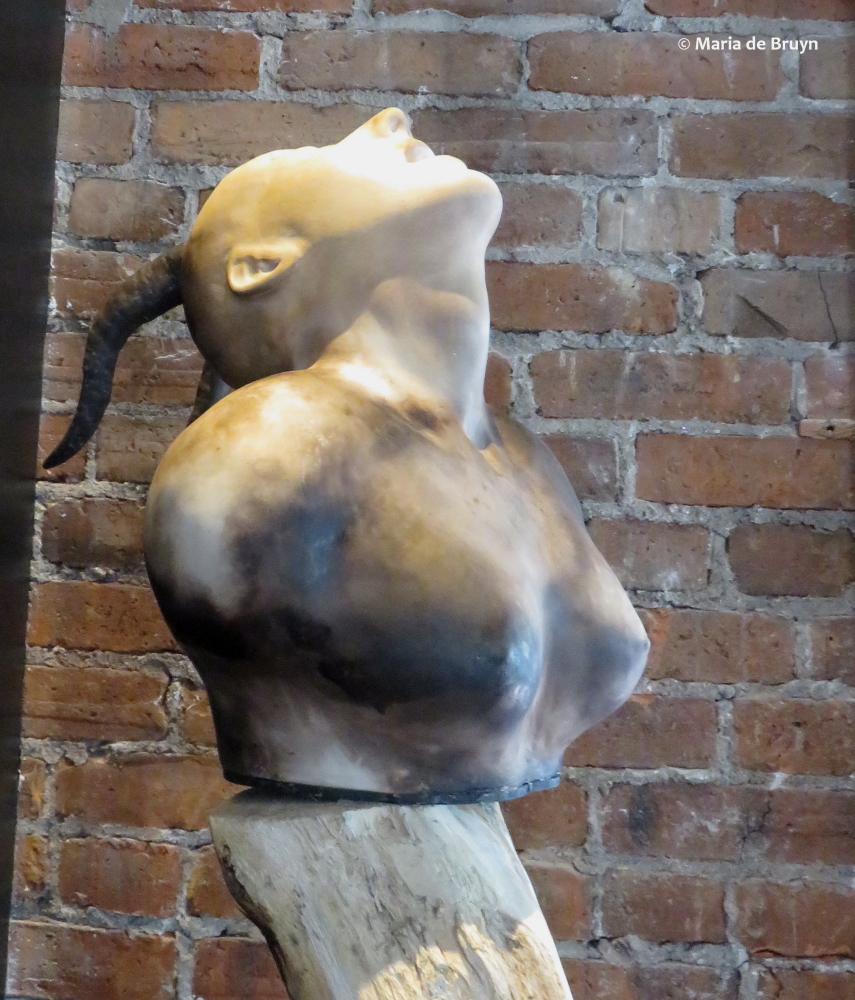
The warblers really are quite beautiful in their breeding plumage and many birders spend long periods of time searching them out and admiring them. This often involves looking up at treetops since many species forage for insects in mid- and high forest canopies. This may lead to a condition in humans called “warbler neck”, the result of staying for a prolonged time in the posture indicated to the left. (The statue was in the lobby of our Quebec hotel and was called “Force intérieure” (inner force) by Julie Lajoie.)

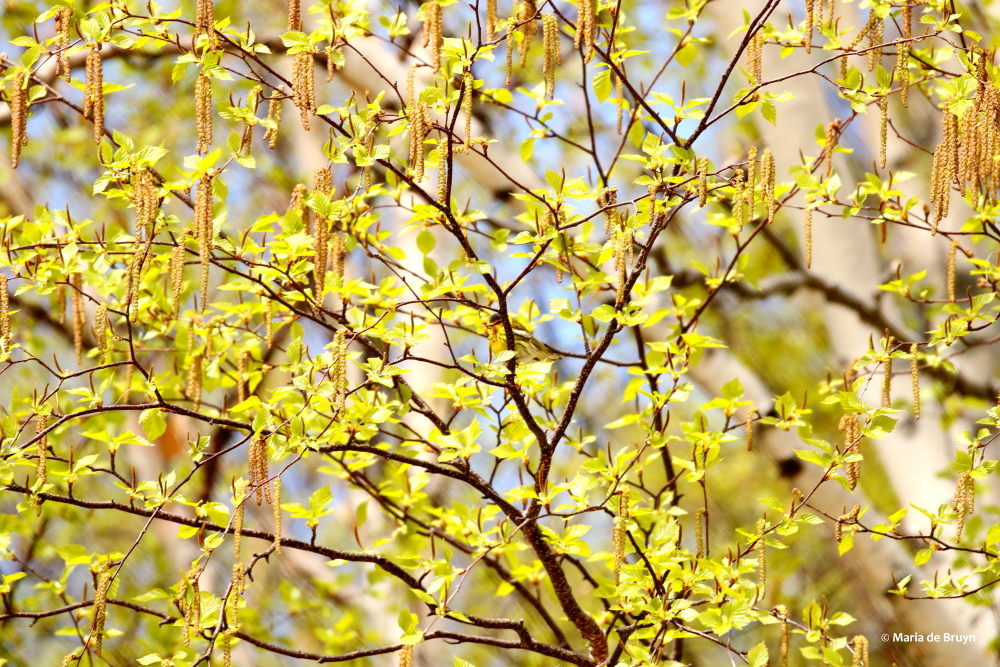
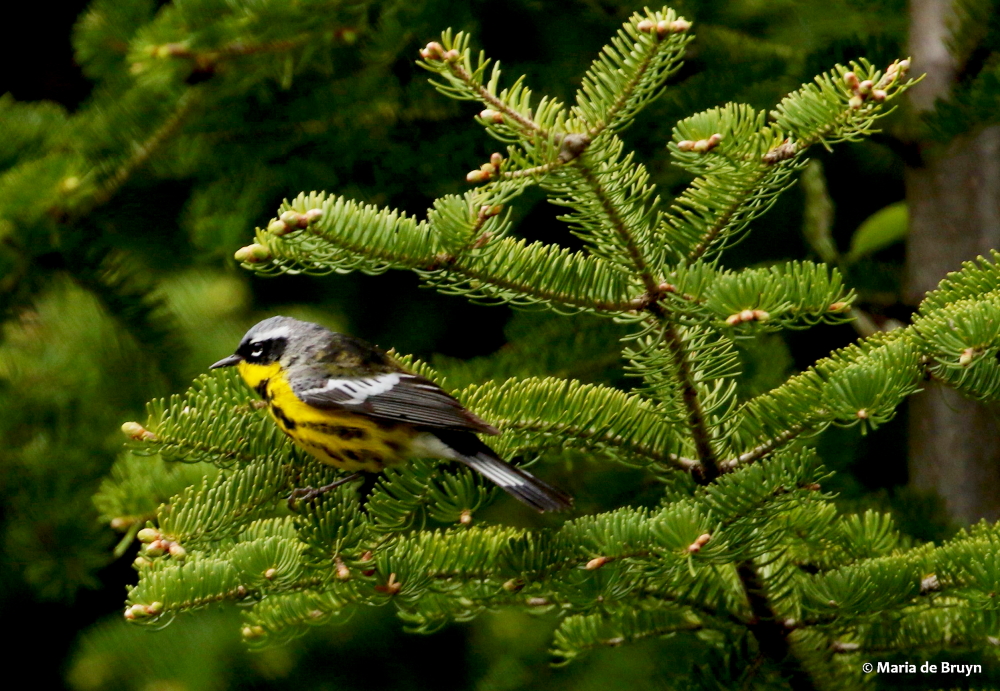
One warbler that we didn’t need to strain to see was the Cape May (Setophaga tigrina), which was named for Cape May, New Jersey, where it was first observed by ornithologist Alexander Wilson in 1811. After that, these birds weren’t seen again in that area for more than a century!
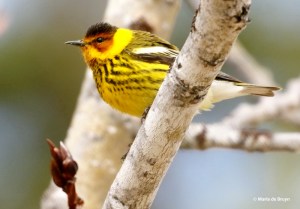
The males really do call attention to themselves with their bright breeding colors – a distinctive rusty cheek patch, yellow throat and collar, dark crown and lots of vertical black stripes going down its sides and chest.

In spring, this warbler migrates almost 3,000 miles from the West Indies to the coniferous forests of Canada and the northern US to breed. As the fist-sized songbird flies north, its diet adapts to the environment. During winter among the palm trees, the Cape May drinks berry juice and the nectar from flowers thanks to its unusual semi-tubular and curled tongue. (It will also drink from nectar feeders!) But in summer in the boreal forests, it eats insects—especially the spruce budworm—with a special gusto.
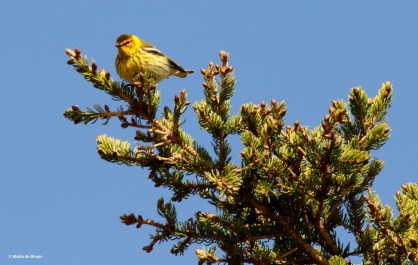
The male and female build a nest together near the top of a tree (35-60 feet high!) and the female tries to prevent others from seeing the nest. She namely will not enter the nest directly but goes up and down the trunk of the tree, entering from below.
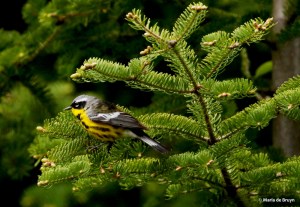
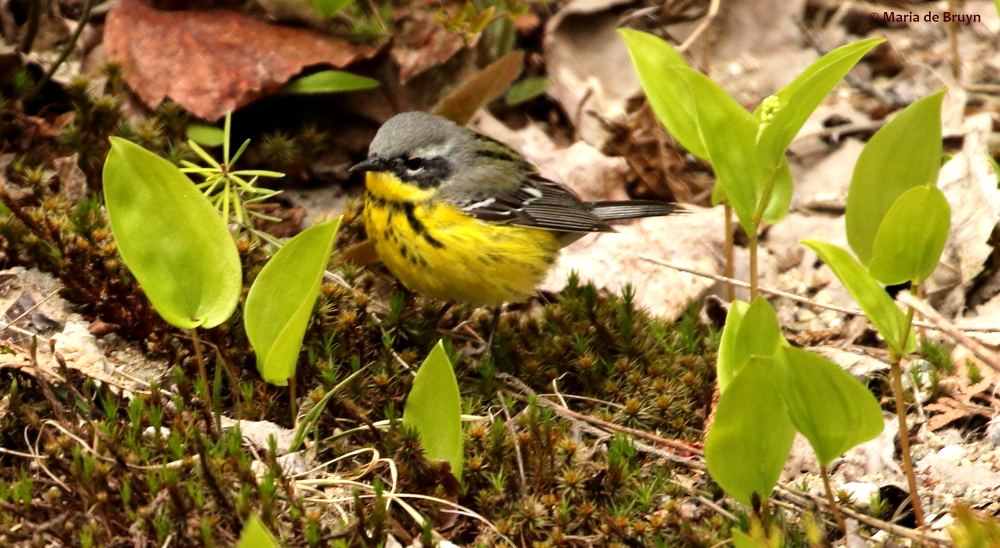
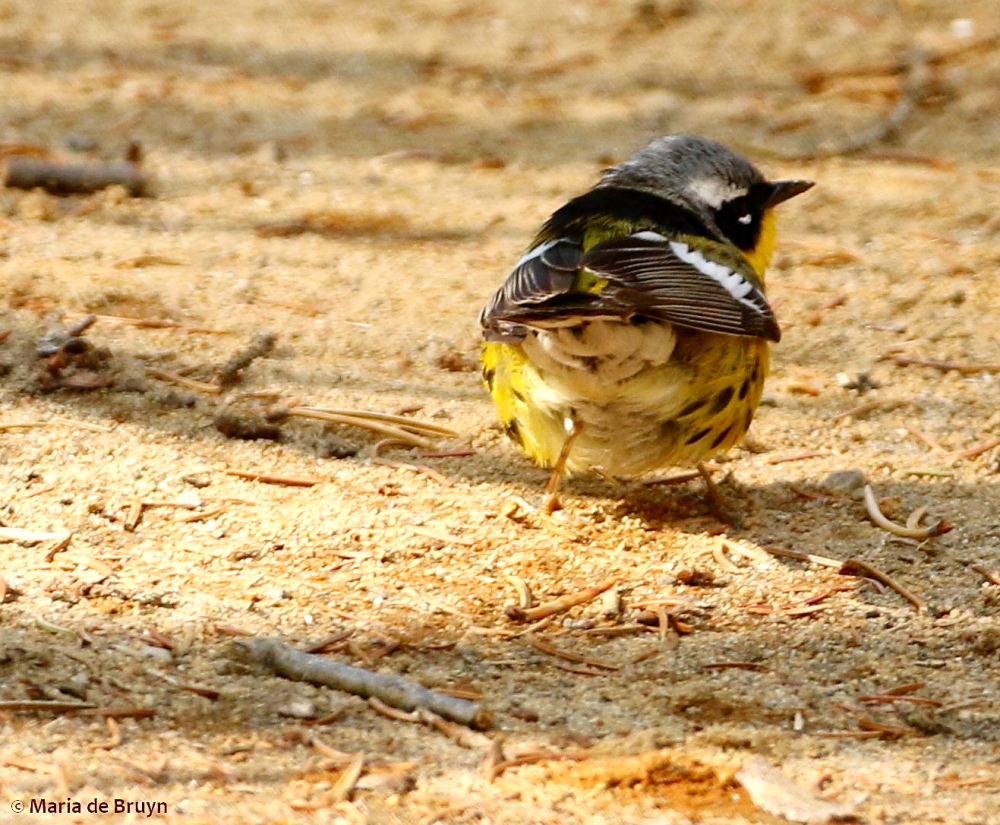
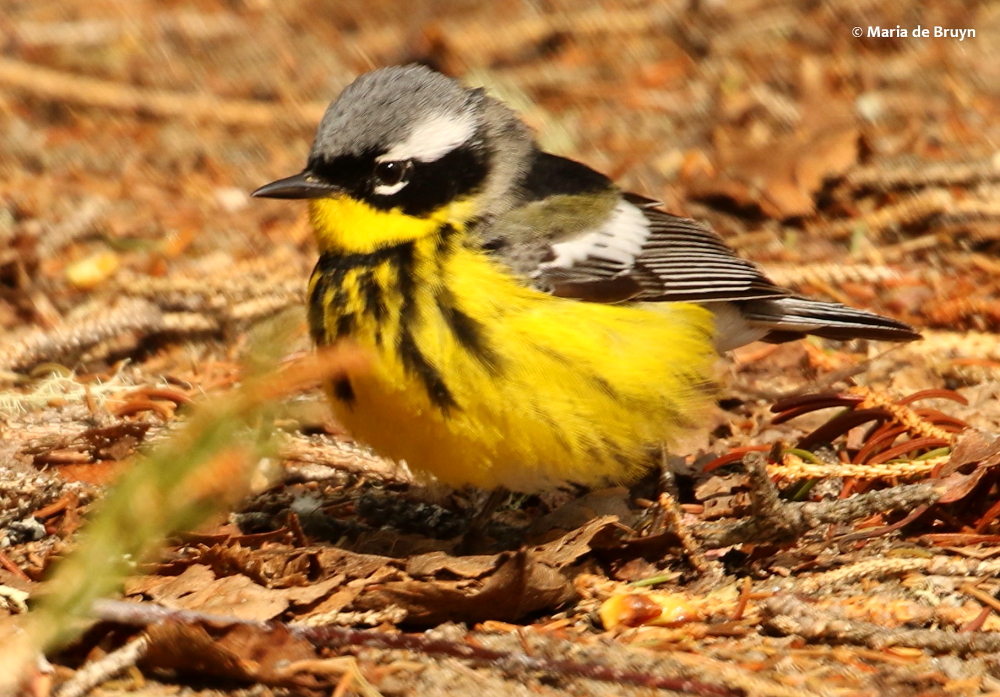
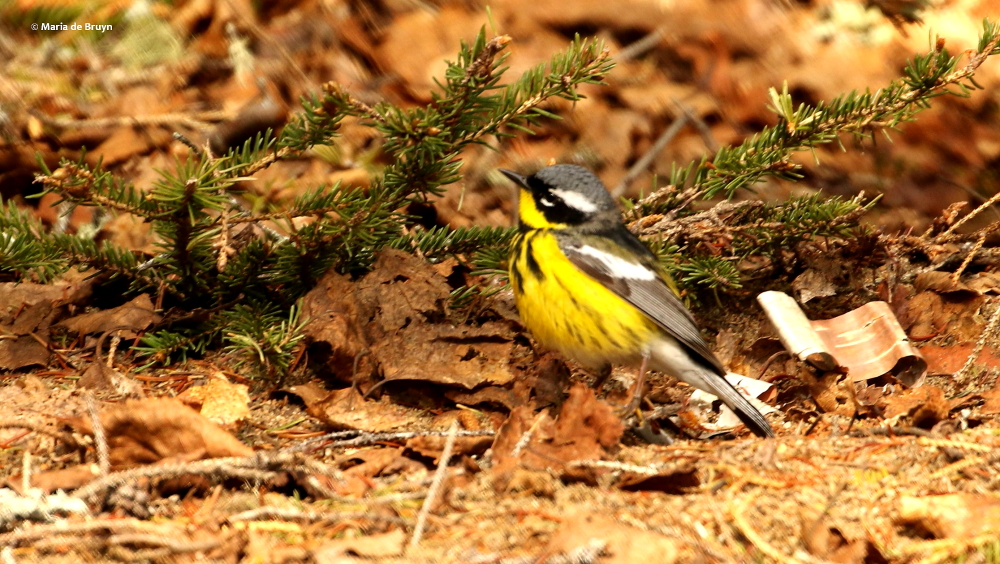
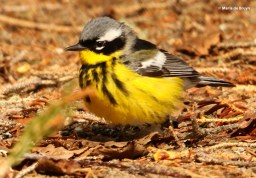
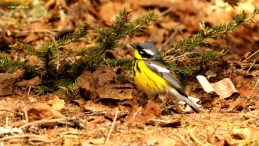
A second seemingly ubiquitous bird at our migration destination was the magnolia warbler (Setophaga magnolia). Like the Cape May, the male in breeding attire has vertical black stripes on a yellow chest but his face is marked by a black mask topped by a white stripe.

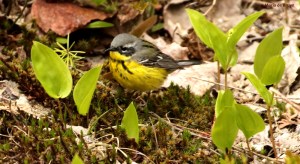
 

Most of my sightings of this species involved individuals looking for insects on the ground. At one point, it was interesting to see a “Maggie” fluttering his wings over sandy spots in the dunes, obviously to scare up insects that he then quickly grabbed. My attempts to get a photo of the fluttering were unsuccessful but it was very cool to watch.


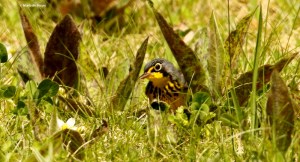
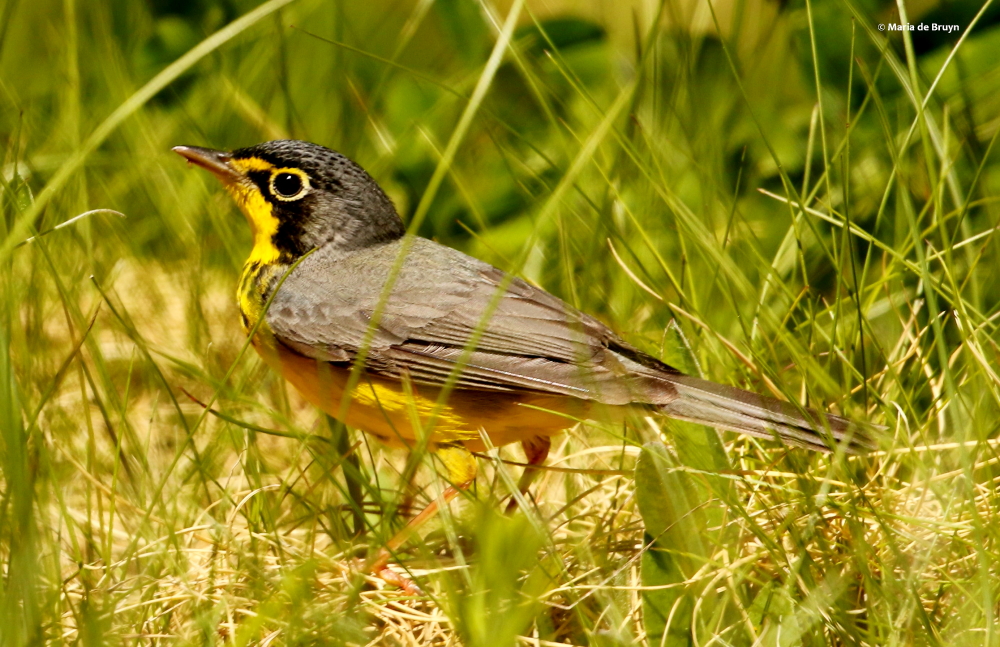
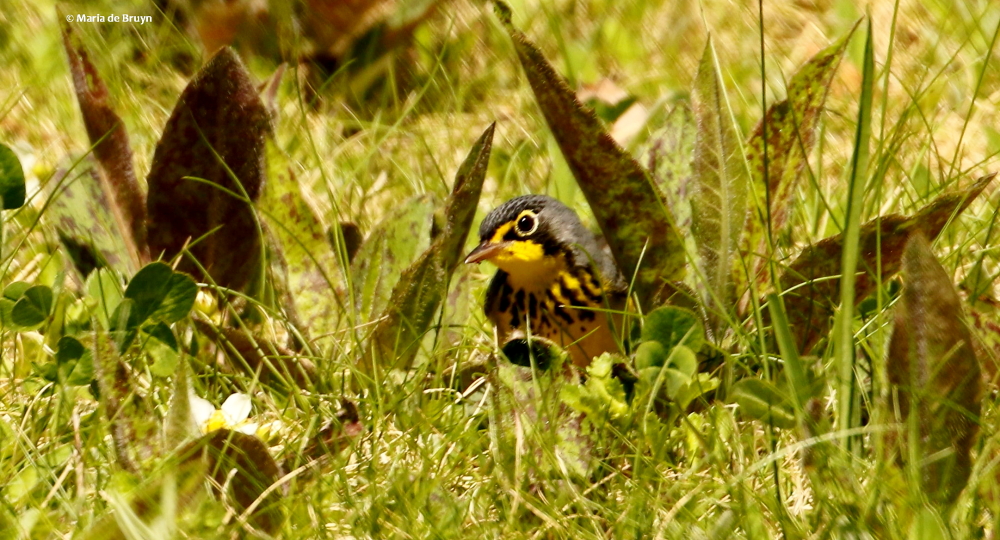
Another warbler that sports a black “necklace” against a yellow breast is the Canada warbler (Cardellina canadensis). Males and females look similar except that the male has a bit longer tail and somewhat darker breast stripes.
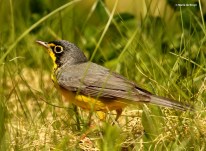
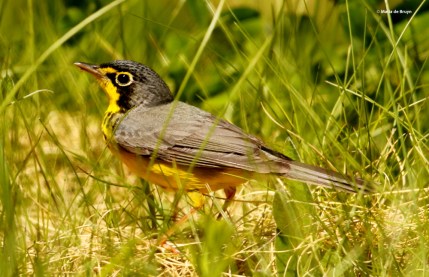
 

Some of these birds spend the summer in the Appalachian Mountains of western North Carolina (NC), but I had not seen one before. Towards the end of our trip, a Canada warbler decided to forage in the yard of the house where we were staying – finally, I was able to get some good looks at him!

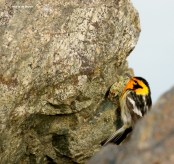
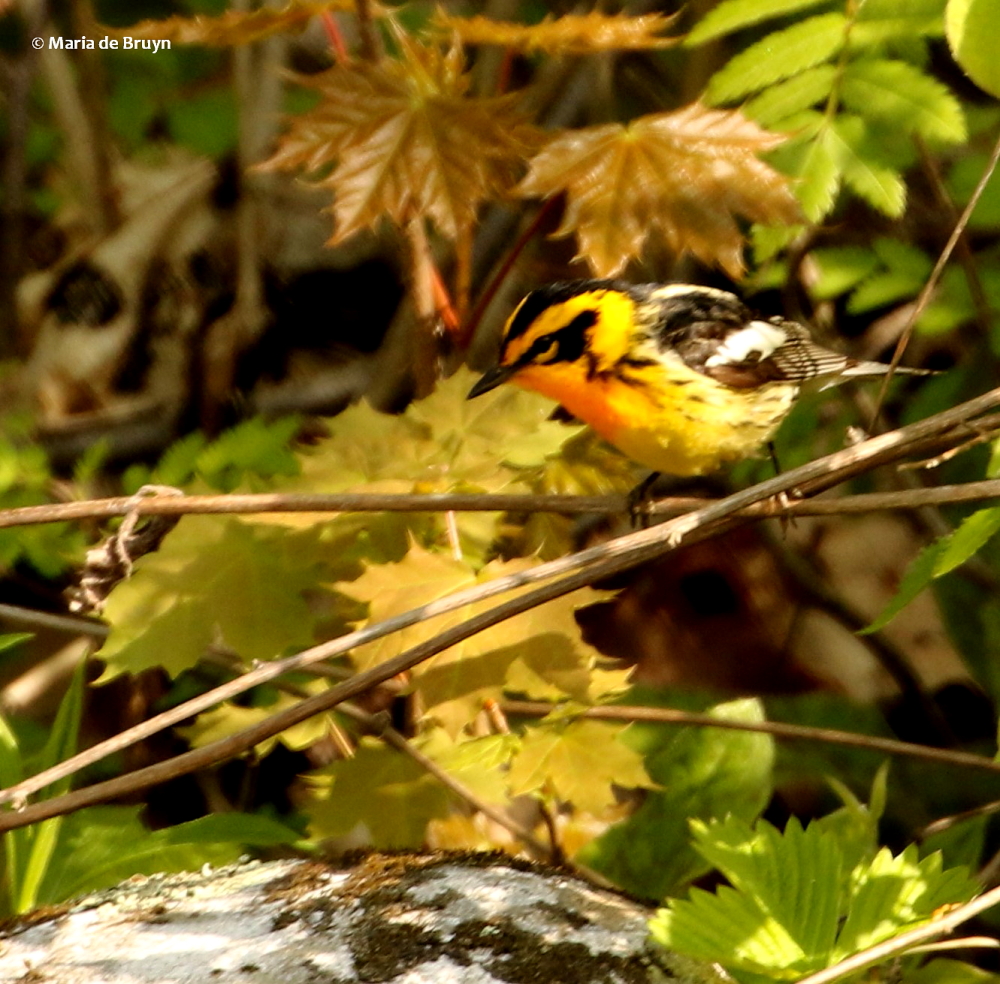
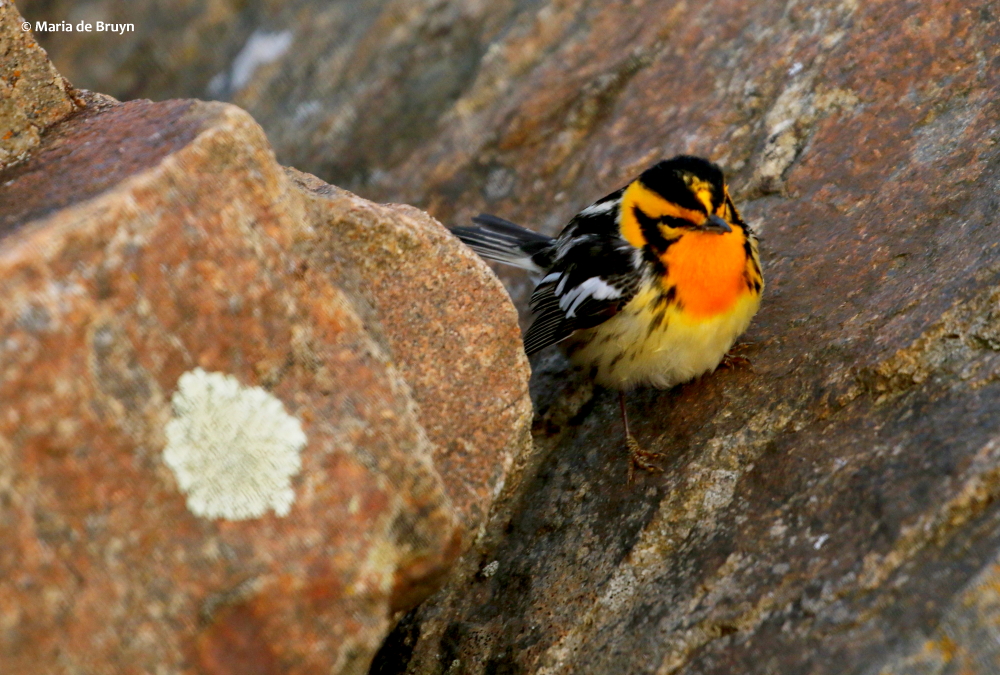
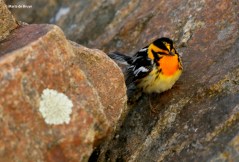
The male Blackburnian warbler (Setophaga fusca) also has black breast stripes but against a white background. His face is quite striking with a flame-orange throat against a yellow and black head.  The female is somewhat more muted in coloration but also quite lovely.
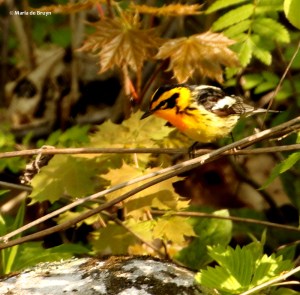
 

These birds do not appear to be shy around people. One was grabbing insects in a grassy patch near a parking lot and not at all perturbed when five of us stopped nearby to take portrait shots.

Another was intent on getting insects among the rocks alongside a pier.


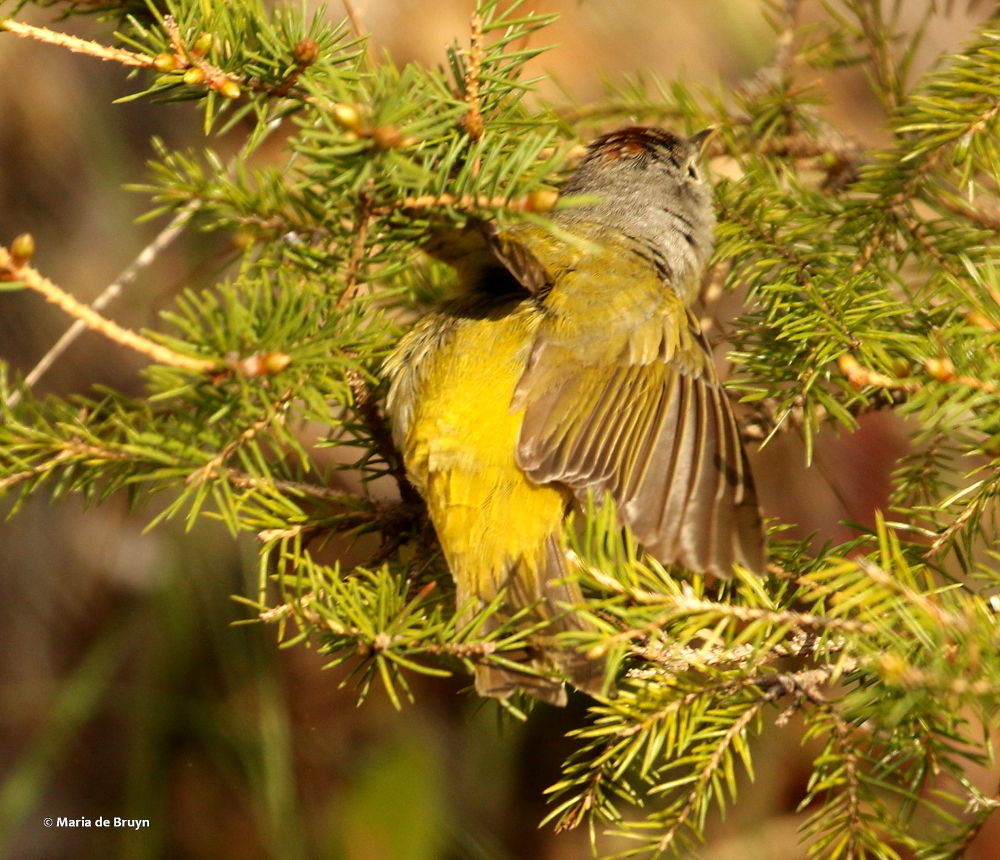
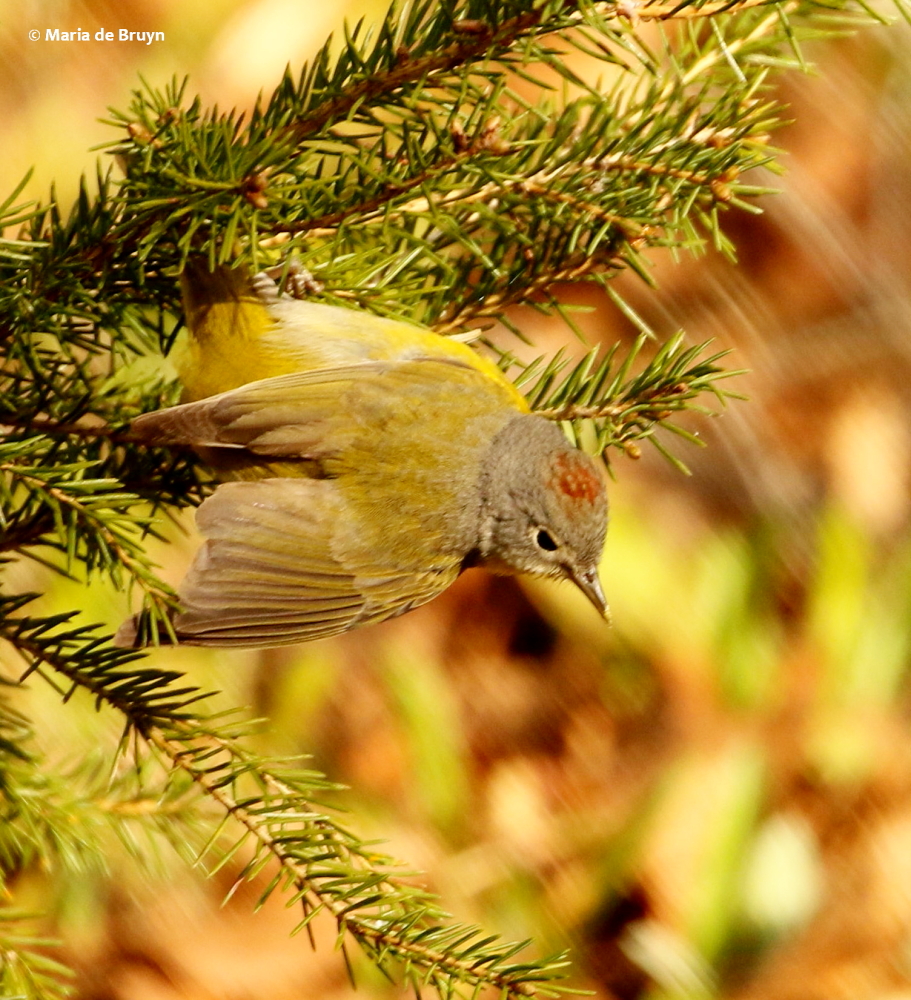
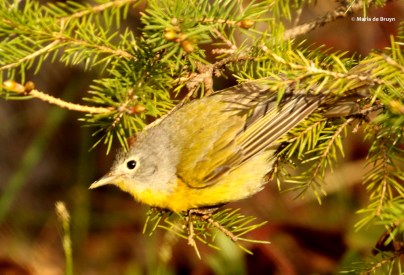
The Nashville warbler (Oreothlypis ruficapilla) was a lifer for me, fairly easy to distinguish by its rufous cap.


An interesting bit of information about them is that they sometimes use porcupine quills in constructing their nests, which they locate on the ground under shrubs!
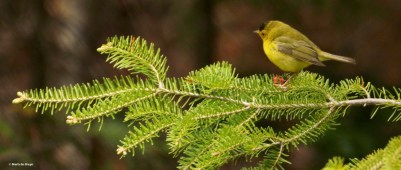
The Wilson’s warbler (Cardellina pusilla) also has a distinctive cap, but when I got to see one around dusk one day, it didn’t feel like turning around to face me. It was nevertheless another lifer.

They spend a lot of time in the understory and nest on the ground, but that apparently doesn’t make them easier to spot!
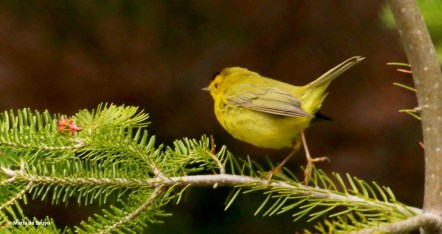
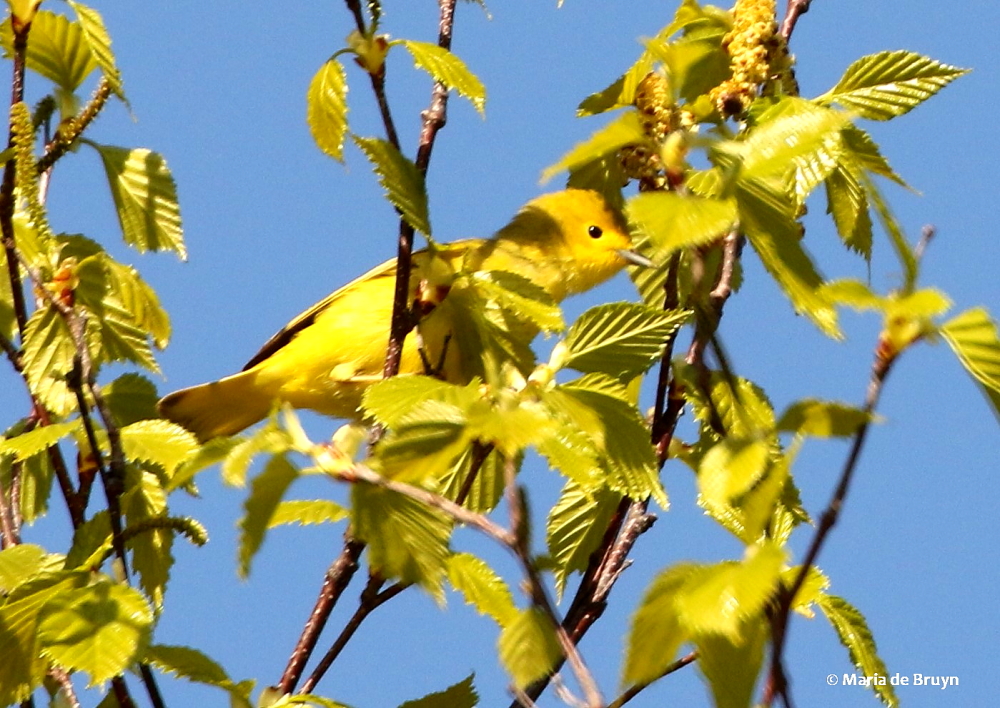
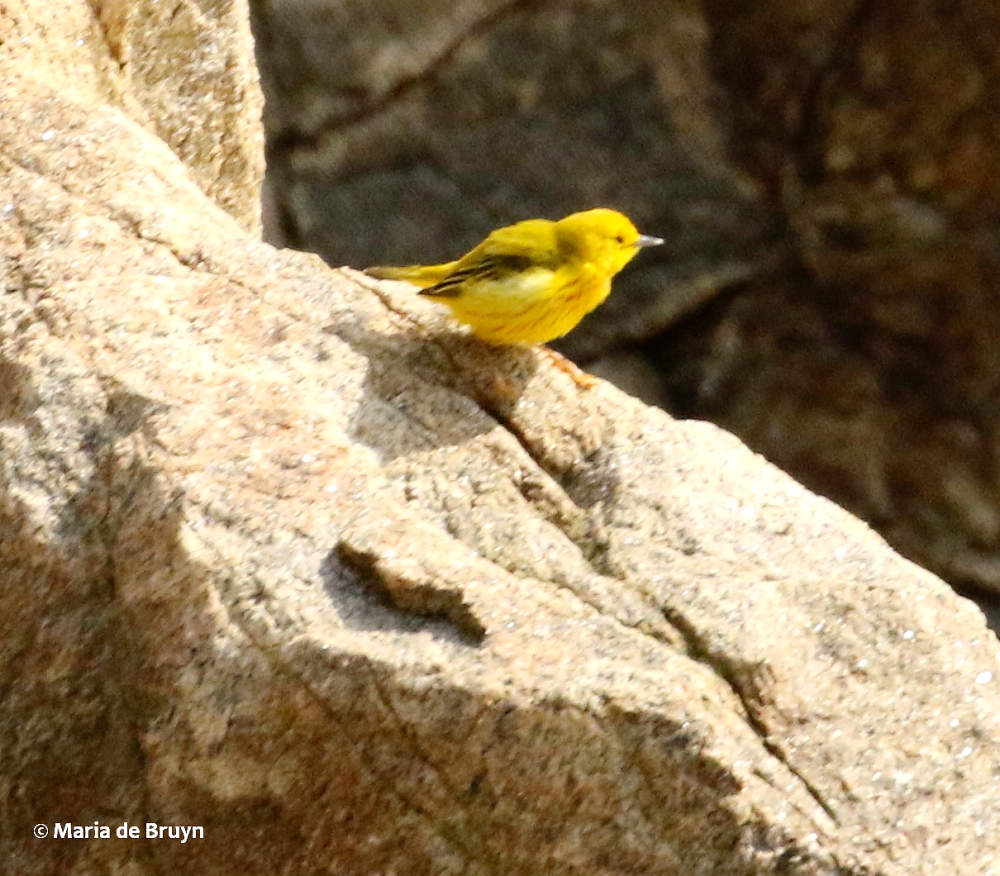
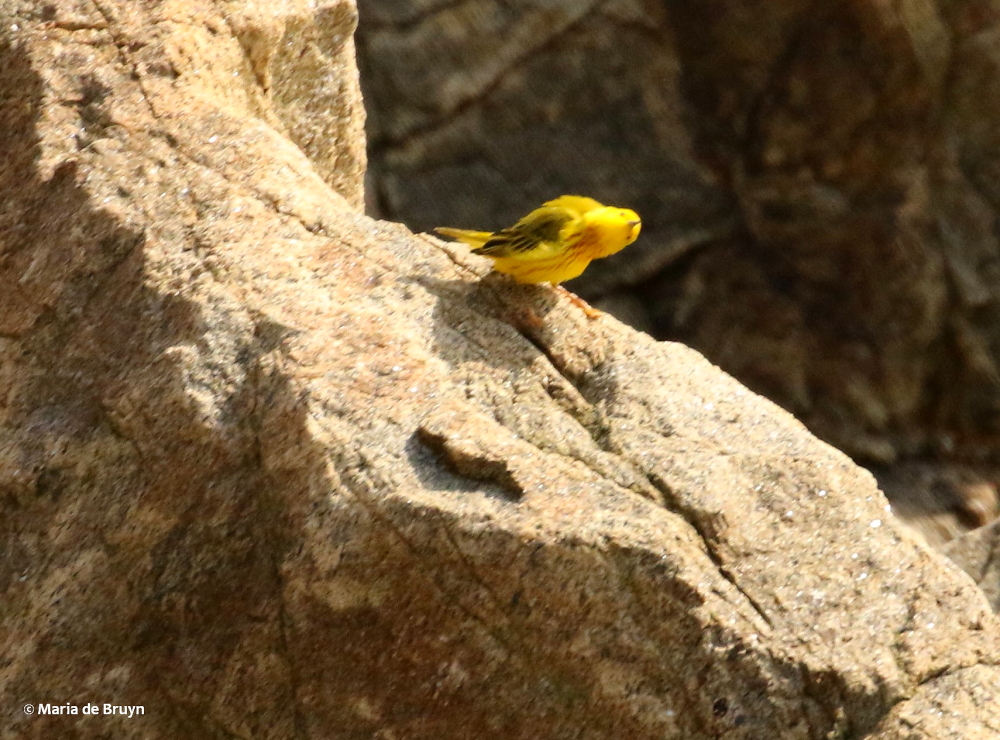
One warbler that I have seen several times in NC is the tiny yellow warbler (Setophaga petechia). They tend to like being near wetlands and streams and this has proved to be the case for my spottings. I have seen them near a water ditch in one reserve as well as near the Haw River. In Quebec, I also saw one searching for insects in the rocks bordering a pier.


You can see that this warbler has reddish striping on its chest and that is what I’ve noted in the birds seen in my area. However, below you can see a male bird without striping; our local guide said that a number of birds that breed in Quebec do not develop any striping but remain entirely yellow.
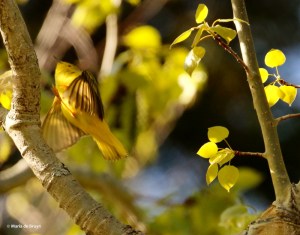
 

A behavior that distinguishes them from many other birds is that they are capable of recognizing when a brown-headed cowbird has laid one of its eggs in their nest. The yellow warblers try to avoid raising the nest parasite by smothering the cowbird egg with a new layer of nest materials. If they had already laid eggs of their own, they then produce a new clutch; sometimes, they just build a new nest elsewhere.
Another warbler that is quite familiar to me is the yellow-rumped warbler (Setophaga coronata). A group spends the winter at my yard feeders and begin changing into their breeding plumage shortly before migrating north. In Quebec, I got to see them in their full coloration, and they were handsome indeed!

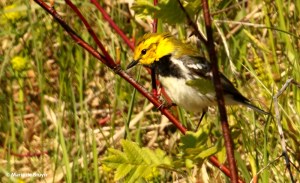
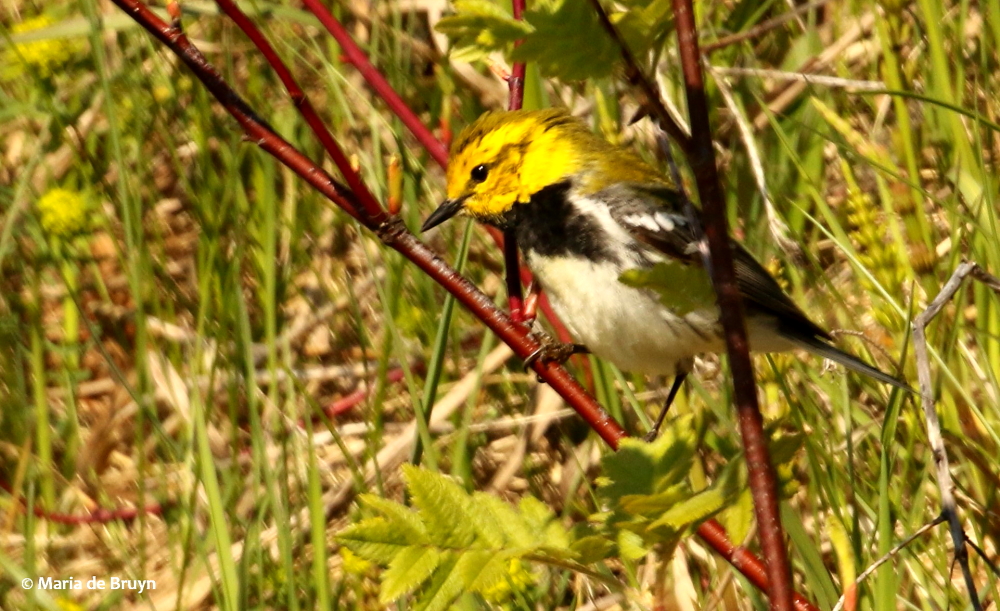
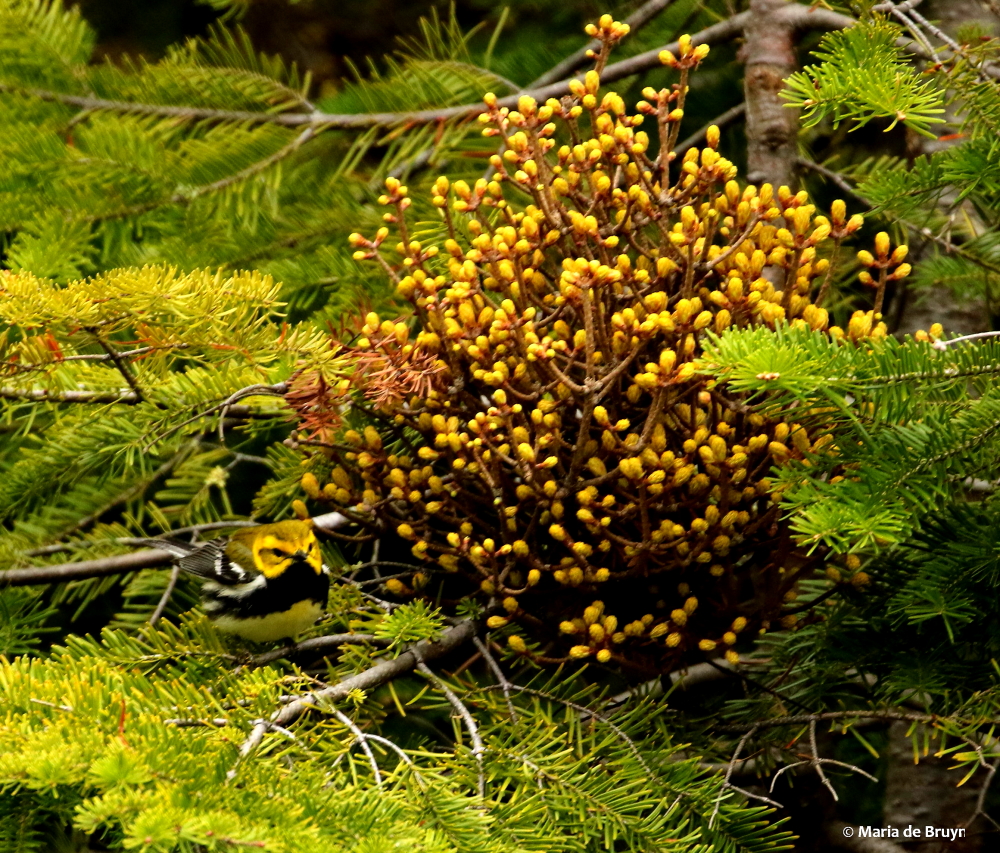
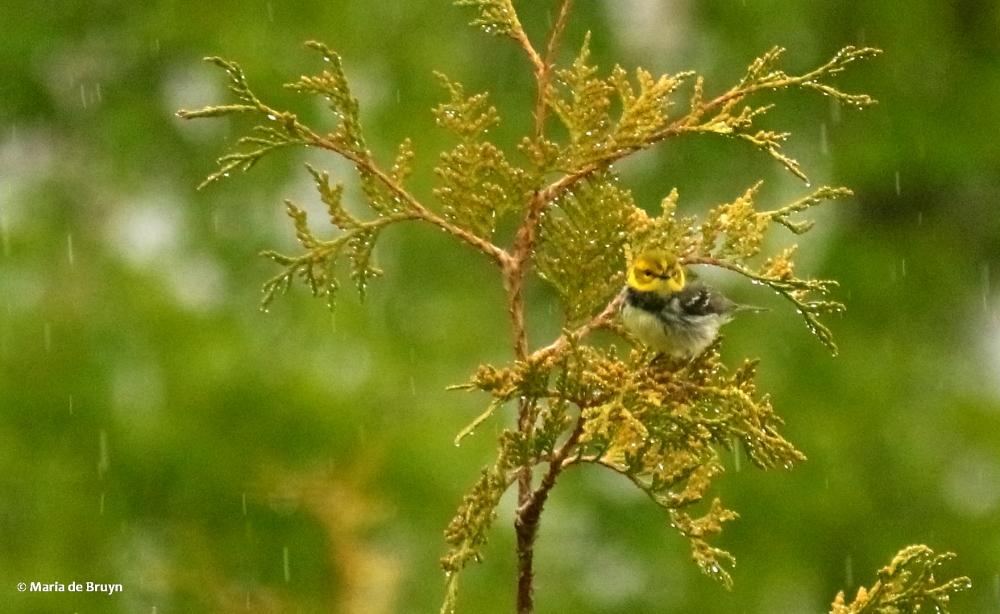
My final bird for this blog is also one I’ve seen before, but I found it simply stunning when watching it in the Canadian trees. The black-throated green warbler (Setophagahy virens) as the striped warblers but the brightness of the yellow and black coloring on the breeding male is wonderful to see.

They seemed to “color-match” some of the trees in which I watched them foraging.


In other cases, they complemented the deep green of the deciduous evergreen trees in which they were perching.


These birds particularly like caterpillars but eat a wide variety of insects. An interesting behavior observed by researchers concerns its singing – the males really like to belt it out, with one male having been recorded singing 466 songs in one hour!


Having observed these wood warblers in their breeding habitat, I now have an increased understanding of why birders are willing to endure warbler necks. 😊